Your brake pedal is a little softer than it was last month. The exhaust has picked up a rattly note on cold starts. The smog light came on, and now you're trying to decide whether to spend money on repairs, chase a smog appointment, or waste half a Saturday bouncing between shops and DMV lines.
That's the Antioch problem. Most drivers don't need more jargon, they need a clear read on what's urgent, what's annoying, and what can be handled in one clean trip. Antioch brake and muffler decisions get a lot easier when you stop treating every noise as a separate crisis and start looking at the whole visit, the symptom, the inspection, and the paperwork.
Table of Contents
- The Moment You Realize Your Car Needs Attention
- Warning Signs You Should Never Ignore
- What Brakes and Mufflers Actually Do in Your Car
- Typical Services and Realistic Cost Ranges in Antioch
- Certifications and Shop Traits That Matter
- Why a Test-Only Smog Station Changes the Equation
- Questions to Ask and How to Prep Your Car
- Putting It All Together This Week
The Moment You Realize Your Car Needs Attention
You're backing out of a driveway in Antioch, hit the first stop sign, and hear a high squeal that wasn't there yesterday. Or the car starts cold, the muffler gives off a low rumble, and the sound follows you down the block like it's attached to the bumper. That's usually the point where people start guessing, and guessing is how you end up paying twice.
The smarter move is to treat the noise as a system warning, not a single-part verdict. A brake squeal can be pads nearing the end. A rattle can be a loose heat shield, a worn hanger, or internal exhaust wear. A soft pedal, steering shake, or exhaust hiss each points in a different direction, and the difference matters because the right shop should be able to explain it before they turn a wrench.
Practical rule: If the symptom changed the way the car feels, not just the way it sounds, stop waiting for it to “go away.”
What this guide really protects you from is vague estimates, mystery add-ons, and the classic “we found three more things” surprise. Antioch drivers don't need a lecture. They need enough clarity to know whether they're asking for brake work, muffler work, a smog check, or just a straight answer from the person holding the clipboard.
Warning Signs You Should Never Ignore
What your ears are telling you
A squeal at low speed usually means the pad material is getting thin enough that the wear indicator is doing its job. Grinding is more serious, because metal is likely contacting metal, and that's the point where delay becomes damage. On the exhaust side, a hollow rumble, ticking, or sharp hiss often means the system is leaking somewhere it shouldn't.
A smell matters too. Exhaust odor in the cabin is not something to brush off, and a hot, metallic smell after braking hard is a clue that the system has been working too hard or dragging. If a sound shows up every morning and fades later, that doesn't make it harmless, it usually means the part is warming up and temporarily masking the issue.
What you feel through the car
A brake pedal that feels spongy, low, or inconsistent deserves attention fast. So does a steering wheel shake during braking, because that usually means the braking surface isn't contacting evenly. If the car pulls left or right when you stop, don't normalize it.
For exhaust issues, the main thing you feel is a change in how the car breathes or sounds under load. You may notice more cabin drone, more vibration at idle, or a weaker, less settled response. Those aren't cosmetic problems. They're clues.
What you can see without tools
Check the driveway or parking spot for fluid. Brake fluid leaks are not a “watch and wait” item. Rust streaks, hanging exhaust parts, or a visibly separated pipe connection also tell you more than a five-minute sales pitch ever will.
- Urgent now: grinding brakes, fluid leaks, exhaust smell in the cabin, strong pulling under braking.
- Book soon: squealing, light vibration, rumble on startup, small exhaust rattle.
- Document first: dashboard lights, odd smells, or changes that happen only under specific conditions.
If you can describe the symptom in plain English, the shop has less room to pad the diagnosis.
What Brakes and Mufflers Actually Do in Your Car
The brake side, part by part
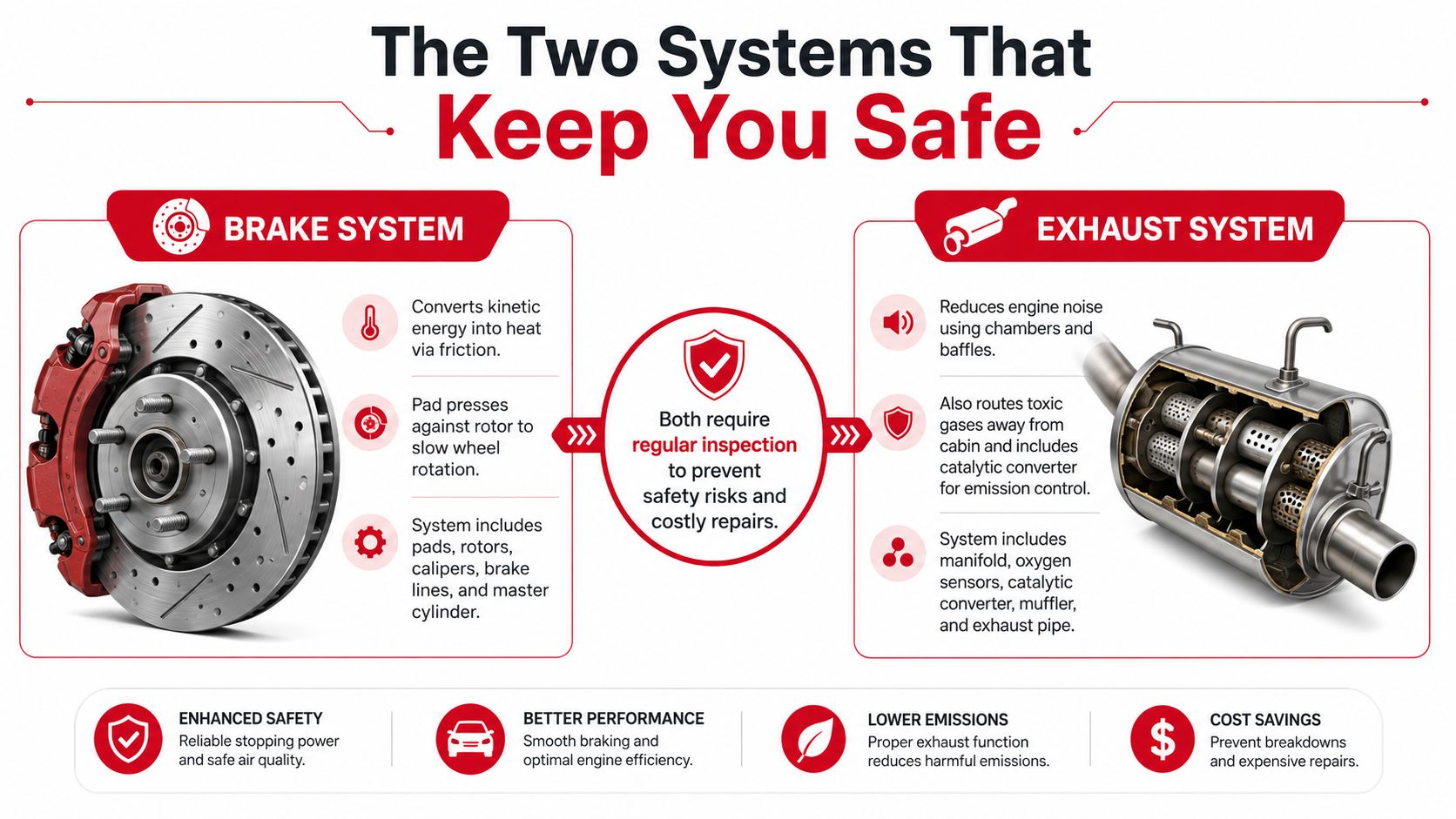
Brakes aren't one component. They're a chain. The pads are the wearing surface, the rotors are the friction disc, the calipers clamp everything together, and the lines and master cylinder move fluid to make it all work. If a shop says “you need brakes,” that could mean simple pad replacement, or it could mean the rotor surface is too far gone, a caliper is sticking, or the fluid system isn't doing its job.
That's why pricing changes so much from one quote to another. A pad swap is a very different job from a caliper-and-rotor job, and the labor, hardware, and fluid needs are not the same. If the estimate doesn't break that out, push back.
The exhaust side, part by part
The exhaust system does more than mute noise. It routes hot gases away from the cabin, helps control emissions, and uses parts like the manifold, sensors, catalytic converter, resonator, muffler, and tailpipe to balance sound and flow. A muffler is only one piece of that chain, so “muffler repair” can mean a small patch, a section replacement, or a larger exhaust job.
That's also where fitment matters. A muffler that looks close enough can still alter back-pressure and drivability if the inlet size, body length, or offset is wrong. Donaldson's engine-brake silencer specs show that flow behavior changes at different pressure conditions, which is a good reminder that exhaust design affects more than sound. Donaldson's exhaust product guide makes that point plainly.
Practical rule: If the quote doesn't specify the exact brake or exhaust part being replaced, you're not comparing the same job.
For drivers trying to cut emissions and avoid repeat visits, a basic maintenance mindset helps. Fire House Smog's emissions guide is worth reading before you assume a warning light means the same thing for every vehicle.
Why fit and material matter
OEM-style muffler catalogs list aluminized-steel, baffled oval mufflers with common inlet and outlet diameters from about 2.0 to 3.5 inches and overall lengths from roughly 22 to 31 inches. Fortluft's exhaust catalog shows how much those dimensions vary. That's not cosmetic trivia, because a poor match can make installation harder, sealing worse, and the exhaust note harsher than it needs to be.
Typical Services and Realistic Cost Ranges in Antioch
What you're usually paying for
Most Antioch brake and muffler work falls into a few buckets. Pads alone are the lightest job. Rotors add machining or replacement. Calipers raise the bill because they're a labor and parts step-up. On the exhaust side, a single muffler repair is one thing, but a larger section or catalytic converter-related job is a different conversation entirely.
The honest way to think about pricing is not, “What's the cheapest place?” It's, “What exactly is included?” Hardware kits, brake fluid, sensors, clamps, hangers, and diagnostic time can all be hidden in the fine print. The low quote often just omits the parts that make the repair hold together.
A simple comparison
| Service | Typical Range | What Moves the Price |
|---|---|---|
| Brake pad replacement | Lower to mid-range | Vehicle layout, pad quality, rust, labor access |
| Rotor resurfacing or replacement | Mid-range | Rotor condition, hub corrosion, vehicle type |
| Caliper service | Mid to higher range | Sticking hardware, fluid condition, integrated brake design |
| Single muffler replacement | Lower to mid-range | Pipe size, hanger damage, weld work, fitment |
| Full exhaust section repair | Mid to higher range | Rust, clamp failure, sensor removal, custom fabrication |
| Catalytic converter replacement | Higher range | Emissions parts, sensor work, vehicle-specific fitment |
Those are not sticker prices, they're planning buckets. The point is to keep you from walking into a shop with a fantasy number in your head and getting frustrated when reality shows up.
What pushes the job up
European and luxury vehicles usually take more labor. Rusted fasteners slow everything down. Integrated parking brake calipers and emissions-related exhaust parts can add complexity fast. If a shop explains those variables clearly, that's a good sign. If it just throws out a number and hopes you don't ask questions, keep walking.
Certifications and Shop Traits That Matter
The credentials that actually mean something
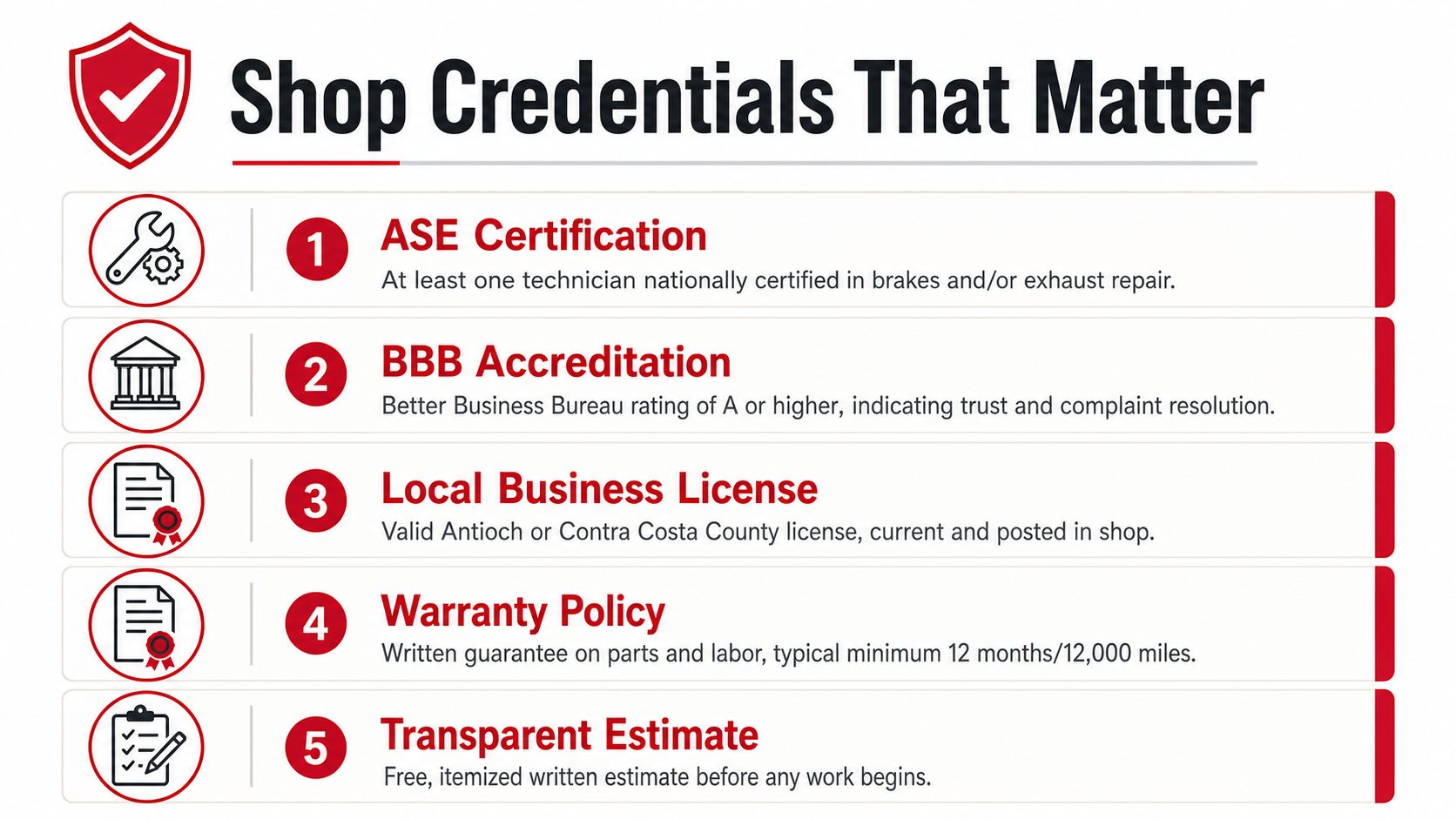
A clean lobby doesn't mean much. ASE certification does matter, because it shows the technician has passed recognized testing in a trade area. A real written estimate matters even more. So does a warranty you can read without asking three times what it covers.
For smog work, STAR certification is not a bragging-rights badge, it's a California smog-program label tied to inspection oversight. If you need that side of the process, the question isn't whether the shop has a nice waiting room, it's whether it is operating in the right lane for your vehicle and paperwork.
Fire House Smog's STAR-certified station page spells out that model clearly.
What trustworthy shops do without being asked
- Break out the estimate: parts, labor, and any sublet work should be separate.
- Show the worn parts: if they replaced it, they should be willing to show it.
- Explain the warranty: if they dodge the warranty question, that's a red flag.
- Keep the bay organized: a messy work area usually means sloppy habits elsewhere.
- Answer direct questions: if they can't explain the repair in ordinary language, they don't understand it well enough.
A good shop doesn't get defensive when you ask about parts, labor, and warranty. It gets specific.
One more thing. California DMV-related services are a different category from repair work. If a business can handle inspection and registration tasks on-site, that's useful, but it doesn't make its brake advice more credible. Judge each function on its own.
Why a Test-Only Smog Station Changes the Equation
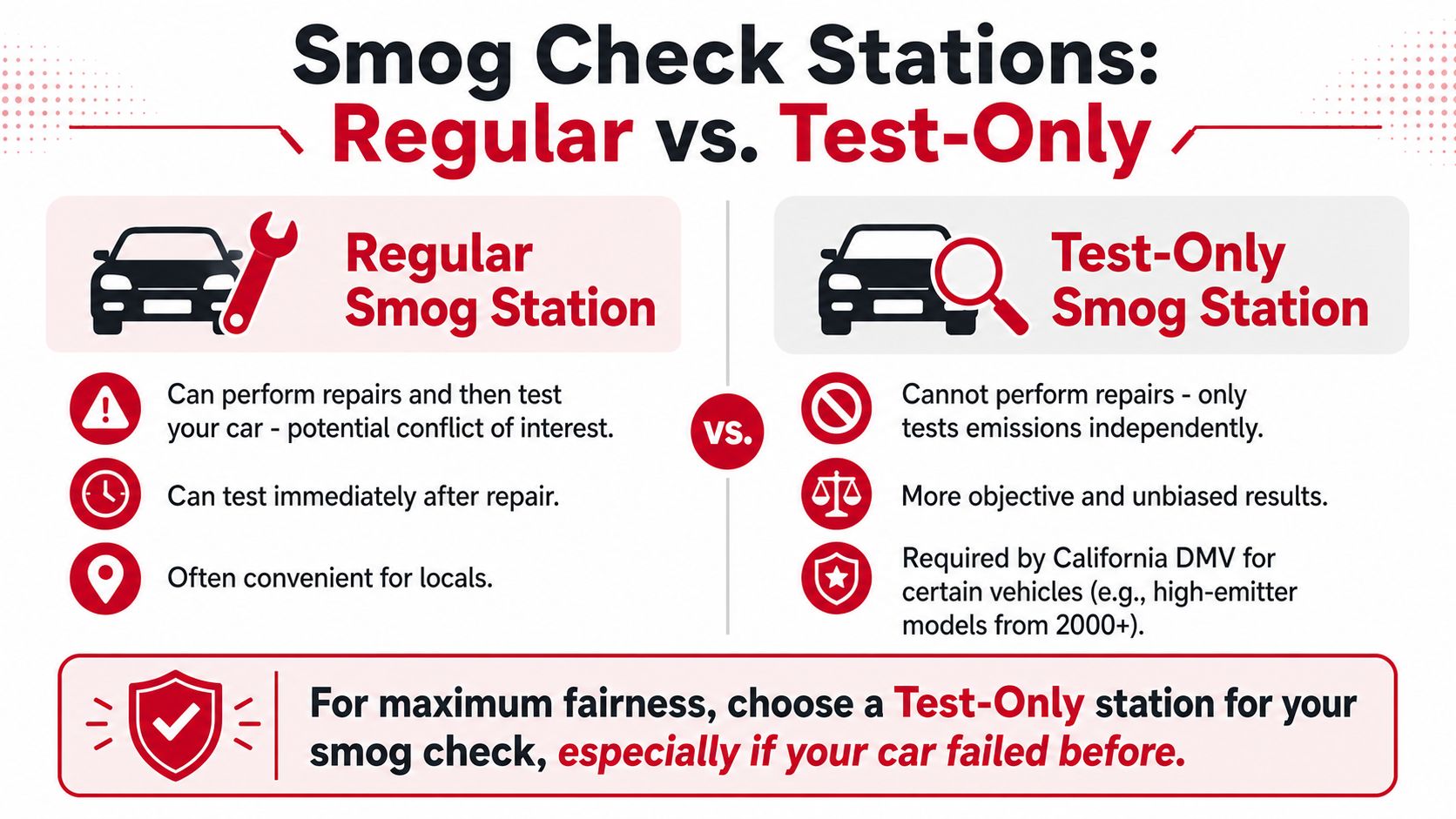
Why the business model matters
A test-only station cannot sell the repair work that follows a failed test. That changes the conversation. The person running your inspection has less reason to turn a borderline result into a sales pitch, which is exactly why a lot of drivers prefer that setup when they want a straight read.
A repair-oriented shop can still be honest, but the incentive structure is different. If the same place inspects, diagnoses, and repairs, you should ask more questions, not fewer. That doesn't make it bad. It just means you should know what game you're playing.
Where STAR stations fit
California's STAR program adds another layer of oversight for certain vehicles and testing situations. The practical value for the driver is not the label itself, it's the confidence that the test is being run in a tighter lane. For a car that's been on the edge before, that can be a smarter first stop than guessing at a repair bill and then getting tested somewhere else anyway.
The convenience angle matters too. A station that handles smog and DMV registration on-site turns two errands into one. Fire House Smog's in-and-out test-only center page reflects that workflow, including test-only service and registration support.
What to look for in the appointment itself
If a station offers a free retest, extended hours, and on-site tag issuance, that's not fluff. It's a time saver. For Antioch drivers balancing work, family, and more than one vehicle, convenience often matters more than shaving a few dollars off the first line item.
Questions to Ask and How to Prep Your Car
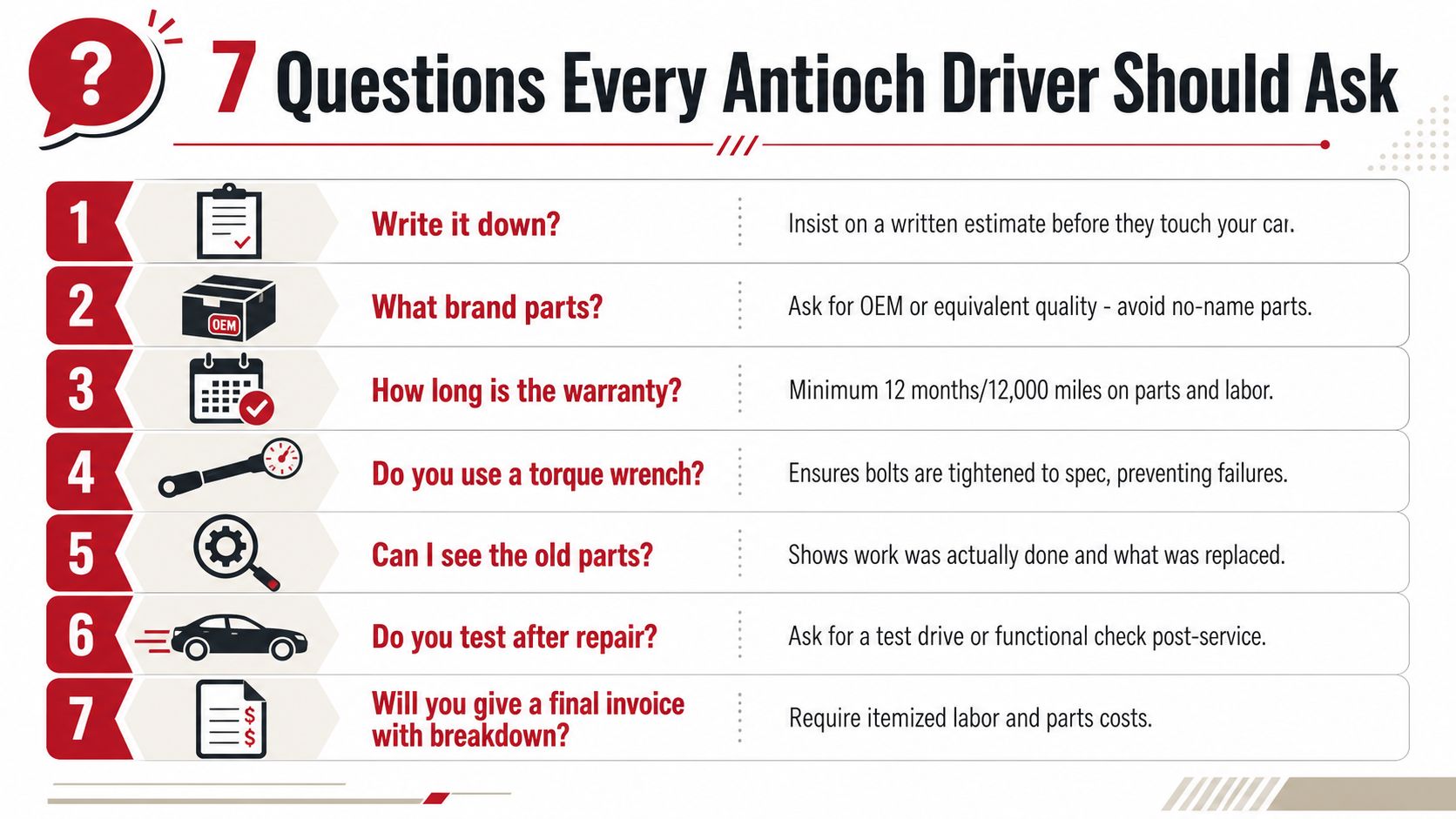
The seven questions that expose weak shops
Ask these before you agree to anything. If the answers are vague, the shop is telling you what kind of experience you're about to have.
- Write it down? Ask for a written estimate before work starts.
- What brand parts? Get the exact part quality, not “good stuff.”
- How long is the warranty? Parts and labor should be covered in writing.
- Do you use a torque wrench? On brake and wheel-related work, that matters.
- Can I see the old parts? If they can't show them, ask why not.
- Do you test after repair? A repair that isn't checked is unfinished.
- Will you give a final invoice with breakdown? You want the final paper trail, not a shrug.
These questions work at a muffler shop, a brake shop, or a smog station. They're short, direct, and hard to dodge.
Fifteen minutes of prep saves time
Clear the trunk. Note any warning lights. Snap a photo of the dash before you leave home. Make sure the gas cap seals properly. If you're bringing the car in for brake work, release the parking brake before you arrive if the shop asks for it, and park on level ground whenever you can.
For smog and registration, bring the renewal notice, payment, ID, and any paperwork that applies to an out-of-state transfer. If the vehicle has an obvious issue like a check-engine light, don't hide it. A good station would rather know up front than waste your time pretending the problem isn't there.
One honest checklist before you hand over the keys
- Paperwork ready: renewal notice, ID, payment, transfer forms if needed.
- Car ready: gas cap tight, dashboard photo saved, trunk cleared.
- Problem described: one sentence about what changed, when, and how often.
- Expectation set: ask what happens if the diagnosis changes once the car is in the bay.
If a shop can't handle that conversation, it probably can't handle the repair cleanly either.
Putting It All Together This Week
Start with the symptom, not the sale. If the problem is braking, pulling, squealing, or exhaust noise, you need a repair shop that can explain parts, labor, and warranty without dancing around the question. If the task is smog, registration renewal, or a transfer, a STAR-certified test-only station is the cleaner choice because it removes the repair-sales conflict and keeps the visit focused.
Then use the questions. Don't skip them because the counter person sounds busy. A shop that's worth your money will answer them clearly, and a station that can handle smog plus DMV work should be able to tell you exactly which documents you need before you arrive. Convenience is only valuable when it comes with transparency.
For a lot of Antioch drivers, the smart move is a one-trip workflow, smog, registration, and any follow-up paperwork handled together. That saves you from the usual shuffle, and it keeps you from paying for a repair you didn't need just to get a sticker.
If you want a test-only smog check with on-site DMV registration support in Antioch, Fire House Smog handles that workflow in one stop. Visit Fire House Smog to check the service details, bring the right paperwork, and get in and out without turning it into a second errand.
After the Fender Bender: Finding Your Antioch Auto Body Shop
A crash changes your day fast. The tow, the estimate, the insurance call, and the worry about whether your car will ever look right again can all hit at once. If you're sorting through auto body shop Antioch CA options right now, the job is bigger than picking a paint booth. You need a shop that can handle the repair correctly, explain the process clearly, and keep your life moving while the car is off the road.
Antioch has plenty of collision-repair choices, and that can help if you know what kind of help you need. Some drivers need insurer-friendly structural repair, some need a local shop that can move fast on cosmetic damage, and some need a cleaner answer to the bigger “whole problem,” whether that means DMV paperwork, emissions compliance, or avoiding another trip across town. The shops below give you a practical starting point.
Table of Contents
- 1. Crash Champions – Antioch
- 2. Caliber Collision – Antioch Wilbur Ave
- 3. Jim's Auto Body – Antioch
- 4. G&C Auto Body – Antioch
- 5. Geno's Auto Body – Antioch
- 6. Juanito's Auto Body – Antioch
- 7. Hillcrest Auto Lounge Autobody Repair and Paint
- Antioch Auto Body Shops, 7-Shop Comparison
- Making Your Final Choice in Antioch
1. Crash Champions – Antioch
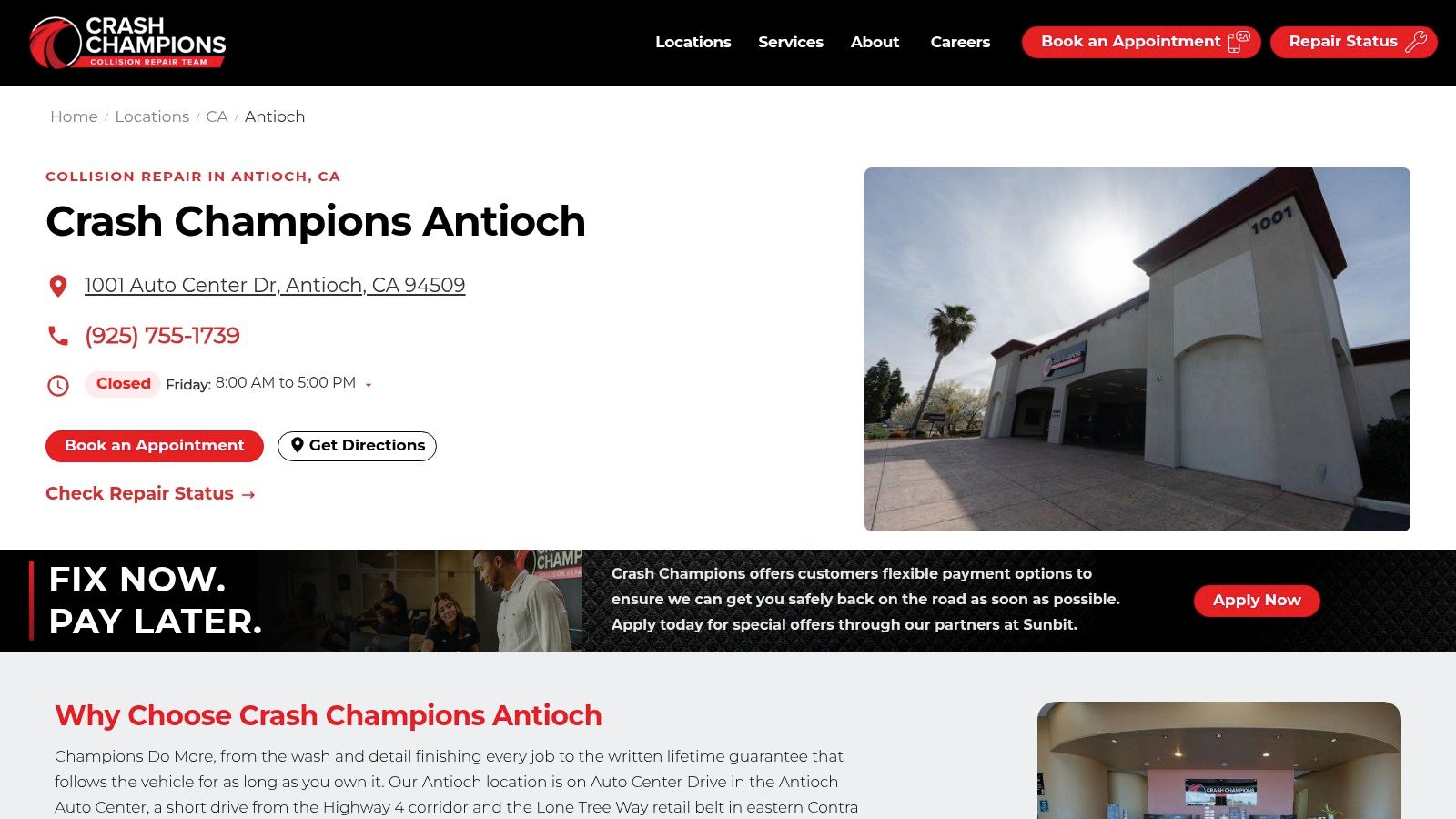
Crash Champions fits drivers who want a structured, insurer-friendly process. Its Antioch location on Auto Center Drive is a strong option for newer vehicles, especially if you're dealing with a claim and don't want to chase updates by phone all day. The shop's online appointment booking and repair-status tools matter more than they sound like they do when your car is already sitting in a lot.
What stands out
The key advantage here is confidence around modern repairs. Crash Champions highlights OEM-certified repairs for brands like FCA, Ford, GM, Honda, Hyundai, Infiniti, Kia, and Nissan, plus I-CAR Gold Class technician training and ADAS calibration support. That combination is useful if your vehicle has sensors, driver-assist features, or late-model repair requirements that older body shops may not handle as smoothly.
The trade-off is the usual chain-shop reality. Experience can vary by location and management, and lead times can stretch when demand spikes. If you're choosing based on consistency and claims handling, though, this shop belongs near the top of the list.
- Best for insurer-coordinated claims: The process is built for documentation, status tracking, and standard repair workflows.
- Best for newer vehicles: OEM repair posture and ADAS support matter more on cars with advanced electronics.
- Less ideal for boutique work: If you want classic restoration or highly custom finishing, this isn't the first call.
For drivers who still need emissions or registration help after the repair, it helps to separate body work from compliance work. A dedicated test-only station like Fire House Smog's Lone Tree Way location can keep the administrative side from slowing down the collision side.
Practical rule: If the estimate includes sensors, camera calibration, or a lot of insurer back-and-forth, choose the shop that explains the workflow before they take the car apart.
Best fit
Pick Crash Champions if you want a big-network process and you'd rather have the claim handled cleanly than chase a more specialized craft-shop experience. It's a sensible choice for late-model daily drivers that need predictable documentation and repair coordination.
2. Caliber Collision – Antioch Wilbur Ave
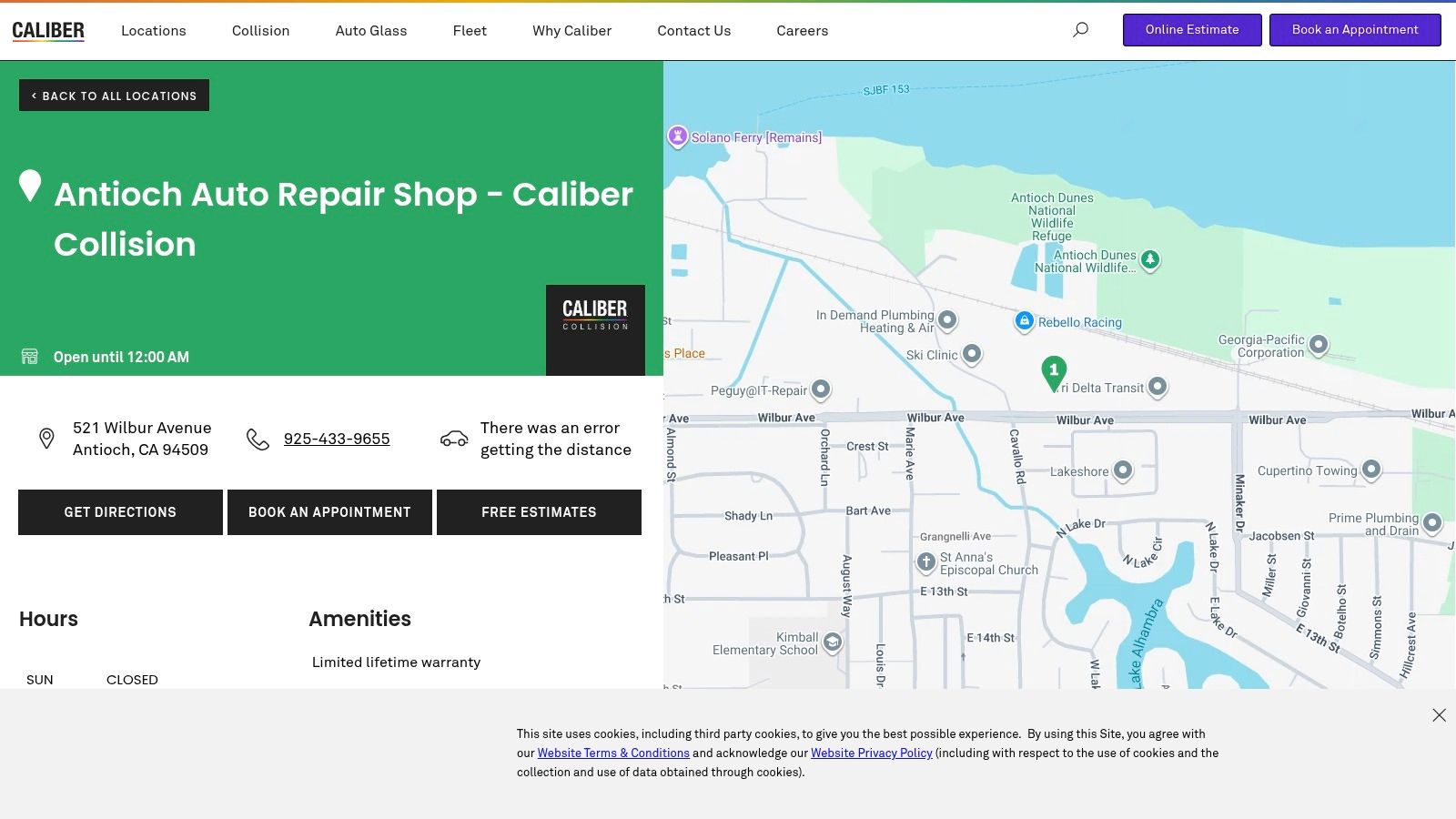
Caliber Collision on Wilbur Avenue is the sort of shop that appeals to people who need scale. If your repair depends on parts sourcing, insurer communication, and a predictable intake process, a large network location can reduce friction. That matters when your vehicle is out of service and every extra day affects work, school runs, or jobsite schedules.
What stands out
The main draw is operational depth. Caliber's networked process and parts-sourcing reach are a real advantage when the job isn't simple bumper paint, and the online scheduling setup makes it easier to get on the calendar without driving around town first. For working drivers, weekday availability is a practical plus, not a marketing line.
The downside is also familiar. Large chains can be efficient, but the experience can feel less personal, and they're usually not the best match for custom or classic restoration work. If you want a more personalized relationship with one technician or owner, a smaller shop may feel better.
A large collision network is useful when the car needs organized parts flow more than creative problem-solving.
Best fit
This is a strong option for drivers who care about documentation, insurer coordination, and getting replacement parts moving quickly. It's less attractive if your project is cosmetic, custom, or something you want managed as a one-off from start to finish.
If you're trying to keep the whole repair-and-paperwork process under control, it helps to keep compliance separate from body work. Fire House Smog's smog-check service in Antioch is useful when registration timing matters as much as the repair itself.
What to ask before you book
- Parts sourcing: Ask how they handle delays on backordered components.
- Communication cadence: Find out how often you'll get updates once the car is in.
- Claim handling: Confirm whether they'll work directly with your insurer's workflow.
Best fit
Choose Caliber if you want a big-shop system with broad parts and claims support. It's a practical play when the repair is straightforward on paper but likely to need structured coordination behind the scenes.
3. Jim's Auto Body – Antioch
Jim's Auto Body makes sense for drivers who need a more traditional collision-repair shop with real structural capability. The Antioch facility advertises frame straightening, aluminum repair, and refinishing, which puts it in the category of shops you want to take seriously after a harder impact. The limited lifetime warranty language is also appealing, but only if you read the terms and understand who it applies to.
What stands out
The practical advantage here is range. Frame work, aluminum repair, and refinishing are not minor add-ons, they're signs that the shop is set up for more than quick cosmetic work. That matters if the damage changed alignment, affected structural components, or left the car looking fixable but driving wrong.
The caution is simple. Any lifetime warranty needs to be understood in writing, because those terms can depend on ownership status and other conditions. Appointment backlogs are also more likely after major weather events or a local burst of collision volume.
What to verify in person
- Warranty wording: Ask what “limited lifetime” covers and who qualifies.
- Structural workflow: Confirm whether the estimate includes frame measurements.
- Aluminum capability: Make sure the shop has the equipment for your vehicle's body material.
Jim's is a better fit than many national chains if your repair is more serious than a paint blend and a bumper cover. The regional reputation also helps if you prefer a shop that has been around long enough to build word-of-mouth trust.
Best fit
Pick Jim's Auto Body when the car needs real collision repair depth and you want a place that understands structural work, not just cosmetic patching. It's a strong option for owners who care more about repair quality than about a polished app experience.
4. G&C Auto Body – Antioch
G&C Auto Body is a good fit for drivers who want the backing of a larger Northern California network without losing the feel of a regional operator. The Antioch location emphasizes I-CAR-certified technicians, OEM repair-procedure adherence, and online appointment requests, which makes it appealing if you're trying to protect a late-model vehicle while still working through an insurance claim.
What stands out
The main strength is consistency. Multi-shop operators often have more standardized processes than small independents, and that can help when you want fewer surprises during teardown, parts ordering, and final delivery. G&C also participates in community programs, which won't fix your car faster, but it does suggest the business is rooted in the region rather than operating as a detached franchise outpost.
The trade-off is familiar to anyone who has used a large network. Customer experiences can vary, and the shop may not be the right match for custom or classic restoration work. That doesn't make it weak, it just means the shop is optimized for a different kind of job.
Use the shop's size to your advantage. Ask how they document OEM procedures and who signs off on the final repair before you approve the work.
Best fit
G&C is a strong choice if you want insurer coordination, documented repair methods, and a shop that looks built for contemporary collision work. It's especially useful if your car is new enough that repair procedure matters as much as body fit and finish.
5. Geno's Auto Body – Antioch
Geno's Auto Body is the kind of neighborhood shop many Antioch drivers end up liking because it feels direct. The Antioch location on W. 10th Street, plus sister shops in Brentwood and Concord, gives it some flexibility if one branch is backed up. That matters when you're trying to get work started without waiting for the calendar to clear.
What stands out
The shop covers collision repair and paint, and the Saturday-by-appointment option is genuinely useful for people who can't disappear from work in the middle of the week. Flexible routing to another location can also keep a job moving if the Antioch shop is full. That kind of practical adaptation is often more valuable than a flashy website.
The limitation is that smaller shops sometimes publish fewer formal certifications online. That doesn't mean they can't do good work, but it does mean you should ask directly about the technical side, especially if your vehicle has advanced electronics or needs a more complex repair plan.
Best fit
Geno's is a solid option if you want accessible communication and a shop that can be nimble about scheduling. It works best for drivers who value a local feel and don't mind asking detailed questions before leaving the car.
Questions worth asking
- Routing options: If Antioch is full, can your car be handled at a sister location?
- Rental coordination: Will they help manage the downtime?
- Paint match: How do they handle blends on adjacent panels?
If your repair is tied to a broader compliance deadline, don't let the body work swallow the whole week. Fire House Smog's explanation of smog-check fail reasons is useful when you're trying to avoid a second round of surprises after the repair is done.
6. Juanito's Auto Body – Antioch
Juanito's Auto Body stands out because it doesn't treat every vehicle like the same insurance job. Along with collision repair, the shop handles custom paint, restoration work, and pinstriping, which makes it a better match for drivers who care about aesthetics as much as damage recovery. Classic cars and specialty finishes have different needs, and this shop leans into that.
What stands out
The strongest reason to call Juanito's is flexibility. If you've got a car that needs more than a standard repair, or you're planning cosmetic improvements alongside accident work, a shop with custom capability can save you from splitting the job in two. That is especially helpful when the vehicle isn't a plain commuter and you want the finish to look intentional, not just repaired.
The trade-off is that you should confirm structural and late-model repair capabilities before assuming the shop is the right fit for every collision. Custom work and OEM-style collision work overlap in places, but they are not identical. Turnaround can also be different when the project includes specialty finishes or restoration details.
Best fit
Juanito's is a smart pick for enthusiasts, classic-car owners, and drivers who want collision repair plus a cosmetic refresh. It's less of a default choice for the newest vehicles with heavy sensor and calibration needs, unless the shop specifically confirms that capability.
Good body shops explain what they do well and what they don't. That honesty usually tells you more than a polished gallery does.
7. Hillcrest Auto Lounge Autobody Repair and Paint
Hillcrest Auto Lounge brings a more personal, local style to Antioch body work. The shop on Sunset Drive handles collision repair, full refinishing, and custom design work, and it also offers general diagnostics. That broader approach can help when the car has both visible body damage and a separate issue you'd like checked while it's already in the bay.
What stands out
The hands-on owner involvement is the feature that most drivers will notice. Smaller local operators often communicate more directly, and that can make a stressful repair feel less abstract. If you're in Antioch, Brentwood, or Oakley, the shop's service area also makes it feel like a neighborhood option rather than a destination shop.
The caution is straightforward. The website is light on technical certification detail, so if your vehicle has ADAS features or other late-model requirements, you should ask specifically about calibration and insurer-network participation. That's not a knock on the shop, it's just the right way to compare a local independent against a more formal collision network.
Best fit
Hillcrest is a good fit for drivers who want a local relationship and aren't afraid to ask direct questions about process, timing, and technical capability. It works well for repair-plus-paint jobs where communication matters as much as the finish.
What to ask before you commit
- Calibration support: Can the shop handle modern sensors and related repair steps?
- Claim handling: Will they work cleanly with your insurer?
- Scope control: Are you getting collision repair only, or extra work you didn't ask for?
When the repair is done, the paperwork still matters. That's why it helps to keep a nearby compliance partner in mind, especially if smog or registration timing is part of the bigger headache.
Antioch Auto Body Shops, 7-Shop Comparison
| Provider | Process Complexity 🔄 | Resource & Equipment Needs ⚡ | Expected Quality & Impact ⭐📊 | Ideal Use Cases 💡 | Key Advantages |
|---|---|---|---|---|---|
| Crash Champions – Antioch | Standardized, insurer-friendly workflows; ADAS calibration adds technical steps 🔄 | High, OEM certifications, I‑CAR Gold techs, calibration gear ⚡ | High OEM-level repairs for late‑model cars; consistent claims documentation ⭐⭐⭐⭐ 📊 | Insurer-coordinated claims, ADAS-equipped or late‑model vehicles 💡 | OEM certifications, I‑CAR Gold, online booking & repair tracking |
| Caliber Collision – Antioch (Wilbur Ave) | Scaled, repeatable processes across network; insurer coordination streamlined 🔄 | Very high, deep parts sourcing and supply‑chain support ⚡ | Consistent, timely repairs when parts available; strong documentation ⭐⭐⭐ 📊 | Claims needing fast parts sourcing and standardized processes 💡 | Scale reduces parts wait, consistent insurer communication |
| Jim's Auto Body – Antioch | Traditional shop with structural/frame workflows; moderate procedural complexity 🔄 | High, frame straightening, aluminum repair, modern refinishing ⚡ | Strong structural and cosmetic results; limited lifetime warranty (verify) ⭐⭐⭐⭐ 📊 | Structural collisions, aluminum repairs, owners seeking warranty-backed work 💡 | Decades-long regional reputation; warranty on repairs/paint |
| G&C Auto Body – Antioch | Multi-shop operator with OEM procedure adherence and trained staff 🔄 | High, I‑CAR certified techs, multiple Bay Area locations ⚡ | Consistent technician standards and insurer coordination; reliable outcomes ⭐⭐⭐ 📊 | Insurer claims and regional fleet work where consistency matters 💡 | Scale + training standards; community engagement |
| Geno's Auto Body – Antioch | Local multi-location workflow; flexible routing reduces backlog complexity 🔄 | Moderate, standard collision/paint equipment; Saturday availability ⚡ | Reliable neighborhood repairs; technical depth varies by location ⭐⭐–⭐⭐⭐ 📊 | Quick local repairs, weekend appointments, flexible scheduling 💡 | Accessible communication; ability to route work to sister shops |
| Juanito's Auto Body – Antioch | Custom/restoration workflows can be complex; verify structural/ OEM capability 🔄 | Moderate, specialty paint, restorations, pinstriping; tailored equipment ⚡ | Excellent cosmetic/custom finishes; structural/ADAS outcomes depend on verification ⭐⭐⭐⭐ (cosmetic) 📊 | Classic cars, custom paint/restoration, aesthetic upgrades 💡 | One-stop collision + custom finishes; specialty paint skills |
| Hillcrest Auto Lounge – Autobody Repair & Paint (Antioch) | Owner-driven, hands-on processes; combines diagnostics with bodywork 🔄 | Moderate, full refinish and diagnostic capability; custom design tools ⚡ | Good for custom paint and refinish; late‑model ADAS capability uncertain ⭐⭐–⭐⭐⭐ 📊 | Custom paint jobs, refinish work and general diagnostics for local drivers 💡 | Hands-on owner involvement; suitable for aesthetic and everyday repairs |
Making Your Final Choice in Antioch
The right auto body shop Antioch CA choice depends on what kind of problem you're solving. If you need insurer coordination and modern repair systems, the bigger names make sense. If you want structural depth, custom paint, or a more local relationship, one of the independents may be a better fit. The wrong move is picking by logo alone and hoping the rest works itself out.
Start with three questions. Can the shop handle your vehicle's exact repair needs? Will they explain the estimate and warranty in plain language? And can they keep your downtime under control without turning one problem into three? Those questions matter more than a glossy waiting room.
Antioch also has a useful repair ecosystem, which is why it helps to think beyond the fender. California's auto body market is large and busy, with $10.2 billion in 2026 market value, 12,996 businesses, 47,526 employees, and 2.8% annual growth since 2021 in market size, so it makes sense that the local area has both chain and independent options. The state's repairer labor base is also substantial, with 151,910 automotive body and related repairer jobs nationwide in May 2023 and 15,620 in California at a mean wage of $29.12/hour or $60,570/year, which helps explain why standardized workflows and fast turnaround matter so much for local drivers. That kind of scale rewards shops that communicate clearly and move cars through efficiently, not just shops that look busy.
One final point gets overlooked all the time. Collision repair can lead straight into emissions questions, DMV renewals, and registration timing, especially if the car has been off the road for a while. In Antioch, the best repair decision is often the one that solves the body damage without creating a second administrative mess.
If you need the compliance side handled after the repair, Fire House Smog can help with STAR-certified test-only smog checks and on-site DMV registration services right here in Antioch. Visit Fire House Smog when you want a test-only station that keeps the process straightforward, reduces extra trips, and helps you get back to the part that matters, driving your car again.

A standard STAR smog check usually lands around $70 to $85 total for most passenger cars, because you're paying the station's inspection fee plus the $8.25 state certificate fee only after a pass. The best benchmark to keep in mind is the $68.56 statewide average inspection cost, which puts a typical out-the-door total at roughly $76.81 before any EFT or convenience fees.
You're probably standing at the counter with a renewal notice in one hand and a price quote in your head that doesn't quite make sense. One shop says one number, another says something else, and nobody explains why the legal test can cost more or less depending on where you go.
Table of Contents
- What Drivers Actually Pay for a STAR Smog Check
- How the Price Is Built
- Test Only Versus Test and Repair Stations
- How Vehicle Type Changes the Price
- Retest Policy and When You Get a Free One
- Coupons, Discounts, and How to Lower the Final Number
- What to Bring and How to Plan the Visit
- What the Price Buys You
What Drivers Actually Pay for a STAR Smog Check
Pull into a STAR station with a renewal notice, and the first number that matters is the all-in pass cost, not the sticker price on the wall. For a normal passenger car, that usually sits around $70 to $85 total, because the shop charges its inspection fee and California adds the $8.25 certificate fee only if the vehicle passes.
The number to trust is the pass total
That's the figure I'd use when you're comparing quotes in Antioch or anywhere else in California. A low posted inspection price can still end up expensive if the station layers on extras, while a higher quoted fee may already include the moving parts that matter at the register.
The benchmark behind that range is the $68.56 statewide average inspection cost reported in independent summaries based on BAR pricing data, which works out to about $76.81 out the door before any EFT or convenience fees. That's why a quote in the $70 to $85 band is normal for a standard STAR inspection, not a ripoff.
Practical rule: if the station can't tell you the pass total clearly, keep asking. A clean answer is usually a sign the shop knows its own pricing.
The important part is this. STAR pricing isn't one fixed state number for the test itself, so the station controls the inspection charge. The state only controls the certificate fee, and that fee only shows up if you pass.
How the Price Is Built
A STAR smog bill has three moving parts. Two are set by the shop, one is set by the state, and the final total depends on whether the car passes.
Start with the shop's inspection fee
The station sets its own posted inspection price. California does not fix that base smog fee statewide, so two shops in the same area can legally quote different numbers for the same kind of test. The number that matters is the pass total, because that is what you will hand over if the vehicle clears the inspection.
For Antioch-area drivers, the smart move is to compare the full pass price, not the teaser on the wall. The shop fee is the part that moves around, and that is where one station undercuts another, or hides a charge in the fine print. If you want the cleanest quote, ask for the out-the-door number before you pull in.
Add the state certificate fee only after a pass
California charges the $8.25 certificate fee only when the vehicle passes inspection. That fee is fixed, so it does not change from shop to shop. A pass adds it to the bill, and a fail does not trigger that same final total.
Watch for small electronic transmission fees
Some stations add a small fee for electronic transmission or similar processing. It is not the main cost driver, but it still changes the final number. A shop can advertise a low inspection price and then pad the receipt with a processing charge, so the quote only helps if it includes every item you will see at checkout.
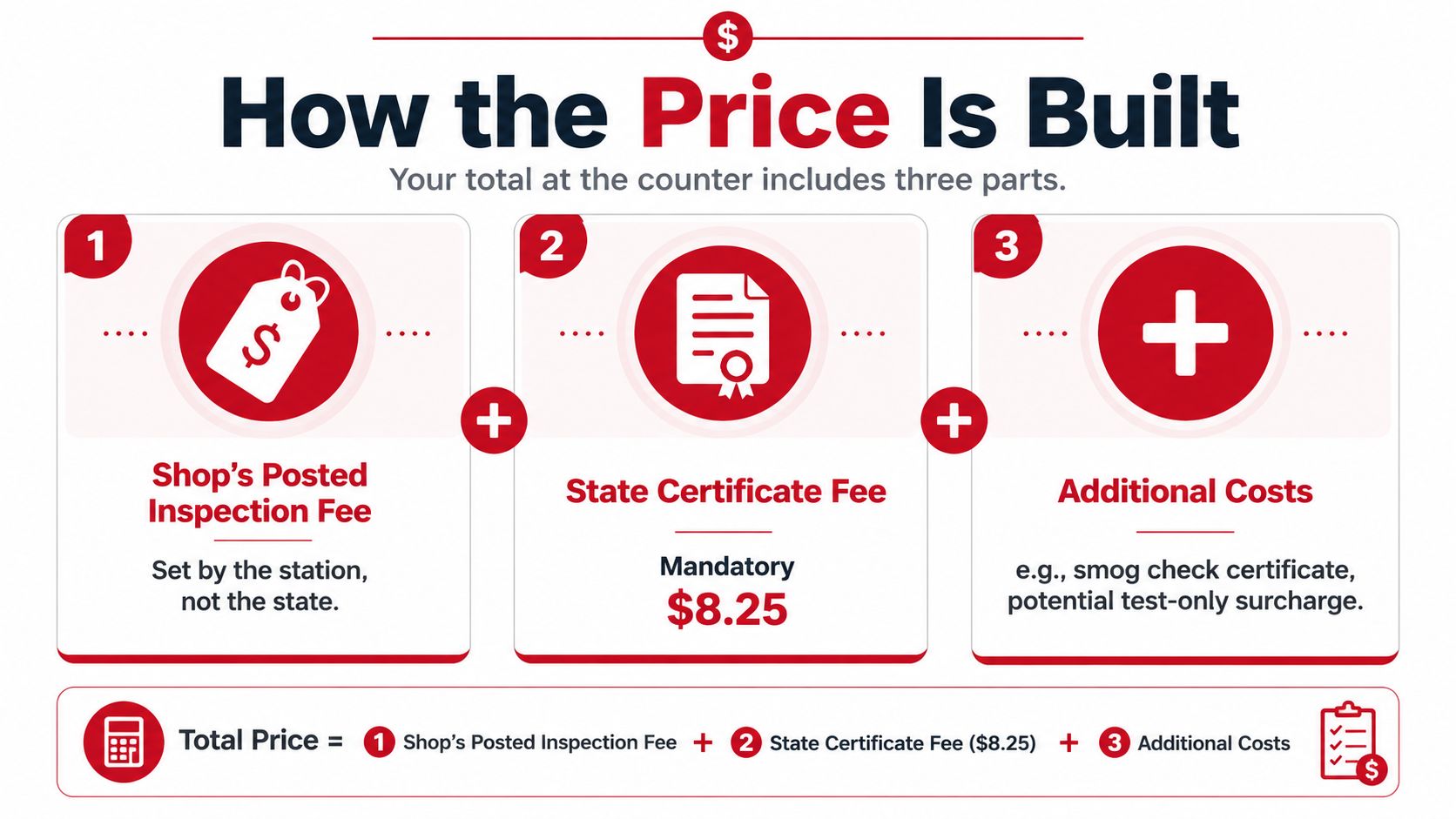
The bargaining space lives in the posted inspection fee, because the certificate fee is fixed. If you want a lower final number, compare the shop price first, then ask whether any extra transmission or convenience charge is being added on top. A STAR Test Only station usually makes that easier, and if you want a straight compliance visit without repair pressure, check out this smog test only center in Antioch.
Test Only Versus Test and Repair Stations
A STAR Test Only station and a STAR Test and Repair station do the same legal job, but they do not price that job the same way. The test-only model keeps the focus on the inspection itself, and that usually means a cleaner bill. Fire House Smog operates as a test-only STAR station with no repair sales, which removes the repair revenue pressure that can shape how some shops present the final number.
Test-only shops keep the bill cleaner
A test-only station has one job, inspect the vehicle and certify the result. There is no repair desk waiting to turn a failed test into a bigger ticket, so the inspection quote tends to stay more direct and easier to read.
That matters more than people admit. A shop that sells repairs can still be honest, but the structure is built so the same place that finds the failure can also sell the fix. If you are watching your budget, that is the part to watch.
My rule as a shop owner: if you already know you need a clean compliance test, go test-only first. Do not pay for a diagnosis you did not ask for.
| STAR Station Type Comparison | Average Inspection Fee | Repair Upsell Risk | Typical Use Case |
|---|---|---|---|
| STAR Test Only | $62.36 | Lower, because the station does not sell repairs | Drivers who want a compliance test only |
| STAR Test and Repair | $71.01 | Higher, because the shop can profit from the fix | Drivers who may want diagnosis and repair in one place |
For Antioch drivers, that difference shows up in the actual out-the-door number. A test-only shop is usually the smarter choice when you need the certificate and nothing else. A test-and-repair station makes sense only if you want one place to inspect the car, tell you what failed, and handle the repair work too.
How Vehicle Type Changes the Price
Vehicle class drives pricing harder than expected. The emissions workflow gets more complex as you move into older model years, different fuel types, and larger platforms, so the price climbs with the work.
The price ladder gets steeper as the vehicle gets older or bigger
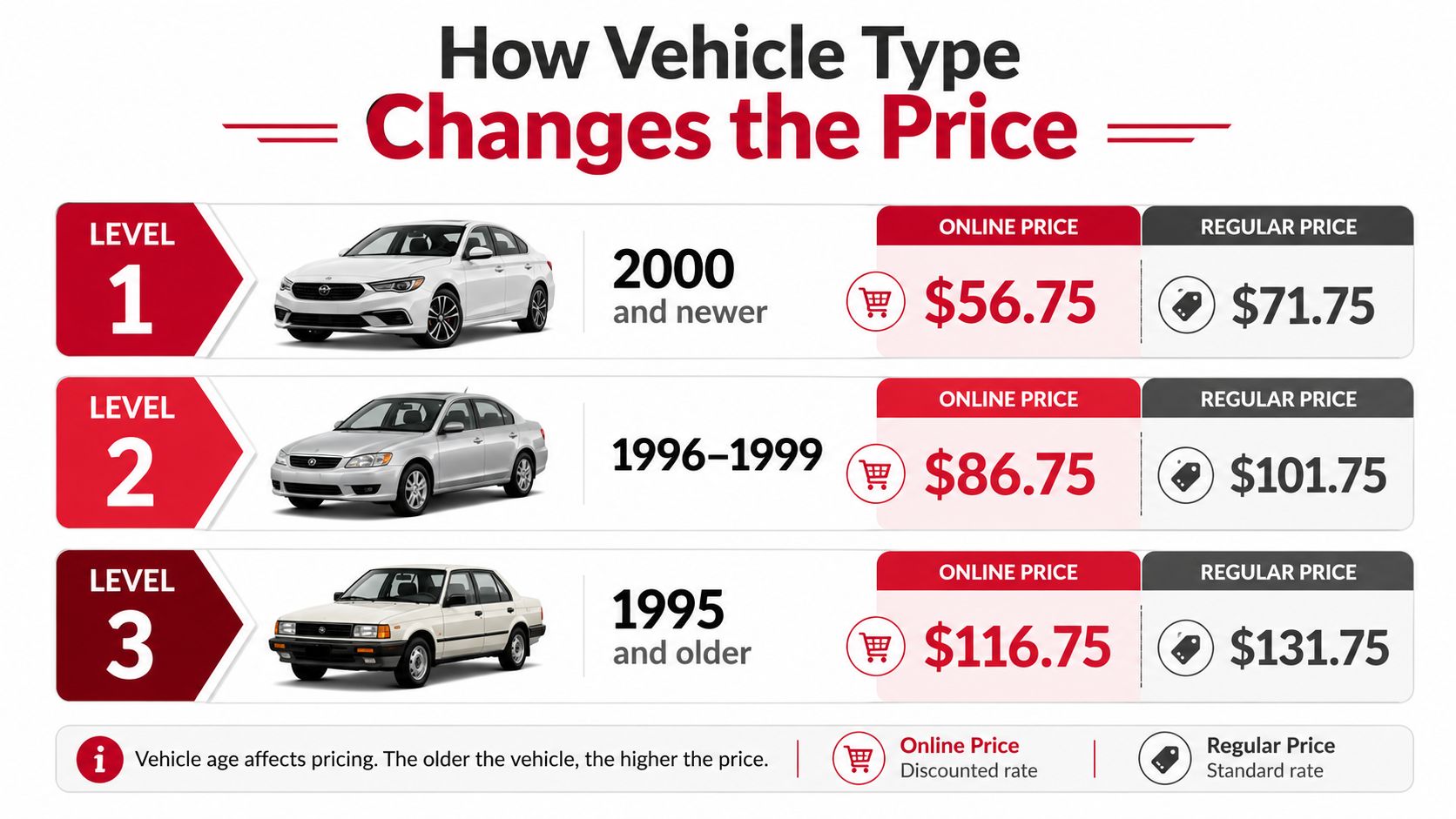
A California STAR price sheet shows a clear progression. 2000-and-newer vehicles run $56.75 online or $71.75 regular, ’96–’99 vehicles run $86.75 online or $101.75 regular, 95 and older run $106.75 online or $121.75 regular, and RV or motorhome tests run $176.75 online or $191.75 regular, all before the $8.25 certificate fee.
That spread isn't arbitrary. Legacy emissions systems take more time, larger vehicles take more handling, and RV or motorhome testing can require a different workflow entirely. That's why older diesels, fleet vehicles, and RV owners should budget well above the common passenger-car band.
A practical way to read the sheet is simple, each step into a more complex class can add roughly $15 to $70+ before fees. That's the number that matters when you're trying to estimate the out-the-door cost before you leave home.
Budget for the vehicle you own, not the one you wish you owned
If you drive a newer light-duty car, you're usually in the lower pricing band. If you own an older car, a diesel, or a motorhome, don't compare your quote to a basic sedan and complain that the station is “overcharging.” The inspection is just different.
Retest Policy and When You Get a Free One
If your car fails, don't pay twice by accident. The smart move is to ask the station exactly how its free retest works before you leave the lot.
Bring the same vehicle back with the repair proof
A free retest usually applies when you return to the same station within the station's qualifying window and bring the car back for the same issue after a qualifying repair. That means the vehicle, the failure, and the paperwork all need to line up.
The key is to separate a valid retest from a brand-new test. If you go somewhere else, wait too long, or show up without the original failure paperwork, the station may treat it as a full-price visit instead of a courtesy retest.
Ask these two things before you drive off
- What paperwork do you need? Bring the original smog report and any repair receipt the shop expects.
- What counts as the same problem? Some failures are straightforward, others trigger a new inspection path if the vehicle has changed in a meaningful way.
That's the part drivers skip, and it costs them. A good station will explain the retest terms clearly, and you should make them do it before you leave.
Coupons, Discounts, and How to Lower the Final Number
If you want the lowest legal STAR price, start with coupons and end with a test-only station. Those are the two levers that usually matter most, because they attack the inspection fee before the fixed certificate fee ever gets involved.
Coupons cut the shop fee, not the state fee
A coupon reduces the station's posted inspection price. It does not erase the $8.25 state certificate fee, so your savings show up on the inspection side of the bill, not on the certificate line.
That's why coupon math is simple. If a vehicle would otherwise fall into a higher pricing tier, a decent coupon can move the receipt back toward the standard passenger-car range. On the higher-end vehicle classes, the savings are even more noticeable because the posted test price has more room to move.
For Antioch drivers who want a simple place to check current offers, Fire House Smog coupon details are worth looking at before you book. Just keep your eyes on the final pass total, not the headline discount alone.
Pick the structure that doesn't sell you a repair
A test-only station is the cleaner play because the shop isn't trying to convert a failed inspection into a repair ticket. You're paying for the compliance test, and that's it.
- Use coupons early: Apply them to the inspection fee before you compare totals.
- Choose test-only when you can: That keeps repair pressure off the table.
- Ask about the pass total: The number you want is the amount after the certificate fee.
Don't chase the lowest advertised price if the shop hides the real total in add-ons.
That's how drivers end up paying more than they expected. A fair quote tells you the inspection cost, the certificate fee, and any small processing charge up front.
What to Bring and How to Plan the Visit
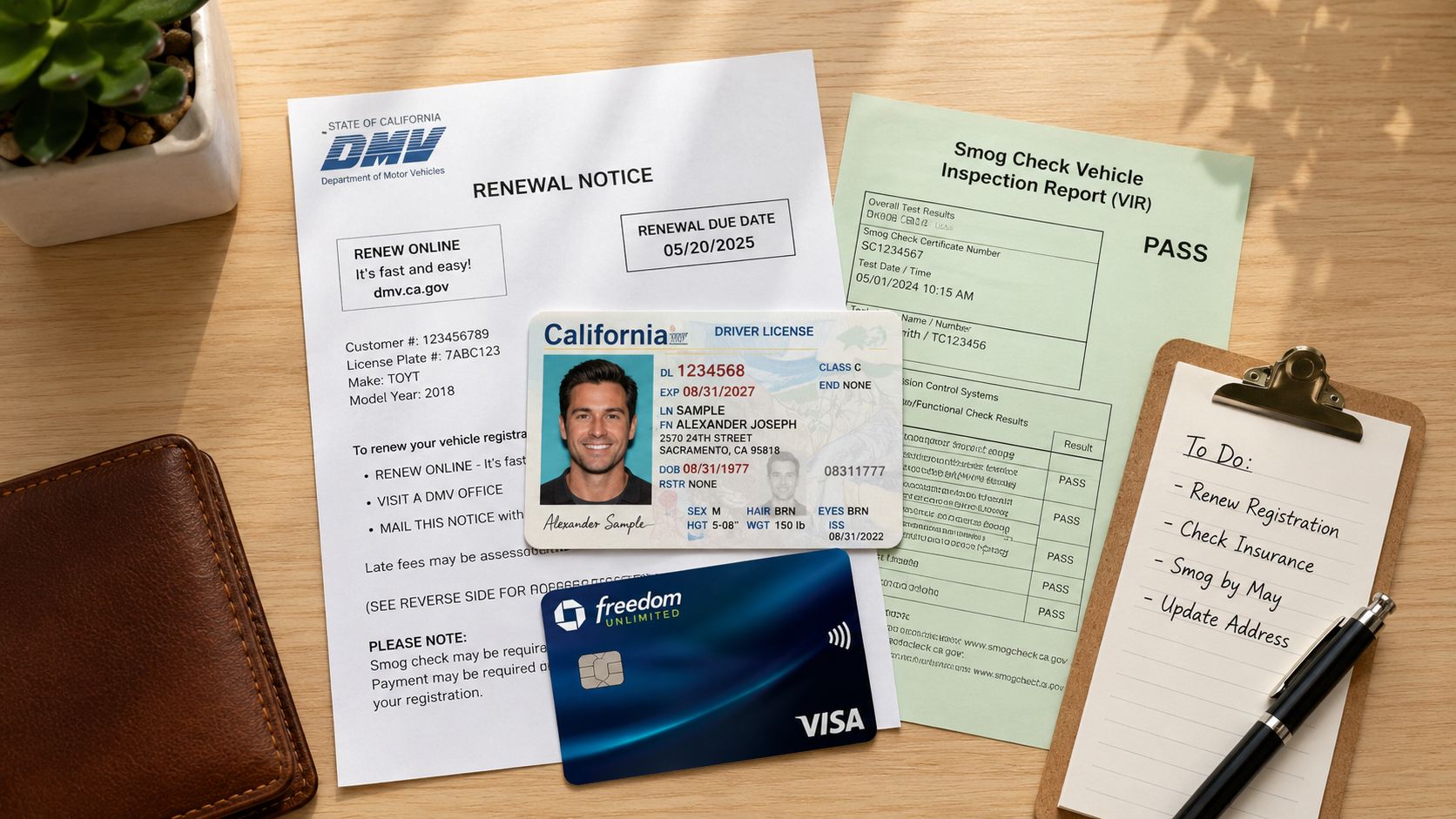
A smooth smog visit starts before you put the car in drive. Bring your renewal notice or DMV notice, your valid ID, and your payment method, and keep any prior smog report handy if you're returning for a retest.
Use the station that matches your schedule
Fire House Smog operates at 2900 Lone Tree Way, Antioch, CA 94509, and the phone number is 925-754-1600. It offers smog testing seven days a week, with DMV registration renewals Monday through Saturday 9:30 AM to 5:00 PM and Sunday 12:00 PM to 4:00 PM, plus two service bays and on-site sticker printing. The station also recommends calling ahead for RVs, which is just common sense because large vehicles need more room and more planning. Vehicle registration document requirements are worth checking before you roll in.
Don't waste a trip on missing paperwork
- Bring your renewal notice: That's the fastest way to match the visit to the right transaction.
- Carry a valid ID and payment: You want no surprises at the counter.
- Keep your previous test report: This matters if you're coming back for a retest.
The point is to show up ready, not hopeful. A prepared driver gets through faster, and a station with two bays can move cars more efficiently when the paperwork is already in order.
What the Price Buys You
The receipt pays for more than a quick emissions test. In a test-only setup with on-site DMV services, you are paying for a cleaner process, fewer repair pitches, and less time wasted bouncing between offices.
The value is in the workflow, not just the number
At a station that handles smog testing and DMV renewals in one place, the price covers convenience that matters on a workday. You get the inspection done, handle registration tasks on-site, and leave with fewer stops on your list.
That matters even more in a test-only model, because the station is not trying to turn your visit into a repair sale. You get the compliance result, the DMV handling, and the sticker process without the usual upsell pressure.
Bottom line: a fair STAR price is the one that gets you legal, gets you out, and does not drag you into a second bill.
Weekend availability and two-service-bay throughput matter too. They do not change the legal fee structure, but they do change the value of the trip, especially if you would otherwise burn half a day at a crowded DMV counter.
If you want a straightforward STAR smog check in Antioch, go where the pricing is clear and the process is built for compliance, not repairs. Fire House Smog handles STAR test-only inspections, on-site DMV registration renewals, and sticker printing at 2900 Lone Tree Way, and you can check the details or plan your visit at Fire House Smog.
You open a DMV renewal notice, see that a smog certificate is part of the process, and suddenly the errand feels bigger than a quick stop at the corner shop. That reaction makes sense. Smog check stations are not just service bays, they're the gatekeepers for a statewide compliance system that California uses to keep millions of vehicles moving through renewal on time.
If you've never dealt with one before, the rules can feel mixed together, especially when one notice says STAR, another says test only, and the DMV page talks about renewal, registration, and emissions in the same breath. The safest way to think about it is simple, a smog station verifies whether your vehicle meets the state's inspection requirement so your paperwork can keep moving. In California, that system is large enough that it's better to understand the whole picture first, then pick the right station for your car and your situation.
Table of Contents
- Why Smog Check Stations Matter to California Drivers
- How Smog Check Stations Work
- Test-Only STAR versus Test-and-Repair Stations
- What Happens During Your Smog Check Visit
- Using a Smog Station with On-Site DMV Services
- RVs Fleets and Other Vehicles That Need Special Handling
- What Makes a Test-Only STAR Station in Antioch Stand Out
- Choosing the Right Station and Preparing for Your Visit
Why Smog Check Stations Matter to California Drivers
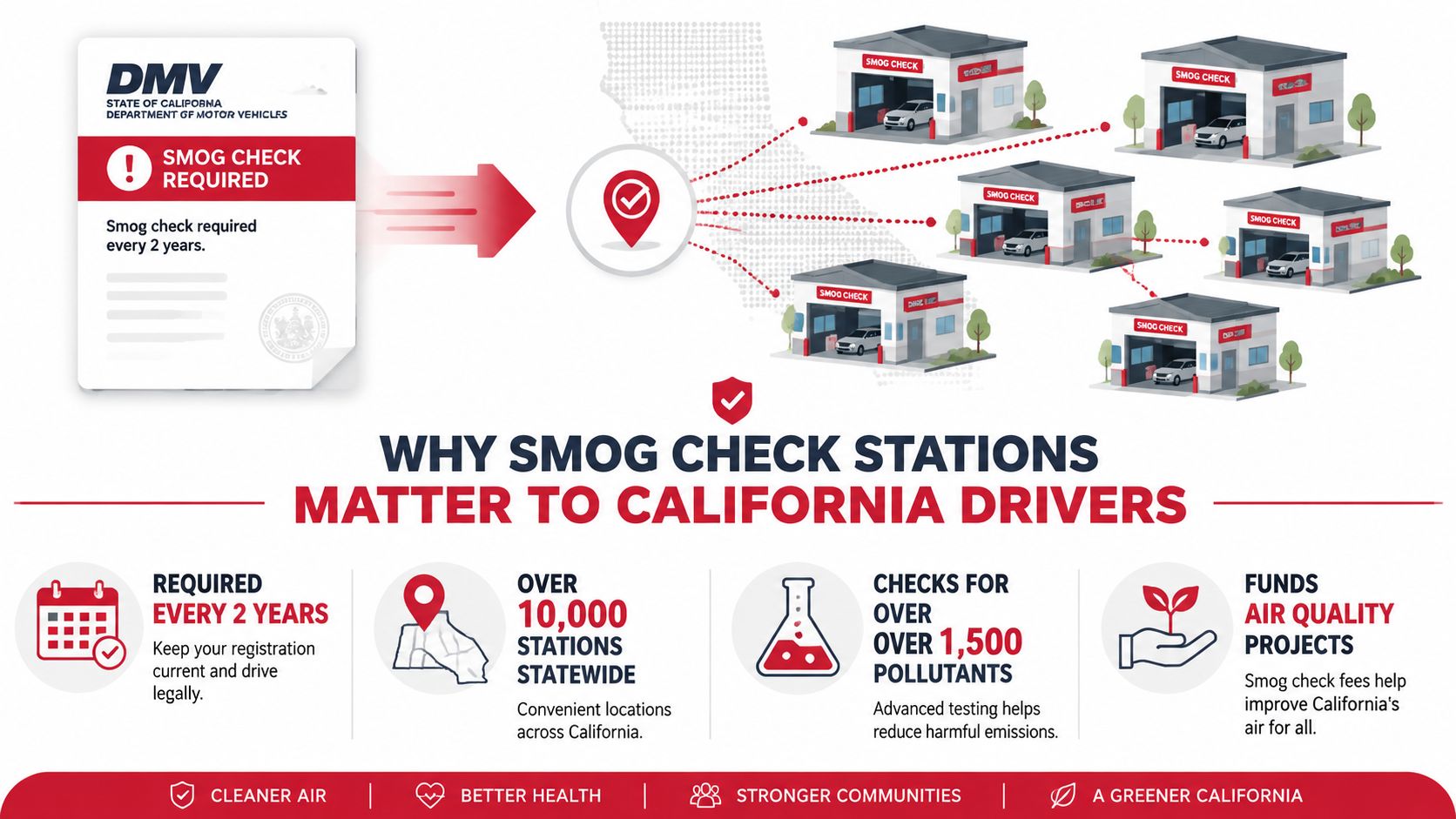
The first time a renewal notice points you toward a smog inspection, it can feel like one more chore in a stack of chores. The better way to read it is as a checkpoint in a statewide system that keeps California's vehicle renewal process moving. The state's smog program has been in place since 1984, and California says it now includes more than 7,000 smog check stations, about 10 million vehicles tested each year, and about 400 tons of smog-forming pollutants per day reduced through the system overall, which is why these stations function as public infrastructure, not an occasional extra stop (California Smog Check Fact Sheet/index.pdf)).
For a driver, that bigger system shows up in a very practical way. If the certificate does not get completed, renewal can stall, and the DMV does not care whether the delay came from a busy schedule, a confusing notice, or a station you chose without checking the rules first.
Practical rule: treat the smog visit the way you'd treat a brake inspection before a long trip. It is a required checkpoint, like checking tire pressure before you head out, not a guess-and-hope errand.
Timing matters too. California's current rules require most vehicles to get a Smog Check every other year, and for a first-time test, the state says to add eight years to the model year, so a 2020 model-year vehicle first needs one in 2028 (California Smog Check Fact Sheet). That is why the question is not only where to go. It is also when the requirement starts and whether the station you pick matches the notice in your hands.
For drivers who want the rules behind the test, the vehicle emissions standards guide gives a plain-language overview of the emissions standards that shape the inspection. If you only need the short version, the station is the last checkpoint between your vehicle and a clean renewal path.
How Smog Check Stations Work
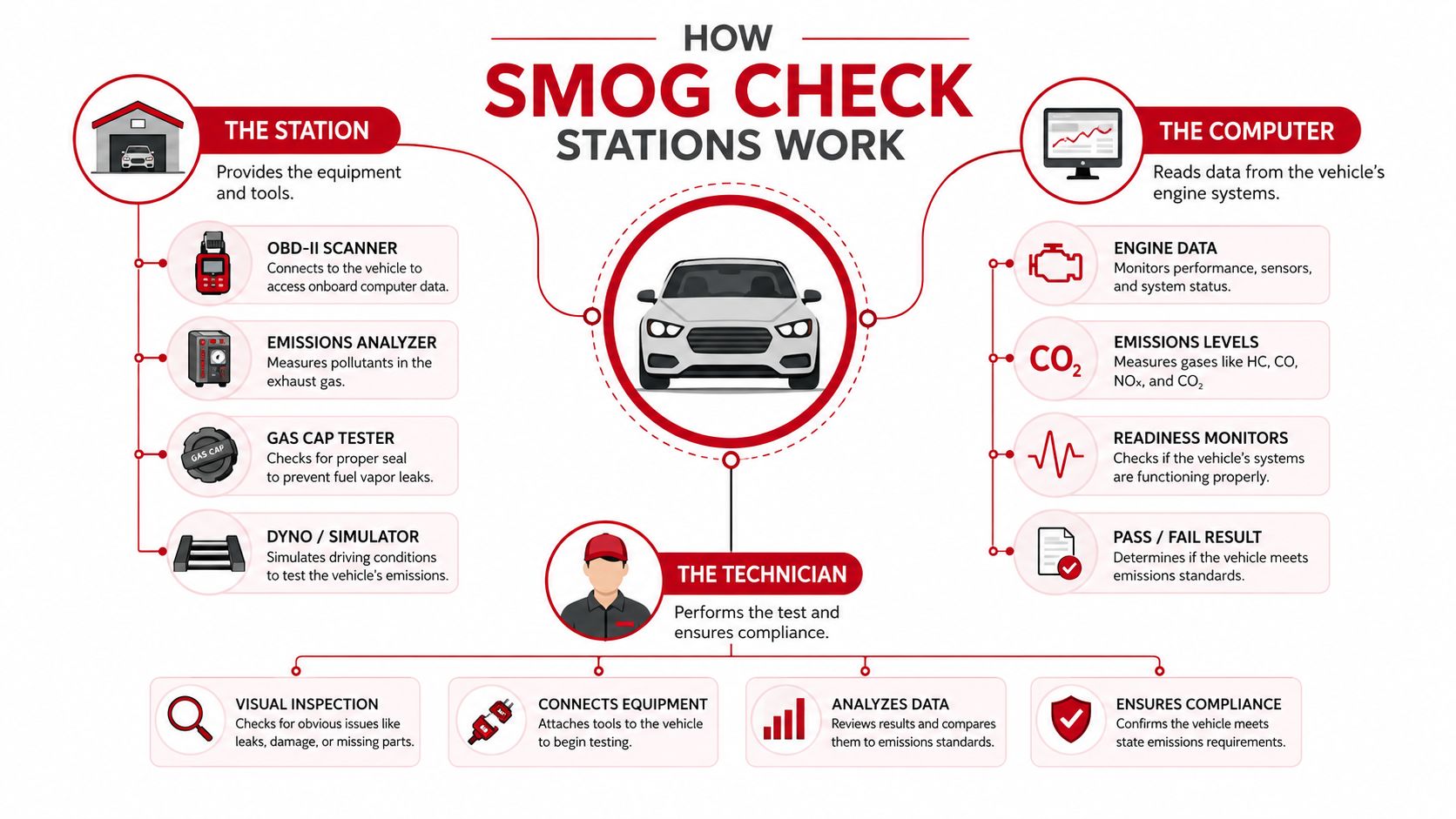
A smog check station is a controlled exam room for your car. The technician checks emissions-related systems with approved equipment instead of guessing from sound or appearance alone. California's test-only stations must use a BAR-97 emissions inspection system and keep supporting tools like an ignition timing light, vacuum pump or gauge, scan-code retrieval device, and a fuel-fillpipe restrictor gauge with defined dimensions and materials (California Code of Regulations, Section 3340.16).
That hardware list sounds old-school, but the inspection itself is increasingly digital. The BAR checklist says the station computer must run a BAR-tested and approved Microsoft-supported Windows version, and the emissions device must display and store live streaming OBD data, support bi-directional capability, and capture high-frequency abnormal signals regardless of screen refresh rate (BAR Smog Checklist). In plain English, the station is checking whether your vehicle's computer and emissions systems are talking to each other the way they should.
What the technician is looking for
The technician's job is narrower than many drivers expect. They look for emissions control issues, diagnostic trouble codes, visible tampering, and whether the onboard diagnostics behave correctly. They are not giving a general repair consultation or judging whether your transmission, suspension, or tires are in perfect shape.
A good smog bay reads your car the way a clinic reads a blood-pressure cuff, it is looking for a specific system response, not a full-body diagnosis.
That is why the inspection can feel technical even though the customer experience is simple. You bring the car in, the station connects to the vehicle, the computer checks the emissions side, and the state gets a record of whether your vehicle passed. If you want a shorter consumer-facing explanation of the timing, this smog check timing guide is a useful companion.
The fillpipe gauge is a good example of how exact the program gets. California specifies a non-sparking aluminum alloy 5052 tool with a test portion diameter of 0.9375–0.950 inches and a length of 5–12 inches, which shows that inspection hardware has to be reproducible from one station to the next (California Code of Regulations, Section 3340.16). That consistency is why a smog station is more than a mechanic with a scanner, it is a regulated testing site.
Test-Only STAR versus Test-and-Repair Stations
A first-time driver usually wants one clear answer. If the car fails, who can fix it, and who is there only to measure the result? A test-only station keeps those roles separate. The station performs the inspection and issues the outcome, but it does not profit from selling the repair that follows. A test-and-repair station can inspect the car and also handle qualifying repairs, which is convenient, though it places testing and repair under one roof.
California's BAR data helps show why those station types are treated differently. In the July 2025 executive summary, 1,019,416 initial tests produced 85,135 failures, a failure rate of 8.35%, and when all tests were counted, the failure rate was 8.88% (BAR July 2025 Executive Summary). The same report shows that BAR-97 stations had an overall failure rate of 17.69% versus 7.62% for OIS stations. That does not automatically mean one station type is doing a poorer job. It can also reflect the kinds of vehicles each category sees and how the inspection is carried out.
What STAR status signals
California uses STAR to direct certain vehicles to stations that meet higher performance standards. BAR has also said that vehicles certified by high-performing smog stations fail roadside checks at lower rates than those from lower-performing stations (BAR July 2025 Executive Summary). The label is about program performance, not waiting-room comfort or how polished the counter looks.
| Station Type | What It Does | Best Fit For |
|---|---|---|
| Test-only station | Performs the emissions inspection and issues the result | Drivers who want a pure inspection with no repair sales |
| Test-and-repair station | Tests the car and can also handle qualifying repairs | Drivers who want one stop for diagnosis and repair |
| STAR station | Meets higher program standards for directed vehicles | Drivers whose notice or vehicle profile requires STAR |
For a closer look at the category itself, the STAR-certified smog station guide gives a plain-English explanation of how these stations fit into the program. The main point is simple. A test-only lane, a repair-capable shop, and a STAR station each serve a different purpose, and the right one depends on what your notice requires and what kind of vehicle you are bringing in.
A station in Antioch shows how this works in practice. A driver can arrive for a required test, use a test-only STAR lane when the vehicle calls for it, and handle DMV-related errands in the same trip if the location offers that service. That setup matters for fleets too, because keeping testing separate from repair work can help a business move vehicles through without turning every stop into a repair consultation.
What Happens During Your Smog Check Visit
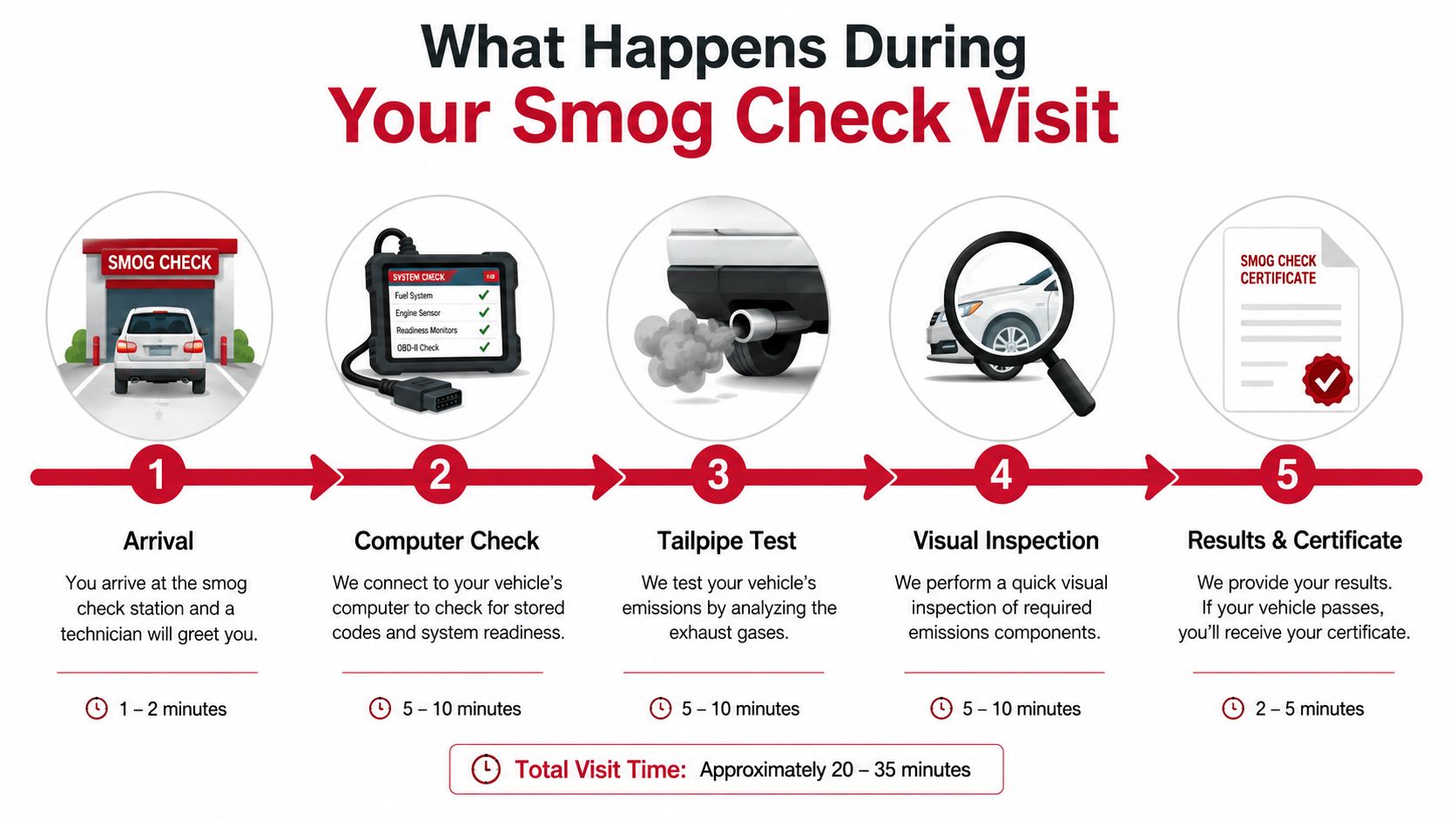
A smog visit is usually less mysterious than people expect once they understand the sequence. You pull in, the technician confirms the vehicle details, the car is connected to the inspection equipment, and the station checks the emissions-related systems that California requires. If the vehicle passes, the result gets handled electronically, and you leave with the paperwork trail needed for registration.
The visit from start to finish
The first step is paperwork and identification. The technician needs the right vehicle, the right registration information, and a car that's ready to be tested, which means the check engine light should already be addressed if it's on.
The second step is the diagnostics connection. On modern vehicles, the OBD system is the car's own language, and the station reads that language to see whether the emissions controls are behaving properly.
The third step is the physical inspection. The technician looks for visible emissions equipment issues and other problems that would interfere with a clean result.
If the car is only being warmed up, not driven enough to finish its self-checks, the station may see an incomplete picture even if the engine sounds fine.
The final step is the result. A pass keeps the renewal moving, while a fail usually comes with a report explaining what the station found. Some stations also offer a retest policy, which can matter if a repair is needed before the vehicle can return. When that happens, the station is no longer just a testing stop, it becomes part of the paper trail between repair, retest, and DMV completion.
A quick note on expectations. A smog inspection isn't a place for guesswork or persuasion, and the technician can't “override” a bad reading because a driver is in a hurry. The visit works best when you treat it like a checkpoint on a route, not a negotiation.
Using a Smog Station with On-Site DMV Services
A station that also handles DMV business changes the whole errand. Instead of finishing the smog test and then driving to a separate field office, you can often handle renewal-related paperwork in the same stop if the station is a licensed DMV business partner. That matters most when your main problem isn't the inspection itself, it's the time lost bouncing between two offices.
Fire House Smog in Antioch is a worked example of this setup. It offers on-site California DMV registration renewals with sticker printing, and it also handles ownership transfers for California and out-of-state vehicles, including stickers and plates as needed. For a driver staring at a renewal notice, that means the smog result and the DMV completion step can live in the same visit instead of becoming two separate trips.
What to bring and why it matters
A combined visit still works only if you show up prepared. Bring the renewal notice, any title or transfer paperwork you've been given, and a payment method that the station accepts. If your transaction involves an out-of-state title, the paperwork trail can be more involved, so it helps to ask what the station needs before you drive over.
Weekend and extended hours are useful because they cut down on the workday conflict most drivers run into. Fire House Smog lists Monday through Saturday 9:30 AM to 5:00 PM and Sunday 12:00 PM to 4:00 PM for DMV service hours, with limited services possible on weekends, which is exactly the kind of detail that prevents a wasted trip.
Driver shortcut: if your renewal notice points to smog plus registration, ask whether the station can finish both pieces before you leave. That one question can save a second line at the DMV.
The reason this model matters is simple. A DMV field office is good at government paperwork, but it isn't built around inspection throughput. A station with on-site DMV capability gives you the emissions result and the renewal handling in one place, which is the closest thing to a single-stop solution California drivers can get.
RVs Fleets and Other Vehicles That Need Special Handling
Not every vehicle fits neatly into a standard passenger-car appointment. RVs, motorhomes, and small fleet vehicles often need a quick phone call before they roll in because length, height, and bay clearance can change whether a station can test them safely. A two-bay layout helps, but it doesn't erase the fact that oversized vehicles take more planning than a sedan.
Real-world scheduling beats generic advice. A driver with a motorhome doesn't want to find out at the curb that the station can't handle the vehicle dimensions. A fleet manager doesn't want to send three work vans to a shop with limited throughput if one bay is tied up and the other is already full.
Why the station layout matters
A station with multiple bays can rotate vehicles more efficiently, especially when it also offers weekend availability. That matters for businesses that can't leave service vehicles off the road during weekday hours. It also matters for families trying to finish a registration task between school pickup and dinner.
Out-of-state title transfers fit into this same category of special handling. The smog test may be only one part of the visit, but the DMV paperwork can change what the station needs to verify, so those drivers should ask about document requirements before showing up.
Some stations are built around speed, others around breadth of service. The best match depends on whether you're arriving in a compact commuter car, a large utility vehicle, or a vehicle that needs both inspection and DMV processing in the same stop.
What Makes a Test-Only STAR Station in Antioch Stand Out
A test-only STAR station earns attention for a specific reason, it removes the repair incentive while still meeting a higher inspection standard. For drivers who worry about being sold work they didn't ask for, that combination can feel cleaner and easier to trust. The Antioch example also matters because it pairs the inspection with on-site DMV services, so the visit can solve both the smog requirement and the renewal problem.
The practical features line up with common driver frustrations. Two service bays help with throughput. Seven-day smog testing helps working drivers. Weekend DMV hours help people who can't disappear from work in the middle of the day. The drive-through layout on Lone Tree Way reduces the friction that usually makes inspection errands drag out longer than they should.
Why test-only is a feature
A test-only station doesn't make money by recommending fixes. That's useful when you want a straight result and a clean certificate trail. It's also useful when you already know your car needs repair elsewhere and just want the inspection handled by a separate party.
The Antioch location is also a good example of how one station can serve different needs without turning into a general repair shop. It can inspect passenger cars, SUVs, and light-duty trucks, and it can handle some RVs and motorhomes within size and equipment limits, which is exactly the kind of flexibility local drivers look for when a single vehicle can't be treated like a standard sedan.
If you're comparing nearby options, Fire House Smog is one option to consider for STAR-certified test-only inspection plus DMV registration support in one place. That matters most when your worry is accuracy, not upselling.
Choosing the Right Station and Preparing for Your Visit
A smog check goes more smoothly when you start with the notice in your hand instead of the nearest address on a map. If the DMV paperwork says STAR, that is the first filter. If the same trip needs renewal help, look for a licensed partner that can handle the smog result and the paperwork step at the same stop. If the vehicle is oversized or unusual, call ahead so you know the bay, equipment, and height limits before you drive over.
A simple way to picture the choice is like picking the right socket for a lug nut. The wrench has to match the job, or the process stalls before it starts.
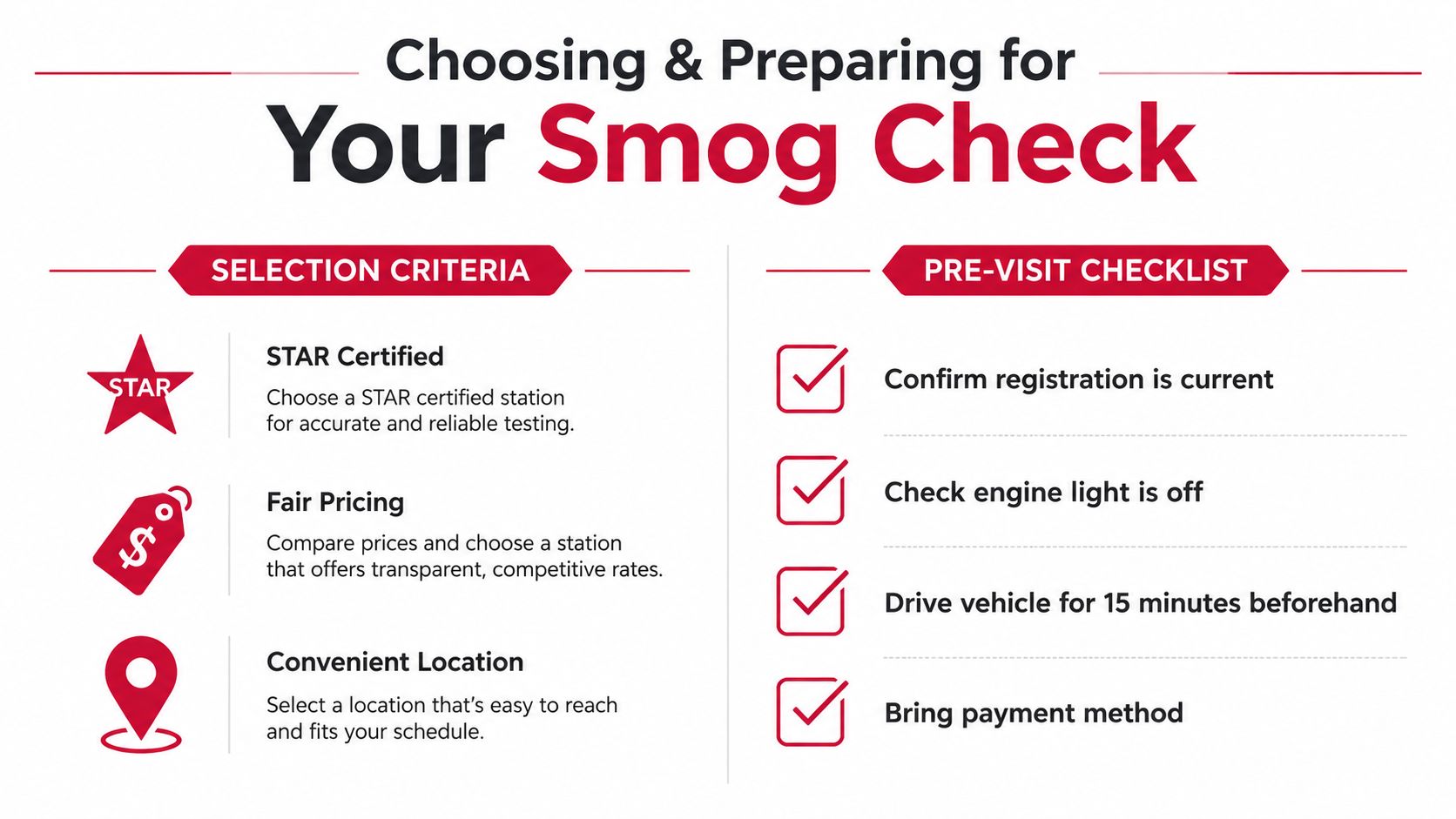
A simple pre-visit checklist
- Confirm the notice requirement: Check whether your vehicle needs a regular station, STAR, or something more specific.
- Make the car test-ready: If the check engine light is on, handle that first.
- Drive before you go: Get the engine fully warmed up so the car is ready to report accurately.
- Bring the paperwork: Renewal notice, title documents if needed, and a payment method.
- Ask about the retest policy: If the car fails, find out what the station includes before you leave.
These steps are like checking tire pressure before a road trip. A little preparation helps the visit reflect the car's real condition instead of a problem that could have been fixed earlier.
Quick questions drivers ask
Do I always need a STAR station? No. The requirement depends on the notice and the vehicle profile, not on convenience.
What does a free retest mean? It usually means the station will inspect the car again after a qualifying repair, but you should confirm the terms before assuming anything.
How is on-site DMV renewal different from the field office? A DMV field office handles government transactions, while an on-site partner can process certain renewal tasks right where the smog test happens.
If your goal is to finish the inspection without another stop and leave with the renewal step handled, a station like Fire House Smog is built for that kind of visit. Review its services, compare them with your notice, and decide whether its smog and DMV options fit your plan when you are ready to move ahead.
You're standing at the counter with a 32-foot motorhome title in one hand and a DMV renewal notice in the other, and nobody has bothered to tell you whether this rig needs a regular smog check, a STAR station, or a completely different emissions program. That's the part that trips most owners up. A motorhome is not handled like a normal sedan, and if you guess wrong, you waste a day, miss your registration timing, or roll up to a station that can't inspect the vehicle anyway.
The smart move is to treat smog check for motorhomes as a decision tree, not a simple appointment. Your answer depends on fuel type, model year, GVWR, and whether the DMV notice specifically calls for STAR testing. For heavier diesel rigs, the path can shift again into Clean Truck Check territory. If you know which lane you're in before you leave home, the rest gets much easier.
Table of Contents
- Why Motorhome Smog Checks Catch Owners Off Guard
- Which Motorhomes Need a Smog Check in California
- Standard Smog Check vs Clean Truck Check for Heavy RVs
- STAR Stations and What Your Renewal Notice Is Telling You
- How to Prepare Your Motorhome Before the Test
- Visiting Fire House Smog in Antioch With a Motorhome
- Common Mistakes That Waste a Motorhome Smog Trip
Why Motorhome Smog Checks Catch Owners Off Guard
A guy walks into a station with a clean-looking Class A and assumes the same rules that apply to his pickup will apply here. Five minutes later, he's learning the bay won't fit the coach, or the fuel type sends him into a different emissions lane, or the renewal notice wants STAR capacity he didn't plan for. That's a bad day, and it happens because RV owners think “motorhome” is the main rule. It isn't.
The vehicle type is not the whole story
California doesn't decide this with one label. The practical screening variables are fuel type, model year, GVWR, and whether the renewal notice flags STAR testing. The BAR says RVs and motorhomes meeting the applicable criteria need a Smog Check, so being recreational doesn't buy you an exemption by itself. You need to know which rule bucket your coach falls into before you book anything. California Smog Check rules for RVs and motorhomes
Practical rule: Don't call a station and ask, “Do you smog motorhomes?” Ask, “What's the cutoff for my fuel type, model year, and gross weight, and do you handle STAR or Clean Truck Check vehicles?”
That's the only way to avoid guessing.
The station can be right for cars and wrong for your rig
A lot of stations are built around passenger cars and light trucks. A motorhome can need more space, different equipment, or a different inspection lane entirely. California's own data shows how much volume the program handles, with 10.3 million initial inspections in 2019, and about 8.4 million, or 82%, completed at STAR stations. That tells you two things. STAR-capable stations matter, and the system has long been built around high-volume screening, not casual one-off RV surprises. California Smog Check performance report
Start with the right questions
Before you book, ask yourself these four things in plain English.
- What fuel does it use? Gasoline, diesel, hybrid, or alternative fuel changes the lane.
- What model year is it? The cutoff dates are different for gas and diesel.
- How heavy is it? GVWR can push the vehicle into a different compliance regime.
- Does the DMV notice mention STAR? If it does, don't ignore that wording.
That's the map. If you answer those questions first, you're not just scheduling a smog check. You're routing the vehicle to the right program the first time.
Which Motorhomes Need a Smog Check in California
California keeps this simple once you look at the registration rules instead of the RV badge. Gasoline, hybrid, and alternative-fuel vehicles model year 1976 and newer require Smog Check. Diesel vehicles model year 1998 and newer require Smog Check. The BAR also says RVs and motorhomes that meet those standards need a Smog Check, so there is no separate recreational exemption buried in the fine print. BAR Smog Check rules
Fuel type and model year set the starting point
If your motorhome runs on gasoline and is 1976 or newer, treat it as a Smog Check vehicle unless the DMV notice says something different. If it runs on diesel and is 1998 or newer, use the same rule. Fuel type and model year decide whether a motorhome enters the program, not its recreational classification.
That is the part owners miss. They look at the coach body and assume the RV label changes the rule. It does not. The state starts with fuel type, then checks model year.
The first test does not happen right away
The BAR's current rule uses an eight model year trigger for the first inspection. A 2020 model-year vehicle first needs a renewal smog inspection in 2028. That is the cleanest way to read the calendar. You are not counting miles, you are counting model-year age the way the DMV does. BAR Smog Check rules
A lot of owners miss the first test window because the coach is stored, used seasonally, or only driven on trips. The DMV does not care about your usage pattern. It cares about the model year rule.
California Motorhome Smog Eligibility at a Glance
| Fuel Type | Model Year | Smog Check Required | First Test Trigger |
|---|---|---|---|
| Gasoline, hybrid, alternative fuel | 1976 and newer | Yes, when the vehicle meets California's motorhome rules | Eight model years after the model year |
| Diesel | 1998 and newer | Yes, when the vehicle meets California's motorhome rules | Eight model years after the model year |
If you want the plain answer, here it is. Motorhome does not mean exempt. Fuel type and model year decide the starting point. If the registration notice points you to inspection, take it seriously and set the first required smog date on your calendar as soon as you can. For a motorhome that is already in the inspection window, a station that handles larger vehicles, such as Fire House Smog's truck and RV smog info, is the right place to start.
Standard Smog Check vs Clean Truck Check for Heavy RVs
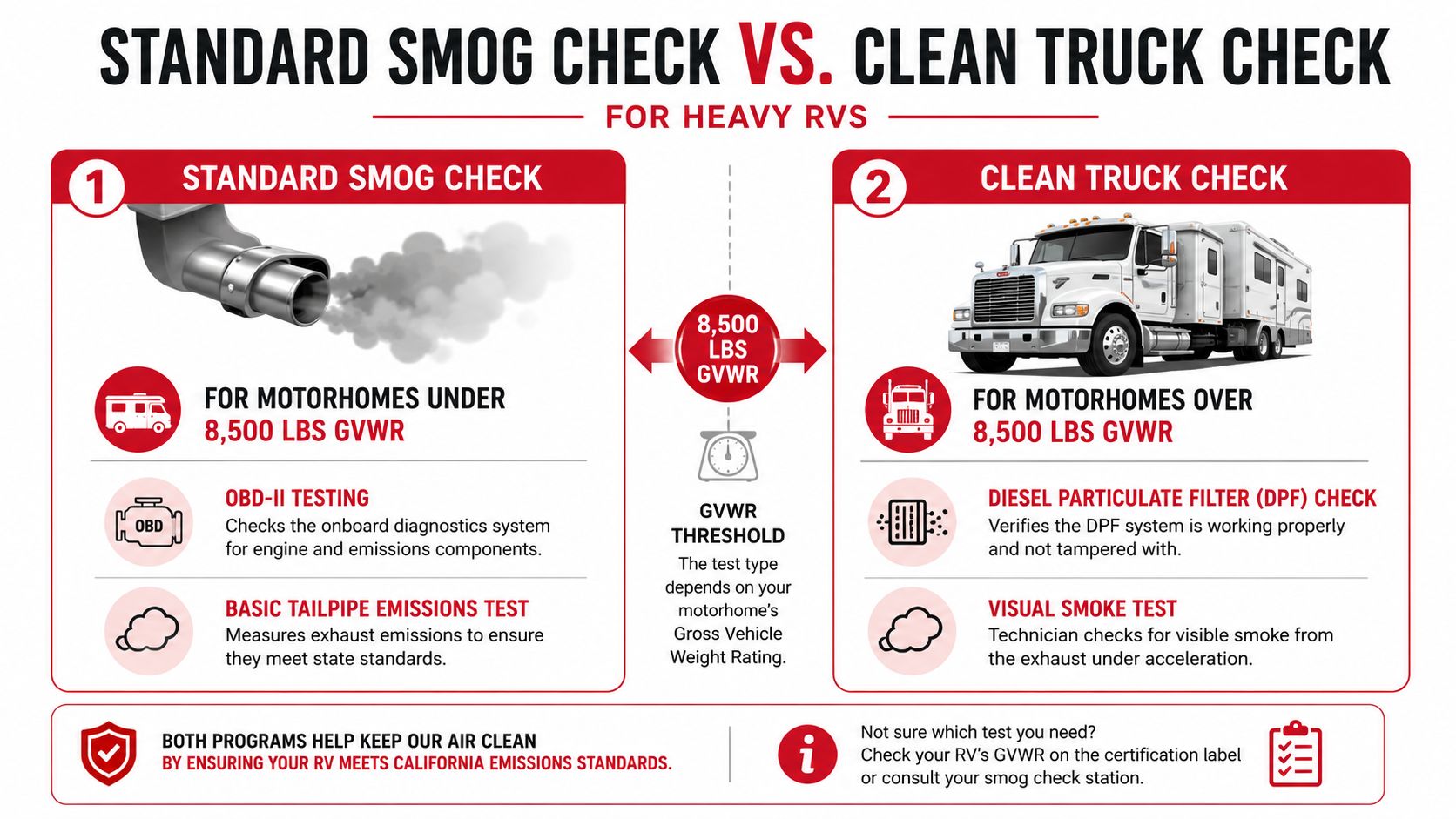
Owners get surprised here because the coach looks like a normal motorhome, but California may treat it like a heavier compliance vehicle. The line that matters is simple. If a California-registered motorhome is over 14,000 lb GVWR and runs on diesel or another non-gasoline fuel, CARB places it under Clean Truck Check rules instead of the ordinary Smog Check lane. CARB Clean Truck Check motorhome fact sheet
The inspection method changes with the vehicle
Standard Smog Check still applies to lighter motorhomes that fit the regular California inspection rules. BAR's performance report also shows that enhanced-area ASM testing is limited to motor homes under 8,501 GVWR, which is one of the practical cutoffs stations use when deciding what test equipment and procedure to use. That threshold matters because it tells you when a lighter rig can still be handled through the normal smog process. California Smog Check performance report
Clean Truck Check uses a different test path. For 2013 and newer diesel engines and 2018 and newer alternative-fuel engines, CARB requires an OBD data scan with a CARB-certified device. Older diesel vehicles go through a smoke opacity test and a visual inspection of emissions controls. Same coach body, different inspection route. CARB Clean Truck Check motorhome fact sheet
Side by side, the difference is obvious
| Lane | Typical Trigger | What Gets Checked |
|---|---|---|
| Standard Smog Check | Light-duty motorhome rules, fuel type and model year based | Regular smog inspection methods tied to California Smog Check |
| Clean Truck Check | California-registered motorhome over 14,000 lb GVWR running diesel or other non-gasoline fuel | OBD scan on newer engines, opacity and visual checks on older diesels |
If your rig is heavy and diesel, do not book it like a car. Call the station first, and if you want a place that works with truck-style compliance work, this motor vehicle smog inspection resource is the kind of category page worth checking before you drive across town.
The owner's mistake is usually assuming the chassis decides everything
GVWR, fuel type, and engine model year determine the testing path, so two similar-looking coaches can follow different inspection routes. A gas-powered motorhome and a diesel coach may look nearly the same in the driveway, but the station may handle them differently once the VIN, weight class, and engine family are checked. If you own a heavy diesel coach, stop calling it a generic smog check and start sorting out which compliance lane it belongs in.
STAR Stations and What Your Renewal Notice Is Telling You
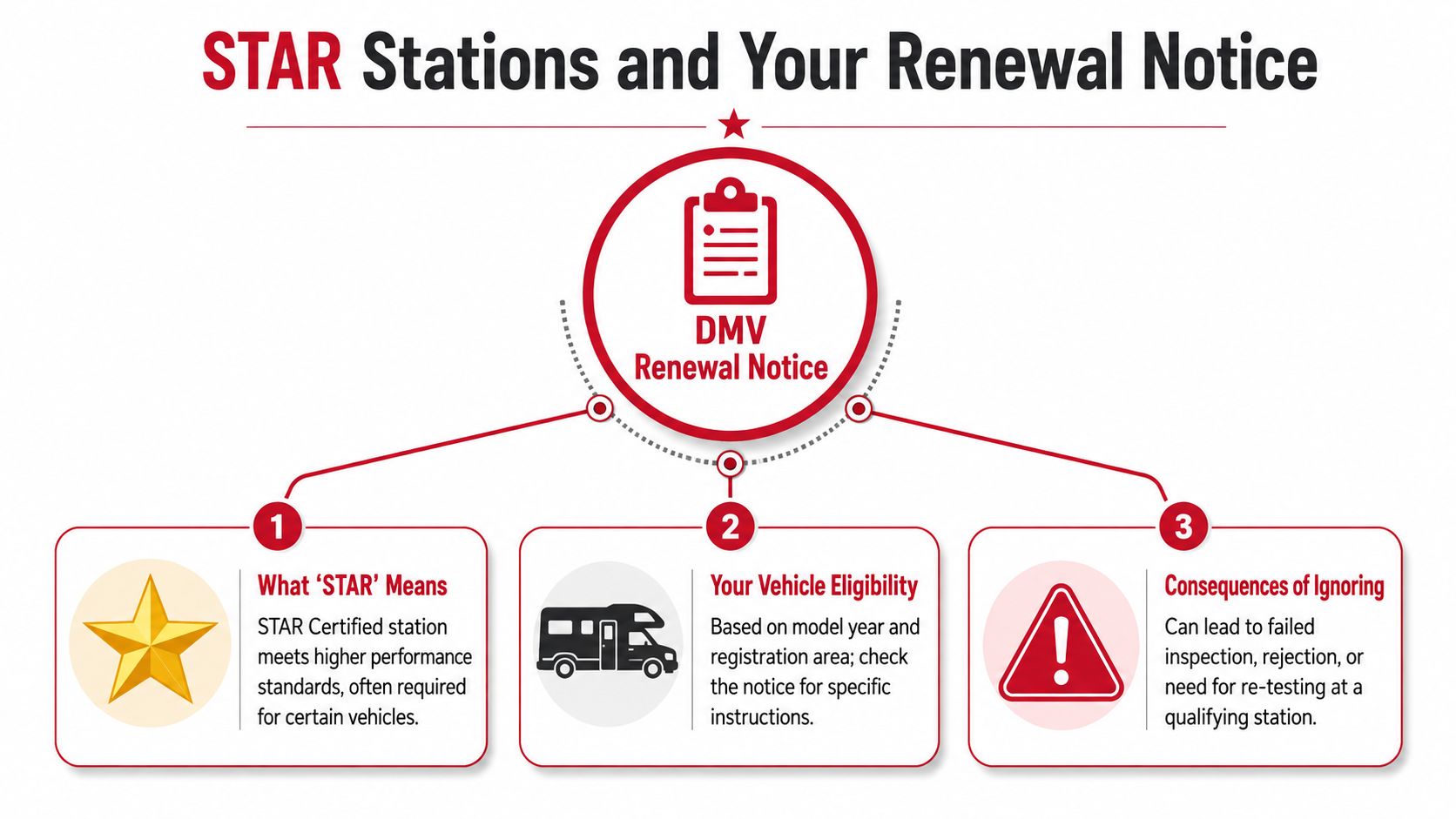
A STAR mark on your renewal notice means the DMV wants a higher-performance inspection lane for that vehicle. It points you to the right kind of station before you waste time at a shop that cannot process the notice correctly.
STAR and test-only are not the same thing
A STAR-certified station is a station that meets the state's higher performance standard for that inspection role. A test-only station performs the inspection and does not sell repairs, so it removes the repair upsell conflict a lot of owners worry about. Those are separate categories, and mixing them up leads to bad assumptions when you book the appointment. If you want the plain-language version of the designation, see what STAR certified means.
Read the renewal notice, not your assumptions
The renewal notice is the document that controls your next step. If it says STAR, follow that instruction. If it does not mention STAR, do not guess that you still need it, and do not guess that you are exempt either. Check the fuel type and model year first, then read any specific testing instruction printed on the notice.
Plain advice: If the notice calls for STAR, bring the notice to the station and let the paperwork drive the appointment. Guessing costs time.
What matters when you're deciding where to go
- If STAR is listed: You need a station that can meet that requirement.
- If STAR is not listed: You may still need a regular smog inspection based on vehicle rules.
- If the coach is heavy and diesel: Confirm whether it belongs in Clean Truck Check instead of standard Smog Check.
- If you're unsure: Call ahead with the VIN, fuel type, model year, and GVWR handy.
A renewal notice can steer you into the wrong lane if you read it loosely. The smart move is to match the notice to the vehicle details, then choose the station that can legally handle that job.
How to Prepare Your Motorhome Before the Test
Most failed inspections are avoidable. Owners show up with a cold engine, a warning light glowing on the dash, missing paperwork, or a rig that hasn't been checked for obvious leaks. That turns a normal appointment into a return trip, and it doesn't need to happen.
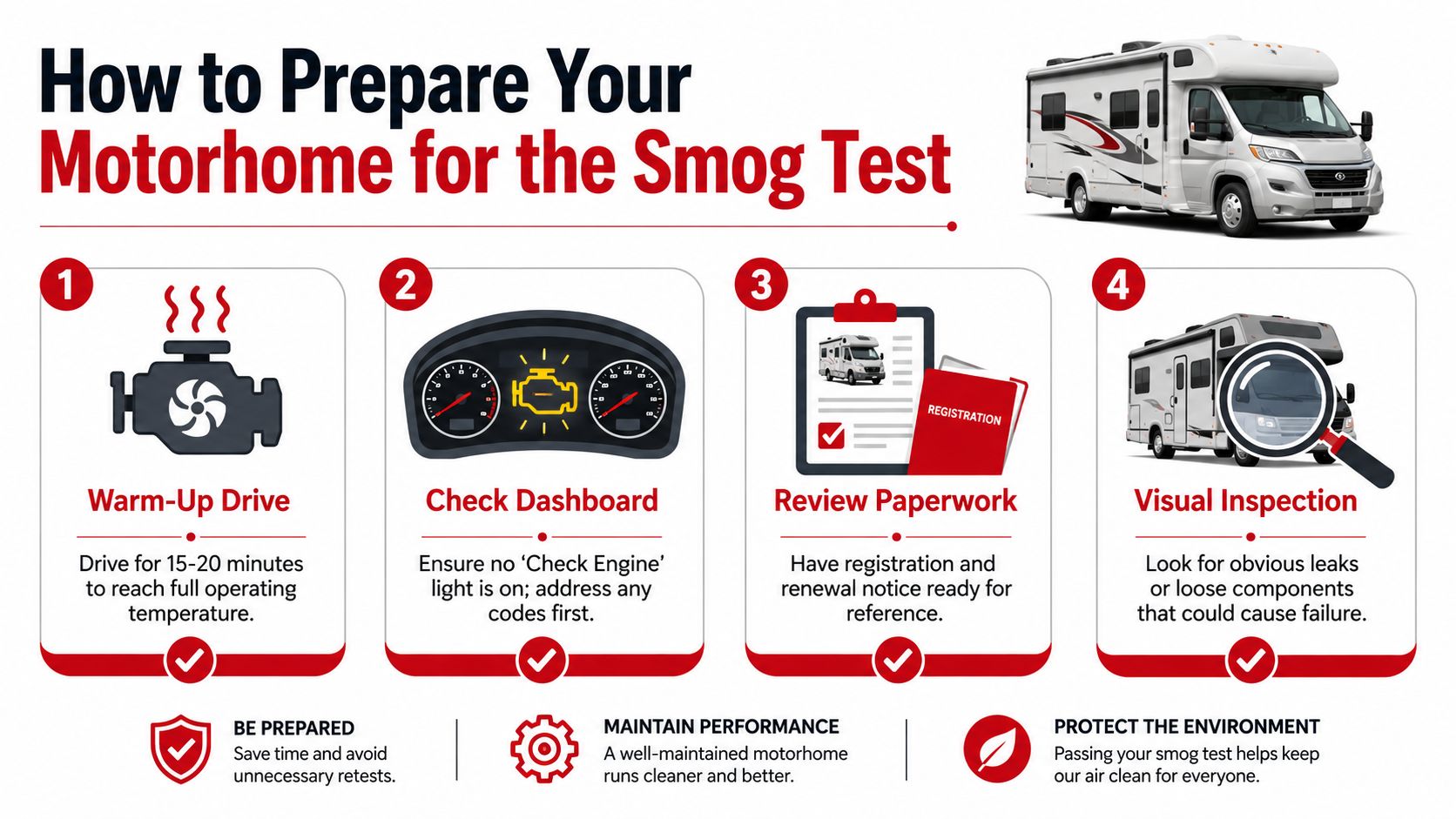
Warm the engine and look at the dash first
Drive the motorhome long enough to get it fully up to operating temperature before you arrive. A cold coach is a bad idea on test day because the system is checking how the vehicle runs, not how it behaves after sitting in the driveway. Then look at the dashboard. If the Check Engine light is on, fix that before the appointment.
Bring the right papers and do a basic walk-around
Have your registration and renewal notice ready. That saves time at the counter and keeps the station from guessing about what the DMV wants. Then do a quick visual inspection around the vehicle for obvious leaks, loose hoses, or other problems that can trip the inspection before it starts.
- Warm-Up Drive. Give yourself enough road time to bring the engine up to normal temperature.
- Dashboard Check. Clear the warning-light question before you ever pull into the bay.
- Paperwork Ready. Bring the registration and renewal notice together.
- Visual Walk-Around. Catch the obvious stuff while you're still at home.
The BAR doesn't publish a magic shortcut for a good test. Your job is to arrive with the vehicle in working condition and the paperwork in hand. If the station offers a free retest when required, that helps with small fixes, but it doesn't replace preparation. California Smog Check rules
Don't forget the practical stuff
A motorhome takes longer to stage than a car. Leave room for parking, turn radius, and the time it takes to get settled at the bay. If your coach uses a testing path that includes a dynamometer cycle, tire condition and general drivability matter too. Show up ready, and you're far less likely to turn one appointment into a two-day headache.
Visiting Fire House Smog in Antioch With a Motorhome
If you're bringing a motorhome into East Contra Costa County, the question is whether the station can handle the coach without sending you back out the gate. Fire House Smog at 2900 Lone Tree Way in Antioch is a STAR-certified test-only station and DMV registration services provider, and it has two service bays, which matters when you show up with a larger vehicle. Lone Tree Way location details
Check the layout before you go. With a motorhome, access, turning room, and bay size decide whether the trip is quick or a waste of fuel.
What the station can do, and what it can't
The station handles smog testing, but it is test-only, so it does not sell repairs. That keeps the inspection separate from the repair side, which is the setup most RV owners want when they just need a clean result and a straight answer.
It also offers on-site DMV registration renewals with sticker printing and ownership transfer services during posted hours. If your motorhome fits the station's inspection limits, you may be able to finish the registration part in the same visit. Fire House Smog says it can handle some RVs and motorhomes, but only within its size and equipment constraints, so calling ahead is part of the job, not a courtesy.
Expect the workflow to be practical, not fancy
The process is simple. You pull in, the vehicle gets checked for fit and eligibility, and the staff tells you whether the coach belongs in their lane or needs a different shop. That direct answer saves time, and it keeps you from forcing a large rig into a space that was not built for it.
The two-bay setup helps with throughput, and the station's seven-day testing schedule gives you more options if your renewal timing is tight. If you can't spare a weekday morning, that flexibility matters.
Use the visit to solve more than one problem
If your motorhome qualifies for inspection there, you may be able to handle the smog certificate and the DMV transaction in one stop. That is the primary advantage of a station that also handles registration work. Fewer stops. Fewer loose ends. Less chance of letting the renewal sit until the last minute.
If you want to save yourself a bad trip, call before you arrive and give them the motorhome's fuel type, model year, and GVWR. Ask whether the bay and equipment fit the vehicle, then decide whether to bring it in. The station's Antioch motorhome smog check page is the right place to start, and one quick conversation can keep a large RV from clogging up your day.
Common Mistakes That Waste a Motorhome Smog Trip
The same five mistakes show up over and over. Owners pull up without confirming the bay fit, ignore a lit warning lamp, miss the STAR instruction on the notice, assume a heavy diesel coach still falls under ordinary Smog Check pricing, or forget the DMV paperwork and discover the certificate alone doesn't finish the job. Every one of those mistakes is avoidable.
Call ahead before you move the rig
That is the single most impactful habit. A station can tell you in one phone call whether the vehicle fits the bay, whether the fuel and model year route it into standard Smog Check or Clean Truck Check, and whether STAR is required. If you skip that call, you're gambling with a large vehicle and your own time.
Don't show up with the wrong assumptions
- Bay Fit: Confirm the station can physically handle the motorhome.
- Warning Lights: Fix a glowing check-engine light before you leave home.
- STAR Notice: Read the renewal notice instead of guessing.
- Program Type: Know whether the vehicle belongs in standard Smog Check or Clean Truck Check.
- Paperwork: Bring the renewal notice and registration, not just the rig.
Keep the checklist in the coach
The best owners don't rely on memory. They keep a short note in a cabinet or glove compartment and run it every time the renewal comes up. That habit saves hours, and it keeps a simple inspection from turning into a stalled registration.
The point is simple. A motorhome smog visit goes smoothly when you treat it like a planning task, not an errand.
If you want the rules explained plainly and the process handled without guesswork, bring your motorhome to Fire House Smog. The station handles STAR-certified test-only smog checks, DMV registration services, and some RVs and motorhomes within its equipment limits, so it's a practical first call when you're trying to figure out what your coach needs.
You're holding a DMV renewal notice, the car runs fine, and you still have to get through a smog check before the sticker shows up. That's the Daly City routine in one sentence. If you treat the inspection as a random errand, you waste time. If you treat it as part of a compliance workflow, you can finish the test and the registration without making a second trip across town.
Table of Contents
- Why a Daly City Smog Check Is Part of a Bigger Workflow
- Choosing the Right Type of Smog Station in Daly City
- Preparing Your Vehicle the Day Before the Test
- What Actually Happens During the Inspection
- Smog Check Fees, Retest Rules, and Exemptions
- Finishing Your DMV Registration in One Trip
- What to Do If Your Vehicle Fails the Smog Test
Why a Daly City Smog Check Is Part of a Bigger Workflow
A Daly City driver usually does not need “a smog check” as a standalone errand. What you need is the certificate that moves the paperwork forward, whether that means a renewal, a title change, or an out-of-state registration. Treat the job as three linked steps, prep, station, DMV submission, and you avoid doing the same work twice.
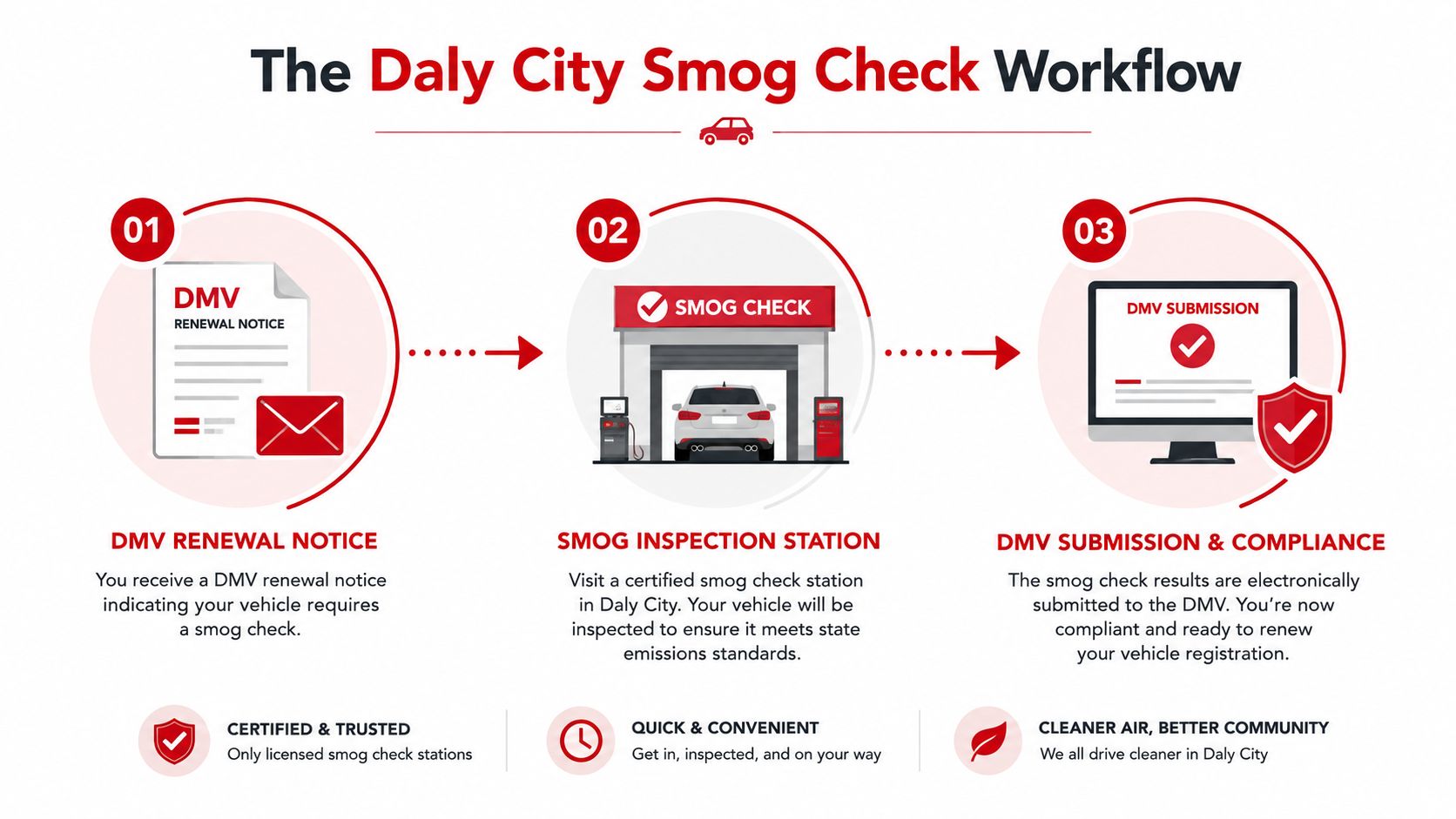
California's program runs statewide in designated counties, and the state's official BAR report for January 2026 logged 989,080 initial tests and 1,065,033 all tests, with an 8.35% initial-test failure rate and an 8.81% overall failure rate (BAR January 2026 executive summary). That failure rate matters because a failed certificate stops the workflow cold. The car can run fine and still leave you unable to finish registration on time.
The rules are not optional and they are not vague. In California, many gasoline, hybrid, flex-fuel, propane, and natural-gas vehicles generally need a smog check starting in the fifth model year through the eighth model year window, and out-of-state first registrations can trigger testing too. For many gasoline-powered vehicles, the first inspection effectively arrives when the vehicle is four model years old because of how the state calculates the model-year threshold, as noted in the same BAR report and the Daly City DMV field office guidance.
Practical rule: do not book the inspection until you know whether your DMV notice calls for a normal certificate, a STAR certificate, or a renewal workflow that needs both the test and the registration handled the same day.
Daly City sits inside the Bay Area's regulated inspection network, so the station is part of the compliance chain, not a convenience stop. If you want the cleanest path, bring the renewal notice, get the test done, and make sure the certificate gets transmitted into the DMV process without delay. That is how you turn one appointment into a completed renewal, not just another receipt in your glovebox. If you need a quick refresher on station types, review how a STAR-certified smog station works before you book.
Choosing the Right Type of Smog Station in Daly City
Pick the wrong station and you burn a morning for nothing. That's the part most drivers get wrong. A station is not just a place that “does smog.” It's a specific type of licensed operation, and your DMV notice may narrow the choice before you ever pull in.
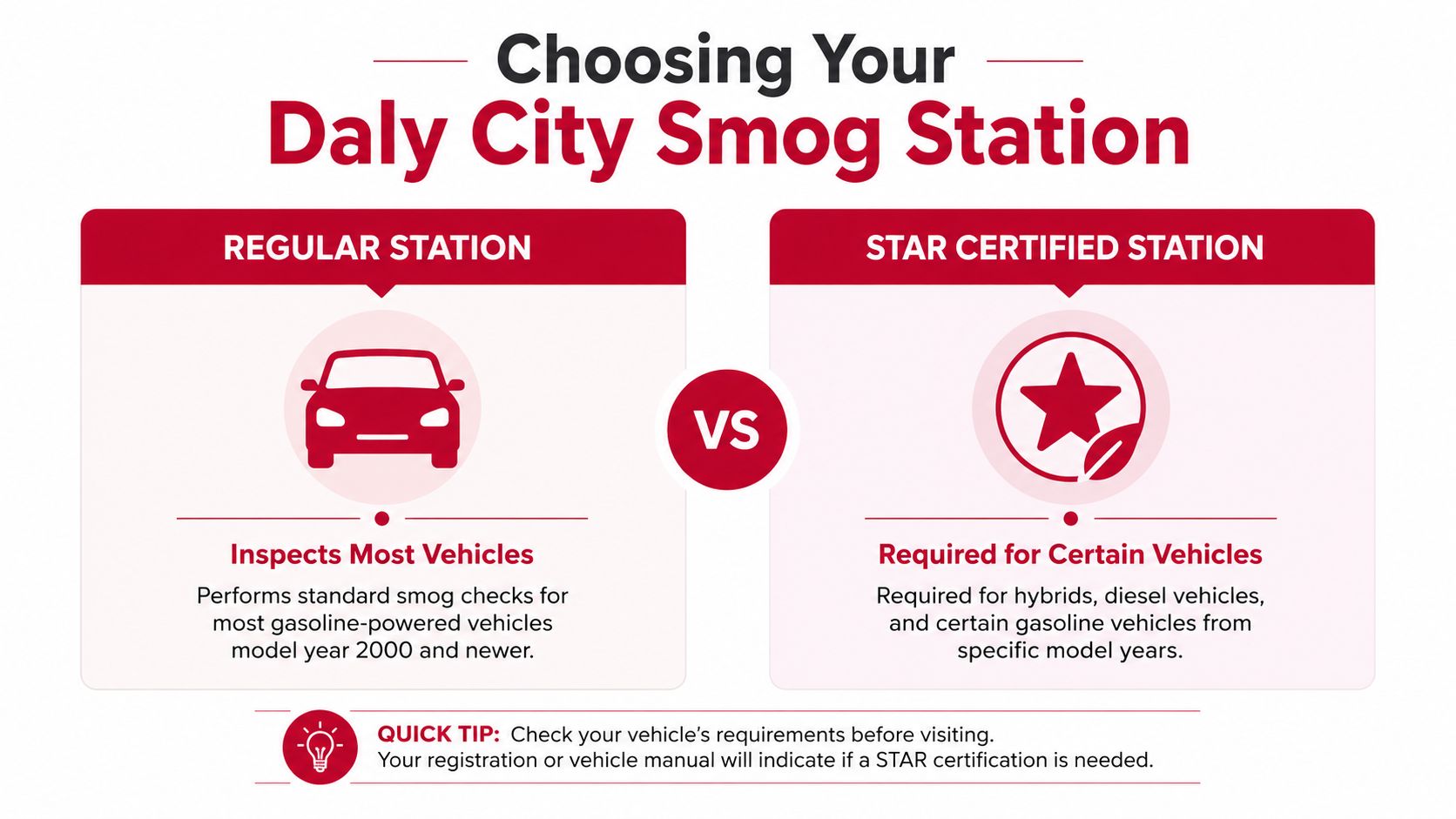
A regular licensed station can inspect many vehicles, but that doesn't mean it can inspect yours. A STAR-certified station meets higher performance standards and can inspect high-polluting vehicles, which is why some DMV notices direct drivers there (BAR smog check guidance). If your renewal notice says STAR, stop shopping around. Go straight to a STAR station.
The cleanest way to think about station choice is by function:
- Test-only station: this is the no-repair lane. The inspector tests the car, issues the result, and doesn't sell you a repair job. That matters when you want a clean compliance decision instead of a sales pitch.
- STAR-certified station: this is for directed vehicles and higher-standard testing paths. If the DMV notice requires it, there's no workaround.
- Regular station: this works for many drivers, but only if your vehicle and notice allow it.
A station can look convenient and still be the wrong fit. The Daly City DMV field office is a local registration hub, and nearby stations publish broad weekday hours, including some that run 9:00 AM–6:00 PM six days a week and others that offer 8:30 AM–6:00 PM weekday service (Daly City DMV field office guidance). Convenient hours don't matter if the station type doesn't match the notice.
Before you leave home, verify the station's license status and the exact service type. If you want a station that handles the test and then pairs the result with DMV renewal service, Fire House Smog is one option that combines smog testing with DMV registration work, including renewals and transfers, at the same location: California DMV registration renewal service.
Preparing Your Vehicle the Day Before the Test
Most Daly City failures start in the driveway. The car looked fine yesterday, the driver skipped a few basics, and the vehicle shows up with a check-engine light or an unreadiness problem that could have been avoided. If you want one clean visit, prep the car the day before and treat the smog check as part of the renewal workflow, not a separate errand.
Warm the car before you show up
Bring the engine up to normal operating temperature before you head to the station. A smog inspection goes faster and cleaner when the car is already warmed up, and a cold start in the parking lot is a bad way to begin. Drive long enough to fully heat the engine, then leave the accessories off when you arrive.
A recently disconnected battery is another easy way to waste a trip. BAR says to allow one to two weeks of driving after a battery disconnect so readiness monitors can reset before the OBD inspection (BAR smog guidance). If the battery was recently replaced, stop guessing and let the drive cycle do its work.
A lit check-engine light is a stop sign, not a suggestion. Fix it before the test, because the inspection checks emissions-system status, not your optimism.
Bring the right things and strip out the noise
Take the DMV renewal notice with you. BAR recommends it, and that single piece of paper keeps the station from fumbling the workflow. Clear out loose items, turn off distracting aftermarket accessories, and don't make the technician work around clutter.
Use the cabin like a workbench, not a storage unit:
- Remove loose gear: backpacks, tools, and cargo that can slide around during the inspection.
- Check warning lights: if the check-engine light is on, stop there and repair the issue first.
- Leave the car mechanically calm: rough idle, overheating, fluid leaks, or loud engine noise can get the vehicle rejected before the formal test starts.
- Keep the battery situation stable: if it was recently disconnected, give the monitors time to reset.
If the vehicle needs service before the test, get that done first. A car that is warmed up, free of warning lights, and ready for inspection gives you the best shot at leaving with the certificate and moving straight on to renewal without another trip.
What Actually Happens During the Inspection
A smog inspection stops looking mysterious the moment you see the sequence. The vehicle rolls in, the technician checks the emissions-related basics, and the station runs the test that fits your car. If you came prepared, the whole thing feels like part of the renewal process, not a separate errand.
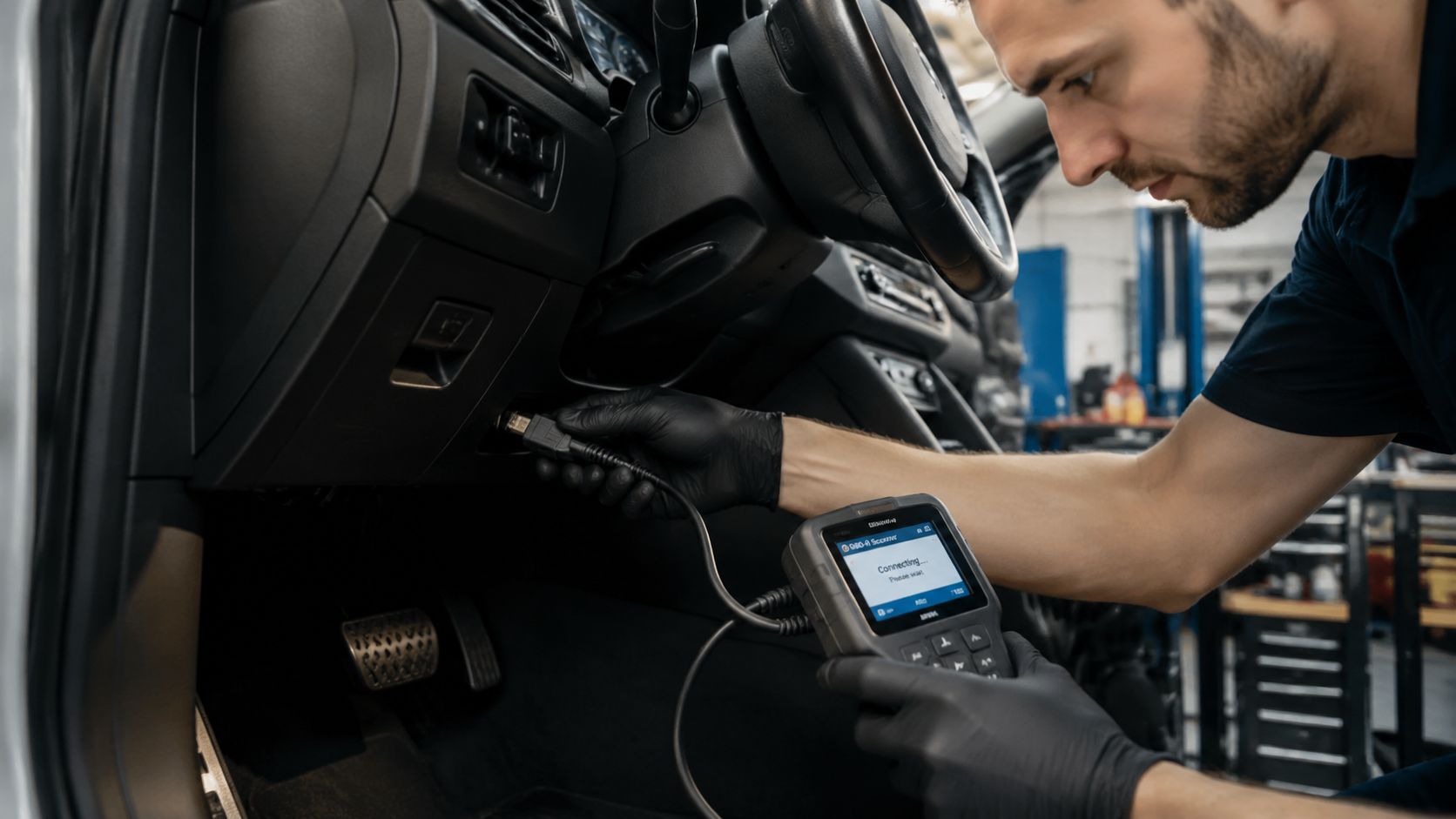
First comes the visual and functional check
California's standard inspection workflow starts with a visual inspection of emission-control parts and a functional inspection of the system (BAR smog guidance). Missing hardware, tampering, or modified software can fail the car even when it drives fine. The technician is checking whether the emissions system is complete and intact, not just whether the engine starts.
For gasoline vehicles, the station also runs a visible-smoke procedure. Inspectors check the crankcase and tailpipe, then perform three BAR Snap Tests with the engine brought to 2,000–3,000 RPM and stabilized between pulls (BAR smog check guidance). If the engine is rough, overheating, or leaking fluids, the car can get turned away before the formal test even begins.
Then the machine depends on your model year
For 2000 and newer vehicles, the BAR On-Board Diagnostic Inspection System is used. For 1999 and older vehicles, the BAR-97 Emissions Inspection System measures tailpipe emissions, and older vehicles can go through a loaded-mode test using a chassis dynamometer or a two-speed idle test (BAR smog guidance). In the loaded-mode test, the station measures hydrocarbon, carbon monoxide, carbon dioxide, and oxides of nitrogen, and the car passes only if the emissions stay within the applicable standards.
That's the part Daly City drivers miss when they show up half-ready. A car can sound normal and still fail because the OBD system is not ready, a required component is missing, or the emissions numbers are off. After the test, the certificate goes electronically into the DMV system, which is what lets you finish the registration step without another trip.
Smog Check Fees, Retest Rules, and Exemptions
Don't pay for a test you don't need, and don't assume every failure means you've got to pay twice. Daly City drivers lose money when they guess wrong about three things, whether the car is exempt, what the station charges, and whether a retest is included.
What you can skip
California's smog program doesn't apply the same way to every vehicle. The rules depend on model year, fuel type, and registration situation. Many newer vehicles are outside the testing window, and certain diesel models fall under separate treatment. If your registration notice doesn't call for a certificate, don't invent one by booking a test out of habit.
What you actually pay for
The state sets the inspection framework, but stations can set their own labor charge. That's why one shop can feel straightforward and another can feel padded. The useful question is not “What does smog cost?” It's “What exactly is included, and does a retest come with it?”
| Vehicle Type | Typical Price Range | Retest Eligible |
|---|---|---|
| Passenger car | Qualitative, station-set | Sometimes, depending on station policy |
| Light truck | Qualitative, station-set | Sometimes, depending on station policy |
| SUV | Qualitative, station-set | Sometimes, depending on station policy |
| RV or motorhome meeting criteria | Qualitative, station-set | Sometimes, depending on station policy |
California BAR says RVs and motorhomes meeting the criteria can require smog checks too (Daly City DMV field office guidance). That's an easy detail to miss if you only think in terms of sedans and pickups. If your vehicle is unusual, call ahead instead of assuming the standard passenger-car process applies.
A strong shop will tell you whether the retest policy is part of the deal before you hand over the keys. That matters because a failed vehicle often needs a second visit after repair, and the smartest owners use a station with a clear retest path rather than paying twice for the same paperwork.
Finishing Your DMV Registration in One Trip
The smog certificate is not the finish line. It's the handoff. If you still need to renew registration, transfer ownership, or get a new sticker issued, the right move is to tie the certificate directly into the DMV workflow the same day.
What the DMV counter needs
Bring the renewal notice, your proof of insurance if required by the transaction, payment method, and any ownership paperwork tied to a sale or transfer. That list gets longer when the vehicle came from out of state or the title changed hands recently. The point is simple, the station should not be your only stop.
The Daly City DMV field office exists as a local registration hub, but long lines are the reason many drivers want a licensed business partner handling the renewal instead (Daly City DMV field office guidance). If you can complete the inspection and submit the renewal without crossing town again, you save the part of the day that usually gets lost to waiting.
A passing certificate can also support transfer-of-ownership work, including California and out-of-state vehicles when the transaction requires it. That workflow is exactly where a combined smog-and-DMV site helps, because the certificate doesn't sit in your inbox waiting for another errand.
For drivers who want that combined path, California DMV registration renewal service is the relevant service page to check. Use it when your goal is completion, not just inspection.
Keep the sequence tight
Don't leave the smog station until you know the certificate is handled and the next step is clear. The clean sequence is inspection, transmission of the result, DMV payment or renewal, then sticker or registration follow-through. That's one trip done right.
What to Do If Your Vehicle Fails the Smog Test
A failed test is frustrating, but it's not automatically a repair emergency. Daly City drivers get trapped by one bad assumption, that every failure means a huge bill. That's wrong. Some failures are paperwork and readiness problems, and some are real emissions faults that need repair.
Start by reading the failure type
A failure can come from readiness issues, a lit check-engine light, missing emission-control parts, or a genuine emissions exceedance. BAR's process checks more than tailpipe output, which is why a car can fail even if it still drives clean enough to feel normal (BAR smog guidance). If the failure is a readiness problem, the fix may be driving cycles and monitor reset, not major parts replacement.
The best move is to sort the failure before authorizing work. Test-only stations are useful here because they remove the incentive to push repairs. That doesn't mean every repair estimate is wrong. It means you should know the failure reason before anyone starts upselling parts you don't need.
Use the fail reason to decide the next move
- Readiness fault: drive the vehicle properly after a battery disconnect or repair, then retest once monitors are ready.
- Check-engine light: repair the cause before returning, because a light that stays on usually means the car isn't ready for a pass.
- Missing or tampered components: restore the original emissions equipment and retest.
- Tailpipe or OBD failure: fix the issue that caused the readings to miss standard, then complete the retest.
The article on smog check fail reasons is worth reading if you want the common failure patterns laid out plainly. Use it as a filter before you approve work. The goal is a passing retest that flows straight back into the DMV renewal, not a repair shop detour that drags the process out for days.
Get the workflow right the first time. If you want a clean smog check plus DMV follow-through without extra running around, use a station that handles both sides of the process and asks the right questions before you arrive. Fire House Smog can help with inspection and registration tasks in one place, so you can leave with the certificate handled and the renewal moving. Visit Fire House Smog and book the visit that gets the job finished, not just started.
You're staring at a renewal notice, and one line keeps catching your eye, STAR required. That usually leads to the same question at the counter, on the phone, or in the driveway, what's the difference between a regular smog shop, a STAR certified smog check test only center, and a place that can fix the car too?
In plain terms, STAR is California's higher-standard inspection tier, and test-only means the station can inspect your vehicle but can't sell the repair. If you're trying to avoid a second trip, understand whether you're required to go STAR at all, and figure out what happens if your car fails, the details matter more than the label on the sign.
Table of Contents
- What a STAR Certified Smog Check Test Only Center Actually Is
- STAR Certification and Test Only Status Explained Separately
- How a Test Only Station Differs from Regular Smog Shops
- What Happens During a Test Only Smog Inspection
- Who Needs a STAR Test and What About RVs and Exempt Vehicles
- Fees Documents Retests and the On Site DMV Experience
- Why Drivers in Antioch and East Contra Costa Choose a Local Test Only Station
- STAR Smog Questions Drivers Ask Before They Book
What a STAR Certified Smog Check Test Only Center Actually Is
A lot of drivers arrive with the same look on their face, a DMV envelope in one hand and a phone in the other, trying to decode what STAR means before they waste an afternoon. A STAR certified smog check test only center sits inside California's broader Smog Check system, so it isn't a separate program, it's a higher-controlled part of the same system.
California's Bureau of Automotive Repair says the STAR program started in January 2013, and in calendar year 2023, 48% of licensed stations were STAR certified while 83% of all Smog Check tests were performed by STAR stations, according to the BAR's 2024 Smog Check Performance Report. The same report says California's Smog Check program removes about 400 tons of smog-forming pollutants every day and serves more than 10 million vehicles each year at more than 5,000 independently owned stations statewide, which shows why STAR is part of a large regulatory network, not a boutique service (BAR 2024 Smog Check Performance Report).
What the label tells you
STAR tells you the station has met higher BAR performance standards. Test only tells you the station is licensed to inspect vehicles, not to do the repair work itself. Those are separate layers, and a business can be one, the other, both, or neither.
That distinction matters on visit day. A test-only station can tell you whether the vehicle passes or fails, but it doesn't turn into a repair shop if the car needs work. If you're used to full-service auto shops, that can feel unusual at first, but it's the point of the model.
A real-world example helps: a driver with a renewal notice marked STAR can show up at a STAR test-only center, get the inspection, and leave with the result, without being steered into a repair estimate from the same counter. That separation is useful when you want clarity first and a repair decision later.
Practical rule: if your paper says STAR, the station status matters. If you're not sure whether you need repairs, test-only keeps the inspection separate from the sales pitch.
STAR Certification and Test Only Status Explained Separately
A driver can roll up to a station with a renewal notice, see the word STAR, and still not know what that means for the visit. The cleanest way to read the label is to separate two questions. One asks whether the station meets BAR's higher oversight standard. The other asks whether the station is allowed to do inspections only, or inspections plus repairs.
STAR certification is about oversight and consistency. BAR requires a STAR-certified test-only center to meet controls that go beyond ordinary smog stations, including the ability to inspect all vehicle types subject to Smog Check, maintain the BAR-certified inspection equipment required by the Smog Check Manual, and keep calibrated equipment passing calibration at least once every 10 calendar days when calibration is required (BAR STAR Certification).
That matters because the inspection process has to hold up under the same rules every day, whether the car is a small commuter vehicle or something more complex. If the required equipment is missing, out of calibration, or not being maintained to BAR standards, the station is not operating with the consistency the program expects. For a first-time customer, that means the result comes from a process BAR has already tightened, instead of from a shop's own judgment call.
Test only is a different question
Test only describes what the shop is allowed to do, not how strict its oversight is. A test-only station can inspect vehicles, but it cannot sell emissions repairs. A test-and-repair shop can inspect and repair. A STAR station can meet BAR's higher standard, yet it may still be either test-only or test-and-repair.
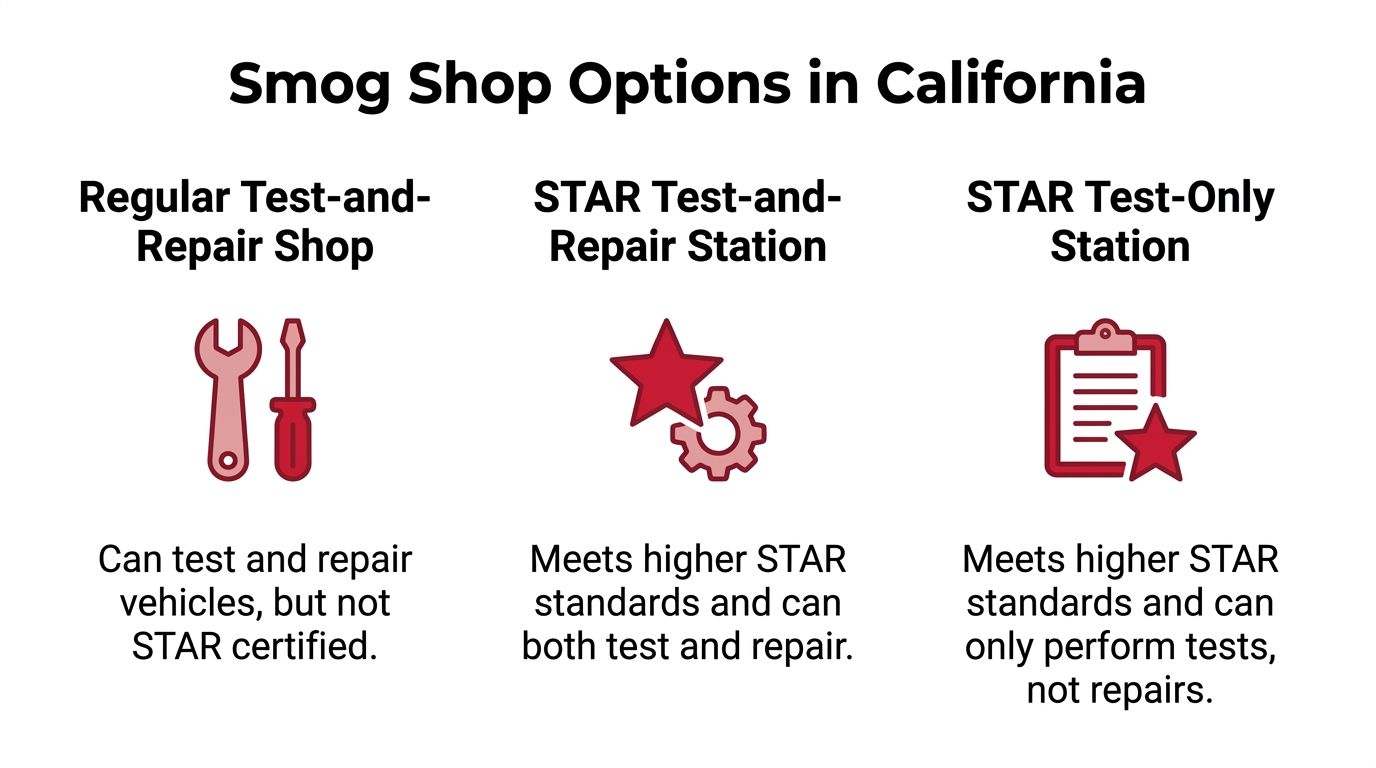
The simplest way to separate the two labels is this. STAR describes the standard of oversight. test only describes whether the station is allowed to fix the vehicle after the inspection. A referee can call the play and still not coach either team, and the same split applies here.
For a driver, that split changes the tone of the visit. A test-only station gives you the inspection result without the same counter pressure to turn a failure into an in-house repair job. A test-and-repair station has a different business setup, because the shop can diagnose, quote, and repair under the same roof.
That is why the combinations matter. A station can be STAR and test-only, STAR and test-and-repair, or a regular test-and-repair shop without STAR status. The label on the sign gives you one piece of the picture, and the renewal notice tells you which setup fits your situation. If you want a plain-language walkthrough from the station side, Fire House Smog's STAR certification explanation lays out the same distinction in simple terms.
How a Test Only Station Differs from Regular Smog Shops
A regular smog shop can often do more than one thing, which sounds convenient until the vehicle is borderline and you're trying to decide who you trust with the result. A STAR test-only station gives you a narrower service, inspection without repair, and that narrower service removes the in-house incentive to push a fix right after the failure.
The 2025 BAR Smog Check Executive Summary Report makes the scale of test-only clear. STAR Test-Only stations performed 5,916,245 initial tests and recorded 481,639 failures, an 8.14% failure rate. STAR Test-and-Repair stations performed 2,766,051 initial tests with 227,215 failures, an 8.21% failure rate. STAR Test-Only stations also issued 5,822,635 certificates overall, compared with 2,710,210 certificates from STAR Test-and-Repair stations (BAR 2025 Smog Check Executive Summary Report).
What those numbers mean for a driver
Those figures don't tell you whether your car will pass, but they do show something useful. Test-only STAR stations are not a niche fallback, they're operating at very large scale and handling a volume close to the combined total of STAR Test-and-Repair stations. That makes test-only a central part of California's inspection network, not an afterthought.
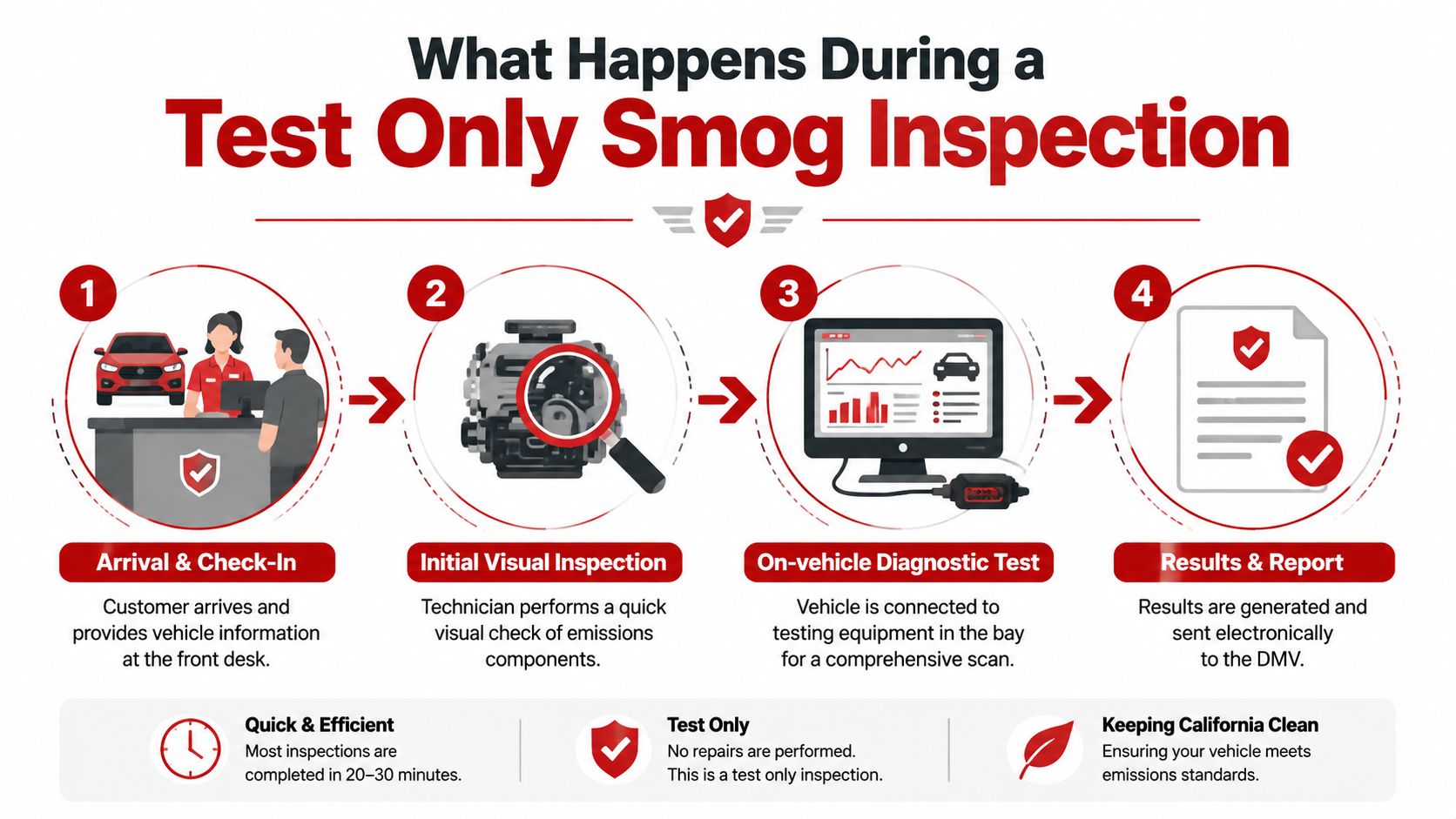
The consumer experience is different too. At a regular smog shop, some drivers feel pressure because the same business that fails the car may also want to repair it. At a test-only station, the result stands on its own. If the car needs work, you can take the report somewhere else and decide what to do without buying into the first estimate you hear.
Fire House Smog's test-only overview describes that same split clearly, inspection only, no repair upsell. That's the key difference most first-time customers are really looking for, even if they don't say it that way.
What Happens During a Test Only Smog Inspection
A first-time visit usually starts with the same small ritual, pull in, hand over the paperwork, and wait for the technician to confirm the vehicle details. The inspection is designed to be straightforward, but the exact steps depend on the vehicle year and the state rules that apply to it.
The bay workflow
At a test-only station, the technician checks the vehicle visually, then connects the required test equipment. For 1996-and-newer vehicles, that normally means an OBD-II diagnostic connection. Older vehicles may also involve a tailpipe-style emissions check, depending on the vehicle class and what BAR requires for that inspection.
Most drivers care about one thing here, how soon they'll know. The station's job is to generate a result, not to turn the visit into a sales conversation.
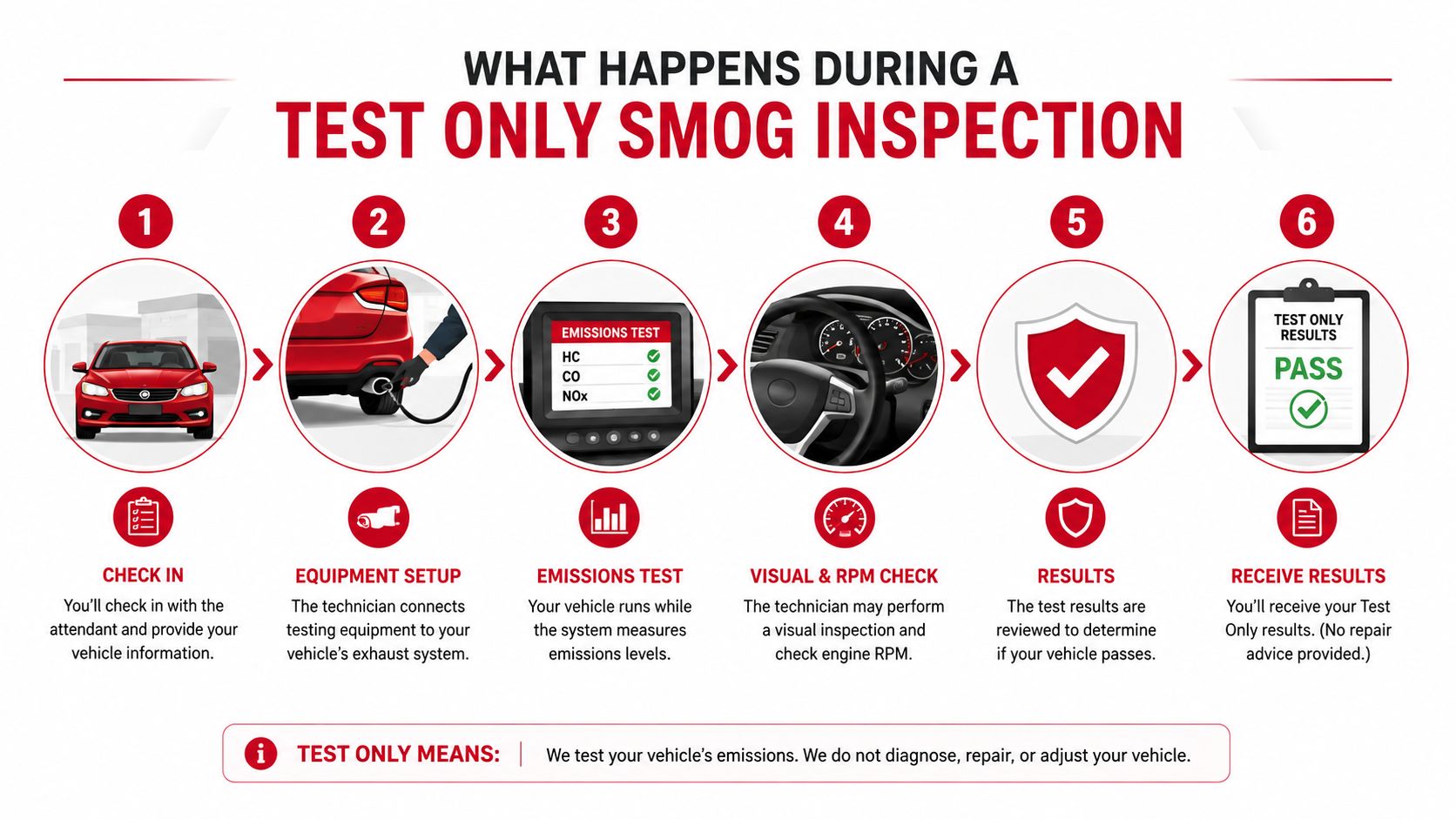
If the car passes, the result is transmitted electronically and the driver gets what they need to continue the DMV process. If it fails, the station provides the report, and the next decision is whether to repair first or look at an approved repair path elsewhere. That split is exactly why test-only centers work well for drivers who want the inspection separated from the repair decision.
| Smog Inspection Stages at a Test Only Station | |||
|---|---|---|---|
| Stage | What the Technician Does | What the Driver Experiences | Typical Time |
| Arrival and check-in | Confirms the vehicle and paperwork | Hands over the renewal notice or vehicle details | Brief |
| Visual inspection | Looks over emissions-related components | Waits near the counter or in the lobby | Short |
| Diagnostic testing | Runs the vehicle through the required equipment | Stays nearby while the test is completed | Short |
| Results and report | Generates the pass, fail, or directed result | Receives the outcome and next-step paperwork | Brief |
The main thing to remember is that the station is measuring compliance, not negotiating a fix. That makes the visit feel cleaner and more predictable, especially when you already suspect the vehicle may be close to the line.
Who Needs a STAR Test and What About RVs and Exempt Vehicles
A renewal notice can look simple until one line changes the whole errand. One driver needs a STAR test, another needs a regular smog inspection, and a third does not need a smog check at all. The DMV says a smog inspection is generally required for registration renewal, with important exceptions for gasoline vehicles 1975 and older, diesel vehicles from 1997 and older or over 14,000 pounds GVW, natural gas vehicles over 14,000 pounds, electric vehicles, and gasoline vehicles less than eight model-years old. The renewal notice is the document that tells you whether your specific renewal requires STAR, a standard smog inspection, or no smog check at all (California DMV Smog Inspections).
That is why STAR searches can feel confusing when the question is eligibility. If the vehicle is exempt, the issue is not finding a station, it is reading the paperwork correctly. If the notice calls for STAR, then the station type matters, and the safest first step is to trust the renewal notice before you plan the visit.
RVs and unusual vehicles need a call ahead
Fire House Smog notes that some recreational vehicles and motorhomes can be tested, subject to size and equipment constraints. A vehicle can be eligible on paper and still be hard to fit in a bay, so a quick phone call can prevent a wasted drive. The business lists 925-754-1600 as the contact line for screening those cases.
RVs, diesel vans, motorhomes, and newer vehicles that may fall into an exemption category all benefit from the same approach. Read the renewal notice first, then confirm the vehicle fit with the station before you head over. A test-only center keeps the question narrow, the car gets inspected or it does not, and the station can tell you whether the vehicle belongs in the lane at all.
Fees Documents Retests and the On Site DMV Experience
Most drivers want to know three things before they leave the house, what to bring, what the test costs, and whether they're going to need a second appointment. Fire House Smog's pricing page explains its smog-test pricing and coupon policy, including a discount on the test and a free retest when required under the site's terms (Fire House Smog smog check cost information).
Bring the renewal notice, a valid ID, payment, and any previous test paperwork if you already have a failure report. That makes the handoff quicker and helps the technician confirm the right vehicle record. If you've recently disconnected the battery or cleared codes, bring the last report too, because it can help you understand where the car stands before you drive off again.
The DMV side of the visit
Fire House Smog also handles DMV registration tasks on site, including renewals and ownership transfers, with sticker printing during posted hours. That turns the stop into more than just a test, which matters if your schedule only allows one errand day. The station says smog testing is available seven days a week, while DMV service hours run Monday through Saturday, 9:30 AM to 5:00 PM, and Sunday, 12:00 PM to 4:00 PM.
That combination is useful for a simple reason. The smog result and the registration task often sit back-to-back in real life, so finishing both in one trip saves time and lowers the chance of forgetting a follow-up. For drivers who already know they need a renewal and a smog certificate, the station's two-service flow is easier than bouncing between separate offices.
Why Drivers in Antioch and East Contra Costa Choose a Local Test Only Station
A local test-only station earns its keep by reducing the number of decisions a driver has to make on the same day. At 2900 Lone Tree Way, Antioch, CA 94509, Fire House Smog gives East Contra Costa drivers a direct stop with parking, a phone line for unusual vehicles, and a setup built around inspection rather than repair sales.
What makes the local option practical
The first advantage is the layout. Two service bays help keep the line moving, which matters when you're trying to fit a smog test between work, school pickup, or a registration deadline. The second advantage is timing. Smog testing is offered seven days a week with extended weekday and weekend hours, so drivers don't have to build the whole day around a narrow appointment window.
The third advantage is fit. If you're bringing a truck, a diesel, or a motorhome, a local station can tell you quickly whether the vehicle is a match for its bays and equipment. That is more useful than driving across town to discover the answer at the curb.
When a local station is the better choice
If you already know you need a STAR test, a local test-only center is usually the cleaner choice when you want the result without a repair pitch. If you also need registration work, a station that handles DMV services on site keeps the trip simple. If you're unsure about RV eligibility, a quick call before you leave is the safest move.
For Antioch and nearby communities, the logic is straightforward. Pick the station that can inspect the vehicle, handle the paperwork, and tell you the result without adding a second errand unless you need one.
STAR Smog Questions Drivers Ask Before They Book
Can a STAR test-only center help a marginal car pass?
It can't change the pass or fail rules. STAR means the station meets higher BAR standards, and test-only means it doesn't sell repairs, so the inspection is cleaner, but the vehicle still has to meet the same emissions requirements.
How do I know from my renewal notice whether I need STAR?
BAR says your renewal notice tells you when you must go to a STAR station. If the notice calls for STAR, use that instruction. If the notice doesn't require it, you may not need a STAR site at all.
What if the check-engine light is on or the monitors aren't ready?
That's the kind of problem that often leads to a failed inspection, because the car hasn't met the readiness conditions the state needs. If the battery was recently disconnected, give the car time and driving miles before you test.
Should I go to a STAR test-only station first or a test-and-repair shop first?
If you want a neutral result and a clean paper trail, test-only first makes sense. If you already know the car needs diagnosis and repair, a repair-capable shop may be the better first stop, but that's a different goal than getting the smog certificate done efficiently.
If you want a straightforward smog visit in Antioch, Fire House Smog handles STAR test-only inspections, DMV registration services, and on-site tag issuance under one roof. If you're sorting out a renewal notice, an unusual vehicle, or a test you don't want tied to a repair pitch, visit Fire House Smog and plan the stop around the vehicle you drive.
You've got the renewal notice in your hand, the dash light is staring back at you, and now you're trying to figure out whether you need a smog check, a safety inspection, or both. California makes people work too hard for a simple answer, so here it is straight, a California vehicle inspection usually means an emissions test for registration, not a generic mechanic inspection, and the wrong assumption costs time and money.
The fastest path is to separate the two programs in your head before you book anything. Smog checks are the common requirement for registration renewal, while safety systems inspections show up in narrower situations like out-of-state cars, revived salvage vehicles, specially constructed vehicles, motorcycles, and some trailers over 3,000 pounds GVWR. If you treat them like the same thing, you'll book the wrong appointment, show up unprepared, and pay for a retest you didn't need.
Table of Contents
- Understanding What Your California Vehicle Inspection Actually Requires
- Determining Your Eligibility and Exemption Status
- Pre-Inspection Checklist to Maximize Your Pass Rate
- What Happens During Your Smog Check Appointment
- Completing Your DMV Registration Without a Separate Office Visit
- Fire House Smog Services and How to Schedule Your Visit
Understanding What Your California Vehicle Inspection Actually Requires
Smog Check vs. Safety Inspection
A lot of drivers walk into this confused because the DMV notice just says “inspection” in the broad, everyday sense. In California, that's sloppy language for a very specific process. The common requirement is a smog inspection tied to registration, while a separate vehicle safety systems inspection is triggered by specific vehicle histories and classes, not by ordinary annual ownership of a passenger car. California's smog inspection overview makes that split clear.
If you own a normal privately owned passenger vehicle, don't assume you need an annual safety inspection. You usually don't. What you usually need is the emissions side of the equation, which is why so many drivers search for a California vehicle inspection when they really need a smog appointment.
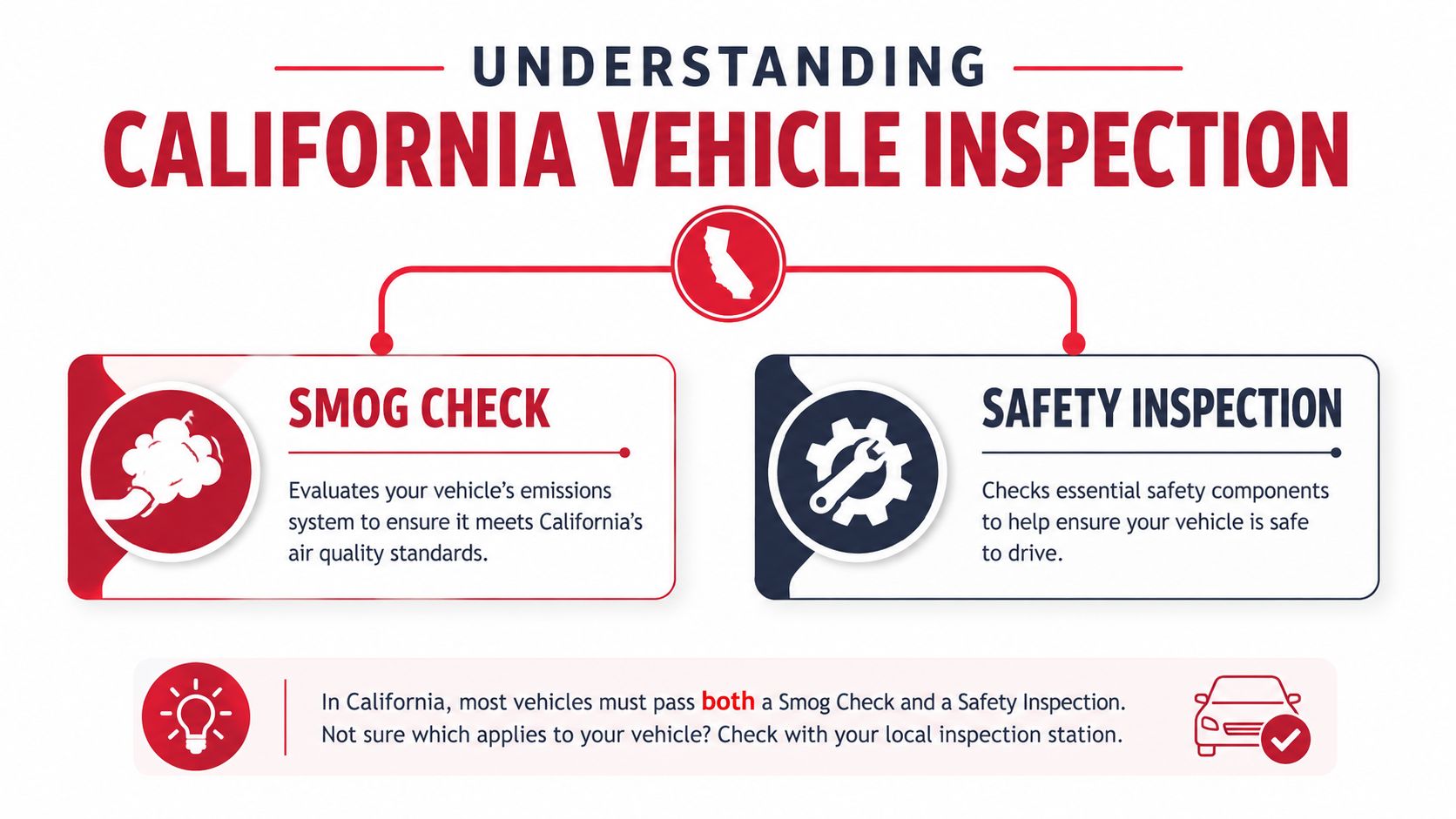
Practical rule: if the car is due for registration renewal, think smog first, safety inspection only if the vehicle history or type triggers it.
That distinction matters because the wrong appointment doesn't just waste time, it sends you to the wrong lane. If the car needs emissions compliance, a test-only smog station is the correct stop. If it needs a separate safety systems verification, the paperwork and inspection path are different, and DMV and BAR guidance treat them as separate programs.
A good way to keep yourself out of trouble is to ask one blunt question before scheduling, “What problem am I solving, registration smog compliance or title/safety verification?” If you can answer that, you've already avoided the biggest consumer mistake around California vehicle inspection rules. For a simple emissions-specific explainer, see California emissions standards and smog basics.
Determining Your Eligibility and Exemption Status
How California Decides Who Gets Tested
California does not guess at smog obligations. It uses model year, fuel type, vehicle class, and registration history to decide whether a vehicle needs testing. The BAR January 2024 summary shows the program is still very active, with 952,481 initial tests and 80,936 failures, for an 8.50% initial-test failure rate, and 1,029,286 total tests with 92,532 failures, for an 8.99% overall failure rate, so this is still a real compliance checkpoint, not a box to check. BAR January 2024 Executive Summary
The smart move is to verify the exemption before you book, not after you are already at the station.
California keeps some exemptions narrow and others broad. BAR lists the program as biennial, and the official exemption framework includes gasoline vehicles 1975 and older, diesel vehicles 1997 and older or over 14,000 pounds GVWR, and natural gas vehicles over 14,000 pounds. Those carveouts are why most inspection volume lands on newer gasoline, hybrid, and eligible light-duty diesel vehicles.
Here is the decision framework I use with customers:
| California Smog Check Exemption Rules | Vehicle Type | Exemption Criteria | Notes |
|---|---|---|---|
| Gasoline passenger vehicles | 1975 and older | Exempt from smog inspection | Old enough to fall outside the regular smog program. |
| Diesel vehicles | 1997 and older, or over 14,000 pounds GVWR | Exempt from smog inspection | Weight and model year both matter. |
| Natural gas vehicles | Over 14,000 pounds | Exempt from smog inspection | Heavy natural gas vehicles are treated separately. |
| Newer gasoline vehicles | Less than 8 model years old | Exempt from smog inspection under DMV rules | The exemption changes the timing for many late-model cars. |
| Very new gasoline vehicles | Less than 4 model years old | May pay a smog abatement fee instead of getting inspected for the first 8 registration years | This is the rule people miss most often. |
That last rule catches a lot of drivers. DMV says gasoline-powered vehicles less than eight model years old are exempt from smog inspection, but starting January 1, 2019, vehicles less than four model years old may pay a smog abatement fee instead of getting inspected for the first eight registration years. That means newer cars do not all follow the same path, and you should not trust old advice from a friend or an outdated forum thread. DMV smog inspection rules
If you are unsure, check the model year, fuel type, and whether the vehicle has a special title or registration history. That is the only reliable way to make the right call before you spend money on the wrong inspection. If you want to avoid a useless visit, read this quick guide to common reasons a smog check fails before you book.
Pre-Inspection Checklist to Maximize Your Pass Rate
What to Fix Before You Show Up
A failed smog check costs more than the inspection fee. You pay for repairs, then you pay again to come back, and the retest process burns time you did not need to lose. The smart move is simple, show up with the car already sorted and ready for a clean emissions test, especially if you want the same trip to cover smog testing and on-site DMV registration at a test-only station. BAR's procedure puts weight on vehicle configuration, test sequence, and properly maintained equipment, so a sloppy arrival usually turns into avoidable delay. Smog Check manual
Here is the checklist I give drivers who want to avoid retest pain:
- Check Engine Light off: If the light is on, stop there. Diagnose the fault first.
- Drive cycle completed: After battery disconnects or repairs, give the car enough normal driving time for the onboard monitor to reset.
- Tire pressure and basic fluids checked: Low pressure, neglected oil, or ignored coolant issues are signs the car has not been prepped properly.
- Gas cap tightened properly: A loose cap creates a preventable failure and wastes a visit.
- Accessories off at arrival: Turn off the A/C, radio, seat heaters, and anything else that adds load.
- Transmission in park or neutral: Roll in correctly. A bad setup can stop the test from moving forward.
- Paperwork ready: Bring the registration notice, insurance if required, and any prior repair records so the counter goes fast.
Simple rule: if the car is not behaving normally on the drive over, it is not ready for the test.
The reason this matters is the visual inspection and mode test work together. Technicians check for tampered or missing emissions parts, confirm the vehicle is set up correctly, and then follow the required test path. If the car shows up in the wrong configuration, in the wrong gear position, or with equipment that is past calibration, you are setting yourself up for a retest instead of a pass. Smog Check manual
If the check engine light has been on recently, use the visit as your deadline, not your diagnosis tool. Clearing codes without fixing the cause only buys you a second failure. For the common reasons drivers get stuck, read the main smog check failure causes.
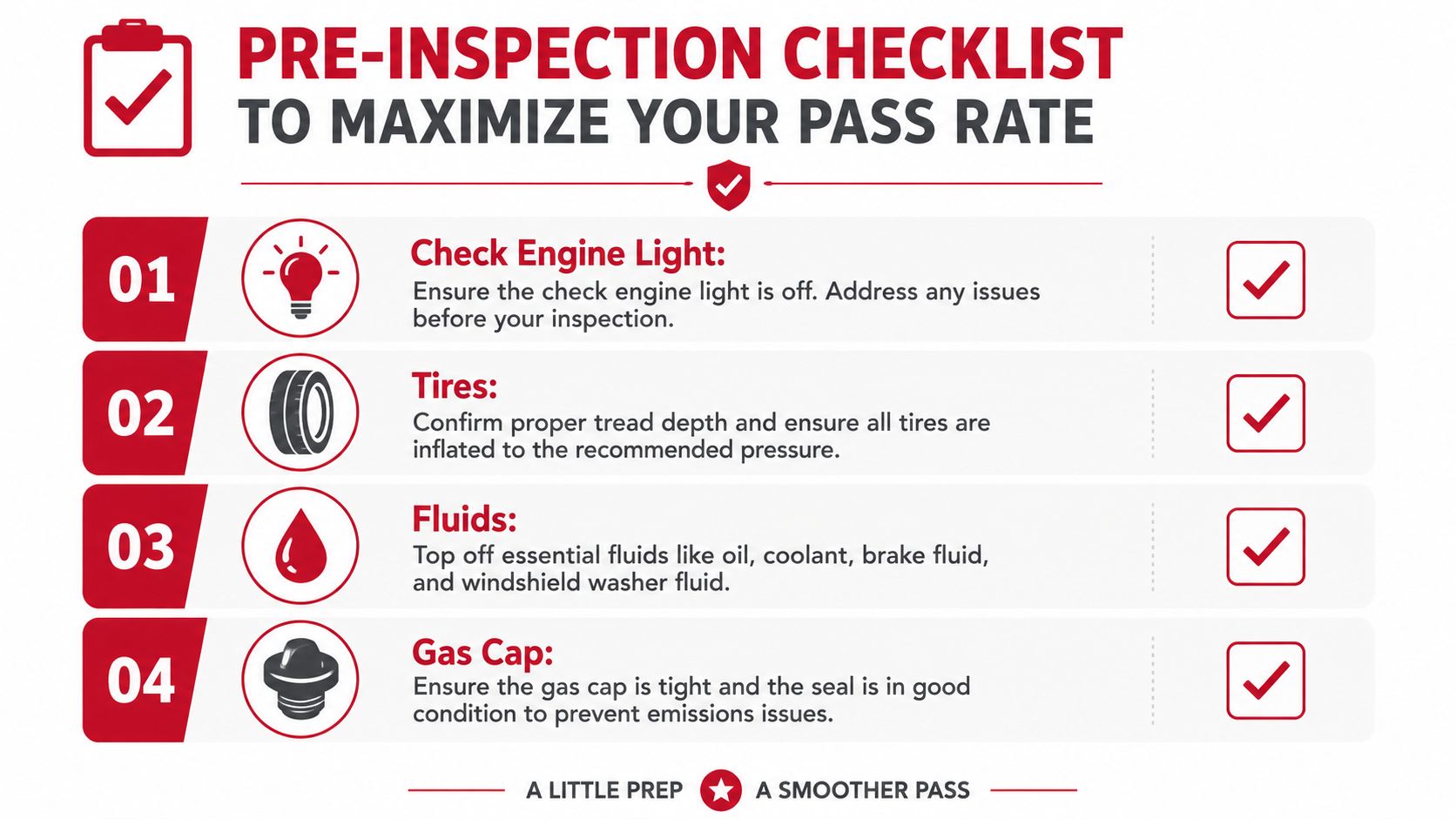
What Happens During Your Smog Check Appointment
From Check-In to Certification
A test-only station should feel organized the moment you arrive. You pull in, hand over the paperwork, and the technician confirms the vehicle's setup before the inspection starts. That step catches obvious problems early, before you waste time on a test that was never going to count.
The visual inspection comes first. The technician checks for missing, altered, or incorrectly installed emissions parts, then runs the required mode test. For the BAR Snap Test, the accelerator is pressed quickly from idle to between 2,000 and 3,000 RPM and released right back to idle. That is a specific procedure, not a casual rev, and the car needs to be in the right condition before the test begins. The equipment used in the inspection also has to be maintained and calibrated to the required standards. Smog Check manual
If the vehicle shows up with the wrong setup, the wrong gear position, or any condition that disrupts the test path, expect delay or a retest. That is how drivers lose time and pay twice. The easy fix is simple, arrive with the car behaving normally and let the station follow the correct sequence.
When the inspection ends, you receive a Vehicle Inspection Report. If the car passes, that report is the piece that supports the registration process. If it fails, the report tells you what needs attention instead of leaving you to guess. A test-only station keeps that part clean, because the station is there to test the car, not sell you repairs before you understand the failure.
The workflow is faster at a station built around inspection volume, especially when the bays stay moving and the staff follows the same order every time. That means less waiting, fewer handoffs, and a clearer trip from check-in to result. If you want to see how the smog result can feed straight into registration without a separate DMV visit, use this California DMV registration renewal service as the next step after the test.
Completing Your DMV Registration Without a Separate Office Visit
How the Smog Result Connects to Renewal
You pass the smog test, and the job is still only halfway done if you have to leave and stand in line at the DMV. A station that handles registration on-site turns that into one stop, which is the cleanest way to finish a renewal or title transfer without losing the rest of your day.
A licensed registration services provider can take the passing result and move straight into the DMV side of the transaction. That means the sticker can be printed on-site, and transfer paperwork can be handled without a second office visit. If you have ever tried to fit a smog appointment, a DMV queue, and a work schedule into the same day, you already know why this saves time. The state's smog rules treat the inspection as part of the renewal process, not a separate errand, and California DMV registration renewal services can help keep that handoff in one place.
Timing is the advantage. Once the inspection result is ready, the registration work can start right away instead of waiting for another appointment, another line, or another day off. That matters for out-of-state vehicles, title transfers, and drivers who want one location to handle both the emissions test and the paperwork.
If renewal is the goal, keep the inspection and DMV work together unless you have a good reason to split them.
That approach saves money in the real world. Every extra trip uses fuel and time, and a failed retest gets worse when the paperwork is still scattered. The better workflow is straightforward, arrive with the right documents, pass the inspection, and finish the registration while the result is still fresh.
Fire House Smog Services and How to Schedule Your Visit
Booking, Hours, and Retest Policy
Fire House Smog is a STAR-certified test-only station and licensed DMV registration services provider in Antioch, California. The setup is built for speed, with a drive-through layout, parking, and two bays that help cut down wait time. Smog test availability runs seven days a week, while DMV service hours are Monday through Saturday 9:30 AM to 5:00 PM and Sunday 12:00 PM to 4:00 PM.
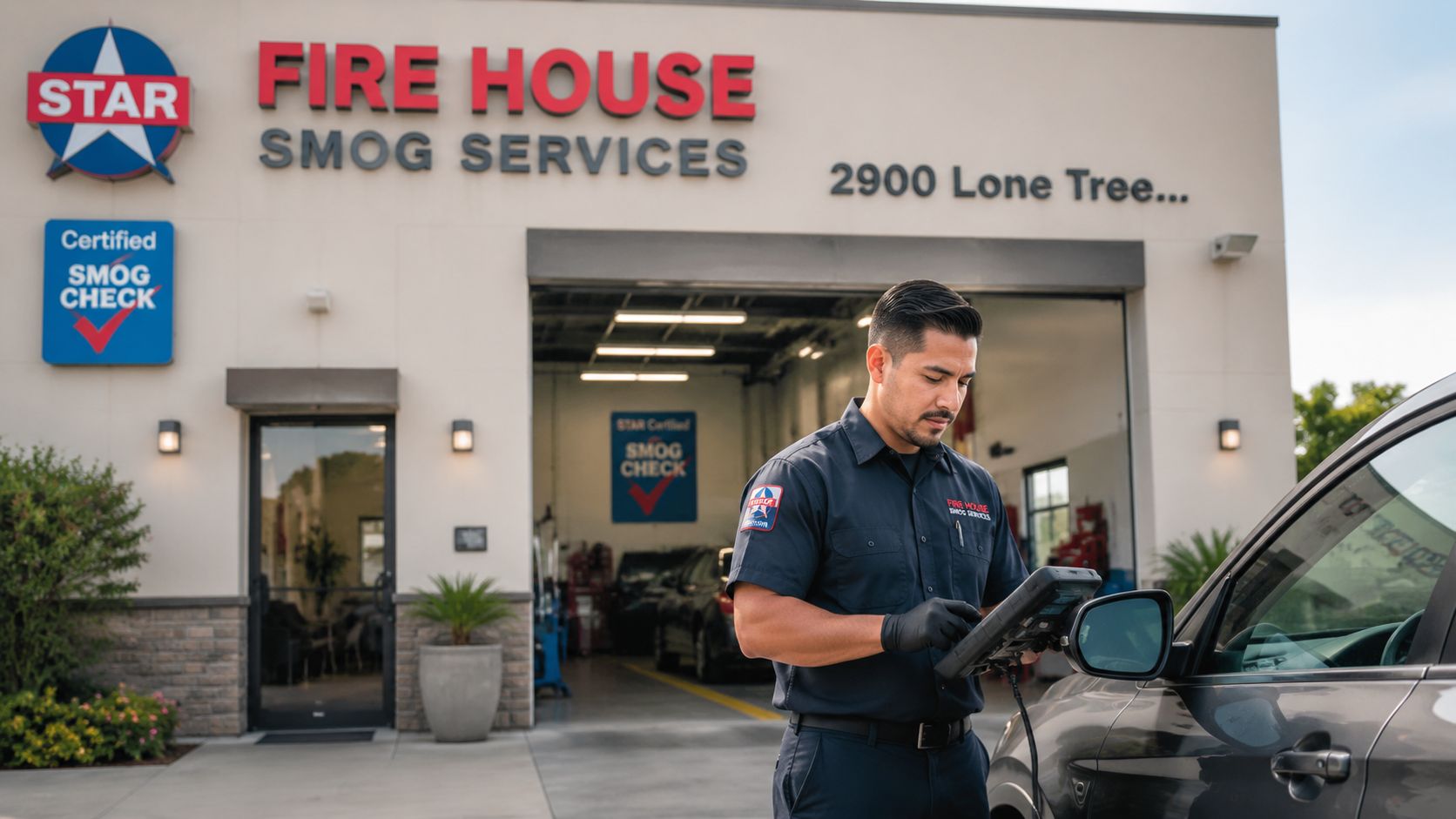
The station works on passenger cars, SUVs, light-duty trucks, and some RVs and motorhomes when the size and equipment fit the lane and bay limits, so call ahead before you bring something oversized. That matters because a test-only station is there to handle emissions testing first, then the DMV paperwork if you need it. If the car fails, ask about the retest policy before you pay and leave. A free retest can save you from paying for the same problem twice, as long as you follow the site rules and coupon terms. For questions or scheduling, call 925-754-1600.
Use the coupons if they apply, bring the right paperwork, and show up with the car ready for inspection instead of trying to sort out a fault code in the parking lot. That is how you avoid wasting time, and it is the fastest way to keep a failed visit from turning into another full-price return trip. A clean California vehicle inspection comes down to preparation and the right order of operations, not luck.
If you want one stop for emissions testing and DMV registration tasks, visit Fire House Smog and book the appointment that fits your schedule.
California vehicle registration cost typically runs $300 to $450 a year on a normal gasoline car once the base fee, vehicle license fee, smog fee, and county or district charges are stacked. The exact total depends on vehicle value, weight class, and county, so the bill on your notice can land far above or below that range.
That's why the number on the renewal form never tells the full story. If you're staring at a DMV notice in Antioch and trying to figure out what you'll owe, the answer is in the fee stack, not the headline.
Table of Contents
- What Drivers Actually Pay for Vehicle Registration in California
- The Fee Stack That Builds Your California Registration Bill
- How Vehicle Type Changes the Final Number
- Documents, Timing, and When Smog Certification Is Required
- Why Combining Smog and Registration at One Location Saves Time
- Common Surprise Charges and How to Avoid Them
- Your Single-Visit Plan at Fire House Smog
What Drivers Actually Pay for Vehicle Registration in California
The answer is simple. A California driver is usually paying a bundle of fees, not one flat renewal price, and the total shifts with the car you own, where you live, and whether the vehicle needs smog certification. For many everyday gasoline cars in California, the combined annual cost lands in the $300 to $450 zone, while the statewide average registration and documentation fee is about $595.08 because some vehicles and counties run much higher than that typical range. World Population Review's state fee ranking
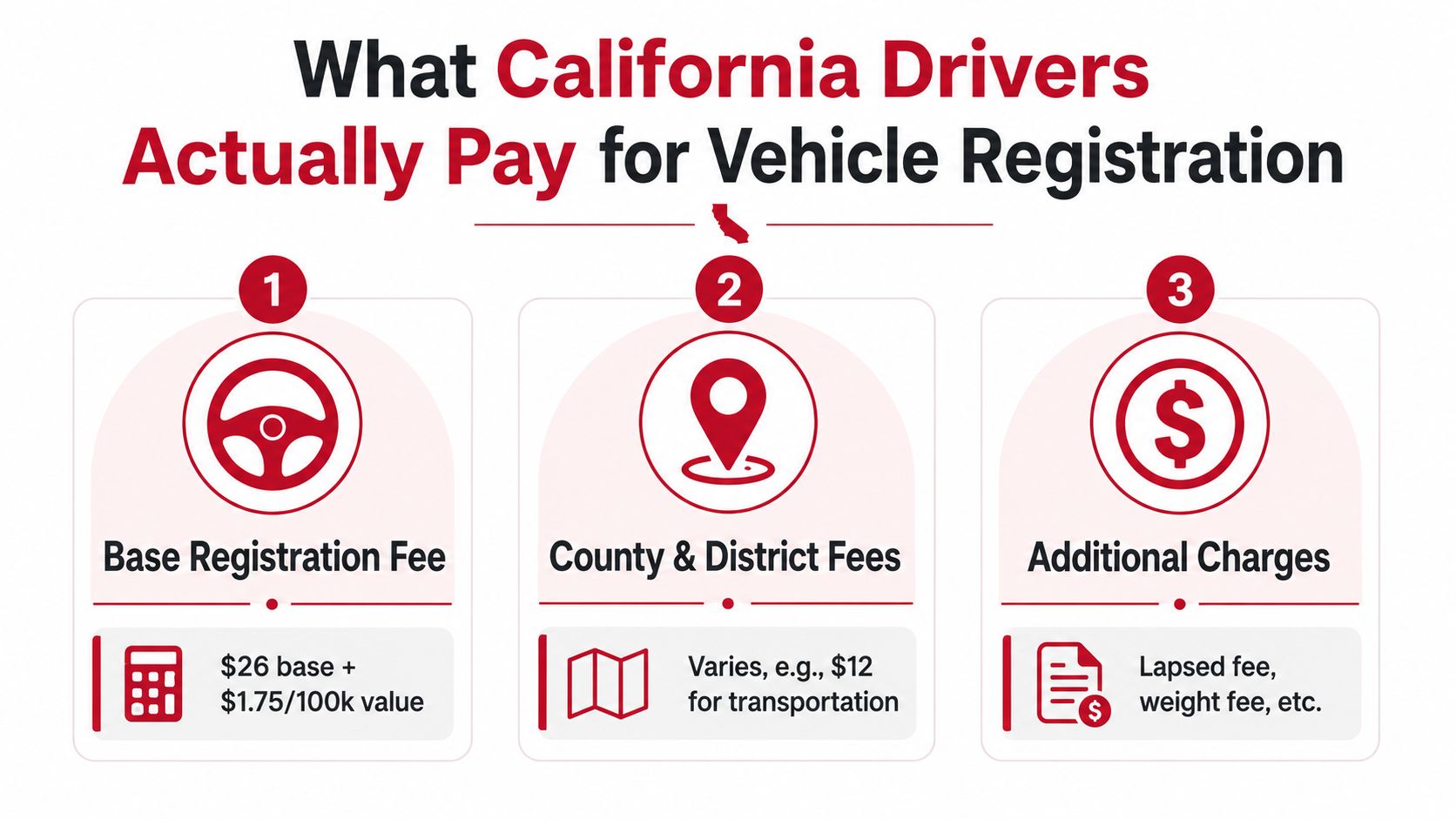
Read the bill as a stack, not a sticker price
California doesn't price registration like a simple sticker. The DMV structure layers a base registration fee, a vehicle license fee tied to value, and extra state or local charges depending on the vehicle and transaction type. That's why two drivers in Antioch can renew on the same day and still owe very different amounts.
Practical rule: If your renewal notice looks higher than last year, don't assume it's an error. In California, the car's value, the category it falls into, and the county or district add-ons can all change the total.
The DMV's own fee schedule makes that clear. California's registration pricing includes an original registration or renewal fee of $76, plus separate line items such as $8 for the Alternative Fuel/Technology Smog fee and $3 for the Alternative Fuel/Technology Registration fee. The final amount depends on which bucket your transaction falls into, which is why first-time owners often misread the notice. California DMV registration fees
For Antioch drivers, the useful way to think about it is this. The DMV wants proof the vehicle is eligible, the state wants its base fee and value-based share, and local add-ons can show up on top. If your car needs smog, that's not just a separate task, it's part of the transaction path that decides whether the renewal can be completed at all.
Internal resource for local renewal help: registration renewal fee details
The Fee Stack That Builds Your California Registration Bill
A California renewal at the counter is usually a stack of charges, not one flat price. The clerk does not ring up the bill as a single mystery number. They apply the state's core registration charges, then add any vehicle-specific or transaction-specific items that fit your car.
What each line item is doing
The core value-based piece is the Vehicle License Fee, and California sets it at 0.65% of depreciated vehicle value annually. That is why the number shifts as the car gets older, because the state is taxing what the vehicle is worth now, not what it cost when it was new. The separate original registration or renewal fee of $76 is the standard DMV transaction charge that sits on top of that calculation. California DMV registration fees
California also uses targeted add-ons. The DMV schedule lists separate Alternative Fuel/Technology Smog and Alternative Fuel/Technology Registration charges when those categories apply. That is the part many owners miss, especially when they skim a renewal notice and look only for the bottom-line amount. If your car falls into one of those buckets, the bill changes before you even get to any local filing issues.
Bottom line: California registration is a mix of vehicle value, vehicle category, and specialized filings. At the counter, each one can change what you owe.
Here is the useful comparison. New York uses a different model, with biennial registration and weight-based fees that rise from $26.00 for the lightest passenger class to higher brackets as weight increases, plus separate use-tax and metro-area charges in some cases. California leans harder on value-based pricing, so a newer or pricier car can cost more to keep registered even if it is driven like an ordinary commuter. New York DMV passenger vehicle registration fees
Common California registration line items
| Line Item | Typical Amount | What It Pays For |
|---|---|---|
| Original registration or renewal fee | $76 | DMV transaction fee for registration filing |
| Vehicle License Fee | 0.65% of depreciated value | Value-based state revenue component |
| Alternative Fuel/Technology Smog fee | $8 | Category-specific smog-related charge |
| Alternative Fuel/Technology Registration fee | $3 | Category-specific registration charge |
That table is the quickest way to read the printout that comes back from the DMV window. If the amount looks high, check the value-based piece first, then look for category-specific add-ons, then confirm whether the vehicle type or transaction triggered anything unusual. In Antioch, that is exactly where first-time owners get surprised, and it is also why a combined business vehicle registration service stop can save a second trip when the paperwork and smog status are already lined up.
How Vehicle Type Changes the Final Number
Walk into the DMV with two cars that look similar on the street, and the totals can still come out different. California does not charge a single flat sticker price for every vehicle. The bill shifts with value, weight, and category, so a commuter sedan, a pickup, an older economy car, and a heavier recreational vehicle can all land in different brackets. California vehicle registration fee structure
A newer sedan costs differently than an older one
A five-year-old commuter sedan usually stays closer to the lower end of the California range because depreciation has already cut down the Vehicle License Fee portion. A newer or more expensive sedan pushes the total up because the value-based piece still has more to work with. That is why two Antioch owners with similar-looking cars can still leave the counter with different renewal amounts.
Light-duty pickups often cost more than small sedans because weight and use category matter more. If the truck falls into a heavier bracket, the final amount rises even when it is not a commercial rig. The bill is not random. Weight-based pricing makes trucks less predictable than a basic compact car. A vehicle that works as a daily commuter can still cost more because the fee chart treats it as heavier.
An eleven-year-old economy car usually benefits from depreciation. Montana's age-based fee schedule makes the contrast easy to see, dropping from $217 for vehicles 0–4 years old to $28 for vehicles 11 years or older, which shows how older vehicles can sit in a much lower bracket than newer ones. California does not use Montana's exact formula, but the same basic problem shows up here. Newer vehicles carry a larger value-based burden, while older ones usually come out lighter at the counter. Montana light vehicle registration and fees
A simple comparison for Antioch owners
- Commuter sedan: Usually the easiest to budget for, because depreciation pulls down the value-based charge.
- Light-duty pickup: Expect a higher bill if the weight bracket or use classification pushes it upward.
- Older economy car: Often cheaper than a newer equivalent, mainly because the value-based piece has already fallen.
- Mid-size RV: Call ahead. Some RVs are accepted, but size and equipment limits still matter, so fee logic is only part of the decision.
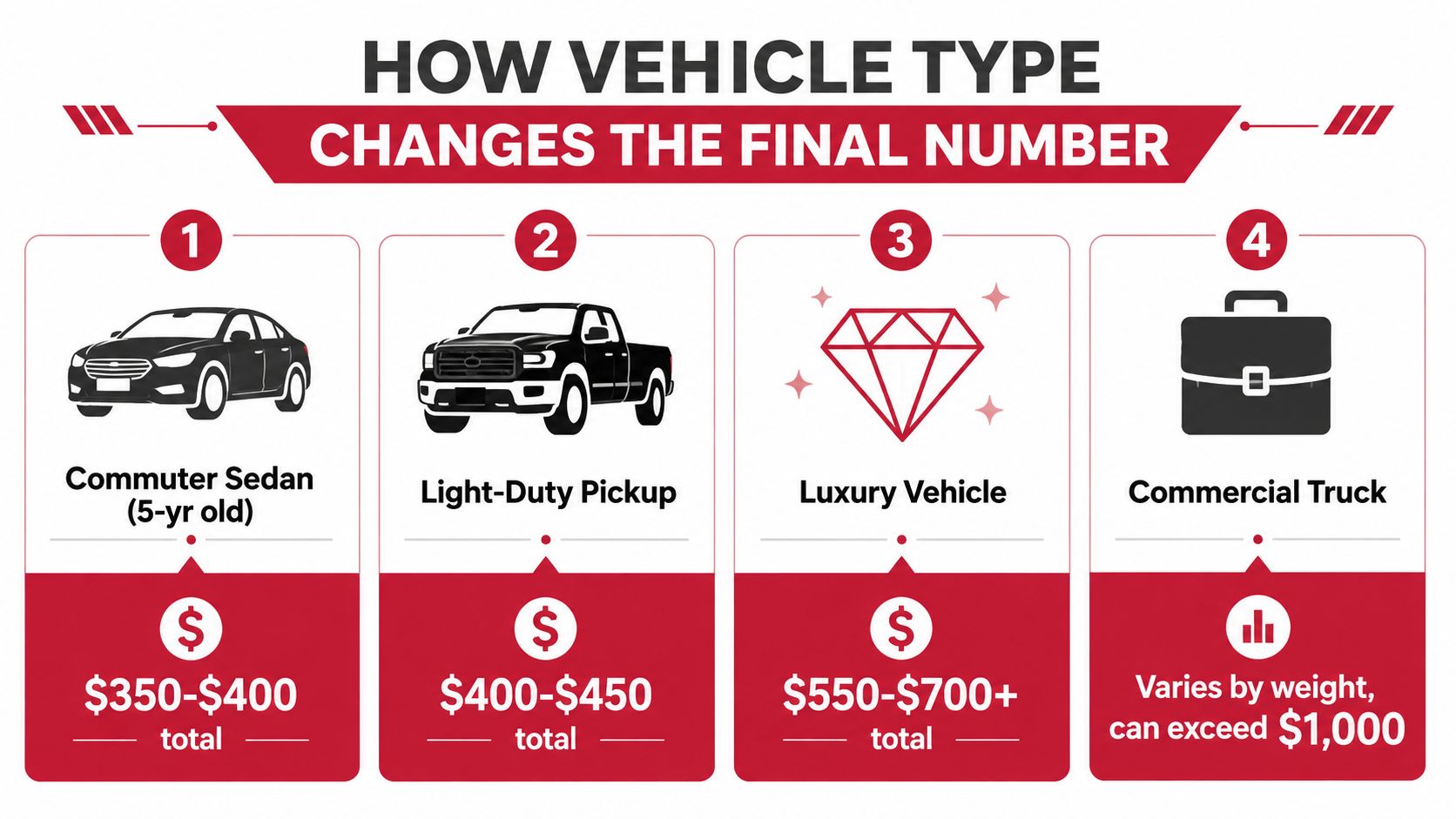
If you are registering a truck or van for a company, the numbers can shift again because commercial and heavier classes often sit in separate brackets. Fire House Smog's business vehicle registration page is the right place to check before you make a second trip for paperwork that should have been handled once.
Documents, Timing, and When Smog Certification Is Required
The DMV doesn't care how busy you are. It cares whether the paperwork is complete and whether the vehicle is eligible for renewal right now. If one document is missing, the whole transaction stalls and you end up paying with time instead of money.
What to bring before you leave home
Bring the basics. You need proof of insurance, photo ID, the title or transfer paperwork if ownership is changing, and payment. If smog is required, bring a current passing smog certificate or be ready to get one before the DMV portion is processed. Vehicle registration documents checklist
The fastest renewal is the one you don't have to restart.
Timing matters because smog and registration don't always happen on the same clock. For renewal, California drivers often need the smog result to still be valid when the DMV processes the filing, and if the certificate expires before the paperwork is submitted, the car has to be tested again. Sale, transfer, and out-of-state registration usually trigger a fresh emissions step right away, so don't assume last month's certificate still solves today's problem.
California also uses an even-year and odd-year smog cycle, so some vehicles get pulled back into testing on a predictable schedule rather than every renewal. That's why the renewal notice is worth reading carefully instead of assuming the same rule applies to every car in the driveway. If you've changed ownership, moved a car in from another state, or let the registration go stale, expect the paperwork to get stricter, not looser.
What makes drivers lose time
- Expired smog certificate: The renewal stops until you retest.
- Missing title paperwork: Ownership transfer can't finish cleanly.
- Late renewal: Penalties start to pile on once the vehicle is out of compliance.
- Wrong transaction type: Renewal, transfer, and out-of-state filing are not interchangeable.
The smartest move is to gather the paperwork before you drive anywhere. Once you're at the counter, the difference between a clean transaction and a wasted trip is usually a document you could have printed or checked in advance.
Why Combining Smog and Registration at One Location Saves Time
The usual route burns time fast. You visit a smog station, wait for the result, then go somewhere else to finish the DMV paperwork, and then you may have to come back if a document is missing or the filing hits a snag. In Antioch, that turns a normal renewal into a wasted half-day, especially if you are juggling work, school pickup, or a vehicle that needs to stay on the road.
One stop beats two stops
A STAR-certified test-only shop keeps the inspection focused on emissions and avoids the repair-shop conflict. Add licensed DMV processing on the same site, and the same visit can handle the test, the renewal, and the tag issuance without sending you across town. That matters because vehicle registration cost is not just the fee on the notice, it is also the time and gas you burn when the process gets split into pieces.
A local Antioch provider like Fire House Smog combines STAR-certified testing with on-site DMV services, including tag issuance. That setup keeps the renewal moving at the counter instead of turning it into a two-stop errand.
The local workflow is simple. You arrive with your documents, get the vehicle tested if needed, and let the DMV side of the counter finish the registration work while you are already there. That is a better system than making one renewal stretch into two separate trips.
If your goal is to get the tags in hand, the cleanest move is a place that can finish both jobs without sending you out for a second line.
The operating setup matters too. A shop with smog availability throughout the week, DMV service hours that cover the usual workday and part of the weekend, and multiple service bays can keep vehicles moving instead of stacking them up. That is the kind of arrangement that cuts waiting and keeps the counter from becoming the bottleneck.
Common Surprise Charges and How to Avoid Them
Most drivers don't get hurt by the headline fee. They get hurt by the surprises that show up after they've already planned their budget. If you want to keep vehicle registration cost under control, you need to know the traps before the DMV does.
The charges that catch people off guard
- Lapsed registration penalty: Let the renewal drag on, and the bill gets uglier fast. Re-registering before the vehicle sits out of compliance too long is the easiest way to avoid paying more than you planned.
- Weight reclassification: Modify a truck, change its load setup, or misstate the vehicle class, and the DMV can move it into a different bracket. That's how a seemingly minor change becomes a bigger fee.
- Transfer-related charges: Buying, selling, or inheriting a car can trigger extra paperwork and extra cost because the transaction is no longer a simple renewal.
- Special plates and category fees: Personalized or special-interest plate setups can add recurring charges, and owners often forget to account for them until the renewal notice arrives.
The age and value structure matters here too. Newer, heavier, and special-category vehicles are more likely to carry hidden costs because California's system isn't flat. That's the whole point of a policy that uses vehicle worth, weight, and fuel type as part of the price.
How to keep the bill from jumping
- Check the renewal notice early. Don't wait until the last week.
- Confirm the vehicle class. A truck that should be in one bracket but gets processed in another can cost more.
- Make sure the smog certificate is current. If it expires before processing, you're back at square one.
- Ask about transfer paperwork before you arrive. A missing title signature is one of the fastest ways to create a second trip.
If you've lifted a truck, changed equipment, or bought a used vehicle with a messy registration history, verify the fee path before you pay anything. That one step prevents the kind of surprise that turns a normal renewal into a budget problem.
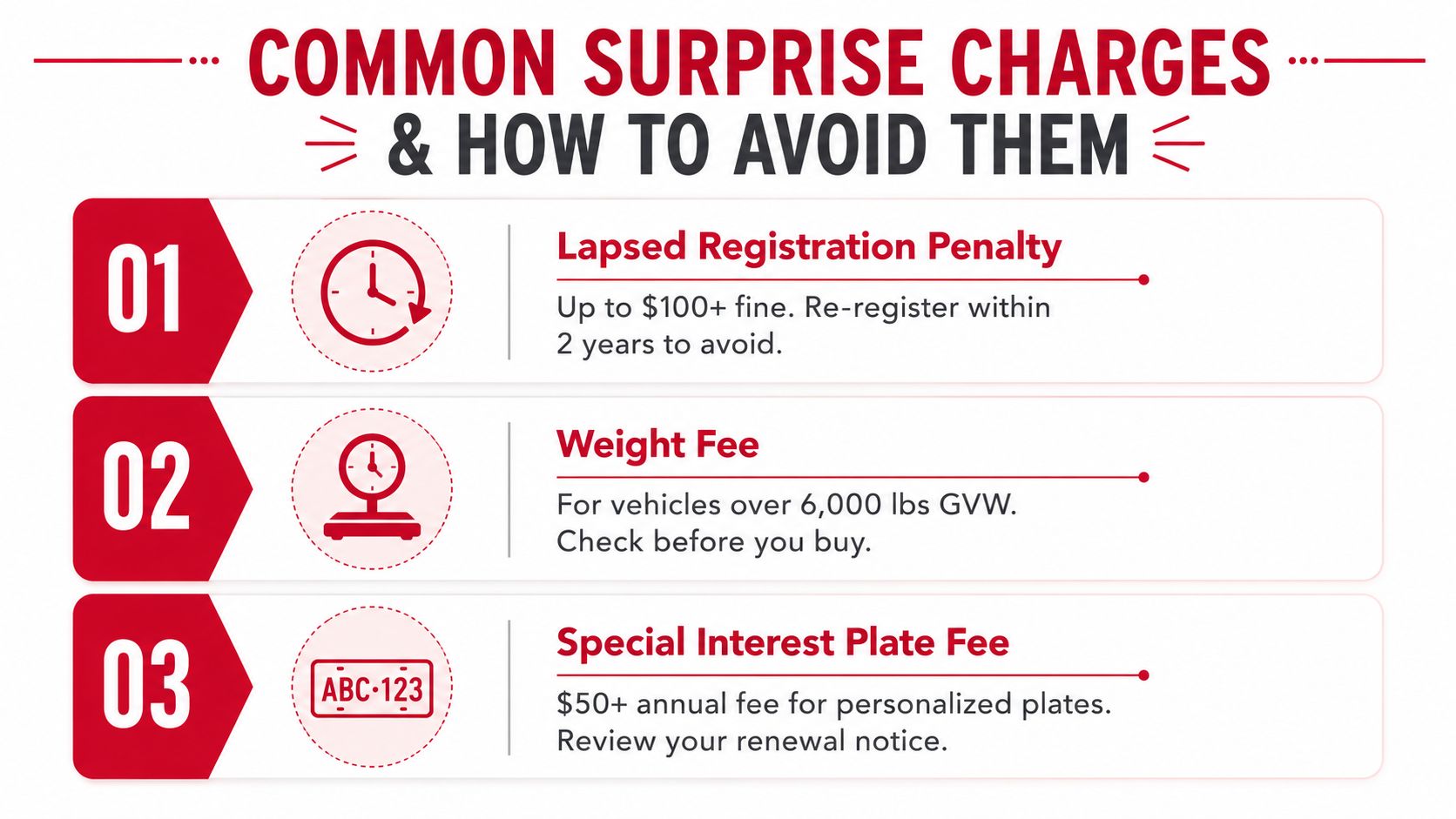
Your Single-Visit Plan at Fire House Smog
If you live in Antioch or anywhere in East Contra Costa County, the cleanest plan is to bring the paperwork, get the smog handled, and finish the DMV side in one stop. Fire House Smog is at 2900 Lone Tree Way, Antioch, CA 94509, and the phone number is 925-754-1600. It serves passenger cars, SUVs, light-duty trucks, and some RVs, subject to size and equipment constraints.
Bring proof of insurance, ID, and whatever renewal or title paperwork you already have. If your vehicle needs smog, let the station handle that first, then complete the registration renewal while you're already there. If the car is an RV or something unusual, call ahead so you don't waste a trip.
The shop's model is simple. It's a test-only station, so the emissions test isn't tied to repair upsells, and the DMV side can process the registration work without forcing you to start over somewhere else. That's the right setup when you want the whole vehicle registration cost problem solved without dragging it out over several days. Fire House Smog
If you want the fee stack handled without the usual DMV runaround, take your renewal paperwork to Fire House Smog and get the smog and registration processed in one visit. It's a practical option for Antioch drivers who want straight answers, on-site tag issuance, and fewer surprises at the counter. Visit Fire House Smog to check hours, confirm what to bring, and get your registration done the simple way.
You've got the renewal notice in one hand, the deadline in the other, and a simple question in mind, where's the California smog check near me that won't turn into a second trip, a surprise repair bill, or a DMV line later in the week? The answer depends on more than distance. In California, the right station type, the vehicle's model year, and whether you can finish registration on-site all change how smooth the day goes.
Table of Contents
- What a California Smog Check Near Me Really Involves
- How to Choose the Right Station Type Near You
- Preparing Your Vehicle and Paperwork Before You Go
- What Happens During the Inspection at a STAR Test-Only Station
- Handling Failures, Retests, and Repair Documentation
- Combining Your Smog Check With On-Site DMV Renewal
- RV, Fleet, and Specialty Vehicle Considerations
What a California Smog Check Near Me Really Involves
A driver opens a DMV renewal notice, sees the smog requirement, and assumes any station will do. In California, that assumption can send you to the wrong counter, the wrong lane, or the wrong kind of test. The station you choose can change the whole visit.
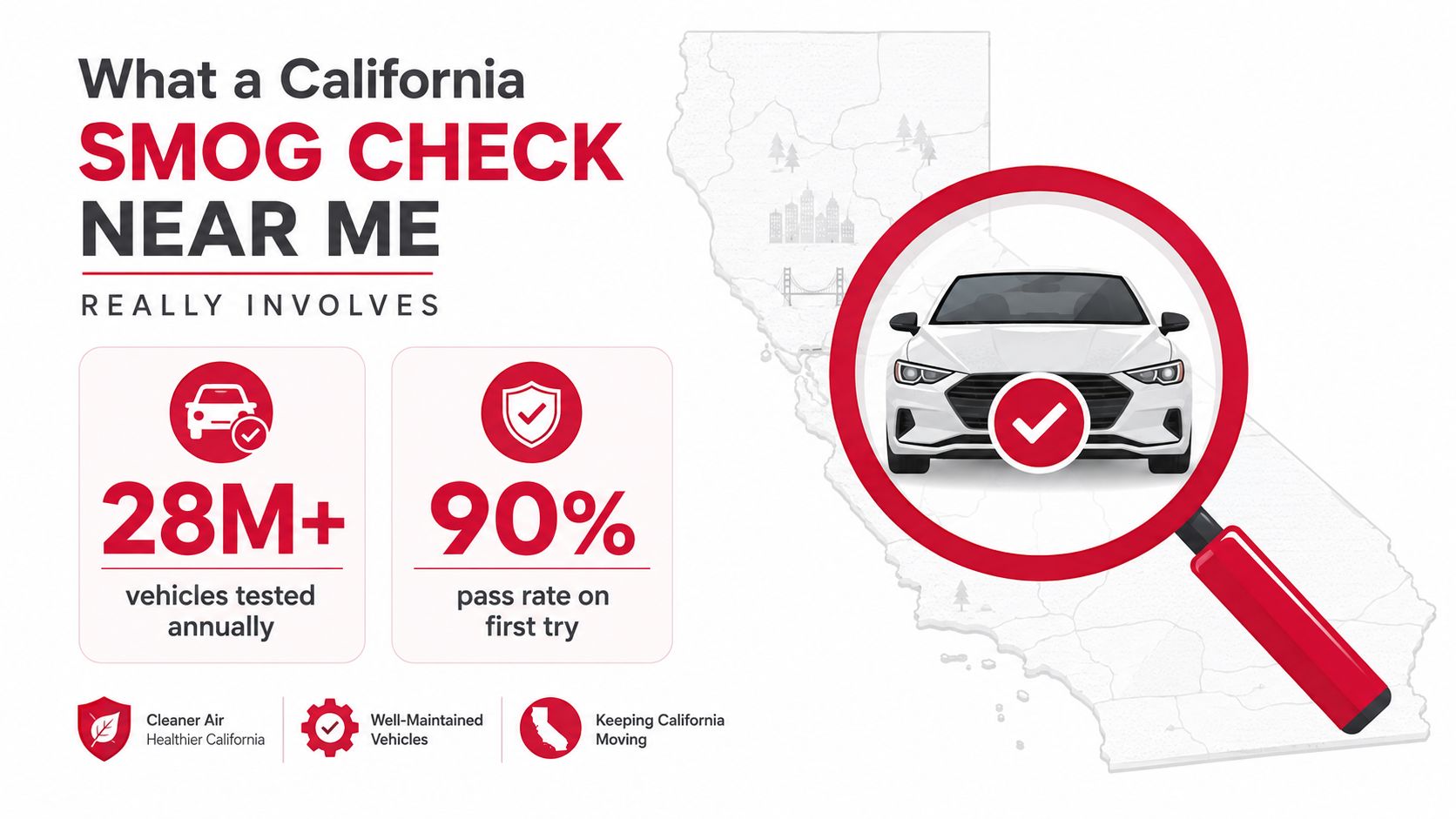
California's Bureau of Automotive Repair says most gasoline, hybrid, and alternative-fuel vehicles model year 1976 and newer, plus diesel vehicles model year 1998 and newer, are subject to Smog Check, and the inspection is generally required every other year for registration renewal (BAR 2025 Smog Check Executive Summary). That is why this is routine work for a large share of drivers, not a rare trip reserved for problem vehicles.
The scale matters, too. BAR reported 11,275,981 initial tests and 12,200,718 total tests in the 2025 summary, with an 8.51% failure rate for initial tests and a 9.04% failure rate overall. A California Senate fact sheet also says the program removes about 400 tons of smog-forming pollutants every day, and that more than 10 million vehicles get tested each year at more than 7,000 independently owned smog check stations statewide (California Senate fact sheet/index.pdf)).
Practical rule: the phrase smog check near me in California really means, “Which nearby station is authorized for my vehicle and my renewal notice?”
Station type changes the workflow. A test-only station performs the inspection and issues the result, while a station with different certification may also handle repairs or a different inspection path. The distinction matters because the wrong stop can mean a second drive, a different line, or a station that cannot process your vehicle the way your renewal notice requires.
If you want a local example of how a station can be set up for this workflow, STAR-certified smog station services show how one facility can fit the role without turning the visit into a repair estimate conversation.
How to Choose the Right Station Type Near You
Start with the renewal notice, not the map app. If it points you to a STAR-certified station or a test-only station, that instruction matters more than a five-minute shorter drive. Choosing the wrong type can leave you parked at the curb while the staff tells you to go somewhere else.
Read the notice for the station requirement
The renewal paperwork is the clearest signal you get. If the notice calls for a STAR station, a regular station won't give you the right path for that vehicle. If the notice doesn't specify, a nearby certified station can often handle the test, but it still needs to be the right kind of test site for your car.
A test-only station is simple by design. It tests the vehicle and certifies the result, but doesn't sell repairs, which removes the awkward incentive to turn a failed inspection into a repair job on the spot. A repair-capable station can still be legitimate, but the workflow is different and the customer experience often is, too.
Search for fit, not just proximity
Use the BAR station finder, then check the station's certification, posted hours, and whether it handles your vehicle class before you leave home. That's especially important if you drive something that isn't a standard sedan. Some RVs and motorhomes fit within a station's equipment and bay limits, but some don't, and a quick phone call saves a wasted trip.
If the vehicle barely fits in a parking stall or needs special handling to enter a bay, call first.
For a local test-only option, this in-out smog test-only center is an example of the kind of station setup drivers look for when they want a straightforward inspection path.
Use the renewal notice like a checklist
The practical decision points are simple.
- Check the certification callout: If STAR is required, don't guess.
- Confirm vehicle fit: Large vehicles need a yes from the station, not a maybe.
- Look at hours before you drive: Some stations work better for early morning, others for weekend timing.
- Ask what happens if you fail: A test-only station gives you a clean inspection result, which makes the next step more predictable.
That's the difference between searching for a station and searching for the right station. The goal isn't to find the closest building with a sign. It's to find the one that can legally test your vehicle, accept it, and keep the rest of the day moving.
Preparing Your Vehicle and Paperwork Before You Go
The easiest failures are the ones drivers can prevent at home. I've seen plenty of people arrive convinced the car is fine, only to discover the battery was disconnected last week, the check-engine light is still on, or the paperwork isn't in the car. A short pre-test routine solves most of that.
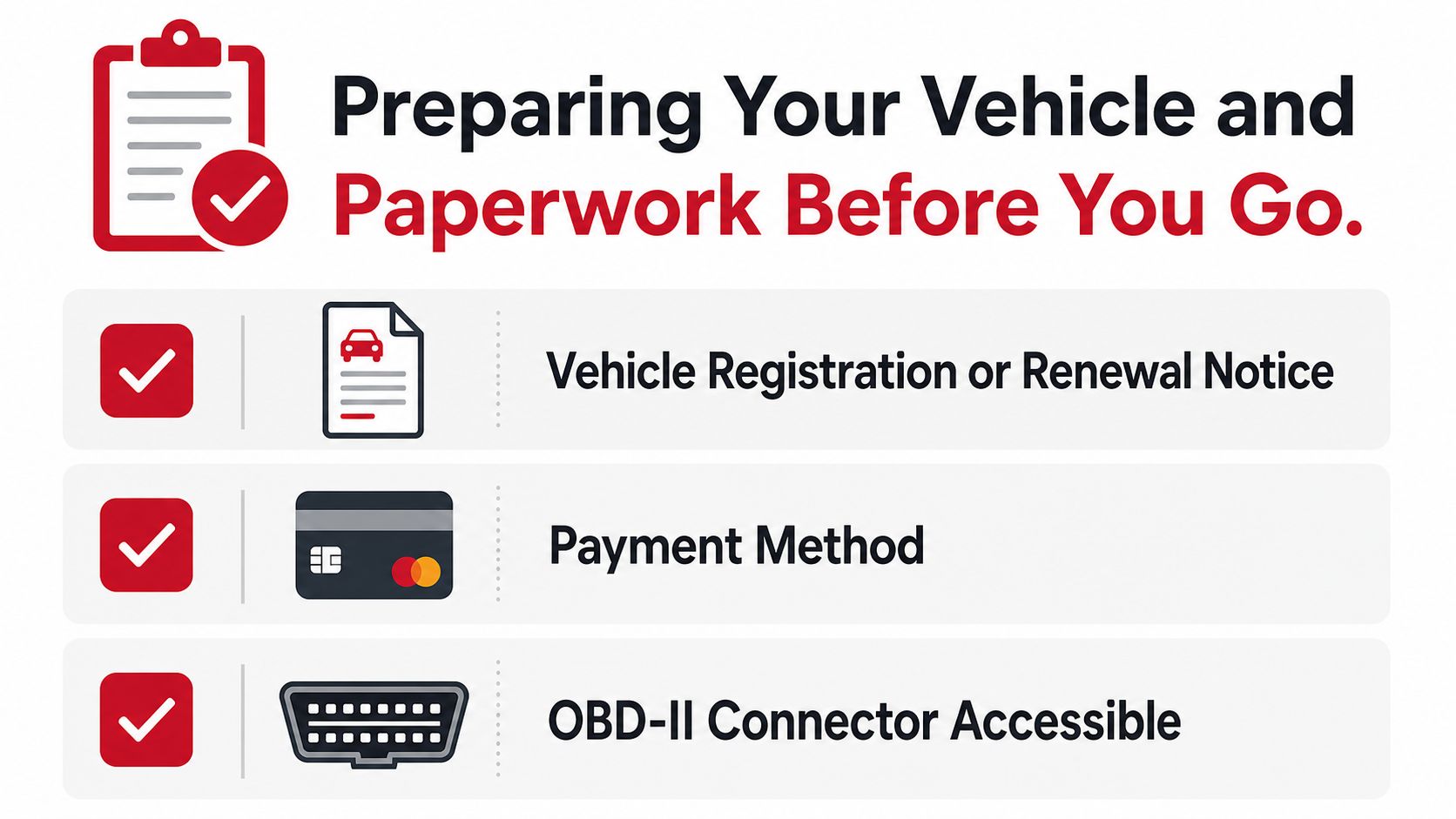
What to bring with you
Bring the vehicle registration or renewal notice, a payment method, and any prior certificate or failure paperwork you already have. If you're heading to a station that can finish registration on-site, having the right documents ready matters even more. Keep everything in one folder or glove box pocket so you're not digging through the car at the counter.
The car itself needs a quick check before you leave. The check-engine light has to be off, and the gas cap should seal properly. If the battery was recently disconnected or replaced, BAR advises drivers to keep driving for one to two weeks so readiness monitors can reset (BAR Smog Check guidance). That one step avoids a common modern-car failure where the vehicle looks fine but the computer hasn't completed its self-checks.
Build a short morning routine
A clean morning routine beats guesswork.
- Look at the dashboard first: The check-engine light should be off before you head out.
- Confirm the battery history: If it was recently changed or disconnected, give the monitors time to reset.
- Check the fuel cap: A loose or damaged cap can turn into a needless return trip.
- Keep the OBD-II port accessible: Don't bury it under accessories or aftermarket covers.
BAR says a smog inspection typically includes a visual inspection, a functional inspection, an OBD system check for most 2000-and-newer vehicles, or a tailpipe test for pre-2000 vehicles, and the full inspection usually takes about 30 minutes (BAR Smog Check guidance). That timing assumes you arrive ready. If your paperwork is missing or the car hasn't completed a drive cycle after a battery reset, the visit gets longer fast.
A clean pre-check doesn't guarantee a pass, but it removes the most common avoidable reasons for failure.
That matters because the modern test is as much about the vehicle's self-diagnostics as it is about what comes out of the tailpipe. If the car is prepared, the station can do its job without extra delay.
What Happens During the Inspection at a STAR Test-Only Station
The visit starts the same way almost every time. You pull into the lot, hand over the renewal notice and keys, and the technician moves the car into the bay. At a test-only station, the workflow stays focused on inspection, not sales pressure, which keeps the handoff simple.
The inspection steps in the bay
First comes the visual inspection. The technician checks emissions-related equipment for obvious tampering, missing parts, or damage. That's followed by the functional inspection, where the station verifies the systems are operating as they should. For 2000-and-newer vehicles, the technician connects to the OBD system. For older vehicles, the process shifts to a tailpipe test (BAR Smog Check guidance).
The point of a test-only bay is speed and clarity. The station is looking for whether the vehicle passes the state test, not for a reason to open a repair order. That makes the visit easier to understand. You're not negotiating a fix. You're getting the inspection result that registration depends on.
What the driver usually sees
Most of the time, the driver waits a short time while the tech runs the test and prints the result. BAR says the full inspection usually takes about 30 minutes (BAR Smog Check guidance). A busy station may move faster or slower depending on what's ahead of you, but the process itself is still straightforward.
If the vehicle passes, you leave with the certificate path cleared. If it doesn't, you get a failure result that tells you what stopped the pass. Either way, the visit is structured to end with a clear next step.
A STAR test-only station changes the tone of the visit. The technician tests the car, reports the result, and the repair conversation happens somewhere else if it needs to happen at all.
That separation matters in practice. Drivers get less confusion, and they know exactly where they stand before they spend money on repairs. For people trying to finish a renewal in one afternoon, that kind of clarity is the value.
Handling Failures, Retests, and Repair Documentation
A failed smog test is a starting point for the next step. The report tells you what stopped the pass, and that is the part you use to plan repairs. Once you know the failure category, the job gets much more specific.
What the failure categories mean
California BAR breaks failures into functional, OBDII, and visual categories in its 2022 summary (BAR 2022 Smog Check Executive Summary). Those categories matter because each one points to a different kind of problem, not just a generic “fix the car” answer.
| Common Smog Failure Categories and Typical Causes | What Is Checked | Common Triggers |
|---|---|---|
| Functional | Whether required components and systems work as expected | Check-engine light, readiness issues, equipment not operating correctly |
| OBDII | Onboard diagnostic data for newer vehicles | Monitor not ready, fault codes, recent battery disconnect |
| Visual | Emissions equipment present and unaltered | Missing catalytic converter, tampered parts, obvious leaks |
A driver who gets a failure printout usually wants the shortest path to a retest. The report helps the repair shop focus on the right system the first time. That saves a lot more time than guessing at parts and hoping the next inspection goes differently.
Why the paperwork matters
Keep every repair receipt if you end up needing a directed retest or documented follow-up. The first failure report tells the shop what to inspect, and the receipts show what was repaired. That paper trail matters when the next inspection depends on proof instead of just a verbal explanation.
Some fixes are simple. A loose gas cap can be handled quickly, while a failed oxygen sensor or a deeper emissions issue takes longer and should be documented carefully. The point is to repair the specific cause shown on the report, then return for the retest with the paperwork in hand.
A test-only station keeps that process cleaner because the inspection and the repair sale stay separate. You are not trying to sort out the result while someone is also selling you the fix. That makes the retest path easier to follow and keeps the decision making clearer.
Keep the failure report with the repair invoice until the registration is complete. People lose time when they try to recreate the paperwork later.
For drivers trying to finish everything in one trip, a station that also handles registration can shorten the back and forth after the repair is done. A local example is California DMV registration renewal services, which shows how some stations connect smog results with DMV follow-through.
The practical sequence stays the same. A failed test becomes repair, retest, certificate, registration. That is manageable when the documents stay organized from the start.
Combining Your Smog Check With On-Site DMV Renewal
Once the vehicle passes, the time-saver is finishing the registration without driving somewhere else. A station that's also a licensed DMV business partner can process the renewal on-site, which means one stop instead of two. For drivers trying to stay out of a DMV field office, that changes the whole day.
What can be handled in the same visit
On-site DMV renewal typically covers registration renewal, and some stations also handle ownership transfers for California and out-of-state vehicles, plus sticker and plate issuance when needed. That lets the certificate and the registration move together instead of sitting in separate queues. It's especially helpful when your smog due date and renewal deadline are close.
Fire House Smog publishes a local example of this combined workflow at California DMV registration renewal services. The station lists DMV service hours Monday to Saturday 9:30 AM to 5:00 PM and Sunday 12:00 PM to 4:00 PM, with smog testing available seven days a week ([publisher information provided in brief]). Its Antioch location is 2900 Lone Tree Way, and the contact number is 925-754-1600 ([publisher information provided in brief]).
Why the on-site model helps working drivers
Weekend availability changes the equation. If your schedule is packed during the week, a station that handles both smog and DMV work can save an extra trip, especially when the sticker can be printed on-site. That also reduces the risk of doing the smog test, then waiting days before you can finish the paperwork somewhere else.
The best single-trip plan is simple, pass the smog test, finish the renewal where you're already parked, and leave with the next step already done.
That doesn't mean every DMV task belongs at the smog station. Some situations still require a field office or additional documentation. But for standard renewals and the most common transfer work, a combined stop keeps the process tight and avoids unnecessary backtracking.
If you want to see how a station can structure that workflow in one place, the local renewal page is the right reference point.
RV, Fleet, and Specialty Vehicle Considerations
The standard advice works well for a sedan or light-duty truck. It falls apart faster when the vehicle is oversized, commercial, or part of a fleet schedule. Those drivers need to think about fit, timing, and paperwork before they ever pull into the lot.
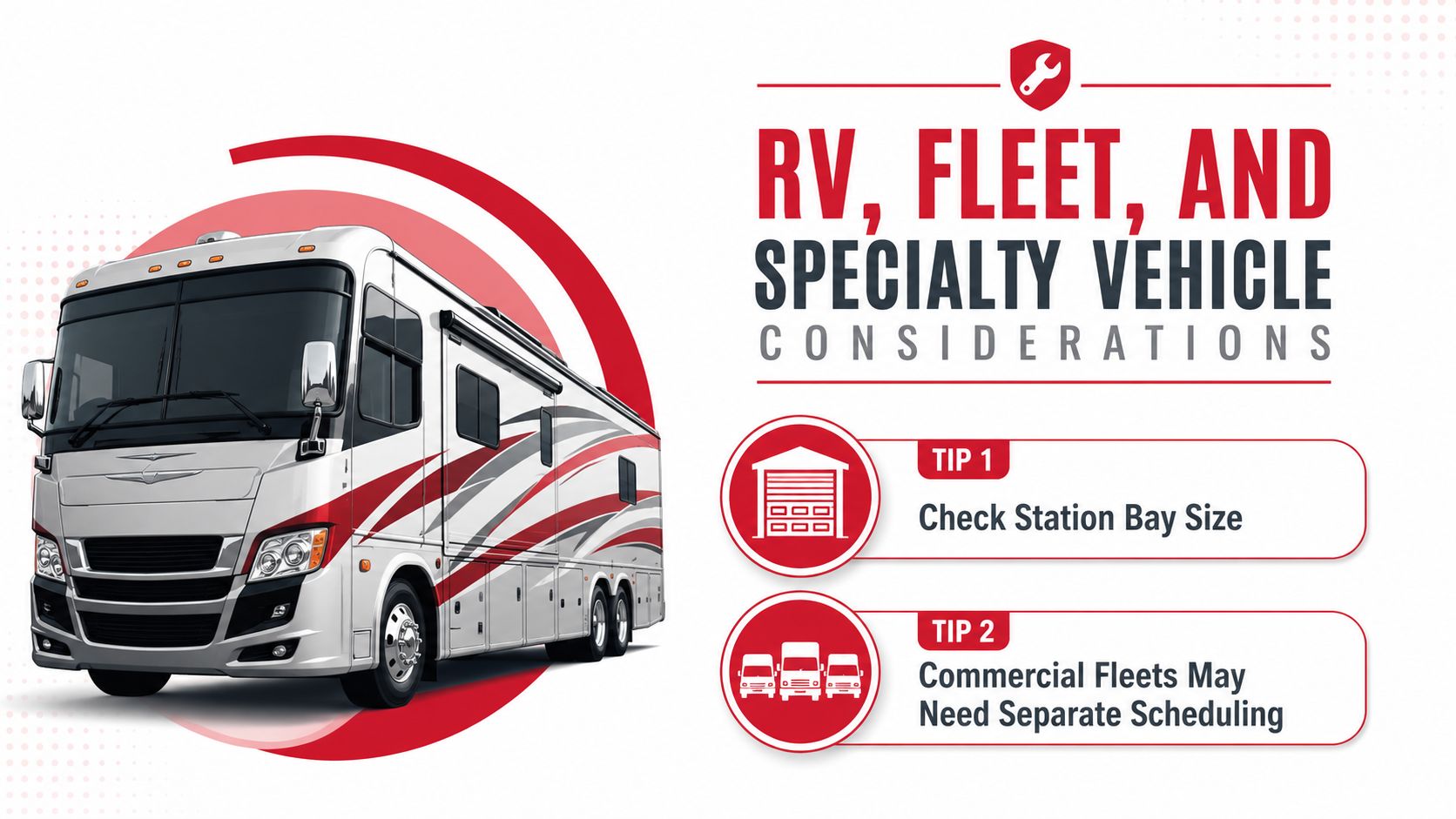
Start with bay size and equipment limits
Some RVs and motorhomes can be tested, but only if the station's bay size and equipment can handle them. That's why the phone call matters more for a large vehicle than for a compact car. A station may be certified and still not be physically set up for the vehicle you drive.
That same logic applies to fleets. If you're processing multiple vehicles, the limit isn't just certification, it's throughput. A two-bay station can move faster than a smaller one, and that matters when several vehicles need testing in the same day.
Specialty vehicles need a tighter plan
Diesel vehicles follow a different applicability rule than gasoline cars, since BAR says most diesel vehicles model year 1998 and newer are subject to Smog Check (BAR 2025 Smog Check Executive Summary). Hybrid and alternative-fuel vehicles are also part of the statewide system when they fall within the qualifying model-year range (BAR 2025 Smog Check Executive Summary). That means specialty drivers shouldn't assume the inspection path is the same just because the vehicle feels modern.
Out-of-state transfers can add another layer, especially when the paperwork needs to match the vehicle's status before DMV can finish the registration. When the vehicle type is unusual, or when the registration is tied to a business, call ahead and explain the exact make, model, and configuration. The right answer on the phone is cheaper than discovering a size or equipment issue at the curb.
Use the local setup to your advantage
A station with two service bays and extended hours can be useful for fleet work because it gives you more scheduling flexibility and reduces idle time between vehicles. That's why a test-only station with DMV capability is often a good fit for small-business drivers who want one location to handle more than one task.
Fire House Smog is one local example in Antioch. It's a STAR-certified test-only station, it handles emissions inspections for cars, trucks, and some recreational vehicles, and it processes DMV renewals on-site at 2900 Lone Tree Way ([publisher information provided in brief]). For Antioch and East Contra Costa County drivers, that kind of setup reduces the number of stops without turning the visit into a repair shop detour.
The cleanest workflow stays the same no matter what you drive. Confirm the station type on the notice. Run the pre-test checks. Bring the right paperwork. Choose a STAR-certified test-only station with hours that fit your schedule. Use the retest path if needed, then finish DMV renewal on-site in the same visit. As the fleet gets cleaner, older vehicles still show the higher failure rates, so preparation matters most where the margin is tight.
If you're due now, make the trip count. Visit Fire House Smog for a STAR-certified test-only smog check, on-site DMV renewal support, and a station setup built for drivers who want to handle the inspection and registration in one stop.