Your registration notice shows up, and your first thought usually isn't air quality. It's time. You need the smog check done, the DMV wants the paperwork right, and you don't want to lose half a day sitting in lines or arguing with a shop that suddenly found "other issues."
That's why an In & Out Smog Test Only Center model makes sense for a lot of California drivers. If your goal is simple, get tested accurately, avoid repair-shop games, and finish your registration with the least hassle possible, this is the lane to stay in. If you also have access to on-site DMV services, you can cut out one of the most annoying parts of the whole process.
Table of Contents
- That DMV Smog Notice Just Arrived What Now
- Understanding the Test-Only Smog Center Model
- The Top 3 Benefits of Choosing a Test-Only Center
- Fire House Smog Your STAR-Certified Center in Antioch
- Skip the DMV Lines with On-Site Services
- FAQs and Tips for a Quick Smog Check
That DMV Smog Notice Just Arrived What Now
Start with the notice itself. Check whether the DMV is requiring a smog inspection or whether your paperwork specifically says you need a STAR station. That detail matters because not every shop can handle every inspection requirement.
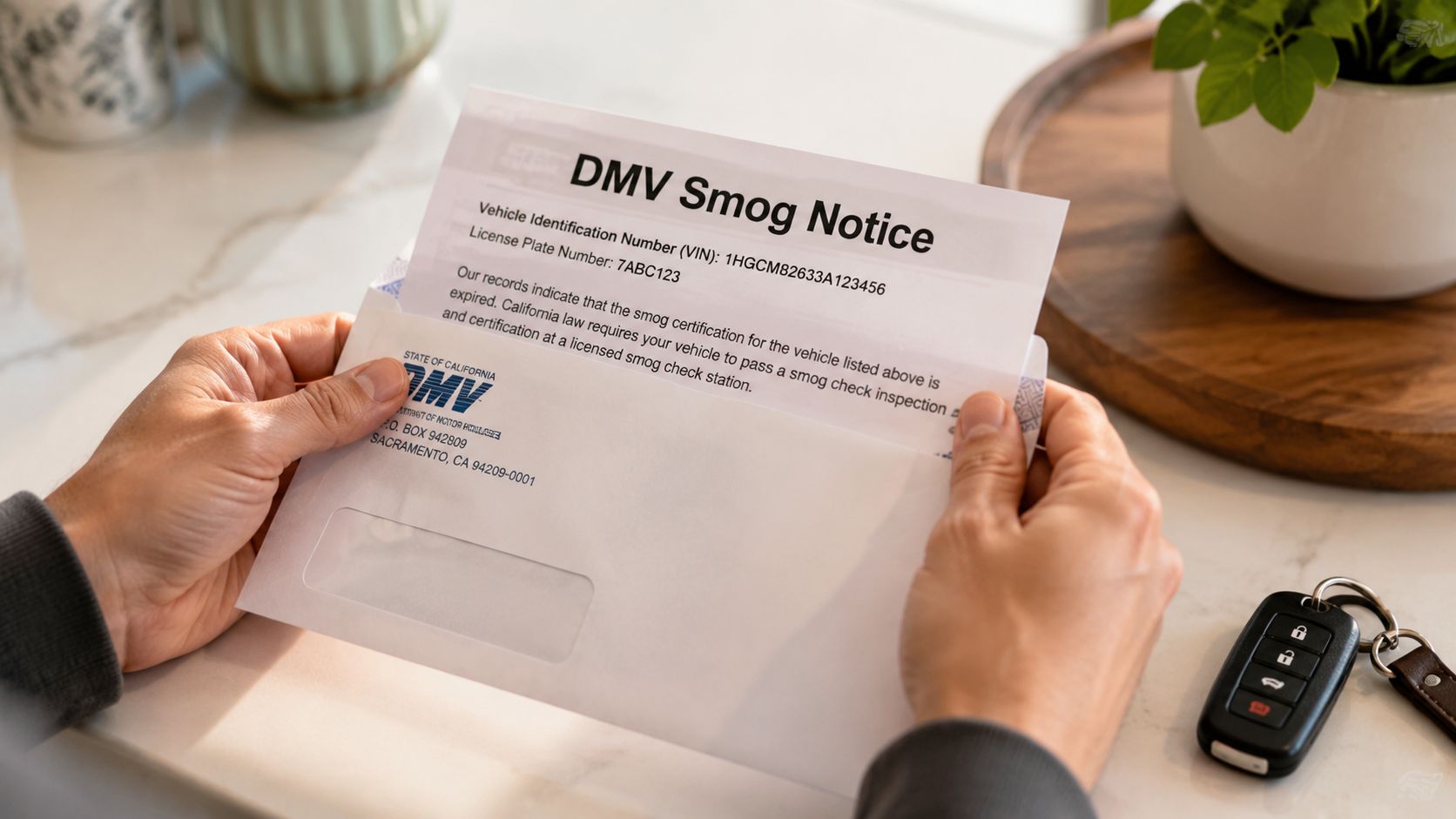
If you're also due for registration, don't split this into two errands unless you have to. A station that handles smog testing and DMV-related processing in the same visit can save you a lot of wasted motion. If you need a refresher on the paperwork side, this guide to California DMV registration renewal is a useful starting point.
First move after opening the notice
Don't overthink it. Use this order:
- Read the DMV requirement carefully. Look for STAR language, transfer language, or anything tied to renewal.
- Check your dashboard. If the Check Engine light is on, handle that before you test.
- Choose a test-only station first. It keeps the inspection separate from repair sales.
- Bring your registration-related paperwork. If the location also handles DMV tasks, you'll be ready to finish the job in one stop.
Practical rule: When the state wants a clean answer, go to the place that's only there to test.
Most drivers get tripped up because they treat the smog check like a random oil-change errand. It's not. It's a compliance step tied directly to your registration and, sometimes, your transfer paperwork. Pick the right station first, and the rest gets easier.
Understanding the Test-Only Smog Center Model
A lot of confusion comes from one basic problem. People assume every smog shop works the same way. It doesn't.
A STAR Test Only smog center is legally authorized by the California Bureau of Automotive Repair to perform both regular and STAR-directed inspections, but it can't perform smog repair services. That separation is the point. It removes the built-in conflict where the same business tests the car and then tries to sell the fix. Typical pricing for these stations is listed as $29.95 to $59.95 plus an $8.25 state certificate fee in this overview of the STAR smog check station program.
Why test-only matters
Think of a test-only center like a lab. The lab runs the test and reports the result. It doesn't try to turn the result into a repair invoice.
That matters even more if your DMV paperwork directs you to a STAR station. State rules send certain vehicles to these stations because the inspection needs to meet a higher compliance standard. If your notice says STAR, going somewhere else first just wastes time.
A test-only station gives you the answer. It doesn't try to sell you the answer.
Test-only center vs test and repair shop
| Feature | Test-Only Center | Test & Repair Shop |
|---|---|---|
| Core job | Inspects emissions compliance only | Inspects and may also sell repairs |
| Repair work | Not allowed for smog repairs | Allowed |
| Conflict of interest | Lower, because it can't profit from smog repairs | Higher, because failed tests can turn into repair work |
| STAR-directed vehicles | Can handle them if STAR-certified | Depends on station type and certification |
| Best fit | Drivers who want an unbiased pass/fail result | Drivers who want testing and repairs in one place |
Here's my view. If you want a straight answer, start with test-only. If your car fails, then decide where to repair it. That sequence protects your wallet and your time better than walking into a shop that benefits from both the diagnosis and the repair sale.
The Top 3 Benefits of Choosing a Test-Only Center
You open the DMV notice, see the smog requirement, and want it handled in one stop. Good. Start with a test-only center. It gives you a clean inspection result without the pressure of a repair upsell, and the smart shops pair that with on-site registration help so you can cut out an extra DMV errand.
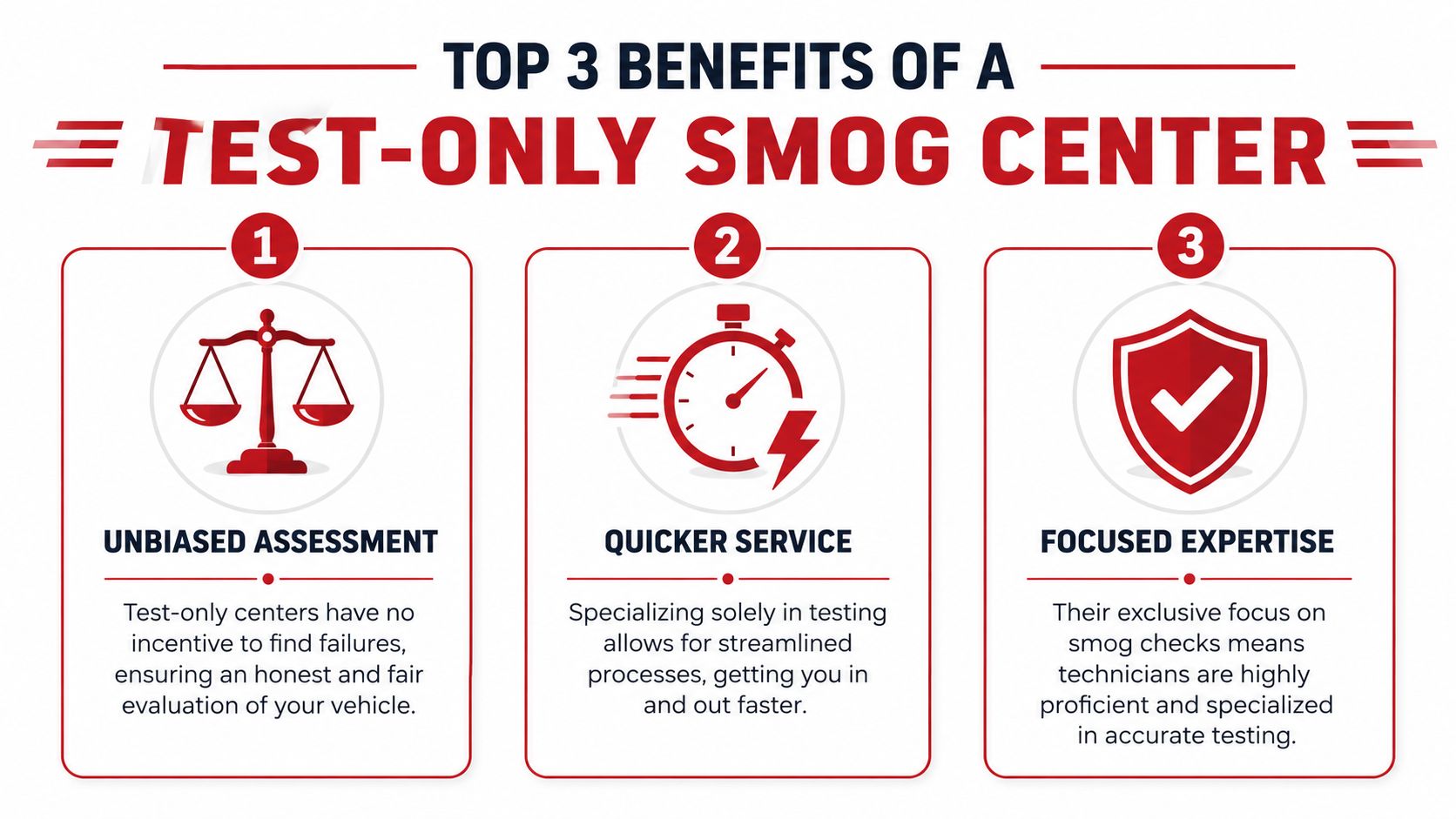
Benefit one honest results
This is the main reason to choose test-only. The shop tests your car and reports the result. It does not profit from selling smog repairs after a failure.
That separation protects you.
If your vehicle passes, you can move on. If it fails, you can decide where to spend your repair money instead of making that decision under pressure at the same counter.
Benefit two faster visits
Focused shops waste less of your day. They are built to process inspections, not split attention between oil changes, engine work, phone calls about parts, and smog checks stacked in between.
That usually means a cleaner workflow, fewer delays, and less waiting around for a basic compliance visit. If you choose a local Antioch smog check service built for quick inspections, you also put yourself in a better position to finish the smog and handle registration needs in one place. That is the overlooked advantage. The test is unbiased, and the paperwork side gets easier too.
Benefit three fewer DMV surprises
DMV problems usually start with paperwork, not the tailpipe. Using the right station type helps you avoid rejected documents, repeat visits, and the headache of figuring out why a certificate did not line up with what your notice required.
This comes up with STAR-directed vehicles, registration renewals with extra scrutiny, and transfers where clean documentation saves time. Get the inspection done at the right place the first time. Then, if the shop also offers on-site DMV services, you can finish more of the process without standing in another line.
A cheap smog check is not a bargain if bad paperwork sends you back to the DMV twice.
Fire House Smog Your STAR-Certified Center in Antioch
Your renewal notice shows up, you need a STAR smog, and the last thing you need is a shop that turns a simple inspection into a half-day chore. Fire House Smog is the kind of place built to keep that from happening.
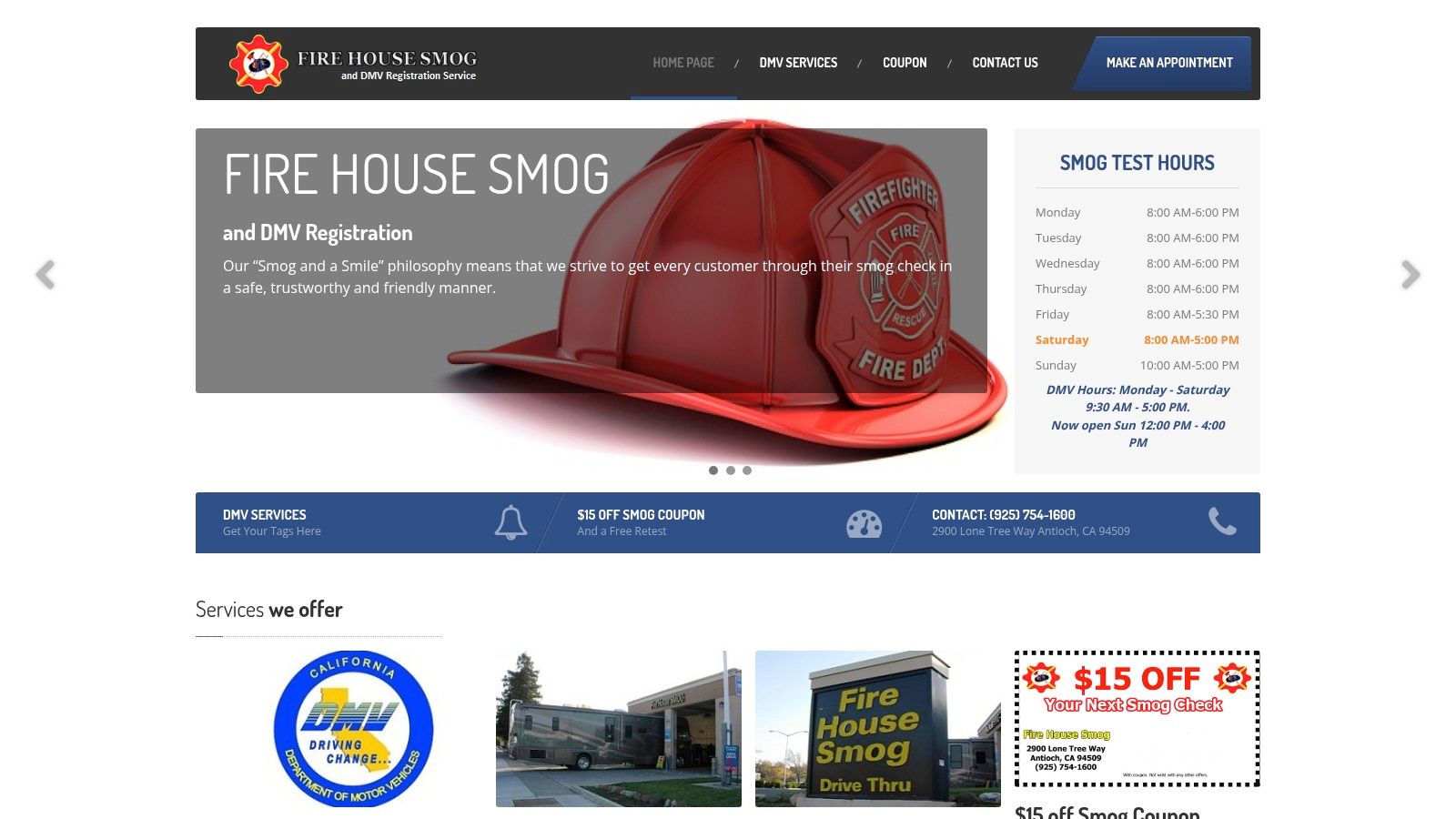
The big advantage here is simple. Fire House Smog runs as a STAR-certified test-only station, so the inspection stays separate from repair sales pressure. That matters if you want a clean answer about whether your vehicle passes, without getting pushed toward in-house fixes.
The shop also has a layout designed to keep cars moving. More than one service bay and a drive-through setup make a real difference on busy days. At cramped locations, one delay can back up the whole line. Here, the operation is set up for volume, which is exactly what local drivers want from a smog visit.
If you want to preview the shop before you go, the Antioch smog check service page gives a clear look at the station and how it handles inspections.
Why this Antioch location stands out
A lot of smog shops only solve one problem. Fire House Smog solves two. You get the unbiased test-only model, and you get a location that is set up to make the registration side easier once the inspection is done.
That is the overlooked benefit.
The station is at 2900 Lone Tree Way, Antioch, CA 94509, close to Highway 4 and easy to reach for drivers coming from Antioch, Pittsburg, Oakley, and Brentwood. Easy access matters more than people think. If the shop is hard to enter, hard to park at, or constantly jammed, the whole "quick smog check" promise falls apart.
Fire House Smog also appears in a California BAR document from 2020 that references its STAR test-only status. That supports the practical point local drivers care about. This is not a random general repair shop squeezing smog checks into the day. It is a station built around inspection work.
Here's a quick look at the station in action.
For Antioch drivers, that setup saves more hassle than a generic smog station. You can get the inspection from a shop with no repair agenda, then handle the next step faster because the business is built around compliance, not upsells. That one-two combination is what makes this location worth knowing about.
Skip the DMV Lines with On-Site Services
Your renewal notice shows up, you handle the smog check, and then you still end up stuck dealing with registration somewhere else. That is the wasted trip smart drivers should avoid.
The better move is simple. Use a test-only smog center that can also help you finish the DMV side on site. That gives you two real advantages in one stop. You get an unbiased inspection, and you cut out the second errand that usually eats up the rest of your day.
Fire House Smog offers smog testing seven days a week and on-site DMV services during business hours. It also offers a $15 discount coupon, which makes the visit easier on your budget.
How to get in and out faster
Treat the visit like a compliance errand, not just a smog appointment. Show up prepared, do the inspection first, then finish any qualifying registration task before you leave.
A simple plan works best:
- Bring your paperwork: If you need help with renewal or ownership-related paperwork, review the required vehicle registration documents before you go.
- Start with the smog check: That keeps the inspection tied directly to the registration step you need to finish.
- Ask about on-site DMV processing right away: If your transaction qualifies, handle the tags or sticker during the same visit.
- Use the weekend schedule if weekdays are packed: That matters for drivers trying to avoid missing work or rearranging family schedules.
Who benefits most from this setup
Busy commuters save the most obvious time. Parents with a packed schedule also benefit because one stop is easier to manage than bouncing between a smog shop and a DMV counter. Local business owners and small fleet operators get another benefit. Less vehicle downtime means less disruption to the workday.
That is the practical edge a lot of smog articles miss. A test-only center protects you from repair-shop pressure. On-site DMV help protects your schedule. Put those together, and the whole job gets finished with less hassle, less waiting, and fewer chances for paperwork problems.
FAQs and Tips for a Quick Smog Check
A smooth smog visit usually comes down to basic preparation. Most delays are avoidable.
What to bring and what to check first
Bring your registration paperwork and any DMV notice you received. Before you leave home, make sure the Check Engine light isn't on and the car is in normal running condition.
A short pre-visit checklist helps:
- Dashboard check: If warning lights are active, don't assume it'll be fine.
- Paperwork check: Bring the documents tied to renewal or transfer.
- Timing check: Go when you can complete both testing and any registration task without rushing.
What if your car fails
Don't treat a failed test at a test-only station as bad service. Treat it as a clean diagnosis.
Data cited in discussion around California test-only stations shows STAR-certified stations have an initial failure rate of about 12% to 15%, compared with about 8% at non-STAR stations, not because the service is worse, but because the model is more impartial and doesn't rely on quick repair-based pass decisions, as described in this review discussion of test-only station failure-rate concerns.
That lines up with what experienced drivers eventually learn. Honest testing can feel harsher in the moment, but it protects you from false confidence and paperwork headaches later. If you're using a coupon at Fire House Smog, the site policy also includes a free retest when required, which takes some sting out of an initial failure.
If you want the simplest path through smog and registration in Antioch, use Fire House Smog. It's a STAR-certified test-only station with on-site DMV services, two service bays, seven-day smog availability, and the kind of setup that saves time instead of creating another errand.
That DMV envelope tends to sit on the counter longer than it should. You know it needs attention, but you also know one missing form, one expired smog certificate, or one title mistake can turn a simple errand into multiple trips and a lot of waiting.
Most registration problems aren't hard. They're incomplete. People usually get stuck because they start the process before they've matched their paperwork to their exact situation. With vehicle registration documents, that distinction matters. A renewal, a private-party title transfer, and an out-of-state vehicle don't move through the same lane, even when they look similar on the surface.
Table of Contents
- Conquering Your DMV To-Do List Starts Here
- The California Smog Check What to Know in 2026
- Solving Document Disasters Lost Titles and Missing Paperwork
- The Fast Lane Skip the DMV with On-Site Services
- Vehicle Registration FAQs
- Can I renew registration if I lost my notice?
- Can I register a car if I just bought it and the seller made a mistake on the title?
- Do I always need a smog check for registration?
- What should I do before bringing in an out-of-state vehicle?
- I lost my registration card. Is that the same as losing my title?
- What's the most common mistake people make?
Conquering Your DMV To-Do List Starts Here
A lot of drivers open a notice, glance at the due date, then start digging through the glove box. They find an old registration card, maybe an insurance card, maybe a smog paper from months ago, and hope that's enough. Sometimes it is. Often it isn't.
That's not surprising when you look at the scale. The United States is projected to reach 290.9 million motor vehicle registrations in 2026, according to IBISWorld's U.S. motor vehicle registrations estimate. That number helps explain why registration systems are so document-driven. Every car has to tie back to a clear administrative record.
Practical rule: Registration goes faster when you stop treating it like one task and start treating it like a document match.
In day-to-day service work, the same pattern comes up again and again. Someone has the right vehicle but the wrong paper. Or the right paper but an outdated one. A buyer brings a signed title but forgets the smog step. A family member tries to renew registration using a notice that doesn't reflect a recent address change. None of those situations are unusual.
The fix is simple. Start with the scenario, not the line at the DMV. If you know whether you're renewing, transferring ownership, bringing in an out-of-state car, or replacing missing paperwork, the checklist gets much shorter and much clearer.
Renewal paperwork
For a standard renewal, gather the documents that prove the vehicle, the current registration status, and any required inspection compliance. The renewal notice helps, but it shouldn't be the only thing you rely on. Bring the current registration card if you have it, your plate number, and identification that matches the record.
If your notice says a smog check is required, treat that as a time-sensitive item. Don't assume an old certificate will still work. Inspection paperwork has its own validity window, and that catches people who try to piece everything together late.
California title transfer after a private sale
A private-party purchase usually needs more than buyers expect. The signed title is the center of the file, but it isn't the whole file. You also need supporting ownership details that match the vehicle exactly, including VIN, seller information, buyer information, and any disclosures required by the transaction.
For California cases, keep these together before you start:
- Signed title: Make sure buyer, seller, and vehicle details are complete and legible.
- Odometer disclosure if applicable: Check that mileage information is present when required.
- Smog compliance if required: Don't leave this for the end if the transfer depends on it.
- Registration application paperwork: California commonly uses Application for Title or Registration (REG 343) in registration workflows.
- Insurance and ID: Bring current proof that matches the owner information you're submitting.
Many files face difficulties. In California, 15 to 20% of registration applications face initial rejection because of mismatched VINs or unreported modifications, and missing smog check documentation is the leading cause of refusal, affecting about 35% of new registrations for vehicles over six years old, based on the California registration process discussion at Cobra Dreams.
Small errors matter more than people think. A single digit off in the VIN can stop the whole transaction.
Out-of-state vehicle transfer
An out-of-state transfer is the scenario where people most often underestimate the paperwork. They assume the current out-of-state registration proves everything. It helps, but California usually needs the vehicle itself to match the documents on record. That can mean VIN verification and closer review if the vehicle has modifications or unusual history.
Bring a tighter file for this situation:
- Out-of-state title or current registration: Bring both if you have them.
- Proof of identity: Use ID that matches the buyer or registrant.
- Insurance: Current California-compliant proof helps avoid follow-up delays.
- VIN-ready vehicle: The vehicle may need physical verification, so it must be accessible.
- Technical or build-related paperwork if modified: Engine swaps, frame changes, or specialty builds need clearer support than stock vehicles.
- Smog-related paperwork if required: Don't assume another state's process replaces California requirements.
If you want the basic renewal side of the process laid out cleanly, Fire House Smog keeps a practical overview of California DMV registration renewal steps.
Quick comparison table
| Document | Renewal | CA Title Transfer | Out-of-State Transfer |
|---|---|---|---|
| Current registration notice/card | Usually helpful | Sometimes | Helpful |
| Signed title | No | Yes | Usually yes |
| Application for Title or Registration (REG 343) | Sometimes | Often needed | Often needed |
| Proof of insurance | Often needed | Often needed | Often needed |
| VIN verification | Usually no | Sometimes | Often relevant |
| Smog documentation if required | Sometimes | Often relevant | Often relevant |
| Odometer disclosure if applicable | No | May apply | May apply |
The California Smog Check What to Know in 2026
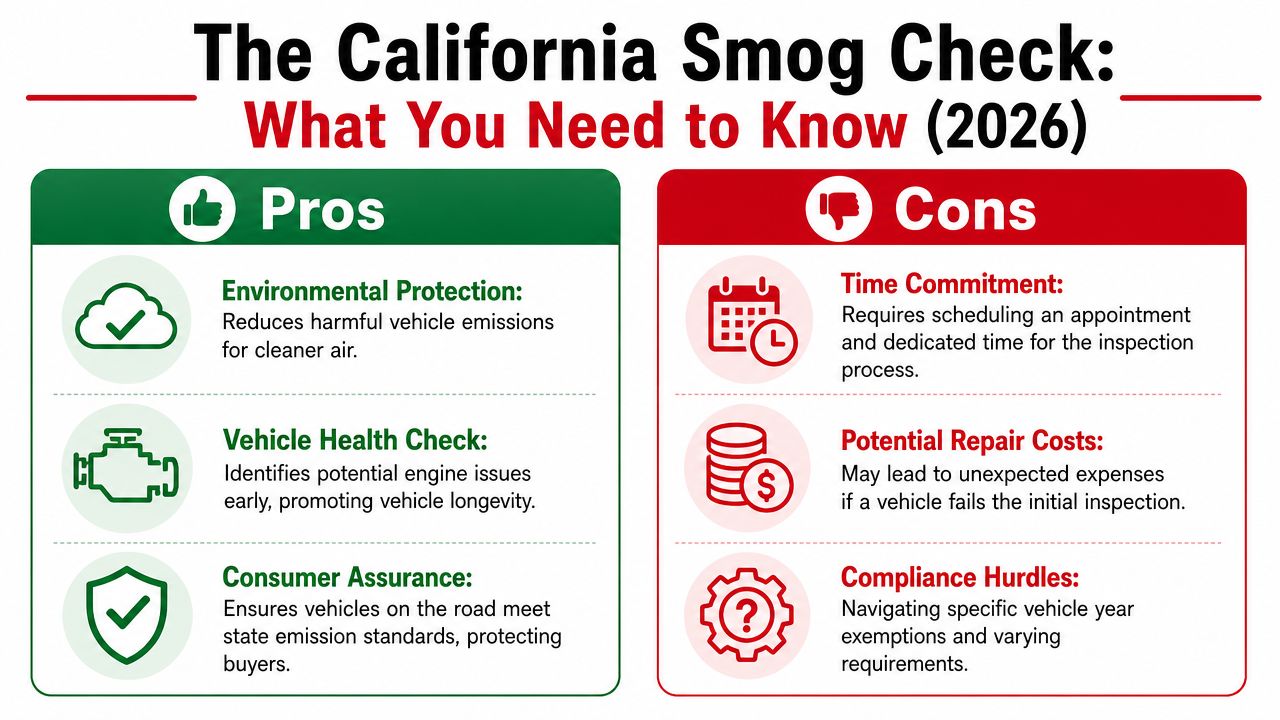
Smog is where registration timing often falls apart. Drivers handle the ownership paper, the insurance, the signatures, then realize the emissions step is what holds the file up. In California, that's a common reason a simple registration turns into a second round of paperwork.
Where drivers lose time
The biggest issue isn't always failing the test. It's getting the test done, then waiting too long to finish the registration. The validity of an emission control inspection is limited to 90 days in most states, including California, and missing that window often leads to another round of delay. The same source notes that failure to complete the registration within that window often results in a 40% rejection rate for renewal applications, which means owners may need another smog check, as described in this technical data sheet and inspection timing discussion.
That's why the right sequence matters. Handle the smog inspection close enough to your registration date that the certificate is still valid when the DMV side is processed. Waiting until the last minute is risky. Doing it too early can also backfire.
Why STAR and test-only matter
Not every station plays the same role in the process. A STAR-certified station meets a higher performance standard set by the state, and some vehicles are specifically directed to a STAR station. If your notice calls for STAR, that isn't optional.
A test-only station matters for a different reason. The inspection is the service. There's no repair sale attached to the result. For many drivers, that makes the process clearer because the shop is focused on accurate testing and reporting, not selling repair work in the same transaction.
If you need a local STAR inspection, the Antioch smog check service page shows what that process looks like in practice.
A good smog visit saves time when it lines up with the registration clock. A badly timed one creates repeat work.
For drivers dealing with multiple deadlines, the cleanest approach is to keep three items together: the registration notice, current insurance, and any emissions requirement tied to the vehicle. Once those are aligned, the rest of the file is usually much easier to finish.
Solving Document Disasters Lost Titles and Missing Paperwork
Losing paperwork feels bigger than it is. Most document problems are fixable. Significant damage results from freezing up, guessing, or submitting partial information that creates a second problem on top of the first.
If the title is missing after a sale
This one causes a lot of panic. A buyer pays for the vehicle, gets possession, and then the title is lost, incomplete, or never properly transferred. Most general guides act like the process stops there. It doesn't, but it does become more state-specific.
One overlooked point is that some states allow alternate paths. As noted in this private-sale title guidance discussing Illinois and title alternatives, states such as Missouri may allow registration with a Manufacturer's Statement of Origin (MSO) or a notarized lien release, and Illinois has a 20-day window that can matter in private-sale timing. The important takeaway isn't that California follows those exact rules. It's that missing-title situations aren't always dead ends, even though many consumer guides treat them that way.
For a practical response, do this first:
- Contact the seller immediately: Don't wait and hope the title turns up.
- Confirm what was signed: A title signed incorrectly can be as troublesome as a lost one.
- Ask whether a duplicate title request is possible: In many cases, that's the cleanest correction.
- Keep your bill of sale and payment record together: Those help establish the timeline of the transaction.
- Don't alter documents yourself: Cross-outs and handwritten fixes often create new rejection issues.
If your paperwork doesn't match the vehicle
This usually shows up around the VIN, odometer information, or modifications. The paperwork says one thing. The car says another. That's where verification steps become important, especially for out-of-state vehicles, reconstructed units, or cars with changes that weren't documented cleanly.
A VIN check is often the fastest way to identify whether the mismatch is minor clerical error or a larger file problem. If you need that step, Fire House Smog provides VIN verification support in Antioch.
Here's a useful overview before you make calls or stand in line:
Bring every ownership-related paper you have, even if you think one of them is outdated. The missing clue is often on the document people leave at home.
How to keep this from happening again
Drivers with one vehicle can usually manage registration papers with a simple folder. Families with several cars and small business fleets need more discipline than that. The best working method is boring, but it works: keep originals in one secure place, carry only what needs to be in the vehicle, and review expiration-sensitive documents before you need them.
For modified vehicles, keep build and compliance paperwork attached to the title file, not in a separate stack. For private sales, make copies before either party leaves. For out-of-state transfers, bring more than you think you'll need. Overpreparing is cheaper than a second trip.
The Fast Lane Skip the DMV with On-Site Services
The traditional route is familiar. Gather what you think you need, drive to the DMV, wait for your number, reach the counter, then learn the file is missing one item you could have brought if someone had told you sooner. The trip wasn't wasted, but it wasn't finished either.
The alternative works better because it compresses the steps. Instead of separating smog, paperwork review, and registration processing into different stops, a licensed service partner can often line them up in one visit.
Two ways this usually goes
One driver shows up with a vague stack of papers and hopes the clerk can sort it out. Another shows up with the right scenario matched to the right documents. The second driver usually finishes faster because the transaction is built correctly before it enters the system.
That's the true shortcut. It isn't luck. It's sequence.
A local licensed DMV business partner can handle common transactions such as renewals, ownership transfers, and related registration work without sending you into a full DMV office line. If the vehicle also needs emissions testing, doing both tasks in one place reduces the chance that the smog side and the document side drift apart.
What a licensed partner changes
On-site processing offers its greatest help:
- Immediate document review: Missing items get caught before the submission goes sideways.
- Smog and registration alignment: If both are needed, they can be coordinated in the same visit.
- Tag and sticker handling: For eligible transactions, official registration output can be printed on-site.
- Less rework: You're less likely to discover a preventable problem after waiting in line.
Fire House Smog is one local option that combines STAR-certified test-only smog inspections with licensed California DMV registration services, including on-site renewals and ownership transfer support at its Antioch location.
This model is especially useful for working drivers, families juggling multiple vehicles, and fleet managers who can't afford to lose half a day every time a registration file needs attention. The trade-off is simple. You still need the right paperwork. You just don't have to do the sorting, testing, and processing in separate places if your transaction qualifies.
Vehicle Registration FAQs
Can I renew registration if I lost my notice?
Usually, yes. The notice helps, but it isn't the registration itself. What matters is matching the vehicle and owner record correctly. Bring the registration card if you have it, plus plate information, ID, insurance, and any required inspection paperwork.
Can I register a car if I just bought it and the seller made a mistake on the title?
Sometimes, but don't guess. Title errors can be fixable, yet handwritten corrections often make things worse. Get the seller involved quickly and find out whether the title needs to be re-signed, replaced, or supported with additional ownership documents.
Do I always need a smog check for registration?
Not always. It depends on the transaction and the vehicle. Renewals, sales, and out-of-state transfers can trigger different requirements, so check the notice and the vehicle record before assuming you're exempt or required.
What should I do before bringing in an out-of-state vehicle?
Bring the title or current registration, proof of insurance, identification, and any paperwork tied to modifications or unusual vehicle history. Make sure the vehicle itself is available if verification is needed. Out-of-state transfers go smoother when the car and the paperwork can be checked together.
I lost my registration card. Is that the same as losing my title?
No. They're different documents and create different problems. A lost registration card is usually a simpler replacement issue. A lost title affects ownership proof, transfers, and some registration scenarios much more directly.
What's the most common mistake people make?
Starting too early with the wrong paperwork, or too late with time-sensitive paperwork. Vehicle registration documents aren't hard to collect once you know your scenario. The trouble starts when drivers mix renewal documents with transfer documents, or bring inspection paperwork that no longer fits the registration timeline.
If you want to avoid the usual back-and-forth, bring your paperwork to Fire House Smog. The shop handles smog inspections and qualifying DMV registration services from one Antioch location, which makes it easier to match the right documents to the right transaction and finish the job without a separate DMV office stop.
The renewal notice lands on the counter and the mood drops instantly. You see the DMV return address, think about smog, fees, website errors, and whether your sticker will show up on time. That reaction makes sense. California's system is big, layered, and not built for clarity.
It's also manageable once you stop treating it like one simple payment and start treating it like a short checklist with a few known traps. The big one is timing. The other big one is using the wrong website or trying to renew before the DMV has the right data on file.
California handles a huge volume of vehicle paperwork. The DMV says it manages over 36.19 million registered vehicles and processed over 15.05 million total vehicle registrations in its most recent full reporting year, according to the California DMV at a glance. That scale is exactly why you need a cleaner plan than “I'll just do it online later.”
Table of Contents
- That DMV Envelope Has Arrived What Now
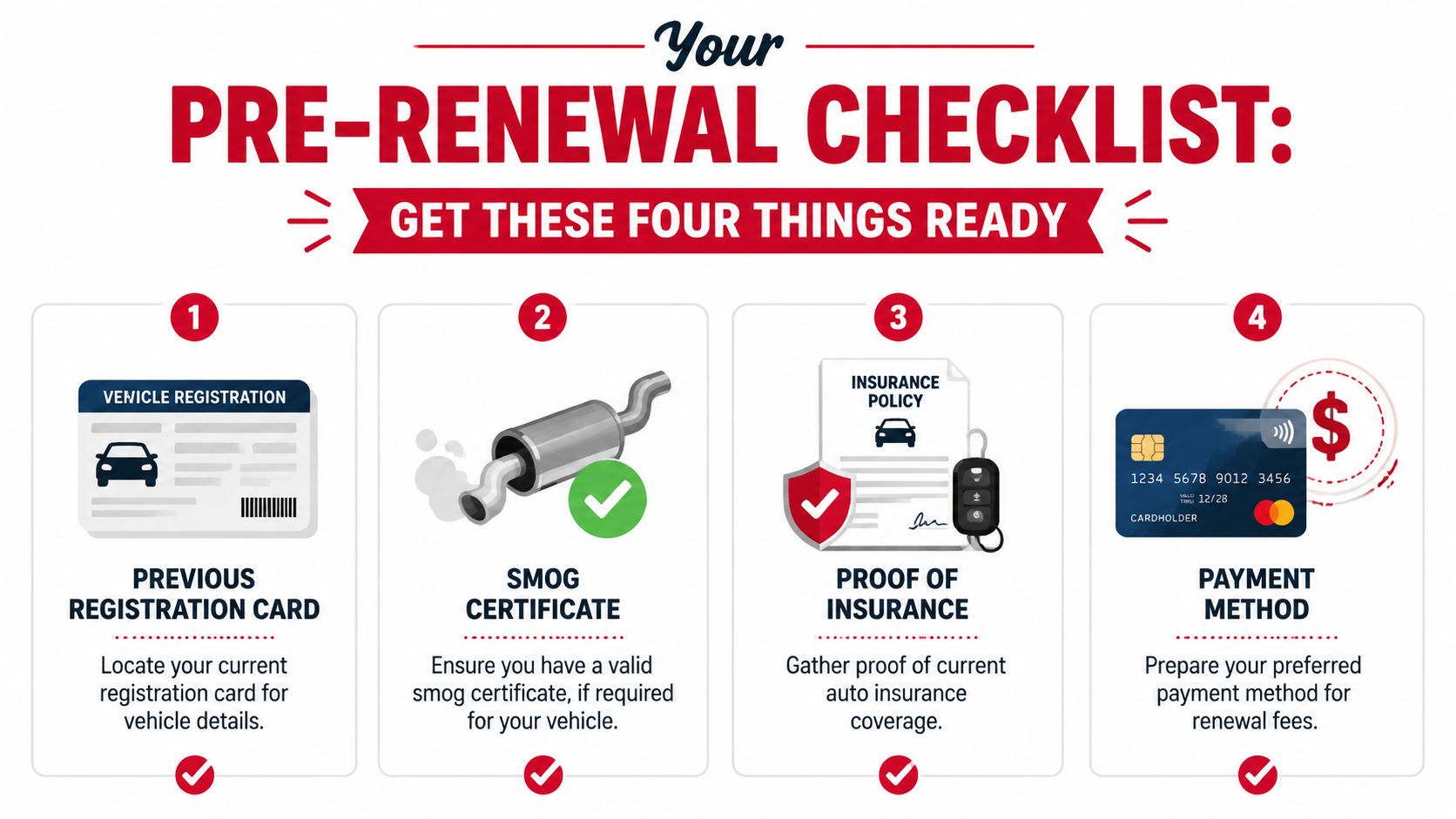
- Your Pre-Renewal Checklist Get These Four Things Ready
- Decoding the Bill Understanding Your Registration Fees
- Choose Your Path Four Ways to Renew Your Registration
- Troubleshooting Common Registration Renewal Problems
- California Registration Renewal FAQ
That DMV Envelope Has Arrived What Now
Most drivers do the same thing first. They open the envelope, scan for the due date, look at the amount, and immediately wonder if there's some hidden catch. Usually there is, but it's not mysterious. It's one of a handful of routine issues: smog status, address mismatch, unpaid holds, or using a renewal path that sounds official but costs far more than it should.
The smart move is to slow down for five minutes before you pay anything. Read the notice. Check whether the vehicle is flagged for smog. Confirm the address the DMV has on file still matches where you receive mail. If any of those pieces are wrong, the renewal itself isn't the first task. Fixing the record is.
The Real Problem Usually Isnt The Payment
People assume California DMV registration renewal is hard because the DMV wants to make it hard. That's not really it. The process breaks when the system is missing one required data point. The payment part is easy. The record-matching part is where people get burned.
Practical rule: Don't submit payment first and troubleshoot later. In California DMV registration renewal, bad sequencing creates most of the headaches.
There's another reason people get tripped up. They treat every renewal option as interchangeable. They aren't. Online can be fast. Mail can be fine if nothing is urgent. A field office can solve stubborn problems, but it costs you time. A licensed partner can be the cleanest route when you need a smog check and renewal handled in one stop.
Your Goal Is A First-Try Approval
You don't need to know every DMV rule. You need to know which few rules block issuance of the sticker and registration card. That means going in with the right details, using the official path or a legitimate licensed provider, and avoiding last-minute guesses.
Handle the renewal like a transaction, not a chore. Gather what the system needs. Confirm what can stop it. Then choose the path that fits your situation instead of defaulting to whatever search result shows up first.
Your Pre-Renewal Checklist Get These Four Things Ready
If you want a smooth renewal, do the prep before you touch the payment page. That preparation often determines whether individuals save themselves a wasted trip or create one.
Start With The Notice And Your Vehicle Details
Pull out the renewal notice if you have it. If you don't, use your registration card and vehicle information. You want the plate number exactly as shown, with no added spaces, and you want the vehicle details to match what the DMV expects.
Keep these four items ready:
- Registration paperwork: Your current registration card or renewal notice gives you the vehicle identifiers the system expects.
- VIN access: Have the vehicle nearby if possible so you can confirm the VIN when needed.
- Insurance proof: Make sure your auto insurance is current and tied to the right vehicle.
- Payment method: Don't wait until the last screen to find your card or account information.
If you're handling smog first, use a STAR-certified smog test station near you so you're not guessing about whether the inspection path will satisfy DMV requirements.
Smog Is The Gatekeeper
When a vehicle requires smog, the DMV's system won't approve renewal unless it has a passing electronic record on file. The DMV notes that its renewal system rejects transactions when a required smog certificate isn't electronically available, and approximately 12% of online renewal failures are tied to this data lag, according to the California DMV smog inspections page.
That means the paper receipt from the smog station doesn't do the job by itself. The DMV system wants the electronic handoff.
If your car needs smog, assume the electronic transfer matters more than your payment confirmation.
Two more checks belong on your list before you renew:
- Address accuracy: If your mailing address is outdated, fix that first. Otherwise your registration can go to the wrong place.
- Outstanding holds: Parking tickets or similar holds can stop the renewal cold.
What To Verify Before You Click Pay
Use this short mental test:
- Do I have the right vehicle details?
- If smog is required, has the electronic result reached DMV?
- Is my address current?
- Is anything on the vehicle likely to block issuance?
Do those four things and the rest gets much easier. Skip them and you'll waste time blaming the website for a problem that started before you logged in.
Decoding the Bill Understanding Your Registration Fees
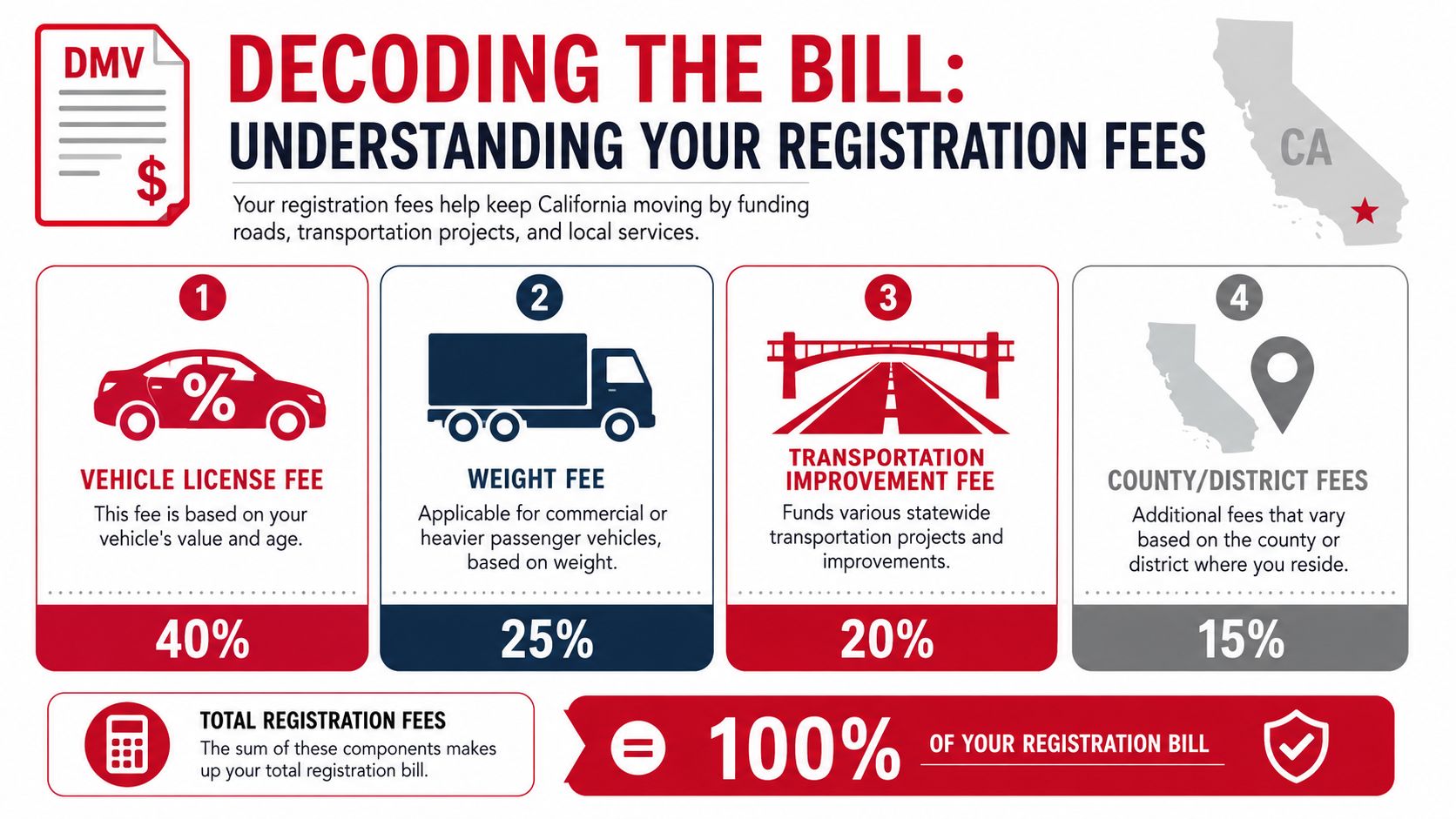
The fee notice confuses people because it looks like one charge when it's really a stack of charges. That's why two drivers with similar cars can end up with different totals.
Why Your Total Never Looks Simple
California doesn't bill registration as a single flat renewal fee. The biggest factor for many passenger vehicles is the Vehicle License Fee, or VLF, which is tied to the vehicle's assessed value. The fixed renewal fee is only one piece of the total. Other charges can also apply depending on the vehicle and location.
Here's the important mindset shift. When your renewal feels high, don't ask, “Why is the DMV charging so much for registration?” Ask, “Which parts of this bill are fixed, and which parts change based on value or location?”
That question gets you to the answer faster.
A Real Example Of The Value-Based Fee
The DMV says the VLF is calculated at exactly 0.65% of the vehicle's current assessed value, and for a $40,000 vehicle that fee alone is $260, on top of the fixed base registration or renewal fee of $76, according to the California DMV registration fees page.
That one example explains most of the confusion people have. The renewal isn't just “the sticker fee.” A newer or higher-value vehicle can push the total up fast because the value-based piece moves with the car.
A short explainer helps:
| Fee Component | What it means |
|---|---|
| Base renewal fee | Fixed statewide starting point |
| Vehicle License Fee | Value-based charge tied to assessed vehicle value |
| Smog-related charges | Applies when required by vehicle status |
| Local or regional additions | Varies by where the vehicle is registered |
If you want a quick visual walkthrough before you stare at your notice again, this overview is useful:
Don't compare your total to your neighbor's and assume something is wrong. Compare the components.
Choose Your Path Four Ways to Renew Your Registration
People either save time or hand money to the wrong middleman. All four common renewal methods work. They just don't work equally well for every situation.
The Official Online Route
If your record is clean, online renewal through the official DMV portal is usually the first option to try. It's convenient, and you avoid a trip. But convenience only counts if the DMV already has the data it needs.
Online is a bad choice when you just changed your address, recently handled a smog issue, or suspect there's a hold attached to the vehicle. In those cases, the website often just becomes a rejection screen with no useful explanation.
Mail And Field Office Options
Mail works if you're early, your address is correct, and nothing about the vehicle is unusual. It's not a rescue tool. It's a routine tool.
A field office is the opposite. It's what you use when the record needs human intervention or you need a more direct answer. The trade-off is obvious. You spend time getting there, waiting, and handling it in person.
Here's the clean comparison.
| Method | Speed | Convenience | Get Sticker |
|---|---|---|---|
| Official DMV online | Fast when the record is clean | High | Not on the spot |
| Slower | Moderate | Not on the spot | |
| DMV field office | Variable | Low | Often handled in person |
| Licensed business partner | Fast for many common transactions | High | Often on the spot |
Licensed Partners And The Third-Party Fee Trap
This is the part a lot of drivers learn the hard way. Not every website that looks like DMV is the DMV. ABC7 reported that the DMV tells people to go directly to its website, while authorized third-party vendors can legally add fees that turn a simple $90 renewal into a $300+ expense, according to ABC7's report on California renewal fees and vendor markups.
That's why I tell people to stop trusting search results during urgent renewals.
Use this filter before you pay anywhere online:
- Check the site identity: If you intended to use DMV, make sure you are on the official DMV website.
- Read the fee screen carefully: If service charges feel inflated or vague, back out.
- Know the difference between licensed and lookalike: A licensed business partner is legitimate. A confusing search result with stacked service fees can still cost you far more than expected.
For drivers in East Contra Costa County, one practical option is smog check and DMV registration service in Antioch, where a licensed provider can handle common renewals and issue tags on site during service hours. That route makes the most sense when you want the transaction handled in person without going to a DMV office.
The best renewal method isn't the one with the fewest clicks. It's the one least likely to fail for your exact record.
My blunt advice is simple. Use the official DMV website for clean, straightforward renewals. Use mail only when time isn't tight. Use a field office for messy records. Use a licensed partner when you want in-person handling without the DMV-office experience. And never pay a suspicious markup because a search ad got to you first.
Troubleshooting Common Registration Renewal Problems
Most renewal problems aren't complicated. They just feel complicated because the DMV system gives blunt error messages and very little context.
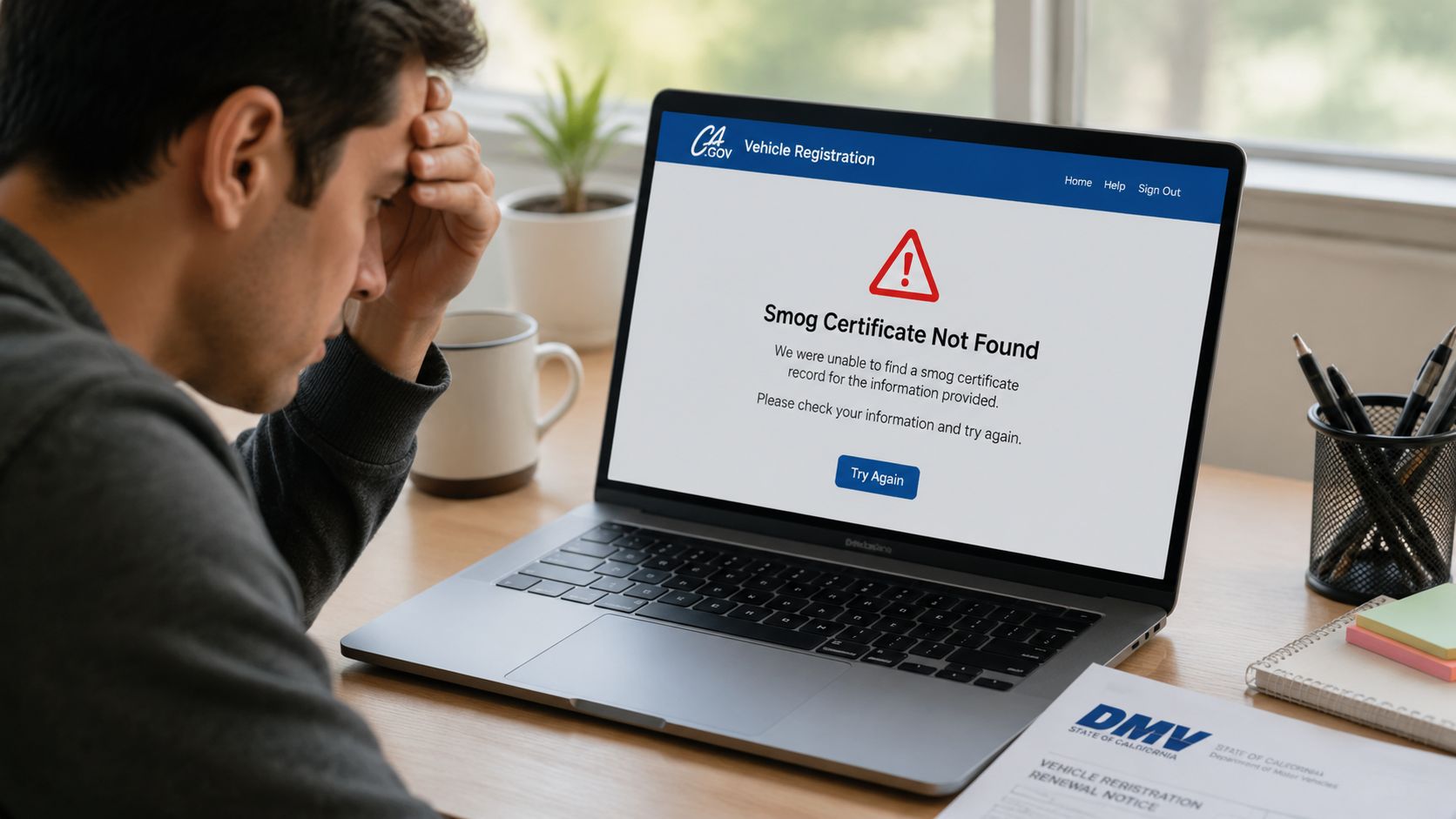
When The Smog Record Hasnt Landed Yet
You pass smog, go online, try to renew, and the system still acts like you never did the inspection. That happens. Independent reporting notes that smog certificate transfer is often quick, but processing delays can extend up to 3 business days before the DMV system updates, according to Reviver's overview of California smog check requirements.
Don't keep submitting the same renewal attempt over and over. That doesn't fix a missing electronic record.
Do this instead:
- Wait before retrying: If the smog was just completed or you just passed a retest, give the system time to update.
- Confirm the vehicle identifiers: A mismatch in plate or VIN details can create a false dead end.
- Use a real person when needed: If the record still won't clear, in-person help is often faster than guessing.
When Youre Missing Information Or Hit A Hard Stop
Another common issue is not having the vehicle details the system wants. That becomes a bigger problem when the notice is missing or the VIN information isn't easy to verify. If your record has identity or documentation issues tied to the vehicle, VIN verification help can be the right next step before you keep pushing the renewal itself.
If you hit a stop screen, don't panic. Work backwards.
- Check whether the vehicle needs smog and whether the record has updated.
- Make sure your identifying information matches exactly.
- Look for anything tied to the vehicle that could block issuance.
- Switch renewal methods if the system clearly needs human review.
A rejected online renewal doesn't always mean your registration is impossible. It usually means one required record hasn't lined up yet.
The worst move is doing nothing because the error message was vague. California DMV registration renewal is usually recoverable once you identify which record is blocking the sticker.
California Registration Renewal FAQ
What If My Car Fails Smog
You can't complete renewal until the smog requirement is satisfied when your vehicle is subject to inspection. Fix the underlying emissions issue, complete the required retest, and wait for the passing result to make it through the DMV system before trying again. If timing is tight, don't rely on same-minute online renewal after the retest.
Can I Renew While Im Out Of State
Yes, many drivers handle California DMV registration renewal remotely if the record is otherwise clean. The catch is practical, not theoretical. If the vehicle needs smog or the mailing address is wrong, distance makes the process slower and more fragile. Get your documents and address squared away before you submit anything.
Do Newer Cars Need Smog Right Away
Not always. California has exemptions for some vehicles, including certain newer vehicles and categories such as electric vehicles, motorcycles, trailers, and vehicles manufactured before 1975, under the state's smog rules. Don't assume your car is exempt just because it's newer. Check what your notice says.
How Fast Do I Get My Sticker And Registration
That depends on the method. Online and mail are convenient, but they depend on processing and delivery. In-person service, whether at a DMV location or a licensed provider that can issue tags on site, is the better choice when you want the sticker in hand rather than waiting on the mail.
If you lost the renewal notice, you can still usually move forward as long as you have the correct vehicle details. The notice helps, but it isn't the only path.
The short version is this: if your record is simple, keep it simple. If anything looks off, stop forcing the online route and switch to a method that can resolve the issue directly.
If you want to avoid DMV-office lines and handle your renewal in person, Fire House Smog in Antioch offers STAR-certified smog testing and licensed DMV registration services, including on-site tag issuance during posted service hours. It's a practical option when you need the smog check and registration side handled in one stop.
Your renewal notice shows up, you open it at the kitchen counter, and one line jumps out fast: STAR smog check required. That usually means you can't just pull into any station on the way home and expect the DMV to accept the result. If you're in Antioch, Pittsburg, Brentwood, Oakley, or nearby East Contra Costa, that small detail matters because it decides where you can go, how long the errand takes, and whether you end up making a second trip.
Most drivers searching for a STAR certified smog test near me aren't trying to become emissions experts. They want to get the inspection done, avoid confusion, and move on with their day. If you can also handle registration in the same stop, even better. That's where a local, practical approach helps.
Table of Contents
- Find a STAR Certified Smog Test Near You in Antioch
- What STAR Certification Really Means for Your Smog Check
- The Smog Test Process at Fire House Smog Step-by-Step
- Why a Test-Only STAR Station Is Your Best Choice
- Skip the DMV Lines with On-Site Registration Services
- FAQ Pricing and Policies at Fire House Smog
Find a STAR Certified Smog Test Near You in Antioch
A common Antioch scenario goes like this. Your registration is due soon, your notice says STAR is required, and you're trying to figure out whether that means a special shop, a longer wait, or extra paperwork. In practice, the first thing that matters is simple: if the DMV notice specifically says STAR, a regular smog station won't be able to issue the certificate you need.
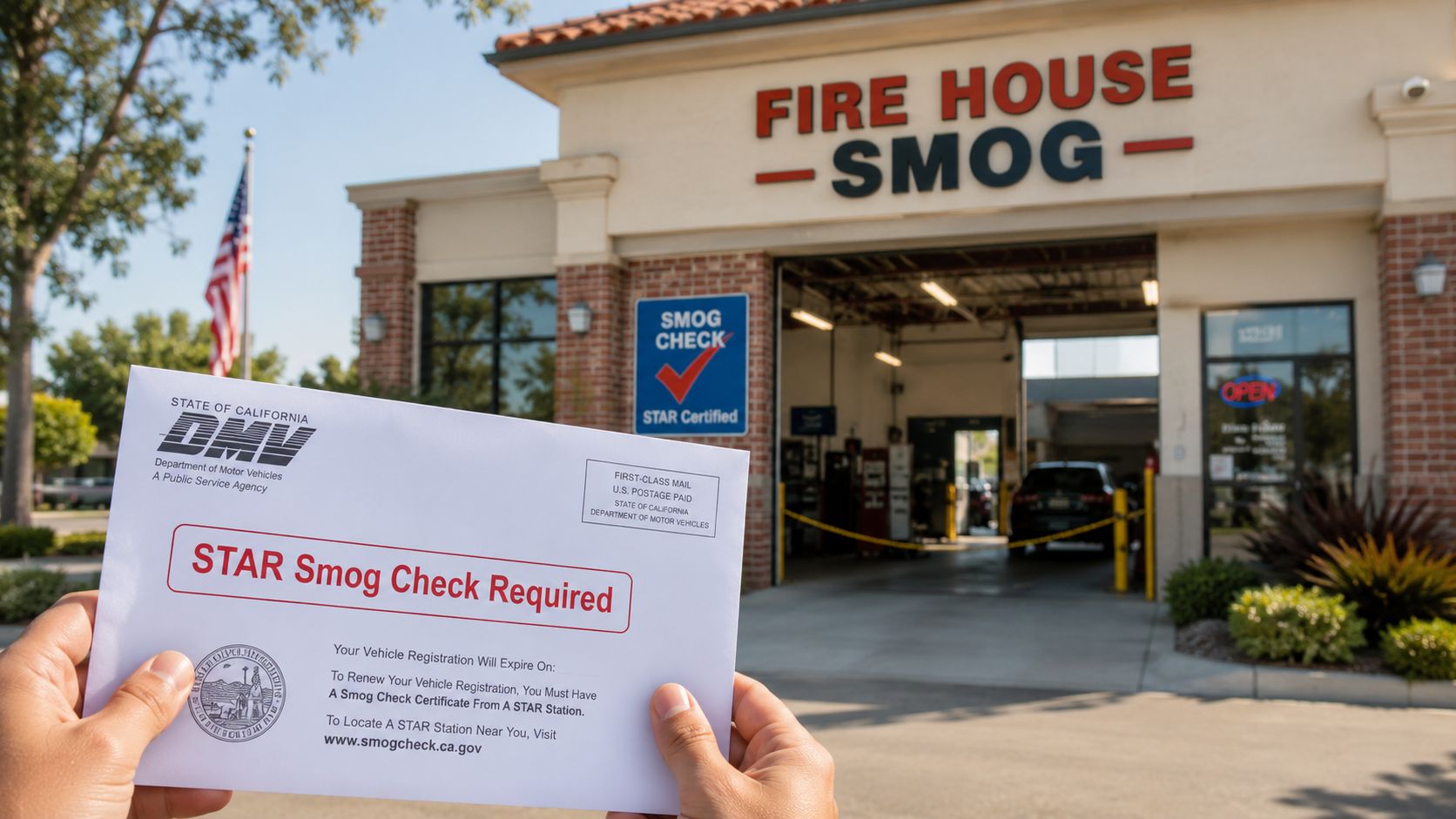
For local drivers, that narrows the search quickly. You need a station that handles STAR-directed vehicles, knows the paperwork flow, and doesn't turn a short errand into half a day. If you're checking options in town, Antioch smog check service details make it easier to confirm what kind of vehicles are handled and what services are available in the same visit.
What Antioch drivers usually want to know first
- Can I go anywhere? No. If the notice says STAR, the certificate has to come from a STAR-qualified station.
- Will this take forever? It depends on traffic at the shop and the vehicle, but a station built for throughput is usually easier to deal with than a tiny one-bay setup.
- What if I also need DMV help? That can save a lot of time if the same location can handle the registration side after the inspection.
If your notice says STAR, don't guess. Check that the station is authorized before you drive over.
Around East Contra Costa, convenience is not just about distance. It's also about avoiding a wasted stop, especially if you're squeezing this in before work, after school pickup, or on a weekend when the DMV is the last place you want to stand in line.
What STAR Certification Really Means for Your Smog Check
You get a DMV notice, head out for a quick smog check, and then find out the shop you picked cannot test your vehicle because the notice says STAR. That is the hassle most drivers are trying to avoid.
STAR certification means a station has been approved by California's Bureau of Automotive Repair to inspect vehicles the state wants checked more closely under the Smog Check Program. BAR explains the program and STAR station requirements on its official STAR Program page. For Antioch drivers, the practical point is simple. If your renewal or DMV paperwork says STAR, the inspection has to be done at a STAR station.
That requirement usually comes up for vehicles that fall into one of a few common situations:
- A prior smog inspection failed and the retest must be done at a STAR station
- The vehicle fits a higher-risk emissions profile under state selection rules
- The state selected the vehicle for program monitoring
- The DMV notice specifically directs the owner to a STAR-certified location
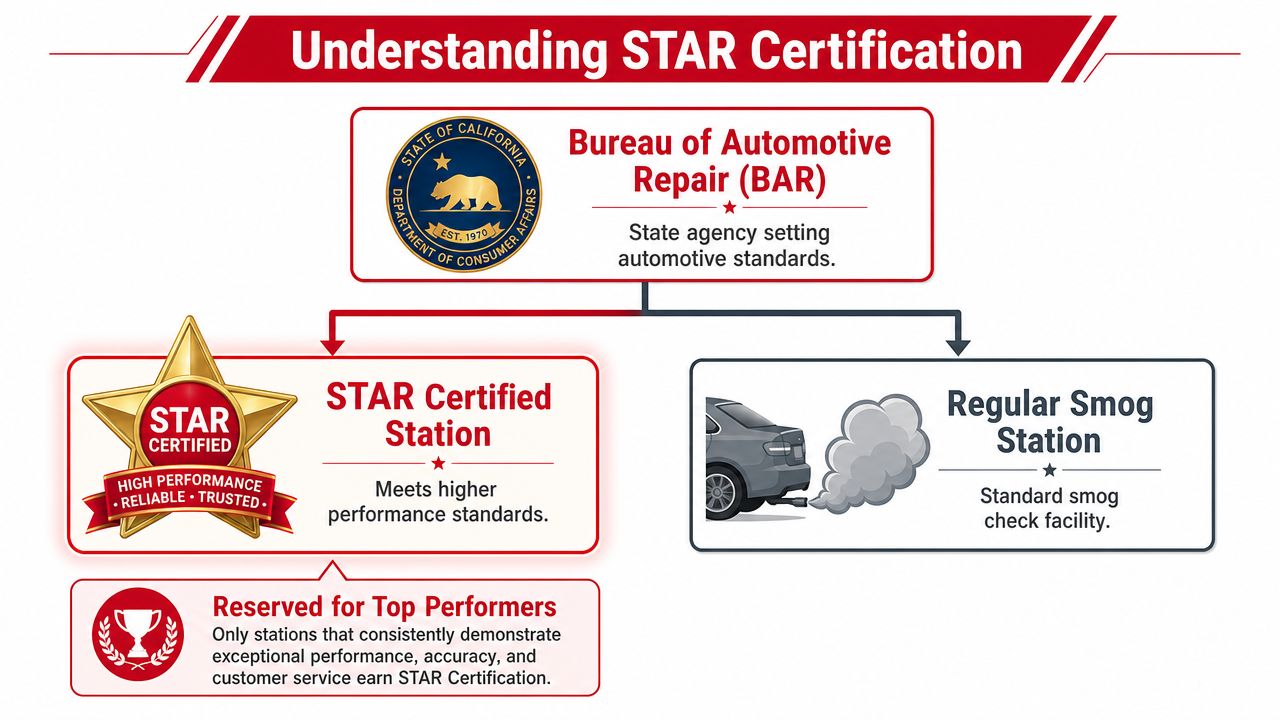
A lot of drivers assume STAR means the test itself is different. Usually, what changes is the station requirement and the level of oversight attached to that station. The state uses STAR stations for cases where inspection accuracy matters more because the vehicle has already raised a flag or fits a pattern the program watches more closely.
That is why choosing the right location first saves time. A non-STAR shop might still be a legitimate smog station, but it cannot help if your paperwork calls for STAR. At Fire House Smog, that distinction matters every day because plenty of East Contra Costa customers come in trying to handle both the inspection and the registration side without making two separate stops.
Practical rule: If your DMV notice says STAR, treat it as a shop requirement.
It also helps to show up with the vehicle ready for inspection. If the check engine light is on or monitors are not set after a recent repair, the visit can stall before the test really starts. These smog test prep tips for Antioch drivers can help you avoid an unnecessary retest.
For local drivers, STAR certification is less about labels and more about getting the right certificate the first time. In Antioch, that matters even more when you want one stop for the smog check and help with the DMV paperwork afterward.
The Smog Test Process at Fire House Smog Step-by-Step
A lot of customer stress comes from not knowing what happens after they pull in. The process is usually straightforward when the station is organized. At 2900 Lone Tree Way, the setup includes two service bays, which helps keep cars moving and reduces the bottleneck you see at single-bay stations.
Before you arrive
Bring the basics and make sure your vehicle is ready for a normal inspection. If your check engine light is on, handle that before the test. For prep guidance, smog test prep tips for Antioch drivers are useful because the little details are usually what save people from an avoidable retest.
Here's the simple checklist.
| Item | Why You Need It |
|---|---|
| DMV renewal notice | Helps confirm whether STAR is required and speeds up check-in |
| Vehicle registration | Verifies the vehicle record and testing details |
| Driver identification | Helps match paperwork when needed |
| Payment method | Keeps the visit moving without an extra trip |
| Coupon, if applicable | Lets staff apply current discount terms and retest policy correctly |
What happens in the bay
After check-in, the technician confirms the vehicle information and test requirement. Then the inspection process starts based on the vehicle type and what the state requires for that model year and configuration. The main customer benefit here is not mystery. You know where the car is, what it's there for, and what result needs to be transmitted.
A good test-only workflow is usually calm and direct. There isn't a handoff to a repair estimate writer because repairs aren't the point of the visit.
Bring the notice if you have it. It removes guesswork and speeds up the first few minutes.
If your vehicle passes
When a vehicle passes, the result is submitted electronically for DMV purposes. This convenience is a key benefit, as it means you don't have to carry paper proof from office to office hoping someone enters it correctly later.
For many drivers, the errand should end here. If you also need registration help, it can move directly into that step instead of becoming a second trip.
If your vehicle doesn't pass
A failed result isn't fun, but it doesn't need to become chaos. You need to know what failed, what has to be fixed elsewhere if repair is needed, and whether you qualify under the station's free retest policy based on site policy and coupon terms.
The practical trade-off with any test-only station is simple:
- You get an unbiased inspection.
- You won't be sold in-house repair work.
- If repairs are needed, you'll need to complete them elsewhere and return if a retest is required.
That arrangement works well for customers who want a clean answer without the pressure of an immediate repair pitch.
Why a Test-Only STAR Station Is Your Best Choice
When people are nervous about a smog check, they usually aren't worried about the machine. They're worried about what comes after a failure. The big concern is getting told the car needs work right now, at this shop, for a price they weren't planning to pay.
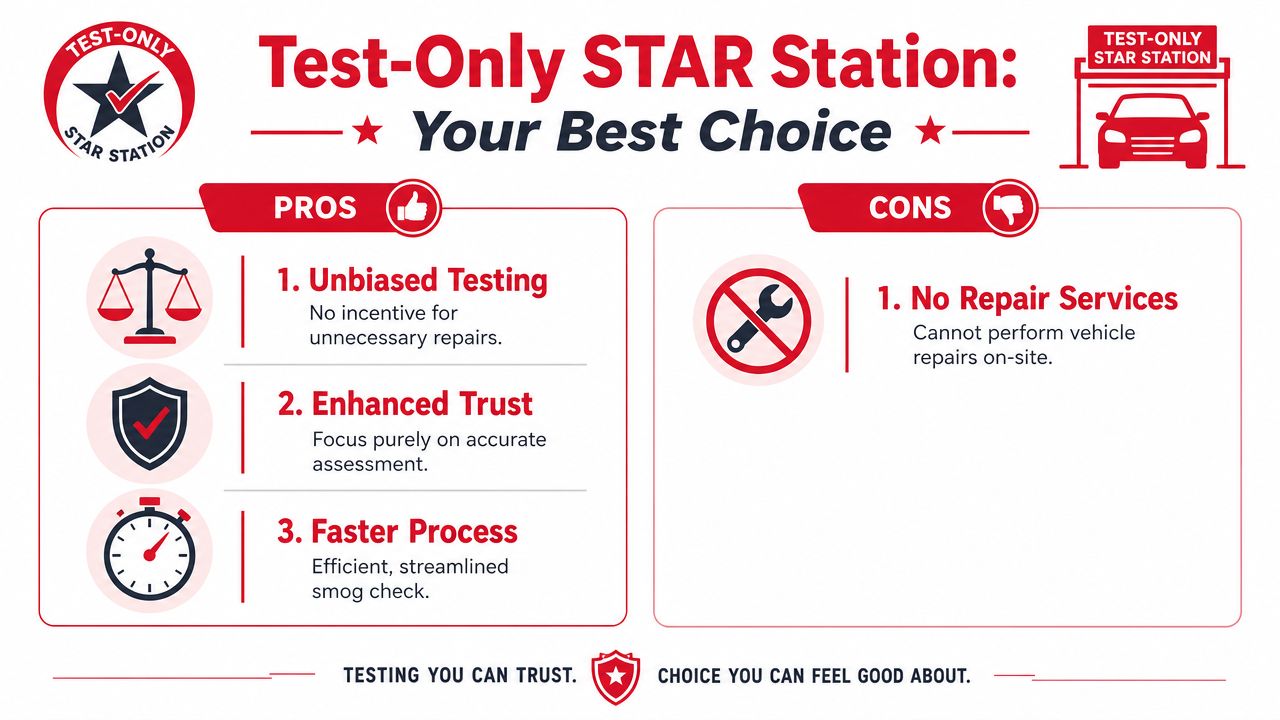
That's exactly why the test-only model matters. The verified data states that STAR-certified test-only stations are legally prohibited from offering on-site repair services, a BAR mandate intended to ensure non-bias and accurate inspection results. It also states that this removes the financial incentive to fail a vehicle in order to sell repair work.
What this changes for the customer
At a test-and-repair shop, a failed inspection can immediately become a sales conversation. Sometimes that repair is legitimate. Sometimes the customer doesn't know enough to judge the recommendation on the spot. A test-only station removes that conflict because the station doesn't make money from repair work.
That doesn't mean test-only is perfect for every driver. There is one real trade-off.
- The upside: You get a cleaner inspection process with less pressure.
- The limitation: If repairs are needed, you have to take the vehicle elsewhere.
- The benefit for many people: You can make repair decisions on your own time, instead of from the waiting room.
When this model makes the most sense
This approach fits well when you're dealing with a DMV-directed STAR test, a prior failure, or a vehicle you're not interested in repairing at the same shop that inspected it. For Antioch drivers who value separation between diagnosis and repair sales, test-only smog station details are worth reviewing before you pick a location.
One practical example is Fire House Smog, which operates as a STAR-certified test-only smog check station and DMV registration services provider in Antioch. That combination is useful for drivers who want the inspection handled separately from repairs, while still keeping the paperwork side convenient.
A test-only station can't fix your car on site. For many customers, that's the reason they trust the result.
Skip the DMV Lines with On-Site Registration Services
You pass the smog check, get back in the car, and then remember the registration still is not done. That is the part Antioch drivers get frustrated with most. The test may take a short visit. The paperwork can turn it into a second trip across town.
At Fire House Smog, the point of offering on-site DMV registration help is simple. Finish more of the job in one place. The 2900 Lone Tree Way location handles California DMV registration renewals with sticker printing and can also help with ownership transfers for California and out-of-state vehicles. Posted DMV service hours are Monday through Saturday 9:30 AM to 5:00 PM and Sunday 12:00 PM to 4:00 PM, with some weekend services limited.
Why Antioch drivers use both services together
In the shop, I see the same pattern all the time. A customer comes in focused on the smog check, but what they really want is to leave knowing the registration side is handled too. That matters even more for drivers in Antioch, Pittsburg, Oakley, Brentwood, and the rest of East Contra Costa, where an extra errand can easily eat up the rest of the day.
There is a practical trade-off here. On-site registration services save time, but they still depend on what your transaction requires and what documents you bring. A renewal with no surprises is usually straightforward. A title transfer or out-of-state vehicle can take a little more prep, so calling ahead is smart if your situation is not routine.
Common reasons people use the DMV side on site
- Renewals after a smog check: Get the inspection done and take care of registration during the same stop.
- Sticker printing: If the transaction qualifies, you can leave with the registration sticker instead of waiting on another visit.
- Ownership transfers: Buyers and sellers often need smog paperwork and title work handled close together.
- Weekend convenience: Sunday DMV hours help drivers who cannot get in during the workweek.
For many local drivers, that one-stop setup is a time-saver. The smog test gets the vehicle cleared. The on-site DMV service helps get the registration finished without adding another line, another appointment, or another half day of hassle.
FAQ Pricing and Policies at Fire House Smog
How much does a smog check cost
Pricing can change, and coupon terms matter. The smart move is to call ahead or check the current offer before driving over. That also helps if you're asking about the free retest policy, since eligibility follows site policy and coupon terms.
What are the hours
Smog testing is available seven days a week with extended evening and weekend hours. DMV services are available Monday through Saturday from 9:30 AM to 5:00 PM and Sunday from 12:00 PM to 4:00 PM, with some weekend DMV services limited.
What if my check engine light is on
If the check engine light is on, don't go in expecting a pass. In practice, that light usually means the vehicle isn't ready for a successful smog inspection. Handle the underlying issue first, then come back for the test.
If a warning light is on, it's cheaper to diagnose the problem first than to pay for a test you already know is likely to fail.
Do you test RVs and motorhomes
Some RVs and motorhomes can be tested, but not all of them. Size and equipment constraints matter, so calling ahead is the right move before bringing in a larger vehicle.
What if my vehicle fails
You'll get the inspection result and know that any needed repairs must be handled off site because the operation is test-only. After repairs, ask about the return process and whether your visit qualifies for the station's free retest policy.
What should I bring
Bring your DMV notice if you have it, plus registration and a payment method. If you're doing DMV paperwork too, have any ownership or registration documents ready so the second half of the visit goes smoothly.
Where is it and how do I contact the shop
The location is 2900 Lone Tree Way, Antioch, CA 94509. The phone number is 925-754-1600.
If you need a smog inspection and want to handle registration in the same stop, contact Fire House Smog at 2900 Lone Tree Way in Antioch or call 925-754-1600 before you head over. It's a practical option for STAR-directed tests, routine smog checks, and DMV tasks that you'd rather not split into multiple trips.

That DMV renewal notice usually lands at the wrong time. You're busy, the registration deadline is close, and now you need a smog check without turning it into a half-day project or getting pulled into a repair conversation you didn't plan for.
That's why a Smog Test Only Discount Center matters. If your goal is simple, get tested, get your certificate sent in, and move on, a test-only shop is often the cleanest path. In Antioch, that matters even more because drivers often want one stop that handles the smog check quickly and, if possible, takes care of registration needs too.
California runs one of the largest vehicle emissions programs in the country. The state's Smog Check Program requires testing for approximately 10 million vehicles annually, and the program helped reduce on-road hydrocarbon emissions by 80 to 90% and nitrogen oxides by over 70% between 1980 and 2020, according to the California Bureau of Automotive Repair Smog Check overview. For most drivers, though, the big issue isn't the statewide policy. It's getting through your own appointment with less hassle.
Table of Contents
- Your Guide to a Stress-Free Smog Check
- What Is a STAR Test-Only Center
- Fire House Smog Services in Antioch
- Using Your Discount and Free Retest
- Your Pre-Test Checklist to Pass the First Time
- Location Hours and Contact Information
Your Guide to a Stress-Free Smog Check
Drivers don't want a “smog experience.” They want a certificate sent to the DMV and one less thing on their list. The stress usually comes from three places. You're not sure whether your car will pass, you don't want to wait around, and you don't want a simple inspection to turn into a sales pitch.
A smog test only discount center solves a lot of that upfront. The job is narrow by design. The station tests the vehicle, reports the result, and submits the certificate electronically when the vehicle passes. That narrower setup is exactly what many drivers need when they're trying to renew registration quickly.
A common Antioch scenario looks like this: you check your renewal notice, realize smog is required, and start searching for a place that's open when you're off work. You also want clear pricing, not a vague “come in and we'll see.” That's where discount offers and test-only service become practical, not just marketing language.
Practical rule: If you already know you only need the inspection, a test-only station usually creates fewer detours.
Another benefit is psychological. When a shop doesn't repair cars on-site, the conversation tends to stay focused on compliance. You're there for a result, not a bundle of extra recommendations. That doesn't guarantee a pass, of course. It does make the process feel cleaner and easier to trust.
For local drivers, the most useful setup is a station that combines STAR-certified testing, a visible coupon, and on-site DMV support. That mix saves the most time because it cuts down repeat trips and reduces confusion about what to do next.
What Is a STAR Test-Only Center
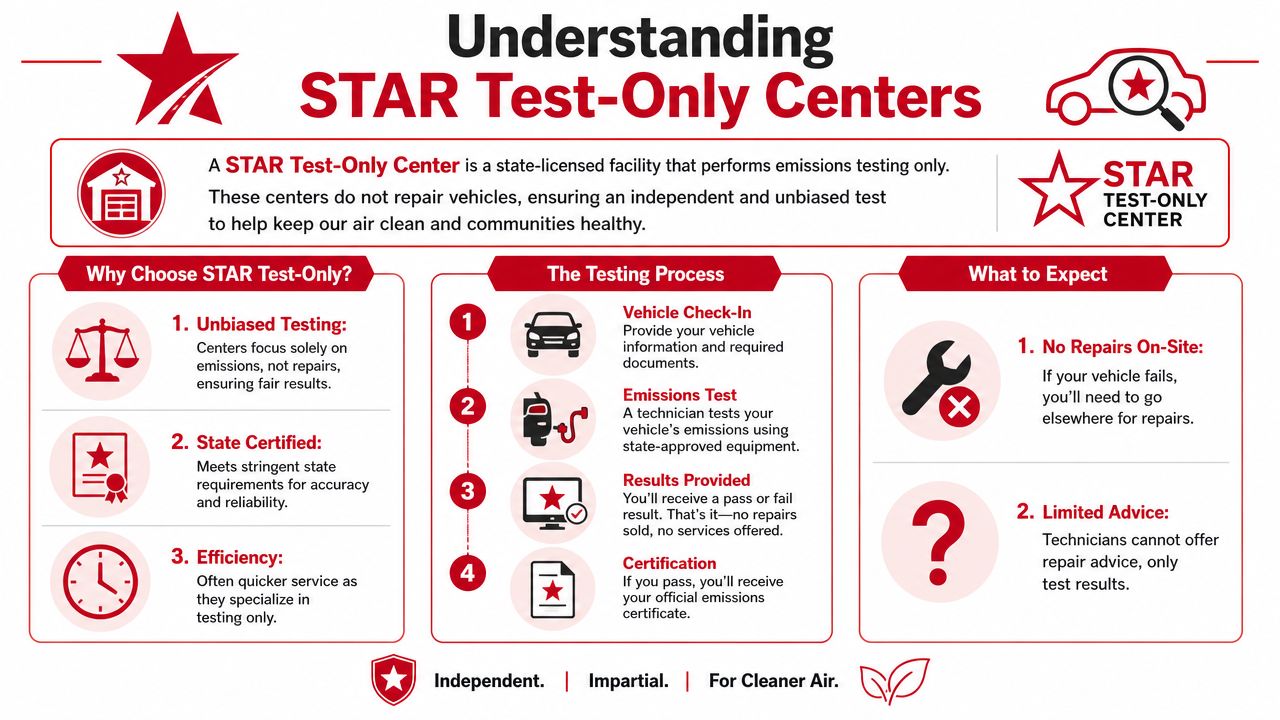
A STAR test-only center handles one job: inspect your vehicle's emissions and report the result to the state. It does not repair the car. For many Antioch drivers, that separation is the main advantage because it keeps the visit focused on the inspection instead of turning into a repair estimate.
“STAR” and “test-only” mean different things.
“STAR” is a California designation for stations that meet tighter performance and oversight standards within the state smog program, as outlined by the California Bureau of Automotive Repair STAR Program. In plain terms, the station has to keep its equipment, testing process, and inspection quality in line with state requirements.
That matters for a simple reason. Drivers need a result they can trust, whether the car passes or fails.
“Test-only” matters even more from the customer side. A shop that does not perform repairs on-site has less reason to turn a failed inspection into a sales conversation. The station tests the vehicle, explains the result, and submits the certificate electronically if the car passes. If it does not pass, you can take that result to the repair shop of your choice.
California's consumer guidance on smog inspections also separates station types and explains that some stations only inspect, while others inspect and repair. That distinction is part of how drivers can choose the setup that fits their situation, as described by the California Department of Consumer Affairs smog check information.
Here is the practical trade-off. A test-and-repair shop can be convenient if you already expect repairs and want everything done in one place. A test-only station is usually the better fit when you want a neutral inspection first and do not want the inspector to have a financial stake in the repair decision.
| Feature | Test-Only Center (e.g., Fire House Smog) | Test-and-Repair Shop |
|---|---|---|
| Main job | Emissions inspection only | Inspection plus repair work |
| Repair incentive | None in-house | Present because repairs are sold on-site |
| Customer experience | Focused on the test result and compliance | May include repair recommendations and pricing |
| Best fit | Drivers who want an unbiased inspection | Drivers who want testing and repairs in one visit |
For local drivers, that model works well when it is paired with clear pricing, STAR certification, and practical help after the test. The Antioch smog check service page shows how that service is set up at Fire House Smog. The short version is simple: if you need an accurate inspection without the usual conflict of interest, a STAR test-only center is often the smarter choice.
Fire House Smog Services in Antioch
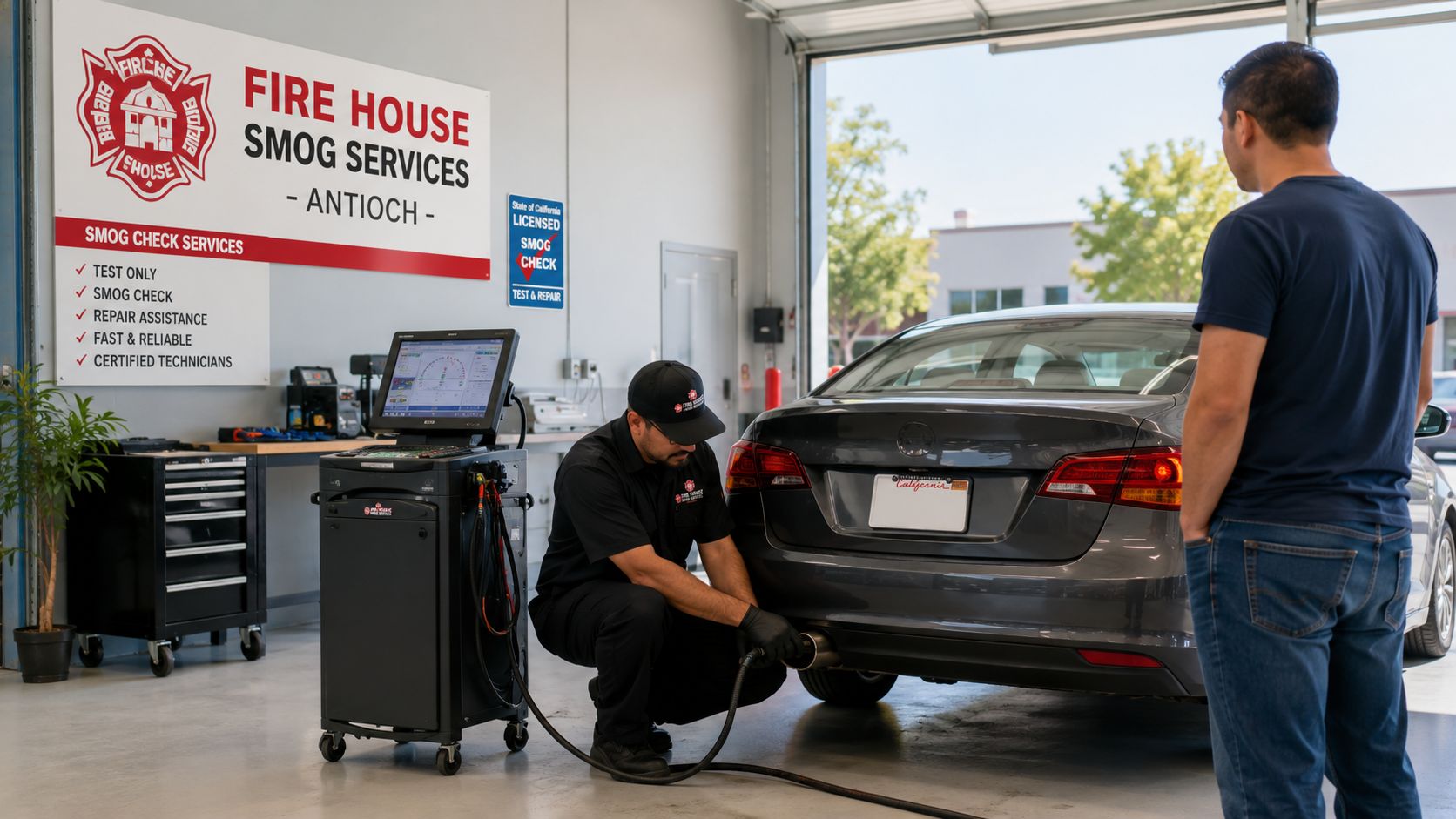
The local value isn't just “we do smog checks.” It's whether the shop handles the practical stuff that usually wastes your time. In Antioch, that means vehicle eligibility, faster throughput, and DMV-related tasks that can be handled on-site instead of sending you somewhere else.
What drivers usually need most
The common needs are straightforward:
- Passenger vehicle testing: Cars, SUVs, and light-duty trucks are the core use case for a STAR-certified test-only station.
- Diesel and larger-vehicle questions: Some stations can handle certain diesel vehicles and some recreational vehicles, but size and equipment limits matter. Calling ahead saves a wasted trip.
- DMV renewals on-site: This is one of the biggest convenience wins. If the station also handles registration renewals and sticker printing, you can avoid a separate DMV stop.
- Ownership transfers: If you bought or sold a vehicle, registration paperwork can become the bigger headache than the smog test itself.
- Fleet service: Small business owners don't need drama. They need a predictable place to move vehicles through inspections with less downtime.
That combination is where one local shop can do more than a basic smog lane. Fire House Smog operates as a STAR-certified test-only smog check station and licensed DMV registration services provider in Antioch, handling smog inspections for cars, trucks, and some RVs, along with registration renewals, ownership transfers, and related tag or plate services on-site.
A shop that can test the car and handle the registration step cuts out the most annoying part of the process, the second errand.
Why the workflow matters
Capacity affects your day more than most drivers realize. A station can be honest, licensed, and still slow if cars pile up and the layout creates bottlenecks.
Verified operational guidance notes that stations with an optimized multi-bay workflow can process vehicles efficiently. With two service bays and a testing-focused setup, a station like this can handle roughly 12 to 16 vehicles per day, which helps reduce wait times during busy periods, according to this test-only center throughput overview.
That doesn't mean every visit is instant. It does mean the workflow is built for movement, not for juggling smog jobs around repair tickets, parts delays, or cars stuck on lifts.
Here's what tends to work best for customers:
- Call ahead for unusual vehicles: RVs, motorhomes, and oversized vehicles can have fit or equipment issues.
- Use weekday DMV service when possible: If your goal includes registration or transfer work, going during the full DMV service window usually avoids confusion.
- Choose a test-only lane when you want neutrality: If you don't need repairs, you don't gain much from standing in line at a repair shop.
For fleet owners, this matters even more. A neutral testing environment makes recordkeeping cleaner and helps separate compliance from maintenance planning.
Using Your Discount and Free Retest
Those searching for a smog test only discount center are trying to keep a required expense from getting bigger than it needs to be. That's reasonable. Smog isn't a fun purchase, so a clear coupon matters more than fancy branding.
The useful part is when the discount is easy to find and easy to redeem. If a coupon takes five clicks, has vague conditions, or isn't honored consistently, it doesn't save you time. It just adds one more thing to ask about at the counter.
How to use the coupon
The simplest approach is:
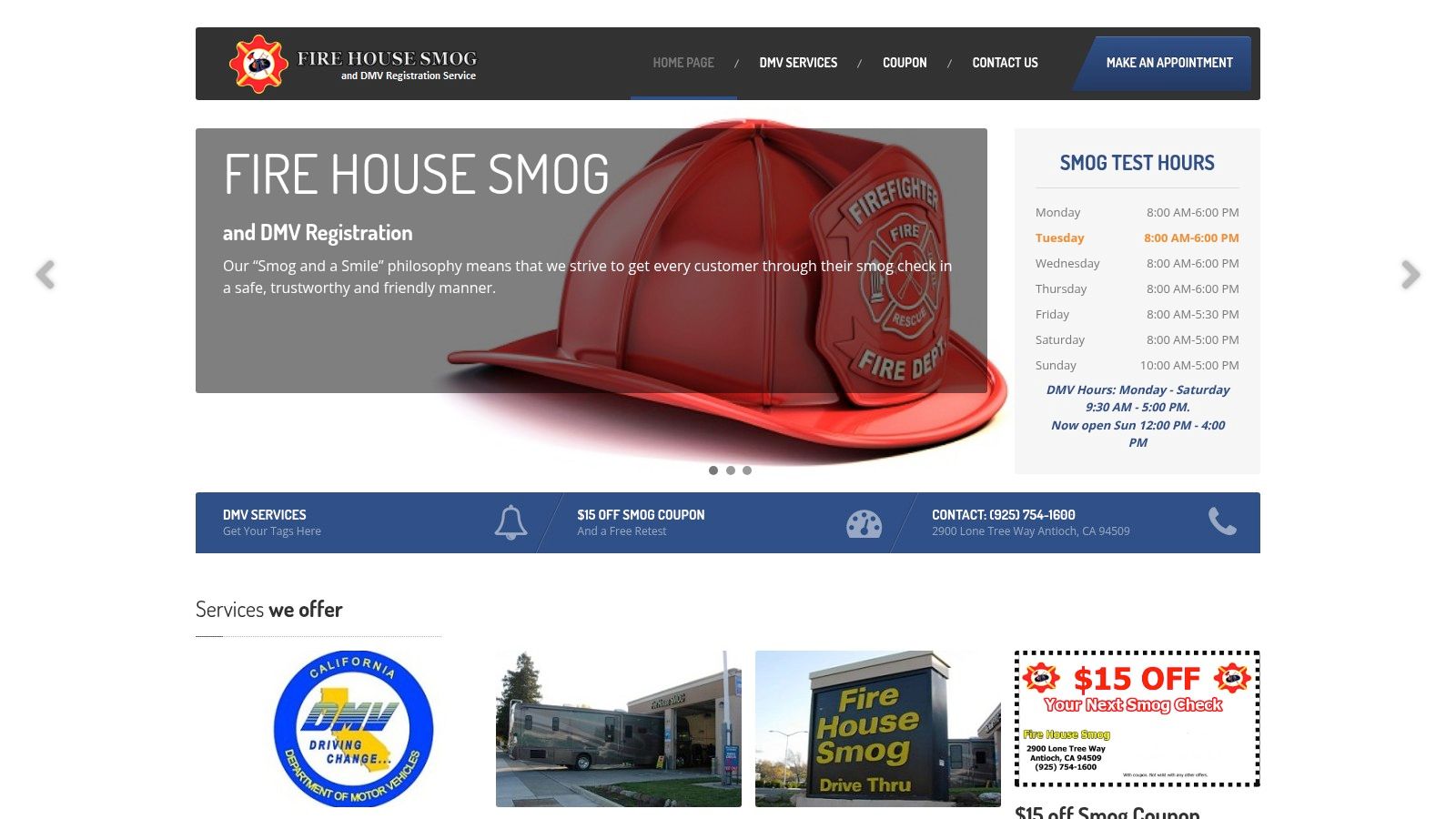
- Open the posted coupon page first. The current offer is listed on the Fire House Smog coupon page.
- Check the terms before you drive over. Look for vehicle restrictions, testing type, and any policy tied to the free retest.
- Bring the coupon with you. Digital display is usually easiest, but confirm if you prefer a printed copy.
- Mention it before the transaction is finalized. That avoids awkward backtracking after the test is already written up.
Publisher information provided for this article states that the coupon policy includes $15 off smog testing and a free retest, subject to site policy and coupon terms. That's the kind of offer that matters because it addresses both the first visit and the possibility that you may need to return after repairs elsewhere.
How to think about the free retest
A free retest is helpful, but only if you understand what it is and what it isn't.
- It lowers repeat-cost risk: If the vehicle needs outside repair and you come back under the coupon terms, the second visit may be less frustrating financially.
- It doesn't replace diagnosis: A test-only station reports the result. If the car fails, you'll still need a repair facility to address the actual issue.
- It works best when expectations are clear: Ask what qualifies, how long the retest window lasts under current policy, and whether all vehicle categories are included.
What saves the most money: Use the coupon on the first visit, and use the free retest policy as a backup, not as your main plan.
The best discount is still passing the first time. That starts before you leave home.
Your Pre-Test Checklist to Pass the First Time
You pull out of the driveway, drive across Antioch, wait your turn, and then find out the car was never ready for testing. That is the trip to avoid.
A test-only station helps by keeping the process straightforward. The station inspects and reports. It does not sell repairs, which means you get a clean result without the pressure that can come from a repair-and-test shop. Your part is showing up with the vehicle in normal running condition so the reading reflects how it performs.
What to check before you leave home
Start with the items that cause the most preventable failures.
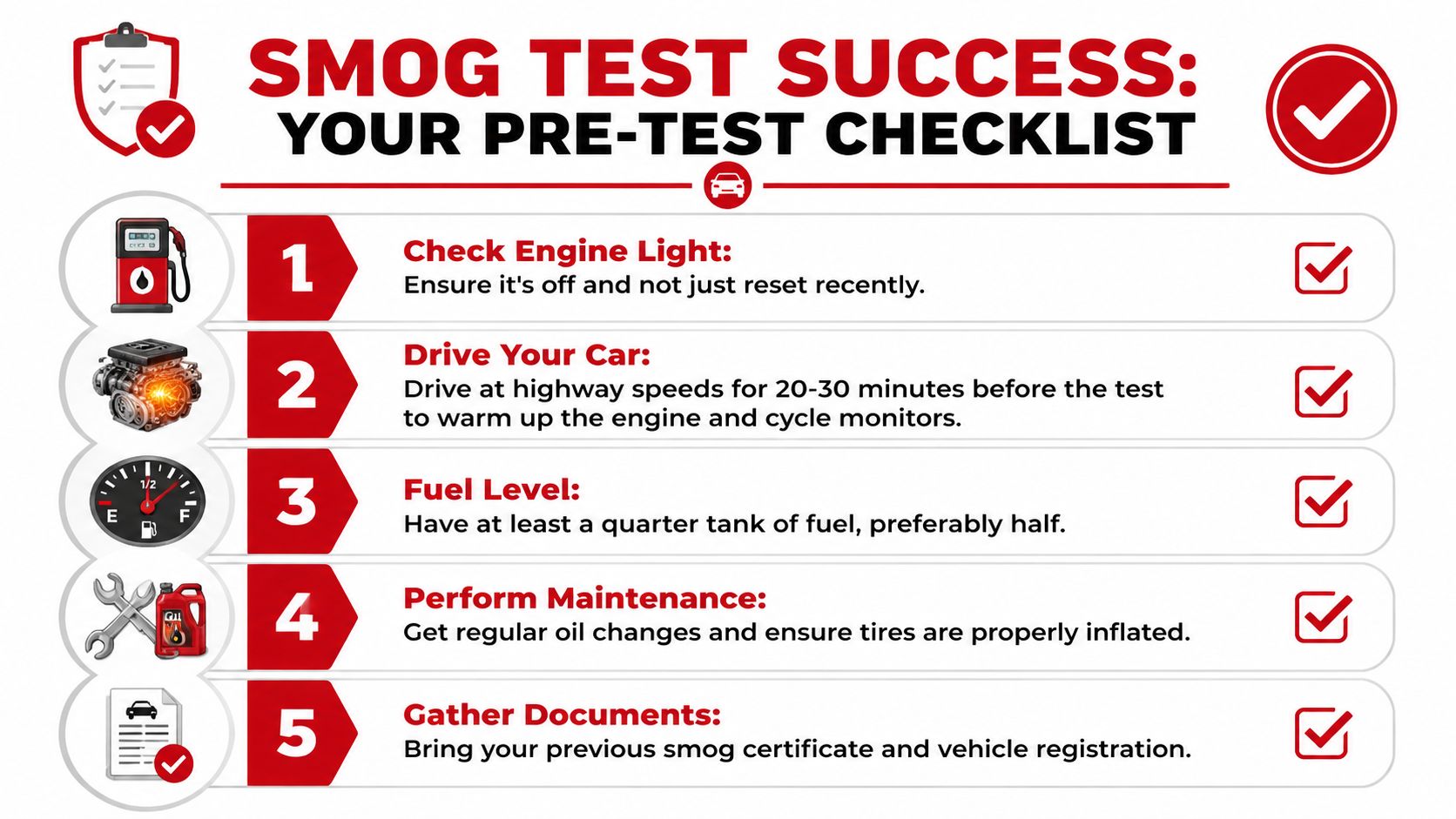
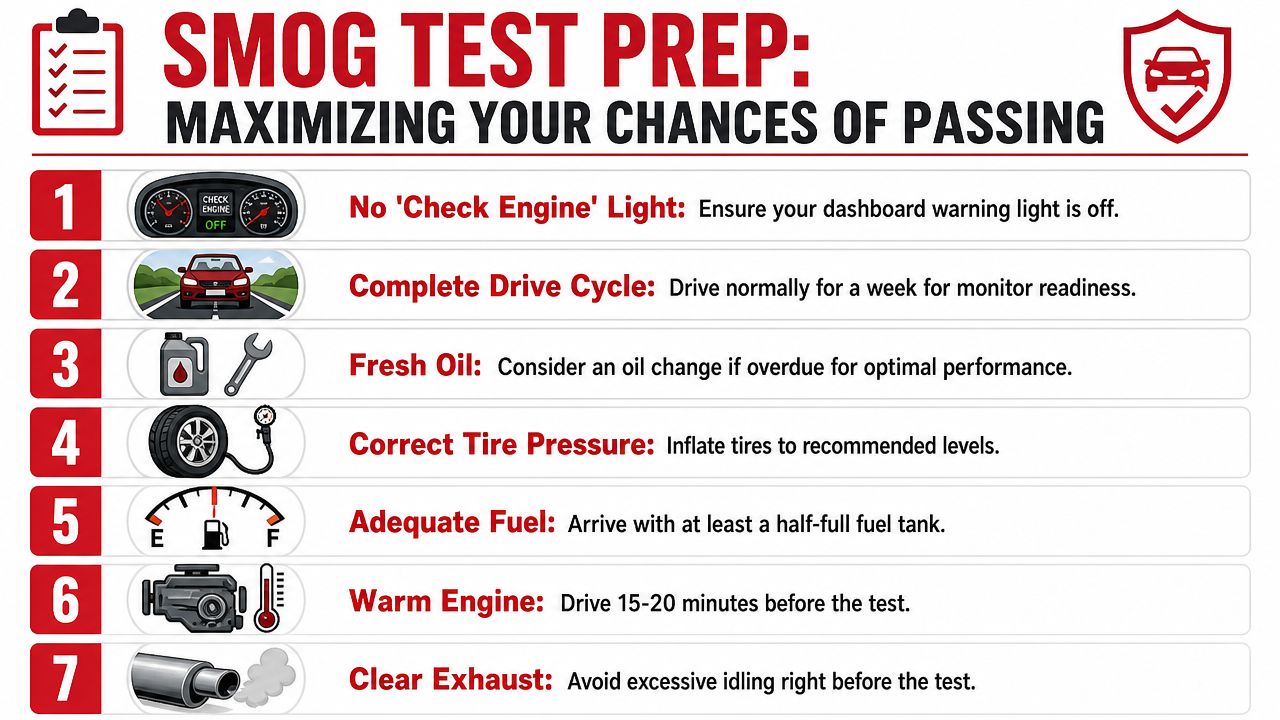
- Check Engine light off: If the light is on, handle that before testing. If codes were just cleared, the car may still show incomplete readiness monitors and fail for that reason alone.
- Fuel level in a normal range: Don't arrive nearly empty or packed full right after a fill-up. A moderate level is the safer bet.
- No obvious drivability problems: Rough idle, fuel smell, stalling, or visible leaks are signs to fix the problem first.
- Battery has not been disconnected recently: Many vehicles need normal driving time after a disconnect before all emissions monitors reset.
- Basic maintenance caught up: Dirty oil, overdue air filters, and neglected spark plugs can work against you on an older vehicle.
- Registration notice or paperwork ready: Keep it easy to reach so check-in takes two minutes instead of ten.
STAR-certified means the station meets California requirements for equipment, training, and inspection procedures. In plain terms, the test is standardized. That is good for drivers because the focus stays on the vehicle's condition, not on guesswork about where to test. If you want to confirm fit for your vehicle before you head over, use the Fire House Smog contact page.
What helps on test day
Bring the car in warm.
A short drive before the test usually helps more than people expect, especially on vehicles that spend most of their time on quick local trips. The catalytic converter and emissions system work better at normal operating temperature. A cold engine can make a healthy car look worse than it really is.
Use this routine:
- Drive 15 to 20 minutes first: Steady city or highway driving is better than starting the car and heading straight to the station.
- Skip the long parking-lot idle: If you warm it up, keep the visit moving.
- Pay attention on the way over: Misfire, hesitation, surging, or a new warning light means the car is telling you something.
- Do not treat the test like diagnosis: A smog inspection shows pass or fail. If there is a fault, repairs happen somewhere else.
That last point matters. The test-only model protects you from mixed incentives. You get an inspection result, not a sales pitch tied to the same visit.
If the car has been running normally for several days, the warning lights are off, and you drive it in warmed up, you have already cut down a lot of avoidable trouble.
Location Hours and Contact Information
Convenience matters most at the end of the process. Once you've decided where to go, you need the address, phone number, and service hours in one place, especially because smog hours and DMV hours aren't always the same.
Where to go
Fire House Smog is located at 2900 Lone Tree Way, Antioch, CA 94509. The phone number is 925-754-1600. For directions, service questions, or to confirm vehicle fit before arrival, use the Fire House Smog contact page.
If you're bringing an RV, motorhome, or another vehicle that might test the limits of bay space or equipment, calling first is the smart move. That quick check can save a pointless drive across town.
Hours at a glance
Smog testing is available seven days a week with extended hours. DMV-related services operate on a narrower schedule, and weekend DMV service may be limited depending on the task.
| Service | Monday-Saturday | Sunday |
|---|---|---|
| Smog testing | Extended daytime and evening hours | Available |
| DMV services | 9:30 AM to 5:00 PM | 12:00 PM to 4:00 PM |
A lot of driver frustration comes from showing up for the right place at the wrong time. Keep the two schedules separate in your mind. If you only need the smog check, you have more flexibility. If you also need registration or title-related help, plan around the DMV service window.
If you need a straightforward smog inspection and DMV help in Antioch, Fire House Smog is one local option for STAR-certified test-only service, on-site registration support, and posted coupon savings.
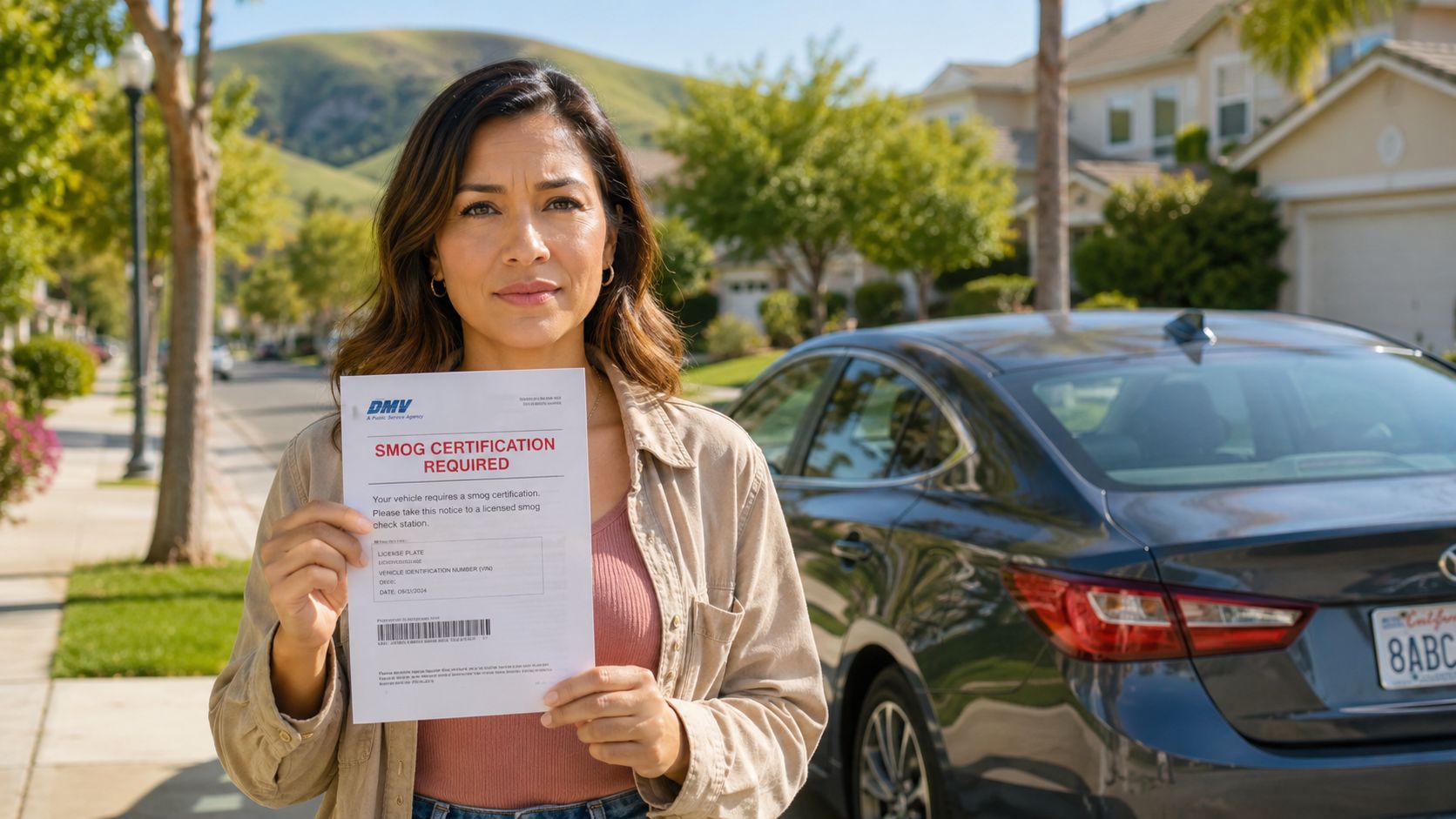
You open the DMV renewal notice, scan for the amount due, and then spot the line that slows everything down: Smog Certification Required. If you're in Antioch, that usually means one more errand before your registration is finished, and the main frustration isn't the test itself. It's the risk of making two or three trips because you picked the wrong station, showed up with a cold engine, or didn't realize the certificate doesn't sit around forever.
The good news is that a smog check in Antioch, CA is usually manageable when you treat it like a short compliance task instead of a mystery. The process is routine, the testing flow is standardized, and most of the hassle comes from timing mistakes or avoidable prep issues. Antioch drivers also have a practical advantage. You can line up the inspection and, in some cases, handle DMV-related paperwork locally instead of burning half a day in line elsewhere.
Table of Contents
- Your Fast-Track Guide to Smog Checks in Antioch
- How to Prepare Your Vehicle for the Smog Test
- Navigating the Smog Station What to Bring and Expect
- Fire House Smog A One-Stop Shop in Antioch
- Smog Check Costs Coupons and Free Retest Rules
- Antioch Smog Check FAQs and Troubleshooting
Your Fast-Track Guide to Smog Checks in Antioch
If your renewal notice says you need a smog certificate, you're dealing with a standard part of vehicle compliance in Contra Costa County. For many Antioch drivers, this isn't optional paperwork you can push off. It's tied directly to registration and, in some situations, ownership transfer.
One timing issue catches people off guard. In California, a passing smog check is generally valid for 90 days, which makes it a short-lived compliance document rather than something you can do early and forget about, according to Geotab's California smog check guide. If you're renewing late or buying and selling a vehicle, that window matters.
The fastest local approach
Most delays come from three mistakes:
- Waiting until the deadline week and finding a line.
- Showing up unprepared with a check-engine light or incomplete paperwork.
- Using the wrong station type when DMV has directed your vehicle to a STAR location.
Practical rule: Handle the smog check close enough to your DMV deadline that the certificate stays useful, but early enough that a surprise failure doesn't put your registration on hold.
The local shortcut is simple. Pick a station that can handle the class of vehicle you own, go in with your documents ready, and if possible use a place that can also help with DMV registration tasks on-site. That last part matters more than people think. It can turn a smog day into a single stop instead of a test visit followed by a separate DMV trip.
For those seeking a smog check Antioch CA, the primary objective is clear. Not just passing, but finishing the whole errand with the fewest moving parts.
How to Prepare Your Vehicle for the Smog Test
Most smog failures aren't shocking. They're usually tied to warning lights, readiness monitors, or obvious equipment issues that could've been spotted before leaving home. A little prep saves a lot of backtracking.
Start with the failure triggers
California's smog check includes a visual inspection of emissions hardware, a functional OBD inspection for fault codes, and for pre-2000 vehicles, a tailpipe test. The inspection typically takes 20 to 30 minutes, and a lit check-engine lamp is a common immediate reason for failure, according to California BAR's smog check overview.
That gives you a very clear pre-test checklist.
- Check the dash first. If the check-engine light is on, don't go yet. You're paying for a result that will likely fail right away.
- Think about recent battery work. If the battery was disconnected recently, your OBD readiness monitors may have reset. That can create a problem even if the car seems to drive fine.
- Look under the hood only for the obvious. Missing or visibly tampered emissions parts can stop the process before any tailpipe result matters.
A car can feel normal and still be unready for smog. Driveability and monitor readiness aren't the same thing.
Simple prep that helps
A practical routine works better than overthinking it.
First, drive the car before the appointment. A warm engine helps the vehicle arrive in normal operating condition, and it reduces the odds of walking into the bay with a cold, barely-used car that hasn't completed normal driving behavior.
Second, don't clear codes right before the test. People sometimes erase a warning light and head straight to the station. That's one of the fastest ways to trade one problem for another, because the monitors may no longer show ready.
Third, bring special paperwork only if your vehicle situation is unusual. If you're dealing with an out-of-state transfer or related identification issue, it helps to check what a VIN verification service may require before your visit.
A prep list that actually matters
| Check before leaving | Why it matters |
|---|---|
| Dashboard warning lights | A check-engine lamp can trigger immediate failure |
| Recent battery disconnect | Readiness monitors may not be complete |
| Warm-up drive | Helps the vehicle arrive in normal operating condition |
| Obvious emissions tampering | Visual inspection can flag missing hardware |
| Fuel and basic drivability | Prevents avoidable interruptions during testing |
The best prep is boring. Drive the car normally, fix warning-light issues before testing, and don't treat smog day like the time to gamble on a maybe.
Navigating the Smog Station What to Bring and Expect
The station visit is usually straightforward when you walk in ready. Most of the stress comes from not knowing whether you'll be there for ten minutes or all afternoon, and whether you're missing something important.
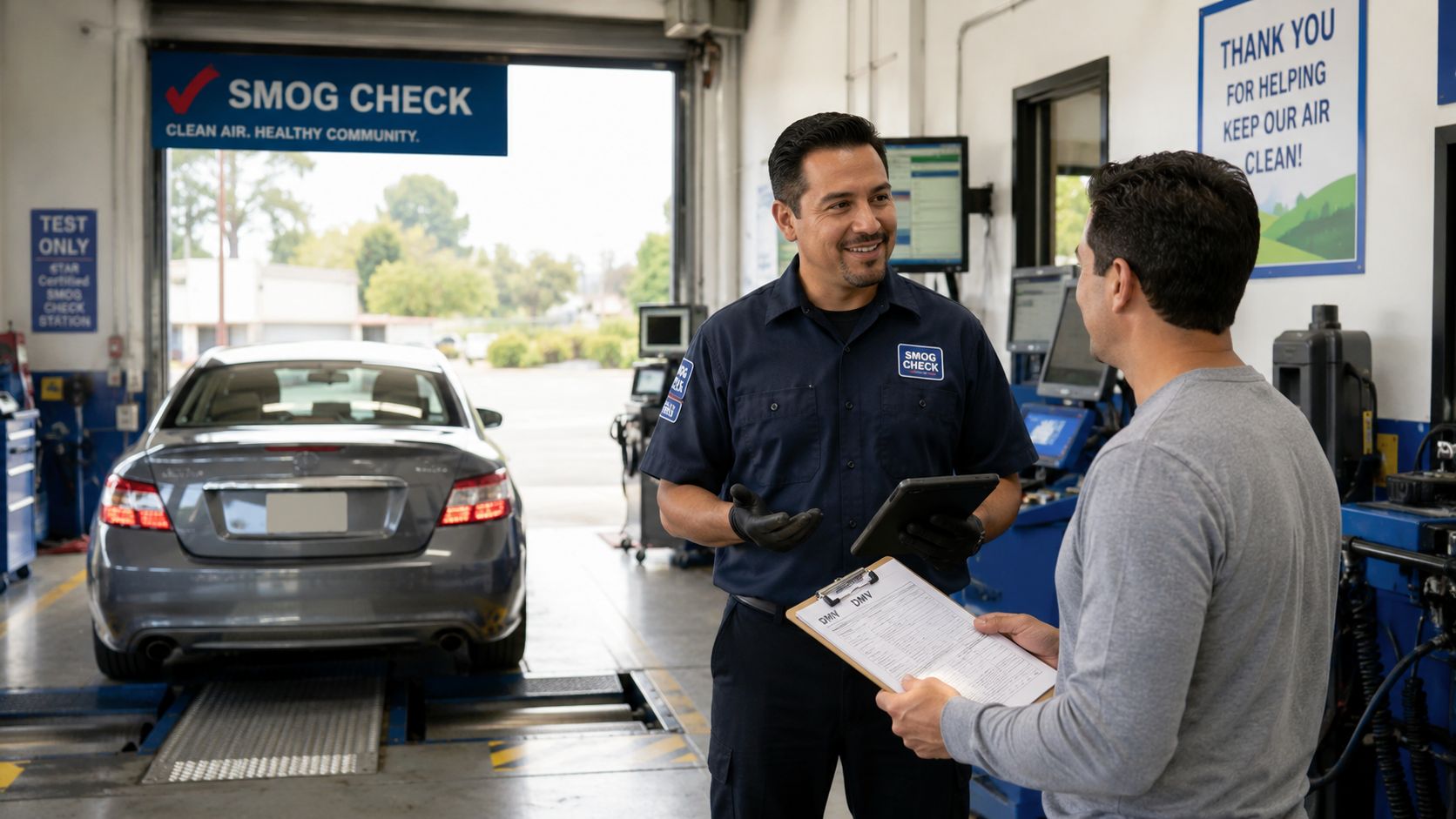
Bring the basics
For a routine Antioch visit, have these with you:
- DMV renewal notice if you received one
- Current registration
- Driver's license
- Payment method
- Any coupon or appointment confirmation
That last item is easy to forget, especially if you booked online. If you want to cut down on waiting, use the station's online appointment page before you head over.
What the visit usually looks like
California smog testing runs inside a large statewide inspection system, not as some loose local process. The Bureau of Automotive Repair publishes executive summaries showing statewide inspection totals, failure rates, and licensing activity. BAR also notes that a typical smog test takes about 20 to 30 minutes, which helps explain why higher-throughput Antioch stations use multiple bays to keep cars moving, as shown in the BAR smog check executive summary reports.
In practice, a well-run visit often feels like this:
- You pull in and check in with the front desk or technician.
- They confirm the vehicle information and what kind of test you need.
- The technician moves the car into a bay and runs the inspection steps.
- You wait while the system checks the vehicle.
- You get the result and next-step instructions.
The smoother your arrival, the faster the whole stop goes. A ready car and clear paperwork matter as much as the station's speed.
If it helps to see the general process before you go, this walkthrough gives a useful visual reference:
A good station experience shouldn't feel mysterious. You should know what you're handing over, what the technician is checking, and whether you're done or need repairs before a retest.
Fire House Smog A One-Stop Shop in Antioch
You get the renewal notice, drive over for the test, and then realize you still have to deal with DMV paperwork somewhere else. That extra stop is what turns a simple Antioch smog check into a time drain.
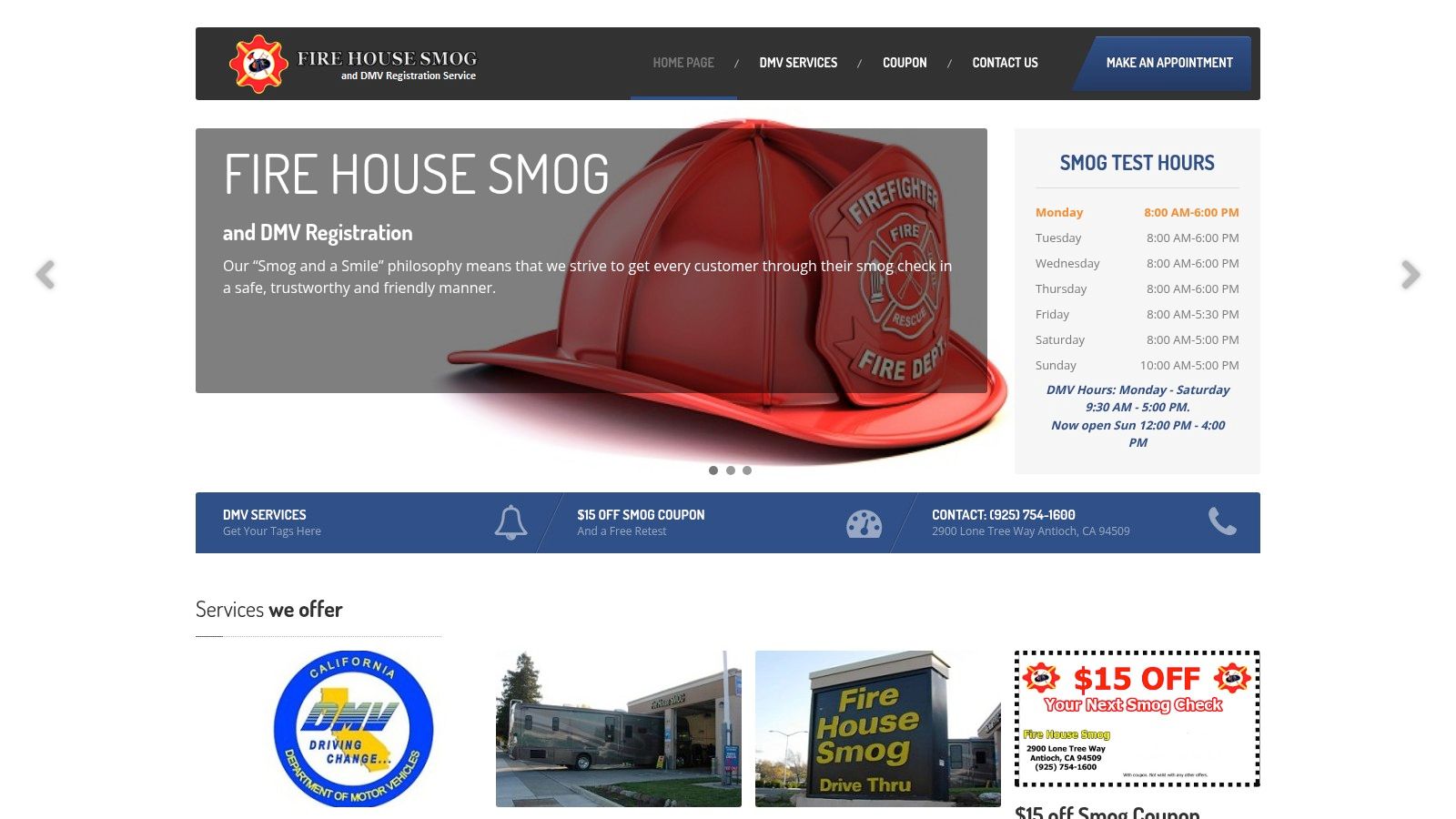
For local drivers, the primary advantage is not just finding any station with an open bay. It is finding one that can handle the type of inspection your notice requires and, if needed, help you finish the registration side without sending you to wait in another line.
Why STAR and test-only matter in Antioch
Some Antioch vehicles can go to a regular smog shop. Others are directed to a STAR station, and if your DMV paperwork says STAR, that requirement decides where you can test. Checking that before you leave home saves a wasted trip.
A test-only station also matters for drivers who want a straightforward inspection. The shop runs the test and reports the result. It does not turn the visit into an in-house repair conversation.
That setup works well if your goal is simple. Get the inspection done, get the certificate transmitted, and move on.
Where the one-stop setup saves time
Fire House Smog, at 2900 Lone Tree Way in Antioch, is a STAR-certified test-only station that also offers on-site DMV services. That combination is what makes it useful in real Antioch situations, especially for people trying to keep the whole errand to one stop.
It helps most in a few common cases:
- Registration is due now. You can handle the smog check and DMV paperwork in one place instead of splitting the job across two appointments.
- You are transferring ownership. Smog and registration tasks often come up together during a sale, and keeping them under one roof cuts down on back-and-forth.
- You want a cleaner process. Test-only service keeps the visit focused on compliance, not repair sales.
- You are comparing total hassle, not just price. A low test price loses its appeal if it still leaves you standing in a DMV line afterward.
If you are also price-checking before you go, review the current Antioch smog coupon offers and terms closely. Coupon details often tell you whether the deal fits your vehicle and whether a retest is included.
For Antioch residents, that is the local shortcut. Pick a station that can meet the STAR requirement if you have one, run the test without the sales pressure, and handle DMV work on-site if that is the part you are trying to avoid.
Smog Check Costs Coupons and Free Retest Rules
Price matters, but this is one of those errands where the cheapest listing isn't always the easiest experience. You want a fair test price, clear retest terms, and no confusion about what's included.
What pricing usually looks like
Industry guidance commonly places a typical smog test around $20 to $50, depending on the vehicle and service setup. That general range appears in BAR-related executive summary context and related guidance discussed earlier, which is why Antioch stations often compete on speed, convenience, and add-ons as much as raw price.
What that means in real life is simple. A bargain price doesn't help much if you wait too long, miss the station type you need, or have to come back because the policy details weren't clear.
How to use coupons without surprises
If you're comparing local options, check the current smog coupon page before you go. Read the terms carefully. Coupon language often tells you more than the headline discount does, especially around retests and vehicle exclusions.
A few points are worth checking every time:
- Eligibility details matter. Not every coupon applies to every vehicle class.
- Retest wording matters more than the discount amount if you're worried about failing.
- Timing rules can affect whether you qualify for a free retest after repairs.
Free retest rules are about terms, not assumptions
Drivers often hear "free retest" and assume it means unlimited retries or no conditions. That's usually not how these offers work. Free retest policies typically depend on the station's posted terms, qualifying repairs, and a return within the allowed time window.
Here's the practical approach:
| Before you pay | Why to ask |
|---|---|
| Does the coupon include a retest | Prevents assumptions |
| Which vehicles are excluded | Avoids surprise upcharges |
| Is there a deadline to return | Keeps you eligible |
| Do I need proof of repairs | Helps if the vehicle fails |
The cheapest smog check isn't always the one with the lowest posted number. It's the one that avoids a second round of confusion.
Antioch Smog Check FAQs and Troubleshooting
What if my car fails
Read the failure report first. It tells you whether you're dealing with a check-engine light, an incomplete readiness monitor, or an emissions component problem. Each one points to a different fix, and guessing usually costs more than waiting a day and addressing the actual issue.
Keep the paperwork. Before you schedule a retest, ask the station what its retest policy requires and whether you need repair documentation. A quick return only helps if the original problem is resolved.
Do I need a STAR station
If your DMV notice says STAR, use a STAR station. California assigns certain vehicles to the enhanced testing program, and a pass from the wrong station type will not clear that requirement.
This is one of the easiest ways Antioch drivers lose time. They get the test done, then learn they need to do it again at a STAR location.
What about RVs, diesel vehicles, or unusual cases
The rules for different vehicle types can be confusing. The right test depends on model year, fuel type, weight class, and how the vehicle is classified in California records.
For RVs, diesel trucks, older vehicles, and out-of-state transfers, call before you leave home. Ask the direct question that matters: can you test my exact vehicle type today? That saves you from showing up at a station that handles standard passenger cars but not your setup.
How does the DMV get my result
California sends smog results to DMV electronically after the test is completed. In most cases, you do not need to carry a paper certificate to prove the vehicle passed.
What does matter is timing. If your registration deadline is close, confirm the test was transmitted properly and make sure the DMV side gets handled without delay. That is where a one-stop location helps in a practical way. Fire House Smog in Antioch handles STAR-certified test-only inspections and on-site DMV services, so you can finish the test and registration steps in one stop instead of dealing with a separate DMV trip later.