Opening a DMV renewal notice can turn a routine errand into an immediate question: why does this letter say STAR station required? The answer usually isn't that your car needs a completely different kind of emissions test. It means California has directed you to a station with an additional Bureau of Automotive Repair certification.
An all star smog check follows the state's normal inspection process, but the station must meet higher operational and performance standards. This guide explains when STAR certification matters, how to verify a legitimate station, what happens in the testing bay, and what you should do if your vehicle fails.
Table of Contents
- What an All Star Smog Check Really Means
- How the STAR Program Started and Why It Exists
- STAR vs Regular and Test-Only Stations
- The Higher Standards STAR Stations Must Meet
- When California Requires a STAR Smog Check
- How to Verify a Station and What Testing Involves
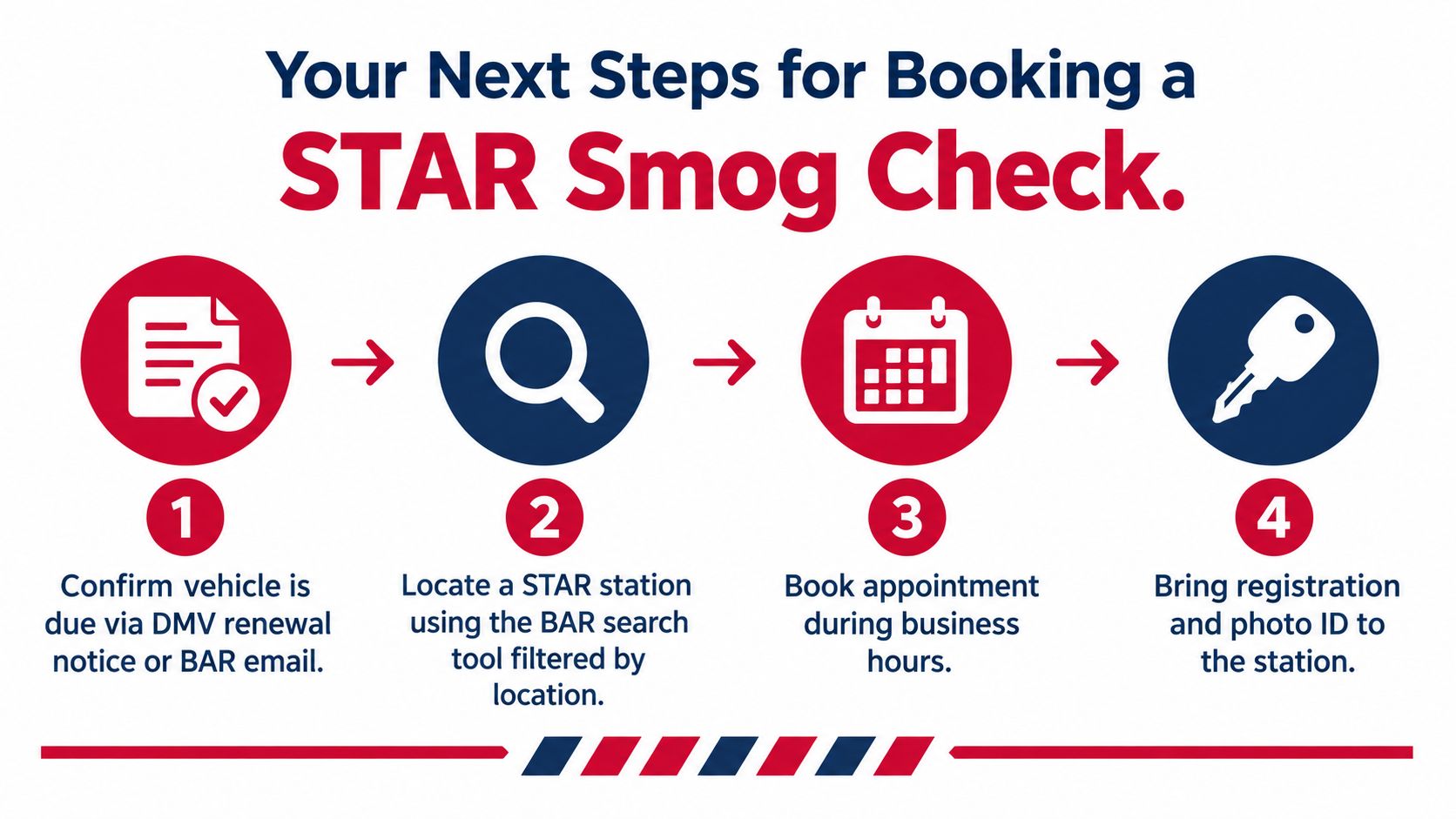
- Your Next Steps for Booking a STAR Smog Check
What an All Star Smog Check Really Means
STAR is a certification for the station, not a separate test for the vehicle. California's Smog Check process can include an OBD II inspection, visual emissions-control checks, and other required procedures depending on the vehicle. The California Smog Check program explains that vehicles from model year 2000 onward are inspected primarily through OBD II, while older vehicles may require additional evaporative-system and fuel-cap checks.
Think of STAR like a higher-level license displayed over the regular station license. A standard licensed station may be authorized to perform ordinary Smog Check inspections. A STAR-certified station has also demonstrated that it can meet BAR requirements for equipment, operations, and inspection performance.
That distinction matters because California doesn't send every vehicle to the same type of station. Some drivers can choose a regular licensed station. Others receive a DMV notice directing them to a STAR station, which means the certification changes where the inspection may be completed.
What STAR changes for you
At the bay, the technician still connects the vehicle to testing equipment and checks the systems required for that vehicle. The practical difference is the station's authority and oversight. A STAR station has been approved to handle vehicles that California considers part of a higher-risk inspection group, including vehicles identified through DMV direction.
A test-only STAR station can inspect and certify a vehicle, but it doesn't sell repair work. That separation can make the process easier to understand because the business evaluating the vehicle isn't also diagnosing and selling the repair.
Practical rule: Read the DMV notice before booking. If it says STAR station required, a nearby regular shop may not be able to complete the certification you need.
You can also review a plain-language explanation of what STAR-certified smog testing means before choosing a location. The four questions to answer are simple: Is STAR required for this vehicle, is the station certified, what will the inspection include, and what happens if the result is a fail?
How the STAR Program Started and Why It Exists
You arrive for a Smog Check expecting a simple pass-or-fail result. Behind that result, California also needs confidence that the station followed the right procedure and recorded the vehicle's information accurately. The STAR program was created to provide that added oversight.
California established STAR through Assembly Bill 2289, and the program began on January 1, 2013. It replaced the former Gold Shield Program, which ended on December 31, 2012. The Bureau of Automotive Repair STAR FAQ explains that STAR was designed to improve inspection quality and support California's emissions-reduction requirements.
The basic model works like a quality-control system. California identifies stations that can perform inspections under closer performance controls, then uses the program to direct certain vehicles to those locations. STAR certification applies to both test-only and test-and-repair businesses. It describes how a station's inspection work is monitored, not whether the business performs mechanical repairs.
Why station quality affects the driver
Your vehicle is only one part of a Smog Check. The technician must use approved equipment, follow the required testing procedure, enter accurate vehicle details, and interpret the result correctly. A skipped step or poorly maintained machine can produce a result that does not accurately reflect the vehicle's condition.
For the driver, STAR changes the level of accountability surrounding the inspection. BAR uses performance measures to compare a station's results with those of similar vehicles and reviews incidents that may indicate testing problems. This does not guarantee a passing result or make every repair recommendation correct. It gives the inspection process a clearer system for identifying problems and monitoring station performance.
The program also handles a large share of California's testing. In California's 2025 data, STAR stations represented 49% of licensed Smog Check stations but performed 83% of all Smog Check tests, according to BAR's STAR program information. STAR locations therefore completed a disproportionately large share of inspections compared with their number of facilities.
That reach explains why STAR is more than a label on a shop sign. It affects how California manages inspection quality and, for some drivers, which station can complete the required inspection.
STAR vs Regular and Test-Only Stations
Drivers often treat “STAR,” “test-only,” and “test-and-repair” as three competing station categories. They are different labels that describe different things. STAR describes certification, while test-only and test-and-repair describe what the business is allowed to do after inspecting the vehicle.
A regular station may perform standard Smog Check services for vehicles that aren't subject to a STAR direction. A STAR station may be test-only or test-and-repair, but it must meet the additional BAR requirements attached to STAR certification.
| Station Type | Can Perform Repairs | Can Process STAR or Directed Notices | Best For |
|---|---|---|---|
| Regular test-and-repair station | Yes | Not necessarily | Drivers whose renewal doesn't require STAR and who want inspection and repair at one business |
| Regular test-only station | No | Not necessarily | Drivers seeking an inspection without repair sales when STAR isn't required |
| STAR test-and-repair station | Yes | Yes, when authorized for the vehicle | Drivers who need STAR testing and may want diagnosis or repairs at the same location |
| STAR test-only station | No | Yes | Drivers who need STAR certification and prefer a testing-only business |
The important distinction after a failure
A test-only station can't repair the vehicle. If the inspection finds a problem, the station should provide the inspection result and explain the next step, but you'll need a separate repair provider. A STAR test-and-repair station may diagnose and repair the vehicle, although the station's authority to certify a particular directed vehicle still depends on the applicable rules.
A regular shop isn't automatically less competent at repairs. It may just not have the STAR certification needed for a DMV-directed inspection. Conversely, a STAR label doesn't mean the station is a full-service repair facility.
The BAR's explanation of STAR-certified test-only centers can help you understand why some drivers deliberately choose a station that doesn't sell repairs. The model separates the inspection decision from repair revenue, which gives the customer a clearer boundary between testing and fixing.
Prices vary by station, vehicle, location, and services included. A STAR station may charge a different fee from a nearby regular station, so ask for the current price before authorizing the inspection.
The Higher Standards STAR Stations Must Meet
STAR certification rests on measurable requirements rather than a sign on the building. BAR reviews station performance and can evaluate whether the business continues to meet the program's standards. That means certification isn't a permanent reward earned once and kept without review.
The BAR STAR program requirements include several performance measures. One compares the station's Similar Vehicle Failure Rate with the industry-wide failure rate for similar vehicles. For STAR eligibility, that station rate must be at least 50% of the industry-wide failure rate for similar vehicles. The same source lists a Gear Shift Incident rate no greater than 2% of certified vehicles and an Excessive Test Deviation Rate of no more than 1.
What the scorecard means in everyday terms
| Metric | Standard Required |
|---|---|
| Similar Vehicle Failure Rate | At least 50% of the industry-wide failure rate for similar vehicles |
| Gear Shift Incident rate | No greater than 2% of certified vehicles |
| Excessive Test Deviation Rate | No more than 1 |
| Ongoing program compliance | The station must continue meeting BAR operational and performance requirements |
A failure-rate comparison doesn't mean a STAR station should make every vehicle pass. A vehicle with a genuine emissions problem should fail, regardless of the station's certification. The comparison helps BAR identify unusual station patterns that may deserve closer review.
Gear-shift incidents and test deviations relate to how the inspection is carried out. For a driver, those controls support a more consistent process, particularly when the vehicle's result is unexpected. The standards also give BAR a basis for accountability if testing behavior falls outside acceptable limits.
STAR certification is best understood as a continuing performance obligation, not a one-time quality badge.
The certification also doesn't promise a repair, a pass, or a particular wait time. It tells you that the station has qualified for the STAR program and must continue operating within the program's rules.
When California Requires a STAR Smog Check
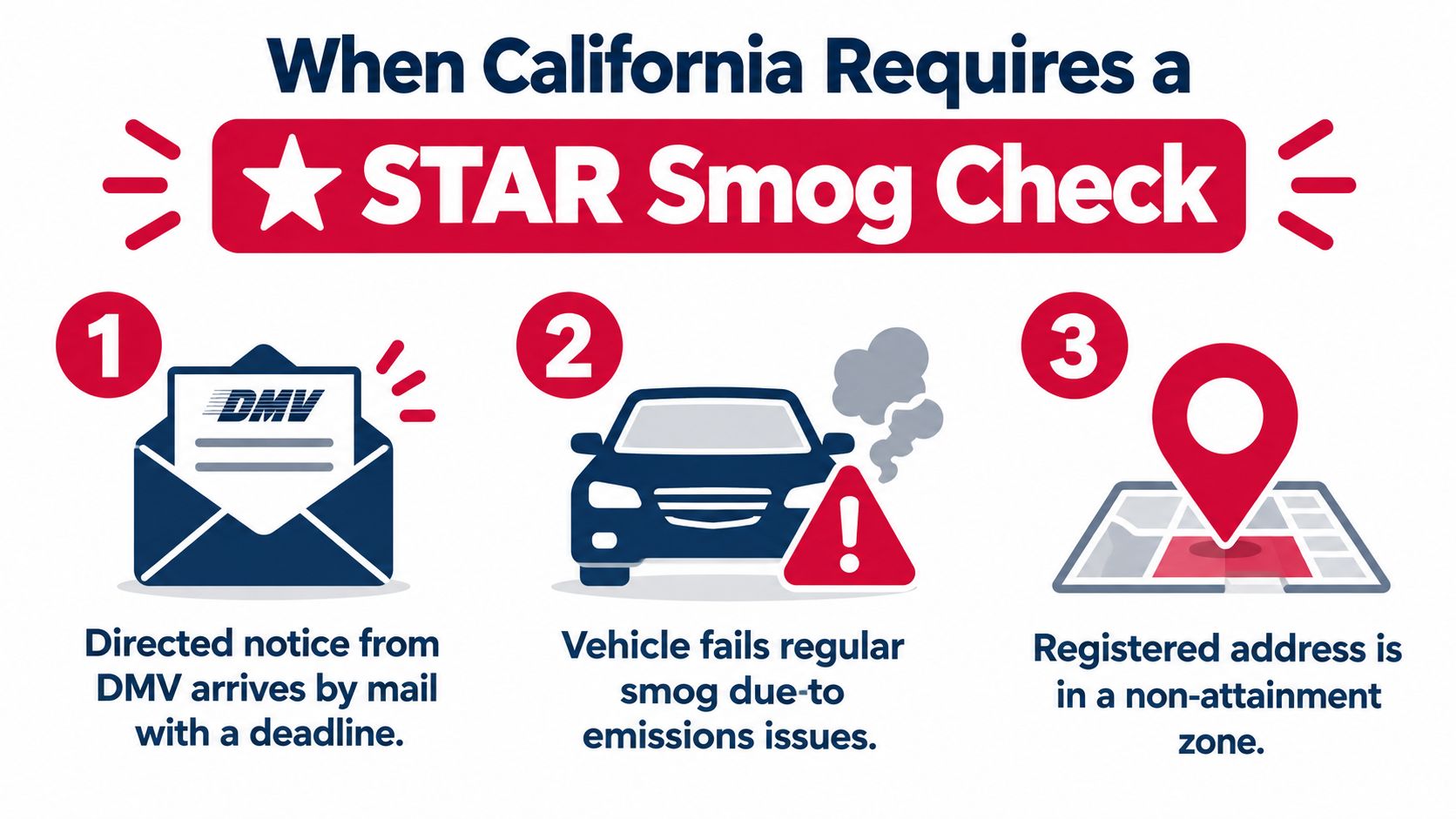
You are renewing your registration, and the DMV notice says your vehicle must visit a STAR station. That instruction changes where you can test. It is different from a general reminder to complete a Smog Check, so read the notice carefully before booking an appointment or driving to a shop.
A directed notice places the vehicle in a more controlled inspection pathway. California may direct a vehicle because of its testing history or emissions profile. Vehicle age, an ownership transfer, or a routine renewal can require a Smog Check without automatically requiring STAR testing.
Check the instruction, not the rumor
Use the notice as your starting point:
- Read the renewal notice. Look for wording that requires a STAR station or identifies a specific inspection type.
- Match the vehicle details. Confirm that the notice belongs to the vehicle you are taking for testing and that the registration information is current.
- Check the station listing. Use the BAR listing to find nearby STAR-certified businesses and see whether each offers test-only or test-and-repair service.
- Call before your visit. Ask whether the station can process the exact requirement shown on your notice.
A first-time California registration or ownership transfer may involve a Smog Check, but neither situation alone establishes a STAR requirement. A failed ordinary inspection also does not automatically mean every later test must take place at a STAR station. The DMV instruction or applicable BAR process determines the required testing location.
After a directed test, the station must submit the required electronic certification. If that certification is missing, the DMV may be unable to complete your registration renewal. A failed result can lead to repairs and another inspection, but the result itself does not turn every future test into a STAR requirement.
California also has special provisions for older and collector vehicles. BAR's current materials state that collector-vehicle exemptions are scheduled to be extended in stages beginning January 1, 2028, subject to final rulemaking, as reflected in the DMV's Smog Inspections guidance. Abbreviated inspections remain available for certain vehicles that are 35 years old or older. Check the current requirements before assuming your vehicle qualifies for an exemption.
How to Verify a Station and What Testing Involves
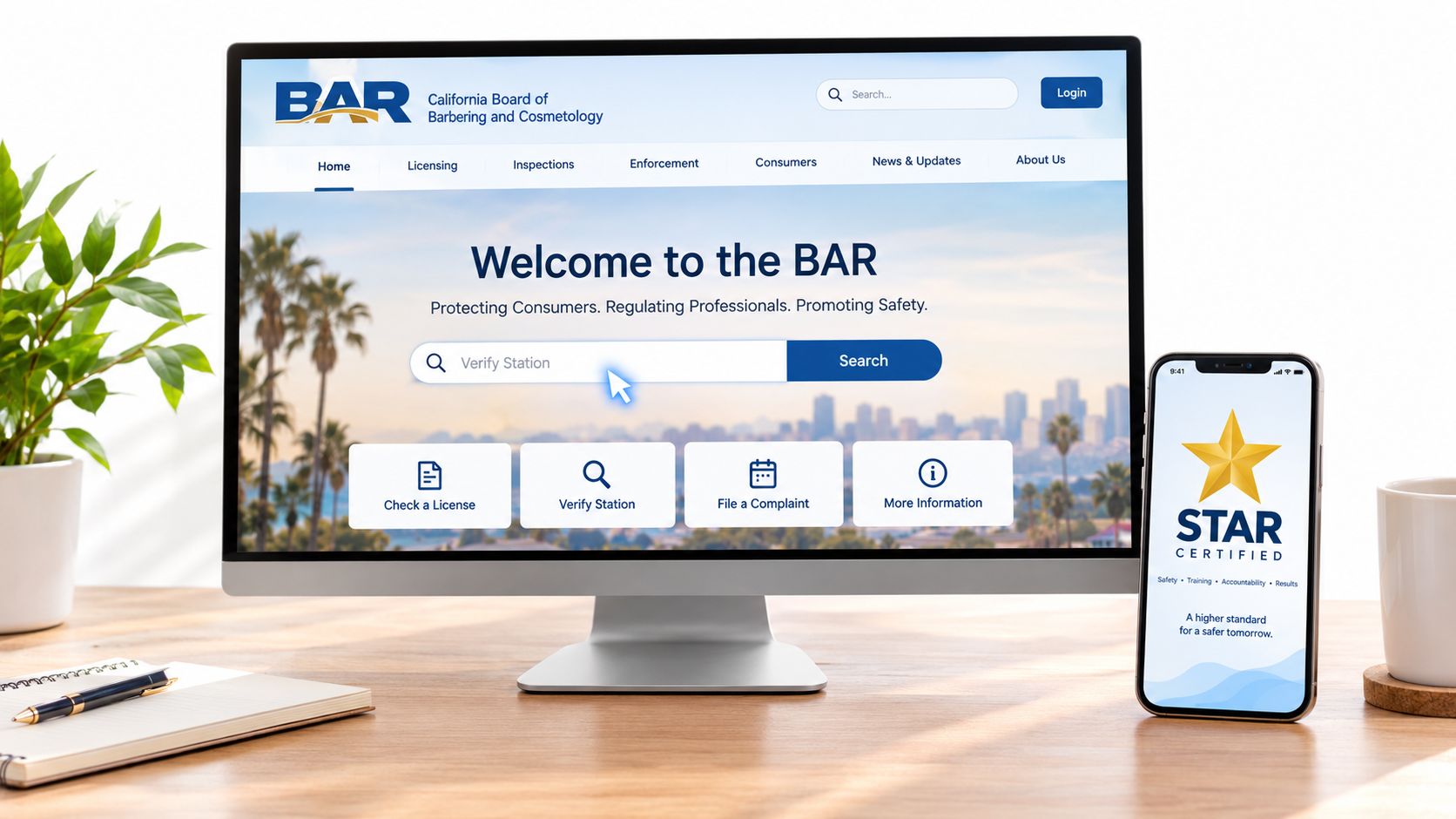
Start with the BAR station lookup rather than relying only on a business name, search advertisement, or a sign in a parking lot. Enter the location information, review the station's listing, and confirm the STAR designation, station type, license information, and any disciplinary information shown in the official record.
A legitimate business should also display the required station information at its location. Look for a posted STAR decal or other official signage, then compare the business name and address with the BAR listing. If the listing says test-only but an employee immediately proposes repair work, ask who would perform the repair and whether the inspection business is separate.
What the technician checks
For a newer vehicle, the technician generally connects an approved tool to the vehicle's OBD II system and reviews emissions-related information. The malfunction indicator lamp must illuminate with the key on and engine off, then turn off once the engine is running. If that required behavior isn't present, the vehicle fails the OBD portion.
The inspection can also include visual and functional checks of emissions equipment. Older vehicles may require different procedures, including tailpipe or evaporative-system checks, depending on the vehicle and the applicable program rules. A technician should be able to explain which procedure applies without promising a result in advance.
The visit length varies with the vehicle, station workload, and inspection type. Ask about the expected timing when you book rather than relying on a generic estimate.
After a pass, the station electronically sends the certification to DMV. You generally don't need to carry a paper certificate to a DMV counter, although you should keep your receipt and any inspection documentation.
After a fail, a test-only station can explain the result and provide the report, but it doesn't perform the repair. BAR and DMV guidance direct failed vehicles toward the appropriate next steps, including the BAR Referee Program in situations where that process applies.
Your Next Steps for Booking a STAR Smog Check
You can avoid most last-minute problems by treating the appointment as a document and deadline task, not just a quick drive to a repair shop.
- Confirm the requirement. Check the DMV renewal notice or official BAR communication. Identify whether it says STAR station required and note the registration deadline.
- Find the correct station. Use the BAR search tool and filter the results by location and certification type. Confirm whether the business is test-only or test-and-repair.
- Call before booking. Ask the station to confirm its STAR status, current fee, accepted payment methods, appointment policy, and ability to handle your vehicle.
- Prepare your documents. Bring the DMV or BAR notice, current registration information, and a form of identification. The station may need accurate vehicle and owner details to complete the transaction.
Before arrival, drive long enough for the engine to reach normal operating temperature, unless your vehicle's condition makes that unsafe. Check that the fuel cap seals correctly, and remove aftermarket electronics that could create warning-light issues or interfere with the vehicle's normal diagnostic systems.
For more guidance on the cost of a STAR smog check, contact the station directly because pricing depends on the vehicle and service. Don't approve repairs based only on a verbal explanation. If the vehicle fails, request the complete Vehicle Inspection Report, keep every receipt and estimate, and ask whether you may qualify for California's Consumer Assistance Program if the repair burden meets the program's requirements.
A sensible planning window is 6 to 8 weeks before registration renewal. That gives you time to arrange repairs, complete a retest, resolve questions about the result, and allow the electronic certification to reach DMV without turning the renewal deadline into an emergency.
Fire House Smog provides STAR-certified test-only smog inspections and California DMV registration services at its Antioch location. Visit Fire House Smog to review the available services and contact the station before booking your STAR inspection.
You're standing beside a large motorhome with a DMV renewal notice in hand, wondering whether it belongs at an ordinary smog station, a heavy-duty emissions facility, or nowhere at all. That uncertainty is understandable, but guessing can cost you a wasted trip, a rejected inspection, and a registration delay.
California doesn't exempt RVs just because they're recreational vehicles. Fuel type, model year, registration status, and gross vehicle weight rating, or GVWR, determine the correct emissions pathway. The most important dividing line for many diesel motorhomes is the GVWR label inside the driver's door. Check that label before booking a test.
Table of Contents
- Navigating California RV Emissions Requirements
- Standard Smog Check Rules for Motorhomes
- The Heavy-Duty Clean Truck Check Divide
- Preparing Your RV for a Passing Inspection
- Why a STAR Test-Only Station Protects You
- Combining Smog Testing with DMV Registration
- Your RV Compliance Action Plan
Navigating California RV Emissions Requirements
David parked his gasoline motorhome for most of the year and assumed limited use would keep emissions testing off his registration requirements. The renewal notice proved otherwise. California bases the requirement on the vehicle's characteristics and registration circumstances, not on how often the owner takes it camping.
For a smog check for an RV, start with classification. A motorhome is not exempt just because it is recreational. A gasoline RV from 1976 or newer is generally subject to Smog Check, while diesel vehicles from 1998 or newer are generally included, subject to California's weight and registration rules. The standard light-duty path usually requires inspection every other year when the DMV requests certification.
Practical rule: Classify your RV by fuel, model year, and GVWR, not by its appearance.
The biggest mistake involves diesel pushers and other large coaches. A non-gasoline motorhome with a GVWR over 14,000 pounds may fall under California's separate Clean Truck Check program instead of the standard Smog Check program. That changes the testing method, reporting process, schedule, and type of facility you need. Confirm the weight threshold before driving to a passenger-vehicle smog station.
Find the controlling details first
Record these four details before contacting a testing facility:
- Fuel: gasoline, diesel, or another fuel.
- Model year: use the vehicle's model year, not the purchase date.
- GVWR: read the manufacturer's label on the driver's door jamb.
- Registration purpose: confirm whether the motorhome is registered for non-commercial or commercial use.
The California Bureau of Automotive Repair Smog Check guidance explains which qualifying RVs and motorhomes fall within California's program. For more detail on how vehicle class and registration status affect testing, review these California emissions testing requirements.
Use the classification result to choose the facility. Confirm that it handles your testing program and can physically accommodate the coach. A station built for passenger cars may lack the equipment or space for a large motorhome, and a standard Smog Check certificate may not satisfy a heavy-duty Clean Truck Check obligation. Identifying the correct lane first prevents a rejected inspection, wasted travel, and registration delays.
Standard Smog Check Rules for Motorhomes
A newer gasoline motorhome can avoid a routine inspection, while an older qualifying coach may need one during registration renewal or a transfer of ownership. The standard lane is defined by timing and exemption rules, so check the DMV requirement before booking an appointment.
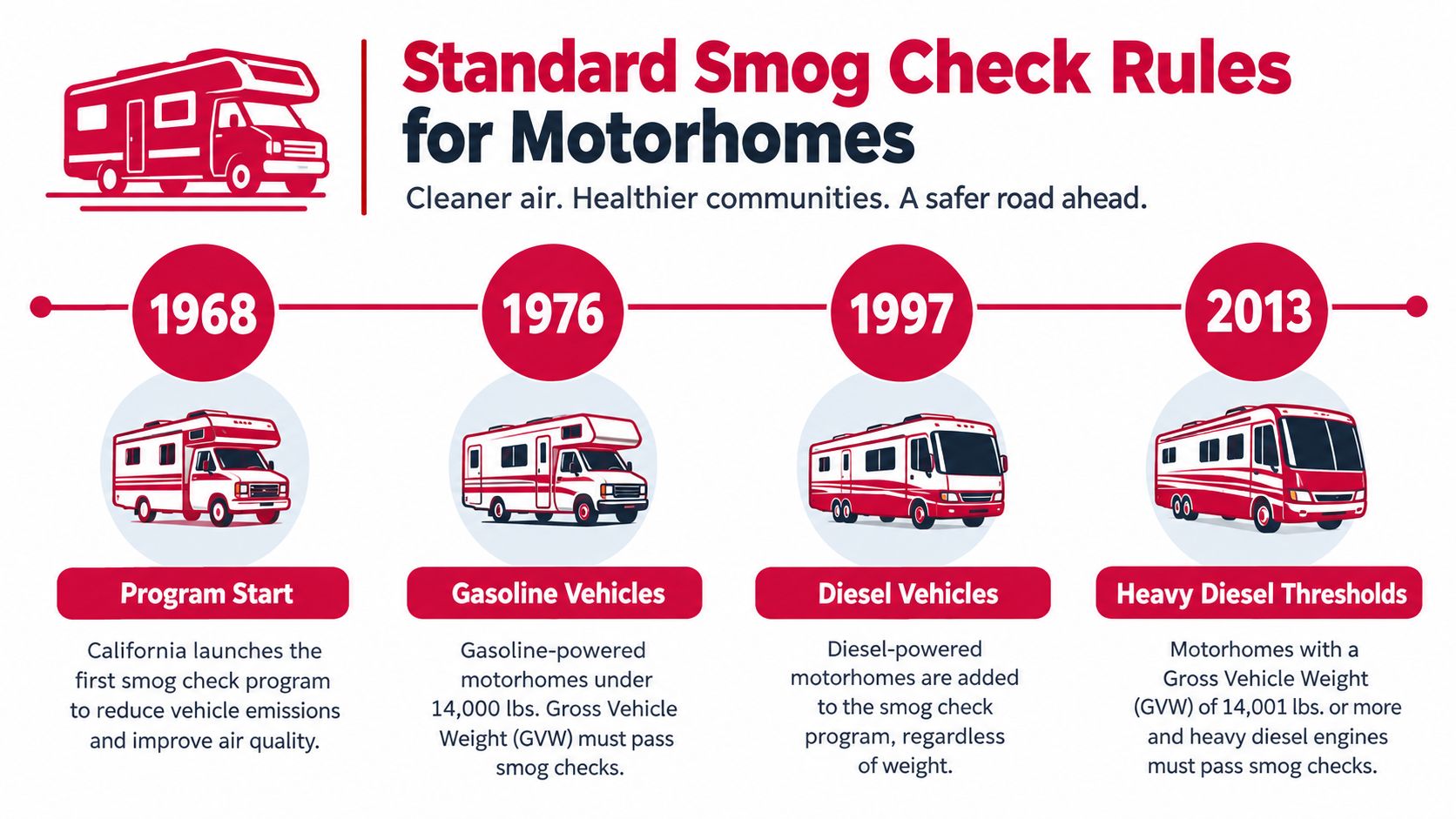
For vehicles in the ordinary program, testing is generally required every other year when the DMV renewal process calls for it. A change of ownership can also trigger a test. The timing depends on the vehicle's status in California records, not just on whether the coach is used regularly.
The age exemption is easy to miss. Vehicles four model years old and newer aren't subject to the biennial or change-of-ownership Smog Check requirement. California also provides a smog abatement fee option for vehicles less than four model years old during the first eight years they are registered. That pathway began January 1, 2019, and is described in the Bureau of Automotive Repair's Smog Check program information.
Use the exemption and fee rules to check your renewal notice:
- A newer qualifying gasoline motorhome may fall within the four-model-year exemption.
- A vehicle outside that exemption may require the inspection or the applicable abatement fee.
- An ownership transfer can create a testing requirement even when the usual renewal cycle has not arrived.
- A notice from the DMV remains the controlling prompt for registration compliance.
California also changed how qualifying newer vehicles are inspected. Assembly Bill 2018 expanded emissions testing in areas that had not attained federal air-quality standards. Assembly Bill 2289 shifted 2000 model-year-and-newer vehicles toward an OBD II-focused inspection approach, according to the 2026 Smog Check Performance Report. For an eligible RV, that means the technician may rely heavily on the onboard diagnostic system rather than an older tailpipe-style procedure.
Do not treat a missing renewal notice as proof of exemption. Check the model year, review the DMV requirement, and confirm that the selected station can test a motorhome of your size. A large diesel coach also requires a separate GVWR check before you choose the standard lane.
The Heavy-Duty Clean Truck Check Divide
A diesel motorhome can arrive at the wrong testing facility only because its owner checked the engine type but not the weight rating. The 14,000-pound GVWR threshold determines whether many non-gasoline coaches follow California's separate Clean Truck Check process instead of the ordinary smog lane.
For a non-gasoline motorhome with a GVWR over 14,000 pounds, the owner must register the vehicle in the Clean Truck Check Vehicle Inspection System, pay the required annual fee, and submit passing emissions compliance tests. This is a separate administrative and testing process, not a tougher version of a regular passenger-vehicle smog visit.
Check the door-jamb label before booking. A large diesel pusher may be unable to complete its required compliance process at a standard smog station, even if that station routinely handles smaller RVs.
CARB says Clean Truck Check deadlines began January 1, 2025. Passing tests may be submitted up to 90 days before the applicable deadline, according to the Clean Truck Check motorhome requirements. Non-commercial motorhomes are tested annually, while commercial-use motorhomes are tested semi-annually. Vehicle use affects the schedule, but GVWR is the first eligibility question.
Compare the two compliance lanes
| Feature | Standard Smog Check | Clean Truck Check |
|---|---|---|
| Primary vehicle group | Qualifying gasoline RVs and lighter vehicles | Non-gasoline motorhomes over 14,000 pounds GVWR |
| Main reference point | Fuel, model year, weight, and registration rules | GVWR, fuel, vehicle use, and CARB participation |
| Typical frequency | Every other year when required for registration | Annual for non-commercial motorhomes, semi-annual for commercial-use motorhomes |
| Administrative system | Standard California Smog Check process | Clean Truck Check Vehicle Inspection System |
| Facility question | Can the station perform the required RV inspection? | Can the provider perform and report heavy-duty compliance testing? |
| Owner's first check | Model year and fuel type | Door-jamb GVWR and fuel type |
Beginning October 2027, OBD-equipped vehicles are currently scheduled to move to quarterly testing under CARB's proposed framework, subject to final rulemaking. CARB's Clean Truck Check motorhome fact sheet distinguishes that proposed future framework from the annual schedule that applies to non-commercial motorhomes.
The label inside the door jamb is the deciding document. Coach length, a diesel badge, and another owner's experience do not establish the applicable lane.
If the motorhome is non-gasoline and exceeds the threshold, verify its registration in the required system, pay the applicable fee, and choose a provider that supports Clean Truck Check. Confirm the lane first. Booking a routine biennial smog appointment for a heavy diesel coach can waste time and create an avoidable trip.
Preparing Your RV for a Passing Inspection
A failed inspection often starts before the RV reaches the testing bay. One warning light, incomplete monitor, loose fuel cap, or unapproved emissions modification can turn an expensive coach trip into a second appointment. Confirm the correct testing lane first, especially if the door-jamb GVWR places a heavy diesel motorhome under Clean Truck Check rather than the standard smog process.
Start with the dashboard. An illuminated check-engine light signals an emissions fault that needs diagnosis. Do not clear codes immediately before testing. Clearing them can reset readiness monitors, so the vehicle may not show that its required systems have completed their checks. Review this guide to OBD readiness monitors before scheduling the inspection.
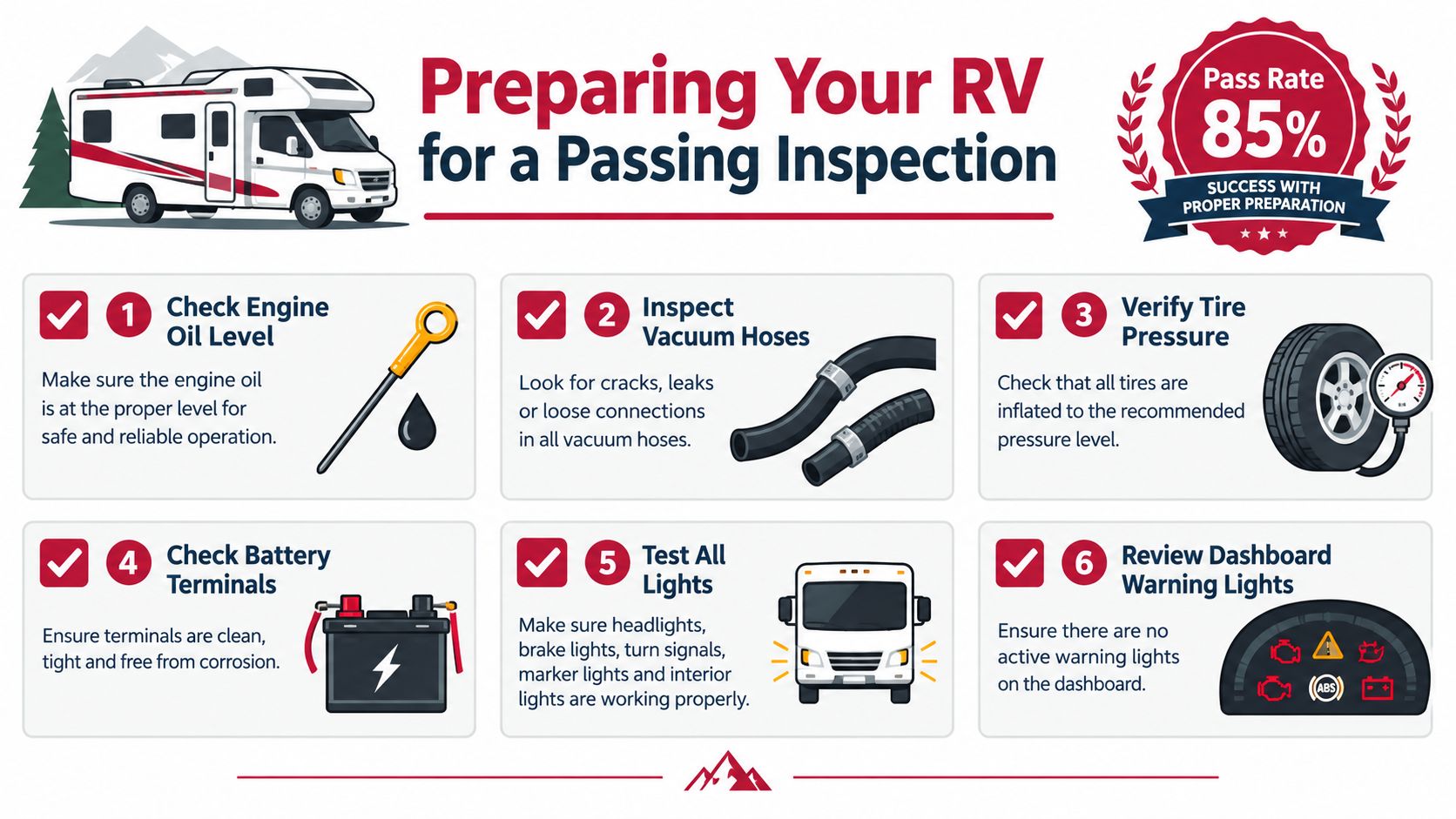
Use a practical inspection checklist
- Confirm the warning-light status. The dashboard should not display an active emissions warning. If a light appeared recently, have the code diagnosed instead of guessing.
- Inspect the fuel cap. A loose or damaged cap can keep the fuel system from sealing. Tighten it until it locks, and replace it if the seal is worn.
- Complete normal driving after repairs. The onboard monitors may need ordinary operating conditions to run. Ask your technician whether the required drive pattern has finished.
- Look for tampering. The inspection can include a visual review of emissions equipment. Non-approved intake, exhaust, catalytic converter, or other modifications can cause a failure even when the engine runs normally.
- Check basic operating condition. Verify the oil level, battery connections, vacuum hoses, lights, and tire pressure. These checks do not replace emissions diagnosis, but they reduce preventable interruptions.
- Confirm station access. Call with the coach's dimensions, fuel type, and GVWR. A facility may accept some RVs while lacking the clearance or equipment needed for yours.
Bring the RV in a warm, maintained condition. For a heavy diesel motorhome, follow the Clean Truck Check provider's instructions for engine condition, visible smoke, identification labels, and reporting. Do not apply gasoline-RV preparation advice to the wrong testing lane.
The inspection may involve an emissions-equipment review, diagnostic scan, and procedures suited to the vehicle. Keep the RV in its normal operating configuration. Removing equipment or temporarily clearing a warning light does not correct the compliance problem and can create further diagnostic complications.
Watch this short visual guide before scheduling:
Why a STAR Test-Only Station Protects You
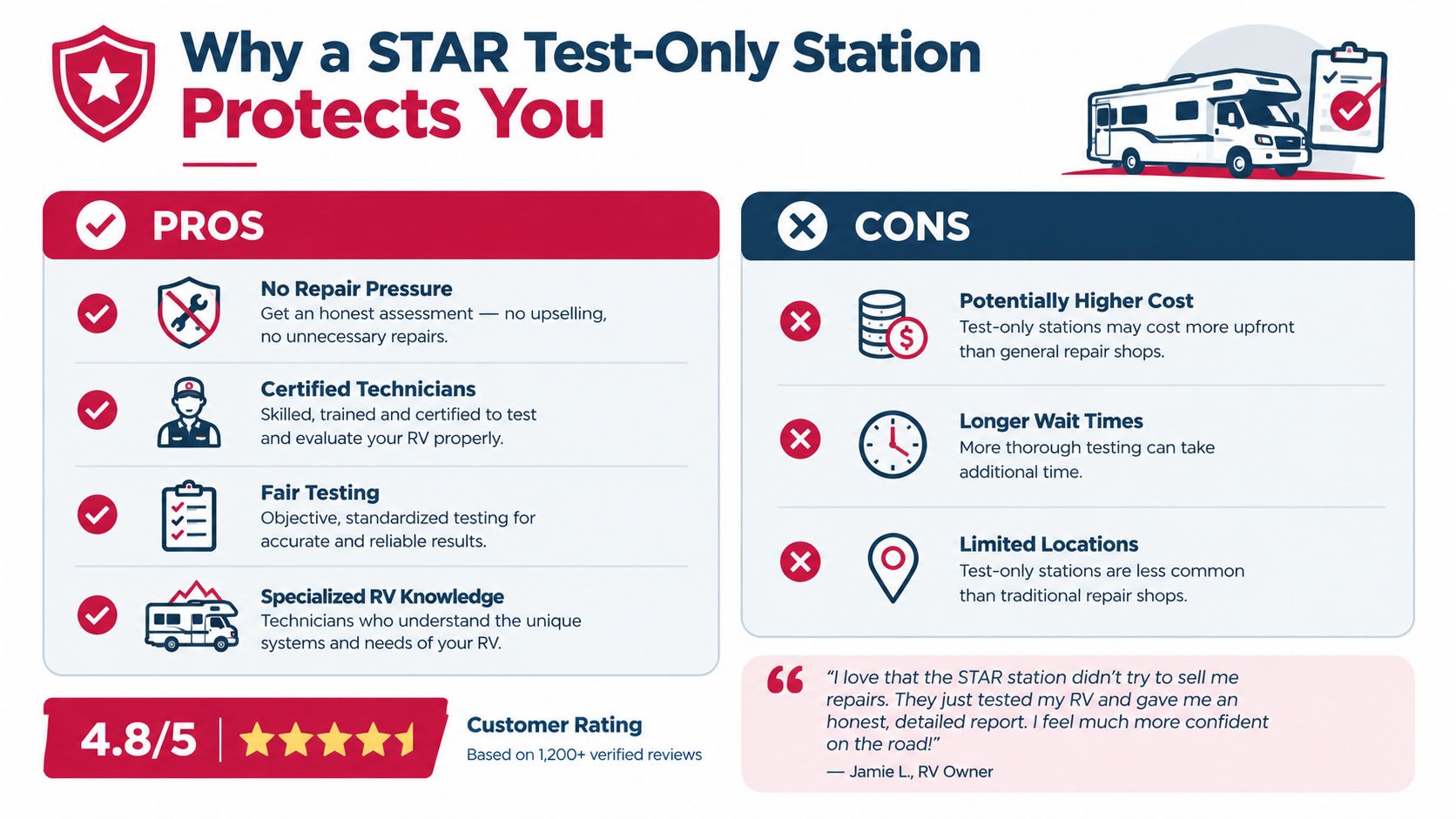
You can fail an RV emissions inspection, then face pressure to approve expensive repairs before you understand the cause. A test-only station separates those decisions. It performs the inspection without selling the repair work that might follow, which gives you room to compare repair options for a large, difficult-to-service vehicle.
A test-and-repair business can still conduct a legitimate inspection. However, a failed test may lead directly to an in-house repair recommendation. With a test-only facility, you receive the result first and can choose an independent mechanic, mobile technician, dealer, or specialist based on the documented failure.
Match the facility to your RV
A STAR-certified test-only station may be required when the DMV directs your vehicle to STAR testing. The certificate alone does not confirm that the facility can handle a large coach. Call before booking and verify the following:
- Vehicle clearance: Can the bay accommodate the motorhome's height, width, wheelbase, and approach angle?
- Testing category: Does the station inspect your fuel type and model year?
- RV capacity: Does it accept motorhomes, or only cars and light trucks?
- Scheduling: Can it reserve enough time for a large vehicle?
- Result handling: Will you receive clear documentation if the vehicle fails?
Fire House Smog is one example of a STAR-certified test-only station and licensed DMV registration services provider that inspects some RVs and motorhomes, subject to size and equipment limits. Call with the coach's dimensions before visiting. Its test-only model means it does not sell repair work, while its two-bay setup and extended testing hours support vehicle throughput. Confirm fit and equipment before relying on those operating details.
Ask before leaving home: “Can your equipment accept my exact RV, and is my vehicle in the standard Smog Check category?”
That answer matters more than proximity. If the RV fails, use the inspection report to obtain an independent diagnosis. Do not authorize major work based only on a verbal suggestion.
Combining Smog Testing with DMV Registration
A renewal notice does not determine the correct inspection lane. First confirm the RV's classification, especially its GVWR, fuel type, and model year. A qualifying standard-program motorhome may combine its smog inspection with DMV registration services. A heavy diesel motorhome subject to Clean Truck Check follows a separate compliance process, so booking a regular smog appointment can waste a trip.
Before scheduling, call the facility with the model year, fuel type, GVWR, and approximate dimensions. Confirm that it can test the RV and complete the requested DMV transaction during the same visit. Ask whether registration renewal, ownership transfers, or sticker printing are available for your transaction. This prevents an avoidable arrival with the correct notice but the wrong provider, equipment, or service category.
Prepare the documents in advance:
- Current registration: Helps verify the vehicle record.
- DMV renewal notice: Bring it when the DMV has sent one.
- Insurance information: Keep current proof available if the transaction requires it.
- Ownership documents: Bring the title or transfer paperwork for a change of ownership.
- Payment method: Confirm accepted payment types before driving a large RV to the facility.
A passing result may transmit electronically, but keep the receipt and inspection paperwork. If the DMV requires additional information, missing documents can turn one planned visit into a second trip.
Fire House Smog's published service information lists on-site California DMV registration renewals, ownership transfers, and registration sticker printing during posted service hours. Its listed location is 2900 Lone Tree Way in Antioch. Owners of larger RVs should confirm clearance, equipment compatibility, and the vehicle's testing category before booking. DMV service hours may differ from smog testing hours, so ask about both services during the call.
Book with enough time for diagnosis or retesting if the RV fails. This matters even more when the motorhome has been stored for an extended period or must travel a significant distance to reach the facility. Plan around the vehicle's emissions classification and the provider's capabilities, not just the renewal deadline.
Your RV Compliance Action Plan
California RV emissions compliance starts with the vehicle's classification. Confirm the correct testing lane before booking a station.
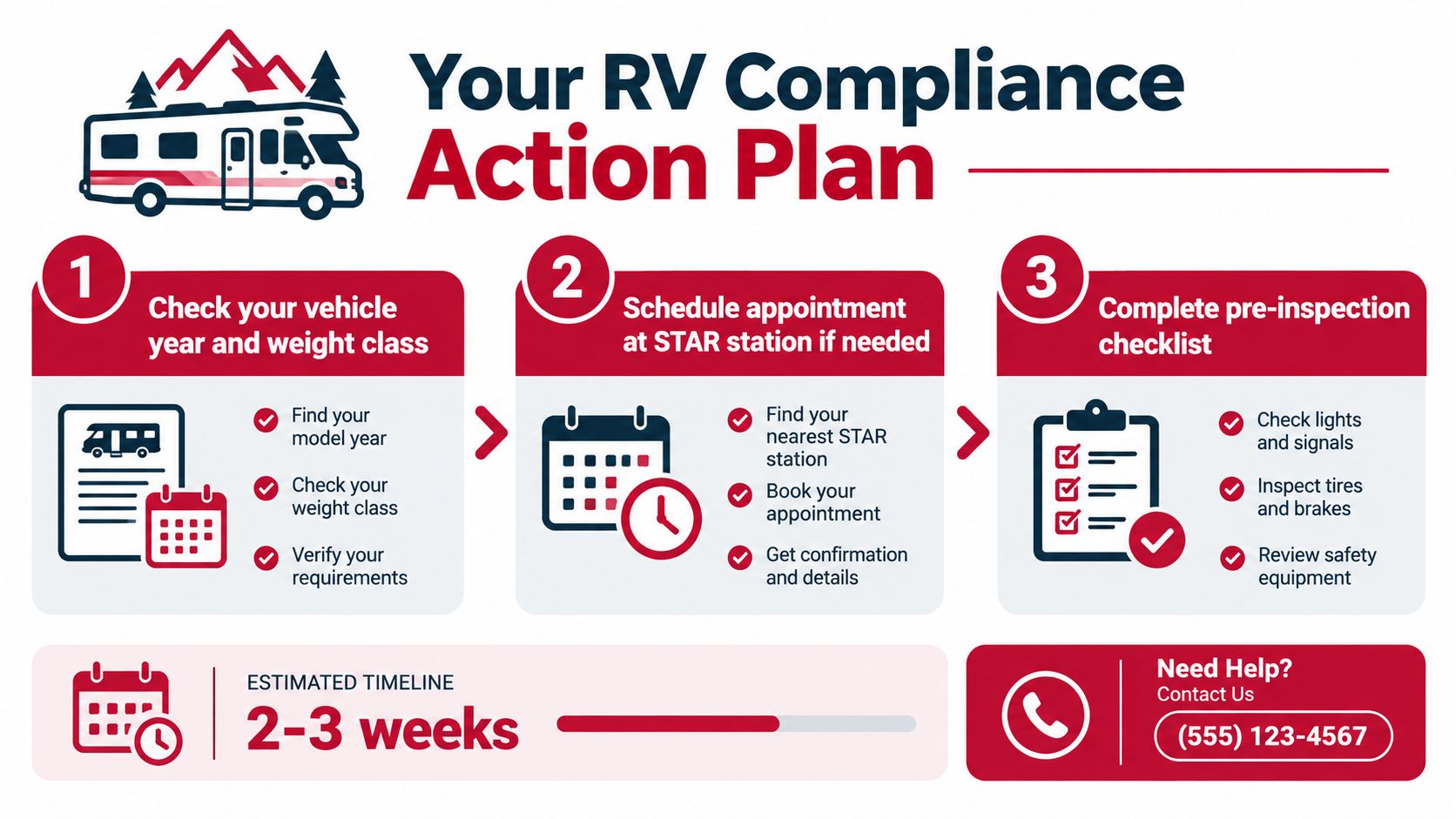
Step one, identify the lane
Record the model year, fuel type, and GVWR. Gasoline motorhomes from 1976 or newer and diesel vehicles from 1998 or newer generally fall under standard Smog Check rules when they meet California requirements. Vehicles four model years old and newer generally avoid biennial and change-of-ownership testing.
A non-gasoline motorhome over 14,000 pounds GVWR belongs in the Clean Truck Check process, not the standard smog lane. This threshold determines which provider and reporting process you need.
Step two, book the right provider
For a standard inspection, confirm STAR certification if your DMV notice requires it, and verify that the station accepts your RV's size. Heavy diesel motorhomes need a provider equipped for Clean Truck Check testing and reporting. One certificate does not replace the other.
Step three, arrive prepared
Bring registration, the renewal notice, insurance information, ownership documents when relevant, and accurate vehicle details. Check warning lights, complete required drive conditions, inspect emissions equipment, and confirm the facility can handle the coach safely.
Use the Bureau of Automotive Repair's program overview and current CARB motorhome guidance when the vehicle's status is unclear. Verify requirements before each registration cycle.
Fire House Smog offers STAR-certified test-only inspections, some RV and motorhome testing subject to size and equipment limits, and California DMV services with on-site sticker printing. Visit Fire House Smog to confirm fit and coordinate services before arrival.
Your registration renewal notice is on the kitchen table, and it says a smog check is required. Your neighbor's older truck is exempt, while a coworker was directed to a particular station. It's easy to assume the rules are inconsistent, but California bases them on a few practical details: model year, fuel type, vehicle weight, registration status, and the wording of the DMV notice.
For drivers in Antioch, Pittsburg, Brentwood, Oakley, and the rest of East Contra Costa County, the process is usually straightforward once you know which category your vehicle falls into. The important change many older guides miss is California's OBD-readiness requirement effective October 1, 2025. A vehicle may look and drive normally, yet still fail if its emissions monitors haven't completed their checks.
Table of Contents
- Why Smog Testing Matters for California Drivers
- Which Vehicles Need a Smog Check
- STAR, Test-Only, and Test-and-Repair Explained
- How Often You Need to Test and When to Do It
- How to Prepare Your Car Before the Test
- What Happens During the Inspection
- Pairing Your Smog Check with DMV Renewal
- Retests, Failures, and Edge-Case Vehicles
Why Smog Testing Matters for California Drivers
California uses Smog Check as part of its vehicle-registration system and broader emissions-control program. The practical result is simple: when the DMV tells you a certificate is required, you generally need a passing result before completing the related registration task. The California DMV smog-inspection guidance explains which vehicles enter the program and which categories are exempt.
That's why a renewal notice matters more than a neighbor's experience. Two vehicles parked on the same Antioch street can follow different rules because they use different fuels, have different model years, or carry different weight ratings. A gasoline sedan may need testing, while an electric vehicle or qualifying heavy diesel vehicle doesn't.
The practical reason to take the test seriously
A smog inspection isn't a substitute for regular maintenance, but it can uncover emissions problems that aren't obvious during an ordinary commute. A malfunctioning oxygen sensor, evaporative-emissions leak, or other emissions-system fault can trigger a failure even when the vehicle starts, idles, and drives acceptably.
The inspection also creates a clean compliance record for common ownership tasks. That matters when you're renewing registration, transferring a vehicle, or bringing an out-of-state vehicle into California. If the DMV requires a certificate and you wait until the registration deadline, a failed test can leave little time for diagnosis and repair.
Practical rule: Start with the DMV notice and the vehicle's identification details, not with a generic online checklist.
For local drivers, planning ahead also reduces disruption. You can schedule the inspection before the renewal deadline, ask whether the station handles directed vehicles, and find out whether electronic submission or on-site DMV services are available. A calm check-in is much easier than trying to solve eligibility, testing, repairs, and registration on the same rushed afternoon.
Which Vehicles Need a Smog Check
Use a simple decision process. First identify the vehicle's fuel type. Then check its model year and, for diesel or natural-gas vehicles, its gross vehicle weight. Finally, read the DMV notice because a vehicle can be directed to a specific kind of station.
The California DMV's official rules state that gasoline-powered vehicles from 1975 model year or older are exempt. Gasoline vehicles that are less than eight model-years old can generally pay a smog abatement fee instead of entering the standard inspection pathway during their first eight years of registration.
| Vehicle Type | Model Years | Smog Required? | Notes |
|---|---|---|---|
| Gasoline-powered vehicle | 1975 or older | No | Exempt under the DMV's age-based rule |
| Gasoline-powered vehicle | Newer than eight model-years old | Usually no standard inspection | A smog abatement fee may apply during the first eight years of registration |
| Gasoline-powered vehicle | Within the regular inspection population | Usually yes | Check the DMV renewal or transfer notice |
| Diesel-powered vehicle | 1997 or older | Exempt under the DMV rule | Confirm the vehicle's fuel and registration details |
| Diesel-powered vehicle | Any model year, over 14,000 pounds GVW | Exempt from this standard pathway | Weight classification is decisive |
| Natural-gas vehicle | Over 14,000 pounds GVW | Exempt | Lighter vehicles may follow different rules |
| Electric vehicle | Any model year | No standard Smog Check | It has no tailpipe emissions system to inspect |
Applying the decision tree locally
A 2017 gasoline Honda Civic in Pittsburg may fall within the inspection population if the registration notice calls for a test. A 2003 diesel pickup needs a closer look at its weight rating and the applicable diesel rule, rather than an automatic assumption that every diesel is exempt. A 2024 plug-in hybrid should be checked against the newer-vehicle exemption and the DMV notice, while a fully electric vehicle is exempt from the standard Smog Check.
RVs, motorhomes, collector cars, and government vehicles shouldn't be classified by appearance alone. The Bureau of Automotive Repair's Smog Check overview specifically identifies qualifying RVs, motorhomes, collector cars, and government vehicles as categories that may still need a Smog Check.
STAR, Test-Only, and Test-and-Repair Explained
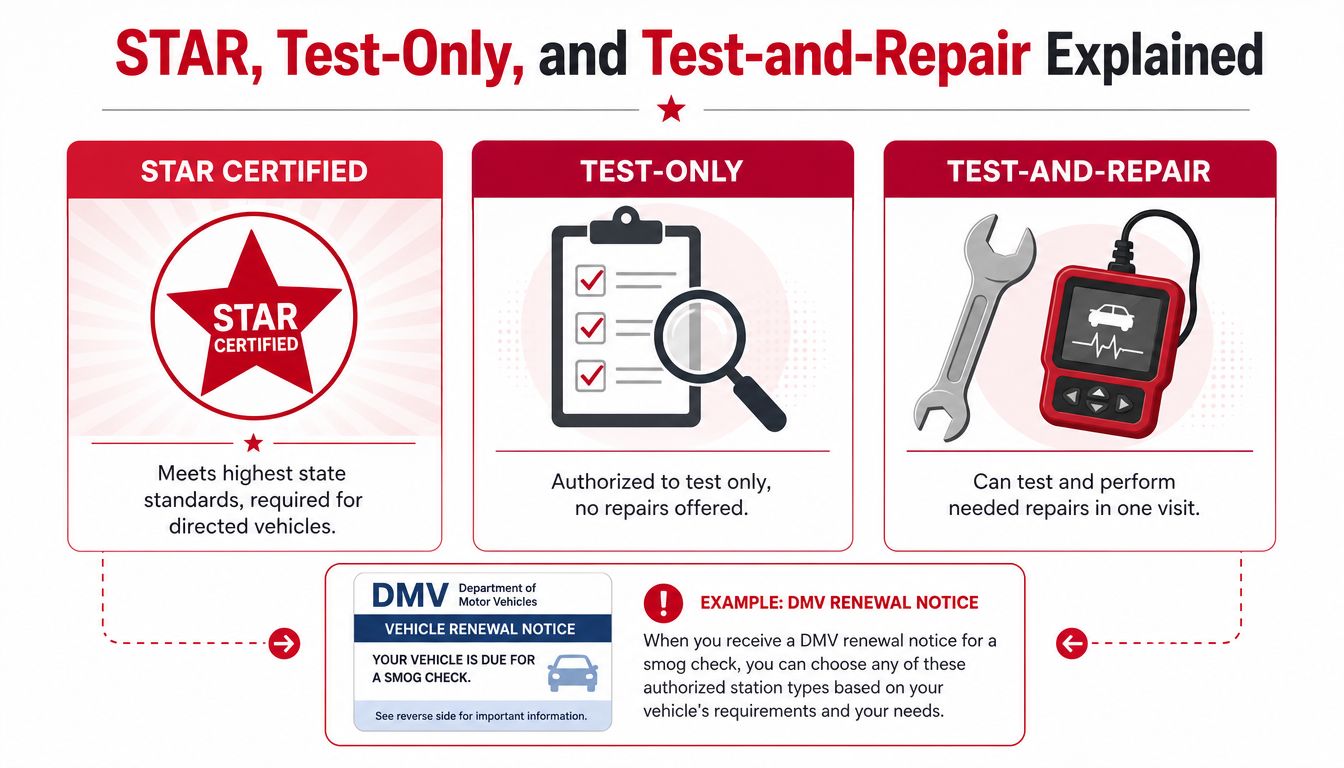
The station type controls what the business is allowed to do and, in some cases, where your vehicle may be tested. STAR certification is a quality-control layer, not a separate emissions standard. The Bureau of Automotive Repair STAR FAQ says STAR stations must meet licensing, equipment, recordkeeping, inspector, and performance requirements. BAR also describes performance measures that include a Similar Vehicle Failure Rate of at least 50% of the industry-wide failure rate for comparable vehicles and a gear-shift-incident limit of no more than 2% of certified vehicles.
A test-only station performs inspections but doesn't repair vehicles. A test-and-repair station can diagnose and repair a vehicle after testing it. A STAR-certified station has met the state's additional certification requirements and can test vehicles that the DMV directs to STAR facilities.
What a DMV notice changes
Suppose your Antioch renewal notice says “STAR station required.” You can't treat that as a suggestion. BAR explains that certain vehicles are directed to STAR stations through DMV registration notices, so station selection becomes part of the compliance process.
A notice that doesn't require STAR may allow more choice, but the station still needs the correct license for the service you need. Before booking, confirm whether the business is STAR-certified, test-only, or test-and-repair. If you want a neutral inspection without repair sales at the same location, a test-only station may suit you. If you want one business to test and repair the vehicle, test-and-repair may be more convenient.
For a clearer explanation of the certification distinction, review what STAR-certified smog testing means. In East Contra Costa County, a STAR test-only station can be useful when the DMV has directed your vehicle there. The technician tests the vehicle under the applicable state process, and the station's test-only license means it doesn't profit from selling repairs.
How Often You Need to Test and When to Do It
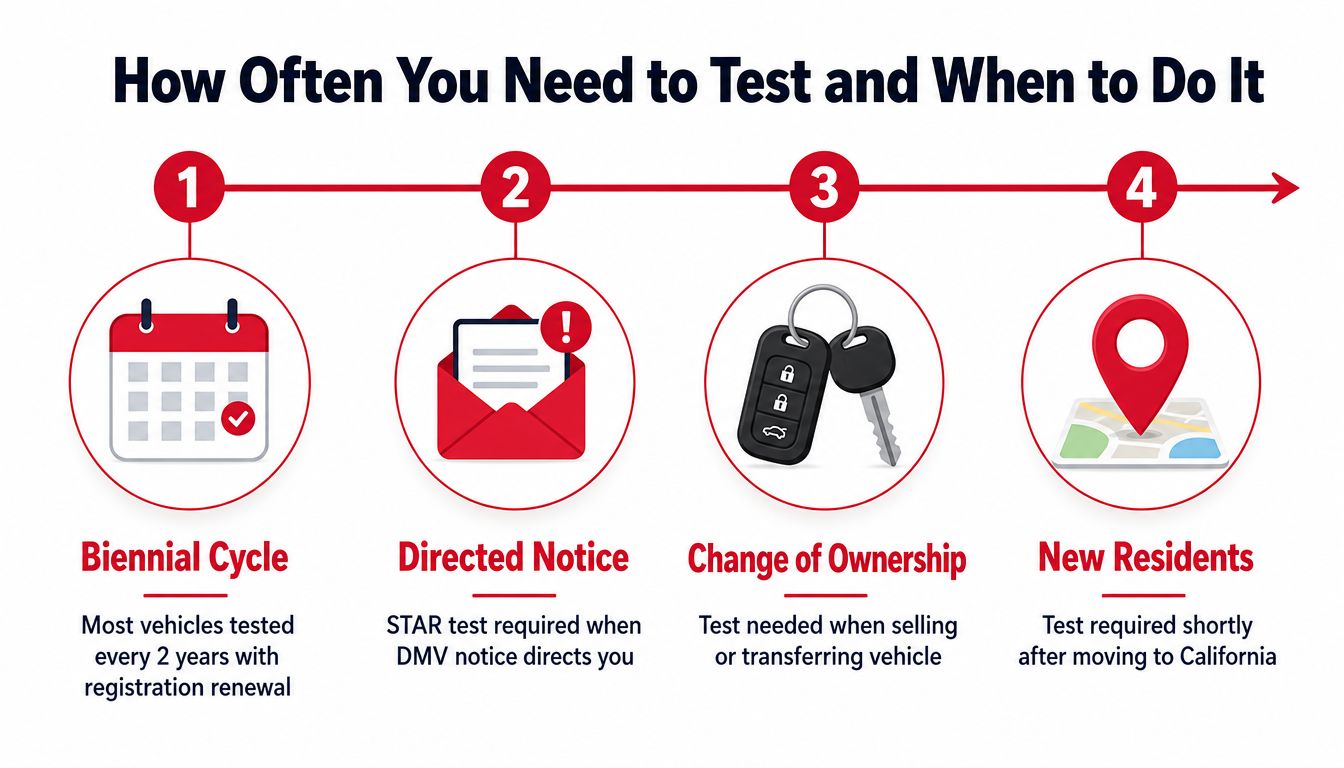
Most eligible vehicles follow a biennial registration-related cycle, but the DMV notice controls the immediate deadline. A vehicle can also need a test for a change of ownership, an out-of-state registration event, or a directed inspection. Don't assume that passing once makes the vehicle permanently clear.
Start with these four situations:
- Registration renewal: Read the notice for the smog requirement and any station direction.
- Directed testing: If the notice names STAR, use a STAR-certified location.
- Ownership transfer: Ask whether a current certificate is needed for the transaction.
- California entry: An out-of-state vehicle may need inspection before California registration is completed.
Read the notice before booking
The renewal notice usually tells you whether the DMV expects a smog certificate and whether a particular station type is required. If the vehicle is newer and falls within the applicable exemption period, the notice may direct you toward the abatement-fee route instead of a standard inspection.
Older or directed vehicles can require more attention. A notice may lead you to test annually or may change the next testing instruction after a successful inspection. Follow the document in front of you rather than relying on a general rule remembered from a previous renewal.
In East County, Saturday mornings can be busy because working drivers choose the same convenient window. A mid-week appointment or drop-off often makes the visit easier. If you're pairing the test with DMV service, verify both schedules first, since the inspection and registration counters may keep different hours.
How to Prepare Your Car Before the Test
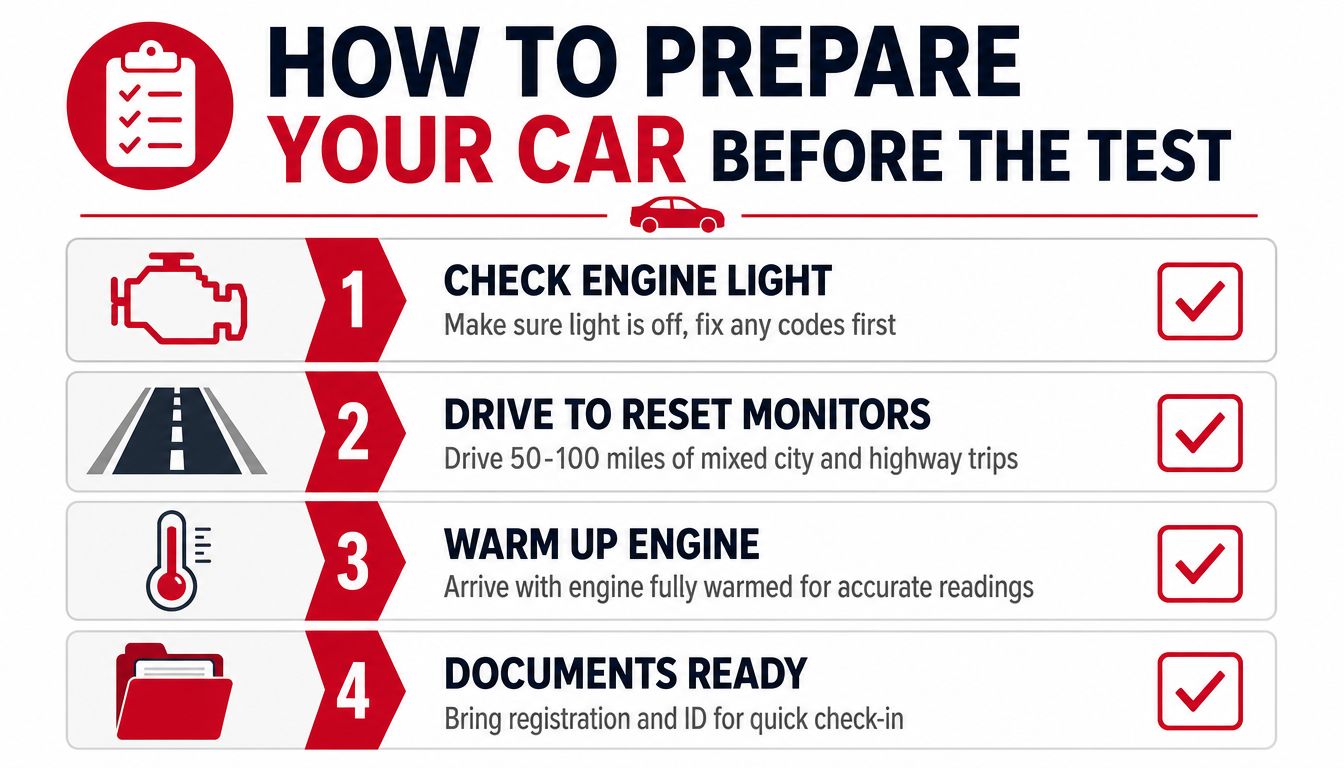
A few checks before you leave home can prevent a wasted visit. Start with the Check Engine Light. If it's illuminated, don't erase the code just to make the dashboard look normal. The technician's equipment can still identify trouble codes, and clearing the code may leave the readiness monitors incomplete.
The biggest recent change is the OBD-readiness rule. BAR states that effective October 1, 2025, all readiness monitors must be set for a vehicle to pass a Smog Check. That means disconnecting the battery or clearing codes shortly before the appointment can create a failure even if the light is off. Read the BAR explanation of the new OBD-readiness monitor regulations before scheduling a recently repaired vehicle.
A practical pre-test checklist
- Check the warning light: Diagnose emissions codes before the appointment instead of masking them.
- Drive normally after repairs: Use a mix of city and highway driving so the vehicle can complete its self-checks. The exact drive pattern varies by vehicle.
- Inspect the gas cap: A loose or damaged cap can contribute to an evaporative-emissions problem.
- Bring the paperwork: Have the registration or renewal notice available, along with identification if you're handling a DMV transaction.
If the car has just had its battery disconnected, ask a repair professional whether the monitors have completed before paying for an inspection. Some monitors take longer than others, and a generic short drive may not be enough for every vehicle.
On test morning, a normal drive that brings the engine to operating temperature can help the inspection begin with the vehicle warmed up. Don't treat a long highway run as a guarantee of passage. It won't repair a defective component or replace the manufacturer-specific conditions needed for monitor completion.
What Happens During the Inspection
You'll usually begin by showing the technician the registration paperwork or DMV notice and explaining what you need, especially if the notice directs you to STAR. At a test-only station, the technician records the vehicle information, checks the required equipment, and begins the inspection without offering repair work.
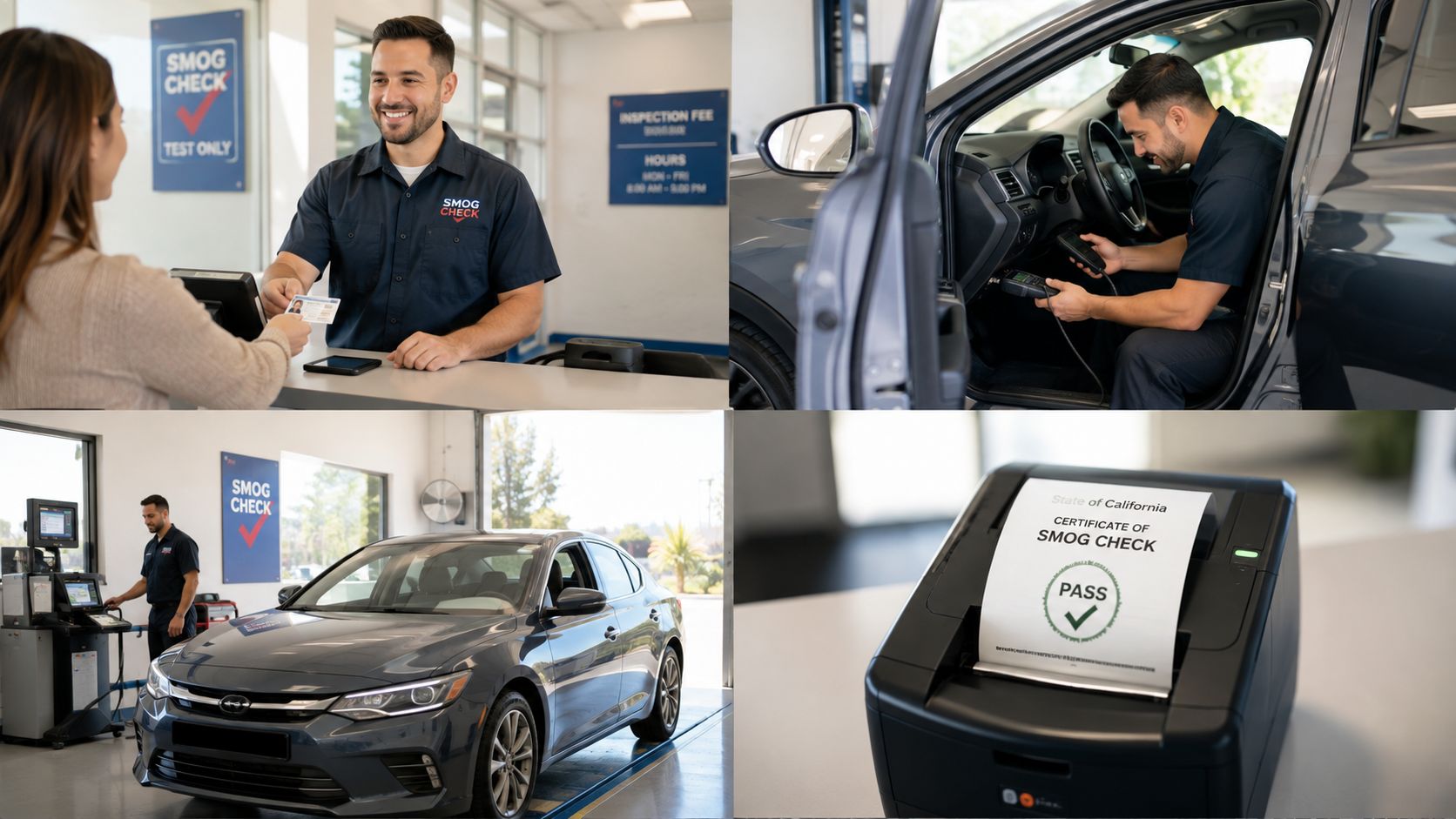
For an OBD-equipped vehicle, the technician connects a scanner to the diagnostic port. The system reads emissions-related trouble information and monitor status. The technician also performs the required visual checks, looking for emissions equipment that's missing, disconnected, or altered.
What older vehicles may require
The exact inspection depends on the vehicle. Older gasoline vehicles and certain diesel vehicles may require a tailpipe measurement, while other vehicles use an OBD-based procedure. Some vehicles are placed on test equipment that checks performance under controlled conditions.
The technician may also inspect items such as the gas cap, emissions labels, and visible components under the hood or beneath the vehicle. You don't need to memorize the equipment list. You do need to tell the technician about recent battery work, warning lights, or repairs that could affect monitor status.
A passing vehicle generates the required electronic result for the DMV, and the technician provides the inspection paperwork. If it fails, the Vehicle Inspection Report identifies the area that needs attention. Ask the technician to explain whether the issue is a monitor, trouble code, visual item, or measured emissions result.
For a visual walkthrough of the process, watch the California smog inspection video after reviewing the written report from your own vehicle.
Pairing Your Smog Check with DMV Renewal
A combined visit can save a separate trip, but treat it as two related services. The smog station performs the inspection. A DMV service counter or licensed registration provider handles the renewal transaction, fees, and sticker issuance under its own operating schedule.
Bring the renewal notice or current registration, a valid California identification document when required, and a payment method accepted by the businesses involved. Keep the inspection paperwork even when the result is transmitted electronically. It gives you a record if the DMV system needs time to update or you need to discuss the transaction later.
A smoother one-stop visit
Call before driving over and ask four questions:
- Station eligibility: Does the location perform the exact test type named on the DMV notice?
- Vehicle fit: Can it accommodate your car, truck, RV, or motorhome?
- DMV hours: Is the registration counter open when the inspection bay is operating?
- Retest policy: What documentation or coupon terms apply if the vehicle needs a retest?
Electronic submission can make the DMV portion quicker, but it doesn't eliminate the need to confirm the registration balance and required documents. If the inspector recommends repairs, ask for a written explanation and estimate before deciding whether to finish the registration transaction that day.
For a detailed overview of the registration side, see California DMV registration renewal services. A station may advertise evening or weekend smog testing while its DMV partner keeps shorter hours, so check both calendars rather than assuming they match.
Retests, Failures, and Edge-Case Vehicles
A failed inspection gives you information, not a final verdict on the vehicle. The report should identify the reason for failure, whether it involves an emissions code, an incomplete monitor, a visual problem, or a measured result. A test-only station can explain the report, but it generally won't perform the repair, so you may need a qualified repair shop before returning.
Ask about the station's retest terms before leaving. Some locations offer a free retest within 90 days under their policy and coupon conditions, but the details can depend on returning with the same vehicle and meeting the station's requirements. Keep the failed report, repair invoices, and any coupon together.
Vehicles that don't fit the ordinary pattern
| Vehicle or Situation | Smog Requirement | Key Notes |
|---|---|---|
| RV or motorhome | May require a Smog Check | BAR says qualifying RVs and motorhomes need testing; call ahead about size and equipment |
| Collector vehicle | Rules can depend on the vehicle and current program treatment | BAR says California is considering an abbreviated inspection for collector motor vehicles 35 model years and older |
| Diesel vehicle | Depends on model year and weight | DMV exemptions include diesel vehicles from 1997 or older and diesel vehicles over 14,000 pounds GVW |
| Natural-gas vehicle | Depends on weight | Natural-gas vehicles over 14,000 pounds are exempt under the DMV rule |
| Electric vehicle | No standard Smog Check | DMV lists electric vehicles among exempt vehicles |
| Government vehicle | May require a Smog Check | BAR identifies qualifying government vehicles as needing inspection |
The California smog exemption guidance can help you organize the initial questions, but unusual vehicles still deserve direct confirmation. An RV built on a truck chassis, a collector vehicle with specialized registration, or a heavy diesel vehicle shouldn't be classified from a casual description alone.
Keep the registration, vehicle identification information, prior inspection paperwork, and any DMV notice available. Those documents help the technician determine which procedure applies and reduce classification mistakes.
Your next steps are practical: confirm eligibility from the DMV notice, prepare the vehicle without clearing its diagnostic information, book the correct STAR or licensed station, and keep every report until the registration update and sticker are complete.
Fire House Smog provides STAR-certified test-only inspections, DMV registration services, and retest assistance at 2900 Lone Tree Way in Antioch, with service availability for many cars, light trucks, and some recreational vehicles. Visit Fire House Smog to check the current hours, vehicle eligibility, and documents to bring before your appointment.
In California, most gas-powered cars and light trucks 8 model years and newer are exempt this year, while vehicles 6 model years and older, diesel trucks under 14,000 lbs, and cars sent to a STAR station by the DMV must pass an emissions test to register or renew. If you're standing at the counter in Antioch with a renewal notice in hand, the rule is simple, the DMV cares about a passing smog certificate before it finishes the paperwork.
A lot of drivers only hear the word “smog” when renewal time shows up, so the process feels bigger than it is. At the shop, it's just a set of checks that tells the state whether your vehicle is putting out too much pollution for its age and type. At the DMV counter, it becomes the gatekeeper for registration, which is why a missing certificate can stop the renewal process even when everything else looks ready.
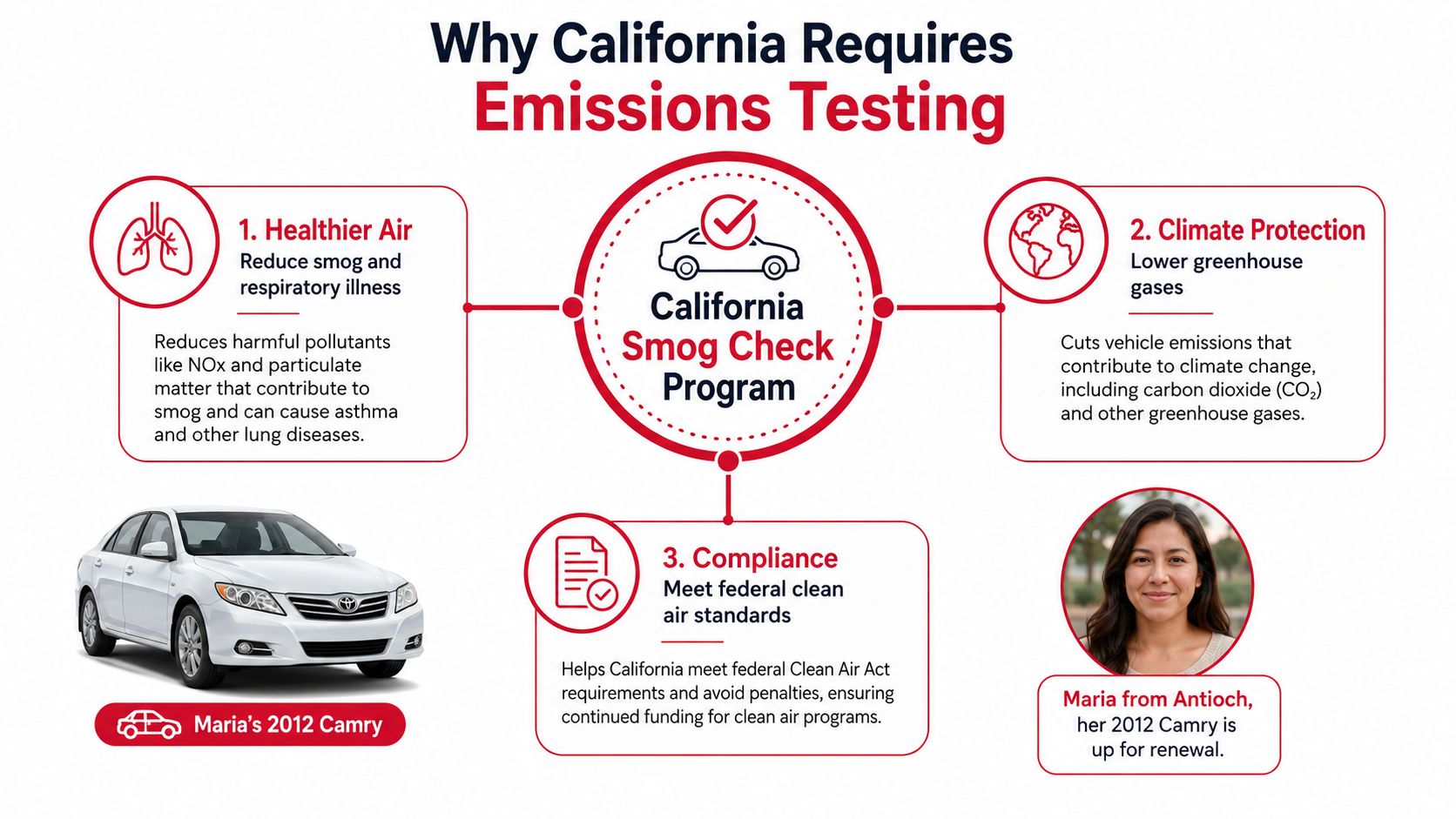
Table of Contents
- Why California Requires Emissions Testing
- Which Vehicles Must Be Tested
- STAR, Test-Only, and Regular Smog Stations Explained
- When and How Often You Need to Test
- Exemptions and Special Vehicle Cases
- How to Prepare Before You Arrive
- What Happens During the Test
- Failures, Retests and Your Next Steps
Why California Requires Emissions Testing
Maria from Antioch brings in her 2012 Camry because her registration renewal is coming up, and she wants to know why the state still asks for a smog check. The short answer is that California uses emissions testing to keep high-polluting vehicles from slipping through the registration process. In the federal framework, the Clean Air Act gave states and regulators the structure to run inspection and maintenance programs, and EPA guidance says those programs were formalized through the 1990 amendments and the original I/M rule followed in 1992 (EPA guidance on inspection and maintenance programs).
What the shop is trying to catch
A smog check is not one single test. It is an umbrella term for the visual inspection, the on-board diagnostics scan, and, for some older vehicles, the tailpipe portion that people usually picture when they hear “emissions test.” EPA describes the purpose as finding high-emitting in-use vehicles with short, warmed-up tests that can be done in idle mode or loaded mode, while still tracking real-world emissions problems (EPA emissions-testing technical guidance).
That matters in places like the Bay Area and the Central Valley because a dirty-running car doesn't stay in one zip code. It joins traffic, idles in lines, and adds to the air everyone breathes. The state's job is to reduce that risk before the vehicle gets another year on the road.
Practical rule: if the DMV needs a smog certificate, the certificate is part of the renewal, not a separate courtesy step.
How the DMV uses the test
The registration system is the enforcement hook. If the vehicle needs a smog check and the certificate doesn't clear, the DMV renewal doesn't clear either. That's why drivers often hear about emissions testing right when they need tags, plates, or a renewed registration card.
For Antioch drivers, that's usually the point where the process becomes very practical. You go to the station, the technician checks the car, and the result is sent into the registration workflow if the vehicle passes. The system is meant to be fast enough for everyday drivers, but firm enough that a failed vehicle can't skip the line.
Which Vehicles Must Be Tested
The easiest way to sort California emissions testing requirements is to put your vehicle into one of a few buckets. If your car is a newer gasoline model, you may be exempt. If it's older, diesel, or specifically flagged by the DMV, you may need to go in.
The three decision points that matter most
First, gasoline cars and light trucks 8 model years and newer are exempt this registration cycle. That means a 2018 vehicle is off the hook in 2026. Second, vehicles 6 model years and older fall into the regular biennial cycle, so they need a smog check every other renewal. Third, any vehicle that gets a DMV-directed STAR notice must go where the notice says, regardless of age.
Diesel adds a separate lane. Diesel trucks under 14,000 pounds GVWR follow a different annual rule through the state's heavy-duty program, so they don't fit neatly into the gasoline-car pattern. If you're unsure, the renewal notice usually tells you more than a general rule ever will.
Fast if-then guide
- If your gasoline car is 8 model years old or newer, you're usually exempt for this cycle.
- If your vehicle is 6 model years old or older, expect a biennial smog check.
- If the DMV mailed you a STAR-directed notice, follow that notice even if a regular station looks closer.
- If you own a diesel truck under 14,000 pounds GVWR, check the diesel-specific requirement rather than the gasoline schedule.
- If you're transferring a vehicle from out of state or changing ownership, expect an off-cycle visit.
| Vehicle Category | Model Year Rule | Test Frequency | Station Type Required |
|---|---|---|---|
| Gasoline cars and light trucks | 8 model years and newer exempt | No test this cycle | Any applicable station only if DMV directs it |
| Gasoline cars and light trucks | 6 model years and older | Every other renewal | Regular, STAR, or test-only, depending on DMV notice |
| Diesel trucks under 14,000 lbs GVWR | Separate diesel rule | Annual cycle | Follow the diesel-specific requirement |
| Out-of-state transfer or change of ownership | Based on transfer event | Off-cycle when required | As directed by the DMV notice |
| DMV-directed STAR vehicle | Any age | As directed | STAR station or test-only when specified |
If you want a station that handles California smog work and DMV paperwork in one place, Fire House Smog's STAR-certified smog station is set up for that kind of visit.
STAR, Test-Only, and Regular Smog Stations Explained
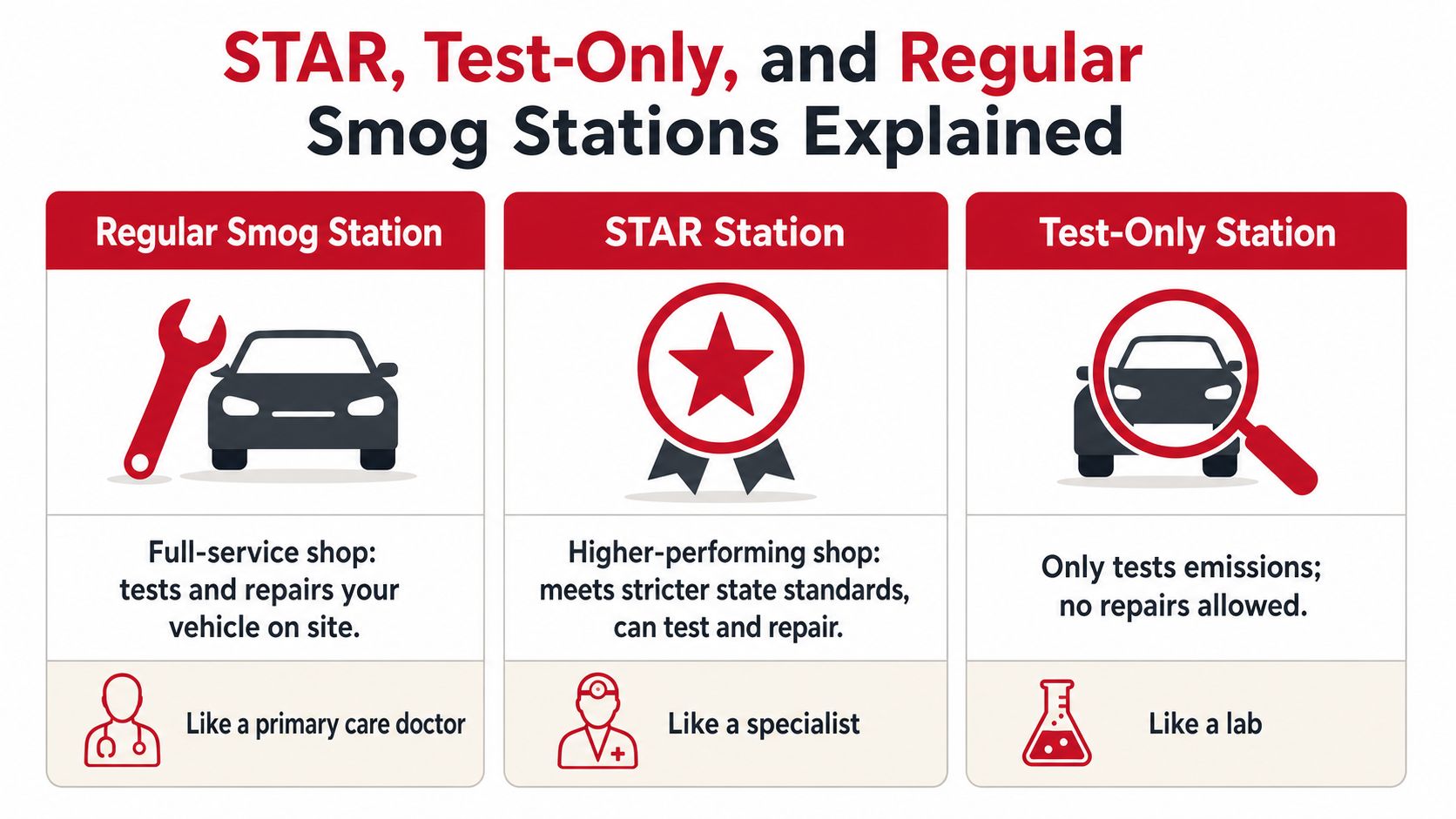
The station type changes where you're allowed to go, even when the inspection looks similar from the waiting room. A regular smog station can test vehicles and perform repairs. A STAR station meets additional state performance standards and handles vehicles that require closer oversight. A test-only station conducts the inspection but does not repair the vehicle it checks.
Why station type changes the trip
A regular station is convenient when you want testing and repairs handled at the same location. A STAR station can also test and repair, but it must meet stricter state standards. The DMV may direct certain vehicles there for closer control. A test-only station performs the inspection only. If the vehicle fails, you must take it somewhere else for diagnosis or repair.
That difference matters for drivers in Antioch and East Contra Costa County. If the DMV notice directs you to a STAR or test-only station, visiting the wrong shop can mean another drive, another line, and time away from work. The notice determines the station type, not the station your neighbor used last year.
How the DMV decides where you go
The DMV can assign a vehicle to STAR based on its inspection history or random selection. Repeated high emissions can also place the vehicle in a more closely controlled category. The state is trying to keep the highest-risk cars under closer watch.
A test-only station separates inspection from repair, so the result is focused on compliance rather than repair sales.
Read the renewal notice before choosing a location. If it says STAR, select a STAR station, such as Fire House Smog's STAR-certified smog station. If it specifies test-only, choose a station that performs inspections without repairs. Regular stations remain appropriate when the DMV does not assign a different type.
The right station prevents an avoidable second visit. At the shop counter, bring the notice and confirm the required station type before the vehicle enters the test lane.
When and How Often You Need to Test
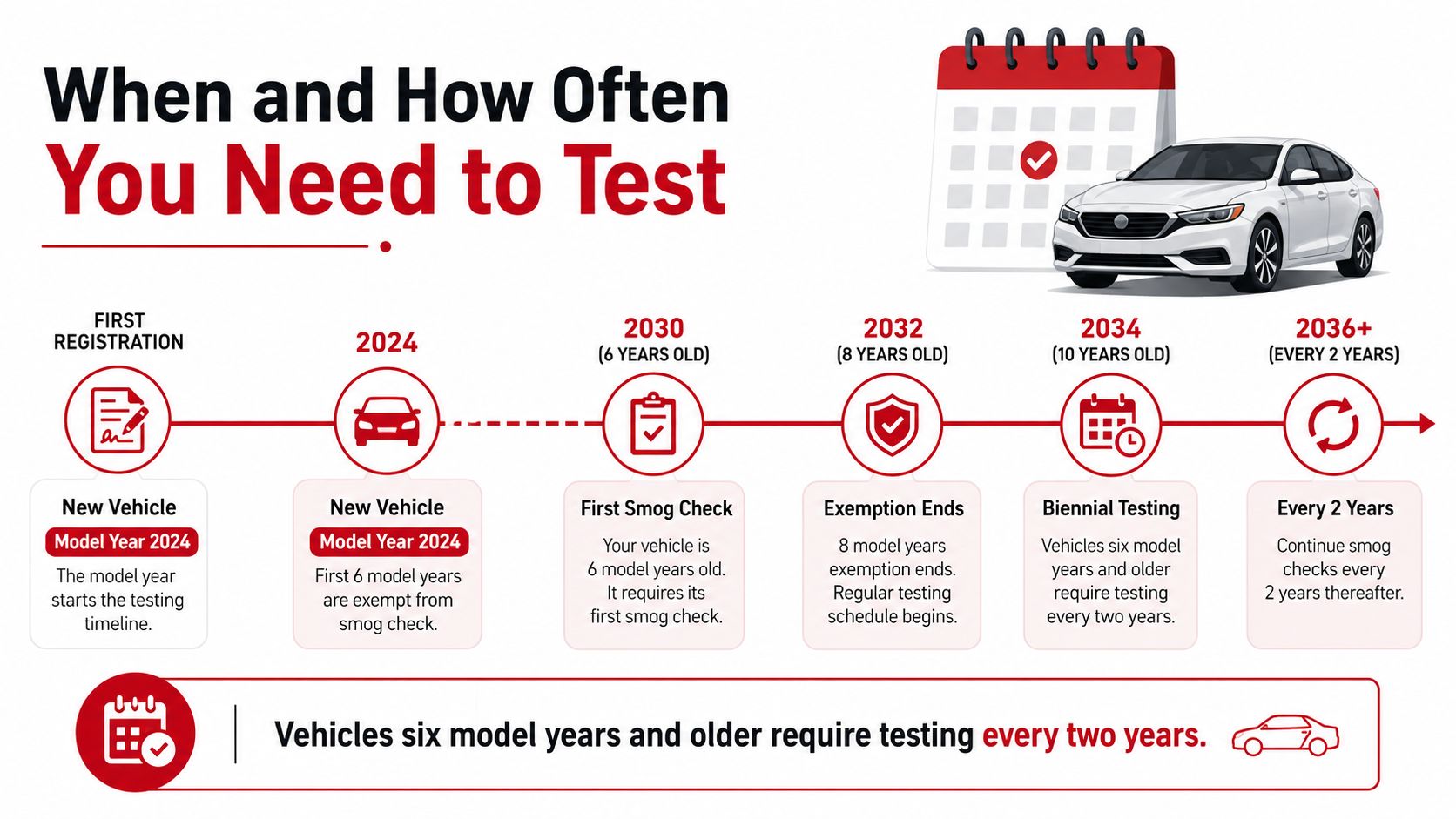
The DMV renewal notice is the best calendar you have. California's biennial cycle is tied to the vehicle's model year, not to when you bought it or when you feel like dealing with it, so the model year determines when the smog requirement starts and how often it returns.
Reading the cycle the right way
A simple way to think about it is this. Newer gasoline vehicles get a long exemption window, then the smog requirement begins once the vehicle reaches the older category that the state regulates. After that, the vehicle comes back every other renewal. The renewal notice matters because it tells you the due date the DMV wants, and that date controls the registration process.
For a 2024 model-year vehicle, the timeline starts with the no-test window, then the first required smog check comes later in the vehicle's life, and after that the pattern continues on the same two-year rhythm. The date printed by the DMV still wins if it conflicts with a general rule you heard from a friend.
Off-cycle visits that catch people off guard
Not every smog appointment follows the regular renewal clock. An out-of-state title transfer can trigger a visit before California issues plates. A change of ownership can do the same. A vehicle that's been stored, brought back into service, or previously failed and got a DMV-directed follow-up may also need to go back off-cycle.
Diesel trucks under 14,000 pounds live in their own lane, so their timing doesn't follow the same gasoline pattern. That's why the registration card and renewal notice matter so much. They're the state's instructions for your specific vehicle, not a generic sample notice.
Practical rule: if the DMV letter and a general online rule disagree, the DMV letter is the one to follow.
That rule saves drivers from showing up early, too late, or at the wrong kind of station. It also keeps the visit focused on what the DMV needs, which is the fastest path from the bay back to the renewal counter.
Exemptions and Special Vehicle Cases
Some vehicles never need a smog check, and others only need one when a specific event happens. The trick is to sort “never,” “not yet,” and “only if the DMV asks” into separate buckets. That distinction keeps drivers from paying for a test they don't owe.
Vehicles that are usually exempt
The most common exemptions are straightforward. Battery-electric vehicles and hydrogen fuel cell vehicles do not need smog tests. Motorcycles, trailers, farm equipment, and most vehicles older than 1975 are also outside the regular smog cycle. New gasoline cars and light trucks get the 8 model year exemption window described earlier, so a 2026 model sold in 2025 would be exempt through that early period.
Hybrid vehicles are different. They still follow the biennial cycle when the state places them in the tested category, because they still have a gas engine that can emit pollution. That's a common point of confusion at the counter.
Special cases that still trip people up
An out-of-state vehicle being registered in California for the first time usually must pass before plates are issued. A transfer of ownership can also bring testing back into the picture, even if the seller just had one done recently. And if the DMV has flagged a prior problem, that flag can override a driver's assumption that the car is exempt.
There are also hardship tools for some drivers. California has hardship extensions and economic hardship waivers for eligible cases, and those requests depend on income limits and proof that the needed repairs are beyond the state-set cost threshold. If a driver qualifies, that changes the repair path, but it doesn't erase the need to document the issue.
| Vehicle Type | Smog Check Required? | Notes |
|---|---|---|
| Battery-electric vehicle | No | No tailpipe emissions to test |
| Hydrogen fuel cell vehicle | No | Exempt from smog testing |
| Motorcycle | No | Outside the regular program |
| Trailer | No | Not a self-propelled emissions source |
| Most vehicles older than 1975 | No | Common exemption category |
| Hybrid vehicle | Sometimes | Follows the applicable smog cycle when required |
| Diesel truck under 14,000 lbs GVWR | Yes, under diesel rules | Separate annual requirement |
| Out-of-state first registration | Yes, when required | Must pass before plates are issued |
For drivers who want a local place to handle both emissions work and registration tasks, Fire House Smog's smog exemption guide is a useful reference before heading out.
How to Prepare Before You Arrive
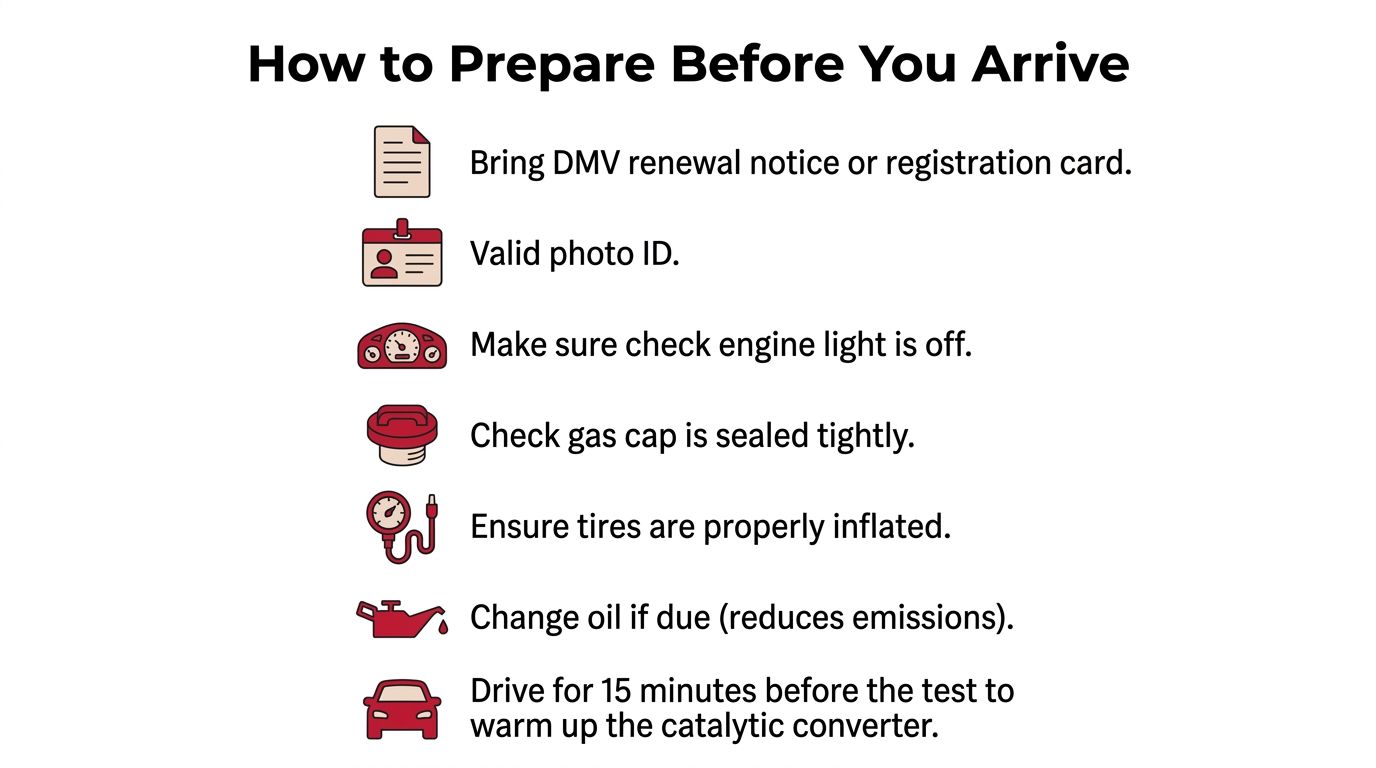
The cleanest smog visit starts the night before. A little prep helps the technician move straight into the inspection instead of pausing for paperwork, a dead battery, or a loose gas cap that could have been fixed at home in thirty seconds.
What to bring
- DMV renewal notice or registration card: This tells the station what the DMV expects.
- Valid photo ID: The shop may need to verify who's dropping off the vehicle.
- Prior smog certificate if you're retesting: That keeps the follow-up visit tied to the original failure.
- Payment method: Many shops take cash, card, and sometimes check, but it's smart to confirm before you leave.
What to check on the car
Warm the engine before you arrive. A drive of at least fifteen minutes helps the catalytic converter and other parts reach normal operating temperature, which is how the test is meant to be performed. Make sure the check engine light is off, because that light often points to a problem the scan will catch.
A tight gas cap matters too. If it doesn't seal properly, the system can fail the pressure check. Even tire pressure can help keep the car stable during any loaded testing setup, so don't ignore it if the tires look uneven.
Practical rule: if the battery was recently disconnected, take the car on a short drive first so the readiness monitors can relearn normal operation.
The inside of the car matters less than the engine, but it still helps to remove loose items so the technician can move freely and confirm the VIN without clutter. At busy stations in Antioch, arriving a few minutes early keeps the appointment smooth, especially if the renewal notice has a STAR or test-only instruction written on it.
What Happens During the Test
At a STAR station in Antioch, the visit usually starts with a quick intake at the bay. The technician checks the VIN, fuel type, and registration details so the car matches the paperwork. That first step is simple, but it prevents the wrong vehicle from getting tested under the wrong rule.
The inspection inside and under the hood
The technician then does the visual checks required for the vehicle. On newer cars, the OBD-II scan reads readiness monitors and trouble codes from the car's computer. On older vehicles, the inspection can include the tailpipe portion and related emissions checks, which is why the process looks different depending on what you drive.
Gas caps may be pressure-tested as part of the process, because a bad seal can let pollution escape where it shouldn't. The technician may also look at emissions-related parts under the hood to make sure they're present and connected. The point is not to make your life hard, it's to confirm the car still matches the emissions system it was built to use.
What the driver experiences
Most drivers wait in the lobby while the inspection runs. The full visit is usually short enough to fit into a normal errand stop, and the technician shares the result before anything gets sent into the DMV system. If the vehicle passes, the certificate moves the registration forward. If it fails, the printed result becomes the starting point for repairs.
The process is standardized statewide by BAR, so the same basic steps apply whether you're tested in Antioch or elsewhere in California. If the car fails and the station offers a retest coupon or retest policy, ask about the window and the fee before you leave. That small question can save you a second surprise trip.
Failures, Retests and Your Next Steps
A failed smog test is not the end of the road. It just tells you where the car needs work before the DMV will accept the certificate. The useful part is that the report points to the problem instead of leaving you to guess.
What the three outcomes look like
A pass means the certificate is sent to the DMV and the registration path keeps moving. A fail means you get a printed repair report that shows which component, system, or readiness item didn't meet the requirement. A directed-repair notice means the DMV wants the vehicle handled in a particular way, often because the case needs more control than a routine renewal.
After a fail, the next step is usually repair and retest. California gives drivers a 30-day window to make repairs and return, and the retest fee is a normal part of that process unless the station's policy says otherwise. Some stations offer a free-retest coupon within the required period at the same location, which can lower the cost if you come back on time.
Getting help when repair costs are the problem
The state also has Consumer Assistance Program options through ARB, including Repair Assistance and Vehicle Retirement for income-eligible drivers. Those programs can help when the repair bill is more than the vehicle owner can reasonably absorb. The exact eligibility rules matter, so this is one of those moments where the paperwork is as important as the wrench work.
The station's result page can help you understand what the paper means before you call around for repairs. If you need that translation, the emissions test results guide is a practical place to start.
Once you know the failure reason, call the shop, schedule the return visit, and confirm whether the DMV wants a STAR station for the retest. Bring the original paperwork back with you, because that keeps the second visit tied to the first one instead of starting over.
If your registration is due and you want the paperwork handled without bouncing between offices, Fire House Smog can perform the smog check and help with DMV registration tasks in Antioch. Visit Fire House Smog to plan your visit, confirm station requirements, and get your vehicle checked before the renewal deadline.
An auto check center coupon can cut the advertised smog-test price by $15, and the Fire House Smog offer includes a free retest when its policy conditions are met. You'll need to show the coupon on your phone in person, not just mention that you saw it online.
Your registration deadline is close, you've found a discount online, and now you're wondering whether the low price covers the entire inspection or only part of it. That's the right question to ask before driving across Antioch. A coupon saves the most when your vehicle is eligible, your OBD system is ready, and you arrive with the required proof already visible.
The offer is more than a lower inspection charge. Used correctly, it combines a reduced test price with protection against paying again for an eligible retest. The catch is simple: the car still has to meet California testing requirements, and the offer's vehicle, redemption, and retest terms control the final result.
Table of Contents
- What an Auto Check Center Coupon Actually Gets You
- Reading the Fine Print Before You Book
- Preparing Your Vehicle So the Coupon Counts
- Redeeming the Coupon In Person
- Using the Free Retest Without Losing the Discount
- Smart Ways to Stretch the Coupon Even Further
What an Auto Check Center Coupon Actually Gets You
A driver who finds an auto check center coupon online usually wants three answers: How much is the discount? What does the offer cover? What should I bring? For the Fire House Smog offer, the published deal reduces the smog-check charge by $15, and the coupon must be presented at the service desk on your phone or in the required printed form. The discount applies to the qualifying smog service, not automatically to every vehicle, fee, or additional transaction.
The second part is the free retest. If the vehicle fails the initial inspection and the station's policy requirements are satisfied, the customer can return for the eligible retest without paying another test charge. That condition matters because a low first-visit price has limited value if an unready vehicle creates a second full-price visit.
Why the test-only model matters
Fire House Smog operates as a STAR-certified test-only station. A test-only station performs the inspection but doesn't sell the repair work needed after a failure. That separation gives you a clearer decision point: the station reports the result, and you choose where to diagnose or repair the vehicle.
The coupon therefore works in two ways:
- Immediate savings: The qualifying inspection fee is reduced by the advertised amount.
- Retest protection: An eligible failed inspection can lead to a no-charge retest under the station's terms.
- Less repair pressure: The test-only format means the inspection facility isn't using the failure as a reason to sell in-house repairs.
- Compliance-focused service: The STAR certification matters when your vehicle or DMV notice requires a STAR-directed inspection.
Practical rule: Treat the coupon as a lower test price plus a safety net, not as a guarantee that the vehicle will pass.
Before leaving home, open the offer on your phone, check that the text is readable, and keep your registration or renewal notice with you. A coupon can reduce the cost of the visit, but it can't waive state requirements or repair a vehicle that isn't ready.
Reading the Fine Print Before You Book
Most coupon complaints begin with a mismatch between the advertised rate and the vehicle that arrives at the bay. Online smog offers commonly advertise discounts ranging from about 25% to 64%, with some listings showing offers as high as 67%, while the final transaction may still include state-related fees. Groupon's smog-check listings also describe standard smog checks as commonly costing about $40 to $80 before taxes and state fees, with coupons sometimes bringing the out-of-pocket service price into the $20 to $40 range.
Those figures are market context, not a promise for your car. California offers often separate the base test price from the certificate fee, and vehicle class can change the charge. A low search-result snippet may apply only to qualifying cars and newer model years, while older vehicles, diesels, RVs, or specialty tests may carry different terms.
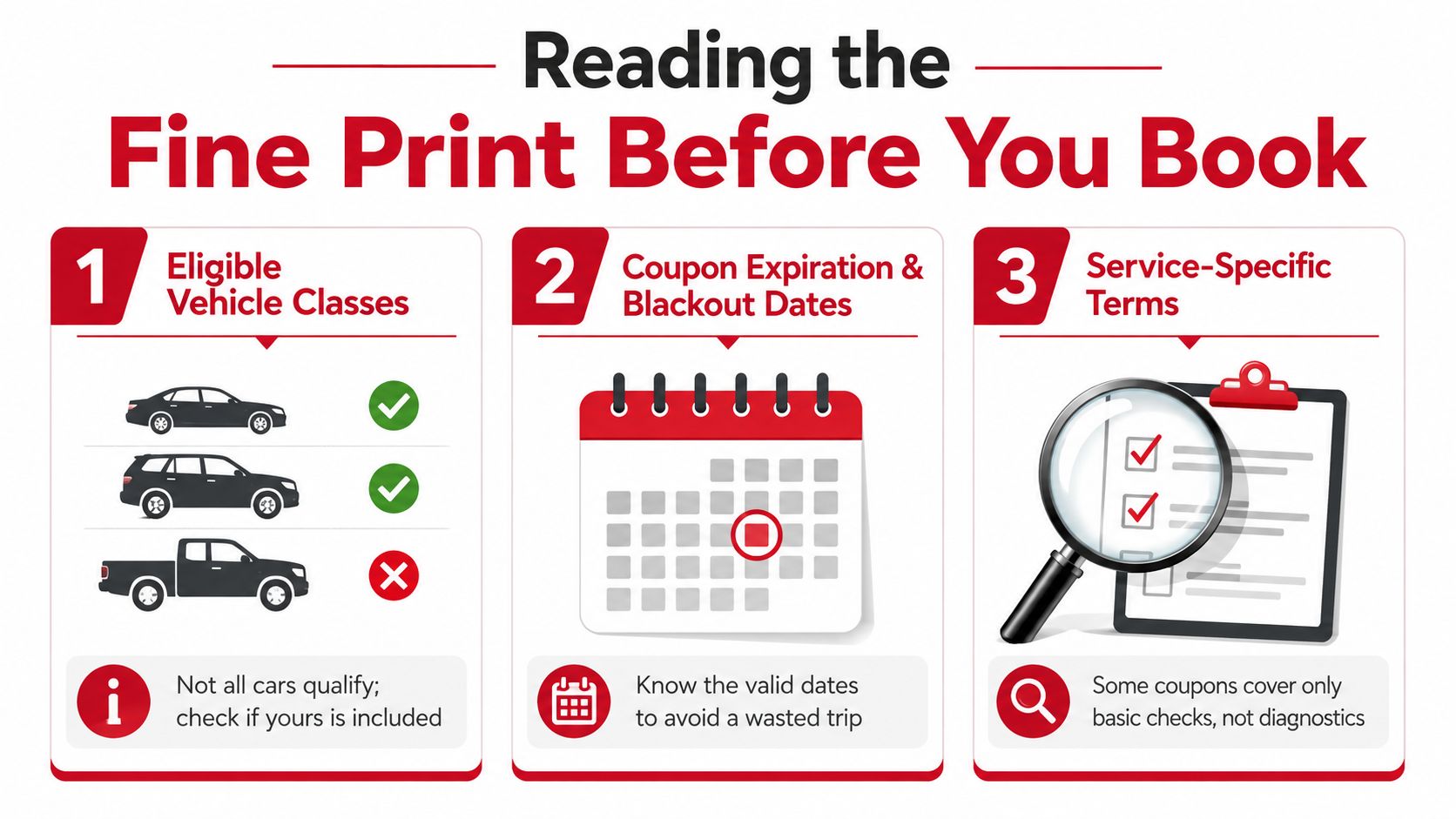
Check these terms before driving over
| Term | What to confirm |
|---|---|
| Vehicle class | Ask whether the offer covers your car, SUV, truck, or light-duty van. |
| Model year | Check for year limits such as “2000 and newer” or “1996 and newer.” |
| Special vehicles | Confirm rules for diesels, RVs, motorhomes, and vehicles that may not fit the equipment. |
| Certificate fee | Ask whether the mandatory state certificate charge is included or added separately. |
| Redemption method | Confirm whether you must show the offer on your phone, print it, or mention a code. |
| Expiration terms | Check the expiration date and exclusions before scheduling. |
The Fire House Smog coupon policy is the right place to verify the Antioch offer's current conditions rather than relying on a third-party snippet. Use one decision rule: if the station can't confirm eligibility, certificate-fee treatment, and redemption requirements, don't assume the headline price is your out-the-door price.
Preparing Your Vehicle So the Coupon Counts
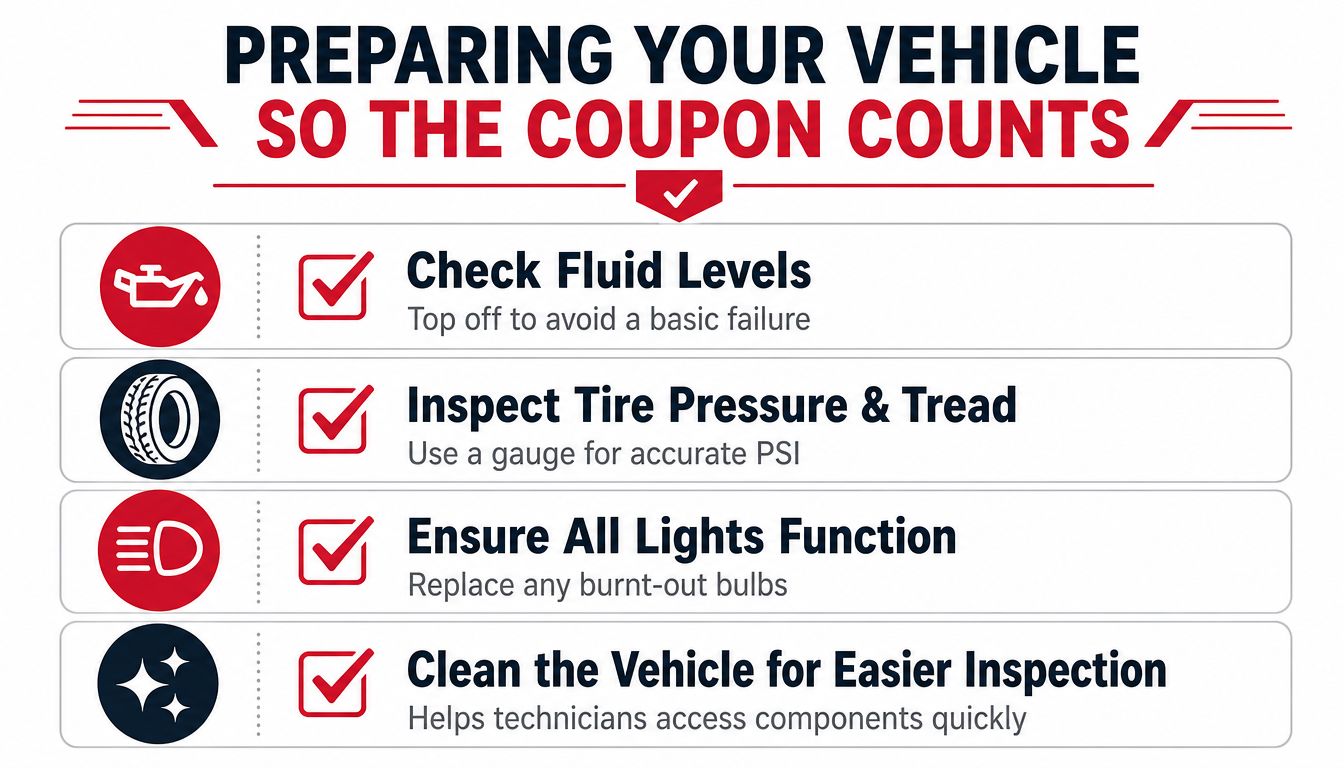
The best coupon is the one you use on a car that passes the first time. A free retest helps after a failure, but it doesn't replace the time spent diagnosing the problem, arranging repairs, and returning to the station.
Start with the emissions data, not just the way the car feels on the road. California's Smog Check performance reporting recorded an overall failure rate of about 7% for 2000 and newer model-year vehicles in the 2024–2025 cycle, while roadside fleet-weighted checks showed a rate of about 14%. Those figures come from the California BAR performance report, and they illustrate why a vehicle that drives normally can still fail a formal inspection.
Run this morning-of checklist
- Check OBD readiness. Use a compatible scan tool to confirm the required monitors are ready. If the battery was recently disconnected or codes were cleared, the system may need additional driving before testing.
- Look for pending or stored codes. A check-engine light isn't the only concern. Pending faults can indicate an emissions problem even when the light hasn't illuminated.
- Inspect the gas cap. Tighten it until it clicks. Replace a damaged or poorly sealing cap before the appointment.
- Warm the engine. Arrive with the vehicle at normal operating temperature, unless the station gives you different instructions.
- Check visible emissions hardware. Don't remove, disconnect, or alter components such as the catalytic converter, air-injection parts, or vacuum lines.
- Bring the paperwork. Keep your registration, renewal notice, payment method, identification for DMV services, and coupon together.
Don't clear a code immediately before the test and assume the problem is gone. Clearing codes can also reset readiness monitors, creating a different reason for rejection. For a plain-language review of common failure causes, use Fire House Smog's guide to smog test failure reasons, then decide whether the vehicle needs diagnosis before inspection.
Redeeming the Coupon In Person
At a STAR-certified test-only station such as Fire House Smog, redemption starts before the technician connects the equipment. Pull into the drive-through layout on Lone Tree Way, keep the coupon open on your phone, and show it at the counter before the transaction is finalized. Don't wait until after payment to ask whether the discount can be applied.
Bring the registration or DMV renewal notice so the technician can match the vehicle and service request. Bring a payment method, and bring identification if you also want DMV registration services. If you're completing a renewal or ownership-transfer transaction, have the related paperwork ready instead of expecting the smog counter to reconstruct it from memory.
What happens in the bay
The technician confirms the vehicle and test type, applies the qualifying coupon terms, and begins the inspection. Depending on the vehicle and applicable California procedure, the process can include:
- Connecting to the vehicle's OBD system.
- Checking readiness data and diagnostic information.
- Performing visual checks of emissions equipment.
- Conducting a tailpipe test where the procedure requires it.
- Recording the result for the state emissions program.
The station's two service bays support a straightforward workflow, but arrival time still affects your wait. A visit during a quieter period is usually easier than arriving during a DMV rush, especially if you're combining the smog check with registration work.
If the vehicle passes, the STAR certificate supports the applicable DMV transaction. When on-site DMV services are requested and available, the station can also process qualifying renewals or ownership tasks, including tag issuance according to its posted services and hours.
The test-only structure is important if the vehicle fails. Fire House Smog doesn't perform the repair work, so you receive the inspection result without an in-house repair sale attached to it. You can then take the report to the repair provider of your choice.
Using the Free Retest Without Losing the Discount
A failed first inspection does not end the coupon. It starts a repair-and-return process under the station's published terms. Before leaving, ask for the retest deadline, required documents, and whether you must schedule the return. For the Antioch station's test-only model, the inspection result identifies the problem, while repairs must be completed elsewhere. Review the test-only smog check details before booking if you expect to need a retest.
Keep the original coupon and failed inspection paperwork. The report gives your repair provider a clear starting point. Depending on the station's policy, bring repair receipts, parts invoices, or other proof that the listed issue was corrected.
Follow the return sequence
- Keep the failed-test paperwork. Save the report and original coupon.
- Repair the listed issue. Use a qualified provider and retain the invoice.
- Confirm readiness again. After repairs or code clearing, verify that the OBD monitors are ready.
- Contact the station. Confirm whether an appointment is required and which documents to bring.
- Return within the policy window. A late visit may lose the no-charge retest.
- Present the original documentation. Let the station connect the retest to the first inspection.
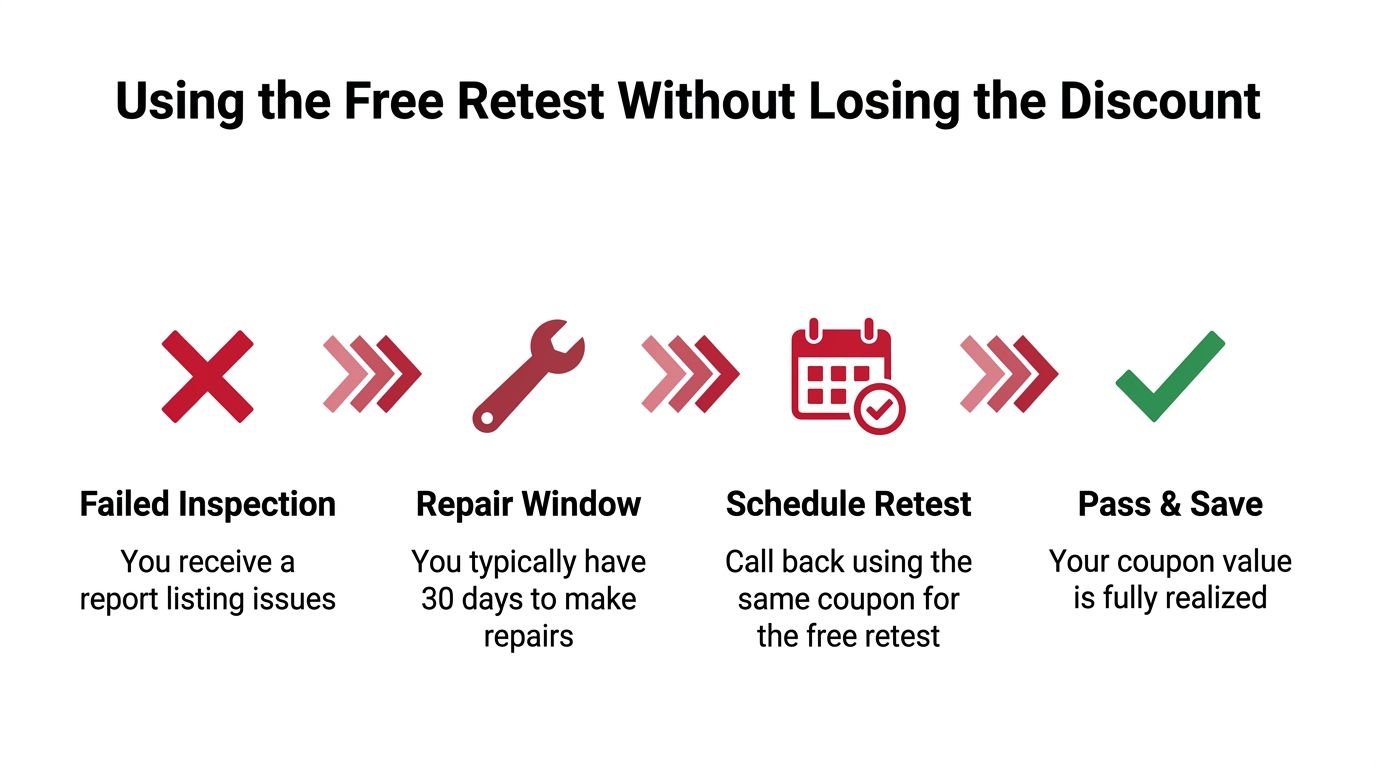
The free retest helps when the repair is completed correctly. Formal inspection programs reject a meaningful share of vehicles, and the EPA technical analysis describes a target rejection band of roughly 10% to 20% of inspected vehicles for short emissions tests. A failure does not establish that the station made an error, and repairs may require more than a minor adjustment.
Program reporting also identifies failures on first retests, including roughly 11% on first retests. Do not spend the coupon return on a guess. Use the no-charge retest only after the vehicle is fully prepared and the monitors are ready.
Smart Ways to Stretch the Coupon Even Further
The strongest savings playbook is operational. Choose the right station format, verify the offer before you leave, and remove avoidable reasons for a second trip. Chasing the biggest percentage in a search result is less useful than confirming the exact final charge for your vehicle.
Make the visit efficient
Visit during a quieter weekday period when your schedule allows. Mid-morning can be easier than a weekend rush, particularly if you also need DMV work. Call ahead for an RV, motorhome, diesel, or unusual vehicle because equipment and bay-size restrictions may change eligibility.
Pair services only when you need them. If your registration renewal is due, ask whether the station provides the DMV transaction on-site and whether the required paperwork is complete. A combined visit can save a separate trip, but it doesn't change the emissions requirements or make an ineligible vehicle qualify.
Protect the advertised savings
Use this short checklist before leaving home:
- Read the terms: Confirm vehicle class, model year, expiration, exclusions, and certificate-fee treatment.
- Check readiness: Scan for codes and verify that the monitors are set.
- Show the offer: Keep the coupon visible on your phone before check-in.
- Bring registration: Carry the renewal notice or registration and any DMV documents.
- Save repair records: Keep invoices if you need to use the retest policy.
- Return promptly: Use the free retest within the station's stated window if the first inspection fails.

A test-only station can also reduce decision pressure because the facility isn't selling the repairs. That doesn't make the inspection easier, but it gives you a cleaner separation between testing and diagnosis. The coupon does its job when you combine that neutral test model with a ready vehicle and complete documentation.
Use the same approach at any STAR station. Compare the actual qualifying price, not the promotional headline, and ask what happens if the vehicle fails. The free retest, eligibility rules, and state-related charges matter more than a flashy discount.
Fire House Smog offers STAR-certified test-only smog checks, a published coupon discount, eligible free retests, and on-site DMV services at its Antioch location. Bring your phone coupon and registration, confirm your vehicle's eligibility before you drive over, and visit Fire House Smog to review the current offer and plan your inspection.
You're standing at the counter with a 32-foot motorhome title in one hand and a DMV renewal notice in the other, and nobody has bothered to tell you whether this rig needs a regular smog check, a STAR station, or a completely different emissions program. That's the part that trips most owners up. A motorhome is not handled like a normal sedan, and if you guess wrong, you waste a day, miss your registration timing, or roll up to a station that can't inspect the vehicle anyway.
The smart move is to treat smog check for motorhomes as a decision tree, not a simple appointment. Your answer depends on fuel type, model year, GVWR, and whether the DMV notice specifically calls for STAR testing. For heavier diesel rigs, the path can shift again into Clean Truck Check territory. If you know which lane you're in before you leave home, the rest gets much easier.
Table of Contents
- Why Motorhome Smog Checks Catch Owners Off Guard
- Which Motorhomes Need a Smog Check in California
- Standard Smog Check vs Clean Truck Check for Heavy RVs
- STAR Stations and What Your Renewal Notice Is Telling You
- How to Prepare Your Motorhome Before the Test
- Visiting Fire House Smog in Antioch With a Motorhome
- Common Mistakes That Waste a Motorhome Smog Trip
Why Motorhome Smog Checks Catch Owners Off Guard
A guy walks into a station with a clean-looking Class A and assumes the same rules that apply to his pickup will apply here. Five minutes later, he's learning the bay won't fit the coach, or the fuel type sends him into a different emissions lane, or the renewal notice wants STAR capacity he didn't plan for. That's a bad day, and it happens because RV owners think “motorhome” is the main rule. It isn't.
The vehicle type is not the whole story
California doesn't decide this with one label. The practical screening variables are fuel type, model year, GVWR, and whether the renewal notice flags STAR testing. The BAR says RVs and motorhomes meeting the applicable criteria need a Smog Check, so being recreational doesn't buy you an exemption by itself. You need to know which rule bucket your coach falls into before you book anything. California Smog Check rules for RVs and motorhomes
Practical rule: Don't call a station and ask, “Do you smog motorhomes?” Ask, “What's the cutoff for my fuel type, model year, and gross weight, and do you handle STAR or Clean Truck Check vehicles?”
That's the only way to avoid guessing.
The station can be right for cars and wrong for your rig
A lot of stations are built around passenger cars and light trucks. A motorhome can need more space, different equipment, or a different inspection lane entirely. California's own data shows how much volume the program handles, with 10.3 million initial inspections in 2019, and about 8.4 million, or 82%, completed at STAR stations. That tells you two things. STAR-capable stations matter, and the system has long been built around high-volume screening, not casual one-off RV surprises. California Smog Check performance report
Start with the right questions
Before you book, ask yourself these four things in plain English.
- What fuel does it use? Gasoline, diesel, hybrid, or alternative fuel changes the lane.
- What model year is it? The cutoff dates are different for gas and diesel.
- How heavy is it? GVWR can push the vehicle into a different compliance regime.
- Does the DMV notice mention STAR? If it does, don't ignore that wording.
That's the map. If you answer those questions first, you're not just scheduling a smog check. You're routing the vehicle to the right program the first time.
Which Motorhomes Need a Smog Check in California
California keeps this simple once you look at the registration rules instead of the RV badge. Gasoline, hybrid, and alternative-fuel vehicles model year 1976 and newer require Smog Check. Diesel vehicles model year 1998 and newer require Smog Check. The BAR also says RVs and motorhomes that meet those standards need a Smog Check, so there is no separate recreational exemption buried in the fine print. BAR Smog Check rules
Fuel type and model year set the starting point
If your motorhome runs on gasoline and is 1976 or newer, treat it as a Smog Check vehicle unless the DMV notice says something different. If it runs on diesel and is 1998 or newer, use the same rule. Fuel type and model year decide whether a motorhome enters the program, not its recreational classification.
That is the part owners miss. They look at the coach body and assume the RV label changes the rule. It does not. The state starts with fuel type, then checks model year.
The first test does not happen right away
The BAR's current rule uses an eight model year trigger for the first inspection. A 2020 model-year vehicle first needs a renewal smog inspection in 2028. That is the cleanest way to read the calendar. You are not counting miles, you are counting model-year age the way the DMV does. BAR Smog Check rules
A lot of owners miss the first test window because the coach is stored, used seasonally, or only driven on trips. The DMV does not care about your usage pattern. It cares about the model year rule.
California Motorhome Smog Eligibility at a Glance
| Fuel Type | Model Year | Smog Check Required | First Test Trigger |
|---|---|---|---|
| Gasoline, hybrid, alternative fuel | 1976 and newer | Yes, when the vehicle meets California's motorhome rules | Eight model years after the model year |
| Diesel | 1998 and newer | Yes, when the vehicle meets California's motorhome rules | Eight model years after the model year |
If you want the plain answer, here it is. Motorhome does not mean exempt. Fuel type and model year decide the starting point. If the registration notice points you to inspection, take it seriously and set the first required smog date on your calendar as soon as you can. For a motorhome that is already in the inspection window, a station that handles larger vehicles, such as Fire House Smog's truck and RV smog info, is the right place to start.
Standard Smog Check vs Clean Truck Check for Heavy RVs
Owners get surprised here because the coach looks like a normal motorhome, but California may treat it like a heavier compliance vehicle. The line that matters is simple. If a California-registered motorhome is over 14,000 lb GVWR and runs on diesel or another non-gasoline fuel, CARB places it under Clean Truck Check rules instead of the ordinary Smog Check lane. CARB Clean Truck Check motorhome fact sheet
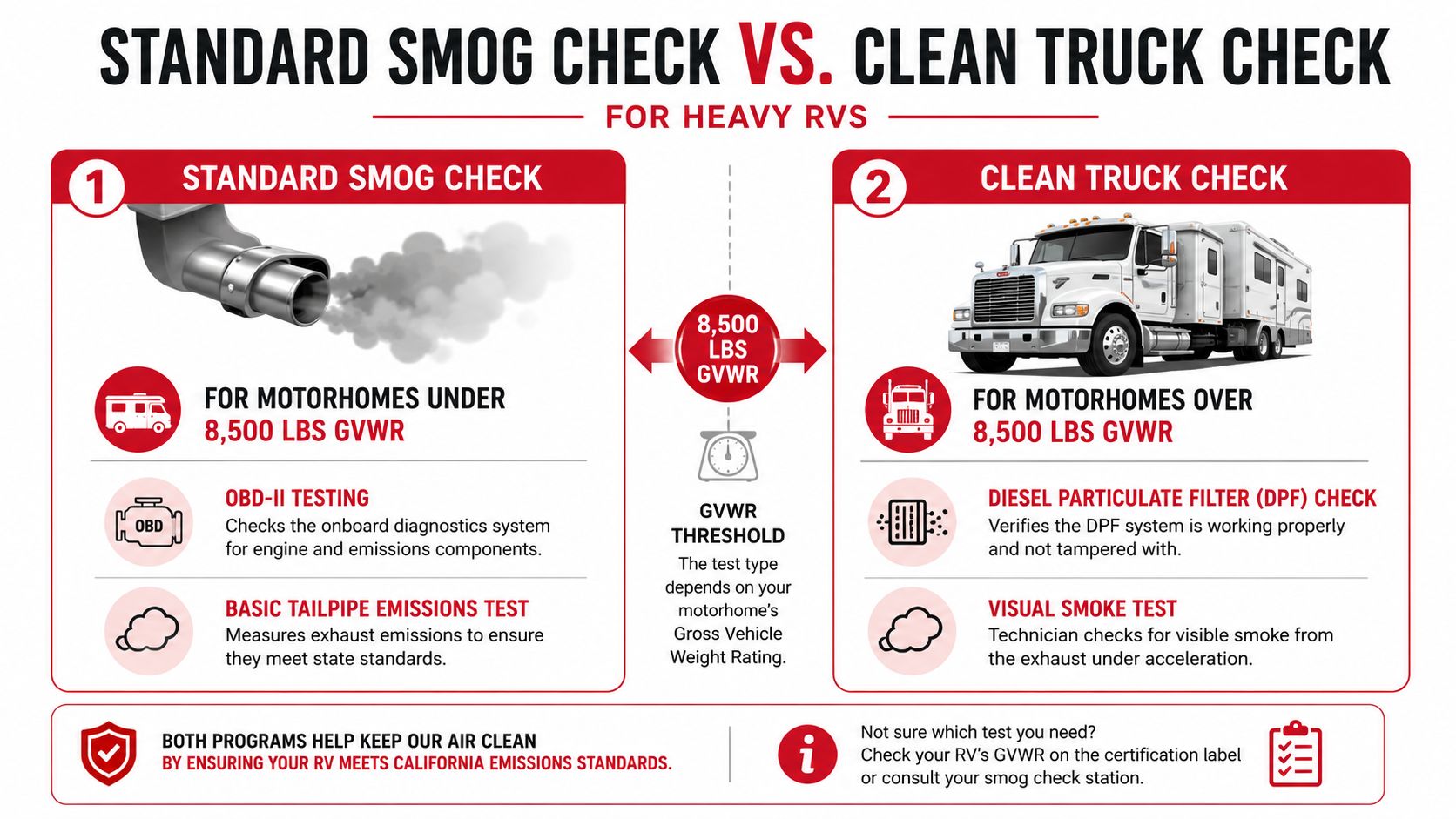
The inspection method changes with the vehicle
Standard Smog Check still applies to lighter motorhomes that fit the regular California inspection rules. BAR's performance report also shows that enhanced-area ASM testing is limited to motor homes under 8,501 GVWR, which is one of the practical cutoffs stations use when deciding what test equipment and procedure to use. That threshold matters because it tells you when a lighter rig can still be handled through the normal smog process. California Smog Check performance report
Clean Truck Check uses a different test path. For 2013 and newer diesel engines and 2018 and newer alternative-fuel engines, CARB requires an OBD data scan with a CARB-certified device. Older diesel vehicles go through a smoke opacity test and a visual inspection of emissions controls. Same coach body, different inspection route. CARB Clean Truck Check motorhome fact sheet
Side by side, the difference is obvious
| Lane | Typical Trigger | What Gets Checked |
|---|---|---|
| Standard Smog Check | Light-duty motorhome rules, fuel type and model year based | Regular smog inspection methods tied to California Smog Check |
| Clean Truck Check | California-registered motorhome over 14,000 lb GVWR running diesel or other non-gasoline fuel | OBD scan on newer engines, opacity and visual checks on older diesels |
If your rig is heavy and diesel, do not book it like a car. Call the station first, and if you want a place that works with truck-style compliance work, this motor vehicle smog inspection resource is the kind of category page worth checking before you drive across town.
The owner's mistake is usually assuming the chassis decides everything
GVWR, fuel type, and engine model year determine the testing path, so two similar-looking coaches can follow different inspection routes. A gas-powered motorhome and a diesel coach may look nearly the same in the driveway, but the station may handle them differently once the VIN, weight class, and engine family are checked. If you own a heavy diesel coach, stop calling it a generic smog check and start sorting out which compliance lane it belongs in.
STAR Stations and What Your Renewal Notice Is Telling You
A STAR mark on your renewal notice means the DMV wants a higher-performance inspection lane for that vehicle. It points you to the right kind of station before you waste time at a shop that cannot process the notice correctly.
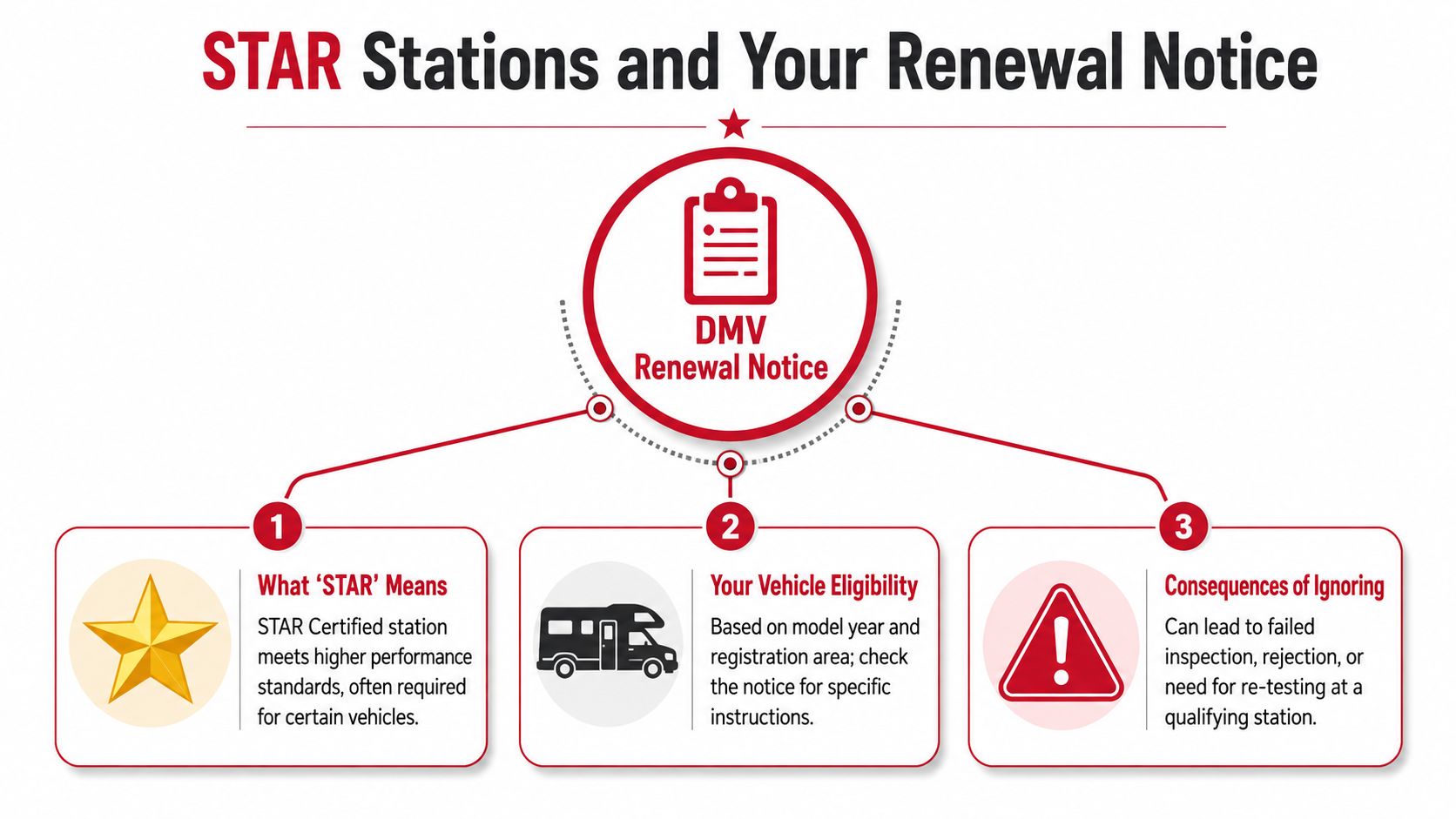
STAR and test-only are not the same thing
A STAR-certified station is a station that meets the state's higher performance standard for that inspection role. A test-only station performs the inspection and does not sell repairs, so it removes the repair upsell conflict a lot of owners worry about. Those are separate categories, and mixing them up leads to bad assumptions when you book the appointment. If you want the plain-language version of the designation, see what STAR certified means.
Read the renewal notice, not your assumptions
The renewal notice is the document that controls your next step. If it says STAR, follow that instruction. If it does not mention STAR, do not guess that you still need it, and do not guess that you are exempt either. Check the fuel type and model year first, then read any specific testing instruction printed on the notice.
Plain advice: If the notice calls for STAR, bring the notice to the station and let the paperwork drive the appointment. Guessing costs time.
What matters when you're deciding where to go
- If STAR is listed: You need a station that can meet that requirement.
- If STAR is not listed: You may still need a regular smog inspection based on vehicle rules.
- If the coach is heavy and diesel: Confirm whether it belongs in Clean Truck Check instead of standard Smog Check.
- If you're unsure: Call ahead with the VIN, fuel type, model year, and GVWR handy.
A renewal notice can steer you into the wrong lane if you read it loosely. The smart move is to match the notice to the vehicle details, then choose the station that can legally handle that job.
How to Prepare Your Motorhome Before the Test
Most failed inspections are avoidable. Owners show up with a cold engine, a warning light glowing on the dash, missing paperwork, or a rig that hasn't been checked for obvious leaks. That turns a normal appointment into a return trip, and it doesn't need to happen.
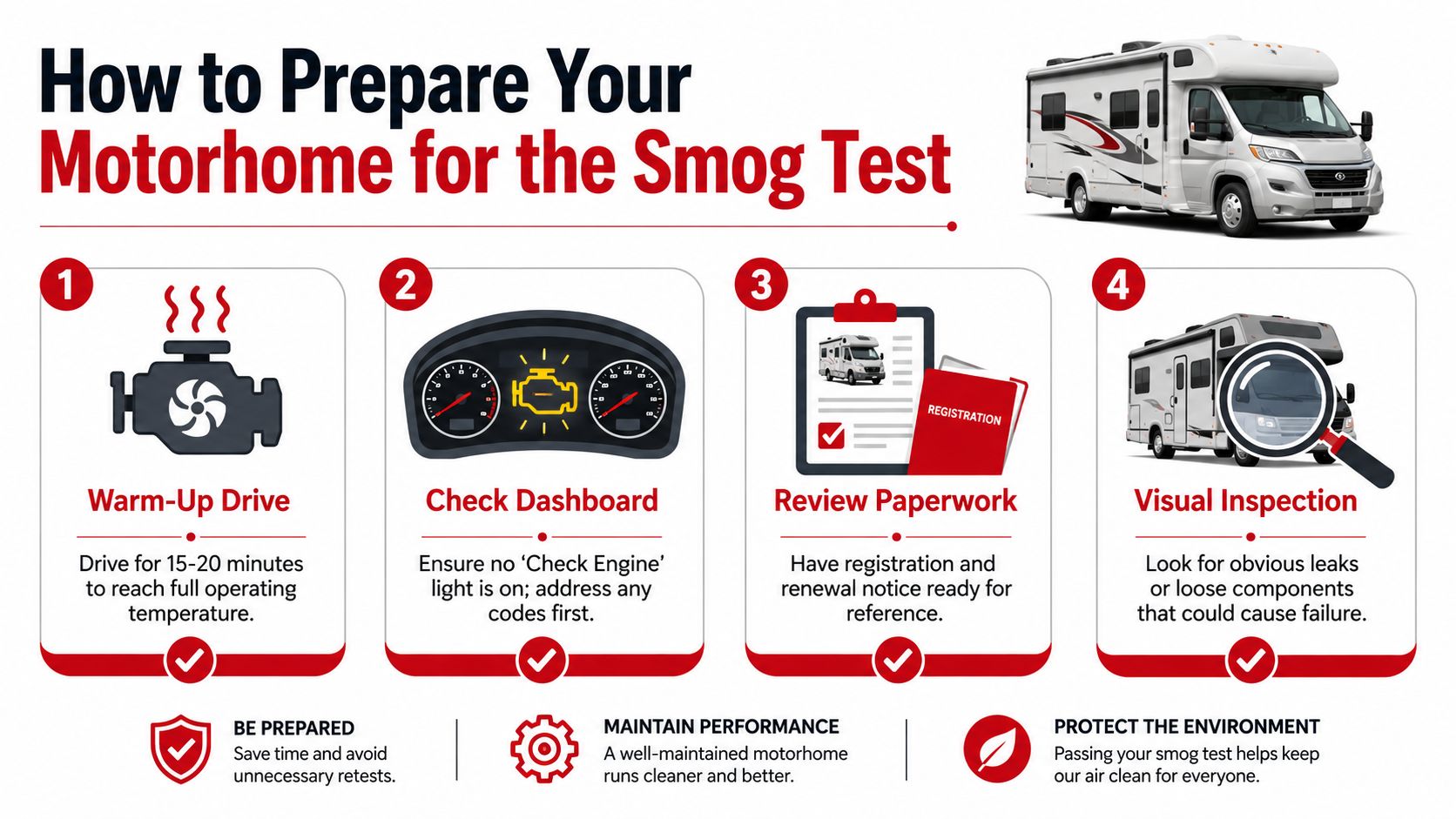
Warm the engine and look at the dash first
Drive the motorhome long enough to get it fully up to operating temperature before you arrive. A cold coach is a bad idea on test day because the system is checking how the vehicle runs, not how it behaves after sitting in the driveway. Then look at the dashboard. If the Check Engine light is on, fix that before the appointment.
Bring the right papers and do a basic walk-around
Have your registration and renewal notice ready. That saves time at the counter and keeps the station from guessing about what the DMV wants. Then do a quick visual inspection around the vehicle for obvious leaks, loose hoses, or other problems that can trip the inspection before it starts.
- Warm-Up Drive. Give yourself enough road time to bring the engine up to normal temperature.
- Dashboard Check. Clear the warning-light question before you ever pull into the bay.
- Paperwork Ready. Bring the registration and renewal notice together.
- Visual Walk-Around. Catch the obvious stuff while you're still at home.
The BAR doesn't publish a magic shortcut for a good test. Your job is to arrive with the vehicle in working condition and the paperwork in hand. If the station offers a free retest when required, that helps with small fixes, but it doesn't replace preparation. California Smog Check rules
Don't forget the practical stuff
A motorhome takes longer to stage than a car. Leave room for parking, turn radius, and the time it takes to get settled at the bay. If your coach uses a testing path that includes a dynamometer cycle, tire condition and general drivability matter too. Show up ready, and you're far less likely to turn one appointment into a two-day headache.
Visiting Fire House Smog in Antioch With a Motorhome
If you're bringing a motorhome into East Contra Costa County, the question is whether the station can handle the coach without sending you back out the gate. Fire House Smog at 2900 Lone Tree Way in Antioch is a STAR-certified test-only station and DMV registration services provider, and it has two service bays, which matters when you show up with a larger vehicle. Lone Tree Way location details
Check the layout before you go. With a motorhome, access, turning room, and bay size decide whether the trip is quick or a waste of fuel.
What the station can do, and what it can't
The station handles smog testing, but it is test-only, so it does not sell repairs. That keeps the inspection separate from the repair side, which is the setup most RV owners want when they just need a clean result and a straight answer.
It also offers on-site DMV registration renewals with sticker printing and ownership transfer services during posted hours. If your motorhome fits the station's inspection limits, you may be able to finish the registration part in the same visit. Fire House Smog says it can handle some RVs and motorhomes, but only within its size and equipment constraints, so calling ahead is part of the job, not a courtesy.
Expect the workflow to be practical, not fancy
The process is simple. You pull in, the vehicle gets checked for fit and eligibility, and the staff tells you whether the coach belongs in their lane or needs a different shop. That direct answer saves time, and it keeps you from forcing a large rig into a space that was not built for it.
The two-bay setup helps with throughput, and the station's seven-day testing schedule gives you more options if your renewal timing is tight. If you can't spare a weekday morning, that flexibility matters.
Use the visit to solve more than one problem
If your motorhome qualifies for inspection there, you may be able to handle the smog certificate and the DMV transaction in one stop. That is the primary advantage of a station that also handles registration work. Fewer stops. Fewer loose ends. Less chance of letting the renewal sit until the last minute.
If you want to save yourself a bad trip, call before you arrive and give them the motorhome's fuel type, model year, and GVWR. Ask whether the bay and equipment fit the vehicle, then decide whether to bring it in. The station's Antioch motorhome smog check page is the right place to start, and one quick conversation can keep a large RV from clogging up your day.
Common Mistakes That Waste a Motorhome Smog Trip
The same five mistakes show up over and over. Owners pull up without confirming the bay fit, ignore a lit warning lamp, miss the STAR instruction on the notice, assume a heavy diesel coach still falls under ordinary Smog Check pricing, or forget the DMV paperwork and discover the certificate alone doesn't finish the job. Every one of those mistakes is avoidable.
Call ahead before you move the rig
That is the single most impactful habit. A station can tell you in one phone call whether the vehicle fits the bay, whether the fuel and model year route it into standard Smog Check or Clean Truck Check, and whether STAR is required. If you skip that call, you're gambling with a large vehicle and your own time.
Don't show up with the wrong assumptions
- Bay Fit: Confirm the station can physically handle the motorhome.
- Warning Lights: Fix a glowing check-engine light before you leave home.
- STAR Notice: Read the renewal notice instead of guessing.
- Program Type: Know whether the vehicle belongs in standard Smog Check or Clean Truck Check.
- Paperwork: Bring the renewal notice and registration, not just the rig.
Keep the checklist in the coach
The best owners don't rely on memory. They keep a short note in a cabinet or glove compartment and run it every time the renewal comes up. That habit saves hours, and it keeps a simple inspection from turning into a stalled registration.
The point is simple. A motorhome smog visit goes smoothly when you treat it like a planning task, not an errand.
If you want the rules explained plainly and the process handled without guesswork, bring your motorhome to Fire House Smog. The station handles STAR-certified test-only smog checks, DMV registration services, and some RVs and motorhomes within its equipment limits, so it's a practical first call when you're trying to figure out what your coach needs.
You're holding a DMV renewal notice, the car runs fine, and you still have to get through a smog check before the sticker shows up. That's the Daly City routine in one sentence. If you treat the inspection as a random errand, you waste time. If you treat it as part of a compliance workflow, you can finish the test and the registration without making a second trip across town.
Table of Contents
- Why a Daly City Smog Check Is Part of a Bigger Workflow
- Choosing the Right Type of Smog Station in Daly City
- Preparing Your Vehicle the Day Before the Test
- What Actually Happens During the Inspection
- Smog Check Fees, Retest Rules, and Exemptions
- Finishing Your DMV Registration in One Trip
- What to Do If Your Vehicle Fails the Smog Test
Why a Daly City Smog Check Is Part of a Bigger Workflow
A Daly City driver usually does not need “a smog check” as a standalone errand. What you need is the certificate that moves the paperwork forward, whether that means a renewal, a title change, or an out-of-state registration. Treat the job as three linked steps, prep, station, DMV submission, and you avoid doing the same work twice.
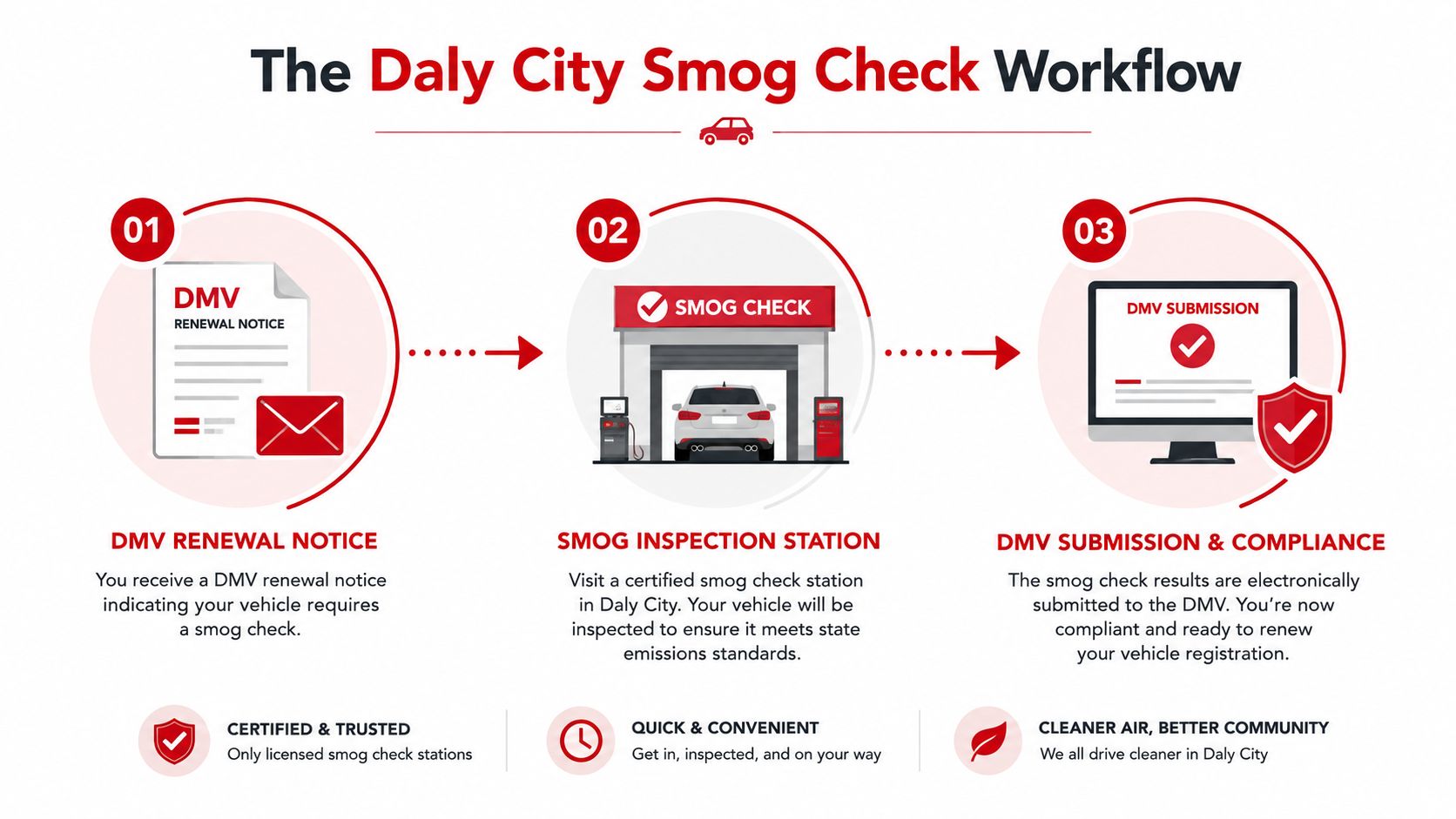
California's program runs statewide in designated counties, and the state's official BAR report for January 2026 logged 989,080 initial tests and 1,065,033 all tests, with an 8.35% initial-test failure rate and an 8.81% overall failure rate (BAR January 2026 executive summary). That failure rate matters because a failed certificate stops the workflow cold. The car can run fine and still leave you unable to finish registration on time.
The rules are not optional and they are not vague. In California, many gasoline, hybrid, flex-fuel, propane, and natural-gas vehicles generally need a smog check starting in the fifth model year through the eighth model year window, and out-of-state first registrations can trigger testing too. For many gasoline-powered vehicles, the first inspection effectively arrives when the vehicle is four model years old because of how the state calculates the model-year threshold, as noted in the same BAR report and the Daly City DMV field office guidance.
Practical rule: do not book the inspection until you know whether your DMV notice calls for a normal certificate, a STAR certificate, or a renewal workflow that needs both the test and the registration handled the same day.
Daly City sits inside the Bay Area's regulated inspection network, so the station is part of the compliance chain, not a convenience stop. If you want the cleanest path, bring the renewal notice, get the test done, and make sure the certificate gets transmitted into the DMV process without delay. That is how you turn one appointment into a completed renewal, not just another receipt in your glovebox. If you need a quick refresher on station types, review how a STAR-certified smog station works before you book.
Choosing the Right Type of Smog Station in Daly City
Pick the wrong station and you burn a morning for nothing. That's the part most drivers get wrong. A station is not just a place that “does smog.” It's a specific type of licensed operation, and your DMV notice may narrow the choice before you ever pull in.
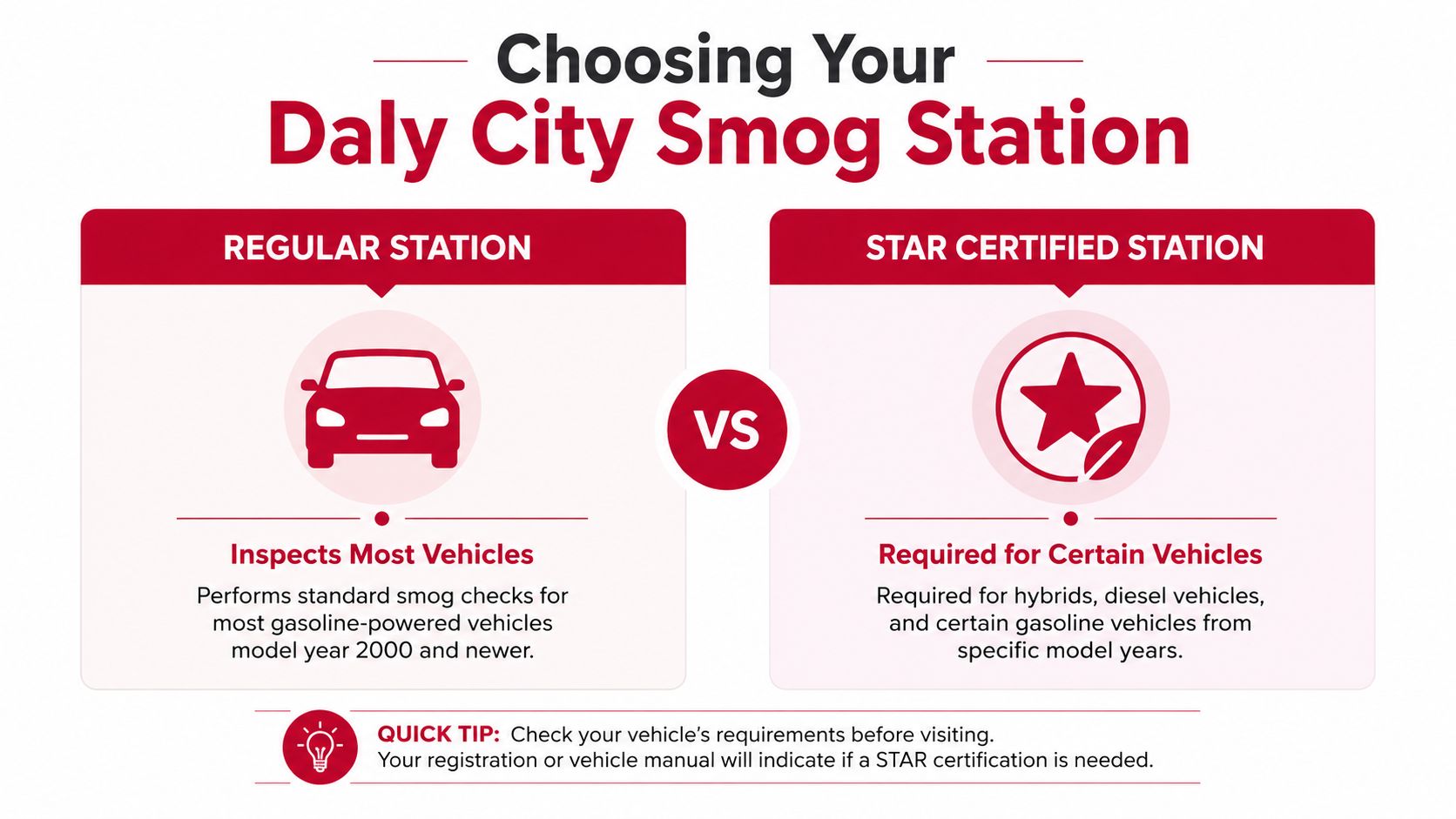
A regular licensed station can inspect many vehicles, but that doesn't mean it can inspect yours. A STAR-certified station meets higher performance standards and can inspect high-polluting vehicles, which is why some DMV notices direct drivers there (BAR smog check guidance). If your renewal notice says STAR, stop shopping around. Go straight to a STAR station.
The cleanest way to think about station choice is by function:
- Test-only station: this is the no-repair lane. The inspector tests the car, issues the result, and doesn't sell you a repair job. That matters when you want a clean compliance decision instead of a sales pitch.
- STAR-certified station: this is for directed vehicles and higher-standard testing paths. If the DMV notice requires it, there's no workaround.
- Regular station: this works for many drivers, but only if your vehicle and notice allow it.
A station can look convenient and still be the wrong fit. The Daly City DMV field office is a local registration hub, and nearby stations publish broad weekday hours, including some that run 9:00 AM–6:00 PM six days a week and others that offer 8:30 AM–6:00 PM weekday service (Daly City DMV field office guidance). Convenient hours don't matter if the station type doesn't match the notice.
Before you leave home, verify the station's license status and the exact service type. If you want a station that handles the test and then pairs the result with DMV renewal service, Fire House Smog is one option that combines smog testing with DMV registration work, including renewals and transfers, at the same location: California DMV registration renewal service.
Preparing Your Vehicle the Day Before the Test
Most Daly City failures start in the driveway. The car looked fine yesterday, the driver skipped a few basics, and the vehicle shows up with a check-engine light or an unreadiness problem that could have been avoided. If you want one clean visit, prep the car the day before and treat the smog check as part of the renewal workflow, not a separate errand.
Warm the car before you show up
Bring the engine up to normal operating temperature before you head to the station. A smog inspection goes faster and cleaner when the car is already warmed up, and a cold start in the parking lot is a bad way to begin. Drive long enough to fully heat the engine, then leave the accessories off when you arrive.
A recently disconnected battery is another easy way to waste a trip. BAR says to allow one to two weeks of driving after a battery disconnect so readiness monitors can reset before the OBD inspection (BAR smog guidance). If the battery was recently replaced, stop guessing and let the drive cycle do its work.
A lit check-engine light is a stop sign, not a suggestion. Fix it before the test, because the inspection checks emissions-system status, not your optimism.
Bring the right things and strip out the noise
Take the DMV renewal notice with you. BAR recommends it, and that single piece of paper keeps the station from fumbling the workflow. Clear out loose items, turn off distracting aftermarket accessories, and don't make the technician work around clutter.
Use the cabin like a workbench, not a storage unit:
- Remove loose gear: backpacks, tools, and cargo that can slide around during the inspection.
- Check warning lights: if the check-engine light is on, stop there and repair the issue first.
- Leave the car mechanically calm: rough idle, overheating, fluid leaks, or loud engine noise can get the vehicle rejected before the formal test starts.
- Keep the battery situation stable: if it was recently disconnected, give the monitors time to reset.
If the vehicle needs service before the test, get that done first. A car that is warmed up, free of warning lights, and ready for inspection gives you the best shot at leaving with the certificate and moving straight on to renewal without another trip.
What Actually Happens During the Inspection
A smog inspection stops looking mysterious the moment you see the sequence. The vehicle rolls in, the technician checks the emissions-related basics, and the station runs the test that fits your car. If you came prepared, the whole thing feels like part of the renewal process, not a separate errand.
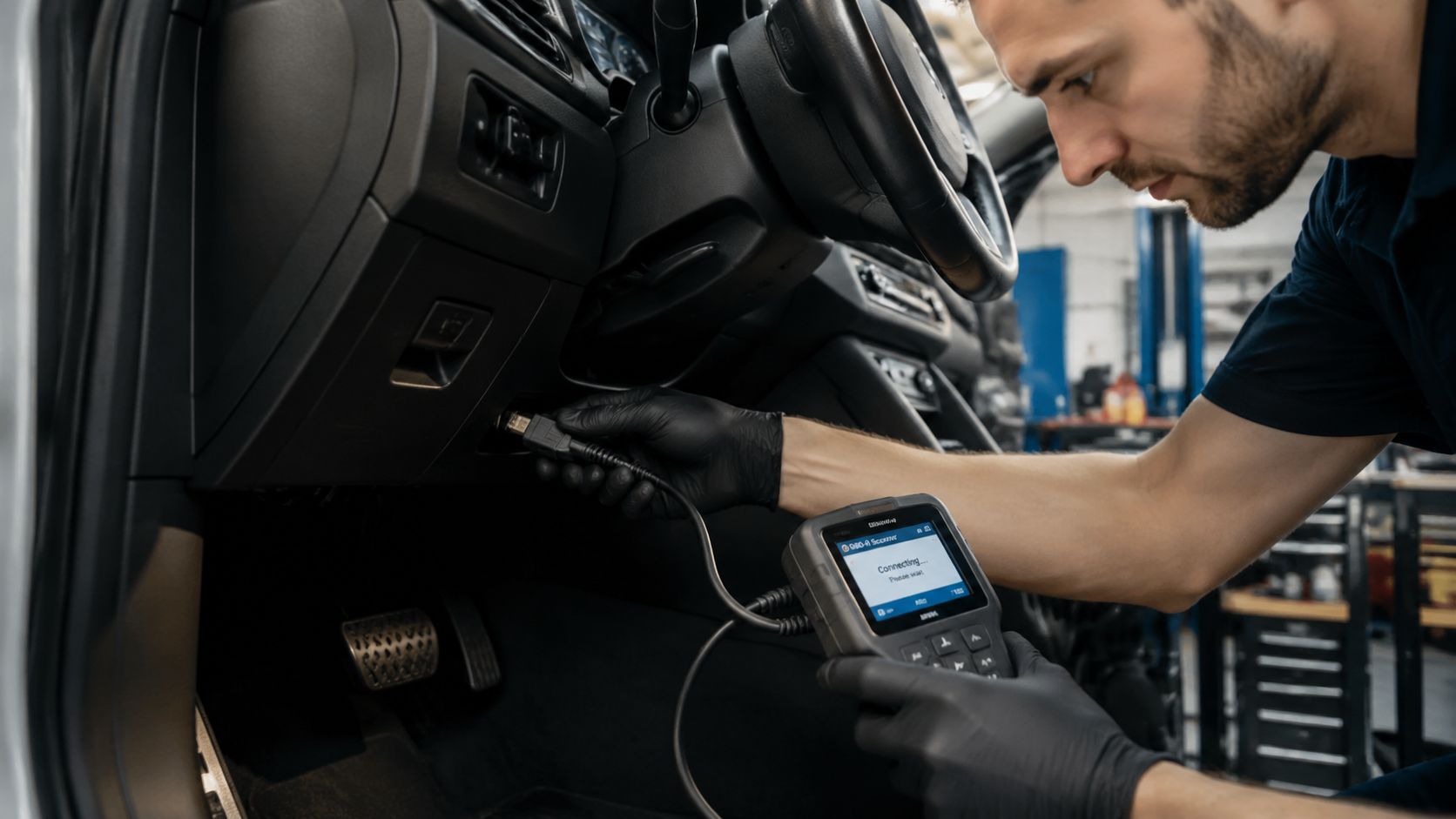
First comes the visual and functional check
California's standard inspection workflow starts with a visual inspection of emission-control parts and a functional inspection of the system (BAR smog guidance). Missing hardware, tampering, or modified software can fail the car even when it drives fine. The technician is checking whether the emissions system is complete and intact, not just whether the engine starts.
For gasoline vehicles, the station also runs a visible-smoke procedure. Inspectors check the crankcase and tailpipe, then perform three BAR Snap Tests with the engine brought to 2,000–3,000 RPM and stabilized between pulls (BAR smog check guidance). If the engine is rough, overheating, or leaking fluids, the car can get turned away before the formal test even begins.
Then the machine depends on your model year
For 2000 and newer vehicles, the BAR On-Board Diagnostic Inspection System is used. For 1999 and older vehicles, the BAR-97 Emissions Inspection System measures tailpipe emissions, and older vehicles can go through a loaded-mode test using a chassis dynamometer or a two-speed idle test (BAR smog guidance). In the loaded-mode test, the station measures hydrocarbon, carbon monoxide, carbon dioxide, and oxides of nitrogen, and the car passes only if the emissions stay within the applicable standards.
That's the part Daly City drivers miss when they show up half-ready. A car can sound normal and still fail because the OBD system is not ready, a required component is missing, or the emissions numbers are off. After the test, the certificate goes electronically into the DMV system, which is what lets you finish the registration step without another trip.
Smog Check Fees, Retest Rules, and Exemptions
Don't pay for a test you don't need, and don't assume every failure means you've got to pay twice. Daly City drivers lose money when they guess wrong about three things, whether the car is exempt, what the station charges, and whether a retest is included.
What you can skip
California's smog program doesn't apply the same way to every vehicle. The rules depend on model year, fuel type, and registration situation. Many newer vehicles are outside the testing window, and certain diesel models fall under separate treatment. If your registration notice doesn't call for a certificate, don't invent one by booking a test out of habit.
What you actually pay for
The state sets the inspection framework, but stations can set their own labor charge. That's why one shop can feel straightforward and another can feel padded. The useful question is not “What does smog cost?” It's “What exactly is included, and does a retest come with it?”
| Vehicle Type | Typical Price Range | Retest Eligible |
|---|---|---|
| Passenger car | Qualitative, station-set | Sometimes, depending on station policy |
| Light truck | Qualitative, station-set | Sometimes, depending on station policy |
| SUV | Qualitative, station-set | Sometimes, depending on station policy |
| RV or motorhome meeting criteria | Qualitative, station-set | Sometimes, depending on station policy |
California BAR says RVs and motorhomes meeting the criteria can require smog checks too (Daly City DMV field office guidance). That's an easy detail to miss if you only think in terms of sedans and pickups. If your vehicle is unusual, call ahead instead of assuming the standard passenger-car process applies.
A strong shop will tell you whether the retest policy is part of the deal before you hand over the keys. That matters because a failed vehicle often needs a second visit after repair, and the smartest owners use a station with a clear retest path rather than paying twice for the same paperwork.
Finishing Your DMV Registration in One Trip
The smog certificate is not the finish line. It's the handoff. If you still need to renew registration, transfer ownership, or get a new sticker issued, the right move is to tie the certificate directly into the DMV workflow the same day.
What the DMV counter needs
Bring the renewal notice, your proof of insurance if required by the transaction, payment method, and any ownership paperwork tied to a sale or transfer. That list gets longer when the vehicle came from out of state or the title changed hands recently. The point is simple, the station should not be your only stop.
The Daly City DMV field office exists as a local registration hub, but long lines are the reason many drivers want a licensed business partner handling the renewal instead (Daly City DMV field office guidance). If you can complete the inspection and submit the renewal without crossing town again, you save the part of the day that usually gets lost to waiting.
A passing certificate can also support transfer-of-ownership work, including California and out-of-state vehicles when the transaction requires it. That workflow is exactly where a combined smog-and-DMV site helps, because the certificate doesn't sit in your inbox waiting for another errand.
For drivers who want that combined path, California DMV registration renewal service is the relevant service page to check. Use it when your goal is completion, not just inspection.
Keep the sequence tight
Don't leave the smog station until you know the certificate is handled and the next step is clear. The clean sequence is inspection, transmission of the result, DMV payment or renewal, then sticker or registration follow-through. That's one trip done right.
What to Do If Your Vehicle Fails the Smog Test
A failed test is frustrating, but it's not automatically a repair emergency. Daly City drivers get trapped by one bad assumption, that every failure means a huge bill. That's wrong. Some failures are paperwork and readiness problems, and some are real emissions faults that need repair.
Start by reading the failure type
A failure can come from readiness issues, a lit check-engine light, missing emission-control parts, or a genuine emissions exceedance. BAR's process checks more than tailpipe output, which is why a car can fail even if it still drives clean enough to feel normal (BAR smog guidance). If the failure is a readiness problem, the fix may be driving cycles and monitor reset, not major parts replacement.
The best move is to sort the failure before authorizing work. Test-only stations are useful here because they remove the incentive to push repairs. That doesn't mean every repair estimate is wrong. It means you should know the failure reason before anyone starts upselling parts you don't need.
Use the fail reason to decide the next move
- Readiness fault: drive the vehicle properly after a battery disconnect or repair, then retest once monitors are ready.
- Check-engine light: repair the cause before returning, because a light that stays on usually means the car isn't ready for a pass.
- Missing or tampered components: restore the original emissions equipment and retest.
- Tailpipe or OBD failure: fix the issue that caused the readings to miss standard, then complete the retest.
The article on smog check fail reasons is worth reading if you want the common failure patterns laid out plainly. Use it as a filter before you approve work. The goal is a passing retest that flows straight back into the DMV renewal, not a repair shop detour that drags the process out for days.
Get the workflow right the first time. If you want a clean smog check plus DMV follow-through without extra running around, use a station that handles both sides of the process and asks the right questions before you arrive. Fire House Smog can help with inspection and registration tasks in one place, so you can leave with the certificate handled and the renewal moving. Visit Fire House Smog and book the visit that gets the job finished, not just started.
You're staring at a renewal notice, and one line keeps catching your eye, STAR required. That usually leads to the same question at the counter, on the phone, or in the driveway, what's the difference between a regular smog shop, a STAR certified smog check test only center, and a place that can fix the car too?
In plain terms, STAR is California's higher-standard inspection tier, and test-only means the station can inspect your vehicle but can't sell the repair. If you're trying to avoid a second trip, understand whether you're required to go STAR at all, and figure out what happens if your car fails, the details matter more than the label on the sign.
Table of Contents
- What a STAR Certified Smog Check Test Only Center Actually Is
- STAR Certification and Test Only Status Explained Separately
- How a Test Only Station Differs from Regular Smog Shops
- What Happens During a Test Only Smog Inspection
- Who Needs a STAR Test and What About RVs and Exempt Vehicles
- Fees Documents Retests and the On Site DMV Experience
- Why Drivers in Antioch and East Contra Costa Choose a Local Test Only Station
- STAR Smog Questions Drivers Ask Before They Book
What a STAR Certified Smog Check Test Only Center Actually Is
A lot of drivers arrive with the same look on their face, a DMV envelope in one hand and a phone in the other, trying to decode what STAR means before they waste an afternoon. A STAR certified smog check test only center sits inside California's broader Smog Check system, so it isn't a separate program, it's a higher-controlled part of the same system.
California's Bureau of Automotive Repair says the STAR program started in January 2013, and in calendar year 2023, 48% of licensed stations were STAR certified while 83% of all Smog Check tests were performed by STAR stations, according to the BAR's 2024 Smog Check Performance Report. The same report says California's Smog Check program removes about 400 tons of smog-forming pollutants every day and serves more than 10 million vehicles each year at more than 5,000 independently owned stations statewide, which shows why STAR is part of a large regulatory network, not a boutique service (BAR 2024 Smog Check Performance Report).
What the label tells you
STAR tells you the station has met higher BAR performance standards. Test only tells you the station is licensed to inspect vehicles, not to do the repair work itself. Those are separate layers, and a business can be one, the other, both, or neither.
That distinction matters on visit day. A test-only station can tell you whether the vehicle passes or fails, but it doesn't turn into a repair shop if the car needs work. If you're used to full-service auto shops, that can feel unusual at first, but it's the point of the model.
A real-world example helps: a driver with a renewal notice marked STAR can show up at a STAR test-only center, get the inspection, and leave with the result, without being steered into a repair estimate from the same counter. That separation is useful when you want clarity first and a repair decision later.
Practical rule: if your paper says STAR, the station status matters. If you're not sure whether you need repairs, test-only keeps the inspection separate from the sales pitch.
STAR Certification and Test Only Status Explained Separately
A driver can roll up to a station with a renewal notice, see the word STAR, and still not know what that means for the visit. The cleanest way to read the label is to separate two questions. One asks whether the station meets BAR's higher oversight standard. The other asks whether the station is allowed to do inspections only, or inspections plus repairs.
STAR certification is about oversight and consistency. BAR requires a STAR-certified test-only center to meet controls that go beyond ordinary smog stations, including the ability to inspect all vehicle types subject to Smog Check, maintain the BAR-certified inspection equipment required by the Smog Check Manual, and keep calibrated equipment passing calibration at least once every 10 calendar days when calibration is required (BAR STAR Certification).
That matters because the inspection process has to hold up under the same rules every day, whether the car is a small commuter vehicle or something more complex. If the required equipment is missing, out of calibration, or not being maintained to BAR standards, the station is not operating with the consistency the program expects. For a first-time customer, that means the result comes from a process BAR has already tightened, instead of from a shop's own judgment call.
Test only is a different question
Test only describes what the shop is allowed to do, not how strict its oversight is. A test-only station can inspect vehicles, but it cannot sell emissions repairs. A test-and-repair shop can inspect and repair. A STAR station can meet BAR's higher standard, yet it may still be either test-only or test-and-repair.
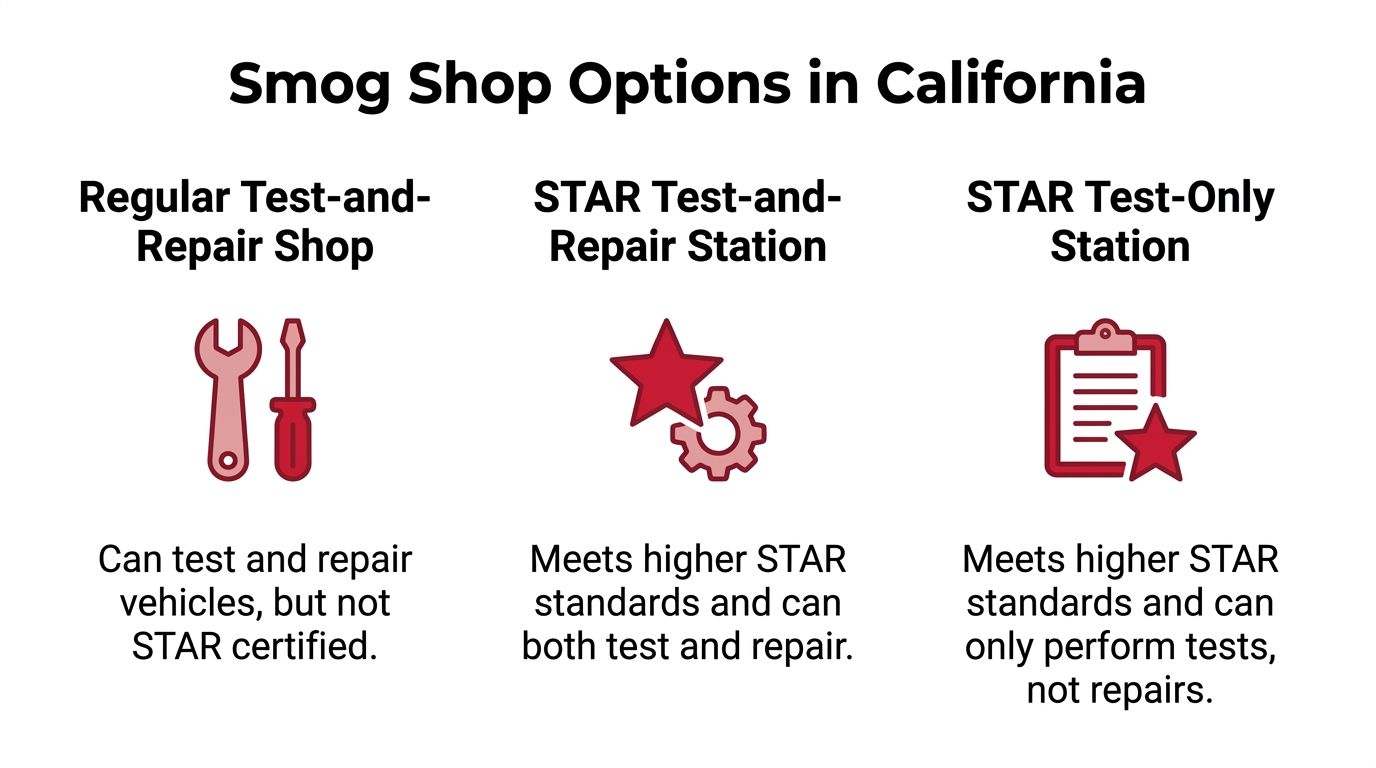
The simplest way to separate the two labels is this. STAR describes the standard of oversight. test only describes whether the station is allowed to fix the vehicle after the inspection. A referee can call the play and still not coach either team, and the same split applies here.
For a driver, that split changes the tone of the visit. A test-only station gives you the inspection result without the same counter pressure to turn a failure into an in-house repair job. A test-and-repair station has a different business setup, because the shop can diagnose, quote, and repair under the same roof.
That is why the combinations matter. A station can be STAR and test-only, STAR and test-and-repair, or a regular test-and-repair shop without STAR status. The label on the sign gives you one piece of the picture, and the renewal notice tells you which setup fits your situation. If you want a plain-language walkthrough from the station side, Fire House Smog's STAR certification explanation lays out the same distinction in simple terms.
How a Test Only Station Differs from Regular Smog Shops
A regular smog shop can often do more than one thing, which sounds convenient until the vehicle is borderline and you're trying to decide who you trust with the result. A STAR test-only station gives you a narrower service, inspection without repair, and that narrower service removes the in-house incentive to push a fix right after the failure.
The 2025 BAR Smog Check Executive Summary Report makes the scale of test-only clear. STAR Test-Only stations performed 5,916,245 initial tests and recorded 481,639 failures, an 8.14% failure rate. STAR Test-and-Repair stations performed 2,766,051 initial tests with 227,215 failures, an 8.21% failure rate. STAR Test-Only stations also issued 5,822,635 certificates overall, compared with 2,710,210 certificates from STAR Test-and-Repair stations (BAR 2025 Smog Check Executive Summary Report).
What those numbers mean for a driver
Those figures don't tell you whether your car will pass, but they do show something useful. Test-only STAR stations are not a niche fallback, they're operating at very large scale and handling a volume close to the combined total of STAR Test-and-Repair stations. That makes test-only a central part of California's inspection network, not an afterthought.
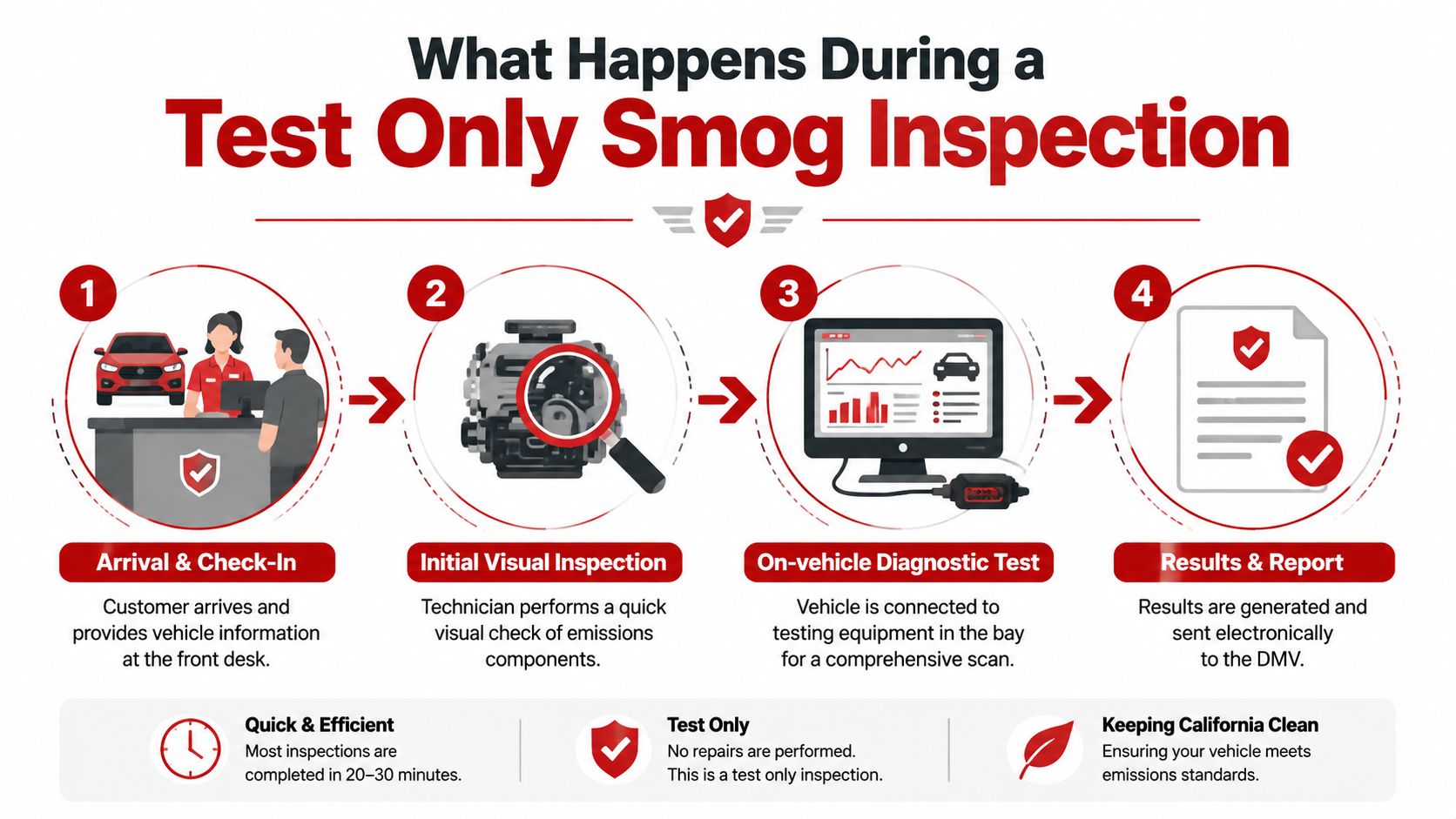
The consumer experience is different too. At a regular smog shop, some drivers feel pressure because the same business that fails the car may also want to repair it. At a test-only station, the result stands on its own. If the car needs work, you can take the report somewhere else and decide what to do without buying into the first estimate you hear.
Fire House Smog's test-only overview describes that same split clearly, inspection only, no repair upsell. That's the key difference most first-time customers are really looking for, even if they don't say it that way.
What Happens During a Test Only Smog Inspection
A first-time visit usually starts with the same small ritual, pull in, hand over the paperwork, and wait for the technician to confirm the vehicle details. The inspection is designed to be straightforward, but the exact steps depend on the vehicle year and the state rules that apply to it.
The bay workflow
At a test-only station, the technician checks the vehicle visually, then connects the required test equipment. For 1996-and-newer vehicles, that normally means an OBD-II diagnostic connection. Older vehicles may also involve a tailpipe-style emissions check, depending on the vehicle class and what BAR requires for that inspection.
Most drivers care about one thing here, how soon they'll know. The station's job is to generate a result, not to turn the visit into a sales conversation.
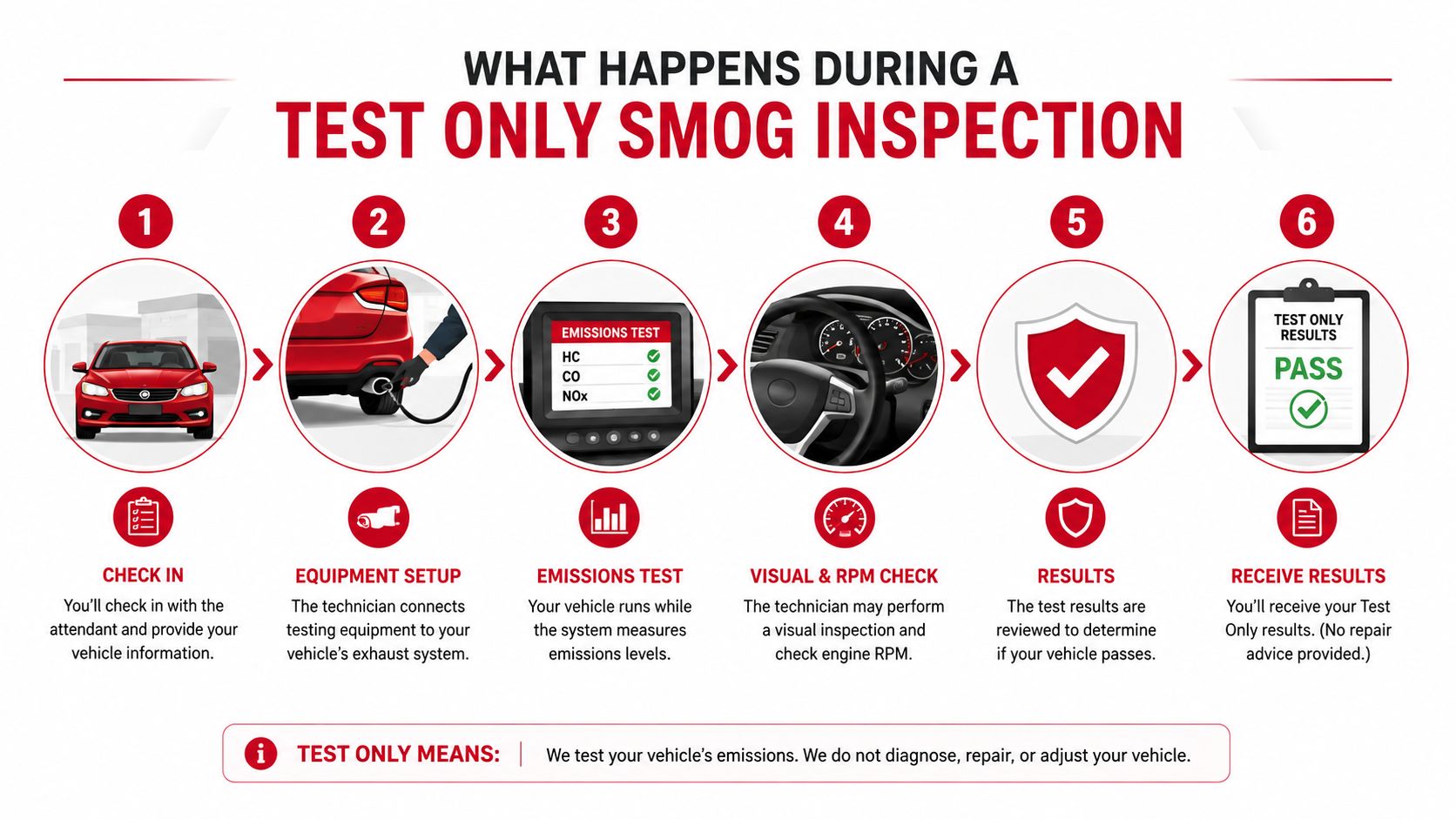
If the car passes, the result is transmitted electronically and the driver gets what they need to continue the DMV process. If it fails, the station provides the report, and the next decision is whether to repair first or look at an approved repair path elsewhere. That split is exactly why test-only centers work well for drivers who want the inspection separated from the repair decision.
| Smog Inspection Stages at a Test Only Station | |||
|---|---|---|---|
| Stage | What the Technician Does | What the Driver Experiences | Typical Time |
| Arrival and check-in | Confirms the vehicle and paperwork | Hands over the renewal notice or vehicle details | Brief |
| Visual inspection | Looks over emissions-related components | Waits near the counter or in the lobby | Short |
| Diagnostic testing | Runs the vehicle through the required equipment | Stays nearby while the test is completed | Short |
| Results and report | Generates the pass, fail, or directed result | Receives the outcome and next-step paperwork | Brief |
The main thing to remember is that the station is measuring compliance, not negotiating a fix. That makes the visit feel cleaner and more predictable, especially when you already suspect the vehicle may be close to the line.
Who Needs a STAR Test and What About RVs and Exempt Vehicles
A renewal notice can look simple until one line changes the whole errand. One driver needs a STAR test, another needs a regular smog inspection, and a third does not need a smog check at all. The DMV says a smog inspection is generally required for registration renewal, with important exceptions for gasoline vehicles 1975 and older, diesel vehicles from 1997 and older or over 14,000 pounds GVW, natural gas vehicles over 14,000 pounds, electric vehicles, and gasoline vehicles less than eight model-years old. The renewal notice is the document that tells you whether your specific renewal requires STAR, a standard smog inspection, or no smog check at all (California DMV Smog Inspections).
That is why STAR searches can feel confusing when the question is eligibility. If the vehicle is exempt, the issue is not finding a station, it is reading the paperwork correctly. If the notice calls for STAR, then the station type matters, and the safest first step is to trust the renewal notice before you plan the visit.
RVs and unusual vehicles need a call ahead
Fire House Smog notes that some recreational vehicles and motorhomes can be tested, subject to size and equipment constraints. A vehicle can be eligible on paper and still be hard to fit in a bay, so a quick phone call can prevent a wasted drive. The business lists 925-754-1600 as the contact line for screening those cases.
RVs, diesel vans, motorhomes, and newer vehicles that may fall into an exemption category all benefit from the same approach. Read the renewal notice first, then confirm the vehicle fit with the station before you head over. A test-only center keeps the question narrow, the car gets inspected or it does not, and the station can tell you whether the vehicle belongs in the lane at all.
Fees Documents Retests and the On Site DMV Experience
Most drivers want to know three things before they leave the house, what to bring, what the test costs, and whether they're going to need a second appointment. Fire House Smog's pricing page explains its smog-test pricing and coupon policy, including a discount on the test and a free retest when required under the site's terms (Fire House Smog smog check cost information).
Bring the renewal notice, a valid ID, payment, and any previous test paperwork if you already have a failure report. That makes the handoff quicker and helps the technician confirm the right vehicle record. If you've recently disconnected the battery or cleared codes, bring the last report too, because it can help you understand where the car stands before you drive off again.
The DMV side of the visit
Fire House Smog also handles DMV registration tasks on site, including renewals and ownership transfers, with sticker printing during posted hours. That turns the stop into more than just a test, which matters if your schedule only allows one errand day. The station says smog testing is available seven days a week, while DMV service hours run Monday through Saturday, 9:30 AM to 5:00 PM, and Sunday, 12:00 PM to 4:00 PM.
That combination is useful for a simple reason. The smog result and the registration task often sit back-to-back in real life, so finishing both in one trip saves time and lowers the chance of forgetting a follow-up. For drivers who already know they need a renewal and a smog certificate, the station's two-service flow is easier than bouncing between separate offices.
Why Drivers in Antioch and East Contra Costa Choose a Local Test Only Station
A local test-only station earns its keep by reducing the number of decisions a driver has to make on the same day. At 2900 Lone Tree Way, Antioch, CA 94509, Fire House Smog gives East Contra Costa drivers a direct stop with parking, a phone line for unusual vehicles, and a setup built around inspection rather than repair sales.
What makes the local option practical
The first advantage is the layout. Two service bays help keep the line moving, which matters when you're trying to fit a smog test between work, school pickup, or a registration deadline. The second advantage is timing. Smog testing is offered seven days a week with extended weekday and weekend hours, so drivers don't have to build the whole day around a narrow appointment window.
The third advantage is fit. If you're bringing a truck, a diesel, or a motorhome, a local station can tell you quickly whether the vehicle is a match for its bays and equipment. That is more useful than driving across town to discover the answer at the curb.
When a local station is the better choice
If you already know you need a STAR test, a local test-only center is usually the cleaner choice when you want the result without a repair pitch. If you also need registration work, a station that handles DMV services on site keeps the trip simple. If you're unsure about RV eligibility, a quick call before you leave is the safest move.
For Antioch and nearby communities, the logic is straightforward. Pick the station that can inspect the vehicle, handle the paperwork, and tell you the result without adding a second errand unless you need one.
STAR Smog Questions Drivers Ask Before They Book
Can a STAR test-only center help a marginal car pass?
It can't change the pass or fail rules. STAR means the station meets higher BAR standards, and test-only means it doesn't sell repairs, so the inspection is cleaner, but the vehicle still has to meet the same emissions requirements.
How do I know from my renewal notice whether I need STAR?
BAR says your renewal notice tells you when you must go to a STAR station. If the notice calls for STAR, use that instruction. If the notice doesn't require it, you may not need a STAR site at all.
What if the check-engine light is on or the monitors aren't ready?
That's the kind of problem that often leads to a failed inspection, because the car hasn't met the readiness conditions the state needs. If the battery was recently disconnected, give the car time and driving miles before you test.
Should I go to a STAR test-only station first or a test-and-repair shop first?
If you want a neutral result and a clean paper trail, test-only first makes sense. If you already know the car needs diagnosis and repair, a repair-capable shop may be the better first stop, but that's a different goal than getting the smog certificate done efficiently.
If you want a straightforward smog visit in Antioch, Fire House Smog handles STAR test-only inspections, DMV registration services, and on-site tag issuance under one roof. If you're sorting out a renewal notice, an unusual vehicle, or a test you don't want tied to a repair pitch, visit Fire House Smog and plan the stop around the vehicle you drive.
You're holding a renewal notice, the car starts fine, and still you're not sure whether a smog check in Martinez, CA means a quick stop at any shop or a special trip to a STAR station. That's the part that trips up a lot of drivers, because California smog rules aren't just about whether your vehicle is old. They're about model year, fuel type, ownership status, and what the DMV says on the notice.
Martinez drivers also run into a practical problem. The nearest place isn't always the right place, and the right place isn't always the one with the easiest hours. If you know which station type you need, what the inspector will check, and what can cause an automatic fail, the whole process gets a lot less stressful.
Table of Contents
- What Martinez Drivers Actually Need to Know About Smog Checks
- How California Smog Check Rules Apply to Martinez
- Regular, Test-Only, and STAR Stations Explained
- What Happens During a Smog Check Visit
- Pricing, Coupons, and a Convenient Antioch Alternative
- On-Site DMV Registration and Tag Services
- Smart Preparation Tips Before You Test
- Recap and Next Steps for Martinez Drivers
What Martinez Drivers Actually Need to Know About Smog Checks
If you're standing in the driveway with a renewal notice in one hand and your keys in the other, the first question is simple. Which station do I need? The answer depends on whether your notice asks for a normal smog inspection, a DMV-directed STAR visit, or no visit at all because your vehicle is still within an exemption window.
That's why this guide is built around decisions, not jargon. A Martinez driver needs to know whether the vehicle is due now, whether a nearby station can legally test it, what paperwork to bring, and how to avoid a second trip. The goal is to make the state rules usable on a Tuesday afternoon, not just accurate on paper.
What to look at first
Start with the renewal notice. If the DMV specifically directs you to a STAR station, that instruction matters more than convenience. If it doesn't, you may be able to use any licensed smog shop that handles your vehicle type.
Practical rule: The notice tells you more than the shop sign does.
From there, look at the vehicle itself. A gas car, hybrid, diesel truck, or older model can each fall into a different testing lane. The rest of this guide walks through those differences in plain English so you can make one clean decision before you leave home.
How California Smog Check Rules Apply to Martinez
California's smog program is built around model year thresholds, and those thresholds decide whether you're due, exempt, or stuck with a DMV-directed visit. The California Bureau of Automotive Repair says gasoline, hybrid, and alternative-fuel vehicles model year 1976 and newer generally need Smog Check service, while diesel vehicles model year 1998 and newer also fall under the program. Those are the broad rules that affect Martinez drivers every day. You can review the state framework on the California Bureau of Automotive Repair Smog Check page.
For registration renewal, the exemption window is wider. Gasoline, hybrid, and alternative-fuel vehicles that are 8 model years old or newer are exempt. For change of ownership, the exemption window tightens to 4 model years or newer. The DMV also says that beginning January 1, 2019, vehicles less than 4 model years old may pay a smog abatement fee instead of getting a Smog Check for the first 8 years they're registered. Those are the milestones that decide whether you can renew without a test, need a test now, or can use a fee instead of a standard inspection.
The key thing to remember is that renewal and ownership transfer are different events. A car can be exempt for renewal and still need a test for a sale. That's where a lot of Martinez drivers get caught, especially when a family member gifts a car or a private seller hands over the title.
Do You Need a Smog Check in Martinez?
| Vehicle Type | Model Year | Renewal Test? | Ownership Test? |
|---|---|---|---|
| Gasoline, hybrid, alternative-fuel | 1976 and newer | Usually yes, unless within the renewal exemption window | Usually yes, unless 4 model years old or newer |
| Diesel | 1998 and newer | Usually yes, unless the DMV notice says otherwise | Usually yes, depending on the notice and vehicle status |
| Very new gasoline, hybrid, alternative-fuel vehicle | Less than 4 model years old | May qualify for the smog abatement fee noted by the DMV | Often exempt within the ownership window |
A DMV notice can override your guess. If it says STAR, treat that as the instruction that matters.
The easiest way to use these rules is to ask one question first. Is this a renewal, a sale, or a transfer? Once you answer that, the model year rules make a lot more sense.
Regular, Test-Only, and STAR Stations Explained
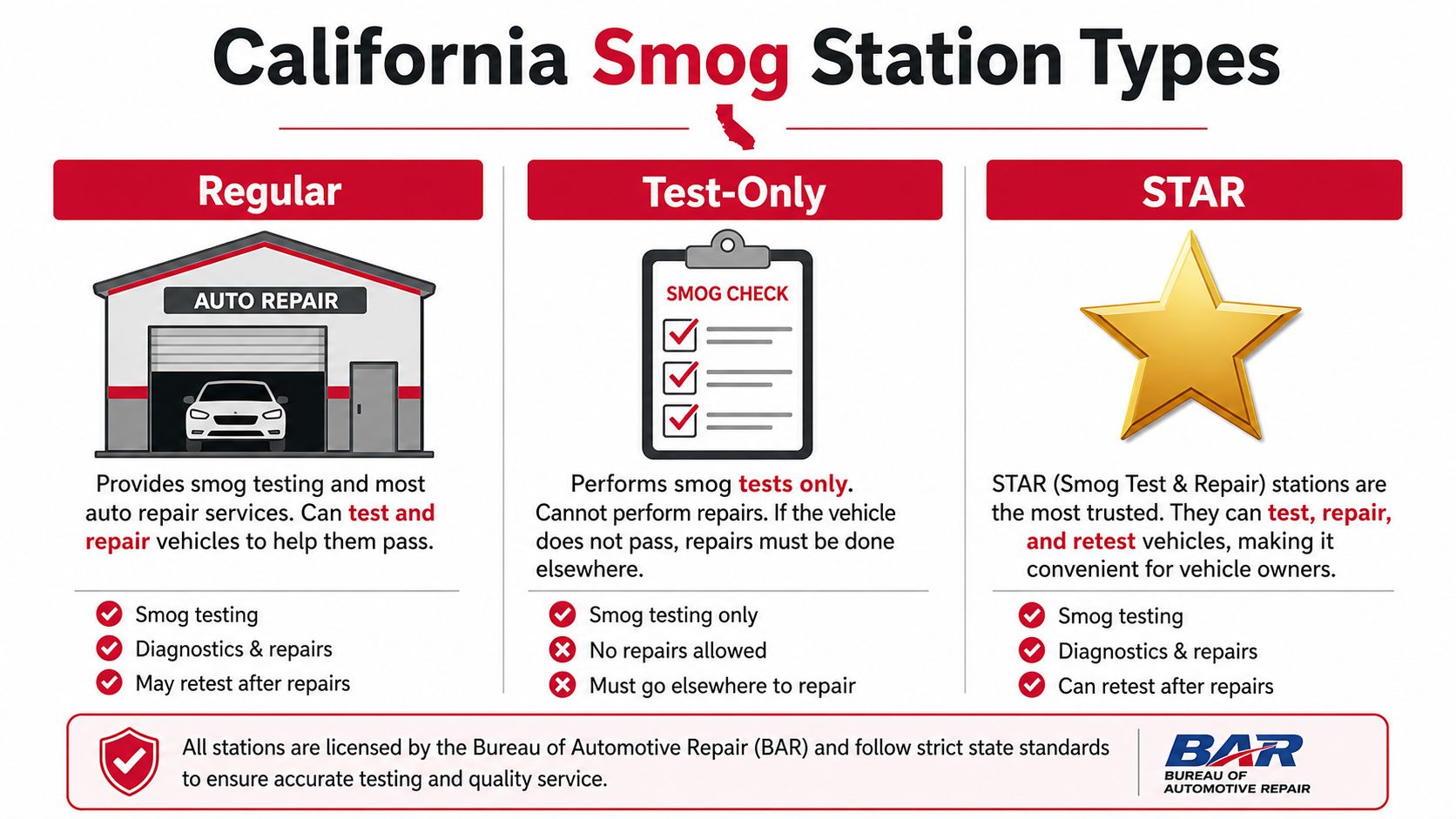
California doesn't use the words regular, test-only, and STAR interchangeably, even though drivers often do. That confusion matters, because the wrong stop can waste your time or send you back to square one. The STAR certified smog explanation is useful because it puts the station types in the right bucket.
A regular smog shop can inspect vehicles if it's licensed for that vehicle and test type. A test-only station performs the inspection but doesn't sell repairs, which removes the repair upsell from the same visit. A STAR station is part of California's STAR program and is used for DMV-directed vehicles and gross polluters, as noted in DMV guidance and BAR program language. You can see that DMV guidance on smog inspections and directed STAR visits.
How the station type affects your day
If your notice says nothing special, a licensed smog station that handles your vehicle may be enough. If the notice directs you to STAR, that's not a suggestion. It means the DMV wants that specific type of visit, and showing up at the wrong station can leave you paying for the first trip and doing it again somewhere else.
A quick comparison helps:
| Station Type | What It Does | When Martinez Drivers Use It |
|---|---|---|
| Regular | Inspects vehicles and may also offer repairs, depending on licensing | When no STAR directive appears and the vehicle fits the station's scope |
| Test-Only | Inspects only, without repair sales | When you want inspection without repair incentives |
| STAR | Handles DMV-directed vehicles and gross polluters | When the renewal notice or vehicle status requires it |
Good rule of thumb: The DMV notice decides the station type before price or distance does.
That's the part most local marketing pages skip. They talk about “cheap smog” or “STAR” like they're the same thing, but they aren't. The safest move is to match the station to the notice, then choose the one that fits your schedule.
What Happens During a Smog Check Visit
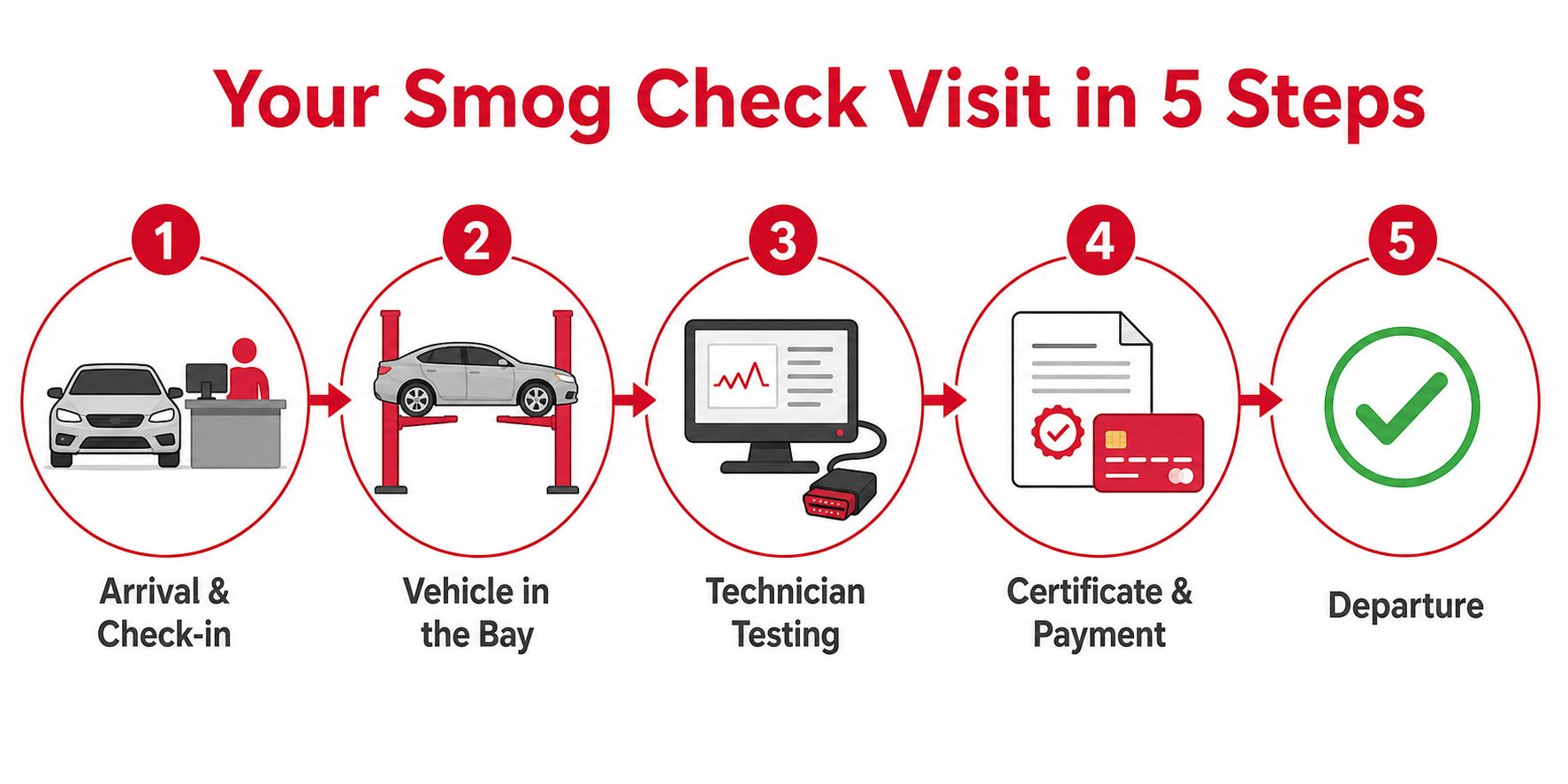
A smog visit is usually straightforward once you know the sequence. You arrive, hand over the keys and the paperwork, and the technician checks the vehicle in. On newer cars, the test centers on the OBD-II system, which looks at the vehicle's onboard emissions controls. On 1999-and-older vehicles, California's BAR procedures use BAR-97 emissions inspection equipment that can measure tailpipe emissions, which is why older cars are more sensitive to exhaust condition, engine temperature, and bay airflow.
The pre-check issues are the part that saves or sinks the visit. A lit check-engine light is an automatic fail under BAR guidance, so that dash light matters more than most drivers think. If you disconnected the battery recently, the car may need time to complete its drive cycles before the monitors are ready for testing. If you test too soon, you can fail for readiness, not because the car is broken, but because it hasn't relearned enough data yet.
What to bring and what to expect
Bring your vehicle registration or renewal notice, plus anything the station asks for when you schedule. Then expect the technician to either plug into the diagnostic port or run the older tailpipe-capable procedure, depending on the model year. The whole process is designed to verify emissions status, not to diagnose unrelated repairs.
By the time the inspection ends, you'll usually get a result and, if it passes, the certificate workflow moves forward from there. If it doesn't pass, the report tells you what kept it from clearing.
If the battery was changed last week, don't rush the test just to get it done.
The video above shows the visit from check-in to departure in a simple flow. That's the shape of it, a short station visit with a few technical checkpoints that decide whether your registration can move ahead.
Pricing, Coupons, and a Convenient Antioch Alternative
Smog pricing in the East Bay usually comes down to what the station includes, how busy it is, and whether it uses a test-only model or a repair-based model. A test-only station is easier to compare because the inspection and the repair conversation are separated. That doesn't make every coupon equal, but it does make the visit easier to understand before you commit.
For Martinez-area drivers who want a practical option with weekend access, Fire House Smog in Antioch is one of the nearby choices to look at. It's a STAR-certified test-only smog check station at 2900 Lone Tree Way in Antioch, and it offers seven-day smog testing, two service bays, and a free retest policy under its posted terms. It also says it can test cars, SUVs, light-duty trucks, and some RVs or motorhomes, although larger vehicles should be checked ahead of time because bay size and equipment limits still apply. You can review the station details on the Fire House Smog homepage and the specific local service page for California DMV registration renewal support.
The trade-off is simple. Antioch adds a bit of drive time for some Martinez residents, but it can pay off if you need weekend hours, a test-only visit, or a place where smog testing and DMV services happen at the same location. That matters if you're trying to finish the whole errand in one stop instead of splitting it between a test shop and a separate DMV office.
What that means in practice
- If you just need the test: A test-only station keeps the visit focused on emissions.
- If your schedule is tight: Seven-day availability can help when weekday hours don't.
- If you hate repeat trips: A free retest policy can make a first failure less painful.
Convenience isn't only about distance. It's also about whether the shop can finish the job you came for.
For Martinez drivers, the real question isn't “What's cheapest on the sign?” It's “Which station solves the whole errand with the fewest return visits?”
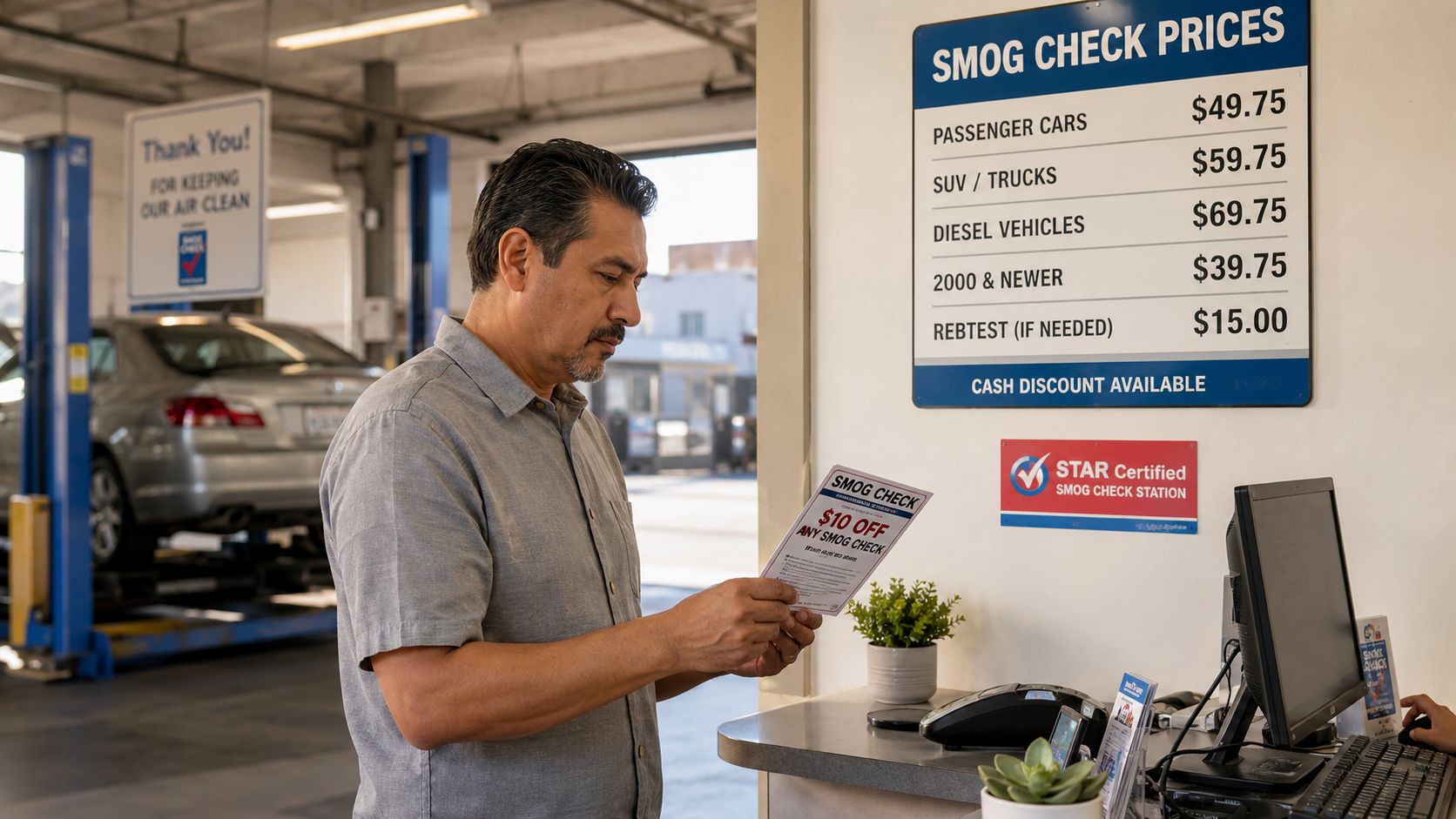
On-Site DMV Registration and Tag Services
When the registration is due, a lot of drivers think the DMV field office is the only real option. It isn't. A licensed DMV business partner can handle certain registration tasks on site, which cuts down the back-and-forth that usually comes with a renewal or transfer. That's especially useful if you're trying to finish the emissions check and the paperwork on the same trip.
For Antioch-area drivers, Fire House Smog says it provides California DMV registration renewals with sticker printing and ownership transfers for California and out-of-state vehicles. If the transaction needs plates or tags, the station says it can process those as needed during the visit. For the state's own renewal framework, the DMV partner model is a different path from standing in line at a field office, and that difference is what saves time for a lot of working drivers. The service details are outlined on the registration renewal page.
What to bring for each type of visit
A renewal is usually simpler. Bring the renewal notice and the vehicle documents the station asks for. A transfer usually needs more attention because ownership details have to match the transaction, and out-of-state paperwork can add another layer.
Here's the basic idea:
- Renewal visit: You're trying to keep the existing registration current.
- Transfer visit: You're changing ownership, so the paperwork has to follow the sale or transfer.
- Tag or plate issuance: You leave with the registration work handled if the transaction requires it.
The main benefit is obvious once you've spent time at a field office. You don't have to treat the smog station and the DMV as separate errands when a partner location can handle both pieces. For a Martinez driver with a limited window on a weekend, that can matter more than a small difference in mileage.
Smart Preparation Tips Before You Test
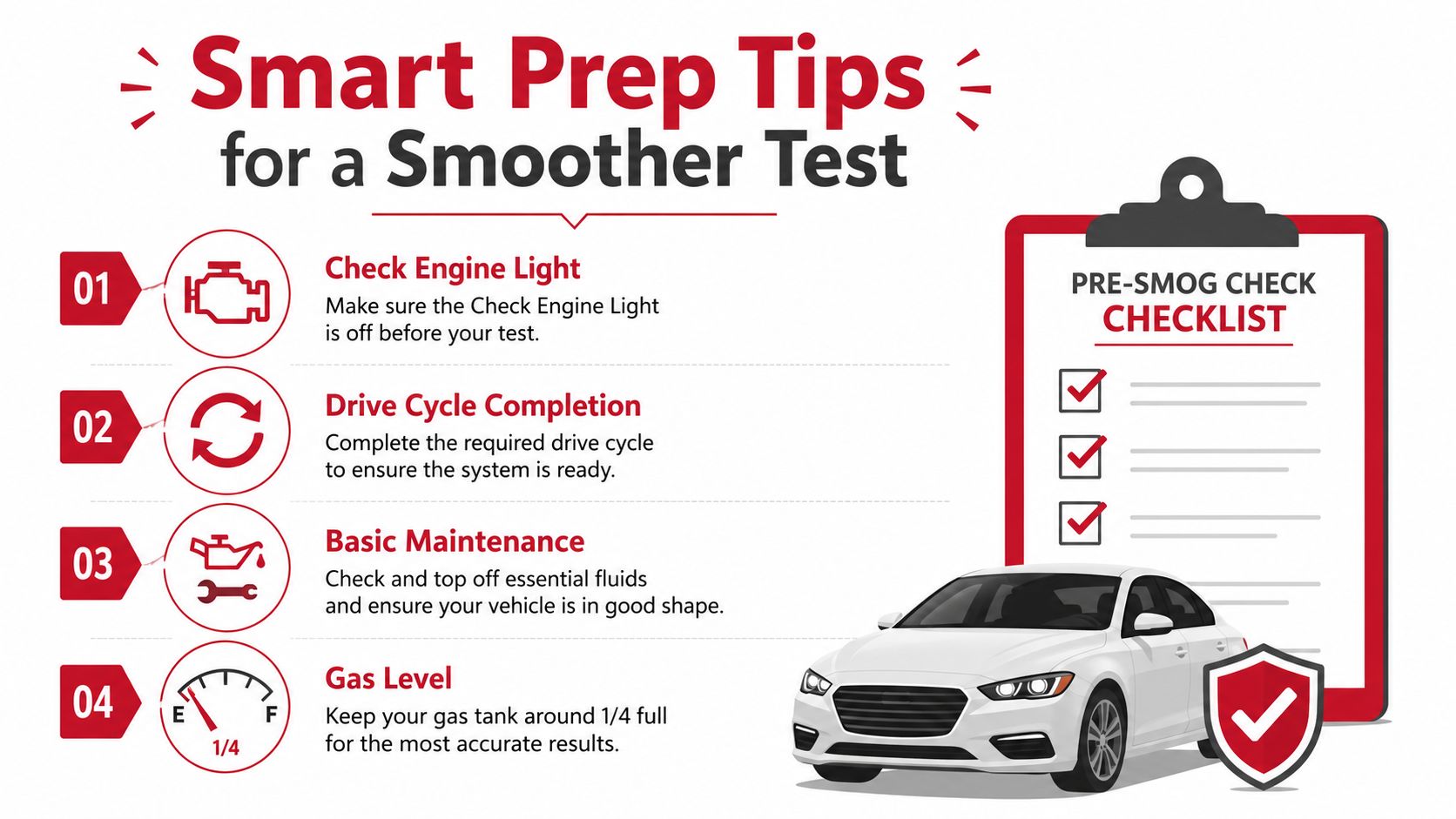
A few small checks before the appointment can save you from a wasted trip. Start with the check-engine light. If it's on, the car is not ready for a pass, so there's no point hoping the light will be ignored.
Next, think about the drive cycle. If the battery was disconnected or replaced recently, the vehicle may need a week or two of driving before the monitors settle back in. That's why a car that runs perfectly can still fail a readiness check if the computer hasn't had enough time to relearn.
The other basics are simple but worth doing. Make sure the engine is warmed up before you arrive, confirm the gas cap seals properly, and keep the fuel level reasonable so the test can proceed without avoidable delays. If you're bringing an RV, motorhome, or another larger vehicle, call ahead so the station can confirm bay and equipment fit before you drive over.
You can also review the common failure patterns on the smog check fail reasons page, which is useful if you want to understand why a car that “feels fine” still didn't clear.
A short pre-test checklist
- Check the dashboard: A lit engine warning lamp should be fixed first.
- Give the car time: After a battery reset, drive long enough for monitors to complete.
- Warm it up: Arrive with an engine that's already at operating temperature.
- Call ahead for bigger rigs: Larger vehicles can run into space or equipment limits.
A first failure doesn't end the process. It just tells you what needs attention before the retest.
That's why a free retest policy can matter. If the conditions are met and the car is repaired or ready by the time you come back, you're not starting from scratch.
Recap and Next Steps for Martinez Drivers
First, check whether the vehicle is due by age, fuel type, and whether this is a renewal or a transfer. Second, match the station to the DMV notice, because STAR is a requirement in some cases, not a marketing label. Third, choose a place with hours that fit your life, especially if you'd rather finish the test and the registration work in one trip.
If you need weekend testing or on-site DMV help, a short drive to Antioch can be worth it. For unusual vehicles, it's smart to call ahead before you go.
If you want a smog visit that stays simple, Fire House Smog handles test-only inspections, DMV registration services, and tag work in one location. For Martinez drivers who want to compare station type, hours, and paperwork in one stop, visit Fire House Smog and plan your trip before the renewal deadline sneaks up.

You just got the renewal notice, and now you're trying to figure out one thing fast, where do I go for a smog check in Dublin without wasting half the day? If your car is due, the wrong station choice can cost you time, force a second trip, or send you to a lane that can't even test your vehicle type.
The smart move is simple. Check whether your vehicle needs a test this year, match it to the right station type, and show up with a warm, ready car. That's how you avoid the usual scramble and get the registration handled without dragging it out.
Table of Contents
- Why Dublin Drivers Need to Plan Their Smog Check
- California Smog Check Requirements Explained
- How to Prepare Your Vehicle Before the Test
- Common Reasons Vehicles Fail and How to Fix Them
- Choosing Between Test-Only and Test-and-Repair Stations
- Combining Your Smog Check with DMV Registration Renewal
- Your Action Plan for a Stress-Free Smog Check
Why Dublin Drivers Need to Plan Their Smog Check
A Dublin driver gets the renewal notice, glances at the deadline, and assumes the smog part will be easy. Then they show up at the nearest station with the wrong vehicle type, a dead check engine light issue, or a diesel that needs a different setup. That's how a quick errand turns into an all-day mess.
The problem starts before you leave home
California ties Smog Check timing to registration renewal, and the state says the first test is generally due eight model years after the model year for qualifying vehicles (California Bureau of Automotive Repair). That means you don't want to wait until the last minute and then discover the car needs attention before it can pass.
Practical rule: If the renewal notice says smog is required, treat it like a deadline, not a suggestion.
The other reason to plan ahead is simple. A station that can test a standard passenger car may not be the right place for a diesel, RV, or hybrid with special equipment needs. Dublin listings make this obvious if you look closely, but the generic storefront language usually hides the operational details.
Why last-minute visits go sideways
A rushed visit often means the car hasn't been driven enough for the onboard monitors to complete, the engine is still cold, or the driver hasn't checked obvious issues first. If the car fails, you've now got a second deadline, a repair decision, and a registration problem all at once.
That's also why pairing the smog visit with your DMV errand matters. If your station handles registration work too, you can finish more in one stop and stop burning time on separate trips. For East Bay drivers, that's the difference between a controlled errand and a day spent chasing paperwork.
California Smog Check Requirements Explained
A Dublin driver usually finds out the hard way that California's Smog Check rules are tied to registration renewal. Most gasoline, hybrid, and alternative-fuel vehicles model year 1976 and newer need a Smog Check every other year, and the first one is generally due eight model years after the model year. The state lays out the basics here: California Bureau of Automotive Repair. If you own a 2020 model-year vehicle, you should expect the first requirement to show up for 2028 registration renewal.
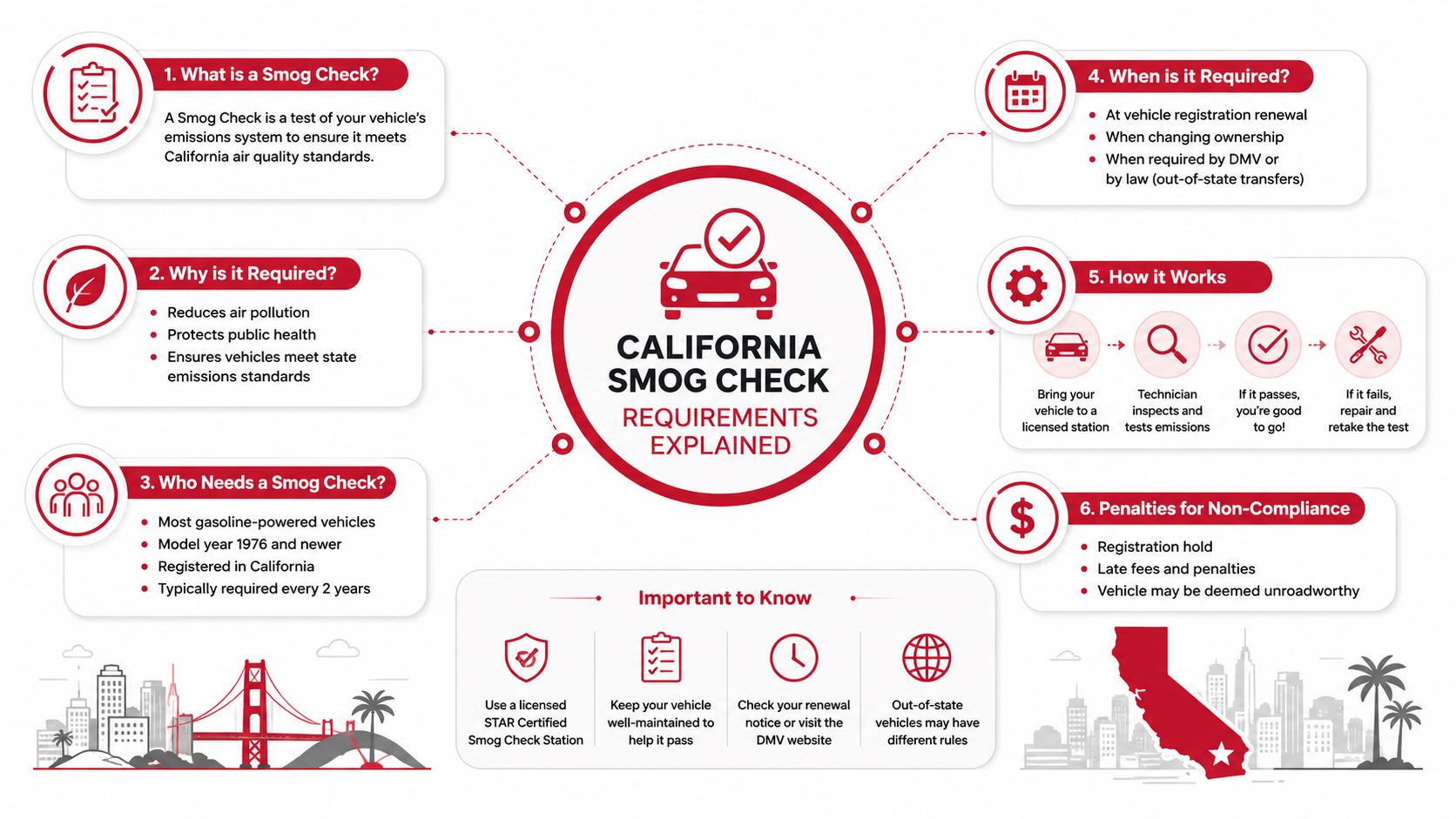
Understanding station labels
The station label matters because the wrong shop can leave you stuck with a failed trip and no completed test. California uses test-only, test-and-repair, and STAR stations, and STAR stations are held to higher performance standards for inspecting higher-polluting vehicles. That label tells you what the station can legally do, so check it before you leave home.
A test-only station checks the vehicle and stops there. A test-and-repair station can inspect the car and handle fixes in the same place, which is the better move if you already know the car has a problem. A STAR station is the stricter option, and if your renewal paperwork calls for one, do not assume a regular smog shop will qualify.
Match the requirement to the vehicle
Passenger cars are usually simple. Diesels, hybrids, RVs, vans, trucks, and motorhomes need a closer look because station equipment, lane size, and certification can differ from one place to another. The first question is not which shop is closest. The first question is whether that station can test your exact vehicle without wasting your time.
Here's the practical breakdown:
- Standard daily driver: Use a station that handles your vehicle class and the certification your renewal notice expects.
- Diesel, hybrid, RV, or motorhome: Call ahead and confirm the station can test that setup, including any size or equipment limits.
- STAR notice: Do not guess. Go only to a station that is authorized for that requirement.
If you want one less errand, pair the smog visit with DMV registration renewal at a station that offers both services. That saves a second stop and keeps the paperwork moving in one trip.
How to Prepare Your Vehicle Before the Test
The best smog check is the one you pass the first time. That doesn't happen by luck, it happens because you show up with a car that's ready for the inspection computer to read it correctly.
Get the monitors ready
Drive the vehicle enough before the appointment that the onboard system has time to complete its checks. A common rule of thumb is to put enough miles on the car before test day so the readiness monitors have had a chance to set. If the car has been sitting, don't bring it in cold and expect a smooth result.
Practical rule: Warm engine, normal driving history, no shortcut attempts.
You should also pay attention to the dashboard. If the check engine light is on, stop treating the visit like a routine errand. That light is often the first clue that the car needs diagnosis before testing, not after. The same goes for rough idling, sputtering, or anything that tells you the engine isn't running cleanly.
Handle the obvious stuff first
A loose gas cap is a small problem that can create a big headache. Make sure it seals properly and looks undamaged before you head out. If the cap is cracked or won't tighten correctly, replace it first.
Use this quick prep list:
- Confirm the dashboard is clear: No warning lights, especially no check engine light.
- Inspect the gas cap: Tighten it fully and replace it if the seal looks worn.
- Drive the car normally beforehand: Don't park it for days and then rush to the station.
- Fix basic maintenance items: If oil changes, filters, or ignition service are overdue, handle them first.
- Book a warm-time appointment: Late morning or early afternoon usually beats a cold-start visit.

The station can only test what shows up in front of it. If the car is already borderline, your prep work is what keeps the visit from turning into a repair estimate.
Common Reasons Vehicles Fail and How to Fix Them
Most smog failures aren't mysterious. They usually come down to a handful of predictable issues, and once you know the pattern, you can decide whether the car needs quick maintenance or real repair work.
The usual failure points
A lit check engine light is the obvious one. If that light is on, the car needs diagnosis first because the computer already knows something is wrong. Another common problem is incomplete onboard diagnostic monitors, which means the car hasn't finished the internal checks the smog machine needs to see.
Exhaust and emissions hardware matter too. A worn catalytic converter, tired oxygen sensor, or bad evap sealing can push the vehicle out of range. Those problems usually show up as drivability issues, poor fuel control, or recurring warning lights, not just a failed test printout.
For a deeper breakdown of failure patterns, I'd send drivers to this guide on smog check fail reasons.
What the fix usually looks like
Small problems are often cheap and fast to correct. A gas cap is a simple replacement. A monitor that isn't ready may just need more driving time after the repair has been cleared. Sensor or converter problems are a different story, because those usually need diagnosis, parts, and a real repair plan.
If the car failed because the computer sees an active fault, don't waste a test fee on a second guess. Fix the fault first.
Owners often lose money this way. They show up hoping the car will “just pass,” fail the test, and then pay again after the repair. If you already know the vehicle has symptoms, get the diagnosis first and the inspection second.
Choosing Between Test-Only and Test-and-Repair Stations
This decision matters more than most Dublin drivers realize. If you pick the wrong type of station, you may lose time, lose trust in the result, or miss the easiest path for your situation.
Test-only keeps the process clean
A test-only station inspects the vehicle and stops there. No repair sales, no pressure to buy parts, no built-in conflict between the test result and the repair estimate. If you want a straightforward certification and nothing else, that's the cleaner setup.
That's why I usually point cautious drivers toward a test-only lane when they already have a repair shop they trust. If the car fails, they can take the result elsewhere and compare options without being locked into the same place.
Test-and-repair is about convenience
A test-and-repair station makes sense when you suspect the car may need work and you'd rather handle diagnosis and repair in one stop. That's useful for drivers who don't want to bounce between two businesses.
For Dublin drivers with specialized vehicles, the question is whether the station can test what you drive. Some local listings advertise diesel, hybrid, RV, and gross-polluter coverage, while others don't. That's why I tell people to call ahead instead of gambling on a web listing.
One local option is Fire House Smog's test-only center, which fits drivers who want a certification-focused visit and no repair upsell. I'd still verify vehicle type before heading over, especially for larger or less common rigs.
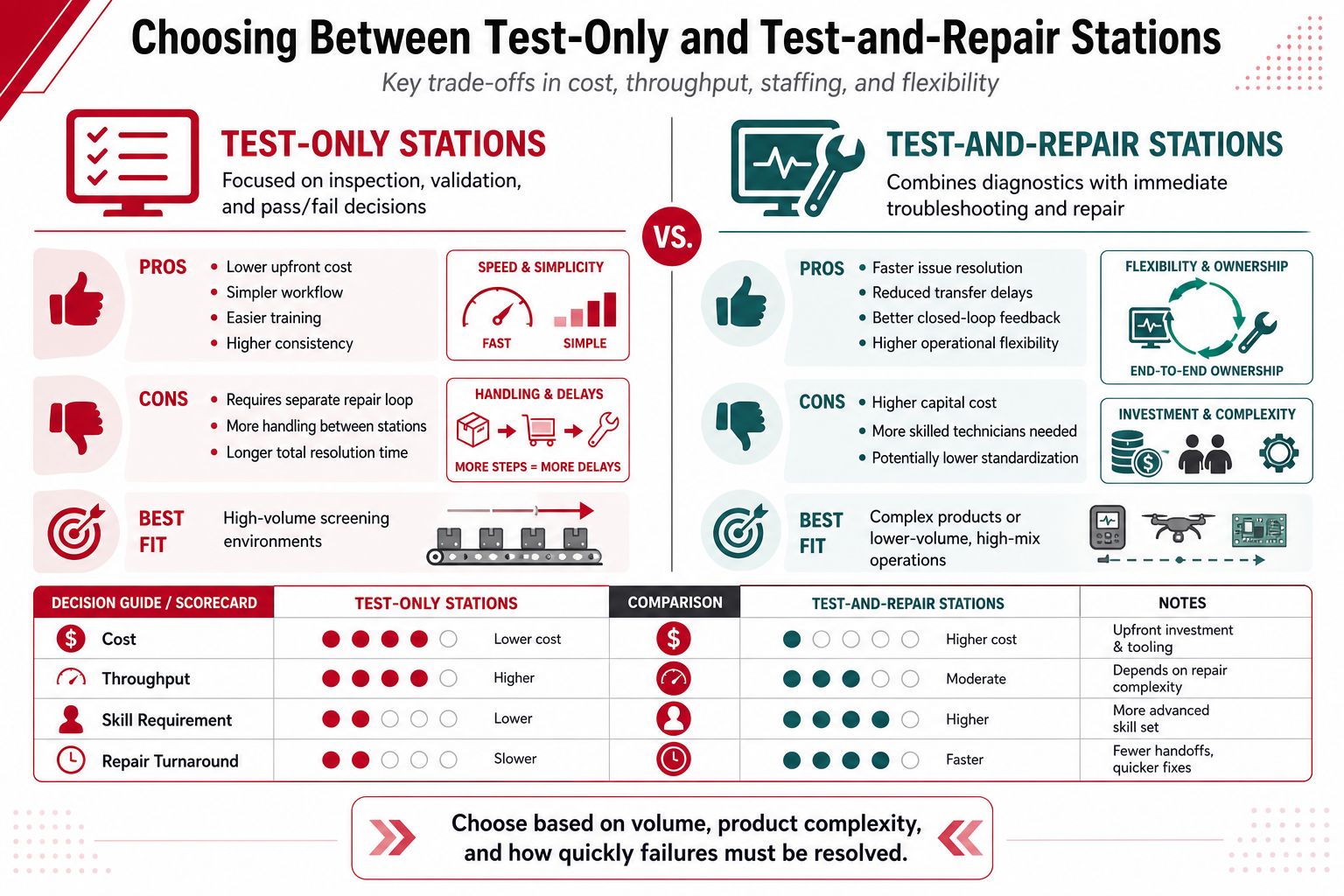
The short version is this. If you want an unbiased inspection, choose test-only. If you expect to need repair work and want one stop, choose test-and-repair. If your vehicle is unusual, confirm the lane can handle it before you leave the driveway.
Combining Your Smog Check with DMV Registration Renewal
This is the time-saving move most drivers miss. If the station is also a licensed DMV registration service provider, you can usually handle the smog test and the renewal work without bouncing across town.
What you can often finish in one trip
On-site DMV services commonly cover registration renewal, sticker printing, and ownership transfer work. That means you can leave with the compliance task wrapped up instead of waiting for a separate office visit and mailing cycle. For busy drivers, that's the whole point.
Bring the documents the station asks for and keep them together before you arrive. If you're renewing, that usually means your registration paperwork and any items tied to the vehicle record. If you're transferring ownership, you need the transfer documents ready so the clerk isn't chasing missing signatures.
The registration side of the process is handled as a service, not a guess, so it helps to review the station's DMV page first. A useful local reference is California DMV registration renewal service information.
Why this saves more than time
A combined stop also cuts down on delays caused by office hours and crowded counters. If the station offers evening or weekend availability, you get more flexibility than a standard weekday DMV visit. That matters for working people who can't afford to take a half-day off just to chase a sticker.
For fleet owners and anyone managing more than one vehicle, the benefit is even bigger. One stop, one line, one set of documents, and less chance of forgetting a step between the test and the renewal.
Your Action Plan for a Stress-Free Smog Check
Start with the notice, not the station. Confirm whether your vehicle needs a Smog Check this cycle, then match it to the right lane, test-only, test-and-repair, or STAR if your paperwork calls for it (California Bureau of Automotive Repair). If you drive a diesel, hybrid, RV, or other less common setup, call ahead and make sure the shop can test it.
The simplest way to do it right
- Check the renewal notice. Don't guess about timing.
- Choose the correct station type. Match certification to the car.
- Prep the vehicle first. Warm it up, clear obvious issues, inspect the cap.
- Book a sensible appointment time. Avoid rolling in cold and unprepared.
- Bring your DMV paperwork if you want same-trip renewal.
- Ask about retest policy before you pay.
Keep your expectations tight and your checklist short. That's how you stay in control of the process instead of letting the process control your day.
If you want a smog visit that's fast, test-only, and built around getting you in and out without repair pressure, Fire House Smog handles STAR-certified testing and DMV registration services in one place. Call ahead if you drive something unusual, bring the right paperwork, and make the trip once instead of twice.