
You're standing beside a large motorhome with a DMV renewal notice in hand, wondering whether it belongs at an ordinary smog station, a heavy-duty emissions facility, or nowhere at all. That uncertainty is understandable, but guessing can cost you a wasted trip, a rejected inspection, and a registration delay.
California doesn't exempt RVs just because they're recreational vehicles. Fuel type, model year, registration status, and gross vehicle weight rating, or GVWR, determine the correct emissions pathway. The most important dividing line for many diesel motorhomes is the GVWR label inside the driver's door. Check that label before booking a test.
Table of Contents
- Navigating California RV Emissions Requirements
- Standard Smog Check Rules for Motorhomes
- The Heavy-Duty Clean Truck Check Divide
- Preparing Your RV for a Passing Inspection
- Why a STAR Test-Only Station Protects You
- Combining Smog Testing with DMV Registration
- Your RV Compliance Action Plan
Navigating California RV Emissions Requirements
David parked his gasoline motorhome for most of the year and assumed limited use would keep emissions testing off his registration requirements. The renewal notice proved otherwise. California bases the requirement on the vehicle's characteristics and registration circumstances, not on how often the owner takes it camping.
For a smog check for an RV, start with classification. A motorhome is not exempt just because it is recreational. A gasoline RV from 1976 or newer is generally subject to Smog Check, while diesel vehicles from 1998 or newer are generally included, subject to California's weight and registration rules. The standard light-duty path usually requires inspection every other year when the DMV requests certification.
Practical rule: Classify your RV by fuel, model year, and GVWR, not by its appearance.
The biggest mistake involves diesel pushers and other large coaches. A non-gasoline motorhome with a GVWR over 14,000 pounds may fall under California's separate Clean Truck Check program instead of the standard Smog Check program. That changes the testing method, reporting process, schedule, and type of facility you need. Confirm the weight threshold before driving to a passenger-vehicle smog station.
Find the controlling details first
Record these four details before contacting a testing facility:
- Fuel: gasoline, diesel, or another fuel.
- Model year: use the vehicle's model year, not the purchase date.
- GVWR: read the manufacturer's label on the driver's door jamb.
- Registration purpose: confirm whether the motorhome is registered for non-commercial or commercial use.
The California Bureau of Automotive Repair Smog Check guidance explains which qualifying RVs and motorhomes fall within California's program. For more detail on how vehicle class and registration status affect testing, review these California emissions testing requirements.
Use the classification result to choose the facility. Confirm that it handles your testing program and can physically accommodate the coach. A station built for passenger cars may lack the equipment or space for a large motorhome, and a standard Smog Check certificate may not satisfy a heavy-duty Clean Truck Check obligation. Identifying the correct lane first prevents a rejected inspection, wasted travel, and registration delays.
Standard Smog Check Rules for Motorhomes
A newer gasoline motorhome can avoid a routine inspection, while an older qualifying coach may need one during registration renewal or a transfer of ownership. The standard lane is defined by timing and exemption rules, so check the DMV requirement before booking an appointment.
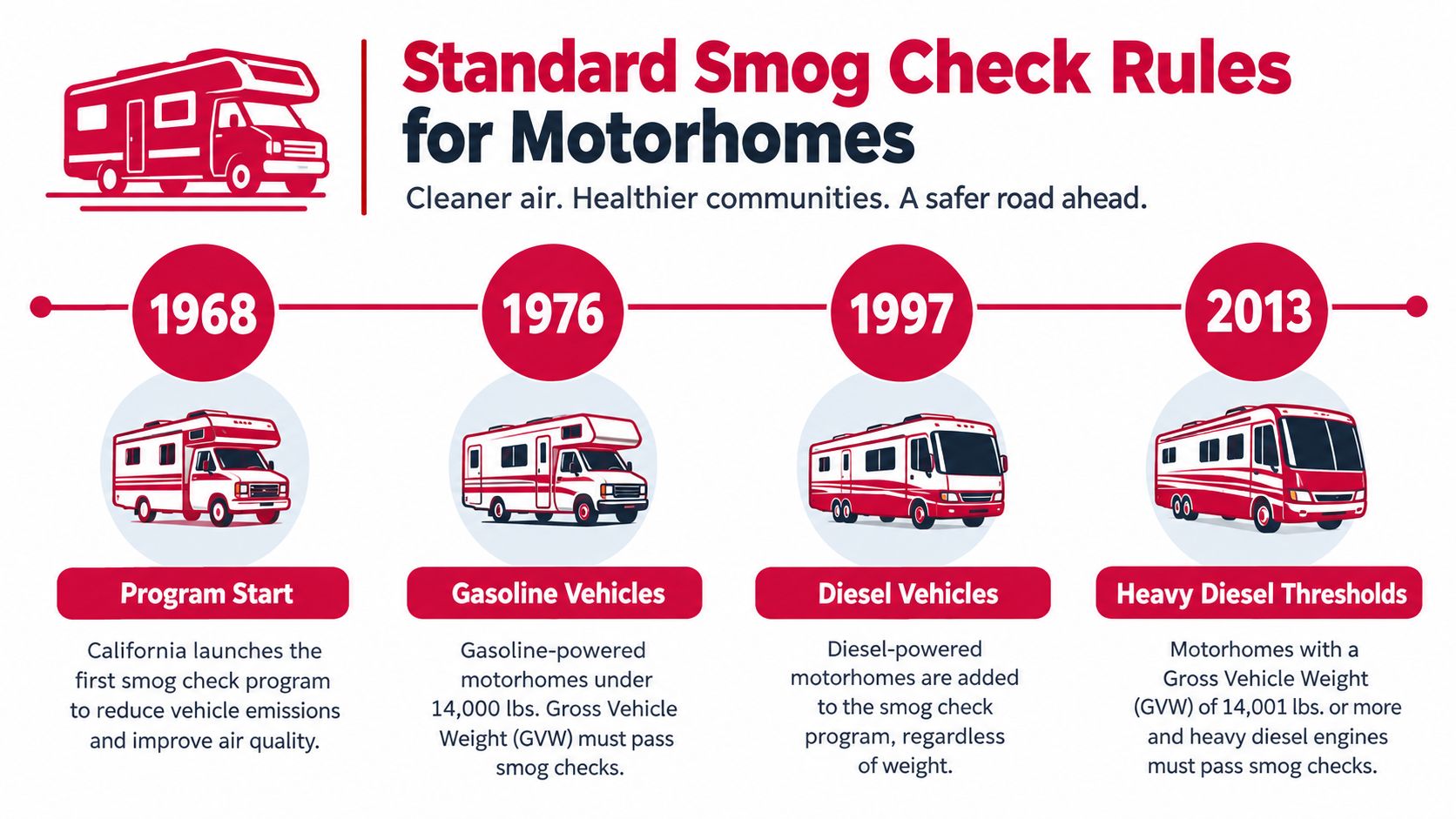
For vehicles in the ordinary program, testing is generally required every other year when the DMV renewal process calls for it. A change of ownership can also trigger a test. The timing depends on the vehicle's status in California records, not just on whether the coach is used regularly.
The age exemption is easy to miss. Vehicles four model years old and newer aren't subject to the biennial or change-of-ownership Smog Check requirement. California also provides a smog abatement fee option for vehicles less than four model years old during the first eight years they are registered. That pathway began January 1, 2019, and is described in the Bureau of Automotive Repair's Smog Check program information.
Use the exemption and fee rules to check your renewal notice:
- A newer qualifying gasoline motorhome may fall within the four-model-year exemption.
- A vehicle outside that exemption may require the inspection or the applicable abatement fee.
- An ownership transfer can create a testing requirement even when the usual renewal cycle has not arrived.
- A notice from the DMV remains the controlling prompt for registration compliance.
California also changed how qualifying newer vehicles are inspected. Assembly Bill 2018 expanded emissions testing in areas that had not attained federal air-quality standards. Assembly Bill 2289 shifted 2000 model-year-and-newer vehicles toward an OBD II-focused inspection approach, according to the 2026 Smog Check Performance Report. For an eligible RV, that means the technician may rely heavily on the onboard diagnostic system rather than an older tailpipe-style procedure.
Do not treat a missing renewal notice as proof of exemption. Check the model year, review the DMV requirement, and confirm that the selected station can test a motorhome of your size. A large diesel coach also requires a separate GVWR check before you choose the standard lane.
The Heavy-Duty Clean Truck Check Divide
A diesel motorhome can arrive at the wrong testing facility only because its owner checked the engine type but not the weight rating. The 14,000-pound GVWR threshold determines whether many non-gasoline coaches follow California's separate Clean Truck Check process instead of the ordinary smog lane.
For a non-gasoline motorhome with a GVWR over 14,000 pounds, the owner must register the vehicle in the Clean Truck Check Vehicle Inspection System, pay the required annual fee, and submit passing emissions compliance tests. This is a separate administrative and testing process, not a tougher version of a regular passenger-vehicle smog visit.
Check the door-jamb label before booking. A large diesel pusher may be unable to complete its required compliance process at a standard smog station, even if that station routinely handles smaller RVs.
CARB says Clean Truck Check deadlines began January 1, 2025. Passing tests may be submitted up to 90 days before the applicable deadline, according to the Clean Truck Check motorhome requirements. Non-commercial motorhomes are tested annually, while commercial-use motorhomes are tested semi-annually. Vehicle use affects the schedule, but GVWR is the first eligibility question.
Compare the two compliance lanes
| Feature | Standard Smog Check | Clean Truck Check |
|---|---|---|
| Primary vehicle group | Qualifying gasoline RVs and lighter vehicles | Non-gasoline motorhomes over 14,000 pounds GVWR |
| Main reference point | Fuel, model year, weight, and registration rules | GVWR, fuel, vehicle use, and CARB participation |
| Typical frequency | Every other year when required for registration | Annual for non-commercial motorhomes, semi-annual for commercial-use motorhomes |
| Administrative system | Standard California Smog Check process | Clean Truck Check Vehicle Inspection System |
| Facility question | Can the station perform the required RV inspection? | Can the provider perform and report heavy-duty compliance testing? |
| Owner's first check | Model year and fuel type | Door-jamb GVWR and fuel type |
Beginning October 2027, OBD-equipped vehicles are currently scheduled to move to quarterly testing under CARB's proposed framework, subject to final rulemaking. CARB's Clean Truck Check motorhome fact sheet distinguishes that proposed future framework from the annual schedule that applies to non-commercial motorhomes.
The label inside the door jamb is the deciding document. Coach length, a diesel badge, and another owner's experience do not establish the applicable lane.
If the motorhome is non-gasoline and exceeds the threshold, verify its registration in the required system, pay the applicable fee, and choose a provider that supports Clean Truck Check. Confirm the lane first. Booking a routine biennial smog appointment for a heavy diesel coach can waste time and create an avoidable trip.
Preparing Your RV for a Passing Inspection
A failed inspection often starts before the RV reaches the testing bay. One warning light, incomplete monitor, loose fuel cap, or unapproved emissions modification can turn an expensive coach trip into a second appointment. Confirm the correct testing lane first, especially if the door-jamb GVWR places a heavy diesel motorhome under Clean Truck Check rather than the standard smog process.
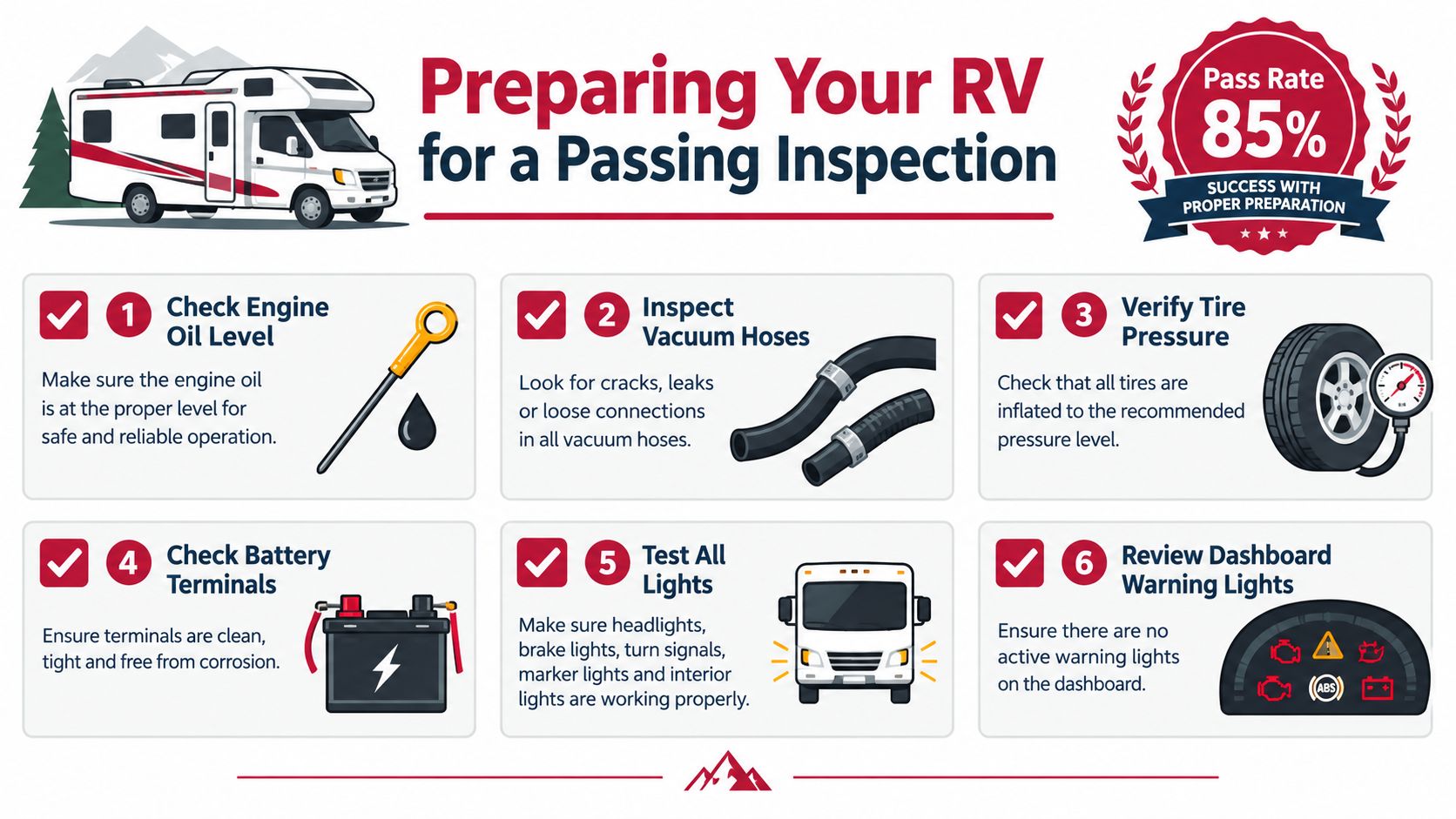
Start with the dashboard. An illuminated check-engine light signals an emissions fault that needs diagnosis. Do not clear codes immediately before testing. Clearing them can reset readiness monitors, so the vehicle may not show that its required systems have completed their checks. Review this guide to OBD readiness monitors before scheduling the inspection.
Use a practical inspection checklist
- Confirm the warning-light status. The dashboard should not display an active emissions warning. If a light appeared recently, have the code diagnosed instead of guessing.
- Inspect the fuel cap. A loose or damaged cap can keep the fuel system from sealing. Tighten it until it locks, and replace it if the seal is worn.
- Complete normal driving after repairs. The onboard monitors may need ordinary operating conditions to run. Ask your technician whether the required drive pattern has finished.
- Look for tampering. The inspection can include a visual review of emissions equipment. Non-approved intake, exhaust, catalytic converter, or other modifications can cause a failure even when the engine runs normally.
- Check basic operating condition. Verify the oil level, battery connections, vacuum hoses, lights, and tire pressure. These checks do not replace emissions diagnosis, but they reduce preventable interruptions.
- Confirm station access. Call with the coach's dimensions, fuel type, and GVWR. A facility may accept some RVs while lacking the clearance or equipment needed for yours.
Bring the RV in a warm, maintained condition. For a heavy diesel motorhome, follow the Clean Truck Check provider's instructions for engine condition, visible smoke, identification labels, and reporting. Do not apply gasoline-RV preparation advice to the wrong testing lane.
The inspection may involve an emissions-equipment review, diagnostic scan, and procedures suited to the vehicle. Keep the RV in its normal operating configuration. Removing equipment or temporarily clearing a warning light does not correct the compliance problem and can create further diagnostic complications.
Watch this short visual guide before scheduling:
Why a STAR Test-Only Station Protects You
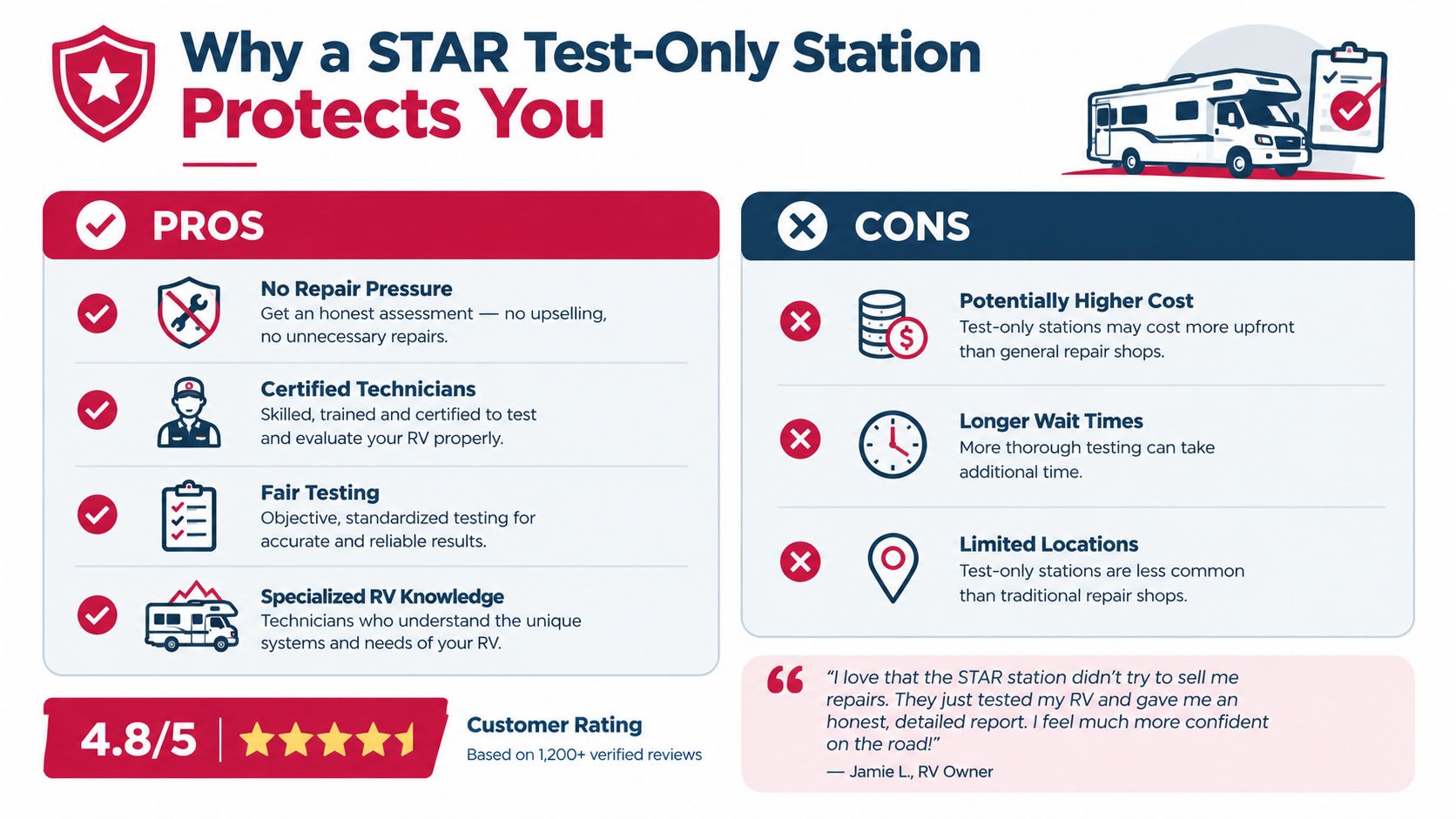
You can fail an RV emissions inspection, then face pressure to approve expensive repairs before you understand the cause. A test-only station separates those decisions. It performs the inspection without selling the repair work that might follow, which gives you room to compare repair options for a large, difficult-to-service vehicle.
A test-and-repair business can still conduct a legitimate inspection. However, a failed test may lead directly to an in-house repair recommendation. With a test-only facility, you receive the result first and can choose an independent mechanic, mobile technician, dealer, or specialist based on the documented failure.
Match the facility to your RV
A STAR-certified test-only station may be required when the DMV directs your vehicle to STAR testing. The certificate alone does not confirm that the facility can handle a large coach. Call before booking and verify the following:
- Vehicle clearance: Can the bay accommodate the motorhome's height, width, wheelbase, and approach angle?
- Testing category: Does the station inspect your fuel type and model year?
- RV capacity: Does it accept motorhomes, or only cars and light trucks?
- Scheduling: Can it reserve enough time for a large vehicle?
- Result handling: Will you receive clear documentation if the vehicle fails?
Fire House Smog is one example of a STAR-certified test-only station and licensed DMV registration services provider that inspects some RVs and motorhomes, subject to size and equipment limits. Call with the coach's dimensions before visiting. Its test-only model means it does not sell repair work, while its two-bay setup and extended testing hours support vehicle throughput. Confirm fit and equipment before relying on those operating details.
Ask before leaving home: “Can your equipment accept my exact RV, and is my vehicle in the standard Smog Check category?”
That answer matters more than proximity. If the RV fails, use the inspection report to obtain an independent diagnosis. Do not authorize major work based only on a verbal suggestion.
Combining Smog Testing with DMV Registration
A renewal notice does not determine the correct inspection lane. First confirm the RV's classification, especially its GVWR, fuel type, and model year. A qualifying standard-program motorhome may combine its smog inspection with DMV registration services. A heavy diesel motorhome subject to Clean Truck Check follows a separate compliance process, so booking a regular smog appointment can waste a trip.
Before scheduling, call the facility with the model year, fuel type, GVWR, and approximate dimensions. Confirm that it can test the RV and complete the requested DMV transaction during the same visit. Ask whether registration renewal, ownership transfers, or sticker printing are available for your transaction. This prevents an avoidable arrival with the correct notice but the wrong provider, equipment, or service category.
Prepare the documents in advance:
- Current registration: Helps verify the vehicle record.
- DMV renewal notice: Bring it when the DMV has sent one.
- Insurance information: Keep current proof available if the transaction requires it.
- Ownership documents: Bring the title or transfer paperwork for a change of ownership.
- Payment method: Confirm accepted payment types before driving a large RV to the facility.
A passing result may transmit electronically, but keep the receipt and inspection paperwork. If the DMV requires additional information, missing documents can turn one planned visit into a second trip.
Fire House Smog's published service information lists on-site California DMV registration renewals, ownership transfers, and registration sticker printing during posted service hours. Its listed location is 2900 Lone Tree Way in Antioch. Owners of larger RVs should confirm clearance, equipment compatibility, and the vehicle's testing category before booking. DMV service hours may differ from smog testing hours, so ask about both services during the call.
Book with enough time for diagnosis or retesting if the RV fails. This matters even more when the motorhome has been stored for an extended period or must travel a significant distance to reach the facility. Plan around the vehicle's emissions classification and the provider's capabilities, not just the renewal deadline.
Your RV Compliance Action Plan
California RV emissions compliance starts with the vehicle's classification. Confirm the correct testing lane before booking a station.
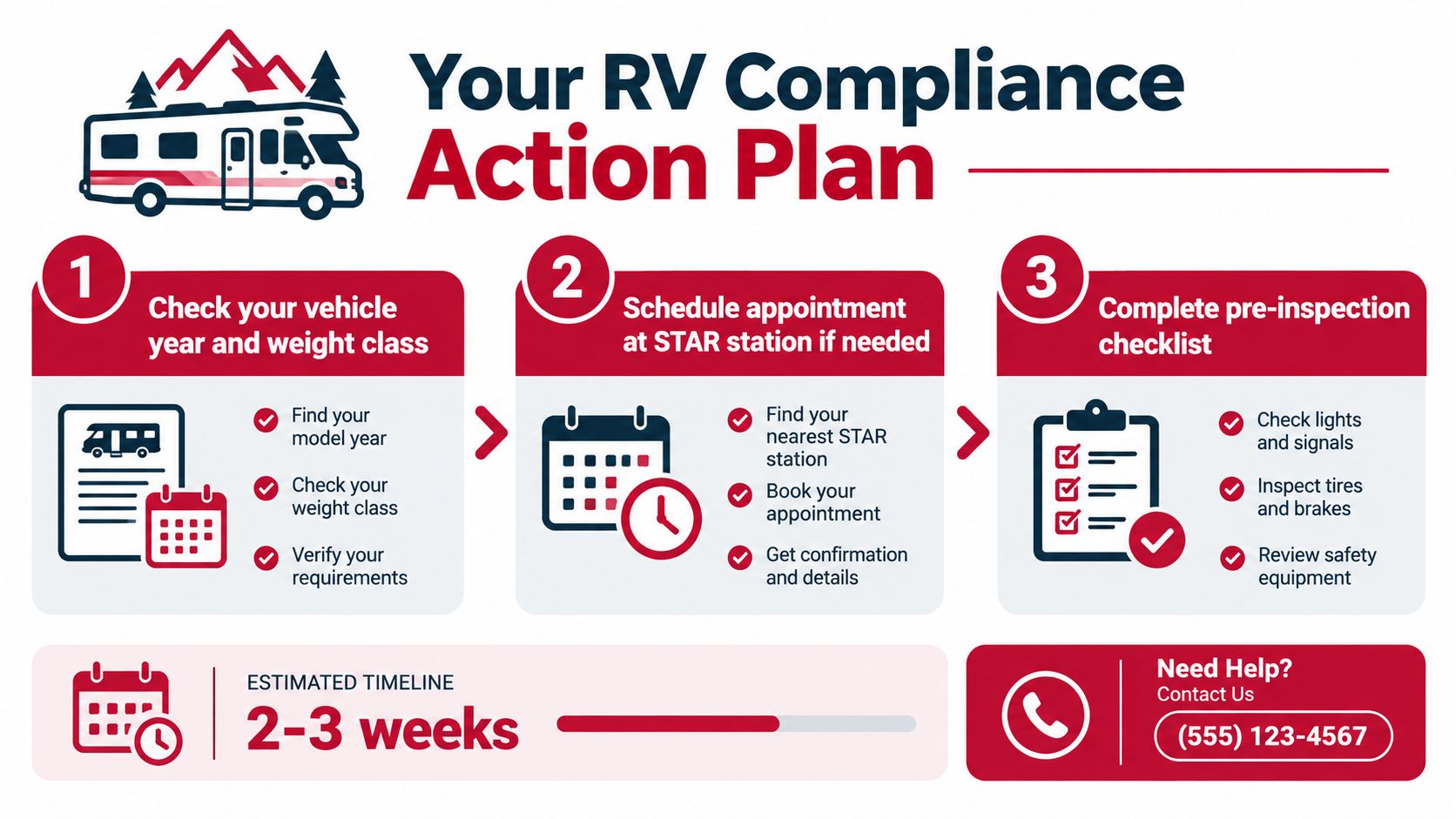
Step one, identify the lane
Record the model year, fuel type, and GVWR. Gasoline motorhomes from 1976 or newer and diesel vehicles from 1998 or newer generally fall under standard Smog Check rules when they meet California requirements. Vehicles four model years old and newer generally avoid biennial and change-of-ownership testing.
A non-gasoline motorhome over 14,000 pounds GVWR belongs in the Clean Truck Check process, not the standard smog lane. This threshold determines which provider and reporting process you need.
Step two, book the right provider
For a standard inspection, confirm STAR certification if your DMV notice requires it, and verify that the station accepts your RV's size. Heavy diesel motorhomes need a provider equipped for Clean Truck Check testing and reporting. One certificate does not replace the other.
Step three, arrive prepared
Bring registration, the renewal notice, insurance information, ownership documents when relevant, and accurate vehicle details. Check warning lights, complete required drive conditions, inspect emissions equipment, and confirm the facility can handle the coach safely.
Use the Bureau of Automotive Repair's program overview and current CARB motorhome guidance when the vehicle's status is unclear. Verify requirements before each registration cycle.
Fire House Smog offers STAR-certified test-only inspections, some RV and motorhome testing subject to size and equipment limits, and California DMV services with on-site sticker printing. Visit Fire House Smog to confirm fit and coordinate services before arrival.