Your California registration is expiring, and you need a current sticker before the next drive. The problem is that you may not know whether the record is ready for renewal, whether a smog check is required, or whether the transaction is a transfer rather than a routine renewal.
The best DMV tag renewal near me option depends on the job. A kiosk can be fastest for an uncomplicated, eligible renewal. A private DMV partner can be better for transfers, replacement materials, or hands-on help. A DMV office remains the backup for cases that require official staff review. If emissions testing is part of the problem, Fire House Smog combines STAR-certified test-only smog checks with California DMV services and sticker printing at 2900 Lone Tree Way in Antioch.
Before leaving home, verify your renewal notice or vehicle information, payment method, smog clearance, insurance status, possible registration holds, posted hours, appointment requirements, and whether the location handles your specific transaction. Kiosk and partner eligibility varies by case. Service fees, RV limits, weekend availability, and payment rules also need confirmation before you drive over.
Table of Contents
- 1. Fire House Smog for combined smog and DMV service
- 2. AAA Antioch Branch for member service
- 3. DMV Now Kiosk at Safeway Brentwood for self-service speed
- 4. DMV Now Kiosk at the Pittsburg DMV field office for an official-location backup
- 5. Jimmy's Registration Service in Brentwood for transfers and hands-on help
- 6. Pacific Star Insurance registration desk in Pittsburg for local counter support
- 7. Rapido Auto Registration in Pittsburg for flexible bilingual service
- DMV Tag Renewal Near Me, 7-Location Comparison
- Make Your Renewal Visit Count
1. Fire House Smog for combined smog and DMV service
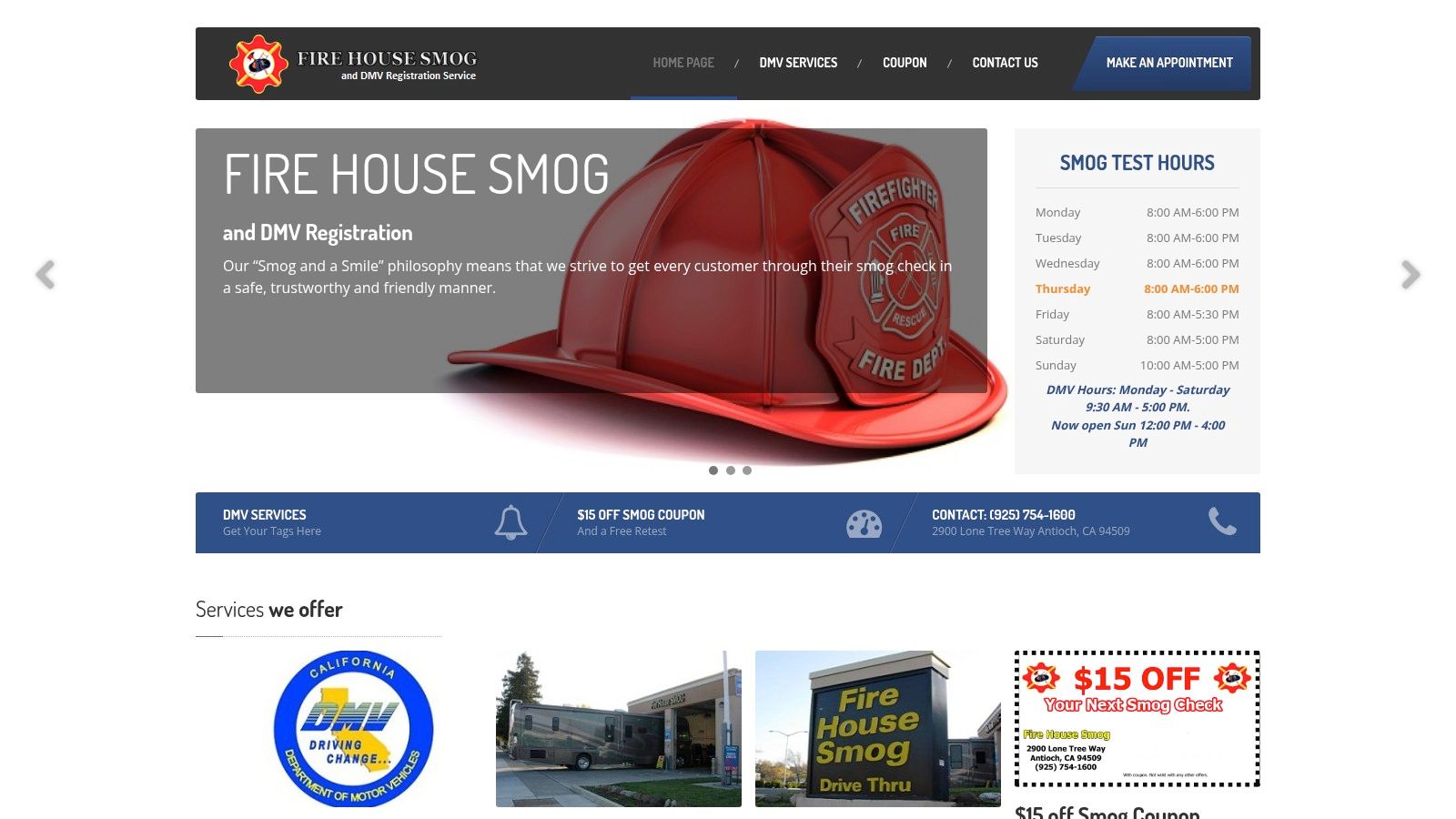
When a smog check stands between you and registration, splitting the visit across two locations wastes time. Fire House Smog keeps both steps under one roof at 2900 Lone Tree Way in Antioch. The facility is a STAR-certified, test-only smog station and a licensed California DMV registration services provider.
The shop tests passenger cars, SUVs, light-duty trucks, and some recreational vehicles, subject to bay and equipment limits. It also handles California registration renewals, ownership transfers, and related DMV tasks. On-site sticker and plate printing may be available during posted service hours, so confirm that your transaction qualifies before arriving. This setup fits drivers who need emissions testing and want local help with the registration step afterward.
California generally requires emissions inspections every other year. Vehicles four model years old or newer are exempt from biennial and change-of-ownership Smog Checks. A vehicle entering California from another state generally needs a Smog Check if it is a 1976 model year or newer and is being registered in California for the first time, subject to applicable exemptions. Review the California Smog Check requirements and June 2025 results before treating your vehicle as exempt.
Why the test-only model matters
Fire House Smog does not repair vehicles that fail. You receive the inspection result and can take the vehicle to another provider for repairs. Its two service bays support quick vehicle movement, while seven-day smog availability and extended evening and weekend hours can reduce waiting for drivers with limited schedules. Confirm current hours and any transaction cutoff before visiting.
The shop also advertises a coupon policy that may include a smog discount and a free retest when required, subject to current terms. Available materials do not provide current pricing, so confirm fees, coupon conditions, payment requirements, and DMV service availability in advance.
Practical rule: If your renewal notice requires smog certification, ask Fire House Smog to confirm the inspection requirements and whether the registration transaction can be completed after the electronic result posts.
For local guidance, read this overview of Smog Check services in Antioch. Call 925-754-1600 before bringing an RV or motorhome. Some recreational vehicles fit the service profile, but larger vehicles or unusual equipment may exceed the location's limits.
Best for: Drivers who need smog testing plus renewal or transfer assistance at one location.
Watch for: Failed vehicles require repairs elsewhere. Confirm RV capacity, eligibility, current coupons, payment rules, posted hours, and whether on-site sticker or plate issuance applies to your case.
2. AAA Antioch Branch for member service
If you already hold an active AAA membership, the Antioch branch lets you skip the DMV counter and handle eligible California registration renewals with staff. The branch can print new tags during the visit and offers help with duplicate documents, temporary permits, and some out-of-state registration matters.
Choose this route when the transaction needs explanation rather than a touchscreen. Staff guidance can help with a document question or a common registration issue, while a routine renewal may be completed on-site. Bring your renewal information and confirm that the branch handles your exact transaction. Ownership transfers and standard renewals can follow different requirements.
The Antioch branch information page lists current hours, services, and membership requirements. Check it before leaving, then confirm any transaction cutoff by phone. Posted branch hours may differ from the time available for DMV processing.
What members should confirm
Active membership is required. A credit-card payment for DMV services may also carry a processing fee of up to about 1.7%. Confirm the current fee and accepted payment methods before authorizing the transaction.
Bring the renewal notice or complete vehicle details. Check that insurance and smog information are current when applicable. A registration hold can stop the renewal, even if branch staff can identify the next step. Ask whether your case qualifies for on-site sticker or tag issuance before visiting.
AAA members who want staffed guidance on common DMV tasks will save time here. The trade-off is membership cost plus any applicable card-processing charge.
Choose AAA when: You have active membership, prefer face-to-face assistance, and need a staffed option for a routine renewal or common registration issue.
Compare the branch with alternatives to waiting in the DMV line. Use AAA when service guidance and immediate tag printing matter more than minimizing partner fees. Check operating hours, eligibility, payment rules, and holds first so the visit solves the task in one trip.
Best for: AAA members seeking staffed help, on-site tag printing, and assistance with common DMV-related tasks.
Watch for: Membership requirements, possible card-processing charges, transaction eligibility, registration holds, and current branch hours.
3. DMV Now Kiosk at Safeway Brentwood for self-service speed
A straightforward renewal with no registration hold is the situation where the Safeway Brentwood kiosk works best. You complete the touchscreen process, pay, and can receive a printed sticker after a successful eligible transaction, without a counter appointment.
Bring the renewal notice or complete vehicle details, and check that required smog and insurance information is current. The kiosk is for eligible California vehicle registration renewals, not every registration task. Transfers, unusual ownership records, and other unsupported transactions need staffed assistance or a different service route.
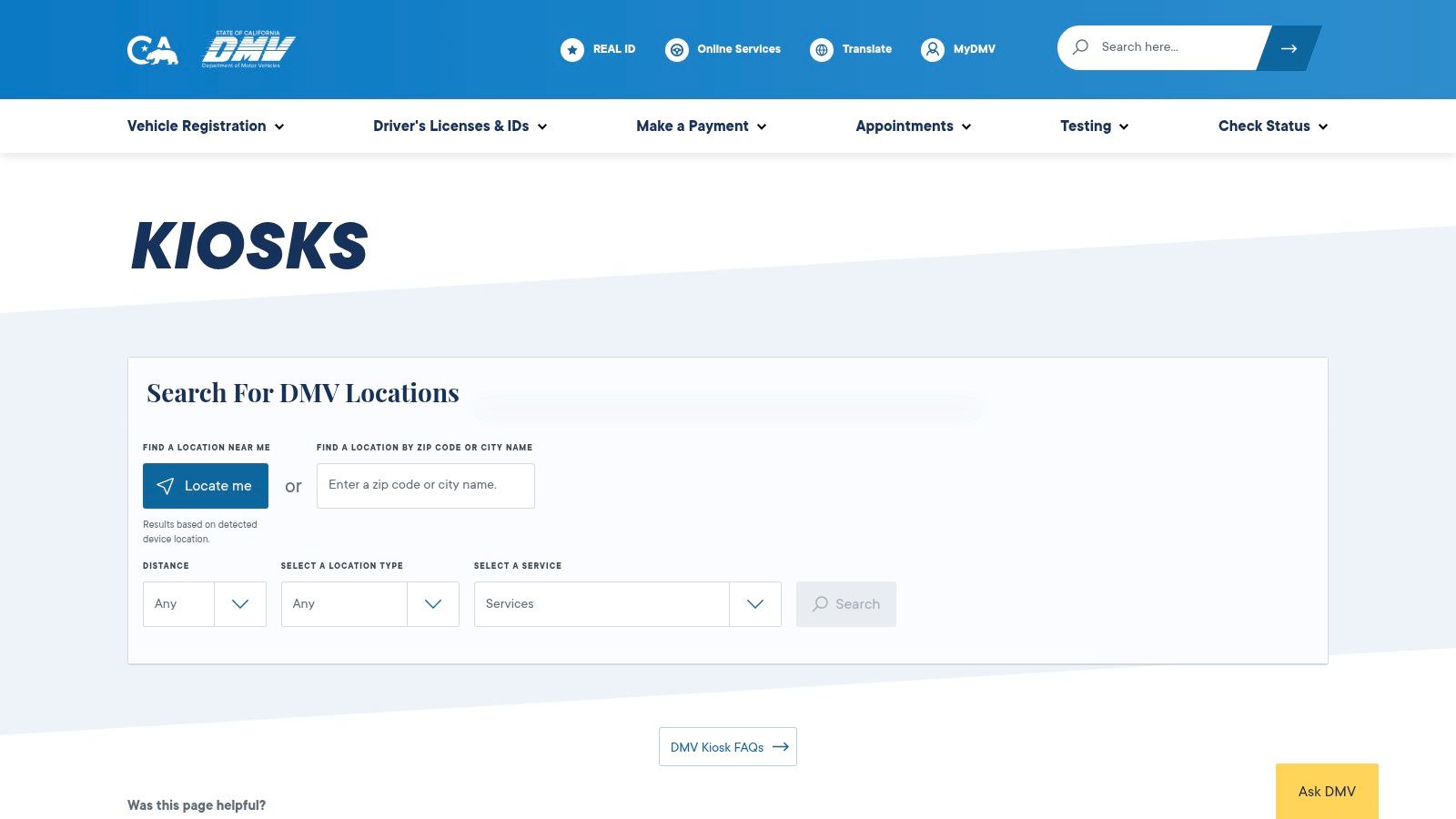
The touchscreen accepts multiple payment types, but confirm the current payment requirements before visiting. Use the California DMV kiosk directory to verify the location and supported transactions. Confirm the Safeway kiosk's current access hours as well. Grocery-store hours and kiosk availability may differ, so do not rely on late-night or early-morning access without checking first.
When the kiosk won't solve the problem
A blocking issue can stop the transaction before the sticker prints. Examples include unresolved smog clearance, an insurance lapse, a renewal more than 90 days past due, or another registration hold. California DMV also explains that missing electronic smog certification, insurance not reported electronically, and unresolved parking tickets can leave a renewal incomplete. Review the California vehicle registration renewal requirements before leaving home.
Use the kiosk only after confirming that the renewal is eligible and the record has no known hold. Arrive with documents ready and visit during verified access hours to reduce wasted time. If the transaction fails, compare a DMV alternative near you that offers staffed help.
Fastest route: Use the Brentwood kiosk for an eligible, uncomplicated renewal when immediate sticker printing and self-service speed matter more than hands-on assistance.
Best for: Eligible renewals with complete records and a preference for quick, self-service sticker issuance.
Watch for: Registration holds, missing smog or insurance data, unsupported transactions, payment rules, and current kiosk access hours.
4. DMV Now Kiosk at the Pittsburg DMV field office for an official-location backup
When the Brentwood retail kiosk is unavailable, or you prefer an official DMV setting, the Pittsburg field-office kiosk provides a practical backup. It handles many eligible renewals and can print the registration sticker on site, while the staffed office is nearby if the machine rejects the transaction.
Debit and credit cards are accepted, but confirm current payment requirements before visiting. The kiosk cannot resolve an insurance reporting error, missing smog information, registration hold, or unsupported transfer workflow. Those issues may require a counter visit or an update from another agency before renewal can finish.
Check the Pittsburg DMV kiosk details for supported transactions and current access information. Verify operating hours separately, and do not assume kiosk access guarantees immediate staff assistance. The kiosk and counter follow separate service paths, and office demand, appointment rules, and available capacity can affect escalation.
Use the location strategically
Bring your renewal notice, vehicle information, and payment method. Confirm that the record is eligible before leaving home, especially if you suspect a hold or incomplete smog or insurance reporting. A successful kiosk transaction avoids a conventional counter interaction and provides the sticker immediately.
If the machine declines the renewal, ask the field office what official step comes next, subject to current hours and appointment requirements. Arriving early, checking access information in advance, and having documents ready can reduce wasted time. The official setting also avoids driving to another retail kiosk after a failed attempt.
Choose this location when you want self-service speed with an official DMV office available as a fallback. A known hold or transfer review calls for a staffed registration partner that can discuss the paperwork more directly, although private service fees apply.
Best for: Drivers seeking kiosk convenience at a DMV field office, on-site sticker issuance, and an official backup if self-service fails.
Watch for: Eligibility limits, current kiosk and office hours, payment requirements, counter availability, registration holds, transfer restrictions, and the possibility that a failed transaction still requires an appointment.
5. Jimmy's Registration Service in Brentwood for transfers and hands-on help
Ownership transfers, replacement plates, and sticker replacements fall outside what a kiosk typically handles. Jimmy's Registration Service in Brentwood offers a staffed counter for these transactions, with walk-in registration service, same-day renewals, and on-the-spot sticker printing. Document review can help when you are unsure which forms or supporting records apply.
Use this route when the transaction is more involved than renewing an eligible registration. Bring your renewal notice, vehicle information, identification, and any transfer or replacement documents that apply. A staff member can review the paperwork, but the provider cannot clear every DMV record problem. Missing smog results, insurance reporting issues, citation holds, or other registration blocks may require action by the relevant agency before completion.
The California DMV location search for Brentwood services can help verify the listing and available services. Confirm current operating hours, walk-in acceptance, daily capacity, payment requirements, and whether the office can complete your specific transfer or replacement request. Local provider details can change, so check before travelling.
Where the partner fee earns its value
Jimmy's is a practical choice when DMV-office waiting costs more than a private service fee, or when document review matters more than the lowest-cost option. It suits transfers, replacement plates, replacement stickers, and other tasks that a self-service kiosk may reject.
Ask for the complete fee breakdown before authorizing the transaction. The DMV charge and the provider's service fee are separate, and the available information does not state the current partner fee.
Best for: Brentwood drivers who need staffed help with transfers, replacement materials, same-day registration service, or paperwork review.
Watch for: Service fees, changing hours, daily capacity, required documents, payment rules, registration holds, and whether the provider can finish your specific transaction.
6. Pacific Star Insurance registration desk in Pittsburg for local counter support
Pittsburg residents who want to address registration and auto insurance questions in one visit can use Pacific Star Insurance's on-site DMV desk. The counter accepts walk-ins and can issue tags or stickers on the spot for eligible transactions. Spanish-language assistance is also available, giving local customers a staffed alternative to a kiosk or DMV field-office queue.
Choose this desk for face-to-face help, especially when you want someone to review the transaction before submission. Insurance assistance does not remove DMV requirements. Missing smog certification, an insurance reporting issue, a citation, or another registration hold may require action by the relevant agency before the desk can finish the renewal.
For a simple renewal with no hold, a kiosk may be faster and avoid a private partner fee. Pacific Star makes more sense when proximity, personal guidance, or an insurance conversation matters more than the lowest-cost route. Same-day sticker issuance depends on transaction eligibility, so ask the counter to confirm it before paying.
Review the Pacific Star Insurance registration service before travelling. Confirm current operating hours, walk-in availability, daily capacity, payment methods, partner charges, and the documents required for a renewal or transfer. The available description does not establish that every complex DMV case can be completed there.
Bring your renewal notice or vehicle information, insurance confirmation when relevant, and all transfer documents. Check for registration holds before visiting, and call ahead if the transaction involves a title, replacement material, or another nonstandard request. Arriving outside peak periods may reduce waiting, but confirm the desk's current schedule first.
Best for: Pittsburg residents who want local counter assistance, possible same-visit sticker issuance, insurance support, and Spanish-language service.
Watch for: Private partner fees, current hours, walk-in capacity, payment rules, eligibility limits, and referrals for complex DMV cases.
7. Rapido Auto Registration in Pittsburg for flexible bilingual service
Evening and weekend appointments matter when weekday counter hours conflict with work or family commitments. Rapido Auto Registration on Railroad Avenue in Pittsburg offers bilingual staff, same-day renewals, flexible booking, and help with transfers and replacement plates or stickers.
Staff assistance makes the service useful for document-heavy transactions. Bring the title, purchase paperwork, vehicle details, owner information, and any other records connected to the request. For replacement materials, identify what was lost or damaged and confirm which identification and vehicle records are required.
The provider describes on-site tag issuance, but confirm that your specific renewal qualifies before paying. Registration holds, unresolved citations, insurer issues, or other agency blocks may require action elsewhere. Ask whether the counter can complete the transaction, issue the sticker during the visit, or refer you to the appropriate agency.
Check the Rapido Auto Registration website for current appointment instructions, operating hours, listed services, and contact details. Confirm eligibility, payment methods, required documents, total cost, and the private partner fee in addition to DMV fees. Appointment availability and same-day processing should also be verified before travelling.
Book ahead for an evening or weekend visit, and send or review paperwork in advance if the provider allows it. That preparation can reduce counter time and expose missing documents before your appointment.
Best use of a private partner: Choose this route for a transfer, replacement request, bilingual assistance, or a deadline that makes flexible scheduling valuable. A kiosk is usually the better fit for a simple renewal without holds when avoiding a service fee matters most.
Best for: Pittsburg drivers who need bilingual support, flexible appointments, transfers, replacement materials, or evening and weekend access.
Watch for: Private partner fees, appointment availability, current hours, payment rules, required documents, eligibility limits, and the provider's ability to resolve your specific DMV record issue.
DMV Tag Renewal Near Me, 7-Location Comparison
| Service | Process / Complexity 🔄 | Speed / Efficiency ⚡ | Expected Outcome / Impact 📊 | Ideal Use Cases 💡 | Key Advantages ⭐ |
|---|---|---|---|---|---|
| Fire House Smog | Low, test-only workflow; call ahead for large RVs | High, two bays, extended hours, 7‑day service | Certified smog inspection + on-site DMV transactions (when eligible) | Drivers needing certified smog checks and same‑visit DMV service | ⭐ STAR‑certified testing; transparent, repair‑free inspections |
| AAA Antioch Branch (DMV partner) | Moderate, requires active AAA membership | High, same‑day renewals for members | Registration renewals and on‑the‑spot tag printing for members | AAA members wanting faster DMV-like service with staff help | ⭐ Knowledgeable staff; same‑day tag issuance for members |
| DMV Now Kiosk – Safeway Brentwood (self‑service) | Very low, self‑serve touchscreen; limited transaction set | Very high, instant printing, very long hours | Immediate sticker printing for eligible, simple renewals | Straightforward renewals with no holds; 24/7 convenience | ⭐ Fastest, most time‑flexible option for simple renewals |
| DMV Now Kiosk – Pittsburg DMV Field Office (self‑service) | Low, kiosk inside DMV with easy escalation to staff | High, instant print; useful during busy office hours | Instant renewals for kiosk‑supported records | Quick in‑office renewals or fallback when retail kiosks unavailable | ⭐ Quick kiosk access plus on‑site escalation if needed |
| Jimmy's Registration Service (Brentwood) | Low‑Moderate, walk‑in partner counter; staff assistance | High, same‑day service but with partner fees | Renewals, transfers, replacement stickers handled same day | Transactions too complex for kiosks or customers preferring in‑person help | ⭐ In‑person support for multi‑step transactions |
| Pacific Star Insurance – Registration Desk (Pittsburg) | Low, walk‑in counter; insurance + registration options | High, instant tag issuance; local convenience | Same‑day renewals and potential insurance bundling | Locals wanting face‑to‑face help and insurance options | ⭐ Face‑to‑face service; Spanish‑language support; bundling option |
| Rapido Auto Registration (Pittsburg) | Low‑Moderate, independent partner; appointments recommended | High, flexible hours incl. evenings/weekends | Same‑day renewals, transfers, replacements; bilingual support | Bilingual customers and those needing evening/weekend service | ⭐ Flexible hours and Spanish‑language assistance |
Make Your Renewal Visit Count
Choose the route based on the problem, not just the phrase you typed into search. An uncomplicated, eligible renewal with no known holds belongs at a DMV Now kiosk. The Brentwood Safeway kiosk is the best speed-first option when you want immediate sticker printing and flexible access. The Pittsburg DMV kiosk is the better backup when you prefer to complete self-service inside a field-office location.
Choose a private registration partner when you need a person to review a transfer, replacement sticker, replacement plate, or other transaction outside normal kiosk limits. Jimmy's Registration Service fits Brentwood residents who want walk-in help. Pacific Star Insurance is useful in Pittsburg when registration and insurance questions overlap. Rapido Auto Registration is the strongest local choice when bilingual support or an evening or weekend appointment matters.
AAA Antioch is the right route for members who want staffed service and common DMV assistance. It can be faster than a traditional DMV visit for eligible transactions, but membership and possible card-processing charges affect the value. Confirm those conditions before you go.
Fire House Smog is the clear choice when a required emissions inspection stands between you and registration. Its STAR-certified test-only model, on-site California DMV services, sticker printing, two bays, and seven-day smog availability make it suitable for drivers who want to reduce separate trips. It doesn't perform repairs, so a failed vehicle must go elsewhere for repair before a retest or completed renewal.
Check the record before choosing a location
Payment alone doesn't guarantee a completed renewal. California DMV identifies missing electronic smog certification, insurance that hasn't been electronically reported, and unresolved parking tickets as reasons an online renewal can remain incomplete. Review the DMV renewal guidance and check your renewal notice for a smog requirement before selecting a kiosk or partner.
Late renewal needs careful attention too. California DMV says penalties begin when fees aren't paid by the expiration date. The listed vehicle-license-fee penalty is 10% for days 1–10, 20% for days 11–30, and 60% for 31 days to one year, as shown on the DMV registration penalties page. If the vehicle is off the road, consider whether Planned Nonoperation is appropriate. DMV allows PNO filing up to 60 days before expiration or up to 90 days after expiration, but a vehicle in PNO status can't be operated or parked on public roads.
Use this pre-visit list:
- Renewal details: Bring the renewal notice or the vehicle information needed to locate the record.
- Payment method: Confirm whether the location accepts your preferred card, cash, check, or other payment type.
- Smog status: Check whether certification is required, whether a STAR station is specified, and whether the electronic result has posted.
- Insurance status: Verify that current insurance has been electronically reported to DMV.
- Registration holds: Check for parking citations, unpaid fees, or other blocks that could prevent completion.
- Sticker issuance: Ask whether the location prints the sticker or plates during the same visit.
- Service fees: Separate DMV charges from private-provider fees and confirm the total before payment.
- Hours and appointments: Verify posted hours, transaction cutoffs, walk-in capacity, and appointment requirements.
- Vehicle limits: Call Fire House Smog before bringing an RV or motorhome because size and equipment limits apply.
California's registration system increasingly favors digital and self-service activity. Online DMV transactions increased 44% between 2019 and 2023, while reported customer satisfaction rose from 2.5 out of 5 in 2018 to 4.25 out of 5 in 2024, according to the Stanford-related California DMV case study. That means a local provider must offer something more useful than merely repeating an online payment screen. Immediate printing, document review, emissions assistance, and convenient hours are the reasons to choose an in-person route.
California's inspection network also operates at substantial scale. The Bureau of Automotive Repair's 2026 performance report states that the state had more than 8,000 active Smog Check stations during calendar years 2024–2025 and tested approximately 19 million vehicles from model year 2000 and newer, with about 1.3 million failures. Those figures reinforce the practical point: confirm the emissions requirement before you drive to a renewal location, especially for an older, recently purchased, or out-of-state vehicle.
Call ahead for anything unusual. That includes RV dimensions, out-of-state transfers, missing insurance records, failed smog tests, title problems, late renewals, and registration holds. The right location can save a trip, but only after you confirm that it can complete your exact transaction.
Fire House Smog combines STAR-certified test-only smog inspections with California DMV registration renewals, ownership transfers, and on-site sticker or plate printing at 2900 Lone Tree Way in Antioch. If your search for “DMV tag renewal near me” also involves emissions testing, call 925-754-1600 to confirm eligibility, RV limits, current hours, and service details, then visit Fire House Smog for a more efficient local route.
You've just opened your California DMV renewal notice, and there it is: a smog check requirement. Your car seems to run normally, but you're worried that a repair shop might recommend expensive work before you even know whether the vehicle failed. The good news is that you can separate the emissions inspection from any repair decision by choosing an auto smog test only station.
That distinction matters, but it's easy to confuse test-only, STAR, and ordinary test-and-repair stations. The station type determines what the business can do, while STAR describes whether the station meets California's performance standards. Your renewal notice determines which capability you need.
Table of Contents
- What Is an Auto Smog Test Only Station
- Understanding STAR Certification and Quality Standards
- Preparing Your Vehicle for Emissions Testing
- When You Need STAR Versus Regular Test-Only
- Special Cases for Diesel RV and Out-of-State Vehicles
- Your Complete Smog Check Experience at Fire House
What Is an Auto Smog Test Only Station
You pull into a station with a renewal notice on the passenger seat and one immediate concern: will the vehicle pass? An auto smog test only station is designed to answer that question through a California Smog Check inspection. It does not perform emissions repairs, so the inspection result remains separate from any later repair decision.
A test-only smog station measures emissions-related compliance, records the inspection results, and provides the required certification when the vehicle passes. Its role is similar to a measuring station rather than a general repair shop. The California Bureau of Automotive Repair's description of STAR and test-only stations explains the distinction between test-only businesses and test-and-repair stations.
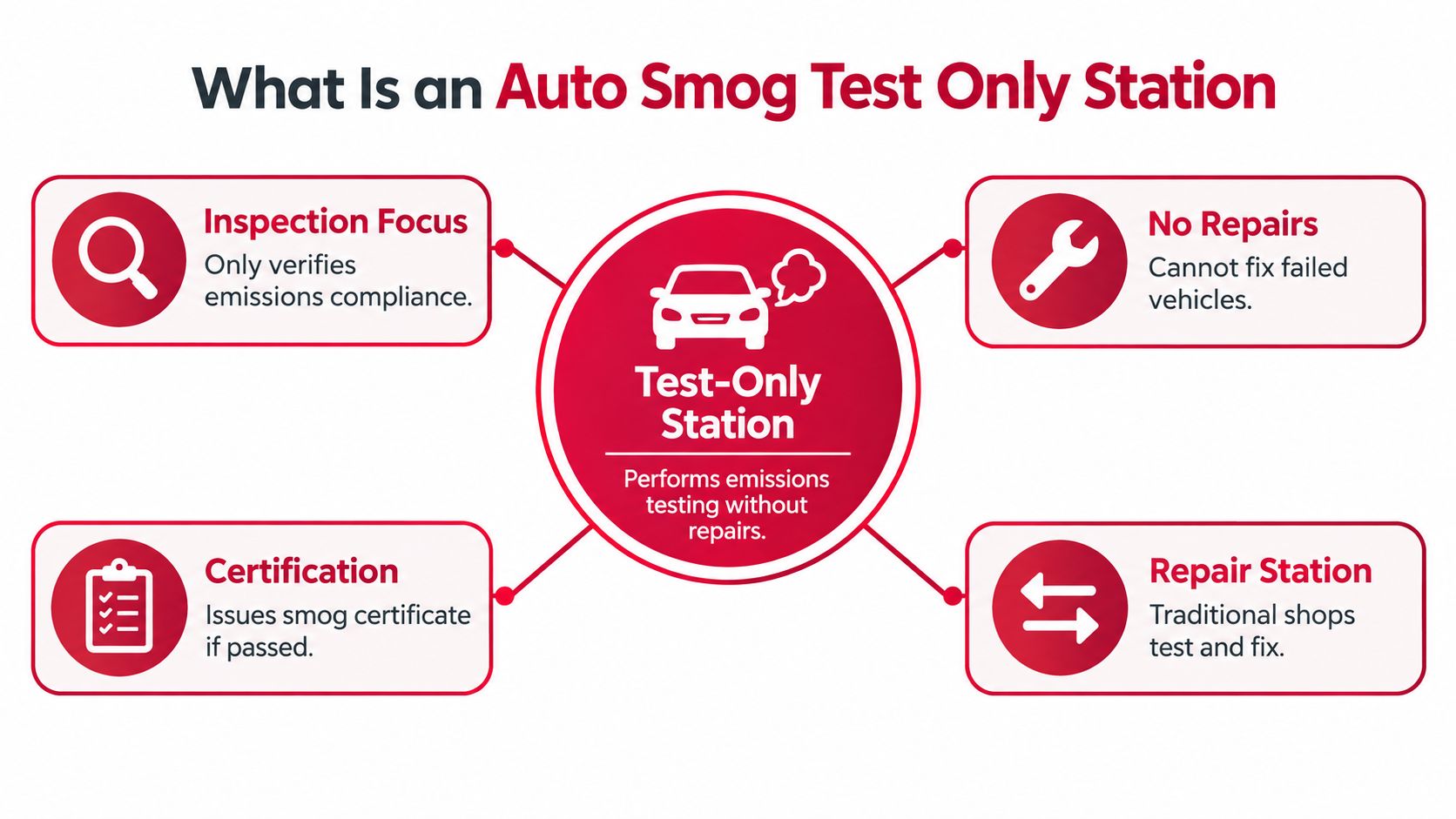
If your vehicle passes, the station completes the certification process that applies to your inspection. If it fails, you receive the test information and can choose a separate provider for diagnosis or repairs. You do not have to approve corrective work from the business that performed the inspection.
Practical rule: Ask for the vehicle inspection report after any failure so you can compare repair options with clear information about what the test identified.
How the station fits into California's program
California established its Smog Check program in 1984 under Senate Bill 33. The original program covered vehicles from the 1976 model year onward and generally used a biennial inspection structure. The Bureau of Automotive Repair, Department of Motor Vehicles, and California Air Resources Board work together within the program, as described in the BAR program background paper.
The program developed as vehicle technology changed. California introduced the Enhanced Smog Check program in June 1998, expanding beyond the earlier focus on basic two-speed-idle testing. Assembly Bill 2289 later created the STAR certification system, which replaced the Gold Shield program on January 1, 2013.
These milestones show why a test-only station is more than an automotive shop with an emissions analyzer. It performs a regulated inspection under California's Smog Check framework. For a practical explanation of the facility's role, see Fire House Smog's official test-only smog station guide.
Test-only versus test-and-repair
A test-and-repair station may inspect the vehicle, diagnose emissions problems, and complete repairs. That arrangement can suit a driver who wants one business to manage the entire process. A test-only station keeps the compliance measurement and repair choice with separate businesses, which can make comparison-shopping easier after a failure.
Before leaving after a failed inspection, confirm which part of the test produced the result and keep the report for the repair provider. A failure does not by itself mean the testing station should perform the repair. It means the vehicle needs further attention before the required certification can be completed.
Understanding STAR Certification and Quality Standards
A driver may hear “STAR station” and assume it means “test-only.” Those labels describe different things. Test-only identifies what the business does, while STAR-certified identifies whether the station meets California's performance requirements.
California permits STAR certification for both test-only and test-and-repair stations. A station can therefore perform inspections without being STAR-certified, and a STAR-certified station may offer repairs unless it operates under the test-only model.
STAR adds a performance-based quality layer to the station's license. California evaluates participating stations using inspection measures such as test deviations, similar-vehicle failure rates, incorrect gear selection during dynamometer testing, and follow-up pass rates. The program updates short-term performance measures monthly, while station pass or fail determinations occur quarterly, according to BAR's STAR program information.
What STAR tells you
A STAR designation means the station has met defined performance requirements for the type of Smog Check work it performs. It is not a general endorsement of every repair service, and it cannot guarantee that a particular vehicle will pass.
Your vehicle may still fail at a STAR station because of an emissions fault, an illuminated malfunction indicator lamp, incomplete diagnostic information, or another issue found during the inspection. The designation evaluates the station's inspection performance. It does not predict the condition of your car.
For drivers seeking an independent result, a STAR-certified test-only station combines two separate features. The business does not perform emissions repairs, and it meets the applicable STAR performance standards. That separation lets you take a failure report to a repair provider of your choice.
Why the station share and test share differ
STAR facilities performed a much larger share of inspections than their share of licensed stations in 2023. The BAR 2024 Smog Check Performance Report states that STAR-certified stations represented 48% of all licensed Smog Check stations but performed 83% of all Smog Check tests.
The report attributes part of this volume to vehicles directed to STAR facilities. Driver preference likely accounts for the rest. The figures show that a driver may encounter STAR stations frequently, but they do not mean every test-only station has STAR certification.
| Term | What it means | What it doesn't mean |
|---|---|---|
| Test-only | The business performs Smog Check inspections but doesn't make emissions repairs | It doesn't automatically mean the station is STAR-certified |
| STAR-certified | The station meets California's applicable performance requirements | It doesn't guarantee that every vehicle will pass |
| Test-and-repair | The business may inspect and repair emissions-related problems | It doesn't necessarily provide the separation some drivers prefer |
Before your appointment, read the DMV notice carefully. Confirm whether it directs you to a STAR facility, then verify both questions with the station: Does the business perform only testing, and is it STAR-certified? This check prevents a test-only label from being mistaken for a STAR designation.
For a practical explanation of the designation and what it means during an inspection, see Fire House Smog's guide to STAR-certified smog testing.
Preparing Your Vehicle for Emissions Testing
Modern California inspections rely heavily on the vehicle's OBD-II system, not only on a tailpipe measurement. EPA technical guidance explains that OBD systems monitor up to 11 emissions-related subsystem categories, including continuous monitors for misfire, fuel trim, and components. Other monitors run only when the vehicle reaches the operating conditions needed for the computer to complete its self-tests, as described in the EPA's vehicle emissions inspection and maintenance guidance.
The scanner may show a monitor as ready, not ready, or not applicable. “Not ready” doesn't automatically prove that the vehicle is producing excessive emissions. It means the computer hasn't completed the relevant self-test, so the emissions status remains officially unknown.
Avoid resetting the diagnostic system
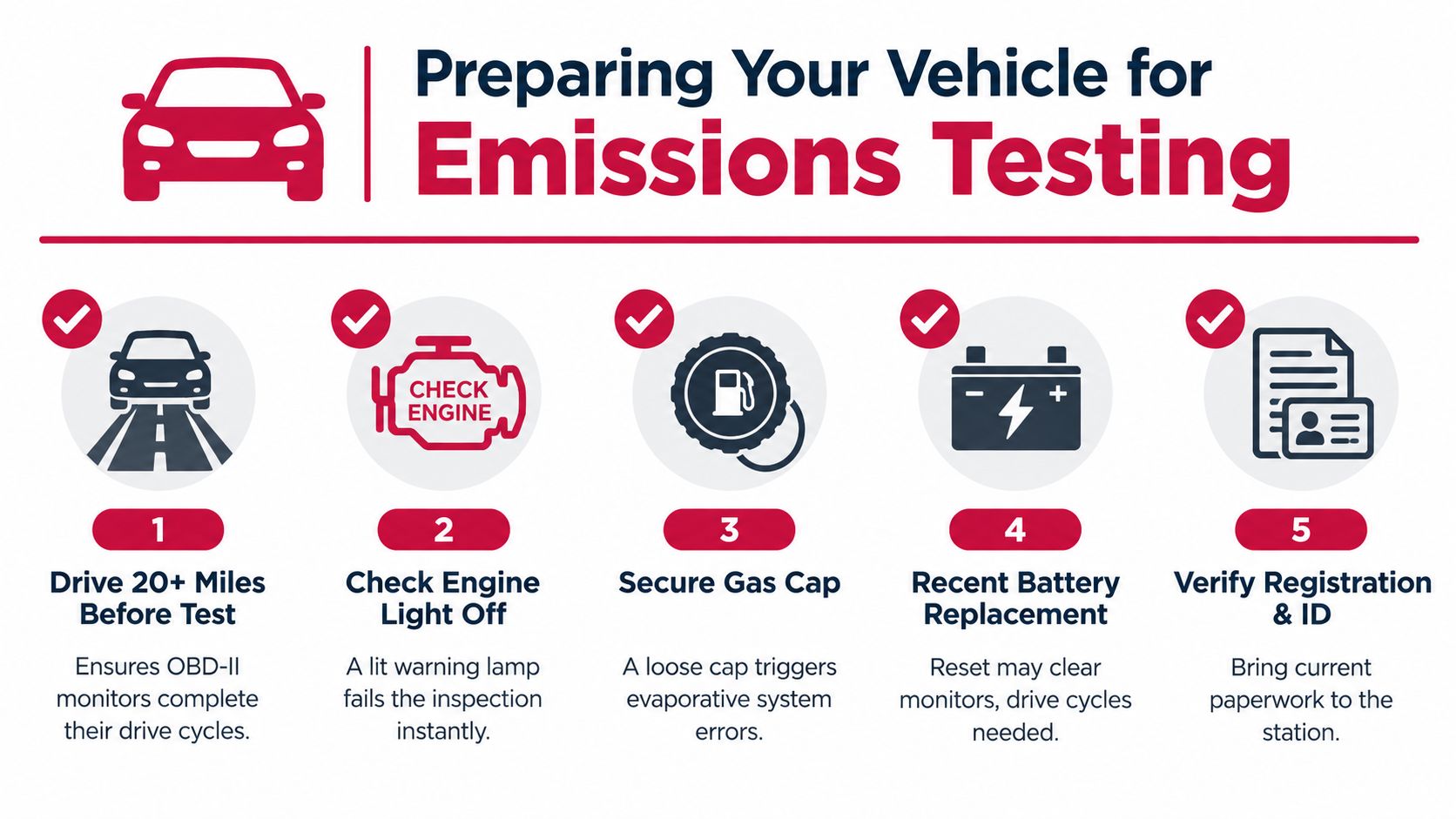
The most common preparation mistake is clearing trouble codes shortly before the appointment. Disconnecting the battery can have the same effect. Either action may erase stored readiness results, leaving the vehicle unable to demonstrate that its self-tests have completed.
If the check engine light has been on, don't just clear it and drive directly to the station. Have the problem diagnosed, complete any needed repair, and allow the vehicle's monitors to run through the required driving conditions. A compliant scan tool can show whether the applicable monitors are ready before you schedule the inspection.
A sensible pre-visit check
Use this short checklist before you leave home:
- Look at the warning lamps: Confirm that the malfunction indicator lamp isn't illuminated. A light that returns after code clearing still signals an unresolved emissions-related issue.
- Check the readiness status: Ask a qualified technician or use a compliant scan tool to verify that the applicable monitors show ready.
- Think about recent battery work: If you replaced or disconnected the battery, the vehicle may need normal driving before its self-tests finish.
- Inspect the fuel cap: A loose or damaged cap can contribute to evaporative-system faults. EPA guidance recognizes evaporative diagnostics as relevant because those systems can detect faults that increase fuel-vapor emissions.
- Bring your documents: Have your renewal notice and vehicle information available so the station can confirm the requested inspection.
Before you book: If a battery was recently disconnected or diagnostic codes were erased, ask the station whether the vehicle is likely to need additional drive-cycle preparation.
The car may drive smoothly while an evaporative, fuel-trim, or other emissions monitor remains incomplete. That's why readiness status deserves attention before an auto smog test only appointment, even when there's no obvious drivability complaint.
For a closer look at the scanner information drivers commonly encounter, review this guide to OBD readiness monitors.
When You Need STAR Versus Regular Test-Only
The wording on the DMV renewal notice should control your decision. Don't assume that “test-only” and “STAR” describe the same requirement. A regular test-only station can perform inspections without repairs, but a vehicle directed to a STAR station needs to be tested at a location with the required STAR capability.
The California Smog Check consumer page recorded 891,196 initial tests and an 8.77% initial failure rate in February 2025. Those figures show why a driver may feel uncertain about the result, but they don't predict what your own vehicle will do. The sensible response is to identify the required station type before arriving and prepare the car's diagnostic system rather than choosing a location at random.
Read the notice before searching
Use this decision guide:
| What your notice says | What to look for |
|---|---|
| STAR station required | Choose a station that is explicitly STAR-certified. It may be test-only or test-and-repair, depending on your preference and the location's services. |
| Smog check required, with no STAR direction | A licensed station may be appropriate, but confirm whether you want a test-only business and whether it handles your vehicle type. |
| The notice is unclear | Contact the station or use California's official program information before scheduling. Don't rely on the phrase “smog station” alone. |
A STAR station isn't necessarily a repair shop. The designation applies to the quality of the inspection operation, while the test-only label tells you that the business doesn't perform emissions repairs. The two labels answer different questions.
What happens after a pass or failure
If the vehicle passes, the inspection record can support the registration process. If it fails, the test-only station should provide the result so you can make a separate repair decision. You may use a repair facility of your choice, then ask about the retest process after the underlying issue has been addressed.
Fleet managers can apply the same logic across multiple vehicles. Record the station's certification status, keep each inspection result with the vehicle file, and avoid comparing vehicles tested under different procedures. Consistent testing makes the results easier to interpret, while independent repair decisions help keep inspection and repair costs separate.
Read the exact instruction: The station your DMV notice requires is determined by the notice, not by whether a location happens to advertise itself as test-only.
Special Cases for Diesel RV and Out-of-State Vehicles
A diesel pickup, motorhome, or recently imported vehicle may need more planning than a standard gasoline passenger car. Legal eligibility is only one part of the question. The station must also have the appropriate equipment and enough physical space to inspect the vehicle safely.
California's Smog Check frequently asked questions from BAR state that diesel vehicles from the 1998 model year onward generally require Smog Check when their GVWR is 14,000 pounds or less. Diesel vehicles from 1997 and older, and vehicles above 14,000 pounds under the stated rules, are excluded. The rule depends on both the model year and the vehicle's gross vehicle weight rating, so fuel type alone doesn't answer the question.
RV and motorhome owners
RVs and motorhomes can require Smog Check, but the right appointment depends on the vehicle's type, model year, dimensions, and classification. A vehicle may be legally subject to inspection while still being too large for a particular station's bay or equipment.
Call before driving across town. Give the station the vehicle's approximate length, height, width, fuel type, model year, and GVWR. A clear description lets the operator tell you whether the location can physically accommodate the vehicle or whether you need a facility with different equipment.
Consider two examples. A light-duty diesel van may fit the usual test setup and fall within the applicable weight range. A large diesel motorhome may require a different arrangement because its GVWR or dimensions exceed the station's normal operating limits. The names sound similar to a customer, but the appointment requirements can be very different.
Vehicles coming from another state
BAR reports that all out-of-state vehicles from the 1976 model year onward generally require a smog inspection when registering in California for the first time, even if the vehicle recently passed an inspection in another state. California's registration process applies its own requirements, so an out-of-state emissions certificate doesn't necessarily replace a California Smog Check.
Before booking, gather:
- Fuel type: Gasoline, diesel, hybrid, or another configuration.
- Model year: This helps determine which program rules may apply.
- GVWR: Check the manufacturer label or vehicle documentation, especially for diesel trucks and recreational vehicles.
- Registration status: Note whether the vehicle is already California-registered or entering California for the first registration.
- Vehicle dimensions: Confirm whether the station can accommodate the height, width, length, and wheel arrangement.
- DMV wording: Bring the renewal or registration paperwork and check whether it directs you to STAR.
If any detail is uncertain, ask before the appointment. That short conversation can prevent a wasted trip and gives the station a chance to explain what documentation or equipment the inspection requires.
Your Complete Smog Check Experience at Fire House
For an Antioch driver, the process can be simple when the vehicle and paperwork are ready. Fire House Smog operates as a STAR-certified test-only station at 2900 Lone Tree Way in Antioch, providing emissions inspections for cars, SUVs, light-duty trucks, and some recreational vehicles subject to size and equipment limits.
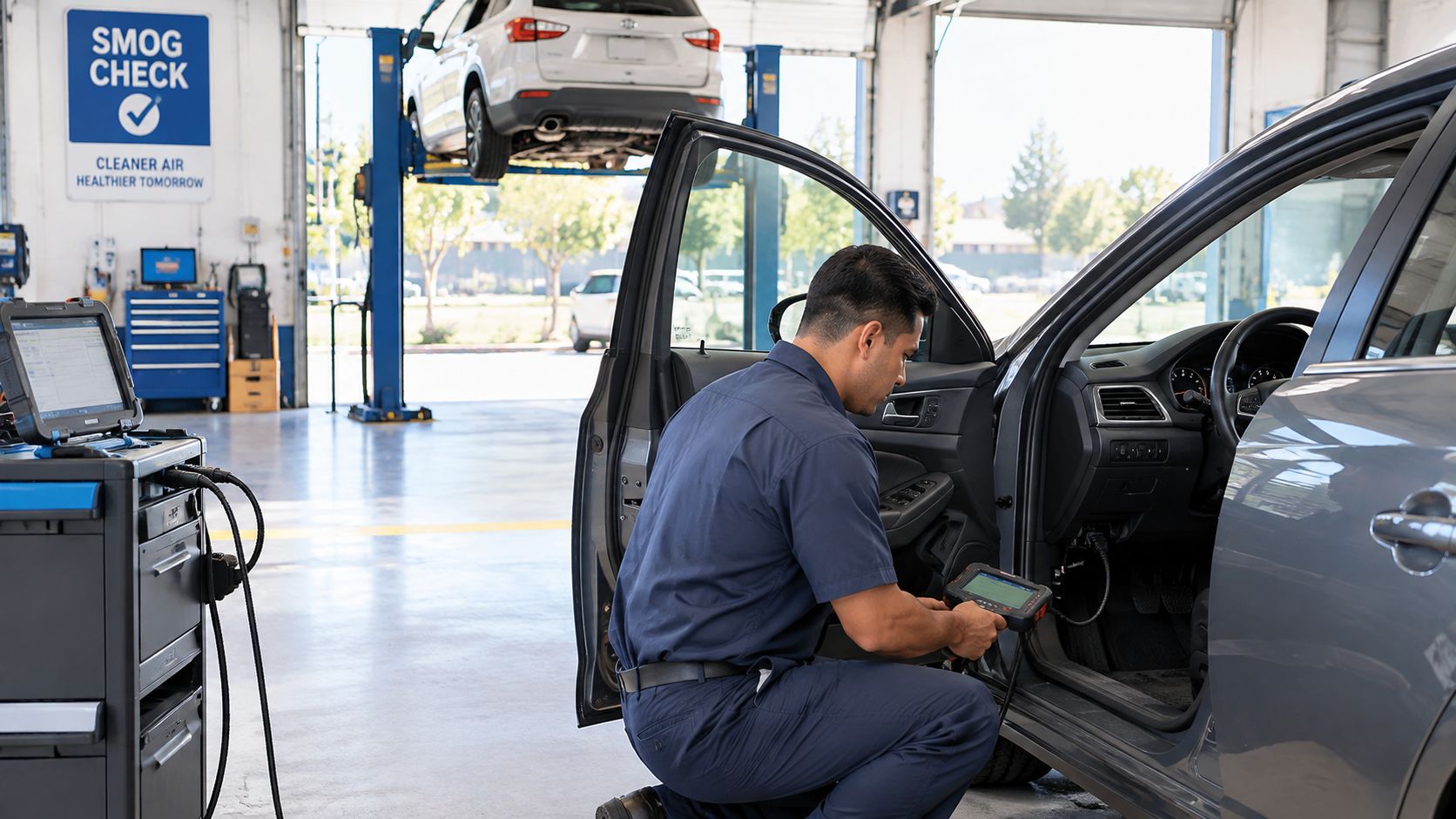
On arrival, bring your renewal notice, registration information, and identification. The station checks the vehicle under the required procedure, reviews the emissions-related data, and records the result. Because the operation is test-only, it doesn't sell emissions repairs. If the vehicle fails, you can take the report to a repair provider and ask about the applicable retest process.
Fire House has two service bays, offers smog testing seven days a week, and provides extended weekday and weekend availability. Its licensed DMV partnership also supports California registration renewals, ownership transfers, and on-site sticker printing, with DMV service hours separate from smog testing hours. Coupon terms may include a discount and a free retest, so confirm the current policy when you schedule.
For questions about a large vehicle or RV, call 925-754-1600 before arriving. Confirm the vehicle's dimensions, fuel type, model year, GVWR, and the exact requirement on your DMV notice. That preparation helps you choose the correct inspection and avoid repair pressure while keeping the certification process separate from any later work.
Fire House Smog provides STAR-certified, test-only smog inspections in Antioch for qualifying cars, trucks, and some RVs, along with California DMV registration services. Bring your renewal notice or registration paperwork, call 925-754-1600 with special-vehicle questions, and visit Fire House Smog to arrange an inspection without in-house emissions repair sales.
The inspection itself typically takes about 30 minutes. Your total visit may take longer because check-in, paperwork, payment, vehicle positioning, and any queue happen outside the hands-on test.
You may be asking because a registration deadline is approaching, your workday is already planned around a short stop, or you don't want to arrive at a smog station and discover that “30 minutes” means something different than you expected. For a California STAR Smog Check, the most useful distinction is between inspection time and total visit time.
The technical inspection is only one stage. A test-only station may also need to verify vehicle information, position the car, complete required documentation, process the result, and manage vehicles waiting ahead of you. Understanding that sequence makes it easier to choose an appointment or walk-in time without building your entire day around an uncertain estimate.
Table of Contents
- Understanding the Star Test Timeline
- The Two Phases of Your Smog Check Visit
- Key Factors That Extend Test Duration
- What to Expect at a STAR Test-Only Station
- Comparing Standard and Extended Timelines
- Tips to Minimize Time Spent at the Station
Understanding the Star Test Timeline
Your registration deadline is close, and you have planned a quick stop before work. At a STAR test-only station, the inspection may fit into that window, but the full visit follows a longer path from arrival to certification.
At Fire House Smog, separate the inspection time from the waiting and administrative time around it. The hands-on inspection is the technical portion. A line, vehicle positioning, data entry, paperwork, certificate processing, or payment can add time before or after that work. This distinction gives you a more useful answer to “How long is STAR testing?” and helps you reserve time without treating the estimate as a guarantee.
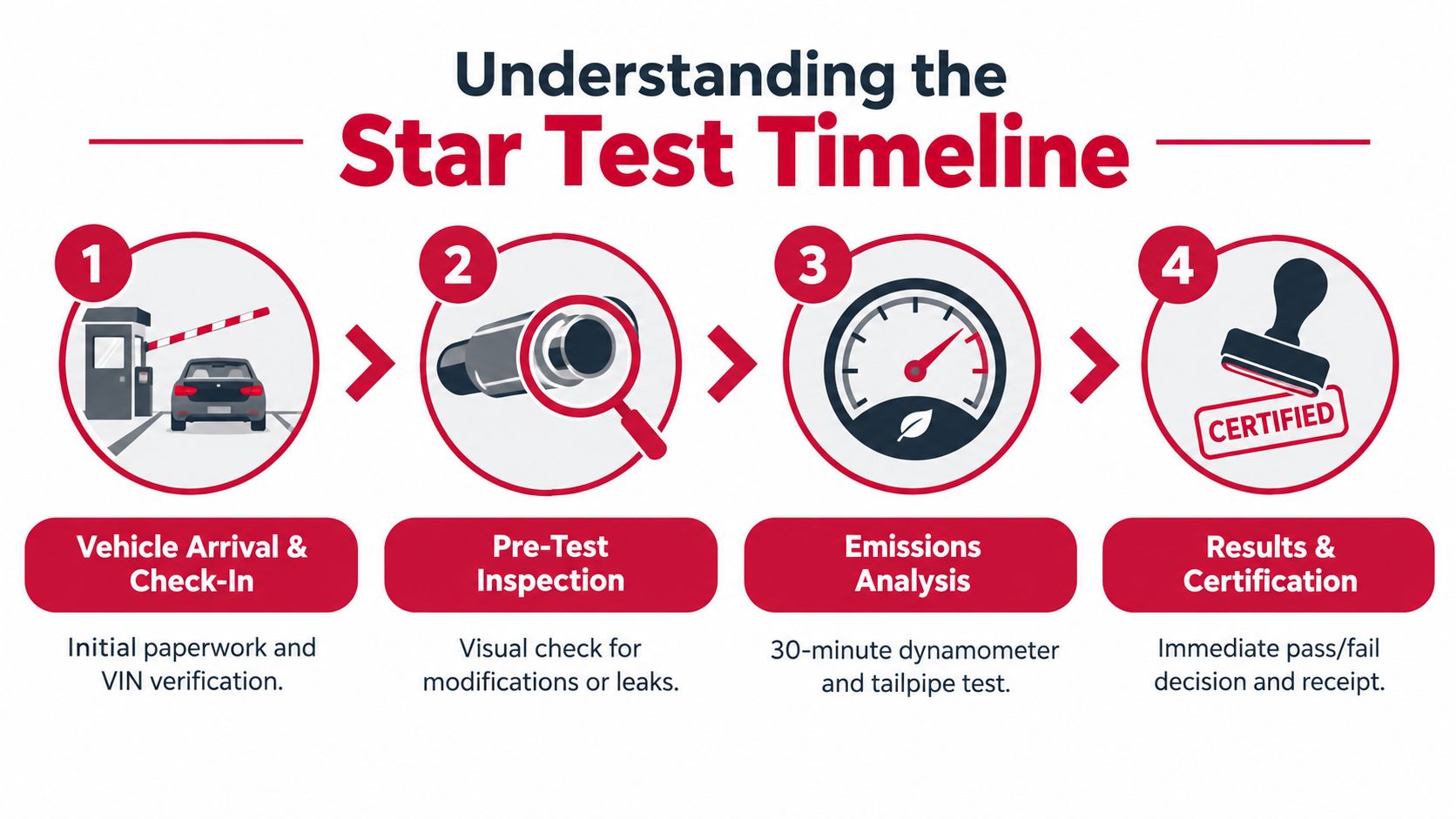
The working estimate
The timeline works like a short sequence with four parts:
- Arrival and check-in, when the station records the vehicle and customer details.
- Pre-test checks, including the visual and functional portions that apply to the vehicle.
- Emissions analysis, the main technical part of the inspection.
- Results and certification, when the outcome and receipt are processed.
The California Bureau of Automotive Repair's STAR FAQ explains that a thorough inspection can take 20 minutes or more, while its practical estimate is about 30 minutes for the inspection itself (California Bureau of Automotive Repair's STAR FAQ). Use the 20-minute figure as an indication of the hands-on work, and reserve 30 minutes as the more useful planning allowance for the inspection's required procedures.
Practical rule: Reserve about 30 minutes for the inspection, then add personal buffer for a possible line and administrative processing.
That extra margin can protect your work schedule, DMV plans, or school pickup if the station is busy. For a broader explanation of the steps surrounding the technical test, see this guide to how long a smog check takes.
The Two Phases of Your Smog Check Visit
A STAR visit becomes easier to understand when you separate it into intake and processing first, followed by the technical inspection. The phases connect, but they don't take place in the same way or require the same information from you.
Phase one, intake and processing
The first step is administrative. The station needs to identify the vehicle, record the relevant information, and prepare the order for inspection. You may need to provide registration details or answer questions about the vehicle, while the technician confirms what type of testing applies.
This stage helps prevent an incorrect test. The vehicle's age, equipment, readiness status, and inspection requirements affect the workflow, so accurate information at check-in gives the technician a clearer starting point. A queue can also form here if several customers arrive at once, even when the inspection bay itself is available.
Keep your registration information accessible and tell the technician if the battery was recently disconnected or replaced. That detail can affect whether the vehicle is ready for testing, as explained in the California BAR smog check overview.
Phase two, the technical inspection
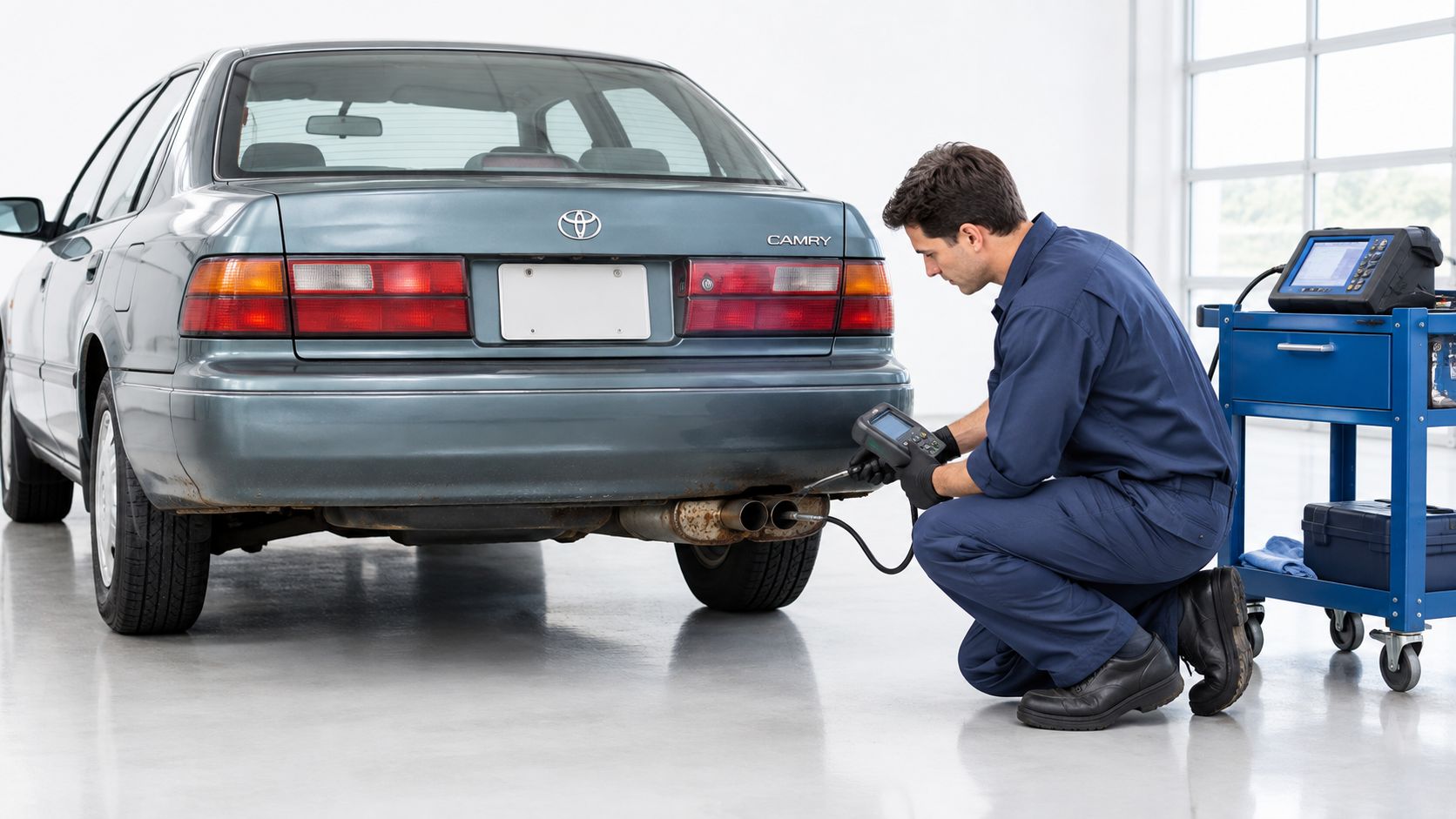
Once intake is complete, the vehicle moves through the applicable inspection procedures. For most vehicles from 2000 and newer, the process includes an OBD inspection, which checks information from the onboard emissions system. Vehicles built before 2000 generally receive a tailpipe emissions test instead, according to the BAR smog check requirements.
The technician may also perform a visual inspection of emissions-control hardware and functional checks. These steps aren't optional extras. They help establish whether the vehicle's emissions equipment is present and operating according to the applicable requirements.
After the technical work, the result is recorded and the customer receives the relevant documentation. A passing result may allow you to continue with registration tasks, while a failing result means you'll need to address the identified problem before seeking another test.
The key planning point is simple: the inspection clock starts after intake and vehicle preparation, not necessarily when you first enter the station.
Key Factors That Extend Test Duration
The about 30-minute estimate works best for a vehicle that is ready, a station with manageable workload, and a test that proceeds without complications. Several conditions can change that experience before or during the inspection.
Vehicle age and inspection type
The vehicle's model year affects the technical path. Most vehicles from 2000 and newer typically receive an OBD inspection, while pre-2000 vehicles generally receive a tailpipe emissions test. The inspection can also vary by vehicle type, applicable procedures, and the technician's familiarity with that vehicle.
A STAR station meets higher performance standards and may inspect vehicles that require STAR testing, including high-polluting vehicles. STAR status doesn't create a separate fixed-duration test protocol. It identifies the station's authorization and performance category, while the actual work still depends on the vehicle and required procedures.
Readiness monitors and battery history
A recently disconnected or replaced battery can create a delay that no station can solve by moving your car ahead in line. California requires driving for roughly a week or two in some circumstances so emissions-readiness monitors can reset before the vehicle is tested. If the monitors aren't ready, the visit may end without a completed passing inspection.
The OBD readiness monitor information can help you understand why a vehicle may need preparation before arrival. The important distinction is between waiting at the station and waiting for the vehicle's computer to complete its monitoring cycle. The second may require time on the road before testing can proceed.
Warning lights and station workload
An illuminated check-engine light signals a condition that must be repaired before a passing result is possible. Testing the car sooner doesn't remove that requirement, and attempting a test without addressing the issue can turn a planned certification visit into a repair appointment.
Queue length also matters. A station may complete the technical inspection efficiently while customers still wait for a bay, intake, or final paperwork. This short video provides additional visual context for the emissions testing process.
What to Expect at a STAR Test-Only Station
You arrive expecting one task, but the visit runs on two clocks. The first is the hands-on inspection in the bay. The second covers check-in, vehicle and registration details, result entry, and certification paperwork. Separating these stages gives you a clearer estimate than treating the entire visit as one block of testing time.
A test-only station performs the inspection and records the outcome. It does not handle emissions repairs as part of that appointment. If the vehicle does not pass, you can take the result to a repair provider of your choice rather than making an on-the-spot decision about station repairs.
At Fire House Smog, the STAR test-only workflow uses two service bays. That capacity can help keep vehicles moving when one bay is occupied by a procedure or paperwork. It does not guarantee an immediate start, since the total visit still depends on the vehicle, the station's current workload, and the time needed for administrative steps.
A typical customer sequence
The process usually follows this order:
- Check in: Provide the requested vehicle and registration information.
- Confirm the test: The station identifies the STAR inspection procedures that apply.
- Move into a bay: The technician performs the applicable visual, functional, OBD, or tailpipe checks.
- Receive the result: The station records the outcome and gives you the relevant receipt or certification information.
The inspection is only one part of the timeline. The test-only format keeps the next decision clear: after the result is recorded, you know whether the vehicle passed or needs attention elsewhere. Drivers planning a focused visit can review the quick STAR smog service information beforehand. Calling ahead can also clarify arrangements for an unusually large vehicle or special equipment.
Comparing Standard and Extended Timelines
At Fire House Smog, a STAR test-only visit has two separate clocks: the time spent on the inspection and the time spent waiting, checking in, paying, or completing certificate processing. A vehicle that is ready and accepted promptly may need about 30 minutes for the inspection itself. The full visit can take longer.
| Scenario | Estimated Time |
|---|---|
| Vehicle is ready, the station has available capacity, and the inspection proceeds normally | About 30 minutes for the inspection, plus intake and processing |
| Vehicles are waiting ahead of you | Longer than the inspection estimate because the delay occurs before the vehicle enters a bay |
| Registration information, payment, or certificate processing needs extra attention | Longer than the hands-on inspection |
| The battery was recently disconnected or replaced and the monitors are not ready | Immediate testing may not be possible. Applicable readiness driving may take roughly a week or two |
| The check-engine light is illuminated | Repair is required before a passing result is possible |
| The vehicle fails and needs diagnosis or corrective work | The visit extends beyond the inspection, followed by a later retest after the issue is addressed |
This comparison separates inspection time from administrative and readiness delays. The about 30 minutes estimate describes the core STAR inspection, much like the time a technician spends examining a vehicle rather than the time a customer spends completing an entire appointment.
A queue adds time before testing begins. Paperwork or payment adds time after the inspection. A readiness problem changes the schedule more significantly because the vehicle may need additional driving before a valid test can occur. A failed test creates a separate repair and retest timeline.
A short visit is realistic when the vehicle is prepared and the station can accept it without a substantial queue. If a warning light is on or an emissions issue remains unresolved, schedule diagnosis first. Treating a STAR appointment as a troubleshooting visit can turn a focused inspection into a longer process.
Tips to Minimize Time Spent at the Station
A driver who arrives at Fire House Smog with the right documents and a prepared vehicle can keep the appointment focused on the inspection. Preparation cannot remove every queue or processing delay, but it can prevent avoidable interruptions before and after the hands-on test.
Before leaving, check the dashboard and consider the vehicle's recent history. A short drive may warm the engine, but it will not resolve an illuminated check-engine light or incomplete readiness monitors. If the battery was recently disconnected or replaced, tell the station and confirm whether the vehicle can be tested yet.
Use this checklist:
- Review the dashboard: Arrange repairs before testing if the check-engine light is illuminated.
- Confirm battery history: Mention any recent battery disconnection or replacement during intake.
- Bring documents: Keep registration information available for registration and certificate processing.
- Plan a buffer: Allow time for a queue, payment, and paperwork beyond the core inspection.
- Choose the right visit window: Extended weekday hours and weekend availability may help you fit the appointment around work.
- Ask about retesting: If the vehicle fails, confirm the station's current free-retest policy and any coupon terms before authorizing repairs.
Two service bays may help Fire House Smog keep vehicles moving, while testing seven days a week gives drivers more scheduling options. Required procedures still take their proper time, and an unready vehicle cannot be rushed through a valid test.
Visit Fire House Smog for a STAR test-only smog inspection in Antioch. Contact the station before arrival with questions about vehicle size, readiness monitors, retesting, or how much time to reserve.
Your registration renewal is due, the smog check still needs to be completed, and the only time you can handle it is after work or on the weekend. A DMV field office may not be your best option. The right DMV alternative near me depends on the task, your vehicle, your membership status, your location, and whether you need emissions testing, title paperwork, insurance support, or only a new registration sticker.
California DMV registration renewals can often be completed online, by phone, at self-service kiosks, or through licensed registration service partners. Kiosks can print a registration card and plate tag on the spot, while partner offices may handle more involved transactions for an added service fee. Use the comparison below to match the job with the right local option, then confirm hours, eligibility, payment rules, total fees, and required documents before you leave home. Fire House Smog is the strongest Antioch choice when you need STAR-certified test-only smog testing and eligible California registration services in one visit.
Table of Contents
- 1. Fire House Smog
- 2. AAA Antioch Branch
- 3. A1 Stop Smog
- 4. Navid VIP Smog
- 5. In/Out Tags Inc
- 6. Pacific Star Insurance Services
- 7. DMV NOW Kiosk at Safeway Brentwood
- 7 Local DMV Alternatives Comparison
- Choose the Fastest Route for Your DMV Task
1. Fire House Smog
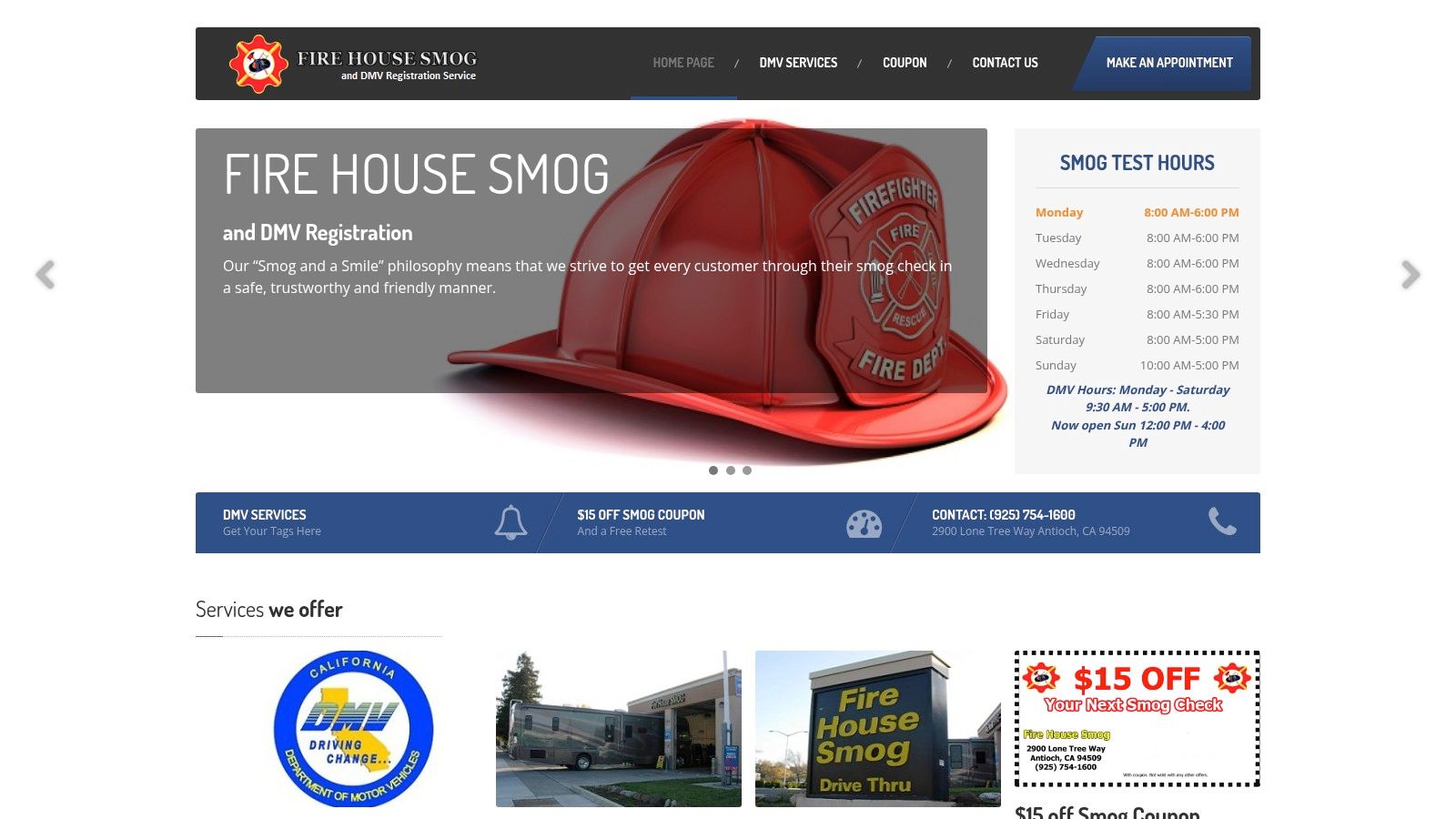
Fire House Smog is the best all-around choice in Antioch when your registration renewal depends on a smog check. The STAR-certified test-only station at 2900 Lone Tree Way combines emissions testing for cars, SUVs, light-duty trucks, and some recreational vehicles with eligible California DMV registration services.
California requires a smog check every other year for most vehicles renewing registration, and the DMV may direct certain vehicles to a STAR station. STAR-certified locations performed 83% of all California Smog Check tests in 2025, which shows why certification matters when you need a compliant inspection rather than a general repair-shop diagnosis. You can verify the state's inspection guidance through the California DMV smog inspection requirements.
Fire House Smog's test-only model keeps the inspection separate from repair sales. If the vehicle fails, you'll need another repair provider, but you won't be pushed toward repairs at the testing counter. The business also advertises a free retest policy under its site and coupon terms, along with a published discount.
Best for combining two required tasks
The major advantage is the ability to complete a qualifying smog check and then handle registration work without making a separate DMV trip. Services include eligible renewals, ownership transfers, sticker issuance, and plate-related transactions through a licensed California DMV business partner. Review the Antioch DMV registration services before visiting to see which transaction fits your situation.
Smog testing is available seven days a week, with extended evening and weekend availability. DMV services have more limited hours, listed as Monday through Saturday from 9:30 AM to 5:00 PM and Sunday from 12:00 PM to 4:00 PM. Weekend DMV availability may be limited, so call before planning a Sunday visit.
Practical rule: Call 925-754-1600 before bringing an RV or motorhome. Some larger vehicles can be tested, but bay size and equipment compatibility determine whether service is possible.
The station has two service bays and a drive-through layout designed for quick vehicle handling. Its main limitations are clear. It doesn't perform repairs, and RV compatibility must be confirmed in advance. For current rates, coupons, payment details, hours, and vehicle-size limits, contact Fire House Smog directly through its official Antioch service website.
2. AAA Antioch Branch
AAA Antioch is the right choice when you're already a AAA member and want registration work handled alongside insurance or roadside-service questions. The branch processes many eligible California DMV transactions, including renewals, sticker issuance, title work, duplicate titles, specialty plates, and transfers.
The strongest reason to choose AAA is familiarity. Staff regularly work with DMV paperwork and can provide a member-oriented checklist before processing the transaction. Eligible renewals may receive a sticker on the spot, which removes the need to wait for a mailed item or visit a field office.
Best for members who need more than registration
AAA makes sense when your visit has two purposes. You might need to renew registration and ask about insurance, update coverage information, or resolve another membership-related issue. Combining those conversations at one counter can save a separate trip.
The limitation is decisive: AAA membership is required for DMV services. This isn't the place to go if you only want a public walk-in alternative and don't hold an eligible membership. Credit or debit payment may also involve a small card-processing charge at the branch, so confirm the payment total before authorizing the transaction.
AAA is a poor fit for a smog check because the branch isn't the combined emissions-and-registration option in this list. If you need both tasks completed together, select a STAR-certified DMV Business Partner instead. If you need registration, title, or plate work and already use AAA for insurance, check the AAA Antioch Branch service details before visiting.
3. A1 Stop Smog
A1 Stop Smog is a strong fit for drivers who want a STAR-certified, test-only inspection and registration assistance in the same trip. The Antioch location serves as a California DMV Business Partner and can handle eligible renewals with on-site sticker printing, along with many title and transfer transactions.
The test-only format matters if you want a clear separation between compliance testing and mechanical repairs. A1 Stop Smog won't repair a failed vehicle on-site, so you'll need to arrange repairs elsewhere if the inspection doesn't pass. That creates an extra step, but it also keeps the inspection focused on testing rather than repair recommendations.
Best for a combined smog and registration visit
Choose A1 Stop Smog when you've received a renewal notice that calls for a smog check and you want to avoid a separate DMV counter. Its posted Monday-through-Saturday schedule may work well for weekday and Saturday visits, but confirm the current hours before driving over.
The registration side is subject to eligibility rules and partner service fees in addition to standard DMV charges. Ask for the complete total before the transaction begins. You should also confirm whether the specific title, transfer, replacement, or renewal issue can be completed at the counter.
Before you go: Bring the renewal notice, current registration information, identification, proof of insurance if applicable, and any title or transfer documents requested for your transaction. The office can tell you which items are mandatory for your case.
For drivers comparing local STAR-certified test-only smog centers, A1 Stop Smog belongs near the top of the list when proximity and combined service matter. Its main drawbacks are the lack of repairs and the added partner charge. Call ahead if your vehicle has unusual equipment or your paperwork involves an out-of-state title.
4. Navid VIP Smog
Navid VIP Smog combines STAR-certified test-only smog testing with California DMV registration services. It can handle eligible renewals with sticker printing, ownership transfers, replacements, and related title or registration work, giving Antioch-area drivers another way to avoid a separate field-office visit.
This option is especially useful when your task is straightforward but still requires more than a kiosk can provide. A kiosk is limited to approved self-service transactions. Navid VIP Smog has staff who can review paperwork and process qualifying registration-related requests at a counter.
Best for a staffed smog and registration counter
The station's STAR certification and public state report card provide useful verification points when comparing emissions providers. You can review its California DMV Business Partner listing before visiting.
Navid VIP Smog doesn't perform repairs if the vehicle fails its inspection. You'll need to take the vehicle to a separate repair facility, then return for a retest if required. Confirm whether the retest policy, registration processing, and any outstanding DMV issue can be handled in your particular situation.
Weekday service and limited Saturday availability make scheduling important. Its web presence is more limited than some competing locations, so calling is the practical move. Ask four questions before leaving: Can you process my transaction, what documents should I bring, what are the partner fees, and is the DMV counter open when I arrive?
5. In/Out Tags Inc
In/Out Tags Inc is the clearest choice for title and registration paperwork in Brentwood. Unlike the smog-focused businesses above, this office specializes in vehicle documents, including new registrations, ownership transfers, replacement items, out-of-state titles, and manufacturer's statement of origin transactions.
That focus makes it useful for cases that don't fit a simple online renewal or kiosk visit. If you've brought a vehicle into California, need to transfer ownership, or have title paperwork that requires review, a dedicated registration office is more suitable than a self-service machine.
Best for title-heavy transactions
In/Out Tags can print eligible stickers on site, but the main value is its paperwork focus. Staff can concentrate on the registration and title details instead of dividing attention between emissions testing and mechanical concerns. The downtown Brentwood location also makes it a practical alternative for residents who don't want to drive to an Antioch smog station.
Partner service fees apply on top of standard DMV charges. Ask for a written or clearly itemized total, especially when the transaction includes an out-of-state title, a new California registration, transfer paperwork, plates, or replacement documents. Month-end demand may also be higher, so calling ahead is sensible.
Bring every document connected to the vehicle, not only the renewal notice. A title, purchase document, transfer paperwork, identification, insurance information, and any notices from the DMV may affect whether the office can complete the transaction. Confirm the exact document list with In/Out Tags Inc before visiting.
6. Pacific Star Insurance Services
Pacific Star Insurance Services is a smart option when your DMV task overlaps with an insurance question. The Pittsburg agency operates as a California DMV Business Partner and handles eligible registration renewals with sticker printing, ownership transfers, permanent trailer identification transactions, and duplicate titles.
The combined insurance-and-registration counter can save time for drivers who need to update coverage, ask about a policy, or resolve an insurance matter while completing vehicle paperwork. Its Railroad Avenue location serves the Pittsburg and Antioch area, and published hours include some Saturday availability.
Best for insurance customers with DMV paperwork
Pacific Star is not a replacement for every DMV service. It doesn't handle driver licensing, and not every complex vehicle transaction will be available through the partner counter. Call before visiting if your case involves a blocked renewal, an unusual trailer issue, an out-of-state title, or missing ownership documents.
Partner fees apply in addition to standard DMV charges. Ask whether the quoted total includes the registration amount, any processing fee, card payment charge, title-related costs, and plate or sticker issuance. Payment methods can vary by office, so don't assume that your preferred method will be accepted for every transaction.
Use Pacific Star Insurance Services registration support when you want one local counter for insurance and eligible vehicle registration work. Choose a dedicated title office instead if the insurance connection doesn't help and your paperwork is the central problem.
7. DMV NOW Kiosk at Safeway Brentwood
The DMV NOW kiosk inside the Safeway at 3110 Balfour Road in Brentwood is the fastest choice for an eligible routine renewal. It can print a registration card and sticker immediately and also supports replacement registration cards or stickers and vehicle or driver record requests.
California DMV kiosks are designed to move routine transactions away from field offices. The DMV says registration renewals can be completed through online channels, phone service, kiosks, and licensed business partners, and kiosk users can receive a new registration card and plate tag on the spot. Check the official DMV kiosk locator for current location and transaction information.
Best for simple renewals
Use the Safeway kiosk when you already know the renewal is eligible and don't need a person to inspect title paperwork. The retail setting can provide longer access than a conventional DMV counter, although the store's hours and kiosk availability should still be confirmed.
The kiosk won't solve a complex title transfer, out-of-state registration, blocked renewal, ownership dispute, or transaction requiring document review. It also won't perform a smog check. If the renewal requires emissions compliance, complete that requirement first or select a combined provider such as Fire House Smog or another STAR-certified DMV Business Partner.
Fastest route: If your renewal is eligible, your payment method works, and no title or eligibility issue is blocking the transaction, start with a DMV NOW kiosk. Use this guide to skip the DMV line when a self-service renewal meets your needs.
Credit or debit payments can include a state-set card fee at kiosks. Confirm the total on screen before completing payment. If the kiosk rejects the transaction, don't keep guessing. Move to a staffed partner office or contact the DMV to identify the issue.
7 Local DMV Alternatives Comparison
| Service | Complexity 🔄 | Resources & Cost ⚡ | Expected Outcome 📊 | Best Use Case 💡 | Key Advantage ⭐ |
|---|---|---|---|---|---|
| Fire House Smog | Low, streamlined test-only + DMV workflows | Moderate, test + partner fees; extended hours reduce time cost | Fast smog throughput; same-day stickers when eligible; no on-site repairs | Commuters, fleet managers, anyone avoiding DMV lines | ⭐⭐⭐ STAR-certified DMV partner; free retest/coupons |
| AAA Antioch Branch | Low–Medium, standard office processing; membership required | Low–Moderate, membership needed; possible card fee | Faster than DMV for members; on-site sticker issuance | AAA members needing insurance plus registration | ⭐⭐ Faster turnaround for members; insurance integration |
| A1 Stop Smog (Antioch) | Low, STAR test-only with DMV partner services | Moderate, partner fees; walk-ins accepted | Combined smog + registration in one trip; no repairs on-site | Drivers wanting smog and renewal in one stop | ⭐⭐⭐ STAR-certified; convenient combined services |
| Navid VIP Smog (Antioch) | Low, STAR test-only with DMV partner | Moderate, partner fees; limited web presence (call ahead) | Same-day registration when eligible; public STAR report available | Those who value station transparency and combined tasks | ⭐⭐ STAR-certified with BAR report card |
| In/Out Tags Inc (Brentwood) | Low–Medium, specialized registration workflows | Moderate, partner service fees; can be busy month-end | Full title and registration coverage; on-the-spot stickers | Complex title/out-of-state/MSO transactions | ⭐⭐⭐ Full-service registration specialist |
| Pacific Star Insurance Services (Pittsburg) | Low–Medium, combines insurance and DMV processes | Moderate, partner fees; not all DMV tasks offered | Same-day stickers for eligible renewals; insurance assistance available | Customers needing insurance help plus transfers/renewals | ⭐⭐ One-stop insurance + registration counter |
| DMV NOW Kiosk – Safeway Brentwood | Very low, self-service touchscreen | Low time cost; state-set card fee applies | Fastest option for kiosk-eligible renewals; instant sticker printing | Quick renewals/replacements during long retail hours | ⭐⭐⭐ Fastest for simple DMV transactions (under 5 min) |
Choose the Fastest Route for Your DMV Task
Match the alternative to the job, not just to the nearest address. A kiosk is the best first choice for an eligible, uncomplicated renewal when you only need a registration card or sticker. It keeps the process self-service and avoids a field-office visit, but it can't review complex paperwork or explain why a renewal is blocked.
Choose AAA Antioch when you're an eligible member and want registration work combined with insurance or membership support. The membership requirement makes it a poor choice for nonmembers. Choose In/Out Tags Inc when the main problem is a title, transfer, out-of-state vehicle, new California registration, or other document-heavy transaction. Choose Pacific Star Insurance Services when the registration task and an insurance question belong in the same visit.
Fire House Smog, A1 Stop Smog, and Navid VIP Smog are the strongest category for a vehicle that needs both a smog check and registration assistance. Select Fire House Smog when extended smog availability, Antioch access, test-only service, and weekend scheduling are priorities. Select among the other STAR-certified providers based on location, current counter hours, vehicle compatibility, and the exact registration task.
Confirm before driving: Ask about current hours, transaction eligibility, total partner fees, accepted payment methods, required documents, smog requirements, and whether weekend service is limited.
Don't assume that every business partner can process every DMV transaction. California's alternative channels handle many routine tasks, but driver licensing still requires the appropriate DMV process, and complex cases may need a field office or additional state review. If your renewal is blocked, your title is incomplete, or the vehicle is coming from another state, explain the entire situation on the phone before you visit.
For Fire House Smog, call 925-754-1600 or visit Fire House Smog's official website to confirm current rates, coupons, hours, registration eligibility, and RV or motorhome compatibility. That call can prevent a wasted trip and tell you whether the station can complete your smog and registration needs together.
Fire House Smog combines STAR-certified test-only smog checks with eligible California DMV registration services, including on-site sticker and plate issuance in Antioch. If you need a practical DMV alternative near you, visit Fire House Smog to check current hours, coupons, rates, and vehicle compatibility before arriving.
You're standing in the quick-lube lane the day before your registration deadline, watching the clock and wondering whether a fresh oil change could be the difference between a pass and a trip back for repairs. The technician asks what you need, and the question comes out almost automatically: does an oil change affect emissions test results?
The honest answer has two parts. Fresh oil can improve tailpipe readings when the old oil is overdue or contaminated, but it won't repair a failed oxygen sensor, catalytic converter, or engine fault. At the same time, a recently serviced vehicle can still fail a California-style emissions inspection if its onboard computer hasn't completed its readiness checks, especially after someone disconnects the battery. The exhaust side and the computer side need separate attention.
Table of Contents
- The Question Most Drivers Ask Before Their Smog Check
- How Oil Condition Reaches the Tailpipe and the Computer
- What the Research Actually Measured After an Oil Change
- When Dirty Oil Raises Hydrocarbons and Carbon Monoxide
- The OBD Readiness Trap Behind a Check Engine Light
- A Practical Pre-Test Plan for the Week Before Your Appointment
- Putting It Together for a Clean First Pass
The Question Most Drivers Ask Before Their Smog Check
Maria's car is running normally. It starts without hesitation, the check-engine light is off, and she hasn't noticed unusual smoke. Her smog renewal is due soon, but the oil change sticker says she's overdue. She pulls into a quick-lube shop and asks whether changing the oil before the appointment is a smart move.
The answer depends on the oil's condition, not on the fact that an oil change is happening. If the oil has absorbed fuel, moisture, soot, or other contaminants, replacing it may reduce the material entering the intake through the crankcase ventilation system. That can help lower certain tailpipe readings. If the oil is already fresh and the engine is healthy, changing it again probably won't alter the result in a meaningful way.
There's another issue Maria may not see from the driver's seat. A smog inspection may evaluate the vehicle's OBD readiness, meaning whether the computer has completed its checks of emissions-related systems. A battery disconnect or memory reset can erase those completed checks. The car may have clean oil and no obvious drivability problem, yet still arrive at the station with monitors marked “not ready.”
Practical rule: An overdue oil change can be sensible maintenance before testing. Disconnecting the battery without allowing the computer to complete its checks can create a separate inspection problem.
Think of the decision as two lanes:
- Tailpipe lane: Oil condition can influence hydrocarbons and carbon monoxide when contaminated oil or fuel dilution increases crankcase vapor loading.
- Computer lane: Oil condition doesn't make an OBD monitor complete. The vehicle needs normal driving conditions so its monitoring routines can run.
- Repair lane: A warning light, active fault, excessive oil consumption, or visible smoke requires diagnosis rather than a last-minute oil change.
So, should Maria change the oil? If it's overdue, contaminated, or accompanied by an oil-related engine concern, yes, as part of proper preparation. If it was changed recently, her time is better spent checking for warning lights, preserving readiness, and making sure the vehicle is operating normally.
How Oil Condition Reaches the Tailpipe and the Computer
Engine oil doesn't normally burn as part of the fuel mixture, but the crankcase is connected to the intake through the PCV system. PCV means positive crankcase ventilation. It draws gases and vapors from inside the engine and routes them back into the intake, where the engine burns them.
Some combustion gas slips past the piston rings into the crankcase. Technicians call this blow-by. Worn rings can allow more combustion pressure into the crankcase, but even a normally operating engine produces some blow-by. The PCV system then carries those vapors toward the intake.
A useful analogy is a sponge beneath a dripping faucet. Fresh oil is a relatively clean sponge. Oil that has spent a long time absorbing fuel, moisture, and combustion byproducts is already saturated. When the PCV system pulls vapor from the crankcase, that contaminated mixture can become part of what the engine sends through combustion and eventually out of the exhaust.
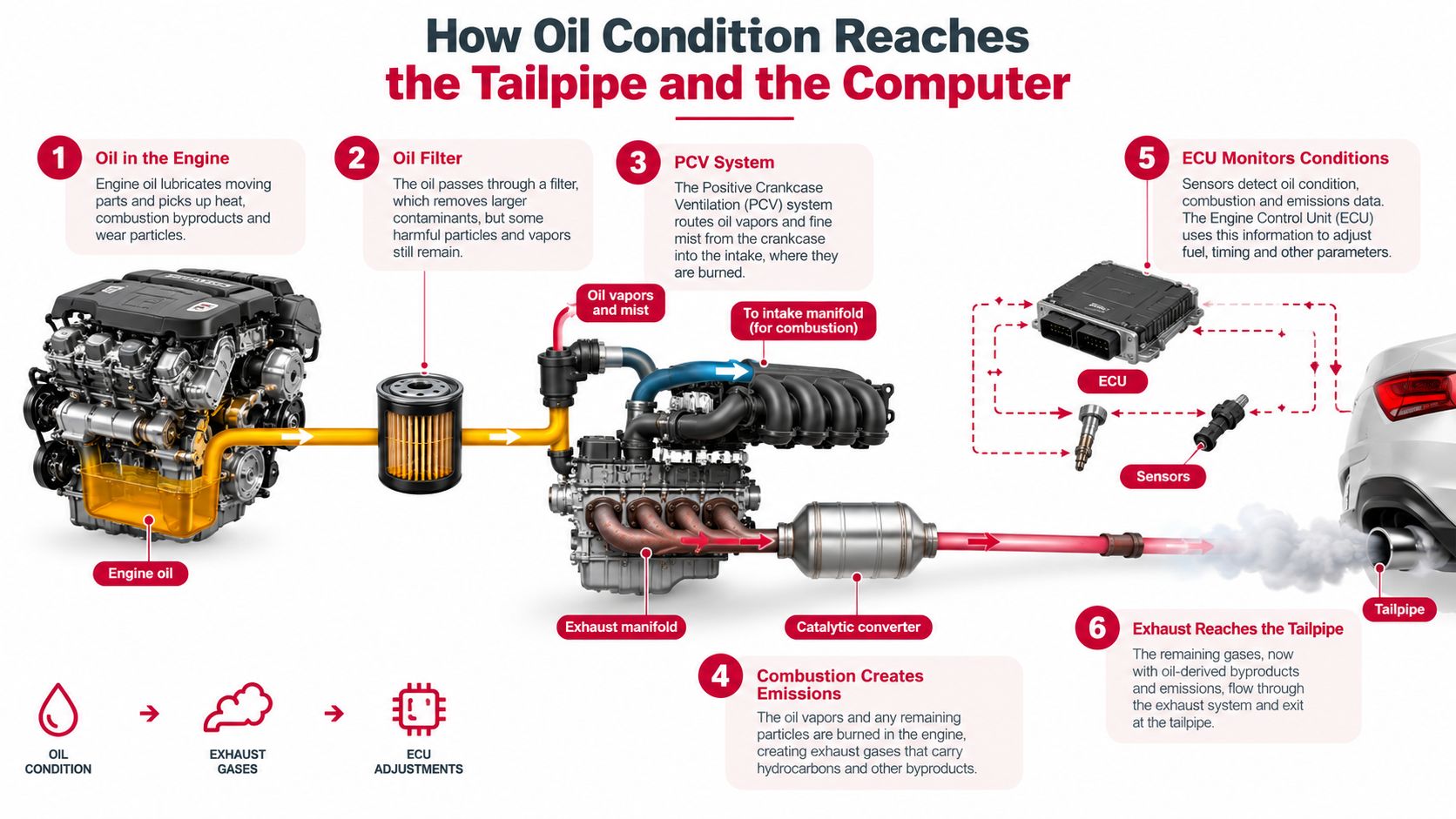
The tailpipe path
Hydrocarbons, often abbreviated HC, are unburned fuel compounds. Carbon monoxide, or CO, forms when combustion doesn't completely convert fuel into carbon dioxide. Extra crankcase vapors can affect the mixture entering the engine, particularly when the oil contains fuel or when the engine has mechanical wear.
That doesn't mean every old-looking oil sample causes a failure. Oil color alone isn't a reliable emissions diagnosis. The important question is what the oil has absorbed and whether the engine is allowing an unusual amount of vapor into the intake.
The computer path
The vehicle's OBD system is different from the oil circulating in the engine. OBD stands for onboard diagnostics. It uses sensors and programmed checks to evaluate emissions-related operation, including whether the catalytic converter, oxygen sensors, fuel systems, and other monitored systems appear to be working correctly.
You can read a straightforward explanation of the inspection process in this guide to what a smog check examines. The key distinction is simple: fresh oil may influence combustion conditions, but it doesn't directly set an OBD monitor to complete. A battery reset, cleared code, or recent repair can change the computer's status even when the oil level and oil quality are correct.
What the Research Actually Measured After an Oil Change
The strongest evidence for an oil change affecting emissions comes from a controlled comparison. A 2024 study in the Pakistan Journal of Science tested vehicles immediately before and after a routine engine oil change with portable emission analyzers. Across gasoline automobiles, motorcycles, and motorcycle rickshaws, the researchers measured reductions in regulated pollutants after fresh oil was installed. For the gasoline-powered vehicles included in the supplied findings, CO fell by 9% to 67%, while hydrocarbons fell by 21% to 52% (study PDF).
Those figures don't mean every vehicle will show the same change. The result depends on the vehicle's engine condition, the starting condition of the oil, fuel dilution, mechanical wear, and the testing method. A newer engine with recently serviced oil may have little room for improvement. A vehicle with badly contaminated oil may respond more noticeably.
One passenger-car comparison makes the result easier to picture. In the supplied study findings, the car's CO reading fell from 0.87% to 0.28%, approximately a 67% reduction, after the oil change. The same vehicle also showed a reduction in HC, although the verified material provided here doesn't include a specific HC value for the table below.
Tailpipe Emissions Before vs After Oil Change
| Test Condition | CO (%) | HC (ppm) |
|---|---|---|
| Passenger car before oil change | 0.87% | Reduced after the oil change, exact supplied value not specified |
| Passenger car after fresh oil installation | 0.28% | Lower than before, exact supplied value not specified |
The practical lesson is not that an oil change guarantees a pass. It's that oil condition can be a real emissions variable over a short testing window. A routine service may change what the analyzer measures, particularly when contaminated oil and fuel dilution are contributing to crankcase vapors.
The research also supports a useful distinction. An oil change is an emissions-related maintenance step, not an emissions-system repair. It may improve HC and CO readings, but it won't correct a damaged catalyst, a vacuum leak, a persistent misfire, or a sensor fault. The vehicle still needs to be evaluated as a complete system.
Here's a short visual explanation before we move to the underlying causes:
When Dirty Oil Raises Hydrocarbons and Carbon Monoxide
Contaminated oil becomes more relevant when the crankcase contains substances the engine wasn't designed to meter as part of its normal fuel mixture. The PCV valve pulls crankcase vapors into the intake, so the engine can burn them rather than release them directly. That process is useful, but it also means the condition of the crankcase can influence combustion.
Several situations can load the oil with unwanted material:
- Fuel dilution: Repeated short trips, rich operation, or an injector problem can allow unburned fuel to mix with the oil. That thins the oil and increases the amount of fuel vapor available to the PCV system.
- Moisture accumulation: An engine that doesn't reach normal operating conditions regularly may retain water vapor and condensation in the crankcase. Moisture changes the oil's condition and can combine with combustion byproducts.
- Soot loading: A rich-running engine creates more fuel than the combustion process can use cleanly. Soot and other byproducts then collect in the oil.
- Mechanical wear: Worn piston rings or valve seals can increase the amount of combustion gas or oil vapor entering places it shouldn't. The PCV system can carry that material toward the intake.
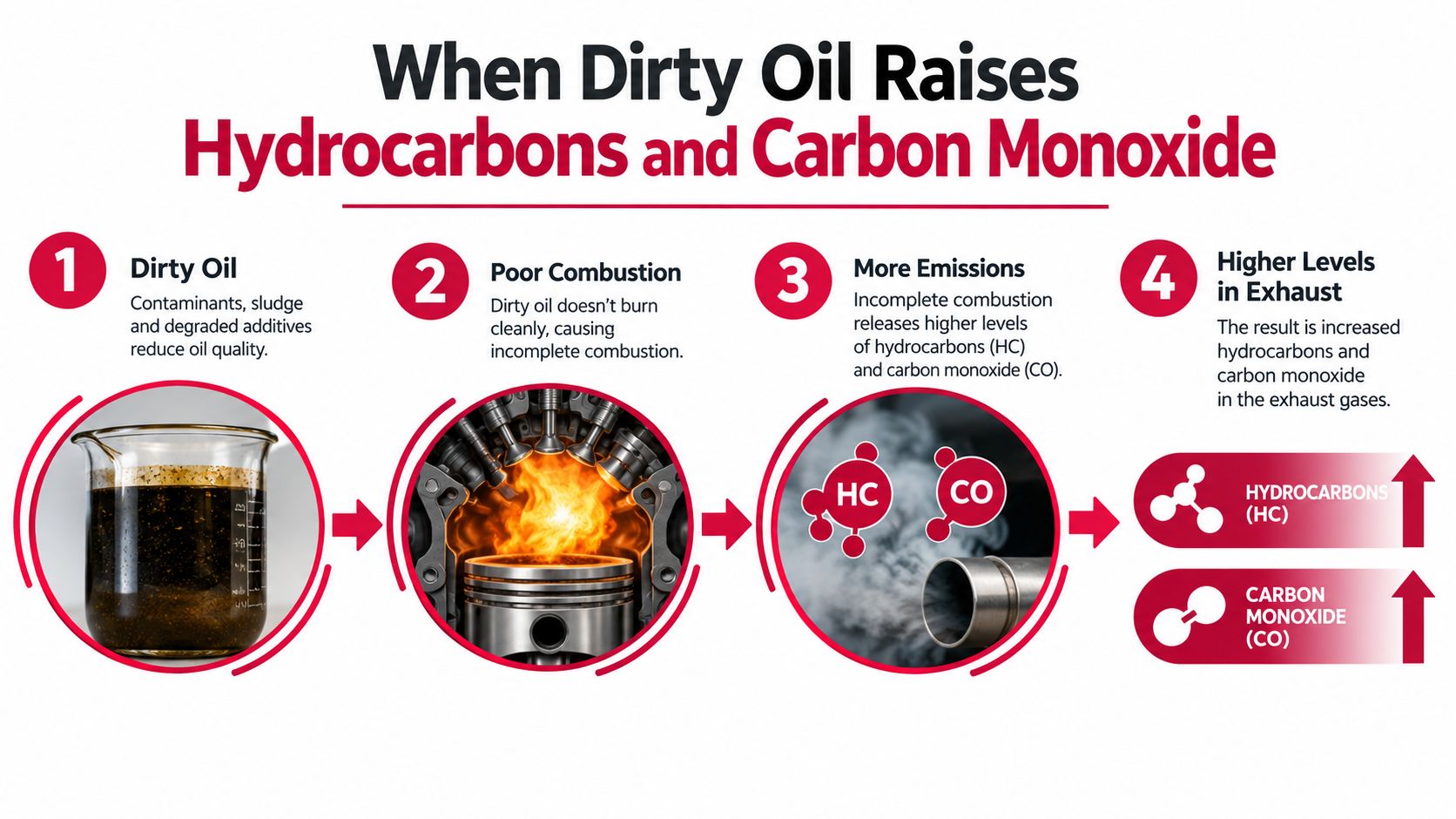
Why HC and CO can rise
HC rises when fuel or oil-related vapors pass through combustion without being fully burned. CO can rise when the mixture becomes richer than the engine can burn efficiently. Contaminated crankcase vapors don't always create a dramatic problem, but they can matter when the vehicle is already close to an inspection limit.
That's why a fresh oil change can help a borderline vehicle in some circumstances. It removes the old oil and the contaminants it has collected, reducing the load in the crankcase. The improvement is more plausible when the service is overdue or when there are signs of fuel dilution.
Why oil color isn't enough
Black oil isn't automatically proof that a vehicle will fail, and clean-looking oil isn't proof that the engine is emissions-ready. Oil darkens as it holds suspended material, and the oil's actual condition depends on the vehicle, lubricant, driving pattern, and maintenance history.
A fresh fill can remove one contributor to high readings. It can't remove the cause of a misfire, repair worn rings, or restore a damaged catalytic converter.
If the oil level keeps dropping, the exhaust produces excessive smoke, or the engine has an oil leak, treat those as diagnostic clues. The Maryland emissions inspection guidance advises checking oil and coolant levels and looking for leaks and excessive smoke before testing (vehicle emissions inspection guidance). Those checks are useful preparation principles even though inspection procedures vary by state.
The OBD Readiness Trap Behind a Check Engine Light
Many nervous drivers focus on the oil dipstick because it's visible. The OBD system is less obvious, but it can determine whether a modern vehicle is accepted for testing.
An OBD monitor is a programmed self-check. The computer observes conditions such as temperature, speed, load, fuel level, and other operating factors, then decides whether a particular emissions system has completed its evaluation. A monitor marked ready has completed its check. A monitor marked not ready hasn't gathered enough information yet.
Disconnecting the battery can erase stored readiness information. Clearing diagnostic trouble codes can do the same. That creates the trap: the technician installs fresh oil, the car feels fine, and the driver assumes the vehicle is prepared. But the computer may still need normal driving before the required checks complete.
Why a battery reset changes the answer
An oil change itself doesn't normally erase readiness. The problem arises when someone disconnects the battery during service, replaces the battery, clears a fault, or uses a scan tool to reset the computer. The vehicle then starts the post-reset process again.
A recent repair can create a similar situation. If the check-engine light is on, the computer has identified an emissions-related fault. Fresh oil doesn't override that fault. If the light was recently cleared, the light may remain off while the monitors are still incomplete.
Use this OBD readiness monitor explanation to understand what the dashboard and a scan tool are showing. Before the inspection, a technician can check readiness status without guessing from how the car feels.
What to do after a reset
Don't disconnect the battery as a casual pre-test step. If it was already disconnected, drive the vehicle normally and give the monitoring system time to run under varied conditions. The exact sequence depends on the vehicle, so the owner's manual or a technician's scan-tool check is more reliable than a generic internet drive cycle.
Computer-side rule: A clean oil change and a ready OBD system are separate achievements. You need both when the inspection relies on computer checks.
A Practical Pre-Test Plan for the Week Before Your Appointment
Start with the dashboard, not the oil bottle. If the check-engine light is illuminated, arrange diagnosis before the appointment. If the light was recently cleared or the battery was disconnected, have the readiness status checked before you pay for an inspection.
Early preparation
Look at the maintenance history. If the oil is overdue, the level is low, or the engine has signs of fuel dilution, schedule the oil change using the manufacturer-recommended oil. Don't treat an oil change as necessary just because the inspection is approaching if the oil was recently replaced and the engine is operating normally.
Check the basics as well:
- Oil and coolant: Bring both to the manufacturer-recommended level. Don't overfill either one.
- Leaks and smoke: Look for fluid leaks and excessive exhaust smoke. Those symptoms deserve attention before testing.
- Fuel cap: Make sure the cap seals properly after refueling. A loose or damaged cap can contribute to an emissions fault.
- Tires: Confirm that the tires are in sound condition and properly inflated so the vehicle can be driven safely during preparation.
- Recent parts: Avoid installing an unverified sensor, fuel additive, or other last-minute component without allowing time to confirm that the repair worked and the computer has completed its checks.
If the battery was disconnected
Drive the vehicle in ordinary traffic rather than trying to force a result with aggressive acceleration. A mix of city and steady-speed driving gives the computer varied operating conditions, but the required pattern differs by model.
Check readiness before the appointment. If a monitor still shows “not ready,” rescheduling may be wiser than arriving at the station and discovering the issue during the inspection. A scan tool can reveal this status before the official test.
On appointment day
A warmed-up engine generally gives the vehicle a better chance to operate as intended than a cold start at the station. Follow the station's instructions and avoid shutting the engine off repeatedly while waiting if staff ask you to remain in line.
An oil change may help when the lubricant is overdue or contaminated, especially if the vehicle has signs of fuel dilution or heavy crankcase vapor loading. It's usually wasted effort when the oil is fresh and the underlying problem is an active fault or incomplete readiness.
For more general preparation ideas, see this guide to reducing vehicle emissions. Use it as maintenance guidance, not as a promise that any single service will produce a pass.
Putting It Together for a Clean First Pass
The conditional answer is the useful one. Dirty or overdue oil can affect tailpipe readings, while fresh oil that was already in good condition may change very little. Battery disconnection and cleared codes can affect the computer's readiness status, regardless of what's in the oil pan.
If the vehicle fails, read the inspection report before authorizing repairs. The report should identify whether the issue involves a tailpipe reading, an OBD fault, readiness, or another inspection condition. Ask the station whether it can perform a retest and what its retest policy requires. If the vehicle needs a particular type of California inspection, confirm whether the station's certification matches that requirement. A STAR-certified test-only station is one possible option when the vehicle or registration notice calls for that type of inspection.
Questions drivers often leave unanswered
What if the battery was reset yesterday? Treat the vehicle as potentially not ready. A one-day-old reset doesn't prove that the monitors have completed, so check the status with a scan tool before testing. You may see evidence of a recent reset through incomplete readiness monitors, but the absence of that evidence doesn't establish that the battery was never disconnected.
What if the car is referred as a gross polluter? Don't try to mask the result with another oil change. Follow the referral instructions and have the underlying emissions problem diagnosed. A referral is a sign that the vehicle needs more than routine pre-test preparation.
Do DMV renewal rules cover every vehicle the same way? No. Requirements can vary by vehicle type, registration situation, and applicable California program rules. Classic vehicles, diesel vehicles, and recreational vehicles may have different testing treatment or equipment limitations, so check the notice and confirm with the testing station before driving over.
Can a station refuse the test? It can direct you to the appropriate process when the vehicle falls outside its equipment, certification, or service limits. Call ahead if you have a large recreational vehicle, unusual equipment, or a registration notice with special instructions.
A clean run means the vehicle has no active emissions warning light, no unresolved fault that blocks the inspection, required monitors are complete, and measured emissions are below the applicable limits. It also means the engine has the correct oil level and manufacturer-specified oil, with no obvious leak or smoke problem.
Don't schedule an oil change as a superstition. Schedule it because the oil needs replacing, then protect the computer's readiness and diagnose warning signs before testing.
Fire House Smog provides STAR-certified, test-only smog inspections and California DMV registration services at its Antioch location, with retest options available under its site policy and coupon terms. Visit Fire House Smog to check services, hours, and appointment information before your emissions test.
Opening a DMV renewal notice can turn a routine errand into an immediate question: why does this letter say STAR station required? The answer usually isn't that your car needs a completely different kind of emissions test. It means California has directed you to a station with an additional Bureau of Automotive Repair certification.
An all star smog check follows the state's normal inspection process, but the station must meet higher operational and performance standards. This guide explains when STAR certification matters, how to verify a legitimate station, what happens in the testing bay, and what you should do if your vehicle fails.
Table of Contents
- What an All Star Smog Check Really Means
- How the STAR Program Started and Why It Exists
- STAR vs Regular and Test-Only Stations
- The Higher Standards STAR Stations Must Meet
- When California Requires a STAR Smog Check
- How to Verify a Station and What Testing Involves
- Your Next Steps for Booking a STAR Smog Check
What an All Star Smog Check Really Means
STAR is a certification for the station, not a separate test for the vehicle. California's Smog Check process can include an OBD II inspection, visual emissions-control checks, and other required procedures depending on the vehicle. The California Smog Check program explains that vehicles from model year 2000 onward are inspected primarily through OBD II, while older vehicles may require additional evaporative-system and fuel-cap checks.
Think of STAR like a higher-level license displayed over the regular station license. A standard licensed station may be authorized to perform ordinary Smog Check inspections. A STAR-certified station has also demonstrated that it can meet BAR requirements for equipment, operations, and inspection performance.
That distinction matters because California doesn't send every vehicle to the same type of station. Some drivers can choose a regular licensed station. Others receive a DMV notice directing them to a STAR station, which means the certification changes where the inspection may be completed.
What STAR changes for you
At the bay, the technician still connects the vehicle to testing equipment and checks the systems required for that vehicle. The practical difference is the station's authority and oversight. A STAR station has been approved to handle vehicles that California considers part of a higher-risk inspection group, including vehicles identified through DMV direction.
A test-only STAR station can inspect and certify a vehicle, but it doesn't sell repair work. That separation can make the process easier to understand because the business evaluating the vehicle isn't also diagnosing and selling the repair.
Practical rule: Read the DMV notice before booking. If it says STAR station required, a nearby regular shop may not be able to complete the certification you need.
You can also review a plain-language explanation of what STAR-certified smog testing means before choosing a location. The four questions to answer are simple: Is STAR required for this vehicle, is the station certified, what will the inspection include, and what happens if the result is a fail?
How the STAR Program Started and Why It Exists
You arrive for a Smog Check expecting a simple pass-or-fail result. Behind that result, California also needs confidence that the station followed the right procedure and recorded the vehicle's information accurately. The STAR program was created to provide that added oversight.
California established STAR through Assembly Bill 2289, and the program began on January 1, 2013. It replaced the former Gold Shield Program, which ended on December 31, 2012. The Bureau of Automotive Repair STAR FAQ explains that STAR was designed to improve inspection quality and support California's emissions-reduction requirements.
The basic model works like a quality-control system. California identifies stations that can perform inspections under closer performance controls, then uses the program to direct certain vehicles to those locations. STAR certification applies to both test-only and test-and-repair businesses. It describes how a station's inspection work is monitored, not whether the business performs mechanical repairs.
Why station quality affects the driver
Your vehicle is only one part of a Smog Check. The technician must use approved equipment, follow the required testing procedure, enter accurate vehicle details, and interpret the result correctly. A skipped step or poorly maintained machine can produce a result that does not accurately reflect the vehicle's condition.
For the driver, STAR changes the level of accountability surrounding the inspection. BAR uses performance measures to compare a station's results with those of similar vehicles and reviews incidents that may indicate testing problems. This does not guarantee a passing result or make every repair recommendation correct. It gives the inspection process a clearer system for identifying problems and monitoring station performance.
The program also handles a large share of California's testing. In California's 2025 data, STAR stations represented 49% of licensed Smog Check stations but performed 83% of all Smog Check tests, according to BAR's STAR program information. STAR locations therefore completed a disproportionately large share of inspections compared with their number of facilities.
That reach explains why STAR is more than a label on a shop sign. It affects how California manages inspection quality and, for some drivers, which station can complete the required inspection.
STAR vs Regular and Test-Only Stations
Drivers often treat “STAR,” “test-only,” and “test-and-repair” as three competing station categories. They are different labels that describe different things. STAR describes certification, while test-only and test-and-repair describe what the business is allowed to do after inspecting the vehicle.
A regular station may perform standard Smog Check services for vehicles that aren't subject to a STAR direction. A STAR station may be test-only or test-and-repair, but it must meet the additional BAR requirements attached to STAR certification.
| Station Type | Can Perform Repairs | Can Process STAR or Directed Notices | Best For |
|---|---|---|---|
| Regular test-and-repair station | Yes | Not necessarily | Drivers whose renewal doesn't require STAR and who want inspection and repair at one business |
| Regular test-only station | No | Not necessarily | Drivers seeking an inspection without repair sales when STAR isn't required |
| STAR test-and-repair station | Yes | Yes, when authorized for the vehicle | Drivers who need STAR testing and may want diagnosis or repairs at the same location |
| STAR test-only station | No | Yes | Drivers who need STAR certification and prefer a testing-only business |
The important distinction after a failure
A test-only station can't repair the vehicle. If the inspection finds a problem, the station should provide the inspection result and explain the next step, but you'll need a separate repair provider. A STAR test-and-repair station may diagnose and repair the vehicle, although the station's authority to certify a particular directed vehicle still depends on the applicable rules.
A regular shop isn't automatically less competent at repairs. It may just not have the STAR certification needed for a DMV-directed inspection. Conversely, a STAR label doesn't mean the station is a full-service repair facility.
The BAR's explanation of STAR-certified test-only centers can help you understand why some drivers deliberately choose a station that doesn't sell repairs. The model separates the inspection decision from repair revenue, which gives the customer a clearer boundary between testing and fixing.
Prices vary by station, vehicle, location, and services included. A STAR station may charge a different fee from a nearby regular station, so ask for the current price before authorizing the inspection.
The Higher Standards STAR Stations Must Meet
STAR certification rests on measurable requirements rather than a sign on the building. BAR reviews station performance and can evaluate whether the business continues to meet the program's standards. That means certification isn't a permanent reward earned once and kept without review.
The BAR STAR program requirements include several performance measures. One compares the station's Similar Vehicle Failure Rate with the industry-wide failure rate for similar vehicles. For STAR eligibility, that station rate must be at least 50% of the industry-wide failure rate for similar vehicles. The same source lists a Gear Shift Incident rate no greater than 2% of certified vehicles and an Excessive Test Deviation Rate of no more than 1.
What the scorecard means in everyday terms
| Metric | Standard Required |
|---|---|
| Similar Vehicle Failure Rate | At least 50% of the industry-wide failure rate for similar vehicles |
| Gear Shift Incident rate | No greater than 2% of certified vehicles |
| Excessive Test Deviation Rate | No more than 1 |
| Ongoing program compliance | The station must continue meeting BAR operational and performance requirements |
A failure-rate comparison doesn't mean a STAR station should make every vehicle pass. A vehicle with a genuine emissions problem should fail, regardless of the station's certification. The comparison helps BAR identify unusual station patterns that may deserve closer review.
Gear-shift incidents and test deviations relate to how the inspection is carried out. For a driver, those controls support a more consistent process, particularly when the vehicle's result is unexpected. The standards also give BAR a basis for accountability if testing behavior falls outside acceptable limits.
STAR certification is best understood as a continuing performance obligation, not a one-time quality badge.
The certification also doesn't promise a repair, a pass, or a particular wait time. It tells you that the station has qualified for the STAR program and must continue operating within the program's rules.
When California Requires a STAR Smog Check
You are renewing your registration, and the DMV notice says your vehicle must visit a STAR station. That instruction changes where you can test. It is different from a general reminder to complete a Smog Check, so read the notice carefully before booking an appointment or driving to a shop.
A directed notice places the vehicle in a more controlled inspection pathway. California may direct a vehicle because of its testing history or emissions profile. Vehicle age, an ownership transfer, or a routine renewal can require a Smog Check without automatically requiring STAR testing.
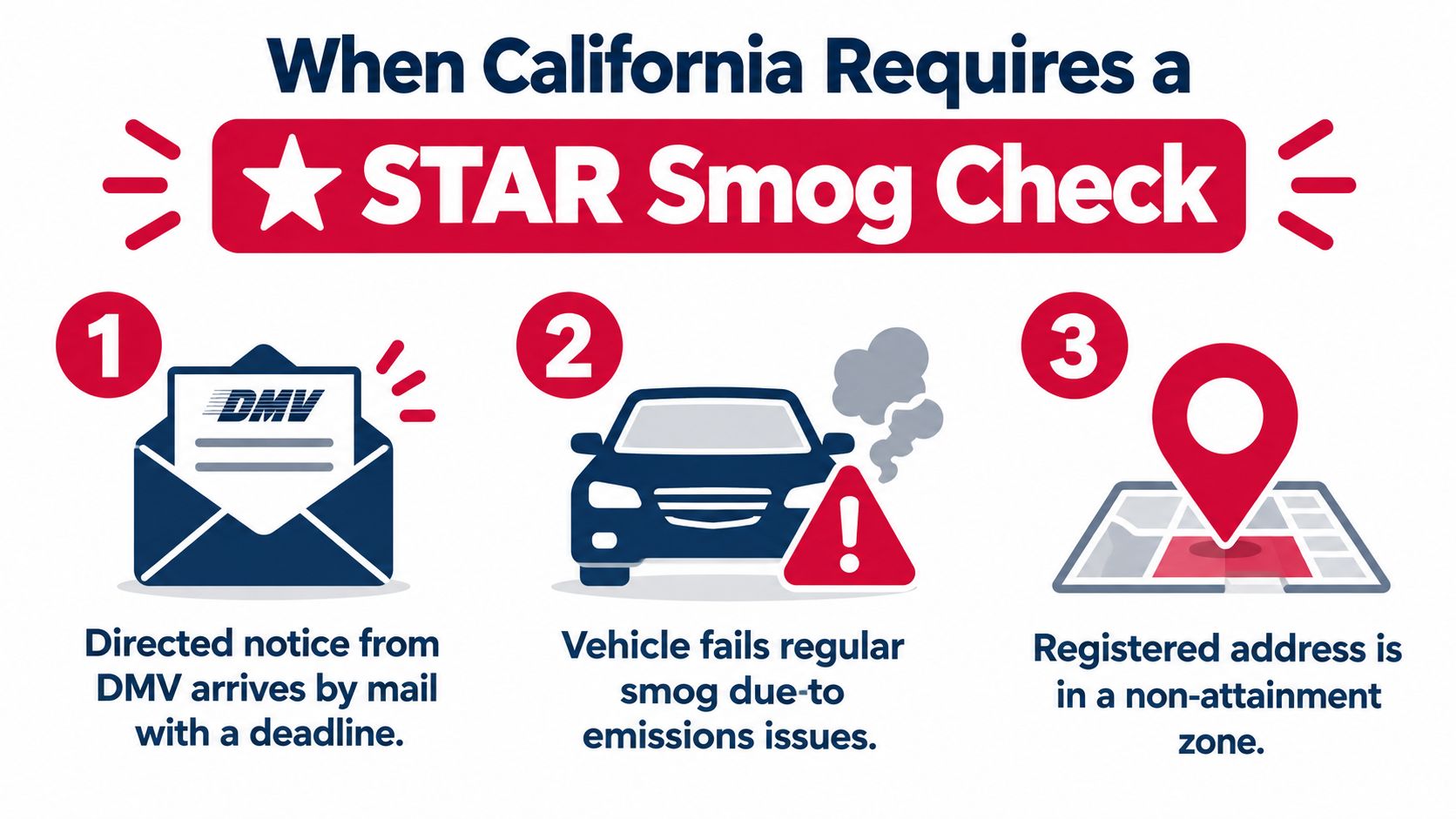
Check the instruction, not the rumor
Use the notice as your starting point:
- Read the renewal notice. Look for wording that requires a STAR station or identifies a specific inspection type.
- Match the vehicle details. Confirm that the notice belongs to the vehicle you are taking for testing and that the registration information is current.
- Check the station listing. Use the BAR listing to find nearby STAR-certified businesses and see whether each offers test-only or test-and-repair service.
- Call before your visit. Ask whether the station can process the exact requirement shown on your notice.
A first-time California registration or ownership transfer may involve a Smog Check, but neither situation alone establishes a STAR requirement. A failed ordinary inspection also does not automatically mean every later test must take place at a STAR station. The DMV instruction or applicable BAR process determines the required testing location.
After a directed test, the station must submit the required electronic certification. If that certification is missing, the DMV may be unable to complete your registration renewal. A failed result can lead to repairs and another inspection, but the result itself does not turn every future test into a STAR requirement.
California also has special provisions for older and collector vehicles. BAR's current materials state that collector-vehicle exemptions are scheduled to be extended in stages beginning January 1, 2028, subject to final rulemaking, as reflected in the DMV's Smog Inspections guidance. Abbreviated inspections remain available for certain vehicles that are 35 years old or older. Check the current requirements before assuming your vehicle qualifies for an exemption.
How to Verify a Station and What Testing Involves
Start with the BAR station lookup rather than relying only on a business name, search advertisement, or a sign in a parking lot. Enter the location information, review the station's listing, and confirm the STAR designation, station type, license information, and any disciplinary information shown in the official record.
A legitimate business should also display the required station information at its location. Look for a posted STAR decal or other official signage, then compare the business name and address with the BAR listing. If the listing says test-only but an employee immediately proposes repair work, ask who would perform the repair and whether the inspection business is separate.
What the technician checks
For a newer vehicle, the technician generally connects an approved tool to the vehicle's OBD II system and reviews emissions-related information. The malfunction indicator lamp must illuminate with the key on and engine off, then turn off once the engine is running. If that required behavior isn't present, the vehicle fails the OBD portion.
The inspection can also include visual and functional checks of emissions equipment. Older vehicles may require different procedures, including tailpipe or evaporative-system checks, depending on the vehicle and the applicable program rules. A technician should be able to explain which procedure applies without promising a result in advance.
The visit length varies with the vehicle, station workload, and inspection type. Ask about the expected timing when you book rather than relying on a generic estimate.
After a pass, the station electronically sends the certification to DMV. You generally don't need to carry a paper certificate to a DMV counter, although you should keep your receipt and any inspection documentation.
After a fail, a test-only station can explain the result and provide the report, but it doesn't perform the repair. BAR and DMV guidance direct failed vehicles toward the appropriate next steps, including the BAR Referee Program in situations where that process applies.
Your Next Steps for Booking a STAR Smog Check
You can avoid most last-minute problems by treating the appointment as a document and deadline task, not just a quick drive to a repair shop.
- Confirm the requirement. Check the DMV renewal notice or official BAR communication. Identify whether it says STAR station required and note the registration deadline.
- Find the correct station. Use the BAR search tool and filter the results by location and certification type. Confirm whether the business is test-only or test-and-repair.
- Call before booking. Ask the station to confirm its STAR status, current fee, accepted payment methods, appointment policy, and ability to handle your vehicle.
- Prepare your documents. Bring the DMV or BAR notice, current registration information, and a form of identification. The station may need accurate vehicle and owner details to complete the transaction.
Before arrival, drive long enough for the engine to reach normal operating temperature, unless your vehicle's condition makes that unsafe. Check that the fuel cap seals correctly, and remove aftermarket electronics that could create warning-light issues or interfere with the vehicle's normal diagnostic systems.
For more guidance on the cost of a STAR smog check, contact the station directly because pricing depends on the vehicle and service. Don't approve repairs based only on a verbal explanation. If the vehicle fails, request the complete Vehicle Inspection Report, keep every receipt and estimate, and ask whether you may qualify for California's Consumer Assistance Program if the repair burden meets the program's requirements.
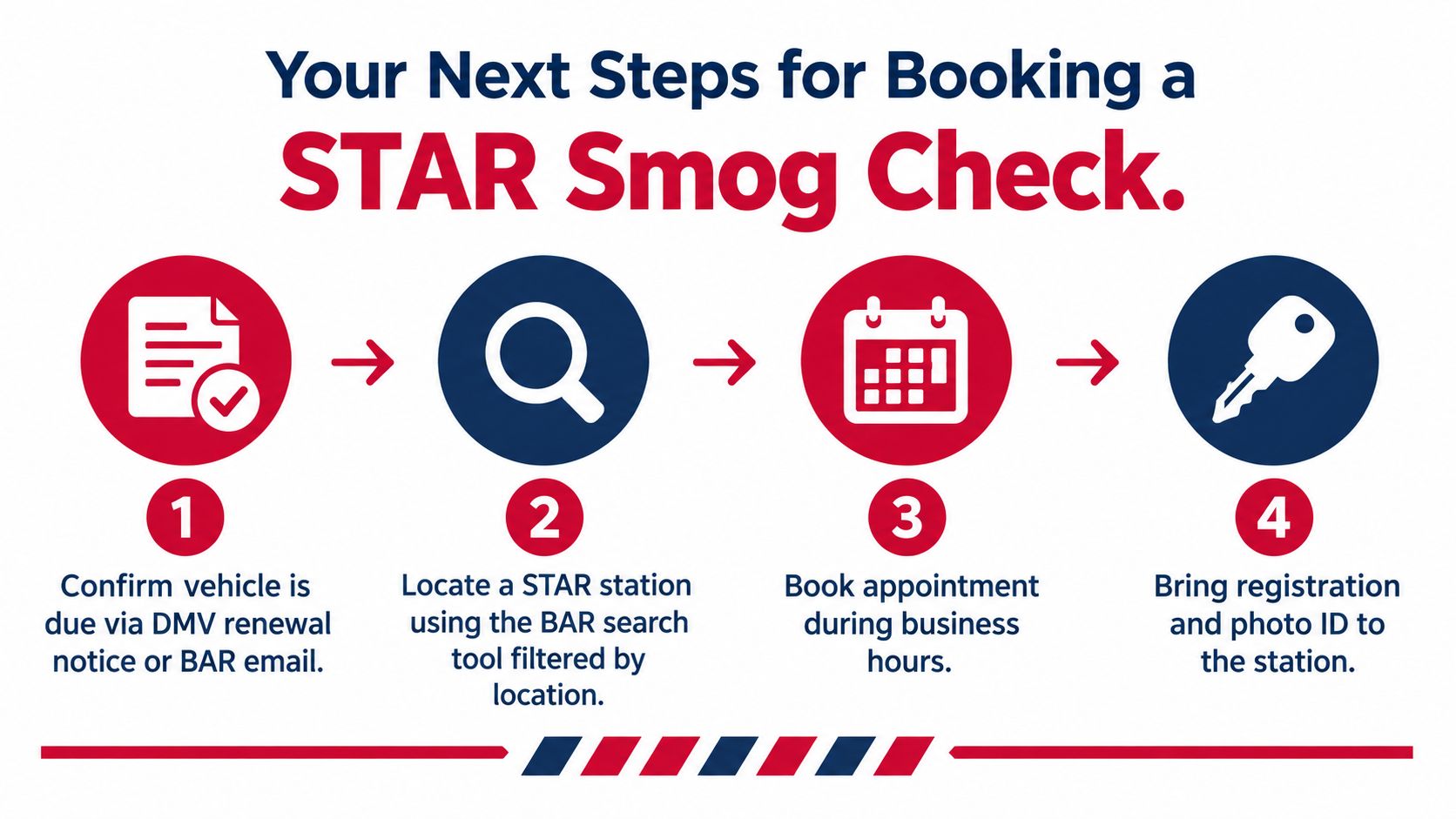
A sensible planning window is 6 to 8 weeks before registration renewal. That gives you time to arrange repairs, complete a retest, resolve questions about the result, and allow the electronic certification to reach DMV without turning the renewal deadline into an emergency.
Fire House Smog provides STAR-certified test-only smog inspections and California DMV registration services at its Antioch location. Visit Fire House Smog to review the available services and contact the station before booking your STAR inspection.
A California vehicle ownership transfer typically requires a smog certificate, a signed title, and payment of transfer fees, and one missing or incomplete document can stall the application. In Texas, 6,432,879 vehicle titles were processed in fiscal year 2018, showing how often ownership changes depend on accurate paperwork rather than a simple exchange of keys.
You may be standing beside a newly purchased car with the payment complete, the keys in hand, and a title that looks almost finished. Then someone notices the seller missed a signature, the lien release isn't attached, or the smog requirement hasn't been satisfied. The sale feels complete, but the legal transfer isn't.
California treats smog compliance and DMV paperwork as connected parts of the same ownership chain. A vehicle can pass the emissions inspection and still be rejected because the title is incomplete. It can also have a properly signed title but remain stalled because the required smog documentation is missing or the vehicle doesn't meet emissions requirements.
That distinction matters because the fastest transfer is not always the one with the fewest steps. It's the one where each dependency is checked before the packet reaches the DMV. The following process reflects what tends to work in practice for California buyers and sellers, including people transferring vehicles from another state.
Table of Contents
- Navigating the California Transfer Process
- Essential Documents for a Successful Transfer
- Why Professional Smog and DMV Services Matter
- Common Errors That Delay Your Transfer
- Your Complete Transfer Timeline and Tips
- Frequently Asked Questions About Transfers
Navigating the California Transfer Process
A buyer and seller can agree on a price in minutes, but the ownership record changes only after the required chain of documents, signatures, fees, and compliance steps is complete. California DMV guidance identifies the Certificate of Title, required signatures, transfer fees, odometer information, and supporting forms as central parts of the process. The California DMV title transfer guidance also explains what to do when the original title is missing or a lien affects the record.

Follow the document chain
Start by identifying the vehicle and confirming that the seller's name on the title matches the seller's identification. Next, check whether a lien is listed and verify that the lienholder has released its interest. The seller and buyer then complete the title, including the odometer disclosure when required, and prepare any supporting forms for the specific situation.
The smog step belongs in this preparation, not as an afterthought. If the vehicle requires a smog certificate, arrange the inspection before finalizing the DMV packet. A failed or incomplete emissions record can hold up the transfer even when every signature is correct, while a successful test doesn't correct a missing lien release or an incorrectly completed title.
Practical rule: Treat the smog certificate, title, identity documents, and fee payment as one packet. If one part is unresolved, the transfer is not ready.
The final stage is submission to the DMV or an authorized registration provider. Once the transfer is accepted, the registration record and title can be updated according to the agency's process. For an out-of-state vehicle, expect additional verification and documentation rather than assuming a California title transfer follows the same path as an in-state vehicle.
California's process is therefore best understood as a sequence: establish ownership, confirm emissions compliance, complete the title and disclosures, resolve liens, submit the forms and fees, and retain proof of submission. Skipping ahead creates the delays that buyers often mistake for a DMV processing problem.
Essential Documents for a Successful Transfer
A clean transfer begins with document control. California DMV requirements can change depending on whether the title is available, a lien exists, the vehicle comes from another state, or an ownership detail needs correction. The core packet should be assembled before either party signs, because a signature on the wrong line can be harder to correct than a missing form.
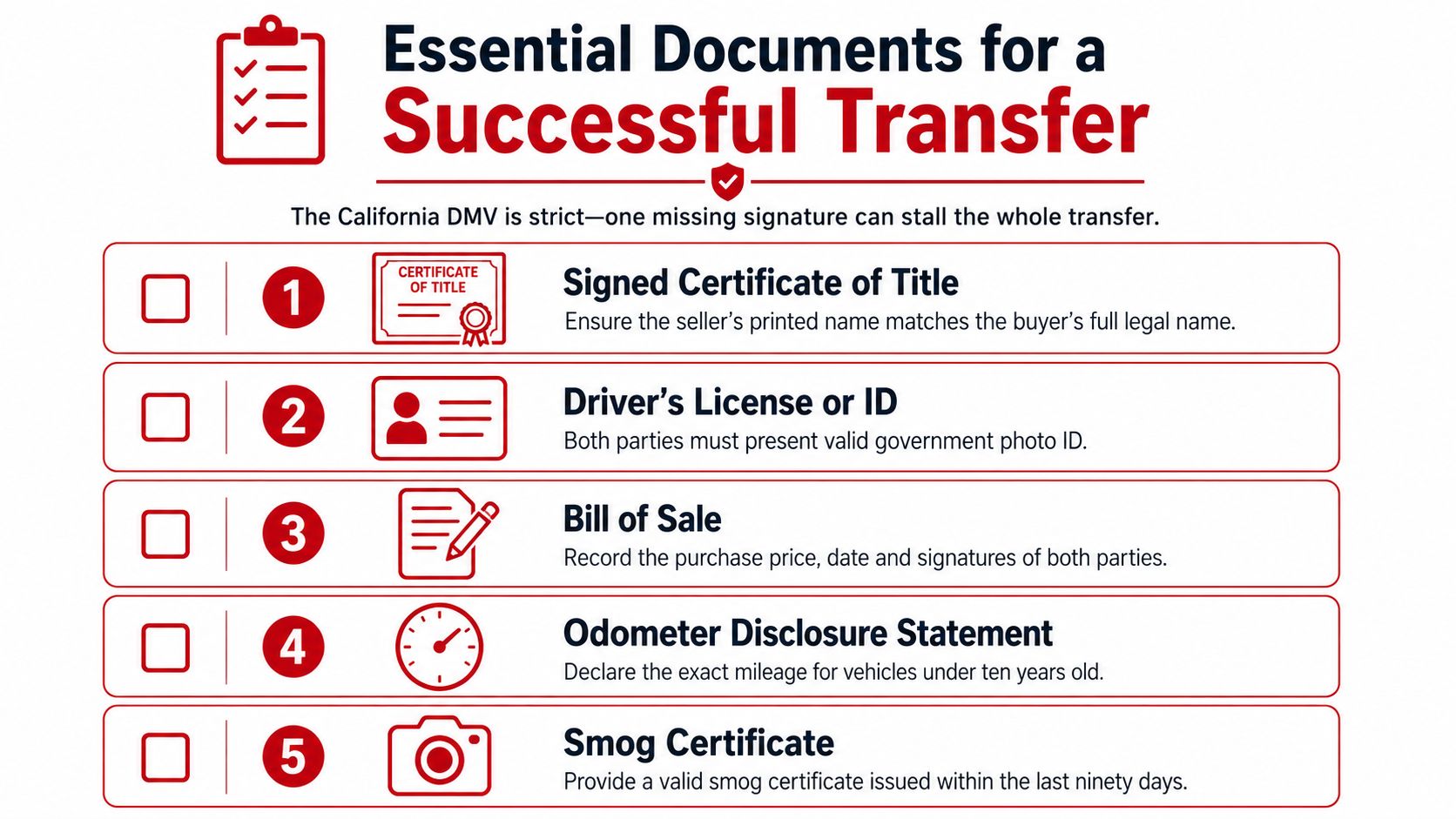
Build the packet before signing
Certificate of Title: Use the original title when available. The seller must sign in the correct assignment area, and the buyer's legal name and address must be entered accurately. Don't use cross-outs or correction fluid. If the title is lost, the transfer may need to begin with a replacement-or-transfer application.
Identification: Both parties should have valid government-issued identification available. The names used on the title and forms need to correspond with the identifying documents. A casual abbreviation or an old address can trigger a correction request.
Bill of sale: Keep a written record showing the parties, vehicle details, transaction date, purchase price, and signatures. It supports the transaction record and gives both sides evidence of what they agreed to exchange.
Odometer disclosure: Record the mileage exactly as required, using complete numeric information rather than an estimate. An incomplete or inconsistent disclosure is one of the most common reasons a title packet comes back for correction.
Smog certificate: Provide the required California emissions documentation for the vehicle and transaction. The smog result is not a substitute for a title, and a signed title doesn't substitute for emissions compliance.
Resolve liens before submission
A lien is an ownership issue, not merely a financing detail. If a lender still appears on the title, the seller needs documentation showing that the obligation was satisfied or the lienholder must participate in the transfer. Buyers should inspect this before paying, because an unresolved lien can prevent the DMV from recording the new owner.
Supporting paperwork may include REG 227, REG 262, REG 256, REG 166, and the Notice of Transfer and Release of Liability, depending on the circumstances. Don't add forms randomly. Use the form that matches the missing title, odometer disclosure, lien, exemption, or liability situation, and confirm the current requirement before submission.
A useful California title transfer paperwork checklist can help you compare the documents you have with the documents your transaction requires. The purpose isn't to create a thicker file. It's to submit a complete, internally consistent file the first time.
Why Professional Smog and DMV Services Matter
The DIY route can work when the title is clean, the vehicle passes its emissions inspection, both parties are available, and the buyer understands which forms apply. Its weakness is fragmentation. The owner may visit one location for smog testing, another for DMV work, and then discover that a missing signature or lien document requires a return trip.
A combined service changes the handoff between compliance and registration. A provider can identify whether the emissions step is complete before accepting the transfer packet, then check whether the title and supporting forms are ready for processing. That doesn't guarantee approval when a lender, out-of-state record, or ownership dispute requires separate action, but it reduces avoidable gaps between steps.
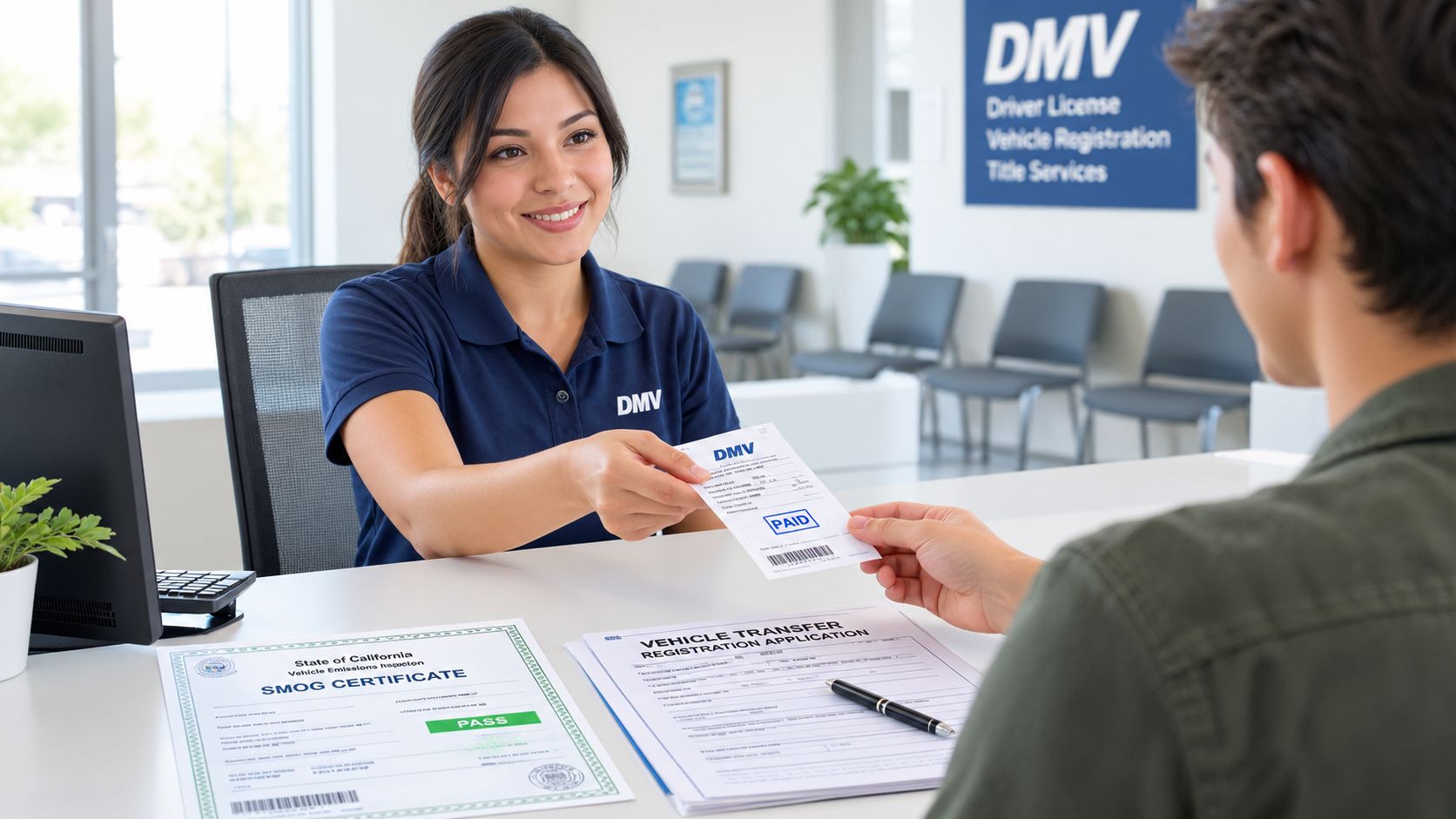
Compare the two routes
| DIY handling | Integrated service |
|---|---|
| You coordinate the smog inspection and DMV submission separately. | The emissions and registration steps can be reviewed as one workflow. |
| You remain responsible for spotting missing signatures, lien documents, and forms. | Staff can help identify apparent paperwork gaps before submission. |
| Registration materials may require a later pickup or mailing step. | An authorized provider may offer on-site registration services and tag printing. |
| A failed smog result becomes a separate problem to diagnose. | The test result can be discussed before the transfer packet is finalized. |
The trade-off is control versus convenience. DIY processing may suit someone who is comfortable reading DMV instructions and correcting paperwork. A licensed partner is more useful when the vehicle is out of state, the title has a lien history, the buyer and seller have limited availability, or a failed smog test has created uncertainty.
Fire House Smog operates as a STAR-certified test-only station and licensed DMV registration partner at 2900 Lone Tree Way in Antioch. It offers on-site California DMV renewals with sticker printing, ownership transfers for California and out-of-state vehicles, and two service bays designed to reduce wait times during posted hours.
Because it is test-only, repairs aren't sold as part of the inspection. If the vehicle fails, the next decision is repair and retest, not an automatic repair purchase at the testing location. The California smog check and registration service is therefore most useful when you want the emissions result and registration paperwork evaluated within the same local workflow.
A professional service can't replace a lender's release or a seller's missing signature. It can help you discover those problems before you build your schedule around an incomplete transfer.
Common Errors That Delay Your Transfer
The most frustrating delays often begin with a document that looks finished. A seller signs the title, but not in the assigned seller field. A buyer writes a shortened name that doesn't match the identification record. Someone copies the VIN from memory instead of reading it directly from the title or vehicle.
Consider a typical failed handoff. The buyer and seller complete the sale, but the title contains one wrong VIN character and the odometer section is incomplete. The DMV can't confidently connect the document to the vehicle or accept the disclosure, so the packet returns for correction. The buyer must locate the seller again, correct the title properly, and resubmit.
Check the points most likely to stop the file
Seller signatures: Compare the title's signature lines with the printed ownership name. A missing or misplaced signature can stop the transfer even when the buyer has paid and taken possession.
Odometer disclosure: Enter the exact mileage in the required format. Don't guess, round, overwrite, or leave a field blank because the vehicle's condition seems obvious.
Lien release: Look for the lienholder information before the transaction closes. A paid loan doesn't automatically mean the title record is already clear.
Names and addresses: Use the legal names and current addresses required for the record. Small inconsistencies can generate a correction request.
VIN: Match the VIN on the title, vehicle, forms, and supporting documents character by character. A VIN discrepancy deserves investigation before submission, not an assumption that the DMV will fix it.
Independent title-transfer guidance identifies missing signatures, odometer problems, unreleased liens, name and address errors, and VIN mismatches as recurring rejection triggers. The title transfer error guide also warns about open titles and title jumping, practices that can leave the record without a valid documented chain of ownership.
Title jumping is especially risky because it attempts to pass a vehicle through an intermediary without recording the intermediary's ownership properly. The result can be a legal and registration dead end rather than a shortcut.
Smog creates another version of the same problem. A vehicle may fail because of emissions-related conditions, or the certificate may be absent when the transfer requires it. Use the common smog check failure reasons to understand what needs attention before treating a failed result as a paperwork issue.
Your Complete Transfer Timeline and Tips
A transfer moves fastest when the owner treats it as a controlled sequence rather than a collection of errands. The first task is not signing the title. It's confirming that the vehicle, seller, lien status, smog requirement, and supporting documents can all be reconciled.
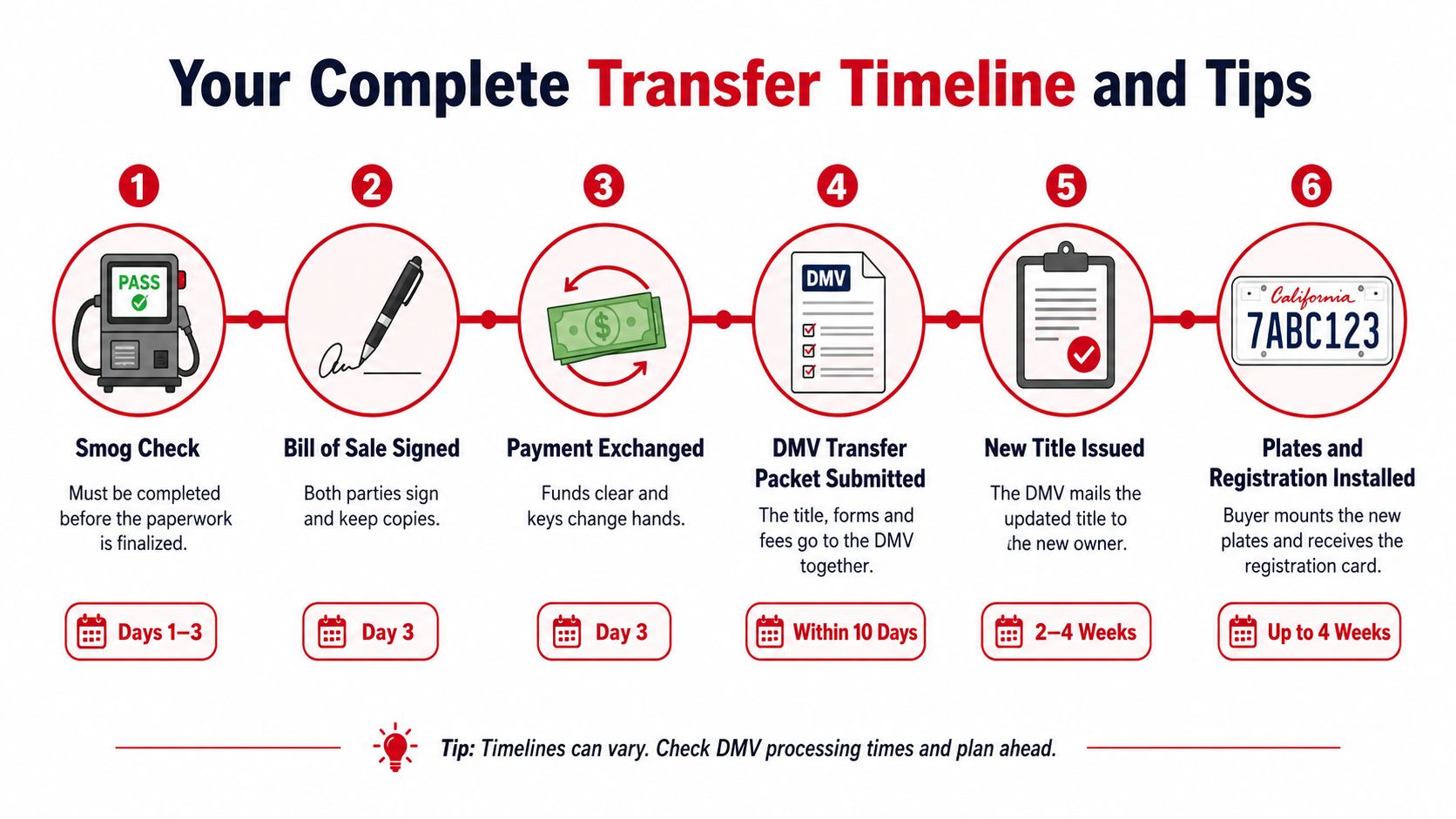
Use a single working sequence
First, inspect the compliance position. Arrange the required smog check and keep the result with the transfer documents. If the vehicle fails, identify the repair and retest path before either party assumes the transfer can be completed.
Second, verify the ownership record. Read the title directly. Confirm the seller's name, VIN, lienholder information, odometer section, and assignment areas. Ask for lien-release documentation before money changes hands if a lender appears on the record.
Third, complete the transaction record. Prepare the bill of sale, sign the title in the correct places, complete the required odometer disclosure, and make copies for both parties. The seller should also complete the appropriate notice of transfer and release of liability.
Fourth, audit the packet. Compare names, addresses, VIN characters, dates, signatures, and mileage across every document. This step is where many avoidable errors can be caught while the seller is still available.
Fifth, submit the transfer. Send the title, required forms, supporting documents, and fees together through the DMV or an authorized registration provider. Keep the receipt or other proof that the packet was accepted.
Finally, monitor the record and registration materials. A new title may be mailed after processing, and plate or registration delivery can depend on the transaction and vehicle history. Don't discard the old paperwork until the new record is confirmed.
An EU analysis illustrates why ownership transfers are operational workflows rather than instant handovers. It estimated about 40 million vehicle ownership transfers per year across the European Union, with around 3.5 million crossing between Member States, or roughly 8% of the total. The same analysis estimated about one week for deregistration, four weeks for re-registration in another Member State, and approximately five weeks for the full cross-border transfer process. These figures are not California processing promises, but they show why cross-border records require more coordination than a local sale. See the European Parliament analysis of vehicle ownership transfers for that broader context.
Reduce return trips
Call ahead when the vehicle is unusual, comes from another state, has a lien history, or may exceed a testing station's equipment limits. Bring the original documents, government identification, payment method, and clear copies, and ask whether the provider can handle the particular ownership scenario before you drive over.
Use a provider that can address both sides of the chain when timing matters. Completing the smog inspection and submitting the DMV packet during the same visit can remove a handoff, but it won't overcome a missing title or unresolved lender interest. The practical goal is not to rush an incomplete file. It's to discover the incomplete part early.
Frequently Asked Questions About Transfers
Does an out-of-state vehicle follow the same process?
Not always. An out-of-state vehicle may require additional verification and records before California can issue the new registration. Bring the out-of-state title, identification, transaction documents, and any available lien information, and confirm the applicable requirements before submission.
What happens if the vehicle fails the smog check?
A failed test means the emissions issue must be addressed before the transfer can proceed where a passing certificate is required. Ask about repair documentation and retest eligibility. Fire House Smog's site policy and coupon terms provide for a free retest when applicable, so confirm the conditions before returning.
What if a lender still appears on the title?
Don't assume the paid loan has already cleared the record. Obtain the lien release or coordinate with the lienholder, then include the correct documentation with the transfer packet. An unresolved lien can prevent the new owner from being recorded.
How can I avoid another DMV trip?
Check the title against the seller's identification, verify the VIN on the vehicle, complete the odometer disclosure, confirm the lien status, arrange the smog inspection, and bring every required form and fee together. If any item is uncertain, resolve it before the appointment rather than submitting a packet that you already suspect is incomplete.
For a connected vehicle ownership transfer service in Antioch, Fire House Smog can perform STAR-certified smog testing and process California or out-of-state ownership transfers through its licensed DMV registration service. Visit Fire House Smog with your title and vehicle documents so the emissions and registration steps can be reviewed together.
Many California registration renewals can start online, but most still depend on an in-person smog check, and title transfers usually require a physical visit. For many owners, a hybrid service center that combines digital preparation with on-site compliance checks is the most efficient path.
You submit the form, enter your payment details, and expect the process to be finished. Then the system reminds you that your vehicle needs a smog certification, or you discover that an unpaid parking ticket is blocking renewal. If you recently bought the car, the task becomes more involved because the state must verify ownership, fees, identity, and vehicle records.
That gap between online convenience and offline requirements explains why local vehicle registration services remain useful. A capable provider can help you identify the transaction, check the paperwork, complete required inspections, and issue registration materials when the state permits on-site processing.
Table of Contents
- The Reality of Modern Vehicle Registration Services
- Understanding How Vehicle Registration Works
- Types of Services You Will Encounter
- Comparing DMV Offices and Authorized Service Centers
- The Advantage of Integrated Smog and Registration Services
- How to Prepare for Your Registration Appointment
The Reality of Modern Vehicle Registration Services
You open your laptop, place the renewal notice beside it, and prepare to pay. The form seems straightforward until it asks for smog certification. Then the practical problems appear: a dashboard warning light, an unpaid parking ticket, or an address that no longer matches the DMV record.
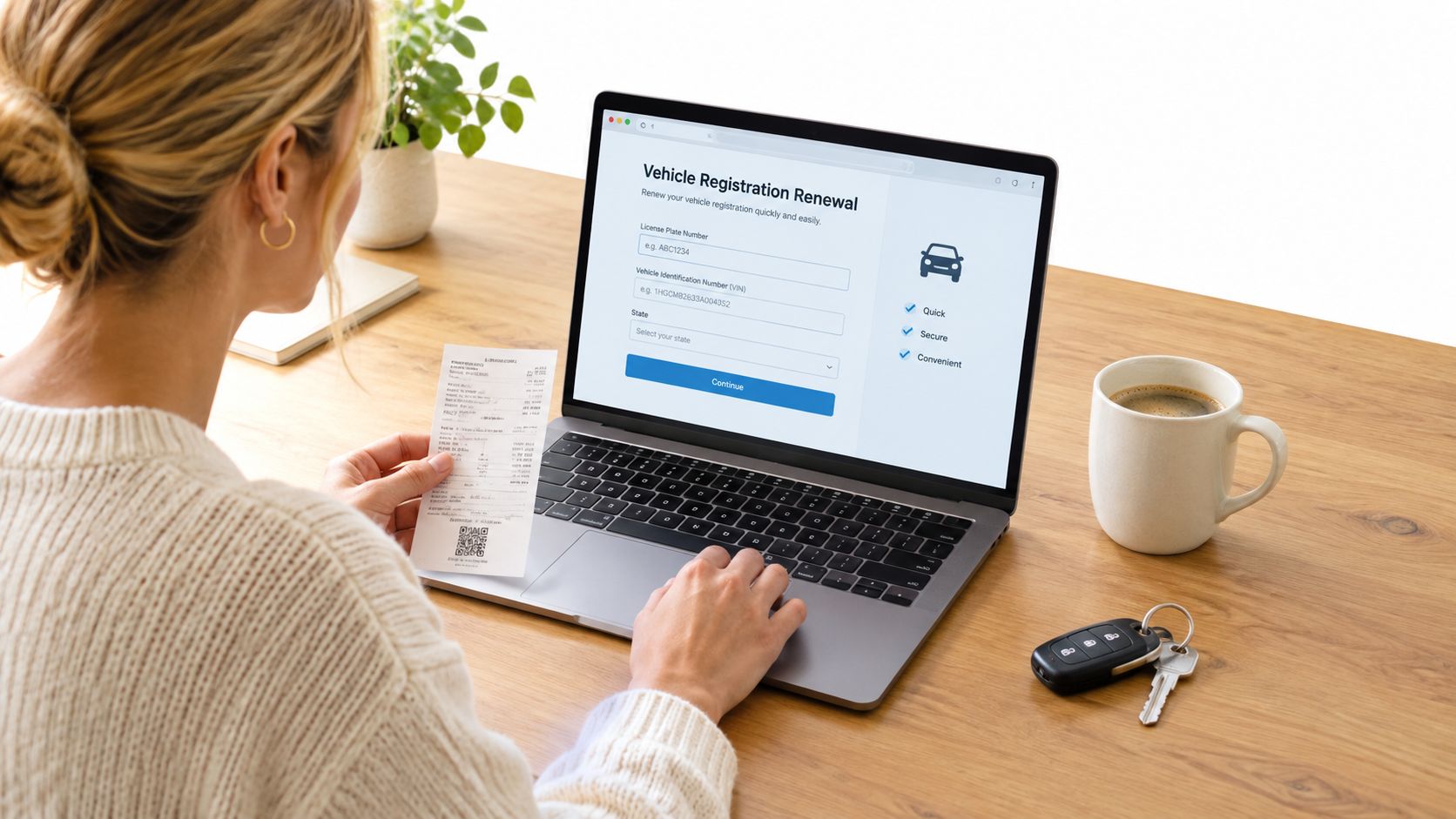
California's DMV states that a smog inspection is generally required for vehicle registration or renewal, with listed exceptions. Renewal can also be blocked by unresolved items such as missing smog certification or unpaid parking tickets. The California DMV renewal requirements show why registration is more than an online payment.
Why online renewal can stop halfway
A digital application can accept your information and payment, but it cannot inspect the vehicle. If smog certification is required, an approved inspection must happen before the renewal can be completed. The DMV also offers an online process for Planned Nonoperation filings. These filings can be submitted up to 60 days before expiration or 90 days after expiration.
The process works like a bridge with two sides. Online tools handle forms, account details, and payment, while a physical location may still need to verify the vehicle, review documents, or issue registration materials. Vehicle registration services connect those steps, so you do not have to treat each requirement as a separate search.
Practical rule: Treat online payment as one step in the transaction, not automatic proof that your registration is finished.
The local service advantage
A local center can first identify whether you need a renewal, transfer, replacement item, or compliance correction. That check helps you avoid joining the wrong queue or submitting the wrong paperwork. In Antioch and nearby East Contra Costa communities, the same visit may address emissions compliance and DMV-related documents.
The most useful hybrid process follows a clear order: prepare digitally, confirm requirements in person, then finish the remaining state transaction through an authorized channel. A provider that handles both sides can catch a missing document before it turns into a delayed notice or another trip.
Understanding How Vehicle Registration Works
Vehicle registration connects a specific vehicle to an owner record. It gives the state a way to identify the vehicle, track legal responsibility, collect required fees, and confirm that the vehicle meets applicable rules. A registration card or sticker is only the visible result of that larger administrative record.
The system developed gradually. New York became the first U.S. state to require vehicle registration on April 25, 1901. California followed later that year, Massachusetts became the first state to issue plates in 1903, and by 1918 all 48 contiguous states were issuing license plates. By 1910, 36 states required motor vehicle registration, and by 1921 every state required annual registration, according to the District of Columbia DMV vehicle registration history.
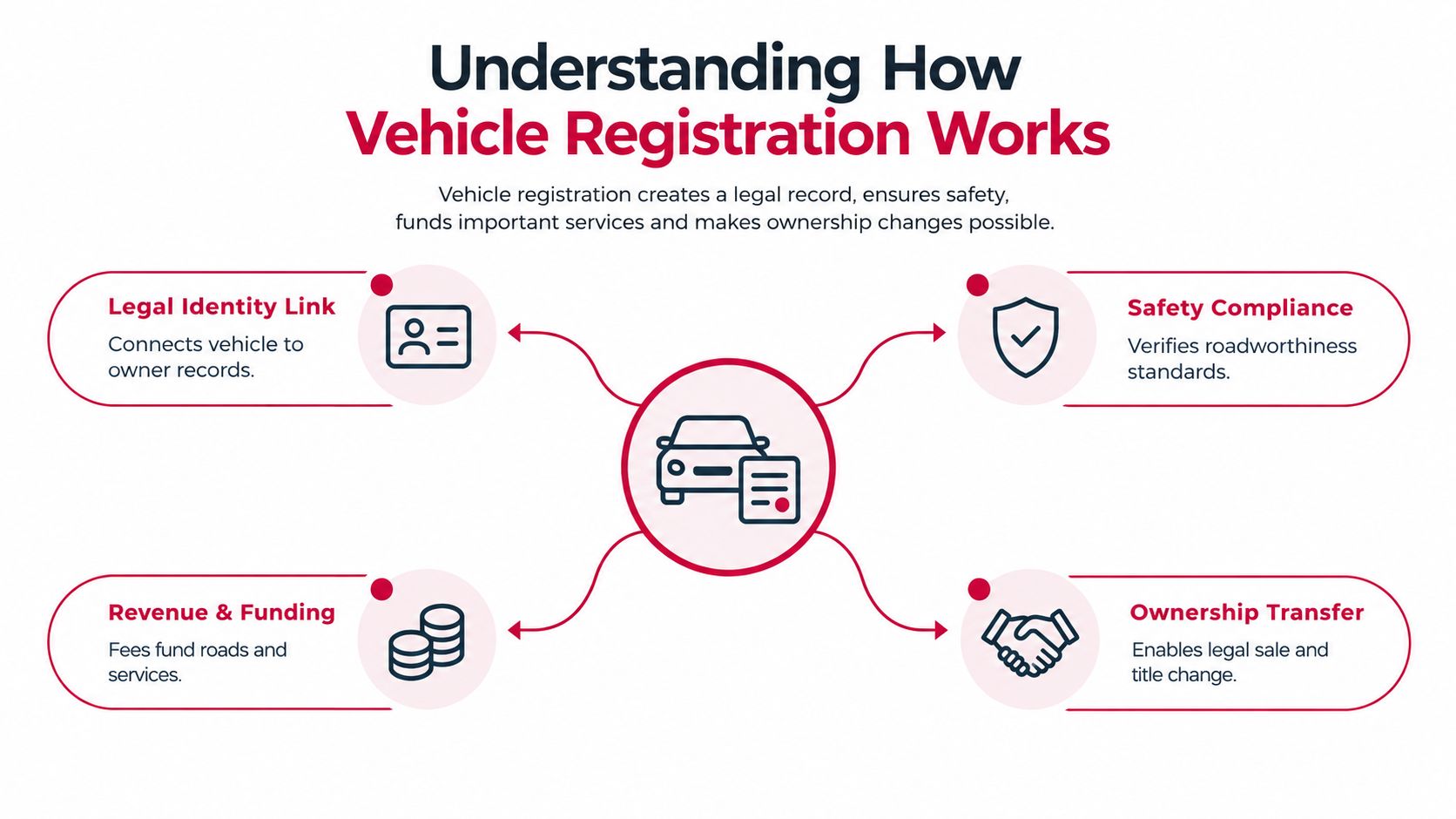
Four parts of the registration record
Registration rules differ by state, but the underlying functions are familiar:
- Legal identity link: The record connects the vehicle identification number, owner information, and address.
- Compliance check: The state can require emissions, insurance, safety, or other conditions before allowing registration.
- Fee collection: Registration charges support the administration of transportation systems and related public services.
- Ownership evidence: Registration and title processes help document a sale, transfer, or change in responsibility.
Registration and title aren't identical. The title primarily establishes ownership, while registration authorizes the vehicle to operate under the applicable state rules. A sale can therefore require both ownership paperwork and a new registration record.
Why California feels especially procedural
California combines electronic renewal with emissions compliance. The DMV says smog certification is required for registration or renewal in many cases, and the renewal won't proceed when required certification or other obligations remain unresolved. That means the process can involve a website, a physical inspection lane, and a state record review.
For a plain-language explanation of the renewal step, see this guide to what vehicle registration renewal involves. Understanding the distinction between payment, certification, and final issuance helps prevent a common mistake: assuming the transaction is complete because the first online step succeeded.
Types of Services You Will Encounter
The right service depends on what changed. A routine renewal keeps an existing registration active. A transfer changes the vehicle's ownership record. A Planned Nonoperation filing changes how the vehicle may be used. An out-of-state transaction may require documents from both the previous jurisdiction and California.
Routine renewals
A renewal is usually the most familiar transaction. You confirm the vehicle and owner information, satisfy any emissions or administrative requirements, pay the applicable charges, and receive updated registration materials. If the DMV record is clear and the vehicle is eligible, the process can be straightforward.
It can become complicated when the vehicle requires a smog check, the address is outdated, a ticket remains unpaid, or the DMV requests additional review. A service provider can help separate those issues instead of treating every delay as a payment problem.
Ownership transfers
Buying or selling a vehicle creates a different workflow. New York DMV guidance shows that first-time registration can involve plate or transfer fees, a title certificate fee, and use tax in many counties. Customers may receive one or two plates and a registration window sticker at the counter or by mail, depending on the transaction. New York's registration and title instructions illustrate why a transfer requires more than changing a name on a renewal form.
Expect to discuss:
- Proof of ownership: Title, bill of sale, or other documents required by the jurisdiction.
- Vehicle identity: VIN and related information must match the official record.
- Fees and taxes: The transaction may include separate registration, title, transfer, or use-tax charges.
- Plates and documents: The state may issue new plates, stickers, registration cards, or title materials.
Special filings and cross-state moves
Planned Nonoperation is useful when an owner intends not to operate a vehicle on public roads for a defined period. It isn't a substitute for ordinary renewal when the vehicle will continue being driven.
Out-of-state purchases and moves require extra care because the vehicle may need to leave one state's record and enter another's. Insurance proof, identity, address, emissions status, title documents, and temporary operating permissions can all matter. Ask the provider exactly which transaction they handle before arriving, especially if you bought the vehicle privately or the title is held by a lender.
Comparing DMV Offices and Authorized Service Centers
A DMV office is the official state channel. An authorized service center is a private provider permitted to handle specified transactions through a state partnership or license. Neither option eliminates the state's requirements, but the experience can differ sharply.
The California DMV estimates kiosk renewals can be completed instantly when all requirements are met. It estimates about one week for online and phone renewals and about two weeks for mail renewals, while noting that extra review can extend processing. These California DMV processing estimates make the operational trade-off clear: a local in-person provider can be useful when immediate document verification or on-site issuance is available.
Side-by-side comparison
| Feature | DMV Office | Authorized Service Center |
|---|---|---|
| Authority | Direct state agency service | Private provider authorized for specific DMV transactions |
| Routine renewal | Available through eligible channels | Often available on site, subject to authorization and eligibility |
| Document review | State staff review the transaction | Staff can check paperwork before submission or issuance |
| Smog compliance | Usually handled separately from the DMV counter | Some centers combine emissions testing with registration services |
| Complex transfers | Handles state transactions under DMV procedures | May handle transfers, plates, and related paperwork within its approved scope |
| Processing result | May be mailed or completed through an eligible state channel | On-site materials may be issued when requirements are satisfied |
| Best fit | Unusual cases requiring direct state adjudication | Eligible transactions where speed, guidance, and convenience matter |
Choosing the right channel
Use the DMV when your case involves an issue only the state can resolve, such as a disputed record, unusual ownership problem, or formal correction. An authorized center may be more practical when your documents are complete and you need a renewal, transfer, sticker, or related service without navigating multiple locations.
Check the provider's exact authority before you go. Some centers handle only renewals, while others can process ownership transfers or plate-related work. The phrase California DMV registration services should mean more than general paperwork help. Ask whether the location can complete your specific transaction and whether it can issue the needed item on site.
Before you leave home: Confirm the transaction type, required documents, inspection status, payment method, and service hours.
The Advantage of Integrated Smog and Registration Services
California's hybrid reality is easiest to understand through the emissions requirement. You can begin a renewal online, but if the vehicle needs a smog check, a physical inspection still stands between your payment and a completed registration. A title transfer adds another layer because the provider must verify ownership documents and transaction details.
An integrated center reduces handoffs. Instead of visiting a smog station, discovering a problem, then arranging a separate DMV appointment, you can have the emissions result and registration paperwork handled within one coordinated workflow, where the provider is authorized to offer both services.
Why the timing matters
A California DMV kiosk renewal can be completed instantly when all requirements are satisfied. Online and phone renewals are estimated at about one week, while mail renewals are estimated at about two weeks, according to the DMV's renewal processing information. Those estimates don't mean every case will take that long, but they show why same-visit processing can matter to someone whose expiration date is close.
The bottleneck often isn't the payment screen. It's the missing smog certification, incorrect document, unresolved fee, or incomplete transfer record. An on-site provider can focus attention on those eligibility checks before the customer leaves.
What happens if the vehicle fails
A failed smog inspection changes the plan, but it doesn't necessarily end the process. The owner may need repairs and a retest before the emissions requirement is satisfied. A center that performs the inspection and handles registration paperwork can explain what remains outstanding, while a test-only operation keeps testing separate from repair sales.
Fire House Smog is one local option that provides STAR-certified test-only smog inspections and California DMV registration services at its Antioch location. Its listed services include renewals, ownership transfers, related plate or sticker handling, and a free retest under applicable site policy and coupon terms. Verify current availability and conditions directly with the provider.
The hybrid model in practice
The efficient sequence is usually:
- Check the DMV record: Identify the renewal, transfer, or filing and look for holds.
- Prepare the documents: Match names, addresses, VIN details, title information, and insurance records.
- Complete the physical requirement: Obtain the smog inspection or other required verification.
- Finish the authorized transaction: Submit the completed information and receive the registration item when eligible.
This approach doesn't remove state rules. It puts the digital and physical steps in the right order, reducing the chance of paying first and discovering later that the record still needs action.
How to Prepare for Your Registration Appointment
Preparation starts with identifying the transaction, not with searching for the nearest office. A renewal, transfer, replacement plate request, and Planned Nonoperation filing can require different documents and follow different timelines.
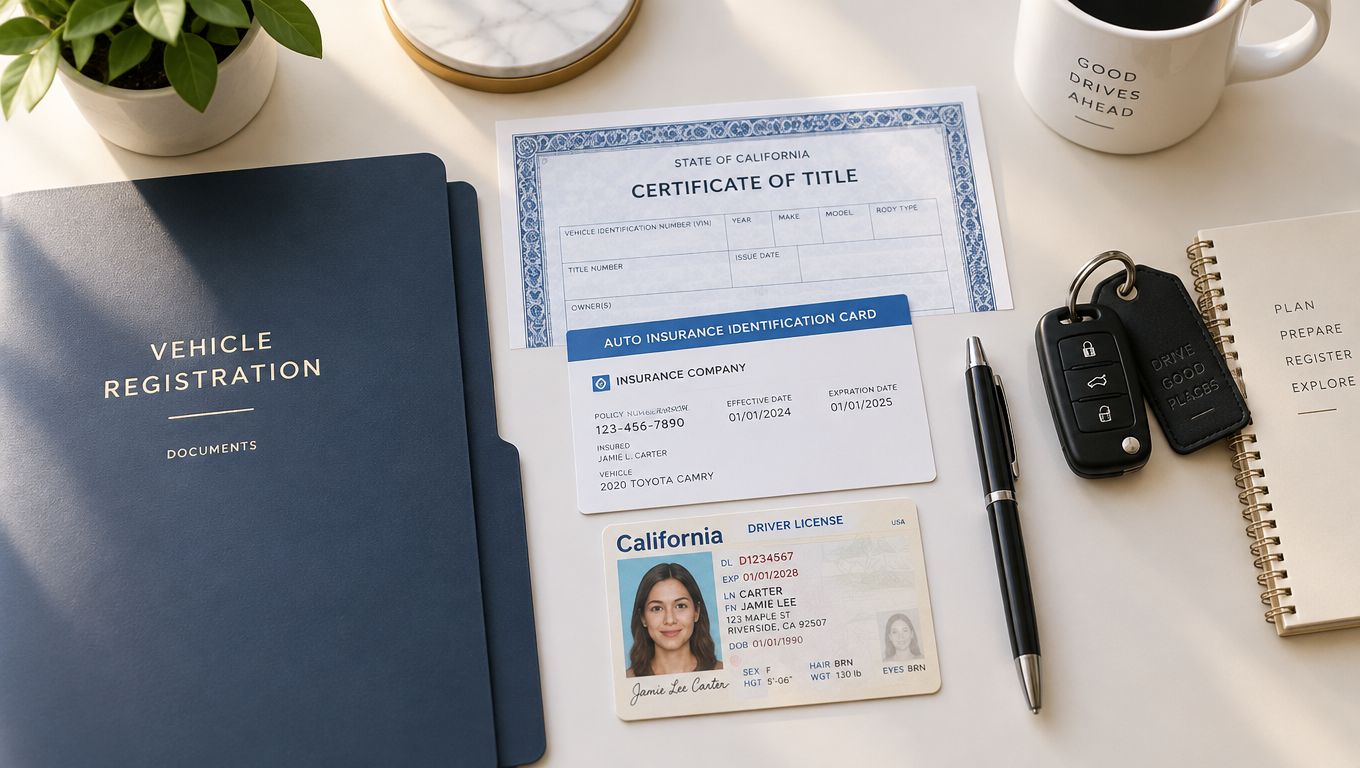
Bring the documents that match your situation. Your current registration, driver license or other identification, proof of insurance, title, and bill of sale may all be relevant, especially for a transfer. Keep the VIN and vehicle details accessible, and check that names and addresses are consistent across the paperwork.
Use this vehicle registration document checklist before leaving home:
- Renewal: Current registration, identification, insurance information, and any smog certification details.
- Ownership transfer: Title, bill of sale, buyer and seller information, identification, and payment method.
- Out-of-state vehicle: Prior title and registration, identity and address evidence, insurance, and any required inspection information.
- Problem record: Notices, receipts, parking-ticket resolution, or other documents connected to the hold.
If the vehicle has a check-engine light, address the issue before scheduling a smog test. Also confirm the center's current DMV hours rather than relying on its smog-testing schedule, since those services may operate on different timetables.
The following video can help you think through the paperwork and appointment process before you go.
Call ahead for unusual vehicles, out-of-state titles, lender-held documents, RVs, or transactions involving missing paperwork. A short conversation can reveal whether the provider handles the case and what you need to bring.
Fire House Smog offers STAR-certified test-only smog checks alongside California DMV renewals, ownership transfers, and related registration services at its Antioch location. Bring your documents, confirm the current service hours, and visit Fire House Smog to coordinate the inspection and registration steps in one place.
You're standing at the smog station counter with a fresh Vehicle Inspection Report in your hand. The page is full of abbreviations, check marks, “incomplete” statuses, and one prominent word at the top: PASS or FAIL. If your result says fail, it's easy to assume the car needs an expensive repair, even when the report is pointing to a timing problem after recent battery work.
Learning how to read smog check results starts with reading the page in the right order. Begin with the verdict, then identify the failure category, check readiness, review fault information, and finally look at visual or functional findings. That sequence usually tells you whether you need a mechanic, more normal driving, or no action at all.
Table of Contents
- Why Your Smog Check Printout Matters
- Understanding the Vehicle Inspection Report Layout
- Reading Readiness Monitors on Your OBD Report
- Decoding OBD Trouble Codes and Emission Readings
- Repair Problem or Timing Problem
- Your Next Steps After a Failed Smog Check
- Smog Check Tips and Key Takeaways
Why Your Smog Check Printout Matters
A Vehicle Inspection Report is more useful than the large PASS or FAIL line suggests. California's Bureau of Automotive Repair says the report includes the test results, the overall pass or fail outcome, and any open safety recalls identified through the inspection process. California BAR's Smog Check guidance also shows why this audience needs clearer explanations: about 1.3 million of 19 million 2000+ model-year vehicles tested in calendar years 2024 and 2025 failed Smog Check.
That failure number doesn't mean every driver has a major engine problem. A failed report can reflect an active emissions fault, incomplete computer self-tests, a visual issue, a functional problem, or an emissions reading above the applicable limit. Those categories lead to very different next steps.
Practical rule: Don't diagnose the car from the PASS or FAIL line alone. Find the specific category that produced the result.
Start at the top and confirm that the report belongs to your vehicle. Check the vehicle identification details, including the information used by the station to record the inspection. Then locate the overall result. Treat that line as the answer to “Did the vehicle pass today?” It doesn't necessarily answer “What should I do next?”
The reason usually appears lower on the page. You may see OBD fault information, readiness monitor statuses, visual inspection results, functional checks, or emission measurements. Read those lines as evidence. A report marked FAIL because a monitor is incomplete calls for a different response than one showing an active fault code or a failed emissions component.
That distinction is the foundation of a calm, accurate conversation at the counter. You don't need to understand every abbreviation before you can understand the decision the report is asking you to make.
Understanding the Vehicle Inspection Report Layout
Think of the report as a series of questions about the vehicle. Each block answers one question, and the order matters.
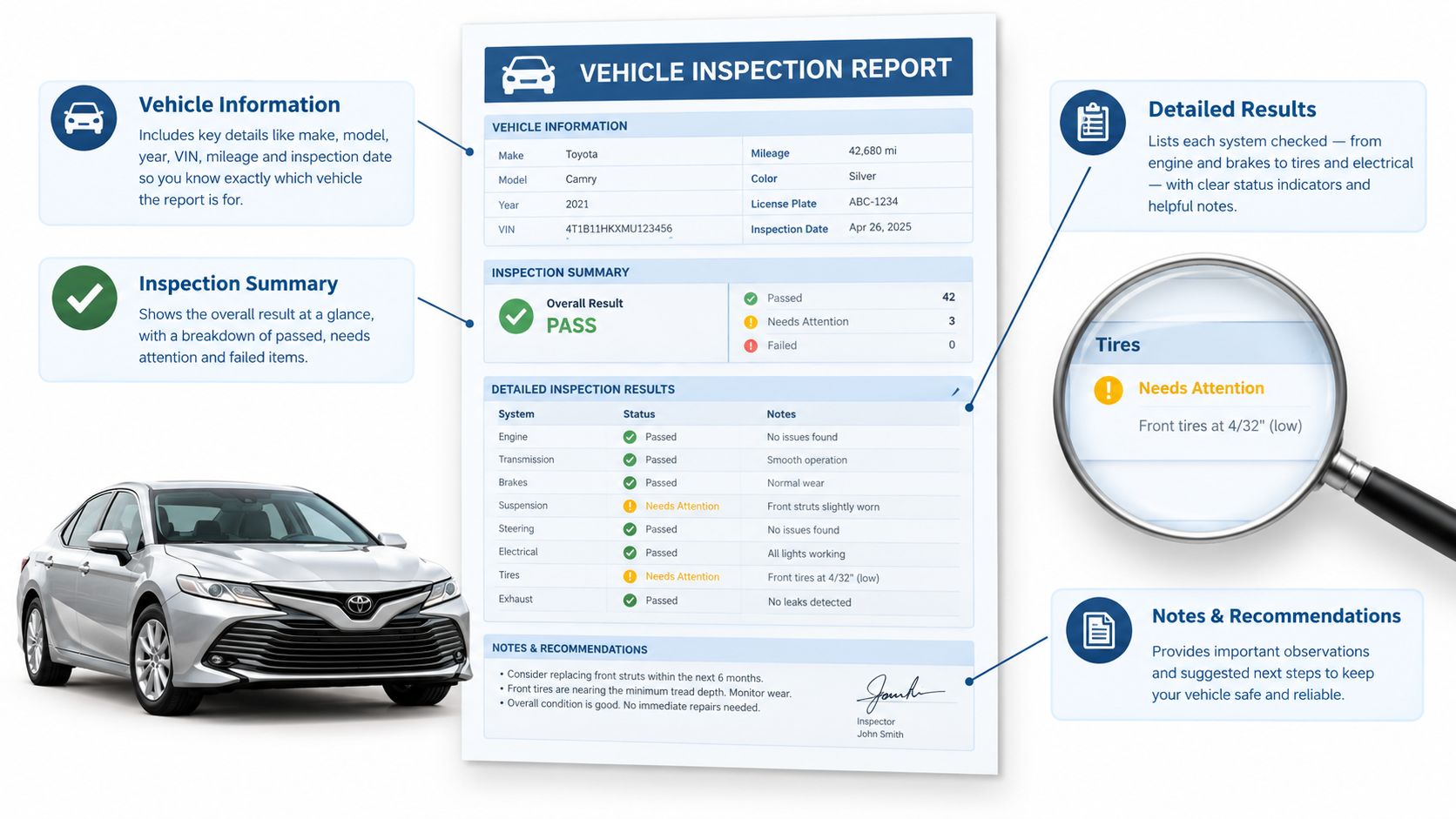
Start with the identity and verdict
The vehicle information block confirms that the station tested the correct car. Check the identifying details before you interpret anything else. Next, find the overall result line. PASS means the vehicle met the requirements recorded by that inspection. FAIL means at least one part of the inspection did not meet the requirements.
The verdict is important, but it's only the first layer. Don't jump from FAIL straight to “replace a part.” Move down the report and find the marked failure category.
Find the reason hierarchy
The report may separate results into several groups:
- OBD fault information: This shows whether the onboard diagnostic system reported emissions-related trouble codes or a malfunction indicator lamp condition.
- Readiness status: This shows whether the vehicle's emissions self-tests have completed.
- Visual inspection: This records whether required emissions equipment appears present and compliant.
- Functional inspection: This checks whether certain emissions-related systems operate as required.
- Emission measurements: On vehicles and tests where measurements apply, this section compares measured pollutants with the applicable limits.
A report can contain more than one concern. For example, it might show incomplete readiness alongside a visual or functional issue. Don't assume the first line you notice is the only reason for failure. Look for the section that is explicitly marked failed, then note whether another section contains a separate issue that also needs attention.
Treat recalls as separate information
Open safety recalls may appear on the report, but a recall notice isn't automatically the same thing as an emissions failure. Keep it in view, then separate it from the result category that caused the smog outcome. This prevents a reader from confusing a safety notice with a failed OBD or emissions test.
The most useful question to ask the technician is specific: “Which report line caused the failure?” Once you know whether the answer is readiness, OBD, visual, functional, or emissions measurement, the rest of the printout becomes much easier to interpret.
Reading Readiness Monitors on Your OBD Report
A readiness monitor is a self-test performed by the vehicle's onboard computer. The computer checks emissions-related systems during different driving conditions, then records whether each test is complete. The monitor doesn't just tell you whether a part exists. It tells you whether the vehicle has completed the conditions needed to evaluate that system.
On the report, look for a readiness section with statuses such as complete, ready, incomplete, or not ready. The exact labels can vary, but the meaning is straightforward. A complete monitor has finished its self-check. An incomplete monitor hasn't finished, so the computer doesn't yet have a completed result for that system.
Why monitors become incomplete
The most common timing clue is recent interruption of the vehicle's computer memory. Clearing a trouble code or disconnecting the battery can reset readiness information. The check-engine light may be off afterward, but the vehicle still needs normal driving conditions to run its self-tests again.
That's why a car can feel completely normal and still fail the inspection. The driver may not notice any change in acceleration, starting, or fuel use, while the computer reports that one or more required checks remain unfinished. The problem is the missing data, not necessarily a failed mechanical component.
California BAR explains that a vehicle fails when too many readiness monitors are incomplete. The agency says owners can often address a readiness-related failure by driving normally for about a week so the monitors can reset, and as of October 1, 2025, California requires all readiness monitors to be set for a pass. California's OBD II readiness guidance makes this screen a first-pass diagnostic step, not a minor footnote.
What to do with the screen
If the report shows incomplete monitors but no active fault information, don't clear the system again. That would restart the same process. Drive the vehicle normally, including the types of city and highway conditions it ordinarily experiences, then have the readiness status checked again.
For a more detailed explanation of the statuses and what they indicate, review this guide to OBD readiness monitors. The key question remains simple: are the monitors incomplete because the car needs time to finish its self-tests, or are they incomplete because an underlying fault keeps preventing completion?
Decoding OBD Trouble Codes and Emission Readings
Once readiness is clear, read the OBD fault information. OBD stands for onboard diagnostics, the vehicle's computer system for monitoring emissions-related operation. A diagnostic trouble code, often called a DTC, is the computer's standardized description of a detected problem.
Codes commonly begin with a letter. P generally identifies a powertrain-related code, which can involve the engine, transmission, or emissions controls. The numbers that follow narrow the system and condition involved. You don't need a complete code encyclopedia at the counter. You need to record the exact code and connect it to the failure category printed on the report.
Common fault clues
California BAR notes that a vehicle with the check-engine light on won't pass, and that modified or non-approved software can also cause failure. The 2026 California Smog Check Performance Report identifies several familiar sources of OBD emissions failures, including loose gas caps, oxygen-sensor faults, and evaporative leaks.
Those clues point to different diagnostic paths:
- Loose or damaged gas cap: The fuel-vapor system may not seal correctly, allowing an evaporative emissions fault to appear.
- Evaporative leak: The system that stores and controls fuel vapors may have a leak or another sealing problem.
- Oxygen-sensor fault: The computer may be receiving an unreliable signal used to manage fuel and emissions control.
- Modified software: Non-approved programming can cause the vehicle to fail even if the car drives normally.
The report may also show emission measurements rather than, or in addition to, OBD information. A measurement above the applicable limit indicates that the vehicle's recorded emissions exceeded the standard used for that inspection. That result needs diagnosis, not a guess based on how the exhaust smells or how smoothly the engine runs.
Don't rely on driving feel
A vehicle can fail with no obvious drivability symptoms. The onboard computer may detect an emissions-control problem before the driver notices rough running, hesitation, or reduced power. The code and the report are the evidence to use when deciding what to inspect.
Write down every code exactly as shown. Don't replace a sensor just because its name appears in a code. A code identifies a detected condition, but proper diagnosis determines whether the sensor, wiring, leak, software, or another component caused it. You can also review this explanation of emissions test results before approving repairs.
Repair Problem or Timing Problem
The most useful distinction on a failed report is whether the computer is reporting an active fault or an unfinished self-test. An active fault usually requires diagnosis and repair. An incomplete readiness result may require more normal driving, provided the report doesn't also show a fault, lamp, visual issue, or failed measurement.
| What the Report Shows | Likely Problem Type | Your Next Move |
|---|---|---|
| Check-engine light is on | Active emissions or engine-management fault | Have the code diagnosed and repair the underlying cause |
| Specific OBD trouble code is listed | Active fault information | Record the code and seek diagnosis before retesting |
| No active code, but monitors are incomplete | Timing or readiness issue | Avoid clearing the system and drive normally for about a week |
| Emission measurement exceeds the applicable limit | Measured emissions problem | Have the engine and emissions controls diagnosed |
| Visual inspection is marked failed | Equipment or modification issue | Correct the visible emissions-system problem |
| Functional inspection is marked failed | Emissions-related system didn't operate as required | Identify the failed system and repair or service it |
The report can include diagnostic trouble codes, monitor status, or emission measurements that help separate these situations. State inspection guidance also illustrates why paperwork may identify an active fault, an incomplete monitor, or an excessive reading even when the vehicle has no obvious symptoms. This explanation of emissions inspection results is useful for understanding the general logic behind those report fields.
A practical example makes the difference clear. Suppose the check-engine light is off, no trouble code is listed, and the readiness block shows incomplete monitors after recent battery work. That pattern points first toward a timing issue. Suppose instead the light is on and the report lists an evaporative-system code. The car may still drive smoothly, but the report points toward diagnosis and repair.
The safest approach is to match the next action to the strongest clue. Incomplete without an active fault suggests time and driving. A lamp, code, failed measurement, visual issue, or functional issue suggests diagnosis.
Your Next Steps After a Failed Smog Check
Put the report on a clean surface and follow the marked findings instead of guessing. Your next move should come from the reason category.
Check readiness first. If the report shows incomplete monitors without an active code, don't clear the vehicle's memory again. California BAR says normal driving for about a week can allow the monitors to complete, so arrange a readiness check after that period.
Address active faults. If the report shows a check-engine light, diagnostic trouble code, failed emission measurement, visual issue, or functional failure, take the report to a qualified repair professional. Ask for diagnosis of the listed condition rather than an automatic replacement of the named sensor or component.
Keep the paperwork. Bring the original Vehicle Inspection Report or the station's retest information when you return. If you're handling registration renewal, keep the smog paperwork with your DMV documents so the certification and renewal tasks stay connected.
Confirm retest terms. Retest policies vary by station. A test-only station in Antioch offers a free retest under its coupon and site policy, conducts smog testing seven days a week, and doesn't sell repairs. Verify the current terms before you go.
For a plain-language review of the categories that commonly appear after a failure, see this guide to smog check fail reasons. It can help you translate the marked line before you decide whether to drive, repair, or schedule a retest.
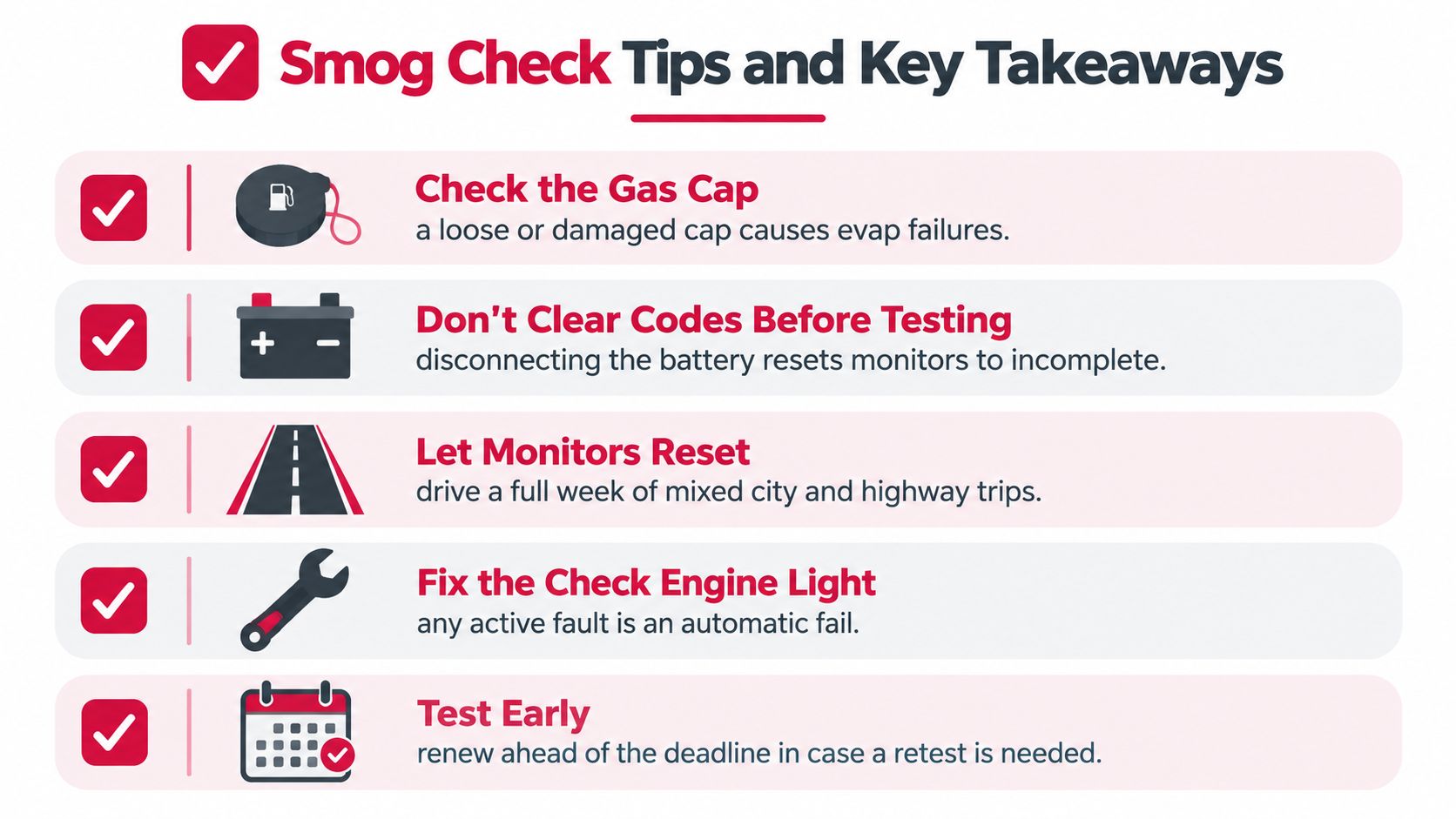
Smog Check Tips and Key Takeaways
Use this short checklist before your next inspection:
- Check the gas cap: Make sure it seals correctly, since a loose cap can contribute to an evaporative-system failure.
- Don't clear codes before testing: Clearing codes or disconnecting the battery can leave readiness monitors incomplete.
- Let the monitors finish: If the report identifies a readiness issue without an active fault, drive normally for about a week before checking again.
- Watch the check-engine light: A lit malfunction indicator lamp is a direct warning that the vehicle may fail.
- Read the reason, not just the verdict: The failure category tells you whether to investigate timing, repairs, measurements, or equipment.
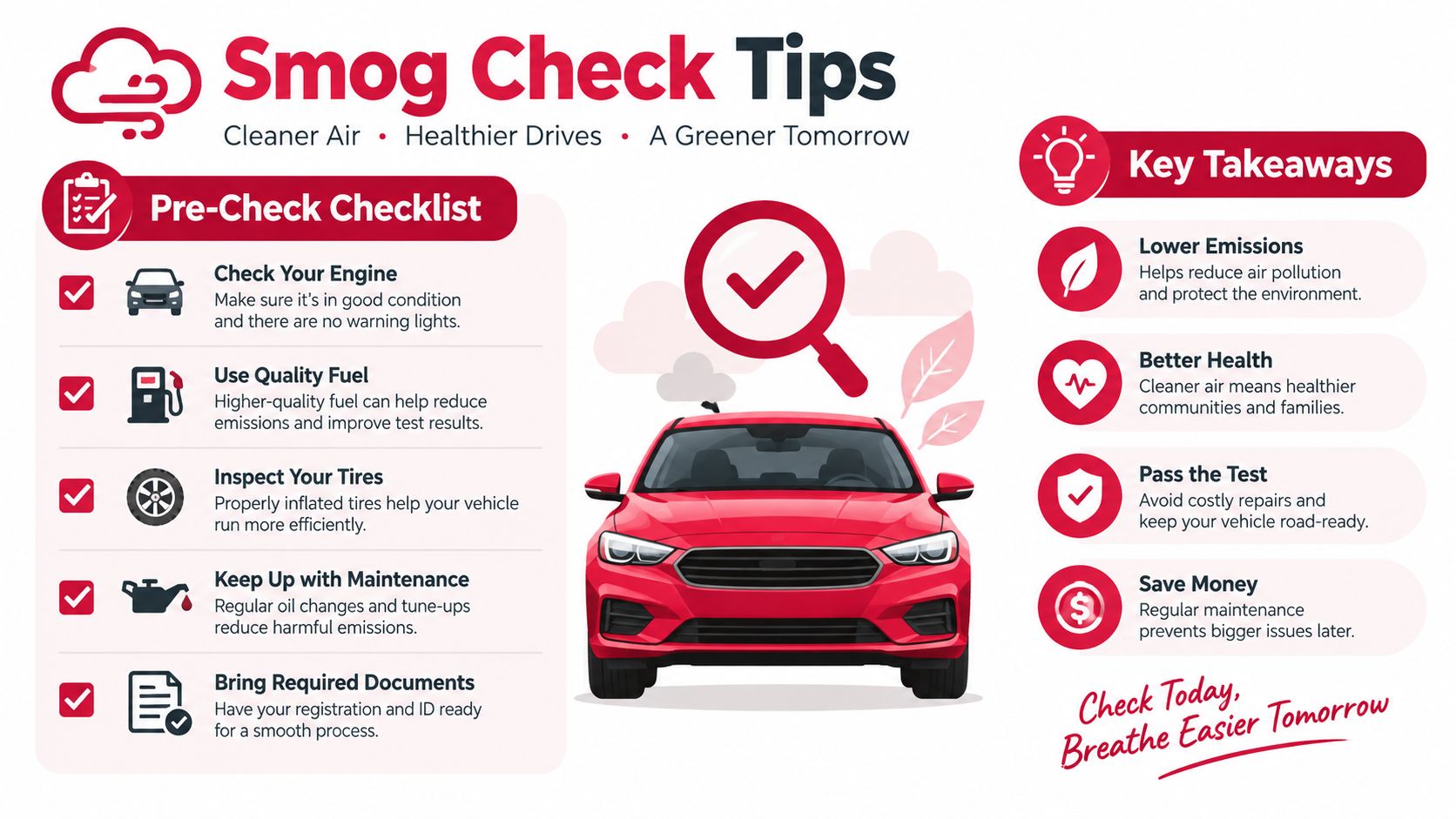
Keep this reading order: Verdict, failure category, readiness status, OBD fault information, then visual, functional, and emission findings.
Most confusion disappears once each line answers one question. The verdict tells you what happened, readiness tells you whether the computer finished checking, fault information points to active conditions, and the failure category tells you what to do next.
If you're in Antioch or East Contra Costa County, Fire House Smog provides STAR-certified test-only inspections, California DMV registration services with on-site tag issuance, and retesting under its current coupon and site policy. Bring your Vehicle Inspection Report, and contact the station before visiting to confirm current hours and retest terms.
You're standing beside a large motorhome with a DMV renewal notice in hand, wondering whether it belongs at an ordinary smog station, a heavy-duty emissions facility, or nowhere at all. That uncertainty is understandable, but guessing can cost you a wasted trip, a rejected inspection, and a registration delay.
California doesn't exempt RVs just because they're recreational vehicles. Fuel type, model year, registration status, and gross vehicle weight rating, or GVWR, determine the correct emissions pathway. The most important dividing line for many diesel motorhomes is the GVWR label inside the driver's door. Check that label before booking a test.
Table of Contents
- Navigating California RV Emissions Requirements
- Standard Smog Check Rules for Motorhomes
- The Heavy-Duty Clean Truck Check Divide
- Preparing Your RV for a Passing Inspection
- Why a STAR Test-Only Station Protects You
- Combining Smog Testing with DMV Registration
- Your RV Compliance Action Plan
Navigating California RV Emissions Requirements
David parked his gasoline motorhome for most of the year and assumed limited use would keep emissions testing off his registration requirements. The renewal notice proved otherwise. California bases the requirement on the vehicle's characteristics and registration circumstances, not on how often the owner takes it camping.
For a smog check for an RV, start with classification. A motorhome is not exempt just because it is recreational. A gasoline RV from 1976 or newer is generally subject to Smog Check, while diesel vehicles from 1998 or newer are generally included, subject to California's weight and registration rules. The standard light-duty path usually requires inspection every other year when the DMV requests certification.
Practical rule: Classify your RV by fuel, model year, and GVWR, not by its appearance.
The biggest mistake involves diesel pushers and other large coaches. A non-gasoline motorhome with a GVWR over 14,000 pounds may fall under California's separate Clean Truck Check program instead of the standard Smog Check program. That changes the testing method, reporting process, schedule, and type of facility you need. Confirm the weight threshold before driving to a passenger-vehicle smog station.
Find the controlling details first
Record these four details before contacting a testing facility:
- Fuel: gasoline, diesel, or another fuel.
- Model year: use the vehicle's model year, not the purchase date.
- GVWR: read the manufacturer's label on the driver's door jamb.
- Registration purpose: confirm whether the motorhome is registered for non-commercial or commercial use.
The California Bureau of Automotive Repair Smog Check guidance explains which qualifying RVs and motorhomes fall within California's program. For more detail on how vehicle class and registration status affect testing, review these California emissions testing requirements.
Use the classification result to choose the facility. Confirm that it handles your testing program and can physically accommodate the coach. A station built for passenger cars may lack the equipment or space for a large motorhome, and a standard Smog Check certificate may not satisfy a heavy-duty Clean Truck Check obligation. Identifying the correct lane first prevents a rejected inspection, wasted travel, and registration delays.
Standard Smog Check Rules for Motorhomes
A newer gasoline motorhome can avoid a routine inspection, while an older qualifying coach may need one during registration renewal or a transfer of ownership. The standard lane is defined by timing and exemption rules, so check the DMV requirement before booking an appointment.
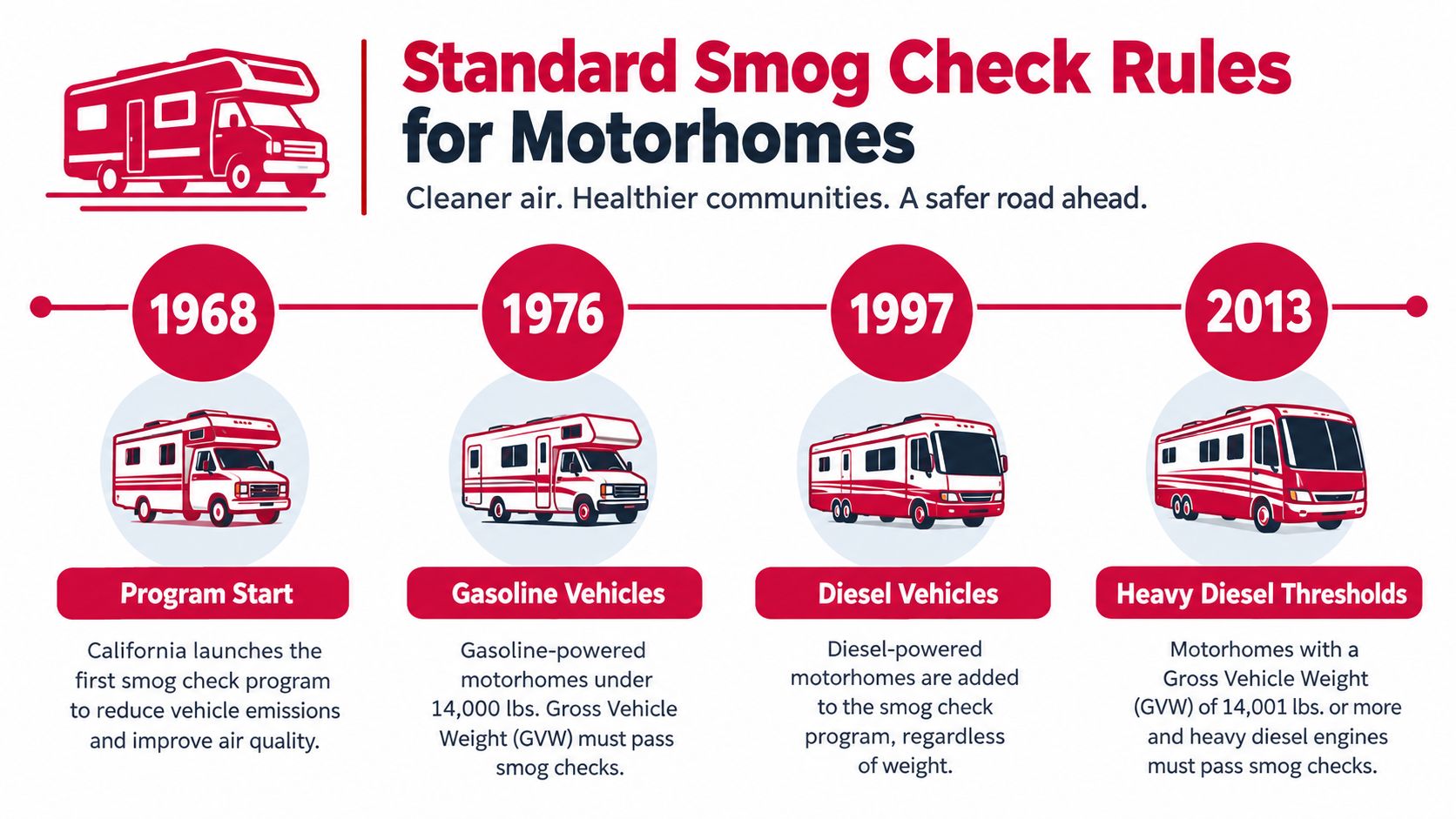
For vehicles in the ordinary program, testing is generally required every other year when the DMV renewal process calls for it. A change of ownership can also trigger a test. The timing depends on the vehicle's status in California records, not just on whether the coach is used regularly.
The age exemption is easy to miss. Vehicles four model years old and newer aren't subject to the biennial or change-of-ownership Smog Check requirement. California also provides a smog abatement fee option for vehicles less than four model years old during the first eight years they are registered. That pathway began January 1, 2019, and is described in the Bureau of Automotive Repair's Smog Check program information.
Use the exemption and fee rules to check your renewal notice:
- A newer qualifying gasoline motorhome may fall within the four-model-year exemption.
- A vehicle outside that exemption may require the inspection or the applicable abatement fee.
- An ownership transfer can create a testing requirement even when the usual renewal cycle has not arrived.
- A notice from the DMV remains the controlling prompt for registration compliance.
California also changed how qualifying newer vehicles are inspected. Assembly Bill 2018 expanded emissions testing in areas that had not attained federal air-quality standards. Assembly Bill 2289 shifted 2000 model-year-and-newer vehicles toward an OBD II-focused inspection approach, according to the 2026 Smog Check Performance Report. For an eligible RV, that means the technician may rely heavily on the onboard diagnostic system rather than an older tailpipe-style procedure.
Do not treat a missing renewal notice as proof of exemption. Check the model year, review the DMV requirement, and confirm that the selected station can test a motorhome of your size. A large diesel coach also requires a separate GVWR check before you choose the standard lane.
The Heavy-Duty Clean Truck Check Divide
A diesel motorhome can arrive at the wrong testing facility only because its owner checked the engine type but not the weight rating. The 14,000-pound GVWR threshold determines whether many non-gasoline coaches follow California's separate Clean Truck Check process instead of the ordinary smog lane.
For a non-gasoline motorhome with a GVWR over 14,000 pounds, the owner must register the vehicle in the Clean Truck Check Vehicle Inspection System, pay the required annual fee, and submit passing emissions compliance tests. This is a separate administrative and testing process, not a tougher version of a regular passenger-vehicle smog visit.
Check the door-jamb label before booking. A large diesel pusher may be unable to complete its required compliance process at a standard smog station, even if that station routinely handles smaller RVs.
CARB says Clean Truck Check deadlines began January 1, 2025. Passing tests may be submitted up to 90 days before the applicable deadline, according to the Clean Truck Check motorhome requirements. Non-commercial motorhomes are tested annually, while commercial-use motorhomes are tested semi-annually. Vehicle use affects the schedule, but GVWR is the first eligibility question.
Compare the two compliance lanes
| Feature | Standard Smog Check | Clean Truck Check |
|---|---|---|
| Primary vehicle group | Qualifying gasoline RVs and lighter vehicles | Non-gasoline motorhomes over 14,000 pounds GVWR |
| Main reference point | Fuel, model year, weight, and registration rules | GVWR, fuel, vehicle use, and CARB participation |
| Typical frequency | Every other year when required for registration | Annual for non-commercial motorhomes, semi-annual for commercial-use motorhomes |
| Administrative system | Standard California Smog Check process | Clean Truck Check Vehicle Inspection System |
| Facility question | Can the station perform the required RV inspection? | Can the provider perform and report heavy-duty compliance testing? |
| Owner's first check | Model year and fuel type | Door-jamb GVWR and fuel type |
Beginning October 2027, OBD-equipped vehicles are currently scheduled to move to quarterly testing under CARB's proposed framework, subject to final rulemaking. CARB's Clean Truck Check motorhome fact sheet distinguishes that proposed future framework from the annual schedule that applies to non-commercial motorhomes.
The label inside the door jamb is the deciding document. Coach length, a diesel badge, and another owner's experience do not establish the applicable lane.
If the motorhome is non-gasoline and exceeds the threshold, verify its registration in the required system, pay the applicable fee, and choose a provider that supports Clean Truck Check. Confirm the lane first. Booking a routine biennial smog appointment for a heavy diesel coach can waste time and create an avoidable trip.
Preparing Your RV for a Passing Inspection
A failed inspection often starts before the RV reaches the testing bay. One warning light, incomplete monitor, loose fuel cap, or unapproved emissions modification can turn an expensive coach trip into a second appointment. Confirm the correct testing lane first, especially if the door-jamb GVWR places a heavy diesel motorhome under Clean Truck Check rather than the standard smog process.
Start with the dashboard. An illuminated check-engine light signals an emissions fault that needs diagnosis. Do not clear codes immediately before testing. Clearing them can reset readiness monitors, so the vehicle may not show that its required systems have completed their checks. Review this guide to OBD readiness monitors before scheduling the inspection.
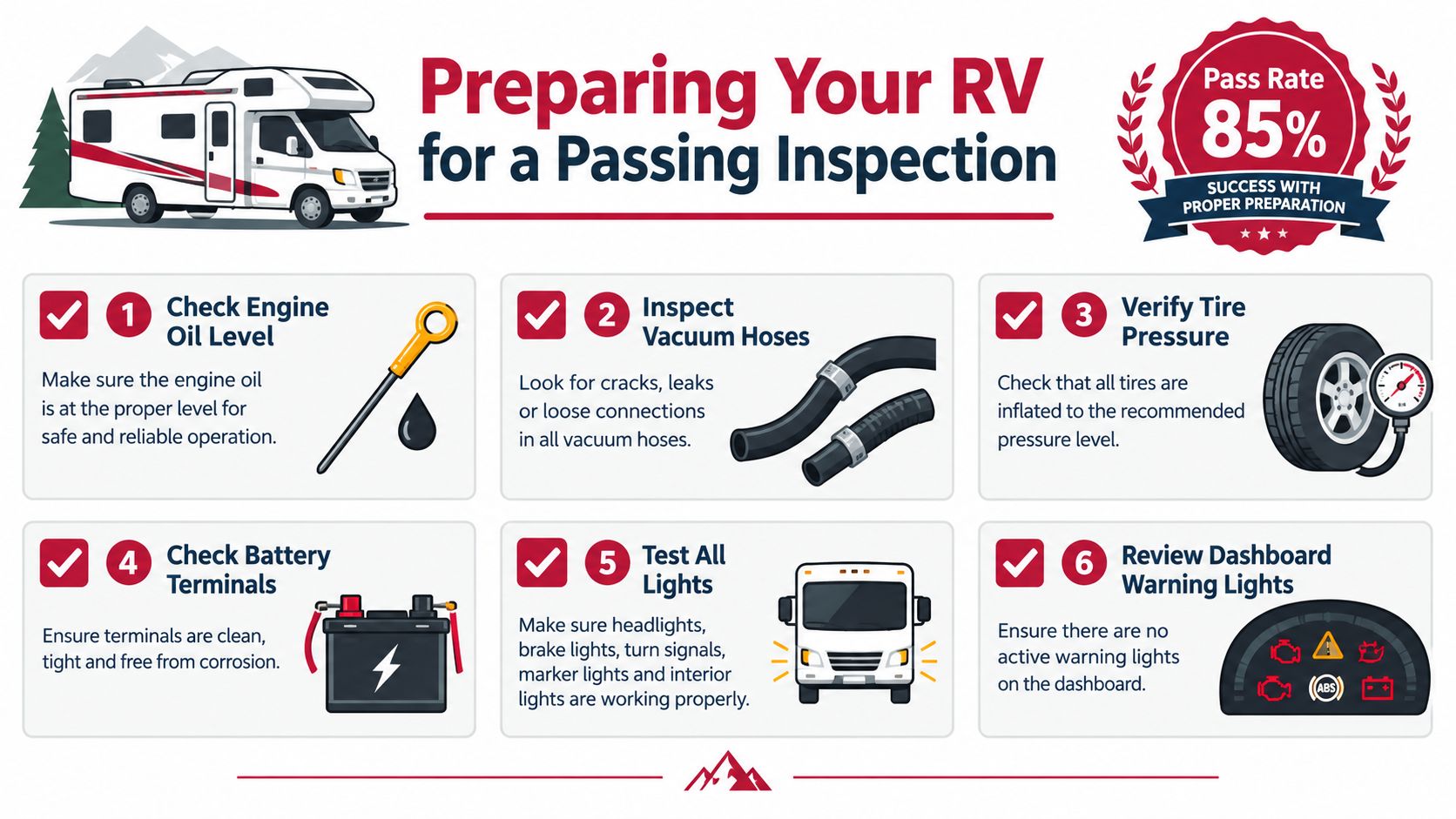
Use a practical inspection checklist
- Confirm the warning-light status. The dashboard should not display an active emissions warning. If a light appeared recently, have the code diagnosed instead of guessing.
- Inspect the fuel cap. A loose or damaged cap can keep the fuel system from sealing. Tighten it until it locks, and replace it if the seal is worn.
- Complete normal driving after repairs. The onboard monitors may need ordinary operating conditions to run. Ask your technician whether the required drive pattern has finished.
- Look for tampering. The inspection can include a visual review of emissions equipment. Non-approved intake, exhaust, catalytic converter, or other modifications can cause a failure even when the engine runs normally.
- Check basic operating condition. Verify the oil level, battery connections, vacuum hoses, lights, and tire pressure. These checks do not replace emissions diagnosis, but they reduce preventable interruptions.
- Confirm station access. Call with the coach's dimensions, fuel type, and GVWR. A facility may accept some RVs while lacking the clearance or equipment needed for yours.
Bring the RV in a warm, maintained condition. For a heavy diesel motorhome, follow the Clean Truck Check provider's instructions for engine condition, visible smoke, identification labels, and reporting. Do not apply gasoline-RV preparation advice to the wrong testing lane.
The inspection may involve an emissions-equipment review, diagnostic scan, and procedures suited to the vehicle. Keep the RV in its normal operating configuration. Removing equipment or temporarily clearing a warning light does not correct the compliance problem and can create further diagnostic complications.
Watch this short visual guide before scheduling:
Why a STAR Test-Only Station Protects You
You can fail an RV emissions inspection, then face pressure to approve expensive repairs before you understand the cause. A test-only station separates those decisions. It performs the inspection without selling the repair work that might follow, which gives you room to compare repair options for a large, difficult-to-service vehicle.
A test-and-repair business can still conduct a legitimate inspection. However, a failed test may lead directly to an in-house repair recommendation. With a test-only facility, you receive the result first and can choose an independent mechanic, mobile technician, dealer, or specialist based on the documented failure.
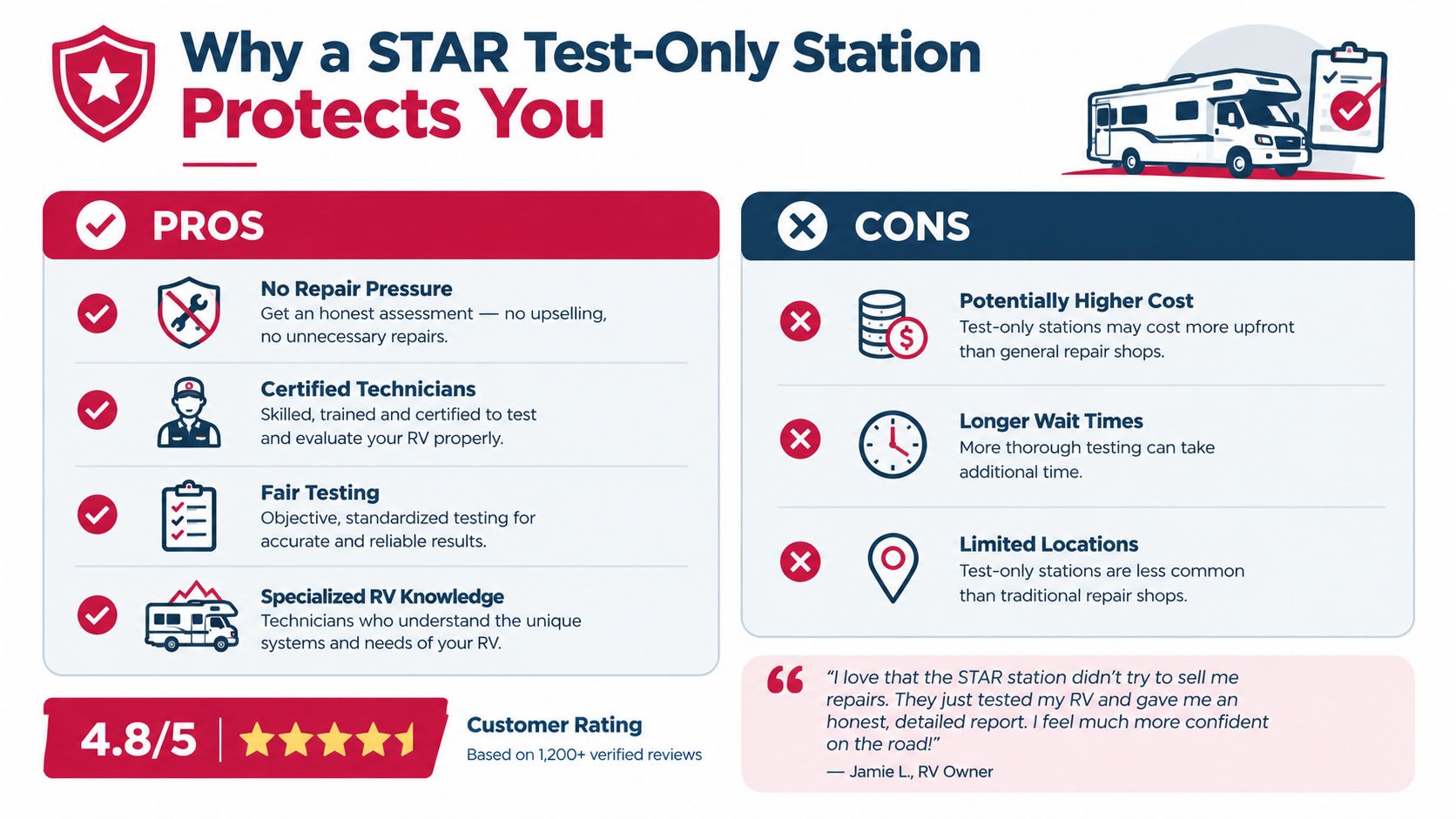
Match the facility to your RV
A STAR-certified test-only station may be required when the DMV directs your vehicle to STAR testing. The certificate alone does not confirm that the facility can handle a large coach. Call before booking and verify the following:
- Vehicle clearance: Can the bay accommodate the motorhome's height, width, wheelbase, and approach angle?
- Testing category: Does the station inspect your fuel type and model year?
- RV capacity: Does it accept motorhomes, or only cars and light trucks?
- Scheduling: Can it reserve enough time for a large vehicle?
- Result handling: Will you receive clear documentation if the vehicle fails?
Fire House Smog is one example of a STAR-certified test-only station and licensed DMV registration services provider that inspects some RVs and motorhomes, subject to size and equipment limits. Call with the coach's dimensions before visiting. Its test-only model means it does not sell repair work, while its two-bay setup and extended testing hours support vehicle throughput. Confirm fit and equipment before relying on those operating details.
Ask before leaving home: “Can your equipment accept my exact RV, and is my vehicle in the standard Smog Check category?”
That answer matters more than proximity. If the RV fails, use the inspection report to obtain an independent diagnosis. Do not authorize major work based only on a verbal suggestion.
Combining Smog Testing with DMV Registration
A renewal notice does not determine the correct inspection lane. First confirm the RV's classification, especially its GVWR, fuel type, and model year. A qualifying standard-program motorhome may combine its smog inspection with DMV registration services. A heavy diesel motorhome subject to Clean Truck Check follows a separate compliance process, so booking a regular smog appointment can waste a trip.
Before scheduling, call the facility with the model year, fuel type, GVWR, and approximate dimensions. Confirm that it can test the RV and complete the requested DMV transaction during the same visit. Ask whether registration renewal, ownership transfers, or sticker printing are available for your transaction. This prevents an avoidable arrival with the correct notice but the wrong provider, equipment, or service category.
Prepare the documents in advance:
- Current registration: Helps verify the vehicle record.
- DMV renewal notice: Bring it when the DMV has sent one.
- Insurance information: Keep current proof available if the transaction requires it.
- Ownership documents: Bring the title or transfer paperwork for a change of ownership.
- Payment method: Confirm accepted payment types before driving a large RV to the facility.
A passing result may transmit electronically, but keep the receipt and inspection paperwork. If the DMV requires additional information, missing documents can turn one planned visit into a second trip.
Fire House Smog's published service information lists on-site California DMV registration renewals, ownership transfers, and registration sticker printing during posted service hours. Its listed location is 2900 Lone Tree Way in Antioch. Owners of larger RVs should confirm clearance, equipment compatibility, and the vehicle's testing category before booking. DMV service hours may differ from smog testing hours, so ask about both services during the call.
Book with enough time for diagnosis or retesting if the RV fails. This matters even more when the motorhome has been stored for an extended period or must travel a significant distance to reach the facility. Plan around the vehicle's emissions classification and the provider's capabilities, not just the renewal deadline.
Your RV Compliance Action Plan
California RV emissions compliance starts with the vehicle's classification. Confirm the correct testing lane before booking a station.
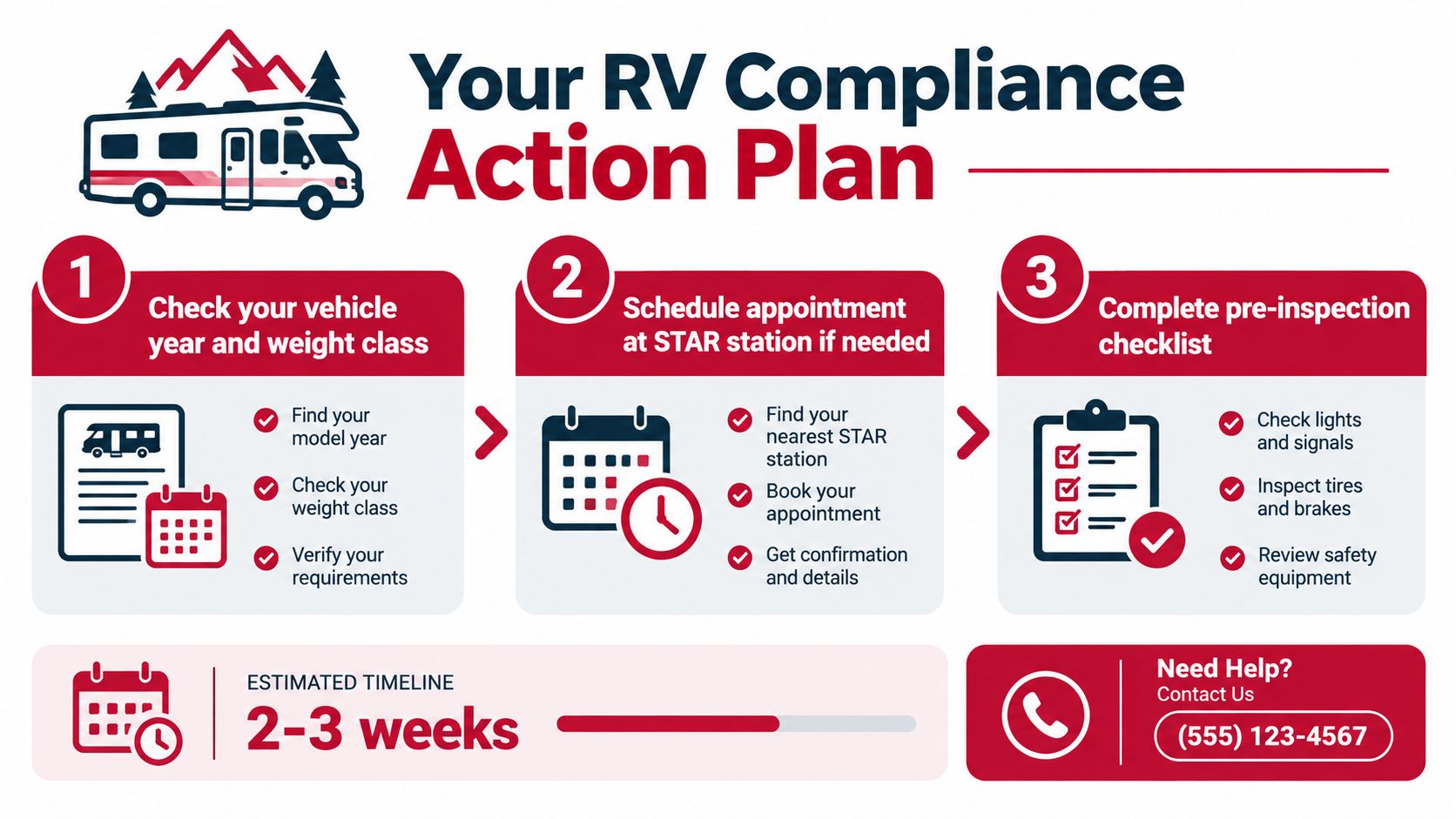
Step one, identify the lane
Record the model year, fuel type, and GVWR. Gasoline motorhomes from 1976 or newer and diesel vehicles from 1998 or newer generally fall under standard Smog Check rules when they meet California requirements. Vehicles four model years old and newer generally avoid biennial and change-of-ownership testing.
A non-gasoline motorhome over 14,000 pounds GVWR belongs in the Clean Truck Check process, not the standard smog lane. This threshold determines which provider and reporting process you need.
Step two, book the right provider
For a standard inspection, confirm STAR certification if your DMV notice requires it, and verify that the station accepts your RV's size. Heavy diesel motorhomes need a provider equipped for Clean Truck Check testing and reporting. One certificate does not replace the other.
Step three, arrive prepared
Bring registration, the renewal notice, insurance information, ownership documents when relevant, and accurate vehicle details. Check warning lights, complete required drive conditions, inspect emissions equipment, and confirm the facility can handle the coach safely.
Use the Bureau of Automotive Repair's program overview and current CARB motorhome guidance when the vehicle's status is unclear. Verify requirements before each registration cycle.
Fire House Smog offers STAR-certified test-only inspections, some RV and motorhome testing subject to size and equipment limits, and California DMV services with on-site sticker printing. Visit Fire House Smog to confirm fit and coordinate services before arrival.