
California requires you to complete vehicle ownership-transfer paperwork within 10 days of the sale, and license plates can't be transferred separately from the vehicle's title and registration record. The plate number, VIN, registered owner, and vehicle record must move together through the California DMV process.
You may be standing beside a newly purchased car with the signed title in your hand, wondering whether you can remove your old plates and bolt them onto the replacement vehicle. That assumption causes many avoidable delays. California treats a plate transfer as an ownership and registration transaction, not a physical handoff of metal plates.
The straightforward path is manageable when you identify the plate type, confirm the smog requirement, prepare the correct forms, and submit everything on time. Special-interest, personalized, historical, exempt, missing, damaged, and out-of-state situations follow different rules, so the details matter.
Table of Contents
- Understanding California License Plate Transfers
- Documents and Forms You'll Need
- The Step-by-Step Transfer Process
- Smart Tips for a Smooth Transfer
- Special Plates Out-of-State and Dealer Transfers
- Getting Your Plates Transferred Without the Hassle
Understanding California License Plate Transfers
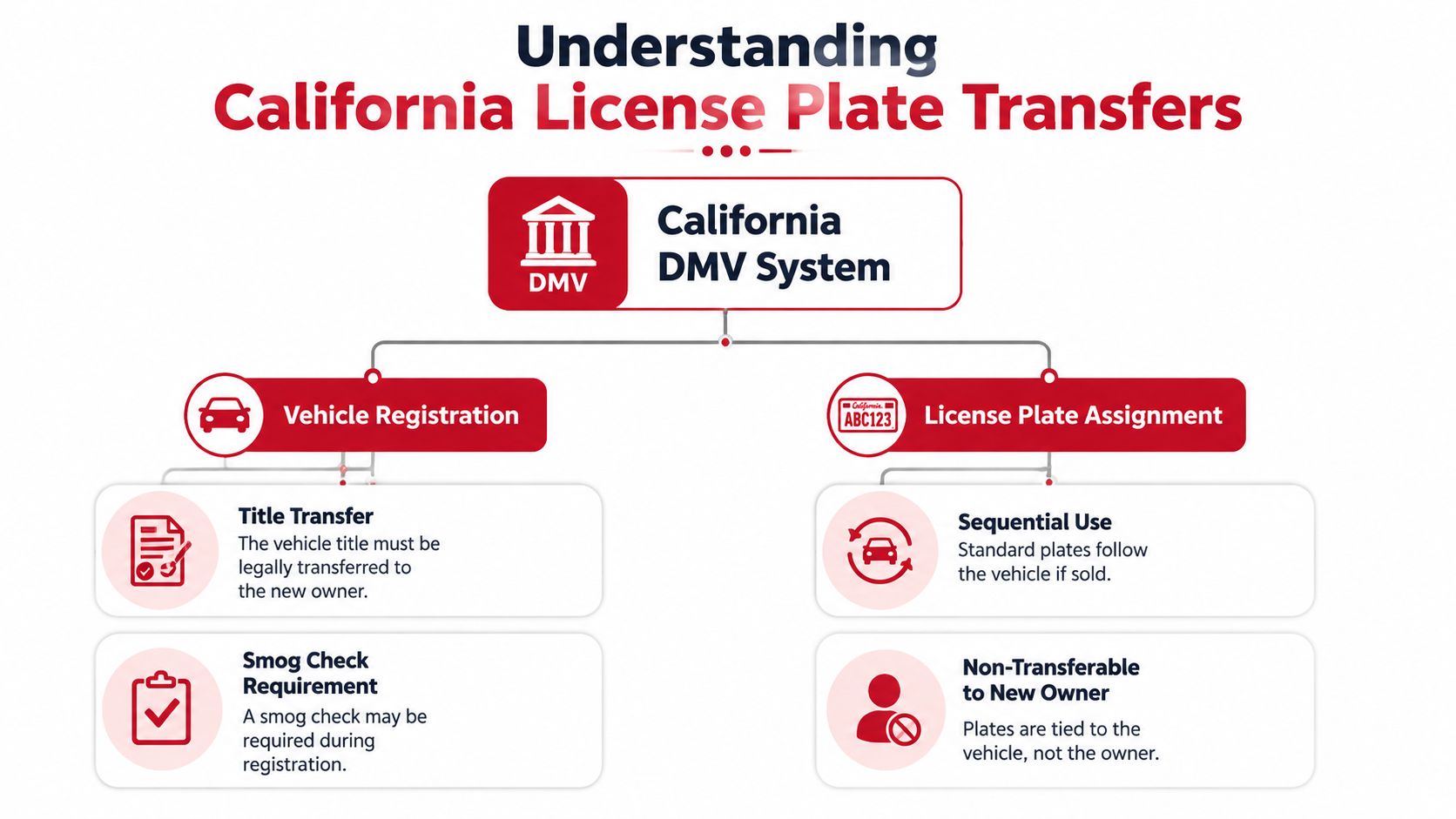
A buyer may leave the DMV with the right paperwork but still have the wrong expectation about the plates. California treats a plate transfer as part of the vehicle's ownership and registration record, not as a separate exchange of metal plates.
Ownership-transfer paperwork must be started within 10 days of the sale, and the DMV record must be updated within that same 10-day window when the registered owner or lienholder changes. The California DMV ownership-transfer rule ties the deadline to the vehicle record. Removing a plate and attaching it to another vehicle does not complete the transaction.
California connects the plate with the vehicle identification number, title chain, registration record, and registered owner. Those records establish which vehicle carries the plate and when responsibility changed. This is why a plate transfer can stall even when the physical plate is available.
Why the release of liability matters
The seller's Notice of Transfer and Release of Liability records the sale and helps prevent responsibility for the vehicle from remaining with the seller. The notice requires the new owner's name and address, plate number, last five digits of the VIN, odometer reading at the time of sale, and date of sale, as described in the California DMV transfer guidance.
Enter each field directly from the transaction documents. A wrong plate number, missing VIN digit, or buyer address that conflicts with the paperwork can trigger follow-up questions and delay completion.
Practical rule: Handle the plate as one part of the complete ownership update. Do not attach it first and plan to correct the title record later.
Standard plates versus eligible special plates
Ordinary sequential plates generally stay assigned to the vehicle. Only certain personalized environmental, special recognition, and special-interest plates may be reassigned. The California DMV's license plate guidance identifies the plate class as the first factor in deciding whether reassignment is available.
The answer therefore depends on the plate and the record behind it. Registration status, renewal fees, ownership names, and the required form can change the result. Special plates may follow a separate reassignment process, so confirm eligibility before removing anything from the vehicle.
Documents and Forms You'll Need
A plate transfer can fail even when the plate is physically correct. California ties the plate to the vehicle record, ownership information, and registration status, so assemble the ownership paperwork before addressing the plate itself.
The signed California title is the main document when it is available. If the title is missing, complete the REG 227 application for a replacement or transfer title. Buyer and seller signatures must appear where required, and the applicable transfer fee must accompany the filing. A bill of sale can document the transaction, but it does not replace the DMV's title and registration requirements.
Core paperwork at a glance
| Document | When Required | Key Information Needed |
|---|---|---|
| Signed California title | Standard ownership transfer when the title is available | Buyer and seller signatures, vehicle and ownership details |
| REG 227 application | When the title is missing | Replacement or transfer title information and required signatures |
| Notice of Transfer and Release of Liability | Seller reports the completed sale | New owner's name and address, plate number, last five VIN digits, odometer reading, and sale date |
| Smog certification or smog transfer fee | Depends on the vehicle's model year and transfer circumstances | Current certification when required, or the applicable fee for newer vehicles |
| REG 17 | Eligible special-interest plate reassignment or interchange | Current plate ownership, requested reassignment, and required signatures |
| Related special-plate forms | Certain specialty or owner-issued plate situations | Ownership proof, registration status, plate details, and fees when applicable |
Use this vehicle registration documents checklist to organize the packet before visiting a DMV office or licensed registration provider. Keep originals together, then make copies or clear scans for your records.
Match every name and address
Check the title, registration record, buyer and seller details, and submitted forms line by line. A changed name, an active lienholder, or an address that differs from DMV records can stop the transaction until the discrepancy is resolved.
The Notice of Transfer and Release of Liability requires accurate vehicle and sale information, including the plate number, identifying details, buyer information, and sale date. Submit complete information rather than expecting the DMV to correct missing fields. Enter the last five VIN digits and odometer reading directly from the transaction documents.
Special plates require their own review. Ordinary sequential plates generally remain assigned to the vehicle, while eligible personalized environmental, special recognition, and special-interest plates may be reassigned or interchanged through the appropriate process. Confirm the plate class, ownership, registration status, and required form before removing the plate. A plate transfer and an ownership transfer are related filings, but they are not always the same transaction.
The Step-by-Step Transfer Process
A plate transfer can stall even after the buyer and seller sign the paperwork. California ties the plate to the vehicle record, ownership filing, and registration status, so complete each step in order and keep proof of what was submitted.
Start with the smog decision
California DMV and the Bureau of Automotive Repair state that most vehicles over four model years old need a current smog certification for a change of ownership, while vehicles four model years old or newer do not need the inspection and instead require a smog transfer fee, according to the California Smog Check guidance.
Do not rely on an older inspection because it appears in the vehicle history. For a private-party sale, confirm that the certificate is valid for the ownership change and recent enough for the transaction. Exempt vehicles and special transfer situations follow different rules, so verify the applicable exception before arranging the inspection.
Gather the signed title and supporting forms
Confirm that the title contains the required buyer and seller signatures. If the title is missing, complete the replacement-or-transfer title application before submitting the ownership change. Prepare the Notice of Transfer and Release of Liability information, the smog documentation or applicable fee, and any special-plate form required for plates other than ordinary sequential stock.
Use this California title transfer paperwork guide to check the paperwork sequence before leaving home. A missing signature or incomplete field is easier to fix before the DMV visit than at the counter.
File within the statutory window
Submit the ownership transfer to the DMV or an authorized registration service within the 10-day period. Use the actual sale date and make sure the filing matches the vehicle identifiers, plate number, and ownership information. Pay the transfer and registration charges required for the transaction.
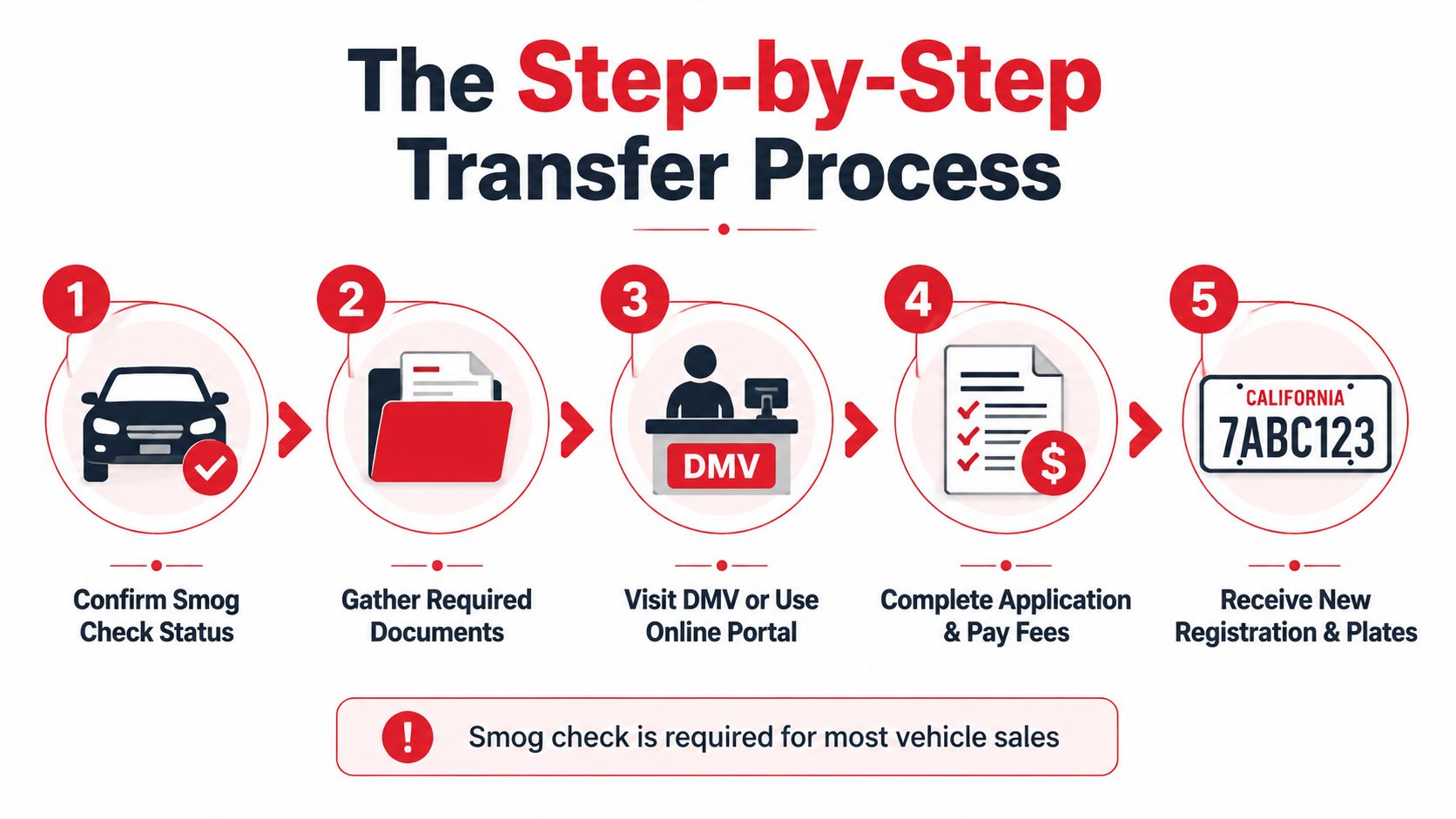
Before leaving, obtain a receipt, confirmation, or other evidence that the DMV or service provider accepted the filing. Keep it with the title records until the updated registration arrives. On-site registration services may reduce repeat visits when the packet is complete, but they still must follow the same record and plate requirements.
The following video offers a visual overview of the ownership and registration workflow:
If the DMV requests more information, respond with the same names, addresses, plate number, VIN details, and sale date used in the original filing. Consistent information helps prevent a correction from becoming a second transfer problem.
Smart Tips for a Smooth Transfer
Most stalled transfers don't fail because the owner misunderstood the fee. They stall because a document is incomplete, a plate condition doesn't match the record, or the applicant's address conflicts with the DMV file.
California's replacement-plate guidance explains that replacing plates can require surrendering the remaining plates and providing proof of identity. In some cases, a CHP vehicle verification may be required when the plates were issued within the last 90 days, and mail-in replacement requests require the registered owner to have the same address as the DMV record, according to the California DMV replacement-plate instructions.
Inspect the plates before filing
Look at both plates before you submit the transfer. If one is missing, stolen, badly damaged, or unreadable, tell the DMV or registration provider immediately instead of presenting the transaction as a normal plate movement.
Replacement and transfer are different tasks. A transfer changes the vehicle or ownership record. A replacement addresses the physical plate problem. Combining both without the required identity, surrender, or verification documents can stop the entire packet.
Treat address mismatches as a real issue
An address mismatch can affect more than where the registration card is mailed. It can prevent a mail-in replacement request, trigger a request for identity or residency information, and create confusion when the buyer's address on the Notice of Transfer differs from other documents.
Before submitting:
- Compare the address: Check the address on the title, registration record, replacement request, and release-of-liability filing.
- Confirm identity details: Use the legal names that belong to the vehicle record and transaction.
- Record the plate carefully: Recheck every character against the physical plate.
- Verify the VIN digits: The Notice of Transfer requires the last five VIN digits, not a guess based on another document.
- Separate damaged-plate work: Ask whether replacement or surrender paperwork must accompany the ownership transfer.
The fastest filing is the one that doesn't need a correction.
A licensed service provider can be useful when the transaction combines a missing title, smog requirement, replacement plate, address change, or out-of-state record. The provider can identify the form conflict before submission, but you're still responsible for supplying accurate ownership information and signing where required.
Special Plates Out-of-State and Dealer Transfers
Special plates don't follow the same path as ordinary sequential plates. California's DMV procedures distinguish special-interest plate transfers, owner-issued special plates, historical plates, and exempt-vehicle plates, and each category can impose different eligibility and surrender requirements.
For special-interest plates, both the current plate owner and the new owner generally submit REG 17. The current owner releases plate priority, while the new owner requests the plate. The California DMV special-plate transfer procedures also state that owner-issued special-plate interchange requires both vehicles to be currently registered, with renewal fees paid, and both plates eligible for reassignment.
Compare the common scenarios
| Situation | Main rule | Common extra requirement |
|---|---|---|
| Standard sequential plate | Usually remains tied to the vehicle during the ownership record update | Signed title, transfer filing, and required smog documentation |
| Special-interest or personalized plate | May be reassigned when the plate qualifies | REG 17 from the current and new owner |
| Owner-issued special plate interchange | Allowed only when both vehicles meet registration conditions | Both vehicles currently registered and renewal fees paid |
| DP, DV, CMOH, or POW plate | Ownership names may require additional proof | Statement of Facts showing the registered owner's connection to the plate |
| Historical plate on a collector vehicle | Can't be affixed before DMV approval | Surrender of prior plates if approval is granted |
| Exempt agency vehicle | Exempt plates generally must be surrendered when the vehicle leaves the exempt agency | Retention may be allowed only when moving to another exempt agency |
| Vehicle coming from another state | Requires a California registration and vehicle-record process | Plate surrender and inspection requirements depend on the transaction |
The DMV's special-plate interchange procedures also explain that eligible special plates can be reassigned or interchanged only when the vehicles are currently registered and renewal fees are paid. Some reassignment procedures state that a substitute license plate fee isn't due, although current registration fees still must be paid.
Out-of-state and dealer transactions
An out-of-state vehicle isn't a simple California plate swap. The vehicle must enter California's registration system, and the existing out-of-state plates may need to be surrendered to the California DMV. The exact inspection, title, and verification requirements depend on the vehicle and transaction, so don't assume that an out-of-state plate can be retained under California rules.
Dealer purchases often feel easier because the dealer submits much of the registration paperwork. That convenience doesn't change the underlying plate rules. Tell the dealer early that you want to retain an eligible special plate, and confirm whether the plate is being transferred, replaced, or left with the vehicle.
For a private sale, the buyer and seller usually have to coordinate signatures and disclosures themselves. A dealer may coordinate the packet, but you should still review the plate number, ownership names, address, and odometer information before signing.
Getting Your Plates Transferred Without the Hassle
A smooth transaction depends on decisions made before anyone reaches the counter. Identify the plate type first. Then verify whether the vehicle needs a current smog certification, locate the signed title or REG 227, prepare the Notice of Transfer and Release of Liability information, and check every address and VIN character.
Use this working checklist:
- Confirm the sale date: Count the filing window from the completed sale and aim to submit within the 10-day period.
- Classify the plate: Standard sequential, special-interest, personalized, historical, exempt, damaged, missing, or stolen plates don't all use the same process.
- Resolve the title: Bring the signed title, or complete the replacement-or-transfer title application if it's missing.
- Check smog status: Determine whether the vehicle falls within the smog-certification requirement or the newer-vehicle fee path.
- Prepare the liability notice: Have the buyer's name and address, plate number, last five VIN digits, odometer reading, and sale date ready.
- Submit and retain proof: Keep the receipt or confirmation until the DMV record and registration documents reflect the transaction.
A licensed DMV service provider can reduce the practical burden when you need ownership-transfer processing, registration work, smog certification, or on-site sticker and plate issuance. Fire House Smog in Antioch provides licensed DMV registration services and STAR-certified test-only smog inspections, with service hours listed as Monday through Saturday from 9:30 AM to 5:00 PM and Sunday from 12:00 PM to 4:00 PM. Availability for specific transactions can vary, so confirm the required documents before visiting.
You can skip the DMV line by using an authorized service option, but preparation still matters. No provider can correct an unsigned title, an inaccurate VIN, or an ownership detail that doesn't match the record without the proper supporting documents.
Visit Fire House Smog in Antioch for California ownership-transfer and registration assistance, including smog testing and applicable sticker or plate processing. Bring your signed title, identification, sale details, and any special-plate or replacement documents so the staff can review the transaction before submission.
You open a DMV renewal notice, see that a smog certificate is part of the process, and suddenly the errand feels bigger than a quick stop at the corner shop. That reaction makes sense. Smog check stations are not just service bays, they're the gatekeepers for a statewide compliance system that California uses to keep millions of vehicles moving through renewal on time.
If you've never dealt with one before, the rules can feel mixed together, especially when one notice says STAR, another says test only, and the DMV page talks about renewal, registration, and emissions in the same breath. The safest way to think about it is simple, a smog station verifies whether your vehicle meets the state's inspection requirement so your paperwork can keep moving. In California, that system is large enough that it's better to understand the whole picture first, then pick the right station for your car and your situation.
Table of Contents
- Why Smog Check Stations Matter to California Drivers
- How Smog Check Stations Work
- Test-Only STAR versus Test-and-Repair Stations
- What Happens During Your Smog Check Visit
- Using a Smog Station with On-Site DMV Services
- RVs Fleets and Other Vehicles That Need Special Handling
- What Makes a Test-Only STAR Station in Antioch Stand Out
- Choosing the Right Station and Preparing for Your Visit
Why Smog Check Stations Matter to California Drivers
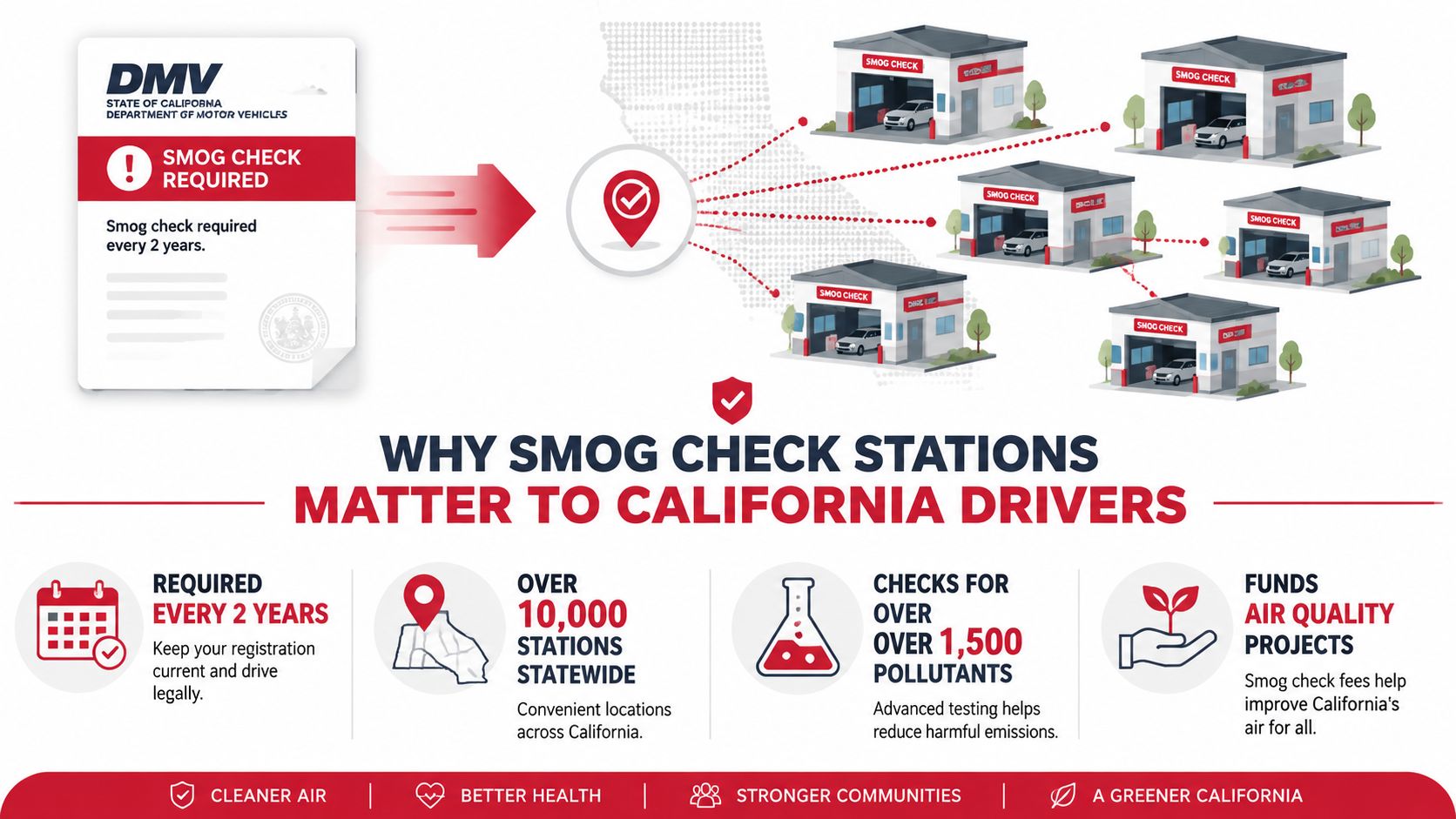
The first time a renewal notice points you toward a smog inspection, it can feel like one more chore in a stack of chores. The better way to read it is as a checkpoint in a statewide system that keeps California's vehicle renewal process moving. The state's smog program has been in place since 1984, and California says it now includes more than 7,000 smog check stations, about 10 million vehicles tested each year, and about 400 tons of smog-forming pollutants per day reduced through the system overall, which is why these stations function as public infrastructure, not an occasional extra stop (California Smog Check Fact Sheet/index.pdf)).
For a driver, that bigger system shows up in a very practical way. If the certificate does not get completed, renewal can stall, and the DMV does not care whether the delay came from a busy schedule, a confusing notice, or a station you chose without checking the rules first.
Practical rule: treat the smog visit the way you'd treat a brake inspection before a long trip. It is a required checkpoint, like checking tire pressure before you head out, not a guess-and-hope errand.
Timing matters too. California's current rules require most vehicles to get a Smog Check every other year, and for a first-time test, the state says to add eight years to the model year, so a 2020 model-year vehicle first needs one in 2028 (California Smog Check Fact Sheet). That is why the question is not only where to go. It is also when the requirement starts and whether the station you pick matches the notice in your hands.
For drivers who want the rules behind the test, the vehicle emissions standards guide gives a plain-language overview of the emissions standards that shape the inspection. If you only need the short version, the station is the last checkpoint between your vehicle and a clean renewal path.
How Smog Check Stations Work
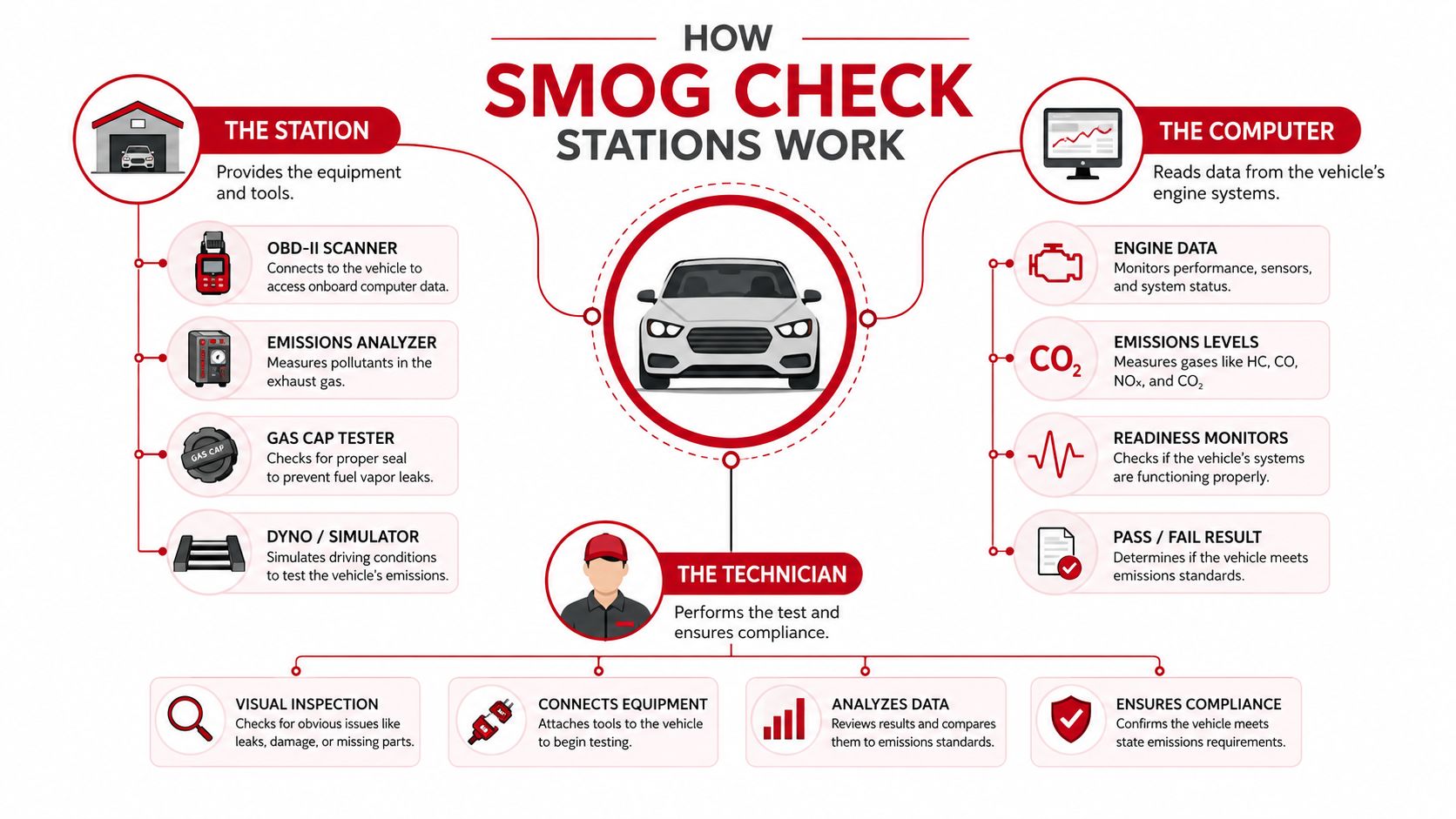
A smog check station is a controlled exam room for your car. The technician checks emissions-related systems with approved equipment instead of guessing from sound or appearance alone. California's test-only stations must use a BAR-97 emissions inspection system and keep supporting tools like an ignition timing light, vacuum pump or gauge, scan-code retrieval device, and a fuel-fillpipe restrictor gauge with defined dimensions and materials (California Code of Regulations, Section 3340.16).
That hardware list sounds old-school, but the inspection itself is increasingly digital. The BAR checklist says the station computer must run a BAR-tested and approved Microsoft-supported Windows version, and the emissions device must display and store live streaming OBD data, support bi-directional capability, and capture high-frequency abnormal signals regardless of screen refresh rate (BAR Smog Checklist). In plain English, the station is checking whether your vehicle's computer and emissions systems are talking to each other the way they should.
What the technician is looking for
The technician's job is narrower than many drivers expect. They look for emissions control issues, diagnostic trouble codes, visible tampering, and whether the onboard diagnostics behave correctly. They are not giving a general repair consultation or judging whether your transmission, suspension, or tires are in perfect shape.
A good smog bay reads your car the way a clinic reads a blood-pressure cuff, it is looking for a specific system response, not a full-body diagnosis.
That is why the inspection can feel technical even though the customer experience is simple. You bring the car in, the station connects to the vehicle, the computer checks the emissions side, and the state gets a record of whether your vehicle passed. If you want a shorter consumer-facing explanation of the timing, this smog check timing guide is a useful companion.
The fillpipe gauge is a good example of how exact the program gets. California specifies a non-sparking aluminum alloy 5052 tool with a test portion diameter of 0.9375–0.950 inches and a length of 5–12 inches, which shows that inspection hardware has to be reproducible from one station to the next (California Code of Regulations, Section 3340.16). That consistency is why a smog station is more than a mechanic with a scanner, it is a regulated testing site.
Test-Only STAR versus Test-and-Repair Stations
A first-time driver usually wants one clear answer. If the car fails, who can fix it, and who is there only to measure the result? A test-only station keeps those roles separate. The station performs the inspection and issues the outcome, but it does not profit from selling the repair that follows. A test-and-repair station can inspect the car and also handle qualifying repairs, which is convenient, though it places testing and repair under one roof.
California's BAR data helps show why those station types are treated differently. In the July 2025 executive summary, 1,019,416 initial tests produced 85,135 failures, a failure rate of 8.35%, and when all tests were counted, the failure rate was 8.88% (BAR July 2025 Executive Summary). The same report shows that BAR-97 stations had an overall failure rate of 17.69% versus 7.62% for OIS stations. That does not automatically mean one station type is doing a poorer job. It can also reflect the kinds of vehicles each category sees and how the inspection is carried out.
What STAR status signals
California uses STAR to direct certain vehicles to stations that meet higher performance standards. BAR has also said that vehicles certified by high-performing smog stations fail roadside checks at lower rates than those from lower-performing stations (BAR July 2025 Executive Summary). The label is about program performance, not waiting-room comfort or how polished the counter looks.
| Station Type | What It Does | Best Fit For |
|---|---|---|
| Test-only station | Performs the emissions inspection and issues the result | Drivers who want a pure inspection with no repair sales |
| Test-and-repair station | Tests the car and can also handle qualifying repairs | Drivers who want one stop for diagnosis and repair |
| STAR station | Meets higher program standards for directed vehicles | Drivers whose notice or vehicle profile requires STAR |
For a closer look at the category itself, the STAR-certified smog station guide gives a plain-English explanation of how these stations fit into the program. The main point is simple. A test-only lane, a repair-capable shop, and a STAR station each serve a different purpose, and the right one depends on what your notice requires and what kind of vehicle you are bringing in.
A station in Antioch shows how this works in practice. A driver can arrive for a required test, use a test-only STAR lane when the vehicle calls for it, and handle DMV-related errands in the same trip if the location offers that service. That setup matters for fleets too, because keeping testing separate from repair work can help a business move vehicles through without turning every stop into a repair consultation.
What Happens During Your Smog Check Visit
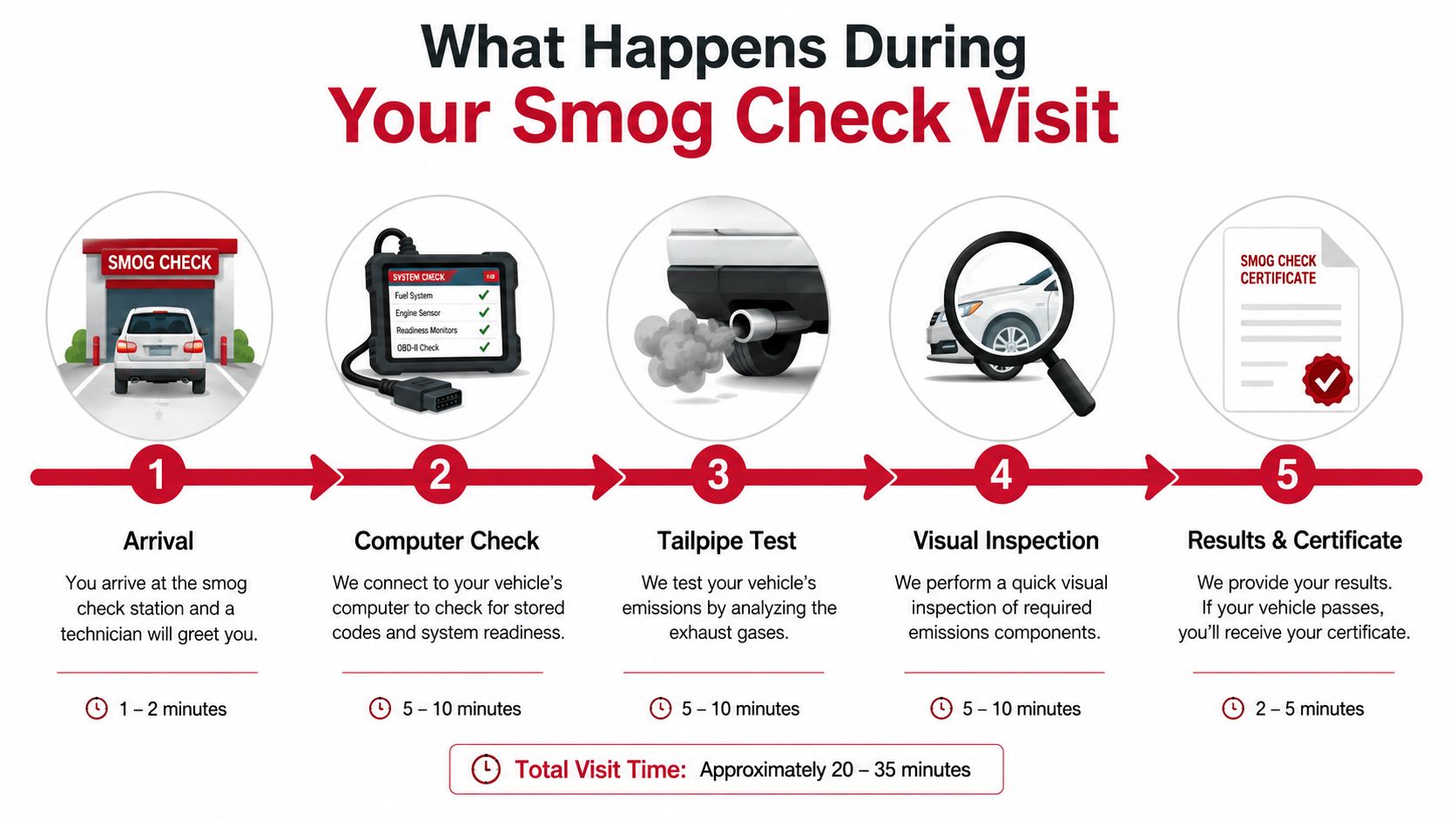
A smog visit is usually less mysterious than people expect once they understand the sequence. You pull in, the technician confirms the vehicle details, the car is connected to the inspection equipment, and the station checks the emissions-related systems that California requires. If the vehicle passes, the result gets handled electronically, and you leave with the paperwork trail needed for registration.
The visit from start to finish
The first step is paperwork and identification. The technician needs the right vehicle, the right registration information, and a car that's ready to be tested, which means the check engine light should already be addressed if it's on.
The second step is the diagnostics connection. On modern vehicles, the OBD system is the car's own language, and the station reads that language to see whether the emissions controls are behaving properly.
The third step is the physical inspection. The technician looks for visible emissions equipment issues and other problems that would interfere with a clean result.
If the car is only being warmed up, not driven enough to finish its self-checks, the station may see an incomplete picture even if the engine sounds fine.
The final step is the result. A pass keeps the renewal moving, while a fail usually comes with a report explaining what the station found. Some stations also offer a retest policy, which can matter if a repair is needed before the vehicle can return. When that happens, the station is no longer just a testing stop, it becomes part of the paper trail between repair, retest, and DMV completion.
A quick note on expectations. A smog inspection isn't a place for guesswork or persuasion, and the technician can't “override” a bad reading because a driver is in a hurry. The visit works best when you treat it like a checkpoint on a route, not a negotiation.
Using a Smog Station with On-Site DMV Services
A station that also handles DMV business changes the whole errand. Instead of finishing the smog test and then driving to a separate field office, you can often handle renewal-related paperwork in the same stop if the station is a licensed DMV business partner. That matters most when your main problem isn't the inspection itself, it's the time lost bouncing between two offices.
Fire House Smog in Antioch is a worked example of this setup. It offers on-site California DMV registration renewals with sticker printing, and it also handles ownership transfers for California and out-of-state vehicles, including stickers and plates as needed. For a driver staring at a renewal notice, that means the smog result and the DMV completion step can live in the same visit instead of becoming two separate trips.
What to bring and why it matters
A combined visit still works only if you show up prepared. Bring the renewal notice, any title or transfer paperwork you've been given, and a payment method that the station accepts. If your transaction involves an out-of-state title, the paperwork trail can be more involved, so it helps to ask what the station needs before you drive over.
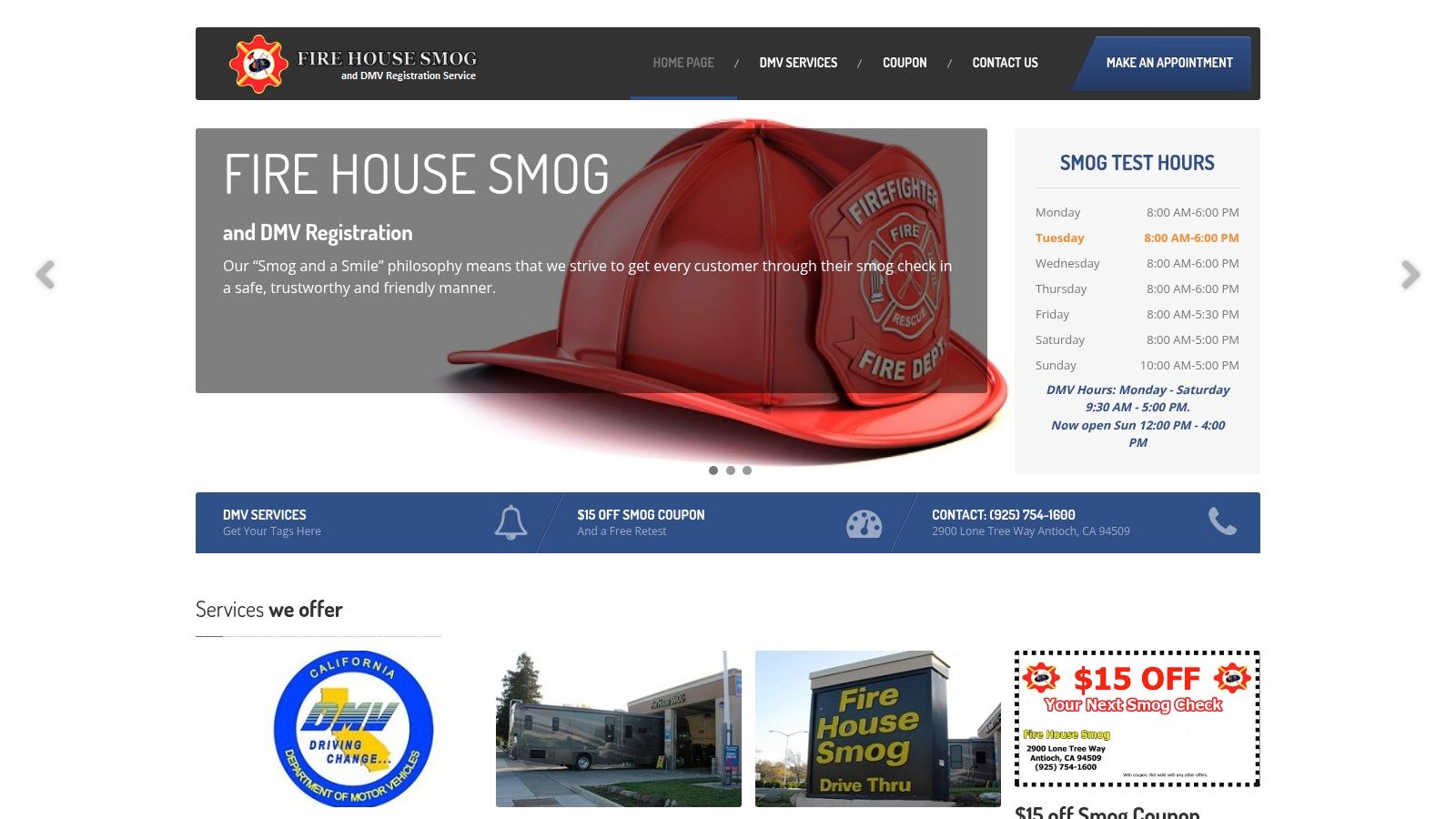
Weekend and extended hours are useful because they cut down on the workday conflict most drivers run into. Fire House Smog lists Monday through Saturday 9:30 AM to 5:00 PM and Sunday 12:00 PM to 4:00 PM for DMV service hours, with limited services possible on weekends, which is exactly the kind of detail that prevents a wasted trip.
Driver shortcut: if your renewal notice points to smog plus registration, ask whether the station can finish both pieces before you leave. That one question can save a second line at the DMV.
The reason this model matters is simple. A DMV field office is good at government paperwork, but it isn't built around inspection throughput. A station with on-site DMV capability gives you the emissions result and the renewal handling in one place, which is the closest thing to a single-stop solution California drivers can get.
RVs Fleets and Other Vehicles That Need Special Handling
Not every vehicle fits neatly into a standard passenger-car appointment. RVs, motorhomes, and small fleet vehicles often need a quick phone call before they roll in because length, height, and bay clearance can change whether a station can test them safely. A two-bay layout helps, but it doesn't erase the fact that oversized vehicles take more planning than a sedan.
Real-world scheduling beats generic advice. A driver with a motorhome doesn't want to find out at the curb that the station can't handle the vehicle dimensions. A fleet manager doesn't want to send three work vans to a shop with limited throughput if one bay is tied up and the other is already full.
Why the station layout matters
A station with multiple bays can rotate vehicles more efficiently, especially when it also offers weekend availability. That matters for businesses that can't leave service vehicles off the road during weekday hours. It also matters for families trying to finish a registration task between school pickup and dinner.
Out-of-state title transfers fit into this same category of special handling. The smog test may be only one part of the visit, but the DMV paperwork can change what the station needs to verify, so those drivers should ask about document requirements before showing up.
Some stations are built around speed, others around breadth of service. The best match depends on whether you're arriving in a compact commuter car, a large utility vehicle, or a vehicle that needs both inspection and DMV processing in the same stop.
What Makes a Test-Only STAR Station in Antioch Stand Out
A test-only STAR station earns attention for a specific reason, it removes the repair incentive while still meeting a higher inspection standard. For drivers who worry about being sold work they didn't ask for, that combination can feel cleaner and easier to trust. The Antioch example also matters because it pairs the inspection with on-site DMV services, so the visit can solve both the smog requirement and the renewal problem.
The practical features line up with common driver frustrations. Two service bays help with throughput. Seven-day smog testing helps working drivers. Weekend DMV hours help people who can't disappear from work in the middle of the day. The drive-through layout on Lone Tree Way reduces the friction that usually makes inspection errands drag out longer than they should.
Why test-only is a feature
A test-only station doesn't make money by recommending fixes. That's useful when you want a straight result and a clean certificate trail. It's also useful when you already know your car needs repair elsewhere and just want the inspection handled by a separate party.
The Antioch location is also a good example of how one station can serve different needs without turning into a general repair shop. It can inspect passenger cars, SUVs, and light-duty trucks, and it can handle some RVs and motorhomes within size and equipment limits, which is exactly the kind of flexibility local drivers look for when a single vehicle can't be treated like a standard sedan.
If you're comparing nearby options, Fire House Smog is one option to consider for STAR-certified test-only inspection plus DMV registration support in one place. That matters most when your worry is accuracy, not upselling.
Choosing the Right Station and Preparing for Your Visit
A smog check goes more smoothly when you start with the notice in your hand instead of the nearest address on a map. If the DMV paperwork says STAR, that is the first filter. If the same trip needs renewal help, look for a licensed partner that can handle the smog result and the paperwork step at the same stop. If the vehicle is oversized or unusual, call ahead so you know the bay, equipment, and height limits before you drive over.
A simple way to picture the choice is like picking the right socket for a lug nut. The wrench has to match the job, or the process stalls before it starts.
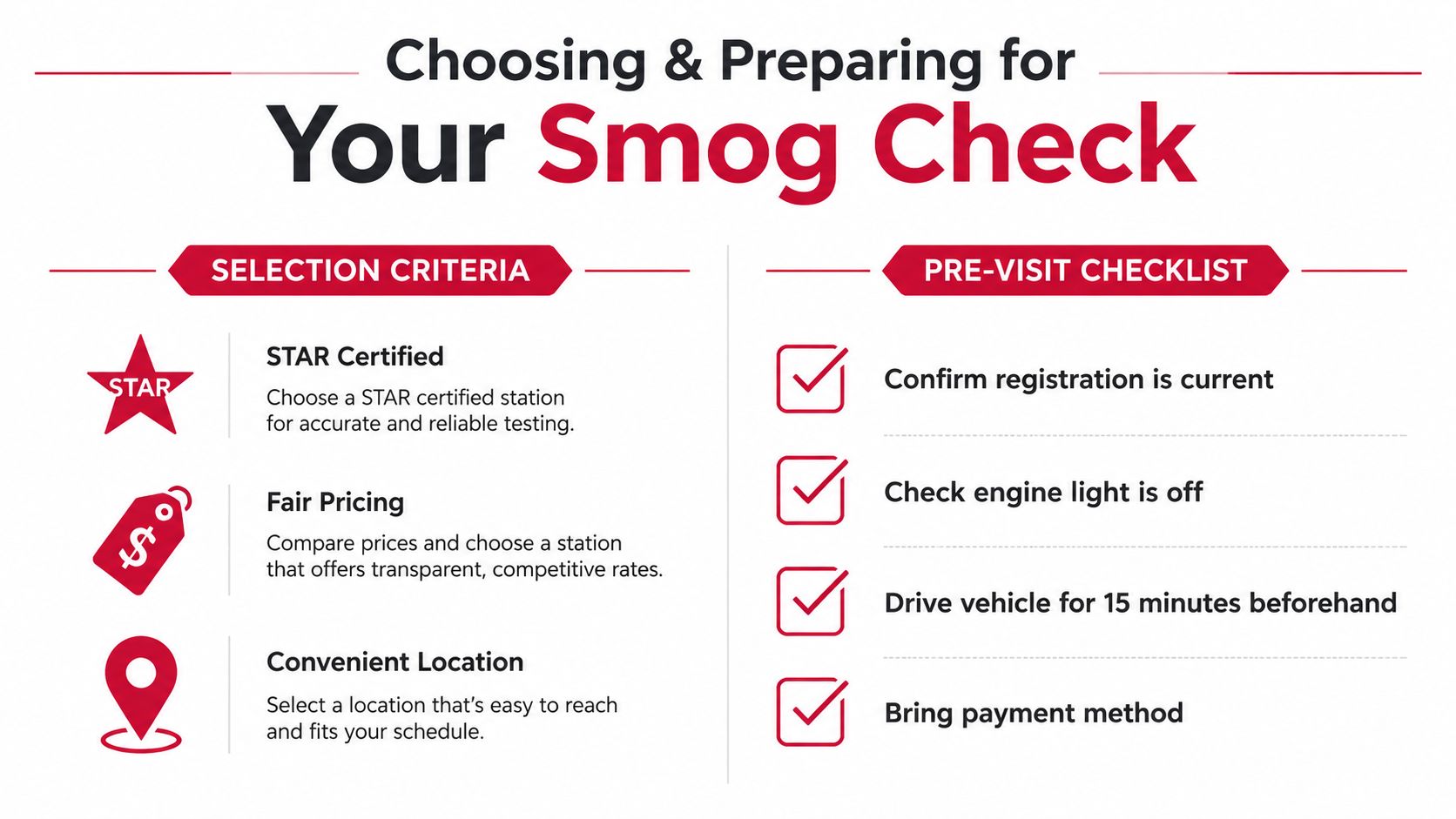
A simple pre-visit checklist
- Confirm the notice requirement: Check whether your vehicle needs a regular station, STAR, or something more specific.
- Make the car test-ready: If the check engine light is on, handle that first.
- Drive before you go: Get the engine fully warmed up so the car is ready to report accurately.
- Bring the paperwork: Renewal notice, title documents if needed, and a payment method.
- Ask about the retest policy: If the car fails, find out what the station includes before you leave.
These steps are like checking tire pressure before a road trip. A little preparation helps the visit reflect the car's real condition instead of a problem that could have been fixed earlier.
Quick questions drivers ask
Do I always need a STAR station? No. The requirement depends on the notice and the vehicle profile, not on convenience.
What does a free retest mean? It usually means the station will inspect the car again after a qualifying repair, but you should confirm the terms before assuming anything.
How is on-site DMV renewal different from the field office? A DMV field office handles government transactions, while an on-site partner can process certain renewal tasks right where the smog test happens.
If your goal is to finish the inspection without another stop and leave with the renewal step handled, a station like Fire House Smog is built for that kind of visit. Review its services, compare them with your notice, and decide whether its smog and DMV options fit your plan when you are ready to move ahead.
The moving truck is finally unloaded. Your kitchen is still half in boxes, you're learning new roads, and somewhere between setting up utilities and changing your address, your car still has plates from your old state.
That's the part many new California residents underestimate. Out of state vehicle registration sounds simple until you run into smog rules, VIN verification, title questions, residency proof, and a DMV process that doesn't forgive missing paperwork. The difficulty isn't usually with the rule itself. Instead, it lies with the friction.
California gives you a path, but it expects you to move quickly and bring the right documents the first time. If you show up unprepared, the process turns into repeat visits, more time off work, and more confusion than it needs to be. A practical checklist helps. So does knowing what usually stalls an application before you ever stand in line. If you want a clean starting point, this vehicle registration document guide is a useful companion while you gather your packet.
Table of Contents
- Welcome to California Now About Your Car
- The Clock Is Ticking Your First 20 Days
- Gathering Your Essential Paperwork
- Navigating Smog Checks and VIN Verification
- Calculating and Paying Your Registration Fees
- Troubleshooting Common Registration Roadblocks
- Your Finish Line A Faster Path to California Plates
Welcome to California Now About Your Car
Most new residents reach the same moment. The car is sitting in the driveway with valid plates from somewhere else, so it feels like there's no rush. Then the questions start. Do you need California insurance first? Is a smog check always required? What if the title is still with the lender? Can you just wait until renewal time?
That's where people lose time. California doesn't treat out of state vehicle registration like a casual update. It treats it like a formal transfer into the state system, with its own inspection, paperwork, and fee process. The vehicle has to match California's records, California's emissions rules, and California's registration requirements before the state will finish the transfer.
What catches new residents off guard
The surprise usually isn't one big issue. It's three or four smaller ones stacked together.
- The title question: Many owners don't physically have the out-of-state title because a lienholder holds it.
- The inspection step: A vehicle can be running perfectly and still need separate California verification steps.
- The address mismatch: Insurance, ID, registration paperwork, and proof of residence need to line up cleanly.
- The truck or RV detail: Heavier vehicles often have extra paperwork that passenger-car owners never think about.
Practical rule: Don't judge your registration by whether the car drives fine. Judge it by whether your paperwork, identification details, and vehicle records match.
The smoothest registrations usually happen when the owner treats the process like a document project first and a DMV errand second. That means gathering ownership papers, confirming the vehicle's status, and handling inspections before your deadline is staring at you.
The Clock Is Ticking Your First 20 Days
California doesn't leave this open-ended. State regulations say California residents who buy a vehicle with out-of-state plates must apply for in-state registration and pay the required fees within 20 days of the purchase date, according to the California Air Resources Board background document.
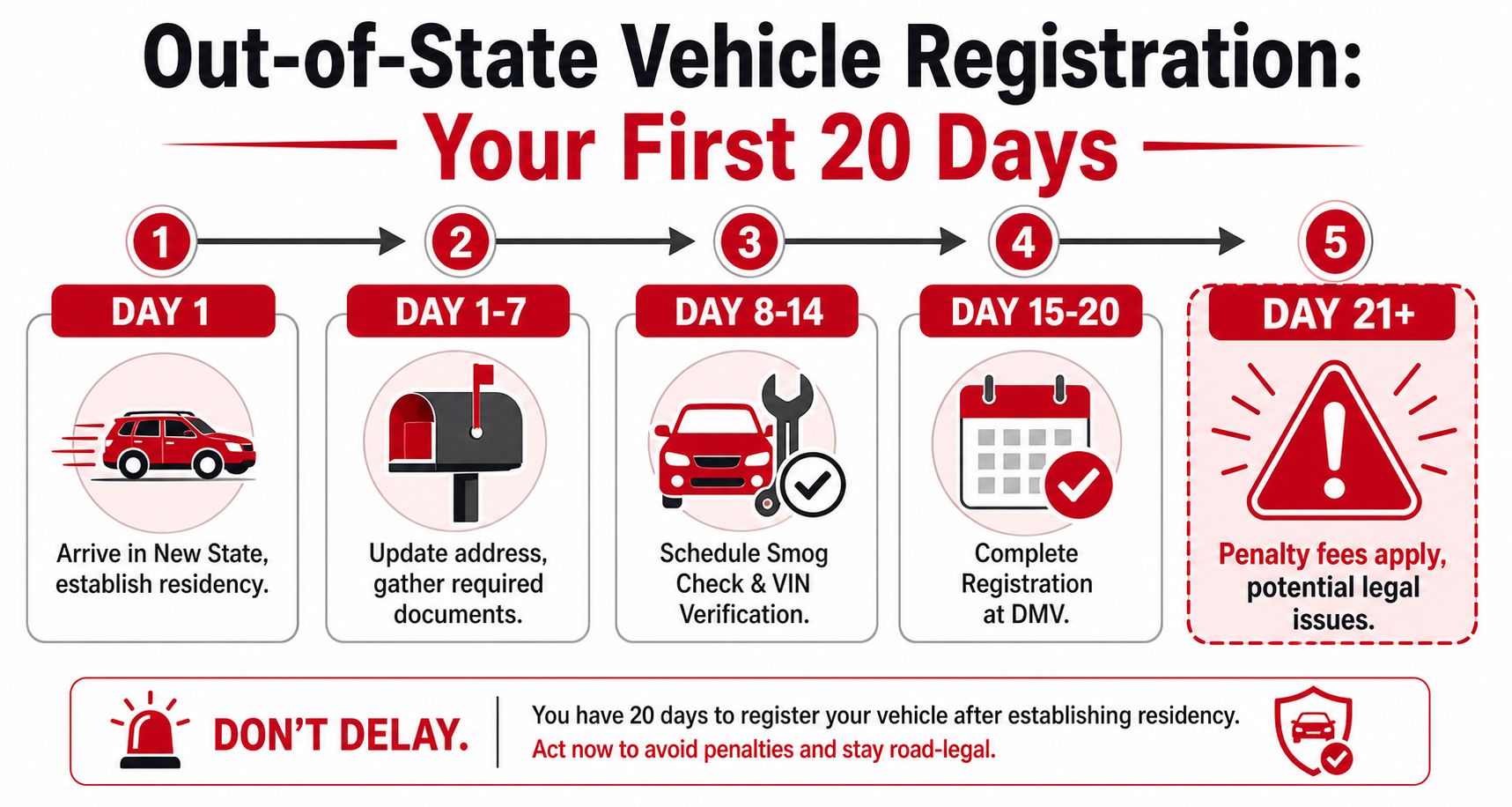
That deadline matters because people often assume they can wait until their old registration expires. California doesn't look at it that way. Once you're required to register here, delay creates risk. Even if the vehicle still looks fully legal to you, the state expects the transfer process to already be underway.
What counts as your starting point
For most new residents, the practical approach is simple. If you've moved here and are making California your home, start acting as if the clock is already running.
Waiting for the perfect moment usually creates the main problem. People postpone the process until they have a free weekday, until the lender sends paperwork, or until they decide whether they're “really settled.” By then, they're scrambling to book inspections and assemble documents under pressure.
What to do first
Handle the early steps in order so nothing bottlenecks later.
- Update your address records. Your California address needs to appear consistently across the documents you'll use.
- Locate ownership documents. If a lender holds the title, contact them immediately and ask what they require for an out-of-state transfer.
- Confirm whether the vehicle needs smog and VIN verification. In practice, it is advisable to assume both are required until verified otherwise.
- Check for truck or RV extras. Those vehicles often need a weight certificate in addition to the core registration packet.
- Book your inspection-related services early. Appointments and missing forms are what usually squeeze that 20-day window.
The deadline feels generous until you lose a week waiting on one document.
A good rule is to spend your first few days building the file, not debating the rule. Once you've got the title situation clear and the inspection steps scheduled, the rest of the process gets much easier to control.
Gathering Your Essential Paperwork
Most failed trips happen for one reason. The owner brings most of the documents, not all of them.
California wants a clean chain that proves who you are, what the vehicle is, who owns it, and where you now live. If one part of that chain is weak, the application slows down or stops. This is especially common in out of state transfers because lenders, previous state titles, and differing state forms create more room for mismatch. If you're dealing with ownership movement from another state, this out-of-state title transfer overview can help you understand the handoff.
Your core document packet
Start with ownership first. The original out-of-state title is the key document when it's available. If you still owe money on the car, the lienholder may hold it, and that changes how the transfer gets processed. Don't wait until the end to figure that out.
Next comes the application material. California typically requires a formal registration application, and the details on that form must match the vehicle and ownership records exactly. If the car is under the age threshold that triggers odometer disclosure requirements, make sure that disclosure is complete and readable. Missing odometer information is one of the recurring reasons transfers stall.
Then there's residency proof. On this point, many organized people still get tripped up because they bring documents that show activity in California but not necessarily clean proof of residence. Use current, consistent records and make sure the name and address formatting match across your packet as closely as possible.
California Out-of-State Registration Document Checklist
| Document | Purpose | Key Details |
|---|---|---|
| Out-of-state title | Proves ownership | If a lienholder holds it, contact them early for transfer instructions |
| Registration application | Starts the California record | Complete every ownership and vehicle field carefully |
| Current out-of-state registration | Helps verify existing vehicle record | Bring the latest valid card or renewal proof you have |
| California driver license or ID | Confirms identity | Name should align with title and application |
| Proof of California residency | Shows your in-state residence | Use documents with your current California address |
| Odometer disclosure | Required for certain vehicles | Especially important for vehicles under the applicable age threshold |
| Smog certificate, if required | Shows emissions compliance | Complete this before final processing if your vehicle needs it |
| VIN verification form or completed verification | Confirms vehicle identity | Must match the physical vehicle exactly |
| Weight certificate for trucks or RVs, if required | Supports classification and fees | Needed for qualifying vehicles, not standard passenger cars |
| Proof of insurance, if requested in your transaction flow | Supports registration file | Make sure the address and vehicle details are consistent |
A few practical habits make this much easier:
- Bring originals when possible: Copies help you stay organized, but originals often resolve questions on the spot.
- Check every name format: Middle initials, suffixes, and ownership wording matter more than people expect.
- Match addresses everywhere: A different apartment format or an old mailing address can slow a file down.
- Carry backup residency proof: If one document raises a question, a second one can save the trip.
If your paperwork tells three slightly different stories, the clerk has to stop and sort it out. That's when a quick visit turns into a delayed registration.
Keep the whole packet in one folder. Put ownership documents first, identity and residency documents second, then inspection records behind them. That order mirrors the way problems tend to be discovered, and it makes corrections faster if someone at the counter needs to review your file.
Navigating Smog Checks and VIN Verification
The most technical part of out of state vehicle registration in California isn't the form. It's the vehicle validation itself.
California requires a two-step technical validation for out-of-state registration that includes VIN verification by a licensed verifier and a weight certificate for trucks or RVs, with failure rates exceeding 15% because of missing odometer disclosures or mismatched VIN plates on vehicles under 20 years old, according to this out-of-state registration process analysis.
Why these two checks stop so many registrations
Owners often focus on smog because they've heard about California emissions rules for years. But VIN verification is just as important. California has to connect your paperwork to the actual vehicle in front of it. If the number on the title, the number on the registration record, and the number physically attached to the vehicle don't line up cleanly, the transfer won't move forward.
Smog has its own problem. People assume that because the car passed in another state, or because it renews fine where it came from, California will accept that history. It won't. California applies its own emissions compliance process.
A STAR-certified station matters here because California distinguishes between station types. If you're not sure what that label means, this STAR-certified smog explanation breaks down the role clearly.
What the verifier is actually checking
VIN verification is not a paperwork-only exercise. The verifier inspects the vehicle and compares the identifying number on the vehicle itself to the ownership record. On some vehicles, age, wear, prior repairs, or hard-to-read plates create avoidable delays.
Common issues include:
- Unreadable VIN plate details
- Mismatched paperwork from a previous state
- Incomplete odometer disclosure
- Weight-certificate omissions on trucks and RVs
- Assumptions that renewal rules are the same as transfer rules
That last issue is more common than people think. Owners often bring the mindset of a simple renewal into a transfer transaction, and California treats those as very different tasks.
Here's a quick visual walk-through of the general process before you arrive:
When a local DMV partner helps
This is the stage where combining services can remove a lot of friction. Instead of getting a smog inspection in one place, then chasing down verification help elsewhere, some owners use a local provider that handles both emissions testing and DMV-related registration tasks in the same workflow.
Fire House Smog is one example in Antioch. It's a STAR-certified test-only smog station and licensed DMV service provider that handles transfer-of-ownership work for California and out-of-state vehicles, with on-site sticker and plate processing as needed during posted service hours.
That matters most when your issue isn't dramatic. It's just logistical. If your paperwork is basically ready and your car needs the California compliance steps, reducing extra stops usually reduces mistakes too.
Calculating and Paying Your Registration Fees
Fees make people nervous because the bill doesn't come from one simple line item. California registration costs are a stack of charges tied to the vehicle, the transaction type, and sometimes the vehicle class.
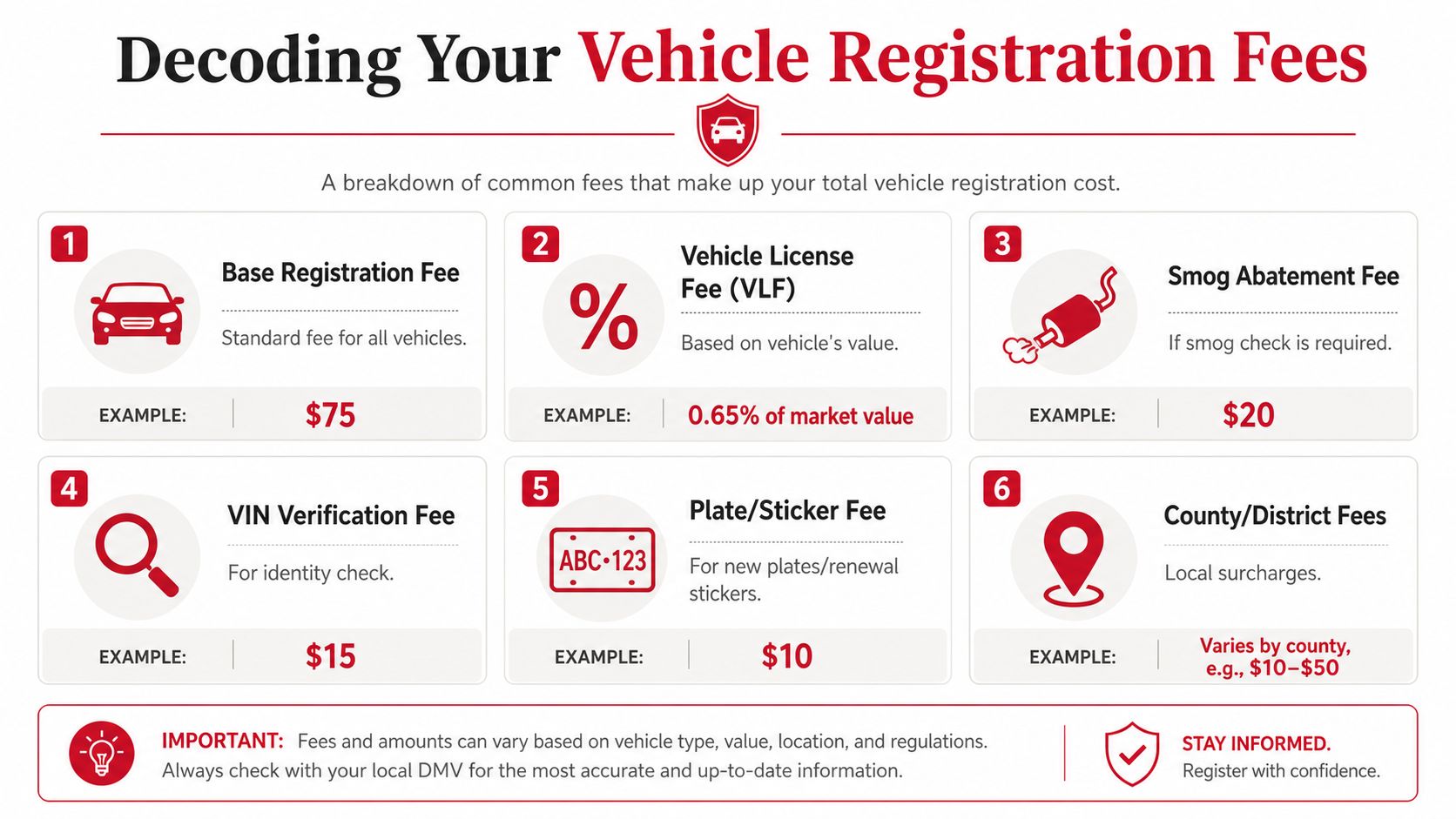
The practical mistake is expecting a neighbor's number to predict your own. Two people can move to California at the same time with completely different fee totals because their vehicles, titles, purchase histories, or classifications differ.
Why one person's bill looks nothing like another's
The final amount often reflects several moving parts, such as the basic registration charge, ownership-related charges, vehicle license components, use-tax exposure depending on the transaction, and class-specific costs for trucks or RVs. A heavier vehicle or a more complex transfer usually creates a different fee picture than a standard passenger car with clean paperwork.
That's why broad online guesses don't help much. The right way to think about fees is by category:
- Registration-related charges: The baseline cost of putting the vehicle into California's system.
- Vehicle-based charges: Some fees depend on the vehicle's classification or record details.
- Tax-related charges: Use tax can surprise people, especially after an out-of-state purchase.
- Transaction-specific add-ons: Plate, transfer, or related processing items may apply depending on the case.
If you own a truck or RV, budget extra attention rather than just extra money. Those files often involve additional classification steps before the fee side is even finalized.
Where late mistakes get expensive
California enforces this area aggressively. In one year, the California Highway Patrol collected over $1 million from 3,383 out-of-state license plate violations, with an average penalty of $297.58 per case, according to this CHP enforcement report summary.
That doesn't mean every delayed registration ends in a citation. It does mean the state treats intentional avoidance seriously, especially when a California resident appears to be using another state's plates to avoid California fees and taxes.
Don't treat fees as a reason to wait. Delay can turn one required payment into a more expensive problem.
The best financial move is usually the least dramatic one. Start early, classify the vehicle correctly, and get the documentation right before you submit. Most extra costs show up after preventable delays, not before.
Troubleshooting Common Registration Roadblocks
When registration goes sideways, it usually happens in familiar ways. The car fails smog. The title is somewhere you can't access quickly. The residency documents don't line up. Or the owner thinks living in California part-time is enough to justify using another state's registration.
None of those issues automatically kills the process. They just require the right next move.
If your smog check doesn't pass
Don't jump straight into random repairs. First, get the failure details and understand whether the issue is emissions-related, readiness-related, or tied to a vehicle condition that needs diagnosis.
Then be methodical:
- Read the inspection result carefully: The cause matters. A failed test and an incomplete test are not the same problem.
- Fix the actual issue: Don't authorize unrelated work just because you're on a deadline.
- Retest after the repair path is clear: Some stations offer a free retest under their posted policy and coupon terms, which can reduce the hassle of repeating the process.
If your title is missing or held by a lienholder
This is common, especially for recently financed vehicles. Contact the lender immediately and ask what they need for a California transfer. Some owners assume the DMV or service provider will request it automatically. Sometimes that's part of the process, sometimes it isn't, and waiting to find out at the counter wastes time you may not have.
Have your loan account information ready before you call. Ask specifically about title release timing, transfer authorization, and whether they send the title directly or provide another ownership document for the registration file.
Residency and domicile are not the same thing
This point causes real legal trouble because people hear casual advice from friends and assume physical presence is enough. It often isn't. According to this analysis of registration rules and domicile requirements, 34 states and D.C. require domicile, meaning intent to make a place your permanent home, not just temporary presence.
That matters for California residents trying to keep another state's registration as a convenience strategy. If your registration story, insurance address, tax filings, and daily reality don't line up, you're creating a file that can look deceptive.
A weekend place, a mailing address, or a relative's home usually isn't enough if your real home life is centered in California.
When in doubt, align everything with where you live. That means your license, insurance, registration, and supporting documents should point in the same direction. Clean consistency solves more registration problems than clever workarounds ever do.
Your Finish Line A Faster Path to California Plates
The clean version of this process is straightforward. Act quickly. Build a complete paperwork packet. Handle the smog and VIN requirements early. Then finish the registration before delays create fee or compliance trouble.
What slows people down isn't usually the law. It's fragmentation. One place checks emissions. Another place handles part of the paperwork. The title issue is still unresolved. A residency document has the wrong address format. By the time all of that gets sorted, the simple transfer no longer feels simple.
That's why many new residents choose a DMV partner instead of trying to decode everything in real time at the counter. If you can work with a provider that handles registration services and the inspection side in one local stop, you reduce the number of handoffs and the number of places a mistake can hide.
You don't need a complicated strategy for out of state vehicle registration in California. You need a complete file, the right inspections, and a process that doesn't force you to start over.
If you want help getting your California registration handled with fewer moving parts, Fire House Smog in Antioch provides STAR-certified smog testing and licensed DMV registration services for renewals, ownership transfers, and out-of-state vehicle transactions, with on-site tag issuance during posted hours.
You've unpacked the boxes, changed your address, and maybe figured out which grocery store you like. Then the vehicle paperwork catches up with you. Your car still has an out-of-state title, your registration timing suddenly matters, and California wants more than just a signature and a fee.
That's often where difficulties arise. The official checklist sounds simple until you're standing at the counter missing a VIN verification, holding a smog report from the wrong time window, or learning that the base fee was only the smallest part of the total bill. An out of state title transfer in California is manageable, but it works best when you treat it like a document process first and a DMV visit second.
Drivers in Antioch and the rest of East Contra Costa County run into the same friction points over and over. The paperwork has to line up. The smog certificate has to be current. The title has to be usable, not just “some proof that I own the car.” If there's a lien, an electronic title, or a missing signature, the process slows down fast.
This guide is written the way I'd explain it to a new California resident who wants to get it done once, not twice. It focuses on what happens on the ground, what commonly fails, and how to move through the smog and registration parts with fewer surprises.
Table of Contents
- Welcome to California Now Let's Tackle the DMV
- Your Document and Fee Checklist Before You Start
- The Core Steps for a Smooth Title Transfer
- Understanding California's Smog Check Requirement
- Navigating Common Transfer Complications
- Skip the DMV Line and Finalize Your Registration
Welcome to California Now Let's Tackle the DMV
You unpack the house, update your insurance, and assume the car can wait until you have a free morning. Then the California paperwork starts asking for a VIN verification, a California smog certificate, and an original title that may still be sitting in a folder from your last state.
California handles an out of state transfer as a new vehicle record, not a simple address change. The state needs to confirm the vehicle, confirm ownership, and enter it into California's title and registration system correctly. That is why new residents get tripped up. The issue usually is not one big problem. It is a missed signature, a lender hold, a smog delay, or showing up before the vehicle record is ready to be finalized.
Where transfers usually go off track
The patterns are pretty consistent at the counter and at the smog station.
- The title is not ready for transfer: It may be signed in the wrong spot, missing a release, or still held electronically or by a lender.
- The owner handles steps in the wrong order: People head to DMV first, then learn they still need VIN verification or a California smog certificate.
- Out of state assumptions cause delays: A registration card, an old emissions test, or incomplete ownership paperwork often does not satisfy California's requirements.
- The move pushes the car paperwork down the list: By the time drivers deal with it, they are rushed and more likely to miss something.
One practical rule helps more than any checklist. Do not make your final DMV trip until the title path is clear, the smog question is settled, the VIN verification plan is set, and your California insurance is active.
A more effective approach
The smoothest cases follow the same order. First, confirm you have the ownership document that California can accept. Next, find out whether the vehicle will need smog. Then handle the verification and bring a complete packet for registration, instead of hoping the clerk can patch together missing pieces at the window.
That last part matters. California counter staff can tell you what is missing, but they usually cannot solve missing ownership records, lender delays, or failed smog issues on the spot.
At Fire House Smog, we see this every week. The official instructions tell you what the state requires. The primary frustration is knowing which item will stop the file from moving. If you want to avoid the common paperwork misses before you head out, use this California title transfer paperwork checklist.
Treat the transfer like a compliance file, not a quick errand. That mindset saves repeat trips.
Your Document and Fee Checklist Before You Start
Preparation saves more time here than speed. Before you leave home, you want a complete packet and a realistic idea of cost.
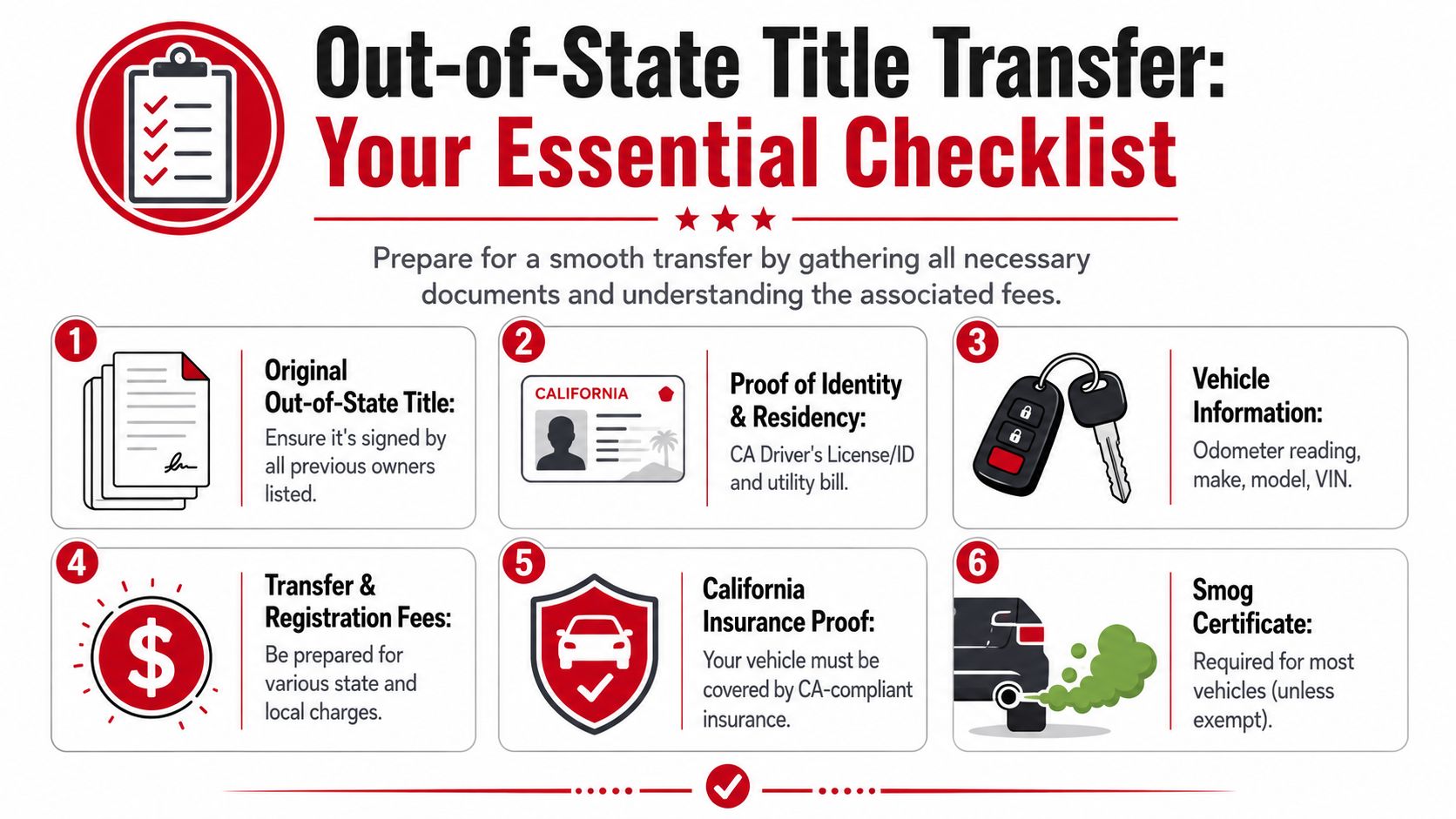
The documents that should be in your folder
For a standard California out of state title transfer, the required core items are consistent:
- Form REG 343: This is the Application for Title or Registration.
- Form REG 31: This is the Verification of Vehicle form.
- Original out-of-state title: It should be properly signed where required.
- California insurance proof: The vehicle must be covered under California-compliant insurance.
- Smog certificate if your vehicle isn't exempt: This belongs in your packet before the final filing stage.
- Ownership support if needed: If your situation involves a lien, a missing title, or title release issues, bring the supporting records that connect ownership clearly.
If you want a practical prep sheet before you go, this title transfer paperwork checklist is useful for organizing the documents people most often forget.
The fees people underestimate
A lot of drivers hear “title transfer fee” and assume that's the whole story. It isn't.
According to California title transfer fee guidance, the base title transfer fee is $15, but the total cost typically ranges from $150 to $300 or more once use tax, registration fees, and possible penalties are added. The same source states that use tax is calculated at 7.25% to 10.25% of the purchase price, depending on the local jurisdiction.
Here's the practical breakdown:
| Cost item | What to expect |
|---|---|
| Base transfer fee | $15 |
| Use tax | 7.25% to 10.25% of purchase price, depending on location |
| Title only fee | $27 for a new title only |
| Duplicate title | $27 if a duplicate is needed |
| Registration fee if registration has lapsed | Approximately $62 |
| Total transfer cost | Often $150 to $300 or more once all required charges are included |
The checklist that prevents repeat trips
Use this as your last review before you leave:
- Check the title first: Make sure you have the original out-of-state title and that signatures are complete.
- Confirm insurance is California-compliant: Out-of-state proof often creates confusion if the policy hasn't been updated.
- Know your smog status: If your vehicle isn't exempt, don't assume you can finish the process without the certificate.
- Bring the vehicle information with you: VIN, make, model, and odometer details need to match the paperwork.
- Budget beyond the headline fee: Use tax usually changes the total more than people expect.
- Watch the clock: The same fee guidance notes that failing to complete the transfer within 30 days of purchase may trigger added penalties.
Bring originals when possible. A clean folder with complete paperwork beats trying to reconstruct ownership details at the counter.
The Core Steps for a Smooth Title Transfer
A lot of new California residents hit the same snag. They have the car, the old title, and a free morning, then find out one missing form or one unresolved title issue stops the whole filing.
The process goes much better when you handle it in the order DMV staff and verification partners see every day. The usual filing packet includes Form REG 343, the original out-of-state title, a VIN verification on Form REG 31, a California smog certificate if your vehicle needs one, and payment for taxes and registration charges. The part the official instructions often gloss over is sequence. If you do the expensive or time-consuming steps before checking ownership problems, you can waste a trip.
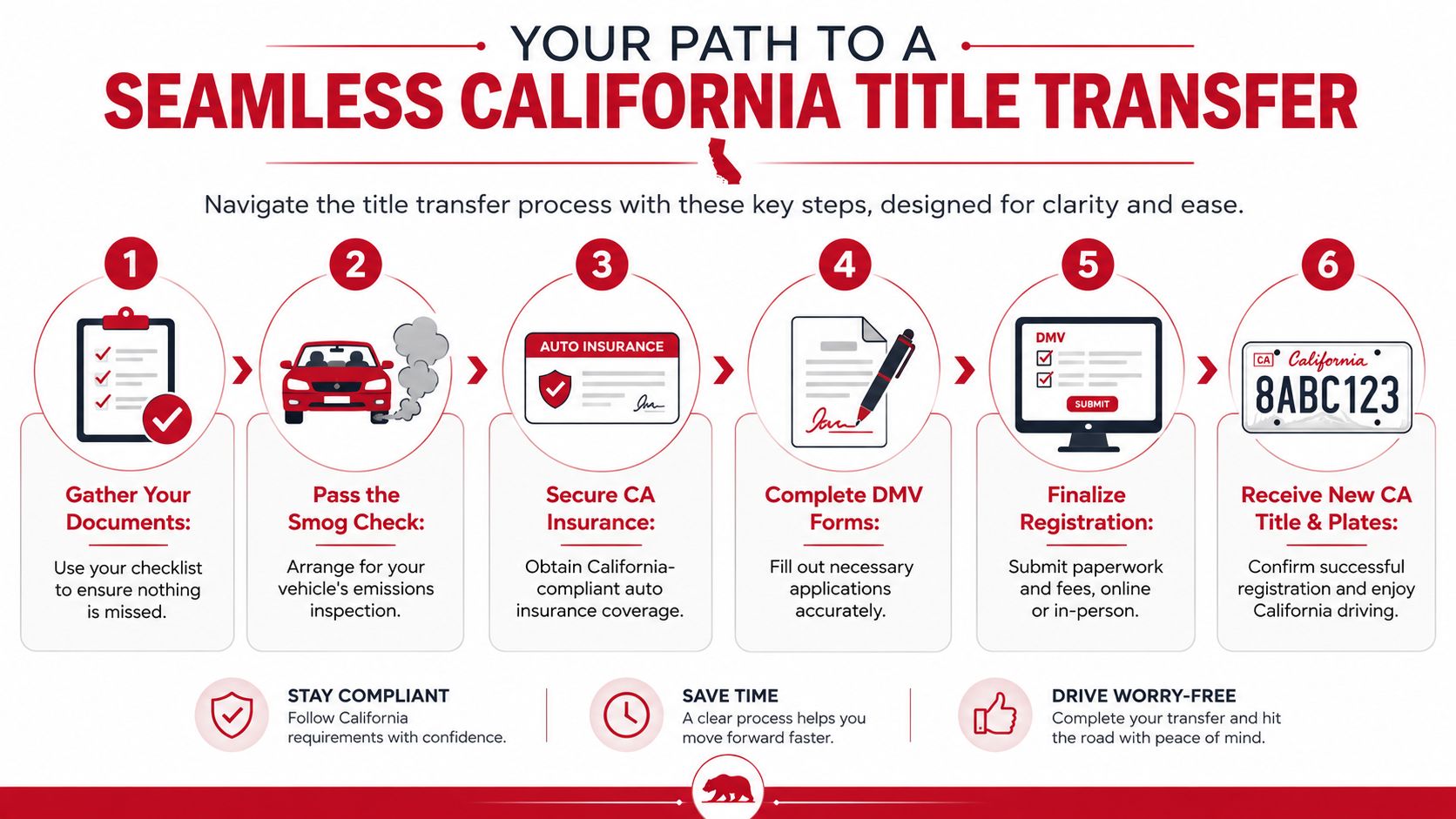
Start by confirming the title can actually transfer
Check the title before you book anything.
Look for missing seller signatures, mismatched names, lienholder information that was never released, or a title that was replaced by another document in the prior state. I have seen people complete a smog check and line up at DMV only to learn the title was signed in the wrong place or still showed a bank interest. California will not clean that up for you at the counter. You have to fix it with the seller, lender, or prior state first.
If the ownership chain is not clean, stop there and resolve it before spending time on the rest.
Get the VIN verification done early
For an out-of-state vehicle, California usually wants the vehicle physically verified so the VIN and basic vehicle details match the paperwork. That is where Form REG 31 comes in.
This step causes more repeat trips than people expect because it depends on the vehicle being present and the paperwork matching what is on the car. If the VIN plate is hard to read, the door label is missing, or the title has one digit off, the application can stall until that gets sorted out. If you want a plain-English overview of what the inspector is checking, Fire House Smog has a helpful guide to California VIN verification requirements.
A simple rule helps here. Do not save VIN verification for the same visit when you plan to file everything else unless you are certain the car and documents match.
Complete smog before your final DMV filing
Handle smog before you make the registration trip, not after.
Out-of-state owners often assume a recent inspection from another state will carry over. California does not treat it that way. If your vehicle is one that needs a California smog certificate, DMV will expect that result to already be on file when you finish the registration. At Fire House Smog, this is usually the point where people get frustrated, because they thought they were one signature away from being done and instead learn the vehicle still needs a California test.
The trade-off is simple. Doing smog earlier adds one errand up front, but it prevents a failed DMV visit later.
Submit the application with a complete packet
Once the title is clean, the VIN is verified, and smog is handled if required, bring the full packet for final processing:
- Form REG 343
- The original out-of-state title
- Completed VIN verification on Form REG 31
- Smog certification, if required
- California insurance information
- Payment for fees and taxes
Small mistakes matter here. A blank odometer field, a name that does not match your ID, or a title signed with cross-outs can send the file back for correction.
Here is the order that usually saves the most time:
| Best order | Why it works |
|---|---|
| Review the title first | Catches deal-breaking ownership issues before you spend time elsewhere |
| Do the VIN verification | Identifies mismatches while the vehicle is available for inspection |
| Complete the smog check if required | Prevents the last-step registration stall that catches many new residents |
| Fill out REG 343 carefully | Reduces avoidable clerical rejections |
| Go to DMV or registration partner with everything ready | Gives the clerk one complete file instead of a partial application |
In practice, the hard part is rarely the law itself. It is the missing signature, the unreadable VIN, or the smog step left for last.
Understanding California's Smog Check Requirement
A lot of out of state transfers stall at smog. The owner has the title, the forms, the insurance, and then learns California will not finish registration until the vehicle clears emissions.
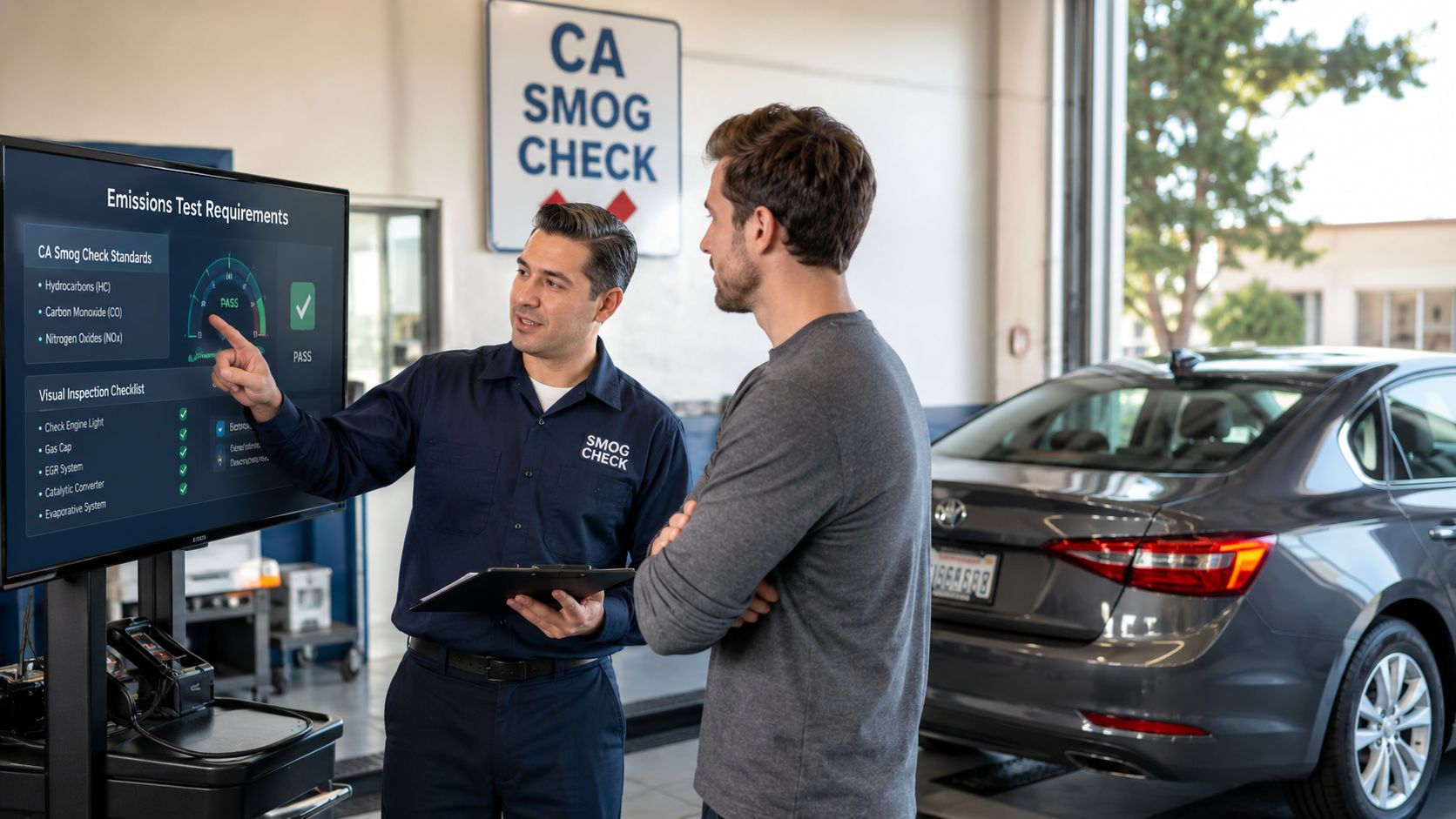
For most out of state vehicles being registered in California, a California smog certification is required before the transfer can be completed. The test has to be done at a California-licensed station, and some vehicles are directed to a STAR-certified station. The DMV summary sounds simple. The part it does not spell out is what usually goes wrong on the ground: people rely on an old test from another state, test the car too late, or assume their vehicle is exempt without confirming the rule that applies to their model year and fuel type.
Which vehicles usually need it
Start with the practical assumption that your vehicle needs a smog check unless you know it falls into an exemption. Electric vehicles are commonly exempt. Older vehicles can also fall outside the requirement based on model year and fuel type.
That is the point people should verify early.
If you drive a gasoline vehicle, a diesel vehicle, or a hybrid, and it is not clearly exempt, plan for a California smog check as part of the transfer. That keeps you from building the rest of the file around a guess.
What a STAR station changes
A STAR station is not just a regular shop with a different sign. It is a station that meets California's tighter program standards for certain inspections. If your registration case calls for a STAR inspection, going to a non-STAR shop first wastes time and money because you may have to test again at the correct facility.
That is one of the failure points the DMV website tends to gloss over. The rule is easy enough to read. The frustrating part is learning you tested at the wrong place only after you are trying to wrap up registration.
Using a shop that handles these transfer cases every day helps because staff can flag those issues before you start. At Fire House Smog, the station is STAR-certified, test-only, and also provides DMV registration services, so a new California resident can get the smog done and then finish the registration step in the same place once the paperwork is ready.
Before you go further, this video gives a helpful visual sense of the smog process and what drivers should expect.
What to do if the vehicle doesn't pass
A failed test does not kill the title transfer. It delays final registration until the emissions problem is corrected.
The first job is to read the failure report carefully and find out whether the issue looks like overdue maintenance, a sensor problem, or a repair issue that needs diagnosis. At a test-only station, the result is usually easier to trust because the shop is not trying to sell the repair in the same visit. That matters when you are deciding what to fix first and whether the car is worth further work.
One practical mistake to avoid is going straight to the DMV after a failed test and hoping the clerk can make an exception. They cannot finish the registration without a passing result when smog is required.
Treat smog as a gatekeeper item. Once it is handled correctly, the last registration step gets much easier.
Navigating Common Transfer Complications
Straightforward transfers move well. The difficult ones usually fail for predictable reasons.
According to expert data on California out-of-state transfer failures, approximately 30–40% of out-of-state title transfers face initial rejection due to documentation gaps, most often a missing valid smog certificate, incomplete REG 343 sections, or missing VIN verification on REG 31. The same source notes that when a vehicle has a lien, obtaining the title from the out-of-state lienholder can add 2–4 weeks to the process.
That tracks with what causes the most stress in real life. It's usually not a mystery rule. It's an incomplete chain of ownership or a record that California can't immediately accept.
When the title isn't clean and ready
A title can be “missing” in more than one way.
Sometimes the owner can't find it. Sometimes the lender still holds it. Sometimes the seller signed part of it but not all of it. Leased vehicles can create another version of the same problem because the registered user and the legal owner aren't always the same party on paper.
When that happens, don't rush into the DMV hoping they'll sort it out from your registration card. They usually need actual ownership documentation that supports the transfer.
Common trouble spots include:
- Active liens: The lender may need to release the lien or provide title-related paperwork before California can issue a clean new title.
- Seller errors: Missing signatures, name mismatches, or incomplete transfer sections can stop the filing.
- Lost title situations: You may need to work back through the original state or lienholder before California can finish the conversion.
- Leased vehicles: The leasing company's role changes the document path, so confirm what ownership papers they require before you schedule anything.
Why electronic titles create delays
Electronic title systems create a newer kind of problem. A driver assumes the title exists because the prior state shows ownership electronically, but California may still need a physical title or a paper version issued through the originating state's process.
The verified data specifically notes that e-title incompatibility is a growing bottleneck and that California does not universally accept out-of-state e-titles without additional verification steps. In practical terms, this means a transfer can stall even when ownership is legitimate, because the paperwork format isn't yet usable.
If your prior state used an electronic title, verify early whether a paper title must be requested. That question can save weeks.
The important takeaway is that complications aren't random. They fit patterns. If your vehicle has a lien, an electronic title, a lease structure, salvage history, or title gaps, pause and solve the ownership record before you worry about counter service speed.
Skip the DMV Line and Finalize Your Registration
Individuals can handle the forms. What they want to avoid is the long, uncertain final step.
That's the part where a licensed registration service changes the experience. Instead of making the DMV counter your only option, you can use a provider that's authorized to process registration work after the vehicle clears the required compliance pieces.
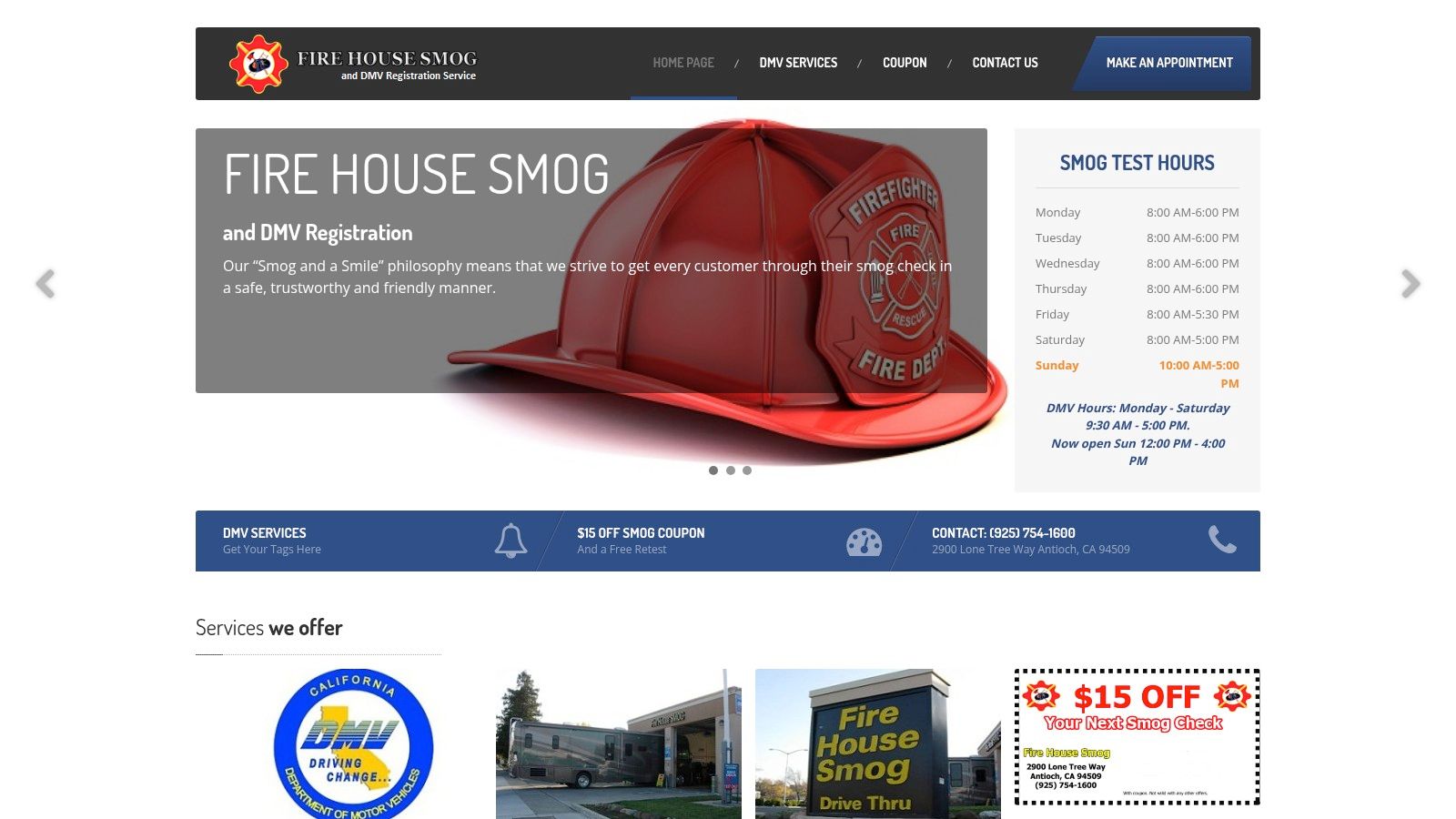
What an easier final step looks like
For many Antioch-area drivers, the most practical route is to complete the smog inspection, bring the ownership paperwork together, and finalize the registration side through a local DMV service provider rather than waiting for a traditional office appointment.
A provider offering DMV registration services near Antioch can handle renewals, ownership transfers, and related registration tasks on site when your documents are in order. That matters because the final step of an out of state title transfer is rarely difficult in theory. It's difficult because of lines, scheduling, and avoidable return trips.
Local details that matter
If you're in East Contra Costa County, the practical details are straightforward:
- Location: 2900 Lone Tree Way, Antioch, CA 94509
- Phone: 925-754-1600
- DMV service hours: Monday through Saturday 9:30 AM to 5:00 PM, Sunday 12:00 PM to 4:00 PM
- Smog availability: Seven days a week, with extended evening and weekend coverage
- Service type: STAR-certified test-only smog inspections and licensed DMV registration services
- Vehicle scope: Cars, trucks, and some RVs, subject to equipment and size limits
The on-the-ground advantage is simple. You can deal with emissions compliance and registration-related processing through the same location, and the test-only setup avoids the tension that comes with mixing diagnostics, repair sales, and paperwork under one roof.
For a new resident, that often makes the whole process feel more manageable. You're not guessing which step to do next. You're finishing the transfer with a complete packet and a shorter path to plates, stickers, and updated California records.
If you want a practical place to handle the smog and registration side of an out of state title transfer, Fire House Smog offers STAR-certified smog checks and licensed DMV registration services at 2900 Lone Tree Way in Antioch. Call 925-754-1600 to confirm your vehicle type, paperwork needs, and current DMV service availability before you stop by.
You open the renewal notice, scan the amount due, and think the same thing most California drivers think. Why is my registration renewal fee so high? The total rarely looks simple, and the line items often feel like they were written for someone who already knows DMV math.
That confusion is normal. A California renewal bill usually combines several different charges, and some of them change based on your vehicle's value, age, location, or smog status. If you're also trying to renew quickly, avoid penalties, and not waste half a day sorting it out, the process can feel bigger than it should.
This guide breaks it down the way a local DMV partner would explain it across the counter. Plain language. Real examples. No mystery fees added in the shadows.
Table of Contents
- That Surprise Bill from the DMV
- Decoding Your California Registration Fee
- Smog Checks Special Plates and Late Penalties
- How to Estimate Your Renewal Cost Before the Bill Arrives
- Your Renewal Options From DMV Lines to Instant Tags
- A Simple Checklist for a Smooth Renewal
That Surprise Bill from the DMV
Maria opens her envelope at the kitchen counter, sees the total, and immediately starts comparing it to last year in her head. She remembers paying registration before, but this time the amount feels different enough that she wonders if something's wrong.
That moment happens all the time. People expect one simple registration renewal fee, then see a total that looks more like a stack of charges bundled together. Some drivers assume the DMV made a mistake. Others put the notice aside for a few days, planning to “look at it later,” which is usually how a simple renewal becomes a stressful one.
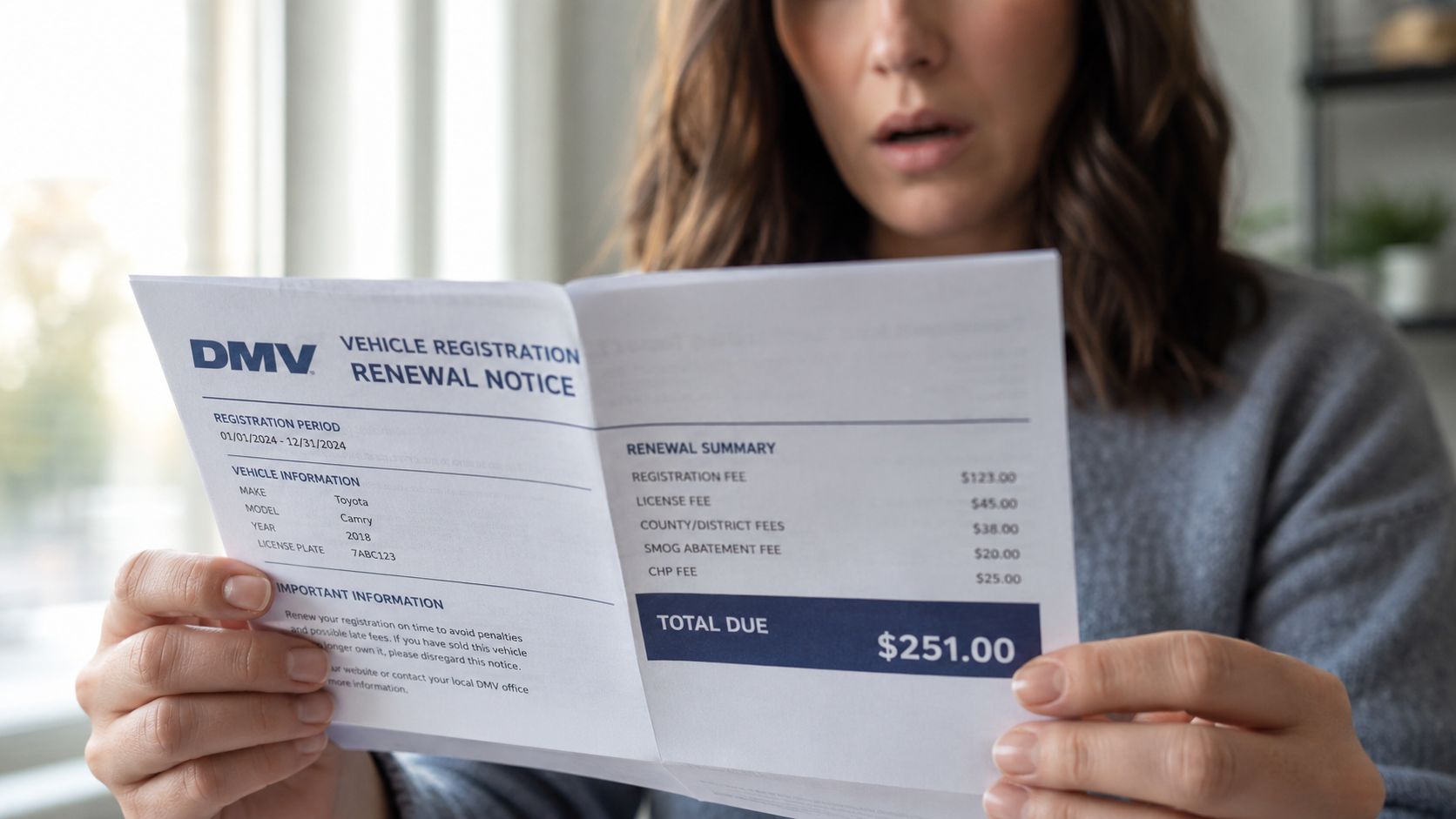
The hard part is that the bill often mixes fixed charges, value-based charges, and sometimes extra requirements like smog compliance. If you don't know which part is driving the total, the number can feel random even when it isn't.
Practical rule: Don't judge your renewal notice by the final amount alone. Look at what kind of charges are inside it.
A lot of drivers also mix up three different questions:
- What does the state charge? Those are official registration-related fees.
- What changes year to year? Vehicle value, smog status, and local add-ons can shift the total.
- What costs are optional? Third-party processing fees can make a normal renewal look much more expensive than it really is.
Once you separate those, the notice starts to make sense. You can tell what's normal, what needs action, and what you might be able to avoid.
That's the key point. Most frustration doesn't come from paying the fee itself. It comes from not knowing why the number landed where it did, or whether you're about to pay more than you should.
Decoding Your California Registration Fee
A California renewal notice works more like an itemized grocery receipt than a single price tag. You are paying for a bundle of state charges, and one line can carry much more weight than the others.
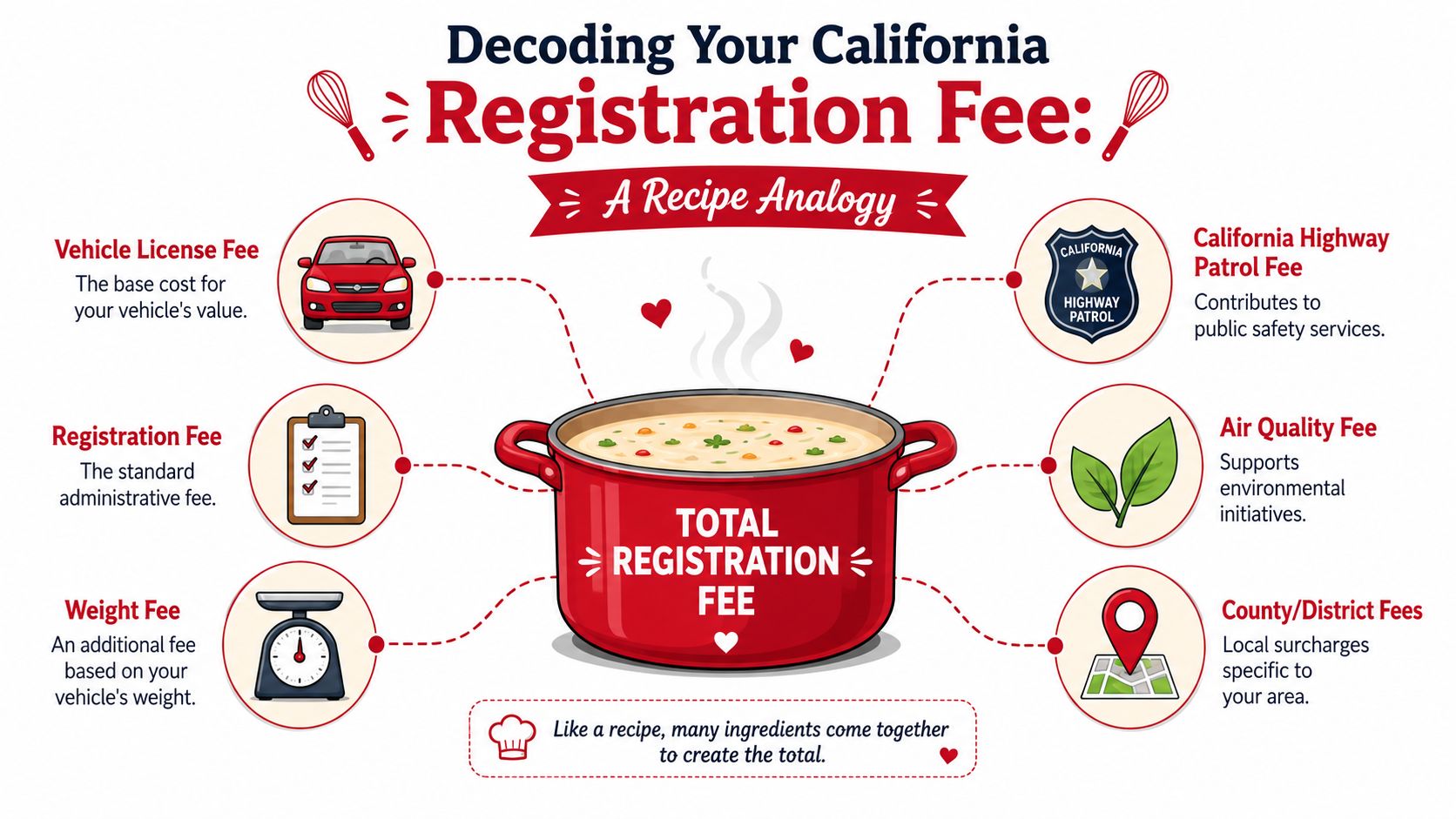
Why the total doesn't look like one fee
On a renewal notice, California groups several charges into one amount. Some are flat state fees. Some change based on the vehicle. Some are tied to value. That mix is why two neighbors can renew in the same month and owe very different totals.
One public fee breakdown shows how this can look on a real notice, including a base registration charge, a California Highway Patrol charge, and a Transportation Improvement Fee that rises for higher-value vehicles (California fee breakdown example).
If you want a plain-English reference while reading your notice, this California registration fee guide from Fire House Smog lays out the common parts in a simpler format. That local DMV partner perspective matters, because many drivers do not get overcharged by the state itself. They get confused by unfamiliar line items, or by renewal websites that pile on service fees without making them obvious up front.
The Vehicle License Fee is often the biggest moving part
The line that surprises people most is the Vehicle License Fee, or VLF. It changes with the vehicle's current value, so it does not stay fixed from year to year.
A practical way to read it is this: the VLF acts like the variable part of your bill, while the registration and CHP charges are closer to the steady part. If your vehicle is newer or worth more, that variable piece can be much larger. If the vehicle has aged and lost value, that part often drops over time.
One source explains the VLF calculation and gives sample amounts for lower-value and higher-value vehicles, which helps explain why a renewal on a newer car can feel much steeper than expected (California VLF and fee examples).
Fixed fees still shape the bill
Fixed charges may not be the largest lines, but they still matter because they appear year after year. They create the floor of the renewal cost before value-based fees and other add-ons enter the picture.
Here is the simplest way to sort what you are seeing on the notice:
- Value-based fee: usually the part tied to what the vehicle is worth
- Fixed state charges: recurring items such as registration-related and CHP-related fees
- Other add-ons: charges tied to vehicle category, location, or special programs
That last group is where drivers need to slow down and read carefully. Official DMV-related charges are one thing. Extra processing charges from unauthorized third-party renewal sites are something else. From the counter at a licensed DMV partner like Fire House Smog, that difference is easy to spot. Online, it is not always obvious until the total jumps.
Once you separate the notice into those buckets, the bill starts to feel less random. You can see which part is normal, which part changes with value, and which part deserves a second look before you pay.
Smog Checks Special Plates and Late Penalties
You open your renewal notice, expect the usual amount, and then one small detail changes the whole errand. Sometimes it is a smog requirement. Sometimes it is a plate-related charge. Sometimes timing is the problem, because once the due date passes, the price can climb fast.
From the counter at a licensed DMV partner like Fire House Smog, these trouble spots are usually easy to spot. On an unfamiliar renewal website, they are not always labeled clearly, and that can leave drivers paying extra processing fees while still missing a smog step or a deadline.
When smog changes your renewal steps
Smog rules confuse people because “exempt” can mean two different things. A vehicle may be exempt from the test itself, but still have a smog-related charge attached to renewal.
A simple way to sort it out is to separate the test from the fee:
- Some vehicles need a smog test before renewal can be completed
- Some vehicles do not need the test this cycle
- Some test-exempt vehicles still owe a smog abatement fee
That distinction matters. If your notice mentions smog, treat it like a gate at the front of the process. Until that requirement is handled, the rest of the renewal may stay stuck. If you want to catch problems before your appointment, this guide to common smog check fail reasons can help you troubleshoot early.
Special plates create a different kind of surprise. They can add costs or paperwork that do not appear on a standard renewal, so it is smart to read those line items separately instead of assuming every vehicle follows the same pattern.
Why waiting gets expensive
Late registration works like an overdue utility bill. The original amount may have been manageable, but once the deadline passes, penalties become their own line of the story.
California does not give drivers a grace period for registration renewal. Payment is due by the expiration date shown on the registration card, and late payment can trigger penalties. Smog requirements, exemption rules, smog abatement fees for some newer exempt vehicles, and late-penalty reminders are summarized in California renewal guidance.
The practical risk is simple. A driver may spend time comparing renewal options, click through an unofficial site with extra checkout fees, and still not finish the one step that controls completion. That is why in-person help can save money as well as time. You can confirm whether smog is due, ask about plate-related charges, and finish the transaction without guessing which fee is state-required and which fee came from the website.
Use this checklist if your notice looks more complicated than usual:
- Open the notice right away. Small renewal problems get more expensive when they sit unopened.
- Check whether smog is required. That tells you if payment alone will finish the renewal.
- Read the expiration date carefully. The due date on the card is the date that matters.
- Review special plate charges on their own. They may not match the pattern of a standard renewal.
- Be cautious with third-party checkout pages. If the fees are hard to explain, stop and verify them before paying.
Many “surprise” renewal totals come from one of three sources. Smog added a required step, special plates added an extra charge, or a missed deadline added penalties.
How to Estimate Your Renewal Cost Before the Bill Arrives
If you'd rather not be surprised by the next notice, estimate the registration renewal fee before it shows up. You won't get a perfect crystal ball, but you can get close enough to budget and catch anything that looks off.
What to gather first
Start with the basics from your current registration or vehicle records:
- License plate number
- Vehicle identification details
- Your county or registration location
- Any clue that smog may be due this cycle
Then use the official California DMV fee calculator. Enter the vehicle details exactly as requested. If you guess at trim level, date, or classification, the estimate can drift.
A practical example helps. Say you're estimating for a family sedan that's a few years old and registered in Contra Costa County. You'd enter the identifying information, review the result, and then compare it with what you paid last cycle. If the amount seems meaningfully different, don't panic. The cause may be ordinary, such as a value-based change or a required smog step.
How to sanity check the estimate
Don't focus only on the grand total. Ask a few better questions:
- Does the result include a value-based component? That part often explains the biggest share.
- Is smog involved this year? If yes, your process may take longer than an online payment alone.
- Are you looking at an official estimate or a private checkout page? Those are not the same thing.
A good estimate is mainly a planning tool. It helps you set aside the money, avoid deadline stress, and recognize when a fee page includes charges that don't look like state fees.
A renewal is easier when you treat it like a calendar task, not a surprise expense. Check early, compare calmly, and leave yourself time if smog is due.
One more note. As your car ages, the value-based part of your renewal may ease over time. That doesn't mean every future total will always go down, but it does mean depreciation can work in your favor on the part of the bill tied to vehicle value.
Your Renewal Options From DMV Lines to Instant Tags
You've got several ways to renew, but they don't all cost the same in time, stress, or transparency.
The main ways drivers renew
Some drivers still mail payment. That can work if everything is straightforward and you're well ahead of the deadline. The downside is obvious. If something is missing, delayed, or unclear, you don't get immediate feedback.
Others use the official DMV online process. That's often the cleanest digital route when your record is simple and no extra steps are blocking completion. It's usually the first online option to consider because you're dealing directly with the state rather than a middle layer.
Then there's the field office route. For some situations, it's necessary. For many routine renewals, though, it means waiting, juggling paperwork, and hoping the line moves faster than your afternoon disappears.
Here's a quick comparison:
| Renewal method | What it's good for | Main drawback |
|---|---|---|
| Straightforward renewals with time to spare | Slow problem-solving | |
| Official online DMV route | Simple renewals from home | Limited help if an issue pops up |
| DMV office visit | Cases needing direct state handling | Time and waiting |
| Licensed DMV partner | In-person help with faster completion for many routine tasks | Availability depends on provider services |
The third party fee trap
A lot of people don't realize that some websites are not the state and not a local licensed partner. They're third-party businesses adding service charges on top of official fees.
That confusion has led to cases where an $84 cost ballooned to over $120 because a third-party vendor added service fees, and official agencies such as the Florida Department of Highway Safety have recommended renewing directly through state or tax collector portals to avoid those extra charges (video summary of third-party service fee confusion).
That example comes from outside California, but the lesson applies anywhere. Before you pay, make sure you know whether you're on:
- An official government site
- A licensed in-person DMV business partner
- A private website charging convenience fees
If the page isn't clear about who is collecting what, stop and verify before entering payment.
When in person makes more sense
An in-person option can be the easiest route when you want someone to look at the notice, confirm what's required, and help you leave with the matter handled. A licensed DMV partner can be especially useful if you're unsure about missing paperwork, timing, or whether your renewal is being held up by another requirement.
For drivers in Antioch, DMV registration services near you may include Fire House Smog, which processes California DMV renewals and provides on-site tag issuance during posted hours.
Sometimes seeing the process helps people choose faster. This short video gives a quick look at the local service setting and workflow.
The best renewal option depends on what you need. If your case is simple and you're on an official state page, online may be fine. If you want help, speed, and a clearer line between official fees and added service charges, a licensed local partner often makes the process easier to trust.
A Simple Checklist for a Smooth Renewal
The easiest renewal is the one you prepare for before you're in a rush. Most delays come from one missing item, one unclear smog status, or one deadline that crept up faster than expected.
What to bring
Keep this checklist together so you're not searching through the glove box, your email, and old paperwork at the same time.
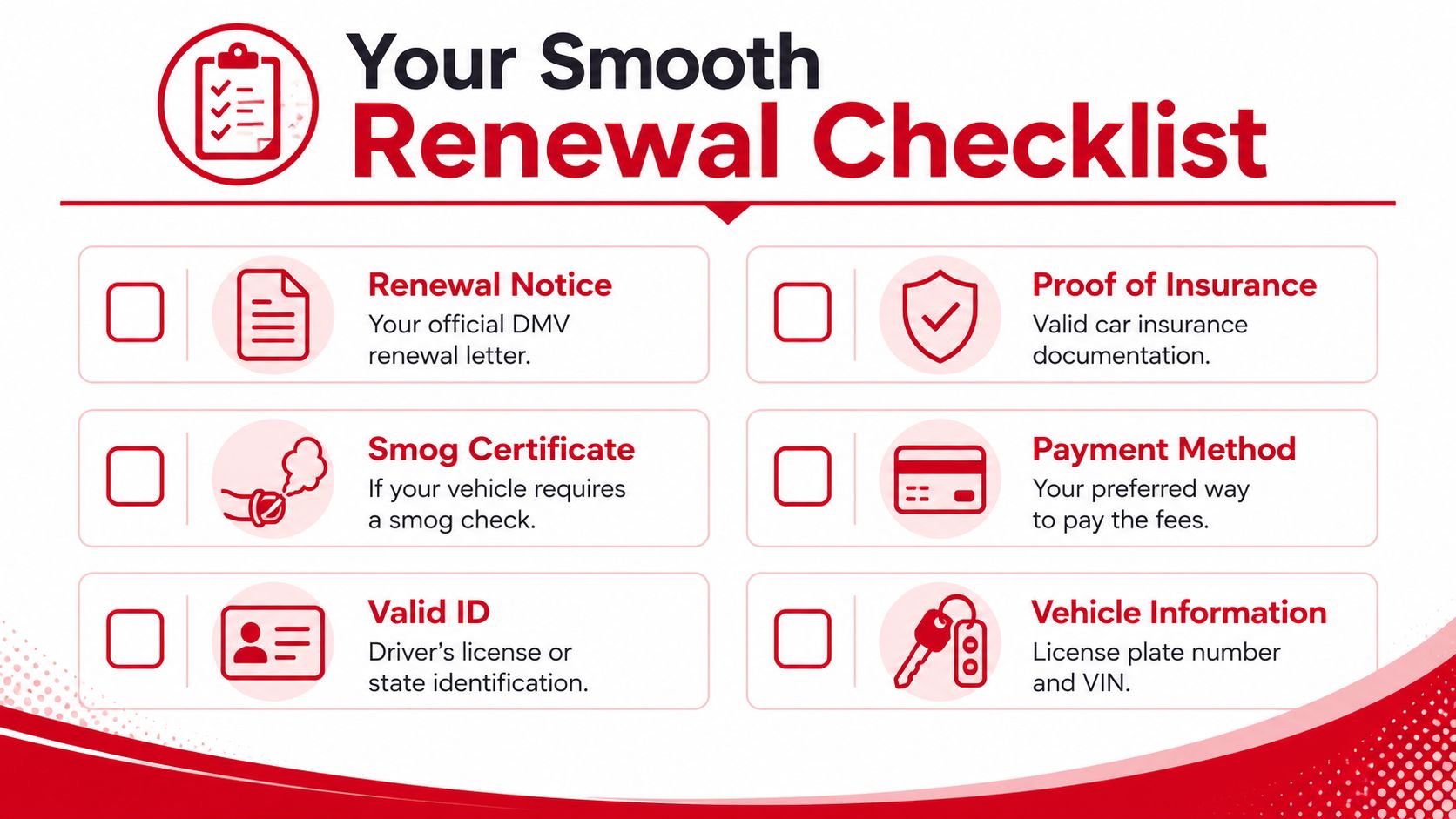
- Renewal notice: If you have it, bring it. It gives the quickest snapshot of what the state expects.
- Proof of insurance: Make sure it's current and easy to show.
- Smog certificate status: If your vehicle needs smog, handle that before the deadline whenever possible.
- Payment method: Bring the form of payment you plan to use.
- Valid identification: A driver's license or state ID can help resolve record questions.
- Vehicle details: Your plate number and VIN are useful if paperwork is missing or inconsistent.
Keep your registration documents in one dedicated folder at home. That habit saves more time than most people expect.
If you lost the renewal notice
Don't let a missing notice stop you. You can still renew, but you'll want your vehicle information, identification, and current insurance ready. The key is not to wait just because the paper is missing.
A few small habits make renewal easier every year:
- Check the date early: Put the expiration date in your phone calendar before the last week sneaks up on you.
- Confirm your address: If the DMV has an old address, notices can arrive late or not at all.
- Handle smog ahead of time: If your cycle may require it, don't leave it for the final day.
- Review who you're paying: Know whether the charge is an official state fee or an added third-party service fee.
- Save your completed paperwork: Keep the new registration card where you can find it next year.
California renewal doesn't have to feel like a puzzle. Once you know what drives the total, what can delay the process, and where extra fees can hide, the job gets much simpler.
If you want a local in-person option for California DMV renewals and smog-related needs, Fire House Smog in Antioch provides STAR-certified smog testing and licensed DMV registration services with on-site tag issuance during posted hours.