
You've agreed on a price, the seller has the keys ready, and you're trying to work out whether the title and an old smog receipt are enough to finish the sale. Before you hand over payment, check the paperwork dates. In California, used car registration starts with the seller's preparation, not just the buyer's trip to submit the transfer.
A clean handoff means the seller can provide the ownership documents, address any lien, and establish whether the vehicle needs a current smog certification. The buyer then has a complete package to file, rather than a car in the driveway and missing signatures to chase.
Table of Contents
- Deadlines and Fees for Your Transfer
- Smog Rules by Vehicle Age and Sale Type
- Documents and Transfer Steps
- On-Site Service or a DMV Office Visit
- Registration Mistakes and How to Fix Them
- Book Your Smog Check and Transfer Visit
Deadlines and Fees for Your Transfer
Write the sale date on your calendar before separating the paperwork. For the seller, two clocks are already running before money changes hands: the window to report the transfer and the life of a fresh smog certificate. Keep government charges, inspection costs, and any registration-service charge separate when comparing your total.
California used car transfer deadlines and fees
| Item | Timing or amount | Who handles it |
|---|---|---|
| Notice of Transfer and Release of Liability | Within 5 calendar days of sale, according to the California DMV transfer guidance | Seller |
| Ownership transfer | The DMV transfer charge plus use tax; filed through a licensed registration service such as Fire House Smog, the service charge is $55.00 plus the applicable DMV fee, including the sticker and any plate needed | Buyer |
| Transfer fees submitted to DMV | Submit promptly after sale; a late-penalty threshold is a deadline, not breathing room | Buyer |
| Smog transfer fee for qualifying newer vehicles | A DMV charge paid in place of an inspection, for vehicles inside the newer-vehicle exemption | Buyer |
| Use tax | Calculated from the purchase price and applicable location-based tax rate | Buyer |
| Smog certificate validity | 90 days from the test date, per the California Bureau of Automotive Repair smog-check guidance; the seller's passing certificate should still be inside that window on filing day | Seller in a private sale |
| Registration renewal after transfer | Renewal payments made shortly after expiration can still avoid penalties, but the registration itself is already out of date; renewals through a registration service run $30.00 plus the applicable DMV fee, sticker included | Buyer |
| Registration fees | Calculated for the vehicle, including applicable weight- and value-based charges | Buyer |
Calendar the seller's release-of-liability filing first. That filing creates a dated record of the reported transfer. It doesn't replace the buyer's ownership-transfer application, and neither party should assume the other has completed both tasks. A seller who files on day one and hands over a smog certificate with weeks of validity left gives the buyer the cleanest possible package to submit.
Budget for the transaction, not just the transfer charge
Ask for an itemized calculation before paying. A quoted transfer charge isn't necessarily the full amount needed to cover tax, registration, certification, and service charges. Use our vehicle transfer fee guide to distinguish those categories.
Practical rule: File when the package is complete, rather than waiting for the last possible day.
For a dealer purchase, confirm in writing what the dealer will submit and what remains yours to handle. Keep the purchase agreement and filing receipts together.
Smog Rules by Vehicle Age and Sale Type
Settle the smog question before the buyer arrives. In a private sale requiring certification, the seller should arrange the passing inspection rather than leave the buyer to discover an unresolved emissions problem after paying. The test date starts a clock that runs against your closing timeline, so a seller who tests early in the listing period keeps more of that window open for the paperwork that follows.
Use this visual to identify the questions to settle before closing.
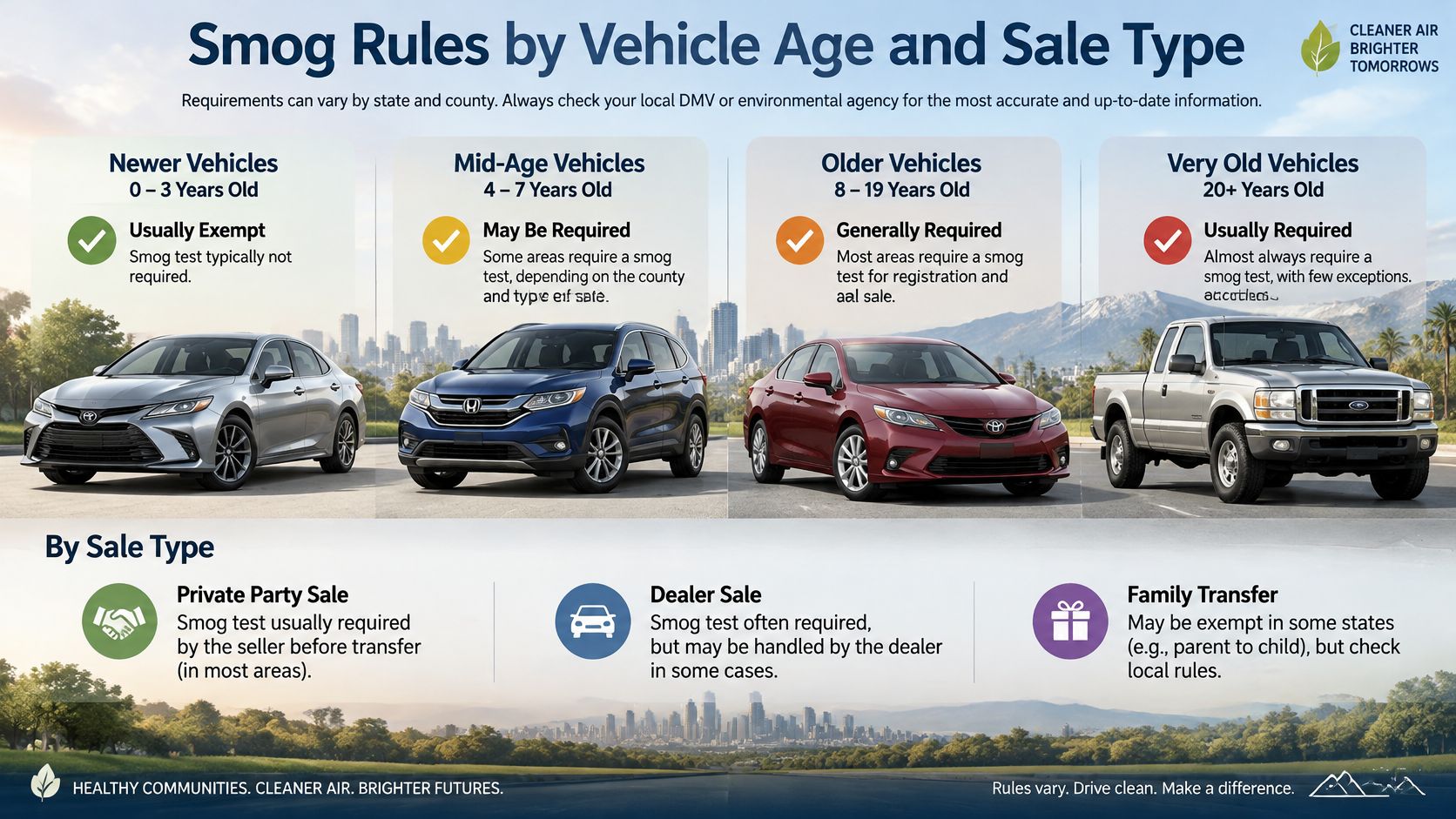
The key private-sale check is whether the seller's passing test falls within the 90-day validity window described in the Bureau of Automotive Repair smog check guidance. That same guidance distinguishes newer-vehicle treatment from the rules for older vehicles. A routine renewal exemption does not automatically carry over to an ownership transfer, so treat the test date as the start of the registration clock and work backward from the day you plan to file.
Smog requirements by vehicle age and sale situation
| Situation | Smog document or action | Who handles it |
|---|---|---|
| Vehicle within the applicable newer-vehicle exemption | Confirm transfer eligibility by exact model year; applicable transfer fee replaces certification | Buyer pays applicable fee |
| Older gasoline or diesel vehicle, private sale, current passing test | Confirm that the passing certification is valid for the transfer | Seller provides |
| Older vehicle with an expired test | Arrange a new smog test before submitting the transfer package | Seller arranges |
| Vehicle fails smog test | Obtain repairs and a passing retest before completing a transfer requiring certification | Seller |
| Vehicle bought out of state | Confirm California entry, certification, and verification requirements | Buyer confirms with DMV |
Check the exemption against the transaction
Age-based rules confuse sellers because renewal and ownership-transfer guidance describe different situations. Use the vehicle's exact model year, fuel type, and sale type when reviewing California smog exemptions, rather than relying on the seller's statement that the car is too new to need a test.
A recent biennial inspection may satisfy the certification requirement, but check the actual record and date. A receipt for an inspection that failed isn't a passing certification.
This video provides another way to review the smog-check process.
At Fire House Smog, we're a STAR-certified test-only station. We don't perform repairs, so if the vehicle fails, you arrange the repair work elsewhere and return for a free retest when required. That distinction matters for scheduling: a seller who needs a retest should build repair time into the calendar before the certification window closes.
Documents and Transfer Steps
Build the packet before choosing where to file. A missing signature can require another meeting with the seller, while an unresolved lien can require contact with the lender.
Gather the complete packet
- Ownership document: The California Certificate of Title, or the applicable REG 227 paperwork when the title is unavailable.
- Required signatures: Seller, buyer, and lienholder signatures appropriate to the transaction.
- Vehicle identification: The complete VIN, checked against the vehicle and every document.
- Sale details: Purchase date, purchase price, and the buyer's correct legal name and address.
- Mileage disclosure: A properly completed odometer disclosure wherever required.
- Lien release: Documentation releasing the lender's interest when applicable.
- Smog certification: A valid passing certification when the transfer requires it.
- Payment: An accepted payment method for applicable fees and use tax.
The California DMV transfers manual requires a complete VIN on REG 262, warns that errors or alterations void an odometer disclosure, and distinguishes consumer guidance to submit fees within 10 days of sale from a procedural 30-day late-penalty threshold. Treat the shorter guidance as the planning limit and aim to submit the completed package immediately.
Keep this checklist available while assembling the originals.
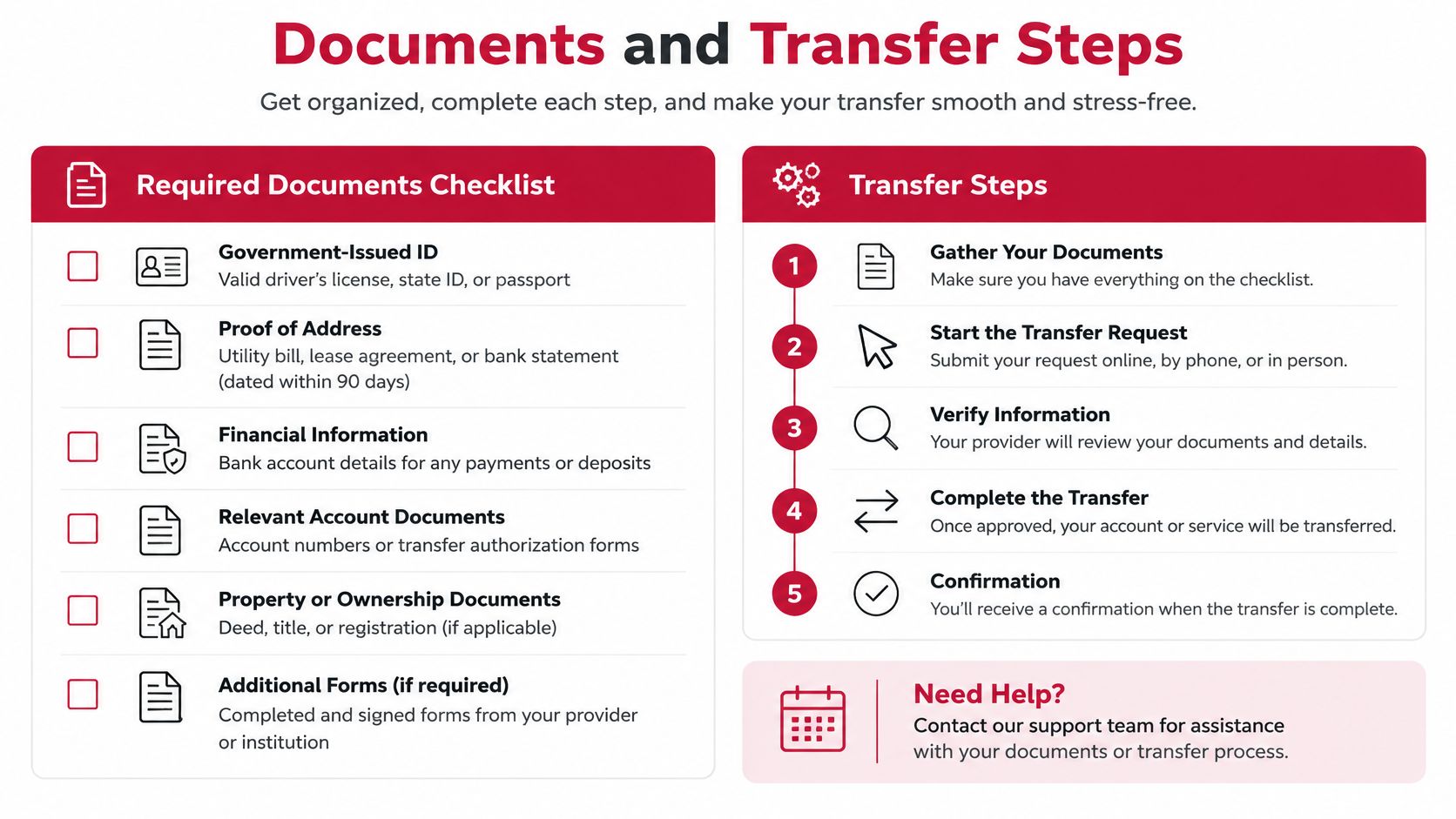
Complete the handoff in a workable order
Compare the title with the vehicle. Read the VIN character by character instead of checking only the ending. Confirm that the person signing as seller is identified appropriately on the ownership paperwork, and inspect the lienholder section. A matching license plate isn't enough to resolve an inconsistent VIN or ownership name.
Review the signature boxes together. Buyer and seller should identify their designated fields before either signs. If the title lists a lender, establish what release documentation is needed before treating the title as ready to transfer. A paid-off loan and a documented release aren't interchangeable.
Complete the odometer disclosure carefully. Read the vehicle's displayed mileage directly and enter it in the appropriate field in ink. Don't overwrite a digit, use correction fluid, or assume initials will validate an altered entry. If something goes wrong, stop and obtain instructions for replacement paperwork rather than adding more marks.
Enter the transaction details consistently. Use the actual purchase date and agreed price, and write the buyer's address completely, including an apartment or unit designation. A blank price can interrupt tax processing; inconsistent dates can make it harder to establish when obligations began. Compare these fields across the title, sale paperwork, and application before anyone leaves.
Have the seller file the release of liability. The seller should retain the submission confirmation with the sale documents. The buyer should still proceed with the ownership-transfer package independently. Waiting for the buyer to report that registration is finished leaves the seller without control over their own filing.
Submit the fees and transfer documents. Bring the originals to the chosen processing location and ask for a receipt identifying what was accepted and paid. If something is missing, ask exactly which document or field needs correction. Don't leave with only a verbal instruction to bring more paperwork.
Check the issued record. Review the registration card for the owner's name, address, VIN, and vehicle details. Check any sticker or plate issued for the transaction, and retain the receipt while remaining documents are processed. If something doesn't match, report the specific discrepancy rather than assuming it will correct itself.
Scan the packet before submission, but don't assume a phone image can replace an original signature document.
Our vehicle registration documents checklist can help you organize what to bring. Keep the title, lien paperwork, sale documents, and filing confirmation in a secure folder rather than leaving the entire ownership file in the vehicle.
Before leaving the counter, distinguish accepted for processing from fully completed. If additional action remains, write down who must take it, what document is needed, and how you'll confirm completion.
On-Site Service or a DMV Office Visit
Choose the location by transaction eligibility and your schedule, not just distance. A local visit helps only if the processor can handle the work and you arrive with a complete packet.
On-site service compared with a DMV office visit
| Factor | On-site service in Antioch | DMV office |
|---|---|---|
| Travel and queue | Local option; confirm current availability rather than assuming no wait | Closest offices to our station are Pittsburg and Concord; allow for travel and waiting |
| Weekday hours | Our DMV service hours are Monday through Friday, 9:30 AM–5:00 PM | Check the selected office's posted hours |
| Saturday hours | 9:30 AM–5:00 PM; services may be limited | Confirm whether the selected office offers Saturday appointments |
| Sunday hours | 12:00 PM–4:00 PM; services may be limited | Confirm availability before planning a Sunday visit |
| Transaction types | Eligible registration and ownership-transfer work within business-partner authority | Broader transaction handling, including matters requiring DMV review |
Match the route to the paperwork
We're a licensed California business partner for DMV registration services. That credential doesn't mean every unusual ownership issue can be resolved at an on-site counter. Call before visiting if the title has conflicting names, the vehicle came from another state, or a prior application was rejected.
A DMV office is the better starting point when DMV staff must determine eligibility or resolve a record problem beyond a business partner's authority. For an ordinary, complete transfer, a local appointment may fit your work schedule better.
Before you travel: Confirm the transaction type, required originals, accepted payment method, and service availability for that day.
Smog-test hours and DMV-service hours aren't identical. If you want both handled during the same visit, schedule around the registration-service window and confirm that the particular transaction can be processed.
VIN verification is not currently available at our station. If your transfer requires it, arrange that step separately rather than arriving expecting to finish it here. This is especially important when planning an out-of-state vehicle's California paperwork.
Registration Mistakes and How to Fix Them
An untidy entry isn't always something a processor can overlook. An altered odometer disclosure can invalidate the document, so the fastest recovery is usually to stop improvising and obtain the correct replacement paperwork.
Find the defect before resubmitting
- Altered odometer entry: Look for crossed-out digits, overwritten mileage, correction fluid, or inconsistent entries. Obtain the required replacement disclosure and any Statement of Facts requested for the correction. Submit once the replacement is properly completed and signed.
- Incomplete or mismatched VIN: Compare the vehicle identifier with the title and transfer documents. Don't guess a missing character or copy an identifier from an unrelated receipt. Resolve the mismatch before submitting the corrected packet.
- Missing lien release: A lender still appears on the ownership record, but there's no acceptable release. Contact the lender for the appropriate documentation. A payment confirmation alone shouldn't be treated as proof that the transfer paperwork is complete.
- Late or incomplete filing: You have the vehicle but no receipt confirming submission. Contact the processor promptly about paying applicable fees and completing outstanding documents. Don't postpone all action because part of the packet needs correction.
- Expired smog certification: The passing inspection no longer qualifies for the transaction. Arrange a new inspection and coordinate submission so the replacement certification remains usable.
Keep a correction record
When a package is rejected, keep the rejection notice with a copy of the submitted documents. Mark the exact defect on your copy, not on an original that must remain unaltered.
Ask whether the correction requires a new signature, replacement form, supporting statement, or another inspection. Then check the entire packet again before returning. Fixing only the first visible error can leave a second problem unresolved.
There's no useful universal promise for how long a correction will take. Your control is over obtaining the right document, keeping proof of payment and filing, and submitting the complete correction promptly.
Book Your Smog Check and Transfer Visit
Confirm the seller's documents and certification status before booking the final transfer visit. Check that the seller has filed their required notice, that any lien-release paperwork is available, and that the inspection record is suitable for the sale. If an item is missing, assign responsibility for obtaining it before either party assumes the transaction is finished.
Customers can make an appointment through the Fire House Smog website. Call (925) 754-1600 to confirm vehicle questions, coordinate the visit, or discuss an RV or motorhome, which must be checked against our size and equipment constraints before arrival.
Prepare for the appointment
Bring the original ownership paperwork and supporting documents, not just screenshots. Keep a separate copy of the packet for yourself, and have the purchase details available so the processor doesn't have to reconstruct them from messages between buyer and seller.
The $15 OFF Smog Coupon gives $15 off a smog test and includes a free retest. It can't be combined with other offers. Print the offer or mention at the service desk that you saw it on the website.
Don't schedule a required inspection so early that you leave little usable time for the sale, repairs if needed, and submission. Equally, don't leave the test until the handoff if the seller hasn't established whether the vehicle will pass.
Use this closing plan:
- Confirm documents this week: Resolve signatures, ownership details, and lien paperwork before the handoff.
- Time the inspection for the sale: Leave room for any needed repair and retest while keeping certification current.
- File when the packet is complete: Aim for same-day submission and retain the filing receipt.
Fire House Smog offers test-only smog inspections and eligible California ownership-transfer services to help you complete your used car registration paperwork. Visit Fire House Smog to arrange your appointment, and call ahead if your vehicle or transfer needs special preparation.