
A California vehicle ownership transfer typically requires a smog certificate, a signed title, and payment of transfer fees, and one missing or incomplete document can stall the application. In Texas, 6,432,879 vehicle titles were processed in fiscal year 2018, showing how often ownership changes depend on accurate paperwork rather than a simple exchange of keys.
You may be standing beside a newly purchased car with the payment complete, the keys in hand, and a title that looks almost finished. Then someone notices the seller missed a signature, the lien release isn't attached, or the smog requirement hasn't been satisfied. The sale feels complete, but the legal transfer isn't.
California treats smog compliance and DMV paperwork as connected parts of the same ownership chain. A vehicle can pass the emissions inspection and still be rejected because the title is incomplete. It can also have a properly signed title but remain stalled because the required smog documentation is missing or the vehicle doesn't meet emissions requirements.
That distinction matters because the fastest transfer is not always the one with the fewest steps. It's the one where each dependency is checked before the packet reaches the DMV. The following process reflects what tends to work in practice for California buyers and sellers, including people transferring vehicles from another state.
Table of Contents
- Navigating the California Transfer Process
- Essential Documents for a Successful Transfer
- Why Professional Smog and DMV Services Matter
- Common Errors That Delay Your Transfer
- Your Complete Transfer Timeline and Tips
- Frequently Asked Questions About Transfers
Navigating the California Transfer Process
A buyer and seller can agree on a price in minutes, but the ownership record changes only after the required chain of documents, signatures, fees, and compliance steps is complete. California DMV guidance identifies the Certificate of Title, required signatures, transfer fees, odometer information, and supporting forms as central parts of the process. The California DMV title transfer guidance also explains what to do when the original title is missing or a lien affects the record.
Follow the document chain
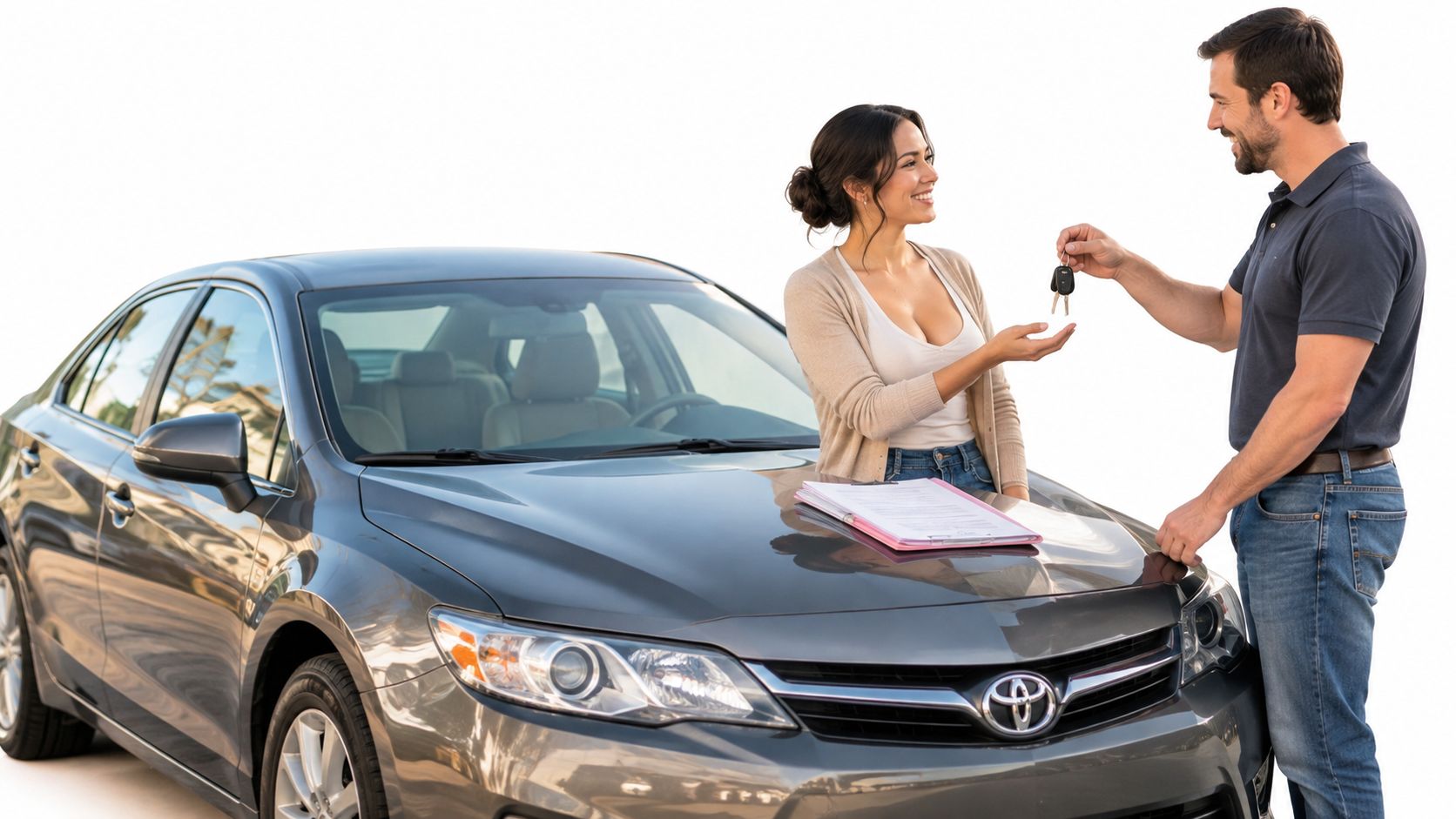
Start by identifying the vehicle and confirming that the seller's name on the title matches the seller's identification. Next, check whether a lien is listed and verify that the lienholder has released its interest. The seller and buyer then complete the title, including the odometer disclosure when required, and prepare any supporting forms for the specific situation.
The smog step belongs in this preparation, not as an afterthought. If the vehicle requires a smog certificate, arrange the inspection before finalizing the DMV packet. A failed or incomplete emissions record can hold up the transfer even when every signature is correct, while a successful test doesn't correct a missing lien release or an incorrectly completed title.
Practical rule: Treat the smog certificate, title, identity documents, and fee payment as one packet. If one part is unresolved, the transfer is not ready.
The final stage is submission to the DMV or an authorized registration provider. Once the transfer is accepted, the registration record and title can be updated according to the agency's process. For an out-of-state vehicle, expect additional verification and documentation rather than assuming a California title transfer follows the same path as an in-state vehicle.
California's process is therefore best understood as a sequence: establish ownership, confirm emissions compliance, complete the title and disclosures, resolve liens, submit the forms and fees, and retain proof of submission. Skipping ahead creates the delays that buyers often mistake for a DMV processing problem.
Essential Documents for a Successful Transfer
A clean transfer begins with document control. California DMV requirements can change depending on whether the title is available, a lien exists, the vehicle comes from another state, or an ownership detail needs correction. The core packet should be assembled before either party signs, because a signature on the wrong line can be harder to correct than a missing form.
Build the packet before signing
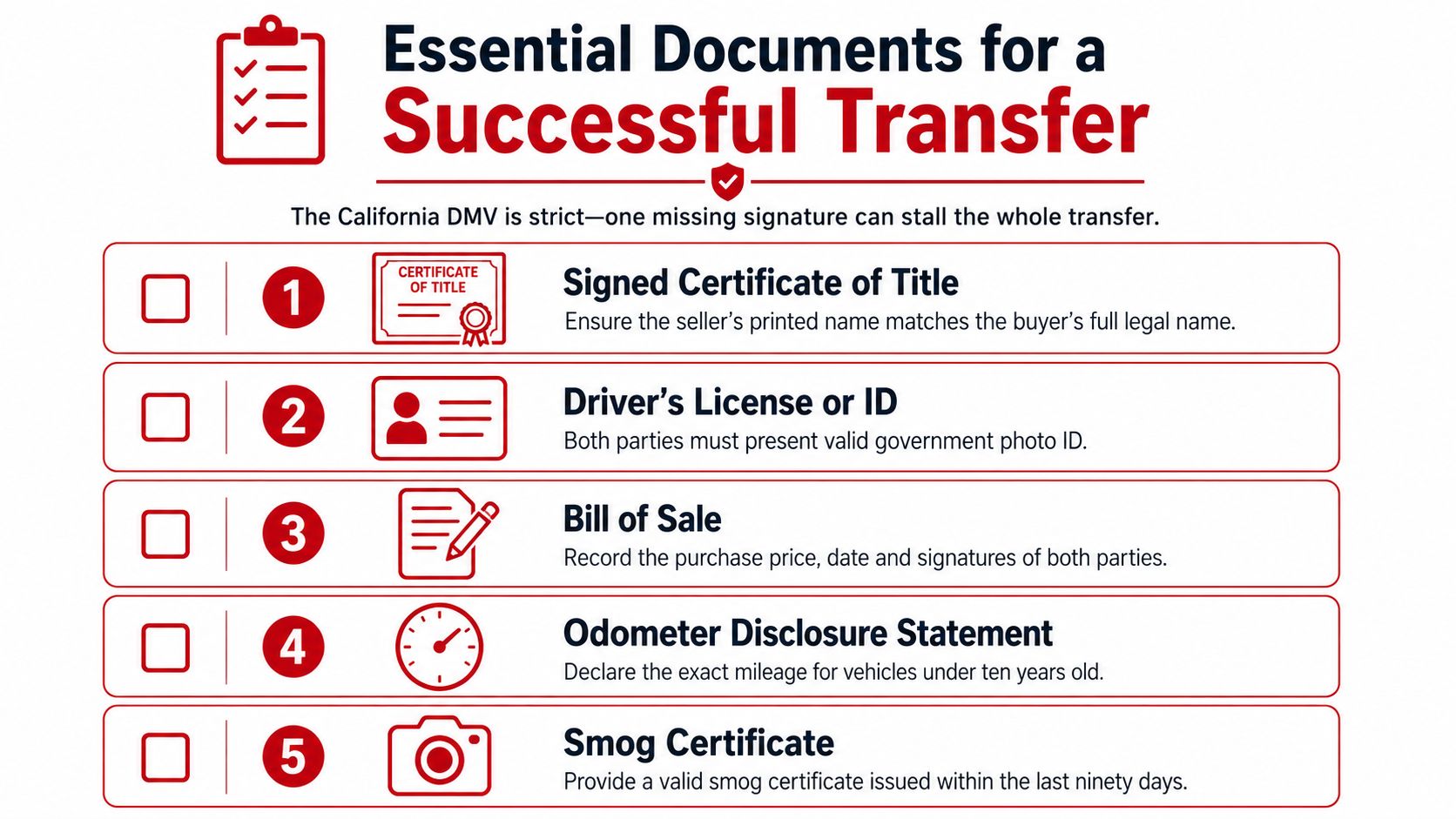
Certificate of Title: Use the original title when available. The seller must sign in the correct assignment area, and the buyer's legal name and address must be entered accurately. Don't use cross-outs or correction fluid. If the title is lost, the transfer may need to begin with a replacement-or-transfer application.
Identification: Both parties should have valid government-issued identification available. The names used on the title and forms need to correspond with the identifying documents. A casual abbreviation or an old address can trigger a correction request.
Bill of sale: Keep a written record showing the parties, vehicle details, transaction date, purchase price, and signatures. It supports the transaction record and gives both sides evidence of what they agreed to exchange.
Odometer disclosure: Record the mileage exactly as required, using complete numeric information rather than an estimate. An incomplete or inconsistent disclosure is one of the most common reasons a title packet comes back for correction.
Smog certificate: Provide the required California emissions documentation for the vehicle and transaction. The smog result is not a substitute for a title, and a signed title doesn't substitute for emissions compliance.
Resolve liens before submission
A lien is an ownership issue, not merely a financing detail. If a lender still appears on the title, the seller needs documentation showing that the obligation was satisfied or the lienholder must participate in the transfer. Buyers should inspect this before paying, because an unresolved lien can prevent the DMV from recording the new owner.
Supporting paperwork may include REG 227, REG 262, REG 256, REG 166, and the Notice of Transfer and Release of Liability, depending on the circumstances. Don't add forms randomly. Use the form that matches the missing title, odometer disclosure, lien, exemption, or liability situation, and confirm the current requirement before submission.
A useful California title transfer paperwork checklist can help you compare the documents you have with the documents your transaction requires. The purpose isn't to create a thicker file. It's to submit a complete, internally consistent file the first time.
Why Professional Smog and DMV Services Matter
The DIY route can work when the title is clean, the vehicle passes its emissions inspection, both parties are available, and the buyer understands which forms apply. Its weakness is fragmentation. The owner may visit one location for smog testing, another for DMV work, and then discover that a missing signature or lien document requires a return trip.
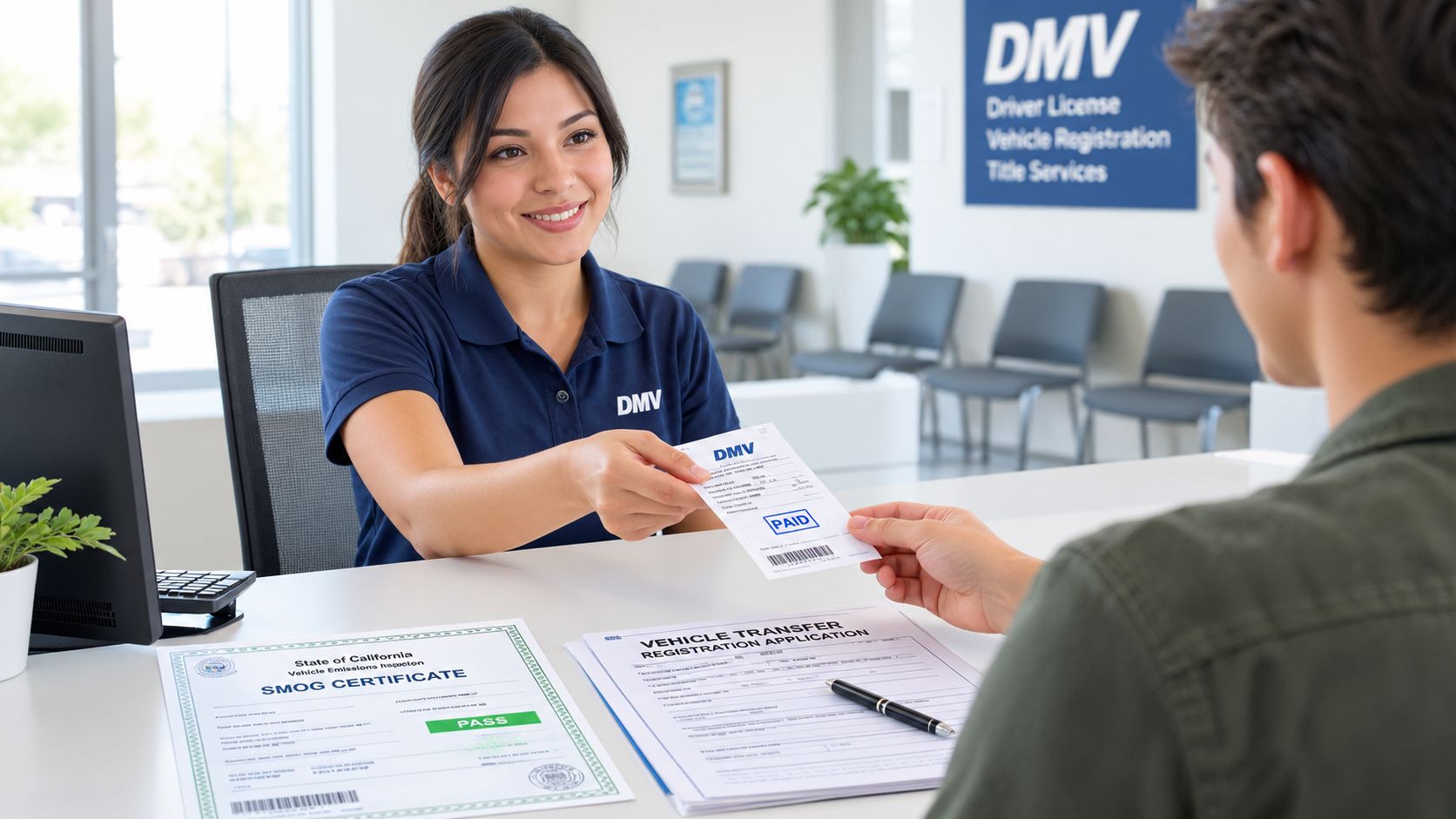
A combined service changes the handoff between compliance and registration. A provider can identify whether the emissions step is complete before accepting the transfer packet, then check whether the title and supporting forms are ready for processing. That doesn't guarantee approval when a lender, out-of-state record, or ownership dispute requires separate action, but it reduces avoidable gaps between steps.
Compare the two routes
| DIY handling | Integrated service |
|---|---|
| You coordinate the smog inspection and DMV submission separately. | The emissions and registration steps can be reviewed as one workflow. |
| You remain responsible for spotting missing signatures, lien documents, and forms. | Staff can help identify apparent paperwork gaps before submission. |
| Registration materials may require a later pickup or mailing step. | An authorized provider may offer on-site registration services and tag printing. |
| A failed smog result becomes a separate problem to diagnose. | The test result can be discussed before the transfer packet is finalized. |
The trade-off is control versus convenience. DIY processing may suit someone who is comfortable reading DMV instructions and correcting paperwork. A licensed partner is more useful when the vehicle is out of state, the title has a lien history, the buyer and seller have limited availability, or a failed smog test has created uncertainty.
Fire House Smog operates as a STAR-certified test-only station and licensed DMV registration partner at 2900 Lone Tree Way in Antioch. It offers on-site California DMV renewals with sticker printing, ownership transfers for California and out-of-state vehicles, and two service bays designed to reduce wait times during posted hours.
Because it is test-only, repairs aren't sold as part of the inspection. If the vehicle fails, the next decision is repair and retest, not an automatic repair purchase at the testing location. The California smog check and registration service is therefore most useful when you want the emissions result and registration paperwork evaluated within the same local workflow.
A professional service can't replace a lender's release or a seller's missing signature. It can help you discover those problems before you build your schedule around an incomplete transfer.
Common Errors That Delay Your Transfer
The most frustrating delays often begin with a document that looks finished. A seller signs the title, but not in the assigned seller field. A buyer writes a shortened name that doesn't match the identification record. Someone copies the VIN from memory instead of reading it directly from the title or vehicle.
Consider a typical failed handoff. The buyer and seller complete the sale, but the title contains one wrong VIN character and the odometer section is incomplete. The DMV can't confidently connect the document to the vehicle or accept the disclosure, so the packet returns for correction. The buyer must locate the seller again, correct the title properly, and resubmit.
Check the points most likely to stop the file
Seller signatures: Compare the title's signature lines with the printed ownership name. A missing or misplaced signature can stop the transfer even when the buyer has paid and taken possession.
Odometer disclosure: Enter the exact mileage in the required format. Don't guess, round, overwrite, or leave a field blank because the vehicle's condition seems obvious.
Lien release: Look for the lienholder information before the transaction closes. A paid loan doesn't automatically mean the title record is already clear.
Names and addresses: Use the legal names and current addresses required for the record. Small inconsistencies can generate a correction request.
VIN: Match the VIN on the title, vehicle, forms, and supporting documents character by character. A VIN discrepancy deserves investigation before submission, not an assumption that the DMV will fix it.
Independent title-transfer guidance identifies missing signatures, odometer problems, unreleased liens, name and address errors, and VIN mismatches as recurring rejection triggers. The title transfer error guide also warns about open titles and title jumping, practices that can leave the record without a valid documented chain of ownership.
Title jumping is especially risky because it attempts to pass a vehicle through an intermediary without recording the intermediary's ownership properly. The result can be a legal and registration dead end rather than a shortcut.
Smog creates another version of the same problem. A vehicle may fail because of emissions-related conditions, or the certificate may be absent when the transfer requires it. Use the common smog check failure reasons to understand what needs attention before treating a failed result as a paperwork issue.
Your Complete Transfer Timeline and Tips
A transfer moves fastest when the owner treats it as a controlled sequence rather than a collection of errands. The first task is not signing the title. It's confirming that the vehicle, seller, lien status, smog requirement, and supporting documents can all be reconciled.
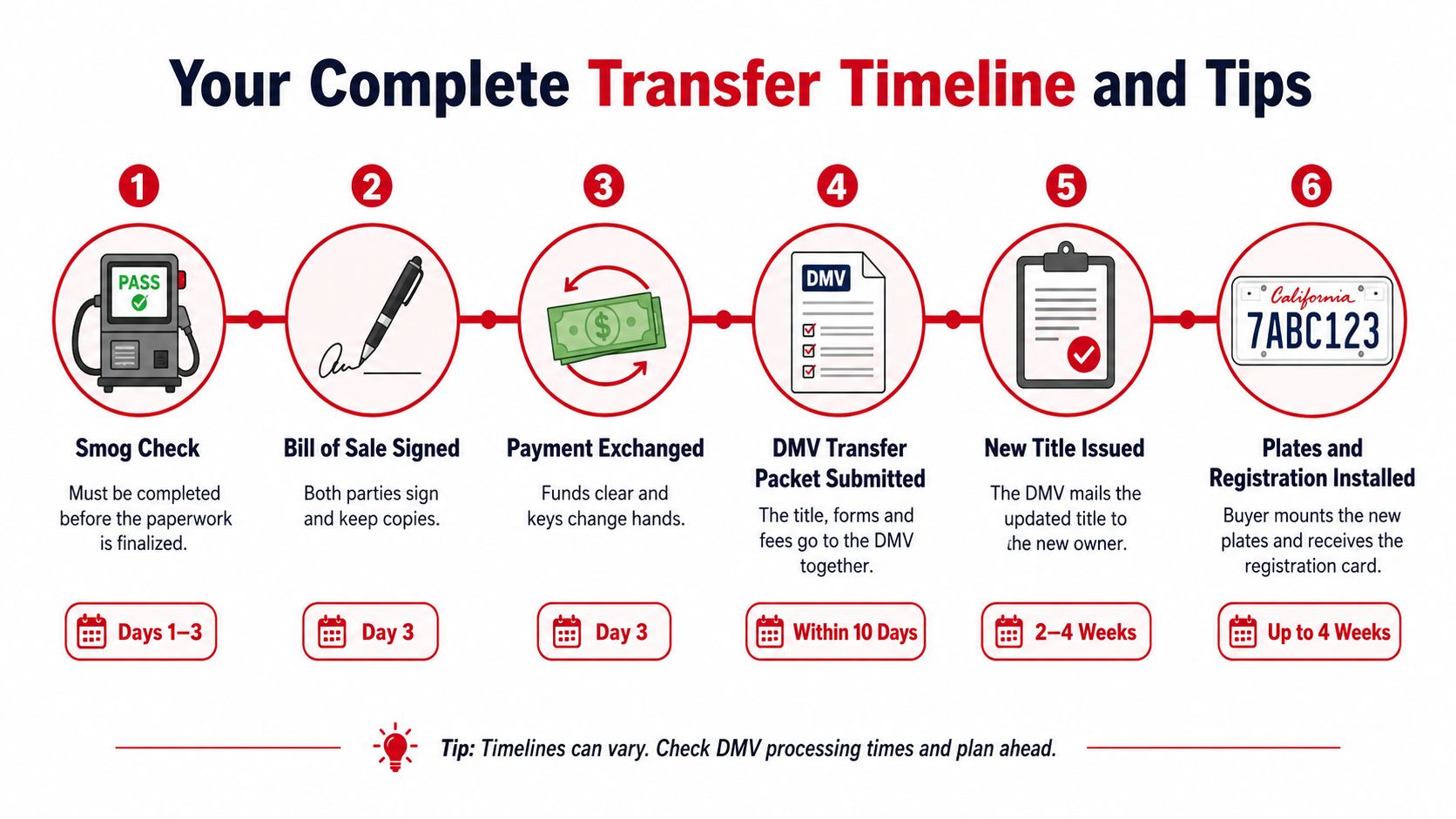
Use a single working sequence
First, inspect the compliance position. Arrange the required smog check and keep the result with the transfer documents. If the vehicle fails, identify the repair and retest path before either party assumes the transfer can be completed.
Second, verify the ownership record. Read the title directly. Confirm the seller's name, VIN, lienholder information, odometer section, and assignment areas. Ask for lien-release documentation before money changes hands if a lender appears on the record.
Third, complete the transaction record. Prepare the bill of sale, sign the title in the correct places, complete the required odometer disclosure, and make copies for both parties. The seller should also complete the appropriate notice of transfer and release of liability.
Fourth, audit the packet. Compare names, addresses, VIN characters, dates, signatures, and mileage across every document. This step is where many avoidable errors can be caught while the seller is still available.
Fifth, submit the transfer. Send the title, required forms, supporting documents, and fees together through the DMV or an authorized registration provider. Keep the receipt or other proof that the packet was accepted.
Finally, monitor the record and registration materials. A new title may be mailed after processing, and plate or registration delivery can depend on the transaction and vehicle history. Don't discard the old paperwork until the new record is confirmed.
An EU analysis illustrates why ownership transfers are operational workflows rather than instant handovers. It estimated about 40 million vehicle ownership transfers per year across the European Union, with around 3.5 million crossing between Member States, or roughly 8% of the total. The same analysis estimated about one week for deregistration, four weeks for re-registration in another Member State, and approximately five weeks for the full cross-border transfer process. These figures are not California processing promises, but they show why cross-border records require more coordination than a local sale. See the European Parliament analysis of vehicle ownership transfers for that broader context.
Reduce return trips
Call ahead when the vehicle is unusual, comes from another state, has a lien history, or may exceed a testing station's equipment limits. Bring the original documents, government identification, payment method, and clear copies, and ask whether the provider can handle the particular ownership scenario before you drive over.
Use a provider that can address both sides of the chain when timing matters. Completing the smog inspection and submitting the DMV packet during the same visit can remove a handoff, but it won't overcome a missing title or unresolved lender interest. The practical goal is not to rush an incomplete file. It's to discover the incomplete part early.
Frequently Asked Questions About Transfers
Does an out-of-state vehicle follow the same process?
Not always. An out-of-state vehicle may require additional verification and records before California can issue the new registration. Bring the out-of-state title, identification, transaction documents, and any available lien information, and confirm the applicable requirements before submission.
What happens if the vehicle fails the smog check?
A failed test means the emissions issue must be addressed before the transfer can proceed where a passing certificate is required. Ask about repair documentation and retest eligibility. Fire House Smog's site policy and coupon terms provide for a free retest when applicable, so confirm the conditions before returning.
What if a lender still appears on the title?
Don't assume the paid loan has already cleared the record. Obtain the lien release or coordinate with the lienholder, then include the correct documentation with the transfer packet. An unresolved lien can prevent the new owner from being recorded.
How can I avoid another DMV trip?
Check the title against the seller's identification, verify the VIN on the vehicle, complete the odometer disclosure, confirm the lien status, arrange the smog inspection, and bring every required form and fee together. If any item is uncertain, resolve it before the appointment rather than submitting a packet that you already suspect is incomplete.
For a connected vehicle ownership transfer service in Antioch, Fire House Smog can perform STAR-certified smog testing and process California or out-of-state ownership transfers through its licensed DMV registration service. Visit Fire House Smog with your title and vehicle documents so the emissions and registration steps can be reviewed together.
You've just bought a used car from a friend, signed what you thought was the right paperwork, and driven home with the keys. Then you discover the title has a missing signature, the smog certificate isn't available, or the seller hasn't filed the release of liability. The car is in your driveway, but the ownership record still belongs to someone else.
Learning how to transfer ownership of a car in California means treating the transaction as a compliance process, not a simple exchange. The buyer, seller, lienholder, and California Department of Motor Vehicles each have specific responsibilities. A small paperwork error can delay the title, leave the seller connected to the vehicle, or force both parties to make another DMV visit.
Table of Contents
- Why the Transfer Process Trips People Up
- Gathering the Required Documents Before You Start
- Completing the Ownership Transfer Step by Step
- Handling Special Cases and Complicated Transfers
- Using a Licensed DMV Registration Service Instead of the DMV Office
- Key Deadlines and Mistakes to Avoid During Your Transfer
Why the Transfer Process Trips People Up
Most private-party sales begin informally. The buyer and seller agree on a price, exchange payment, and sign the certificate of title. That part feels finished. The administrative transfer, however, still requires correctly completed documents, the right supporting records, and prompt filing with the DMV.
California gives the buyer a short window to start the transfer. The buyer must begin the process with the DMV within 10 days of the sale, while the seller's Notice of Transfer and Release of Liability filing is due within 5 days. The California DMV title-transfer guidance explains these deadlines and the consequences of leaving the record unchanged.
The seller's risk doesn't end at the handoff
A seller who hands over the keys but doesn't file the release of liability can remain exposed to vehicle-related issues until the DMV records the transfer. That exposure can become especially frustrating when the buyer delays registration, submits an incomplete title, or discovers a lien that wasn't cleared.
The buyer faces a different problem. Driving a vehicle that hasn't been properly transferred can create registration, insurance, and enforcement complications. The purchase agreement may prove that money changed hands, but it doesn't replace the state's ownership record.
Practical rule: Don't leave the transaction assuming the signed title is the finish line. It's the starting document for the DMV workflow.
Small errors create large delays
Common trouble spots include:
- Wrong signatures: The registered owner must release interest on the title. A lienholder or legal owner may also need to sign.
- Unclear mileage information: The odometer disclosure must be completed where required, using the appropriate transfer documentation.
- Missing title: A buyer can't substitute a handwritten note for a lost certificate of title. California uses specific replacement and transfer forms.
- Unresolved lien: The lienholder's interest must be released before the ownership record can be cleanly updated.
- Out-of-state history: A vehicle coming into California may require additional verification rather than the same process used for a California-titled car.
The safest approach is to identify the vehicle's exact transfer scenario before anyone signs. A standard California private sale is one path. A missing title, estate transfer, or interstate vehicle can change the paperwork and the way the DMV accepts the application.
Gathering the Required Documents Before You Start
Prepare the paperwork before making an appointment, visiting a registration service, or submitting anything online. California transfers are easier when every name, vehicle identification number, date, and signature matches across the documents.
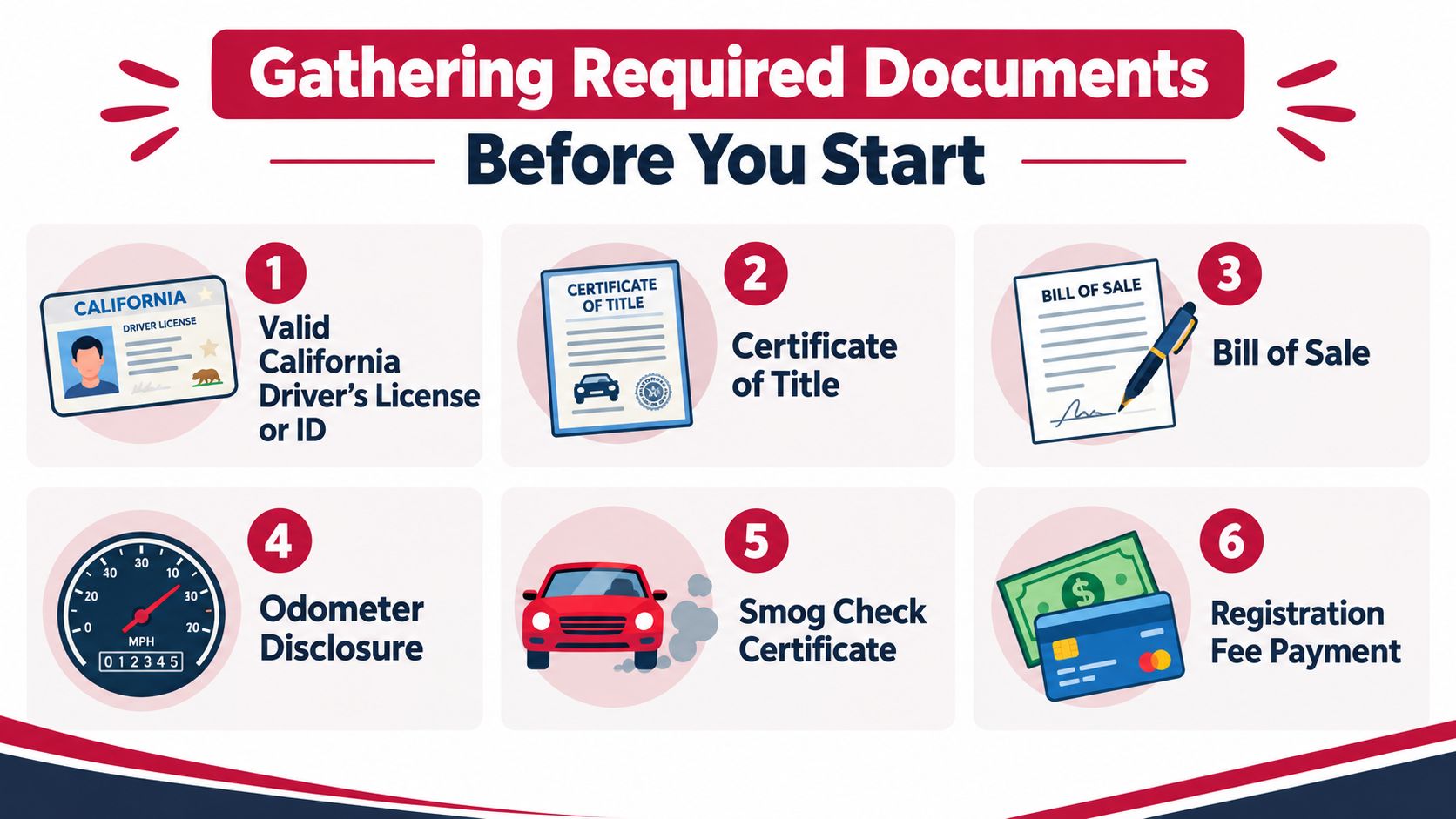
Start with the title and identity documents
The certificate of title is the central ownership document. The seller should review the assignment area carefully, sign exactly as the name appears on the title, and provide the buyer with the completed original. Never guess where a signature belongs. If a legal owner or lienholder appears on the record, that party's release may also be necessary.
The buyer should bring valid identification and verify the vehicle identification number against the car itself, the title, and the registration record. A single character mismatch can cause the DMV or a registration provider to stop the transfer for clarification.
A bill of sale can document the transaction details, even when it isn't the primary ownership instrument. Keep a copy showing the vehicle, buyer, seller, sale date, and transaction terms.
Check mileage, smog, and payment requirements
Odometer information needs careful attention. California uses REG 262, the Vehicle/Vessel Transfer and Reassignment Form, to document odometer mileage in situations where the form is required. Don't erase, overwrite, or casually correct mileage entries. Ask the DMV or a licensed provider how to handle a damaged form instead.
Smog certification is another frequent source of delay. Whether a smog check is required depends on the vehicle and transaction circumstances, so confirm the requirement before submitting the transfer. If certification is needed, complete it before the paperwork is presented.
The buyer also needs to be ready for the applicable transfer fees and taxes. The exact amount depends on the transaction and vehicle record, so use the DMV's fee calculation process or have a licensed registration provider review it.
For a practical document checklist, keep the California vehicle registration documents guide available while assembling your file.
Know what changes when the title is missing
A missing title requires a different route. California uses REG 227 for an Application for Replacement or Transfer of Title when the original title is unavailable, subject to the facts of the case and the signatures required.
A replacement-title transfer can also involve notarization. California DMV procedures state that, for vehicles three model years or older, the legal owner or lienholder signature on certain replacement-title transfers must be notarized. The California DMV basic transfer requirements also describe the registered owner's release, lienholder requirements, and odometer documentation.
Before submission, compare your file against this short checklist:
- Original title or REG 227: Confirm which document applies.
- REG 262 when required: Complete mileage information without alterations.
- Smog documentation: Verify whether the vehicle and transaction require certification.
- Lien release: Obtain the legal owner's release when a lien remains on record.
- Identification and payment: Bring acceptable identification and funds for the calculated charges.
- Copies: Photograph or copy every signed page before handing over originals.
Completing the Ownership Transfer Step by Step
The cleanest transfer follows the transaction order. Handle the seller's signatures first, confirm the vehicle information, then let the buyer submit the ownership application without waiting for paperwork to drift between households.
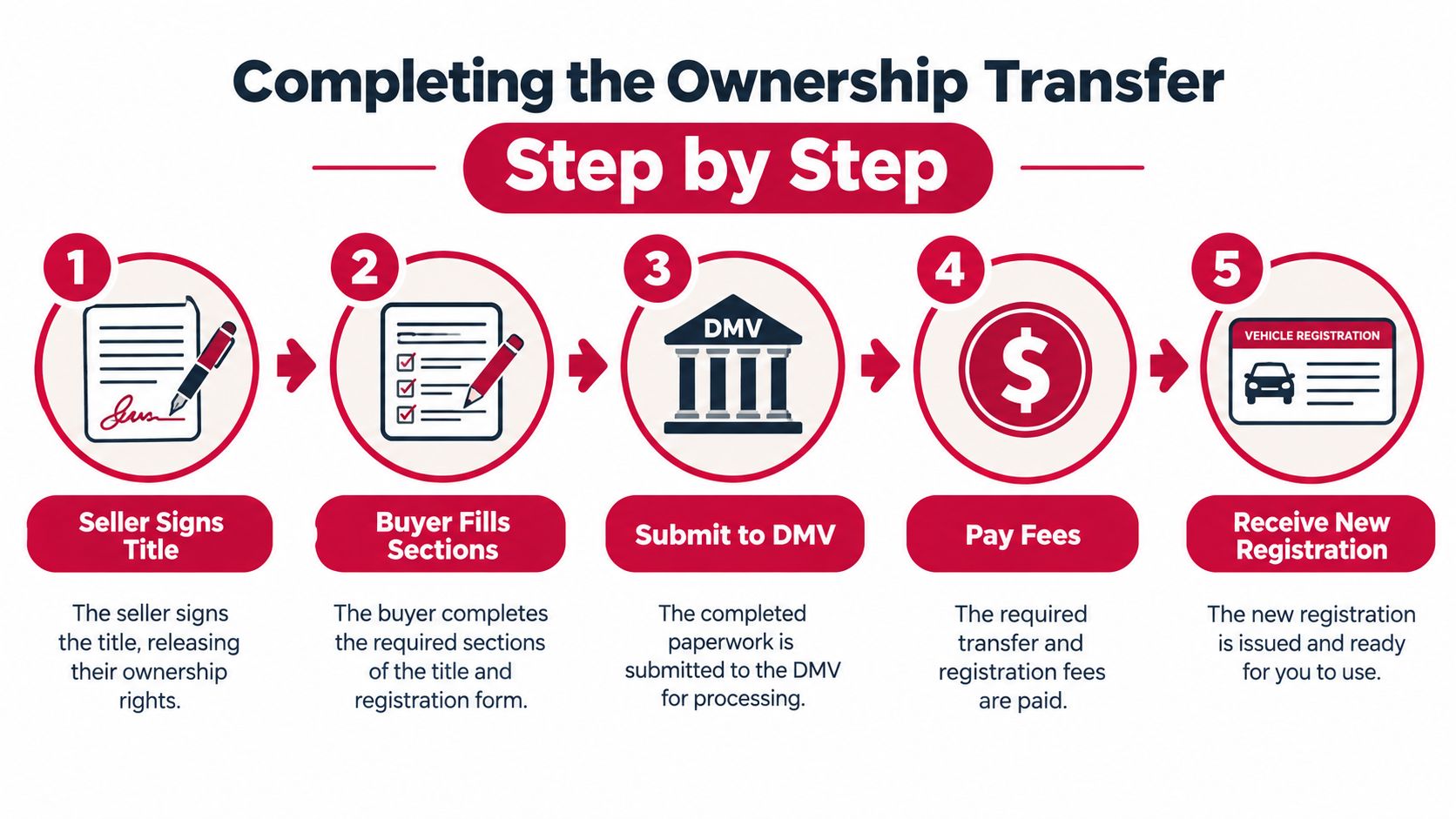
1. The seller completes the assignment
The seller signs the certificate of title in the correct seller section and completes any required sale details. The seller should check the name spelling, vehicle identification number, and sale date before giving the document to the buyer.
If the title includes a lienholder or legal owner, don't assume the buyer can resolve it later. Obtain the required release or confirm the lienholder's role before the transaction is treated as complete.
2. The buyer verifies the application
The buyer checks that the title, bill of sale, odometer disclosure, and supporting forms all identify the same vehicle. Review the VIN on the dashboard or door label, not just the paperwork. If the vehicle information differs, stop and resolve the discrepancy before filing.
The buyer also confirms whether a smog certification is required and whether the vehicle's registration record has unresolved issues. Submitting an incomplete packet can create a request for more documents and delay issuance of the new title.
3. The seller files the release of liability
The seller files the Notice of Transfer and Release of Liability promptly. This filing tells the DMV that the vehicle has changed hands and helps separate the seller from future responsibility while the buyer completes the title transfer.
The release of liability doesn't transfer ownership by itself. It protects the seller's position, while the buyer's title and registration application updates the official ownership record.
4. The buyer submits and pays
The buyer submits the transfer documents through the available DMV channel or through a licensed registration service that handles the transaction. Pay the calculated transfer fees, registration charges, and applicable taxes through the accepted payment method.
At a DMV office, bring the complete original packet and be prepared for the clerk to review each document. A registration service can review the file before submission, which is useful when the title is old, the transaction includes a lien release, or the vehicle's history isn't straightforward.
Keep copies of the signed title, forms, receipts, and release filings. These records give both parties a paper trail if the DMV later requests clarification.
A visual walkthrough can help first-time buyers understand the sequence:
5. The buyer confirms the result
The transfer isn't finished merely because documents were accepted at a counter. Confirm that the buyer receives the updated registration record, stickers, plates, or other issued items applicable to the vehicle.
If the DMV or service provider gives a receipt or temporary evidence of submission, store it with the transaction file. Follow up if the title or registration doesn't arrive as expected, and respond quickly to any request for a corrected form.
Handling Special Cases and Complicated Transfers
A generic private-sale checklist breaks down when the vehicle comes from another state, the owner has died, or the original title is unavailable. These situations require a decision based on the record, not a guess based on what worked for a friend's car.
Out-of-state vehicles
An out-of-state vehicle may need more than a signed title. California can require additional registration, identification, inspection, emissions, or ownership documentation depending on the vehicle's history and the state that issued the title.
Start by collecting the out-of-state title, current registration information, sale records, lien release, and identification. Don't wait until the California counter visit to discover that the seller's signature format or lien status requires another document.
For a focused review of the interstate process, see this guide to out-of-state title transfers.
Inherited and deceased-owner vehicles
An inherited vehicle isn't handled like an ordinary buyer-seller sale. The person authorized to act for the estate may need to provide death documentation, probate or estate paperwork, a properly assigned title, and forms that establish authority to transfer the vehicle.
Government guidance for ownership transfers, including New Jersey's deceased-owner and estate transfer procedures, illustrates the broader point: estate cases carry extra rules, document requirements, and appointment or notarization issues. California applicants should confirm the current California requirements for the specific estate status instead of relying on a standard bill of sale.
The practical decision tree is straightforward:
- Named transfer authority exists: Use the title and estate documents that establish the authorized person's role.
- Probate is open: Confirm what the executor or administrator may sign and whether court documentation is required.
- No clear authority exists: Don't sign as the owner. Resolve the estate authority before presenting the transfer.
- Title is missing: Ask which replacement-title and estate forms must be filed together.
Family transfers and missing titles
A family relationship doesn't automatically remove title requirements. Gift, inheritance, and family transactions can have different tax treatment and documentation rules, so describe the transaction accurately and confirm the applicable forms.
A missing or damaged title should trigger a document review before submission. Use the applicable replacement or transfer form, identify any lienholder, and make sure every required signature is completed in the proper place.
Digital transfer systems can reduce routine paperwork, but online convenience stops when the record contains unresolved fines, insurance issues, lien questions, identity mismatches, deceased-owner status, or interstate registration changes. India's official ownership-transfer information shows how requirements can vary by transaction and jurisdiction, while Singapore and Ireland demonstrate that some markets support online ownership changes with exceptions. The lesson for California owners is practical: use digital tools for eligible routine cases, but switch to a direct DMV or licensed-provider review when the record is complicated.
Using a Licensed DMV Registration Service Instead of the DMV Office
A California DMV office remains the direct government channel, but eligible registration transactions can also go through a licensed provider. A provider may review the documents, calculate charges, submit the transfer, and issue available registration items under its authorized services. For owners comparing licensed DMV registration services in California, the main question is whether the case needs a government decision or careful administrative handling.
The trade-off comes down to who needs to make the decision. The DMV is the right route for disputed ownership, unclear estate authority, unusual legal questions, or record issues that only the agency can resolve. A licensed provider may save time on routine transfers, missing-document guidance, California and out-of-state vehicle paperwork, and transactions handled by owners who cannot spend hours waiting at a branch.
Compare the two routes
| DMV office | Licensed registration service |
|---|---|
| Direct government counter for complex record issues | Local document review before submission |
| Appropriate when the DMV must resolve a legal or record question | Useful for eligible ownership transfers and registration tasks |
| May require planning around office access and availability | May offer broader local hours and on-site issuance |
| Government fees still apply | Service charges may apply in addition to government fees |
A provider does not remove a required lien release, estate document, smog inspection, or corrected signature. It cannot approve a transfer that California law or the vehicle record does not permit. Its practical value is different: an experienced reviewer can catch preventable errors and handle eligible paperwork without requiring a branch visit for every routine task.
When local processing makes sense
Fire House Smog is a licensed California DMV registration services provider in Antioch. Its listed services include ownership transfers for California and out-of-state vehicles, registration renewals, and on-site sticker and plate issuance when applicable. It also operates a STAR-certified test-only smog station, allowing owners who need emissions certification to address that requirement at the same location, subject to the vehicle and service details.
Fire House Smog lists DMV service hours from Monday through Saturday, with Sunday service available for limited transactions. Smog testing is available throughout the week. Confirm current hours, required documents, and whether the specific transfer can be completed before visiting.
Use the DMV directly when ownership is contested or legally unclear. Choose a licensed provider when the transfer is eligible, the documents are ready for review, and reducing administrative time matters more than completing every step personally.
Key Deadlines and Mistakes to Avoid During Your Transfer
The deadlines are the part to write down immediately. The buyer must start the California transfer with the DMV within 10 days of the sale, and the seller must file the release of liability within 5 days, as stated in California DMV title-transfer guidance.
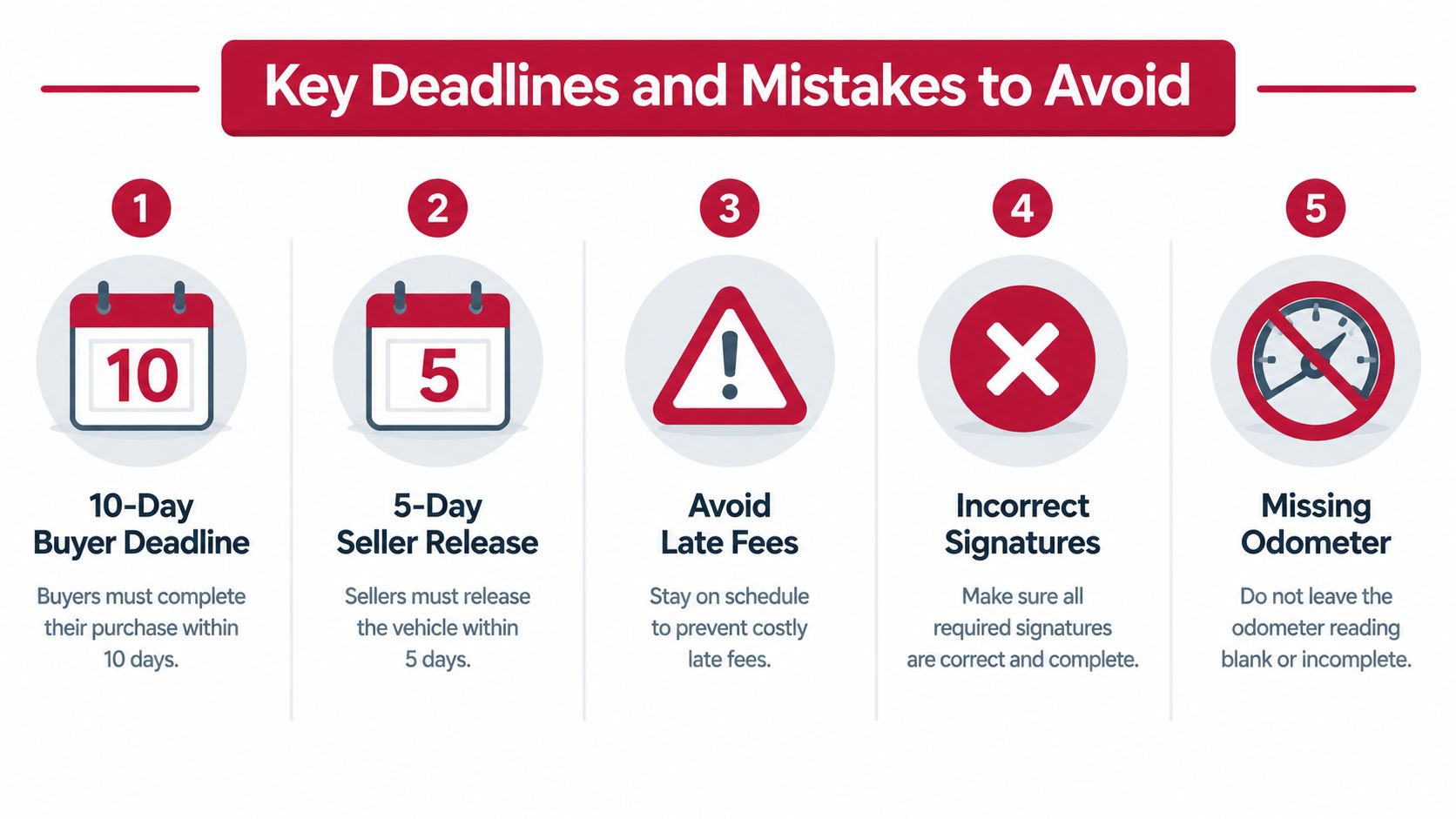
Use this final check before submitting:
- Buyer deadline: Start the transfer promptly and keep the receipt.
- Seller protection: File the release of liability within the required window.
- Title signatures: Match names and sign only in the correct fields.
- Odometer record: Complete the required mileage disclosure without alterations.
- Special cases: Stop and get document guidance for liens, estates, missing titles, and out-of-state vehicles.
A licensed registration service can help review eligible paperwork, but it can't replace missing legal authority or an unresolved lien.
If your California ownership transfer involves a missing title, an out-of-state vehicle, smog certification, or registration issuance, visit Fire House Smog in Antioch for licensed DMV registration services and STAR-certified smog testing. Bring your title and supporting documents so the staff can identify missing requirements before submission.
You just bought the work van, the pickup, or the service truck, and now it's sitting in the lot with temporary paperwork while your crew is asking when it can start paying for itself. The DMV line doesn't care that you've got jobs to finish, invoices to send, or tools already loaded in the back. What matters is getting business vehicle registration done correctly, with the right documents, the right fees, and no repeat trip because one piece of paperwork was missing.
That's where most owners lose time. The registration process looks simple until you realize the vehicle may need commercial handling, smog paperwork, insurance that matches business use, and a form package that has to be accepted the first time. If you handle fleets, vans, light trucks, or a single company car, the difference between an easy filing and a rejected filing is usually preparation, not luck.
Table of Contents
- Getting Your Business on the Road Without the Hassle
- Does Your Vehicle Need Commercial Registration
- Your Document and Smog Check Checklist
- Navigating the California Registration Forms and Process
- Estimating Your Business Vehicle Registration Fees
- Skip the DMV Lines A Smarter Way to Register
Getting Your Business on the Road Without the Hassle
A contractor picks up a new service van on Friday, then spends Monday calling around because the registration packet isn't ready. A field manager has the title in one folder, insurance in another, and no clear answer on whether the vehicle has to be treated like a commercial unit. That is the core problem with business vehicle registration, the vehicle is ready, but the paperwork isn't.

The fastest path is not guessing at the DMV counter. It starts with classifying the vehicle correctly, lining up the ownership and insurance pieces, and making sure the emissions paperwork is already in hand before anyone submits the packet. From a DMV service partner's point of view, that early sorting is what saves the most time, because rejected filings usually come back with the same missing details.
Practical rule: If you are still sorting out whether the vehicle is personal, mixed-use, or fully tied to the company, stop and classify it first. Rework after a rejection always costs more time than a careful first submission.
For small businesses, the registration step is more than administrative. A sloppy filing can turn into a delay that pulls a vehicle out of service, ties up a driver, and forces someone to spend another day fixing paperwork instead of working. Clean submissions avoid that repeat work.
The practical goal is simple, get the vehicle legal without losing a day to avoidable mistakes. Treat the process like an operations checklist, not a one-time paperwork sprint, and the registration is easier to finish without surprises.
Does Your Vehicle Need Commercial Registration
The first mistake owners make is assuming that any car with a logo on the door automatically counts as a business vehicle, or that putting a vehicle in a company name makes the process easier. In practice, the classification depends on how the vehicle is used, how it's titled, and what documents the DMV or related agencies want to see. Generic advice usually skips that part, which is why owners end up with the wrong filing path.
A good test is to ask three questions. Who owns the vehicle on paper. How is it used day to day. What proof does the registering authority want before it accepts the registration. For some vehicles, the answer points to standard business handling. For others, it points to more formal commercial treatment.
Ownership and use don't mean the same thing
A vehicle can be used for work without being titled in a company name, and a vehicle can be titled to a business entity without being as simple as a personal car to register. That's where the paperwork gets messy. The source material is clear that requirements can vary by legal entity, vehicle type, and jurisdiction, and often call for business credentials such as an EIN, proof of ownership, and specific insurance before registration is accepted business vehicle registration guidance.
That means mixed-use vehicles need extra care. If a pickup is driven to job sites during the week and used personally on weekends, the owner still needs to understand how the registration and insurance records line up. The DMV doesn't care about convenience, it cares about whether the file matches the stated use.
What usually triggers the commercial path
Commercial treatment often comes up when the vehicle is clearly a work asset, especially when it's tied to a business entity or equipped for service use. Permanent tool racks, trade equipment, and company branding can all point toward a business file that should be handled differently than a private sedan. The key is not the decoration, it's the operational use and the documentation trail.
If the vehicle is doing business work every week, build the registration around that reality instead of trying to make a personal template fit.
The safest move is to classify the vehicle before you gather forms. That prevents the classic mistake of filing as if it were personal, then discovering later that the insurance, title, or supporting documents don't match the business use. It also keeps you from paying for a filing that has to be corrected later.
Your Document and Smog Check Checklist
A clean registration packet starts before you ever touch a DMV form. If one document is missing, the file can stall, and in California that often means the emissions piece becomes the blocker. The fastest way to handle business vehicle registration is to gather the ownership record, business proof, insurance, and smog paperwork together before submission.
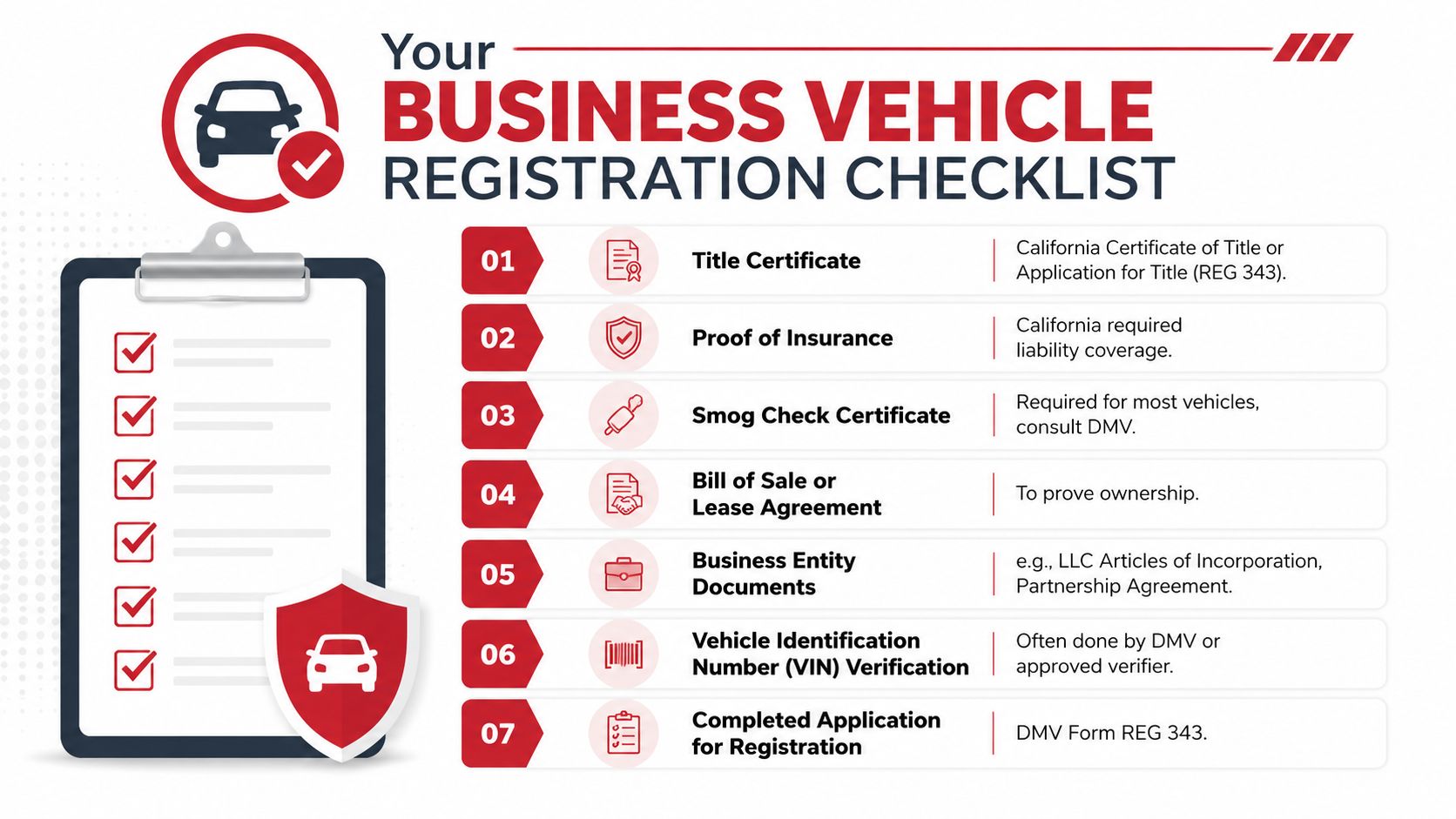
A solid packet usually includes the title or the out-of-state equivalent, a bill of sale or lease agreement if ownership changed, business entity documents, proof of insurance, and the completed registration application. California's smog rules matter here because proof of a passed inspection is part of the registration process for most vehicles, and smog checks are typically required every other year for vehicles that are at least six years old California Senate Transportation Committee fact sheet.
What to put in the folder first
- Title or ownership record: Bring the California Certificate of Title, or the correct out-of-state ownership document if the vehicle just came in from elsewhere.
- Business entity proof: Keep LLC, corporation, partnership, or other formation documents ready when the vehicle is titled to the company.
- Insurance matching business use: The policy needs to reflect commercial or business use, not just a personal driver profile.
- Bill of sale or lease papers: These help prove how the vehicle was acquired and who has the right to register it.
- Completed DMV application: Fill it out before the appointment so you're not guessing at the counter.
The internal document list for this workflow is available at Fire House Smog's registration document checklist, which is useful if you're trying to avoid missing a basic supporting item.
Where smog check problems usually happen
The most common failure point is timing. Owners often assume they can submit the registration first and fix emissions later, but that does not work smoothly in California. Smog inspection belongs in the initial packet, and missing emissions paperwork is a frequent reason for rejection.
That is why a test-only smog station matters. You want a place that can inspect, certify, and help close the loop without pushing you into a separate repair conversation. For a business owner, every extra stop means more downtime.
Navigating the California Registration Forms and Process
Once the paperwork is in hand, precision matters. The file has to match the vehicle, the owner, and the business entity, or the DMV will usually send it back for correction. For business vehicle registration, every document needs to tell the same story from start to finish.
Start by confirming business use, then gather ownership records and business documents, get the right insurance, complete the DMV forms, and submit the packet in that order. That sequence saves time because the state wants the paperwork to line up before it accepts the registration. It also keeps emissions paperwork in the initial submission instead of forcing a second round of corrections.
The form fields that deserve extra attention
The Application for Title or Registration, often handled as REG 343 in California workflows, needs a line-by-line review before it goes in. Names, entity type, mailing address, and vehicle details should match the title, the insurance record, and the supporting business documents. If the vehicle is owned by an LLC or corporation, use the exact company name on every page.
Small mismatches create big delays. If the title names one legal entity and the insurance certificate names another, the file can stall while someone sorts out the difference. That is time lost at the counter, and it is usually avoidable.
How title ownership affects the filing
A sole proprietor, LLC, corporation, or partnership can each create a different paper trail. The vehicle may be used for the same work, but the registering authority still cares about who legally owns it and who can act for that owner. The entity paperwork is part of showing that the business has the right to register the vehicle.
Practical rule: Use the exact legal name from the entity documents everywhere the DMV asks for the owner's name. Informal shortcuts lead to corrections.
If you are handling more than one vehicle, standardize the packet. Use the same naming convention, the same insurance format, and the same checklist for each unit. That makes later renewals easier, because the business does not have to relearn the process every time a new truck is added.
For owners who would rather not spend a morning fixing form errors, a service partner such as Fire House Smog can handle DMV registration tasks along with related emissions work in one place. If you are also planning for renewals, the registration renewal fee guide is useful for understanding what usually comes up again later.
Estimating Your Business Vehicle Registration Fees
The first question for many owners is cost, and it should be. Registration is part of the ongoing expense of keeping a company vehicle legal, not a one-time formality. California DMV statistics show that the average vehicle license fee was $89 per vehicle and the average total fee paid per vehicle registration was $261 in the 2019 publication, which makes the expense easier to treat as a recurring operating cost rather than a small filing charge California DMV statistics publication.
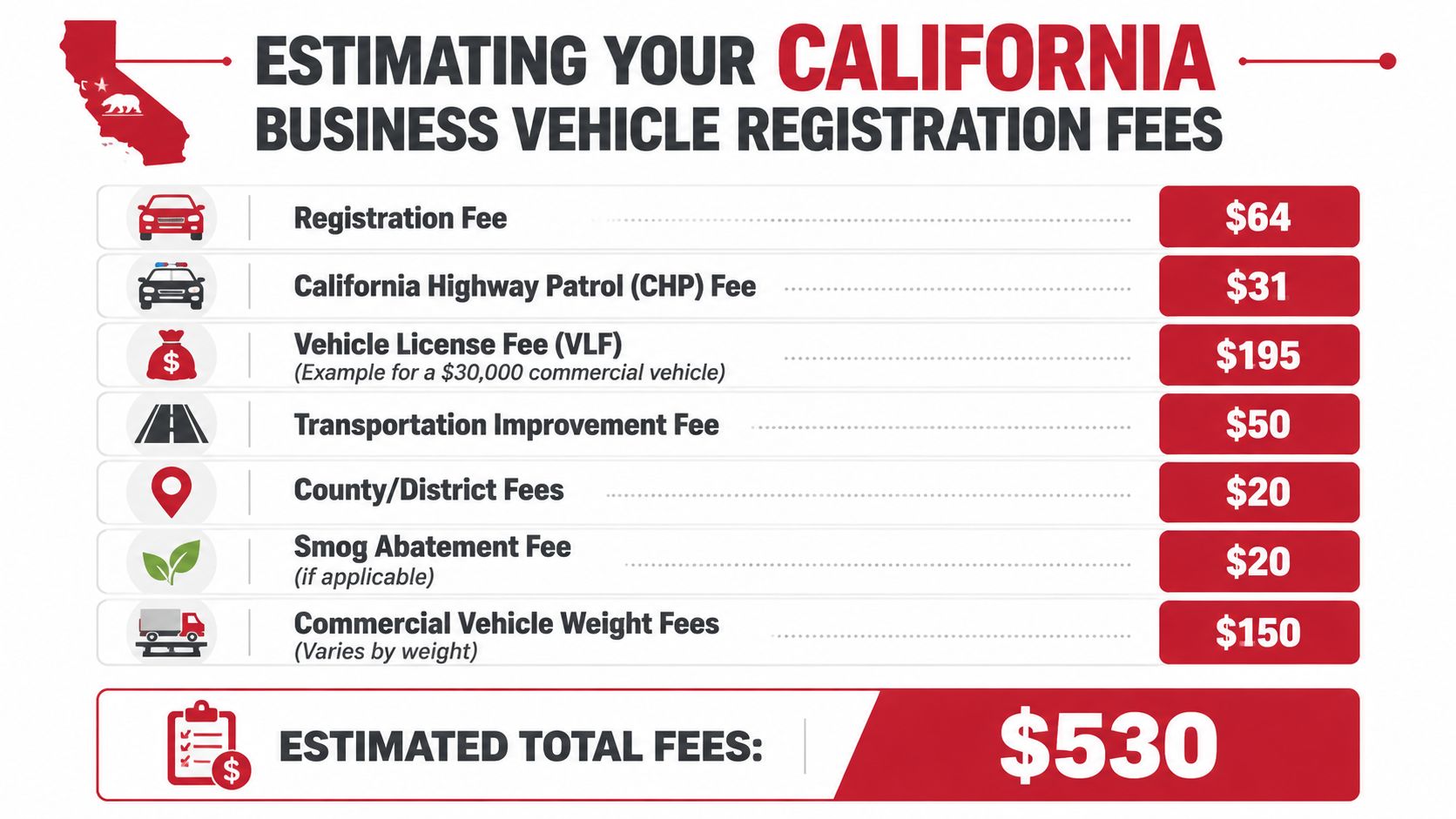
The total can change based on the vehicle type, whether it is commercial, how it is weighted, and which county or district charges apply. That is why one fleet vehicle may cost differently from another even when the paperwork looks similar. A light-duty service van and a passenger car do not always follow the same fee path.
What you're actually paying for
A registration bill is usually a stack of separate charges, not a single flat amount. Some fees cover the base registration, some relate to state administration, and some reflect vehicle value or use. Commercial vehicles can also bring in weight-related charges, which is where many owners get surprised.
The practical way to read the bill is this. Part of it is identity, part of it is compliance, and part of it is vehicle classification. If the vehicle is treated as a business asset, that classification can affect the final number more than people expect.
Why renewal timing matters
California's recurring registration cycle means the cost shows up again and again, not just when you buy the vehicle. The registration-renewal resource at Fire House Smog's registration renewal fee guidance is useful when you are planning ahead, because renewals are where budget mistakes usually pile up.
Budgeting advice: Don't price the vehicle only at purchase. Price the vehicle as an annual compliance line item, then keep the renewal date on the calendar from day one.
For a business, that is the better accounting approach. It makes cash flow easier to forecast, and it keeps a late renewal from turning into a work stoppage. If the vehicle is needed for revenue, the registration bill is really a continuity expense.
Skip the DMV Lines A Smarter Way to Register
A DMV office can take a whole morning, and if one piece of your packet is wrong, you may be back again. That's the hidden cost for small businesses, not just the fee itself, but the labor lost waiting, resubmitting, and rearranging routes. If your vehicle is needed for customers, that downtime hits harder than the paperwork line item.
A licensed DMV partner changes the workflow. Instead of sending one person to the DMV, another to a smog station, and a third person to chase forms, you can use a single stop for emissions and registration support where eligible. The goal is less back-and-forth, fewer corrections, and faster release of the vehicle back to work.
The operational advantage is simple. A business gets guidance from someone who handles registration files regularly, which lowers the chance of avoidable errors. It also helps when the vehicle needs on-site tag issuance or when the owner wants the registration handled without building an internal admin process around one truck.
If you want a local option that combines DMV registration services with smog testing, the service details at DMV registration services near me are worth checking before you plan a trip. That kind of setup is especially useful for owners who'd rather keep staff on job sites than in waiting rooms.
For most businesses, the best choice isn't “do it yourself or never do it at all.” It's choosing the path that gets the vehicle legal with the fewest mistakes and the least interruption. If that means handing the packet to a licensed partner, that's often the more efficient business decision.
A CTA for Fire House Smog. If you need help with California business vehicle registration, smog certification, or DMV paperwork for a work vehicle, contact Fire House Smog in Antioch and get the process handled in one visit instead of spending your day bouncing between offices.