
A California vehicle ownership transfer typically requires a smog certificate, a signed title, and payment of transfer fees, and one missing or incomplete document can stall the application. In Texas, 6,432,879 vehicle titles were processed in fiscal year 2018, showing how often ownership changes depend on accurate paperwork rather than a simple exchange of keys.
You may be standing beside a newly purchased car with the payment complete, the keys in hand, and a title that looks almost finished. Then someone notices the seller missed a signature, the lien release isn't attached, or the smog requirement hasn't been satisfied. The sale feels complete, but the legal transfer isn't.
California treats smog compliance and DMV paperwork as connected parts of the same ownership chain. A vehicle can pass the emissions inspection and still be rejected because the title is incomplete. It can also have a properly signed title but remain stalled because the required smog documentation is missing or the vehicle doesn't meet emissions requirements.
That distinction matters because the fastest transfer is not always the one with the fewest steps. It's the one where each dependency is checked before the packet reaches the DMV. The following process reflects what tends to work in practice for California buyers and sellers, including people transferring vehicles from another state.
Table of Contents
- Navigating the California Transfer Process
- Essential Documents for a Successful Transfer
- Why Professional Smog and DMV Services Matter
- Common Errors That Delay Your Transfer
- Your Complete Transfer Timeline and Tips
- Frequently Asked Questions About Transfers
Navigating the California Transfer Process
A buyer and seller can agree on a price in minutes, but the ownership record changes only after the required chain of documents, signatures, fees, and compliance steps is complete. California DMV guidance identifies the Certificate of Title, required signatures, transfer fees, odometer information, and supporting forms as central parts of the process. The California DMV title transfer guidance also explains what to do when the original title is missing or a lien affects the record.
Follow the document chain
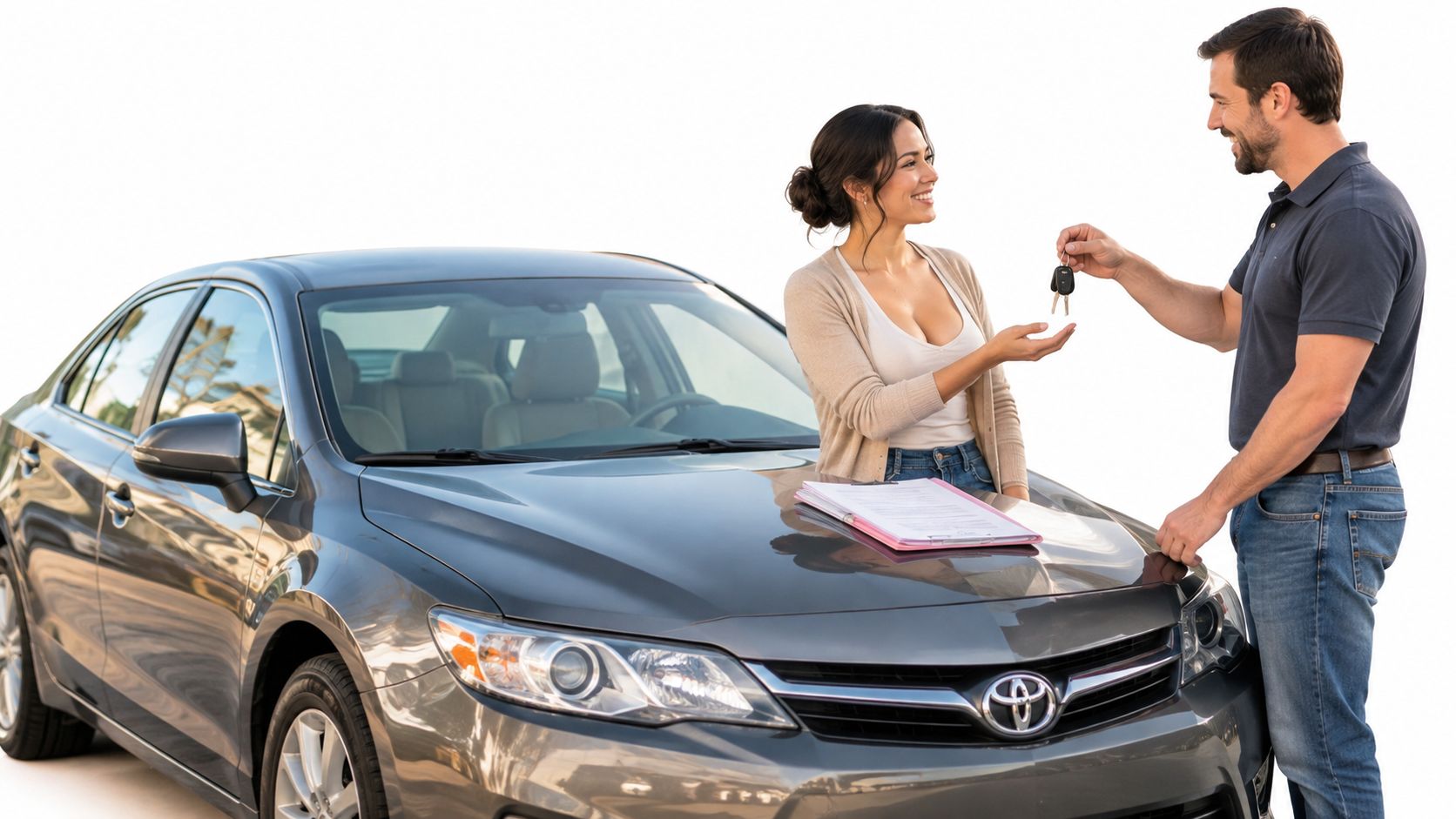
Start by identifying the vehicle and confirming that the seller's name on the title matches the seller's identification. Next, check whether a lien is listed and verify that the lienholder has released its interest. The seller and buyer then complete the title, including the odometer disclosure when required, and prepare any supporting forms for the specific situation.
The smog step belongs in this preparation, not as an afterthought. If the vehicle requires a smog certificate, arrange the inspection before finalizing the DMV packet. A failed or incomplete emissions record can hold up the transfer even when every signature is correct, while a successful test doesn't correct a missing lien release or an incorrectly completed title.
Practical rule: Treat the smog certificate, title, identity documents, and fee payment as one packet. If one part is unresolved, the transfer is not ready.
The final stage is submission to the DMV or an authorized registration provider. Once the transfer is accepted, the registration record and title can be updated according to the agency's process. For an out-of-state vehicle, expect additional verification and documentation rather than assuming a California title transfer follows the same path as an in-state vehicle.
California's process is therefore best understood as a sequence: establish ownership, confirm emissions compliance, complete the title and disclosures, resolve liens, submit the forms and fees, and retain proof of submission. Skipping ahead creates the delays that buyers often mistake for a DMV processing problem.
Essential Documents for a Successful Transfer
A clean transfer begins with document control. California DMV requirements can change depending on whether the title is available, a lien exists, the vehicle comes from another state, or an ownership detail needs correction. The core packet should be assembled before either party signs, because a signature on the wrong line can be harder to correct than a missing form.
Build the packet before signing
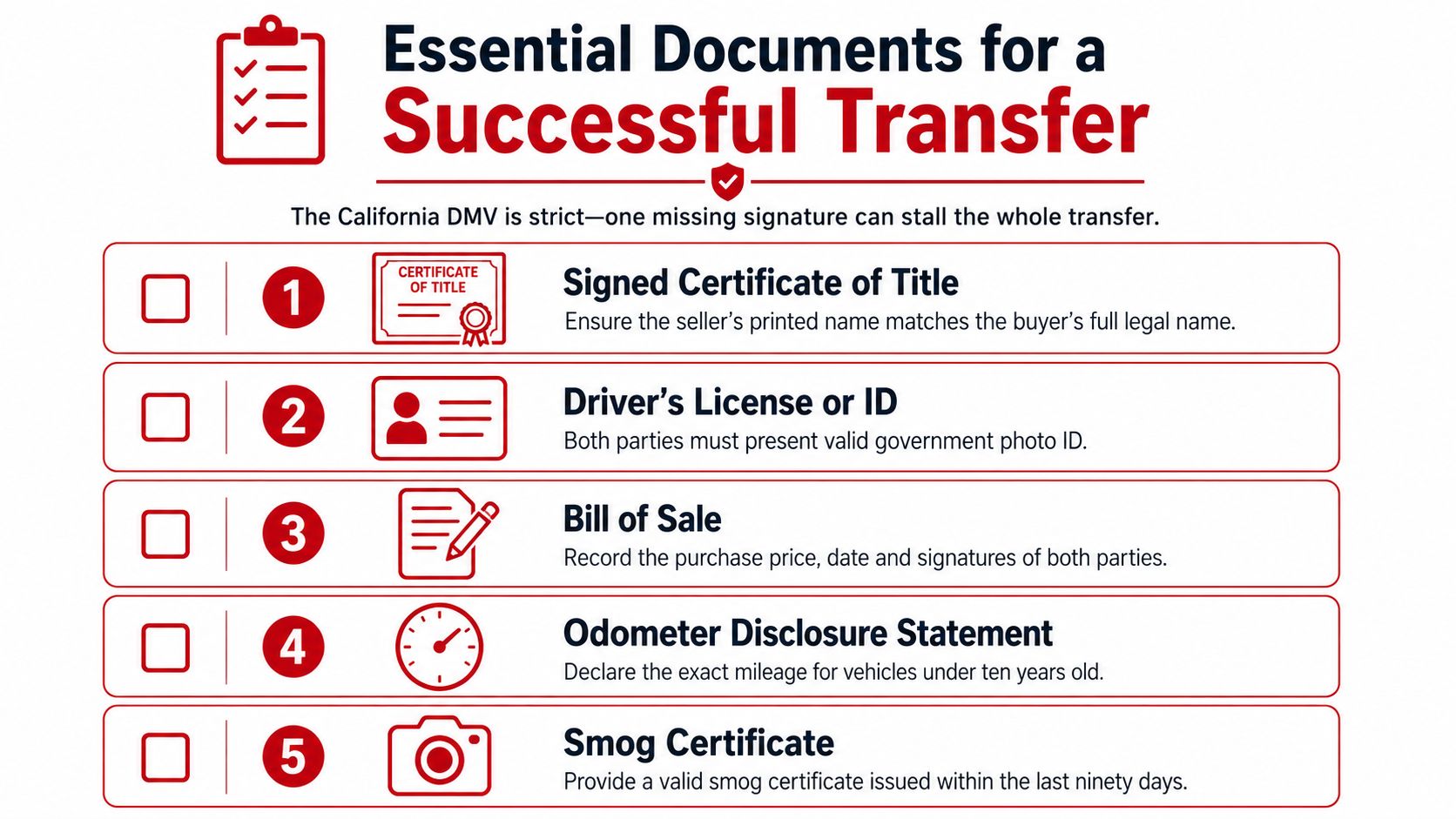
Certificate of Title: Use the original title when available. The seller must sign in the correct assignment area, and the buyer's legal name and address must be entered accurately. Don't use cross-outs or correction fluid. If the title is lost, the transfer may need to begin with a replacement-or-transfer application.
Identification: Both parties should have valid government-issued identification available. The names used on the title and forms need to correspond with the identifying documents. A casual abbreviation or an old address can trigger a correction request.
Bill of sale: Keep a written record showing the parties, vehicle details, transaction date, purchase price, and signatures. It supports the transaction record and gives both sides evidence of what they agreed to exchange.
Odometer disclosure: Record the mileage exactly as required, using complete numeric information rather than an estimate. An incomplete or inconsistent disclosure is one of the most common reasons a title packet comes back for correction.
Smog certificate: Provide the required California emissions documentation for the vehicle and transaction. The smog result is not a substitute for a title, and a signed title doesn't substitute for emissions compliance.
Resolve liens before submission
A lien is an ownership issue, not merely a financing detail. If a lender still appears on the title, the seller needs documentation showing that the obligation was satisfied or the lienholder must participate in the transfer. Buyers should inspect this before paying, because an unresolved lien can prevent the DMV from recording the new owner.
Supporting paperwork may include REG 227, REG 262, REG 256, REG 166, and the Notice of Transfer and Release of Liability, depending on the circumstances. Don't add forms randomly. Use the form that matches the missing title, odometer disclosure, lien, exemption, or liability situation, and confirm the current requirement before submission.
A useful California title transfer paperwork checklist can help you compare the documents you have with the documents your transaction requires. The purpose isn't to create a thicker file. It's to submit a complete, internally consistent file the first time.
Why Professional Smog and DMV Services Matter
The DIY route can work when the title is clean, the vehicle passes its emissions inspection, both parties are available, and the buyer understands which forms apply. Its weakness is fragmentation. The owner may visit one location for smog testing, another for DMV work, and then discover that a missing signature or lien document requires a return trip.
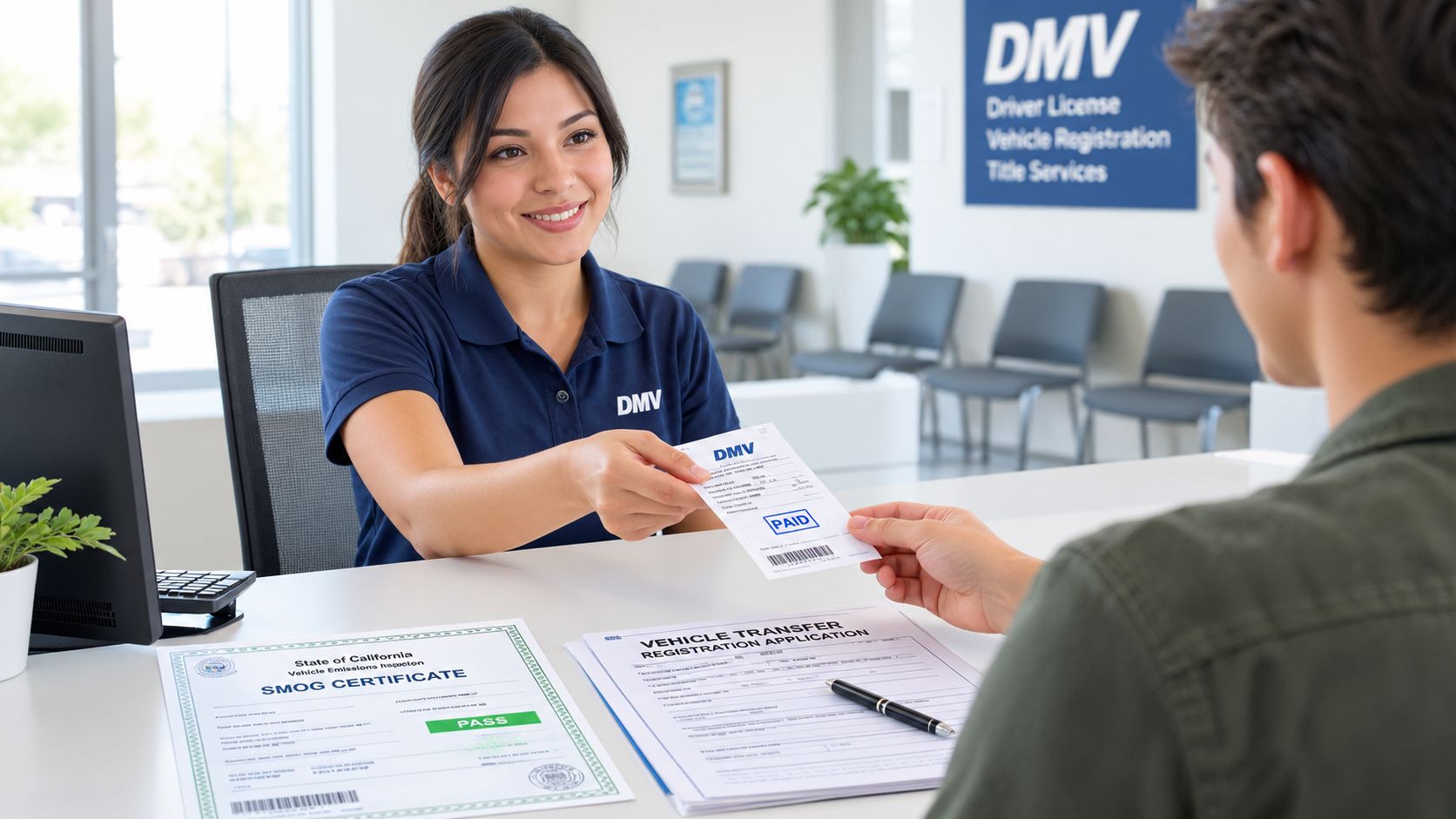
A combined service changes the handoff between compliance and registration. A provider can identify whether the emissions step is complete before accepting the transfer packet, then check whether the title and supporting forms are ready for processing. That doesn't guarantee approval when a lender, out-of-state record, or ownership dispute requires separate action, but it reduces avoidable gaps between steps.
Compare the two routes
| DIY handling | Integrated service |
|---|---|
| You coordinate the smog inspection and DMV submission separately. | The emissions and registration steps can be reviewed as one workflow. |
| You remain responsible for spotting missing signatures, lien documents, and forms. | Staff can help identify apparent paperwork gaps before submission. |
| Registration materials may require a later pickup or mailing step. | An authorized provider may offer on-site registration services and tag printing. |
| A failed smog result becomes a separate problem to diagnose. | The test result can be discussed before the transfer packet is finalized. |
The trade-off is control versus convenience. DIY processing may suit someone who is comfortable reading DMV instructions and correcting paperwork. A licensed partner is more useful when the vehicle is out of state, the title has a lien history, the buyer and seller have limited availability, or a failed smog test has created uncertainty.
Fire House Smog operates as a STAR-certified test-only station and licensed DMV registration partner at 2900 Lone Tree Way in Antioch. It offers on-site California DMV renewals with sticker printing, ownership transfers for California and out-of-state vehicles, and two service bays designed to reduce wait times during posted hours.
Because it is test-only, repairs aren't sold as part of the inspection. If the vehicle fails, the next decision is repair and retest, not an automatic repair purchase at the testing location. The California smog check and registration service is therefore most useful when you want the emissions result and registration paperwork evaluated within the same local workflow.
A professional service can't replace a lender's release or a seller's missing signature. It can help you discover those problems before you build your schedule around an incomplete transfer.
Common Errors That Delay Your Transfer
The most frustrating delays often begin with a document that looks finished. A seller signs the title, but not in the assigned seller field. A buyer writes a shortened name that doesn't match the identification record. Someone copies the VIN from memory instead of reading it directly from the title or vehicle.
Consider a typical failed handoff. The buyer and seller complete the sale, but the title contains one wrong VIN character and the odometer section is incomplete. The DMV can't confidently connect the document to the vehicle or accept the disclosure, so the packet returns for correction. The buyer must locate the seller again, correct the title properly, and resubmit.
Check the points most likely to stop the file
Seller signatures: Compare the title's signature lines with the printed ownership name. A missing or misplaced signature can stop the transfer even when the buyer has paid and taken possession.
Odometer disclosure: Enter the exact mileage in the required format. Don't guess, round, overwrite, or leave a field blank because the vehicle's condition seems obvious.
Lien release: Look for the lienholder information before the transaction closes. A paid loan doesn't automatically mean the title record is already clear.
Names and addresses: Use the legal names and current addresses required for the record. Small inconsistencies can generate a correction request.
VIN: Match the VIN on the title, vehicle, forms, and supporting documents character by character. A VIN discrepancy deserves investigation before submission, not an assumption that the DMV will fix it.
Independent title-transfer guidance identifies missing signatures, odometer problems, unreleased liens, name and address errors, and VIN mismatches as recurring rejection triggers. The title transfer error guide also warns about open titles and title jumping, practices that can leave the record without a valid documented chain of ownership.
Title jumping is especially risky because it attempts to pass a vehicle through an intermediary without recording the intermediary's ownership properly. The result can be a legal and registration dead end rather than a shortcut.
Smog creates another version of the same problem. A vehicle may fail because of emissions-related conditions, or the certificate may be absent when the transfer requires it. Use the common smog check failure reasons to understand what needs attention before treating a failed result as a paperwork issue.
Your Complete Transfer Timeline and Tips
A transfer moves fastest when the owner treats it as a controlled sequence rather than a collection of errands. The first task is not signing the title. It's confirming that the vehicle, seller, lien status, smog requirement, and supporting documents can all be reconciled.
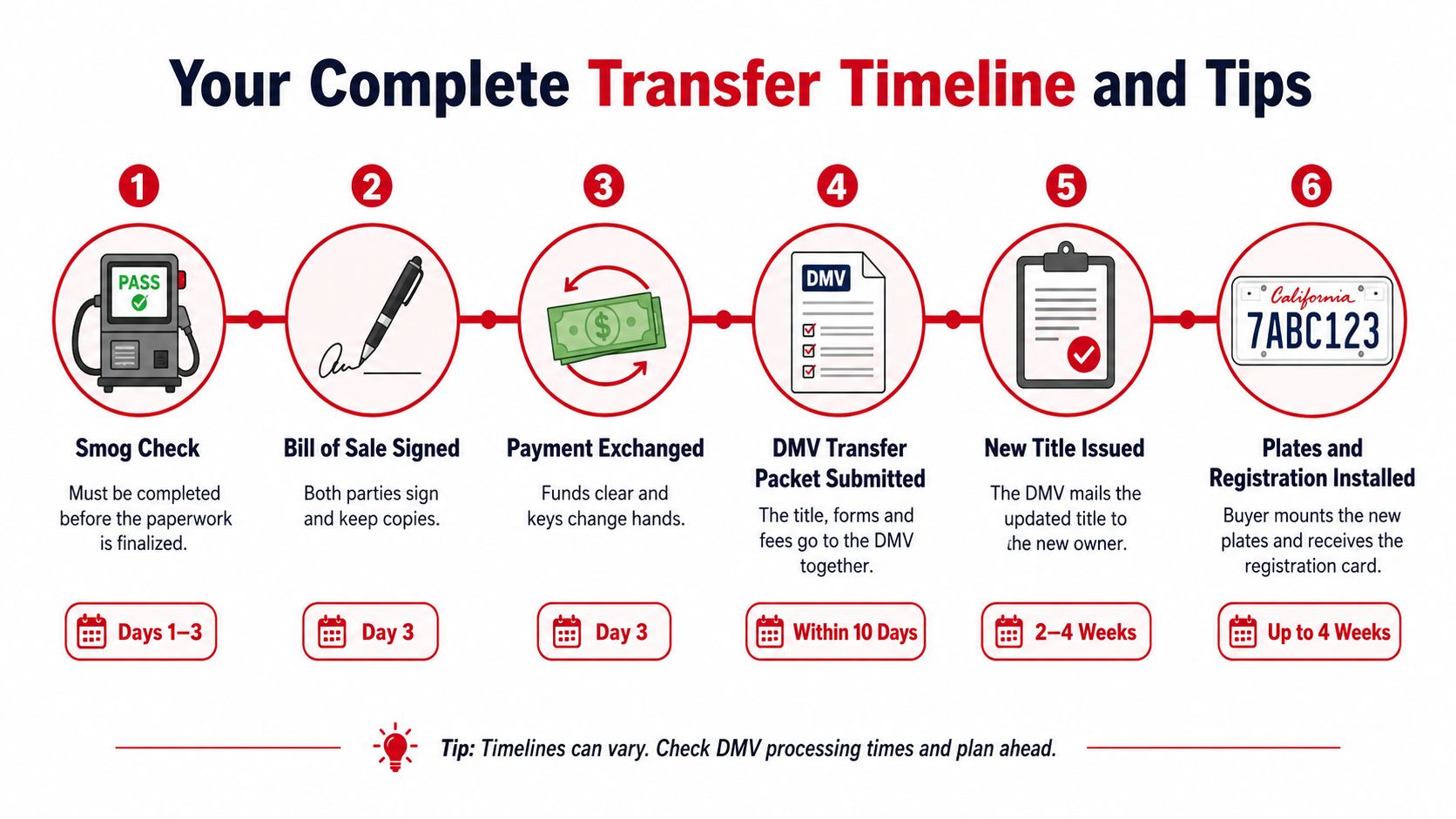
Use a single working sequence
First, inspect the compliance position. Arrange the required smog check and keep the result with the transfer documents. If the vehicle fails, identify the repair and retest path before either party assumes the transfer can be completed.
Second, verify the ownership record. Read the title directly. Confirm the seller's name, VIN, lienholder information, odometer section, and assignment areas. Ask for lien-release documentation before money changes hands if a lender appears on the record.
Third, complete the transaction record. Prepare the bill of sale, sign the title in the correct places, complete the required odometer disclosure, and make copies for both parties. The seller should also complete the appropriate notice of transfer and release of liability.
Fourth, audit the packet. Compare names, addresses, VIN characters, dates, signatures, and mileage across every document. This step is where many avoidable errors can be caught while the seller is still available.
Fifth, submit the transfer. Send the title, required forms, supporting documents, and fees together through the DMV or an authorized registration provider. Keep the receipt or other proof that the packet was accepted.
Finally, monitor the record and registration materials. A new title may be mailed after processing, and plate or registration delivery can depend on the transaction and vehicle history. Don't discard the old paperwork until the new record is confirmed.
An EU analysis illustrates why ownership transfers are operational workflows rather than instant handovers. It estimated about 40 million vehicle ownership transfers per year across the European Union, with around 3.5 million crossing between Member States, or roughly 8% of the total. The same analysis estimated about one week for deregistration, four weeks for re-registration in another Member State, and approximately five weeks for the full cross-border transfer process. These figures are not California processing promises, but they show why cross-border records require more coordination than a local sale. See the European Parliament analysis of vehicle ownership transfers for that broader context.
Reduce return trips
Call ahead when the vehicle is unusual, comes from another state, has a lien history, or may exceed a testing station's equipment limits. Bring the original documents, government identification, payment method, and clear copies, and ask whether the provider can handle the particular ownership scenario before you drive over.
Use a provider that can address both sides of the chain when timing matters. Completing the smog inspection and submitting the DMV packet during the same visit can remove a handoff, but it won't overcome a missing title or unresolved lender interest. The practical goal is not to rush an incomplete file. It's to discover the incomplete part early.
Frequently Asked Questions About Transfers
Does an out-of-state vehicle follow the same process?
Not always. An out-of-state vehicle may require additional verification and records before California can issue the new registration. Bring the out-of-state title, identification, transaction documents, and any available lien information, and confirm the applicable requirements before submission.
What happens if the vehicle fails the smog check?
A failed test means the emissions issue must be addressed before the transfer can proceed where a passing certificate is required. Ask about repair documentation and retest eligibility. Fire House Smog's site policy and coupon terms provide for a free retest when applicable, so confirm the conditions before returning.
What if a lender still appears on the title?
Don't assume the paid loan has already cleared the record. Obtain the lien release or coordinate with the lienholder, then include the correct documentation with the transfer packet. An unresolved lien can prevent the new owner from being recorded.
How can I avoid another DMV trip?
Check the title against the seller's identification, verify the VIN on the vehicle, complete the odometer disclosure, confirm the lien status, arrange the smog inspection, and bring every required form and fee together. If any item is uncertain, resolve it before the appointment rather than submitting a packet that you already suspect is incomplete.
For a connected vehicle ownership transfer service in Antioch, Fire House Smog can perform STAR-certified smog testing and process California or out-of-state ownership transfers through its licensed DMV registration service. Visit Fire House Smog with your title and vehicle documents so the emissions and registration steps can be reviewed together.
You've got a registration problem, but you don't necessarily have a DMV problem. In California, the right move is often choosing the right channel, because some renewals are simple enough for a kiosk or online system, while other cases fall apart without document review, smog timing, or title help.
That's why DMV registration services California shoppers usually care about one thing first, even if they don't say it that way, which option gets the job done fastest without forcing a second trip. The answer depends on the transaction, the paperwork you already have, and whether your case can be finished without inspection, verification, or in-person issue resolution.
Table of Contents
- Choosing the Right Registration Channel for Your Situation
- Document Requirements by Transaction Type
- Smog Check Requirements and Registration Timing
- Handling Complex Registration Scenarios
- When Third-Party Services Save Time and Money
- Your Registration Action Plan
Choosing the Right Registration Channel for Your Situation
The most common mistake I see is treating every registration as a line-at-the-branch problem. California's own renewal data shows why that mindset wastes time. In fiscal year 2021–2022, DMV field offices served 3,411,951 renewal customers, while 12,014,480 renewals were completed online, 5,945,011 by mail, and 2,897,420 at self-service kiosks, out of 30,883,634 total renewal customers across all channels. Field offices handled only about 11.0% of renewal customers, while internet renewals accounted for about 38.9% of the total, which tells you the system is built around multiple access points, not one front desk. That same DMV reporting also noted that in 2019–20, the department processed 68.3 million transactions overall, and vehicle registration renewals were the single largest category, nearly half of all DMV transactions.
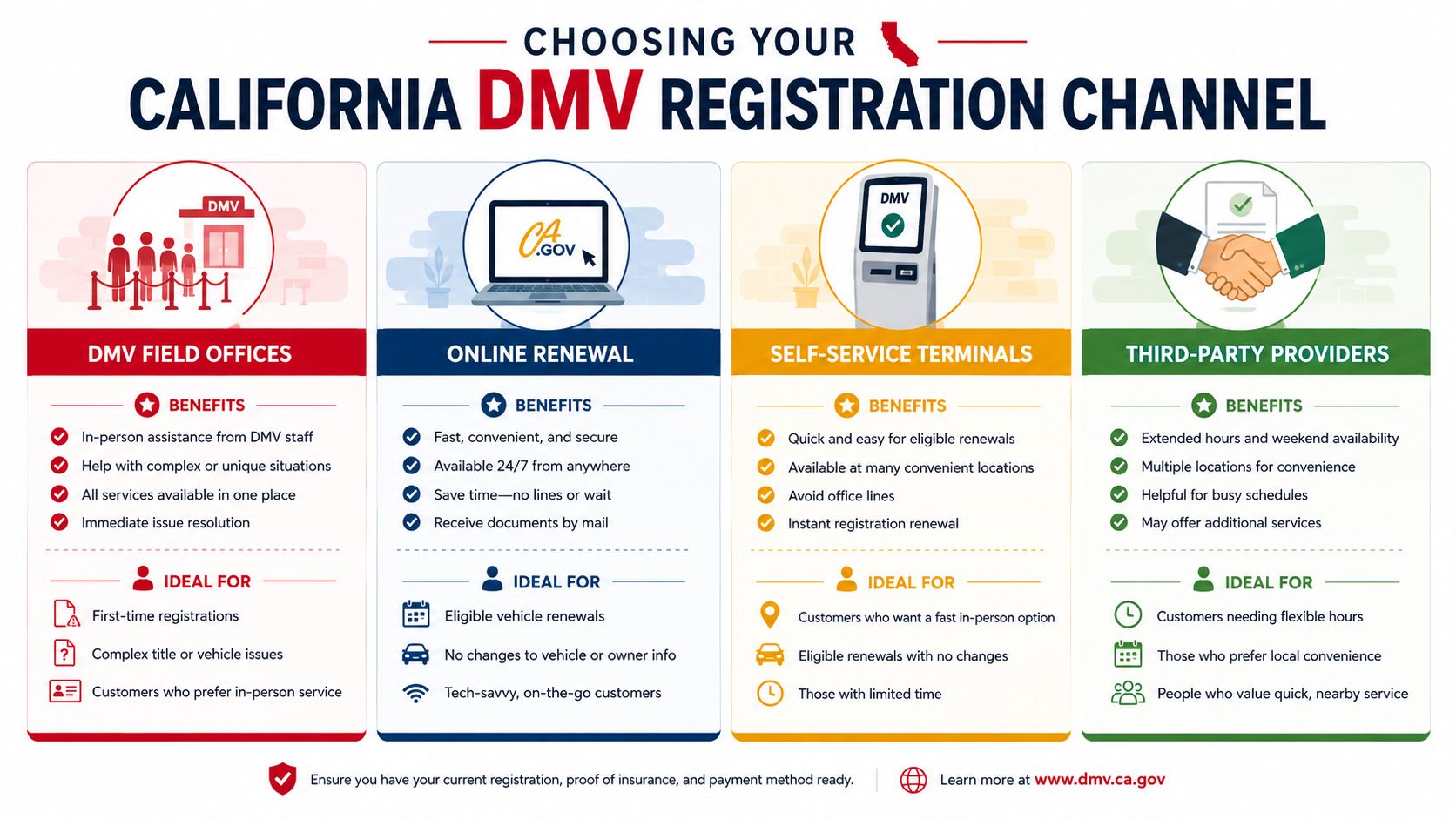
How to choose fast
A routine renewal usually belongs online, by mail, or at a kiosk if your record is clean and your notice doesn't flag a problem. A simple in-person office visit still makes sense when your transaction needs review, but the numbers above show that most renewals don't have to start there.
A licensed third-party provider is most useful when the case is still straightforward enough to finish quickly, but inconvenient enough that your time matters. Think document-heavy renewals, ownership transfers, or situations where you want someone who can look at the paperwork before you burn a half day on a failed visit.
Practical rule: if the transaction can be completed without title questions, VIN issues, or smog-related delays, a low-friction channel usually beats a branch visit.
California's DMV also says many tasks can be handled online, by phone, or at kiosk locations, and it lists authorized private registration-service partners as part of the state's channel mix. That means the central question usually isn't “DMV or local service,” it's “which channel fits this specific file with the fewest steps?”
Document Requirements by Transaction Type
Paperwork problems are where good intentions go to die. A lot of people show up thinking the registration is just a formality, then discover the file is missing a title signature, lienholder release, or proof tied to the transaction type. California DMV guidance for vehicle registration is document-driven, and the required pieces change depending on whether you're renewing, buying, transferring, or bringing a vehicle into the state.
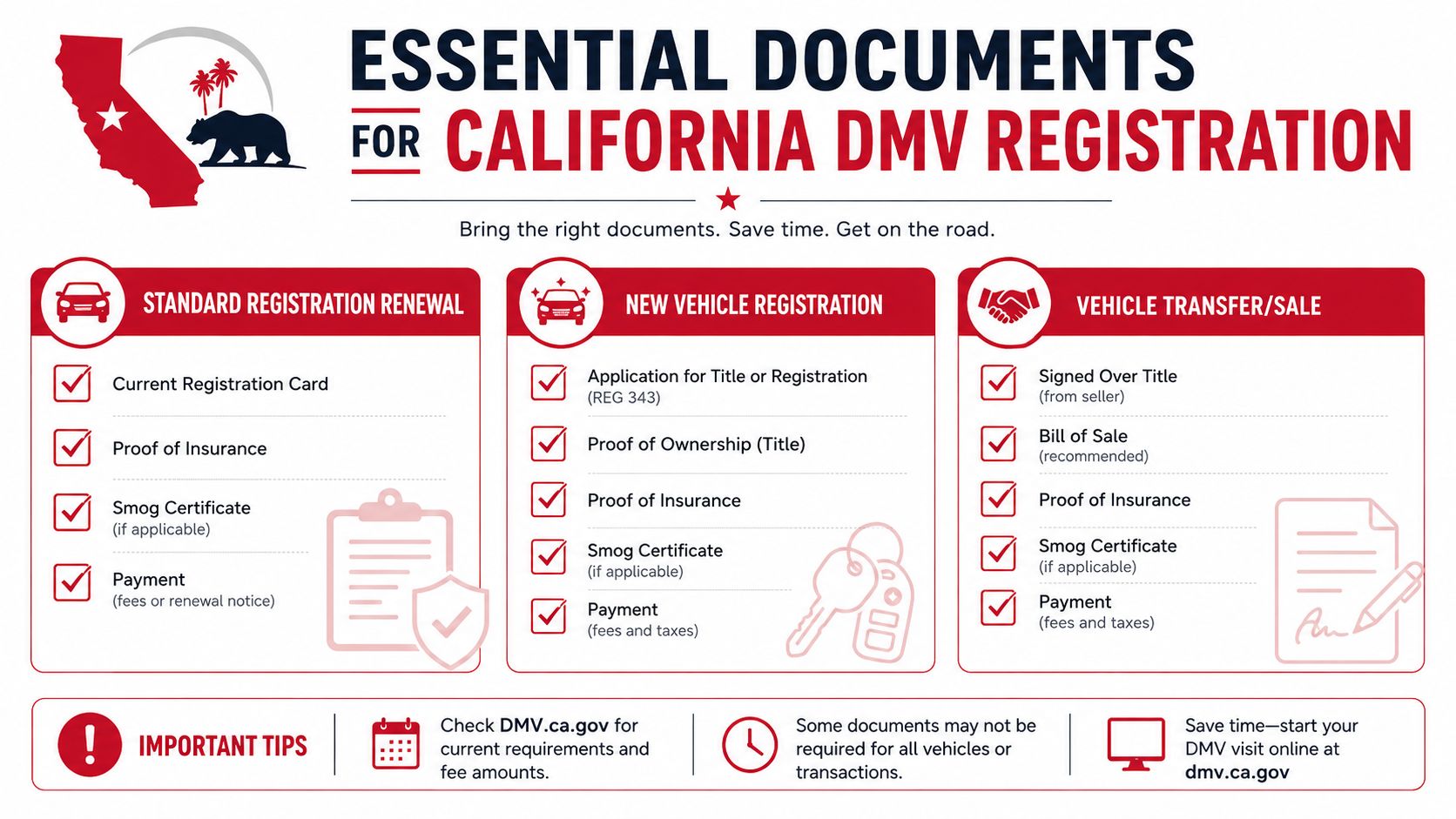
Renewal files are the simplest, until they aren't
For a standard renewal, the key is to confirm that the account is eligible before you leave home. If the DMV system flags a smog issue, address issue, or fee mismatch, the trip stops being simple very quickly.
For ownership transfers, the title is the center of the file. California DMV says applicants generally need the title or out-of-state title, signatures from the seller and lienholder if applicable, and may also need smog certification, VIN-related forms, and use tax or fees before the transaction can be completed in person at a field office. That's why a transfer that looks routine on paper can stall if one signature is missing.
Missing a title line is worse than missing a receipt. Receipts can often be replaced, but a title problem can pause the whole transaction.
For new residents and out-of-state vehicles, the DMV's new-resident guidance makes the in-person document set even more important. Expect to deal with title, proof of insurance, smog certificate, and VIN verification when required, because those are the points that most often trigger repeat visits if they're incomplete. Industry guidance also flags missing odometer disclosures for vehicles under 10 model years, missing title documents, and missing smog certificates as common delay points.
If you want a practical document checklist to compare against your own file, use the guide at vehicle registration documents before you book anything. The safest habit is simple, match the transaction to the document set first, then choose the channel.
Smog Check Requirements and Registration Timing
Smog and registration are tied together, but they don't always move on the same schedule. That mismatch is where a lot of people lose time, because they try to renew first and test later, or they assume the registration can be finished while emissions paperwork is still pending.
California DMV says registration often requires smog certification in many cases, and the state's registration workflow is built around that compliance step. If the vehicle needs testing, don't treat the smog station as an afterthought. It's part of the registration file, not a separate errand.
Timing matters more than the test itself
The cleanest approach is to get the vehicle ready for inspection before you start the registration process. That matters most when the car has been sitting, the battery was disconnected, or the readiness monitors may not cooperate with the first test cycle.
If the vehicle fails, the registration file stops there until the issue is fixed. That's why a test-only station is valuable for drivers who want a straight answer first, since there's no repair upsell attached to the inspection. A service center that also sells repairs can make the process feel more complicated, especially when the primary need is just to know whether the car passed.
California also maintains a STAR-certified testing framework, and that's relevant when a vehicle needs a test that meets state requirements for the transaction. If you're unsure how that works, the overview at what STAR-certified smog means is a useful starting point before you schedule.
For registration timing, the smart sequence is:
- Confirm whether smog is required.
- Get the vehicle tested before the renewal deadline.
- Fix any failure before trying to finish the DMV transaction.
- Keep the test result with the rest of your registration documents.
A lot of registration headaches disappear when smog is treated as a gate, not a follow-up. That's especially true for drivers who are already close to the deadline, because a failed test creates a delay exactly when you can least afford one.
Handling Complex Registration Scenarios
Some registration files are too messy for online self-service, and that's where in-person expertise starts to matter. Out-of-state vehicles, seller absences, salvage history, rebuilt titles, and specialty vehicles all create friction because the system needs proof, verification, or inspection before it can move forward.
California DMV says out-of-state vehicles must be registered after you become a resident, and the new-resident process emphasizes in-person completion with title, insurance, smog certificate, and VIN verification when required. That combination is the reason these cases don't behave like a routine renewal. They're document and identity checks, not just payment events.
Where the process usually breaks
If the seller is unavailable, the missing signature or missing title action often becomes the bottleneck. If the vehicle has a title issue, the DMV can't just ignore it because the registration is due. The file needs a clean ownership path.
Specialty vehicles create a different kind of problem. RVs, commercial trucks, and vehicles with unusual equipment may fit the registration rules, but they don't always fit the easy assumptions behind online systems. That's why some licensed registration providers and partner offices exist in the first place, to handle transactions that need more than a self-service screen.
Here's the practical pattern I've seen work:
- Bring every ownership document together first. Title, bill of sale, lienholder paperwork, and any release forms should be sorted before you ask a provider to process the file.
- Assume VIN verification may be required. If the car is new to California or the title status is unusual, plan for inspection-related steps.
- Expect smog-related delays on edge cases. If the vehicle can't be tested yet, the registration won't be finished cleanly.
- Use a provider when the first visit is unlikely to finish the job. A second trip costs more than a paid review in many cases.
California's DMV business-partner program exists because some transactions are handled through authorized private industry partners rather than only through online self-service. In practice, that can be the difference between one organized appointment and several failed attempts.
When Third-Party Services Save Time and Money
The extra fee for a third-party registration provider only makes sense when it saves you more than money. That usually means it saves time, avoids a penalty, or prevents a failed trip that would cost you even more in hassle.
California's late-payment penalties are a real example of why timing matters. For renewals 31 days to one year late, the penalty includes 60% of the VLF and weight fee due, plus a $30 registration late fee and a $30 CHP late fee, according to the DMV's published registration statistics. Once a file is drifting late, the value of getting help quickly rises fast.
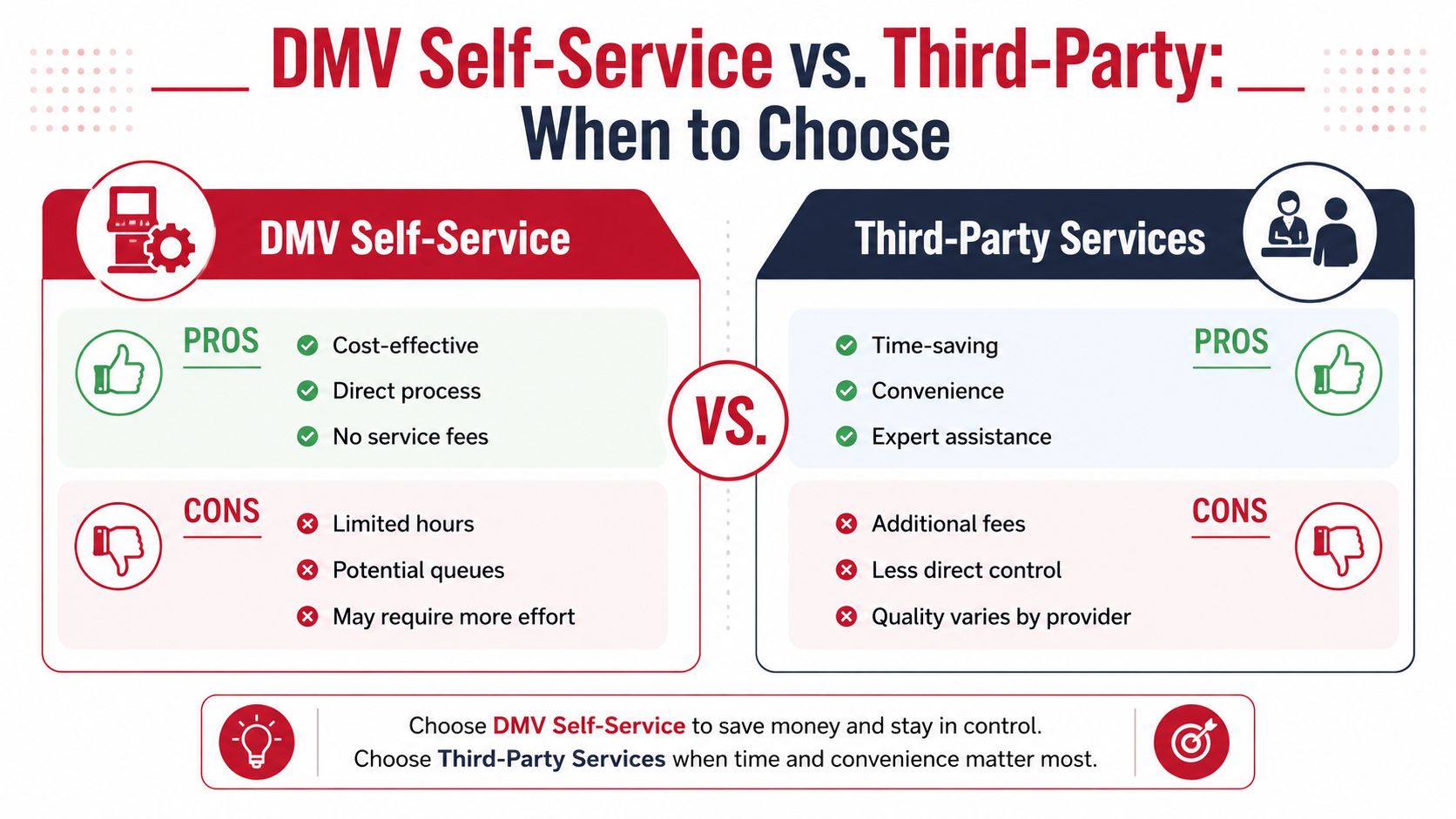
What is worth paying for
Third-party help makes the most sense when the transaction is:
- Time-sensitive, because a deadline is close.
- Paperwork-heavy, because the file needs review before submission.
- Complex, because the case involves transfer, out-of-state paperwork, or verification.
- Operationally awkward, because you can't take time off for a branch visit.
DMV self-service is still the right answer for many routine renewals. It's usually the cheaper choice, and for clean files it's efficient. But if your case is likely to bounce, the apparent savings disappear quickly.
If you already know your file has a title issue, smog issue, or residency issue, the cheapest option on paper isn't always the cheapest outcome.
A local example is DMV registration services near me, which can matter for drivers who want smog testing and registration support in one place rather than splitting the trip between two stops. That kind of setup doesn't replace DMV channels, it just reduces the number of loose ends that can stall the file.
Your Registration Action Plan
Start with the transaction type, not the location. Renewal, transfer, out-of-state registration, and complex title cases all need different paperwork, and the wrong channel can turn a simple task into a repeat visit.
Use this quick filter:
- If the file is clean, try online, mail, or a kiosk first.
- If documents are incomplete or the title is messy, use an in-person provider or DMV office.
- If smog is involved, get that handled before you commit to the registration visit.
- If the deadline is close, choose the fastest channel that can finish the whole file, not just part of it.
- If the vehicle is new to California, expect verification and inspection steps.
The DMV's own service mix shows that California drivers already rely on multiple channels, so there's no prize for forcing every case through the same route. The right move is the one that gets the registration completed once, cleanly, with no follow-up trip.
Fire House Smog handles STAR-certified smog checks and California DMV registration services in Antioch, including renewals, ownership transfers, and related tag-issuance work. If your file involves smog timing, an out-of-state vehicle, or a registration issue that needs an in-person look, visit Fire House Smog to review service options and current hours before you drive over.