
A California vehicle ownership transfer typically requires a smog certificate, a signed title, and payment of transfer fees, and one missing or incomplete document can stall the application. In Texas, 6,432,879 vehicle titles were processed in fiscal year 2018, showing how often ownership changes depend on accurate paperwork rather than a simple exchange of keys.
You may be standing beside a newly purchased car with the payment complete, the keys in hand, and a title that looks almost finished. Then someone notices the seller missed a signature, the lien release isn't attached, or the smog requirement hasn't been satisfied. The sale feels complete, but the legal transfer isn't.
California treats smog compliance and DMV paperwork as connected parts of the same ownership chain. A vehicle can pass the emissions inspection and still be rejected because the title is incomplete. It can also have a properly signed title but remain stalled because the required smog documentation is missing or the vehicle doesn't meet emissions requirements.
That distinction matters because the fastest transfer is not always the one with the fewest steps. It's the one where each dependency is checked before the packet reaches the DMV. The following process reflects what tends to work in practice for California buyers and sellers, including people transferring vehicles from another state.
Table of Contents
- Navigating the California Transfer Process
- Essential Documents for a Successful Transfer
- Why Professional Smog and DMV Services Matter
- Common Errors That Delay Your Transfer
- Your Complete Transfer Timeline and Tips
- Frequently Asked Questions About Transfers
Navigating the California Transfer Process
A buyer and seller can agree on a price in minutes, but the ownership record changes only after the required chain of documents, signatures, fees, and compliance steps is complete. California DMV guidance identifies the Certificate of Title, required signatures, transfer fees, odometer information, and supporting forms as central parts of the process. The California DMV title transfer guidance also explains what to do when the original title is missing or a lien affects the record.
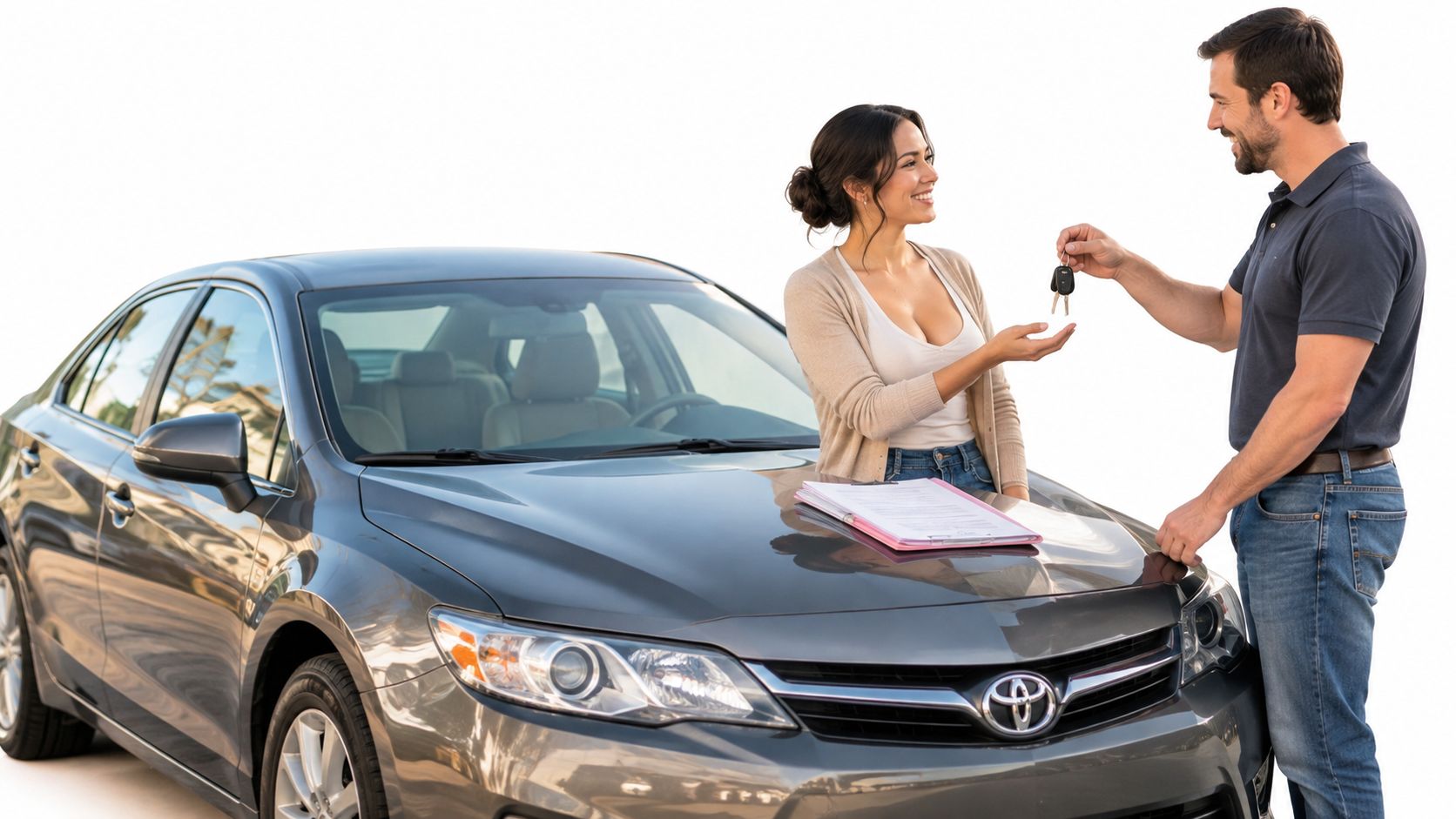
Follow the document chain
Start by identifying the vehicle and confirming that the seller's name on the title matches the seller's identification. Next, check whether a lien is listed and verify that the lienholder has released its interest. The seller and buyer then complete the title, including the odometer disclosure when required, and prepare any supporting forms for the specific situation.
The smog step belongs in this preparation, not as an afterthought. If the vehicle requires a smog certificate, arrange the inspection before finalizing the DMV packet. A failed or incomplete emissions record can hold up the transfer even when every signature is correct, while a successful test doesn't correct a missing lien release or an incorrectly completed title.
Practical rule: Treat the smog certificate, title, identity documents, and fee payment as one packet. If one part is unresolved, the transfer is not ready.
The final stage is submission to the DMV or an authorized registration provider. Once the transfer is accepted, the registration record and title can be updated according to the agency's process. For an out-of-state vehicle, expect additional verification and documentation rather than assuming a California title transfer follows the same path as an in-state vehicle.
California's process is therefore best understood as a sequence: establish ownership, confirm emissions compliance, complete the title and disclosures, resolve liens, submit the forms and fees, and retain proof of submission. Skipping ahead creates the delays that buyers often mistake for a DMV processing problem.
Essential Documents for a Successful Transfer
A clean transfer begins with document control. California DMV requirements can change depending on whether the title is available, a lien exists, the vehicle comes from another state, or an ownership detail needs correction. The core packet should be assembled before either party signs, because a signature on the wrong line can be harder to correct than a missing form.
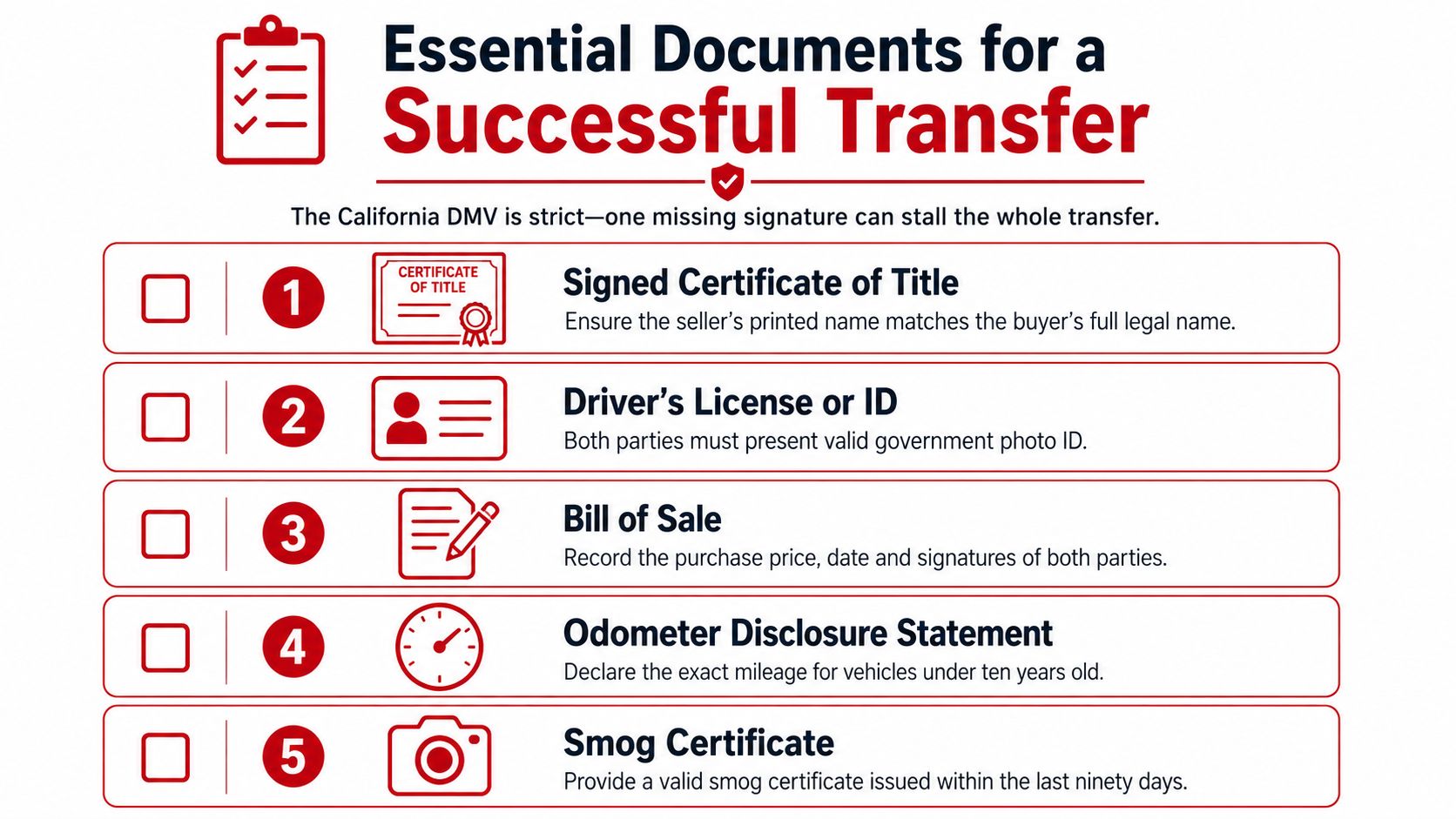
Build the packet before signing
Certificate of Title: Use the original title when available. The seller must sign in the correct assignment area, and the buyer's legal name and address must be entered accurately. Don't use cross-outs or correction fluid. If the title is lost, the transfer may need to begin with a replacement-or-transfer application.
Identification: Both parties should have valid government-issued identification available. The names used on the title and forms need to correspond with the identifying documents. A casual abbreviation or an old address can trigger a correction request.
Bill of sale: Keep a written record showing the parties, vehicle details, transaction date, purchase price, and signatures. It supports the transaction record and gives both sides evidence of what they agreed to exchange.
Odometer disclosure: Record the mileage exactly as required, using complete numeric information rather than an estimate. An incomplete or inconsistent disclosure is one of the most common reasons a title packet comes back for correction.
Smog certificate: Provide the required California emissions documentation for the vehicle and transaction. The smog result is not a substitute for a title, and a signed title doesn't substitute for emissions compliance.
Resolve liens before submission
A lien is an ownership issue, not merely a financing detail. If a lender still appears on the title, the seller needs documentation showing that the obligation was satisfied or the lienholder must participate in the transfer. Buyers should inspect this before paying, because an unresolved lien can prevent the DMV from recording the new owner.
Supporting paperwork may include REG 227, REG 262, REG 256, REG 166, and the Notice of Transfer and Release of Liability, depending on the circumstances. Don't add forms randomly. Use the form that matches the missing title, odometer disclosure, lien, exemption, or liability situation, and confirm the current requirement before submission.
A useful California title transfer paperwork checklist can help you compare the documents you have with the documents your transaction requires. The purpose isn't to create a thicker file. It's to submit a complete, internally consistent file the first time.
Why Professional Smog and DMV Services Matter
The DIY route can work when the title is clean, the vehicle passes its emissions inspection, both parties are available, and the buyer understands which forms apply. Its weakness is fragmentation. The owner may visit one location for smog testing, another for DMV work, and then discover that a missing signature or lien document requires a return trip.
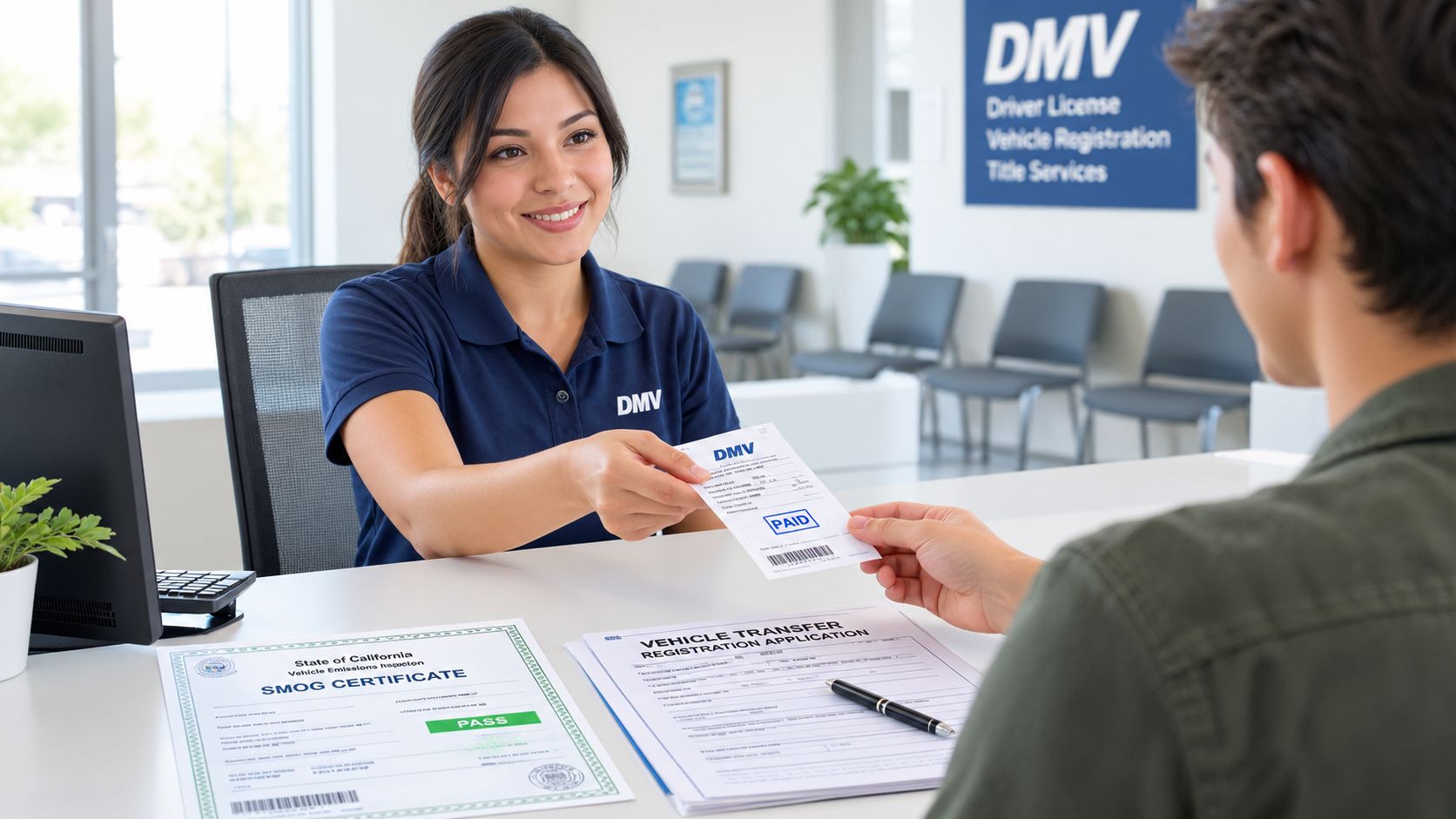
A combined service changes the handoff between compliance and registration. A provider can identify whether the emissions step is complete before accepting the transfer packet, then check whether the title and supporting forms are ready for processing. That doesn't guarantee approval when a lender, out-of-state record, or ownership dispute requires separate action, but it reduces avoidable gaps between steps.
Compare the two routes
| DIY handling | Integrated service |
|---|---|
| You coordinate the smog inspection and DMV submission separately. | The emissions and registration steps can be reviewed as one workflow. |
| You remain responsible for spotting missing signatures, lien documents, and forms. | Staff can help identify apparent paperwork gaps before submission. |
| Registration materials may require a later pickup or mailing step. | An authorized provider may offer on-site registration services and tag printing. |
| A failed smog result becomes a separate problem to diagnose. | The test result can be discussed before the transfer packet is finalized. |
The trade-off is control versus convenience. DIY processing may suit someone who is comfortable reading DMV instructions and correcting paperwork. A licensed partner is more useful when the vehicle is out of state, the title has a lien history, the buyer and seller have limited availability, or a failed smog test has created uncertainty.
Fire House Smog operates as a STAR-certified test-only station and licensed DMV registration partner at 2900 Lone Tree Way in Antioch. It offers on-site California DMV renewals with sticker printing, ownership transfers for California and out-of-state vehicles, and two service bays designed to reduce wait times during posted hours.
Because it is test-only, repairs aren't sold as part of the inspection. If the vehicle fails, the next decision is repair and retest, not an automatic repair purchase at the testing location. The California smog check and registration service is therefore most useful when you want the emissions result and registration paperwork evaluated within the same local workflow.
A professional service can't replace a lender's release or a seller's missing signature. It can help you discover those problems before you build your schedule around an incomplete transfer.
Common Errors That Delay Your Transfer
The most frustrating delays often begin with a document that looks finished. A seller signs the title, but not in the assigned seller field. A buyer writes a shortened name that doesn't match the identification record. Someone copies the VIN from memory instead of reading it directly from the title or vehicle.
Consider a typical failed handoff. The buyer and seller complete the sale, but the title contains one wrong VIN character and the odometer section is incomplete. The DMV can't confidently connect the document to the vehicle or accept the disclosure, so the packet returns for correction. The buyer must locate the seller again, correct the title properly, and resubmit.
Check the points most likely to stop the file
Seller signatures: Compare the title's signature lines with the printed ownership name. A missing or misplaced signature can stop the transfer even when the buyer has paid and taken possession.
Odometer disclosure: Enter the exact mileage in the required format. Don't guess, round, overwrite, or leave a field blank because the vehicle's condition seems obvious.
Lien release: Look for the lienholder information before the transaction closes. A paid loan doesn't automatically mean the title record is already clear.
Names and addresses: Use the legal names and current addresses required for the record. Small inconsistencies can generate a correction request.
VIN: Match the VIN on the title, vehicle, forms, and supporting documents character by character. A VIN discrepancy deserves investigation before submission, not an assumption that the DMV will fix it.
Independent title-transfer guidance identifies missing signatures, odometer problems, unreleased liens, name and address errors, and VIN mismatches as recurring rejection triggers. The title transfer error guide also warns about open titles and title jumping, practices that can leave the record without a valid documented chain of ownership.
Title jumping is especially risky because it attempts to pass a vehicle through an intermediary without recording the intermediary's ownership properly. The result can be a legal and registration dead end rather than a shortcut.
Smog creates another version of the same problem. A vehicle may fail because of emissions-related conditions, or the certificate may be absent when the transfer requires it. Use the common smog check failure reasons to understand what needs attention before treating a failed result as a paperwork issue.
Your Complete Transfer Timeline and Tips
A transfer moves fastest when the owner treats it as a controlled sequence rather than a collection of errands. The first task is not signing the title. It's confirming that the vehicle, seller, lien status, smog requirement, and supporting documents can all be reconciled.
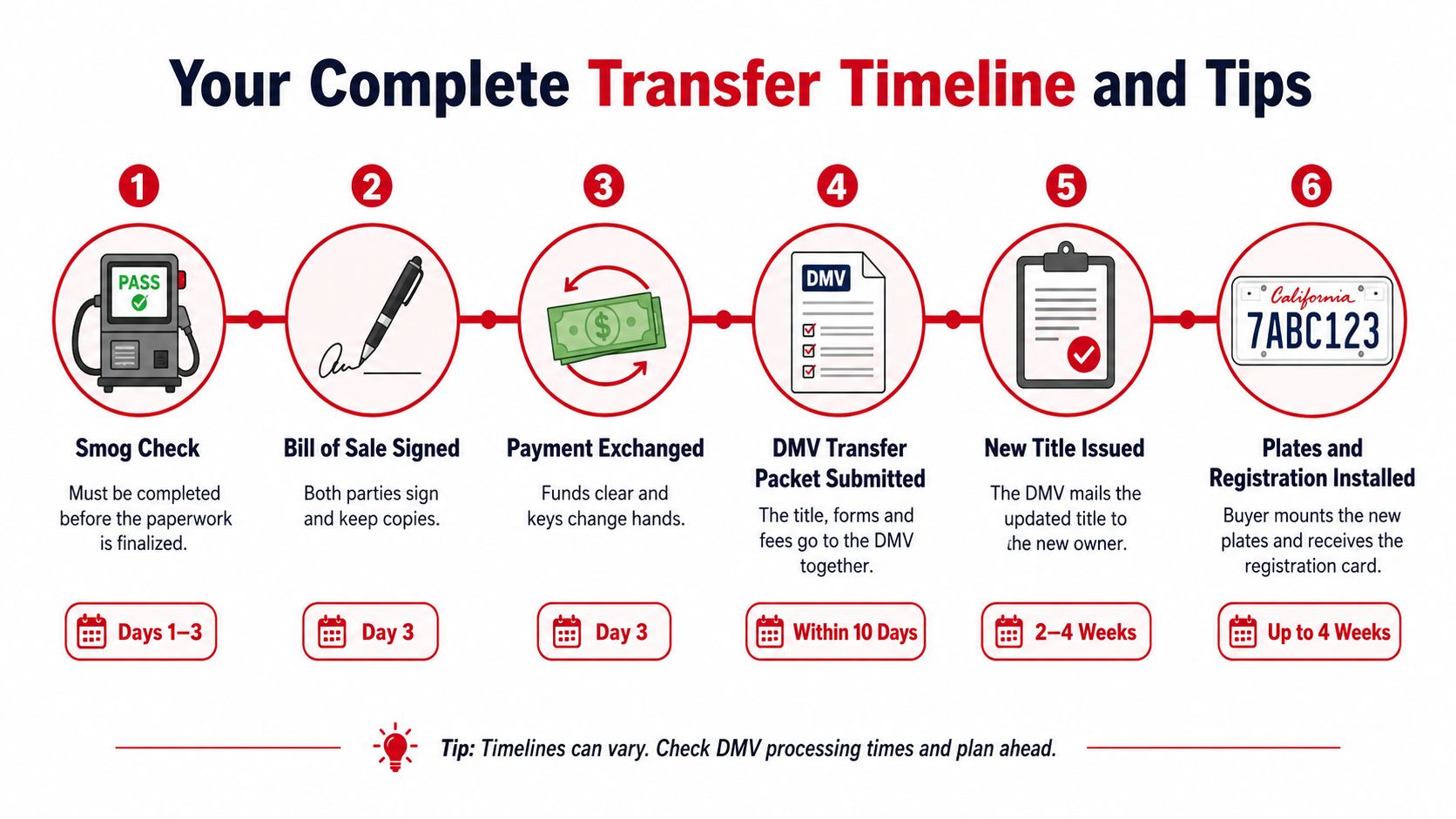
Use a single working sequence
First, inspect the compliance position. Arrange the required smog check and keep the result with the transfer documents. If the vehicle fails, identify the repair and retest path before either party assumes the transfer can be completed.
Second, verify the ownership record. Read the title directly. Confirm the seller's name, VIN, lienholder information, odometer section, and assignment areas. Ask for lien-release documentation before money changes hands if a lender appears on the record.
Third, complete the transaction record. Prepare the bill of sale, sign the title in the correct places, complete the required odometer disclosure, and make copies for both parties. The seller should also complete the appropriate notice of transfer and release of liability.
Fourth, audit the packet. Compare names, addresses, VIN characters, dates, signatures, and mileage across every document. This step is where many avoidable errors can be caught while the seller is still available.
Fifth, submit the transfer. Send the title, required forms, supporting documents, and fees together through the DMV or an authorized registration provider. Keep the receipt or other proof that the packet was accepted.
Finally, monitor the record and registration materials. A new title may be mailed after processing, and plate or registration delivery can depend on the transaction and vehicle history. Don't discard the old paperwork until the new record is confirmed.
An EU analysis illustrates why ownership transfers are operational workflows rather than instant handovers. It estimated about 40 million vehicle ownership transfers per year across the European Union, with around 3.5 million crossing between Member States, or roughly 8% of the total. The same analysis estimated about one week for deregistration, four weeks for re-registration in another Member State, and approximately five weeks for the full cross-border transfer process. These figures are not California processing promises, but they show why cross-border records require more coordination than a local sale. See the European Parliament analysis of vehicle ownership transfers for that broader context.
Reduce return trips
Call ahead when the vehicle is unusual, comes from another state, has a lien history, or may exceed a testing station's equipment limits. Bring the original documents, government identification, payment method, and clear copies, and ask whether the provider can handle the particular ownership scenario before you drive over.
Use a provider that can address both sides of the chain when timing matters. Completing the smog inspection and submitting the DMV packet during the same visit can remove a handoff, but it won't overcome a missing title or unresolved lender interest. The practical goal is not to rush an incomplete file. It's to discover the incomplete part early.
Frequently Asked Questions About Transfers
Does an out-of-state vehicle follow the same process?
Not always. An out-of-state vehicle may require additional verification and records before California can issue the new registration. Bring the out-of-state title, identification, transaction documents, and any available lien information, and confirm the applicable requirements before submission.
What happens if the vehicle fails the smog check?
A failed test means the emissions issue must be addressed before the transfer can proceed where a passing certificate is required. Ask about repair documentation and retest eligibility. Fire House Smog's site policy and coupon terms provide for a free retest when applicable, so confirm the conditions before returning.
What if a lender still appears on the title?
Don't assume the paid loan has already cleared the record. Obtain the lien release or coordinate with the lienholder, then include the correct documentation with the transfer packet. An unresolved lien can prevent the new owner from being recorded.
How can I avoid another DMV trip?
Check the title against the seller's identification, verify the VIN on the vehicle, complete the odometer disclosure, confirm the lien status, arrange the smog inspection, and bring every required form and fee together. If any item is uncertain, resolve it before the appointment rather than submitting a packet that you already suspect is incomplete.
For a connected vehicle ownership transfer service in Antioch, Fire House Smog can perform STAR-certified smog testing and process California or out-of-state ownership transfers through its licensed DMV registration service. Visit Fire House Smog with your title and vehicle documents so the emissions and registration steps can be reviewed together.
California adds a 10% charge plus $20 in flat fees for renewals 1–10 days late, and the percentage climbs to 160% plus $200 in flat fees after two years, so every additional month costs you real money. The fastest way to limit the damage is to confirm your expiration date, clear any hold, complete a required smog check, and process the renewal before the vehicle moves into a higher penalty tier.
You're probably reading this because the sticker on your plate is already expired, or because you found an old renewal notice in the glove box. A late registration renewal isn't just a paperwork problem. In California, the charge changes with the length of the delay, and the jump after the first month is especially painful.
The right response is simple: stop driving the vehicle until you know its registration status, verify the exact lapse date, and handle the renewal as soon as possible. California's published penalty table and Vehicle Code section 9554 provide the framework, including a limited grace window and specific circumstances in which penalties may be waived. California DMV's penalty schedule is the document to use when estimating the state charges.
Table of Contents
- Why a Lapsed Tag Is a Bigger Problem Than It Feels
- How California Calculates Late Registration Renewal Penalties
- What You Need Before You Renew a Late Registration
- Choosing Where to Complete a Late Registration Renewal
- Walking Through the Late Renewal Step by Step
- Hidden Costs and Risks Beyond the Late Fee
- Your Same-Day Late Renewal Action Plan
Why a Lapsed Tag Is a Bigger Problem Than It Feels
Maria drives from Antioch toward Delta de Anza for work. She let her 2019 Civic pass its registration date by two weeks and assumed the fix would be minor. The surprise came when she checked the renewal amount and saw a 10% penalty on the vehicle license fee and weight fee, plus $20 in fixed late fees.
Her first instinct was to wait until payday. That would have been the wrong move. The penalty schedule is based on the delay period, so waiting can move the renewal into a more expensive bracket even though the vehicle itself hasn't changed.
Practical rule: Once you know the registration is late, treat the renewal as urgent paperwork, not a task for later.
The DMV charge is only one part of the exposure. Driving with expired registration can lead to a roadside citation, and a stop on Highway 4 can turn a missed renewal into a much more disruptive afternoon. A registration lapse can also create complications when an insurer reviews policy information or handles a claim, especially if the vehicle's legal operating status becomes relevant.
A lapsed registration can interfere with more than daily commuting. You may face difficulty transferring ownership, completing another DMV transaction, or proving that the vehicle was properly registered during a particular period. Those problems often appear when you're trying to sell the car, replace a title, or resolve an insurance question.
The cost of waiting rises in stages
Maria's two-week delay sits in the lower part of California's schedule. If she waits beyond the 30-day exception, the percentage-based charge changes sharply. If she keeps driving while the tag remains expired, she also exposes herself to enforcement separate from the DMV renewal bill.
The practical recommendation is direct. Check the expiration date today, identify whether a smog certificate is required, and get a complete fee calculation before deciding that postponing the renewal is harmless.
How California Calculates Late Registration Renewal Penalties
California Vehicle Code section 9554 authorizes a penalty for a renewal application made after midnight on the expiration date, while also providing an exception for an application made within the applicable 30-day window. The DMV's published table applies the percentage to the vehicle license fee and weight fee, then adds the listed CHP and registration late fees. Vehicle Code section 9554 contains the statutory framework.
The tiers are easy to misunderstand because the fixed amounts and percentage amounts change together. The example below uses a $312 base only to illustrate the percentage calculation. It doesn't include any other possible registration charges, county charges, smog costs, or adjustments.
| Days or time late | Percentage penalty | Flat fees added | Example on $312 base |
|---|---|---|---|
| 1–10 days | 10% | $20 | $31.20 penalty, $20 flat fees, $363.20 subtotal |
| 11–30 days | 20% | $30 | $62.40 penalty, $30 flat fees, $404.40 subtotal |
| 31 days to one year | 60% | $60 | $187.20 penalty, $60 flat fees, $559.20 subtotal |
| More than one year to two years | 80% | $100 | $249.60 penalty, $100 flat fees, $661.60 subtotal |
| More than two years | 160% | $200 | $499.20 penalty, $200 flat fees, $1,011.20 subtotal |
These examples show why the 31-day threshold matters. On the illustration, the percentage penalty rises from $62.40 in the 11–30-day tier to $187.20 in the 31-days-to-one-year tier. The table is a calculation example, not a quote for your vehicle, because the DMV applies the percentage to the relevant vehicle license fee and weight fee rather than automatically to every amount on a renewal bill.
For a practical explanation of the underlying renewal bill, review this guide to California registration renewal fees. Then ask for the full transaction breakdown before paying.
What the grace window means
The DMV states that no late penalty is added when the renewal application is made within 30 days after midnight of the expiration date. That doesn't mean you should continue driving casually with an expired registration. It means eligible drivers have a defined period in which submitting the application can avoid the late penalty.
California also allows penalty waivers in specific circumstances. Eligibility depends on the facts and the required DMV process, so don't assume a waiver applies without asking about it directly.
What You Need Before You Renew a Late Registration
A smooth late renewal starts with preparation. Before you visit a smog station, DMV office, or registration service, confirm the vehicle's status and gather the documents that identify both you and the car.
Start with the smog requirement. Many gasoline vehicles that are within the state's newer-model exemption may not need a current smog check for the renewal cycle, but exceptions can apply. A change of ownership, an out-of-state title, or a gross-polluter designation can place the vehicle on a different testing path. Diesel vehicles and heavier trucks may also involve separate program requirements.
Bring a complete document set
Use this California vehicle registration document checklist before leaving home:
- Identification: Carry a current photo ID.
- Vehicle information: Bring the renewal notice, registration card, or license plate number.
- Insurance evidence: Have proof of insurance available.
- Title paperwork: Include out-of-state title documents when the transaction involves an imported vehicle.
- Payment: Bring an accepted payment method and be prepared for the amount to differ from the original notice.
Check for holds before you make the trip. Unresolved parking matters, smog-related holds, or other registration restrictions can stop the transaction even when you have the right documents. If a court or agency has issued a release form for a hold, bring that release with you rather than expecting the DMV system to update instantly.
Don't assume a smog pass clears every problem. It resolves the emissions requirement when applicable, but it doesn't automatically remove unrelated registration holds or calculate every outstanding charge.
Choosing Where to Complete a Late Registration Renewal
The best channel depends on why the registration is late and what the vehicle needs. Online renewal is convenient for a straightforward transaction, but it's a poor choice when the system can't verify the vehicle, a smog certificate is required, or the account contains a hold.
A DMV field office can handle complex verification, but the process may involve an appointment, waiting, and additional follow-up if another document or inspection result is missing. A licensed DMV partner can be useful when you need registration processing and related services in one place. Fire House Smog, for example, offers STAR-certified test-only smog checks and on-site California DMV registration services with sticker printing in Antioch. Confirm current service availability before visiting.
| Factor | DMV online portal | DMV field office | Licensed partner, Fire House Smog |
|---|---|---|---|
| Straightforward renewal | Convenient when the account is eligible | Available, but may require a visit | Available during posted DMV service hours |
| Late-fee calculation | System-generated for eligible transactions | DMV staff review | Registration service can review the transaction |
| Smog requirement | May reject transactions needing verification | Can process documentation | Smog testing and registration services may be available at the same location |
| Holds or unusual records | Limited ability to resolve them online | Appropriate for formal verification | May identify the issue and direct you to the agency that must clear it |
| Sticker issuance | Delivery process applies | Ask about issuance for the transaction | On-site sticker printing is available for qualifying services |
| Best fit | Clean, uncomplicated renewal | Legal or record problems requiring DMV review | Drivers seeking a local, combined service path |
Online systems can reject overdue renewals or vehicles that need a smog certificate. Don't keep resubmitting the same transaction. If the portal won't accept it, switch to a channel equipped to inspect the vehicle or review the record.
Walking Through the Late Renewal Step by Step
The fastest reliable process is orderly. Start by confirming the expiration date on the registration card or DMV record. The exact date determines which penalty tier applies, so guessing can lead to the wrong expectation about the total.
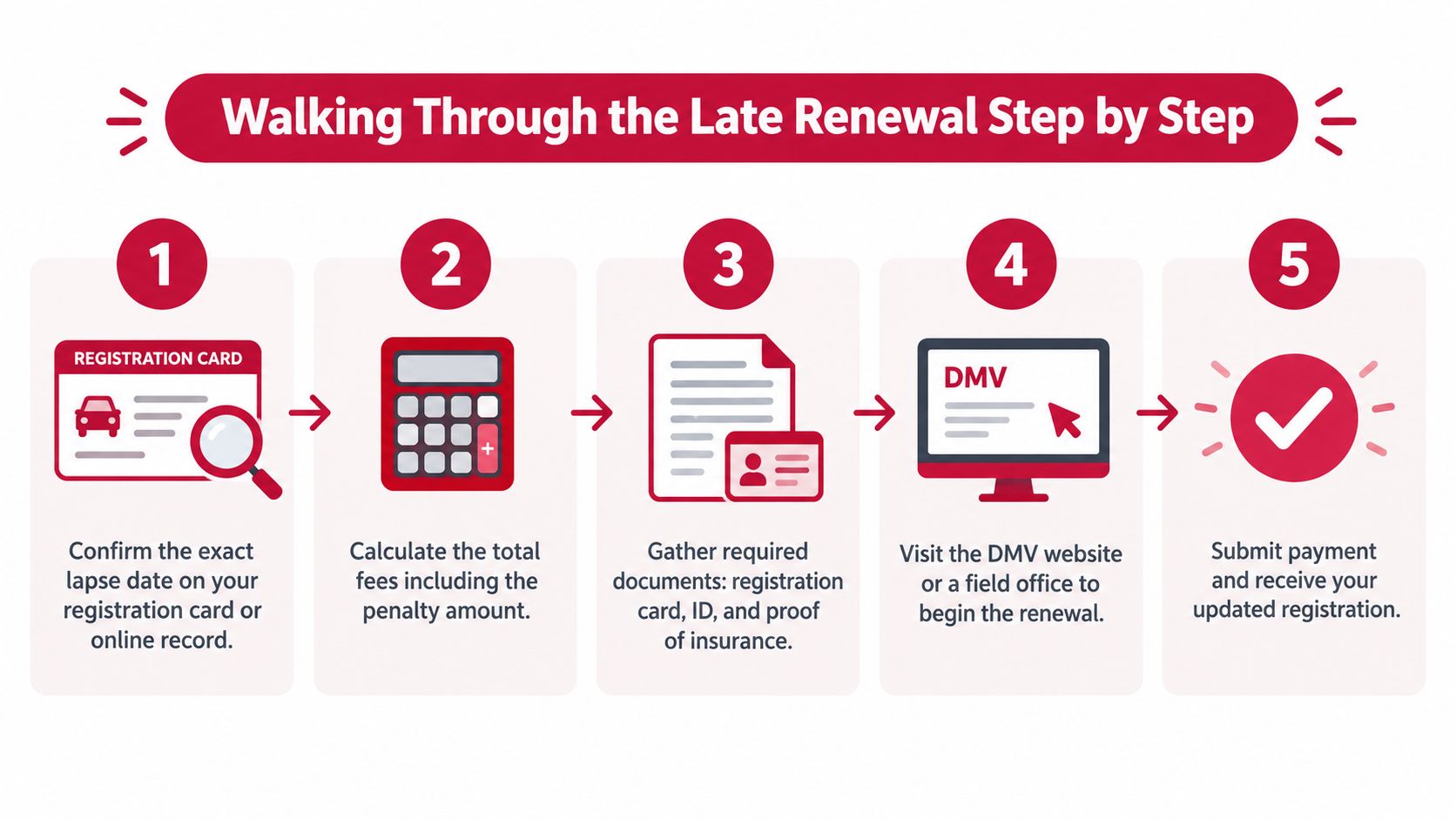
Follow the transaction in this order
- Verify the lapse: Confirm the expiration date and look for registration holds.
- Handle emissions first: If the vehicle needs a smog check, use the required testing station and obtain the electronic or paper result.
- Assemble the file: Bring the registration card or renewal notice, photo ID, proof of insurance, smog documentation when required, and payment.
- Request a full calculation: Have the service channel apply the base charges, applicable penalty tier, and fixed fees to your vehicle's record.
- Complete payment and verify issuance: Before leaving, confirm that the renewal was processed and ask when the updated registration card and sticker are issued.
The reason for doing smog first is practical. A failed or missing inspection can block the registration transaction, leaving you with a second trip. If the vehicle has an obvious check-engine issue, address that problem before relying on a same-day renewal plan.
Keep the receipt and updated documents in the vehicle once the transaction is complete. If the registration can't be completed that day, don't drive the car as though the old sticker were valid. Arrange lawful transport while you resolve the outstanding requirement.
Hidden Costs and Risks Beyond the Late Fee
The DMV penalty is the most visible charge, but it isn't the only consequence of leaving a registration expired. A roadside stop can create a separate citation for operating a vehicle without current registration under California law. The amount and handling of that citation depend on the enforcement action and the court process, so it shouldn't be folded into the DMV estimate.
A vehicle can also become harder to sell or transfer while its registration record remains unresolved. Buyers, lenders, and family members may hesitate to complete a transaction when the title or registration history requires additional work. A withheld or incomplete registration document can turn a simple private sale into a records problem.
Don't ignore holds
Parking-related issues and smog holds can prevent renewal until the responsible agency clears them. The DMV may be unable to complete the transaction merely because you've brought payment. You need the underlying hold resolved or the required release documented.
Insurance deserves attention, too. A registration lapse can surface during policy administration or claim review, creating questions about the vehicle's status at the time of an incident. That doesn't automatically decide coverage, but it gives you another reason to keep the registration current and retain proof of the completed renewal.
Driving while you're waiting to “deal with it later” adds exposure without solving the underlying record.
If you receive a citation, impound notice, or insurance inquiry, handle that issue separately from the DMV renewal. Paying the DMV balance may not automatically close a court matter or resolve an insurance file.
Your Same-Day Late Renewal Action Plan
Use a same-day plan that removes uncertainty in the right order. First, inspect the registration card and DMV record for the expiration date, then check whether a hold appears. Next, determine whether the vehicle needs a smog certificate and complete that inspection before asking for the final registration calculation.
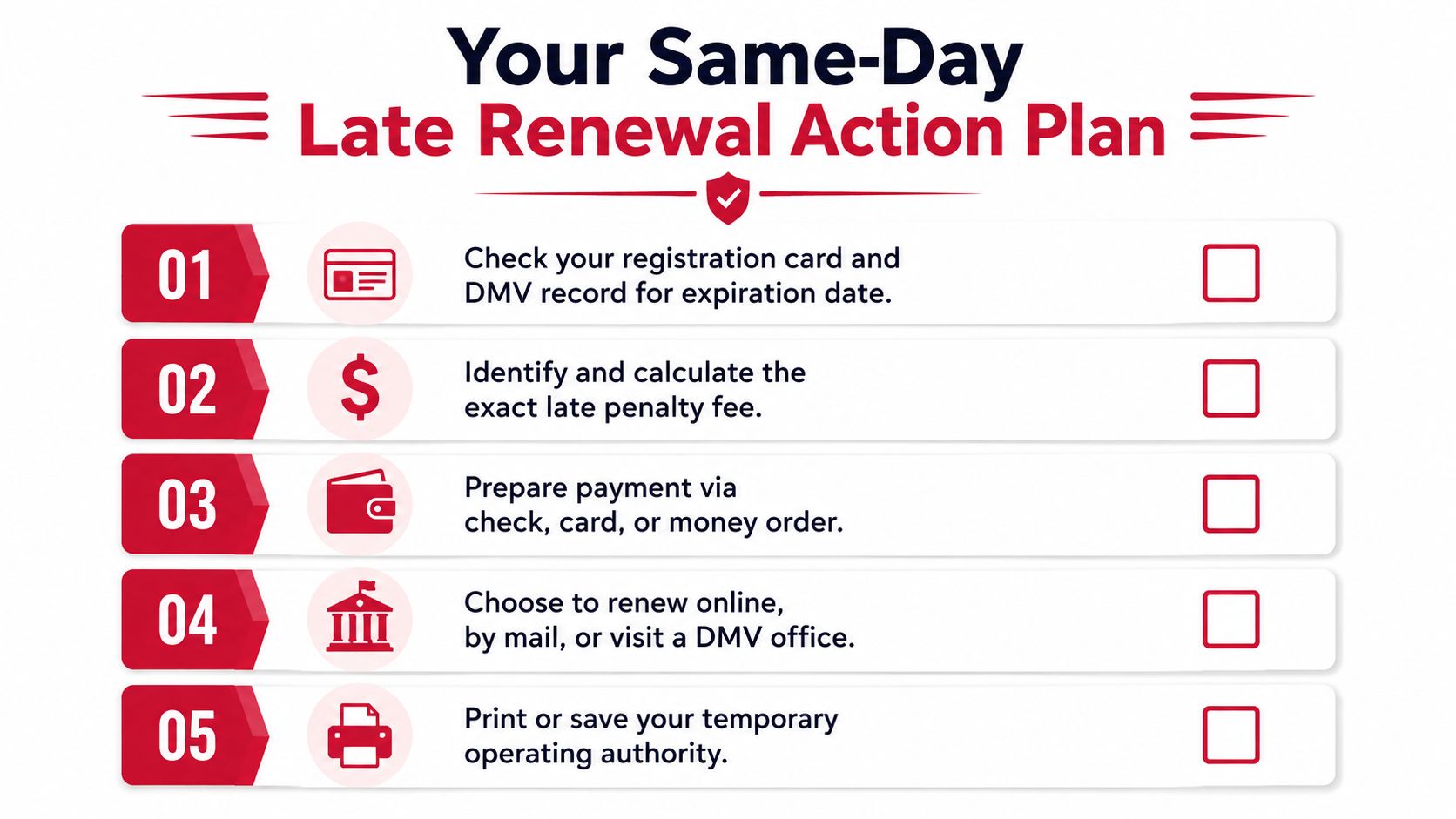
Bring the renewal notice or registration card, valid identification, proof of insurance, required smog documentation, and payment. Ask for an itemized total that distinguishes the base renewal amount from late penalties, fixed fees, other registration charges, and inspection costs. That breakdown tells you exactly what you're paying and helps identify a problem before you authorize the transaction.
Choose the channel based on the record:
- Use the online portal when the renewal is uncomplicated and the account is accepted.
- Use a DMV field office when the record needs formal verification or a government hold must be addressed.
- Use a licensed local service when you need a smog inspection and registration processing coordinated in one visit. Antioch drivers can review ways to avoid the DMV line before choosing that route.
Keep every receipt and registration document until the new sticker and card are in your possession. If the vehicle can't be renewed immediately, don't drive it on public roads with expired registration. Arrange a tow or other permitted transport, then finish the inspection, hold release, payment, and issuance process.
The best outcome is not merely paying a bill. It's ending the lapse, documenting the transaction, and removing the vehicle from the enforcement and insurance risks that come with an unresolved registration record.
Fire House Smog provides STAR-certified test-only smog inspections and California DMV registration services with on-site sticker printing at 2900 Lone Tree Way in Antioch. Bring your registration documents and proof of insurance, confirm the current requirements, and visit Fire House Smog to handle an eligible late renewal locally.
You open the mailbox, see the DMV notice, and immediately start doing calendar math. Can I get there before work? Will I need an appointment? If the car still needs a smog check, is this now two errands instead of one?
That's why so many Antioch drivers search for DMV registration services near me when the renewal notice shows up. They're not looking for a government building. They're looking for the fastest legal way to get current, stay on the road, and avoid burning half a day in line.
In East Contra Costa County, the smarter move is usually simple: handle the smog requirement and the registration transaction through a licensed local provider so you can skip the main DMV office entirely.
Table of Contents
- That Dreaded Envelope What To Do When Your DMV Notice Arrives
- The DMV Office vs A Local Partner The Real Difference
- Your Guide to Same-Day Registration Renewals and Transfers
- What to Expect at Fire House Smog in Antioch
- Pro Tips to Permanently Avoid DMV Headaches
That Dreaded Envelope What To Do When Your DMV Notice Arrives
The usual pattern goes like this. You get the notice, set it on the counter, and tell yourself you'll deal with it later. A few days pass. Then the stress starts because registration deadlines don't move just because your week got packed.
For a lot of drivers in Antioch, the frustration isn't the renewal itself. It's the assumption that renewing registration automatically means a trip to a crowded DMV field office, a long wait, and a second stop somewhere else if the car also needs emissions testing.
That assumption is where people lose time.
In California, registration volume is already high, and it keeps pressure on the system. In 2023, California recorded a total of 1,775,915 vehicle registrations, an 11.9% increase from the previous year, which helps explain why field offices stay busy and why drivers look for faster alternatives through California Auto Outlook data from CNCDA.
What most drivers miss
A licensed DMV business partner can often handle the transaction you were planning to do at the state office. That means your search for DMV registration services near me should include local registration providers, not just official DMV locations.
If your renewal notice says a smog check is required, preparation matters. The fastest visits usually happen when you already know which documents to bring, and this vehicle registration documents guide is a practical place to double-check before you leave home.
Practical rule: Don't wait until the last week on the notice. The closer you get to the deadline, the fewer options you have if paperwork is missing or the vehicle needs a retest.
The better move in Antioch
Busy drivers usually care about one thing. Can this be handled in one stop?
That's a key advantage of using a local provider that's set up for both emissions compliance and registration work. Instead of treating the DMV notice like the start of a drawn-out chore, treat it like a checklist item. Get the car tested if required, finish the registration, collect what you need, and get back to your day.
The DMV Office vs A Local Partner The Real Difference
When people type DMV registration services near me, they often mean, “Where can I get this done today without making my whole day revolve around it?” That question has two very different answers depending on where you go.
A state DMV field office is the official channel. A licensed local partner is the practical channel for many common transactions.
Why the experience feels different
The DMV field office handles a huge range of issues, from licensing to identity documents to complex title problems. That broad mission is exactly why a routine registration errand can turn into a slow, crowded process.
A local registration provider is narrower by design. The workflow is built around common vehicle transactions, and that matters when you're trying to renew tags or complete a transfer without bouncing between locations.
The fastest registration visit is usually the one that removes extra stops, not the one that chases the nearest government building.
There's another point drivers often misunderstand. Many people still think registration and emissions testing are separate errands by default. In practice, California's STAR-certified stations like Fire House Smog are licensed to provide both, which simplifies the process and avoids the repair-sales conflict that can come with shops that also sell repairs, as noted in this discussion of third-party registration and emissions-location confusion.
DMV Office vs Local Partner
| Factor | CA DMV Field Office | Licensed Partner (e.g., Fire House Smog) |
|---|---|---|
| Primary role | Broad state services across many transaction types | Focused registration help for common vehicle needs |
| Smog check on-site | No | Yes, at locations that are licensed for both |
| Workflow | Often separate from emissions compliance | Can combine smog and registration in one visit |
| Repair upsell concern | Not applicable at DMV | Reduced at test-only stations that don't perform repairs |
| Convenience for renewals | Can require more waiting and planning | Often better suited for quick, local processing |
| Best use case | Complex DMV matters outside routine registration | Drivers who want one-stop renewal or transfer service |
What works and what doesn't
What works is choosing the place that matches the transaction. If you need a straightforward renewal, a smog-related renewal, or a common ownership transfer, a licensed partner is often the cleaner option.
What doesn't work is treating every DMV notice like it requires a trip to the field office. That approach adds friction for no real benefit when the job is something a local provider can legally process.
Your Guide to Same-Day Registration Renewals and Transfers
If you want same-day service, don't wing it. Most delays happen because the driver showed up with the wrong paperwork, forgot the title, or didn't realize the smog requirement had to be cleared first.
California requires a smog inspection for most registration renewals and ownership changes, and that requirement has to be satisfied before a sticker can be issued, according to the California DMV vehicle registration rules.
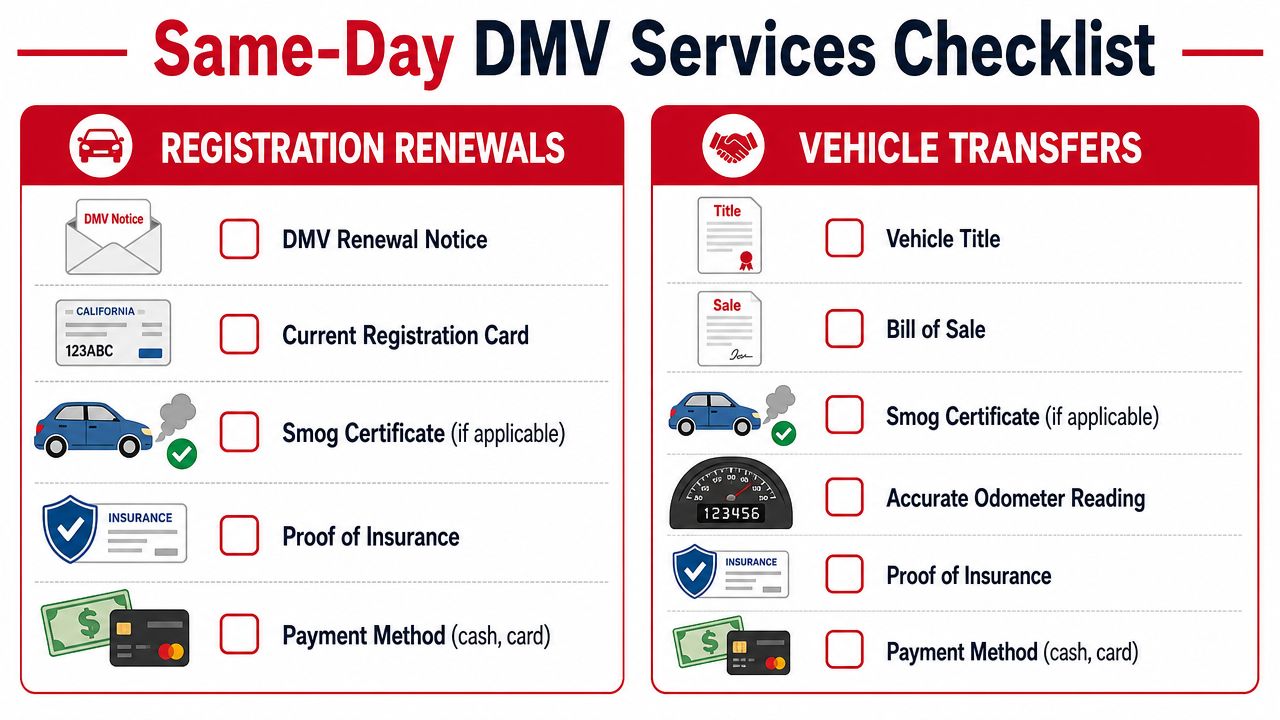
For a registration renewal
A renewal is usually the simpler visit, especially if the notice is current and the vehicle information matches what the state has on file.
Bring these items:
- DMV renewal notice: This speeds up lookups and helps the counter verify exactly what's due.
- Current registration card: Helpful if the notice isn't available or if details need to be confirmed.
- Smog certificate if applicable: If your renewal requires emissions compliance, handle that first.
- Proof of insurance: Keep it current and easy to show.
- Payment method: Bring a card or cash based on what the location accepts.
If you're unsure whether your paperwork is enough, it helps to review the transfer and registration requirements ahead of time through this vehicle registration transfer page.
For an ownership transfer
Transfers go smoothly when the title is complete and legible. They slow down fast when signatures are missing, the buyer and seller information doesn't match, or the odometer reading wasn't recorded properly where required.
Bring as much of the following as applies to your situation:
- Vehicle title: The pink slip matters most. Check signatures before leaving home.
- Bill of sale: Not always the main document, but often useful when the transaction details need support.
- Smog certificate if applicable: This is the item people forget most often in private-party sales.
- Accurate odometer reading: Write it down carefully.
- Proof of insurance: Don't assume you can sort this out later the same day.
- Payment method: Fees and processing still need to be completed on-site.
If you're buying or selling locally, fill out the title before anyone drives away. Fixing signature mistakes after the fact is where simple transfers turn into repeated trips.
The order matters
For transactions tied to emissions compliance, the sequence is straightforward:
- Confirm what kind of transaction you're doing
- Complete the smog check if the vehicle requires it
- Bring the supporting documents to the registration counter
- Finish payment and collect the updated registration items
That order is why one-stop locations save so much hassle. You're not guessing which errand comes first. The requirement that can block the sticker gets handled before the paperwork is finalized.
What to Expect at Fire House Smog in Antioch
At the Antioch location on Lone Tree Way, the process is built around a simple idea. Get the vehicle inspected, then complete the registration transaction without sending the driver somewhere else.
That matters because STAR test-only service changes the feel of the visit. A test-only station isn't trying to turn a failed inspection into a repair sale. For drivers, that removes a layer of suspicion that comes up at shops where the same business both diagnoses the problem and profits from the repair.
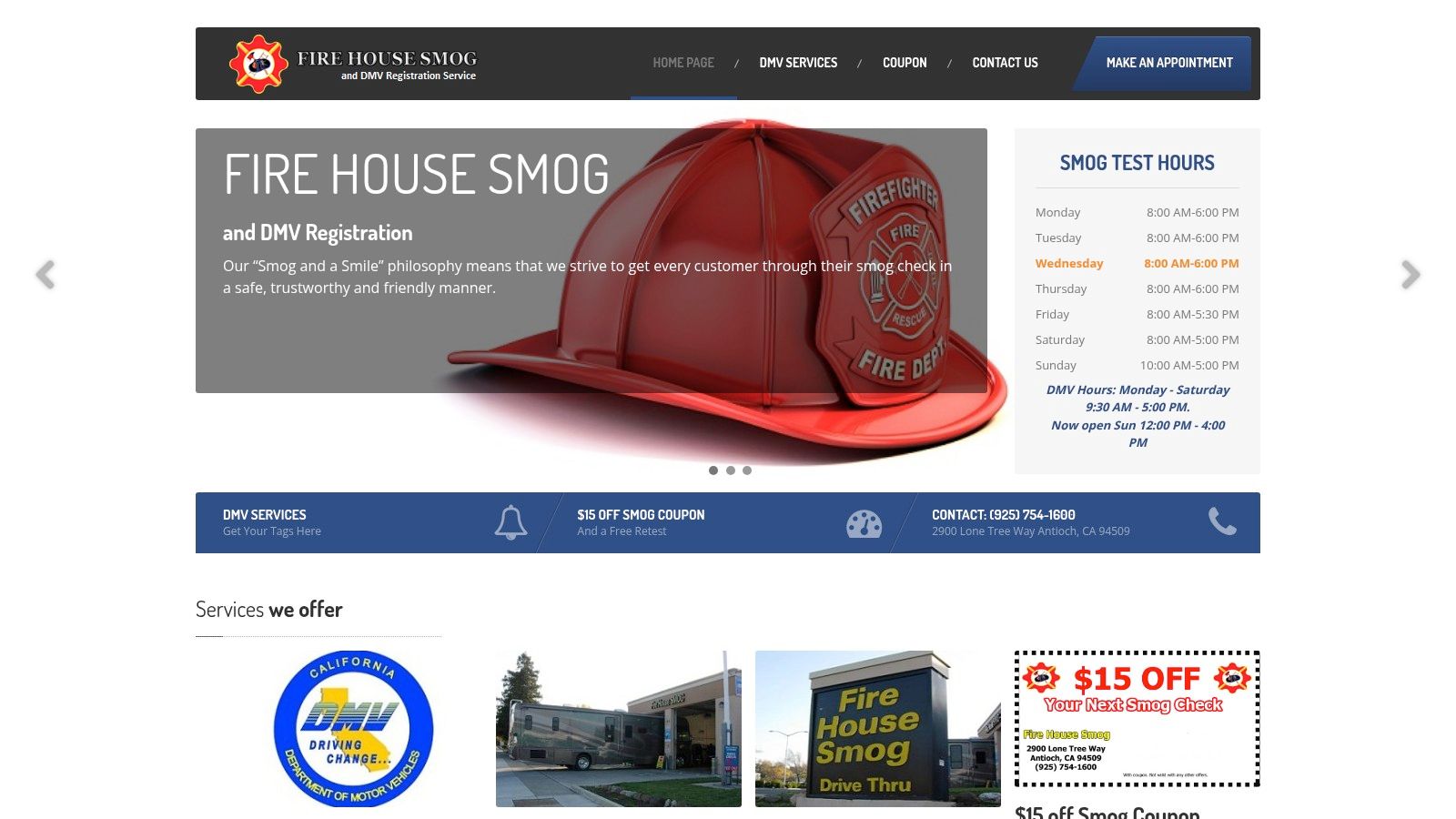
What the visit usually looks like
You arrive with the car and your paperwork. The smog side handles the inspection. After that, you move to the counter for the DMV side if your transaction qualifies for on-site processing.
The setup includes two service bays, which helps keep cars moving and reduces the bottleneck you often see at smaller stations with only one lane of activity. Most passenger cars, SUVs, and light trucks fit the usual workflow. Some RVs and motorhomes can be handled too, but calling first is the smart move because size and equipment limits matter.
If you need to confirm the emissions side before going in, the most relevant local service details are on the Antioch smog check page.
Why people choose this route
Drivers usually want three things:
- One stop instead of two: Finish the smog requirement and registration task in a single visit.
- No repair pressure: Test-only service keeps the inspection separate from repair sales.
- Same-day completion: For eligible transactions, you can leave with current registration handled instead of waiting to schedule another errand.
Local shops that combine compliance work and registration processing solve a very specific problem. They turn a DMV chore into a short operational stop.
Pro Tips to Permanently Avoid DMV Headaches
The cleanest registration experience starts before you leave home. Most problems aren't dramatic. They're small preventable issues like missing paperwork, an unsigned title, or showing up on a weekend expecting every weekday service to be available.
The habits that save time
- Open the notice right away: Don't let it sit on the counter until the deadline feels urgent.
- Check whether smog is part of the transaction: If it is, treat that as the gatekeeper step.
- Match the location to the job: Routine renewals and standard transfers often fit a licensed partner better than a field office.
- Review hours before you drive over: Weekend confusion is common.
Weekend availability is where drivers get tripped up. While some states have 24/7 self-service kiosks, most licensed California DMV partners offer more limited weekend hours, such as Sunday afternoons, so it's smart to verify current weekend tag-printing availability in advance through this weekend-hours note about third-party service limitations.
One last practical move
Before booking your time around the visit, check the business website for current smog coupons or service notes. Even when the registration side is the main reason you're going, a small discount on the smog side and a clear understanding of posted DMV hours can make the whole errand simpler.
If your goal is to stop treating registration like an all-day event, the pattern is consistent: prepare the documents, handle smog first when required, and use a local one-stop provider when the transaction fits.
If you want a local one-stop option in Antioch for smog testing and DMV registration help, Fire House Smog handles common renewals, ownership transfers, and on-site tag issuance during posted service hours. Calling ahead is the quickest way to confirm what documents you need and whether your transaction can be completed the same day.
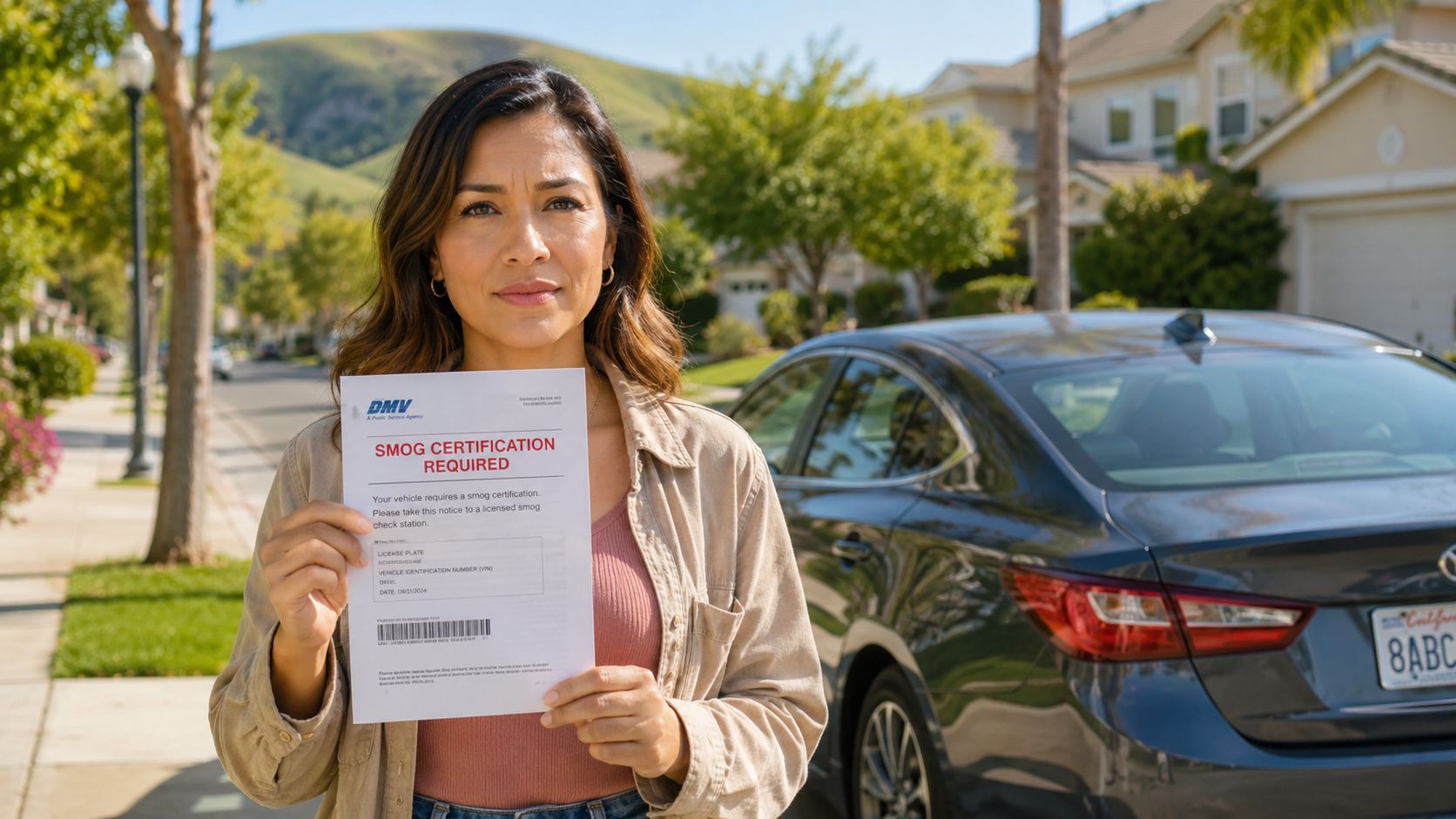
You open the DMV renewal notice, scan for the amount due, and then spot the line that slows everything down: Smog Certification Required. If you're in Antioch, that usually means one more errand before your registration is finished, and the main frustration isn't the test itself. It's the risk of making two or three trips because you picked the wrong station, showed up with a cold engine, or didn't realize the certificate doesn't sit around forever.
The good news is that a smog check in Antioch, CA is usually manageable when you treat it like a short compliance task instead of a mystery. The process is routine, the testing flow is standardized, and most of the hassle comes from timing mistakes or avoidable prep issues. Antioch drivers also have a practical advantage. You can line up the inspection and, in some cases, handle DMV-related paperwork locally instead of burning half a day in line elsewhere.
Table of Contents
- Your Fast-Track Guide to Smog Checks in Antioch
- How to Prepare Your Vehicle for the Smog Test
- Navigating the Smog Station What to Bring and Expect
- Fire House Smog A One-Stop Shop in Antioch
- Smog Check Costs Coupons and Free Retest Rules
- Antioch Smog Check FAQs and Troubleshooting
Your Fast-Track Guide to Smog Checks in Antioch
If your renewal notice says you need a smog certificate, you're dealing with a standard part of vehicle compliance in Contra Costa County. For many Antioch drivers, this isn't optional paperwork you can push off. It's tied directly to registration and, in some situations, ownership transfer.
One timing issue catches people off guard. In California, a passing smog check is generally valid for 90 days, which makes it a short-lived compliance document rather than something you can do early and forget about, according to Geotab's California smog check guide. If you're renewing late or buying and selling a vehicle, that window matters.
The fastest local approach
Most delays come from three mistakes:
- Waiting until the deadline week and finding a line.
- Showing up unprepared with a check-engine light or incomplete paperwork.
- Using the wrong station type when DMV has directed your vehicle to a STAR location.
Practical rule: Handle the smog check close enough to your DMV deadline that the certificate stays useful, but early enough that a surprise failure doesn't put your registration on hold.
The local shortcut is simple. Pick a station that can handle the class of vehicle you own, go in with your documents ready, and if possible use a place that can also help with DMV registration tasks on-site. That last part matters more than people think. It can turn a smog day into a single stop instead of a test visit followed by a separate DMV trip.
For those seeking a smog check Antioch CA, the primary objective is clear. Not just passing, but finishing the whole errand with the fewest moving parts.
How to Prepare Your Vehicle for the Smog Test
Most smog failures aren't shocking. They're usually tied to warning lights, readiness monitors, or obvious equipment issues that could've been spotted before leaving home. A little prep saves a lot of backtracking.
Start with the failure triggers
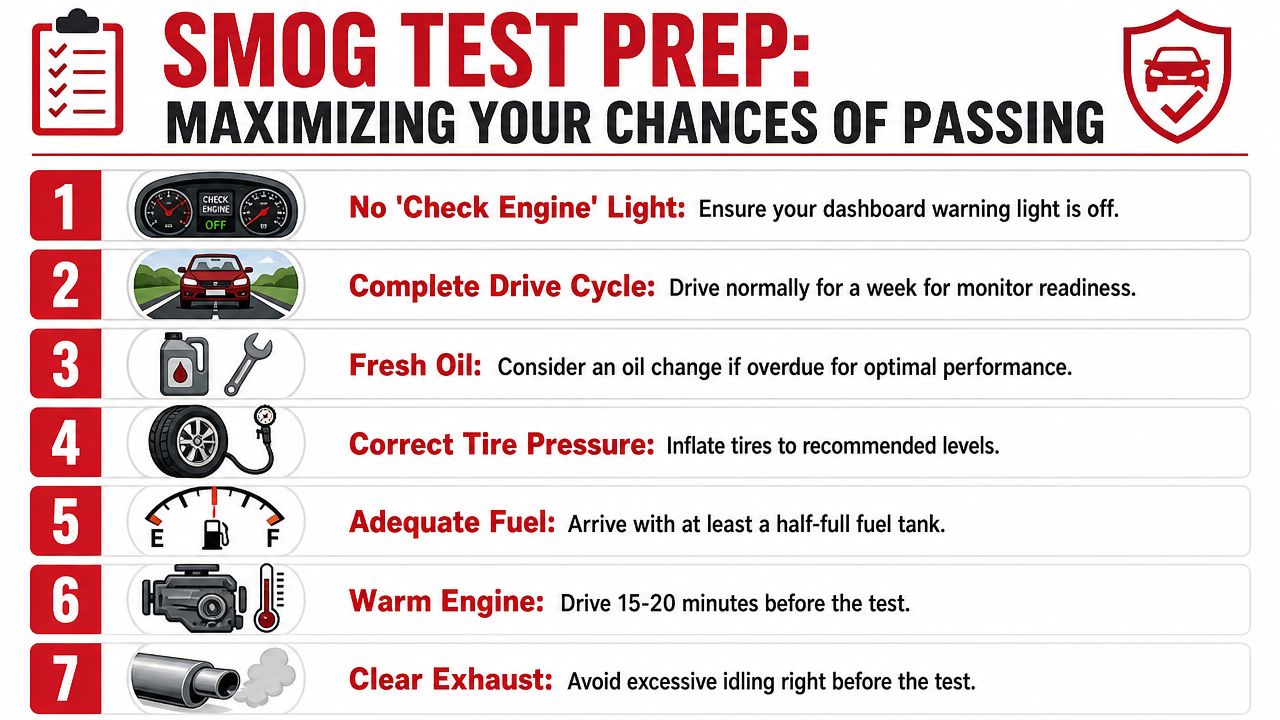
California's smog check includes a visual inspection of emissions hardware, a functional OBD inspection for fault codes, and for pre-2000 vehicles, a tailpipe test. The inspection typically takes 20 to 30 minutes, and a lit check-engine lamp is a common immediate reason for failure, according to California BAR's smog check overview.
That gives you a very clear pre-test checklist.
- Check the dash first. If the check-engine light is on, don't go yet. You're paying for a result that will likely fail right away.
- Think about recent battery work. If the battery was disconnected recently, your OBD readiness monitors may have reset. That can create a problem even if the car seems to drive fine.
- Look under the hood only for the obvious. Missing or visibly tampered emissions parts can stop the process before any tailpipe result matters.
A car can feel normal and still be unready for smog. Driveability and monitor readiness aren't the same thing.
Simple prep that helps
A practical routine works better than overthinking it.
First, drive the car before the appointment. A warm engine helps the vehicle arrive in normal operating condition, and it reduces the odds of walking into the bay with a cold, barely-used car that hasn't completed normal driving behavior.
Second, don't clear codes right before the test. People sometimes erase a warning light and head straight to the station. That's one of the fastest ways to trade one problem for another, because the monitors may no longer show ready.
Third, bring special paperwork only if your vehicle situation is unusual. If you're dealing with an out-of-state transfer or related identification issue, it helps to check what a VIN verification service may require before your visit.
A prep list that actually matters
| Check before leaving | Why it matters |
|---|---|
| Dashboard warning lights | A check-engine lamp can trigger immediate failure |
| Recent battery disconnect | Readiness monitors may not be complete |
| Warm-up drive | Helps the vehicle arrive in normal operating condition |
| Obvious emissions tampering | Visual inspection can flag missing hardware |
| Fuel and basic drivability | Prevents avoidable interruptions during testing |
The best prep is boring. Drive the car normally, fix warning-light issues before testing, and don't treat smog day like the time to gamble on a maybe.
Navigating the Smog Station What to Bring and Expect
The station visit is usually straightforward when you walk in ready. Most of the stress comes from not knowing whether you'll be there for ten minutes or all afternoon, and whether you're missing something important.
Bring the basics
For a routine Antioch visit, have these with you:
- DMV renewal notice if you received one
- Current registration
- Driver's license
- Payment method
- Any coupon or appointment confirmation
That last item is easy to forget, especially if you booked online. If you want to cut down on waiting, use the station's online appointment page before you head over.
What the visit usually looks like
California smog testing runs inside a large statewide inspection system, not as some loose local process. The Bureau of Automotive Repair publishes executive summaries showing statewide inspection totals, failure rates, and licensing activity. BAR also notes that a typical smog test takes about 20 to 30 minutes, which helps explain why higher-throughput Antioch stations use multiple bays to keep cars moving, as shown in the BAR smog check executive summary reports.
In practice, a well-run visit often feels like this:
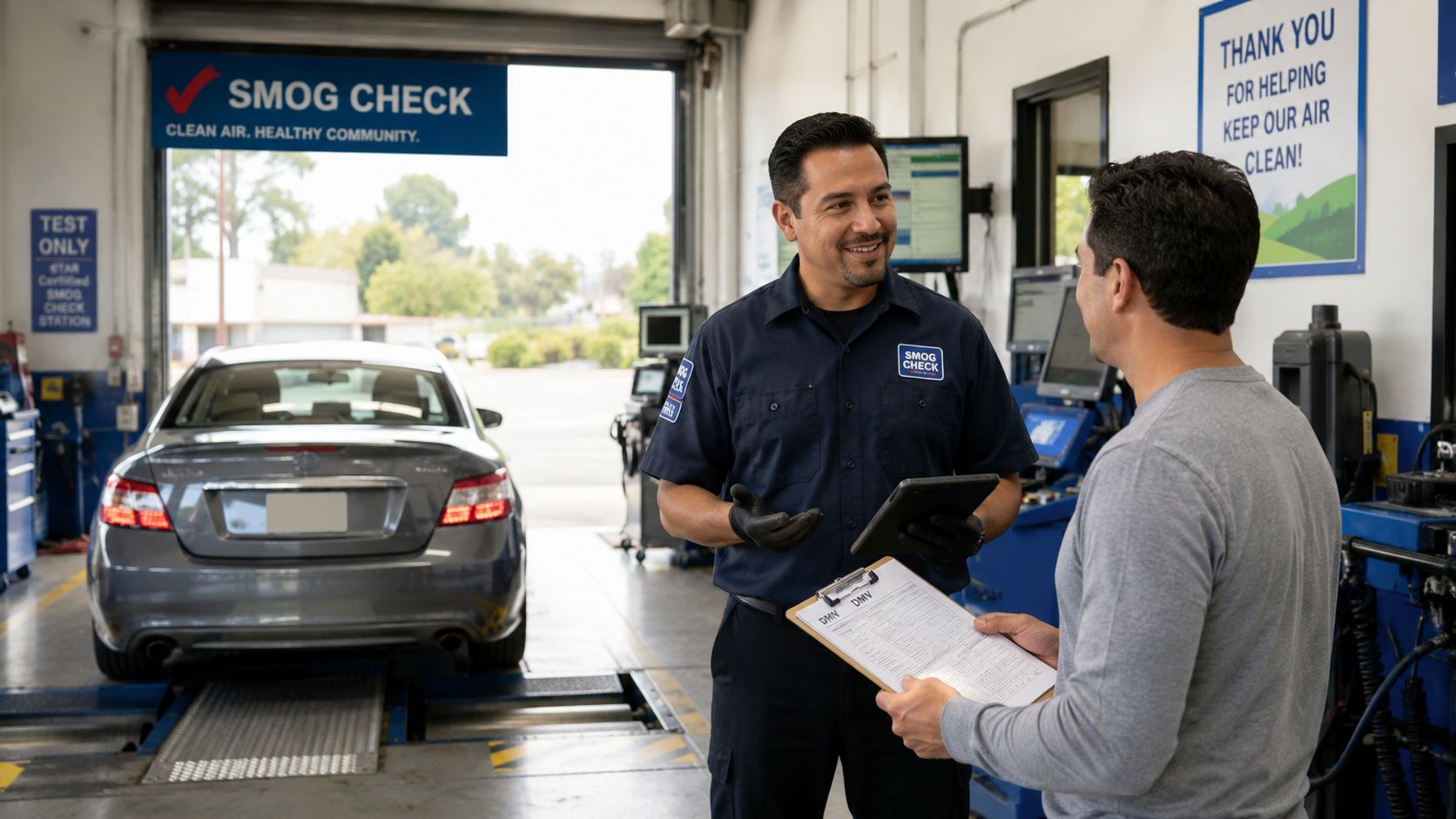
- You pull in and check in with the front desk or technician.
- They confirm the vehicle information and what kind of test you need.
- The technician moves the car into a bay and runs the inspection steps.
- You wait while the system checks the vehicle.
- You get the result and next-step instructions.
The smoother your arrival, the faster the whole stop goes. A ready car and clear paperwork matter as much as the station's speed.
If it helps to see the general process before you go, this walkthrough gives a useful visual reference:
A good station experience shouldn't feel mysterious. You should know what you're handing over, what the technician is checking, and whether you're done or need repairs before a retest.
Fire House Smog A One-Stop Shop in Antioch
You get the renewal notice, drive over for the test, and then realize you still have to deal with DMV paperwork somewhere else. That extra stop is what turns a simple Antioch smog check into a time drain.
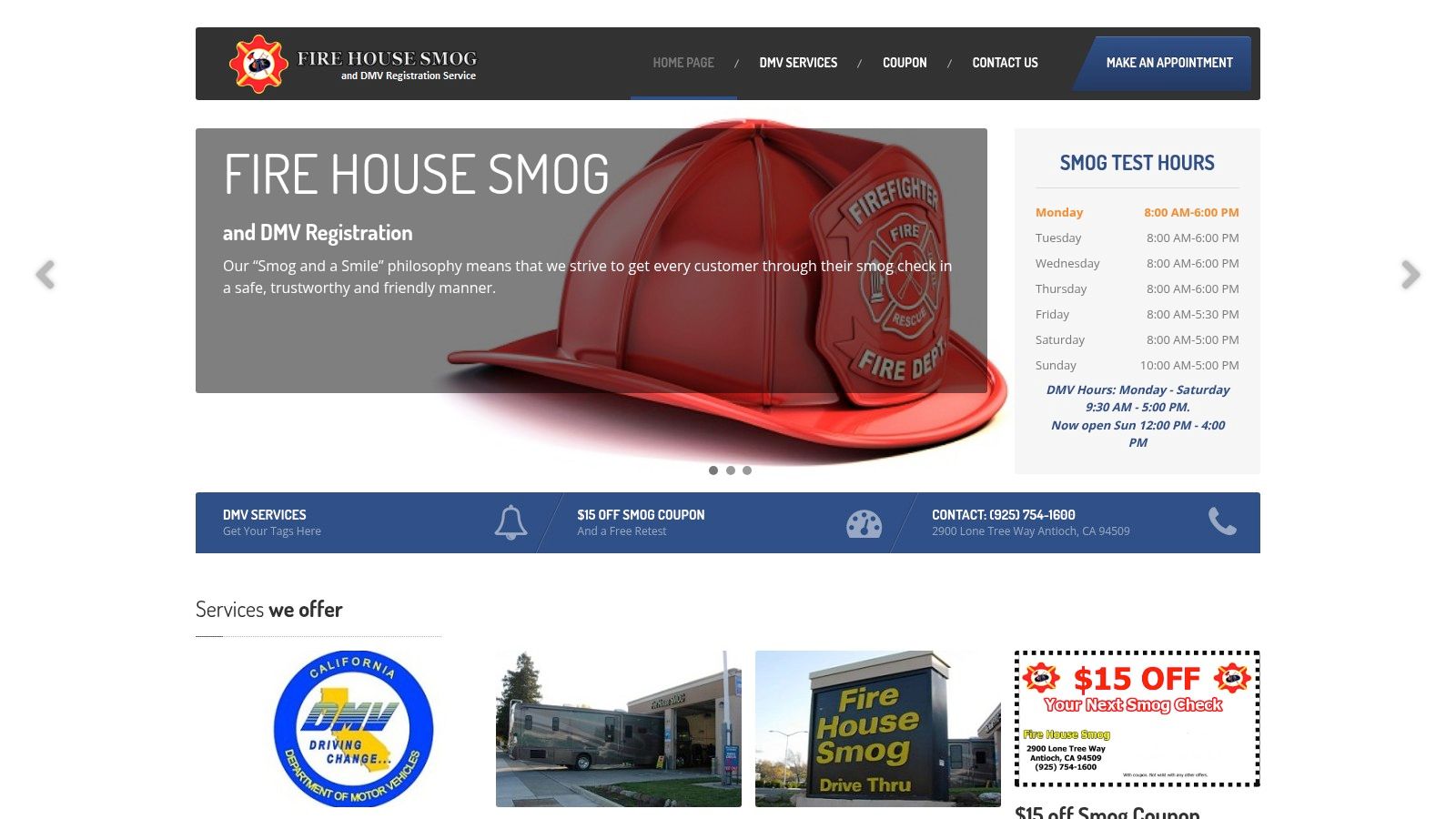
For local drivers, the primary advantage is not just finding any station with an open bay. It is finding one that can handle the type of inspection your notice requires and, if needed, help you finish the registration side without sending you to wait in another line.
Why STAR and test-only matter in Antioch
Some Antioch vehicles can go to a regular smog shop. Others are directed to a STAR station, and if your DMV paperwork says STAR, that requirement decides where you can test. Checking that before you leave home saves a wasted trip.
A test-only station also matters for drivers who want a straightforward inspection. The shop runs the test and reports the result. It does not turn the visit into an in-house repair conversation.
That setup works well if your goal is simple. Get the inspection done, get the certificate transmitted, and move on.
Where the one-stop setup saves time
Fire House Smog, at 2900 Lone Tree Way in Antioch, is a STAR-certified test-only station that also offers on-site DMV services. That combination is what makes it useful in real Antioch situations, especially for people trying to keep the whole errand to one stop.
It helps most in a few common cases:
- Registration is due now. You can handle the smog check and DMV paperwork in one place instead of splitting the job across two appointments.
- You are transferring ownership. Smog and registration tasks often come up together during a sale, and keeping them under one roof cuts down on back-and-forth.
- You want a cleaner process. Test-only service keeps the visit focused on compliance, not repair sales.
- You are comparing total hassle, not just price. A low test price loses its appeal if it still leaves you standing in a DMV line afterward.
If you are also price-checking before you go, review the current Antioch smog coupon offers and terms closely. Coupon details often tell you whether the deal fits your vehicle and whether a retest is included.
For Antioch residents, that is the local shortcut. Pick a station that can meet the STAR requirement if you have one, run the test without the sales pressure, and handle DMV work on-site if that is the part you are trying to avoid.
Smog Check Costs Coupons and Free Retest Rules
Price matters, but this is one of those errands where the cheapest listing isn't always the easiest experience. You want a fair test price, clear retest terms, and no confusion about what's included.
What pricing usually looks like
Industry guidance commonly places a typical smog test around $20 to $50, depending on the vehicle and service setup. That general range appears in BAR-related executive summary context and related guidance discussed earlier, which is why Antioch stations often compete on speed, convenience, and add-ons as much as raw price.
What that means in real life is simple. A bargain price doesn't help much if you wait too long, miss the station type you need, or have to come back because the policy details weren't clear.
How to use coupons without surprises
If you're comparing local options, check the current smog coupon page before you go. Read the terms carefully. Coupon language often tells you more than the headline discount does, especially around retests and vehicle exclusions.
A few points are worth checking every time:
- Eligibility details matter. Not every coupon applies to every vehicle class.
- Retest wording matters more than the discount amount if you're worried about failing.
- Timing rules can affect whether you qualify for a free retest after repairs.
Free retest rules are about terms, not assumptions
Drivers often hear "free retest" and assume it means unlimited retries or no conditions. That's usually not how these offers work. Free retest policies typically depend on the station's posted terms, qualifying repairs, and a return within the allowed time window.
Here's the practical approach:
| Before you pay | Why to ask |
|---|---|
| Does the coupon include a retest | Prevents assumptions |
| Which vehicles are excluded | Avoids surprise upcharges |
| Is there a deadline to return | Keeps you eligible |
| Do I need proof of repairs | Helps if the vehicle fails |
The cheapest smog check isn't always the one with the lowest posted number. It's the one that avoids a second round of confusion.
Antioch Smog Check FAQs and Troubleshooting
What if my car fails
Read the failure report first. It tells you whether you're dealing with a check-engine light, an incomplete readiness monitor, or an emissions component problem. Each one points to a different fix, and guessing usually costs more than waiting a day and addressing the actual issue.
Keep the paperwork. Before you schedule a retest, ask the station what its retest policy requires and whether you need repair documentation. A quick return only helps if the original problem is resolved.
Do I need a STAR station
If your DMV notice says STAR, use a STAR station. California assigns certain vehicles to the enhanced testing program, and a pass from the wrong station type will not clear that requirement.
This is one of the easiest ways Antioch drivers lose time. They get the test done, then learn they need to do it again at a STAR location.
What about RVs, diesel vehicles, or unusual cases
The rules for different vehicle types can be confusing. The right test depends on model year, fuel type, weight class, and how the vehicle is classified in California records.
For RVs, diesel trucks, older vehicles, and out-of-state transfers, call before you leave home. Ask the direct question that matters: can you test my exact vehicle type today? That saves you from showing up at a station that handles standard passenger cars but not your setup.
How does the DMV get my result
California sends smog results to DMV electronically after the test is completed. In most cases, you do not need to carry a paper certificate to prove the vehicle passed.
What does matter is timing. If your registration deadline is close, confirm the test was transmitted properly and make sure the DMV side gets handled without delay. That is where a one-stop location helps in a practical way. Fire House Smog in Antioch handles STAR-certified test-only inspections and on-site DMV services, so you can finish the test and registration steps in one stop instead of dealing with a separate DMV trip later.