
California adds a 10% charge plus $20 in flat fees for renewals 1–10 days late, and the percentage climbs to 160% plus $200 in flat fees after two years, so every additional month costs you real money. The fastest way to limit the damage is to confirm your expiration date, clear any hold, complete a required smog check, and process the renewal before the vehicle moves into a higher penalty tier.
You're probably reading this because the sticker on your plate is already expired, or because you found an old renewal notice in the glove box. A late registration renewal isn't just a paperwork problem. In California, the charge changes with the length of the delay, and the jump after the first month is especially painful.
The right response is simple: stop driving the vehicle until you know its registration status, verify the exact lapse date, and handle the renewal as soon as possible. California's published penalty table and Vehicle Code section 9554 provide the framework, including a limited grace window and specific circumstances in which penalties may be waived. California DMV's penalty schedule is the document to use when estimating the state charges.
Table of Contents
- Why a Lapsed Tag Is a Bigger Problem Than It Feels
- How California Calculates Late Registration Renewal Penalties
- What You Need Before You Renew a Late Registration
- Choosing Where to Complete a Late Registration Renewal
- Walking Through the Late Renewal Step by Step
- Hidden Costs and Risks Beyond the Late Fee
- Your Same-Day Late Renewal Action Plan
Why a Lapsed Tag Is a Bigger Problem Than It Feels
Maria drives from Antioch toward Delta de Anza for work. She let her 2019 Civic pass its registration date by two weeks and assumed the fix would be minor. The surprise came when she checked the renewal amount and saw a 10% penalty on the vehicle license fee and weight fee, plus $20 in fixed late fees.
Her first instinct was to wait until payday. That would have been the wrong move. The penalty schedule is based on the delay period, so waiting can move the renewal into a more expensive bracket even though the vehicle itself hasn't changed.
Practical rule: Once you know the registration is late, treat the renewal as urgent paperwork, not a task for later.
The DMV charge is only one part of the exposure. Driving with expired registration can lead to a roadside citation, and a stop on Highway 4 can turn a missed renewal into a much more disruptive afternoon. A registration lapse can also create complications when an insurer reviews policy information or handles a claim, especially if the vehicle's legal operating status becomes relevant.
A lapsed registration can interfere with more than daily commuting. You may face difficulty transferring ownership, completing another DMV transaction, or proving that the vehicle was properly registered during a particular period. Those problems often appear when you're trying to sell the car, replace a title, or resolve an insurance question.
The cost of waiting rises in stages
Maria's two-week delay sits in the lower part of California's schedule. If she waits beyond the 30-day exception, the percentage-based charge changes sharply. If she keeps driving while the tag remains expired, she also exposes herself to enforcement separate from the DMV renewal bill.
The practical recommendation is direct. Check the expiration date today, identify whether a smog certificate is required, and get a complete fee calculation before deciding that postponing the renewal is harmless.
How California Calculates Late Registration Renewal Penalties
California Vehicle Code section 9554 authorizes a penalty for a renewal application made after midnight on the expiration date, while also providing an exception for an application made within the applicable 30-day window. The DMV's published table applies the percentage to the vehicle license fee and weight fee, then adds the listed CHP and registration late fees. Vehicle Code section 9554 contains the statutory framework.
The tiers are easy to misunderstand because the fixed amounts and percentage amounts change together. The example below uses a $312 base only to illustrate the percentage calculation. It doesn't include any other possible registration charges, county charges, smog costs, or adjustments.
| Days or time late | Percentage penalty | Flat fees added | Example on $312 base |
|---|---|---|---|
| 1–10 days | 10% | $20 | $31.20 penalty, $20 flat fees, $363.20 subtotal |
| 11–30 days | 20% | $30 | $62.40 penalty, $30 flat fees, $404.40 subtotal |
| 31 days to one year | 60% | $60 | $187.20 penalty, $60 flat fees, $559.20 subtotal |
| More than one year to two years | 80% | $100 | $249.60 penalty, $100 flat fees, $661.60 subtotal |
| More than two years | 160% | $200 | $499.20 penalty, $200 flat fees, $1,011.20 subtotal |
These examples show why the 31-day threshold matters. On the illustration, the percentage penalty rises from $62.40 in the 11–30-day tier to $187.20 in the 31-days-to-one-year tier. The table is a calculation example, not a quote for your vehicle, because the DMV applies the percentage to the relevant vehicle license fee and weight fee rather than automatically to every amount on a renewal bill.
For a practical explanation of the underlying renewal bill, review this guide to California registration renewal fees. Then ask for the full transaction breakdown before paying.
What the grace window means
The DMV states that no late penalty is added when the renewal application is made within 30 days after midnight of the expiration date. That doesn't mean you should continue driving casually with an expired registration. It means eligible drivers have a defined period in which submitting the application can avoid the late penalty.
California also allows penalty waivers in specific circumstances. Eligibility depends on the facts and the required DMV process, so don't assume a waiver applies without asking about it directly.
What You Need Before You Renew a Late Registration
A smooth late renewal starts with preparation. Before you visit a smog station, DMV office, or registration service, confirm the vehicle's status and gather the documents that identify both you and the car.
Start with the smog requirement. Many gasoline vehicles that are within the state's newer-model exemption may not need a current smog check for the renewal cycle, but exceptions can apply. A change of ownership, an out-of-state title, or a gross-polluter designation can place the vehicle on a different testing path. Diesel vehicles and heavier trucks may also involve separate program requirements.
Bring a complete document set
Use this California vehicle registration document checklist before leaving home:
- Identification: Carry a current photo ID.
- Vehicle information: Bring the renewal notice, registration card, or license plate number.
- Insurance evidence: Have proof of insurance available.
- Title paperwork: Include out-of-state title documents when the transaction involves an imported vehicle.
- Payment: Bring an accepted payment method and be prepared for the amount to differ from the original notice.
Check for holds before you make the trip. Unresolved parking matters, smog-related holds, or other registration restrictions can stop the transaction even when you have the right documents. If a court or agency has issued a release form for a hold, bring that release with you rather than expecting the DMV system to update instantly.
Don't assume a smog pass clears every problem. It resolves the emissions requirement when applicable, but it doesn't automatically remove unrelated registration holds or calculate every outstanding charge.
Choosing Where to Complete a Late Registration Renewal
The best channel depends on why the registration is late and what the vehicle needs. Online renewal is convenient for a straightforward transaction, but it's a poor choice when the system can't verify the vehicle, a smog certificate is required, or the account contains a hold.
A DMV field office can handle complex verification, but the process may involve an appointment, waiting, and additional follow-up if another document or inspection result is missing. A licensed DMV partner can be useful when you need registration processing and related services in one place. Fire House Smog, for example, offers STAR-certified test-only smog checks and on-site California DMV registration services with sticker printing in Antioch. Confirm current service availability before visiting.
| Factor | DMV online portal | DMV field office | Licensed partner, Fire House Smog |
|---|---|---|---|
| Straightforward renewal | Convenient when the account is eligible | Available, but may require a visit | Available during posted DMV service hours |
| Late-fee calculation | System-generated for eligible transactions | DMV staff review | Registration service can review the transaction |
| Smog requirement | May reject transactions needing verification | Can process documentation | Smog testing and registration services may be available at the same location |
| Holds or unusual records | Limited ability to resolve them online | Appropriate for formal verification | May identify the issue and direct you to the agency that must clear it |
| Sticker issuance | Delivery process applies | Ask about issuance for the transaction | On-site sticker printing is available for qualifying services |
| Best fit | Clean, uncomplicated renewal | Legal or record problems requiring DMV review | Drivers seeking a local, combined service path |
Online systems can reject overdue renewals or vehicles that need a smog certificate. Don't keep resubmitting the same transaction. If the portal won't accept it, switch to a channel equipped to inspect the vehicle or review the record.
Walking Through the Late Renewal Step by Step
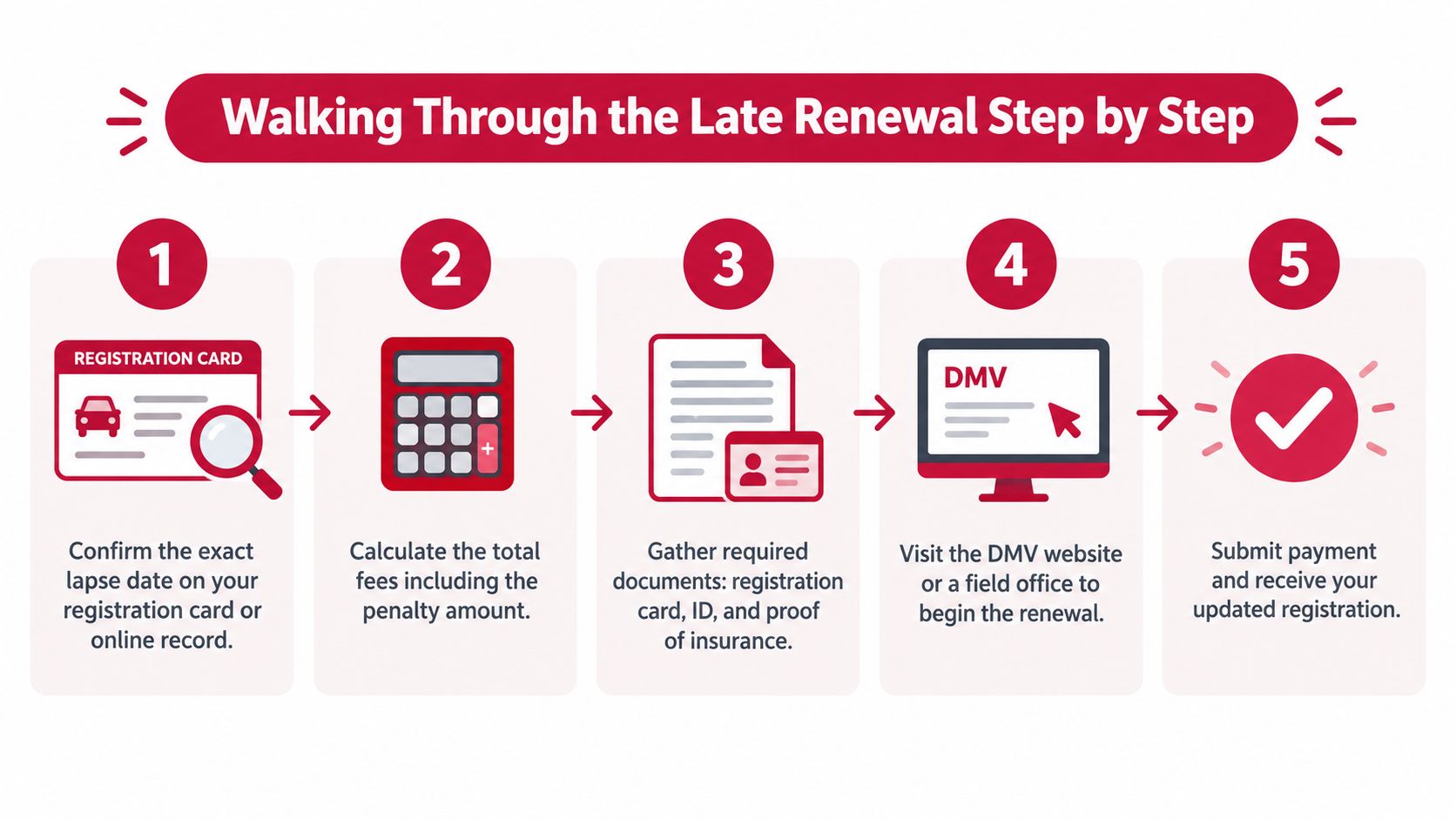
The fastest reliable process is orderly. Start by confirming the expiration date on the registration card or DMV record. The exact date determines which penalty tier applies, so guessing can lead to the wrong expectation about the total.
Follow the transaction in this order
- Verify the lapse: Confirm the expiration date and look for registration holds.
- Handle emissions first: If the vehicle needs a smog check, use the required testing station and obtain the electronic or paper result.
- Assemble the file: Bring the registration card or renewal notice, photo ID, proof of insurance, smog documentation when required, and payment.
- Request a full calculation: Have the service channel apply the base charges, applicable penalty tier, and fixed fees to your vehicle's record.
- Complete payment and verify issuance: Before leaving, confirm that the renewal was processed and ask when the updated registration card and sticker are issued.
The reason for doing smog first is practical. A failed or missing inspection can block the registration transaction, leaving you with a second trip. If the vehicle has an obvious check-engine issue, address that problem before relying on a same-day renewal plan.
Keep the receipt and updated documents in the vehicle once the transaction is complete. If the registration can't be completed that day, don't drive the car as though the old sticker were valid. Arrange lawful transport while you resolve the outstanding requirement.
Hidden Costs and Risks Beyond the Late Fee
The DMV penalty is the most visible charge, but it isn't the only consequence of leaving a registration expired. A roadside stop can create a separate citation for operating a vehicle without current registration under California law. The amount and handling of that citation depend on the enforcement action and the court process, so it shouldn't be folded into the DMV estimate.
A vehicle can also become harder to sell or transfer while its registration record remains unresolved. Buyers, lenders, and family members may hesitate to complete a transaction when the title or registration history requires additional work. A withheld or incomplete registration document can turn a simple private sale into a records problem.
Don't ignore holds
Parking-related issues and smog holds can prevent renewal until the responsible agency clears them. The DMV may be unable to complete the transaction merely because you've brought payment. You need the underlying hold resolved or the required release documented.
Insurance deserves attention, too. A registration lapse can surface during policy administration or claim review, creating questions about the vehicle's status at the time of an incident. That doesn't automatically decide coverage, but it gives you another reason to keep the registration current and retain proof of the completed renewal.
Driving while you're waiting to “deal with it later” adds exposure without solving the underlying record.
If you receive a citation, impound notice, or insurance inquiry, handle that issue separately from the DMV renewal. Paying the DMV balance may not automatically close a court matter or resolve an insurance file.
Your Same-Day Late Renewal Action Plan
Use a same-day plan that removes uncertainty in the right order. First, inspect the registration card and DMV record for the expiration date, then check whether a hold appears. Next, determine whether the vehicle needs a smog certificate and complete that inspection before asking for the final registration calculation.
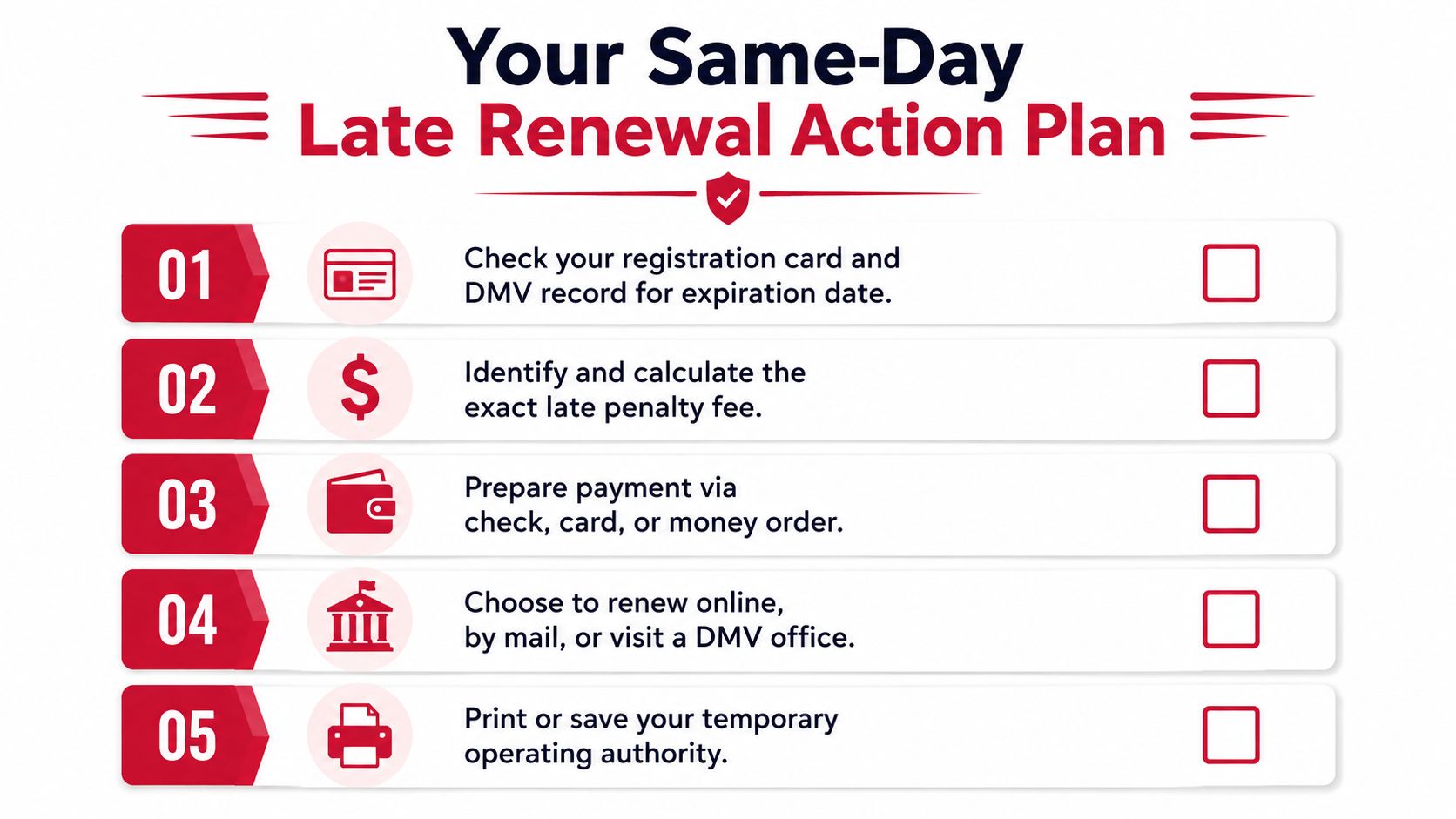
Bring the renewal notice or registration card, valid identification, proof of insurance, required smog documentation, and payment. Ask for an itemized total that distinguishes the base renewal amount from late penalties, fixed fees, other registration charges, and inspection costs. That breakdown tells you exactly what you're paying and helps identify a problem before you authorize the transaction.
Choose the channel based on the record:
- Use the online portal when the renewal is uncomplicated and the account is accepted.
- Use a DMV field office when the record needs formal verification or a government hold must be addressed.
- Use a licensed local service when you need a smog inspection and registration processing coordinated in one visit. Antioch drivers can review ways to avoid the DMV line before choosing that route.
Keep every receipt and registration document until the new sticker and card are in your possession. If the vehicle can't be renewed immediately, don't drive it on public roads with expired registration. Arrange a tow or other permitted transport, then finish the inspection, hold release, payment, and issuance process.
The best outcome is not merely paying a bill. It's ending the lapse, documenting the transaction, and removing the vehicle from the enforcement and insurance risks that come with an unresolved registration record.
Fire House Smog provides STAR-certified test-only smog inspections and California DMV registration services with on-site sticker printing at 2900 Lone Tree Way in Antioch. Bring your registration documents and proof of insurance, confirm the current requirements, and visit Fire House Smog to handle an eligible late renewal locally.