
California has no general grace period for registration renewal. What drivers call an extension usually means the limited 60-day renewal-notice timing rule, Planned Nonoperation (PNO) for a vehicle being stored, or a $50 Temporary Operating Permit after a failed biennial smog test.
You're looking at your renewal notice, the car still needs attention, and you need it for work tomorrow. Maybe you haven't booked the smog inspection. Maybe it failed, or a parking citation is holding up the renewal.
My advice to an Antioch driver in that position is straightforward: separate the payment deadline from permission to drive. Then identify what's blocking your registration before you spend time chasing an extension that doesn't fit your situation.
Table of Contents
- What California Actually Offers When You Search for a Registration Renewal Extension
- How the DMV Late Fee Schedule Actually Works
- Four Real Scenarios on Your Expiration Date
- Temporary Operating Permits After a Failed Smog Test
- Planned Nonoperation Versus Continued Driving
- Using a DMV Partner Office to Renew On Site
- What Paying Late Versus Paying on Time Looks Like in Real Life
- Your Expiration Date Checklist and Where to Get Help
What California Actually Offers When You Search for a Registration Renewal Extension
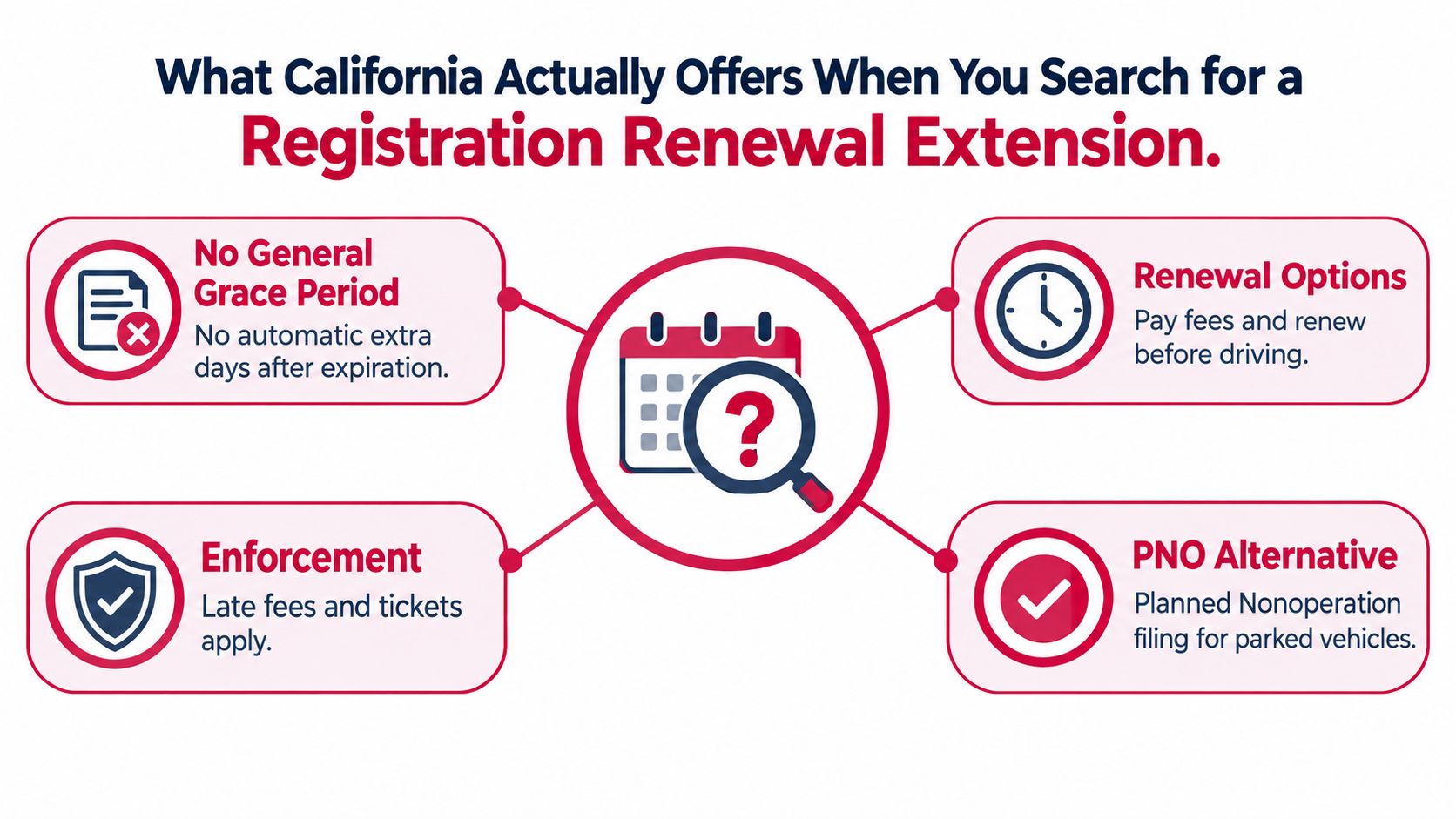
Your registration expires at midnight on its assigned expiration date. California doesn't automatically give you extra days to pay without penalties, so treat the date on your registration as a deadline, not a suggestion. The limited exception is the DMV's notice-timing rule, which permits renewal within 60 days after the notification date when that deadline falls later than expiration, as described in the California DMV registration-fee guidance.
That exception isn't a blanket extension you can request because you're busy, waiting for repairs, or short on money. Before relying on it, ask the DMV to confirm whether your notice creates a later applicable deadline.
The distinction is easier to understand when you separate the available options.
Match the option to the problem
- Notice timing rule: This addresses an eligible renewal-notice timing issue. Don't interpret it as unrestricted permission to operate an expired vehicle.
- Planned Nonoperation: This fits a vehicle you intend to take out of use and store, not a commuter you still need every morning.
- Temporary Operating Permit: This may address lawful temporary operation after a qualifying failed smog inspection. It doesn't replace the renewal itself.
For someone searching for a California DMV registration renewal extension, the useful question isn't whether more time exists. It's whether you need more time to pay, intend to stop using the vehicle, or need authorized temporary operation while resolving a smog failure.
Practical rule: Ask what the option changes. A payment deadline, a storage status, and operating permission aren't interchangeable.
Suppose you're at home near Lone Tree Way with a renewal notice and an unresolved emissions problem. Don't start by assuming the notice exception applies. Start by checking the expiration date, determining whether the vehicle will remain in use, and identifying the outstanding requirement.
That approach gives you a usable decision instead of false reassurance.
How the DMV Late Fee Schedule Actually Works
A late renewal isn't just your original bill with a small convenience charge attached. The DMV adds fixed registration and California Highway Patrol late fees, plus percentage-based penalties on the vehicle license fee and any applicable weight fee.
The percentages don't apply indiscriminately to the entire renewal total. Keep those components separate when reviewing your bill, or you'll miscalculate what the delay costs.
California DMV Late Registration Penalty Tiers
The following amounts come from the DMV's published late-registration penalty schedule; the listed percentage applies to both the vehicle license fee and any applicable weight fee.
| Days Late | Vehicle License Fee % | Registration Late Fee | CHP Late Fee |
|---|---|---|---|
| 1–10 days | 10% | $10 | $10 |
| 11–30 days | 20% | $15 | $15 |
| 31 days to one year | 60% | $30 | $30 |
| More than one year, no more than two years | 80% | $50 | $50 |
| More than two years | 160% | $100 | $100 |
Read across the row that matches your delinquency. You owe both fixed fees, not whichever one seems relevant, and the percentage-based charge comes on top of them.
This is why I don't recommend waiting for the entire renewal problem to disappear before addressing payment. If the car needs smog, delaying payment adds a financial problem to an emissions problem. It doesn't make the inspection easier or remove the certification requirement.
Review the bill before paying
- Find the underlying fees: Identify the vehicle license fee and any applicable weight fee rather than applying the percentage to the total bill.
- Check the delinquency bracket: A delay that crosses into another bracket can change both fixed charges and percentage penalties.
- Separate other charges: Outstanding citations and transaction-related charges shouldn't be confused with the DMV's late-payment schedule.
Use this registration renewal fee guide to prepare questions about your renewal amount, then confirm the actual balance for your vehicle.
The recommendation is simple: protect the payment deadline even when another requirement remains unfinished. Don't assume a short delay is free, and don't mistake payment protection for completed registration.
Four Real Scenarios on Your Expiration Date
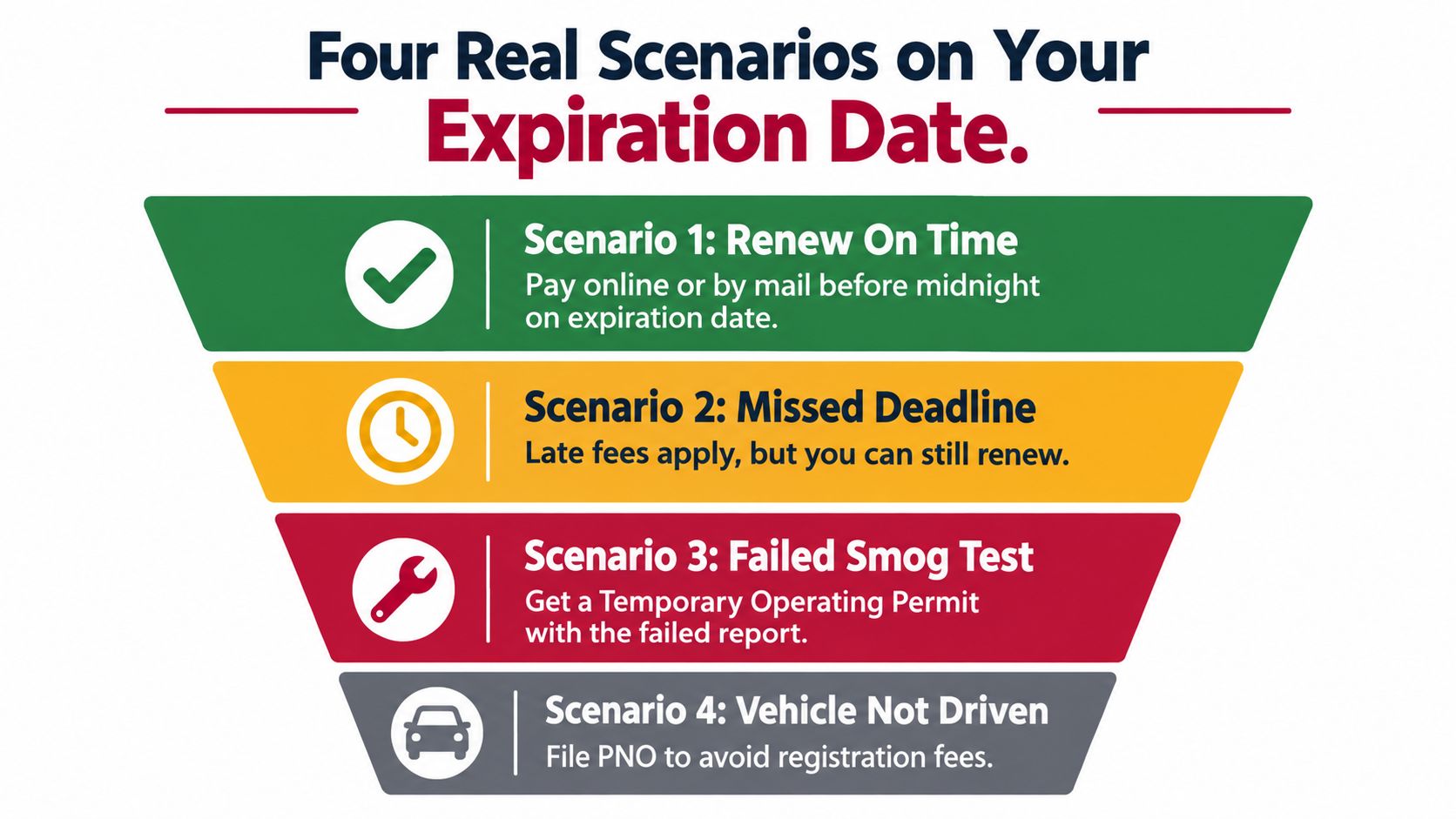
Choose your next action based on the vehicle's actual status. A road-use vehicle awaiting smog needs a different response from a stored vehicle, and an insurance hold isn't the same problem as a failed emissions test.
The graphic provides a broad overview of renewal trouble. Use the decision branches below to distinguish what you should do today.
A road-use vehicle still needs smog
Pay the renewal fees by the applicable deadline, then finish the required inspection. Don't hold the payment until you find a convenient testing appointment.
If the vehicle has already passed and no other requirement remains outstanding, complete the renewal rather than pursuing an extension. If certification is still missing, payment protects against late-payment penalties but doesn't finish renewal or independently authorize driving, as the DMV's registration-renewal guidance explains.
Keep your renewal notice, payment confirmation, and inspection paperwork together. Ask what remains outstanding before assuming the transaction is complete.
The vehicle will be stored
Choose PNO if you're taking the vehicle out of use. Confirm the filing and storage arrangement before treating the vehicle as nonoperational.
Don't select PNO because it seems cheaper while planning to keep driving. Arrange another way to get to work, run errands, or move equipment.
The vehicle failed its smog inspection
Keep the failed inspection report and address payment immediately. Then ask the DMV whether you qualify for the smog-related operating permit described below.
A failed result is important documentation. A missing appointment isn't a failed inspection, and you shouldn't assume those situations receive the same permit treatment.
Parking citations or insurance requirements block renewal
Identify the specific hold, resolve it, and confirm that the registration requirement has been cleared. Keep citation-payment documentation or insurance proof available for follow-up.
Don't drive on the strength of a renewal-fee receipt when operating requirements remain unresolved. Paying the registration bill doesn't erase a parking-citation hold or repair an insurance lapse.
For additional context while organizing your next steps, you can watch the accompanying video.
- Payment question: Has the amount due been paid by the applicable deadline?
- Completion question: Has every outstanding renewal requirement been satisfied?
- Driving question: Is the vehicle currently authorized for operation?
Get an answer to each. A yes to payment alone isn't enough.
Temporary Operating Permits After a Failed Smog Test
A failed biennial smog test calls for a permit eligibility check, not a search for an automatic renewal extension. The relevant DMV option is a Temporary Operating Permit, commonly called a TOP.
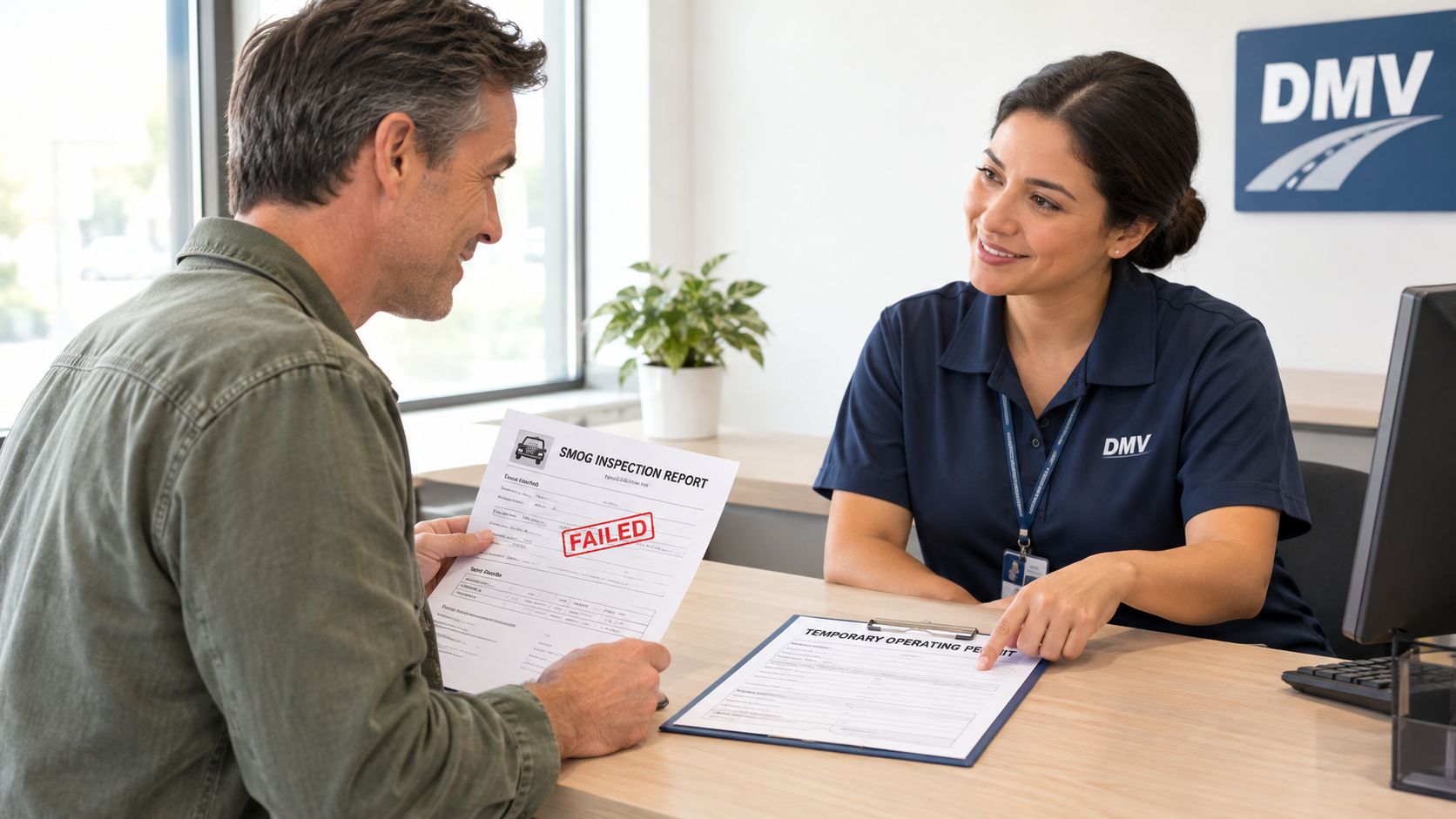
Gather the paperwork before asking for the permit. That gives the DMV something concrete to evaluate instead of a general explanation that your car needs repairs.
Bring the required evidence
The smog-related TOP costs $50 and requires paid registration fees, proof of insurance, and the failed inspection report, according to the DMV's Temporary Operating Permit requirements.
That permit is valid for 60 days from registration expiration or the date the vehicle is removed from PNO, and only one biennial-smog TOP may be issued for the same vehicle during a two-year period, under those same DMV requirements. The separate one-time 30-day TOP option is unavailable after more than 60 days from expiration, so don't treat it as a guaranteed backup.
- Registration payment: Have evidence that you've paid the renewal fees.
- Insurance proof: Bring current documentation rather than assuming payment resolves insurance eligibility.
- Failed report: Keep the actual inspection result for the permit request.
Work from the permit's actual expiration
The clock doesn't automatically start whenever repairs become convenient. Check the dates on the permit and arrange diagnosis, repairs, and retesting around that deadline.
A TOP gives you a defined opportunity to resolve the problem. It isn't a promise of another permit when the first one ends.
Use this explanation of what happens if you fail a smog test to organize your repair and retest questions.
If the permit expires before you satisfy the requirements, don't assume you can keep driving. Stop operating the vehicle unless the DMV confirms another applicable authorization, and ask what remains necessary to complete registration.
Planned Nonoperation Versus Continued Driving
PNO makes sense when your vehicle is going into storage. It doesn't make sense when you still intend to commute, make deliveries, or leave the vehicle parked somewhere it could receive a citation.
The DMV requires renewal or PNO fees by the expiration date to avoid penalties. Its Planned Nonoperation guidance also makes clear that paying fees alone doesn't authorize operation with unfinished requirements.
Decide whether you can actually stop using it
| Your intention | Recommended approach |
|---|---|
| Store the vehicle without road use | Check PNO eligibility and complete the filing |
| Keep using the vehicle | Complete registration and operating requirements |
| Resume use after storage | Resolve the registration requirements before returning it to service |
The comparison below illustrates the distinction. Confirm the current filing amount with the DMV rather than relying on a price displayed in a graphic.
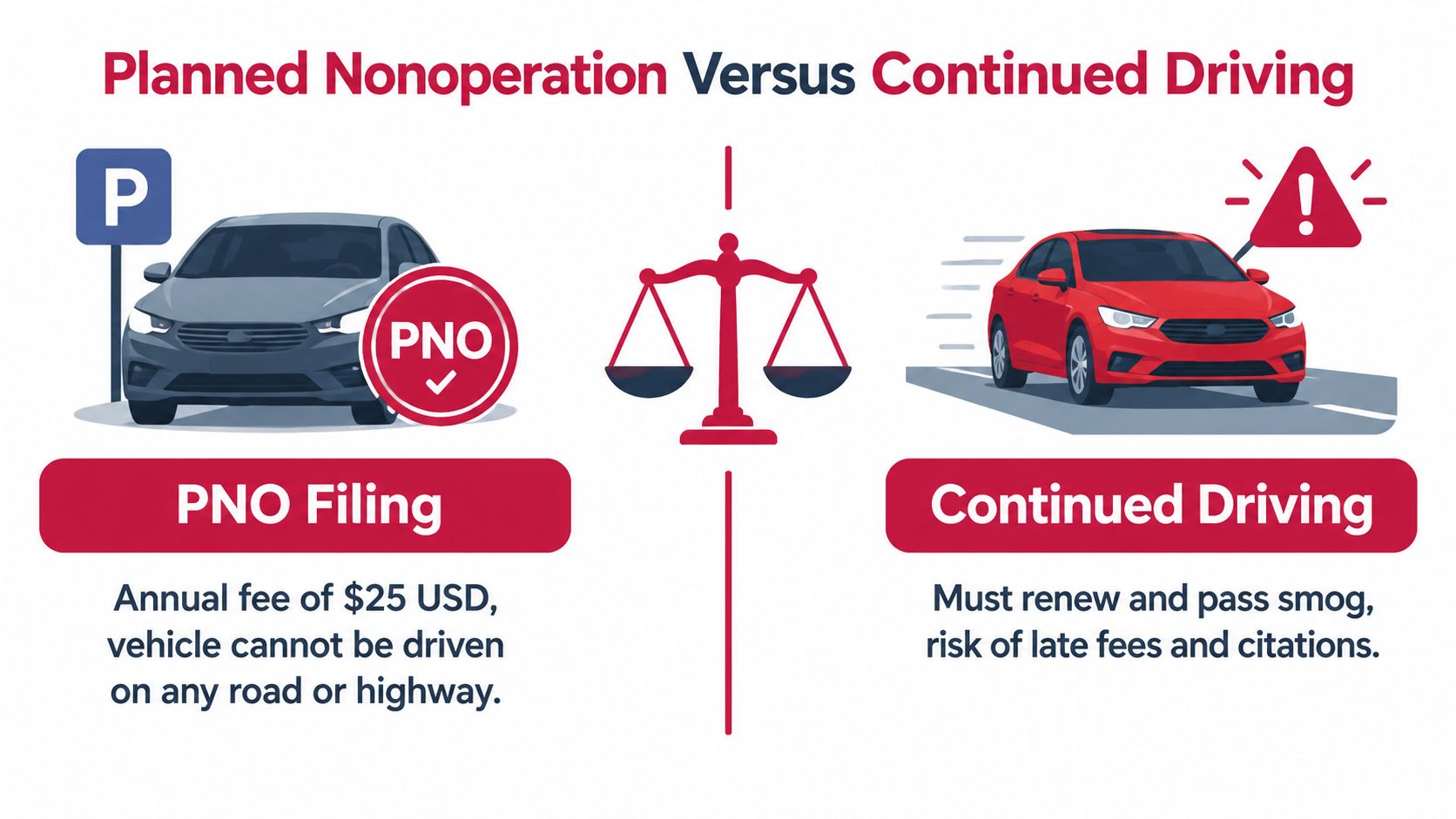
Storage must be a real change in use. Operating the vehicle or parking it where it could receive a citation can require full registration fees and penalties. Don't file PNO and then decide an occasional trip doesn't count.
Before returning a stored vehicle to use, ask for the current registration balance and complete any outstanding certification, insurance, or other requirements. Don't assume removing it from storage automatically restores legal operating status.
- Arrange storage: Choose a location that fits the nonoperation restriction.
- Plan transportation: Make sure you can leave the vehicle unused.
- Retain confirmation: Keep the filing record with the vehicle's registration documents.
My recommendation is to choose PNO only when your transportation plan supports it. If you know you'll need the vehicle, address renewal instead of selecting a status you can't maintain.
Using a DMV Partner Office to Renew On Site
An on-site registration office can help with an eligible renewal when you want personal assistance and tag issuance. It can't turn an ineligible transaction into a completed registration because you've reached the counter.
Fire House Smog is one local option in Antioch, alongside DMV renewal channels. It provides smog testing and licensed registration services, including on-site renewal sticker issuance; its DMV registration services information can help you check which transaction you need.
Choose the channel after checking eligibility
The DMV reports instant kiosk processing when all requirements are met, approximately one week online or by phone, and about two weeks by mail, in its registration-renewal procedures. The same procedures allow renewal as early as 75 days before expiration, giving you time to address problems before they become urgent.
Those processing estimates aren't interchangeable with permission to drive. They describe a transaction channel, not an exemption from smog certification or another outstanding requirement.
If you want on-site help, prepare before arriving:
- Bring the notice or registration record: Let the office identify the vehicle and the renewal issue.
- Have payment ready: Ask about the DMV balance and any separate service charges.
- Carry relevant documents: Include identification, insurance proof, and inspection paperwork when applicable.
- Disclose the blocker: Mention citations, a failed test, or an insurance issue before expecting tags.
Ask for a completion check
A useful counter question is: What specifically prevents this renewal from being completed today? That invites a concrete answer, whether the issue is certification, a hold, or another DMV requirement.
For a straightforward eligible renewal, an on-site provider may fit your schedule. For an unresolved hold, expect guidance about what must be cleared rather than an override.
Don't make an unnecessary trip just because expiration is close. Confirm service availability, explain the problem, and ask which paperwork to bring. That's more useful than arriving with only a payment card and hoping the office can bypass the requirement.
What Paying Late Versus Paying on Time Looks Like in Real Life
Consider a hypothetical Antioch commuter whose renewal is due while the required smog inspection is still unfinished. The driver pays on time, saves the confirmation, and arranges the inspection without treating that receipt as permission to operate after expiration.
That driver still has work to do. The difference is that the missing certification hasn't been allowed to become a late-payment problem too.
The driver who separates the tasks
The commuter checks whether any other requirement is outstanding and asks about lawful operation before using the car. If the inspection passes, the remaining task is to complete the eligible renewal through an appropriate channel.
If it fails, the driver keeps the report and evaluates the permit route. The driver doesn't assume that having paid means the vehicle is fully registered.
Counter advice: Handle what you can today, then name the requirement you still need to finish.
The driver who waits for everything
A contrasting hypothetical driver postpones payment until the inspection and paperwork feel convenient. By the time that driver seeks help, the applicable late charges from the published schedule must be addressed along with the original renewal obligation.
There's no need to invent a dramatic total or compare it with an insurance bill. The financial difference depends on the vehicle's actual fee components and how long payment was delayed.
The operational problem may still be identical: neither driver can ignore missing certification or an unresolved hold. The driver who paid on time avoided adding preventable late-payment charges.
- Better decision: Address the fee deadline while actively resolving the blocker.
- Costlier decision: Wait for every other task before dealing with payment.
These are illustrations, not customer case studies. Their lesson is practical: an incomplete renewal needs coordinated actions, not an all-or-nothing approach.
Your Expiration Date Checklist and Where to Get Help
Put your renewal notice and registration record in front of you. You don't need a pile of extension advice before taking action, you need to know the applicable deadline, the vehicle's intended use, and the requirement that remains unfinished.
Start with the deadline, then work through the actual status. If you're already late, ask for the current balance rather than estimating from memory.
Check these items before choosing your next move
- Confirm the expiration date: Compare the registration record with the notice. Ask the DMV to verify any claimed notice-timing exception.
- Verify smog status: Distinguish a missing inspection from a failed inspection and a completed certification.
- Identify holds: Check whether parking citations, insurance, address information, or another requirement prevents completion.
- Choose the use plan: Decide whether you'll complete renewal for road use or store the vehicle.
- Check permit eligibility: If the vehicle failed its required biennial test, gather the documents for a DMV determination.
- Select a renewal channel: Use the channel that fits your eligible transaction and available time.
- Keep the records: Save payment, filing, inspection, and permit documents so you can answer follow-up questions.
Get local help with the paperwork
For in-person assistance at the Antioch station discussed above, the address is 2900 Lone Tree Way, Antioch, CA 94509, and the phone number is 925-754-1600. Published DMV service hours are Monday through Saturday, 9:30 AM to 5:00 PM, and Sunday, noon to 4:00 PM, with limited services possible on weekends.
Call before traveling if you have a hold, need a permit, or aren't sure your transaction can be handled locally. Tell the office what's blocking renewal, not just that you need an extension.
The next step should solve your actual problem. Pay, store, resolve a hold, or request a permit determination as appropriate. Don't substitute an assumed extension for any of those actions.
Fire House Smog offers STAR-certified test-only smog inspections and California DMV registration renewals with on-site sticker issuance for eligible transactions. Visit Fire House Smog to check services, then call with your expiration date and outstanding requirements so you can prepare for the right next step.
California adds a 10% charge plus $20 in flat fees for renewals 1–10 days late, and the percentage climbs to 160% plus $200 in flat fees after two years, so every additional month costs you real money. The fastest way to limit the damage is to confirm your expiration date, clear any hold, complete a required smog check, and process the renewal before the vehicle moves into a higher penalty tier.
You're probably reading this because the sticker on your plate is already expired, or because you found an old renewal notice in the glove box. A late registration renewal isn't just a paperwork problem. In California, the charge changes with the length of the delay, and the jump after the first month is especially painful.
The right response is simple: stop driving the vehicle until you know its registration status, verify the exact lapse date, and handle the renewal as soon as possible. California's published penalty table and Vehicle Code section 9554 provide the framework, including a limited grace window and specific circumstances in which penalties may be waived. California DMV's penalty schedule is the document to use when estimating the state charges.
Table of Contents
- Why a Lapsed Tag Is a Bigger Problem Than It Feels
- How California Calculates Late Registration Renewal Penalties
- What You Need Before You Renew a Late Registration
- Choosing Where to Complete a Late Registration Renewal
- Walking Through the Late Renewal Step by Step
- Hidden Costs and Risks Beyond the Late Fee
- Your Same-Day Late Renewal Action Plan
Why a Lapsed Tag Is a Bigger Problem Than It Feels
Maria drives from Antioch toward Delta de Anza for work. She let her 2019 Civic pass its registration date by two weeks and assumed the fix would be minor. The surprise came when she checked the renewal amount and saw a 10% penalty on the vehicle license fee and weight fee, plus $20 in fixed late fees.
Her first instinct was to wait until payday. That would have been the wrong move. The penalty schedule is based on the delay period, so waiting can move the renewal into a more expensive bracket even though the vehicle itself hasn't changed.
Practical rule: Once you know the registration is late, treat the renewal as urgent paperwork, not a task for later.
The DMV charge is only one part of the exposure. Driving with expired registration can lead to a roadside citation, and a stop on Highway 4 can turn a missed renewal into a much more disruptive afternoon. A registration lapse can also create complications when an insurer reviews policy information or handles a claim, especially if the vehicle's legal operating status becomes relevant.
A lapsed registration can interfere with more than daily commuting. You may face difficulty transferring ownership, completing another DMV transaction, or proving that the vehicle was properly registered during a particular period. Those problems often appear when you're trying to sell the car, replace a title, or resolve an insurance question.
The cost of waiting rises in stages
Maria's two-week delay sits in the lower part of California's schedule. If she waits beyond the 30-day exception, the percentage-based charge changes sharply. If she keeps driving while the tag remains expired, she also exposes herself to enforcement separate from the DMV renewal bill.
The practical recommendation is direct. Check the expiration date today, identify whether a smog certificate is required, and get a complete fee calculation before deciding that postponing the renewal is harmless.
How California Calculates Late Registration Renewal Penalties
California Vehicle Code section 9554 authorizes a penalty for a renewal application made after midnight on the expiration date, while also providing an exception for an application made within the applicable 30-day window. The DMV's published table applies the percentage to the vehicle license fee and weight fee, then adds the listed CHP and registration late fees. Vehicle Code section 9554 contains the statutory framework.
The tiers are easy to misunderstand because the fixed amounts and percentage amounts change together. The example below uses a $312 base only to illustrate the percentage calculation. It doesn't include any other possible registration charges, county charges, smog costs, or adjustments.
| Days or time late | Percentage penalty | Flat fees added | Example on $312 base |
|---|---|---|---|
| 1–10 days | 10% | $20 | $31.20 penalty, $20 flat fees, $363.20 subtotal |
| 11–30 days | 20% | $30 | $62.40 penalty, $30 flat fees, $404.40 subtotal |
| 31 days to one year | 60% | $60 | $187.20 penalty, $60 flat fees, $559.20 subtotal |
| More than one year to two years | 80% | $100 | $249.60 penalty, $100 flat fees, $661.60 subtotal |
| More than two years | 160% | $200 | $499.20 penalty, $200 flat fees, $1,011.20 subtotal |
These examples show why the 31-day threshold matters. On the illustration, the percentage penalty rises from $62.40 in the 11–30-day tier to $187.20 in the 31-days-to-one-year tier. The table is a calculation example, not a quote for your vehicle, because the DMV applies the percentage to the relevant vehicle license fee and weight fee rather than automatically to every amount on a renewal bill.
For a practical explanation of the underlying renewal bill, review this guide to California registration renewal fees. Then ask for the full transaction breakdown before paying.
What the grace window means
The DMV states that no late penalty is added when the renewal application is made within 30 days after midnight of the expiration date. That doesn't mean you should continue driving casually with an expired registration. It means eligible drivers have a defined period in which submitting the application can avoid the late penalty.
California also allows penalty waivers in specific circumstances. Eligibility depends on the facts and the required DMV process, so don't assume a waiver applies without asking about it directly.
What You Need Before You Renew a Late Registration
A smooth late renewal starts with preparation. Before you visit a smog station, DMV office, or registration service, confirm the vehicle's status and gather the documents that identify both you and the car.
Start with the smog requirement. Many gasoline vehicles that are within the state's newer-model exemption may not need a current smog check for the renewal cycle, but exceptions can apply. A change of ownership, an out-of-state title, or a gross-polluter designation can place the vehicle on a different testing path. Diesel vehicles and heavier trucks may also involve separate program requirements.
Bring a complete document set
Use this California vehicle registration document checklist before leaving home:
- Identification: Carry a current photo ID.
- Vehicle information: Bring the renewal notice, registration card, or license plate number.
- Insurance evidence: Have proof of insurance available.
- Title paperwork: Include out-of-state title documents when the transaction involves an imported vehicle.
- Payment: Bring an accepted payment method and be prepared for the amount to differ from the original notice.
Check for holds before you make the trip. Unresolved parking matters, smog-related holds, or other registration restrictions can stop the transaction even when you have the right documents. If a court or agency has issued a release form for a hold, bring that release with you rather than expecting the DMV system to update instantly.
Don't assume a smog pass clears every problem. It resolves the emissions requirement when applicable, but it doesn't automatically remove unrelated registration holds or calculate every outstanding charge.
Choosing Where to Complete a Late Registration Renewal
The best channel depends on why the registration is late and what the vehicle needs. Online renewal is convenient for a straightforward transaction, but it's a poor choice when the system can't verify the vehicle, a smog certificate is required, or the account contains a hold.
A DMV field office can handle complex verification, but the process may involve an appointment, waiting, and additional follow-up if another document or inspection result is missing. A licensed DMV partner can be useful when you need registration processing and related services in one place. Fire House Smog, for example, offers STAR-certified test-only smog checks and on-site California DMV registration services with sticker printing in Antioch. Confirm current service availability before visiting.
| Factor | DMV online portal | DMV field office | Licensed partner, Fire House Smog |
|---|---|---|---|
| Straightforward renewal | Convenient when the account is eligible | Available, but may require a visit | Available during posted DMV service hours |
| Late-fee calculation | System-generated for eligible transactions | DMV staff review | Registration service can review the transaction |
| Smog requirement | May reject transactions needing verification | Can process documentation | Smog testing and registration services may be available at the same location |
| Holds or unusual records | Limited ability to resolve them online | Appropriate for formal verification | May identify the issue and direct you to the agency that must clear it |
| Sticker issuance | Delivery process applies | Ask about issuance for the transaction | On-site sticker printing is available for qualifying services |
| Best fit | Clean, uncomplicated renewal | Legal or record problems requiring DMV review | Drivers seeking a local, combined service path |
Online systems can reject overdue renewals or vehicles that need a smog certificate. Don't keep resubmitting the same transaction. If the portal won't accept it, switch to a channel equipped to inspect the vehicle or review the record.
Walking Through the Late Renewal Step by Step
The fastest reliable process is orderly. Start by confirming the expiration date on the registration card or DMV record. The exact date determines which penalty tier applies, so guessing can lead to the wrong expectation about the total.
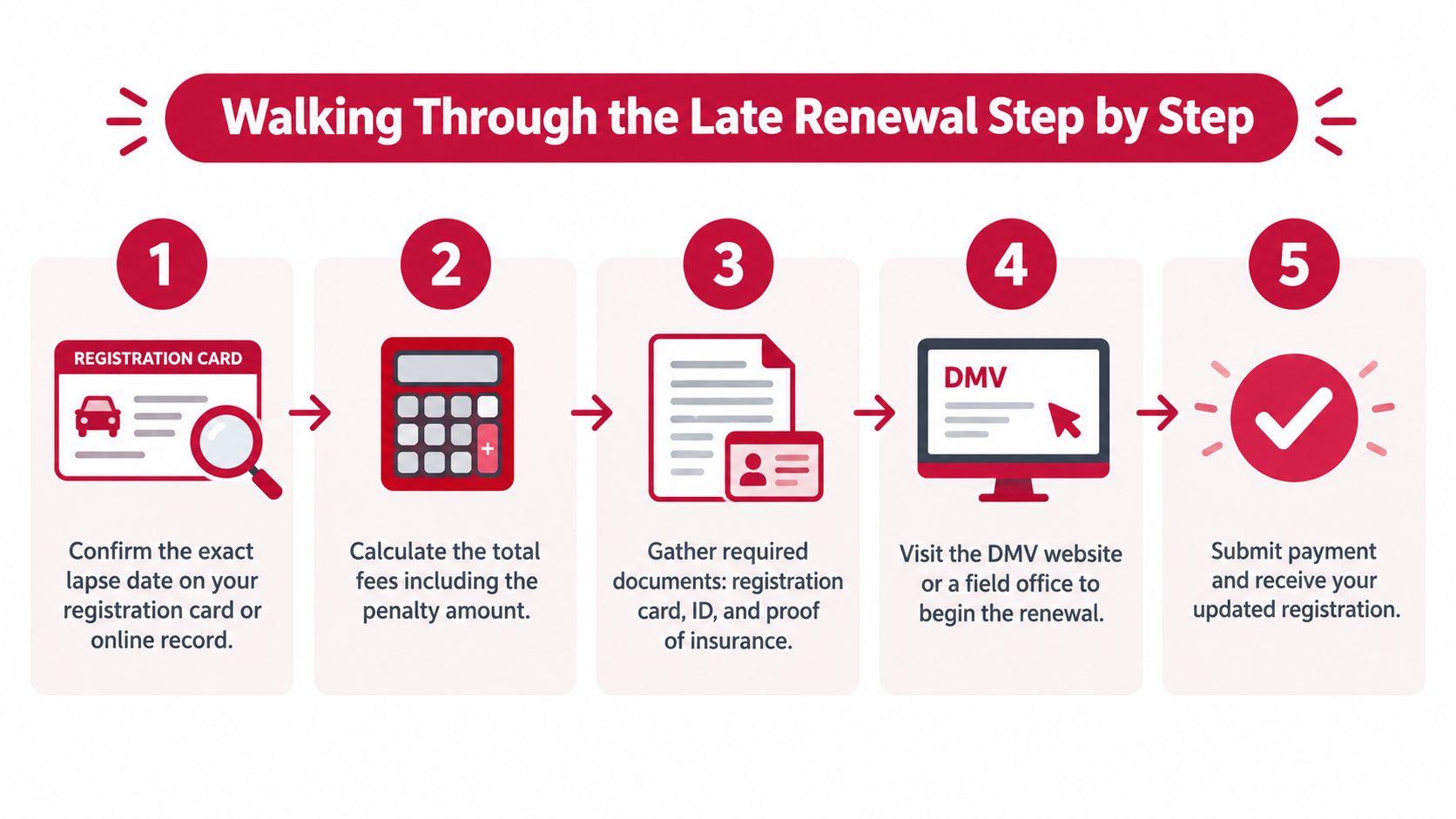
Follow the transaction in this order
- Verify the lapse: Confirm the expiration date and look for registration holds.
- Handle emissions first: If the vehicle needs a smog check, use the required testing station and obtain the electronic or paper result.
- Assemble the file: Bring the registration card or renewal notice, photo ID, proof of insurance, smog documentation when required, and payment.
- Request a full calculation: Have the service channel apply the base charges, applicable penalty tier, and fixed fees to your vehicle's record.
- Complete payment and verify issuance: Before leaving, confirm that the renewal was processed and ask when the updated registration card and sticker are issued.
The reason for doing smog first is practical. A failed or missing inspection can block the registration transaction, leaving you with a second trip. If the vehicle has an obvious check-engine issue, address that problem before relying on a same-day renewal plan.
Keep the receipt and updated documents in the vehicle once the transaction is complete. If the registration can't be completed that day, don't drive the car as though the old sticker were valid. Arrange lawful transport while you resolve the outstanding requirement.
Hidden Costs and Risks Beyond the Late Fee
The DMV penalty is the most visible charge, but it isn't the only consequence of leaving a registration expired. A roadside stop can create a separate citation for operating a vehicle without current registration under California law. The amount and handling of that citation depend on the enforcement action and the court process, so it shouldn't be folded into the DMV estimate.
A vehicle can also become harder to sell or transfer while its registration record remains unresolved. Buyers, lenders, and family members may hesitate to complete a transaction when the title or registration history requires additional work. A withheld or incomplete registration document can turn a simple private sale into a records problem.
Don't ignore holds
Parking-related issues and smog holds can prevent renewal until the responsible agency clears them. The DMV may be unable to complete the transaction merely because you've brought payment. You need the underlying hold resolved or the required release documented.
Insurance deserves attention, too. A registration lapse can surface during policy administration or claim review, creating questions about the vehicle's status at the time of an incident. That doesn't automatically decide coverage, but it gives you another reason to keep the registration current and retain proof of the completed renewal.
Driving while you're waiting to “deal with it later” adds exposure without solving the underlying record.
If you receive a citation, impound notice, or insurance inquiry, handle that issue separately from the DMV renewal. Paying the DMV balance may not automatically close a court matter or resolve an insurance file.
Your Same-Day Late Renewal Action Plan
Use a same-day plan that removes uncertainty in the right order. First, inspect the registration card and DMV record for the expiration date, then check whether a hold appears. Next, determine whether the vehicle needs a smog certificate and complete that inspection before asking for the final registration calculation.
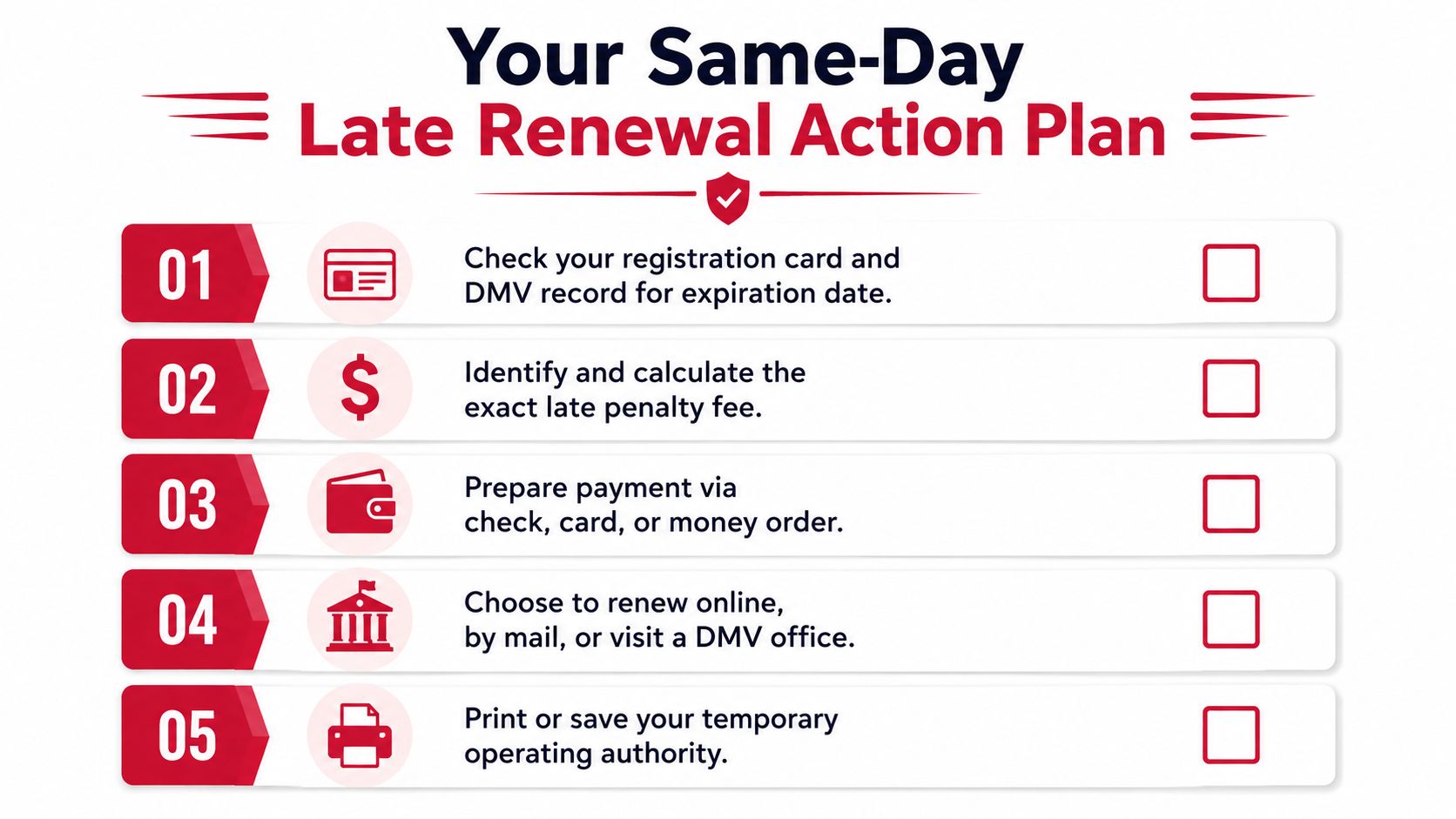
Bring the renewal notice or registration card, valid identification, proof of insurance, required smog documentation, and payment. Ask for an itemized total that distinguishes the base renewal amount from late penalties, fixed fees, other registration charges, and inspection costs. That breakdown tells you exactly what you're paying and helps identify a problem before you authorize the transaction.
Choose the channel based on the record:
- Use the online portal when the renewal is uncomplicated and the account is accepted.
- Use a DMV field office when the record needs formal verification or a government hold must be addressed.
- Use a licensed local service when you need a smog inspection and registration processing coordinated in one visit. Antioch drivers can review ways to avoid the DMV line before choosing that route.
Keep every receipt and registration document until the new sticker and card are in your possession. If the vehicle can't be renewed immediately, don't drive it on public roads with expired registration. Arrange a tow or other permitted transport, then finish the inspection, hold release, payment, and issuance process.
The best outcome is not merely paying a bill. It's ending the lapse, documenting the transaction, and removing the vehicle from the enforcement and insurance risks that come with an unresolved registration record.
Fire House Smog provides STAR-certified test-only smog inspections and California DMV registration services with on-site sticker printing at 2900 Lone Tree Way in Antioch. Bring your registration documents and proof of insurance, confirm the current requirements, and visit Fire House Smog to handle an eligible late renewal locally.