What Happens if You Fail Smog Test? Your 2026 Guide
You've just picked up your vehicle from a California smog station, and the paper in your hand says FAIL. Your registration renewal is due, the repair estimate is unknown, and you may be wondering whether you can keep driving or whether the car has suddenly become too expensive to keep.
A failed result is serious, but it isn't a dead end. California has a defined process involving the DMV, the Bureau of Automotive Repair, repair shops, STAR Certified stations, retesting, and financial assistance. The right next step depends on why the vehicle failed, where the DMV directed you to go, and whether repairing the car makes financial sense.
Table of Contents
- That “FAIL” Notice Just Landed What Now
- Understanding the DMV Registration Hold
- Your First Three Steps After Failing
- Navigating Vehicle Repairs and Retesting
- Exploring Waivers and Financial Assistance Programs
- Frequently Asked Questions About Smog Failures
That “FAIL” Notice Just Landed What Now
The first thing to understand is that a failed smog test doesn't automatically mean your vehicle is unusable. It means the vehicle didn't meet the applicable emissions requirements during that inspection, and you now need to resolve the listed problem before completing the registration process.
The driver in this situation often makes one of two mistakes. Some approve an expensive repair before understanding the inspection report. Others disconnect the battery or clear diagnostic codes, hoping the warning light will disappear. Neither approach is a sound starting point. The Vehicle Inspection Report, or VIR, should guide the next decision.
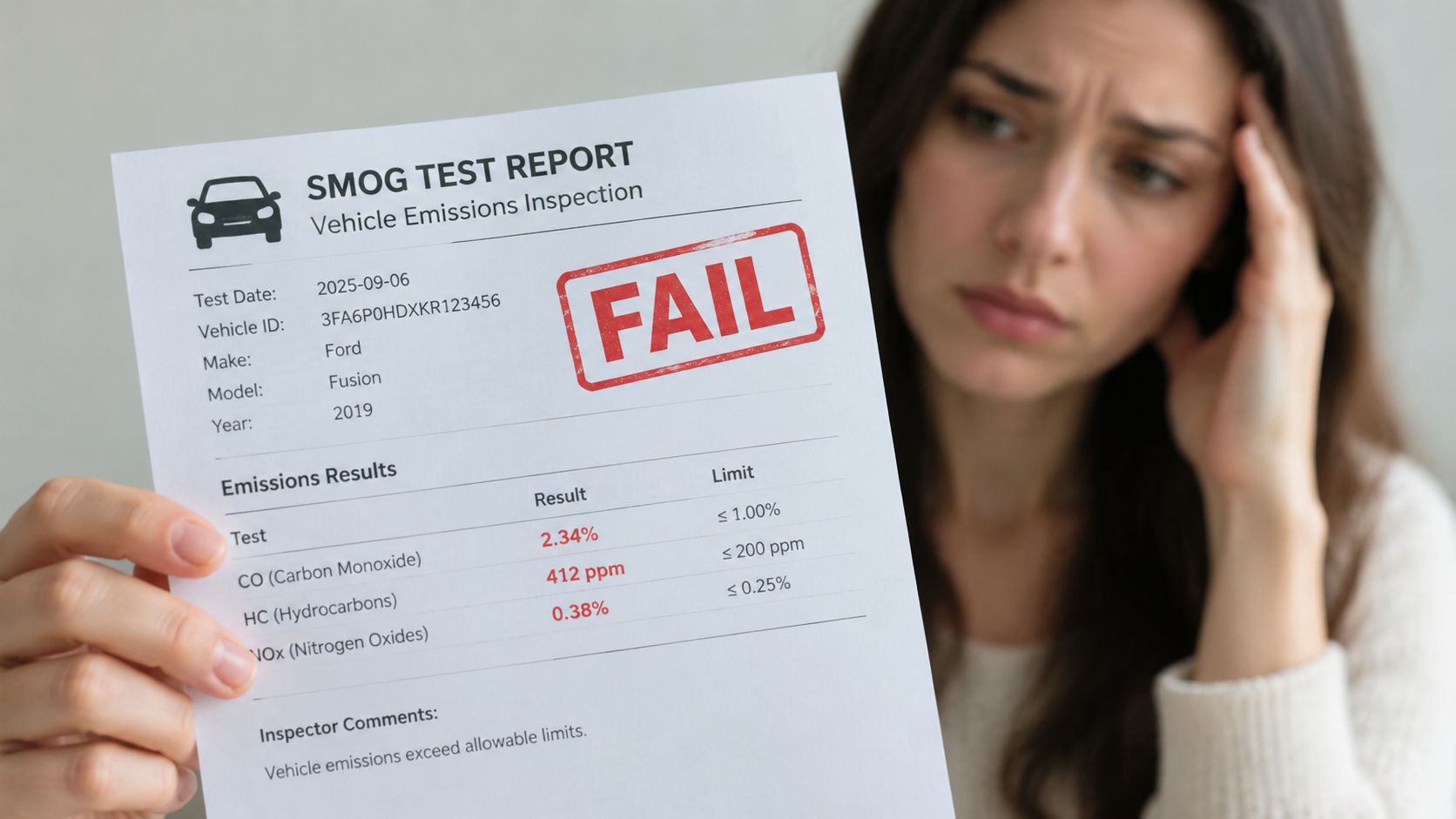
Start with the paperwork
Keep the failed inspection report. It identifies the area that needs attention and can show whether the failure involved the onboard diagnostic system, emissions readings, readiness, or a visual and functional inspection. Bring that document to any repair facility you consult.
You can also review guidance on understanding emissions test results before authorizing work. The objective is simple: identify the failure, confirm the diagnosis, then decide whether repair or a state assistance option is the sensible path.
Practical rule: Don't buy parts based only on a warning light or a guess. Diagnose the cause shown by the failed report.
Your existing registration isn't necessarily canceled on the spot. The immediate problem is usually that you can't complete renewal until the vehicle meets the required smog condition. If the car is directed to a particular type of station, follow that instruction rather than paying for a retest at a location that can't certify it.
The rest of the process comes down to three questions: What failed? Who must perform the repair or retest? Is repair financially justified for this vehicle?
Understanding the DMV Registration Hold
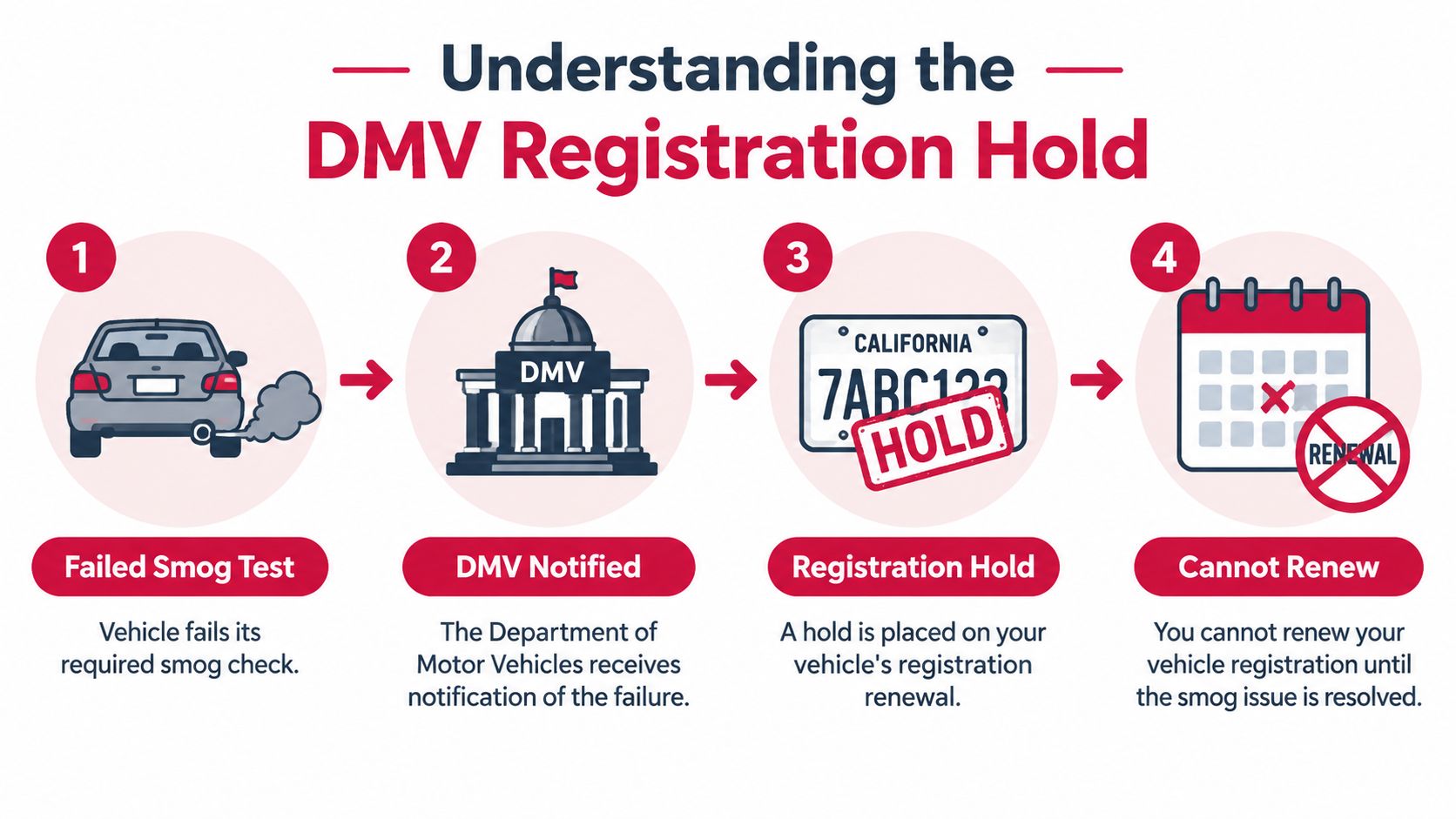
In California, a failed smog check can block DMV registration renewal until the vehicle is repaired and passes a retest. The DMV directs drivers with a failed inspection to contact the Bureau of Automotive Repair Referee Program for next steps, while BAR determines whether the vehicle needs additional certification at a STAR Certified station or with a BAR Referee. California DMV's smog inspection guidance describes the connection between the failed inspection and the renewal process.
This isn't the same as receiving a traffic citation. It's an administrative hold tied to emissions compliance. You may still have time before the current registration expires, but the DMV won't complete the renewal while the required smog issue remains unresolved.
Why California uses this process
California's smog program covers most gasoline vehicles from model year 1996 onward and many diesel vehicles, so the registration consequence affects ordinary passenger cars and light trucks, not just unusual or heavily modified vehicles. The state connects inspection results with registration because a failed vehicle may continue producing emissions above the permitted level unless the owner repairs and certifies it.
The basic sequence looks like this:
- The vehicle fails its required inspection.
- The failure is associated with the vehicle's registration record.
- Renewal remains blocked until the smog requirement is satisfied.
- A passing retest or approved alternative allows the registration process to continue.
Some vehicles have a straightforward path through repair and retesting. Others require more oversight. A car that exceeds gross-polluter standards, or one directed to a STAR station on the DMV renewal notice, may need after-repair certification at a STAR Certified station or review by a BAR Referee.
If you're dealing with renewal at the same time, this guide to California DMV registration renewal explains the related administrative process. The important point is that the hold has a defined solution. Repair the emissions problem, complete the correct certification, and submit the passing result through the normal DMV process.
Your First Three Steps After Failing
Don't start by searching for the cheapest replacement sensor. Start by collecting facts. A failed smog inspection gives you a decision point, and the quality of the decision depends on how carefully you read the result.
Step one, read the VIR line by line
Look for the specific field marked as failed. A warning light or diagnostic code may point toward an emissions problem, but it doesn't always identify the failed part. The inspection report may also indicate an issue with readiness, a visual component, or another functional requirement.
Write down the exact failure description and any diagnostic information. Take the report to a repair shop that can test the underlying system rather than replacing a commonly associated component.
Step two, classify the failure
The repair strategy changes depending on the category.
- OBD-related failure: The vehicle computer may be reporting an unresolved emissions fault or may not have completed its required self-checks.
- Warning-light failure: An illuminated check-engine light can prevent a passing result until the cause is repaired and the system is ready for inspection.
- Tailpipe emissions failure: Older vehicles may fail because measured pollutants exceed the applicable limit.
- Visual failure: Missing, disconnected, modified, or visibly incorrect emissions equipment can prevent certification.
- Functional failure: Systems such as fuel-vapor controls or exhaust-gas recirculation may need testing before a repair is approved.
This classification keeps you from treating every failed test as a catalytic-converter problem. A shop should verify the cause with scan data, electrical testing, vacuum or leak testing, and component inspection as appropriate.
Step three, separate diagnosis from certification
A general repair shop may be the right place to diagnose and repair the vehicle. The retest station has a different role. If the vehicle must be certified at a STAR station, use the station type shown on the report or renewal notice.
A STAR-certified, test-only station is especially useful for an independent retest because it doesn't sell the repair. That arrangement removes the direct incentive to recommend parts or labor after a failure. The station evaluates whether the vehicle passes, while a separate repair facility handles the diagnosis and mechanical work.
For a clearer breakdown of common causes, review reasons a vehicle can fail a smog check. Don't clear codes or disconnect the battery merely to make the warning light disappear. Those actions can erase useful diagnostic information and leave the emissions monitors incomplete, creating another inspection problem instead of solving the original one.
Navigating Vehicle Repairs and Retesting
The repair and retest path depends on the vehicle's failure status. A regular failure may be repaired and certified at a Test-and-Repair station when the vehicle doesn't exceed gross-polluter standards. A vehicle that exceeds those standards, or one originally directed to a STAR station by the DMV renewal notice, may need certification at a STAR Certified station or a BAR Referee. BAR explains these pathways in its Consumer Assistance Program repair guidance.
What gross-polluter status changes
“Gross polluter” isn't a casual description of an old or dirty car. It's a regulatory status indicating emissions are substantially beyond the applicable threshold. Once that status applies, the vehicle may no longer follow the ordinary test-and-repair route.
That distinction matters because a repair shop can complete excellent mechanical work, yet the vehicle may still need certification at the required STAR location. Before paying for a second inspection, check the VIR and DMV notice for station instructions. Retesting at the wrong location can waste time and leave the compliance problem open.
A sensible repair sequence looks like this:
- Confirm the failed system. Ask the technician to explain the diagnostic evidence.
- Get a written estimate. Separate necessary emissions repairs from maintenance recommendations.
- Check program eligibility before work begins. Some assistance programs require approval before repairs are performed.
- Complete the repair and any required drive cycle. The vehicle's emissions monitors may need to return to a ready state.
- Use the required station for certification. Follow the DMV or BAR direction on STAR and Referee involvement.
The repair decision shouldn't be based on the most dramatic possible failure. A failed oxygen sensor, wiring fault, vacuum leak, ignition problem, or emissions-control failure can each require a different diagnostic approach. The report tells you where to begin, but competent testing determines which component needs replacement.
BAR also recognizes that failure can lead to more than one outcome. Eligible consumers may pursue repair assistance, while owners whose vehicles aren't practical to repair may qualify for retirement or replacement through the Consumer Assistance Program. That makes the retest decision part of a broader ownership decision, especially when the vehicle is older, has other mechanical issues, or has little resale value.
Exploring Waivers and Financial Assistance Programs
A failed smog test creates a financial question as much as a mechanical one. Before authorizing repairs, compare the estimate with the vehicle's condition, market value, expected reliability, and eligibility for California assistance.
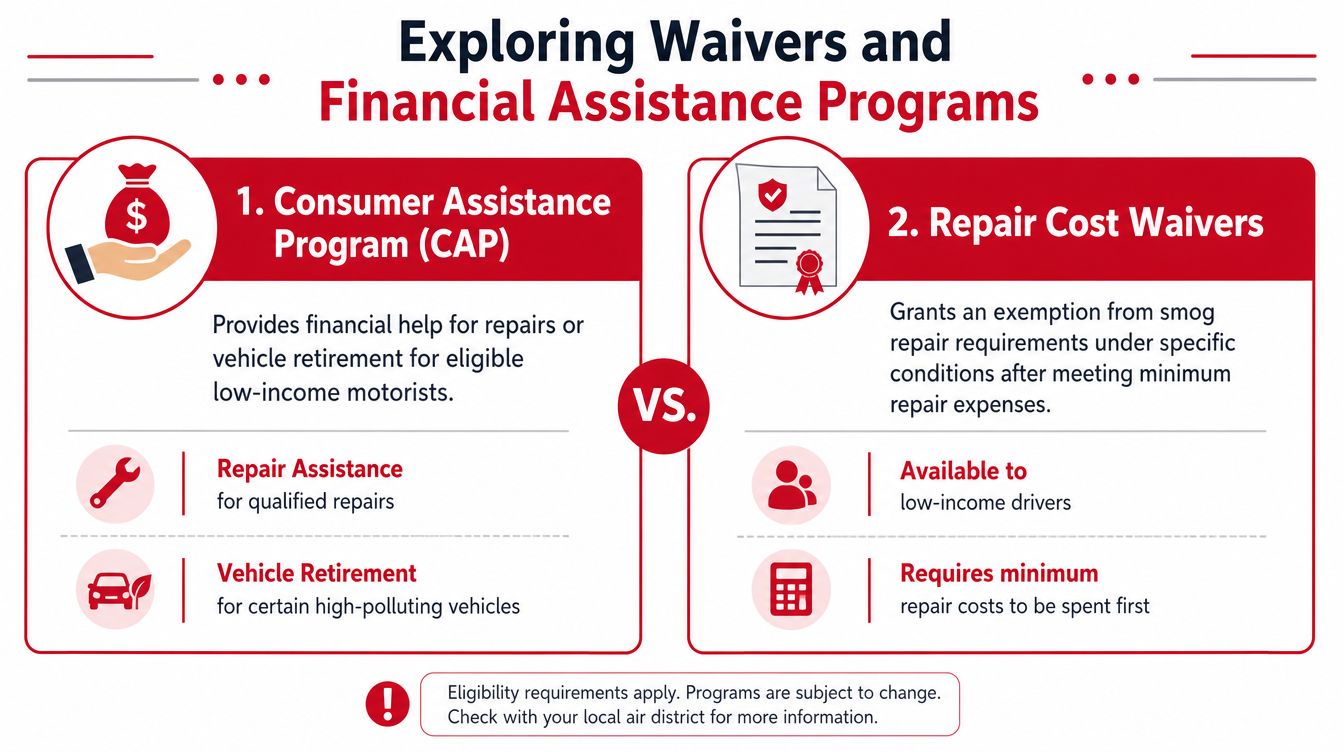
The Consumer Assistance Program, or CAP, can cover more than $1,450 in emissions-related repairs for eligible drivers, as described in California's failed-smog assistance guidance. CAP can also pay approximately $1,350 to $2,000 to retire a qualifying vehicle, according to the same guidance. These figures don't mean every applicant qualifies or that every repair receives the maximum amount. Eligibility and program conditions control the outcome.
Compare the choices before spending
| Option | When it may fit | Main trade-off |
|---|---|---|
| Repair and retest | The vehicle is dependable and the diagnosis supports a reasonable repair | You spend money keeping an older vehicle on the road |
| CAP repair assistance | You meet program requirements and the needed work qualifies | Approval and repair conditions must be followed |
| Vehicle retirement | The car is low-value, high-emitting, or has several major problems | You lose the vehicle but may receive program payment |
| Repair Cost Waiver | You meet strict requirements after completing qualifying repairs | It doesn't eliminate the need to satisfy the program's conditions |
A repair estimate that looks manageable on a reliable vehicle may be unreasonable on a car with failing transmission, severe rust, electrical faults, or other major defects. Conversely, retiring a vehicle can be a poor choice when the emissions repair is limited and the rest of the car is sound.
Waivers require careful verification
A Repair Cost Waiver isn't a general exemption that anyone receives after a failed test. It has specific conditions, and eligible low-income drivers may need to spend the required minimum on qualifying repairs before the waiver can apply. Ask BAR or the relevant program administrator about current requirements before assuming a waiver will clear the registration hold.
Use this decision filter:
- Repair the car when the failure is diagnosable, the vehicle is mechanically dependable, and the estimate is proportionate to its remaining value.
- Explore CAP repair assistance when household eligibility and the repair pathway line up.
- Consider retirement when the emissions work is only one of several expensive problems.
- Ask about a waiver only after confirming the exact requirements and eligible repair documentation.
The strongest financial decision is the one based on the complete vehicle, not the failed component alone.
Frequently Asked Questions About Smog Failures
Can I drive after the vehicle fails?
A failed result doesn't automatically answer every operating question. California offers a 60-day Temporary Operating Permit for certain failed-biennial or failed-transfer smog cases. The DMV requires the failed inspection report, registration fees, proof of insurance, and a $50 nonrefundable fee, and only one biennial-smog TOP per vehicle in a two-year period may be issued, according to the DMV Temporary Operating Permit requirements.
The permit is not automatic. Confirm that your vehicle and situation qualify before relying on it.
What should I do if I disagree with the result?
Don't argue with the station before reviewing the report. If the DMV or BAR directed your vehicle to a Referee, contact the BAR Referee Program and follow its instructions. Bring the failed report, repair records, and any related documentation.
Why use a test-only station for the retest?
A test-only station doesn't sell the repair that might follow a failure. That separation reduces the conflict of interest between diagnosing a problem and selling the work. A STAR-certified test-only location is also appropriate when the vehicle's paperwork requires STAR certification.
Should I repair or retire the car?
Compare the verified repair estimate with the vehicle's overall condition and its eligibility for CAP. Repair may make sense for a dependable vehicle with one clear emissions issue. Retirement deserves consideration when the car is low-value, high-emitting, or burdened by other major repairs.
Fire House Smog provides STAR-certified test-only smog inspections and can help eligible customers understand the retest process after a failure, with free retests available under applicable policy and coupon terms. Visit Fire House Smog to review available services and plan your next step.