
CA Registration Renewal Fee: Avoid Penalties in 2026
You open the renewal notice, scan the amount due, and think the same thing most California drivers think. Why is my registration renewal fee so high? The total rarely looks simple, and the line items often feel like they were written for someone who already knows DMV math.
That confusion is normal. A California renewal bill usually combines several different charges, and some of them change based on your vehicle's value, age, location, or smog status. If you're also trying to renew quickly, avoid penalties, and not waste half a day sorting it out, the process can feel bigger than it should.
This guide breaks it down the way a local DMV partner would explain it across the counter. Plain language. Real examples. No mystery fees added in the shadows.
Table of Contents
- That Surprise Bill from the DMV
- Decoding Your California Registration Fee
- Smog Checks Special Plates and Late Penalties
- How to Estimate Your Renewal Cost Before the Bill Arrives
- Your Renewal Options From DMV Lines to Instant Tags
- A Simple Checklist for a Smooth Renewal
That Surprise Bill from the DMV
Maria opens her envelope at the kitchen counter, sees the total, and immediately starts comparing it to last year in her head. She remembers paying registration before, but this time the amount feels different enough that she wonders if something's wrong.
That moment happens all the time. People expect one simple registration renewal fee, then see a total that looks more like a stack of charges bundled together. Some drivers assume the DMV made a mistake. Others put the notice aside for a few days, planning to “look at it later,” which is usually how a simple renewal becomes a stressful one.
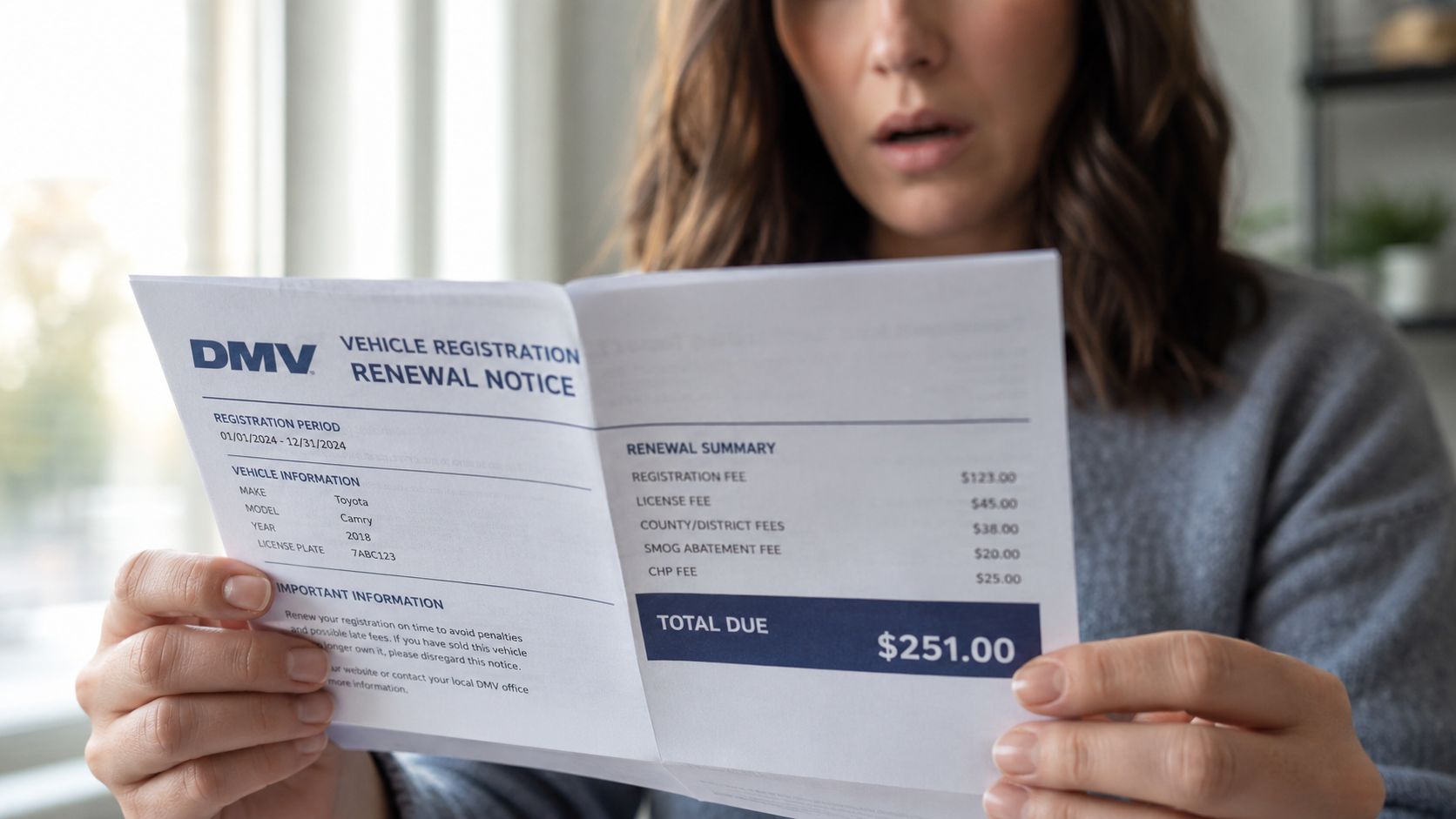
The hard part is that the bill often mixes fixed charges, value-based charges, and sometimes extra requirements like smog compliance. If you don't know which part is driving the total, the number can feel random even when it isn't.
Practical rule: Don't judge your renewal notice by the final amount alone. Look at what kind of charges are inside it.
A lot of drivers also mix up three different questions:
- What does the state charge? Those are official registration-related fees.
- What changes year to year? Vehicle value, smog status, and local add-ons can shift the total.
- What costs are optional? Third-party processing fees can make a normal renewal look much more expensive than it really is.
Once you separate those, the notice starts to make sense. You can tell what's normal, what needs action, and what you might be able to avoid.
That's the key point. Most frustration doesn't come from paying the fee itself. It comes from not knowing why the number landed where it did, or whether you're about to pay more than you should.
Decoding Your California Registration Fee
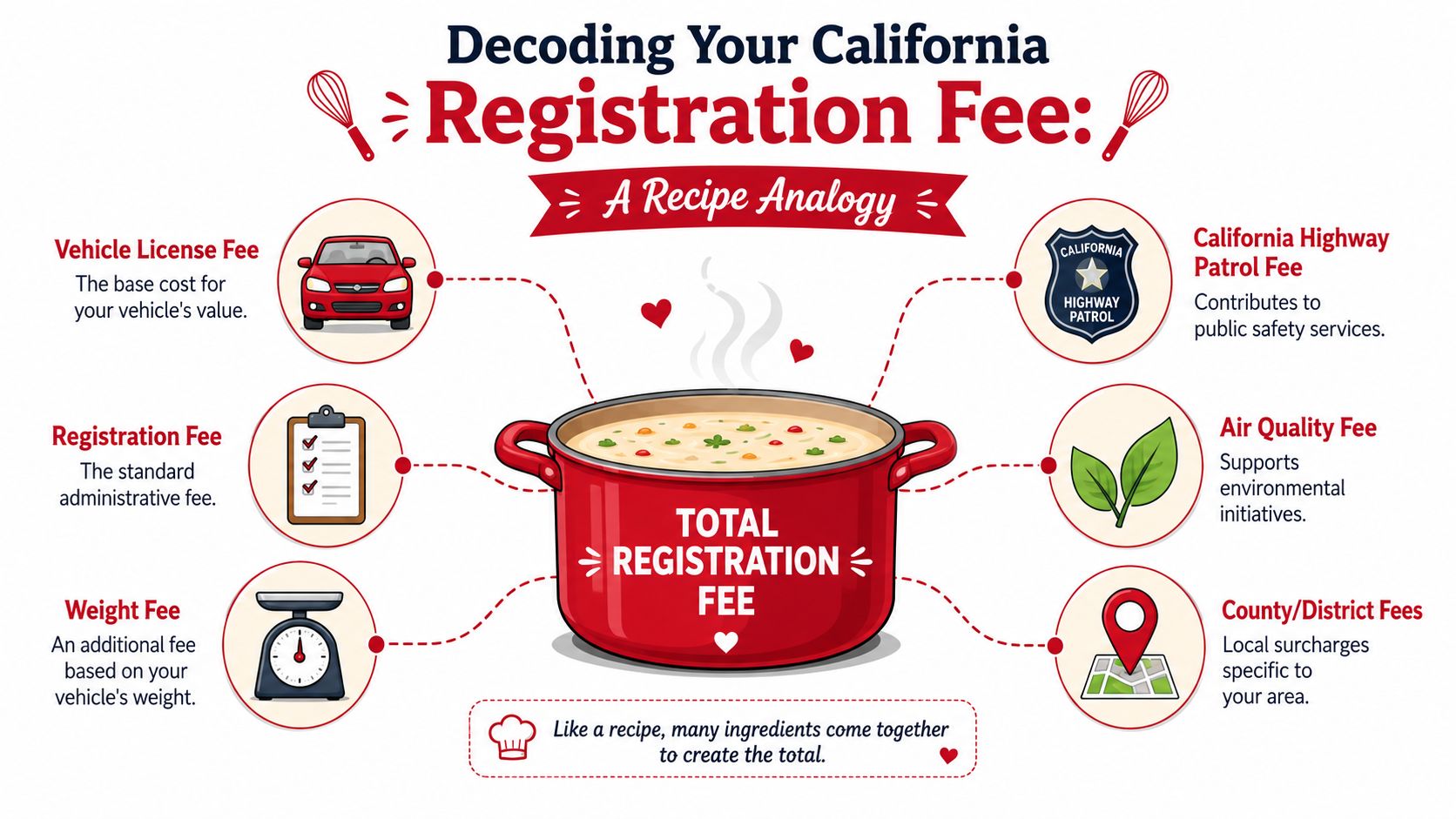
A California renewal notice works more like an itemized grocery receipt than a single price tag. You are paying for a bundle of state charges, and one line can carry much more weight than the others.
Why the total doesn't look like one fee
On a renewal notice, California groups several charges into one amount. Some are flat state fees. Some change based on the vehicle. Some are tied to value. That mix is why two neighbors can renew in the same month and owe very different totals.
One public fee breakdown shows how this can look on a real notice, including a base registration charge, a California Highway Patrol charge, and a Transportation Improvement Fee that rises for higher-value vehicles (California fee breakdown example).
If you want a plain-English reference while reading your notice, this California registration fee guide from Fire House Smog lays out the common parts in a simpler format. That local DMV partner perspective matters, because many drivers do not get overcharged by the state itself. They get confused by unfamiliar line items, or by renewal websites that pile on service fees without making them obvious up front.
The Vehicle License Fee is often the biggest moving part
The line that surprises people most is the Vehicle License Fee, or VLF. It changes with the vehicle's current value, so it does not stay fixed from year to year.
A practical way to read it is this: the VLF acts like the variable part of your bill, while the registration and CHP charges are closer to the steady part. If your vehicle is newer or worth more, that variable piece can be much larger. If the vehicle has aged and lost value, that part often drops over time.
One source explains the VLF calculation and gives sample amounts for lower-value and higher-value vehicles, which helps explain why a renewal on a newer car can feel much steeper than expected (California VLF and fee examples).
Fixed fees still shape the bill
Fixed charges may not be the largest lines, but they still matter because they appear year after year. They create the floor of the renewal cost before value-based fees and other add-ons enter the picture.
Here is the simplest way to sort what you are seeing on the notice:
- Value-based fee: usually the part tied to what the vehicle is worth
- Fixed state charges: recurring items such as registration-related and CHP-related fees
- Other add-ons: charges tied to vehicle category, location, or special programs
That last group is where drivers need to slow down and read carefully. Official DMV-related charges are one thing. Extra processing charges from unauthorized third-party renewal sites are something else. From the counter at a licensed DMV partner like Fire House Smog, that difference is easy to spot. Online, it is not always obvious until the total jumps.
Once you separate the notice into those buckets, the bill starts to feel less random. You can see which part is normal, which part changes with value, and which part deserves a second look before you pay.
Smog Checks Special Plates and Late Penalties
You open your renewal notice, expect the usual amount, and then one small detail changes the whole errand. Sometimes it is a smog requirement. Sometimes it is a plate-related charge. Sometimes timing is the problem, because once the due date passes, the price can climb fast.
From the counter at a licensed DMV partner like Fire House Smog, these trouble spots are usually easy to spot. On an unfamiliar renewal website, they are not always labeled clearly, and that can leave drivers paying extra processing fees while still missing a smog step or a deadline.
When smog changes your renewal steps
Smog rules confuse people because “exempt” can mean two different things. A vehicle may be exempt from the test itself, but still have a smog-related charge attached to renewal.
A simple way to sort it out is to separate the test from the fee:
- Some vehicles need a smog test before renewal can be completed
- Some vehicles do not need the test this cycle
- Some test-exempt vehicles still owe a smog abatement fee
That distinction matters. If your notice mentions smog, treat it like a gate at the front of the process. Until that requirement is handled, the rest of the renewal may stay stuck. If you want to catch problems before your appointment, this guide to common smog check fail reasons can help you troubleshoot early.
Special plates create a different kind of surprise. They can add costs or paperwork that do not appear on a standard renewal, so it is smart to read those line items separately instead of assuming every vehicle follows the same pattern.
Why waiting gets expensive
Late registration works like an overdue utility bill. The original amount may have been manageable, but once the deadline passes, penalties become their own line of the story.
California does not give drivers a grace period for registration renewal. Payment is due by the expiration date shown on the registration card, and late payment can trigger penalties. Smog requirements, exemption rules, smog abatement fees for some newer exempt vehicles, and late-penalty reminders are summarized in California renewal guidance.
The practical risk is simple. A driver may spend time comparing renewal options, click through an unofficial site with extra checkout fees, and still not finish the one step that controls completion. That is why in-person help can save money as well as time. You can confirm whether smog is due, ask about plate-related charges, and finish the transaction without guessing which fee is state-required and which fee came from the website.
Use this checklist if your notice looks more complicated than usual:
- Open the notice right away. Small renewal problems get more expensive when they sit unopened.
- Check whether smog is required. That tells you if payment alone will finish the renewal.
- Read the expiration date carefully. The due date on the card is the date that matters.
- Review special plate charges on their own. They may not match the pattern of a standard renewal.
- Be cautious with third-party checkout pages. If the fees are hard to explain, stop and verify them before paying.
Many “surprise” renewal totals come from one of three sources. Smog added a required step, special plates added an extra charge, or a missed deadline added penalties.
How to Estimate Your Renewal Cost Before the Bill Arrives
If you'd rather not be surprised by the next notice, estimate the registration renewal fee before it shows up. You won't get a perfect crystal ball, but you can get close enough to budget and catch anything that looks off.
What to gather first
Start with the basics from your current registration or vehicle records:
- License plate number
- Vehicle identification details
- Your county or registration location
- Any clue that smog may be due this cycle
Then use the official California DMV fee calculator. Enter the vehicle details exactly as requested. If you guess at trim level, date, or classification, the estimate can drift.
A practical example helps. Say you're estimating for a family sedan that's a few years old and registered in Contra Costa County. You'd enter the identifying information, review the result, and then compare it with what you paid last cycle. If the amount seems meaningfully different, don't panic. The cause may be ordinary, such as a value-based change or a required smog step.
How to sanity check the estimate
Don't focus only on the grand total. Ask a few better questions:
- Does the result include a value-based component? That part often explains the biggest share.
- Is smog involved this year? If yes, your process may take longer than an online payment alone.
- Are you looking at an official estimate or a private checkout page? Those are not the same thing.
A good estimate is mainly a planning tool. It helps you set aside the money, avoid deadline stress, and recognize when a fee page includes charges that don't look like state fees.
A renewal is easier when you treat it like a calendar task, not a surprise expense. Check early, compare calmly, and leave yourself time if smog is due.
One more note. As your car ages, the value-based part of your renewal may ease over time. That doesn't mean every future total will always go down, but it does mean depreciation can work in your favor on the part of the bill tied to vehicle value.
Your Renewal Options From DMV Lines to Instant Tags
You've got several ways to renew, but they don't all cost the same in time, stress, or transparency.
The main ways drivers renew
Some drivers still mail payment. That can work if everything is straightforward and you're well ahead of the deadline. The downside is obvious. If something is missing, delayed, or unclear, you don't get immediate feedback.
Others use the official DMV online process. That's often the cleanest digital route when your record is simple and no extra steps are blocking completion. It's usually the first online option to consider because you're dealing directly with the state rather than a middle layer.
Then there's the field office route. For some situations, it's necessary. For many routine renewals, though, it means waiting, juggling paperwork, and hoping the line moves faster than your afternoon disappears.
Here's a quick comparison:
| Renewal method | What it's good for | Main drawback |
|---|---|---|
| Straightforward renewals with time to spare | Slow problem-solving | |
| Official online DMV route | Simple renewals from home | Limited help if an issue pops up |
| DMV office visit | Cases needing direct state handling | Time and waiting |
| Licensed DMV partner | In-person help with faster completion for many routine tasks | Availability depends on provider services |
The third party fee trap
A lot of people don't realize that some websites are not the state and not a local licensed partner. They're third-party businesses adding service charges on top of official fees.
That confusion has led to cases where an $84 cost ballooned to over $120 because a third-party vendor added service fees, and official agencies such as the Florida Department of Highway Safety have recommended renewing directly through state or tax collector portals to avoid those extra charges (video summary of third-party service fee confusion).
That example comes from outside California, but the lesson applies anywhere. Before you pay, make sure you know whether you're on:
- An official government site
- A licensed in-person DMV business partner
- A private website charging convenience fees
If the page isn't clear about who is collecting what, stop and verify before entering payment.
When in person makes more sense
An in-person option can be the easiest route when you want someone to look at the notice, confirm what's required, and help you leave with the matter handled. A licensed DMV partner can be especially useful if you're unsure about missing paperwork, timing, or whether your renewal is being held up by another requirement.
For drivers in Antioch, DMV registration services near you may include Fire House Smog, which processes California DMV renewals and provides on-site tag issuance during posted hours.
Sometimes seeing the process helps people choose faster. This short video gives a quick look at the local service setting and workflow.
The best renewal option depends on what you need. If your case is simple and you're on an official state page, online may be fine. If you want help, speed, and a clearer line between official fees and added service charges, a licensed local partner often makes the process easier to trust.
A Simple Checklist for a Smooth Renewal
The easiest renewal is the one you prepare for before you're in a rush. Most delays come from one missing item, one unclear smog status, or one deadline that crept up faster than expected.
What to bring
Keep this checklist together so you're not searching through the glove box, your email, and old paperwork at the same time.
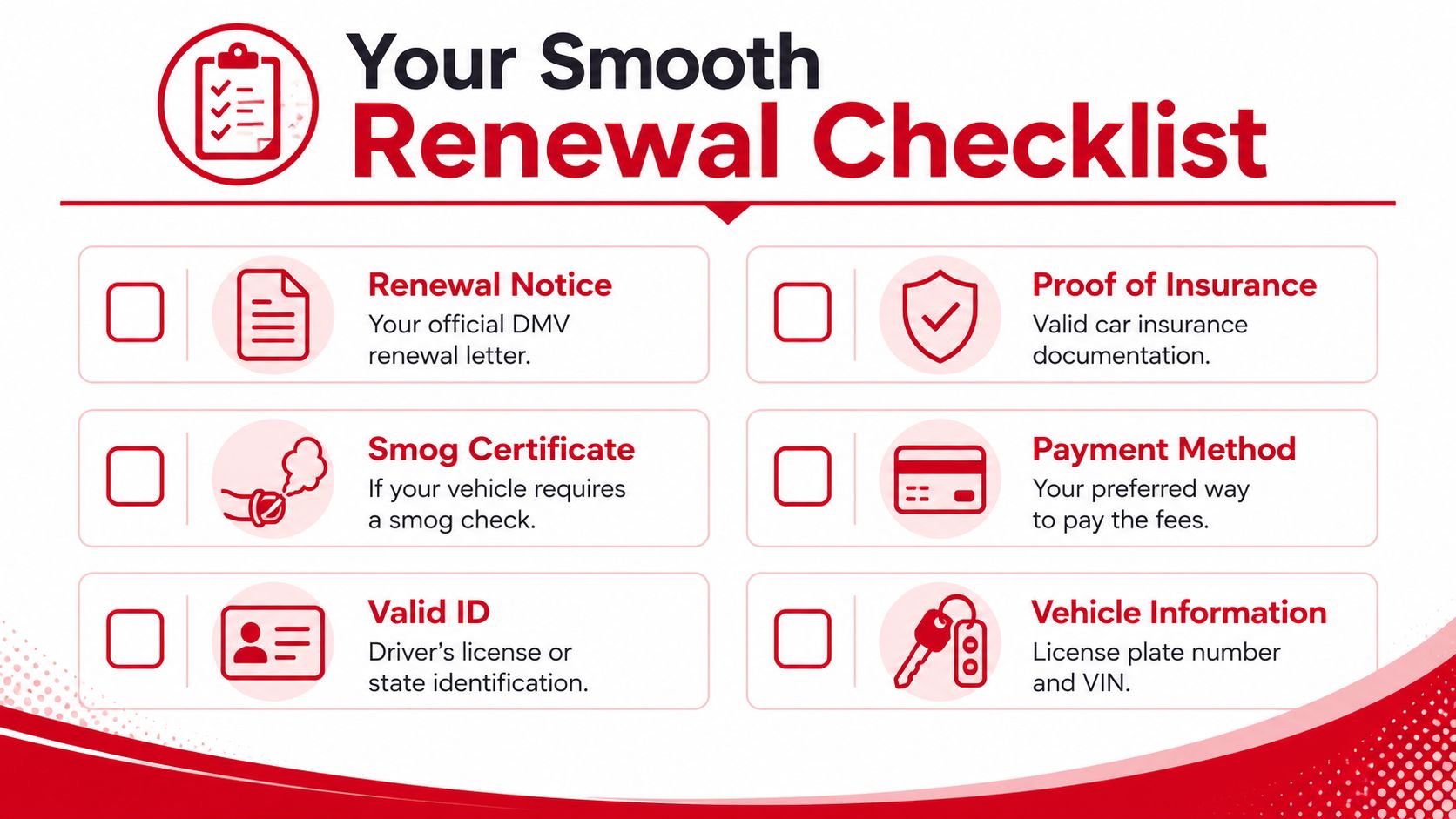
- Renewal notice: If you have it, bring it. It gives the quickest snapshot of what the state expects.
- Proof of insurance: Make sure it's current and easy to show.
- Smog certificate status: If your vehicle needs smog, handle that before the deadline whenever possible.
- Payment method: Bring the form of payment you plan to use.
- Valid identification: A driver's license or state ID can help resolve record questions.
- Vehicle details: Your plate number and VIN are useful if paperwork is missing or inconsistent.
Keep your registration documents in one dedicated folder at home. That habit saves more time than most people expect.
If you lost the renewal notice
Don't let a missing notice stop you. You can still renew, but you'll want your vehicle information, identification, and current insurance ready. The key is not to wait just because the paper is missing.
A few small habits make renewal easier every year:
- Check the date early: Put the expiration date in your phone calendar before the last week sneaks up on you.
- Confirm your address: If the DMV has an old address, notices can arrive late or not at all.
- Handle smog ahead of time: If your cycle may require it, don't leave it for the final day.
- Review who you're paying: Know whether the charge is an official state fee or an added third-party service fee.
- Save your completed paperwork: Keep the new registration card where you can find it next year.
California renewal doesn't have to feel like a puzzle. Once you know what drives the total, what can delay the process, and where extra fees can hide, the job gets much simpler.
If you want a local in-person option for California DMV renewals and smog-related needs, Fire House Smog in Antioch provides STAR-certified smog testing and licensed DMV registration services with on-site tag issuance during posted hours.