Many California registration renewals can start online, but most still depend on an in-person smog check, and title transfers usually require a physical visit. For many owners, a hybrid service center that combines digital preparation with on-site compliance checks is the most efficient path.
You submit the form, enter your payment details, and expect the process to be finished. Then the system reminds you that your vehicle needs a smog certification, or you discover that an unpaid parking ticket is blocking renewal. If you recently bought the car, the task becomes more involved because the state must verify ownership, fees, identity, and vehicle records.
That gap between online convenience and offline requirements explains why local vehicle registration services remain useful. A capable provider can help you identify the transaction, check the paperwork, complete required inspections, and issue registration materials when the state permits on-site processing.
Table of Contents
- The Reality of Modern Vehicle Registration Services
- Understanding How Vehicle Registration Works
- Types of Services You Will Encounter
- Comparing DMV Offices and Authorized Service Centers
- The Advantage of Integrated Smog and Registration Services
- How to Prepare for Your Registration Appointment
The Reality of Modern Vehicle Registration Services
You open your laptop, place the renewal notice beside it, and prepare to pay. The form seems straightforward until it asks for smog certification. Then the practical problems appear: a dashboard warning light, an unpaid parking ticket, or an address that no longer matches the DMV record.
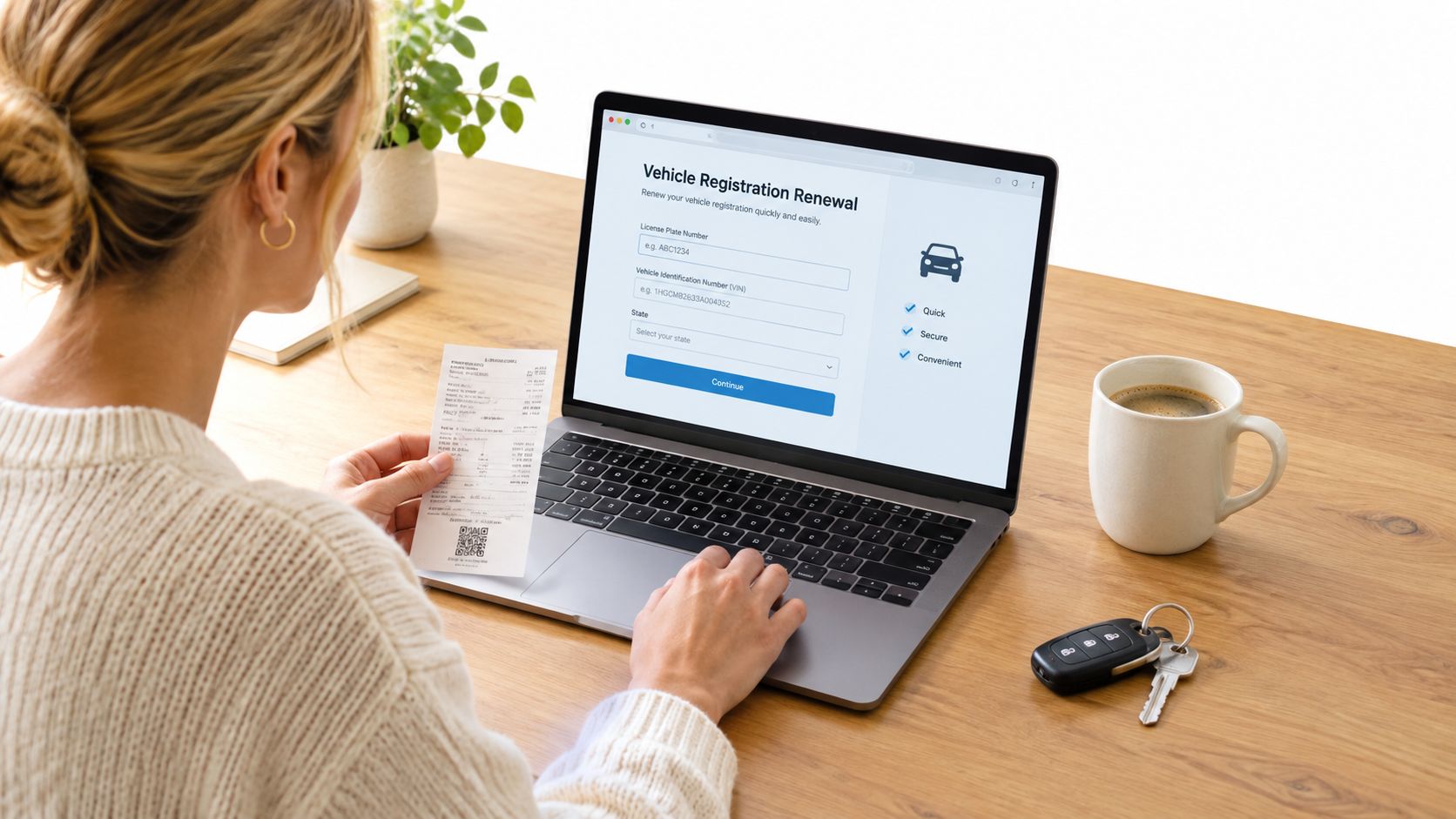
California's DMV states that a smog inspection is generally required for vehicle registration or renewal, with listed exceptions. Renewal can also be blocked by unresolved items such as missing smog certification or unpaid parking tickets. The California DMV renewal requirements show why registration is more than an online payment.
Why online renewal can stop halfway
A digital application can accept your information and payment, but it cannot inspect the vehicle. If smog certification is required, an approved inspection must happen before the renewal can be completed. The DMV also offers an online process for Planned Nonoperation filings. These filings can be submitted up to 60 days before expiration or 90 days after expiration.
The process works like a bridge with two sides. Online tools handle forms, account details, and payment, while a physical location may still need to verify the vehicle, review documents, or issue registration materials. Vehicle registration services connect those steps, so you do not have to treat each requirement as a separate search.
Practical rule: Treat online payment as one step in the transaction, not automatic proof that your registration is finished.
The local service advantage
A local center can first identify whether you need a renewal, transfer, replacement item, or compliance correction. That check helps you avoid joining the wrong queue or submitting the wrong paperwork. In Antioch and nearby East Contra Costa communities, the same visit may address emissions compliance and DMV-related documents.
The most useful hybrid process follows a clear order: prepare digitally, confirm requirements in person, then finish the remaining state transaction through an authorized channel. A provider that handles both sides can catch a missing document before it turns into a delayed notice or another trip.
Understanding How Vehicle Registration Works
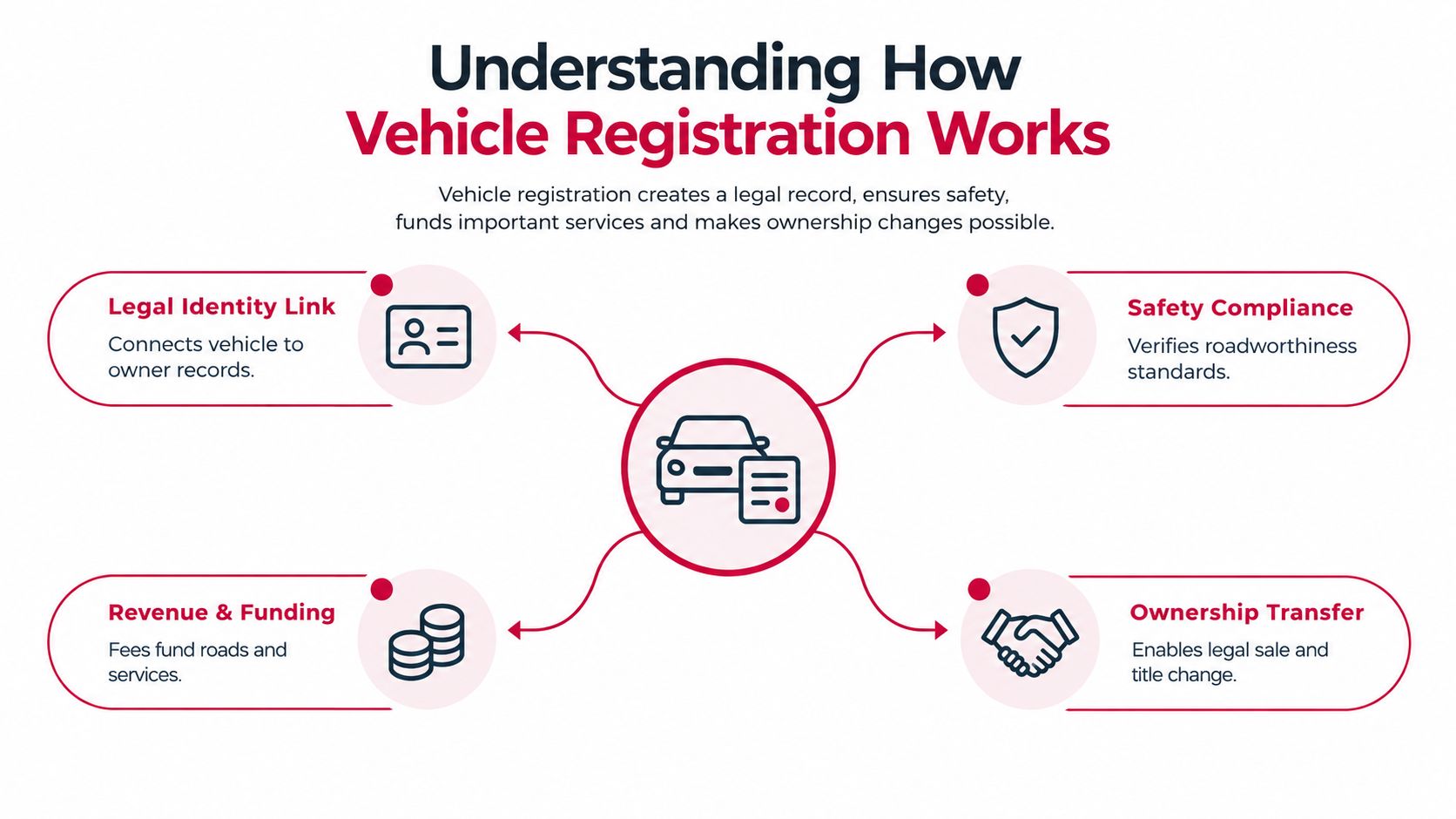
Vehicle registration connects a specific vehicle to an owner record. It gives the state a way to identify the vehicle, track legal responsibility, collect required fees, and confirm that the vehicle meets applicable rules. A registration card or sticker is only the visible result of that larger administrative record.
The system developed gradually. New York became the first U.S. state to require vehicle registration on April 25, 1901. California followed later that year, Massachusetts became the first state to issue plates in 1903, and by 1918 all 48 contiguous states were issuing license plates. By 1910, 36 states required motor vehicle registration, and by 1921 every state required annual registration, according to the District of Columbia DMV vehicle registration history.
Four parts of the registration record
Registration rules differ by state, but the underlying functions are familiar:
- Legal identity link: The record connects the vehicle identification number, owner information, and address.
- Compliance check: The state can require emissions, insurance, safety, or other conditions before allowing registration.
- Fee collection: Registration charges support the administration of transportation systems and related public services.
- Ownership evidence: Registration and title processes help document a sale, transfer, or change in responsibility.
Registration and title aren't identical. The title primarily establishes ownership, while registration authorizes the vehicle to operate under the applicable state rules. A sale can therefore require both ownership paperwork and a new registration record.
Why California feels especially procedural
California combines electronic renewal with emissions compliance. The DMV says smog certification is required for registration or renewal in many cases, and the renewal won't proceed when required certification or other obligations remain unresolved. That means the process can involve a website, a physical inspection lane, and a state record review.
For a plain-language explanation of the renewal step, see this guide to what vehicle registration renewal involves. Understanding the distinction between payment, certification, and final issuance helps prevent a common mistake: assuming the transaction is complete because the first online step succeeded.
Types of Services You Will Encounter
The right service depends on what changed. A routine renewal keeps an existing registration active. A transfer changes the vehicle's ownership record. A Planned Nonoperation filing changes how the vehicle may be used. An out-of-state transaction may require documents from both the previous jurisdiction and California.
Routine renewals
A renewal is usually the most familiar transaction. You confirm the vehicle and owner information, satisfy any emissions or administrative requirements, pay the applicable charges, and receive updated registration materials. If the DMV record is clear and the vehicle is eligible, the process can be straightforward.
It can become complicated when the vehicle requires a smog check, the address is outdated, a ticket remains unpaid, or the DMV requests additional review. A service provider can help separate those issues instead of treating every delay as a payment problem.
Ownership transfers
Buying or selling a vehicle creates a different workflow. New York DMV guidance shows that first-time registration can involve plate or transfer fees, a title certificate fee, and use tax in many counties. Customers may receive one or two plates and a registration window sticker at the counter or by mail, depending on the transaction. New York's registration and title instructions illustrate why a transfer requires more than changing a name on a renewal form.
Expect to discuss:
- Proof of ownership: Title, bill of sale, or other documents required by the jurisdiction.
- Vehicle identity: VIN and related information must match the official record.
- Fees and taxes: The transaction may include separate registration, title, transfer, or use-tax charges.
- Plates and documents: The state may issue new plates, stickers, registration cards, or title materials.
Special filings and cross-state moves
Planned Nonoperation is useful when an owner intends not to operate a vehicle on public roads for a defined period. It isn't a substitute for ordinary renewal when the vehicle will continue being driven.
Out-of-state purchases and moves require extra care because the vehicle may need to leave one state's record and enter another's. Insurance proof, identity, address, emissions status, title documents, and temporary operating permissions can all matter. Ask the provider exactly which transaction they handle before arriving, especially if you bought the vehicle privately or the title is held by a lender.
Comparing DMV Offices and Authorized Service Centers
A DMV office is the official state channel. An authorized service center is a private provider permitted to handle specified transactions through a state partnership or license. Neither option eliminates the state's requirements, but the experience can differ sharply.
The California DMV estimates kiosk renewals can be completed instantly when all requirements are met. It estimates about one week for online and phone renewals and about two weeks for mail renewals, while noting that extra review can extend processing. These California DMV processing estimates make the operational trade-off clear: a local in-person provider can be useful when immediate document verification or on-site issuance is available.
Side-by-side comparison
| Feature | DMV Office | Authorized Service Center |
|---|---|---|
| Authority | Direct state agency service | Private provider authorized for specific DMV transactions |
| Routine renewal | Available through eligible channels | Often available on site, subject to authorization and eligibility |
| Document review | State staff review the transaction | Staff can check paperwork before submission or issuance |
| Smog compliance | Usually handled separately from the DMV counter | Some centers combine emissions testing with registration services |
| Complex transfers | Handles state transactions under DMV procedures | May handle transfers, plates, and related paperwork within its approved scope |
| Processing result | May be mailed or completed through an eligible state channel | On-site materials may be issued when requirements are satisfied |
| Best fit | Unusual cases requiring direct state adjudication | Eligible transactions where speed, guidance, and convenience matter |
Choosing the right channel
Use the DMV when your case involves an issue only the state can resolve, such as a disputed record, unusual ownership problem, or formal correction. An authorized center may be more practical when your documents are complete and you need a renewal, transfer, sticker, or related service without navigating multiple locations.
Check the provider's exact authority before you go. Some centers handle only renewals, while others can process ownership transfers or plate-related work. The phrase California DMV registration services should mean more than general paperwork help. Ask whether the location can complete your specific transaction and whether it can issue the needed item on site.
Before you leave home: Confirm the transaction type, required documents, inspection status, payment method, and service hours.
The Advantage of Integrated Smog and Registration Services
California's hybrid reality is easiest to understand through the emissions requirement. You can begin a renewal online, but if the vehicle needs a smog check, a physical inspection still stands between your payment and a completed registration. A title transfer adds another layer because the provider must verify ownership documents and transaction details.
An integrated center reduces handoffs. Instead of visiting a smog station, discovering a problem, then arranging a separate DMV appointment, you can have the emissions result and registration paperwork handled within one coordinated workflow, where the provider is authorized to offer both services.
Why the timing matters
A California DMV kiosk renewal can be completed instantly when all requirements are satisfied. Online and phone renewals are estimated at about one week, while mail renewals are estimated at about two weeks, according to the DMV's renewal processing information. Those estimates don't mean every case will take that long, but they show why same-visit processing can matter to someone whose expiration date is close.
The bottleneck often isn't the payment screen. It's the missing smog certification, incorrect document, unresolved fee, or incomplete transfer record. An on-site provider can focus attention on those eligibility checks before the customer leaves.
What happens if the vehicle fails
A failed smog inspection changes the plan, but it doesn't necessarily end the process. The owner may need repairs and a retest before the emissions requirement is satisfied. A center that performs the inspection and handles registration paperwork can explain what remains outstanding, while a test-only operation keeps testing separate from repair sales.
Fire House Smog is one local option that provides STAR-certified test-only smog inspections and California DMV registration services at its Antioch location. Its listed services include renewals, ownership transfers, related plate or sticker handling, and a free retest under applicable site policy and coupon terms. Verify current availability and conditions directly with the provider.
The hybrid model in practice
The efficient sequence is usually:
- Check the DMV record: Identify the renewal, transfer, or filing and look for holds.
- Prepare the documents: Match names, addresses, VIN details, title information, and insurance records.
- Complete the physical requirement: Obtain the smog inspection or other required verification.
- Finish the authorized transaction: Submit the completed information and receive the registration item when eligible.
This approach doesn't remove state rules. It puts the digital and physical steps in the right order, reducing the chance of paying first and discovering later that the record still needs action.
How to Prepare for Your Registration Appointment
Preparation starts with identifying the transaction, not with searching for the nearest office. A renewal, transfer, replacement plate request, and Planned Nonoperation filing can require different documents and follow different timelines.
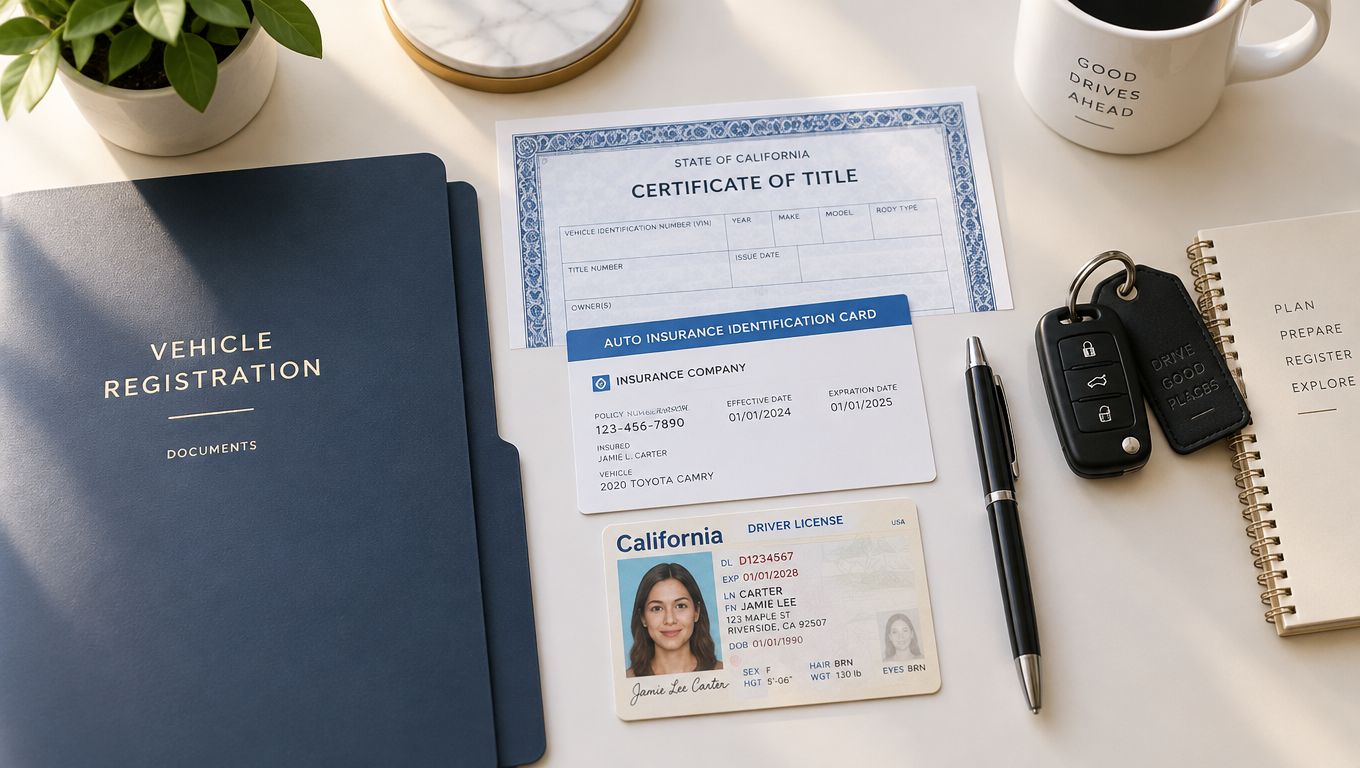
Bring the documents that match your situation. Your current registration, driver license or other identification, proof of insurance, title, and bill of sale may all be relevant, especially for a transfer. Keep the VIN and vehicle details accessible, and check that names and addresses are consistent across the paperwork.
Use this vehicle registration document checklist before leaving home:
- Renewal: Current registration, identification, insurance information, and any smog certification details.
- Ownership transfer: Title, bill of sale, buyer and seller information, identification, and payment method.
- Out-of-state vehicle: Prior title and registration, identity and address evidence, insurance, and any required inspection information.
- Problem record: Notices, receipts, parking-ticket resolution, or other documents connected to the hold.
If the vehicle has a check-engine light, address the issue before scheduling a smog test. Also confirm the center's current DMV hours rather than relying on its smog-testing schedule, since those services may operate on different timetables.
The following video can help you think through the paperwork and appointment process before you go.
Call ahead for unusual vehicles, out-of-state titles, lender-held documents, RVs, or transactions involving missing paperwork. A short conversation can reveal whether the provider handles the case and what you need to bring.
Fire House Smog offers STAR-certified test-only smog checks alongside California DMV renewals, ownership transfers, and related registration services at its Antioch location. Bring your documents, confirm the current service hours, and visit Fire House Smog to coordinate the inspection and registration steps in one place.
You open your California DMV renewal notice expecting a routine fee reminder. Instead, one line says Smog Check Required, and another may direct you to a STAR-certified or test-only station. The wording can make a simple renewal feel like a trip through a maze of government terms.
The key is to separate two labels that people often treat as interchangeable. Test-only describes what a station is allowed to do. STAR describes a state certification tied to inspection performance and oversight. A station can be both, but the terms don't mean the same thing. Once that distinction is clear, choosing the right location, completing the inspection, and handling your registration become much easier.
Table of Contents
- Why Your Renewal Notice Says Smog Check
- What a Test Only Smog Station Is
- Test Only Versus Test and Repair Stations
- Why STAR Certification Changes the Equation
- What to Expect During Your Smog Visit
- Pairing Your Smog Check With DMV Services
- Can a Test Only Visit Help Your Car Pass
- Choosing the Right Station for Your Situation
Why Your Renewal Notice Says Smog Check
You open a California DMV renewal notice expecting a fee reminder. Instead, it says Smog Check Required, and your renewal cannot finish until the vehicle meets that requirement. For most gasoline vehicles older than eight model years and most diesel trucks, a passing emissions inspection is part of renewing registration. The notice functions as a registration gatekeeper, so treating it as optional can leave the renewal incomplete.
The wording may also point you toward a STAR-certified station, a test-only station, or another directed inspection type. These labels answer different questions. Test-only describes what the facility is licensed to do. STAR identifies a certification for eligible test-and-repair and test-only stations that meet higher inspection-based standards. One station can carry both labels, but neither term automatically replaces the other. The Bureau of Automotive Repair STAR FAQ explains the certification program.
Why some vehicles receive a direction
A station direction may be connected to the vehicle's inspection history, a directed recall, missing relevant smog history, or state monitoring of high-emitting vehicles. The reason can vary, but the practical step stays the same: read the notice before choosing a shop. A nearby facility may be licensed for smog inspections yet unable to perform the inspection your vehicle was assigned.
A general smog requirement usually leaves you with more choice among licensed stations. A notice naming STAR or test-only limits that choice. If DMV directs the vehicle to a STAR station, use a facility with that designation for the required inspection. The California Smog Check guidance from BAR describes how directed vehicles and test-only stations fit into the program.
Practical rule: Let the words on the renewal notice guide your selection. A business name can be misleading, so confirm that the station's BAR credentials match the stated requirement.
Before booking, identify the assignment first. Then check whether the station is authorized for that inspection and whether it may perform repairs. That distinction helps you choose the right visit instead of paying for an inspection the location cannot complete.
What a Test Only Smog Station Is
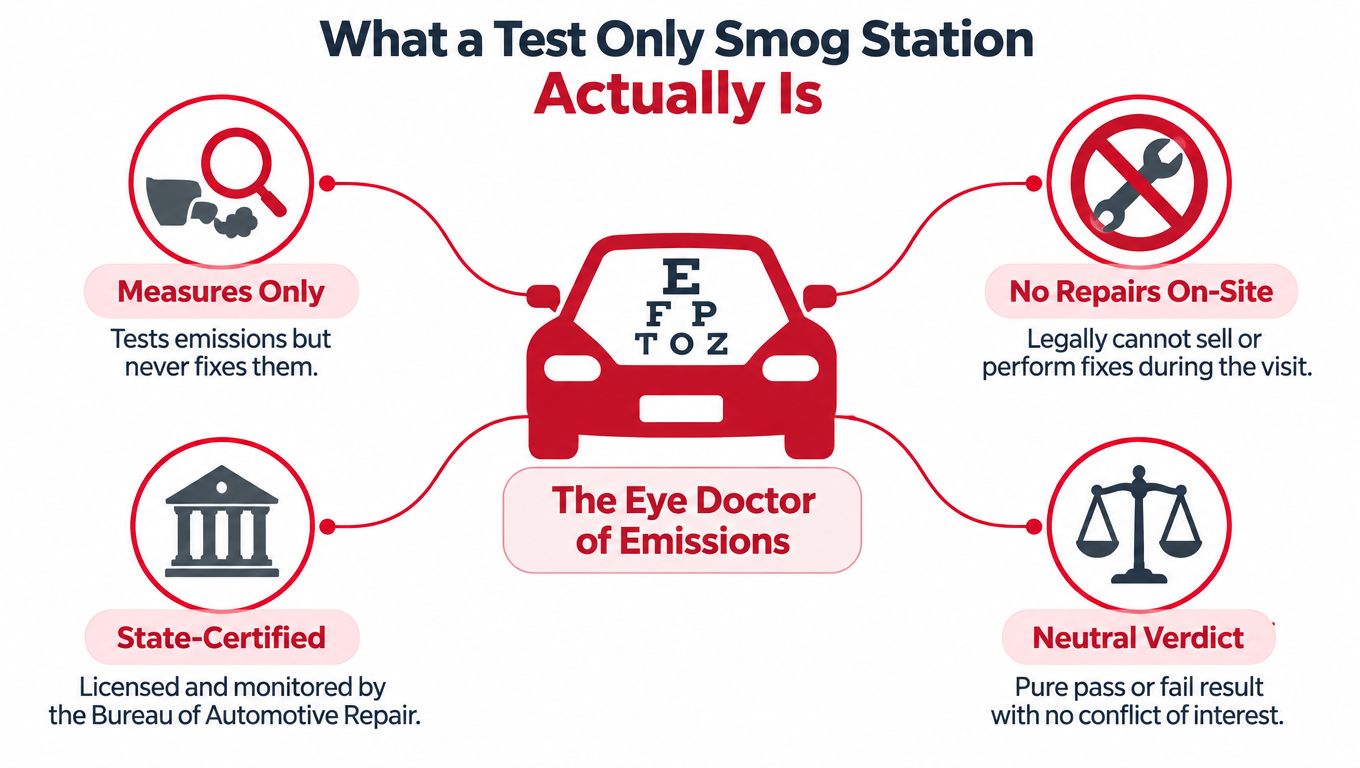
Your car can fail an emissions inspection without the inspection shop being the place that repairs it. A test-only smog station works like an eye doctor's examination room: it measures a condition, records the result, and gives you information for the next step. It does not diagnose or repair emissions problems during that visit.
The Bureau of Automotive Repair's smog check information describes a test-only station as a facility licensed to perform inspections only. Its authorization covers testing, not emissions diagnosis or repair. That distinction applies to the vehicle service the station is allowed to provide, not just the wording in its business name.
Why inspection and repair are separated
Consider a shop that decides whether your car fails and then sells the work needed to correct the failure. The arrangement can create a financial incentive to recommend repairs. California's test-only model separates those roles. The station's job is to perform the inspection and report its result.
That separation does not mean the technician ignores a problem. If your vehicle fails, you receive the failure information and can take the car to a qualified repair facility. The inspection and the repair decision occur in different places, like a medical test performed separately from treatment.
Where STAR fits
STAR certification is a separate layer. It is not another name for test-only. Qualifying test-only and test-and-repair stations can earn STAR certification by meeting the program's additional inspection standards.
A STAR test-only station has both designations:
- Test-only: It can inspect the vehicle but cannot diagnose or repair emissions problems.
- STAR-certified: It meets the program's additional standards and may serve vehicles directed to STAR facilities.
A STAR-directed vehicle needs the required inspection authorization, not necessarily a repair department. Test-only answers what the station can do. STAR answers which inspection tier it has earned.
Test Only Versus Test and Repair Stations
Your choice depends on what you need after the inspection. A test-only station suits a driver who wants the result first and plans to choose a repair shop separately. A test-and-repair station suits someone who prefers one business to inspect the vehicle and address an emissions problem if it fails.
Choose test-only when independence matters
Suppose your renewal notice allows a regular Smog Check, your car has no known emissions issue, and you already have a trusted repair shop. A test-only visit gives you the inspection result without tying that result to an in-house repair estimate. If the car passes, you can finish the transaction. If it fails, you can compare repair options before authorizing work.
A test-only technician can perform the required inspection and report the outcome. The station cannot diagnose or repair the emissions problem during that visit, clear a diagnostic fault, or adjust the vehicle for another test. The inspection works like a separate medical screening: it identifies the result, while treatment happens elsewhere.
Choose test-and-repair when one-stop service helps
A test-and-repair station can inspect the vehicle and, when appropriate, diagnose and perform qualifying emissions repairs. This may reduce scheduling when you already suspect a problem, such as a warning light or a previous failed inspection. The same business may also provide the follow-up test after repairs, subject to the applicable rules.
That convenience does not decide whether the station can inspect your vehicle. Your notice and vehicle status do. A station that offers repairs may still lack the authorization required for a directed inspection, so check the required designation before booking.
| Decision point | Test-only station | Test-and-repair station |
|---|---|---|
| Your priority | An inspection separate from repair sales | Inspection and possible repair coordination |
| After a failure | Take the result to a shop you select | Ask the same business about diagnosis and repairs |
| Repair service during the visit | Not available for emissions problems | May be available |
| If your notice names a station type | Use it only when the notice permits that option | Confirm it has the required authorization |
| STAR designation | May also be STAR-certified | May also be STAR-certified |
The words test-only describe the station's service limits. They do not describe the station's quality or predict whether your car will pass. Likewise, test-and-repair describes the services the business may provide, not a guaranteed result.
Before you arrive, read the renewal notice for any direction or credential requirement. If no special direction applies, choose between independent testing and repair convenience based on your vehicle's condition and the kind of follow-up support you want.
Why STAR Certification Changes the Equation
A driver can visit a test-only station and still need to ask a separate question: does that station have STAR certification? These labels describe different parts of the business. Test-only identifies what the station may sell. STAR identifies whether the station meets the state program's inspection and oversight requirements.
The official STAR program explanation from BAR describes STAR certification as available to qualifying test-and-repair and test-only stations. Certification is intended to support consistent inspection quality and emissions-reduction requirements. It does not change the condition of your vehicle or promise a passing result.
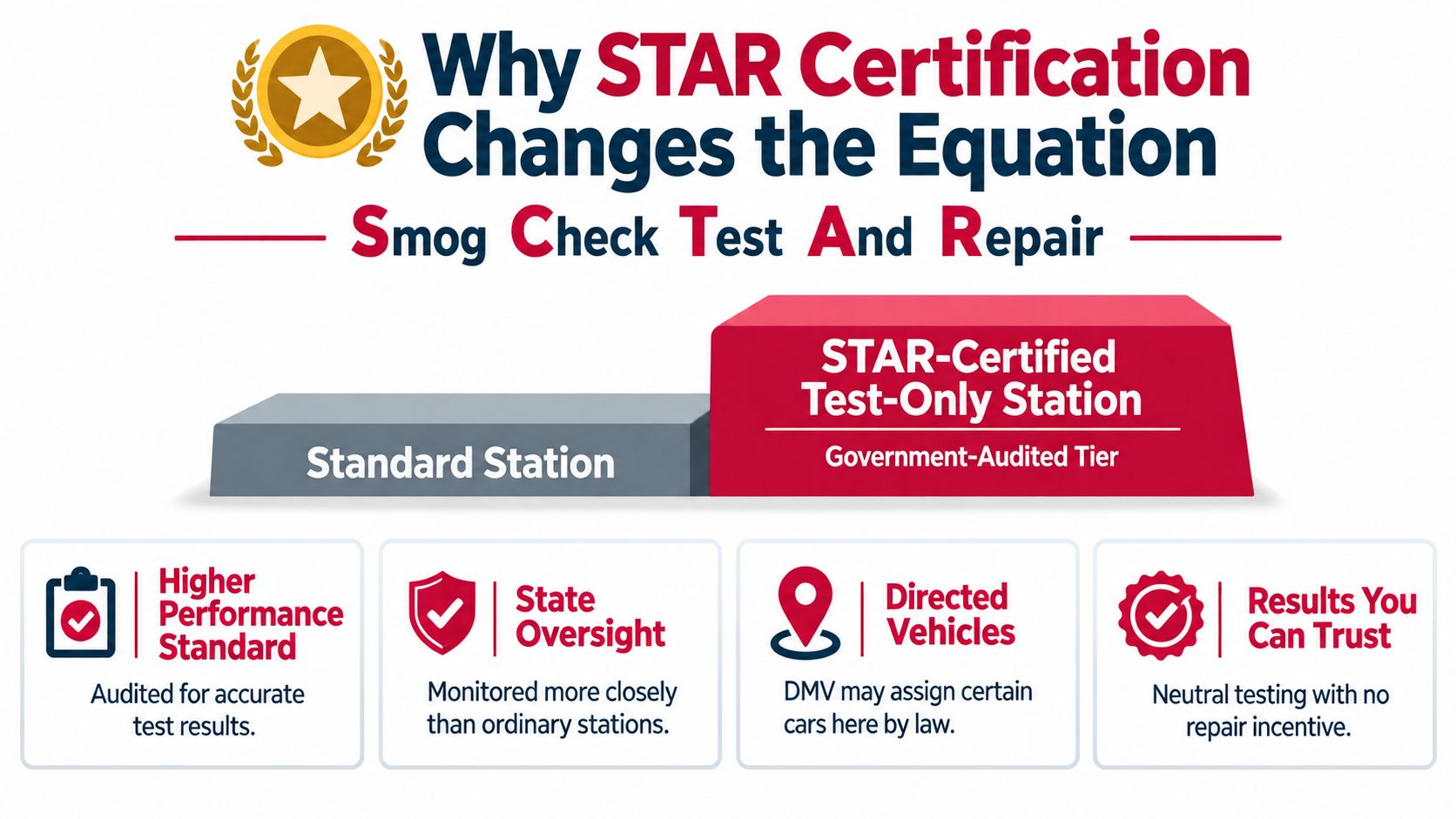
STAR and test-only answer different questions
Use two checks before booking:
- Can the station repair the vehicle? If it cannot, the business is test-only. If it can, it is test-and-repair.
- Does the station hold STAR certification? If it does, the station participates in STAR, regardless of whether it is test-only or test-and-repair.
California's published Smog Check information reports that, in calendar year 2025, 49% of licensed stations were STAR-certified, while STAR-certified stations performed 83% of all Smog Check tests. STAR stations therefore handle much of the testing, but STAR does not mean test-only. The California Smog Check information published by BAR supports those figures.
What STAR means for a directed vehicle
If DMV directs your vehicle to a STAR station, a non-STAR location cannot replace that requirement. Check the designation on your notice before choosing a business. A STAR-certified test-only station may fit well when you need the required credential and want the inspection kept separate from repair sales.
For a practical explanation of how these labels fit together, review this guide to a STAR-certified smog station. The useful rule is simple: verify both labels. “STAR” alone does not tell you whether the station repairs cars.
What to Expect During Your Smog Visit
An official test-only visit usually follows a straightforward sequence. Since the station can't sell emissions repairs during the inspection, the appointment stays focused on verifying the vehicle and transmitting the result.
Bring the DMV renewal notice or Smog Check Required letter, your current registration, and a payment method. The station needs accurate vehicle information, including the VIN, to connect the inspection result with the correct DMV record.
The inspection sequence
- Check in. The technician confirms the vehicle, the requested service, and any direction shown on your DMV paperwork.
- Verify the record. Vehicle details and VIN information are checked before testing begins.
- Connect the equipment. The technician accesses the vehicle's On-Board Diagnostics system and reads relevant information.
- Inspect emissions equipment. The process can include a visual review of items such as the catalytic converter, gas cap, and check engine light status.
- Measure emissions. Depending on the vehicle and applicable test requirements, the technician may use an emissions probe, dynamometer, or idle test.
- Transmit the result. A passing result is sent electronically to DMV, allowing the registration process to continue.
A 2000 and newer gasoline vehicle that passes usually takes about 20 to 30 minutes, according to the provided California smog service guidance. Because the result is transmitted electronically, you generally won't wait for a paper certificate to arrive by mail.
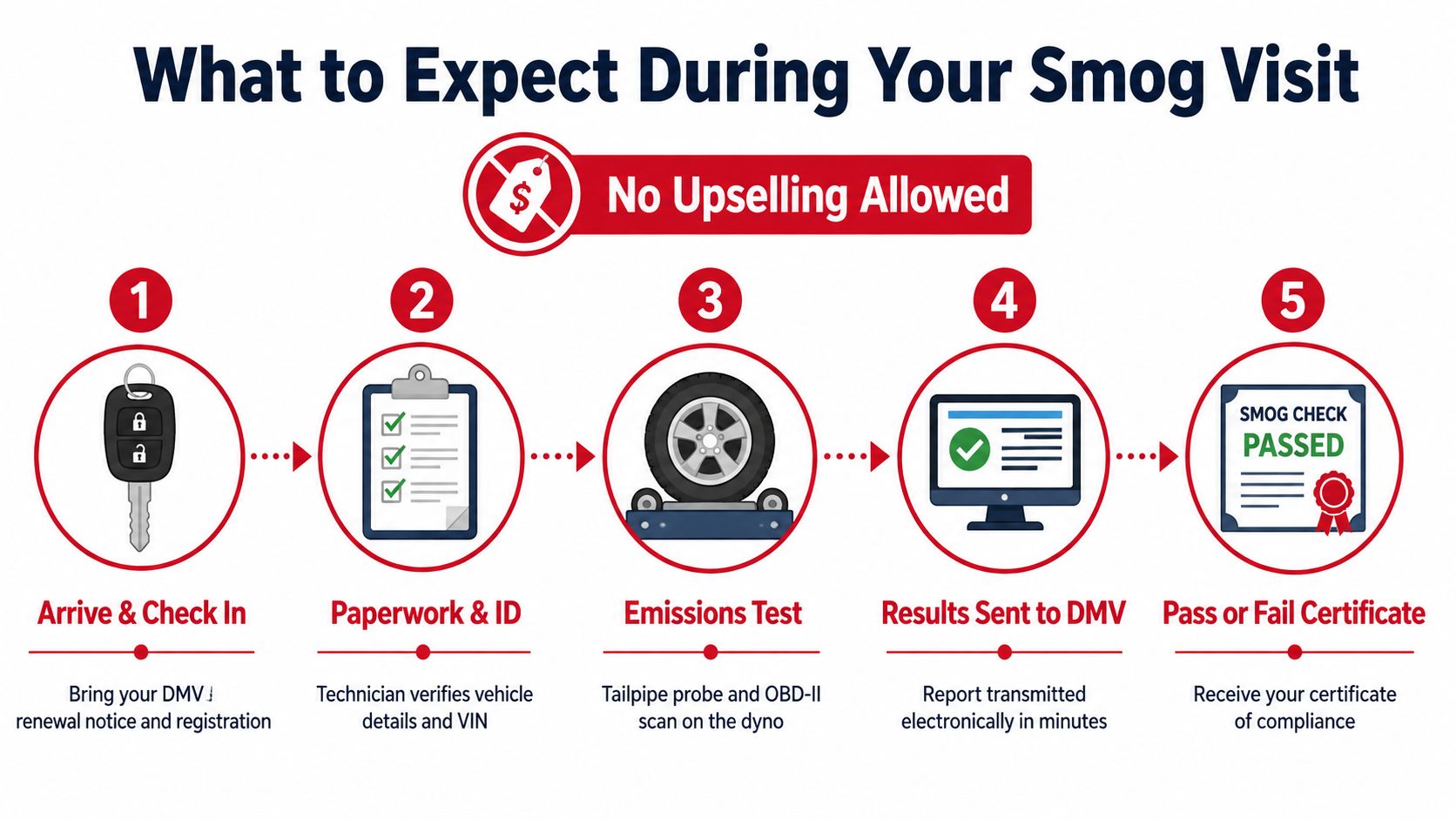
The technician isn't tuning the engine or preparing the car to pass. The station is documenting the vehicle's condition under the applicable inspection procedure. If the result is a failure, ask for the printed information and take it to a repair professional for diagnosis.
The process is also shown in this California smog inspection video, which can help first-time customers understand the basic flow before arriving.
Pairing Your Smog Check With DMV Services
A smog inspection and a registration renewal are separate actions, but they often belong in the same errand. Some STAR-certified test-only stations also operate as licensed DMV business partners. The California DMV business-partner program explains that participating partners can handle certain registration tasks and may offer shorter waits than a DMV field office.
The workflow is simple. First, the station completes the inspection. Once the passing result clears electronically, the DMV partner handles the eligible registration transaction at the same location. Depending on the record, that may include collecting renewal fees, issuing a sticker, or printing updated registration paperwork.
| Task | DMV Field Office | Smog Station With DMV Partner |
|---|---|---|
| Smog inspection | Usually completed elsewhere | Completed at the same location |
| Registration renewal | Available when the record qualifies | Available for eligible transactions |
| Sticker issuance | Handled at the office | May be handled on site |
| Ownership transfer | Available with required documents | May be available for eligible transfers |
| Number of stops | Often requires a separate smog visit | Can combine the inspection and DMV task |
| Wait experience | Field-office queue or appointment | Business-partner queue, often more focused |
When the combined visit helps most
This option is especially useful when your record needs an immediate transaction rather than a simple online renewal. A business partner may be able to help with a sticker, transfer paperwork, or a registration issue that an online form can't resolve.
California DMV also offers online and phone renewal channels, so an in-person partner visit isn't always necessary. Compare the transaction you need with the channel available to you. If you already need a smog inspection and your vehicle is directed to an eligible station, combining both services can remove an extra trip.
Learn more about the California smog check registration service before you leave home, and confirm which documents the location requires for your specific transaction.
Can a Test Only Visit Help Your Car Pass
A 2004 Toyota Camry arrives for its smog test with an intermittent check-engine light. It may pass on one visit and fail on another because the vehicle's computer can show different readiness information depending on recent driving, repairs, or when the warning light becomes active. A test-only station cannot change that result. It records what the vehicle shows during the inspection.
A test-only visit can still improve the quality of your decision. The station provides an independent measurement and documents the result without also selling repairs. If the facility is STAR-certified, it follows the program's inspection requirements, but STAR certification does not guarantee a passing result.
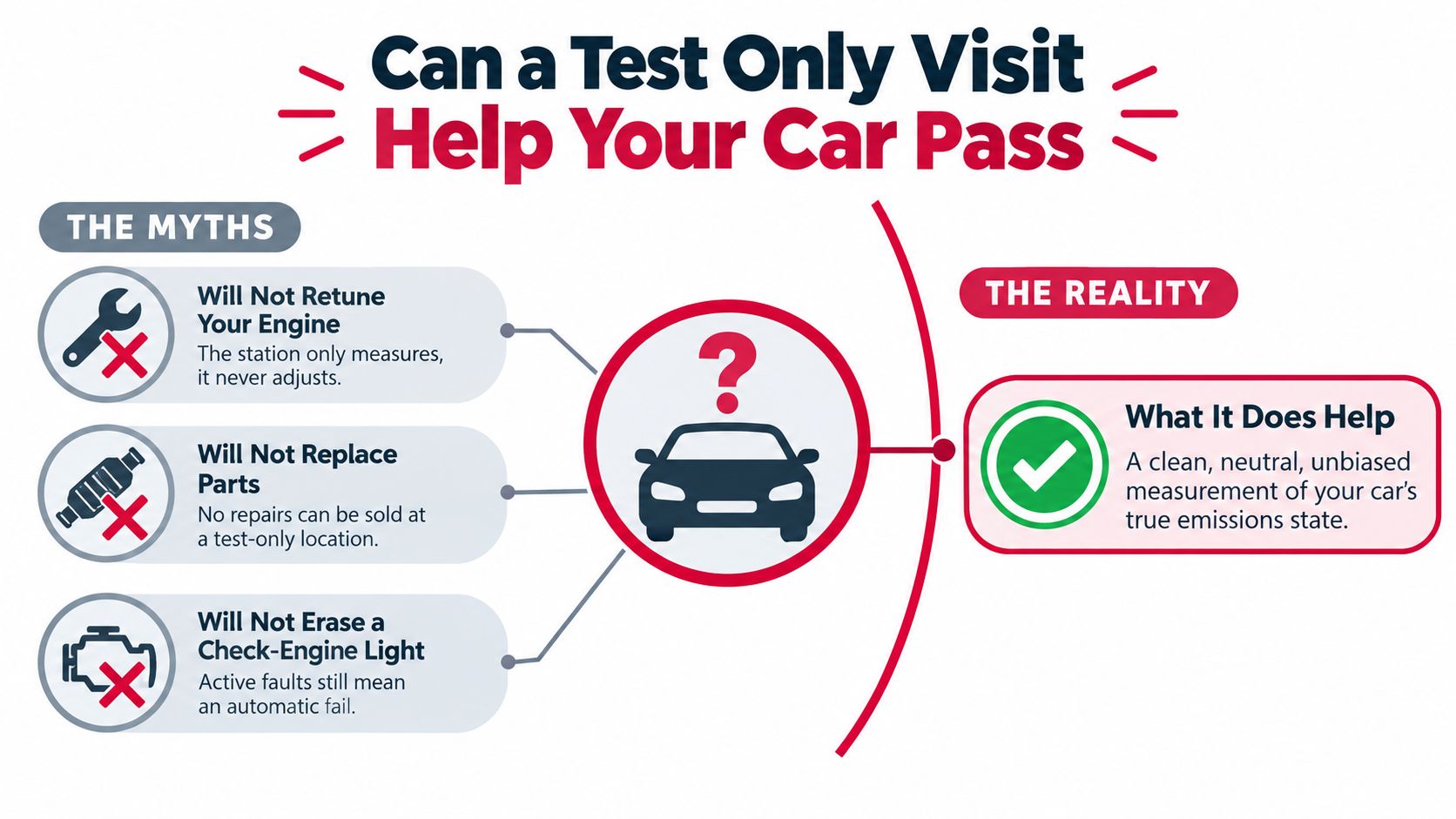
What a failed test can reveal
Common failure causes include an active check-engine light, incomplete readiness monitors, emissions readings above the limit, a damaged catalytic converter, or visible emissions equipment problems. A recent battery replacement can also erase stored information and leave monitors incomplete, even if the car feels normal while driving.
For example, a Camry with a loose oxygen-sensor connection may run smoothly but fail its emissions reading. Another vehicle may have no warning light yet still fail because its catalytic converter is no longer reducing pollutants effectively. The test result points to the issue, while a qualified repair provider determines the fix.
Myth vs. reality
Myth: A test-only station can make a borderline car pass.
Reality: It measures the vehicle as presented and cannot tune, repair, or adjust it.
Myth: A failed test means the inspection was unfair.
Reality: The result identifies a compliance problem that needs attention before registration can be completed.
Myth: Trying another station is the repair.
Reality: Reviewing the common smog check failure reasons and obtaining a proper diagnosis is the productive next step.
Choosing the Right Station for Your Situation
Start with the renewal notice. It tells you more than a search result or a sign outside a shop.
| Notice Type | Station Required | Best For |
|---|---|---|
| Smog check required | A licensed station authorized for the vehicle | Drivers with a standard inspection requirement |
| Test-only stated | A test-only station | Vehicles directed away from repair facilities |
| STAR stated | A STAR-certified station | Vehicles requiring the program's inspection tier |
| STAR and test-only stated | A STAR-certified test-only station | Drivers who need both credentials |
Match the station to the transaction
If the notice only calls for a smog check, decide whether you prefer an inspection-only visit or the possibility of repair coordination. If it says test-only, don't book a standard repair shop merely because it has an available appointment. If it says STAR, confirm the location's certification before you arrive.
Then look at the practical details:
- Credential: Verify that the station matches the notice.
- Services: Check whether it performs only inspections or also handles repairs.
- DMV support: Ask whether it can process your renewal or other eligible registration task.
- Documents: Bring the notice, registration, and paperwork for any ownership transaction.
- Schedule: Confirm testing hours separately from DMV partner hours.
- Vehicle fit: Ask ahead about unusual vehicle sizes, recreational vehicles, or other equipment limits.
- Result handling: Confirm that the station transmits the result electronically and explain what happens if the vehicle fails.
A combined visit can be the fastest path when you need both a passing inspection and an eligible DMV transaction. It won't eliminate every requirement, and online renewal may be simpler for a straightforward record, but the right partner location can spare you a separate field-office stop.
Fire House Smog in Antioch offers STAR-certified test-only smog inspections and eligible DMV registration services, including renewal and ownership-transfer assistance. If your notice requires a matching station and you want to handle both tasks in one visit, visit Fire House Smog to review the available services and confirm the current hours before driving over.
You're standing in line at the testing station with a registration deadline approaching, and the car feels perfectly normal. The check-engine light is off, the engine starts cleanly, and you're wondering whether a short drive to the station is enough. That's where many owners get caught. A California smog test can fail a vehicle that drives well if its emissions monitors haven't completed, especially after a battery replacement or diagnostic reset.
The practical way to pass California smog test requirements is to handle the job in the right order: confirm the vehicle needs testing, diagnose warning lights, verify readiness, complete a proper mixed-driving cycle, and inspect the simple hardware that causes avoidable failures. California's Bureau of Automotive Repair Smog Check guidance and its 2025 Smog Check Executive Summary Report make the point clear. Passing is less about luck at the bay and more about arriving with the emissions system ready to report.
Table of Contents
- Who Actually Needs a Smog Check and When
- Driveway Pre-Test Maintenance That Moves the Needle
- The Readiness Monitor Rule Most Drivers Miss
- Quick Visual and Mechanical Checks Before You Pay
- What Happens at a STAR-Certified Test-Only Station
- Failing the Test and the Free Retest Path Forward
- Final Pre-Test Checklist and Common Questions
Who Actually Needs a Smog Check and When
Start with eligibility. California generally requires checks for gasoline, hybrid, and alternative-fuel vehicles from model year 1976 onward. Diesel vehicles from model year 1998 onward are generally included, subject to the applicable weight and exemption rules described by the California Bureau of Automotive Repair.
The renewal exemptions are specific. Gasoline vehicles eight model years and newer generally don't need a renewal smog check, while gasoline vehicles four model years and newer generally qualify for the change-of-ownership exemption. Diesel vehicles from 1997 and older, or diesel vehicles exceeding 14,000 pounds GVWR, fall outside the stated testing requirement.
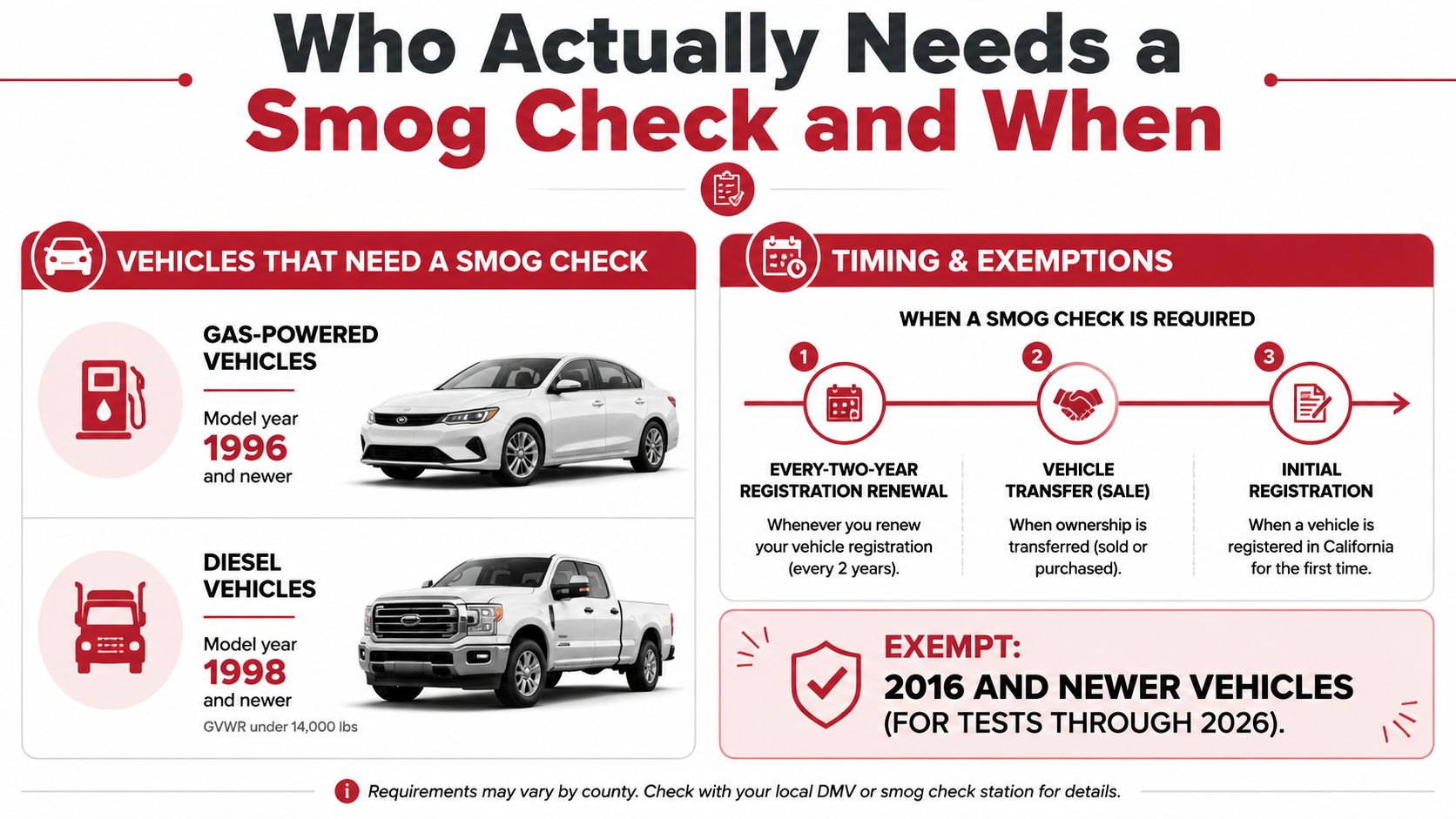
Check the trigger, not just the age
The BAR says Smog Check is required every other year as part of registration renewal. Your DMV renewal notice is the practical answer. If it says a smog check is required, plan for one. Some owners are also enrolled in the state's direct-mail renewal process, so the notice remains the document to follow rather than relying on a general age rule.
A change of ownership can trigger testing even when a vehicle would otherwise qualify for a renewal exemption. First-time California registration also matters. An out-of-state vehicle from 1976 or newer requires a Smog Check when it's first registered in California, which includes many used cars and light trucks entering the state.
For a broader explanation of California emissions testing requirements, use the vehicle's registration situation as your starting point.
Decision rule: If you received a DMV notice, test. If you bought the vehicle out of state, test. If it's a gasoline vehicle older than the applicable exemption window, expect a test. Otherwise, check the next registration or ownership milestone before assuming you're exempt.
Driveway Pre-Test Maintenance That Moves the Needle
The last few days before inspection are useful, but only if you spend them on legitimate preparation rather than gimmicks. No additive can repair a failed catalyst, oxygen sensor, or EVAP leak. Your best controllable advantage is arriving with the engine fully warm, the fuel system sealed, and the diagnostic computer undisturbed.
Use the drive as preparation
Take a 20-minute mixed drive that includes steady cruising, ordinary city operation, deceleration, and idle time. This warms the engine and catalytic converter and gives the computer the operating conditions it needs to run emissions self-tests. A short trip around the block isn't a drive cycle.
Check the fuel door and gas cap. Tighten the cap properly and replace it if the seal is visibly damaged. A new cap is a sensible repair for a damaged seal, but it won't solve a deeper EVAP leak.
Then inspect the basics:
- Air filter: Replace it if it's visibly dirty or restricted. Don't replace a clean filter because a test is approaching.
- Engine oil: Verify that the level is correct and that the oil matches the manufacturer's specified viscosity. An oil change is appropriate if maintenance is due.
- Fuel: Use fresh gasoline from a reputable, busy station. Don't experiment with unusual fuel blends immediately before inspection.
- Engine behavior: Notice hard starts, unstable idle, fuel odor, hesitation, or misfires. Those symptoms deserve diagnosis before testing.
Let the computer finish its work
After the mixed drive, allow the vehicle to cool and restart normally later. Don't disconnect the battery, clear trouble codes, or use a scan tool to erase a warning just to make the dashboard look clean. Those actions can reset readiness monitors and leave the car unprepared.
For more practical emissions-reduction maintenance, review this guide to reducing vehicle emissions.
A screwdriver and a few minutes of inspection are enough for most driveway checks. The goal isn't to manipulate the test. It's to catch loose components, obvious maintenance issues, and recent resets before you pay for an official result.
Before heading out, this video can help you visualize the basic preparation routine:
The Readiness Monitor Rule Most Drivers Miss
A vehicle can have no check-engine light and still fail because the onboard diagnostic system hasn't completed its self-tests. Readiness monitors are the computer's record that emissions-related systems have operated under the conditions required for evaluation. If the monitor status is incomplete, the inspector doesn't have a complete compliance picture.
BAR states that, effective October 1, 2025, all readiness monitors must be set for a vehicle to pass, except for unique design issues granted by BAR or CARB. That makes readiness a legal gate, not a suggestion. The BAR Smog Check FAQ explains the requirement and why a vehicle must complete its self-diagnostic testing.
The monitors you need to understand
| Monitor | What it checks | Typical setting conditions |
|---|---|---|
| Misfire | Combustion irregularities | Cold start, warm operation, and varied engine load |
| Fuel system | Fuel delivery and mixture control | Warm engine with changing load |
| Comprehensive components | Sensors, actuators, and related controls | Normal operation across different conditions |
| Catalyst | Catalytic-converter efficiency | Fully warm engine and steady driving |
| Heated catalyst | Heated catalyst operation, where equipped | Cold start and controlled warm-up |
| EVAP | Fuel-vapor containment | Fuel level and temperature conditions, followed by driving |
| Secondary air | Air-injection operation, where equipped | Cold-start operation |
| O2 sensor | Oxygen-sensor response and heater function | Warm engine with steady and changing conditions |
A battery disconnect, a recently cleared code, or a routine made up only of short trips can leave one or more monitors marked Not Ready. The engine may feel smooth because the vehicle is operating normally, but the computer still hasn't completed its required checks.
Set readiness before booking
The cleanest method is to use the manufacturer's drive-cycle instructions from the service manual. Follow the sequence precisely, because some monitors require a cold start, a stable cruise, a controlled deceleration, and an idle period.
A qualified shop can also diagnose why a monitor won't run and determine whether a permitted procedure applies. Use an OBD-II scanner to verify the monitor status before paying for the official inspection. Don't erase codes after checking. If the scan shows incomplete monitors, keep driving under varied conditions and rescan later.
The OBD readiness monitor guide can help you interpret what the scanner reports. Treat “Ready” as the finish line, not just the absence of a dashboard warning.
Quick Visual and Mechanical Checks Before You Pay
A few minutes beside the vehicle can reveal problems that cost little to correct but create an unnecessary failure. Start at the rear of the car and work forward. You're looking for loose, missing, altered, or visibly damaged emissions equipment.
The gas cap deserves special attention. Tighten it until it clicks and inspect the sealing ring for cracks, flattening, or damage. If the cap won't tighten securely, replace it before testing. A cap problem can also create an EVAP fault that turns on the malfunction indicator lamp.
Read the dashboard honestly
Turn the key on without starting the engine. The check-engine light should illuminate during the bulb check, then go out after the engine starts. If it stays on, diagnose the cause. If you recently cleared codes or disconnected the battery, don't confuse a dark dashboard with a ready vehicle. The reset may have erased the monitor history.
Check for signs that the vehicle needs attention:
- Rough idle or a misfire: Diagnose ignition, fuel, and air-control problems before inspection.
- Fuel smell: Look for a fuel or vapor leak rather than trying to mask the odor.
- Aftermarket intake parts: Return emissions-related modifications to a compliant configuration.
- Dangling hoses or missing components: Secure or repair them before the visual inspection.
- Fluid leaks: Identify the source and repair it, especially if the leak can affect engine operation.
Confirm that the VIN plate is legible and matches the registration paperwork. Inspect the catalytic converter and other visible emissions hardware for signs of tampering or removal. Don't rely on a clean-looking engine bay if the equipment isn't correct for the vehicle.
Tire condition and inflation should also be sensible for safe dynamometer operation. Correct mismatched or damaged tires and set pressure according to the vehicle manufacturer's specification. These checks won't cure an emissions defect, but they can prevent a simple inspection or safety concern from interrupting the appointment.
What Happens at a STAR-Certified Test-Only Station
A STAR-certified test-only station performs inspections under BAR requirements without selling the repair work needed after a failure. That separation matters. The technician's job is to inspect, record, and report the vehicle's result, not to create a repair sale.
Arrival starts with paperwork and vehicle identification. The technician then examines the visible emissions equipment, including the catalytic converter, air-injection parts where fitted, crankcase ventilation components, engine configuration, and gas-cap seal. After that visual check, the vehicle enters the emissions portion of the inspection.
The inspection sequence
Older applicable vehicles may undergo a loaded-mode test on a dynamometer. The equipment simulates driving while measuring pollutants such as hydrocarbons, carbon monoxide, and oxides of nitrogen. The exact test path depends on the vehicle's model year, fuel type, and inspection requirements.
Modern vehicles rely heavily on the OBD-II portion. The technician connects to the diagnostic port and checks for stored emissions-related trouble codes and completed readiness monitors. A car that feels normal can still fail here if the computer reports an active fault or incomplete self-tests.
The appointment usually includes more than inserting a scanner. Expect the technician to verify the vehicle identity, inspect components, operate the test equipment, and issue the result. Keep the Vehicle Inspection Report because it tells you exactly what passed or failed.
Choose the station based on the notice
A DMV-directed STAR requirement should be handled at a STAR station. The same applies to vehicles with a gross-polluter designation or owners who want a test-only inspection with no repair-sales conflict. Ask about retest terms before authorizing work, because the station and program conditions control whether a retest is free.
Don't arrive immediately after a battery reset, code clear, or repair that requires the computer to relearn. The station can report what the vehicle says, but it can't manufacture readiness.
Failing the Test and the Free Retest Path Forward
A failed certificate points to a specific problem, not the end of the vehicle's useful life. Get the complete Vehicle Inspection Report first, then identify the failed category. Do not approve random parts replacement because the result says “fail.”
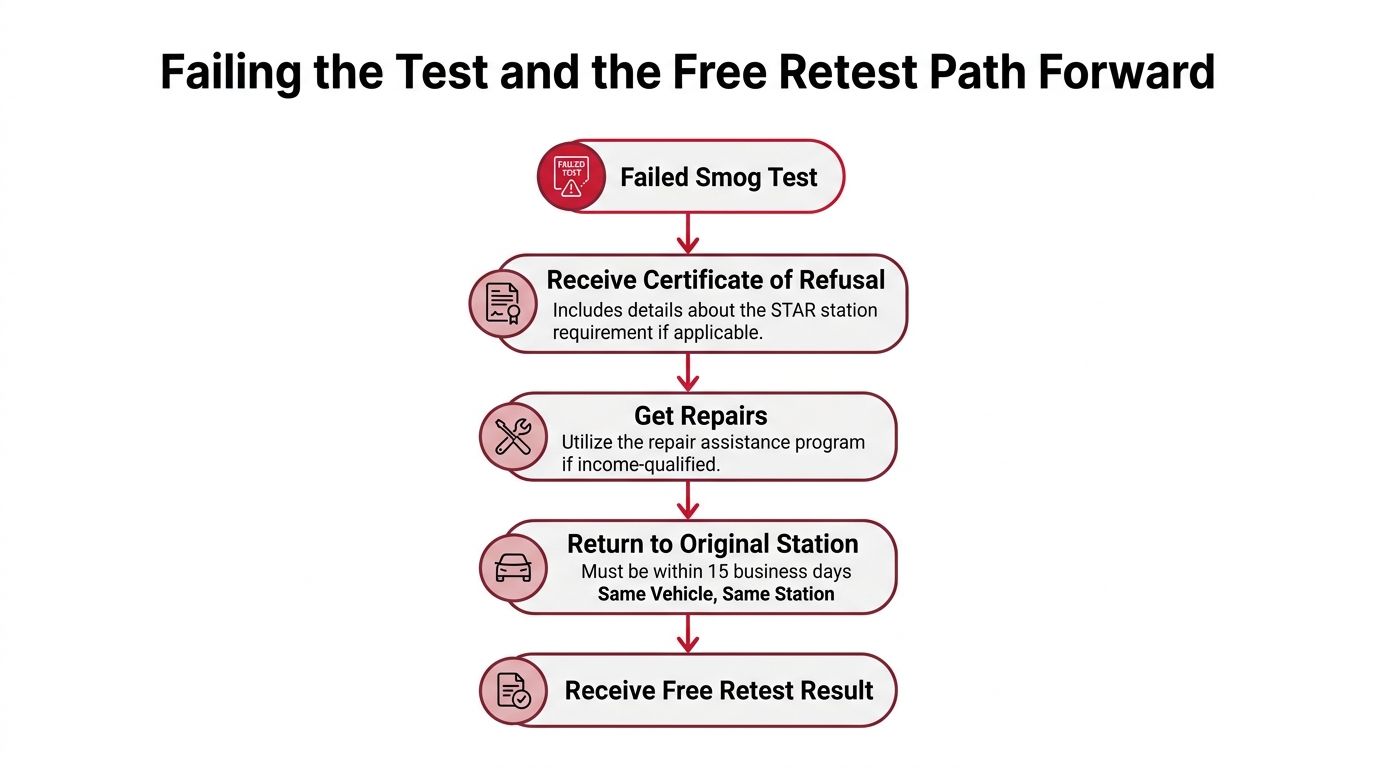
Use the report to set repair priorities
Sort the result into three repair groups:
- Immediate low-complexity items: A damaged gas cap, disconnected hose, or obvious maintenance problem may be quick to correct.
- Diagnostic faults: Oxygen-sensor, EVAP, fuel-control, and misfire codes need testing before you install parts. A code identifies a system, not automatically a failed component.
- Emissions hardware failures: Confirm a suspected catalyst or other major component before authorizing replacement. An unresolved engine problem can damage the new part and leave you with another failure.
The BAR's 2025 executive summary recorded 11,275,981 initial tests and 959,667 failures, an 8.51% initial-test failure rate. Those figures appear in the official BAR report. The practical takeaway is clear: most vehicles pass initially, while the failed group still includes enough different causes to make a written repair plan worthwhile.
Protect your retest eligibility
Free-retest eligibility depends on the original testing location, the repair location, and whether the vehicle remains unaltered. Before leaving, ask the station to state its retest policy and the program conditions that apply to your vehicle.
After repairs or a computer reset, drive until the readiness monitors show complete. Returning to the bay too soon can produce another failure even after the underlying repair is finished. Bring the original report, repair invoices, registration materials, and any documents the station or DMV requests.
A gross-polluter designation may qualify you for California's Consumer Assistance Program if you meet its requirements. Check that option instead of guessing about repair funding. Keep every receipt and inspection document so the DMV has a clear record when registration depends on the repair and retest result.
Final Pre-Test Checklist and Common Questions
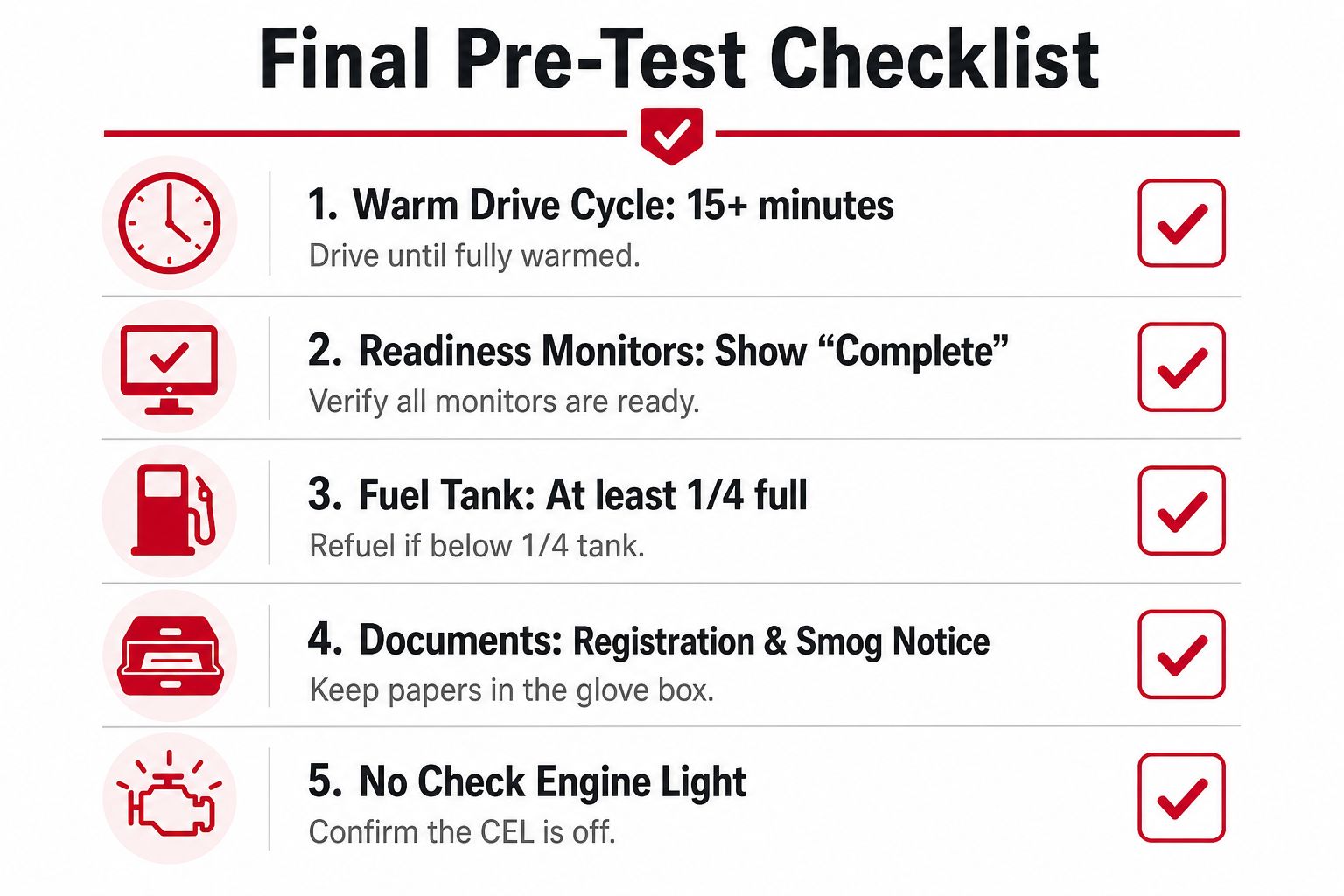
Use this list on the morning of the appointment. It's deliberately short because the useful checks are the ones you'll complete.
- Warm the vehicle: Drive through mixed conditions long enough to bring the engine fully to operating temperature.
- Verify readiness: Scan the OBD-II system and confirm every required monitor shows Ready.
- Check the fuel level: Keep enough fuel for normal operation and the test equipment.
- Secure the gas cap: Tighten it and confirm the seal looks intact.
- Watch the MIL: Don't test with the check-engine light illuminated.
- Bring documents: Carry the registration, renewal notice, and identification or insurance documents requested by the station.
- Inspect the VIN: Make sure the vehicle identification number is visible and matches your paperwork.
Common questions
Does a diesel vehicle always need a test? No. Diesel eligibility depends on model year and the stated weight exemption. Diesel vehicles from 1997 and older, or those over 14,000 pounds GVWR, are among the listed exemptions.
Does an out-of-state vehicle need California testing? Yes, an out-of-state vehicle from 1976 or newer generally needs a Smog Check for first-time California registration.
What if the check-engine light turns on while driving to the station? Stop treating the appointment as a pass attempt. Diagnose the fault first. An illuminated malfunction indicator lamp is a direct warning that the emissions system needs attention.
Do hybrids follow the same process? Hybrids are included in the general gasoline, hybrid, and alternative-fuel vehicle population, although their test procedure depends on the vehicle's design.
What happens after a battery disconnect? The disconnect can reset readiness monitors. Drive under the manufacturer's specified conditions and confirm the monitors are ready before testing.
For drivers who want the inspection handled by a STAR-certified test-only station, Fire House Smog offers smog inspections in Antioch, along with California DMV registration services and an applicable free-retest option under its stated policy and coupon terms. Bring your paperwork, verify readiness before arrival, and contact the station if your vehicle has unusual equipment or RV dimensions.
A STAR-certified test-only smog station is the inspection facility California directs certain drivers to for emissions certification, and because it cannot perform repairs it gives you a no-upsell path to registration compliance. If your renewal notice says STAR, or you know your vehicle has to be directed, this is the cleanest way to handle it without getting dragged into a repair counter first.
You probably opened your renewal notice in Antioch, saw unfamiliar language, and thought, “Do I need any smog station, or do I need the STAR one?” That's the question, not the technical labels. California built the system so the notice tells you what the state wants, and the station type determines whether your visit counts.
Table of Contents
- Why Your Renewal Notice Just Sent You to a STAR Station
- What STAR and Test-Only Actually Mean
- What Happens During a STAR Test-Only Smog Check
- How to Prepare Your Car Before the Inspection
- On-Site DMV Renewals and Transfers in One Stop
- Test-Only vs Test-and-Repair Stations Compared
- Policies Worth Knowing Before You Drive Over
- Common Questions Antioch Drivers Ask First
Why Your Renewal Notice Just Sent You to a STAR Station
A lot of drivers in East Contra Costa don't realize the renewal notice is the decision, not a suggestion. When the DMV says a vehicle needs a STAR station, that instruction comes out of California's smog compliance system, not from the shop down the street. The state's BAR explains that STAR is a voluntary designation for eligible stations, while the DMV uses that designation to route certain vehicles into higher-oversight inspections through the registration process. BAR STAR program overview, DMV registration renewal rules
The notice is doing more than asking for a smog test
If your notice says “Smog Certification Required at a STAR station,” that's a hard requirement. The DMV says renewal can't be finalized until smog certification is complete, even if the fees are already paid. DMV registration renewal rules That's why people get stuck, they treat the notice like paperwork when it's really a gate.
STAR routing usually shows up on vehicles the state wants checked more closely. BAR says STAR-certified test-only and test-and-repair stations must serve vehicles identified as gross polluters, and eligibility is tied to quarterly performance metrics. BAR STAR program overview In plain terms, California is trying to keep the highest-risk vehicles under tighter inspection control.
Practical rule: if the renewal notice names STAR, don't shop for the cheapest nearby station first. Shop for the station that can actually complete the requirement.
Why drivers in Antioch get tripped up
People often search for “star smog station” when they really need to know whether the notice demands STAR-only testing or just a normal smog check. BAR defines a test-only station as a station that performs Smog Checks but does not make emissions repairs, while STAR is a separate performance designation. BAR smog check basics That distinction matters because a shop can be licensed to test and still not be the right shop for a directed vehicle.
At Fire House Smog, the workflow is built around that exact problem, a driver arrives with a notice, gets the inspection done, and if the vehicle clears, the registration side can move without a second stop. Fire House Smog registration renewal help That's the part most people need when the DMV letter lands in their mailbox.
What STAR and Test-Only Actually Mean
STAR and test-only are not the same label, and mixing them up is how people waste time. STAR is about state performance standards and oversight. Test-only is about what the station is allowed to do with your car after it inspects it. The two can overlap, but they answer different questions.
STAR means higher oversight from the state
BAR says STAR certification is a designation for Smog Check test-only and test-and-repair stations that meet stricter standards. The state uses that structure to steer certain vehicles toward stations it trusts for inspection quality and directed-vehicle handling. BAR STAR program overview That's the point of STAR, not to make the visit fancier, but to make the station more accountable.
Test-only means no repair business attached
A test-only station performs the smog inspection, but it cannot do emissions repairs. That keeps the station from turning a failed inspection into a repair sale. BAR's definition is simple, and it matters because it removes the built-in upsell pressure that comes with a repair bay. BAR smog check basics
Why the combination matters
When you put the two together, you get the setup California uses for directed vehicles and gross polluters. BAR says STAR-certified test-only and test-and-repair stations must serve previously identified gross polluters, and the DMV says some vehicles are specifically directed to STAR stations on the renewal notice. BAR STAR program overview, DMV smog inspection rules That combination is why a STAR test-only smog station is often the right answer when you don't need repair help, you just need the state to accept the result.
Straight talk: if your car is healthy and you only need the certificate, test-only is usually the cleaner route. If the car needs diagnosis and repair under one roof, that's a different conversation.
The video below gives a quick visual on how the process flows from check-in to certification.
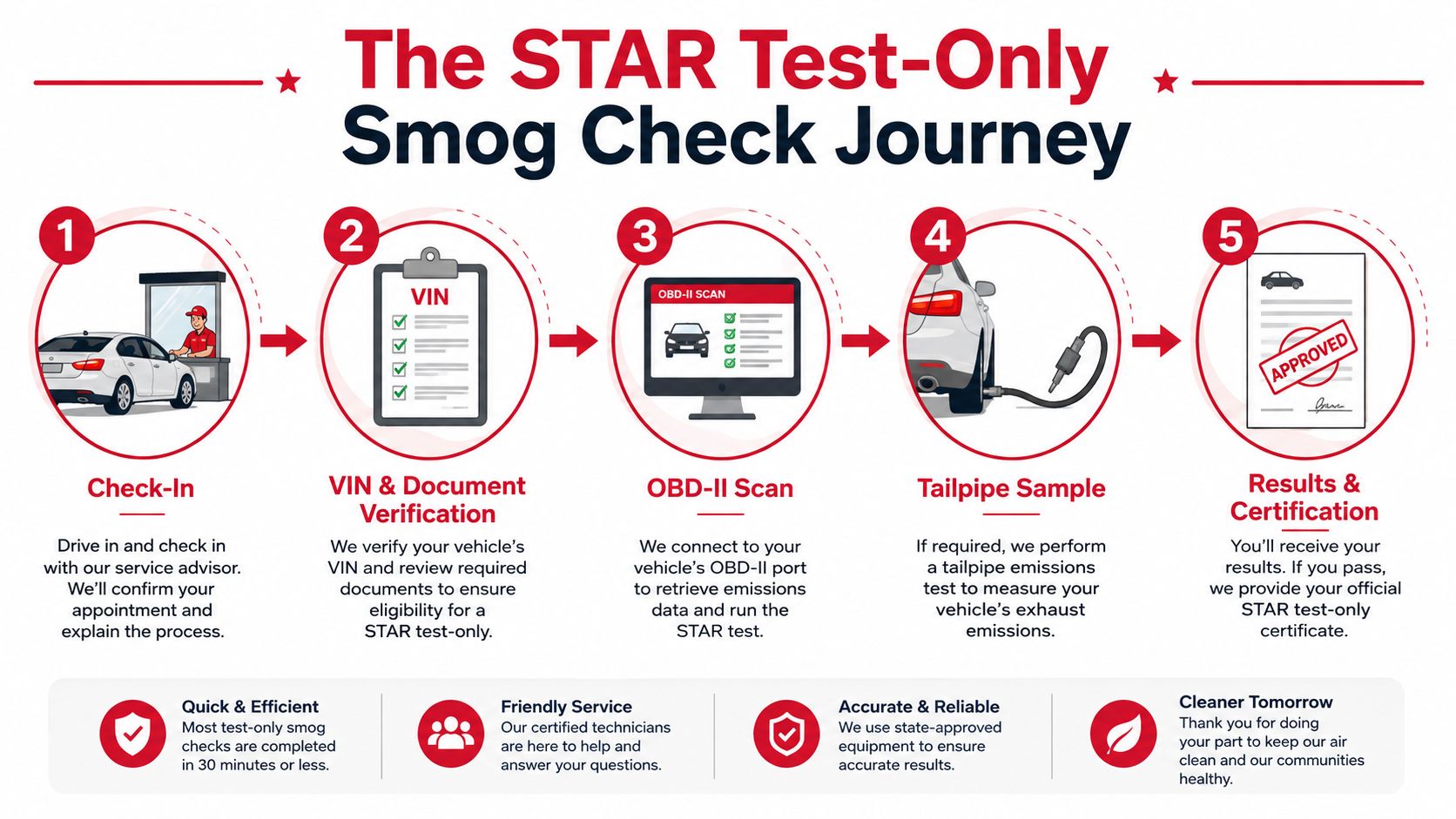
What Happens During a STAR Test-Only Smog Check
A STAR test-only visit is not complicated, but it is exact. The technician checks the vehicle, runs the required inspection steps, and records the result for the DMV system. If the car passes, the paper trail moves. If it fails, the report tells you what needs attention.
The inspection starts with identity, not the tailpipe
The first thing the station does is match the vehicle to the paperwork. That means VIN, registration, and the renewal notice if the DMV directed the vehicle to STAR. BAR also says the station scans the renewal notice barcode so the correct vehicle information gets sent to DMV, and the driver gets a Vehicle Inspection Report for records. DMV renewal rules
After that, the inspection moves into the visual and functional checks. That includes looking at emissions-related equipment and confirming the vehicle still has the parts it's supposed to have. If the equipment isn't there, or if the check engine light is on, the visit usually stops being a routine pass and becomes a compliance issue.
The scan and emissions portions do the heavy lifting
For OBD-II vehicles, the technician plugs into the onboard diagnostics system and checks readiness status and stored trouble codes. For applicable model years, BAR-97 equipment can also run the tailpipe portion of the test, including the appropriate idle procedure. The station is not guessing, it's reading the vehicle's own emissions data and comparing it to the state's rules.
What you get at the end
If the vehicle passes, the result is submitted electronically and the DMV registration file updates from there. That's why the renewal notice matters so much, the inspection isn't just a receipt, it's a compliance event tied directly to your registration. DMV registration renewal rules
If the vehicle fails, the report is still useful. It tells you what the station saw, and because the station is test-only, you're not being pushed into a repair estimate at the same counter. That's the advantage of the model.
How to Prepare Your Car Before the Inspection
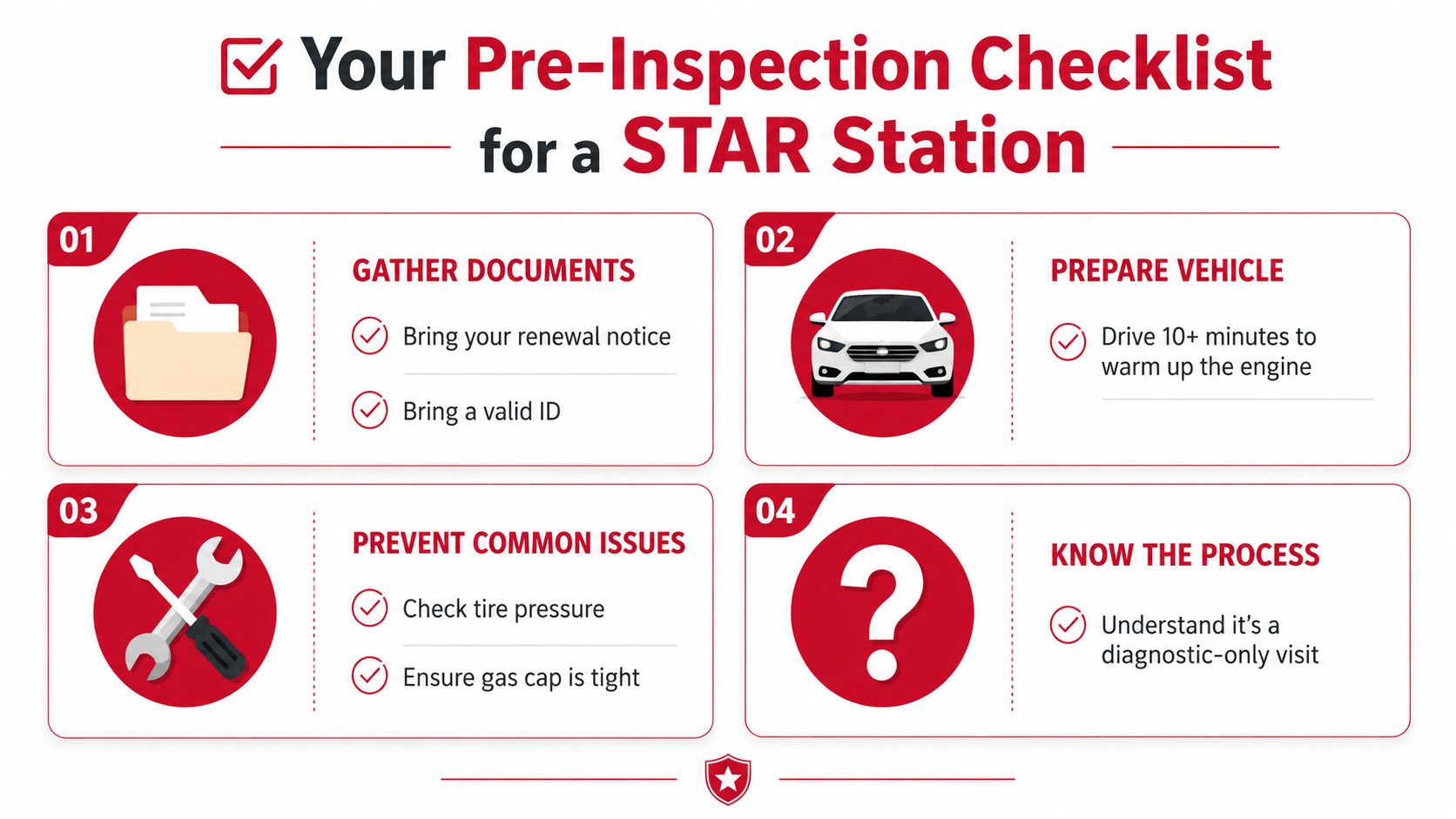
A lot of failures are preventable, and most of the preventable ones show up before the machine ever starts. Bring the right documents, show up with a warm car, and don't roll in with obvious warning-light problems hoping they'll be ignored. They won't be.
Bring the paperwork the station actually needs
At minimum, bring the DMV renewal notice and a valid ID. If you're doing a renewal that needs sticker printing or a transfer, have the registration card and whatever ownership paperwork applies to the transaction. The station needs the right record to match your inspection to the right DMV file, and BAR says the barcode on the renewal notice is part of that process. DMV renewal rules
Warm the car up before you arrive
Drive the vehicle long enough to bring the engine up to normal operating temperature. A cold engine can give you a misleading test result, and readiness monitors often look better once the car has been driven normally. If the battery was recently disconnected, the monitors may not be ready at all, which is a common reason drivers get blindsided. For monitor basics, see the OBD readiness guide at Fire House Smog's readiness monitor page.
Don't ignore obvious mechanical shortcuts
Check the gas cap, look at the dashboard lights, and make sure the fuel tank isn't running near empty. A loose cap or a glowing check engine light is the kind of problem that turns a simple visit into a failed visit. If the vehicle doesn't pass, the VIR tells you what happened so you can go fix the right thing instead of guessing.
Bring the car in ready, not hopeful. Hope doesn't pass a smog test, preparation does.
On-Site DMV Renewals and Transfers in One Stop
A smog station becomes a real time-saver when it can finish the DMV side too. That's the difference between one productive stop and a smog receipt sitting on your passenger seat while you line up somewhere else later. For drivers in Antioch, that matters because the right visit can solve both the inspection and the registration problem in one move. DMV registration services near me
The same visit can handle more than a renewal
If the smog check clears, a renewal can move straight into sticker printing when the station offers on-site DMV service. The same kind of setup can also handle in-state ownership transfers and out-of-state vehicles brought into California, as long as the paperwork is in order and any required VIN verification is completed. That's useful when you're trying to get a car legal without bouncing between offices.
In-person still makes sense in the cases that cause the most friction
Online renewal is fine until it isn't. Lapsed registration, address changes that weren't updated, title situations that need a human review, and certain transfer cases can all force an in-person stop. If a hold is attached to the record, a counter with DMV processing capability is usually the faster path than trying to force it through a website that can't solve the exception.
At Fire House Smog on Lone Tree Way, the flow is built to be practical, smog test first, VIR upload next, then the DMV transaction if the vehicle passes. That sequence keeps the renewal from becoming a separate errand later. The station also posts DMV service hours separately from smog hours, so you should check them before you drive over.
Test-Only vs Test-and-Repair Stations Compared
People ask this like it's a technical debate, but the driver-side answer is simple. You either want inspection only, or you want inspection plus repair options in the same business. The right choice depends on whether your car needs a clean certificate or actual mechanical work.
| Factor | Test-Only Station | Test-and-Repair Station |
|---|---|---|
| Main purpose | Inspects and certifies | Inspects and can repair |
| Repair sales pressure | None, because repairs aren't allowed | Present, because repairs are part of the business model |
| Best for | Drivers who want a fast certificate | Drivers who expect diagnostics or follow-up work |
| STAR fit | STAR exists here and matters for directed vehicles | STAR also exists here for qualified stations |
| Visit style | Clean handoff, straight test | Possible test, diagnosis, repair, retest sequence |
The real-world difference is pressure
A test-and-repair shop can inspect your car and then quote repairs if it fails. That isn't automatically bad, but it does change the incentive structure. A test-only station is barred from doing the repair job, so the inspection stands on its own.
For a driver whose vehicle is running well, that's exactly what you want. No service writer, no repair estimate ballooning after the test, no pressure to keep the car there all afternoon. If the vehicle needs wrench work, then a repair shop earns its place. If it just needs proof of compliance, test-only is cleaner.
My advice: choose repair when the car needs repair. Choose test-only when the car just needs the certificate.
Policies Worth Knowing Before You Drive Over
Small policy details matter more than people expect, especially if you're trying to finish this in one stop. If you show up with the wrong vehicle type, the wrong documents, or the wrong expectation about hours, you burn the whole trip. The fix is easy, check the rules before you leave.
What to ask about before you pull out of the driveway
- Vehicle fit: Ask whether your car, truck, RV, or motorhome fits the station's equipment and bay limits.
- Retest policy: Confirm whether a free retest applies if the vehicle fails and comes back within the allowed window.
- Payment: Bring whatever the station accepts for both smog and DMV processing, because the smog charge and DMV transaction can be separate.
- Renewal notice: Bring the notice if you want sticker printing or directed STAR processing, since the barcode matters.
- Transfer paperwork: Bring title and identity documents for ownership transfers, especially if the car came from out of state.
Timing is part of the policy too
Fire House Smog runs two bays, which helps control wait times, but month-end crunch still happens. The smart move is to check posted hours before you go, especially if you need both the smog and DMV counter on the same visit. Smog testing runs seven days a week, while DMV service hours are posted separately, so don't assume the same window applies to both.
If you're handling a directed STAR test, a voluntary test, or a transfer with extra paperwork, plan to arrive when both services are staffed. That's how you avoid making a second trip for something that could have been finished the first time.
Common Questions Antioch Drivers Ask First
Most first-time visitors want the same few answers before they leave the driveway. They're not asking for theory, they're asking what to bring, where to go, and whether the day is going to turn into a mess. Fair questions.
How do I know if STAR is required
Read the DMV renewal notice. If it says STAR station or indicates a directed inspection, that's the instruction you follow. If the notice doesn't say that, a regular licensed smog station may be enough, but the notice always wins over assumptions.
What should I bring for a renewal versus a transfer
For a renewal, bring the notice and ID. For a transfer, bring the title paperwork, ID, and anything tied to the transaction itself, plus the vehicle if VIN verification is needed. If the car is out of state, don't guess, bring the full packet and let the counter tell you what's missing.
What happens if the vehicle fails
You get the Vehicle Inspection Report, and that report becomes the roadmap. Because the station is test-only, the failed result doesn't turn into a repair pitch at the same desk. You take the car, fix the issue elsewhere, and come back under the retest policy if the station offers one.
Do newer vehicles still need smog checks
California's requirements depend on the vehicle and transaction type, not just the age on the odometer. If you're dealing with a renewal or a transfer, don't assume a newer car is automatically exempt. Check the notice, then ask the station or the DMV counter if anything looks unclear.
Is there a difference between a STAR test-only shop and a STAR test-and-repair shop
Yes. Both can be STAR-qualified, but one can't repair your car and the other can. If you only need certification, test-only keeps the visit focused. If you need diagnosis and repair, a test-and-repair shop may fit better.
What if I still have questions
Use the on-site DMV staff for case-specific problems. Generic advice only goes so far when the record has a flag, the title is unusual, or the registration status is messy. That's where a live counter beats internet guessing.
If you need a STAR-certified test-only smog check in Antioch, Fire House Smog handles the inspection without repair pressure and can also process DMV registration work on-site when your paperwork is ready. If your renewal notice is already telling you where to go, visit Fire House Smog and take care of the smog test and the registration stop in one trip.
Marcus in Antioch opened his mail and found the notice no truck owner wants: his 2012 Silverado 1500 needs a smog check before DMV will renew the registration. Without a valid certificate, the renewal stalls, and that can put a contractor's daily routine at risk, from hauling tools to reaching a job site.
“Clean air truck” isn't just a sales phrase. In California, it connects vehicle emissions, registration requirements, California Air Resources Board enforcement, and the inspection process at an approved smog station. The rules depend on the truck's fuel, weight, model year, and compliance history.
By the end, you'll know what California means by a clean air truck, how gasoline and diesel pickups follow different paths, what happens during a smog inspection, and how to prepare for a test-only STAR station. You'll also understand why older diesel equipment receives attention from CARB even when it doesn't use the same station-based test as a light-duty gasoline truck.
The practical takeaway is simple. By the last section, you'll know which station to use, what paperwork to bring, and what to check before paying for a test.
Table of Contents
- Why a Clean Air Truck Matters in California Right Now
- What a Clean Air Truck Means
- Diesel and Gasoline Trucks Under California Rules
- How Smog Checks and Certification Work
- Pre-Check Habits That Prevent Failed Smog Tests
- Getting Your Truck Compliant at a STAR Test-Only Station
- Common Misconceptions That Trip Up Truck Owners
- Your Next Steps and Where to Test in Antioch
Why a Clean Air Truck Matters in California Right Now
California treats emissions compliance as part of vehicle ownership, not as an optional maintenance project. If your renewal notice requires a smog check, the DMV generally needs the electronic certificate before it can complete the registration renewal. A truck that runs reliably can still fail because its emissions controls, diagnostic monitors, or inspection records don't satisfy the current test.
That's why the phrase clean air truck matters to owners. It describes a truck that meets the emissions requirements for its model year and passes the inspection required for its class. A clean-looking exterior, strong engine, or recent oil change doesn't establish compliance.
Practical rule: Read the DMV renewal notice before choosing a station. The notice tells you whether the state has placed a smog requirement on that registration renewal.
California's enforcement picture also reaches beyond the ordinary light-duty smog appointment. Visible smoke from a diesel truck can attract roadside attention, and commercial diesel operators may face CARB obligations that don't appear on a typical passenger-vehicle checklist. Heavy-duty trucks also matter disproportionately to air-quality policy. An EPA and Congressional Research Service summary states that heavy-duty trucks account for about 32% of mobile-source NOx emissions while representing roughly 2% of California's on-road vehicle fleet.
The policy direction is tightening, too. EPA's heavy-duty standards finalized in December 2022 are described as more than 80% stronger than the rules then in place, with model year 2027 and later trucks facing stricter emissions requirements. EPA's final-rule materials describe tailpipe NOx reductions of about 80% and particulate-matter reductions of 50% versus prior standards.
For an owner, the next step isn't to debate every future rule. It's to identify the truck category, follow the current registration instruction, and test before the deadline.
What a Clean Air Truck Means
A clean air truck meets the emissions standard assigned to its model year and vehicle class. That definition comes from a long federal rulemaking history, not from a badge, aftermarket claim, or a clean-looking exhaust.
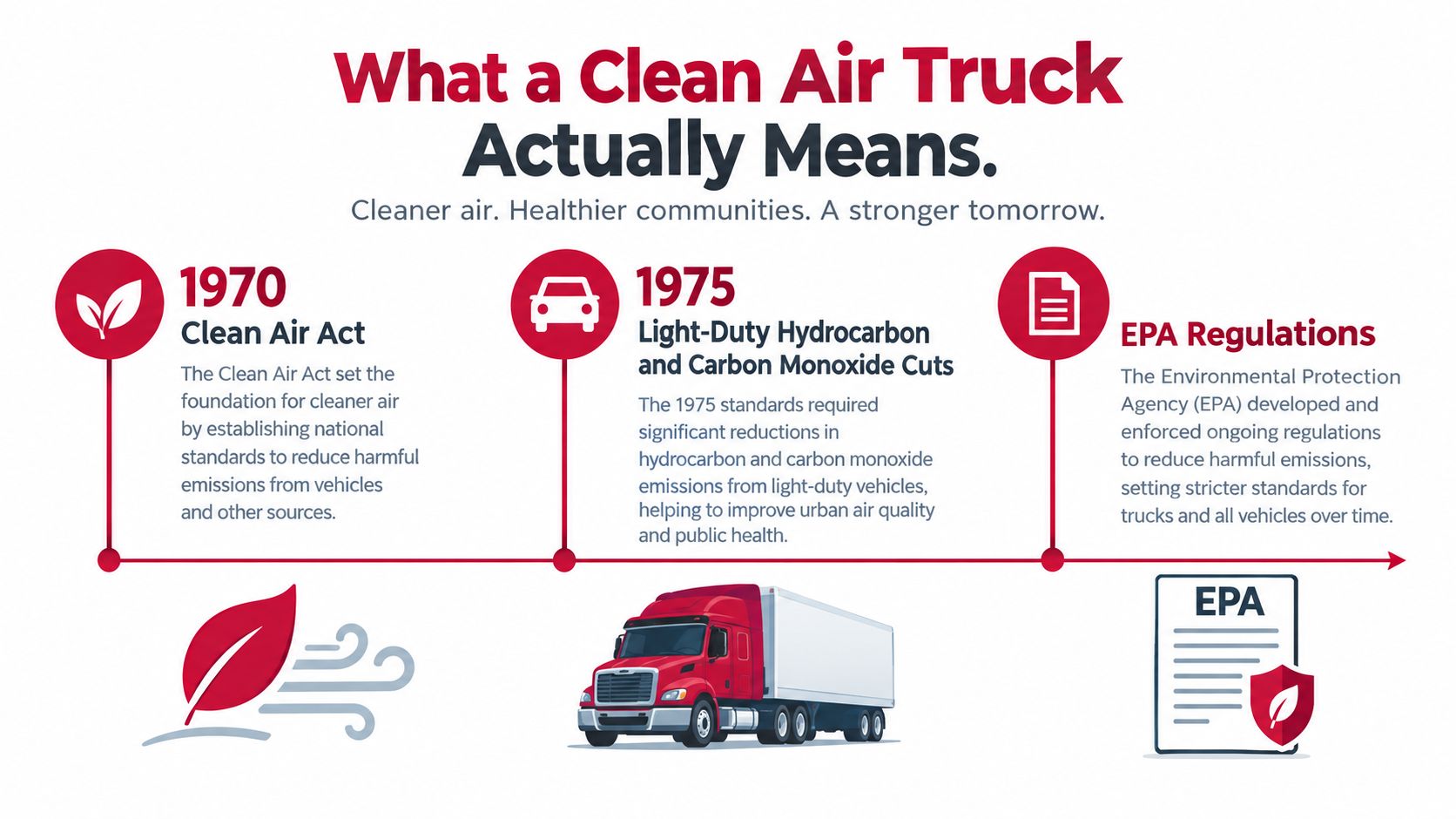
The federal Clean Air Act of 1970 established national vehicle-emissions controls. Standards for cars and light-duty trucks followed in 1975, and EPA continued tightening nitrogen oxide limits for light trucks. EPA's historical summary records a 2.3 grams-per-mile NOx limit by 1979, followed by stricter requirements for heavier and lighter light-duty trucks in later years. EPA's clean-vehicle history identifies the Tier 2 program, finalized in 2000 and phased in from the 2004 model year, as a major change. Its 0.07 grams-per-mile NOx standard represented an 86% to 95% reduction for light trucks compared with prior requirements.
The heavy-duty reset
Diesel freight trucks reached another major compliance point with EPA's 2007 heavy-duty standards. New heavy-duty engines had to reduce particulate matter to 0.01 grams per brake horsepower-hour, a near-zero level. EPA's SmartWay timeline describes the 2007-era rules as reducing smog-forming emissions from trucks and buses by about 95% and particulate emissions by about 90% compared with earlier levels. Newer clean-diesel engines have also been described as producing about 99% lower NOx and 98% fewer particulate emissions than previous generations. EPA's SmartWay timeline places the newer model year 2027 requirements within that continuing progression.
California adds a separate layer through CARB programs and vehicle rules. New truck sales, fleet composition, and emissions performance are moving toward stronger zero-emission and near-zero-emission requirements, with light-duty phases covering model years 2027 through 2033, according to the ICCT policy update. Those requirements shape new-vehicle purchases and fleet planning. They do not cancel an older truck's current smog obligation.
For an owner, the working definition is straightforward: your truck must meet the standard tied to its model year and pass the California inspection required for its category. That is what determines registration readiness. A truck can have newer emissions technology and still fail if its required inspection, equipment, or emissions controls do not meet California's rules.
Diesel and Gasoline Trucks Under California Rules
Start with fuel type. A gasoline pickup and a diesel work truck may look similar in the driveway, but California can send them through different compliance paths.
A gasoline light-duty truck generally enters the recurring smog-check cycle based on model year and age. California's process commonly uses OBD-II testing for newer vehicles, while older vehicles may receive additional inspection procedures. Diesel light-duty trucks are handled differently, especially around particulate controls, fees, and the types of enforcement that apply.
Use this quick sorting table before you book:
| Category | Model Year Scope | Smog Check Required? | Annual Fee | Main Exemption |
|---|---|---|---|---|
| Gasoline light-duty truck | 1976 and newer, subject to California's age and registration rules | Often, when listed on the DMV renewal notice | Smog Abatement and transaction charges may apply | 1975 and older gasoline vehicles |
| Diesel light-duty truck | 1997 and newer, under 14,000 pounds GVWR | Subject to the applicable DMV cycle | Diesel particulate fee may apply | Pre-1997 diesel light-duty vehicles |
| Heavy-duty diesel truck | Heavy commercial class | Often outside the station smog-check line | CARB reporting and equipment obligations may apply | Station-test exemption does not remove CARB duties |
| Electric or hydrogen fuel-cell vehicle | Applicable zero-emission vehicle class | No tailpipe smog test | Registration rules still apply | No combustion tailpipe |
A gasoline owner should first confirm the renewal notice. A diesel light-duty owner should also account for CARB's diesel particulate fee structure and confirm whether the truck's weight and model year place it in the light-duty testing category. For diesel-specific testing information, review diesel smog testing in California.
Heavy-duty diesel owners need a different mindset. A truck may not receive the same station inspection as a light-duty pickup, yet CARB can still regulate it through programs involving reporting, idling, transport refrigeration equipment, and roadside visible-smoke enforcement. Don't mistake “no station smog check” for “no emissions responsibility.”
Your three-bucket decision is straightforward:
- Gasoline light-duty truck: Follow the DMV smog instruction and use the correct station type.
- Diesel light-duty truck: Confirm test eligibility, particulate-fee treatment, and equipment requirements.
- Heavy commercial diesel: Check the applicable CARB programs before assuming a station visit is the only obligation.
How Smog Checks and Certification Work
A California smog inspection combines electronic diagnosis with a physical emissions check. The exact procedure depends on the truck's age, fuel, equipment, and the inspection program attached to its registration.
A STAR-certified station meets additional state performance and testing requirements. A test-only station can inspect the vehicle but doesn't perform repair work. That separation matters because the station's job is to document the result, not sell you a repair package after a failure. The STAR-certified smog explanation gives owners more background on how the designation affects station selection.
What happens in the bay
For newer gasoline trucks, the technician connects to the vehicle's OBD-II system. The system reports diagnostic trouble codes and readiness monitors. The technician also checks emissions-related components visually and may perform a fuel-cap inspection or tailpipe procedure when the vehicle and test require it.
Older vehicles may receive a tailpipe emissions test. Newer diesel trucks can involve different inspection equipment and procedures, so the technician must follow the applicable BAR process rather than applying a gasoline checklist to every truck.
| Station Type | Can Test | Can Repair | Handles Directed or Random Referrals | Typical Use |
|---|---|---|---|---|
| Regular licensed station | Yes | May, depending on license and business model | Some referral work | Routine inspections and repairs |
| STAR-certified station | Yes | May be test-and-repair or test-only | Yes, when authorized | STAR-required vehicles |
| STAR test-only station | Yes | No | Yes, when authorized | Independent certification and referrals |
| Repair facility | Not necessarily | Yes | Not necessarily | Diagnosis and emissions repairs |
If the BAR system directs or randomly refers a vehicle to STAR, the owner must use an eligible STAR station. A failed inspection produces a noncompliance result rather than a registration certificate. The owner then repairs the identified problem and returns for a retest under the station's and state's eligibility rules.
Ask about retest terms before leaving. A same-station retest may be free within the qualifying period, while changing stations can mean paying for another inspection. Once the truck passes, the station transmits the certificate electronically to DMV, and the owner can complete the registration step.
Pre-Check Habits That Prevent Failed Smog Tests
Most owners don't need a complicated emissions strategy before a routine test. They need to avoid arriving with an obvious fault or an incomplete diagnostic system.
Start with the dashboard. An illuminated check-engine light, also called the malfunction indicator lamp, is a serious warning for an OBD-equipped truck. A vehicle can feel perfectly normal while storing an emissions code that causes an automatic failure.
Then check the readiness monitors. Disconnecting the battery or clearing codes resets the system's self-tests. The truck may need mixed driving before the monitors complete, and arriving too soon can leave the vehicle ineligible for a clean pass.
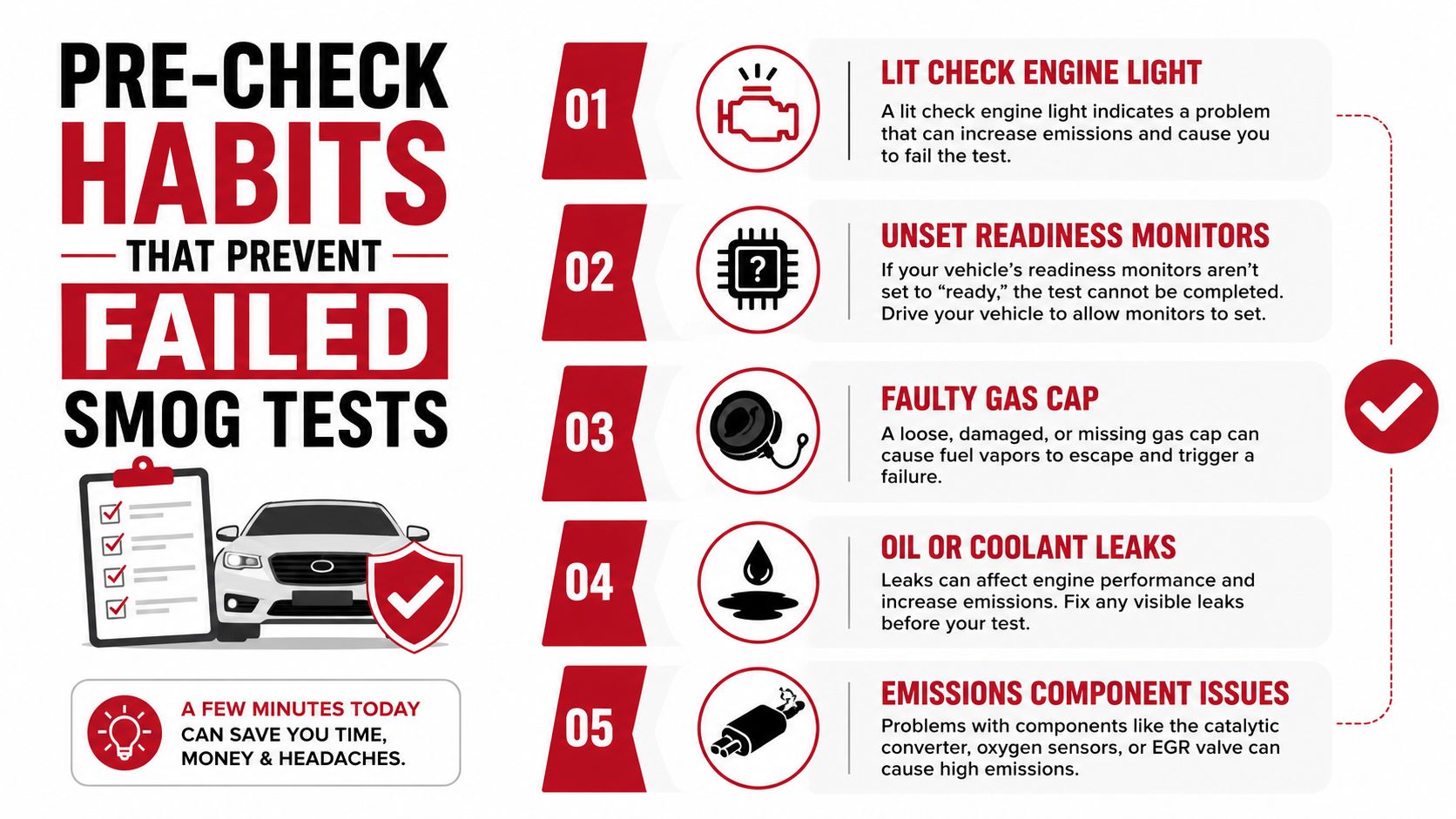
Your driveway checklist
- Inspect the fuel cap: Make sure the cap seals tightly and the gasket isn't cracked. A small EVAP leak can trigger a code.
- Look at emissions hardware: Check for obvious damage, missing shields, disconnected hoses, or an altered catalytic converter.
- Watch for leaks: Oil or coolant reaching the exhaust can create problems and may point to a larger mechanical issue.
- Check the warning lights: Don't assume a pending code is harmless. Have it diagnosed before scheduling the inspection.
- Drive normally after repairs: Use a mixed city and highway loop over several days so the vehicle can complete its self-checks.
A 50 to 70 mile mixed-driving routine is a practical preparation target for many vehicles, but it doesn't guarantee that every monitor will set. The truck's operating conditions and the specific fault determine how quickly the system completes its checks.
Avoid the battery-disconnect shortcut. Clearing the light without fixing the cause usually creates a second problem, incomplete readiness monitors, and a higher chance of referral or failure.
A failed test isn't always a major engine disaster. A loose cap, an EVAP fault, or an incomplete monitor can be easier to correct than a failed catalytic converter or diesel emissions component. Get the failure report, repair the listed issue, and retest instead of guessing.
Getting Your Truck Compliant at a STAR Test-Only Station
At a STAR test-only station such as Fire House Smog in Antioch, the process should be orderly. Bring the truck, registration paperwork, and the DMV renewal notice. If you're returning after a failure, bring the prior inspection paperwork or certificate of noncompliance so the technician can understand the retest situation.
The first step is document verification. The technician confirms the vehicle identification information, registration details, and the inspection type. A commercial owner with several vehicles should identify each truck clearly and ask whether the station can process the vehicles in a practical order.
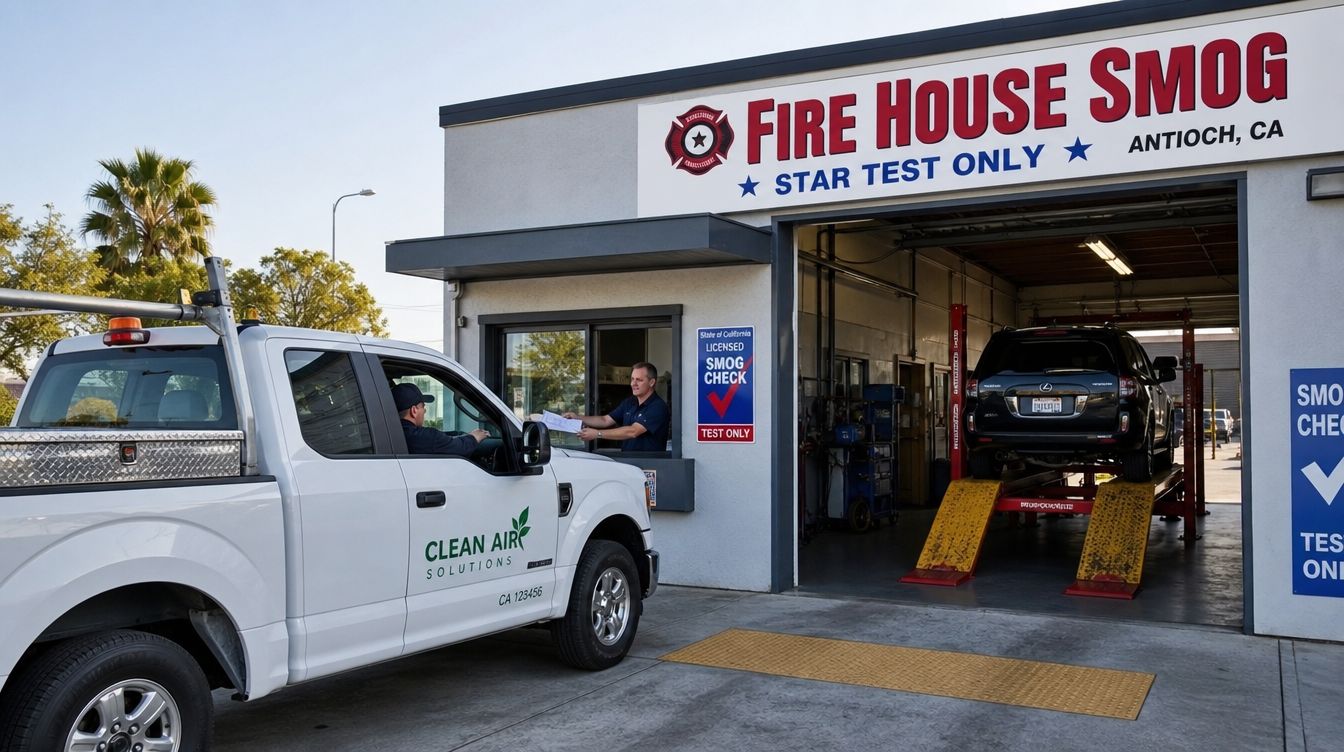
What the technician checks
The bay procedure may include a visual inspection of emissions equipment, a gas-cap test, an OBD-II connection, and a tailpipe test where applicable. The technician follows the state-required procedure for that truck rather than treating every pickup, diesel, and work vehicle the same way.
There are three practical outcomes:
- Pass: The station submits the smog certificate electronically to DMV.
- Fail: You receive documentation showing the noncompliance result and the reason for failure.
- Directed or random referral: The state requires the vehicle to complete the inspection at an eligible STAR station.
A test-only station doesn't repair the truck, which keeps the result separate from repair sales. If the truck fails, take the report to a qualified repair shop, address the exact cause, and ask the testing station about its retest policy before returning.
For contractors, operating hours matter. Fire House Smog is located at 2900 Lone Tree Way in Antioch, offers smog testing seven days a week, and provides DMV renewal and tag-printing services Monday through Saturday from 9:30 AM to 5:00 PM and Sunday from 12:00 PM to 4:00 PM, according to the publisher's supplied business information. The station lists two service bays and a phone number, 925-754-1600, for confirming vehicle fit and current service availability.
Common Misconceptions That Trip Up Truck Owners
Truck owners lose time when they treat California emissions rules as one-size-fits-all. Three assumptions cause repeated problems.
| Myth | Reality |
|---|---|
| Diesel trucks are exempt in California | Some diesel classes avoid the ordinary station test, but diesel light-duty vehicles can still face smog requirements, particulate-fee obligations, and CARB enforcement. |
| A check-engine light is fine if the truck drives normally | An illuminated emissions warning can indicate an active diagnostic fault, and incomplete readiness monitors can prevent a pass. |
| Every smog shop produces the same result | Station type matters when DMV or BAR requires STAR testing, including certain directed or random referrals. |
The first myth confuses test exemption with emissions exemption. A heavy-duty diesel truck may stay outside the regular station smog line while remaining subject to CARB rules involving smoke, idling, reporting, or emissions equipment. A light-duty diesel pickup can follow another path based on its model year and weight.
The second myth comes from relying on drivability. OBD systems monitor emissions functions that a driver may never feel from behind the wheel. A truck can start easily, pull a trailer, and idle smoothly while still failing the electronic portion of the inspection.
The third myth is expensive because the wrong station can create a scheduling problem. If the DMV or BAR directs the truck to STAR, choose an eligible STAR station before paying for an inspection elsewhere.
The certificate is the goal, not merely a running engine. Bring the truck to the station type shown by the registration or referral instructions.
Your Next Steps and Where to Test in Antioch
Handle the renewal in this order:
- Read the DMV notice: Confirm that the registration renewal requires a smog certificate and note any station or referral instruction.
- Gather paperwork: Bring the renewal notice, current registration, plates, and any prior smog paperwork if the truck is being retested.
- Prepare the diagnostic system: Inspect the fuel-cap seal, check for a lit malfunction indicator lamp, and have pending or stored emissions codes diagnosed.
- Drive before testing: Use mixed city and highway driving during the week before the appointment so readiness monitors have a chance to complete. A 50 to 100 mile preparation range is a practical target, but monitor completion still depends on the vehicle and repair history.
- Use the right station: Book a STAR test-only inspection when the DMV notice, BAR referral, or truck category requires it.
A light-duty gasoline or diesel truck owner in Antioch can review smog check service in Antioch before heading out. Bring the truck with enough fuel for the inspection, remove anything blocking access to the diagnostic connector, and tell the technician whether the battery was recently disconnected or codes were cleared.
Fire House Smog operates at 2900 Lone Tree Way, Antioch, California 94509. Its supplied business information lists smog testing seven days a week, DMV tag printing Monday through Saturday from 9:30 AM to 5:00 PM, Sunday DMV hours from 12:00 PM to 4:00 PM, and phone support at 925-754-1600. Confirm current hours and whether the truck fits the station's equipment limits before arrival, especially for larger work trucks and recreational vehicles.
A clean truck should leave with the certificate transmitted to DMV. If it fails, keep the report, repair the listed issue, and ask about the qualifying retest window before changing stations.
Fire House Smog provides STAR-certified test-only smog inspections for cars and light-duty trucks, along with DMV renewal services and on-site tag printing in Antioch. Bring your renewal notice and truck to Fire House Smog or call 925-754-1600 to confirm the correct service before you arrive.
You've got the renewal notice in one hand, the deadline in the other, and a simple question in mind, where's the California smog check near me that won't turn into a second trip, a surprise repair bill, or a DMV line later in the week? The answer depends on more than distance. In California, the right station type, the vehicle's model year, and whether you can finish registration on-site all change how smooth the day goes.
Table of Contents
- What a California Smog Check Near Me Really Involves
- How to Choose the Right Station Type Near You
- Preparing Your Vehicle and Paperwork Before You Go
- What Happens During the Inspection at a STAR Test-Only Station
- Handling Failures, Retests, and Repair Documentation
- Combining Your Smog Check With On-Site DMV Renewal
- RV, Fleet, and Specialty Vehicle Considerations
What a California Smog Check Near Me Really Involves
A driver opens a DMV renewal notice, sees the smog requirement, and assumes any station will do. In California, that assumption can send you to the wrong counter, the wrong lane, or the wrong kind of test. The station you choose can change the whole visit.
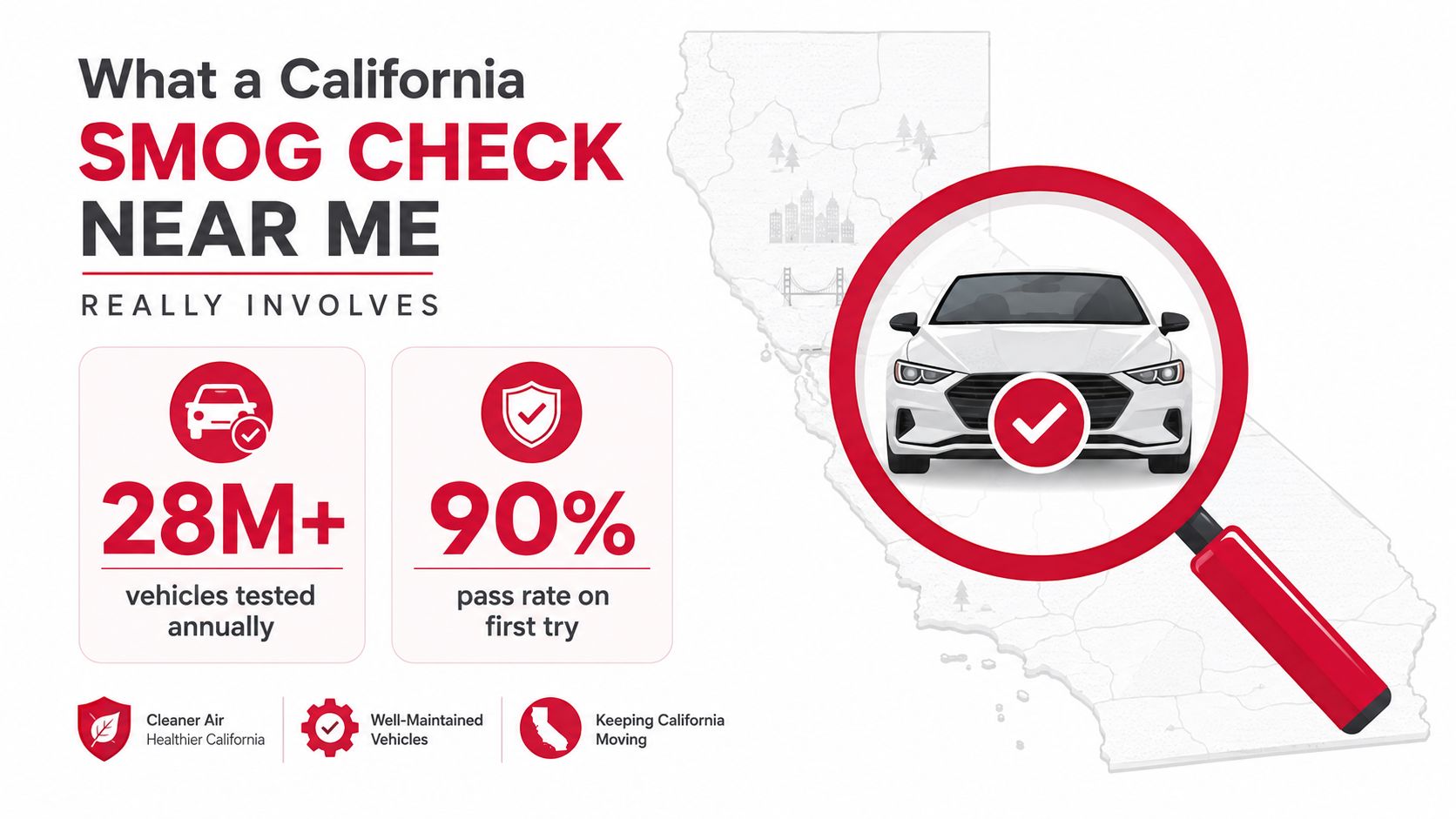
California's Bureau of Automotive Repair says most gasoline, hybrid, and alternative-fuel vehicles model year 1976 and newer, plus diesel vehicles model year 1998 and newer, are subject to Smog Check, and the inspection is generally required every other year for registration renewal (BAR 2025 Smog Check Executive Summary). That is why this is routine work for a large share of drivers, not a rare trip reserved for problem vehicles.
The scale matters, too. BAR reported 11,275,981 initial tests and 12,200,718 total tests in the 2025 summary, with an 8.51% failure rate for initial tests and a 9.04% failure rate overall. A California Senate fact sheet also says the program removes about 400 tons of smog-forming pollutants every day, and that more than 10 million vehicles get tested each year at more than 7,000 independently owned smog check stations statewide (California Senate fact sheet/index.pdf)).
Practical rule: the phrase smog check near me in California really means, “Which nearby station is authorized for my vehicle and my renewal notice?”
Station type changes the workflow. A test-only station performs the inspection and issues the result, while a station with different certification may also handle repairs or a different inspection path. The distinction matters because the wrong stop can mean a second drive, a different line, or a station that cannot process your vehicle the way your renewal notice requires.
If you want a local example of how a station can be set up for this workflow, STAR-certified smog station services show how one facility can fit the role without turning the visit into a repair estimate conversation.
How to Choose the Right Station Type Near You
Start with the renewal notice, not the map app. If it points you to a STAR-certified station or a test-only station, that instruction matters more than a five-minute shorter drive. Choosing the wrong type can leave you parked at the curb while the staff tells you to go somewhere else.
Read the notice for the station requirement
The renewal paperwork is the clearest signal you get. If the notice calls for a STAR station, a regular station won't give you the right path for that vehicle. If the notice doesn't specify, a nearby certified station can often handle the test, but it still needs to be the right kind of test site for your car.
A test-only station is simple by design. It tests the vehicle and certifies the result, but doesn't sell repairs, which removes the awkward incentive to turn a failed inspection into a repair job on the spot. A repair-capable station can still be legitimate, but the workflow is different and the customer experience often is, too.
Search for fit, not just proximity
Use the BAR station finder, then check the station's certification, posted hours, and whether it handles your vehicle class before you leave home. That's especially important if you drive something that isn't a standard sedan. Some RVs and motorhomes fit within a station's equipment and bay limits, but some don't, and a quick phone call saves a wasted trip.
If the vehicle barely fits in a parking stall or needs special handling to enter a bay, call first.
For a local test-only option, this in-out smog test-only center is an example of the kind of station setup drivers look for when they want a straightforward inspection path.
Use the renewal notice like a checklist
The practical decision points are simple.
- Check the certification callout: If STAR is required, don't guess.
- Confirm vehicle fit: Large vehicles need a yes from the station, not a maybe.
- Look at hours before you drive: Some stations work better for early morning, others for weekend timing.
- Ask what happens if you fail: A test-only station gives you a clean inspection result, which makes the next step more predictable.
That's the difference between searching for a station and searching for the right station. The goal isn't to find the closest building with a sign. It's to find the one that can legally test your vehicle, accept it, and keep the rest of the day moving.
Preparing Your Vehicle and Paperwork Before You Go
The easiest failures are the ones drivers can prevent at home. I've seen plenty of people arrive convinced the car is fine, only to discover the battery was disconnected last week, the check-engine light is still on, or the paperwork isn't in the car. A short pre-test routine solves most of that.
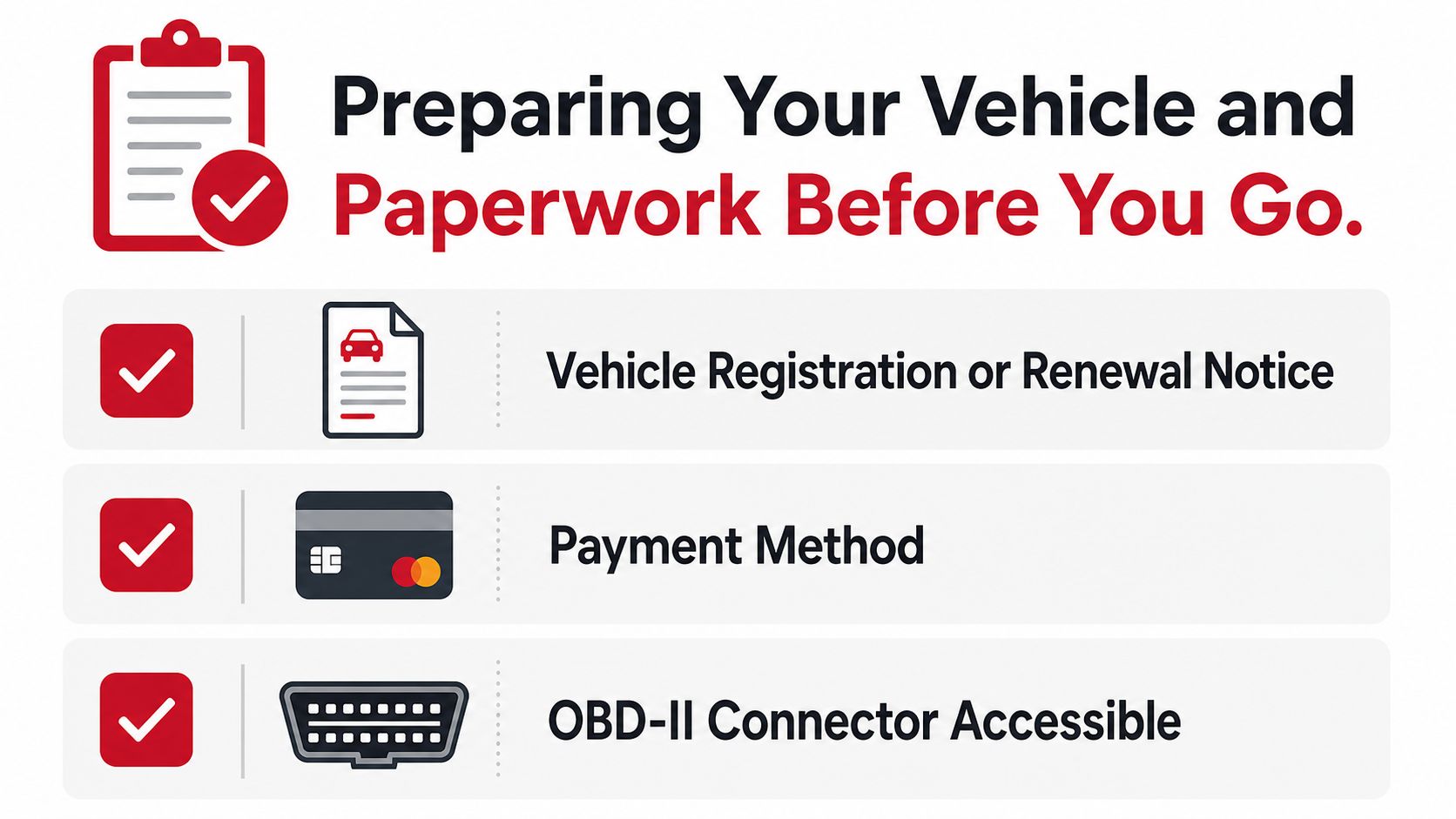
What to bring with you
Bring the vehicle registration or renewal notice, a payment method, and any prior certificate or failure paperwork you already have. If you're heading to a station that can finish registration on-site, having the right documents ready matters even more. Keep everything in one folder or glove box pocket so you're not digging through the car at the counter.
The car itself needs a quick check before you leave. The check-engine light has to be off, and the gas cap should seal properly. If the battery was recently disconnected or replaced, BAR advises drivers to keep driving for one to two weeks so readiness monitors can reset (BAR Smog Check guidance). That one step avoids a common modern-car failure where the vehicle looks fine but the computer hasn't completed its self-checks.
Build a short morning routine
A clean morning routine beats guesswork.
- Look at the dashboard first: The check-engine light should be off before you head out.
- Confirm the battery history: If it was recently changed or disconnected, give the monitors time to reset.
- Check the fuel cap: A loose or damaged cap can turn into a needless return trip.
- Keep the OBD-II port accessible: Don't bury it under accessories or aftermarket covers.
BAR says a smog inspection typically includes a visual inspection, a functional inspection, an OBD system check for most 2000-and-newer vehicles, or a tailpipe test for pre-2000 vehicles, and the full inspection usually takes about 30 minutes (BAR Smog Check guidance). That timing assumes you arrive ready. If your paperwork is missing or the car hasn't completed a drive cycle after a battery reset, the visit gets longer fast.
A clean pre-check doesn't guarantee a pass, but it removes the most common avoidable reasons for failure.
That matters because the modern test is as much about the vehicle's self-diagnostics as it is about what comes out of the tailpipe. If the car is prepared, the station can do its job without extra delay.
What Happens During the Inspection at a STAR Test-Only Station
The visit starts the same way almost every time. You pull into the lot, hand over the renewal notice and keys, and the technician moves the car into the bay. At a test-only station, the workflow stays focused on inspection, not sales pressure, which keeps the handoff simple.
The inspection steps in the bay
First comes the visual inspection. The technician checks emissions-related equipment for obvious tampering, missing parts, or damage. That's followed by the functional inspection, where the station verifies the systems are operating as they should. For 2000-and-newer vehicles, the technician connects to the OBD system. For older vehicles, the process shifts to a tailpipe test (BAR Smog Check guidance).
The point of a test-only bay is speed and clarity. The station is looking for whether the vehicle passes the state test, not for a reason to open a repair order. That makes the visit easier to understand. You're not negotiating a fix. You're getting the inspection result that registration depends on.
What the driver usually sees
Most of the time, the driver waits a short time while the tech runs the test and prints the result. BAR says the full inspection usually takes about 30 minutes (BAR Smog Check guidance). A busy station may move faster or slower depending on what's ahead of you, but the process itself is still straightforward.
If the vehicle passes, you leave with the certificate path cleared. If it doesn't, you get a failure result that tells you what stopped the pass. Either way, the visit is structured to end with a clear next step.
A STAR test-only station changes the tone of the visit. The technician tests the car, reports the result, and the repair conversation happens somewhere else if it needs to happen at all.
That separation matters in practice. Drivers get less confusion, and they know exactly where they stand before they spend money on repairs. For people trying to finish a renewal in one afternoon, that kind of clarity is the value.
Handling Failures, Retests, and Repair Documentation
A failed smog test is a starting point for the next step. The report tells you what stopped the pass, and that is the part you use to plan repairs. Once you know the failure category, the job gets much more specific.
What the failure categories mean
California BAR breaks failures into functional, OBDII, and visual categories in its 2022 summary (BAR 2022 Smog Check Executive Summary). Those categories matter because each one points to a different kind of problem, not just a generic “fix the car” answer.
| Common Smog Failure Categories and Typical Causes | What Is Checked | Common Triggers |
|---|---|---|
| Functional | Whether required components and systems work as expected | Check-engine light, readiness issues, equipment not operating correctly |
| OBDII | Onboard diagnostic data for newer vehicles | Monitor not ready, fault codes, recent battery disconnect |
| Visual | Emissions equipment present and unaltered | Missing catalytic converter, tampered parts, obvious leaks |
A driver who gets a failure printout usually wants the shortest path to a retest. The report helps the repair shop focus on the right system the first time. That saves a lot more time than guessing at parts and hoping the next inspection goes differently.
Why the paperwork matters
Keep every repair receipt if you end up needing a directed retest or documented follow-up. The first failure report tells the shop what to inspect, and the receipts show what was repaired. That paper trail matters when the next inspection depends on proof instead of just a verbal explanation.
Some fixes are simple. A loose gas cap can be handled quickly, while a failed oxygen sensor or a deeper emissions issue takes longer and should be documented carefully. The point is to repair the specific cause shown on the report, then return for the retest with the paperwork in hand.
A test-only station keeps that process cleaner because the inspection and the repair sale stay separate. You are not trying to sort out the result while someone is also selling you the fix. That makes the retest path easier to follow and keeps the decision making clearer.
Keep the failure report with the repair invoice until the registration is complete. People lose time when they try to recreate the paperwork later.
For drivers trying to finish everything in one trip, a station that also handles registration can shorten the back and forth after the repair is done. A local example is California DMV registration renewal services, which shows how some stations connect smog results with DMV follow-through.
The practical sequence stays the same. A failed test becomes repair, retest, certificate, registration. That is manageable when the documents stay organized from the start.
Combining Your Smog Check With On-Site DMV Renewal
Once the vehicle passes, the time-saver is finishing the registration without driving somewhere else. A station that's also a licensed DMV business partner can process the renewal on-site, which means one stop instead of two. For drivers trying to stay out of a DMV field office, that changes the whole day.
What can be handled in the same visit
On-site DMV renewal typically covers registration renewal, and some stations also handle ownership transfers for California and out-of-state vehicles, plus sticker and plate issuance when needed. That lets the certificate and the registration move together instead of sitting in separate queues. It's especially helpful when your smog due date and renewal deadline are close.
Fire House Smog publishes a local example of this combined workflow at California DMV registration renewal services. The station lists DMV service hours Monday to Saturday 9:30 AM to 5:00 PM and Sunday 12:00 PM to 4:00 PM, with smog testing available seven days a week ([publisher information provided in brief]). Its Antioch location is 2900 Lone Tree Way, and the contact number is 925-754-1600 ([publisher information provided in brief]).
Why the on-site model helps working drivers
Weekend availability changes the equation. If your schedule is packed during the week, a station that handles both smog and DMV work can save an extra trip, especially when the sticker can be printed on-site. That also reduces the risk of doing the smog test, then waiting days before you can finish the paperwork somewhere else.
The best single-trip plan is simple, pass the smog test, finish the renewal where you're already parked, and leave with the next step already done.
That doesn't mean every DMV task belongs at the smog station. Some situations still require a field office or additional documentation. But for standard renewals and the most common transfer work, a combined stop keeps the process tight and avoids unnecessary backtracking.
If you want to see how a station can structure that workflow in one place, the local renewal page is the right reference point.
RV, Fleet, and Specialty Vehicle Considerations
The standard advice works well for a sedan or light-duty truck. It falls apart faster when the vehicle is oversized, commercial, or part of a fleet schedule. Those drivers need to think about fit, timing, and paperwork before they ever pull into the lot.
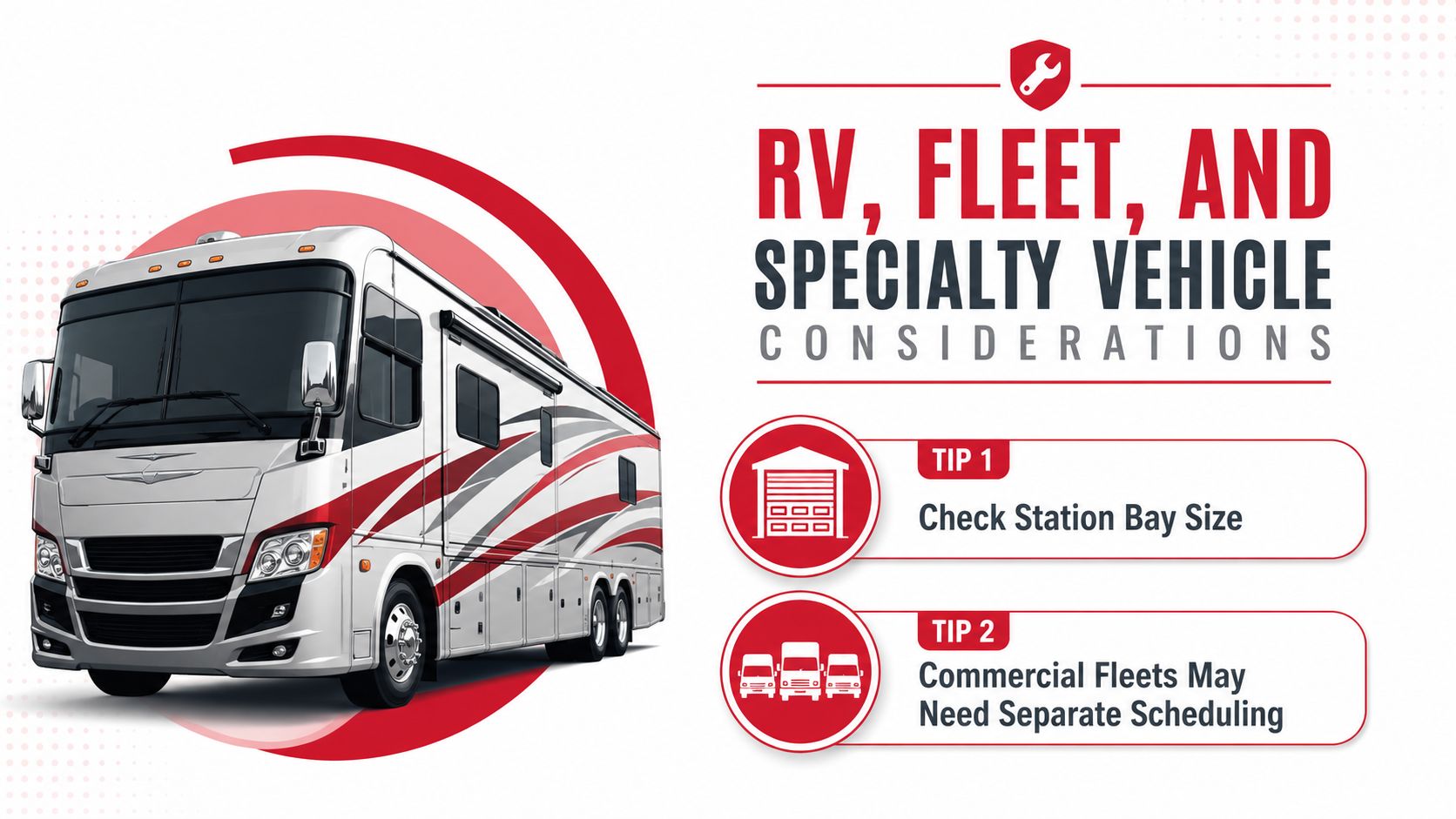
Start with bay size and equipment limits
Some RVs and motorhomes can be tested, but only if the station's bay size and equipment can handle them. That's why the phone call matters more for a large vehicle than for a compact car. A station may be certified and still not be physically set up for the vehicle you drive.
That same logic applies to fleets. If you're processing multiple vehicles, the limit isn't just certification, it's throughput. A two-bay station can move faster than a smaller one, and that matters when several vehicles need testing in the same day.
Specialty vehicles need a tighter plan
Diesel vehicles follow a different applicability rule than gasoline cars, since BAR says most diesel vehicles model year 1998 and newer are subject to Smog Check (BAR 2025 Smog Check Executive Summary). Hybrid and alternative-fuel vehicles are also part of the statewide system when they fall within the qualifying model-year range (BAR 2025 Smog Check Executive Summary). That means specialty drivers shouldn't assume the inspection path is the same just because the vehicle feels modern.
Out-of-state transfers can add another layer, especially when the paperwork needs to match the vehicle's status before DMV can finish the registration. When the vehicle type is unusual, or when the registration is tied to a business, call ahead and explain the exact make, model, and configuration. The right answer on the phone is cheaper than discovering a size or equipment issue at the curb.
Use the local setup to your advantage
A station with two service bays and extended hours can be useful for fleet work because it gives you more scheduling flexibility and reduces idle time between vehicles. That's why a test-only station with DMV capability is often a good fit for small-business drivers who want one location to handle more than one task.
Fire House Smog is one local example in Antioch. It's a STAR-certified test-only station, it handles emissions inspections for cars, trucks, and some recreational vehicles, and it processes DMV renewals on-site at 2900 Lone Tree Way ([publisher information provided in brief]). For Antioch and East Contra Costa County drivers, that kind of setup reduces the number of stops without turning the visit into a repair shop detour.
The cleanest workflow stays the same no matter what you drive. Confirm the station type on the notice. Run the pre-test checks. Bring the right paperwork. Choose a STAR-certified test-only station with hours that fit your schedule. Use the retest path if needed, then finish DMV renewal on-site in the same visit. As the fleet gets cleaner, older vehicles still show the higher failure rates, so preparation matters most where the margin is tight.
If you're due now, make the trip count. Visit Fire House Smog for a STAR-certified test-only smog check, on-site DMV renewal support, and a station setup built for drivers who want to handle the inspection and registration in one stop.
You're staring at a DMV renewal notice, the car runs fine, and you still have that annoying question, do I need a smog check in San Leandro, or am I about to waste an afternoon? That's the right question to ask first. The expensive mistake isn't showing up a few minutes late, it's bringing the wrong vehicle, the wrong paperwork, or a car that isn't ready to pass.
San Leandro drivers don't need guesswork. California's rules decide whether your car is in scope, and the DMV and BAR rules are clear enough if you read them instead of trusting forum noise. The smart move is to treat a smog check San Leandro appointment as a readiness check, then match your vehicle and your renewal notice to the right station type before you ever leave home.
Table of Contents
- What a San Leandro Smog Check Actually Covers
- How to Prep Your Car Before the Test
- Standard, STAR, and Test-Only Stations Explained
- What Happens During a San Leandro Smog Visit
- Failing the Test and Getting a Free Retest
- Hours, Wait Times, and Smart Timing Around San Leandro
- Putting It All Together Before Your Next Renewal
What a San Leandro Smog Check Actually Covers
A San Leandro driver can have the renewal notice in hand and still be unsure whether the car is even subject to testing. Start with the DMV rule, not the rumor mill. California requires smog inspections for most vehicles when they're being registered or when registration is renewed, with exemptions for gasoline vehicles 1975 or older, diesel vehicles 1997 or older or over 14,000 pounds GVWR, electric vehicles, and gasoline vehicles under eight model years old. The state also says some newer vehicles can pay a smog abatement fee instead of testing for the first 8 registration years. For out-of-state vehicles, California's BAR summary says all 1976 model-year and newer vehicles need a smog check before first registration in the state, which matters a lot in a Bay Area city where people move and buy cars across state lines. Read the DMV's own inspection rules before you book anything, then use California's vehicle emissions standards overview as a plain-language reference point.
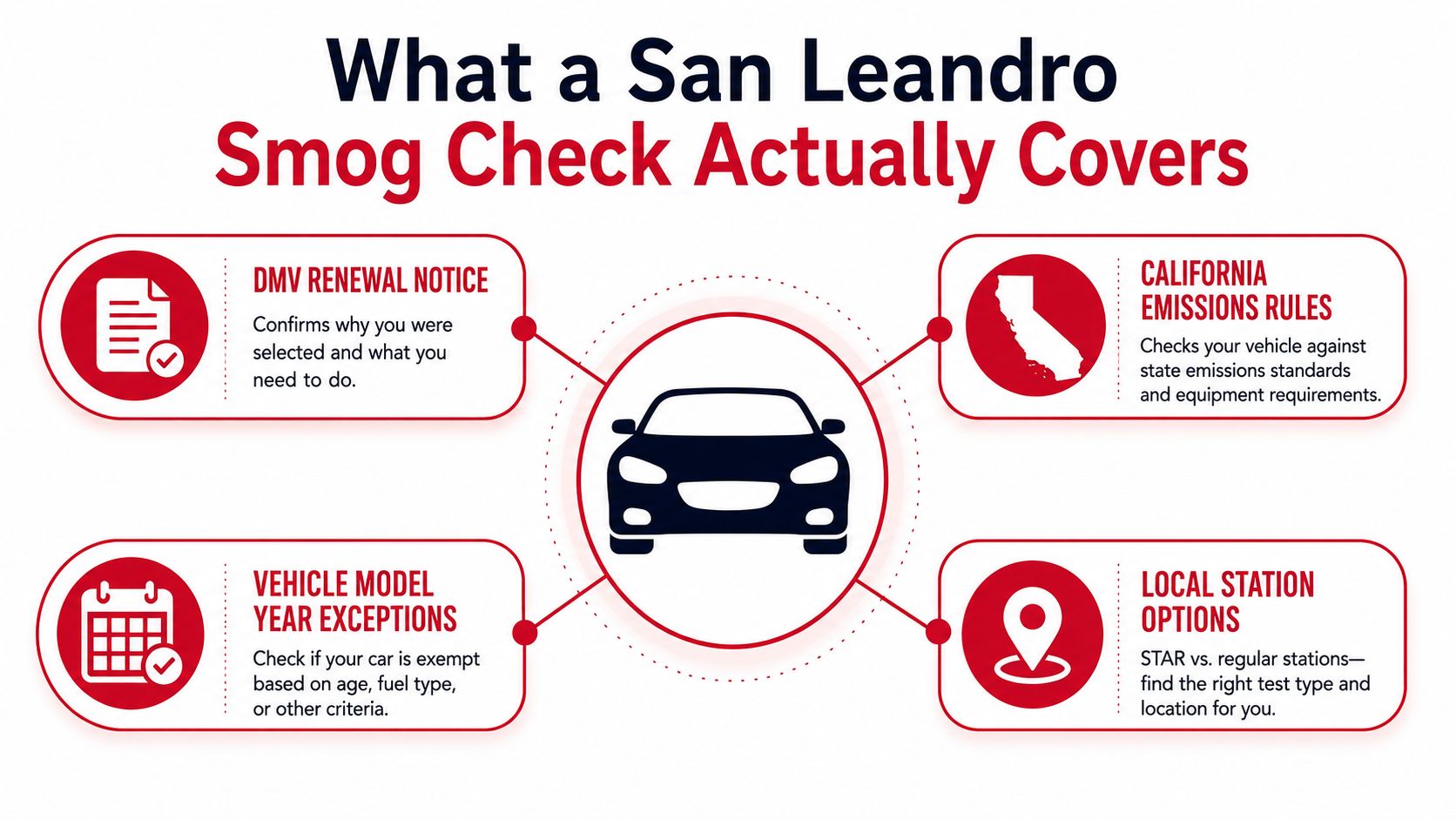
The first filter is eligibility
If your vehicle falls into one of the exemption buckets, don't book a test just because a renewal notice arrived. The notice tells you what the DMV expects administratively, but the vehicle class decides whether a smog inspection is required. That's the part too many drivers skip, and then they show up with a car that never needed to be on the bay in the first place.
Out-of-state transfers are the other common trap. If the vehicle is 1976 model year or newer and it's coming into California for the first time, the smog check comes before first registration. That's not a suggestion, and it's not something a shop can waive because the car looks clean.
Read the notice, then match the vehicle
The cleanest way to think about it is simple, the DMV notice points to paperwork, the vehicle class points to the test. If the car is clearly exempt, stop there. If it's not exempt, move straight to preparation and station selection.
Practical rule: don't book based on anxiety. Book only after you've checked the model year, fuel type, and whether the car is entering California for the first time.
How to Prep Your Car Before the Test
Most failed smog appointments don't start with a bad catalytic converter. They start with a car that wasn't ready to be tested. California-focused guidance says the right prep starts with the check-engine light, then the battery history, then the OBD-II readiness monitors that have to complete before the car can be fairly evaluated. If you clear a code or disconnect the battery right before you go, the monitors may not have reset yet, and that can set you up for a refusal or a retest even if the engine itself is fine. Read the warning-light and readiness guidance in common smog fail reasons before you roll out.
What to do in your driveway
Start with the dashboard. If the check-engine light is on, don't pretend the station will magically ignore it. Then check the gas cap, because a loose seal is the kind of small issue that creates a big headache later.
A simple pre-visit checklist works better than guesswork:
- Check the dashboard first. If the warning light is on, fix the cause before you test.
- Avoid a fresh battery disconnect. A recent reset can leave readiness monitors incomplete.
- Drive the car long enough to re-learn. Mixed driving gives the onboard system time to complete its checks.
- Don't clear codes right before the appointment. That often creates a readiness problem instead of solving one.
- Confirm the gas cap is tight. It's basic, but it still matters.
Give the car time, not just a quick lap
A short errand loop isn't enough if the monitors were just cleared. Many California drivers need a real drive cycle before the car is ready, and the practical guidance for that is usually a 50 to 100 miles of mixed driving. I'd treat that as a planning window, not a promise. If you want fewer surprises, stop chasing a same-day miracle and give the car time to complete its own checks.
The fastest appointment in the world doesn't help if the car arrives half asleep. A proper prep run beats a rushed test every time.
A clean bill of health starts before the bay door opens. If the light's on or the battery was just swapped, fix readiness first and test second.
Standard, STAR, and Test-Only Stations Explained
San Leandro search results throw three labels at drivers, and each one changes the job the station is allowed to do. A standard smog station can inspect many vehicles. A STAR-certified station handles DMV-directed vehicles and works under tighter oversight. A test-only station performs inspections without selling repairs, so the technician has no repair revenue tied to the outcome. If you want the cleanest split between testing and fixing, test-only is the smarter choice.
The question is not which shop has the shortest line. It is whether your vehicle belongs in that bay at all. If DMV directed your car to STAR, book a STAR-certified station and stop there. If you already failed once, test-only often makes more sense because the station is there to verify the result, not to steer you into parts you did not ask for. For a closer look at the certification framework, see what STAR-certified smog means.
What each station type does
A standard station handles routine inspections for many drivers, but it does not fit every directed case. A STAR station has the certification level DMV uses for vehicles that need closer oversight. A test-only station is the cleanest option when you want the inspection result without the repair pitch attached.
Use the notice first. Use the station label second.
| Station type | Best use case | What to expect |
|---|---|---|
| Standard station | Routine vehicles that aren't directed elsewhere | Regular inspection service |
| STAR-certified station | DMV-directed vehicles | Stricter certification framework |
| Test-only station | Drivers who want testing without repair sales | Inspection only, no repair upsell |
Don't overthink the label
The renewal notice matters more than the search result. If the notice calls for STAR, book STAR. If the notice does not require it and you just need a valid inspection, a regular station may be enough. If you want to avoid a conflict of interest and keep the transaction clean, test-only is the more disciplined choice.
That is why I tell neighbors to read the notice before they read the reviews. The right station type saves more time than any polished marketing page ever will.
What Happens During a San Leandro Smog Visit
A good San Leandro visit should feel boring in the best way. You pull in, hand over the vehicle info, and the technician starts by confirming the paperwork and the car's eligibility for the specific inspection path. At a STAR test-only station, that usually means the technician is focused on the inspection itself, not on steering you into repairs you didn't ask for.
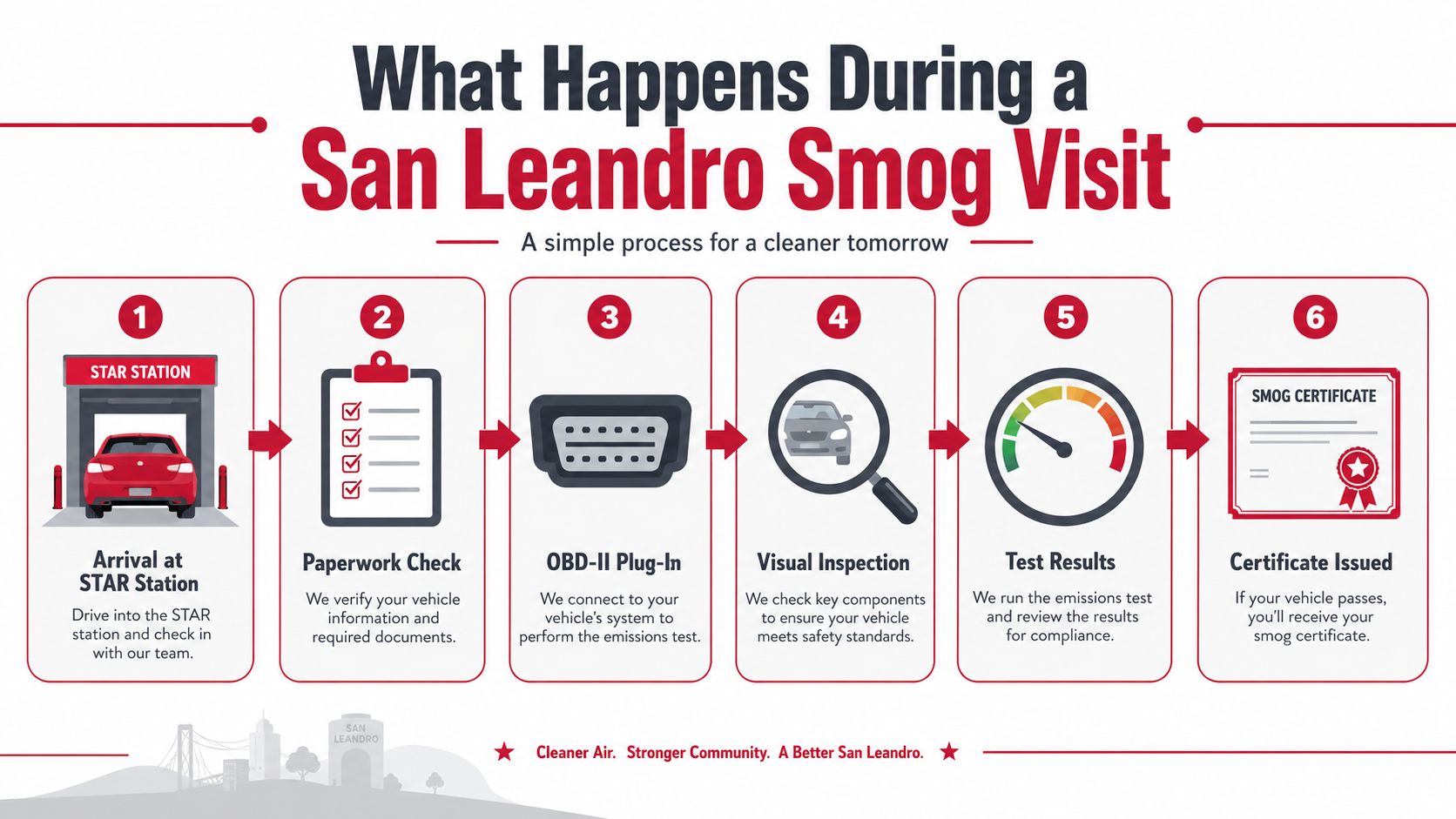
The inspection path
The car gets the OBD-II plug-in first if that applies to the vehicle class. Then comes the visual check, where the technician looks for obvious tampering or missing components, followed by the emissions portion that fits the vehicle's age and setup. Some cars are evaluated through onboard diagnostics, while others can involve additional test steps depending on class and equipment.
A compliant, well-prepped car can move through the visit in about 10 to 15 minutes, according to the San Leandro guide linked earlier. That short on-paper visit is exactly why readiness matters so much. The test can be quick, but the car still has to be ready to answer the computer when it's plugged in.
What the tech is actually watching for
This isn't a mystery scan with random failure points. The technician is looking for the signals that the car's emissions controls are working the way they should, and that the onboard system isn't hiding a recent reset. If the car is ready, the result tends to be straightforward. If it isn't, the visit turns into a wait for a retest instead of a clean pass.
A fast station doesn't rescue an unready car. The delay usually comes from the vehicle, not the bay.
When the inspection passes, the certificate gets uploaded to DMV and the driver moves on. That's the whole point of a well-run visit, a clean result with no drama and no surprise detour.
Failing the Test and Getting a Free Retest
A fail report isn't the end of the process, but it does tell you exactly where to stop guessing. Read the Vehicle Inspection Report first. If the issue is readiness, a warning light, or a straightforward emissions problem, the next move is different in each case. Don't rush back to the same lane with the same unresolved issue and hope the answer changes.
Fix the right problem
If the report points to readiness, the car probably needs more driving before it will pass. If the check-engine light is still on, the repair comes first. If the failure is a true emissions issue, a separate repair shop should diagnose the cause before you return for another test.
That's where test-only stations make sense again. Since they don't sell repairs, they aren't benefiting from telling you to replace parts on the spot. You can take the report to a repair shop, get the issue addressed, then come back for the recheck.
Bring the right paperwork back
When you return, bring the same vehicle and the report that proves what failed. If the station offers a free retest under its policy, use it instead of paying twice for the same problem. The free retest is most useful when the original failure was real, the fix was targeted, and the car is ready this time.
If you're dealing with a waiver or hardship extension, handle that through the DMV side, not by arguing it at the lane. The station's job is to test the vehicle and document the result. DMV handles the registration outcome.
Don't pay for repeat inspections because you skipped diagnosis. Fix the failure once, then use the retest path the right way.
Hours, Wait Times, and Smart Timing Around San Leandro
San Leandro has a more active testing corridor than a lot of drivers realize. Local station listings show published hours such as 8:00 AM to 3:30 PM, 8:30 AM to 5:30 PM, 8:30 AM to 5:00 PM, and 9:00 AM to 6:00 PM, which tells you the market isn't limited to one narrow weekday window. Some locations also test on weekends, so the best time to go depends less on your schedule and more on how crowded the lane will be.
Pick the quietest window
If you want the shortest wait, I'd aim for early in the week and early in the day. Monday and Tuesday mornings tend to be easier than Friday afternoons because drivers who waited on their renewal notice often rush in near the end of the week. The point isn't mystical traffic prediction, it's simple crowd behavior.
The DMV cycle creates its own bottlenecks. People wait until the deadline is close, then every local station gets hit at once. If your renewal month is approaching, don't join the late surge unless you enjoy sitting in a line behind three people who all had the same idea.
Use flexibility to your advantage
San Leandro's station spread gives you options, so use them. If your preferred site looks packed, move a few blocks or try another open window instead of forcing the same lane. A nearby alternative is often faster than sitting still because you fell in love with one address.
The same logic applies to your car. A flexible schedule helps, but only if the vehicle is prepared. If the readiness monitors aren't set, a short wait at the right station still beats a short wait at the wrong one.
Putting It All Together Before Your Next Renewal
A San Leandro smog appointment should run on a simple routine, not panic. First, confirm whether the car is exempt under California's rules. Second, check the dashboard and make sure readiness isn't broken by a fresh battery disconnect or a code clear. Third, book the right station type, especially if DMV points you toward STAR or you want a test-only result with no repair sales attached.
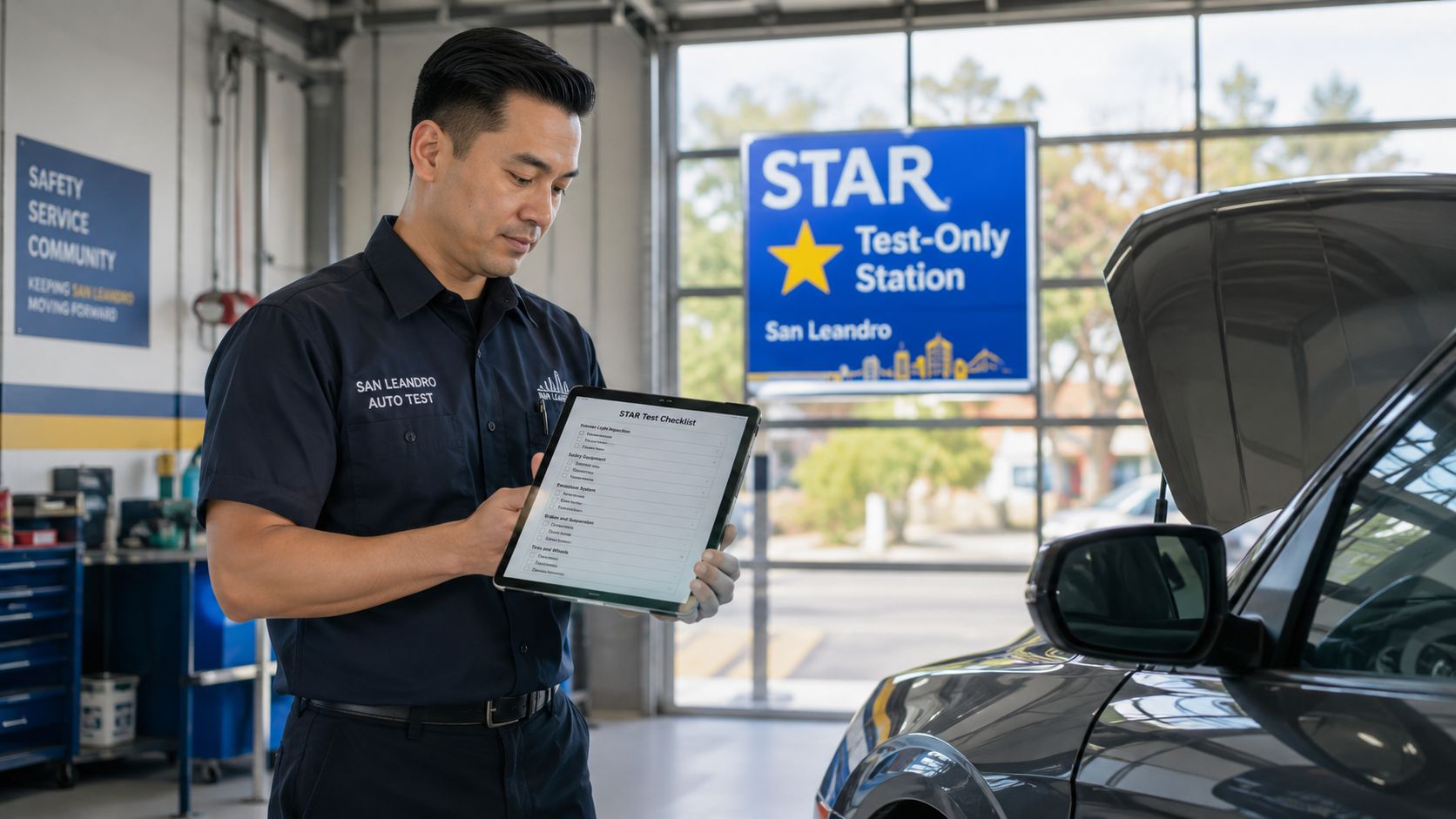
A 30-day playbook that actually works
Use the month before renewal like this:
- Check exemption status early. Don't wait until the due date to find out the car never needed testing.
- Watch the warning lights. A lit check-engine light means you're not ready.
- Give the car real drive time. Readiness needs miles, not wishful thinking.
- Choose the correct station type. Standard, STAR, and test-only are not interchangeable.
- Plan for the retest path. Keep the report and use it if the first visit doesn't pass.
That routine beats improvising on the last day of the month. It also keeps you from paying for a problem that should have been caught in your driveway.
Fire House Smog is one option for drivers who want a STAR-certified test-only smog check and DMV-related registration help in one stop, but the bigger lesson is the same no matter where you go. Treat the appointment like a readiness checkpoint, not a race. If you want a cleaner renewal cycle next time, start with the car, pick the right lane, and show up only when the vehicle is ready.
You open the renewal notice, scan the amount due, and think the same thing most California drivers think. Why is my registration renewal fee so high? The total rarely looks simple, and the line items often feel like they were written for someone who already knows DMV math.
That confusion is normal. A California renewal bill usually combines several different charges, and some of them change based on your vehicle's value, age, location, or smog status. If you're also trying to renew quickly, avoid penalties, and not waste half a day sorting it out, the process can feel bigger than it should.
This guide breaks it down the way a local DMV partner would explain it across the counter. Plain language. Real examples. No mystery fees added in the shadows.
Table of Contents
- That Surprise Bill from the DMV
- Decoding Your California Registration Fee
- Smog Checks Special Plates and Late Penalties
- How to Estimate Your Renewal Cost Before the Bill Arrives
- Your Renewal Options From DMV Lines to Instant Tags
- A Simple Checklist for a Smooth Renewal
That Surprise Bill from the DMV
Maria opens her envelope at the kitchen counter, sees the total, and immediately starts comparing it to last year in her head. She remembers paying registration before, but this time the amount feels different enough that she wonders if something's wrong.
That moment happens all the time. People expect one simple registration renewal fee, then see a total that looks more like a stack of charges bundled together. Some drivers assume the DMV made a mistake. Others put the notice aside for a few days, planning to “look at it later,” which is usually how a simple renewal becomes a stressful one.
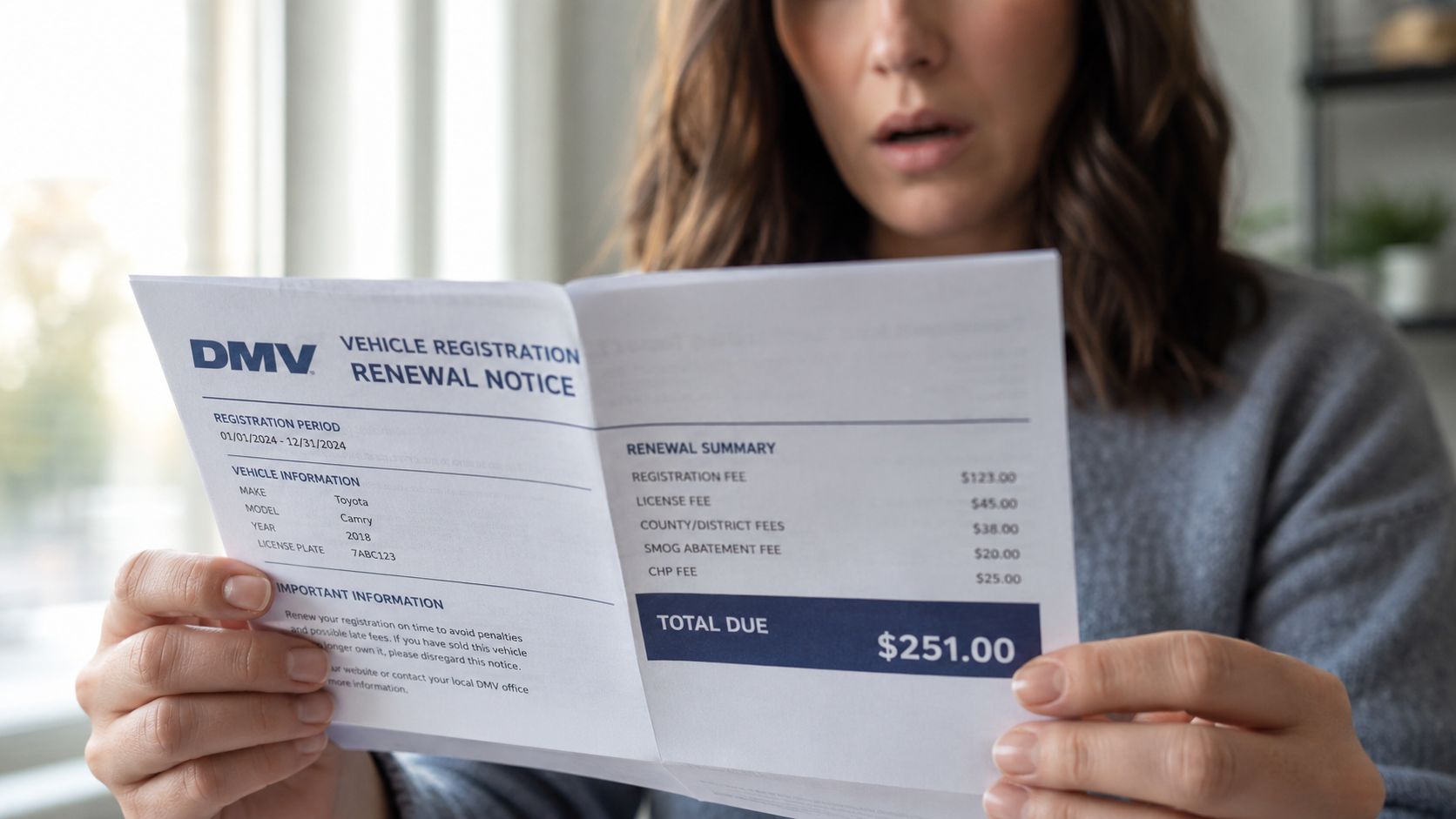
The hard part is that the bill often mixes fixed charges, value-based charges, and sometimes extra requirements like smog compliance. If you don't know which part is driving the total, the number can feel random even when it isn't.
Practical rule: Don't judge your renewal notice by the final amount alone. Look at what kind of charges are inside it.
A lot of drivers also mix up three different questions:
- What does the state charge? Those are official registration-related fees.
- What changes year to year? Vehicle value, smog status, and local add-ons can shift the total.
- What costs are optional? Third-party processing fees can make a normal renewal look much more expensive than it really is.
Once you separate those, the notice starts to make sense. You can tell what's normal, what needs action, and what you might be able to avoid.
That's the key point. Most frustration doesn't come from paying the fee itself. It comes from not knowing why the number landed where it did, or whether you're about to pay more than you should.
Decoding Your California Registration Fee
A California renewal notice works more like an itemized grocery receipt than a single price tag. You are paying for a bundle of state charges, and one line can carry much more weight than the others.
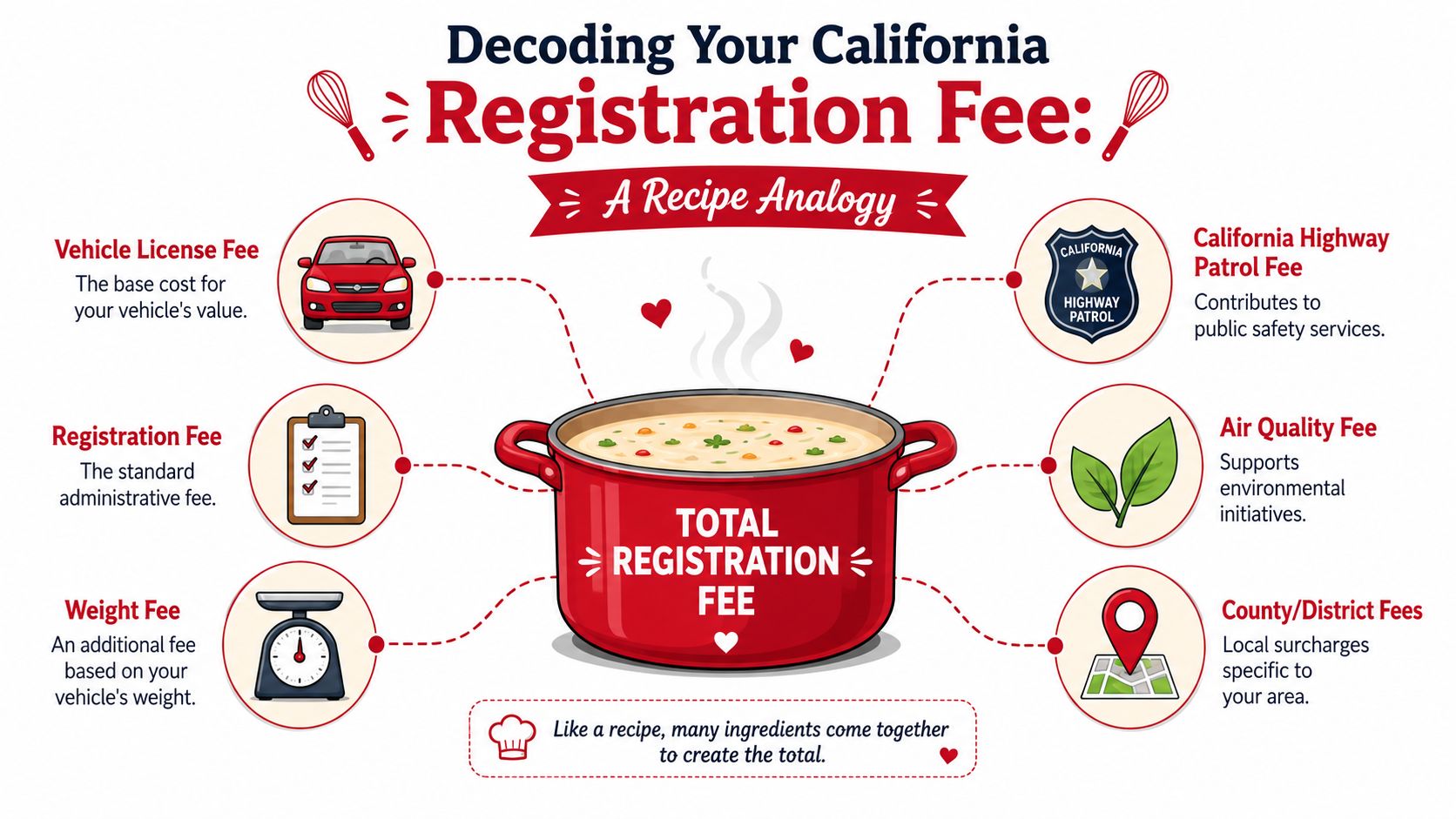
Why the total doesn't look like one fee
On a renewal notice, California groups several charges into one amount. Some are flat state fees. Some change based on the vehicle. Some are tied to value. That mix is why two neighbors can renew in the same month and owe very different totals.
One public fee breakdown shows how this can look on a real notice, including a base registration charge, a California Highway Patrol charge, and a Transportation Improvement Fee that rises for higher-value vehicles (California fee breakdown example).
If you want a plain-English reference while reading your notice, this California registration fee guide from Fire House Smog lays out the common parts in a simpler format. That local DMV partner perspective matters, because many drivers do not get overcharged by the state itself. They get confused by unfamiliar line items, or by renewal websites that pile on service fees without making them obvious up front.
The Vehicle License Fee is often the biggest moving part
The line that surprises people most is the Vehicle License Fee, or VLF. It changes with the vehicle's current value, so it does not stay fixed from year to year.
A practical way to read it is this: the VLF acts like the variable part of your bill, while the registration and CHP charges are closer to the steady part. If your vehicle is newer or worth more, that variable piece can be much larger. If the vehicle has aged and lost value, that part often drops over time.
One source explains the VLF calculation and gives sample amounts for lower-value and higher-value vehicles, which helps explain why a renewal on a newer car can feel much steeper than expected (California VLF and fee examples).
Fixed fees still shape the bill
Fixed charges may not be the largest lines, but they still matter because they appear year after year. They create the floor of the renewal cost before value-based fees and other add-ons enter the picture.
Here is the simplest way to sort what you are seeing on the notice:
- Value-based fee: usually the part tied to what the vehicle is worth
- Fixed state charges: recurring items such as registration-related and CHP-related fees
- Other add-ons: charges tied to vehicle category, location, or special programs
That last group is where drivers need to slow down and read carefully. Official DMV-related charges are one thing. Extra processing charges from unauthorized third-party renewal sites are something else. From the counter at a licensed DMV partner like Fire House Smog, that difference is easy to spot. Online, it is not always obvious until the total jumps.
Once you separate the notice into those buckets, the bill starts to feel less random. You can see which part is normal, which part changes with value, and which part deserves a second look before you pay.
Smog Checks Special Plates and Late Penalties
You open your renewal notice, expect the usual amount, and then one small detail changes the whole errand. Sometimes it is a smog requirement. Sometimes it is a plate-related charge. Sometimes timing is the problem, because once the due date passes, the price can climb fast.
From the counter at a licensed DMV partner like Fire House Smog, these trouble spots are usually easy to spot. On an unfamiliar renewal website, they are not always labeled clearly, and that can leave drivers paying extra processing fees while still missing a smog step or a deadline.
When smog changes your renewal steps
Smog rules confuse people because “exempt” can mean two different things. A vehicle may be exempt from the test itself, but still have a smog-related charge attached to renewal.
A simple way to sort it out is to separate the test from the fee:
- Some vehicles need a smog test before renewal can be completed
- Some vehicles do not need the test this cycle
- Some test-exempt vehicles still owe a smog abatement fee
That distinction matters. If your notice mentions smog, treat it like a gate at the front of the process. Until that requirement is handled, the rest of the renewal may stay stuck. If you want to catch problems before your appointment, this guide to common smog check fail reasons can help you troubleshoot early.
Special plates create a different kind of surprise. They can add costs or paperwork that do not appear on a standard renewal, so it is smart to read those line items separately instead of assuming every vehicle follows the same pattern.
Why waiting gets expensive
Late registration works like an overdue utility bill. The original amount may have been manageable, but once the deadline passes, penalties become their own line of the story.
California does not give drivers a grace period for registration renewal. Payment is due by the expiration date shown on the registration card, and late payment can trigger penalties. Smog requirements, exemption rules, smog abatement fees for some newer exempt vehicles, and late-penalty reminders are summarized in California renewal guidance.
The practical risk is simple. A driver may spend time comparing renewal options, click through an unofficial site with extra checkout fees, and still not finish the one step that controls completion. That is why in-person help can save money as well as time. You can confirm whether smog is due, ask about plate-related charges, and finish the transaction without guessing which fee is state-required and which fee came from the website.
Use this checklist if your notice looks more complicated than usual:
- Open the notice right away. Small renewal problems get more expensive when they sit unopened.
- Check whether smog is required. That tells you if payment alone will finish the renewal.
- Read the expiration date carefully. The due date on the card is the date that matters.
- Review special plate charges on their own. They may not match the pattern of a standard renewal.
- Be cautious with third-party checkout pages. If the fees are hard to explain, stop and verify them before paying.
Many “surprise” renewal totals come from one of three sources. Smog added a required step, special plates added an extra charge, or a missed deadline added penalties.
How to Estimate Your Renewal Cost Before the Bill Arrives
If you'd rather not be surprised by the next notice, estimate the registration renewal fee before it shows up. You won't get a perfect crystal ball, but you can get close enough to budget and catch anything that looks off.
What to gather first
Start with the basics from your current registration or vehicle records:
- License plate number
- Vehicle identification details
- Your county or registration location
- Any clue that smog may be due this cycle
Then use the official California DMV fee calculator. Enter the vehicle details exactly as requested. If you guess at trim level, date, or classification, the estimate can drift.
A practical example helps. Say you're estimating for a family sedan that's a few years old and registered in Contra Costa County. You'd enter the identifying information, review the result, and then compare it with what you paid last cycle. If the amount seems meaningfully different, don't panic. The cause may be ordinary, such as a value-based change or a required smog step.
How to sanity check the estimate
Don't focus only on the grand total. Ask a few better questions:
- Does the result include a value-based component? That part often explains the biggest share.
- Is smog involved this year? If yes, your process may take longer than an online payment alone.
- Are you looking at an official estimate or a private checkout page? Those are not the same thing.
A good estimate is mainly a planning tool. It helps you set aside the money, avoid deadline stress, and recognize when a fee page includes charges that don't look like state fees.
A renewal is easier when you treat it like a calendar task, not a surprise expense. Check early, compare calmly, and leave yourself time if smog is due.
One more note. As your car ages, the value-based part of your renewal may ease over time. That doesn't mean every future total will always go down, but it does mean depreciation can work in your favor on the part of the bill tied to vehicle value.
Your Renewal Options From DMV Lines to Instant Tags
You've got several ways to renew, but they don't all cost the same in time, stress, or transparency.
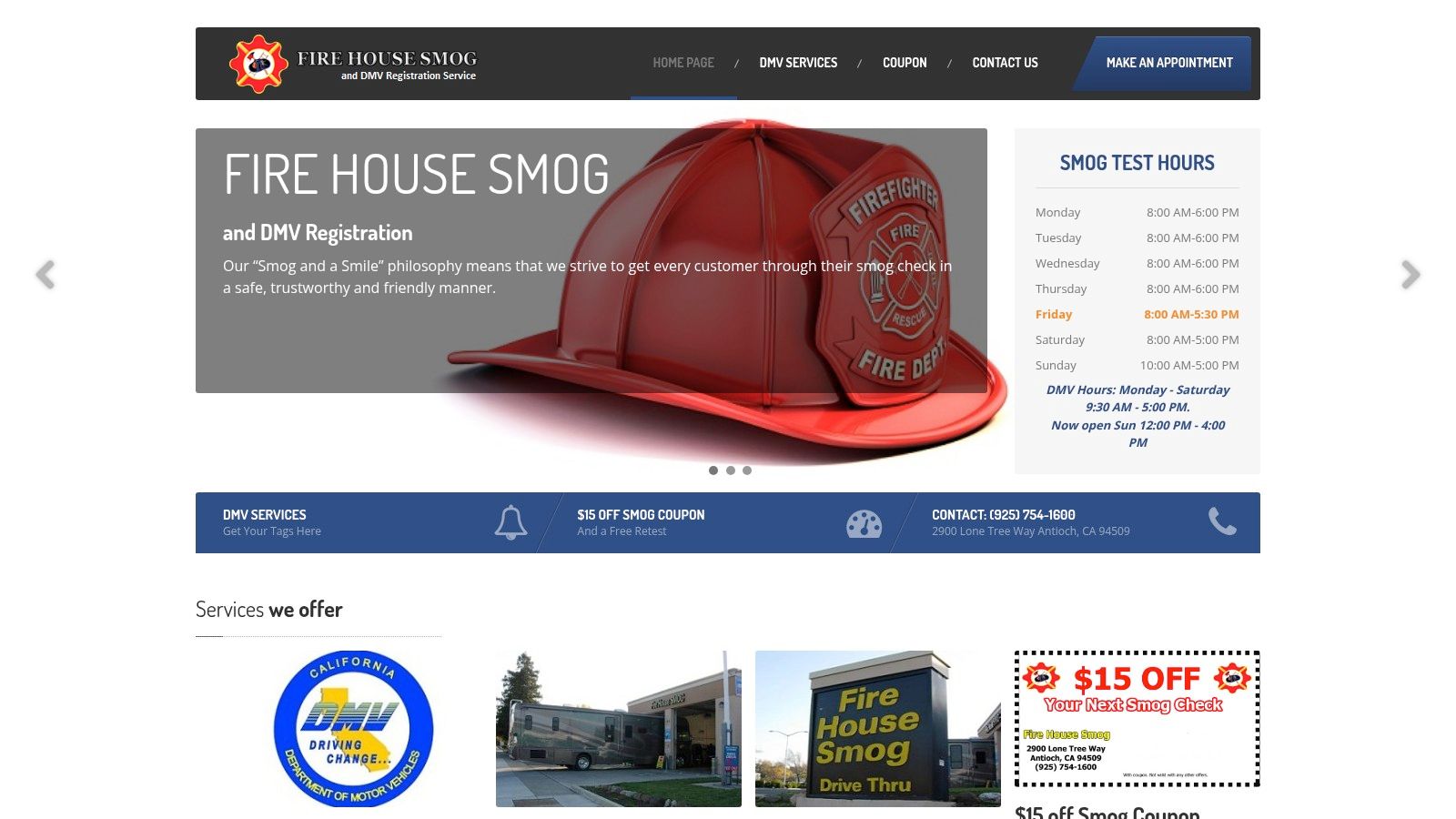
The main ways drivers renew
Some drivers still mail payment. That can work if everything is straightforward and you're well ahead of the deadline. The downside is obvious. If something is missing, delayed, or unclear, you don't get immediate feedback.
Others use the official DMV online process. That's often the cleanest digital route when your record is simple and no extra steps are blocking completion. It's usually the first online option to consider because you're dealing directly with the state rather than a middle layer.
Then there's the field office route. For some situations, it's necessary. For many routine renewals, though, it means waiting, juggling paperwork, and hoping the line moves faster than your afternoon disappears.
Here's a quick comparison:
| Renewal method | What it's good for | Main drawback |
|---|---|---|
| Straightforward renewals with time to spare | Slow problem-solving | |
| Official online DMV route | Simple renewals from home | Limited help if an issue pops up |
| DMV office visit | Cases needing direct state handling | Time and waiting |
| Licensed DMV partner | In-person help with faster completion for many routine tasks | Availability depends on provider services |
The third party fee trap
A lot of people don't realize that some websites are not the state and not a local licensed partner. They're third-party businesses adding service charges on top of official fees.
That confusion has led to cases where an $84 cost ballooned to over $120 because a third-party vendor added service fees, and official agencies such as the Florida Department of Highway Safety have recommended renewing directly through state or tax collector portals to avoid those extra charges (video summary of third-party service fee confusion).
That example comes from outside California, but the lesson applies anywhere. Before you pay, make sure you know whether you're on:
- An official government site
- A licensed in-person DMV business partner
- A private website charging convenience fees
If the page isn't clear about who is collecting what, stop and verify before entering payment.
When in person makes more sense
An in-person option can be the easiest route when you want someone to look at the notice, confirm what's required, and help you leave with the matter handled. A licensed DMV partner can be especially useful if you're unsure about missing paperwork, timing, or whether your renewal is being held up by another requirement.
For drivers in Antioch, DMV registration services near you may include Fire House Smog, which processes California DMV renewals and provides on-site tag issuance during posted hours.
Sometimes seeing the process helps people choose faster. This short video gives a quick look at the local service setting and workflow.
The best renewal option depends on what you need. If your case is simple and you're on an official state page, online may be fine. If you want help, speed, and a clearer line between official fees and added service charges, a licensed local partner often makes the process easier to trust.
A Simple Checklist for a Smooth Renewal
The easiest renewal is the one you prepare for before you're in a rush. Most delays come from one missing item, one unclear smog status, or one deadline that crept up faster than expected.
What to bring
Keep this checklist together so you're not searching through the glove box, your email, and old paperwork at the same time.
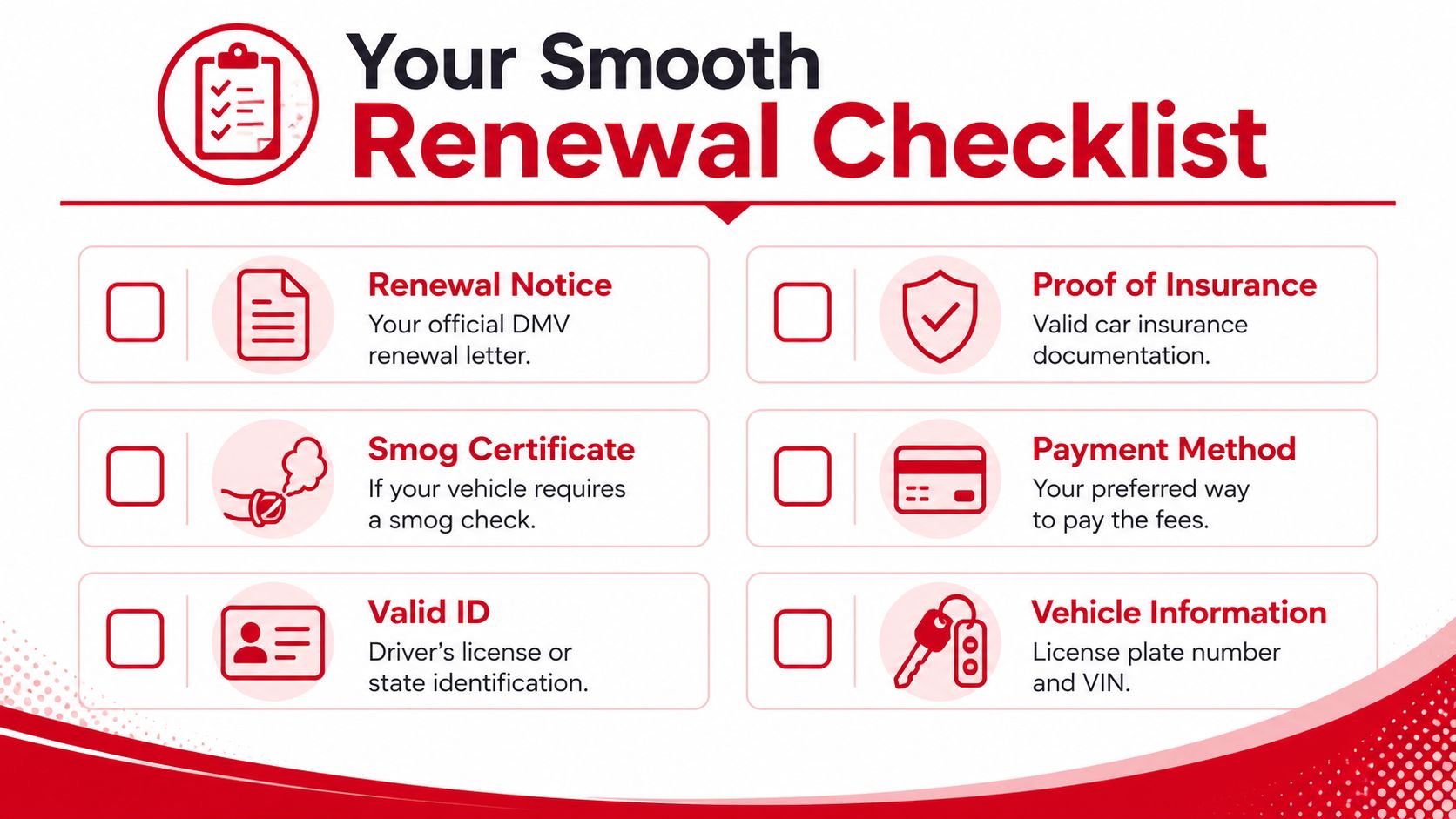
- Renewal notice: If you have it, bring it. It gives the quickest snapshot of what the state expects.
- Proof of insurance: Make sure it's current and easy to show.
- Smog certificate status: If your vehicle needs smog, handle that before the deadline whenever possible.
- Payment method: Bring the form of payment you plan to use.
- Valid identification: A driver's license or state ID can help resolve record questions.
- Vehicle details: Your plate number and VIN are useful if paperwork is missing or inconsistent.
Keep your registration documents in one dedicated folder at home. That habit saves more time than most people expect.
If you lost the renewal notice
Don't let a missing notice stop you. You can still renew, but you'll want your vehicle information, identification, and current insurance ready. The key is not to wait just because the paper is missing.
A few small habits make renewal easier every year:
- Check the date early: Put the expiration date in your phone calendar before the last week sneaks up on you.
- Confirm your address: If the DMV has an old address, notices can arrive late or not at all.
- Handle smog ahead of time: If your cycle may require it, don't leave it for the final day.
- Review who you're paying: Know whether the charge is an official state fee or an added third-party service fee.
- Save your completed paperwork: Keep the new registration card where you can find it next year.
California renewal doesn't have to feel like a puzzle. Once you know what drives the total, what can delay the process, and where extra fees can hide, the job gets much simpler.
If you want a local in-person option for California DMV renewals and smog-related needs, Fire House Smog in Antioch provides STAR-certified smog testing and licensed DMV registration services with on-site tag issuance during posted hours.
The renewal notice lands on the counter and the mood drops instantly. You see the DMV return address, think about smog, fees, website errors, and whether your sticker will show up on time. That reaction makes sense. California's system is big, layered, and not built for clarity.
It's also manageable once you stop treating it like one simple payment and start treating it like a short checklist with a few known traps. The big one is timing. The other big one is using the wrong website or trying to renew before the DMV has the right data on file.
California handles a huge volume of vehicle paperwork. The DMV says it manages over 36.19 million registered vehicles and processed over 15.05 million total vehicle registrations in its most recent full reporting year, according to the California DMV at a glance. That scale is exactly why you need a cleaner plan than “I'll just do it online later.”
Table of Contents
- That DMV Envelope Has Arrived What Now
- Your Pre-Renewal Checklist Get These Four Things Ready
- Decoding the Bill Understanding Your Registration Fees
- Choose Your Path Four Ways to Renew Your Registration
- Troubleshooting Common Registration Renewal Problems
- California Registration Renewal FAQ
That DMV Envelope Has Arrived What Now
Most drivers do the same thing first. They open the envelope, scan for the due date, look at the amount, and immediately wonder if there's some hidden catch. Usually there is, but it's not mysterious. It's one of a handful of routine issues: smog status, address mismatch, unpaid holds, or using a renewal path that sounds official but costs far more than it should.
The smart move is to slow down for five minutes before you pay anything. Read the notice. Check whether the vehicle is flagged for smog. Confirm the address the DMV has on file still matches where you receive mail. If any of those pieces are wrong, the renewal itself isn't the first task. Fixing the record is.
The Real Problem Usually Isnt The Payment
People assume California DMV registration renewal is hard because the DMV wants to make it hard. That's not really it. The process breaks when the system is missing one required data point. The payment part is easy. The record-matching part is where people get burned.
Practical rule: Don't submit payment first and troubleshoot later. In California DMV registration renewal, bad sequencing creates most of the headaches.
There's another reason people get tripped up. They treat every renewal option as interchangeable. They aren't. Online can be fast. Mail can be fine if nothing is urgent. A field office can solve stubborn problems, but it costs you time. A licensed partner can be the cleanest route when you need a smog check and renewal handled in one stop.
Your Goal Is A First-Try Approval
You don't need to know every DMV rule. You need to know which few rules block issuance of the sticker and registration card. That means going in with the right details, using the official path or a legitimate licensed provider, and avoiding last-minute guesses.
Handle the renewal like a transaction, not a chore. Gather what the system needs. Confirm what can stop it. Then choose the path that fits your situation instead of defaulting to whatever search result shows up first.
Your Pre-Renewal Checklist Get These Four Things Ready
If you want a smooth renewal, do the prep before you touch the payment page. That preparation often determines whether individuals save themselves a wasted trip or create one.
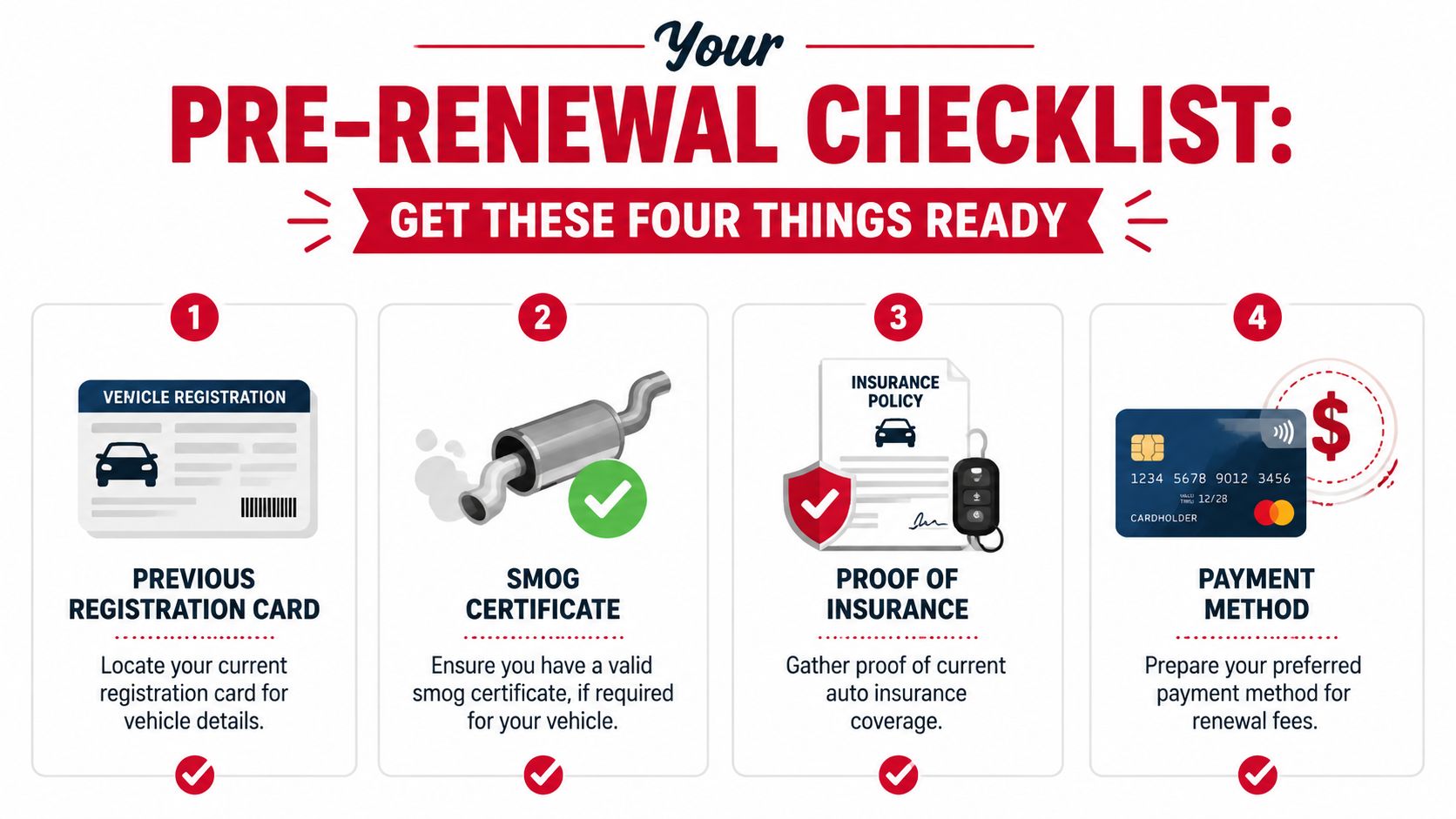
Start With The Notice And Your Vehicle Details
Pull out the renewal notice if you have it. If you don't, use your registration card and vehicle information. You want the plate number exactly as shown, with no added spaces, and you want the vehicle details to match what the DMV expects.
Keep these four items ready:
- Registration paperwork: Your current registration card or renewal notice gives you the vehicle identifiers the system expects.
- VIN access: Have the vehicle nearby if possible so you can confirm the VIN when needed.
- Insurance proof: Make sure your auto insurance is current and tied to the right vehicle.
- Payment method: Don't wait until the last screen to find your card or account information.
If you're handling smog first, use a STAR-certified smog test station near you so you're not guessing about whether the inspection path will satisfy DMV requirements.
Smog Is The Gatekeeper
When a vehicle requires smog, the DMV's system won't approve renewal unless it has a passing electronic record on file. The DMV notes that its renewal system rejects transactions when a required smog certificate isn't electronically available, and approximately 12% of online renewal failures are tied to this data lag, according to the California DMV smog inspections page.
That means the paper receipt from the smog station doesn't do the job by itself. The DMV system wants the electronic handoff.
If your car needs smog, assume the electronic transfer matters more than your payment confirmation.
Two more checks belong on your list before you renew:
- Address accuracy: If your mailing address is outdated, fix that first. Otherwise your registration can go to the wrong place.
- Outstanding holds: Parking tickets or similar holds can stop the renewal cold.
What To Verify Before You Click Pay
Use this short mental test:
- Do I have the right vehicle details?
- If smog is required, has the electronic result reached DMV?
- Is my address current?
- Is anything on the vehicle likely to block issuance?
Do those four things and the rest gets much easier. Skip them and you'll waste time blaming the website for a problem that started before you logged in.
Decoding the Bill Understanding Your Registration Fees
The fee notice confuses people because it looks like one charge when it's really a stack of charges. That's why two drivers with similar cars can end up with different totals.
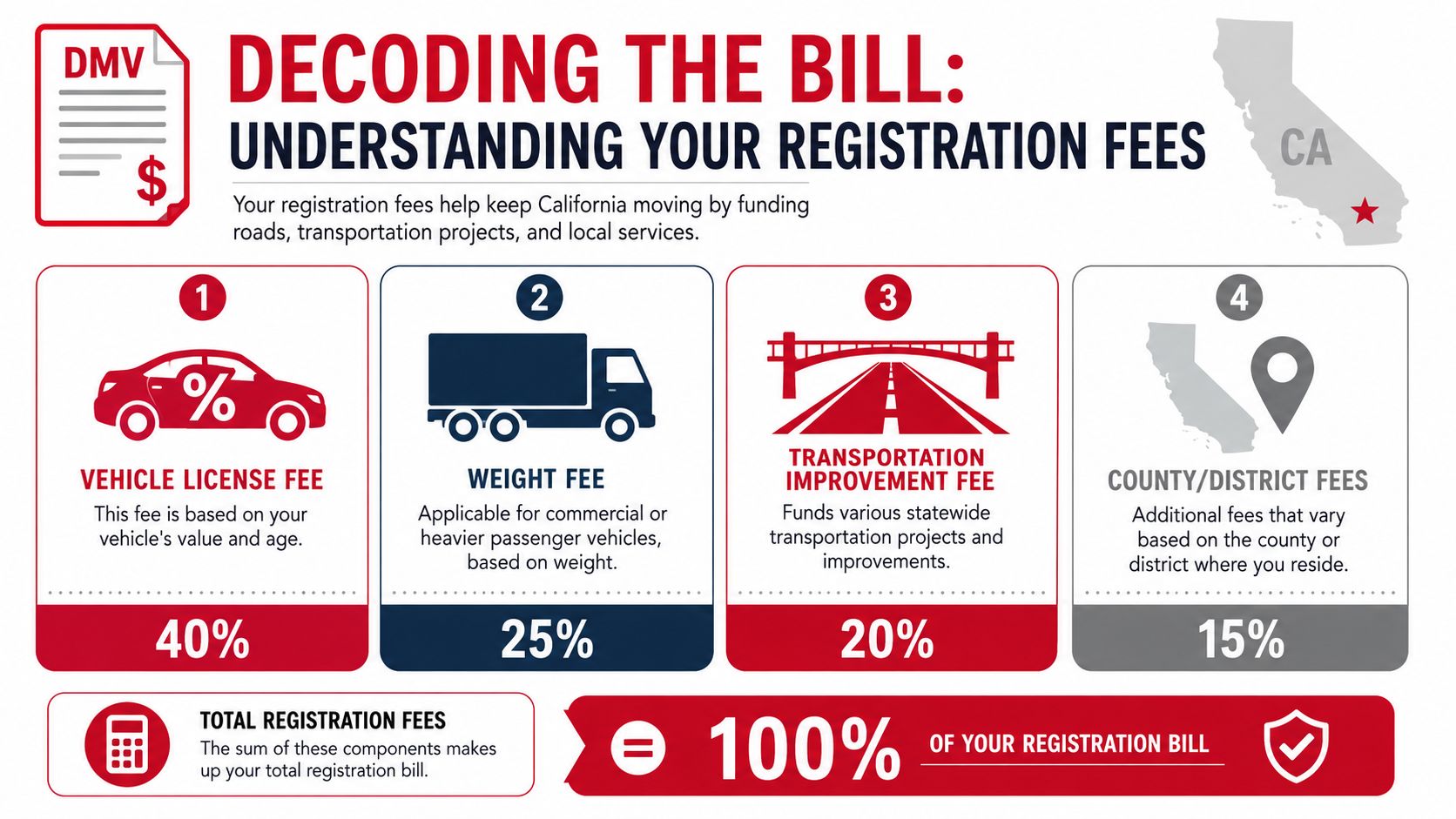
Why Your Total Never Looks Simple
California doesn't bill registration as a single flat renewal fee. The biggest factor for many passenger vehicles is the Vehicle License Fee, or VLF, which is tied to the vehicle's assessed value. The fixed renewal fee is only one piece of the total. Other charges can also apply depending on the vehicle and location.
Here's the important mindset shift. When your renewal feels high, don't ask, “Why is the DMV charging so much for registration?” Ask, “Which parts of this bill are fixed, and which parts change based on value or location?”
That question gets you to the answer faster.
A Real Example Of The Value-Based Fee
The DMV says the VLF is calculated at exactly 0.65% of the vehicle's current assessed value, and for a $40,000 vehicle that fee alone is $260, on top of the fixed base registration or renewal fee of $76, according to the California DMV registration fees page.
That one example explains most of the confusion people have. The renewal isn't just “the sticker fee.” A newer or higher-value vehicle can push the total up fast because the value-based piece moves with the car.
A short explainer helps:
| Fee Component | What it means |
|---|---|
| Base renewal fee | Fixed statewide starting point |
| Vehicle License Fee | Value-based charge tied to assessed vehicle value |
| Smog-related charges | Applies when required by vehicle status |
| Local or regional additions | Varies by where the vehicle is registered |
If you want a quick visual walkthrough before you stare at your notice again, this overview is useful:
Don't compare your total to your neighbor's and assume something is wrong. Compare the components.
Choose Your Path Four Ways to Renew Your Registration
People either save time or hand money to the wrong middleman. All four common renewal methods work. They just don't work equally well for every situation.
The Official Online Route
If your record is clean, online renewal through the official DMV portal is usually the first option to try. It's convenient, and you avoid a trip. But convenience only counts if the DMV already has the data it needs.
Online is a bad choice when you just changed your address, recently handled a smog issue, or suspect there's a hold attached to the vehicle. In those cases, the website often just becomes a rejection screen with no useful explanation.
Mail And Field Office Options
Mail works if you're early, your address is correct, and nothing about the vehicle is unusual. It's not a rescue tool. It's a routine tool.
A field office is the opposite. It's what you use when the record needs human intervention or you need a more direct answer. The trade-off is obvious. You spend time getting there, waiting, and handling it in person.
Here's the clean comparison.
| Method | Speed | Convenience | Get Sticker |
|---|---|---|---|
| Official DMV online | Fast when the record is clean | High | Not on the spot |
| Slower | Moderate | Not on the spot | |
| DMV field office | Variable | Low | Often handled in person |
| Licensed business partner | Fast for many common transactions | High | Often on the spot |
Licensed Partners And The Third-Party Fee Trap
This is the part a lot of drivers learn the hard way. Not every website that looks like DMV is the DMV. ABC7 reported that the DMV tells people to go directly to its website, while authorized third-party vendors can legally add fees that turn a simple $90 renewal into a $300+ expense, according to ABC7's report on California renewal fees and vendor markups.
That's why I tell people to stop trusting search results during urgent renewals.
Use this filter before you pay anywhere online:
- Check the site identity: If you intended to use DMV, make sure you are on the official DMV website.
- Read the fee screen carefully: If service charges feel inflated or vague, back out.
- Know the difference between licensed and lookalike: A licensed business partner is legitimate. A confusing search result with stacked service fees can still cost you far more than expected.
For drivers in East Contra Costa County, one practical option is smog check and DMV registration service in Antioch, where a licensed provider can handle common renewals and issue tags on site during service hours. That route makes the most sense when you want the transaction handled in person without going to a DMV office.
The best renewal method isn't the one with the fewest clicks. It's the one least likely to fail for your exact record.
My blunt advice is simple. Use the official DMV website for clean, straightforward renewals. Use mail only when time isn't tight. Use a field office for messy records. Use a licensed partner when you want in-person handling without the DMV-office experience. And never pay a suspicious markup because a search ad got to you first.
Troubleshooting Common Registration Renewal Problems
Most renewal problems aren't complicated. They just feel complicated because the DMV system gives blunt error messages and very little context.
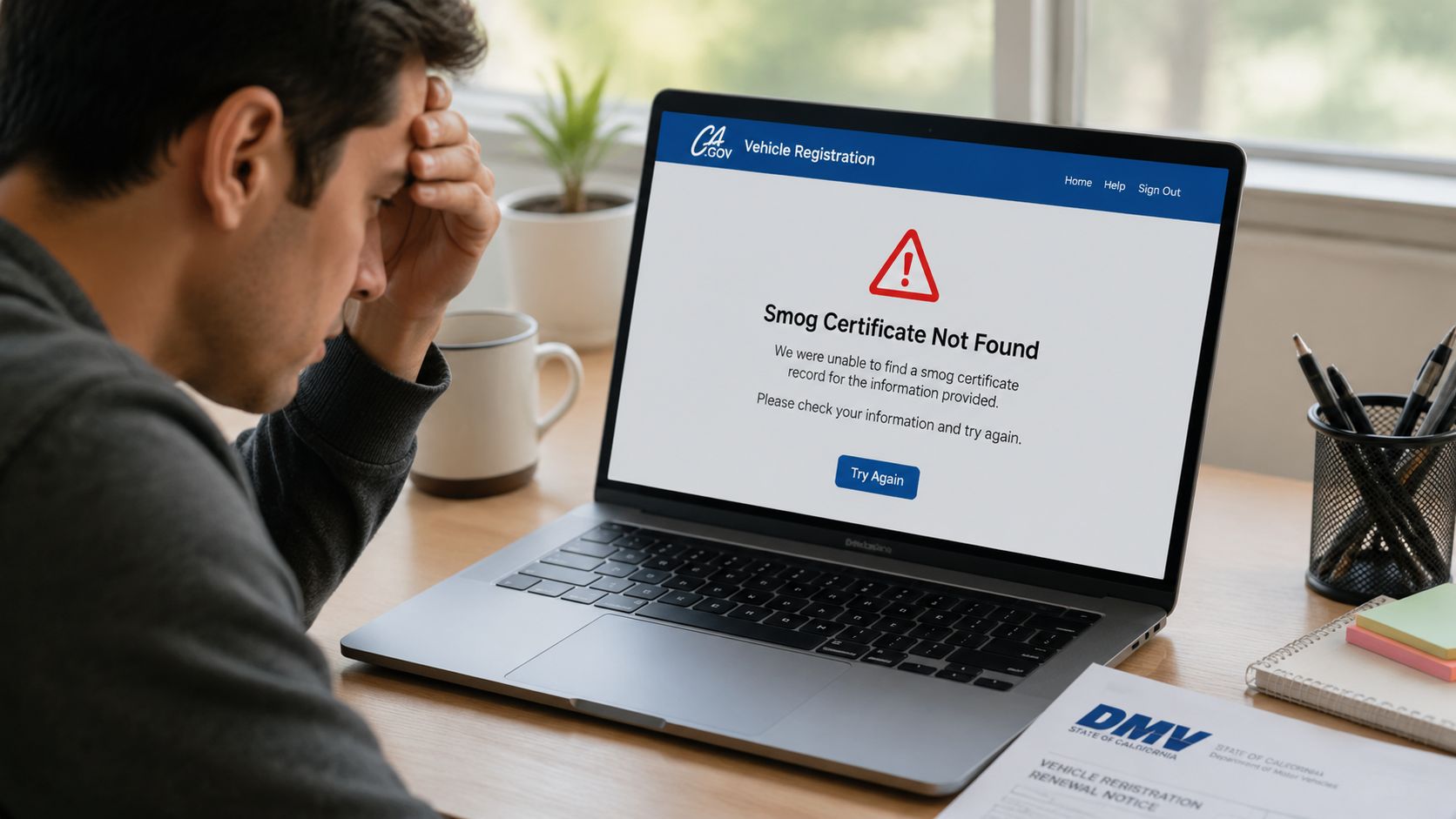
When The Smog Record Hasnt Landed Yet
You pass smog, go online, try to renew, and the system still acts like you never did the inspection. That happens. Independent reporting notes that smog certificate transfer is often quick, but processing delays can extend up to 3 business days before the DMV system updates, according to Reviver's overview of California smog check requirements.
Don't keep submitting the same renewal attempt over and over. That doesn't fix a missing electronic record.
Do this instead:
- Wait before retrying: If the smog was just completed or you just passed a retest, give the system time to update.
- Confirm the vehicle identifiers: A mismatch in plate or VIN details can create a false dead end.
- Use a real person when needed: If the record still won't clear, in-person help is often faster than guessing.
When Youre Missing Information Or Hit A Hard Stop
Another common issue is not having the vehicle details the system wants. That becomes a bigger problem when the notice is missing or the VIN information isn't easy to verify. If your record has identity or documentation issues tied to the vehicle, VIN verification help can be the right next step before you keep pushing the renewal itself.
If you hit a stop screen, don't panic. Work backwards.
- Check whether the vehicle needs smog and whether the record has updated.
- Make sure your identifying information matches exactly.
- Look for anything tied to the vehicle that could block issuance.
- Switch renewal methods if the system clearly needs human review.
A rejected online renewal doesn't always mean your registration is impossible. It usually means one required record hasn't lined up yet.
The worst move is doing nothing because the error message was vague. California DMV registration renewal is usually recoverable once you identify which record is blocking the sticker.
California Registration Renewal FAQ
What If My Car Fails Smog
You can't complete renewal until the smog requirement is satisfied when your vehicle is subject to inspection. Fix the underlying emissions issue, complete the required retest, and wait for the passing result to make it through the DMV system before trying again. If timing is tight, don't rely on same-minute online renewal after the retest.
Can I Renew While Im Out Of State
Yes, many drivers handle California DMV registration renewal remotely if the record is otherwise clean. The catch is practical, not theoretical. If the vehicle needs smog or the mailing address is wrong, distance makes the process slower and more fragile. Get your documents and address squared away before you submit anything.
Do Newer Cars Need Smog Right Away
Not always. California has exemptions for some vehicles, including certain newer vehicles and categories such as electric vehicles, motorcycles, trailers, and vehicles manufactured before 1975, under the state's smog rules. Don't assume your car is exempt just because it's newer. Check what your notice says.
How Fast Do I Get My Sticker And Registration
That depends on the method. Online and mail are convenient, but they depend on processing and delivery. In-person service, whether at a DMV location or a licensed provider that can issue tags on site, is the better choice when you want the sticker in hand rather than waiting on the mail.
If you lost the renewal notice, you can still usually move forward as long as you have the correct vehicle details. The notice helps, but it isn't the only path.
The short version is this: if your record is simple, keep it simple. If anything looks off, stop forcing the online route and switch to a method that can resolve the issue directly.
If you want to avoid DMV-office lines and handle your renewal in person, Fire House Smog in Antioch offers STAR-certified smog testing and licensed DMV registration services, including on-site tag issuance during posted service hours. It's a practical option when you need the smog check and registration side handled in one stop.