
A California vehicle ownership transfer typically requires a smog certificate, a signed title, and payment of transfer fees, and one missing or incomplete document can stall the application. In Texas, 6,432,879 vehicle titles were processed in fiscal year 2018, showing how often ownership changes depend on accurate paperwork rather than a simple exchange of keys.
You may be standing beside a newly purchased car with the payment complete, the keys in hand, and a title that looks almost finished. Then someone notices the seller missed a signature, the lien release isn't attached, or the smog requirement hasn't been satisfied. The sale feels complete, but the legal transfer isn't.
California treats smog compliance and DMV paperwork as connected parts of the same ownership chain. A vehicle can pass the emissions inspection and still be rejected because the title is incomplete. It can also have a properly signed title but remain stalled because the required smog documentation is missing or the vehicle doesn't meet emissions requirements.
That distinction matters because the fastest transfer is not always the one with the fewest steps. It's the one where each dependency is checked before the packet reaches the DMV. The following process reflects what tends to work in practice for California buyers and sellers, including people transferring vehicles from another state.
Table of Contents
- Navigating the California Transfer Process
- Essential Documents for a Successful Transfer
- Why Professional Smog and DMV Services Matter
- Common Errors That Delay Your Transfer
- Your Complete Transfer Timeline and Tips
- Frequently Asked Questions About Transfers
Navigating the California Transfer Process
A buyer and seller can agree on a price in minutes, but the ownership record changes only after the required chain of documents, signatures, fees, and compliance steps is complete. California DMV guidance identifies the Certificate of Title, required signatures, transfer fees, odometer information, and supporting forms as central parts of the process. The California DMV title transfer guidance also explains what to do when the original title is missing or a lien affects the record.
Follow the document chain
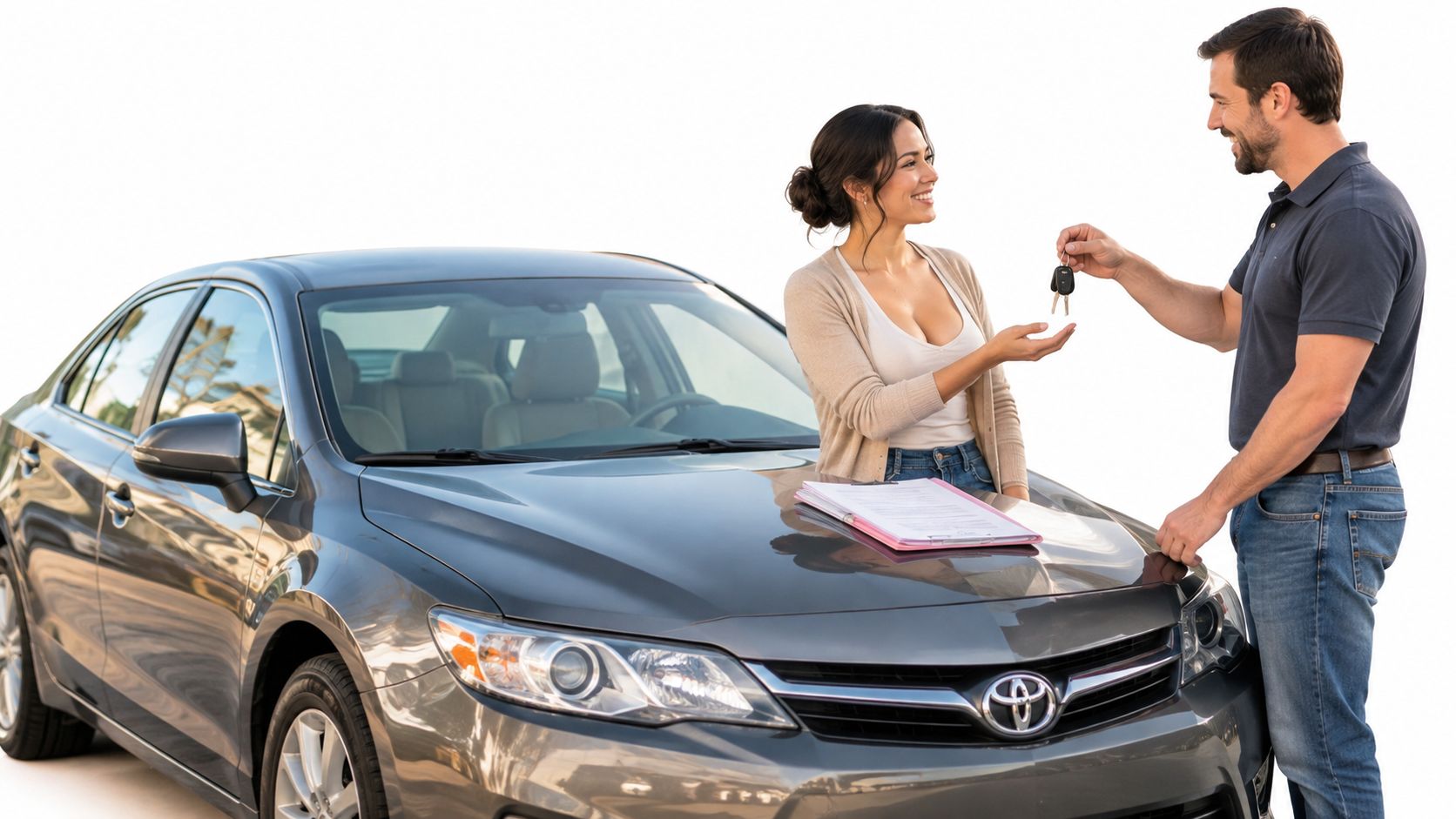
Start by identifying the vehicle and confirming that the seller's name on the title matches the seller's identification. Next, check whether a lien is listed and verify that the lienholder has released its interest. The seller and buyer then complete the title, including the odometer disclosure when required, and prepare any supporting forms for the specific situation.
The smog step belongs in this preparation, not as an afterthought. If the vehicle requires a smog certificate, arrange the inspection before finalizing the DMV packet. A failed or incomplete emissions record can hold up the transfer even when every signature is correct, while a successful test doesn't correct a missing lien release or an incorrectly completed title.
Practical rule: Treat the smog certificate, title, identity documents, and fee payment as one packet. If one part is unresolved, the transfer is not ready.
The final stage is submission to the DMV or an authorized registration provider. Once the transfer is accepted, the registration record and title can be updated according to the agency's process. For an out-of-state vehicle, expect additional verification and documentation rather than assuming a California title transfer follows the same path as an in-state vehicle.
California's process is therefore best understood as a sequence: establish ownership, confirm emissions compliance, complete the title and disclosures, resolve liens, submit the forms and fees, and retain proof of submission. Skipping ahead creates the delays that buyers often mistake for a DMV processing problem.
Essential Documents for a Successful Transfer
A clean transfer begins with document control. California DMV requirements can change depending on whether the title is available, a lien exists, the vehicle comes from another state, or an ownership detail needs correction. The core packet should be assembled before either party signs, because a signature on the wrong line can be harder to correct than a missing form.
Build the packet before signing
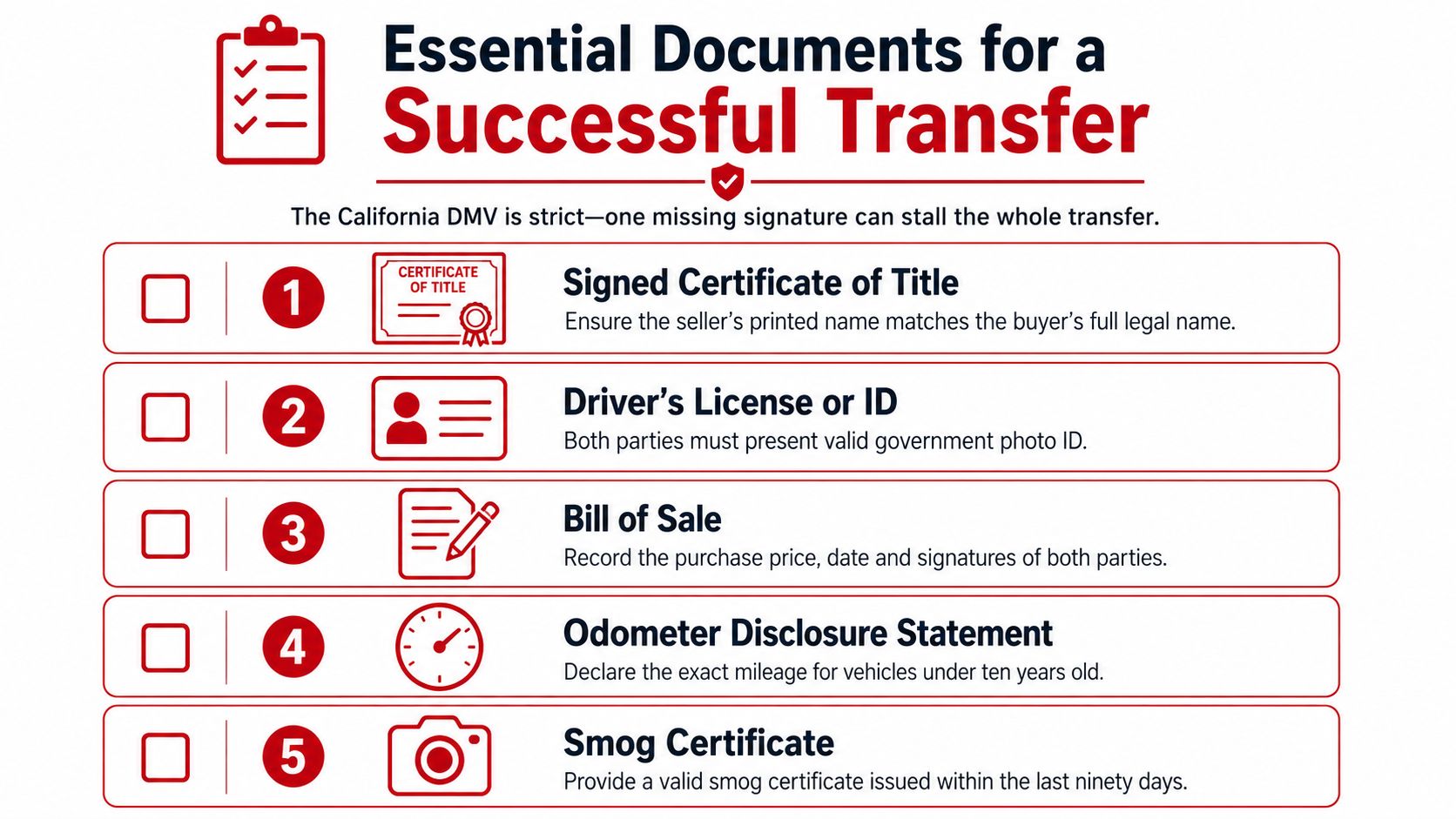
Certificate of Title: Use the original title when available. The seller must sign in the correct assignment area, and the buyer's legal name and address must be entered accurately. Don't use cross-outs or correction fluid. If the title is lost, the transfer may need to begin with a replacement-or-transfer application.
Identification: Both parties should have valid government-issued identification available. The names used on the title and forms need to correspond with the identifying documents. A casual abbreviation or an old address can trigger a correction request.
Bill of sale: Keep a written record showing the parties, vehicle details, transaction date, purchase price, and signatures. It supports the transaction record and gives both sides evidence of what they agreed to exchange.
Odometer disclosure: Record the mileage exactly as required, using complete numeric information rather than an estimate. An incomplete or inconsistent disclosure is one of the most common reasons a title packet comes back for correction.
Smog certificate: Provide the required California emissions documentation for the vehicle and transaction. The smog result is not a substitute for a title, and a signed title doesn't substitute for emissions compliance.
Resolve liens before submission
A lien is an ownership issue, not merely a financing detail. If a lender still appears on the title, the seller needs documentation showing that the obligation was satisfied or the lienholder must participate in the transfer. Buyers should inspect this before paying, because an unresolved lien can prevent the DMV from recording the new owner.
Supporting paperwork may include REG 227, REG 262, REG 256, REG 166, and the Notice of Transfer and Release of Liability, depending on the circumstances. Don't add forms randomly. Use the form that matches the missing title, odometer disclosure, lien, exemption, or liability situation, and confirm the current requirement before submission.
A useful California title transfer paperwork checklist can help you compare the documents you have with the documents your transaction requires. The purpose isn't to create a thicker file. It's to submit a complete, internally consistent file the first time.
Why Professional Smog and DMV Services Matter
The DIY route can work when the title is clean, the vehicle passes its emissions inspection, both parties are available, and the buyer understands which forms apply. Its weakness is fragmentation. The owner may visit one location for smog testing, another for DMV work, and then discover that a missing signature or lien document requires a return trip.
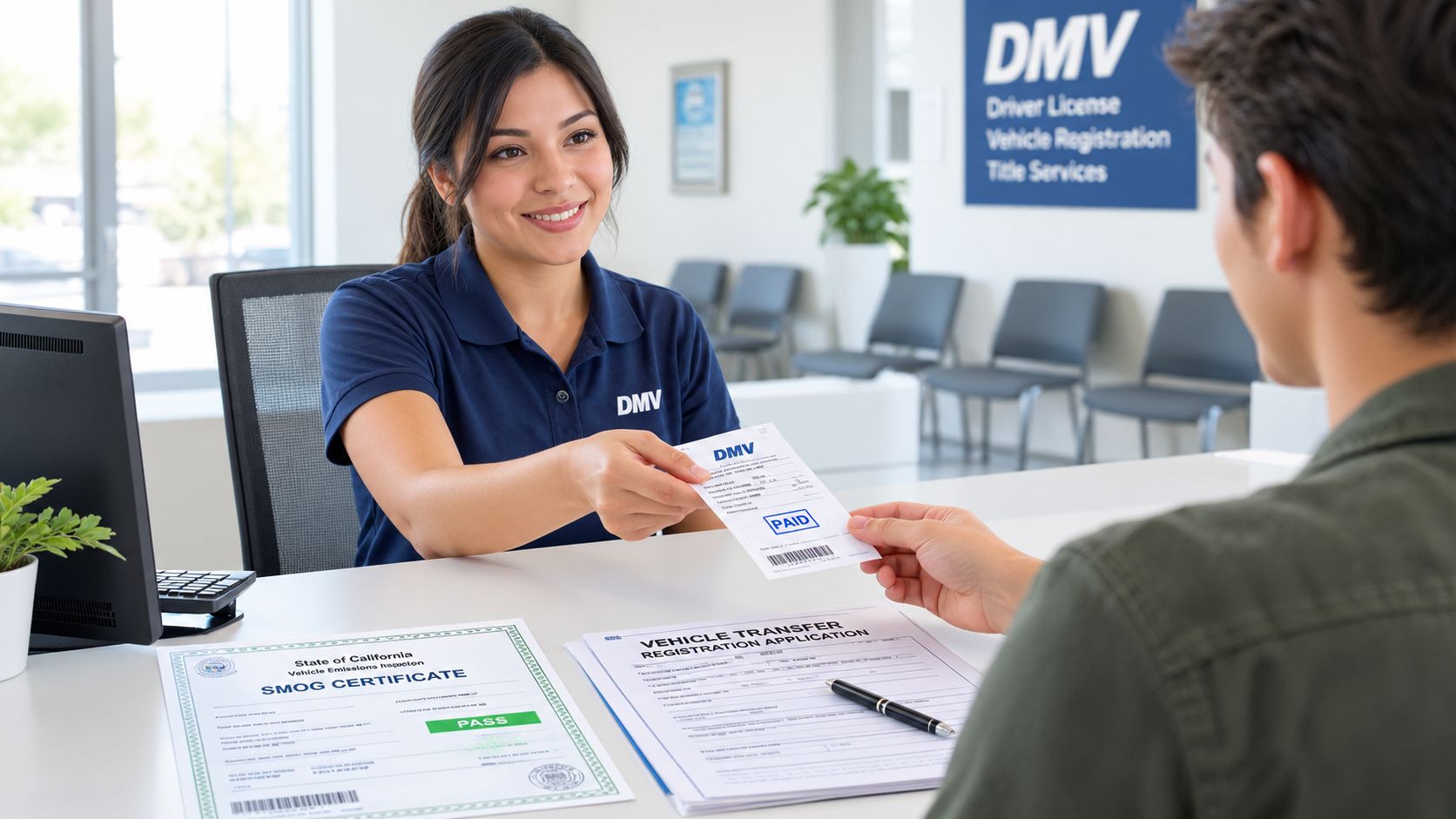
A combined service changes the handoff between compliance and registration. A provider can identify whether the emissions step is complete before accepting the transfer packet, then check whether the title and supporting forms are ready for processing. That doesn't guarantee approval when a lender, out-of-state record, or ownership dispute requires separate action, but it reduces avoidable gaps between steps.
Compare the two routes
| DIY handling | Integrated service |
|---|---|
| You coordinate the smog inspection and DMV submission separately. | The emissions and registration steps can be reviewed as one workflow. |
| You remain responsible for spotting missing signatures, lien documents, and forms. | Staff can help identify apparent paperwork gaps before submission. |
| Registration materials may require a later pickup or mailing step. | An authorized provider may offer on-site registration services and tag printing. |
| A failed smog result becomes a separate problem to diagnose. | The test result can be discussed before the transfer packet is finalized. |
The trade-off is control versus convenience. DIY processing may suit someone who is comfortable reading DMV instructions and correcting paperwork. A licensed partner is more useful when the vehicle is out of state, the title has a lien history, the buyer and seller have limited availability, or a failed smog test has created uncertainty.
Fire House Smog operates as a STAR-certified test-only station and licensed DMV registration partner at 2900 Lone Tree Way in Antioch. It offers on-site California DMV renewals with sticker printing, ownership transfers for California and out-of-state vehicles, and two service bays designed to reduce wait times during posted hours.
Because it is test-only, repairs aren't sold as part of the inspection. If the vehicle fails, the next decision is repair and retest, not an automatic repair purchase at the testing location. The California smog check and registration service is therefore most useful when you want the emissions result and registration paperwork evaluated within the same local workflow.
A professional service can't replace a lender's release or a seller's missing signature. It can help you discover those problems before you build your schedule around an incomplete transfer.
Common Errors That Delay Your Transfer
The most frustrating delays often begin with a document that looks finished. A seller signs the title, but not in the assigned seller field. A buyer writes a shortened name that doesn't match the identification record. Someone copies the VIN from memory instead of reading it directly from the title or vehicle.
Consider a typical failed handoff. The buyer and seller complete the sale, but the title contains one wrong VIN character and the odometer section is incomplete. The DMV can't confidently connect the document to the vehicle or accept the disclosure, so the packet returns for correction. The buyer must locate the seller again, correct the title properly, and resubmit.
Check the points most likely to stop the file
Seller signatures: Compare the title's signature lines with the printed ownership name. A missing or misplaced signature can stop the transfer even when the buyer has paid and taken possession.
Odometer disclosure: Enter the exact mileage in the required format. Don't guess, round, overwrite, or leave a field blank because the vehicle's condition seems obvious.
Lien release: Look for the lienholder information before the transaction closes. A paid loan doesn't automatically mean the title record is already clear.
Names and addresses: Use the legal names and current addresses required for the record. Small inconsistencies can generate a correction request.
VIN: Match the VIN on the title, vehicle, forms, and supporting documents character by character. A VIN discrepancy deserves investigation before submission, not an assumption that the DMV will fix it.
Independent title-transfer guidance identifies missing signatures, odometer problems, unreleased liens, name and address errors, and VIN mismatches as recurring rejection triggers. The title transfer error guide also warns about open titles and title jumping, practices that can leave the record without a valid documented chain of ownership.
Title jumping is especially risky because it attempts to pass a vehicle through an intermediary without recording the intermediary's ownership properly. The result can be a legal and registration dead end rather than a shortcut.
Smog creates another version of the same problem. A vehicle may fail because of emissions-related conditions, or the certificate may be absent when the transfer requires it. Use the common smog check failure reasons to understand what needs attention before treating a failed result as a paperwork issue.
Your Complete Transfer Timeline and Tips
A transfer moves fastest when the owner treats it as a controlled sequence rather than a collection of errands. The first task is not signing the title. It's confirming that the vehicle, seller, lien status, smog requirement, and supporting documents can all be reconciled.
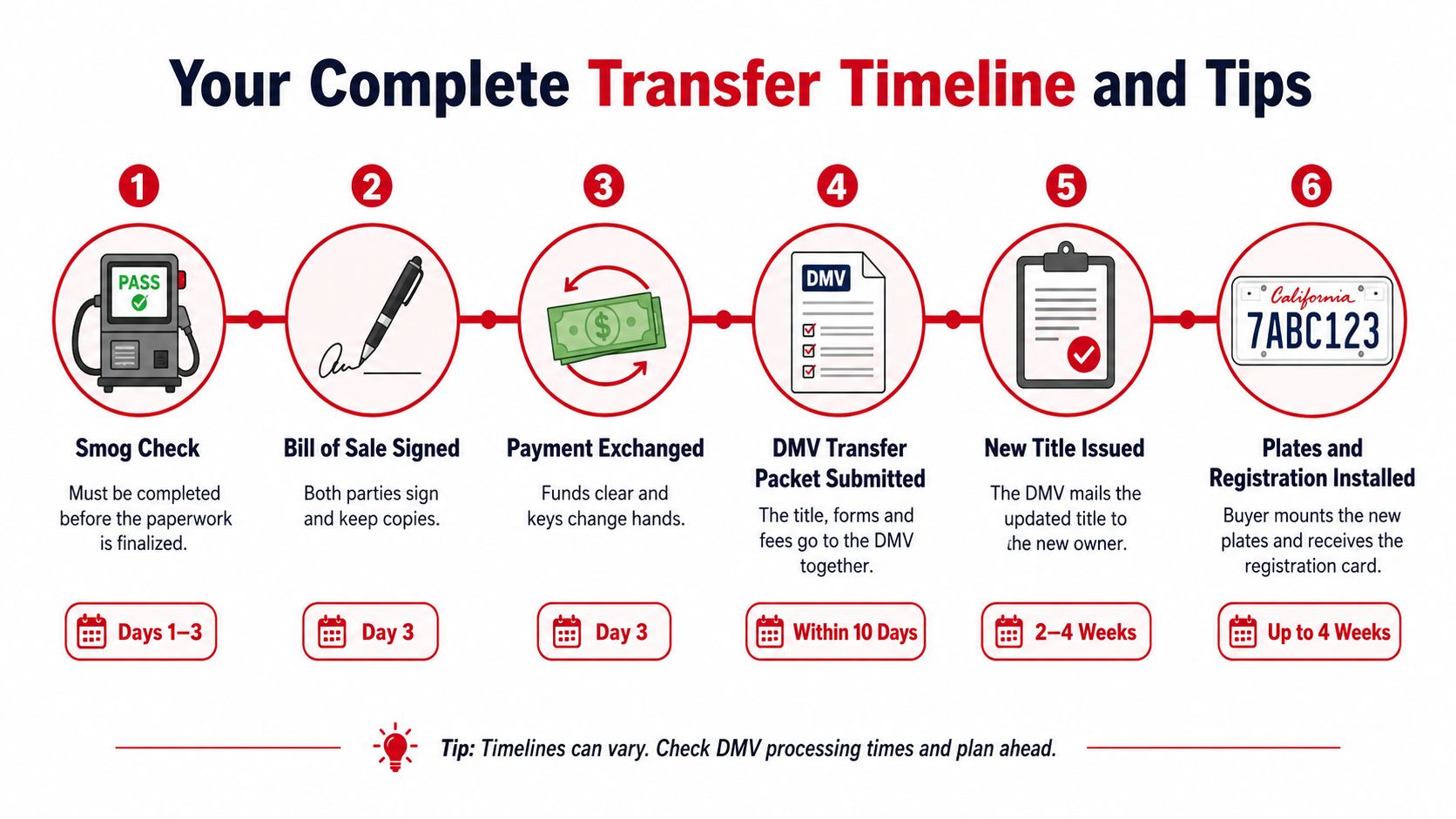
Use a single working sequence
First, inspect the compliance position. Arrange the required smog check and keep the result with the transfer documents. If the vehicle fails, identify the repair and retest path before either party assumes the transfer can be completed.
Second, verify the ownership record. Read the title directly. Confirm the seller's name, VIN, lienholder information, odometer section, and assignment areas. Ask for lien-release documentation before money changes hands if a lender appears on the record.
Third, complete the transaction record. Prepare the bill of sale, sign the title in the correct places, complete the required odometer disclosure, and make copies for both parties. The seller should also complete the appropriate notice of transfer and release of liability.
Fourth, audit the packet. Compare names, addresses, VIN characters, dates, signatures, and mileage across every document. This step is where many avoidable errors can be caught while the seller is still available.
Fifth, submit the transfer. Send the title, required forms, supporting documents, and fees together through the DMV or an authorized registration provider. Keep the receipt or other proof that the packet was accepted.
Finally, monitor the record and registration materials. A new title may be mailed after processing, and plate or registration delivery can depend on the transaction and vehicle history. Don't discard the old paperwork until the new record is confirmed.
An EU analysis illustrates why ownership transfers are operational workflows rather than instant handovers. It estimated about 40 million vehicle ownership transfers per year across the European Union, with around 3.5 million crossing between Member States, or roughly 8% of the total. The same analysis estimated about one week for deregistration, four weeks for re-registration in another Member State, and approximately five weeks for the full cross-border transfer process. These figures are not California processing promises, but they show why cross-border records require more coordination than a local sale. See the European Parliament analysis of vehicle ownership transfers for that broader context.
Reduce return trips
Call ahead when the vehicle is unusual, comes from another state, has a lien history, or may exceed a testing station's equipment limits. Bring the original documents, government identification, payment method, and clear copies, and ask whether the provider can handle the particular ownership scenario before you drive over.
Use a provider that can address both sides of the chain when timing matters. Completing the smog inspection and submitting the DMV packet during the same visit can remove a handoff, but it won't overcome a missing title or unresolved lender interest. The practical goal is not to rush an incomplete file. It's to discover the incomplete part early.
Frequently Asked Questions About Transfers
Does an out-of-state vehicle follow the same process?
Not always. An out-of-state vehicle may require additional verification and records before California can issue the new registration. Bring the out-of-state title, identification, transaction documents, and any available lien information, and confirm the applicable requirements before submission.
What happens if the vehicle fails the smog check?
A failed test means the emissions issue must be addressed before the transfer can proceed where a passing certificate is required. Ask about repair documentation and retest eligibility. Fire House Smog's site policy and coupon terms provide for a free retest when applicable, so confirm the conditions before returning.
What if a lender still appears on the title?
Don't assume the paid loan has already cleared the record. Obtain the lien release or coordinate with the lienholder, then include the correct documentation with the transfer packet. An unresolved lien can prevent the new owner from being recorded.
How can I avoid another DMV trip?
Check the title against the seller's identification, verify the VIN on the vehicle, complete the odometer disclosure, confirm the lien status, arrange the smog inspection, and bring every required form and fee together. If any item is uncertain, resolve it before the appointment rather than submitting a packet that you already suspect is incomplete.
For a connected vehicle ownership transfer service in Antioch, Fire House Smog can perform STAR-certified smog testing and process California or out-of-state ownership transfers through its licensed DMV registration service. Visit Fire House Smog with your title and vehicle documents so the emissions and registration steps can be reviewed together.