You're probably here because one of three things happened. Your DMV renewal notice says you need a smog check, you typed car emissions testing near me because your registration deadline is getting close, or you just bought, sold, or moved a vehicle and want to avoid surprises.
That stress is normal. Most first-time drivers don't know what the test includes, what can make a car fail, or whether they need a regular station or a STAR station. The good news is that the process is much simpler when you know what the state is checking and how to prepare before you pull in.
Table of Contents
- Understanding California's Smog Check Program
- How to Prepare for Your Emissions Test
- Your Step-by-Step Guide to the Smog Test
- Why Cars Fail Smog Tests and How to Avoid It
- What Happens After Your Smog Test Results
- Fire House Smog Your All-in-One Smog and DMV Solution
- Your Smog Check Questions Answered
Understanding California's Smog Check Program
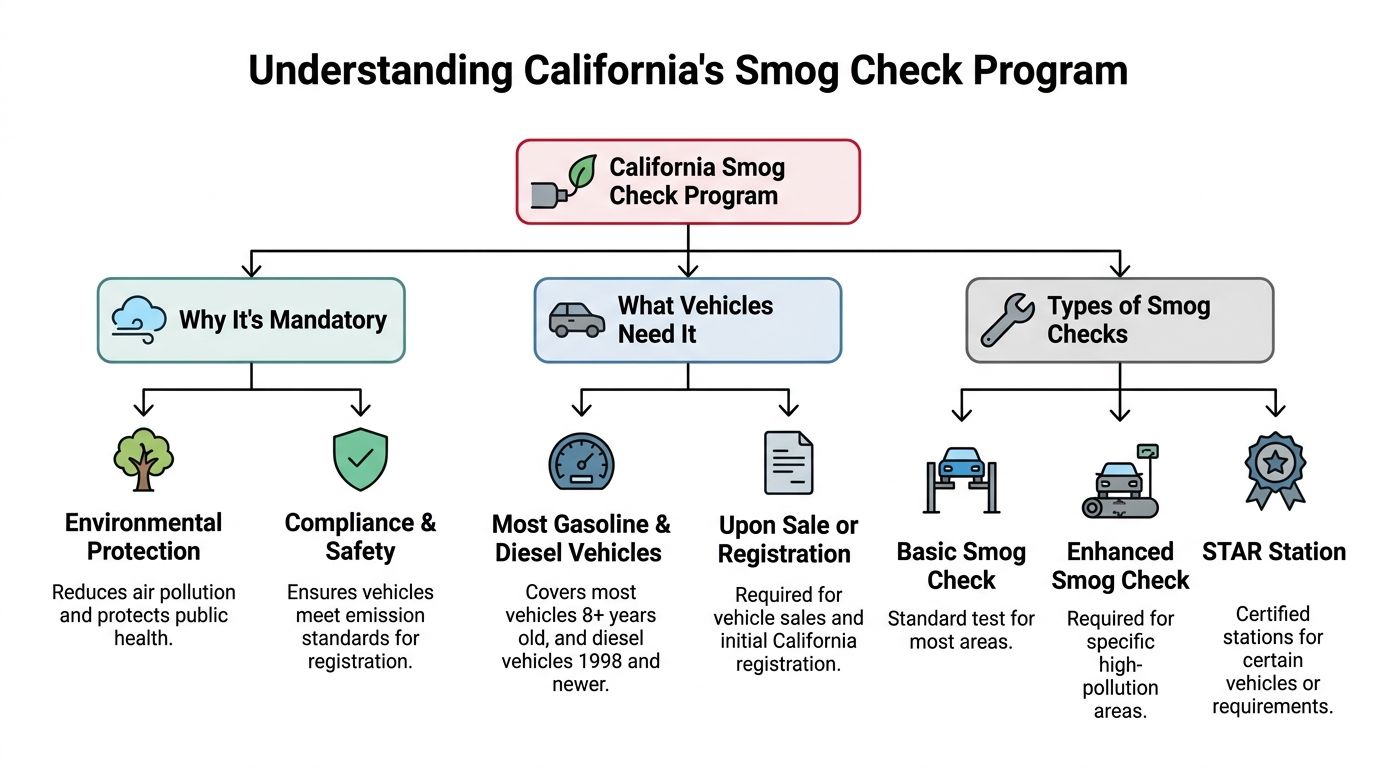
California's smog program exists for a practical reason. The state requires emissions testing for many vehicles so cars on the road stay within emissions standards tied to registration and air quality rules. According to the California Smog Check Program overview, gasoline-powered, hybrid, and alternative-fuel vehicles made in 1976 or later generally need testing every two years, while vehicles that are eight model years old or newer are exempt from testing during that early period and pay a smog abatement fee instead.
For drivers in Antioch, that matters because Contra Costa County is part of the kind of area where smog compliance is part of normal vehicle ownership. The same source notes that STAR-certified stations are used in high-pollution areas and that the program removes about 400 tons of smog-forming pollutants from California's air every day.
Why California requires smog checks
Think of a smog check as a compliance and maintenance checkpoint, not a punishment. The state wants to catch vehicles that are releasing more pollution than they should, especially as parts age, sensors drift, or emissions equipment stops working correctly.
Practical rule: If your registration renewal notice asks for smog, treat it like a required step for registration, not an optional tune-up suggestion.
California also separates out certain vehicles. Electric vehicles, motorcycles, trailers, and gasoline-powered vehicles from 1975 or earlier are generally excluded from the testing requirement, though owners still need to keep emissions systems intact under state rules noted in that same program overview.
Which vehicles usually need testing
Most Antioch drivers can sort themselves into one of these buckets:
- Newer gasoline vehicles: If your car is within its first eight model years, you'll typically pay the abatement fee instead of taking a biennial test.
- Older gasoline vehicles: Once the vehicle ages out of that early exemption, biennial testing usually applies.
- Hybrid vehicles: Hybrids are part of the required list under current California rules.
- Diesel vehicles: Some diesel vehicles also require testing under California's program rules.
If you're searching for local help, start with a STAR-certified smog check in Antioch so you don't waste time at the wrong kind of station.
How to Prepare for Your Emissions Test
A little prep can save you from the most frustrating kind of failure, the one caused by something simple. Most drivers don't need to be mechanics. You just need to arrive with a car that's ready to be read properly and a few basics handled before check-in.
The easy checks to do before you leave home
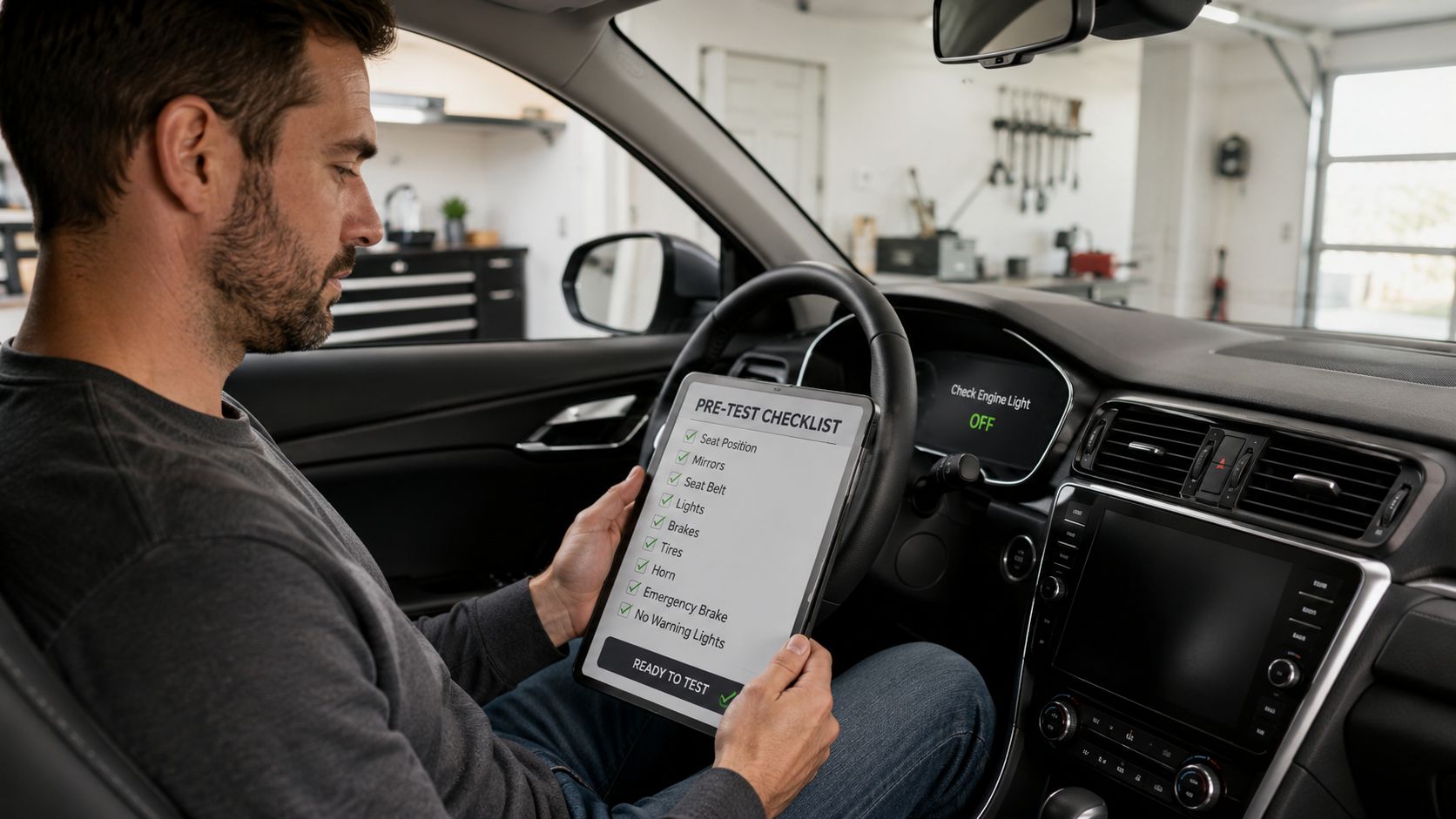
Start with the dashboard. If your Check Engine light is on, don't ignore it and hope for the best. That light often points to the exact kind of issue that can stop an emissions inspection from passing.
Then think about recent work on the car. If the battery was disconnected, replaced, or the car recently had certain repairs, the onboard computer may not be ready yet. That becomes important during modern emissions testing.
A short prep list helps:
- Drive the car first: Don't bring it in cold if you can avoid it. A normal drive helps the car reach regular operating condition.
- Check the gas cap: Make sure it's there and tightened properly. A loose or damaged cap can create trouble.
- Look for warning lights: If the dash is lit up, get that diagnosed before testing.
- Avoid last-minute battery disconnects: Resetting the car's memory right before a test can create readiness problems.
A smog test goes smoother when the car has been driven normally and nothing has recently reset the vehicle computer.
What to bring and what to avoid
Bring the paperwork that helps the visit move quickly. Your renewal notice is helpful if you have it. Current registration details are useful too, especially if you're trying to complete your DMV requirement without guesswork.
Later in your prep, it helps to see the process in motion:
A few things drivers should avoid before they head out:
- Don't clear codes right before the test: That can wipe out readiness information the inspector needs.
- Don't assume a recent repair means the car is instantly ready: The repair may be fine, but the system may still need normal driving to complete self-checks.
- Don't wait until the final day if you can help it: If something small needs attention, extra time lowers the pressure.
Your Step-by-Step Guide to the Smog Test
Many drivers feel more comfortable knowing what the appointment entails. The process is straightforward. You arrive, check in, the technician confirms what kind of test your vehicle needs, and then the inspection starts.
What check-in looks like
When you pull in, the first few minutes are usually simple. A technician or staff member gets your basic vehicle information, confirms the service needed, and lines the car up for the inspection bay. At a busy shop, two service bays can make a real difference because they help keep cars moving instead of stacking everyone into one long line.
For a first-timer, this is the part that feels more routine than dramatic. You're not negotiating a repair estimate. You're confirming identity, vehicle details, and the type of compliance check required.
What happens during the inspection
A California smog inspection typically includes a few separate checks rather than one single “machine test.” For many drivers, the technician is looking at three broad areas.
First is the visual inspection. The technician checks whether required emissions components appear to be present and properly installed.
Second is the functional side. On many newer vehicles, that includes connecting to the vehicle computer through the OBDII system. The California smog testing overview by year notes that vehicles model year 2000 and newer include an OBDII inspection as part of the test, which reads the vehicle's computerized diagnostics data.
Third is the emissions compliance measurement that applies based on the vehicle and test type. The technician verifies whether the vehicle meets the state requirement for that inspection cycle.
Most drivers are surprised by how ordinary the visit feels. The test is usually more about verification than mystery.
When the inspection is finished, you get the result and the next step becomes clear right away.
Why Cars Fail Smog Tests and How to Avoid It
Failure usually comes from a short list of problems. Some are true emissions faults. Others are preventable readiness issues that catch drivers off guard because the car seems to run fine.
The failure points drivers run into most often
Here are the trouble spots I'd tell any first-time driver to think about before searching for Car emissions testing near me and heading out.
| Issue | What It Is | Simple Check |
|---|---|---|
| Check Engine light | The car's computer has detected a fault that affects monitored systems | Look at the dash before you leave |
| Loose or faulty gas cap | The fuel vapor system may not seal correctly | Tighten the cap and inspect for wear |
| Incomplete OBD readiness | The onboard system hasn't finished its self-checks | Avoid recent battery resets and drive normally first |
| Emissions component problem | Parts like sensors or converters may not be working correctly | If the car runs rough or has warning lights, get it diagnosed |
| Modified or missing equipment | Required emissions parts may be altered or absent | Make sure factory-style emissions equipment is still in place |
A lot of people assume a smog failure means the engine is about to die. That's often not true. Some failures come from items that don't feel dramatic while driving, like a leak in the evaporative system, a sensor issue, or computer monitors that haven't reset.
The common smog check fail reasons guide is worth reviewing if you want a local breakdown of what inspectors commonly see.
The OBD monitor issue that catches people off guard
This is one of the most misunderstood parts of modern testing. If a battery was disconnected, replaced, or certain repairs were done recently, the car's computer may erase readiness information. The vehicle might drive normally, idle fine, and still not be ready for inspection.
According to the Connecticut vehicle testing explanation of OBD readiness, a week of combined highway and city driving is often needed to reset OBD monitors after a battery disconnect or repair. That plain-language advice is useful far beyond Connecticut because the basic driver mistake is the same everywhere. People clear codes, swap a battery, or finish a repair and head directly to a smog station before the system has completed its checks.
If you recently disconnected the battery, don't assume the car is ready just because the warning light is off.
That's why a vehicle can “feel fixed” but still fail on inspection day. The solution is often patience and normal driving, not panic.
What Happens After Your Smog Test Results
Once the inspection ends, you're on one of two paths. Both are manageable.
If your car passes
If the vehicle passes, the biggest relief is that you're usually done with the emissions requirement for that cycle. The result is typically transmitted electronically, which helps complete the registration side without making you chase paper proof from office to office.
If you also need help with your registration steps, a local California DMV registration renewal service can save you from dealing with a separate trip and more waiting.
For most drivers, a pass means the test fades into the background quickly. You handle the paperwork, finish renewal, and move on.
If your car doesn't pass
A failed result feels personal, but it usually isn't. It means the car didn't meet one part of the requirement on that visit. The next step is figuring out whether the problem is a readiness issue, a simple repair item, or a larger emissions-related fault.
The important thing is trust. A test-only station doesn't profit by turning your failed inspection into an in-house repair order. That separation matters because it keeps the testing result independent from repair sales pressure.
If your vehicle needs work, get the issue diagnosed and repaired by the shop you choose. Then return for the retest under the station's policy and coupon terms if that applies. That setup makes the process feel a lot less like a dead end.
- Keep your report: It helps the repair shop understand what needs attention.
- Ask what kind of failure it was: Readiness and component failures are not the same thing.
- Don't rush back too early: If the issue involved monitor readiness, the car may need more normal driving before a retest.
Fire House Smog Your All-in-One Smog and DMV Solution
The biggest time drain in vehicle compliance usually isn't the inspection itself. It's the bouncing around afterward. One location for testing and another for registration. One set of hours for weekdays and another office that closes before you can get there.
That's where a combined smog-and-DMV setup helps Antioch drivers most.
Why the one-stop setup matters
Fire House Smog is a STAR-certified test-only station and a licensed DMV registration services provider in Antioch. That combination matters because it cuts out two common frustrations at once. You don't have repair upselling tied to the smog result, and you don't have to default to a DMV office line for every registration task.
The shop also operates with two service bays, which helps reduce bottlenecks when several drivers arrive around the same time. For people squeezing this errand into lunch, after work, or a weekend window, that practical detail matters more than flashy marketing language.
A station that only tests and also handles DMV tasks solves two separate headaches in one stop.
What Antioch drivers can handle in one visit
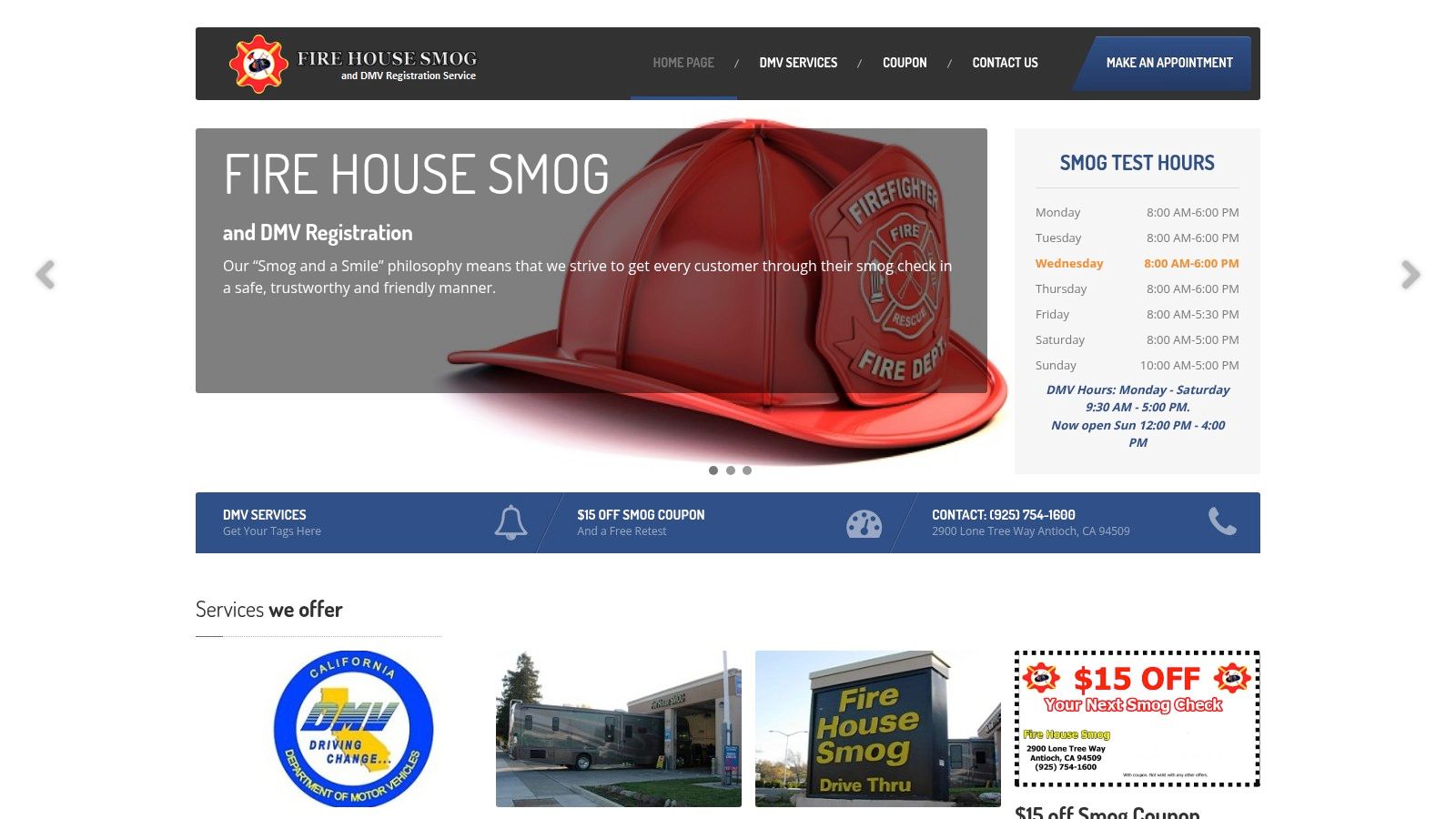
Fire House Smog can handle more than a standard passenger-car inspection. Based on the business information provided, Antioch-area drivers can use it for:
- STAR-certified smog checks: Passenger cars, SUVs, and light-duty trucks are the core fit.
- Some RV and motorhome smog checks: Because size and equipment matter, it's smart to call ahead.
- Registration renewals: On-site DMV service includes sticker printing during posted hours.
- Ownership transfers: That includes California vehicles and out-of-state vehicles.
- On-site tags and related registration help: Useful when you want to leave with more than a test receipt.
Hours are another quality-of-life advantage. Smog testing is available seven days a week with extended evening and weekend availability. DMV service hours are listed as Monday through Saturday, 9:30 AM to 5:00 PM, and Sunday, 12:00 PM to 4:00 PM, with limited services possible on weekends.
For Antioch drivers, that means fewer workday disruptions. It also means small business owners, families with packed schedules, and people handling title or registration issues don't have to build their whole day around a government office visit.
Your Smog Check Questions Answered
Do I need a smog check when selling a car
In many California vehicle sale situations, smog compliance becomes part of the transfer process. If you're selling, don't guess. Confirm the exact requirement tied to the vehicle and transfer.
What if my renewal notice says STAR station
Use a STAR-certified station. If your notice specifies STAR, going to a non-STAR location can waste a trip.
My car runs fine. Can it still fail
Yes. A car can drive normally and still fail because of a sensor issue, a gas cap problem, or incomplete OBD readiness after battery service or repairs.
How long should I drive after battery work before testing
Don't rely on one short errand. As noted earlier, normal mixed driving over about a week is often needed for readiness monitors to reset after a battery disconnect or certain repairs.
Can I handle registration at the same place
Yes, if you choose a shop that also offers licensed DMV services. That's one of the easiest ways to avoid extra lines and another trip across town.
Can larger vehicles come in too
Some RVs and motorhomes can be tested, but bay space and equipment limits matter. Calling ahead is the safest move.
If you want a smoother way to handle smog and registration in Antioch, contact Fire House Smog. It's a STAR-certified test-only station at 2900 Lone Tree Way with on-site DMV services, two service bays, seven-day smog availability, and help for renewals, transfers, and some RVs. Call first if you've got a larger vehicle or want to confirm DMV service timing.
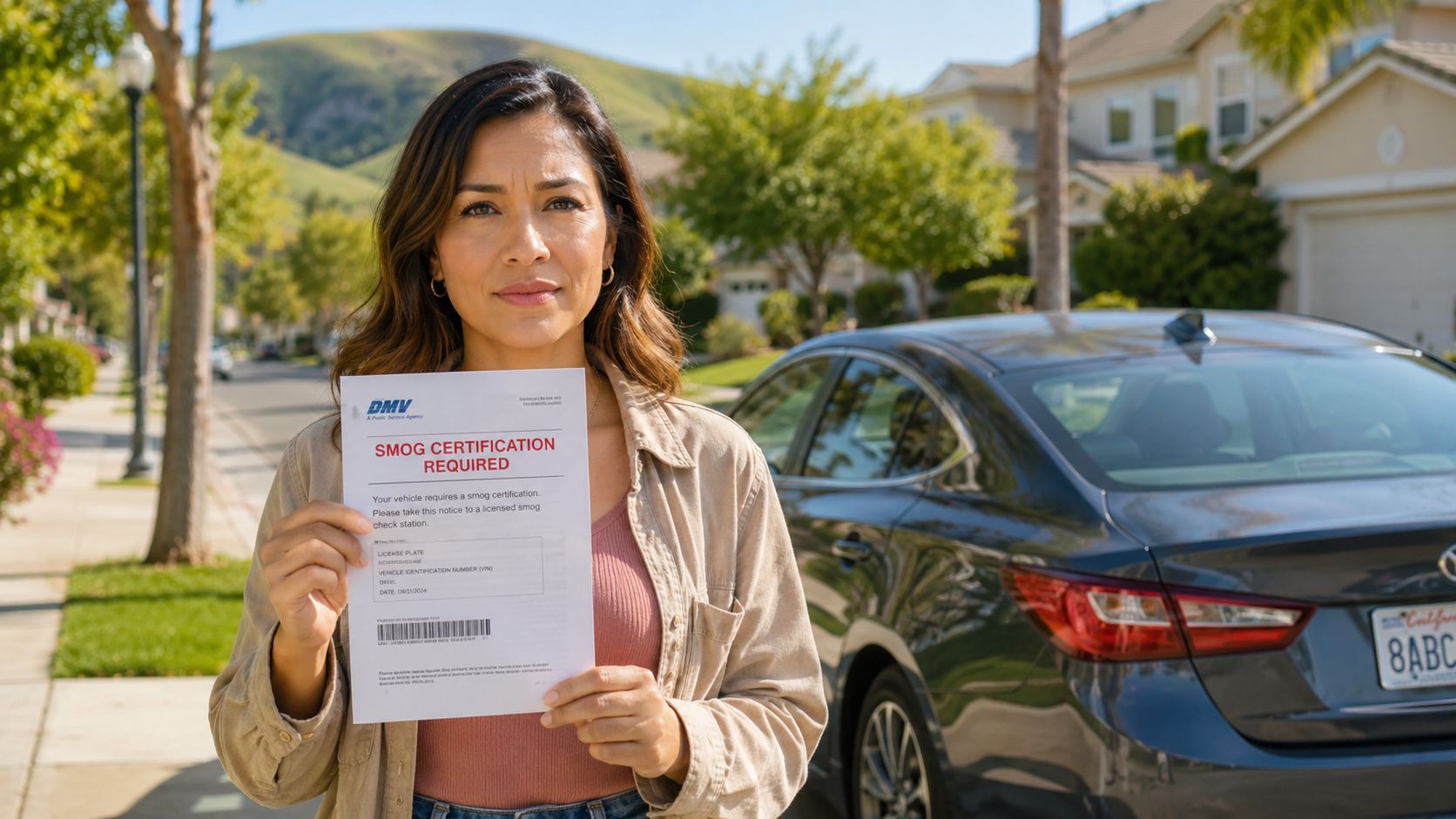
You open the DMV renewal notice, scan for the amount due, and then spot the line that slows everything down: Smog Certification Required. If you're in Antioch, that usually means one more errand before your registration is finished, and the main frustration isn't the test itself. It's the risk of making two or three trips because you picked the wrong station, showed up with a cold engine, or didn't realize the certificate doesn't sit around forever.
The good news is that a smog check in Antioch, CA is usually manageable when you treat it like a short compliance task instead of a mystery. The process is routine, the testing flow is standardized, and most of the hassle comes from timing mistakes or avoidable prep issues. Antioch drivers also have a practical advantage. You can line up the inspection and, in some cases, handle DMV-related paperwork locally instead of burning half a day in line elsewhere.
Table of Contents
- Your Fast-Track Guide to Smog Checks in Antioch
- How to Prepare Your Vehicle for the Smog Test
- Navigating the Smog Station What to Bring and Expect
- Fire House Smog A One-Stop Shop in Antioch
- Smog Check Costs Coupons and Free Retest Rules
- Antioch Smog Check FAQs and Troubleshooting
Your Fast-Track Guide to Smog Checks in Antioch
If your renewal notice says you need a smog certificate, you're dealing with a standard part of vehicle compliance in Contra Costa County. For many Antioch drivers, this isn't optional paperwork you can push off. It's tied directly to registration and, in some situations, ownership transfer.
One timing issue catches people off guard. In California, a passing smog check is generally valid for 90 days, which makes it a short-lived compliance document rather than something you can do early and forget about, according to Geotab's California smog check guide. If you're renewing late or buying and selling a vehicle, that window matters.
The fastest local approach
Most delays come from three mistakes:
- Waiting until the deadline week and finding a line.
- Showing up unprepared with a check-engine light or incomplete paperwork.
- Using the wrong station type when DMV has directed your vehicle to a STAR location.
Practical rule: Handle the smog check close enough to your DMV deadline that the certificate stays useful, but early enough that a surprise failure doesn't put your registration on hold.
The local shortcut is simple. Pick a station that can handle the class of vehicle you own, go in with your documents ready, and if possible use a place that can also help with DMV registration tasks on-site. That last part matters more than people think. It can turn a smog day into a single stop instead of a test visit followed by a separate DMV trip.
For those seeking a smog check Antioch CA, the primary objective is clear. Not just passing, but finishing the whole errand with the fewest moving parts.
How to Prepare Your Vehicle for the Smog Test
Most smog failures aren't shocking. They're usually tied to warning lights, readiness monitors, or obvious equipment issues that could've been spotted before leaving home. A little prep saves a lot of backtracking.
Start with the failure triggers
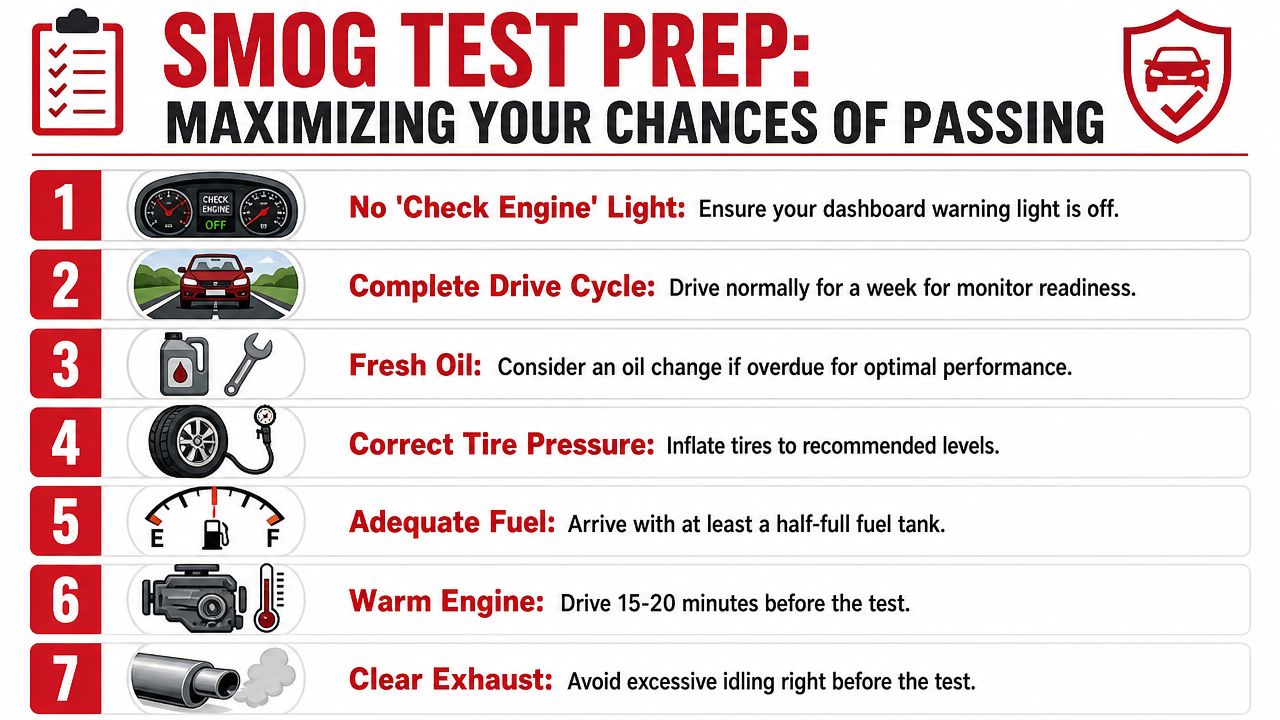
California's smog check includes a visual inspection of emissions hardware, a functional OBD inspection for fault codes, and for pre-2000 vehicles, a tailpipe test. The inspection typically takes 20 to 30 minutes, and a lit check-engine lamp is a common immediate reason for failure, according to California BAR's smog check overview.
That gives you a very clear pre-test checklist.
- Check the dash first. If the check-engine light is on, don't go yet. You're paying for a result that will likely fail right away.
- Think about recent battery work. If the battery was disconnected recently, your OBD readiness monitors may have reset. That can create a problem even if the car seems to drive fine.
- Look under the hood only for the obvious. Missing or visibly tampered emissions parts can stop the process before any tailpipe result matters.
A car can feel normal and still be unready for smog. Driveability and monitor readiness aren't the same thing.
Simple prep that helps
A practical routine works better than overthinking it.
First, drive the car before the appointment. A warm engine helps the vehicle arrive in normal operating condition, and it reduces the odds of walking into the bay with a cold, barely-used car that hasn't completed normal driving behavior.
Second, don't clear codes right before the test. People sometimes erase a warning light and head straight to the station. That's one of the fastest ways to trade one problem for another, because the monitors may no longer show ready.
Third, bring special paperwork only if your vehicle situation is unusual. If you're dealing with an out-of-state transfer or related identification issue, it helps to check what a VIN verification service may require before your visit.
A prep list that actually matters
| Check before leaving | Why it matters |
|---|---|
| Dashboard warning lights | A check-engine lamp can trigger immediate failure |
| Recent battery disconnect | Readiness monitors may not be complete |
| Warm-up drive | Helps the vehicle arrive in normal operating condition |
| Obvious emissions tampering | Visual inspection can flag missing hardware |
| Fuel and basic drivability | Prevents avoidable interruptions during testing |
The best prep is boring. Drive the car normally, fix warning-light issues before testing, and don't treat smog day like the time to gamble on a maybe.
Navigating the Smog Station What to Bring and Expect
The station visit is usually straightforward when you walk in ready. Most of the stress comes from not knowing whether you'll be there for ten minutes or all afternoon, and whether you're missing something important.
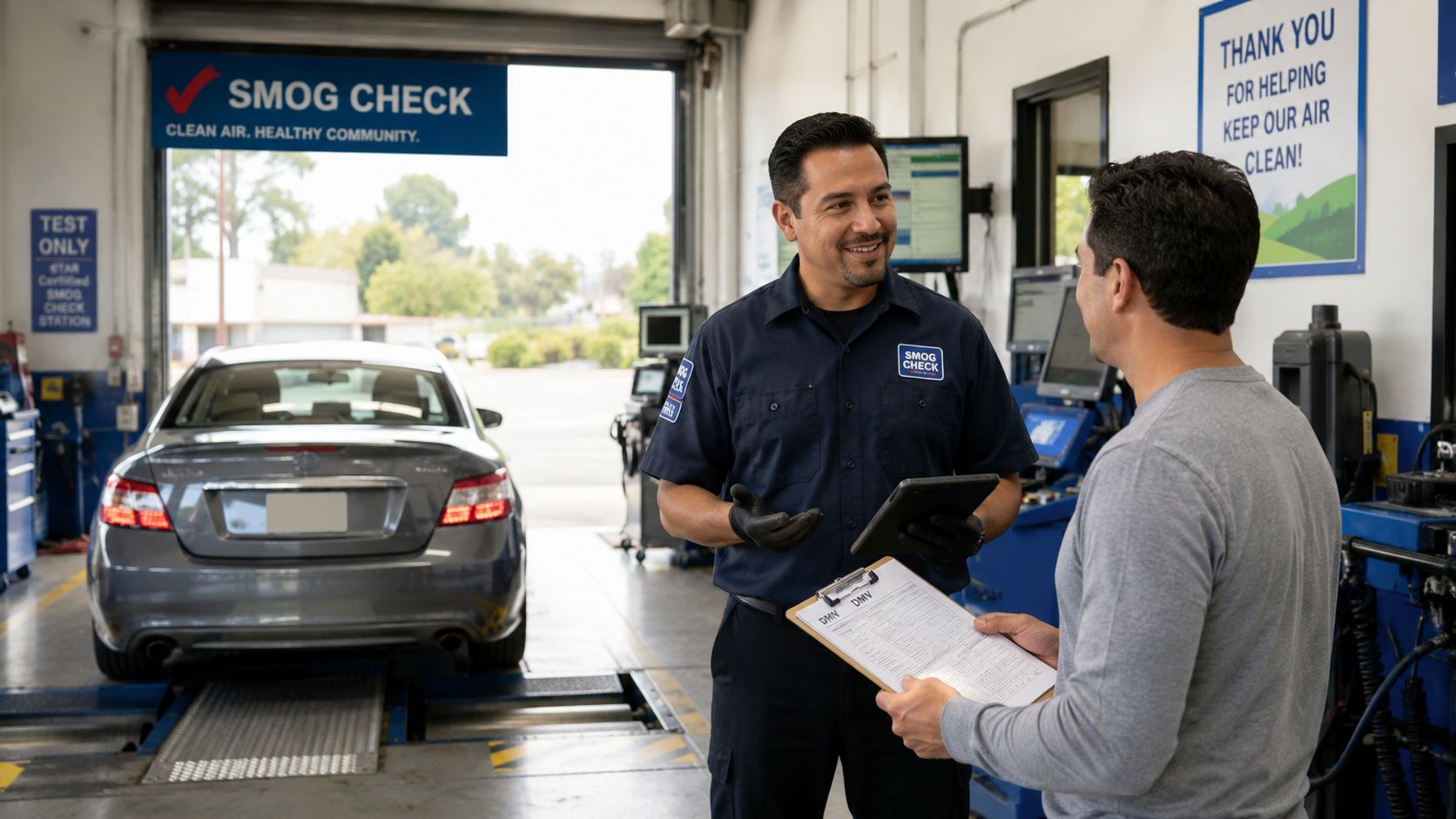
Bring the basics
For a routine Antioch visit, have these with you:
- DMV renewal notice if you received one
- Current registration
- Driver's license
- Payment method
- Any coupon or appointment confirmation
That last item is easy to forget, especially if you booked online. If you want to cut down on waiting, use the station's online appointment page before you head over.
What the visit usually looks like
California smog testing runs inside a large statewide inspection system, not as some loose local process. The Bureau of Automotive Repair publishes executive summaries showing statewide inspection totals, failure rates, and licensing activity. BAR also notes that a typical smog test takes about 20 to 30 minutes, which helps explain why higher-throughput Antioch stations use multiple bays to keep cars moving, as shown in the BAR smog check executive summary reports.
In practice, a well-run visit often feels like this:
- You pull in and check in with the front desk or technician.
- They confirm the vehicle information and what kind of test you need.
- The technician moves the car into a bay and runs the inspection steps.
- You wait while the system checks the vehicle.
- You get the result and next-step instructions.
The smoother your arrival, the faster the whole stop goes. A ready car and clear paperwork matter as much as the station's speed.
If it helps to see the general process before you go, this walkthrough gives a useful visual reference:
A good station experience shouldn't feel mysterious. You should know what you're handing over, what the technician is checking, and whether you're done or need repairs before a retest.
Fire House Smog A One-Stop Shop in Antioch
You get the renewal notice, drive over for the test, and then realize you still have to deal with DMV paperwork somewhere else. That extra stop is what turns a simple Antioch smog check into a time drain.
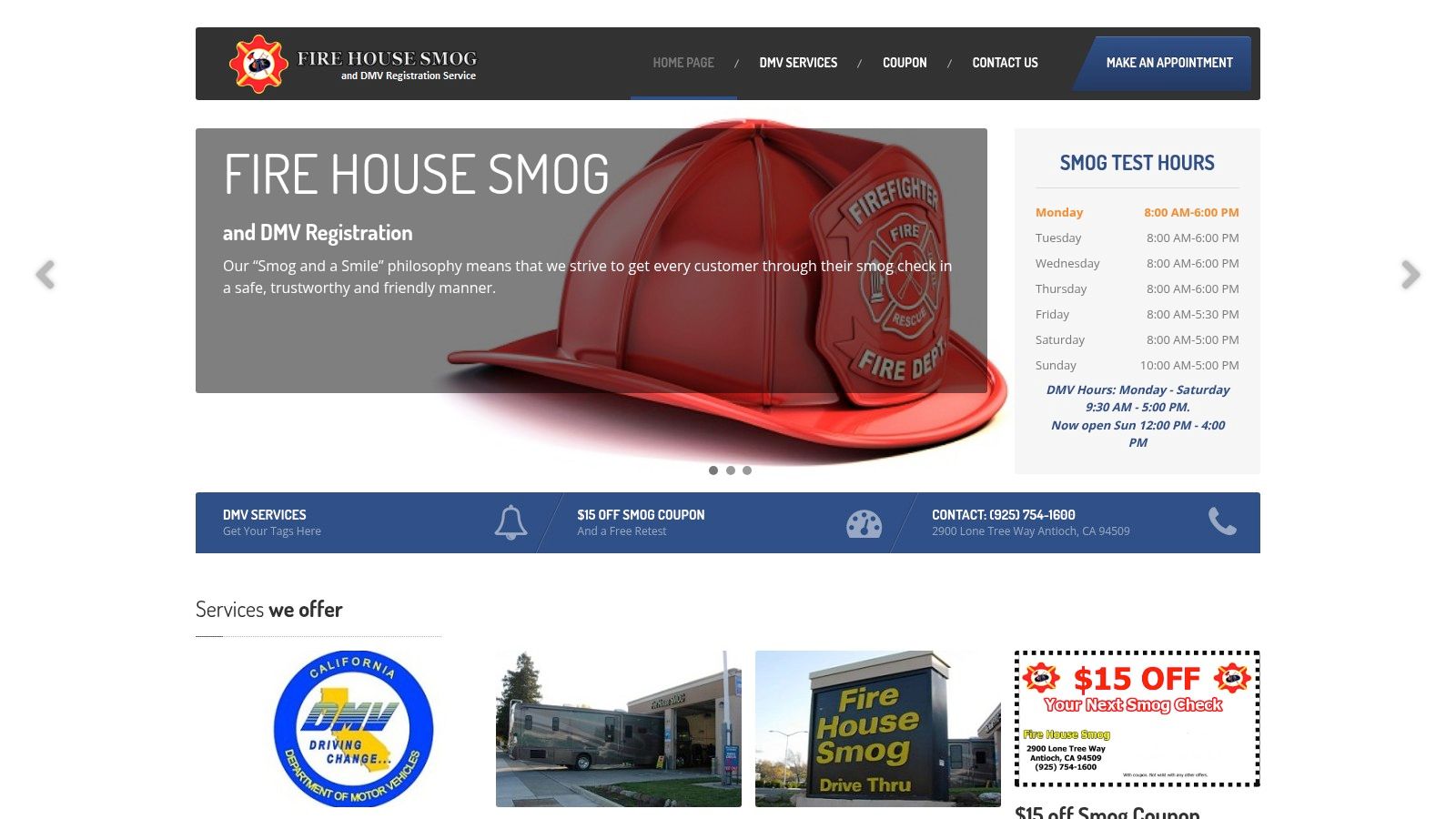
For local drivers, the primary advantage is not just finding any station with an open bay. It is finding one that can handle the type of inspection your notice requires and, if needed, help you finish the registration side without sending you to wait in another line.
Why STAR and test-only matter in Antioch
Some Antioch vehicles can go to a regular smog shop. Others are directed to a STAR station, and if your DMV paperwork says STAR, that requirement decides where you can test. Checking that before you leave home saves a wasted trip.
A test-only station also matters for drivers who want a straightforward inspection. The shop runs the test and reports the result. It does not turn the visit into an in-house repair conversation.
That setup works well if your goal is simple. Get the inspection done, get the certificate transmitted, and move on.
Where the one-stop setup saves time
Fire House Smog, at 2900 Lone Tree Way in Antioch, is a STAR-certified test-only station that also offers on-site DMV services. That combination is what makes it useful in real Antioch situations, especially for people trying to keep the whole errand to one stop.
It helps most in a few common cases:
- Registration is due now. You can handle the smog check and DMV paperwork in one place instead of splitting the job across two appointments.
- You are transferring ownership. Smog and registration tasks often come up together during a sale, and keeping them under one roof cuts down on back-and-forth.
- You want a cleaner process. Test-only service keeps the visit focused on compliance, not repair sales.
- You are comparing total hassle, not just price. A low test price loses its appeal if it still leaves you standing in a DMV line afterward.
If you are also price-checking before you go, review the current Antioch smog coupon offers and terms closely. Coupon details often tell you whether the deal fits your vehicle and whether a retest is included.
For Antioch residents, that is the local shortcut. Pick a station that can meet the STAR requirement if you have one, run the test without the sales pressure, and handle DMV work on-site if that is the part you are trying to avoid.
Smog Check Costs Coupons and Free Retest Rules
Price matters, but this is one of those errands where the cheapest listing isn't always the easiest experience. You want a fair test price, clear retest terms, and no confusion about what's included.
What pricing usually looks like
Industry guidance commonly places a typical smog test around $20 to $50, depending on the vehicle and service setup. That general range appears in BAR-related executive summary context and related guidance discussed earlier, which is why Antioch stations often compete on speed, convenience, and add-ons as much as raw price.
What that means in real life is simple. A bargain price doesn't help much if you wait too long, miss the station type you need, or have to come back because the policy details weren't clear.
How to use coupons without surprises
If you're comparing local options, check the current smog coupon page before you go. Read the terms carefully. Coupon language often tells you more than the headline discount does, especially around retests and vehicle exclusions.
A few points are worth checking every time:
- Eligibility details matter. Not every coupon applies to every vehicle class.
- Retest wording matters more than the discount amount if you're worried about failing.
- Timing rules can affect whether you qualify for a free retest after repairs.
Free retest rules are about terms, not assumptions
Drivers often hear "free retest" and assume it means unlimited retries or no conditions. That's usually not how these offers work. Free retest policies typically depend on the station's posted terms, qualifying repairs, and a return within the allowed time window.
Here's the practical approach:
| Before you pay | Why to ask |
|---|---|
| Does the coupon include a retest | Prevents assumptions |
| Which vehicles are excluded | Avoids surprise upcharges |
| Is there a deadline to return | Keeps you eligible |
| Do I need proof of repairs | Helps if the vehicle fails |
The cheapest smog check isn't always the one with the lowest posted number. It's the one that avoids a second round of confusion.
Antioch Smog Check FAQs and Troubleshooting
What if my car fails
Read the failure report first. It tells you whether you're dealing with a check-engine light, an incomplete readiness monitor, or an emissions component problem. Each one points to a different fix, and guessing usually costs more than waiting a day and addressing the actual issue.
Keep the paperwork. Before you schedule a retest, ask the station what its retest policy requires and whether you need repair documentation. A quick return only helps if the original problem is resolved.
Do I need a STAR station
If your DMV notice says STAR, use a STAR station. California assigns certain vehicles to the enhanced testing program, and a pass from the wrong station type will not clear that requirement.
This is one of the easiest ways Antioch drivers lose time. They get the test done, then learn they need to do it again at a STAR location.
What about RVs, diesel vehicles, or unusual cases
The rules for different vehicle types can be confusing. The right test depends on model year, fuel type, weight class, and how the vehicle is classified in California records.
For RVs, diesel trucks, older vehicles, and out-of-state transfers, call before you leave home. Ask the direct question that matters: can you test my exact vehicle type today? That saves you from showing up at a station that handles standard passenger cars but not your setup.
How does the DMV get my result
California sends smog results to DMV electronically after the test is completed. In most cases, you do not need to carry a paper certificate to prove the vehicle passed.
What does matter is timing. If your registration deadline is close, confirm the test was transmitted properly and make sure the DMV side gets handled without delay. That is where a one-stop location helps in a practical way. Fire House Smog in Antioch handles STAR-certified test-only inspections and on-site DMV services, so you can finish the test and registration steps in one stop instead of dealing with a separate DMV trip later.