
California Vehicle Transfer Fee: What It Costs
In California, the vehicle transfer fee is a mandatory DMV charge the buyer pays within 10 days of taking ownership. It's separate from use tax, the vehicle license fee, and registration fees.
You've picked up the keys, signed the paperwork, and thought the car deal was finished. Then a DMV bill arrives with a total that looks much higher than the transfer fee you expected. The surprise usually comes from several separate charges appearing together, each tied to a different part of the transaction.
The useful question isn't only “What's the transfer fee?” It's also “Which other charges apply, and what must I do before a deadline?” California's rules make the ownership record and the timing of the paperwork financially important. Whether you bought from a dealer, a neighbor, or brought a vehicle into California, knowing what each line means can help you prepare and spot missing information.
Table of Contents
- The Surprise That Hits Every New California Car Owner
- What the Vehicle Transfer Fee Actually Covers
- Who Pays and When the Clock Starts Ticking
- The Other Charges That Travel With the Transfer Fee
- How Transfer Type Changes the Bill
- Where Smog Certification Fits Into the Transfer
- Handling the Transfer in One Stop at Fire House Smog
- Why the Transfer Fee Is Not a Flat Number
The Surprise That Hits Every New California Car Owner
A first-time buyer might read “vehicle transfer fee” on an estimate and assume it represents the full cost of putting the car in their name. But the bill can also include tax, registration balances, title-related charges, and penalties. Those amounts aren't all part of the transfer fee, even when they appear on the same estimate.
Consider a buyer who purchases a used car privately and receives a DMV estimate that's larger than expected. The estimate doesn't necessarily mean the transfer fee itself has changed. The buyer's county, the vehicle's registration status, and whether earlier ownership changes were properly recorded can all affect the total. A bill is easier to understand when you read each charge as its own obligation instead of treating the total as one unexplained price.
The buyer is generally responsible for the transfer fee, and the clock starts from the transaction date. That means the paperwork deserves attention as soon as the sale or gift is complete, not only when the next registration renewal comes around. A delay can create a separate penalty issue, even if the original transfer charge is straightforward.
A useful way to read the bill: First identify the government charge for recording ownership. Then check taxes, registration-related fees, and any late charges separately.
This guide follows that same order. It starts with what the transfer fee covers, then explains who pays and when, why other line items vary, and how transaction type and smog certification can affect the process. If you already have an estimate, compare its individual entries with the relevant details below rather than relying on the headline total.
What the Vehicle Transfer Fee Actually Covers
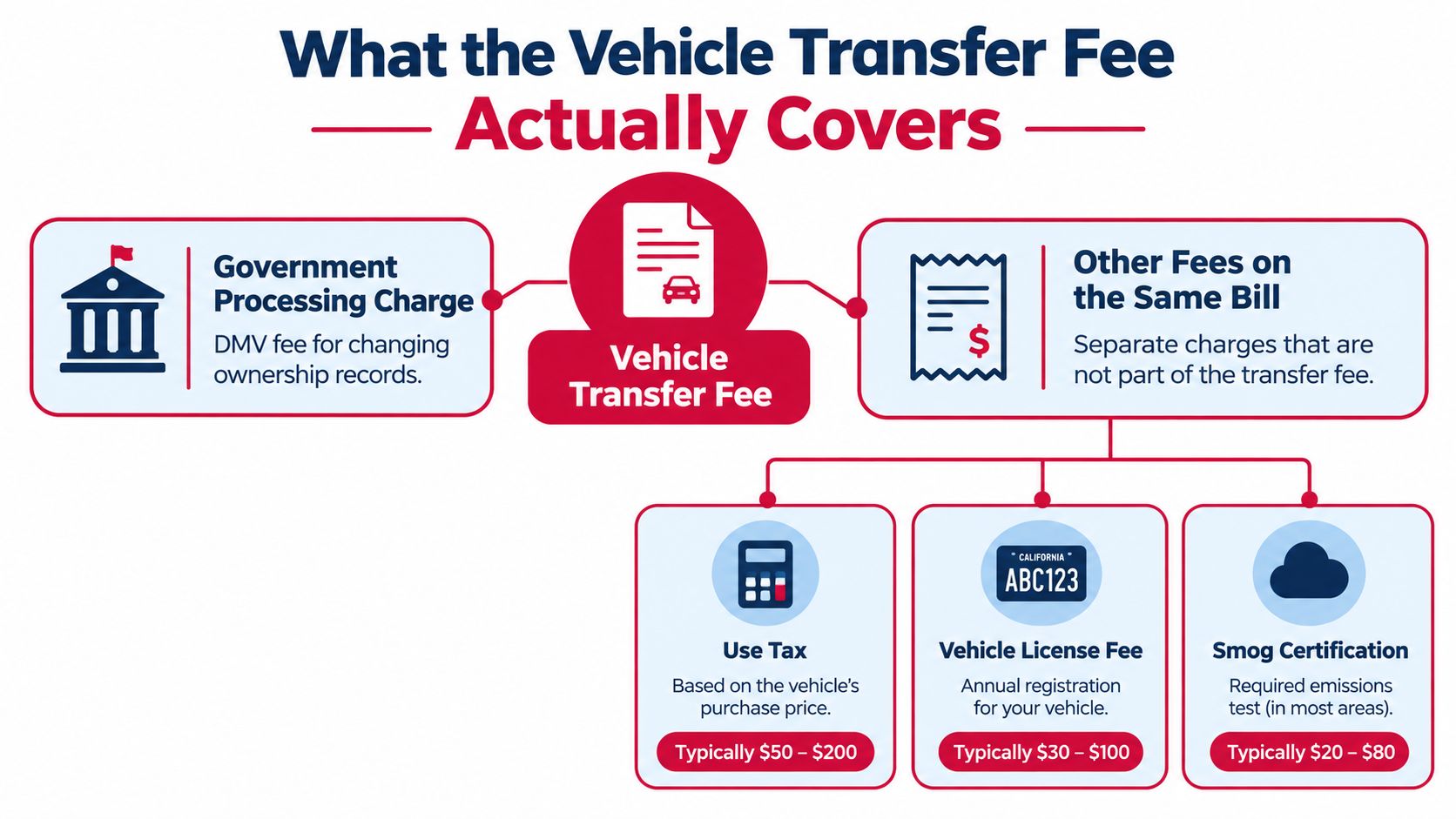
The vehicle transfer fee is the DMV charge for processing a change in ownership. California requires it when a vehicle changes hands through a sale, gift, donation, or trade. It pays for the administrative act of updating the ownership record. It isn't a percentage of the purchase price, and it doesn't stand in for every other charge due during registration.
Think of the fee like postage on a registered letter. The postage gets the document into the delivery system, but it doesn't represent the value of what's inside. In the same way, the transfer fee covers the ownership-record process, while tax and registration charges follow their own rules.
Separate charges on the same bill
A DMV estimate may list use tax, a vehicle license fee, renewal charges, county or district fees, weight fees, or special plate charges alongside the transfer fee. These are not all components of that fee. They arise from other requirements, so a transfer estimate can be higher than the transfer charge alone.
The distinction matters when you're comparing estimates or trying to work out why a bill changed. Ask what each line represents: Is it the charge for changing the ownership record, a tax, a registration balance, or a late assessment? A clearly itemized answer is more useful than a single total.
One vehicle, one transfer obligation
The DMV applies transfer fees separately to separate vehicles. If ownership changes hands more than once before the DMV is notified, the transfer record may also need to account for each intervening sale. So the same fee label can relate to more than one ownership change, not just the person who most recently brought the paperwork to the DMV.
Who Pays and When the Clock Starts Ticking
The buyer pays the transfer fees, and California hands that buyer two dates to track at once. Payment is due within 10 days of the transaction date, and penalties apply once the required payment has gone unsubmitted for 30 days, per the California DMV's title-transfer guidance. Read the first date as the deadline and the second as the point where the bill starts growing.
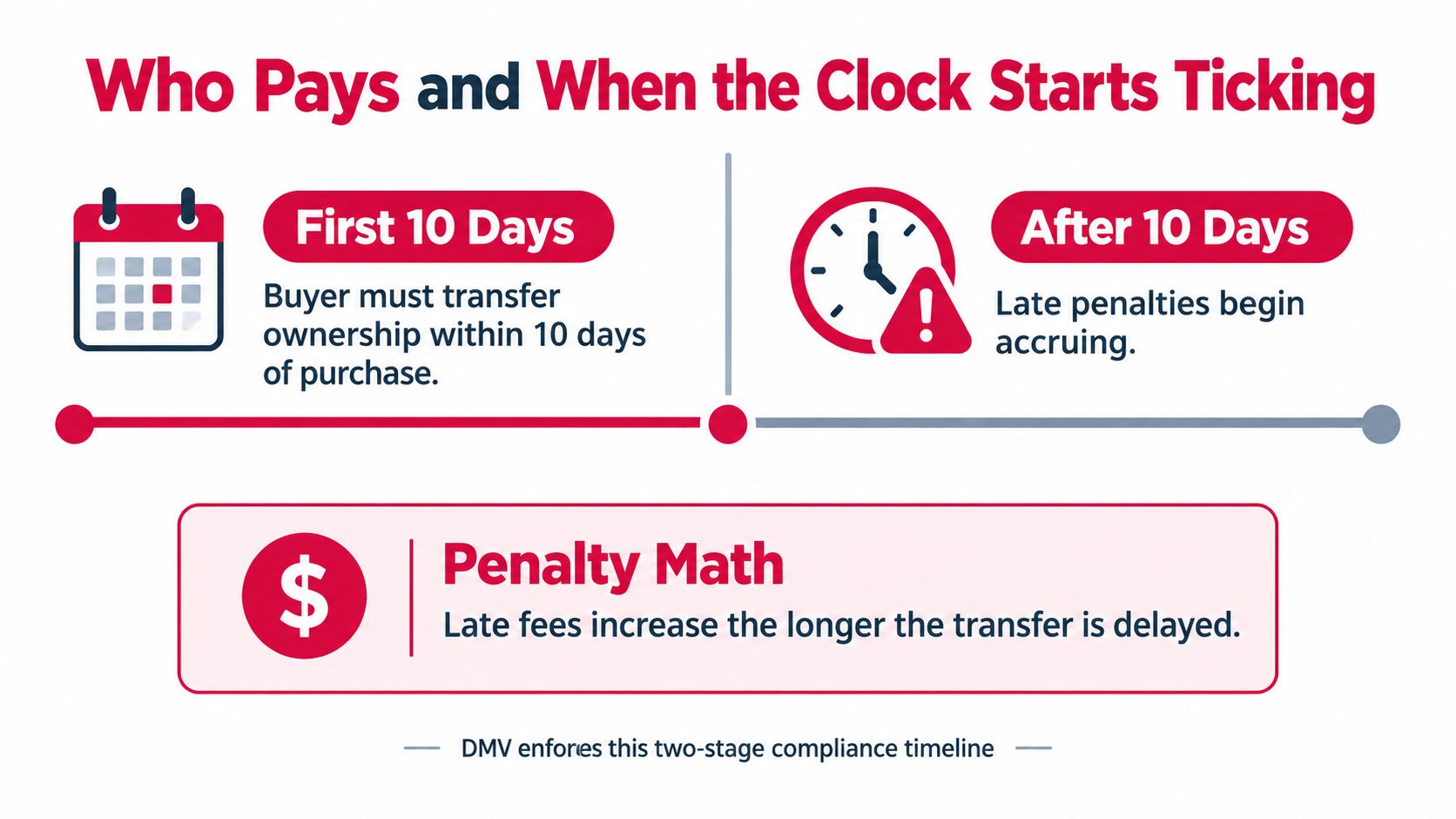
The gap between those dates trips up first-time buyers.
A buyer who files on day 25 did beat the penalty cutoff, but the obligation was already two weeks late. Transfer timing works like a parking meter with a grace period: enforcement may not show up right away, yet the time was still owed from the start.
Late charges can also attach to the registration side of the same bill. Under the DMV's registration-fee guidance, a registration delay of 1 to 10 days adds 10% of the vehicle-license and weight fees, plus $10 registration and $10 CHP late fees. Those penalties sit on the registration lines, and the transfer fee itself stays unchanged. Each line follows its own clock, so the cheapest transfer is the one filed early with complete paperwork.
What happens when ownership changed more than once
A vehicle that passes through several buyers before anyone notifies the DMV leaves a chain of transfers on the record. The DMV's multiple-transfer guidance states that only the last transfer in the chain draws a transfer penalty, while the fees tied to earlier transfers still apply.
Use tax paid by an earlier buyer cannot be credited toward what a later buyer owes. If the title history has gaps, ask the DMV or a qualified registration provider to reconstruct the sequence of sales before assuming the most recent transaction is the only one on the record.
Keep the transaction date, the signed title, and every ownership document together, then file promptly. For help pairing the transfer with the rest of the registration paperwork, review vehicle registration transfer services. Clear dates and complete documents are what turn an unpredictable bill into one you can estimate line by line.
The Other Charges That Travel With the Transfer Fee
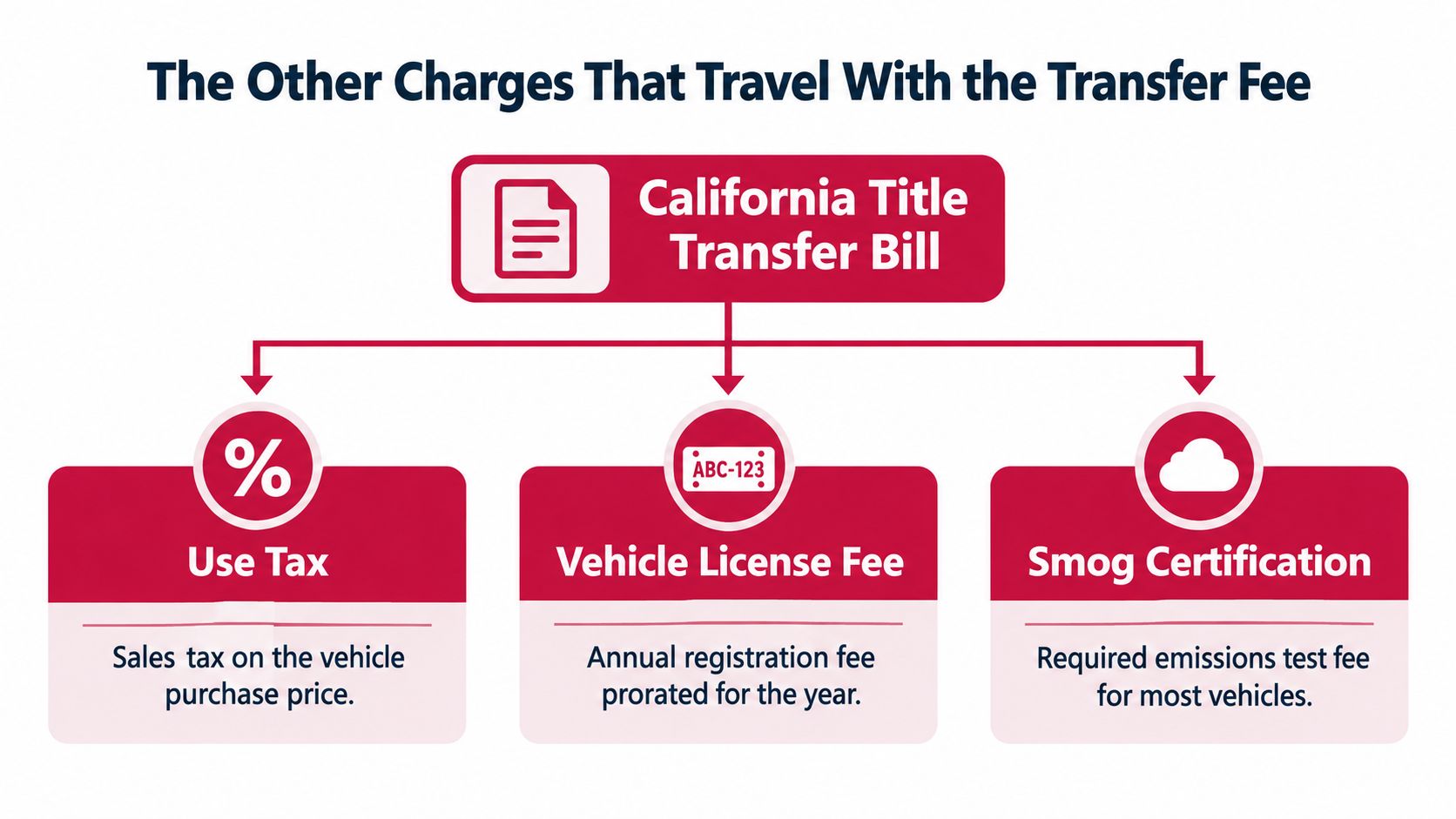
The transfer fee is just one entry in a possible set of charges. The total can depend on the vehicle, the buyer's location, and the vehicle's registration status. Reading the bill line by line helps you distinguish taxes and registration costs from the administrative charge for changing ownership.
Use tax follows the buyer's location
For a taxable purchase, California use tax is generally calculated using the purchaser's city and county. The rate may range from 7.25% to 10.25%, so two buyers transferring similar vehicles can face different tax amounts because they live in different jurisdictions. The tax is distinct from the transfer fee, and the total due can't be estimated by looking at that fee alone. The California DMV title-transfer information describes this distinction and the factors that can affect a transfer bill.
VLF and other registration-related charges
For applicable vehicles, the vehicle license fee (VLF) is 0.65% of market value. The DMV uses the vehicle's VLF class and relevant model-year schedule, not the new owner's negotiated purchase price, to determine the amount. This is why a low sale price doesn't necessarily mean the VLF will be calculated from that price.
Other possible line items include renewal charges, county or district fees, weight fees, and special plate charges. Whether they apply depends on the vehicle and its registration circumstances. Ask for an itemized calculation if the estimate combines these amounts or if you can't tell which line is tied to the transfer.
Check the effective fee schedule
California periodically adjusts certain DMV charges through statutory consumer-price-index increases. A fee notice effective January 1, 2026, lists the title-only fee, off-highway-vehicle transfer fee, and moped original-or-transfer fee each increasing from $27 to $28. Those examples apply to the specific fees listed in that notice, not to every vehicle transfer. Check the DMV's current calculation for your vehicle and transaction rather than assuming a charge shown in an older estimate still applies.
For an overview of the wider registration estimate, see California vehicle registration costs. Treat each item as its own rule-based charge, and ask whether a figure is tax, registration, title processing, or an optional service fee.
How Transfer Type Changes the Bill
Two people can transfer similar cars in the same week and walk out with different totals. The transfer fee itself rarely explains the gap. The transaction type underneath it usually does, because a private sale, a gift, a donation, a trade, and an out-of-state title each carry slightly different tax treatment and paperwork.
Before relying on any estimate, identify what happened: Was the vehicle sold, given as a gift, donated, traded, or brought into California from another state?
| Transfer situation | What to check | Why the total may differ |
|---|---|---|
| Private-party sale | Confirm the transaction details, date, and current registration status. | Use tax may apply, and the buyer remains responsible for the transfer fees. |
| Gift | Make sure the transfer is being reported as a gift and ask how the DMV will assess tax. | A gift may be treated differently from a taxable purchase, but don't assume the tax outcome without confirming eligibility. |
| Donation | Check the transfer documents and whether the recipient is an organization or another party. | Donation paperwork and tax treatment may depend on the specific transaction. |
| Trade | Review the sale and trade paperwork as separate parts of the transaction. | The transfer still needs to be documented, and the full bill may include registration charges beyond the transfer fee. |
| Out-of-state title | Gather the existing title and ask what verification or California registration steps are required. | An out-of-state vehicle can need additional processing, so the estimate may differ from an in-state transfer. |
For taxable purchases, use tax follows the purchaser's city and county rather than one statewide figure. As covered under use tax above, the rate depends on the buyer's jurisdiction, consistent with the DMV title-transfer guidance referenced earlier, so confirm the applicable rate for your location instead of reusing a figure from another transaction.
The same caution applies to gifts and donations. Say a relative signs a car over to you for free. The paperwork may still ask when the vehicle changed hands, what it was worth, and whether the transfer qualifies for different tax treatment. Clarify what documentation the DMV needs before assuming the word "gift" on a form closes the file. If you buy privately instead, keep the signed title and transaction details together so the date and ownership path are clear.
Out-of-state titles deserve their own check. Ask whether the vehicle needs verification, whether its registration status changes the amount due, and which documents must accompany the title. Across every row of the table, the order of operations stays the same: identify the transfer type first, then estimate taxes and registration charges separately from the transfer fee.
Where Smog Certification Fits Into the Transfer
A smog certificate can be a separate requirement from the ownership-record fee, and it can affect how smoothly you complete registration. Don't assume every vehicle or every transfer follows the same emissions-testing rule. Confirm whether a smog check is required for your specific vehicle and situation before you plan the rest of the paperwork.
The timing matters. If the vehicle needs testing, completing that step before you submit the full transfer and registration package can help avoid a stop in processing. If you're unsure whether a recent certificate will meet the requirement, check with the DMV or a smog station before relying on it. The California smog-test requirements page offers additional guidance.
| Scenario | Smog required | Notes |
|---|---|---|
| Vehicle transfer where a smog inspection is required | Yes | Arrange the inspection and confirm the certificate is ready for the transfer process. |
| Vehicle with a recent passing certificate | Confirm first | Ask whether the existing certificate can be used for this transaction. |
| Vehicle with an exemption or a special circumstance | Confirm first | Don't assume an exemption applies based only on the vehicle's age or fuel type. |
| Vehicle that fails the inspection | A passing result may still be needed | Resolve the emissions issue and check the next steps before expecting registration processing to finish. |
A passing certificate doesn't replace the title, transfer payment, or any applicable tax. It addresses an emissions requirement. Keeping those steps distinct makes it easier to see what's still outstanding if the DMV or a service provider says the transfer can't yet be completed.
If the vehicle fails, ask the testing station what the result means and what options are available. Some stations offer a retest under their own policies, but confirm the terms directly. That way, you can plan around the testing requirement without confusing it with the transfer-fee deadline or assuming that one completed step clears the others.
Handling the Transfer in One Stop at Fire House Smog
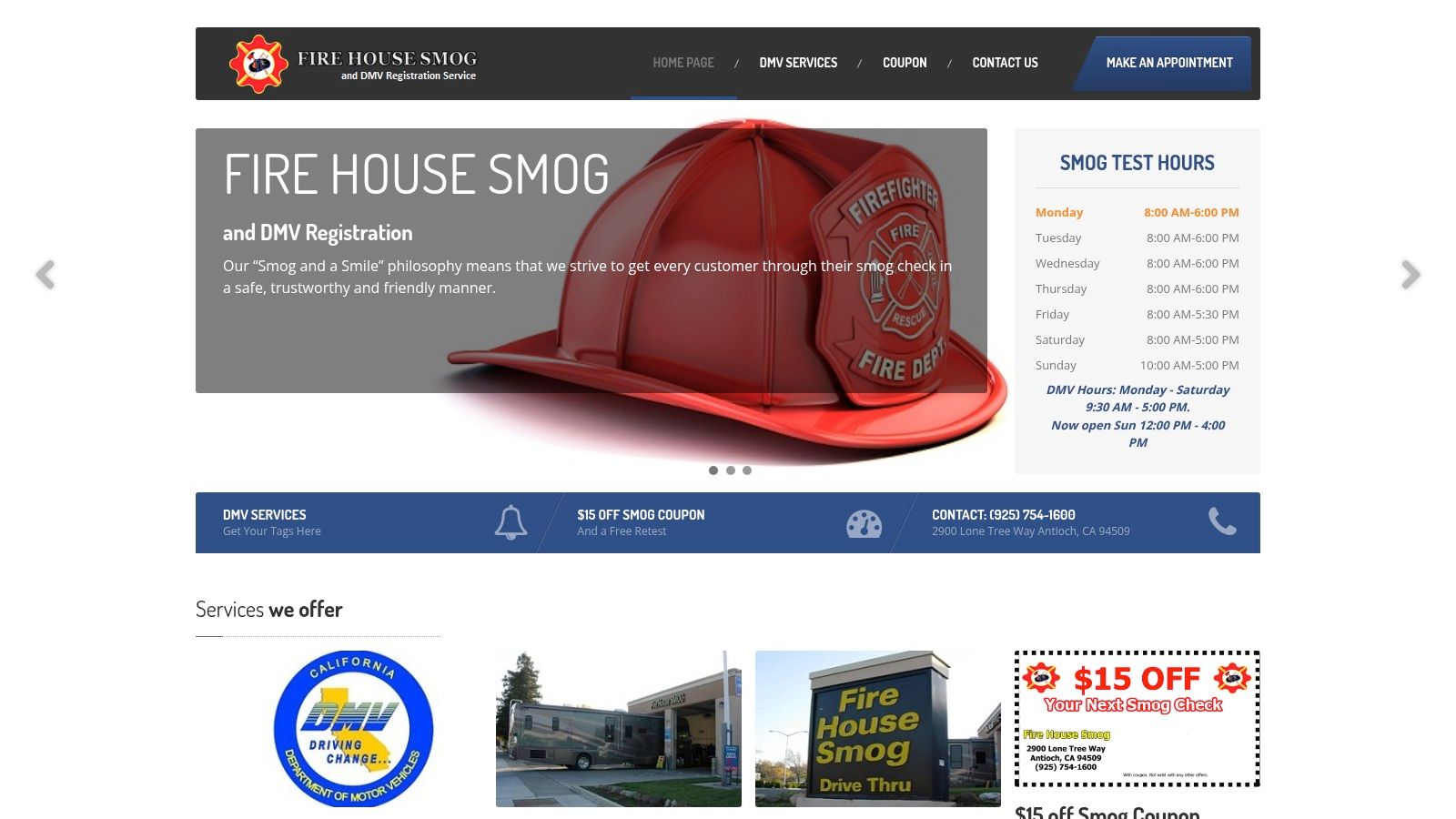
A buyer handling both a smog requirement and DMV paperwork may prefer a provider that can address those tasks in one place. Fire House Smog is a STAR-certified test-only smog station and licensed DMV registration services provider in Antioch. It performs smog inspections and processes California ownership transfers, including support for out-of-state vehicles, with stickers and plates as needed.
A buyer arriving with a signed title and the right supporting documents can ask staff to check what's needed for the transaction and whether smog testing applies. Bring a valid ID, the signed title, any lien-release paperwork, and a smog certificate if you already have one. If a document is missing or the title record has an issue, clarify that before expecting the transfer to be completed.
What the service can handle
The station offers STAR-certified, test-only smog inspections for passenger vehicles and light-duty trucks, plus testing for some RVs and motorhomes when size and equipment allow. Its test-only model means it doesn't sell repairs, so testing and repair work aren't bundled into the same service.
For DMV matters, the site handles California registration renewals and ownership transfers, including out-of-state vehicle support. On-site tag and plate issuance is available when needed for eligible transactions. The station also has two service bays, and its published service information notes a free retest may be available subject to site policy and coupon terms. Confirm eligibility and current terms with the business.
Smog testing is available seven days a week, with extended evening and weekend hours. DMV services are listed for Monday through Saturday, 9:30 AM to 5:00 PM, and Sunday, 12:00 PM to 4:00 PM, though weekend services may be limited. The location is 2900 Lone Tree Way, Antioch, CA 94509. Check directly before visiting to confirm the service you need and the documents to bring.
Why the Transfer Fee Is Not a Flat Number
A vehicle transfer fee is a government charge, but the amount due on a transfer bill isn't necessarily one universal price. The fee is only one part of the transaction. The buyer's jurisdiction, vehicle class and weight, registration status, ownership history, and timing can each affect other line items or obligations.
Use this checklist before finalizing the transfer:
- Confirm the transaction type: Identify whether you're buying, receiving a gift, donating, trading, or registering an out-of-state vehicle.
- Check registration status: Find out whether the vehicle has an outstanding registration balance or another unresolved issue.
- Identify the buyer's city and county: Use tax depends on jurisdiction when the purchase is taxable.
- Review the title and lien status: Make sure the title is signed correctly and determine whether a lien release is needed.
- Ask about previous transfers: If the DMV wasn't notified of earlier sales, more than one transfer-fee obligation may apply.
- Confirm whether smog testing is required: Don't assume a vehicle is ready for registration until you've checked the applicable emissions requirement.
- Note the transaction date: Submit the required payment and paperwork promptly to avoid timing-related problems.
Once those details are in hand, ask for an itemized estimate. A clear breakdown should distinguish the government transfer charge from use tax, VLF, registration charges, penalties, and any optional service fee. That gives you a more reliable picture of the total than a headline transfer price.
If you're completing a California ownership transfer in Antioch, Fire House Smog offers smog inspections and DMV registration services, including ownership-transfer support. Contact the station or visit its Lone Tree Way location to confirm what documents your transaction requires and whether it can handle your transfer and any needed smog test.