
You find an expired registration card in the glove box, then open a renewal notice that arrived after a move. Maybe your car also needs a smog check, and you're wondering whether to pay now or wait until everything is ready. Before assuming you owe a flat late charge, separate two questions: Does the DMV consider your payment late, and what charges apply if it does?
California DMV registration renewal late fees depend on the vehicle record, the applicable deadline, and the length of the delay. You don't need to guess from someone else's renewal bill. You need the right deadline, the full assessed amount, and a clear plan for completing any remaining requirements.
Table of Contents
- When Your California Registration Is Actually Late
- California DMV Late Fee Amounts and How They Add Up
- Why Parking the Car or Failing Smog Rarely Stops Penalties
- What Short Delays and Multi-Year Lapses Really Cost
- Driving Holds and Other Costs of Waiting
- Where to Pay a Late California Registration Renewal
- Clear the Balance Before the Next Milestone
When Your California Registration Is Actually Late
An expired card is a reason to check your registration promptly. But if your notice arrived late, the printed expiration date isn't the only timing detail worth checking.
The DMV's late-renewal procedures state that payment is timely when fees are paid by midnight on the registration expiration date or within 60 days after the owner is notified through the renewal notice, whichever date is later. That later-date test matters when you're trying to understand a forwarded notice, a delayed notification, or a vehicle purchased near its renewal deadline.
Don't turn that rule into an assumed extension. A missing envelope doesn't, by itself, establish which notification date the DMV will recognize.
Compare the dates before accepting the charge
Start with the registration card and the notice you have. Then ask the DMV or the registration-service provider processing the transaction to confirm how the vehicle record treats the deadline.
- Check the expiration date. Use the date on the registration card rather than relying on your memory of when you usually renew.
- Identify the notification issue. Explain whether the notice arrived late, was forwarded, or never reached you.
- Verify the record. Ask which deadline applies before deciding that an assessed penalty is correct or that no penalty is owed.
- Flag a recent purchase. If you're handling a transfer, make that clear rather than treating it as an ordinary renewal.
Practical rule: A late notice is a reason to verify the deadline, not permission to assume you can keep driving or postpone payment.
Early renewal isn't a grace period
The DMV's registration-fee guidance and calculator explain that renewal fees are generated approximately 75 days before expiration, and generally become mandatory when an application is presented within 30 days before expiration. The same guidance recognizes payment on the next business day when the deadline falls on a weekend or state holiday.
Those rules serve different purposes. The early window lets you address renewal before the deadline; the business-day exception addresses a specific calendar situation. Neither creates a general grace period after expiration.
If the dates don't make sense, request a record review rather than estimating how many days late you are from the envelope alone.
California DMV Late Fee Amounts and How They Add Up
The late penalty isn't one flat charge. Once the DMV establishes that payment is delinquent, the bill combines a percentage-based penalty with separate registration and California Highway Patrol, or CHP, late fees.
The percentage applies to the vehicle license fee and any applicable weight fee, not automatically to every item on your renewal bill. That distinction matters because a renewal contains charges with different purposes.
California Registration Renewal Late Fee Bands
The following schedule follows the California DMV registration-fee table, including the combined fixed charges calculated from its registration and CHP columns.
| Delay window | Percent of license and weight fees | Registration late fee | CHP late fee | Fixed charges combined |
|---|---|---|---|---|
| 1–10 days | 10% | $10 | $10 | $20 |
| 11–30 days | 20% | $15 | $15 | $30 |
| 31 days through one year | 60% | $30 | $30 | $60 |
| More than one year through two years | 80% | $50 | $50 | $100 |
| More than two years | 160% | $100 | $100 | $200 |
Read across the applicable row, not just the final column. The combined fixed amount is only part of the late penalty, and the late penalty is added to the ordinary renewal charges.
Understand what the percentage uses
Think of the calculation as a set of separate components:
- License-fee component. Apply the relevant percentage to the vehicle license fee.
- Weight-fee component. Apply that percentage to any applicable weight fee.
- Fixed components. Add both the registration late fee and the CHP late fee from the applicable row.
Then account for the regular fees due. Don't multiply the entire renewal notice by the penalty percentage, and don't treat the fixed-charge column as the full balance.
This also explains why owners can be equally late but owe different amounts. Their vehicles may have different license fees or weight classifications. For a heavier vehicle with an applicable weight fee, the percentage component can make a meaningful difference.
For an overview of the underlying bill, the registration renewal fee guide can help you distinguish ordinary renewal charges from delinquency charges.
The useful question for a clerk or processor is straightforward: Which delay band applies, and which vehicle fees were used to calculate the percentage? Asking for that breakdown is more helpful than asking why your neighbor paid less.
You can use the schedule to understand an assessment. Use the vehicle record to confirm the amount you need to pay.
Why Parking the Car or Failing Smog Rarely Stops Penalties
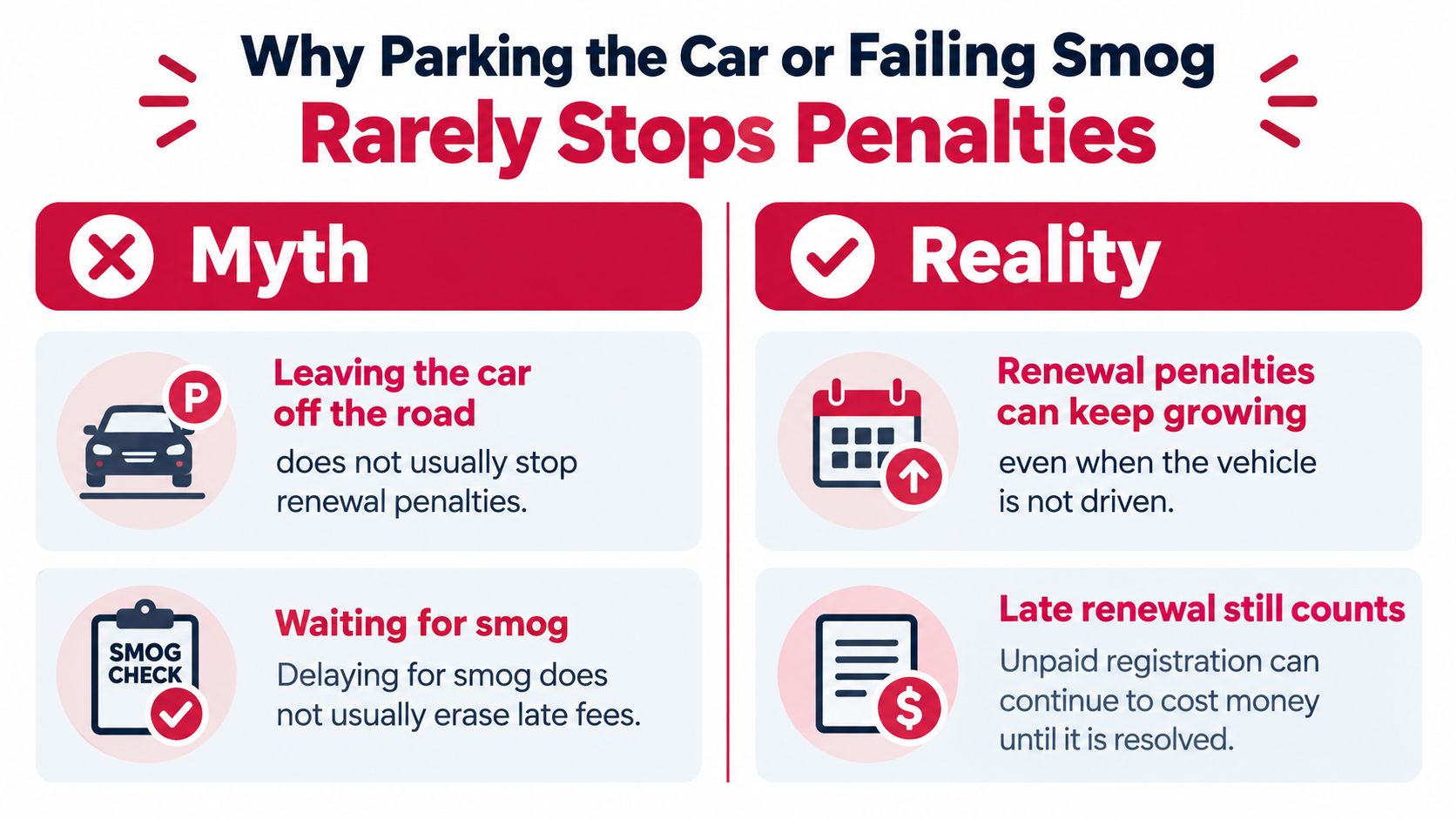
Leaving a car in the driveway doesn't automatically tell the DMV that you've chosen nonoperation. Waiting for a smog certificate doesn't automatically pause the payment deadline, either.
Those misunderstandings often start with a reasonable thought: if you can't use the vehicle, why should renewal penalties apply? The DMV treats vehicle use, fee payment, and renewal completion as different issues.
The visual below separates the common assumptions from the registration problem that still needs attention.
Nonoperation requires a filing
Under the DMV's Planned Nonoperation filing rules, PNO generally must be filed by the registration expiration date to avoid a penalty; it may be filed up to 90 days afterward if the vehicle wasn't operated, towed, stored, or parked on public roads, but a late filing can still carry penalties. Under those rules, after 91 days, full-year registration fees and penalties are due.
A PNO filing therefore isn't the same thing as asking the DMV to erase an existing balance. The filing has timing and use conditions, and it doesn't automatically remove amounts already owed.
- Parked on private property. That may be relevant to PNO eligibility, but it doesn't replace the filing.
- Used on public roads. Don't assume an otherwise unused vehicle meets the nonoperation conditions.
- Already delinquent. Ask what remains due instead of expecting a PNO request to cancel prior charges.
Missing smog doesn't mean missing the payment
The DMV guidance linked above also tells owners who lack smog certification or proof of insurance to pay renewal fees by the expiration date to avoid penalties. Paying the fees and finishing the renewal aren't always the same event.
If the vehicle failed its inspection, you still need to address the emissions problem. The explanation of what happens after a failed smog test can help you understand that separate task.
An unfinished smog requirement isn't a reason to leave the fee-payment question unresolved.
Ask what you can pay now, what requirement remains outstanding, and what must happen before the registration can be completed. That keeps a testing problem from becoming an avoidable payment problem as well.
What Short Delays and Multi-Year Lapses Really Cost
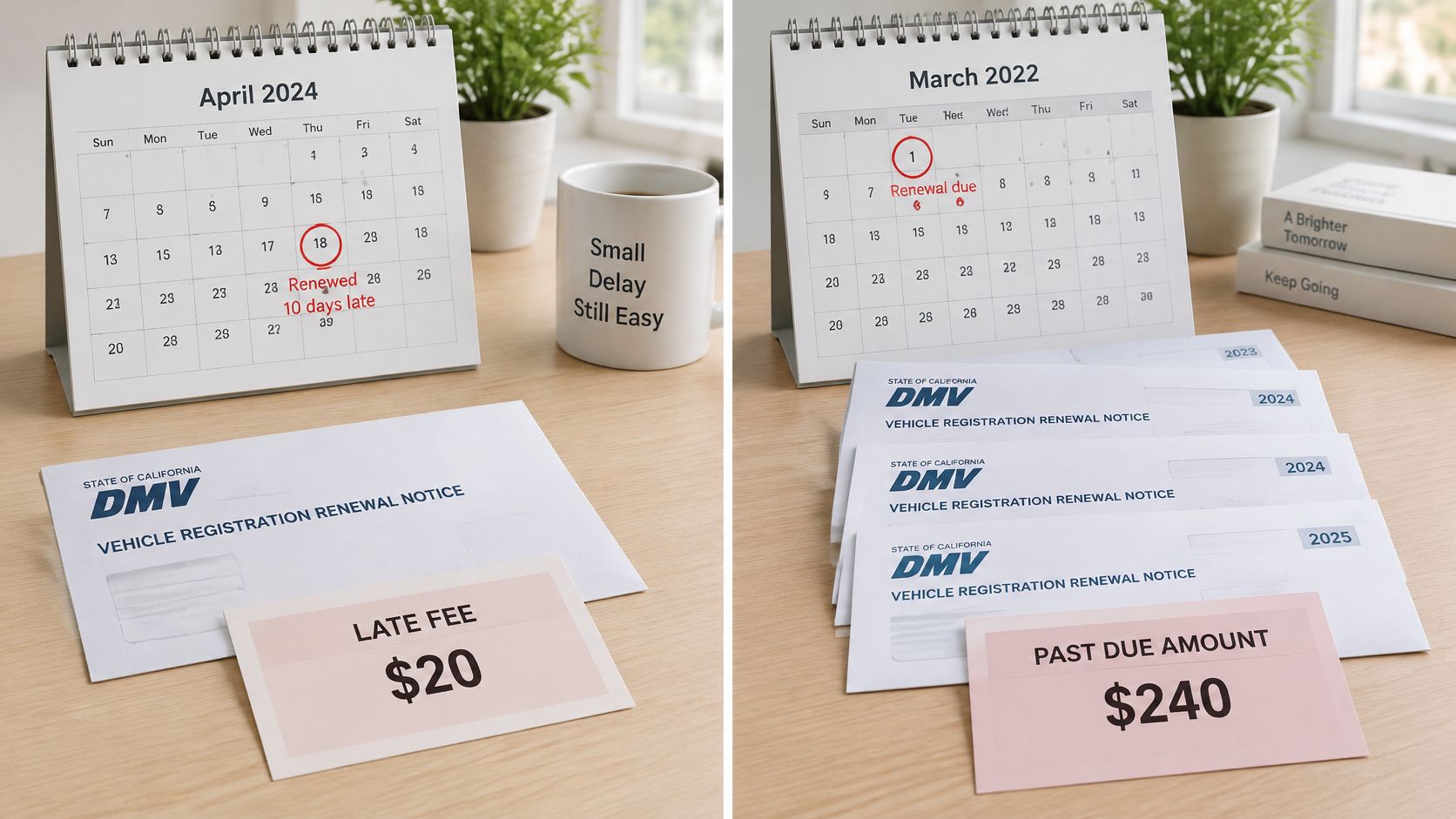
Consider two hypothetical drivers, not customer case studies. One discovers a recent missed renewal while sorting the mail. The other finds paperwork for a vehicle whose registration has been unresolved for years.
The desk scenes below illustrate those different situations, but neither driver can determine the full bill from the notice's appearance alone.
The recently missed renewal
The first driver checks the record and confirms that the payment falls into the shortest delinquency band shown earlier. There's still a percentage component, even though the delay was brief.
The mistake would be to look only at the fixed-charge column and set aside that amount. The driver also needs the vehicle-specific calculation and the ordinary renewal balance.
A sensible response is to ask for the complete assessment, then handle any unfinished certification separately. There's no need to assume the largest penalty applies, but there's also no reason to wait for another threshold before acting.
The vehicle left unresolved for years
The second driver has a different problem. The DMV's late-penalty schedule applies 80% of the license and applicable weight fees, plus $50 registration and $50 CHP late fees, when payment is more than one year but no more than two years late; beyond two years, those amounts rise to 160%, $100, and $100 respectively.
The important comparison is structural: both the percentage and the fixed charges rise. The older lapse doesn't preserve the same small overdue charge indefinitely.
For that owner, an old estimate isn't a reliable payment target. The record needs a current review, particularly if the vehicle has been sitting through changes in ownership, storage, or intended use.
This accompanying video provides another format for considering the renewal issue.
The practical lesson from both stories is the same without assuming identical bills:
- A recent lapse needs a complete calculation. A small fixed charge doesn't mean that's all you owe.
- An older lapse needs a fresh assessment. Don't rely on a remembered amount or an unopened notice.
- A threshold deserves attention before you cross it. Ask what the record requires now rather than waiting until you're ready to drive.
Neither story supports guessing a total from the age of the paperwork. The delay band explains the penalty structure; the vehicle record supplies the rest.
Driving Holds and Other Costs of Waiting
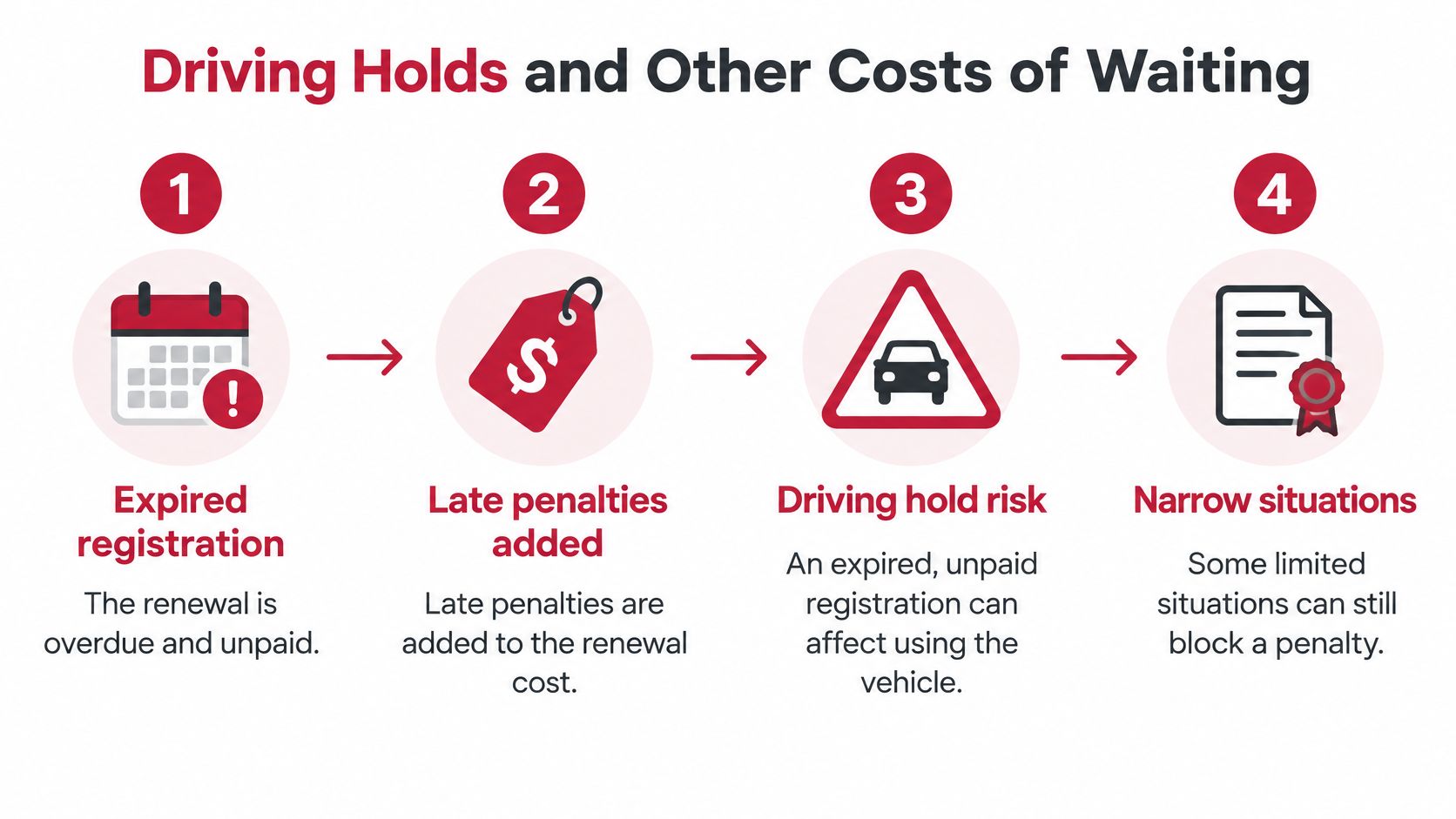
Paying a balance and confirming that a vehicle is ready for lawful operation are related, but they aren't interchangeable. A driver may address the money owed while still needing to finish a smog or documentation requirement.
As described in the DMV guidance cited earlier, late penalties are added to other fees due, and registration status may affect lawful vehicle operation. Before returning the vehicle to the road, confirm both the assessed balance and the status of the renewal.
The timeline below highlights the questions to resolve. It shouldn't be read as a promise that every expired registration follows an identical enforcement sequence.
Ask about status, not just price
When you speak with a processor, make the intended outcome clear: you want to know what is required to complete registration, not merely how much money can be accepted.
- Confirm the full balance. Ask whether the quoted amount includes the applicable delinquency charges and ordinary renewal fees.
- Identify outstanding requirements. Find out whether certification or documentation still prevents completion.
- Confirm completion. Don't assume that a payment receipt alone answers every question about operating the vehicle.
This distinction is especially important when the car needs a smog inspection. Don't assume the trip to obtain certification is permitted because you intend to resolve the renewal afterward.
Exceptions depend on the circumstances
The DMV guidance discussed earlier recognizes limited exceptions involving certain properly documented nonoperation, repossession, transfer, storage, and military-deployment circumstances. These aren't interchangeable reasons to request a general waiver.
If one seems relevant, describe what happened accurately and ask what documentation the DMV requires. A storage situation, for example, needs review under the applicable rule rather than an assumption that any parked vehicle qualifies.
Before returning to the road: Verify that the payment and the outstanding registration requirements have both been addressed.
You don't need to predict an enforcement outcome to make a sound decision. You need a confirmed record, a clear explanation of anything still missing, and an appropriate payment or documented exception.
That approach avoids both extremes: treating an expired card as harmless and assuming consequences that the record hasn't established.
Where to Pay a Late California Registration Renewal
You can work directly with the DMV or use a licensed registration-service provider. The processing location doesn't change the state's penalty rules. Whoever handles the transaction must determine the applicable delinquency period and collect the required DMV and CHP amounts along with ordinary renewal fees.
The useful comparison is about what your transaction needs. A straightforward payment is different from a renewal that still needs emissions certification or a record review.
Choose the path that matches the problem
| Payment path | When it may fit | What to clarify |
|---|---|---|
| DMV online renewal | You want to handle an available renewal transaction yourself | Whether the record permits completion and what remains outstanding |
| DMV office | You need direct help reviewing the record or an unusual circumstance | What documents to bring and whether the matter can be completed |
| Licensed registration service | You want in-person processing, potentially alongside a smog visit | Available services, processing charges, and whether the record can be cleared |
An office visit can involve waiting, while an online payment won't necessarily solve a missing-certification issue. A licensed provider may offer on-site sticker printing when the record can be cleared, but don't assume every transaction qualifies for immediate completion.
Ask about the full transaction cost, including any service charge, before authorizing processing. State penalties and a provider's processing charge are different parts of the bill.
A local smog-and-renewal option
In Antioch, Fire House Smog is a STAR-certified test-only station and licensed DMV registration-services provider offering smog inspections, renewal processing with on-site sticker printing, and ownership transfers. Its local DMV registration-services information lists the location at 2900 Lone Tree Way, telephone 925-754-1600, and DMV service hours of Monday through Saturday, 9:30 AM to 5:00 PM, and Sunday, noon to 4:00 PM, with limited services possible on weekends.
The station handles passenger cars, SUVs, and light-duty trucks, plus some RVs when size and equipment allow. Its test-only model means it doesn't sell repairs, so a failed inspection still requires a separate repair plan.
For an ordinary renewal, paying the DMV yourself may meet your needs. If emissions certification is the missing piece, a combined testing-and-registration visit may be more practical.
Call ahead for an RV, a weekend transaction, or a record that may need more than routine processing. Confirming those details before traveling is more useful than assuming sticker printing is available for every unresolved renewal.
Clear the Balance Before the Next Milestone
Start with the vehicle record, not the amount you hope the bill will be. A forwarded notice, an unused car, and an unfinished smog test each raise different questions, so describe your situation clearly when you ask for help.
Your immediate goal is an accurate assessment and a workable completion plan. You don't need to solve the entire problem from the paperwork on your kitchen table.
Put the next actions in order
- Verify the deadline. If notification was delayed or the ownership recently changed, ask how the DMV record treats the payment date.
- Request the full assessed amount. Confirm that the calculation includes the percentage component and both fixed late charges, rather than budgeting from the fixed portion alone.
- Resolve the correct filing. If nonoperation applies, check eligibility and the permitted filing window. Otherwise, arrange the renewal payment.
- Finish outstanding requirements. Address smog certification, insurance documentation, or other items identified by the processor.
- Confirm the resulting status. Keep the receipt and ask whether anything remains before treating the renewal as complete.
Don't wait to ask about payment just because you're still arranging repairs. Likewise, don't treat a possible notice-related exception as permission to drive while the deadline question remains unresolved.
Make the visit useful
For drivers in Antioch and East Contra Costa County who still need emissions certification, a local test-only station with registration processing can be an option. Ask whether your vehicle and transaction can be handled together, especially if an RV or unusual record issue is involved.
Have the registration card, renewal notice, and relevant payment or filing records available for review. Explain any late-notice issue before processing begins so the timing question doesn't get lost in a discussion about the total.
The next milestone to focus on is practical: getting the record reviewed and taking the action it requires. An accurate answer today is more useful than another estimate you'll need to revisit later.
Visit Fire House Smog for STAR-certified test-only smog testing and California registration renewal processing with on-site sticker printing when your record can be cleared. If your renewal is overdue, call ahead to discuss the remaining requirements and confirm available DMV services before your visit.
In California, the vehicle transfer fee is a mandatory DMV charge the buyer pays within 10 days of taking ownership. It's separate from use tax, the vehicle license fee, and registration fees.
You've picked up the keys, signed the paperwork, and thought the car deal was finished. Then a DMV bill arrives with a total that looks much higher than the transfer fee you expected. The surprise usually comes from several separate charges appearing together, each tied to a different part of the transaction.
The useful question isn't only “What's the transfer fee?” It's also “Which other charges apply, and what must I do before a deadline?” California's rules make the ownership record and the timing of the paperwork financially important. Whether you bought from a dealer, a neighbor, or brought a vehicle into California, knowing what each line means can help you prepare and spot missing information.
Table of Contents
- The Surprise That Hits Every New California Car Owner
- What the Vehicle Transfer Fee Actually Covers
- Who Pays and When the Clock Starts Ticking
- The Other Charges That Travel With the Transfer Fee
- How Transfer Type Changes the Bill
- Where Smog Certification Fits Into the Transfer
- Handling the Transfer in One Stop at Fire House Smog
- Why the Transfer Fee Is Not a Flat Number
The Surprise That Hits Every New California Car Owner
A first-time buyer might read “vehicle transfer fee” on an estimate and assume it represents the full cost of putting the car in their name. But the bill can also include tax, registration balances, title-related charges, and penalties. Those amounts aren't all part of the transfer fee, even when they appear on the same estimate.
Consider a buyer who purchases a used car privately and receives a DMV estimate that's larger than expected. The estimate doesn't necessarily mean the transfer fee itself has changed. The buyer's county, the vehicle's registration status, and whether earlier ownership changes were properly recorded can all affect the total. A bill is easier to understand when you read each charge as its own obligation instead of treating the total as one unexplained price.
The buyer is generally responsible for the transfer fee, and the clock starts from the transaction date. That means the paperwork deserves attention as soon as the sale or gift is complete, not only when the next registration renewal comes around. A delay can create a separate penalty issue, even if the original transfer charge is straightforward.
A useful way to read the bill: First identify the government charge for recording ownership. Then check taxes, registration-related fees, and any late charges separately.
This guide follows that same order. It starts with what the transfer fee covers, then explains who pays and when, why other line items vary, and how transaction type and smog certification can affect the process. If you already have an estimate, compare its individual entries with the relevant details below rather than relying on the headline total.
What the Vehicle Transfer Fee Actually Covers
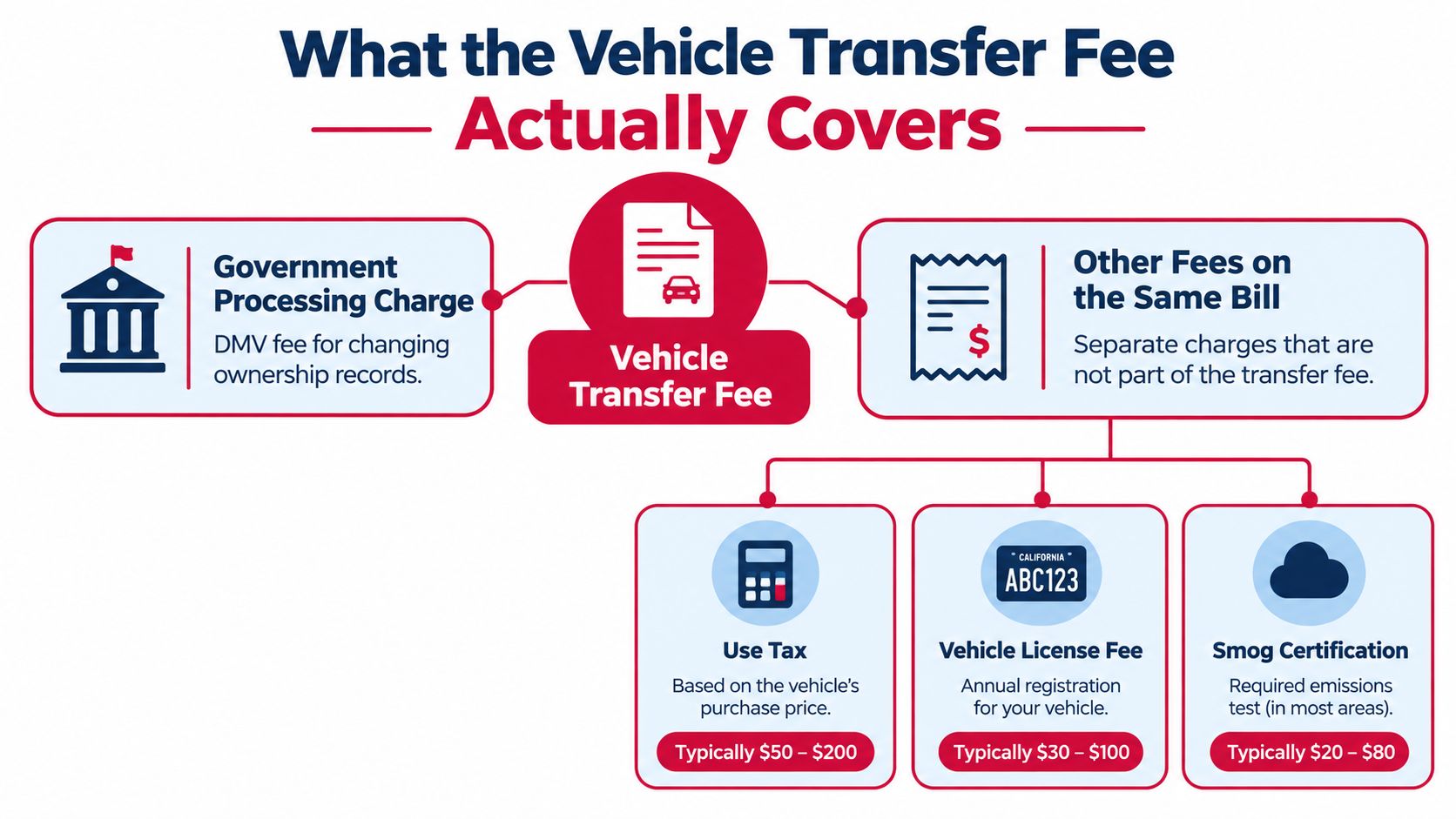
The vehicle transfer fee is the DMV charge for processing a change in ownership. California requires it when a vehicle changes hands through a sale, gift, donation, or trade. It pays for the administrative act of updating the ownership record. It isn't a percentage of the purchase price, and it doesn't stand in for every other charge due during registration.
Think of the fee like postage on a registered letter. The postage gets the document into the delivery system, but it doesn't represent the value of what's inside. In the same way, the transfer fee covers the ownership-record process, while tax and registration charges follow their own rules.
Separate charges on the same bill
A DMV estimate may list use tax, a vehicle license fee, renewal charges, county or district fees, weight fees, or special plate charges alongside the transfer fee. These are not all components of that fee. They arise from other requirements, so a transfer estimate can be higher than the transfer charge alone.
The distinction matters when you're comparing estimates or trying to work out why a bill changed. Ask what each line represents: Is it the charge for changing the ownership record, a tax, a registration balance, or a late assessment? A clearly itemized answer is more useful than a single total.
One vehicle, one transfer obligation
The DMV applies transfer fees separately to separate vehicles. If ownership changes hands more than once before the DMV is notified, the transfer record may also need to account for each intervening sale. So the same fee label can relate to more than one ownership change, not just the person who most recently brought the paperwork to the DMV.
Who Pays and When the Clock Starts Ticking
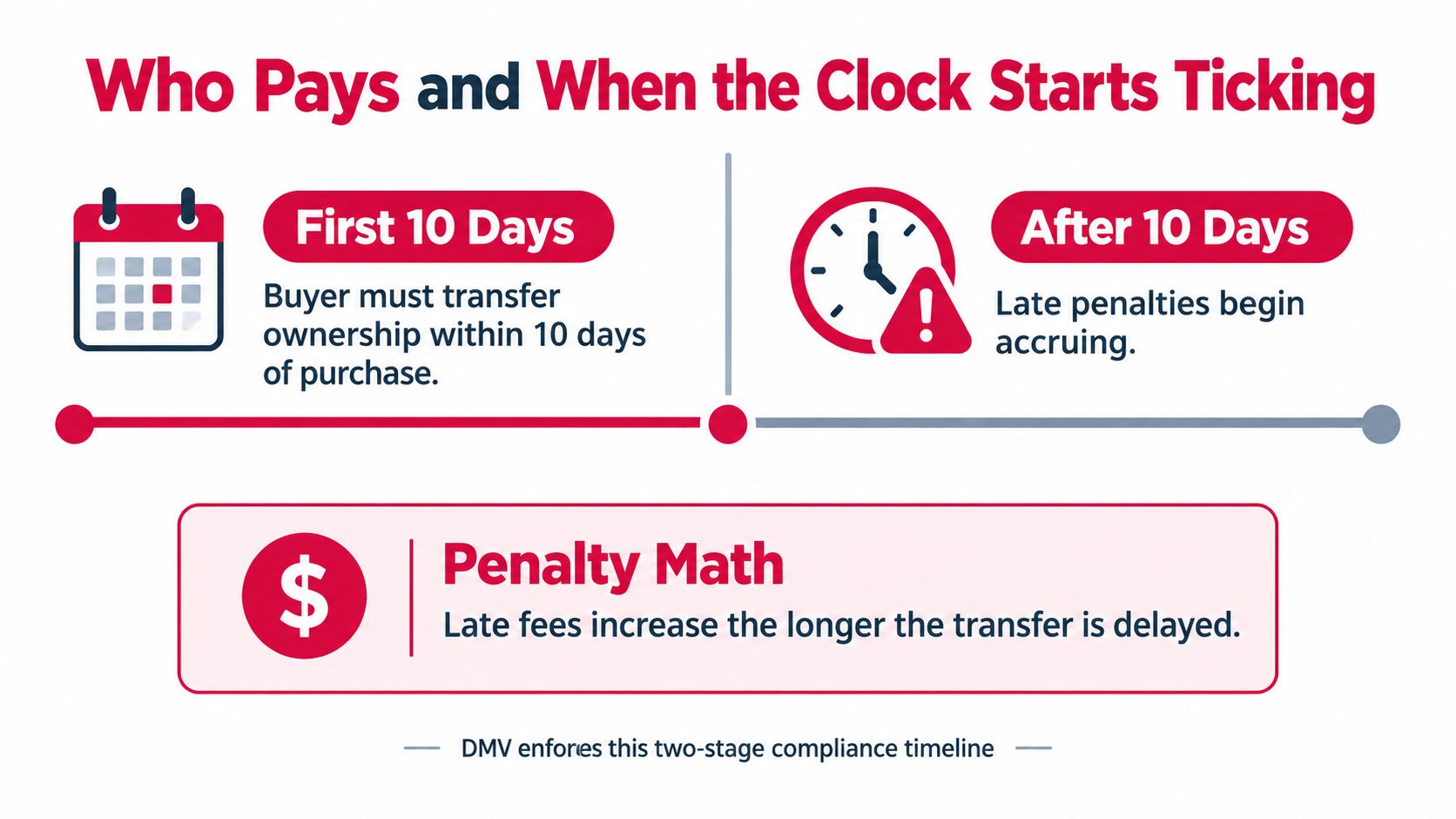
The buyer pays the transfer fees, and California hands that buyer two dates to track at once. Payment is due within 10 days of the transaction date, and penalties apply once the required payment has gone unsubmitted for 30 days, per the California DMV's title-transfer guidance. Read the first date as the deadline and the second as the point where the bill starts growing.
The gap between those dates trips up first-time buyers.
A buyer who files on day 25 did beat the penalty cutoff, but the obligation was already two weeks late. Transfer timing works like a parking meter with a grace period: enforcement may not show up right away, yet the time was still owed from the start.
Late charges can also attach to the registration side of the same bill. Under the DMV's registration-fee guidance, a registration delay of 1 to 10 days adds 10% of the vehicle-license and weight fees, plus $10 registration and $10 CHP late fees. Those penalties sit on the registration lines, and the transfer fee itself stays unchanged. Each line follows its own clock, so the cheapest transfer is the one filed early with complete paperwork.
What happens when ownership changed more than once
A vehicle that passes through several buyers before anyone notifies the DMV leaves a chain of transfers on the record. The DMV's multiple-transfer guidance states that only the last transfer in the chain draws a transfer penalty, while the fees tied to earlier transfers still apply.
Use tax paid by an earlier buyer cannot be credited toward what a later buyer owes. If the title history has gaps, ask the DMV or a qualified registration provider to reconstruct the sequence of sales before assuming the most recent transaction is the only one on the record.
Keep the transaction date, the signed title, and every ownership document together, then file promptly. For help pairing the transfer with the rest of the registration paperwork, review vehicle registration transfer services. Clear dates and complete documents are what turn an unpredictable bill into one you can estimate line by line.
The Other Charges That Travel With the Transfer Fee
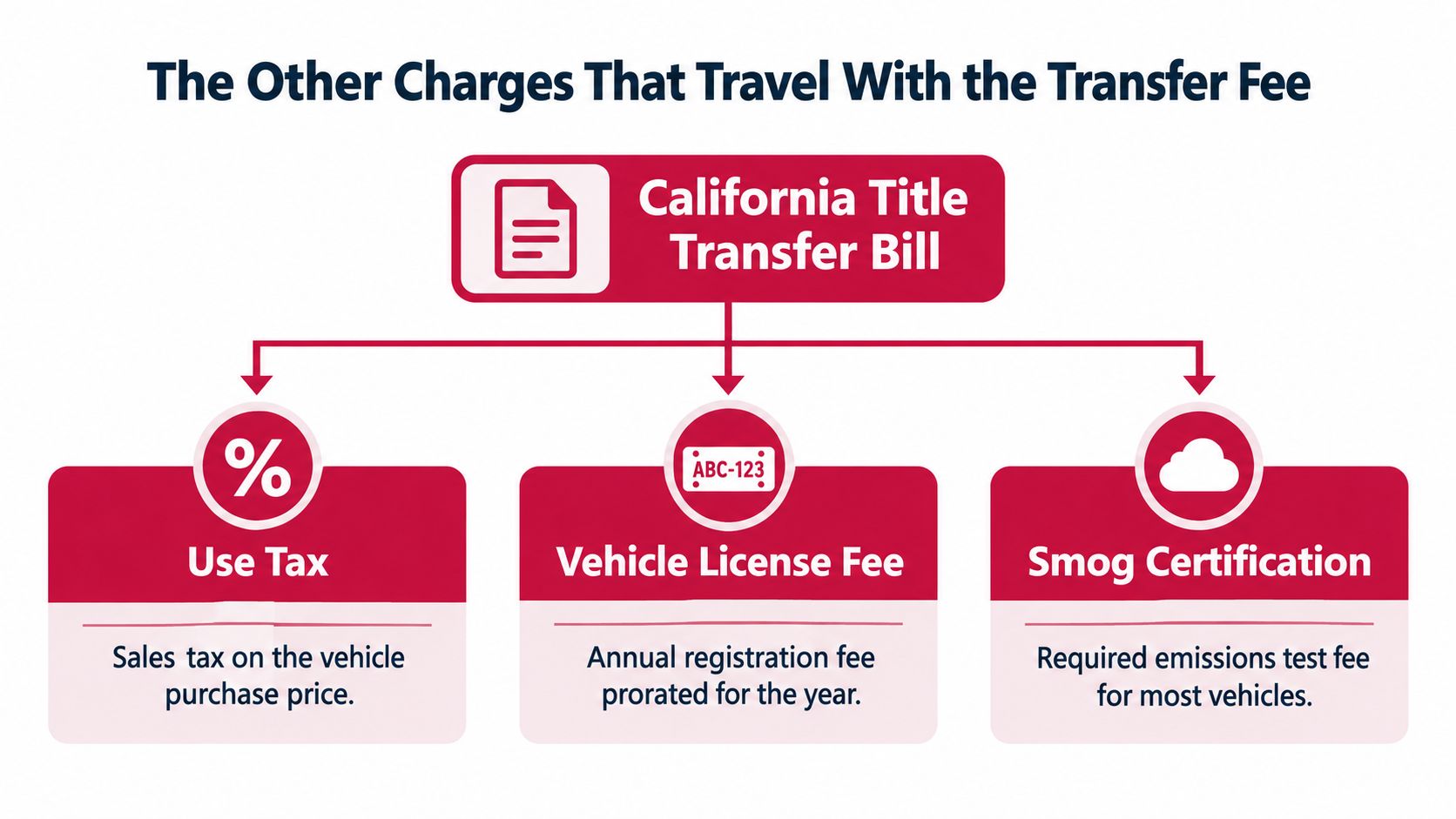
The transfer fee is just one entry in a possible set of charges. The total can depend on the vehicle, the buyer's location, and the vehicle's registration status. Reading the bill line by line helps you distinguish taxes and registration costs from the administrative charge for changing ownership.
Use tax follows the buyer's location
For a taxable purchase, California use tax is generally calculated using the purchaser's city and county. The rate may range from 7.25% to 10.25%, so two buyers transferring similar vehicles can face different tax amounts because they live in different jurisdictions. The tax is distinct from the transfer fee, and the total due can't be estimated by looking at that fee alone. The California DMV title-transfer information describes this distinction and the factors that can affect a transfer bill.
VLF and other registration-related charges
For applicable vehicles, the vehicle license fee (VLF) is 0.65% of market value. The DMV uses the vehicle's VLF class and relevant model-year schedule, not the new owner's negotiated purchase price, to determine the amount. This is why a low sale price doesn't necessarily mean the VLF will be calculated from that price.
Other possible line items include renewal charges, county or district fees, weight fees, and special plate charges. Whether they apply depends on the vehicle and its registration circumstances. Ask for an itemized calculation if the estimate combines these amounts or if you can't tell which line is tied to the transfer.
Check the effective fee schedule
California periodically adjusts certain DMV charges through statutory consumer-price-index increases. A fee notice effective January 1, 2026, lists the title-only fee, off-highway-vehicle transfer fee, and moped original-or-transfer fee each increasing from $27 to $28. Those examples apply to the specific fees listed in that notice, not to every vehicle transfer. Check the DMV's current calculation for your vehicle and transaction rather than assuming a charge shown in an older estimate still applies.
For an overview of the wider registration estimate, see California vehicle registration costs. Treat each item as its own rule-based charge, and ask whether a figure is tax, registration, title processing, or an optional service fee.
How Transfer Type Changes the Bill
Two people can transfer similar cars in the same week and walk out with different totals. The transfer fee itself rarely explains the gap. The transaction type underneath it usually does, because a private sale, a gift, a donation, a trade, and an out-of-state title each carry slightly different tax treatment and paperwork.
Before relying on any estimate, identify what happened: Was the vehicle sold, given as a gift, donated, traded, or brought into California from another state?
| Transfer situation | What to check | Why the total may differ |
|---|---|---|
| Private-party sale | Confirm the transaction details, date, and current registration status. | Use tax may apply, and the buyer remains responsible for the transfer fees. |
| Gift | Make sure the transfer is being reported as a gift and ask how the DMV will assess tax. | A gift may be treated differently from a taxable purchase, but don't assume the tax outcome without confirming eligibility. |
| Donation | Check the transfer documents and whether the recipient is an organization or another party. | Donation paperwork and tax treatment may depend on the specific transaction. |
| Trade | Review the sale and trade paperwork as separate parts of the transaction. | The transfer still needs to be documented, and the full bill may include registration charges beyond the transfer fee. |
| Out-of-state title | Gather the existing title and ask what verification or California registration steps are required. | An out-of-state vehicle can need additional processing, so the estimate may differ from an in-state transfer. |
For taxable purchases, use tax follows the purchaser's city and county rather than one statewide figure. As covered under use tax above, the rate depends on the buyer's jurisdiction, consistent with the DMV title-transfer guidance referenced earlier, so confirm the applicable rate for your location instead of reusing a figure from another transaction.
The same caution applies to gifts and donations. Say a relative signs a car over to you for free. The paperwork may still ask when the vehicle changed hands, what it was worth, and whether the transfer qualifies for different tax treatment. Clarify what documentation the DMV needs before assuming the word "gift" on a form closes the file. If you buy privately instead, keep the signed title and transaction details together so the date and ownership path are clear.
Out-of-state titles deserve their own check. Ask whether the vehicle needs verification, whether its registration status changes the amount due, and which documents must accompany the title. Across every row of the table, the order of operations stays the same: identify the transfer type first, then estimate taxes and registration charges separately from the transfer fee.
Where Smog Certification Fits Into the Transfer
A smog certificate can be a separate requirement from the ownership-record fee, and it can affect how smoothly you complete registration. Don't assume every vehicle or every transfer follows the same emissions-testing rule. Confirm whether a smog check is required for your specific vehicle and situation before you plan the rest of the paperwork.
The timing matters. If the vehicle needs testing, completing that step before you submit the full transfer and registration package can help avoid a stop in processing. If you're unsure whether a recent certificate will meet the requirement, check with the DMV or a smog station before relying on it. The California smog-test requirements page offers additional guidance.
| Scenario | Smog required | Notes |
|---|---|---|
| Vehicle transfer where a smog inspection is required | Yes | Arrange the inspection and confirm the certificate is ready for the transfer process. |
| Vehicle with a recent passing certificate | Confirm first | Ask whether the existing certificate can be used for this transaction. |
| Vehicle with an exemption or a special circumstance | Confirm first | Don't assume an exemption applies based only on the vehicle's age or fuel type. |
| Vehicle that fails the inspection | A passing result may still be needed | Resolve the emissions issue and check the next steps before expecting registration processing to finish. |
A passing certificate doesn't replace the title, transfer payment, or any applicable tax. It addresses an emissions requirement. Keeping those steps distinct makes it easier to see what's still outstanding if the DMV or a service provider says the transfer can't yet be completed.
If the vehicle fails, ask the testing station what the result means and what options are available. Some stations offer a retest under their own policies, but confirm the terms directly. That way, you can plan around the testing requirement without confusing it with the transfer-fee deadline or assuming that one completed step clears the others.
Handling the Transfer in One Stop at Fire House Smog
A buyer handling both a smog requirement and DMV paperwork may prefer a provider that can address those tasks in one place. Fire House Smog is a STAR-certified test-only smog station and licensed DMV registration services provider in Antioch. It performs smog inspections and processes California ownership transfers, including support for out-of-state vehicles, with stickers and plates as needed.
A buyer arriving with a signed title and the right supporting documents can ask staff to check what's needed for the transaction and whether smog testing applies. Bring a valid ID, the signed title, any lien-release paperwork, and a smog certificate if you already have one. If a document is missing or the title record has an issue, clarify that before expecting the transfer to be completed.
What the service can handle
The station offers STAR-certified, test-only smog inspections for passenger vehicles and light-duty trucks, plus testing for some RVs and motorhomes when size and equipment allow. Its test-only model means it doesn't sell repairs, so testing and repair work aren't bundled into the same service.
For DMV matters, the site handles California registration renewals and ownership transfers, including out-of-state vehicle support. On-site tag and plate issuance is available when needed for eligible transactions. The station also has two service bays, and its published service information notes a free retest may be available subject to site policy and coupon terms. Confirm eligibility and current terms with the business.
Smog testing is available seven days a week, with extended evening and weekend hours. DMV services are listed for Monday through Saturday, 9:30 AM to 5:00 PM, and Sunday, 12:00 PM to 4:00 PM, though weekend services may be limited. The location is 2900 Lone Tree Way, Antioch, CA 94509. Check directly before visiting to confirm the service you need and the documents to bring.
Why the Transfer Fee Is Not a Flat Number
A vehicle transfer fee is a government charge, but the amount due on a transfer bill isn't necessarily one universal price. The fee is only one part of the transaction. The buyer's jurisdiction, vehicle class and weight, registration status, ownership history, and timing can each affect other line items or obligations.
Use this checklist before finalizing the transfer:
- Confirm the transaction type: Identify whether you're buying, receiving a gift, donating, trading, or registering an out-of-state vehicle.
- Check registration status: Find out whether the vehicle has an outstanding registration balance or another unresolved issue.
- Identify the buyer's city and county: Use tax depends on jurisdiction when the purchase is taxable.
- Review the title and lien status: Make sure the title is signed correctly and determine whether a lien release is needed.
- Ask about previous transfers: If the DMV wasn't notified of earlier sales, more than one transfer-fee obligation may apply.
- Confirm whether smog testing is required: Don't assume a vehicle is ready for registration until you've checked the applicable emissions requirement.
- Note the transaction date: Submit the required payment and paperwork promptly to avoid timing-related problems.
Once those details are in hand, ask for an itemized estimate. A clear breakdown should distinguish the government transfer charge from use tax, VLF, registration charges, penalties, and any optional service fee. That gives you a more reliable picture of the total than a headline transfer price.
If you're completing a California ownership transfer in Antioch, Fire House Smog offers smog inspections and DMV registration services, including ownership-transfer support. Contact the station or visit its Lone Tree Way location to confirm what documents your transaction requires and whether it can handle your transfer and any needed smog test.
California vehicle registration cost typically runs $300 to $450 a year on a normal gasoline car once the base fee, vehicle license fee, smog fee, and county or district charges are stacked. The exact total depends on vehicle value, weight class, and county, so the bill on your notice can land far above or below that range.
That's why the number on the renewal form never tells the full story. If you're staring at a DMV notice in Antioch and trying to figure out what you'll owe, the answer is in the fee stack, not the headline.
Table of Contents
- What Drivers Actually Pay for Vehicle Registration in California
- The Fee Stack That Builds Your California Registration Bill
- How Vehicle Type Changes the Final Number
- Documents, Timing, and When Smog Certification Is Required
- Why Combining Smog and Registration at One Location Saves Time
- Common Surprise Charges and How to Avoid Them
- Your Single-Visit Plan at Fire House Smog
What Drivers Actually Pay for Vehicle Registration in California
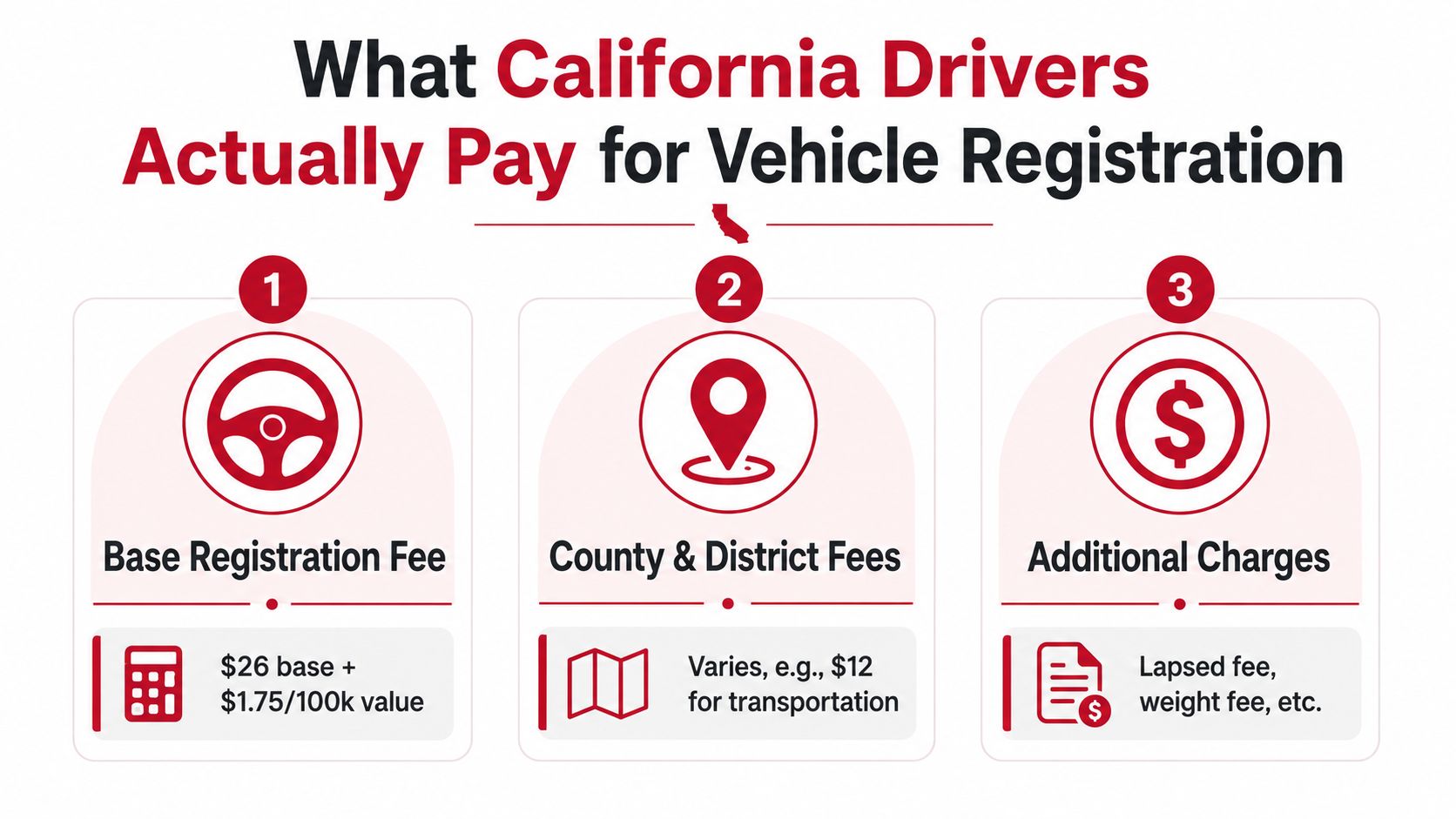
The answer is simple. A California driver is usually paying a bundle of fees, not one flat renewal price, and the total shifts with the car you own, where you live, and whether the vehicle needs smog certification. For many everyday gasoline cars in California, the combined annual cost lands in the $300 to $450 zone, while the statewide average registration and documentation fee is about $595.08 because some vehicles and counties run much higher than that typical range. World Population Review's state fee ranking
Read the bill as a stack, not a sticker price
California doesn't price registration like a simple sticker. The DMV structure layers a base registration fee, a vehicle license fee tied to value, and extra state or local charges depending on the vehicle and transaction type. That's why two drivers in Antioch can renew on the same day and still owe very different amounts.
Practical rule: If your renewal notice looks higher than last year, don't assume it's an error. In California, the car's value, the category it falls into, and the county or district add-ons can all change the total.
The DMV's own fee schedule makes that clear. California's registration pricing includes an original registration or renewal fee of $76, plus separate line items such as $8 for the Alternative Fuel/Technology Smog fee and $3 for the Alternative Fuel/Technology Registration fee. The final amount depends on which bucket your transaction falls into, which is why first-time owners often misread the notice. California DMV registration fees
For Antioch drivers, the useful way to think about it is this. The DMV wants proof the vehicle is eligible, the state wants its base fee and value-based share, and local add-ons can show up on top. If your car needs smog, that's not just a separate task, it's part of the transaction path that decides whether the renewal can be completed at all.
Internal resource for local renewal help: registration renewal fee details
The Fee Stack That Builds Your California Registration Bill
A California renewal at the counter is usually a stack of charges, not one flat price. The clerk does not ring up the bill as a single mystery number. They apply the state's core registration charges, then add any vehicle-specific or transaction-specific items that fit your car.
What each line item is doing
The core value-based piece is the Vehicle License Fee, and California sets it at 0.65% of depreciated vehicle value annually. That is why the number shifts as the car gets older, because the state is taxing what the vehicle is worth now, not what it cost when it was new. The separate original registration or renewal fee of $76 is the standard DMV transaction charge that sits on top of that calculation. California DMV registration fees
California also uses targeted add-ons. The DMV schedule lists separate Alternative Fuel/Technology Smog and Alternative Fuel/Technology Registration charges when those categories apply. That is the part many owners miss, especially when they skim a renewal notice and look only for the bottom-line amount. If your car falls into one of those buckets, the bill changes before you even get to any local filing issues.
Bottom line: California registration is a mix of vehicle value, vehicle category, and specialized filings. At the counter, each one can change what you owe.
Here is the useful comparison. New York uses a different model, with biennial registration and weight-based fees that rise from $26.00 for the lightest passenger class to higher brackets as weight increases, plus separate use-tax and metro-area charges in some cases. California leans harder on value-based pricing, so a newer or pricier car can cost more to keep registered even if it is driven like an ordinary commuter. New York DMV passenger vehicle registration fees
Common California registration line items
| Line Item | Typical Amount | What It Pays For |
|---|---|---|
| Original registration or renewal fee | $76 | DMV transaction fee for registration filing |
| Vehicle License Fee | 0.65% of depreciated value | Value-based state revenue component |
| Alternative Fuel/Technology Smog fee | $8 | Category-specific smog-related charge |
| Alternative Fuel/Technology Registration fee | $3 | Category-specific registration charge |
That table is the quickest way to read the printout that comes back from the DMV window. If the amount looks high, check the value-based piece first, then look for category-specific add-ons, then confirm whether the vehicle type or transaction triggered anything unusual. In Antioch, that is exactly where first-time owners get surprised, and it is also why a combined business vehicle registration service stop can save a second trip when the paperwork and smog status are already lined up.
How Vehicle Type Changes the Final Number
Walk into the DMV with two cars that look similar on the street, and the totals can still come out different. California does not charge a single flat sticker price for every vehicle. The bill shifts with value, weight, and category, so a commuter sedan, a pickup, an older economy car, and a heavier recreational vehicle can all land in different brackets. California vehicle registration fee structure
A newer sedan costs differently than an older one
A five-year-old commuter sedan usually stays closer to the lower end of the California range because depreciation has already cut down the Vehicle License Fee portion. A newer or more expensive sedan pushes the total up because the value-based piece still has more to work with. That is why two Antioch owners with similar-looking cars can still leave the counter with different renewal amounts.
Light-duty pickups often cost more than small sedans because weight and use category matter more. If the truck falls into a heavier bracket, the final amount rises even when it is not a commercial rig. The bill is not random. Weight-based pricing makes trucks less predictable than a basic compact car. A vehicle that works as a daily commuter can still cost more because the fee chart treats it as heavier.
An eleven-year-old economy car usually benefits from depreciation. Montana's age-based fee schedule makes the contrast easy to see, dropping from $217 for vehicles 0–4 years old to $28 for vehicles 11 years or older, which shows how older vehicles can sit in a much lower bracket than newer ones. California does not use Montana's exact formula, but the same basic problem shows up here. Newer vehicles carry a larger value-based burden, while older ones usually come out lighter at the counter. Montana light vehicle registration and fees
A simple comparison for Antioch owners
- Commuter sedan: Usually the easiest to budget for, because depreciation pulls down the value-based charge.
- Light-duty pickup: Expect a higher bill if the weight bracket or use classification pushes it upward.
- Older economy car: Often cheaper than a newer equivalent, mainly because the value-based piece has already fallen.
- Mid-size RV: Call ahead. Some RVs are accepted, but size and equipment limits still matter, so fee logic is only part of the decision.
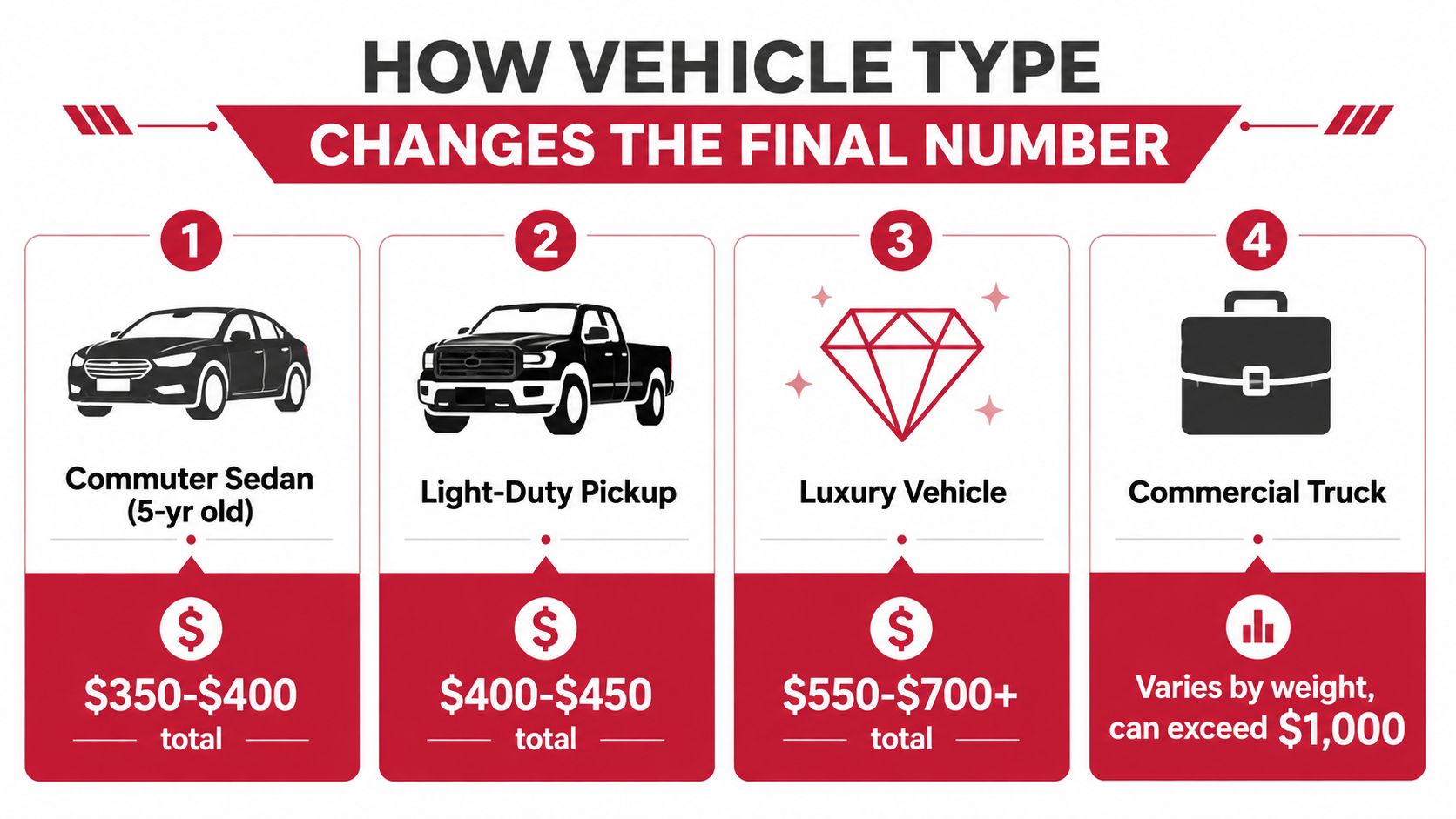
If you are registering a truck or van for a company, the numbers can shift again because commercial and heavier classes often sit in separate brackets. Fire House Smog's business vehicle registration page is the right place to check before you make a second trip for paperwork that should have been handled once.
Documents, Timing, and When Smog Certification Is Required
The DMV doesn't care how busy you are. It cares whether the paperwork is complete and whether the vehicle is eligible for renewal right now. If one document is missing, the whole transaction stalls and you end up paying with time instead of money.
What to bring before you leave home
Bring the basics. You need proof of insurance, photo ID, the title or transfer paperwork if ownership is changing, and payment. If smog is required, bring a current passing smog certificate or be ready to get one before the DMV portion is processed. Vehicle registration documents checklist
The fastest renewal is the one you don't have to restart.
Timing matters because smog and registration don't always happen on the same clock. For renewal, California drivers often need the smog result to still be valid when the DMV processes the filing, and if the certificate expires before the paperwork is submitted, the car has to be tested again. Sale, transfer, and out-of-state registration usually trigger a fresh emissions step right away, so don't assume last month's certificate still solves today's problem.
California also uses an even-year and odd-year smog cycle, so some vehicles get pulled back into testing on a predictable schedule rather than every renewal. That's why the renewal notice is worth reading carefully instead of assuming the same rule applies to every car in the driveway. If you've changed ownership, moved a car in from another state, or let the registration go stale, expect the paperwork to get stricter, not looser.
What makes drivers lose time
- Expired smog certificate: The renewal stops until you retest.
- Missing title paperwork: Ownership transfer can't finish cleanly.
- Late renewal: Penalties start to pile on once the vehicle is out of compliance.
- Wrong transaction type: Renewal, transfer, and out-of-state filing are not interchangeable.
The smartest move is to gather the paperwork before you drive anywhere. Once you're at the counter, the difference between a clean transaction and a wasted trip is usually a document you could have printed or checked in advance.
Why Combining Smog and Registration at One Location Saves Time
The usual route burns time fast. You visit a smog station, wait for the result, then go somewhere else to finish the DMV paperwork, and then you may have to come back if a document is missing or the filing hits a snag. In Antioch, that turns a normal renewal into a wasted half-day, especially if you are juggling work, school pickup, or a vehicle that needs to stay on the road.
One stop beats two stops
A STAR-certified test-only shop keeps the inspection focused on emissions and avoids the repair-shop conflict. Add licensed DMV processing on the same site, and the same visit can handle the test, the renewal, and the tag issuance without sending you across town. That matters because vehicle registration cost is not just the fee on the notice, it is also the time and gas you burn when the process gets split into pieces.
A local Antioch provider like Fire House Smog combines STAR-certified testing with on-site DMV services, including tag issuance. That setup keeps the renewal moving at the counter instead of turning it into a two-stop errand.
The local workflow is simple. You arrive with your documents, get the vehicle tested if needed, and let the DMV side of the counter finish the registration work while you are already there. That is a better system than making one renewal stretch into two separate trips.
If your goal is to get the tags in hand, the cleanest move is a place that can finish both jobs without sending you out for a second line.
The operating setup matters too. A shop with smog availability throughout the week, DMV service hours that cover the usual workday and part of the weekend, and multiple service bays can keep vehicles moving instead of stacking them up. That is the kind of arrangement that cuts waiting and keeps the counter from becoming the bottleneck.
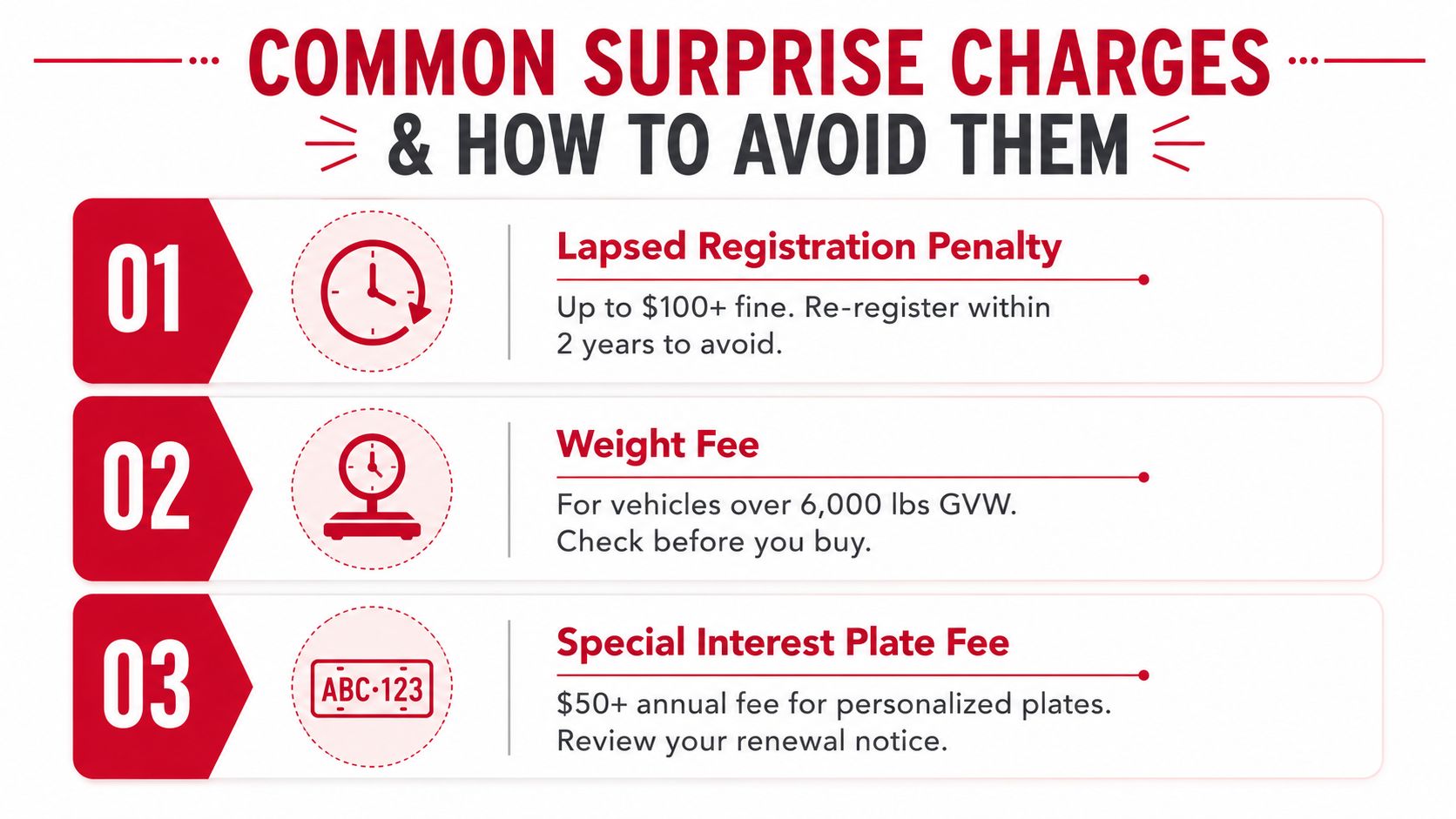
Common Surprise Charges and How to Avoid Them
Most drivers don't get hurt by the headline fee. They get hurt by the surprises that show up after they've already planned their budget. If you want to keep vehicle registration cost under control, you need to know the traps before the DMV does.
The charges that catch people off guard
- Lapsed registration penalty: Let the renewal drag on, and the bill gets uglier fast. Re-registering before the vehicle sits out of compliance too long is the easiest way to avoid paying more than you planned.
- Weight reclassification: Modify a truck, change its load setup, or misstate the vehicle class, and the DMV can move it into a different bracket. That's how a seemingly minor change becomes a bigger fee.
- Transfer-related charges: Buying, selling, or inheriting a car can trigger extra paperwork and extra cost because the transaction is no longer a simple renewal.
- Special plates and category fees: Personalized or special-interest plate setups can add recurring charges, and owners often forget to account for them until the renewal notice arrives.
The age and value structure matters here too. Newer, heavier, and special-category vehicles are more likely to carry hidden costs because California's system isn't flat. That's the whole point of a policy that uses vehicle worth, weight, and fuel type as part of the price.
How to keep the bill from jumping
- Check the renewal notice early. Don't wait until the last week.
- Confirm the vehicle class. A truck that should be in one bracket but gets processed in another can cost more.
- Make sure the smog certificate is current. If it expires before processing, you're back at square one.
- Ask about transfer paperwork before you arrive. A missing title signature is one of the fastest ways to create a second trip.
If you've lifted a truck, changed equipment, or bought a used vehicle with a messy registration history, verify the fee path before you pay anything. That one step prevents the kind of surprise that turns a normal renewal into a budget problem.
Your Single-Visit Plan at Fire House Smog
If you live in Antioch or anywhere in East Contra Costa County, the cleanest plan is to bring the paperwork, get the smog handled, and finish the DMV side in one stop. Fire House Smog is at 2900 Lone Tree Way, Antioch, CA 94509, and the phone number is 925-754-1600. It serves passenger cars, SUVs, light-duty trucks, and some RVs, subject to size and equipment constraints.
Bring proof of insurance, ID, and whatever renewal or title paperwork you already have. If your vehicle needs smog, let the station handle that first, then complete the registration renewal while you're already there. If the car is an RV or something unusual, call ahead so you don't waste a trip.
The shop's model is simple. It's a test-only station, so the emissions test isn't tied to repair upsells, and the DMV side can process the registration work without forcing you to start over somewhere else. That's the right setup when you want the whole vehicle registration cost problem solved without dragging it out over several days. Fire House Smog
If you want the fee stack handled without the usual DMV runaround, take your renewal paperwork to Fire House Smog and get the smog and registration processed in one visit. It's a practical option for Antioch drivers who want straight answers, on-site tag issuance, and fewer surprises at the counter. Visit Fire House Smog to check hours, confirm what to bring, and get your registration done the simple way.