
California DMV Registration Renewal Late Fees Guide
You find an expired registration card in the glove box, then open a renewal notice that arrived after a move. Maybe your car also needs a smog check, and you're wondering whether to pay now or wait until everything is ready. Before assuming you owe a flat late charge, separate two questions: Does the DMV consider your payment late, and what charges apply if it does?
California DMV registration renewal late fees depend on the vehicle record, the applicable deadline, and the length of the delay. You don't need to guess from someone else's renewal bill. You need the right deadline, the full assessed amount, and a clear plan for completing any remaining requirements.
Table of Contents
- When Your California Registration Is Actually Late
- California DMV Late Fee Amounts and How They Add Up
- Why Parking the Car or Failing Smog Rarely Stops Penalties
- What Short Delays and Multi-Year Lapses Really Cost
- Driving Holds and Other Costs of Waiting
- Where to Pay a Late California Registration Renewal
- Clear the Balance Before the Next Milestone
When Your California Registration Is Actually Late
An expired card is a reason to check your registration promptly. But if your notice arrived late, the printed expiration date isn't the only timing detail worth checking.
The DMV's late-renewal procedures state that payment is timely when fees are paid by midnight on the registration expiration date or within 60 days after the owner is notified through the renewal notice, whichever date is later. That later-date test matters when you're trying to understand a forwarded notice, a delayed notification, or a vehicle purchased near its renewal deadline.
Don't turn that rule into an assumed extension. A missing envelope doesn't, by itself, establish which notification date the DMV will recognize.
Compare the dates before accepting the charge
Start with the registration card and the notice you have. Then ask the DMV or the registration-service provider processing the transaction to confirm how the vehicle record treats the deadline.
- Check the expiration date. Use the date on the registration card rather than relying on your memory of when you usually renew.
- Identify the notification issue. Explain whether the notice arrived late, was forwarded, or never reached you.
- Verify the record. Ask which deadline applies before deciding that an assessed penalty is correct or that no penalty is owed.
- Flag a recent purchase. If you're handling a transfer, make that clear rather than treating it as an ordinary renewal.
Practical rule: A late notice is a reason to verify the deadline, not permission to assume you can keep driving or postpone payment.
Early renewal isn't a grace period
The DMV's registration-fee guidance and calculator explain that renewal fees are generated approximately 75 days before expiration, and generally become mandatory when an application is presented within 30 days before expiration. The same guidance recognizes payment on the next business day when the deadline falls on a weekend or state holiday.
Those rules serve different purposes. The early window lets you address renewal before the deadline; the business-day exception addresses a specific calendar situation. Neither creates a general grace period after expiration.
If the dates don't make sense, request a record review rather than estimating how many days late you are from the envelope alone.
California DMV Late Fee Amounts and How They Add Up
The late penalty isn't one flat charge. Once the DMV establishes that payment is delinquent, the bill combines a percentage-based penalty with separate registration and California Highway Patrol, or CHP, late fees.
The percentage applies to the vehicle license fee and any applicable weight fee, not automatically to every item on your renewal bill. That distinction matters because a renewal contains charges with different purposes.
California Registration Renewal Late Fee Bands
The following schedule follows the California DMV registration-fee table, including the combined fixed charges calculated from its registration and CHP columns.
| Delay window | Percent of license and weight fees | Registration late fee | CHP late fee | Fixed charges combined |
|---|---|---|---|---|
| 1–10 days | 10% | $10 | $10 | $20 |
| 11–30 days | 20% | $15 | $15 | $30 |
| 31 days through one year | 60% | $30 | $30 | $60 |
| More than one year through two years | 80% | $50 | $50 | $100 |
| More than two years | 160% | $100 | $100 | $200 |
Read across the applicable row, not just the final column. The combined fixed amount is only part of the late penalty, and the late penalty is added to the ordinary renewal charges.
Understand what the percentage uses
Think of the calculation as a set of separate components:
- License-fee component. Apply the relevant percentage to the vehicle license fee.
- Weight-fee component. Apply that percentage to any applicable weight fee.
- Fixed components. Add both the registration late fee and the CHP late fee from the applicable row.
Then account for the regular fees due. Don't multiply the entire renewal notice by the penalty percentage, and don't treat the fixed-charge column as the full balance.
This also explains why owners can be equally late but owe different amounts. Their vehicles may have different license fees or weight classifications. For a heavier vehicle with an applicable weight fee, the percentage component can make a meaningful difference.
For an overview of the underlying bill, the registration renewal fee guide can help you distinguish ordinary renewal charges from delinquency charges.
The useful question for a clerk or processor is straightforward: Which delay band applies, and which vehicle fees were used to calculate the percentage? Asking for that breakdown is more helpful than asking why your neighbor paid less.
You can use the schedule to understand an assessment. Use the vehicle record to confirm the amount you need to pay.
Why Parking the Car or Failing Smog Rarely Stops Penalties
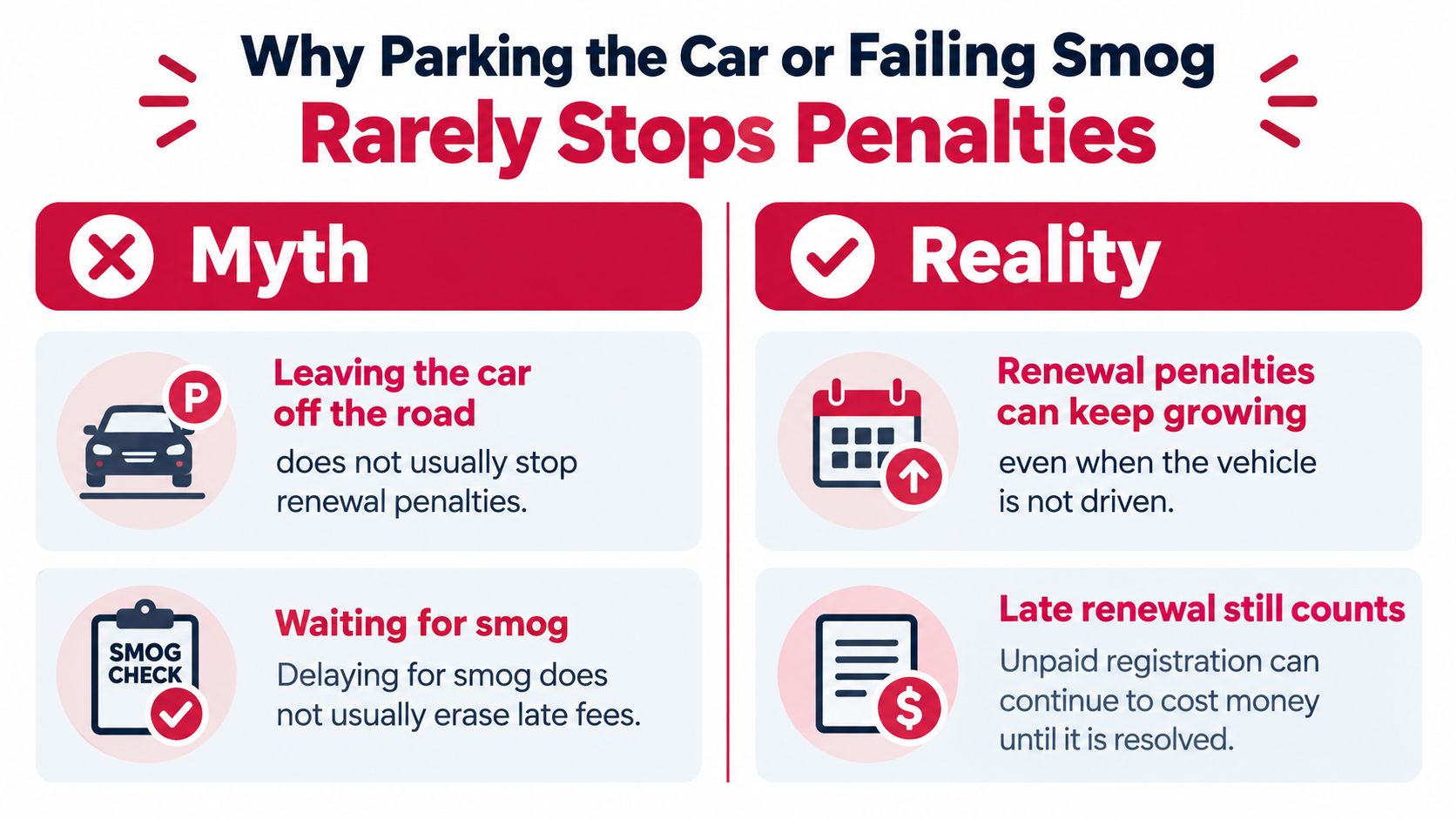
Leaving a car in the driveway doesn't automatically tell the DMV that you've chosen nonoperation. Waiting for a smog certificate doesn't automatically pause the payment deadline, either.
Those misunderstandings often start with a reasonable thought: if you can't use the vehicle, why should renewal penalties apply? The DMV treats vehicle use, fee payment, and renewal completion as different issues.
The visual below separates the common assumptions from the registration problem that still needs attention.
Nonoperation requires a filing
Under the DMV's Planned Nonoperation filing rules, PNO generally must be filed by the registration expiration date to avoid a penalty; it may be filed up to 90 days afterward if the vehicle wasn't operated, towed, stored, or parked on public roads, but a late filing can still carry penalties. Under those rules, after 91 days, full-year registration fees and penalties are due.
A PNO filing therefore isn't the same thing as asking the DMV to erase an existing balance. The filing has timing and use conditions, and it doesn't automatically remove amounts already owed.
- Parked on private property. That may be relevant to PNO eligibility, but it doesn't replace the filing.
- Used on public roads. Don't assume an otherwise unused vehicle meets the nonoperation conditions.
- Already delinquent. Ask what remains due instead of expecting a PNO request to cancel prior charges.
Missing smog doesn't mean missing the payment
The DMV guidance linked above also tells owners who lack smog certification or proof of insurance to pay renewal fees by the expiration date to avoid penalties. Paying the fees and finishing the renewal aren't always the same event.
If the vehicle failed its inspection, you still need to address the emissions problem. The explanation of what happens after a failed smog test can help you understand that separate task.
An unfinished smog requirement isn't a reason to leave the fee-payment question unresolved.
Ask what you can pay now, what requirement remains outstanding, and what must happen before the registration can be completed. That keeps a testing problem from becoming an avoidable payment problem as well.
What Short Delays and Multi-Year Lapses Really Cost
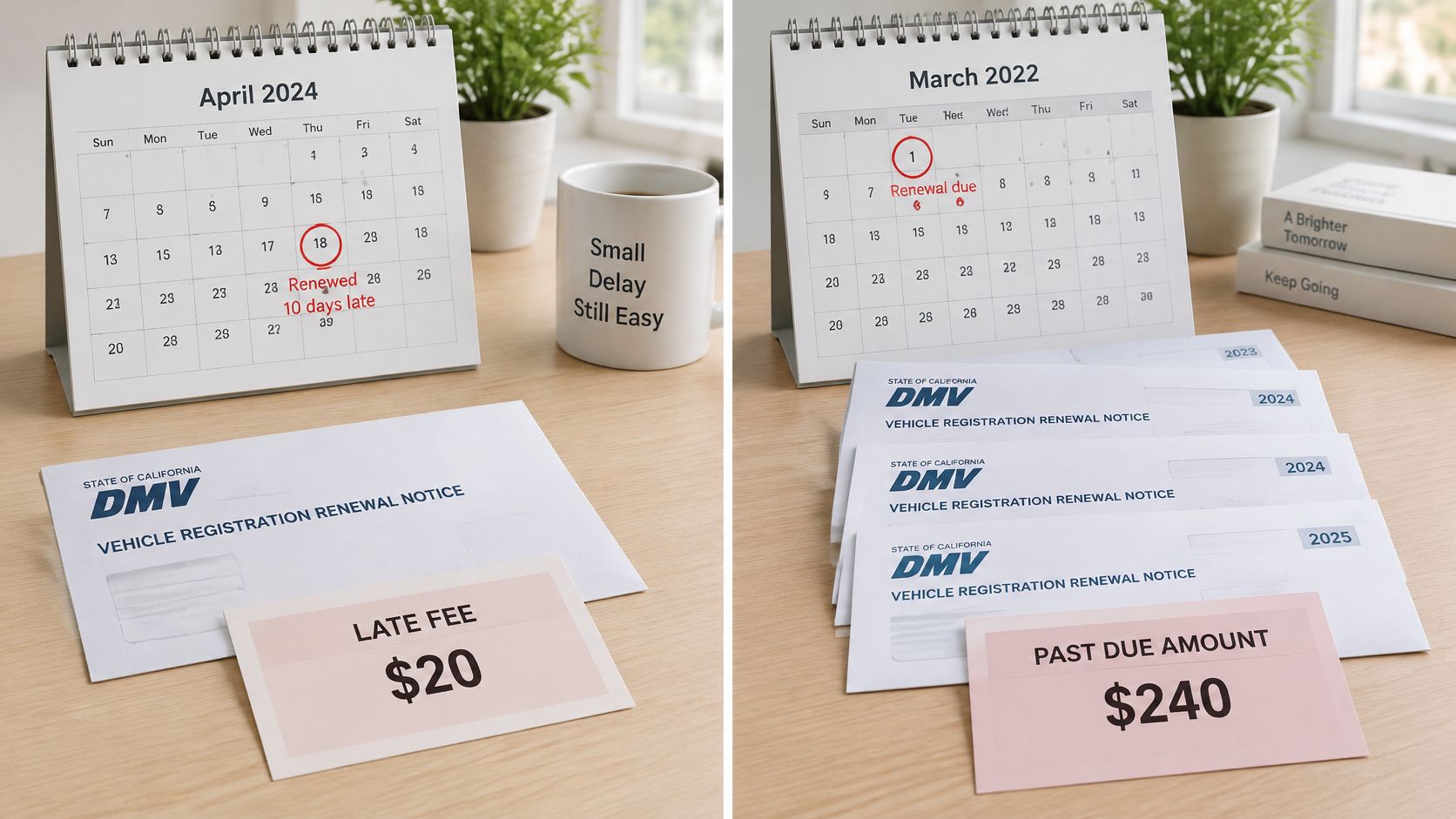
Consider two hypothetical drivers, not customer case studies. One discovers a recent missed renewal while sorting the mail. The other finds paperwork for a vehicle whose registration has been unresolved for years.
The desk scenes below illustrate those different situations, but neither driver can determine the full bill from the notice's appearance alone.
The recently missed renewal
The first driver checks the record and confirms that the payment falls into the shortest delinquency band shown earlier. There's still a percentage component, even though the delay was brief.
The mistake would be to look only at the fixed-charge column and set aside that amount. The driver also needs the vehicle-specific calculation and the ordinary renewal balance.
A sensible response is to ask for the complete assessment, then handle any unfinished certification separately. There's no need to assume the largest penalty applies, but there's also no reason to wait for another threshold before acting.
The vehicle left unresolved for years
The second driver has a different problem. The DMV's late-penalty schedule applies 80% of the license and applicable weight fees, plus $50 registration and $50 CHP late fees, when payment is more than one year but no more than two years late; beyond two years, those amounts rise to 160%, $100, and $100 respectively.
The important comparison is structural: both the percentage and the fixed charges rise. The older lapse doesn't preserve the same small overdue charge indefinitely.
For that owner, an old estimate isn't a reliable payment target. The record needs a current review, particularly if the vehicle has been sitting through changes in ownership, storage, or intended use.
This accompanying video provides another format for considering the renewal issue.
The practical lesson from both stories is the same without assuming identical bills:
- A recent lapse needs a complete calculation. A small fixed charge doesn't mean that's all you owe.
- An older lapse needs a fresh assessment. Don't rely on a remembered amount or an unopened notice.
- A threshold deserves attention before you cross it. Ask what the record requires now rather than waiting until you're ready to drive.
Neither story supports guessing a total from the age of the paperwork. The delay band explains the penalty structure; the vehicle record supplies the rest.
Driving Holds and Other Costs of Waiting
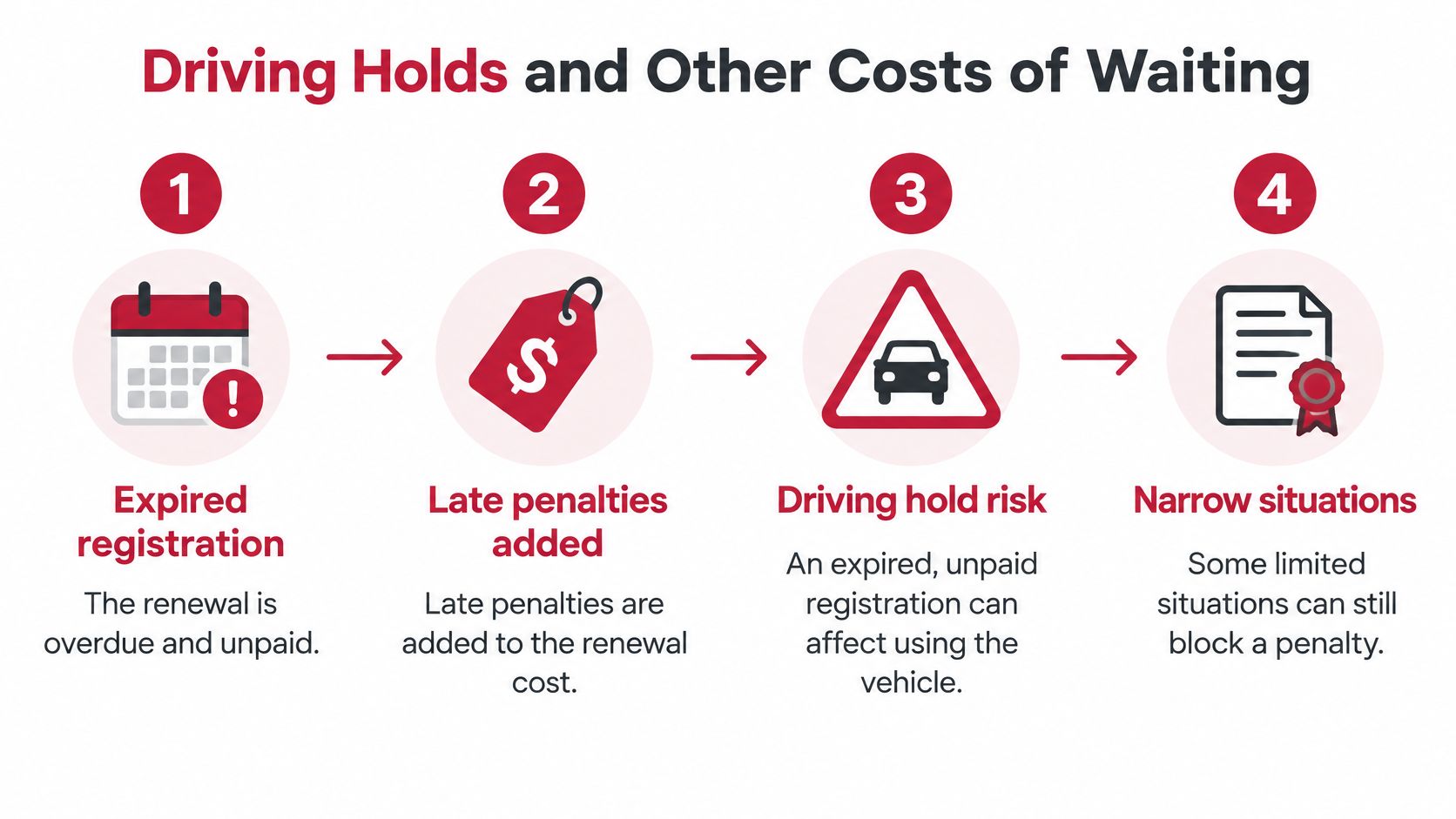
Paying a balance and confirming that a vehicle is ready for lawful operation are related, but they aren't interchangeable. A driver may address the money owed while still needing to finish a smog or documentation requirement.
As described in the DMV guidance cited earlier, late penalties are added to other fees due, and registration status may affect lawful vehicle operation. Before returning the vehicle to the road, confirm both the assessed balance and the status of the renewal.
The timeline below highlights the questions to resolve. It shouldn't be read as a promise that every expired registration follows an identical enforcement sequence.
Ask about status, not just price
When you speak with a processor, make the intended outcome clear: you want to know what is required to complete registration, not merely how much money can be accepted.
- Confirm the full balance. Ask whether the quoted amount includes the applicable delinquency charges and ordinary renewal fees.
- Identify outstanding requirements. Find out whether certification or documentation still prevents completion.
- Confirm completion. Don't assume that a payment receipt alone answers every question about operating the vehicle.
This distinction is especially important when the car needs a smog inspection. Don't assume the trip to obtain certification is permitted because you intend to resolve the renewal afterward.
Exceptions depend on the circumstances
The DMV guidance discussed earlier recognizes limited exceptions involving certain properly documented nonoperation, repossession, transfer, storage, and military-deployment circumstances. These aren't interchangeable reasons to request a general waiver.
If one seems relevant, describe what happened accurately and ask what documentation the DMV requires. A storage situation, for example, needs review under the applicable rule rather than an assumption that any parked vehicle qualifies.
Before returning to the road: Verify that the payment and the outstanding registration requirements have both been addressed.
You don't need to predict an enforcement outcome to make a sound decision. You need a confirmed record, a clear explanation of anything still missing, and an appropriate payment or documented exception.
That approach avoids both extremes: treating an expired card as harmless and assuming consequences that the record hasn't established.
Where to Pay a Late California Registration Renewal
You can work directly with the DMV or use a licensed registration-service provider. The processing location doesn't change the state's penalty rules. Whoever handles the transaction must determine the applicable delinquency period and collect the required DMV and CHP amounts along with ordinary renewal fees.
The useful comparison is about what your transaction needs. A straightforward payment is different from a renewal that still needs emissions certification or a record review.
Choose the path that matches the problem
| Payment path | When it may fit | What to clarify |
|---|---|---|
| DMV online renewal | You want to handle an available renewal transaction yourself | Whether the record permits completion and what remains outstanding |
| DMV office | You need direct help reviewing the record or an unusual circumstance | What documents to bring and whether the matter can be completed |
| Licensed registration service | You want in-person processing, potentially alongside a smog visit | Available services, processing charges, and whether the record can be cleared |
An office visit can involve waiting, while an online payment won't necessarily solve a missing-certification issue. A licensed provider may offer on-site sticker printing when the record can be cleared, but don't assume every transaction qualifies for immediate completion.
Ask about the full transaction cost, including any service charge, before authorizing processing. State penalties and a provider's processing charge are different parts of the bill.
A local smog-and-renewal option
In Antioch, Fire House Smog is a STAR-certified test-only station and licensed DMV registration-services provider offering smog inspections, renewal processing with on-site sticker printing, and ownership transfers. Its local DMV registration-services information lists the location at 2900 Lone Tree Way, telephone 925-754-1600, and DMV service hours of Monday through Saturday, 9:30 AM to 5:00 PM, and Sunday, noon to 4:00 PM, with limited services possible on weekends.
The station handles passenger cars, SUVs, and light-duty trucks, plus some RVs when size and equipment allow. Its test-only model means it doesn't sell repairs, so a failed inspection still requires a separate repair plan.
For an ordinary renewal, paying the DMV yourself may meet your needs. If emissions certification is the missing piece, a combined testing-and-registration visit may be more practical.
Call ahead for an RV, a weekend transaction, or a record that may need more than routine processing. Confirming those details before traveling is more useful than assuming sticker printing is available for every unresolved renewal.
Clear the Balance Before the Next Milestone
Start with the vehicle record, not the amount you hope the bill will be. A forwarded notice, an unused car, and an unfinished smog test each raise different questions, so describe your situation clearly when you ask for help.
Your immediate goal is an accurate assessment and a workable completion plan. You don't need to solve the entire problem from the paperwork on your kitchen table.
Put the next actions in order
- Verify the deadline. If notification was delayed or the ownership recently changed, ask how the DMV record treats the payment date.
- Request the full assessed amount. Confirm that the calculation includes the percentage component and both fixed late charges, rather than budgeting from the fixed portion alone.
- Resolve the correct filing. If nonoperation applies, check eligibility and the permitted filing window. Otherwise, arrange the renewal payment.
- Finish outstanding requirements. Address smog certification, insurance documentation, or other items identified by the processor.
- Confirm the resulting status. Keep the receipt and ask whether anything remains before treating the renewal as complete.
Don't wait to ask about payment just because you're still arranging repairs. Likewise, don't treat a possible notice-related exception as permission to drive while the deadline question remains unresolved.
Make the visit useful
For drivers in Antioch and East Contra Costa County who still need emissions certification, a local test-only station with registration processing can be an option. Ask whether your vehicle and transaction can be handled together, especially if an RV or unusual record issue is involved.
Have the registration card, renewal notice, and relevant payment or filing records available for review. Explain any late-notice issue before processing begins so the timing question doesn't get lost in a discussion about the total.
The next milestone to focus on is practical: getting the record reviewed and taking the action it requires. An accurate answer today is more useful than another estimate you'll need to revisit later.
Visit Fire House Smog for STAR-certified test-only smog testing and California registration renewal processing with on-site sticker printing when your record can be cleared. If your renewal is overdue, call ahead to discuss the remaining requirements and confirm available DMV services before your visit.