
Most advice about how to check vehicle ownership starts in the wrong place. It tells you to run the plate, pull a vehicle history report, or type the VIN into a website and look for a name. In California, that search doesn't prove the person holding the keys can legally sell you the car.
A clean history report can still sit next to an open lien. A registration card can be current while the title names someone else. A seller can have the car in the driveway, know every repair it has had, and still lack a transferable right to sell it.
You're not hunting for one name. You're proving an unbroken, transferable chain of title, with fixed deadlines once money changes hands. If the title, VIN, seller identity, lien status, mileage, and signatures don't line up, don't treat the gap as paperwork for later. Stop the sale until they do.
Table of Contents
- What Actually Proves California Vehicle Ownership
- Information Deadlines and Privacy Limits
- Verify the Title Before You Pay
- When the Ownership Check Does Not Match
- Finish the Transfer With a Licensed Partner
What Actually Proves California Vehicle Ownership
California won't hand a stranger the registered owner's name and address from a license plate or VIN. That's the first correction most buyers need. A public owner lookup isn't a step you missed. It's a step that doesn't replace the seller producing the title.
The California Certificate of Title is the document that proves ownership. The California DMV guide to vehicle titles distinguishes that certificate from other records and identifies the registered owner, legal owner or lienholder, VIN, and odometer information on it. Read those fields separately. They answer different questions.
A registered owner is the person associated with registration and use of the vehicle. A legal owner or lienholder may be a lender with a financial claim until the loan is satisfied. When those names differ, possession of the car and a card in the glove box don't settle who can sign the title over to you.
Records That Look Like Proof but Are Not
A history report helps you screen a car. It may flag salvage, theft, brands, or mileage problems. It doesn't prove the seller is the legal owner, and it can't release a lien. Treat it as background, not as the ownership check itself.
The same caution applies to the seller's Notice of Transfer and Release of Liability. That filing tells DMV the seller reported the sale and asks to be released from later liability. It doesn't put ownership in the buyer's name. Buyers who confuse those two filings can drive away believing the transfer is finished when the official title work still isn't.
Financed and recently paid off cars add another wrinkle. California's Electronic Lien and Title system stores lienholder title information electronically. A lender can transmit lien satisfaction to DMV before any paper title reaches the seller. No paper in the driveway may be explainable, but it still has to be explained with records, not reassurance.
| Record | What it shows | What it does not prove | Where it comes from |
|---|---|---|---|
| California Certificate of Title | Legal ownership, registered owner, legal owner or lienholder, VIN, odometer | That registration fees are current | Seller, or DMV after a title is issued |
| Registration card | Registered owner and that the vehicle is registered | A right to transfer ownership | Vehicle or the owner's DMV record |
| Vehicle history or NMVTIS-style report | Brands such as salvage or theft, and some odometer or lien flags | That the person selling is the legal owner or that the lien is released | Commercial history provider |
| Notice of Transfer and Release of Liability | Seller has reported the sale and asked to be released from later liability | That ownership has transferred to the buyer | Seller files with DMV, often online |
| Electronic lien and title record | Lienholder holds the title electronically until the loan is satisfied | That a paper title is already in the seller's hands | Lender and DMV Electronic Lien and Title system |
| REG 227 duplicate or paperless title application | A request to replace a lost, stolen, damaged, or illegible title | Ownership until DMV issues the replacement | Seller or owner submits to DMV |
Walk the rows in order. The title answers who owns it. The registration card answers whether the vehicle is registered. The notice protects the seller after the sale. A REG 227 starts a replacement process, but the application itself isn't ownership.
If you're deciding whether you're looking at an ownership document or a registration document, read the plain comparison of title transfer versus registration before you agree on price. Then use a simple rule. Any row that fails is a stop, not a chore to clean up after payment.
Information Deadlines and Privacy Limits
Gather the facts before you open a DMV session or drive to meet a seller. Guessing at a character in a VIN or a name spelling at the counter wastes the trip and can put the wrong information into the packet.
What to Have in Hand
- Vehicle identifiers: The full VIN and, for a car already registered in California, the license plate number.
- Title names: The registered owner, any legal owner or lienholder, and the exact spelling used on the title.
- Sale facts: The odometer reading, sale date, purchase price, and contact details for buyer and seller.
- Identity documents: Photo ID for the person signing, plus any lien release the title requires.
- Supporting certificates: A smog certificate when this transfer requires one, kept separate from the title itself.
Keep two jobs apart. Checking a car you already own means signing in to your DMV online account and comparing the plate and VIN it shows with your title and registration card. Checking a car you might buy means the seller produces the title for you to inspect. There's no public owner name lookup that lets you skip that exchange.
Two Clocks Start at the Sale
People often treat the seller's filing and the buyer's filing as one task. They're separate duties, owed by different people, and one doesn't complete the other.
Seller clock: File the Notice of Transfer and Release of Liability within 5 days after the sale. Buyer clock: Submit the ownership transfer within 10 days after purchase.
The seller's notice helps keep later tolls, parking citations, and crash liability from being billed to the old owner. It does not transfer the title. The buyer's submission is the official ownership transfer, and waiting risks penalties and a record that still points to the prior owner.
| Deadline | Timing | What it does |
|---|---|---|
| Seller Notice of Transfer and Release of Liability | 5 days after sale | Stops later tolls and tickets from billing the old owner, but does not transfer ownership |
| Buyer ownership transfer | 10 days after purchase | Official title transfer still required; late filing risks penalties |
| Electronic lien paper title delivery | About 8 days per DMV average | A recent payoff plus this wait can be normal; silence from the lender beyond it is a problem to chase |
On money, expect the DMV transfer fee plus use tax based on the purchase price or the vehicle's current value, whichever the DMV rules require for that transaction. A licensed business partner adds its own service fee on top of the state amount, so don't mistake the service charge for the state charge. Ask for the two figures separately before you pay.
Before anyone leaves the driveway, photograph the signed title, the IDs used, the dashboard odometer, and the liability release confirmation. Keep online confirmation numbers with the transfer packet. If DMV follows up, you'll have a complete filing trail instead of a memory of what somebody clicked.
Verify the Title Before You Pay
A registration card and a set of keys do not prove that a seller can transfer ownership. The title must connect the legal owner to the person signing the sale, with any lien properly cleared. If that chain has a gap, pause before paying.
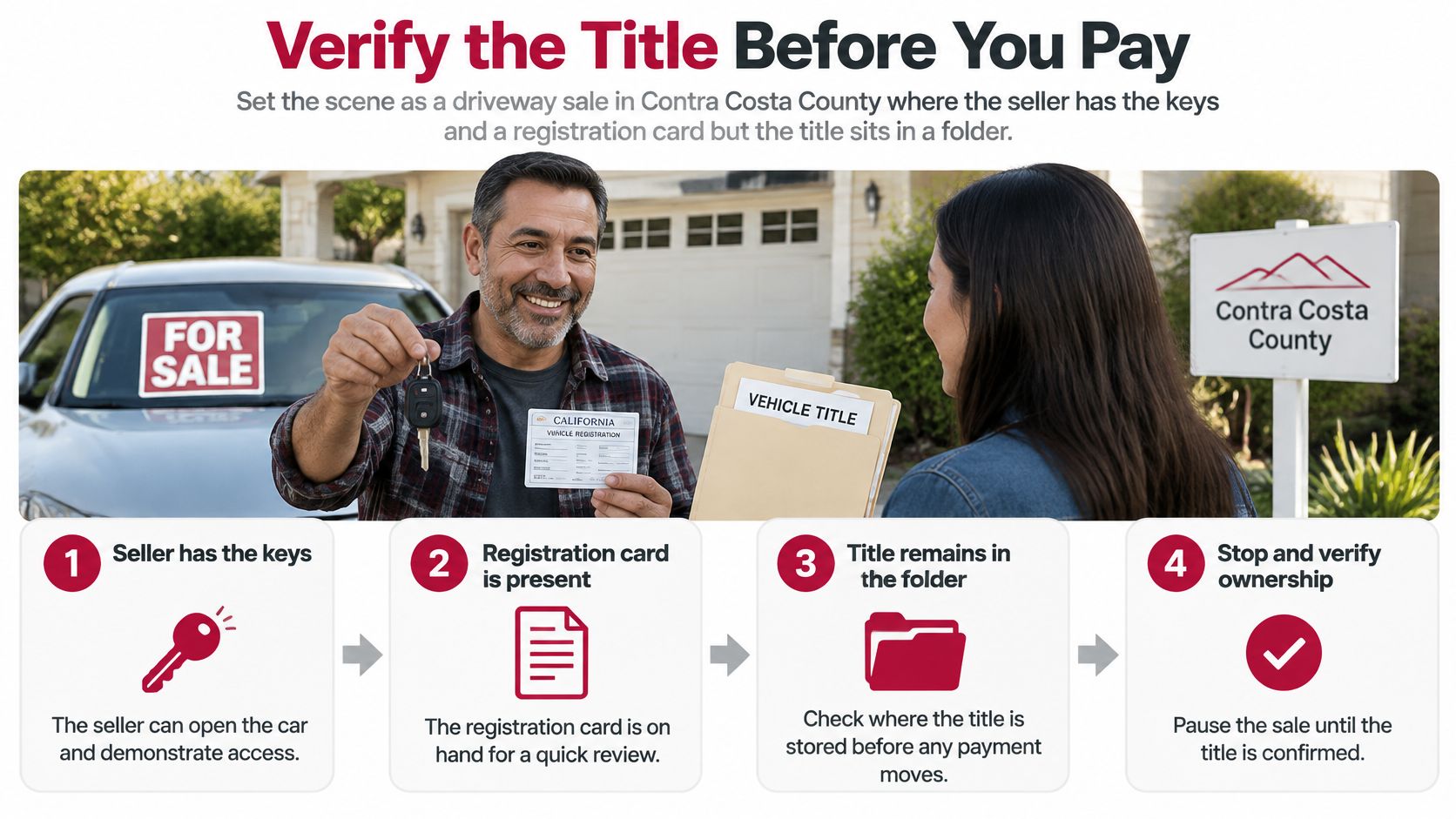
The California DMV guide to changing vehicle ownership gives the buyer 10 days after purchase to transfer ownership and the seller 5 days to file a Notice of Transfer and Release of Liability. Check the paperwork before money changes hands so there is time to address a missing signature or release.
The Eight Checks in Order
Get the original title. Ask to see the California Certificate of Title. If it is lost, stolen, damaged, or illegible, the owner needs to start REG 227 for a replacement. Do not pay in full based on a promise that the title will turn up.
Compare the VIN yourself. In daylight, match the VIN on the vehicle to the title, character by character. Check every digit and letter, including the check digit. A mismatch can mean the paperwork describes a different vehicle.
Match the seller to the title. Compare the name on the title with the photo ID of the person selling the vehicle. If they differ, ask for the missing link in the ownership chain. An explanation from a spouse, relative, friend, or prior buyer does not replace the required documentation.
Collect every required signature. Check that the buyer, seller, and any required lienholder have signed in the correct places. Do not leave reassignment spaces blank for someone to complete later. Each assignment should show a clear transfer from one owner to the next.
Verify the lien release. If a lienholder is listed, confirm the release before finalizing payment. A lien release on REG 227 must be notarized. A payoff screenshot may support the seller's account, but it does not replace the release needed for the transfer.
Capture the odometer reading. Record the vehicle's mileage and complete the required disclosure. Federal odometer disclosure rules apply to most newer vehicles, so read the disclosure section of the title and transfer form before you sign. Compare the written figure with the dashboard reading while both parties are present.
Confirm smog where required. Some transfers require smog certification and others do not. Confirm which rule applies to the vehicle and buyer before submitting the paperwork. Resolve title problems first, rather than spending money on a test before you know the transfer can proceed.
Calculate fees and use tax before filing. Account for the DMV transfer fee, any use tax, and applicable registration amounts. If you use a service provider, keep its charge separate from the state's fees so you know what each amount covers.
Stop if the VIN, seller's identity, lien status, mileage, or signatures do not match. Do not hand over the money or submit an incomplete packet.
A mismatch can delay the new title and leave the prior owner connected to the vehicle in DMV records. The buyer may also have difficulty registering or reselling a car without a clean transfer. Waiting for the right document is safer than trying to unwind a payment later.
Habits That Prevent Most Stalls
Sellers can file the release of liability on the day of sale and keep its confirmation with a copy of the signed title. That creates a dated record if a toll or ticket arrives after the sale.
Buyers should settle questions about the seller's name and any lien before paying for repairs, registration, or smog testing. A new battery does not repair a broken title chain, and parts receipts do not establish that the seller can transfer ownership.
Family and gift transfers still need a complete owner match, even when no money changes hands. The titled owner must make the transfer, or the missing assignment must be completed.
For an out-of-state vehicle, allow time to review the title before promising a registration date. Once the documents and ownership chain line up, file the transfer promptly and keep copies of the paperwork.
When the Ownership Check Does Not Match
The sale stalls on a Saturday. The ad said clear title, the test drive went fine, and the folder doesn't match the claim. Don't start by asking which form fixes it. Name the mismatch first. The correct next step depends on whether the problem is identity, lien, mileage, a missing title, or an unfinished earlier sale.
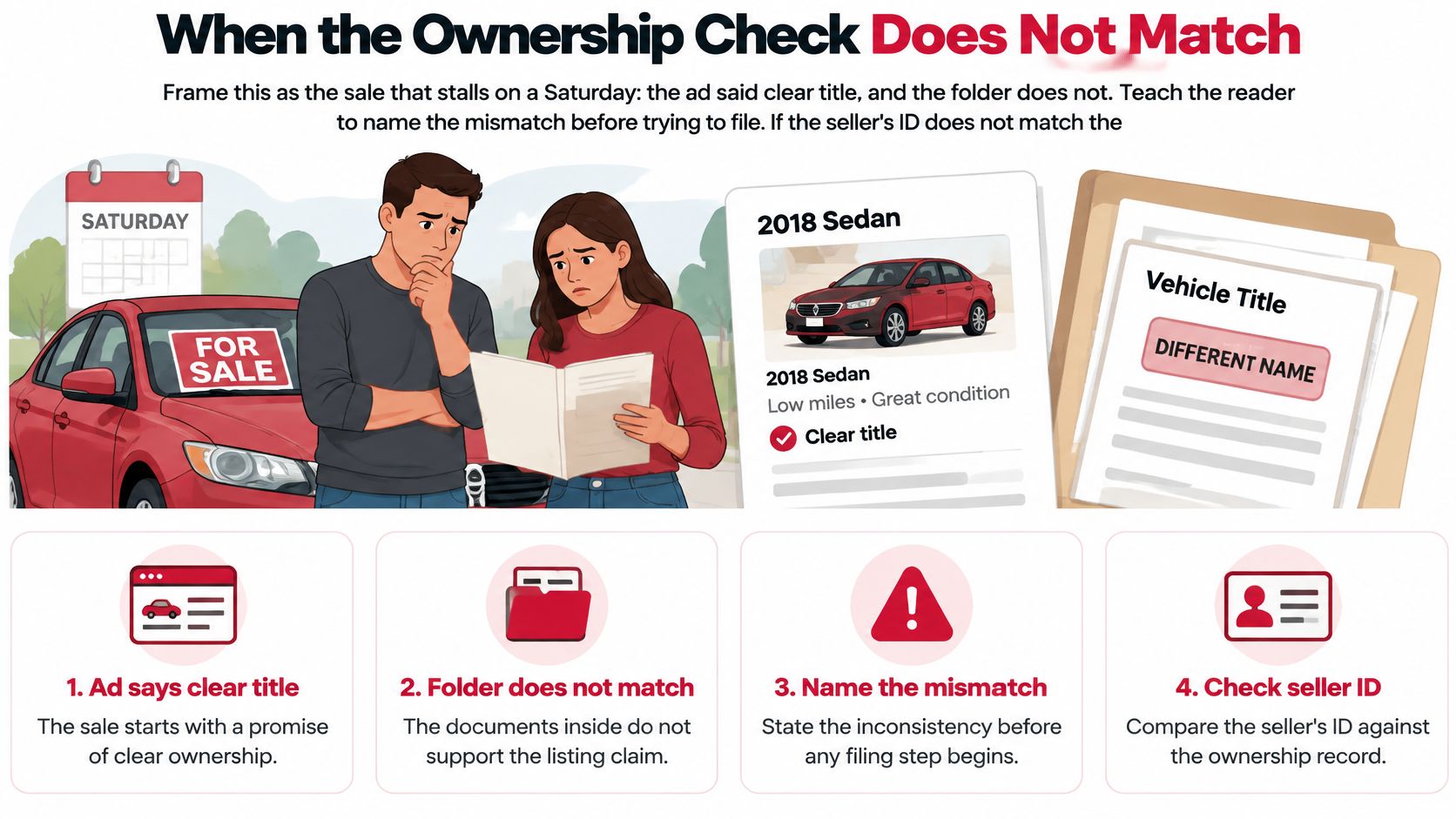
The California DMV guidance on title transfers and changes requires ownership or lienholder changes to be reported to DMV within 10 days, and an official title transfer is still required. That deadline doesn't excuse filing a packet you already know is incomplete. It means you should resolve the defect quickly and document what you did.
| What you see | Likely cause | What to do | Do not do |
|---|---|---|---|
| Seller ID does not match the title | Title never updated, or the seller is not the legal owner | Stop and require the titled owner or a complete chain of assignments | Accept a registration card as a substitute |
| No paper title in hand | Lost or damaged title, or an electronic lien not yet converted to paper | Use REG 227 for a lost title, or wait about eight days after a confirmed electronic payoff | File a transfer with a blank or missing title |
| Lien still listed | Loan unpaid, or release not recorded | Get a lien release, notarized when it is on REG 227 | Trust a verbal payoff or a payment screenshot alone |
| Odometer figures disagree | Disclosure error, noncomplying title, or a possible rollback | Reconcile the reading and use the required disclosure, including REG 262 when the title is noncomplying or extra reassignment is needed | Submit conflicting mileage |
| Out-of-state or foreign title | Incoming title may not meet California or federal disclosure rules | Confirm the title complies before choosing the California form | Assume every out-of-state title transfers the same way |
| Several names in the assignment chain | Prior sales were never finished with DMV | Complete each link before the current seller signs to you | Skip a missing owner to save time |
The Eight Day Electronic Lien Wait
No paper title doesn't always mean the seller is hiding something. After an electronic lien transaction, paper title delivery averages eight days, according to the DMV guidance linked above. A recent, confirmed payoff plus that short wait can be legitimate. Ask for the lender's payoff confirmation and a date you can verify.
Silence is different. If the lender won't confirm satisfaction, the seller can't say when the electronic record was released, or the promised paper title keeps slipping without a paper trail, pause the purchase. You're distinguishing a processing delay from an unresolved ownership problem, and the seller needs to supply the evidence.
When REG 262 Enters the Packet
Mileage mismatches need care because an error can look like fraud on paper. Federal rules generally require odometer disclosure during transfers. California may require the separate REG 262 when the title is noncomplying, a replacement title application is used, or additional reassignment is needed. For an out of state vehicle, the disclosure method depends on whether the incoming title already complies with applicable requirements.
Don't average two mileage figures, copy the lower one, or leave the space blank to deal with later. Reconcile the title, dashboard, and disclosure, then use the form that fits the title you have. If the numbers still conflict, walk away until the seller can explain them with records.
Multiple names in the reassignment boxes require the same patience. Each link has to be complete. Skipping a missing owner breaks the chain you're trying to prove. While you sort it out, you can review how to track a vehicle ownership transfer status so you know what a completed filing should look like.
An incomplete packet delays the new title while liability can stay with the prior owner. That's the chain of title test. You aren't hunting one name. You're proving an uninterrupted right to sell, from the titled owner through every assignment to you.
Finish the Transfer With a Licensed Partner
Once the title, VIN, seller, lien, and odometer agree, the remaining job is filing. You don't need another owner search. You need the transfer submitted correctly and current registration issued before the buyer's deadline becomes a problem.
You can submit to DMV directly or use a licensed California business partner for DMV registration services. That choice matters when a field office line would push a clean packet past its filing window. The nearest DMV offices to Antioch are in Pittsburg and Concord, so travel and queue time belong in the decision.
At Fire House Smog, 2900 Lone Tree Way in Antioch, we handle California renewals and ownership transfers, including California and out of state vehicles with the sticker and license plates as needed. Our transfer service is $55 plus the applicable DMV fee. State use tax and any registration fees DMV calculates are separate, so read the DMV amount and our service fee as two lines, not one bundled state charge.
You can review the filing path for a DMV transfer of ownership before you come in. DMV services run Monday through Friday 9:30 AM to 5:00 PM, Saturday 9:30 AM to 5:00 PM, and Sunday 12:00 PM to 4:00 PM, though weekend services may be limited. Call us at (925) 754-1600 or book through our website if you want to confirm weekend availability.
Smog is a separate requirement from the paperwork. When a transfer requires it, our station is STAR-certified and test-only, and we don't do repairs. That separation keeps the emissions result independent from any repair sale.
Bring a Packet That Can Be Filed
- Signed title: The original title with buyer, seller, and lienholder signatures completed as required.
- Identification: Photo ID matching the names used in the transfer.
- Odometer disclosure: The completed disclosure for this vehicle and title type.
- Lien release: The release when a lienholder appears, notarized when the form requires it.
- Smog certificate: The certificate when this transfer requires one.
If any one of those items is still missing, fix it before you ask any counter to file. A partner can submit a clean transfer efficiently. No counter can turn a broken chain of title into proof of ownership.
Bring your signed title, ID, odometer disclosure, any lien release, and smog certificate if required, and we'll help you finish the California or out of state ownership transfer without a field office queue. Visit Fire House Smog to book or call (925) 754-1600 before you come to 2900 Lone Tree Way in Antioch.
Yes, you can get car registration online in California when you're renewing an eligible vehicle already in your name. No, that isn't a blanket answer for title transfers, first-time registrations, or vehicles coming from another state.
Online renewal is a mainstream service: California DMV recorded 12,014,480 internet vehicle-registration-renewal customers in fiscal year 2021–2022, approximately 38.9% of renewal customers across all channels, according to its renewal customer report. The important distinction is what those customers were doing: renewing an existing registration record, not necessarily establishing ownership or registering a newly arrived vehicle.
Think of the DMV website as a self-checkout lane. It works well when the vehicle's record scans cleanly. It can't replace a missing title, supply an emissions certificate, or turn a payment receipt into a completed registration when required records are still missing.
Table of Contents
- Yes for Many California Renewals
- Which Registration Tasks Stay Online
- Smog Records and a Printed Sticker
- How to Renew an Eligible Vehicle Online
- When the Portal Will Not Finish the Renewal
- Transfers and Cars From Another State
- Renew Online or Finish in Antioch
Yes for Many California Renewals
An eligible annual renewal can often be completed online without a field-office visit. But the renewal portal isn't a substitute for every transaction people describe as registering a car.
California recorded 12,187,450 internet renewal customers out of 31,009,049 total renewal customers in fiscal year 2020–2021, about 39.3%, according to the California DMV's renewal customer report. That volume makes the practical point: online renewal isn't a workaround or a special exception. It's an established service for vehicles that meet the requirements.
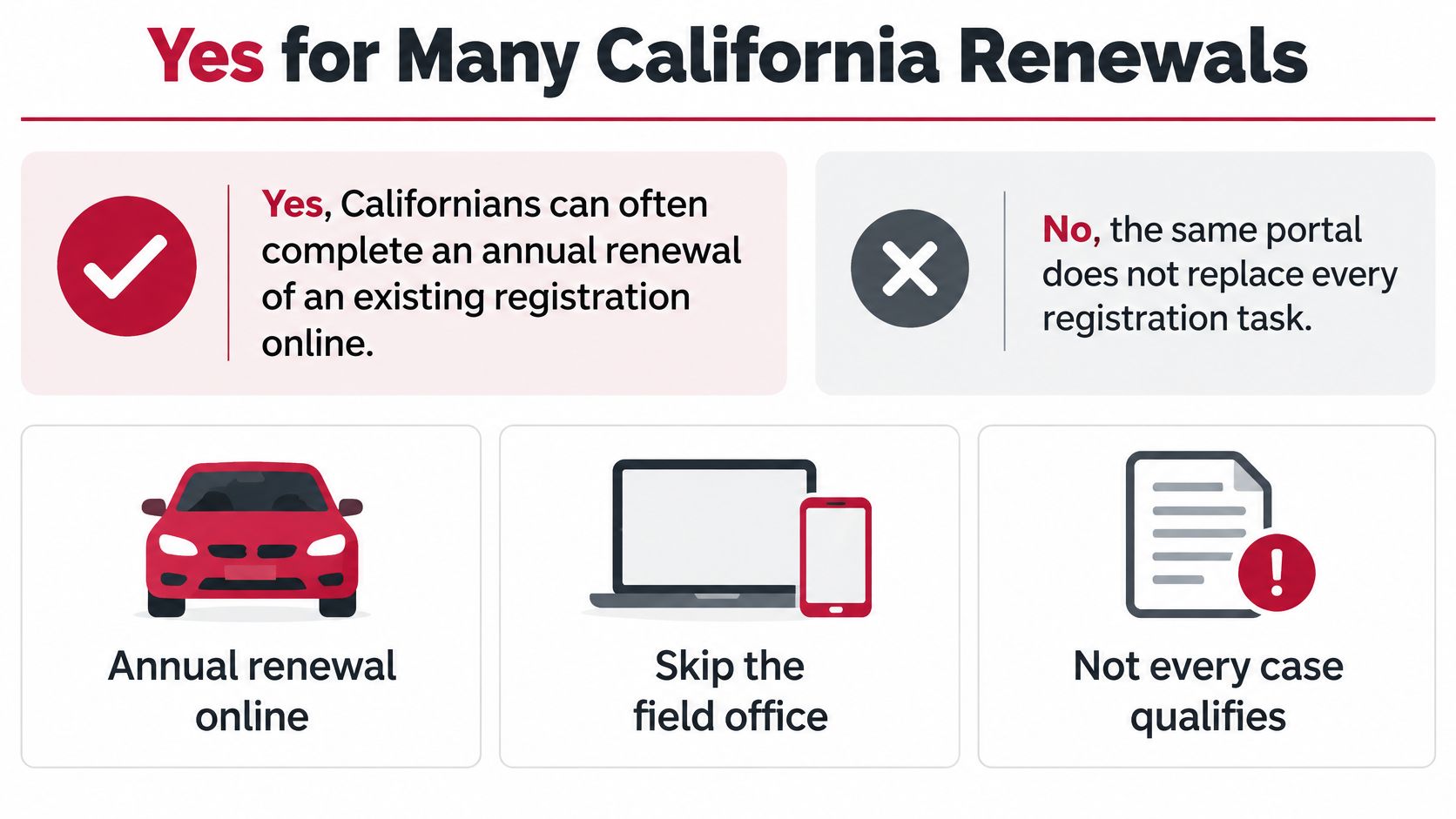
Start with the job, not the payment
Before entering a plate number, decide what you're asking DMV to change. These are different jobs:
- Renew an existing record. You already own the vehicle, and you're extending its registration.
- Transfer a purchase. You bought the vehicle and need the ownership record changed.
- Register an out-of-state vehicle. You're bringing a vehicle into California's registration system and need the appropriate documents reviewed.
The self-checkout comparison helps here. An ordinary renewal resembles scanning a known item with a readable barcode. A purchase with missing signatures resembles bringing an item to checkout without the paperwork needed to identify who owns it. Repeatedly scanning the plate won't solve that problem.
Practical rule: Choose the transaction that matches the vehicle's ownership and registration status, not simply the webpage that accepts a payment.
Eligible doesn't mean nothing else is required
A car can belong to you and still need a supporting step before an online renewal clears. For example, the renewal notice may require a smog inspection. The inspection itself happens outside the website, even if the registration transaction can ultimately finish online.
That distinction answers a common version of the question, “Can you get car registration online?” You may be able to complete the administrative renewal online without being able to complete every prerequisite from your laptop.
Start with the notice and the vehicle's current ownership documents. If the owner is staying the same and you're renewing an established California record, the regular renewal service is a reasonable starting point. If the owner or state registration is changing, select the corresponding document-based process instead.
Which Registration Tasks Stay Online
California registration tasks and the channel that finishes them
| Transaction | Online path | Must already be true | If the portal stops you |
|---|---|---|---|
| Annual renewal of a car already in your name | Yes, when eligibility checks pass | Vehicle identifiers, required electronic insurance and smog records, and an accepted payment method are available | Clear the failed check, then renew online or use assisted renewal |
| Planned nonoperation | Online or by mail | File by the registration expiration date | A missed deadline can mean a late penalty |
| Renewal notice shows wrong address | Change the address online first | Allow the address update to process before renewing | Correct the mailing record rather than paying against the old address |
| Partial-year or other nonstandard renewal | Assisted renewal rather than routine self-service | Renewal notice and supporting certification are ready | Use DMV assisted processing |
| Ownership transfer after a purchase | Not a renewal of the seller's record | Ownership papers, signatures, transfer fees, and required compliance documents are complete | Use DMV or a licensed registration partner |
| Out-of-state vehicle | Not through the standard annual-renewal portal | Ownership and California compliance documents are assembled | Use an in-person or authorized-provider document review |
| Missing California title | Not a routine renewal solution | A replacement-title application and supporting ownership papers are prepared | Obtain assisted document review |
| Smog due or unpaid parking citations | Payment alone doesn't complete renewal | Required smog information is on file and citations are resolved | Finish compliance before treating registration as complete |
Use the table one vehicle at a time. A renewal notice for the car you've owned for years points toward the annual-renewal row. A bill of sale for a car you just purchased points toward a transfer, even if the seller also handed you a renewal notice.
A renewal notice and a bill of sale mean different things
Say you open your household car's renewal notice. Your name is correct, the vehicle is familiar, and you haven't changed ownership. Your task is to check the renewal requirements and complete the existing record.
Now say you buy a used pickup over the weekend. You have the keys and a signed bill of sale, but the California ownership record still needs attention. Paying a renewal charge associated with that plate doesn't establish that the truck belongs to you.
The same separation matters when you move to California with a vehicle registered elsewhere. You aren't just extending an existing California registration. You need the paperwork appropriate to bringing that vehicle into the state's system.
A plate number identifies a vehicle. It doesn't tell the portal that every ownership, address, and compliance requirement has been satisfied.
Choose a fallback that can fix the actual problem
A rejected renewal doesn't always mean you need a field-office appointment. Some problems require a corrected electronic record; others require a person to review documents. Match the fallback to what's missing.
For an ordinary renewal, preserve the portal's message before closing the page. For an ownership transaction, organize the title papers instead of continuing through a renewal checkout. For an out-of-state vehicle, confirm the document packet before making a trip.
This avoids a frustrating detour: reaching a payment screen, assuming you selected the right service, and discovering afterward that the vehicle still needs a different transaction.
Smog Records and a Printed Sticker
The website can process information, but it can't inspect your exhaust system or hand a sticker through your screen. Those physical steps explain why an otherwise online transaction can still involve a visit somewhere.
The inspection and the registration are connected, but they aren't the same service. When a smog certificate is required, the registration process needs the electronic certification associated with the vehicle. A photo of inspection paperwork on your phone isn't the same thing as that electronic record being available.
Complete the inspection before assuming the record is ready
If your notice calls for a smog check, arrange the test before treating the renewal as a simple payment task. Keep the inspection paperwork so you can identify the vehicle and discuss any mismatch if the renewal still shows an emissions requirement.
Our guide to California smog test validity can help you think through the timing of the inspection and the registration transaction. Don't assume an old test automatically satisfies the requirement attached to the current transaction.
At a test-only station, inspection and repair sales are separate. We don't perform repairs, so a failed test doesn't lead to an in-house repair invoice. The next action is to address the reason for failure and arrange the necessary retest.
- If the vehicle passes: Keep the paperwork and make sure the renewal can recognize the required certification.
- If it fails: Resolve the emissions issue before expecting the registration requirement to clear.
- If the portal still requests smog: Preserve that message and the inspection paperwork rather than assuming another payment will help.
Decide how you need to receive the sticker
Finishing an online transaction and holding the registration sticker are different milestones. Follow the DMV's completion and delivery instructions, and don't assume an online payment means you'll have a physical sticker immediately.
If you need counter assistance, verify that the transaction can be completed with the documents you have. An unresolved compliance requirement remains unresolved at a counter, even when printing is available.
Also check registration-counter hours separately from smog-testing hours. A station may be open for inspections while its registration counter isn't operating. Once the required electronic records are ready and no ownership documents are missing, the website remains a sensible tool for an eligible renewal.
How to Renew an Eligible Vehicle Online
Start with a clean renewal: the car is already in your name, and you're extending its California registration rather than changing ownership. The California DMV vehicle-registration renewal service requires the plate number, the last five characters of the VIN or HIN, and an accepted electronic payment method, with required insurance and smog information on file.
Use this visual as a preparation checklist, then work through the actions below.
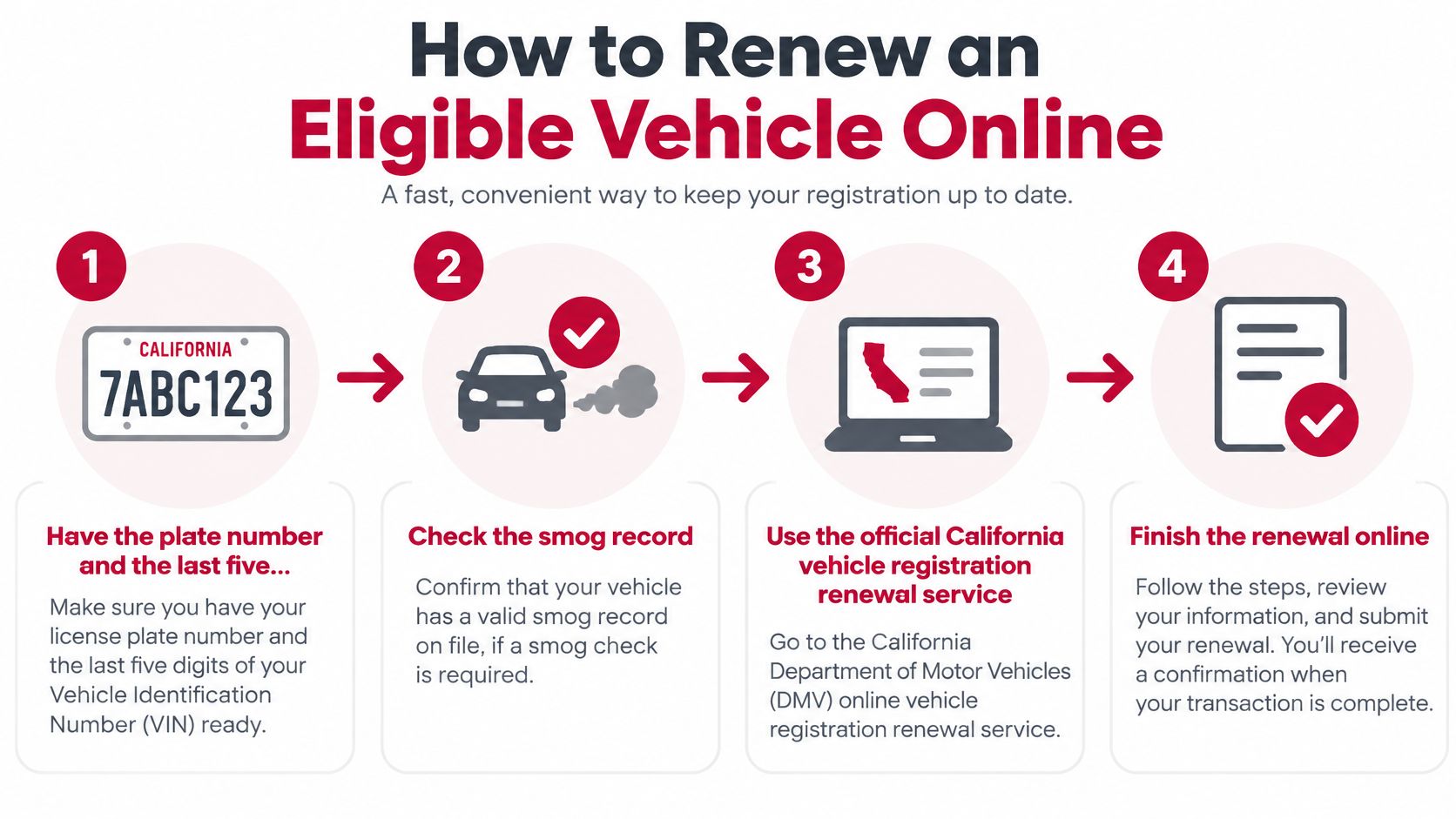
Prepare the record before paying
Gather the vehicle identifiers. Use the renewal notice or the vehicle's identifying information. Check each character carefully, especially when you manage several cars or work trucks.
Confirm electronic insurance reporting. Unless the vehicle is exempt, DMV needs the required insurance information electronically. Having a policy card in your wallet doesn't by itself establish that the electronic registration record has what it needs. Contact your insurer if the portal identifies an insurance problem.
Check the required smog record. Complete any required inspection and make sure the certification requirement is satisfied. Paying while the smog requirement remains open can leave you with fees paid but renewal unfinished.
Resolve parking citations and other holds. Read the notice and portal messages rather than skipping directly to checkout. If you recently resolved a citation, retain the receipt so you can address a record that hasn't cleared.
Pay the displayed fees. Use a credit card, debit card, or checking account accepted by the service. Review the vehicle information and amount before submitting.
Save the result and follow delivery instructions. Keep the confirmation and any status message. Watch for the registration card and sticker through the method DMV specifies, and act on any outstanding requirement rather than assuming the receipt closes the transaction.
For help organizing what to keep beside you, use our vehicle registration documents checklist. A readable notice, correct identifiers, and retained compliance receipts make it easier to resolve a rejected transaction without starting from memory.
Payment isn't clearance: The payment screen handles fees. A completed renewal also requires the vehicle's record to satisfy the applicable checks.
Read the final status, not just the charge
A successful charge tells you money moved. Read the completion language separately, including any instruction to submit a document or satisfy a requirement.
If the vehicle isn't being operated, consider the appropriate planned-nonoperation process rather than letting the renewal sit unresolved. Don't treat a pending issue as permission to ignore the expiration date.
This video provides another way to follow the renewal process.
If the portal asks for documents, displays an incorrect address, or won't accept the vehicle, save the exact message. It identifies what needs attention more reliably than a bank statement showing the payment.
When the Portal Will Not Finish the Renewal
Paid but not registered is the surprise to avoid. A payment receipt can exist while the registration remains incomplete because the vehicle still needs a required record or document.
Say an East Contra Costa driver pays during a lunch break, then discovers the required smog certification isn't on file. The useful next action is the inspection and confirmation of the certification record, not another attempt to pay the same renewal charge.
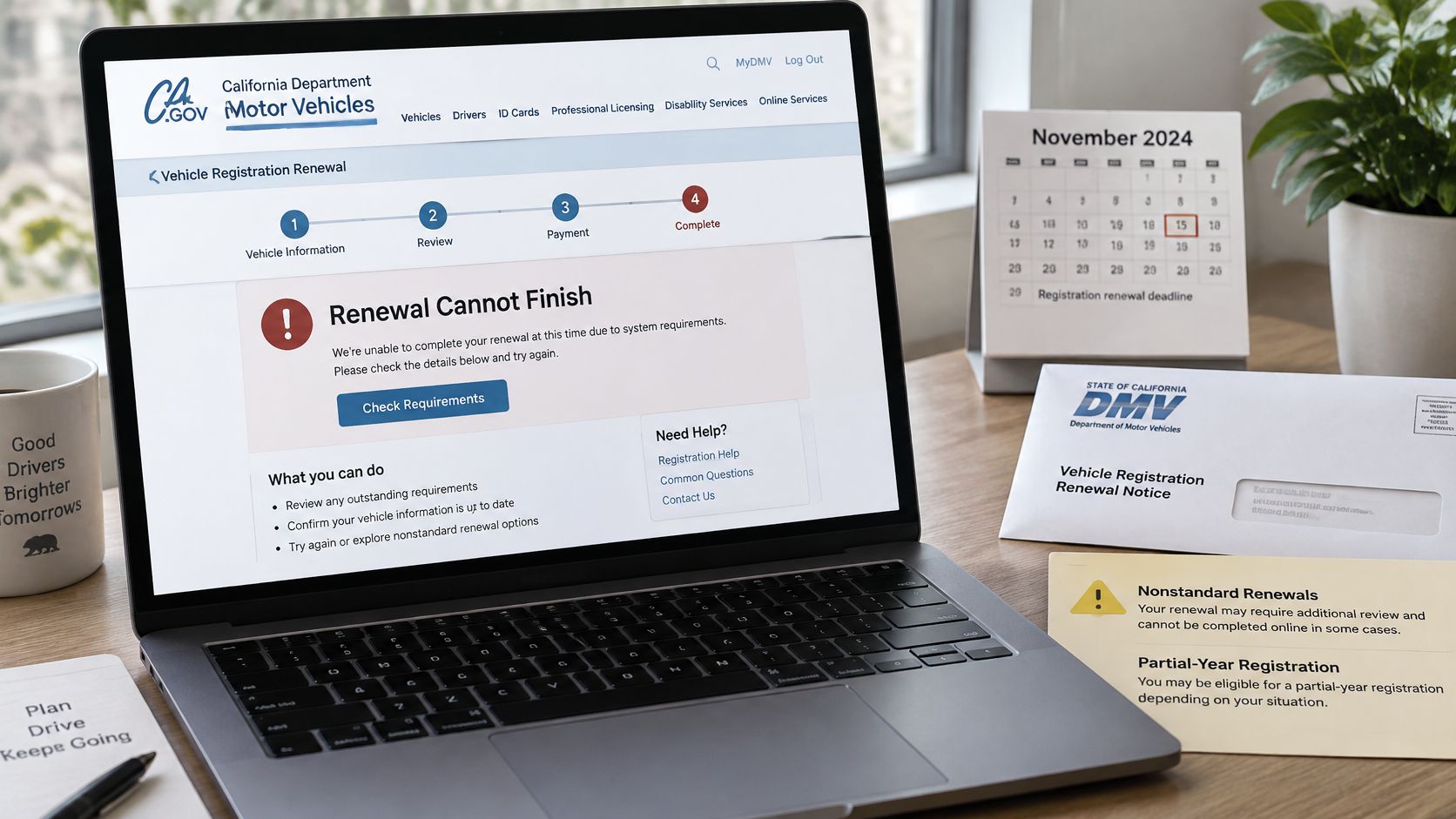
Match the stop to the fix
An incorrect address creates a timing problem. The California DMV's assisted renewal guidance instructs customers to change an incorrect address online and allow three business days before renewing, and states that renewal or planned nonoperation must be filed by the expiration date to avoid a late penalty.
Changing your address in a payment form isn't a substitute for correcting the DMV address record. Start with the address-change process, then allow the prescribed processing interval before attempting renewal.
Other stops call for different actions:
- Nonstandard renewal: Partial-year registration and other complex renewals need assisted processing. Prepare the renewal notice and smog certification when applicable.
- Insurance mismatch: Work with the insurer on the electronic reporting issue. Don't assume that entering payment details updates coverage information.
- Citation hold: Resolve the citation and retain proof. If the hold remains, seek help with the unresolved record rather than repeatedly submitting fees.
- Document request: Supply the requested paperwork through the appropriate assisted process. A routine checkout can't review missing supporting documents on its own.
Separate processing time from your deadline
The expiration date doesn't change just because you're working on a correction. Check it before choosing a process, particularly when an address update or document review is involved.
Don't improvise by sending duplicate payments. Save the confirmation, the unresolved message, and any supporting receipts, then use assisted DMV processing to establish what remains outstanding.
Fix the condition named in the rejection. Paying again doesn't replace an inspection, update an ownership record, or supply a missing signature.
A renewal problem and an ownership problem also require different responses. If the portal is rejecting a recently purchased vehicle because the paperwork still identifies the seller, you don't merely have a difficult annual renewal. You have a transfer to complete.
Transfers and Cars From Another State
People often search for online registration when they mean putting a newly purchased car in their name. California treats that as an ownership transfer, not an extension of the registration attached to the plate.
Under the California DMV title-transfer guidance, ownership changes must be reported within 10 days. A renewal payment doesn't substitute for that ownership transaction.
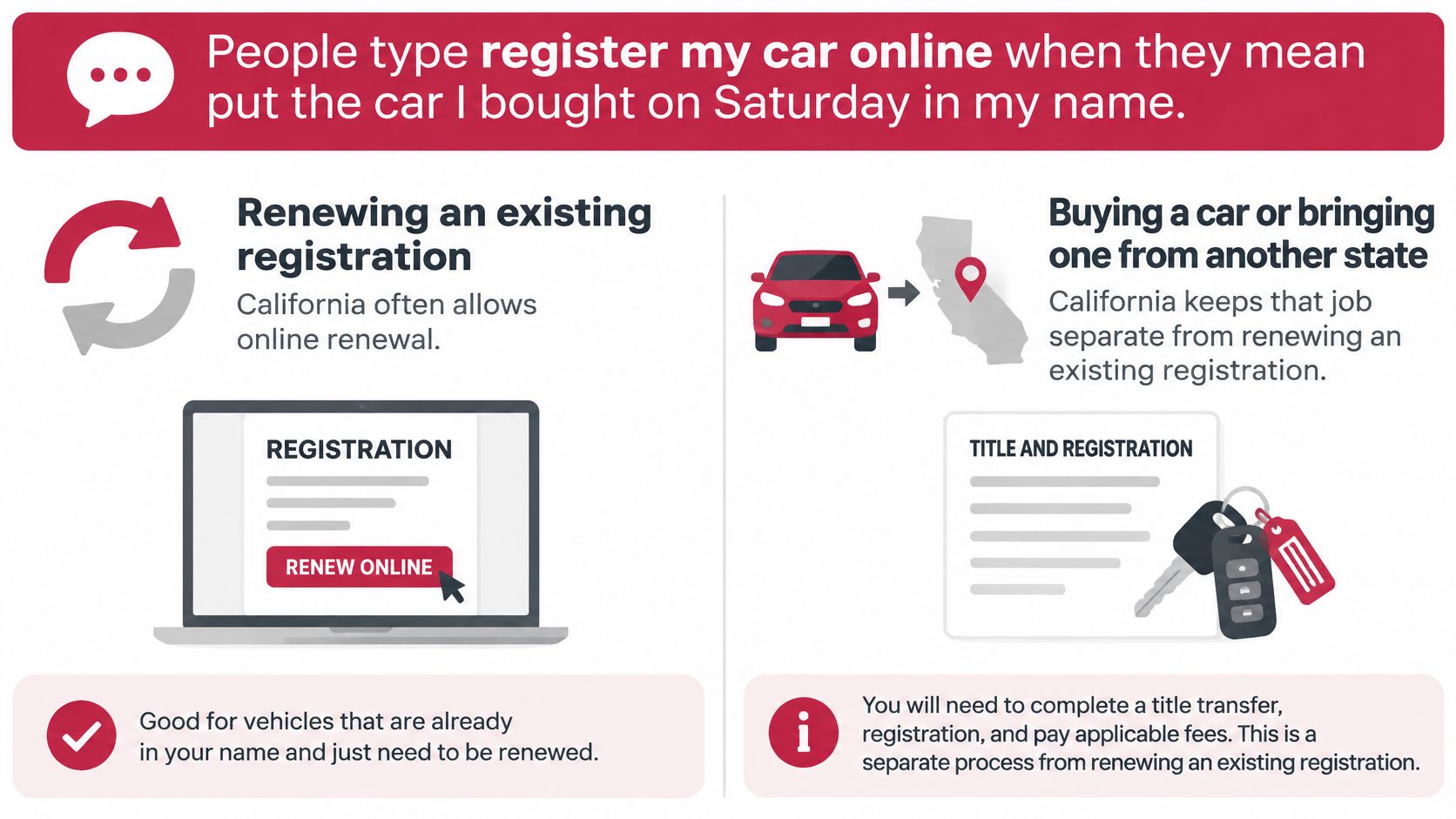
A California purchase needs a title packet
Say you buy a used sedan on Saturday. The seller gives you keys, a registration card, and a renewal notice. Before paying the renewal, check whether you have the documents needed to transfer ownership.
The packet can include:
- Ownership document: The California title, or the applicable replacement-title application if it's missing.
- Required signatures: The seller's and other required parties' signatures, including a lienholder when applicable.
- Odometer disclosure: The required mileage disclosure for the transaction.
- Fees and compliance documents: Transfer fees and smog certification when required.
A missing California title may require REG 227, rather than another trip through the renewal portal. Missing lienholder information or signatures also needs attention before you expect the ownership record to change.
Like a house, paying an annual bill doesn't change the name on the deed. Likewise, renewing the seller's registration doesn't establish you as the vehicle's new owner. Assuming otherwise can leave ownership records, liability questions, and penalties unresolved.
An out-of-state car starts from a different record
Now take a driver moving to California with a car registered elsewhere. The car may already belong to that driver, but there isn't a straightforward California annual-renewal record to extend.
The task is to assemble the ownership and California compliance documents appropriate to that vehicle. Our out-of-state vehicle registration guide helps distinguish that packet from an ordinary renewal notice.
Before visiting DMV or a licensed registration provider, gather the existing title and registration documents and identify any missing ownership papers. Confirm how any required inspection or verification will be handled. VIN Verification is not currently available at our station, so don't assume every part of an out-of-state transaction can happen at the same counter.
Online tools can help with document-based transactions, but they don't eliminate the documents themselves. The useful question isn't only whether you can start online. It's whether the channel you choose can finish the specific ownership and registration work your vehicle requires.
Renew Online or Finish in Antioch
Stay online when your vehicle's record is ready for routine renewal. That means the car is already in your name, required insurance and smog information is available electronically, the address is correct, and no unresolved citations or document requirements remain.
Choose counter assistance when you need help completing the record, have a title-transfer packet, or need an eligible transaction's sticker issued during the visit. Bring the renewal notice or ownership documents, the portal's rejection message, and any payment confirmation so the person reviewing the transaction can distinguish an unpaid fee from an unfinished requirement.
Check the counter hours before leaving
At Fire House Smog, we're a STAR-certified test-only station and licensed California DMV business partner at 2900 Lone Tree Way, Antioch, CA 94509. Our registration services include California renewals and ownership transfers; a regular California renewal, including the sticker, costs $30.00 plus the applicable DMV fee.
- Weekday DMV counter: Monday through Friday, 9:30 AM–5:00 PM.
- Weekend DMV counter: Saturday, 9:30 AM–5:00 PM, and Sunday, 12:00 PM–4:00 PM, with services possibly limited.
- Before bringing an RV or motorhome: Call (925) 754-1600 to check whether we can test it.
Smog-testing hours extend beyond the registration counter's schedule, so don't use the testing hours to plan a DMV transaction. Bring payment for both the station service fee and the applicable DMV fee, and call before traveling if you're unsure whether your documents are complete.
Fire House Smog offers test-only smog inspections, California registration renewals, and ownership-transfer assistance, with on-site sticker issuance for eligible completed transactions. Visit Fire House Smog and select Make an Appointment, or call to confirm what to bring before coming to our Antioch counter.
In California, the vehicle transfer fee is a mandatory DMV charge the buyer pays within 10 days of taking ownership. It's separate from use tax, the vehicle license fee, and registration fees.
You've picked up the keys, signed the paperwork, and thought the car deal was finished. Then a DMV bill arrives with a total that looks much higher than the transfer fee you expected. The surprise usually comes from several separate charges appearing together, each tied to a different part of the transaction.
The useful question isn't only “What's the transfer fee?” It's also “Which other charges apply, and what must I do before a deadline?” California's rules make the ownership record and the timing of the paperwork financially important. Whether you bought from a dealer, a neighbor, or brought a vehicle into California, knowing what each line means can help you prepare and spot missing information.
Table of Contents
- The Surprise That Hits Every New California Car Owner
- What the Vehicle Transfer Fee Actually Covers
- Who Pays and When the Clock Starts Ticking
- The Other Charges That Travel With the Transfer Fee
- How Transfer Type Changes the Bill
- Where Smog Certification Fits Into the Transfer
- Handling the Transfer in One Stop at Fire House Smog
- Why the Transfer Fee Is Not a Flat Number
The Surprise That Hits Every New California Car Owner
A first-time buyer might read “vehicle transfer fee” on an estimate and assume it represents the full cost of putting the car in their name. But the bill can also include tax, registration balances, title-related charges, and penalties. Those amounts aren't all part of the transfer fee, even when they appear on the same estimate.
Consider a buyer who purchases a used car privately and receives a DMV estimate that's larger than expected. The estimate doesn't necessarily mean the transfer fee itself has changed. The buyer's county, the vehicle's registration status, and whether earlier ownership changes were properly recorded can all affect the total. A bill is easier to understand when you read each charge as its own obligation instead of treating the total as one unexplained price.
The buyer is generally responsible for the transfer fee, and the clock starts from the transaction date. That means the paperwork deserves attention as soon as the sale or gift is complete, not only when the next registration renewal comes around. A delay can create a separate penalty issue, even if the original transfer charge is straightforward.
A useful way to read the bill: First identify the government charge for recording ownership. Then check taxes, registration-related fees, and any late charges separately.
This guide follows that same order. It starts with what the transfer fee covers, then explains who pays and when, why other line items vary, and how transaction type and smog certification can affect the process. If you already have an estimate, compare its individual entries with the relevant details below rather than relying on the headline total.
What the Vehicle Transfer Fee Actually Covers
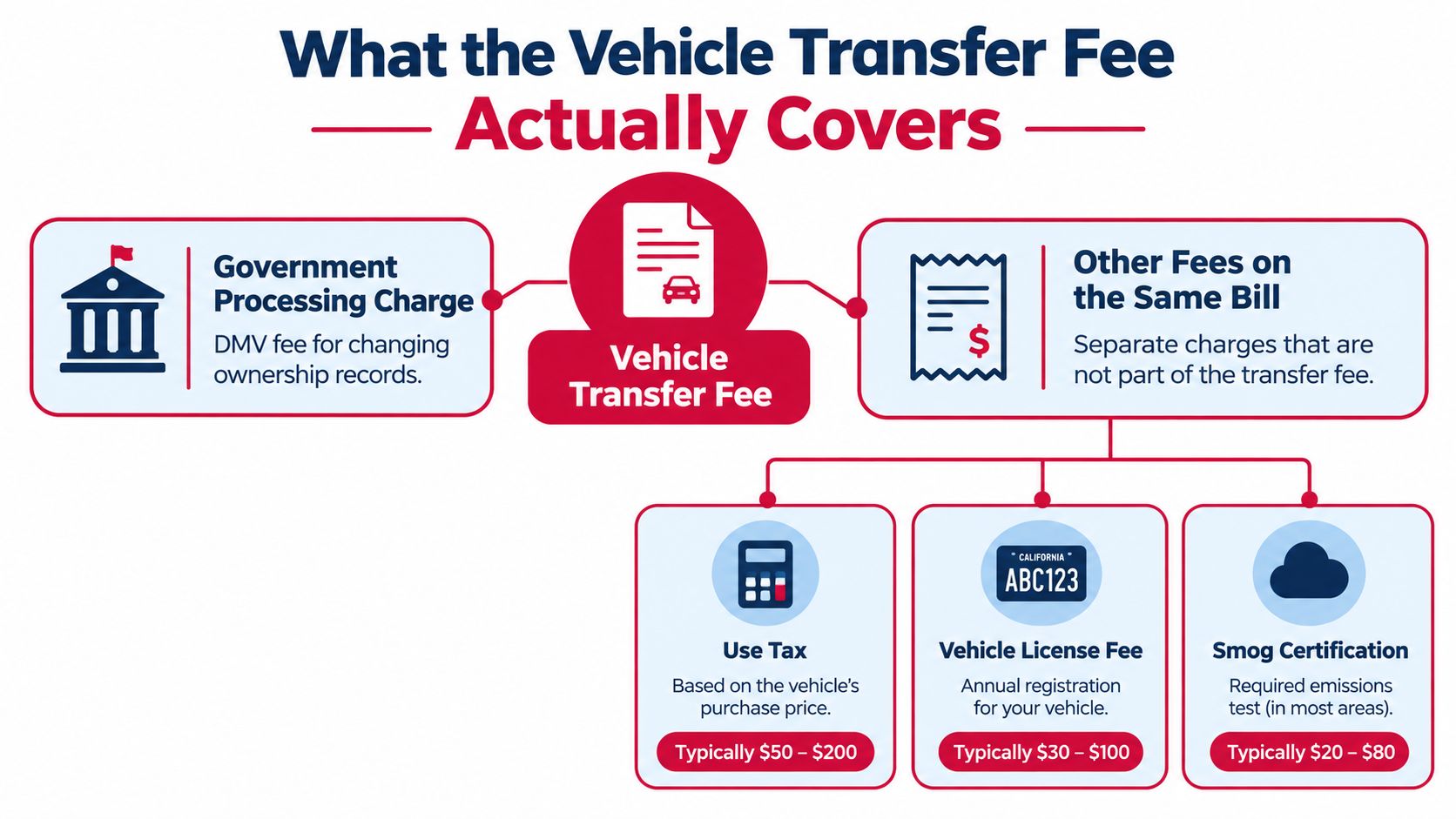
The vehicle transfer fee is the DMV charge for processing a change in ownership. California requires it when a vehicle changes hands through a sale, gift, donation, or trade. It pays for the administrative act of updating the ownership record. It isn't a percentage of the purchase price, and it doesn't stand in for every other charge due during registration.
Think of the fee like postage on a registered letter. The postage gets the document into the delivery system, but it doesn't represent the value of what's inside. In the same way, the transfer fee covers the ownership-record process, while tax and registration charges follow their own rules.
Separate charges on the same bill
A DMV estimate may list use tax, a vehicle license fee, renewal charges, county or district fees, weight fees, or special plate charges alongside the transfer fee. These are not all components of that fee. They arise from other requirements, so a transfer estimate can be higher than the transfer charge alone.
The distinction matters when you're comparing estimates or trying to work out why a bill changed. Ask what each line represents: Is it the charge for changing the ownership record, a tax, a registration balance, or a late assessment? A clearly itemized answer is more useful than a single total.
One vehicle, one transfer obligation
The DMV applies transfer fees separately to separate vehicles. If ownership changes hands more than once before the DMV is notified, the transfer record may also need to account for each intervening sale. So the same fee label can relate to more than one ownership change, not just the person who most recently brought the paperwork to the DMV.
Who Pays and When the Clock Starts Ticking
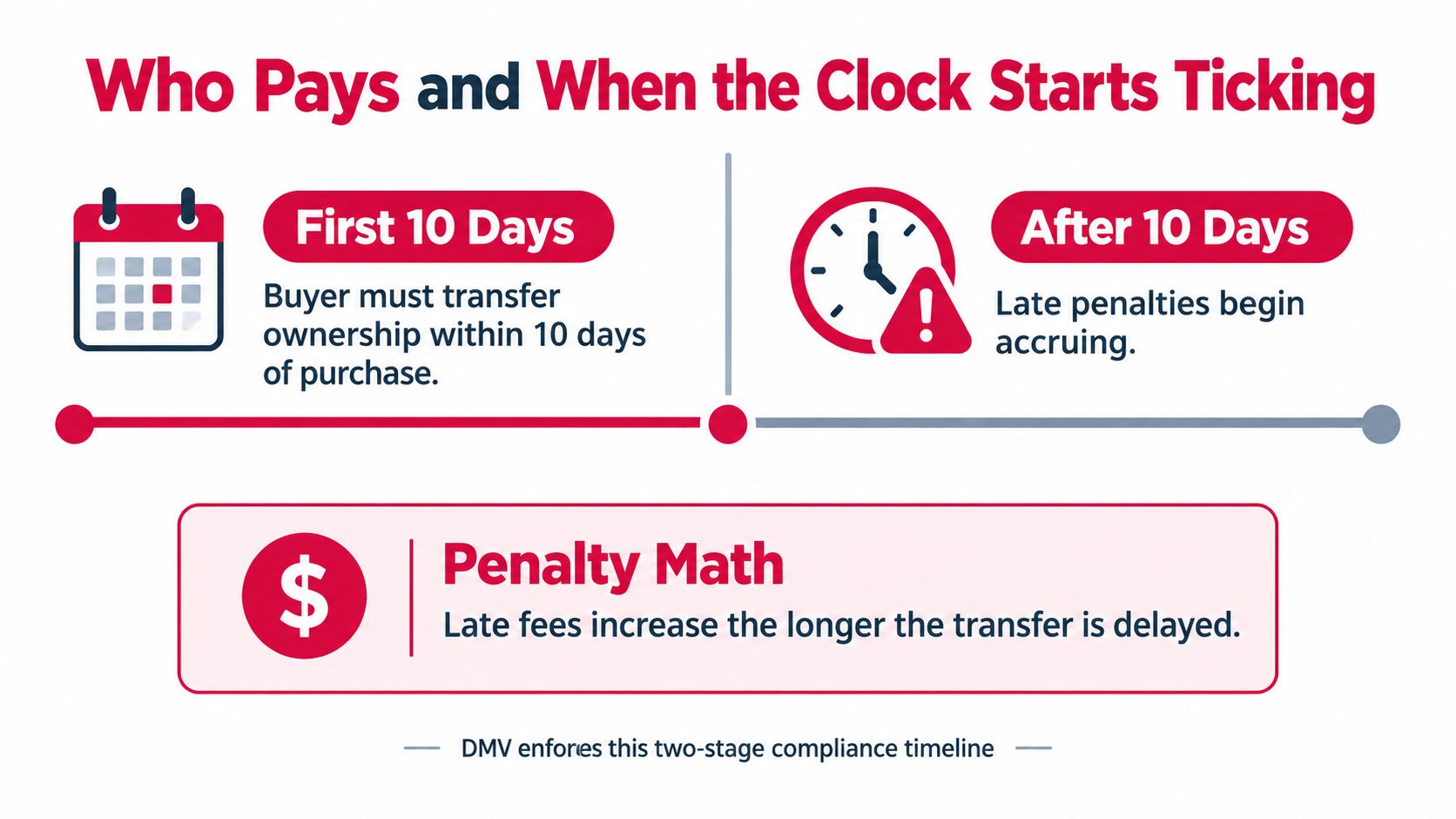
The buyer pays the transfer fees, and California hands that buyer two dates to track at once. Payment is due within 10 days of the transaction date, and penalties apply once the required payment has gone unsubmitted for 30 days, per the California DMV's title-transfer guidance. Read the first date as the deadline and the second as the point where the bill starts growing.
The gap between those dates trips up first-time buyers.
A buyer who files on day 25 did beat the penalty cutoff, but the obligation was already two weeks late. Transfer timing works like a parking meter with a grace period: enforcement may not show up right away, yet the time was still owed from the start.
Late charges can also attach to the registration side of the same bill. Under the DMV's registration-fee guidance, a registration delay of 1 to 10 days adds 10% of the vehicle-license and weight fees, plus $10 registration and $10 CHP late fees. Those penalties sit on the registration lines, and the transfer fee itself stays unchanged. Each line follows its own clock, so the cheapest transfer is the one filed early with complete paperwork.
What happens when ownership changed more than once
A vehicle that passes through several buyers before anyone notifies the DMV leaves a chain of transfers on the record. The DMV's multiple-transfer guidance states that only the last transfer in the chain draws a transfer penalty, while the fees tied to earlier transfers still apply.
Use tax paid by an earlier buyer cannot be credited toward what a later buyer owes. If the title history has gaps, ask the DMV or a qualified registration provider to reconstruct the sequence of sales before assuming the most recent transaction is the only one on the record.
Keep the transaction date, the signed title, and every ownership document together, then file promptly. For help pairing the transfer with the rest of the registration paperwork, review vehicle registration transfer services. Clear dates and complete documents are what turn an unpredictable bill into one you can estimate line by line.
The Other Charges That Travel With the Transfer Fee
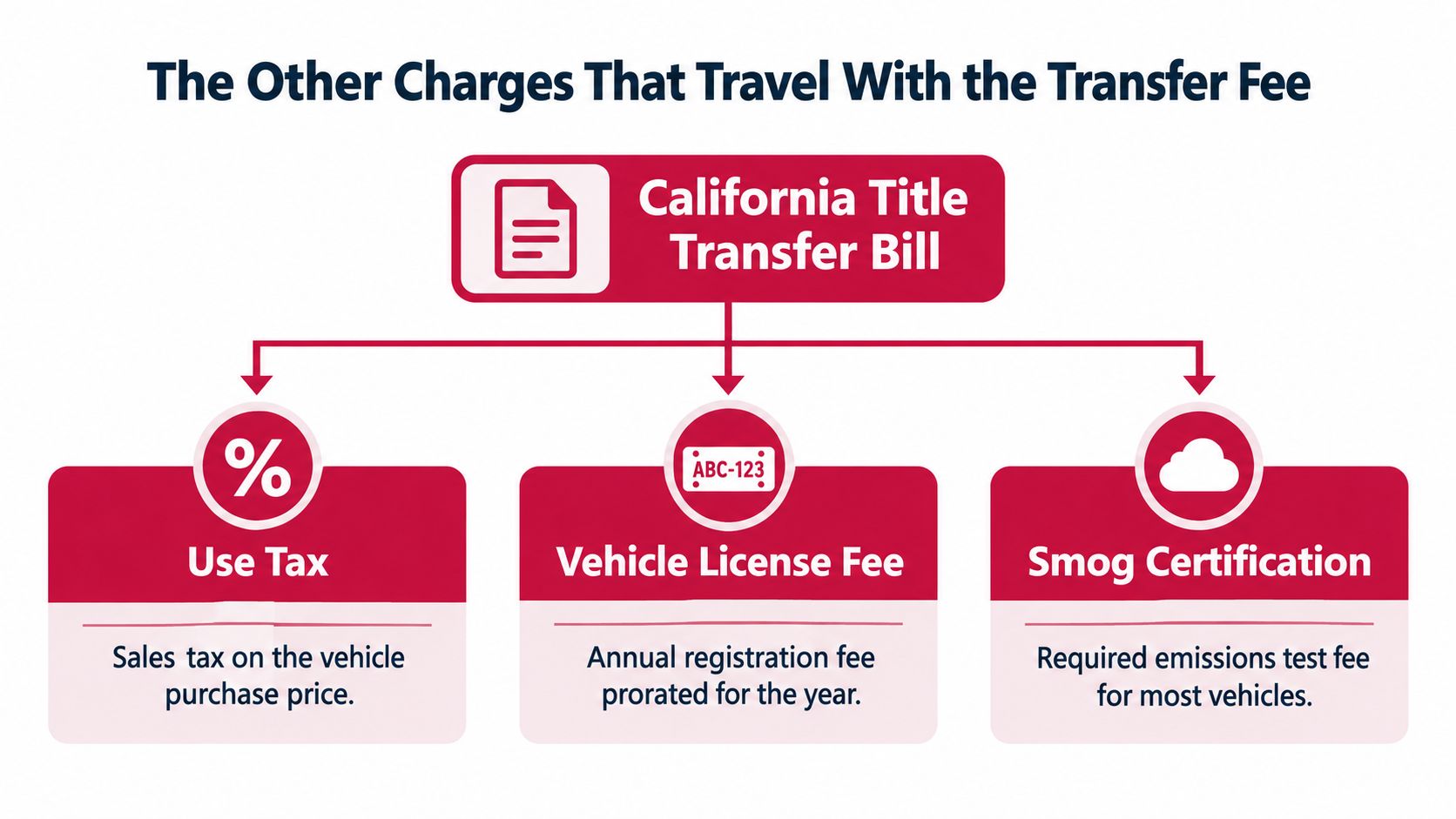
The transfer fee is just one entry in a possible set of charges. The total can depend on the vehicle, the buyer's location, and the vehicle's registration status. Reading the bill line by line helps you distinguish taxes and registration costs from the administrative charge for changing ownership.
Use tax follows the buyer's location
For a taxable purchase, California use tax is generally calculated using the purchaser's city and county. The rate may range from 7.25% to 10.25%, so two buyers transferring similar vehicles can face different tax amounts because they live in different jurisdictions. The tax is distinct from the transfer fee, and the total due can't be estimated by looking at that fee alone. The California DMV title-transfer information describes this distinction and the factors that can affect a transfer bill.
VLF and other registration-related charges
For applicable vehicles, the vehicle license fee (VLF) is 0.65% of market value. The DMV uses the vehicle's VLF class and relevant model-year schedule, not the new owner's negotiated purchase price, to determine the amount. This is why a low sale price doesn't necessarily mean the VLF will be calculated from that price.
Other possible line items include renewal charges, county or district fees, weight fees, and special plate charges. Whether they apply depends on the vehicle and its registration circumstances. Ask for an itemized calculation if the estimate combines these amounts or if you can't tell which line is tied to the transfer.
Check the effective fee schedule
California periodically adjusts certain DMV charges through statutory consumer-price-index increases. A fee notice effective January 1, 2026, lists the title-only fee, off-highway-vehicle transfer fee, and moped original-or-transfer fee each increasing from $27 to $28. Those examples apply to the specific fees listed in that notice, not to every vehicle transfer. Check the DMV's current calculation for your vehicle and transaction rather than assuming a charge shown in an older estimate still applies.
For an overview of the wider registration estimate, see California vehicle registration costs. Treat each item as its own rule-based charge, and ask whether a figure is tax, registration, title processing, or an optional service fee.
How Transfer Type Changes the Bill
Two people can transfer similar cars in the same week and walk out with different totals. The transfer fee itself rarely explains the gap. The transaction type underneath it usually does, because a private sale, a gift, a donation, a trade, and an out-of-state title each carry slightly different tax treatment and paperwork.
Before relying on any estimate, identify what happened: Was the vehicle sold, given as a gift, donated, traded, or brought into California from another state?
| Transfer situation | What to check | Why the total may differ |
|---|---|---|
| Private-party sale | Confirm the transaction details, date, and current registration status. | Use tax may apply, and the buyer remains responsible for the transfer fees. |
| Gift | Make sure the transfer is being reported as a gift and ask how the DMV will assess tax. | A gift may be treated differently from a taxable purchase, but don't assume the tax outcome without confirming eligibility. |
| Donation | Check the transfer documents and whether the recipient is an organization or another party. | Donation paperwork and tax treatment may depend on the specific transaction. |
| Trade | Review the sale and trade paperwork as separate parts of the transaction. | The transfer still needs to be documented, and the full bill may include registration charges beyond the transfer fee. |
| Out-of-state title | Gather the existing title and ask what verification or California registration steps are required. | An out-of-state vehicle can need additional processing, so the estimate may differ from an in-state transfer. |
For taxable purchases, use tax follows the purchaser's city and county rather than one statewide figure. As covered under use tax above, the rate depends on the buyer's jurisdiction, consistent with the DMV title-transfer guidance referenced earlier, so confirm the applicable rate for your location instead of reusing a figure from another transaction.
The same caution applies to gifts and donations. Say a relative signs a car over to you for free. The paperwork may still ask when the vehicle changed hands, what it was worth, and whether the transfer qualifies for different tax treatment. Clarify what documentation the DMV needs before assuming the word "gift" on a form closes the file. If you buy privately instead, keep the signed title and transaction details together so the date and ownership path are clear.
Out-of-state titles deserve their own check. Ask whether the vehicle needs verification, whether its registration status changes the amount due, and which documents must accompany the title. Across every row of the table, the order of operations stays the same: identify the transfer type first, then estimate taxes and registration charges separately from the transfer fee.
Where Smog Certification Fits Into the Transfer
A smog certificate can be a separate requirement from the ownership-record fee, and it can affect how smoothly you complete registration. Don't assume every vehicle or every transfer follows the same emissions-testing rule. Confirm whether a smog check is required for your specific vehicle and situation before you plan the rest of the paperwork.
The timing matters. If the vehicle needs testing, completing that step before you submit the full transfer and registration package can help avoid a stop in processing. If you're unsure whether a recent certificate will meet the requirement, check with the DMV or a smog station before relying on it. The California smog-test requirements page offers additional guidance.
| Scenario | Smog required | Notes |
|---|---|---|
| Vehicle transfer where a smog inspection is required | Yes | Arrange the inspection and confirm the certificate is ready for the transfer process. |
| Vehicle with a recent passing certificate | Confirm first | Ask whether the existing certificate can be used for this transaction. |
| Vehicle with an exemption or a special circumstance | Confirm first | Don't assume an exemption applies based only on the vehicle's age or fuel type. |
| Vehicle that fails the inspection | A passing result may still be needed | Resolve the emissions issue and check the next steps before expecting registration processing to finish. |
A passing certificate doesn't replace the title, transfer payment, or any applicable tax. It addresses an emissions requirement. Keeping those steps distinct makes it easier to see what's still outstanding if the DMV or a service provider says the transfer can't yet be completed.
If the vehicle fails, ask the testing station what the result means and what options are available. Some stations offer a retest under their own policies, but confirm the terms directly. That way, you can plan around the testing requirement without confusing it with the transfer-fee deadline or assuming that one completed step clears the others.
Handling the Transfer in One Stop at Fire House Smog
A buyer handling both a smog requirement and DMV paperwork may prefer a provider that can address those tasks in one place. Fire House Smog is a STAR-certified test-only smog station and licensed DMV registration services provider in Antioch. It performs smog inspections and processes California ownership transfers, including support for out-of-state vehicles, with stickers and plates as needed.
A buyer arriving with a signed title and the right supporting documents can ask staff to check what's needed for the transaction and whether smog testing applies. Bring a valid ID, the signed title, any lien-release paperwork, and a smog certificate if you already have one. If a document is missing or the title record has an issue, clarify that before expecting the transfer to be completed.
What the service can handle
The station offers STAR-certified, test-only smog inspections for passenger vehicles and light-duty trucks, plus testing for some RVs and motorhomes when size and equipment allow. Its test-only model means it doesn't sell repairs, so testing and repair work aren't bundled into the same service.
For DMV matters, the site handles California registration renewals and ownership transfers, including out-of-state vehicle support. On-site tag and plate issuance is available when needed for eligible transactions. The station also has two service bays, and its published service information notes a free retest may be available subject to site policy and coupon terms. Confirm eligibility and current terms with the business.
Smog testing is available seven days a week, with extended evening and weekend hours. DMV services are listed for Monday through Saturday, 9:30 AM to 5:00 PM, and Sunday, 12:00 PM to 4:00 PM, though weekend services may be limited. The location is 2900 Lone Tree Way, Antioch, CA 94509. Check directly before visiting to confirm the service you need and the documents to bring.
Why the Transfer Fee Is Not a Flat Number
A vehicle transfer fee is a government charge, but the amount due on a transfer bill isn't necessarily one universal price. The fee is only one part of the transaction. The buyer's jurisdiction, vehicle class and weight, registration status, ownership history, and timing can each affect other line items or obligations.
Use this checklist before finalizing the transfer:
- Confirm the transaction type: Identify whether you're buying, receiving a gift, donating, trading, or registering an out-of-state vehicle.
- Check registration status: Find out whether the vehicle has an outstanding registration balance or another unresolved issue.
- Identify the buyer's city and county: Use tax depends on jurisdiction when the purchase is taxable.
- Review the title and lien status: Make sure the title is signed correctly and determine whether a lien release is needed.
- Ask about previous transfers: If the DMV wasn't notified of earlier sales, more than one transfer-fee obligation may apply.
- Confirm whether smog testing is required: Don't assume a vehicle is ready for registration until you've checked the applicable emissions requirement.
- Note the transaction date: Submit the required payment and paperwork promptly to avoid timing-related problems.
Once those details are in hand, ask for an itemized estimate. A clear breakdown should distinguish the government transfer charge from use tax, VLF, registration charges, penalties, and any optional service fee. That gives you a more reliable picture of the total than a headline transfer price.
If you're completing a California ownership transfer in Antioch, Fire House Smog offers smog inspections and DMV registration services, including ownership-transfer support. Contact the station or visit its Lone Tree Way location to confirm what documents your transaction requires and whether it can handle your transfer and any needed smog test.