
Most advice about how to check vehicle ownership starts in the wrong place. It tells you to run the plate, pull a vehicle history report, or type the VIN into a website and look for a name. In California, that search doesn't prove the person holding the keys can legally sell you the car.
A clean history report can still sit next to an open lien. A registration card can be current while the title names someone else. A seller can have the car in the driveway, know every repair it has had, and still lack a transferable right to sell it.
You're not hunting for one name. You're proving an unbroken, transferable chain of title, with fixed deadlines once money changes hands. If the title, VIN, seller identity, lien status, mileage, and signatures don't line up, don't treat the gap as paperwork for later. Stop the sale until they do.
Table of Contents
- What Actually Proves California Vehicle Ownership
- Information Deadlines and Privacy Limits
- Verify the Title Before You Pay
- When the Ownership Check Does Not Match
- Finish the Transfer With a Licensed Partner
What Actually Proves California Vehicle Ownership
California won't hand a stranger the registered owner's name and address from a license plate or VIN. That's the first correction most buyers need. A public owner lookup isn't a step you missed. It's a step that doesn't replace the seller producing the title.
The California Certificate of Title is the document that proves ownership. The California DMV guide to vehicle titles distinguishes that certificate from other records and identifies the registered owner, legal owner or lienholder, VIN, and odometer information on it. Read those fields separately. They answer different questions.
A registered owner is the person associated with registration and use of the vehicle. A legal owner or lienholder may be a lender with a financial claim until the loan is satisfied. When those names differ, possession of the car and a card in the glove box don't settle who can sign the title over to you.
Records That Look Like Proof but Are Not
A history report helps you screen a car. It may flag salvage, theft, brands, or mileage problems. It doesn't prove the seller is the legal owner, and it can't release a lien. Treat it as background, not as the ownership check itself.
The same caution applies to the seller's Notice of Transfer and Release of Liability. That filing tells DMV the seller reported the sale and asks to be released from later liability. It doesn't put ownership in the buyer's name. Buyers who confuse those two filings can drive away believing the transfer is finished when the official title work still isn't.
Financed and recently paid off cars add another wrinkle. California's Electronic Lien and Title system stores lienholder title information electronically. A lender can transmit lien satisfaction to DMV before any paper title reaches the seller. No paper in the driveway may be explainable, but it still has to be explained with records, not reassurance.
| Record | What it shows | What it does not prove | Where it comes from |
|---|---|---|---|
| California Certificate of Title | Legal ownership, registered owner, legal owner or lienholder, VIN, odometer | That registration fees are current | Seller, or DMV after a title is issued |
| Registration card | Registered owner and that the vehicle is registered | A right to transfer ownership | Vehicle or the owner's DMV record |
| Vehicle history or NMVTIS-style report | Brands such as salvage or theft, and some odometer or lien flags | That the person selling is the legal owner or that the lien is released | Commercial history provider |
| Notice of Transfer and Release of Liability | Seller has reported the sale and asked to be released from later liability | That ownership has transferred to the buyer | Seller files with DMV, often online |
| Electronic lien and title record | Lienholder holds the title electronically until the loan is satisfied | That a paper title is already in the seller's hands | Lender and DMV Electronic Lien and Title system |
| REG 227 duplicate or paperless title application | A request to replace a lost, stolen, damaged, or illegible title | Ownership until DMV issues the replacement | Seller or owner submits to DMV |
Walk the rows in order. The title answers who owns it. The registration card answers whether the vehicle is registered. The notice protects the seller after the sale. A REG 227 starts a replacement process, but the application itself isn't ownership.
If you're deciding whether you're looking at an ownership document or a registration document, read the plain comparison of title transfer versus registration before you agree on price. Then use a simple rule. Any row that fails is a stop, not a chore to clean up after payment.
Information Deadlines and Privacy Limits
Gather the facts before you open a DMV session or drive to meet a seller. Guessing at a character in a VIN or a name spelling at the counter wastes the trip and can put the wrong information into the packet.
What to Have in Hand
- Vehicle identifiers: The full VIN and, for a car already registered in California, the license plate number.
- Title names: The registered owner, any legal owner or lienholder, and the exact spelling used on the title.
- Sale facts: The odometer reading, sale date, purchase price, and contact details for buyer and seller.
- Identity documents: Photo ID for the person signing, plus any lien release the title requires.
- Supporting certificates: A smog certificate when this transfer requires one, kept separate from the title itself.
Keep two jobs apart. Checking a car you already own means signing in to your DMV online account and comparing the plate and VIN it shows with your title and registration card. Checking a car you might buy means the seller produces the title for you to inspect. There's no public owner name lookup that lets you skip that exchange.
Two Clocks Start at the Sale
People often treat the seller's filing and the buyer's filing as one task. They're separate duties, owed by different people, and one doesn't complete the other.
Seller clock: File the Notice of Transfer and Release of Liability within 5 days after the sale. Buyer clock: Submit the ownership transfer within 10 days after purchase.
The seller's notice helps keep later tolls, parking citations, and crash liability from being billed to the old owner. It does not transfer the title. The buyer's submission is the official ownership transfer, and waiting risks penalties and a record that still points to the prior owner.
| Deadline | Timing | What it does |
|---|---|---|
| Seller Notice of Transfer and Release of Liability | 5 days after sale | Stops later tolls and tickets from billing the old owner, but does not transfer ownership |
| Buyer ownership transfer | 10 days after purchase | Official title transfer still required; late filing risks penalties |
| Electronic lien paper title delivery | About 8 days per DMV average | A recent payoff plus this wait can be normal; silence from the lender beyond it is a problem to chase |
On money, expect the DMV transfer fee plus use tax based on the purchase price or the vehicle's current value, whichever the DMV rules require for that transaction. A licensed business partner adds its own service fee on top of the state amount, so don't mistake the service charge for the state charge. Ask for the two figures separately before you pay.
Before anyone leaves the driveway, photograph the signed title, the IDs used, the dashboard odometer, and the liability release confirmation. Keep online confirmation numbers with the transfer packet. If DMV follows up, you'll have a complete filing trail instead of a memory of what somebody clicked.
Verify the Title Before You Pay
A registration card and a set of keys do not prove that a seller can transfer ownership. The title must connect the legal owner to the person signing the sale, with any lien properly cleared. If that chain has a gap, pause before paying.
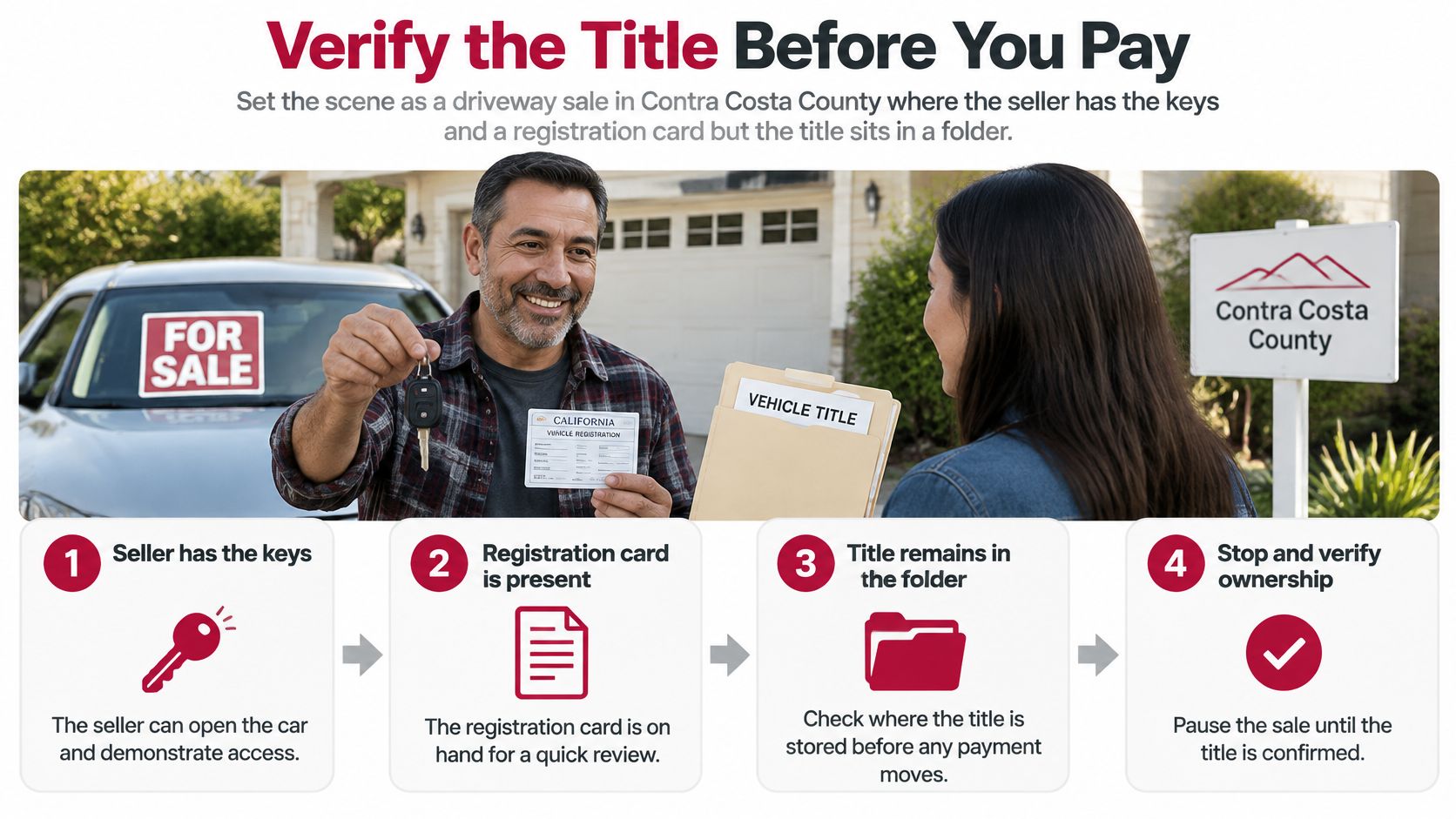
The California DMV guide to changing vehicle ownership gives the buyer 10 days after purchase to transfer ownership and the seller 5 days to file a Notice of Transfer and Release of Liability. Check the paperwork before money changes hands so there is time to address a missing signature or release.
The Eight Checks in Order
Get the original title. Ask to see the California Certificate of Title. If it is lost, stolen, damaged, or illegible, the owner needs to start REG 227 for a replacement. Do not pay in full based on a promise that the title will turn up.
Compare the VIN yourself. In daylight, match the VIN on the vehicle to the title, character by character. Check every digit and letter, including the check digit. A mismatch can mean the paperwork describes a different vehicle.
Match the seller to the title. Compare the name on the title with the photo ID of the person selling the vehicle. If they differ, ask for the missing link in the ownership chain. An explanation from a spouse, relative, friend, or prior buyer does not replace the required documentation.
Collect every required signature. Check that the buyer, seller, and any required lienholder have signed in the correct places. Do not leave reassignment spaces blank for someone to complete later. Each assignment should show a clear transfer from one owner to the next.
Verify the lien release. If a lienholder is listed, confirm the release before finalizing payment. A lien release on REG 227 must be notarized. A payoff screenshot may support the seller's account, but it does not replace the release needed for the transfer.
Capture the odometer reading. Record the vehicle's mileage and complete the required disclosure. Federal odometer disclosure rules apply to most newer vehicles, so read the disclosure section of the title and transfer form before you sign. Compare the written figure with the dashboard reading while both parties are present.
Confirm smog where required. Some transfers require smog certification and others do not. Confirm which rule applies to the vehicle and buyer before submitting the paperwork. Resolve title problems first, rather than spending money on a test before you know the transfer can proceed.
Calculate fees and use tax before filing. Account for the DMV transfer fee, any use tax, and applicable registration amounts. If you use a service provider, keep its charge separate from the state's fees so you know what each amount covers.
Stop if the VIN, seller's identity, lien status, mileage, or signatures do not match. Do not hand over the money or submit an incomplete packet.
A mismatch can delay the new title and leave the prior owner connected to the vehicle in DMV records. The buyer may also have difficulty registering or reselling a car without a clean transfer. Waiting for the right document is safer than trying to unwind a payment later.
Habits That Prevent Most Stalls
Sellers can file the release of liability on the day of sale and keep its confirmation with a copy of the signed title. That creates a dated record if a toll or ticket arrives after the sale.
Buyers should settle questions about the seller's name and any lien before paying for repairs, registration, or smog testing. A new battery does not repair a broken title chain, and parts receipts do not establish that the seller can transfer ownership.
Family and gift transfers still need a complete owner match, even when no money changes hands. The titled owner must make the transfer, or the missing assignment must be completed.
For an out-of-state vehicle, allow time to review the title before promising a registration date. Once the documents and ownership chain line up, file the transfer promptly and keep copies of the paperwork.
When the Ownership Check Does Not Match
The sale stalls on a Saturday. The ad said clear title, the test drive went fine, and the folder doesn't match the claim. Don't start by asking which form fixes it. Name the mismatch first. The correct next step depends on whether the problem is identity, lien, mileage, a missing title, or an unfinished earlier sale.
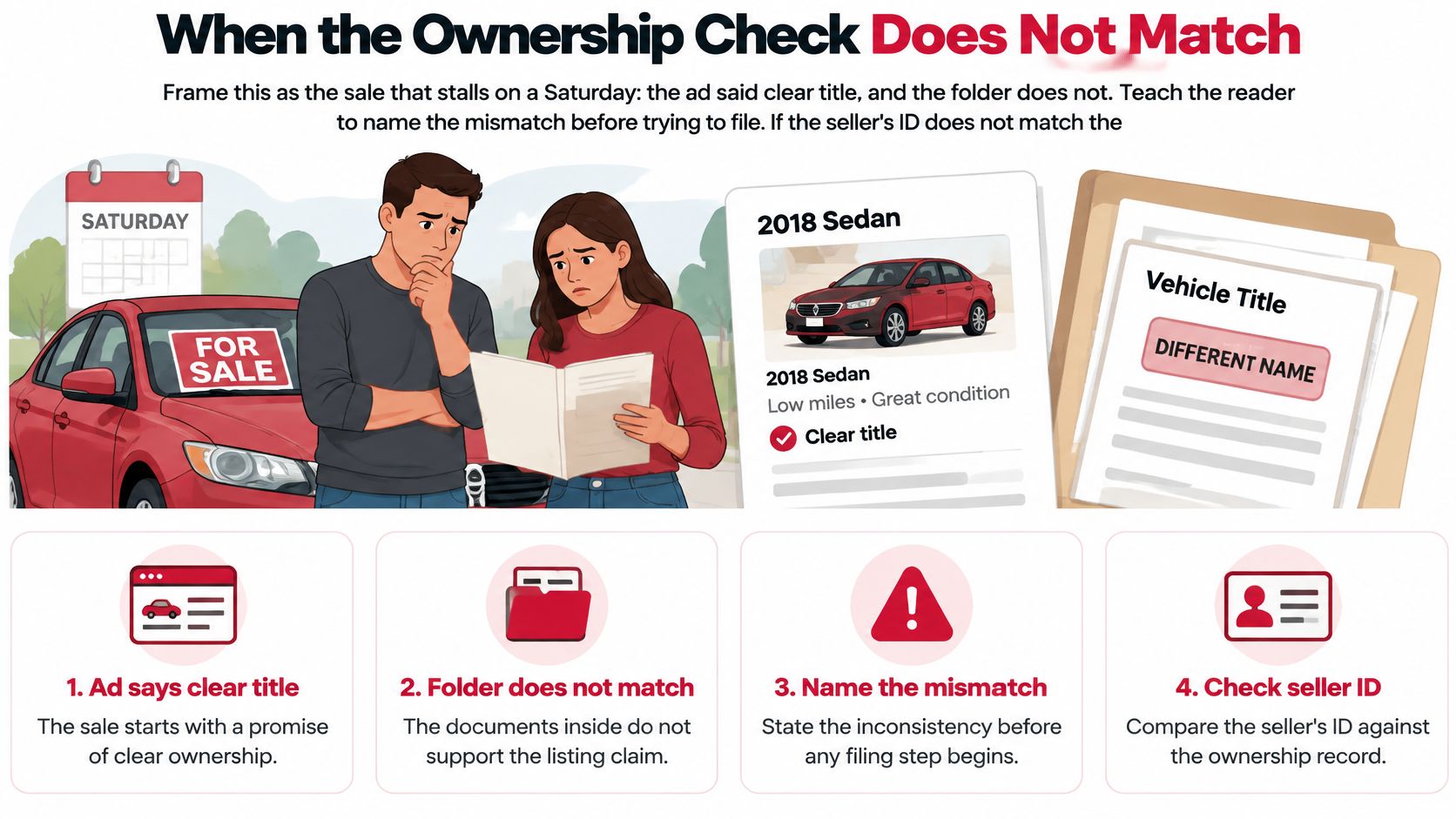
The California DMV guidance on title transfers and changes requires ownership or lienholder changes to be reported to DMV within 10 days, and an official title transfer is still required. That deadline doesn't excuse filing a packet you already know is incomplete. It means you should resolve the defect quickly and document what you did.
| What you see | Likely cause | What to do | Do not do |
|---|---|---|---|
| Seller ID does not match the title | Title never updated, or the seller is not the legal owner | Stop and require the titled owner or a complete chain of assignments | Accept a registration card as a substitute |
| No paper title in hand | Lost or damaged title, or an electronic lien not yet converted to paper | Use REG 227 for a lost title, or wait about eight days after a confirmed electronic payoff | File a transfer with a blank or missing title |
| Lien still listed | Loan unpaid, or release not recorded | Get a lien release, notarized when it is on REG 227 | Trust a verbal payoff or a payment screenshot alone |
| Odometer figures disagree | Disclosure error, noncomplying title, or a possible rollback | Reconcile the reading and use the required disclosure, including REG 262 when the title is noncomplying or extra reassignment is needed | Submit conflicting mileage |
| Out-of-state or foreign title | Incoming title may not meet California or federal disclosure rules | Confirm the title complies before choosing the California form | Assume every out-of-state title transfers the same way |
| Several names in the assignment chain | Prior sales were never finished with DMV | Complete each link before the current seller signs to you | Skip a missing owner to save time |
The Eight Day Electronic Lien Wait
No paper title doesn't always mean the seller is hiding something. After an electronic lien transaction, paper title delivery averages eight days, according to the DMV guidance linked above. A recent, confirmed payoff plus that short wait can be legitimate. Ask for the lender's payoff confirmation and a date you can verify.
Silence is different. If the lender won't confirm satisfaction, the seller can't say when the electronic record was released, or the promised paper title keeps slipping without a paper trail, pause the purchase. You're distinguishing a processing delay from an unresolved ownership problem, and the seller needs to supply the evidence.
When REG 262 Enters the Packet
Mileage mismatches need care because an error can look like fraud on paper. Federal rules generally require odometer disclosure during transfers. California may require the separate REG 262 when the title is noncomplying, a replacement title application is used, or additional reassignment is needed. For an out of state vehicle, the disclosure method depends on whether the incoming title already complies with applicable requirements.
Don't average two mileage figures, copy the lower one, or leave the space blank to deal with later. Reconcile the title, dashboard, and disclosure, then use the form that fits the title you have. If the numbers still conflict, walk away until the seller can explain them with records.
Multiple names in the reassignment boxes require the same patience. Each link has to be complete. Skipping a missing owner breaks the chain you're trying to prove. While you sort it out, you can review how to track a vehicle ownership transfer status so you know what a completed filing should look like.
An incomplete packet delays the new title while liability can stay with the prior owner. That's the chain of title test. You aren't hunting one name. You're proving an uninterrupted right to sell, from the titled owner through every assignment to you.
Finish the Transfer With a Licensed Partner
Once the title, VIN, seller, lien, and odometer agree, the remaining job is filing. You don't need another owner search. You need the transfer submitted correctly and current registration issued before the buyer's deadline becomes a problem.
You can submit to DMV directly or use a licensed California business partner for DMV registration services. That choice matters when a field office line would push a clean packet past its filing window. The nearest DMV offices to Antioch are in Pittsburg and Concord, so travel and queue time belong in the decision.
At Fire House Smog, 2900 Lone Tree Way in Antioch, we handle California renewals and ownership transfers, including California and out of state vehicles with the sticker and license plates as needed. Our transfer service is $55 plus the applicable DMV fee. State use tax and any registration fees DMV calculates are separate, so read the DMV amount and our service fee as two lines, not one bundled state charge.
You can review the filing path for a DMV transfer of ownership before you come in. DMV services run Monday through Friday 9:30 AM to 5:00 PM, Saturday 9:30 AM to 5:00 PM, and Sunday 12:00 PM to 4:00 PM, though weekend services may be limited. Call us at (925) 754-1600 or book through our website if you want to confirm weekend availability.
Smog is a separate requirement from the paperwork. When a transfer requires it, our station is STAR-certified and test-only, and we don't do repairs. That separation keeps the emissions result independent from any repair sale.
Bring a Packet That Can Be Filed
- Signed title: The original title with buyer, seller, and lienholder signatures completed as required.
- Identification: Photo ID matching the names used in the transfer.
- Odometer disclosure: The completed disclosure for this vehicle and title type.
- Lien release: The release when a lienholder appears, notarized when the form requires it.
- Smog certificate: The certificate when this transfer requires one.
If any one of those items is still missing, fix it before you ask any counter to file. A partner can submit a clean transfer efficiently. No counter can turn a broken chain of title into proof of ownership.
Bring your signed title, ID, odometer disclosure, any lien release, and smog certificate if required, and we'll help you finish the California or out of state ownership transfer without a field office queue. Visit Fire House Smog to book or call (925) 754-1600 before you come to 2900 Lone Tree Way in Antioch.