
Title Transfer vs Registration: What California Drivers Need
You bought a used car from a private seller in Antioch, signed the paperwork, and drove home with the keys. Then you realize the title, registration, smog certificate, plates, and DMV deadlines are all separate pieces of the same transaction. The question isn't whether you need a title transfer or registration. In many California purchase situations, you need both, and each one solves a different problem.
Title transfer changes the legal owner. Registration updates the vehicle's California record and supports lawful road use. The signed title sitting in your glove box doesn't complete the job by itself. California DMV rules require the seller to submit a Notice of Transfer and Release of Liability within 5 calendar days, while the buyer must complete the ownership transfer and pay the required fees. DMV also frames ownership-change record updates as due within 10 days of the sale or transfer. California DMV explains the Notice of Transfer and Release of Liability requirements.
| Question | Title transfer | Vehicle registration |
|---|---|---|
| Main purpose | Records who legally owns the vehicle | Keeps the vehicle's California record current for road use |
| Trigger | Sale, gift, inheritance, or another ownership change | Purchase, move to California, renewal, replacement, or record update |
| Core paperwork | California Certificate of Title and required signatures | Registration application, title or ownership documents, fees, and possible smog paperwork |
| Common supporting items | Odometer disclosure, lien release, replacement-title paperwork if needed | Smog certification, fees, use tax, registration card, and applicable forms |
| Result | Ownership record moves to the new owner | Updated registration record, card, sticker, or plates as applicable |
Table of Contents
- Two Different DMV Moments Most Drivers Mix Up
- What Title Transfer and Registration Actually Mean
- California Rules, Documents, and Fees for Each
- Side-by-Side Comparison at a Glance
- Real Antioch Scenarios That Show Which One You Need
- How Fire House Smog Handles Both on Site
- Practical Recommendations and Common Questions
Two Different DMV Moments Most Drivers Mix Up
The Antioch buyer who leaves a private sale with a signed title often focuses on the registration sticker. That's understandable, but it misses the legal step underneath it. The title transfer puts the vehicle in the buyer's name. Registration documents the vehicle's current California status and road-use authorization.
Those tasks may happen during the same DMV transaction, but they aren't interchangeable. If the title transfer isn't completed, the DMV may not be able to finish the ownership record or related registration work. If registration isn't current, owning the vehicle doesn't automatically make it compliant for driving on public roads.
Start with the event that caused the paperwork
A private sale, inheritance, gift, or move from another state changes the paperwork path. A routine renewal usually doesn't change ownership, so it generally calls for registration service rather than a new title transfer. A dealer may submit much of the paperwork for you, but the transaction still involves ownership documentation, registration, taxes, and fees.
California gives the seller a short reporting deadline. The seller must notify the DMV within 5 calendar days by filing a Notice of Transfer and Release of Liability, while the buyer must complete the transfer requirements and pay applicable fees. DMV guidance also identifies 10 days as the ownership-change record-update window. The DMV's title-transfer guidance distinguishes the seller's notice from the buyer's transfer responsibility.
Practical rule: If the vehicle changed owners, handle the title paperwork first and bundle registration into the same visit whenever possible.
A STAR-certified smog check can be part of the transaction when California requires emissions certification. Don't assume the smog question is separate from the purchase. Before you schedule a visit, identify whether you're dealing with a private sale, out-of-state vehicle, inheritance, or renewal.
For a plain-language look at the ongoing registration side, review vehicle registration renewal guidance.
What Title Transfer and Registration Actually Mean
A title transfer is the legal ownership update. The California Certificate of Title identifies the vehicle's ownership record, and the buyer and seller generally complete the required title information before the buyer submits the transfer to the DMV. Required odometer disclosure can also be part of the package, particularly for qualifying privately sold vehicles.
Registration answers a different question. It connects the vehicle to a California DMV record, registration card, and current proof that required registration obligations have been addressed. Registration can involve fees, use tax, emissions documentation, and, where applicable, a planned nonoperation status.
Ownership and road status are connected, not identical
After an Antioch private-party purchase, the buyer commonly handles both ownership transfer and registration together. The signed title supports the ownership change, while the registration portion records the vehicle in California and applies the required fees and compliance checks.
A renewal is different. If you still own the same vehicle and only the tags are expiring, you generally need to renew registration rather than transfer the title again. Moving from another state, receiving a vehicle through inheritance, or accepting a vehicle as a gift can require both ownership paperwork and California registration.
The paperwork reflects that distinction:
- Title documents: The signed California Certificate of Title is central to a normal transfer. If the title is missing, replacement-or-transfer paperwork is required.
- Registration documents: The buyer may need the signed title, smog certification, fees, and use tax when registering a privately purchased vehicle.
- Ownership corrections: A lienholder or registered-owner change requires the DMV record to be updated and the title transferred to the new owner.
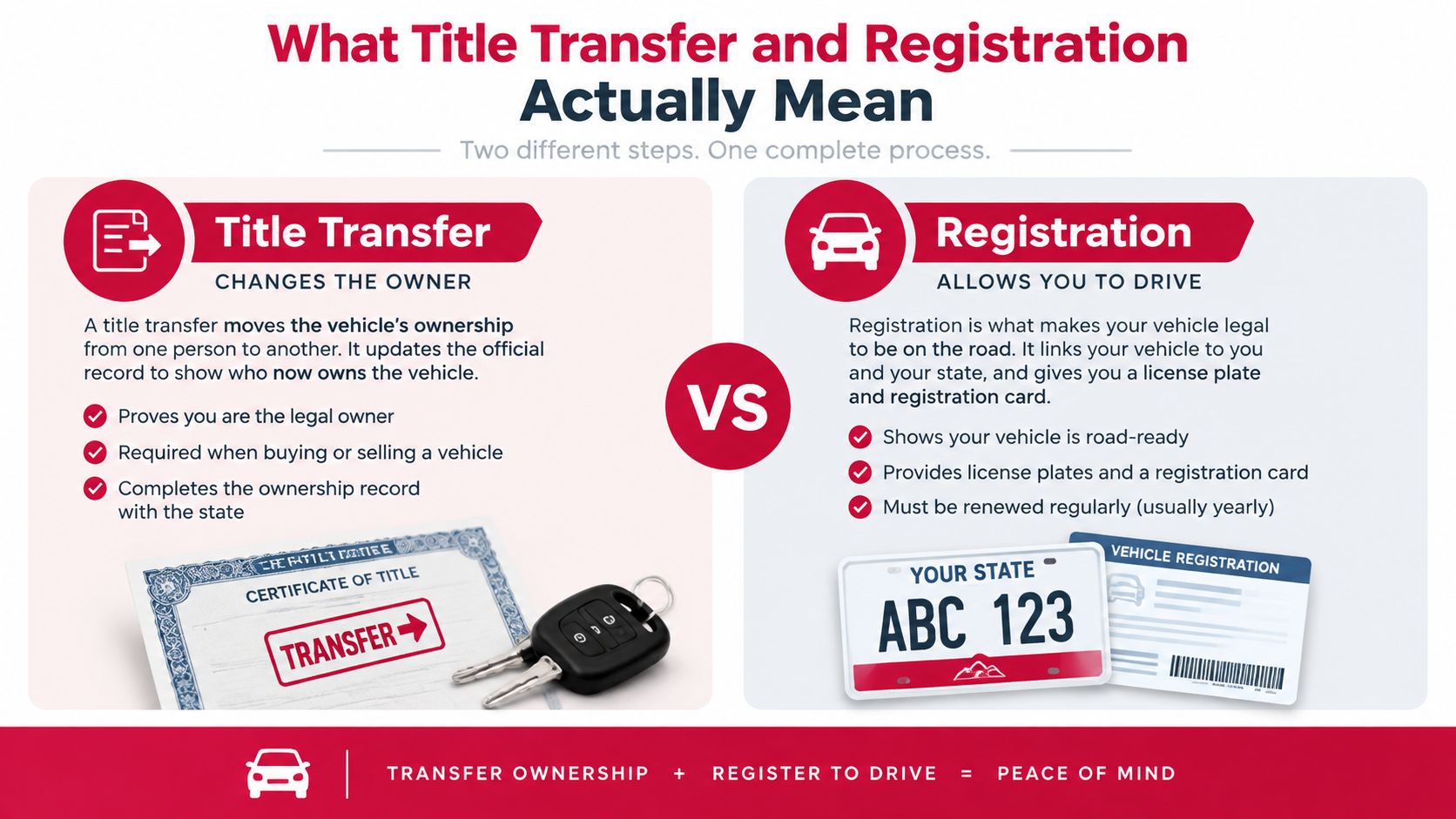
The title answers, “Who owns this vehicle?” Registration answers, “Is this vehicle properly documented and current for California road use?” Keep those questions separate and the process becomes much easier to organize.
California Rules, Documents, and Fees for Each
An Antioch private-party purchase can require more paperwork than a routine tag renewal. After a sale or transfer, the seller must submit the Notice of Transfer and Release of Liability within 5 calendar days. The buyer must complete the ownership and registration steps, with DMV materials identifying an ownership-change record update within 10 days. California DMV's private-party registration instructions outline how the signed title, smog certification, odometer disclosure, fees, and use tax may fit into the package.
What belongs in the title file
For a standard California transfer, bring the California Certificate of Title with the required buyer and seller signatures. A lost, damaged, or unavailable title requires replacement-or-transfer paperwork before DMV can complete the ownership change. REG 227 applies to missing or replacement title situations.
The transaction may also require supporting documents:
| Requirement | Title Transfer | Vehicle Registration |
|---|---|---|
| Ownership proof | Signed California title, or replacement-title paperwork when the title is missing | Signed title or another acceptable ownership document |
| Emissions paperwork | May be required as part of the related transfer and registration transaction | Smog certification may be required for applicable private-party or out-of-state transactions |
| Financial obligations | Transfer fee and other applicable charges | Registration fees, use tax, vehicle-related charges, and applicable county or district amounts |
| Supporting forms | Odometer disclosure, lien documents, and forms for special circumstances | Application forms, weight declarations, REG 256, REG 139, or other applicable documents |
| Submission | DMV field office or mail, depending on the transaction | DMV field office, mail, online renewal, or an authorized registration service |
For a privately sold vehicle, check whether odometer disclosure applies to a vehicle under 10 years old. Bring the smog certification, applicable fees, and use tax when required. Confirm the current document package before leaving for DMV, especially if the vehicle came from another state or the title has a lien.
Don't treat fees as one flat charge
A single transaction can combine a title-transfer fee, registration fees, use tax, and other charges based on the vehicle and the circumstances. A dealer purchase may call for the certificate of title or an out-of-state title for a used vehicle, title-transfer fees or use tax, and forms such as REG 256, REG 139, or weight declarations when applicable.
Gather the paperwork first, then get a current DMV estimate. Old online posts often show amounts that no longer apply. For an Antioch-area document checklist, use Fire House Smog's vehicle registration documents guide. Bring only the forms that match your transaction, and skip transfer paperwork for a simple renewal when ownership has not changed.
Side-by-Side Comparison at a Glance
| Criterion | Title transfer | Vehicle registration |
|---|---|---|
| Purpose | Establishes the new legal owner | Keeps the vehicle documented and authorized for California road use |
| When required | Sale, gift, inheritance, lien change, or another ownership change | Purchase, move to California, renewal, replacement, or registration update |
| Primary form used | REG 262 may support odometer or transfer details when required | REG 343 may support an application, or an online renewal may be used when eligible |
| Typical documents | Signed title, required odometer disclosure, lien release, and replacement-title paperwork if needed | Title or ownership proof, smog certification when required, fees, use tax, and registration information |
| DMV fees involved | Transfer fee plus other applicable transaction charges | Registration fees, use tax, and other applicable charges |
| What you receive | Updated California title showing the new owner | Updated registration card and sticker, with plates or other proof when applicable |
Purpose and timing
The title transfer follows an ownership event. California DMV guidance identifies the buyer's transfer deadline as 10 calendar days after the sale or transfer, while the seller's Notice of Transfer and Release of Liability is due within 5 calendar days. Registration follows the vehicle's operating status, so renewal can occur without a new ownership change.
Forms and documents
REG 262 may be relevant when odometer or transfer information is required. REG 343 can support an Application for Title or Registration, while online renewal may be available for an eligible unchanged ownership record. Don't sign a form just because a seller or buyer hands it to you. Check that every required field matches the transaction.
Smog, tax, and plates
Smog certification isn't the same thing as the title-transfer fee or registration fee. It can be required for a transfer or California registration, while a renewal may require emissions compliance based on the vehicle's renewal circumstances. Use tax can apply to a transfer, and the exact amount depends on the transaction rather than a universal flat rule.
Plate handling also matters. A private seller should follow DMV directions for the sale and handle the plates as required. The buyer shouldn't assume the plates, title, and registration all move together automatically.
The short version: Title transfer proves ownership. Registration proves current California road status.
Real Antioch Scenarios That Show Which One You Need
Antioch and East County drivers usually don't ask for a definition first. They ask, “What do I bring for my situation?” Match the event to the service before you make the trip.
You bought from a private seller in Antioch
Bring the signed California title and review whether an odometer disclosure, smog certification, use tax, and other fees apply. You need the ownership transfer and the registration portion of the transaction, not just a sticker renewal. The buyer's transfer window is 10 calendar days, and the seller has 5 calendar days to file the Notice of Transfer and Release of Liability.
Useful service line: On-site DMV processing, with smog certification if the transaction requires it.
You moved from Texas to Antioch
An out-of-state vehicle can require California title and registration paperwork, VIN verification, and smog certification. Bring the out-of-state title or other ownership documents, identification, and any lien information. Don't skip VIN verification just because the vehicle is already titled elsewhere.
Useful service line: VIN verification paired with California registration and title processing.
You inherited a vehicle from a relative in Brentwood
Inheritance changes ownership, so renewal alone isn't enough. The transaction may require estate or transfer documentation, the appropriate DMV form, and registration fees. Because inherited-vehicle paperwork depends on the facts of the estate and the ownership record, bring the death certificate or estate documents if the DMV directs you to provide them.
Useful service line: On-site DMV ownership transfer, with registration handling.
Your tags expired months ago
This is a registration problem if ownership hasn't changed. Check whether a smog certification is required and expect the DMV to calculate applicable renewal charges and penalties based on the record. Don't start a title transfer unless the vehicle changed owners.
Useful service line: Registration renewal and smog certification.
You bought through a Contra Costa dealership
The dealer commonly handles much of the title and registration submission, but the buyer still needs to understand the use tax and other charges included in the transaction. Keep copies of the purchase and title documents until the California record is complete.
Useful service line: Smog certification when required, plus on-site DMV help if the dealer leaves an unresolved registration or title issue.
How Fire House Smog Handles Both on Site
Antioch drivers often lose time by separating paperwork that can be handled during one planned visit. A licensed DMV registration service can process eligible renewals and ownership transactions, while a STAR-certified station can handle the emissions inspection when California requires one.
Fire House Smog is a STAR-certified test-only smog station and licensed DMV registration services provider. Its service lines include on-site registration renewals, ownership transfers for California and out-of-state vehicles, VIN-related support, and smog inspections for eligible cars, trucks, and some recreational vehicles. Confirm vehicle-size or transaction-specific requirements before arriving.
Bring the complete file
For an ownership change, bring the title and all documents connected to the transaction. Depending on the facts, that can include replacement-title paperwork, odometer information, lien documents, identification, smog certification, and forms such as REG 262, REG 343, REG 5, or REG 256.
The station's DMV service location is 2720 Hillcrest Avenue in Antioch, and the publisher's service information identifies weekend availability and bilingual staff. Call before you go if you're combining smog, VIN verification, and title work, especially for an out-of-state vehicle or RV.
A combined visit works best when you identify every trigger first, ownership change, California registration, emissions certification, VIN verification, or renewal.
The same DMV fees still apply. A service fee may be added for handling the transaction. For location details and service information, see Fire House Smog in Antioch.
Practical Recommendations and Common Questions
Use one decision rule at the counter. If ownership changed, start with title transfer and add registration. If ownership didn't change, handle registration renewal or replacement only. That keeps you from paying for the wrong service and prevents a routine renewal from turning into an unnecessary ownership transaction.
Before leaving home, check the three problems that cause the most avoidable delays:
- Missing smog certification: Confirm whether the transaction or renewal requires a smog check.
- Incomplete odometer or transfer paperwork: Review REG 262 and the title for signatures and required information.
- Out-of-state vehicle: Plan for VIN verification and bring the out-of-state ownership documents.
Questions Antioch drivers ask
How long does a title transfer take in person versus by mail? Processing time depends on the transaction and whether the paperwork is complete. In-person submission lets staff identify missing items immediately, while mail requires you to send the complete package and wait for DMV processing.
Is the transfer fee separate from registration fees? Yes, treat title-transfer charges and registration charges as separate categories. The final amount depends on the transaction and vehicle record, so request a current estimate.
What if the title is lost? Use replacement-or-transfer paperwork, including REG 227 when applicable. The DMV must have acceptable ownership documentation before it can complete the transfer.
Do I need a smog check before transferring the vehicle? Sometimes. California DMV may require smog certification for the related transfer or registration, depending on the vehicle and situation. Confirm before arriving.
How do I handle a lien release? Bring the lien-release documentation and any title information showing the lien status. The DMV may need to update both the ownership and lienholder records.
Can a spouse sign for a deceased co-owner? Don't assume a spouse can sign automatically. The DMV may require estate, survivorship, or other supporting documentation, so confirm the correct process before signing.
Fire House Smog offers STAR-certified smog checks, VIN verification support, and on-site DMV services for eligible title transfers and registration renewals in Antioch. Bring your ownership documents and call ahead if your transaction combines several requirements, then visit Fire House Smog to handle the paperwork and emissions step in one stop.