
You're standing at the counter with a 32-foot motorhome title in one hand and a DMV renewal notice in the other, and nobody has bothered to tell you whether this rig needs a regular smog check, a STAR station, or a completely different emissions program. That's the part that trips most owners up. A motorhome is not handled like a normal sedan, and if you guess wrong, you waste a day, miss your registration timing, or roll up to a station that can't inspect the vehicle anyway.
The smart move is to treat smog check for motorhomes as a decision tree, not a simple appointment. Your answer depends on fuel type, model year, GVWR, and whether the DMV notice specifically calls for STAR testing. For heavier diesel rigs, the path can shift again into Clean Truck Check territory. If you know which lane you're in before you leave home, the rest gets much easier.
Table of Contents
- Why Motorhome Smog Checks Catch Owners Off Guard
- Which Motorhomes Need a Smog Check in California
- Standard Smog Check vs Clean Truck Check for Heavy RVs
- STAR Stations and What Your Renewal Notice Is Telling You
- How to Prepare Your Motorhome Before the Test
- Visiting Fire House Smog in Antioch With a Motorhome
- Common Mistakes That Waste a Motorhome Smog Trip
Why Motorhome Smog Checks Catch Owners Off Guard
A guy walks into a station with a clean-looking Class A and assumes the same rules that apply to his pickup will apply here. Five minutes later, he's learning the bay won't fit the coach, or the fuel type sends him into a different emissions lane, or the renewal notice wants STAR capacity he didn't plan for. That's a bad day, and it happens because RV owners think “motorhome” is the main rule. It isn't.
The vehicle type is not the whole story
California doesn't decide this with one label. The practical screening variables are fuel type, model year, GVWR, and whether the renewal notice flags STAR testing. The BAR says RVs and motorhomes meeting the applicable criteria need a Smog Check, so being recreational doesn't buy you an exemption by itself. You need to know which rule bucket your coach falls into before you book anything. California Smog Check rules for RVs and motorhomes
Practical rule: Don't call a station and ask, “Do you smog motorhomes?” Ask, “What's the cutoff for my fuel type, model year, and gross weight, and do you handle STAR or Clean Truck Check vehicles?”
That's the only way to avoid guessing.
The station can be right for cars and wrong for your rig
A lot of stations are built around passenger cars and light trucks. A motorhome can need more space, different equipment, or a different inspection lane entirely. California's own data shows how much volume the program handles, with 10.3 million initial inspections in 2019, and about 8.4 million, or 82%, completed at STAR stations. That tells you two things. STAR-capable stations matter, and the system has long been built around high-volume screening, not casual one-off RV surprises. California Smog Check performance report
Start with the right questions
Before you book, ask yourself these four things in plain English.
- What fuel does it use? Gasoline, diesel, hybrid, or alternative fuel changes the lane.
- What model year is it? The cutoff dates are different for gas and diesel.
- How heavy is it? GVWR can push the vehicle into a different compliance regime.
- Does the DMV notice mention STAR? If it does, don't ignore that wording.
That's the map. If you answer those questions first, you're not just scheduling a smog check. You're routing the vehicle to the right program the first time.
Which Motorhomes Need a Smog Check in California
California keeps this simple once you look at the registration rules instead of the RV badge. Gasoline, hybrid, and alternative-fuel vehicles model year 1976 and newer require Smog Check. Diesel vehicles model year 1998 and newer require Smog Check. The BAR also says RVs and motorhomes that meet those standards need a Smog Check, so there is no separate recreational exemption buried in the fine print. BAR Smog Check rules
Fuel type and model year set the starting point
If your motorhome runs on gasoline and is 1976 or newer, treat it as a Smog Check vehicle unless the DMV notice says something different. If it runs on diesel and is 1998 or newer, use the same rule. Fuel type and model year decide whether a motorhome enters the program, not its recreational classification.
That is the part owners miss. They look at the coach body and assume the RV label changes the rule. It does not. The state starts with fuel type, then checks model year.
The first test does not happen right away
The BAR's current rule uses an eight model year trigger for the first inspection. A 2020 model-year vehicle first needs a renewal smog inspection in 2028. That is the cleanest way to read the calendar. You are not counting miles, you are counting model-year age the way the DMV does. BAR Smog Check rules
A lot of owners miss the first test window because the coach is stored, used seasonally, or only driven on trips. The DMV does not care about your usage pattern. It cares about the model year rule.
California Motorhome Smog Eligibility at a Glance
| Fuel Type | Model Year | Smog Check Required | First Test Trigger |
|---|---|---|---|
| Gasoline, hybrid, alternative fuel | 1976 and newer | Yes, when the vehicle meets California's motorhome rules | Eight model years after the model year |
| Diesel | 1998 and newer | Yes, when the vehicle meets California's motorhome rules | Eight model years after the model year |
If you want the plain answer, here it is. Motorhome does not mean exempt. Fuel type and model year decide the starting point. If the registration notice points you to inspection, take it seriously and set the first required smog date on your calendar as soon as you can. For a motorhome that is already in the inspection window, a station that handles larger vehicles, such as Fire House Smog's truck and RV smog info, is the right place to start.
Standard Smog Check vs Clean Truck Check for Heavy RVs
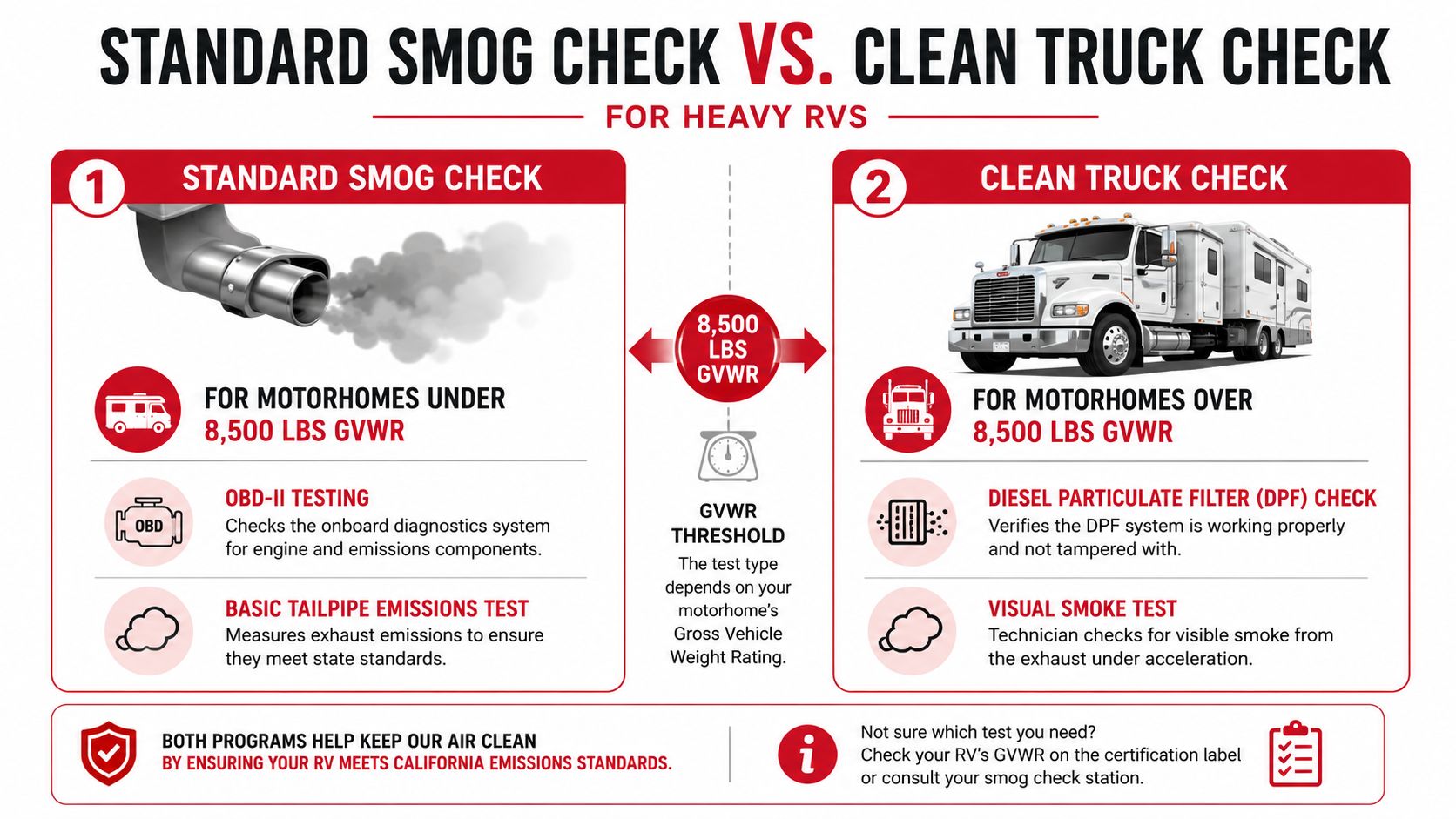
Owners get surprised here because the coach looks like a normal motorhome, but California may treat it like a heavier compliance vehicle. The line that matters is simple. If a California-registered motorhome is over 14,000 lb GVWR and runs on diesel or another non-gasoline fuel, CARB places it under Clean Truck Check rules instead of the ordinary Smog Check lane. CARB Clean Truck Check motorhome fact sheet
The inspection method changes with the vehicle
Standard Smog Check still applies to lighter motorhomes that fit the regular California inspection rules. BAR's performance report also shows that enhanced-area ASM testing is limited to motor homes under 8,501 GVWR, which is one of the practical cutoffs stations use when deciding what test equipment and procedure to use. That threshold matters because it tells you when a lighter rig can still be handled through the normal smog process. California Smog Check performance report
Clean Truck Check uses a different test path. For 2013 and newer diesel engines and 2018 and newer alternative-fuel engines, CARB requires an OBD data scan with a CARB-certified device. Older diesel vehicles go through a smoke opacity test and a visual inspection of emissions controls. Same coach body, different inspection route. CARB Clean Truck Check motorhome fact sheet
Side by side, the difference is obvious
| Lane | Typical Trigger | What Gets Checked |
|---|---|---|
| Standard Smog Check | Light-duty motorhome rules, fuel type and model year based | Regular smog inspection methods tied to California Smog Check |
| Clean Truck Check | California-registered motorhome over 14,000 lb GVWR running diesel or other non-gasoline fuel | OBD scan on newer engines, opacity and visual checks on older diesels |
If your rig is heavy and diesel, do not book it like a car. Call the station first, and if you want a place that works with truck-style compliance work, this motor vehicle smog inspection resource is the kind of category page worth checking before you drive across town.
The owner's mistake is usually assuming the chassis decides everything
GVWR, fuel type, and engine model year determine the testing path, so two similar-looking coaches can follow different inspection routes. A gas-powered motorhome and a diesel coach may look nearly the same in the driveway, but the station may handle them differently once the VIN, weight class, and engine family are checked. If you own a heavy diesel coach, stop calling it a generic smog check and start sorting out which compliance lane it belongs in.
STAR Stations and What Your Renewal Notice Is Telling You
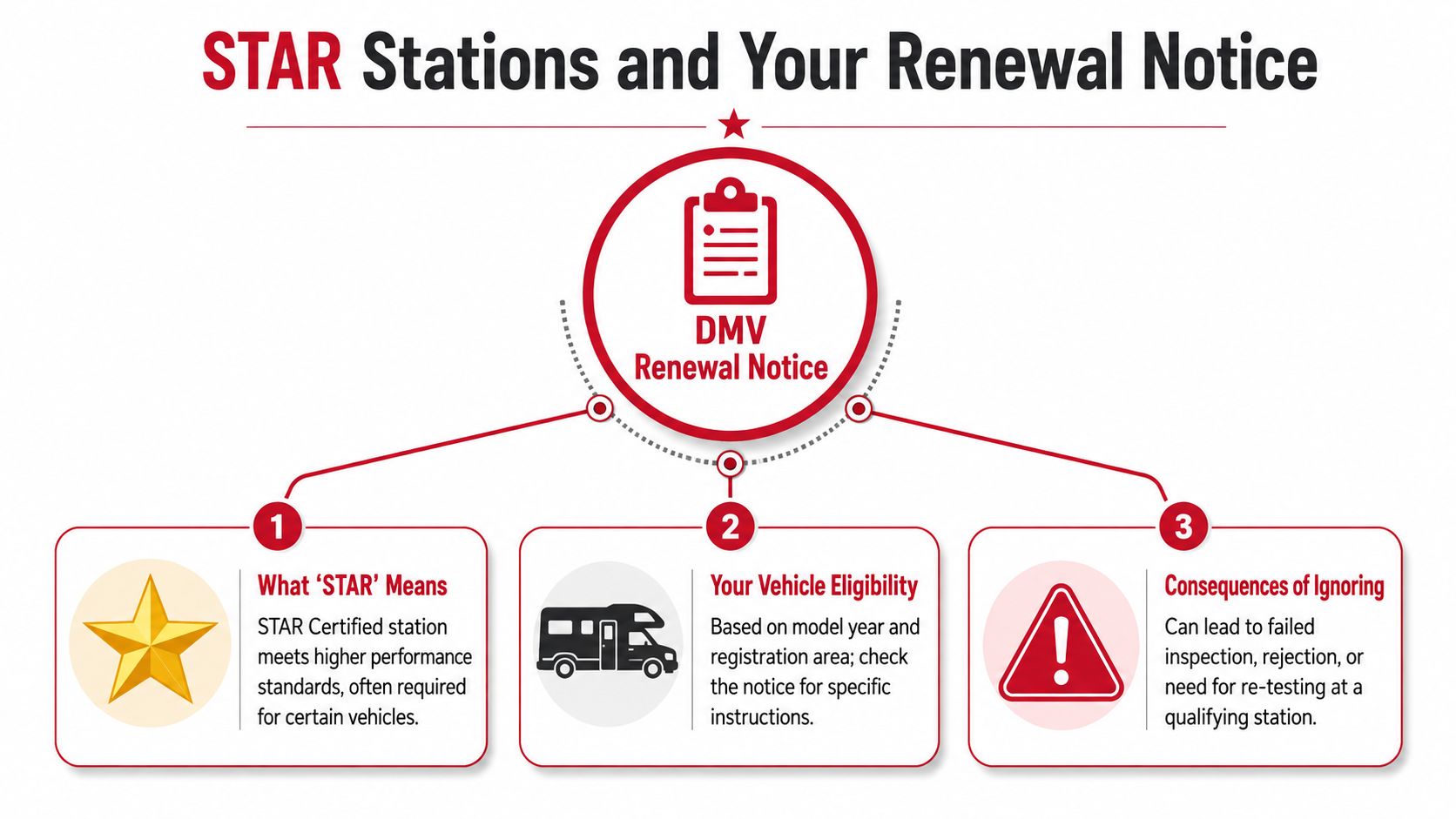
A STAR mark on your renewal notice means the DMV wants a higher-performance inspection lane for that vehicle. It points you to the right kind of station before you waste time at a shop that cannot process the notice correctly.
STAR and test-only are not the same thing
A STAR-certified station is a station that meets the state's higher performance standard for that inspection role. A test-only station performs the inspection and does not sell repairs, so it removes the repair upsell conflict a lot of owners worry about. Those are separate categories, and mixing them up leads to bad assumptions when you book the appointment. If you want the plain-language version of the designation, see what STAR certified means.
Read the renewal notice, not your assumptions
The renewal notice is the document that controls your next step. If it says STAR, follow that instruction. If it does not mention STAR, do not guess that you still need it, and do not guess that you are exempt either. Check the fuel type and model year first, then read any specific testing instruction printed on the notice.
Plain advice: If the notice calls for STAR, bring the notice to the station and let the paperwork drive the appointment. Guessing costs time.
What matters when you're deciding where to go
- If STAR is listed: You need a station that can meet that requirement.
- If STAR is not listed: You may still need a regular smog inspection based on vehicle rules.
- If the coach is heavy and diesel: Confirm whether it belongs in Clean Truck Check instead of standard Smog Check.
- If you're unsure: Call ahead with the VIN, fuel type, model year, and GVWR handy.
A renewal notice can steer you into the wrong lane if you read it loosely. The smart move is to match the notice to the vehicle details, then choose the station that can legally handle that job.
How to Prepare Your Motorhome Before the Test
Most failed inspections are avoidable. Owners show up with a cold engine, a warning light glowing on the dash, missing paperwork, or a rig that hasn't been checked for obvious leaks. That turns a normal appointment into a return trip, and it doesn't need to happen.
Warm the engine and look at the dash first
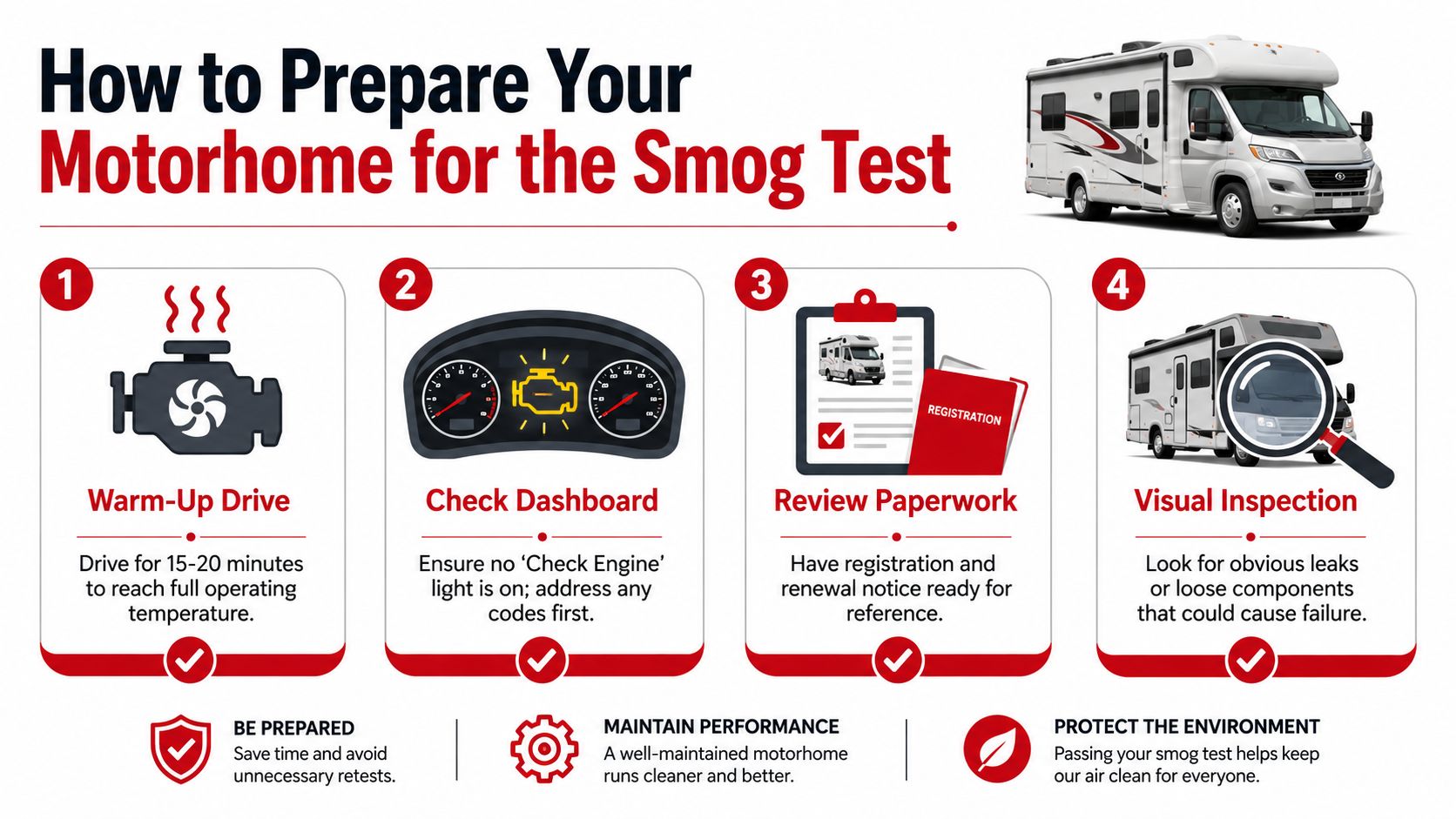
Drive the motorhome long enough to get it fully up to operating temperature before you arrive. A cold coach is a bad idea on test day because the system is checking how the vehicle runs, not how it behaves after sitting in the driveway. Then look at the dashboard. If the Check Engine light is on, fix that before the appointment.
Bring the right papers and do a basic walk-around
Have your registration and renewal notice ready. That saves time at the counter and keeps the station from guessing about what the DMV wants. Then do a quick visual inspection around the vehicle for obvious leaks, loose hoses, or other problems that can trip the inspection before it starts.
- Warm-Up Drive. Give yourself enough road time to bring the engine up to normal temperature.
- Dashboard Check. Clear the warning-light question before you ever pull into the bay.
- Paperwork Ready. Bring the registration and renewal notice together.
- Visual Walk-Around. Catch the obvious stuff while you're still at home.
The BAR doesn't publish a magic shortcut for a good test. Your job is to arrive with the vehicle in working condition and the paperwork in hand. If the station offers a free retest when required, that helps with small fixes, but it doesn't replace preparation. California Smog Check rules
Don't forget the practical stuff
A motorhome takes longer to stage than a car. Leave room for parking, turn radius, and the time it takes to get settled at the bay. If your coach uses a testing path that includes a dynamometer cycle, tire condition and general drivability matter too. Show up ready, and you're far less likely to turn one appointment into a two-day headache.
Visiting Fire House Smog in Antioch With a Motorhome
If you're bringing a motorhome into East Contra Costa County, the question is whether the station can handle the coach without sending you back out the gate. Fire House Smog at 2900 Lone Tree Way in Antioch is a STAR-certified test-only station and DMV registration services provider, and it has two service bays, which matters when you show up with a larger vehicle. Lone Tree Way location details
Check the layout before you go. With a motorhome, access, turning room, and bay size decide whether the trip is quick or a waste of fuel.
What the station can do, and what it can't
The station handles smog testing, but it is test-only, so it does not sell repairs. That keeps the inspection separate from the repair side, which is the setup most RV owners want when they just need a clean result and a straight answer.
It also offers on-site DMV registration renewals with sticker printing and ownership transfer services during posted hours. If your motorhome fits the station's inspection limits, you may be able to finish the registration part in the same visit. Fire House Smog says it can handle some RVs and motorhomes, but only within its size and equipment constraints, so calling ahead is part of the job, not a courtesy.
Expect the workflow to be practical, not fancy
The process is simple. You pull in, the vehicle gets checked for fit and eligibility, and the staff tells you whether the coach belongs in their lane or needs a different shop. That direct answer saves time, and it keeps you from forcing a large rig into a space that was not built for it.
The two-bay setup helps with throughput, and the station's seven-day testing schedule gives you more options if your renewal timing is tight. If you can't spare a weekday morning, that flexibility matters.
Use the visit to solve more than one problem
If your motorhome qualifies for inspection there, you may be able to handle the smog certificate and the DMV transaction in one stop. That is the primary advantage of a station that also handles registration work. Fewer stops. Fewer loose ends. Less chance of letting the renewal sit until the last minute.
If you want to save yourself a bad trip, call before you arrive and give them the motorhome's fuel type, model year, and GVWR. Ask whether the bay and equipment fit the vehicle, then decide whether to bring it in. The station's Antioch motorhome smog check page is the right place to start, and one quick conversation can keep a large RV from clogging up your day.
Common Mistakes That Waste a Motorhome Smog Trip
The same five mistakes show up over and over. Owners pull up without confirming the bay fit, ignore a lit warning lamp, miss the STAR instruction on the notice, assume a heavy diesel coach still falls under ordinary Smog Check pricing, or forget the DMV paperwork and discover the certificate alone doesn't finish the job. Every one of those mistakes is avoidable.
Call ahead before you move the rig
That is the single most impactful habit. A station can tell you in one phone call whether the vehicle fits the bay, whether the fuel and model year route it into standard Smog Check or Clean Truck Check, and whether STAR is required. If you skip that call, you're gambling with a large vehicle and your own time.
Don't show up with the wrong assumptions
- Bay Fit: Confirm the station can physically handle the motorhome.
- Warning Lights: Fix a glowing check-engine light before you leave home.
- STAR Notice: Read the renewal notice instead of guessing.
- Program Type: Know whether the vehicle belongs in standard Smog Check or Clean Truck Check.
- Paperwork: Bring the renewal notice and registration, not just the rig.
Keep the checklist in the coach
The best owners don't rely on memory. They keep a short note in a cabinet or glove compartment and run it every time the renewal comes up. That habit saves hours, and it keeps a simple inspection from turning into a stalled registration.
The point is simple. A motorhome smog visit goes smoothly when you treat it like a planning task, not an errand.
If you want the rules explained plainly and the process handled without guesswork, bring your motorhome to Fire House Smog. The station handles STAR-certified test-only smog checks, DMV registration services, and some RVs and motorhomes within its equipment limits, so it's a practical first call when you're trying to figure out what your coach needs.
California vehicle registration cost typically runs $300 to $450 a year on a normal gasoline car once the base fee, vehicle license fee, smog fee, and county or district charges are stacked. The exact total depends on vehicle value, weight class, and county, so the bill on your notice can land far above or below that range.
That's why the number on the renewal form never tells the full story. If you're staring at a DMV notice in Antioch and trying to figure out what you'll owe, the answer is in the fee stack, not the headline.
Table of Contents
- What Drivers Actually Pay for Vehicle Registration in California
- The Fee Stack That Builds Your California Registration Bill
- How Vehicle Type Changes the Final Number
- Documents, Timing, and When Smog Certification Is Required
- Why Combining Smog and Registration at One Location Saves Time
- Common Surprise Charges and How to Avoid Them
- Your Single-Visit Plan at Fire House Smog
What Drivers Actually Pay for Vehicle Registration in California
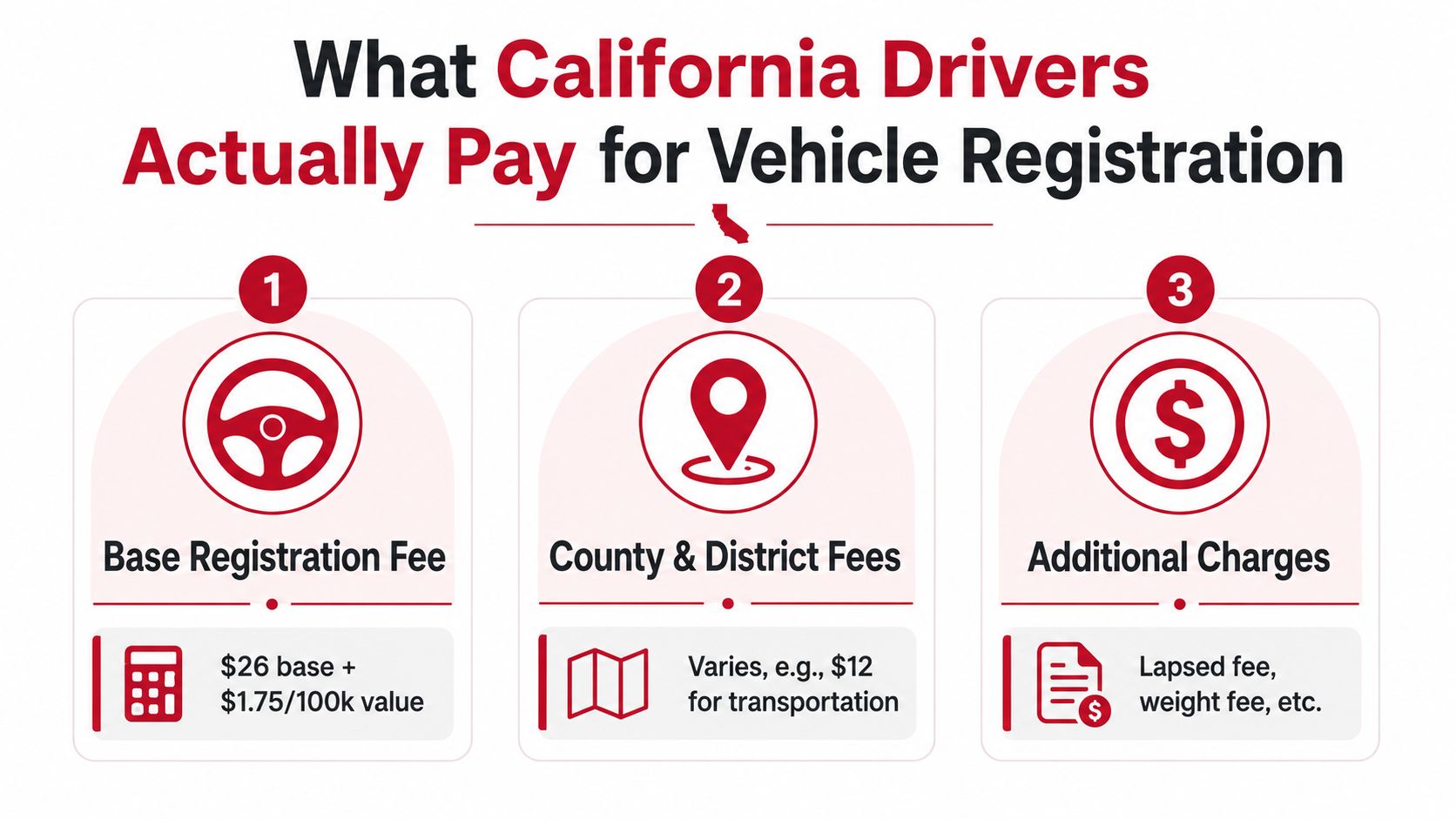
The answer is simple. A California driver is usually paying a bundle of fees, not one flat renewal price, and the total shifts with the car you own, where you live, and whether the vehicle needs smog certification. For many everyday gasoline cars in California, the combined annual cost lands in the $300 to $450 zone, while the statewide average registration and documentation fee is about $595.08 because some vehicles and counties run much higher than that typical range. World Population Review's state fee ranking
Read the bill as a stack, not a sticker price
California doesn't price registration like a simple sticker. The DMV structure layers a base registration fee, a vehicle license fee tied to value, and extra state or local charges depending on the vehicle and transaction type. That's why two drivers in Antioch can renew on the same day and still owe very different amounts.
Practical rule: If your renewal notice looks higher than last year, don't assume it's an error. In California, the car's value, the category it falls into, and the county or district add-ons can all change the total.
The DMV's own fee schedule makes that clear. California's registration pricing includes an original registration or renewal fee of $76, plus separate line items such as $8 for the Alternative Fuel/Technology Smog fee and $3 for the Alternative Fuel/Technology Registration fee. The final amount depends on which bucket your transaction falls into, which is why first-time owners often misread the notice. California DMV registration fees
For Antioch drivers, the useful way to think about it is this. The DMV wants proof the vehicle is eligible, the state wants its base fee and value-based share, and local add-ons can show up on top. If your car needs smog, that's not just a separate task, it's part of the transaction path that decides whether the renewal can be completed at all.
Internal resource for local renewal help: registration renewal fee details
The Fee Stack That Builds Your California Registration Bill
A California renewal at the counter is usually a stack of charges, not one flat price. The clerk does not ring up the bill as a single mystery number. They apply the state's core registration charges, then add any vehicle-specific or transaction-specific items that fit your car.
What each line item is doing
The core value-based piece is the Vehicle License Fee, and California sets it at 0.65% of depreciated vehicle value annually. That is why the number shifts as the car gets older, because the state is taxing what the vehicle is worth now, not what it cost when it was new. The separate original registration or renewal fee of $76 is the standard DMV transaction charge that sits on top of that calculation. California DMV registration fees
California also uses targeted add-ons. The DMV schedule lists separate Alternative Fuel/Technology Smog and Alternative Fuel/Technology Registration charges when those categories apply. That is the part many owners miss, especially when they skim a renewal notice and look only for the bottom-line amount. If your car falls into one of those buckets, the bill changes before you even get to any local filing issues.
Bottom line: California registration is a mix of vehicle value, vehicle category, and specialized filings. At the counter, each one can change what you owe.
Here is the useful comparison. New York uses a different model, with biennial registration and weight-based fees that rise from $26.00 for the lightest passenger class to higher brackets as weight increases, plus separate use-tax and metro-area charges in some cases. California leans harder on value-based pricing, so a newer or pricier car can cost more to keep registered even if it is driven like an ordinary commuter. New York DMV passenger vehicle registration fees
Common California registration line items
| Line Item | Typical Amount | What It Pays For |
|---|---|---|
| Original registration or renewal fee | $76 | DMV transaction fee for registration filing |
| Vehicle License Fee | 0.65% of depreciated value | Value-based state revenue component |
| Alternative Fuel/Technology Smog fee | $8 | Category-specific smog-related charge |
| Alternative Fuel/Technology Registration fee | $3 | Category-specific registration charge |
That table is the quickest way to read the printout that comes back from the DMV window. If the amount looks high, check the value-based piece first, then look for category-specific add-ons, then confirm whether the vehicle type or transaction triggered anything unusual. In Antioch, that is exactly where first-time owners get surprised, and it is also why a combined business vehicle registration service stop can save a second trip when the paperwork and smog status are already lined up.
How Vehicle Type Changes the Final Number
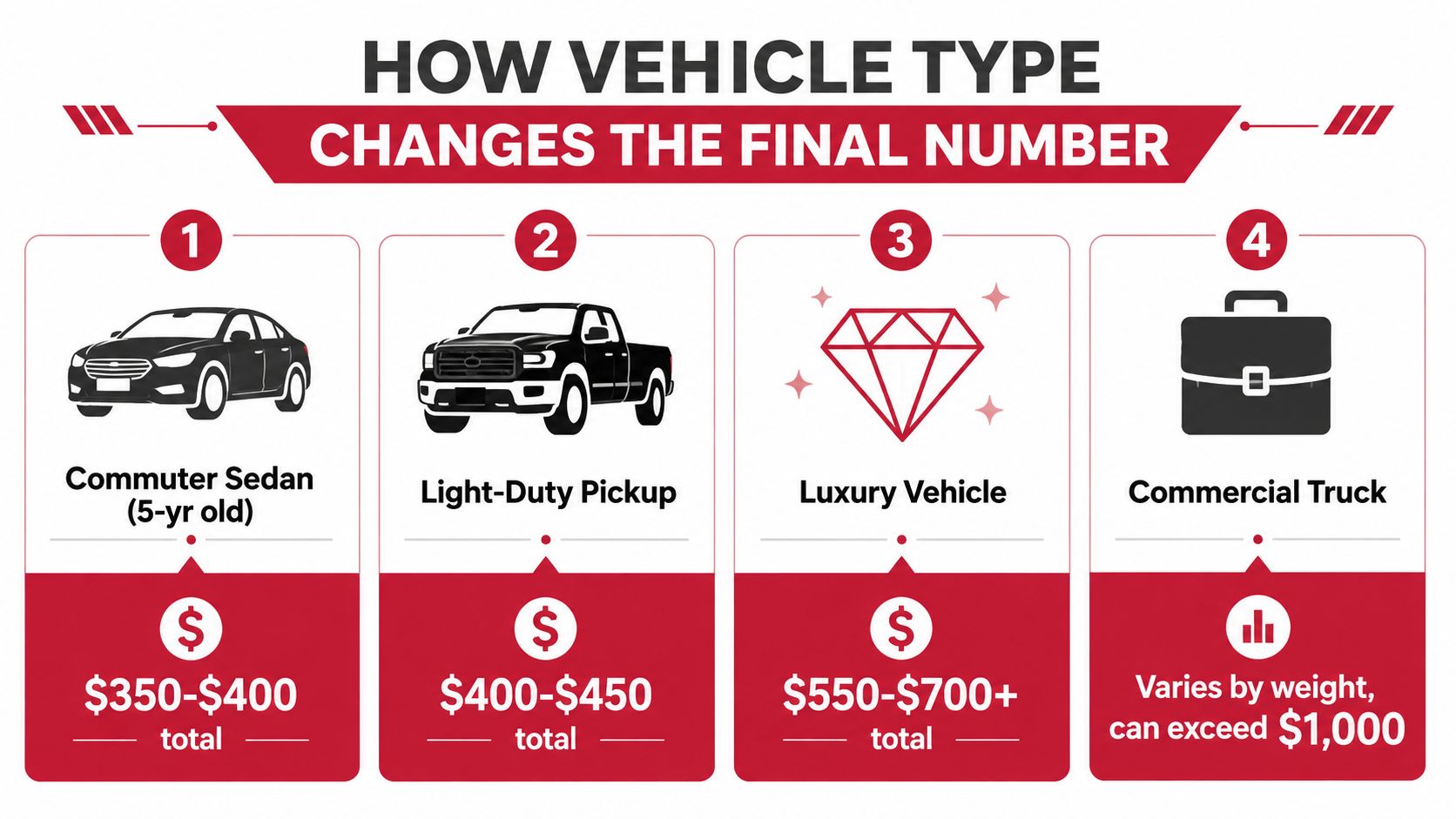
Walk into the DMV with two cars that look similar on the street, and the totals can still come out different. California does not charge a single flat sticker price for every vehicle. The bill shifts with value, weight, and category, so a commuter sedan, a pickup, an older economy car, and a heavier recreational vehicle can all land in different brackets. California vehicle registration fee structure
A newer sedan costs differently than an older one
A five-year-old commuter sedan usually stays closer to the lower end of the California range because depreciation has already cut down the Vehicle License Fee portion. A newer or more expensive sedan pushes the total up because the value-based piece still has more to work with. That is why two Antioch owners with similar-looking cars can still leave the counter with different renewal amounts.
Light-duty pickups often cost more than small sedans because weight and use category matter more. If the truck falls into a heavier bracket, the final amount rises even when it is not a commercial rig. The bill is not random. Weight-based pricing makes trucks less predictable than a basic compact car. A vehicle that works as a daily commuter can still cost more because the fee chart treats it as heavier.
An eleven-year-old economy car usually benefits from depreciation. Montana's age-based fee schedule makes the contrast easy to see, dropping from $217 for vehicles 0–4 years old to $28 for vehicles 11 years or older, which shows how older vehicles can sit in a much lower bracket than newer ones. California does not use Montana's exact formula, but the same basic problem shows up here. Newer vehicles carry a larger value-based burden, while older ones usually come out lighter at the counter. Montana light vehicle registration and fees
A simple comparison for Antioch owners
- Commuter sedan: Usually the easiest to budget for, because depreciation pulls down the value-based charge.
- Light-duty pickup: Expect a higher bill if the weight bracket or use classification pushes it upward.
- Older economy car: Often cheaper than a newer equivalent, mainly because the value-based piece has already fallen.
- Mid-size RV: Call ahead. Some RVs are accepted, but size and equipment limits still matter, so fee logic is only part of the decision.
If you are registering a truck or van for a company, the numbers can shift again because commercial and heavier classes often sit in separate brackets. Fire House Smog's business vehicle registration page is the right place to check before you make a second trip for paperwork that should have been handled once.
Documents, Timing, and When Smog Certification Is Required
The DMV doesn't care how busy you are. It cares whether the paperwork is complete and whether the vehicle is eligible for renewal right now. If one document is missing, the whole transaction stalls and you end up paying with time instead of money.
What to bring before you leave home
Bring the basics. You need proof of insurance, photo ID, the title or transfer paperwork if ownership is changing, and payment. If smog is required, bring a current passing smog certificate or be ready to get one before the DMV portion is processed. Vehicle registration documents checklist
The fastest renewal is the one you don't have to restart.
Timing matters because smog and registration don't always happen on the same clock. For renewal, California drivers often need the smog result to still be valid when the DMV processes the filing, and if the certificate expires before the paperwork is submitted, the car has to be tested again. Sale, transfer, and out-of-state registration usually trigger a fresh emissions step right away, so don't assume last month's certificate still solves today's problem.
California also uses an even-year and odd-year smog cycle, so some vehicles get pulled back into testing on a predictable schedule rather than every renewal. That's why the renewal notice is worth reading carefully instead of assuming the same rule applies to every car in the driveway. If you've changed ownership, moved a car in from another state, or let the registration go stale, expect the paperwork to get stricter, not looser.
What makes drivers lose time
- Expired smog certificate: The renewal stops until you retest.
- Missing title paperwork: Ownership transfer can't finish cleanly.
- Late renewal: Penalties start to pile on once the vehicle is out of compliance.
- Wrong transaction type: Renewal, transfer, and out-of-state filing are not interchangeable.
The smartest move is to gather the paperwork before you drive anywhere. Once you're at the counter, the difference between a clean transaction and a wasted trip is usually a document you could have printed or checked in advance.
Why Combining Smog and Registration at One Location Saves Time
The usual route burns time fast. You visit a smog station, wait for the result, then go somewhere else to finish the DMV paperwork, and then you may have to come back if a document is missing or the filing hits a snag. In Antioch, that turns a normal renewal into a wasted half-day, especially if you are juggling work, school pickup, or a vehicle that needs to stay on the road.
One stop beats two stops
A STAR-certified test-only shop keeps the inspection focused on emissions and avoids the repair-shop conflict. Add licensed DMV processing on the same site, and the same visit can handle the test, the renewal, and the tag issuance without sending you across town. That matters because vehicle registration cost is not just the fee on the notice, it is also the time and gas you burn when the process gets split into pieces.
A local Antioch provider like Fire House Smog combines STAR-certified testing with on-site DMV services, including tag issuance. That setup keeps the renewal moving at the counter instead of turning it into a two-stop errand.
The local workflow is simple. You arrive with your documents, get the vehicle tested if needed, and let the DMV side of the counter finish the registration work while you are already there. That is a better system than making one renewal stretch into two separate trips.
If your goal is to get the tags in hand, the cleanest move is a place that can finish both jobs without sending you out for a second line.
The operating setup matters too. A shop with smog availability throughout the week, DMV service hours that cover the usual workday and part of the weekend, and multiple service bays can keep vehicles moving instead of stacking them up. That is the kind of arrangement that cuts waiting and keeps the counter from becoming the bottleneck.
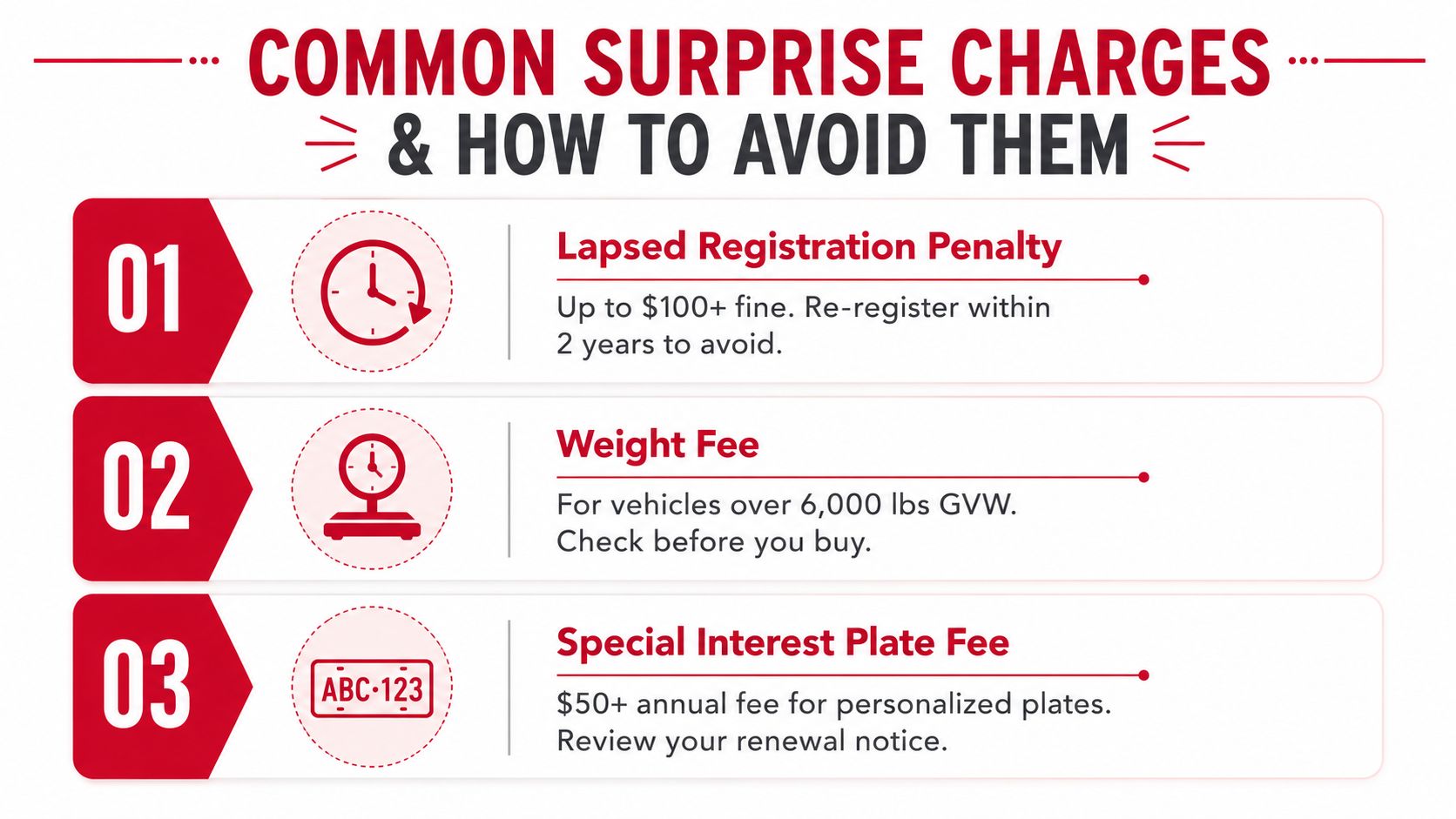
Common Surprise Charges and How to Avoid Them
Most drivers don't get hurt by the headline fee. They get hurt by the surprises that show up after they've already planned their budget. If you want to keep vehicle registration cost under control, you need to know the traps before the DMV does.
The charges that catch people off guard
- Lapsed registration penalty: Let the renewal drag on, and the bill gets uglier fast. Re-registering before the vehicle sits out of compliance too long is the easiest way to avoid paying more than you planned.
- Weight reclassification: Modify a truck, change its load setup, or misstate the vehicle class, and the DMV can move it into a different bracket. That's how a seemingly minor change becomes a bigger fee.
- Transfer-related charges: Buying, selling, or inheriting a car can trigger extra paperwork and extra cost because the transaction is no longer a simple renewal.
- Special plates and category fees: Personalized or special-interest plate setups can add recurring charges, and owners often forget to account for them until the renewal notice arrives.
The age and value structure matters here too. Newer, heavier, and special-category vehicles are more likely to carry hidden costs because California's system isn't flat. That's the whole point of a policy that uses vehicle worth, weight, and fuel type as part of the price.
How to keep the bill from jumping
- Check the renewal notice early. Don't wait until the last week.
- Confirm the vehicle class. A truck that should be in one bracket but gets processed in another can cost more.
- Make sure the smog certificate is current. If it expires before processing, you're back at square one.
- Ask about transfer paperwork before you arrive. A missing title signature is one of the fastest ways to create a second trip.
If you've lifted a truck, changed equipment, or bought a used vehicle with a messy registration history, verify the fee path before you pay anything. That one step prevents the kind of surprise that turns a normal renewal into a budget problem.
Your Single-Visit Plan at Fire House Smog
If you live in Antioch or anywhere in East Contra Costa County, the cleanest plan is to bring the paperwork, get the smog handled, and finish the DMV side in one stop. Fire House Smog is at 2900 Lone Tree Way, Antioch, CA 94509, and the phone number is 925-754-1600. It serves passenger cars, SUVs, light-duty trucks, and some RVs, subject to size and equipment constraints.
Bring proof of insurance, ID, and whatever renewal or title paperwork you already have. If your vehicle needs smog, let the station handle that first, then complete the registration renewal while you're already there. If the car is an RV or something unusual, call ahead so you don't waste a trip.
The shop's model is simple. It's a test-only station, so the emissions test isn't tied to repair upsells, and the DMV side can process the registration work without forcing you to start over somewhere else. That's the right setup when you want the whole vehicle registration cost problem solved without dragging it out over several days. Fire House Smog
If you want the fee stack handled without the usual DMV runaround, take your renewal paperwork to Fire House Smog and get the smog and registration processed in one visit. It's a practical option for Antioch drivers who want straight answers, on-site tag issuance, and fewer surprises at the counter. Visit Fire House Smog to check hours, confirm what to bring, and get your registration done the simple way.

You're holding a renewal notice, the car starts fine, and still you're not sure whether a smog check in Martinez, CA means a quick stop at any shop or a special trip to a STAR station. That's the part that trips up a lot of drivers, because California smog rules aren't just about whether your vehicle is old. They're about model year, fuel type, ownership status, and what the DMV says on the notice.
Martinez drivers also run into a practical problem. The nearest place isn't always the right place, and the right place isn't always the one with the easiest hours. If you know which station type you need, what the inspector will check, and what can cause an automatic fail, the whole process gets a lot less stressful.
Table of Contents
- What Martinez Drivers Actually Need to Know About Smog Checks
- How California Smog Check Rules Apply to Martinez
- Regular, Test-Only, and STAR Stations Explained
- What Happens During a Smog Check Visit
- Pricing, Coupons, and a Convenient Antioch Alternative
- On-Site DMV Registration and Tag Services
- Smart Preparation Tips Before You Test
- Recap and Next Steps for Martinez Drivers
What Martinez Drivers Actually Need to Know About Smog Checks
If you're standing in the driveway with a renewal notice in one hand and your keys in the other, the first question is simple. Which station do I need? The answer depends on whether your notice asks for a normal smog inspection, a DMV-directed STAR visit, or no visit at all because your vehicle is still within an exemption window.
That's why this guide is built around decisions, not jargon. A Martinez driver needs to know whether the vehicle is due now, whether a nearby station can legally test it, what paperwork to bring, and how to avoid a second trip. The goal is to make the state rules usable on a Tuesday afternoon, not just accurate on paper.
What to look at first
Start with the renewal notice. If the DMV specifically directs you to a STAR station, that instruction matters more than convenience. If it doesn't, you may be able to use any licensed smog shop that handles your vehicle type.
Practical rule: The notice tells you more than the shop sign does.
From there, look at the vehicle itself. A gas car, hybrid, diesel truck, or older model can each fall into a different testing lane. The rest of this guide walks through those differences in plain English so you can make one clean decision before you leave home.
How California Smog Check Rules Apply to Martinez
California's smog program is built around model year thresholds, and those thresholds decide whether you're due, exempt, or stuck with a DMV-directed visit. The California Bureau of Automotive Repair says gasoline, hybrid, and alternative-fuel vehicles model year 1976 and newer generally need Smog Check service, while diesel vehicles model year 1998 and newer also fall under the program. Those are the broad rules that affect Martinez drivers every day. You can review the state framework on the California Bureau of Automotive Repair Smog Check page.
For registration renewal, the exemption window is wider. Gasoline, hybrid, and alternative-fuel vehicles that are 8 model years old or newer are exempt. For change of ownership, the exemption window tightens to 4 model years or newer. The DMV also says that beginning January 1, 2019, vehicles less than 4 model years old may pay a smog abatement fee instead of getting a Smog Check for the first 8 years they're registered. Those are the milestones that decide whether you can renew without a test, need a test now, or can use a fee instead of a standard inspection.
The key thing to remember is that renewal and ownership transfer are different events. A car can be exempt for renewal and still need a test for a sale. That's where a lot of Martinez drivers get caught, especially when a family member gifts a car or a private seller hands over the title.
Do You Need a Smog Check in Martinez?
| Vehicle Type | Model Year | Renewal Test? | Ownership Test? |
|---|---|---|---|
| Gasoline, hybrid, alternative-fuel | 1976 and newer | Usually yes, unless within the renewal exemption window | Usually yes, unless 4 model years old or newer |
| Diesel | 1998 and newer | Usually yes, unless the DMV notice says otherwise | Usually yes, depending on the notice and vehicle status |
| Very new gasoline, hybrid, alternative-fuel vehicle | Less than 4 model years old | May qualify for the smog abatement fee noted by the DMV | Often exempt within the ownership window |
A DMV notice can override your guess. If it says STAR, treat that as the instruction that matters.
The easiest way to use these rules is to ask one question first. Is this a renewal, a sale, or a transfer? Once you answer that, the model year rules make a lot more sense.
Regular, Test-Only, and STAR Stations Explained
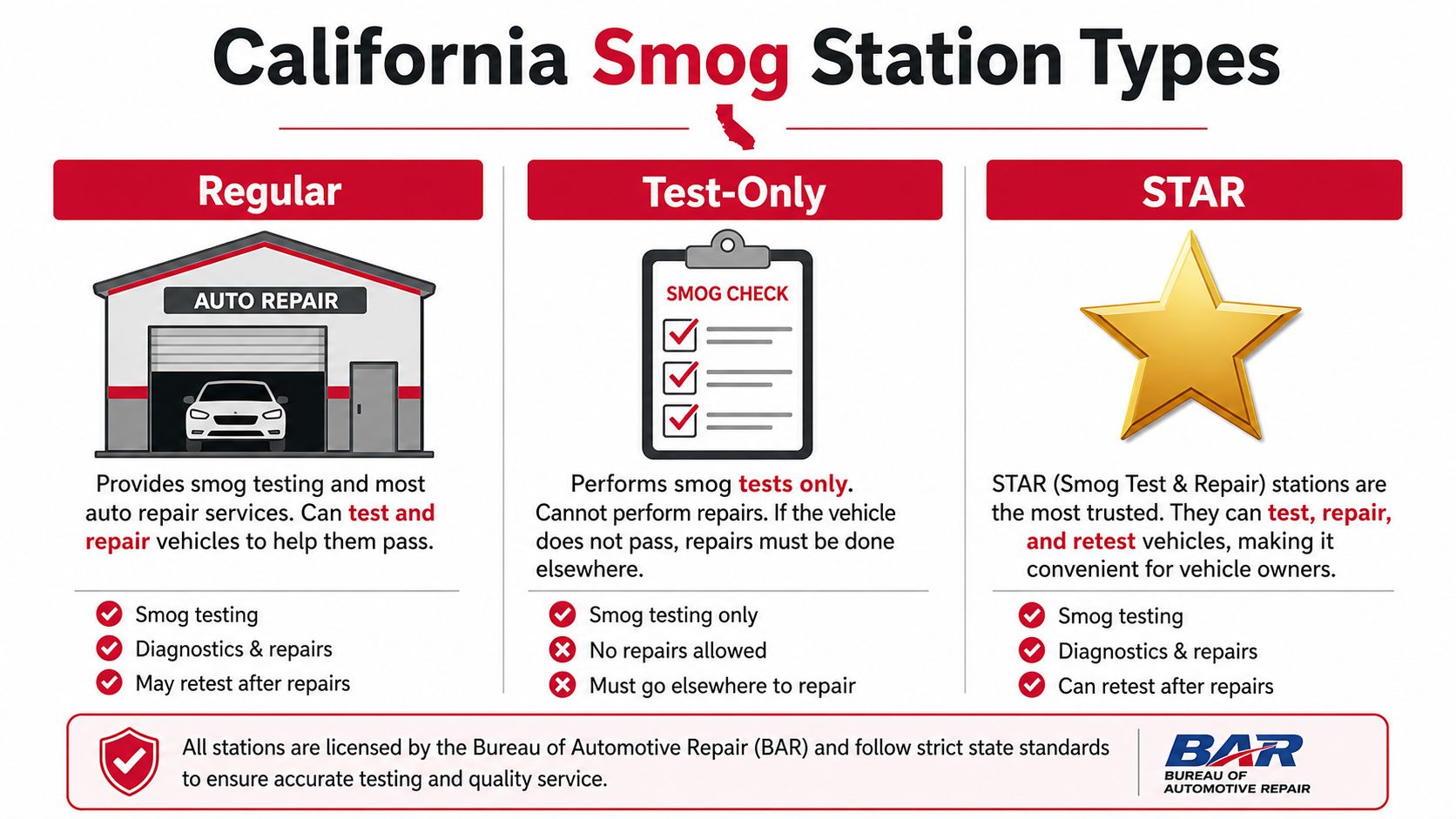
California doesn't use the words regular, test-only, and STAR interchangeably, even though drivers often do. That confusion matters, because the wrong stop can waste your time or send you back to square one. The STAR certified smog explanation is useful because it puts the station types in the right bucket.
A regular smog shop can inspect vehicles if it's licensed for that vehicle and test type. A test-only station performs the inspection but doesn't sell repairs, which removes the repair upsell from the same visit. A STAR station is part of California's STAR program and is used for DMV-directed vehicles and gross polluters, as noted in DMV guidance and BAR program language. You can see that DMV guidance on smog inspections and directed STAR visits.
How the station type affects your day
If your notice says nothing special, a licensed smog station that handles your vehicle may be enough. If the notice directs you to STAR, that's not a suggestion. It means the DMV wants that specific type of visit, and showing up at the wrong station can leave you paying for the first trip and doing it again somewhere else.
A quick comparison helps:
| Station Type | What It Does | When Martinez Drivers Use It |
|---|---|---|
| Regular | Inspects vehicles and may also offer repairs, depending on licensing | When no STAR directive appears and the vehicle fits the station's scope |
| Test-Only | Inspects only, without repair sales | When you want inspection without repair incentives |
| STAR | Handles DMV-directed vehicles and gross polluters | When the renewal notice or vehicle status requires it |
Good rule of thumb: The DMV notice decides the station type before price or distance does.
That's the part most local marketing pages skip. They talk about “cheap smog” or “STAR” like they're the same thing, but they aren't. The safest move is to match the station to the notice, then choose the one that fits your schedule.
What Happens During a Smog Check Visit
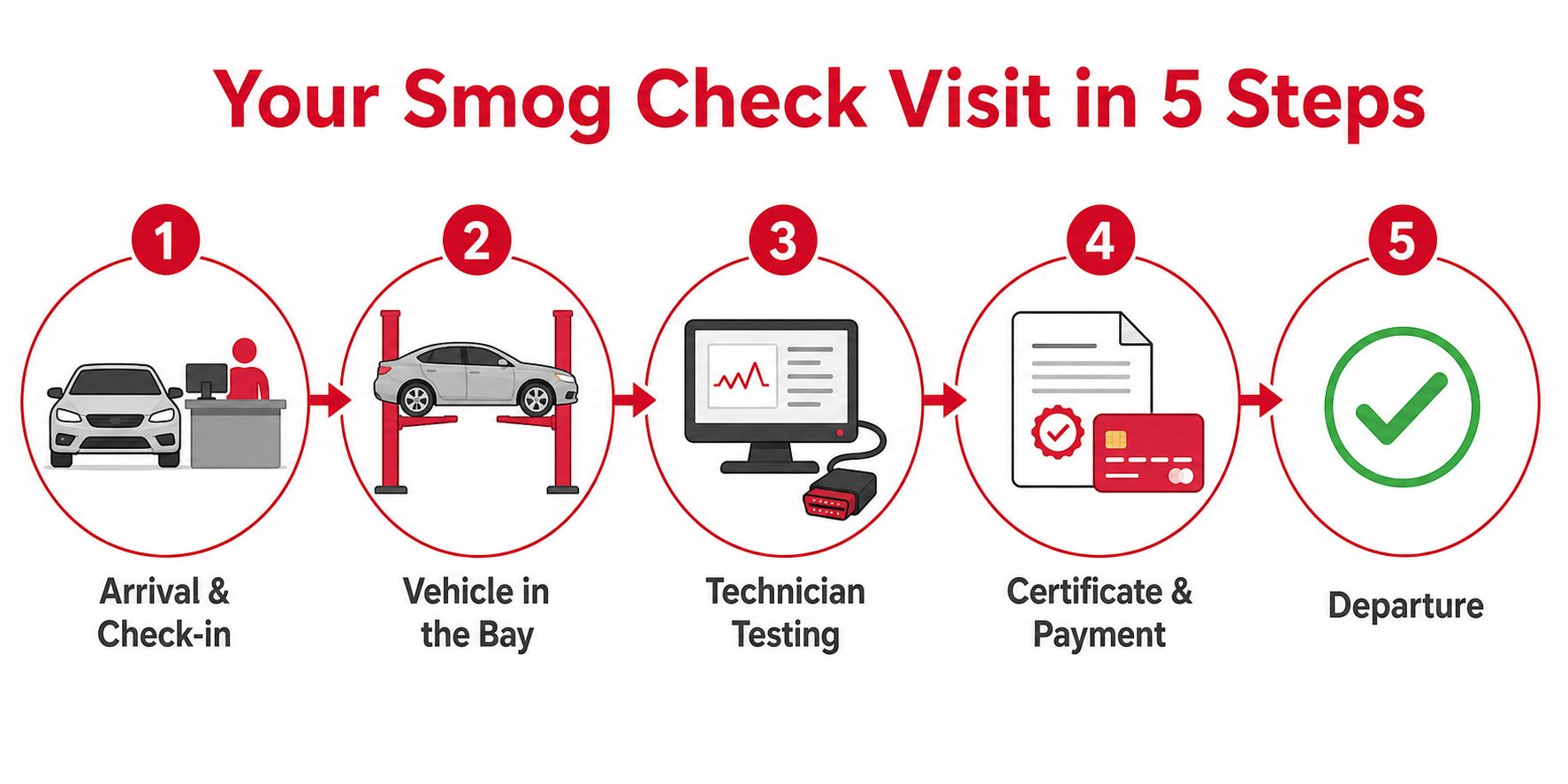
A smog visit is usually straightforward once you know the sequence. You arrive, hand over the keys and the paperwork, and the technician checks the vehicle in. On newer cars, the test centers on the OBD-II system, which looks at the vehicle's onboard emissions controls. On 1999-and-older vehicles, California's BAR procedures use BAR-97 emissions inspection equipment that can measure tailpipe emissions, which is why older cars are more sensitive to exhaust condition, engine temperature, and bay airflow.
The pre-check issues are the part that saves or sinks the visit. A lit check-engine light is an automatic fail under BAR guidance, so that dash light matters more than most drivers think. If you disconnected the battery recently, the car may need time to complete its drive cycles before the monitors are ready for testing. If you test too soon, you can fail for readiness, not because the car is broken, but because it hasn't relearned enough data yet.
What to bring and what to expect
Bring your vehicle registration or renewal notice, plus anything the station asks for when you schedule. Then expect the technician to either plug into the diagnostic port or run the older tailpipe-capable procedure, depending on the model year. The whole process is designed to verify emissions status, not to diagnose unrelated repairs.
By the time the inspection ends, you'll usually get a result and, if it passes, the certificate workflow moves forward from there. If it doesn't pass, the report tells you what kept it from clearing.
If the battery was changed last week, don't rush the test just to get it done.
The video above shows the visit from check-in to departure in a simple flow. That's the shape of it, a short station visit with a few technical checkpoints that decide whether your registration can move ahead.
Pricing, Coupons, and a Convenient Antioch Alternative
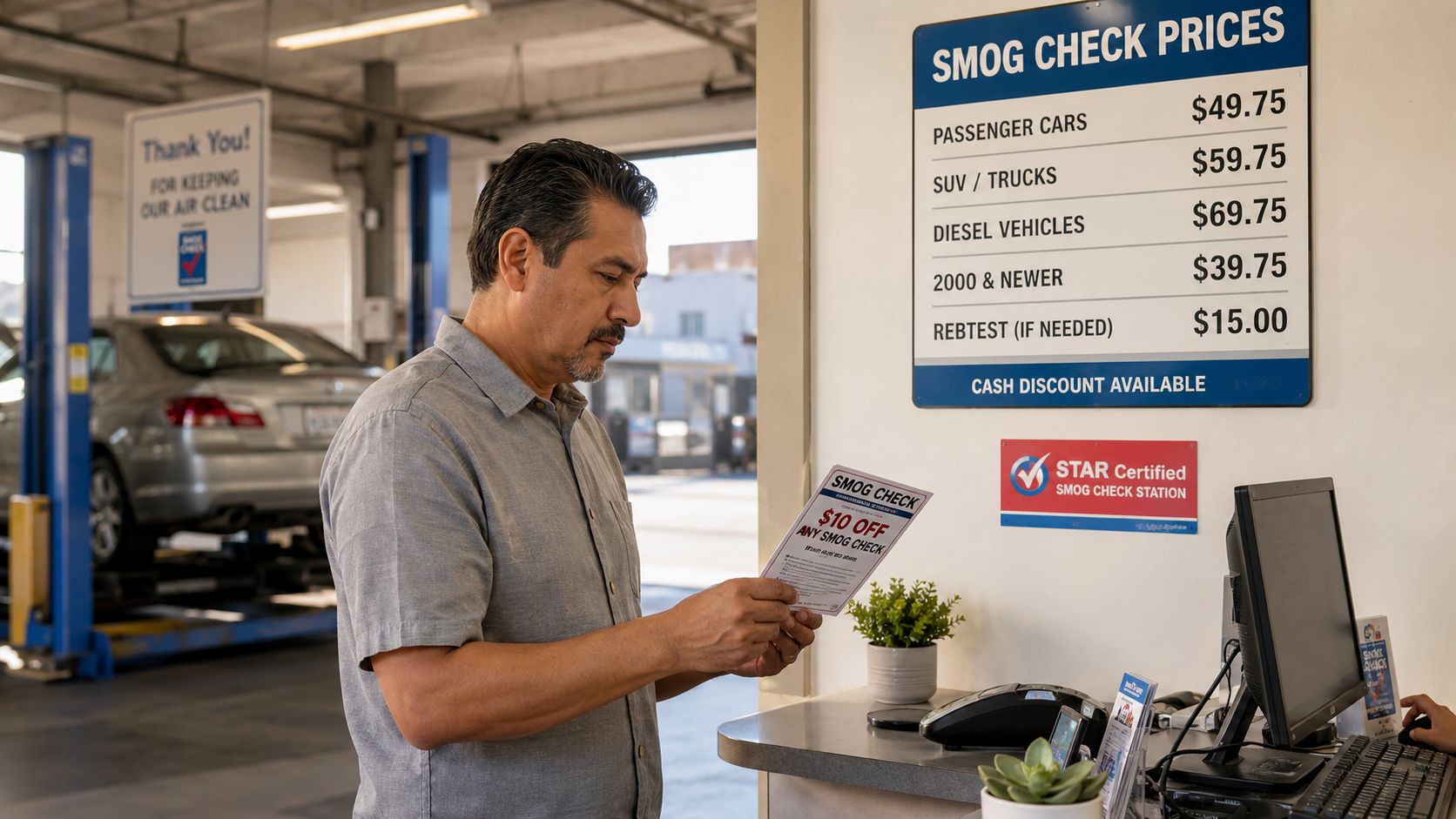
Smog pricing in the East Bay usually comes down to what the station includes, how busy it is, and whether it uses a test-only model or a repair-based model. A test-only station is easier to compare because the inspection and the repair conversation are separated. That doesn't make every coupon equal, but it does make the visit easier to understand before you commit.
For Martinez-area drivers who want a practical option with weekend access, Fire House Smog in Antioch is one of the nearby choices to look at. It's a STAR-certified test-only smog check station at 2900 Lone Tree Way in Antioch, and it offers seven-day smog testing, two service bays, and a free retest policy under its posted terms. It also says it can test cars, SUVs, light-duty trucks, and some RVs or motorhomes, although larger vehicles should be checked ahead of time because bay size and equipment limits still apply. You can review the station details on the Fire House Smog homepage and the specific local service page for California DMV registration renewal support.
The trade-off is simple. Antioch adds a bit of drive time for some Martinez residents, but it can pay off if you need weekend hours, a test-only visit, or a place where smog testing and DMV services happen at the same location. That matters if you're trying to finish the whole errand in one stop instead of splitting it between a test shop and a separate DMV office.
What that means in practice
- If you just need the test: A test-only station keeps the visit focused on emissions.
- If your schedule is tight: Seven-day availability can help when weekday hours don't.
- If you hate repeat trips: A free retest policy can make a first failure less painful.
Convenience isn't only about distance. It's also about whether the shop can finish the job you came for.
For Martinez drivers, the real question isn't “What's cheapest on the sign?” It's “Which station solves the whole errand with the fewest return visits?”
On-Site DMV Registration and Tag Services
When the registration is due, a lot of drivers think the DMV field office is the only real option. It isn't. A licensed DMV business partner can handle certain registration tasks on site, which cuts down the back-and-forth that usually comes with a renewal or transfer. That's especially useful if you're trying to finish the emissions check and the paperwork on the same trip.
For Antioch-area drivers, Fire House Smog says it provides California DMV registration renewals with sticker printing and ownership transfers for California and out-of-state vehicles. If the transaction needs plates or tags, the station says it can process those as needed during the visit. For the state's own renewal framework, the DMV partner model is a different path from standing in line at a field office, and that difference is what saves time for a lot of working drivers. The service details are outlined on the registration renewal page.
What to bring for each type of visit
A renewal is usually simpler. Bring the renewal notice and the vehicle documents the station asks for. A transfer usually needs more attention because ownership details have to match the transaction, and out-of-state paperwork can add another layer.
Here's the basic idea:
- Renewal visit: You're trying to keep the existing registration current.
- Transfer visit: You're changing ownership, so the paperwork has to follow the sale or transfer.
- Tag or plate issuance: You leave with the registration work handled if the transaction requires it.
The main benefit is obvious once you've spent time at a field office. You don't have to treat the smog station and the DMV as separate errands when a partner location can handle both pieces. For a Martinez driver with a limited window on a weekend, that can matter more than a small difference in mileage.
Smart Preparation Tips Before You Test
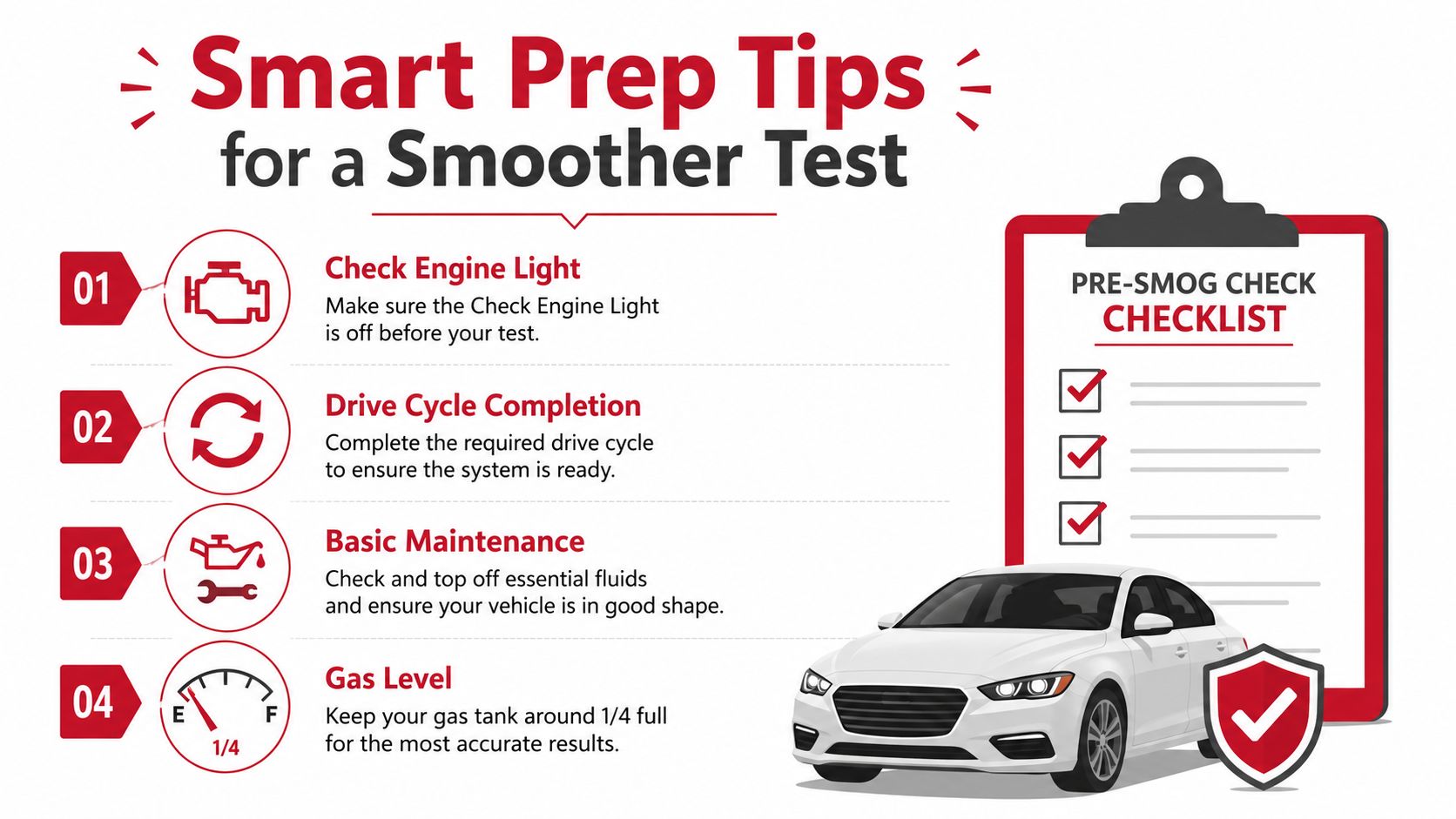
A few small checks before the appointment can save you from a wasted trip. Start with the check-engine light. If it's on, the car is not ready for a pass, so there's no point hoping the light will be ignored.
Next, think about the drive cycle. If the battery was disconnected or replaced recently, the vehicle may need a week or two of driving before the monitors settle back in. That's why a car that runs perfectly can still fail a readiness check if the computer hasn't had enough time to relearn.
The other basics are simple but worth doing. Make sure the engine is warmed up before you arrive, confirm the gas cap seals properly, and keep the fuel level reasonable so the test can proceed without avoidable delays. If you're bringing an RV, motorhome, or another larger vehicle, call ahead so the station can confirm bay and equipment fit before you drive over.
You can also review the common failure patterns on the smog check fail reasons page, which is useful if you want to understand why a car that “feels fine” still didn't clear.
A short pre-test checklist
- Check the dashboard: A lit engine warning lamp should be fixed first.
- Give the car time: After a battery reset, drive long enough for monitors to complete.
- Warm it up: Arrive with an engine that's already at operating temperature.
- Call ahead for bigger rigs: Larger vehicles can run into space or equipment limits.
A first failure doesn't end the process. It just tells you what needs attention before the retest.
That's why a free retest policy can matter. If the conditions are met and the car is repaired or ready by the time you come back, you're not starting from scratch.
Recap and Next Steps for Martinez Drivers
First, check whether the vehicle is due by age, fuel type, and whether this is a renewal or a transfer. Second, match the station to the DMV notice, because STAR is a requirement in some cases, not a marketing label. Third, choose a place with hours that fit your life, especially if you'd rather finish the test and the registration work in one trip.
If you need weekend testing or on-site DMV help, a short drive to Antioch can be worth it. For unusual vehicles, it's smart to call ahead before you go.
If you want a smog visit that stays simple, Fire House Smog handles test-only inspections, DMV registration services, and tag work in one location. For Martinez drivers who want to compare station type, hours, and paperwork in one stop, visit Fire House Smog and plan your trip before the renewal deadline sneaks up.