
You're standing at the counter with a 32-foot motorhome title in one hand and a DMV renewal notice in the other, and nobody has bothered to tell you whether this rig needs a regular smog check, a STAR station, or a completely different emissions program. That's the part that trips most owners up. A motorhome is not handled like a normal sedan, and if you guess wrong, you waste a day, miss your registration timing, or roll up to a station that can't inspect the vehicle anyway.
The smart move is to treat smog check for motorhomes as a decision tree, not a simple appointment. Your answer depends on fuel type, model year, GVWR, and whether the DMV notice specifically calls for STAR testing. For heavier diesel rigs, the path can shift again into Clean Truck Check territory. If you know which lane you're in before you leave home, the rest gets much easier.
Table of Contents
- Why Motorhome Smog Checks Catch Owners Off Guard
- Which Motorhomes Need a Smog Check in California
- Standard Smog Check vs Clean Truck Check for Heavy RVs
- STAR Stations and What Your Renewal Notice Is Telling You
- How to Prepare Your Motorhome Before the Test
- Visiting Fire House Smog in Antioch With a Motorhome
- Common Mistakes That Waste a Motorhome Smog Trip
Why Motorhome Smog Checks Catch Owners Off Guard
A guy walks into a station with a clean-looking Class A and assumes the same rules that apply to his pickup will apply here. Five minutes later, he's learning the bay won't fit the coach, or the fuel type sends him into a different emissions lane, or the renewal notice wants STAR capacity he didn't plan for. That's a bad day, and it happens because RV owners think “motorhome” is the main rule. It isn't.
The vehicle type is not the whole story
California doesn't decide this with one label. The practical screening variables are fuel type, model year, GVWR, and whether the renewal notice flags STAR testing. The BAR says RVs and motorhomes meeting the applicable criteria need a Smog Check, so being recreational doesn't buy you an exemption by itself. You need to know which rule bucket your coach falls into before you book anything. California Smog Check rules for RVs and motorhomes
Practical rule: Don't call a station and ask, “Do you smog motorhomes?” Ask, “What's the cutoff for my fuel type, model year, and gross weight, and do you handle STAR or Clean Truck Check vehicles?”
That's the only way to avoid guessing.
The station can be right for cars and wrong for your rig
A lot of stations are built around passenger cars and light trucks. A motorhome can need more space, different equipment, or a different inspection lane entirely. California's own data shows how much volume the program handles, with 10.3 million initial inspections in 2019, and about 8.4 million, or 82%, completed at STAR stations. That tells you two things. STAR-capable stations matter, and the system has long been built around high-volume screening, not casual one-off RV surprises. California Smog Check performance report
Start with the right questions
Before you book, ask yourself these four things in plain English.
- What fuel does it use? Gasoline, diesel, hybrid, or alternative fuel changes the lane.
- What model year is it? The cutoff dates are different for gas and diesel.
- How heavy is it? GVWR can push the vehicle into a different compliance regime.
- Does the DMV notice mention STAR? If it does, don't ignore that wording.
That's the map. If you answer those questions first, you're not just scheduling a smog check. You're routing the vehicle to the right program the first time.
Which Motorhomes Need a Smog Check in California
California keeps this simple once you look at the registration rules instead of the RV badge. Gasoline, hybrid, and alternative-fuel vehicles model year 1976 and newer require Smog Check. Diesel vehicles model year 1998 and newer require Smog Check. The BAR also says RVs and motorhomes that meet those standards need a Smog Check, so there is no separate recreational exemption buried in the fine print. BAR Smog Check rules
Fuel type and model year set the starting point
If your motorhome runs on gasoline and is 1976 or newer, treat it as a Smog Check vehicle unless the DMV notice says something different. If it runs on diesel and is 1998 or newer, use the same rule. Fuel type and model year decide whether a motorhome enters the program, not its recreational classification.
That is the part owners miss. They look at the coach body and assume the RV label changes the rule. It does not. The state starts with fuel type, then checks model year.
The first test does not happen right away
The BAR's current rule uses an eight model year trigger for the first inspection. A 2020 model-year vehicle first needs a renewal smog inspection in 2028. That is the cleanest way to read the calendar. You are not counting miles, you are counting model-year age the way the DMV does. BAR Smog Check rules
A lot of owners miss the first test window because the coach is stored, used seasonally, or only driven on trips. The DMV does not care about your usage pattern. It cares about the model year rule.
California Motorhome Smog Eligibility at a Glance
| Fuel Type | Model Year | Smog Check Required | First Test Trigger |
|---|---|---|---|
| Gasoline, hybrid, alternative fuel | 1976 and newer | Yes, when the vehicle meets California's motorhome rules | Eight model years after the model year |
| Diesel | 1998 and newer | Yes, when the vehicle meets California's motorhome rules | Eight model years after the model year |
If you want the plain answer, here it is. Motorhome does not mean exempt. Fuel type and model year decide the starting point. If the registration notice points you to inspection, take it seriously and set the first required smog date on your calendar as soon as you can. For a motorhome that is already in the inspection window, a station that handles larger vehicles, such as Fire House Smog's truck and RV smog info, is the right place to start.
Standard Smog Check vs Clean Truck Check for Heavy RVs
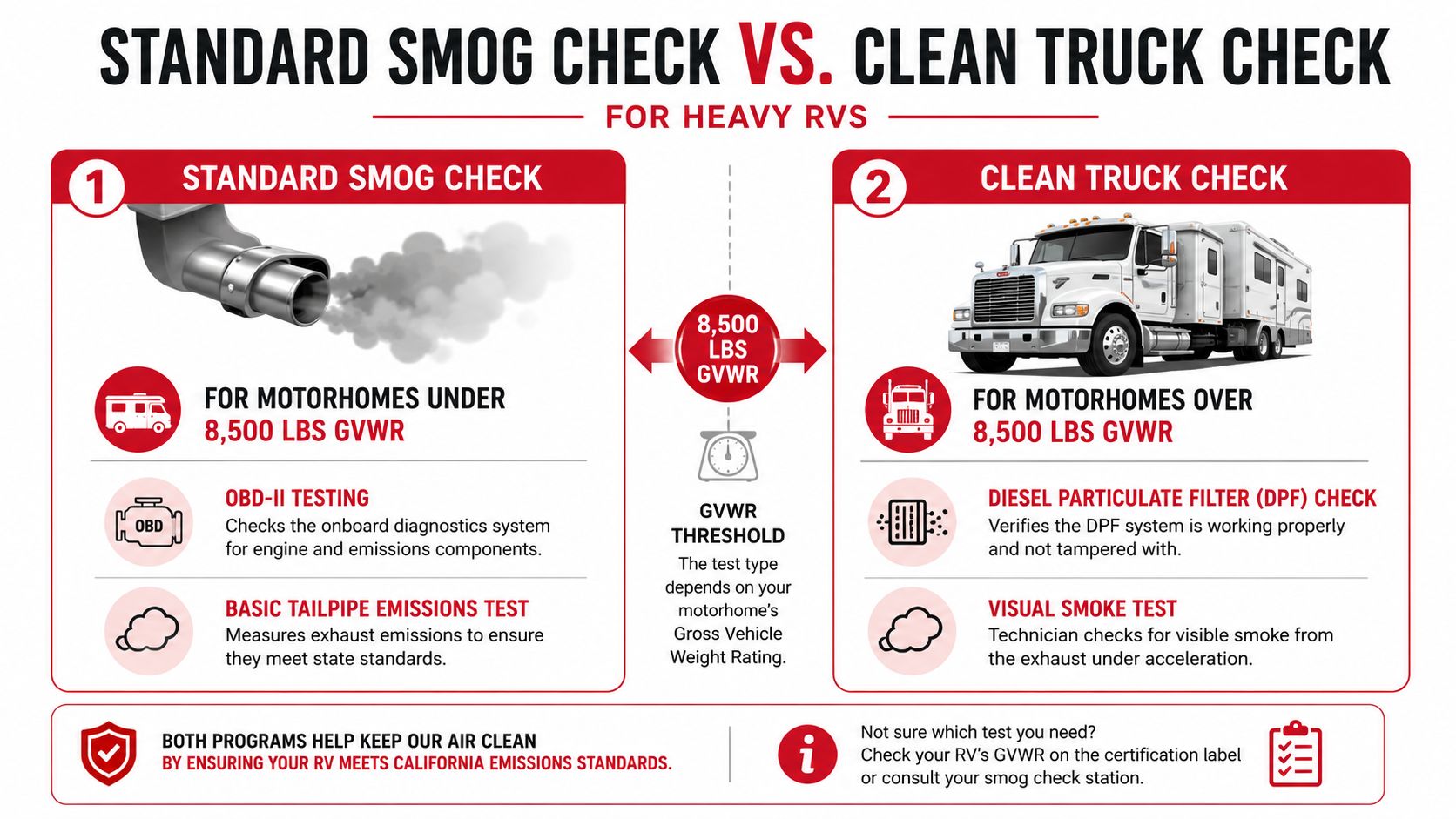
Owners get surprised here because the coach looks like a normal motorhome, but California may treat it like a heavier compliance vehicle. The line that matters is simple. If a California-registered motorhome is over 14,000 lb GVWR and runs on diesel or another non-gasoline fuel, CARB places it under Clean Truck Check rules instead of the ordinary Smog Check lane. CARB Clean Truck Check motorhome fact sheet
The inspection method changes with the vehicle
Standard Smog Check still applies to lighter motorhomes that fit the regular California inspection rules. BAR's performance report also shows that enhanced-area ASM testing is limited to motor homes under 8,501 GVWR, which is one of the practical cutoffs stations use when deciding what test equipment and procedure to use. That threshold matters because it tells you when a lighter rig can still be handled through the normal smog process. California Smog Check performance report
Clean Truck Check uses a different test path. For 2013 and newer diesel engines and 2018 and newer alternative-fuel engines, CARB requires an OBD data scan with a CARB-certified device. Older diesel vehicles go through a smoke opacity test and a visual inspection of emissions controls. Same coach body, different inspection route. CARB Clean Truck Check motorhome fact sheet
Side by side, the difference is obvious
| Lane | Typical Trigger | What Gets Checked |
|---|---|---|
| Standard Smog Check | Light-duty motorhome rules, fuel type and model year based | Regular smog inspection methods tied to California Smog Check |
| Clean Truck Check | California-registered motorhome over 14,000 lb GVWR running diesel or other non-gasoline fuel | OBD scan on newer engines, opacity and visual checks on older diesels |
If your rig is heavy and diesel, do not book it like a car. Call the station first, and if you want a place that works with truck-style compliance work, this motor vehicle smog inspection resource is the kind of category page worth checking before you drive across town.
The owner's mistake is usually assuming the chassis decides everything
GVWR, fuel type, and engine model year determine the testing path, so two similar-looking coaches can follow different inspection routes. A gas-powered motorhome and a diesel coach may look nearly the same in the driveway, but the station may handle them differently once the VIN, weight class, and engine family are checked. If you own a heavy diesel coach, stop calling it a generic smog check and start sorting out which compliance lane it belongs in.
STAR Stations and What Your Renewal Notice Is Telling You
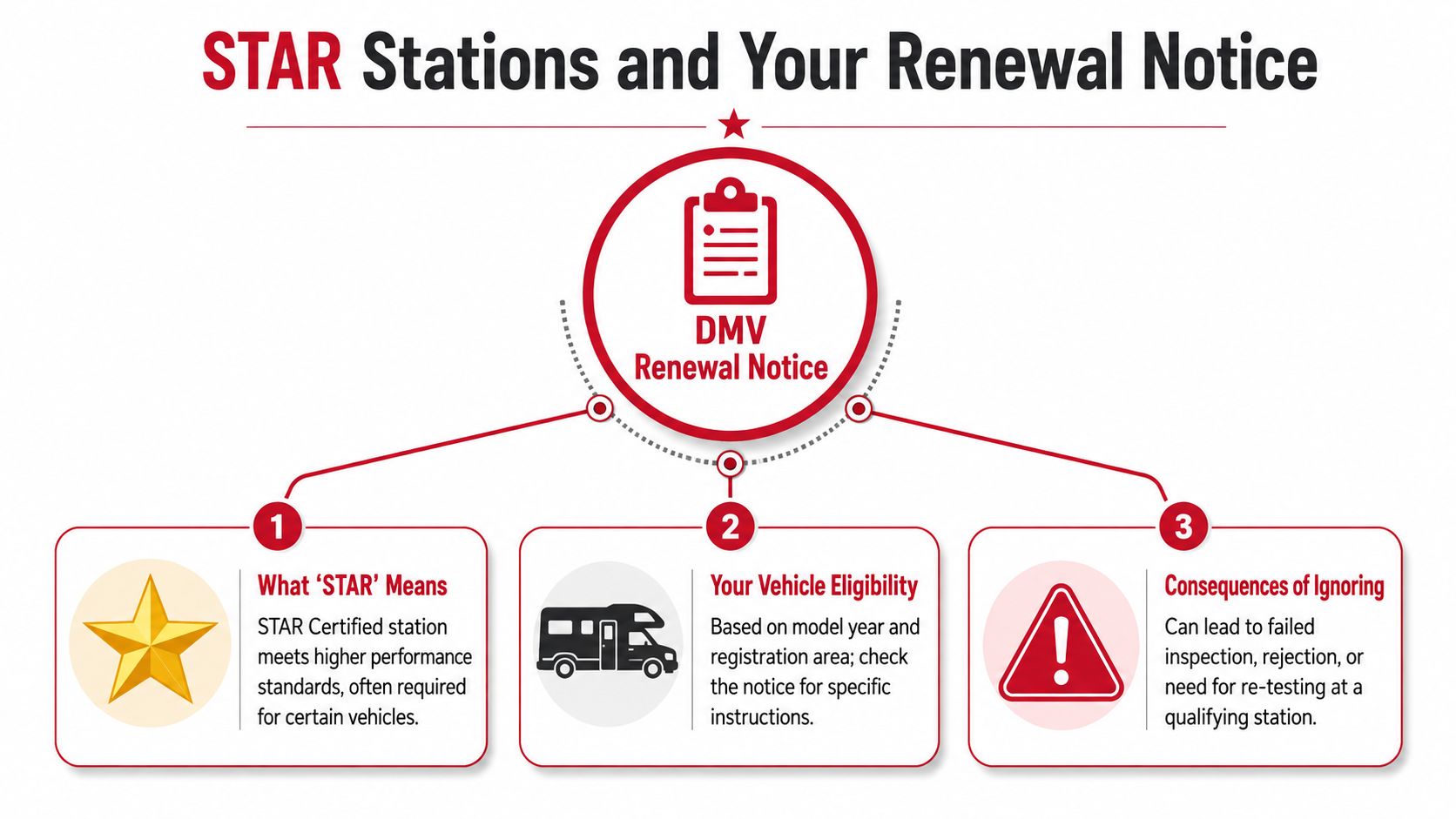
A STAR mark on your renewal notice means the DMV wants a higher-performance inspection lane for that vehicle. It points you to the right kind of station before you waste time at a shop that cannot process the notice correctly.
STAR and test-only are not the same thing
A STAR-certified station is a station that meets the state's higher performance standard for that inspection role. A test-only station performs the inspection and does not sell repairs, so it removes the repair upsell conflict a lot of owners worry about. Those are separate categories, and mixing them up leads to bad assumptions when you book the appointment. If you want the plain-language version of the designation, see what STAR certified means.
Read the renewal notice, not your assumptions
The renewal notice is the document that controls your next step. If it says STAR, follow that instruction. If it does not mention STAR, do not guess that you still need it, and do not guess that you are exempt either. Check the fuel type and model year first, then read any specific testing instruction printed on the notice.
Plain advice: If the notice calls for STAR, bring the notice to the station and let the paperwork drive the appointment. Guessing costs time.
What matters when you're deciding where to go
- If STAR is listed: You need a station that can meet that requirement.
- If STAR is not listed: You may still need a regular smog inspection based on vehicle rules.
- If the coach is heavy and diesel: Confirm whether it belongs in Clean Truck Check instead of standard Smog Check.
- If you're unsure: Call ahead with the VIN, fuel type, model year, and GVWR handy.
A renewal notice can steer you into the wrong lane if you read it loosely. The smart move is to match the notice to the vehicle details, then choose the station that can legally handle that job.
How to Prepare Your Motorhome Before the Test
Most failed inspections are avoidable. Owners show up with a cold engine, a warning light glowing on the dash, missing paperwork, or a rig that hasn't been checked for obvious leaks. That turns a normal appointment into a return trip, and it doesn't need to happen.
Warm the engine and look at the dash first
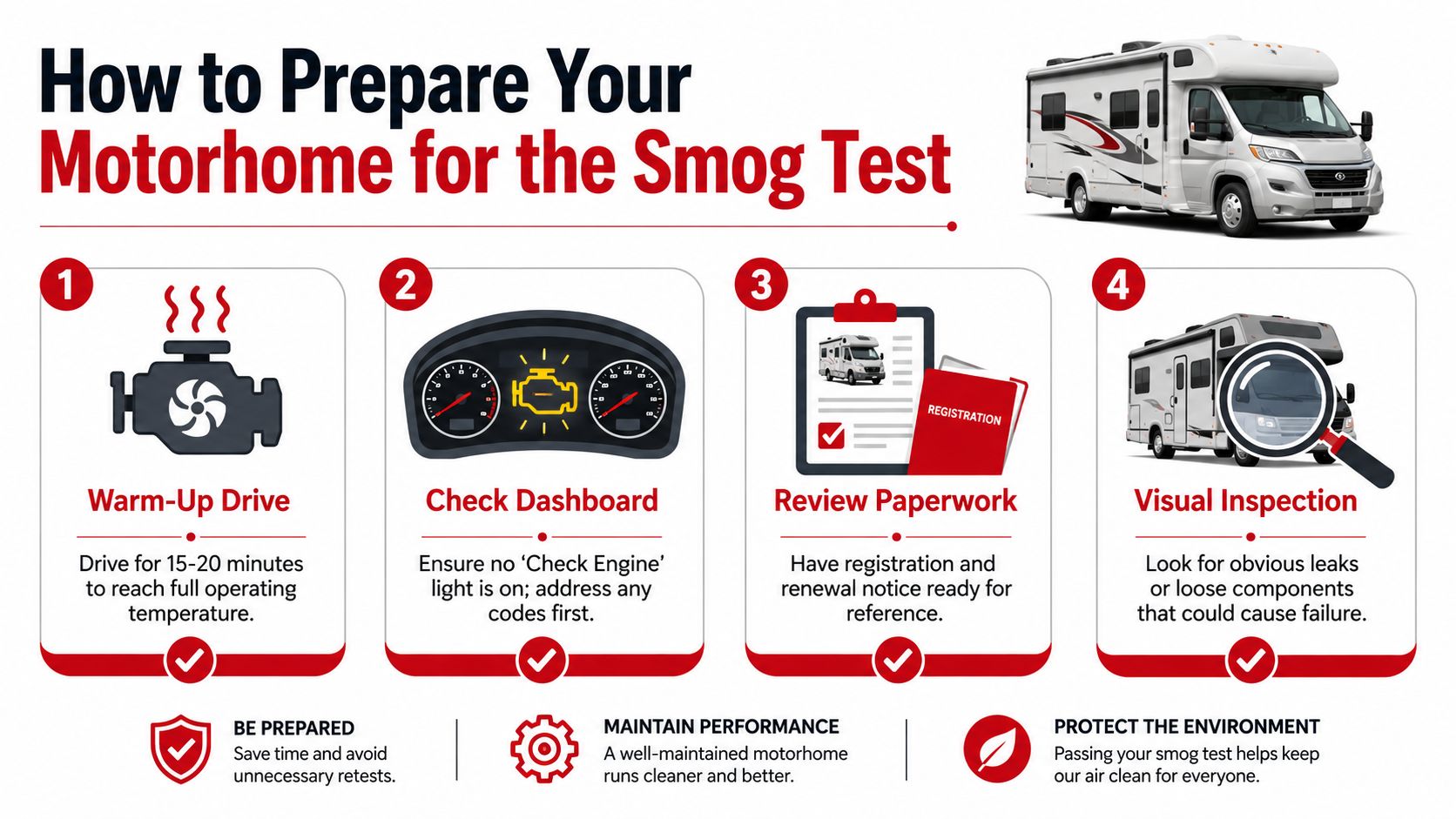
Drive the motorhome long enough to get it fully up to operating temperature before you arrive. A cold coach is a bad idea on test day because the system is checking how the vehicle runs, not how it behaves after sitting in the driveway. Then look at the dashboard. If the Check Engine light is on, fix that before the appointment.
Bring the right papers and do a basic walk-around
Have your registration and renewal notice ready. That saves time at the counter and keeps the station from guessing about what the DMV wants. Then do a quick visual inspection around the vehicle for obvious leaks, loose hoses, or other problems that can trip the inspection before it starts.
- Warm-Up Drive. Give yourself enough road time to bring the engine up to normal temperature.
- Dashboard Check. Clear the warning-light question before you ever pull into the bay.
- Paperwork Ready. Bring the registration and renewal notice together.
- Visual Walk-Around. Catch the obvious stuff while you're still at home.
The BAR doesn't publish a magic shortcut for a good test. Your job is to arrive with the vehicle in working condition and the paperwork in hand. If the station offers a free retest when required, that helps with small fixes, but it doesn't replace preparation. California Smog Check rules
Don't forget the practical stuff
A motorhome takes longer to stage than a car. Leave room for parking, turn radius, and the time it takes to get settled at the bay. If your coach uses a testing path that includes a dynamometer cycle, tire condition and general drivability matter too. Show up ready, and you're far less likely to turn one appointment into a two-day headache.
Visiting Fire House Smog in Antioch With a Motorhome
If you're bringing a motorhome into East Contra Costa County, the question is whether the station can handle the coach without sending you back out the gate. Fire House Smog at 2900 Lone Tree Way in Antioch is a STAR-certified test-only station and DMV registration services provider, and it has two service bays, which matters when you show up with a larger vehicle. Lone Tree Way location details
Check the layout before you go. With a motorhome, access, turning room, and bay size decide whether the trip is quick or a waste of fuel.
What the station can do, and what it can't
The station handles smog testing, but it is test-only, so it does not sell repairs. That keeps the inspection separate from the repair side, which is the setup most RV owners want when they just need a clean result and a straight answer.
It also offers on-site DMV registration renewals with sticker printing and ownership transfer services during posted hours. If your motorhome fits the station's inspection limits, you may be able to finish the registration part in the same visit. Fire House Smog says it can handle some RVs and motorhomes, but only within its size and equipment constraints, so calling ahead is part of the job, not a courtesy.
Expect the workflow to be practical, not fancy
The process is simple. You pull in, the vehicle gets checked for fit and eligibility, and the staff tells you whether the coach belongs in their lane or needs a different shop. That direct answer saves time, and it keeps you from forcing a large rig into a space that was not built for it.
The two-bay setup helps with throughput, and the station's seven-day testing schedule gives you more options if your renewal timing is tight. If you can't spare a weekday morning, that flexibility matters.
Use the visit to solve more than one problem
If your motorhome qualifies for inspection there, you may be able to handle the smog certificate and the DMV transaction in one stop. That is the primary advantage of a station that also handles registration work. Fewer stops. Fewer loose ends. Less chance of letting the renewal sit until the last minute.
If you want to save yourself a bad trip, call before you arrive and give them the motorhome's fuel type, model year, and GVWR. Ask whether the bay and equipment fit the vehicle, then decide whether to bring it in. The station's Antioch motorhome smog check page is the right place to start, and one quick conversation can keep a large RV from clogging up your day.
Common Mistakes That Waste a Motorhome Smog Trip
The same five mistakes show up over and over. Owners pull up without confirming the bay fit, ignore a lit warning lamp, miss the STAR instruction on the notice, assume a heavy diesel coach still falls under ordinary Smog Check pricing, or forget the DMV paperwork and discover the certificate alone doesn't finish the job. Every one of those mistakes is avoidable.
Call ahead before you move the rig
That is the single most impactful habit. A station can tell you in one phone call whether the vehicle fits the bay, whether the fuel and model year route it into standard Smog Check or Clean Truck Check, and whether STAR is required. If you skip that call, you're gambling with a large vehicle and your own time.
Don't show up with the wrong assumptions
- Bay Fit: Confirm the station can physically handle the motorhome.
- Warning Lights: Fix a glowing check-engine light before you leave home.
- STAR Notice: Read the renewal notice instead of guessing.
- Program Type: Know whether the vehicle belongs in standard Smog Check or Clean Truck Check.
- Paperwork: Bring the renewal notice and registration, not just the rig.
Keep the checklist in the coach
The best owners don't rely on memory. They keep a short note in a cabinet or glove compartment and run it every time the renewal comes up. That habit saves hours, and it keeps a simple inspection from turning into a stalled registration.
The point is simple. A motorhome smog visit goes smoothly when you treat it like a planning task, not an errand.
If you want the rules explained plainly and the process handled without guesswork, bring your motorhome to Fire House Smog. The station handles STAR-certified test-only smog checks, DMV registration services, and some RVs and motorhomes within its equipment limits, so it's a practical first call when you're trying to figure out what your coach needs.