Official Brake and Light Adjustment Certificates Explained
California stopped issuing official brake and light adjustment certificates on September 27, 2024, and for initial transactions on or after December 27, 2024 one electronic Vehicle Safety Systems Inspection certificate with a BAR-recorded Pass replaces the old brake and lamp pair. That's the opposite of the most popular advice you'll still find online, which tells you to search for a shop, ask for two papers, and bring them to DMV. Follow that advice in 2026 and you can pay for the wrong thing, book at the wrong station, or arrive with a form the clerk can't accept.
The problem isn't that your brakes and lights stopped mattering. They still have to work. The problem is the name on your notice. DMV paperwork, auction packets, salvage checklists, and old forum posts still use the retired label. Owners type that label into search, find a page that was never updated, and assume the paper still exists. A better approach is to treat official brake and light adjustment certificates as a legacy phrase and translate it. For most covered vehicles, the translation is a VSSI Pass. For a few older files, it's a form that's still recognized if its prefix and date qualify. For others, it's an exemption or a narrow distance exception. Pick the right translation first, and you won't waste a trip.
Table of Contents
- Which Document California Accepts Now
- How Two Brake and Lamp Certificates Became One Inspection
- How to Check an Old Brake or Lamp Form
- Four Real Cases Under the Current Rules
- How to Get a VSSI Certificate for DMV
- Finish the Registration After the Safety Record Is Set
Which Document California Accepts Now
You don't need background before you need an answer. Match your transaction date and vehicle class to one row below before you pay for any inspection. The current rule is simple. California no longer issues the old papers, and an initial transaction dated on or after December 27, 2024 is built around an electronic record, not a pair of certificates you carry in.
What to Submit Instead of a Brake and Light Certificate
| Situation | Document to use | Accepted now |
|---|---|---|
| Car, SUV, or light truck in a covered transaction | One electronic VSSI certificate with a BAR Pass | Yes, when VIN and certificate number match |
| Initial transaction on or after December 27, 2024 with only paper certificates | Old brake and lamp papers | No |
| Transaction that started on or before December 26, 2024 | Paper from that original transaction | Case by case; ask DMV how to handle it |
| Trailer at 3,000 pounds GVW or less | None | Exempt |
| Trailer over 3,000 pounds GVW | VSSI or the applicable official path | Required when the transaction says so |
| Motorcycle or large commercial vehicle with a qualified station available | VSSI from a station that inspects that class | Yes |
| Motorcycle or large commercial vehicle with no qualified station reasonably close | REG 256 Statement of Facts from a repair shop | Possible distance exception |
| Revived salvage or public-auction vehicle | VSSI, or an older B-91 or L-91 only if type and issue date still qualify | Check the transaction |
| REV 11/08 BC or LC form issued after November 29, 2015 | That obsolete adjustment form | No; get a new inspection |
The DMV guidance on the electronic VSSI transition states that, effective December 27, 2024, paper brake-and-light certificates are no longer accepted for initial transactions, while one electronic VSSI certificate with a BAR-recorded "Pass" replaces the former pair of separate brake and lamp certificates. That one sentence redraws your workflow. You aren't collecting two papers anymore. You're confirming that one electronic result exists and points to your vehicle.
That means three details have to match before you leave the station. The VIN, the certificate number, and the Pass result must all belong to the vehicle in your registration transaction. The DMV record or a BAR Inspection History screen print must display the certificate number, so don't rely on a verbal "you passed" at the counter. Ask the station to show you the record, read the VIN character by character if you have to, and keep the number with your paperwork. A transposed digit turns a finished inspection into a stalled transaction.
Check at the station, not at DMV. If the VIN, certificate number, and Pass don't match on the electronic record, fix it where the inspection happened. A DMV clerk can't correct a BAR record for you.
The date split in the table matters because older files don't always follow the new rule cleanly. Paper documentation may require special handling when the originating transaction occurred on or before December 26, 2024. If that's your file, don't guess in either direction. Don't assume the paper is automatically valid because it's old, and don't throw it away because the program ended. Ask DMV how that specific transaction should be handled, and bring the form so staff can see its type and issue date.
Three Points the Table Can't Carry
First, vehicle class controls where you can go. A regular station may not be equipped to inspect a motorcycle or a heavy truck, even if it handles passenger cars all day. Booking first and asking later wastes the appointment. When you call, name the exact vehicle, not just the document you think you need. Say "motorcycle" or "large commercial vehicle" and confirm the station inspects that class. If it doesn't, the next question isn't how to squeeze your vehicle into the wrong bay. It's whether a qualified station for that class is reasonably within reach.
Second, the trailer rule is a bright line, and owners often trip over it in both directions. A trailer at 3,000 pounds gross vehicle weight or less is the standing exemption, so its owner shouldn't be sent hunting for an inspection the rule doesn't require. A heavier trailer is a different story. It follows the transaction requirement, and "it's just a trailer" isn't an argument at the counter. Read the rating on the trailer, not the weight you happen to be hauling today. The rating is what places you on one side of the line or the other.
Third, a repair shop statement is a fallback, not a loophole. The DMV salvage procedures for vehicles sold by a public agency or auctioneer describe a Statement of Facts (REG 256) from a repair shop confirming that the brakes and lights work properly when an official station for that vehicle type isn't within a reasonable distance. The same procedures place the rollout in order, with station and technician licensing beginning March 27, 2024, inspections beginning July 8, 2024, and the former programs ending September 27, 2024.
Read that exception narrowly. If your car can reach an enrolled VSSI station, an informal note from a friendly shop isn't a substitute, and relying on one can delay registration. The REG 256 path exists for a documented access problem, such as a motorcycle or large commercial vehicle with no qualified station reasonably close. It's not a way to skip the electronic inspection because a shop letter is cheaper or closer. If you think the exception fits, put the question to DMV before you pay anyone, and be specific about the vehicle type and the distance problem.
Why Your Notice Still Prints the Old Words
Some DMV notices still print brake and light certificate even though the papers behind those words are retired. Treat that wording as leftover text, not proof the retired paper is still for sale. Government forms and third party checklists get updated on different schedules, and the old phrase survives in packets that were printed, copied, or posted years ago. Your job is to translate, not to hunt. When a notice uses the old name, ask which current document satisfies that line for your vehicle and transaction date.
That translation habit also keeps separate inspections separate. California drivers deal with several certificates, and they're not interchangeable. Reading about a vehicle emission test certificate is useful for a smog requirement, but an emissions result doesn't create a safety systems record. Each inspection answers a different question. Smog asks what comes out of the tailpipe. The VSSI asks whether the vehicle's safety systems pass. A clerk working a safety line item needs the safety record, and a smog certificate won't fill that slot no matter how recent it is.
Fees and inspection times vary by station and vehicle, so get those details when you book rather than trusting an old price list online. What you can lock down in advance is the document itself. Find your row in the table, confirm the station inspects your class, and verify the electronic Pass before you drive away. Those three steps prevent most of the confusion the old certificate name still causes.
How Two Brake and Lamp Certificates Became One Inspection
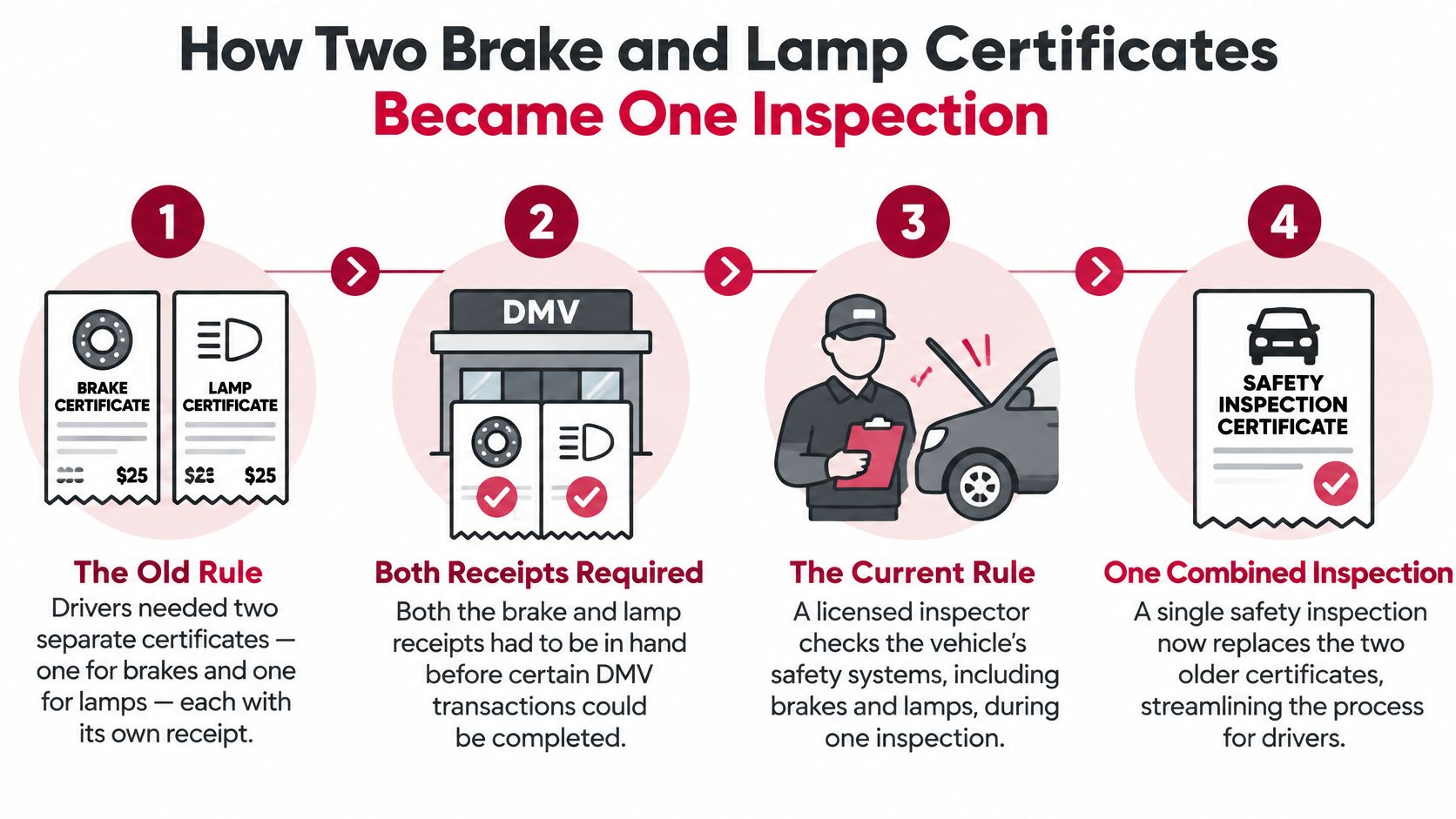
The old system worked like two separate store receipts. One receipt said your brakes had been checked and adjusted. The other said the same for your lamps. For certain DMV transactions, especially ones involving vehicles that needed safety documentation before they could return to the road, both receipts had to be in hand before the transaction could finish. Missing either one stopped the file, even if the other system was perfect.
Say you repaired a car and needed to complete a covered registration transaction under that old rule. You'd visit a licensed official brake station for the brake Certificate of Compliance, then handle the lamp side at a licensed lamp station. Sometimes one business held both licenses, sometimes not. Either way, the state treated brakes and lamps as two programs, two licenses, and two certificates. The owner carried the paper, and the paper carried the proof.
Why the License Mattered More Than the Paper
California tied each certificate to a license for a practical reason. A license linked the form to regulated equipment, station qualifications, and a qualified adjuster. Any shop could tell you a headlight looked fine. Only a licensed station with a licensed adjuster could issue the official certificate DMV would accept. That distinction protected the transaction. The state wasn't buying a shop's opinion. It was accepting a result produced inside a regulated program, by a person and a station it had approved for that exact category.
This is also why owners got tripped up by lookalikes. A repair invoice showing brake work isn't a brake certificate. A note saying the lights were aimed isn't a lamp certificate. The work and the official document were related, but they weren't the same thing. DMV acceptance depended on the document coming through the licensed path, with the right category on it. A brake form couldn't do a lamp form's job, and neither form meant much if the issuer lacked the matching license.
The Law That Folded Two Programs Into One
The Bureau of Automotive Repair safety program page reports that Assembly Bill 471, enacted in 2021, authorized BAR to consolidate the former brake and lamp programs into a single Vehicle Safety Systems Inspection program, and that on September 27, 2024 brake-and-lamp station and adjuster licenses were no longer valid and those stations and adjusters were no longer permitted to issue brake-and-lamp certificates of compliance. That's the turning point. After that date, a shop advertising a fresh official brake or lamp certificate is advertising something its old license no longer supports.
BAR's cleanup steps tell the same story. The bureau stated it would collect and refund unused certificates and monitor certificates submitted to DMV after the program ended. You don't collect and refund blank forms for a program that's still running. Those steps closed the supply of legitimate new paper and put old submissions under scrutiny. For owners, the message is blunt. A certificate printed on familiar stock isn't automatically a live document, and a station's old signage isn't a current license.
Under the replacement system, an enrolled station issues one electronic VSSI certificate when the vehicle passes, and that certificate is transmitted through the BAR system for applicable DMV requirements. Notice what changed and what didn't. The safety check didn't disappear. The split disappeared. One inspection produces one electronic record, so there's no second receipt to chase and no pair of papers to keep together in a glovebox. The proof now lives in the system DMV can verify, tied to the vehicle by its identifying information.
Two receipts became one record. If a shop wants to sell you the second receipt, it's selling you the old system.
BAR also warns that some DMV paperwork may still refer to old brake-and-light certificates, and those references shouldn't be interpreted as evidence that the former certificates remain available. That warning explains the confusion you're probably feeling. You aren't misreading your notice. The notice is using retired language. The current compliance document is generally a VSSI certificate, subject to the vehicle and transaction involved. When old words and new rules collide, follow the rule that's still issuing documents.
How to Check an Old Brake or Lamp Form
Maybe you aren't shopping for an inspection at all. Maybe a certificate is already sitting in your glovebox, your salvage folder, or an auction packet, and you want to know whether it's worth anything. Treat that as a desk check. Validity depends on the form, its prefix, its date, and the vehicle. Possessing a piece of paper proves nothing, because an apparently complete form can still be rejected for being obsolete or improperly issued.
Start by identifying which legacy format you're holding. The California DMV handbook material on brake and light certificates recognizes the Certificate of Compliance, Brake Adjustment (B-91) and Certificate of Compliance, Lamp Adjustment (L-91), revision 4/99, identified by certificate-number prefixes "BA" and "LA", and also older Certificate of Adjustment forms, revision 11/08, identified by "BC" for brake and "LC" for lamp certificates. Those names, revisions, and prefixes are your first sort. If you can't place the form in one of those families, stop there and ask DMV before building a transaction around it.
Run Five Checks in Order
Work through the form the way a clerk would, top to bottom.
- Form name and revision. Read the exact title and revision date printed on the form, such as 4/99 or 11/08. Don't rely on what the seller called it.
- Certificate prefix. Find the two letters starting the certificate number. BA and LA point to the B-91 and L-91 compliance forms. BC and LC point to the older adjustment forms.
- Issue date. BC and LC forms fail in this regard. The same DMV material sets a firm cutoff, stating that certificates with revision 11/08 and an issue date after November 29, 2015 were not acceptable, requiring the customer to obtain a new certificate.
- Adjustment category. Confirm the form covers the system you need. A lamp form offered as proof of a brake adjustment is the wrong document, however clean it looks.
- Issuing station. Identify who issued it and whether that station held the matching license for that adjustment when the form was issued. An unofficial issuer makes the paper unofficial.
Put the date check next to the prefix check in your mind, because together they decide the most common rejection. A BC or LC form with an 11/08 revision and a 2016 issue date can be filled out perfectly, signed, and still dead on arrival. The problem isn't handwriting or a missing stamp. The form family itself passed its cutoff. Arguing that the brakes were genuinely inspected back then won't rescue it, because DMV policy rejects the document type and date combination. The fix is a new inspection through the current path, not a better explanation of the old one.
Two Situations That Change the Desk Check
Vehicle category can end the check early. Brake-and-light certificates were generally unnecessary for trailers with a gross vehicle weight rating below 3,000 pounds, so don't send a small trailer owner hunting for a replacement form the transaction never required. Confirm the rating first. If the trailer sits under the line, the absence of a certificate isn't a defect in the file.
Access can change the answer too. Where a qualified inspection station for a particular vehicle type, such as a motorcycle or large commercial vehicle, wasn't reasonably accessible, DMV procedures could allow a repair-shop Statement of Facts instead. That's a circumstances question, not a form question. You'd need the vehicle type and the distance problem to fit the procedure, and DMV makes that call. Don't manufacture the exception after the fact to explain why a regular certificate is missing.
Desk rule. If the prefix, revision, or date fails, stop defending the old paper at the counter and get the electronic inspection.
One last habit saves time. Photograph the form front and back before you travel, and note the prefix, revision, and issue date in your phone. If DMV staff need to advise you, those three details let them answer quickly. And if the form fails the check, you'll know exactly why, which keeps you from paying a second shop to reproduce the same rejected document. The paper had a real job in its era. Your job now is to confirm whether that era's rules still accept it.
Four Real Cases Under the Current Rules
Rules get easier to use when you see them land on actual vehicles. Each case below has one problem and one correct document. The pattern repeats, and once you spot it, you'll read your own notice differently.
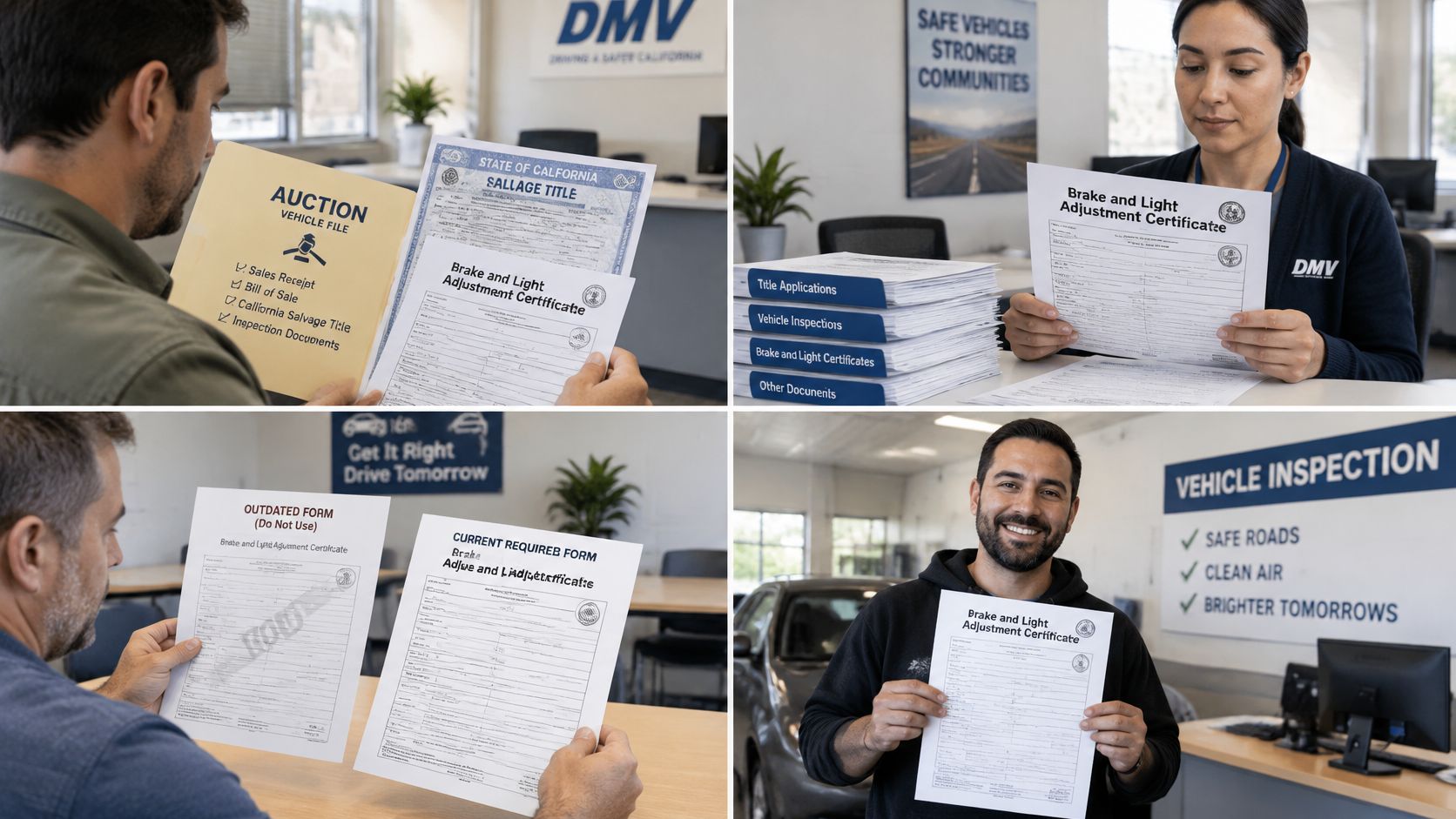
The collage below shows the paperwork side of these transactions, where the wrong form creates the delay.
Case 1 The Auction Packet With Old Wording
A buyer purchases a damaged car at auction, repairs it, and starts clearing a California salvage title. The packet includes a checklist calling for an official brake and light adjustment certificate, so the buyer starts calling shops asking for a BA and LA pair. That search is the mistake. The buyer should ask whether this transaction now requires a VSSI Pass, then treat any older B-91 or L-91 in the file as a document to verify by type and issue date, not as automatic proof. If the packet holds a later issued REV 11/08 form instead, that form is the one that gets rejected. Correct document for a new inspection need: an electronic VSSI certificate.
Case 2 The Fresh Paper Bought in 2026
An owner's DMV notice uses the words brake and light, so the owner pays a shop in 2026 for a fresh paper brake-and-light certificate and brings it in with confidence. The confidence is misplaced. The Bureau of Automotive Repair VSSI guidance states that the old programs ended on September 27, 2024, when former station and adjuster licenses became invalid and those businesses could no longer issue brake-and-lamp certificates of compliance. A newly issued paper can't be submitted as if the program were still open. The owner doesn't need a refund argument first. The owner needs the right inspection. Correct document: an electronic Pass from an enrolled station, transmitted so DMV can verify it.
The video below walks through the inspection context behind cases like these, so you can see what the current process looks like in practice.
Case 3 The Motorcycle Nobody Nearby Inspects
A motorcycle owner calls several stations. Each one is polite, and each one says the same thing. They don't inspect motorcycles. The owner is tempted to book a passenger car appointment anyway and hope the station improvises. Don't. A station that can't inspect the class can't produce the record for it. The productive question goes to DMV. Ask whether a REG 256 Statement of Facts from a repair shop applies because no qualified station for motorcycles is within a reasonable distance. Bring specifics, including the vehicle type and the stations you contacted. Correct document, if DMV allows the exception: the REG 256. If a qualified station is reasonably available, the correct document goes back to a VSSI from that station.
Case 4 The Small Trailer and the Helpful Forum
An owner registers a small utility trailer and posts a question online. Three replies insist both certificates are required, and one links to a checklist from years ago. The trailer's gross vehicle weight rating is under 3,000 pounds. That owner should rely on the exemption and skip an inspection the rule doesn't require. Forum confidence doesn't override a weight rating. Correct document: none for that trailer. The owner saves the fee, the trip, and the argument by checking the rating before obeying the checklist.
Notice what all four owners had in common. Each one started from the old certificate name, and the name pointed three of them toward the wrong action. BAR directs consumers to obtain a vehicle safety systems inspection certificate instead, while warning that some DMV paperwork still uses outdated terminology. That's why the search itself creates risk. Typing the retired phrase finds retired instructions. Before you pay for anything, confirm the transaction specific requirement for your vehicle, your date, and your class. The right question isn't "who sells this certificate." It's "what document does California accept for this transaction now." Ask that, and the four cases collapse into one habit.
How to Get a VSSI Certificate for DMV
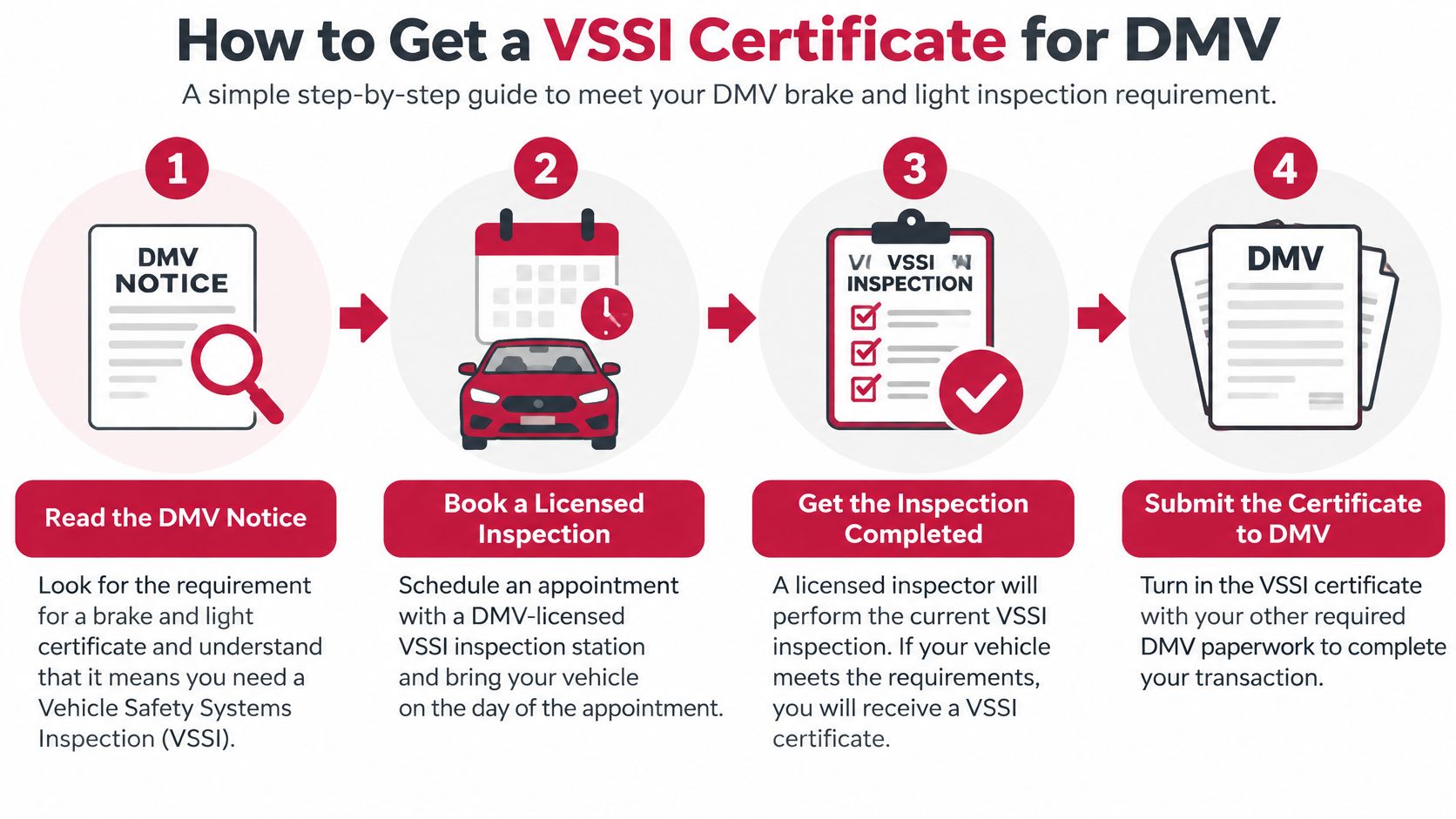
If your vehicle needs a current inspection, follow one numbered path. Don't improvise the order. Each step prevents a specific failure, and skipping ahead is how owners end up with a paid inspection that doesn't match their file.
The Six Steps in Order
- Translate the notice. Read your DMV notice and convert the words brake and light certificate into a Vehicle Safety Systems Inspection, unless your vehicle is an exempt small trailer or you have a documented distance exception. Write "VSSI" on your copy so you ask shops for the right thing.
- Confirm the vehicle class. Tell the station exactly what you're bringing. A motorcycle or heavy truck shouldn't be booked at a station that only handles passenger cars. This one phone question prevents a wasted trip with a vehicle the bay can't take.
- Choose an enrolled VSSI station. Pick a station operating in the current program, not a shop still advertising a retired brake-and-lamp adjuster license. Old signage on the wall doesn't equal current enrollment.
- Get inspected once. Have the station perform the inspection and transmit the result through the BAR system. There's no second trip for a separate lamp certificate, because the combined inspection replaced the pair.
- Verify before you leave. Check that the VIN, the certificate number, and the Pass result match on the DMV record or the BAR Inspection History screen print. Read the VIN against your vehicle paperwork, not from memory.
- Use the electronic record. Take that verified record into your registration transaction. The certificate number is your reference if a clerk needs to locate the result.
Where Owners Usually Go Wrong
The most common failure happens at step 5, because it feels like paperwork after the work is done. It isn't. The electronic record is the product you paid for. If the VIN is wrong, DMV sees an inspection for some other vehicle, or for no vehicle it can match to your file. Fixing that at the station takes minutes while the technician and the record are in front of you. Fixing it later means another trip and a stalled registration.
The second failure is substitution. An informal note from a repair shop isn't the substitute for a car that can reach an enrolled station, however trustworthy the shop is. Trust isn't the standard. The program is. DMV acceptance follows the official electronic pathway for covered vehicles, and a letter outside that pathway leaves the clerk with nothing to verify. Save shop statements for the narrow distance situation where DMV procedures call for one.
There's also a date question hiding in older files. If your original transaction began on or before December 26, 2024, ask DMV how any paper from that file should be handled instead of assuming it's either automatically valid or automatically dead. Bring the paper, state the transaction start date, and let staff sort the handling. Guessing wrong in either direction costs you a trip. Guessing "valid" risks rejection at the counter. Guessing "dead" risks paying for an inspection you didn't need.
Local context helps at the booking stage too. If you're sorting out related work in the Antioch area, our page on Antioch brake and muffler services is a useful starting point for understanding nearby options, but the document rule doesn't change by neighborhood. Wherever you go, the station has to be enrolled for the inspection and able to take your vehicle class. Ask both questions on the same call.
Save the certificate number with your registration paperwork when you get home, in the same folder or the same phone note. If DMV, a buyer, or an insurer asks how the safety requirement was satisfied, you'll answer in seconds instead of digging through a glovebox. And keep the categories clean to the end. A smog check is a different inspection and doesn't replace a VSSI certificate.
Finish the Registration After the Safety Record Is Set
Start from the decision you've already made. If the lookup showed an exemption or a still valid older form, take that answer to the registration transaction and don't buy a new certificate. If your vehicle needed a current inspection, move to the DMV step only after the VSSI Pass, VIN, and certificate number match. Correct safety document first, registration second. Reversing that order is how files stall at the counter.
For the registration step itself, we're a licensed California business partner for DMV registration services, and our DMV registration services include CA renewals and ownership transfers. Regular CA vehicle registration renewals, including the sticker, cost $30.00 plus the applicable DMV fee. Review the documents a transaction needs on our page covering vehicle registration documents, then confirm directly which DMV services we can handle for your specific transaction before you book, because available services can change.
Call with your VIN, certificate number, and registration paperwork in front of you, so we can answer the transaction question in one conversation. Ask which vehicle classes and transactions we handle, and don't rely on any shop to issue a retired brake-and-lamp certificate. A smog check is a separate test and doesn't produce a brake, lamp, or VSSI certificate. Bring us a settled safety record, and the registration work becomes the straightforward part.
If your VSSI Pass is verified or your vehicle falls under a real exemption, we can help you finish the California registration step with renewals and ownership transfers handled by a licensed DMV business partner. Bring your VIN, certificate number, and paperwork, and visit Fire House Smog to confirm the services your transaction needs before you make the trip.