
You bought the car on Saturday. The seller handed you the keys, you sent the money, and the signed title is on the kitchen table. Monday you look up the record and the seller's name is still there. That gap is your vehicle ownership transfer status. The handshake finished the sale. It did not finish the state's file.
Until that file changes, tickets, tolls, and questions about who owns the car can still land on the wrong person. The pages below walk each stage in order, then show how to name the blocker when a file stalls and who has to fix it.
Table of Contents
- What Transfer Status Means for a Car You Just Bought
- The Transfer Stages and What Each Status Means
- How to Check Your Transfer Status Step by Step
- How Long Each Transfer Step Typically Takes
- Documents and Fees Needed to Avoid a Hold
- Diagnose a Stalled Transfer and Choose Your Next Move
What Transfer Status Means for a Car You Just Bought
A handshake sale is like agreeing to buy a house. Vehicle ownership transfer status is the deed at the county office, and until that recording happens, the official owner on paper has not changed.
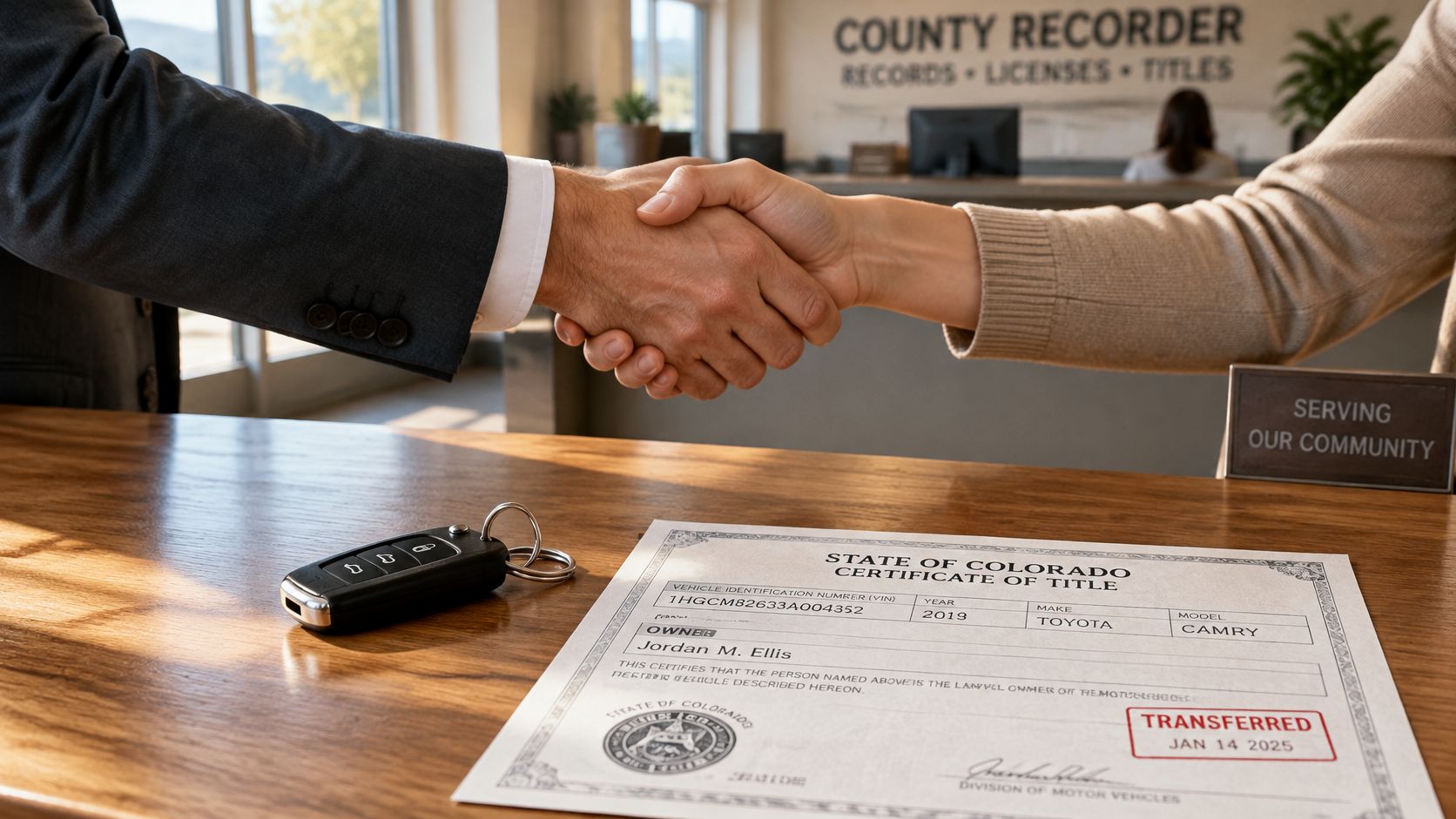
California treats the transfer as a legal-record update, not a private sale. The California DMV title transfer rules say that whenever a vehicle is bought or sold, or whenever the registered owner or lienholder changes, the Certificate of Title must move to the new owner.
A sale and a transfer are different events. The deal can be complete between two people while official ownership stays incomplete until DMV requirements, documents, and fees are satisfied.
Two clocks that start on the sale date
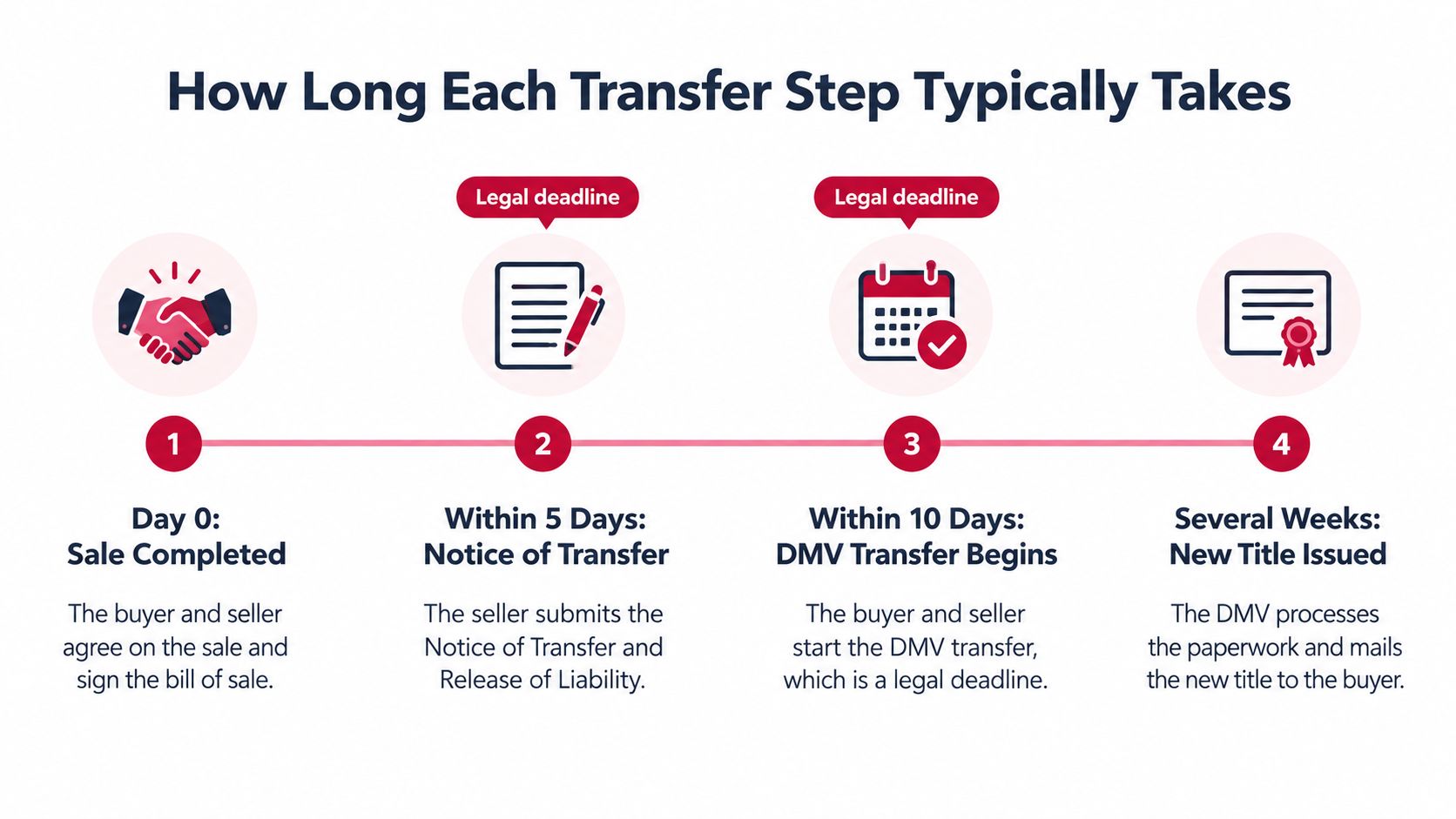
The buyer and seller must begin the ownership-transfer process with the DMV within 10 days of the sale. After selling or transferring the vehicle, the seller also has five days to submit a Notice of Transfer and Release of Liability. That notice helps separate the seller's future responsibility from the vehicle record. Miss either clock and the commercial deal can look finished while the official status is still open.
Why the DMV keeps the file
Title records establish legal ownership and preserve the vehicle-identification details needed for registration, resale, lien recording, and enforcement. A bill of sale shows what you and the seller agreed. It does not, by itself, change the name on the state file. People often treat a title transfer and a registration update as the same filing. They aren't, and title transfer versus registration is the distinction to settle before you assume one receipt covers both.
The first two things to check
Look at two lines before you do anything else. Does the record already show you as the new owner? Does a lienholder still appear? A registration card can update while a lender's interest is still on the title. Those two answers tell you whether you are waiting on ordinary processing or chasing a release.
The Transfer Stages and What Each Status Means
Screens don't all use the same words. Match the meaning in this table, not the exact label. Stages usually move forward in this order, and a problem can send the file back to a pending stage.
| Stage | What It Means | Who Must Act Next |
|---|---|---|
| Sale agreed, no DMV filing | The parties exchanged the vehicle. The DMV record still shows the seller. | Buyer and seller start the transfer within 10 days. |
| Application submitted | The DMV has the transfer paperwork and the fee payment. | The DMV processes. The buyer watches for the title and registration. |
| Lien release pending | A lienholder must release its interest before a clean title can issue. | The lienholder sends the electronic release. |
| Title in production | The record is updated and a paper title is being printed or mailed. | The DMV. The buyer waits for delivery. |
| Pending report or suspense | A fee deposit or a data mismatch stops automated processing. | The buyer, the seller, or the DMV corrects the item. |
| Complete | The title and registration both show the new owner. | The buyer keeps the new registration card. |
Sale agreed, then application submitted
At the first stage, nothing official has happened. You may have the keys and a signed title, and the public record still names the seller. Once the application and fees are in, the DMV holds the file. Your job shifts from filing to watching. An application number on the receipt is the handle you'll need for every later check.
Lien release, then title in production
A financed car can't get a clean title until the lender lets go. Lien release pending means the lender still has to send that release. You can't finish this stage by calling the DMV and asking them to ignore the lien. Title in production is the quieter stage. The name on the record has moved, and a paper title is being printed or mailed. Waiting is reasonable here, unless the expected window passes with no mail.
Pending, suspense, and complete
Pending report or suspense is not a polite word for "busy." A fee deposit that didn't post, or a data mismatch, stopped the automated path and pushed the file into manual work. Somebody has to correct the item. It might be you, the seller, or a DMV clerk after you show the fee record. Complete means both the title and the registration show the new owner. Keep the new registration card. Don't treat a registration-only update as this stage if a lienholder is still listed.
One action per stage keeps you from waiting on a problem that waiting won't fix. If the stage says a person must send or correct something, that person acts. If the stage says the DMV is printing or reviewing a clean file, you watch the date and recheck.
How to Check Your Transfer Status Step by Step
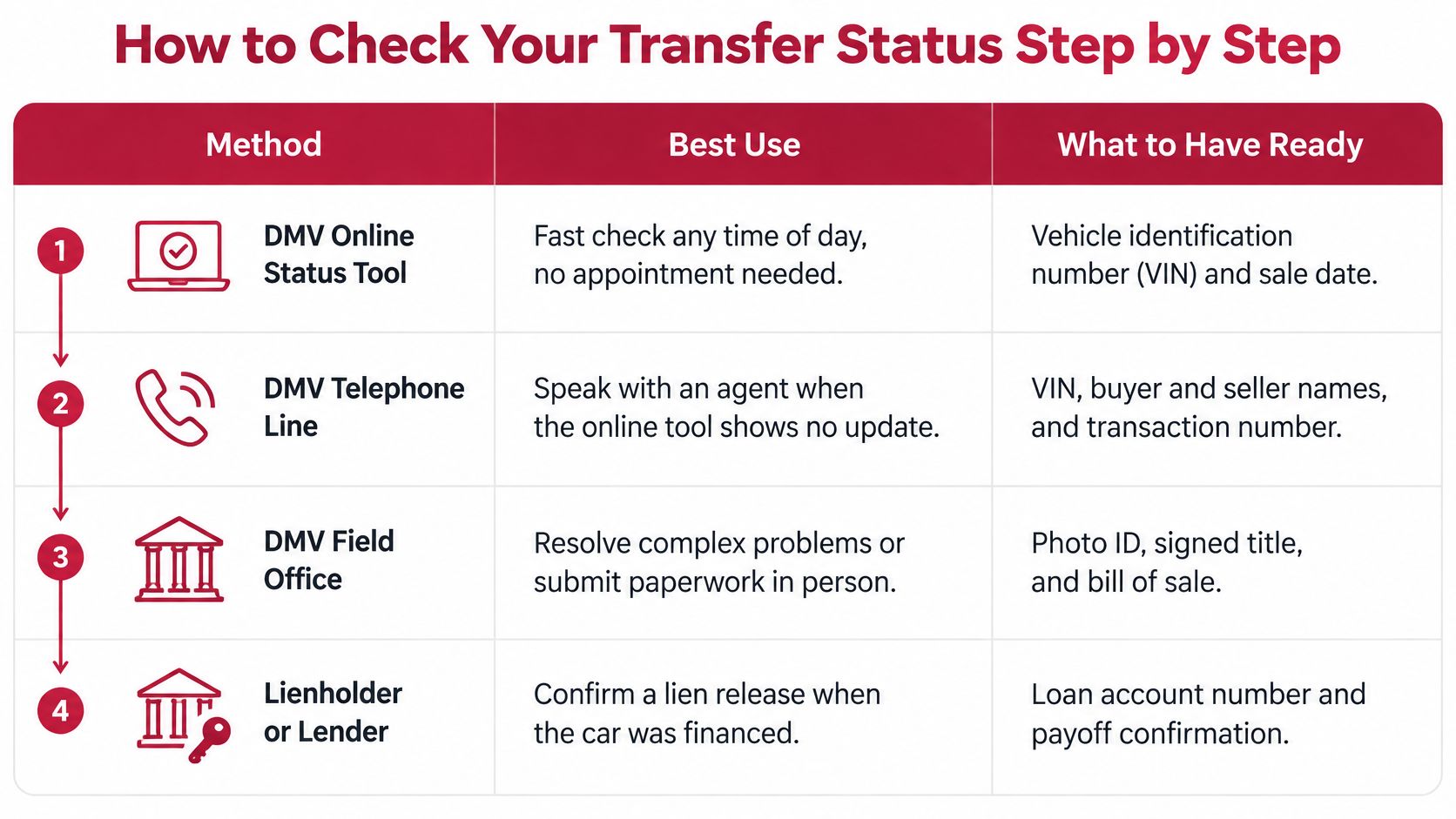
Four channels can answer where the file sits. Each one is good at a different job, and each one goes blind in a different way.
| Channel | Best For | What to Have Ready | Main Limit |
|---|---|---|---|
| DMV online status tool | Quick checks at any hour | VIN, plate, application or transaction number | Can lag behind processing |
| DMV telephone service | Questions about a specific hold | Application details and buyer ID | Long waits at busy times |
| DMV field office | Problems that need a clerk to review documents | Original documents and ID | Wait times; appointments may be needed |
| Lienholder or lender | Confirming a lien release was sent | Loan account number and VIN | Only knows the lien side of the record |
What each channel can and can't see
Online is the first look, not the last word. The status tool is there any hour, and it doesn't need an appointment. It can trail the work a clerk already did, so a blank or old result doesn't prove the file is stuck.
The phone line is for a named hold. Use it when the screen mentions a suspense item or hasn't moved. Waits run long at the start of the week and around lunch, so call with the application details already in front of you.
A field office is for paper a screen can't judge. A clerk can look at an original title, a bill of sale, or a signature that didn't scan cleanly. Expect a wait, and an appointment may be required.
The lender only knows the lien. A bank can tell you whether it sent the electronic release. It can't tell you whether the DMV accepted your fees or your odometer reading.
The online check, then the follow-up
- Gather the VIN, the license plate, the buyer name, and the application or transaction number from your receipt.
- Open the DMV online status tool on dmv.ca.gov and enter those details.
- Compare the result with the stage table above. Match the meaning if the wording differs.
- Write down the date of the last status change so the next check has a baseline.
- If nothing has changed after about 10 business days, or the status shows a hold, call the DMV telephone service at 1-800-777-0133. Confirm that number on dmv.ca.gov before you dial.
- If a lien is involved, ask the lender whether the electronic release was sent. A release that was never transmitted will not show up as a DMV delay.
A short walk-through of pulling the VIN and reading a status screen makes the first three steps easier to picture.
What to write down after every call
Keep a note for each contact. Record the date, the name of the agent, and any reference number. Write the exact phrase they used for the hold, not your summary of it. "Suspense, report of deposit of fees" is useful later. "They said it's processing" is not. If a second agent contradicts the first, you can read the earlier note back instead of starting over.
Practical rule: Recheck online before you call, and call the lender before you visit a field office about a missing title on a car that was financed.
How Long Each Transfer Step Typically Takes
Deadlines and processing times are not the same kind of number. The clocks from the first section are legal limits on when you must start. Processing times are typical estimates, and they move with workload and with how clean the file is.
Take a sale on January 5. The seller's Notice of Transfer and Release of Liability is due January 10. The buyer and seller must have the DMV transfer underway by January 15. If that filing is on time and nothing blocks it, a paper title from an electronic lien transaction is often expected about eight days later, around January 23.
What "about eight days" actually measures
Under California's Electronic Lien and Title (ELT) program, the DMV keeps the ownership record electronically for participating lienholders instead of holding a paper title. The registered owner gets a paper registration card. When the lien is satisfied, the lienholder sends an electronic release. After that, the DMV can issue a sole-owner paper title or create a record for a replacement lienholder. The application for title or registration (REG 343) guidance says the average time to receive a paper title from an electronic transaction is about eight days.
That average assumes the file can move automatically. Pending reports of deposit of fees, or suspense transactions, can block automated title issuance and force manual processing. A rush application is a different path. Qualifying rush applications normally take 8 to 10 business days after DMV headquarters receives a complete, condition-free application. Rush does not repair a bad signature or an open lien. It shortens the queue for a file that is already clean.
When the January dates slip
File late and the whole example shifts. The electronic title doesn't start its roughly eight-day count until the DMV has a file it can work. Late-transfer penalties can apply after the filing window. The dollar amount isn't confirmed here, so check the current schedule rather than guessing from an old receipt.
A transfer-status check should verify both the registered-owner change and whether an active legal-owner or lienholder record remains. A vehicle can look transferred in registration data while the lien-release or title-production stage is still pending. If your expected date passes with no status change, don't add another week of waiting by habit. Move to the diagnosis below and name the blocker.
Documents and Fees Needed to Avoid a Hold
Most stalls start as a missing line on this list. The DMV can't invent a signature, a smog result, or a lender's name after you leave the counter.
| Document or Fee | Purpose | Practical Note |
|---|---|---|
| Signed Certificate of Title or approved replacement | Proves the seller's ownership and passes it on | Lender-held titles need the lender's release |
| Notice of Transfer and Release of Liability | Separates the seller's future responsibility | File it soon after the sale so later tickets don't stay on the seller |
| Smog certificate | Emissions compliance for a change of ownership | Exemptions apply; confirm before testing |
| Application for Title or Registration (REG 343) | Asks the DMV to issue title and registration to the buyer | Use the current form, not a saved copy from an older sale |
| Transfer fee | Processing the ownership change | Confirm the current amount on dmv.ca.gov before you pay |
| Title fee | Issuing the new title | Confirm the current amount on dmv.ca.gov; it is separate from the transfer fee |
| Registration fees and use tax | Registering the vehicle to the buyer | Varies by vehicle value and county; check the current schedule |
| Lienholder information | Recording any lien that remains | Required when a lender is involved |
| Proof of insurance | Required for registration | Keep a current policy document |
The vehicle registration documents checklist is a useful cross-check when you're assembling a file that also needs a smog certificate. A transfer packet and a renewal packet overlap, and they aren't identical.
Habits that keep a file out of suspense
- Sign only where the form indicates. A signature in the wrong box, or a buyer signing the seller's release line, is a common reason a clerk sends the packet back.
- Match the VIN and the odometer to the vehicle. One transposed digit is enough to stop automated processing. Read the dash, the title, and the application out loud against each other.
- Bring originals if you file in person. A photo of a title helps you at home. A clerk often needs the paper. If the title is lost, ask which approved replacement the DMV will accept before you invent a substitute.
- Confirm fees on dmv.ca.gov the week you file. Amounts change, and a short payment can sit as a report of deposit of fees instead of a completed transfer. Registration fees and use tax also move with vehicle value and county, so an old forum post is a bad guide.
Smog before you pay for a test
A change of ownership often needs a smog certificate, and model-year and vehicle-type exemptions exist. Confirm the exemption before you pay for a test you didn't need. If a certificate is required, an old one from the seller's last renewal may fall outside the window the DMV will accept for this sale. Ask before you assume last year's test still counts.
Diagnose a Stalled Transfer and Choose Your Next Move
Waiting is the right move only when the file is actually moving. A buyer who files on day six can see registration update within two weeks and still never receive a paper title, because a lender never released its interest. Registration data can show a transfer while the lien or title stage is still open. The DMV can also route a file to manual review when fees, lien records, or paper-title handling don't match.
California's electronic lien guidance is blunt about why an apparently complete transfer enters manual review. Pending reports of deposit of fees, suspense transactions, incorrect paper-title handling, or a lienholder's unresolved interest can prevent automated title issuance and delay later transfers. The rush title processing page is about speed for a clean application. It doesn't clear those blockers. At every stall, ask one question. What exactly is blocking my transfer, and who must fix it, the buyer, the seller, the lienholder, or the DMV?
| Symptom | Likely Blocker | Who Must Fix It |
|---|---|---|
| Status stuck at application submitted for weeks | Missing signature, VIN, or odometer error | Seller or buyer corrects and resubmits |
| Registration updated but no title | Lien release not yet recorded in ELT | Lienholder sends the electronic release |
| Title still lists a lienholder | Lien not satisfied, or release not sent | Lender, not the registered owner |
| Mailed title never arrives | Title sent to the lienholder or an old address | Lender for the title; buyer for the address |
| Status shows pending report or suspense | Fee deposit issue or incorrect paper-title handling | DMV, after the buyer checks the fee record |
| Smog certificate rejected at filing | Certificate outside the allowed window, or an exemption misread | Buyer re-tests or confirms the exemption with the DMV |
Three paths, not one waiting room
Path one, the file is still inside the window. The last status change is recent, no hold language appears, and you are inside the processing estimate from the January-style timeline above. Wait, and recheck on the expected date. Another call today won't print a title that is already in production.
Path two, the blocker is a document. The status has sat past that window, and the symptom is a signature, a VIN, an odometer line, a fee shortfall, or a smog certificate. Fix that item and resubmit. Do not file a second full application on top of the first one until a clerk tells you the first file is dead. Two open applications can create the duplicate-record problem you were trying to avoid.
Path three, a lender still holds the interest or the paper. Contact the lender first. Ask whether the loan is satisfied and whether the electronic release was sent. If the lender says the release is on the DMV record and the status still won't move, then call the DMV with the release date and your application number. The registered owner often cannot demand a title that the system is built to mail to the legal owner.
Verify the lien release, the signatures, the fees, the VIN, and the odometer. If the title is missing, confirm you are using the approved missing-title path rather than a photocopy. Also ask a question buyers skip. Will the lender, not the registered owner, receive the new title? A "lost" title is sometimes sitting at the bank because that is where the record said to send it.
When a local office can help, and when it can't
A licensed registration service can submit a complete California or out-of-state transfer and issue a sticker and plates when the file qualifies. DMV registration customer service through a business partner is one way to avoid a field-office line for that submission. Fire House Smog, a STAR-certified test-only station and licensed DMV registration provider at 2900 Lone Tree Way, Antioch, CA 94509, handles those transfers during posted hours, Monday to Saturday 9:30 AM to 5:00 PM and Sunday 12:00 PM to 4:00 PM, at 925-754-1600. It can move a complete file. It can't clear a DMV suspense item or force a lender to release a lien, so confirm the file is clean before you treat the visit as the fix.
Call ahead with the VIN, the status stage from the table, and the documents on the checklist. Say which path you are on. A clerk who hears "it's been three weeks" has less to work with than a clerk who hears "registration updated, ELT release not sent, lender is X."
If your transfer is waiting on a smog certificate or a complete ownership packet, Fire House Smog can inspect the vehicle and process California DMV ownership transfers, including stickers and plates when the file qualifies. Bring the VIN, your status stage, and the signed title or lender release so the visit starts from a real blocker instead of a guess. Visit Fire House Smog to check hours and what to bring before you drive over.