
DMV Registration Customer Service: How It Works
You've arrived at the DMV with a renewal notice in your hand, but the line already stretches past the entrance. You need a registration renewal, perhaps a smog check too, and you're trying to work out whether this visit will take minutes or most of your day. That uncertainty is the part of DMV registration customer service that frustrates drivers most.
The process becomes easier to manage when you treat it as a workflow rather than a single counter visit. Your transaction moves through intake, document review, payment, system entry, and registration issuance. The right service channel can remove unnecessary steps, especially when an authorized business partner can combine emissions testing with registration work.
Table of Contents
- The DMV Registration Customer Service Experience at a Glance
- What DMV Registration Customer Service Actually Covers
- Choosing the Right Channel for Your Transaction
- How to Prepare Before You Contact DMV Customer Service
- Inside an On-Site Registration Partner Like Fire House Smog
- Common Registration Problems and How to Solve Them
- Misconceptions About DMV Registration Customer Service
- Your Pre-Visit Checklist and When to Choose a Partner
The DMV Registration Customer Service Experience at a Glance
A DMV registration visit usually follows a recognizable sequence. You first explain what you need, show identification, and enter the queue for that transaction. The clerk then checks the documents connected with your vehicle, confirms the required fees, enters the transaction into the registration system, and provides the completed registration materials.
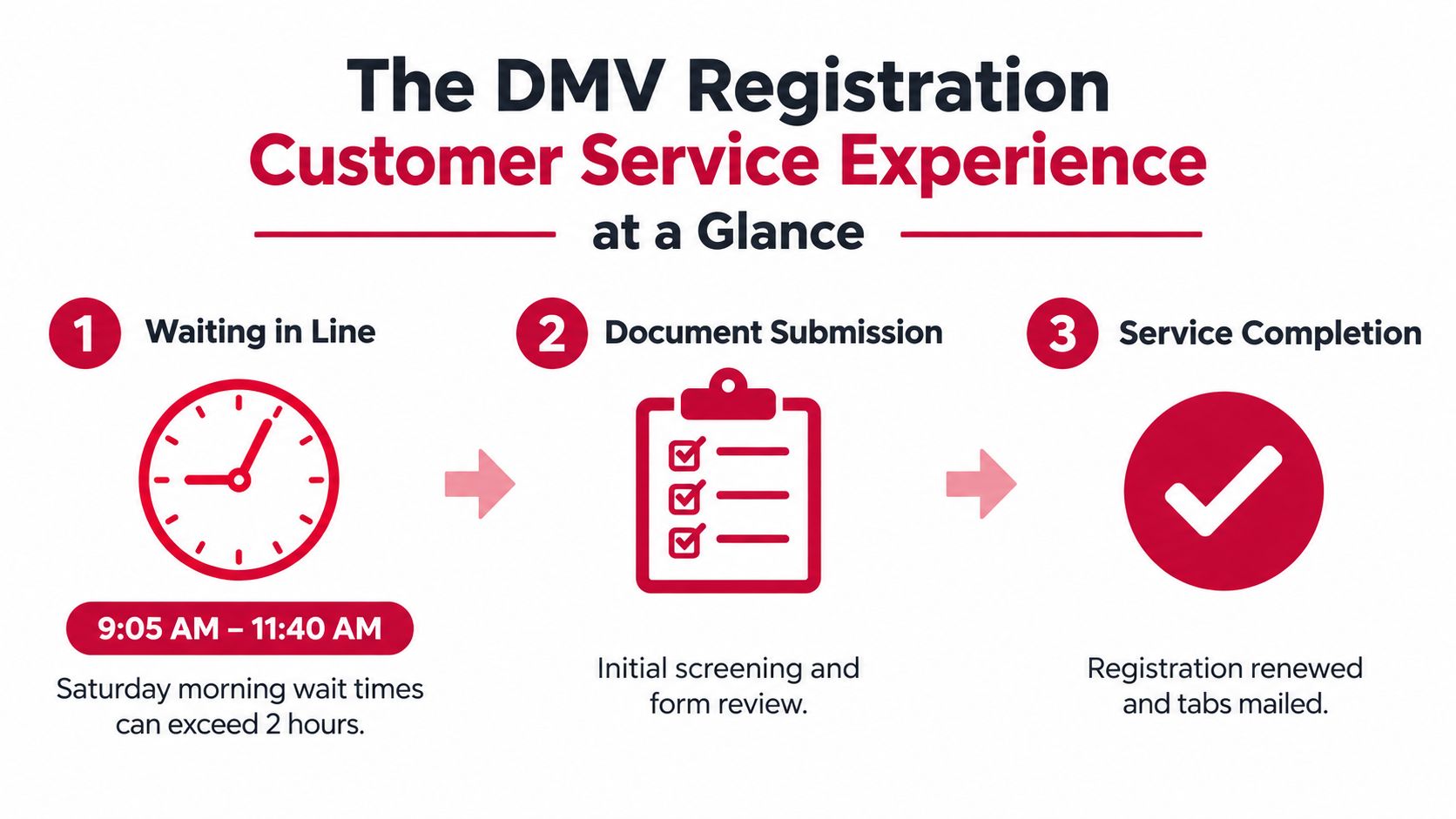
The five points where time is spent
Intake: Tell the representative whether you need a renewal, title transfer, duplicate sticker, address update, or another service. This determines which queue and document set apply.
Document review: The representative checks items such as your registration record, title, smog information, insurance, identification, and payment details. Missing paperwork often stops the transaction here.
Payment and system entry: Once the documents pass review, the representative collects the required fees and submits the information through the approved registration system. Your receipt confirms that the transaction was entered, but it may not always mean every physical item is already in your hand.
Registration issuance: Depending on the channel and transaction, you may receive a registration card, year sticker, or plates. Some services issue materials immediately, while others mail them.
Follow-up: A hold, rejected document, mailing delay, or record correction creates a second service need. Keep your receipt and any confirmation number so the next representative can locate the transaction quickly.
Practical rule: Ask which stage your transaction is in before asking how much longer it will take. “Is the hold in document review or system processing?” gets a more useful answer than “How long is the wait?”
Wait times can change sharply when policy deadlines create a rush. An official Oregon transportation report recorded an average call wait of 12 minutes in 2025, while wait times improved to under 2 minutes in 2026 after demand eased, as described in the Oregon customer service report. The lesson applies broadly: a busy DMV day doesn't necessarily mean the transaction itself is difficult. Volume can be the problem.
What DMV Registration Customer Service Actually Covers
DMV registration customer service includes the routine tasks that keep a vehicle record accurate and current. A renewal extends the registration period. A title transfer changes ownership after a sale. A duplicate sticker replaces a lost item, while an address update keeps notices connected to the correct location.
Other requests are more specialized. A lien release removes a lender's interest after a loan is paid. A plate surrender records that a vehicle has been sold, totaled, or otherwise removed from active use. A field-office representative may also need to review a VIN verification or correct a complicated title record.
Three channels, one connected process
Most drivers use one of three channels:
- Field offices: These are designed for transactions that need face-to-face examination, identity checks, VIN verification, or detailed title review.
- Online services and phone systems: These are useful for straightforward renewals, address changes, status questions, and other requests that don't require a physical inspection or document examiner.
- Authorized business partners: DMV-licensed businesses handle an approved range of registration services, which can include renewals, title transfers, plates, and stickers.
An authorized partner isn't a separate registration system. The partner operates through DMV-approved channels and works with the vehicle record maintained by the agency. California DMV describes business partners as providers that can handle services including renewals, plates, stickers, title transfers, and reports of sale, and notes that these locations often have shorter waits than field offices in its registration business partner guidance.
Why the workflow matters
The same transaction can feel completely different depending on where it starts. A field office may need to divide your visit into document review, payment, and issuance at separate points. A partner location may combine related steps, such as a smog inspection and renewal, when the transaction qualifies.
The important question isn't just, “Can this place renew my registration?” Ask instead, “Can this channel complete every required step for my vehicle?” That distinction prevents a trip that ends with a receipt but no sticker, or a renewal attempt that must be restarted after a missing smog result is discovered.
Choosing the Right Channel for Your Transaction
Start with the transaction, not the location. A simple renewal with no record issue has different requirements from an out-of-state title transfer or a vehicle that needs VIN verification. Choosing the wrong entry point can create an extra handoff, even when every representative is doing the correct work.
| Channel | Typical Wait | Availability | Best For |
|---|---|---|---|
| Field office | Appointment or in-person queue | Office hours | VIN checks, complex title corrections, examiner review |
| Online service | No physical queue | Available through the DMV portal | Straightforward renewals, eligible address updates, duplicate records |
| Authorized partner | Depends on location and transaction | Posted business hours | Renewals, transfers, smog-related registration work, sticker or plate issuance |
Use the field office for exceptions
A field office is the safer choice when the record needs an examiner's attention. Examples include a VIN verification, an unresolved title problem, conflicting ownership documents, or a transfer that can't be completed through the online portal. Bring the original documents requested by the agency, not just photographs on your phone.
Use online service for clean, simple records
The DMV website works well when the vehicle is eligible for online renewal and the record contains no unresolved hold. Before submitting, confirm that the registration information, address, insurance details, and smog status are current. If the portal rejects the transaction, save the message. It often identifies the missing step you need to complete elsewhere.
Use a partner when steps belong together
An authorized business partner is useful when you need in-person help but don't need a field-office examiner. For an Antioch driver who needs both a smog inspection and a registration renewal, a partner such as Fire House Smog can handle those related steps at one location when the transaction qualifies. Review the available DMV registration service options before you leave home, then confirm hours and document requirements.
The best channel is the one that completes the whole workflow. A short online renewal is convenient only if no additional review is required. A partner visit is efficient only if you arrive with the documents and vehicle information needed to finish the transaction.
How to Prepare Before You Contact DMV Customer Service
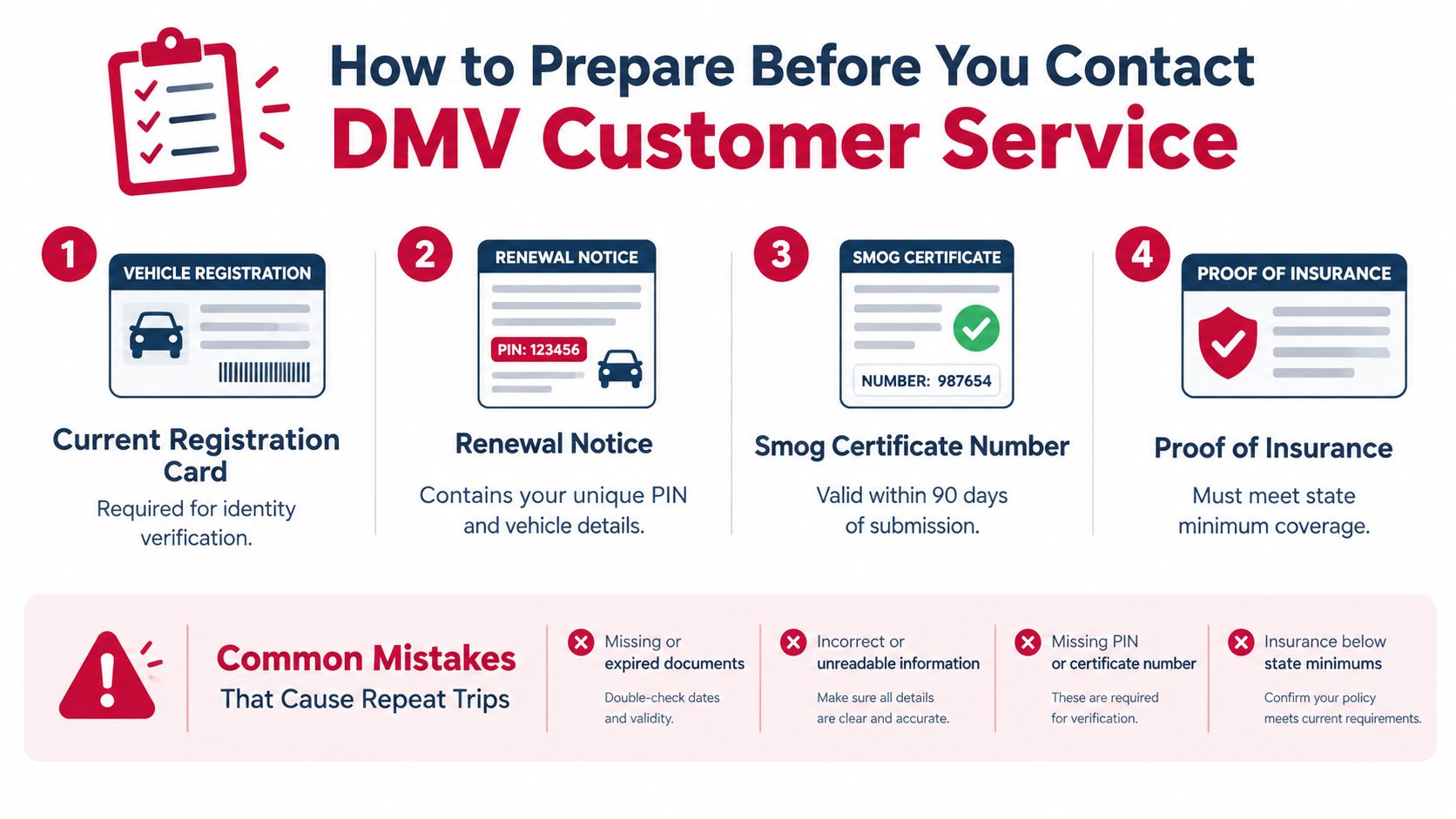
Most repeat visits come from one missing item, not from a complicated DMV rule. Prepare your documents before you choose a channel, and separate what you need for a renewal from what you need for a title transaction.
Build a transaction folder
For a standard renewal, gather:
- Current registration card: Use it to confirm the plate, vehicle identification number, and registered owner.
- Renewal notice: Keep the entire notice, including any reference or identification information.
- Smog information: Have the certificate or test details available if the vehicle is due for an inspection.
- Proof of insurance: Make sure it identifies the correct vehicle and meets the requirements for the jurisdiction.
- Valid identification: Bring an accepted ID for an in-person transaction.
- Payment method: Check what the selected channel accepts before you arrive.
For a transfer, add the title, signed ownership documents, lien-release paperwork when applicable, and any required bill of sale or release-of-liability document. Don't assume the representative can infer a missing signature or correct an incomplete title without additional paperwork.
Match your preparation to the channel
For an online request, log in before calling. Check whether the portal shows a smog requirement, an address mismatch, an unpaid balance, or a document upload request. Write down the exact error message and the confirmation number for any submission.
For a field office appointment, organize originals in the order the transaction requires. For a partner visit, bring the same core documents, but also bring the vehicle if a smog inspection is part of the work. A representative can process the registration only after the required supporting result is available.
For a more detailed document list, review vehicle registration documents from Fire House Smog. The list won't replace the DMV's requirements, but it can help you notice gaps before you travel.
You can also use this short video as a visual reminder of the preparation process:
Inside an On-Site Registration Partner Like Fire House Smog
Consider a driver in Antioch whose renewal requires a smog inspection. The traditional workflow may split the task between an emissions station and a later DMV visit. The partner model brings the related steps together, provided the vehicle and transaction meet the requirements.
The driver arrives with the renewal information, identification, insurance details, and payment method. A technician performs the emissions inspection, and the result is submitted through the approved process. Once the registration record can be completed, the registration representative handles the DMV portion at the same location.
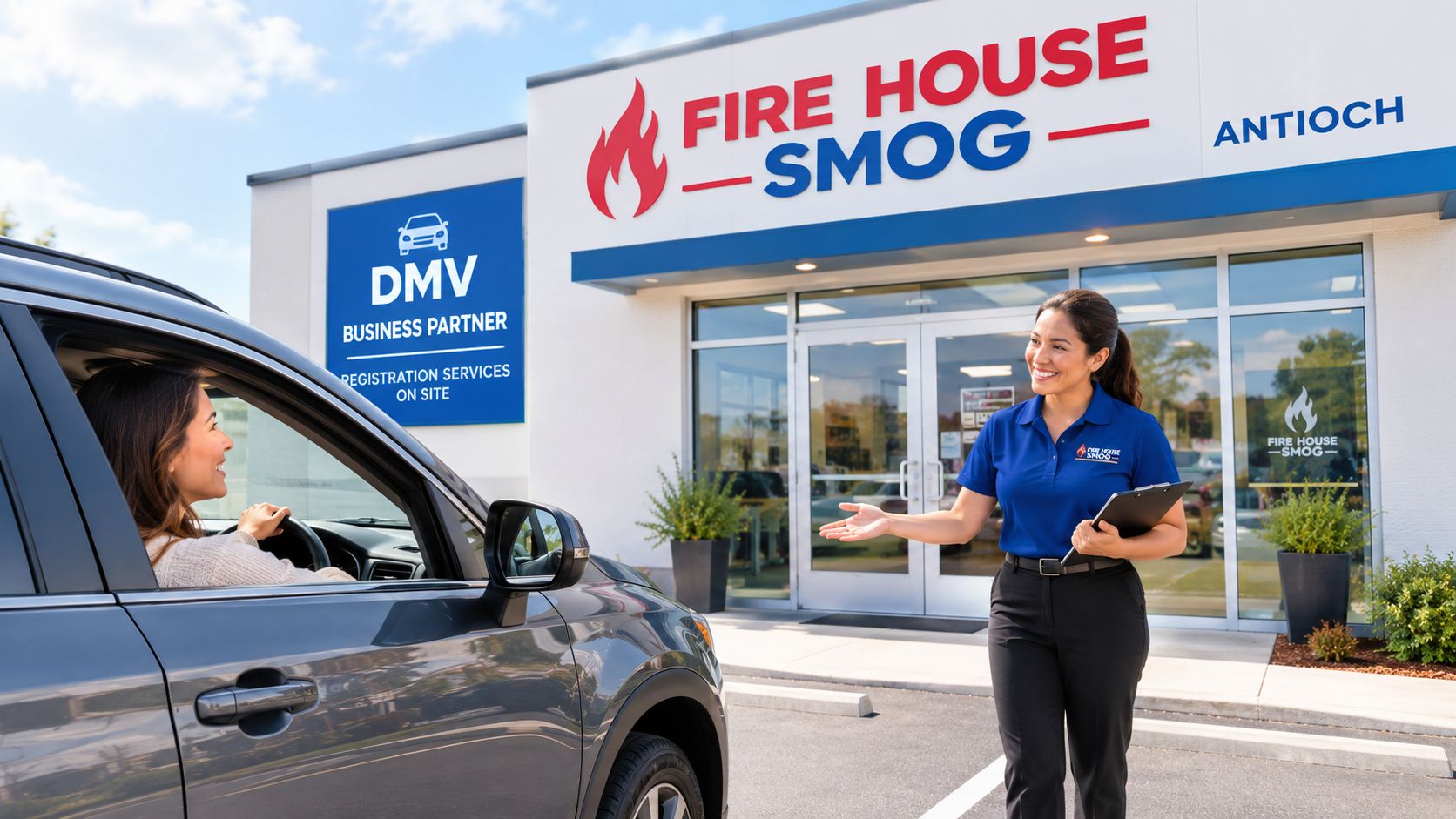
What the combined visit changes
The benefit isn't that the rules disappear. The same eligibility checks, fees, and record requirements still apply. The difference is the handoff. Instead of completing an inspection, locating a second appointment, carrying documents to another counter, and explaining the situation again, the driver can move from one related task to the next in a single location.
California's modernization work shows why the backend matters. The DMV's business-partner automation program describes six authorized first-line service providers supporting second-line business partners, making connectivity and transaction submission central to service delivery in the business partner automation program.
Faster front-counter service only saves time when the representative can validate the record, submit the transaction, and issue the approved output through the connected system.
At Fire House Smog, the relevant services include STAR-certified test-only smog inspections, California registration renewals, and ownership transfers, with sticker or plate services when applicable. Drivers should confirm the transaction, hours, and any vehicle-size limits before arriving. Information about the registration renewal fee process can help you prepare for the payment step.
Common Registration Problems and How to Solve Them
A rejected registration transaction usually points to one unfinished part of the workflow. Find that part first. Repeating the entire application without fixing the underlying issue only sends the same error back into the system.
| Problem | Cause | Fix |
|---|---|---|
| Smog result missing | The vehicle requires a qualifying inspection, or the result hasn't reached the record | Complete the required inspection at an appropriate certified station, then ask the representative to check the record again |
| Hold on title | A lien release, transfer document, or ownership detail is missing | Provide the missing paperwork and request that the transaction be resubmitted |
| Missing signature | The title or supporting statement wasn't signed in the required place | Complete the missing signature or required statement before returning |
| VIN issue | The vehicle identification number needs physical verification or doesn't match the record | Obtain the required VIN verification from the authorized verifier, then submit it with the transaction |
| Payment decline | The selected card or payment method wasn't accepted | Use another accepted method or guaranteed funds at the chosen counter |
Fix the specific blockage
A smog issue isn't solved by calling about a title. Ask whether the inspection result is present, accepted, and attached to the correct vehicle record. If the system still shows a requirement, the station or registration representative needs to identify whether the problem is the test, the transmission, or the vehicle's eligibility.
A title hold requires paperwork, not persuasion. Find the missing lien release or transfer document, check that names and vehicle details match, and have the representative retransmit the complete file. If the title is incomplete, don't write over uncertain information. Ask which form or correction the agency accepts.
Know when the phone isn't enough
Phone support can explain a status, but it may not be able to verify a physical VIN, inspect an original title, or accept a missing signature. Use the call to identify the required next action, then take that action through the channel authorized to complete it.
Keep every receipt, rejection message, and submission reference. Those records give the next representative a clear starting point and reduce the chance that you pay for or submit the same step twice.
Misconceptions About DMV Registration Customer Service
The field office is important, but it isn't the only place where registration work happens. California DMV-authorized business partners can provide defined services such as renewals, title transfers, stickers, and plates, while online tools handle eligible transactions without a counter visit.
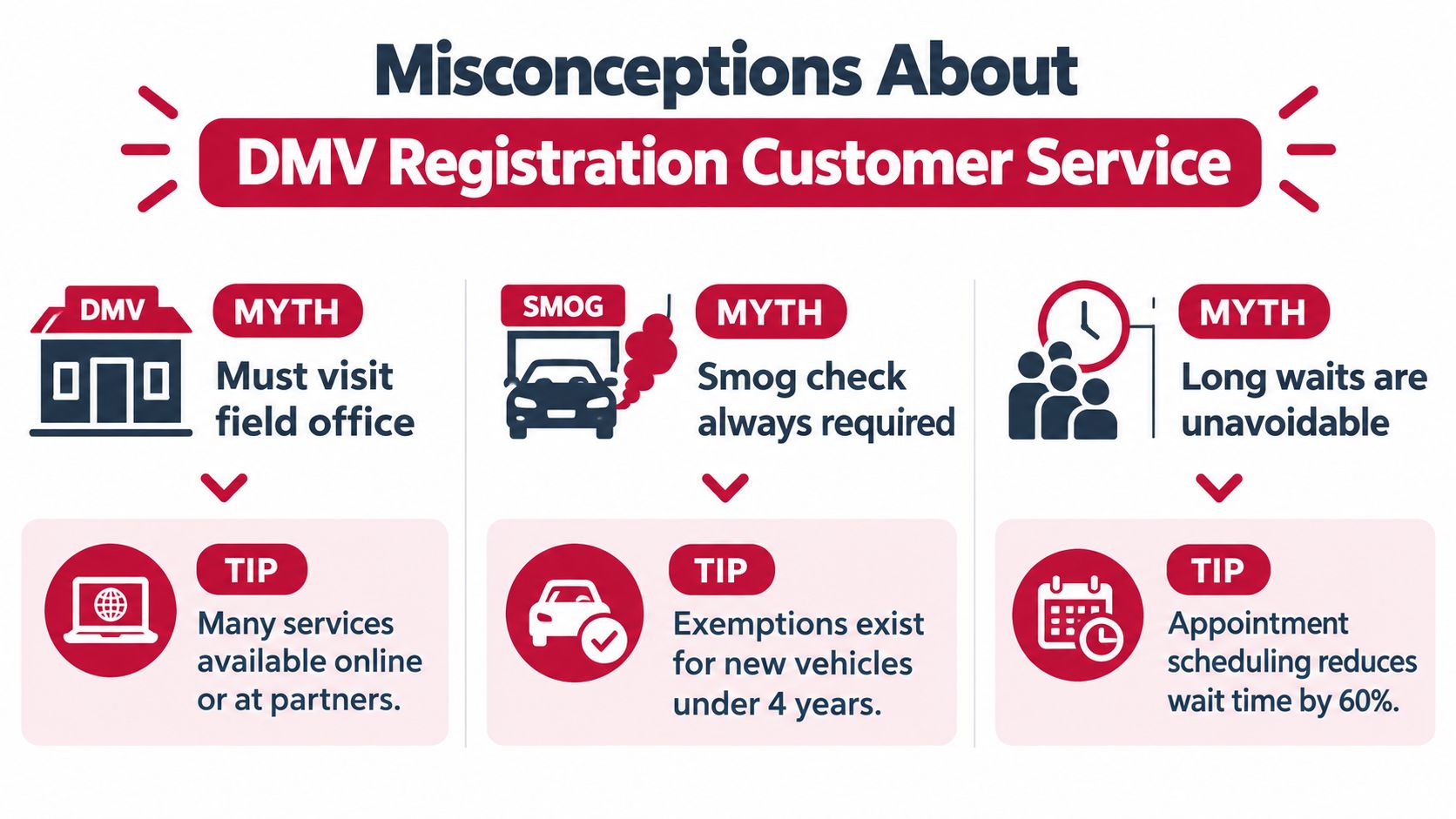
Myth one, tags always require a field office
A qualified partner may issue registration materials through approved DMV systems. Whether you receive a sticker, card, or plate depends on the transaction and the partner's authorized services. Confirm before visiting, especially if you need a particular item the same day.
Myth two, a phone agent can clear every block
A phone representative can explain what the record shows, but some problems require physical documents, an inspection, a VIN verification, or an in-person review. A title hold and a VIN discrepancy usually need evidence submitted through the appropriate channel.
Myth three, online renewal always works
Online renewal is a strong option for a clean, eligible record. It can stop when the vehicle needs a smog result, the title contains an unresolved issue, ownership information has changed, or the system requires documents that can't be verified automatically.
Two more assumptions that waste time
Late penalties are generally calculated through the registration system. A walk-in conversation doesn't automatically remove them. If you believe the amount is wrong, ask which review or correction process applies instead of assuming a clerk can delete the charge.
A “no smog due” message should also be read as a current record status, not a permanent promise. If the agency later flags a discrepancy, a qualifying certified station may need to complete the inspection and submit the result before the registration can move forward.
The fastest route isn't always the shortest line. It's the channel that can complete the blocked step.
Your Pre-Visit Checklist and When to Choose a Partner
Use this checklist before you contact DMV registration customer service:
- Confirm the transaction: Decide whether you're renewing, transferring ownership, updating information, replacing a document, or resolving a hold.
- Check the record: Review the DMV portal for a smog requirement, title issue, address problem, or payment notice.
- Gather vehicle details: Have the plate number, VIN, current odometer reading, and registration card available.
- Bring supporting documents: Include the renewal notice, title, lien release, insurance proof, identification, and any required smog information.
- Choose an accepted payment method: Don't wait until the counter to discover that your preferred method won't work.
- Save confirmation details: Keep receipts, error messages, and submission references after every contact.
A simple routing rule
Choose the DMV website for a straightforward renewal when the smog information is already on file and the record shows no hold. Use the phone line for status questions, general instructions, and address-related guidance. Choose a field office when an examiner must review a complex title, ownership dispute, VIN verification, or unusual transfer.
Choose an authorized partner when your renewal includes a smog inspection, when you need registration materials issued through an approved business channel, or when combining related steps in one visit matters more than using an online form. For Antioch-area drivers, Fire House Smog offers smog testing and on-site California DMV registration services during its posted hours, with service availability depending on the transaction and day.
California's move toward online services and partner automation shows that registration customer service is becoming a connected workflow, not just a line at a government counter. A modernization report described a major August 2024 milestone in which Rapid Registration allowed private-party, out-of-state, and new registrations to be handled entirely online for the first time, while more than two dozen services had moved online as part of the broader effort, according to coverage of modernized DMV services.
Before leaving home, ask one final question: which channel can complete every required step for this vehicle? That answer will usually save more time than choosing the location with the shortest advertised queue.
If your Antioch registration renewal also needs a smog inspection, bring your vehicle documents and payment information to Fire House Smog for STAR-certified testing and eligible on-site DMV registration services. Confirm the current hours and transaction requirements before visiting so the inspection, renewal, and registration materials can be handled through the right workflow.
1 comment
[…] Don't drive away with only verbal confirmation. Take the registration card, sticker, receipts, and any plates or transfer documents the clerk gives you. If the printed information is wrong, correct it before leaving rather than trying to untangle the record later. For help with the administrative side, see the DMV registration customer service information. […]

California Smog Check & Registration Service in One Visit said: