
The moving truck is finally unloaded. Your kitchen is still half in boxes, you're learning new roads, and somewhere between setting up utilities and changing your address, your car still has plates from your old state.
That's the part many new California residents underestimate. Out of state vehicle registration sounds simple until you run into smog rules, VIN verification, title questions, residency proof, and a DMV process that doesn't forgive missing paperwork. The difficulty isn't usually with the rule itself. Instead, it lies with the friction.
California gives you a path, but it expects you to move quickly and bring the right documents the first time. If you show up unprepared, the process turns into repeat visits, more time off work, and more confusion than it needs to be. A practical checklist helps. So does knowing what usually stalls an application before you ever stand in line. If you want a clean starting point, this vehicle registration document guide is a useful companion while you gather your packet.
Table of Contents
- Welcome to California Now About Your Car
- The Clock Is Ticking Your First 20 Days
- Gathering Your Essential Paperwork
- Navigating Smog Checks and VIN Verification
- Calculating and Paying Your Registration Fees
- Troubleshooting Common Registration Roadblocks
- Your Finish Line A Faster Path to California Plates
Welcome to California Now About Your Car
Most new residents reach the same moment. The car is sitting in the driveway with valid plates from somewhere else, so it feels like there's no rush. Then the questions start. Do you need California insurance first? Is a smog check always required? What if the title is still with the lender? Can you just wait until renewal time?
That's where people lose time. California doesn't treat out of state vehicle registration like a casual update. It treats it like a formal transfer into the state system, with its own inspection, paperwork, and fee process. The vehicle has to match California's records, California's emissions rules, and California's registration requirements before the state will finish the transfer.
What catches new residents off guard
The surprise usually isn't one big issue. It's three or four smaller ones stacked together.
- The title question: Many owners don't physically have the out-of-state title because a lienholder holds it.
- The inspection step: A vehicle can be running perfectly and still need separate California verification steps.
- The address mismatch: Insurance, ID, registration paperwork, and proof of residence need to line up cleanly.
- The truck or RV detail: Heavier vehicles often have extra paperwork that passenger-car owners never think about.
Practical rule: Don't judge your registration by whether the car drives fine. Judge it by whether your paperwork, identification details, and vehicle records match.
The smoothest registrations usually happen when the owner treats the process like a document project first and a DMV errand second. That means gathering ownership papers, confirming the vehicle's status, and handling inspections before your deadline is staring at you.
The Clock Is Ticking Your First 20 Days
California doesn't leave this open-ended. State regulations say California residents who buy a vehicle with out-of-state plates must apply for in-state registration and pay the required fees within 20 days of the purchase date, according to the California Air Resources Board background document.
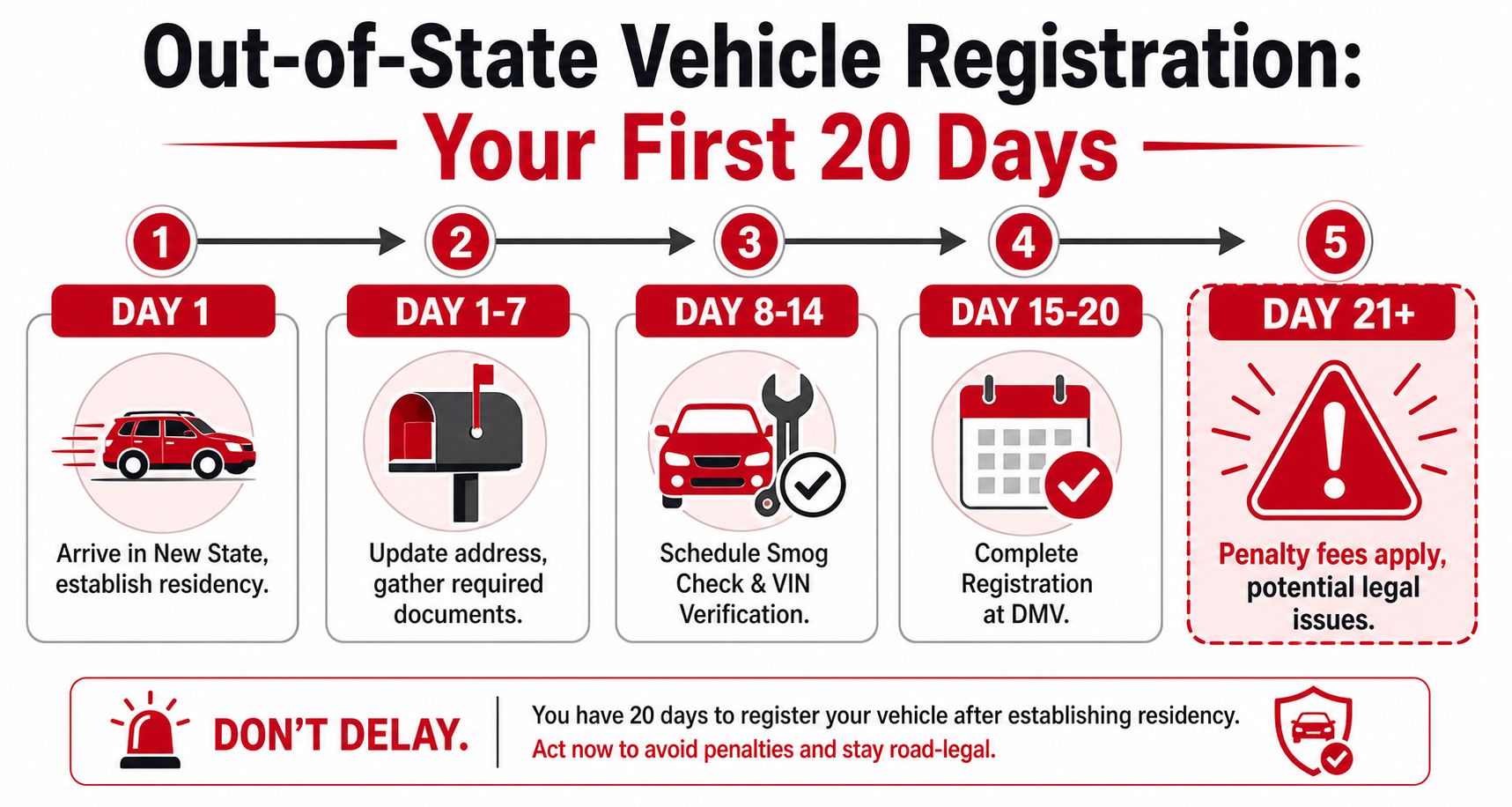
That deadline matters because people often assume they can wait until their old registration expires. California doesn't look at it that way. Once you're required to register here, delay creates risk. Even if the vehicle still looks fully legal to you, the state expects the transfer process to already be underway.
What counts as your starting point
For most new residents, the practical approach is simple. If you've moved here and are making California your home, start acting as if the clock is already running.
Waiting for the perfect moment usually creates the main problem. People postpone the process until they have a free weekday, until the lender sends paperwork, or until they decide whether they're “really settled.” By then, they're scrambling to book inspections and assemble documents under pressure.
What to do first
Handle the early steps in order so nothing bottlenecks later.
- Update your address records. Your California address needs to appear consistently across the documents you'll use.
- Locate ownership documents. If a lender holds the title, contact them immediately and ask what they require for an out-of-state transfer.
- Confirm whether the vehicle needs smog and VIN verification. In practice, it is advisable to assume both are required until verified otherwise.
- Check for truck or RV extras. Those vehicles often need a weight certificate in addition to the core registration packet.
- Book your inspection-related services early. Appointments and missing forms are what usually squeeze that 20-day window.
The deadline feels generous until you lose a week waiting on one document.
A good rule is to spend your first few days building the file, not debating the rule. Once you've got the title situation clear and the inspection steps scheduled, the rest of the process gets much easier to control.
Gathering Your Essential Paperwork
Most failed trips happen for one reason. The owner brings most of the documents, not all of them.
California wants a clean chain that proves who you are, what the vehicle is, who owns it, and where you now live. If one part of that chain is weak, the application slows down or stops. This is especially common in out of state transfers because lenders, previous state titles, and differing state forms create more room for mismatch. If you're dealing with ownership movement from another state, this out-of-state title transfer overview can help you understand the handoff.
Your core document packet
Start with ownership first. The original out-of-state title is the key document when it's available. If you still owe money on the car, the lienholder may hold it, and that changes how the transfer gets processed. Don't wait until the end to figure that out.
Next comes the application material. California typically requires a formal registration application, and the details on that form must match the vehicle and ownership records exactly. If the car is under the age threshold that triggers odometer disclosure requirements, make sure that disclosure is complete and readable. Missing odometer information is one of the recurring reasons transfers stall.
Then there's residency proof. On this point, many organized people still get tripped up because they bring documents that show activity in California but not necessarily clean proof of residence. Use current, consistent records and make sure the name and address formatting match across your packet as closely as possible.
California Out-of-State Registration Document Checklist
| Document | Purpose | Key Details |
|---|---|---|
| Out-of-state title | Proves ownership | If a lienholder holds it, contact them early for transfer instructions |
| Registration application | Starts the California record | Complete every ownership and vehicle field carefully |
| Current out-of-state registration | Helps verify existing vehicle record | Bring the latest valid card or renewal proof you have |
| California driver license or ID | Confirms identity | Name should align with title and application |
| Proof of California residency | Shows your in-state residence | Use documents with your current California address |
| Odometer disclosure | Required for certain vehicles | Especially important for vehicles under the applicable age threshold |
| Smog certificate, if required | Shows emissions compliance | Complete this before final processing if your vehicle needs it |
| VIN verification form or completed verification | Confirms vehicle identity | Must match the physical vehicle exactly |
| Weight certificate for trucks or RVs, if required | Supports classification and fees | Needed for qualifying vehicles, not standard passenger cars |
| Proof of insurance, if requested in your transaction flow | Supports registration file | Make sure the address and vehicle details are consistent |
A few practical habits make this much easier:
- Bring originals when possible: Copies help you stay organized, but originals often resolve questions on the spot.
- Check every name format: Middle initials, suffixes, and ownership wording matter more than people expect.
- Match addresses everywhere: A different apartment format or an old mailing address can slow a file down.
- Carry backup residency proof: If one document raises a question, a second one can save the trip.
If your paperwork tells three slightly different stories, the clerk has to stop and sort it out. That's when a quick visit turns into a delayed registration.
Keep the whole packet in one folder. Put ownership documents first, identity and residency documents second, then inspection records behind them. That order mirrors the way problems tend to be discovered, and it makes corrections faster if someone at the counter needs to review your file.
Navigating Smog Checks and VIN Verification
The most technical part of out of state vehicle registration in California isn't the form. It's the vehicle validation itself.
California requires a two-step technical validation for out-of-state registration that includes VIN verification by a licensed verifier and a weight certificate for trucks or RVs, with failure rates exceeding 15% because of missing odometer disclosures or mismatched VIN plates on vehicles under 20 years old, according to this out-of-state registration process analysis.
Why these two checks stop so many registrations
Owners often focus on smog because they've heard about California emissions rules for years. But VIN verification is just as important. California has to connect your paperwork to the actual vehicle in front of it. If the number on the title, the number on the registration record, and the number physically attached to the vehicle don't line up cleanly, the transfer won't move forward.
Smog has its own problem. People assume that because the car passed in another state, or because it renews fine where it came from, California will accept that history. It won't. California applies its own emissions compliance process.
A STAR-certified station matters here because California distinguishes between station types. If you're not sure what that label means, this STAR-certified smog explanation breaks down the role clearly.
What the verifier is actually checking
VIN verification is not a paperwork-only exercise. The verifier inspects the vehicle and compares the identifying number on the vehicle itself to the ownership record. On some vehicles, age, wear, prior repairs, or hard-to-read plates create avoidable delays.
Common issues include:
- Unreadable VIN plate details
- Mismatched paperwork from a previous state
- Incomplete odometer disclosure
- Weight-certificate omissions on trucks and RVs
- Assumptions that renewal rules are the same as transfer rules
That last issue is more common than people think. Owners often bring the mindset of a simple renewal into a transfer transaction, and California treats those as very different tasks.
Here's a quick visual walk-through of the general process before you arrive:
When a local DMV partner helps
This is the stage where combining services can remove a lot of friction. Instead of getting a smog inspection in one place, then chasing down verification help elsewhere, some owners use a local provider that handles both emissions testing and DMV-related registration tasks in the same workflow.
Fire House Smog is one example in Antioch. It's a STAR-certified test-only smog station and licensed DMV service provider that handles transfer-of-ownership work for California and out-of-state vehicles, with on-site sticker and plate processing as needed during posted service hours.
That matters most when your issue isn't dramatic. It's just logistical. If your paperwork is basically ready and your car needs the California compliance steps, reducing extra stops usually reduces mistakes too.
Calculating and Paying Your Registration Fees
Fees make people nervous because the bill doesn't come from one simple line item. California registration costs are a stack of charges tied to the vehicle, the transaction type, and sometimes the vehicle class.
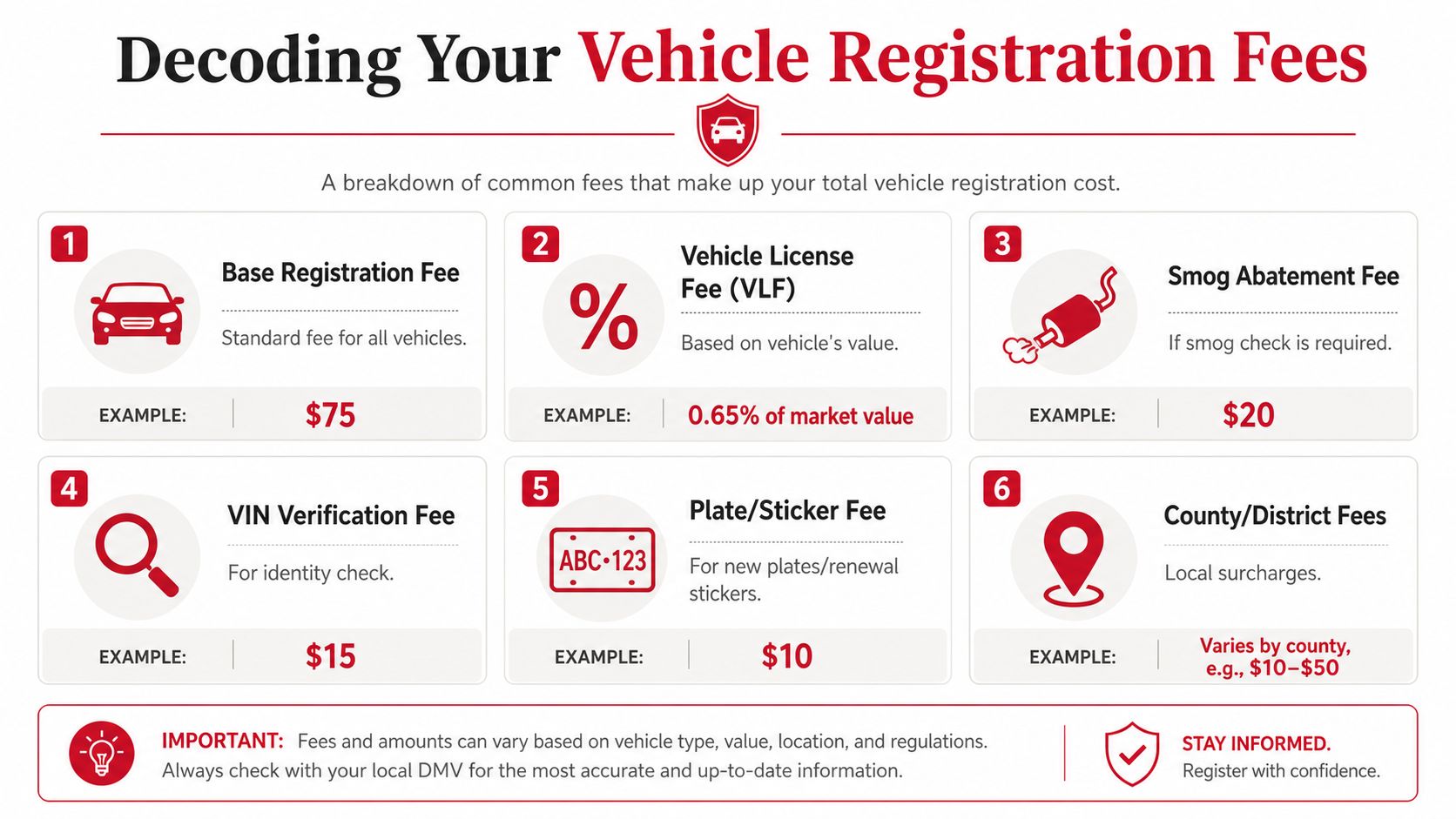
The practical mistake is expecting a neighbor's number to predict your own. Two people can move to California at the same time with completely different fee totals because their vehicles, titles, purchase histories, or classifications differ.
Why one person's bill looks nothing like another's
The final amount often reflects several moving parts, such as the basic registration charge, ownership-related charges, vehicle license components, use-tax exposure depending on the transaction, and class-specific costs for trucks or RVs. A heavier vehicle or a more complex transfer usually creates a different fee picture than a standard passenger car with clean paperwork.
That's why broad online guesses don't help much. The right way to think about fees is by category:
- Registration-related charges: The baseline cost of putting the vehicle into California's system.
- Vehicle-based charges: Some fees depend on the vehicle's classification or record details.
- Tax-related charges: Use tax can surprise people, especially after an out-of-state purchase.
- Transaction-specific add-ons: Plate, transfer, or related processing items may apply depending on the case.
If you own a truck or RV, budget extra attention rather than just extra money. Those files often involve additional classification steps before the fee side is even finalized.
Where late mistakes get expensive
California enforces this area aggressively. In one year, the California Highway Patrol collected over $1 million from 3,383 out-of-state license plate violations, with an average penalty of $297.58 per case, according to this CHP enforcement report summary.
That doesn't mean every delayed registration ends in a citation. It does mean the state treats intentional avoidance seriously, especially when a California resident appears to be using another state's plates to avoid California fees and taxes.
Don't treat fees as a reason to wait. Delay can turn one required payment into a more expensive problem.
The best financial move is usually the least dramatic one. Start early, classify the vehicle correctly, and get the documentation right before you submit. Most extra costs show up after preventable delays, not before.
Troubleshooting Common Registration Roadblocks
When registration goes sideways, it usually happens in familiar ways. The car fails smog. The title is somewhere you can't access quickly. The residency documents don't line up. Or the owner thinks living in California part-time is enough to justify using another state's registration.
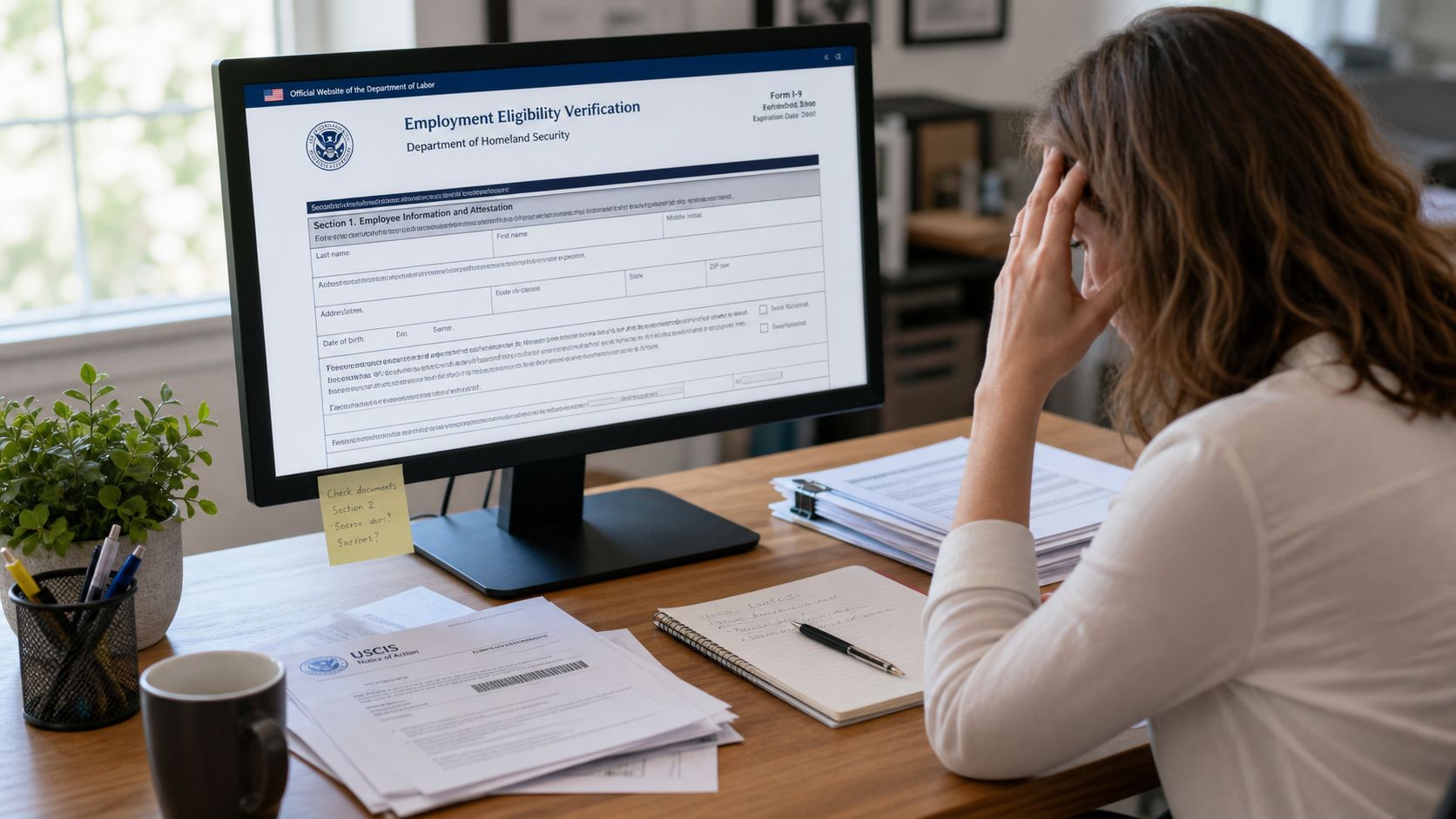
None of those issues automatically kills the process. They just require the right next move.
If your smog check doesn't pass
Don't jump straight into random repairs. First, get the failure details and understand whether the issue is emissions-related, readiness-related, or tied to a vehicle condition that needs diagnosis.
Then be methodical:
- Read the inspection result carefully: The cause matters. A failed test and an incomplete test are not the same problem.
- Fix the actual issue: Don't authorize unrelated work just because you're on a deadline.
- Retest after the repair path is clear: Some stations offer a free retest under their posted policy and coupon terms, which can reduce the hassle of repeating the process.
If your title is missing or held by a lienholder
This is common, especially for recently financed vehicles. Contact the lender immediately and ask what they need for a California transfer. Some owners assume the DMV or service provider will request it automatically. Sometimes that's part of the process, sometimes it isn't, and waiting to find out at the counter wastes time you may not have.
Have your loan account information ready before you call. Ask specifically about title release timing, transfer authorization, and whether they send the title directly or provide another ownership document for the registration file.
Residency and domicile are not the same thing
This point causes real legal trouble because people hear casual advice from friends and assume physical presence is enough. It often isn't. According to this analysis of registration rules and domicile requirements, 34 states and D.C. require domicile, meaning intent to make a place your permanent home, not just temporary presence.
That matters for California residents trying to keep another state's registration as a convenience strategy. If your registration story, insurance address, tax filings, and daily reality don't line up, you're creating a file that can look deceptive.
A weekend place, a mailing address, or a relative's home usually isn't enough if your real home life is centered in California.
When in doubt, align everything with where you live. That means your license, insurance, registration, and supporting documents should point in the same direction. Clean consistency solves more registration problems than clever workarounds ever do.
Your Finish Line A Faster Path to California Plates
The clean version of this process is straightforward. Act quickly. Build a complete paperwork packet. Handle the smog and VIN requirements early. Then finish the registration before delays create fee or compliance trouble.
What slows people down isn't usually the law. It's fragmentation. One place checks emissions. Another place handles part of the paperwork. The title issue is still unresolved. A residency document has the wrong address format. By the time all of that gets sorted, the simple transfer no longer feels simple.
That's why many new residents choose a DMV partner instead of trying to decode everything in real time at the counter. If you can work with a provider that handles registration services and the inspection side in one local stop, you reduce the number of handoffs and the number of places a mistake can hide.
You don't need a complicated strategy for out of state vehicle registration in California. You need a complete file, the right inspections, and a process that doesn't force you to start over.
If you want help getting your California registration handled with fewer moving parts, Fire House Smog in Antioch provides STAR-certified smog testing and licensed DMV registration services for renewals, ownership transfers, and out-of-state vehicle transactions, with on-site tag issuance during posted hours.