
California requires you to complete vehicle ownership-transfer paperwork within 10 days of the sale, and license plates can't be transferred separately from the vehicle's title and registration record. The plate number, VIN, registered owner, and vehicle record must move together through the California DMV process.
You may be standing beside a newly purchased car with the signed title in your hand, wondering whether you can remove your old plates and bolt them onto the replacement vehicle. That assumption causes many avoidable delays. California treats a plate transfer as an ownership and registration transaction, not a physical handoff of metal plates.
The straightforward path is manageable when you identify the plate type, confirm the smog requirement, prepare the correct forms, and submit everything on time. Special-interest, personalized, historical, exempt, missing, damaged, and out-of-state situations follow different rules, so the details matter.
Table of Contents
- Understanding California License Plate Transfers
- Documents and Forms You'll Need
- The Step-by-Step Transfer Process
- Smart Tips for a Smooth Transfer
- Special Plates Out-of-State and Dealer Transfers
- Getting Your Plates Transferred Without the Hassle
Understanding California License Plate Transfers
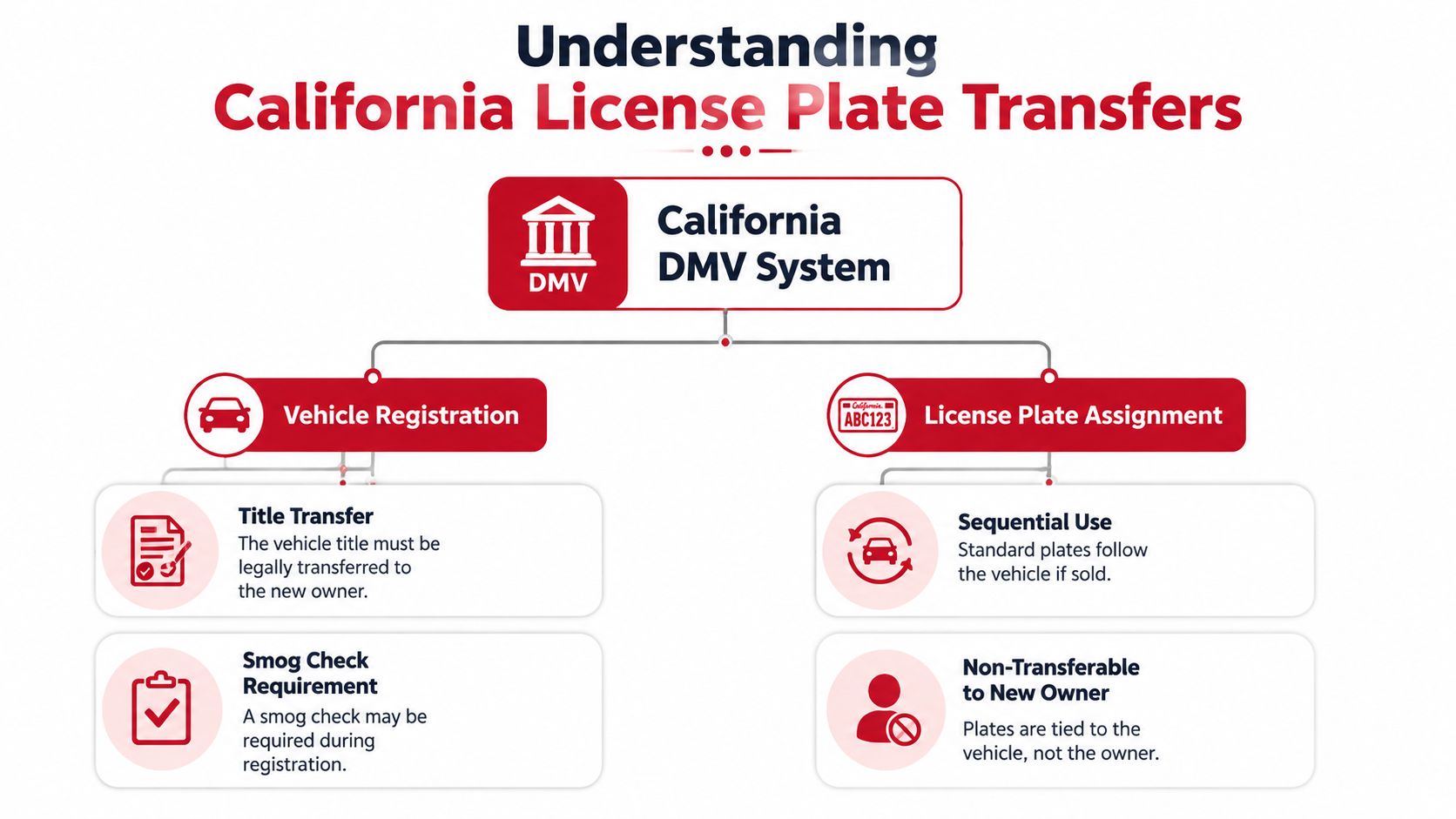
A buyer may leave the DMV with the right paperwork but still have the wrong expectation about the plates. California treats a plate transfer as part of the vehicle's ownership and registration record, not as a separate exchange of metal plates.
Ownership-transfer paperwork must be started within 10 days of the sale, and the DMV record must be updated within that same 10-day window when the registered owner or lienholder changes. The California DMV ownership-transfer rule ties the deadline to the vehicle record. Removing a plate and attaching it to another vehicle does not complete the transaction.
California connects the plate with the vehicle identification number, title chain, registration record, and registered owner. Those records establish which vehicle carries the plate and when responsibility changed. This is why a plate transfer can stall even when the physical plate is available.
Why the release of liability matters
The seller's Notice of Transfer and Release of Liability records the sale and helps prevent responsibility for the vehicle from remaining with the seller. The notice requires the new owner's name and address, plate number, last five digits of the VIN, odometer reading at the time of sale, and date of sale, as described in the California DMV transfer guidance.
Enter each field directly from the transaction documents. A wrong plate number, missing VIN digit, or buyer address that conflicts with the paperwork can trigger follow-up questions and delay completion.
Practical rule: Handle the plate as one part of the complete ownership update. Do not attach it first and plan to correct the title record later.
Standard plates versus eligible special plates
Ordinary sequential plates generally stay assigned to the vehicle. Only certain personalized environmental, special recognition, and special-interest plates may be reassigned. The California DMV's license plate guidance identifies the plate class as the first factor in deciding whether reassignment is available.
The answer therefore depends on the plate and the record behind it. Registration status, renewal fees, ownership names, and the required form can change the result. Special plates may follow a separate reassignment process, so confirm eligibility before removing anything from the vehicle.
Documents and Forms You'll Need
A plate transfer can fail even when the plate is physically correct. California ties the plate to the vehicle record, ownership information, and registration status, so assemble the ownership paperwork before addressing the plate itself.
The signed California title is the main document when it is available. If the title is missing, complete the REG 227 application for a replacement or transfer title. Buyer and seller signatures must appear where required, and the applicable transfer fee must accompany the filing. A bill of sale can document the transaction, but it does not replace the DMV's title and registration requirements.
Core paperwork at a glance
| Document | When Required | Key Information Needed |
|---|---|---|
| Signed California title | Standard ownership transfer when the title is available | Buyer and seller signatures, vehicle and ownership details |
| REG 227 application | When the title is missing | Replacement or transfer title information and required signatures |
| Notice of Transfer and Release of Liability | Seller reports the completed sale | New owner's name and address, plate number, last five VIN digits, odometer reading, and sale date |
| Smog certification or smog transfer fee | Depends on the vehicle's model year and transfer circumstances | Current certification when required, or the applicable fee for newer vehicles |
| REG 17 | Eligible special-interest plate reassignment or interchange | Current plate ownership, requested reassignment, and required signatures |
| Related special-plate forms | Certain specialty or owner-issued plate situations | Ownership proof, registration status, plate details, and fees when applicable |
Use this vehicle registration documents checklist to organize the packet before visiting a DMV office or licensed registration provider. Keep originals together, then make copies or clear scans for your records.
Match every name and address
Check the title, registration record, buyer and seller details, and submitted forms line by line. A changed name, an active lienholder, or an address that differs from DMV records can stop the transaction until the discrepancy is resolved.
The Notice of Transfer and Release of Liability requires accurate vehicle and sale information, including the plate number, identifying details, buyer information, and sale date. Submit complete information rather than expecting the DMV to correct missing fields. Enter the last five VIN digits and odometer reading directly from the transaction documents.
Special plates require their own review. Ordinary sequential plates generally remain assigned to the vehicle, while eligible personalized environmental, special recognition, and special-interest plates may be reassigned or interchanged through the appropriate process. Confirm the plate class, ownership, registration status, and required form before removing the plate. A plate transfer and an ownership transfer are related filings, but they are not always the same transaction.
The Step-by-Step Transfer Process
A plate transfer can stall even after the buyer and seller sign the paperwork. California ties the plate to the vehicle record, ownership filing, and registration status, so complete each step in order and keep proof of what was submitted.
Start with the smog decision
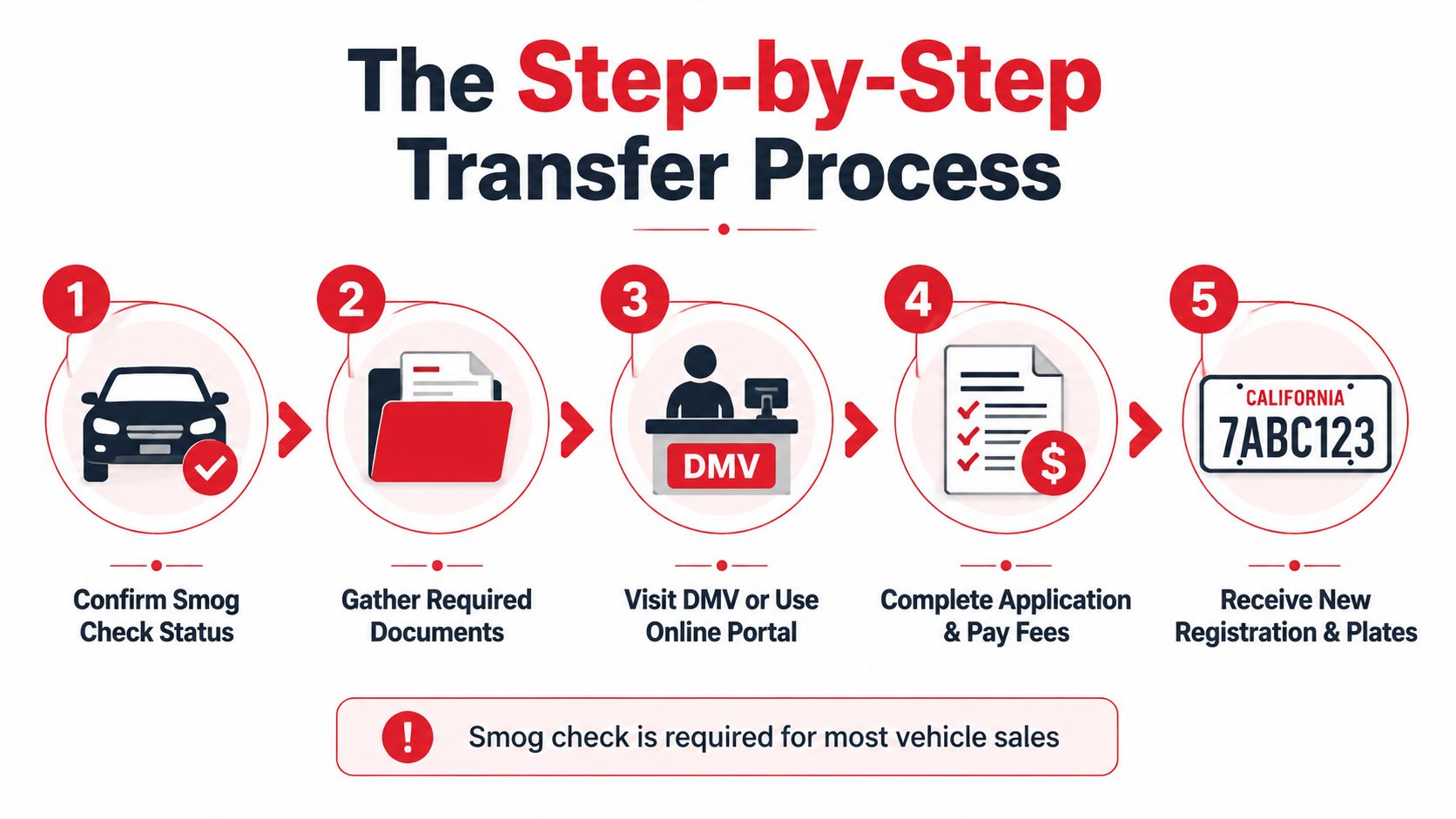
California DMV and the Bureau of Automotive Repair state that most vehicles over four model years old need a current smog certification for a change of ownership, while vehicles four model years old or newer do not need the inspection and instead require a smog transfer fee, according to the California Smog Check guidance.
Do not rely on an older inspection because it appears in the vehicle history. For a private-party sale, confirm that the certificate is valid for the ownership change and recent enough for the transaction. Exempt vehicles and special transfer situations follow different rules, so verify the applicable exception before arranging the inspection.
Gather the signed title and supporting forms
Confirm that the title contains the required buyer and seller signatures. If the title is missing, complete the replacement-or-transfer title application before submitting the ownership change. Prepare the Notice of Transfer and Release of Liability information, the smog documentation or applicable fee, and any special-plate form required for plates other than ordinary sequential stock.
Use this California title transfer paperwork guide to check the paperwork sequence before leaving home. A missing signature or incomplete field is easier to fix before the DMV visit than at the counter.
File within the statutory window
Submit the ownership transfer to the DMV or an authorized registration service within the 10-day period. Use the actual sale date and make sure the filing matches the vehicle identifiers, plate number, and ownership information. Pay the transfer and registration charges required for the transaction.
Before leaving, obtain a receipt, confirmation, or other evidence that the DMV or service provider accepted the filing. Keep it with the title records until the updated registration arrives. On-site registration services may reduce repeat visits when the packet is complete, but they still must follow the same record and plate requirements.
The following video offers a visual overview of the ownership and registration workflow:
If the DMV requests more information, respond with the same names, addresses, plate number, VIN details, and sale date used in the original filing. Consistent information helps prevent a correction from becoming a second transfer problem.
Smart Tips for a Smooth Transfer
Most stalled transfers don't fail because the owner misunderstood the fee. They stall because a document is incomplete, a plate condition doesn't match the record, or the applicant's address conflicts with the DMV file.
California's replacement-plate guidance explains that replacing plates can require surrendering the remaining plates and providing proof of identity. In some cases, a CHP vehicle verification may be required when the plates were issued within the last 90 days, and mail-in replacement requests require the registered owner to have the same address as the DMV record, according to the California DMV replacement-plate instructions.
Inspect the plates before filing
Look at both plates before you submit the transfer. If one is missing, stolen, badly damaged, or unreadable, tell the DMV or registration provider immediately instead of presenting the transaction as a normal plate movement.
Replacement and transfer are different tasks. A transfer changes the vehicle or ownership record. A replacement addresses the physical plate problem. Combining both without the required identity, surrender, or verification documents can stop the entire packet.
Treat address mismatches as a real issue
An address mismatch can affect more than where the registration card is mailed. It can prevent a mail-in replacement request, trigger a request for identity or residency information, and create confusion when the buyer's address on the Notice of Transfer differs from other documents.
Before submitting:
- Compare the address: Check the address on the title, registration record, replacement request, and release-of-liability filing.
- Confirm identity details: Use the legal names that belong to the vehicle record and transaction.
- Record the plate carefully: Recheck every character against the physical plate.
- Verify the VIN digits: The Notice of Transfer requires the last five VIN digits, not a guess based on another document.
- Separate damaged-plate work: Ask whether replacement or surrender paperwork must accompany the ownership transfer.
The fastest filing is the one that doesn't need a correction.
A licensed service provider can be useful when the transaction combines a missing title, smog requirement, replacement plate, address change, or out-of-state record. The provider can identify the form conflict before submission, but you're still responsible for supplying accurate ownership information and signing where required.
Special Plates Out-of-State and Dealer Transfers
Special plates don't follow the same path as ordinary sequential plates. California's DMV procedures distinguish special-interest plate transfers, owner-issued special plates, historical plates, and exempt-vehicle plates, and each category can impose different eligibility and surrender requirements.
For special-interest plates, both the current plate owner and the new owner generally submit REG 17. The current owner releases plate priority, while the new owner requests the plate. The California DMV special-plate transfer procedures also state that owner-issued special-plate interchange requires both vehicles to be currently registered, with renewal fees paid, and both plates eligible for reassignment.
Compare the common scenarios
| Situation | Main rule | Common extra requirement |
|---|---|---|
| Standard sequential plate | Usually remains tied to the vehicle during the ownership record update | Signed title, transfer filing, and required smog documentation |
| Special-interest or personalized plate | May be reassigned when the plate qualifies | REG 17 from the current and new owner |
| Owner-issued special plate interchange | Allowed only when both vehicles meet registration conditions | Both vehicles currently registered and renewal fees paid |
| DP, DV, CMOH, or POW plate | Ownership names may require additional proof | Statement of Facts showing the registered owner's connection to the plate |
| Historical plate on a collector vehicle | Can't be affixed before DMV approval | Surrender of prior plates if approval is granted |
| Exempt agency vehicle | Exempt plates generally must be surrendered when the vehicle leaves the exempt agency | Retention may be allowed only when moving to another exempt agency |
| Vehicle coming from another state | Requires a California registration and vehicle-record process | Plate surrender and inspection requirements depend on the transaction |
The DMV's special-plate interchange procedures also explain that eligible special plates can be reassigned or interchanged only when the vehicles are currently registered and renewal fees are paid. Some reassignment procedures state that a substitute license plate fee isn't due, although current registration fees still must be paid.
Out-of-state and dealer transactions
An out-of-state vehicle isn't a simple California plate swap. The vehicle must enter California's registration system, and the existing out-of-state plates may need to be surrendered to the California DMV. The exact inspection, title, and verification requirements depend on the vehicle and transaction, so don't assume that an out-of-state plate can be retained under California rules.
Dealer purchases often feel easier because the dealer submits much of the registration paperwork. That convenience doesn't change the underlying plate rules. Tell the dealer early that you want to retain an eligible special plate, and confirm whether the plate is being transferred, replaced, or left with the vehicle.
For a private sale, the buyer and seller usually have to coordinate signatures and disclosures themselves. A dealer may coordinate the packet, but you should still review the plate number, ownership names, address, and odometer information before signing.
Getting Your Plates Transferred Without the Hassle
A smooth transaction depends on decisions made before anyone reaches the counter. Identify the plate type first. Then verify whether the vehicle needs a current smog certification, locate the signed title or REG 227, prepare the Notice of Transfer and Release of Liability information, and check every address and VIN character.
Use this working checklist:
- Confirm the sale date: Count the filing window from the completed sale and aim to submit within the 10-day period.
- Classify the plate: Standard sequential, special-interest, personalized, historical, exempt, damaged, missing, or stolen plates don't all use the same process.
- Resolve the title: Bring the signed title, or complete the replacement-or-transfer title application if it's missing.
- Check smog status: Determine whether the vehicle falls within the smog-certification requirement or the newer-vehicle fee path.
- Prepare the liability notice: Have the buyer's name and address, plate number, last five VIN digits, odometer reading, and sale date ready.
- Submit and retain proof: Keep the receipt or confirmation until the DMV record and registration documents reflect the transaction.
A licensed DMV service provider can reduce the practical burden when you need ownership-transfer processing, registration work, smog certification, or on-site sticker and plate issuance. Fire House Smog in Antioch provides licensed DMV registration services and STAR-certified test-only smog inspections, with service hours listed as Monday through Saturday from 9:30 AM to 5:00 PM and Sunday from 12:00 PM to 4:00 PM. Availability for specific transactions can vary, so confirm the required documents before visiting.
You can skip the DMV line by using an authorized service option, but preparation still matters. No provider can correct an unsigned title, an inaccurate VIN, or an ownership detail that doesn't match the record without the proper supporting documents.
Visit Fire House Smog in Antioch for California ownership-transfer and registration assistance, including smog testing and applicable sticker or plate processing. Bring your signed title, identification, sale details, and any special-plate or replacement documents so the staff can review the transaction before submission.
The moving truck is finally unloaded. Your kitchen is still half in boxes, you're learning new roads, and somewhere between setting up utilities and changing your address, your car still has plates from your old state.
That's the part many new California residents underestimate. Out of state vehicle registration sounds simple until you run into smog rules, VIN verification, title questions, residency proof, and a DMV process that doesn't forgive missing paperwork. The difficulty isn't usually with the rule itself. Instead, it lies with the friction.
California gives you a path, but it expects you to move quickly and bring the right documents the first time. If you show up unprepared, the process turns into repeat visits, more time off work, and more confusion than it needs to be. A practical checklist helps. So does knowing what usually stalls an application before you ever stand in line. If you want a clean starting point, this vehicle registration document guide is a useful companion while you gather your packet.
Table of Contents
- Welcome to California Now About Your Car
- The Clock Is Ticking Your First 20 Days
- Gathering Your Essential Paperwork
- Navigating Smog Checks and VIN Verification
- Calculating and Paying Your Registration Fees
- Troubleshooting Common Registration Roadblocks
- Your Finish Line A Faster Path to California Plates
Welcome to California Now About Your Car
Most new residents reach the same moment. The car is sitting in the driveway with valid plates from somewhere else, so it feels like there's no rush. Then the questions start. Do you need California insurance first? Is a smog check always required? What if the title is still with the lender? Can you just wait until renewal time?
That's where people lose time. California doesn't treat out of state vehicle registration like a casual update. It treats it like a formal transfer into the state system, with its own inspection, paperwork, and fee process. The vehicle has to match California's records, California's emissions rules, and California's registration requirements before the state will finish the transfer.
What catches new residents off guard
The surprise usually isn't one big issue. It's three or four smaller ones stacked together.
- The title question: Many owners don't physically have the out-of-state title because a lienholder holds it.
- The inspection step: A vehicle can be running perfectly and still need separate California verification steps.
- The address mismatch: Insurance, ID, registration paperwork, and proof of residence need to line up cleanly.
- The truck or RV detail: Heavier vehicles often have extra paperwork that passenger-car owners never think about.
Practical rule: Don't judge your registration by whether the car drives fine. Judge it by whether your paperwork, identification details, and vehicle records match.
The smoothest registrations usually happen when the owner treats the process like a document project first and a DMV errand second. That means gathering ownership papers, confirming the vehicle's status, and handling inspections before your deadline is staring at you.
The Clock Is Ticking Your First 20 Days
California doesn't leave this open-ended. State regulations say California residents who buy a vehicle with out-of-state plates must apply for in-state registration and pay the required fees within 20 days of the purchase date, according to the California Air Resources Board background document.
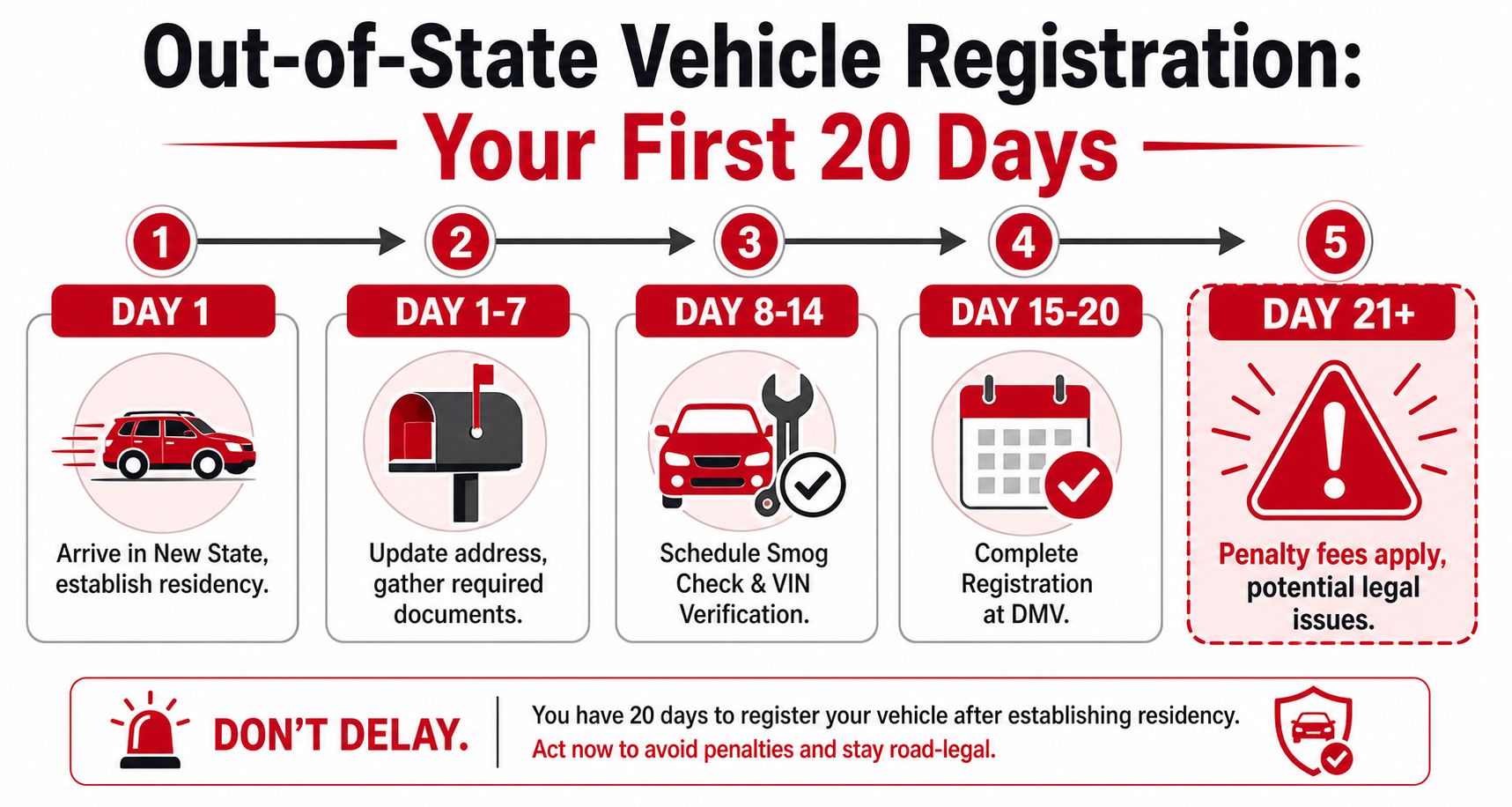
That deadline matters because people often assume they can wait until their old registration expires. California doesn't look at it that way. Once you're required to register here, delay creates risk. Even if the vehicle still looks fully legal to you, the state expects the transfer process to already be underway.
What counts as your starting point
For most new residents, the practical approach is simple. If you've moved here and are making California your home, start acting as if the clock is already running.
Waiting for the perfect moment usually creates the main problem. People postpone the process until they have a free weekday, until the lender sends paperwork, or until they decide whether they're “really settled.” By then, they're scrambling to book inspections and assemble documents under pressure.
What to do first
Handle the early steps in order so nothing bottlenecks later.
- Update your address records. Your California address needs to appear consistently across the documents you'll use.
- Locate ownership documents. If a lender holds the title, contact them immediately and ask what they require for an out-of-state transfer.
- Confirm whether the vehicle needs smog and VIN verification. In practice, it is advisable to assume both are required until verified otherwise.
- Check for truck or RV extras. Those vehicles often need a weight certificate in addition to the core registration packet.
- Book your inspection-related services early. Appointments and missing forms are what usually squeeze that 20-day window.
The deadline feels generous until you lose a week waiting on one document.
A good rule is to spend your first few days building the file, not debating the rule. Once you've got the title situation clear and the inspection steps scheduled, the rest of the process gets much easier to control.
Gathering Your Essential Paperwork
Most failed trips happen for one reason. The owner brings most of the documents, not all of them.
California wants a clean chain that proves who you are, what the vehicle is, who owns it, and where you now live. If one part of that chain is weak, the application slows down or stops. This is especially common in out of state transfers because lenders, previous state titles, and differing state forms create more room for mismatch. If you're dealing with ownership movement from another state, this out-of-state title transfer overview can help you understand the handoff.
Your core document packet
Start with ownership first. The original out-of-state title is the key document when it's available. If you still owe money on the car, the lienholder may hold it, and that changes how the transfer gets processed. Don't wait until the end to figure that out.
Next comes the application material. California typically requires a formal registration application, and the details on that form must match the vehicle and ownership records exactly. If the car is under the age threshold that triggers odometer disclosure requirements, make sure that disclosure is complete and readable. Missing odometer information is one of the recurring reasons transfers stall.
Then there's residency proof. On this point, many organized people still get tripped up because they bring documents that show activity in California but not necessarily clean proof of residence. Use current, consistent records and make sure the name and address formatting match across your packet as closely as possible.
California Out-of-State Registration Document Checklist
| Document | Purpose | Key Details |
|---|---|---|
| Out-of-state title | Proves ownership | If a lienholder holds it, contact them early for transfer instructions |
| Registration application | Starts the California record | Complete every ownership and vehicle field carefully |
| Current out-of-state registration | Helps verify existing vehicle record | Bring the latest valid card or renewal proof you have |
| California driver license or ID | Confirms identity | Name should align with title and application |
| Proof of California residency | Shows your in-state residence | Use documents with your current California address |
| Odometer disclosure | Required for certain vehicles | Especially important for vehicles under the applicable age threshold |
| Smog certificate, if required | Shows emissions compliance | Complete this before final processing if your vehicle needs it |
| VIN verification form or completed verification | Confirms vehicle identity | Must match the physical vehicle exactly |
| Weight certificate for trucks or RVs, if required | Supports classification and fees | Needed for qualifying vehicles, not standard passenger cars |
| Proof of insurance, if requested in your transaction flow | Supports registration file | Make sure the address and vehicle details are consistent |
A few practical habits make this much easier:
- Bring originals when possible: Copies help you stay organized, but originals often resolve questions on the spot.
- Check every name format: Middle initials, suffixes, and ownership wording matter more than people expect.
- Match addresses everywhere: A different apartment format or an old mailing address can slow a file down.
- Carry backup residency proof: If one document raises a question, a second one can save the trip.
If your paperwork tells three slightly different stories, the clerk has to stop and sort it out. That's when a quick visit turns into a delayed registration.
Keep the whole packet in one folder. Put ownership documents first, identity and residency documents second, then inspection records behind them. That order mirrors the way problems tend to be discovered, and it makes corrections faster if someone at the counter needs to review your file.
Navigating Smog Checks and VIN Verification
The most technical part of out of state vehicle registration in California isn't the form. It's the vehicle validation itself.
California requires a two-step technical validation for out-of-state registration that includes VIN verification by a licensed verifier and a weight certificate for trucks or RVs, with failure rates exceeding 15% because of missing odometer disclosures or mismatched VIN plates on vehicles under 20 years old, according to this out-of-state registration process analysis.
Why these two checks stop so many registrations
Owners often focus on smog because they've heard about California emissions rules for years. But VIN verification is just as important. California has to connect your paperwork to the actual vehicle in front of it. If the number on the title, the number on the registration record, and the number physically attached to the vehicle don't line up cleanly, the transfer won't move forward.
Smog has its own problem. People assume that because the car passed in another state, or because it renews fine where it came from, California will accept that history. It won't. California applies its own emissions compliance process.
A STAR-certified station matters here because California distinguishes between station types. If you're not sure what that label means, this STAR-certified smog explanation breaks down the role clearly.
What the verifier is actually checking
VIN verification is not a paperwork-only exercise. The verifier inspects the vehicle and compares the identifying number on the vehicle itself to the ownership record. On some vehicles, age, wear, prior repairs, or hard-to-read plates create avoidable delays.
Common issues include:
- Unreadable VIN plate details
- Mismatched paperwork from a previous state
- Incomplete odometer disclosure
- Weight-certificate omissions on trucks and RVs
- Assumptions that renewal rules are the same as transfer rules
That last issue is more common than people think. Owners often bring the mindset of a simple renewal into a transfer transaction, and California treats those as very different tasks.
Here's a quick visual walk-through of the general process before you arrive:
When a local DMV partner helps
This is the stage where combining services can remove a lot of friction. Instead of getting a smog inspection in one place, then chasing down verification help elsewhere, some owners use a local provider that handles both emissions testing and DMV-related registration tasks in the same workflow.
Fire House Smog is one example in Antioch. It's a STAR-certified test-only smog station and licensed DMV service provider that handles transfer-of-ownership work for California and out-of-state vehicles, with on-site sticker and plate processing as needed during posted service hours.
That matters most when your issue isn't dramatic. It's just logistical. If your paperwork is basically ready and your car needs the California compliance steps, reducing extra stops usually reduces mistakes too.
Calculating and Paying Your Registration Fees
Fees make people nervous because the bill doesn't come from one simple line item. California registration costs are a stack of charges tied to the vehicle, the transaction type, and sometimes the vehicle class.
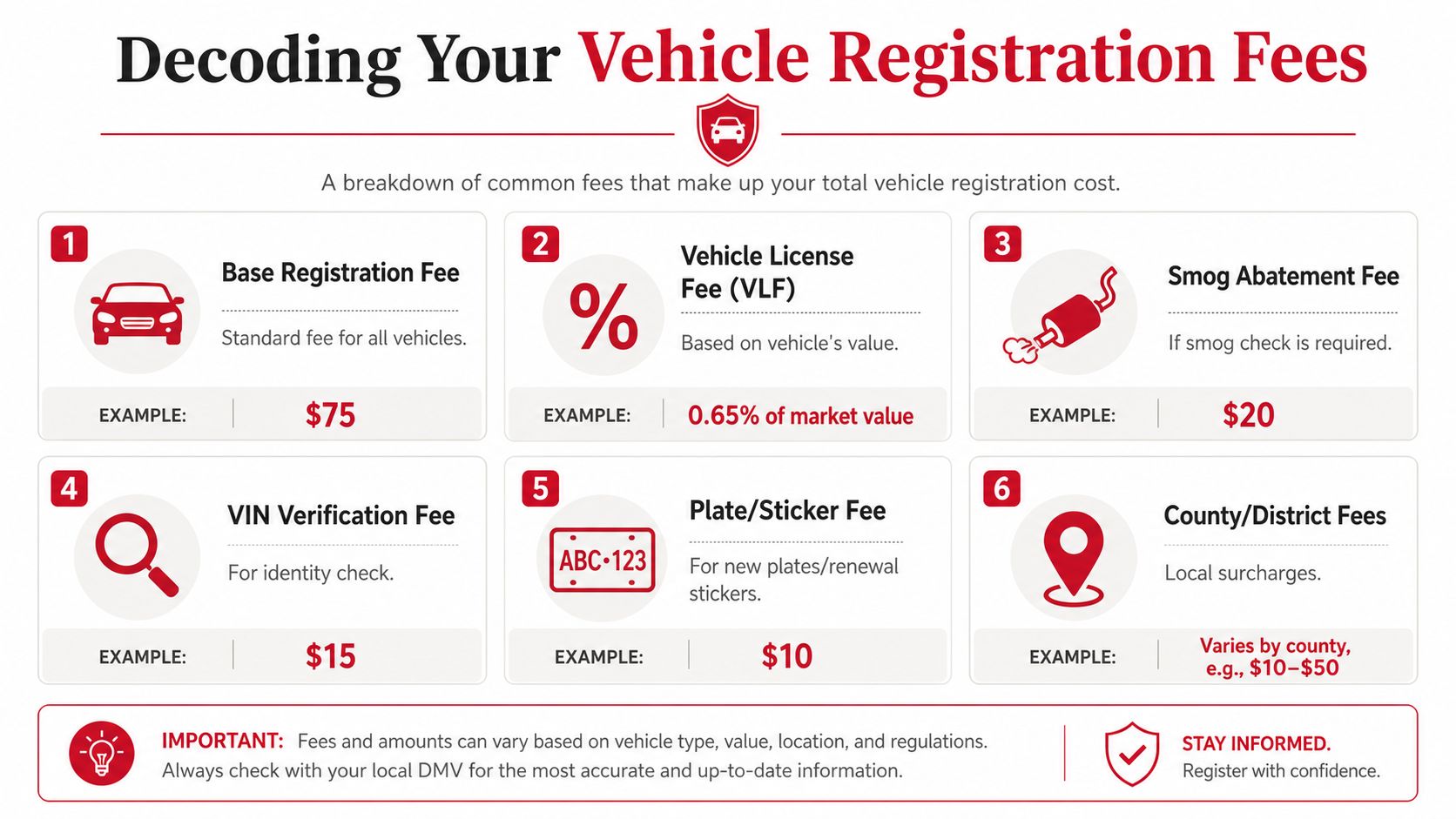
The practical mistake is expecting a neighbor's number to predict your own. Two people can move to California at the same time with completely different fee totals because their vehicles, titles, purchase histories, or classifications differ.
Why one person's bill looks nothing like another's
The final amount often reflects several moving parts, such as the basic registration charge, ownership-related charges, vehicle license components, use-tax exposure depending on the transaction, and class-specific costs for trucks or RVs. A heavier vehicle or a more complex transfer usually creates a different fee picture than a standard passenger car with clean paperwork.
That's why broad online guesses don't help much. The right way to think about fees is by category:
- Registration-related charges: The baseline cost of putting the vehicle into California's system.
- Vehicle-based charges: Some fees depend on the vehicle's classification or record details.
- Tax-related charges: Use tax can surprise people, especially after an out-of-state purchase.
- Transaction-specific add-ons: Plate, transfer, or related processing items may apply depending on the case.
If you own a truck or RV, budget extra attention rather than just extra money. Those files often involve additional classification steps before the fee side is even finalized.
Where late mistakes get expensive
California enforces this area aggressively. In one year, the California Highway Patrol collected over $1 million from 3,383 out-of-state license plate violations, with an average penalty of $297.58 per case, according to this CHP enforcement report summary.
That doesn't mean every delayed registration ends in a citation. It does mean the state treats intentional avoidance seriously, especially when a California resident appears to be using another state's plates to avoid California fees and taxes.
Don't treat fees as a reason to wait. Delay can turn one required payment into a more expensive problem.
The best financial move is usually the least dramatic one. Start early, classify the vehicle correctly, and get the documentation right before you submit. Most extra costs show up after preventable delays, not before.
Troubleshooting Common Registration Roadblocks
When registration goes sideways, it usually happens in familiar ways. The car fails smog. The title is somewhere you can't access quickly. The residency documents don't line up. Or the owner thinks living in California part-time is enough to justify using another state's registration.
None of those issues automatically kills the process. They just require the right next move.
If your smog check doesn't pass
Don't jump straight into random repairs. First, get the failure details and understand whether the issue is emissions-related, readiness-related, or tied to a vehicle condition that needs diagnosis.
Then be methodical:
- Read the inspection result carefully: The cause matters. A failed test and an incomplete test are not the same problem.
- Fix the actual issue: Don't authorize unrelated work just because you're on a deadline.
- Retest after the repair path is clear: Some stations offer a free retest under their posted policy and coupon terms, which can reduce the hassle of repeating the process.
If your title is missing or held by a lienholder
This is common, especially for recently financed vehicles. Contact the lender immediately and ask what they need for a California transfer. Some owners assume the DMV or service provider will request it automatically. Sometimes that's part of the process, sometimes it isn't, and waiting to find out at the counter wastes time you may not have.
Have your loan account information ready before you call. Ask specifically about title release timing, transfer authorization, and whether they send the title directly or provide another ownership document for the registration file.
Residency and domicile are not the same thing
This point causes real legal trouble because people hear casual advice from friends and assume physical presence is enough. It often isn't. According to this analysis of registration rules and domicile requirements, 34 states and D.C. require domicile, meaning intent to make a place your permanent home, not just temporary presence.
That matters for California residents trying to keep another state's registration as a convenience strategy. If your registration story, insurance address, tax filings, and daily reality don't line up, you're creating a file that can look deceptive.
A weekend place, a mailing address, or a relative's home usually isn't enough if your real home life is centered in California.
When in doubt, align everything with where you live. That means your license, insurance, registration, and supporting documents should point in the same direction. Clean consistency solves more registration problems than clever workarounds ever do.
Your Finish Line A Faster Path to California Plates
The clean version of this process is straightforward. Act quickly. Build a complete paperwork packet. Handle the smog and VIN requirements early. Then finish the registration before delays create fee or compliance trouble.
What slows people down isn't usually the law. It's fragmentation. One place checks emissions. Another place handles part of the paperwork. The title issue is still unresolved. A residency document has the wrong address format. By the time all of that gets sorted, the simple transfer no longer feels simple.
That's why many new residents choose a DMV partner instead of trying to decode everything in real time at the counter. If you can work with a provider that handles registration services and the inspection side in one local stop, you reduce the number of handoffs and the number of places a mistake can hide.
You don't need a complicated strategy for out of state vehicle registration in California. You need a complete file, the right inspections, and a process that doesn't force you to start over.
If you want help getting your California registration handled with fewer moving parts, Fire House Smog in Antioch provides STAR-certified smog testing and licensed DMV registration services for renewals, ownership transfers, and out-of-state vehicle transactions, with on-site tag issuance during posted hours.
Vehicle registration renewal is the mandatory annual process of updating your vehicle's legal status with the state, proving you have insurance and have met requirements like a smog check, which allows you to legally drive on public roads. In California, that process can't be completed online unless your electronic smog certification is already on file with the DMV, so the order you do things in matters.
If you're reading this because you found a DMV renewal notice on the counter, remembered your tags are about to expire, or realized you still haven't handled your smog check, you're in the same spot as a lot of busy California drivers. The process feels simple until one missing step blocks the whole thing.
That's where most confusion starts. People think renewal just means paying a bill. It doesn't. It means the state verifies that your vehicle is still properly registered, properly insured, and, when required, properly emissions-tested.
If you want to understand what vehicle registration renewal is, what California checks, and how to avoid wasted trips and long lines, this guide will walk you through it in plain language.
Table of Contents
- That DMV Notice in Your Mailbox
- Why You Must Renew Your Vehicle Registration Annually
- Your California Renewal Checklist Documents and Deadlines
- How to Renew Your Registration in California From Online to On-Site
- Understanding Renewal Costs and Late Penalties
- The Easiest Way to Renew Your Registration in Antioch
That DMV Notice in Your Mailbox
That envelope usually creates the same reaction. You glance at it, set it down, and tell yourself you'll deal with it later. Then later turns into “Do I need a smog check first?” or “Can I just pay online tonight?”
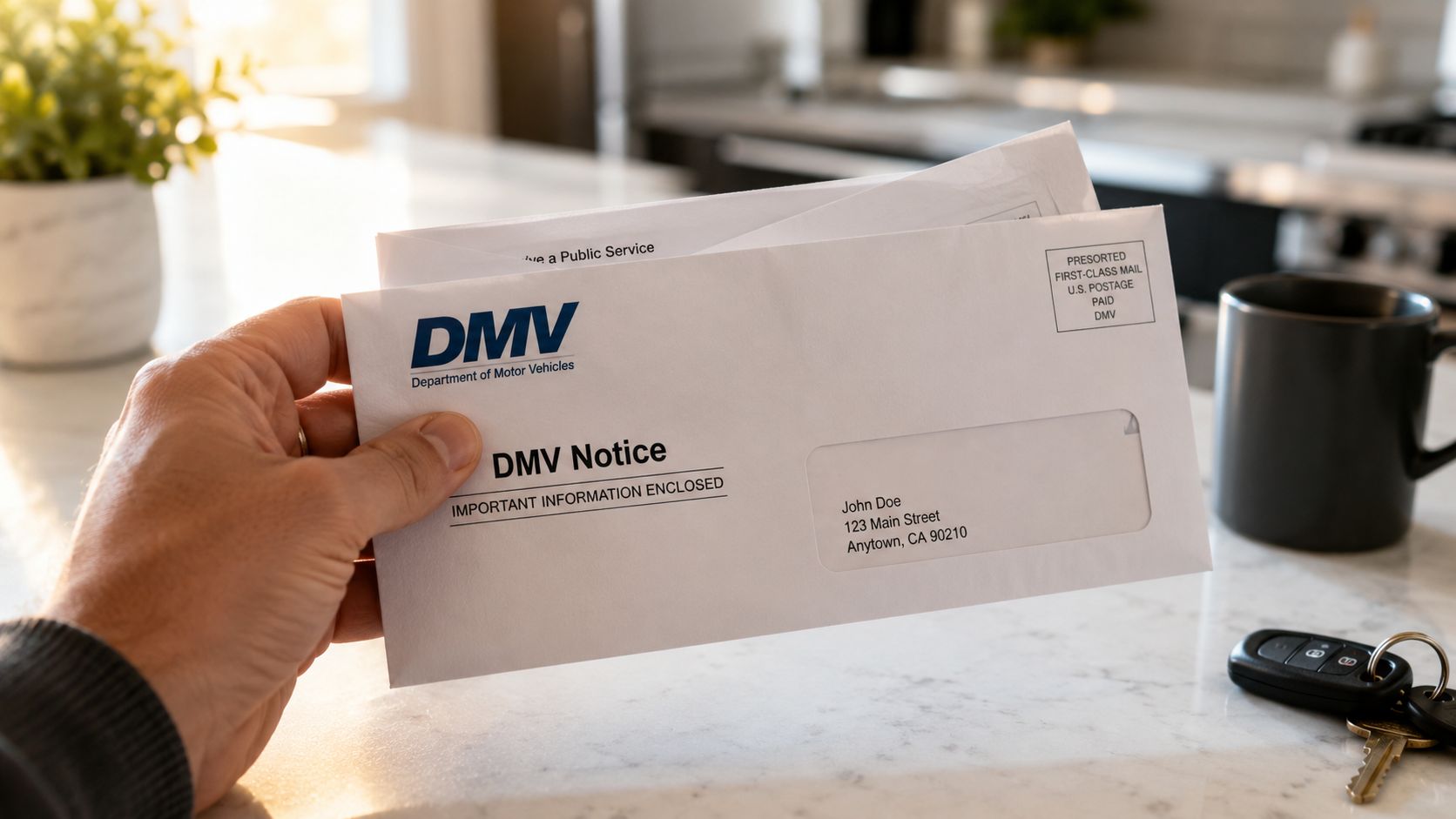
Vehicle registration renewal means renewing the state's permission for your vehicle to stay legally registered for road use. It's not the same as renewing your driver's license, and it's not just replacing a sticker.
A helpful way to think about it is this. Your license says you can drive. Your registration says this vehicle can be on public roads.
Practical rule: If your registration isn't current, paying attention to insurance alone won't fix it. The vehicle itself must be renewed with the state.
The DMV notice is really a prompt to verify three things:
- Your vehicle record is current. The state wants the registration tied to the right owner and the right vehicle details.
- Your compliance items are cleared. That can include insurance and, for many vehicles, emissions compliance.
- Your payment is submitted on time. Renewal only goes smoothly when the prerequisites are already lined up.
That's why renewal feels annoying when you're rushed. It's a chain of steps, and one missing link can stop the whole process.
Many California drivers get tripped up because they start at the payment screen. The better approach is to start with readiness. Do you have your notice or plate information? Is your insurance active? If your vehicle needs smog, has that result been sent in electronically?
Once those pieces are in place, renewal becomes routine instead of frustrating.
Why You Must Renew Your Vehicle Registration Annually
Driving on public roads comes with ongoing obligations. Registration renewal is one of them.
California doesn't treat registration as a one-time purchase that lasts forever. It works more like a recurring authorization. Each year, the state confirms that the vehicle remains properly documented and eligible to operate on shared roads.
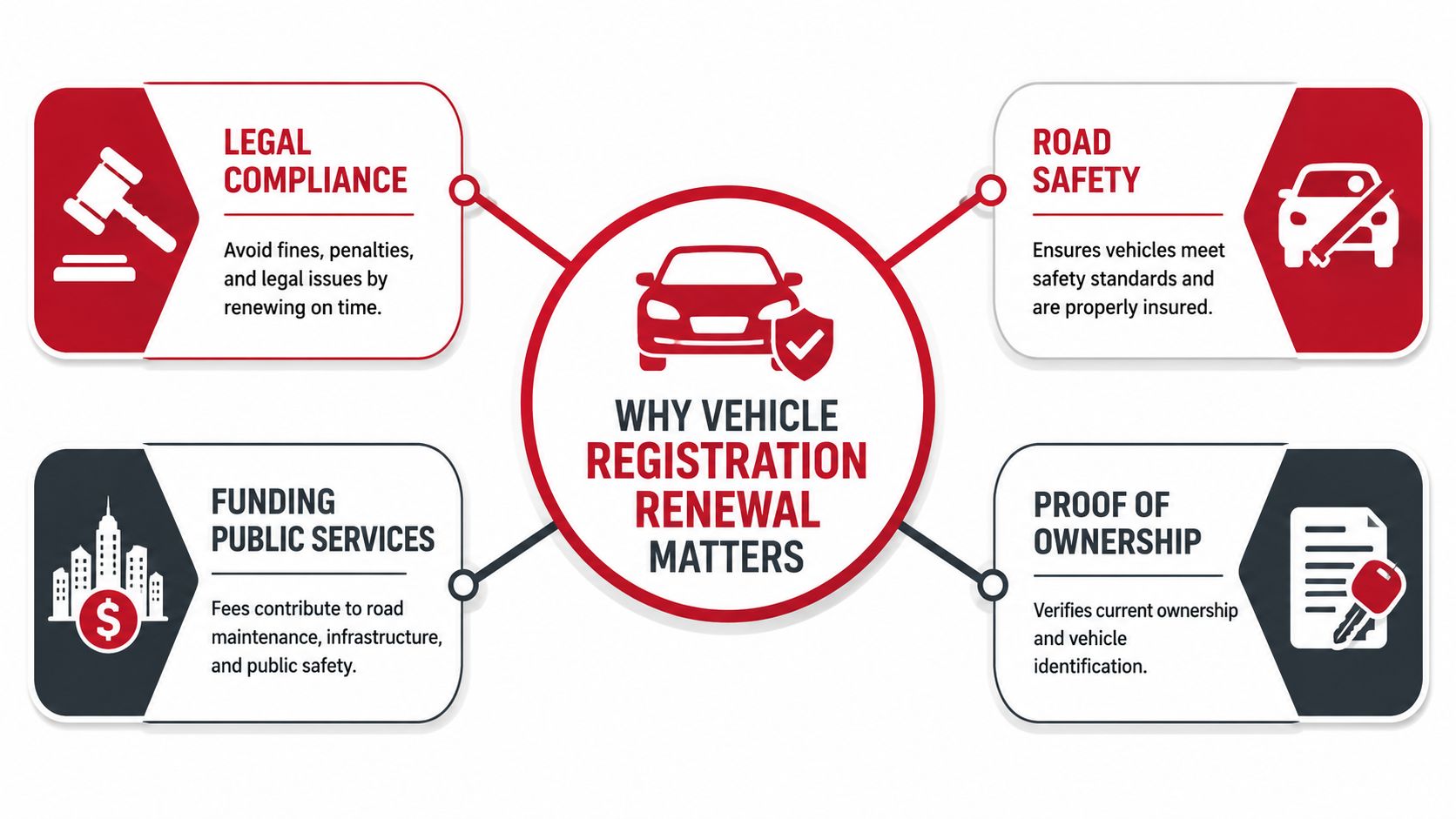
The legal reason
In the United States, renewal is an annual legal requirement. California's DMV says renewal can be denied even if fees are paid when a vehicle doesn't have valid smog certification on file or has outstanding parking tickets, and the DMV also states that electronic smog certification must already be on file before online renewal can proceed through the California vehicle registration renewal process.
That's the part many people don't expect. Payment alone doesn't solve everything. The DMV checks for compliance issues before it finishes the renewal.
The public-interest reason
Registration is also part of how the state manages safe and lawful road use. Think of it as a public-road operating agreement. You use state roads, and in return the state requires current records, valid insurance, and compliance with emissions rules where applicable.
That matters because renewal connects your vehicle to systems other agencies use too. Insurance isn't just something you keep in the glovebox. States increasingly verify it electronically, and the renewal process depends on those records matching.
Renewal isn't just paperwork. It's a state check that your vehicle still meets the conditions for legal use.
The California pain point most people hit
For many California drivers, the hardest part isn't understanding the law. It's handling the smog requirement at the right time.
Here's where people lose time:
- They try to renew online first. Then they discover the DMV has no smog result on file yet.
- They assume a paid fee guarantees completion. It doesn't if another hold is still active.
- They wait until the last minute. Then every extra errand feels urgent.
If you treat renewal like a short checklist instead of a single payment task, it gets much easier. The next step is knowing exactly what to gather before you start.
Your California Renewal Checklist Documents and Deadlines
Most renewal problems come from missing one item, not from the process being complicated. If you pull together what you need first, you can usually avoid repeat trips and stalled transactions.
What to gather before you start
Start with the basics:
- Your renewal notice, if you have it. This usually gives you the fastest path because it ties directly to your vehicle record.
- Your plate number or VIN. If the notice is missing, these details help locate the registration record.
- Current insurance information. California expects active coverage that can be matched to your vehicle record.
- Payment method. Different renewal channels may accept different forms of payment.
- Smog compliance, if required. This is often the item that decides whether you can finish today or not.
A lot of drivers ask about timing. Renewal systems around the world often use strict windows. One cited example outside California is India's 60-day pre-expiry application window for a standardized 5-year renewal duration, while some U.S. jurisdictions still rely on mailed forms and checks, such as New York's MV-3 process through a centralized center in Utica, described in this registration procedure reference. The lesson for California drivers is simple: don't assume every state handles timing and paperwork the same way.
If you want a practical list of paperwork situations, including common registration scenarios, this vehicle registration documents guide is a useful local reference.
When smog becomes the sticking point
Readers usually get confused at this point, so keep the sequence clear.
If your vehicle needs a smog check for renewal, the test must be completed first. In California, the electronic result has to reach DMV records before an online renewal can go through, as noted earlier.
That leads to a common misunderstanding: drivers often think the smog certificate is a paper they submit themselves. In practice, what matters is that the certification is transmitted and visible in the system.
If your renewal won't complete online, check the smog status before assuming the DMV website is the problem.
A few questions help you sort it out quickly:
- Does your renewal notice mention smog? If yes, handle that before trying to pay.
- Were you directed to a STAR station? If so, use the station type required by your notice.
- Did you just buy the vehicle or move to California? Ownership transfers and first-time California registration can involve separate emissions and document requirements.
- Do you have an unusual vehicle type? Some trucks, diesels, and RV-related cases can require extra verification.
Here's a simple comparison to keep straight:
| Requirement | Standard Annual Renewal | Ownership Transfer |
|---|---|---|
| Registration notice or vehicle record lookup | Usually enough to start | Transfer documents are typically needed |
| Insurance verification | Required | Required |
| Smog compliance | Often required based on DMV record | May be required depending on transaction details |
| Main goal | Extend current registration | Update legal ownership and registration record |
The takeaway is practical. Annual renewal is usually easier than a transfer, but both can stop cold if the emissions or insurance piece isn't ready.
How to Renew Your Registration in California From Online to On-Site
California gives you more than one way to renew. The right option depends on what's already done and how much time you want to spend solving problems.
The common renewal paths
Online renewal is the cleanest route when your record is already ready. It works well if your insurance is current, your smog requirement is cleared, and there are no holds that block issuance.
Mail renewal can still work for some drivers, but it's slower and less forgiving when something is missing. If you're close to expiration, mail can feel uncertain because you're waiting on processing instead of resolving issues in real time.
DMV field office service gives you face-to-face help, which is useful when the case is messy. It's also the option many people dread because it can take longer and usually requires more time carved out of your day.
Here's a quick comparison:
- Online
- Best for: Clean records and completed smog compliance
- Main drawback: You may only discover a hold after starting
- Mail
- Best for: Drivers who plan early and don't need immediate resolution
- Main drawback: Harder to correct issues quickly
- In person at a DMV office
- Best for: Complicated cases that need review
- Main drawback: More waiting and more schedule disruption
When one-stop service makes sense
For a lot of Antioch-area drivers, the biggest delay isn't the payment itself. It's having to do the smog check in one place and then solve the registration somewhere else.
That's why some people use a licensed DMV business partner that can handle both. One local option is DMV registration services near Antioch, where Fire House Smog provides STAR-certified test-only smog checks and on-site California DMV renewal services during posted service hours.
The practical benefit is straightforward. If your renewal depends on smog, combining those tasks can reduce extra stops and cut down on back-and-forth.
A short look at the process helps:
- Bring your renewal information.
- Complete the smog check if your notice requires it.
- Confirm the record is ready for DMV processing.
- Finish the registration transaction on site if eligible.
- Leave with updated documentation and tag issuance when available.
If you want to see how that service setup looks before visiting, this short video gives context:
For busy drivers, the main advantage is not having to guess which step comes first.
Understanding Renewal Costs and Late Penalties
Registration notices often look more complicated than they really are. You'll usually see several line items rather than one simple total.
What you're paying for
The exact amount on your notice can vary, but the structure usually reflects the state's registration-related charges and other required fees tied to that vehicle record. What matters most for most drivers is not memorizing every line item. It's understanding that the notice total is the amount tied to your vehicle's current renewal status.
If anything on the record is unresolved, the transaction may not process cleanly even when you're ready to pay.
For drivers trying to understand the line items before they head out, this registration renewal fee explainer can help decode what you're seeing on the notice.
Why waiting gets expensive fast
Late renewal matters because penalties don't stay theoretical. Other jurisdictions show the same pattern clearly. In the Dominican Republic, over 360,000 vehicles missed the registration sticker renewal deadline, and surcharges ranged from RD$2,000 for a single-year lapse to RD$3,100 for multi-year non-renewals, according to this report on missed vehicle renewals and surcharges.
California has its own penalty structure, and the practical lesson is the same. Once a registration goes late, the problem usually gets more expensive and more annoying, not less.
Paying attention before expiration is almost always easier than sorting out penalties, missing paperwork, and blocked records after the fact.
The most expensive delay is often the one caused by procrastination mixed with confusion. A driver waits because they think renewal is just a payment. Then they learn a required smog test or another hold still has to be cleared first.
The Easiest Way to Renew Your Registration in Antioch
If your goal is simple, get legal, avoid lines, and move on with your day, the easiest path is usually the one that removes extra stops.
Who this helps most
This works especially well for:
- Commuters with tight schedules. You don't want to spend a workday chasing separate errands.
- Families with more than one vehicle. Repeating the process across multiple cars gets old fast.
- Drivers who need smog and renewal together. That combination is where most time gets lost.
- Owners of cars, light trucks, and some RVs. A station that handles more than one vehicle type can simplify planning.
Fire House Smog is a STAR-certified test-only smog station and licensed DMV registration services provider at 2900 Lone Tree Way, Antioch, CA 94509. It offers smog testing seven days a week, has two service bays, and provides DMV service hours Monday through Saturday 9:30 AM to 5:00 PM and Sunday 12:00 PM to 4:00 PM, with 925-754-1600 for questions.
Local details you can use
The test-only model matters for some drivers because the station isn't selling repairs. That can make the visit feel more straightforward when all you need is emissions testing and registration help.
On-site DMV renewal service also matters because it addresses the most common Antioch-area pain point: people don't want one trip for smog and another for registration if both are part of the same task.
If you call ahead, you can also ask whether your vehicle type, especially if it's larger or RV-related, fits the service setup for that day. That small step can save you a wasted drive.
The core idea is simple. What is vehicle registration renewal? It's an annual legal requirement. But in practice, it goes fastest when the insurance, smog, and registration pieces are handled in the right order and, if possible, in one place.
If you want a faster local option for smog checks and California DMV renewals, Fire House Smog in Antioch handles STAR-certified smog testing and on-site registration services during posted hours, so you can clear the requirements and finish the process with fewer stops.
Your registration renewal notice shows up, and one line jumps off the page: you need a smog check. For a lot of Antioch drivers, that's the moment the questions start. Why this year? What exactly are they checking? Is a newer emissions rule going to cause trouble for the car you already own?
The easiest way to think about vehicle emissions standards is this: they're the air-quality rules your car has to meet so it can stay on the road legally. They may sound abstract, but they show up in a very concrete place. The smog station bay, the DMV renewal process, and that dashboard warning light you were hoping would go away on its own.
This guide is for the local driver who wants the policy translated into plain language. If you're trying to line up an Antioch smog check appointment, it helps to understand what the rules are really doing, how California fits into the bigger picture, and what your next step should be before you pull in for a test.
Table of Contents
- Your Guide to Navigating Smog Check Requirements
- What Are Vehicle Emissions Standards
- Federal vs California Standards Why the Rules Differ
- How Standards Impact Your Vehicle and Smog Test
- Passing Your Smog Check and What to Do If You Fail
- Compliance Made Easy in Antioch
Your Guide to Navigating Smog Check Requirements
A smog check can feel like a bureaucratic chore until you connect it to its real job. It's a screening process that helps keep higher-polluting vehicles from adding more exhaust to the air people breathe every day. In that sense, it works a lot like a routine health check. You may feel fine driving the car, but the test can catch a problem your nose, ears, and eyes won't detect.
That bigger purpose isn't just local. Over 70% of all light vehicles sold globally today are subject to mandatory vehicle emissions standards, and major markets such as the United States, Japan, and China helped establish the basic frameworks many countries now follow, according to the Climate Change Authority review of international vehicle emissions standards. So when you get a renewal notice in Antioch, you're dealing with a local requirement that sits inside a much larger shift toward tighter emissions control.
Why your smog check matters beyond registration
The test isn't only about paperwork. It's about confirming that your car's emissions system is still doing what it was designed to do. Parts like the catalytic converter, oxygen sensors, evaporative controls, and onboard computer all play a role.
If one of those systems stops working properly, your vehicle may still drive normally for a while. But it can release more pollution than the rules allow.
Practical rule: A smog check isn't a punishment for owning an older car. It's a compliance check to make sure the emissions equipment on that car is still working the way the law expects.
What drivers usually want to know first
Most questions fall into a few buckets:
- Why am I required this year: Registration cycles, vehicle type, and California program rules determine when testing applies.
- What are they checking: The vehicle's emissions-related systems, including electronic readiness and fault reporting.
- Will a new rule affect my current car: New sales rules and ownership rules are not the same thing.
- What happens if I fail: You'll need diagnosis and repair before retesting.
Those questions are normal. The confusion usually comes from hearing a federal headline, a California headline, and a DMV notice, then trying to figure out how they connect to one car in one driveway.
What Are Vehicle Emissions Standards
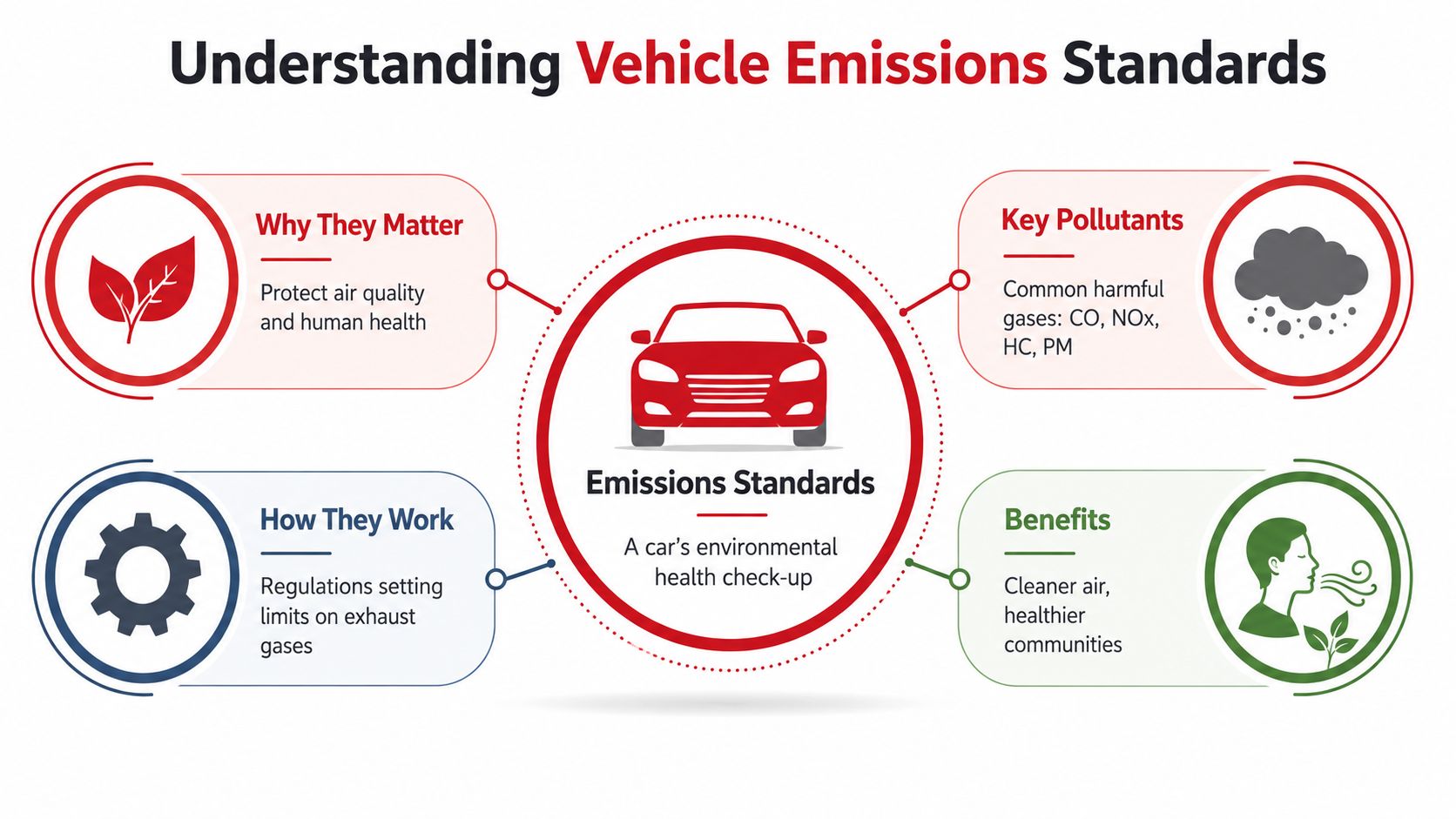
Vehicle emissions standards are legal limits on how much pollution a vehicle may emit. These standards tell manufacturers how clean a vehicle must be, and they give states a framework for checking whether vehicles on the road are still operating as intended.
Think of standards as limits on what comes out of the tailpipe
A useful way to picture it is as an environmental report card for your car. The rules focus on pollutants that affect air quality and health, including carbon monoxide (CO), nitrogen oxides (NOx), hydrocarbons (HC), and particulate matter (PM). You don't need to memorize every acronym. What matters is that these are the byproducts regulators try to reduce because they contribute to smog and dirtier air.
The scale helps explain why the rules exist. A typical passenger vehicle emits about 4.6 metric tons of carbon dioxide per year, each gallon of gasoline produces 8,887 grams of CO2, and light-duty vehicles account for 57% of U.S. transportation-sector greenhouse gas emissions, according to the EESI fact sheet on vehicle efficiency and emissions standards.
That doesn't mean your smog check is measuring every emissions issue in the same way. It does mean the vehicle category most Antioch residents drive has a large impact, which is why regulators pay so much attention to it.
Why this matters to an everyday driver
If you're standing at a smog counter, the policy debate can feel far away. But the practical takeaway is simple. Your car has emissions-control hardware and software. The standards are the rules. The smog check is one way the state verifies that your car still fits within that system.
Here's the plain-language version of the main pollutants:
| Pollutant | What it means in plain English | Why drivers should care |
|---|---|---|
| CO | Gas produced by incomplete combustion | Higher levels can point to poor combustion or control-system problems |
| NOx | Compounds formed under high heat in the engine | A major contributor to smog formation |
| HC | Unburned fuel vapors | Often signals fuel or ignition issues |
| PM | Very small particles in exhaust | Important in modern emissions control, especially under stricter rules |
Cleaner-running emissions systems usually mean fewer surprises at test time. A glowing Check Engine light often means the car already knows something is wrong.
Federal vs California Standards Why the Rules Differ
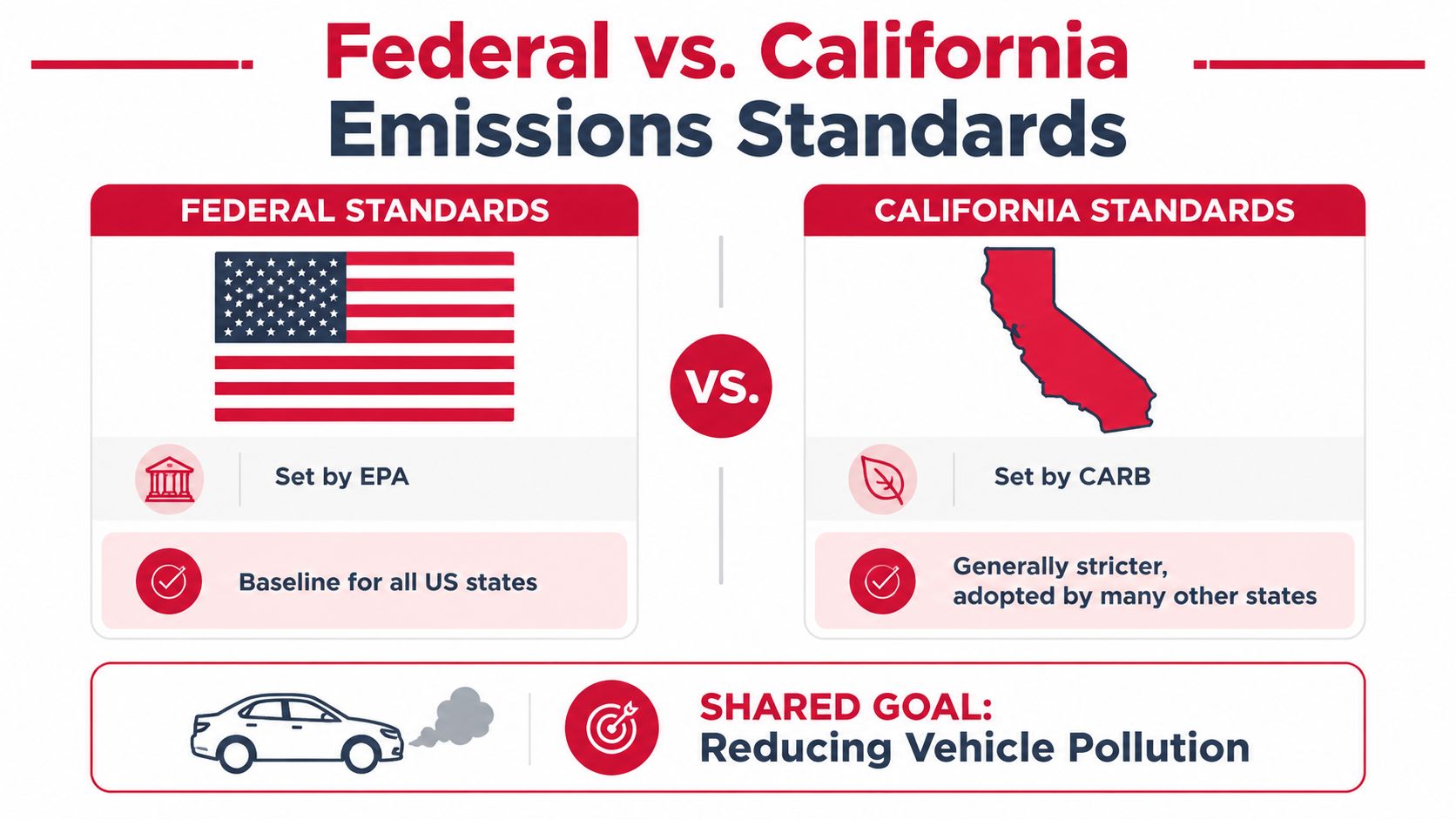
Drivers hear about EPA rules on the news, then run into California smog requirements at registration time. That can make it sound like there are competing systems. There are really two connected layers. A federal baseline and California's separate authority to set stricter rules in some areas.
Two rulebooks, one vehicle market
At the federal level, the Environmental Protection Agency sets national emissions standards. Those rules apply across the country and shape how automakers design vehicles for the U.S. market.
California operates differently because the Clean Air Act gives the state a unique waiver to set stricter vehicle emissions standards due to its “compelling and extraordinary” circumstances, and that waiver also allows other states to adopt California's rules, including rules tied to 100% zero-emission new passenger vehicle sales by 2035, as explained in the analysis of California's vehicle emissions waiver and related legal questions.
That's why California's rules aren't just a local preference. They come from a specific legal path built into federal law.
What that means when your car gets tested
For a driver in Antioch, the legal structure matters because it affects what kinds of vehicles are certified for sale here and how emissions compliance gets enforced over time. California has long pushed stricter controls, and that pressure shows up in the design of modern emissions systems, onboard diagnostics, and inspection programs.
The practical side looks like this:
- Manufacturers build to standards: They design vehicles to meet federal requirements, California requirements, or both depending on certification.
- States enforce road-use compliance: California uses inspections and registration rules to verify that emissions-related systems remain functional.
- Drivers deal with the result at renewal time: That's when abstract policy turns into a smog test notice.
The rule that affects a new vehicle at the dealership isn't always the same rule that affects your current vehicle at registration. That distinction clears up a lot of confusion.
A second source of confusion is the idea that if California adopts stricter future standards, your current gasoline or diesel vehicle will suddenly become illegal. That isn't how these standards work in practice. The standards for new vehicle sales influence what gets sold and how it gets engineered. Your smog check focuses on whether your specific registered vehicle still complies with the requirements that apply to it.
That's also why the car's electronics matter so much. The onboard system tracks emissions-related faults and readiness. In modern testing, that electronic self-reporting becomes a big part of the inspection.
How Standards Impact Your Vehicle and Smog Test
When drivers hear “vehicle emissions standards,” many picture lawmakers and automakers arguing over future cars. But your everyday encounter with those standards is much simpler. It happens when your car reports its own emissions health during a smog inspection.
What happens when you pull into the bay
For many vehicles, the heart of the process is the OBD-II system, short for onboard diagnostics. Think of it as the vehicle's internal watchdog. It monitors emissions-related components, stores trouble codes when it detects a problem, and tracks whether key systems have completed their self-checks.
So if you drive into a station in Antioch for testing, the process usually starts with basic vehicle identification and then moves to the inspection itself. The testing equipment reads what the car's computer has recorded. If the system sees an active fault, incomplete readiness information, or another emissions-related issue, that can affect the result.
Here's how that feels from the driver's seat:
- You arrive with a renewal notice or registration need.
- The technician checks the vehicle details to make sure the correct test applies.
- The inspection equipment communicates with the vehicle through the diagnostic system.
- The system reports status information about emissions-related monitors and faults.
- You get a pass or fail result based on what the program requires for that vehicle.
A lot of people also hear terms like STAR-certified and aren't sure what that means. In plain English, it means the station meets state program requirements for certain inspections. If your DMV notice says you need a STAR station, that isn't a suggestion. It's part of the testing requirement tied to your vehicle record.
The fear most drivers have, and the answer
The biggest anxiety point is usually this: if rules are getting stricter, will the state eventually force me to get rid of the car I already own?
The answer is no. None of the EPA or California standards require owners to give up existing vehicles, and used cars remain legal indefinitely. The stricter standards, including the 2027 to 2032 EPA rule, apply to the sale of new vehicles, according to the EPA announcement on final pollution standards for cars.
That distinction matters. A new-vehicle standard affects what automakers sell. A smog inspection affects whether your current vehicle is still operating legally within the inspection system.
If your current vehicle is registered properly and can meet the applicable inspection requirements, a future new-car rule doesn't automatically push it off the road.
Where drivers still get tripped up is assuming “legal to own” and “ready to pass smog” mean the same thing. They don't. A vehicle can remain legal to own, but still fail a required inspection if the emissions system has a fault. That's why maintenance matters. Not because the rules are trying to retire your car, but because the systems on the car still have to work.
Passing Your Smog Check and What to Do If You Fail
The best smog check strategy is boring. Show up with a vehicle that's fully warmed up, no warning lights on, and no unresolved emissions problems. Most headaches start when drivers rush in right after a battery disconnect, ignore a Check Engine light, or test a car that hasn't been driven enough to complete its self-checks.
A simple pre-test checklist
Before your appointment, focus on a few practical basics:
- Drive the car first: A warmed-up engine and emissions system usually give the test the conditions it expects.
- Check the dashboard: If the Check Engine light is on, deal with that before testing.
- Avoid testing right after repairs that reset monitors: If the battery was disconnected or codes were cleared, the car may need more driving before the system reports ready.
- Handle obvious maintenance issues: Poor running condition, fuel-system issues, or exhaust leaks can cause trouble.
- Bring your paperwork: Your renewal notice or registration information can help the station confirm what test is needed.
One local option for a test-only inspection is the Fire House Smog test-only discount center, which handles smog testing without doing in-house repair sales. For drivers who worry about being sold repair work at the same counter where they're tested, that model can make the process feel more straightforward.
If you pass
Passing is the easy path. The certificate is typically transmitted electronically, and then you move on to finish the registration step required for your renewal.
That's why a clean pass often feels anticlimactic. You arrive, the system checks out, the record goes through, and you're done.
To see the inspection process in action, this overview helps:
If you fail
A failed smog check doesn't always mean a major repair bill. It means the inspection found an emissions-related problem that has to be diagnosed and corrected before the vehicle can pass.
Use this sequence:
- Read the failure information carefully: The reason matters. A trouble code problem and an incomplete readiness problem aren't the same thing.
- Get the car diagnosed by a repair shop: A test-only station inspects. It doesn't repair.
- Complete the needed repair work: The goal is to fix the cause, not just clear the light.
- Return for retesting: If the station offers a retest policy or coupon, ask how it applies.
Don't guess at a fix after a fail. Let a repair technician identify the actual emissions fault, then come back once the system is ready for retest.
Compliance Made Easy in Antioch
Most drivers don't struggle with the idea of clean air. They struggle with the logistics. Finding time after work. Sorting out whether the DMV needs a test, a renewal, or both. Wondering if a failed test will turn into a sales pitch for repairs. Standing in one line for a smog certificate and another line for registration.
Why the policy side still matters locally
Federal and California rules shape the vehicle market, but individual drivers still interact with the system through periodic inspections and registration compliance. That connection is why policy isn't just background noise. It reaches all the way down to what happens when your renewal date approaches.
For example, the 2021 EPA final rule set an industry-wide target for light trucks at 161 grams of CO₂ per mile by 2026 and projected a fleetwide average of 49 mpg. These performance-based standards are met by manufacturers, not individual drivers, according to the Center for Climate and Energy Solutions summary of transportation carbon regulations. For local drivers, the key takeaway is the second half of that idea. Automakers meet the sales standards. Drivers still need inspections on existing vehicles because road-level compliance depends on whether emissions systems keep working over time.
That's why your renewal process can feel disconnected from the headline you heard about new-car rules. They are related, but they operate at different points in the system.
What solves the real-world hassle
The practical solution is usually less about learning every legal detail and more about choosing a setup that removes friction. In Antioch, that means looking for a station that can handle the inspection efficiently and help with the registration side when possible.
A few details make a meaningful difference for busy drivers:
- Test-only service: If a station doesn't sell repairs, there's less concern about a conflict between diagnosis and repair revenue.
- STAR-certified inspections: That matters when your notice specifically requires a STAR station.
- On-site DMV help: A location that can also process California DMV registration renewal services can reduce the back-and-forth many drivers dislike.
- Two service bays: More than one bay can help keep the flow moving when several cars arrive around the same time.
- Seven-day smog availability and extended hours: That matters if your work schedule makes weekday daytime errands difficult.
- Free retest policy, where applicable: If your vehicle needs another inspection after repairs, knowing the retest terms up front helps.
Here's a useful way to compare your options locally:
| What you need | Why it matters | What to ask before you go |
|---|---|---|
| STAR testing | Some DMV notices require it | “Does my notice require a STAR station?” |
| Test-only inspection | Helps avoid repair upselling concerns | “Do you perform repairs on-site?” |
| DMV transaction support | Saves a second trip | “Can you process renewal and print tags?” |
| Flexible hours | Makes compliance easier around work | “Are you open evenings or weekends?” |
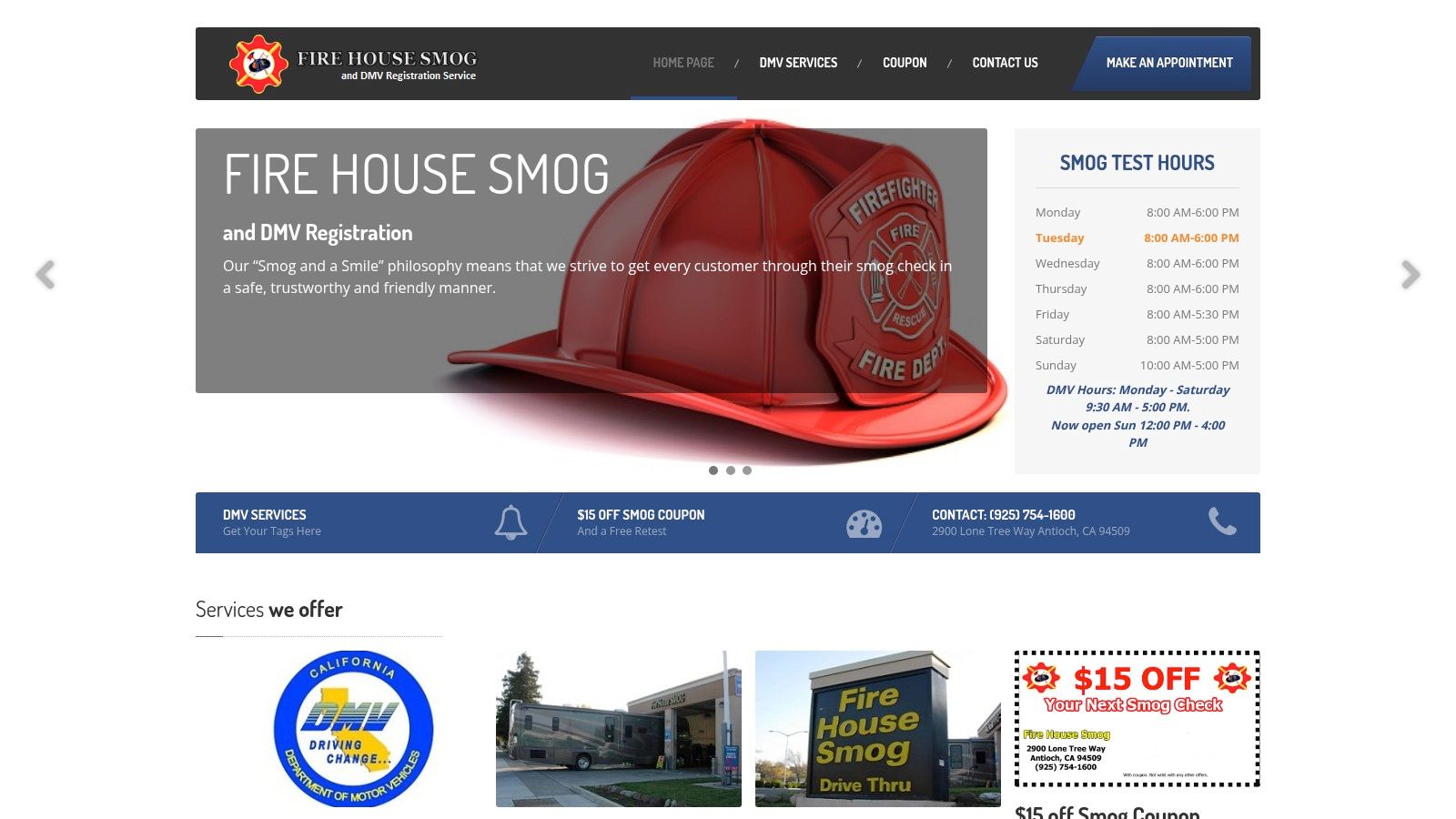
For Antioch drivers, Fire House Smog fits that practical model. It's a STAR-certified test-only smog station and licensed DMV registration services provider at 2900 Lone Tree Way in Antioch, with two service bays, smog testing seven days a week, and on-site DMV services during posted hours, including renewals and ownership transfers. Those features directly address the most common local pain points: time, uncertainty, and the desire to separate testing from repair sales.
A smooth smog visit usually comes down to three things. Bring the right vehicle at the right time, make sure the car is actually ready, and choose a station whose process matches what your DMV notice requires.
If your renewal is coming up, the smartest move is to handle it before it becomes urgent. Check your notice, confirm whether you need a STAR inspection, make sure your dashboard is clear of warning lights, and plan the visit when you can complete the process without rushing.
If you need a smog inspection or want to handle registration in the same stop, Fire House Smog offers STAR-certified test-only smog checks and on-site DMV services in Antioch. Call ahead if you have questions about your vehicle type, a recent failed test, or whether your renewal paperwork requires a STAR station.
That DMV renewal notice lands in the mail, and the first thought for most Pittsburg drivers is the same. How fast can I get this done without wasting half a day or failing for something avoidable?
For a smog check in Pittsburg, CA, the hardest part usually isn't the test itself. It's choosing the right station, figuring out whether your notice requires STAR, and avoiding the small mistakes that turn a routine visit into a second trip. A lot of locals pick the closest shop first, then learn the hard way that “test-only” and “STAR-certified” are not the same thing.
The good news is that California's smog process is predictable when you know what to look for. A little prep, the right station choice, and a realistic idea of what happens at the counter can save you time, hassle, and one of those “I have to come back again?” afternoons.
Table of Contents
- Your Guide to a Fast Smog Check in Pittsburg
- Choosing the Right Smog Station Near Pittsburg
- Preparing Your Vehicle to Pass the First Time
- What to Expect During the Smog Test and DMV Process
- Handling a Failed Test and Using Free Retests
Your Guide to a Fast Smog Check in Pittsburg
You get the DMV renewal notice, glance at the deadline, and figure a smog check will be a quick stop on the way home. Then the true delay starts. The shop you picked is nearby, but it is not the right fit for what your notice requires, or your car is not ready to test, or you still have to sort out the registration side after the inspection.
That is how a 30-minute job turns into half a day.
In California, many gasoline-powered vehicles from model year 1976 and newer, along with certain diesel vehicles from model year 1998 and newer, need a smog inspection every two years under the state's Smog Check program. Newer vehicles usually pay an abatement fee first and do not get their first physical inspection until later in the registration cycle.
For Pittsburg drivers, the time-saving part is rarely the test itself. It is choosing a station that matches the DMV notice the first time, arriving with a vehicle that is ready, and avoiding extra stops you did not plan for.
What usually slows people down
The inspection process is fairly routine. A technician checks emissions-related equipment, confirms the warning light and onboard system status, and completes the required test based on the vehicle.
The delays usually happen before the car enters the bay.
- Wrong station choice: The station cannot perform the type of inspection listed on your DMV notice.
- Readiness problems: The battery was recently disconnected, monitors have not reset, or the check engine light is on.
- Last-minute timing: You wait until the registration deadline is close and lose flexibility on where to go.
Practical rule: The fastest smog check is the one you only have to do once.
What a smart local approach looks like
Start with the DMV notice. In Pittsburg, the biggest avoidable mistake is treating STAR and test-only as if they mean the same thing. They do not. If your notice calls for STAR, a short drive to Antioch can save you from a wasted appointment and a second trip. A verified STAR smog and DMV service near Pittsburg often makes more sense than picking the closest address and hoping it works out.
Then look at the car itself. If the check engine light is on, or the battery was disconnected recently, handle that before you show up. A smog station can test the vehicle in its current condition. It cannot complete drive-cycle monitors for you while you wait.
Finally, choose a shop that reduces loose ends. If the station can help you finish the registration side at the same visit, that saves more time than shaving a few minutes off the drive.
Choosing based on service fit, not just distance, is usually the quickest route. The best shortcut is picking the station least likely to send you back out for another errand.
Choosing the Right Smog Station Near Pittsburg
The biggest mistake I see around Pittsburg isn't mechanical. It's administrative. A driver gets a DMV notice, searches for a smog shop, sees “test-only,” and assumes that's enough.
Sometimes it is. Sometimes it absolutely isn't.
STAR and test-only are not interchangeable
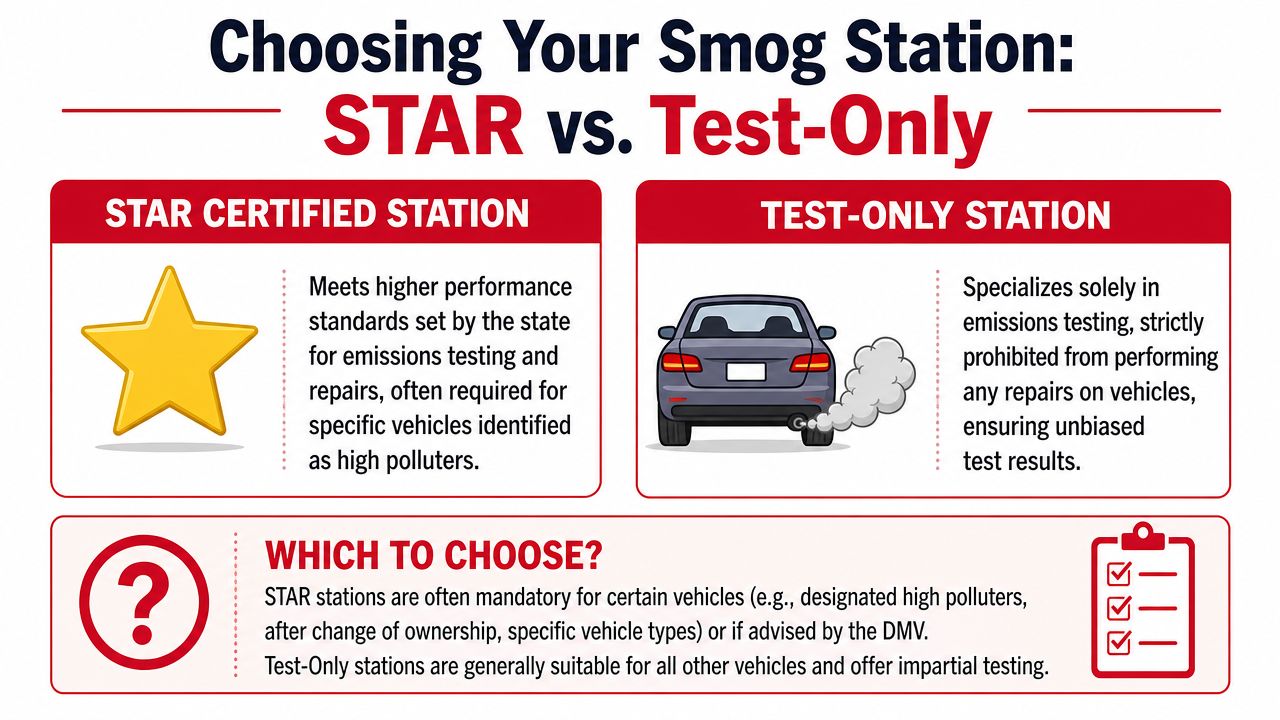
A STAR-certified station meets higher BAR performance standards. A test-only station focuses on inspections and doesn't perform repairs. Those are related ideas, but they are not the same label.
That distinction matters because 22% of California vehicles require STAR testing per DMV renewal notices, and Pittsburg drivers often assume local stations are automatically STAR-certified when they aren't. The same source notes that this confusion pushes some residents to look at verified STAR options in Antioch, about 8 miles away, rather than risk a wasted trip to a non-STAR shop. That's spelled out in this California STAR FAQ for drivers comparing station types.
Here's the practical difference:
| Station type | Best for | Common mistake |
|---|---|---|
| STAR-certified | Vehicles specifically directed by the DMV to STAR | Assuming every smog shop has STAR status |
| Test-only | Drivers who want an inspection-only model without repair upsells | Thinking “test-only” automatically satisfies a STAR-required notice |
Why some Pittsburg drivers head to Antioch
This is one of those local trade-offs that's worth being honest about. If your first priority is shaving a few minutes off the drive, staying inside city limits may feel like the obvious choice. If your priority is getting the correct inspection the first time, a short drive to a verified STAR station can be the better move.
That matters most when your notice requires STAR and the local station you're considering doesn't clearly show that designation. In that case, “nearby” can become “wrong shop, no certificate, try again.”
If your DMV paperwork says STAR, verify STAR before you leave home. Don't rely on the words “smog” or “test-only” on a storefront sign.
For drivers weighing cross-city options, a verified STAR test-only station in Antioch is often the cleaner choice because it removes the guesswork. You're not gambling on whether the station type matches your DMV notice.
What works and what doesn't
What works:
- Reading the DMV notice closely: Look for a direct STAR requirement.
- Verifying the station designation: Check that the shop is clearly identified for the type of inspection you need.
- Thinking beyond city lines: A short drive can be more efficient than a failed visit.
What doesn't:
- Assuming every local shop qualifies: That's the trap.
- Confusing “test-only” with “STAR-certified”: They overlap sometimes, but they aren't identical terms.
- Choosing by distance alone: The shortest drive can turn into the longest afternoon.
If you're trying to make the smartest call for a smog check in Pittsburg, CA, this is usually it. Match the station to the notice first, then worry about mileage.
Preparing Your Vehicle to Pass the First Time
You pull out of your driveway in Pittsburg, make the short trip for a smog check, and find out the car was never ready to test in the first place. That is one of the easiest ways to lose half a day.
An active check engine light is an automatic smog test failure. Recent battery service can also cause trouble because the car's readiness monitors may not be set yet. I see that one catch people all the time, especially after a new battery, alternator work, or a repair where the codes were cleared.
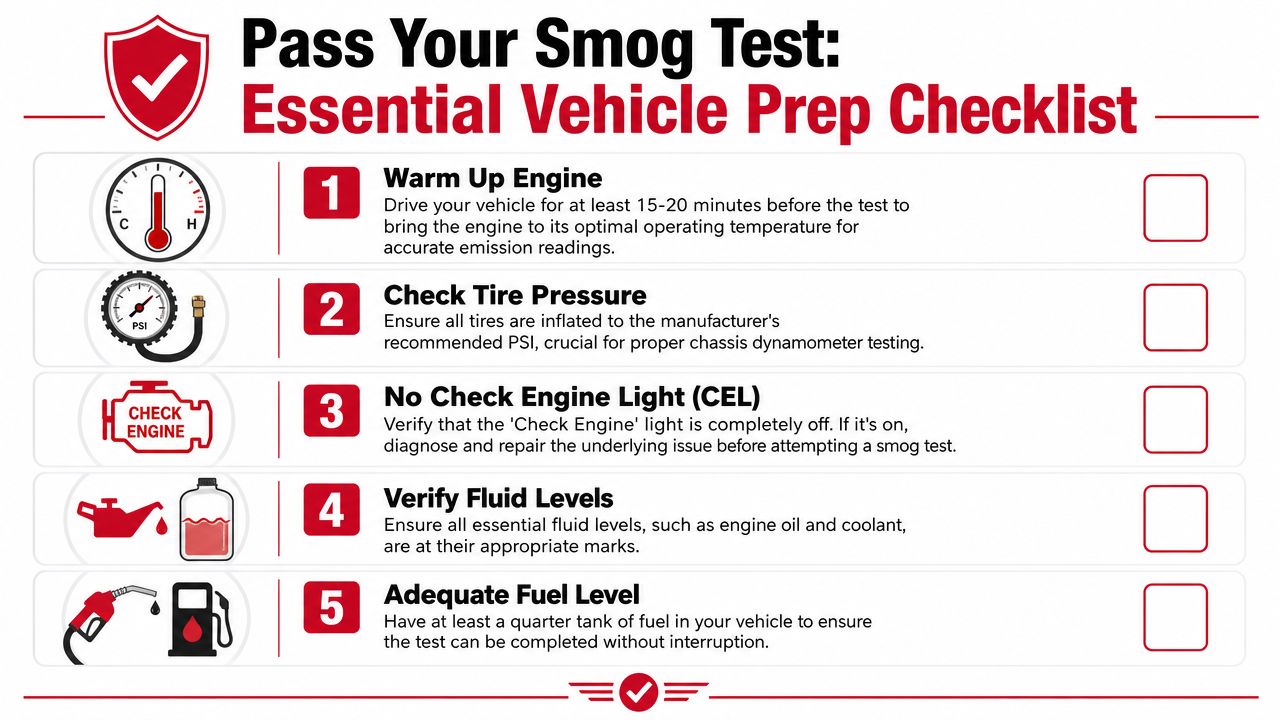
The two mistakes that cause the most grief
Start with the dashboard. If the check engine light is on, handle that before you book the test. The station cannot ignore it, and hoping it will slide through only turns one visit into two.
Battery disconnects are the other common problem. After the battery has been replaced or disconnected, the vehicle often needs normal driving before the emissions monitors show ready again. Even a smooth-running car can fail if its emissions system, onboard diagnostics, and readiness monitors are not aligned for compliance.
That trade-off matters for Pittsburg drivers deciding where to go. If you are already making a short drive to a verified STAR station in Antioch to avoid the STAR versus test-only mix-up, make sure the car is test-ready first. The smarter trip is the one that gets the certificate done in one shot.
A simple pre-test routine
Use this quick check before you leave:
- Check the dash first: No check engine light, and no fresh code clearing.
- Think about recent repairs: Battery replacement, dead battery jump starts, or electrical work can reset monitors.
- Tighten the gas cap: A loose cap can trigger emissions faults on some vehicles.
- Drive long enough to warm the car up: A cold engine is not ideal for a smog appointment.
- Bring your registration notice and ID: If you need a refresher on what the DMV usually asks for, this guide to California DMV registration renewal requirements helps.
- Skip the guesswork: If your paperwork points you to a STAR inspection, go to a verified STAR station instead of trying a nearby shop and hoping the designation matches.
A short prep video can also help if you want a quick visual refresher before you go.
What not to do on test day
Do not clear codes right before the appointment. That usually resets the monitors without solving the fault, which creates another reason for the car to fail.
Do not show up right after battery service, either. Give the vehicle time to complete its normal drive cycles.
And do not rely on how the car feels. Plenty of cars drive fine and still fail because the emissions side is not ready. The goal is simple. Clean dashboard, warmed-up engine, documents in hand, and the right station for your notice. That combination gives you the best chance of passing the first time.
What to Expect During the Smog Test and DMV Process
You pull out of work in Pittsburg, glance at the registration notice on the passenger seat, and realize you want this done in one shot. That is exactly why the station choice matters. If your notice calls for STAR, going straight to a verified STAR station in Antioch saves the usual mistake of stopping at the nearest shop first, then finding out you still need to test somewhere else.
The actual smog inspection is usually simple on the customer side. You check in, hand over your paperwork, and let the inspector run the required test sequence. At a well-run STAR test-only station, the visit feels organized instead of confusing.
What happens in the bay
The inspector generally works through three areas:
- Visual inspection of emissions-related components
- OBD-II check to read the vehicle's onboard systems and readiness status
- Emissions measurement based on the vehicle and the test procedure it requires
Newer vehicles often move through the process faster if the monitors are ready and there are no warning lights. Older models can take a little more hands-on checking. Either way, the station handles the testing. Your job is mostly to arrive with the right documents and the right type of appointment.
Why the DMV side matters more than people expect
A passed smog test is only part of the errand. Registration still has to be completed properly, and that is the point many drivers overlook.
Stations that can help with both steps save time in a very practical way. You are not driving from a test location to another office, waiting in another line, or wondering whether the certificate has gone through yet. For many East Contra Costa drivers, onsite California DMV registration renewal help is what turns a two-stop chore into a one-stop errand.
That matters even more if you are deciding between a random nearby shop and a verified STAR station a short drive away. In real life, the extra few minutes to Antioch often beats losing an hour to the wrong station, incomplete paperwork, or a second trip.
Details that help the process go smoothly
A few parts of the process are easy to miss:
- Certificate transmission: The station sends the smog result electronically to the DMV.
- Timing matters: Don't get tested too early, then let the registration deadline drag out.
- Certificate fee: Part of the bill includes the state certificate charge, so do not be surprised when you see it on the invoice.
The easiest smog visit is the one with no guesswork. You show up at the correct STAR station, the test gets handled cleanly, the result goes to DMV electronically, and your registration gets wrapped up without another stop. For Pittsburg drivers, that is often the smartest reason to make the short drive to a proven STAR shop in Antioch instead of rolling the dice on whatever is closest.
Handling a Failed Test and Using Free Retests
Failing a smog test feels worse than it usually is. Most of the stress comes from not knowing what the next move should be.
A failed test doesn't mean you're stuck. It means you need to fix the specific issue the inspection identified, then come back with the car ready.
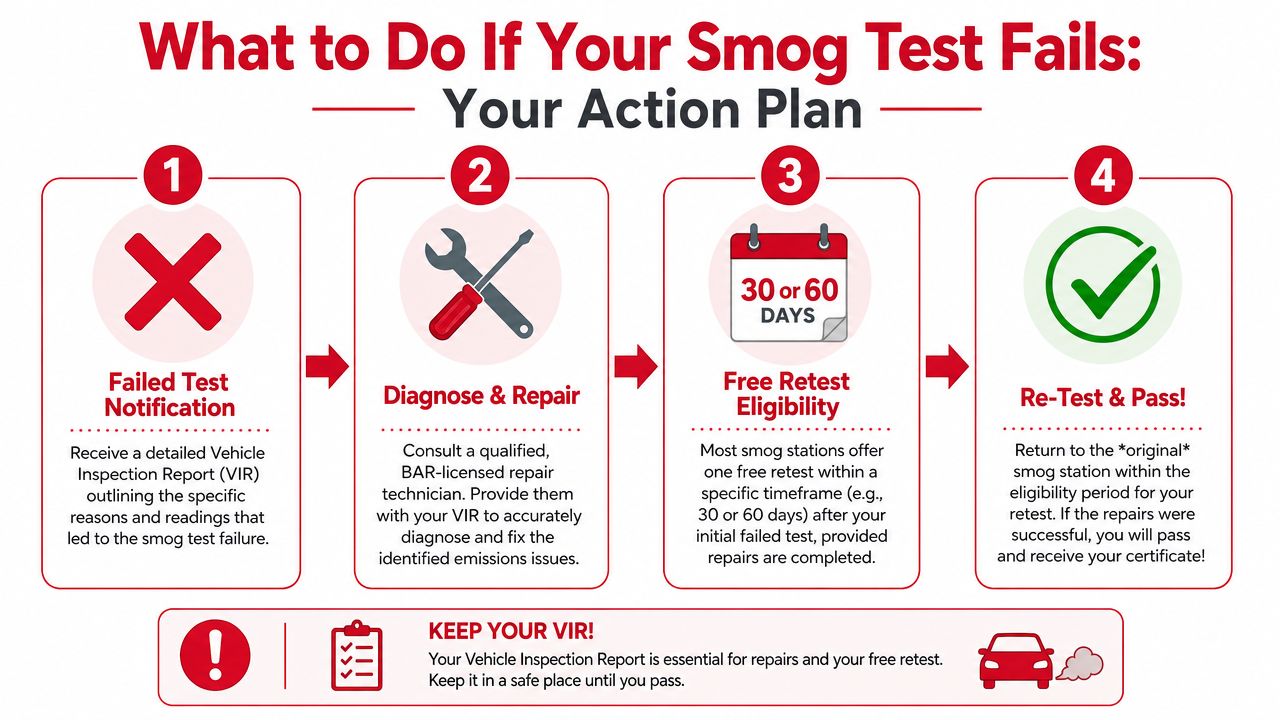
Start with the inspection report
When a vehicle doesn't pass, the first thing to focus on is the Vehicle Inspection Report, often called the VIR. That report tells you what failed and gives your mechanic a much better starting point than “it didn't pass smog.”
This is also where a test-only station has a real advantage. Because the station isn't selling you repair work, there's less pressure and less confusion about whether you're being pushed toward an in-house fix. The testing side stays separate from the repair decision.
Take the VIR to a mechanic you trust. Ask them to diagnose the failure based on that report, not guess from symptoms.
Use the retest strategically
Once the repair is done, go back for the retest according to the station's policy. That matters because many drivers waste time by bouncing to a different location instead of following the original station's retest terms.
A better approach looks like this:
- Keep the VIR: Don't leave it in the glove box and forget about it.
- Choose a repair shop you trust: Independent mechanic, dealership, or your regular local shop.
- Confirm retest terms before leaving the station: Ask what qualifies, how to redeem it, and whether you need the original paperwork.
- Return promptly after repairs: Don't let the issue drag out longer than necessary.
Calm beats guesswork
The worst move after a failure is random parts swapping. That's expensive and usually slower than a proper diagnosis.
The better move is simple. Read the report, repair the cause, then retest under the offered terms. If you're looking for a local option with a smog discount and retest policy, make sure you understand the coupon conditions before the first inspection so there are no surprises later.
A failed smog test is a repair decision, not a panic situation.
The practical upside of being prepared
Drivers who plan for the possibility of a retest usually handle the whole process better. They keep their paperwork, they don't rush into the first repair recommendation without understanding the problem, and they go back with a clear path instead of frustration.
That's really the bigger lesson behind a smog check in Pittsburg, CA. The process is manageable when you treat it like a checklist, not a crisis.
If you want a straightforward place to handle both the inspection and registration side, Fire House Smog in Antioch is a practical option for Pittsburg drivers who'd rather avoid station-type confusion, long DMV lines, and repeat trips. It's a STAR-certified test-only station with on-site DMV services, which makes it a smart fit when your goal is simple: get the smog done, get the paperwork handled, and get back on the road.
You bought a used car, shook hands, took the keys, and drove home feeling good about the deal. Then the paperwork reality hit. A California vehicle registration transfer can go smoothly, or it can turn into a mess of missing signatures, failed smog issues, late penalties, and a wasted afternoon in a DMV line.
Most transfer problems aren't complicated. They're preventable. People sign in the wrong place, forget the odometer disclosure, assume the title alone is enough, or wait too long to start the transfer. Then they find out the DMV won't process anything until every missing piece is fixed.
The fastest path is simple. Get the title right. Confirm the smog requirement before money changes hands. Bring the correct backup forms if the title is missing or full. Use a licensed DMV service partner when you want to avoid the office entirely. That's how you keep this from dragging out.
Table of Contents
- Your Guide to a Painless California Vehicle Transfer
- The Core Paperwork You Cannot Ignore
- Smog Checks STAR Stations and Exemptions
- Calculating Fees and Understanding Timelines
- Special Transfer Scenarios Gifts Inheritance and Out-of-State
- Skip the DMV The Licensed Partner Advantage
- FAQ Common Vehicle Transfer Problems
Your Guide to a Painless California Vehicle Transfer
A clean vehicle registration transfer in California comes down to one thing. Control the handoff before the buyer and seller part ways. Once someone leaves with the car and the other person leaves with the money, fixing mistakes gets harder fast.
If you're the buyer, don't trust promises like “I'll send you the missing form later.” Get everything while the seller is standing in front of you. If you're the seller, don't hand over the vehicle until the title is filled out correctly and your release steps are clear. That one decision saves more headaches than anything else.
The fastest way to handle it
A traditional DMV office visit is often assumed to be necessary. Usually, it isn't. For many transfers, the quicker route is to gather the title, smog compliance, identification details, and any backup forms first, then use a licensed registration service provider to submit the transfer, collect fees, and issue registration items if the transaction qualifies.
Practical rule: Don't start with the DMV line. Start with your document check. If the paperwork is wrong, the office visit won't help.
There are only a few moving parts, but every one matters:
- Ownership proof: Usually the California title, properly signed.
- Buyer and seller information: Names must match what the transfer documents require.
- Smog compliance: Often a stumbling block for many private party deals.
- Fees and timing: Waiting is how simple transfers become expensive transfers.
- Special exceptions: Gifts, inheritances, and out-of-state vehicles follow different rules.
Where people lose time
The usual delays come from avoidable mistakes:
- Wrong signatures: A signed title with names in the wrong field can stop the transfer.
- Missing forms: Lost title, crowded title, or family transfer issues often need extra paperwork.
- Bad timing: People wait until they need tags, then discover penalties or missing steps.
- Smog confusion: Buyers often assume they must solve it, when the seller usually should have handled it.
You don't need luck. You need a checklist, a realistic plan, and the discipline to not skip steps because the seller “seems trustworthy.” Trust doesn't process paperwork. Correct documents do.
The Core Paperwork You Cannot Ignore
If the paperwork is wrong, nothing else matters. Not the payment, not the bill of sale story, not the handshake. The transfer rises or falls on documents the DMV or a licensed partner can process.
Start with the title
The California Certificate of Title, often called the pink slip, is the main ownership document. In a standard transfer, the seller signs to release ownership and the buyer signs to accept it. Sounds simple. It is, until someone signs the wrong line, scratches something out, or leaves a required field blank.
Check every field before anyone writes on it. Make sure the vehicle information matches the car, the legal owner information is clear, and there's no unresolved lien issue. If there's a lien listed and no proper release, stop right there. You don't have a clean transfer yet.
Write the odometer reading carefully and exactly. An odometer mistake is one of the easiest ways to turn a routine transfer into a correction project.
Don't let the seller “pre-sign” sections and hand you the title later. Complete it together. If a correction is needed after the fact, you may end up needing additional forms or signatures you can't easily get back.
Know the backup forms before you need them
The title is the first choice. It isn't the only path.
If the title is missing, damaged, or unavailable, the common fix is Application for Replacement or Transfer of Title (REG 227). This form is what keeps a lost-title situation from killing the sale. But it has to be completed correctly, and it doesn't erase other requirements like lien release or smog compliance.
If the title has no room left for additional transfers, or multiple reassignments are involved, you may need Vehicle/Vessel Transfer and Reassignment Form (REG 262). This comes up more often with dealer-style chains, title history issues, or transactions where ownership changed but the paperwork wasn't neatly wrapped up.
A few hard rules make this easier:
- Match names exactly: The seller's name should match the ownership record.
- Check for lien release: If a lender is still attached on paper, clear that first.
- Use the right fallback form: Don't guess between REG 227 and REG 262.
- Review before leaving: Once buyer and seller separate, missing signatures become a chase.
For a practical form-by-form prep list, use this California vehicle registration documents guide before you submit anything.
Vehicle transfer document checklist
| Document | Who Provides/Signs It? | Key Action |
|---|---|---|
| California Certificate of Title | Seller and buyer | Seller releases ownership, buyer accepts ownership, key fields completed accurately |
| REG 227 | Buyer and seller, depending on title situation | Used when the title is lost, missing, or needs replacement for transfer |
| REG 262 | Parties involved in reassignment | Used when extra reassignment documentation is required |
| Lien release evidence | Lienholder or seller with proper release | Confirms the vehicle can be transferred free of recorded lien issues |
| Odometer disclosure | Usually seller, acknowledged as required in transfer paperwork | Records mileage accurately and legibly |
The signature check that saves deals
Before you call the transfer “done,” stop and ask four questions:
- Is the title complete, with no skipped signature area that applies?
- Is the odometer reading entered clearly?
- Is there any lien showing that still needs release?
- Does this situation require REG 227 or REG 262?
People rush this step because they want the deal finished. That's backwards. The deal isn't finished until the paperwork is processable.
Smog Checks STAR Stations and Exemptions
The smog check is where a lot of private-party transfers fall apart. Not because it's mysterious, but because buyers and sellers often assume the other person is handling it. In California, that's a mistake you should clear up before the sale closes.
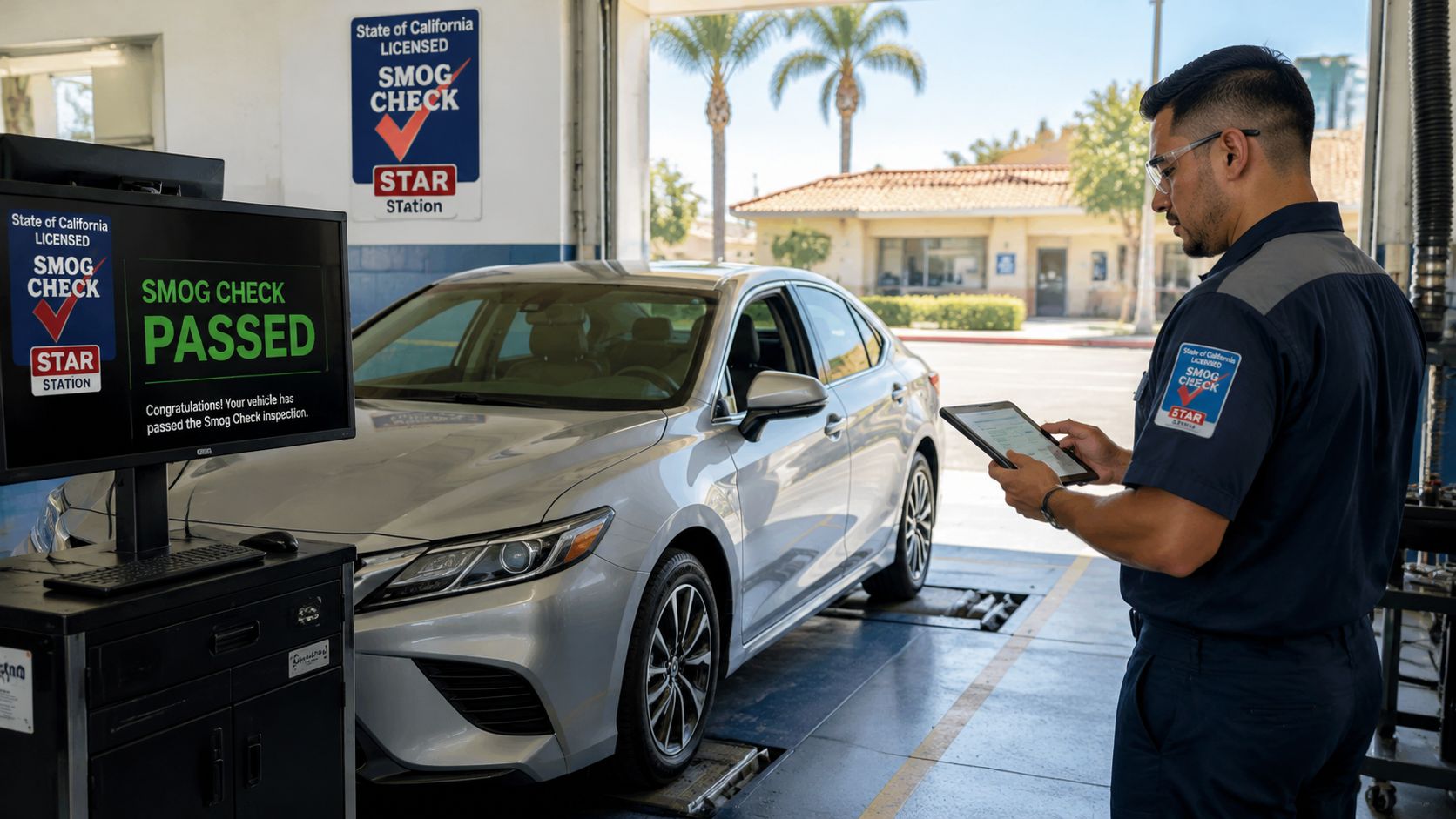
Who handles the smog check
In a typical private-party sale, the seller should provide a valid smog certificate for the transfer, unless the vehicle falls into an exemption category. Buyers often discover too late that the car won't transfer cleanly without it. Don't make that your surprise after payment.
If you're buying, ask about smog before money changes hands. If you're selling, get it done first. That keeps the transaction clean and avoids the ugly argument where each side insists the other should fix it.
If the seller says, “It should pass,” that's not the same as providing the required smog documentation.
The good news is the reporting process is usually straightforward. Once the vehicle passes at an authorized station, the result is typically transmitted electronically, which means you don't have to babysit paper certificates the way people used to.
What a STAR station means
A STAR-certified station is a station approved to perform smog inspections for vehicles that require that level of inspection. Some vehicles are directed to a STAR station because of DMV requirements tied to that vehicle's record or testing category. If your notice or transaction points you there, don't argue with it. Just use a STAR station and keep moving.
A test-only station has one big advantage. It has no repair sale attached to the inspection. That matters because you want a clean answer about whether the car passes, not a sales pitch.
If you need a STAR location for the transfer requirement, this STAR-certified smog test service is one local option for Antioch drivers.
Common exemptions that change the process
Not every transfer needs a smog certificate. Some vehicles are exempt, and that changes the handoff.
Common situations that may be exempt include:
- Newer gasoline vehicles: Some late-model vehicles may not need transfer smog in the same way older vehicles do.
- Electric vehicles: Fully electric vehicles generally aren't going through a smog inspection process.
- Other exempt categories: Certain transfer types or vehicle classes can follow different rules.
Because exemption details can vary by vehicle type and situation, the smart move is to verify the category before the transaction. Don't assume your vehicle is exempt because someone told you “it's pretty new” or “it's not a regular car.”
The shortest route through smog
Handle smog before you start arguing over forms or fees. If the vehicle needs it and doesn't have it, you don't have a ready-to-finish transfer. You have a pending problem.
That's why experienced buyers ask for proof early, and experienced sellers schedule the inspection before listing the vehicle. It removes uncertainty, keeps the timeline tight, and prevents a failed transfer from wrecking the sale.
Calculating Fees and Understanding Timelines
People obsess over the purchase price and ignore the transfer costs. That's shortsighted. A vehicle registration transfer doesn't end when you pay the seller. It ends when the state record matches reality and the registration side is brought current.
What you usually pay for
The total usually includes several pieces, not one flat charge. Expect the transfer to involve:
- Transfer-related fees: These are tied to changing ownership on the record.
- Use tax: This is often based on the transaction and whether the transfer qualifies for an exception.
- Registration-related charges: If annual registration is due, that can become part of the transaction.
- Late penalties: These are the charges people create for themselves by waiting.
The exact total depends on the vehicle and the facts of the transfer. That's why rough guesses from the seller are useless. The seller usually doesn't know, and if they do know, they still aren't the one processing your paperwork.
Deadlines that matter
The timeline is where simple transfers become expensive. The seller should promptly file a Notice of Transfer and Release of Liability, and the buyer should move quickly to begin the transfer process. Waiting doesn't help either side.
If you're the seller, filing your release protects you from future trouble tied to the car after the sale. If you're the buyer, delaying the transfer is how you end up dealing with fees, registration confusion, and headaches when you try to drive, insure, or sell the vehicle later.
For related registration needs and timing issues, this California DMV registration renewal page covers the kind of paperwork delays that often overlap with transfer problems.
Watch this closely: Late penalties don't feel urgent on the day you buy the car. They feel urgent when you finally process the transfer and learn waiting cost you more.
How penalties sneak up on people
Here's the usual pattern. A buyer gets the car, plans to “handle the DMV stuff next week,” drives it for a while, then discovers the title work isn't finished, the registration timing wasn't handled, or the smog issue still wasn't resolved. By then, the delay has turned a routine transfer into a more expensive one.
The answer is not complicated. Start immediately. Even if one piece is still pending, get moving on the process while the deal is fresh and the seller is easy to reach.
A clean transfer should happen while documents, signatures, and contact information are still easy to gather. If you wait, every missing piece becomes harder to fix. That's why I tell buyers the same thing every time. Treat the transfer like part of the sale, not a chore for later.
Special Transfer Scenarios Gifts Inheritance and Out-of-State
Not every vehicle registration transfer is a normal private sale. Some are family handoffs, some follow a death in the family, and some involve a car coming into California from another state. These cases are manageable, but only if you stop treating them like standard title sign-overs.
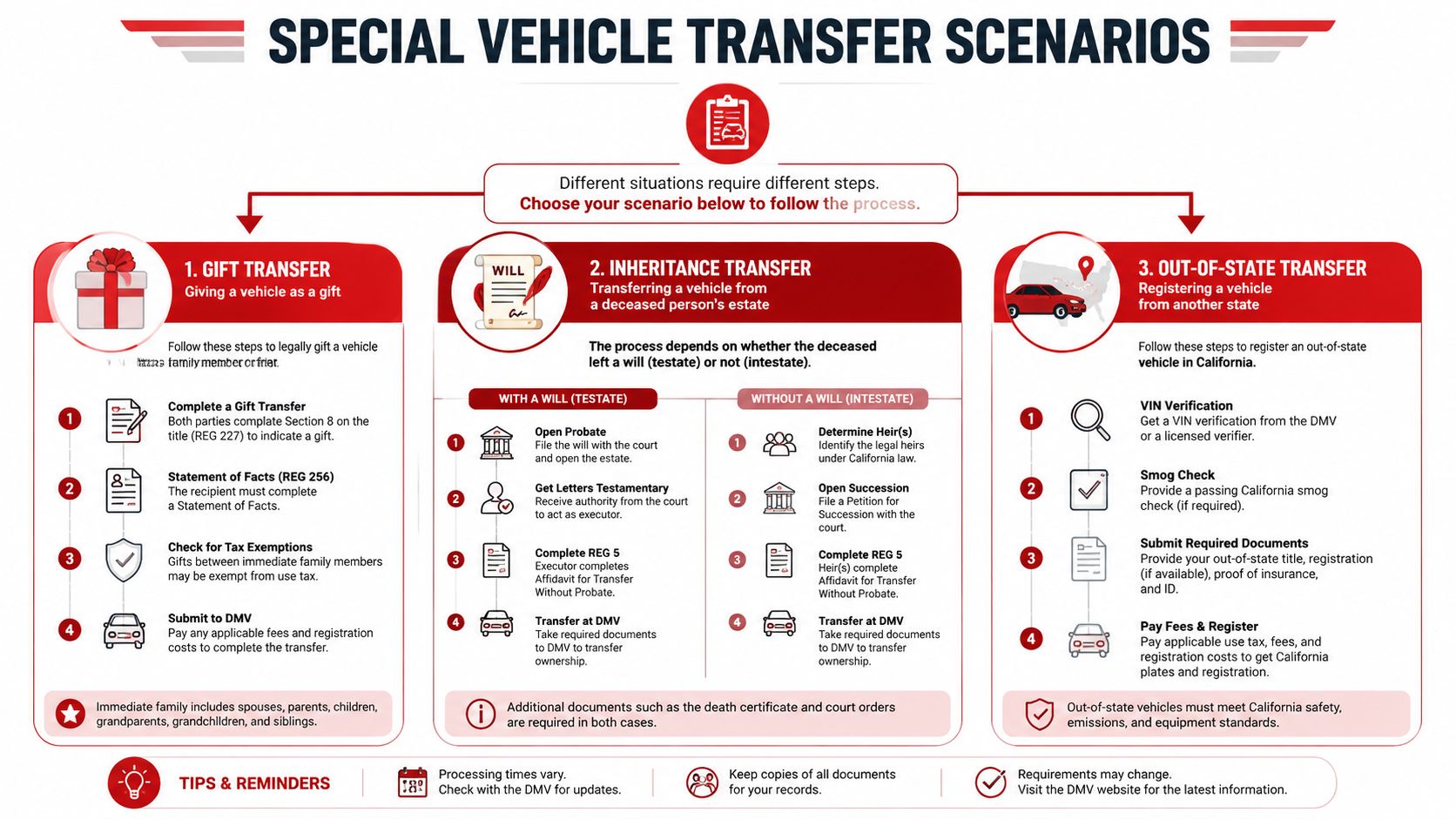
Gift transfers
A parent gives a car to an adult child. A grandparent hands down an older sedan. A sibling transfers a truck to another sibling for no payment. People call these “easy family transfers” and then make them harder by documenting them like a sale.
In a true gift situation, the paperwork often includes a Statement of Facts (REG 256) to support the nature of the transfer and address use tax treatment where an exemption applies. If you're claiming the transfer is a gift, make sure the documents tell the same story. Don't write one thing on the title, another on a bill of sale, and then expect the record to process cleanly.
Use common sense here:
- Keep the transaction description consistent
- Use REG 256 when the facts require it
- Don't casually mix “gift” language with sale language
If money changed hands in a way that looks like a sale, document it accurately. The shortcut is accuracy, not creativity.
Inheritance transfers
These usually happen when a family member is trying to settle a vehicle after someone dies. The biggest mistake is assuming possession equals ownership. It doesn't. The person holding the keys isn't automatically the person who can transfer the vehicle.
A common tool in qualifying situations is the Affidavit for Transfer Without Probate (REG 5). That form can help move the title without opening a full probate path when the situation fits the rule. But this is exactly the kind of transfer where names, capacity, and supporting documents must line up cleanly.
Don't sign inheritance paperwork casually. If you sign in the wrong role or leave out a supporting document, you create delays that are much harder to untangle later.
Keep the file organized. Death-related transfers often involve emotionally drained families, and that's when papers get lost, signatures get rushed, and avoidable errors pile up.
Out-of-state transfers
This one catches people off guard. They bought a car elsewhere, moved to California with their vehicle, or inherited one from a relative in another state. Then they learn California wants more than the old title and a handshake.
For an out-of-state transfer, the vehicle may need VIN verification using REG 31, along with California registration processing and, where applicable, smog compliance. That VIN step matters because California needs to confirm the vehicle identity against the record being created or updated.
Typical out-of-state issues include:
- Mismatched paperwork: The title, registration, and vehicle information don't line up neatly.
- Missing inspection step: People forget that VIN verification may be required.
- Smog assumptions: They think an out-of-state emissions history replaces California requirements. It often doesn't.
- Plate confusion: They assume old plates settle the registration side. They don't.
The smart way to handle special cases
Don't improvise. Special transfers move faster when you identify the category first, then build the paperwork around it. Ask one question up front: Is this a sale, a gift, an inheritance, or an out-of-state registration issue?
Once you answer that truthfully, the right form usually becomes obvious. Most delays in these cases come from people choosing the wrong story first and the wrong paperwork second.
Skip the DMV The Licensed Partner Advantage
The standard DMV office route is rarely the fastest route. You wait, take a number, reach the window, and then learn you're missing one signature, one form, or one supporting detail. Then you leave and start over. That's not efficient. It's preventable.
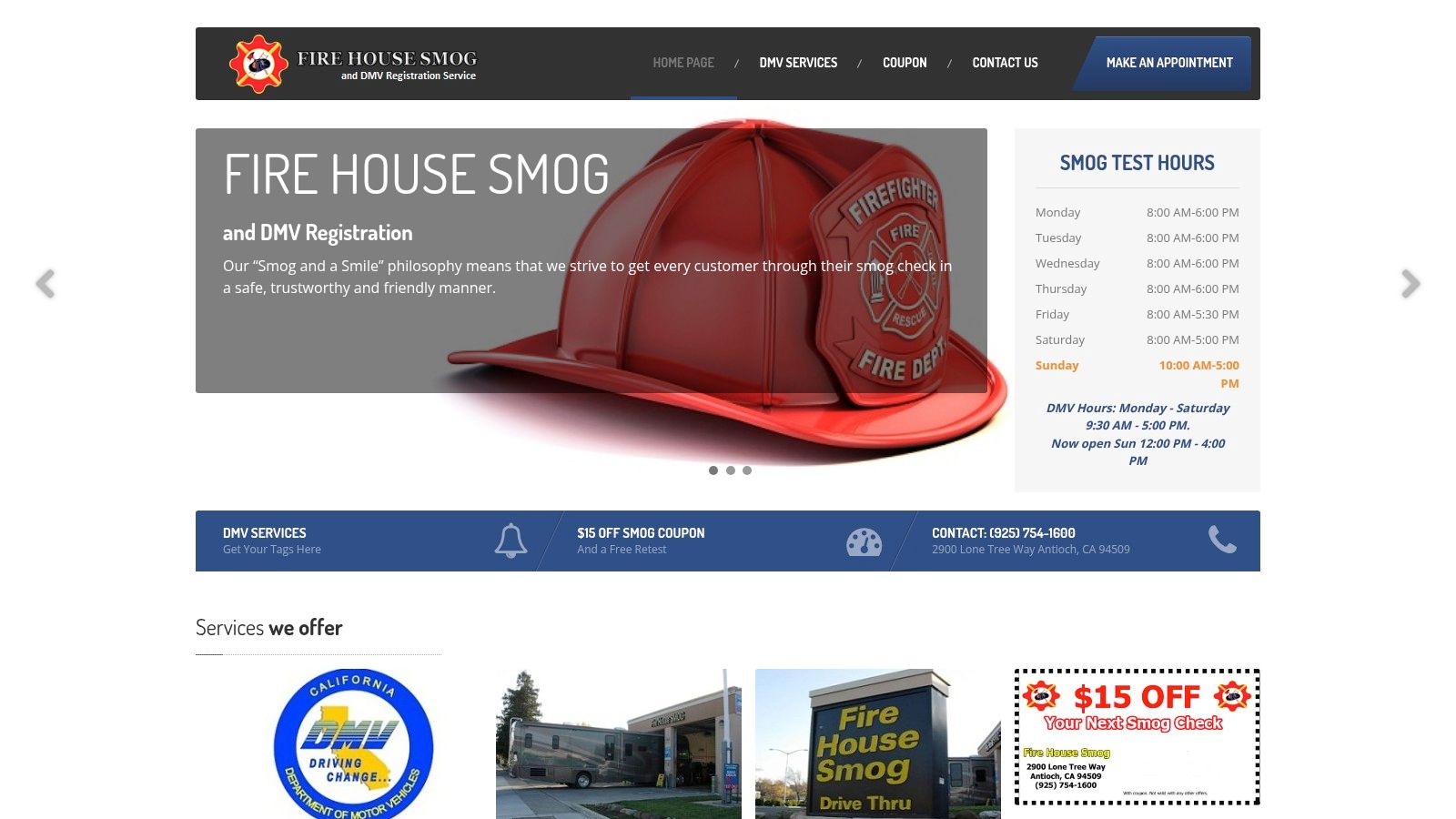
What a licensed partner actually does
A licensed DMV service partner can handle much of the work people think requires an office visit. That can include processing transfer paperwork, collecting state fees, and issuing registration items when the transaction qualifies. The practical benefit is obvious. You avoid the office line and deal with a business that focuses on transaction throughput, document review, and same-visit completion when possible.
That matters even more when the transfer also needs a smog check. Combining those steps cuts down the back-and-forth that usually burns time.
One Antioch option is Fire House Smog, a licensed DMV registration services provider and STAR-certified test-only smog station that handles ownership transfers for California and out-of-state vehicles and can issue registration items on site during posted hours.
A quick look at how this kind of service works can help if you've only dealt with traditional DMV counters before.
When this route makes the most sense
Use a licensed partner when speed matters, when your schedule is tight, or when you already know the transfer includes moving parts. That includes situations like:
- You need smog and transfer help together
- You bought from a private seller and want document review before submission
- You'd rather get registration items issued on site than wait on mail
- You can't spend half a day on a weekday at a DMV office
There's also a practical trust benefit with test-only operations. A shop that doesn't sell repairs has less reason to turn an inspection into a sales conversation. For many drivers, that makes the process cleaner and easier to understand.
If your paperwork is straightforward, a licensed partner is usually the smartest path. If the case is unusually tangled, they can often tell you that quickly too, which still saves time compared with discovering the problem after waiting in line.
FAQ Common Vehicle Transfer Problems
What if the seller lost the title
Use REG 227 if the transaction qualifies for a replacement or transfer of title situation. Don't rely on a bill of sale alone and assume the ownership record will sort itself out. It won't.
What happens if I wait too long to start the transfer
Delays can trigger added costs and extra complications. Critically, the longer you wait, the harder it becomes to track down missing signatures, fix title errors, or resolve smog and registration issues tied to the sale.
What if the vehicle fails smog
That usually sends you back to the seller-side responsibility issue in a private-party transaction. The transfer can stall until the smog requirement is properly satisfied, unless the vehicle falls under an exemption. If you're using a station with a retest policy, ask about that before leaving so you understand your next step.
Can I transfer a vehicle with a lien still on it
Not cleanly, not unless the lien issue is properly resolved. If a lienholder is still shown on the title record, you need the appropriate release before ownership can move the way you want it to.
Do I need to go to the DMV in person
Often, no. Many people can complete the transfer through a licensed registration service provider instead of a DMV office, provided they bring the right documents and the transaction qualifies.
Is a family transfer automatically simple
No. Family transfers are easier only when the paperwork matches the facts. If it's a gift, document it as a gift. If it's an inheritance, use the forms that fit that situation. “It's staying in the family” doesn't replace required paperwork.
If you want the fastest path through a California vehicle registration transfer, skip the guesswork and bring your paperwork to Fire House Smog. They handle smog inspections, ownership transfers, California and out-of-state registration work, and on-site tag issuance during posted service hours at their Antioch location.
That DMV envelope tends to sit on the counter longer than it should. You know it needs attention, but you also know one missing form, one expired smog certificate, or one title mistake can turn a simple errand into multiple trips and a lot of waiting.
Most registration problems aren't hard. They're incomplete. People usually get stuck because they start the process before they've matched their paperwork to their exact situation. With vehicle registration documents, that distinction matters. A renewal, a private-party title transfer, and an out-of-state vehicle don't move through the same lane, even when they look similar on the surface.
Table of Contents
- Conquering Your DMV To-Do List Starts Here
- The California Smog Check What to Know in 2026
- Solving Document Disasters Lost Titles and Missing Paperwork
- The Fast Lane Skip the DMV with On-Site Services
- Vehicle Registration FAQs
- Can I renew registration if I lost my notice?
- Can I register a car if I just bought it and the seller made a mistake on the title?
- Do I always need a smog check for registration?
- What should I do before bringing in an out-of-state vehicle?
- I lost my registration card. Is that the same as losing my title?
- What's the most common mistake people make?
Conquering Your DMV To-Do List Starts Here
A lot of drivers open a notice, glance at the due date, then start digging through the glove box. They find an old registration card, maybe an insurance card, maybe a smog paper from months ago, and hope that's enough. Sometimes it is. Often it isn't.
That's not surprising when you look at the scale. The United States is projected to reach 290.9 million motor vehicle registrations in 2026, according to IBISWorld's U.S. motor vehicle registrations estimate. That number helps explain why registration systems are so document-driven. Every car has to tie back to a clear administrative record.
Practical rule: Registration goes faster when you stop treating it like one task and start treating it like a document match.
In day-to-day service work, the same pattern comes up again and again. Someone has the right vehicle but the wrong paper. Or the right paper but an outdated one. A buyer brings a signed title but forgets the smog step. A family member tries to renew registration using a notice that doesn't reflect a recent address change. None of those situations are unusual.
The fix is simple. Start with the scenario, not the line at the DMV. If you know whether you're renewing, transferring ownership, bringing in an out-of-state car, or replacing missing paperwork, the checklist gets much shorter and much clearer.
Renewal paperwork
For a standard renewal, gather the documents that prove the vehicle, the current registration status, and any required inspection compliance. The renewal notice helps, but it shouldn't be the only thing you rely on. Bring the current registration card if you have it, your plate number, and identification that matches the record.
If your notice says a smog check is required, treat that as a time-sensitive item. Don't assume an old certificate will still work. Inspection paperwork has its own validity window, and that catches people who try to piece everything together late.
California title transfer after a private sale
A private-party purchase usually needs more than buyers expect. The signed title is the center of the file, but it isn't the whole file. You also need supporting ownership details that match the vehicle exactly, including VIN, seller information, buyer information, and any disclosures required by the transaction.
For California cases, keep these together before you start:
- Signed title: Make sure buyer, seller, and vehicle details are complete and legible.
- Odometer disclosure if applicable: Check that mileage information is present when required.
- Smog compliance if required: Don't leave this for the end if the transfer depends on it.
- Registration application paperwork: California commonly uses Application for Title or Registration (REG 343) in registration workflows.
- Insurance and ID: Bring current proof that matches the owner information you're submitting.
Many files face difficulties. In California, 15 to 20% of registration applications face initial rejection because of mismatched VINs or unreported modifications, and missing smog check documentation is the leading cause of refusal, affecting about 35% of new registrations for vehicles over six years old, based on the California registration process discussion at Cobra Dreams.
Small errors matter more than people think. A single digit off in the VIN can stop the whole transaction.
Out-of-state vehicle transfer
An out-of-state transfer is the scenario where people most often underestimate the paperwork. They assume the current out-of-state registration proves everything. It helps, but California usually needs the vehicle itself to match the documents on record. That can mean VIN verification and closer review if the vehicle has modifications or unusual history.
Bring a tighter file for this situation:
- Out-of-state title or current registration: Bring both if you have them.
- Proof of identity: Use ID that matches the buyer or registrant.
- Insurance: Current California-compliant proof helps avoid follow-up delays.
- VIN-ready vehicle: The vehicle may need physical verification, so it must be accessible.
- Technical or build-related paperwork if modified: Engine swaps, frame changes, or specialty builds need clearer support than stock vehicles.
- Smog-related paperwork if required: Don't assume another state's process replaces California requirements.
If you want the basic renewal side of the process laid out cleanly, Fire House Smog keeps a practical overview of California DMV registration renewal steps.
Quick comparison table
| Document | Renewal | CA Title Transfer | Out-of-State Transfer |
|---|---|---|---|
| Current registration notice/card | Usually helpful | Sometimes | Helpful |
| Signed title | No | Yes | Usually yes |
| Application for Title or Registration (REG 343) | Sometimes | Often needed | Often needed |
| Proof of insurance | Often needed | Often needed | Often needed |
| VIN verification | Usually no | Sometimes | Often relevant |
| Smog documentation if required | Sometimes | Often relevant | Often relevant |
| Odometer disclosure if applicable | No | May apply | May apply |
The California Smog Check What to Know in 2026
Smog is where registration timing often falls apart. Drivers handle the ownership paper, the insurance, the signatures, then realize the emissions step is what holds the file up. In California, that's a common reason a simple registration turns into a second round of paperwork.
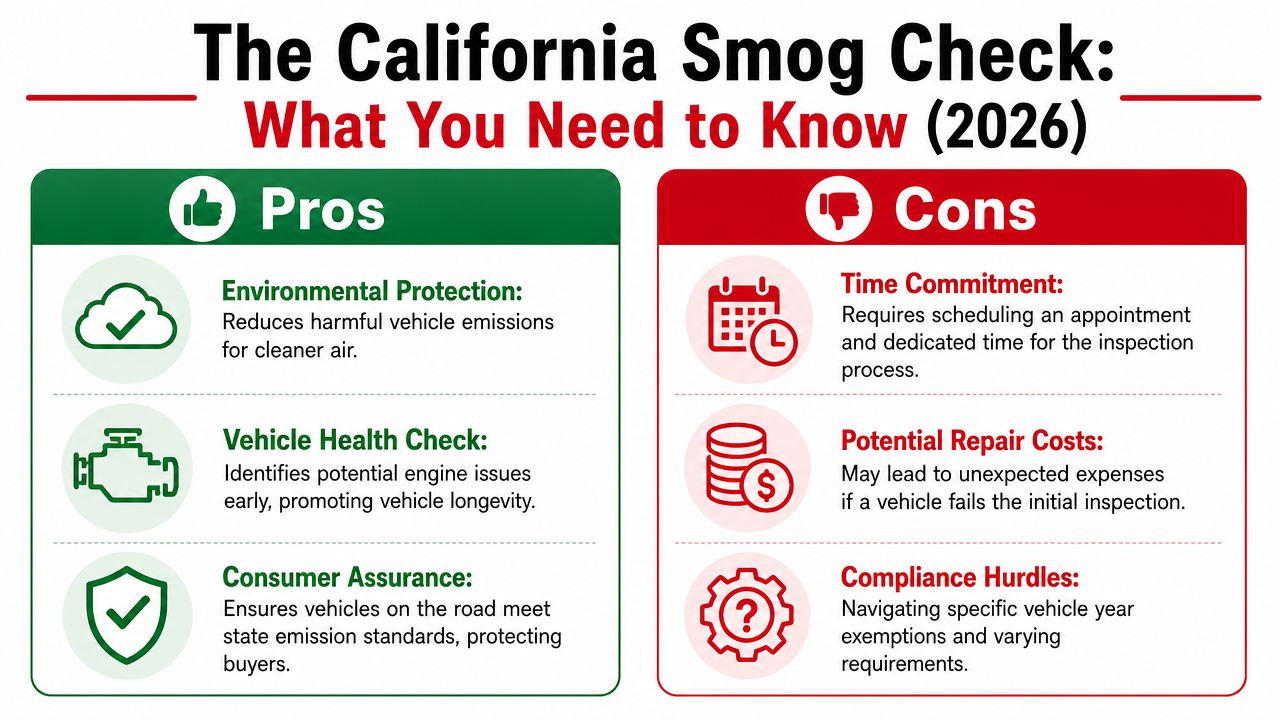
Where drivers lose time
The biggest issue isn't always failing the test. It's getting the test done, then waiting too long to finish the registration. The validity of an emission control inspection is limited to 90 days in most states, including California, and missing that window often leads to another round of delay. The same source notes that failure to complete the registration within that window often results in a 40% rejection rate for renewal applications, which means owners may need another smog check, as described in this technical data sheet and inspection timing discussion.
That's why the right sequence matters. Handle the smog inspection close enough to your registration date that the certificate is still valid when the DMV side is processed. Waiting until the last minute is risky. Doing it too early can also backfire.
Why STAR and test-only matter
Not every station plays the same role in the process. A STAR-certified station meets a higher performance standard set by the state, and some vehicles are specifically directed to a STAR station. If your notice calls for STAR, that isn't optional.
A test-only station matters for a different reason. The inspection is the service. There's no repair sale attached to the result. For many drivers, that makes the process clearer because the shop is focused on accurate testing and reporting, not selling repair work in the same transaction.
If you need a local STAR inspection, the Antioch smog check service page shows what that process looks like in practice.
A good smog visit saves time when it lines up with the registration clock. A badly timed one creates repeat work.
For drivers dealing with multiple deadlines, the cleanest approach is to keep three items together: the registration notice, current insurance, and any emissions requirement tied to the vehicle. Once those are aligned, the rest of the file is usually much easier to finish.
Solving Document Disasters Lost Titles and Missing Paperwork
Losing paperwork feels bigger than it is. Most document problems are fixable. Significant damage results from freezing up, guessing, or submitting partial information that creates a second problem on top of the first.
If the title is missing after a sale
This one causes a lot of panic. A buyer pays for the vehicle, gets possession, and then the title is lost, incomplete, or never properly transferred. Most general guides act like the process stops there. It doesn't, but it does become more state-specific.
One overlooked point is that some states allow alternate paths. As noted in this private-sale title guidance discussing Illinois and title alternatives, states such as Missouri may allow registration with a Manufacturer's Statement of Origin (MSO) or a notarized lien release, and Illinois has a 20-day window that can matter in private-sale timing. The important takeaway isn't that California follows those exact rules. It's that missing-title situations aren't always dead ends, even though many consumer guides treat them that way.
For a practical response, do this first:
- Contact the seller immediately: Don't wait and hope the title turns up.
- Confirm what was signed: A title signed incorrectly can be as troublesome as a lost one.
- Ask whether a duplicate title request is possible: In many cases, that's the cleanest correction.
- Keep your bill of sale and payment record together: Those help establish the timeline of the transaction.
- Don't alter documents yourself: Cross-outs and handwritten fixes often create new rejection issues.
If your paperwork doesn't match the vehicle
This usually shows up around the VIN, odometer information, or modifications. The paperwork says one thing. The car says another. That's where verification steps become important, especially for out-of-state vehicles, reconstructed units, or cars with changes that weren't documented cleanly.
A VIN check is often the fastest way to identify whether the mismatch is minor clerical error or a larger file problem. If you need that step, Fire House Smog provides VIN verification support in Antioch.
Here's a useful overview before you make calls or stand in line:
Bring every ownership-related paper you have, even if you think one of them is outdated. The missing clue is often on the document people leave at home.
How to keep this from happening again
Drivers with one vehicle can usually manage registration papers with a simple folder. Families with several cars and small business fleets need more discipline than that. The best working method is boring, but it works: keep originals in one secure place, carry only what needs to be in the vehicle, and review expiration-sensitive documents before you need them.
For modified vehicles, keep build and compliance paperwork attached to the title file, not in a separate stack. For private sales, make copies before either party leaves. For out-of-state transfers, bring more than you think you'll need. Overpreparing is cheaper than a second trip.
The Fast Lane Skip the DMV with On-Site Services
The traditional route is familiar. Gather what you think you need, drive to the DMV, wait for your number, reach the counter, then learn the file is missing one item you could have brought if someone had told you sooner. The trip wasn't wasted, but it wasn't finished either.
The alternative works better because it compresses the steps. Instead of separating smog, paperwork review, and registration processing into different stops, a licensed service partner can often line them up in one visit.
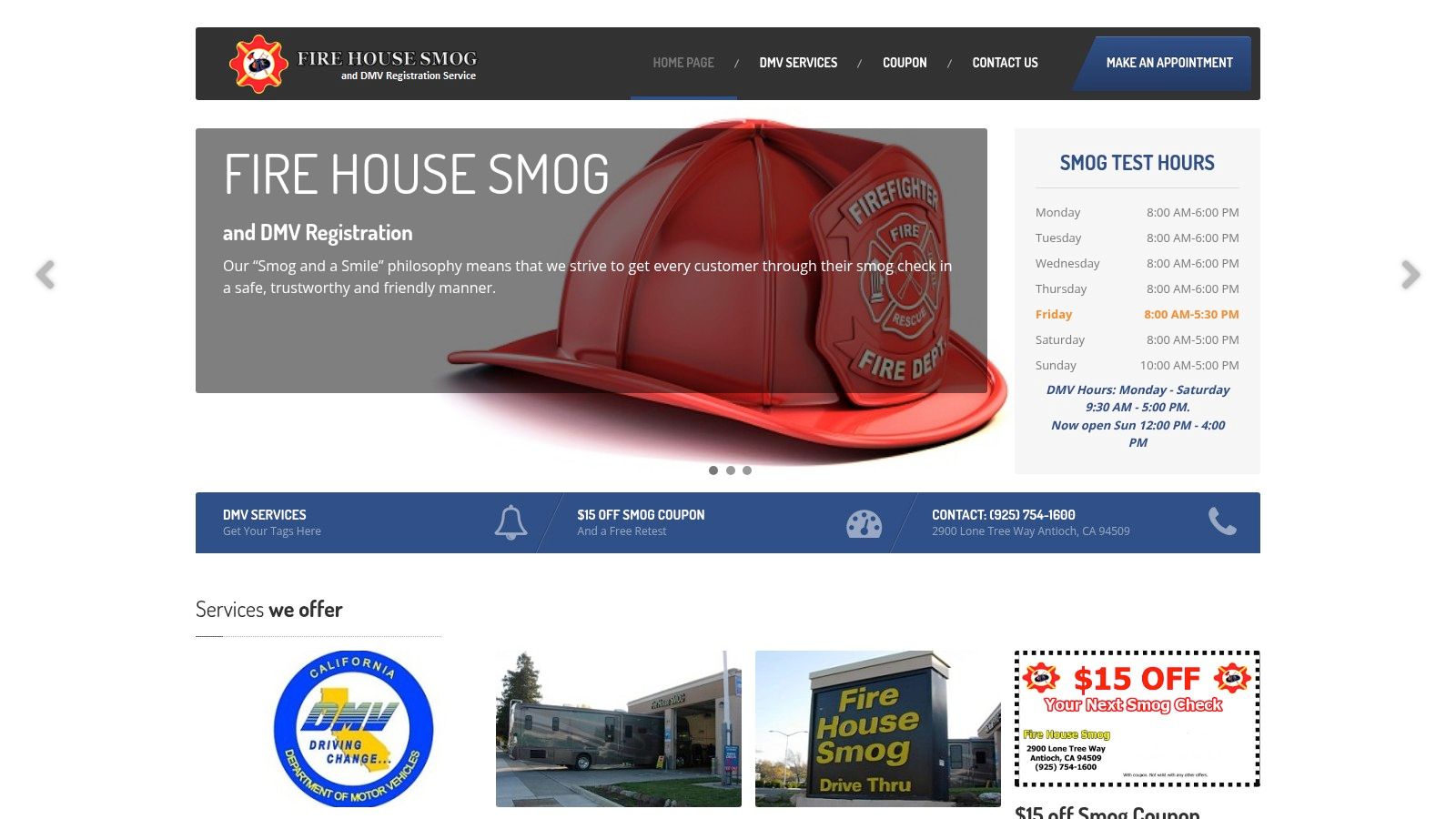
Two ways this usually goes
One driver shows up with a vague stack of papers and hopes the clerk can sort it out. Another shows up with the right scenario matched to the right documents. The second driver usually finishes faster because the transaction is built correctly before it enters the system.
That's the true shortcut. It isn't luck. It's sequence.
A local licensed DMV business partner can handle common transactions such as renewals, ownership transfers, and related registration work without sending you into a full DMV office line. If the vehicle also needs emissions testing, doing both tasks in one place reduces the chance that the smog side and the document side drift apart.
What a licensed partner changes
On-site processing offers its greatest help:
- Immediate document review: Missing items get caught before the submission goes sideways.
- Smog and registration alignment: If both are needed, they can be coordinated in the same visit.
- Tag and sticker handling: For eligible transactions, official registration output can be printed on-site.
- Less rework: You're less likely to discover a preventable problem after waiting in line.
Fire House Smog is one local option that combines STAR-certified test-only smog inspections with licensed California DMV registration services, including on-site renewals and ownership transfer support at its Antioch location.
This model is especially useful for working drivers, families juggling multiple vehicles, and fleet managers who can't afford to lose half a day every time a registration file needs attention. The trade-off is simple. You still need the right paperwork. You just don't have to do the sorting, testing, and processing in separate places if your transaction qualifies.
Vehicle Registration FAQs
Can I renew registration if I lost my notice?
Usually, yes. The notice helps, but it isn't the registration itself. What matters is matching the vehicle and owner record correctly. Bring the registration card if you have it, plus plate information, ID, insurance, and any required inspection paperwork.
Can I register a car if I just bought it and the seller made a mistake on the title?
Sometimes, but don't guess. Title errors can be fixable, yet handwritten corrections often make things worse. Get the seller involved quickly and find out whether the title needs to be re-signed, replaced, or supported with additional ownership documents.
Do I always need a smog check for registration?
Not always. It depends on the transaction and the vehicle. Renewals, sales, and out-of-state transfers can trigger different requirements, so check the notice and the vehicle record before assuming you're exempt or required.
What should I do before bringing in an out-of-state vehicle?
Bring the title or current registration, proof of insurance, identification, and any paperwork tied to modifications or unusual vehicle history. Make sure the vehicle itself is available if verification is needed. Out-of-state transfers go smoother when the car and the paperwork can be checked together.
I lost my registration card. Is that the same as losing my title?
No. They're different documents and create different problems. A lost registration card is usually a simpler replacement issue. A lost title affects ownership proof, transfers, and some registration scenarios much more directly.
What's the most common mistake people make?
Starting too early with the wrong paperwork, or too late with time-sensitive paperwork. Vehicle registration documents aren't hard to collect once you know your scenario. The trouble starts when drivers mix renewal documents with transfer documents, or bring inspection paperwork that no longer fits the registration timeline.
If you want to avoid the usual back-and-forth, bring your paperwork to Fire House Smog. The shop handles smog inspections and qualifying DMV registration services from one Antioch location, which makes it easier to match the right documents to the right transaction and finish the job without a separate DMV office stop.