Smog Check Pittsburg CA: Your 2026 Guide to Passing
That DMV renewal notice lands in the mail, and the first thought for most Pittsburg drivers is the same. How fast can I get this done without wasting half a day or failing for something avoidable?
For a smog check in Pittsburg, CA, the hardest part usually isn't the test itself. It's choosing the right station, figuring out whether your notice requires STAR, and avoiding the small mistakes that turn a routine visit into a second trip. A lot of locals pick the closest shop first, then learn the hard way that “test-only” and “STAR-certified” are not the same thing.
The good news is that California's smog process is predictable when you know what to look for. A little prep, the right station choice, and a realistic idea of what happens at the counter can save you time, hassle, and one of those “I have to come back again?” afternoons.
Table of Contents
- Your Guide to a Fast Smog Check in Pittsburg
- Choosing the Right Smog Station Near Pittsburg
- Preparing Your Vehicle to Pass the First Time
- What to Expect During the Smog Test and DMV Process
- Handling a Failed Test and Using Free Retests
Your Guide to a Fast Smog Check in Pittsburg
You get the DMV renewal notice, glance at the deadline, and figure a smog check will be a quick stop on the way home. Then the true delay starts. The shop you picked is nearby, but it is not the right fit for what your notice requires, or your car is not ready to test, or you still have to sort out the registration side after the inspection.
That is how a 30-minute job turns into half a day.
In California, many gasoline-powered vehicles from model year 1976 and newer, along with certain diesel vehicles from model year 1998 and newer, need a smog inspection every two years under the state's Smog Check program. Newer vehicles usually pay an abatement fee first and do not get their first physical inspection until later in the registration cycle.
For Pittsburg drivers, the time-saving part is rarely the test itself. It is choosing a station that matches the DMV notice the first time, arriving with a vehicle that is ready, and avoiding extra stops you did not plan for.
What usually slows people down
The inspection process is fairly routine. A technician checks emissions-related equipment, confirms the warning light and onboard system status, and completes the required test based on the vehicle.
The delays usually happen before the car enters the bay.
- Wrong station choice: The station cannot perform the type of inspection listed on your DMV notice.
- Readiness problems: The battery was recently disconnected, monitors have not reset, or the check engine light is on.
- Last-minute timing: You wait until the registration deadline is close and lose flexibility on where to go.
Practical rule: The fastest smog check is the one you only have to do once.
What a smart local approach looks like
Start with the DMV notice. In Pittsburg, the biggest avoidable mistake is treating STAR and test-only as if they mean the same thing. They do not. If your notice calls for STAR, a short drive to Antioch can save you from a wasted appointment and a second trip. A verified STAR smog and DMV service near Pittsburg often makes more sense than picking the closest address and hoping it works out.
Then look at the car itself. If the check engine light is on, or the battery was disconnected recently, handle that before you show up. A smog station can test the vehicle in its current condition. It cannot complete drive-cycle monitors for you while you wait.
Finally, choose a shop that reduces loose ends. If the station can help you finish the registration side at the same visit, that saves more time than shaving a few minutes off the drive.
Choosing based on service fit, not just distance, is usually the quickest route. The best shortcut is picking the station least likely to send you back out for another errand.
Choosing the Right Smog Station Near Pittsburg
The biggest mistake I see around Pittsburg isn't mechanical. It's administrative. A driver gets a DMV notice, searches for a smog shop, sees “test-only,” and assumes that's enough.
Sometimes it is. Sometimes it absolutely isn't.
STAR and test-only are not interchangeable
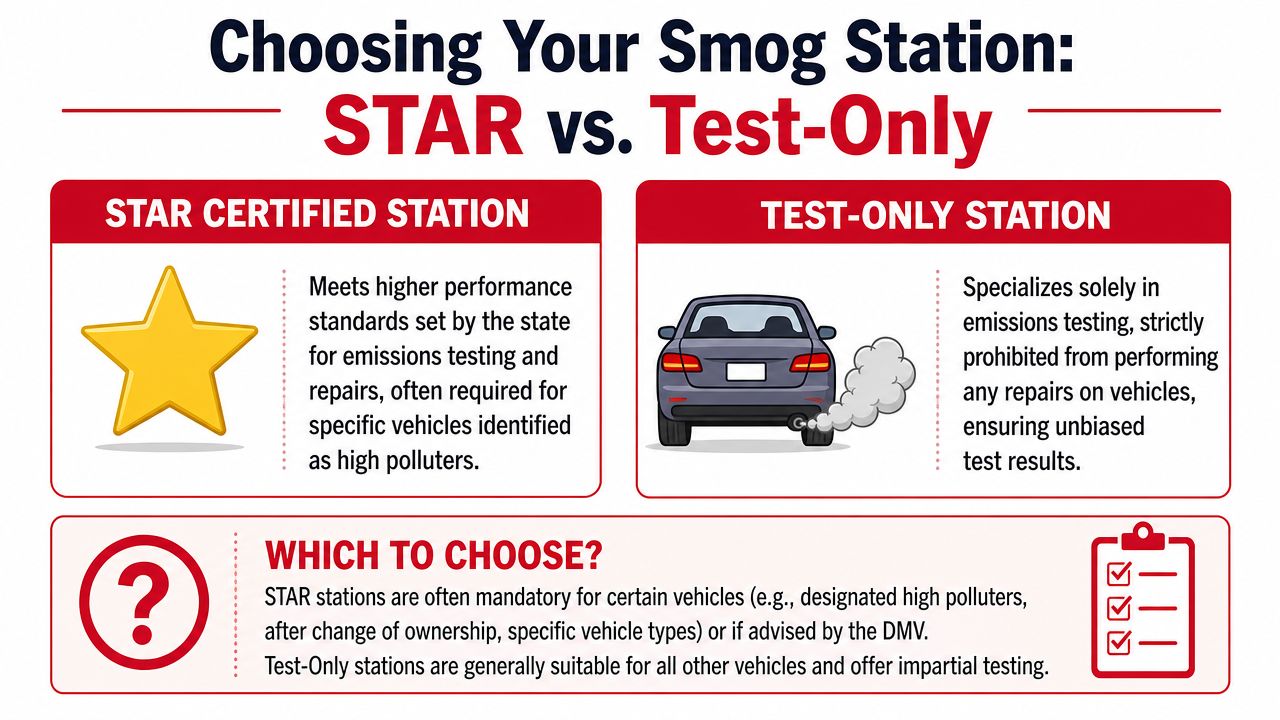
A STAR-certified station meets higher BAR performance standards. A test-only station focuses on inspections and doesn't perform repairs. Those are related ideas, but they are not the same label.
That distinction matters because 22% of California vehicles require STAR testing per DMV renewal notices, and Pittsburg drivers often assume local stations are automatically STAR-certified when they aren't. The same source notes that this confusion pushes some residents to look at verified STAR options in Antioch, about 8 miles away, rather than risk a wasted trip to a non-STAR shop. That's spelled out in this California STAR FAQ for drivers comparing station types.
Here's the practical difference:
| Station type | Best for | Common mistake |
|---|---|---|
| STAR-certified | Vehicles specifically directed by the DMV to STAR | Assuming every smog shop has STAR status |
| Test-only | Drivers who want an inspection-only model without repair upsells | Thinking “test-only” automatically satisfies a STAR-required notice |
Why some Pittsburg drivers head to Antioch
This is one of those local trade-offs that's worth being honest about. If your first priority is shaving a few minutes off the drive, staying inside city limits may feel like the obvious choice. If your priority is getting the correct inspection the first time, a short drive to a verified STAR station can be the better move.
That matters most when your notice requires STAR and the local station you're considering doesn't clearly show that designation. In that case, “nearby” can become “wrong shop, no certificate, try again.”
If your DMV paperwork says STAR, verify STAR before you leave home. Don't rely on the words “smog” or “test-only” on a storefront sign.
For drivers weighing cross-city options, a verified STAR test-only station in Antioch is often the cleaner choice because it removes the guesswork. You're not gambling on whether the station type matches your DMV notice.
What works and what doesn't
What works:
- Reading the DMV notice closely: Look for a direct STAR requirement.
- Verifying the station designation: Check that the shop is clearly identified for the type of inspection you need.
- Thinking beyond city lines: A short drive can be more efficient than a failed visit.
What doesn't:
- Assuming every local shop qualifies: That's the trap.
- Confusing “test-only” with “STAR-certified”: They overlap sometimes, but they aren't identical terms.
- Choosing by distance alone: The shortest drive can turn into the longest afternoon.
If you're trying to make the smartest call for a smog check in Pittsburg, CA, this is usually it. Match the station to the notice first, then worry about mileage.
Preparing Your Vehicle to Pass the First Time
You pull out of your driveway in Pittsburg, make the short trip for a smog check, and find out the car was never ready to test in the first place. That is one of the easiest ways to lose half a day.
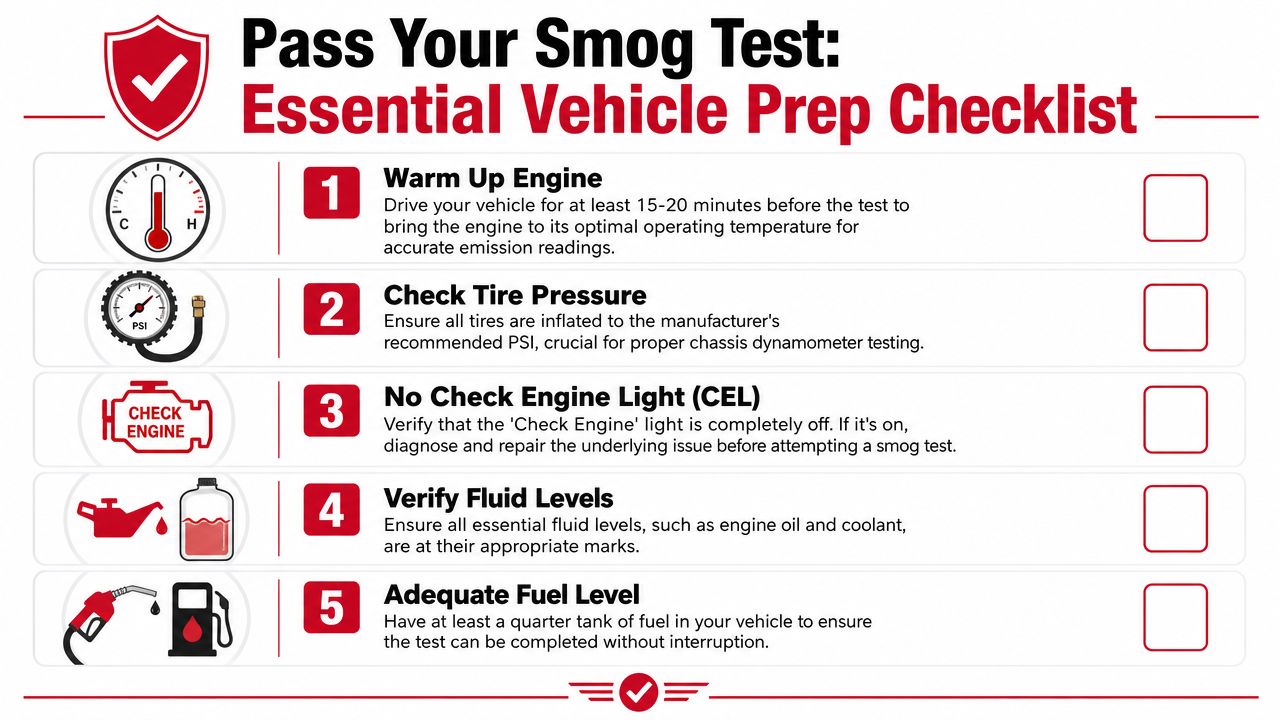
An active check engine light is an automatic smog test failure. Recent battery service can also cause trouble because the car's readiness monitors may not be set yet. I see that one catch people all the time, especially after a new battery, alternator work, or a repair where the codes were cleared.
The two mistakes that cause the most grief
Start with the dashboard. If the check engine light is on, handle that before you book the test. The station cannot ignore it, and hoping it will slide through only turns one visit into two.
Battery disconnects are the other common problem. After the battery has been replaced or disconnected, the vehicle often needs normal driving before the emissions monitors show ready again. Even a smooth-running car can fail if its emissions system, onboard diagnostics, and readiness monitors are not aligned for compliance.
That trade-off matters for Pittsburg drivers deciding where to go. If you are already making a short drive to a verified STAR station in Antioch to avoid the STAR versus test-only mix-up, make sure the car is test-ready first. The smarter trip is the one that gets the certificate done in one shot.
A simple pre-test routine
Use this quick check before you leave:
- Check the dash first: No check engine light, and no fresh code clearing.
- Think about recent repairs: Battery replacement, dead battery jump starts, or electrical work can reset monitors.
- Tighten the gas cap: A loose cap can trigger emissions faults on some vehicles.
- Drive long enough to warm the car up: A cold engine is not ideal for a smog appointment.
- Bring your registration notice and ID: If you need a refresher on what the DMV usually asks for, this guide to California DMV registration renewal requirements helps.
- Skip the guesswork: If your paperwork points you to a STAR inspection, go to a verified STAR station instead of trying a nearby shop and hoping the designation matches.
A short prep video can also help if you want a quick visual refresher before you go.
What not to do on test day
Do not clear codes right before the appointment. That usually resets the monitors without solving the fault, which creates another reason for the car to fail.
Do not show up right after battery service, either. Give the vehicle time to complete its normal drive cycles.
And do not rely on how the car feels. Plenty of cars drive fine and still fail because the emissions side is not ready. The goal is simple. Clean dashboard, warmed-up engine, documents in hand, and the right station for your notice. That combination gives you the best chance of passing the first time.
What to Expect During the Smog Test and DMV Process
You pull out of work in Pittsburg, glance at the registration notice on the passenger seat, and realize you want this done in one shot. That is exactly why the station choice matters. If your notice calls for STAR, going straight to a verified STAR station in Antioch saves the usual mistake of stopping at the nearest shop first, then finding out you still need to test somewhere else.
The actual smog inspection is usually simple on the customer side. You check in, hand over your paperwork, and let the inspector run the required test sequence. At a well-run STAR test-only station, the visit feels organized instead of confusing.
What happens in the bay
The inspector generally works through three areas:
- Visual inspection of emissions-related components
- OBD-II check to read the vehicle's onboard systems and readiness status
- Emissions measurement based on the vehicle and the test procedure it requires
Newer vehicles often move through the process faster if the monitors are ready and there are no warning lights. Older models can take a little more hands-on checking. Either way, the station handles the testing. Your job is mostly to arrive with the right documents and the right type of appointment.
Why the DMV side matters more than people expect
A passed smog test is only part of the errand. Registration still has to be completed properly, and that is the point many drivers overlook.
Stations that can help with both steps save time in a very practical way. You are not driving from a test location to another office, waiting in another line, or wondering whether the certificate has gone through yet. For many East Contra Costa drivers, onsite California DMV registration renewal help is what turns a two-stop chore into a one-stop errand.
That matters even more if you are deciding between a random nearby shop and a verified STAR station a short drive away. In real life, the extra few minutes to Antioch often beats losing an hour to the wrong station, incomplete paperwork, or a second trip.
Details that help the process go smoothly
A few parts of the process are easy to miss:
- Certificate transmission: The station sends the smog result electronically to the DMV.
- Timing matters: Don't get tested too early, then let the registration deadline drag out.
- Certificate fee: Part of the bill includes the state certificate charge, so do not be surprised when you see it on the invoice.
The easiest smog visit is the one with no guesswork. You show up at the correct STAR station, the test gets handled cleanly, the result goes to DMV electronically, and your registration gets wrapped up without another stop. For Pittsburg drivers, that is often the smartest reason to make the short drive to a proven STAR shop in Antioch instead of rolling the dice on whatever is closest.
Handling a Failed Test and Using Free Retests
Failing a smog test feels worse than it usually is. Most of the stress comes from not knowing what the next move should be.
A failed test doesn't mean you're stuck. It means you need to fix the specific issue the inspection identified, then come back with the car ready.
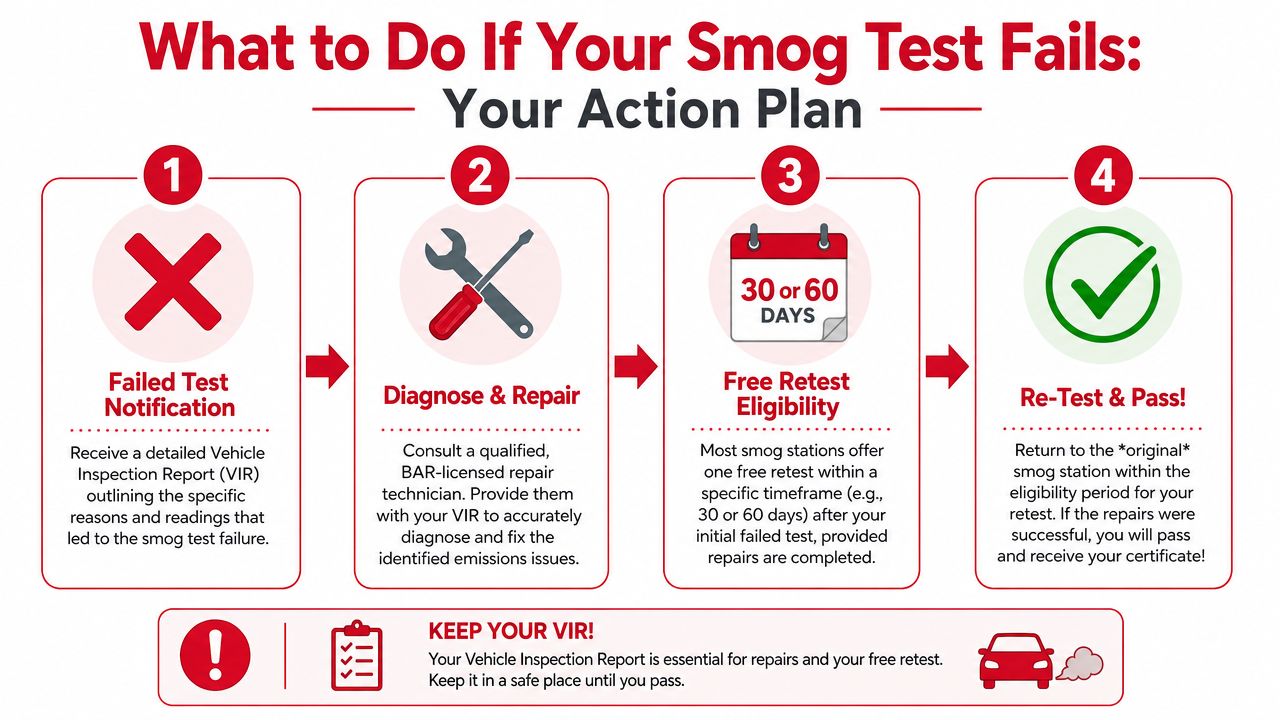
Start with the inspection report
When a vehicle doesn't pass, the first thing to focus on is the Vehicle Inspection Report, often called the VIR. That report tells you what failed and gives your mechanic a much better starting point than “it didn't pass smog.”
This is also where a test-only station has a real advantage. Because the station isn't selling you repair work, there's less pressure and less confusion about whether you're being pushed toward an in-house fix. The testing side stays separate from the repair decision.
Take the VIR to a mechanic you trust. Ask them to diagnose the failure based on that report, not guess from symptoms.
Use the retest strategically
Once the repair is done, go back for the retest according to the station's policy. That matters because many drivers waste time by bouncing to a different location instead of following the original station's retest terms.
A better approach looks like this:
- Keep the VIR: Don't leave it in the glove box and forget about it.
- Choose a repair shop you trust: Independent mechanic, dealership, or your regular local shop.
- Confirm retest terms before leaving the station: Ask what qualifies, how to redeem it, and whether you need the original paperwork.
- Return promptly after repairs: Don't let the issue drag out longer than necessary.
Calm beats guesswork
The worst move after a failure is random parts swapping. That's expensive and usually slower than a proper diagnosis.
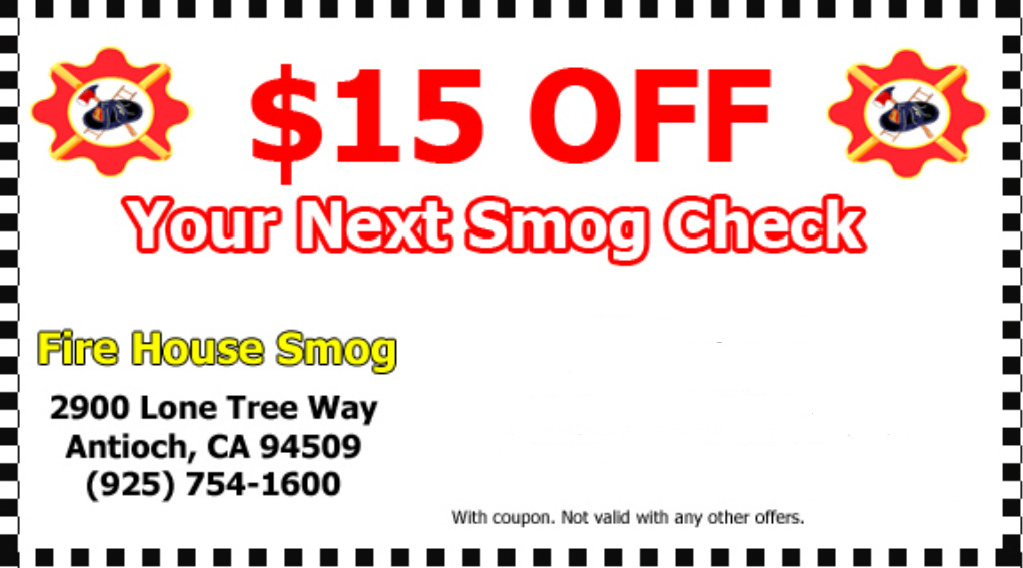
The better move is simple. Read the report, repair the cause, then retest under the offered terms. If you're looking for a local option with a smog discount and retest policy, make sure you understand the coupon conditions before the first inspection so there are no surprises later.
A failed smog test is a repair decision, not a panic situation.
The practical upside of being prepared
Drivers who plan for the possibility of a retest usually handle the whole process better. They keep their paperwork, they don't rush into the first repair recommendation without understanding the problem, and they go back with a clear path instead of frustration.
That's really the bigger lesson behind a smog check in Pittsburg, CA. The process is manageable when you treat it like a checklist, not a crisis.
If you want a straightforward place to handle both the inspection and registration side, Fire House Smog in Antioch is a practical option for Pittsburg drivers who'd rather avoid station-type confusion, long DMV lines, and repeat trips. It's a STAR-certified test-only station with on-site DMV services, which makes it a smart fit when your goal is simple: get the smog done, get the paperwork handled, and get back on the road.