
You open the DMV renewal notice, and there it is, the line that makes people pause at the kitchen table in San Rafael. The car seems fine, the registration is due, and now the form is asking for a smog certification that you weren't expecting, or at least didn't expect to have to think about today. That's the point where most drivers start guessing, and that's where mistakes happen.
The good news is that the system follows a pretty clear pattern once you know where to look. A smog check San Rafael driver usually needs to answer three questions, whether the vehicle is due, whether it's exempt, and if it failed, where it's allowed to go next. The rest of this guide walks through those decisions in plain English, so you can tell the difference between a routine test, a STAR-directed visit, and a repair path that matches the notice in your hand.
Table of Contents
- What Triggers a Smog Check in San Rafael
- Who Is Exempt and Who Must Test
- Test-Only, Test-and-Repair, and STAR Stations Explained
- How to Prepare Your Car Before the Test
- Smog Check Costs and Wait Times in San Rafael
- What Happens After a Failed Smog Check
- Linking the Smog Certificate to Your DMV Renewal
- Common Questions San Rafael Drivers Ask at the Counter
What Triggers a Smog Check in San Rafael
A San Rafael driver usually finds out through the DMV renewal notice. The envelope arrives, the form has a smog certification box, and the next question is whether the vehicle needs testing, whether it needs a specific station type, or whether it qualifies for an exemption. California's Smog Check framework requires inspection for registration renewal in participating counties, and the DMV also marks when a STAR station is required for that vehicle. For Marin County drivers, the notice matters because it is tied to where the vehicle is registered, not just how often it is driven around town. See the DMV's explanation of the statewide framework in the DMV smog inspection rules affecting San Rafael registration renewals.
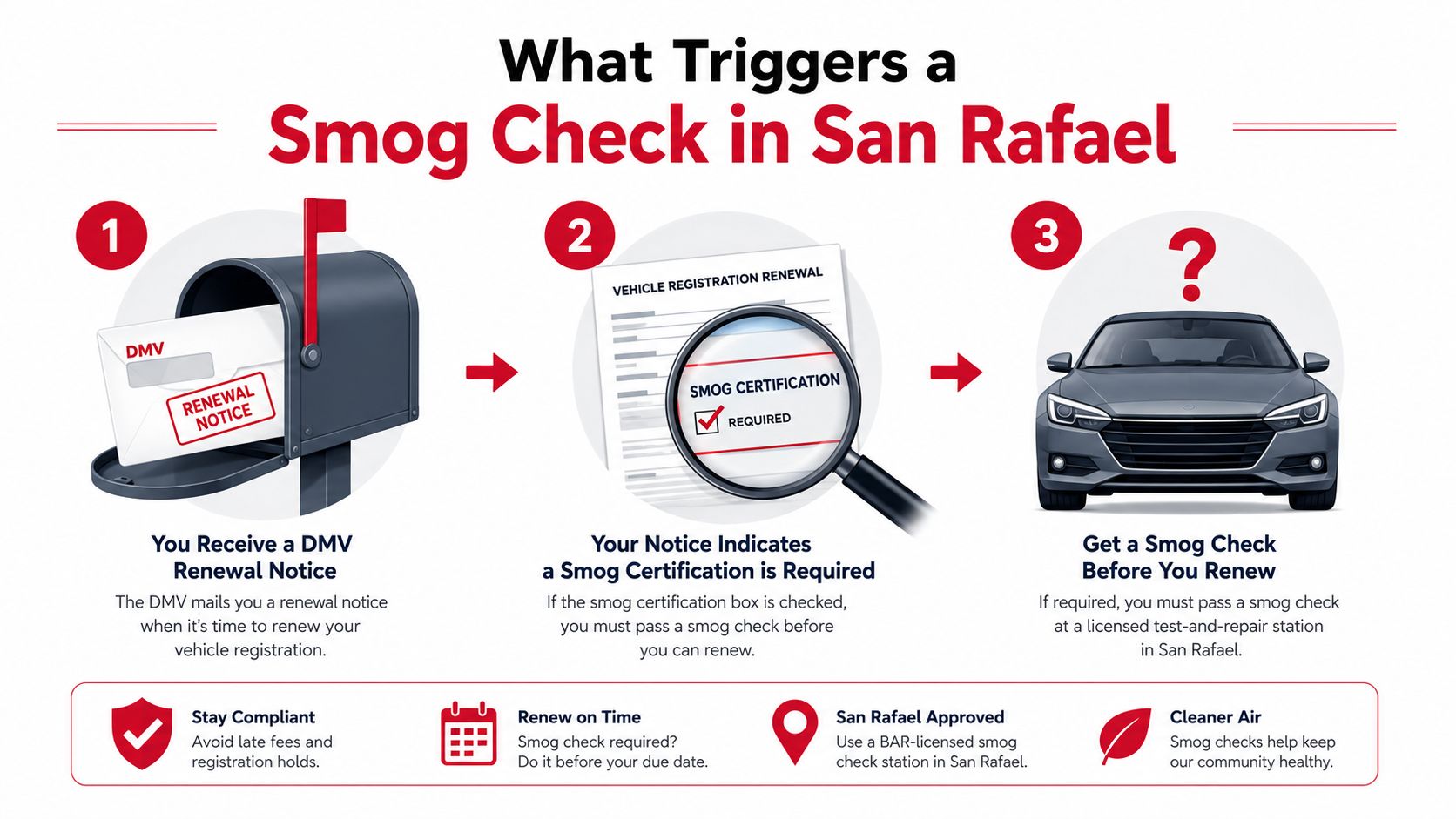
Read the renewal notice like a checklist
The smog certification box is the first thing to check. If it is marked, the DMV expects a certificate before renewal can move ahead. The vehicle description is the next piece, because model year and fuel type tell you whether an exemption may apply. The STAR direction line is the part that causes the most confusion, because a vehicle sent to a STAR station has to be certified at the right kind of station, not just any shop that performs smog inspections.
Practical rule: If the DMV notice says a STAR station is required, treat that as the station assignment for the vehicle.
A useful way to read the notice is to separate the question of need from the question of location. If the notice asks for smog, you are already past the first question and into the second one, where station type matters. That is where drivers lose time, because a vehicle can be eligible for a certificate and still be turned away if it is tested at the wrong station type.
For a San Rafael driver holding a renewal notice at the kitchen table, the job is simple: match the notice to the vehicle. If the notice calls for a certificate, check whether the vehicle sits inside an exemption window, then look for the station type named on the form. If there is already a failure slip in hand, the path changes again, and the next step depends on whether the car needs a test-and-repair station, a test-only station, or a BAR referee review.
Who Is Exempt and Who Must Test
A lot of San Rafael drivers get stuck here because the exemption rules are not based on age in a loose, everyday sense. California DMV uses model year and fuel type to decide who is exempt, and that can feel backwards if you are only looking at the car's actual age. Gasoline-powered vehicles 1975 or older do not need a smog inspection, and diesel-powered vehicles 1997 or older do not need one either. The DMV also lists exemptions for diesel vehicles over 14,000 pounds gross vehicle weight, electric vehicles, and natural-gas-powered vehicles over 14,000 pounds.
The model-year rule is where people usually misread the notice
For gasoline vehicles, the DMV says gasoline-powered vehicles less than eight model-years old do not need a smog inspection. That is a moving window, so the cutoff changes as the model year changes. A driver who counts from the calendar can get the answer wrong, while a driver who counts backward from the current model year gets the right result.
There is also a separate rule that started January 1, 2019, where vehicles under 4 model years old may pay a smog abatement fee instead of undergoing inspections for the first 8 years of registration. That is one reason newer cars do not always follow the same testing pattern as older ones, even when the renewal notice still looks like a smog-related renewal.
A simple way to sort your vehicle
- Gasoline, 1975 or older: no smog inspection required.
- Diesel, 1997 or older: no smog inspection required.
- Diesel over 14,000 pounds GVWR: no smog inspection required.
- Electric: no smog inspection required.
- Natural gas over 14,000 pounds: no smog inspection required.
- Gasoline under eight model years old: generally exempt from testing.
If you want the state's exemption categories in one place, the smog inspection exemption rules page lays them out in DMV language.
A renewal notice that already asks for smog certification means the vehicle has been matched against the exemption rules for that cycle. If the DMV wants a certificate, the car is being treated as a vehicle that must test now, not later. That is the point where the notice matters more than a guess at whether the car feels old enough or new enough.
Test-Only, Test-and-Repair, and STAR Stations Explained
The labels on smog stations sound close, but they serve different purposes. A test-only station handles the inspection and does not sell repairs, so the test result stays separate from the repair estimate. A test-and-repair station can inspect the vehicle and fix emissions-related problems at the same shop. A STAR station meets higher Bureau of Automotive Repair performance standards and can certify some vehicles that other stations are not authorized to certify, including high-polluting vehicles and vehicles the DMV notice sends to STAR. If you want the state's definition of STAR stations and certificate fees, see the California BAR smog check overview.
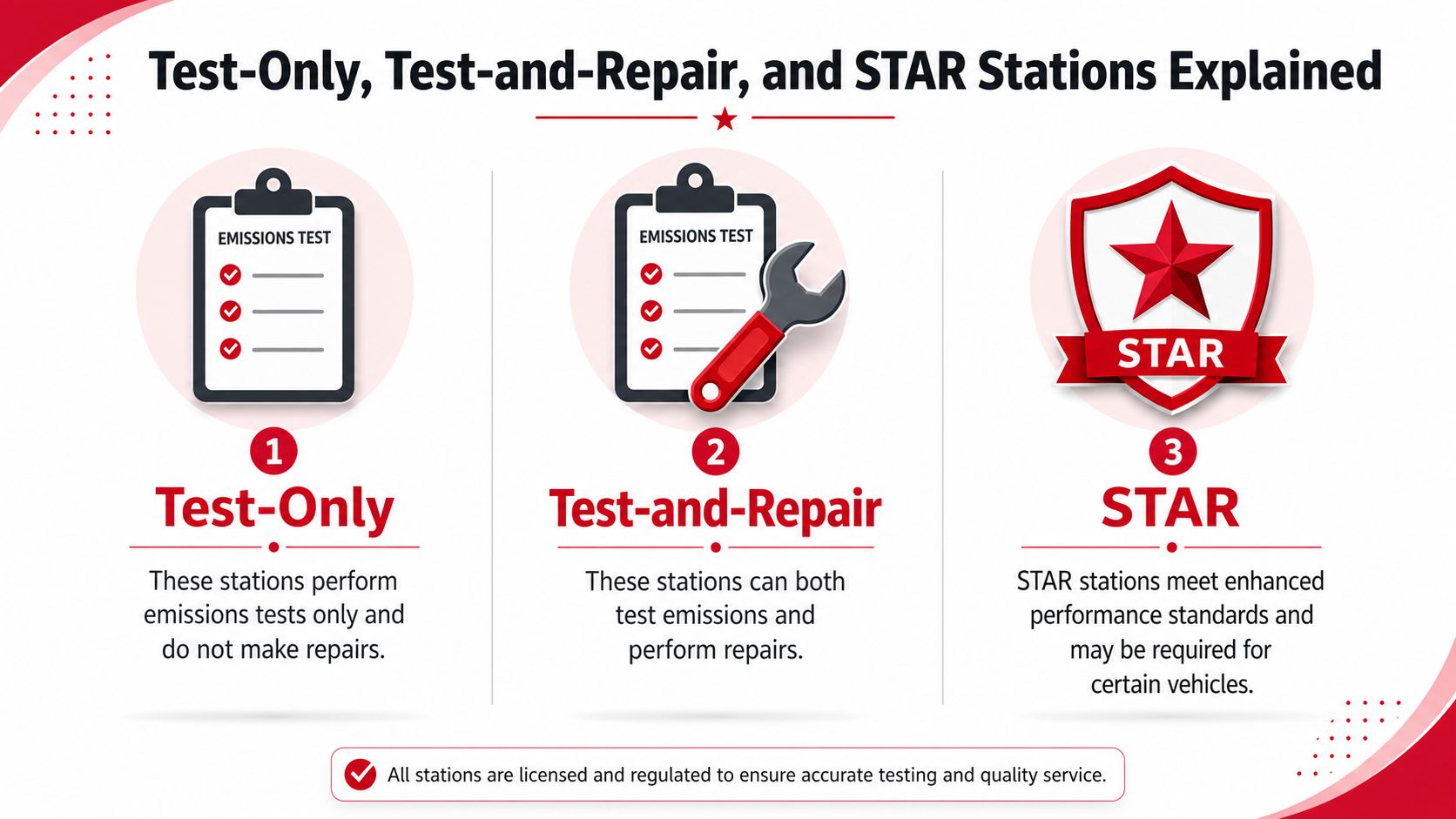
A failed smog check can make the station choice feel more complicated than it first looks. The car may need repair, but the next station still has to be allowed to certify the result. That is why the station type matters before you pull in, not after the test is already done.
Why station type matters before you arrive
If your renewal notice directs you to a STAR station, a non-STAR station cannot complete that certification for you, even if the car passes the inspection. Drivers often miss that part because they focus on the pass or fail line and overlook whether the shop was allowed to sign off on the result. The DMV renewal notice controls the lane you need to use.
A test-only station works well when you want the inspection handled without a repair pitch attached to it. A test-and-repair station makes more sense when you expect the car may fail and you want one place to diagnose and fix the issue. STAR stations matter when the vehicle is directed there, or when the emissions history puts it into a stricter category. For a plain-language explanation of that category, what STAR-certified smog means helps show why one shop can certify a vehicle while another cannot.
Picking the right lane the first time
- Need a first-pass inspection: a test-only station is usually the simplest fit if the notice does not require STAR.
- Need diagnosis and repair in one place: a test-and-repair station is the practical choice.
- Directed by DMV notice or dealing with a high-emitting vehicle: a STAR station may be required.
- Unclear after a failure: read the renewal notice before choosing the next stop.
If you are comparing station types around San Rafael, the main question is not just whether the car can pass. It is whether the station is allowed to handle the next step in the process. That keeps you from paying for the wrong visit, then having to start over somewhere else.
How to Prepare Your Car Before the Test
A clean test result often starts before you reach the station. The most useful prep is simple and mechanical, not dramatic. Drive the car long enough to get it fully warm, make sure the check-engine light isn't on, confirm the gas cap is sealed, and don't show up right after a battery change if the vehicle needs time to reset its monitors. Some stations also use testing methods that depend on the vehicle type, so a little setup helps avoid a return trip.
A five-step routine that keeps people from getting burned
- Take a warm drive first. A drive of at least 10 to 15 minutes helps bring the vehicle up to operating temperature.
- Look at the dashboard. If the check-engine light is illuminated at the time of test, the vehicle fails regardless of how it feels on the road.
- Inspect the gas cap. A loose or badly sealed cap can create trouble that feels small but still matters in inspection.
- Think about battery history. A recently replaced or dead battery can reset readiness monitors, which can delay a clean result.
- Check fuel and tire condition. Some station procedures may depend on vehicle setup, so don't arrive with obvious maintenance issues hanging over the test.
A vehicle that's “driving fine” can still fail if the onboard systems aren't ready or the warning light is on.
That's the part drivers usually underestimate. Smog testing isn't a general roadworthiness check, and it isn't a judgment about how the car feels on the commute up to San Rafael. It's a test of whether the vehicle's emissions-related systems are ready and whether they're operating within the allowed limits.
If you're trying to avoid a second visit, the morning-of checklist matters more than a last-minute top-off of the tank or a wash. Get the dashboard clear, let the engine warm up, and don't treat a warning light as something you can explain away at the counter.
Smog Check Costs and Wait Times in San Rafael
A smog check bill usually has two parts, and separating them keeps the numbers from looking mysterious. The station charges for the inspection itself, and the state certificate fee is added on top of that. California's Bureau of Automotive Repair sets the Smog Check certificate fee at $8.25, while the station sets its own labor price. That is why one San Rafael listing can show $41.75 plus the $8.25 certificate fee, which lands at about $50 on coupon pricing, while another shop may quote something different for the same basic service.
The practical lesson is simple. A lower advertised price may reflect a narrower appointment window, while a higher price may buy you longer hours, weekend availability, or faster service. San Rafael drivers often end up paying for convenience because it is easier to fit the test into a workday or a weekend errand than to wait around for a slow counter.
Wait time is a separate question from price. A quick pass-only visit can move along without much delay, while a busy hour or a vehicle that needs more involved testing can add time to the visit. If you are trying to get registration renewed before the deadline, budget for both the fee and the wait, not just the sticker price.
| Cost Component | Typical Range | Who Sets It |
|---|---|---|
| Smog Check certificate | $8.25 | California Bureau of Automotive Repair |
| Station labor charge | Varies by station | The individual station |
| Advertised local coupon pricing | About $41.75 plus the certificate fee | The station |
| Out-the-door total on a coupon listing | About $50 | Combination of station charge and certificate fee |
Before you hand over the keys, ask about the retest policy. Some stations will retest under certain terms at no extra charge, and that can keep a failed visit from turning into a second full bill at the same shop. If you are comparing places, the retest rule matters just as much as the first price quote.
For drivers who want to understand why a car fails in the first place, this smog check fail reasons guide can help make the common causes easier to sort through.
What Happens After a Failed Smog Check
A failed smog check can feel like a dead end, but the next step depends on the kind of failure and on what the DMV notice says. For a San Rafael driver, the first question is not "Who can fix it?" It is "Who can certify it after the repair?" California BAR explains that if a vehicle fails and is not a gross polluter, it can be repaired and certified at any test-and-repair station. If the vehicle was directed to a STAR station on the DMV notice, or if it exceeded gross polluter thresholds, the repaired vehicle has to be certified by a STAR-certified station or a BAR referee. The BAR's decision rules are laid out in the Smog Check manual.
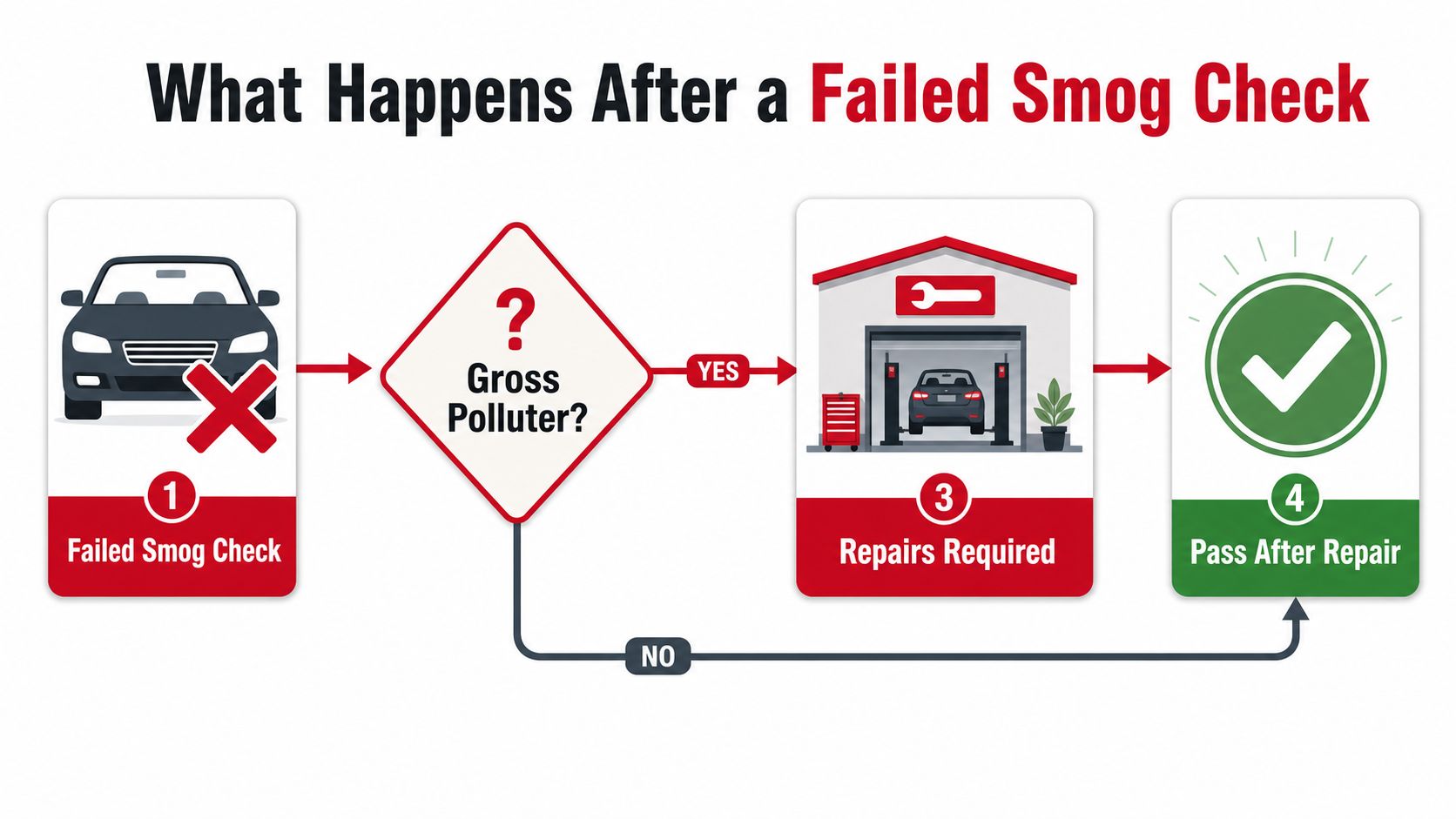
The simplest way to read the failure path is to treat it like a traffic sign. Some cars can make a normal left turn at a test-and-repair station, while others are directed into a narrower lane that only STAR or a referee can use.
The repair path depends on the failure type
If the problem can be corrected by a regular repair shop and the vehicle is not in a restricted category, a test-and-repair station is usually the easiest place to start. The station can both repair the car and complete the follow-up certification, which avoids sending you somewhere else after the fix. If the DMV notice directed the vehicle to STAR, that direction still controls the final certification even after the repair is done.
A BAR referee is a state-employed inspector who performs certification-only tests at fixed locations. Drivers usually end up there when the result is disputed, when the vehicle does not fit the normal station path, or when the repair and test paperwork need a closer review. The referee route is not the default choice, but it is the correct one when the ordinary shop flow does not match the rules.
For drivers trying to make sense of why a car failed before choosing the next shop, the smog check fail reasons guide is a useful starting point. It helps separate routine repair issues from the cases that point toward STAR or a referee.
A practical decision tree
- Failed, not a gross polluter: repair at a test-and-repair station.
- Directed to STAR on the renewal notice: repair and certify through STAR or a referee.
- Gross polluter situation: certification has to follow the stricter STAR or referee route.
- Dispute over the result: the referee path may be the cleaner option.
The key is to read the failure slip and the DMV notice together. Either one can change the next stop, and that is where a lot of San Rafael drivers get tripped up. A car that needs a repair is one path. A car that also carries a STAR direction or a gross polluter designation is a different one.
Linking the Smog Certificate to Your DMV Renewal
A passing smog test only solves part of the renewal. The station sends the result to the DMV electronically, usually within minutes, and then the registration can be finished online, by mail, or at a DMV field office. Some stations also offer DMV renewal services through a licensed business partner, so a driver can handle testing and tag printing in one visit during posted hours. The renewal steps are laid out in the California DMV registration renewal guide.
A San Rafael driver usually runs into trouble at the handoff between the certificate and the renewal notice. A smog pass tells the DMV the car cleared testing, but it does not always mean the renewal is done. If the station only performs testing, the driver still needs to complete the registration somewhere else. If the station also handles DMV renewal services, the paperwork may be finished in the same stop, as long as the vehicle and notice qualify.
The certificate type still matters. A regular pass cannot satisfy a directed renewal if the notice calls for STAR certification, just as a correct test cannot fix the wrong paperwork. The DMV checks the kind of certificate on file, not only whether a certificate exists. That is the part many drivers miss after a failure or a renewal notice arrives with special instructions.
What to have ready at the counter
- Renewal notice: shows whether smog is required and whether STAR is directed.
- Failure slip, if applicable: shows the last test result and helps the station match the next step to the paperwork.
- Current registration: helps the DMV side move faster.
- Proof of repair, if you're returning after a failure: helps connect the repair work to the failed test.
For drivers who want testing and DMV paperwork in one place, Fire House Smog is one example of a station that also provides DMV registration services alongside smog testing. For everyone else, the rule is simple. The smog certificate supports the renewal, but it does not replace the renewal itself.
Common Questions San Rafael Drivers Ask at the Counter
The same questions come up again and again, usually right after the paperwork gets confusing. People want to know whether an out-of-state vehicle can be transferred without a smog check, whether an RV can be tested, whether a directed renewal can be handled anywhere, and how a free retest works. The answers are short once you know the rules.
Quick answers drivers usually need
- Out-of-state transfer: Yes, transferred vehicles generally need a smog check, along with the other paperwork required for the transfer process. VIN verification is part of that process for many transfers, so don't assume the smog visit is the only step.
- RVs and motorhomes: It depends on length and equipment, so call ahead before driving over.
- STAR-directed renewal notice: Only a STAR station or referee can certify it, not a regular non-STAR station.
- Free retest coupons: They're usually tied to the issuing station's terms, and you should bring the original receipt and failure slip.
The best counter question is often, “Does my notice require STAR, or not?” That one detail changes the whole route.
San Rafael drivers get stuck when they treat every failure or renewal the same. They're not the same. A normal pass, a directed renewal, and a post-failure certification each follow a different path, and the station you choose has to match the paperwork you already have.
If you're standing in front of a renewal notice right now, start with the vehicle's model year, fuel type, and STAR direction line. That's the fastest way to tell whether you're booking a routine test, a repair-and-certify visit, or a referee step.
If you want a station that handles both smog testing and DMV registration services, contact Fire House Smog and ask how they handle STAR-directed notices, retests, and renewal paperwork before you head over.

You open your DMV renewal notice, scan for the amount due, and then spot the line that changes your whole errand list: Smog Certification Required.
That one line raises a bunch of practical questions fast. Why does your car need this now? Why does California seem stricter than other states? What do all those terms like CARB, STAR, LEV, and ZEV mean? Most of all, what do you need to do so you can pass the test, renew your registration, and get back on the road without wasting a day?
California emissions standards can feel like a wall of jargon until you connect the policy to what happens in the bay during a real smog inspection. Once you do that, the system makes more sense. The state sets the rules. Testing stations apply them. Your vehicle either shows it's operating within those limits, or it doesn't.
Table of Contents
- Why Your DMV Renewal Says Smog Check Required
- Decoding CARB and the Alphabet Soup of Emissions
- How California's Rules Differ from Federal Standards
- The Road to 2035 and the Future of Driving in California
- Your Vehicle's Smog Check and the Role of STAR Stations
- A Simple Checklist for Passing Your Smog Test
Why Your DMV Renewal Says Smog Check Required
You open your DMV renewal notice, ready to pay the fee and move on. Then one line stops you cold: Smog Check Required.
For many California drivers, that is the moment state policy stops feeling abstract and starts feeling personal. The registration process pauses until the state gets proof that your vehicle's emissions equipment is still doing its job. In other words, the DMV is not asking whether your car starts and drives. It is asking whether the vehicle still meets the emissions rules tied to its age, design, and equipment.
That connection can feel confusing at first. Registration sounds like paperwork. A smog check sounds like a repair issue. In California, the two are linked. The renewal notice acts like a checkpoint between your car and another registration cycle.
The rules behind that checkpoint come from several parts of the state system, but the practical effect is simple for a driver. If your notice says a smog inspection is required, the DMV needs an up-to-date passing result before renewal can be completed.
The notice is really a compliance checkpoint
A helpful way to look at it is this: your renewal notice is a report card request for the emissions side of the car.
Over time, parts wear out. Oxygen sensors get lazy. Catalytic converters stop cleaning exhaust as well as they should. An EVAP system leak can turn on the check engine light even when the car seems to run fine. California requires periodic checks so those problems do not stay hidden for years while the vehicle remains registered.
That distinction is important because drivers often mix up two different ideas:
- How the car feels to drive
- How cleanly the car is operating according to emissions rules
A vehicle can run "pretty normal" and still fail a smog inspection. That surprises a lot of owners the first time it happens.
Practical rule: A smog check verifies emissions performance, not just basic drivability.
If you are sorting out deadlines, fees, and paperwork at the same time, this guide to California DMV registration renewal requirements can help clarify the registration side of the process.
Why California ties this to registration
California keeps a close eye on vehicle emissions because cars and trucks are a major part of the state's air pollution problem. That is the big-picture reason. Your smog notice is the everyday version of that policy.
But for the driver standing at the mailbox, the more useful takeaway is practical. The state uses the renewal cycle because it is one of the few moments when nearly every vehicle owner has to check in. That makes registration an effective point for verifying emissions compliance.
It also explains why the requirement can feel strict. You are not being singled out. Your notice is part of a statewide system designed to catch emissions problems before another registration period begins.
What to do when you see the notice
Start with the basics. Check whether the vehicle needs a test now, whether the check engine light is on, and whether you recently disconnected the battery or had repairs done. Those details can affect the result.
Then choose the right station. A STAR-certified, test-only station such as Fire House Smog can be especially useful when you want a straightforward inspection without the pressure of upselling repairs. That setup helps many drivers get a clear answer about where they stand before the registration clock runs out.
From the driver's seat, the key points are straightforward:
- The DMV notice is the trigger. It tells you a current passing smog result is required for renewal.
- The inspection checks emissions systems. It is not a general judgment about whether the car feels fine on the road.
- A little preparation saves time. Catching warning signs early can reduce retests, delays, and registration stress.
Decoding CARB and the Alphabet Soup of Emissions
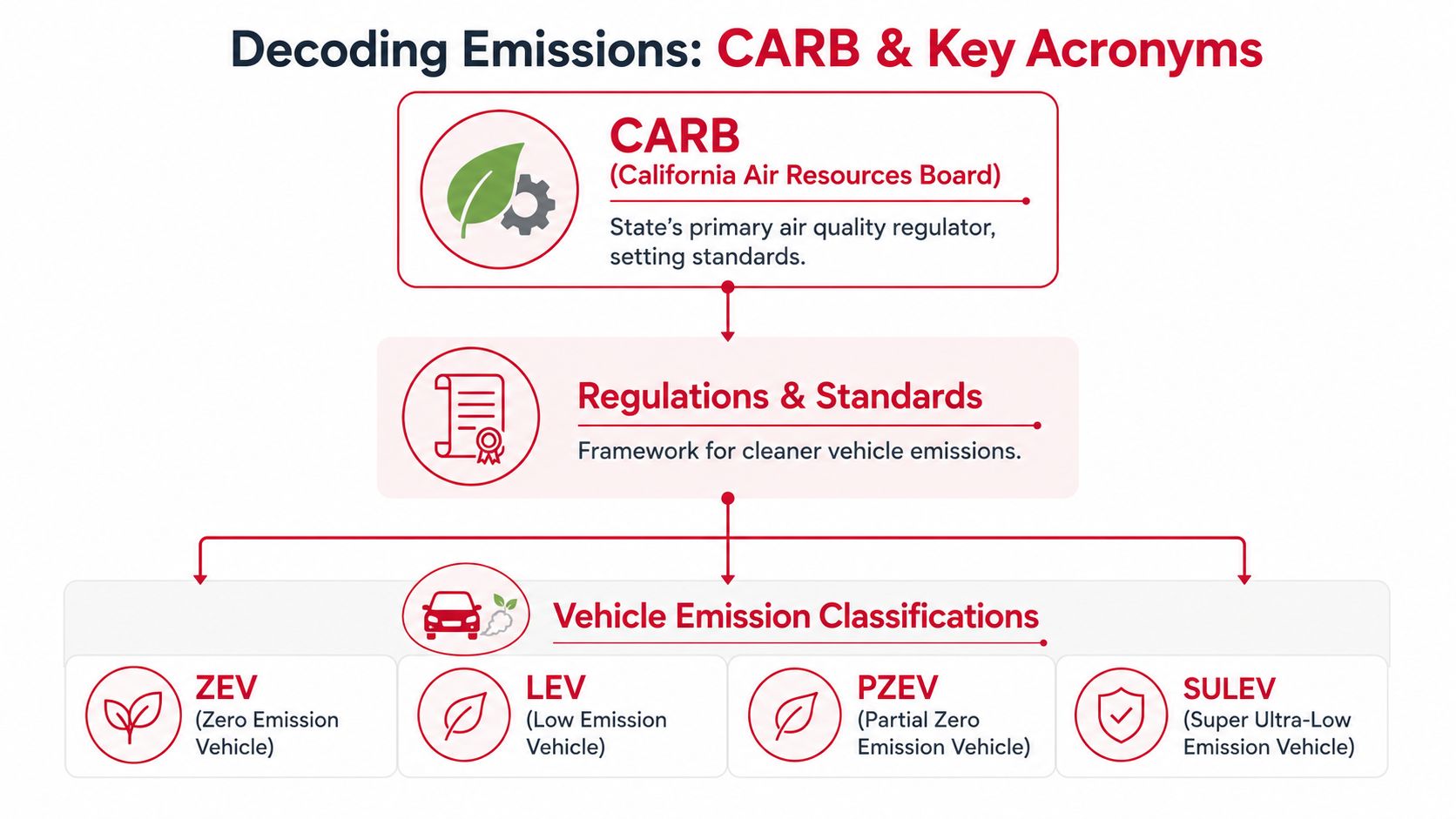
A lot of the stress around California emissions standards comes from the acronyms. They sound technical, but the ideas are manageable once you translate them into plain language.
Who CARB is and why drivers hear about it
Think of CARB as California's air-quality rulemaker for vehicles. It sets standards for what manufacturers must build and what counts as compliant in this state. If you've ever noticed that a car sold in California has specific emissions labeling or equipment requirements, CARB is the reason.
Drivers usually hear about CARB indirectly. The check-engine light comes on. A replacement part needs to be emissions compliant. A smog station checks readiness monitors or tailpipe-related systems. All of that sits downstream from CARB's rules.
One practical example is the state's tighter particulate standard for light-duty vehicles. Under California's LEV III standards, the particulate matter limit for new light-duty vehicles was tightened from 10 mg/mi to 3 mg/mi for vehicles certified by model year 2021, with an in-use compliance standard of 6 mg/mi, as summarized by DieselNet's California light-duty standards reference. In shop terms, that means emissions-control hardware isn't optional decoration. The vehicle needs working systems that can keep pollution below a stricter threshold.
The common emissions acronyms in plain English
The easiest way to understand these labels is to treat them like an environmental report card for the vehicle.
| Acronym | Full Name | Simple Analogy |
|---|---|---|
| CARB | California Air Resources Board | The state teacher who writes the rules and grades the test |
| LEV | Low-Emission Vehicle | A solid passing grade |
| ULEV | Ultra-Low-Emission Vehicle | Better than passing, cleaner than basic compliance |
| SULEV | Super Ultra-Low-Emission Vehicle | Near the top of the class for very low emissions |
| PZEV | Partial Zero-Emission Vehicle | Very clean tailpipe performance with extra emissions protections |
| ZEV | Zero-Emission Vehicle | The A+ category for no tailpipe emissions |
These labels don't all mean the same thing in practice.
LEV means the vehicle meets a low-emissions standard, but it still emits pollution. ULEV and SULEV step down farther. PZEV usually refers to a very clean gasoline vehicle with additional evaporative-emissions controls. ZEV means no tailpipe emissions at all, such as a battery-electric vehicle.
A clean-running gasoline car and a zero-tailpipe-emissions car aren't in the same category. California tracks that difference very closely.
Drivers often run into these terms when shopping for a newer vehicle, reading an emissions label under the hood, or trying to understand why some vehicles sail through a test while others struggle as they age.
If your DMV notice specifically requires a STAR inspection, it also helps to understand the role of a STAR smog test-only station. The acronym side of emissions law and the station type on your notice often connect more closely than people expect.
How California's Rules Differ from Federal Standards
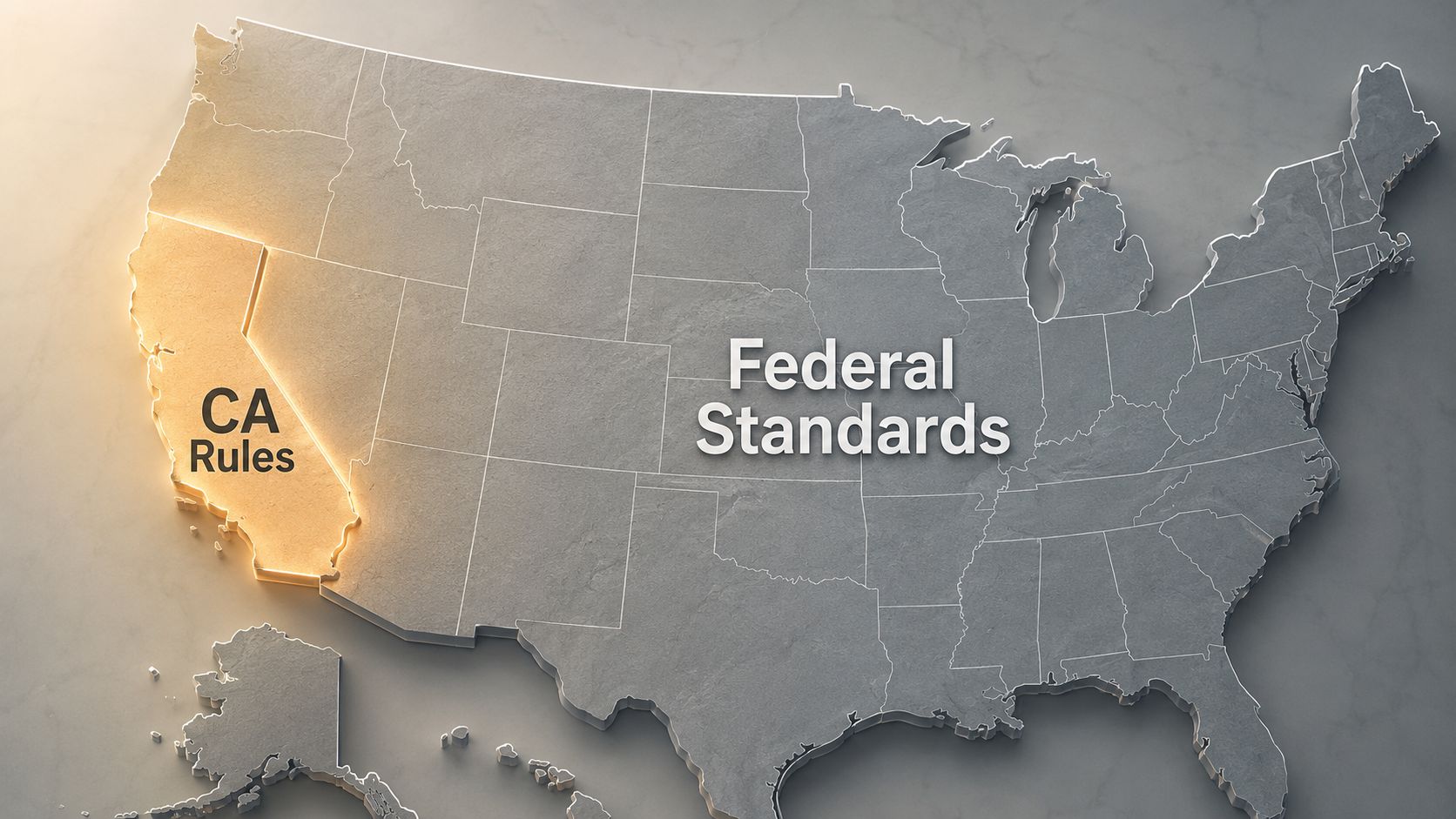
Your car can run fine, no warning light can be on, and you can still feel confused about why California seems stricter than the rest of the country. That confusion is normal. Federal rules set the baseline for the whole U.S., but California is allowed to require more from vehicles sold and registered here.
Why California sets its own path
The practical reason is simple. California has long had serious air-quality problems, especially in dense metro areas and inland valleys where pollution can linger. State regulators have responded by building tighter vehicle rules than the national minimum.
For a driver, it helps to picture federal standards as the minimum passing score on a test. California often grades on a stricter curve. Automakers still have to meet federal requirements, but many vehicles sold here also need to satisfy California-specific emissions rules.
That stricter approach reaches beyond the tailpipe alone. California pays close attention to evaporative emissions, onboard diagnostics, catalyst performance, and how a vehicle behaves right after startup. Those details may sound technical, but they connect directly to real smog check outcomes as a car ages.
What that means for your vehicle
Here is where drivers usually notice the difference:
- Vehicle certification can be stricter: Some vehicles are built or calibrated to meet California emissions requirements, not just federal ones.
- Emissions parts get more attention: Catalytic converters, oxygen sensors, evaporative components, and readiness monitors all have to do their jobs correctly.
- Cold-start performance matters: California focuses on the dirty first moments after startup, when emissions are often at their highest.
A good example is the state's 50-degree F cold-start standard for certain newer light-duty vehicles. California regulations require certification testing at a nominal 50°F for 2026 and later model year vehicles because emissions controls are less effective when the engine and catalyst are cold, as described in the California regulation text hosted by Cornell Law School.
In plain English, California is not only asking, "Does the car run clean once it's warmed up?" It is also asking, "How quickly does it clean itself up after a cold start?"
That distinction can expose borderline problems sooner. A weakening catalytic converter, a lazy oxygen sensor, or an evaporative fault may not be obvious to the owner day to day, but California's tighter framework is more likely to catch it during the inspection process.
So no, the average driver is not taking a completely different smog test in some dramatic way just because they are in California. The better way to understand it is that your test sits inside a stricter rulebook. If you want a clearer side-by-side explanation, this guide to California and federal vehicle emissions standards breaks the terms down into plain driver language.
The Road to 2035 and the Future of Driving in California
A lot of people hear one headline about California and jump straight to the wrong conclusion. They assume the state is about to outlaw every gasoline car on the road. That's not what the rule says.
What the ACCII rule actually says
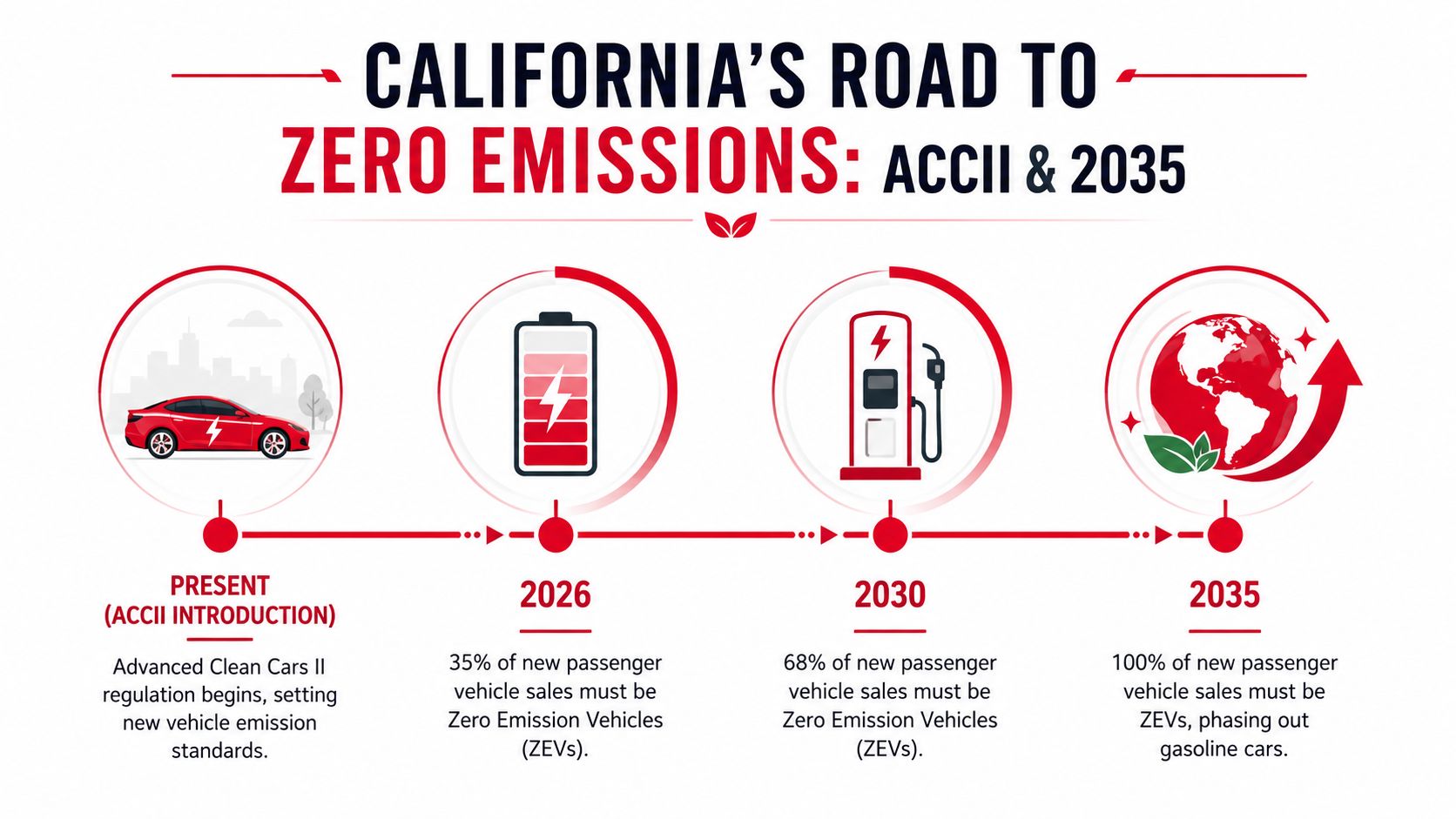
California's Advanced Clean Cars II, often shortened to ACCII, is a sales rule for new vehicles. It requires that 100% of all new light-duty vehicles sold in the state be zero-emission vehicles by 2035, with the phase-in starting with the 2026 model year, according to the American Action Forum summary of California's ZEV rule.
The same source explains that the program ramps up over time rather than flipping overnight. That's why you'll keep hearing about 2026 as an important starting point. It's where the future sales mix begins changing more visibly.
For buyers, this matters because the new-car market will keep shifting toward battery-electric and other zero-emission options. Automakers planning for California can't treat this as a side issue. They have to build product lines that fit the rule.
What it does not mean for current owners
This rule does not mean California is banning your existing gasoline car from the road.
It also doesn't mean used gasoline vehicles suddenly become illegal to own, drive, or sell. If you already have a gas-powered car or truck, the practical question remains the same as it is today: can you keep it registered, maintained, and compliant with the emissions rules that apply to it?
That distinction matters because drivers often mix up two different ideas:
- Rules for new vehicles sold in the future
- Rules for vehicles already in service
Those are not the same thing.
The 2035 target is about what dealers can sell new. It is not a command for current owners to scrap working gasoline vehicles.
There are also cost and benefit discussions wrapped into ACCII. The rule summary cited above states that CARB projected substantial costs and projected benefits through the 2040 model year, with benefits tied heavily to gasoline savings and carbon reductions. For most drivers, though, the immediate takeaway isn't about long-range policy math. It's that California has clearly signaled where the new-vehicle market is heading.
If you're keeping your current car, that future doesn't change the basics. You still need to pay attention to maintenance, warning lights, emissions equipment, and the requirements on your registration notice.
Your Vehicle's Smog Check and the Role of STAR Stations
The policy now turns into a real appointment, a real test, and a real pass or fail.
How policy turns into a pass or fail
A smog inspection isn't guessing. The station is checking whether your vehicle's emissions systems and onboard diagnostics line up with California's requirements for that vehicle.
That can include the condition of the catalytic converter, the status of the check-engine light, readiness monitors, visible emissions components, and whether the vehicle appears to have the correct emissions equipment installed. Newer standards matter here because they shape what performance level the car is expected to maintain.
Take two examples from the rules discussed earlier.
First, California's tighter particulate matter threshold means cleaner output is expected from modern light-duty vehicles. Second, the state's cold-start focus matters because many emissions failures show up when a vehicle can't control pollution quickly after startup. A worn catalyst, incorrect replacement part, or unresolved sensor issue can push a car out of compliance even if it still seems to drive normally.
Why STAR and test-only matter
Some DMV notices don't just say you need a smog check. They say you need it from a STAR-certified station.
STAR is a state designation for stations that meet specific program requirements. If your notice calls for STAR, a non-STAR station won't satisfy that requirement. That's the first practical reason to check the wording on the renewal form before you drive anywhere.
The second issue is business model. Some shops both test and repair. Others are test-only.
That difference matters because 13% of smog checks in California involve vehicles that fail initially but pass on retest without repairs, which has raised concerns about bias at non-test-only locations, according to the California Air Resources Board program page discussing LEV testing and related station concerns. A test-only station doesn't sell repairs, so it removes the incentive tied to repair revenue.
Shop-floor advice: If you want a neutral result, choose a station that only tests and doesn't profit from diagnosing the same failure into a repair order.
That doesn't mean every test-and-repair shop is doing anything improper. It means drivers should understand the incentive structure before choosing where to go.
Here's the practical comparison:
| Station type | What it does | Main driver concern |
|---|---|---|
| Test-and-repair | Inspects and may also sell repairs | Possible conflict if the same shop benefits from a failed result |
| Test-only | Performs the inspection only | You may need a separate repair shop if the vehicle fails |
| STAR-certified test-only | Performs required STAR inspections without repair sales | Useful when the DMV specifically requires STAR and you want a neutral test |
If you want to see the inspection environment before booking, this video gives a quick look at the process and station setup:
A station can also affect what happens after the test. Some locations only send the certificate electronically and leave you to finish registration elsewhere. Others combine services. Fire House Smog is a factual example of the second model. It's a STAR-certified test-only station and licensed DMV service provider in Antioch, so a driver may be able to complete a smog check and DMV renewal tasks in one stop, with on-site tag issuance during posted hours.
What drivers usually get confused about
The most common misunderstandings are straightforward:
- "If the car runs fine, it should pass." Not always. Emissions failures often come from control systems you can't feel while driving.
- "Any smog station is fine." Not if your notice requires STAR.
- "A fail means I need major repairs." Sometimes yes, sometimes no. The failure reason matters.
- "Passing after a retest proves the first failure was valid." Not necessarily. That's one reason neutrality matters.
Smog checks go more smoothly when you pick the right station type first, not after a failed visit.
A Simple Checklist for Passing Your Smog Test
The easiest way to handle California emissions standards is to turn them into a short routine. You don't need to memorize regulations. You need to avoid the common mistakes that lead to delays.
Before you leave home
Read the DMV notice carefully. Look for whether it says a STAR station is required. That one detail decides where you can go.
Make sure the check-engine light isn't on. If it's illuminated, deal with that first. A warning light is one of the clearest signs that the car may not be ready to pass.
Don't ignore recent battery disconnects or repairs. If codes were cleared or the battery was disconnected, the vehicle may need normal driving before its systems show ready again.
A rushed test right after clearing codes is one of the most avoidable reasons people have to come back.
- Drive the car before the inspection. A normal warm-up drive helps the engine and emissions systems operate under more stable conditions than a cold vehicle that has been sitting.
At the station and after the result
Bring your registration information and confirm whether the station can handle the type of vehicle you're bringing. That matters even more if you're showing up with something larger than a typical passenger car.
Then follow this simple decision path:
- If the car passes, the certificate is transmitted and you move on to registration.
- If the car fails, read the failure reason before authorizing anything elsewhere.
- If you need a retest, ask about station policy in advance so you know whether a return visit includes any retest option.
A smart station choice can also save a second errand. Some locations offer on-site registration help and sticker printing, which is useful if you want to handle compliance and DMV paperwork in the same stop instead of splitting the day between agencies and service counters.
The short version is this:
- Check the notice
- Warm up the car
- Make sure there are no active warning lights
- Use the correct station type
- Understand the result before taking the next step
That approach won't guarantee every older vehicle passes, but it does remove a lot of avoidable friction from the process.
If you need a STAR-certified test-only inspection in Antioch, Fire House Smog handles smog checks for cars, SUVs, light-duty trucks, and some RVs, and it also offers on-site California DMV services with tag issuance during posted hours. For drivers who want a neutral test without repair sales, plus the option to complete registration tasks in one place, it's a practical local option.
You open your DMV renewal notice, scan for the amount due, and then see the line nobody likes: smog certification required. If you own a diesel in California, that notice tends to raise more questions than answers. Gas drivers often assume your process is the same as theirs. It isn't.
Diesel owners deal with stricter rules, a smoke test many people misunderstand, and OBD checks that can trip you up even after you've already made the repair. I've seen plenty of owners walk in thinking, “The truck runs fine, so I should be good,” and then get blindsided by an incomplete monitor or smoke that hangs a little too long.
The good news is that the process is manageable when you know what the station is checking. You need to know whether your diesel is subject to testing, what causes failures, how to prep the vehicle before test day, what happens during the inspection, and what to do if you pass or fail.
Table of Contents
- Your Diesel Needs a Smog Check. Now What?
- Which Diesel Vehicles Need a Smog Test in California
- Top Reasons Diesel Vehicles Fail the Smog Test
- How to Prepare Your Diesel for a Smog Test
- The Process at a STAR Test-Only Smog Station
- After the Test Passing Failing and Next Steps
Your Diesel Needs a Smog Check. Now What?
Most diesel owners start in the same place. Registration notice in hand, keys on the counter, and a mild sense that this is going to be more annoying than it should be. That feeling is fair. Diesel testing in California has more traps than most drivers expect.
A common scenario goes like this. You've got a pickup or SUV that starts fine, pulls strong, and doesn't seem to have any obvious issue. You assume the smog test for diesel vehicles is just another quick formality. Then somebody tells you a glowing check engine light means failure. Somebody else says to just clear the code. Then a forum post says smoke is okay if it's “not too bad.” That kind of advice gets people into trouble.
What works is a simple approach.
- Read the renewal notice carefully: If DMV says a smog check is required, treat that as your starting point.
- Figure out whether your diesel falls under the California testing rule: Model year and GVWR matter.
- Check the dashboard before you go: If warning lights are on, don't gamble.
- Drive the vehicle enough after repairs: Clearing codes at the last minute usually creates a different problem.
- Go in prepared: A warm engine and a vehicle in normal running condition usually make the process smoother.
Practical rule: Don't use the smog station as your first diagnostic step if the truck is already warning you that something's wrong.
Owners who do best aren't the ones with perfect vehicles. They're the ones who show up understanding what the inspection involves.
Which Diesel Vehicles Need a Smog Test in California
You open your DMV renewal notice, see the smog requirement, and the first question is usually simple. Does my diesel need this test, or am I exempt?
For California diesel owners, the rule is pretty straightforward once you ignore the bad advice floating around online. Most diesel vehicles with a 1998 or newer model year and a GVWR of 14,000 pounds or less need a smog check every two years, as outlined in this California diesel smog requirement overview. If you drive a light-duty diesel pickup, SUV, or passenger vehicle, assume you are in the program until your door-jamb label and registration details prove otherwise.
That catches a lot of California owners off guard, especially people who just bought a newer diesel and expect the same early-year break gasoline vehicles can get. Diesel does not work that way.
The rule that matters in the real world
At a STAR test-only station, this is the first thing I want an owner to confirm before we even talk about readiness monitors, warning lights, or smoke. Model year and GVWR decide whether your diesel belongs in the biennial smog program. If your truck is covered, the DMV will keep asking for a smog certification at renewal time while it stays registered in California.
If your diesel is older or heavier, the answer can be different. That is why guessing by appearance is a mistake. A truck that looks like a light-duty pickup still needs to be judged by its actual gross vehicle weight rating, not by what the owner or seller assumed.
Quick reference table
| Vehicle Type | Smog Check Required? |
|---|---|
| Diesel, model year 1998 or newer, GVWR 14,000 lbs or less | Yes, biennially |
| Diesel, model year 1997 or older | No, exempt from this biennial requirement |
| Diesel over 14,000 lbs GVWR | No, exempt from this biennial requirement |
The fastest way to sort this out is to check the sticker on the driver's door or door frame and find the GVWR there. Then match that number with the model year on your registration. If you own a pickup and want a more specific breakdown, this guide to a truck smog check in California will help.
A few practical points save people headaches at the counter and in the test bay:
- Do not assume your diesel gets an abatement-fee shortcut. Covered diesel vehicles are generally in the testing cycle, not on a temporary pass.
- Do not test too early unless you need to. Your passing certificate has a deadline tied to DMV timing, so random early testing can create extra work.
- Check the weight rating, not the badge. A 2500, 3500, or similar trim name does not settle the question by itself.
The right move is simple. Verify the model year. Verify the GVWR. Once you know whether your diesel is in the California program, the rest of the smog process gets a lot less confusing.
Top Reasons Diesel Vehicles Fail the Smog Test
California diesel failures usually come from two places. The vehicle reports a problem through the OBD system, or it pushes out smoke that hangs too long during the test. At a STAR test-only shop, we see both every week, and neither one is a surprise once you know what the technician is checking.
The check engine light problem
If your check engine light is on, stop there and handle it before you book the test. A diesel with an active fault is telling you something is wrong, and California smog equipment is going to see it.
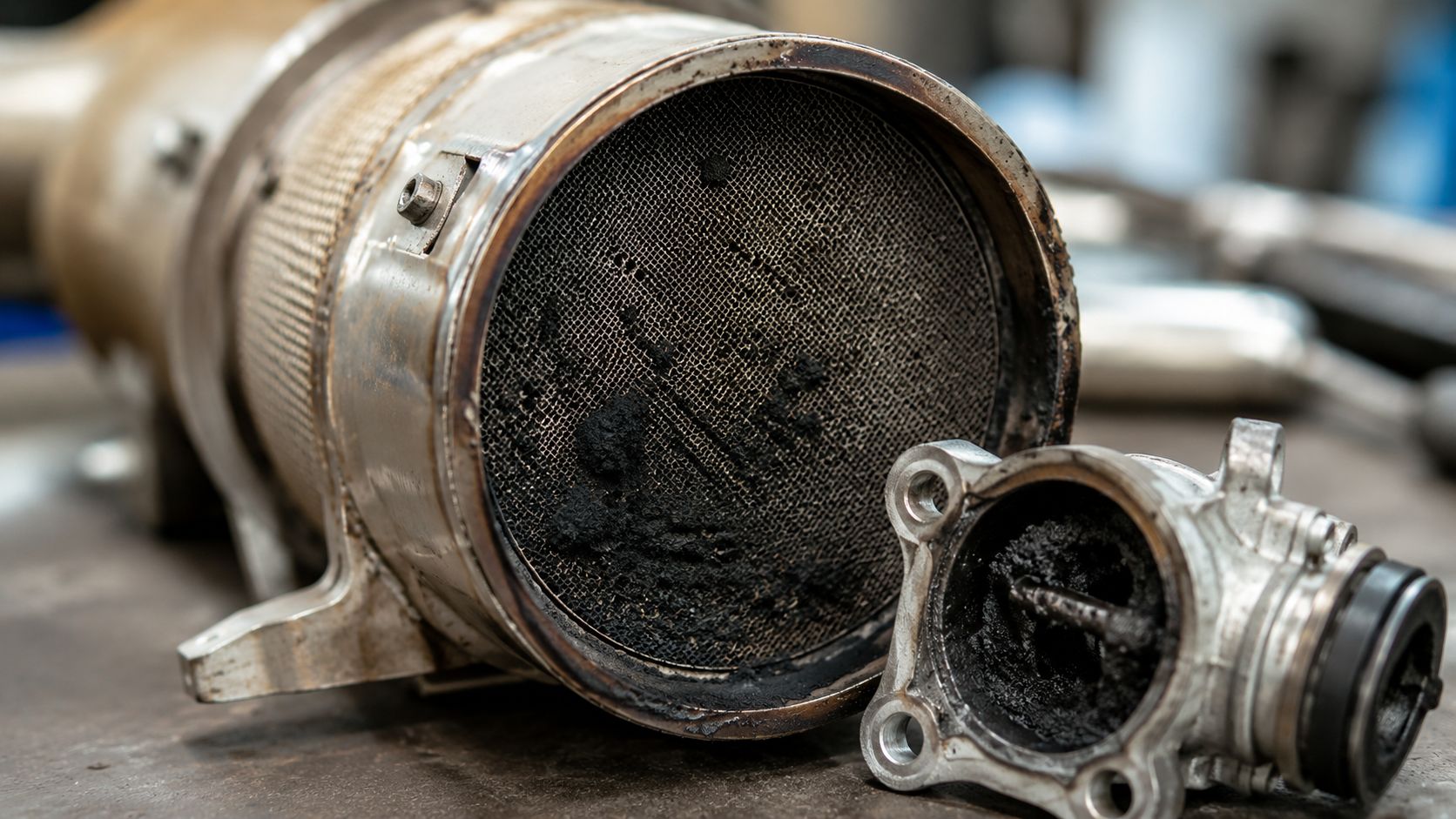
The mistake I want owners to avoid is clearing codes right before coming in. That move usually makes things worse. You still have the original fault, and now the readiness monitors may show incomplete, which can block a passing result.
Here is what that means in plain language:
- An active warning light puts your diesel in a bad position: The fault is part of the inspection picture from the start.
- A recently reset computer raises another problem: The vehicle may not have finished its self-checks.
- A real repair includes drive time afterward: The system has to run its tests and show ready status.
At the shop, this is one of the easiest fail patterns to spot. The owner says the truck is running fine. The computer says otherwise.
Visible smoke during the snap test
Smoke is the other big one, a criterion on which California gets more specific than many drivers expect. The issue is not whether the exhaust looked dramatic to you in the driveway. The issue is whether smoke stays visible too long during the BAR snap-acceleration procedure.
A diesel vehicle fails if a visible smoke plume observed 5 to 15 feet from the tailpipe lingers for more than 3 seconds on either of the final two BAR Snap Tests, according to the California Smog Check Manual.
That catches a lot of owners off guard. A truck can seem acceptable in daily driving and still fail in the bay because the smoke hangs after a quick throttle snap in neutral. If your diesel puffs on startup, hazes under a hard rev, or leaves a cloud that does not clear right away, take that seriously.
Common causes include a restricted DPF, EGR problems, injector issues, turbo problems, and poor maintenance. If you want a broader breakdown of common reasons vehicles fail a smog check, that guide helps. For diesel owners in California, the practical lesson is simple. Lingering smoke is not cosmetic. It is a direct path to failure at a STAR station.
How to Prepare Your Diesel for a Smog Test
Preparation is where you save yourself time, money, and aggravation. Don't overcomplicate it. You're trying to show up with a diesel that is warm, stable, free of warning lights, and fully ready in the OBD system.
Your pre-test checklist
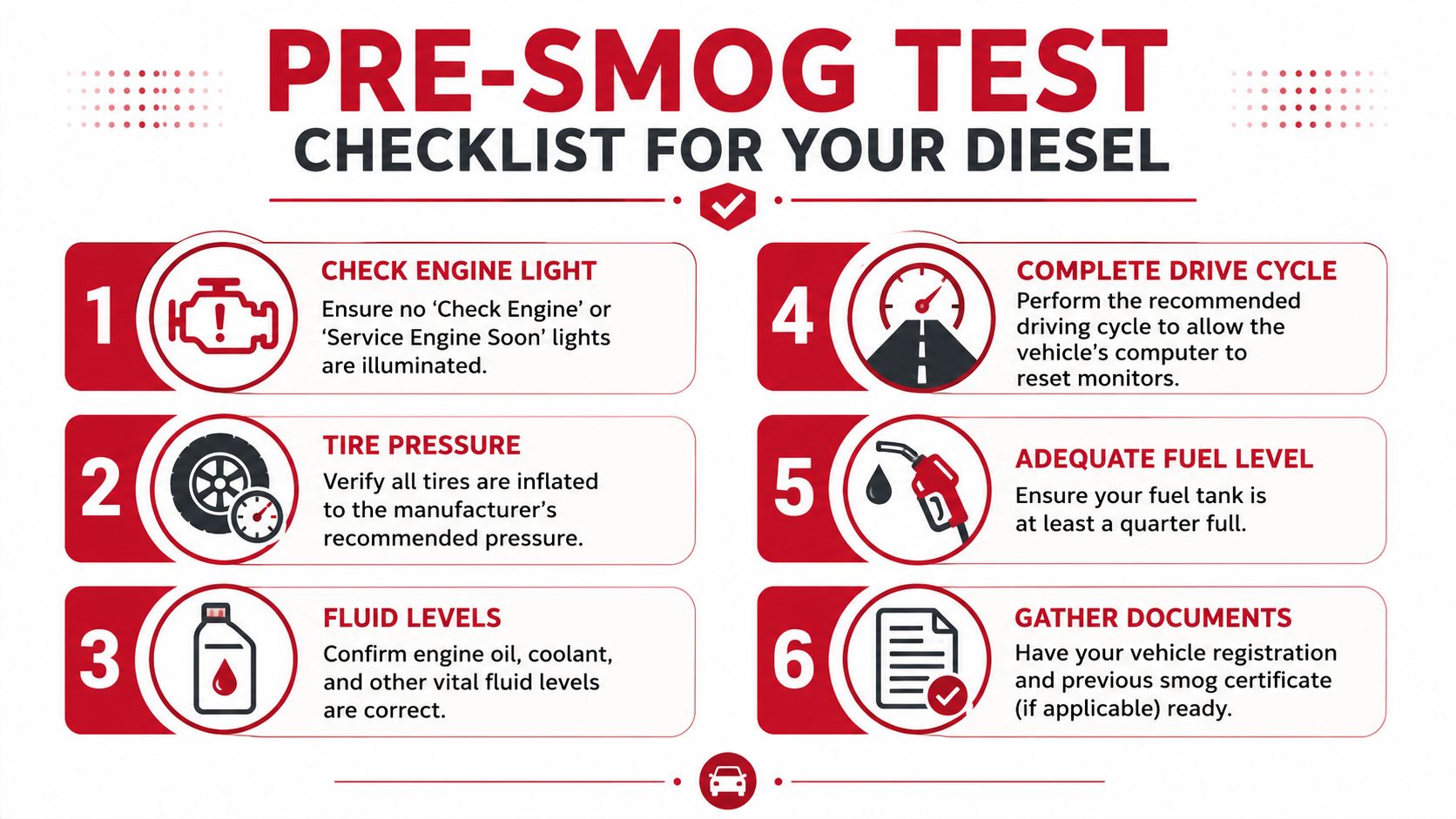
Start with the dashboard. If the Check Engine or Service Engine Soon light is on, handle that first. And if you just cleared it, don't rush straight into the test lane. BAR requires complete OBDII monitors, and a recent reset can leave the vehicle unreadable for pass purposes, as covered in this BAR monitor completion discussion for diesel testing.
Use this checklist before you go:
- Fix the actual fault: Don't erase symptoms. Repair the cause.
- Drive it after repair: The vehicle needs normal operation long enough for the system to run its checks.
- Check for obvious smoke: Have someone watch the exhaust while you briefly raise rpm in a safe area.
- Make sure fluid levels are normal: Low fluids can create drivability problems you don't need on test day.
- Bring your paperwork: Registration paperwork helps keep the visit simple.
This quick video helps visualize the preparation mindset before inspection:
What to do the day of the test
Drive the vehicle long enough to get it fully warm before you arrive. Cold diesels tend to behave worse. They can idle rougher, haze more, and generally make a bad first impression.
A few practical habits help:
- Avoid last-minute battery disconnects. That can wipe out readiness status.
- Don't show up right after major engine work unless you've driven it. Repaired isn't the same as ready.
- If you suspect smoke, postpone and diagnose it. Hope is not a strategy.
- Keep the visit routine. No weird fuel experiments or backyard fixes the morning of the test.
Shop-floor advice: The best smog appointment is the boring one. Warm engine, no lights, normal idle, no surprises.
If you handle those basics, you put yourself in the best position to pass on the first trip.
The Process at a STAR Test-Only Smog Station
A lot of stress disappears once you know what happens in the lane. The inspection isn't mysterious. It's a sequence. The technician checks the vehicle, checks the system, performs the diesel procedure, and records the result.
What the technician does
For a California diesel in the covered class, the station generally looks at three things that matter to owners most.
First is the visual side. The technician is looking for obvious issues and emissions-related concerns that make the vehicle unfit for testing or compliance.
Second is the OBDII check. The station connects to the vehicle and reads the emissions system status. Active faults, stored problems, and incomplete readiness can surface during this process.
Third is the BAR Snap Test. During that procedure, the technician places the vehicle in neutral and quickly pushes the accelerator to 2,000 to 3,000 RPM and releases it to evaluate smoke opacity and duration, according to the California smog check guide describing the BAR Snap Test.
That's the part customers usually notice because they hear the engine rev. But by the time the throttle gets snapped, a lot of the inspection picture is already forming.
Why test-only matters
A test-only station has one major advantage. The shop isn't trying to sell you a repair while it's evaluating your vehicle. That removes the repair upsell angle that makes many drivers uneasy.
That matters even more for diesel owners, because failures can involve systems that are expensive, technical, and easy to misunderstand. At a test-only station, the result is the result. You pass, or you get a report showing what needs attention.
In practical terms, a well-run STAR test-only location is helpful because it usually offers:
- Cleaner decision-making: You're getting an inspection, not a sales pitch.
- Faster throughput: Multiple bays can keep lines moving.
- Convenience if registration is due: Some locations also handle DMV-related tasks on site.
- Better fit for work schedules: Evening and weekend availability helps owners who can't disappear midday.
For drivers in Antioch and nearby areas, that setup is exactly why places that combine STAR testing with registration support are popular. When you can test the diesel and then handle your DMV business in one stop, the whole process feels less like a bureaucratic obstacle and more like a routine errand.
After the Test Passing Failing and Next Steps
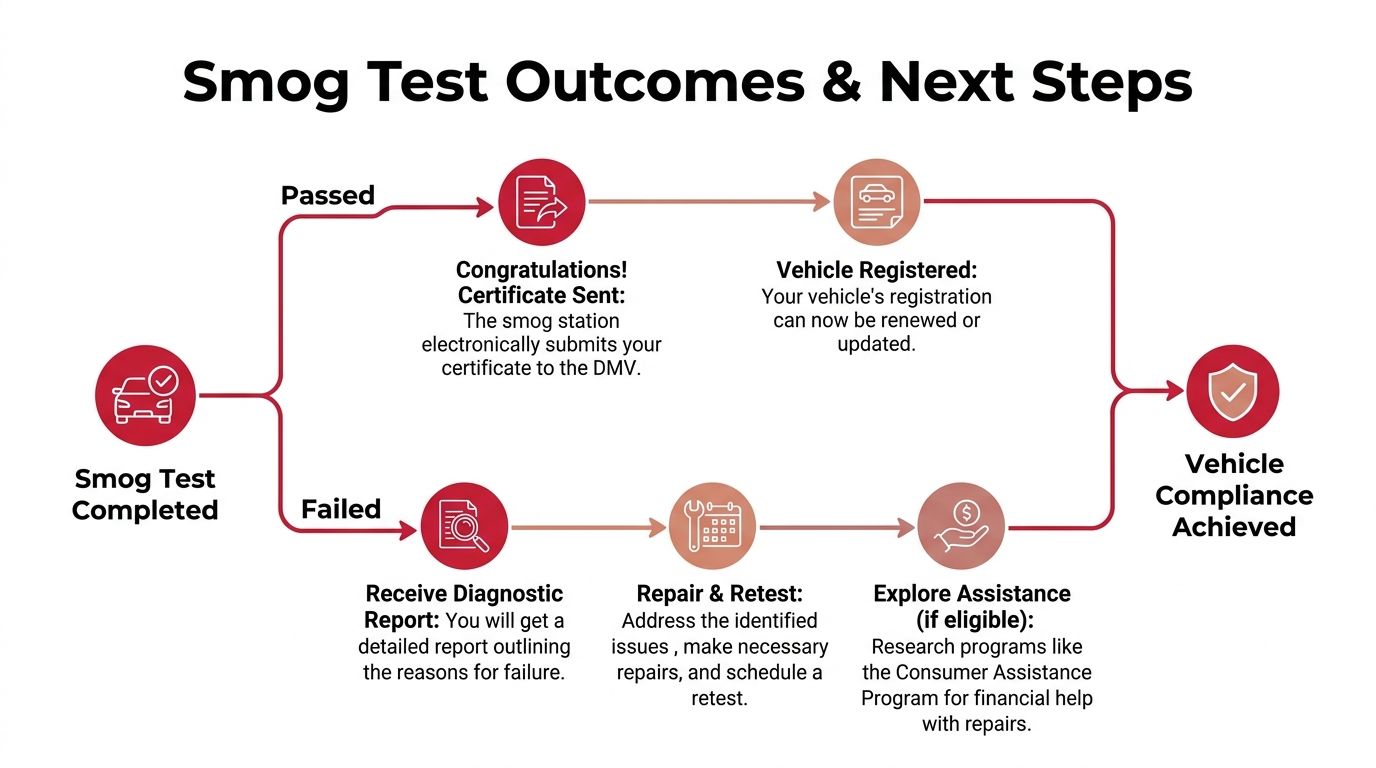
Once the inspection ends, things get simple. You're on one of two tracks. Either the diesel passed and you move on, or it failed and you need to use the report the right way.
If your diesel passes
If the vehicle passes, the station electronically sends the certificate information to DMV. That's the outcome everyone wants because it turns the smog test for diesel vehicles into a one-and-done visit.
At that point, keep your receipt and finish any remaining registration steps. If your registration renewal is the next task, a location that also offers California DMV registration renewal services can make that part faster.
Pass, save your paperwork, and don't wait around if registration is still pending.
If your diesel fails
If the vehicle fails, don't guess. Read the Vehicle Inspection Report carefully. That report tells you why the station could not certify the diesel.
Different failures call for different next moves:
- OBD-related failure: Take the report to a qualified repair shop and address the fault, then drive the vehicle enough for readiness to return.
- Smoke-related failure: Have the engine and emissions system checked before coming back. Lingering smoke rarely fixes itself.
- Visual or equipment issue: Correct the noncompliant condition exactly, not approximately.
Here's the mistake to avoid. Don't throw random parts at the vehicle because a friend had “the same issue.” Diesel failures often overlap in symptoms. A proper diagnosis saves money.
If you're testing at a station with a free retest policy, use it according to the posted terms. That can reduce the sting of a failed first attempt. The important thing is to return only after the issue is repaired and the vehicle is ready, not just quieter, cleaner-looking, or temporarily reset.
A failed inspection is frustrating, but it's still manageable. Use the report, repair the underlying problem, then retest with confidence.
If you need a straightforward place to handle your diesel smog check and registration follow-up, Fire House Smog in Antioch offers STAR-certified test-only inspections, on-site DMV services, weekend availability, and a practical process that keeps things simple for diesel owners.
You open the DMV renewal notice, see the smog requirement, and immediately start doing math in your head. Is the old car going to pass. Is this going to turn into a repair bill. Did that battery disconnect last month just create a new problem.
That anxiety is common, especially when the vehicle is older but still runs fine day to day. Plenty of owners assume a car that drives well will breeze through the test, then get blindsided by an emissions failure, a readiness issue, or a rule they thought didn't apply to “classic” vehicles.
A smog check for older cars in California gets easier once you separate rumor from rule and prep the car for the test it will receive. The practical side matters just as much as the legal side. A warm engine, a complete drive cycle, and choosing the right testing path can save a lot of wasted time and unnecessary repair work.
Table of Contents
- That DMV Notice Arrived What Now
- California Smog Rules for Older Cars Explained
- Preparing Your Vintage Car for Its Smog Check
- The STAR Test Process for Pre-2000 Vehicles
- What to Do If Your Older Car Fails the Smog Check
- Your Antioch Smog Check Partner Fire House Smog
- Frequently Asked Questions About Older Car Smog Checks
- Do I need a smog check to sell an older car
- Can historic plates make my car exempt
- How long is a smog certificate valid
- What is the difference between test-only and test-and-repair
- Do all older cars get the same kind of smog test
- What is the best last-minute thing I can do before the appointment
- If my older car fails, do I have any options besides paying for repairs right away
- If my exempt older vehicle doesn't need biennial smog, can I ignore emissions equipment
That DMV Notice Arrived What Now
Most owners go through the same sequence. First comes denial. “This thing's old, but it's maintained.” Then comes the internet search spiral. One site says older cars are exempt. Another says they're not. A friend swears special plates fix the problem. None of that helps when registration is due.
The first thing to do is slow down and identify what kind of “older car” you have under California rules. A seventies car sits in a very different category than a late nineties sedan. An older diesel follows different rules than an older gasoline car. A transfer of ownership can trigger a requirement even when a routine renewal might not.
That's where people lose money. They approve repairs before confirming the actual requirement, or they go into a test with a cold engine, stale oil, or recently cleared codes and turn a manageable situation into a failure.
Practical rule: Treat the smog check like a specific inspection procedure, not a general judgment on whether your car is “good” or “bad.”
Older vehicles can still pass cleanly. The ones that struggle usually have one of three problems. The owner misunderstood the rule, the car wasn't prepared for the test conditions, or the first failure was handled poorly.
If you're holding that notice right now, the path is straightforward. Confirm whether the car is required to test, prepare it like an older vehicle instead of a modern one, understand what the station is going to do, and know your options if the first result isn't what you wanted. That approach keeps the process calm and keeps you from paying for work you may not need.
California Smog Rules for Older Cars Explained
A lot of confusion starts with one bad assumption. Owners hear “older car” and assume California treats every older vehicle the same. It doesn't.
The exemption line that matters most
For gasoline vehicles, the cutoff is simple. 1975 and older are exempt from the biennial smog check. 1976 and newer usually are not. That is why owners of late seventies, eighties, and nineties cars get caught off guard. The car may feel vintage, but under California registration rules it is still in the testing program, as reflected in California's current classic car smog rule coverage.
Fuel type changes the answer too. Many diesel vehicles follow a different year cutoff, and weight matters. Electric vehicles and motorcycles are outside the regular smog check program. Hybrids are not automatically exempt just because they are partly electric.
That distinction matters at the counter and at the test station. I have seen owners spend money chasing tune-up parts before confirming whether the car needed a test, or what kind of test applied.
A quick reference table
| Vehicle Type | Model Year | Smog Check Required? |
|---|---|---|
| Gasoline | 1975 and older | No for biennial smog requirement |
| Gasoline | 1976 and newer | Yes |
| Hybrid | 1976 and newer threshold applies within the biennial program | Yes |
| Diesel under 14,000 lbs | 1997 and older | No |
| Diesel under 14,000 lbs | 1998 and newer | Yes |
| Electric | Any model year | No |
| Motorcycle | Any model year | No |
Special situations owners miss
Registration event matters almost as much as model year.
A car can be old enough to confuse people and still avoid a regular renewal test for a period of time if it is relatively newer by DMV standards. California uses a smog abatement fee for many vehicles in their first several model years instead of requiring a physical inspection at renewal. That exception does not usually help with first-time California registration from out of state. It also does not erase smog requirements that come up during certain ownership transfers.
Here is the practical version owners should remember:
- Out-of-state vehicles: A vehicle brought into California can need a smog check even if a similar in-state renewal would not.
- Private-party sales: Smog requirements often come up at transfer, and timing can become a problem if the seller waits too long.
- Certificate timing: A passing certificate only stays usable for a limited window, so test too early and you may have to do it again.
- Late renewals: Waiting on the DMV notice does not pause penalties.
The other rule older-car owners need to know is less obvious. A vehicle can be exempt from biennial testing and still be expected to keep its original emissions equipment in place. Removing or disabling required components can still create problems under the California Smog Check Program overview.
That is where standard advice falls short. The rulebook tells you whether the car needs a test. It does not tell you how to avoid an unnecessary failure. On older cars, that usually comes down to test timing, a proper drive cycle so monitors can set, and knowing when a Smog Referee is the better option than arguing with a regular station about an engine change, label issue, or equipment question. Those are the details that save owners money.
Preparing Your Vintage Car for Its Smog Check
A smog check for older cars usually goes better when the owner focuses on simple prep, not panic repairs. Start with the basics that affect how the car runs on test day. Older engines are less forgiving than newer ones, and small issues that seem harmless in normal driving can show up during emissions testing.
What to check before you leave home
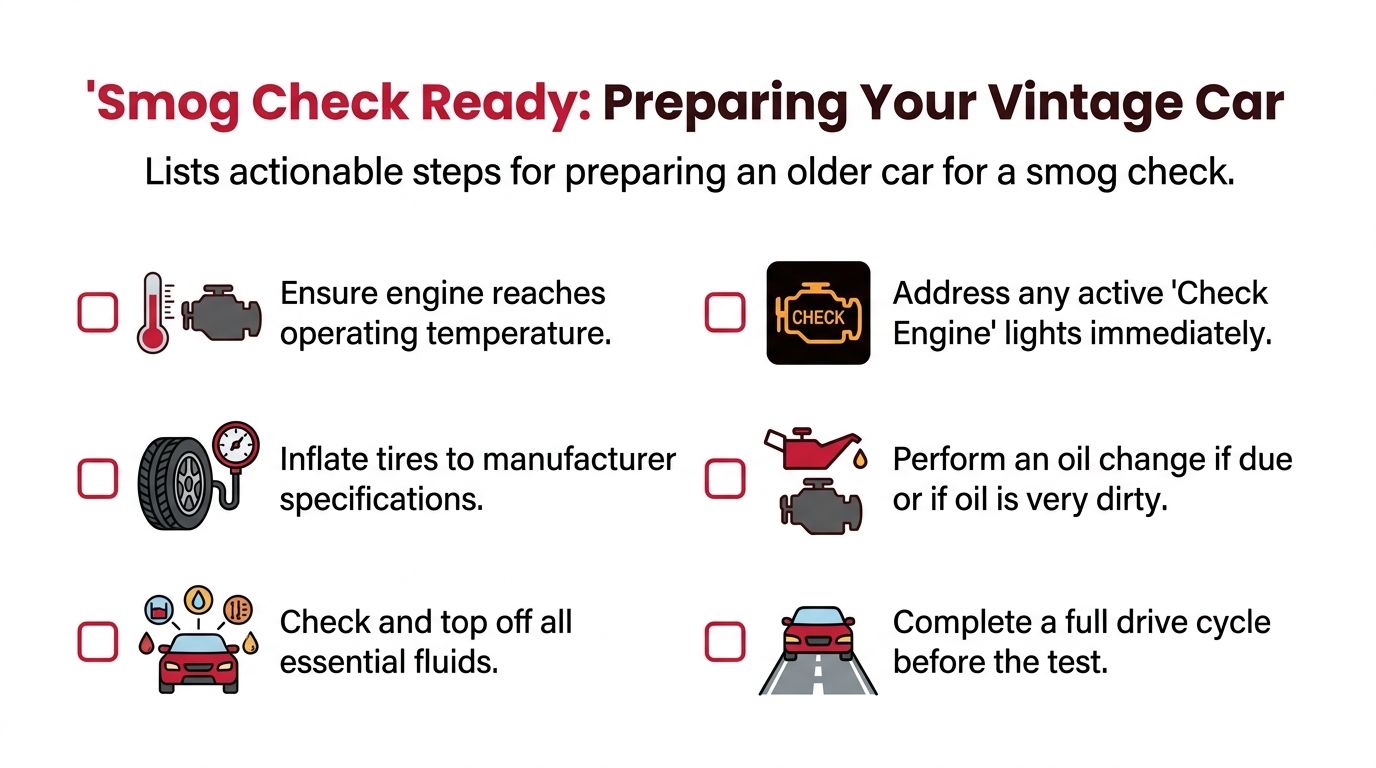
Use this as a practical pre-test checklist:
- Engine temperature: Don't show up with a cold engine. Drive long enough for full operating temperature so the catalytic converter and sensors are doing their job.
- Check Engine light: If the light is on, deal with that first. Clearing codes right before the test often creates a new problem because monitors may not be ready yet.
- Oil condition: If the oil is very dirty or overdue, change it before the test. Old oil can contribute to a rough-running engine.
- Tire pressure: Inflate tires to the correct specification. That helps the car behave normally during testing conditions.
- Fluid levels: Check and top off the basics. You want the engine operating steadily, not compensating for avoidable maintenance issues.
- Battery history: If the battery was recently disconnected or replaced, assume the car may need extra driving before it's fully test-ready.
Why the pre-test drive cycle helps
One of the most overlooked tricks is the pre-test drive cycle. Reddit users and experienced owners report that driving a specific 30-mile route, usually a mix of highway and city driving, can help prime the O2 sensors and catalytic converter, especially on 1995 to 2000 vehicles that struggle after battery disconnections, according to this owner discussion about the 30-mile drive cycle.
That advice lines up with what older-car owners see in real life. A car can feel fine and still not be ready for inspection if the monitors haven't settled back in after power loss or recent code clearing. The drive cycle gives the system time to run its checks under normal conditions.
Here's what tends to work better than random short trips:
- Start with the car fully warmed up.
- Drive a mix of steady-speed road time and stop-and-go sections.
- Avoid idling in a parking lot and calling it “warm.”
- Don't disconnect the battery again before the test.
“If you just cleared codes, don't rush straight to the station. Give the car a real drive first.”
What doesn't work is guessing. Spraying fuel additives into the tank at the last minute, clearing codes on the way over, or showing up after the car sat for days usually creates more trouble than it solves. Older cars reward steady prep, not shortcuts.
The STAR Test Process for Pre-2000 Vehicles
Older cars make people nervous partly because they expect a mysterious process. It isn't mysterious once you know what lane your vehicle falls into.
What BAR-97 means in plain English
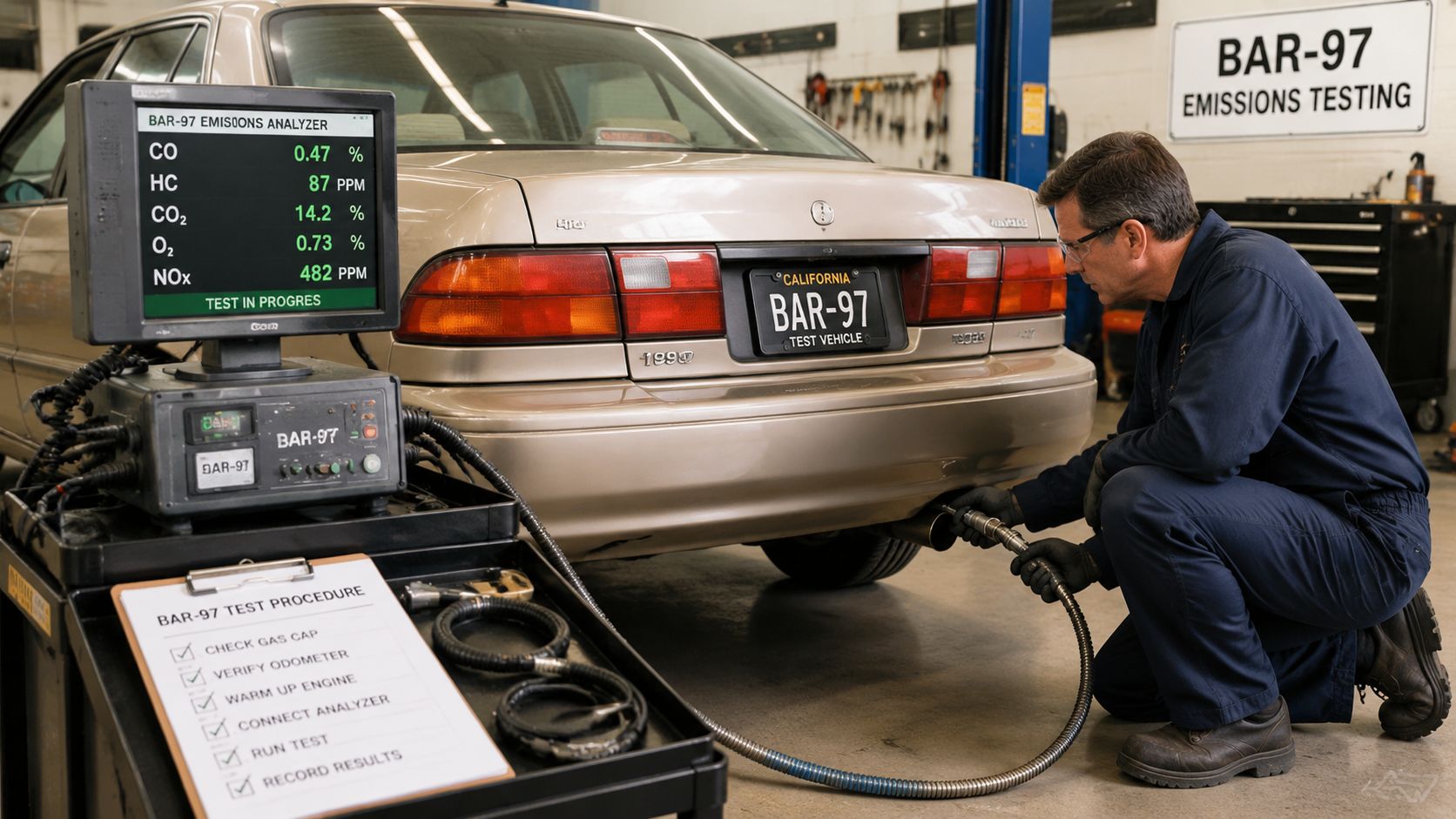
Vehicles built in 1999 and older use the BAR-97 test rather than the newer OBD-II style process used for later vehicles. That older test uses tailpipe emissions sampling and analog diagnostic equipment, and it checks what's coming out of the exhaust instead of relying mainly on the car's onboard reporting, as described in this overview of California's BAR-97 testing for older vehicles.
For owners, the practical takeaway is simple. Mechanical condition matters a lot more on these vehicles. Tune, vacuum integrity, catalytic converter health, and basic engine operation have a direct effect on the result.
The same source notes that BAR-97 testing measures HC, CO, and NOx at the tailpipe, and the inspection window for these vehicles is longer than for newer cars. That's one reason older-car smog appointments can feel more involved.
Why station type matters
If your notice requires a STAR station, pay attention to that requirement. Don't assume every shop handles the same vehicles in the same way.
For older vehicles, many owners prefer a test-only setup because the incentives are cleaner. The shop is there to inspect, not to fail the car and immediately sell a repair package. If you need a STAR inspection, a STAR smog test-only station in Antioch gives you that narrower, more impartial role.
That matters most when the car is borderline or has already had work done elsewhere. You want an accurate result first. Then, if repairs are needed, you can make a calm decision instead of reacting under pressure.
What to Do If Your Older Car Fails the Smog Check
A failed result doesn't always mean the car needs a major repair. It means you need to read the failure correctly before spending money.
Read the failure before approving repairs
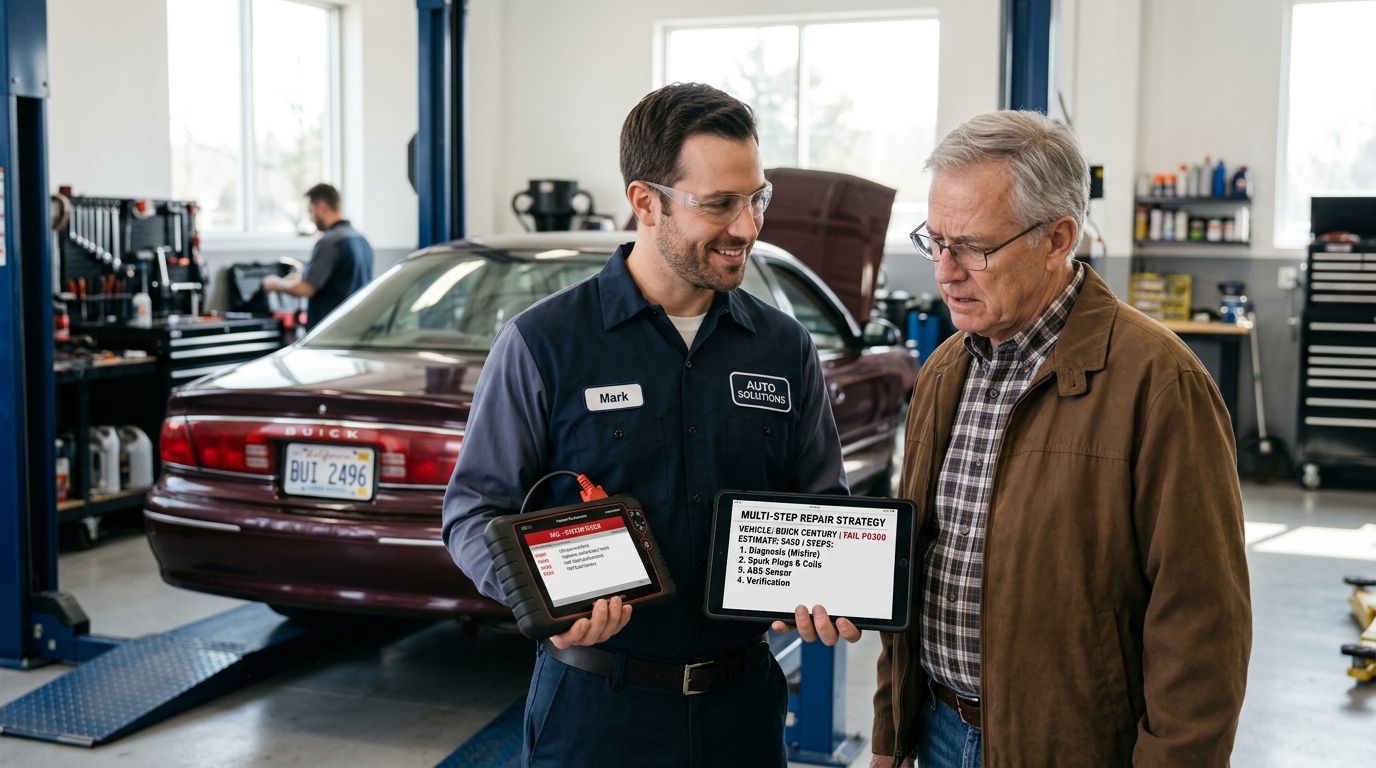
There's a big difference between a true emissions problem and a procedural issue. A car might fail because of actual tailpipe output, a readiness problem, missing or altered equipment, or something that points to a narrow fault rather than a full system rebuild.
Start with this sequence:
- Get the exact reason in writing: Don't leave with a vague memory of what the technician said.
- Match the failure to recent events: Battery disconnect, code clearing, long storage, or recent engine work can all matter.
- Avoid one-shot repair decisions: On older cars, replacing parts by guesswork gets expensive fast.
- Ask about retest policy: Some stations offer a free retest under coupon or posted policy terms, which can make a second attempt much easier after a targeted fix.
If you want a clearer sense of what usually trips cars up, this guide to common smog check fail reasons is a useful starting point.
Common mistake: Owners hear “fail” and approve everything suggested in the first five minutes. That's how small emissions problems turn into large invoices.
When to use the Smog Check Referee
Some older cars don't fit cleanly into standard advice. Collector vehicles, modified vehicles, and stubborn repeat failures are where owners should think about a second opinion.
The Smog Check Referee Program offers a free, independent technical review to determine whether the failure reflects a genuine emissions problem or a testing issue, and in some cases it may waive the repair requirement, according to the BAR Referee review process for smog check results.
That option is more valuable than most owners realize. If the car has an unusual setup, a long repair history, or a result that doesn't match how the vehicle is equipped, the referee path can keep you from chasing the wrong fix.
A short explainer helps if you haven't seen the process before.
Use the referee route when the failure feels questionable, not as a substitute for obvious maintenance. If the catalytic converter is damaged, vacuum lines are disconnected, or the engine is running poorly, that still has to be addressed. But when the case is murky, a second opinion can be the smartest move.
Your Antioch Smog Check Partner Fire House Smog
For local drivers, convenience matters almost as much as the technical side. Older cars don't love unnecessary trips, long waits, or being bounced between the test station and the DMV.
Why the setup is useful for older vehicles
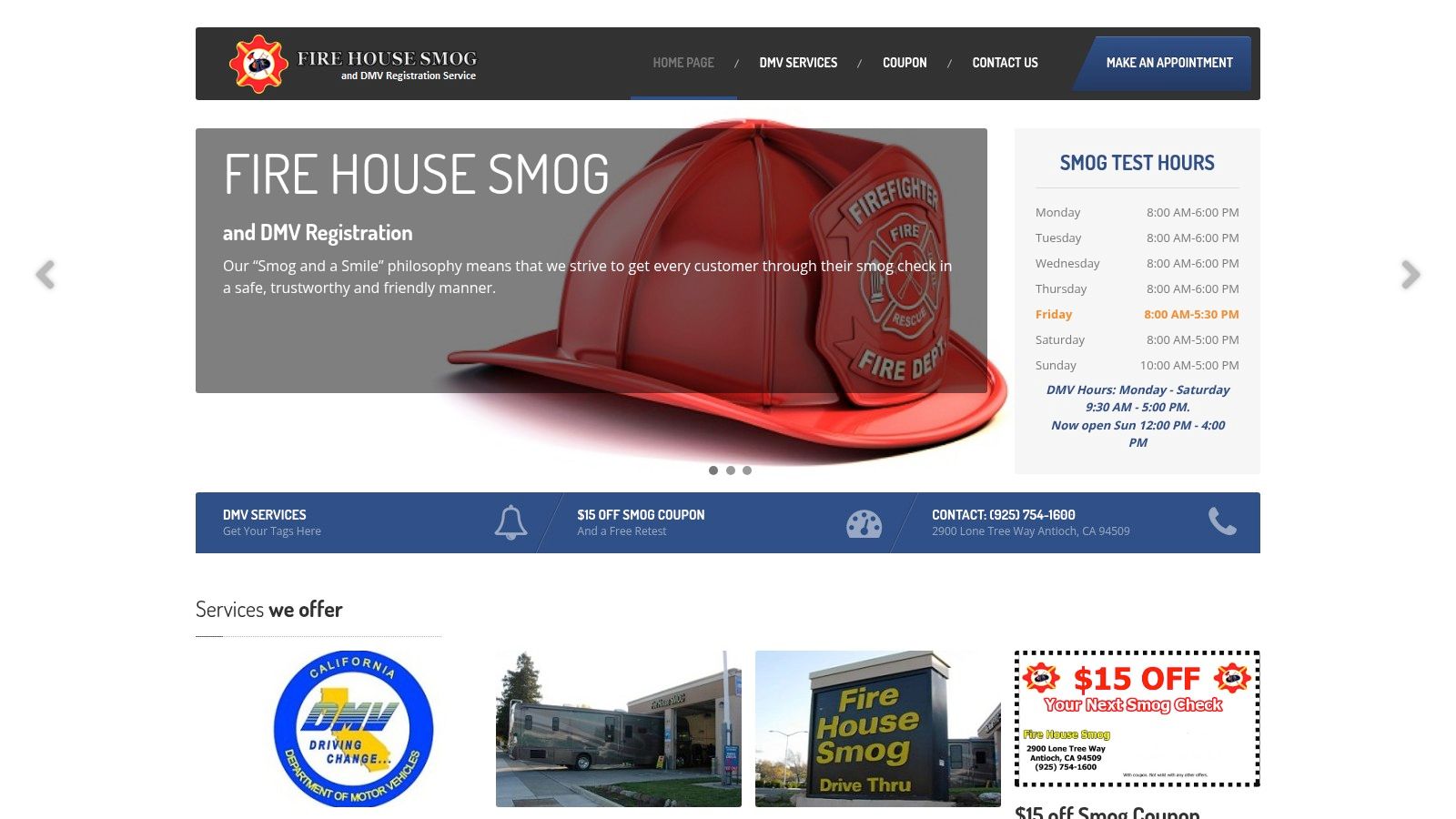
Fire House Smog is a STAR-certified test-only station and licensed DMV registration provider in Antioch. The test-only model is useful for owners who want an inspection without repair upselling, and the station's two-bay setup helps keep vehicles moving instead of stacking up in a single line.
The location also handles California DMV renewals, ownership transfers, and related registration tasks with on-site tag issuance during posted hours. That's a practical advantage when you've already done the hard part and just want the paperwork finished.
Local details that make the process easier
The shop is located at 2900 Lone Tree Way, Antioch, CA 94509, and you can reach it at 925-754-1600. Smog testing is available seven days a week, with extended weekday and weekend availability, and DMV services run Monday through Saturday from 9:30 AM to 5:00 PM and Sunday from 12:00 PM to 4:00 PM.
For Antioch and East Contra Costa County drivers, that combination solves a real problem. You don't have to line up one place for a test and another for registration handling if both are needed.
If you want station details before heading over, the Antioch smog check service page lays out the local service options clearly.
Frequently Asked Questions About Older Car Smog Checks
Do I need a smog check to sell an older car
In many private-party sales, yes. If the car is outside California's newer-vehicle transfer exemption, the seller usually needs to provide a passing smog certificate before the title changes hands.
The practical mistake is testing too early. Smog certificates expire, and older cars can drift out of tune if they sit, so line up the inspection close enough to the sale that you are not paying for the same test twice.
Can historic plates make my car exempt
Historic or collector plates do not automatically remove the smog requirement.
What matters is the vehicle's year, fuel type, and how California classifies it. I have seen owners show up convinced the plate solves everything, then lose time because the car still falls into a test-required category. Check the actual exemption status first, not the badge on the plate.
How long is a smog certificate valid
A smog certificate is valid for 90 days.
That window matters more than owners expect. If you are selling the car, finishing registration late, or waiting on DMV paperwork, watch the calendar. Once the certificate expires, the state can require a fresh test.
What is the difference between test-only and test-and-repair
A test-only station inspects the car and reports the result. A test-and-repair shop can inspect it and sell the repair work.
For an older car, test-only often gives you a cleaner starting point. You get the numbers without having to make a repair decision on the spot. If the car fails, you can compare repair options, ask better questions, and decide whether a regular shop, marque specialist, or Smog Referee makes the most sense.
Do all older cars get the same kind of smog test
No. A pre-2000 car does not move through the program the same way a newer OBD-II vehicle does, and diesel rules are different again.
That is why advice from a neighbor with a different model year can send you in the wrong direction. The right prep depends on the engine management system, the emissions label under the hood, and whether the car needs a STAR station.
What is the best last-minute thing I can do before the appointment
Give the car a proper warm-up drive.
For many older vehicles, a short freeway run followed by normal city driving helps more than any fuel additive poured in the tank the night before. The goal is to get the engine fully hot, stabilize idle quality, and, on cars that track readiness, complete enough of the drive cycle for the monitors to set. If the battery was disconnected recently or repairs were just done, do not assume a quick trip around the block is enough.
If my older car fails, do I have any options besides paying for repairs right away
Yes. Start by reading the failure printout carefully. High hydrocarbons, high carbon monoxide, and a functional failure do not point to the same problem, and treating them like they do is how owners waste money.
If the car has a hard-to-find configuration, an engine swap question, or a dispute over required equipment, the California Smog Referee program can be the right next step. It is also useful when standard shop advice is not lining up with what the car is.
If my exempt older vehicle doesn't need biennial smog, can I ignore emissions equipment
No. Exempt from routine testing does not mean free to remove emissions parts.
That catches owners during a later sale, a referee inspection, or any situation where the car is checked for required equipment. Keeping the emissions system intact is usually cheaper than trying to put a half-modified older car back to stock under deadline pressure.
If you want a straightforward smog check for older cars in East Contra Costa County, Fire House Smog offers STAR-certified test-only inspections, DMV registration help, and seven-day availability at 2900 Lone Tree Way in Antioch. Call first if you've got an unusual vehicle or RV, and bring the DMV notice so the visit goes faster.
That DMV renewal notice lands in the mail, and the first thought for most Pittsburg drivers is the same. How fast can I get this done without wasting half a day or failing for something avoidable?
For a smog check in Pittsburg, CA, the hardest part usually isn't the test itself. It's choosing the right station, figuring out whether your notice requires STAR, and avoiding the small mistakes that turn a routine visit into a second trip. A lot of locals pick the closest shop first, then learn the hard way that “test-only” and “STAR-certified” are not the same thing.
The good news is that California's smog process is predictable when you know what to look for. A little prep, the right station choice, and a realistic idea of what happens at the counter can save you time, hassle, and one of those “I have to come back again?” afternoons.
Table of Contents
- Your Guide to a Fast Smog Check in Pittsburg
- Choosing the Right Smog Station Near Pittsburg
- Preparing Your Vehicle to Pass the First Time
- What to Expect During the Smog Test and DMV Process
- Handling a Failed Test and Using Free Retests
Your Guide to a Fast Smog Check in Pittsburg
You get the DMV renewal notice, glance at the deadline, and figure a smog check will be a quick stop on the way home. Then the true delay starts. The shop you picked is nearby, but it is not the right fit for what your notice requires, or your car is not ready to test, or you still have to sort out the registration side after the inspection.
That is how a 30-minute job turns into half a day.
In California, many gasoline-powered vehicles from model year 1976 and newer, along with certain diesel vehicles from model year 1998 and newer, need a smog inspection every two years under the state's Smog Check program. Newer vehicles usually pay an abatement fee first and do not get their first physical inspection until later in the registration cycle.
For Pittsburg drivers, the time-saving part is rarely the test itself. It is choosing a station that matches the DMV notice the first time, arriving with a vehicle that is ready, and avoiding extra stops you did not plan for.
What usually slows people down
The inspection process is fairly routine. A technician checks emissions-related equipment, confirms the warning light and onboard system status, and completes the required test based on the vehicle.
The delays usually happen before the car enters the bay.
- Wrong station choice: The station cannot perform the type of inspection listed on your DMV notice.
- Readiness problems: The battery was recently disconnected, monitors have not reset, or the check engine light is on.
- Last-minute timing: You wait until the registration deadline is close and lose flexibility on where to go.
Practical rule: The fastest smog check is the one you only have to do once.
What a smart local approach looks like
Start with the DMV notice. In Pittsburg, the biggest avoidable mistake is treating STAR and test-only as if they mean the same thing. They do not. If your notice calls for STAR, a short drive to Antioch can save you from a wasted appointment and a second trip. A verified STAR smog and DMV service near Pittsburg often makes more sense than picking the closest address and hoping it works out.
Then look at the car itself. If the check engine light is on, or the battery was disconnected recently, handle that before you show up. A smog station can test the vehicle in its current condition. It cannot complete drive-cycle monitors for you while you wait.
Finally, choose a shop that reduces loose ends. If the station can help you finish the registration side at the same visit, that saves more time than shaving a few minutes off the drive.
Choosing based on service fit, not just distance, is usually the quickest route. The best shortcut is picking the station least likely to send you back out for another errand.
Choosing the Right Smog Station Near Pittsburg
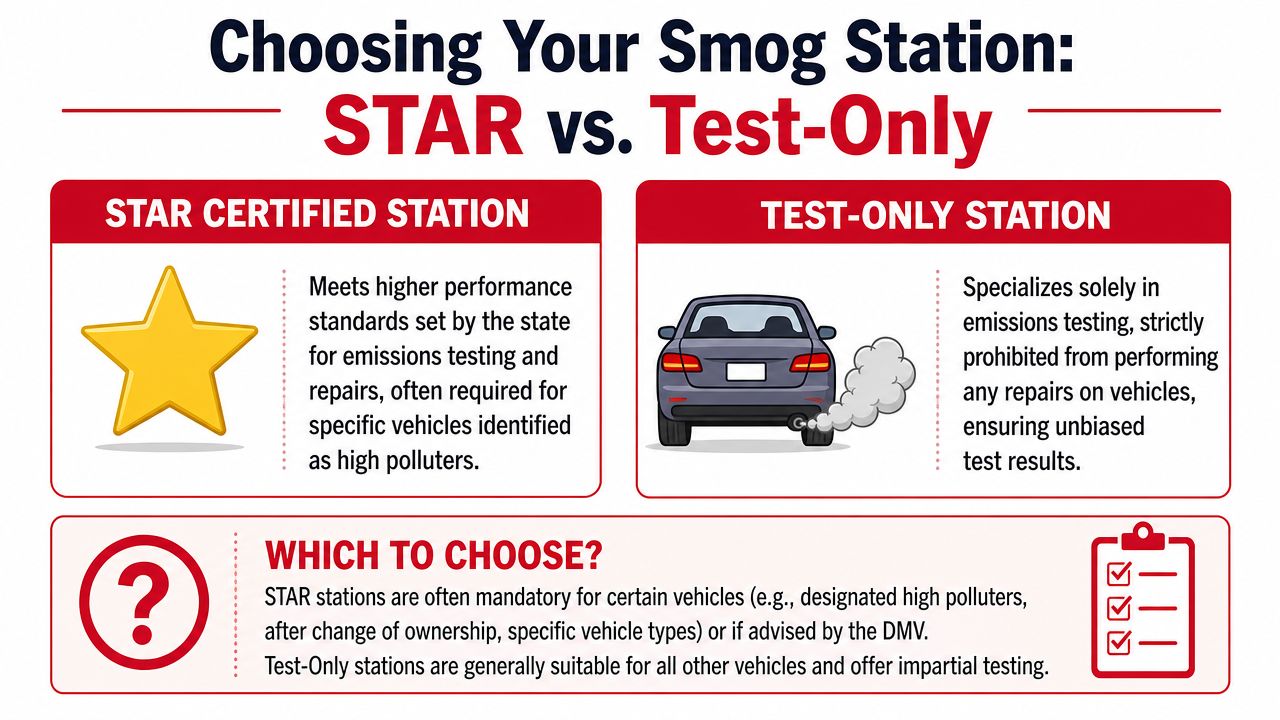
The biggest mistake I see around Pittsburg isn't mechanical. It's administrative. A driver gets a DMV notice, searches for a smog shop, sees “test-only,” and assumes that's enough.
Sometimes it is. Sometimes it absolutely isn't.
STAR and test-only are not interchangeable
A STAR-certified station meets higher BAR performance standards. A test-only station focuses on inspections and doesn't perform repairs. Those are related ideas, but they are not the same label.
That distinction matters because 22% of California vehicles require STAR testing per DMV renewal notices, and Pittsburg drivers often assume local stations are automatically STAR-certified when they aren't. The same source notes that this confusion pushes some residents to look at verified STAR options in Antioch, about 8 miles away, rather than risk a wasted trip to a non-STAR shop. That's spelled out in this California STAR FAQ for drivers comparing station types.
Here's the practical difference:
| Station type | Best for | Common mistake |
|---|---|---|
| STAR-certified | Vehicles specifically directed by the DMV to STAR | Assuming every smog shop has STAR status |
| Test-only | Drivers who want an inspection-only model without repair upsells | Thinking “test-only” automatically satisfies a STAR-required notice |
Why some Pittsburg drivers head to Antioch
This is one of those local trade-offs that's worth being honest about. If your first priority is shaving a few minutes off the drive, staying inside city limits may feel like the obvious choice. If your priority is getting the correct inspection the first time, a short drive to a verified STAR station can be the better move.
That matters most when your notice requires STAR and the local station you're considering doesn't clearly show that designation. In that case, “nearby” can become “wrong shop, no certificate, try again.”
If your DMV paperwork says STAR, verify STAR before you leave home. Don't rely on the words “smog” or “test-only” on a storefront sign.
For drivers weighing cross-city options, a verified STAR test-only station in Antioch is often the cleaner choice because it removes the guesswork. You're not gambling on whether the station type matches your DMV notice.
What works and what doesn't
What works:
- Reading the DMV notice closely: Look for a direct STAR requirement.
- Verifying the station designation: Check that the shop is clearly identified for the type of inspection you need.
- Thinking beyond city lines: A short drive can be more efficient than a failed visit.
What doesn't:
- Assuming every local shop qualifies: That's the trap.
- Confusing “test-only” with “STAR-certified”: They overlap sometimes, but they aren't identical terms.
- Choosing by distance alone: The shortest drive can turn into the longest afternoon.
If you're trying to make the smartest call for a smog check in Pittsburg, CA, this is usually it. Match the station to the notice first, then worry about mileage.
Preparing Your Vehicle to Pass the First Time
You pull out of your driveway in Pittsburg, make the short trip for a smog check, and find out the car was never ready to test in the first place. That is one of the easiest ways to lose half a day.
An active check engine light is an automatic smog test failure. Recent battery service can also cause trouble because the car's readiness monitors may not be set yet. I see that one catch people all the time, especially after a new battery, alternator work, or a repair where the codes were cleared.
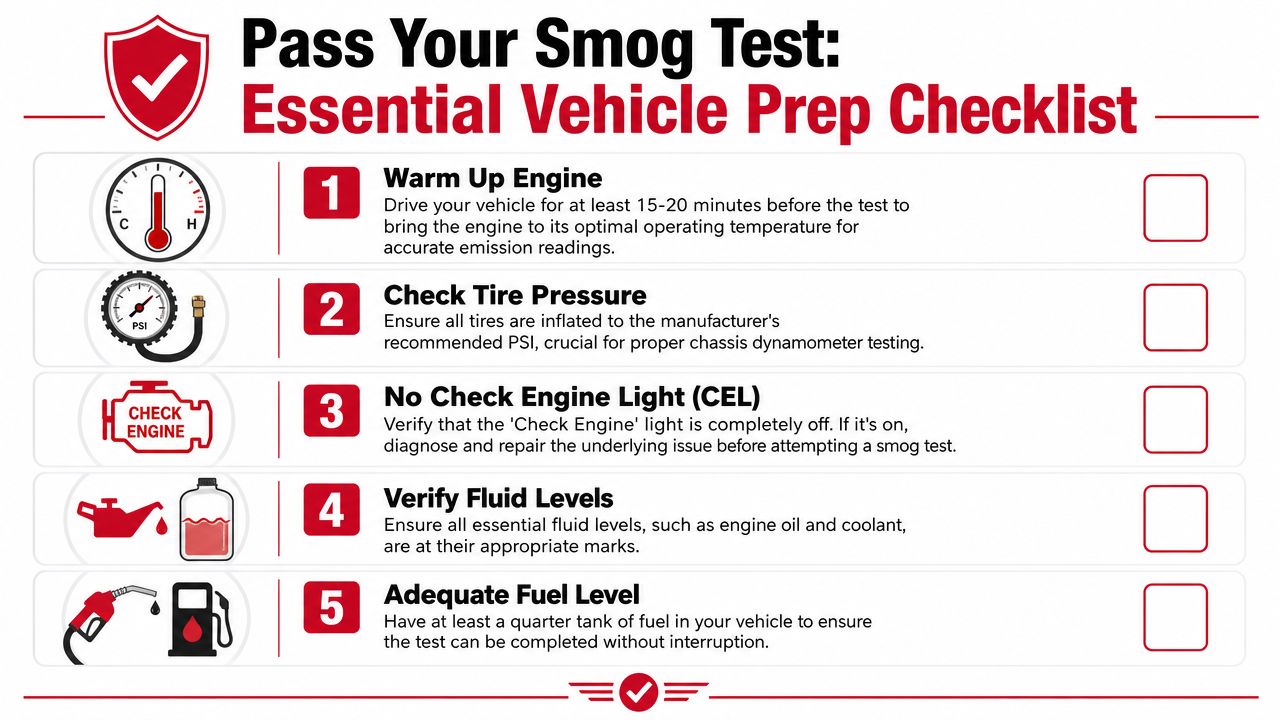
The two mistakes that cause the most grief
Start with the dashboard. If the check engine light is on, handle that before you book the test. The station cannot ignore it, and hoping it will slide through only turns one visit into two.
Battery disconnects are the other common problem. After the battery has been replaced or disconnected, the vehicle often needs normal driving before the emissions monitors show ready again. Even a smooth-running car can fail if its emissions system, onboard diagnostics, and readiness monitors are not aligned for compliance.
That trade-off matters for Pittsburg drivers deciding where to go. If you are already making a short drive to a verified STAR station in Antioch to avoid the STAR versus test-only mix-up, make sure the car is test-ready first. The smarter trip is the one that gets the certificate done in one shot.
A simple pre-test routine
Use this quick check before you leave:
- Check the dash first: No check engine light, and no fresh code clearing.
- Think about recent repairs: Battery replacement, dead battery jump starts, or electrical work can reset monitors.
- Tighten the gas cap: A loose cap can trigger emissions faults on some vehicles.
- Drive long enough to warm the car up: A cold engine is not ideal for a smog appointment.
- Bring your registration notice and ID: If you need a refresher on what the DMV usually asks for, this guide to California DMV registration renewal requirements helps.
- Skip the guesswork: If your paperwork points you to a STAR inspection, go to a verified STAR station instead of trying a nearby shop and hoping the designation matches.
A short prep video can also help if you want a quick visual refresher before you go.
What not to do on test day
Do not clear codes right before the appointment. That usually resets the monitors without solving the fault, which creates another reason for the car to fail.
Do not show up right after battery service, either. Give the vehicle time to complete its normal drive cycles.
And do not rely on how the car feels. Plenty of cars drive fine and still fail because the emissions side is not ready. The goal is simple. Clean dashboard, warmed-up engine, documents in hand, and the right station for your notice. That combination gives you the best chance of passing the first time.
What to Expect During the Smog Test and DMV Process
You pull out of work in Pittsburg, glance at the registration notice on the passenger seat, and realize you want this done in one shot. That is exactly why the station choice matters. If your notice calls for STAR, going straight to a verified STAR station in Antioch saves the usual mistake of stopping at the nearest shop first, then finding out you still need to test somewhere else.
The actual smog inspection is usually simple on the customer side. You check in, hand over your paperwork, and let the inspector run the required test sequence. At a well-run STAR test-only station, the visit feels organized instead of confusing.
What happens in the bay
The inspector generally works through three areas:
- Visual inspection of emissions-related components
- OBD-II check to read the vehicle's onboard systems and readiness status
- Emissions measurement based on the vehicle and the test procedure it requires
Newer vehicles often move through the process faster if the monitors are ready and there are no warning lights. Older models can take a little more hands-on checking. Either way, the station handles the testing. Your job is mostly to arrive with the right documents and the right type of appointment.
Why the DMV side matters more than people expect
A passed smog test is only part of the errand. Registration still has to be completed properly, and that is the point many drivers overlook.
Stations that can help with both steps save time in a very practical way. You are not driving from a test location to another office, waiting in another line, or wondering whether the certificate has gone through yet. For many East Contra Costa drivers, onsite California DMV registration renewal help is what turns a two-stop chore into a one-stop errand.
That matters even more if you are deciding between a random nearby shop and a verified STAR station a short drive away. In real life, the extra few minutes to Antioch often beats losing an hour to the wrong station, incomplete paperwork, or a second trip.
Details that help the process go smoothly
A few parts of the process are easy to miss:
- Certificate transmission: The station sends the smog result electronically to the DMV.
- Timing matters: Don't get tested too early, then let the registration deadline drag out.
- Certificate fee: Part of the bill includes the state certificate charge, so do not be surprised when you see it on the invoice.
The easiest smog visit is the one with no guesswork. You show up at the correct STAR station, the test gets handled cleanly, the result goes to DMV electronically, and your registration gets wrapped up without another stop. For Pittsburg drivers, that is often the smartest reason to make the short drive to a proven STAR shop in Antioch instead of rolling the dice on whatever is closest.
Handling a Failed Test and Using Free Retests
Failing a smog test feels worse than it usually is. Most of the stress comes from not knowing what the next move should be.
A failed test doesn't mean you're stuck. It means you need to fix the specific issue the inspection identified, then come back with the car ready.
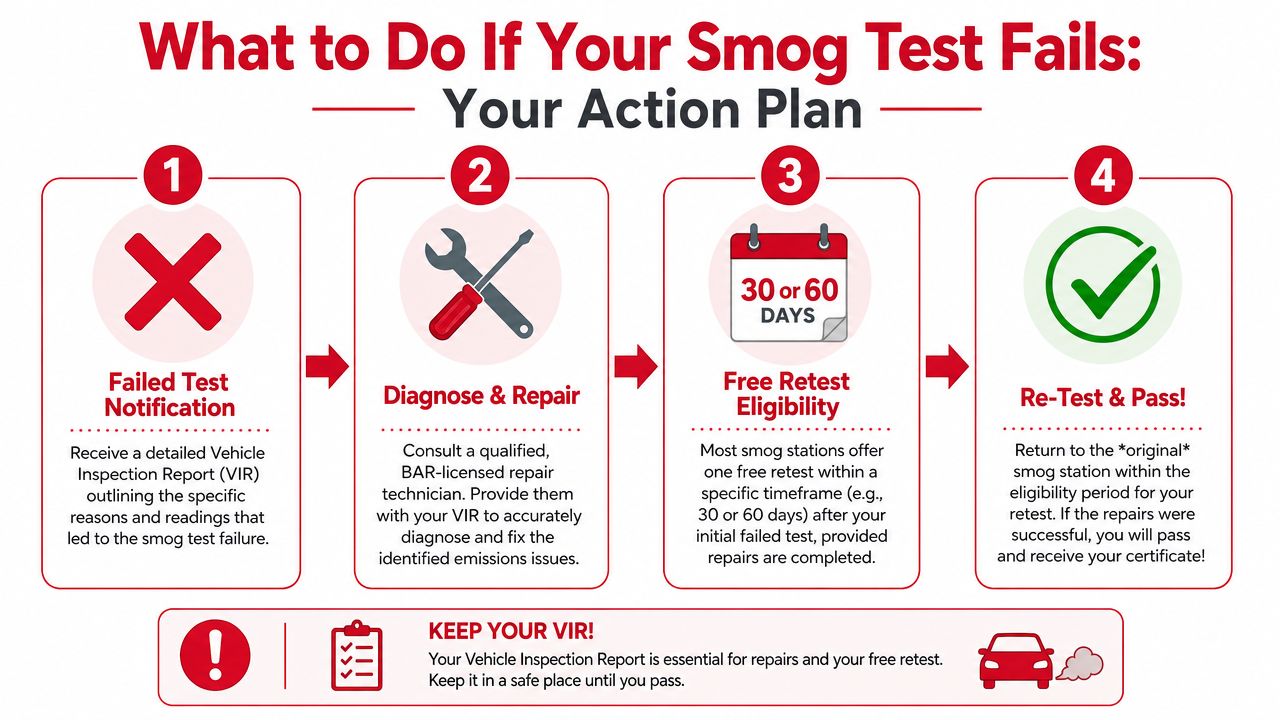
Start with the inspection report
When a vehicle doesn't pass, the first thing to focus on is the Vehicle Inspection Report, often called the VIR. That report tells you what failed and gives your mechanic a much better starting point than “it didn't pass smog.”
This is also where a test-only station has a real advantage. Because the station isn't selling you repair work, there's less pressure and less confusion about whether you're being pushed toward an in-house fix. The testing side stays separate from the repair decision.
Take the VIR to a mechanic you trust. Ask them to diagnose the failure based on that report, not guess from symptoms.
Use the retest strategically
Once the repair is done, go back for the retest according to the station's policy. That matters because many drivers waste time by bouncing to a different location instead of following the original station's retest terms.
A better approach looks like this:
- Keep the VIR: Don't leave it in the glove box and forget about it.
- Choose a repair shop you trust: Independent mechanic, dealership, or your regular local shop.
- Confirm retest terms before leaving the station: Ask what qualifies, how to redeem it, and whether you need the original paperwork.
- Return promptly after repairs: Don't let the issue drag out longer than necessary.
Calm beats guesswork
The worst move after a failure is random parts swapping. That's expensive and usually slower than a proper diagnosis.
The better move is simple. Read the report, repair the cause, then retest under the offered terms. If you're looking for a local option with a smog discount and retest policy, make sure you understand the coupon conditions before the first inspection so there are no surprises later.
A failed smog test is a repair decision, not a panic situation.
The practical upside of being prepared
Drivers who plan for the possibility of a retest usually handle the whole process better. They keep their paperwork, they don't rush into the first repair recommendation without understanding the problem, and they go back with a clear path instead of frustration.
That's really the bigger lesson behind a smog check in Pittsburg, CA. The process is manageable when you treat it like a checklist, not a crisis.
If you want a straightforward place to handle both the inspection and registration side, Fire House Smog in Antioch is a practical option for Pittsburg drivers who'd rather avoid station-type confusion, long DMV lines, and repeat trips. It's a STAR-certified test-only station with on-site DMV services, which makes it a smart fit when your goal is simple: get the smog done, get the paperwork handled, and get back on the road.