
California Emissions Standards: Your 2026 Compliance Guide
You open your DMV renewal notice, scan for the amount due, and then spot the line that changes your whole errand list: Smog Certification Required.
That one line raises a bunch of practical questions fast. Why does your car need this now? Why does California seem stricter than other states? What do all those terms like CARB, STAR, LEV, and ZEV mean? Most of all, what do you need to do so you can pass the test, renew your registration, and get back on the road without wasting a day?
California emissions standards can feel like a wall of jargon until you connect the policy to what happens in the bay during a real smog inspection. Once you do that, the system makes more sense. The state sets the rules. Testing stations apply them. Your vehicle either shows it's operating within those limits, or it doesn't.
Table of Contents
- Why Your DMV Renewal Says Smog Check Required
- Decoding CARB and the Alphabet Soup of Emissions
- How California's Rules Differ from Federal Standards
- The Road to 2035 and the Future of Driving in California
- Your Vehicle's Smog Check and the Role of STAR Stations
- A Simple Checklist for Passing Your Smog Test
Why Your DMV Renewal Says Smog Check Required
You open your DMV renewal notice, ready to pay the fee and move on. Then one line stops you cold: Smog Check Required.
For many California drivers, that is the moment state policy stops feeling abstract and starts feeling personal. The registration process pauses until the state gets proof that your vehicle's emissions equipment is still doing its job. In other words, the DMV is not asking whether your car starts and drives. It is asking whether the vehicle still meets the emissions rules tied to its age, design, and equipment.
That connection can feel confusing at first. Registration sounds like paperwork. A smog check sounds like a repair issue. In California, the two are linked. The renewal notice acts like a checkpoint between your car and another registration cycle.
The rules behind that checkpoint come from several parts of the state system, but the practical effect is simple for a driver. If your notice says a smog inspection is required, the DMV needs an up-to-date passing result before renewal can be completed.
The notice is really a compliance checkpoint
A helpful way to look at it is this: your renewal notice is a report card request for the emissions side of the car.
Over time, parts wear out. Oxygen sensors get lazy. Catalytic converters stop cleaning exhaust as well as they should. An EVAP system leak can turn on the check engine light even when the car seems to run fine. California requires periodic checks so those problems do not stay hidden for years while the vehicle remains registered.
That distinction is important because drivers often mix up two different ideas:
- How the car feels to drive
- How cleanly the car is operating according to emissions rules
A vehicle can run "pretty normal" and still fail a smog inspection. That surprises a lot of owners the first time it happens.
Practical rule: A smog check verifies emissions performance, not just basic drivability.
If you are sorting out deadlines, fees, and paperwork at the same time, this guide to California DMV registration renewal requirements can help clarify the registration side of the process.
Why California ties this to registration
California keeps a close eye on vehicle emissions because cars and trucks are a major part of the state's air pollution problem. That is the big-picture reason. Your smog notice is the everyday version of that policy.
But for the driver standing at the mailbox, the more useful takeaway is practical. The state uses the renewal cycle because it is one of the few moments when nearly every vehicle owner has to check in. That makes registration an effective point for verifying emissions compliance.
It also explains why the requirement can feel strict. You are not being singled out. Your notice is part of a statewide system designed to catch emissions problems before another registration period begins.
What to do when you see the notice
Start with the basics. Check whether the vehicle needs a test now, whether the check engine light is on, and whether you recently disconnected the battery or had repairs done. Those details can affect the result.
Then choose the right station. A STAR-certified, test-only station such as Fire House Smog can be especially useful when you want a straightforward inspection without the pressure of upselling repairs. That setup helps many drivers get a clear answer about where they stand before the registration clock runs out.
From the driver's seat, the key points are straightforward:
- The DMV notice is the trigger. It tells you a current passing smog result is required for renewal.
- The inspection checks emissions systems. It is not a general judgment about whether the car feels fine on the road.
- A little preparation saves time. Catching warning signs early can reduce retests, delays, and registration stress.
Decoding CARB and the Alphabet Soup of Emissions
A lot of the stress around California emissions standards comes from the acronyms. They sound technical, but the ideas are manageable once you translate them into plain language.
Who CARB is and why drivers hear about it
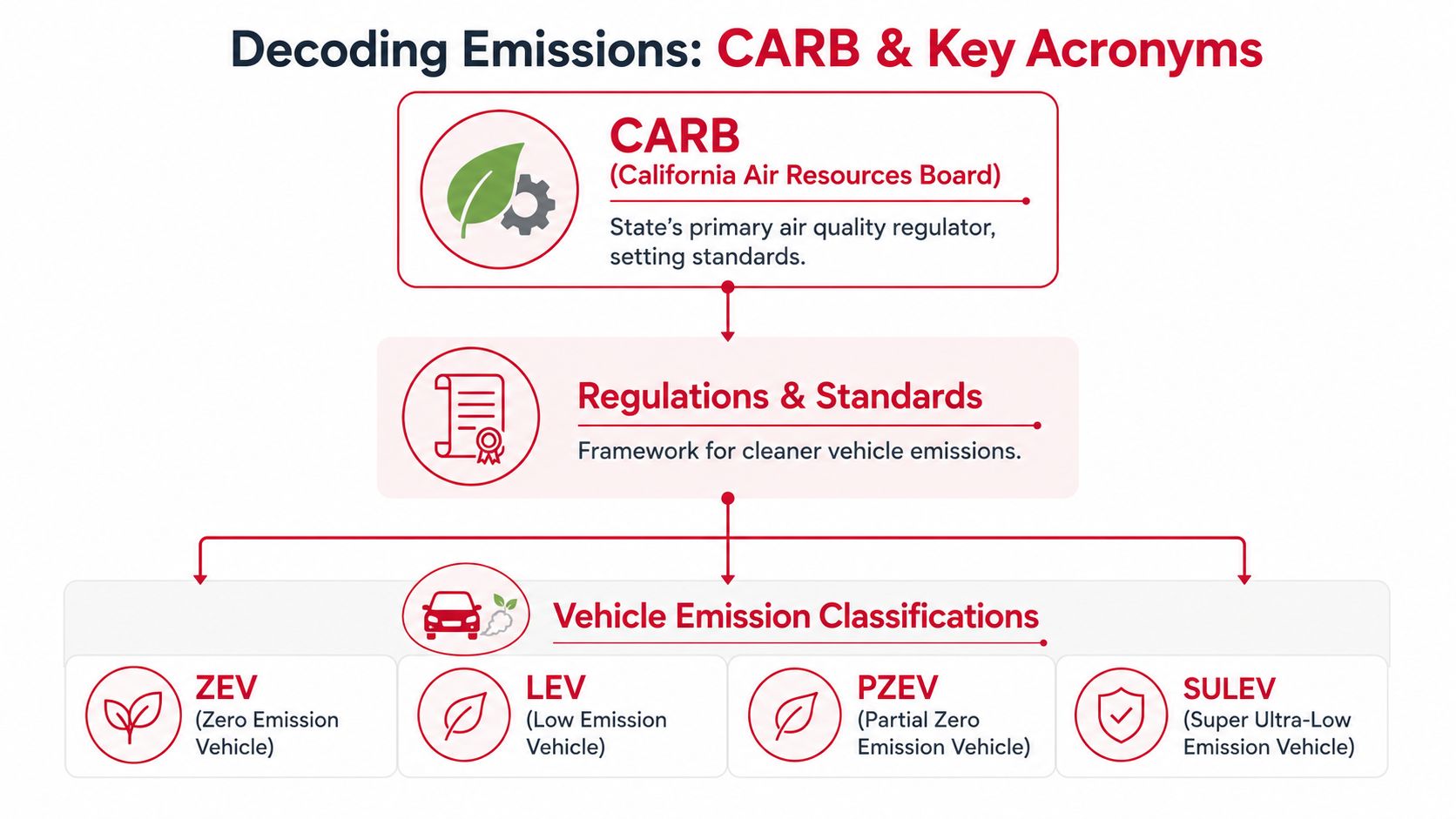
Think of CARB as California's air-quality rulemaker for vehicles. It sets standards for what manufacturers must build and what counts as compliant in this state. If you've ever noticed that a car sold in California has specific emissions labeling or equipment requirements, CARB is the reason.
Drivers usually hear about CARB indirectly. The check-engine light comes on. A replacement part needs to be emissions compliant. A smog station checks readiness monitors or tailpipe-related systems. All of that sits downstream from CARB's rules.
One practical example is the state's tighter particulate standard for light-duty vehicles. Under California's LEV III standards, the particulate matter limit for new light-duty vehicles was tightened from 10 mg/mi to 3 mg/mi for vehicles certified by model year 2021, with an in-use compliance standard of 6 mg/mi, as summarized by DieselNet's California light-duty standards reference. In shop terms, that means emissions-control hardware isn't optional decoration. The vehicle needs working systems that can keep pollution below a stricter threshold.
The common emissions acronyms in plain English
The easiest way to understand these labels is to treat them like an environmental report card for the vehicle.
| Acronym | Full Name | Simple Analogy |
|---|---|---|
| CARB | California Air Resources Board | The state teacher who writes the rules and grades the test |
| LEV | Low-Emission Vehicle | A solid passing grade |
| ULEV | Ultra-Low-Emission Vehicle | Better than passing, cleaner than basic compliance |
| SULEV | Super Ultra-Low-Emission Vehicle | Near the top of the class for very low emissions |
| PZEV | Partial Zero-Emission Vehicle | Very clean tailpipe performance with extra emissions protections |
| ZEV | Zero-Emission Vehicle | The A+ category for no tailpipe emissions |
These labels don't all mean the same thing in practice.
LEV means the vehicle meets a low-emissions standard, but it still emits pollution. ULEV and SULEV step down farther. PZEV usually refers to a very clean gasoline vehicle with additional evaporative-emissions controls. ZEV means no tailpipe emissions at all, such as a battery-electric vehicle.
A clean-running gasoline car and a zero-tailpipe-emissions car aren't in the same category. California tracks that difference very closely.
Drivers often run into these terms when shopping for a newer vehicle, reading an emissions label under the hood, or trying to understand why some vehicles sail through a test while others struggle as they age.
If your DMV notice specifically requires a STAR inspection, it also helps to understand the role of a STAR smog test-only station. The acronym side of emissions law and the station type on your notice often connect more closely than people expect.
How California's Rules Differ from Federal Standards
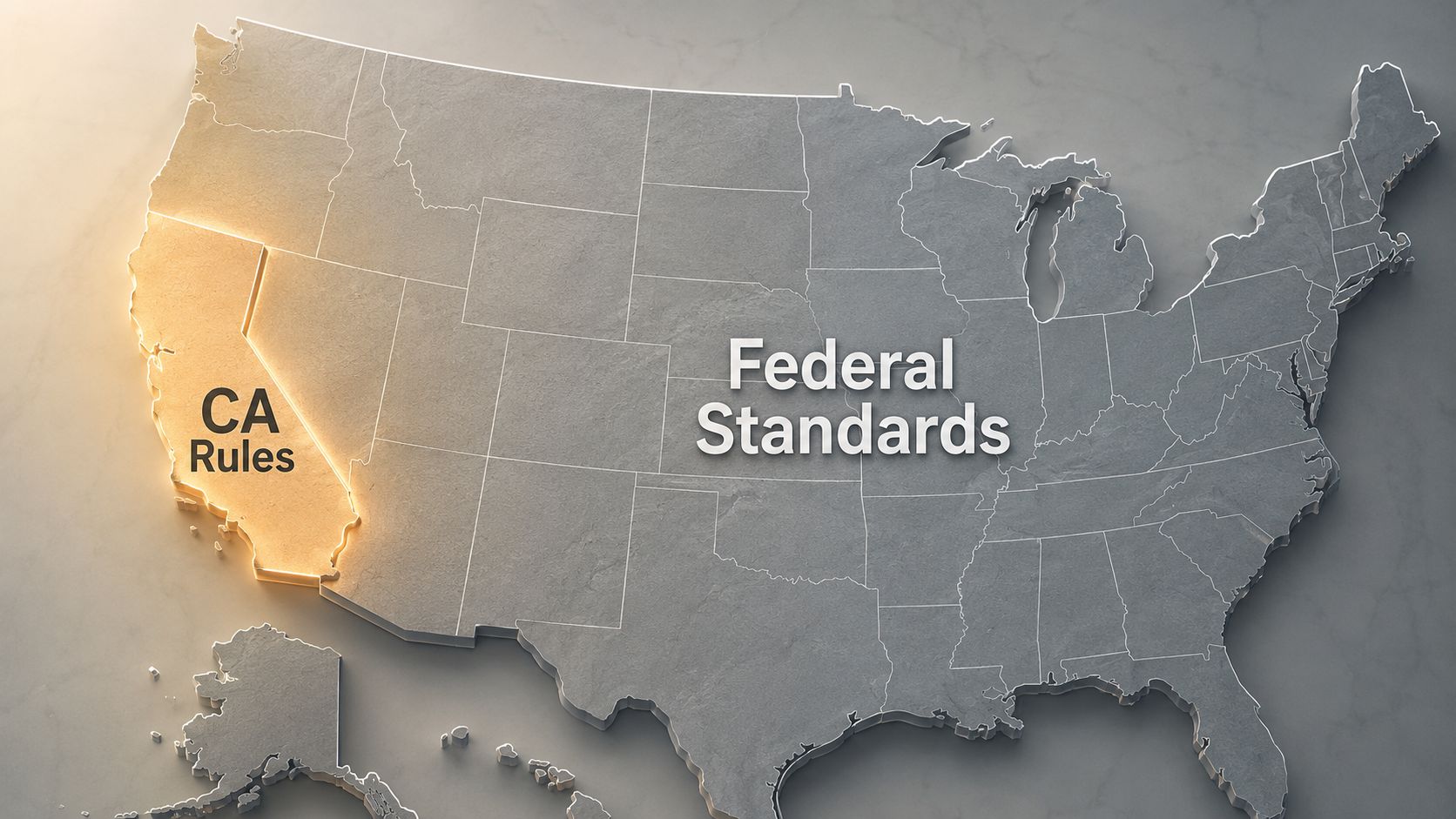
Your car can run fine, no warning light can be on, and you can still feel confused about why California seems stricter than the rest of the country. That confusion is normal. Federal rules set the baseline for the whole U.S., but California is allowed to require more from vehicles sold and registered here.
Why California sets its own path
The practical reason is simple. California has long had serious air-quality problems, especially in dense metro areas and inland valleys where pollution can linger. State regulators have responded by building tighter vehicle rules than the national minimum.
For a driver, it helps to picture federal standards as the minimum passing score on a test. California often grades on a stricter curve. Automakers still have to meet federal requirements, but many vehicles sold here also need to satisfy California-specific emissions rules.
That stricter approach reaches beyond the tailpipe alone. California pays close attention to evaporative emissions, onboard diagnostics, catalyst performance, and how a vehicle behaves right after startup. Those details may sound technical, but they connect directly to real smog check outcomes as a car ages.
What that means for your vehicle
Here is where drivers usually notice the difference:
- Vehicle certification can be stricter: Some vehicles are built or calibrated to meet California emissions requirements, not just federal ones.
- Emissions parts get more attention: Catalytic converters, oxygen sensors, evaporative components, and readiness monitors all have to do their jobs correctly.
- Cold-start performance matters: California focuses on the dirty first moments after startup, when emissions are often at their highest.
A good example is the state's 50-degree F cold-start standard for certain newer light-duty vehicles. California regulations require certification testing at a nominal 50°F for 2026 and later model year vehicles because emissions controls are less effective when the engine and catalyst are cold, as described in the California regulation text hosted by Cornell Law School.
In plain English, California is not only asking, "Does the car run clean once it's warmed up?" It is also asking, "How quickly does it clean itself up after a cold start?"
That distinction can expose borderline problems sooner. A weakening catalytic converter, a lazy oxygen sensor, or an evaporative fault may not be obvious to the owner day to day, but California's tighter framework is more likely to catch it during the inspection process.
So no, the average driver is not taking a completely different smog test in some dramatic way just because they are in California. The better way to understand it is that your test sits inside a stricter rulebook. If you want a clearer side-by-side explanation, this guide to California and federal vehicle emissions standards breaks the terms down into plain driver language.
The Road to 2035 and the Future of Driving in California
A lot of people hear one headline about California and jump straight to the wrong conclusion. They assume the state is about to outlaw every gasoline car on the road. That's not what the rule says.
What the ACCII rule actually says
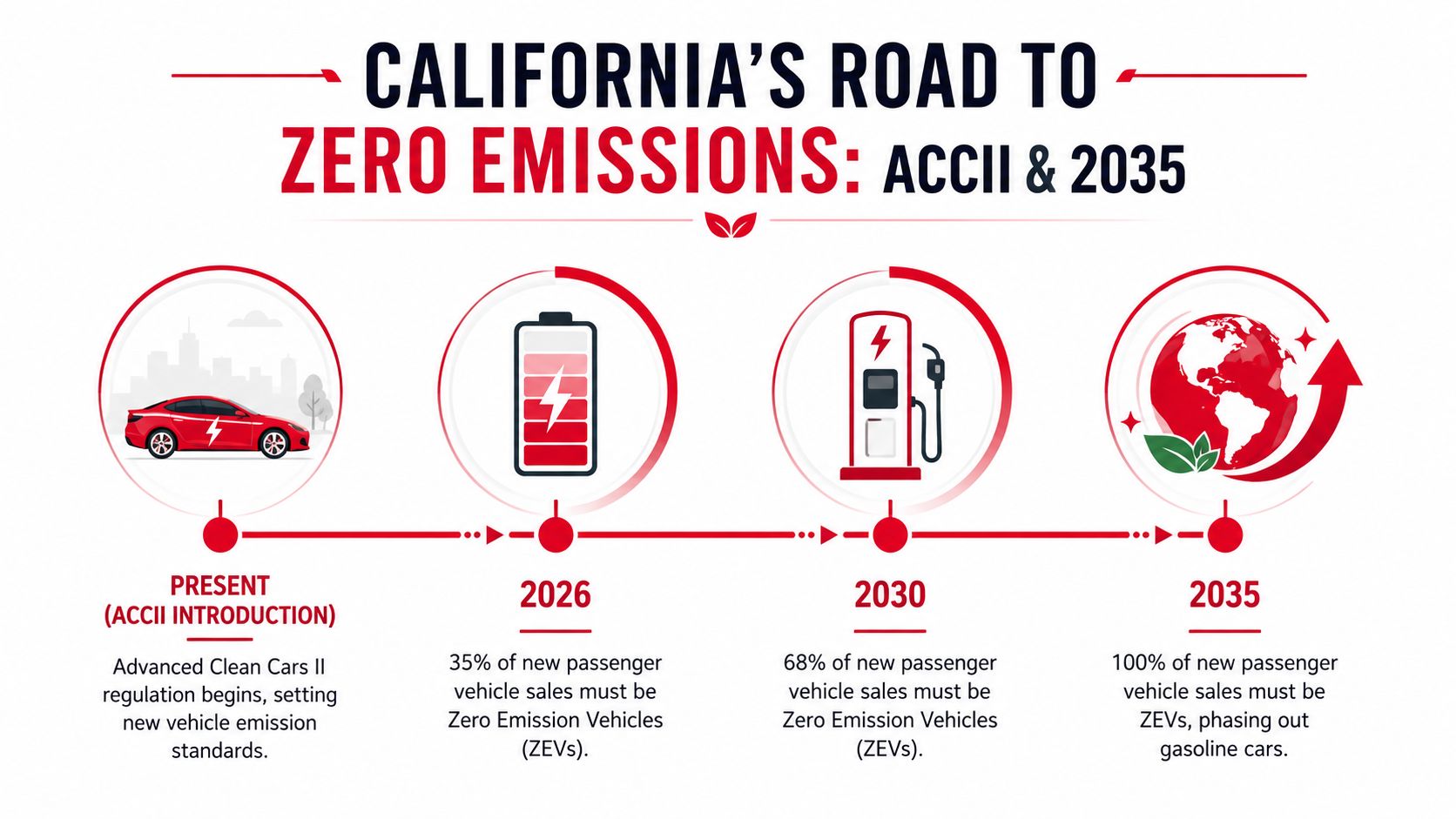
California's Advanced Clean Cars II, often shortened to ACCII, is a sales rule for new vehicles. It requires that 100% of all new light-duty vehicles sold in the state be zero-emission vehicles by 2035, with the phase-in starting with the 2026 model year, according to the American Action Forum summary of California's ZEV rule.
The same source explains that the program ramps up over time rather than flipping overnight. That's why you'll keep hearing about 2026 as an important starting point. It's where the future sales mix begins changing more visibly.
For buyers, this matters because the new-car market will keep shifting toward battery-electric and other zero-emission options. Automakers planning for California can't treat this as a side issue. They have to build product lines that fit the rule.
What it does not mean for current owners
This rule does not mean California is banning your existing gasoline car from the road.
It also doesn't mean used gasoline vehicles suddenly become illegal to own, drive, or sell. If you already have a gas-powered car or truck, the practical question remains the same as it is today: can you keep it registered, maintained, and compliant with the emissions rules that apply to it?
That distinction matters because drivers often mix up two different ideas:
- Rules for new vehicles sold in the future
- Rules for vehicles already in service
Those are not the same thing.
The 2035 target is about what dealers can sell new. It is not a command for current owners to scrap working gasoline vehicles.
There are also cost and benefit discussions wrapped into ACCII. The rule summary cited above states that CARB projected substantial costs and projected benefits through the 2040 model year, with benefits tied heavily to gasoline savings and carbon reductions. For most drivers, though, the immediate takeaway isn't about long-range policy math. It's that California has clearly signaled where the new-vehicle market is heading.
If you're keeping your current car, that future doesn't change the basics. You still need to pay attention to maintenance, warning lights, emissions equipment, and the requirements on your registration notice.
Your Vehicle's Smog Check and the Role of STAR Stations
The policy now turns into a real appointment, a real test, and a real pass or fail.
How policy turns into a pass or fail
A smog inspection isn't guessing. The station is checking whether your vehicle's emissions systems and onboard diagnostics line up with California's requirements for that vehicle.
That can include the condition of the catalytic converter, the status of the check-engine light, readiness monitors, visible emissions components, and whether the vehicle appears to have the correct emissions equipment installed. Newer standards matter here because they shape what performance level the car is expected to maintain.
Take two examples from the rules discussed earlier.
First, California's tighter particulate matter threshold means cleaner output is expected from modern light-duty vehicles. Second, the state's cold-start focus matters because many emissions failures show up when a vehicle can't control pollution quickly after startup. A worn catalyst, incorrect replacement part, or unresolved sensor issue can push a car out of compliance even if it still seems to drive normally.
Why STAR and test-only matter
Some DMV notices don't just say you need a smog check. They say you need it from a STAR-certified station.
STAR is a state designation for stations that meet specific program requirements. If your notice calls for STAR, a non-STAR station won't satisfy that requirement. That's the first practical reason to check the wording on the renewal form before you drive anywhere.
The second issue is business model. Some shops both test and repair. Others are test-only.
That difference matters because 13% of smog checks in California involve vehicles that fail initially but pass on retest without repairs, which has raised concerns about bias at non-test-only locations, according to the California Air Resources Board program page discussing LEV testing and related station concerns. A test-only station doesn't sell repairs, so it removes the incentive tied to repair revenue.
Shop-floor advice: If you want a neutral result, choose a station that only tests and doesn't profit from diagnosing the same failure into a repair order.
That doesn't mean every test-and-repair shop is doing anything improper. It means drivers should understand the incentive structure before choosing where to go.
Here's the practical comparison:
| Station type | What it does | Main driver concern |
|---|---|---|
| Test-and-repair | Inspects and may also sell repairs | Possible conflict if the same shop benefits from a failed result |
| Test-only | Performs the inspection only | You may need a separate repair shop if the vehicle fails |
| STAR-certified test-only | Performs required STAR inspections without repair sales | Useful when the DMV specifically requires STAR and you want a neutral test |
If you want to see the inspection environment before booking, this video gives a quick look at the process and station setup:
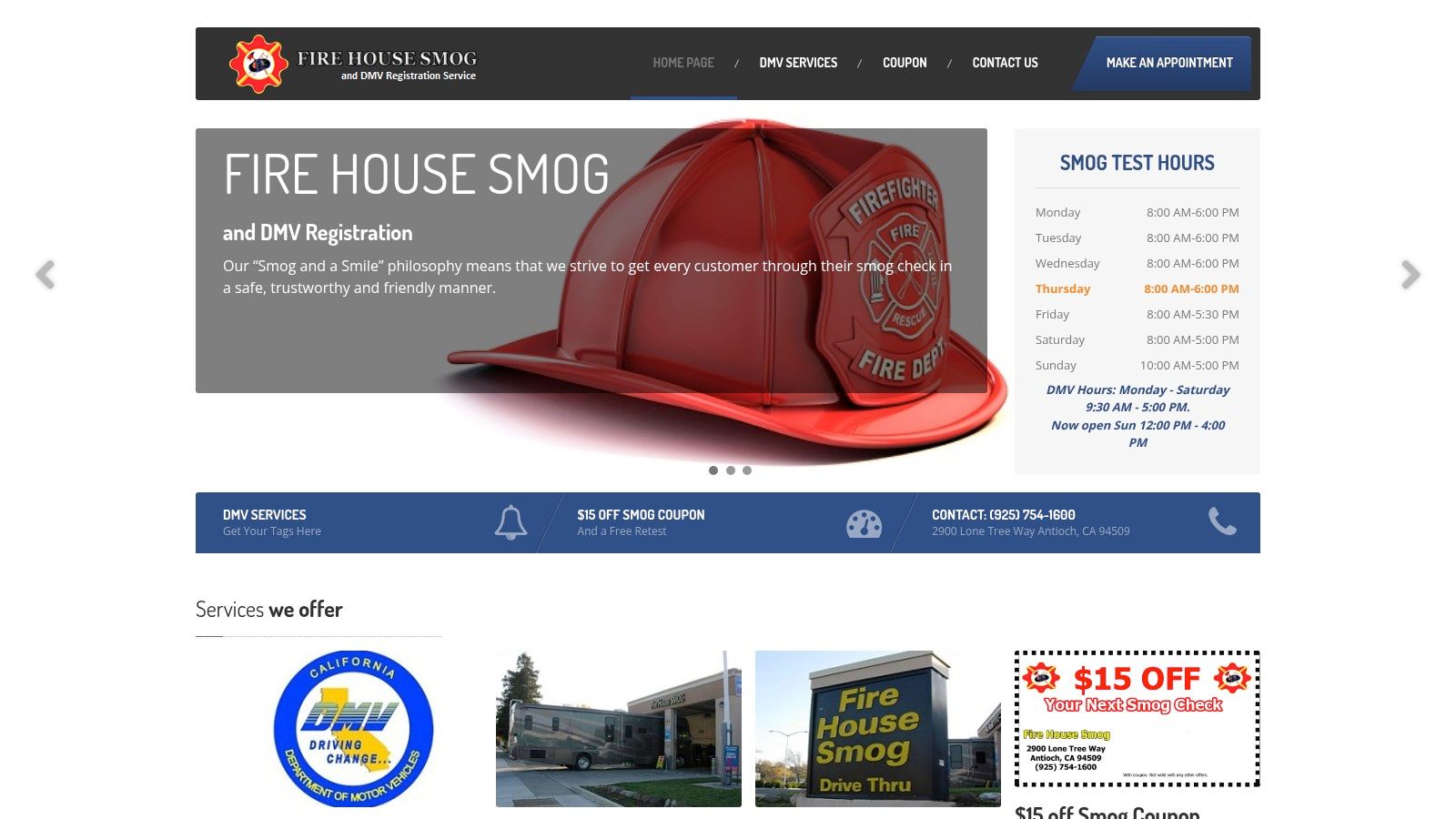
A station can also affect what happens after the test. Some locations only send the certificate electronically and leave you to finish registration elsewhere. Others combine services. Fire House Smog is a factual example of the second model. It's a STAR-certified test-only station and licensed DMV service provider in Antioch, so a driver may be able to complete a smog check and DMV renewal tasks in one stop, with on-site tag issuance during posted hours.
What drivers usually get confused about
The most common misunderstandings are straightforward:
- "If the car runs fine, it should pass." Not always. Emissions failures often come from control systems you can't feel while driving.
- "Any smog station is fine." Not if your notice requires STAR.
- "A fail means I need major repairs." Sometimes yes, sometimes no. The failure reason matters.
- "Passing after a retest proves the first failure was valid." Not necessarily. That's one reason neutrality matters.
Smog checks go more smoothly when you pick the right station type first, not after a failed visit.
A Simple Checklist for Passing Your Smog Test
The easiest way to handle California emissions standards is to turn them into a short routine. You don't need to memorize regulations. You need to avoid the common mistakes that lead to delays.
Before you leave home
Read the DMV notice carefully. Look for whether it says a STAR station is required. That one detail decides where you can go.
Make sure the check-engine light isn't on. If it's illuminated, deal with that first. A warning light is one of the clearest signs that the car may not be ready to pass.
Don't ignore recent battery disconnects or repairs. If codes were cleared or the battery was disconnected, the vehicle may need normal driving before its systems show ready again.
A rushed test right after clearing codes is one of the most avoidable reasons people have to come back.
- Drive the car before the inspection. A normal warm-up drive helps the engine and emissions systems operate under more stable conditions than a cold vehicle that has been sitting.
At the station and after the result
Bring your registration information and confirm whether the station can handle the type of vehicle you're bringing. That matters even more if you're showing up with something larger than a typical passenger car.
Then follow this simple decision path:
- If the car passes, the certificate is transmitted and you move on to registration.
- If the car fails, read the failure reason before authorizing anything elsewhere.
- If you need a retest, ask about station policy in advance so you know whether a return visit includes any retest option.
A smart station choice can also save a second errand. Some locations offer on-site registration help and sticker printing, which is useful if you want to handle compliance and DMV paperwork in the same stop instead of splitting the day between agencies and service counters.
The short version is this:
- Check the notice
- Warm up the car
- Make sure there are no active warning lights
- Use the correct station type
- Understand the result before taking the next step
That approach won't guarantee every older vehicle passes, but it does remove a lot of avoidable friction from the process.
If you need a STAR-certified test-only inspection in Antioch, Fire House Smog handles smog checks for cars, SUVs, light-duty trucks, and some RVs, and it also offers on-site California DMV services with tag issuance during posted hours. For drivers who want a neutral test without repair sales, plus the option to complete registration tasks in one place, it's a practical local option.