You've pulled into a California smog station with a registration renewal approaching, and the question is simple: smog check, what do they check? The technician won't judge the car by how smoothly it drives alone. They'll inspect visible emissions equipment, check the vehicle's warning system and computer data, and, for some older vehicles, measure pollutants directly from the exhaust.
The exact path depends mainly on the vehicle's model year, fuel type, and equipment. California's Bureau of Automotive Repair Smog Check FAQ explains that an inspection may include a visual inspection, functional inspection, OBD system check, and tailpipe test. Knowing what happens at each station step helps you spot simple problems before you pay for a retest.
Table of Contents
- The Smog Check Process: A Step-by-Step Look
- The Visual and Functional Inspection
- The OBD System Check for 2000 and Newer Vehicles
- Tailpipe and Dynamometer Testing for Older Vehicles
- How Pass and Fail Decisions Are Made
- Common Reasons Cars Fail and What to Fix First
- Choosing a STAR or Test Only Station and Preparing for Your Visit
The Smog Check Process: A Step-by-Step Look
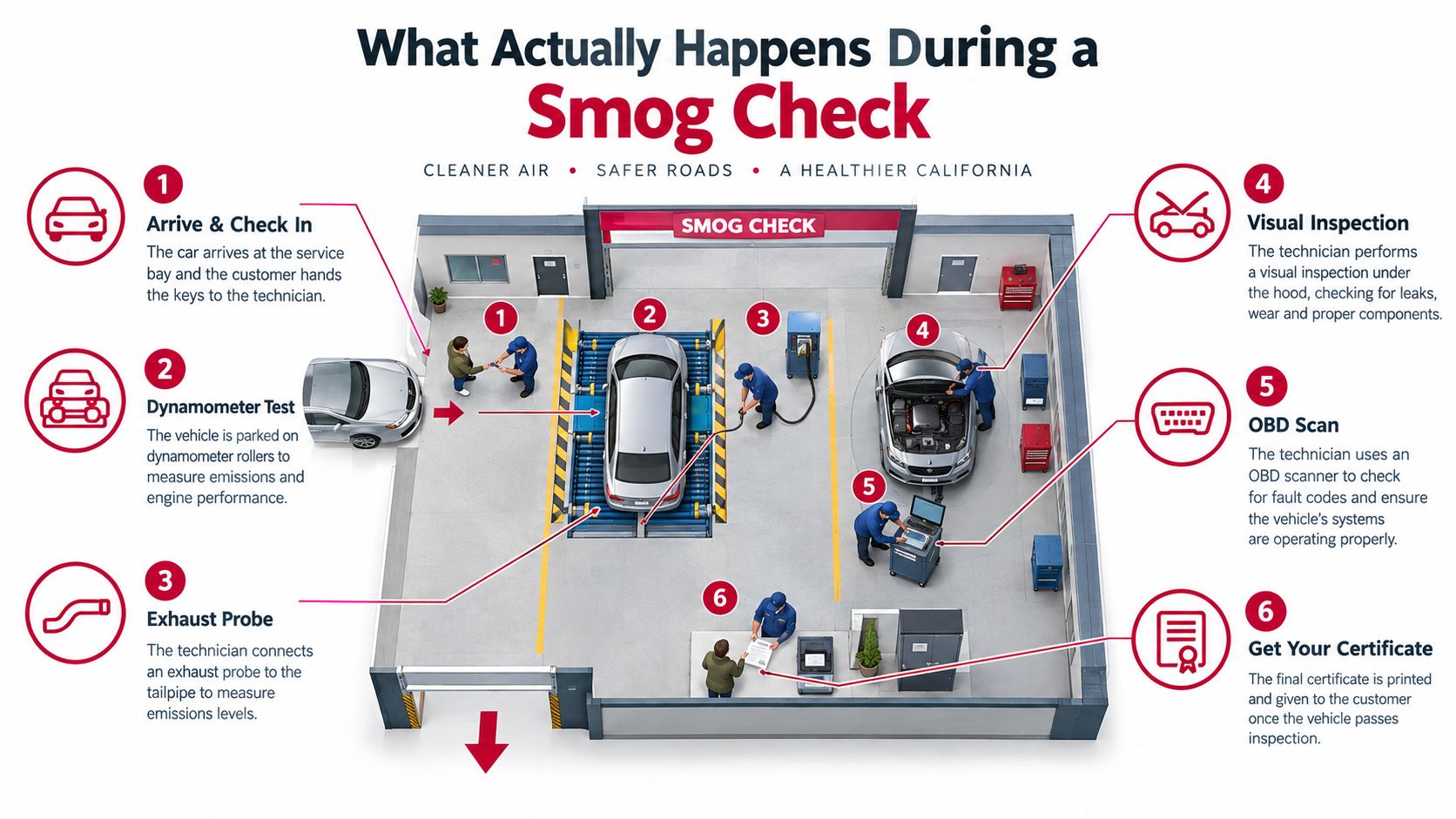
At the counter, you provide the keys and vehicle information. The technician confirms details such as the registration, vehicle identification number, and any available prior smog paperwork. This matching step matters because the vehicle's model year, fuel type, and equipment determine which inspection procedure applies.
Next, the car enters the inspection bay. The technician positions some vehicles for a visual and electronic inspection, while older vehicles may be placed on dynamometer rollers. The rollers work like a controlled road surface, allowing the station to measure emissions while the drive wheels turn. The California BAR program report identifies BAR-97 as the platform primarily used for model-year 1999 and older vehicles and BAR-OIS as the platform primarily used for model-year 2000 and newer vehicles.
The three inspection phases
A typical visit follows three connected phases:
Eyes-on inspection: The technician looks for emissions equipment that is missing, disconnected, damaged, or visibly altered. They may also check whether the malfunction indicator lamp behaves correctly when the ignition is switched on. Before visiting, confirm that warning lights are not illuminated and that nothing under the hood appears disconnected.
Computer inspection: For most 2000-and-newer vehicles, the technician connects a scan tool to the OBD system. It reads emissions-related fault information and readiness status, much like checking whether the vehicle's onboard self-test has finished. Recent battery replacement or code clearing can leave monitors incomplete, so ask about that history before testing.
Exhaust measurement: Older vehicles may receive a tailpipe test while idling or operating on dynamometer rollers. The equipment measures pollutants under the conditions assigned to that vehicle. A technician follows the procedure required for its model year, fuel type, and drivetrain.
The station then transmits the result and provides the applicable paperwork. You may receive a passing certificate, a failure report identifying the problem, or instructions to obtain repair or directed assistance before another test. The California BAR Smog Check overview describes how visual, functional, OBD, and tailpipe procedures are assigned to the vehicle being inspected. A visit often takes 30 to 45 minutes, though vehicle condition and station workload can change the timing.
The Visual and Functional Inspection
Before connecting a scanner, the technician performs a hands-on review. This is the part many owners overlook because it doesn't require a screen or an exhaust probe. The inspector opens the hood, checks accessible emissions components, looks beneath the vehicle when necessary, and watches how warning indicators behave when the ignition is switched on.
What the technician sees under the hood
The gas cap is a small part with a large job. It must seal the fuel system so gasoline vapors don't escape through the filler neck. A loose, cracked, missing, or damaged cap can create an evaporative emissions problem, so twist yours until it clicks or ratchets, then inspect the sealing ring for visible damage.
The catalytic converter also receives attention. The technician verifies that it's present, correctly located, and not obviously tampered with. California's Smog Check Manual specifically addresses catalytic converter presence, location, and visible defects because the converter helps reduce pollutants before exhaust leaves the tailpipe.
Other visible checks may include the air intake, exhaust routing, PCV system, evaporative controls, hoses, wiring, and emissions-related hardware. A disconnected vacuum hose, an obviously altered component, or a replacement part that doesn't meet the applicable requirements can create a failure before the emissions numbers are considered.
What the technician observes while the engine runs
The functional portion includes the malfunction indicator lamp, commonly called the Check Engine Light. With the key turned on before starting, the light should illuminate as part of the vehicle's normal bulb check. After the engine starts, it should go out if the system isn't reporting an active emissions fault.
The inspector may also look for visible smoke, fluid leaks, or other unsafe conditions. At home, check the ground after the car has been parked, look for dripping oil or fuel, and notice whether the exhaust produces persistent visible haze. Don't remove or cover a warning light to make the dashboard appear normal. The technician checks the system's actual behavior and may identify a tampered indicator.
Practical rule: A car can look clean and drive normally, yet still fail because an emissions component is missing, disconnected, or reporting a fault.
The OBD System Check for 2000 and Newer Vehicles
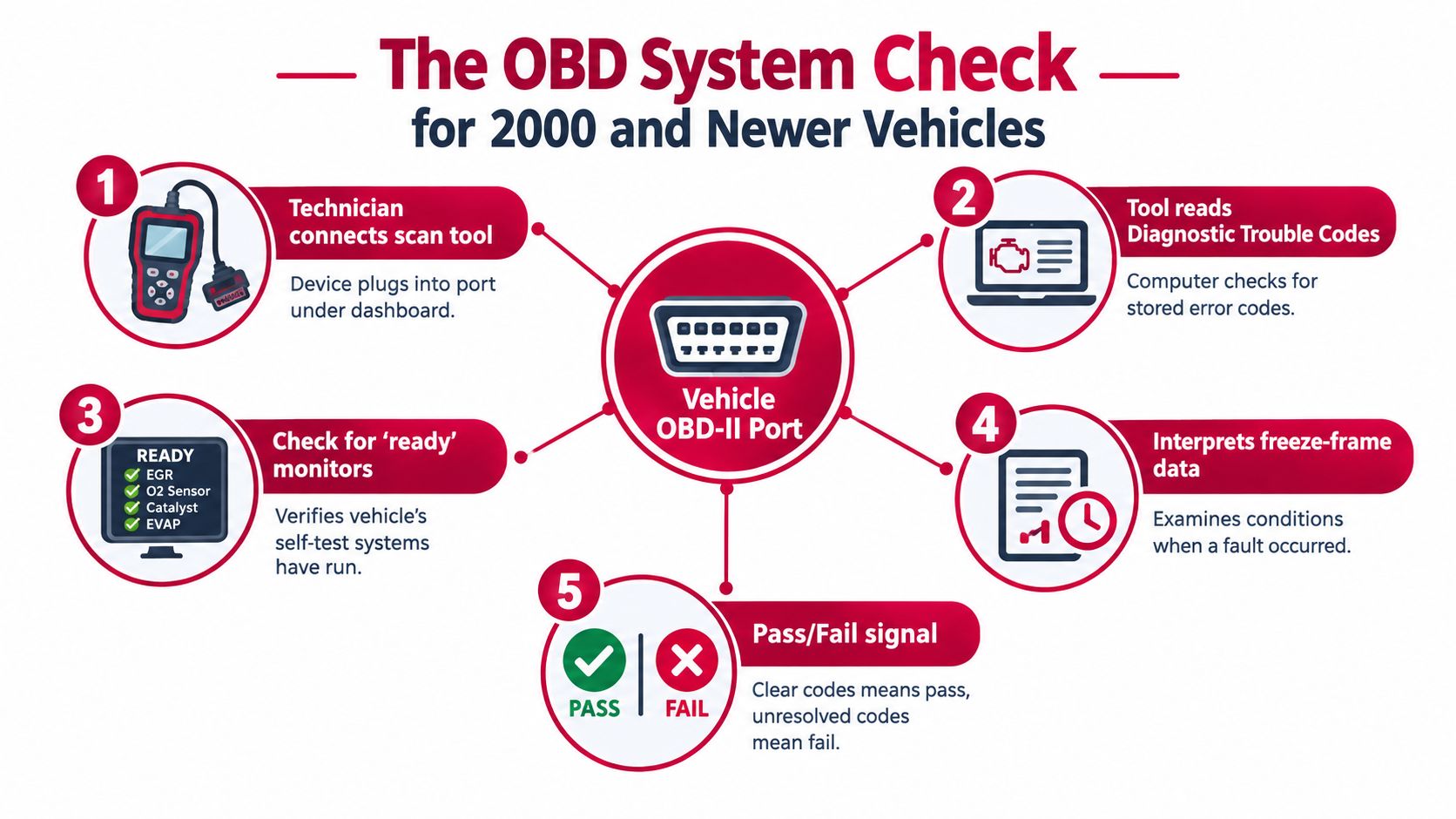
For most 2000-and-newer vehicles, the technician begins inside the cabin, under the dashboard near the steering column. A scan tool plugs into the diagnostic link connector, or DLC, and communicates with the vehicle's onboard computer. The tool checks for stored emissions faults and asks whether the vehicle has completed its built-in self-tests.
These self-tests are called readiness monitors. Each monitor examines a particular system, such as the catalytic converter, oxygen sensors, or evaporative emissions controls. The checks do not all run at once. The vehicle waits for suitable conditions, then evaluates each system during normal driving. A guide to OBD readiness monitors explains why recent repairs or battery work can affect this status.
Why a vehicle can drive well and still fail
A car may start easily, idle smoothly, and feel normal while its computer records an emissions problem. For example, code P0420 indicates that the computer has detected catalytic-converter efficiency below its threshold. The driver may notice little change because the fault concerns emissions performance rather than how the engine feels.
The technician also checks the dashboard warning-light behavior. With the key on before starting, the Check Engine Light should illuminate during the bulb check. After the engine starts, it should go out if the computer is not reporting an active emissions fault.
A steady Check Engine Light points to a fault that needs diagnosis before testing. Disconnecting the battery, clearing a code, or completing electrical work can erase stored information and reset readiness monitors. Refueling immediately before the appointment can also leave the evaporative monitor incomplete.
Before visiting the station, have a repair shop scan the vehicle and confirm that the monitors are ready. Do not clear codes to turn off the light. The technician can still see incomplete monitor status, and the vehicle may fail because the computer has not completed its required checks.
The scan tool reports what the vehicle has detected. It does not repair the problem. The technician compares the results with the applicable inspection requirements and records the outcome electronically. The OBD system check infographic illustrates the process, while the OBD-II system check infographic shows its five basic steps.
If a monitor is incomplete or an emissions code remains active, diagnosis must come before another inspection. Checking the dashboard light and monitor status beforehand can prevent an unnecessary trip to the station.
Tailpipe and Dynamometer Testing for Older Vehicles
Older vehicles take a different test path because they may not supply the electronic emissions information used in a modern OBD inspection. In California, model-year 1999 and older vehicles are primarily associated with BAR-97 tailpipe testing, while model-year 2000 and newer vehicles are primarily associated with BAR-OIS electronic testing. The assigned procedure depends on the vehicle, not customer preference.
At the station, the technician first positions the vehicle for the required procedure. For a BAR-97 inspection, a probe goes into the tailpipe while the equipment samples the exhaust leaving the engine. Depending on the test, the engine may run at idle or at different idle speeds. The machine measures gases such as hydrocarbons, carbon monoxide, nitrogen oxides, and carbon dioxide.
These readings provide clues about what is happening during combustion. High hydrocarbons can point to fuel that did not burn completely. Carbon monoxide can indicate an overly rich mixture, while nitrogen oxide readings can reflect combustion and emissions-control problems. Before the appointment, have a shop check for an exhaust leak, rough running, or disconnected emissions hardware. A damaged tailpipe can also affect how the probe samples the exhaust.
Some older or enhanced-area vehicles are tested on chassis dynamometer rollers. The rollers support the driven wheels and let the technician apply a controlled, simulated driving load. As the engine works harder than it would at idle, the exhaust probe continues sampling emissions. A cooling fan moves air around the vehicle during the procedure, helping control conditions while the test runs.
| Feature | BAR-97, Two-Speed Idle | BAR-OIS, Dynamometer |
|---|---|---|
| Main vehicle group | Primarily model-year 1999 and older vehicles | Primarily model-year 2000 and newer vehicles |
| Main measurement | Direct exhaust sampling at the tailpipe | Electronic emissions-control data through OBD |
| Vehicle position | Stationary during idle-based sampling | Positioned on dynamometer rollers when the assigned procedure requires it |
| Technician's focus | Pollutant concentrations in exhaust | Fault information and readiness data from the vehicle computer |
| Owner concern | Exhaust leaks, poor combustion, and emissions hardware | Warning lights, stored codes, and incomplete monitors |
If your vehicle is older, ask the station which procedure applies before arriving. That answer tells you whether the car will remain stationary or be placed on rollers, and whether checking the exhaust system beforehand should be a priority.
How Pass and Fail Decisions Are Made
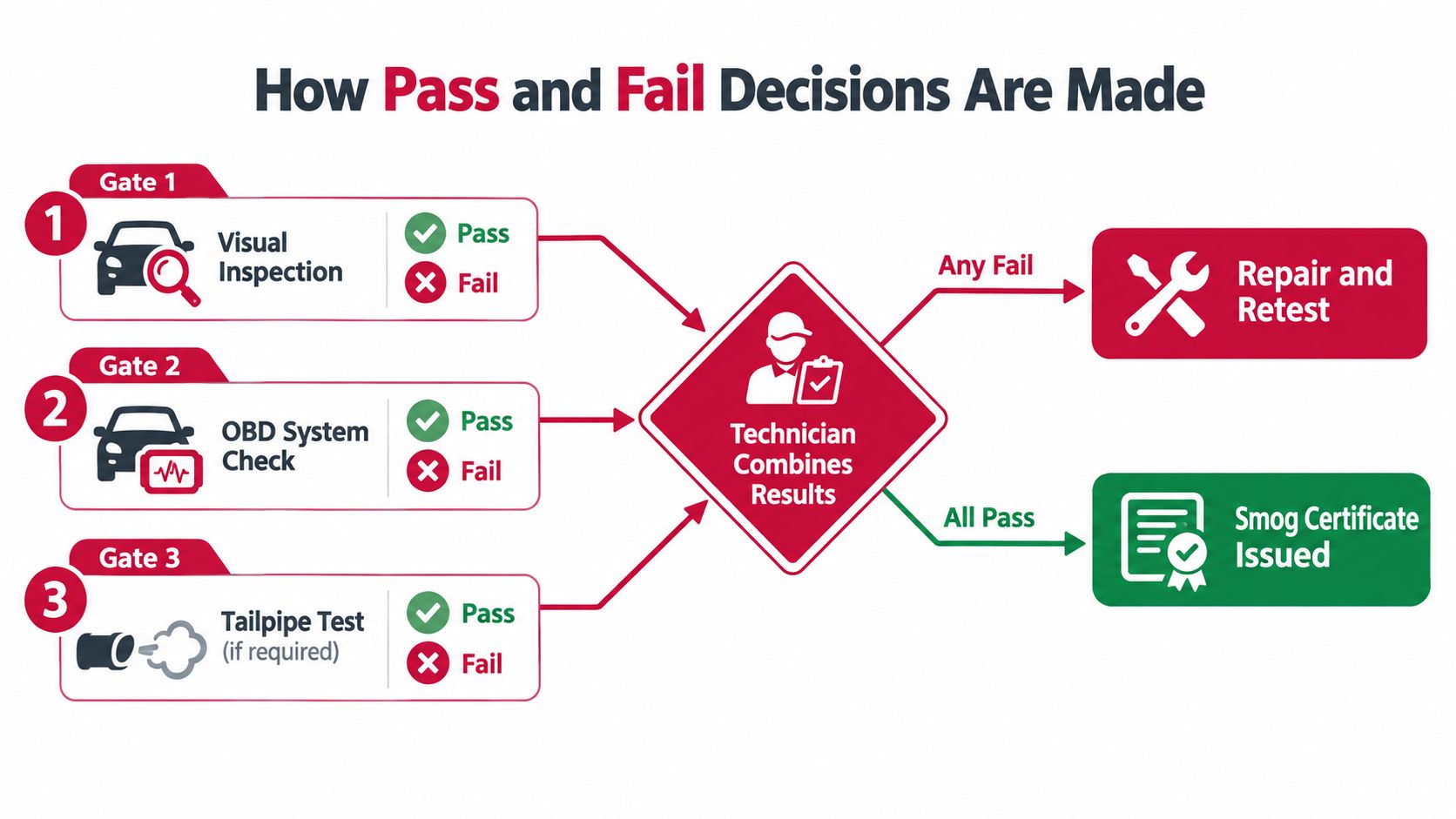
A smog check isn't a single score, like a grade on a test. It's a series of applicable pass or fail gates. The technician must complete every required part for that vehicle, and one failed item can prevent the station from issuing a complete passing certificate.
For example, a vehicle might have emissions hardware that looks intact but show an active Check Engine Light during the OBD check. The visual portion can appear acceptable, yet the electronic result can still fail. An older vehicle can pass the visual inspection and show no obvious functional problem, then fail because its measured tailpipe pollutants exceed the applicable standard.
The model-year cutoff changes the test path
The model-year distinction determines which equipment and data matter. Vehicles primarily tested through BAR-97 are evaluated by direct exhaust measurement, while vehicles primarily tested through BAR-OIS provide electronic emissions information through the onboard diagnostic system. The assigned path isn't a customer preference. The station follows the state procedure that matches the vehicle.
A technician may also stop or refuse a test if the vehicle presents an unsafe condition. An active oil or fuel leak, for example, can create a hazard in an inspection bay. Safety comes before completing a measurement.
What happens after a failure
A failure report identifies the area that needs attention. The correct next step is diagnosis, not automatically replacing expensive parts. A scan code may point toward a system, but the technician or repair professional still needs to determine whether the cause is a sensor, wiring, vacuum leak, catalyst, or another component.
Retesting follows the station's policy and the applicable program rules. Fees can vary, and a station that performs testing only won't complete repairs on site. There isn't a partial pass for a vehicle that passed some gates and failed another. The certificate is issued only when all required portions produce an acceptable result.
Remember: Passing the visual inspection doesn't offset an OBD failure, and a clean dashboard doesn't offset excessive tailpipe emissions.
Common Reasons Cars Fail and What to Fix First
Many failures begin with a small item, but the right repair depends on the actual test result. Start with checks that are visible and inexpensive before authorizing major engine work.
- Gas cap: Tighten it until it clicks or ratchets. Replace it if the seal is cracked, missing, or visibly damaged.
- Check Engine Light: Don't hide or clear it. Have the code read and diagnose the underlying emissions fault.
- Battery or code reset: A recent battery disconnect, jump start, or cleared code can leave monitors incomplete. Ask a qualified shop to verify readiness before testing.
- Vacuum and PCV components: Look for a disconnected hose or damaged PCV valve. Don't pull apart unfamiliar emissions plumbing, but report anything obviously loose.
- Oxygen sensors and EGR equipment: A failed oxygen sensor or sticking exhaust gas recirculation component can affect combustion and emissions. These parts need testing rather than blind replacement.
- Catalytic converter: Confirm that the converter is physically present and correctly installed. An aftermarket part may not meet the vehicle's applicable requirements, so use a qualified repair professional for compliance questions.
The common smog check failure reasons can help you interpret a failure report, but a code alone isn't a complete diagnosis. For instance, a catalyst-related code might result from the converter, an exhaust leak, a sensor problem, or another condition that affects the computer's comparison.
Before the appointment, drive long enough to bring the engine and emissions equipment to normal operating temperature. Check tire inflation against the vehicle manufacturer's specification, especially if the assigned procedure uses dynamometer rollers. If a repair shop gives you a specific drive cycle, follow those instructions and avoid disconnecting the battery afterward.
Recent refueling can also affect evaporative-system monitor completion. If you've just repaired the vehicle or cleared a fault, ask the shop whether the monitors show ready before paying for the official inspection.
Choosing a STAR or Test Only Station and Preparing for Your Visit
California stations don't all operate under the same business model. A regular licensed station can test and repair vehicles. A Test Only station performs the inspection but doesn't carry out the repair work on the same visit. A STAR station meets additional certification and oversight requirements and can inspect vehicles directed to STAR by the DMV or the program.
That distinction matters after a previous failure or a notice directing you to a specific station type. If your paperwork requires STAR testing, you must use a STAR station. If the state hasn't directed you, you can generally choose a station based on convenience, services, and whether you want testing separated from repair work.
What to do before arriving
Use this short preparation list:
- Confirm the station: Check that the business is licensed for the type of inspection your vehicle needs.
- Review your renewal information: Bring the DMV renewal notice or previous smog certificate if you have it.
- Warm the vehicle: Drive for 10 to 15 minutes before the appointment, based on practical preparation guidance from the smog check background guide.
- Check the tires: Inflate them to the manufacturer's recommended pressure if a dynamometer procedure may apply.
- Leave warning lights visible: Never cover, remove, or manipulate a dashboard indicator.
- Ask about vehicle fit: Large trucks, motorhomes, and some recreational vehicles may require a station with suitable equipment.
A Test Only visit can be useful when you want an independent inspection result without repair sales at the same business. Fire House Smog is a STAR-certified test-only station in Antioch that performs inspections for cars, trucks, and some recreational vehicles subject to equipment limits, and it also provides California DMV registration services. You can review its STAR-certified smog station services before deciding where to go.
Bring the vehicle in a condition the technician can inspect safely. If the Check Engine Light is on, monitors are incomplete, or you see a fuel or fluid leak, address that issue first instead of treating the inspection as a guess.
Fire House Smog can perform a STAR-certified test-only inspection and help with California DMV registration services, including on-site renewal processing during posted service hours. Visit Fire House Smog in Antioch to arrange your smog check and confirm whether your vehicle or RV fits the available equipment.
California emissions test results come back as a certificate with a pass or fail status, OBD-II diagnostic data, and any flagged trouble codes. The most common reason a test never reaches the tailpipe stage is incomplete readiness monitors, not a real emissions defect.
You may be standing at the counter with a Vehicle Inspection Report in your hand, trying to decide whether “failed,” “not ready,” or a code such as P0420 means an expensive repair. The wording can feel technical, but the report follows a logical path. It records what the station checked, which part of the inspection stopped the process, and whether the result can be sent to the California Department of Motor Vehicles.
California's statewide results show why these inspections matter. The 2025 Smog Check executive summary recorded 11,275,981 initial tests, with 959,667 failures, an 8.51% initial failure rate, and 12,200,718 total tests with a 9.04% overall failure rate. Emissions-related failures accounted for 83,034 cases, or a 10.20% emissions failure rate, as reported in the California Smog Check benchmark data. A result that doesn't reach the tailpipe stage is therefore worth interpreting carefully, not treating as proof that the engine has a major defect.
Table of Contents
- What Your Emissions Test Results Show
- How OBD-II Readiness Monitors Decide Your Result
- Common Trouble Codes Behind a Failed Emissions Test
- Emissions Failures Versus Visual and Functional Rejections
- Your Retest and Repair Path After a Failure
- Why a STAR Test-Only Station Matters in Antioch
- From Smog Certificate to Renewed Registration in One Stop
- Quick Checklist and Next Steps for Your Vehicle
What Your Emissions Test Results Show
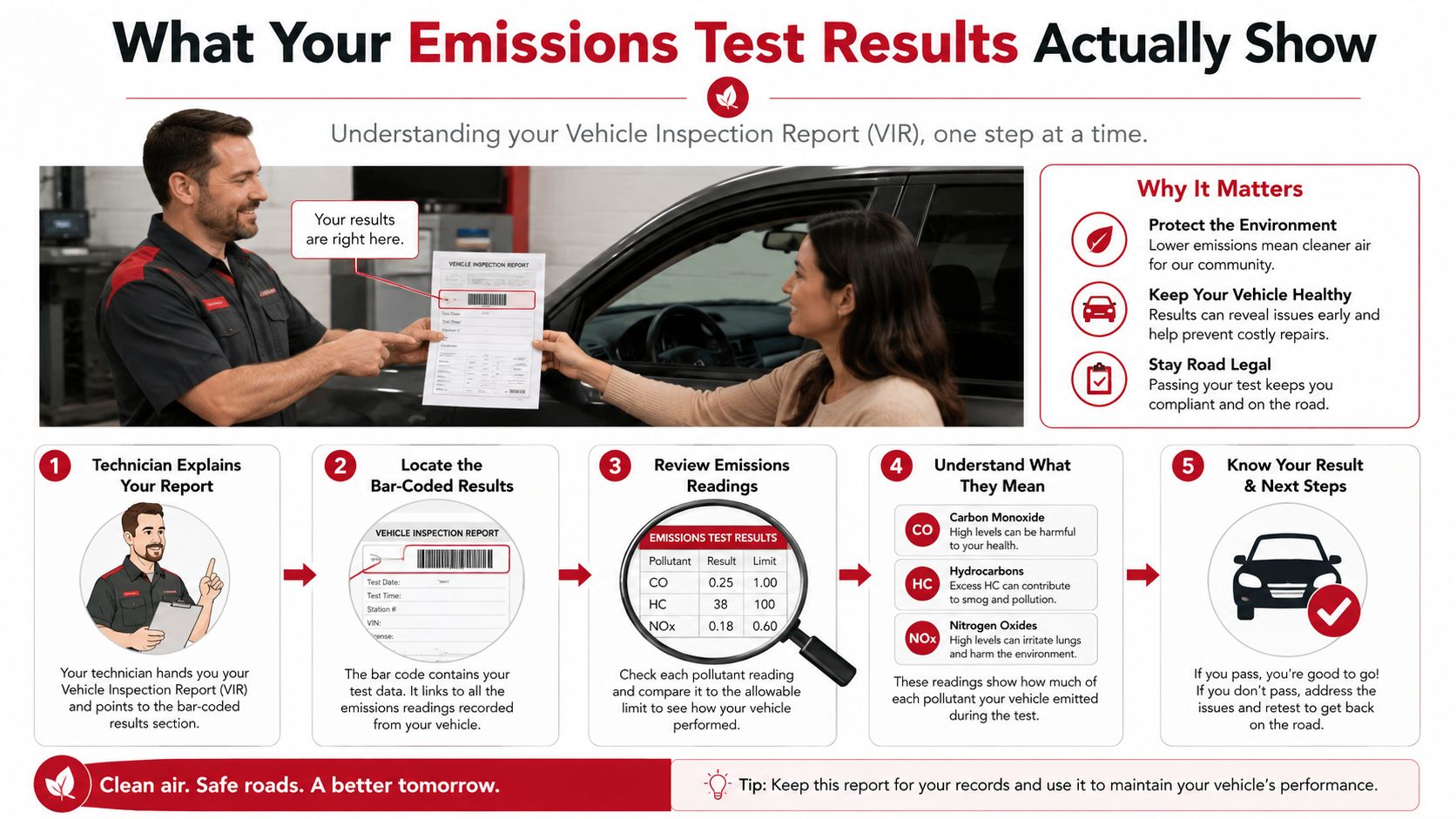
A technician usually hands you a Vehicle Inspection Report, or VIR, after the inspection. Begin with the header before reading the pass or fail box. It normally lists the test date, vehicle identification number, license information, station number, and test type. Confirming these details first can prevent a record problem caused by a mismatch, even when the vehicle itself tested correctly.
The certificate includes a barcode and serves as the inspection record connected to the DMV. It may show the overall outcome, completed inspection portions, OBD-II information, applicable tailpipe readings, and emissions-related diagnostic trouble codes. The applicable measurement rules are summarized in this guide to California emissions standards.
Read the result fields in order
Review these report sections:
- Overall outcome: The final status may be pass, fail, or refusal to test.
- Inspection portions: The VIR can identify visual and functional checks, the OBD scan, and tailpipe testing when required.
- Measured readings: Applicable tailpipe results may include hydrocarbons, or HC, carbon monoxide, or CO, oxides of nitrogen, or NOx, and carbon dioxide, or CO2. The report compares each reading with the applicable cutpoints.
- Diagnostic information: The VIR can list emissions-related trouble codes or show that the vehicle's monitors were not ready.
- Certification statement: A passing certificate provides the DMV with the electronic record needed for the applicable registration transaction.
The certificate is the legal inspection record used by the DMV to clear a registration requirement, not merely a shop receipt. A passing result is generally transmitted electronically. Keep the paper copy in case the online record is delayed or a clerk needs information from the certificate.
Practical rule: A “Not ready” result usually means the inspection was stopped before the tailpipe measurement could happen. Read it as a status of the vehicle's self-checks and inspection progress, then use the VIR to identify what was completed and what prevented certification.
How OBD-II Readiness Monitors Decide Your Result
Think of readiness monitors as a pre-flight checklist. A pilot doesn't take off until the instruments complete their self-checks. Your vehicle's OBD-II system works similarly. It runs self-tests on emissions equipment during particular driving conditions, then stores each monitor as ready or not ready.
Continuous monitors, including misfire detection, fuel-system monitoring, and component checks, operate while the vehicle runs. Non-continuous monitors need specific conditions before they can complete. These include the catalytic converter, oxygen sensor, EVAP system, EGR system, secondary air system, and A/C refrigerant system.
California inspection rules allow only limited incomplete-monitor conditions. EPA and state inspection guidance generally treats 2001-and-newer light-duty vehicles as allowed one unset monitor, while 1996–2000 vehicles are often allowed up to two, as described in the EPA inspection and maintenance policy guidance. If the vehicle exceeds its applicable limit, the test can stop before the tailpipe stage.
Why a monitor becomes not ready
A battery disconnect erases stored monitor status. Clearing a trouble code with a scan tool can do the same thing, even if the repair was appropriate. A recent EVAP-related repair or refueling event may also leave the EVAP monitor waiting for the right conditions, while ordinary short trips may not provide the speed, temperature, and steady driving needed for a complete cycle.
| Monitor | Type | What Can Set It to Not Ready |
|---|---|---|
| Misfire | Continuous | The system hasn't completed its operating checks after memory was cleared |
| Fuel system | Continuous | Recent battery loss, code clearing, or insufficient driving conditions |
| Comprehensive components | Continuous | The vehicle hasn't finished its component self-tests |
| Catalyst | Non-continuous | The required warm-up and steady driving conditions haven't occurred |
| Oxygen sensor | Non-continuous | The sensor monitor is waiting for the proper temperature and operating pattern |
| EVAP | Non-continuous | A recent code clear, refueling event, purge issue, or incomplete drive cycle |
| EGR and secondary air | Non-continuous | The system hasn't encountered the conditions needed to run its test |
| A/C refrigerant | Non-continuous | The vehicle's conditions haven't allowed the monitor to complete |
Before paying for an inspection, ask a technician or qualified shop to check monitor status with a scan tool. If the scan shows too many incomplete monitors, driving the vehicle through the manufacturer-specific cycle may solve the immediate refusal. Guidance on checking this condition is also available in the OBD readiness monitors guide.
A ready vehicle can still fail. Once the monitors are complete, the OBD scan may identify a stored trouble code or a malfunction indicator lamp condition. That code tells you which system needs diagnosis, but it doesn't automatically identify the failed part.
Common Trouble Codes Behind a Failed Emissions Test
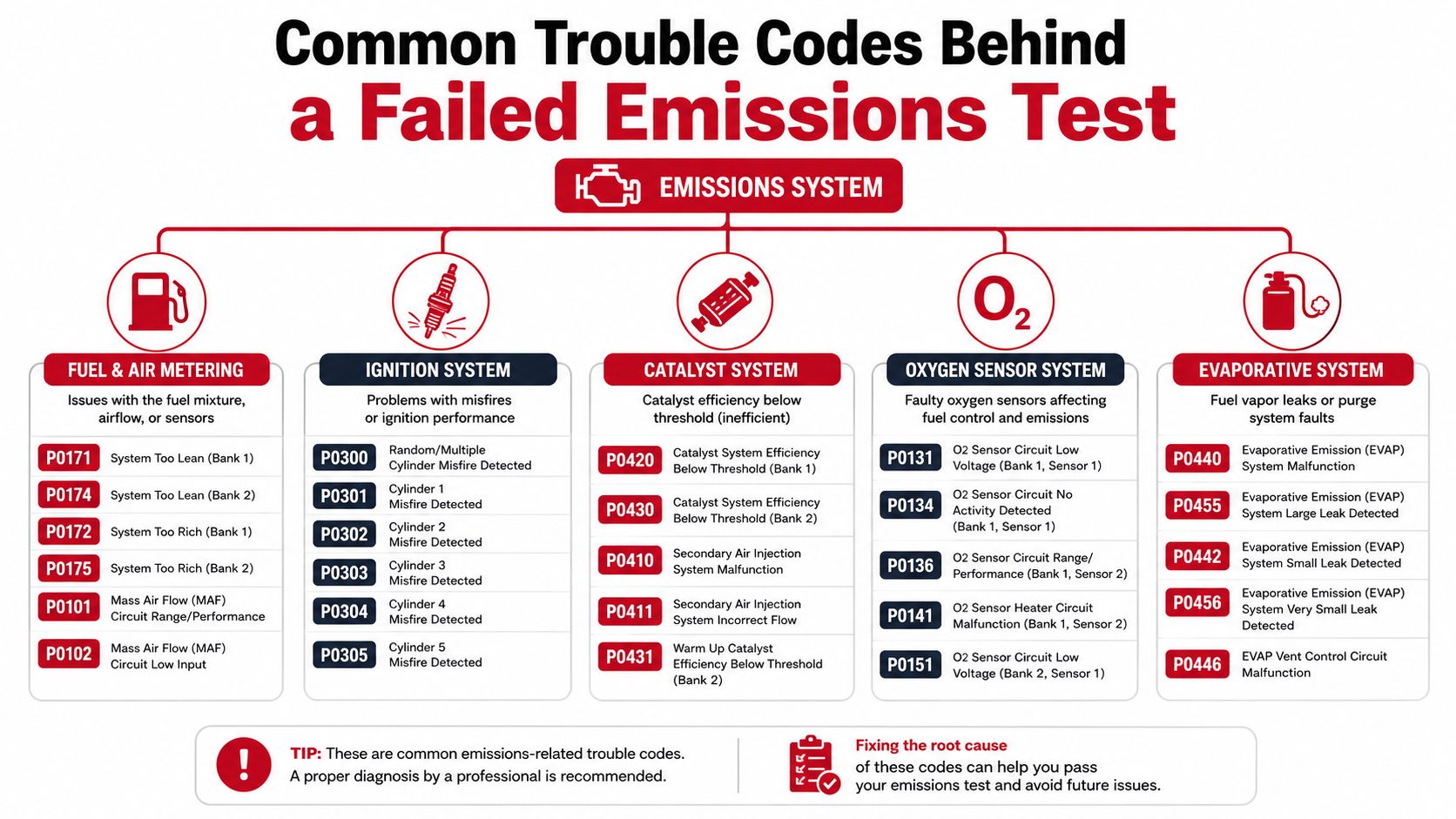
A trouble code is a starting point, not a repair order. The VIR can tell you that the OBD system detected a problem, but it usually can't tell you whether the cause is a hose, sensor, valve, wiring fault, ignition part, or catalytic converter.
Match the code to the system
Fuel and air metering codes, such as P0171, P0172, P0174, and P0175, describe lean or rich operation. A vacuum leak, dirty airflow sensor, fuel-pressure problem, injector issue, or intake leak can produce similar code families. The repair urgency depends on the cause. A lean condition can also contribute to drivability or component damage if it remains unresolved.
Ignition and misfire codes, including P0300 through P0308, indicate random or cylinder-specific misfire detection. Worn spark plugs, ignition coils, injector faults, compression problems, or wiring can be involved. A flashing malfunction indicator lamp deserves prompt attention because continued misfire can send unburned fuel into the exhaust system.
EVAP codes, including P0440, P0442, P0455, and P0456, relate to fuel-vapor leaks or purge-system operation. A loose or damaged fuel cap can be simple, while a split hose, stuck purge valve, or tank-side leak requires more testing. A small leak code isn't the same repair as a large leak code, even though both belong to the EVAP family.
Catalyst efficiency codes, such as P0420 and P0430, mean the monitoring system believes the catalytic converter isn't cleaning the exhaust as expected. An oxygen-sensor problem, exhaust leak, fuel-control issue, or deteriorated converter may be responsible. Replacing the converter before checking those possibilities can waste money.
Oxygen-sensor codes, including P0136 and P0156, can involve the sensor, wiring, exhaust leaks, or a related fuel-control condition. EGR and secondary-air codes, such as P0401, P0411, and P0413, may point to restricted passages, failed valves, pumps, solenoids, or control wiring.
A code names a detected condition. It doesn't name the part you should buy.
EPA documentation explains that OBD systems monitor emissions components for malfunctions or deterioration that could cause emissions thresholds to be exceeded. Field research also identifies catalyst and EVAP monitors as areas where readiness can be less consistent than core monitors, which helps explain why those systems often appear in delayed or failed inspections, as discussed in this OBD emissions monitoring research.
A single code can represent a relatively simple repair or a major emissions-system diagnosis. Ask for the printed code list, the monitor status, and the inspection category before authorizing work. More practical interpretation is available in this guide to common smog check fail reasons.
Emissions Failures Versus Visual and Functional Rejections
Not every failed emissions test is an emissions-reading failure. A technician may record a problem during the visual, functional, or tampering portion before the vehicle reaches an OBD or tailpipe decision.
| Failure Type | Typical Cause | Certificate Marking | Next Step |
|---|---|---|---|
| Emissions-specific | HC, CO, or NOx above the applicable limit, or an emissions-related OBD fault | Failed emissions or OBD portion | Diagnose the system, repair the cause, and retest |
| Visual or functional | Missing converter, altered exhaust, fuel-filler issue, or illuminated malfunction indicator lamp | Failed visual or functional portion | Correct the equipment or diagnose the warning condition |
| Tampering | Removed EGR equipment, altered intake, or exhaust changes before the catalytic converter | Tampering or equipment failure | Restore compliant emissions hardware before retesting |
A tailpipe failure means the measured gases exceeded the applicable cutpoints. An OBD failure means the vehicle's diagnostic system reported a monitored emissions problem or failed to meet the readiness conditions. These are different paths, even though both may appear under the broad heading of emissions compliance.
Visual and tampering findings can bypass tailpipe measurement entirely. For example, a missing catalytic converter is visible hardware evidence, while an altered intake or removed EGR component can create a compliance problem before the analyzer measures exhaust. The station documents the result on the inspection record, while the owner needs to correct the condition and obtain a valid retest.
An illuminated malfunction indicator lamp can create confusion. The lamp is a functional warning, but it usually points toward an OBD diagnosis that may reveal an underlying emissions fault once the vehicle is scanned. A technician shouldn't treat the light itself as the complete diagnosis.
The repair paperwork and the DMV record serve different purposes. The station provides the inspection result and any available failure information. A repair facility may provide diagnostic findings or invoices, but those documents don't substitute for a passing certificate when the DMV requires a completed smog inspection.
Your Retest and Repair Path After a Failure
Antioch drivers should begin with the failure category on the VIR. California's next step depends on whether the result came from OBD-II or tailpipe readings, or from a visual, functional, or tampering finding.
For a failure limited to OBD-II or tailpipe readings, California policy generally allows a free retest within 90 days at the same station when no repairs have been performed, as described in the California retest and inspection guidance. Repair work can change the retest conditions. Clearing a trouble code may also change monitor status, so ask the station about the coupon and its exact terms before doing anything.
Choose the next action from the report
- No repair and eligible failure: Keep the failed VIR, confirm the same-station retest conditions, and return within the allowed period.
- Repair required: Take the code list and inspection findings to a certified smog repair technician. Request diagnosis before approving parts.
- Income-qualified assistance: Check California's Repair Assistance options if you meet the program requirements. The program includes a $500 cap for EVAP repairs, according to the applicable state program terms.
- Directed repair: Follow the repair direction when the inspection or state process sends you to a specific path. An owner's-choice repair means you can select a qualified repair provider.
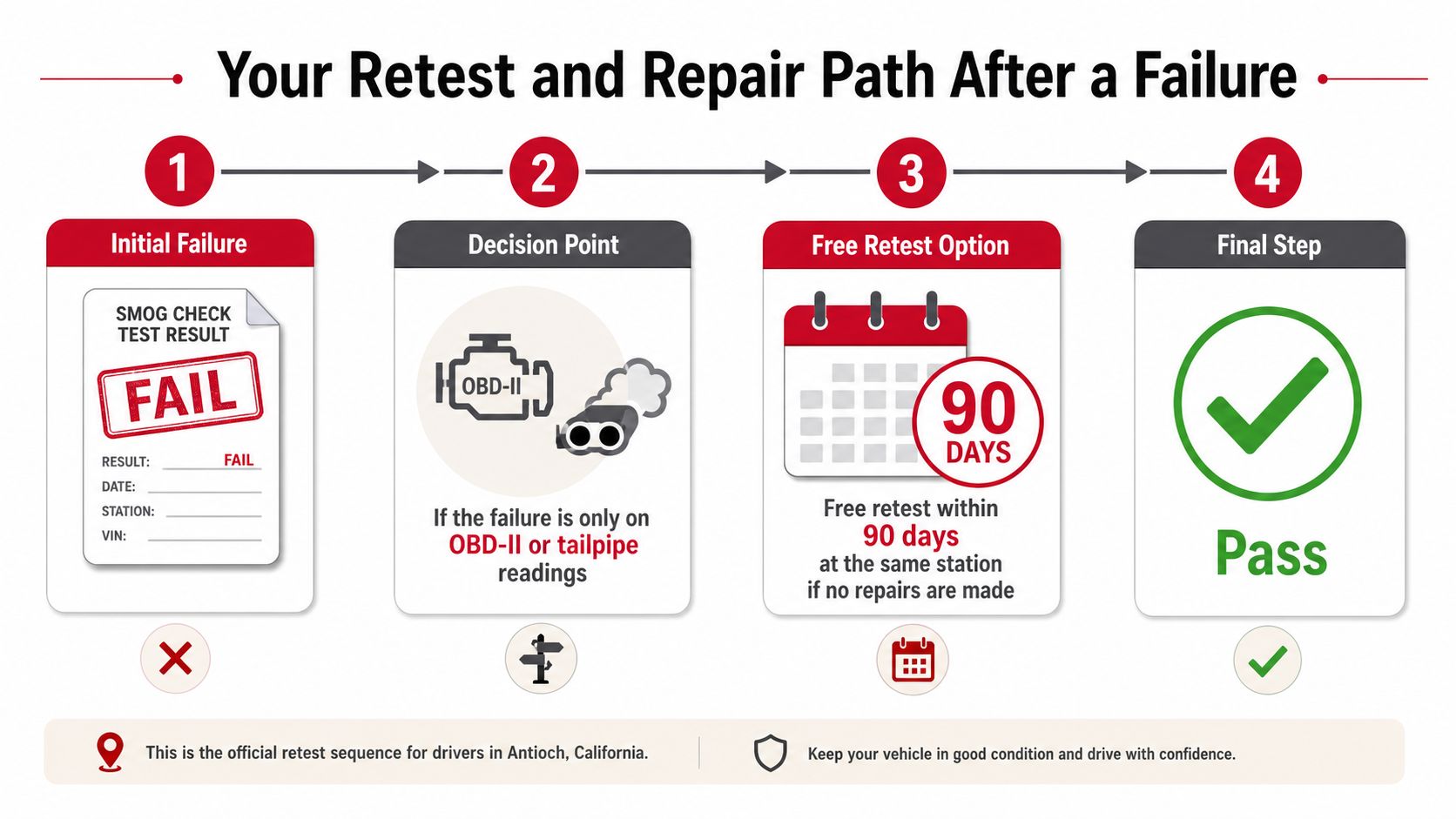
Use the VIR to choose between these paths. A no-repair retest works when the failure was limited to an eligible OBD or tailpipe reading and the vehicle has not been altered. When the report lists a persistent trouble code, visual defect, or tampering, schedule diagnosis and repair before returning for inspection. Fire House Smog offers test-only inspections, retest handling under its site policy and coupon terms, and electronic transmission of completed results to the DMV.
This short video can help you see how the retest decision fits into the broader inspection process.
Bring the original VIR to the follow-up visit.
Why a STAR Test-Only Station Matters in Antioch
A STAR test-only station keeps the inspection separate from repair sales. For a first-time customer, that separation makes the paperwork easier to read. You can focus on whether the vehicle passed, which system caused a failure, and what the report records before discussing repairs.
A test-and-repair shop may inspect the vehicle and sell the work needed afterward. Customers should request clear documentation before approving parts or labor. A test-only station does not perform in-house repairs, so its inspection decision is separate from selling the parts or labor used to correct a failure.
When STAR status affects your appointment
California directs some vehicles to STAR or test-only inspections, including vehicles identified through the state's compliance process. Antioch is part of an enhanced inspection area, so check the registration notice or DMV direction before selecting a station. A vehicle requiring STAR inspection may not be accepted at an ordinary smog location.
Testing also becomes easier to follow when the station concentrates on inspection. The technician can identify whether the result involved readiness monitors, OBD data, tailpipe readings, visual equipment, or tampering. That explanation connects the result to the certificate or failure report without folding a repair estimate into the inspection decision.
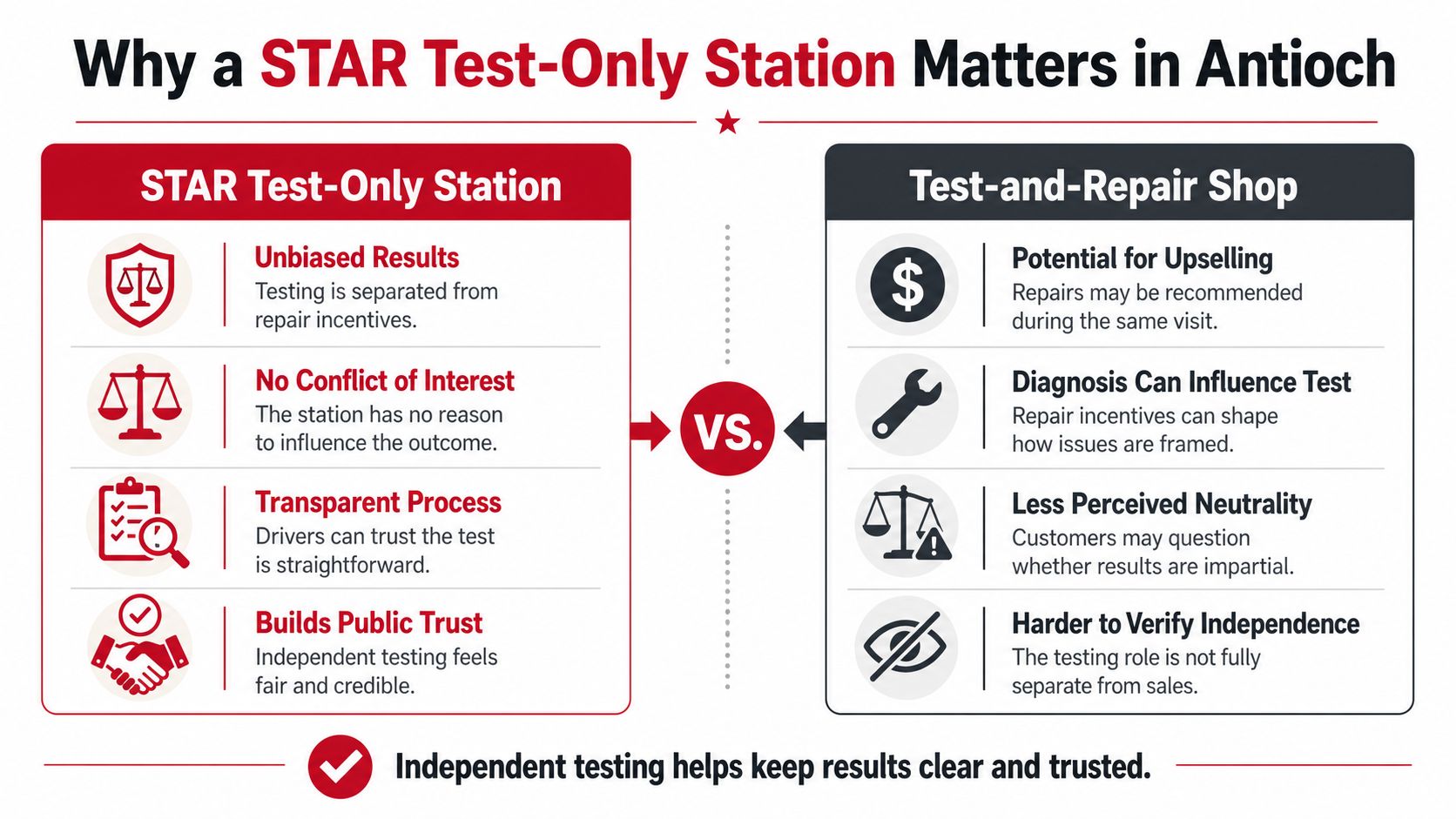
Before driving across Antioch, confirm the required station type for a directed vehicle. For an ordinary renewal, independent testing can provide a neutral result and a clear paper trail. Bring the DMV notice when available. It shows the station which inspection category applies and helps prevent an avoidable appointment mistake.
Test-only operation removes the repair-sales conflict and keeps the inspection decision focused on the vehicle's recorded condition.
From Smog Certificate to Renewed Registration in One Stop
Once the vehicle passes, the technician transmits the result electronically to the DMV. The certificate number may then connect to your renewal record, allowing the registration transaction to move forward without carrying a paper certificate between separate offices.
Start with the renewal notice and confirm that the vehicle's smog requirement has been satisfied. Then complete the registration payment through the available DMV channel. Depending on the vehicle and transaction, renewal may be available online, by mail, or through an authorized on-site DMV service provider.
A practical Antioch sequence
- Bring the renewal notice: It helps the provider locate the correct DMV transaction.
- Bring identification and payment: The provider may need identification and an accepted payment method for the renewal.
- Confirm the smog transmission: If the pass was recent, ask the station to verify that the result was submitted electronically.
- Complete the renewal: Once the DMV record accepts the inspection, pay the required registration fees.
- Collect the sticker and tag materials: An authorized provider may print available registration materials on site.
The timing matters. A certificate should be transmitted before registration expires if you want to avoid a late transaction or a record that hasn't updated in time. If the portal or renewal notice doesn't reflect the result, don't assume the inspection failed. First compare the VIN, license information, and certificate details, then ask the station or DMV service provider to reconcile the record.
A STAR certificate and a regular certificate both document a passing inspection, but the required certificate type depends on the vehicle's DMV direction and inspection category. The notice controls that choice. If the DMV specifically directed a STAR inspection, a pass from a station that doesn't satisfy that direction may not resolve the requirement.
Some drivers use separate trips for the smog check, registration payment, and sticker pickup. An Antioch provider that offers both inspection and licensed DMV registration services can combine those tasks when the vehicle and transaction qualify.
Quick Checklist and Next Steps for Your Vehicle
Use the inspection process as a decision tree rather than guessing from the dashboard light.
- Confirm the vehicle and test type. Check the registration notice, vehicle class, and any STAR direction before choosing a station.
- Protect monitor status. Avoid disconnecting the battery or clearing codes before an inspection. If memory was recently reset, allow enough mixed driving for the required monitors to run.
- Check basic conditions. Make sure the fuel cap is installed correctly and look for an illuminated malfunction indicator lamp.
- Ask for readiness results. If a monitor is incomplete, request the specific monitor name and the driving conditions needed to complete it.
- Read the VIR before authorizing repairs. Identify whether the result is a refusal-to-test, OBD failure, tailpipe failure, visual rejection, functional problem, or tampering finding.
- Request the code list. A DTC is evidence for diagnosis, not proof that the matching component needs replacement.
- Use the correct follow-up path. Return for an eligible no-repair retest, or visit a qualified smog repair technician when the report identifies a repair condition.
- Reconcile the DMV record. After a pass, confirm the electronic submission before completing registration renewal.
Digital records can also be delayed or appear inconsistent across portals. CARB's Clean Truck Check FAQ says results should appear in CTC-VIS within 0–1 days, and advises users to retest, disconnect other devices, check the vehicle-device connection, and confirm stable internet if a result doesn't appear within 5 minutes. It also explains that a vendor portal may show “Awaiting CARB's Response” while the CARB account shows no result, and that CTC-VIS displays submissions made on or after October 1, 2024, as detailed in the CARB test-results troubleshooting guidance. Those details apply to the referenced Clean Truck Check system, but they illustrate why a missing digital record needs reconciliation rather than an immediate assumption of failure.
Bring your emissions test results sheet to Fire House Smog in Antioch if you want the recorded outcome explained before choosing a next step. The station provides STAR-certified test-only inspections and licensed DMV registration services, so eligible customers can address the certificate and renewal workflow in the same visit.
Fire House Smog can review your VIR, explain readiness and trouble-code findings, perform eligible retests, and process qualifying DMV renewals with on-site tag services. Visit Fire House Smog at 2900 Lone Tree Way in Antioch with your inspection report and renewal notice so you can leave with a clear plan for the next pass.
You're staring at a DMV renewal notice, or maybe you just got told your car needs a STAR-certified smog station instead of the shop around the corner. That's usually the moment the stress kicks in, because now the question isn't just “Can I pass?” It's also “Where do I go, and will I need to come back with repairs?”
A STAR station sounds technical, but the idea behind it is simple. California uses it to sort inspection stations by performance, equipment, and compliance, so the cars that need tighter oversight get tested in places the state keeps under closer watch. For drivers, that means the station you choose can affect whether the visit ends with a certificate, a repair referral, or a second trip.
Table of Contents
- The California Smog Check Most Drivers End Up Needing
- What STAR Certification Means
- Test-Only Versus Test-and-Repair STAR Stations
- How a STAR Test-Only Smog Check Works
- Why a Local STAR Station Like Fire House Smog Stands Out
- Preparing for Your Visit and Knowing What You Can Bring
- Misconceptions That Send Drivers to the Wrong Station
- Visiting a STAR Station in Antioch and Frequently Asked Questions
The California Smog Check Most Drivers End Up Needing
A lot of drivers meet the smog system in the least convenient way possible, with a renewal deadline hanging over them. The notice arrives, the car still runs fine, and then the paperwork says the vehicle needs a smog certificate before the DMV will finish the job. That's when a routine errand turns into a short course in California emissions compliance.
For many vehicles, a standard smog check is enough. But some cars and trucks get directed to a STAR-certified smog station because the state wants a more tightly controlled inspection for that vehicle or that situation. The distinction matters because STAR isn't just a label, it tells you which stations are authorized to test directed vehicles under California's performance rules. The state's STAR framework was created as part of a modernization effort that took effect in January 2013, and BAR says more than two-thirds of smog check stations are STAR certified, so this isn't some obscure corner of the system, it's a major part of how the state handles inspections (California Senate Transportation Committee PDF).
Why the station type changes your experience
If you go to a test-only shop, the visit stays focused on testing. If you go to a test-and-repair shop, the same location may also be able to fix what it finds. That's a real difference when you're trying to finish a registration renewal on the same day.
In Antioch and East Contra Costa County, that distinction often shows up in very practical ways. A driver may need a smog certificate, a renewal, and a clear answer about what happens if the car fails. A station that can handle the paperwork on-site turns a DMV chore into one stop instead of two or three.
Practical rule: if your notice says STAR is required, don't book the nearest random smog shop first. Book a station that is actually authorized for the type of inspection your paperwork demands.
What STAR Certification Means
A STAR-certified smog station is not a one-time approval that sits on the wall forever. California keeps it under ongoing review with measurable performance standards, inspection equipment rules, and periodic checks. In plain English, STAR status works more like a quality-control filter than a plaque.
The performance side of STAR status
BAR ties STAR eligibility to numbers that measure how a station performs on similar vehicles. The Similar Vehicle Failure Rate must be at least 50% of the industry-wide failure rate for similar vehicles in the most recently completed quarter, the Excessive Test Deviation Rate must be no more than one, and each inspector must maintain a Follow-up Pass Rate of at least 0.40 unless the station-level score applies for an inspector without one (BAR STAR certification page). Those thresholds matter because they show whether a station is producing careful, repeatable results.
The logic is simple once the jargon gets out of the way. A station that catches the right failures, avoids sloppy deviations, and keeps inspectors within the standard is more dependable for directed vehicles than one that misses too much or varies too widely. STAR turns that idea into a formal system.
The equipment side of the label
Certification also depends on the tools. BAR requires certified inspection equipment, current calibration, and the ability to inspect all vehicles in the Smog Check Program. California regulations say calibration-capable equipment has to pass calibration at least once every 10 calendar days, and BAR can restrict a station from communicating with the vehicle information database if deficiencies aren't corrected (California regulations on Cornell Law).
That means STAR is a live operating standard. If the station falls out of calibration, loses the right software setup, or cannot maintain the required tools, it stops being a dependable place for directed inspections.
A station page like Fire House Smog's STAR-certified smog check overview can help put that rule into a real-world setting. The point is not just that the station has the label. The point is that the label tells you the state is checking both the station's results and the station's equipment, so the inspection process stays accountable over time.
Bottom line: STAR status means the state is watching both the station's results and the station's equipment, which makes the label a continuously monitored quality mark, not a one-time award.
Test-Only Versus Test-and-Repair STAR Stations
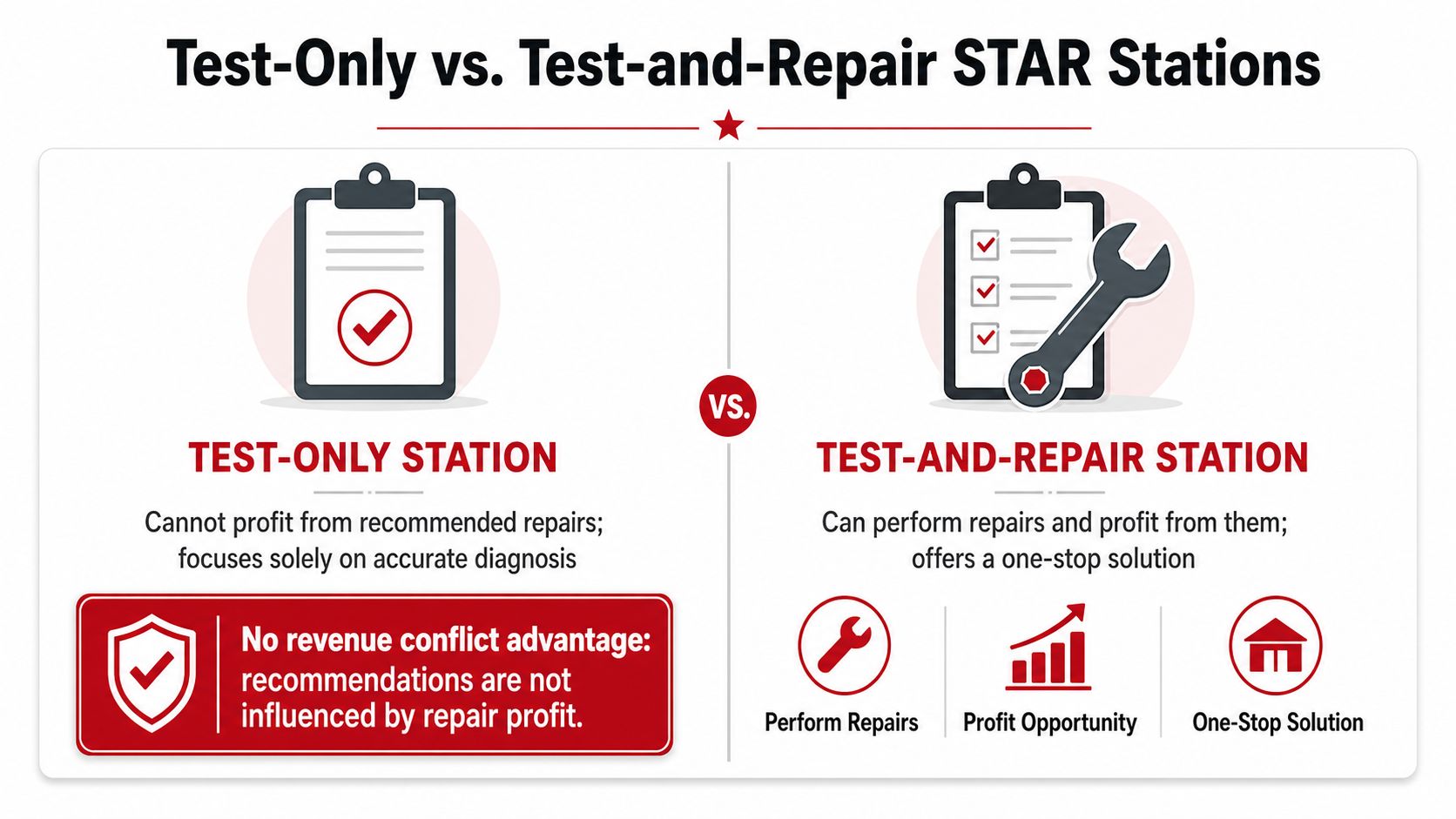
A driver trying to pick the right STAR location usually runs into one practical question first, who is allowed to test the car, and who is allowed to fix it afterward? A STAR test-only station can inspect your vehicle, but it cannot profit from repairing the reason it failed. A STAR test-and-repair station can do both. That split shapes both trust and convenience, especially when the renewal notice already feels like one more thing the DMV has dropped on your desk.

Why test-only matters to drivers
The value of a test-only station is the separation between the inspection and the repair estimate. If the station finds a problem, it does not have a repair bay waiting to turn that failure into additional work. The report sends you to the repair shop you choose, so the testing side stays distinct from the fixing side.
That separation matters for drivers who want the cleanest possible read on their car's emissions status. It also gives peace of mind to anyone who worries about being steered into repairs before they know what the car needs. A test-only shop answers one question, does the vehicle pass today, and then leaves the repair decision to you.
California's statewide numbers show that both station types handle a large share of the program. In BAR's BAR 2025 Smog Check Executive Summary Report, STAR Test-Only stations handled 5,916,245 initial tests and 481,639 failures, for an 8.14% failure rate, while STAR Test-and-Repair stations handled 2,766,051 initial tests and 227,215 failures, for an 8.21% failure rate. Those figures show a broad testing network, not a niche corner of the program.
Why regulators keep both models in play
The state needs places that can test vehicles, and it also needs stations that can repair them. The test-only model lowers the chance that a customer will be pushed toward unnecessary work, while the test-and-repair model gives drivers an option for diagnosis and repairs in one stop. Both fit the Smog Check Program, just in different roles.
For drivers who want a station whose job is limited to inspection, a STAR test-only station is the straightforward choice. For drivers who already know they want a shop that can handle both the result and the fix, test-and-repair is the better match. The right option depends less on the badge and more on what you want the station to do after it plugs in the car.
How a STAR Test-Only Smog Check Works
A STAR test-only visit usually starts with a drive-up and a quick review of your paperwork, much like any other inspection appointment. If your vehicle has been flagged for a directed inspection, the notice usually sends you to a STAR station instead of a regular one. The state is saying the car needs to be tested in a more controlled setting, where the inspection and the repair side stay separate.
What happens at the station
The station first verifies the vehicle and driver information, then connects the car to the inspection method that fits the vehicle. For 1996-and-newer vehicles, that means an OBD-II connection. Older vehicles may go through tailpipe or OIS testing, depending on what the program requires and what equipment the station supports.
After that, the inspector checks emissions-related components and completes the report. If the car passes, the certificate is issued electronically for DMV processing. If it fails, you receive a failure report that points toward repairs, but the station itself does not turn into your repair shop. That separation keeps the test result clean and leaves the next step to you.
What a failure does and doesn't mean
A failed test does not mean the vehicle is done for. It means the emissions system, readiness status, or visible equipment did not meet the standard that day. The purpose of the report is to identify the problem clearly enough that a repair shop can diagnose it without guessing.
A good failure report saves time. It gives the next mechanic a place to start instead of forcing them to search blindly. For a station example that follows this test-only model, you can look at the Lone Tree Way location details for Fire House Smog in Antioch.
Why a Local STAR Station Like Fire House Smog Stands Out
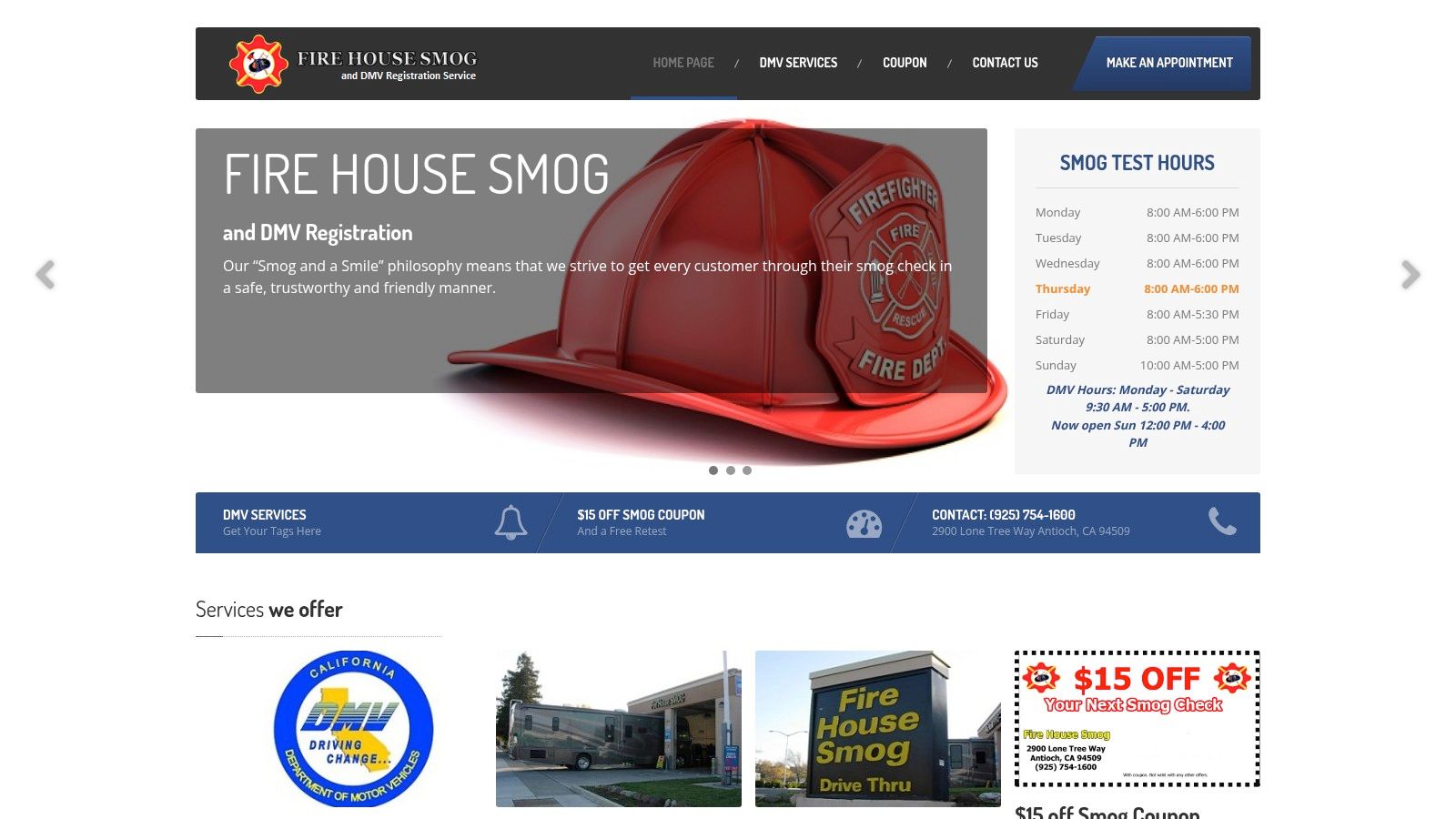
A local station matters when the problem is speed, not theory. At Fire House Smog on 2900 Lone Tree Way in Antioch, the selling point is the practical setup, not a slogan. It's a test-only station, so the testing side stays separate from repair revenue, and it also handles DMV registration tasks on-site during posted hours.
See the Lone Tree Way location details
Why the setup helps real drivers
Two service bays mean the station can move vehicles through faster than a single-bay setup usually can. That matters for commuters, fleet vehicles, and anyone trying to fit a smog check between work and school pickup. The station also posts smog testing seven days a week, which helps when your calendar doesn't match the DMV's.
The DMV side is useful for the same reason. When a driver can renew registration and leave with a sticker the same day, the smog visit stops being only an emissions errand and becomes a completed DMV task.
A local example of the test-only model
If you want a station that reflects the test-only logic discussed above, this is the kind of setup people usually mean. The test happens, the paperwork gets handled, and there's no in-house repair pitch sitting in the middle of the process. For drivers in Brentwood or Oakley, that can turn a frustrating compliance day into a short stop on the way home.
Preparing for Your Visit and Knowing What You Can Bring
The easiest smog visit is the one you prepare for before you pull into the lot. Bring your renewal notice or registration, because that gives the station the paperwork trail it needs for the correct transaction. If the check-engine light is on, don't assume the inspection will magically fix the issue, because the state still evaluates what the vehicle is telling the inspector.
A simple checklist before you drive over
| What to Bring to a STAR Test-Only Smog Check | Why It Matters |
|---|---|
| Renewal notice or registration | Helps the station match the inspection to the correct DMV record |
| Vehicle warmed up | A warmed-up engine is more representative of how the car operates in normal use |
| Gas cap that seals properly | A loose or failing cap can create avoidable emissions concerns |
| Check-engine light concerns addressed first | A warning light usually means the car needs attention before the test makes sense |
| Call ahead for RVs or motorhomes | Some RVs can be inspected, but bay and equipment limits apply |
DMV timing and same-visit planning
For drivers who want the inspection and registration handled together, timing matters. Fire House Smog lists DMV service hours as Monday through Saturday 9:30 AM to 5:00 PM and Sunday 12:00 PM to 4:00 PM. That makes it possible to line up the smog check and the DMV task in one trip instead of splitting them across different days.
Call ahead if your vehicle is unusual. Some RVs and motorhomes can be inspected, but the station has to confirm that the bay and equipment can handle the vehicle safely.
Misconceptions That Send Drivers to the Wrong Station
One common myth is that any shop can certify a directed vehicle. That's not how the system works. STAR stations exist because California wants the most tightly monitored inspections done in stations that meet specific performance and equipment standards.
Another misconception is that STAR stations are set up to fail cars. The opposite concern is closer to the truth. Test-only stations can't profit from the repairs they recommend, so the inspection result is kept separate from the repair sale. That doesn't guarantee a pass, but it does reduce the pressure to turn every failure into a bundled repair bill.
A third myth is that a failed test automatically means a huge repair. Often it doesn't. A failure report is just a starting point, and the next step is to decide whether your own mechanic or repair shop can fix the issue. The state's logic is simple, a failed inspection should lead to diagnosis, not panic.
Visiting a STAR Station in Antioch and Frequently Asked Questions
If you need a STAR test-only visit in East Contra Costa County, the concrete option to keep in mind is Fire House Smog, 2900 Lone Tree Way, Antioch, CA 94509. The phone number is 925-754-1600, and the posted DMV hours are Monday through Saturday 9:30 AM to 5:00 PM and Sunday 12:00 PM to 4:00 PM. If you're juggling registration, transfer paperwork, or a directed smog requirement, that combination saves time.
What if I just moved from another state? You'll usually need California registration steps, and that can include a smog inspection depending on the vehicle and paperwork.
Can a transmission problem keep me from being tested? It can complicate the visit if the vehicle isn't safe to inspect or can't be operated properly.
How are retests handled? If the vehicle fails, you repair it first, then return for the retest under the station's policy and the coupon terms if they apply.
Will a STAR test be accepted at the DMV the same day? If the vehicle passes and the electronic record clears, that's the whole point of doing the inspection before the DMV step.
If your renewal notice or directed vehicle paperwork is already on your counter, don't let it sit there another day. Fire House Smog handles STAR-certified test-only smog checks and on-site DMV registration services in Antioch, so you can keep the whole errand in one place. Visit Fire House Smog to check the station details and head in with a clearer plan.
You open the DMV renewal notice, and there it is, the line that makes people pause at the kitchen table in San Rafael. The car seems fine, the registration is due, and now the form is asking for a smog certification that you weren't expecting, or at least didn't expect to have to think about today. That's the point where most drivers start guessing, and that's where mistakes happen.
The good news is that the system follows a pretty clear pattern once you know where to look. A smog check San Rafael driver usually needs to answer three questions, whether the vehicle is due, whether it's exempt, and if it failed, where it's allowed to go next. The rest of this guide walks through those decisions in plain English, so you can tell the difference between a routine test, a STAR-directed visit, and a repair path that matches the notice in your hand.
Table of Contents
- What Triggers a Smog Check in San Rafael
- Who Is Exempt and Who Must Test
- Test-Only, Test-and-Repair, and STAR Stations Explained
- How to Prepare Your Car Before the Test
- Smog Check Costs and Wait Times in San Rafael
- What Happens After a Failed Smog Check
- Linking the Smog Certificate to Your DMV Renewal
- Common Questions San Rafael Drivers Ask at the Counter
What Triggers a Smog Check in San Rafael
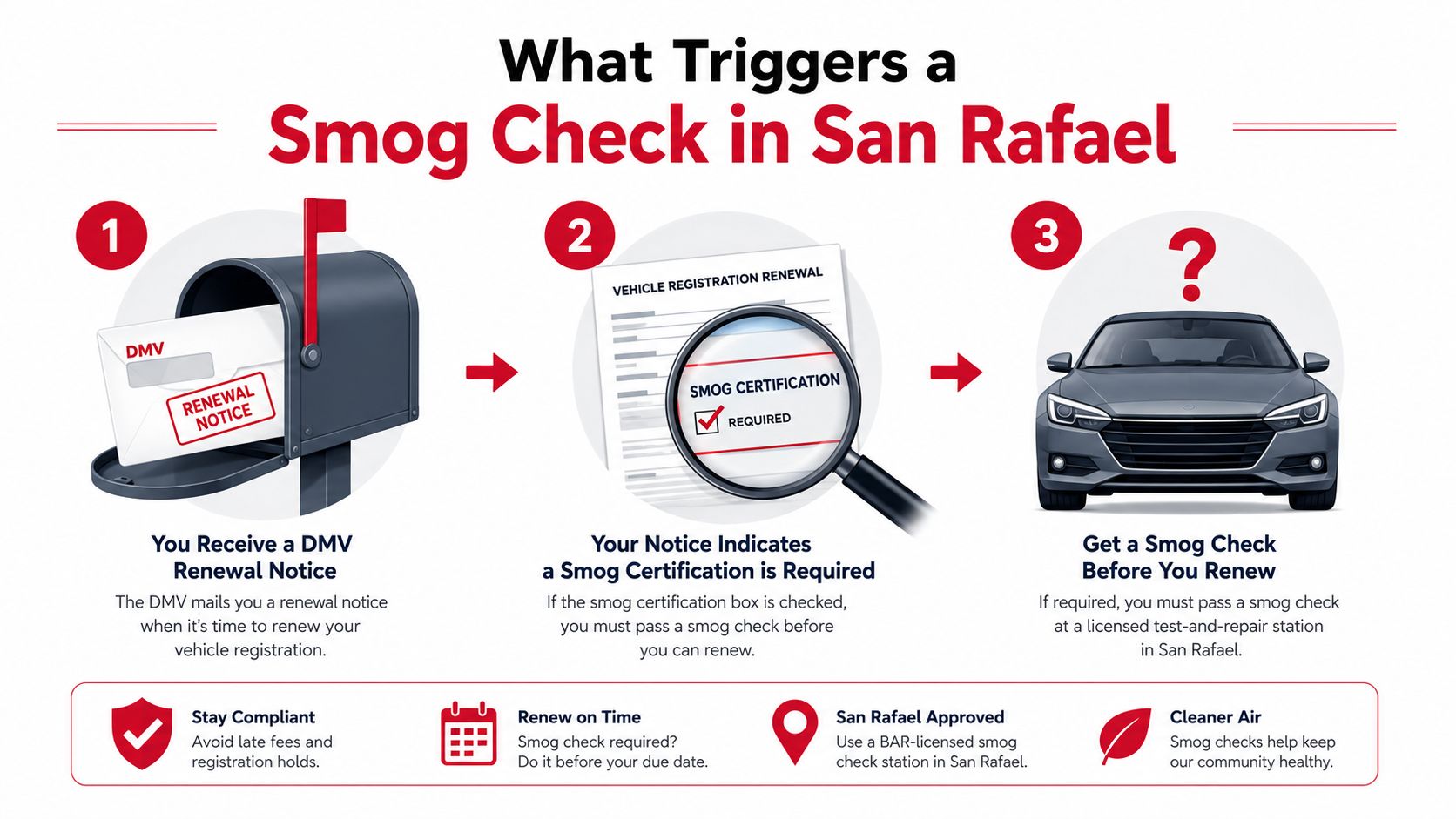
A San Rafael driver usually finds out through the DMV renewal notice. The envelope arrives, the form has a smog certification box, and the next question is whether the vehicle needs testing, whether it needs a specific station type, or whether it qualifies for an exemption. California's Smog Check framework requires inspection for registration renewal in participating counties, and the DMV also marks when a STAR station is required for that vehicle. For Marin County drivers, the notice matters because it is tied to where the vehicle is registered, not just how often it is driven around town. See the DMV's explanation of the statewide framework in the DMV smog inspection rules affecting San Rafael registration renewals.
Read the renewal notice like a checklist
The smog certification box is the first thing to check. If it is marked, the DMV expects a certificate before renewal can move ahead. The vehicle description is the next piece, because model year and fuel type tell you whether an exemption may apply. The STAR direction line is the part that causes the most confusion, because a vehicle sent to a STAR station has to be certified at the right kind of station, not just any shop that performs smog inspections.
Practical rule: If the DMV notice says a STAR station is required, treat that as the station assignment for the vehicle.
A useful way to read the notice is to separate the question of need from the question of location. If the notice asks for smog, you are already past the first question and into the second one, where station type matters. That is where drivers lose time, because a vehicle can be eligible for a certificate and still be turned away if it is tested at the wrong station type.
For a San Rafael driver holding a renewal notice at the kitchen table, the job is simple: match the notice to the vehicle. If the notice calls for a certificate, check whether the vehicle sits inside an exemption window, then look for the station type named on the form. If there is already a failure slip in hand, the path changes again, and the next step depends on whether the car needs a test-and-repair station, a test-only station, or a BAR referee review.
Who Is Exempt and Who Must Test
A lot of San Rafael drivers get stuck here because the exemption rules are not based on age in a loose, everyday sense. California DMV uses model year and fuel type to decide who is exempt, and that can feel backwards if you are only looking at the car's actual age. Gasoline-powered vehicles 1975 or older do not need a smog inspection, and diesel-powered vehicles 1997 or older do not need one either. The DMV also lists exemptions for diesel vehicles over 14,000 pounds gross vehicle weight, electric vehicles, and natural-gas-powered vehicles over 14,000 pounds.
The model-year rule is where people usually misread the notice
For gasoline vehicles, the DMV says gasoline-powered vehicles less than eight model-years old do not need a smog inspection. That is a moving window, so the cutoff changes as the model year changes. A driver who counts from the calendar can get the answer wrong, while a driver who counts backward from the current model year gets the right result.
There is also a separate rule that started January 1, 2019, where vehicles under 4 model years old may pay a smog abatement fee instead of undergoing inspections for the first 8 years of registration. That is one reason newer cars do not always follow the same testing pattern as older ones, even when the renewal notice still looks like a smog-related renewal.
A simple way to sort your vehicle
- Gasoline, 1975 or older: no smog inspection required.
- Diesel, 1997 or older: no smog inspection required.
- Diesel over 14,000 pounds GVWR: no smog inspection required.
- Electric: no smog inspection required.
- Natural gas over 14,000 pounds: no smog inspection required.
- Gasoline under eight model years old: generally exempt from testing.
If you want the state's exemption categories in one place, the smog inspection exemption rules page lays them out in DMV language.
A renewal notice that already asks for smog certification means the vehicle has been matched against the exemption rules for that cycle. If the DMV wants a certificate, the car is being treated as a vehicle that must test now, not later. That is the point where the notice matters more than a guess at whether the car feels old enough or new enough.
Test-Only, Test-and-Repair, and STAR Stations Explained
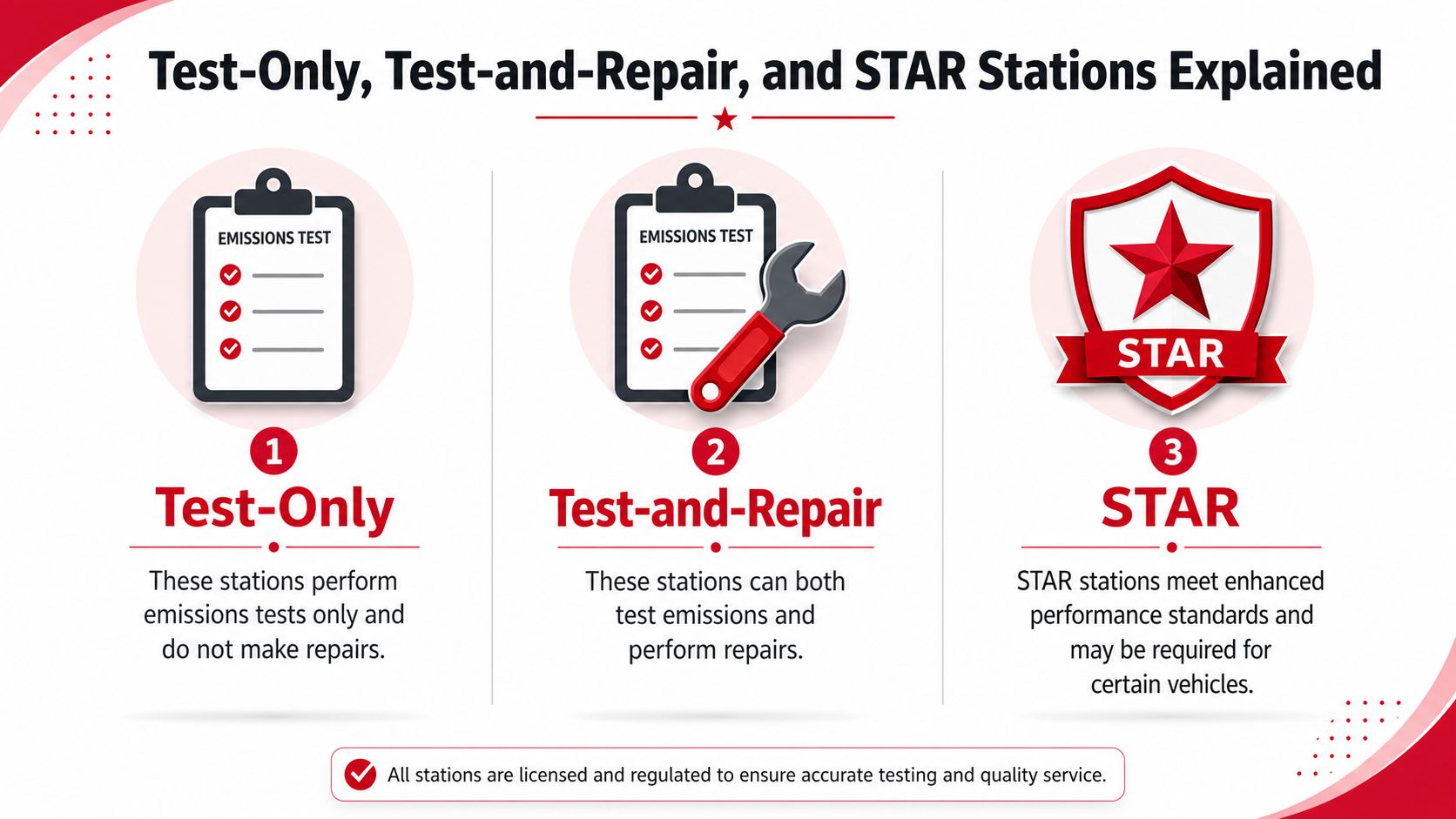
The labels on smog stations sound close, but they serve different purposes. A test-only station handles the inspection and does not sell repairs, so the test result stays separate from the repair estimate. A test-and-repair station can inspect the vehicle and fix emissions-related problems at the same shop. A STAR station meets higher Bureau of Automotive Repair performance standards and can certify some vehicles that other stations are not authorized to certify, including high-polluting vehicles and vehicles the DMV notice sends to STAR. If you want the state's definition of STAR stations and certificate fees, see the California BAR smog check overview.
A failed smog check can make the station choice feel more complicated than it first looks. The car may need repair, but the next station still has to be allowed to certify the result. That is why the station type matters before you pull in, not after the test is already done.
Why station type matters before you arrive
If your renewal notice directs you to a STAR station, a non-STAR station cannot complete that certification for you, even if the car passes the inspection. Drivers often miss that part because they focus on the pass or fail line and overlook whether the shop was allowed to sign off on the result. The DMV renewal notice controls the lane you need to use.
A test-only station works well when you want the inspection handled without a repair pitch attached to it. A test-and-repair station makes more sense when you expect the car may fail and you want one place to diagnose and fix the issue. STAR stations matter when the vehicle is directed there, or when the emissions history puts it into a stricter category. For a plain-language explanation of that category, what STAR-certified smog means helps show why one shop can certify a vehicle while another cannot.
Picking the right lane the first time
- Need a first-pass inspection: a test-only station is usually the simplest fit if the notice does not require STAR.
- Need diagnosis and repair in one place: a test-and-repair station is the practical choice.
- Directed by DMV notice or dealing with a high-emitting vehicle: a STAR station may be required.
- Unclear after a failure: read the renewal notice before choosing the next stop.
If you are comparing station types around San Rafael, the main question is not just whether the car can pass. It is whether the station is allowed to handle the next step in the process. That keeps you from paying for the wrong visit, then having to start over somewhere else.
How to Prepare Your Car Before the Test
A clean test result often starts before you reach the station. The most useful prep is simple and mechanical, not dramatic. Drive the car long enough to get it fully warm, make sure the check-engine light isn't on, confirm the gas cap is sealed, and don't show up right after a battery change if the vehicle needs time to reset its monitors. Some stations also use testing methods that depend on the vehicle type, so a little setup helps avoid a return trip.
A five-step routine that keeps people from getting burned
- Take a warm drive first. A drive of at least 10 to 15 minutes helps bring the vehicle up to operating temperature.
- Look at the dashboard. If the check-engine light is illuminated at the time of test, the vehicle fails regardless of how it feels on the road.
- Inspect the gas cap. A loose or badly sealed cap can create trouble that feels small but still matters in inspection.
- Think about battery history. A recently replaced or dead battery can reset readiness monitors, which can delay a clean result.
- Check fuel and tire condition. Some station procedures may depend on vehicle setup, so don't arrive with obvious maintenance issues hanging over the test.
A vehicle that's “driving fine” can still fail if the onboard systems aren't ready or the warning light is on.
That's the part drivers usually underestimate. Smog testing isn't a general roadworthiness check, and it isn't a judgment about how the car feels on the commute up to San Rafael. It's a test of whether the vehicle's emissions-related systems are ready and whether they're operating within the allowed limits.
If you're trying to avoid a second visit, the morning-of checklist matters more than a last-minute top-off of the tank or a wash. Get the dashboard clear, let the engine warm up, and don't treat a warning light as something you can explain away at the counter.
Smog Check Costs and Wait Times in San Rafael
A smog check bill usually has two parts, and separating them keeps the numbers from looking mysterious. The station charges for the inspection itself, and the state certificate fee is added on top of that. California's Bureau of Automotive Repair sets the Smog Check certificate fee at $8.25, while the station sets its own labor price. That is why one San Rafael listing can show $41.75 plus the $8.25 certificate fee, which lands at about $50 on coupon pricing, while another shop may quote something different for the same basic service.
The practical lesson is simple. A lower advertised price may reflect a narrower appointment window, while a higher price may buy you longer hours, weekend availability, or faster service. San Rafael drivers often end up paying for convenience because it is easier to fit the test into a workday or a weekend errand than to wait around for a slow counter.
Wait time is a separate question from price. A quick pass-only visit can move along without much delay, while a busy hour or a vehicle that needs more involved testing can add time to the visit. If you are trying to get registration renewed before the deadline, budget for both the fee and the wait, not just the sticker price.
| Cost Component | Typical Range | Who Sets It |
|---|---|---|
| Smog Check certificate | $8.25 | California Bureau of Automotive Repair |
| Station labor charge | Varies by station | The individual station |
| Advertised local coupon pricing | About $41.75 plus the certificate fee | The station |
| Out-the-door total on a coupon listing | About $50 | Combination of station charge and certificate fee |
Before you hand over the keys, ask about the retest policy. Some stations will retest under certain terms at no extra charge, and that can keep a failed visit from turning into a second full bill at the same shop. If you are comparing places, the retest rule matters just as much as the first price quote.
For drivers who want to understand why a car fails in the first place, this smog check fail reasons guide can help make the common causes easier to sort through.
What Happens After a Failed Smog Check
A failed smog check can feel like a dead end, but the next step depends on the kind of failure and on what the DMV notice says. For a San Rafael driver, the first question is not "Who can fix it?" It is "Who can certify it after the repair?" California BAR explains that if a vehicle fails and is not a gross polluter, it can be repaired and certified at any test-and-repair station. If the vehicle was directed to a STAR station on the DMV notice, or if it exceeded gross polluter thresholds, the repaired vehicle has to be certified by a STAR-certified station or a BAR referee. The BAR's decision rules are laid out in the Smog Check manual.
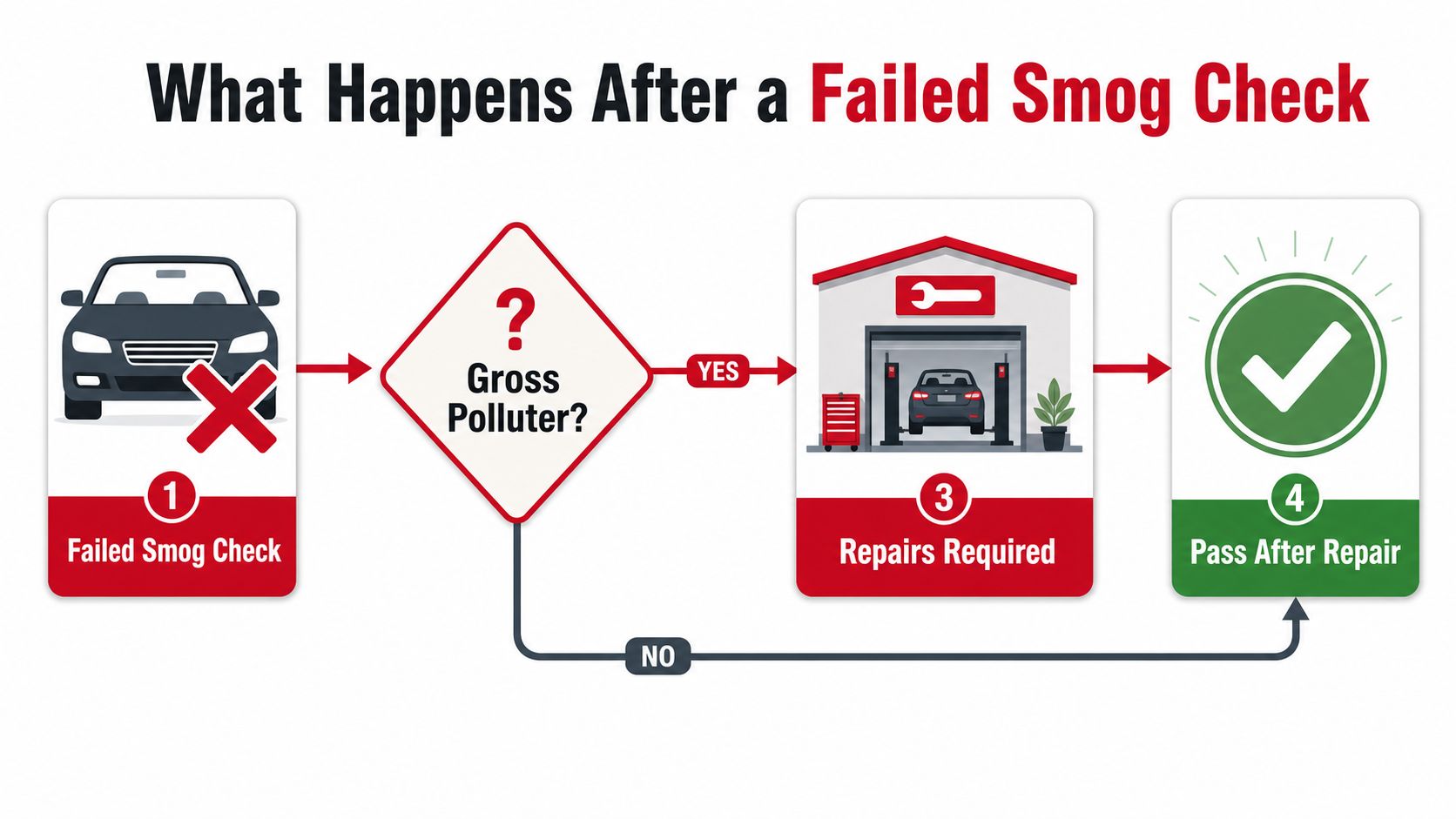
The simplest way to read the failure path is to treat it like a traffic sign. Some cars can make a normal left turn at a test-and-repair station, while others are directed into a narrower lane that only STAR or a referee can use.
The repair path depends on the failure type
If the problem can be corrected by a regular repair shop and the vehicle is not in a restricted category, a test-and-repair station is usually the easiest place to start. The station can both repair the car and complete the follow-up certification, which avoids sending you somewhere else after the fix. If the DMV notice directed the vehicle to STAR, that direction still controls the final certification even after the repair is done.
A BAR referee is a state-employed inspector who performs certification-only tests at fixed locations. Drivers usually end up there when the result is disputed, when the vehicle does not fit the normal station path, or when the repair and test paperwork need a closer review. The referee route is not the default choice, but it is the correct one when the ordinary shop flow does not match the rules.
For drivers trying to make sense of why a car failed before choosing the next shop, the smog check fail reasons guide is a useful starting point. It helps separate routine repair issues from the cases that point toward STAR or a referee.
A practical decision tree
- Failed, not a gross polluter: repair at a test-and-repair station.
- Directed to STAR on the renewal notice: repair and certify through STAR or a referee.
- Gross polluter situation: certification has to follow the stricter STAR or referee route.
- Dispute over the result: the referee path may be the cleaner option.
The key is to read the failure slip and the DMV notice together. Either one can change the next stop, and that is where a lot of San Rafael drivers get tripped up. A car that needs a repair is one path. A car that also carries a STAR direction or a gross polluter designation is a different one.
Linking the Smog Certificate to Your DMV Renewal
A passing smog test only solves part of the renewal. The station sends the result to the DMV electronically, usually within minutes, and then the registration can be finished online, by mail, or at a DMV field office. Some stations also offer DMV renewal services through a licensed business partner, so a driver can handle testing and tag printing in one visit during posted hours. The renewal steps are laid out in the California DMV registration renewal guide.
A San Rafael driver usually runs into trouble at the handoff between the certificate and the renewal notice. A smog pass tells the DMV the car cleared testing, but it does not always mean the renewal is done. If the station only performs testing, the driver still needs to complete the registration somewhere else. If the station also handles DMV renewal services, the paperwork may be finished in the same stop, as long as the vehicle and notice qualify.
The certificate type still matters. A regular pass cannot satisfy a directed renewal if the notice calls for STAR certification, just as a correct test cannot fix the wrong paperwork. The DMV checks the kind of certificate on file, not only whether a certificate exists. That is the part many drivers miss after a failure or a renewal notice arrives with special instructions.
What to have ready at the counter
- Renewal notice: shows whether smog is required and whether STAR is directed.
- Failure slip, if applicable: shows the last test result and helps the station match the next step to the paperwork.
- Current registration: helps the DMV side move faster.
- Proof of repair, if you're returning after a failure: helps connect the repair work to the failed test.
For drivers who want testing and DMV paperwork in one place, Fire House Smog is one example of a station that also provides DMV registration services alongside smog testing. For everyone else, the rule is simple. The smog certificate supports the renewal, but it does not replace the renewal itself.
Common Questions San Rafael Drivers Ask at the Counter
The same questions come up again and again, usually right after the paperwork gets confusing. People want to know whether an out-of-state vehicle can be transferred without a smog check, whether an RV can be tested, whether a directed renewal can be handled anywhere, and how a free retest works. The answers are short once you know the rules.
Quick answers drivers usually need
- Out-of-state transfer: Yes, transferred vehicles generally need a smog check, along with the other paperwork required for the transfer process. VIN verification is part of that process for many transfers, so don't assume the smog visit is the only step.
- RVs and motorhomes: It depends on length and equipment, so call ahead before driving over.
- STAR-directed renewal notice: Only a STAR station or referee can certify it, not a regular non-STAR station.
- Free retest coupons: They're usually tied to the issuing station's terms, and you should bring the original receipt and failure slip.
The best counter question is often, “Does my notice require STAR, or not?” That one detail changes the whole route.
San Rafael drivers get stuck when they treat every failure or renewal the same. They're not the same. A normal pass, a directed renewal, and a post-failure certification each follow a different path, and the station you choose has to match the paperwork you already have.
If you're standing in front of a renewal notice right now, start with the vehicle's model year, fuel type, and STAR direction line. That's the fastest way to tell whether you're booking a routine test, a repair-and-certify visit, or a referee step.
If you want a station that handles both smog testing and DMV registration services, contact Fire House Smog and ask how they handle STAR-directed notices, retests, and renewal paperwork before you head over.