You open your California DMV renewal notice expecting a routine fee reminder. Instead, one line says Smog Check Required, and another may direct you to a STAR-certified or test-only station. The wording can make a simple renewal feel like a trip through a maze of government terms.
The key is to separate two labels that people often treat as interchangeable. Test-only describes what a station is allowed to do. STAR describes a state certification tied to inspection performance and oversight. A station can be both, but the terms don't mean the same thing. Once that distinction is clear, choosing the right location, completing the inspection, and handling your registration become much easier.
Table of Contents
- Why Your Renewal Notice Says Smog Check
- What a Test Only Smog Station Is
- Test Only Versus Test and Repair Stations
- Why STAR Certification Changes the Equation
- What to Expect During Your Smog Visit
- Pairing Your Smog Check With DMV Services
- Can a Test Only Visit Help Your Car Pass
- Choosing the Right Station for Your Situation
Why Your Renewal Notice Says Smog Check
You open a California DMV renewal notice expecting a fee reminder. Instead, it says Smog Check Required, and your renewal cannot finish until the vehicle meets that requirement. For most gasoline vehicles older than eight model years and most diesel trucks, a passing emissions inspection is part of renewing registration. The notice functions as a registration gatekeeper, so treating it as optional can leave the renewal incomplete.
The wording may also point you toward a STAR-certified station, a test-only station, or another directed inspection type. These labels answer different questions. Test-only describes what the facility is licensed to do. STAR identifies a certification for eligible test-and-repair and test-only stations that meet higher inspection-based standards. One station can carry both labels, but neither term automatically replaces the other. The Bureau of Automotive Repair STAR FAQ explains the certification program.
Why some vehicles receive a direction
A station direction may be connected to the vehicle's inspection history, a directed recall, missing relevant smog history, or state monitoring of high-emitting vehicles. The reason can vary, but the practical step stays the same: read the notice before choosing a shop. A nearby facility may be licensed for smog inspections yet unable to perform the inspection your vehicle was assigned.
A general smog requirement usually leaves you with more choice among licensed stations. A notice naming STAR or test-only limits that choice. If DMV directs the vehicle to a STAR station, use a facility with that designation for the required inspection. The California Smog Check guidance from BAR describes how directed vehicles and test-only stations fit into the program.
Practical rule: Let the words on the renewal notice guide your selection. A business name can be misleading, so confirm that the station's BAR credentials match the stated requirement.
Before booking, identify the assignment first. Then check whether the station is authorized for that inspection and whether it may perform repairs. That distinction helps you choose the right visit instead of paying for an inspection the location cannot complete.
What a Test Only Smog Station Is
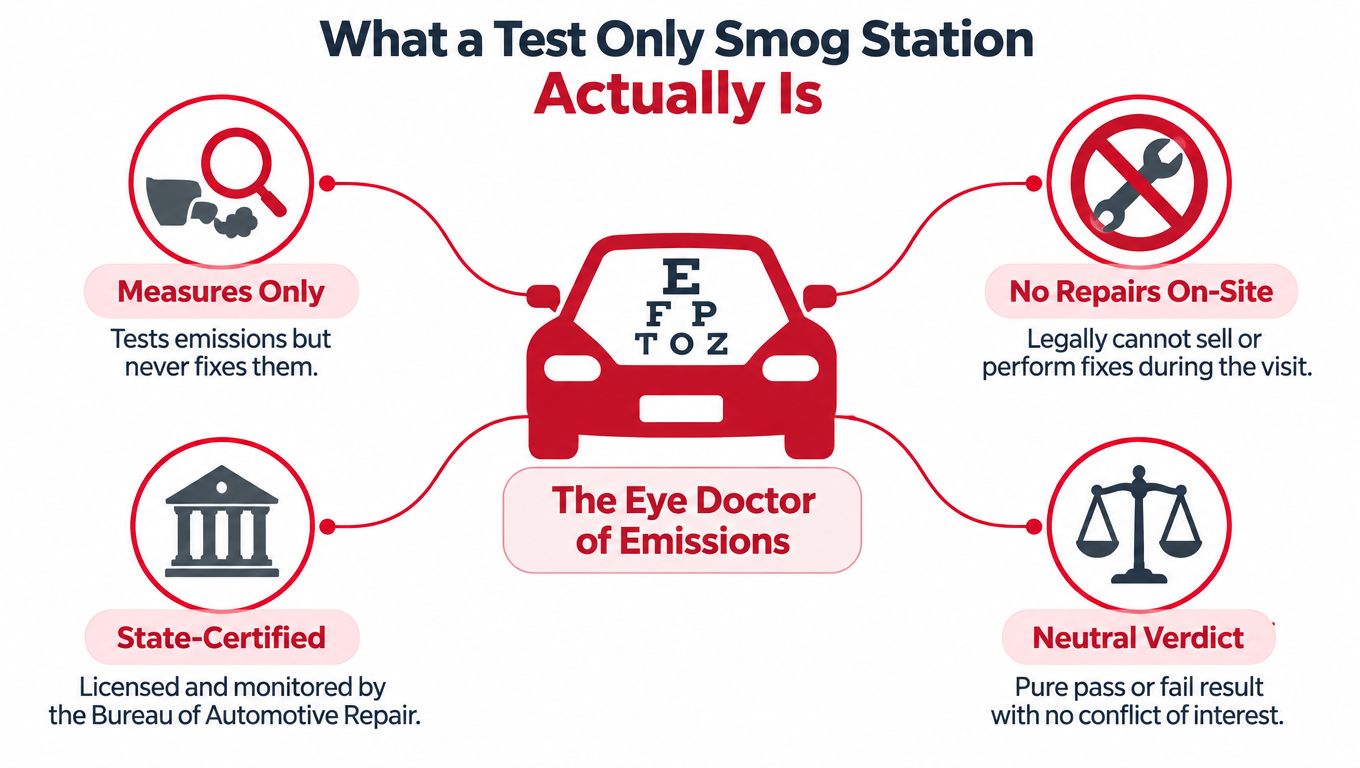
Your car can fail an emissions inspection without the inspection shop being the place that repairs it. A test-only smog station works like an eye doctor's examination room: it measures a condition, records the result, and gives you information for the next step. It does not diagnose or repair emissions problems during that visit.
The Bureau of Automotive Repair's smog check information describes a test-only station as a facility licensed to perform inspections only. Its authorization covers testing, not emissions diagnosis or repair. That distinction applies to the vehicle service the station is allowed to provide, not just the wording in its business name.
Why inspection and repair are separated
Consider a shop that decides whether your car fails and then sells the work needed to correct the failure. The arrangement can create a financial incentive to recommend repairs. California's test-only model separates those roles. The station's job is to perform the inspection and report its result.
That separation does not mean the technician ignores a problem. If your vehicle fails, you receive the failure information and can take the car to a qualified repair facility. The inspection and the repair decision occur in different places, like a medical test performed separately from treatment.
Where STAR fits
STAR certification is a separate layer. It is not another name for test-only. Qualifying test-only and test-and-repair stations can earn STAR certification by meeting the program's additional inspection standards.
A STAR test-only station has both designations:
- Test-only: It can inspect the vehicle but cannot diagnose or repair emissions problems.
- STAR-certified: It meets the program's additional standards and may serve vehicles directed to STAR facilities.
A STAR-directed vehicle needs the required inspection authorization, not necessarily a repair department. Test-only answers what the station can do. STAR answers which inspection tier it has earned.
Test Only Versus Test and Repair Stations
Your choice depends on what you need after the inspection. A test-only station suits a driver who wants the result first and plans to choose a repair shop separately. A test-and-repair station suits someone who prefers one business to inspect the vehicle and address an emissions problem if it fails.
Choose test-only when independence matters
Suppose your renewal notice allows a regular Smog Check, your car has no known emissions issue, and you already have a trusted repair shop. A test-only visit gives you the inspection result without tying that result to an in-house repair estimate. If the car passes, you can finish the transaction. If it fails, you can compare repair options before authorizing work.
A test-only technician can perform the required inspection and report the outcome. The station cannot diagnose or repair the emissions problem during that visit, clear a diagnostic fault, or adjust the vehicle for another test. The inspection works like a separate medical screening: it identifies the result, while treatment happens elsewhere.
Choose test-and-repair when one-stop service helps
A test-and-repair station can inspect the vehicle and, when appropriate, diagnose and perform qualifying emissions repairs. This may reduce scheduling when you already suspect a problem, such as a warning light or a previous failed inspection. The same business may also provide the follow-up test after repairs, subject to the applicable rules.
That convenience does not decide whether the station can inspect your vehicle. Your notice and vehicle status do. A station that offers repairs may still lack the authorization required for a directed inspection, so check the required designation before booking.
| Decision point | Test-only station | Test-and-repair station |
|---|---|---|
| Your priority | An inspection separate from repair sales | Inspection and possible repair coordination |
| After a failure | Take the result to a shop you select | Ask the same business about diagnosis and repairs |
| Repair service during the visit | Not available for emissions problems | May be available |
| If your notice names a station type | Use it only when the notice permits that option | Confirm it has the required authorization |
| STAR designation | May also be STAR-certified | May also be STAR-certified |
The words test-only describe the station's service limits. They do not describe the station's quality or predict whether your car will pass. Likewise, test-and-repair describes the services the business may provide, not a guaranteed result.
Before you arrive, read the renewal notice for any direction or credential requirement. If no special direction applies, choose between independent testing and repair convenience based on your vehicle's condition and the kind of follow-up support you want.
Why STAR Certification Changes the Equation
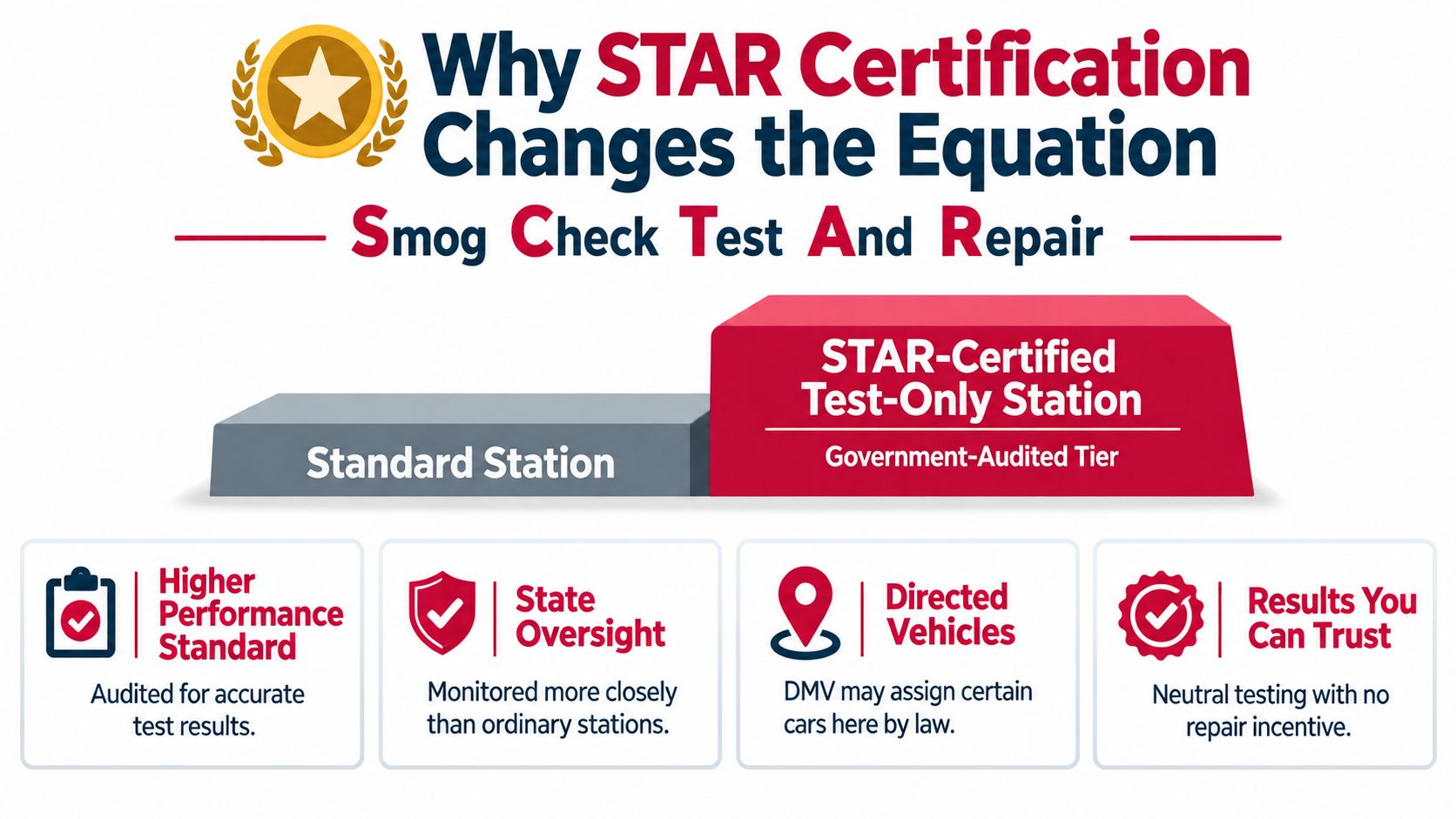
A driver can visit a test-only station and still need to ask a separate question: does that station have STAR certification? These labels describe different parts of the business. Test-only identifies what the station may sell. STAR identifies whether the station meets the state program's inspection and oversight requirements.
The official STAR program explanation from BAR describes STAR certification as available to qualifying test-and-repair and test-only stations. Certification is intended to support consistent inspection quality and emissions-reduction requirements. It does not change the condition of your vehicle or promise a passing result.
STAR and test-only answer different questions
Use two checks before booking:
- Can the station repair the vehicle? If it cannot, the business is test-only. If it can, it is test-and-repair.
- Does the station hold STAR certification? If it does, the station participates in STAR, regardless of whether it is test-only or test-and-repair.
California's published Smog Check information reports that, in calendar year 2025, 49% of licensed stations were STAR-certified, while STAR-certified stations performed 83% of all Smog Check tests. STAR stations therefore handle much of the testing, but STAR does not mean test-only. The California Smog Check information published by BAR supports those figures.
What STAR means for a directed vehicle
If DMV directs your vehicle to a STAR station, a non-STAR location cannot replace that requirement. Check the designation on your notice before choosing a business. A STAR-certified test-only station may fit well when you need the required credential and want the inspection kept separate from repair sales.
For a practical explanation of how these labels fit together, review this guide to a STAR-certified smog station. The useful rule is simple: verify both labels. “STAR” alone does not tell you whether the station repairs cars.
What to Expect During Your Smog Visit
An official test-only visit usually follows a straightforward sequence. Since the station can't sell emissions repairs during the inspection, the appointment stays focused on verifying the vehicle and transmitting the result.
Bring the DMV renewal notice or Smog Check Required letter, your current registration, and a payment method. The station needs accurate vehicle information, including the VIN, to connect the inspection result with the correct DMV record.
The inspection sequence
- Check in. The technician confirms the vehicle, the requested service, and any direction shown on your DMV paperwork.
- Verify the record. Vehicle details and VIN information are checked before testing begins.
- Connect the equipment. The technician accesses the vehicle's On-Board Diagnostics system and reads relevant information.
- Inspect emissions equipment. The process can include a visual review of items such as the catalytic converter, gas cap, and check engine light status.
- Measure emissions. Depending on the vehicle and applicable test requirements, the technician may use an emissions probe, dynamometer, or idle test.
- Transmit the result. A passing result is sent electronically to DMV, allowing the registration process to continue.
A 2000 and newer gasoline vehicle that passes usually takes about 20 to 30 minutes, according to the provided California smog service guidance. Because the result is transmitted electronically, you generally won't wait for a paper certificate to arrive by mail.
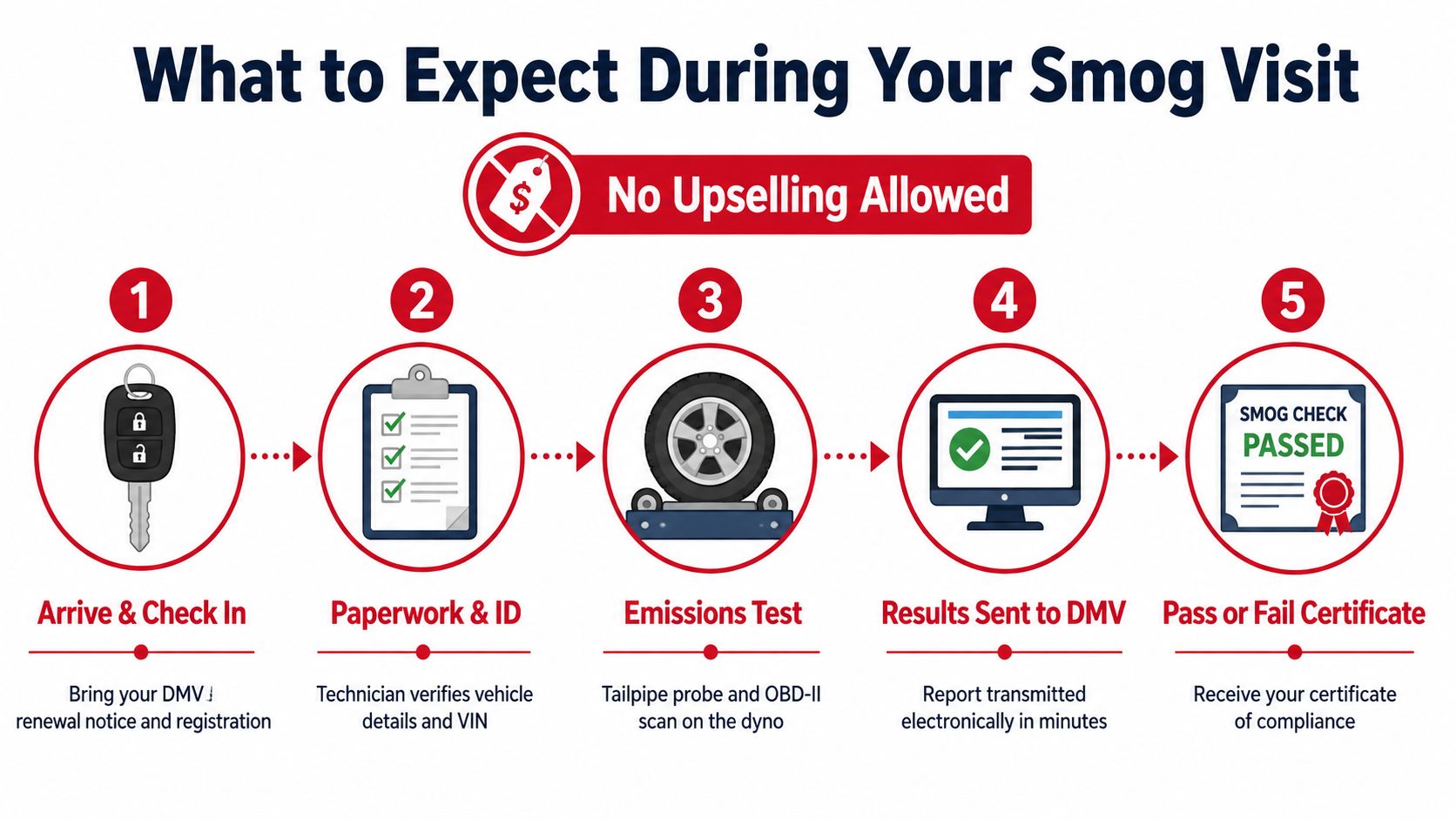
The technician isn't tuning the engine or preparing the car to pass. The station is documenting the vehicle's condition under the applicable inspection procedure. If the result is a failure, ask for the printed information and take it to a repair professional for diagnosis.
The process is also shown in this California smog inspection video, which can help first-time customers understand the basic flow before arriving.
Pairing Your Smog Check With DMV Services
A smog inspection and a registration renewal are separate actions, but they often belong in the same errand. Some STAR-certified test-only stations also operate as licensed DMV business partners. The California DMV business-partner program explains that participating partners can handle certain registration tasks and may offer shorter waits than a DMV field office.
The workflow is simple. First, the station completes the inspection. Once the passing result clears electronically, the DMV partner handles the eligible registration transaction at the same location. Depending on the record, that may include collecting renewal fees, issuing a sticker, or printing updated registration paperwork.
| Task | DMV Field Office | Smog Station With DMV Partner |
|---|---|---|
| Smog inspection | Usually completed elsewhere | Completed at the same location |
| Registration renewal | Available when the record qualifies | Available for eligible transactions |
| Sticker issuance | Handled at the office | May be handled on site |
| Ownership transfer | Available with required documents | May be available for eligible transfers |
| Number of stops | Often requires a separate smog visit | Can combine the inspection and DMV task |
| Wait experience | Field-office queue or appointment | Business-partner queue, often more focused |
When the combined visit helps most
This option is especially useful when your record needs an immediate transaction rather than a simple online renewal. A business partner may be able to help with a sticker, transfer paperwork, or a registration issue that an online form can't resolve.
California DMV also offers online and phone renewal channels, so an in-person partner visit isn't always necessary. Compare the transaction you need with the channel available to you. If you already need a smog inspection and your vehicle is directed to an eligible station, combining both services can remove an extra trip.
Learn more about the California smog check registration service before you leave home, and confirm which documents the location requires for your specific transaction.
Can a Test Only Visit Help Your Car Pass
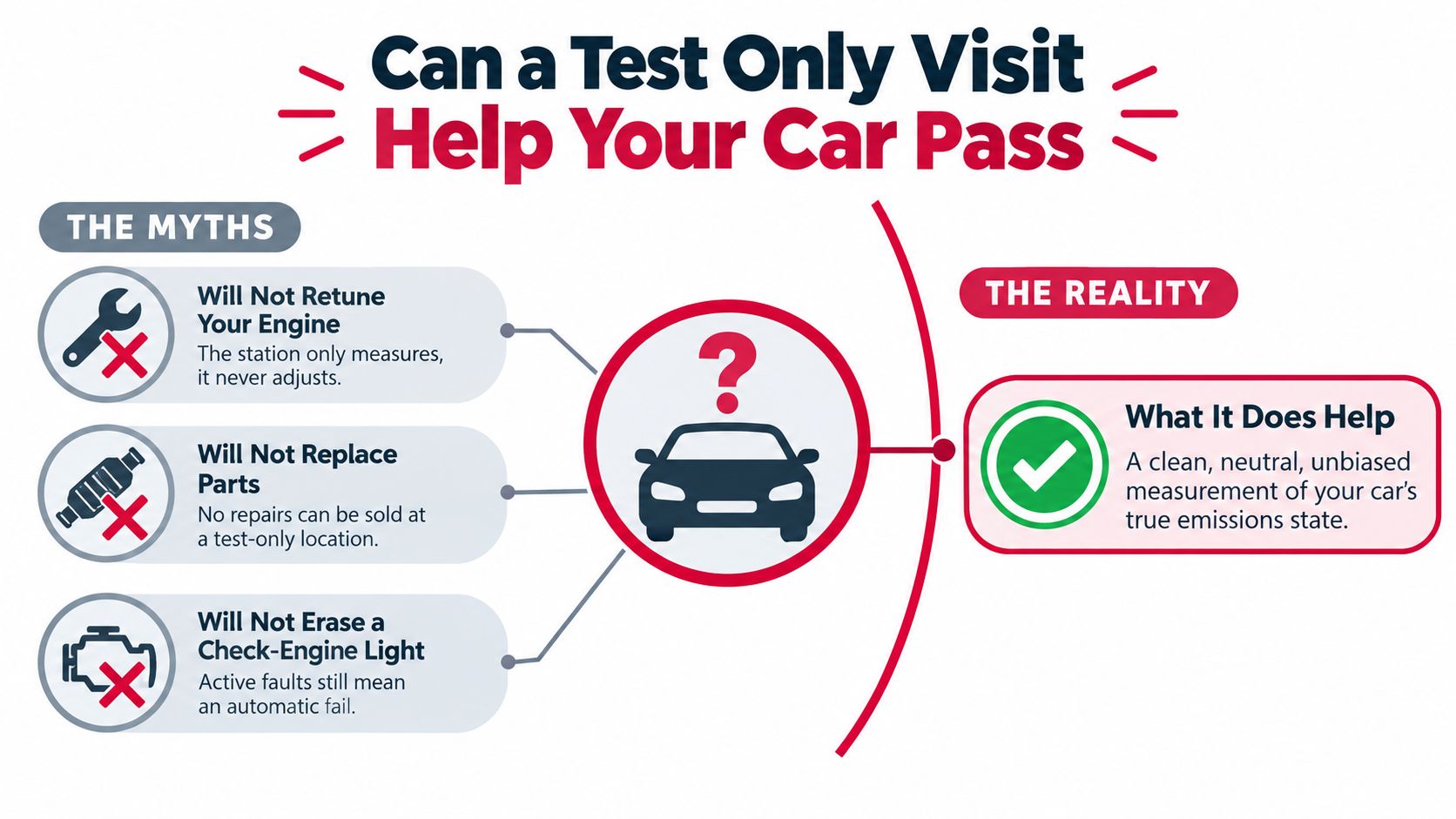
A 2004 Toyota Camry arrives for its smog test with an intermittent check-engine light. It may pass on one visit and fail on another because the vehicle's computer can show different readiness information depending on recent driving, repairs, or when the warning light becomes active. A test-only station cannot change that result. It records what the vehicle shows during the inspection.
A test-only visit can still improve the quality of your decision. The station provides an independent measurement and documents the result without also selling repairs. If the facility is STAR-certified, it follows the program's inspection requirements, but STAR certification does not guarantee a passing result.
What a failed test can reveal
Common failure causes include an active check-engine light, incomplete readiness monitors, emissions readings above the limit, a damaged catalytic converter, or visible emissions equipment problems. A recent battery replacement can also erase stored information and leave monitors incomplete, even if the car feels normal while driving.
For example, a Camry with a loose oxygen-sensor connection may run smoothly but fail its emissions reading. Another vehicle may have no warning light yet still fail because its catalytic converter is no longer reducing pollutants effectively. The test result points to the issue, while a qualified repair provider determines the fix.
Myth vs. reality
Myth: A test-only station can make a borderline car pass.
Reality: It measures the vehicle as presented and cannot tune, repair, or adjust it.
Myth: A failed test means the inspection was unfair.
Reality: The result identifies a compliance problem that needs attention before registration can be completed.
Myth: Trying another station is the repair.
Reality: Reviewing the common smog check failure reasons and obtaining a proper diagnosis is the productive next step.
Choosing the Right Station for Your Situation
Start with the renewal notice. It tells you more than a search result or a sign outside a shop.
| Notice Type | Station Required | Best For |
|---|---|---|
| Smog check required | A licensed station authorized for the vehicle | Drivers with a standard inspection requirement |
| Test-only stated | A test-only station | Vehicles directed away from repair facilities |
| STAR stated | A STAR-certified station | Vehicles requiring the program's inspection tier |
| STAR and test-only stated | A STAR-certified test-only station | Drivers who need both credentials |
Match the station to the transaction
If the notice only calls for a smog check, decide whether you prefer an inspection-only visit or the possibility of repair coordination. If it says test-only, don't book a standard repair shop merely because it has an available appointment. If it says STAR, confirm the location's certification before you arrive.
Then look at the practical details:
- Credential: Verify that the station matches the notice.
- Services: Check whether it performs only inspections or also handles repairs.
- DMV support: Ask whether it can process your renewal or other eligible registration task.
- Documents: Bring the notice, registration, and paperwork for any ownership transaction.
- Schedule: Confirm testing hours separately from DMV partner hours.
- Vehicle fit: Ask ahead about unusual vehicle sizes, recreational vehicles, or other equipment limits.
- Result handling: Confirm that the station transmits the result electronically and explain what happens if the vehicle fails.
A combined visit can be the fastest path when you need both a passing inspection and an eligible DMV transaction. It won't eliminate every requirement, and online renewal may be simpler for a straightforward record, but the right partner location can spare you a separate field-office stop.
Fire House Smog in Antioch offers STAR-certified test-only smog inspections and eligible DMV registration services, including renewal and ownership-transfer assistance. If your notice requires a matching station and you want to handle both tasks in one visit, visit Fire House Smog to review the available services and confirm the current hours before driving over.
You're at a two-bay test-only station on a Wednesday afternoon. One vehicle is already on the dynamometer, another is idling outside with its check-engine light glowing, and a third driver is staring at a phone, deciding whether to wait or leave. Everyone has the same question: will this quick STAR smog visit take about twenty minutes, or will it consume the afternoon?
The test itself can be short. The line isn't always short. Vehicle condition, readiness monitors, paperwork, bay availability, staffing, and the cars ahead of you determine how quickly you leave. California's Smog Check program is large and active, with 11,275,981 initial tests and 12,200,718 total tests recorded in 2025, while the initial failure rate was 8.51% and the overall failure rate was 9.04% according to the California Smog Check executive summary.
A quick visit is therefore a workflow outcome, not a promise printed on a sign. The practical questions are simple: does the station have a process that keeps bays moving, and have you brought in a vehicle that can complete the inspection?
Table of Contents
- The 20-Minute Question Every Driver Asks
- What STAR Certification and Test-Only Really Mean
- How a Test-Only Station Moves Cars Through Fast
- Documents, Prep, and the Actual Test Sequence
- Realistic Turnaround Times by Scenario
- Hours, Fees, Coupons, and the Free Retest Rule
- Practical Tips to Cut Your Wait
- Deciding Whether a Quick STAR Visit Is Right for You
The 20-Minute Question Every Driver Asks
At 2:15 on a normal weekday, a two-bay station can look busy without being backed up. One technician may be finishing a dynamometer test while another checks paperwork and connects an OBD scanner. A car outside with a warning light can change the rhythm immediately, because the technician may need to stop the normal sequence and explain that the vehicle isn't ready to pass.
That's why drivers confuse test time with wait time. A clean, prepared vehicle can move through the inspection promptly, but your total visit depends on what arrived before you. One bay may be occupied by a vehicle that needs a tailpipe procedure, while the other is handling a visual inspection, payment, and certificate paperwork. If the station has fewer technicians than open bays, the extra space won't help much.
Practical rule: Ask, “How many cars are ahead of me, and are both bays running?” That answer is more useful than a generic promise that the test is fast.
The best stations engineer speed around repeatable handoffs. They review the customer's paperwork before pulling the vehicle in, screen for warning lights and readiness problems, and keep repair discussions out of the testing lane. You control some of that outcome by arriving prepared. The station controls the rest through its certification standards, bay layout, staffing, equipment, and retest policy.
The central point is straightforward. Quick STAR smog service means fewer avoidable interruptions, not a relaxed inspection. California's STAR framework measures station performance, and the Bureau of Automotive Repair's STAR FAQ explains that short-term measures are updated monthly, pass/fail decisions are made quarterly, and the Follow-up Pass Rate is updated twice a year, in January and July.
What STAR Certification and Test-Only Really Mean
STAR certification is a performance designation from California's Bureau of Automotive Repair. It applies to stations that meet controlled performance standards, including similar-vehicle failure rates, gear-shift incidents, and excessive test deviations. The BAR STAR program requirements specify a Similar Vehicle Failure Rate of at least half the industry-wide failure rate for similar vehicles, a Gear Shift Incident rate no higher than 2%, and an Excessive Test Deviation Rate of no more than 1.
Those standards explain why a DMV notice may direct you to a STAR station. In 2025, STAR-certified stations represented 49% of licensed stations but performed 83% of all Smog Check tests, according to the 2026 Smog Check Performance Report information published by BAR. That concentration makes STAR a defined quality-control program, not a casual label for any shop that offers emissions testing.
Use a test-only station when repairs should stay out of the inspection
A STAR station can be test-only or test-and-repair. Test-only means the business performs the inspection but does not sell or perform the emissions repairs identified during it. That separation keeps the testing decision apart from the repair sale.
A test-only station may be appropriate or required for directed testing, including vehicles identified through DMV notices, certain gross-polluter procedures, and some ownership or registration situations. Check your renewal notice before booking. If it directs you to STAR, choose a STAR station rather than assuming any smog check will satisfy the requirement.
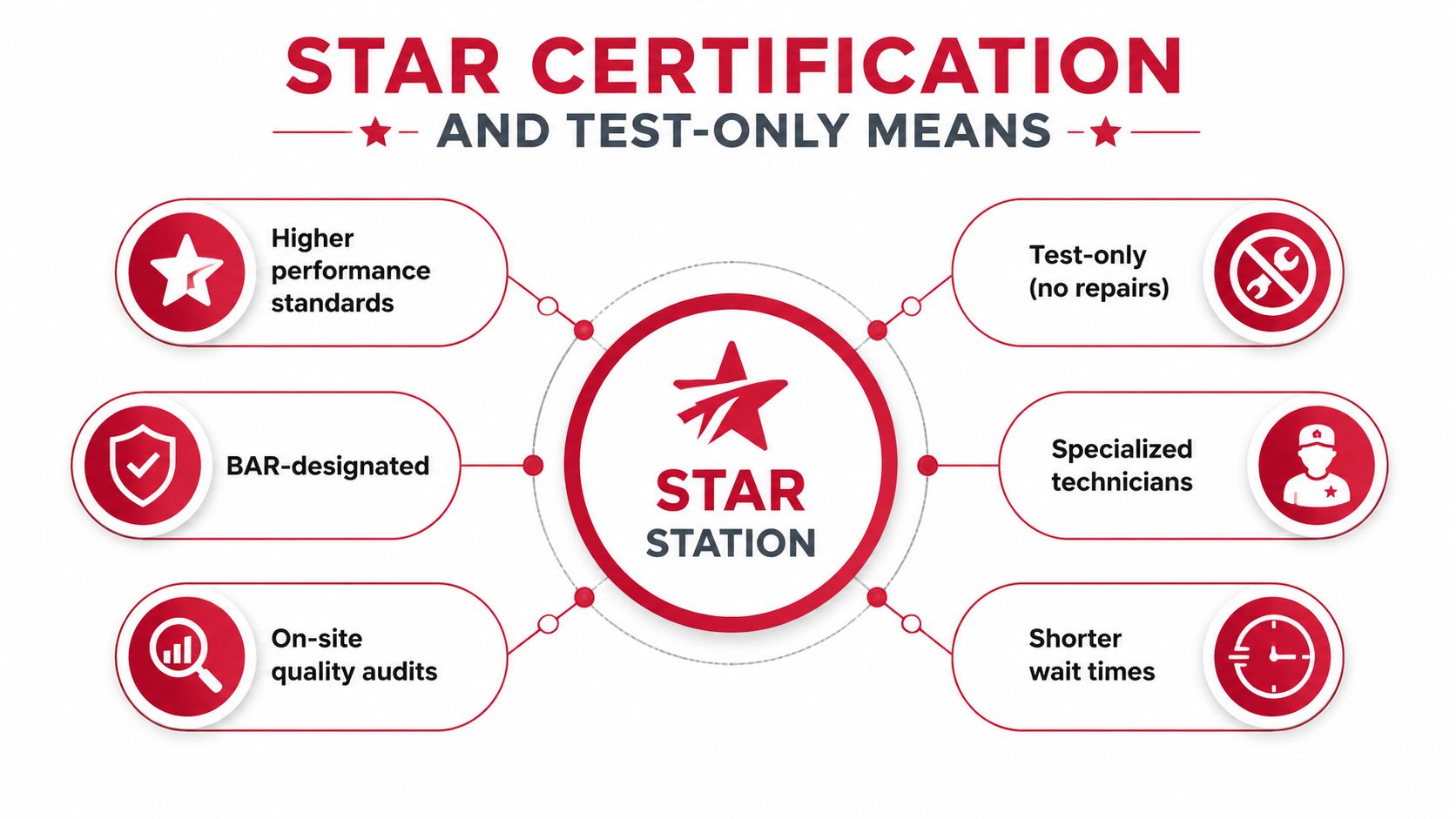
Test-only does not mean the inspection uses a tougher standard. The station follows California's approved procedure, including the applicable visual, OBD, dynamometer, or tailpipe elements. It also cannot issue a repair waiver or sell the repair needed after a failure.
For a plain-language explanation, read this guide to what STAR-certified smog means. The practical takeaway is simple: confirm the notice requirement, select the correct station type, and bring the vehicle in ready for the approved test.
How a Test-Only Station Moves Cars Through Fast
A fast station treats each vehicle as a sequence of handoffs. It doesn't let every appointment turn into an open-ended diagnosis. The technician confirms eligibility, checks the vehicle for obvious test blockers, connects the equipment, completes the required inspection, and prints the result.
At a two-bay station, the layout matters. One bay may handle an OBD-focused inspection while the other handles a dynamometer procedure. When the staff is coordinated, one vehicle can be leaving as another enters. When only one technician is working, both bays may exist but only one can move.
The station controls the process
A station's operational levers include:
- Bay assignment: Staff can send each vehicle to the appropriate equipment instead of creating unnecessary shuffling.
- Pre-screening: A quick check for a warning light, readiness issue, leaking fluids, or obvious modifications prevents wasted bay time.
- Paperwork preparation: Pulling registration details together before the inspection keeps the certificate and payment steps from becoming a bottleneck.
- Standardized testing: A defined sequence prevents technicians from wandering into repair diagnostics that a test-only facility isn't there to perform.
You control the other half. Bring your renewal notice or registration, disclose recent battery work or cleared codes, and don't arrive with a dashboard warning light you hope the technician won't notice. The technician will inspect the vehicle as presented, not as you wish it were presented.
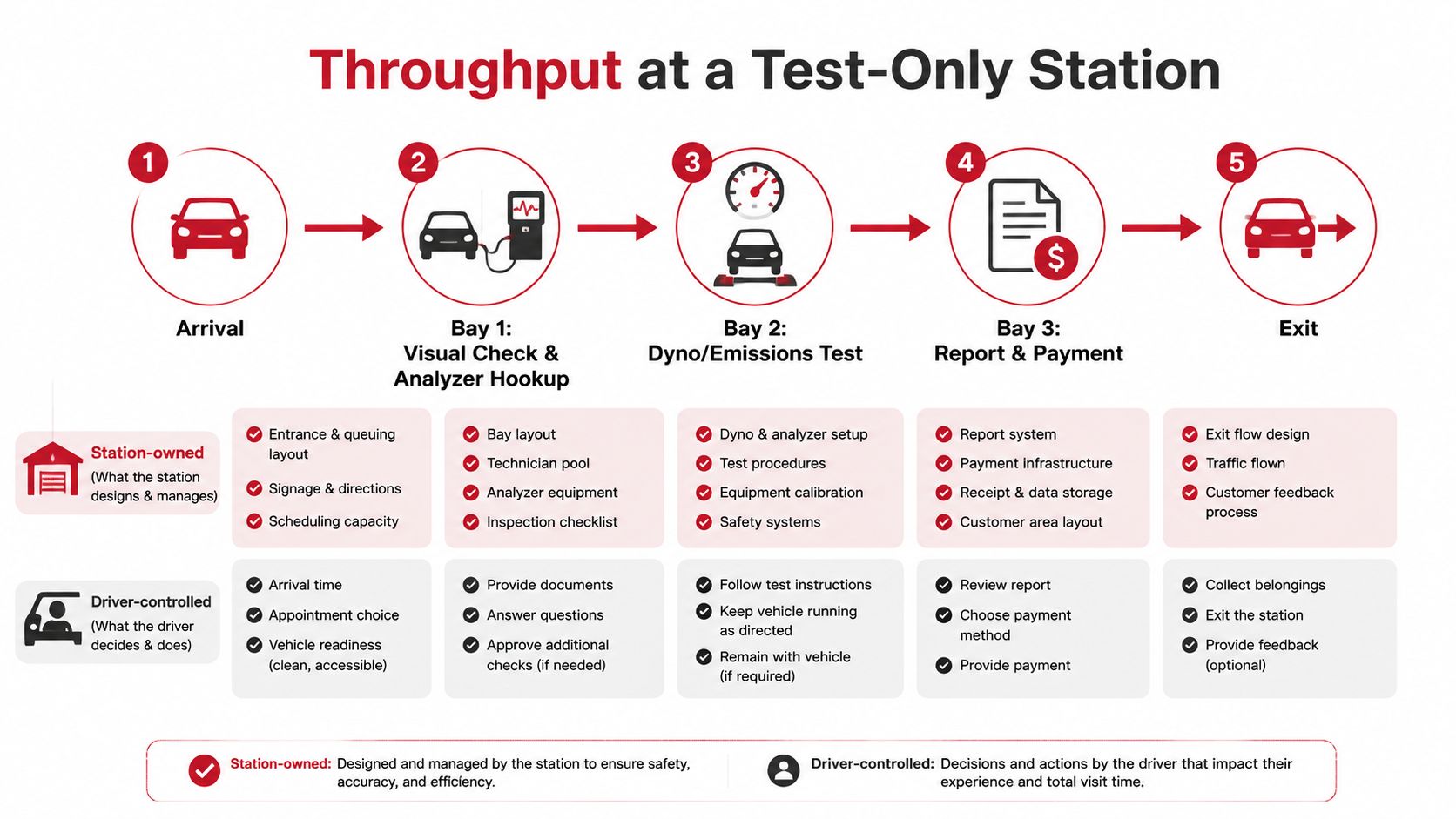
The biggest bottleneck is often readiness, not the analyzer. If a vehicle's monitors aren't complete, the inspection may stop before the emissions portion can produce a valid result. California's OBD readiness regulation update says that, effective October 1, 2025, all readiness monitors must be set to pass. A station can be efficient, but it can't manufacture a completed drive cycle in the bay.
Documents, Prep, and the Actual Test Sequence
Bring the documents that let the technician identify the vehicle and complete the transaction without interruption. Your preparation folder should contain:
- Renewal notice or registration: The notice tells the technician what DMV event you're handling and whether STAR certification is specified.
- Last smog certificate, if available: It can help clarify recent testing history, though the station can determine the current inspection requirements.
- Payment method: Ask about accepted payment types and the total before the vehicle enters the bay.
The technician's pre-screening conversation is short, but answer it accurately. Mention a recent battery disconnect, cleared diagnostic codes, a repair that involved the engine computer, or a vehicle that has been sitting for an extended period. Those details can point to incomplete monitors even when the malfunction indicator lamp, commonly called the check-engine light, is off.
Readiness is not the same as a warning light
The malfunction indicator light tells you that the vehicle's onboard diagnostic system has detected a qualifying fault. Readiness monitors tell the technician whether the vehicle has completed its required self-checks. A light can be off while the monitors remain incomplete, especially after the battery has been disconnected or codes have been cleared.
For 1996-and-newer spark-ignition passenger vehicles and trucks under 14,001 GVWR, California's OBD II inspection checks the malfunction indicator light, fault codes, and readiness monitors, as described by BAR's OBD inspection guidance. The technician may reject or pause the test before emissions measurement if the vehicle shows a warning light, has incomplete required monitors, presents an inaccessible diagnostic connector, or has an obvious condition that prevents safe testing.
What happens in the bay
The sequence generally follows the vehicle's model year and equipment:
- The technician confirms the vehicle information and performs the initial screening.
- The station completes the required visual inspection, including relevant emissions equipment and warning indicators.
- The technician connects the OBD II interface when the vehicle uses that procedure.
- The vehicle undergoes the applicable tailpipe or dynamometer inspection.
- The station prints the pass or fail report and submits the certificate information through the state system.
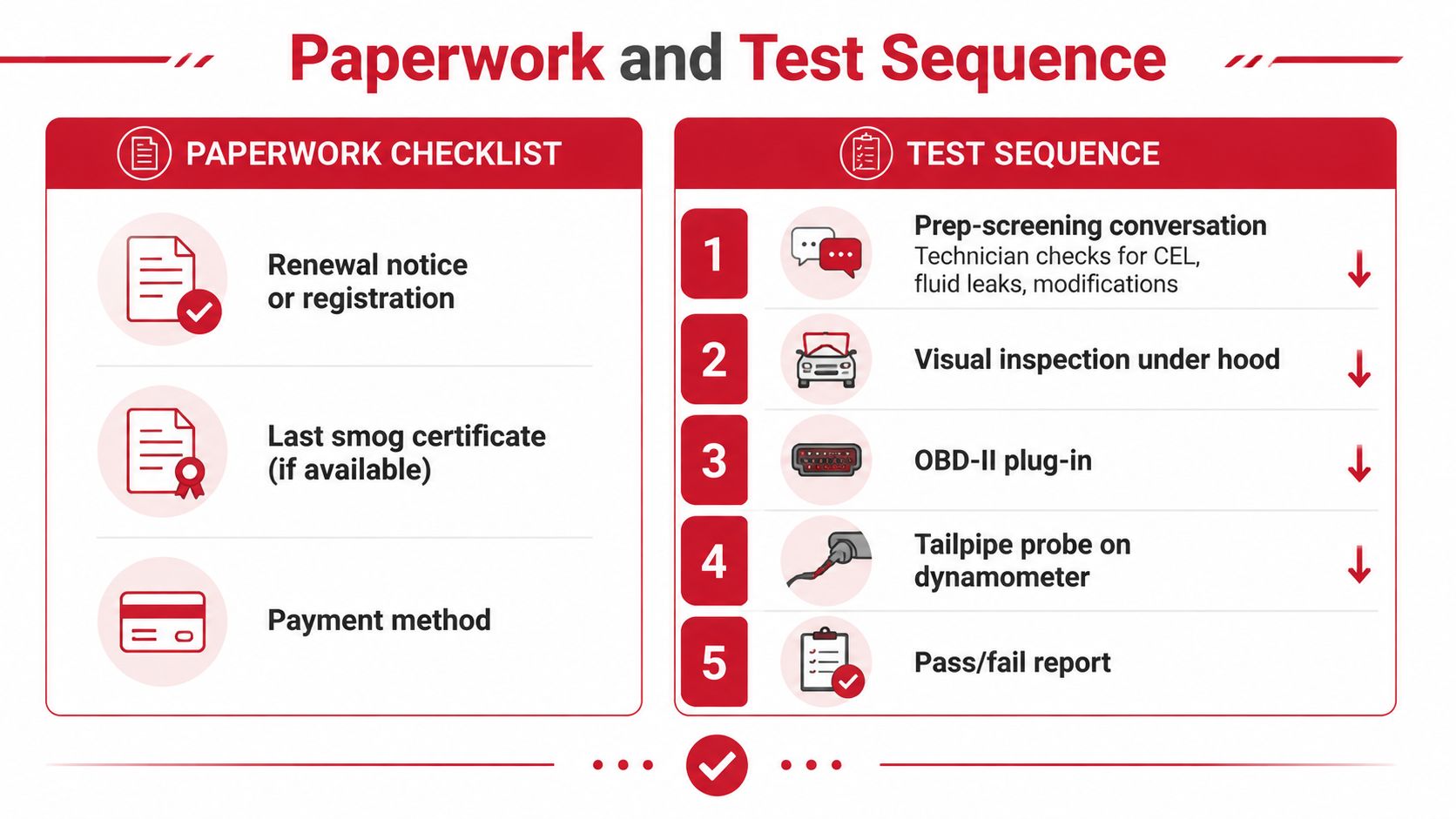
A pass completes the emissions side of the visit. A failure produces a report that identifies the reason, but a test-only station won't become your repair shop. That clear boundary is useful because it keeps the inspection focused and lets you choose where to address the problem.
Realistic Turnaround Times by Scenario
A quick visit depends on the vehicle arriving ready, the bay available, and the station's screening process. A normally driven vehicle with complete monitors can move through a routine inspection. A warning light, incomplete readiness status, or older testing procedure can stop that workflow before a certificate is issued.
Use these ranges for planning, not as promises. Queue length, vehicle type, required procedure, and the technician's initial findings determine the actual visit time.
| Vehicle Scenario | Typical Visit | Notes |
|---|---|---|
| Clean, prepared vehicle with monitors complete | About 15 to 20 minutes | Fastest path when a bay is open and paperwork is ready |
| Vehicle with an incomplete monitor | Longer than a routine visit | The technician may stop the test and explain that more driving is required |
| Vehicle with the check-engine light on | No reliable quick turnaround | A passing certificate may require repairs and completed monitors first |
| Older vehicle requiring a tailpipe and dynamometer procedure | Longer than a modern OBD-only visit | Extra equipment and emissions steps add time |
Do not plan around the shortest scenario. A station can complete a failed test quickly, yet the visit still wastes time if the vehicle was not ready. See the readiness rules discussed earlier in this article before booking.
A test-only station cannot turn a check-engine-light vehicle into a passing inspection because you are in a hurry. Get a diagnostic assessment from a repair provider, fix the cause, complete the required driving, and return for testing. The station's bay count and retest policy affect how quickly you can recover from a failure, so ask about both before you arrive.
For more detail on queues, preparation, and inspection steps, review this guide to how long a smog check takes.
Ask the station a more useful question than “Can you do it in twenty minutes?” Confirm that your vehicle is ready, ask how many cars are ahead of you, and verify whether the station has an open bay. That workflow check gives you a realistic arrival-to-departure estimate.
Hours, Fees, Coupons, and the Free Retest Rule
A fast visit starts with the station's real schedule, not a search listing. Check operating hours before leaving, then call if your vehicle has unusual equipment, a motorhome, a directed notice, or a recent failed test. Midweek mornings often produce a calmer queue than Monday, Saturday, lunch periods, or the final stretch before closing.
Ask for the full price before authorizing the test. California's mandatory state certificate fee is $8.25, and recent 2026 reporting placed the statewide average inspection cost at $68.56 before that fee, according to this California Smog Check 2026 cost and compliance update. The station may list a separate testing price, vehicle-type charge, payment fee, or convenience fee. Confirm the complete out-the-door amount.
Read the coupon terms before booking
Coupons apply under specific conditions. Check the vehicle class, service type, expiration terms, and participating station before you rely on the advertised discount. A free retest may require the original inspection to have been performed at that station, a return within the stated validity period, and the original paperwork or coupon.
Use this wording when you call:
“If my vehicle fails today, what exactly qualifies me for a free retest, how long is the offer valid, and do I have to return to the same station?”
Do not assume another shop will honor the offer. Do not assume the retest includes diagnosis or repairs. A test-only facility may waive the retest inspection under its policy while charging separately for outside repair work or another service. Ask what the policy covers before you leave after a failure.
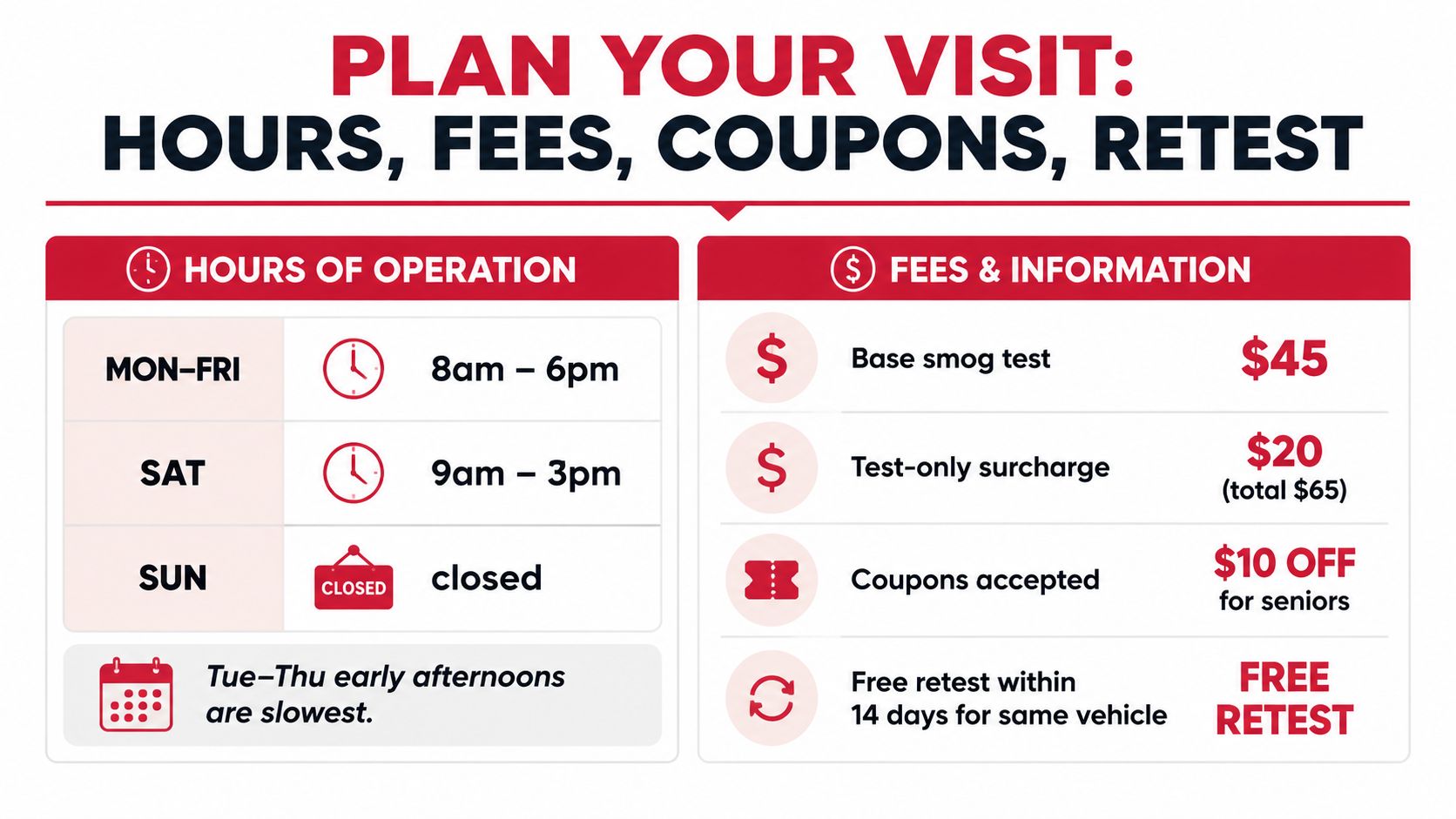
A directed STAR notice can limit your station choice even when the vehicle appears ordinary. BAR updates performance measures on different schedules, so STAR selection is not based on one permanent label. Follow the DMV direction first, then compare price, bay availability, retest terms, and whether the station can process the related registration task.
As noted earlier, California's updated readiness rule requires all monitors to pass. For coupon terms and a focused list of questions, review this guide to a STAR smog test coupon. The useful comparison is the total cost after a pass, failure, or repeat visit, not the lowest advertised entry price.
Practical Tips to Cut Your Wait
The highest-value preparation happens before you leave home. Use this order, because it separates actions that prevent a wasted trip from tricks that merely sound automotive.
Call ahead for screening. Tell the station your vehicle's model year, whether the check-engine light is on, whether the battery was recently disconnected, and whether the DMV notice says STAR. A technician can often tell you whether the visit makes sense before you spend time driving there.
Choose the right arrival window. Midweek, midmorning visits usually give you a better chance of finding an open bay than Monday or Saturday rush periods. Avoid the lunch window and the last part of the day, when unfinished vehicles and paperwork can stack up.
Verify readiness with a scan tool. If you own an OBD II reader, check monitor status before booking. If you don't, ask a qualified technician to check it. California's current readiness rule makes this more important because all readiness monitors must be set to pass under the rule effective October 1, 2025, according to the BAR explanation of the updated OBD readiness requirements.
Drive normally after repairs. A vehicle that recently had codes cleared or a battery disconnected may need a manufacturer-specific drive cycle. Don't guess at the distance or route. Follow the vehicle's service information, and don't book the smog test until the monitors show ready.
Skip the myths
Running premium fuel, adding a mystery fuel additive, or arriving with an almost empty tank isn't a substitute for proper readiness. Those habits don't repair a failed oxygen sensor, restore a missing catalyst, or complete a monitor that hasn't run. Bring the car in normal operating condition, with properly inflated tires if the vehicle will use a dynamometer, and with the diagnostic connector accessible.
Have your registration and renewal notice in one folder. Remove clutter from the cabin, make sure the technician can access the dashboard, and disclose modifications rather than hoping they go unnoticed. These details won't change a failing emissions system, but they can prevent needless handling delays.
Deciding Whether a Quick STAR Visit Is Right for You
The fastest visit starts before you enter the bay. Decide whether the car is ready or needs screening first.
Book a quick STAR smog visit when the vehicle has been driven normally, the check-engine light is off, no recent battery reset or code clearing interrupted the monitors, and your registration paperwork is ready. Follow the DMV notice, confirm the station is STAR certified, ask about the current queue, and let the technician complete the inspection. Bay availability, readiness screening, and a clear retest policy determine speed more than a “quick” label.
Prepare first if the warning light is on, the vehicle was recently repaired, the battery was disconnected, the car has been sitting, or you already know a monitor is incomplete. A paid pre-inspection or diagnostic scan can cost less than a failed testing trip followed by another appointment. A test-only station can identify the failure, but it will not sell the repair that resolves it.
California requires a Smog Check for all out-of-state 1976 model-year and newer vehicles registering in California for the first time, along with other initial registration events determined by the DMV. The January 2026 BAR report cited earlier covers those requirements. It also explains that 100% battery-electric vehicles are exempt, while hybrids and plug-in hybrids remain subject to biennial inspection. Confirm your vehicle's category before booking.
Reserve an appointment, or visit promptly after receiving the renewal notice instead of waiting until the deadline. Bring the notice, registration details, and vehicle information in one folder. If you're in Antioch or East Contra Costa County, Fire House Smog is a STAR-certified test-only station at 2900 Lone Tree Way. Ask the station to confirm readiness screening and retest eligibility before you arrive.
You're staring at a DMV renewal notice, or maybe you just got told your car needs a STAR-certified smog station instead of the shop around the corner. That's usually the moment the stress kicks in, because now the question isn't just “Can I pass?” It's also “Where do I go, and will I need to come back with repairs?”
A STAR station sounds technical, but the idea behind it is simple. California uses it to sort inspection stations by performance, equipment, and compliance, so the cars that need tighter oversight get tested in places the state keeps under closer watch. For drivers, that means the station you choose can affect whether the visit ends with a certificate, a repair referral, or a second trip.
Table of Contents
- The California Smog Check Most Drivers End Up Needing
- What STAR Certification Means
- Test-Only Versus Test-and-Repair STAR Stations
- How a STAR Test-Only Smog Check Works
- Why a Local STAR Station Like Fire House Smog Stands Out
- Preparing for Your Visit and Knowing What You Can Bring
- Misconceptions That Send Drivers to the Wrong Station
- Visiting a STAR Station in Antioch and Frequently Asked Questions
The California Smog Check Most Drivers End Up Needing
A lot of drivers meet the smog system in the least convenient way possible, with a renewal deadline hanging over them. The notice arrives, the car still runs fine, and then the paperwork says the vehicle needs a smog certificate before the DMV will finish the job. That's when a routine errand turns into a short course in California emissions compliance.
For many vehicles, a standard smog check is enough. But some cars and trucks get directed to a STAR-certified smog station because the state wants a more tightly controlled inspection for that vehicle or that situation. The distinction matters because STAR isn't just a label, it tells you which stations are authorized to test directed vehicles under California's performance rules. The state's STAR framework was created as part of a modernization effort that took effect in January 2013, and BAR says more than two-thirds of smog check stations are STAR certified, so this isn't some obscure corner of the system, it's a major part of how the state handles inspections (California Senate Transportation Committee PDF).
Why the station type changes your experience
If you go to a test-only shop, the visit stays focused on testing. If you go to a test-and-repair shop, the same location may also be able to fix what it finds. That's a real difference when you're trying to finish a registration renewal on the same day.
In Antioch and East Contra Costa County, that distinction often shows up in very practical ways. A driver may need a smog certificate, a renewal, and a clear answer about what happens if the car fails. A station that can handle the paperwork on-site turns a DMV chore into one stop instead of two or three.
Practical rule: if your notice says STAR is required, don't book the nearest random smog shop first. Book a station that is actually authorized for the type of inspection your paperwork demands.
What STAR Certification Means
A STAR-certified smog station is not a one-time approval that sits on the wall forever. California keeps it under ongoing review with measurable performance standards, inspection equipment rules, and periodic checks. In plain English, STAR status works more like a quality-control filter than a plaque.
The performance side of STAR status
BAR ties STAR eligibility to numbers that measure how a station performs on similar vehicles. The Similar Vehicle Failure Rate must be at least 50% of the industry-wide failure rate for similar vehicles in the most recently completed quarter, the Excessive Test Deviation Rate must be no more than one, and each inspector must maintain a Follow-up Pass Rate of at least 0.40 unless the station-level score applies for an inspector without one (BAR STAR certification page). Those thresholds matter because they show whether a station is producing careful, repeatable results.
The logic is simple once the jargon gets out of the way. A station that catches the right failures, avoids sloppy deviations, and keeps inspectors within the standard is more dependable for directed vehicles than one that misses too much or varies too widely. STAR turns that idea into a formal system.
The equipment side of the label
Certification also depends on the tools. BAR requires certified inspection equipment, current calibration, and the ability to inspect all vehicles in the Smog Check Program. California regulations say calibration-capable equipment has to pass calibration at least once every 10 calendar days, and BAR can restrict a station from communicating with the vehicle information database if deficiencies aren't corrected (California regulations on Cornell Law).
That means STAR is a live operating standard. If the station falls out of calibration, loses the right software setup, or cannot maintain the required tools, it stops being a dependable place for directed inspections.
A station page like Fire House Smog's STAR-certified smog check overview can help put that rule into a real-world setting. The point is not just that the station has the label. The point is that the label tells you the state is checking both the station's results and the station's equipment, so the inspection process stays accountable over time.
Bottom line: STAR status means the state is watching both the station's results and the station's equipment, which makes the label a continuously monitored quality mark, not a one-time award.
Test-Only Versus Test-and-Repair STAR Stations
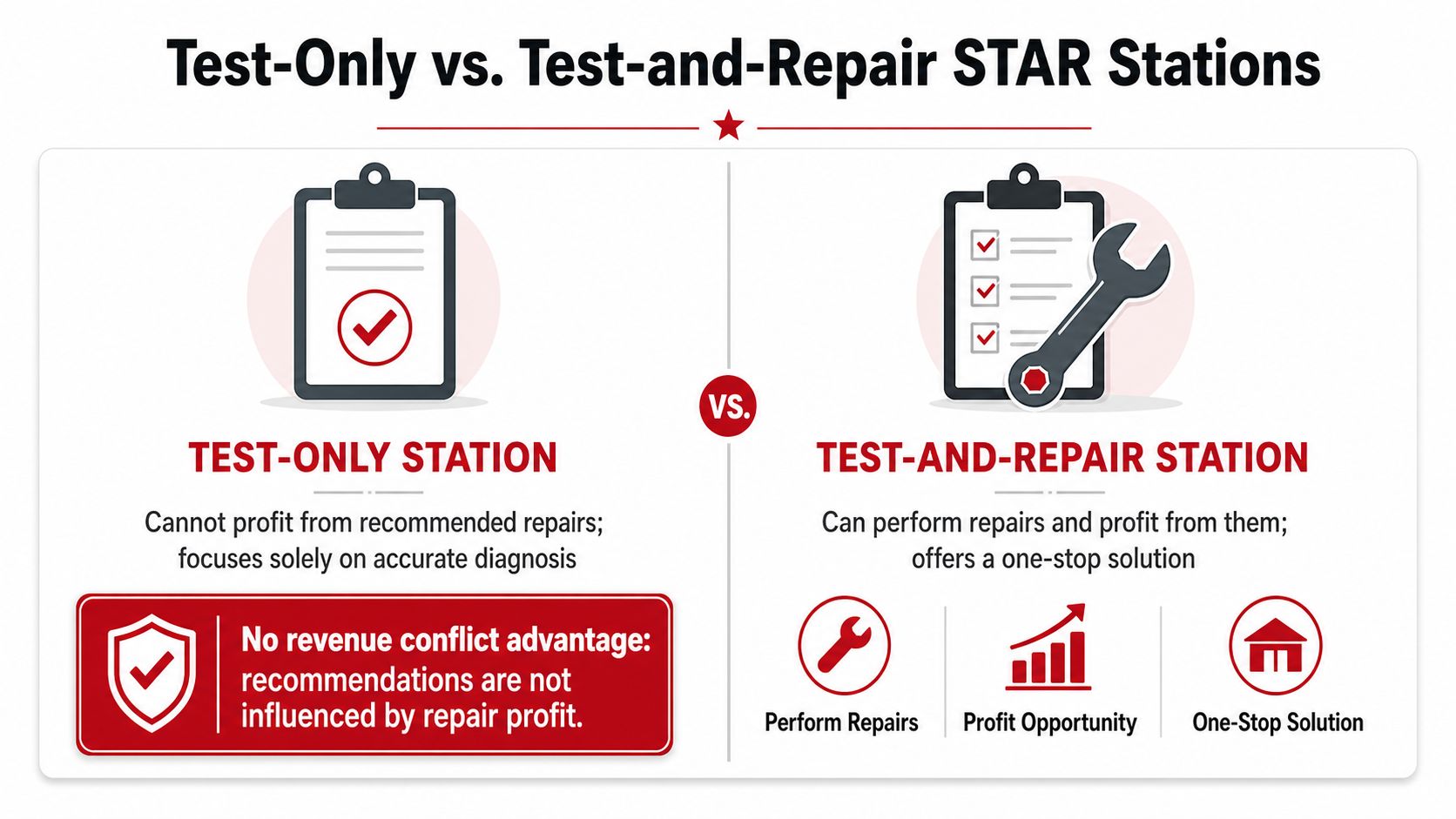
A driver trying to pick the right STAR location usually runs into one practical question first, who is allowed to test the car, and who is allowed to fix it afterward? A STAR test-only station can inspect your vehicle, but it cannot profit from repairing the reason it failed. A STAR test-and-repair station can do both. That split shapes both trust and convenience, especially when the renewal notice already feels like one more thing the DMV has dropped on your desk.

Why test-only matters to drivers
The value of a test-only station is the separation between the inspection and the repair estimate. If the station finds a problem, it does not have a repair bay waiting to turn that failure into additional work. The report sends you to the repair shop you choose, so the testing side stays distinct from the fixing side.
That separation matters for drivers who want the cleanest possible read on their car's emissions status. It also gives peace of mind to anyone who worries about being steered into repairs before they know what the car needs. A test-only shop answers one question, does the vehicle pass today, and then leaves the repair decision to you.
California's statewide numbers show that both station types handle a large share of the program. In BAR's BAR 2025 Smog Check Executive Summary Report, STAR Test-Only stations handled 5,916,245 initial tests and 481,639 failures, for an 8.14% failure rate, while STAR Test-and-Repair stations handled 2,766,051 initial tests and 227,215 failures, for an 8.21% failure rate. Those figures show a broad testing network, not a niche corner of the program.
Why regulators keep both models in play
The state needs places that can test vehicles, and it also needs stations that can repair them. The test-only model lowers the chance that a customer will be pushed toward unnecessary work, while the test-and-repair model gives drivers an option for diagnosis and repairs in one stop. Both fit the Smog Check Program, just in different roles.
For drivers who want a station whose job is limited to inspection, a STAR test-only station is the straightforward choice. For drivers who already know they want a shop that can handle both the result and the fix, test-and-repair is the better match. The right option depends less on the badge and more on what you want the station to do after it plugs in the car.
How a STAR Test-Only Smog Check Works
A STAR test-only visit usually starts with a drive-up and a quick review of your paperwork, much like any other inspection appointment. If your vehicle has been flagged for a directed inspection, the notice usually sends you to a STAR station instead of a regular one. The state is saying the car needs to be tested in a more controlled setting, where the inspection and the repair side stay separate.
What happens at the station
The station first verifies the vehicle and driver information, then connects the car to the inspection method that fits the vehicle. For 1996-and-newer vehicles, that means an OBD-II connection. Older vehicles may go through tailpipe or OIS testing, depending on what the program requires and what equipment the station supports.
After that, the inspector checks emissions-related components and completes the report. If the car passes, the certificate is issued electronically for DMV processing. If it fails, you receive a failure report that points toward repairs, but the station itself does not turn into your repair shop. That separation keeps the test result clean and leaves the next step to you.
What a failure does and doesn't mean
A failed test does not mean the vehicle is done for. It means the emissions system, readiness status, or visible equipment did not meet the standard that day. The purpose of the report is to identify the problem clearly enough that a repair shop can diagnose it without guessing.
A good failure report saves time. It gives the next mechanic a place to start instead of forcing them to search blindly. For a station example that follows this test-only model, you can look at the Lone Tree Way location details for Fire House Smog in Antioch.
Why a Local STAR Station Like Fire House Smog Stands Out
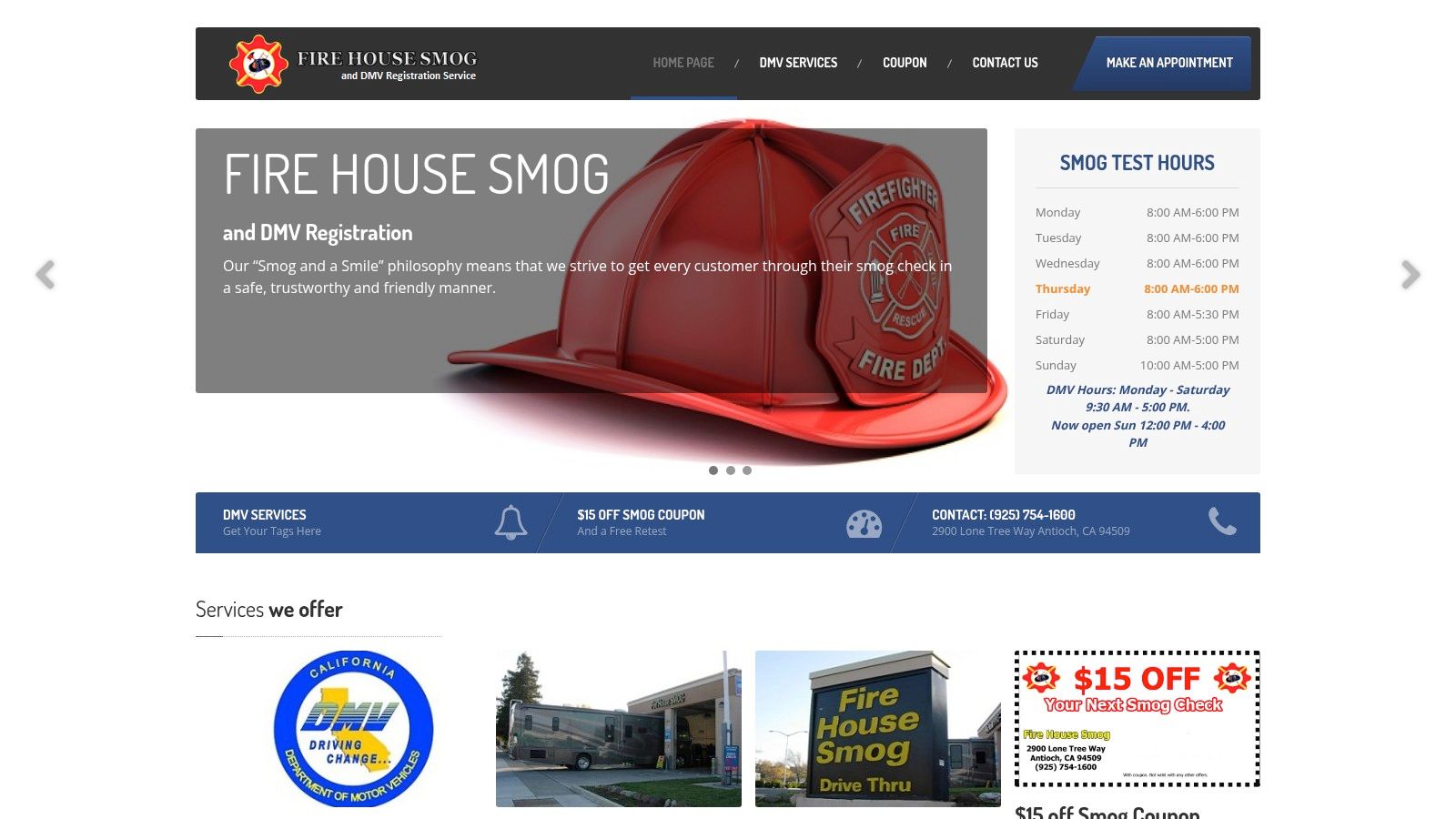
A local station matters when the problem is speed, not theory. At Fire House Smog on 2900 Lone Tree Way in Antioch, the selling point is the practical setup, not a slogan. It's a test-only station, so the testing side stays separate from repair revenue, and it also handles DMV registration tasks on-site during posted hours.
See the Lone Tree Way location details
Why the setup helps real drivers
Two service bays mean the station can move vehicles through faster than a single-bay setup usually can. That matters for commuters, fleet vehicles, and anyone trying to fit a smog check between work and school pickup. The station also posts smog testing seven days a week, which helps when your calendar doesn't match the DMV's.
The DMV side is useful for the same reason. When a driver can renew registration and leave with a sticker the same day, the smog visit stops being only an emissions errand and becomes a completed DMV task.
A local example of the test-only model
If you want a station that reflects the test-only logic discussed above, this is the kind of setup people usually mean. The test happens, the paperwork gets handled, and there's no in-house repair pitch sitting in the middle of the process. For drivers in Brentwood or Oakley, that can turn a frustrating compliance day into a short stop on the way home.
Preparing for Your Visit and Knowing What You Can Bring
The easiest smog visit is the one you prepare for before you pull into the lot. Bring your renewal notice or registration, because that gives the station the paperwork trail it needs for the correct transaction. If the check-engine light is on, don't assume the inspection will magically fix the issue, because the state still evaluates what the vehicle is telling the inspector.
A simple checklist before you drive over
| What to Bring to a STAR Test-Only Smog Check | Why It Matters |
|---|---|
| Renewal notice or registration | Helps the station match the inspection to the correct DMV record |
| Vehicle warmed up | A warmed-up engine is more representative of how the car operates in normal use |
| Gas cap that seals properly | A loose or failing cap can create avoidable emissions concerns |
| Check-engine light concerns addressed first | A warning light usually means the car needs attention before the test makes sense |
| Call ahead for RVs or motorhomes | Some RVs can be inspected, but bay and equipment limits apply |
DMV timing and same-visit planning
For drivers who want the inspection and registration handled together, timing matters. Fire House Smog lists DMV service hours as Monday through Saturday 9:30 AM to 5:00 PM and Sunday 12:00 PM to 4:00 PM. That makes it possible to line up the smog check and the DMV task in one trip instead of splitting them across different days.
Call ahead if your vehicle is unusual. Some RVs and motorhomes can be inspected, but the station has to confirm that the bay and equipment can handle the vehicle safely.
Misconceptions That Send Drivers to the Wrong Station
One common myth is that any shop can certify a directed vehicle. That's not how the system works. STAR stations exist because California wants the most tightly monitored inspections done in stations that meet specific performance and equipment standards.
Another misconception is that STAR stations are set up to fail cars. The opposite concern is closer to the truth. Test-only stations can't profit from the repairs they recommend, so the inspection result is kept separate from the repair sale. That doesn't guarantee a pass, but it does reduce the pressure to turn every failure into a bundled repair bill.
A third myth is that a failed test automatically means a huge repair. Often it doesn't. A failure report is just a starting point, and the next step is to decide whether your own mechanic or repair shop can fix the issue. The state's logic is simple, a failed inspection should lead to diagnosis, not panic.
Visiting a STAR Station in Antioch and Frequently Asked Questions
If you need a STAR test-only visit in East Contra Costa County, the concrete option to keep in mind is Fire House Smog, 2900 Lone Tree Way, Antioch, CA 94509. The phone number is 925-754-1600, and the posted DMV hours are Monday through Saturday 9:30 AM to 5:00 PM and Sunday 12:00 PM to 4:00 PM. If you're juggling registration, transfer paperwork, or a directed smog requirement, that combination saves time.
What if I just moved from another state? You'll usually need California registration steps, and that can include a smog inspection depending on the vehicle and paperwork.
Can a transmission problem keep me from being tested? It can complicate the visit if the vehicle isn't safe to inspect or can't be operated properly.
How are retests handled? If the vehicle fails, you repair it first, then return for the retest under the station's policy and the coupon terms if they apply.
Will a STAR test be accepted at the DMV the same day? If the vehicle passes and the electronic record clears, that's the whole point of doing the inspection before the DMV step.
If your renewal notice or directed vehicle paperwork is already on your counter, don't let it sit there another day. Fire House Smog handles STAR-certified test-only smog checks and on-site DMV registration services in Antioch, so you can keep the whole errand in one place. Visit Fire House Smog to check the station details and head in with a clearer plan.