

You search “smog check unlimited coupon” because your registration deadline is close and you want one simple price, not a scavenger hunt. Instead, you find expired PDFs, vague “$20 off” promotions, and stations that won't explain which vehicles qualify. “Unlimited” usually doesn't mean unlimited testing at one flat rate. It may refer to a coupon that includes a retest, while the actual price still depends on vehicle year, diesel or RV eligibility, the state certificate fee, and other exclusions.
I compared the fine print using the same five-point test for every deal: price transparency, vehicle scope, retest terms, expiration, and DMV reporting. This roundup focuses on East Bay and Bay Area options for California drivers. California's market is large and recurring, with about 22 million vehicles covered by the program and roughly 11 million initial inspections annually by 2015 according to independent research on California's Smog Check program. Use the ratings below, then keep the final checklist for the next coupon you find.
Table of Contents
- 1. Fire House Smog
- 2. Smog Express
- 3. Super Station
- 4. AutoTek
- 5. Brentwood Smog Express
- 6. Horizon Smog
- 7. Smog Check Plus
- Smog Check Unlimited Coupon: 7-Station Comparison
- The Five-Point Coupon Checklist You Can Reuse on Any Smog Deal
1. Fire House Smog
Fire House Smog is my top pick for Antioch drivers who want a test-only station, clear service boundaries, and practical help beyond the emissions inspection. It's a STAR-certified station at 2900 Lone Tree Way, Antioch, and it also provides licensed California DMV registration services. That combination matters when you need a smog result and a renewal, ownership transfer, sticker, or plate handled without making a separate DMV trip.
The test-only model is a real advantage. Fire House Smog doesn't sell in-house repairs, so the station has less incentive to turn a failed inspection into a repair estimate. It handles passenger cars, SUVs, light-duty trucks, and some RVs or motorhomes, although larger vehicles should be confirmed before arrival. Two service bays, seven-day smog availability, and extended evening and weekend hours suit commuters, families, and small fleets.
Its coupon policy includes a discount and a free retest when the stated conditions apply. The site doesn't publish a fixed price, so call 925-754-1600 or review the current quick smog check coupon before driving over.
Five-point legitimacy grade
- Price transparency: 3/5. A coupon is available, but you need to confirm the current out-the-door amount.
- Vehicle scope: 4/5. Cars, SUVs, light trucks, and some RVs are covered, with size and equipment limits.
- Retest terms: 4/5. A free retest is available under the site's policy and coupon conditions.
- Expiration: 3/5. Verify the current coupon terms before testing.
- DMV reporting: 5/5. The station is a licensed DMV services provider and handles California registration tasks on site.
Best fit: Antioch drivers who want STAR testing, no repair upsell, a possible free retest, and DMV services under one roof.
The main drawback is that Fire House Smog is test-only. If your vehicle fails, you'll need repairs elsewhere before returning for the retest. Still, for drivers prioritizing speed, independence, and convenient registration support, this is the strongest local choice. See the Antioch smog check service before you go.
2. Smog Express
If your registration deadline is close, Smog Express is built for a quick stop. Its Richmond offer advertises $20 off plus a free retest, using the broad phrase “any smog, any year.” Confirm the restrictions before you rely on that wording, especially if your vehicle falls outside a standard passenger-car test.
This is a STAR-certified, test-only station with two Richmond locations. Walk-ins help when planning ahead is impossible, and at least one location is open seven days a week. Electronic DMV reporting also removes the need to carry test paperwork through the registration process.
Five-point legitimacy grade
- Price transparency: 4/5. The discount is clear, but the coupon does not show the final total.
- Vehicle scope: 3/5. The broad offer needs confirmation for older vehicles, diesels, and special tests.
- Retest terms: 4/5. A free retest is included, subject to the offer's limits.
- Expiration: 3/5. Check the live coupon before visiting.
- DMV reporting: 5/5. Electronic submission is advertised.
The key cost check is simple: $20 off isn't the same as a low flat price. Your final bill can still change based on the vehicle and certificate charges. Ask whether the retest covers your exact model, and confirm every fee before the technician begins.
Use the Smog Express website to check the current coupon and Richmond location details.
3. Super Station
Check the total before you book. Super Station's dedicated coupon page lists a $49.75 smog special plus the $8.25 state certificate fee, with the offer advertised as valid through December 31, 2026, as shown on the page at the time of review. Confirm the live terms before visiting. That line-item pricing gives you a clearer starting point than a coupon showing only a discount.
The Concord facility performs STAR smog checks and reports results electronically to the DMV. Saturday hours make scheduling easier, while the broader automotive services can help if your vehicle fails and needs diagnosis or repairs. Since this is a full-service operation rather than a test-only station, ask about repair recommendations and costs before authorizing additional work.
Your five-point check:
- Price transparency: 5/5. The test price and certificate fee are listed separately.
- Vehicle scope: 3/5. The offer covers gasoline passenger vehicles from model year 2000 onward, excluding diesels and RVs.
- Retest terms: 2/5. The coupon does not state a strong retest promise.
- Expiration: 5/5. The page displays an expiration date, but verify it on the live offer.
- DMV reporting: 5/5. Electronic reporting appears in the service description.
The listed charges total $58.00 before any other applicable fee. For context, a 2025 aggregation of more than 1,200 providers reported an average $56.38 including the $8.25 certificate for standard gasoline vehicles from model year 2000 onward, with a projection near $60 in 2026, according to the pricing report. Super Station's advantage is clear pricing, not necessarily the lowest final bill.
Drive a diesel, RV, or pre-2000 vehicle? Call first, because this coupon may not apply.
Review the terms on the Super Station Concord coupons page, then compare nearby Concord smog check options before making the trip.
4. AutoTek
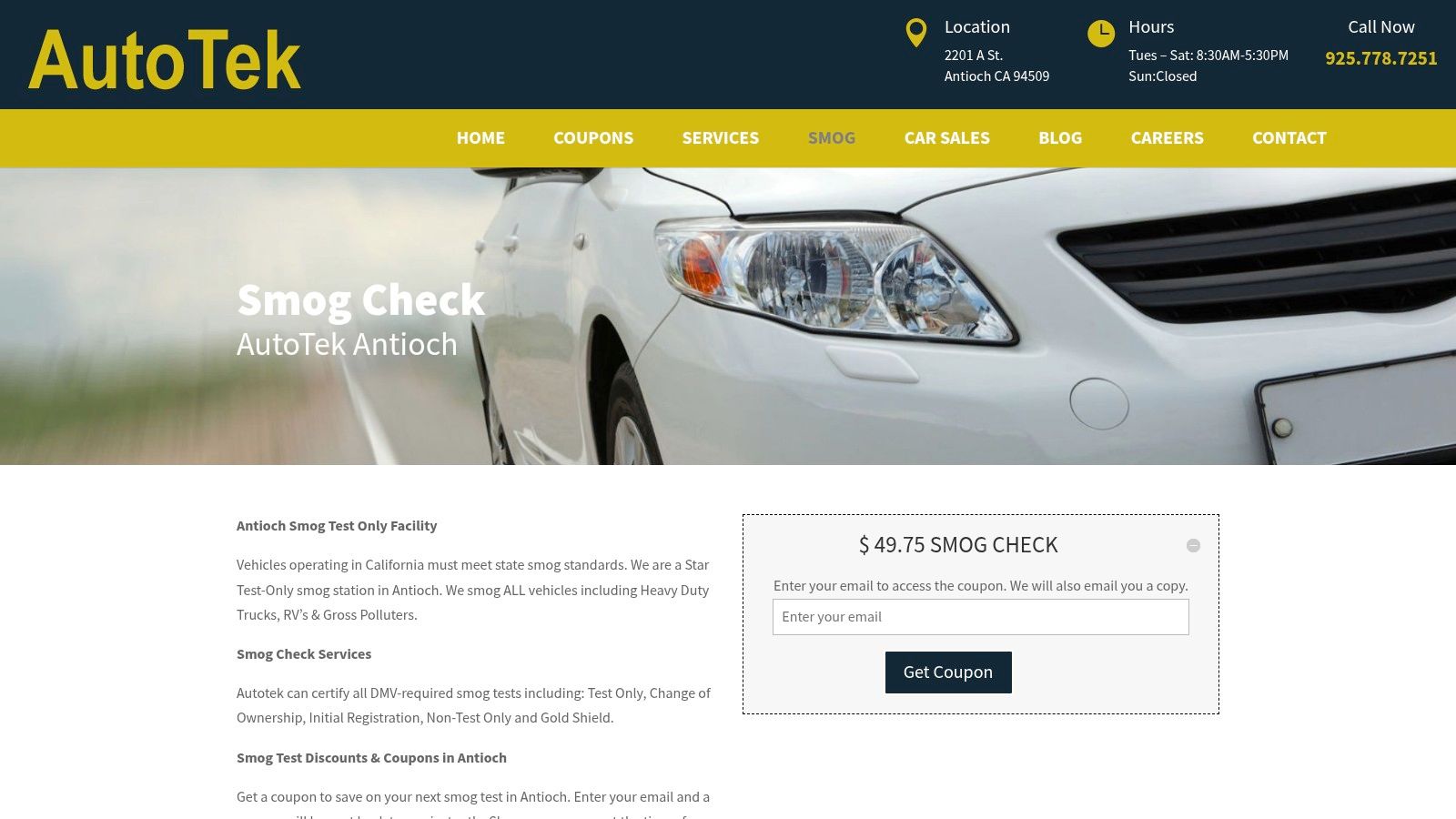
You need a smog test today, your vehicle falls outside the usual passenger-car rules, and the coupon page asks for your email. AutoTek fits that situation. Its advertised offer is $49.75, sent immediately by email after you request it. The extra step is minor, but confirm the emailed terms before driving over.
AutoTek says it handles DMV-required smog types, including heavy-duty vehicles and RVs, with prices that vary by vehicle. That broader coverage is the station's main advantage. It also means the headline price may not be your final bill, so ask for the exact total before authorizing the test.
Use the same five checks applied to every coupon:
- Price transparency: 4/5. The advertised price is clear, though vehicle-specific charges can change the total.
- Vehicle scope: 4/5. Heavy-duty vehicles and RVs are included in the stated service range, with variable pricing.
- Retest terms: 2/5. Confirm whether your vehicle and coupon qualify for a free retest.
- Expiration: 3/5. Check the emailed offer for its current validity.
- DMV reporting: 4/5. Confirm electronic submission when booking.
The test-only setup suits drivers who already have a mechanic or plan to handle repairs elsewhere. If the vehicle fails, AutoTek will not repair it at the inspection station.
For Antioch drivers, local convenience may outweigh a slightly lower advertised price elsewhere. Request the offer through the AutoTek Antioch smog test page, then confirm the final charge and retest policy before arrival.
5. Brentwood Smog Express
Pulling up to Brentwood Smog Express makes sense if you want one shop that can handle the inspection and the fallout if the car fails. The family-run station advertises $10 off a smog inspection on its homepage, holds STAR certification, helps with DMV registration, and keeps Saturday hours.
That said, the offer is a modest discount, not a standout bargain. The key question is whether the shop spells out the certificate fee, the vehicle types covered, and the retest terms before you hand over the keys. Without that, the homepage promotion is less useful than a fully itemized coupon.
Five-point legitimacy grade
- Price transparency: 3/5. The discount is clear, but the final bill is not fully itemized.
- Vehicle scope: 3/5. Check whether your vehicle year, diesel status, RV, or special test is covered.
- Retest terms: 2/5. Ask if a retest is free, discounted, or billed separately.
- Expiration: 2/5. The homepage offer does not show a clean coupon-style expiration setup.
- DMV reporting: 4/5. Registration help is available, but confirm electronic smog submission.
This is the better pick if you want repairs handled at the same place after a failure. It is the weaker pick if your main goal is the lowest upfront test price with no ambiguity.
Check the current offer on the Brentwood Smog Express website, then call before you drive over. Ask three things, does the price include the certificate, does the coupon cover my vehicle, and what do I pay if the car needs a retest?
6. Horizon Smog
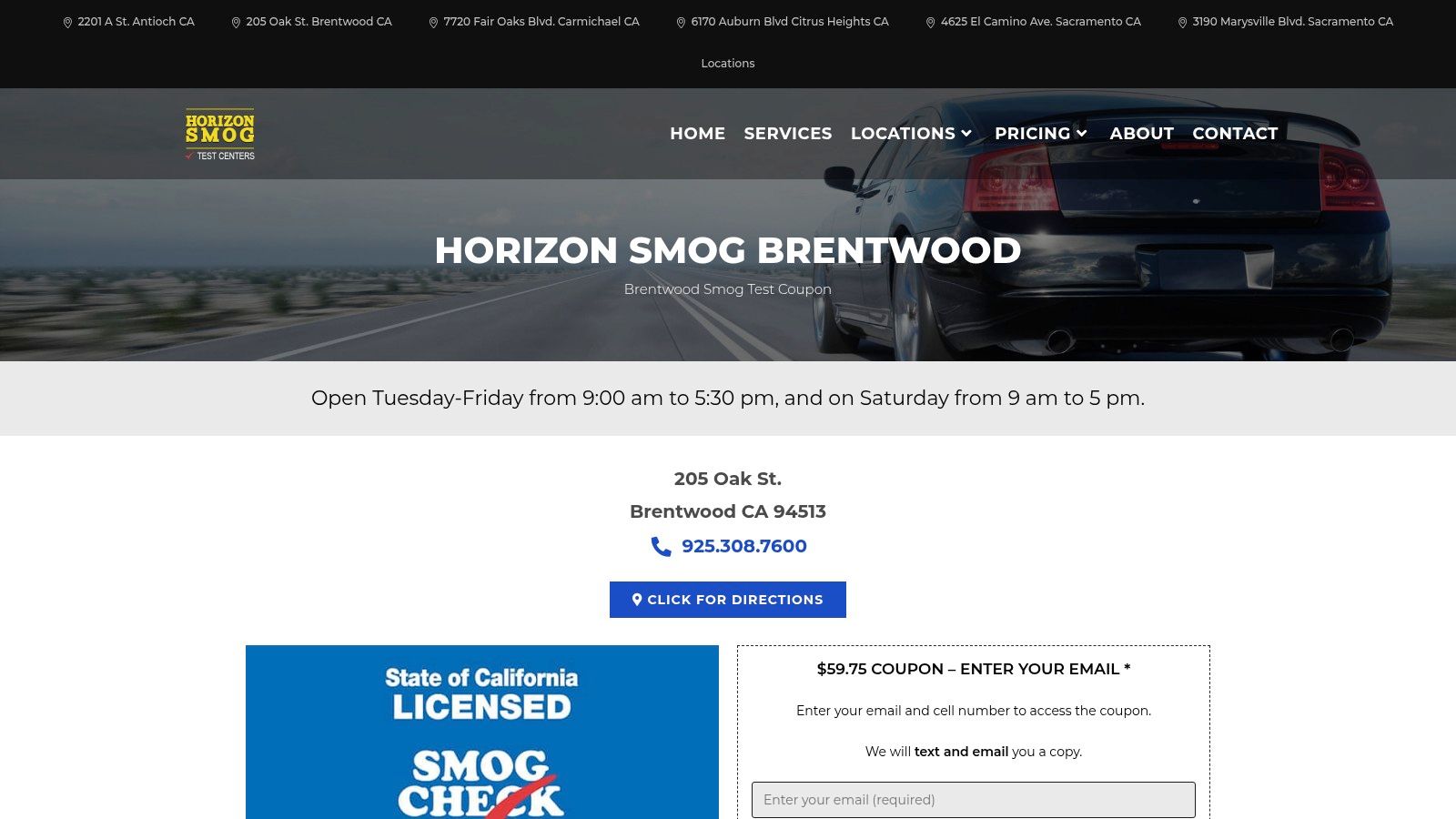
The Brentwood coupon is easy to save and use: print it or keep it on your phone, then walk in without planning several days ahead. That convenience gives Horizon Smog a practical edge for drivers in Brentwood and nearby Oakley. The company also operates within a Northern California network with multiple locations.
I would still treat the coupon as a lead, not a guarantee. Downloadable PDFs can stay online after the price, eligibility rules, or expiration date change. Call before you leave, especially if your vehicle is a diesel, RV, or another category that may face exclusions.
Here is Horizon's five-point legitimacy grade:
- Price transparency: 3/5. The coupon provides an offer, but confirm the complete total before authorizing the test.
- Vehicle scope: 3/5. Ask whether the deal applies to your vehicle and whether exclusions affect the price.
- Retest terms: 3/5. Confirm whether a failed test includes a free retest or a separate charge.
- Expiration: 3/5. Check the PDF date and verify that the station still honors the offer.
- DMV reporting: 4/5. Ask whether the result is submitted electronically to the DMV.
That produces a workable coupon, with weaker certainty than a page that spells out every fee and condition. Choose Horizon for walk-in convenience and a physical offer. Choose another station if exact pricing matters more than speed.
Get the current offer from the Horizon Smog Brentwood location page, save the Horizon Smog Brentwood coupon to your phone, and confirm your vehicle category before handing over the keys.
7. Smog Check Plus
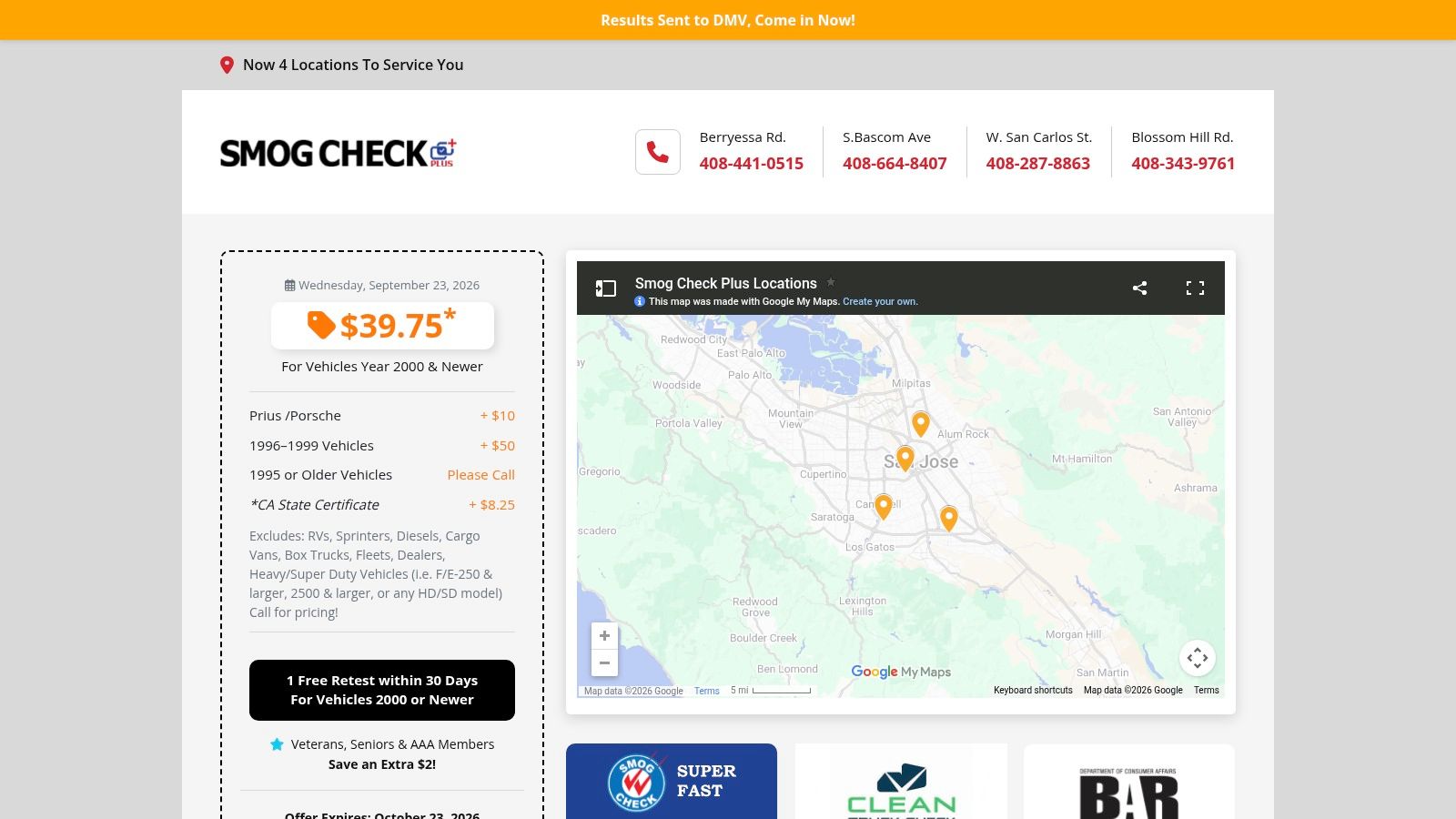
Driving to San Jose can pay off if you want a coupon with the fine print in view before you book. Smog Check Plus lists $39.75 for model year 2000 and newer vehicles, plus the $8.25 certificate fee. Older model years and certain models carry separate upcharges, so do not assume the headline price applies to your car. Qualifying model year 2000 and newer vehicles also receive a free retest within 30 days.
The offer earns its high grade because it states who qualifies and where the price changes. Smog Check Plus operates multiple San Jose locations with STAR certification and test-only service, and it accepts the coupon by phone or mobile device. The listed total for qualifying vehicles is $48.00, combining the test price with the certificate fee.
Here is the five-point legitimacy check:
- Price transparency: 5/5. The test price, certificate fee, and older-vehicle upcharges appear on the offer.
- Vehicle scope: 5/5. The coupon separates model year 2000 and newer vehicles from older vehicles.
- Retest terms: 5/5. Qualifying vehicles receive a free retest within the stated 30-day window.
- Expiration: 4/5. Check the live page for the current offer date before you leave home.
- DMV reporting: 5/5. The station's process includes electronic DMV reporting, but confirm the submission when you check in.
My recommendation is straightforward: use this deal if you already need to be in San Jose or value clear conditions over a shorter drive. Older vehicles can cost more because of BAR-97 testing and add-ons. Drivers in Antioch or East Contra Costa should compare travel time against the savings.
Check the Smog Check Plus coupon page before booking, and review the Smog Check Plus locations to choose the most practical station.
Smog Check Unlimited Coupon: 7-Station Comparison
| Provider (Location) | Process / Complexity 🔄 | Resource Requirements ⚡ | Expected Outcomes ⭐📊 | Ideal Use Cases 💡 | Key Advantages ⭐ |
|---|---|---|---|---|---|
| Fire House Smog (Antioch, CA) | Low, STAR test-only; on-site DMV adds one-stop step | Two service bays; extended evening/weekend hours for throughput | Fast pass/fail testing; same-day sticker/plate printing; free retest when applicable | Commuters, small-fleet managers, anyone needing quick DMV service | On-site DMV services; extended hours; free retest; STAR-certified |
| Smog Express (Richmond, CA) | Low, test-only walk-in model | Two locations; at least one open 7 days; visible coupon for easy redemption | Quick service with $20 off coupon; free retest (terms apply) | East Bay drivers seeking simple coupon-driven discount and walk-in convenience | Clear phone/print coupon; walk-in and electronic DMV submission |
| Super Station (Concord, CA) | Moderate, full-service shop with STAR testing available | Multi-service facility; Saturday hours; explicit coupon page | Transparent pricing ($49.75 + $8.25 cert); reliable service and on-site repair options | Drivers who want clear pricing and potential repairs in one visit | Dedicated coupon page with terms; established local reputation |
| AutoTek (Antioch, CA) | Low, STAR test-only; coupon gated via email | Local test-only station; email-delivered coupon (advertised $49.75) | Fast test-only service; coupon reduces cost if redeemed | Antioch locals preferring nearby test-only option and digital coupon | Local presence; advertised discount; covers heavy-duty/RV testing (varies) |
| Brentwood Smog Express (Brentwood, CA) | Moderate, family-run with testing + repair capability | Saturday hours; DMV assistance; modest homepage coupon | Local service with minor discount ($10 off); repair options if vehicle fails | East Contra Costa residents who may need repairs after a failed test | Full-shop repairs available; neighborhood convenience |
| Horizon Smog (Brentwood, CA) | Low, test-only, multi-location network | Printable PDF coupon; walk-in friendly; quick throughput | Fast walk-in testing; printable coupon simplifies redemption (confirm current terms) | Nearby drivers wanting a printable coupon and quick service | Concrete downloadable coupon; multi-location coverage |
| Smog Check Plus (San Jose, CA) | Low–Moderate, test-only chain with clear tiered pricing | Multiple Bay Area locations; detailed coupon page with vehicle-year surcharges | Low advertised price for 2000+ vehicles ($39.75 + $8.25); free retest within 30 days for qualifying cars | Bay Area drivers seeking lowest transparent price and explicit terms | Transparent line-item pricing; free retest policy; multiple locations |
The Five-Point Coupon Checklist You Can Reuse on Any Smog Deal
The word “unlimited” should never replace a final price and clear eligibility rules. California's current failure rates remain meaningful. The Bureau of Automotive Repair reported an all-model-years initial-test failure rate of 7.72% across 883,803 tests in its April 2026 executive summary, while its January 2026 report recorded 7.70% across 926,948 tests in the bureau's executive summary reports. A free retest can matter, but only if you know when it applies.
Use this five-point check before booking:
- Price transparency: Does the coupon show a real dollar figure, or only “save more” language? A fixed test price is better than a vague percentage discount.
- Vehicle scope: Look for explicit eligibility covering model years 1996 through 1999 versus 2000 and newer, plus separate rules for diesels, RVs, heavy-duty vehicles, and gross-polluter tests.
- Certificate fee: Confirm whether the $8.25 state certificate fee is already included or added at checkout. A coupon can look cheap while leaving this charge off the headline price.
- Retest terms: Ask whether the retest is free, paid, or conditional. Confirm the time window, vehicle limits, and whether repairs must happen at the same shop.
- Expiration and DMV reporting: Find a visible expiration date and confirm that the station submits results electronically to the DMV.
Before you start: Take a screenshot of the coupon or save the PDF. Show it at check-in, and ask the technician to confirm the total before testing.
For Antioch drivers, Fire House Smog is the most practical all-around recommendation. It combines STAR-certified test-only inspections, a free retest policy under applicable terms, seven-day smog availability, and on-site DMV services at 2900 Lone Tree Way, Antioch, CA 94509. Call 925-754-1600 for vehicle-specific pricing, especially if you drive a diesel, heavy-duty truck, RV, or motorhome.
Don't chase the biggest-looking “unlimited” claim. Choose the coupon that tells you what you'll pay, what vehicle it covers, what happens after a failure, and how the result reaches the DMV.
For Antioch and East Contra Costa drivers, Fire House Smog offers STAR-certified test-only smog checks, coupon savings, free retesting under applicable terms, and on-site DMV registration services. Visit Fire House Smog to review the current coupon, confirm your vehicle's eligibility, and plan your visit before the registration deadline.
You're renewing a diesel vehicle registration when a notice mentions emissions compliance, and one question immediately comes up: what does California diesel emission cover? For a passenger diesel, the answer may involve a conventional smog inspection. For a work truck, bus, motorhome, or fleet vehicle, it may involve a different program, additional reporting, or equipment requirements.
The phrase covers more than visible smoke from a tailpipe. It includes pollutants such as nitrogen oxides, particulate matter, and carbon dioxide, along with the tests, filters, monitors, engine standards, and fleet rules California uses to control them. The most important distinction today is between light-duty smog checks and the growing compliance system for heavy-duty and off-road diesel equipment.
This guide translates those rules into practical language. You'll learn what diesel engines produce, why California regulates them aggressively, which program may apply to your vehicle, how emissions are measured, and what steps can help you prepare for testing or fleet compliance.
Table of Contents
- What California Diesel Emission Means for Everyday Drivers
- How Diesel Engines Create Emissions You Can Understand
- Why California Regulates Diesel More Strictly Than Other States
- Light Duty Smog Checks Versus Heavy Duty Clean Truck Check
- How Diesel Emissions Are Measured and Reported in California
- What Diesel Owners Can Do to Stay Compliant in California
- Staying Ahead of California Diesel Emission Changes
What California Diesel Emission Means for Everyday Drivers
You are renewing a diesel vehicle's registration when the notice mentions emissions compliance. The first question is usually simple: do you need a smog inspection, or does another California program apply? The answer depends on the vehicle's weight, use, engine, equipment, and operating location, not on the word “diesel” alone.
For a light-duty diesel car, SUV, or pickup, the immediate requirement may be a California smog inspection connected with registration. A work truck, bus, motorhome, or fleet vehicle follows a different regulatory path. California's heavy-duty Truck and Bus Regulation applies to nearly all diesel-powered vehicles over 14,000 pounds gross vehicle weight rating operating in the state, with limited exceptions.
This shift matters for everyday drivers because California's diesel rules increasingly focus on heavy-duty and off-road equipment. A passenger diesel owner may mainly deal with a smog appointment, while a fleet operator may also manage inspections, reporting, equipment condition, and operating restrictions. Both groups may search for California diesel emission, but they do not face the same checklist.
Emissions are only one part of compliance
Diesel combustion produces nitrogen oxides, or NOx, which contribute to smog formation, and particulate matter, or PM, which includes tiny particles associated with diesel soot. Carbon dioxide is another combustion product with climate implications. California addresses these pollutants through engine standards, fuel requirements, aftertreatment systems, inspections, and fleet programs.
A clean-looking tailpipe does not prove that every emissions control is working. A malfunctioning sensor, failed filter, disabled emissions component, or excessive exhaust restriction can create a compliance problem without producing a dramatic cloud of black smoke. The visible exhaust is only the surface, much like checking a dashboard light tells you a system needs attention without identifying the failed part.
Practical rule: Identify your vehicle category first. An emissions notice does not mean every diesel vehicle follows the same inspection or reporting process.
What you should be able to decide
By the end of this guide, you should be able to:
- Classify the vehicle: Determine whether it is a passenger or light-duty diesel, a heavy-duty vehicle, or off-road equipment.
- Identify the program: Tell a regular smog inspection apart from the Clean Truck Check system.
- Understand the hardware: See why diesel particulate filters, backpressure monitors, and onboard diagnostics affect compliance.
- Prepare intelligently: Gather documents, inspect the vehicle, and seek qualified help before a deadline.
- Choose the right next step: Contact a testing station, fleet compliance provider, or qualified diesel technician based on the vehicle's actual use.
That process helps prevent a practical mistake: arriving for the wrong inspection or assuming that smoke-free exhaust guarantees compliance.
How Diesel Engines Create Emissions You Can Understand
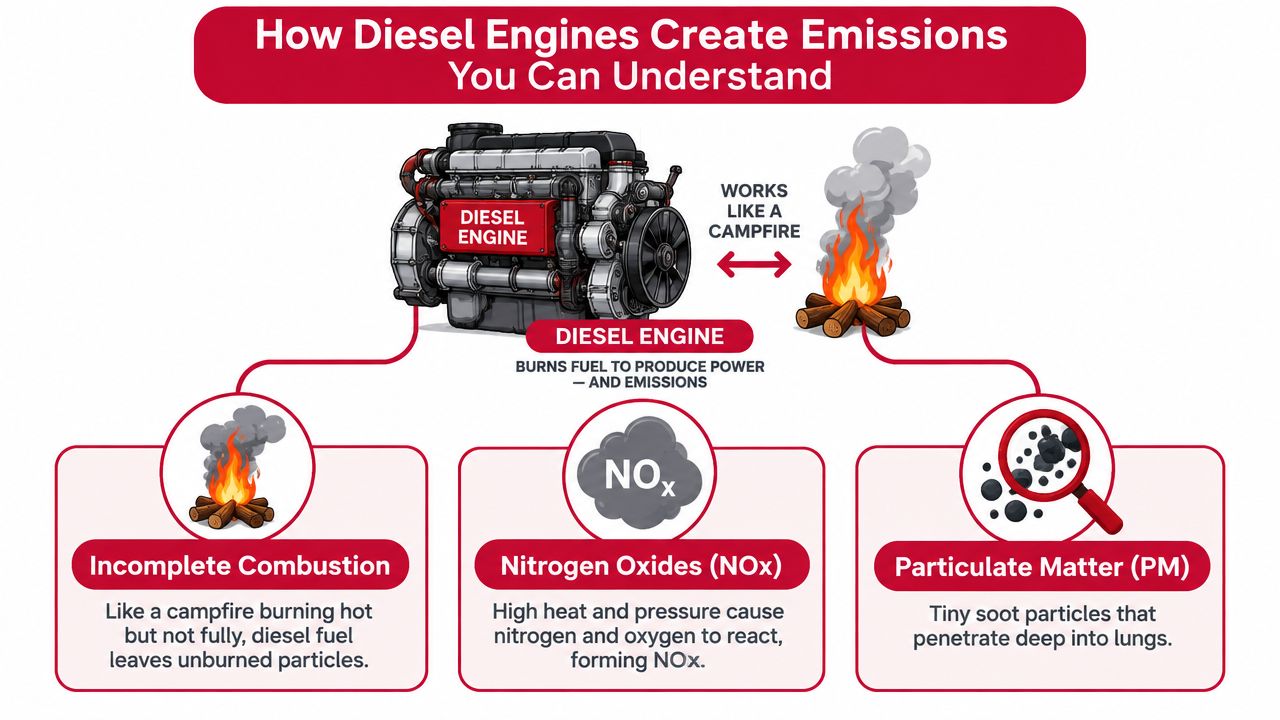
A diesel engine pulls a heavy load up a California grade. Inside the engine, fuel burns under high compression, producing power along with gases and particles that must be controlled before reaching the air. A campfire offers a useful comparison: a hot fire with enough oxygen burns more completely, while uneven fuel pockets leave smoke and residue behind.
Diesel engines are designed for efficiency and pulling power, yet their high-temperature combustion creates pollutants that California regulates closely. The exhaust system uses different components for different pollutants, so one working part cannot solve every emissions problem.
NOx forms in a hot combustion chamber
Nitrogen oxides, or NOx, develop when the intense heat and pressure inside the cylinder cause nitrogen and oxygen to react. NOx usually cannot be seen, but it contributes to the chemical reactions that produce ground-level ozone and smog.
A vehicle can therefore have clear exhaust while producing too much NOx. Depending on the engine and vehicle design, controls may include combustion calibration, exhaust gas recirculation, or selective catalytic reduction. A faulty sensor, catalyst, or related control component can raise NOx emissions without creating a visible black plume.
PM includes visible soot and hidden particles
Particulate matter, or PM, consists of tiny solid and liquid particles suspended in exhaust. Larger soot particles may look like smoke. Smaller particles are difficult to see, which explains why a clean-looking tailpipe does not prove that the emissions system is operating correctly. California focuses heavily on PM because these particles can enter the respiratory system.
A diesel particulate filter, commonly called a DPF, traps soot as exhaust passes through it. The filter must later regenerate, meaning a controlled process burns away the collected material. Repeatedly failed regeneration can restrict the filter and lead to reduced performance or warning lights.
Carbon dioxide has a different role
Carbon dioxide, or CO2, forms whenever carbon-based fuel burns. It differs from NOx and PM, and the control method differs as well. NOx and PM relate closely to local air quality and health concerns, while CO2 reflects the broader climate effect of fuel combustion.
The practical lesson is simple: diesel emission control requires several working systems. A DPF captures soot, but it does not correct every NOx problem. A NOx control system reduces that gas, but it cannot replace a functioning DPF.
Diesel emissions include invisible gases and visible or hidden particles. Compliance depends on controlling both.
Why California Regulates Diesel More Strictly Than Other States
A passenger diesel owner may notice California's rules during registration, while a truck operator may deal with engine model years, inspections, and reporting. That difference reflects how the state built its diesel program over time. The focus has shifted from checking only light-duty vehicles to controlling the heavy-duty and off-road equipment that produces large amounts of diesel pollution.
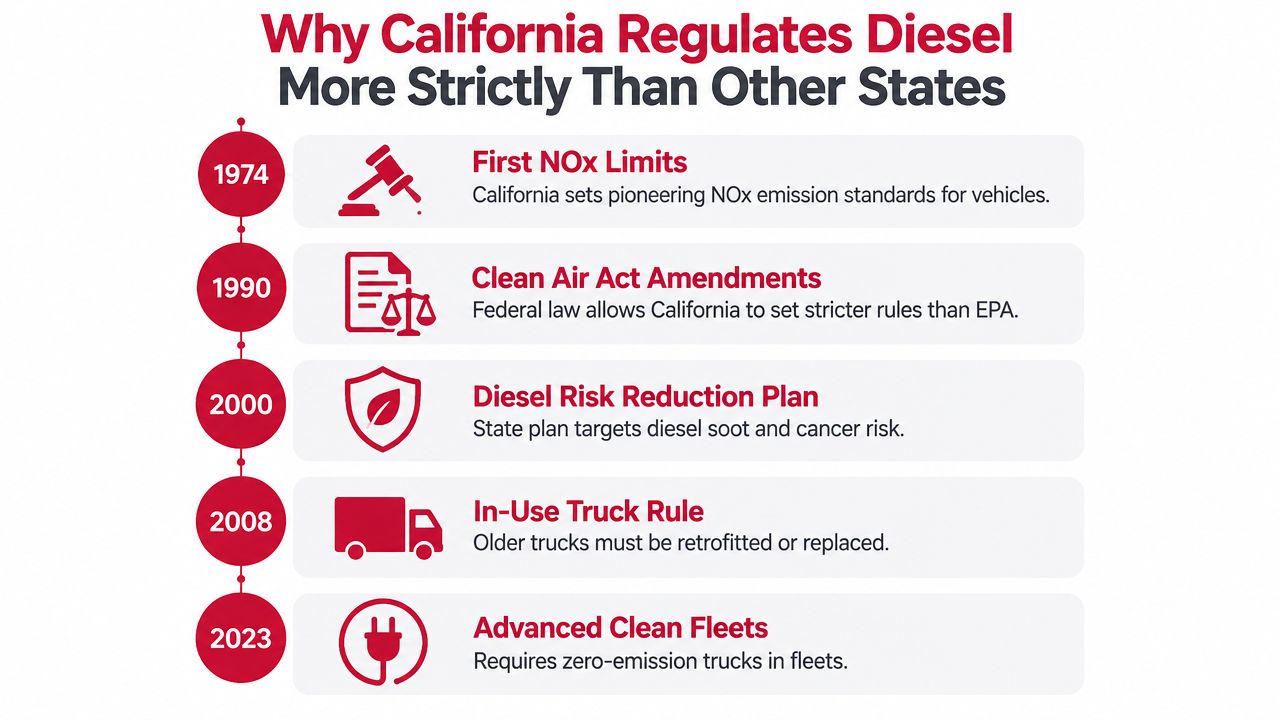
California's Air Resources Board, or CARB, began regulating diesel truck emissions in 1974 with a NOx standard for new vehicles. It tightened those standards through five steps, reaching the current level with 2010 models, according to this California Clean Diesel history.
The state adopted a Diesel Risk Reduction Plan in 2000. Its goals were to reduce diesel PM2.5 emissions by 75% by 2010 and 85% by 2020. Low-sulfur diesel fuel began in 2006 at 15 parts per million, allowing more advanced exhaust-control equipment to operate effectively.
These milestones explain why California diesel emission compliance involves more than a visual inspection. The program combines fuel requirements, new-engine standards, retrofit equipment, and rules for vehicles already working on California roads.
Why heavy-duty vehicles became the focus
CARB identified heavy-duty diesel trucks and buses as the single largest source of statewide NOx, responsible for 30% of statewide NOx emissions. In 2008, the agency estimated that about 941,000 trucks and buses operated in California, producing 859.3 tons per day of NOx and 33.1 tons per day of PM2.5.
Those figures shaped the regulatory strategy. Passenger-car inspections could not address commercial vehicles that travel long distances, carry heavy loads, idle at facilities, and remain in service for years. The same reasoning applies to diesel construction and other off-road equipment, where compliance depends on the engine, control equipment, and operating requirements.
The Truck and Bus Regulation took effect in December 2008. As of January 1, 2023, nearly all diesel-powered vehicles over 14,000 pounds GVWR operating in California must have a 2010-or-newer engine and emission system, with limited exceptions.
For a plain-English overview of standards affecting different vehicle categories, review this guide to diesel emissions standards. The practical starting point is the vehicle's weight rating and use, not the word “diesel.”
Light Duty Smog Checks Versus Heavy Duty Clean Truck Check
A diesel pickup owner may be thinking about registration and a familiar smog check. A fleet manager is usually solving a different problem: whether a heavy-duty vehicle must meet Clean Truck Check, California's inspection and maintenance program for heavy-duty vehicles.
Clean Truck Check covers nearly all diesel and alternative-fuel heavy-duty vehicles over 14,000 pounds GVWR operating on California roads, including trucks registered outside California. CARB identifies the first emissions compliance deadline as January 1, 2025. CARB also indicates that OBD-equipped vehicles are scheduled to move to quarterly testing beginning in October 2027, as described in its Clean Truck Check FAQ.
| Program | Applies To | Test Method | Frequency |
|---|---|---|---|
| Light-duty smog inspection | Qualifying passenger cars, SUVs, and light-duty trucks | California smog inspection procedures based on vehicle equipment and model | Frequency depends on registration and vehicle requirements |
| Clean Truck Check | Nearly all diesel and alternative-fuel vehicles over 14,000 pounds GVWR operating on California roads, including out-of-state trucks | Heavy-duty emissions compliance testing and reporting | Required according to the applicable CARB schedule, with quarterly OBD testing for OBD-equipped vehicles scheduled to begin in October 2027 |
Start with the weight rating, not the engine badge
A personally used diesel pickup may fall under the light-duty smog-check system. A similar-looking vehicle configured for commercial work may receive a different classification. A motorhome or recreational vehicle may also require special handling if its size or equipment exceeds a testing station's setup.
The gross vehicle weight rating provides the clearest starting point. Check the manufacturer's label, registration records, and fleet documentation instead of judging by appearance or the word “diesel.”
For a qualifying passenger diesel that needs a registration-related inspection, this guide to a smog test for diesel vehicles explains what the appointment may involve before you arrive.
Why the burden is shifting
Light-duty smog checks remain familiar to individual drivers. California's expanding compliance workload now centers more heavily on trucks, buses, motorcoaches, some motorhomes, and other heavy-duty vehicles.
That change follows how these vehicles operate. Commercial and industrial equipment can accumulate extensive road or operating time, so owners need an accurate compliance calendar, current vehicle records, and a response plan for failed tests or warning indicators. Waiting for a registration notice can leave an operator unprepared for a separate heavy-duty reporting obligation.
How Diesel Emissions Are Measured and Reported in California
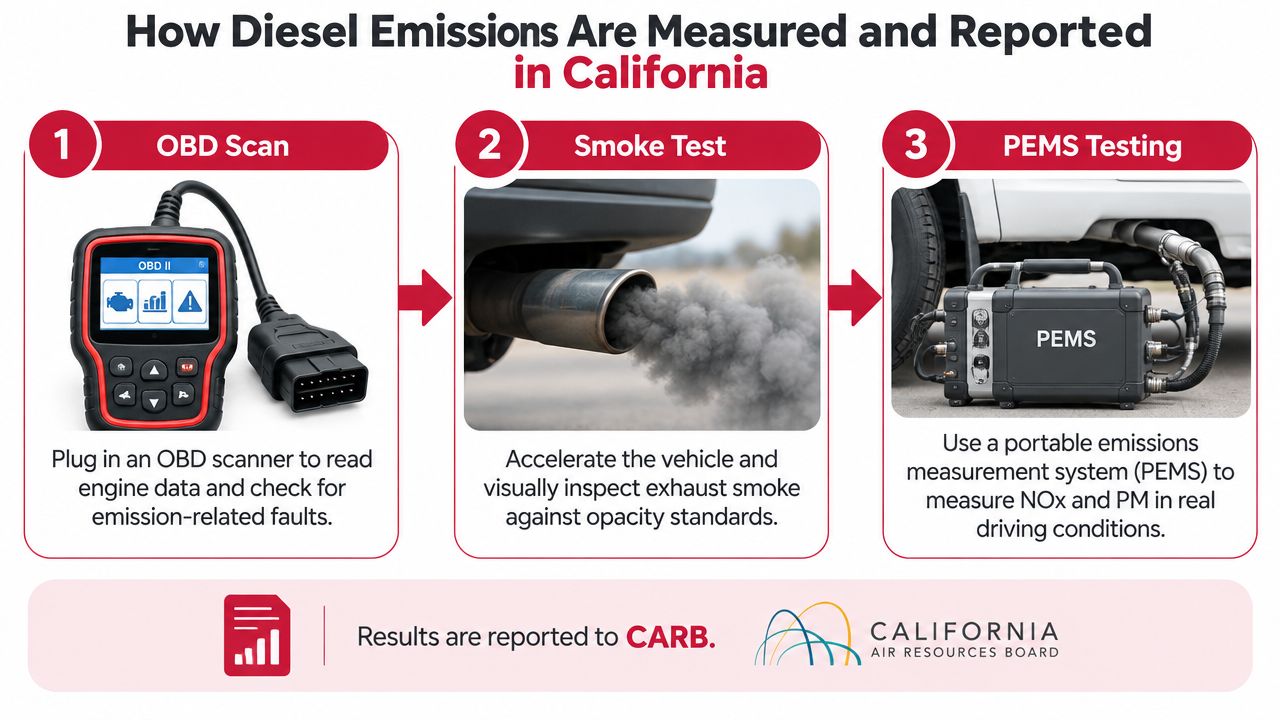
A truck can pass one check and still show a problem in another. California therefore uses several measurement layers. A computer scan may find a stored fault, a smoke or opacity inspection may reveal visible exhaust, and advanced equipment can measure emissions while the vehicle operates on the road or a test cycle.
The process has three practical levels.
First comes the vehicle's own diagnostic data
An onboard diagnostics, or OBD, scan reads information stored by the engine and emissions systems. It can identify sensor faults, aftertreatment trouble, or operating conditions that keep the system from working as designed.
A warning lamp is useful evidence, not a complete verdict. A vehicle without an illuminated lamp may still need readiness checks. Technicians also review whether a recent repair or battery disconnection erased diagnostic information before testing.
Filters require verification and monitoring
CARB requires a verified diesel particulate filter when the device is used for regulatory credit. CARB's installation and maintenance guidance identifies DPFs as the most common technology for reducing diesel particulate matter from heavy-duty engines operating in California.
A filter system also needs a backpressure monitor. It warns the operator before exhaust restriction reaches the specified high-pressure limit. Excessive backpressure can raise engine load, reduce filtration effectiveness, and damage the engine or aftertreatment system.
Real-world testing supports emissions inventories
CARB's EMFAC2025 documentation describes revisions to heavy-duty diesel emission rates based on real-world dynamometer testing, portable emission measurement, and in-use testing data. Its micro-trip method represents actual operating patterns more closely in emissions modeling, as described in the EMFAC2025 technical documentation.
For off-road and heavy-duty equipment, compliance increasingly examines NOx and PM together, rather than soot capture alone. CARB verification materials identify Level 3 diesel technologies that can target at least an 85% particulate matter reduction, while proposed off-road standards address both NOx and PM.
Here's a plain-language visual explanation of the testing flow:
A passing result depends on the complete system: engine, calibration, filter, sensors, and aftertreatment. Changing one component without checking the full setup may leave the original compliance problem in place.
What Diesel Owners Can Do to Stay Compliant in California
A passenger diesel owner may be preparing for a registration smog inspection, while a truck operator is managing a fleet emissions obligation. Those are different lanes of the same road. Start by confirming the vehicle's classification, GVWR, registration status, engine information, operating routes, and any Clean Truck Check responsibilities.
Use the notice as your first checklist:
- Read it carefully: Determine whether it requests a smog certificate, registration action, or heavy-duty compliance response.
- Check warning indicators: Repair check-engine, aftertreatment, DPF, or emissions-system warnings before testing.
- Bring supporting records: Have registration information, vehicle identification details, and recent emissions-system repair documents available.
- Keep the equipment intact: Do not remove, bypass, or substitute emissions components unless the replacement is approved for that vehicle and application.
- Confirm the test site fits: Large trucks, motorhomes, and specialized equipment may not fit every light-duty testing bay.
If a light-duty diesel fails
A failed inspection identifies a condition to diagnose, not a shopping list of parts to replace. Ask the station to explain the failure category, then get a diagnostic opinion from a qualified technician. The practical question is, “What condition caused the failure, and how will this repair correct it?”
Confirm the retest rules before returning. Some stations offer a free retest under their site policy and coupon terms, but eligibility depends on the circumstances and the station's conditions.
If you manage heavy-duty equipment
Fleet compliance works best when every vehicle has its own record. Track the GVWR, engine model year, emissions-control equipment, inspection status, fault history, and upcoming deadlines. A shared spreadsheet or fleet platform is enough if one person owns the task and updates it after each inspection or repair.
For drivers in Antioch and East Contra Costa County, Fire House Smog is a STAR-certified test-only station at 2900 Lone Tree Way in Antioch. It performs smog inspections for qualifying cars, trucks, and some recreational vehicles, along with California DMV renewal services and on-site tag printing. Testing is available seven days a week, and the station has two bays. Call 925-754-1600 before bringing a larger vehicle or motorhome to confirm that it fits the equipment limits. This Clean Air Truck resource explains related heavy-duty considerations.
Staying Ahead of California Diesel Emission Changes
A diesel pickup owner may focus on registration, while a trucking company tracks inspections across an entire fleet. Both face California diesel rules, but the compliance path depends first on vehicle classification. The state is placing growing attention on NOx and PM, especially from heavy-duty fleets and off-road equipment.
Off-road diesel is expected to remain a major source of mobile emissions in California. That direction explains why future compliance planning reaches beyond on-road truck inspections and passenger-vehicle smog checks. CARB has discussed proposed Tier 5 off-road standards in a 2026 workshop, aimed at reducing NOx and particulate matter from new compression-ignition engines sold in California.
Use this verification checklist
- Confirm classification: Check the vehicle's GVWR and identify whether it is light-duty, heavy-duty, or off-road equipment.
- Identify the program: Determine whether the vehicle needs a registration smog inspection, Clean Truck Check activity, or another CARB requirement.
- Track deadlines: Put applicable dates on a fleet calendar rather than relying only on a renewal reminder.
- Protect the emissions system: Maintain the DPF, sensors, backpressure monitor, and related aftertreatment equipment.
- Keep records: Save inspection results, repair invoices, equipment details, and compliance communications.
- Verify changes: Review current CARB guidance before buying parts, installing software, or changing an emissions-control strategy.
A fleet calendar works like a service map. It shows which vehicle needs attention, what documentation is missing, and when the next obligation arrives. For a passenger diesel owner, the same habit can be simpler: confirm the applicable smog-check rules, keep repair records, and verify requirements before a registration renewal.
CARB's SB 1 report identifies a useful-life limitation that reduced modeled emissions reductions from adopted and planned heavy-duty regulations by a cumulative 82,276 tons of NOx and 890 tons of diesel PM from 2024 through 2045 statewide, as documented in the EMFAC2025 technical materials. The point is practical. A rule may become stricter while regulators still assess whether its expected reductions occur during real vehicle use.
Long-term compliance depends on the full emissions system, accurate records, and the program governing the vehicle. Passing one inspection helps, but readiness between inspections prevents avoidable problems.
If you need a qualifying diesel smog inspection or California DMV renewal support in Antioch, visit Fire House Smog. The STAR-certified test-only station offers emissions testing, selected recreational-vehicle inspections, and on-site registration renewal services, so call 925-754-1600 to confirm your vehicle's requirements before arriving.
You've just opened a California DMV renewal notice and noticed the smog requirement. Maybe your vehicle is a diesel pickup, SUV, van, or motorhome, and you're unsure whether the rules apply to your model, your registration status, or the miles you drive. The questions usually arrive together: What exactly counts as a diesel emission, does every diesel vehicle need the same inspection, and what happens if the vehicle is based outside California?
California's approach can feel complicated because it combines several layers. The state regulates diesel particulate matter, nitrogen oxides, engine hardware, fuel characteristics, and in-use vehicle operation. A light-duty owner generally deals with the familiar California Smog Check process, while a heavy-duty vehicle operating on California public roads may fall under the separate Clean Truck Check program.
The reason for this strict approach is practical. Diesel pollution affects more than the person behind the wheel. Emissions can travel through neighborhoods near freeways, warehouses, ports, border crossings, and other freight routes. California's newer data systems examine those patterns at community level, not only as statewide totals.
This guide starts with the basic science, then connects it to health, CARB standards, out-of-state heavy-duty vehicles, exemptions, failed tests, and the steps an Antioch-area driver can take before visiting a test-only station. You'll also see why a functioning diesel particulate filter, accurate sensors, and complete diagnostic information matter even when the exhaust looks clean.
Table of Contents
- Introduction to California Diesel Emissions and Why They Matter Now
- What California Diesel Emissions Are and How They Form
- Health and Environmental Impacts Across California Communities
- How California Regulates Diesel Through CARB Rules and Standards
- Compliance Requirements for Diesel Vehicles Driving in California
- Testing Exemptions and What Happens If Your Diesel Fails
- Practical Guidance for Staying Compliant With Confidence
Introduction to California Diesel Emissions and Why They Matter Now
A diesel owner usually encounters the rules at an inconvenient but familiar moment. The registration renewal arrives, the DMV asks for a smog certificate, or a buyer wants proof that the vehicle can be transferred. The owner searches for “California diesel emissions” and finds references to CARB, DPFs, OBD systems, and Clean Truck Check, often without a clear explanation of which requirement applies.
The first distinction is the vehicle's role. A light-duty diesel vehicle may need a regular California Smog Check for registration or transfer. A heavy-duty vehicle operating on California public roads can face a separate emissions inspection and reporting obligation, even when it's registered in another state. Those programs serve different purposes, so treating every diesel as if it follows one universal test creates confusion.
Why the state focuses on diesel
California's diesel inventory has historically included more than one million on-road and off-road vehicles, along with stationary and portable engines, according to the California Air Resources Board diesel emissions assessment. The same assessment estimated statewide diesel particulate matter emissions at about 28,000 tons per year, with approximately 27% from on-road engines and 66% from off-road engines.
Those figures explain why the state's strategy reaches beyond passenger cars. Trucks matter, but construction equipment, agricultural machinery, generators, ships, and other diesel sources also contribute to the overall burden.
You don't need to become an emissions engineer to handle your own compliance. You do need to identify the correct program, keep the emissions equipment intact, and allow enough time to address a warning light or failed inspection before a registration deadline. The sections below translate the technical terms into decisions you can use.
What California Diesel Emissions Are and How They Form
A heavy-duty diesel truck can pass your neighborhood with no visible smoke and still release pollutants. The engine compresses air, injects fuel, and uses the resulting heat to ignite it. That combustion produces power, while incomplete burning and high-temperature reactions create emissions.
Two pollutants guide much of California's diesel-control work: diesel particulate matter, or diesel PM, and nitrogen oxides, known as NOx. They form differently and behave differently after leaving the tailpipe, so they require different control strategies. The rules also apply across changing routes. An out-of-state truck operating in California may still need to meet California requirements, even though its home-state program differs.
Diesel PM is more than visible smoke
A fireplace offers a useful comparison. The soot you can see represents only part of what combustion releases. Diesel engines can emit extremely small particles even when the exhaust appears clear. More than 90% of diesel particulate matter is smaller than 1 micrometer, placing it within the PM2.5 fraction, as described in California diesel standards and control information.
Fine particles can remain airborne and travel deep into the respiratory system. A diesel particulate filter, or DPF, captures much of this soot before it exits the tailpipe. During regeneration, the system raises conditions inside the filter so accumulated material burns in a controlled process.
NOx creates a different problem
NOx forms mainly during high-temperature combustion. It can affect air quality near the vehicle and react in the atmosphere to help form ozone and secondary particulate matter. PM is commonly associated with material emitted from the exhaust, while NOx can help create additional pollution after entering the air.
Modern diesel systems may combine exhaust gas recirculation, oxidation catalysts, DPFs, and selective catalytic reduction. SCR uses diesel exhaust fluid to reduce NOx. These components operate as a chain. A damaged hose, clogged filter, faulty temperature sensor, or malfunctioning catalyst can break that chain.
Practical rule: A clean-looking tailpipe does not prove that the complete emissions system is working correctly.
The engine computer monitors sensors and operating conditions. If it detects a fault, it may store a diagnostic trouble code or turn on the malfunction indicator lamp. That electronic record can matter during an OBD inspection, even if the vehicle drives normally.
Neighborhood mapping makes this distinction practical. Statewide emissions describe the broad problem, while 1×1 km community maps can show where traffic and nearby sources overlap. For a vehicle owner, the next step is straightforward: keep emissions equipment intact, respond to warning lights, and confirm the correct inspection requirements at a STAR test-only station.
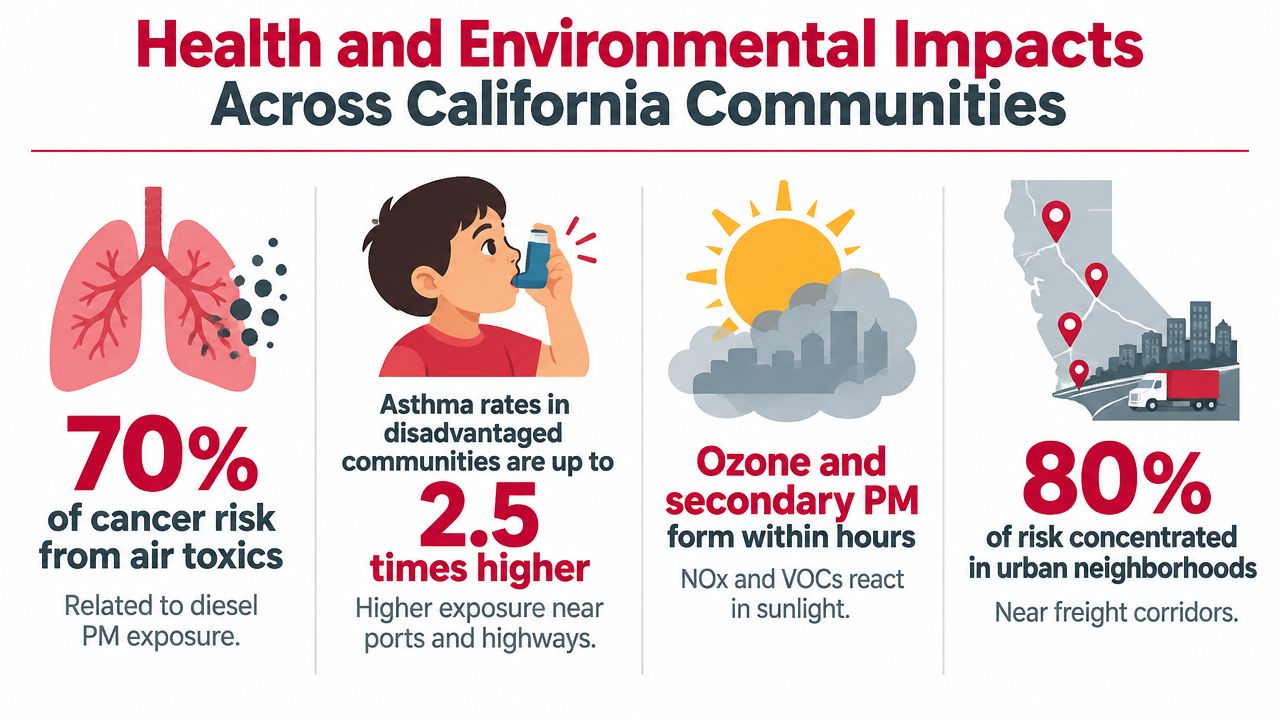
Health and Environmental Impacts Across California Communities
A truck can meet statewide requirements while still affecting neighborhoods differently along its route. People encounter diesel pollution where they live, work, walk, wait near traffic, or spend time beside freight corridors and ports. A statewide average measures overall progress, while local mapping asks the more practical question: where are residents encountering emissions?
Long-term progress has not eliminated risk
A peer-reviewed analysis found that statewide ambient diesel particulate matter concentrations fell 68% between 1990 and 2012, even as diesel vehicle miles traveled increased 81%. The analysis and CARB health summary associated the 2012 ambient concentration of 0.58 µg/m³ with an estimated 520 new cancer cases per million residents exposed, as documented in the peer-reviewed diesel PM analysis.
The lesson is that cleaner engines, improved fuels, and emission-control systems reduced pollution substantially, while residual exposure still deserves attention. Diesel PM remains toxic, and its effects are not distributed evenly across the state.
NOx creates a second pathway. After leaving a vehicle, it can help form ozone and secondary PM, so the impact extends beyond the visible exhaust plume. A route with frequent truck traffic and idling can produce a different exposure pattern from a quiet residential street, even within the same city.
Maps make local exposure easier to understand
California's community-analysis method combines emissions estimates from on-road, area, stationary, and ocean-going vessel sources. OEHHA grids the state at 1×1 kilometer resolution, then converts the information to census tracts for community analysis, as explained in the CalEnviroScreen diesel particulate matter fact sheet.
The inventory also accounts for diesel PM originating on the Mexico side of the border when evaluating San Diego and Imperial counties. Pollution does not stop at a registration system, county line, or state boundary. The same issue appears in interstate compliance: an out-of-state heavy-duty vehicle may follow rules from its home jurisdiction, yet still operate on California roads and affect communities here.
Exposure is local enough that the same vehicle can have very different community effects depending on its route, idling pattern, and proximity to homes, schools, and workplaces.
For drivers, maintenance and compliance are practical parts of reducing that exposure. At a STAR test-only station, ask which inspection applies, keep emissions equipment intact, and address warning lights before testing. One inspection cannot solve a neighborhood-wide problem, but it can help prevent an individual vehicle from adding avoidable pollution.
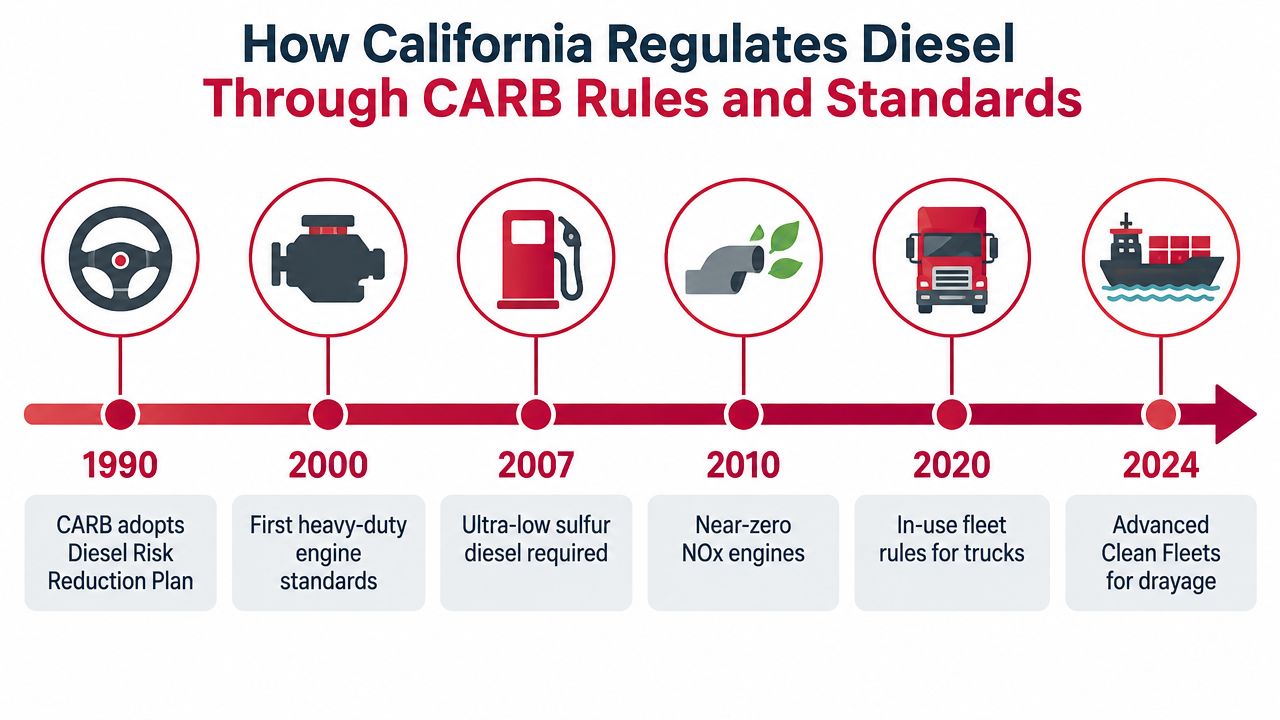
How California Regulates Diesel Through CARB Rules and Standards
A diesel pickup can pass a visual check yet still create excess pollution during idling or low-load driving. California's system therefore works across several connected layers. One set of rules limits particulate matter, another controls NOx under different engine conditions, and fuel policies address carbon intensity. The framework examines the vehicle, its controls, how it operates, and the fuel it uses.
PM controls target the smallest particles
CARB's Diesel Risk Reduction Plan set statewide targets to reduce diesel PM emissions by 75% by 2010 and 85% by 2020. Later control programs moved heavy-duty engines toward PM levels below 0.01 g/bhp-hr, roughly matching the 2007 new-engine PM standard, as described in CARB's heavy-duty diesel risk-reduction materials.
Those limits explain why DPF condition matters. The filter works like a fine screen in the exhaust path, trapping soot before it reaches the air. If it is missing, damaged, modified, or not working correctly, emissions can rise sharply even when the engine still feels powerful. Proper maintenance supports the test result and the neighborhood-level pollution reduction the equipment was designed to provide.
NOx rules cover different operating conditions
CARB's heavy-duty omnibus rule reduced the transient diesel NOx limit from 0.20 to 0.050 g/bhp-hr, a 75% reduction, and lowered the idle NOx limit from 30 g/hr to 10 g/hr. It also established a low-load NOx standard of 0.200 g/bhp-hr for medium- and heavy-duty diesel engines, according to the CARB heavy-duty omnibus initial statement of reasons.
“Transient,” “idle,” and “low-load” describe different engine conditions. A truck may perform cleanly at steady highway speed while producing excess emissions during starting, idling, acceleration, or light-load operation. That distinction matters for vehicles traveling through California from another state, because a home-state rule may not address every condition covered by California requirements.
Fuel policy broadens the picture
California's Low Carbon Fuel Standard, or LCFS, addresses carbon intensity across the transportation fuel system. Amendments taking effect July 1, 2025 set reduction targets of 30% by 2030 and 90% by 2045, according to the official CARB LCFS rulemaking page.
A smog inspection checks vehicle operation and emissions-control readiness. Fuel policy examines the broader lifecycle of transportation fuels. Together, they cover hardware, software, operating conditions, fleet practices, and fuel pathways.
For a plain-language explanation of owner obligations, see California diesel smog laws and requirements. At a STAR test-only station, confirming the correct inspection and addressing warning lights before testing can help connect statewide rules with the condition of one vehicle.
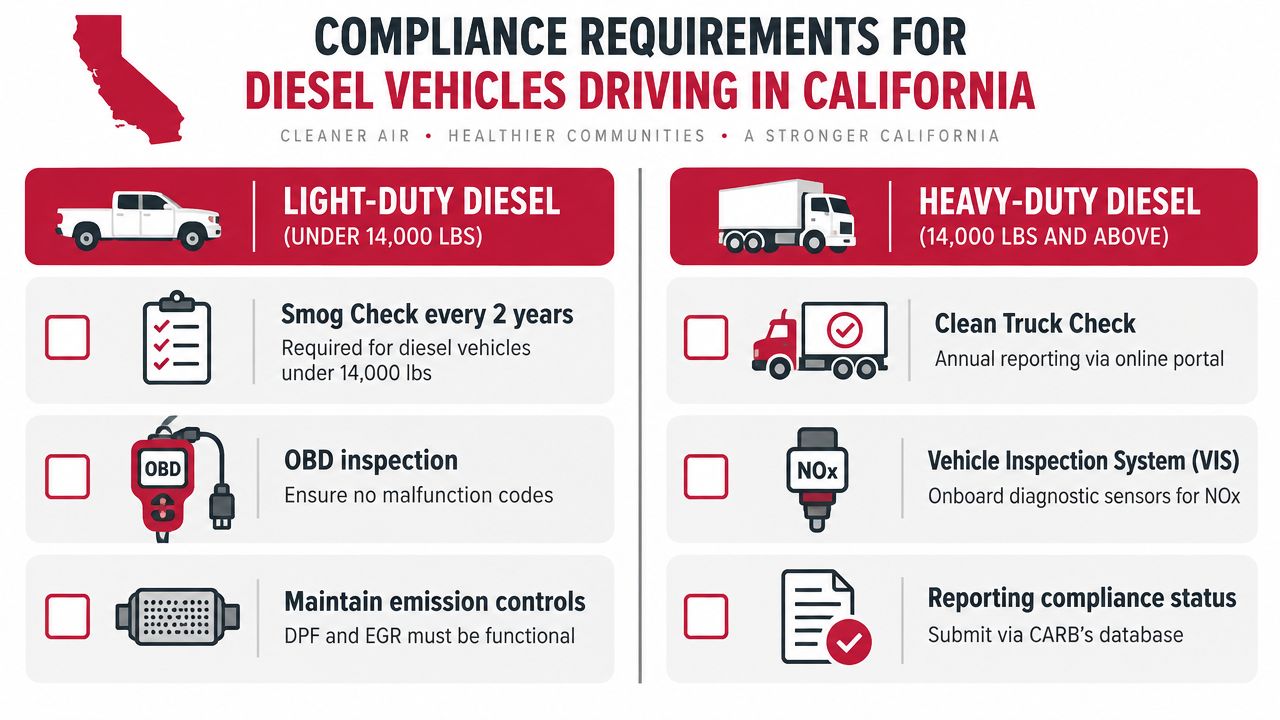
Compliance Requirements for Diesel Vehicles Driving in California
A diesel vehicle's compliance path starts with its use, weight, registration, and equipment, not its fuel type. A light-duty diesel renewing California registration generally follows the regular Smog Check process. A heavy-duty vehicle operating on California public roads may instead fall under Clean Truck Check, including some vehicles registered outside California.
Light-duty diesel vehicles
For a qualifying light-duty diesel vehicle, the inspection may include an OBD check, visual examination of emissions equipment, and an emissions test suited to the vehicle and program requirements. The model year, weight, registration circumstances, and DMV notice determine whether testing is required.
Before scheduling, gather the renewal notice, registration information, and recent repair records. If the malfunction indicator lamp is on, do not erase the codes just before testing. Clearing them can leave readiness monitors incomplete, much like resetting a checklist before all its items have been verified. The vehicle may then be unable to receive a clean result.
A STAR-certified test-only station performs inspections without selling repair work. That separation lets you obtain the test result first and choose a repair provider independently. It can also help connect statewide emissions rules with the condition of one vehicle in the neighborhood where it is driven and tested.
Heavy-duty vehicles and Clean Truck Check
CARB says nearly all diesel and alternative-fuel heavy-duty vehicles over 14,000 pounds operating on California public roads must comply with Clean Truck Check. The requirement includes out-of-state vehicles, motorcoaches, transit vehicles, school buses, and California-registered motorhomes, as stated in the Clean Truck Check FAQ and program information.
Testing began October 1, 2024, and the first compliance deadline was January 1, 2025, according to the same CARB information. Clean Truck Check includes reporting and compliance fees, so passing a regular light-duty smog inspection does not automatically satisfy a heavy-duty obligation. An interstate operator therefore needs to check California's requirements separately rather than relying only on the rules from the vehicle's home state.
| Vehicle situation | Main question |
|---|---|
| California light-duty diesel | Does the DMV require a Smog Check for this renewal or transfer? |
| Out-of-state heavy-duty truck | Does it operate on California public roads and exceed the applicable weight threshold? |
| Diesel motorhome | Is it over the applicable heavy-duty threshold and operating in California? |
| Fleet vehicle | Has the operator completed reporting and the required testing? |
CARB's program schedule calls for OBD-equipped vehicles to move to quarterly testing scheduled to begin in October 2027, as described in the agency's Clean Truck Check information. Fleet managers should track each vehicle separately. One completed inspection does not cover the entire operation.
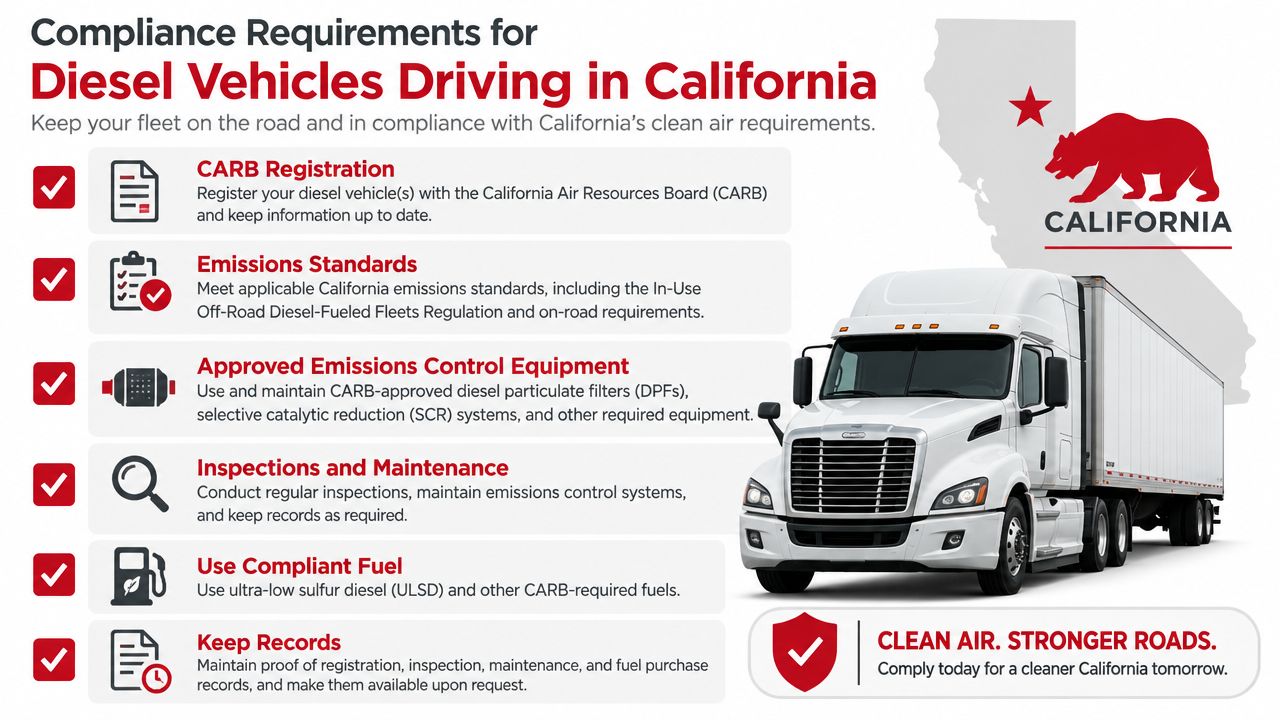
Testing Exemptions and What Happens If Your Diesel Fails
A failed result doesn't always mean the engine needs major work. It means the vehicle didn't meet one or more inspection conditions, and the result should identify the area that needs attention. The right next step depends on whether the issue is a warning lamp, incomplete monitor, visual defect, or measured emissions problem.
| Outcome or Exemption | Who It Applies To | Required Action |
|---|---|---|
| No Smog Check requested | Owners whose DMV notice or vehicle circumstances don't require a test | Confirm the exemption or non-test status with the DMV before assuming registration is complete |
| Pass | Vehicles that meet the applicable inspection requirements | Submit or retain the certificate as directed by the DMV or program |
| Fail with a warning lamp | Vehicles with an active emissions-related fault | Diagnose the stored code, repair the cause, and complete the required retest |
| Fail with incomplete monitors | Vehicles recently cleared of codes or disconnected from battery power | Drive only as appropriate for monitor completion, then follow station guidance |
| Visual inspection failure | Vehicles with missing, disconnected, or visibly altered emissions equipment | Restore compliant hardware before returning for inspection |
| Heavy-duty compliance issue | Vehicles covered by Clean Truck Check that lack required testing, reporting, or compliant results | Complete the applicable CARB process rather than relying on a light-duty certificate |
The table is a decision aid, not a substitute for the exact notice or CARB classification. Exemptions can depend on vehicle type, weight, fuel, registration, and use. Out-of-state registration alone doesn't remove a covered heavy-duty vehicle from California's operating requirements.
Common failure patterns
A DPF can deteriorate, sensors can report implausible readings, and NOx control hardware can stop working as designed. These problems may increase particulate matter or NOx without producing dramatic smoke. The engine computer may detect them before the driver notices a change in performance.
An incomplete monitor is different from a failed emissions measurement. It often means the computer hasn't completed the self-check needed for certification. If a repair shop clears codes and immediately sends the vehicle to a station, the monitors may not be ready.
Before a retest: Keep the failure report, ask which monitor or component caused the result, and make sure the repair provider confirms readiness before you return.
A test-only facility can provide an independent result, but it won't replace a qualified repair diagnosis. For diesel-specific preparation and inspection guidance, review this diesel smog test guide.
Practical Guidance for Staying Compliant With Confidence
Antioch and East Contra Costa County drivers can make the process easier by treating the smog visit as a scheduled compliance task, not a last-minute DMV emergency. Start with the notice, confirm the vehicle category, and check whether the vehicle has an active warning lamp or recent emissions-system repair.
Use this short preparation list:
- Bring the essentials: Take the DMV notice, current registration information, and any repair or diagnostic paperwork.
- Check the dashboard: Resolve an illuminated emissions warning before testing, and don't clear codes immediately beforehand.
- Protect the equipment: Don't remove, bypass, or disconnect the DPF, EGR, catalyst, SCR, or related sensors.
- Confirm the station fit: Call ahead for larger vehicles, RVs, or motorhomes because bay and equipment limits can vary.
- Plan the timing: Seven-day smog testing and extended weekday and weekend hours can help working drivers avoid a rushed visit.
- Ask about retesting: If the vehicle fails, keep the result and confirm whether a free retest applies under the station's current policy and coupon terms.
A STAR-certified test-only model can reduce concern about being pushed into repairs at the same location because the station doesn't sell repair work. Fire House Smog also provides on-site DMV renewal services with tag issuance at 2900 Lone Tree Way, with DMV service hours Monday through Saturday from 9:30 AM to 5:00 PM and Sunday from 12:00 PM to 4:00 PM. Smog testing is available seven days a week, and customers can call ahead at 925-754-1600.
For additional maintenance habits that support cleaner operation, read this guide on reducing vehicle emissions.
Fire House Smog provides STAR-certified test-only smog inspections for qualifying diesel vehicles, along with California DMV renewal and registration services at its Antioch location. Bring your vehicle to Fire House Smog, or call 925-754-1600 to confirm eligibility, available hours, and retest details before you visit.
You're staring at a California registration renewal notice, and the check engine light is glowing on your 2013 Camry. The car starts, drives normally, and doesn't seem to be making unusual noise. That doesn't matter at the smog station. In California, the check engine light, formally called the malfunction indicator lamp, is a regulatory trigger tied directly to the vehicle's emissions inspection.
The right move isn't to gamble on a quick test or erase the warning before you arrive. Diagnose the fault, repair the cause, let the vehicle complete its required self-tests, and only then book the inspection. That sequence prevents the wasted inspection fee and the second trip that follows a predictable failure.
Table of Contents
- What the Check Engine Light Means for Your California Smog Test
- How California Treats an Illuminated MIL During Inspection
- What Happens During the OBD-II Portion of the Smog Check
- Quick Pre-Test Checks You Can Do Before Booking
- Temporary Fixes Versus Professional Diagnostics
- Retest Options and Fire House Smog Policies
- Your Pre-Smog Checklist Before You Drive In
What the Check Engine Light Means for Your California Smog Test
California's Bureau of Automotive Repair treats the MIL as part of the OBD-II inspection, not as a suggestion for the driver. If the lamp is illuminated while the engine is running, the vehicle fails the applicable inspection under the California Smog Check Program. The vehicle can run smoothly, accelerate normally, and still fail because the computerized emissions system has reported a malfunction.
The lamp also has to behave correctly during the dashboard check. With the key on and the engine off, the MIL should illuminate. After the engine starts, it should turn off. That sequence confirms the warning circuit is present and responding rather than removed, disabled, or malfunctioning.
Vehicle age changes the inspection path
OBD-II applies to 1996 and newer gasoline-powered passenger vehicles and light-duty trucks, and to 1998 and newer diesel vehicles, according to BAR's OBD test reference. Newer vehicles receive an OBD-based evaluation, while older vehicles can follow different inspection procedures depending on their model year and equipment.
That means a driver shouldn't apply advice for an older car to a modern vehicle. The exact inspection path depends on the vehicle's fuel type, model year, and applicable Smog Check requirements.
Your decision path is straightforward:
- The light is on while running. Don't book the test yet. Get the fault diagnosed.
- The light was recently cleared. Don't assume the car is ready. Check the readiness monitors.
- The light is off and monitors are ready. A pre-test scan can confirm whether booking makes sense.
- The vehicle fails. Keep the Vehicle Inspection Report, complete the listed repairs, and ask the station about retest eligibility.
Practical rule: A smooth-driving car with an illuminated MIL is still a likely smog failure. The lamp's status matters before the inspector evaluates anything else.
How California Treats an Illuminated MIL During Inspection
The inspection begins with a functional question: does the MIL display the required behavior? California's OBD procedure treats the lamp status as a pass/fail item for applicable OBD-II vehicles. BAR states that a vehicle won't pass Smog Check with the check engine light on, so an inspector can't overlook the warning because the vehicle feels fine on the road.
A normal bulb check isn't a failure. With the key on and the engine off, the MIL should light with the other dashboard indicators. Once the engine starts, it should go out. A steady light while the engine is running indicates that the vehicle's system has commanded the lamp on, and that status produces a failure.
A flashing light deserves immediate attention. It commonly signals an active misfire that can damage the catalytic converter, so driving around hoping it disappears is a poor decision. Whether steady or flashing, an illuminated MIL does not become acceptable because the car passes a quick visual glance.
The cleared-code trap
Clearing trouble codes or disconnecting the battery can turn the dashboard light off temporarily, but it also resets readiness monitors. After emissions repairs, the vehicle must complete the relevant self-tests through normal driving or a manufacturer-specified drive cycle. The BAR explanation of the updated readiness rules makes the key point clear: a cleared lamp alone doesn't prove that the emissions system has verified the repair.
As of October 1, 2025, California requires all applicable readiness monitors to be set for a vehicle to pass, subject to limited fuel-type and model-year allowances described by BAR in its OBD test reference. A recently cleared code can therefore create a separate readiness failure even when the MIL is currently dark.
| MIL Status | Inspector Interpretation | Smog Outcome |
|---|---|---|
| Illuminated with engine running | The OBD system has commanded the lamp on | Fail |
| Illuminated during key-on, engine-off, then off after starting | Normal bulb-check sequence | Continue with the inspection |
| Does not illuminate during key-on, engine-off | Lamp circuit or required display behavior is not verified | Fail |
| Flashing while engine is running | Active fault condition requires prompt diagnosis | Do not test before diagnosis |
| Recently cleared and lamp off | Lamp status may look normal, but monitors may be incomplete | Possible readiness failure |
What Happens During the OBD-II Portion of the Smog Check
At an OBD-equipped station, the technician connects the inspection equipment to the vehicle's diagnostic link connector, commonly called the DLC. The equipment communicates with the vehicle's computer and retrieves the information needed for the official inspection record.
The scan evaluates more than the dashboard lamp. It can capture the vehicle identification information, MIL command status, whether the MIL has been on since the last code clear, stored diagnostic trouble codes, and readiness monitor results. These data points show whether the vehicle's emissions controls have completed their required self-checks and whether the computer has detected a reportable malfunction.
Ready and incomplete monitors
A readiness monitor marked ready has completed its applicable self-test. An incomplete or not-ready monitor hasn't finished the conditions needed for the system to evaluate that emissions component. Battery disconnection and code clearing can return monitors to an incomplete state, which is why arriving immediately after either event is risky.
Under California's current framework, the allowable monitor status depends on fuel type and model year. BAR's guidance describes limited allowances for certain vehicle groups, while the readiness rules effective October 1, 2025 require applicable monitors to be set, with exceptions handled according to the state's criteria.
You can learn more about how these self-tests work in this guide to OBD readiness monitors. The important practical point is that a scan tool reading isn't a repair. It only reports what the vehicle computer currently knows.
The technician then records the inspection results through the BAR inspection system. If the vehicle identification information raises an eVIN issue, the inspection may require an additional visual verification. A damaged, missing, or unreachable diagnostic connector can also prevent the required electronic inspection from being completed.
At the end, the station provides the BAR-OIS printout, which serves as the official record of the inspection. If the vehicle fails, keep that document. It identifies the failed items and gives the repair shop a starting point instead of leaving everyone to guess.
Quick Pre-Test Checks You Can Do Before Booking
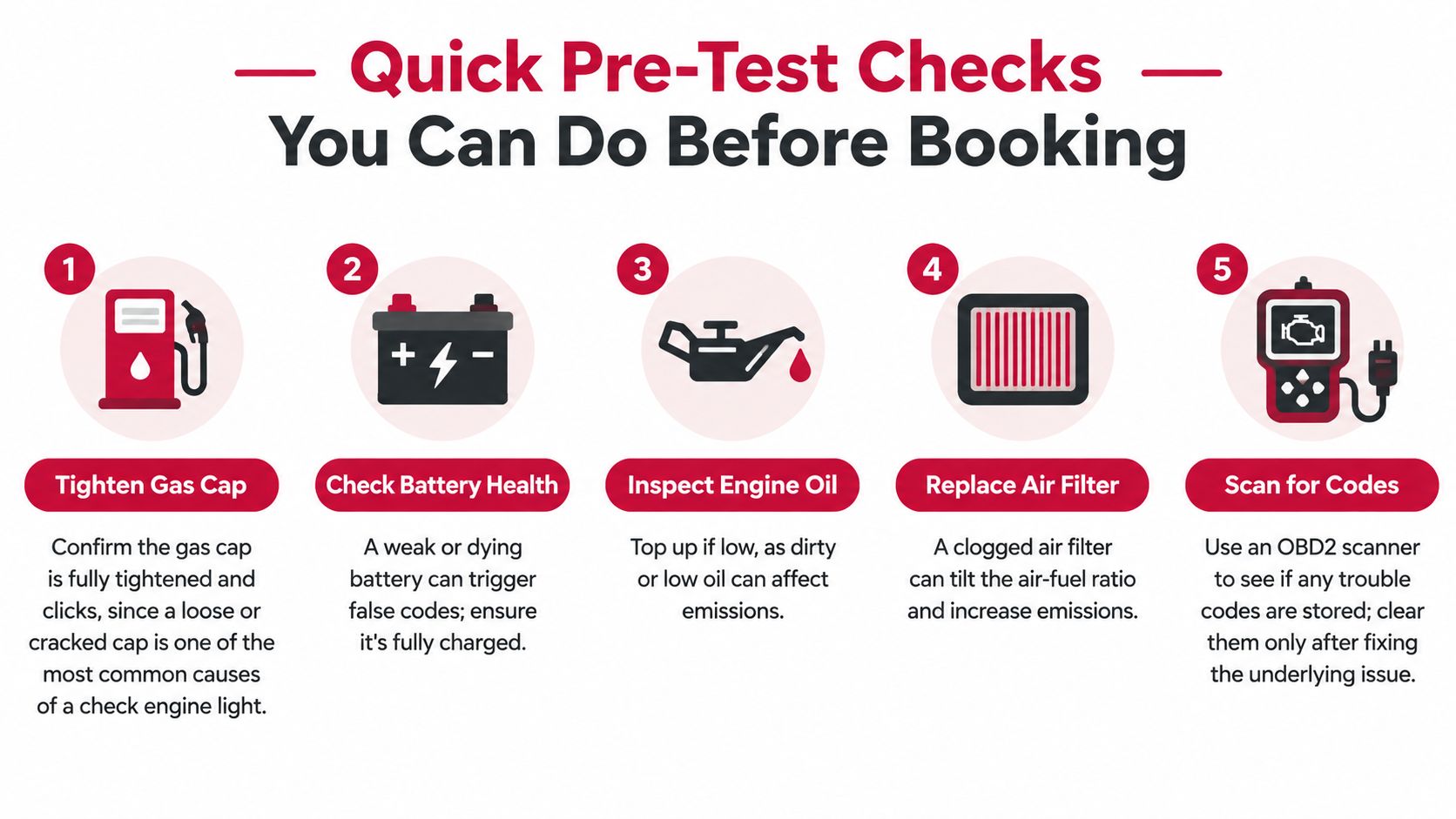
A few checks at home can keep you from paying for an inspection your vehicle was never ready to pass. Start with the gas cap. Remove it, inspect the seal for visible damage, reinstall it, and tighten it until it clicks. A loose or damaged cap can trigger an evaporative-emissions fault, and it's one of the easiest possibilities to rule out.
Then review what happened before the warning appeared. If the battery was disconnected or a code was cleared, the vehicle needs normal driving so its emissions monitors can rerun. A mixture of stop-and-go and highway driving gives the system varied operating conditions, but the manufacturer's drive-cycle instructions may be necessary for monitors that are difficult to set.
Use the dashboard and scanner together
Before starting the engine, look at the instrument cluster. Confirm that the MIL illuminates during the key-on check and then turns off after startup. A dim, intermittent, or missing lamp isn't something to ignore, because the inspection checks the lamp's commanded behavior.
If you have access to an inexpensive OBD-II scanner, read the stored codes and monitor status without erasing anything. You want the scanner to show no active MIL command and the applicable monitors in a ready state. A parts store scan can identify a code, but it usually isn't a full diagnosis.
What not to do
Don't clear the codes just before the appointment. The light may disappear, but the monitors can revert to not ready, creating a different reason for failure. If the MIL returns after you've driven normally, stop treating the problem as a cosmetic dashboard issue and arrange proper diagnostics.
Temporary Fixes Versus Professional Diagnostics
The shortcuts are familiar. Someone disconnects the battery, erases codes with a reader, installs a sensor borrowed from another vehicle, or pours in an additive advertised as an emissions fix. These actions may change what the dashboard shows, but they don't establish that the failed emissions component works.
A professional diagnostic process starts with the code and the conditions under which it appeared. A technician reviews freeze-frame information, tests the system with a capable scan tool, checks wiring and connectors, and isolates the actual cause. Depending on the fault, the repair could involve an oxygen sensor, catalytic converter, ignition component, fuel-control problem, or an EVAP leak.
Compare the choices honestly
| Approach | Typical Cost | Time | Smog Test Outcome Risk |
|---|---|---|---|
| Clear codes or disconnect the battery | Tool or battery-service cost may apply | Immediate dashboard change | High, because monitors can become not ready and the fault may return |
| Replace a part based only on a code | Varies by component and vehicle | Repair time plus monitor drive time | High if the code identifies a system rather than the failed part |
| Use an additive product | Product purchase and application time | Short-term | High, because it doesn't verify the underlying repair |
| Professional diagnosis and repair | Depends on the fault and labor required | Diagnosis, repair, then monitor completion | Lower, because the cause is tested and the vehicle can verify the repair |
Use a code reader as a screening tool, not as permission to erase the evidence. If the light returns, the vehicle runs roughly, or a monitor stays incomplete, pay for diagnosis before paying for another inspection. The common reasons for a smog failure can help you understand the report, but they can't replace vehicle-specific testing.
Fire House Smog operates as a test-only station, so it performs the inspection rather than selling in-house repairs. That separation can be useful when you want an inspection result and a clear failure report before choosing where to repair the vehicle.
Retest Options and Fire House Smog Policies
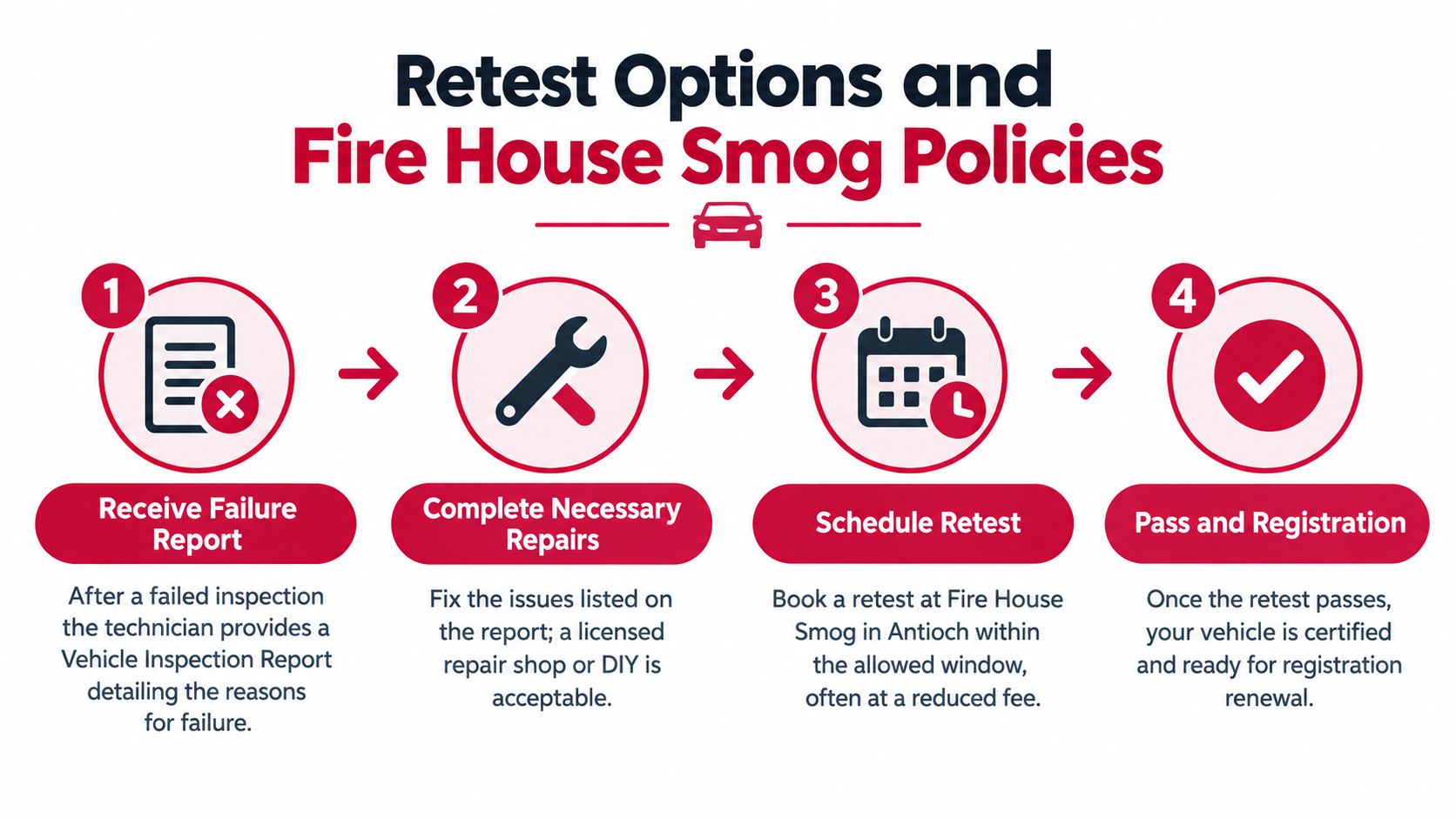
A failed inspection isn't the end of the registration process, but it is a document-driven process from that point forward. The technician provides a Vehicle Inspection Report, or VIR, showing the items that caused the failure. Read that report before authorizing repairs, because the listed failure may concern MIL status, readiness, trouble codes, or another inspection requirement.
The repair location depends on the vehicle's inspection category and the instructions on the report. Some vehicles may need a state-registered repair facility, and STAR, directed-repair, gross-polluter, or hardship situations can involve additional requirements. Don't assume any repair shop can handle every category.
Follow this order after a failure
- Keep the paperwork. Save the VIR and any printed diagnostic information.
- Repair the listed condition. Give the technician the exact failure details, not just “the car needs smog.”
- Allow verification time. After repairs, the vehicle must complete applicable self-tests and return to a ready state.
- Ask about retest eligibility. Fire House Smog's Antioch station offers a free or discounted retest within its defined policy window when the original inspection and qualifying repair work are completed at the same location, subject to site terms and coupon conditions.
- Bring documentation back. Take the prior VIR, repair invoices, identification, and any documents specified by the station.
Call before returning. The station can confirm whether your vehicle qualifies for the applicable retest policy, what repair documentation is needed, and whether a directed or STAR-related requirement changes the process. That short call is more useful than driving back with incomplete paperwork.
The retest still evaluates the vehicle under California's inspection rules. A free or reduced retest doesn't waive the MIL requirement or readiness requirements. It only reduces the cost and inconvenience when the vehicle and documentation meet the station's policy.
For a fuller explanation of the next steps, review what happens after a failed smog test. Repair first, verify the monitors, then schedule the return inspection.
Your Pre-Smog Checklist Before You Drive In
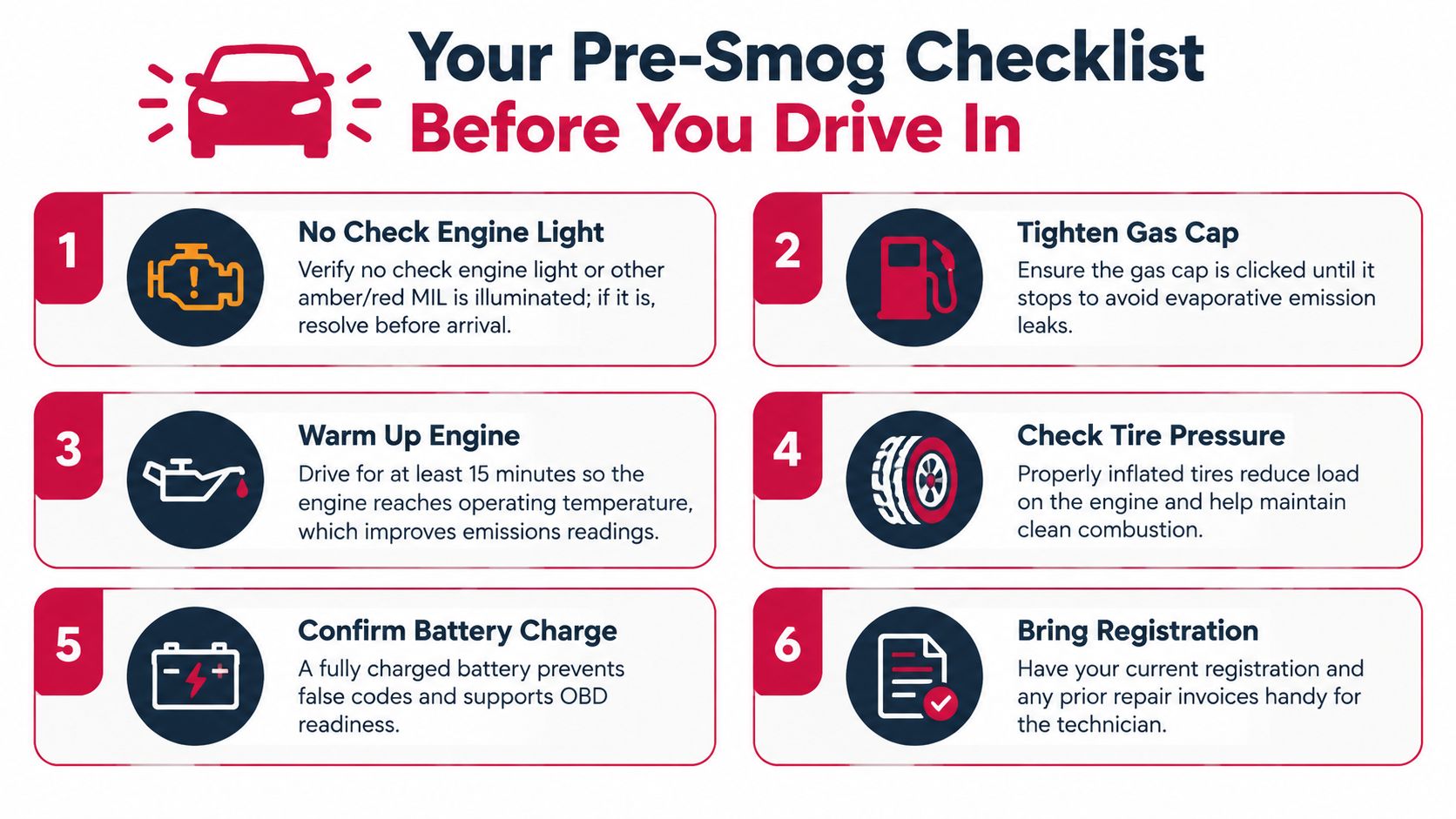
The final check should happen before you leave home, not after the technician connects the OBD equipment. Look at the dashboard with the key on and the engine off, start the vehicle, and confirm the MIL follows the normal sequence. If it stays on, stop there and arrange diagnosis.
Confirm that the battery hasn't recently been disconnected and that no one has erased codes since the last repair. A battery event can reset monitor status, so a dark dashboard light doesn't automatically mean the vehicle is ready for certification.
Run through these final decisions
- Dashboard warning light: The MIL should be off after startup. An illuminated lamp needs diagnosis before testing.
- Gas cap: Tighten it securely and inspect for obvious seal damage.
- Engine warm-up: Drive for at least 15 minutes before arrival, as specified in the preparation guidance provided for this inspection context. This helps bring the engine to operating temperature, but it doesn't replace required monitor completion.
- Fuel level: Keep the tank between one-quarter and three-quarters full when possible, unless your vehicle manufacturer or repair technician gives different instructions.
- Battery condition: Make sure the battery is charged and the vehicle starts normally.
- Documents: Bring your registration, prior VIR, repair invoices, and identification when they apply.
Fire House Smog in Antioch provides STAR-certified, test-only smog inspections and handles California DMV registration services at its Lone Tree Way location. If your vehicle has failed before or recently had emissions work, call ahead to confirm retest eligibility and required paperwork before scheduling.
The practical answer to the California smog test check engine light problem is simple: don't hide the warning, fix the cause, and verify readiness before you test. That approach gives the inspection a real chance to pass and leaves you with documentation if it doesn't.
If your check engine light is on, have the vehicle diagnosed first, then bring the repaired and monitor-ready vehicle to Fire House Smog in Antioch for a STAR-certified test-only inspection. Call ahead about retest eligibility, required documents, and the station's free or discounted retest policy before you make the trip.
A STAR-certified test-only smog station is the inspection facility California directs certain drivers to for emissions certification, and because it cannot perform repairs it gives you a no-upsell path to registration compliance. If your renewal notice says STAR, or you know your vehicle has to be directed, this is the cleanest way to handle it without getting dragged into a repair counter first.
You probably opened your renewal notice in Antioch, saw unfamiliar language, and thought, “Do I need any smog station, or do I need the STAR one?” That's the question, not the technical labels. California built the system so the notice tells you what the state wants, and the station type determines whether your visit counts.
Table of Contents
- Why Your Renewal Notice Just Sent You to a STAR Station
- What STAR and Test-Only Actually Mean
- What Happens During a STAR Test-Only Smog Check
- How to Prepare Your Car Before the Inspection
- On-Site DMV Renewals and Transfers in One Stop
- Test-Only vs Test-and-Repair Stations Compared
- Policies Worth Knowing Before You Drive Over
- Common Questions Antioch Drivers Ask First
Why Your Renewal Notice Just Sent You to a STAR Station
A lot of drivers in East Contra Costa don't realize the renewal notice is the decision, not a suggestion. When the DMV says a vehicle needs a STAR station, that instruction comes out of California's smog compliance system, not from the shop down the street. The state's BAR explains that STAR is a voluntary designation for eligible stations, while the DMV uses that designation to route certain vehicles into higher-oversight inspections through the registration process. BAR STAR program overview, DMV registration renewal rules
The notice is doing more than asking for a smog test
If your notice says “Smog Certification Required at a STAR station,” that's a hard requirement. The DMV says renewal can't be finalized until smog certification is complete, even if the fees are already paid. DMV registration renewal rules That's why people get stuck, they treat the notice like paperwork when it's really a gate.
STAR routing usually shows up on vehicles the state wants checked more closely. BAR says STAR-certified test-only and test-and-repair stations must serve vehicles identified as gross polluters, and eligibility is tied to quarterly performance metrics. BAR STAR program overview In plain terms, California is trying to keep the highest-risk vehicles under tighter inspection control.
Practical rule: if the renewal notice names STAR, don't shop for the cheapest nearby station first. Shop for the station that can actually complete the requirement.
Why drivers in Antioch get tripped up
People often search for “star smog station” when they really need to know whether the notice demands STAR-only testing or just a normal smog check. BAR defines a test-only station as a station that performs Smog Checks but does not make emissions repairs, while STAR is a separate performance designation. BAR smog check basics That distinction matters because a shop can be licensed to test and still not be the right shop for a directed vehicle.
At Fire House Smog, the workflow is built around that exact problem, a driver arrives with a notice, gets the inspection done, and if the vehicle clears, the registration side can move without a second stop. Fire House Smog registration renewal help That's the part most people need when the DMV letter lands in their mailbox.
What STAR and Test-Only Actually Mean
STAR and test-only are not the same label, and mixing them up is how people waste time. STAR is about state performance standards and oversight. Test-only is about what the station is allowed to do with your car after it inspects it. The two can overlap, but they answer different questions.
STAR means higher oversight from the state
BAR says STAR certification is a designation for Smog Check test-only and test-and-repair stations that meet stricter standards. The state uses that structure to steer certain vehicles toward stations it trusts for inspection quality and directed-vehicle handling. BAR STAR program overview That's the point of STAR, not to make the visit fancier, but to make the station more accountable.
Test-only means no repair business attached
A test-only station performs the smog inspection, but it cannot do emissions repairs. That keeps the station from turning a failed inspection into a repair sale. BAR's definition is simple, and it matters because it removes the built-in upsell pressure that comes with a repair bay. BAR smog check basics
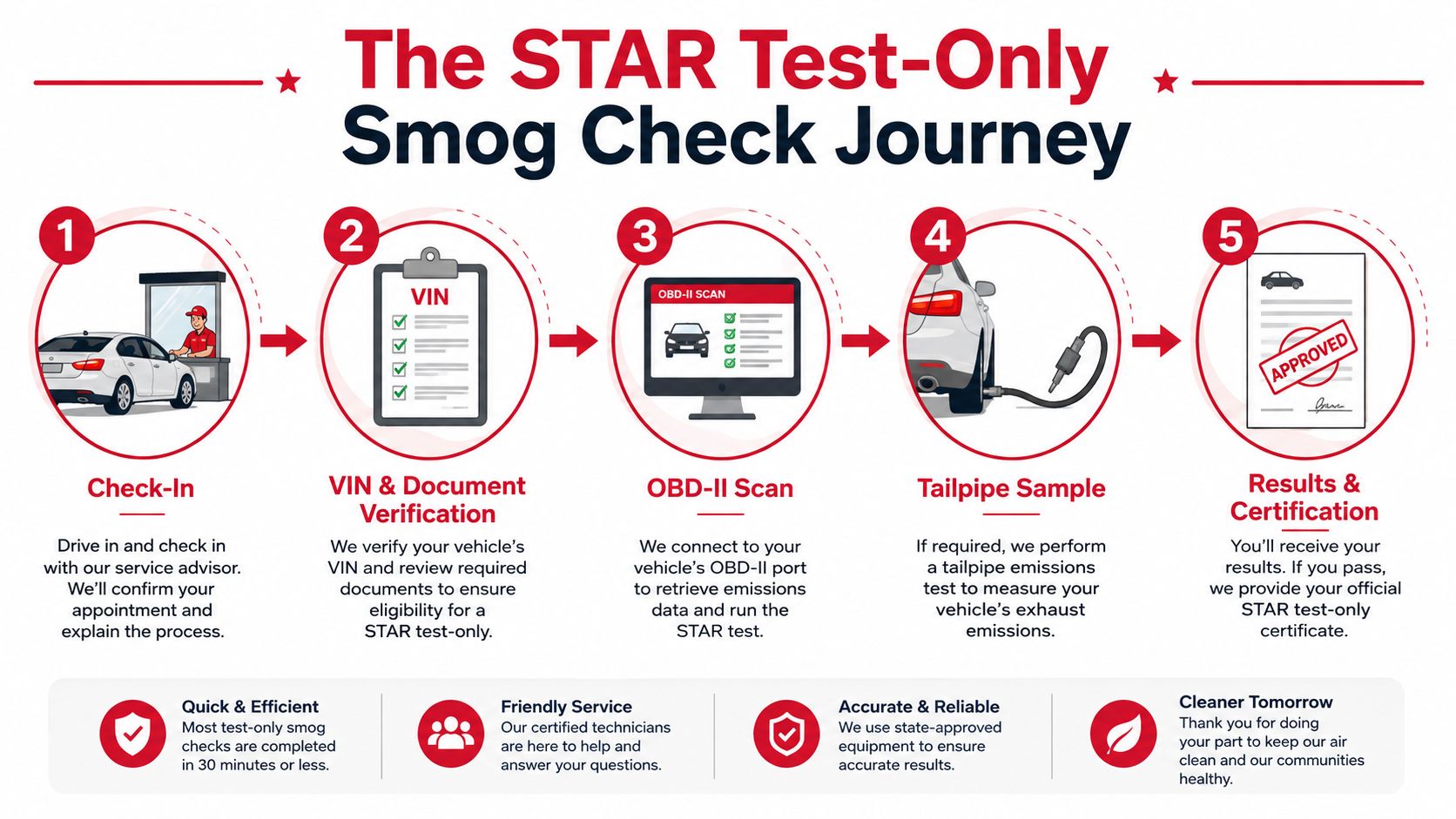
Why the combination matters
When you put the two together, you get the setup California uses for directed vehicles and gross polluters. BAR says STAR-certified test-only and test-and-repair stations must serve previously identified gross polluters, and the DMV says some vehicles are specifically directed to STAR stations on the renewal notice. BAR STAR program overview, DMV smog inspection rules That combination is why a STAR test-only smog station is often the right answer when you don't need repair help, you just need the state to accept the result.
Straight talk: if your car is healthy and you only need the certificate, test-only is usually the cleaner route. If the car needs diagnosis and repair under one roof, that's a different conversation.
The video below gives a quick visual on how the process flows from check-in to certification.
What Happens During a STAR Test-Only Smog Check
A STAR test-only visit is not complicated, but it is exact. The technician checks the vehicle, runs the required inspection steps, and records the result for the DMV system. If the car passes, the paper trail moves. If it fails, the report tells you what needs attention.
The inspection starts with identity, not the tailpipe
The first thing the station does is match the vehicle to the paperwork. That means VIN, registration, and the renewal notice if the DMV directed the vehicle to STAR. BAR also says the station scans the renewal notice barcode so the correct vehicle information gets sent to DMV, and the driver gets a Vehicle Inspection Report for records. DMV renewal rules
After that, the inspection moves into the visual and functional checks. That includes looking at emissions-related equipment and confirming the vehicle still has the parts it's supposed to have. If the equipment isn't there, or if the check engine light is on, the visit usually stops being a routine pass and becomes a compliance issue.
The scan and emissions portions do the heavy lifting
For OBD-II vehicles, the technician plugs into the onboard diagnostics system and checks readiness status and stored trouble codes. For applicable model years, BAR-97 equipment can also run the tailpipe portion of the test, including the appropriate idle procedure. The station is not guessing, it's reading the vehicle's own emissions data and comparing it to the state's rules.
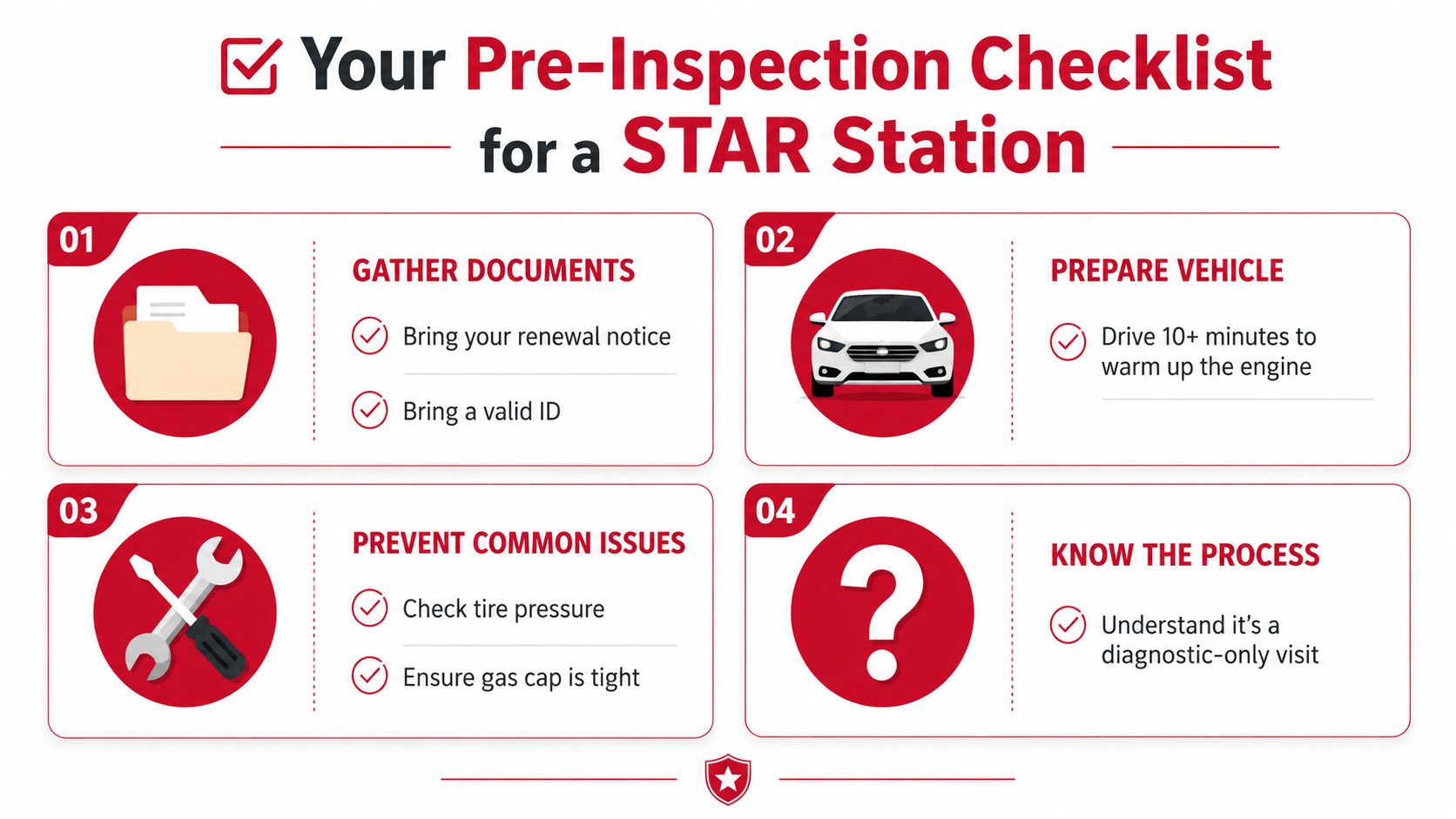
What you get at the end
If the vehicle passes, the result is submitted electronically and the DMV registration file updates from there. That's why the renewal notice matters so much, the inspection isn't just a receipt, it's a compliance event tied directly to your registration. DMV registration renewal rules
If the vehicle fails, the report is still useful. It tells you what the station saw, and because the station is test-only, you're not being pushed into a repair estimate at the same counter. That's the advantage of the model.
How to Prepare Your Car Before the Inspection
A lot of failures are preventable, and most of the preventable ones show up before the machine ever starts. Bring the right documents, show up with a warm car, and don't roll in with obvious warning-light problems hoping they'll be ignored. They won't be.
Bring the paperwork the station actually needs
At minimum, bring the DMV renewal notice and a valid ID. If you're doing a renewal that needs sticker printing or a transfer, have the registration card and whatever ownership paperwork applies to the transaction. The station needs the right record to match your inspection to the right DMV file, and BAR says the barcode on the renewal notice is part of that process. DMV renewal rules
Warm the car up before you arrive
Drive the vehicle long enough to bring the engine up to normal operating temperature. A cold engine can give you a misleading test result, and readiness monitors often look better once the car has been driven normally. If the battery was recently disconnected, the monitors may not be ready at all, which is a common reason drivers get blindsided. For monitor basics, see the OBD readiness guide at Fire House Smog's readiness monitor page.
Don't ignore obvious mechanical shortcuts
Check the gas cap, look at the dashboard lights, and make sure the fuel tank isn't running near empty. A loose cap or a glowing check engine light is the kind of problem that turns a simple visit into a failed visit. If the vehicle doesn't pass, the VIR tells you what happened so you can go fix the right thing instead of guessing.
Bring the car in ready, not hopeful. Hope doesn't pass a smog test, preparation does.
On-Site DMV Renewals and Transfers in One Stop
A smog station becomes a real time-saver when it can finish the DMV side too. That's the difference between one productive stop and a smog receipt sitting on your passenger seat while you line up somewhere else later. For drivers in Antioch, that matters because the right visit can solve both the inspection and the registration problem in one move. DMV registration services near me
The same visit can handle more than a renewal
If the smog check clears, a renewal can move straight into sticker printing when the station offers on-site DMV service. The same kind of setup can also handle in-state ownership transfers and out-of-state vehicles brought into California, as long as the paperwork is in order and any required VIN verification is completed. That's useful when you're trying to get a car legal without bouncing between offices.
In-person still makes sense in the cases that cause the most friction
Online renewal is fine until it isn't. Lapsed registration, address changes that weren't updated, title situations that need a human review, and certain transfer cases can all force an in-person stop. If a hold is attached to the record, a counter with DMV processing capability is usually the faster path than trying to force it through a website that can't solve the exception.
At Fire House Smog on Lone Tree Way, the flow is built to be practical, smog test first, VIR upload next, then the DMV transaction if the vehicle passes. That sequence keeps the renewal from becoming a separate errand later. The station also posts DMV service hours separately from smog hours, so you should check them before you drive over.
Test-Only vs Test-and-Repair Stations Compared
People ask this like it's a technical debate, but the driver-side answer is simple. You either want inspection only, or you want inspection plus repair options in the same business. The right choice depends on whether your car needs a clean certificate or actual mechanical work.
| Factor | Test-Only Station | Test-and-Repair Station |
|---|---|---|
| Main purpose | Inspects and certifies | Inspects and can repair |
| Repair sales pressure | None, because repairs aren't allowed | Present, because repairs are part of the business model |
| Best for | Drivers who want a fast certificate | Drivers who expect diagnostics or follow-up work |
| STAR fit | STAR exists here and matters for directed vehicles | STAR also exists here for qualified stations |
| Visit style | Clean handoff, straight test | Possible test, diagnosis, repair, retest sequence |
The real-world difference is pressure
A test-and-repair shop can inspect your car and then quote repairs if it fails. That isn't automatically bad, but it does change the incentive structure. A test-only station is barred from doing the repair job, so the inspection stands on its own.
For a driver whose vehicle is running well, that's exactly what you want. No service writer, no repair estimate ballooning after the test, no pressure to keep the car there all afternoon. If the vehicle needs wrench work, then a repair shop earns its place. If it just needs proof of compliance, test-only is cleaner.
My advice: choose repair when the car needs repair. Choose test-only when the car just needs the certificate.
Policies Worth Knowing Before You Drive Over
Small policy details matter more than people expect, especially if you're trying to finish this in one stop. If you show up with the wrong vehicle type, the wrong documents, or the wrong expectation about hours, you burn the whole trip. The fix is easy, check the rules before you leave.
What to ask about before you pull out of the driveway
- Vehicle fit: Ask whether your car, truck, RV, or motorhome fits the station's equipment and bay limits.
- Retest policy: Confirm whether a free retest applies if the vehicle fails and comes back within the allowed window.
- Payment: Bring whatever the station accepts for both smog and DMV processing, because the smog charge and DMV transaction can be separate.
- Renewal notice: Bring the notice if you want sticker printing or directed STAR processing, since the barcode matters.
- Transfer paperwork: Bring title and identity documents for ownership transfers, especially if the car came from out of state.
Timing is part of the policy too
Fire House Smog runs two bays, which helps control wait times, but month-end crunch still happens. The smart move is to check posted hours before you go, especially if you need both the smog and DMV counter on the same visit. Smog testing runs seven days a week, while DMV service hours are posted separately, so don't assume the same window applies to both.
If you're handling a directed STAR test, a voluntary test, or a transfer with extra paperwork, plan to arrive when both services are staffed. That's how you avoid making a second trip for something that could have been finished the first time.
Common Questions Antioch Drivers Ask First
Most first-time visitors want the same few answers before they leave the driveway. They're not asking for theory, they're asking what to bring, where to go, and whether the day is going to turn into a mess. Fair questions.
How do I know if STAR is required
Read the DMV renewal notice. If it says STAR station or indicates a directed inspection, that's the instruction you follow. If the notice doesn't say that, a regular licensed smog station may be enough, but the notice always wins over assumptions.
What should I bring for a renewal versus a transfer
For a renewal, bring the notice and ID. For a transfer, bring the title paperwork, ID, and anything tied to the transaction itself, plus the vehicle if VIN verification is needed. If the car is out of state, don't guess, bring the full packet and let the counter tell you what's missing.
What happens if the vehicle fails
You get the Vehicle Inspection Report, and that report becomes the roadmap. Because the station is test-only, the failed result doesn't turn into a repair pitch at the same desk. You take the car, fix the issue elsewhere, and come back under the retest policy if the station offers one.
Do newer vehicles still need smog checks
California's requirements depend on the vehicle and transaction type, not just the age on the odometer. If you're dealing with a renewal or a transfer, don't assume a newer car is automatically exempt. Check the notice, then ask the station or the DMV counter if anything looks unclear.
Is there a difference between a STAR test-only shop and a STAR test-and-repair shop
Yes. Both can be STAR-qualified, but one can't repair your car and the other can. If you only need certification, test-only keeps the visit focused. If you need diagnosis and repair, a test-and-repair shop may fit better.
What if I still have questions
Use the on-site DMV staff for case-specific problems. Generic advice only goes so far when the record has a flag, the title is unusual, or the registration status is messy. That's where a live counter beats internet guessing.
If you need a STAR-certified test-only smog check in Antioch, Fire House Smog handles the inspection without repair pressure and can also process DMV registration work on-site when your paperwork is ready. If your renewal notice is already telling you where to go, visit Fire House Smog and take care of the smog test and the registration stop in one trip.
You're at a two-bay test-only station on a Wednesday afternoon. One vehicle is already on the dynamometer, another is idling outside with its check-engine light glowing, and a third driver is staring at a phone, deciding whether to wait or leave. Everyone has the same question: will this quick STAR smog visit take about twenty minutes, or will it consume the afternoon?
The test itself can be short. The line isn't always short. Vehicle condition, readiness monitors, paperwork, bay availability, staffing, and the cars ahead of you determine how quickly you leave. California's Smog Check program is large and active, with 11,275,981 initial tests and 12,200,718 total tests recorded in 2025, while the initial failure rate was 8.51% and the overall failure rate was 9.04% according to the California Smog Check executive summary.
A quick visit is therefore a workflow outcome, not a promise printed on a sign. The practical questions are simple: does the station have a process that keeps bays moving, and have you brought in a vehicle that can complete the inspection?
Table of Contents
- The 20-Minute Question Every Driver Asks
- What STAR Certification and Test-Only Really Mean
- How a Test-Only Station Moves Cars Through Fast
- Documents, Prep, and the Actual Test Sequence
- Realistic Turnaround Times by Scenario
- Hours, Fees, Coupons, and the Free Retest Rule
- Practical Tips to Cut Your Wait
- Deciding Whether a Quick STAR Visit Is Right for You
The 20-Minute Question Every Driver Asks
At 2:15 on a normal weekday, a two-bay station can look busy without being backed up. One technician may be finishing a dynamometer test while another checks paperwork and connects an OBD scanner. A car outside with a warning light can change the rhythm immediately, because the technician may need to stop the normal sequence and explain that the vehicle isn't ready to pass.
That's why drivers confuse test time with wait time. A clean, prepared vehicle can move through the inspection promptly, but your total visit depends on what arrived before you. One bay may be occupied by a vehicle that needs a tailpipe procedure, while the other is handling a visual inspection, payment, and certificate paperwork. If the station has fewer technicians than open bays, the extra space won't help much.
Practical rule: Ask, “How many cars are ahead of me, and are both bays running?” That answer is more useful than a generic promise that the test is fast.
The best stations engineer speed around repeatable handoffs. They review the customer's paperwork before pulling the vehicle in, screen for warning lights and readiness problems, and keep repair discussions out of the testing lane. You control some of that outcome by arriving prepared. The station controls the rest through its certification standards, bay layout, staffing, equipment, and retest policy.
The central point is straightforward. Quick STAR smog service means fewer avoidable interruptions, not a relaxed inspection. California's STAR framework measures station performance, and the Bureau of Automotive Repair's STAR FAQ explains that short-term measures are updated monthly, pass/fail decisions are made quarterly, and the Follow-up Pass Rate is updated twice a year, in January and July.
What STAR Certification and Test-Only Really Mean
STAR certification is a performance designation from California's Bureau of Automotive Repair. It applies to stations that meet controlled performance standards, including similar-vehicle failure rates, gear-shift incidents, and excessive test deviations. The BAR STAR program requirements specify a Similar Vehicle Failure Rate of at least half the industry-wide failure rate for similar vehicles, a Gear Shift Incident rate no higher than 2%, and an Excessive Test Deviation Rate of no more than 1.
Those standards explain why a DMV notice may direct you to a STAR station. In 2025, STAR-certified stations represented 49% of licensed stations but performed 83% of all Smog Check tests, according to the 2026 Smog Check Performance Report information published by BAR. That concentration makes STAR a defined quality-control program, not a casual label for any shop that offers emissions testing.
Use a test-only station when repairs should stay out of the inspection
A STAR station can be test-only or test-and-repair. Test-only means the business performs the inspection but does not sell or perform the emissions repairs identified during it. That separation keeps the testing decision apart from the repair sale.
A test-only station may be appropriate or required for directed testing, including vehicles identified through DMV notices, certain gross-polluter procedures, and some ownership or registration situations. Check your renewal notice before booking. If it directs you to STAR, choose a STAR station rather than assuming any smog check will satisfy the requirement.
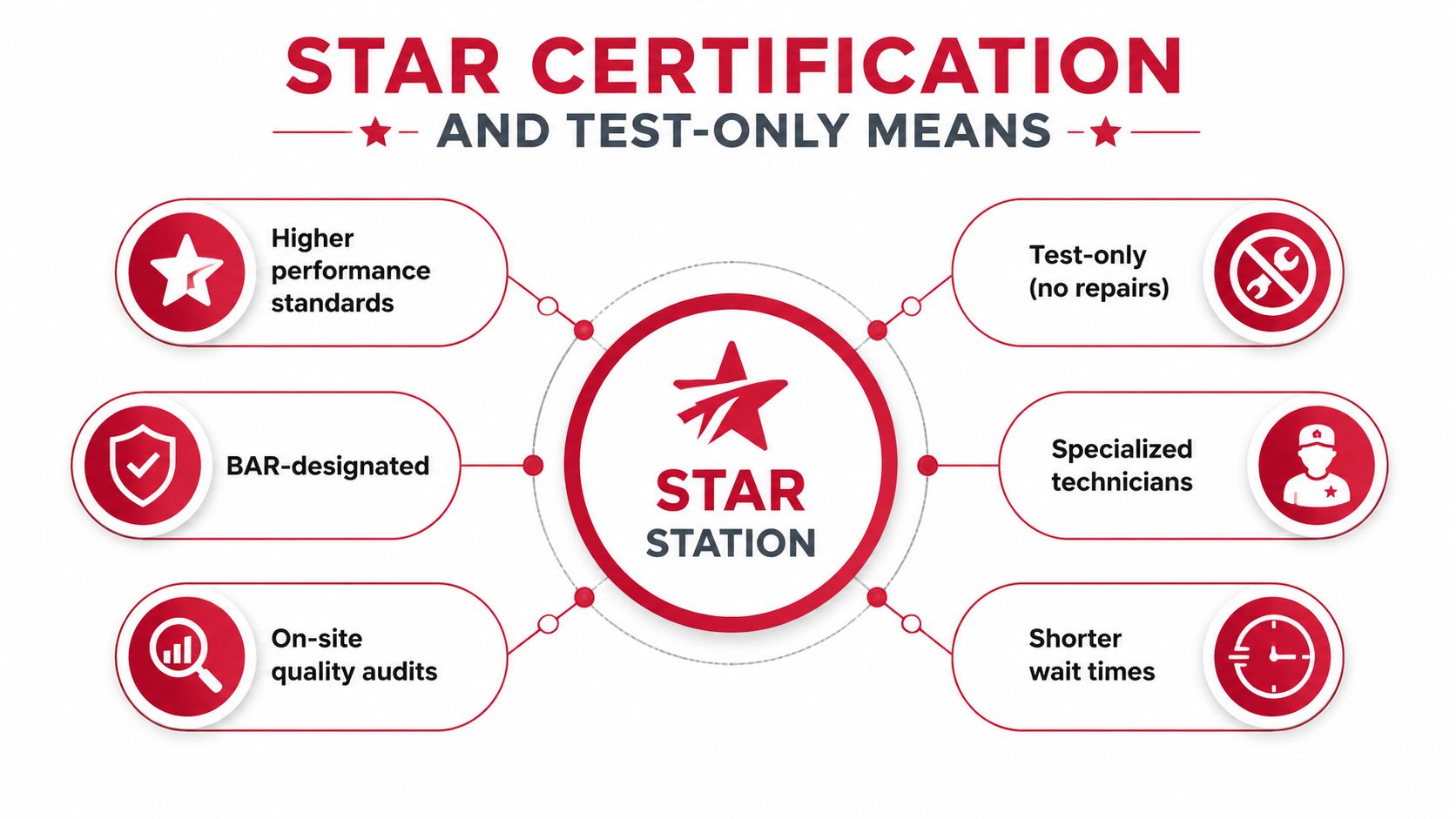
Test-only does not mean the inspection uses a tougher standard. The station follows California's approved procedure, including the applicable visual, OBD, dynamometer, or tailpipe elements. It also cannot issue a repair waiver or sell the repair needed after a failure.
For a plain-language explanation, read this guide to what STAR-certified smog means. The practical takeaway is simple: confirm the notice requirement, select the correct station type, and bring the vehicle in ready for the approved test.
How a Test-Only Station Moves Cars Through Fast
A fast station treats each vehicle as a sequence of handoffs. It doesn't let every appointment turn into an open-ended diagnosis. The technician confirms eligibility, checks the vehicle for obvious test blockers, connects the equipment, completes the required inspection, and prints the result.
At a two-bay station, the layout matters. One bay may handle an OBD-focused inspection while the other handles a dynamometer procedure. When the staff is coordinated, one vehicle can be leaving as another enters. When only one technician is working, both bays may exist but only one can move.
The station controls the process
A station's operational levers include:
- Bay assignment: Staff can send each vehicle to the appropriate equipment instead of creating unnecessary shuffling.
- Pre-screening: A quick check for a warning light, readiness issue, leaking fluids, or obvious modifications prevents wasted bay time.
- Paperwork preparation: Pulling registration details together before the inspection keeps the certificate and payment steps from becoming a bottleneck.
- Standardized testing: A defined sequence prevents technicians from wandering into repair diagnostics that a test-only facility isn't there to perform.
You control the other half. Bring your renewal notice or registration, disclose recent battery work or cleared codes, and don't arrive with a dashboard warning light you hope the technician won't notice. The technician will inspect the vehicle as presented, not as you wish it were presented.
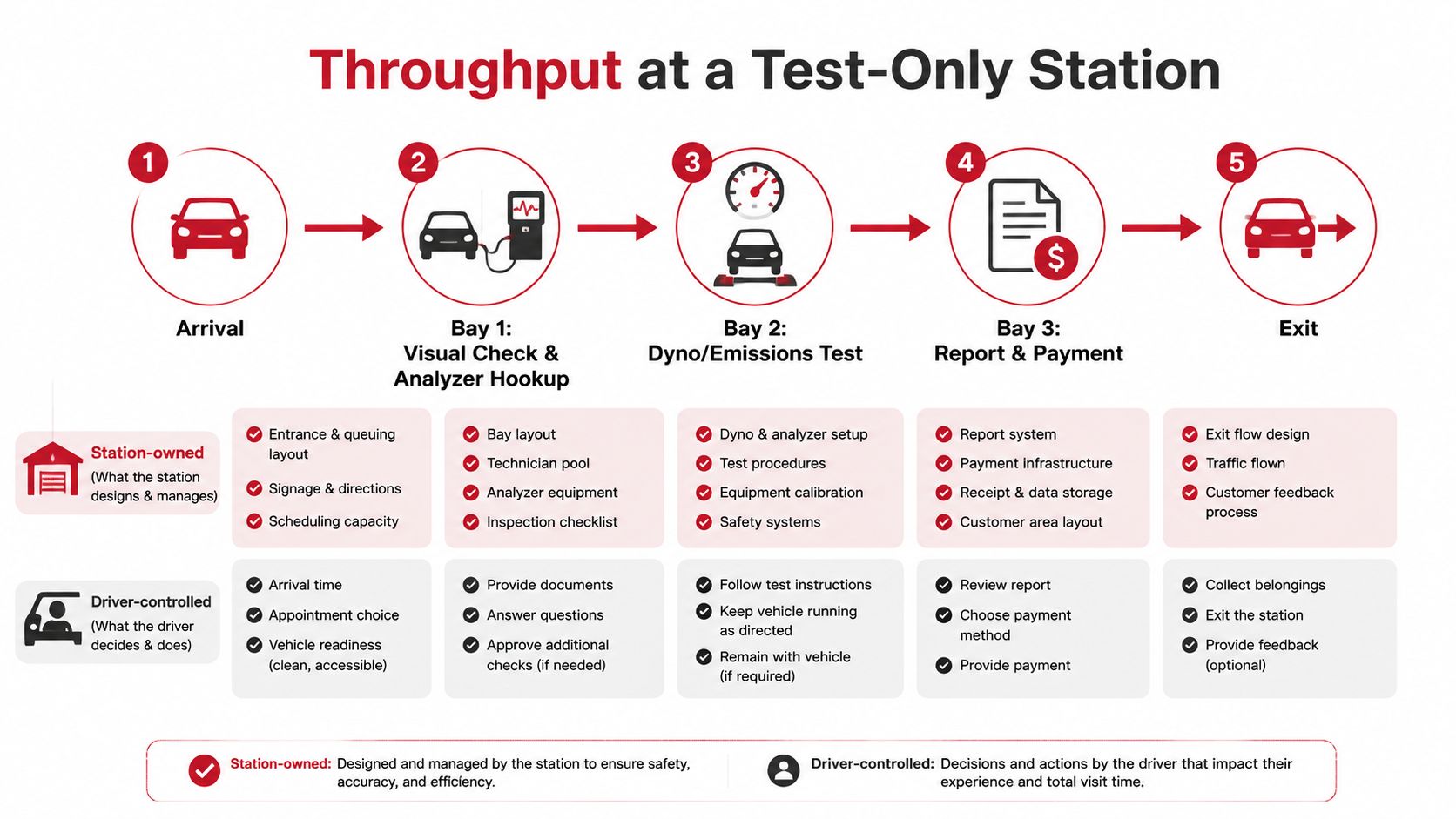
The biggest bottleneck is often readiness, not the analyzer. If a vehicle's monitors aren't complete, the inspection may stop before the emissions portion can produce a valid result. California's OBD readiness regulation update says that, effective October 1, 2025, all readiness monitors must be set to pass. A station can be efficient, but it can't manufacture a completed drive cycle in the bay.
Documents, Prep, and the Actual Test Sequence
Bring the documents that let the technician identify the vehicle and complete the transaction without interruption. Your preparation folder should contain:
- Renewal notice or registration: The notice tells the technician what DMV event you're handling and whether STAR certification is specified.
- Last smog certificate, if available: It can help clarify recent testing history, though the station can determine the current inspection requirements.
- Payment method: Ask about accepted payment types and the total before the vehicle enters the bay.
The technician's pre-screening conversation is short, but answer it accurately. Mention a recent battery disconnect, cleared diagnostic codes, a repair that involved the engine computer, or a vehicle that has been sitting for an extended period. Those details can point to incomplete monitors even when the malfunction indicator lamp, commonly called the check-engine light, is off.
Readiness is not the same as a warning light
The malfunction indicator light tells you that the vehicle's onboard diagnostic system has detected a qualifying fault. Readiness monitors tell the technician whether the vehicle has completed its required self-checks. A light can be off while the monitors remain incomplete, especially after the battery has been disconnected or codes have been cleared.
For 1996-and-newer spark-ignition passenger vehicles and trucks under 14,001 GVWR, California's OBD II inspection checks the malfunction indicator light, fault codes, and readiness monitors, as described by BAR's OBD inspection guidance. The technician may reject or pause the test before emissions measurement if the vehicle shows a warning light, has incomplete required monitors, presents an inaccessible diagnostic connector, or has an obvious condition that prevents safe testing.
What happens in the bay
The sequence generally follows the vehicle's model year and equipment:
- The technician confirms the vehicle information and performs the initial screening.
- The station completes the required visual inspection, including relevant emissions equipment and warning indicators.
- The technician connects the OBD II interface when the vehicle uses that procedure.
- The vehicle undergoes the applicable tailpipe or dynamometer inspection.
- The station prints the pass or fail report and submits the certificate information through the state system.
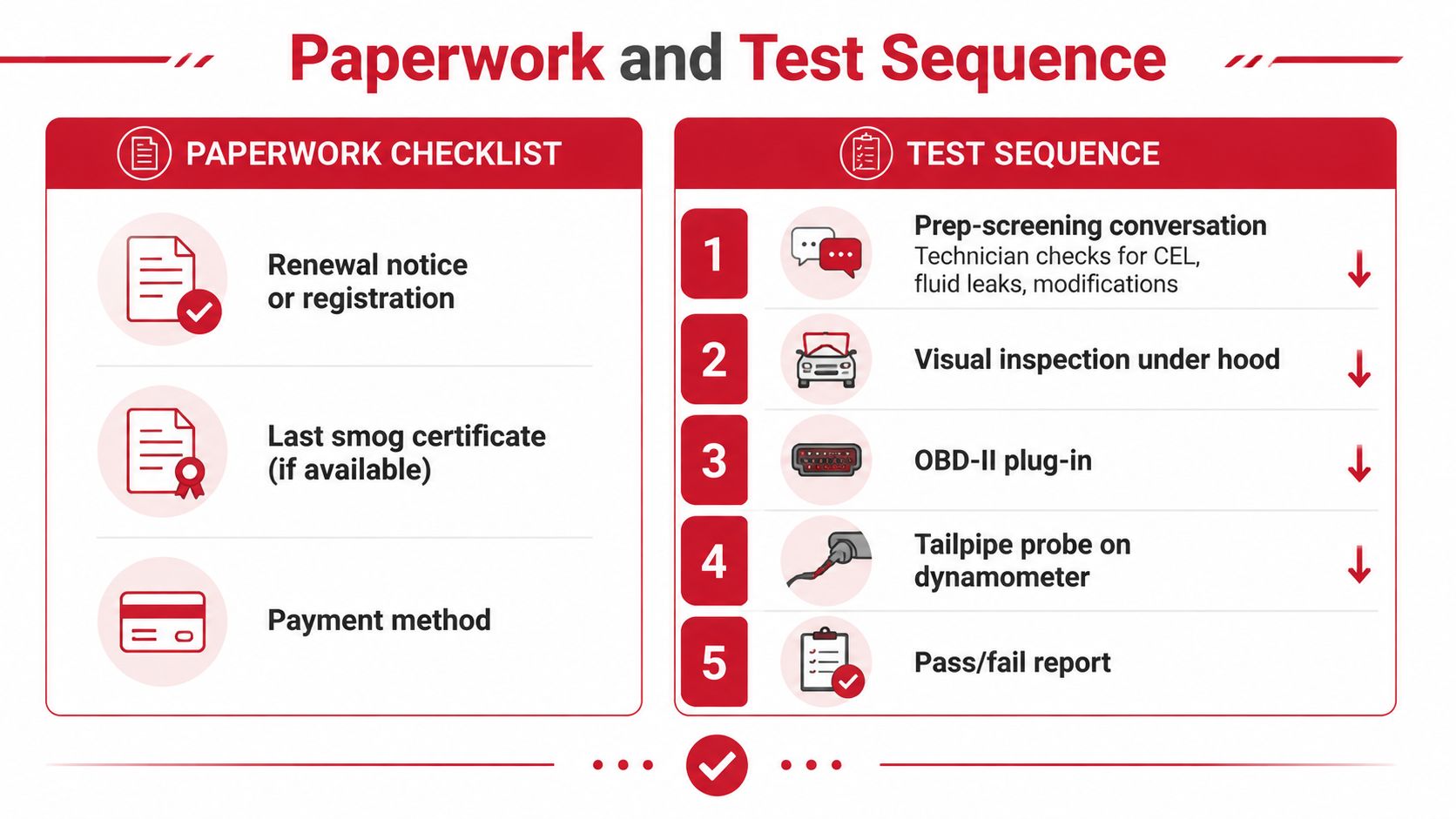
A pass completes the emissions side of the visit. A failure produces a report that identifies the reason, but a test-only station won't become your repair shop. That clear boundary is useful because it keeps the inspection focused and lets you choose where to address the problem.
Realistic Turnaround Times by Scenario
A quick visit depends on the vehicle arriving ready, the bay available, and the station's screening process. A normally driven vehicle with complete monitors can move through a routine inspection. A warning light, incomplete readiness status, or older testing procedure can stop that workflow before a certificate is issued.
Use these ranges for planning, not as promises. Queue length, vehicle type, required procedure, and the technician's initial findings determine the actual visit time.
| Vehicle Scenario | Typical Visit | Notes |
|---|---|---|
| Clean, prepared vehicle with monitors complete | About 15 to 20 minutes | Fastest path when a bay is open and paperwork is ready |
| Vehicle with an incomplete monitor | Longer than a routine visit | The technician may stop the test and explain that more driving is required |
| Vehicle with the check-engine light on | No reliable quick turnaround | A passing certificate may require repairs and completed monitors first |
| Older vehicle requiring a tailpipe and dynamometer procedure | Longer than a modern OBD-only visit | Extra equipment and emissions steps add time |
Do not plan around the shortest scenario. A station can complete a failed test quickly, yet the visit still wastes time if the vehicle was not ready. See the readiness rules discussed earlier in this article before booking.
A test-only station cannot turn a check-engine-light vehicle into a passing inspection because you are in a hurry. Get a diagnostic assessment from a repair provider, fix the cause, complete the required driving, and return for testing. The station's bay count and retest policy affect how quickly you can recover from a failure, so ask about both before you arrive.
For more detail on queues, preparation, and inspection steps, review this guide to how long a smog check takes.
Ask the station a more useful question than “Can you do it in twenty minutes?” Confirm that your vehicle is ready, ask how many cars are ahead of you, and verify whether the station has an open bay. That workflow check gives you a realistic arrival-to-departure estimate.
Hours, Fees, Coupons, and the Free Retest Rule
A fast visit starts with the station's real schedule, not a search listing. Check operating hours before leaving, then call if your vehicle has unusual equipment, a motorhome, a directed notice, or a recent failed test. Midweek mornings often produce a calmer queue than Monday, Saturday, lunch periods, or the final stretch before closing.
Ask for the full price before authorizing the test. California's mandatory state certificate fee is $8.25, and recent 2026 reporting placed the statewide average inspection cost at $68.56 before that fee, according to this California Smog Check 2026 cost and compliance update. The station may list a separate testing price, vehicle-type charge, payment fee, or convenience fee. Confirm the complete out-the-door amount.
Read the coupon terms before booking
Coupons apply under specific conditions. Check the vehicle class, service type, expiration terms, and participating station before you rely on the advertised discount. A free retest may require the original inspection to have been performed at that station, a return within the stated validity period, and the original paperwork or coupon.
Use this wording when you call:
“If my vehicle fails today, what exactly qualifies me for a free retest, how long is the offer valid, and do I have to return to the same station?”
Do not assume another shop will honor the offer. Do not assume the retest includes diagnosis or repairs. A test-only facility may waive the retest inspection under its policy while charging separately for outside repair work or another service. Ask what the policy covers before you leave after a failure.
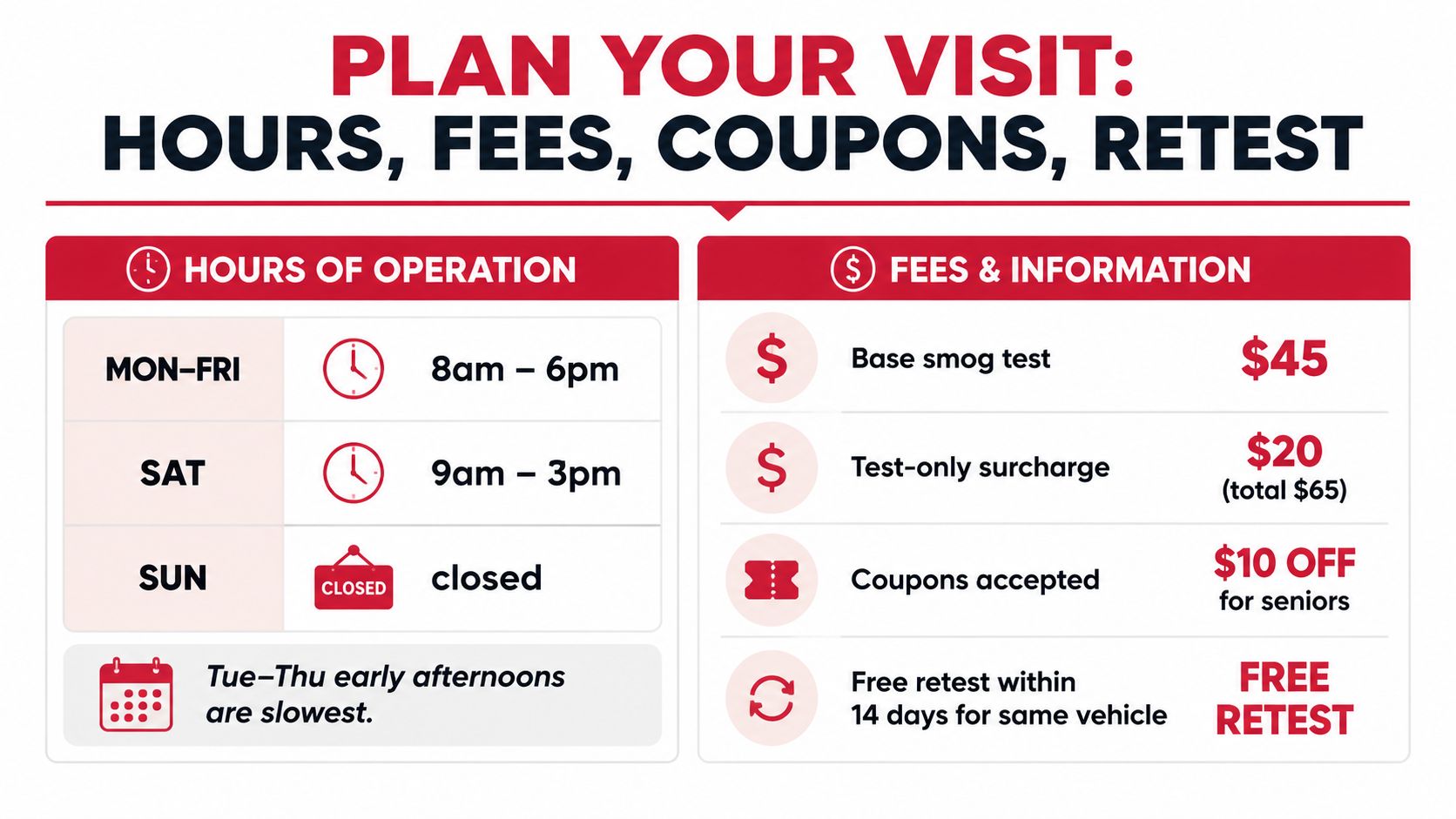
A directed STAR notice can limit your station choice even when the vehicle appears ordinary. BAR updates performance measures on different schedules, so STAR selection is not based on one permanent label. Follow the DMV direction first, then compare price, bay availability, retest terms, and whether the station can process the related registration task.
As noted earlier, California's updated readiness rule requires all monitors to pass. For coupon terms and a focused list of questions, review this guide to a STAR smog test coupon. The useful comparison is the total cost after a pass, failure, or repeat visit, not the lowest advertised entry price.
Practical Tips to Cut Your Wait
The highest-value preparation happens before you leave home. Use this order, because it separates actions that prevent a wasted trip from tricks that merely sound automotive.
Call ahead for screening. Tell the station your vehicle's model year, whether the check-engine light is on, whether the battery was recently disconnected, and whether the DMV notice says STAR. A technician can often tell you whether the visit makes sense before you spend time driving there.
Choose the right arrival window. Midweek, midmorning visits usually give you a better chance of finding an open bay than Monday or Saturday rush periods. Avoid the lunch window and the last part of the day, when unfinished vehicles and paperwork can stack up.
Verify readiness with a scan tool. If you own an OBD II reader, check monitor status before booking. If you don't, ask a qualified technician to check it. California's current readiness rule makes this more important because all readiness monitors must be set to pass under the rule effective October 1, 2025, according to the BAR explanation of the updated OBD readiness requirements.
Drive normally after repairs. A vehicle that recently had codes cleared or a battery disconnected may need a manufacturer-specific drive cycle. Don't guess at the distance or route. Follow the vehicle's service information, and don't book the smog test until the monitors show ready.
Skip the myths
Running premium fuel, adding a mystery fuel additive, or arriving with an almost empty tank isn't a substitute for proper readiness. Those habits don't repair a failed oxygen sensor, restore a missing catalyst, or complete a monitor that hasn't run. Bring the car in normal operating condition, with properly inflated tires if the vehicle will use a dynamometer, and with the diagnostic connector accessible.
Have your registration and renewal notice in one folder. Remove clutter from the cabin, make sure the technician can access the dashboard, and disclose modifications rather than hoping they go unnoticed. These details won't change a failing emissions system, but they can prevent needless handling delays.
Deciding Whether a Quick STAR Visit Is Right for You
The fastest visit starts before you enter the bay. Decide whether the car is ready or needs screening first.
Book a quick STAR smog visit when the vehicle has been driven normally, the check-engine light is off, no recent battery reset or code clearing interrupted the monitors, and your registration paperwork is ready. Follow the DMV notice, confirm the station is STAR certified, ask about the current queue, and let the technician complete the inspection. Bay availability, readiness screening, and a clear retest policy determine speed more than a “quick” label.
Prepare first if the warning light is on, the vehicle was recently repaired, the battery was disconnected, the car has been sitting, or you already know a monitor is incomplete. A paid pre-inspection or diagnostic scan can cost less than a failed testing trip followed by another appointment. A test-only station can identify the failure, but it will not sell the repair that resolves it.
California requires a Smog Check for all out-of-state 1976 model-year and newer vehicles registering in California for the first time, along with other initial registration events determined by the DMV. The January 2026 BAR report cited earlier covers those requirements. It also explains that 100% battery-electric vehicles are exempt, while hybrids and plug-in hybrids remain subject to biennial inspection. Confirm your vehicle's category before booking.
Reserve an appointment, or visit promptly after receiving the renewal notice instead of waiting until the deadline. Bring the notice, registration details, and vehicle information in one folder. If you're in Antioch or East Contra Costa County, Fire House Smog is a STAR-certified test-only station at 2900 Lone Tree Way. Ask the station to confirm readiness screening and retest eligibility before you arrive.
2900 Lone Tree Way, Antioch, CA 94509, 925-754-1600. Fire House Smog there is a STAR-certified test-only smog station and a licensed DMV registration services provider, so if you need emissions certification or registration paperwork, that's the right counter to walk up to first.
A lot of people show up on Lone Tree Way not sure whether they need a smog check, a DMV renewal, or both. If your car has been flagged for a STAR station, or you want one stop for testing plus registration work, this location fits that job better than a typical repair-heavy smog shop.
Table of Contents
- What Fire House Smog on Lone Tree Way Antioch Does
- Understanding STAR Test-Only Smog Certification
- Smog and DMV Services Available at This Station
- Hours of Operation for Smog and DMV Services
- Test-Only Versus Test-and-Repair Smog Stations
- Parking, Layout, and Driving Directions
- Wait Times, Appointments, and Throughput Tips
- Coupon Policy and Free Retest Eligibility
- RV, Oversized Vehicle, and Out-of-State Transfer Notes
- Quick Reference and Frequently Asked Questions
What Fire House Smog on Lone Tree Way Antioch Does
Fire House Smog operates from 2900 Lone Tree Way, Antioch, CA 94509, and the main line is 925-754-1600. It serves as a STAR-certified test-only smog station and a licensed DMV registration services provider. That tells you right away whether you need emissions testing, registration work, or both.
Two service tracks, one stop
The smog side handles state-compliant emissions testing for drivers who need that inspection to complete a renewal, transfer, or other DMV-related step. The DMV side helps people take care of registration tasks without waiting in a longer government line. Because this is a test-only operation, the station is set up for inspection and paperwork, not for repair sales.
That changes the experience at the front counter. You are not dealing with a shop that can pass or fail a car and then steer you into its own repair bay. You are dealing with a station that tests, documents, and processes the paperwork cleanly, which is often the simpler path for a first-time visitor who just wants the work handled correctly.
Why that matters on Lone Tree Way
The practical value here is local, not historical. Lone Tree Way carries a mix of retail, auto-service, and DMV-related traffic, so the question is whether the station can handle your vehicle and your paperwork without wasting your time.
It also helps to know that this location fits a stricter inspection path. If your paperwork calls for a STAR station, or you want to confirm whether a STAR test-only smog visit is the right fit, use the station's own guidance before you arrive. STAR test-only smog guidance
The location is built for drivers who want a direct check-in, a clean test process, and one place that can handle registration services at the same stop.
Understanding STAR Test-Only Smog Certification
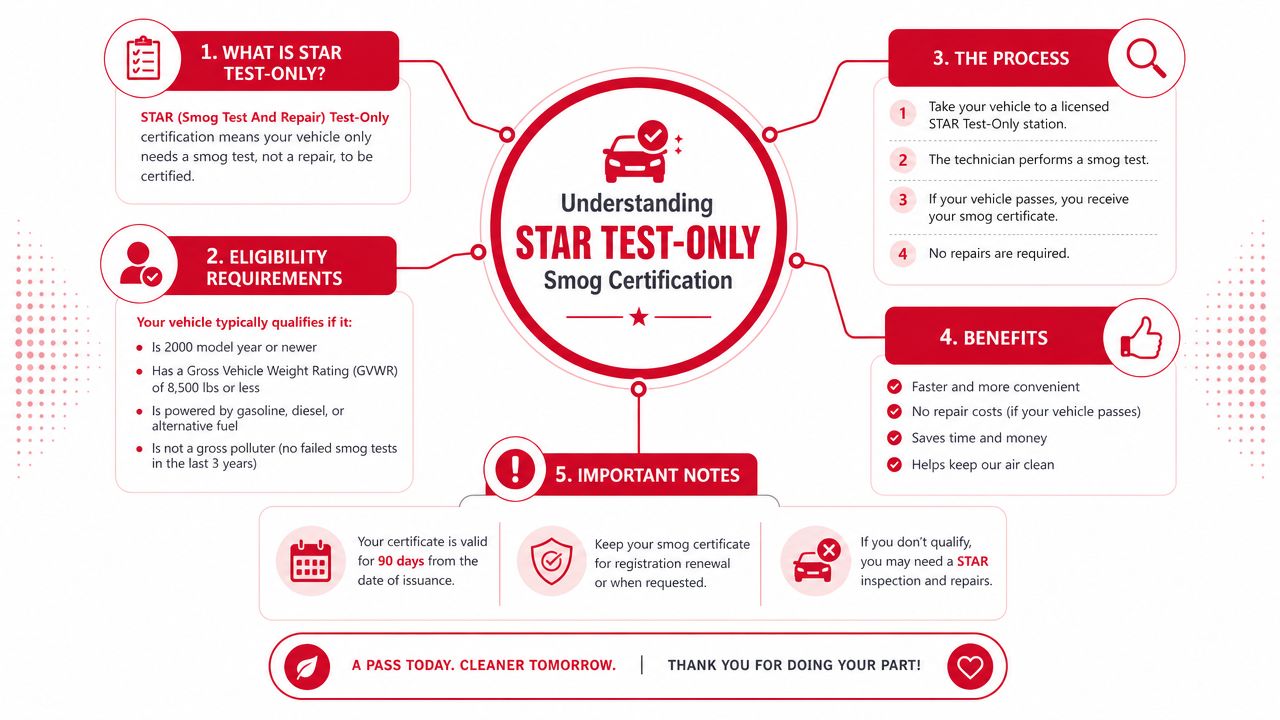
A STAR test-only station is for vehicles that need a stricter or specifically designated emissions inspection path. The key practical point is simple, the station tests your vehicle, but it does not repair it. If your vehicle is directed to a STAR station, you can't substitute a regular shop and call it the same thing.
Vehicles are commonly sent to this kind of station when the state wants a more tightly controlled emissions check. That can happen for a variety of compliance reasons, but the front-counter rule is always the same, if your paperwork says STAR, bring the car to a STAR station rather than guessing.
Practical rule: if the test is required and the vehicle has already been routed to a STAR station, don't shop for the nearest generic smog bay. Bring the exact paperwork and let the station process it the way the state expects.
The other thing drivers need to understand is the test-only part. A test-only station won't steer you into an in-house repair ticket because there isn't one to sell. That reduces the conflict of interest some people worry about when they're nervous about failing a smog test.
For drivers who want to verify they're at the right place, the station's STAR page spells out the service type directly at Fire House Smog's STAR-certified smog test page. That's the cleanest way to confirm the model before you roll in.
Smog and DMV Services Available at This Station
The service menu is straightforward once you split it into two lanes, smog and DMV. That's the easiest way to think about it at the counter, because each lane has different documents, different timing, and different reasons people get sent there.
Smog checks
This station handles passenger cars, SUVs, and light-duty trucks. It also accepts some RVs and motorhomes, but only within size and equipment limits. If you drive something larger or modified, you should call before you start the engine.
| Services at Fire House Smog on Lone Tree Way Antioch | ||
|---|---|---|
| Service Category | What It Covers | What to Bring |
| Smog testing | Passenger cars, SUVs, light-duty trucks, some RVs and motorhomes subject to size and equipment constraints | Vehicle, current registration if available, and any notice telling you to test at a STAR station |
| DMV registration renewals | On-site renewal processing with sticker printing | Valid ID and current registration |
| Ownership transfers | California vehicle transfers and out-of-state transfers | Title or transfer paperwork, valid ID, and lien information if applicable |
| Plates and tags | Plates and tags as needed during registration processing | Existing registration records and transfer documents |
DMV services
The DMV side is the part many drivers don't expect from a smog station. Here, renewals can be handled on-site, and stickers can be printed as part of the transaction. Transfers for California vehicles and out-of-state vehicles are also part of the workflow, along with plates and tags when needed.
Bring the basics. For renewals, that usually means your valid ID and current registration. For transfers, have the title or transfer documents ready, and don't show up missing lien information if a lender is still attached to the vehicle.
One useful thing about a station that does both jobs is that you can often handle the emissions test and the paperwork in the same trip. That saves you from driving across town twice, which is the primary inconvenience most drivers aim to avoid.
Hours of Operation for Smog and DMV Services
Smog testing and DMV services do not run on the same schedule, and that's where people get tripped up. If you assume the whole counter follows one timetable, you can waste a trip even when the doors are open.
Smog hours and DMV hours are separate
Smog testing runs seven days a week with extended evening and weekend availability. DMV services run Monday through Saturday from 9:30 AM to 5:00 PM and Sunday from 12:00 PM to 4:00 PM, with limited services possible on weekends.
| Service | Schedule |
|---|---|
| Smog testing | Seven days a week, extended evening and weekend hours |
| DMV services | Monday through Saturday, 9:30 AM to 5:00 PM |
| DMV services | Sunday, 12:00 PM to 4:00 PM |
| Weekend note | Limited services may be available on weekends |
The practical mistake is showing up for a DMV task during a smog-friendly hour and assuming the same counter flow applies. It doesn't. If your goal is only a test, the seven-day smog schedule gives you room. If you need registration work, you need to line up with the DMV window.
Weekday mornings are usually the cleanest time to avoid crowding. Sunday afternoon is also useful if you work Saturdays and still need a DMV counter that's open.
For most Antioch drivers, the weekend window is the one they forget. Sunday afternoon can be the most workable slot if your week is already packed and you don't want to give up a Saturday errand run.
Test-Only Versus Test-and-Repair Smog Stations
A test-only station and a test-and-repair station solve different problems. That difference sounds small until you're standing at the counter deciding whether you're there for verification or for actual mechanical work.
What test-only changes
At a test-only station, the technician checks emissions compliance and documents the result. There's no built-in repair sale waiting on the other side of the failure. That's the cleanest way to remove the financial incentive to fail a vehicle so the shop can earn the repair job.
A test-and-repair shop can diagnose and fix issues after the test. That sounds convenient, and sometimes it is, but it also means the business model is tied to repair revenue. If you already suspect your car needs work, that setup can make sense. If you just need a neutral answer on whether the vehicle passes, it may not be the right fit.
How to choose the right lane
Use a test-only station when the state has directed you there, or when you want a clean, unbiased check on a vehicle you believe is close to passing. Use a test-and-repair shop when you already know the car needs mechanical attention and you want diagnosis plus repair under one roof.
A test-only station helps when your question is, “Does it pass?” A repair shop helps when your question is, “What's broken and who's fixing it?”
That's the main trade-off. You get a cleaner testing environment, but you give up the convenience of leaving with repairs already done. For many drivers on Lone Tree Way, that trade works in their favor because they want speed, paperwork, and less pressure at the counter.
Parking, Layout, and Driving Directions
Lone Tree Way is a structured suburban arterial with active retail traffic, including a 3.22-acre retail project next to In-Shape Fitness at 4099 Lone Tree Way inside the 18-acre Antioch Town Center master-planned development. That matters because parking demand on the corridor isn't accidental, it's built into the way the area functions. Antioch Town Center project details
How to pull in without second-guessing yourself
The station sits on a stretch where quick in-and-out vehicle movement makes sense, so don't overcomplicate the approach. If you're coming from Highway 4, follow your normal Antioch retail-corridor turnoff to Lone Tree Way and stay alert for shared parking and adjacent business traffic. If you're already on Lone Tree Way, slow down early and look for the driveway rather than trying to brake at the last second.
Parking is usually easier when you arrive early in the day or later in the day, because the surrounding corridor sees regular turn-and-burn traffic from nearby services and retail stops. That's a practical effect of the area's layout, not a guess.
What first-time visitors should expect
- Turn early, not late. The lot flow is easier when you commit before the last moment.
- Keep the vehicle ready. Have your registration, ID, or transfer paperwork in hand before you park.
- Watch for shared use. Lone Tree Way businesses often rely on the same busy corridor rhythm, so don't assume the empty spot you see from the street is the only one available.
The goal is simple, arrive in a way that doesn't add stress before the inspection even starts. Once you know where to turn and when the lot is lightest, the rest of the visit moves faster.
Wait Times, Appointments, and Throughput Tips
Two things help this place move vehicles faster, two service bays and a schedule that spreads demand across the week. That doesn't make the line disappear, but it does mean the station is set up for throughput instead of lingering over a single car all afternoon.
What actually saves time
The easiest win is to call ahead on a busy Saturday, especially if you're bringing more than one vehicle or you need both smog and DMV work. The second easiest win is to bring every document before you get into the lot. Once you've parked, fishing around for missing paperwork is the fastest way to lose your place in the flow.
If you need both a smog check and a registration task, try to combine them in one visit. That's especially useful for drivers who don't want to make separate trips for a test and then a renewal. It also helps small businesses and fleet operators who need multiple vehicles processed without burning a whole workday.
Front-counter advice: if you're coming with a fleet, stack the paperwork in the same order the vehicles will be tested. That keeps the line moving and avoids backtracking between cars.
For drivers who want a rough sense of timing before they leave home, the station has a separate page that addresses how long a smog check tends to take, and it's worth reviewing before you head out: Fire House Smog's smog check timing page.
The key takeaway is not that the station promises a magic fast lane. It's that its hours and bay setup are built to reduce bottlenecks if you show up prepared.
Coupon Policy and Free Retest Eligibility
This station offers a coupon on smog tests and a free retest when required. That means you should ask about the current coupon before you pay, because pricing and eligibility matter more than guesswork at the counter.
What to confirm before the test
- Coupon acceptance. Ask whether the current smog coupon applies to your vehicle and service type.
- Retest window. Confirm the eligibility period for a free retest before you leave.
- Separate fees. DMV charges and smog charges are different transactions, so don't assume one covers the other.
A free retest only helps if the vehicle failed, then got repaired elsewhere, then came back within the required window. That's how the test-only model works in real life. The station doesn't do the repair in-house, so the retest depends on where and when the fix happened.
For the current coupon details, the station posts its policy here: Fire House Smog's smog test coupon page. Check that before you show up if you want to avoid any confusion at payment time.
If the vehicle failed once, don't assume every shop's retest policy is the same. Ask this counter how its free retest works before you hand over the keys.
That single question can save you from paying twice or coming back with the wrong paperwork.
RV, Oversized Vehicle, and Out-of-State Transfer Notes
RVs and motorhomes are where a lot of generic smog advice falls apart. This station can handle some RVs and motorhomes, but only when the size and equipment fit the bay and the inspection setup. If the vehicle is oversized, modified, or unusually tall, calling first isn't optional.
Cases that need a phone call before you drive over
- Oversized RVs and motorhomes. Bay fit and equipment limits matter.
- Lifted trucks. Clearance and inspection access can change the visit.
- Diesel vehicles. Ask before coming in if the vehicle is diesel-powered.
- Check-engine lights. Don't assume a test will clear a warning light.
- Out-of-state transfers. Extra title and registration paperwork can change the process.
Out-of-state transfers deserve special attention because the paperwork can be more involved than a California renewal. If the title, lien info, or ownership path isn't clean, the counter may need more from you before the transaction can move.
The safest habit is to call before you leave home if the vehicle isn't a standard passenger car, SUV, or light-duty truck. That one call can tell you whether the station can inspect it, whether the paperwork is ready, and whether you should handle any missing documents first.
The same advice applies to anything that looks simple but isn't. A vehicle with unusual equipment can pass through a normal day just fine, but a bay with size constraints has to work inside limits. Better to ask once than to discover the limit in the parking lot.
Quick Reference and Frequently Asked Questions
Fire House Smog
Address: 2900 Lone Tree Way, Antioch, CA 94509
Phone: 925-754-1600
What it does: STAR-certified test-only smog checks, DMV registration services, renewals, transfers, plates, tags, and some RV testing within size and equipment limits.
FAQ
Is this the right place for a STAR-directed vehicle?
Yes. If your paperwork points you to a STAR station, this is the right model for that request.
What happens if my car fails?
You'll need repairs elsewhere, then a return visit for retesting if you qualify under the station's free retest policy.
Can I do a DMV renewal and a smog check on the same trip?
Often yes, as long as you come during the correct DMV hours and bring the right documents.
Do I need to call ahead for a walk-in?
For a standard car, you can usually walk in. For RVs, oversized vehicles, or out-of-state transfers, call first.
If you need a STAR test, DMV renewal, or help sorting out a transfer on Lone Tree Way, Fire House Smog is set up for exactly that kind of stop. Visit Fire House Smog before you head over, confirm the service you need, and bring the paperwork that matches your vehicle so the visit moves as cleanly as possible.