How to Reduce Vehicle Emissions the Practical Way
You're probably staring at a renewal notice, a flickering check-engine light, or a gas receipt that looks worse than it should. If your car has to pass a smog check soon, the smartest move is not guessing, and it's not buying random parts. It's tightening up the habits and maintenance that change emissions at the tailpipe and at the test station.
Table of Contents
- Why Vehicle Emissions Matter for Everyday Drivers
- Driving Habits That Cut Emissions Right Away
- Maintenance That Lowers Emissions on the Test
- Fuel Choices and Technology Upgrades Worth Considering
- How California Smog Checks Actually Work
- Test-Only Smog Stations and Why They Matter
- Pairing Your Smog Visit With DMV Services
Why Vehicle Emissions Matter for Everyday Drivers
A lot of drivers think emissions only matter when a county or state makes a speech about climate goals. That's too abstract for a person who just wants the car to start, pass, and keep moving. Vehicle emissions affect your wallet, your time, and whether your car stays legal on the road.
Transportation is a major emissions source because it produces about 15% of global greenhouse gas emissions according to CFR. The same summary notes that transportation emissions have grown faster than any other end-use sector over the past decade, with global transportation emissions rising about 2% per year in that period. The IPCC pathway cited there calls for transportation-related emissions to fall 59% by 2050 relative to 2020 CFR summary. That's the big picture, but the driver-level lesson is more practical, less political, and a lot more immediate.
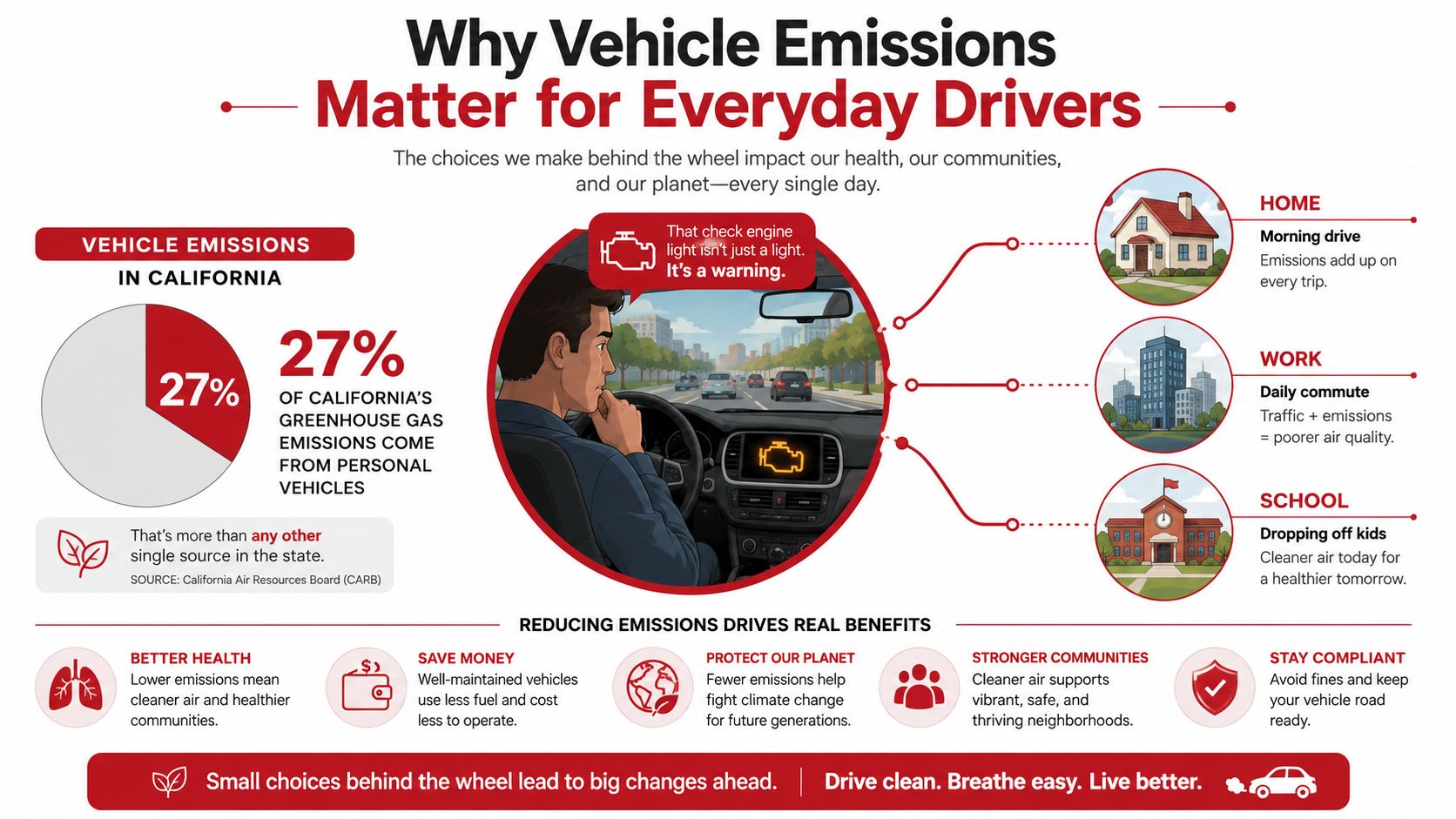
For a daily driver, emissions show up in three places. First, in fuel use, because wasted fuel is wasted money. Second, in drivability, because rough running, poor maintenance, and bad habits make a vehicle harder to live with. Third, at the smog station, where habits and condition become numbers, readiness flags, and visible failures.
The smartest mindset is this, emissions are a system. Your right foot, your maintenance schedule, and your vehicle's condition all affect what comes out of the exhaust. If you want to reduce vehicle emissions the practical way, start by fixing the things you can control today, not the things you can only argue about later.
Practical rule: If the car burns more fuel than it needs to, the exhaust story is usually worse too.
For California drivers, that's not theoretical. It ties directly into compliance, and it connects to your next inspection. If you want the state-specific side of that picture, review California emissions standards before you roll into a test.
Driving Habits That Cut Emissions Right Away
The fastest emissions cuts usually come from the driver, not the parts catalog. I've seen plenty of cars fail or barely pass because the owner drove it like a taxi in a hurry, then expected a fresh sticker to fix the damage. That's backwards. Smooth, sensible driving lowers emissions immediately.
Stop treating every green light like a drag race
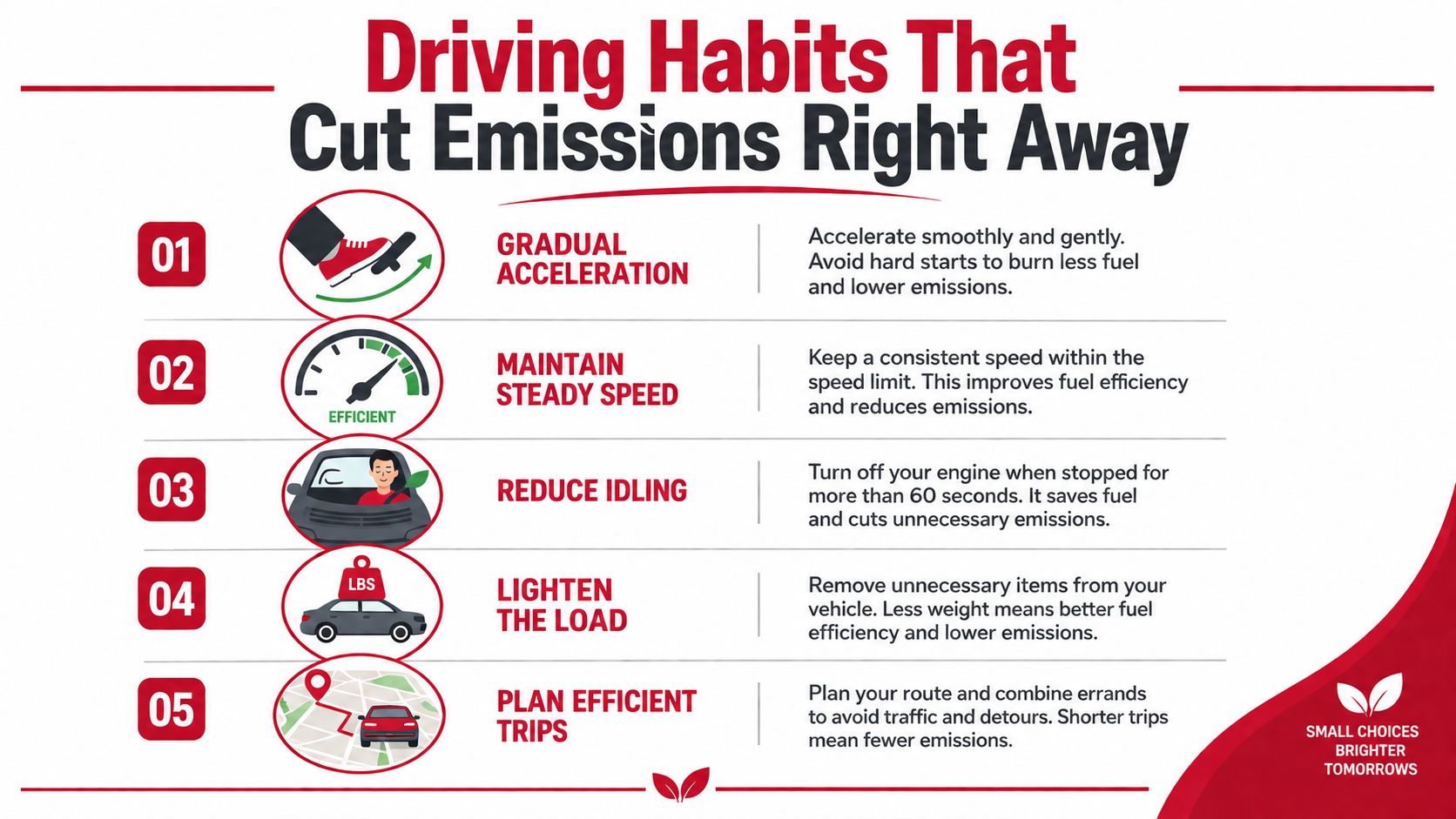
MIT researchers reported in 2025 that fully adopting eco-driving measures at city intersections could reduce annual intersection carbon emissions by 11% to 22% while keeping traffic throughput and safety intact MIT News. That matters because most real-world driving is not wide-open highway cruising, it's stop-and-go, red lights, merges, and impatient braking.
The same MIT report, along with road-transport guidance, points to the basics that drivers ignore: at 110 km/h a car can use up to 25% more fuel than at 90 km/h, and hard acceleration and braking can lower mileage by 33% on the highway and 5% in town MIT News. That's not a subtle difference. If you're flooring it between lights, you're paying for it twice, once at the pump and again in emissions.
Shop-floor advice: Keep the throttle smooth, leave early, and stop chasing yellow lights.
Reduce idling, combine trips, and stop hauling junk
EPA guidance treats walking, biking, public transit, carpooling, trip-chaining, working from home when possible, smoother driving, and regular maintenance as the core practical levers for lowering vehicle pollution EPA. That priority order matters. Driving less beats almost every other move because it cuts emissions at the source instead of trimming them after the fact.
In city traffic, idling and congestion are especially ugly. EPA guidance on stop-and-go driving calls out idling, peak-hour congestion, and smooth acceleration/deceleration because those conditions raise pollution and fuel use EPA PDF. If you sit in a pickup line with the car running, creep through the same route every day, or make three separate errands that could've been one, you're feeding the problem.
Use this quick self-audit on your next commute.
- Start earlier: Leave a few minutes sooner so you're not forced into hard acceleration.
- Hold speed steady: Back off the urge to surge and brake.
- Kill unnecessary idle time: Don't sit with the engine running when you don't need to.
- Chain errands: One loop beats three separate cold starts.
- Clear the load: Unused cargo adds drag and waste.
For California drivers, route choice and speed discipline matter as much as badge or model year. If you want a local reminder of how driving behavior connects to compliance, see vehicle emissions standards for car driving.
Maintenance That Lowers Emissions on the Test
Maintenance doesn't replace good driving. It makes good driving count. I've inspected thousands of vehicles, and the same pattern keeps showing up. The owner focuses on one obvious item, maybe a filter or an oil change, then ignores the rest of the system. That's how people end up chasing a failed smog report with guesswork.
Fix the basics first, not the shiny parts
EPA guidance groups the practical fixes together: walking, biking, transit, carpooling, trip-chaining, smoother driving, and regular maintenance with manufacturer-recommended oil EPA. The reason is simple. Maintenance works best when it supports better driving habits, not when it's treated like a magic patch.
If you're trying to reduce emissions that show up on a smog test, start with the parts that affect combustion quality and system health. A dirty air filter, wrong oil, and obvious warning lights are the stuff I see drivers ignore right before inspection. A clean-running engine is easier to certify than a neglected one.
Here's the order I'd use in the shop.
- Check the warning lights first. A lit check-engine light usually means there's a fault worth addressing before the test.
- Use the manufacturer-recommended oil. Wrong oil choice can make an engine run less cleanly.
- Inspect the air intake path. A clogged air filter is cheap to fix and not worth gambling on.
- Verify tires are properly inflated. Bad pressure hurts economy and can worsen overall vehicle efficiency.
- Get the tune-up work done before test day. Don't wait until the vehicle is already in line.
Plain truth: If the engine is unhappy, the smog machine will usually notice before you do.
Don't fix one thing and ignore the rest
That's the biggest mistake. A driver replaces an air filter, skips the check-engine light, keeps driving aggressively, and then acts surprised when the result doesn't change much. EPA's guidance on vehicle pollution puts these behaviors together because they compound, not because each one is dramatic by itself EPA PDF.
For a California driver, a failed smog test often traces back to a routine maintenance miss, not some mysterious defect. If you want to understand the common fail patterns before you spend money, read smog check fail reasons. That'll save you from buying parts in the wrong order.
Fuel Choices and Technology Upgrades Worth Considering
Once the driving habits are cleaned up and the maintenance is handled, then you can think about purchases. Not before. Too many people throw money at fuel myths or fancy add-ons while their real problem is a bad commute pattern or a neglected engine. Buy only what matches how you drive.
Match the choice to the trip pattern
Some drivers benefit from simple, everyday choices. Others need a more deliberate upgrade because their vehicle spends most of its life in traffic, on short hops, or under steady highway load. A fuel or tech choice only makes sense if it fits the way the car is used.
| Driving Pattern | Best Fuel Choice | Best Tech Upgrade |
|---|---|---|
| Short city trips with frequent stops | Follow the manufacturer's recommended fuel, and avoid premium unless the car requires it | Keep tire pressure correct, because daily stop-and-go magnifies inefficiency |
| Mixed commuting with traffic congestion | Use the recommended grade, stay consistent, and avoid unnecessary fuel “upgrades” | Consider low-rolling-resistance tires if they suit the vehicle and driving feel |
| Mostly highway driving | Stick with the specified fuel grade, not a marketing label | Tires suited to stable cruising and proper alignment matter more than gimmicks |
| Older vehicle with known emissions wear | Use the correct fuel for the engine, not the most expensive option on the shelf | Focus first on emissions-control repair, not cosmetic add-ons |
The point is not to chase premium fuel as a shortcut to cleaner exhaust. The point is to use the fuel the engine was designed for and pair it with the right hardware. If the vehicle doesn't need a higher-octane product, spending more doesn't automatically make it cleaner. It just makes the receipt uglier.
Upgrade where the use case justifies it
Tire choice is one of the few upgrades that can make sense because it affects real rolling effort every day. Low-rolling-resistance replacements can be reasonable for drivers who care about efficiency and spend a lot of time on pavement. The catch is that you should buy them as part of a broader plan, not as a cure-all for bad maintenance.
For older or high-mileage cars, the emissions-control upgrade is repair, not decoration. If the catalytic converter, oxygen sensor, or related systems are tired, fix the system before you dress it up. That's the difference between a vehicle that merely looks maintained and one that behaves better on test day.
Money-saving rule: Spend on the part that changes combustion or rolling resistance, not on the part that sounds impressive in a sales pitch.
How California Smog Checks Actually Work
California smog checks are not a mystery, but drivers keep treating them like one. The station is looking for a vehicle that runs clean enough, has the right equipment in place, and doesn't show signs of tampering or obvious failure. That's the deal. The test is there to measure compliance, not to reward optimism.
What the technician actually checks
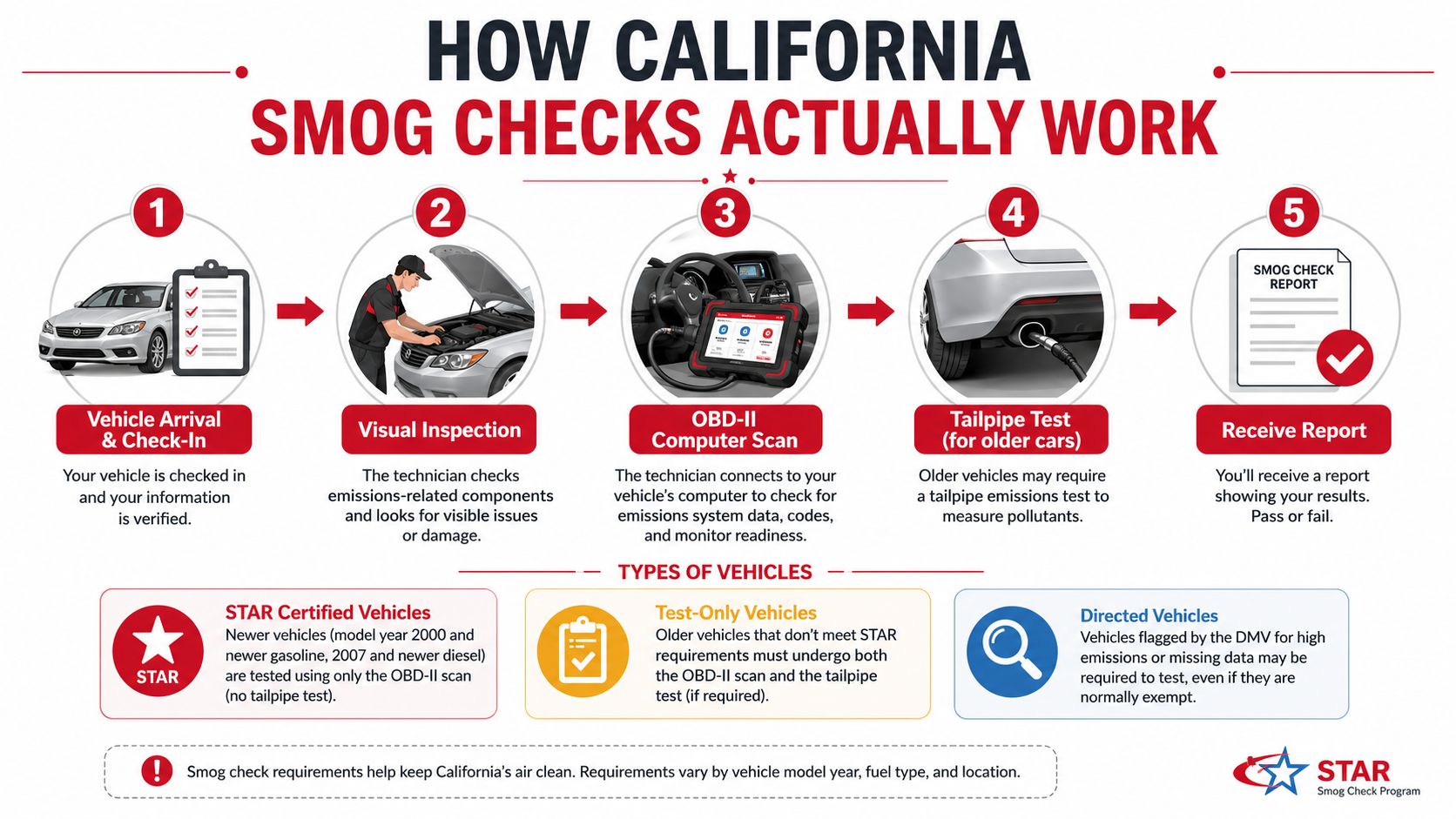
A California smog inspection typically includes an OBD-II computer scan, a visual inspection, and a tailpipe test for older cars where applicable. That means the station is not only reading codes, it's also checking whether the emissions-related hardware appears intact and whether the vehicle's onboard system reports readiness correctly.
The categories matter. STAR-certified vehicles are directed to stations that meet stricter requirements. Test-only stations perform the inspection without also selling repair work. Directed vehicles are the ones the state sends to specific station types because of their compliance profile. That structure helps keep the process organized and keeps the test result tied to the vehicle, not the repair invoice.
Stop-and-go driving can affect what the car shows
EPA guidance on traffic pollution makes one point very clear. Idling, congestion, and stop-and-go patterns raise emissions EPA PDF. That matters because a car that's always driven hard in traffic may arrive at the station in worse shape than a car that gets gentle, steady use. The test doesn't care about your excuse for the drive over. It cares about the data and the hardware.
The practical takeaway is simple. A smog test rewards preparation. Warm the car properly, keep the maintenance current, and don't assume a warning light will somehow disappear at the station. It won't.
Test-Only Smog Stations and Why They Matter
A test-only station changes the customer experience in a way drivers should care about. The tech can inspect the car and report the result, but the station doesn't have a repair revenue stream hanging over the test. That matters because it reduces the pressure to turn every borderline result into a big estimate.
In Antioch, Fire House Smog is one example of that model. It operates as a STAR-certified test-only smog check station and also handles DMV registration services at 2900 Lone Tree Way. The shop has two service bays, offers smog testing seven days a week, and provides a free retest when required under its policy and coupon terms. That's the kind of setup that saves time for working drivers who don't want to bounce between a test lane and a repair counter.
What to ask before you hand over the keys
Bring the vehicle paperwork, your keys, and payment, then ask straightforward questions. Don't let anyone bury the answer under shop language. A good station should tell you whether your vehicle is a normal smog check, a directed case, or something that needs special handling.
Use this short checklist.
- Ask about station type: Confirm whether the location is test-only and STAR-certified.
- Confirm vehicle fit: Ask if your car, truck, SUV, or RV is within their equipment limits.
- Check the retest policy: Know the rules before you leave the lot.
- Ask about wait times: Two bays can help, but timing still matters.
- Bring the basics: Registration-related paperwork, keys, and payment are the minimum.
A test-only station is also useful because it keeps the conversation clean. The result is the result. If you fail, you can take that report to the repair side of your choosing instead of being pushed toward an in-house fix. That protects you from upselling and keeps the decision where it belongs, with the owner of the car.
Pairing Your Smog Visit With DMV Services
The smartest compliance move is to knock out the inspection and the paperwork in one trip. That's where a licensed business partner can save real time. Instead of visiting one place for the test and another for the registration work, you handle both while the car is already there.
California drivers often need help with registration renewals, ownership transfers, and related tag issuance. At Fire House Smog, DMV services are posted Monday through Saturday from 9:30 AM to 5:00 PM and Sunday from 12:00 PM to 4:00 PM, alongside smog-test availability through the week. If you work a normal schedule, that weekend access is the difference between getting it done and putting it off again.
A simple 30-day plan that doesn't waste money
Start with the cheapest fixes first. Drive smoother, cut unnecessary trips, check the warning lights, and get the basic maintenance handled. Then schedule the smog inspection and bring the registration paperwork with you if you also need DMV help.
Here's the order I'd use.
- Check the dash. If the light is on, don't pretend it's fine.
- Change the oil if it's due. Use the manufacturer-recommended oil.
- Inspect the tires and air filter. These are easy, basic fixes.
- Cut the aggressive driving. Less throttle abuse helps right away.
- Book the smog visit. Don't wait until the renewal deadline is breathing down your neck.
Best habit for drivers in a hurry: Get the test and the DMV paperwork done on the same stop, then move on with your week.
Common questions drivers ask in the bay
How often should you smog-check? When the state requires it for your registration cycle or vehicle category. What if the vehicle fails? Fix the fault, then retest under the station's policy or another licensed option. Does a check-engine light automatically disqualify you? In practical terms, it's a serious warning and should be addressed before you test. When is a vehicle exempt? That depends on the vehicle's age, type, and registration situation, so don't guess.
If you're in Antioch or East Contra Costa County, use the weekend hours, ask for the retest policy up front, and take the cleanest route to compliance. Fire House Smog's test-only setup and DMV services make that process simpler than running all over town.
If you need a smog check and DMV paperwork handled without the repair-shop runaround, visit Fire House Smog and book a stop that covers both jobs. You'll get a STAR-certified test-only inspection, clear next-step guidance if the car needs work, and a place that can also handle registration services on the same visit.