Do you know whether your California vehicle is smog exempt, or does it qualify for a temporary registration period without an inspection? That distinction determines whether you'll owe a fee, complete paperwork, schedule a future test, or maintain a permanent exemption based on the vehicle's age, fuel, and weight.
California's rules have changed over time, and the phrase “smog exempt” now covers several situations that don't work the same way. A 1975 gasoline vehicle, an electric vehicle, a newer gasoline vehicle, and a heavy diesel truck may all avoid a smog inspection, but their registration obligations can differ. Use the vehicle's model year, fuel type, transaction type, and gross vehicle weight rating before assuming the answer.
Table of Contents
- Understanding Smog Exemptions vs No Test Required
- Vehicle Age and Model Year Exemptions
- The Eight-Year Rolling Exemption Explained
- Electric and Alternative Fuel Vehicle Exemptions
- How to Claim Your Exemption at the DMV
- Classic Car Exemption Changes Coming Soon
- Local Smog Services for Antioch Vehicle Owners
Understanding Smog Exemptions vs No Test Required
The most common mistake in smog exemptions California searches is treating “no test required” as a permanent exemption. It isn't. A true exemption removes the vehicle from applicable smog testing because it falls into a defined category, while a temporary no-test rule allows a registration or ownership transaction to proceed without an inspection during a limited period.
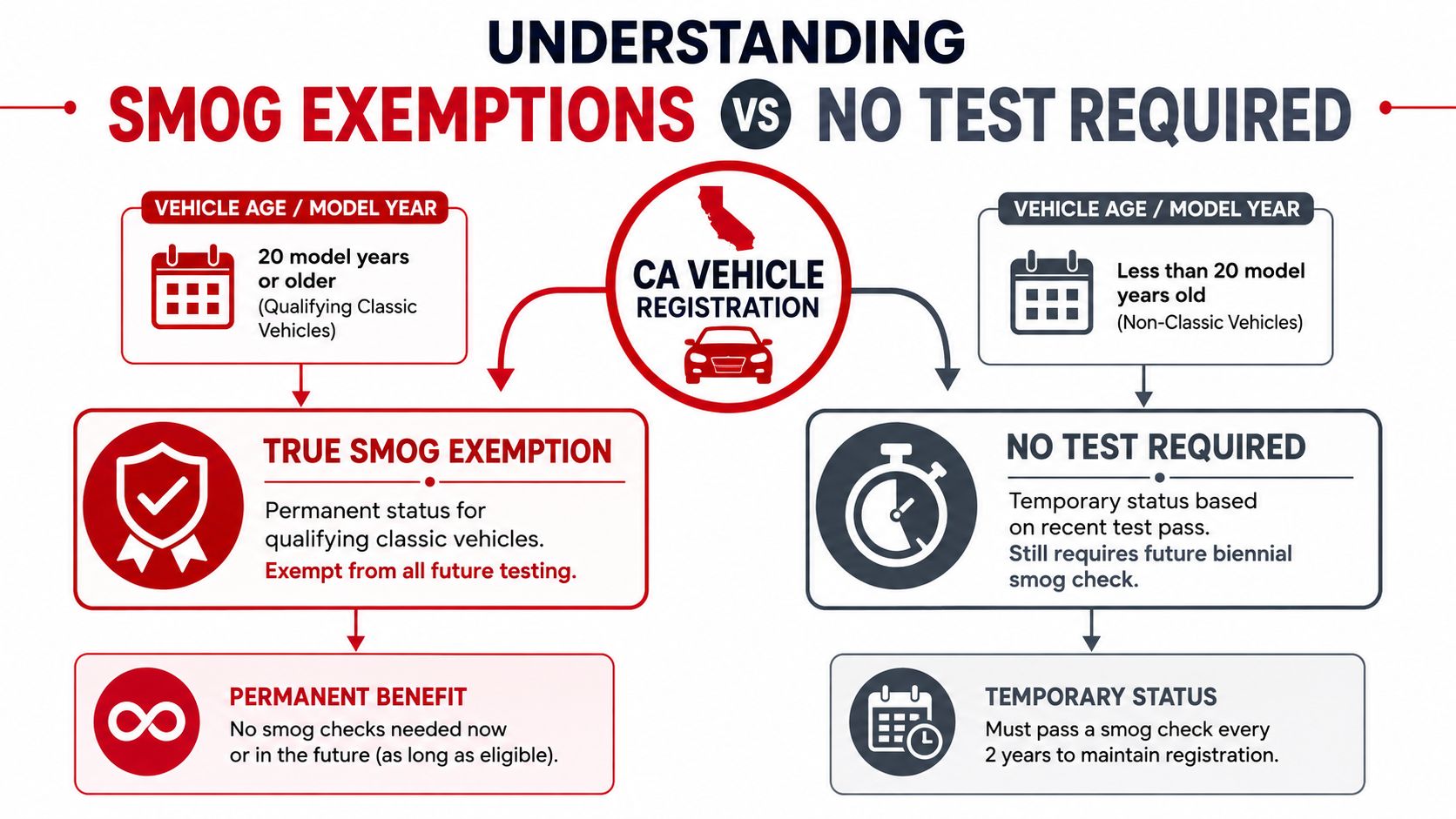
The two statuses have different consequences
A qualifying 1975-or-older gasoline vehicle belongs to California's historic age-based exemption category. By contrast, a newer gasoline, hybrid, or alternative-fuel vehicle that is eight model years old or newer generally skips the smog inspection for registration renewal but still uses a fee-based compliance process, as explained by the California Department of Motor Vehicles smog inspection rules.
That newer vehicle isn't permanently outside the program. Its status changes as the model year ages, and the owner must account for the applicable smog abatement fee at renewal. A vehicle that's no-test for one renewal can require an inspection at a later renewal.
Practical rule: “No test required” answers the inspection question. It doesn't automatically answer the fee, paperwork, or future-renewal questions.
Check your status before starting a transaction
Use this order:
- Identify the model year, not just the purchase year.
- Confirm the fuel type, including whether the vehicle is gasoline, diesel, hybrid, natural gas, or electric.
- Check the transaction, because renewal and ownership transfer use different age rules.
- Review the DMV notice, which may identify a required fee or smog certificate.
- Call a licensed provider or DMV service location if the record conflicts with the vehicle's title or registration.
This prevents a common failure point. Owners show up expecting a permanent exemption, but the DMV record treats the vehicle as temporarily exempt from inspection and still expects the applicable fee or transaction paperwork.
Vehicle Age and Model Year Exemptions
California's permanent historic exemption is narrower than many online summaries suggest. Gasoline-powered vehicles that are 1975 model year or older are exempt, while diesel eligibility follows a separate age and weight structure. The DMV lists diesel vehicles as exempt when they are 1997 model year or older or have a gross vehicle weight rating above 14,000 pounds. Natural-gas vehicles above that weight threshold and electric vehicles also appear in separate exemption categories on the DMV's official smog inspection guidance.
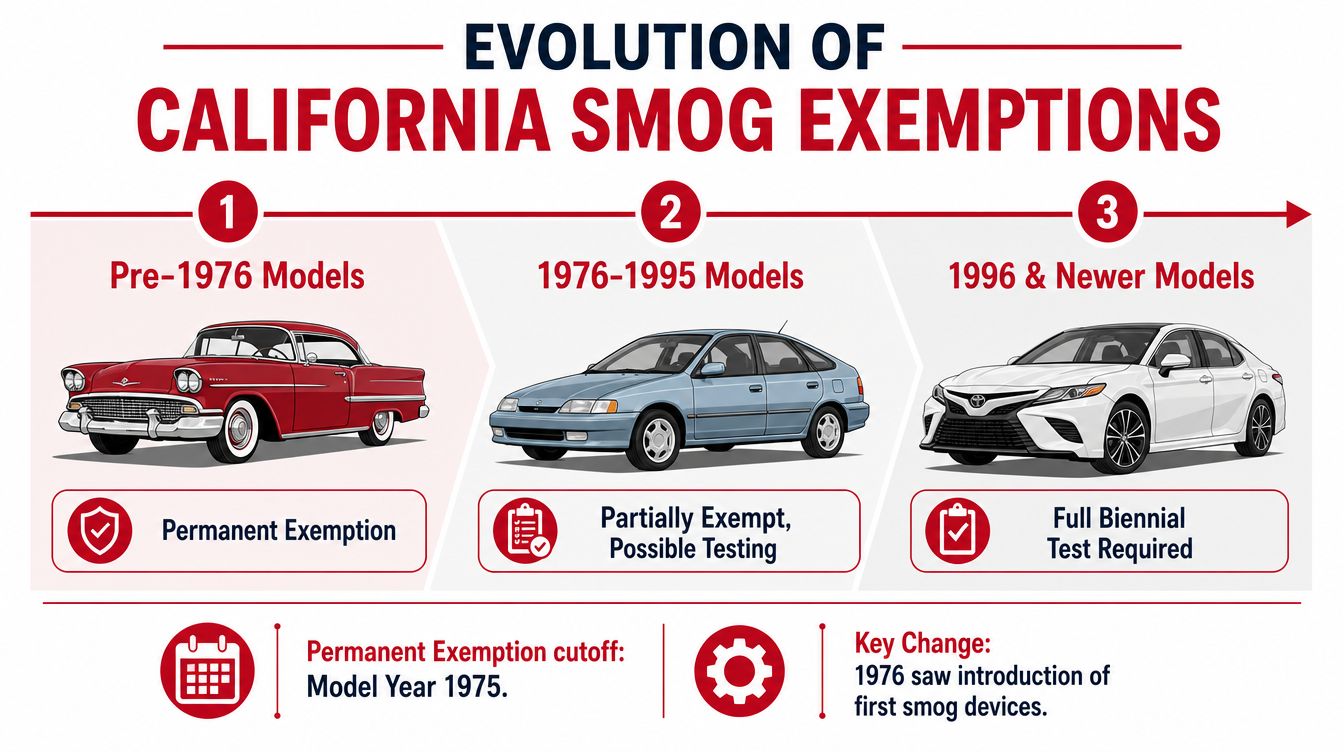
Model year controls the result
Don't use the calendar year you bought the car, the year shown in an advertisement, or the year a manufacturer built a particular vehicle. Use the official model year recorded for that vehicle. A car manufactured late in one calendar year may be sold as the next model year, so the vehicle identification number record, title, registration, and manufacturer documentation matter more than your memory.
For a gasoline classic, the cleanest decision is:
- 1975 or older model year: falls within the DMV's listed gasoline exemption.
- Later gasoline model year: don't assume permanent exemption based only on age or collector status.
- Diesel: check both the model year and GVWR.
- Natural gas: verify whether the vehicle exceeds the stated weight threshold.
- Electric: the DMV lists electric vehicles as exempt from smog inspections.
The legislative history explains why older advice conflicts. Before 1998, California used a cutoff for vehicles manufactured before the 1966 model year. SB 42 extended the cutoff to vehicles manufactured before the 1974 model year and created a rolling approach beginning in 2003. AB 2683 then reversed that rolling rule and established a fixed cutoff for vehicles manufactured before the 1976 model year. The California legislative summary for AB 220 documents that evolution.
Weight matters for diesel and natural gas vehicles
A diesel vehicle's age alone isn't the whole test. A diesel vehicle above 14,000 pounds GVWR qualifies under the DMV's listed weight category, while a natural-gas vehicle must also exceed that threshold for the relevant exemption. Check the manufacturer's GVWR label and registration record rather than estimating from the vehicle's empty weight or how much it carries.
The embedded guide below can help you organize the model-year and fuel-type questions before contacting the DMV.
The Eight-Year Rolling Exemption Explained
The newer-vehicle rule is temporary, transaction-specific, and frequently mislabeled as a permanent exemption. California says gasoline, hybrid, and alternative-fuel vehicles that are eight model years old or newer don't need a smog inspection for registration renewal. For a change of ownership, vehicles four model years old or newer don't need the inspection, according to the Bureau of Automotive Repair's Smog Check guidance.
The transaction changes the answer. A vehicle may qualify for no inspection during a transfer but not during a later renewal, or it may qualify for a renewal without testing while still requiring the applicable fee. The rule is based on model-year age, not the owner's maintenance history or the vehicle's mileage.
How 2026 changes the calculation
The key 2026 issue is the 2018 model year. Independent coverage of the 2026 exemption list explains that 2018-model vehicles lose the eight-year renewal exemption in 2026, so owners who assumed the status was permanent may receive a registration notice requiring a smog check. Review the 2026 California smog exemption guidance against the DMV record before your renewal deadline.
The fee replaces the inspection during the temporary no-test period. It doesn't convert the vehicle into a permanently exempt vehicle, and it doesn't erase future testing obligations once the vehicle ages beyond the applicable threshold.
| Model Year | Renewal Requirement | Transfer Requirement | Fee Type |
|---|---|---|---|
| 2026 and newer | No smog inspection during the applicable temporary period | No smog inspection during the applicable transfer period | Smog abatement or transfer fee may apply |
| 2018 | Check DMV status carefully in 2026, because the eight-year renewal period ends | Apply the separate transfer-age rule | Renewal or transfer fee may apply when no test is required |
| Older than the applicable rolling period | Smog inspection generally returns unless another exemption applies | Smog inspection depends on the transfer-age rule and vehicle record | Fee alone doesn't create permanent exemption |
Treat the table as a screening tool, not a substitute for the DMV transaction record. A vehicle's fuel type, registration classification, and transaction can affect the result.
Owner's rule: If your vehicle is “exempt” only because it's newer, put a future smog check on your renewal plan.
Electric and Alternative Fuel Vehicle Exemptions
Electric vehicles receive a different treatment from hybrids and many other alternative-fuel vehicles. The DMV lists electric vehicles as exempt from smog inspections, while hybrid vehicles are included with gasoline and alternative-fuel vehicles under the temporary age-based no-test rule for newer vehicles. That means a hybrid shouldn't automatically be treated like a battery-electric vehicle.
Natural-gas eligibility also depends on weight. The DMV identifies natural-gas vehicles above 14,000 pounds as exempt, so a smaller natural-gas vehicle shouldn't be classified from fuel type alone. Confirm the fuel designation and GVWR in the vehicle record.
Bring records that match the vehicle
Registration problems often arise when the DMV record doesn't reflect the vehicle's actual configuration. Before a renewal, transfer, or initial California registration, gather:
- Current registration or title: Check the recorded model year and fuel classification.
- Vehicle identification number: Use the VIN consistently across the title, insurance, and DMV paperwork.
- GVWR documentation: For diesel or natural-gas vehicles, use the manufacturer label or official vehicle records.
- Out-of-state documents: If the vehicle is entering California, bring the title and registration documents that establish identity and ownership.
- Transaction paperwork: A transfer and a renewal don't use identical age rules, so identify the transaction before relying on a no-test status.
A fuel-system conversion deserves special caution. Don't assume a modified vehicle will receive the same treatment as a factory-configured electric, natural-gas, or alternative-fuel vehicle. Ask the DMV or a licensed smog professional how the vehicle is classified before submitting the transaction.
Separate testing from registration compliance
An electric vehicle can be exempt from the smog inspection and still require ordinary registration paperwork and fees. A newer hybrid can avoid the test for the applicable period but still carry a smog-related fee. The practical question isn't merely “Does this vehicle pollute?” It's “What does California's record require for this exact vehicle and transaction?”
How to Claim Your Exemption at the DMV
Knowing that a vehicle fits an exemption category doesn't guarantee that the transaction will process without documentation. The DMV's system uses the vehicle record, model year, fuel type, weight information, and transaction details. If one field is wrong or incomplete, the system may request a smog certificate even when the vehicle appears eligible.
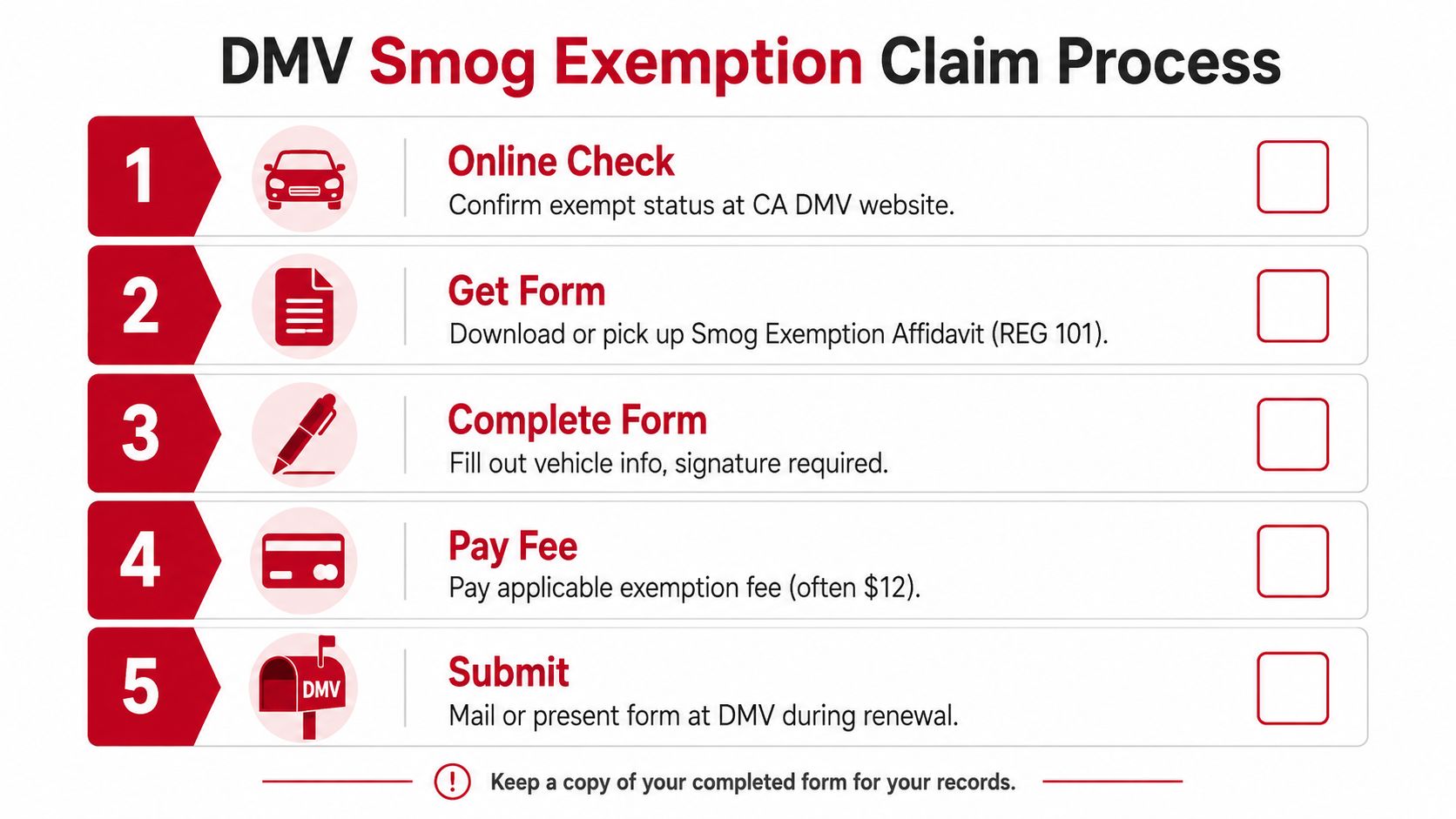
Use a transaction-first checklist
Start with the notice from the DMV. It tells you whether you're renewing registration, transferring ownership, or completing an initial California registration. Then compare the notice with the vehicle's title and registration.
Bring or prepare:
- The DMV renewal or transfer notice, if one was issued.
- Current title and registration documents, especially when the vehicle is newly acquired.
- VIN and model-year information, copied exactly from the vehicle and official documents.
- Fuel and weight evidence, when the exemption depends on electric status, diesel age, natural-gas fuel, or GVWR.
- The applicable fee or payment method, because no inspection doesn't necessarily mean no smog-related charge.
- Any required DMV form, completed with the vehicle information and owner signature.
The infographic references REG 101, but don't rely on an online checklist without confirming the current form and instructions with the DMV. Forms and transaction requirements can change, and a form that applies to one situation may not resolve a record problem in another.
Challenge an incorrect requirement promptly
If the DMV system flags an exempt vehicle, ask what vehicle attribute triggered the request. A staff member may need to correct the model year, fuel type, or weight record rather than send you to a smog station. Don't pay for an unnecessary inspection until you understand whether the issue is eligibility or a data mismatch.
For registration logistics, California DMV registration renewal assistance can be useful when you need help handling the transaction alongside a smog question. Keep copies of submitted forms, receipts, and supporting documents until the registration is complete.
Classic Car Exemption Changes Coming Soon
The historic gasoline exemption and the proposed collector-vehicle changes are not the same rule. Today's core framework centers on gasoline vehicles manufactured before the fixed cutoff associated with the 1976 model year. A collector vehicle outside that category shouldn't be treated as exempt because it's old, valuable, modified, or rarely driven.
BAR's Spring 2026 legislative update describes proposed legislation that would exempt collector motor vehicles manufactured before the 1981 model year from biennial Smog Check, then extend the threshold by one model year annually beginning January 1, 2028, reaching 1985 model-year vehicles by January 1, 2032, if the proposal becomes law. The BAR Spring 2026 legislation and regulations update also describes abbreviated inspections for some older vehicles, so “exempt” may not mean every inspection component disappears.
What this means for a collector owner
Consider three vehicles:
- A qualifying 1975 gasoline vehicle already fits the existing historic framework.
- A 1980 collector vehicle could benefit if the proposed pre-1981 threshold becomes effective.
- A later collector vehicle may need to wait for a future expansion, and the timing depends on enacted law rather than a proposal alone.
That distinction matters when buying a project car. Don't pay a premium today based on a future exemption that hasn't become an active registration rule. Check the current BAR update, the DMV record, and the vehicle's exact model year before completing a purchase or planning a renewal.
Owners of older vehicles can also review smog checks for older cars to identify whether the vehicle falls under the existing exemption, a proposed collector category, or an abbreviated inspection process. Keep the original title, registration history, VIN documentation, and any collector classification records organized. Those documents can help establish the vehicle's identity when its age or configuration creates a question.
Local Smog Services for Antioch Vehicle Owners
Antioch owners should separate three tasks: confirm eligibility, complete the DMV transaction, and test the vehicle when the record requires it. A vehicle that looks exempt may still need a certificate because it has aged out of the rolling rule, falls outside the permanent categories, or has a DMV record with incorrect fuel or model-year information.
A STAR-certified test-only station is relevant when the DMV requires a smog certificate and you want an inspection provider that doesn't sell repair work. Fire House Smog is a STAR-certified test-only station and licensed DMV registration services provider at 2900 Lone Tree Way in Antioch, offering smog testing and selected registration transactions. Review its Antioch smog check services before visiting and call ahead for larger vehicles or RVs.
Match the service to your situation
- Renewal notice requests a certificate: Schedule the required inspection before the deadline.
- You believe the vehicle is permanently exempt: Bring the title and registration so the model year and vehicle category can be checked.
- A newer vehicle says no test required: Confirm the applicable fee and note when the rolling status ends.
- A diesel or natural-gas vehicle qualifies by weight: Bring reliable GVWR documentation instead of estimating.
- The vehicle is a collector car: Verify whether current law applies, rather than relying on proposed changes.
Ask whether the location can process your specific transaction, whether the vehicle fits the equipment limits, and what documents you should bring. That short call can prevent an unnecessary trip and clarify whether you need testing, registration assistance, or a DMV record correction.
Fire House Smog provides STAR-certified test-only smog inspections and California DMV registration services for Antioch vehicle owners, including renewals and ownership transfers. Visit Fire House Smog with your DMV notice and vehicle documents to confirm whether your vehicle needs a test, a fee, or exemption-related paperwork.
You've got the renewal notice in your hand, the dash light is staring back at you, and now you're trying to figure out whether you need a smog check, a safety inspection, or both. California makes people work too hard for a simple answer, so here it is straight, a California vehicle inspection usually means an emissions test for registration, not a generic mechanic inspection, and the wrong assumption costs time and money.
The fastest path is to separate the two programs in your head before you book anything. Smog checks are the common requirement for registration renewal, while safety systems inspections show up in narrower situations like out-of-state cars, revived salvage vehicles, specially constructed vehicles, motorcycles, and some trailers over 3,000 pounds GVWR. If you treat them like the same thing, you'll book the wrong appointment, show up unprepared, and pay for a retest you didn't need.
Table of Contents
- Understanding What Your California Vehicle Inspection Actually Requires
- Determining Your Eligibility and Exemption Status
- Pre-Inspection Checklist to Maximize Your Pass Rate
- What Happens During Your Smog Check Appointment
- Completing Your DMV Registration Without a Separate Office Visit
- Fire House Smog Services and How to Schedule Your Visit
Understanding What Your California Vehicle Inspection Actually Requires
Smog Check vs. Safety Inspection
A lot of drivers walk into this confused because the DMV notice just says “inspection” in the broad, everyday sense. In California, that's sloppy language for a very specific process. The common requirement is a smog inspection tied to registration, while a separate vehicle safety systems inspection is triggered by specific vehicle histories and classes, not by ordinary annual ownership of a passenger car. California's smog inspection overview makes that split clear.
If you own a normal privately owned passenger vehicle, don't assume you need an annual safety inspection. You usually don't. What you usually need is the emissions side of the equation, which is why so many drivers search for a California vehicle inspection when they really need a smog appointment.
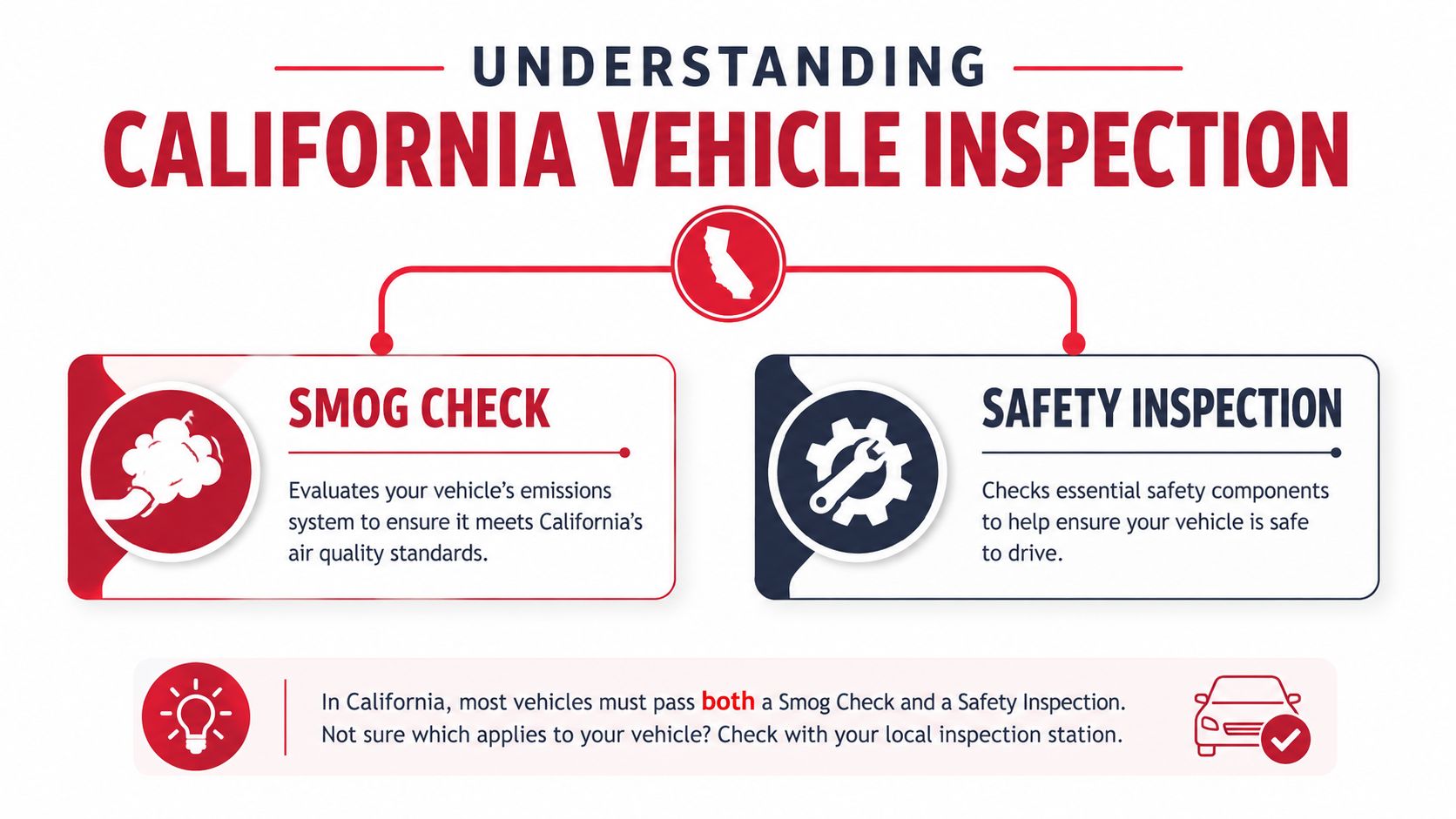
Practical rule: if the car is due for registration renewal, think smog first, safety inspection only if the vehicle history or type triggers it.
That distinction matters because the wrong appointment doesn't just waste time, it sends you to the wrong lane. If the car needs emissions compliance, a test-only smog station is the correct stop. If it needs a separate safety systems verification, the paperwork and inspection path are different, and DMV and BAR guidance treat them as separate programs.
A good way to keep yourself out of trouble is to ask one blunt question before scheduling, “What problem am I solving, registration smog compliance or title/safety verification?” If you can answer that, you've already avoided the biggest consumer mistake around California vehicle inspection rules. For a simple emissions-specific explainer, see California emissions standards and smog basics.
Determining Your Eligibility and Exemption Status
How California Decides Who Gets Tested
California does not guess at smog obligations. It uses model year, fuel type, vehicle class, and registration history to decide whether a vehicle needs testing. The BAR January 2024 summary shows the program is still very active, with 952,481 initial tests and 80,936 failures, for an 8.50% initial-test failure rate, and 1,029,286 total tests with 92,532 failures, for an 8.99% overall failure rate, so this is still a real compliance checkpoint, not a box to check. BAR January 2024 Executive Summary
The smart move is to verify the exemption before you book, not after you are already at the station.
California keeps some exemptions narrow and others broad. BAR lists the program as biennial, and the official exemption framework includes gasoline vehicles 1975 and older, diesel vehicles 1997 and older or over 14,000 pounds GVWR, and natural gas vehicles over 14,000 pounds. Those carveouts are why most inspection volume lands on newer gasoline, hybrid, and eligible light-duty diesel vehicles.
Here is the decision framework I use with customers:
| California Smog Check Exemption Rules | Vehicle Type | Exemption Criteria | Notes |
|---|---|---|---|
| Gasoline passenger vehicles | 1975 and older | Exempt from smog inspection | Old enough to fall outside the regular smog program. |
| Diesel vehicles | 1997 and older, or over 14,000 pounds GVWR | Exempt from smog inspection | Weight and model year both matter. |
| Natural gas vehicles | Over 14,000 pounds | Exempt from smog inspection | Heavy natural gas vehicles are treated separately. |
| Newer gasoline vehicles | Less than 8 model years old | Exempt from smog inspection under DMV rules | The exemption changes the timing for many late-model cars. |
| Very new gasoline vehicles | Less than 4 model years old | May pay a smog abatement fee instead of getting inspected for the first 8 registration years | This is the rule people miss most often. |
That last rule catches a lot of drivers. DMV says gasoline-powered vehicles less than eight model years old are exempt from smog inspection, but starting January 1, 2019, vehicles less than four model years old may pay a smog abatement fee instead of getting inspected for the first eight registration years. That means newer cars do not all follow the same path, and you should not trust old advice from a friend or an outdated forum thread. DMV smog inspection rules
If you are unsure, check the model year, fuel type, and whether the vehicle has a special title or registration history. That is the only reliable way to make the right call before you spend money on the wrong inspection. If you want to avoid a useless visit, read this quick guide to common reasons a smog check fails before you book.
Pre-Inspection Checklist to Maximize Your Pass Rate
What to Fix Before You Show Up
A failed smog check costs more than the inspection fee. You pay for repairs, then you pay again to come back, and the retest process burns time you did not need to lose. The smart move is simple, show up with the car already sorted and ready for a clean emissions test, especially if you want the same trip to cover smog testing and on-site DMV registration at a test-only station. BAR's procedure puts weight on vehicle configuration, test sequence, and properly maintained equipment, so a sloppy arrival usually turns into avoidable delay. Smog Check manual
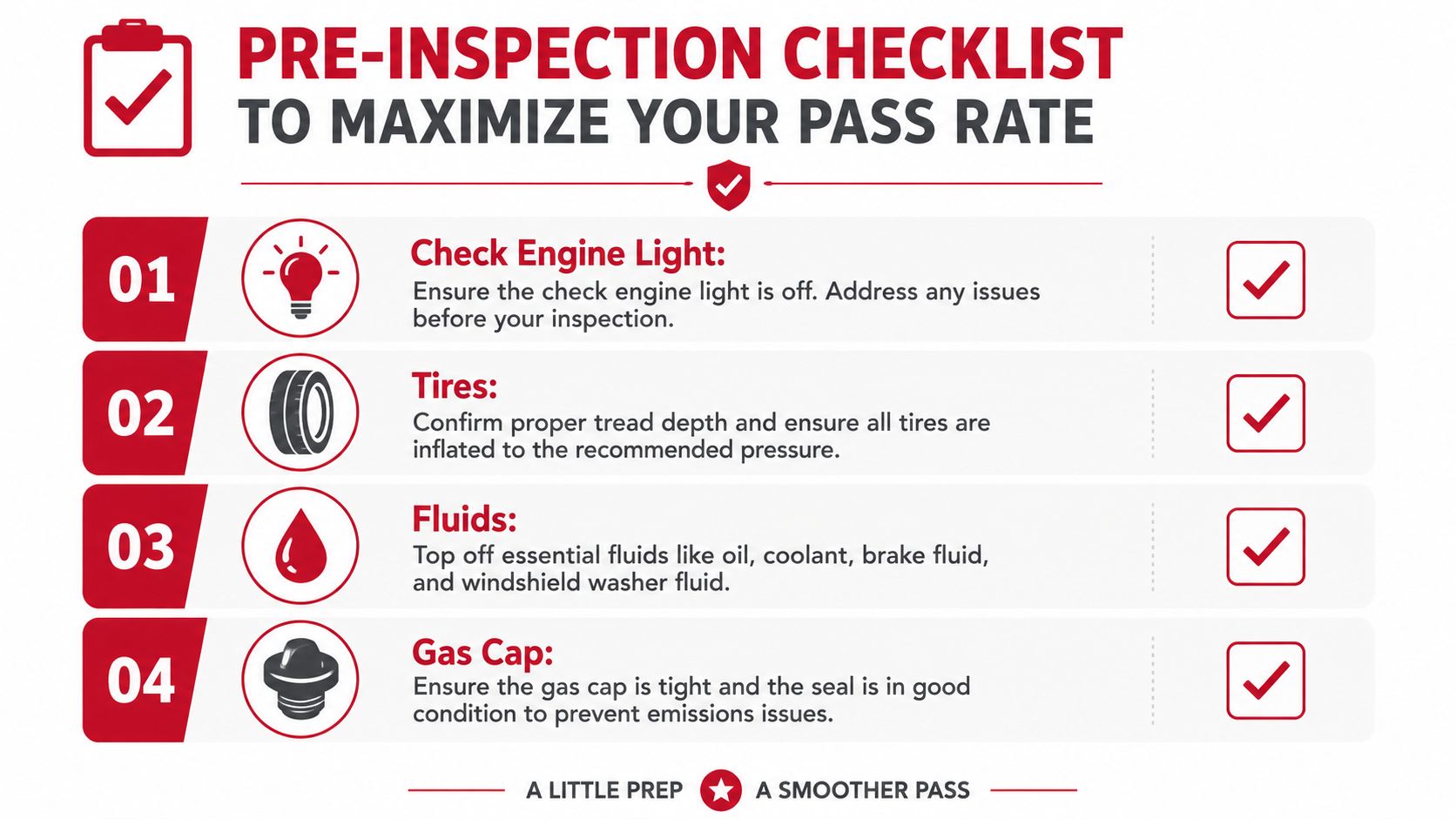
Here is the checklist I give drivers who want to avoid retest pain:
- Check Engine Light off: If the light is on, stop there. Diagnose the fault first.
- Drive cycle completed: After battery disconnects or repairs, give the car enough normal driving time for the onboard monitor to reset.
- Tire pressure and basic fluids checked: Low pressure, neglected oil, or ignored coolant issues are signs the car has not been prepped properly.
- Gas cap tightened properly: A loose cap creates a preventable failure and wastes a visit.
- Accessories off at arrival: Turn off the A/C, radio, seat heaters, and anything else that adds load.
- Transmission in park or neutral: Roll in correctly. A bad setup can stop the test from moving forward.
- Paperwork ready: Bring the registration notice, insurance if required, and any prior repair records so the counter goes fast.
Simple rule: if the car is not behaving normally on the drive over, it is not ready for the test.
The reason this matters is the visual inspection and mode test work together. Technicians check for tampered or missing emissions parts, confirm the vehicle is set up correctly, and then follow the required test path. If the car shows up in the wrong configuration, in the wrong gear position, or with equipment that is past calibration, you are setting yourself up for a retest instead of a pass. Smog Check manual
If the check engine light has been on recently, use the visit as your deadline, not your diagnosis tool. Clearing codes without fixing the cause only buys you a second failure. For the common reasons drivers get stuck, read the main smog check failure causes.
What Happens During Your Smog Check Appointment
From Check-In to Certification
A test-only station should feel organized the moment you arrive. You pull in, hand over the paperwork, and the technician confirms the vehicle's setup before the inspection starts. That step catches obvious problems early, before you waste time on a test that was never going to count.
The visual inspection comes first. The technician checks for missing, altered, or incorrectly installed emissions parts, then runs the required mode test. For the BAR Snap Test, the accelerator is pressed quickly from idle to between 2,000 and 3,000 RPM and released right back to idle. That is a specific procedure, not a casual rev, and the car needs to be in the right condition before the test begins. The equipment used in the inspection also has to be maintained and calibrated to the required standards. Smog Check manual
If the vehicle shows up with the wrong setup, the wrong gear position, or any condition that disrupts the test path, expect delay or a retest. That is how drivers lose time and pay twice. The easy fix is simple, arrive with the car behaving normally and let the station follow the correct sequence.
When the inspection ends, you receive a Vehicle Inspection Report. If the car passes, that report is the piece that supports the registration process. If it fails, the report tells you what needs attention instead of leaving you to guess. A test-only station keeps that part clean, because the station is there to test the car, not sell you repairs before you understand the failure.
The workflow is faster at a station built around inspection volume, especially when the bays stay moving and the staff follows the same order every time. That means less waiting, fewer handoffs, and a clearer trip from check-in to result. If you want to see how the smog result can feed straight into registration without a separate DMV visit, use this California DMV registration renewal service as the next step after the test.
Completing Your DMV Registration Without a Separate Office Visit
How the Smog Result Connects to Renewal
You pass the smog test, and the job is still only halfway done if you have to leave and stand in line at the DMV. A station that handles registration on-site turns that into one stop, which is the cleanest way to finish a renewal or title transfer without losing the rest of your day.
A licensed registration services provider can take the passing result and move straight into the DMV side of the transaction. That means the sticker can be printed on-site, and transfer paperwork can be handled without a second office visit. If you have ever tried to fit a smog appointment, a DMV queue, and a work schedule into the same day, you already know why this saves time. The state's smog rules treat the inspection as part of the renewal process, not a separate errand, and California DMV registration renewal services can help keep that handoff in one place.
Timing is the advantage. Once the inspection result is ready, the registration work can start right away instead of waiting for another appointment, another line, or another day off. That matters for out-of-state vehicles, title transfers, and drivers who want one location to handle both the emissions test and the paperwork.
If renewal is the goal, keep the inspection and DMV work together unless you have a good reason to split them.
That approach saves money in the real world. Every extra trip uses fuel and time, and a failed retest gets worse when the paperwork is still scattered. The better workflow is straightforward, arrive with the right documents, pass the inspection, and finish the registration while the result is still fresh.
Fire House Smog Services and How to Schedule Your Visit
Booking, Hours, and Retest Policy
Fire House Smog is a STAR-certified test-only station and licensed DMV registration services provider in Antioch, California. The setup is built for speed, with a drive-through layout, parking, and two bays that help cut down wait time. Smog test availability runs seven days a week, while DMV service hours are Monday through Saturday 9:30 AM to 5:00 PM and Sunday 12:00 PM to 4:00 PM.
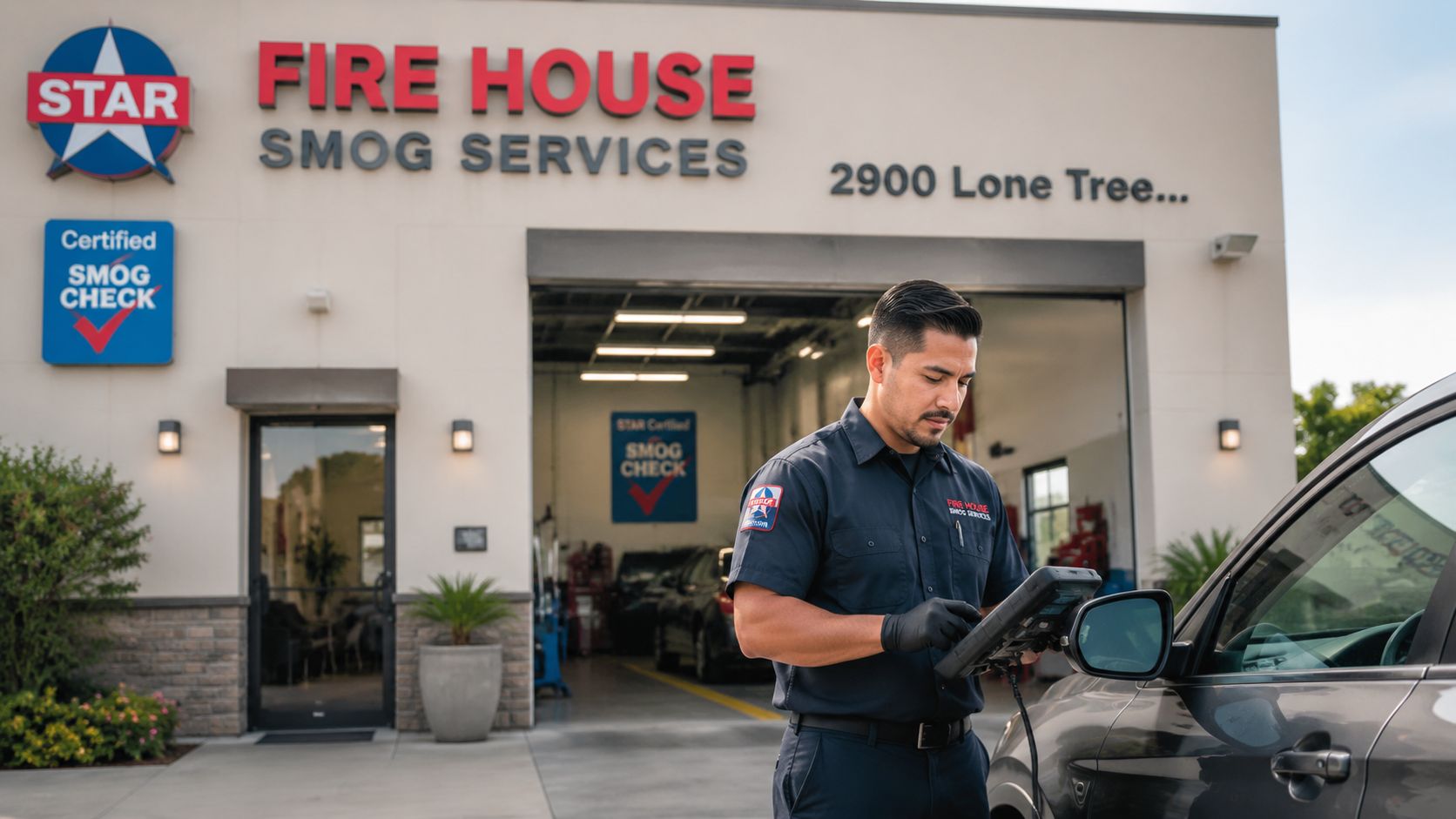
The station works on passenger cars, SUVs, light-duty trucks, and some RVs and motorhomes when the size and equipment fit the lane and bay limits, so call ahead before you bring something oversized. That matters because a test-only station is there to handle emissions testing first, then the DMV paperwork if you need it. If the car fails, ask about the retest policy before you pay and leave. A free retest can save you from paying for the same problem twice, as long as you follow the site rules and coupon terms. For questions or scheduling, call 925-754-1600.
Use the coupons if they apply, bring the right paperwork, and show up with the car ready for inspection instead of trying to sort out a fault code in the parking lot. That is how you avoid wasting time, and it is the fastest way to keep a failed visit from turning into another full-price return trip. A clean California vehicle inspection comes down to preparation and the right order of operations, not luck.
If you want one stop for emissions testing and DMV registration tasks, visit Fire House Smog and book the appointment that fits your schedule.
You're probably staring at a renewal notice, a flickering check-engine light, or a gas receipt that looks worse than it should. If your car has to pass a smog check soon, the smartest move is not guessing, and it's not buying random parts. It's tightening up the habits and maintenance that change emissions at the tailpipe and at the test station.
Table of Contents
- Why Vehicle Emissions Matter for Everyday Drivers
- Driving Habits That Cut Emissions Right Away
- Maintenance That Lowers Emissions on the Test
- Fuel Choices and Technology Upgrades Worth Considering
- How California Smog Checks Actually Work
- Test-Only Smog Stations and Why They Matter
- Pairing Your Smog Visit With DMV Services
Why Vehicle Emissions Matter for Everyday Drivers
A lot of drivers think emissions only matter when a county or state makes a speech about climate goals. That's too abstract for a person who just wants the car to start, pass, and keep moving. Vehicle emissions affect your wallet, your time, and whether your car stays legal on the road.
Transportation is a major emissions source because it produces about 15% of global greenhouse gas emissions according to CFR. The same summary notes that transportation emissions have grown faster than any other end-use sector over the past decade, with global transportation emissions rising about 2% per year in that period. The IPCC pathway cited there calls for transportation-related emissions to fall 59% by 2050 relative to 2020 CFR summary. That's the big picture, but the driver-level lesson is more practical, less political, and a lot more immediate.
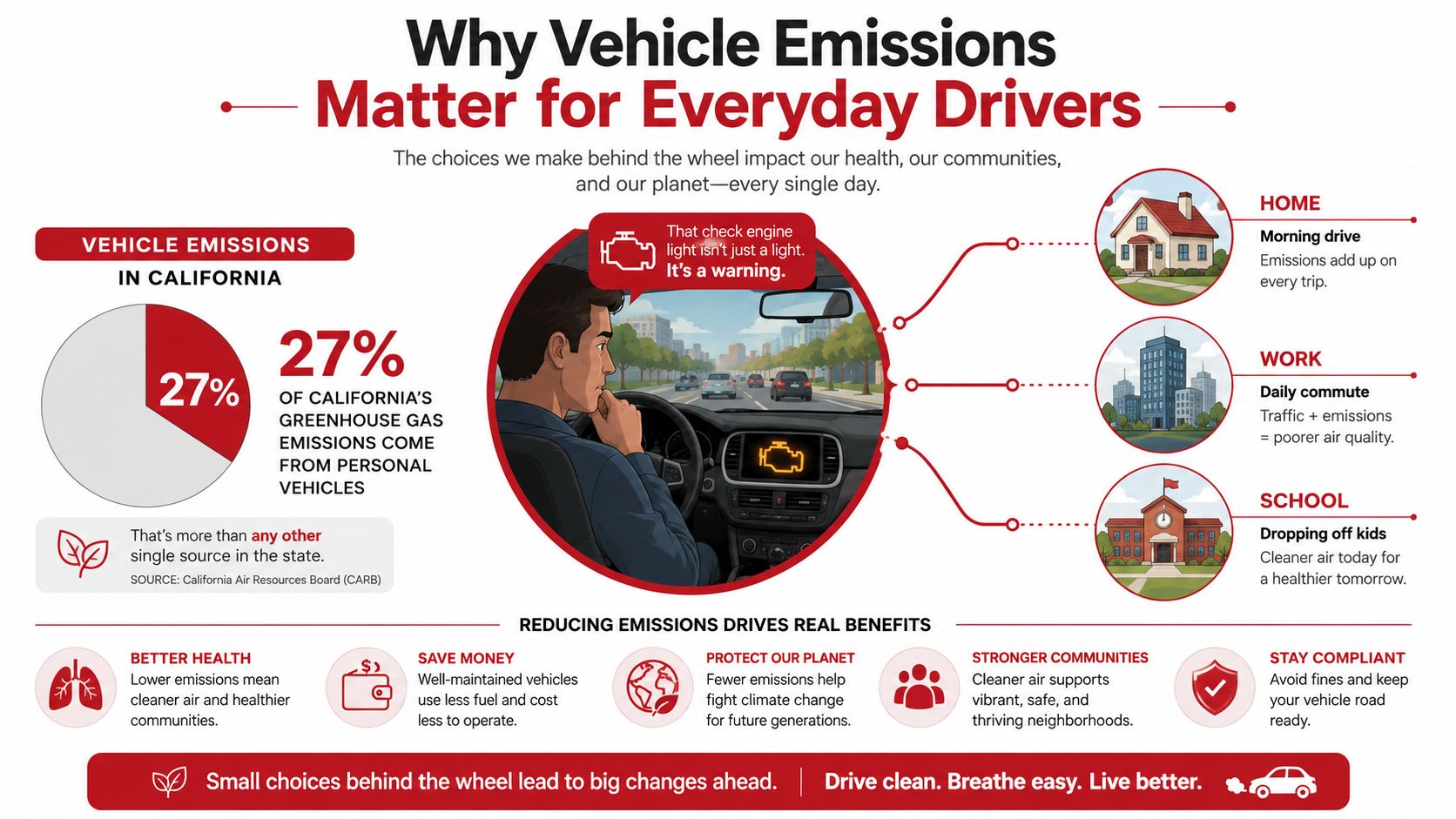
For a daily driver, emissions show up in three places. First, in fuel use, because wasted fuel is wasted money. Second, in drivability, because rough running, poor maintenance, and bad habits make a vehicle harder to live with. Third, at the smog station, where habits and condition become numbers, readiness flags, and visible failures.
The smartest mindset is this, emissions are a system. Your right foot, your maintenance schedule, and your vehicle's condition all affect what comes out of the exhaust. If you want to reduce vehicle emissions the practical way, start by fixing the things you can control today, not the things you can only argue about later.
Practical rule: If the car burns more fuel than it needs to, the exhaust story is usually worse too.
For California drivers, that's not theoretical. It ties directly into compliance, and it connects to your next inspection. If you want the state-specific side of that picture, review California emissions standards before you roll into a test.
Driving Habits That Cut Emissions Right Away
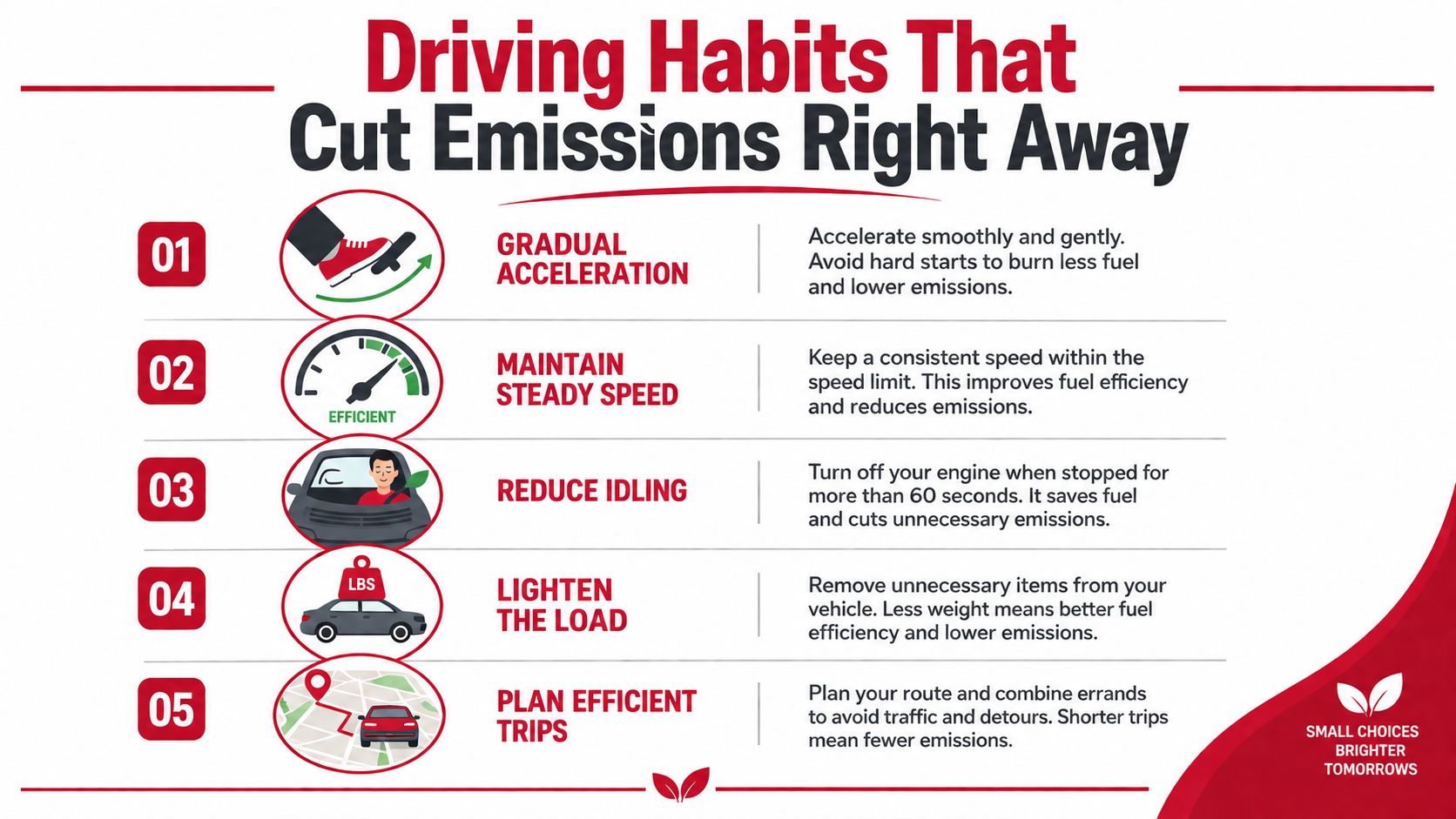
The fastest emissions cuts usually come from the driver, not the parts catalog. I've seen plenty of cars fail or barely pass because the owner drove it like a taxi in a hurry, then expected a fresh sticker to fix the damage. That's backwards. Smooth, sensible driving lowers emissions immediately.
Stop treating every green light like a drag race
MIT researchers reported in 2025 that fully adopting eco-driving measures at city intersections could reduce annual intersection carbon emissions by 11% to 22% while keeping traffic throughput and safety intact MIT News. That matters because most real-world driving is not wide-open highway cruising, it's stop-and-go, red lights, merges, and impatient braking.
The same MIT report, along with road-transport guidance, points to the basics that drivers ignore: at 110 km/h a car can use up to 25% more fuel than at 90 km/h, and hard acceleration and braking can lower mileage by 33% on the highway and 5% in town MIT News. That's not a subtle difference. If you're flooring it between lights, you're paying for it twice, once at the pump and again in emissions.
Shop-floor advice: Keep the throttle smooth, leave early, and stop chasing yellow lights.
Reduce idling, combine trips, and stop hauling junk
EPA guidance treats walking, biking, public transit, carpooling, trip-chaining, working from home when possible, smoother driving, and regular maintenance as the core practical levers for lowering vehicle pollution EPA. That priority order matters. Driving less beats almost every other move because it cuts emissions at the source instead of trimming them after the fact.
In city traffic, idling and congestion are especially ugly. EPA guidance on stop-and-go driving calls out idling, peak-hour congestion, and smooth acceleration/deceleration because those conditions raise pollution and fuel use EPA PDF. If you sit in a pickup line with the car running, creep through the same route every day, or make three separate errands that could've been one, you're feeding the problem.
Use this quick self-audit on your next commute.
- Start earlier: Leave a few minutes sooner so you're not forced into hard acceleration.
- Hold speed steady: Back off the urge to surge and brake.
- Kill unnecessary idle time: Don't sit with the engine running when you don't need to.
- Chain errands: One loop beats three separate cold starts.
- Clear the load: Unused cargo adds drag and waste.
For California drivers, route choice and speed discipline matter as much as badge or model year. If you want a local reminder of how driving behavior connects to compliance, see vehicle emissions standards for car driving.
Maintenance That Lowers Emissions on the Test
Maintenance doesn't replace good driving. It makes good driving count. I've inspected thousands of vehicles, and the same pattern keeps showing up. The owner focuses on one obvious item, maybe a filter or an oil change, then ignores the rest of the system. That's how people end up chasing a failed smog report with guesswork.
Fix the basics first, not the shiny parts
EPA guidance groups the practical fixes together: walking, biking, transit, carpooling, trip-chaining, smoother driving, and regular maintenance with manufacturer-recommended oil EPA. The reason is simple. Maintenance works best when it supports better driving habits, not when it's treated like a magic patch.
If you're trying to reduce emissions that show up on a smog test, start with the parts that affect combustion quality and system health. A dirty air filter, wrong oil, and obvious warning lights are the stuff I see drivers ignore right before inspection. A clean-running engine is easier to certify than a neglected one.
Here's the order I'd use in the shop.
- Check the warning lights first. A lit check-engine light usually means there's a fault worth addressing before the test.
- Use the manufacturer-recommended oil. Wrong oil choice can make an engine run less cleanly.
- Inspect the air intake path. A clogged air filter is cheap to fix and not worth gambling on.
- Verify tires are properly inflated. Bad pressure hurts economy and can worsen overall vehicle efficiency.
- Get the tune-up work done before test day. Don't wait until the vehicle is already in line.
Plain truth: If the engine is unhappy, the smog machine will usually notice before you do.
Don't fix one thing and ignore the rest
That's the biggest mistake. A driver replaces an air filter, skips the check-engine light, keeps driving aggressively, and then acts surprised when the result doesn't change much. EPA's guidance on vehicle pollution puts these behaviors together because they compound, not because each one is dramatic by itself EPA PDF.
For a California driver, a failed smog test often traces back to a routine maintenance miss, not some mysterious defect. If you want to understand the common fail patterns before you spend money, read smog check fail reasons. That'll save you from buying parts in the wrong order.
Fuel Choices and Technology Upgrades Worth Considering
Once the driving habits are cleaned up and the maintenance is handled, then you can think about purchases. Not before. Too many people throw money at fuel myths or fancy add-ons while their real problem is a bad commute pattern or a neglected engine. Buy only what matches how you drive.
Match the choice to the trip pattern
Some drivers benefit from simple, everyday choices. Others need a more deliberate upgrade because their vehicle spends most of its life in traffic, on short hops, or under steady highway load. A fuel or tech choice only makes sense if it fits the way the car is used.
| Driving Pattern | Best Fuel Choice | Best Tech Upgrade |
|---|---|---|
| Short city trips with frequent stops | Follow the manufacturer's recommended fuel, and avoid premium unless the car requires it | Keep tire pressure correct, because daily stop-and-go magnifies inefficiency |
| Mixed commuting with traffic congestion | Use the recommended grade, stay consistent, and avoid unnecessary fuel “upgrades” | Consider low-rolling-resistance tires if they suit the vehicle and driving feel |
| Mostly highway driving | Stick with the specified fuel grade, not a marketing label | Tires suited to stable cruising and proper alignment matter more than gimmicks |
| Older vehicle with known emissions wear | Use the correct fuel for the engine, not the most expensive option on the shelf | Focus first on emissions-control repair, not cosmetic add-ons |
The point is not to chase premium fuel as a shortcut to cleaner exhaust. The point is to use the fuel the engine was designed for and pair it with the right hardware. If the vehicle doesn't need a higher-octane product, spending more doesn't automatically make it cleaner. It just makes the receipt uglier.
Upgrade where the use case justifies it
Tire choice is one of the few upgrades that can make sense because it affects real rolling effort every day. Low-rolling-resistance replacements can be reasonable for drivers who care about efficiency and spend a lot of time on pavement. The catch is that you should buy them as part of a broader plan, not as a cure-all for bad maintenance.
For older or high-mileage cars, the emissions-control upgrade is repair, not decoration. If the catalytic converter, oxygen sensor, or related systems are tired, fix the system before you dress it up. That's the difference between a vehicle that merely looks maintained and one that behaves better on test day.
Money-saving rule: Spend on the part that changes combustion or rolling resistance, not on the part that sounds impressive in a sales pitch.
How California Smog Checks Actually Work
California smog checks are not a mystery, but drivers keep treating them like one. The station is looking for a vehicle that runs clean enough, has the right equipment in place, and doesn't show signs of tampering or obvious failure. That's the deal. The test is there to measure compliance, not to reward optimism.
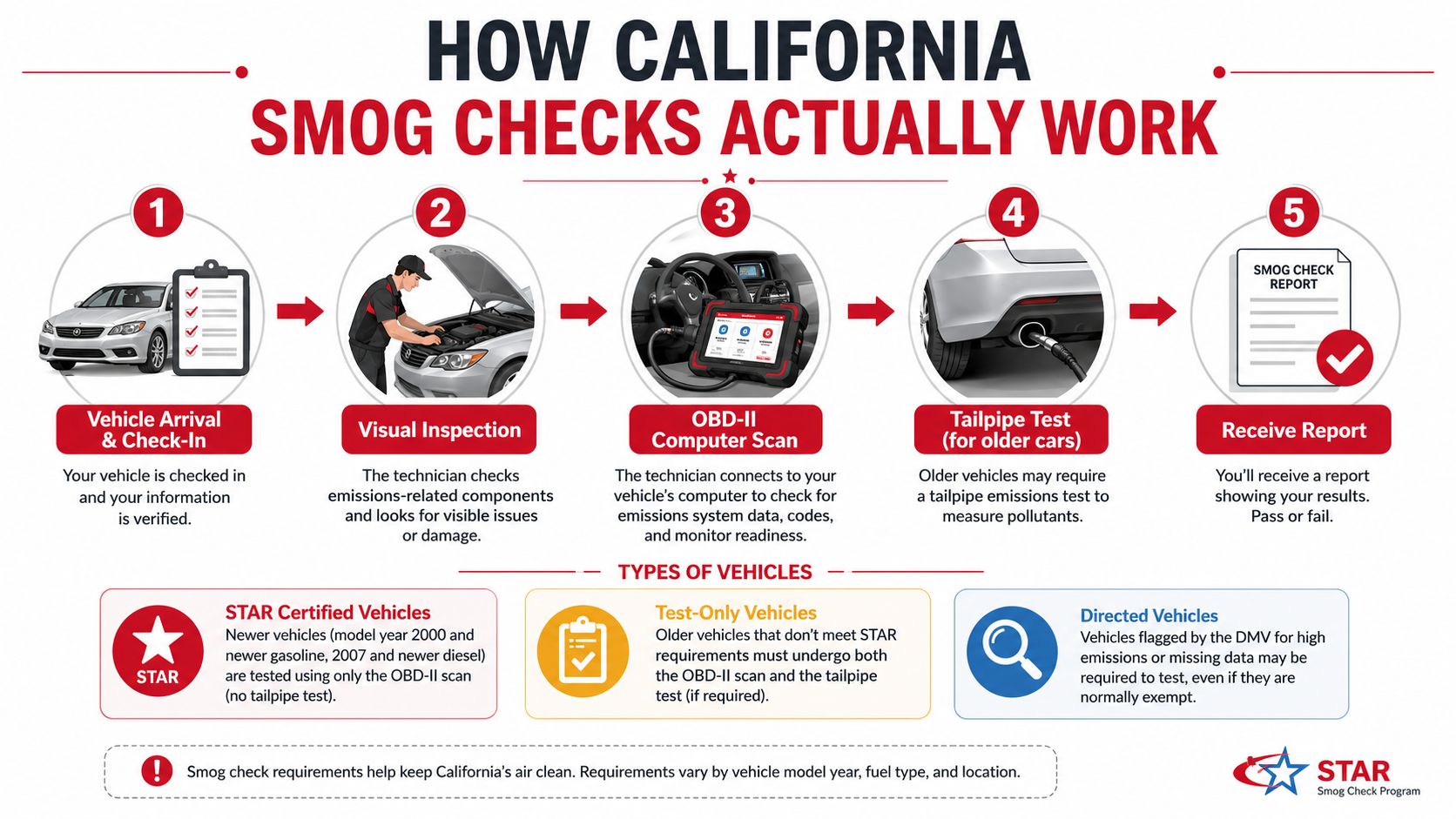
What the technician actually checks
A California smog inspection typically includes an OBD-II computer scan, a visual inspection, and a tailpipe test for older cars where applicable. That means the station is not only reading codes, it's also checking whether the emissions-related hardware appears intact and whether the vehicle's onboard system reports readiness correctly.
The categories matter. STAR-certified vehicles are directed to stations that meet stricter requirements. Test-only stations perform the inspection without also selling repair work. Directed vehicles are the ones the state sends to specific station types because of their compliance profile. That structure helps keep the process organized and keeps the test result tied to the vehicle, not the repair invoice.
Stop-and-go driving can affect what the car shows
EPA guidance on traffic pollution makes one point very clear. Idling, congestion, and stop-and-go patterns raise emissions EPA PDF. That matters because a car that's always driven hard in traffic may arrive at the station in worse shape than a car that gets gentle, steady use. The test doesn't care about your excuse for the drive over. It cares about the data and the hardware.
The practical takeaway is simple. A smog test rewards preparation. Warm the car properly, keep the maintenance current, and don't assume a warning light will somehow disappear at the station. It won't.
Test-Only Smog Stations and Why They Matter
A test-only station changes the customer experience in a way drivers should care about. The tech can inspect the car and report the result, but the station doesn't have a repair revenue stream hanging over the test. That matters because it reduces the pressure to turn every borderline result into a big estimate.
In Antioch, Fire House Smog is one example of that model. It operates as a STAR-certified test-only smog check station and also handles DMV registration services at 2900 Lone Tree Way. The shop has two service bays, offers smog testing seven days a week, and provides a free retest when required under its policy and coupon terms. That's the kind of setup that saves time for working drivers who don't want to bounce between a test lane and a repair counter.
What to ask before you hand over the keys
Bring the vehicle paperwork, your keys, and payment, then ask straightforward questions. Don't let anyone bury the answer under shop language. A good station should tell you whether your vehicle is a normal smog check, a directed case, or something that needs special handling.
Use this short checklist.
- Ask about station type: Confirm whether the location is test-only and STAR-certified.
- Confirm vehicle fit: Ask if your car, truck, SUV, or RV is within their equipment limits.
- Check the retest policy: Know the rules before you leave the lot.
- Ask about wait times: Two bays can help, but timing still matters.
- Bring the basics: Registration-related paperwork, keys, and payment are the minimum.
A test-only station is also useful because it keeps the conversation clean. The result is the result. If you fail, you can take that report to the repair side of your choosing instead of being pushed toward an in-house fix. That protects you from upselling and keeps the decision where it belongs, with the owner of the car.
Pairing Your Smog Visit With DMV Services
The smartest compliance move is to knock out the inspection and the paperwork in one trip. That's where a licensed business partner can save real time. Instead of visiting one place for the test and another for the registration work, you handle both while the car is already there.
California drivers often need help with registration renewals, ownership transfers, and related tag issuance. At Fire House Smog, DMV services are posted Monday through Saturday from 9:30 AM to 5:00 PM and Sunday from 12:00 PM to 4:00 PM, alongside smog-test availability through the week. If you work a normal schedule, that weekend access is the difference between getting it done and putting it off again.
A simple 30-day plan that doesn't waste money
Start with the cheapest fixes first. Drive smoother, cut unnecessary trips, check the warning lights, and get the basic maintenance handled. Then schedule the smog inspection and bring the registration paperwork with you if you also need DMV help.
Here's the order I'd use.
- Check the dash. If the light is on, don't pretend it's fine.
- Change the oil if it's due. Use the manufacturer-recommended oil.
- Inspect the tires and air filter. These are easy, basic fixes.
- Cut the aggressive driving. Less throttle abuse helps right away.
- Book the smog visit. Don't wait until the renewal deadline is breathing down your neck.
Best habit for drivers in a hurry: Get the test and the DMV paperwork done on the same stop, then move on with your week.
Common questions drivers ask in the bay
How often should you smog-check? When the state requires it for your registration cycle or vehicle category. What if the vehicle fails? Fix the fault, then retest under the station's policy or another licensed option. Does a check-engine light automatically disqualify you? In practical terms, it's a serious warning and should be addressed before you test. When is a vehicle exempt? That depends on the vehicle's age, type, and registration situation, so don't guess.
If you're in Antioch or East Contra Costa County, use the weekend hours, ask for the retest policy up front, and take the cleanest route to compliance. Fire House Smog's test-only setup and DMV services make that process simpler than running all over town.
If you need a smog check and DMV paperwork handled without the repair-shop runaround, visit Fire House Smog and book a stop that covers both jobs. You'll get a STAR-certified test-only inspection, clear next-step guidance if the car needs work, and a place that can also handle registration services on the same visit.