
You're trying to renew your California registration, sell a diesel pickup, or bring an out-of-state vehicle into the state. The DMV notice says a smog check may be required, but the rules seem inconsistent. An older diesel may be exempt from the standard inspection, while a newer, clean-running truck can fail because its onboard diagnostic monitors aren't ready.
The answer depends on more than fuel type. Model year, gross vehicle weight rating, vehicle type, and the applicable emissions program determine what you need to do. California uses one system for lighter diesel vehicles and separate programs for heavier commercial vehicles, so starting with the wrong assumption can waste a trip to the station.
Table of Contents
- What diesel owners actually need to know about California smog laws
- Which diesel vehicles fall under the light-duty Smog Check program
- OBD readiness rules that decide whether a newer diesel passes
- Heavy-duty diesel rules beyond the standard smog check
- Common exemptions and exclusions for diesel vehicles
- Real-world scenarios for individual owners and small fleets
- Repair, retest, and penalty steps to stay compliant
- Putting it together, your diesel smog compliance checklist
What diesel owners actually need to know about California smog laws
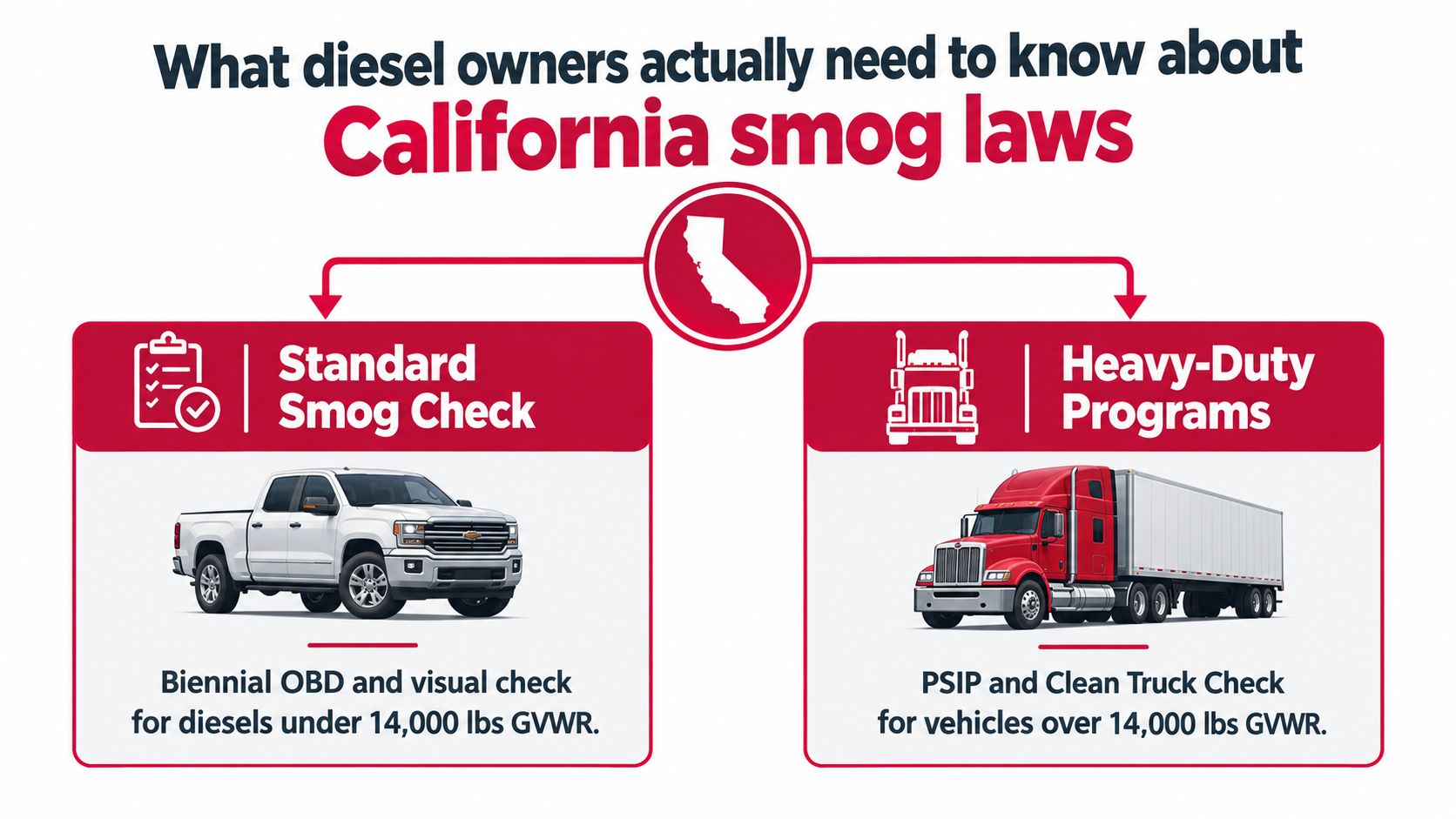
California diesel compliance has two main tracks. The first is the light-duty Smog Check Program, which covers many diesel cars, SUVs, vans, and pickups. These vehicles receive an emissions inspection that combines onboard diagnostics, emissions-equipment checks, and other applicable inspection procedures.
The second track covers heavier vehicles. Diesel vehicles outside the light-duty Smog Check boundary may fall under the Periodic Smoke Inspection Program, commonly called PSIP, and the Truck and Bus Regulation. The California Air Resources Board explains that heavy-duty diesel vehicles registered in California and meeting the applicable weight and age conditions became subject to annual PSIP requirements beginning October 21, 2010, while the Truck and Bus Regulation has operated since December 2008. See the CARB enforcement advisory on the Periodic Smoke Inspection Program for the separate heavy-duty framework.
Start with three questions
Before booking anything, identify:
- What model year is the vehicle? Diesel vehicles from 1998 and newer are generally within the light-duty Smog Check program when they meet the weight requirement. Diesel vehicles from 1997 and older are outside that standard inspection program.
- What is the GVWR? The light-duty boundary is 14,000 pounds GVWR or less. Check the manufacturer's door-placard rating, not the vehicle's current cargo weight.
- What type of vehicle is it? A personal diesel pickup and a commercial heavy-duty truck can face different rules even when both use diesel fuel.
California's diesel policy expanded in stages. The Bureau of Automotive Repair Smog Check guidance identifies January 1, 2010, as the point when Assembly Bill 1488 brought qualifying diesel passenger vehicles and trucks into the program. That history explains why diesel owners often encounter rules that look like a mixture of registration testing, diagnostic checks, smoke inspection, and fleet emissions regulation.
For a broader explanation of emissions equipment and standards, review diesel emissions standards. The rest of the process becomes much easier once you know which side of the 14,000-pound GVWR line your vehicle occupies.
Which diesel vehicles fall under the light-duty Smog Check program
A diesel vehicle generally belongs in California's regular Smog Check lane when it is model year 1998 or newer and has a GVWR of 14,000 pounds or less. That includes many diesel passenger cars, SUVs, vans, and pickups used privately or for lighter work. The California DMV smog inspection guidance uses the same model-year and weight boundary.
The GVWR is the manufacturer's maximum rated operating weight for the vehicle, including occupants and cargo. It isn't the truck's current scale weight. Find the rating on the driver-side door placard, then compare it with the model year listed on the title or registration record.
Use the eight-year timing rule
For a vehicle subject to biennial testing, the first inspection timing can be calculated by adding eight years to the model year, as described in the BAR reference guidance. A 2010 model-year diesel first becomes subject to a biennial Smog Check in 2018, while a 2017 model-year diesel first becomes due in 2025. After that first inspection, the vehicle generally follows the biennial cycle when the DMV requires certification.
| Model Year | GVWR | First Smog Check Due | Station Type |
|---|---|---|---|
| 1997 and older | Any light-duty rating | Exempt from the standard light-duty Smog Check | No standard light-duty test |
| 1998 and newer | 14,000 pounds or less | Add eight years to the model year, subject to DMV requirements | Licensed Smog Check station |
| 1998 and newer | Over 14,000 pounds | Not handled through the light-duty lane | Heavy-duty CARB programs |
A diesel Volkswagen TDI, Mercedes-Benz Bluetec, light-duty Duramax pickup, or Power Stroke pickup may therefore follow the same basic registration-testing path as other vehicles in the light-duty category. The badge, engine size, and body style don't decide the program by themselves. GVWR and model year do.
Don't confuse station categories
The station type matters, but owners often overcomplicate it. A light-duty diesel owner should choose a station licensed and equipped to inspect that vehicle. If the DMV notice or vehicle record directs you to a STAR station, use a STAR-certified location.
Diesel vehicles have special diagnostic requirements, especially newer models. Call before arriving if the vehicle is unusually large, modified, or an RV, because bay and equipment limits can vary. A station that handles ordinary passenger vehicles may not be able to inspect every commercial or recreational diesel.
OBD readiness rules that decide whether a newer diesel passes
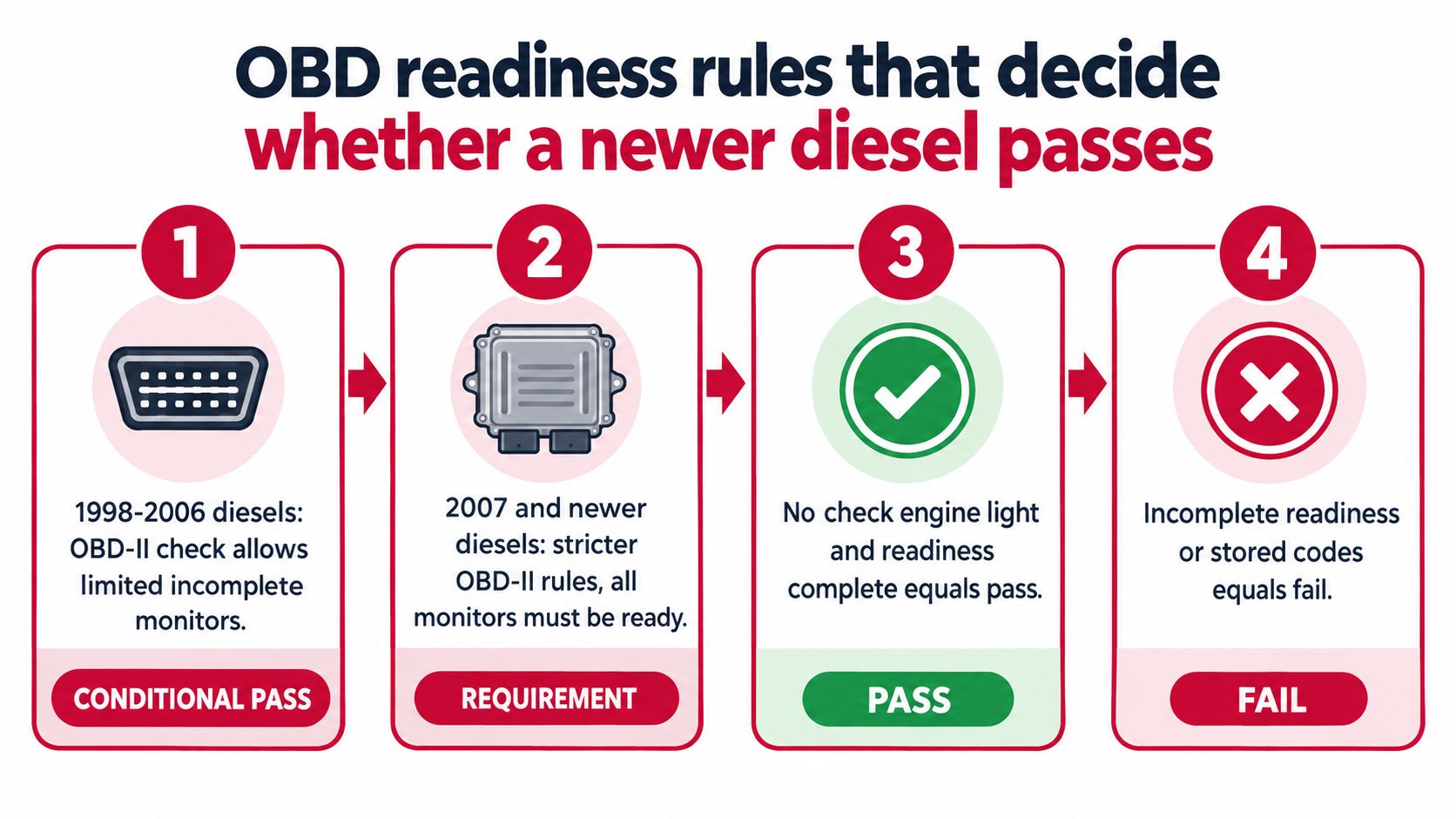
A diesel can start normally, produce no visible smoke, and still fail the smog check because its OBD readiness monitors haven't completed. These monitors are self-tests run by the engine control system. They check whether emissions-related components and systems have performed their required diagnostic routines.
The technician also checks for an illuminated malfunction indicator light and stored emissions faults. Clearing a code may turn the dashboard light off temporarily, but it can reset the monitors to incomplete. That creates a common trap: the owner fixes or clears a problem immediately before the appointment, then arrives with a vehicle that hasn't completed the required drive conditions.
The rules differ by diesel generation
For older OBD-equipped diesels, the applicable readiness standard allows limited incomplete monitors. The exact result depends on the vehicle's model year and the monitor status reported by the diagnostic system.
For 2007 and newer light-duty diesel vehicles, California tightened the readiness requirements beginning in July 2023. The BAR announcement on the updated diesel requirements states that only the Diesel Particulate Filter monitor and the Non-Methane Hydrocarbon Catalyst monitor may remain unset. All other applicable monitors must be ready.
That change matters because the permitted exceptions are narrow. A vehicle with an incomplete monitor after a battery disconnect, ECM reset, software reflash, or code clear may not qualify for a passing result even if it drives well.
Practical rule: Don't clear codes or disconnect the battery immediately before a smog appointment. Repair the cause first, then allow the vehicle to complete the manufacturer's required drive conditions.
Prepare the diagnostic system, not just the engine
After a repair, ask the technician what drive-cycle conditions the vehicle needs. Some monitors require a cold start, steady cruising, stop-and-go operation, or specific temperature conditions. A generic freeway drive may not complete every monitor on every diesel.
You can use an OBD scan tool to see whether monitors show “ready” or “not ready,” but a readiness check isn't a guarantee of a pass. The station still has to inspect the vehicle and evaluate applicable faults and emissions equipment. For a plain-language explanation of monitor status, see OBD readiness monitors.
The video below can help visual learners understand how diagnostic readiness affects emissions testing.
Heavy-duty diesel rules beyond the standard smog check
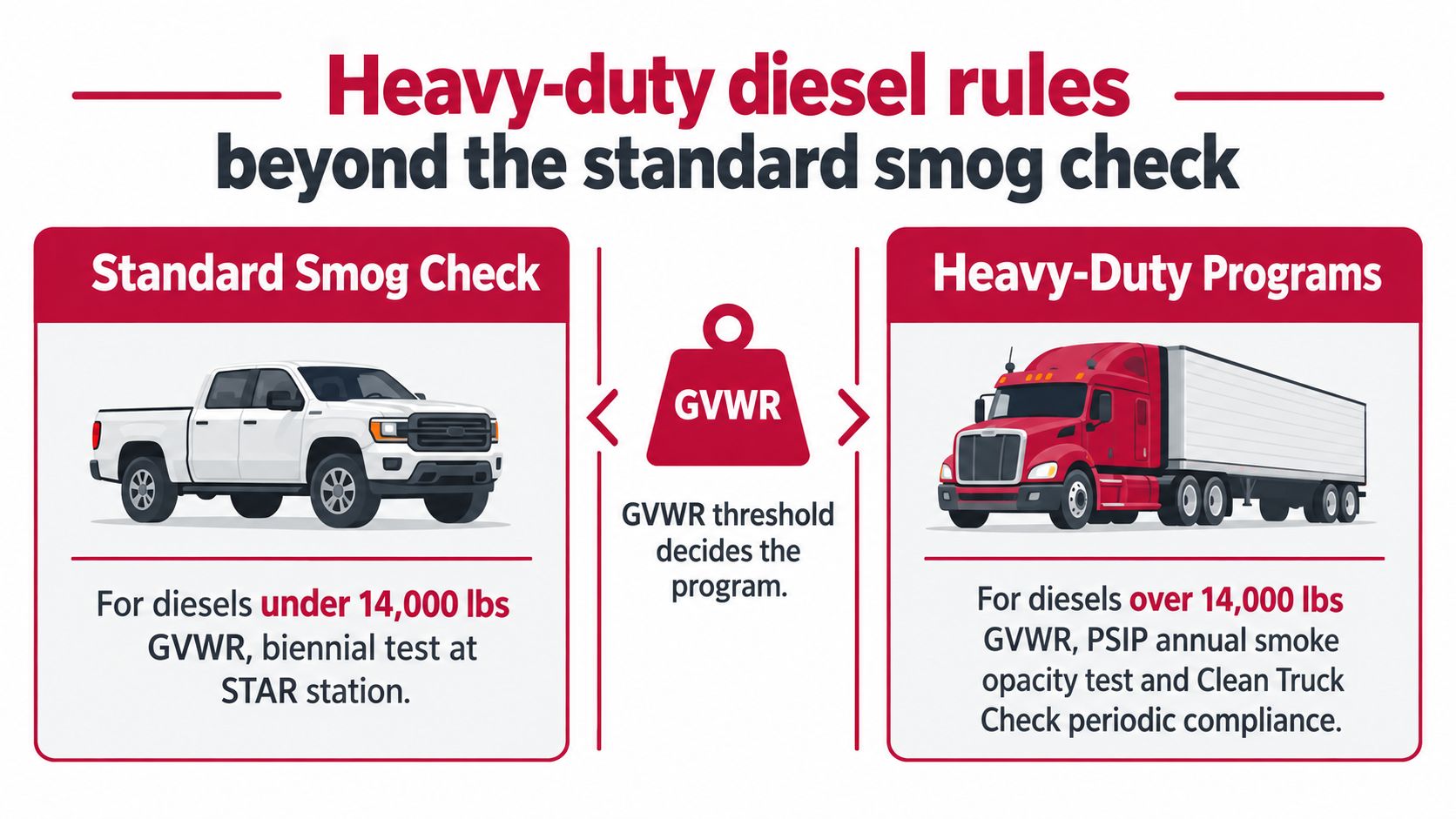
A diesel vehicle over 14,000 pounds GVWR generally doesn't use the ordinary light-duty Smog Check path. It enters a separate compliance environment administered primarily through CARB. That environment can include the Periodic Smoke Inspection Program, the Truck and Bus Regulation, and other heavy-duty requirements that apply according to the vehicle, engine, fleet, and operating conditions.
PSIP focuses on smoke emissions from covered diesel vehicles and buses. Depending on the vehicle and operator, compliance can involve inspections, records, self-certification, roadside enforcement, and station-based testing. A fleet manager shouldn't treat a passing DMV smog certificate as a substitute for heavy-duty CARB compliance.
Engine year matters separately from vehicle year
The Truck and Bus Regulation adds a second layer. CARB states that, as of January 1, 2023, diesel-powered vehicles operating in California with a GVWR over 14,000 pounds generally must have a 2010 or newer engine and emission system, subject to limited exceptions. The relevant engine year may differ from the vehicle's model year, particularly after an engine replacement.
That distinction affects purchasing, repairs, and fleet planning. A truck's cab may have one model year on its registration, while the installed engine carries a different emissions certification. Keep engine documentation with the vehicle records instead of relying only on the title.
Why California regulates smoke and particulate matter
CARB identifies diesel particulate matter as a toxic air contaminant, a designation adopted on August 27, 1998. That classification helps explain why California's diesel rules developed beyond a simple visible-smoke check. The state's framework addresses smoke, particulate emissions, engine age, emissions-control equipment, and fleet operation.
Fleet owners should build a unit-by-unit record showing GVWR, vehicle model year, engine model year, registration status, applicable CARB program, and inspection history. For heavy-duty compliance resources and service context, review clean air truck information, then confirm current obligations directly through CARB before operating or modifying a commercial vehicle.
Common exemptions and exclusions for diesel vehicles
Exemption questions cause many avoidable mistakes because “exempt from the standard Smog Check” doesn't always mean “free from every emissions rule.” A vehicle can sit outside DMV's light-duty inspection program and still face a CARB requirement based on weight, use, or commercial operation.
The clearest light-duty exclusion covers diesel vehicles from model year 1997 and older. Diesel vehicles over 14,000 pounds GVWR are also outside the standard light-duty Smog Check program, but they may fall into the heavy-duty programs described above. The BAR executive summary also identifies the light-duty coverage boundary for newer diesel vehicles.
Check the vehicle category before claiming an exemption
Some categories can be treated differently under the applicable program, including specialized off-road equipment, certain farm vehicles, military vehicles, and diesel-powered motorcycles. The registration classification and actual use matter. Don't rely on a seller's verbal assurance or an old forum post.
Newer vehicles may also be temporarily outside biennial or change-of-ownership testing. A current BAR reference guide identifies vehicles four model-years and newer as not subject to those tests. That timing rule is different from the older-diesel exclusion, so record the model year carefully.
| Vehicle category | Exempt from Smog Check? | Exempt from PSIP? | Documentation needed |
|---|---|---|---|
| Diesel, 1997 model year or older | Generally outside the standard light-duty program | Depends on weight, use, and coverage | Registration and vehicle records |
| Diesel, 1998 or newer, 14,000 pounds GVWR or less | Usually no, unless another exemption applies | Usually outside PSIP as a light-duty vehicle | DMV notice, registration, GVWR record |
| Diesel over 14,000 pounds GVWR | Outside the light-duty program | May be covered by heavy-duty requirements | GVWR, engine records, CARB records |
| Specialized farm, military, or off-road vehicle | May be excluded depending on classification and use | May be excluded or separately regulated | Registration class and use documentation |
| Four model-years and newer | Not subject to biennial or change-of-ownership checks under the applicable timing rule | Separate heavy-duty rules may still apply | Current registration and model-year record |
Out-of-state vehicles being registered in California can have separate first-registration requirements. An exemption from periodic testing doesn't automatically erase the need to meet California's applicable emissions standards when a vehicle is titled or transferred into the state.
Real-world scenarios for individual owners and small fleets
Maria owns a 2017 diesel Ram 1500 in Sacramento. Her renewal notice says a smog certificate is required, so she checks the door placard and confirms the truck falls within the light-duty GVWR boundary. She doesn't clear any diagnostic codes, drives it under the conditions recommended after maintenance, and checks the readiness status before booking a licensed inspection.
Her concern isn't the heavy-duty fleet rule. It's whether the truck's OBD system has completed its self-tests and whether the emissions equipment remains intact. If the vehicle is directed to a STAR station, she chooses a STAR-certified location and brings the renewal information and registration.
A small fleet faces a different decision
Devon manages four diesel box trucks for a delivery company. He starts by separating the vehicles according to GVWR and then records each engine model year, because the Truck and Bus Regulation uses engine and emissions-system requirements that don't always match the cab's model year.
Two units have older engines that require immediate compliance planning. Devon compares the cost and downtime of a compliant engine or emissions-system solution with the vehicle's remaining business value. The other trucks have newer engine configurations, but Devon still maintains the required CARB records and inspection schedule instead of assuming newer equipment is permanently clear.
A private owner prepares for one registration event. A fleet manager maintains a compliance system throughout the vehicle's operating life.
These examples show why the same word, “diesel,” isn't enough to choose a test. Maria needs a light-duty diagnostic inspection. Devon needs a program map for each truck, including engine information, operating weight, and heavy-duty reporting duties.
Repair, retest, and penalty steps to stay compliant
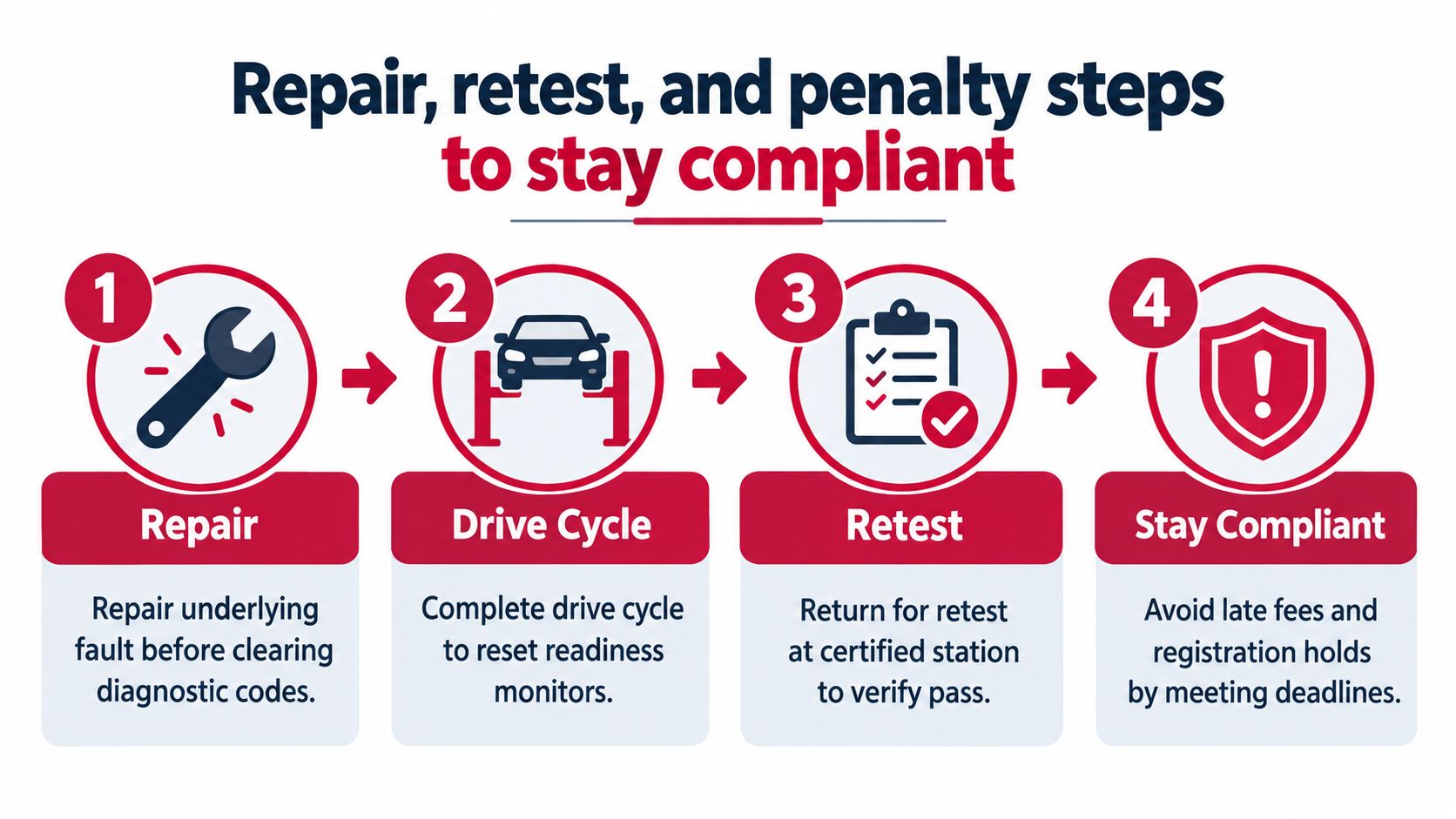
A failed diesel inspection gives you a result to investigate, not a reason to start replacing parts at random. Ask for the failure information, identify whether the issue involves a stored fault, readiness status, visual emissions equipment, or another inspection item, and repair the underlying condition before attempting a retest.
Start with the diagnostic record. If a code was cleared, the vehicle may need to complete its drive cycle again. If the DPF, EGR system, or Non-Methane Hydrocarbon Catalyst has been altered, missing, or incorrectly installed, the correct repair may involve restoring approved equipment rather than just changing software.
Follow a clean retest sequence
- Read the failure result carefully. Save the inspection report and ask which monitor, code, or equipment issue prevented a pass.
- Repair the cause. Use a qualified diesel technician when the issue involves the DPF, EGR, catalyst, sensors, wiring, or engine-control software.
- Complete the required drive conditions. A repaired vehicle still needs its monitors to run and report complete.
- Return for the retest. Bring the failed report, registration information, and repair documentation if requested.
Many stations offer a free retest under their own policy or coupon terms. Ask about the station's exact conditions before authorizing the first inspection. Income-eligible owners may also qualify for repair assistance through California's Consumer Assistance Program, but eligibility and available benefits must be confirmed with the program.
Don't ignore the registration consequence
A failed or refused inspection can delay registration renewal. Unresolved compliance problems can also create DMV holds or prevent a transfer from moving forward. Heavy-duty operators face separate enforcement exposure when a vehicle operates outside applicable CARB requirements, and violations can lead to civil penalties and other enforcement actions.
Keep the renewal notice, registration, inspection report, invoices, parts documentation, and any CARB records together. Good records won't make an illegal modification acceptable, but they'll help a technician or fleet manager identify what changed and what still needs attention.
Putting it together, your diesel smog compliance checklist
Use the vehicle's records, not its appearance, to choose the correct California diesel compliance path. A clean exterior, quiet idle, and absence of visible smoke don't establish exemption or guarantee an OBD pass.
For a private diesel owner
- Confirm the model year. A diesel from 1997 or older is outside the standard light-duty Smog Check program. A newer diesel may be included.
- Read the GVWR placard. If the rating is 14,000 pounds or less, evaluate the light-duty program. If it's over that boundary, investigate heavy-duty CARB requirements.
- Check the DMV notice. The notice tells you whether certification is required for your current registration transaction.
- Apply the timing rule. For applicable vehicles, add eight years to the model year to identify the first biennial inspection point.
- Check readiness before testing. For 2007 and newer light-duty diesels, confirm that all applicable monitors are ready except the DPF and Non-Methane Hydrocarbon Catalyst monitors, which may remain unset under the July 2023 rule.
- Use the right station. Choose a licensed station that can handle your vehicle and follow any STAR direction on the DMV record.
- Bring your paperwork. Have the renewal notice, registration, identification, and repair records available.
For a small fleet manager
Create a record for every unit with GVWR, vehicle model year, engine model year, registration classification, CARB program, inspection dates, and exemption documentation. Separate light-duty Smog Check tasks from PSIP and Truck and Bus Regulation duties so one completed inspection doesn't create a false sense of fleet-wide compliance.
Schedule engine and emissions-system reviews before a registration deadline. For heavy-duty vehicles, confirm current CARB reporting, inspection, and operating requirements directly with the agency because those obligations are distinct from the ordinary DMV smog certificate.
The most reliable workflow is simple: classify first, verify exemptions second, check readiness or heavy-duty inspection status third, and book the correct service last. That order prevents the common mistake of arriving at a station with a vehicle that belongs in a different compliance program.
Fire House Smog provides STAR-certified test-only smog inspections for cars, trucks, and qualifying diesel vehicles, along with California DMV registration renewal and ownership-transfer services. If you're in Antioch or East Contra Costa County, bring your renewal paperwork and vehicle information, then visit Fire House Smog to confirm the appropriate testing and registration service.
Do you know whether your California vehicle is smog exempt, or does it qualify for a temporary registration period without an inspection? That distinction determines whether you'll owe a fee, complete paperwork, schedule a future test, or maintain a permanent exemption based on the vehicle's age, fuel, and weight.
California's rules have changed over time, and the phrase “smog exempt” now covers several situations that don't work the same way. A 1975 gasoline vehicle, an electric vehicle, a newer gasoline vehicle, and a heavy diesel truck may all avoid a smog inspection, but their registration obligations can differ. Use the vehicle's model year, fuel type, transaction type, and gross vehicle weight rating before assuming the answer.
Table of Contents
- Understanding Smog Exemptions vs No Test Required
- Vehicle Age and Model Year Exemptions
- The Eight-Year Rolling Exemption Explained
- Electric and Alternative Fuel Vehicle Exemptions
- How to Claim Your Exemption at the DMV
- Classic Car Exemption Changes Coming Soon
- Local Smog Services for Antioch Vehicle Owners
Understanding Smog Exemptions vs No Test Required
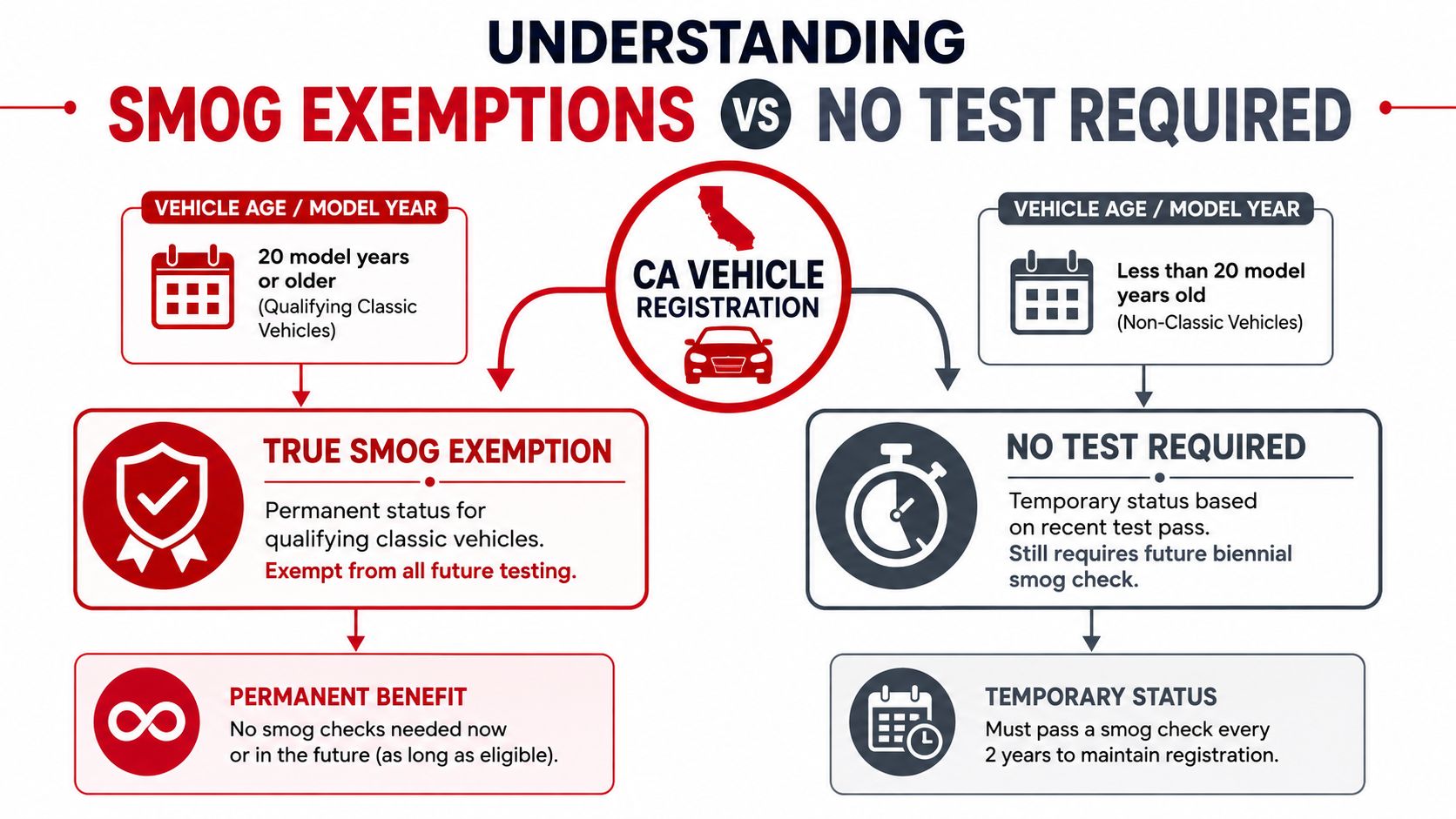
The most common mistake in smog exemptions California searches is treating “no test required” as a permanent exemption. It isn't. A true exemption removes the vehicle from applicable smog testing because it falls into a defined category, while a temporary no-test rule allows a registration or ownership transaction to proceed without an inspection during a limited period.
The two statuses have different consequences
A qualifying 1975-or-older gasoline vehicle belongs to California's historic age-based exemption category. By contrast, a newer gasoline, hybrid, or alternative-fuel vehicle that is eight model years old or newer generally skips the smog inspection for registration renewal but still uses a fee-based compliance process, as explained by the California Department of Motor Vehicles smog inspection rules.
That newer vehicle isn't permanently outside the program. Its status changes as the model year ages, and the owner must account for the applicable smog abatement fee at renewal. A vehicle that's no-test for one renewal can require an inspection at a later renewal.
Practical rule: “No test required” answers the inspection question. It doesn't automatically answer the fee, paperwork, or future-renewal questions.
Check your status before starting a transaction
Use this order:
- Identify the model year, not just the purchase year.
- Confirm the fuel type, including whether the vehicle is gasoline, diesel, hybrid, natural gas, or electric.
- Check the transaction, because renewal and ownership transfer use different age rules.
- Review the DMV notice, which may identify a required fee or smog certificate.
- Call a licensed provider or DMV service location if the record conflicts with the vehicle's title or registration.
This prevents a common failure point. Owners show up expecting a permanent exemption, but the DMV record treats the vehicle as temporarily exempt from inspection and still expects the applicable fee or transaction paperwork.
Vehicle Age and Model Year Exemptions
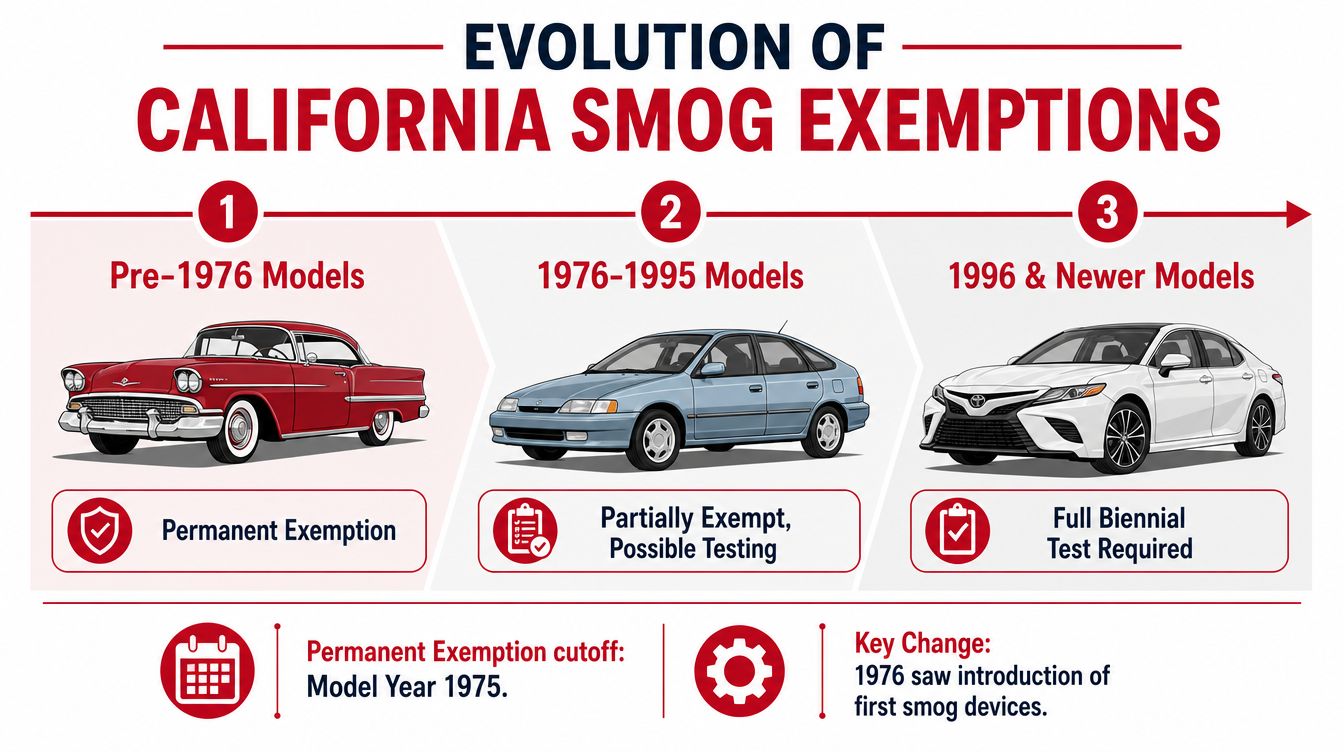
California's permanent historic exemption is narrower than many online summaries suggest. Gasoline-powered vehicles that are 1975 model year or older are exempt, while diesel eligibility follows a separate age and weight structure. The DMV lists diesel vehicles as exempt when they are 1997 model year or older or have a gross vehicle weight rating above 14,000 pounds. Natural-gas vehicles above that weight threshold and electric vehicles also appear in separate exemption categories on the DMV's official smog inspection guidance.
Model year controls the result
Don't use the calendar year you bought the car, the year shown in an advertisement, or the year a manufacturer built a particular vehicle. Use the official model year recorded for that vehicle. A car manufactured late in one calendar year may be sold as the next model year, so the vehicle identification number record, title, registration, and manufacturer documentation matter more than your memory.
For a gasoline classic, the cleanest decision is:
- 1975 or older model year: falls within the DMV's listed gasoline exemption.
- Later gasoline model year: don't assume permanent exemption based only on age or collector status.
- Diesel: check both the model year and GVWR.
- Natural gas: verify whether the vehicle exceeds the stated weight threshold.
- Electric: the DMV lists electric vehicles as exempt from smog inspections.
The legislative history explains why older advice conflicts. Before 1998, California used a cutoff for vehicles manufactured before the 1966 model year. SB 42 extended the cutoff to vehicles manufactured before the 1974 model year and created a rolling approach beginning in 2003. AB 2683 then reversed that rolling rule and established a fixed cutoff for vehicles manufactured before the 1976 model year. The California legislative summary for AB 220 documents that evolution.
Weight matters for diesel and natural gas vehicles
A diesel vehicle's age alone isn't the whole test. A diesel vehicle above 14,000 pounds GVWR qualifies under the DMV's listed weight category, while a natural-gas vehicle must also exceed that threshold for the relevant exemption. Check the manufacturer's GVWR label and registration record rather than estimating from the vehicle's empty weight or how much it carries.
The embedded guide below can help you organize the model-year and fuel-type questions before contacting the DMV.
The Eight-Year Rolling Exemption Explained
The newer-vehicle rule is temporary, transaction-specific, and frequently mislabeled as a permanent exemption. California says gasoline, hybrid, and alternative-fuel vehicles that are eight model years old or newer don't need a smog inspection for registration renewal. For a change of ownership, vehicles four model years old or newer don't need the inspection, according to the Bureau of Automotive Repair's Smog Check guidance.
The transaction changes the answer. A vehicle may qualify for no inspection during a transfer but not during a later renewal, or it may qualify for a renewal without testing while still requiring the applicable fee. The rule is based on model-year age, not the owner's maintenance history or the vehicle's mileage.
How 2026 changes the calculation
The key 2026 issue is the 2018 model year. Independent coverage of the 2026 exemption list explains that 2018-model vehicles lose the eight-year renewal exemption in 2026, so owners who assumed the status was permanent may receive a registration notice requiring a smog check. Review the 2026 California smog exemption guidance against the DMV record before your renewal deadline.
The fee replaces the inspection during the temporary no-test period. It doesn't convert the vehicle into a permanently exempt vehicle, and it doesn't erase future testing obligations once the vehicle ages beyond the applicable threshold.
| Model Year | Renewal Requirement | Transfer Requirement | Fee Type |
|---|---|---|---|
| 2026 and newer | No smog inspection during the applicable temporary period | No smog inspection during the applicable transfer period | Smog abatement or transfer fee may apply |
| 2018 | Check DMV status carefully in 2026, because the eight-year renewal period ends | Apply the separate transfer-age rule | Renewal or transfer fee may apply when no test is required |
| Older than the applicable rolling period | Smog inspection generally returns unless another exemption applies | Smog inspection depends on the transfer-age rule and vehicle record | Fee alone doesn't create permanent exemption |
Treat the table as a screening tool, not a substitute for the DMV transaction record. A vehicle's fuel type, registration classification, and transaction can affect the result.
Owner's rule: If your vehicle is “exempt” only because it's newer, put a future smog check on your renewal plan.
Electric and Alternative Fuel Vehicle Exemptions
Electric vehicles receive a different treatment from hybrids and many other alternative-fuel vehicles. The DMV lists electric vehicles as exempt from smog inspections, while hybrid vehicles are included with gasoline and alternative-fuel vehicles under the temporary age-based no-test rule for newer vehicles. That means a hybrid shouldn't automatically be treated like a battery-electric vehicle.
Natural-gas eligibility also depends on weight. The DMV identifies natural-gas vehicles above 14,000 pounds as exempt, so a smaller natural-gas vehicle shouldn't be classified from fuel type alone. Confirm the fuel designation and GVWR in the vehicle record.
Bring records that match the vehicle
Registration problems often arise when the DMV record doesn't reflect the vehicle's actual configuration. Before a renewal, transfer, or initial California registration, gather:
- Current registration or title: Check the recorded model year and fuel classification.
- Vehicle identification number: Use the VIN consistently across the title, insurance, and DMV paperwork.
- GVWR documentation: For diesel or natural-gas vehicles, use the manufacturer label or official vehicle records.
- Out-of-state documents: If the vehicle is entering California, bring the title and registration documents that establish identity and ownership.
- Transaction paperwork: A transfer and a renewal don't use identical age rules, so identify the transaction before relying on a no-test status.
A fuel-system conversion deserves special caution. Don't assume a modified vehicle will receive the same treatment as a factory-configured electric, natural-gas, or alternative-fuel vehicle. Ask the DMV or a licensed smog professional how the vehicle is classified before submitting the transaction.
Separate testing from registration compliance
An electric vehicle can be exempt from the smog inspection and still require ordinary registration paperwork and fees. A newer hybrid can avoid the test for the applicable period but still carry a smog-related fee. The practical question isn't merely “Does this vehicle pollute?” It's “What does California's record require for this exact vehicle and transaction?”
How to Claim Your Exemption at the DMV
Knowing that a vehicle fits an exemption category doesn't guarantee that the transaction will process without documentation. The DMV's system uses the vehicle record, model year, fuel type, weight information, and transaction details. If one field is wrong or incomplete, the system may request a smog certificate even when the vehicle appears eligible.
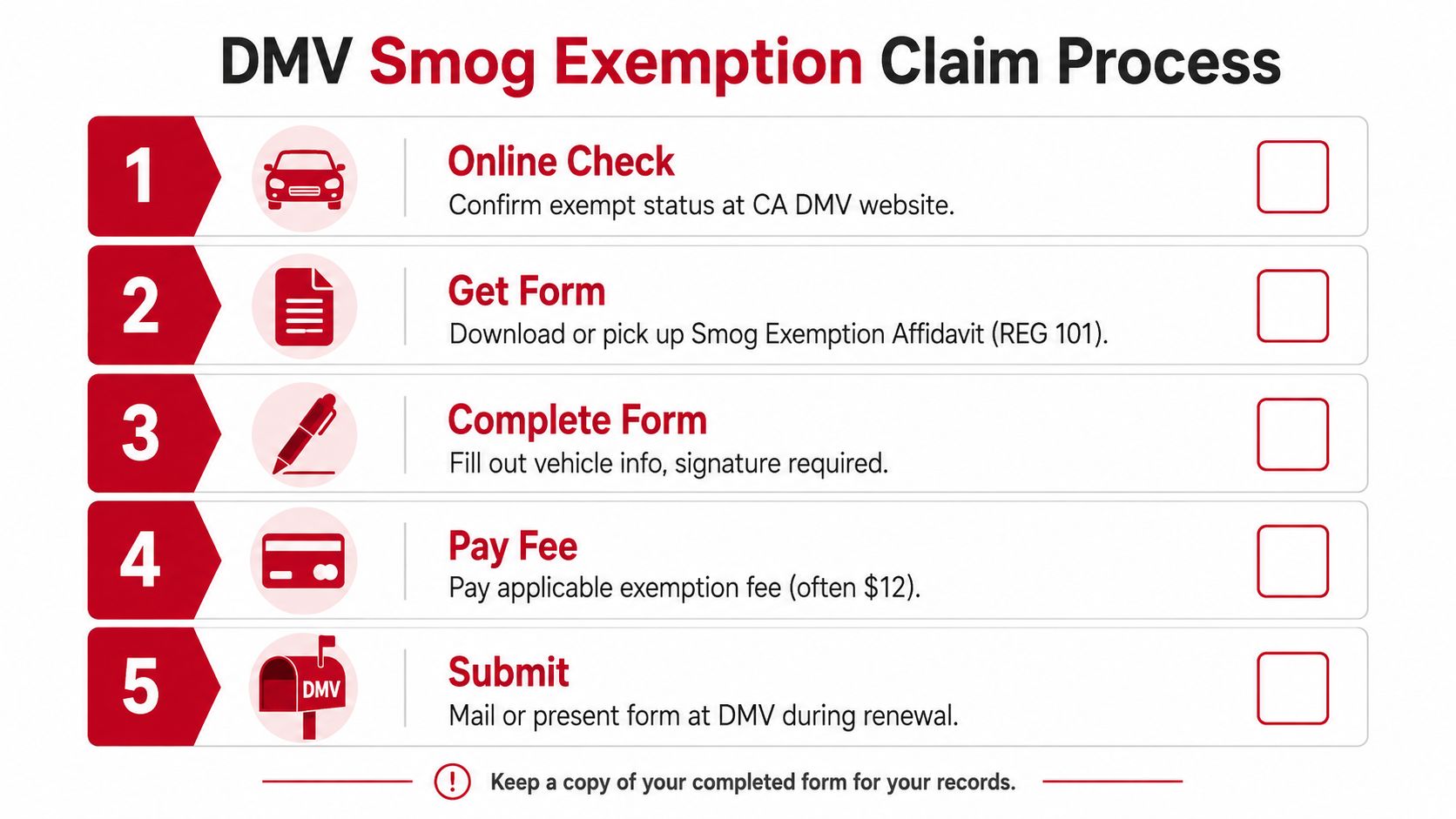
Use a transaction-first checklist
Start with the notice from the DMV. It tells you whether you're renewing registration, transferring ownership, or completing an initial California registration. Then compare the notice with the vehicle's title and registration.
Bring or prepare:
- The DMV renewal or transfer notice, if one was issued.
- Current title and registration documents, especially when the vehicle is newly acquired.
- VIN and model-year information, copied exactly from the vehicle and official documents.
- Fuel and weight evidence, when the exemption depends on electric status, diesel age, natural-gas fuel, or GVWR.
- The applicable fee or payment method, because no inspection doesn't necessarily mean no smog-related charge.
- Any required DMV form, completed with the vehicle information and owner signature.
The infographic references REG 101, but don't rely on an online checklist without confirming the current form and instructions with the DMV. Forms and transaction requirements can change, and a form that applies to one situation may not resolve a record problem in another.
Challenge an incorrect requirement promptly
If the DMV system flags an exempt vehicle, ask what vehicle attribute triggered the request. A staff member may need to correct the model year, fuel type, or weight record rather than send you to a smog station. Don't pay for an unnecessary inspection until you understand whether the issue is eligibility or a data mismatch.
For registration logistics, California DMV registration renewal assistance can be useful when you need help handling the transaction alongside a smog question. Keep copies of submitted forms, receipts, and supporting documents until the registration is complete.
Classic Car Exemption Changes Coming Soon
The historic gasoline exemption and the proposed collector-vehicle changes are not the same rule. Today's core framework centers on gasoline vehicles manufactured before the fixed cutoff associated with the 1976 model year. A collector vehicle outside that category shouldn't be treated as exempt because it's old, valuable, modified, or rarely driven.
BAR's Spring 2026 legislative update describes proposed legislation that would exempt collector motor vehicles manufactured before the 1981 model year from biennial Smog Check, then extend the threshold by one model year annually beginning January 1, 2028, reaching 1985 model-year vehicles by January 1, 2032, if the proposal becomes law. The BAR Spring 2026 legislation and regulations update also describes abbreviated inspections for some older vehicles, so “exempt” may not mean every inspection component disappears.
What this means for a collector owner
Consider three vehicles:
- A qualifying 1975 gasoline vehicle already fits the existing historic framework.
- A 1980 collector vehicle could benefit if the proposed pre-1981 threshold becomes effective.
- A later collector vehicle may need to wait for a future expansion, and the timing depends on enacted law rather than a proposal alone.
That distinction matters when buying a project car. Don't pay a premium today based on a future exemption that hasn't become an active registration rule. Check the current BAR update, the DMV record, and the vehicle's exact model year before completing a purchase or planning a renewal.
Owners of older vehicles can also review smog checks for older cars to identify whether the vehicle falls under the existing exemption, a proposed collector category, or an abbreviated inspection process. Keep the original title, registration history, VIN documentation, and any collector classification records organized. Those documents can help establish the vehicle's identity when its age or configuration creates a question.
Local Smog Services for Antioch Vehicle Owners
Antioch owners should separate three tasks: confirm eligibility, complete the DMV transaction, and test the vehicle when the record requires it. A vehicle that looks exempt may still need a certificate because it has aged out of the rolling rule, falls outside the permanent categories, or has a DMV record with incorrect fuel or model-year information.
A STAR-certified test-only station is relevant when the DMV requires a smog certificate and you want an inspection provider that doesn't sell repair work. Fire House Smog is a STAR-certified test-only station and licensed DMV registration services provider at 2900 Lone Tree Way in Antioch, offering smog testing and selected registration transactions. Review its Antioch smog check services before visiting and call ahead for larger vehicles or RVs.
Match the service to your situation
- Renewal notice requests a certificate: Schedule the required inspection before the deadline.
- You believe the vehicle is permanently exempt: Bring the title and registration so the model year and vehicle category can be checked.
- A newer vehicle says no test required: Confirm the applicable fee and note when the rolling status ends.
- A diesel or natural-gas vehicle qualifies by weight: Bring reliable GVWR documentation instead of estimating.
- The vehicle is a collector car: Verify whether current law applies, rather than relying on proposed changes.
Ask whether the location can process your specific transaction, whether the vehicle fits the equipment limits, and what documents you should bring. That short call can prevent an unnecessary trip and clarify whether you need testing, registration assistance, or a DMV record correction.
Fire House Smog provides STAR-certified test-only smog inspections and California DMV registration services for Antioch vehicle owners, including renewals and ownership transfers. Visit Fire House Smog with your DMV notice and vehicle documents to confirm whether your vehicle needs a test, a fee, or exemption-related paperwork.