Clean Air Truck Guide: California Rules and Compliance Steps
Marcus in Antioch opened his mail and found the notice no truck owner wants: his 2012 Silverado 1500 needs a smog check before DMV will renew the registration. Without a valid certificate, the renewal stalls, and that can put a contractor's daily routine at risk, from hauling tools to reaching a job site.
“Clean air truck” isn't just a sales phrase. In California, it connects vehicle emissions, registration requirements, California Air Resources Board enforcement, and the inspection process at an approved smog station. The rules depend on the truck's fuel, weight, model year, and compliance history.
By the end, you'll know what California means by a clean air truck, how gasoline and diesel pickups follow different paths, what happens during a smog inspection, and how to prepare for a test-only STAR station. You'll also understand why older diesel equipment receives attention from CARB even when it doesn't use the same station-based test as a light-duty gasoline truck.
The practical takeaway is simple. By the last section, you'll know which station to use, what paperwork to bring, and what to check before paying for a test.
Table of Contents
- Why a Clean Air Truck Matters in California Right Now
- What a Clean Air Truck Means
- Diesel and Gasoline Trucks Under California Rules
- How Smog Checks and Certification Work
- Pre-Check Habits That Prevent Failed Smog Tests
- Getting Your Truck Compliant at a STAR Test-Only Station
- Common Misconceptions That Trip Up Truck Owners
- Your Next Steps and Where to Test in Antioch
Why a Clean Air Truck Matters in California Right Now
California treats emissions compliance as part of vehicle ownership, not as an optional maintenance project. If your renewal notice requires a smog check, the DMV generally needs the electronic certificate before it can complete the registration renewal. A truck that runs reliably can still fail because its emissions controls, diagnostic monitors, or inspection records don't satisfy the current test.
That's why the phrase clean air truck matters to owners. It describes a truck that meets the emissions requirements for its model year and passes the inspection required for its class. A clean-looking exterior, strong engine, or recent oil change doesn't establish compliance.
Practical rule: Read the DMV renewal notice before choosing a station. The notice tells you whether the state has placed a smog requirement on that registration renewal.
California's enforcement picture also reaches beyond the ordinary light-duty smog appointment. Visible smoke from a diesel truck can attract roadside attention, and commercial diesel operators may face CARB obligations that don't appear on a typical passenger-vehicle checklist. Heavy-duty trucks also matter disproportionately to air-quality policy. An EPA and Congressional Research Service summary states that heavy-duty trucks account for about 32% of mobile-source NOx emissions while representing roughly 2% of California's on-road vehicle fleet.
The policy direction is tightening, too. EPA's heavy-duty standards finalized in December 2022 are described as more than 80% stronger than the rules then in place, with model year 2027 and later trucks facing stricter emissions requirements. EPA's final-rule materials describe tailpipe NOx reductions of about 80% and particulate-matter reductions of 50% versus prior standards.
For an owner, the next step isn't to debate every future rule. It's to identify the truck category, follow the current registration instruction, and test before the deadline.
What a Clean Air Truck Means
A clean air truck meets the emissions standard assigned to its model year and vehicle class. That definition comes from a long federal rulemaking history, not from a badge, aftermarket claim, or a clean-looking exhaust.
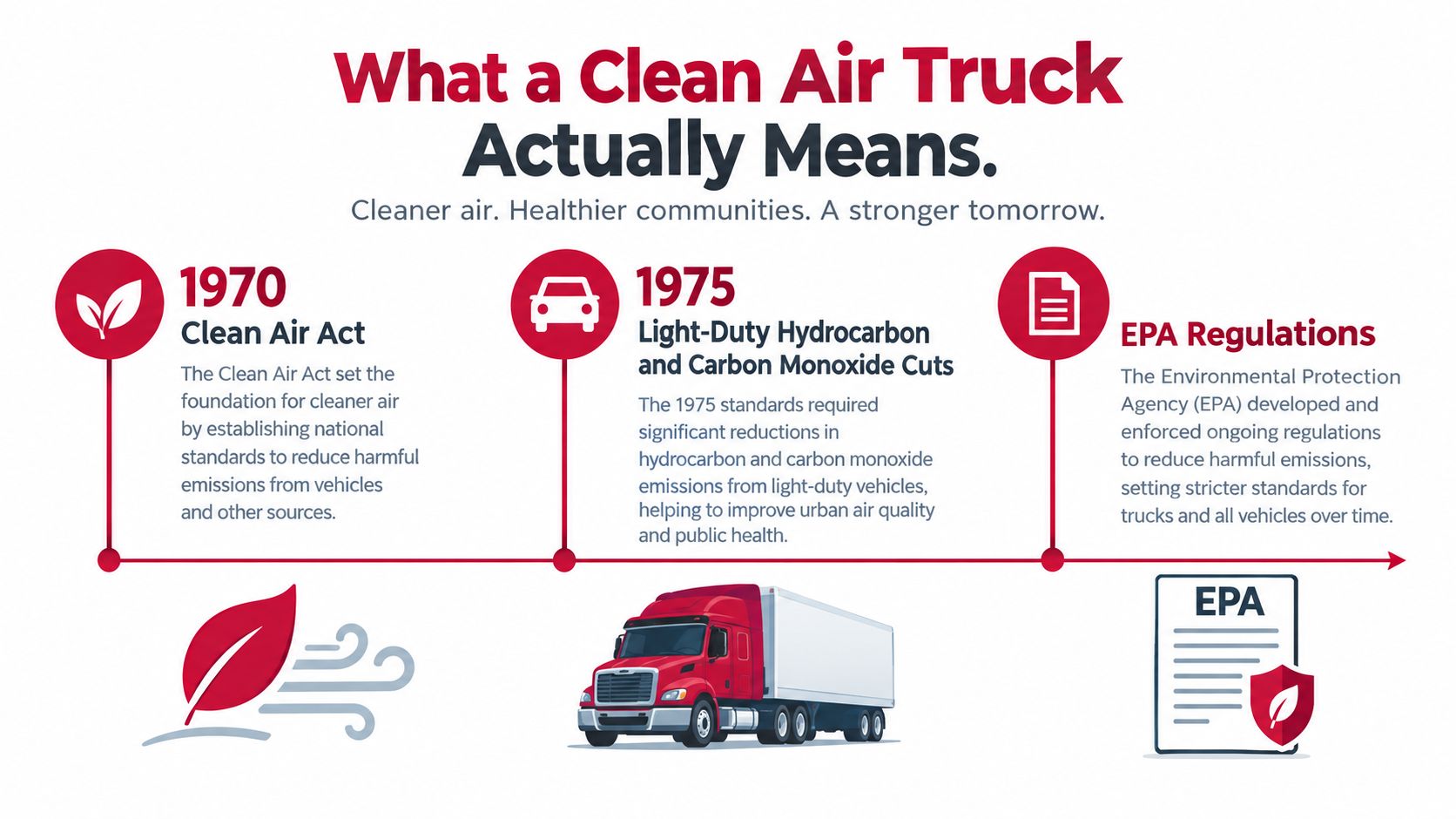
The federal Clean Air Act of 1970 established national vehicle-emissions controls. Standards for cars and light-duty trucks followed in 1975, and EPA continued tightening nitrogen oxide limits for light trucks. EPA's historical summary records a 2.3 grams-per-mile NOx limit by 1979, followed by stricter requirements for heavier and lighter light-duty trucks in later years. EPA's clean-vehicle history identifies the Tier 2 program, finalized in 2000 and phased in from the 2004 model year, as a major change. Its 0.07 grams-per-mile NOx standard represented an 86% to 95% reduction for light trucks compared with prior requirements.
The heavy-duty reset
Diesel freight trucks reached another major compliance point with EPA's 2007 heavy-duty standards. New heavy-duty engines had to reduce particulate matter to 0.01 grams per brake horsepower-hour, a near-zero level. EPA's SmartWay timeline describes the 2007-era rules as reducing smog-forming emissions from trucks and buses by about 95% and particulate emissions by about 90% compared with earlier levels. Newer clean-diesel engines have also been described as producing about 99% lower NOx and 98% fewer particulate emissions than previous generations. EPA's SmartWay timeline places the newer model year 2027 requirements within that continuing progression.
California adds a separate layer through CARB programs and vehicle rules. New truck sales, fleet composition, and emissions performance are moving toward stronger zero-emission and near-zero-emission requirements, with light-duty phases covering model years 2027 through 2033, according to the ICCT policy update. Those requirements shape new-vehicle purchases and fleet planning. They do not cancel an older truck's current smog obligation.
For an owner, the working definition is straightforward: your truck must meet the standard tied to its model year and pass the California inspection required for its category. That is what determines registration readiness. A truck can have newer emissions technology and still fail if its required inspection, equipment, or emissions controls do not meet California's rules.
Diesel and Gasoline Trucks Under California Rules
Start with fuel type. A gasoline pickup and a diesel work truck may look similar in the driveway, but California can send them through different compliance paths.
A gasoline light-duty truck generally enters the recurring smog-check cycle based on model year and age. California's process commonly uses OBD-II testing for newer vehicles, while older vehicles may receive additional inspection procedures. Diesel light-duty trucks are handled differently, especially around particulate controls, fees, and the types of enforcement that apply.
Use this quick sorting table before you book:
| Category | Model Year Scope | Smog Check Required? | Annual Fee | Main Exemption |
|---|---|---|---|---|
| Gasoline light-duty truck | 1976 and newer, subject to California's age and registration rules | Often, when listed on the DMV renewal notice | Smog Abatement and transaction charges may apply | 1975 and older gasoline vehicles |
| Diesel light-duty truck | 1997 and newer, under 14,000 pounds GVWR | Subject to the applicable DMV cycle | Diesel particulate fee may apply | Pre-1997 diesel light-duty vehicles |
| Heavy-duty diesel truck | Heavy commercial class | Often outside the station smog-check line | CARB reporting and equipment obligations may apply | Station-test exemption does not remove CARB duties |
| Electric or hydrogen fuel-cell vehicle | Applicable zero-emission vehicle class | No tailpipe smog test | Registration rules still apply | No combustion tailpipe |
A gasoline owner should first confirm the renewal notice. A diesel light-duty owner should also account for CARB's diesel particulate fee structure and confirm whether the truck's weight and model year place it in the light-duty testing category. For diesel-specific testing information, review diesel smog testing in California.
Heavy-duty diesel owners need a different mindset. A truck may not receive the same station inspection as a light-duty pickup, yet CARB can still regulate it through programs involving reporting, idling, transport refrigeration equipment, and roadside visible-smoke enforcement. Don't mistake “no station smog check” for “no emissions responsibility.”
Your three-bucket decision is straightforward:
- Gasoline light-duty truck: Follow the DMV smog instruction and use the correct station type.
- Diesel light-duty truck: Confirm test eligibility, particulate-fee treatment, and equipment requirements.
- Heavy commercial diesel: Check the applicable CARB programs before assuming a station visit is the only obligation.
How Smog Checks and Certification Work
A California smog inspection combines electronic diagnosis with a physical emissions check. The exact procedure depends on the truck's age, fuel, equipment, and the inspection program attached to its registration.
A STAR-certified station meets additional state performance and testing requirements. A test-only station can inspect the vehicle but doesn't perform repair work. That separation matters because the station's job is to document the result, not sell you a repair package after a failure. The STAR-certified smog explanation gives owners more background on how the designation affects station selection.
What happens in the bay
For newer gasoline trucks, the technician connects to the vehicle's OBD-II system. The system reports diagnostic trouble codes and readiness monitors. The technician also checks emissions-related components visually and may perform a fuel-cap inspection or tailpipe procedure when the vehicle and test require it.
Older vehicles may receive a tailpipe emissions test. Newer diesel trucks can involve different inspection equipment and procedures, so the technician must follow the applicable BAR process rather than applying a gasoline checklist to every truck.
| Station Type | Can Test | Can Repair | Handles Directed or Random Referrals | Typical Use |
|---|---|---|---|---|
| Regular licensed station | Yes | May, depending on license and business model | Some referral work | Routine inspections and repairs |
| STAR-certified station | Yes | May be test-and-repair or test-only | Yes, when authorized | STAR-required vehicles |
| STAR test-only station | Yes | No | Yes, when authorized | Independent certification and referrals |
| Repair facility | Not necessarily | Yes | Not necessarily | Diagnosis and emissions repairs |
If the BAR system directs or randomly refers a vehicle to STAR, the owner must use an eligible STAR station. A failed inspection produces a noncompliance result rather than a registration certificate. The owner then repairs the identified problem and returns for a retest under the station's and state's eligibility rules.
Ask about retest terms before leaving. A same-station retest may be free within the qualifying period, while changing stations can mean paying for another inspection. Once the truck passes, the station transmits the certificate electronically to DMV, and the owner can complete the registration step.
Pre-Check Habits That Prevent Failed Smog Tests
Most owners don't need a complicated emissions strategy before a routine test. They need to avoid arriving with an obvious fault or an incomplete diagnostic system.
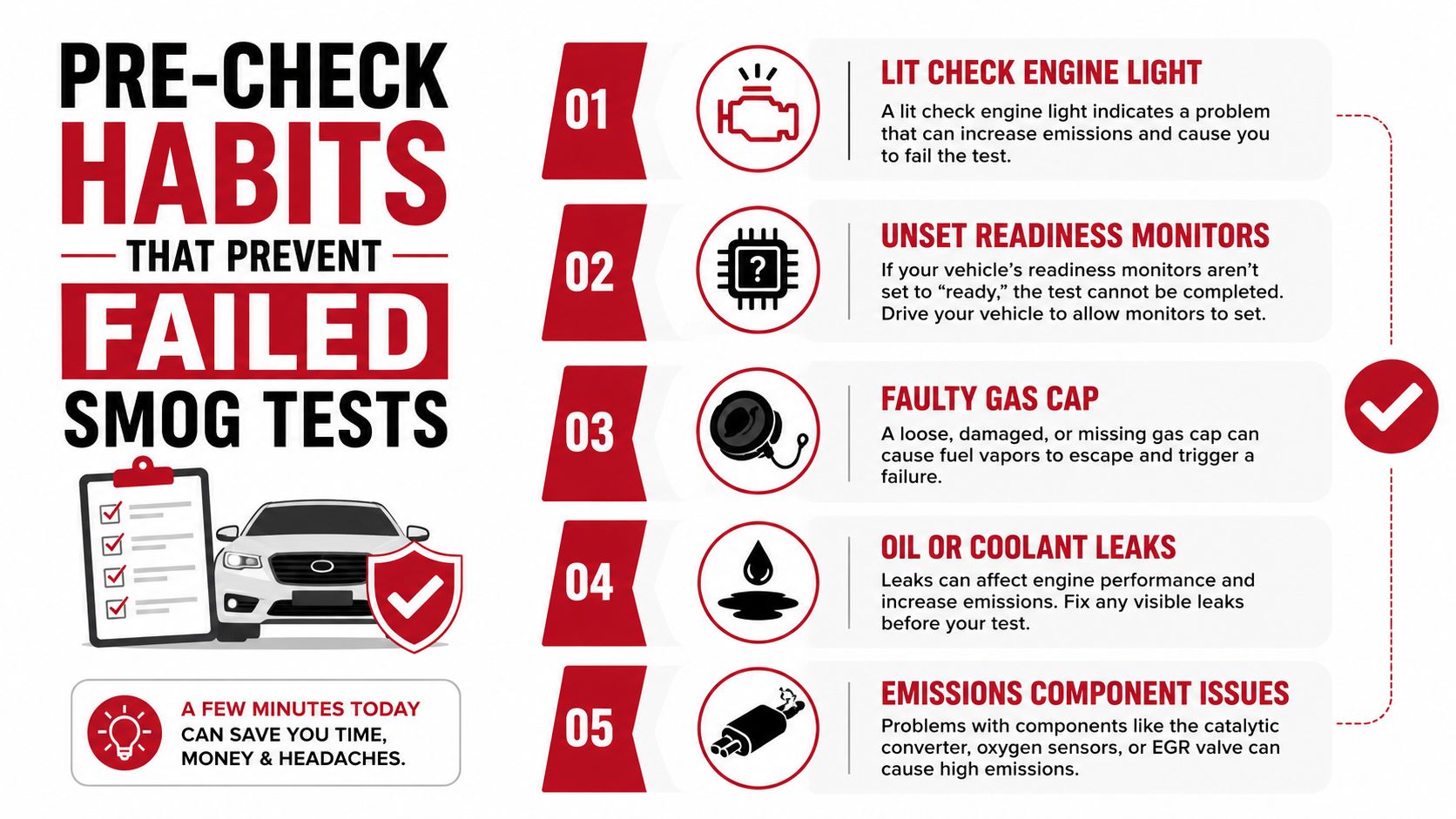
Start with the dashboard. An illuminated check-engine light, also called the malfunction indicator lamp, is a serious warning for an OBD-equipped truck. A vehicle can feel perfectly normal while storing an emissions code that causes an automatic failure.
Then check the readiness monitors. Disconnecting the battery or clearing codes resets the system's self-tests. The truck may need mixed driving before the monitors complete, and arriving too soon can leave the vehicle ineligible for a clean pass.
Your driveway checklist
- Inspect the fuel cap: Make sure the cap seals tightly and the gasket isn't cracked. A small EVAP leak can trigger a code.
- Look at emissions hardware: Check for obvious damage, missing shields, disconnected hoses, or an altered catalytic converter.
- Watch for leaks: Oil or coolant reaching the exhaust can create problems and may point to a larger mechanical issue.
- Check the warning lights: Don't assume a pending code is harmless. Have it diagnosed before scheduling the inspection.
- Drive normally after repairs: Use a mixed city and highway loop over several days so the vehicle can complete its self-checks.
A 50 to 70 mile mixed-driving routine is a practical preparation target for many vehicles, but it doesn't guarantee that every monitor will set. The truck's operating conditions and the specific fault determine how quickly the system completes its checks.
Avoid the battery-disconnect shortcut. Clearing the light without fixing the cause usually creates a second problem, incomplete readiness monitors, and a higher chance of referral or failure.
A failed test isn't always a major engine disaster. A loose cap, an EVAP fault, or an incomplete monitor can be easier to correct than a failed catalytic converter or diesel emissions component. Get the failure report, repair the listed issue, and retest instead of guessing.
Getting Your Truck Compliant at a STAR Test-Only Station
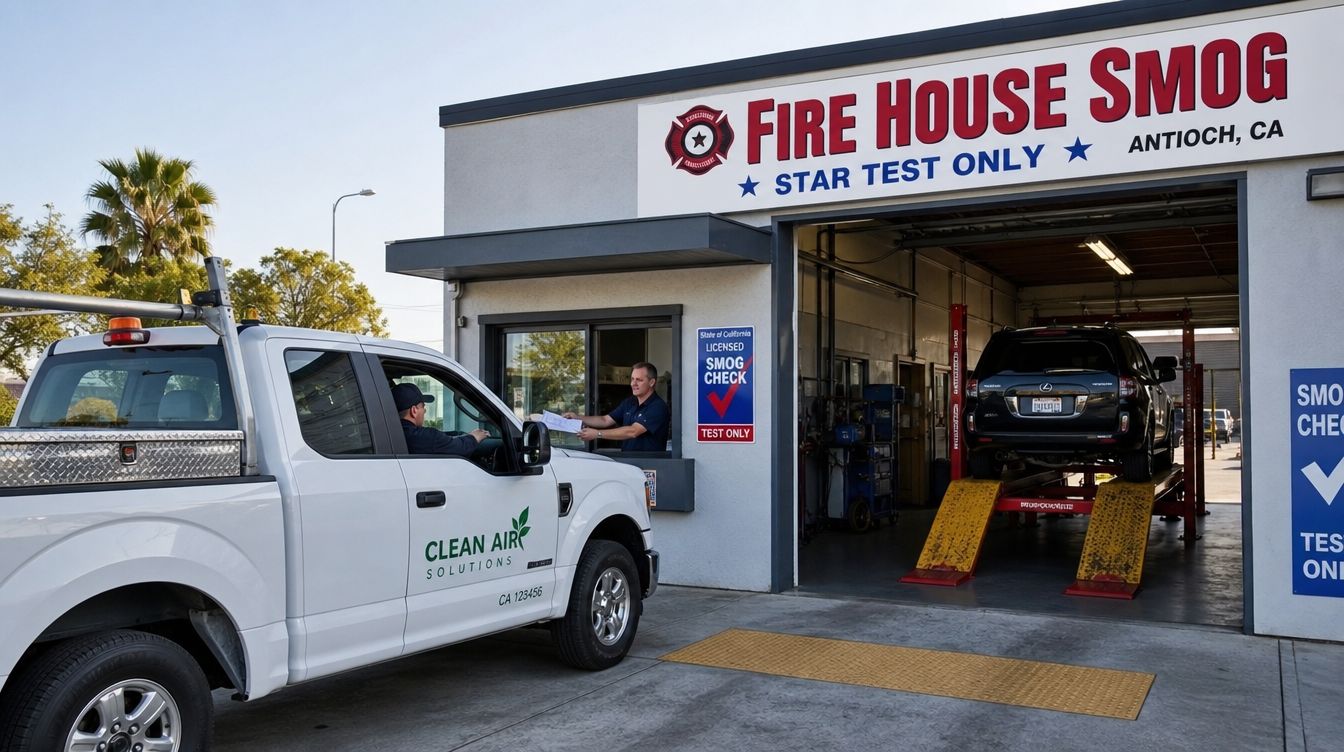
At a STAR test-only station such as Fire House Smog in Antioch, the process should be orderly. Bring the truck, registration paperwork, and the DMV renewal notice. If you're returning after a failure, bring the prior inspection paperwork or certificate of noncompliance so the technician can understand the retest situation.
The first step is document verification. The technician confirms the vehicle identification information, registration details, and the inspection type. A commercial owner with several vehicles should identify each truck clearly and ask whether the station can process the vehicles in a practical order.
What the technician checks
The bay procedure may include a visual inspection of emissions equipment, a gas-cap test, an OBD-II connection, and a tailpipe test where applicable. The technician follows the state-required procedure for that truck rather than treating every pickup, diesel, and work vehicle the same way.
There are three practical outcomes:
- Pass: The station submits the smog certificate electronically to DMV.
- Fail: You receive documentation showing the noncompliance result and the reason for failure.
- Directed or random referral: The state requires the vehicle to complete the inspection at an eligible STAR station.
A test-only station doesn't repair the truck, which keeps the result separate from repair sales. If the truck fails, take the report to a qualified repair shop, address the exact cause, and ask the testing station about its retest policy before returning.
For contractors, operating hours matter. Fire House Smog is located at 2900 Lone Tree Way in Antioch, offers smog testing seven days a week, and provides DMV renewal and tag-printing services Monday through Saturday from 9:30 AM to 5:00 PM and Sunday from 12:00 PM to 4:00 PM, according to the publisher's supplied business information. The station lists two service bays and a phone number, 925-754-1600, for confirming vehicle fit and current service availability.
Common Misconceptions That Trip Up Truck Owners
Truck owners lose time when they treat California emissions rules as one-size-fits-all. Three assumptions cause repeated problems.
| Myth | Reality |
|---|---|
| Diesel trucks are exempt in California | Some diesel classes avoid the ordinary station test, but diesel light-duty vehicles can still face smog requirements, particulate-fee obligations, and CARB enforcement. |
| A check-engine light is fine if the truck drives normally | An illuminated emissions warning can indicate an active diagnostic fault, and incomplete readiness monitors can prevent a pass. |
| Every smog shop produces the same result | Station type matters when DMV or BAR requires STAR testing, including certain directed or random referrals. |
The first myth confuses test exemption with emissions exemption. A heavy-duty diesel truck may stay outside the regular station smog line while remaining subject to CARB rules involving smoke, idling, reporting, or emissions equipment. A light-duty diesel pickup can follow another path based on its model year and weight.
The second myth comes from relying on drivability. OBD systems monitor emissions functions that a driver may never feel from behind the wheel. A truck can start easily, pull a trailer, and idle smoothly while still failing the electronic portion of the inspection.
The third myth is expensive because the wrong station can create a scheduling problem. If the DMV or BAR directs the truck to STAR, choose an eligible STAR station before paying for an inspection elsewhere.
The certificate is the goal, not merely a running engine. Bring the truck to the station type shown by the registration or referral instructions.
Your Next Steps and Where to Test in Antioch
Handle the renewal in this order:
- Read the DMV notice: Confirm that the registration renewal requires a smog certificate and note any station or referral instruction.
- Gather paperwork: Bring the renewal notice, current registration, plates, and any prior smog paperwork if the truck is being retested.
- Prepare the diagnostic system: Inspect the fuel-cap seal, check for a lit malfunction indicator lamp, and have pending or stored emissions codes diagnosed.
- Drive before testing: Use mixed city and highway driving during the week before the appointment so readiness monitors have a chance to complete. A 50 to 100 mile preparation range is a practical target, but monitor completion still depends on the vehicle and repair history.
- Use the right station: Book a STAR test-only inspection when the DMV notice, BAR referral, or truck category requires it.
A light-duty gasoline or diesel truck owner in Antioch can review smog check service in Antioch before heading out. Bring the truck with enough fuel for the inspection, remove anything blocking access to the diagnostic connector, and tell the technician whether the battery was recently disconnected or codes were cleared.
Fire House Smog operates at 2900 Lone Tree Way, Antioch, California 94509. Its supplied business information lists smog testing seven days a week, DMV tag printing Monday through Saturday from 9:30 AM to 5:00 PM, Sunday DMV hours from 12:00 PM to 4:00 PM, and phone support at 925-754-1600. Confirm current hours and whether the truck fits the station's equipment limits before arrival, especially for larger work trucks and recreational vehicles.
A clean truck should leave with the certificate transmitted to DMV. If it fails, keep the report, repair the listed issue, and ask about the qualifying retest window before changing stations.
Fire House Smog provides STAR-certified test-only smog inspections for cars and light-duty trucks, along with DMV renewal services and on-site tag printing in Antioch. Bring your renewal notice and truck to Fire House Smog or call 925-754-1600 to confirm the correct service before you arrive.