You're standing in line at the testing station with a registration deadline approaching, and the car feels perfectly normal. The check-engine light is off, the engine starts cleanly, and you're wondering whether a short drive to the station is enough. That's where many owners get caught. A California smog test can fail a vehicle that drives well if its emissions monitors haven't completed, especially after a battery replacement or diagnostic reset.
The practical way to pass California smog test requirements is to handle the job in the right order: confirm the vehicle needs testing, diagnose warning lights, verify readiness, complete a proper mixed-driving cycle, and inspect the simple hardware that causes avoidable failures. California's Bureau of Automotive Repair Smog Check guidance and its 2025 Smog Check Executive Summary Report make the point clear. Passing is less about luck at the bay and more about arriving with the emissions system ready to report.
Table of Contents
- Who Actually Needs a Smog Check and When
- Driveway Pre-Test Maintenance That Moves the Needle
- The Readiness Monitor Rule Most Drivers Miss
- Quick Visual and Mechanical Checks Before You Pay
- What Happens at a STAR-Certified Test-Only Station
- Failing the Test and the Free Retest Path Forward
- Final Pre-Test Checklist and Common Questions
Who Actually Needs a Smog Check and When
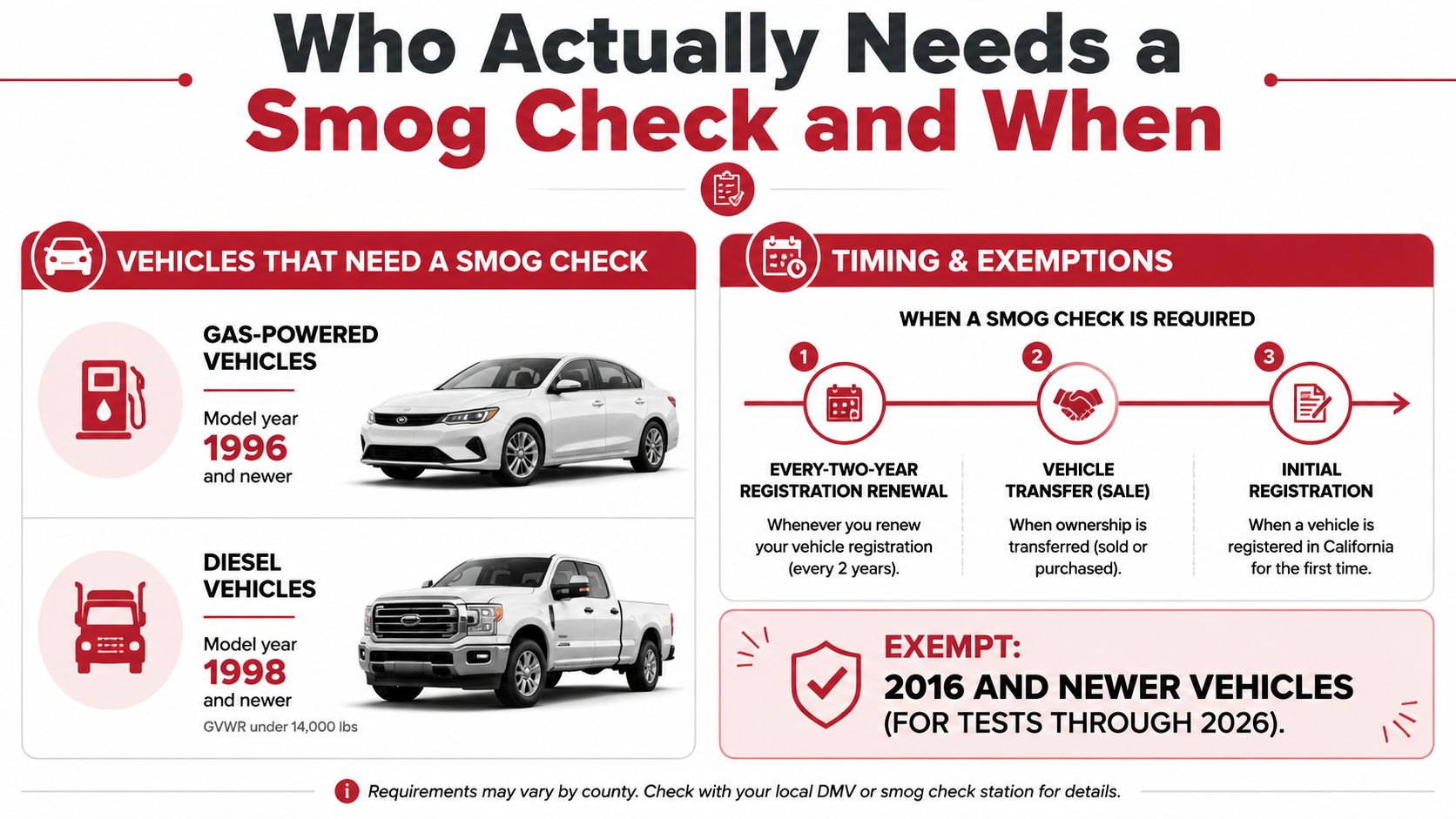
Start with eligibility. California generally requires checks for gasoline, hybrid, and alternative-fuel vehicles from model year 1976 onward. Diesel vehicles from model year 1998 onward are generally included, subject to the applicable weight and exemption rules described by the California Bureau of Automotive Repair.
The renewal exemptions are specific. Gasoline vehicles eight model years and newer generally don't need a renewal smog check, while gasoline vehicles four model years and newer generally qualify for the change-of-ownership exemption. Diesel vehicles from 1997 and older, or diesel vehicles exceeding 14,000 pounds GVWR, fall outside the stated testing requirement.
Check the trigger, not just the age
The BAR says Smog Check is required every other year as part of registration renewal. Your DMV renewal notice is the practical answer. If it says a smog check is required, plan for one. Some owners are also enrolled in the state's direct-mail renewal process, so the notice remains the document to follow rather than relying on a general age rule.
A change of ownership can trigger testing even when a vehicle would otherwise qualify for a renewal exemption. First-time California registration also matters. An out-of-state vehicle from 1976 or newer requires a Smog Check when it's first registered in California, which includes many used cars and light trucks entering the state.
For a broader explanation of California emissions testing requirements, use the vehicle's registration situation as your starting point.
Decision rule: If you received a DMV notice, test. If you bought the vehicle out of state, test. If it's a gasoline vehicle older than the applicable exemption window, expect a test. Otherwise, check the next registration or ownership milestone before assuming you're exempt.
Driveway Pre-Test Maintenance That Moves the Needle
The last few days before inspection are useful, but only if you spend them on legitimate preparation rather than gimmicks. No additive can repair a failed catalyst, oxygen sensor, or EVAP leak. Your best controllable advantage is arriving with the engine fully warm, the fuel system sealed, and the diagnostic computer undisturbed.
Use the drive as preparation
Take a 20-minute mixed drive that includes steady cruising, ordinary city operation, deceleration, and idle time. This warms the engine and catalytic converter and gives the computer the operating conditions it needs to run emissions self-tests. A short trip around the block isn't a drive cycle.
Check the fuel door and gas cap. Tighten the cap properly and replace it if the seal is visibly damaged. A new cap is a sensible repair for a damaged seal, but it won't solve a deeper EVAP leak.
Then inspect the basics:
- Air filter: Replace it if it's visibly dirty or restricted. Don't replace a clean filter because a test is approaching.
- Engine oil: Verify that the level is correct and that the oil matches the manufacturer's specified viscosity. An oil change is appropriate if maintenance is due.
- Fuel: Use fresh gasoline from a reputable, busy station. Don't experiment with unusual fuel blends immediately before inspection.
- Engine behavior: Notice hard starts, unstable idle, fuel odor, hesitation, or misfires. Those symptoms deserve diagnosis before testing.
Let the computer finish its work
After the mixed drive, allow the vehicle to cool and restart normally later. Don't disconnect the battery, clear trouble codes, or use a scan tool to erase a warning just to make the dashboard look clean. Those actions can reset readiness monitors and leave the car unprepared.
For more practical emissions-reduction maintenance, review this guide to reducing vehicle emissions.
A screwdriver and a few minutes of inspection are enough for most driveway checks. The goal isn't to manipulate the test. It's to catch loose components, obvious maintenance issues, and recent resets before you pay for an official result.
Before heading out, this video can help you visualize the basic preparation routine:
The Readiness Monitor Rule Most Drivers Miss
A vehicle can have no check-engine light and still fail because the onboard diagnostic system hasn't completed its self-tests. Readiness monitors are the computer's record that emissions-related systems have operated under the conditions required for evaluation. If the monitor status is incomplete, the inspector doesn't have a complete compliance picture.
BAR states that, effective October 1, 2025, all readiness monitors must be set for a vehicle to pass, except for unique design issues granted by BAR or CARB. That makes readiness a legal gate, not a suggestion. The BAR Smog Check FAQ explains the requirement and why a vehicle must complete its self-diagnostic testing.
The monitors you need to understand
| Monitor | What it checks | Typical setting conditions |
|---|---|---|
| Misfire | Combustion irregularities | Cold start, warm operation, and varied engine load |
| Fuel system | Fuel delivery and mixture control | Warm engine with changing load |
| Comprehensive components | Sensors, actuators, and related controls | Normal operation across different conditions |
| Catalyst | Catalytic-converter efficiency | Fully warm engine and steady driving |
| Heated catalyst | Heated catalyst operation, where equipped | Cold start and controlled warm-up |
| EVAP | Fuel-vapor containment | Fuel level and temperature conditions, followed by driving |
| Secondary air | Air-injection operation, where equipped | Cold-start operation |
| O2 sensor | Oxygen-sensor response and heater function | Warm engine with steady and changing conditions |
A battery disconnect, a recently cleared code, or a routine made up only of short trips can leave one or more monitors marked Not Ready. The engine may feel smooth because the vehicle is operating normally, but the computer still hasn't completed its required checks.
Set readiness before booking
The cleanest method is to use the manufacturer's drive-cycle instructions from the service manual. Follow the sequence precisely, because some monitors require a cold start, a stable cruise, a controlled deceleration, and an idle period.
A qualified shop can also diagnose why a monitor won't run and determine whether a permitted procedure applies. Use an OBD-II scanner to verify the monitor status before paying for the official inspection. Don't erase codes after checking. If the scan shows incomplete monitors, keep driving under varied conditions and rescan later.
The OBD readiness monitor guide can help you interpret what the scanner reports. Treat “Ready” as the finish line, not just the absence of a dashboard warning.
Quick Visual and Mechanical Checks Before You Pay
A few minutes beside the vehicle can reveal problems that cost little to correct but create an unnecessary failure. Start at the rear of the car and work forward. You're looking for loose, missing, altered, or visibly damaged emissions equipment.
The gas cap deserves special attention. Tighten it until it clicks and inspect the sealing ring for cracks, flattening, or damage. If the cap won't tighten securely, replace it before testing. A cap problem can also create an EVAP fault that turns on the malfunction indicator lamp.
Read the dashboard honestly
Turn the key on without starting the engine. The check-engine light should illuminate during the bulb check, then go out after the engine starts. If it stays on, diagnose the cause. If you recently cleared codes or disconnected the battery, don't confuse a dark dashboard with a ready vehicle. The reset may have erased the monitor history.
Check for signs that the vehicle needs attention:
- Rough idle or a misfire: Diagnose ignition, fuel, and air-control problems before inspection.
- Fuel smell: Look for a fuel or vapor leak rather than trying to mask the odor.
- Aftermarket intake parts: Return emissions-related modifications to a compliant configuration.
- Dangling hoses or missing components: Secure or repair them before the visual inspection.
- Fluid leaks: Identify the source and repair it, especially if the leak can affect engine operation.
Confirm that the VIN plate is legible and matches the registration paperwork. Inspect the catalytic converter and other visible emissions hardware for signs of tampering or removal. Don't rely on a clean-looking engine bay if the equipment isn't correct for the vehicle.
Tire condition and inflation should also be sensible for safe dynamometer operation. Correct mismatched or damaged tires and set pressure according to the vehicle manufacturer's specification. These checks won't cure an emissions defect, but they can prevent a simple inspection or safety concern from interrupting the appointment.
What Happens at a STAR-Certified Test-Only Station
A STAR-certified test-only station performs inspections under BAR requirements without selling the repair work needed after a failure. That separation matters. The technician's job is to inspect, record, and report the vehicle's result, not to create a repair sale.
Arrival starts with paperwork and vehicle identification. The technician then examines the visible emissions equipment, including the catalytic converter, air-injection parts where fitted, crankcase ventilation components, engine configuration, and gas-cap seal. After that visual check, the vehicle enters the emissions portion of the inspection.
The inspection sequence
Older applicable vehicles may undergo a loaded-mode test on a dynamometer. The equipment simulates driving while measuring pollutants such as hydrocarbons, carbon monoxide, and oxides of nitrogen. The exact test path depends on the vehicle's model year, fuel type, and inspection requirements.
Modern vehicles rely heavily on the OBD-II portion. The technician connects to the diagnostic port and checks for stored emissions-related trouble codes and completed readiness monitors. A car that feels normal can still fail here if the computer reports an active fault or incomplete self-tests.
The appointment usually includes more than inserting a scanner. Expect the technician to verify the vehicle identity, inspect components, operate the test equipment, and issue the result. Keep the Vehicle Inspection Report because it tells you exactly what passed or failed.
Choose the station based on the notice
A DMV-directed STAR requirement should be handled at a STAR station. The same applies to vehicles with a gross-polluter designation or owners who want a test-only inspection with no repair-sales conflict. Ask about retest terms before authorizing work, because the station and program conditions control whether a retest is free.
Don't arrive immediately after a battery reset, code clear, or repair that requires the computer to relearn. The station can report what the vehicle says, but it can't manufacture readiness.
Failing the Test and the Free Retest Path Forward
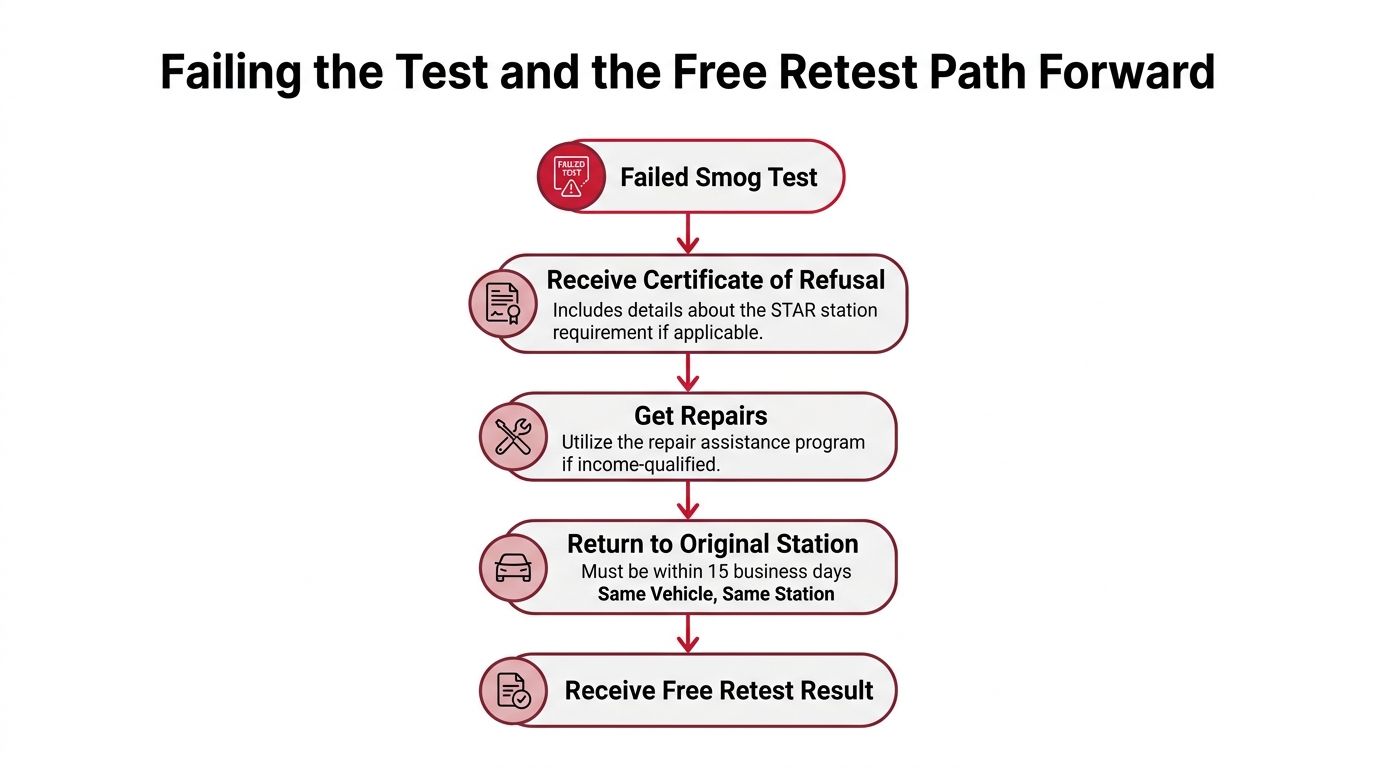
A failed certificate points to a specific problem, not the end of the vehicle's useful life. Get the complete Vehicle Inspection Report first, then identify the failed category. Do not approve random parts replacement because the result says “fail.”
Use the report to set repair priorities
Sort the result into three repair groups:
- Immediate low-complexity items: A damaged gas cap, disconnected hose, or obvious maintenance problem may be quick to correct.
- Diagnostic faults: Oxygen-sensor, EVAP, fuel-control, and misfire codes need testing before you install parts. A code identifies a system, not automatically a failed component.
- Emissions hardware failures: Confirm a suspected catalyst or other major component before authorizing replacement. An unresolved engine problem can damage the new part and leave you with another failure.
The BAR's 2025 executive summary recorded 11,275,981 initial tests and 959,667 failures, an 8.51% initial-test failure rate. Those figures appear in the official BAR report. The practical takeaway is clear: most vehicles pass initially, while the failed group still includes enough different causes to make a written repair plan worthwhile.
Protect your retest eligibility
Free-retest eligibility depends on the original testing location, the repair location, and whether the vehicle remains unaltered. Before leaving, ask the station to state its retest policy and the program conditions that apply to your vehicle.
After repairs or a computer reset, drive until the readiness monitors show complete. Returning to the bay too soon can produce another failure even after the underlying repair is finished. Bring the original report, repair invoices, registration materials, and any documents the station or DMV requests.
A gross-polluter designation may qualify you for California's Consumer Assistance Program if you meet its requirements. Check that option instead of guessing about repair funding. Keep every receipt and inspection document so the DMV has a clear record when registration depends on the repair and retest result.
Final Pre-Test Checklist and Common Questions
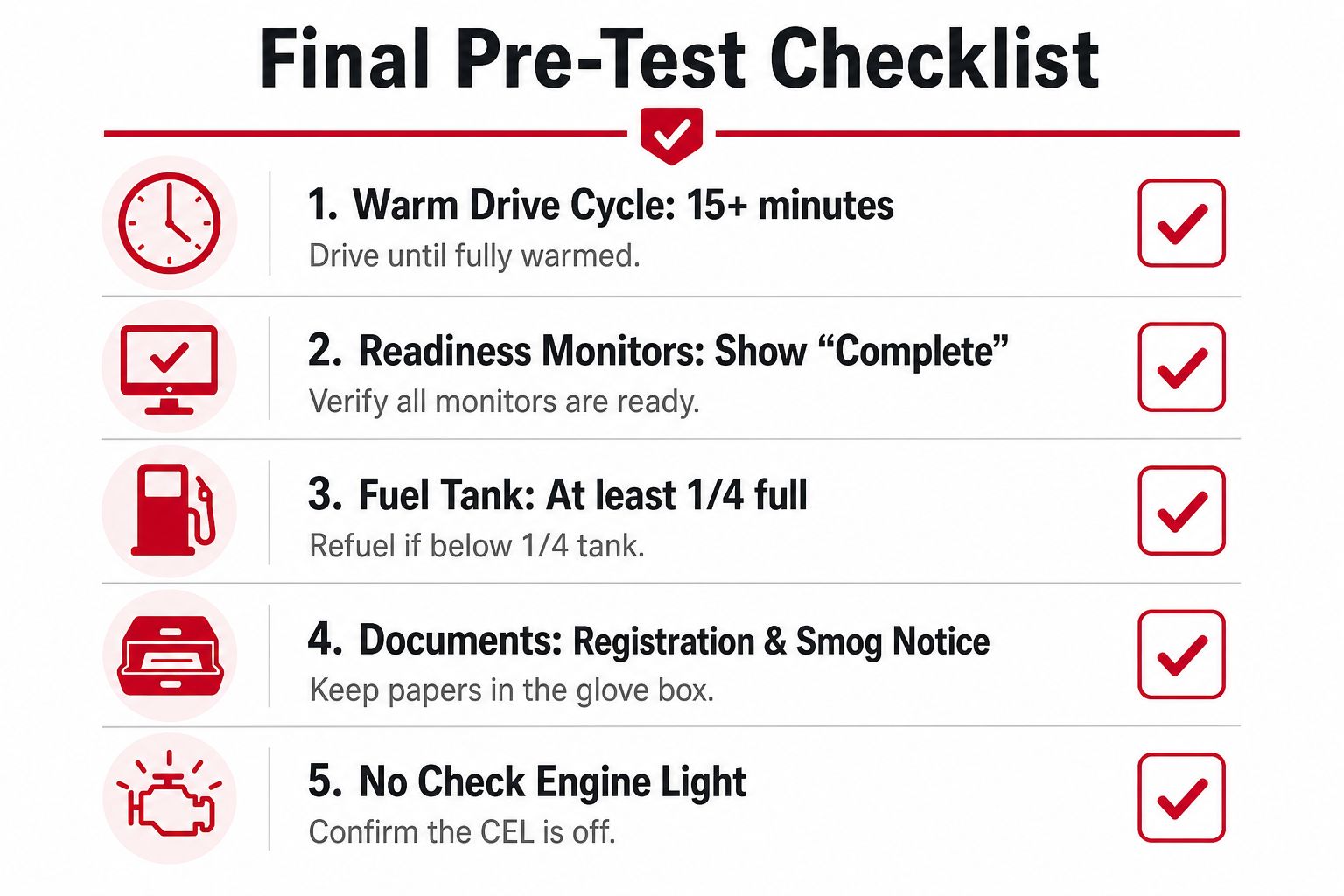
Use this list on the morning of the appointment. It's deliberately short because the useful checks are the ones you'll complete.
- Warm the vehicle: Drive through mixed conditions long enough to bring the engine fully to operating temperature.
- Verify readiness: Scan the OBD-II system and confirm every required monitor shows Ready.
- Check the fuel level: Keep enough fuel for normal operation and the test equipment.
- Secure the gas cap: Tighten it and confirm the seal looks intact.
- Watch the MIL: Don't test with the check-engine light illuminated.
- Bring documents: Carry the registration, renewal notice, and identification or insurance documents requested by the station.
- Inspect the VIN: Make sure the vehicle identification number is visible and matches your paperwork.
Common questions
Does a diesel vehicle always need a test? No. Diesel eligibility depends on model year and the stated weight exemption. Diesel vehicles from 1997 and older, or those over 14,000 pounds GVWR, are among the listed exemptions.
Does an out-of-state vehicle need California testing? Yes, an out-of-state vehicle from 1976 or newer generally needs a Smog Check for first-time California registration.
What if the check-engine light turns on while driving to the station? Stop treating the appointment as a pass attempt. Diagnose the fault first. An illuminated malfunction indicator lamp is a direct warning that the emissions system needs attention.
Do hybrids follow the same process? Hybrids are included in the general gasoline, hybrid, and alternative-fuel vehicle population, although their test procedure depends on the vehicle's design.
What happens after a battery disconnect? The disconnect can reset readiness monitors. Drive under the manufacturer's specified conditions and confirm the monitors are ready before testing.
For drivers who want the inspection handled by a STAR-certified test-only station, Fire House Smog offers smog inspections in Antioch, along with California DMV registration services and an applicable free-retest option under its stated policy and coupon terms. Bring your paperwork, verify readiness before arrival, and contact the station if your vehicle has unusual equipment or RV dimensions.
Most advice on smog check vs smog test says the terms are identical and moves on. That answer is convenient, but it leaves California drivers unprepared for the part that matters: one term describes the state compliance program, while the other describes what the technician does to the vehicle.
That distinction affects where you go, what paperwork you receive, and whether your registration renewal can move forward. It matters even more after California tightened readiness-monitor requirements beginning October 1, 2025. A car can run smoothly and still fail because its emissions monitors haven't completed their checks.
If you're an Antioch driver, learn the practical vocabulary before booking. You need to know whether your notice sends you to a STAR station, whether your vehicle is ready for an OBD inspection, and whether you're seeking a legal certificate or only a diagnostic result.
Table of Contents
- Why Smog Check and Smog Test Are Not the Same Thing
- How the California Smog Check Program Works
- Smog Check vs Smog Test Side by Side
- What the Failure Data Tells You About Real-World Outcomes
- STAR Stations, Test-Only Stations, and Where to Go
- Surprising Ways a Healthy Car Can Still Fail
- A Real Antioch Driver Scenario From Booking to Tag
- Common Questions and Your Next Steps
- Can I use any station with a directed notice
- What's the difference between gross polluter and directed
- How long is a smog certificate good for
- Do I need an appointment
- What if I bought the car from out of state
- Does a new battery reset readiness monitors
- Can I fail if the Check Engine Light is off now
- Are hybrids exempt
- Your five-point preparation list
Why Smog Check and Smog Test Are Not the Same Thing
Smog Check names California's regulated emissions-compliance program. The Bureau of Automotive Repair oversees it, and a passing result can create the electronic certification needed for registration renewal, a sale, or a transfer when the vehicle requires inspection.
A smog test is the inspection performed in the service bay. The technician uses the equipment required for that vehicle, including electronic diagnostics on newer models and tailpipe measurement on older ones. The test produces findings. The Smog Check connects those findings to the state's compliance process and the vehicle's DMV record.
California's modern statewide system took shape in 1984, after the federal Clean Air Act Amendments pushed states toward biennial testing. Many vehicles require an inspection every two years before registration renewal, but the exact requirement depends on the vehicle and transaction. A historical overview of California's smog-check program describes that development and the program's continuing reach.
Why the wording affects your visit
Using the terms loosely can send you to the wrong station or leave you with the wrong expectation. A station may not be authorized for a directed vehicle. A printout showing test results may not be the electronic certification DMV needs. Clearing the battery before an appointment can also leave readiness monitors incomplete, even if the car runs normally.
Practical rule: Read the DMV notice first. Then choose the station. Do not select a location based only on “smog test” in an advertisement.
The distinction also clarifies what a STAR-certified smog inspection involves. STAR is not a separate pollution measurement. It identifies stations that meet additional inspection-quality requirements for vehicles assigned to that network.
Before handing over the keys, ask one direct question: does the vehicle need a regular Smog Check, a STAR-directed inspection, or a retest? Then confirm which document the station will transmit to DMV after a pass. That conversation prevents a failed appointment caused by choosing the wrong service.
How the California Smog Check Program Works
California's Smog Check program developed through successive regulatory changes, not one universal inspection format. The statewide system was formalized in 1984, and later changes added targeted oversight for vehicles associated with higher emissions. The inspection pathway now depends on factors such as model year, fuel type, and DMV direction.
The Bureau of Automotive Repair licenses stations and technicians, sets inspection requirements, and receives results through California's electronic reporting system. A licensed station performs an authorized inspection and submits the outcome. It is not giving an informal opinion about the vehicle.
The process at the station
A typical visit follows four steps:
- The station verifies the vehicle and transaction. The technician confirms the vehicle information and identifies the applicable inspection pathway.
- The technician performs the required checks. Depending on the vehicle, those checks may include visual, functional, and emissions-related inspections.
- The system records the result. The station reports the inspection electronically. A passing result can support the applicable DMV transaction.
- The driver receives the paperwork. The Vehicle Inspection Report lists the test findings, while the electronic certificate supports the state requirement.
For 2000-and-newer vehicles, California's BAR On-Board Diagnostic Inspection System collects OBD information. For 1999-and-older vehicles, the BAR-97 Emissions Inspection System measures tailpipe emissions. The California BAR Smog Check program description explains why the procedure differs between vehicle groups.
Which event brings you in
Registration renewal is the most familiar trigger. A sale or transfer may also require a valid inspection, and an out-of-state vehicle may need one before California registration is completed. The notice and transaction determine the requirement, not the casual wording in an online search.
That makes “I just need a smog test” incomplete. The test is the procedure performed at the station, while the Smog Check program is the compliance requirement tied to the DMV event. If the notice assigns a STAR-directed inspection, a regular station may not be authorized to perform it.
The 2025 readiness-monitor change also affects preparation and station choice. Applicable monitors must be set for a vehicle to pass, subject to narrow exceptions for unique design issues, according to BAR's readiness-monitor guidance. A vehicle can run smoothly and still fail because its emissions system is not inspection-ready. Avoid clearing diagnostic codes or disconnecting the battery shortly before the appointment, since doing so can leave monitors incomplete.
Smog Check vs Smog Test Side by Side
The simplest way to separate the terms is to ask what question each one answers.
Smog check asks: Has this vehicle satisfied the applicable California emissions requirement for the relevant DMV transaction?
Smog test asks: What did the inspection equipment and technician find during this visit?
The two concepts meet at the station, but they aren't the same deliverable. A technician performs the test, and the state uses that result within the Smog Check program.
Smog Check vs Smog Test at a Glance
| Dimension | Smog Check | Smog Test |
|---|---|---|
| Meaning | California's regulated compliance program | The inspection procedure performed on the vehicle |
| Authority | California Bureau of Automotive Repair and DMV requirements | BAR-approved inspection standards and equipment |
| Trigger | Registration renewal, sale, transfer, or another applicable DMV event | The scheduled inspection or retest visit |
| Technical work | Applies the correct inspection pathway to the vehicle | Performs visual, functional, OBD, or tailpipe checks as required |
| Output | Electronic Smog Check certification used for DMV compliance | Vehicle Inspection Report with inspection findings |
| Passing language | The vehicle passes the applicable Smog Check requirement | The test records a pass for the inspection performed |
| Failure handling | The compliance requirement remains unresolved until the vehicle passes or qualifies under an applicable process | The report identifies the failed area and supports repair and retest decisions |
A newer vehicle generally goes through an OBD-based procedure, while an older vehicle may receive tailpipe measurement. The program determines which standards apply. The test carries them out.
Why the same car can face different station rules
A vehicle assigned to a directed or higher-emission review may need a STAR station. That doesn't necessarily mean the technician uses an exotic test. It means the state has assigned the vehicle to a station class designed for added inspection quality and program control.
The distinction also clarifies failure paperwork. A Vehicle Inspection Report tells you what happened during the test. A passing electronic certificate addresses the DMV compliance requirement. You need the latter when your transaction requires official certification, not merely a piece of paper showing that a technician connected equipment.
What the Failure Data Tells You About Real-World Outcomes
California's statewide results show why the distinction between a Smog Check program and an individual smog test matters. In 2025, BAR recorded 11,275,981 initial tests and 12,200,718 total tests, with an 8.51% initial failure rate. Those figures are documented in the program's historical and statewide inspection data.
The pattern continued in January 2026. BAR reported 989,080 initial tests, including 82,543 failures, for an 8.35% initial failure rate. Across all tests, the report recorded 1,065,033 inspections and 93,789 failures, an 8.81% overall failure rate. The January 2026 BAR executive summary provides those results.
Smog Check vs Smog Test Failure Outcomes
| Metric | Smog Check | Smog Test |
|---|---|---|
| What failure means | The DMV-related emissions requirement isn't complete | The vehicle failed one or more inspection checks |
| What the driver receives | A compliance result is transmitted when the vehicle passes | A Vehicle Inspection Report identifies the result |
| Immediate concern | Registration, sale, or transfer may remain unresolved | Repairs, readiness completion, or a retest may be needed |
| Practical next move | Confirm the required station and transaction pathway | Review the failure items before authorizing repairs |
Vehicle age changes the odds and the inspection context. The January report lists an 18.69% overall failure rate for one all-model-year sample category and an 11.09% rate for a 2025 model-year group. Those categories show that results vary by vehicle population and inspection conditions. A newer car can still fail because of readiness or emissions-control issues, while an older car can pass its basic checks despite a smooth idle that gives no reliable guarantee.
Use this guide to common smog-check failure causes before approving parts or labor. The practical rule is simple: confirm the station pathway first, then diagnose the exact failure. That order prevents a wasted visit and reduces the risk of paying for repairs the test did not require.
STAR Stations, Test-Only Stations, and Where to Go
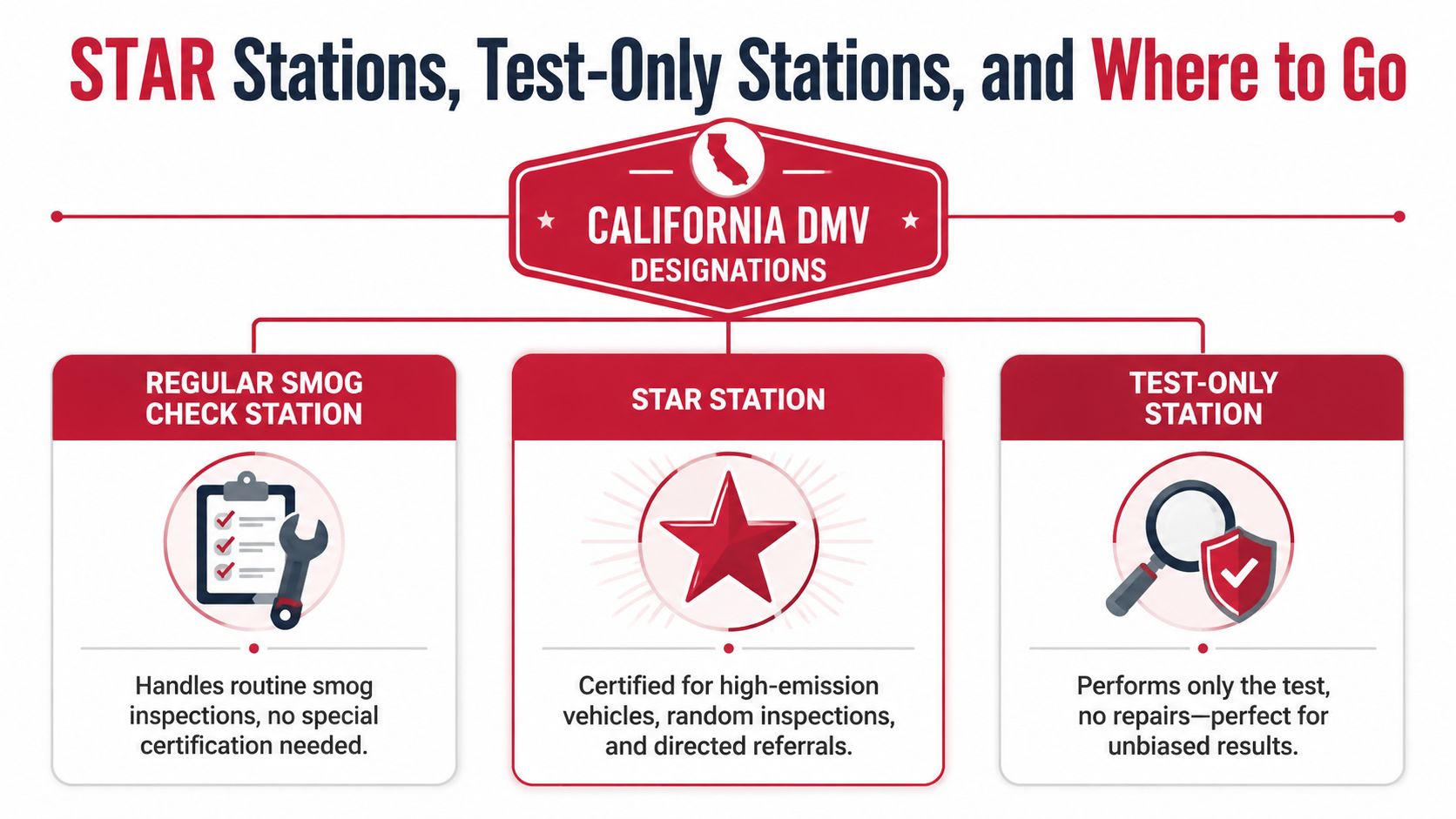
California station designations determine which businesses may inspect your vehicle and whether they may also perform repairs. The terms describe different regulatory roles, not interchangeable names for the same service.
A regular station handles inspections within its license and equipment scope. A STAR station meets higher inspection-based standards and participates in the program when the state directs certain vehicles into that network. A test-only station performs the inspection but cannot repair the same vehicle, keeping testing separate from repair sales. Review the California STAR-certified station requirements before choosing a location.
Why test-only matters
A test-only station removes the direct repair-sales conflict. Its revenue does not depend on selling a catalytic converter, sensor, or other part after a failure. That separation does not guarantee a passing result, but it gives you a clearer boundary between inspection findings and repair recommendations.
The California STAR program explanation describes STAR as a quality-focused program supporting inspection accuracy and emissions reductions. STAR certification can apply to both test-only and test-and-repair stations that meet the required standards.
Read your DMV renewal notice or referral before booking. If it says STAR-directed, choose a STAR-certified station. Otherwise, confirm that the station performs the inspection required for your vehicle and transaction.
For Antioch drivers, Fire House Smog operates as a STAR-certified test-only station at 2900 Lone Tree Way. It provides emissions inspections without in-house repairs, DMV registration services, and a posted retest policy subject to its conditions. Verify your notice and the station's current policy before arriving.
Surprising Ways a Healthy Car Can Still Fail
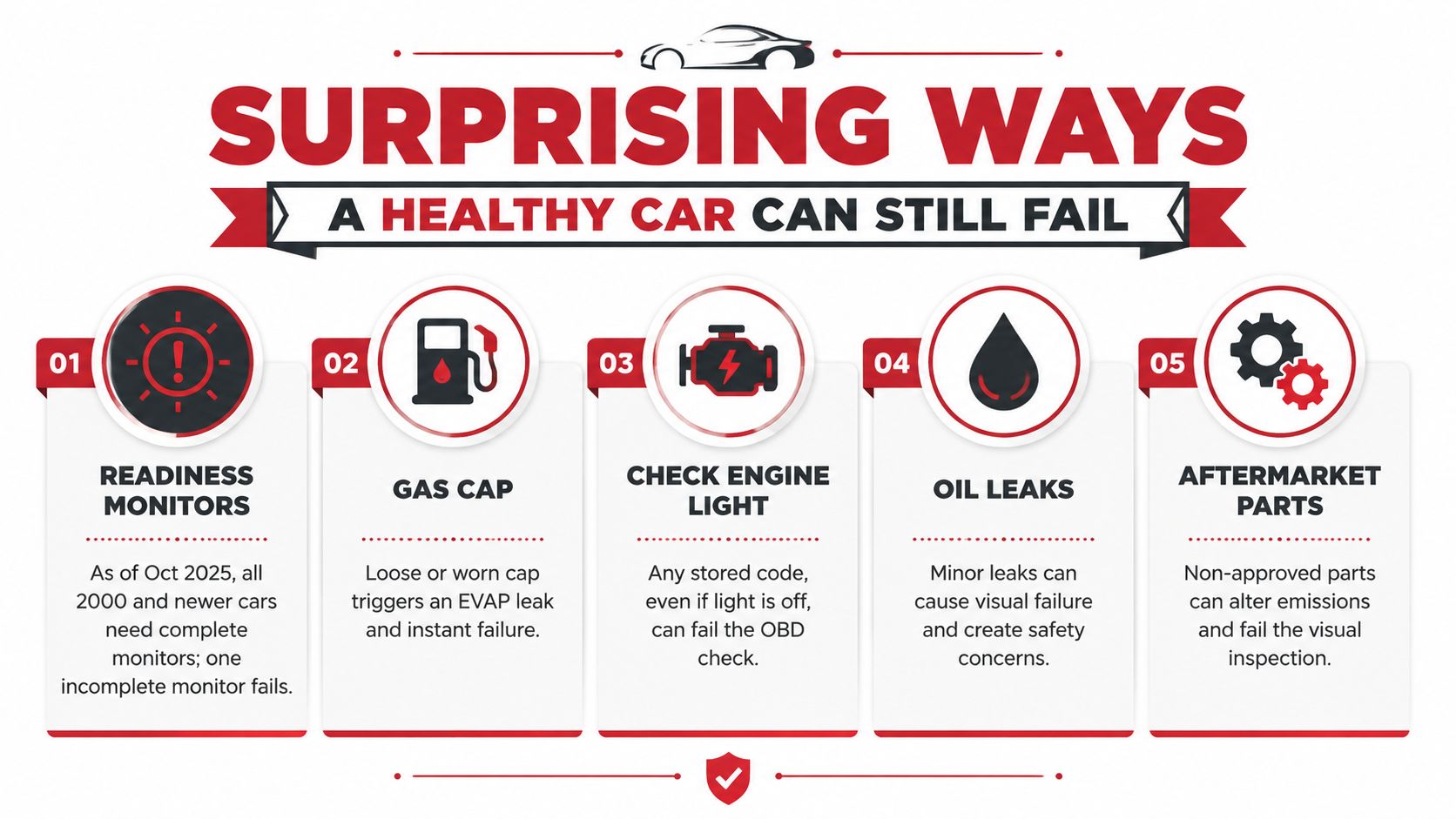
A quiet engine and a dark dashboard don't prove that a car is ready for inspection. California's OBD procedure evaluates emissions-system self-checks that drivers can't feel from behind the wheel.
The biggest recent change took effect October 1, 2025. California BAR guidance says all readiness monitors must be set for a vehicle to pass, with narrow exceptions for unique design issues. That means disconnecting the battery or clearing a diagnostic code shortly before the appointment can leave the vehicle unable to pass even after the original problem appears fixed.
The traps I see most often
- Readiness monitors remain incomplete. The computer needs driving conditions to complete its emissions self-tests after repairs or a battery disconnect.
- A recently cleared code returns later. Clearing the code erases useful history but doesn't complete the drive cycle.
- The Check Engine Light is illuminated. An active malfunction indicator is a direct warning that the OBD inspection may fail.
- The gas cap doesn't seal. An EVAP leak can trigger an emissions fault even when the engine feels normal.
- Aftermarket equipment lacks approval. Intake or exhaust parts that don't carry the required California emissions approval can fail the visual inspection.
A fifteen-minute warm-up is a sensible preparation step, but it isn't a substitute for readiness verification. Before the appointment, use a compatible OBD scanner to check for pending codes and monitor status, confirm that the gas cap clicks and seals properly, and complete a mixed drive cycle rather than taking only short trips.
A healthy car isn't necessarily an inspection-ready car. Check the computer before you pay for the official test.
A Real Antioch Driver Scenario From Booking to Tag
The following scenario is a practical illustration, not a verified customer case study. Marco owns a 2014 Toyota Tacoma in Antioch and receives a DMV renewal notice in October 2025. The notice indicates that his registration renewal requires a Smog Check, so he looks for a station that can handle the applicable inspection rather than booking the first generic “smog test” result.
He books online at Fire House Smog and arrives without recently refueling. The technician connects the inspection equipment and explains that Marco's readiness monitors aren't set. The truck runs normally, but the computer hasn't completed the emissions checks needed for the inspection.
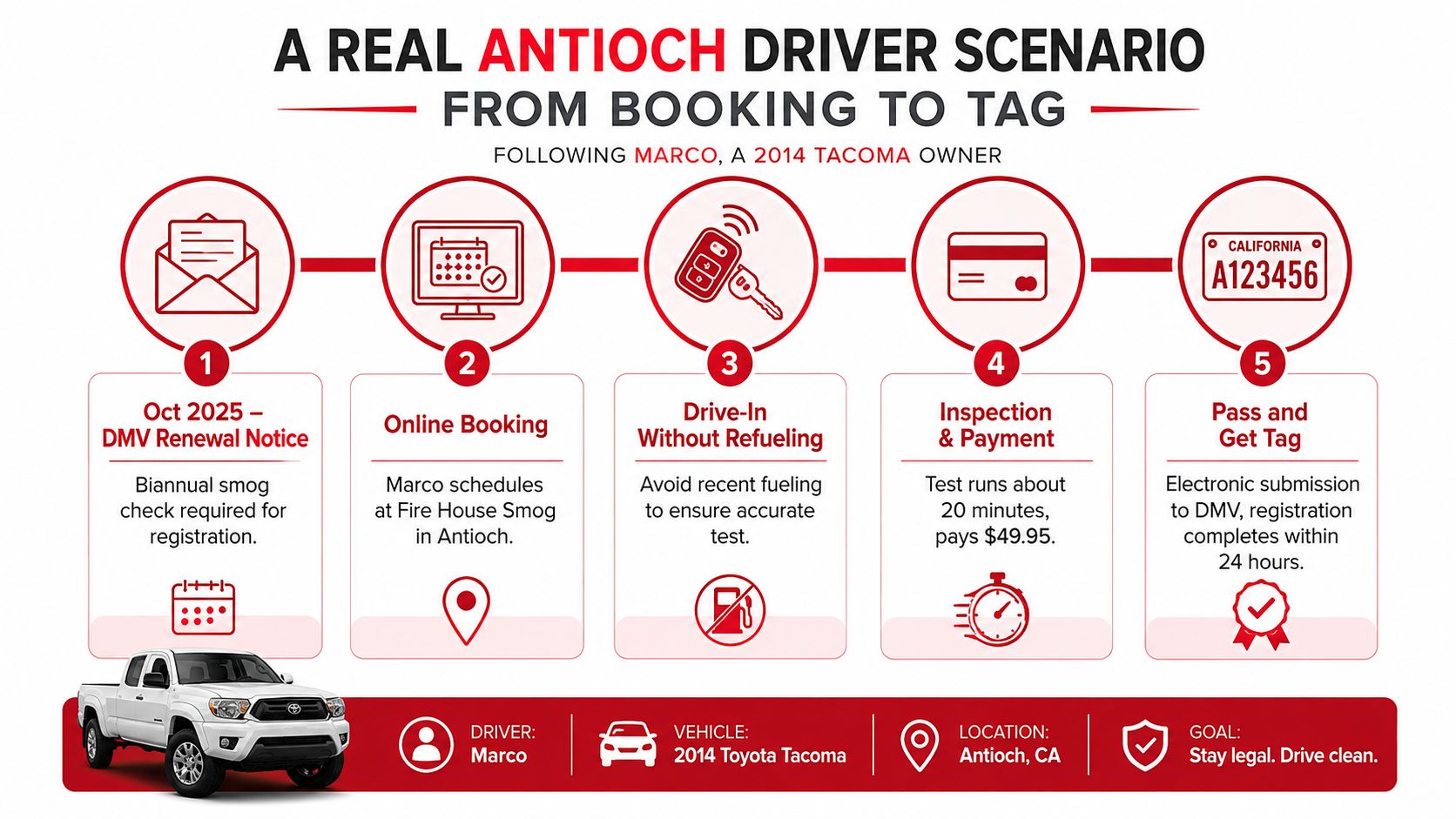
What happens next
Marco pays the station's posted directed-inspection price, then gets the readiness issue addressed before returning. The station's stated example uses a $61.75 directed inspection, followed by a $40 retest within 90 days after the vehicle is ready. Those are scenario-specific amounts, not California-wide prices, and drivers should confirm current charges and eligibility before booking.
On the second visit, the technician completes the directed inspection, the gross-polluter notice is lifted, and the passing result is transmitted electronically for the DMV renewal. Marco leaves with the certificate needed to complete the registration process and later receives his new sticker.
His main regret is simple. He should have checked monitor status before the first appointment and read the notice more carefully. A scanner check would have told him that the vehicle needed more driving time, while confirming the station requirement would have prevented him from treating the appointment as an ordinary walk-in test.
The point isn't the exact invoice. The point is the sequence. Notice type, station eligibility, readiness status, inspection, electronic certification, then registration. Skip the first two checks and a healthy truck can still produce an expensive extra visit.
Common Questions and Your Next Steps
Can I use any station with a directed notice
No. A directed notice can require a STAR-certified station. Confirm the wording on your DMV notice before you book.
What's the difference between gross polluter and directed
A gross-polluter designation describes a vehicle identified as producing emissions at a significantly high level. A directed notice is the station-routing instruction that sends the vehicle into a particular inspection pathway.
How long is a smog certificate good for
The certificate's usefulness depends on the DMV transaction and applicable state rules. Ask the station or DMV how the result applies to your specific renewal, sale, or transfer.
Do I need an appointment
Not always. An appointment can still reduce uncertainty, especially if your vehicle is directed, requires a specific station class, or needs equipment that isn't available at every location.
What if I bought the car from out of state
An out-of-state vehicle may need California inspection before California registration can be completed. Bring the DMV paperwork and ask the station whether it can inspect that vehicle type.
Does a new battery reset readiness monitors
It can. Battery disconnection may erase monitor status, so check readiness with an OBD scanner and allow the required drive cycle to complete before testing.
Can I fail if the Check Engine Light is off now
Yes. The computer may still show pending faults or incomplete monitors. A dark dashboard alone isn't proof that the OBD system is ready.
Are hybrids exempt
Don't assume that a hybrid is exempt. Check the vehicle's fuel type, model year, and California DMV requirement before skipping an inspection.
Your five-point preparation list
- Read the notice. Identify whether the DMV requires a routine or STAR-directed inspection.
- Locate the OBD-II port. Know where the technician will connect and make sure nothing blocks access.
- Check monitor readiness. Use a compatible scanner before the appointment, particularly after battery work or repairs.
- Bring repair records. Prior receipts help explain recent work and guide the conversation if the vehicle fails.
- Confirm the station class. Verify STAR or test-only eligibility before you drive across town.
Fire House Smog provides STAR-certified test-only inspections, DMV registration services, and on-site tag issuance at 2900 Lone Tree Way in Antioch, with smog testing seven days a week and DMV service hours Monday through Saturday from 9:30 AM to 5:00 PM and Sunday from 12:00 PM to 4:00 PM.
If you want the inspection and DMV step handled in one visit, book your vehicle with Fire House Smog and bring your renewal or referral notice. The Antioch team can verify the required station pathway, check the emissions system, and process eligible registration services after a passing result.
You're due for a California registration renewal, and the check engine light came on yesterday. The car still starts, idles, and drives normally, so it's tempting to book a smog test and hope the warning disappears. Don't. At the bay, a lit malfunction indicator lamp can stop the inspection before the technician gets any farther, and switching the light off by clearing codes can leave the vehicle unable to pass for a different reason.
The practical question isn't, “Can I pass smog with the check engine light on?” In California, the answer is no. The useful question is, “What failed, and is the car ready to prove the repair?” The workflow below separates an active emissions fault from a car with an off light but incomplete monitors, so you can diagnose the problem before spending money on parts or a wasted test.
Table of Contents
- Why the Check Engine Light Matters for Smog
- How California Tests the Light
- Reading the Codes Before You Pay for Repairs
- Driving the Right Cycle to Set Readiness Monitors
- What to Do the Day Before and Day of the Test
- Retests Exemptions and When a Light Can Be Legal
- Local Logistics at Fire House Smog in Antioch
Why the Check Engine Light Matters for Smog
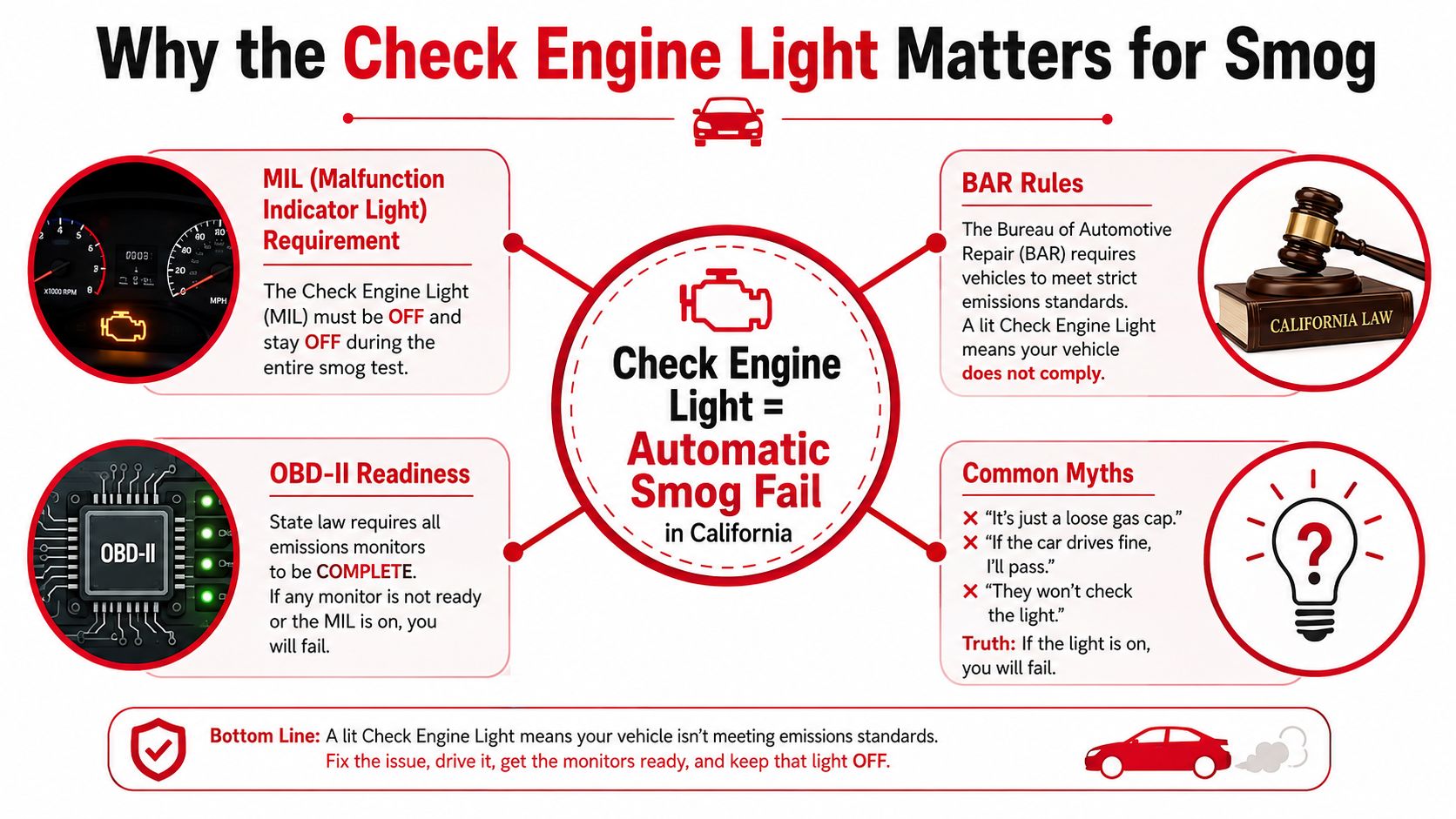
A car can start, idle, and drive normally while its malfunction indicator lamp, or MIL, signals an emissions problem. California treats that lamp as part of the OBD inspection. The California Bureau of Automotive Repair Smog Check manual requires it to illuminate with the key on and engine off, then turn off after the engine starts. A failed sequence can fail the OBD inspection.
The warning light is not a suggestion for the technician. It is evidence that the vehicle computer has stored a fault affecting emissions controls. Problems with fuel control, sensors, or related systems may not yet change acceleration, idle quality, or fuel economy enough for the driver to notice.
Three situations that look similar
A hard fault is a detected malfunction that keeps the MIL on while the engine runs. Treat that as an immediate smog problem. A pending code means the computer has noticed a possible fault but has not confirmed it through its testing. The lamp may remain off, but the code still gives the technician a useful diagnostic lead.
A recent code clear creates a separate problem. Clearing codes, disconnecting the battery, or completing some repairs can switch off the lamp while leaving emissions monitors incomplete. California's updated rule, effective October 1, 2025, requires all readiness monitors to be set for a vehicle to pass Smog Check. An off light does not override a “not ready” result.
Practical rule: Diagnose the fault, repair its cause, confirm the MIL sequence, and check monitor readiness before paying for the test. Clearing codes only hides the warning temporarily and can leave the vehicle unready.
For a broader review of common outcomes, read Fire House Smog's guide to smog check fail reasons. The money-saving workflow is straightforward: scan first, repair the actual cause, complete the required drive checks, and test only when the computer is ready.
How California Tests the Light
At the inspection bay, the technician follows a set sequence rather than judging whether the engine sounds healthy. California's OBD requirements control the process. The BAR OBD test reference outlines the order: first confirm the malfunction indicator lamp, then review diagnostic information and monitor status.
With the ignition on and the engine off, the check engine light should illuminate for the bulb check. After the engine starts, it should go out. A missing lamp, a lamp that never lights, or one that stays on can fail the vehicle before readiness status is reviewed.
What the connector reveals
The technician plugs inspection equipment into the vehicle's OBD-II diagnostic port. The scan checks emissions-related diagnostic trouble codes, confirms whether the MIL is reporting a fault, and reads readiness monitors. These monitors are the vehicle's self-tests for systems including fuel control, oxygen sensors, catalyst performance, and evaporative emissions.
California's inspection method depends on the vehicle's model year. For 2000 and newer gasoline vehicles, Smog Checks rely primarily on OBD-II diagnostics instead of tailpipe testing. Gasoline vehicles from 1996 through 1999 receive both an OBD inspection and tailpipe testing.
| Check Item | 1996-1999 Vehicles | 2000 and Newer Vehicles |
|---|---|---|
| MIL bulb and operation | Checked during OBD inspection | Checked during OBD inspection |
| Diagnostic codes | Read through OBD system | Read through OBD-II system |
| Readiness monitors | Must support inspection eligibility | All required monitors must be complete under the October 2025 rule |
| Tailpipe measurement | Included for gasoline vehicles | Smog checks are primarily OBD-based for gasoline vehicles |
| Visual inspection | Emissions equipment and tampering checked | Emissions equipment and tampering checked |
The October 2025 rule changes the practical pre-test decision. A light that turns off after a code clear does not prove the vehicle is ready. The scan must show completed monitors before the test, or the car can fail inspection eligibility even without an illuminated MIL.
Why the visual check still matters
The computer scan is only part of the appointment. The technician also checks for obvious emissions tampering and missing components. A vehicle can show no current warning light and still have a problem if required emissions hardware has been altered or removed.
Older vehicles outside the applicable OBD inspection framework may undergo other procedures, including tailpipe testing where required. The test mode depends on model year, fuel type, equipment, and California inspection rules. Use the scanner result as one part of the diagnosis, not as the entire eligibility decision.
Reading the Codes Before You Pay for Repairs
A diagnostic trouble code identifies a system or condition. It doesn't automatically identify the failed part. Replacing the first sensor mentioned by a scan tool is how customers turn a modest diagnosis into a parts-shopping spree.
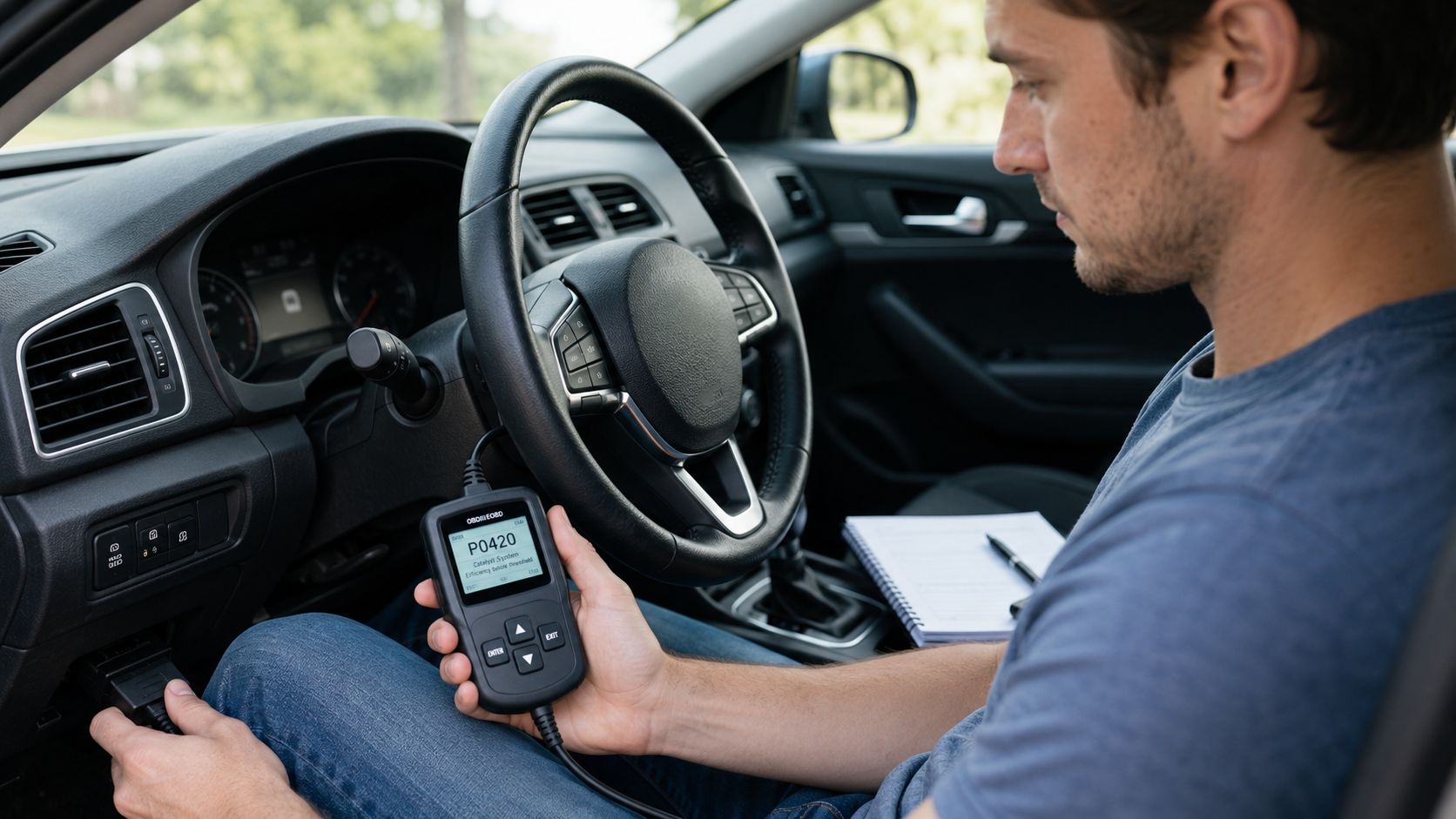
Start with an OBD-II scanner. You can use a personal scanner, borrow one, or ask an auto parts store whether it offers a scan service. Fire House Smog also provides a relevant option for customers who need auto diagnostic and repair guidance in Antioch. The important point is to capture the codes and monitor status before anyone clears the memory.
Read the scan in the right order
Look for confirmed codes, pending codes, freeze-frame information, and readiness status. A confirmed code has met the computer's criteria for storing a fault. A pending code may be an early or intermittent detection, but it can point directly toward a developing issue.
Generic P0 codes follow standardized definitions. Manufacturer-specific P1 codes require the vehicle's service information for accurate interpretation. Freeze-frame data shows the operating conditions when the computer logged the fault, such as engine load, temperature, and speed. That context can distinguish a fault that occurs during freeway operation from one that appears during cold starts or idling.
Use the code as a starting point:
- P0420 catalyst efficiency: Don't immediately buy a catalytic converter. Check for exhaust leaks, misfires, fuel-control problems, and oxygen-sensor data first. A converter can be the victim of another problem, not the original cause.
- P0171 or P0174 lean condition: Inspect vacuum hoses, intake ducting, and the mass-airflow sensor. A dirty MAF sensor or an air leak can mislead fuel-trim diagnosis, but cleaning must follow the sensor maker's instructions.
- P0300 random misfire: Treat this as a priority. Check ignition components, fuel delivery, intake leaks, and engine condition. Misfires can raise emissions and damage the catalyst.
- P0442 small EVAP leak: Start with the gas cap and inspect the seal. If the cap is sound, the system may need a smoke test.
- P0455 large EVAP leak: Look for a missing or poorly sealed cap, disconnected vapor hose, or damaged EVAP component before authorizing expensive work.
Never clear codes right before a smog test. Code clearing resets readiness monitors, so the light may be off while the vehicle reports incomplete checks.
The sensible sequence is scan, document, inspect, repair, and drive. If the light returns, rescan before replacing anything else.
Driving the Right Cycle to Set Readiness Monitors
A repaired car still needs to complete its self-tests before it is ready for inspection. Clearing codes erases stored readiness history, so the vehicle must encounter the temperatures, speeds, loads, and other conditions each monitor requires.
California's October 2025 rule makes this step more important. All readiness monitors must be set for the vehicle to pass. An illuminated dashboard light is not the only issue, and an extinguished light does not prove the checks are complete.
Build a mixed-driving routine
Manufacturers use different enable criteria, so no universal drive cycle works for every model. Start with a cold engine. Let it idle for two to three minutes, then accelerate gently toward 45 to 55 mph on a freeway on-ramp when traffic permits. Hold a steady speed for five to seven minutes, then coast down without braking when safe, giving the fuel-cutoff conditions a chance to occur.
Follow the freeway portion with ordinary surface-street driving. Use gentle acceleration, steady cruising, and complete stops. Repeat the mixed pattern instead of circling one block. Different monitors may require different engine temperatures, vehicle speeds, loads, and coast-down events.
Common checks include:
- Misfire and fuel-trim checks.
- Oxygen-sensor and oxygen-sensor-heater checks.
- Catalyst evaluation.
- EVAP testing.
- EGR and secondary-air checks where equipped.
- Diesel-specific emissions monitors where applicable.
The order varies by vehicle. A monitor can remain incomplete if the fuel level, coolant temperature, ambient conditions, or recent driving pattern did not meet its enable criteria.
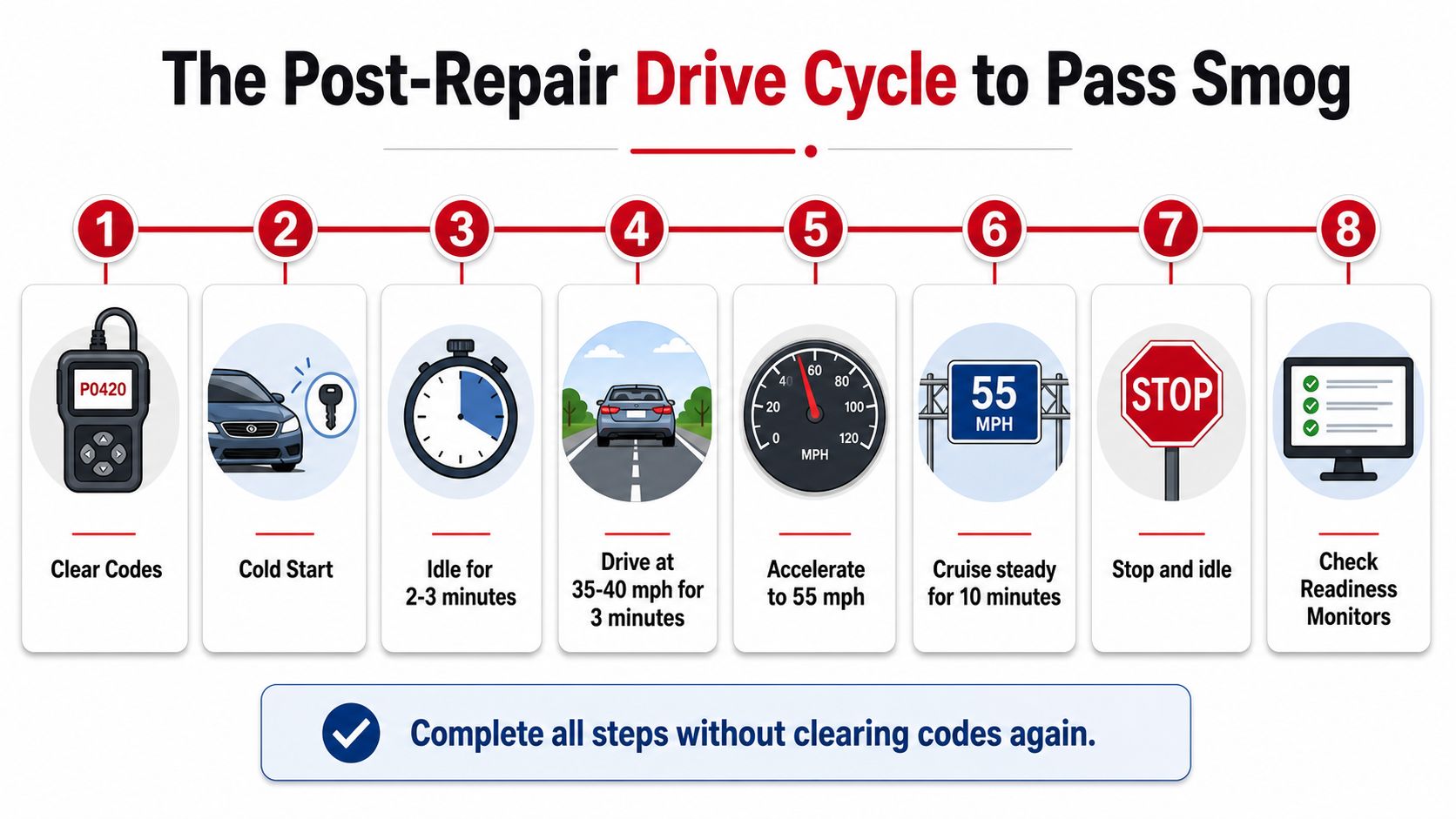
Use a scanner to check readiness instead of judging by mileage. A car that has made many short trips may still need sustained freeway operation for a stubborn monitor. RVs and heavy trucks can require longer warm-up periods and steadier grades because their weight and operating load affect test conditions.
A successful cycle generally takes 50 to 100 miles over two to three days, based on the practical guidance in this drive-cycle preparation guide. Leave the codes alone during that period. If the light returns, stop driving for readiness and diagnose the new result before scheduling the test.
What to Do the Day Before and Day of the Test
The day before the appointment is for verification, not experiments. Cycle the ignition and confirm the check engine light illuminates during the bulb check, then turns off after the engine starts. Scan the car and confirm every required readiness monitor shows complete before you leave home.
Fuel level matters to EVAP testing. Keep the tank around three-quarters full, not completely full and not close to empty. Check that the gas cap seals correctly and clicks into place. If the cap seal is cracked or the cap won't tighten, replace it before testing.
A short pre-test checklist
- Check the scan data: Confirm there are no active emissions codes and that monitors are ready.
- Inspect the gas cap: Make sure it seals and locks as designed.
- Avoid battery disconnection: Removing battery power can erase readiness information and may create anti-theft complications.
- Check tire pressure: Keep the tires evenly inflated, especially if the inspection procedure requires dynamometer operation.
- Bring paperwork: Have the vehicle registration and any recent repair documentation available.
Arrive with the engine warmed through ordinary driving, not by revving the car in the parking lot. Tell the technician about recent battery replacement, code clearing, repairs, or an intermittent light. That information helps the station choose the right pre-check and prevents confusion when the scan shows incomplete data.
The cheapest test is the one you don't take before the car is ready.
Ask for a pre-scan before the formal inspection begins. Fire House Smog's standard quick pre-check is intended to catch failed monitors before the inspection proceeds, which can save a retest trip. If the scanner says “not ready,” leave and finish the drive cycle rather than paying to document a predictable failure.
Retests Exemptions and When a Light Can Be Legal
A failed inspection needs a diagnosis based on the failure type. A hard fail means the MIL is on or the vehicle has a qualifying diagnostic fault. The repair path starts with code interpretation and physical testing. A not-ready fail means the lamp may be off and no active fault may be visible, but the computer hasn't completed its required self-tests. That path usually calls for more correct driving and another readiness scan, not immediate parts replacement.
California's Smog Check information from the Bureau of Automotive Repair confirms the central rule: a vehicle won't pass with the check engine light on. The lamp must also operate correctly during the ignition and running checks. An illuminated light isn't made legal by the fact that the car drives smoothly.
Use the failure result as a decision tool
| Scenario | What It Means | Next Action |
|---|---|---|
| Light remains on with the engine running | The computer has identified an active emissions-related fault | Diagnose and repair before testing again |
| Light doesn't illuminate during the bulb check | The MIL circuit or lamp operation has a defect | Repair the instrumentation problem |
| Light is off but monitors are incomplete | The vehicle isn't ready for certification | Follow the correct drive cycle and rescan |
| Light is off and all monitors are complete | The vehicle has cleared the basic OBD readiness gates | Proceed with the Smog Check |
| Visual emissions equipment problem | Required equipment may be missing, altered, or tampered with | Correct the equipment issue before retest |
Some vehicles follow different inspection rules because of age, fuel type, weight, or vehicle classification. Those categories should be confirmed with the station or BAR rather than assumed from the dashboard light. An exemption from one portion of testing doesn't turn an active MIL into a pass.
Repair assistance may be available through California's Consumer Assistance Program when a qualifying vehicle meets the program's requirements. A cost-based waiver is a separate state process with its own eligibility rules, documentation, and repair requirements. Ask the Bureau of Automotive Repair or a participating station for the current pathway before authorizing work.
The decision tree is straightforward. Light on means repair first. Light off but not ready means drive and rescan. No light and ready means test now. That sequence protects you from both unnecessary repairs and premature retests.
Local Logistics at Fire House Smog in Antioch
Antioch drivers should verify the appointment details before heading to a station, especially when the vehicle isn't a standard passenger car. Fire House Smog operates at 2900 Lone Tree Way in Antioch, and its test-only operation focuses on emissions inspections rather than selling repair work. Confirm the current address, posted hours, vehicle acceptance, and coupon terms before you go.
Bring the vehicle registration, the last smog receipt if you're returning after a failure, and repair paperwork if you're pursuing a directed repair or waiver. Keep the invoice. Retest eligibility depends on the station's policy and coupon terms, and the site's published information describes a free retest when applicable.
Call before bringing unusual vehicles
Call ahead for diesel trucks, RVs, and motorhomes. A diesel vehicle may require a different test procedure, while a larger motorhome may need confirmation that the bay and equipment can accommodate it. Out-of-state vehicles may also need VIN verification or a registration-related service that should be discussed before arrival.
Fire House Smog offers STAR-certified test-only inspections for passenger vehicles, SUVs, light-duty trucks, and some recreational vehicles. It also provides California DMV registration services, including renewal and related registration tasks, subject to posted service hours. Payment methods, current wait times, and vehicle-specific eligibility can change, so ask the station directly rather than relying on an old listing.
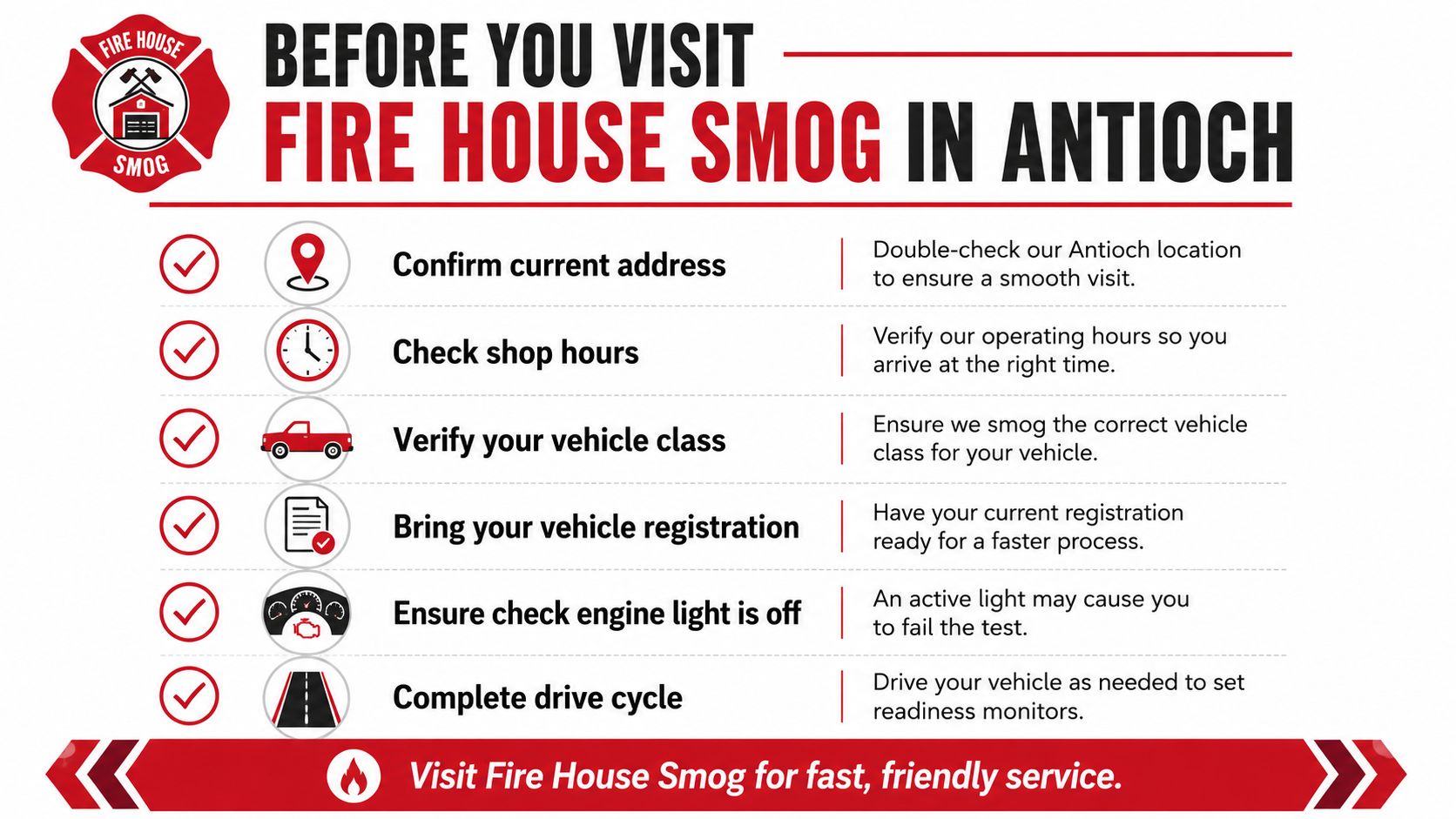
A practical visit checklist:
- Confirm the location: Verify the Lone Tree Way address before leaving.
- Check operating hours: Ask about Sunday, evening, and DMV service availability.
- Verify the vehicle class: Mention diesel trucks, RVs, motorhomes, or unusual equipment.
- Bring documents: Carry registration, prior test paperwork, and repair records.
- Check the light: The MIL must operate correctly and turn off with the engine running.
- Verify readiness: Don't arrive with incomplete monitors, even if the dashboard is dark.
- Plan the timing: An early Saturday appointment can help reduce waiting, but call first for special vehicle classes.
If the phone line is tied up during lunch, leave a voicemail with your vehicle type and reason for calling. The station's listed telephone number is 925-754-1600. A quick confirmation before driving over is better than discovering that an RV, diesel truck, or not-ready vehicle can't enter the test lane.
Fire House Smog offers STAR-certified test-only smog inspections, readiness pre-checks, retest support, and California DMV registration services in Antioch. Check your check engine light and readiness monitors before you go, then visit Fire House Smog or call 925-754-1600 to confirm the right test procedure for your vehicle.
A typical California smog test commonly includes a station-set inspection charge plus an $8.25 state certificate fee, so the all-in vehicle emissions test cost varies by provider and should be confirmed before testing. In Antioch, the right question isn't just “What's your test price?” but “What will I pay if the vehicle passes, fails, or needs a retest?”
Your DMV renewal notice may arrive when you're busy, your registration is close to expiring, and you need a smog check quickly. A low advertised price can look appealing, but it may exclude the certificate fee, apply only to certain vehicles, or provide no protection if the vehicle fails and must return.
California's system is easier to manage once you separate the bill into its parts. The station controls the inspection charge, while the state certificate fee is fixed. Your vehicle's fuel type, size, model year, testing designation, and retest terms can change the final amount.
Table of Contents
- What Antioch Drivers Should Expect to Pay
- Why California Smog Costs Have Two Parts
- How STAR Testing Changes the Process
- How Vehicle Type Affects Test Eligibility and Cost
- What Happens During a Test-Only Smog Visit
- Fire House Smog Pricing Features Compared
- Ways to Save and Plan Your Local Visit
- Your Final Cost Planning Checklist
What Antioch Drivers Should Expect to Pay
An Antioch driver who needs a smog check before registration renewal should plan for the full compliance cost, not just the largest discount in an advertisement. The bill usually combines the station's inspection charge with California's $8.25 smog certificate fee. The California smog-check guidance from the Bureau of Automotive Repair explains that the certificate fee is fixed, while the station sets its inspection price.
For ordinary vehicles, published California fee guides and BAR materials commonly show base inspection prices around $29.95 to $69.95, with the $8.25 certificate fee added after a passing test. That puts a typical passing visit at roughly $38.20 to $78.20 before coupons, vehicle-specific charges, STAR requirements, or retest costs. Ask the station to state the complete passing price before you arrive, rather than assuming the advertised test rate includes every charge.
Confirm the price before you drive over
Call with the vehicle's year, make, model, fuel type, and body style. Ask:
- Total passing price: Does the quote include the $8.25 certificate fee?
- Vehicle eligibility: Can the station test your diesel, van, lifted truck, or recreational vehicle?
- Testing designation: Does your renewal notice require a regular inspection or a STAR-certified location?
- Retest terms: Is a retest included, discounted, or charged separately?
- Payment details: Which payment methods and coupons does the station accept?
A station may need the vehicle identification number and registration details to confirm the correct inspection path. Bring your renewal notice, current registration information, and an accepted payment method.
Practical rule: Compare the all-in passing price and the retest policy. A lower advertised rate can cost more if it excludes the certificate fee or offers no reasonable retest option.
Some newer vehicles follow a different compliance route. Vehicles less than 4 model years old can pay a smog abatement fee instead of receiving an inspection for the first 8 years they are registered, under the California DMV smog inspection rules. Those owners may not need to compare inspection prices during that period.
STAR requirements can change which stations are eligible to perform the inspection and may affect the station's price. Review this Antioch STAR smog check cost guide before booking, especially if your renewal notice specifies STAR testing. If you also need DMV service, ask whether the station offers a combined option and what it includes. The certificate fee remains regulated, while local inspection pricing, vehicle eligibility, and retest terms determine much of the final bill.
Why California Smog Costs Have Two Parts
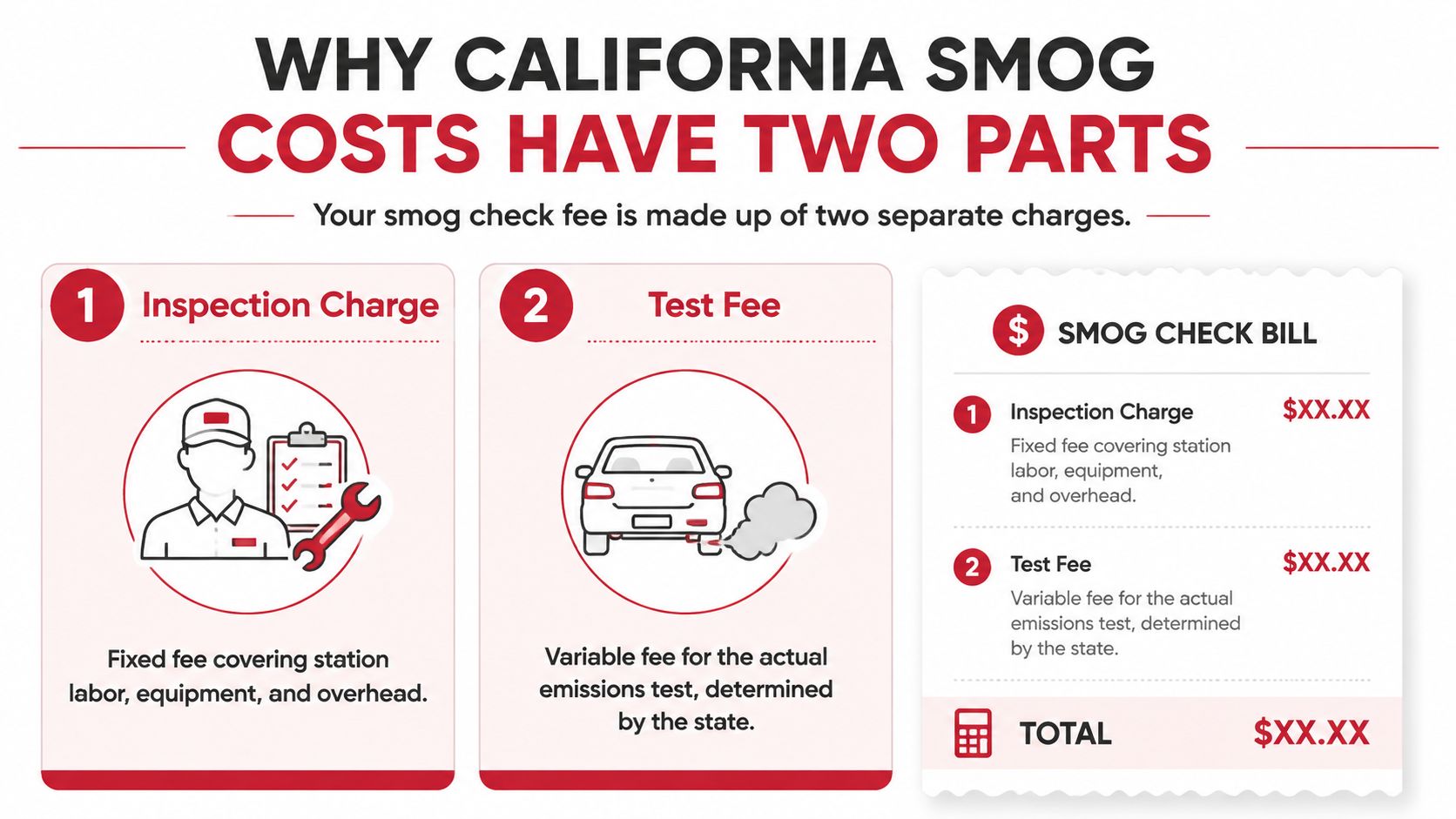
A California smog bill works much like a utility invoice. One line covers the service performed by the provider, and another line represents a required state charge. Treating both lines as one mysterious price makes it harder to compare stations accurately.
The first component is the inspection charge. Each licensed station sets that amount based on its operating costs, equipment, staffing, location, and business model. A test-only facility and a repair shop may structure their pricing differently, even when both perform a valid inspection.
The second component is the $8.25 California smog certificate fee. The Bureau of Automotive Repair states that a station must charge this fee, and the California DMV fee guidance identifies the same regulated certificate charge. The certificate is issued when the vehicle passes, so a passing visit normally includes both the inspection charge and the certificate fee.
What a quote should show
Ask the station to identify each component separately. A clear quote might describe the station's test charge, then identify the state certificate fee as a separate amount. If a coupon reduces the inspection charge, ask whether it also changes any certificate charge. State fees generally aren't treated like promotional labor discounts.
A failed test creates a different billing question. If no certificate is issued, the certificate component doesn't operate like a passing certificate charge. You may still owe the station's inspection charge, and any later diagnostic work or retest may be priced separately under the station's policy.
| Bill component | Who controls it | When to ask about it |
|---|---|---|
| Station inspection charge | The testing station | Before scheduling |
| California certificate fee | The state, collected by the station | Ask whether it's included in the quote |
| Retest charge | The station's policy and promotion terms | Before authorizing the first test |
| DMV renewal or registration charges | The DMV and transaction type | Keep separate from the smog bill |
That separation matters because vehicle emissions test cost isn't the same as your total registration expense. If you also renew your registration at the station, the DMV transaction creates a separate charge. Review California vehicle registration cost information so you don't mistake a combined service receipt for a single smog price.
How STAR Testing Changes the Process
STAR testing isn't just a premium version of an ordinary smog check. California uses STAR-certified stations for vehicles that require a more specific testing channel, including vehicles directed to STAR testing or associated with certain previous inspection outcomes.
Check your renewal notice before choosing a station. If it identifies a STAR requirement, a regular non-STAR location may not be able to complete the transaction correctly. Booking the cheapest nearby appointment first can create an avoidable second trip if the station can't accept the vehicle under its assigned testing requirement.
Regular testing and STAR testing serve different purposes
A regular inspection is appropriate when the renewal notice and vehicle records allow ordinary testing. STAR certification identifies stations that meet additional state program requirements and can handle vehicles directed into that channel.
| Situation | What to confirm |
|---|---|
| Ordinary renewal | Whether the station accepts the vehicle for standard testing |
| STAR or directed notice | Whether the facility is currently STAR-certified |
| Previous failed inspection | Whether the next test must occur at a STAR site |
| Unusual vehicle configuration | Whether the station's equipment can accommodate it |
STAR stations may charge differently because their operating requirements, equipment, and oversight differ from those of other stations. Don't assume that a STAR label automatically means every vehicle needs STAR testing, and don't assume a standard station can substitute for a required STAR location.
Read the renewal notice first. The designation determines where you can test, while the station determines its inspection price.
For Antioch drivers, a regular renewal notice may allow more flexibility, but the notice remains the controlling document. Call before visiting if the vehicle has a prior failure, a directed-test instruction, or unusual registration circumstances.
Use this guide to understand what STAR-certified smog means before paying for an appointment. The practical recommendation is firm: verify the required test type before comparing prices. A lower quote isn't a saving if the facility can't submit the required inspection.
How Vehicle Type Affects Test Eligibility and Cost
The vehicle itself often determines whether a station can perform the test, how long the visit may take, and whether the quoted price applies. A gasoline passenger car usually follows the station's standard process, but a diesel truck, oversized van, motorhome, or modified vehicle may need advance confirmation.
Start with the vehicle class. Gasoline cars and many light-duty trucks are commonly handled by stations equipped for ordinary passenger vehicles. Larger trucks, vans, and recreational vehicles can present clearance, weight, wheelbase, or equipment limitations. A station may accept one RV configuration but decline another because the testing bay or dynamometer setup isn't suitable.
Fuel and model year matter
Diesel and gasoline vehicles don't use identical emissions-testing procedures. Diesel testing can involve different equipment and facility requirements, so don't rely on a gasoline-car price when calling about a diesel truck.
Older vehicles may follow different inspection rules than newer vehicles, and some hybrids or pre-1996 vehicles may have exemptions or partial requirements depending on the applicable California rule. Don't assume an exemption based only on the vehicle's appearance or fuel label. Confirm the exact requirement through the DMV notice or a licensed station.
The station may also need to know whether the vehicle has been modified. Lift kits, unusual tire sizes, aftermarket exhaust parts, and nonstandard engine configurations can affect whether the vehicle fits the equipment or passes visual and emissions checks.
Call before booking unusual vehicles
Give the station precise information:
- Vehicle dimensions: Mention a motorhome, extended van, lifted truck, or unusually long wheelbase.
- Fuel type: State whether it runs on gasoline, diesel, or another approved fuel.
- Model year: The year can affect inspection eligibility and procedure.
- Registration location: County and registration details can affect the required compliance process.
- Prior results: Tell the station if the vehicle failed previously or received a directed-test notice.
A refusal at the bay can still cost you time, fuel, and a missed registration deadline. A short call protects against that outcome and helps the station give a vehicle-specific quote instead of a generic passenger-car price.
The right expectation is not that every vehicle costs more. It's that the station must confirm the vehicle before promising a price.
What Happens During a Test-Only Smog Visit
You arrive with the vehicle and registration information, and the technician begins by confirming the VIN, license information, and testing requirement. At a test-only station, the visit focuses on inspection and reporting rather than repair sales.
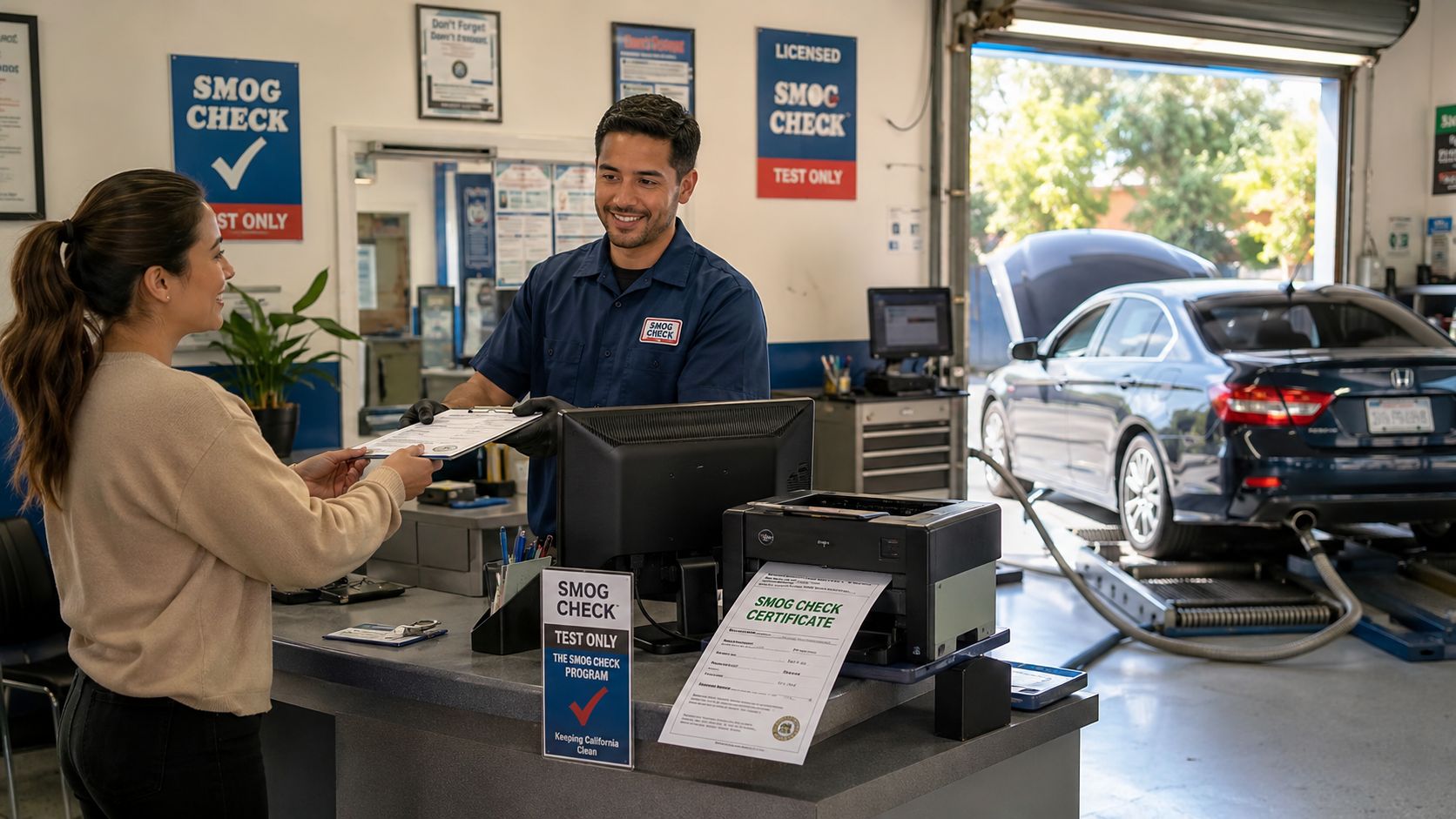
The technician may connect an OBD-II scanner to a compatible vehicle, inspect emissions-related equipment, and use a tailpipe probe or dynamometer when the vehicle and procedure require it. You generally wait while the station records the results and submits the inspection electronically through the California emissions-testing system.
A test-only model can make the financial conversation cleaner. The station doesn't sell the repairs needed after a failure, so the technician's role is to document the test result and explain what the result means. If the vehicle fails, ask for the printed failure information and take it to a repair provider you trust.
The result determines the next cost
A passing result leads to electronic certification and the applicable state certificate charge. A failed result means you may need diagnosis, repairs, and another inspection. The original station's retest policy becomes important at that point, especially if the promotion requires repairs within a specific window or applies only to certain vehicle types.
Two service bays can help a station keep vehicles moving, but capacity still varies by time of day. Ask whether an appointment is needed and whether the station accepts walk-ins.
The inspection doesn't automatically complete every DMV transaction. If you need registration renewal, ownership transfer, or another DMV service, confirm whether the station provides it and whether that transaction carries separate charges.
For a visual overview of the inspection experience, watch the following facility demonstration:
Before leaving, confirm that the result was transmitted and ask what document, receipt, or confirmation you should keep. That final check prevents uncertainty when you complete registration.
Fire House Smog Pricing Features Compared
A station's promotional features matter only when they reduce the all-in cost of compliance. A coupon may lower the initial inspection charge, but it doesn't necessarily eliminate the state certificate fee. A free retest may have more practical value than a larger first-visit discount if the vehicle fails.
Fire House Smog operates as a STAR-certified test-only station in Antioch and offers coupon-based pricing, a free retest under its site policy and coupon terms, and DMV registration services. Treat those features as items to verify, not as assumptions. Other local stations may offer a lower advertised inspection charge, different retest conditions, or a different vehicle eligibility list.
Compare the offer behind the headline
| Feature | Why it can affect total cost | Question to ask |
|---|---|---|
| Coupon discount | Reduces the station-set inspection charge when valid | Does it apply to this vehicle and date? |
| Free retest | Limits the cost of returning after a failed test | What time, mileage, repair, or coupon conditions apply? |
| Test-only operation | Separates inspection from repair sales | Will the station provide failure information without requiring repairs there? |
| STAR certification | Supports vehicles assigned to STAR testing | Does this facility meet the requirement on my notice? |
| DMV services | May combine registration work with the visit | Which DMV charges are separate from the smog bill? |
The retest language deserves special attention. “Free retest” doesn't mean every follow-up visit is automatically free. Ask whether you must repair the vehicle elsewhere, return within a stated period, show the original receipt, or meet vehicle-specific conditions.
A discount protects the first visit. A clear retest policy protects the entire transaction.
Don't choose a station solely because it advertises the lowest number. Ask for the passing total, the certificate treatment, the retest rules, and the eligibility limits in one conversation. That comparison gives you a better measure of vehicle emissions test cost than a coupon headline alone.
Ways to Save and Plan Your Local Visit
The easiest savings usually come from preventing a second trip. Before you leave home, check the renewal notice, gather the registration information, and call the station with the exact vehicle details. That preparation helps identify STAR requirements, size restrictions, and retest terms before money changes hands.
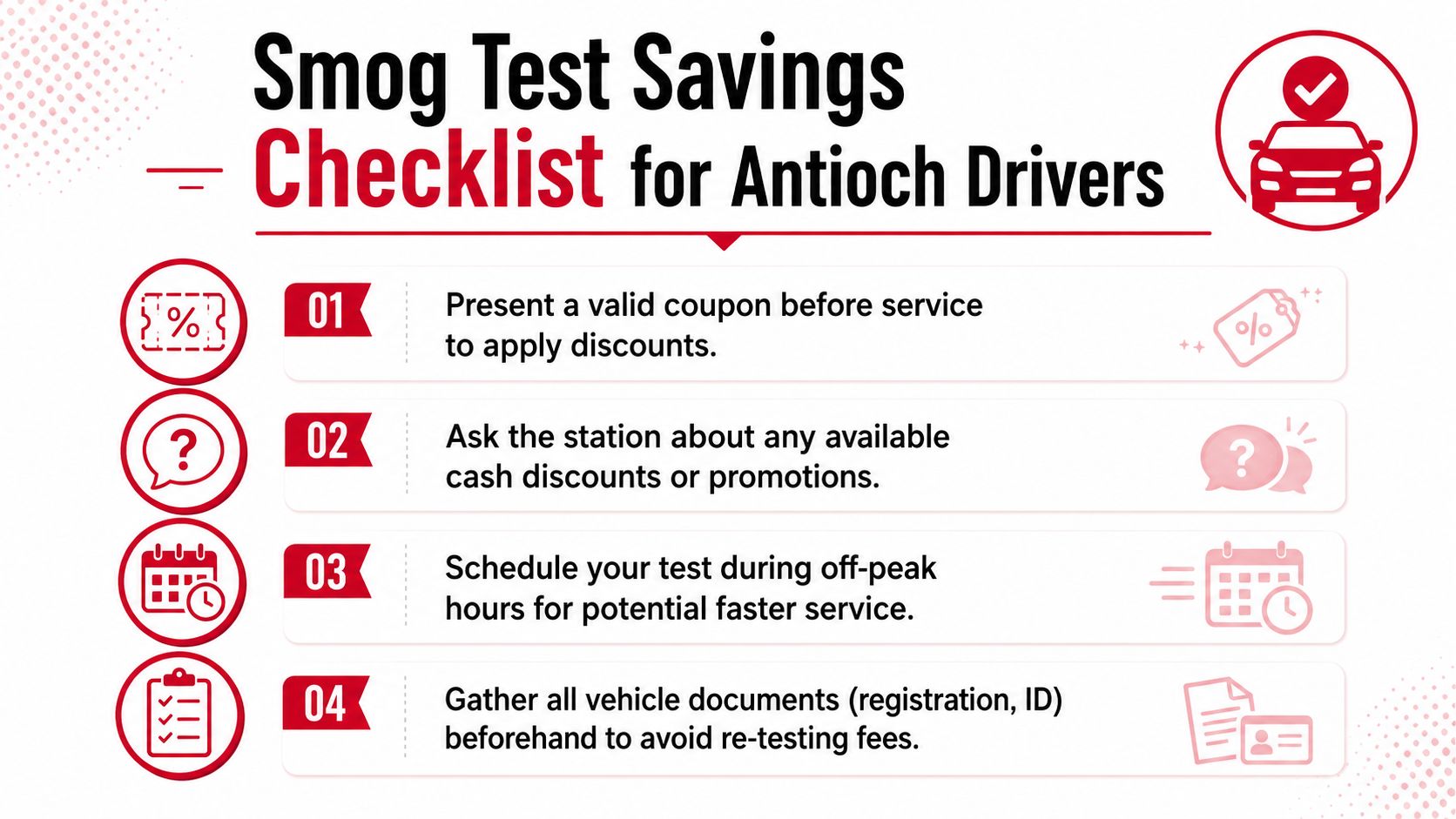
Use this Antioch checklist:
- Bring the coupon first: Present a current coupon before service begins. Ask whether it applies to the station's inspection charge and whether any vehicle exclusions apply.
- Clarify the retest window: Ask whether a free or reduced retest has time, mileage, repair, receipt, or coupon conditions.
- Choose practical hours: Confirm weekend and evening availability if weekday work makes a daytime appointment difficult.
- Combine services carefully: If you plan to renew registration at the same location, ask which DMV services are available that day and which charges are separate.
- Call about large vehicles: Motorhomes, lifted trucks, and oversized vans need bay-clearance and equipment confirmation before arrival.
- Prepare payment: Confirm accepted payment methods so a completed inspection isn't delayed at checkout.
Prevent avoidable retests
A check-engine light, incomplete emissions monitors, or a recently disconnected battery can create problems during testing. A station can explain the inspection result, but it can't promise a pass before examining the vehicle. If the vehicle has a known warning light or recent emissions repair, address that issue before scheduling rather than paying for a predictable failure.
A test-only station can also reduce pressure to approve repairs on the spot. If the vehicle fails, get the results in writing, compare repair options, and confirm the retest terms before returning.
When calling, ask one final question: “What is the total I should expect if the vehicle passes, and what would I pay if it needs a retest?” That question forces the station to explain the bill instead of quoting an incomplete starting price.
Your Final Cost Planning Checklist
Before booking an Antioch smog check, separate the costs into three groups.
First, identify the station-set inspection charge. This is the labor and equipment price the provider controls. Next, identify the $8.25 California certificate fee, which is the regulated state component charged after a passing test. Finally, keep retest charges, repairs, DMV renewal fees, and registration costs separate from the initial inspection quote.
Answer these questions before you schedule:
- What test does the DMV notice require? Regular, STAR, or a directed inspection?
- Can this station test the vehicle? Confirm fuel type, size, model year, and modifications.
- What is the complete passing price? Ask whether the certificate fee is already included.
- Is a coupon active? Verify the expiration date and vehicle restrictions before service.
- What happens after a failure? Get the retest price and conditions in writing.
- Can the station handle my schedule? Confirm appointments, weekend hours, and any DMV service availability.
- Will the result be transmitted electronically? Ask what receipt or confirmation you'll receive.
Newer vehicles may qualify for California's smog abatement route rather than an inspection, as described earlier. Every other driver should compare the complete transaction, not just the first number in an advertisement.
A quick phone call is the most reliable way to produce a predictable vehicle emissions test cost. Confirm eligibility, separate the certificate fee from station pricing, and understand the retest policy before you drive to the bay.
Fire House Smog provides STAR-certified test-only inspections in Antioch, with coupon options, retest terms subject to site policy, and DMV registration services available for eligible transactions. Visit Fire House Smog to confirm your vehicle's testing requirements, current pricing, hours, and appointment options before you arrive.
You're probably staring at a renewal notice, a flickering check-engine light, or a gas receipt that looks worse than it should. If your car has to pass a smog check soon, the smartest move is not guessing, and it's not buying random parts. It's tightening up the habits and maintenance that change emissions at the tailpipe and at the test station.
Table of Contents
- Why Vehicle Emissions Matter for Everyday Drivers
- Driving Habits That Cut Emissions Right Away
- Maintenance That Lowers Emissions on the Test
- Fuel Choices and Technology Upgrades Worth Considering
- How California Smog Checks Actually Work
- Test-Only Smog Stations and Why They Matter
- Pairing Your Smog Visit With DMV Services
Why Vehicle Emissions Matter for Everyday Drivers
A lot of drivers think emissions only matter when a county or state makes a speech about climate goals. That's too abstract for a person who just wants the car to start, pass, and keep moving. Vehicle emissions affect your wallet, your time, and whether your car stays legal on the road.
Transportation is a major emissions source because it produces about 15% of global greenhouse gas emissions according to CFR. The same summary notes that transportation emissions have grown faster than any other end-use sector over the past decade, with global transportation emissions rising about 2% per year in that period. The IPCC pathway cited there calls for transportation-related emissions to fall 59% by 2050 relative to 2020 CFR summary. That's the big picture, but the driver-level lesson is more practical, less political, and a lot more immediate.
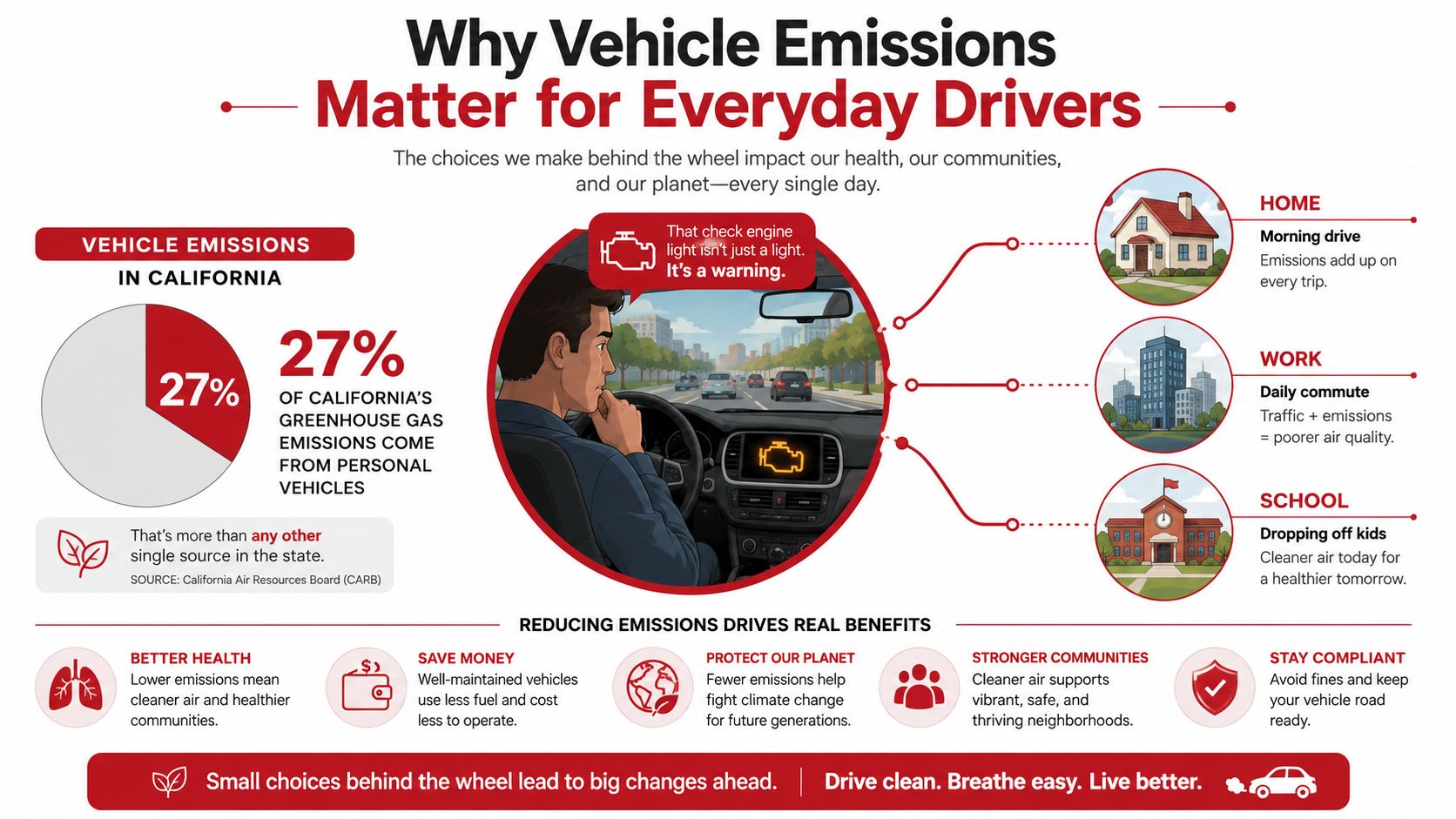
For a daily driver, emissions show up in three places. First, in fuel use, because wasted fuel is wasted money. Second, in drivability, because rough running, poor maintenance, and bad habits make a vehicle harder to live with. Third, at the smog station, where habits and condition become numbers, readiness flags, and visible failures.
The smartest mindset is this, emissions are a system. Your right foot, your maintenance schedule, and your vehicle's condition all affect what comes out of the exhaust. If you want to reduce vehicle emissions the practical way, start by fixing the things you can control today, not the things you can only argue about later.
Practical rule: If the car burns more fuel than it needs to, the exhaust story is usually worse too.
For California drivers, that's not theoretical. It ties directly into compliance, and it connects to your next inspection. If you want the state-specific side of that picture, review California emissions standards before you roll into a test.
Driving Habits That Cut Emissions Right Away
The fastest emissions cuts usually come from the driver, not the parts catalog. I've seen plenty of cars fail or barely pass because the owner drove it like a taxi in a hurry, then expected a fresh sticker to fix the damage. That's backwards. Smooth, sensible driving lowers emissions immediately.
Stop treating every green light like a drag race
MIT researchers reported in 2025 that fully adopting eco-driving measures at city intersections could reduce annual intersection carbon emissions by 11% to 22% while keeping traffic throughput and safety intact MIT News. That matters because most real-world driving is not wide-open highway cruising, it's stop-and-go, red lights, merges, and impatient braking.
The same MIT report, along with road-transport guidance, points to the basics that drivers ignore: at 110 km/h a car can use up to 25% more fuel than at 90 km/h, and hard acceleration and braking can lower mileage by 33% on the highway and 5% in town MIT News. That's not a subtle difference. If you're flooring it between lights, you're paying for it twice, once at the pump and again in emissions.
Shop-floor advice: Keep the throttle smooth, leave early, and stop chasing yellow lights.
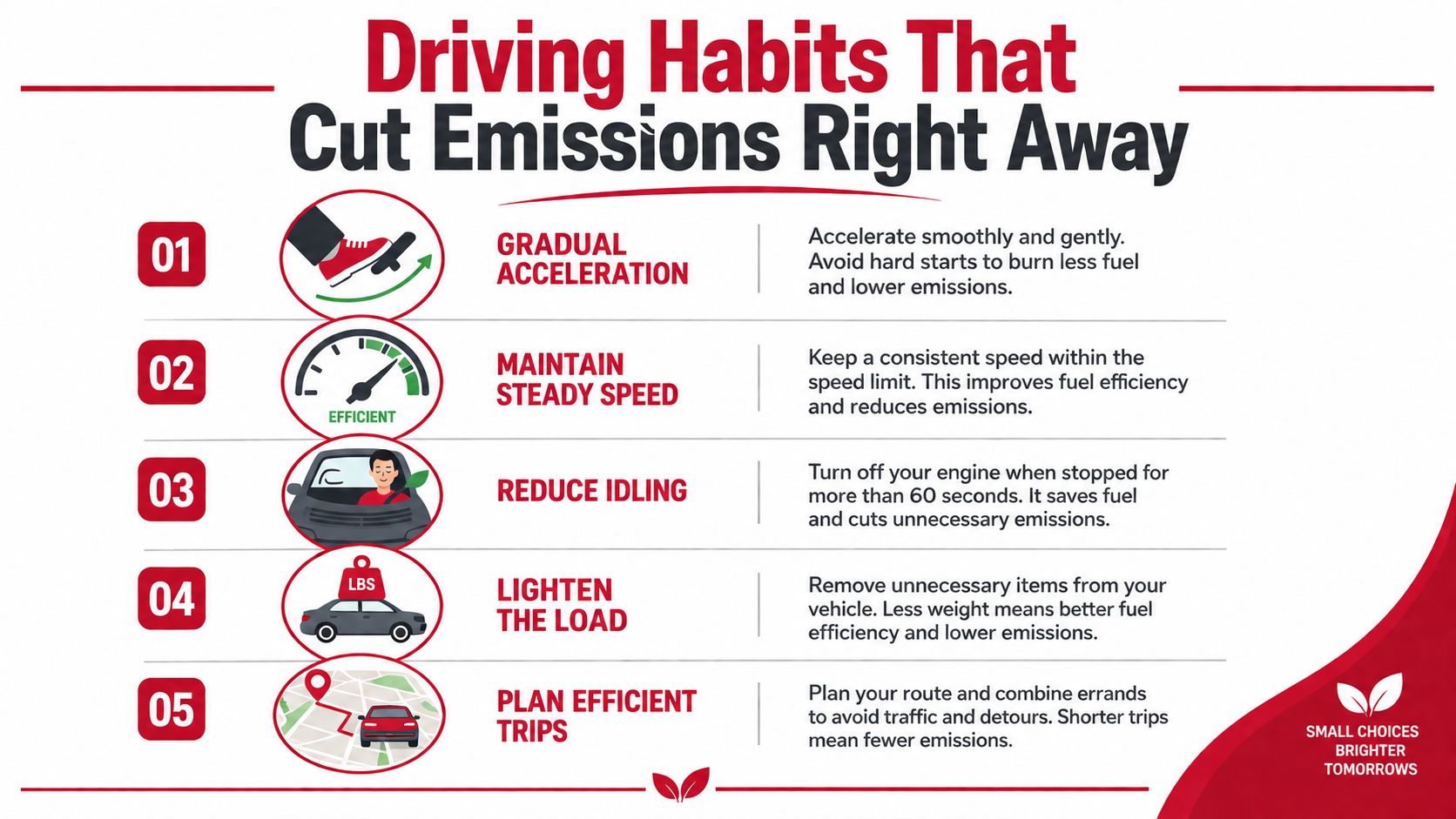
Reduce idling, combine trips, and stop hauling junk
EPA guidance treats walking, biking, public transit, carpooling, trip-chaining, working from home when possible, smoother driving, and regular maintenance as the core practical levers for lowering vehicle pollution EPA. That priority order matters. Driving less beats almost every other move because it cuts emissions at the source instead of trimming them after the fact.
In city traffic, idling and congestion are especially ugly. EPA guidance on stop-and-go driving calls out idling, peak-hour congestion, and smooth acceleration/deceleration because those conditions raise pollution and fuel use EPA PDF. If you sit in a pickup line with the car running, creep through the same route every day, or make three separate errands that could've been one, you're feeding the problem.
Use this quick self-audit on your next commute.
- Start earlier: Leave a few minutes sooner so you're not forced into hard acceleration.
- Hold speed steady: Back off the urge to surge and brake.
- Kill unnecessary idle time: Don't sit with the engine running when you don't need to.
- Chain errands: One loop beats three separate cold starts.
- Clear the load: Unused cargo adds drag and waste.
For California drivers, route choice and speed discipline matter as much as badge or model year. If you want a local reminder of how driving behavior connects to compliance, see vehicle emissions standards for car driving.
Maintenance That Lowers Emissions on the Test
Maintenance doesn't replace good driving. It makes good driving count. I've inspected thousands of vehicles, and the same pattern keeps showing up. The owner focuses on one obvious item, maybe a filter or an oil change, then ignores the rest of the system. That's how people end up chasing a failed smog report with guesswork.
Fix the basics first, not the shiny parts
EPA guidance groups the practical fixes together: walking, biking, transit, carpooling, trip-chaining, smoother driving, and regular maintenance with manufacturer-recommended oil EPA. The reason is simple. Maintenance works best when it supports better driving habits, not when it's treated like a magic patch.
If you're trying to reduce emissions that show up on a smog test, start with the parts that affect combustion quality and system health. A dirty air filter, wrong oil, and obvious warning lights are the stuff I see drivers ignore right before inspection. A clean-running engine is easier to certify than a neglected one.
Here's the order I'd use in the shop.
- Check the warning lights first. A lit check-engine light usually means there's a fault worth addressing before the test.
- Use the manufacturer-recommended oil. Wrong oil choice can make an engine run less cleanly.
- Inspect the air intake path. A clogged air filter is cheap to fix and not worth gambling on.
- Verify tires are properly inflated. Bad pressure hurts economy and can worsen overall vehicle efficiency.
- Get the tune-up work done before test day. Don't wait until the vehicle is already in line.
Plain truth: If the engine is unhappy, the smog machine will usually notice before you do.
Don't fix one thing and ignore the rest
That's the biggest mistake. A driver replaces an air filter, skips the check-engine light, keeps driving aggressively, and then acts surprised when the result doesn't change much. EPA's guidance on vehicle pollution puts these behaviors together because they compound, not because each one is dramatic by itself EPA PDF.
For a California driver, a failed smog test often traces back to a routine maintenance miss, not some mysterious defect. If you want to understand the common fail patterns before you spend money, read smog check fail reasons. That'll save you from buying parts in the wrong order.
Fuel Choices and Technology Upgrades Worth Considering
Once the driving habits are cleaned up and the maintenance is handled, then you can think about purchases. Not before. Too many people throw money at fuel myths or fancy add-ons while their real problem is a bad commute pattern or a neglected engine. Buy only what matches how you drive.
Match the choice to the trip pattern
Some drivers benefit from simple, everyday choices. Others need a more deliberate upgrade because their vehicle spends most of its life in traffic, on short hops, or under steady highway load. A fuel or tech choice only makes sense if it fits the way the car is used.
| Driving Pattern | Best Fuel Choice | Best Tech Upgrade |
|---|---|---|
| Short city trips with frequent stops | Follow the manufacturer's recommended fuel, and avoid premium unless the car requires it | Keep tire pressure correct, because daily stop-and-go magnifies inefficiency |
| Mixed commuting with traffic congestion | Use the recommended grade, stay consistent, and avoid unnecessary fuel “upgrades” | Consider low-rolling-resistance tires if they suit the vehicle and driving feel |
| Mostly highway driving | Stick with the specified fuel grade, not a marketing label | Tires suited to stable cruising and proper alignment matter more than gimmicks |
| Older vehicle with known emissions wear | Use the correct fuel for the engine, not the most expensive option on the shelf | Focus first on emissions-control repair, not cosmetic add-ons |
The point is not to chase premium fuel as a shortcut to cleaner exhaust. The point is to use the fuel the engine was designed for and pair it with the right hardware. If the vehicle doesn't need a higher-octane product, spending more doesn't automatically make it cleaner. It just makes the receipt uglier.
Upgrade where the use case justifies it
Tire choice is one of the few upgrades that can make sense because it affects real rolling effort every day. Low-rolling-resistance replacements can be reasonable for drivers who care about efficiency and spend a lot of time on pavement. The catch is that you should buy them as part of a broader plan, not as a cure-all for bad maintenance.
For older or high-mileage cars, the emissions-control upgrade is repair, not decoration. If the catalytic converter, oxygen sensor, or related systems are tired, fix the system before you dress it up. That's the difference between a vehicle that merely looks maintained and one that behaves better on test day.
Money-saving rule: Spend on the part that changes combustion or rolling resistance, not on the part that sounds impressive in a sales pitch.
How California Smog Checks Actually Work
California smog checks are not a mystery, but drivers keep treating them like one. The station is looking for a vehicle that runs clean enough, has the right equipment in place, and doesn't show signs of tampering or obvious failure. That's the deal. The test is there to measure compliance, not to reward optimism.
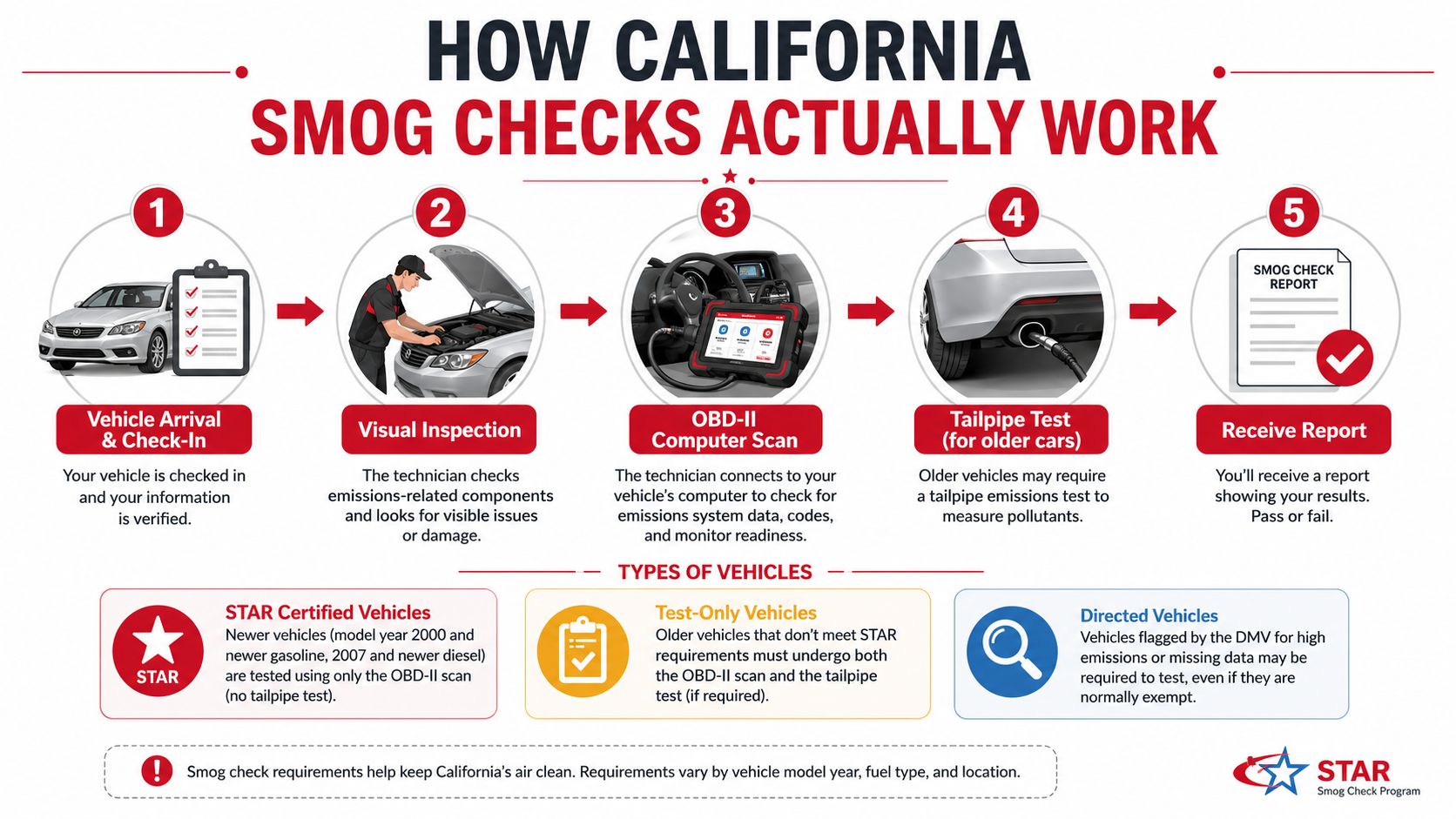
What the technician actually checks
A California smog inspection typically includes an OBD-II computer scan, a visual inspection, and a tailpipe test for older cars where applicable. That means the station is not only reading codes, it's also checking whether the emissions-related hardware appears intact and whether the vehicle's onboard system reports readiness correctly.
The categories matter. STAR-certified vehicles are directed to stations that meet stricter requirements. Test-only stations perform the inspection without also selling repair work. Directed vehicles are the ones the state sends to specific station types because of their compliance profile. That structure helps keep the process organized and keeps the test result tied to the vehicle, not the repair invoice.
Stop-and-go driving can affect what the car shows
EPA guidance on traffic pollution makes one point very clear. Idling, congestion, and stop-and-go patterns raise emissions EPA PDF. That matters because a car that's always driven hard in traffic may arrive at the station in worse shape than a car that gets gentle, steady use. The test doesn't care about your excuse for the drive over. It cares about the data and the hardware.
The practical takeaway is simple. A smog test rewards preparation. Warm the car properly, keep the maintenance current, and don't assume a warning light will somehow disappear at the station. It won't.
Test-Only Smog Stations and Why They Matter
A test-only station changes the customer experience in a way drivers should care about. The tech can inspect the car and report the result, but the station doesn't have a repair revenue stream hanging over the test. That matters because it reduces the pressure to turn every borderline result into a big estimate.
In Antioch, Fire House Smog is one example of that model. It operates as a STAR-certified test-only smog check station and also handles DMV registration services at 2900 Lone Tree Way. The shop has two service bays, offers smog testing seven days a week, and provides a free retest when required under its policy and coupon terms. That's the kind of setup that saves time for working drivers who don't want to bounce between a test lane and a repair counter.
What to ask before you hand over the keys
Bring the vehicle paperwork, your keys, and payment, then ask straightforward questions. Don't let anyone bury the answer under shop language. A good station should tell you whether your vehicle is a normal smog check, a directed case, or something that needs special handling.
Use this short checklist.
- Ask about station type: Confirm whether the location is test-only and STAR-certified.
- Confirm vehicle fit: Ask if your car, truck, SUV, or RV is within their equipment limits.
- Check the retest policy: Know the rules before you leave the lot.
- Ask about wait times: Two bays can help, but timing still matters.
- Bring the basics: Registration-related paperwork, keys, and payment are the minimum.
A test-only station is also useful because it keeps the conversation clean. The result is the result. If you fail, you can take that report to the repair side of your choosing instead of being pushed toward an in-house fix. That protects you from upselling and keeps the decision where it belongs, with the owner of the car.
Pairing Your Smog Visit With DMV Services
The smartest compliance move is to knock out the inspection and the paperwork in one trip. That's where a licensed business partner can save real time. Instead of visiting one place for the test and another for the registration work, you handle both while the car is already there.
California drivers often need help with registration renewals, ownership transfers, and related tag issuance. At Fire House Smog, DMV services are posted Monday through Saturday from 9:30 AM to 5:00 PM and Sunday from 12:00 PM to 4:00 PM, alongside smog-test availability through the week. If you work a normal schedule, that weekend access is the difference between getting it done and putting it off again.
A simple 30-day plan that doesn't waste money
Start with the cheapest fixes first. Drive smoother, cut unnecessary trips, check the warning lights, and get the basic maintenance handled. Then schedule the smog inspection and bring the registration paperwork with you if you also need DMV help.
Here's the order I'd use.
- Check the dash. If the light is on, don't pretend it's fine.
- Change the oil if it's due. Use the manufacturer-recommended oil.
- Inspect the tires and air filter. These are easy, basic fixes.
- Cut the aggressive driving. Less throttle abuse helps right away.
- Book the smog visit. Don't wait until the renewal deadline is breathing down your neck.
Best habit for drivers in a hurry: Get the test and the DMV paperwork done on the same stop, then move on with your week.
Common questions drivers ask in the bay
How often should you smog-check? When the state requires it for your registration cycle or vehicle category. What if the vehicle fails? Fix the fault, then retest under the station's policy or another licensed option. Does a check-engine light automatically disqualify you? In practical terms, it's a serious warning and should be addressed before you test. When is a vehicle exempt? That depends on the vehicle's age, type, and registration situation, so don't guess.
If you're in Antioch or East Contra Costa County, use the weekend hours, ask for the retest policy up front, and take the cleanest route to compliance. Fire House Smog's test-only setup and DMV services make that process simpler than running all over town.
If you need a smog check and DMV paperwork handled without the repair-shop runaround, visit Fire House Smog and book a stop that covers both jobs. You'll get a STAR-certified test-only inspection, clear next-step guidance if the car needs work, and a place that can also handle registration services on the same visit.
You're staring at a DMV renewal notice, the car runs fine, and you still have that annoying question, do I need a smog check in San Leandro, or am I about to waste an afternoon? That's the right question to ask first. The expensive mistake isn't showing up a few minutes late, it's bringing the wrong vehicle, the wrong paperwork, or a car that isn't ready to pass.
San Leandro drivers don't need guesswork. California's rules decide whether your car is in scope, and the DMV and BAR rules are clear enough if you read them instead of trusting forum noise. The smart move is to treat a smog check San Leandro appointment as a readiness check, then match your vehicle and your renewal notice to the right station type before you ever leave home.
Table of Contents
- What a San Leandro Smog Check Actually Covers
- How to Prep Your Car Before the Test
- Standard, STAR, and Test-Only Stations Explained
- What Happens During a San Leandro Smog Visit
- Failing the Test and Getting a Free Retest
- Hours, Wait Times, and Smart Timing Around San Leandro
- Putting It All Together Before Your Next Renewal
What a San Leandro Smog Check Actually Covers
A San Leandro driver can have the renewal notice in hand and still be unsure whether the car is even subject to testing. Start with the DMV rule, not the rumor mill. California requires smog inspections for most vehicles when they're being registered or when registration is renewed, with exemptions for gasoline vehicles 1975 or older, diesel vehicles 1997 or older or over 14,000 pounds GVWR, electric vehicles, and gasoline vehicles under eight model years old. The state also says some newer vehicles can pay a smog abatement fee instead of testing for the first 8 registration years. For out-of-state vehicles, California's BAR summary says all 1976 model-year and newer vehicles need a smog check before first registration in the state, which matters a lot in a Bay Area city where people move and buy cars across state lines. Read the DMV's own inspection rules before you book anything, then use California's vehicle emissions standards overview as a plain-language reference point.
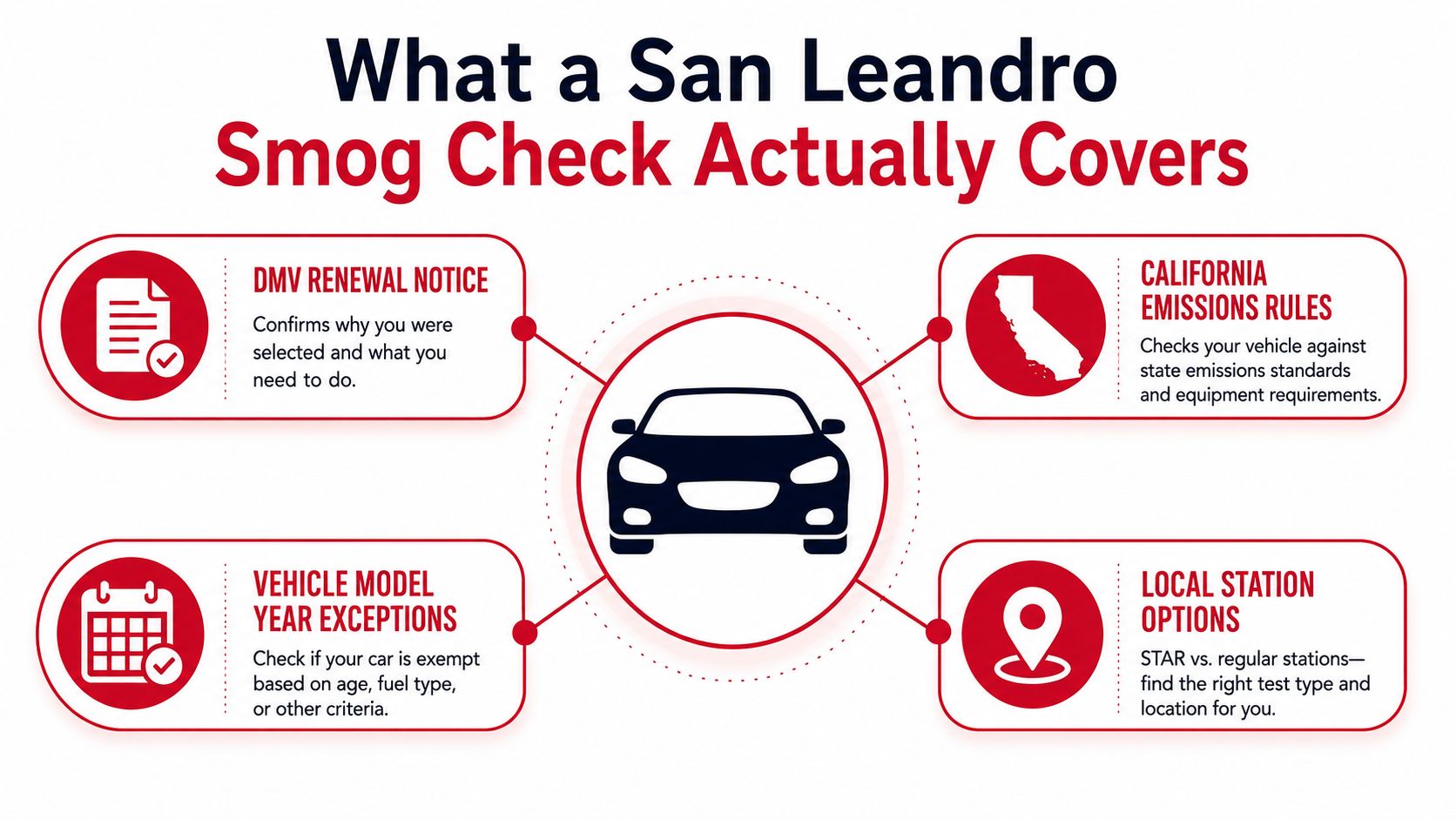
The first filter is eligibility
If your vehicle falls into one of the exemption buckets, don't book a test just because a renewal notice arrived. The notice tells you what the DMV expects administratively, but the vehicle class decides whether a smog inspection is required. That's the part too many drivers skip, and then they show up with a car that never needed to be on the bay in the first place.
Out-of-state transfers are the other common trap. If the vehicle is 1976 model year or newer and it's coming into California for the first time, the smog check comes before first registration. That's not a suggestion, and it's not something a shop can waive because the car looks clean.
Read the notice, then match the vehicle
The cleanest way to think about it is simple, the DMV notice points to paperwork, the vehicle class points to the test. If the car is clearly exempt, stop there. If it's not exempt, move straight to preparation and station selection.
Practical rule: don't book based on anxiety. Book only after you've checked the model year, fuel type, and whether the car is entering California for the first time.
How to Prep Your Car Before the Test
Most failed smog appointments don't start with a bad catalytic converter. They start with a car that wasn't ready to be tested. California-focused guidance says the right prep starts with the check-engine light, then the battery history, then the OBD-II readiness monitors that have to complete before the car can be fairly evaluated. If you clear a code or disconnect the battery right before you go, the monitors may not have reset yet, and that can set you up for a refusal or a retest even if the engine itself is fine. Read the warning-light and readiness guidance in common smog fail reasons before you roll out.
What to do in your driveway
Start with the dashboard. If the check-engine light is on, don't pretend the station will magically ignore it. Then check the gas cap, because a loose seal is the kind of small issue that creates a big headache later.
A simple pre-visit checklist works better than guesswork:
- Check the dashboard first. If the warning light is on, fix the cause before you test.
- Avoid a fresh battery disconnect. A recent reset can leave readiness monitors incomplete.
- Drive the car long enough to re-learn. Mixed driving gives the onboard system time to complete its checks.
- Don't clear codes right before the appointment. That often creates a readiness problem instead of solving one.
- Confirm the gas cap is tight. It's basic, but it still matters.
Give the car time, not just a quick lap
A short errand loop isn't enough if the monitors were just cleared. Many California drivers need a real drive cycle before the car is ready, and the practical guidance for that is usually a 50 to 100 miles of mixed driving. I'd treat that as a planning window, not a promise. If you want fewer surprises, stop chasing a same-day miracle and give the car time to complete its own checks.
The fastest appointment in the world doesn't help if the car arrives half asleep. A proper prep run beats a rushed test every time.
A clean bill of health starts before the bay door opens. If the light's on or the battery was just swapped, fix readiness first and test second.
Standard, STAR, and Test-Only Stations Explained
San Leandro search results throw three labels at drivers, and each one changes the job the station is allowed to do. A standard smog station can inspect many vehicles. A STAR-certified station handles DMV-directed vehicles and works under tighter oversight. A test-only station performs inspections without selling repairs, so the technician has no repair revenue tied to the outcome. If you want the cleanest split between testing and fixing, test-only is the smarter choice.
The question is not which shop has the shortest line. It is whether your vehicle belongs in that bay at all. If DMV directed your car to STAR, book a STAR-certified station and stop there. If you already failed once, test-only often makes more sense because the station is there to verify the result, not to steer you into parts you did not ask for. For a closer look at the certification framework, see what STAR-certified smog means.
What each station type does
A standard station handles routine inspections for many drivers, but it does not fit every directed case. A STAR station has the certification level DMV uses for vehicles that need closer oversight. A test-only station is the cleanest option when you want the inspection result without the repair pitch attached.
Use the notice first. Use the station label second.
| Station type | Best use case | What to expect |
|---|---|---|
| Standard station | Routine vehicles that aren't directed elsewhere | Regular inspection service |
| STAR-certified station | DMV-directed vehicles | Stricter certification framework |
| Test-only station | Drivers who want testing without repair sales | Inspection only, no repair upsell |
Don't overthink the label
The renewal notice matters more than the search result. If the notice calls for STAR, book STAR. If the notice does not require it and you just need a valid inspection, a regular station may be enough. If you want to avoid a conflict of interest and keep the transaction clean, test-only is the more disciplined choice.
That is why I tell neighbors to read the notice before they read the reviews. The right station type saves more time than any polished marketing page ever will.
What Happens During a San Leandro Smog Visit
A good San Leandro visit should feel boring in the best way. You pull in, hand over the vehicle info, and the technician starts by confirming the paperwork and the car's eligibility for the specific inspection path. At a STAR test-only station, that usually means the technician is focused on the inspection itself, not on steering you into repairs you didn't ask for.
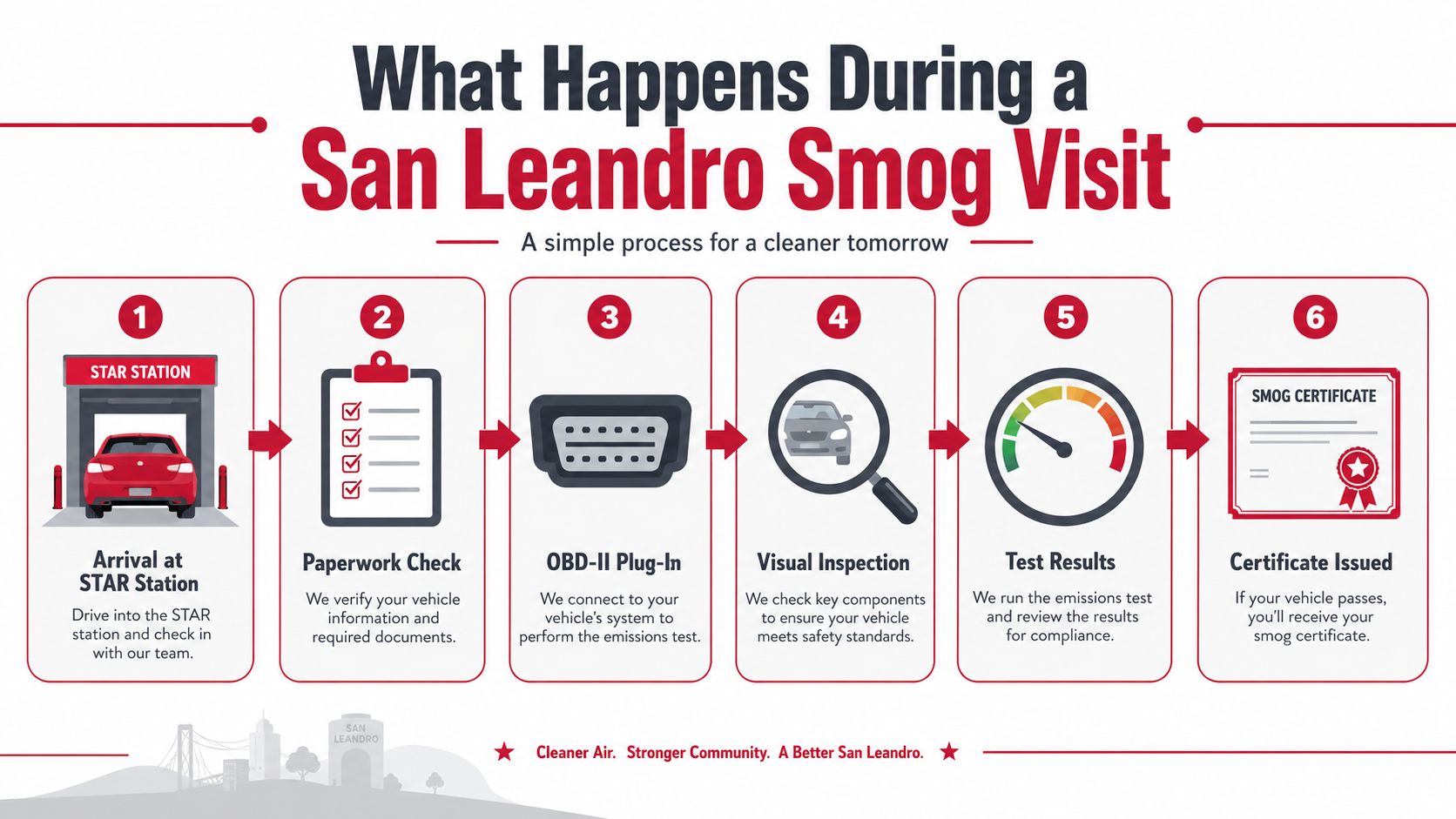
The inspection path
The car gets the OBD-II plug-in first if that applies to the vehicle class. Then comes the visual check, where the technician looks for obvious tampering or missing components, followed by the emissions portion that fits the vehicle's age and setup. Some cars are evaluated through onboard diagnostics, while others can involve additional test steps depending on class and equipment.
A compliant, well-prepped car can move through the visit in about 10 to 15 minutes, according to the San Leandro guide linked earlier. That short on-paper visit is exactly why readiness matters so much. The test can be quick, but the car still has to be ready to answer the computer when it's plugged in.
What the tech is actually watching for
This isn't a mystery scan with random failure points. The technician is looking for the signals that the car's emissions controls are working the way they should, and that the onboard system isn't hiding a recent reset. If the car is ready, the result tends to be straightforward. If it isn't, the visit turns into a wait for a retest instead of a clean pass.
A fast station doesn't rescue an unready car. The delay usually comes from the vehicle, not the bay.
When the inspection passes, the certificate gets uploaded to DMV and the driver moves on. That's the whole point of a well-run visit, a clean result with no drama and no surprise detour.
Failing the Test and Getting a Free Retest
A fail report isn't the end of the process, but it does tell you exactly where to stop guessing. Read the Vehicle Inspection Report first. If the issue is readiness, a warning light, or a straightforward emissions problem, the next move is different in each case. Don't rush back to the same lane with the same unresolved issue and hope the answer changes.
Fix the right problem
If the report points to readiness, the car probably needs more driving before it will pass. If the check-engine light is still on, the repair comes first. If the failure is a true emissions issue, a separate repair shop should diagnose the cause before you return for another test.
That's where test-only stations make sense again. Since they don't sell repairs, they aren't benefiting from telling you to replace parts on the spot. You can take the report to a repair shop, get the issue addressed, then come back for the recheck.
Bring the right paperwork back
When you return, bring the same vehicle and the report that proves what failed. If the station offers a free retest under its policy, use it instead of paying twice for the same problem. The free retest is most useful when the original failure was real, the fix was targeted, and the car is ready this time.
If you're dealing with a waiver or hardship extension, handle that through the DMV side, not by arguing it at the lane. The station's job is to test the vehicle and document the result. DMV handles the registration outcome.
Don't pay for repeat inspections because you skipped diagnosis. Fix the failure once, then use the retest path the right way.
Hours, Wait Times, and Smart Timing Around San Leandro
San Leandro has a more active testing corridor than a lot of drivers realize. Local station listings show published hours such as 8:00 AM to 3:30 PM, 8:30 AM to 5:30 PM, 8:30 AM to 5:00 PM, and 9:00 AM to 6:00 PM, which tells you the market isn't limited to one narrow weekday window. Some locations also test on weekends, so the best time to go depends less on your schedule and more on how crowded the lane will be.
Pick the quietest window
If you want the shortest wait, I'd aim for early in the week and early in the day. Monday and Tuesday mornings tend to be easier than Friday afternoons because drivers who waited on their renewal notice often rush in near the end of the week. The point isn't mystical traffic prediction, it's simple crowd behavior.
The DMV cycle creates its own bottlenecks. People wait until the deadline is close, then every local station gets hit at once. If your renewal month is approaching, don't join the late surge unless you enjoy sitting in a line behind three people who all had the same idea.
Use flexibility to your advantage
San Leandro's station spread gives you options, so use them. If your preferred site looks packed, move a few blocks or try another open window instead of forcing the same lane. A nearby alternative is often faster than sitting still because you fell in love with one address.
The same logic applies to your car. A flexible schedule helps, but only if the vehicle is prepared. If the readiness monitors aren't set, a short wait at the right station still beats a short wait at the wrong one.
Putting It All Together Before Your Next Renewal
A San Leandro smog appointment should run on a simple routine, not panic. First, confirm whether the car is exempt under California's rules. Second, check the dashboard and make sure readiness isn't broken by a fresh battery disconnect or a code clear. Third, book the right station type, especially if DMV points you toward STAR or you want a test-only result with no repair sales attached.
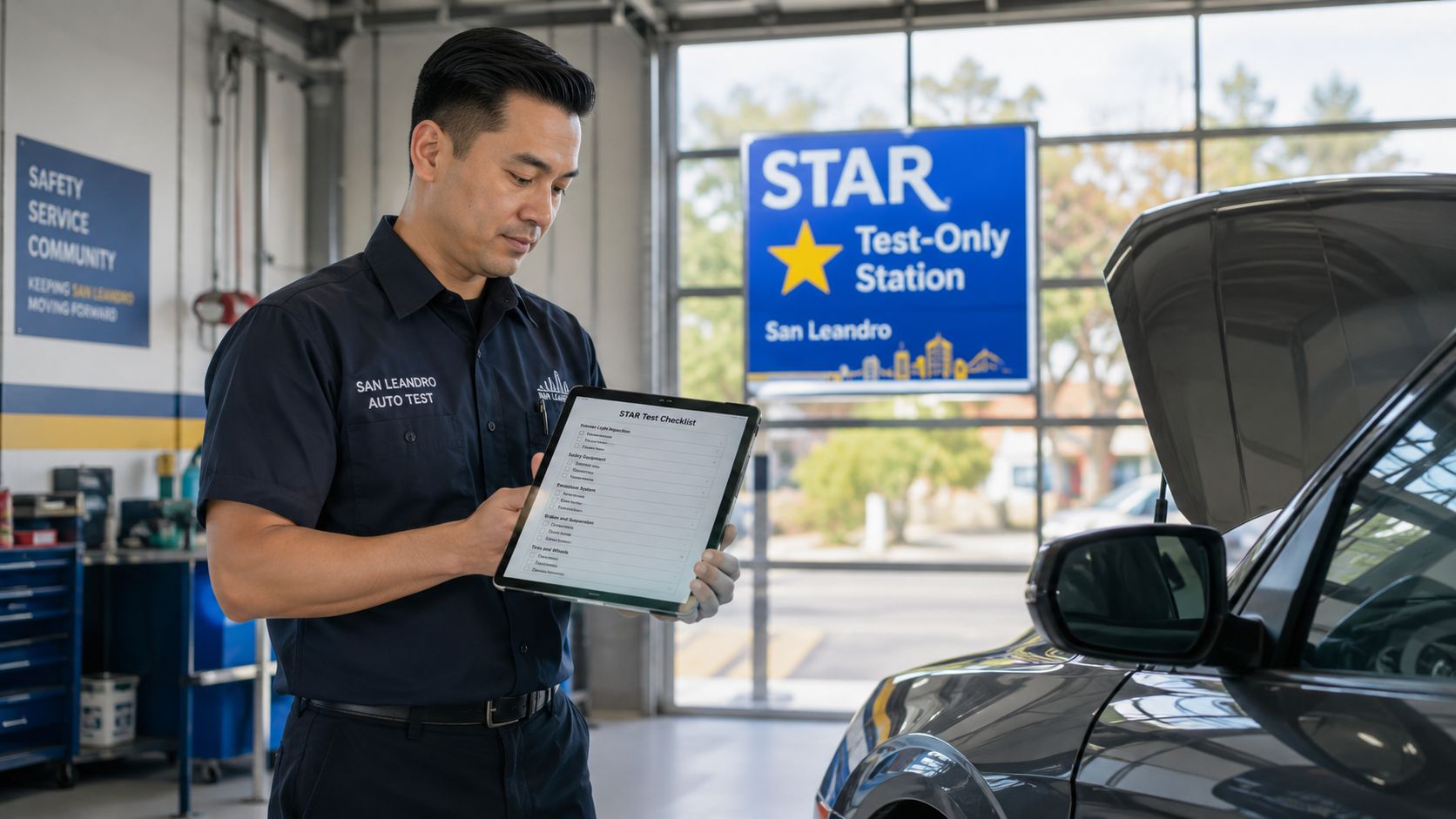
A 30-day playbook that actually works
Use the month before renewal like this:
- Check exemption status early. Don't wait until the due date to find out the car never needed testing.
- Watch the warning lights. A lit check-engine light means you're not ready.
- Give the car real drive time. Readiness needs miles, not wishful thinking.
- Choose the correct station type. Standard, STAR, and test-only are not interchangeable.
- Plan for the retest path. Keep the report and use it if the first visit doesn't pass.
That routine beats improvising on the last day of the month. It also keeps you from paying for a problem that should have been caught in your driveway.
Fire House Smog is one option for drivers who want a STAR-certified test-only smog check and DMV-related registration help in one stop, but the bigger lesson is the same no matter where you go. Treat the appointment like a readiness checkpoint, not a race. If you want a cleaner renewal cycle next time, start with the car, pick the right lane, and show up only when the vehicle is ready.