
Most buying advice tells you to measure the box, count the cubic feet, and call it a day. That's backwards. For a light duty box truck, the box shape tells you almost nothing about how California or federal regulators will treat the vehicle.
Start at the driver's door jamb instead. The label there, plus your registration, model year, and fuel type, decides whether you're dealing with a light-duty vehicle, a medium-duty commercial truck, or something else entirely.
Table of Contents
- Why Light Duty Box Truck Classification Matters
- Reading GVWR and Weight Classes on Your Truck
- Light-Duty Box Trucks Compared with Larger Boxes and RVs
- How Emissions History Shapes Today's Smog Rules
- California Smog Check and DMV Steps to Follow
- Choosing Where to Test and Register Your Truck
- Running Costs and Next Steps for Owners and Businesses
Why Light Duty Box Truck Classification Matters
Two trucks can sit side by side in a lot, both white, both boxy, both used for deliveries, and still follow different rules. One may be handled like a light-duty truck. The other may fall into a heavier commercial category. If you go by looks alone, you'll miss that difference.
That's because light duty box truck is an informal description, not a single legal definition. It generally means a cargo body built on a light-duty truck chassis. The word "generally" does a lot of work in that sentence, and it's where owners get tripped up.
The Three Checks That Actually Decide
Forget the sales listing for a moment. Check these first:
- Weight rating: What's the gross vehicle weight rating, or GVWR, printed on the certification label?
- Vehicle identity: What's the model year, fuel type, axle arrangement, and tire count?
- Jurisdiction: Where's the truck registered, and which inspection rules apply there?
Those three checks answer the question that matters most for a California owner. It's not "Is this a box truck?" It's "Will this exact truck need a smog inspection, and what should I bring before I visit a station?"
Plain truth: The cargo box is the most visible part of the truck and the least useful part for classification.
This matters before you buy, not just before you test. A small business that buys on cargo volume alone may discover later that payload, registration, or inspection treatment doesn't match the plan. An owner who checks the label first can ask better questions, avoid a wasted trip, and bring the right paperwork the first time.
Think of the informal name as a nickname. Nicknames are handy in conversation. They don't settle compliance. The label, the registration, and the rules for your state do.
Reading GVWR and Weight Classes on Your Truck
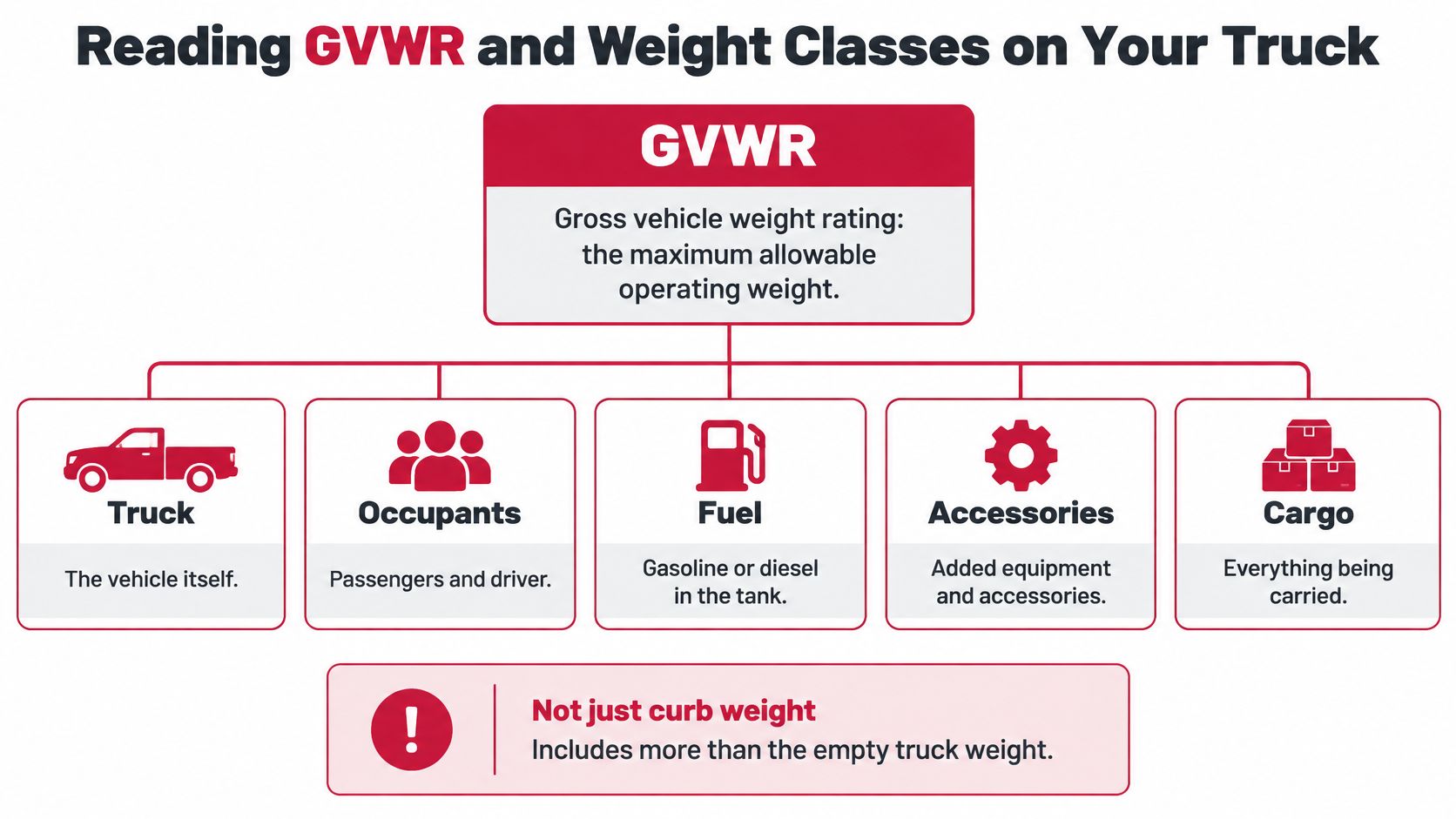
Open the driver's door and find the certification label. You're looking for one number first: GVWR. That number is the manufacturer's maximum allowable operating weight for the vehicle. It isn't a suggestion, and it isn't the empty weight.
GVWR includes the truck itself, the driver and occupants, fuel, accessories, and cargo. Picture it as nested boxes. The smallest box is the empty truck. Each thing you add, people, fuel, tools, shelving, freight, sits inside a larger box. GVWR is the outermost box. Nothing should push you past its walls.
Why the Threshold Depends on Who Is Asking
Here's where readers often get confused. There isn't one universal line for "light-duty."
In the United States, Federal Highway Administration and U.S. Census frameworks commonly place light-duty vehicles below 10,000 pounds GVWR, while federal emissions rules traditionally use an 8,500-pound GVWR threshold for light-duty trucks, as described in EPA guidance on light-duty vehicle emissions. Same truck, different framework, possibly different label.
That doesn't mean one source is lying to you. It means each system was built for a different job. A census category, a highway category, and an emissions certification category don't have to match.
Axles and Tires Count Too
GVWR isn't the only clue on the label. Axle configuration and tire count can matter as much as the weight rating.
EPA's MOVES system, for example, excludes trucks with two or more axles or six or more tires from its basic light-duty-truck source category. You're not expected to memorize that modeling detail. Just take the lesson: regulators look at the whole vehicle setup, not just one number.
- Read the label: Note GVWR and any axle ratings exactly as printed.
- Count the setup: Look at axles and tires, not only box length.
- Check the papers: Compare the label with registration documents before you act.
Why the Box Itself Changes the Math
An enclosed cargo body adds substantial weight. Add a liftgate, shelving, refrigeration equipment, or tool storage, and the vehicle gets heavier before you've loaded a single parcel.
That's how a truck that looks like a small delivery vehicle can move toward a medium-duty category. The body and equipment eat into the space between empty weight and GVWR. What's left is what you can legally and safely carry.
If you only remember one distinction, remember this one. Curb weight is what the truck weighs empty. GVWR is the most it's allowed to weigh when it's fully loaded and working.
Before any compliance decision, verify the certification label, GVWR, axle arrangement, fuel type, and applicable jurisdiction. Don't rely on the nickname in an advertisement.
Light-Duty Box Trucks Compared with Larger Boxes and RVs
Shoppers often compare trucks by how much stuff fits inside. That's understandable, but it's the wrong yardstick. A tall, long box can look generous while leaving very little usable payload.
The better benchmark is the lesser of volume capacity and weight capacity after body equipment is added. If the truck hits its GVWR before the box is full, the extra air space doesn't help you.
A Compact Example That Shows the Trade-Off
Consider the 2016 Freightliner Sprinter 2500 as a representative compact platform. It's listed at 8,550 lb maximum GVWR, with payload ratings of approximately 2,454 to 2,907 lb depending on engine, roof height, and wheelbase, according to the 2016 Freightliner Sprinter specifications.
Its turning diameter also changes with size. The same specifications list 47.6 ft for a 144-inch wheelbase and 54.6 ft for a 170-inch wheelbase. A longer vehicle gives you more cargo length and more box-building flexibility. It also needs more room to turn and can lose payload when the body structure is heavier.
Loading details matter too. The published rear load height is about 27.4 to 27.6 inches, and the rear door opening is approximately 61.6 inches wide and up to 72.4 inches high in high-roof versions. Palletized freight has to fit that opening, not the brochure's cargo volume.
Factors That Separate Light-Duty Box Trucks from Larger Vehicles
| Factor | What to Check | Why It Matters |
|---|---|---|
| GVWR | Certification label and registration | Helps determine weight class and inspection treatment |
| Payload | GVWR minus the equipped vehicle weight | Shows what you can actually carry |
| Body equipment | Liftgate, shelving, refrigeration, ramps | Added equipment reduces remaining payload |
| Axles and tires | Axle arrangement and tire count | Some classification systems use these details |
| Intended use | Cargo work, passenger use, or recreational use | Use can affect how a vehicle is described and handled |
| Physical access | Door opening, load height, turning needs | Decides whether freight and routes work in practice |
Larger box trucks usually offer more room, but room alone doesn't tell you whether classification, testing access, or maneuverability will suit your work. Recreational vehicles raise a different set of questions again, which is why owners comparing vehicle types may also review guidance on a smog check for motorhomes rather than assume truck rules carry over.
Don't compare photographs. Compare labels. Put GVWR, payload, body equipment, door size, and registration details next to each other, and the right choice usually becomes much clearer.
How Emissions History Shapes Today's Smog Rules
A box-shaped body does not decide whether a truck is light duty. The rules tied to its model year, emissions certification, and registered weight class matter more. That is why older paperwork may use terms that differ from the language an owner hears today.
Federal standards changed over time. The Bureau of Transportation Statistics' history of federal exhaust-emission certification standards documents changes by model year, including a GVWR threshold of 8,500 pounds for light-duty trucks beginning in 1979 (federal exhaust-emission certification standards history). That historical threshold helps explain older certification records, but it does not, by itself, determine a California smog-check requirement today.
Why Model Year Still Shows Up in Your Paperwork
Emissions standards developed over successive model years after Congress passed the Clean Air Act in 1970. A truck's certification label records the standards that applied when it was built. It is a snapshot of the vehicle's original certification, not a current smog-check ruling.
For example, an older registration document may describe a truck differently from a newer one, even when both have similar box bodies. The label is like a vehicle's birth certificate: it identifies how the manufacturer certified that specific truck. It does not replace the current rules for testing and registration.
When reviewing the paperwork, match the model year and fuel type to the certification information. If an unfamiliar category appears, use the truck's label and official California guidance to clarify what it means. A familiar-sounding category name alone is not enough to settle how the truck is handled today.
California Smog Check and DMV Steps to Follow
California owners often mix up two separate questions. Untangling them saves time.
First, there's the federal question for manufacturers: what emissions standards must a new vehicle meet? Second, there's your question as an owner: does this truck, already on the road, need an in-use smog inspection in California?
Those aren't the same decision. A federal rule for future model years doesn't tell you what to do with the truck in your driveway today.
What the Federal Rule Does and Doesn't Do
EPA's 2024 multi-pollutant rule applies to new light-duty and medium-duty vehicles beginning with model year 2027 and phases in through 2032, under EPA regulations for greenhouse gas emissions from passenger cars and trucks. It's a forward-looking standard for new vehicles. It doesn't, by itself, decide whether your current truck needs a California smog check.
EPA's heavy-duty greenhouse gas standards are separate again. They cover vocational vehicles such as delivery trucks under a different regulatory framework. If someone quotes a heavy-duty rule at you, ask whether your truck falls in that framework.
A Simple Decision Path for Your Exact Truck
Work through your own vehicle in this order:
- Find the GVWR: Read it from the door-jamb certification label, not a listing.
- Confirm the basics: Note model year, engine, and fuel type.
- Check registration: Make sure the documents match the vehicle in front of you.
- Read any DMV notice: Bring the renewal notice if you received one.
- Ask before you drive: Confirm the station can accept your vehicle's size and type.
That order matters. If you start with box dimensions, you'll gather the least useful information first. If you start with the label, every later conversation gets easier.
Owners who want background before that call can review what's involved in a smog check for trucks, then compare it with their own registration and label details. Don't treat general guidance as a verdict on your specific vehicle.
What to Gather Before You Go
Put these items together before visiting a testing station:
- Certification label details: A clear photo of GVWR and related label information.
- Registration documents: Current papers for the exact truck.
- DMV renewal notice: If one was mailed to you.
- Vehicle facts: Model year, fuel type, and anything unusual about the body or equipment.
Bring facts, not guesses. A photo of the label and your registration will answer more questions in one minute than a description of the box will answer in ten.
The goal isn't to become a regulations expert. It's to arrive with the information a station needs to give you a straight answer.
Choosing Where to Test and Register Your Truck
Once you know your truck's details, the next choice is practical. Where should you handle the test and any related registration task? A nearby station isn't automatically the right station if it can't accept your vehicle or complete your paperwork.
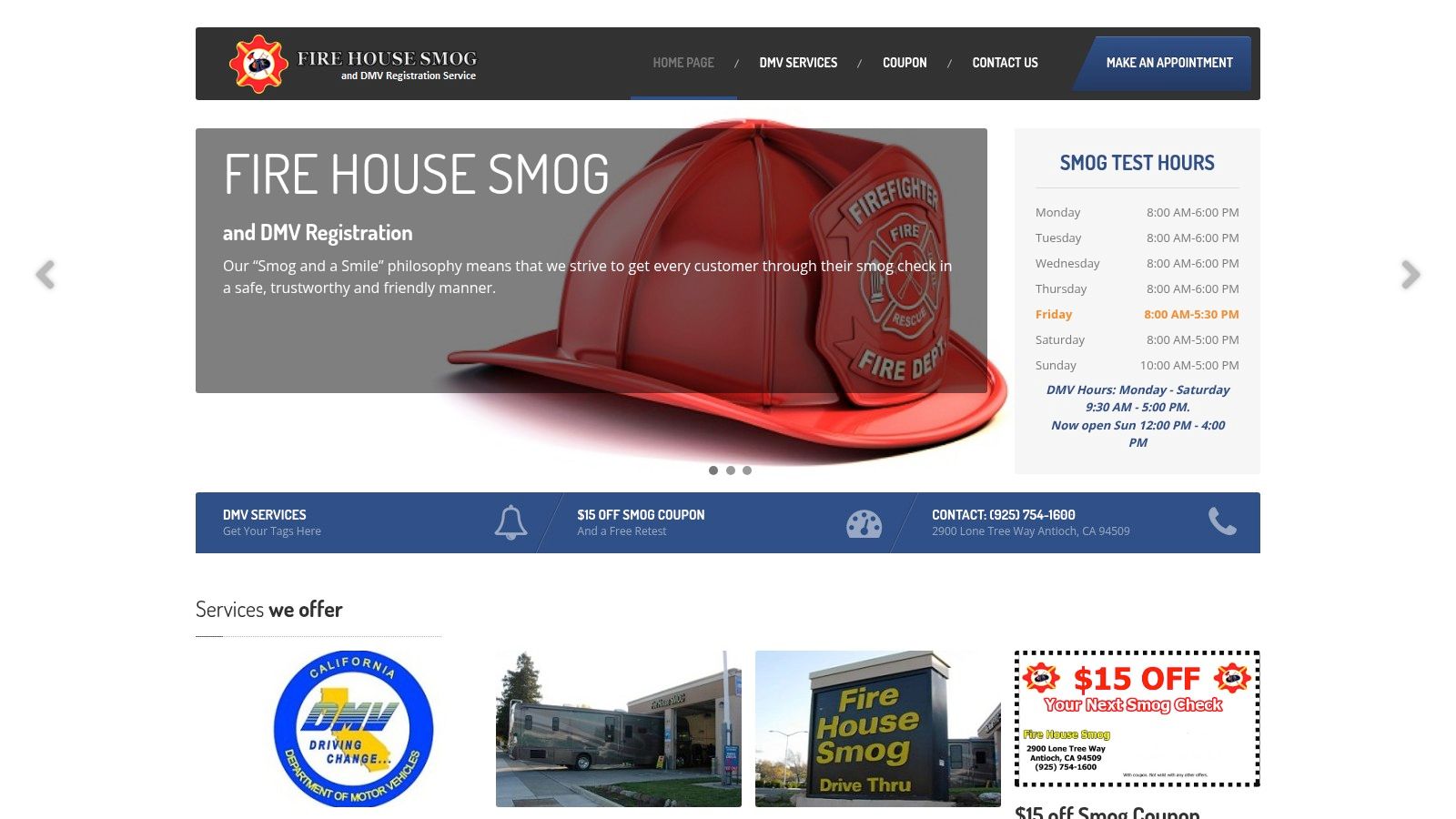
The screenshot below shows the kind of service information worth checking before you travel.
Criteria Worth Checking Before You Book
Use criteria tied to your actual errand:
- Test-only status: Does the station only test, rather than also selling repairs?
- Vehicle fit: Can its bays and equipment accept your truck's size?
- DMV capability: Can it handle renewals, sticker printing, transfers, or tag issuance on site?
- Hours: Do posted hours fit a working driver's schedule?
- Confirmation: Can you call ahead with GVWR and vehicle details?
A test-only model has a simple appeal. The station's job is to inspect and report the result. It isn't also trying to sell you the repair that follows.
One local option that fits several of these criteria is Fire House Smog at 2900 Lone Tree Way in Antioch, California. It's a STAR-certified, test-only smog check station and a licensed DMV registration services provider. It inspects cars, trucks, and some recreational vehicles, subject to size and equipment constraints.
Its DMV work includes renewals with sticker printing, ownership transfers, and on-site tag issuance during posted hours. Smog tests are available seven days a week. DMV services run Monday through Saturday, 9:30 AM to 5:00 PM, and Sunday, 12:00 PM to 4:00 PM. Owners can call 925-754-1600 to confirm eligibility for a specific truck.
The short video below gives additional context before you decide where to go.
Call first if your vehicle sits near a weight or size boundary. That one conversation can prevent a wasted trip with the wrong paperwork or a truck that doesn't fit the equipment.
Running Costs and Next Steps for Owners and Businesses
Classification isn't just paperwork. It affects how you schedule work, when a truck sits idle, and how much each mile really costs. Purchase price is only the opening chapter.
Fuel, tires, maintenance, tolls, downtime, inspection time, and registration errands all belong in the same calculation. So does lost revenue when a delivery truck is parked instead of working.
Put Compliance Inside the Cost Picture
The American Transportation Research Institute reported that average truck operating cost reached $2.336 per mile in 2025, up 3.4 percent year over year, with repair and maintenance rising 8.6 percent to 40.4 cents per mile, according to reporting on the American Transportation Research Institute 2025 truck costs. Those figures cover trucking broadly, not only small box trucks. They still show why maintenance and downtime deserve serious attention in any fleet budget.
A missed inspection deadline or an unplanned repair doesn't just create an invoice. It can remove a working vehicle from its route. For a small business with one truck, that pause can matter more than the test fee.
Be Careful with Simple Electric Vehicle Claims
You'll hear that electric trucks are automatically cheaper. Don't accept that as a universal rule.
A fair comparison has to include payload reduction from batteries, route length, idling, charging access, downtime, maintenance, tires, tolls, and residual value. Urban stop-and-go delivery, regional routes with overnight charging, and high-mileage fleet work produce different economics. Electrification may reduce fuel and maintenance exposure on the right route. It doesn't make every route cheaper by default.
Route test: Judge a replacement truck against your actual route, payload, parking, and charging routine. A brochure comparison can't do that work for you.
Replacement timing should also account for emissions compliance and inspection requirements. If you manage several work vehicles, keeping registration details organized matters too, and guidance on business vehicle registration can help you think through that administrative side before deadlines pile up.
Your next step is small and concrete. Photograph the door-jamb label, pull the registration, note the model year and fuel type, then call 925-754-1600 to confirm whether your exact truck needs a smog check and whether it fits the station's equipment. You'll get a clearer answer in minutes than you'll get from guessing based on box size.
If your truck's label, registration, and model year raise more questions than they answer, Fire House Smog offers STAR-certified test-only smog inspections and on-site DMV registration services in Antioch that can help you sort out the next step. Call ahead with your GVWR and vehicle details to confirm eligibility, then visit during posted hours to handle your smog check and registration task in one place.
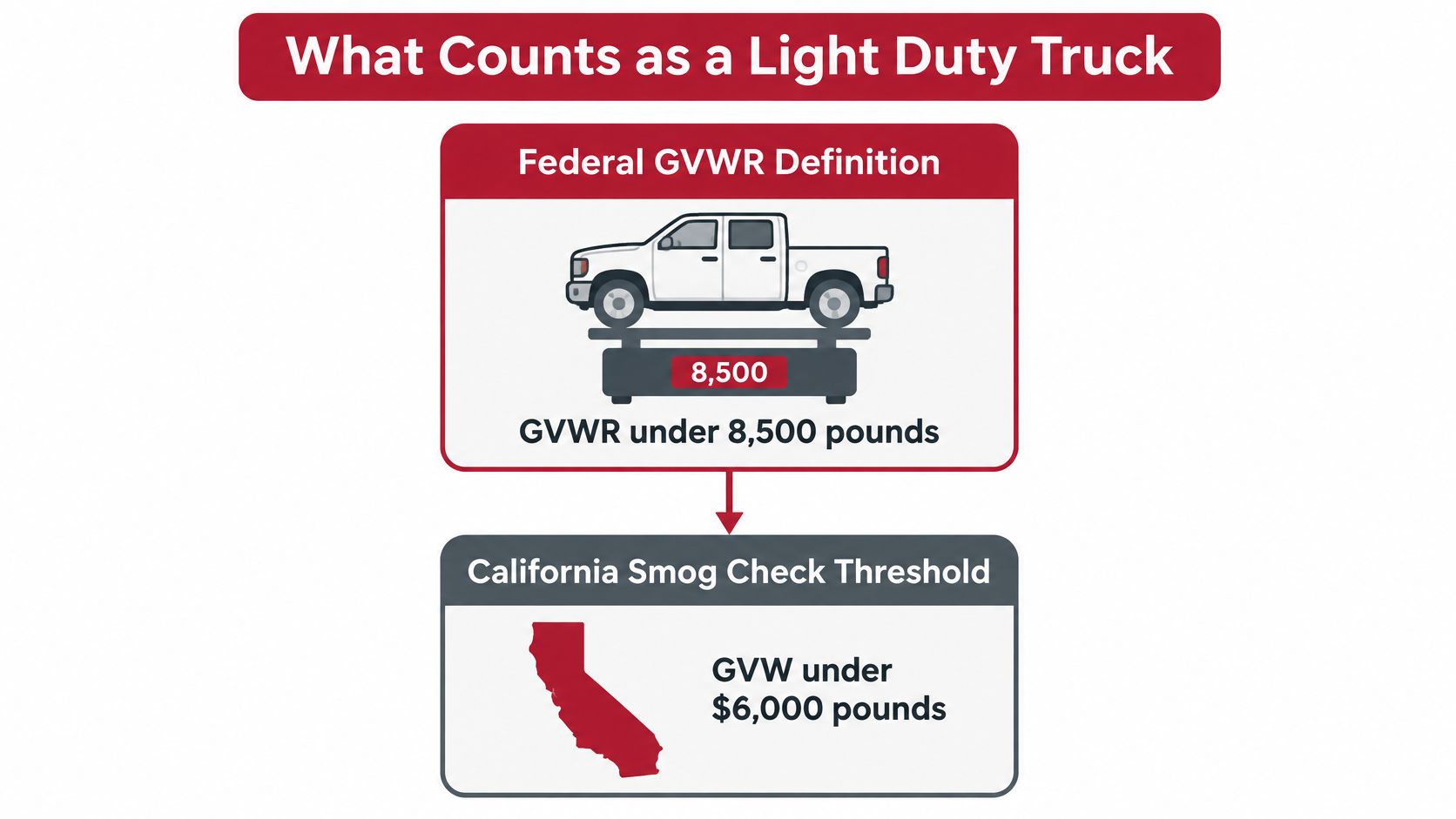
At the federal level, a light duty truck generally means a pickup, van, or SUV with a gross vehicle weight rating (GVWR) of 8,500 pounds or less, while California's Smog Check program uses a separate 6,000-pound GVW threshold that owners should check against the manufacturer's door-jamb label before booking an inspection.
You might be standing beside your work pickup with a registration renewal notice, wondering whether the station needs to know its badge, engine, or weight. Or you've bought a diesel van and received different advice from the seller and a neighbor. The useful answer starts with the vehicle's label, fuel type, and model year, not how big the truck looks.
Table of Contents
- What Counts as a Light Duty Truck
- How California Defines a Light Duty Truck
- Finding Your Truck's GVWR on the Label
- Which Smog Test Your Truck Will Get
- Registration and Inspection in Practice
- Common Misconceptions About Light Duty Trucks
- Pre-Inspection Checklist for Owners and Fleets
What Counts as a Light Duty Truck
A light duty truck is a regulatory category, not just a small pickup. In U.S. transportation statistics, the definition specifically identifies pickups and minivans with GVWR of 8,500 pounds or less, distinguishes passenger cars at up to 6,000 pounds GVWR, and places heavy-duty vehicles at 8,501 pounds GVWR and above, according to the Bureau of Transportation Statistics vehicle classifications.
The broader light-truck grouping also includes familiar SUVs and vans. That's why a family vehicle and a contractor's pickup can appear in the same regulatory discussion even though their owners use them very differently.
Start with the rating, not the appearance
GVWR means gross vehicle weight rating. Think of it as the manufacturer's rated maximum for the loaded vehicle, rather than what the vehicle happens to weigh when you drive into the station.
A truck with an empty bed doesn't move into a lighter regulatory category just because you unloaded your tools. Likewise, a passenger-oriented SUV doesn't automatically count as a passenger car for every emissions or transportation program.
The diagram below separates the federal classification from California's inspection terminology.
Ask which program is using the term
The important question isn't whether your vehicle is light duty. It's light duty under which rule? A transportation statistics table, an emissions standard, and a California inspection classification don't necessarily use identical boundaries.
Keep these uses separate:
- Everyday descriptions: An owner might call a pickup light duty because it handles commuting and occasional hauling.
- Manufacturer descriptions: A sales brochure might distinguish a regular pickup from a heavier work-truck lineup.
- Regulatory classifications: The agency applies the definition written for its particular program.
Those descriptions can coexist without giving you the same inspection answer. A familiar badge such as Silverado, F-150, or Transit Connect helps identify the vehicle, but it doesn't replace the certification label.
Practical rule: Use the truck's name to start the conversation and its manufacturer's rating to settle the classification.
For an owner, the goal isn't to memorize every federal category. It's to recognize when a broad description needs a more specific California answer before making an inspection appointment.
How California Defines a Light Duty Truck
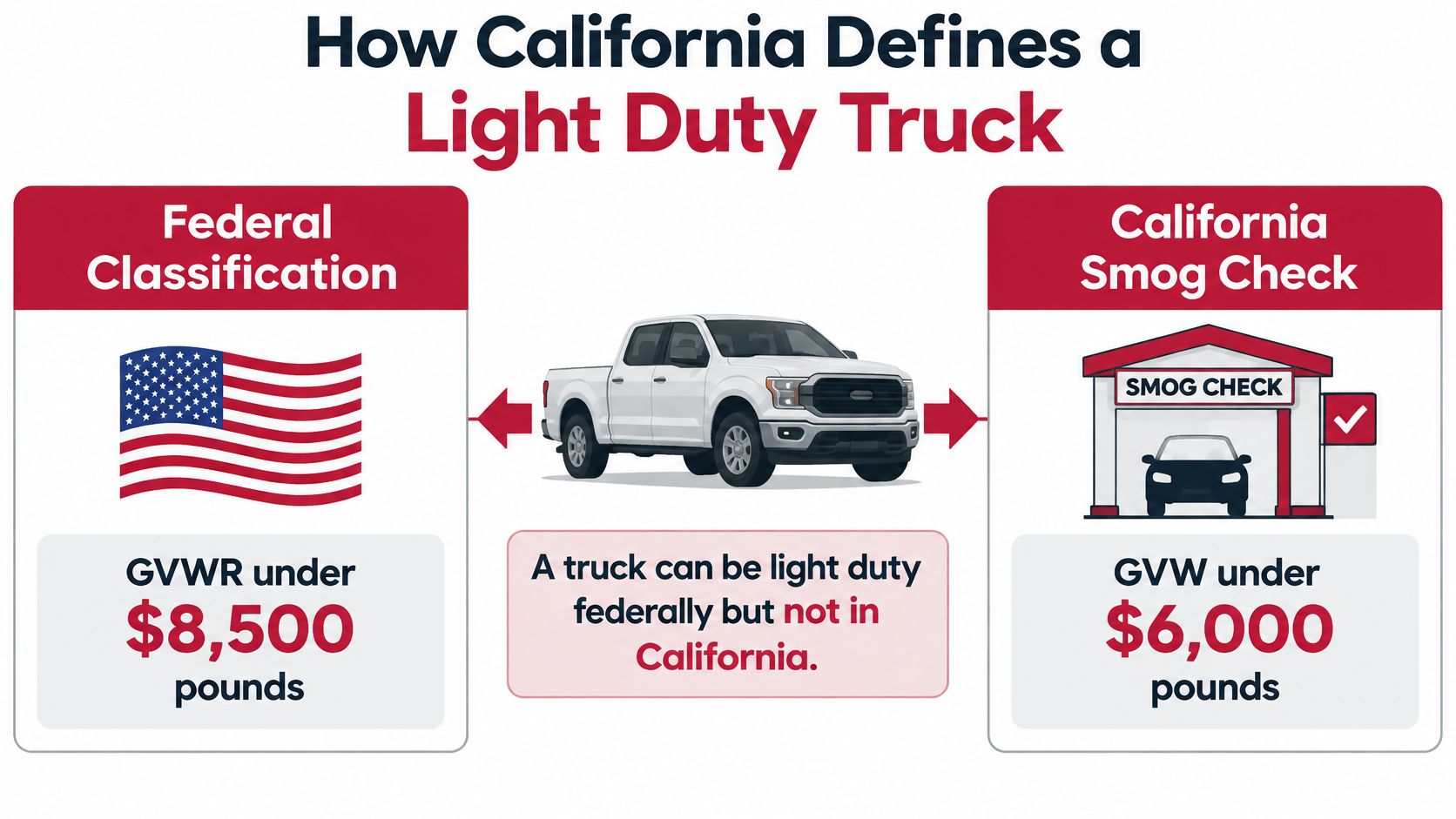
California's Smog Check definition describes a light-duty truck as a motor vehicle rated at 6,000 pounds GVW or less, designed primarily to transport property, or a derivative vehicle with features enabling off-road operation. The Bureau of Automotive Repair's Smog Check Reference Guide supplies that narrower definition; the broader EPA emissions category generally extends to 10,000 pounds GVWR.
That doesn't mean every truck above California's light-duty threshold is exempt from testing. It means the truck may belong in a different classification within the applicable inspection framework.
The comparison below highlights why a federal label alone won't settle a California inspection question.
Compare actual vehicles, not pickup nicknames
Suppose a customer arrives in a Ford F-150 and another arrives in a Chevrolet Silverado work truck. Calling one a half-ton pickup and the other a three-quarter-ton truck may be convenient conversation, but neither description supplies the rating the inspector needs.
The same caution applies to a compact cargo van such as a Transit Connect. Its shape suggests how someone might use it, but the station still needs the actual vehicle information before choosing the appropriate inspection path.
| What the owner knows | What still needs checking |
|---|---|
| The truck's make and model | The manufacturer's weight rating |
| It's used for business | Its fuel type and model year |
| It looks like a heavy work truck | Which inspection program applies |
| It was advertised as light duty | Whether that description matches California's category |
Classification isn't the same as exemption
This is the distinction that prevents many misunderstandings at the counter. Being outside a particular light-duty definition doesn't, by itself, remove a Smog Check requirement.
Weight classification is only part of the answer. Fuel type, model year, and the requirements attached to the vehicle must also be considered.
For related context, review the explanation of vehicle emissions standards rather than assuming a weight label tells the whole story.
The accompanying video offers another way to approach the terminology.
When you call a station, ask which classification applies to your specific truck. That's more useful than asking whether the station tests “small trucks” or “big trucks.”
Finding Your Truck's GVWR on the Label
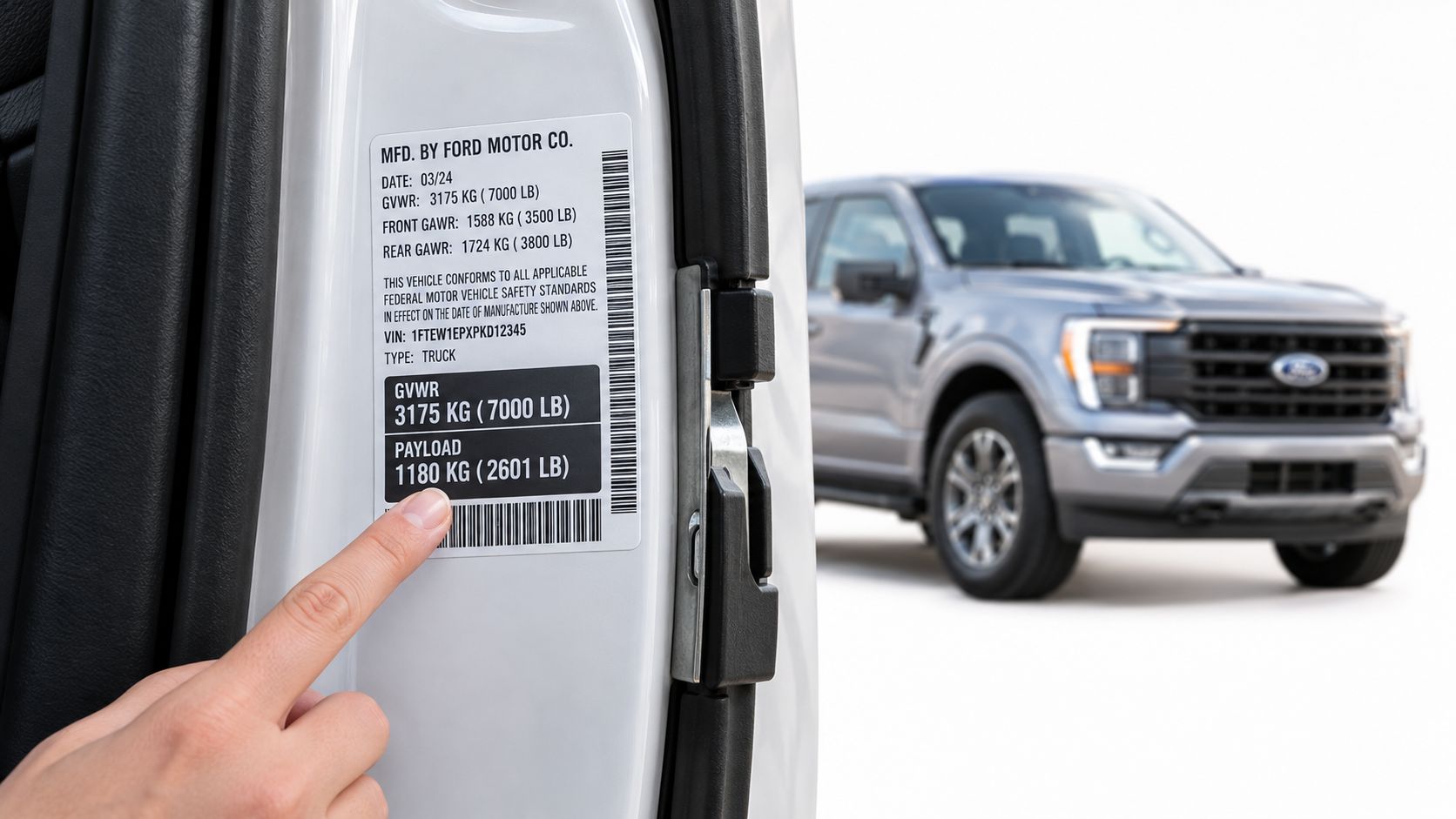
Open the driver's door and look around the door opening for the manufacturer's certification label. You're looking for the field marked GVWR, not a weight figure that happens to appear nearby.
Take a clear photograph of the whole label before calling the station. A close-up can help, but keep enough of the label visible that the rating and vehicle identification information can be read together.
This is the kind of label you're trying to locate.
Weight Terms Owners Confuse
Several weight-related terms come up in truck ownership. They answer different questions, so copying the wrong one can send an otherwise straightforward appointment in the wrong direction.
| Term | What It Means | Why It Matters |
|---|---|---|
| GVWR | The manufacturer's maximum rated weight for the loaded vehicle | This is the rating to identify for classification |
| Curb weight | The vehicle's weight without its carried load | It isn't a substitute for GVWR |
| Actual loaded weight | What the vehicle weighs with its current occupants and cargo | It changes with the load, unlike the manufacturer's rating |
| Payload | The load the vehicle is intended to carry | It describes carrying capacity, not the classification boundary |
| Towing capacity | The load the vehicle is intended to tow | It answers a trailer question, not the truck's Smog Check category |
Read the label before searching the model online
A general internet search can turn up specifications for a different configuration. For inspection planning, start with the label attached to the truck you own rather than a listing for a similar-looking vehicle.
Follow this short process:
- Locate the correct field: Find the letters GVWR and read the associated value and unit.
- Photograph rather than guess: If the print is faded, take a clear image instead of estimating the missing information.
- Flag modifications: Tell the station if the truck has been converted, substantially modified, or fitted with a different body.
- Ask when the label is unclear: Have the vehicle identification information available so the station can advise what documentation it needs.
An empty bed, a trailer rating, and a model badge are all useful information. None replaces the manufacturer's GVWR.
Don't scrape, alter, or try to reconstruct an unreadable label yourself. Ask how to verify the rating before making a special trip, particularly with a modified work truck or chassis-cab vehicle.
Which Smog Test Your Truck Will Get
Once the station has identified your truck's category, fuel type and model year help determine the inspection method. The important distinction is between reading the vehicle's emissions-related diagnostic information and evaluating an older vehicle under a different test procedure.
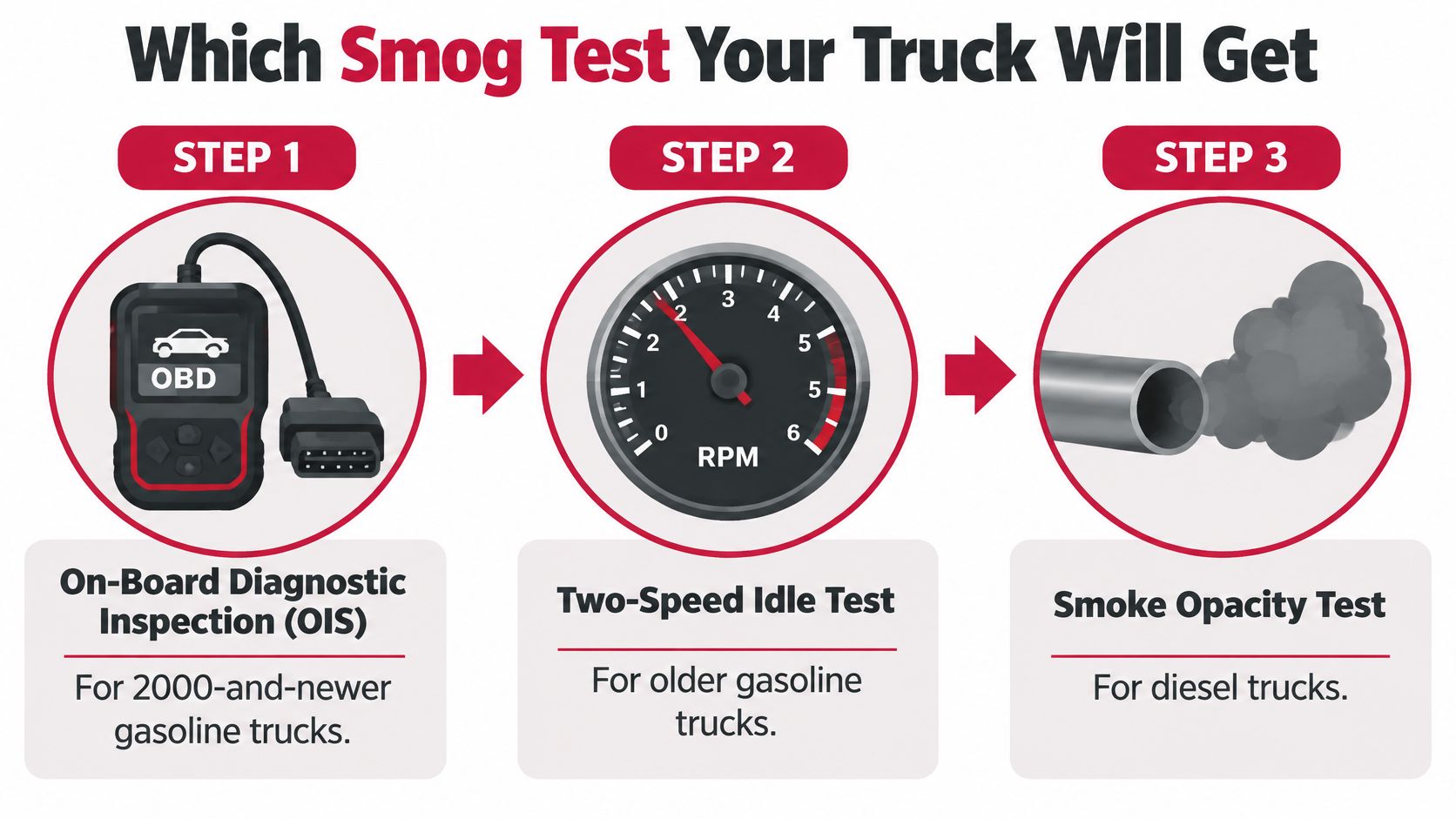
California generally uses an On-Board Diagnostic Inspection, or OIS, for 2000-and-newer gasoline vehicles and 1998-and-newer diesel vehicles. Older gasoline trucks generally use Acceleration Simulation Mode, or ASM, with Two-Speed Idle used in limited circumstances, as described in the California Air Resources Board light-duty vehicle inspection material.
Use the graphic as a visual introduction, not as a sequence of tests every truck receives; the model-year and fuel-type rules above determine the applicable method.
What the diagnostic inspection checks
OIS reads emissions-related information from the vehicle's onboard diagnostic system. It doesn't directly measure tailpipe emissions.
The system provides information about detected faults and whether required self-checks have completed. Those self-checks are called readiness monitors, which is why a truck that seems to run normally can still need attention before testing.
Two issues deserve separate treatment:
- Unresolved faults: A warning light or stored emissions-related diagnostic problem needs diagnosis, not guesswork.
- Incomplete readiness: The vehicle may not yet have completed the checks needed to support the inspection.
Missing emissions equipment and tampering can also affect the outcome. A smooth idle doesn't establish that the emissions system is complete and operating as required.
How older gasoline testing differs
ASM puts the vehicle under a controlled operating load. Two-Speed Idle is a different procedure available in limited cases, not a method owners select because it sounds easier.
| Inspection method | Plain-English description |
|---|---|
| OIS | Reads emissions-related onboard diagnostic information |
| ASM | Tests an older gasoline vehicle under controlled operating load |
| Two-Speed Idle | Uses an idle-based procedure when applicable |
If a technician has just repaired a fault, ask whether the truck has completed the required drive cycle before heading to the station. The useful question is whether the system is ready, not whether you've driven an arbitrary distance.
A station should confirm the procedure for your vehicle. Don't assume every diesel follows the same test path or that every older gasoline pickup receives an identical inspection.
Registration and Inspection in Practice
Consider a contractor preparing to renew the registration on a work pickup. This is a planning example, not a customer case study: the owner has a renewal notice, a busy schedule, and a truck that needs to stay available for jobs.
The sensible starting point is the notice itself. Read the inspection instructions, keep the vehicle information handy, and ask the station to confirm that it can accommodate the truck before arranging time away from work.
Treat the renewal notice as your appointment checklist
If your paperwork directs you to a STAR station, tell the station when you contact it. Confirm both that the location can handle the referral and that its equipment and bay arrangement suit your vehicle.
Bring the documents you're using to complete the transaction rather than relying on a verbal description. A useful preparation list includes:
- Registration paperwork: Bring the renewal notice or available registration document so staff can review the vehicle's requirements.
- Vehicle details: Have the fuel type, model year, and label photograph available.
- Relevant history: Mention recent repairs, warning lights, or modifications when asking about readiness.
- Service questions: Ask separately about inspection availability and registration-processing hours.
For a driver trying to finish both tasks locally, California DMV registration renewal services may be worth considering alongside the inspection appointment. Confirm the documents and services needed for your particular renewal before leaving home.
Understand what a test-only station does
A test-only station performs the inspection without selling the repairs needed to address a failure. That separation can suit an owner who wants to use an existing mechanic for diagnosis and repair.
Before authorizing a visit: Ask about vehicle eligibility, STAR requirements, and retest terms. Those questions are more useful than asking only for a test price.
If the truck doesn't pass, use the inspection results to guide the next conversation with a repair provider. Don't assume a free retest means unlimited attempts or that every return visit qualifies; check the applicable policy and coupon conditions.
The broader reason for emissions oversight is substantial: light-duty trucks produced 37% of U.S. transportation-sector greenhouse-gas emissions in 2022, the largest share among the listed categories, according to the EPA's transportation-sector emissions breakdown. That context explains the category's policy importance, but your appointment still comes down to the requirements for your individual truck.
Common Misconceptions About Light Duty Trucks
A badge isn't a legal classification. A truck marked 2500 or 3500 may suggest where it sits in a manufacturer's lineup, but the name alone doesn't answer which California inspection requirement applies.
The same problem arises when someone says all diesel pickups are exempt, or all commercial vehicles follow the same rules. Those shortcuts skip the details that determine the answer.
Diesel exemptions need both year and weight
The Bureau of Automotive Repair's Smog Check guidance identifies 1998-and-newer diesel vehicles as generally subject to Smog Check, while 1997-and-older diesels and diesel vehicles with GVWR above 14,000 pounds fall outside the ordinary requirement described for that program.
Pay attention to the word above. It's not interchangeable with “at,” and a truck near a boundary shouldn't be classified from memory or a seller's description.
| Common assumption | Better question |
|---|---|
| “It's diesel, so it's exempt.” | What are its model year and manufacturer's rating? |
| “It's a heavy-duty pickup, so ordinary rules don't matter.” | Which program actually covers this vehicle? |
| “The previous owner never tested it.” | What does the current registration requirement say? |
| “My other work truck uses this station.” | Can that station inspect this specific vehicle? |
An exclusion from ordinary Smog Check also shouldn't be treated as proof that no other emissions or registration obligation exists. If the vehicle falls outside the familiar process, confirm the applicable program rather than stopping at the word exempt.
A bigger-looking truck doesn't supply a better answer
Lifted suspension, a service body, or large tires can change how a truck looks without telling you the rating printed on its certification label. Similarly, the fact that an owner uses a truck commercially doesn't supply its fuel type or model year.
Another mistaken assumption is that any automotive shop can perform the required inspection. Before booking, ask whether the location offers the procedure and certification your paperwork calls for, especially for an unusual or modified vehicle.
Don't ask whether a rule applies to trucks in general. Ask whether it applies to the truck identified on your registration.
If advice conflicts, bring the documents and label photograph into the conversation. That gives the station concrete information to work from instead of requiring staff to interpret an informal description.
Pre-Inspection Checklist for Owners and Fleets
Good preparation doesn't mean trying to make the truck look ready. It means confirming that you've selected the right inspection path and addressed the problems that can prevent a valid result.
Keep a short vehicle record with the registration paperwork. For a household pickup, that might be a label photograph saved on your phone; for a small fleet, it can be a shared record that a dispatcher or driver can access.
Before booking
- Confirm the identity: Match the registration paperwork to the truck you're scheduling, especially if your business operates similar vehicles.
- Record the classification details: Have the manufacturer's rating, fuel type, and model year ready when you call.
- Read the notice: Tell the station about any STAR instruction or other inspection direction.
- Describe unusual features: Mention a service body, conversion, modification, or size concern before arriving.
- Separate the services: Ask about inspection availability and DMV transaction hours independently if you want to complete both.
For fleets, don't assume neighboring trucks in the parking lot follow the same process. Review each vehicle's paperwork and ask how the station prefers to schedule multiple inspections.
Before driving to the station
Deal with an unresolved check-engine light through proper diagnosis and repair. Don't treat clearing a warning light as proof that the underlying problem has been fixed.
After repairs, ask the technician whether the required system checks have completed. The explanation of OBD readiness monitors can help you understand what to ask, particularly when a truck seems to drive normally but its inspection readiness is uncertain.
- Confirm readiness: Follow the appropriate repair and drive-cycle guidance rather than guessing from elapsed time.
- Gather the paperwork: Bring the renewal notice and any documents the station requested.
- Check return conditions: Understand retest eligibility before you need it.
- Plan around operations: Fleet managers should ask about extended-hour availability and coordinate arrivals instead of sending every driver at once.
A brief call with accurate vehicle details can prevent a wasted trip. The station can answer a specific classification question much more usefully than a general question about whether it tests trucks.
Fire House Smog offers STAR-certified, test-only inspections for light-duty trucks and on-site California DMV registration services in Antioch, subject to vehicle and service eligibility. Visit Fire House Smog with your renewal notice and truck details, or contact the station before heading over to confirm testing availability, vehicle fit, and current retest terms.