
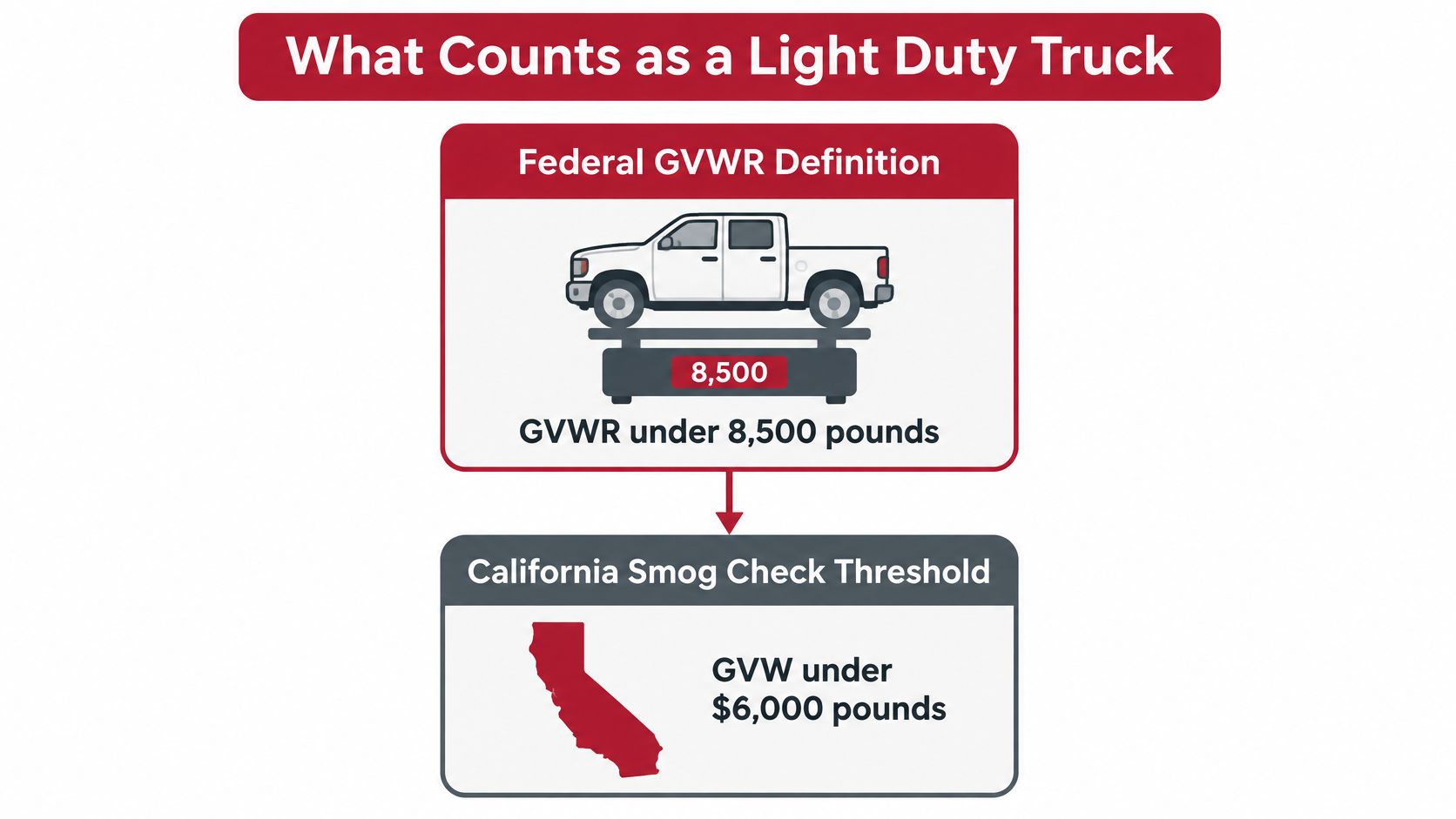
At the federal level, a light duty truck generally means a pickup, van, or SUV with a gross vehicle weight rating (GVWR) of 8,500 pounds or less, while California's Smog Check program uses a separate 6,000-pound GVW threshold that owners should check against the manufacturer's door-jamb label before booking an inspection.
You might be standing beside your work pickup with a registration renewal notice, wondering whether the station needs to know its badge, engine, or weight. Or you've bought a diesel van and received different advice from the seller and a neighbor. The useful answer starts with the vehicle's label, fuel type, and model year, not how big the truck looks.
Table of Contents
- What Counts as a Light Duty Truck
- How California Defines a Light Duty Truck
- Finding Your Truck's GVWR on the Label
- Which Smog Test Your Truck Will Get
- Registration and Inspection in Practice
- Common Misconceptions About Light Duty Trucks
- Pre-Inspection Checklist for Owners and Fleets
What Counts as a Light Duty Truck
A light duty truck is a regulatory category, not just a small pickup. In U.S. transportation statistics, the definition specifically identifies pickups and minivans with GVWR of 8,500 pounds or less, distinguishes passenger cars at up to 6,000 pounds GVWR, and places heavy-duty vehicles at 8,501 pounds GVWR and above, according to the Bureau of Transportation Statistics vehicle classifications.
The broader light-truck grouping also includes familiar SUVs and vans. That's why a family vehicle and a contractor's pickup can appear in the same regulatory discussion even though their owners use them very differently.
Start with the rating, not the appearance
GVWR means gross vehicle weight rating. Think of it as the manufacturer's rated maximum for the loaded vehicle, rather than what the vehicle happens to weigh when you drive into the station.
A truck with an empty bed doesn't move into a lighter regulatory category just because you unloaded your tools. Likewise, a passenger-oriented SUV doesn't automatically count as a passenger car for every emissions or transportation program.
The diagram below separates the federal classification from California's inspection terminology.
Ask which program is using the term
The important question isn't whether your vehicle is light duty. It's light duty under which rule? A transportation statistics table, an emissions standard, and a California inspection classification don't necessarily use identical boundaries.
Keep these uses separate:
- Everyday descriptions: An owner might call a pickup light duty because it handles commuting and occasional hauling.
- Manufacturer descriptions: A sales brochure might distinguish a regular pickup from a heavier work-truck lineup.
- Regulatory classifications: The agency applies the definition written for its particular program.
Those descriptions can coexist without giving you the same inspection answer. A familiar badge such as Silverado, F-150, or Transit Connect helps identify the vehicle, but it doesn't replace the certification label.
Practical rule: Use the truck's name to start the conversation and its manufacturer's rating to settle the classification.
For an owner, the goal isn't to memorize every federal category. It's to recognize when a broad description needs a more specific California answer before making an inspection appointment.
How California Defines a Light Duty Truck
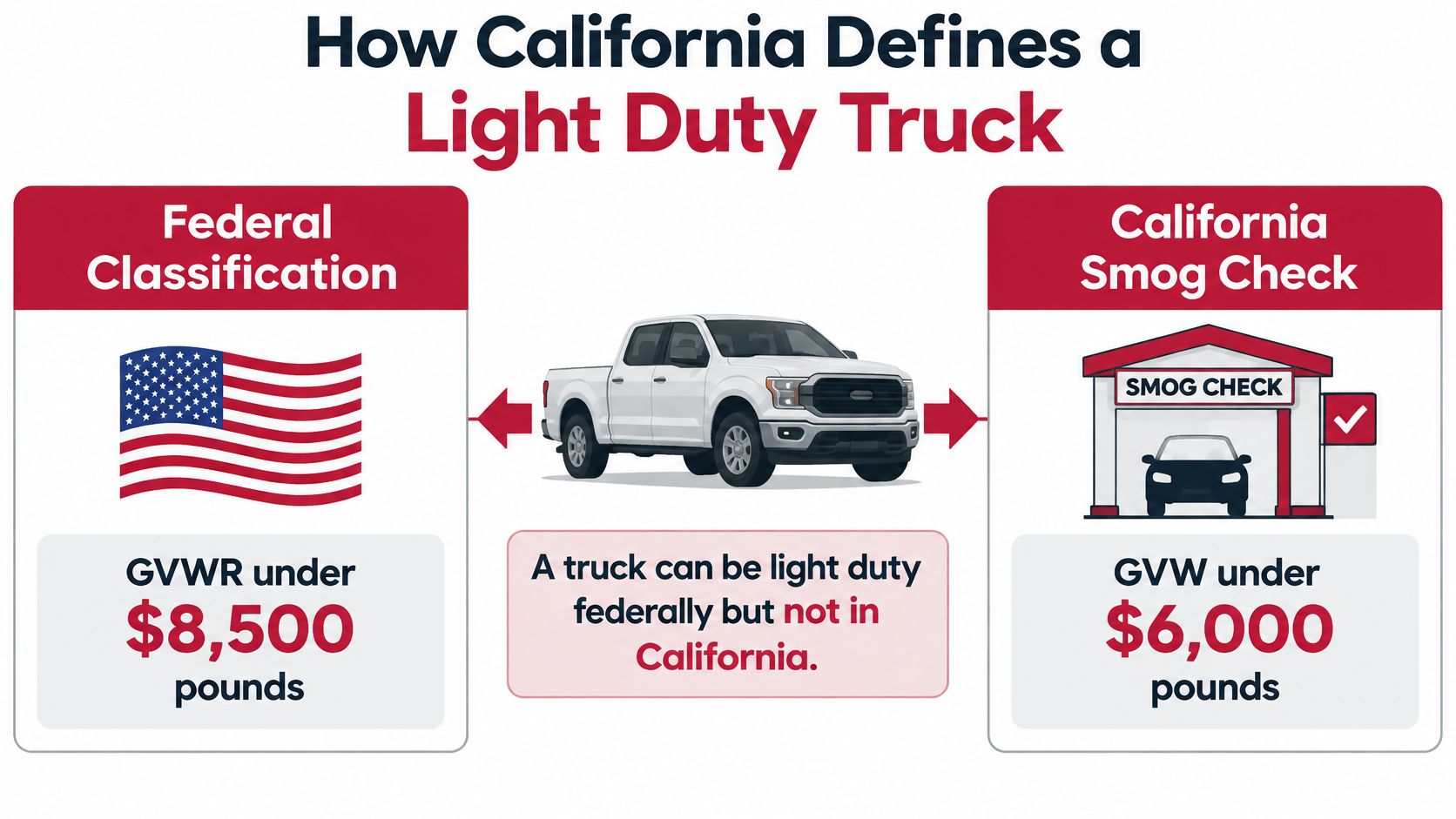
California's Smog Check definition describes a light-duty truck as a motor vehicle rated at 6,000 pounds GVW or less, designed primarily to transport property, or a derivative vehicle with features enabling off-road operation. The Bureau of Automotive Repair's Smog Check Reference Guide supplies that narrower definition; the broader EPA emissions category generally extends to 10,000 pounds GVWR.
That doesn't mean every truck above California's light-duty threshold is exempt from testing. It means the truck may belong in a different classification within the applicable inspection framework.
The comparison below highlights why a federal label alone won't settle a California inspection question.
Compare actual vehicles, not pickup nicknames
Suppose a customer arrives in a Ford F-150 and another arrives in a Chevrolet Silverado work truck. Calling one a half-ton pickup and the other a three-quarter-ton truck may be convenient conversation, but neither description supplies the rating the inspector needs.
The same caution applies to a compact cargo van such as a Transit Connect. Its shape suggests how someone might use it, but the station still needs the actual vehicle information before choosing the appropriate inspection path.
| What the owner knows | What still needs checking |
|---|---|
| The truck's make and model | The manufacturer's weight rating |
| It's used for business | Its fuel type and model year |
| It looks like a heavy work truck | Which inspection program applies |
| It was advertised as light duty | Whether that description matches California's category |
Classification isn't the same as exemption
This is the distinction that prevents many misunderstandings at the counter. Being outside a particular light-duty definition doesn't, by itself, remove a Smog Check requirement.
Weight classification is only part of the answer. Fuel type, model year, and the requirements attached to the vehicle must also be considered.
For related context, review the explanation of vehicle emissions standards rather than assuming a weight label tells the whole story.
The accompanying video offers another way to approach the terminology.
When you call a station, ask which classification applies to your specific truck. That's more useful than asking whether the station tests “small trucks” or “big trucks.”
Finding Your Truck's GVWR on the Label
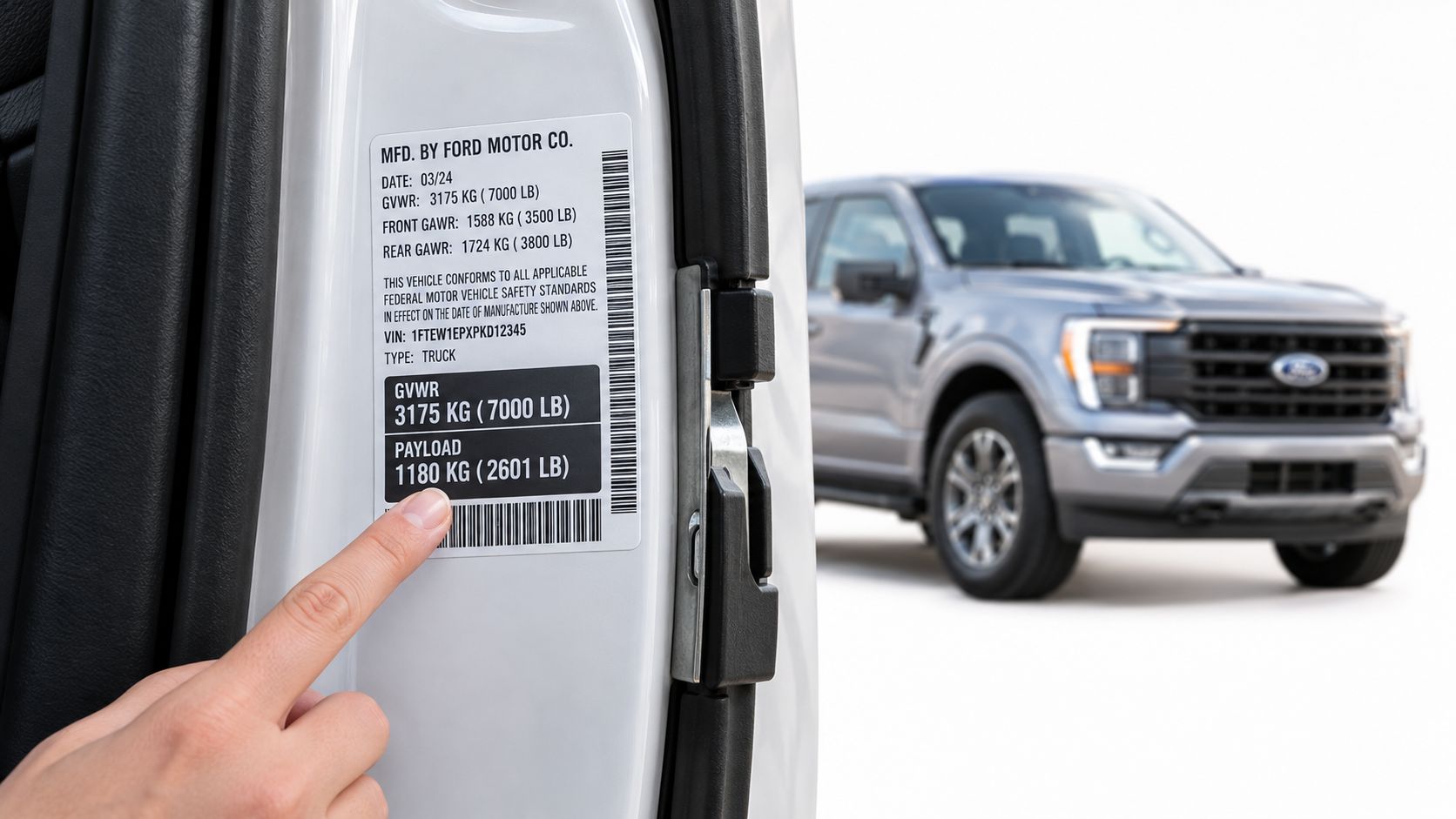
Open the driver's door and look around the door opening for the manufacturer's certification label. You're looking for the field marked GVWR, not a weight figure that happens to appear nearby.
Take a clear photograph of the whole label before calling the station. A close-up can help, but keep enough of the label visible that the rating and vehicle identification information can be read together.
This is the kind of label you're trying to locate.
Weight Terms Owners Confuse
Several weight-related terms come up in truck ownership. They answer different questions, so copying the wrong one can send an otherwise straightforward appointment in the wrong direction.
| Term | What It Means | Why It Matters |
|---|---|---|
| GVWR | The manufacturer's maximum rated weight for the loaded vehicle | This is the rating to identify for classification |
| Curb weight | The vehicle's weight without its carried load | It isn't a substitute for GVWR |
| Actual loaded weight | What the vehicle weighs with its current occupants and cargo | It changes with the load, unlike the manufacturer's rating |
| Payload | The load the vehicle is intended to carry | It describes carrying capacity, not the classification boundary |
| Towing capacity | The load the vehicle is intended to tow | It answers a trailer question, not the truck's Smog Check category |
Read the label before searching the model online
A general internet search can turn up specifications for a different configuration. For inspection planning, start with the label attached to the truck you own rather than a listing for a similar-looking vehicle.
Follow this short process:
- Locate the correct field: Find the letters GVWR and read the associated value and unit.
- Photograph rather than guess: If the print is faded, take a clear image instead of estimating the missing information.
- Flag modifications: Tell the station if the truck has been converted, substantially modified, or fitted with a different body.
- Ask when the label is unclear: Have the vehicle identification information available so the station can advise what documentation it needs.
An empty bed, a trailer rating, and a model badge are all useful information. None replaces the manufacturer's GVWR.
Don't scrape, alter, or try to reconstruct an unreadable label yourself. Ask how to verify the rating before making a special trip, particularly with a modified work truck or chassis-cab vehicle.
Which Smog Test Your Truck Will Get
Once the station has identified your truck's category, fuel type and model year help determine the inspection method. The important distinction is between reading the vehicle's emissions-related diagnostic information and evaluating an older vehicle under a different test procedure.
California generally uses an On-Board Diagnostic Inspection, or OIS, for 2000-and-newer gasoline vehicles and 1998-and-newer diesel vehicles. Older gasoline trucks generally use Acceleration Simulation Mode, or ASM, with Two-Speed Idle used in limited circumstances, as described in the California Air Resources Board light-duty vehicle inspection material.
Use the graphic as a visual introduction, not as a sequence of tests every truck receives; the model-year and fuel-type rules above determine the applicable method.
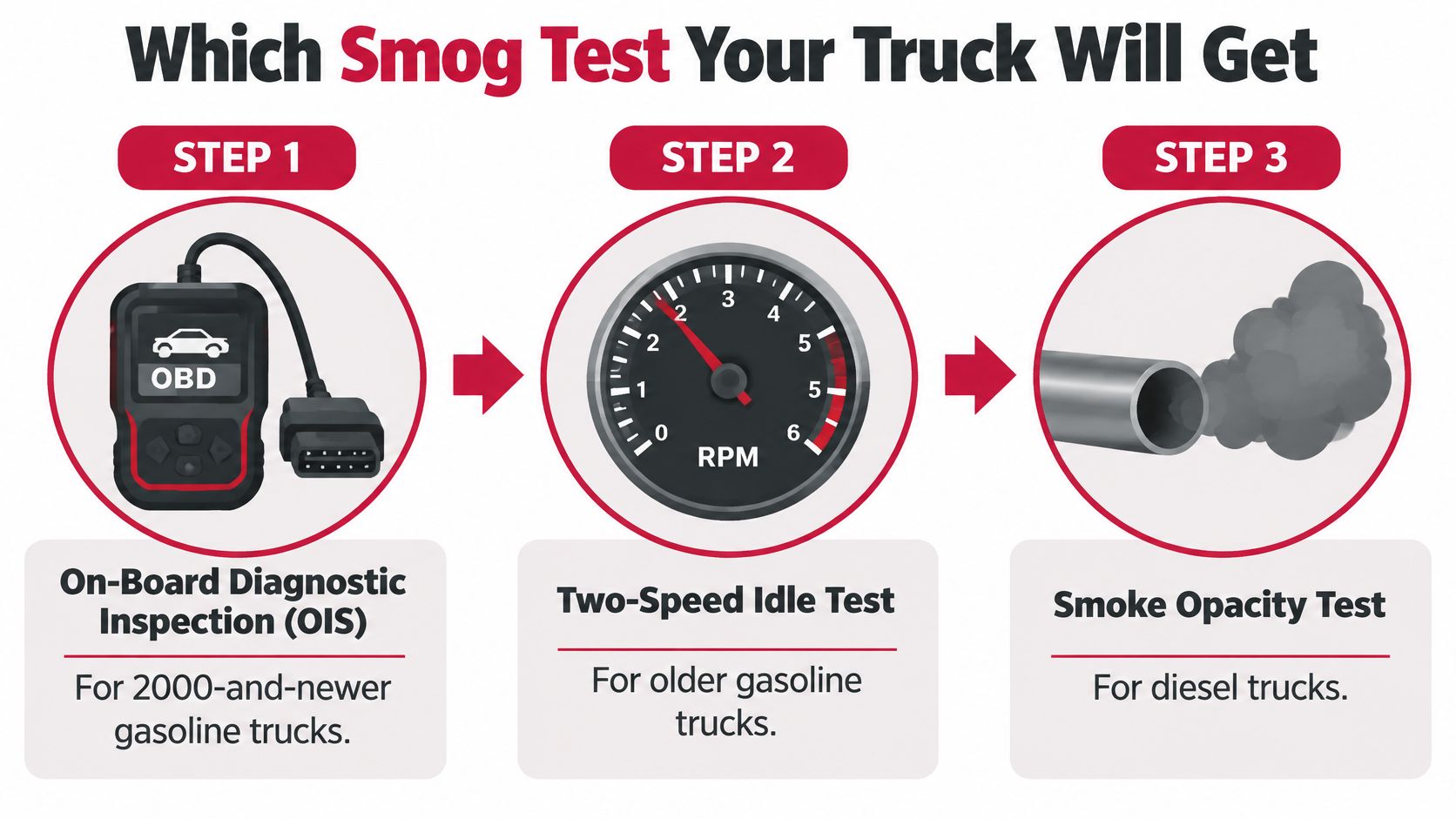
What the diagnostic inspection checks
OIS reads emissions-related information from the vehicle's onboard diagnostic system. It doesn't directly measure tailpipe emissions.
The system provides information about detected faults and whether required self-checks have completed. Those self-checks are called readiness monitors, which is why a truck that seems to run normally can still need attention before testing.
Two issues deserve separate treatment:
- Unresolved faults: A warning light or stored emissions-related diagnostic problem needs diagnosis, not guesswork.
- Incomplete readiness: The vehicle may not yet have completed the checks needed to support the inspection.
Missing emissions equipment and tampering can also affect the outcome. A smooth idle doesn't establish that the emissions system is complete and operating as required.
How older gasoline testing differs
ASM puts the vehicle under a controlled operating load. Two-Speed Idle is a different procedure available in limited cases, not a method owners select because it sounds easier.
| Inspection method | Plain-English description |
|---|---|
| OIS | Reads emissions-related onboard diagnostic information |
| ASM | Tests an older gasoline vehicle under controlled operating load |
| Two-Speed Idle | Uses an idle-based procedure when applicable |
If a technician has just repaired a fault, ask whether the truck has completed the required drive cycle before heading to the station. The useful question is whether the system is ready, not whether you've driven an arbitrary distance.
A station should confirm the procedure for your vehicle. Don't assume every diesel follows the same test path or that every older gasoline pickup receives an identical inspection.
Registration and Inspection in Practice
Consider a contractor preparing to renew the registration on a work pickup. This is a planning example, not a customer case study: the owner has a renewal notice, a busy schedule, and a truck that needs to stay available for jobs.
The sensible starting point is the notice itself. Read the inspection instructions, keep the vehicle information handy, and ask the station to confirm that it can accommodate the truck before arranging time away from work.
Treat the renewal notice as your appointment checklist
If your paperwork directs you to a STAR station, tell the station when you contact it. Confirm both that the location can handle the referral and that its equipment and bay arrangement suit your vehicle.
Bring the documents you're using to complete the transaction rather than relying on a verbal description. A useful preparation list includes:
- Registration paperwork: Bring the renewal notice or available registration document so staff can review the vehicle's requirements.
- Vehicle details: Have the fuel type, model year, and label photograph available.
- Relevant history: Mention recent repairs, warning lights, or modifications when asking about readiness.
- Service questions: Ask separately about inspection availability and registration-processing hours.
For a driver trying to finish both tasks locally, California DMV registration renewal services may be worth considering alongside the inspection appointment. Confirm the documents and services needed for your particular renewal before leaving home.
Understand what a test-only station does
A test-only station performs the inspection without selling the repairs needed to address a failure. That separation can suit an owner who wants to use an existing mechanic for diagnosis and repair.
Before authorizing a visit: Ask about vehicle eligibility, STAR requirements, and retest terms. Those questions are more useful than asking only for a test price.
If the truck doesn't pass, use the inspection results to guide the next conversation with a repair provider. Don't assume a free retest means unlimited attempts or that every return visit qualifies; check the applicable policy and coupon conditions.
The broader reason for emissions oversight is substantial: light-duty trucks produced 37% of U.S. transportation-sector greenhouse-gas emissions in 2022, the largest share among the listed categories, according to the EPA's transportation-sector emissions breakdown. That context explains the category's policy importance, but your appointment still comes down to the requirements for your individual truck.
Common Misconceptions About Light Duty Trucks
A badge isn't a legal classification. A truck marked 2500 or 3500 may suggest where it sits in a manufacturer's lineup, but the name alone doesn't answer which California inspection requirement applies.
The same problem arises when someone says all diesel pickups are exempt, or all commercial vehicles follow the same rules. Those shortcuts skip the details that determine the answer.
Diesel exemptions need both year and weight
The Bureau of Automotive Repair's Smog Check guidance identifies 1998-and-newer diesel vehicles as generally subject to Smog Check, while 1997-and-older diesels and diesel vehicles with GVWR above 14,000 pounds fall outside the ordinary requirement described for that program.
Pay attention to the word above. It's not interchangeable with “at,” and a truck near a boundary shouldn't be classified from memory or a seller's description.
| Common assumption | Better question |
|---|---|
| “It's diesel, so it's exempt.” | What are its model year and manufacturer's rating? |
| “It's a heavy-duty pickup, so ordinary rules don't matter.” | Which program actually covers this vehicle? |
| “The previous owner never tested it.” | What does the current registration requirement say? |
| “My other work truck uses this station.” | Can that station inspect this specific vehicle? |
An exclusion from ordinary Smog Check also shouldn't be treated as proof that no other emissions or registration obligation exists. If the vehicle falls outside the familiar process, confirm the applicable program rather than stopping at the word exempt.
A bigger-looking truck doesn't supply a better answer
Lifted suspension, a service body, or large tires can change how a truck looks without telling you the rating printed on its certification label. Similarly, the fact that an owner uses a truck commercially doesn't supply its fuel type or model year.
Another mistaken assumption is that any automotive shop can perform the required inspection. Before booking, ask whether the location offers the procedure and certification your paperwork calls for, especially for an unusual or modified vehicle.
Don't ask whether a rule applies to trucks in general. Ask whether it applies to the truck identified on your registration.
If advice conflicts, bring the documents and label photograph into the conversation. That gives the station concrete information to work from instead of requiring staff to interpret an informal description.
Pre-Inspection Checklist for Owners and Fleets
Good preparation doesn't mean trying to make the truck look ready. It means confirming that you've selected the right inspection path and addressed the problems that can prevent a valid result.
Keep a short vehicle record with the registration paperwork. For a household pickup, that might be a label photograph saved on your phone; for a small fleet, it can be a shared record that a dispatcher or driver can access.
Before booking
- Confirm the identity: Match the registration paperwork to the truck you're scheduling, especially if your business operates similar vehicles.
- Record the classification details: Have the manufacturer's rating, fuel type, and model year ready when you call.
- Read the notice: Tell the station about any STAR instruction or other inspection direction.
- Describe unusual features: Mention a service body, conversion, modification, or size concern before arriving.
- Separate the services: Ask about inspection availability and DMV transaction hours independently if you want to complete both.
For fleets, don't assume neighboring trucks in the parking lot follow the same process. Review each vehicle's paperwork and ask how the station prefers to schedule multiple inspections.
Before driving to the station
Deal with an unresolved check-engine light through proper diagnosis and repair. Don't treat clearing a warning light as proof that the underlying problem has been fixed.
After repairs, ask the technician whether the required system checks have completed. The explanation of OBD readiness monitors can help you understand what to ask, particularly when a truck seems to drive normally but its inspection readiness is uncertain.
- Confirm readiness: Follow the appropriate repair and drive-cycle guidance rather than guessing from elapsed time.
- Gather the paperwork: Bring the renewal notice and any documents the station requested.
- Check return conditions: Understand retest eligibility before you need it.
- Plan around operations: Fleet managers should ask about extended-hour availability and coordinate arrivals instead of sending every driver at once.
A brief call with accurate vehicle details can prevent a wasted trip. The station can answer a specific classification question much more usefully than a general question about whether it tests trucks.
Fire House Smog offers STAR-certified, test-only inspections for light-duty trucks and on-site California DMV registration services in Antioch, subject to vehicle and service eligibility. Visit Fire House Smog with your renewal notice and truck details, or contact the station before heading over to confirm testing availability, vehicle fit, and current retest terms.