How Much Does a STAR Smog Check Cost in 2026?
A STAR smog check in California usually costs $50 to $80, and a standard vehicle at a STAR station often lands around $55 to $60. The part that catches people off guard is that the number on the sign often isn't the number on the receipt.
You're probably here because a DMV notice showed up, your registration is due, and the words “STAR station required” instantly turned a basic errand into a pricing mystery. That's normal. Most drivers don't need a deep lesson in emissions testing. They just want to know what they'll pay, why one shop advertises one number and charges another, and how to avoid getting nickeled and dimed over a routine smog check.
The practical way to shop for a STAR smog check isn't to chase the lowest headline price. It's to ask for the out-the-door total before you go. That means the base test price, the state certificate fee, and any add-ons tied to your vehicle type or test requirements. Once you know how those pieces fit together, the pricing starts to make sense.
Table of Contents
- Your DMV Notice Arrived Now What
- What a STAR Certified Smog Check Means for Your Wallet
- Key Factors That Change Your Final Smog Check Cost
- Understanding Your Out the Door Price and Hidden Fees
- How Fire House Smog Offers Transparent Pricing
- Practical Tips to Avoid Extra Charges and Pass the First Time
Your DMV Notice Arrived Now What
You open the renewal notice, see Smog Check Required at a STAR Station, and the first practical question is simple. What will the full bill be today, not just the price on the coupon?
For many drivers, the surprise is not the inspection itself. It is the gap between the advertised base price and the amount they pay at the counter. A low number in an ad may only cover the test. Your out the door total can also include the state certificate fee and vehicle-specific pricing that depends on what you brought in.
That is why the right question is not, “How cheap is your smog?” It is, “What is my total price for this vehicle, including the certificate fee?”
What drivers are usually dealing with
In the shop, these are the situations that come up most often:
- Registration renewal: The DMV is waiting on a passing smog result before renewal can be completed.
- A STAR-directed vehicle: Your notice requires a STAR station, so a regular smog shop may not be able to help.
- A vehicle with pricing variables: Some cars, trucks, vans, SUVs, and diesels cost more to test than the smallest advertised rate.
For those also sorting out the rest of the DMV bill, this guide to California registration renewal fees helps put the smog portion in context.
Practical rule: Ask for the out the door price for your exact vehicle, including the certificate.
Why the first quote often misses the real total
I have seen this happen plenty of times. A driver calls around, hears a very low base price, and assumes that is the full amount. Then they arrive with a vehicle that falls outside the ad special, or they find out the certificate fee was never included in the quote.
That does not always mean the shop is doing anything improper. It usually means the advertised number was incomplete. If you want a useful quote, give the year, make, model, fuel type, and whether your DMV notice says STAR. That gets you much closer to the actual receipt instead of the marketing number.
What a STAR Certified Smog Check Means for Your Wallet
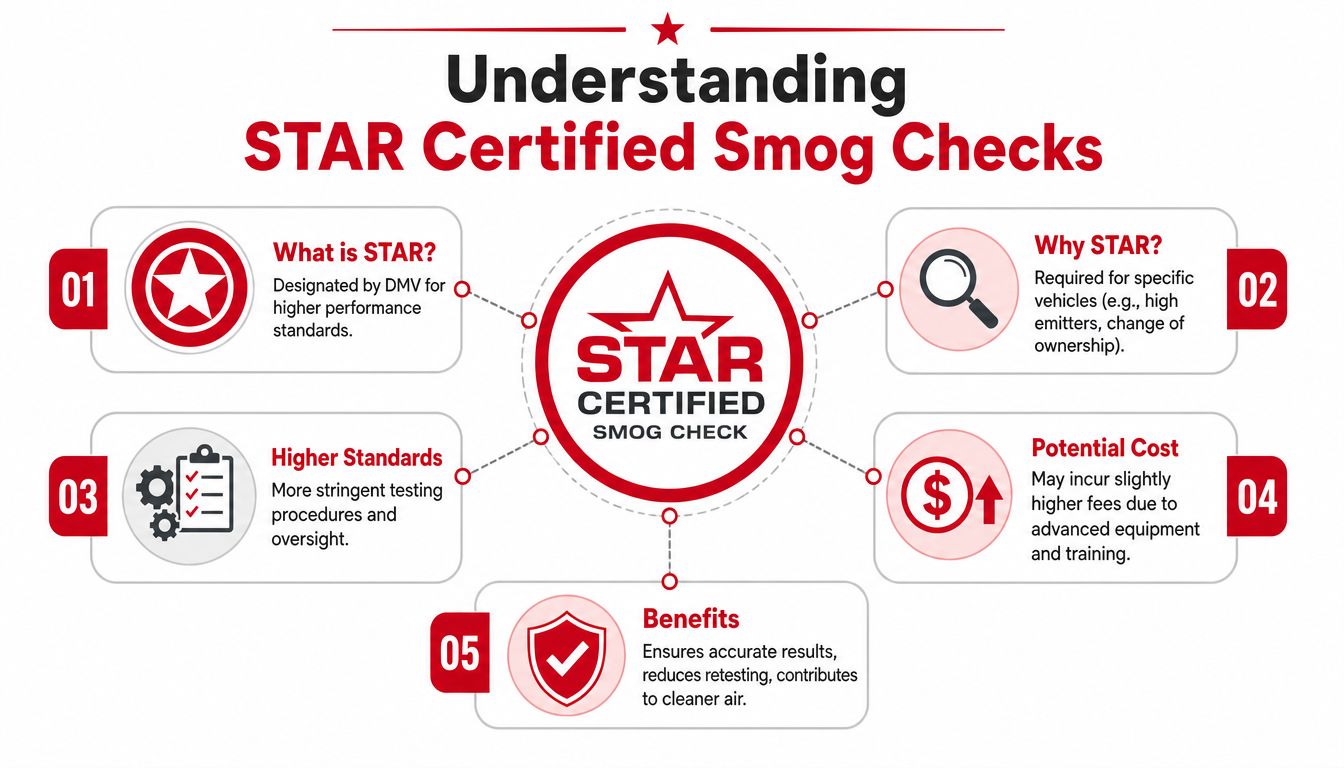
A STAR station isn't just a regular smog shop with a different sign. It's a station that meets higher performance standards set by California's Bureau of Automotive Repair, which is why some vehicles are specifically directed there.
Why STAR usually costs more
For standard vehicles, a STAR-certified smog check typically costs $55 to $60, while the broader range for general smog checks is $29.95 to $69.95, according to this STAR vs regular smog check comparison. That higher STAR price is tied to stricter standards and more frequent BAR oversight.
That doesn't mean you're paying for fluff. It means the station is being held to a tighter standard. If your DMV notice says STAR, you don't have much use for the cheapest non-STAR ad in town because that station may not be allowed to test your vehicle for the purpose you need.
What the STAR requirement is really doing
Think of STAR stations as the honors class of smog testing. Not because they're fancy, but because they're measured more closely.
That matters for vehicles the state wants tested under a stricter process. In practice, that can protect you from sloppy testing, bad records, and situations where a vehicle has to be retested because the first inspection wasn't handled correctly.
A STAR requirement usually feels annoying at first. In practice, it's the state telling you to use a station that meets a higher bar for accuracy and consistency.
What works and what doesn't
What works is choosing a station that clearly confirms two things before you drive over:
- Your vehicle can be tested there
- The quote is for the full service you need
What doesn't work is assuming every smog station is interchangeable. It isn't. If your notice says STAR, then the comparison is between STAR stations, not between a STAR station and a bargain ad from a regular shop.
Key Factors That Change Your Final Smog Check Cost
Two drivers can call the same STAR station on the same day and get different prices. Usually, the difference comes from the vehicle, not the shop.
That matters because the low number in an ad is usually built around the easiest vehicle to test. Once you change the body style, fuel type, model year, or inspection type, the final price can move.
Vehicle type changes the labor
A basic gasoline sedan is usually the quickest job. Larger vehicles often take more setup time, more bay space, and sometimes a different testing approach. That is why trucks, SUVs, vans, diesels, and motorhomes are often quoted above the base rate.
Motorhomes are a good example. They are not priced like a compact car, and any ad that makes them sound interchangeable is leaving out part of the story.
Age and test type can raise the price
Older vehicles can take longer to inspect correctly, especially when the testing process is less straightforward than it is on newer models. Some cars also come in for a different reason than a routine registration renewal, such as a change of ownership or out-of-state registration. That can affect the quote too.
The practical point is simple. A station cannot give you an honest out-the-door estimate from a headline price alone.
| Vehicle Type or Condition | How It Can Affect Price |
|---|---|
| Truck, SUV, or van | Often priced above a basic sedan |
| Older vehicle | May take longer and cost more to inspect |
| Motorhome | Commonly priced much higher than a standard car |
| Diesel vehicle | Often falls into a higher price category |
| Change of ownership or out-of-state inspection | May be quoted differently than a standard renewal |
The questions worth asking before you go
To get a real quote, give the station the details that change the job:
- Body style: Sedan, SUV, pickup, van, or motorhome
- Fuel type: Gasoline or diesel
- Model year: Older vehicles often need a closer look
- Registration situation: Renewal, change of ownership, or out-of-state paperwork
To reduce the chance of paying for a retest, review common smog check fail reasons before you book.
The best quote is based on your exact vehicle and paperwork, not a "starts at" number.
Understanding Your Out the Door Price and Hidden Fees
A driver sees a $29.75 STAR smog special online, pulls in expecting to spend about thirty bucks, and leaves wondering why the total is higher. That happens every day. The gap is usually not magic. It is the difference between a promo price and the out-the-door price.
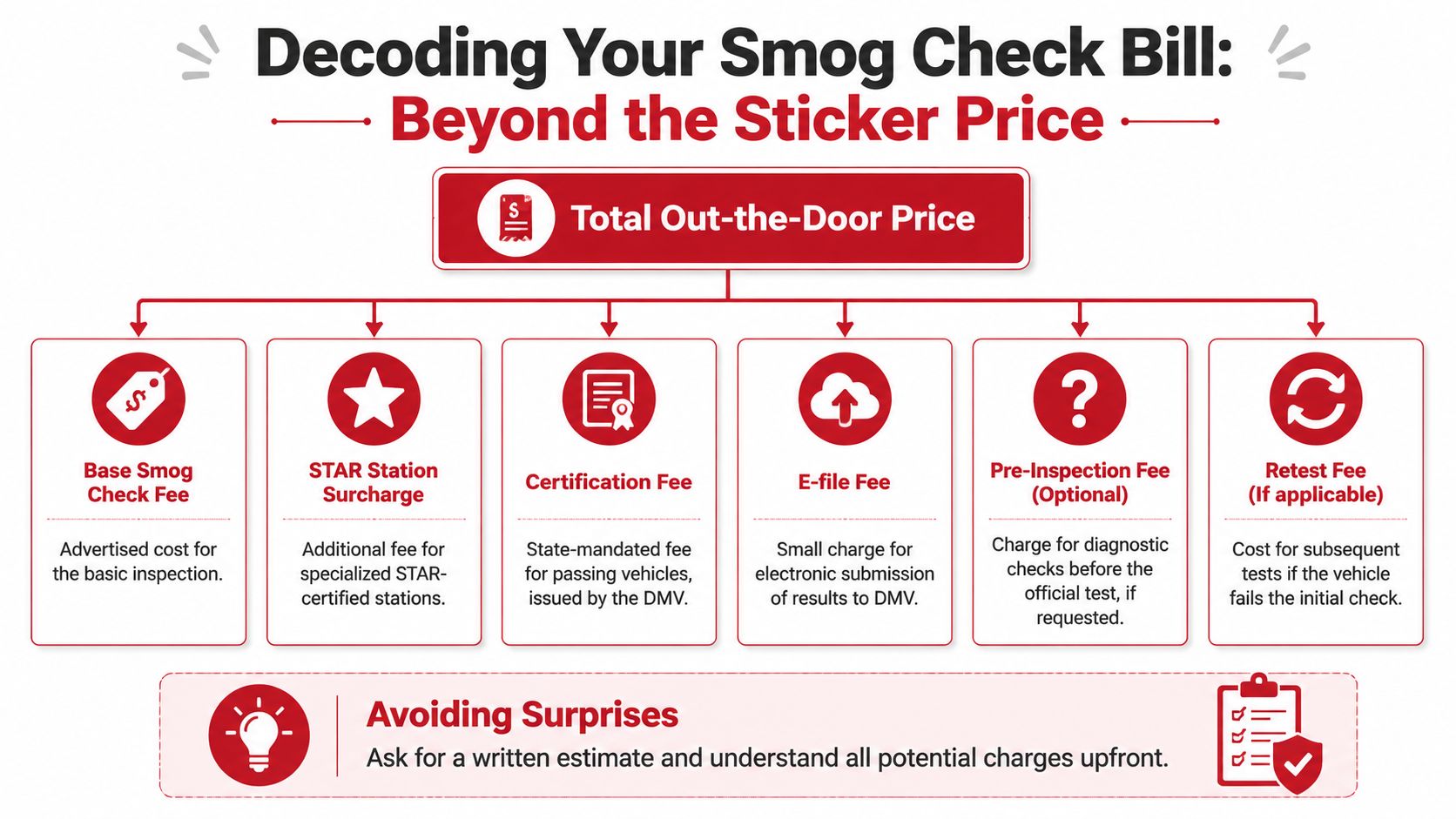
That out-the-door number is what matters. It includes the test charge, the certificate fee if the vehicle passes, and any added amount tied to the vehicle or the type of test being performed. If a shop only leads with the lowest base price, you still do not know what you are going to pay.
The fee every passing vehicle pays
One charge catches people off guard more than any other. California adds a fixed $8.25 Smog Certificate Fee on a passing test. That fee is separate from the station's testing price.
So a low advertised number may be real as a base test price and still not be the final bill. Confusion starts because the ad and the receipt are talking about two different numbers.
Where the final bill usually changes
In the bay, the pattern is pretty simple. Shops advertise the starting price because it looks good. The customer pays the full price based on the actual vehicle and the full transaction.
A clear quote should break the total into these parts:
- Base test fee: The station's charge to perform the inspection
- Certificate fee: The fixed $8.25 added on a passing vehicle
- Common add-ons: Extra cost tied to vehicle size, age, fuel type, or test complexity
Those add-ons are not always improper. Some vehicles do take more time, use different equipment, or fall outside the cheapest advertised category. The problem is poor disclosure. If the fine print does the actual talking, comparison shopping gets harder than it should be.
The question that gets a straight answer
Ask for the full number up front.
“What is my out-the-door price for this vehicle, including the certificate fee and any add-ons?”
That question cuts through the marketing fast. A transparent station can answer it without dodging, because it already knows the difference between a headline special and a real quote. A vague answer usually means the advertised price is only the beginning.
The fair way to compare shops is simple. Compare total price, not starting price.
How Fire House Smog Offers Transparent Pricing
The easiest way to judge a smog station is to see whether its business model lines up with what customers want. Clear pricing. Straight answers. No pressure around repairs.
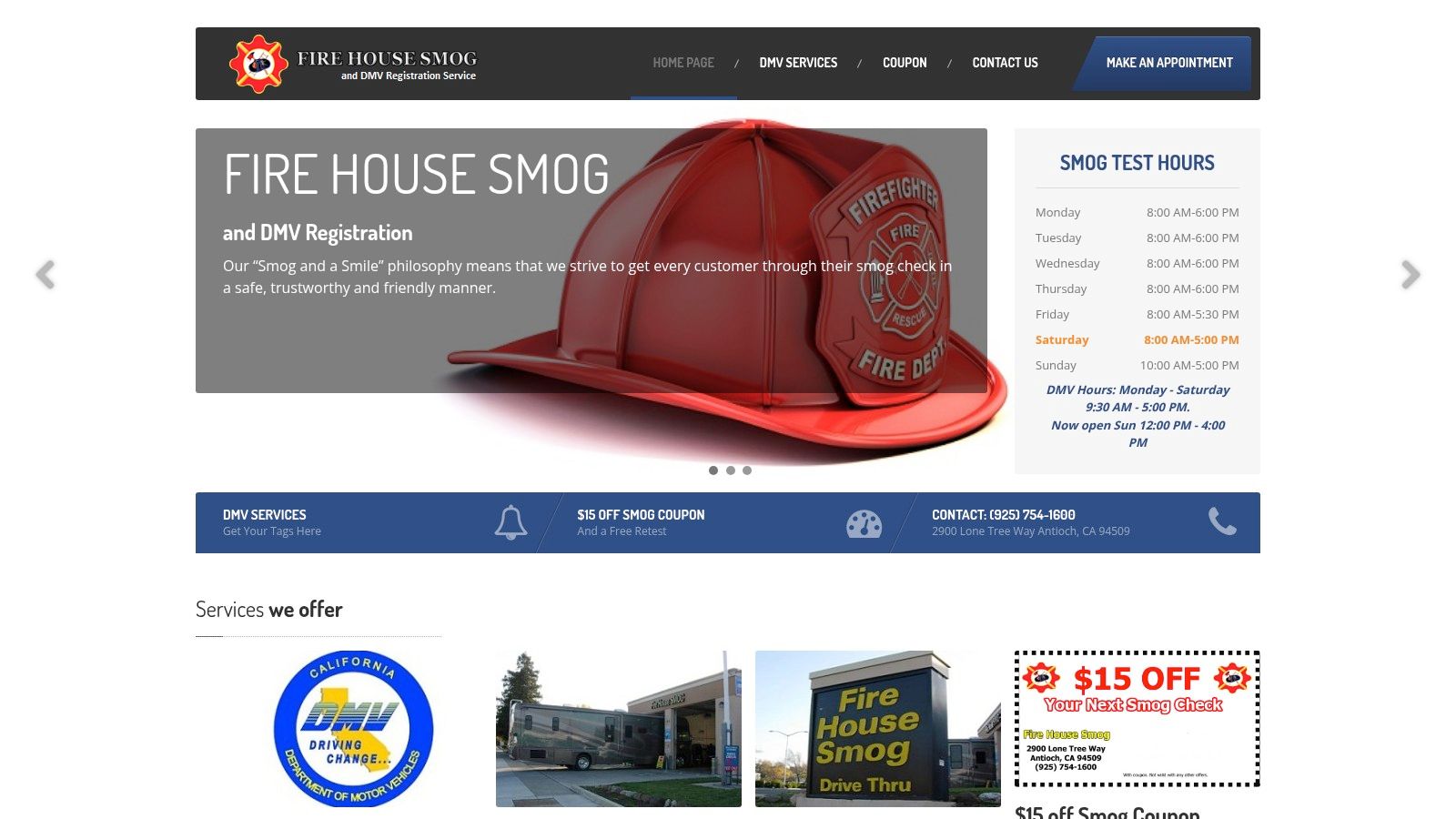
Fire House Smog operates as a STAR-certified test-only station and also provides on-site DMV services in Antioch. That matters because a test-only shop doesn't sell emissions repairs in-house, which removes the repair-sales conflict that drivers worry about when a vehicle doesn't pass.
Why test-only matters
At a test-only station, the shop's job is to inspect and report. It isn't also trying to turn a failed result into repair work on the same ticket.
That setup doesn't guarantee a pass. No honest station can do that. What it does give customers is cleaner separation between the inspection itself and any repair decisions they may need to make elsewhere.
Practical convenience that saves hassle
Fire House Smog also handles DMV registration services on site, including renewals and related paperwork, which can save a separate trip when everything lines up. For drivers who are already juggling renewal deadlines, that convenience matters more than flashy advertising.
Other practical details stand out too:
- Seven-day smog testing availability: Helpful if weekday scheduling is a problem.
- Two service bays: Better flow than a tiny one-bay operation.
- Free retest policy: Available when required, based on site policy and coupon terms.
What transparent pricing looks like in practice
Transparent pricing isn't just posting a low number. It's making it easy for a customer to understand what they're paying for before the car goes into the bay.
That means a shop should be willing to tell you:
- whether the quote is for a STAR inspection,
- whether your vehicle type changes the price,
- and whether the final number includes the state certificate fee when applicable.
When a station answers those questions clearly, the transaction feels normal. When it doesn't, customers end up suspicious even if the actual work is fine.
Practical Tips to Avoid Extra Charges and Pass the First Time
The cheapest smog check is the one you only pay for once. A little prep before you arrive can reduce the chance of a failed test, a retest, or wasted time standing around a parking lot trying to figure out what went wrong.
Start with the basics that drivers can control.
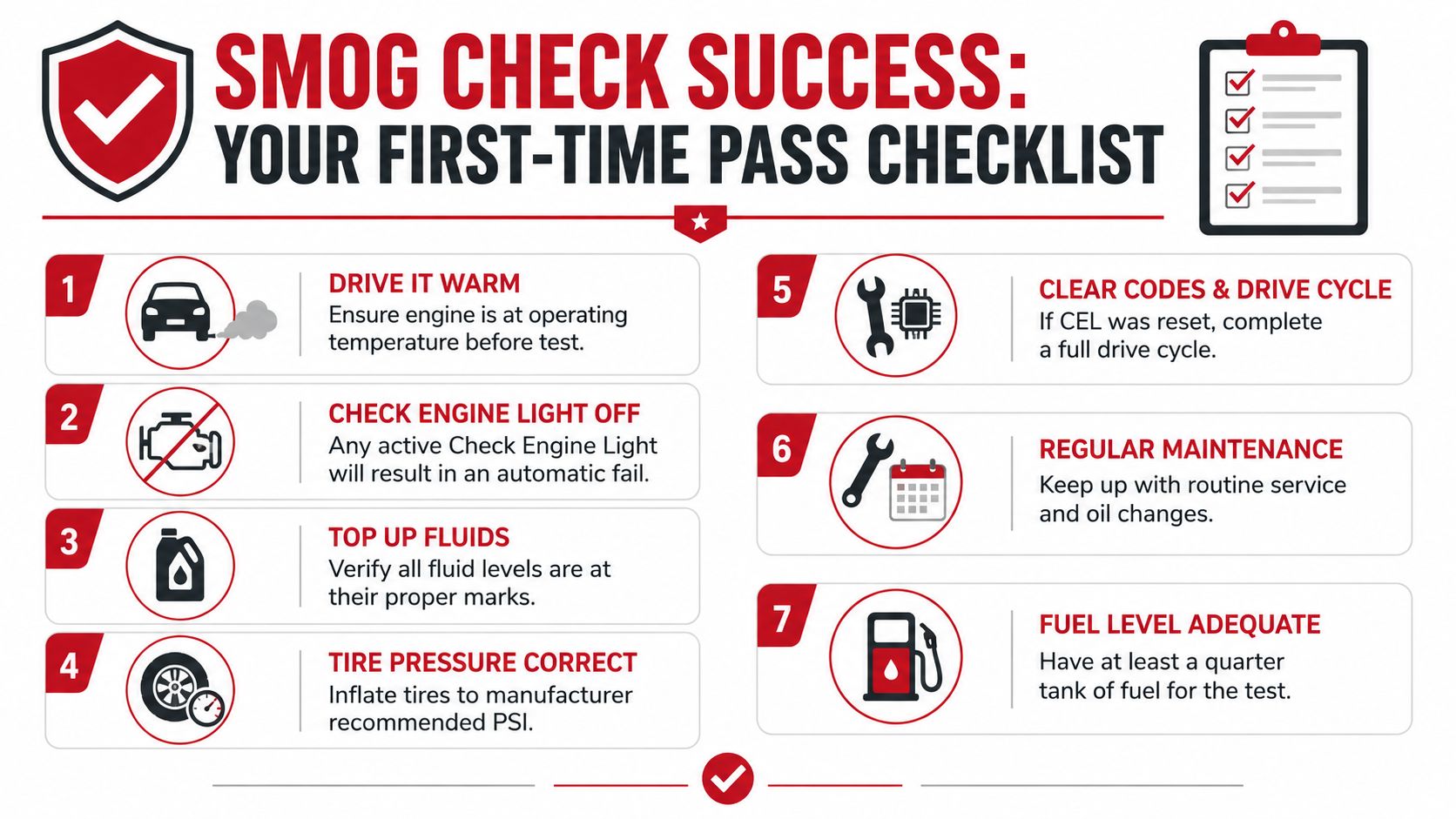
Simple things that help
- Drive the car before the test: Don't bring it in cold if you can avoid it. A warmed-up engine and exhaust system generally put the car in a better testing condition than a vehicle that just started a few minutes ago.
- Make sure the Check Engine light is off: If it's on, deal with that first. Going straight to the smog station usually wastes time and money.
- Don't clear codes right before testing: If someone disconnected the battery or reset the system, the car may not be ready for inspection yet.
- Check basic maintenance items: Old oil, neglected maintenance, or obvious problems can work against you.
- Bring enough fuel: Don't show up nearly empty.
If you want a local option for a STAR test-only visit, you can review the smog test only discount center before heading out.
A quick visual checklist helps many drivers remember the basics before they leave home.
What not to do on test day
Some mistakes are common:
- Don't arrive right after a battery disconnect
- Don't ignore warning lights and hope for the best
- Don't assume a coupon answers the full pricing question
- Don't wait until the registration deadline if you already suspect a problem
A smooth smog visit usually starts before you get to the station. Warm car, no warning lights, no last-minute surprises.
If you've been asking how much does a STAR smog check cost, the practical answer is this: the posted number matters less than showing up prepared and confirming the full price in advance. That's what keeps the process fast, fair, and predictable.
If you need a STAR-certified test-only smog check with on-site DMV help in Antioch, Fire House Smog is built for exactly that. You can handle your inspection, ask for a clear out-the-door quote, and take care of many registration tasks in one stop without the repair upsell that drivers often want to avoid.