Most advice on smog check vs smog test says the terms are identical and moves on. That answer is convenient, but it leaves California drivers unprepared for the part that matters: one term describes the state compliance program, while the other describes what the technician does to the vehicle.
That distinction affects where you go, what paperwork you receive, and whether your registration renewal can move forward. It matters even more after California tightened readiness-monitor requirements beginning October 1, 2025. A car can run smoothly and still fail because its emissions monitors haven't completed their checks.
If you're an Antioch driver, learn the practical vocabulary before booking. You need to know whether your notice sends you to a STAR station, whether your vehicle is ready for an OBD inspection, and whether you're seeking a legal certificate or only a diagnostic result.
Table of Contents
- Why Smog Check and Smog Test Are Not the Same Thing
- How the California Smog Check Program Works
- Smog Check vs Smog Test Side by Side
- What the Failure Data Tells You About Real-World Outcomes
- STAR Stations, Test-Only Stations, and Where to Go
- Surprising Ways a Healthy Car Can Still Fail
- A Real Antioch Driver Scenario From Booking to Tag
- Common Questions and Your Next Steps
- Can I use any station with a directed notice
- What's the difference between gross polluter and directed
- How long is a smog certificate good for
- Do I need an appointment
- What if I bought the car from out of state
- Does a new battery reset readiness monitors
- Can I fail if the Check Engine Light is off now
- Are hybrids exempt
- Your five-point preparation list
Why Smog Check and Smog Test Are Not the Same Thing
Smog Check names California's regulated emissions-compliance program. The Bureau of Automotive Repair oversees it, and a passing result can create the electronic certification needed for registration renewal, a sale, or a transfer when the vehicle requires inspection.
A smog test is the inspection performed in the service bay. The technician uses the equipment required for that vehicle, including electronic diagnostics on newer models and tailpipe measurement on older ones. The test produces findings. The Smog Check connects those findings to the state's compliance process and the vehicle's DMV record.
California's modern statewide system took shape in 1984, after the federal Clean Air Act Amendments pushed states toward biennial testing. Many vehicles require an inspection every two years before registration renewal, but the exact requirement depends on the vehicle and transaction. A historical overview of California's smog-check program describes that development and the program's continuing reach.
Why the wording affects your visit
Using the terms loosely can send you to the wrong station or leave you with the wrong expectation. A station may not be authorized for a directed vehicle. A printout showing test results may not be the electronic certification DMV needs. Clearing the battery before an appointment can also leave readiness monitors incomplete, even if the car runs normally.
Practical rule: Read the DMV notice first. Then choose the station. Do not select a location based only on “smog test” in an advertisement.
The distinction also clarifies what a STAR-certified smog inspection involves. STAR is not a separate pollution measurement. It identifies stations that meet additional inspection-quality requirements for vehicles assigned to that network.
Before handing over the keys, ask one direct question: does the vehicle need a regular Smog Check, a STAR-directed inspection, or a retest? Then confirm which document the station will transmit to DMV after a pass. That conversation prevents a failed appointment caused by choosing the wrong service.
How the California Smog Check Program Works
California's Smog Check program developed through successive regulatory changes, not one universal inspection format. The statewide system was formalized in 1984, and later changes added targeted oversight for vehicles associated with higher emissions. The inspection pathway now depends on factors such as model year, fuel type, and DMV direction.
The Bureau of Automotive Repair licenses stations and technicians, sets inspection requirements, and receives results through California's electronic reporting system. A licensed station performs an authorized inspection and submits the outcome. It is not giving an informal opinion about the vehicle.
The process at the station
A typical visit follows four steps:
- The station verifies the vehicle and transaction. The technician confirms the vehicle information and identifies the applicable inspection pathway.
- The technician performs the required checks. Depending on the vehicle, those checks may include visual, functional, and emissions-related inspections.
- The system records the result. The station reports the inspection electronically. A passing result can support the applicable DMV transaction.
- The driver receives the paperwork. The Vehicle Inspection Report lists the test findings, while the electronic certificate supports the state requirement.
For 2000-and-newer vehicles, California's BAR On-Board Diagnostic Inspection System collects OBD information. For 1999-and-older vehicles, the BAR-97 Emissions Inspection System measures tailpipe emissions. The California BAR Smog Check program description explains why the procedure differs between vehicle groups.
Which event brings you in
Registration renewal is the most familiar trigger. A sale or transfer may also require a valid inspection, and an out-of-state vehicle may need one before California registration is completed. The notice and transaction determine the requirement, not the casual wording in an online search.
That makes “I just need a smog test” incomplete. The test is the procedure performed at the station, while the Smog Check program is the compliance requirement tied to the DMV event. If the notice assigns a STAR-directed inspection, a regular station may not be authorized to perform it.
The 2025 readiness-monitor change also affects preparation and station choice. Applicable monitors must be set for a vehicle to pass, subject to narrow exceptions for unique design issues, according to BAR's readiness-monitor guidance. A vehicle can run smoothly and still fail because its emissions system is not inspection-ready. Avoid clearing diagnostic codes or disconnecting the battery shortly before the appointment, since doing so can leave monitors incomplete.
Smog Check vs Smog Test Side by Side
The simplest way to separate the terms is to ask what question each one answers.
Smog check asks: Has this vehicle satisfied the applicable California emissions requirement for the relevant DMV transaction?
Smog test asks: What did the inspection equipment and technician find during this visit?
The two concepts meet at the station, but they aren't the same deliverable. A technician performs the test, and the state uses that result within the Smog Check program.
Smog Check vs Smog Test at a Glance
| Dimension | Smog Check | Smog Test |
|---|---|---|
| Meaning | California's regulated compliance program | The inspection procedure performed on the vehicle |
| Authority | California Bureau of Automotive Repair and DMV requirements | BAR-approved inspection standards and equipment |
| Trigger | Registration renewal, sale, transfer, or another applicable DMV event | The scheduled inspection or retest visit |
| Technical work | Applies the correct inspection pathway to the vehicle | Performs visual, functional, OBD, or tailpipe checks as required |
| Output | Electronic Smog Check certification used for DMV compliance | Vehicle Inspection Report with inspection findings |
| Passing language | The vehicle passes the applicable Smog Check requirement | The test records a pass for the inspection performed |
| Failure handling | The compliance requirement remains unresolved until the vehicle passes or qualifies under an applicable process | The report identifies the failed area and supports repair and retest decisions |
A newer vehicle generally goes through an OBD-based procedure, while an older vehicle may receive tailpipe measurement. The program determines which standards apply. The test carries them out.
Why the same car can face different station rules
A vehicle assigned to a directed or higher-emission review may need a STAR station. That doesn't necessarily mean the technician uses an exotic test. It means the state has assigned the vehicle to a station class designed for added inspection quality and program control.
The distinction also clarifies failure paperwork. A Vehicle Inspection Report tells you what happened during the test. A passing electronic certificate addresses the DMV compliance requirement. You need the latter when your transaction requires official certification, not merely a piece of paper showing that a technician connected equipment.
What the Failure Data Tells You About Real-World Outcomes
California's statewide results show why the distinction between a Smog Check program and an individual smog test matters. In 2025, BAR recorded 11,275,981 initial tests and 12,200,718 total tests, with an 8.51% initial failure rate. Those figures are documented in the program's historical and statewide inspection data.
The pattern continued in January 2026. BAR reported 989,080 initial tests, including 82,543 failures, for an 8.35% initial failure rate. Across all tests, the report recorded 1,065,033 inspections and 93,789 failures, an 8.81% overall failure rate. The January 2026 BAR executive summary provides those results.
Smog Check vs Smog Test Failure Outcomes
| Metric | Smog Check | Smog Test |
|---|---|---|
| What failure means | The DMV-related emissions requirement isn't complete | The vehicle failed one or more inspection checks |
| What the driver receives | A compliance result is transmitted when the vehicle passes | A Vehicle Inspection Report identifies the result |
| Immediate concern | Registration, sale, or transfer may remain unresolved | Repairs, readiness completion, or a retest may be needed |
| Practical next move | Confirm the required station and transaction pathway | Review the failure items before authorizing repairs |
Vehicle age changes the odds and the inspection context. The January report lists an 18.69% overall failure rate for one all-model-year sample category and an 11.09% rate for a 2025 model-year group. Those categories show that results vary by vehicle population and inspection conditions. A newer car can still fail because of readiness or emissions-control issues, while an older car can pass its basic checks despite a smooth idle that gives no reliable guarantee.
Use this guide to common smog-check failure causes before approving parts or labor. The practical rule is simple: confirm the station pathway first, then diagnose the exact failure. That order prevents a wasted visit and reduces the risk of paying for repairs the test did not require.
STAR Stations, Test-Only Stations, and Where to Go
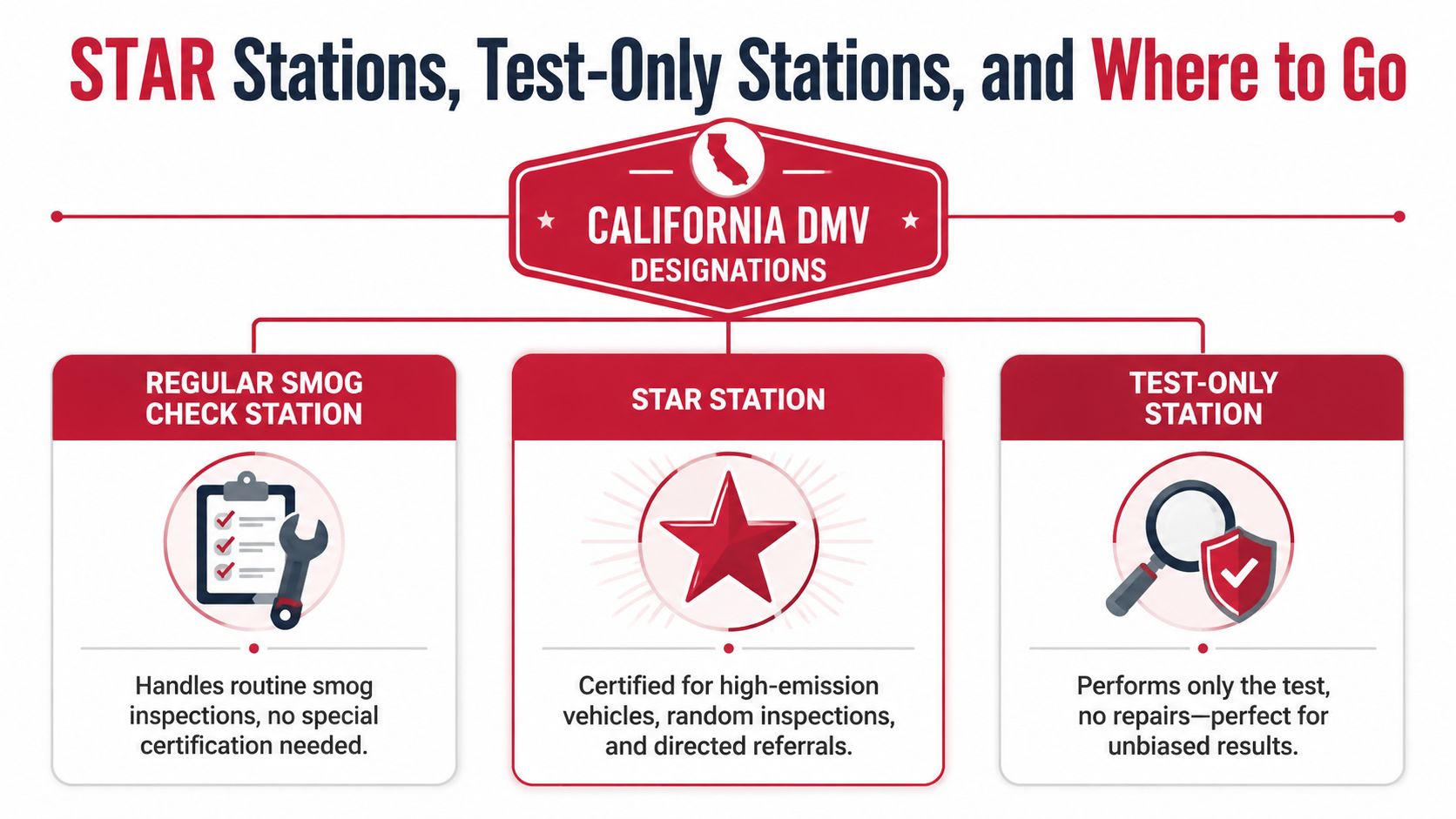
California station designations determine which businesses may inspect your vehicle and whether they may also perform repairs. The terms describe different regulatory roles, not interchangeable names for the same service.
A regular station handles inspections within its license and equipment scope. A STAR station meets higher inspection-based standards and participates in the program when the state directs certain vehicles into that network. A test-only station performs the inspection but cannot repair the same vehicle, keeping testing separate from repair sales. Review the California STAR-certified station requirements before choosing a location.
Why test-only matters
A test-only station removes the direct repair-sales conflict. Its revenue does not depend on selling a catalytic converter, sensor, or other part after a failure. That separation does not guarantee a passing result, but it gives you a clearer boundary between inspection findings and repair recommendations.
The California STAR program explanation describes STAR as a quality-focused program supporting inspection accuracy and emissions reductions. STAR certification can apply to both test-only and test-and-repair stations that meet the required standards.
Read your DMV renewal notice or referral before booking. If it says STAR-directed, choose a STAR-certified station. Otherwise, confirm that the station performs the inspection required for your vehicle and transaction.
For Antioch drivers, Fire House Smog operates as a STAR-certified test-only station at 2900 Lone Tree Way. It provides emissions inspections without in-house repairs, DMV registration services, and a posted retest policy subject to its conditions. Verify your notice and the station's current policy before arriving.
Surprising Ways a Healthy Car Can Still Fail
A quiet engine and a dark dashboard don't prove that a car is ready for inspection. California's OBD procedure evaluates emissions-system self-checks that drivers can't feel from behind the wheel.
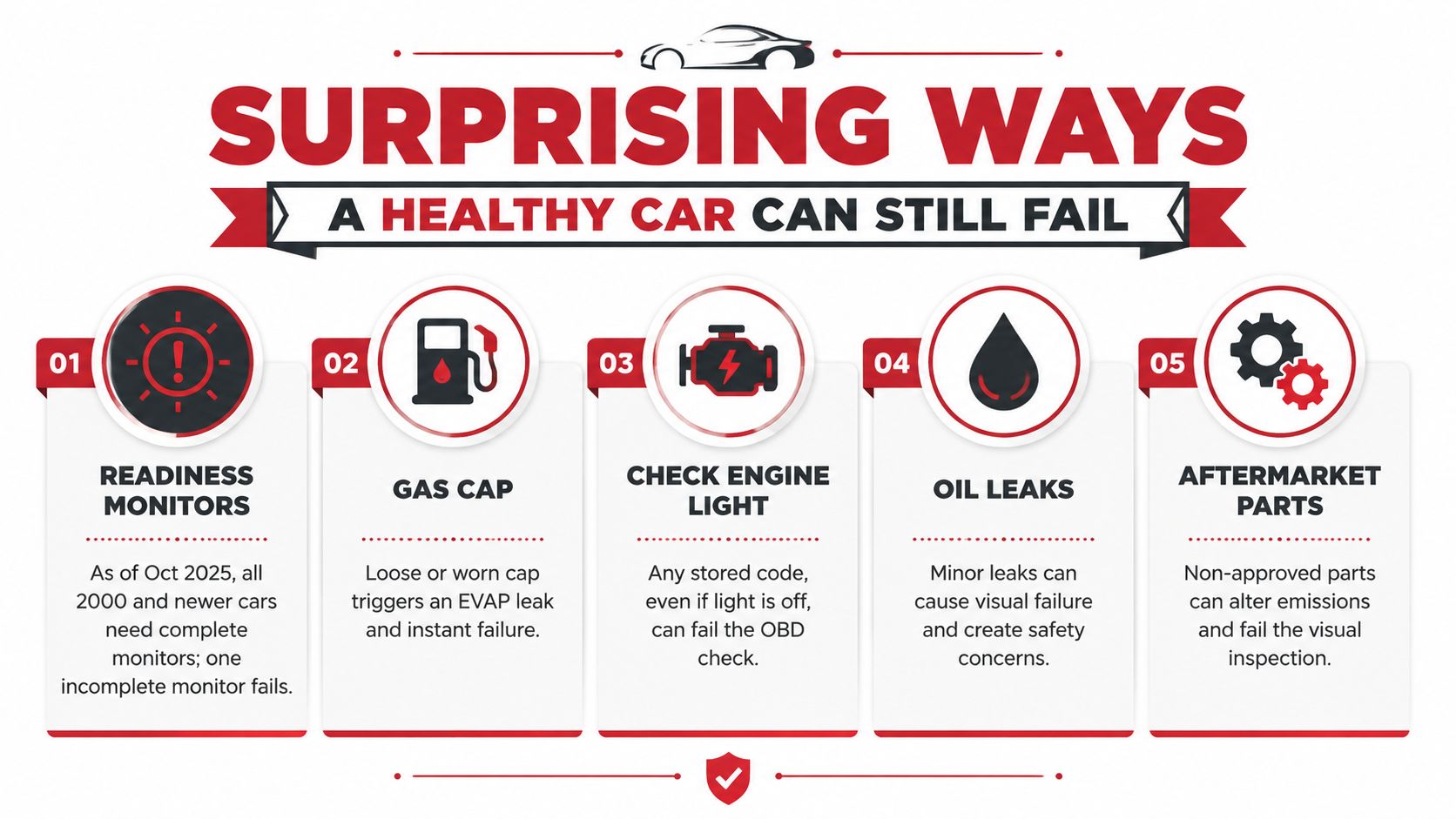
The biggest recent change took effect October 1, 2025. California BAR guidance says all readiness monitors must be set for a vehicle to pass, with narrow exceptions for unique design issues. That means disconnecting the battery or clearing a diagnostic code shortly before the appointment can leave the vehicle unable to pass even after the original problem appears fixed.
The traps I see most often
- Readiness monitors remain incomplete. The computer needs driving conditions to complete its emissions self-tests after repairs or a battery disconnect.
- A recently cleared code returns later. Clearing the code erases useful history but doesn't complete the drive cycle.
- The Check Engine Light is illuminated. An active malfunction indicator is a direct warning that the OBD inspection may fail.
- The gas cap doesn't seal. An EVAP leak can trigger an emissions fault even when the engine feels normal.
- Aftermarket equipment lacks approval. Intake or exhaust parts that don't carry the required California emissions approval can fail the visual inspection.
A fifteen-minute warm-up is a sensible preparation step, but it isn't a substitute for readiness verification. Before the appointment, use a compatible OBD scanner to check for pending codes and monitor status, confirm that the gas cap clicks and seals properly, and complete a mixed drive cycle rather than taking only short trips.
A healthy car isn't necessarily an inspection-ready car. Check the computer before you pay for the official test.
A Real Antioch Driver Scenario From Booking to Tag
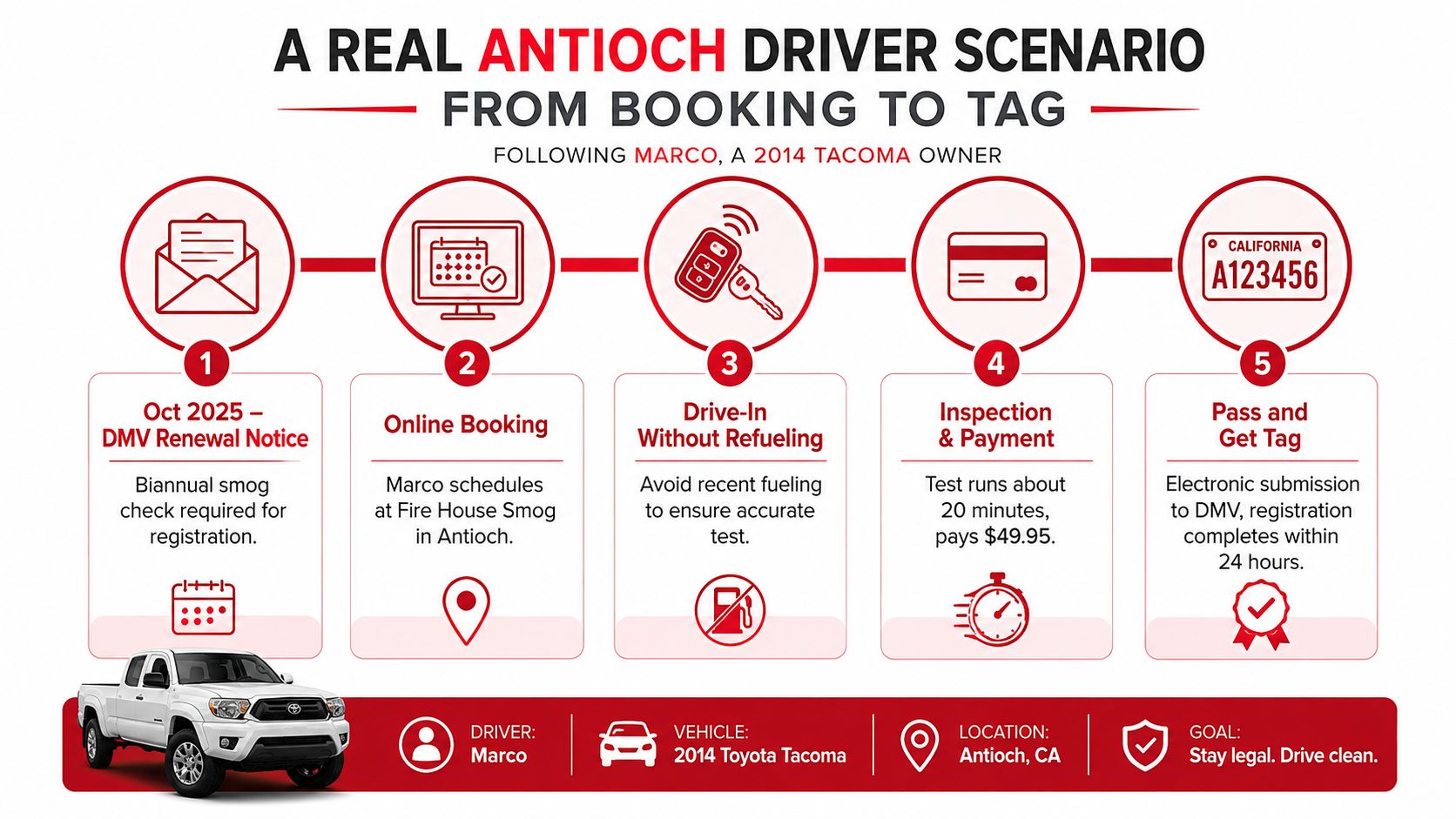
The following scenario is a practical illustration, not a verified customer case study. Marco owns a 2014 Toyota Tacoma in Antioch and receives a DMV renewal notice in October 2025. The notice indicates that his registration renewal requires a Smog Check, so he looks for a station that can handle the applicable inspection rather than booking the first generic “smog test” result.
He books online at Fire House Smog and arrives without recently refueling. The technician connects the inspection equipment and explains that Marco's readiness monitors aren't set. The truck runs normally, but the computer hasn't completed the emissions checks needed for the inspection.
What happens next
Marco pays the station's posted directed-inspection price, then gets the readiness issue addressed before returning. The station's stated example uses a $61.75 directed inspection, followed by a $40 retest within 90 days after the vehicle is ready. Those are scenario-specific amounts, not California-wide prices, and drivers should confirm current charges and eligibility before booking.
On the second visit, the technician completes the directed inspection, the gross-polluter notice is lifted, and the passing result is transmitted electronically for the DMV renewal. Marco leaves with the certificate needed to complete the registration process and later receives his new sticker.
His main regret is simple. He should have checked monitor status before the first appointment and read the notice more carefully. A scanner check would have told him that the vehicle needed more driving time, while confirming the station requirement would have prevented him from treating the appointment as an ordinary walk-in test.
The point isn't the exact invoice. The point is the sequence. Notice type, station eligibility, readiness status, inspection, electronic certification, then registration. Skip the first two checks and a healthy truck can still produce an expensive extra visit.
Common Questions and Your Next Steps
Can I use any station with a directed notice
No. A directed notice can require a STAR-certified station. Confirm the wording on your DMV notice before you book.
What's the difference between gross polluter and directed
A gross-polluter designation describes a vehicle identified as producing emissions at a significantly high level. A directed notice is the station-routing instruction that sends the vehicle into a particular inspection pathway.
How long is a smog certificate good for
The certificate's usefulness depends on the DMV transaction and applicable state rules. Ask the station or DMV how the result applies to your specific renewal, sale, or transfer.
Do I need an appointment
Not always. An appointment can still reduce uncertainty, especially if your vehicle is directed, requires a specific station class, or needs equipment that isn't available at every location.
What if I bought the car from out of state
An out-of-state vehicle may need California inspection before California registration can be completed. Bring the DMV paperwork and ask the station whether it can inspect that vehicle type.
Does a new battery reset readiness monitors
It can. Battery disconnection may erase monitor status, so check readiness with an OBD scanner and allow the required drive cycle to complete before testing.
Can I fail if the Check Engine Light is off now
Yes. The computer may still show pending faults or incomplete monitors. A dark dashboard alone isn't proof that the OBD system is ready.
Are hybrids exempt
Don't assume that a hybrid is exempt. Check the vehicle's fuel type, model year, and California DMV requirement before skipping an inspection.
Your five-point preparation list
- Read the notice. Identify whether the DMV requires a routine or STAR-directed inspection.
- Locate the OBD-II port. Know where the technician will connect and make sure nothing blocks access.
- Check monitor readiness. Use a compatible scanner before the appointment, particularly after battery work or repairs.
- Bring repair records. Prior receipts help explain recent work and guide the conversation if the vehicle fails.
- Confirm the station class. Verify STAR or test-only eligibility before you drive across town.
Fire House Smog provides STAR-certified test-only inspections, DMV registration services, and on-site tag issuance at 2900 Lone Tree Way in Antioch, with smog testing seven days a week and DMV service hours Monday through Saturday from 9:30 AM to 5:00 PM and Sunday from 12:00 PM to 4:00 PM.
If you want the inspection and DMV step handled in one visit, book your vehicle with Fire House Smog and bring your renewal or referral notice. The Antioch team can verify the required station pathway, check the emissions system, and process eligible registration services after a passing result.
You're staring at a DMV renewal notice, the car runs fine, and you still have that annoying question, do I need a smog check in San Leandro, or am I about to waste an afternoon? That's the right question to ask first. The expensive mistake isn't showing up a few minutes late, it's bringing the wrong vehicle, the wrong paperwork, or a car that isn't ready to pass.
San Leandro drivers don't need guesswork. California's rules decide whether your car is in scope, and the DMV and BAR rules are clear enough if you read them instead of trusting forum noise. The smart move is to treat a smog check San Leandro appointment as a readiness check, then match your vehicle and your renewal notice to the right station type before you ever leave home.
Table of Contents
- What a San Leandro Smog Check Actually Covers
- How to Prep Your Car Before the Test
- Standard, STAR, and Test-Only Stations Explained
- What Happens During a San Leandro Smog Visit
- Failing the Test and Getting a Free Retest
- Hours, Wait Times, and Smart Timing Around San Leandro
- Putting It All Together Before Your Next Renewal
What a San Leandro Smog Check Actually Covers
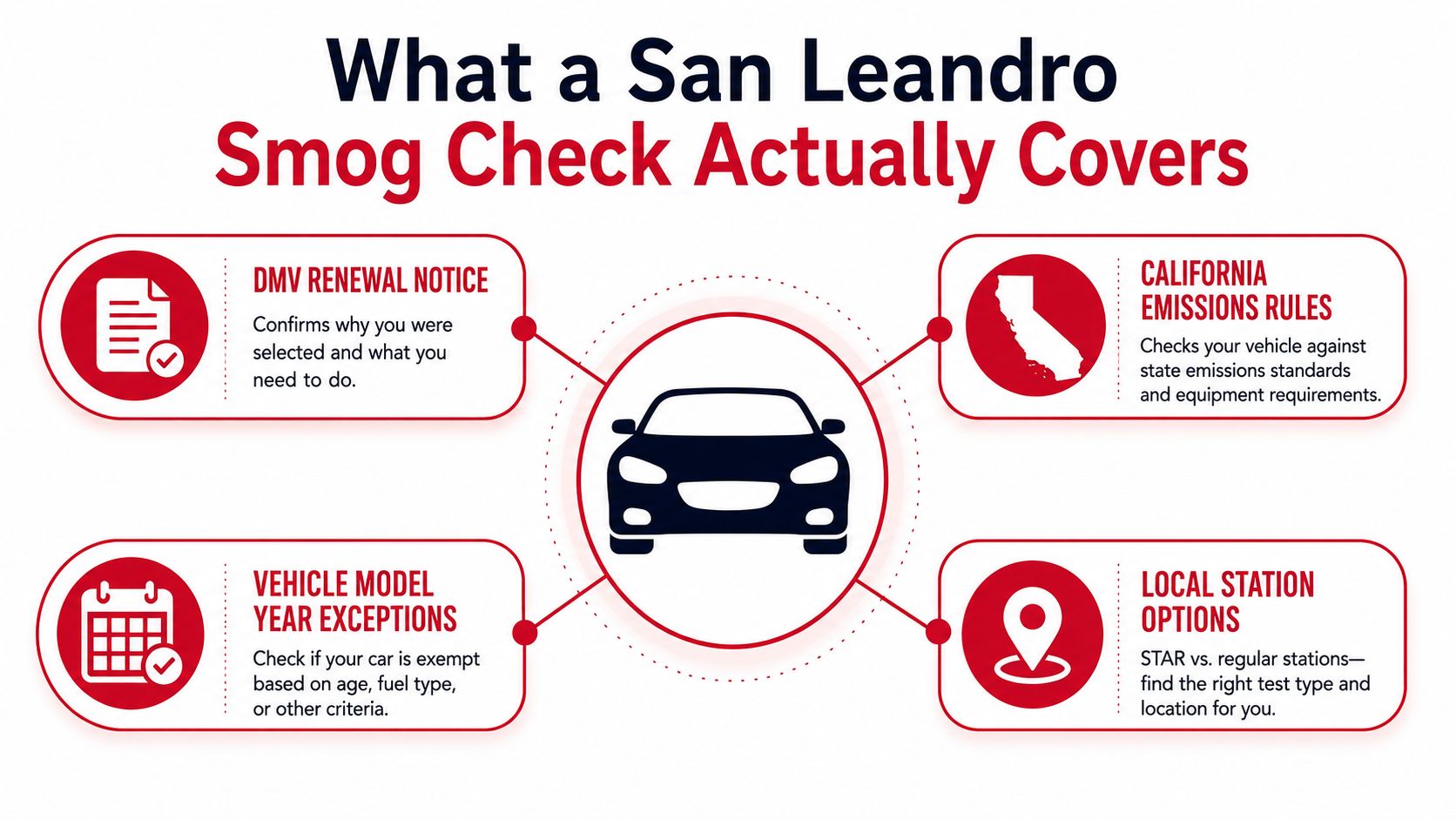
A San Leandro driver can have the renewal notice in hand and still be unsure whether the car is even subject to testing. Start with the DMV rule, not the rumor mill. California requires smog inspections for most vehicles when they're being registered or when registration is renewed, with exemptions for gasoline vehicles 1975 or older, diesel vehicles 1997 or older or over 14,000 pounds GVWR, electric vehicles, and gasoline vehicles under eight model years old. The state also says some newer vehicles can pay a smog abatement fee instead of testing for the first 8 registration years. For out-of-state vehicles, California's BAR summary says all 1976 model-year and newer vehicles need a smog check before first registration in the state, which matters a lot in a Bay Area city where people move and buy cars across state lines. Read the DMV's own inspection rules before you book anything, then use California's vehicle emissions standards overview as a plain-language reference point.
The first filter is eligibility
If your vehicle falls into one of the exemption buckets, don't book a test just because a renewal notice arrived. The notice tells you what the DMV expects administratively, but the vehicle class decides whether a smog inspection is required. That's the part too many drivers skip, and then they show up with a car that never needed to be on the bay in the first place.
Out-of-state transfers are the other common trap. If the vehicle is 1976 model year or newer and it's coming into California for the first time, the smog check comes before first registration. That's not a suggestion, and it's not something a shop can waive because the car looks clean.
Read the notice, then match the vehicle
The cleanest way to think about it is simple, the DMV notice points to paperwork, the vehicle class points to the test. If the car is clearly exempt, stop there. If it's not exempt, move straight to preparation and station selection.
Practical rule: don't book based on anxiety. Book only after you've checked the model year, fuel type, and whether the car is entering California for the first time.
How to Prep Your Car Before the Test
Most failed smog appointments don't start with a bad catalytic converter. They start with a car that wasn't ready to be tested. California-focused guidance says the right prep starts with the check-engine light, then the battery history, then the OBD-II readiness monitors that have to complete before the car can be fairly evaluated. If you clear a code or disconnect the battery right before you go, the monitors may not have reset yet, and that can set you up for a refusal or a retest even if the engine itself is fine. Read the warning-light and readiness guidance in common smog fail reasons before you roll out.
What to do in your driveway
Start with the dashboard. If the check-engine light is on, don't pretend the station will magically ignore it. Then check the gas cap, because a loose seal is the kind of small issue that creates a big headache later.
A simple pre-visit checklist works better than guesswork:
- Check the dashboard first. If the warning light is on, fix the cause before you test.
- Avoid a fresh battery disconnect. A recent reset can leave readiness monitors incomplete.
- Drive the car long enough to re-learn. Mixed driving gives the onboard system time to complete its checks.
- Don't clear codes right before the appointment. That often creates a readiness problem instead of solving one.
- Confirm the gas cap is tight. It's basic, but it still matters.
Give the car time, not just a quick lap
A short errand loop isn't enough if the monitors were just cleared. Many California drivers need a real drive cycle before the car is ready, and the practical guidance for that is usually a 50 to 100 miles of mixed driving. I'd treat that as a planning window, not a promise. If you want fewer surprises, stop chasing a same-day miracle and give the car time to complete its own checks.
The fastest appointment in the world doesn't help if the car arrives half asleep. A proper prep run beats a rushed test every time.
A clean bill of health starts before the bay door opens. If the light's on or the battery was just swapped, fix readiness first and test second.
Standard, STAR, and Test-Only Stations Explained
San Leandro search results throw three labels at drivers, and each one changes the job the station is allowed to do. A standard smog station can inspect many vehicles. A STAR-certified station handles DMV-directed vehicles and works under tighter oversight. A test-only station performs inspections without selling repairs, so the technician has no repair revenue tied to the outcome. If you want the cleanest split between testing and fixing, test-only is the smarter choice.
The question is not which shop has the shortest line. It is whether your vehicle belongs in that bay at all. If DMV directed your car to STAR, book a STAR-certified station and stop there. If you already failed once, test-only often makes more sense because the station is there to verify the result, not to steer you into parts you did not ask for. For a closer look at the certification framework, see what STAR-certified smog means.
What each station type does
A standard station handles routine inspections for many drivers, but it does not fit every directed case. A STAR station has the certification level DMV uses for vehicles that need closer oversight. A test-only station is the cleanest option when you want the inspection result without the repair pitch attached.
Use the notice first. Use the station label second.
| Station type | Best use case | What to expect |
|---|---|---|
| Standard station | Routine vehicles that aren't directed elsewhere | Regular inspection service |
| STAR-certified station | DMV-directed vehicles | Stricter certification framework |
| Test-only station | Drivers who want testing without repair sales | Inspection only, no repair upsell |
Don't overthink the label
The renewal notice matters more than the search result. If the notice calls for STAR, book STAR. If the notice does not require it and you just need a valid inspection, a regular station may be enough. If you want to avoid a conflict of interest and keep the transaction clean, test-only is the more disciplined choice.
That is why I tell neighbors to read the notice before they read the reviews. The right station type saves more time than any polished marketing page ever will.
What Happens During a San Leandro Smog Visit
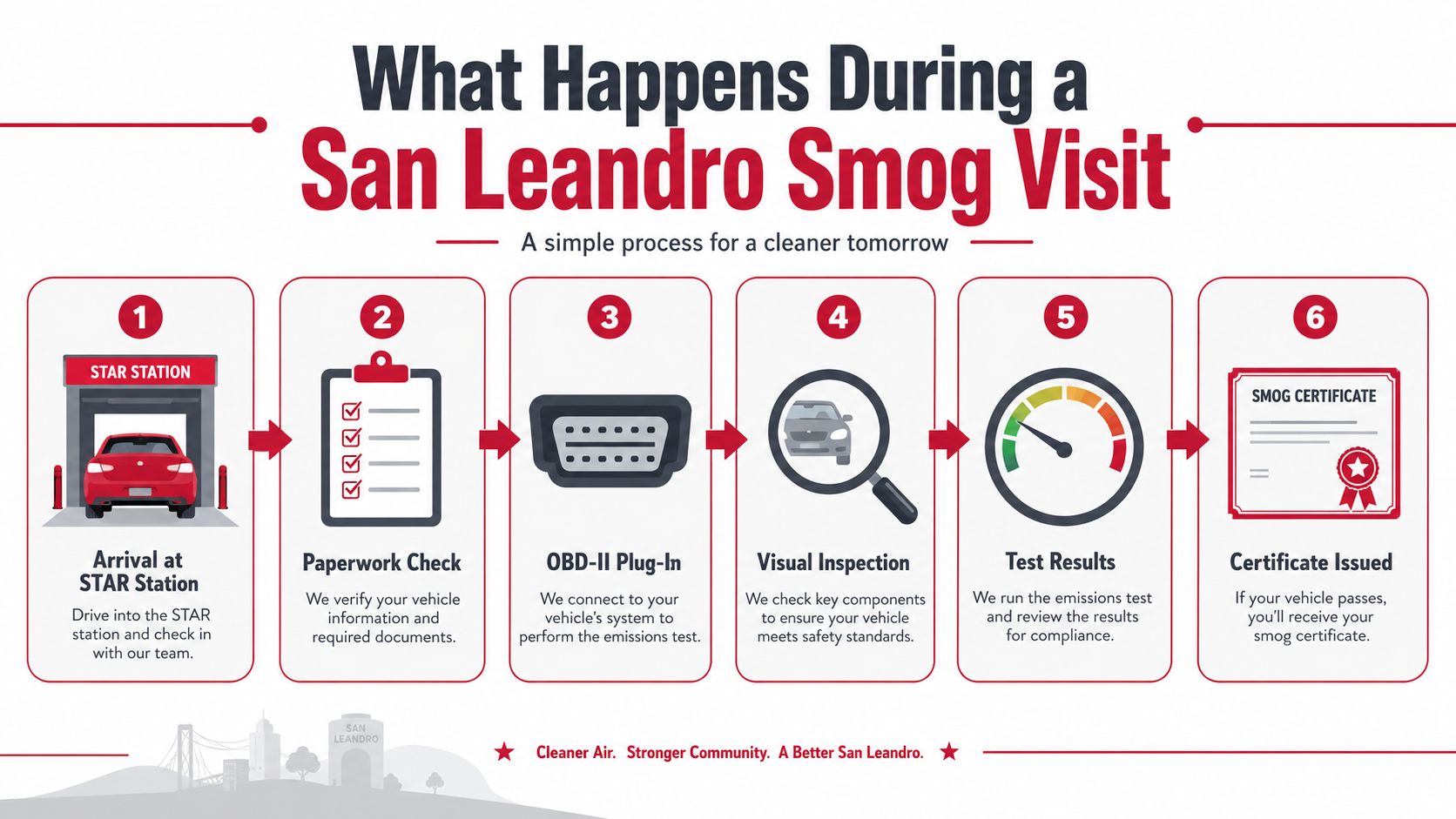
A good San Leandro visit should feel boring in the best way. You pull in, hand over the vehicle info, and the technician starts by confirming the paperwork and the car's eligibility for the specific inspection path. At a STAR test-only station, that usually means the technician is focused on the inspection itself, not on steering you into repairs you didn't ask for.
The inspection path
The car gets the OBD-II plug-in first if that applies to the vehicle class. Then comes the visual check, where the technician looks for obvious tampering or missing components, followed by the emissions portion that fits the vehicle's age and setup. Some cars are evaluated through onboard diagnostics, while others can involve additional test steps depending on class and equipment.
A compliant, well-prepped car can move through the visit in about 10 to 15 minutes, according to the San Leandro guide linked earlier. That short on-paper visit is exactly why readiness matters so much. The test can be quick, but the car still has to be ready to answer the computer when it's plugged in.
What the tech is actually watching for
This isn't a mystery scan with random failure points. The technician is looking for the signals that the car's emissions controls are working the way they should, and that the onboard system isn't hiding a recent reset. If the car is ready, the result tends to be straightforward. If it isn't, the visit turns into a wait for a retest instead of a clean pass.
A fast station doesn't rescue an unready car. The delay usually comes from the vehicle, not the bay.
When the inspection passes, the certificate gets uploaded to DMV and the driver moves on. That's the whole point of a well-run visit, a clean result with no drama and no surprise detour.
Failing the Test and Getting a Free Retest
A fail report isn't the end of the process, but it does tell you exactly where to stop guessing. Read the Vehicle Inspection Report first. If the issue is readiness, a warning light, or a straightforward emissions problem, the next move is different in each case. Don't rush back to the same lane with the same unresolved issue and hope the answer changes.
Fix the right problem
If the report points to readiness, the car probably needs more driving before it will pass. If the check-engine light is still on, the repair comes first. If the failure is a true emissions issue, a separate repair shop should diagnose the cause before you return for another test.
That's where test-only stations make sense again. Since they don't sell repairs, they aren't benefiting from telling you to replace parts on the spot. You can take the report to a repair shop, get the issue addressed, then come back for the recheck.
Bring the right paperwork back
When you return, bring the same vehicle and the report that proves what failed. If the station offers a free retest under its policy, use it instead of paying twice for the same problem. The free retest is most useful when the original failure was real, the fix was targeted, and the car is ready this time.
If you're dealing with a waiver or hardship extension, handle that through the DMV side, not by arguing it at the lane. The station's job is to test the vehicle and document the result. DMV handles the registration outcome.
Don't pay for repeat inspections because you skipped diagnosis. Fix the failure once, then use the retest path the right way.
Hours, Wait Times, and Smart Timing Around San Leandro
San Leandro has a more active testing corridor than a lot of drivers realize. Local station listings show published hours such as 8:00 AM to 3:30 PM, 8:30 AM to 5:30 PM, 8:30 AM to 5:00 PM, and 9:00 AM to 6:00 PM, which tells you the market isn't limited to one narrow weekday window. Some locations also test on weekends, so the best time to go depends less on your schedule and more on how crowded the lane will be.
Pick the quietest window
If you want the shortest wait, I'd aim for early in the week and early in the day. Monday and Tuesday mornings tend to be easier than Friday afternoons because drivers who waited on their renewal notice often rush in near the end of the week. The point isn't mystical traffic prediction, it's simple crowd behavior.
The DMV cycle creates its own bottlenecks. People wait until the deadline is close, then every local station gets hit at once. If your renewal month is approaching, don't join the late surge unless you enjoy sitting in a line behind three people who all had the same idea.
Use flexibility to your advantage
San Leandro's station spread gives you options, so use them. If your preferred site looks packed, move a few blocks or try another open window instead of forcing the same lane. A nearby alternative is often faster than sitting still because you fell in love with one address.
The same logic applies to your car. A flexible schedule helps, but only if the vehicle is prepared. If the readiness monitors aren't set, a short wait at the right station still beats a short wait at the wrong one.
Putting It All Together Before Your Next Renewal
A San Leandro smog appointment should run on a simple routine, not panic. First, confirm whether the car is exempt under California's rules. Second, check the dashboard and make sure readiness isn't broken by a fresh battery disconnect or a code clear. Third, book the right station type, especially if DMV points you toward STAR or you want a test-only result with no repair sales attached.
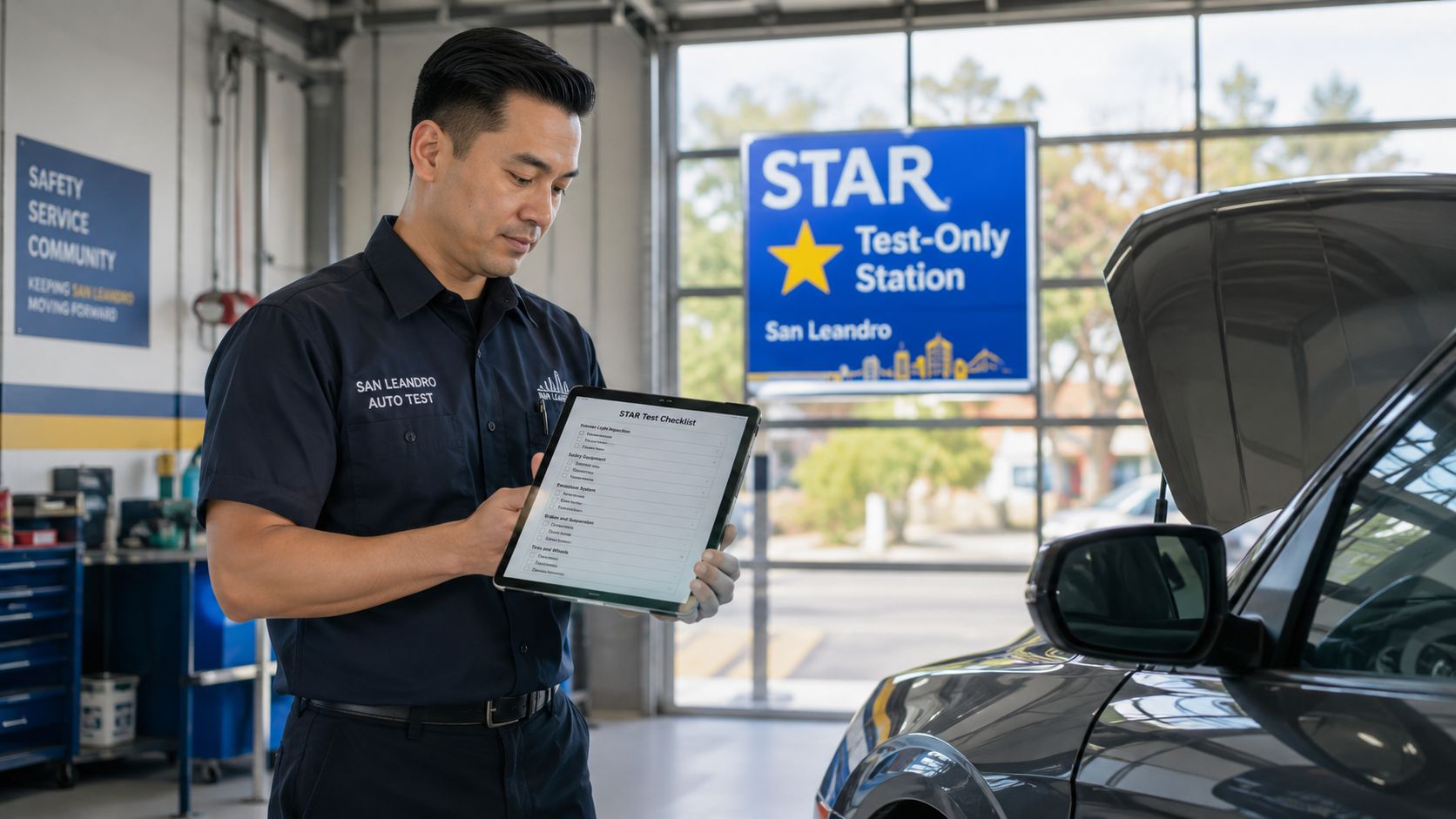
A 30-day playbook that actually works
Use the month before renewal like this:
- Check exemption status early. Don't wait until the due date to find out the car never needed testing.
- Watch the warning lights. A lit check-engine light means you're not ready.
- Give the car real drive time. Readiness needs miles, not wishful thinking.
- Choose the correct station type. Standard, STAR, and test-only are not interchangeable.
- Plan for the retest path. Keep the report and use it if the first visit doesn't pass.
That routine beats improvising on the last day of the month. It also keeps you from paying for a problem that should have been caught in your driveway.
Fire House Smog is one option for drivers who want a STAR-certified test-only smog check and DMV-related registration help in one stop, but the bigger lesson is the same no matter where you go. Treat the appointment like a readiness checkpoint, not a race. If you want a cleaner renewal cycle next time, start with the car, pick the right lane, and show up only when the vehicle is ready.