
California Vehicle Inspection: 2026 Smog Check Guide
You've got the renewal notice in your hand, the dash light is staring back at you, and now you're trying to figure out whether you need a smog check, a safety inspection, or both. California makes people work too hard for a simple answer, so here it is straight, a California vehicle inspection usually means an emissions test for registration, not a generic mechanic inspection, and the wrong assumption costs time and money.
The fastest path is to separate the two programs in your head before you book anything. Smog checks are the common requirement for registration renewal, while safety systems inspections show up in narrower situations like out-of-state cars, revived salvage vehicles, specially constructed vehicles, motorcycles, and some trailers over 3,000 pounds GVWR. If you treat them like the same thing, you'll book the wrong appointment, show up unprepared, and pay for a retest you didn't need.
Table of Contents
- Understanding What Your California Vehicle Inspection Actually Requires
- Determining Your Eligibility and Exemption Status
- Pre-Inspection Checklist to Maximize Your Pass Rate
- What Happens During Your Smog Check Appointment
- Completing Your DMV Registration Without a Separate Office Visit
- Fire House Smog Services and How to Schedule Your Visit
Understanding What Your California Vehicle Inspection Actually Requires
Smog Check vs. Safety Inspection
A lot of drivers walk into this confused because the DMV notice just says “inspection” in the broad, everyday sense. In California, that's sloppy language for a very specific process. The common requirement is a smog inspection tied to registration, while a separate vehicle safety systems inspection is triggered by specific vehicle histories and classes, not by ordinary annual ownership of a passenger car. California's smog inspection overview makes that split clear.
If you own a normal privately owned passenger vehicle, don't assume you need an annual safety inspection. You usually don't. What you usually need is the emissions side of the equation, which is why so many drivers search for a California vehicle inspection when they really need a smog appointment.
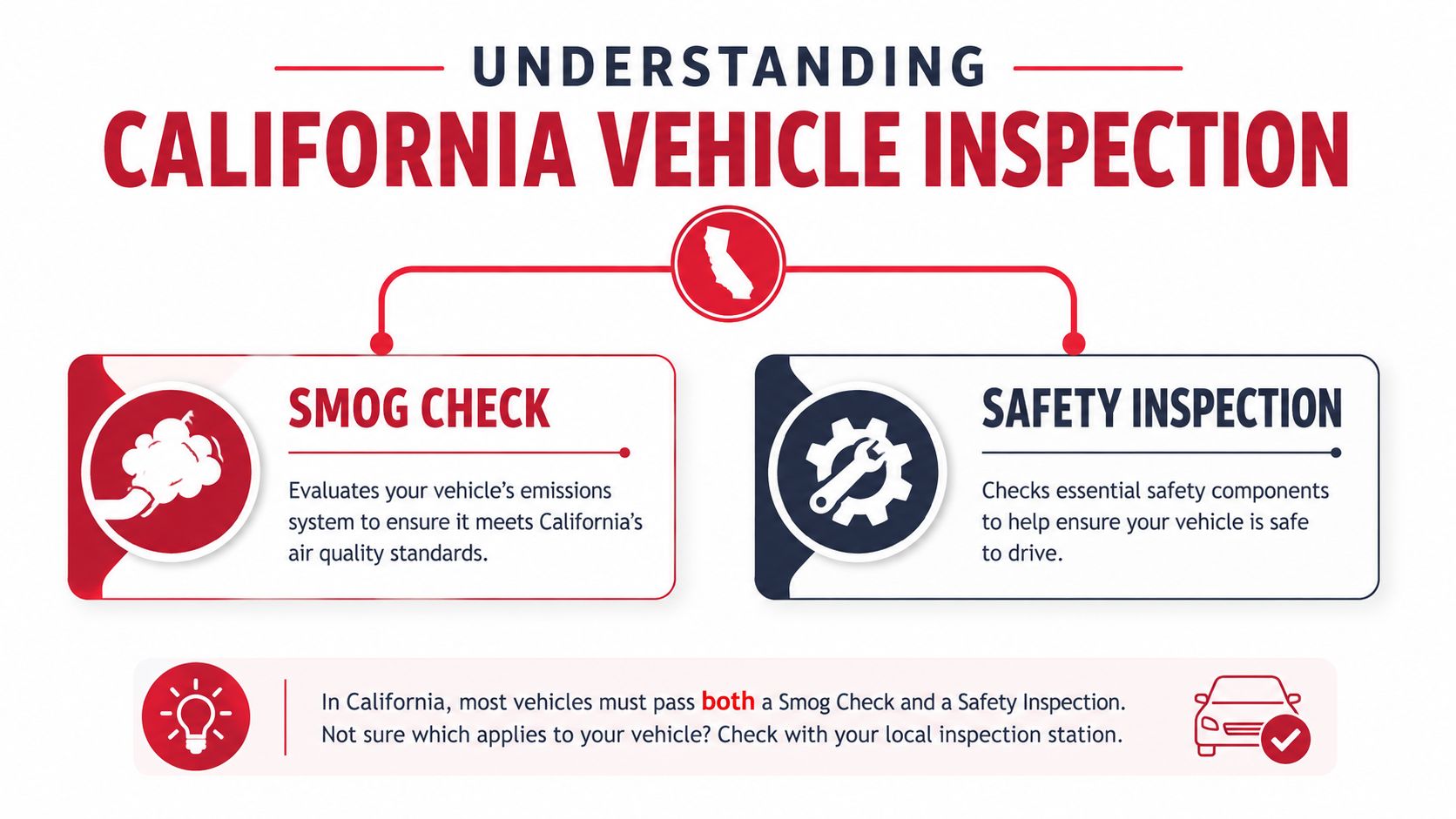
Practical rule: if the car is due for registration renewal, think smog first, safety inspection only if the vehicle history or type triggers it.
That distinction matters because the wrong appointment doesn't just waste time, it sends you to the wrong lane. If the car needs emissions compliance, a test-only smog station is the correct stop. If it needs a separate safety systems verification, the paperwork and inspection path are different, and DMV and BAR guidance treat them as separate programs.
A good way to keep yourself out of trouble is to ask one blunt question before scheduling, “What problem am I solving, registration smog compliance or title/safety verification?” If you can answer that, you've already avoided the biggest consumer mistake around California vehicle inspection rules. For a simple emissions-specific explainer, see California emissions standards and smog basics.
Determining Your Eligibility and Exemption Status
How California Decides Who Gets Tested
California does not guess at smog obligations. It uses model year, fuel type, vehicle class, and registration history to decide whether a vehicle needs testing. The BAR January 2024 summary shows the program is still very active, with 952,481 initial tests and 80,936 failures, for an 8.50% initial-test failure rate, and 1,029,286 total tests with 92,532 failures, for an 8.99% overall failure rate, so this is still a real compliance checkpoint, not a box to check. BAR January 2024 Executive Summary
The smart move is to verify the exemption before you book, not after you are already at the station.
California keeps some exemptions narrow and others broad. BAR lists the program as biennial, and the official exemption framework includes gasoline vehicles 1975 and older, diesel vehicles 1997 and older or over 14,000 pounds GVWR, and natural gas vehicles over 14,000 pounds. Those carveouts are why most inspection volume lands on newer gasoline, hybrid, and eligible light-duty diesel vehicles.
Here is the decision framework I use with customers:
| California Smog Check Exemption Rules | Vehicle Type | Exemption Criteria | Notes |
|---|---|---|---|
| Gasoline passenger vehicles | 1975 and older | Exempt from smog inspection | Old enough to fall outside the regular smog program. |
| Diesel vehicles | 1997 and older, or over 14,000 pounds GVWR | Exempt from smog inspection | Weight and model year both matter. |
| Natural gas vehicles | Over 14,000 pounds | Exempt from smog inspection | Heavy natural gas vehicles are treated separately. |
| Newer gasoline vehicles | Less than 8 model years old | Exempt from smog inspection under DMV rules | The exemption changes the timing for many late-model cars. |
| Very new gasoline vehicles | Less than 4 model years old | May pay a smog abatement fee instead of getting inspected for the first 8 registration years | This is the rule people miss most often. |
That last rule catches a lot of drivers. DMV says gasoline-powered vehicles less than eight model years old are exempt from smog inspection, but starting January 1, 2019, vehicles less than four model years old may pay a smog abatement fee instead of getting inspected for the first eight registration years. That means newer cars do not all follow the same path, and you should not trust old advice from a friend or an outdated forum thread. DMV smog inspection rules
If you are unsure, check the model year, fuel type, and whether the vehicle has a special title or registration history. That is the only reliable way to make the right call before you spend money on the wrong inspection. If you want to avoid a useless visit, read this quick guide to common reasons a smog check fails before you book.
Pre-Inspection Checklist to Maximize Your Pass Rate
What to Fix Before You Show Up
A failed smog check costs more than the inspection fee. You pay for repairs, then you pay again to come back, and the retest process burns time you did not need to lose. The smart move is simple, show up with the car already sorted and ready for a clean emissions test, especially if you want the same trip to cover smog testing and on-site DMV registration at a test-only station. BAR's procedure puts weight on vehicle configuration, test sequence, and properly maintained equipment, so a sloppy arrival usually turns into avoidable delay. Smog Check manual
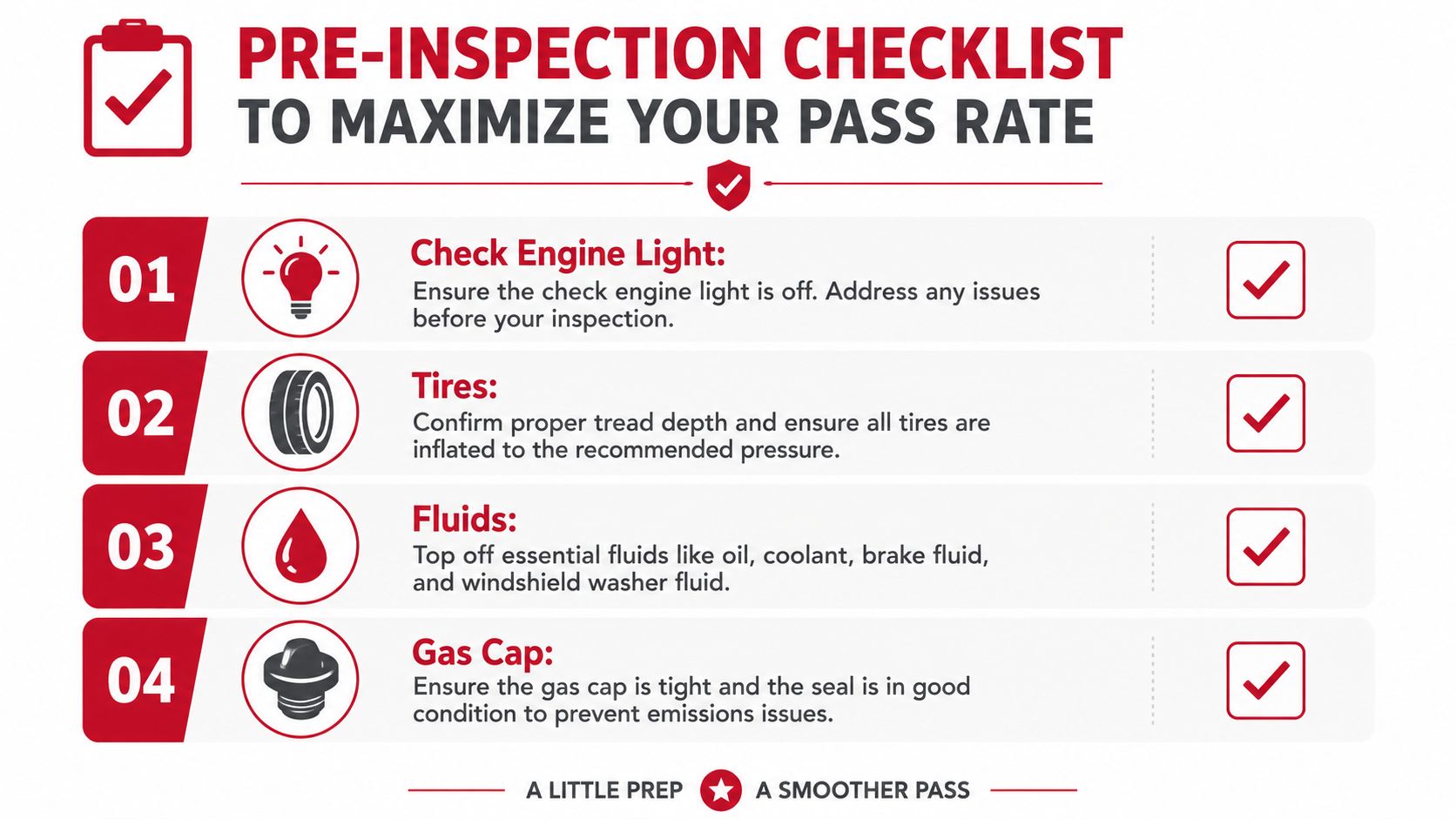
Here is the checklist I give drivers who want to avoid retest pain:
- Check Engine Light off: If the light is on, stop there. Diagnose the fault first.
- Drive cycle completed: After battery disconnects or repairs, give the car enough normal driving time for the onboard monitor to reset.
- Tire pressure and basic fluids checked: Low pressure, neglected oil, or ignored coolant issues are signs the car has not been prepped properly.
- Gas cap tightened properly: A loose cap creates a preventable failure and wastes a visit.
- Accessories off at arrival: Turn off the A/C, radio, seat heaters, and anything else that adds load.
- Transmission in park or neutral: Roll in correctly. A bad setup can stop the test from moving forward.
- Paperwork ready: Bring the registration notice, insurance if required, and any prior repair records so the counter goes fast.
Simple rule: if the car is not behaving normally on the drive over, it is not ready for the test.
The reason this matters is the visual inspection and mode test work together. Technicians check for tampered or missing emissions parts, confirm the vehicle is set up correctly, and then follow the required test path. If the car shows up in the wrong configuration, in the wrong gear position, or with equipment that is past calibration, you are setting yourself up for a retest instead of a pass. Smog Check manual
If the check engine light has been on recently, use the visit as your deadline, not your diagnosis tool. Clearing codes without fixing the cause only buys you a second failure. For the common reasons drivers get stuck, read the main smog check failure causes.
What Happens During Your Smog Check Appointment
From Check-In to Certification
A test-only station should feel organized the moment you arrive. You pull in, hand over the paperwork, and the technician confirms the vehicle's setup before the inspection starts. That step catches obvious problems early, before you waste time on a test that was never going to count.
The visual inspection comes first. The technician checks for missing, altered, or incorrectly installed emissions parts, then runs the required mode test. For the BAR Snap Test, the accelerator is pressed quickly from idle to between 2,000 and 3,000 RPM and released right back to idle. That is a specific procedure, not a casual rev, and the car needs to be in the right condition before the test begins. The equipment used in the inspection also has to be maintained and calibrated to the required standards. Smog Check manual
If the vehicle shows up with the wrong setup, the wrong gear position, or any condition that disrupts the test path, expect delay or a retest. That is how drivers lose time and pay twice. The easy fix is simple, arrive with the car behaving normally and let the station follow the correct sequence.
When the inspection ends, you receive a Vehicle Inspection Report. If the car passes, that report is the piece that supports the registration process. If it fails, the report tells you what needs attention instead of leaving you to guess. A test-only station keeps that part clean, because the station is there to test the car, not sell you repairs before you understand the failure.
The workflow is faster at a station built around inspection volume, especially when the bays stay moving and the staff follows the same order every time. That means less waiting, fewer handoffs, and a clearer trip from check-in to result. If you want to see how the smog result can feed straight into registration without a separate DMV visit, use this California DMV registration renewal service as the next step after the test.
Completing Your DMV Registration Without a Separate Office Visit
How the Smog Result Connects to Renewal
You pass the smog test, and the job is still only halfway done if you have to leave and stand in line at the DMV. A station that handles registration on-site turns that into one stop, which is the cleanest way to finish a renewal or title transfer without losing the rest of your day.
A licensed registration services provider can take the passing result and move straight into the DMV side of the transaction. That means the sticker can be printed on-site, and transfer paperwork can be handled without a second office visit. If you have ever tried to fit a smog appointment, a DMV queue, and a work schedule into the same day, you already know why this saves time. The state's smog rules treat the inspection as part of the renewal process, not a separate errand, and California DMV registration renewal services can help keep that handoff in one place.
Timing is the advantage. Once the inspection result is ready, the registration work can start right away instead of waiting for another appointment, another line, or another day off. That matters for out-of-state vehicles, title transfers, and drivers who want one location to handle both the emissions test and the paperwork.
If renewal is the goal, keep the inspection and DMV work together unless you have a good reason to split them.
That approach saves money in the real world. Every extra trip uses fuel and time, and a failed retest gets worse when the paperwork is still scattered. The better workflow is straightforward, arrive with the right documents, pass the inspection, and finish the registration while the result is still fresh.
Fire House Smog Services and How to Schedule Your Visit
Booking, Hours, and Retest Policy
Fire House Smog is a STAR-certified test-only station and licensed DMV registration services provider in Antioch, California. The setup is built for speed, with a drive-through layout, parking, and two bays that help cut down wait time. Smog test availability runs seven days a week, while DMV service hours are Monday through Saturday 9:30 AM to 5:00 PM and Sunday 12:00 PM to 4:00 PM.
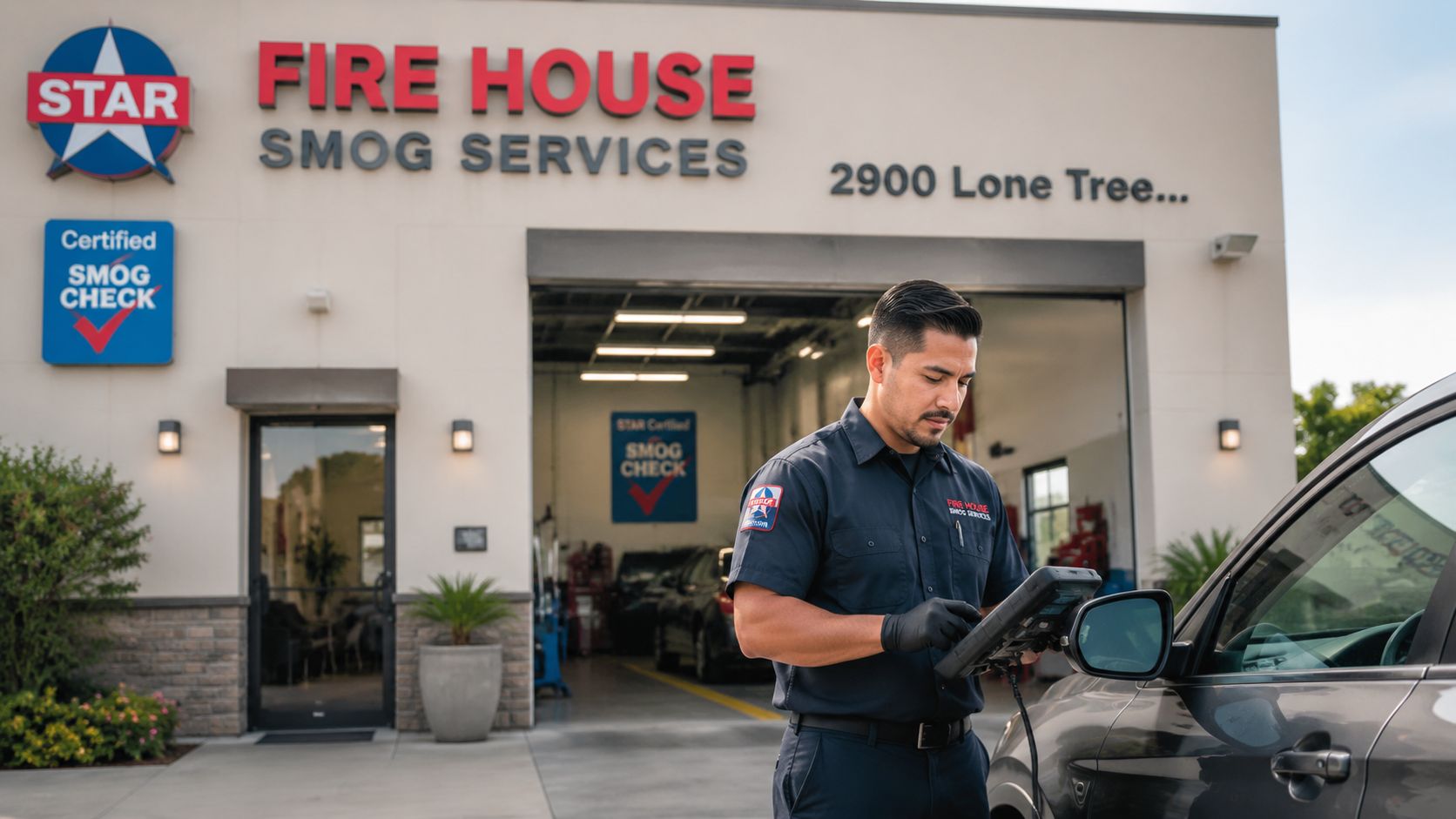
The station works on passenger cars, SUVs, light-duty trucks, and some RVs and motorhomes when the size and equipment fit the lane and bay limits, so call ahead before you bring something oversized. That matters because a test-only station is there to handle emissions testing first, then the DMV paperwork if you need it. If the car fails, ask about the retest policy before you pay and leave. A free retest can save you from paying for the same problem twice, as long as you follow the site rules and coupon terms. For questions or scheduling, call 925-754-1600.
Use the coupons if they apply, bring the right paperwork, and show up with the car ready for inspection instead of trying to sort out a fault code in the parking lot. That is how you avoid wasting time, and it is the fastest way to keep a failed visit from turning into another full-price return trip. A clean California vehicle inspection comes down to preparation and the right order of operations, not luck.
If you want one stop for emissions testing and DMV registration tasks, visit Fire House Smog and book the appointment that fits your schedule.