You're at a two-bay test-only station on a Wednesday afternoon. One vehicle is already on the dynamometer, another is idling outside with its check-engine light glowing, and a third driver is staring at a phone, deciding whether to wait or leave. Everyone has the same question: will this quick STAR smog visit take about twenty minutes, or will it consume the afternoon?
The test itself can be short. The line isn't always short. Vehicle condition, readiness monitors, paperwork, bay availability, staffing, and the cars ahead of you determine how quickly you leave. California's Smog Check program is large and active, with 11,275,981 initial tests and 12,200,718 total tests recorded in 2025, while the initial failure rate was 8.51% and the overall failure rate was 9.04% according to the California Smog Check executive summary.
A quick visit is therefore a workflow outcome, not a promise printed on a sign. The practical questions are simple: does the station have a process that keeps bays moving, and have you brought in a vehicle that can complete the inspection?
Table of Contents
- The 20-Minute Question Every Driver Asks
- What STAR Certification and Test-Only Really Mean
- How a Test-Only Station Moves Cars Through Fast
- Documents, Prep, and the Actual Test Sequence
- Realistic Turnaround Times by Scenario
- Hours, Fees, Coupons, and the Free Retest Rule
- Practical Tips to Cut Your Wait
- Deciding Whether a Quick STAR Visit Is Right for You
The 20-Minute Question Every Driver Asks
At 2:15 on a normal weekday, a two-bay station can look busy without being backed up. One technician may be finishing a dynamometer test while another checks paperwork and connects an OBD scanner. A car outside with a warning light can change the rhythm immediately, because the technician may need to stop the normal sequence and explain that the vehicle isn't ready to pass.
That's why drivers confuse test time with wait time. A clean, prepared vehicle can move through the inspection promptly, but your total visit depends on what arrived before you. One bay may be occupied by a vehicle that needs a tailpipe procedure, while the other is handling a visual inspection, payment, and certificate paperwork. If the station has fewer technicians than open bays, the extra space won't help much.
Practical rule: Ask, “How many cars are ahead of me, and are both bays running?” That answer is more useful than a generic promise that the test is fast.
The best stations engineer speed around repeatable handoffs. They review the customer's paperwork before pulling the vehicle in, screen for warning lights and readiness problems, and keep repair discussions out of the testing lane. You control some of that outcome by arriving prepared. The station controls the rest through its certification standards, bay layout, staffing, equipment, and retest policy.
The central point is straightforward. Quick STAR smog service means fewer avoidable interruptions, not a relaxed inspection. California's STAR framework measures station performance, and the Bureau of Automotive Repair's STAR FAQ explains that short-term measures are updated monthly, pass/fail decisions are made quarterly, and the Follow-up Pass Rate is updated twice a year, in January and July.
What STAR Certification and Test-Only Really Mean
STAR certification is a performance designation from California's Bureau of Automotive Repair. It applies to stations that meet controlled performance standards, including similar-vehicle failure rates, gear-shift incidents, and excessive test deviations. The BAR STAR program requirements specify a Similar Vehicle Failure Rate of at least half the industry-wide failure rate for similar vehicles, a Gear Shift Incident rate no higher than 2%, and an Excessive Test Deviation Rate of no more than 1.
Those standards explain why a DMV notice may direct you to a STAR station. In 2025, STAR-certified stations represented 49% of licensed stations but performed 83% of all Smog Check tests, according to the 2026 Smog Check Performance Report information published by BAR. That concentration makes STAR a defined quality-control program, not a casual label for any shop that offers emissions testing.
Use a test-only station when repairs should stay out of the inspection
A STAR station can be test-only or test-and-repair. Test-only means the business performs the inspection but does not sell or perform the emissions repairs identified during it. That separation keeps the testing decision apart from the repair sale.
A test-only station may be appropriate or required for directed testing, including vehicles identified through DMV notices, certain gross-polluter procedures, and some ownership or registration situations. Check your renewal notice before booking. If it directs you to STAR, choose a STAR station rather than assuming any smog check will satisfy the requirement.
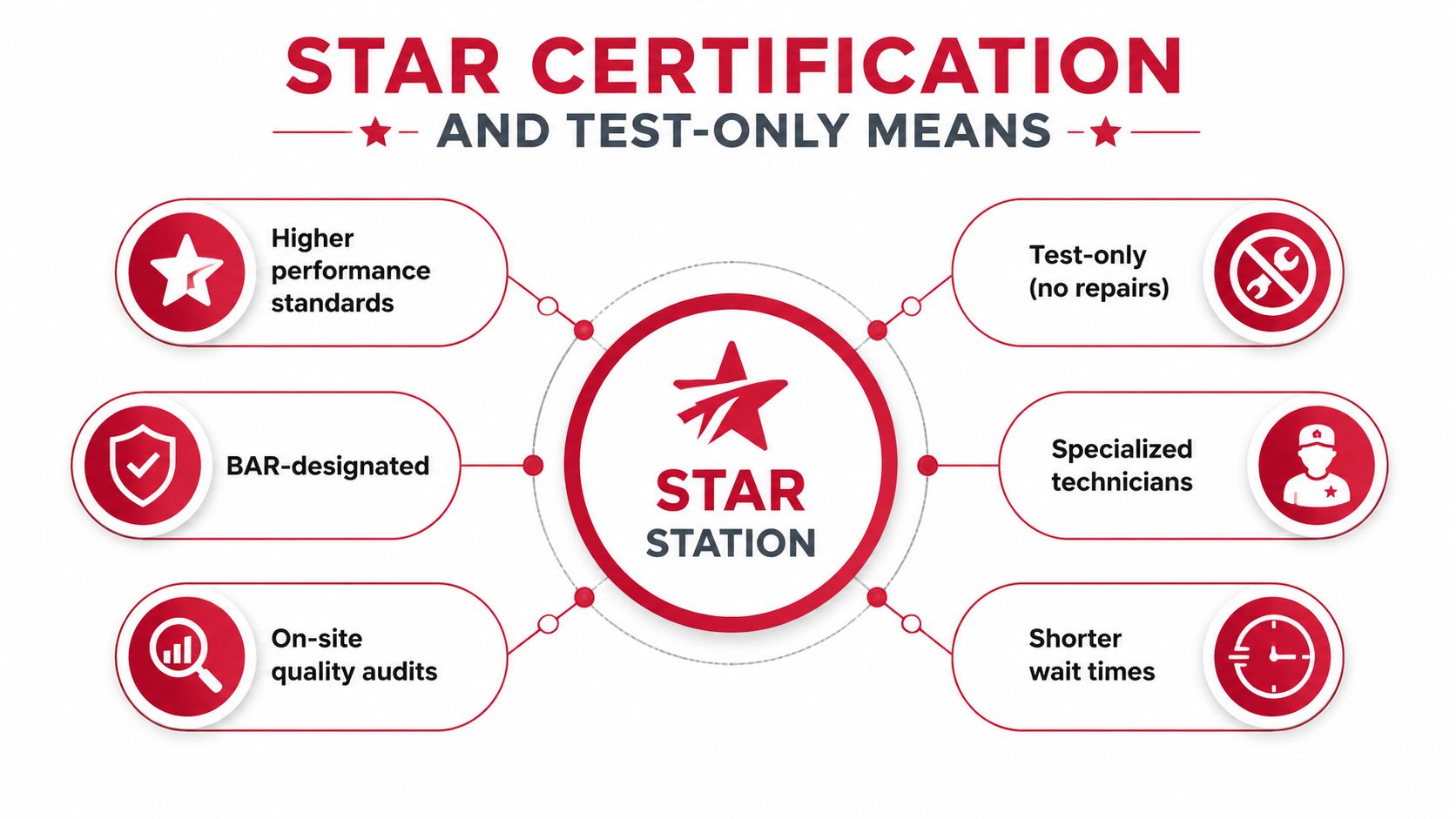
Test-only does not mean the inspection uses a tougher standard. The station follows California's approved procedure, including the applicable visual, OBD, dynamometer, or tailpipe elements. It also cannot issue a repair waiver or sell the repair needed after a failure.
For a plain-language explanation, read this guide to what STAR-certified smog means. The practical takeaway is simple: confirm the notice requirement, select the correct station type, and bring the vehicle in ready for the approved test.
How a Test-Only Station Moves Cars Through Fast
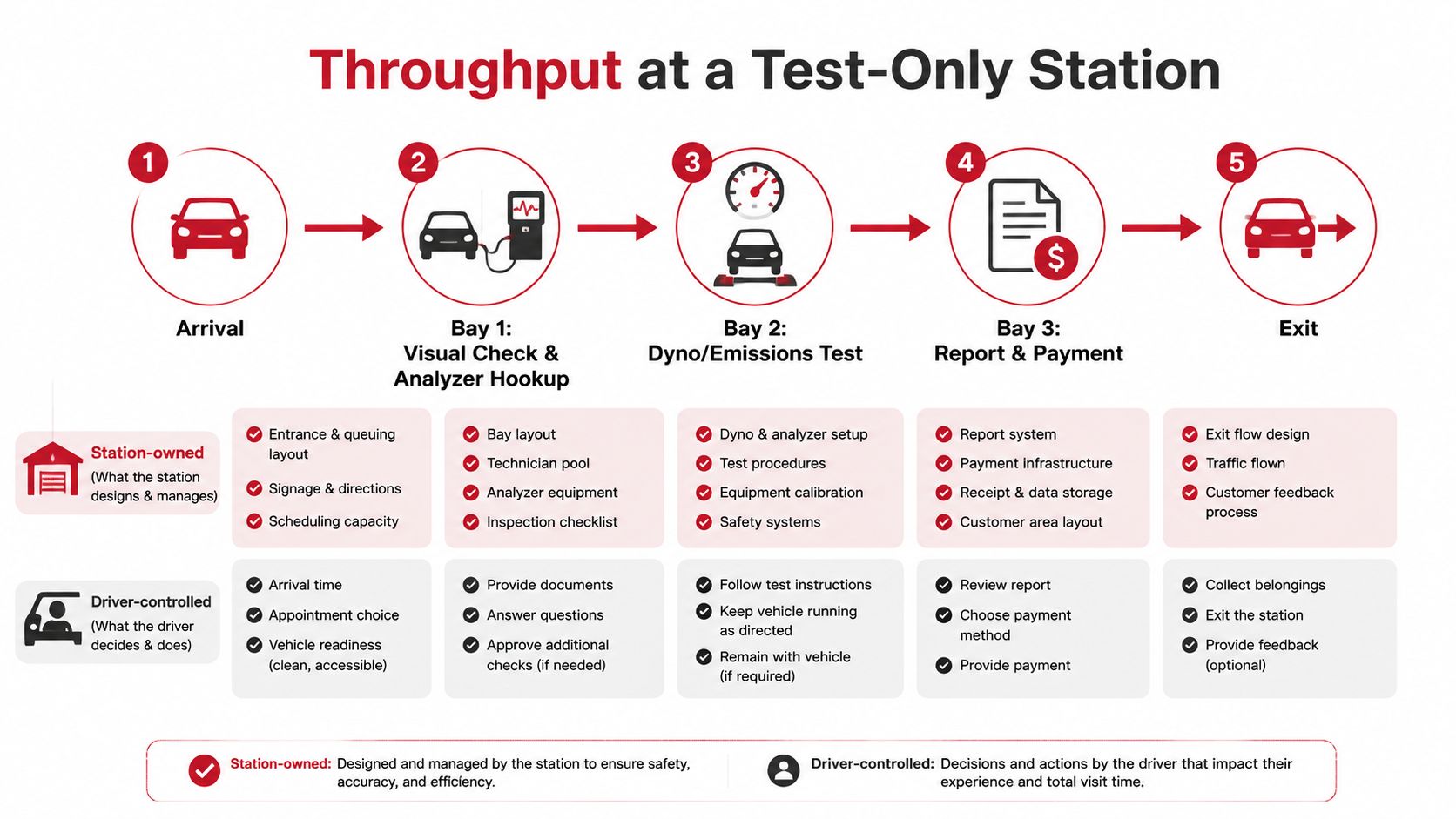
A fast station treats each vehicle as a sequence of handoffs. It doesn't let every appointment turn into an open-ended diagnosis. The technician confirms eligibility, checks the vehicle for obvious test blockers, connects the equipment, completes the required inspection, and prints the result.
At a two-bay station, the layout matters. One bay may handle an OBD-focused inspection while the other handles a dynamometer procedure. When the staff is coordinated, one vehicle can be leaving as another enters. When only one technician is working, both bays may exist but only one can move.
The station controls the process
A station's operational levers include:
- Bay assignment: Staff can send each vehicle to the appropriate equipment instead of creating unnecessary shuffling.
- Pre-screening: A quick check for a warning light, readiness issue, leaking fluids, or obvious modifications prevents wasted bay time.
- Paperwork preparation: Pulling registration details together before the inspection keeps the certificate and payment steps from becoming a bottleneck.
- Standardized testing: A defined sequence prevents technicians from wandering into repair diagnostics that a test-only facility isn't there to perform.
You control the other half. Bring your renewal notice or registration, disclose recent battery work or cleared codes, and don't arrive with a dashboard warning light you hope the technician won't notice. The technician will inspect the vehicle as presented, not as you wish it were presented.
The biggest bottleneck is often readiness, not the analyzer. If a vehicle's monitors aren't complete, the inspection may stop before the emissions portion can produce a valid result. California's OBD readiness regulation update says that, effective October 1, 2025, all readiness monitors must be set to pass. A station can be efficient, but it can't manufacture a completed drive cycle in the bay.
Documents, Prep, and the Actual Test Sequence
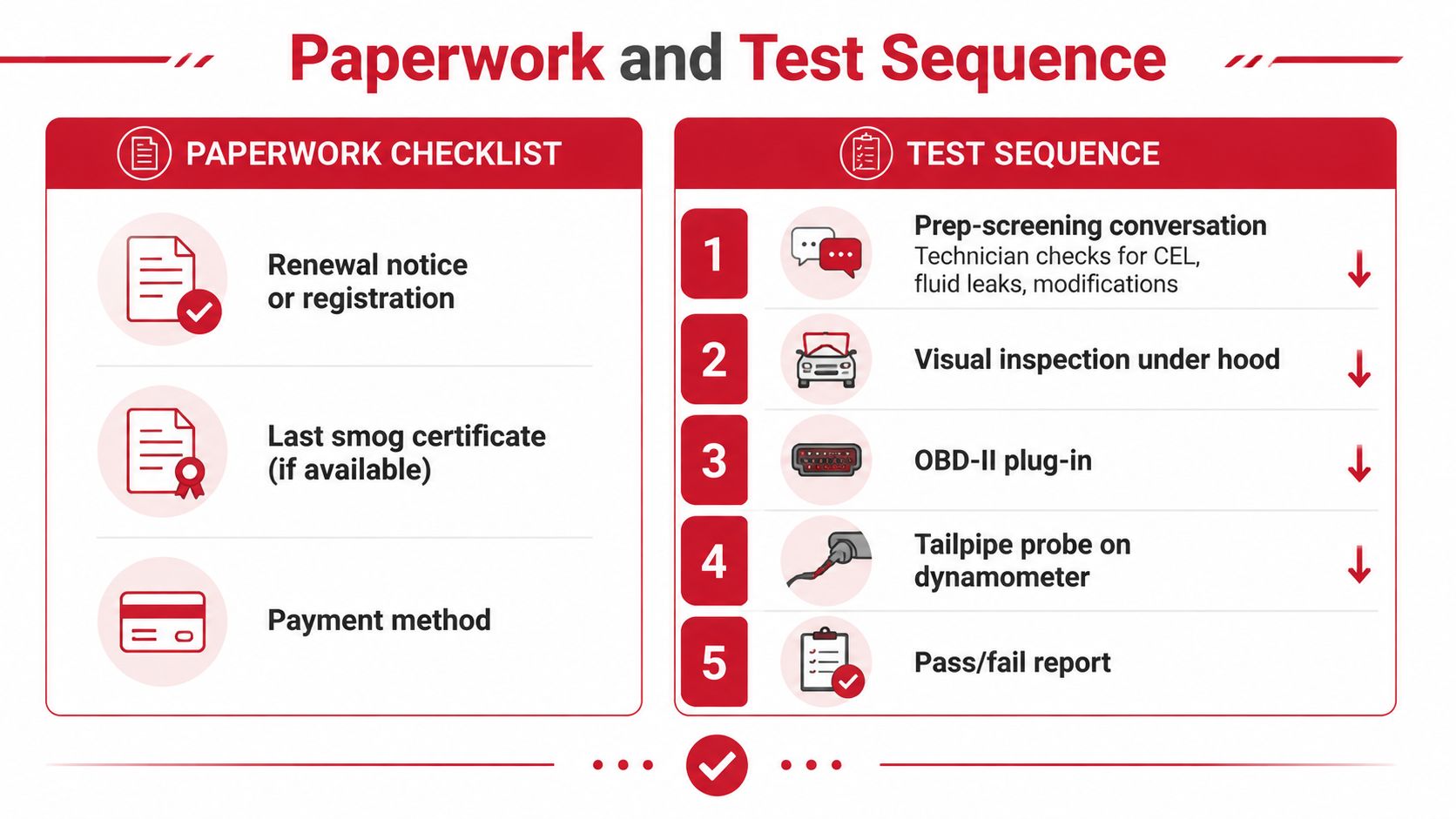
Bring the documents that let the technician identify the vehicle and complete the transaction without interruption. Your preparation folder should contain:
- Renewal notice or registration: The notice tells the technician what DMV event you're handling and whether STAR certification is specified.
- Last smog certificate, if available: It can help clarify recent testing history, though the station can determine the current inspection requirements.
- Payment method: Ask about accepted payment types and the total before the vehicle enters the bay.
The technician's pre-screening conversation is short, but answer it accurately. Mention a recent battery disconnect, cleared diagnostic codes, a repair that involved the engine computer, or a vehicle that has been sitting for an extended period. Those details can point to incomplete monitors even when the malfunction indicator lamp, commonly called the check-engine light, is off.
Readiness is not the same as a warning light
The malfunction indicator light tells you that the vehicle's onboard diagnostic system has detected a qualifying fault. Readiness monitors tell the technician whether the vehicle has completed its required self-checks. A light can be off while the monitors remain incomplete, especially after the battery has been disconnected or codes have been cleared.
For 1996-and-newer spark-ignition passenger vehicles and trucks under 14,001 GVWR, California's OBD II inspection checks the malfunction indicator light, fault codes, and readiness monitors, as described by BAR's OBD inspection guidance. The technician may reject or pause the test before emissions measurement if the vehicle shows a warning light, has incomplete required monitors, presents an inaccessible diagnostic connector, or has an obvious condition that prevents safe testing.
What happens in the bay
The sequence generally follows the vehicle's model year and equipment:
- The technician confirms the vehicle information and performs the initial screening.
- The station completes the required visual inspection, including relevant emissions equipment and warning indicators.
- The technician connects the OBD II interface when the vehicle uses that procedure.
- The vehicle undergoes the applicable tailpipe or dynamometer inspection.
- The station prints the pass or fail report and submits the certificate information through the state system.
A pass completes the emissions side of the visit. A failure produces a report that identifies the reason, but a test-only station won't become your repair shop. That clear boundary is useful because it keeps the inspection focused and lets you choose where to address the problem.
Realistic Turnaround Times by Scenario
A quick visit depends on the vehicle arriving ready, the bay available, and the station's screening process. A normally driven vehicle with complete monitors can move through a routine inspection. A warning light, incomplete readiness status, or older testing procedure can stop that workflow before a certificate is issued.
Use these ranges for planning, not as promises. Queue length, vehicle type, required procedure, and the technician's initial findings determine the actual visit time.
| Vehicle Scenario | Typical Visit | Notes |
|---|---|---|
| Clean, prepared vehicle with monitors complete | About 15 to 20 minutes | Fastest path when a bay is open and paperwork is ready |
| Vehicle with an incomplete monitor | Longer than a routine visit | The technician may stop the test and explain that more driving is required |
| Vehicle with the check-engine light on | No reliable quick turnaround | A passing certificate may require repairs and completed monitors first |
| Older vehicle requiring a tailpipe and dynamometer procedure | Longer than a modern OBD-only visit | Extra equipment and emissions steps add time |
Do not plan around the shortest scenario. A station can complete a failed test quickly, yet the visit still wastes time if the vehicle was not ready. See the readiness rules discussed earlier in this article before booking.
A test-only station cannot turn a check-engine-light vehicle into a passing inspection because you are in a hurry. Get a diagnostic assessment from a repair provider, fix the cause, complete the required driving, and return for testing. The station's bay count and retest policy affect how quickly you can recover from a failure, so ask about both before you arrive.
For more detail on queues, preparation, and inspection steps, review this guide to how long a smog check takes.
Ask the station a more useful question than “Can you do it in twenty minutes?” Confirm that your vehicle is ready, ask how many cars are ahead of you, and verify whether the station has an open bay. That workflow check gives you a realistic arrival-to-departure estimate.
Hours, Fees, Coupons, and the Free Retest Rule
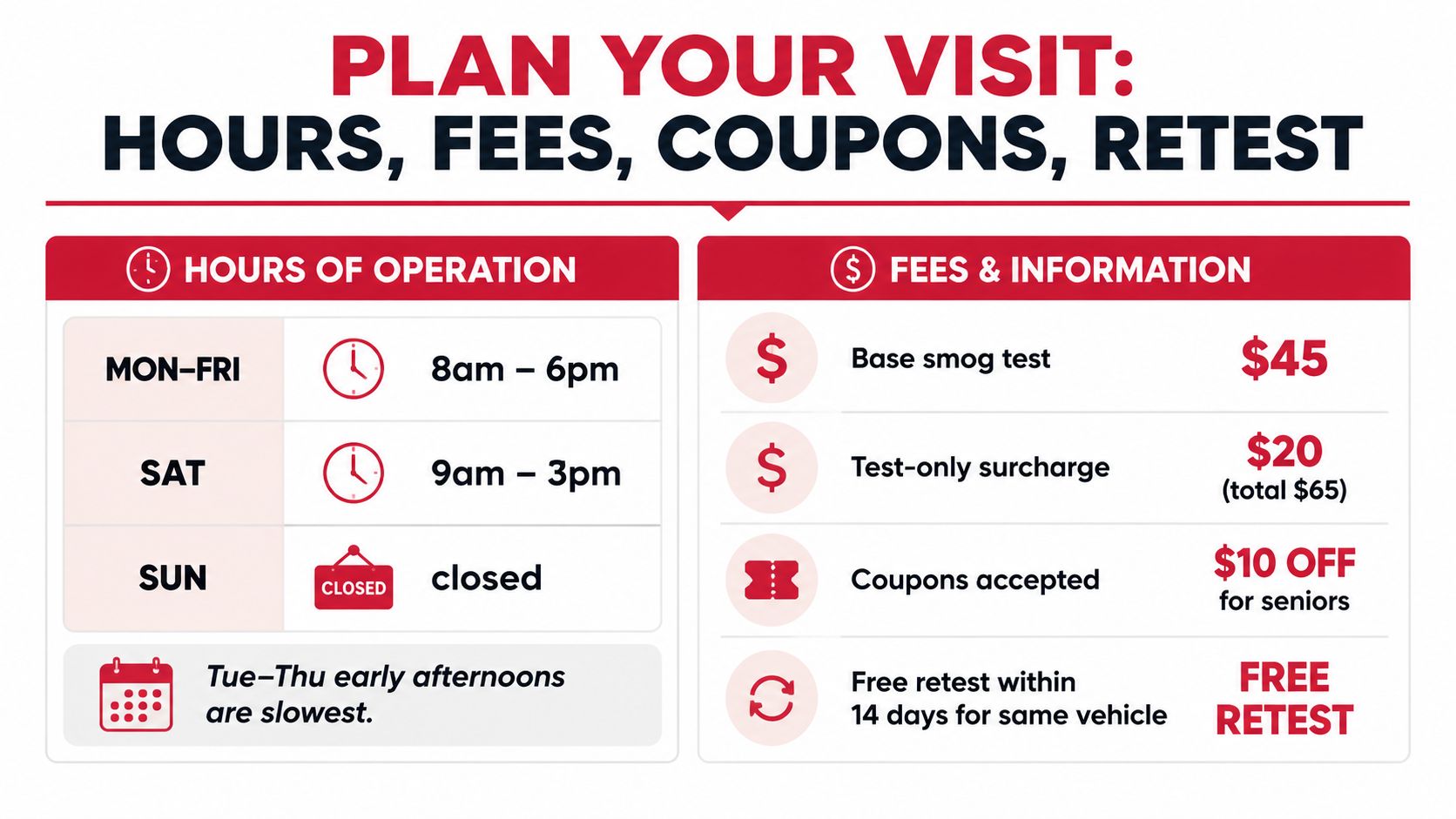
A fast visit starts with the station's real schedule, not a search listing. Check operating hours before leaving, then call if your vehicle has unusual equipment, a motorhome, a directed notice, or a recent failed test. Midweek mornings often produce a calmer queue than Monday, Saturday, lunch periods, or the final stretch before closing.
Ask for the full price before authorizing the test. California's mandatory state certificate fee is $8.25, and recent 2026 reporting placed the statewide average inspection cost at $68.56 before that fee, according to this California Smog Check 2026 cost and compliance update. The station may list a separate testing price, vehicle-type charge, payment fee, or convenience fee. Confirm the complete out-the-door amount.
Read the coupon terms before booking
Coupons apply under specific conditions. Check the vehicle class, service type, expiration terms, and participating station before you rely on the advertised discount. A free retest may require the original inspection to have been performed at that station, a return within the stated validity period, and the original paperwork or coupon.
Use this wording when you call:
“If my vehicle fails today, what exactly qualifies me for a free retest, how long is the offer valid, and do I have to return to the same station?”
Do not assume another shop will honor the offer. Do not assume the retest includes diagnosis or repairs. A test-only facility may waive the retest inspection under its policy while charging separately for outside repair work or another service. Ask what the policy covers before you leave after a failure.
A directed STAR notice can limit your station choice even when the vehicle appears ordinary. BAR updates performance measures on different schedules, so STAR selection is not based on one permanent label. Follow the DMV direction first, then compare price, bay availability, retest terms, and whether the station can process the related registration task.
As noted earlier, California's updated readiness rule requires all monitors to pass. For coupon terms and a focused list of questions, review this guide to a STAR smog test coupon. The useful comparison is the total cost after a pass, failure, or repeat visit, not the lowest advertised entry price.
Practical Tips to Cut Your Wait
The highest-value preparation happens before you leave home. Use this order, because it separates actions that prevent a wasted trip from tricks that merely sound automotive.
Call ahead for screening. Tell the station your vehicle's model year, whether the check-engine light is on, whether the battery was recently disconnected, and whether the DMV notice says STAR. A technician can often tell you whether the visit makes sense before you spend time driving there.
Choose the right arrival window. Midweek, midmorning visits usually give you a better chance of finding an open bay than Monday or Saturday rush periods. Avoid the lunch window and the last part of the day, when unfinished vehicles and paperwork can stack up.
Verify readiness with a scan tool. If you own an OBD II reader, check monitor status before booking. If you don't, ask a qualified technician to check it. California's current readiness rule makes this more important because all readiness monitors must be set to pass under the rule effective October 1, 2025, according to the BAR explanation of the updated OBD readiness requirements.
Drive normally after repairs. A vehicle that recently had codes cleared or a battery disconnected may need a manufacturer-specific drive cycle. Don't guess at the distance or route. Follow the vehicle's service information, and don't book the smog test until the monitors show ready.
Skip the myths
Running premium fuel, adding a mystery fuel additive, or arriving with an almost empty tank isn't a substitute for proper readiness. Those habits don't repair a failed oxygen sensor, restore a missing catalyst, or complete a monitor that hasn't run. Bring the car in normal operating condition, with properly inflated tires if the vehicle will use a dynamometer, and with the diagnostic connector accessible.
Have your registration and renewal notice in one folder. Remove clutter from the cabin, make sure the technician can access the dashboard, and disclose modifications rather than hoping they go unnoticed. These details won't change a failing emissions system, but they can prevent needless handling delays.
Deciding Whether a Quick STAR Visit Is Right for You
The fastest visit starts before you enter the bay. Decide whether the car is ready or needs screening first.
Book a quick STAR smog visit when the vehicle has been driven normally, the check-engine light is off, no recent battery reset or code clearing interrupted the monitors, and your registration paperwork is ready. Follow the DMV notice, confirm the station is STAR certified, ask about the current queue, and let the technician complete the inspection. Bay availability, readiness screening, and a clear retest policy determine speed more than a “quick” label.
Prepare first if the warning light is on, the vehicle was recently repaired, the battery was disconnected, the car has been sitting, or you already know a monitor is incomplete. A paid pre-inspection or diagnostic scan can cost less than a failed testing trip followed by another appointment. A test-only station can identify the failure, but it will not sell the repair that resolves it.
California requires a Smog Check for all out-of-state 1976 model-year and newer vehicles registering in California for the first time, along with other initial registration events determined by the DMV. The January 2026 BAR report cited earlier covers those requirements. It also explains that 100% battery-electric vehicles are exempt, while hybrids and plug-in hybrids remain subject to biennial inspection. Confirm your vehicle's category before booking.
Reserve an appointment, or visit promptly after receiving the renewal notice instead of waiting until the deadline. Bring the notice, registration details, and vehicle information in one folder. If you're in Antioch or East Contra Costa County, Fire House Smog is a STAR-certified test-only station at 2900 Lone Tree Way. Ask the station to confirm readiness screening and retest eligibility before you arrive.