
You're renewing a diesel vehicle registration when a notice mentions emissions compliance, and one question immediately comes up: what does California diesel emission cover? For a passenger diesel, the answer may involve a conventional smog inspection. For a work truck, bus, motorhome, or fleet vehicle, it may involve a different program, additional reporting, or equipment requirements.
The phrase covers more than visible smoke from a tailpipe. It includes pollutants such as nitrogen oxides, particulate matter, and carbon dioxide, along with the tests, filters, monitors, engine standards, and fleet rules California uses to control them. The most important distinction today is between light-duty smog checks and the growing compliance system for heavy-duty and off-road diesel equipment.
This guide translates those rules into practical language. You'll learn what diesel engines produce, why California regulates them aggressively, which program may apply to your vehicle, how emissions are measured, and what steps can help you prepare for testing or fleet compliance.
Table of Contents
- What California Diesel Emission Means for Everyday Drivers
- How Diesel Engines Create Emissions You Can Understand
- Why California Regulates Diesel More Strictly Than Other States
- Light Duty Smog Checks Versus Heavy Duty Clean Truck Check
- How Diesel Emissions Are Measured and Reported in California
- What Diesel Owners Can Do to Stay Compliant in California
- Staying Ahead of California Diesel Emission Changes
What California Diesel Emission Means for Everyday Drivers
You are renewing a diesel vehicle's registration when the notice mentions emissions compliance. The first question is usually simple: do you need a smog inspection, or does another California program apply? The answer depends on the vehicle's weight, use, engine, equipment, and operating location, not on the word “diesel” alone.
For a light-duty diesel car, SUV, or pickup, the immediate requirement may be a California smog inspection connected with registration. A work truck, bus, motorhome, or fleet vehicle follows a different regulatory path. California's heavy-duty Truck and Bus Regulation applies to nearly all diesel-powered vehicles over 14,000 pounds gross vehicle weight rating operating in the state, with limited exceptions.
This shift matters for everyday drivers because California's diesel rules increasingly focus on heavy-duty and off-road equipment. A passenger diesel owner may mainly deal with a smog appointment, while a fleet operator may also manage inspections, reporting, equipment condition, and operating restrictions. Both groups may search for California diesel emission, but they do not face the same checklist.
Emissions are only one part of compliance
Diesel combustion produces nitrogen oxides, or NOx, which contribute to smog formation, and particulate matter, or PM, which includes tiny particles associated with diesel soot. Carbon dioxide is another combustion product with climate implications. California addresses these pollutants through engine standards, fuel requirements, aftertreatment systems, inspections, and fleet programs.
A clean-looking tailpipe does not prove that every emissions control is working. A malfunctioning sensor, failed filter, disabled emissions component, or excessive exhaust restriction can create a compliance problem without producing a dramatic cloud of black smoke. The visible exhaust is only the surface, much like checking a dashboard light tells you a system needs attention without identifying the failed part.
Practical rule: Identify your vehicle category first. An emissions notice does not mean every diesel vehicle follows the same inspection or reporting process.
What you should be able to decide
By the end of this guide, you should be able to:
- Classify the vehicle: Determine whether it is a passenger or light-duty diesel, a heavy-duty vehicle, or off-road equipment.
- Identify the program: Tell a regular smog inspection apart from the Clean Truck Check system.
- Understand the hardware: See why diesel particulate filters, backpressure monitors, and onboard diagnostics affect compliance.
- Prepare intelligently: Gather documents, inspect the vehicle, and seek qualified help before a deadline.
- Choose the right next step: Contact a testing station, fleet compliance provider, or qualified diesel technician based on the vehicle's actual use.
That process helps prevent a practical mistake: arriving for the wrong inspection or assuming that smoke-free exhaust guarantees compliance.
How Diesel Engines Create Emissions You Can Understand
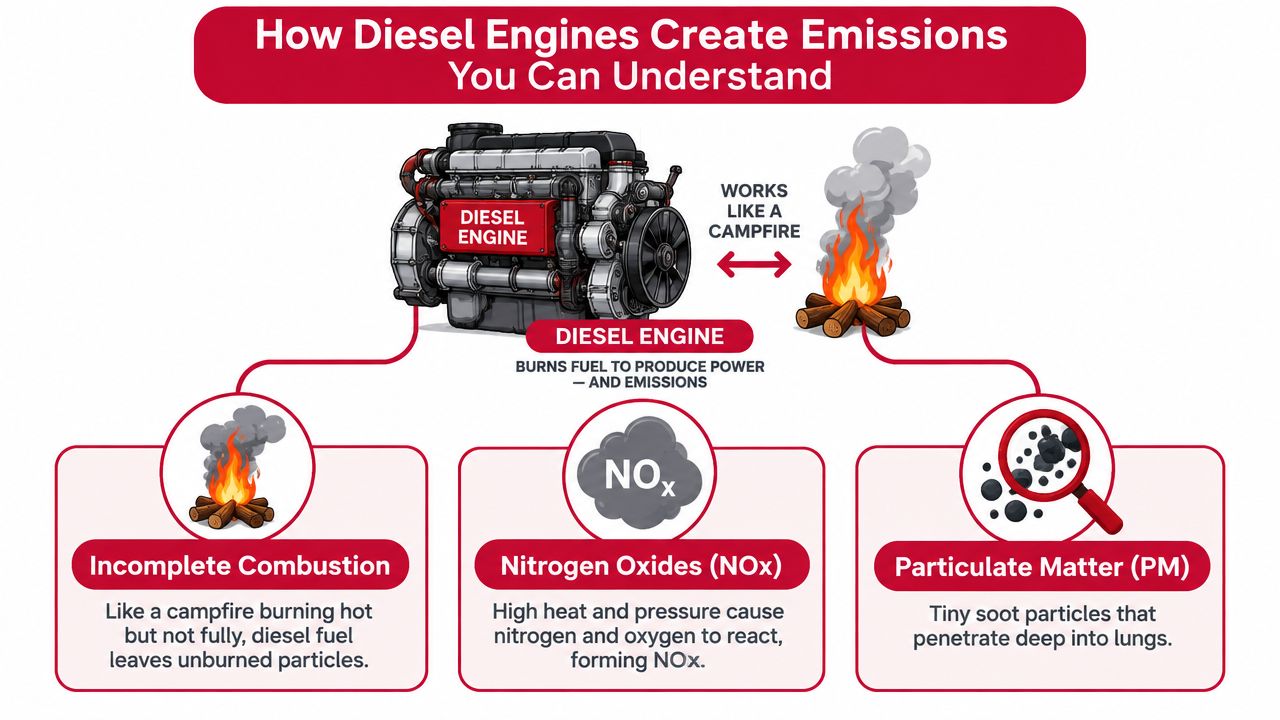
A diesel engine pulls a heavy load up a California grade. Inside the engine, fuel burns under high compression, producing power along with gases and particles that must be controlled before reaching the air. A campfire offers a useful comparison: a hot fire with enough oxygen burns more completely, while uneven fuel pockets leave smoke and residue behind.
Diesel engines are designed for efficiency and pulling power, yet their high-temperature combustion creates pollutants that California regulates closely. The exhaust system uses different components for different pollutants, so one working part cannot solve every emissions problem.
NOx forms in a hot combustion chamber
Nitrogen oxides, or NOx, develop when the intense heat and pressure inside the cylinder cause nitrogen and oxygen to react. NOx usually cannot be seen, but it contributes to the chemical reactions that produce ground-level ozone and smog.
A vehicle can therefore have clear exhaust while producing too much NOx. Depending on the engine and vehicle design, controls may include combustion calibration, exhaust gas recirculation, or selective catalytic reduction. A faulty sensor, catalyst, or related control component can raise NOx emissions without creating a visible black plume.
PM includes visible soot and hidden particles
Particulate matter, or PM, consists of tiny solid and liquid particles suspended in exhaust. Larger soot particles may look like smoke. Smaller particles are difficult to see, which explains why a clean-looking tailpipe does not prove that the emissions system is operating correctly. California focuses heavily on PM because these particles can enter the respiratory system.
A diesel particulate filter, commonly called a DPF, traps soot as exhaust passes through it. The filter must later regenerate, meaning a controlled process burns away the collected material. Repeatedly failed regeneration can restrict the filter and lead to reduced performance or warning lights.
Carbon dioxide has a different role
Carbon dioxide, or CO2, forms whenever carbon-based fuel burns. It differs from NOx and PM, and the control method differs as well. NOx and PM relate closely to local air quality and health concerns, while CO2 reflects the broader climate effect of fuel combustion.
The practical lesson is simple: diesel emission control requires several working systems. A DPF captures soot, but it does not correct every NOx problem. A NOx control system reduces that gas, but it cannot replace a functioning DPF.
Diesel emissions include invisible gases and visible or hidden particles. Compliance depends on controlling both.
Why California Regulates Diesel More Strictly Than Other States
A passenger diesel owner may notice California's rules during registration, while a truck operator may deal with engine model years, inspections, and reporting. That difference reflects how the state built its diesel program over time. The focus has shifted from checking only light-duty vehicles to controlling the heavy-duty and off-road equipment that produces large amounts of diesel pollution.
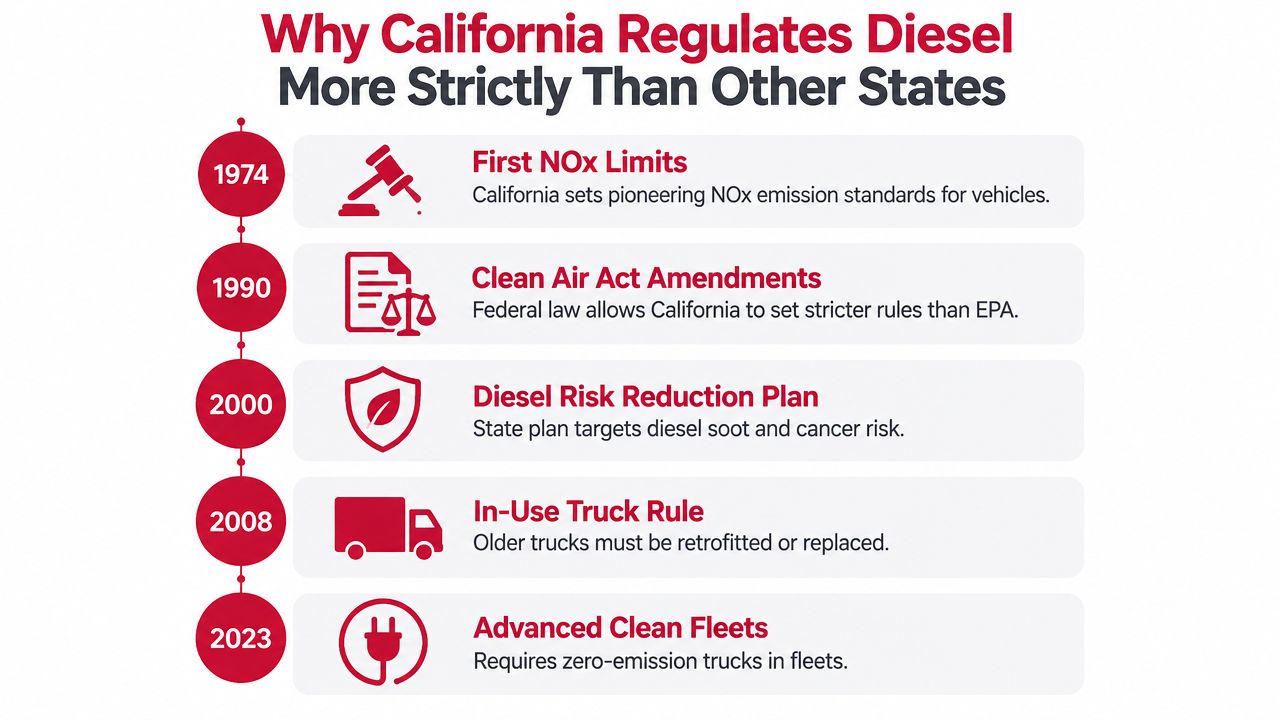
California's Air Resources Board, or CARB, began regulating diesel truck emissions in 1974 with a NOx standard for new vehicles. It tightened those standards through five steps, reaching the current level with 2010 models, according to this California Clean Diesel history.
The state adopted a Diesel Risk Reduction Plan in 2000. Its goals were to reduce diesel PM2.5 emissions by 75% by 2010 and 85% by 2020. Low-sulfur diesel fuel began in 2006 at 15 parts per million, allowing more advanced exhaust-control equipment to operate effectively.
These milestones explain why California diesel emission compliance involves more than a visual inspection. The program combines fuel requirements, new-engine standards, retrofit equipment, and rules for vehicles already working on California roads.
Why heavy-duty vehicles became the focus
CARB identified heavy-duty diesel trucks and buses as the single largest source of statewide NOx, responsible for 30% of statewide NOx emissions. In 2008, the agency estimated that about 941,000 trucks and buses operated in California, producing 859.3 tons per day of NOx and 33.1 tons per day of PM2.5.
Those figures shaped the regulatory strategy. Passenger-car inspections could not address commercial vehicles that travel long distances, carry heavy loads, idle at facilities, and remain in service for years. The same reasoning applies to diesel construction and other off-road equipment, where compliance depends on the engine, control equipment, and operating requirements.
The Truck and Bus Regulation took effect in December 2008. As of January 1, 2023, nearly all diesel-powered vehicles over 14,000 pounds GVWR operating in California must have a 2010-or-newer engine and emission system, with limited exceptions.
For a plain-English overview of standards affecting different vehicle categories, review this guide to diesel emissions standards. The practical starting point is the vehicle's weight rating and use, not the word “diesel.”
Light Duty Smog Checks Versus Heavy Duty Clean Truck Check
A diesel pickup owner may be thinking about registration and a familiar smog check. A fleet manager is usually solving a different problem: whether a heavy-duty vehicle must meet Clean Truck Check, California's inspection and maintenance program for heavy-duty vehicles.
Clean Truck Check covers nearly all diesel and alternative-fuel heavy-duty vehicles over 14,000 pounds GVWR operating on California roads, including trucks registered outside California. CARB identifies the first emissions compliance deadline as January 1, 2025. CARB also indicates that OBD-equipped vehicles are scheduled to move to quarterly testing beginning in October 2027, as described in its Clean Truck Check FAQ.
| Program | Applies To | Test Method | Frequency |
|---|---|---|---|
| Light-duty smog inspection | Qualifying passenger cars, SUVs, and light-duty trucks | California smog inspection procedures based on vehicle equipment and model | Frequency depends on registration and vehicle requirements |
| Clean Truck Check | Nearly all diesel and alternative-fuel vehicles over 14,000 pounds GVWR operating on California roads, including out-of-state trucks | Heavy-duty emissions compliance testing and reporting | Required according to the applicable CARB schedule, with quarterly OBD testing for OBD-equipped vehicles scheduled to begin in October 2027 |
Start with the weight rating, not the engine badge
A personally used diesel pickup may fall under the light-duty smog-check system. A similar-looking vehicle configured for commercial work may receive a different classification. A motorhome or recreational vehicle may also require special handling if its size or equipment exceeds a testing station's setup.
The gross vehicle weight rating provides the clearest starting point. Check the manufacturer's label, registration records, and fleet documentation instead of judging by appearance or the word “diesel.”
For a qualifying passenger diesel that needs a registration-related inspection, this guide to a smog test for diesel vehicles explains what the appointment may involve before you arrive.
Why the burden is shifting
Light-duty smog checks remain familiar to individual drivers. California's expanding compliance workload now centers more heavily on trucks, buses, motorcoaches, some motorhomes, and other heavy-duty vehicles.
That change follows how these vehicles operate. Commercial and industrial equipment can accumulate extensive road or operating time, so owners need an accurate compliance calendar, current vehicle records, and a response plan for failed tests or warning indicators. Waiting for a registration notice can leave an operator unprepared for a separate heavy-duty reporting obligation.
How Diesel Emissions Are Measured and Reported in California
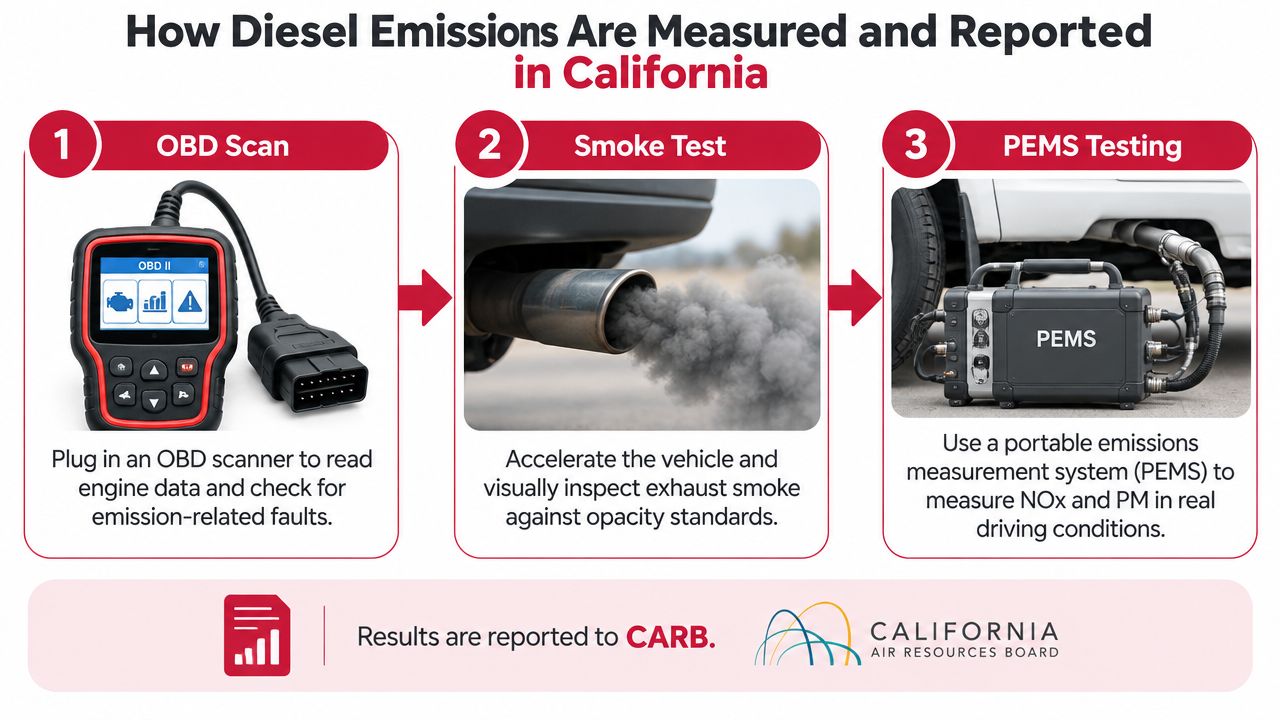
A truck can pass one check and still show a problem in another. California therefore uses several measurement layers. A computer scan may find a stored fault, a smoke or opacity inspection may reveal visible exhaust, and advanced equipment can measure emissions while the vehicle operates on the road or a test cycle.
The process has three practical levels.
First comes the vehicle's own diagnostic data
An onboard diagnostics, or OBD, scan reads information stored by the engine and emissions systems. It can identify sensor faults, aftertreatment trouble, or operating conditions that keep the system from working as designed.
A warning lamp is useful evidence, not a complete verdict. A vehicle without an illuminated lamp may still need readiness checks. Technicians also review whether a recent repair or battery disconnection erased diagnostic information before testing.
Filters require verification and monitoring
CARB requires a verified diesel particulate filter when the device is used for regulatory credit. CARB's installation and maintenance guidance identifies DPFs as the most common technology for reducing diesel particulate matter from heavy-duty engines operating in California.
A filter system also needs a backpressure monitor. It warns the operator before exhaust restriction reaches the specified high-pressure limit. Excessive backpressure can raise engine load, reduce filtration effectiveness, and damage the engine or aftertreatment system.
Real-world testing supports emissions inventories
CARB's EMFAC2025 documentation describes revisions to heavy-duty diesel emission rates based on real-world dynamometer testing, portable emission measurement, and in-use testing data. Its micro-trip method represents actual operating patterns more closely in emissions modeling, as described in the EMFAC2025 technical documentation.
For off-road and heavy-duty equipment, compliance increasingly examines NOx and PM together, rather than soot capture alone. CARB verification materials identify Level 3 diesel technologies that can target at least an 85% particulate matter reduction, while proposed off-road standards address both NOx and PM.
Here's a plain-language visual explanation of the testing flow:
A passing result depends on the complete system: engine, calibration, filter, sensors, and aftertreatment. Changing one component without checking the full setup may leave the original compliance problem in place.
What Diesel Owners Can Do to Stay Compliant in California
A passenger diesel owner may be preparing for a registration smog inspection, while a truck operator is managing a fleet emissions obligation. Those are different lanes of the same road. Start by confirming the vehicle's classification, GVWR, registration status, engine information, operating routes, and any Clean Truck Check responsibilities.
Use the notice as your first checklist:
- Read it carefully: Determine whether it requests a smog certificate, registration action, or heavy-duty compliance response.
- Check warning indicators: Repair check-engine, aftertreatment, DPF, or emissions-system warnings before testing.
- Bring supporting records: Have registration information, vehicle identification details, and recent emissions-system repair documents available.
- Keep the equipment intact: Do not remove, bypass, or substitute emissions components unless the replacement is approved for that vehicle and application.
- Confirm the test site fits: Large trucks, motorhomes, and specialized equipment may not fit every light-duty testing bay.
If a light-duty diesel fails
A failed inspection identifies a condition to diagnose, not a shopping list of parts to replace. Ask the station to explain the failure category, then get a diagnostic opinion from a qualified technician. The practical question is, “What condition caused the failure, and how will this repair correct it?”
Confirm the retest rules before returning. Some stations offer a free retest under their site policy and coupon terms, but eligibility depends on the circumstances and the station's conditions.
If you manage heavy-duty equipment
Fleet compliance works best when every vehicle has its own record. Track the GVWR, engine model year, emissions-control equipment, inspection status, fault history, and upcoming deadlines. A shared spreadsheet or fleet platform is enough if one person owns the task and updates it after each inspection or repair.
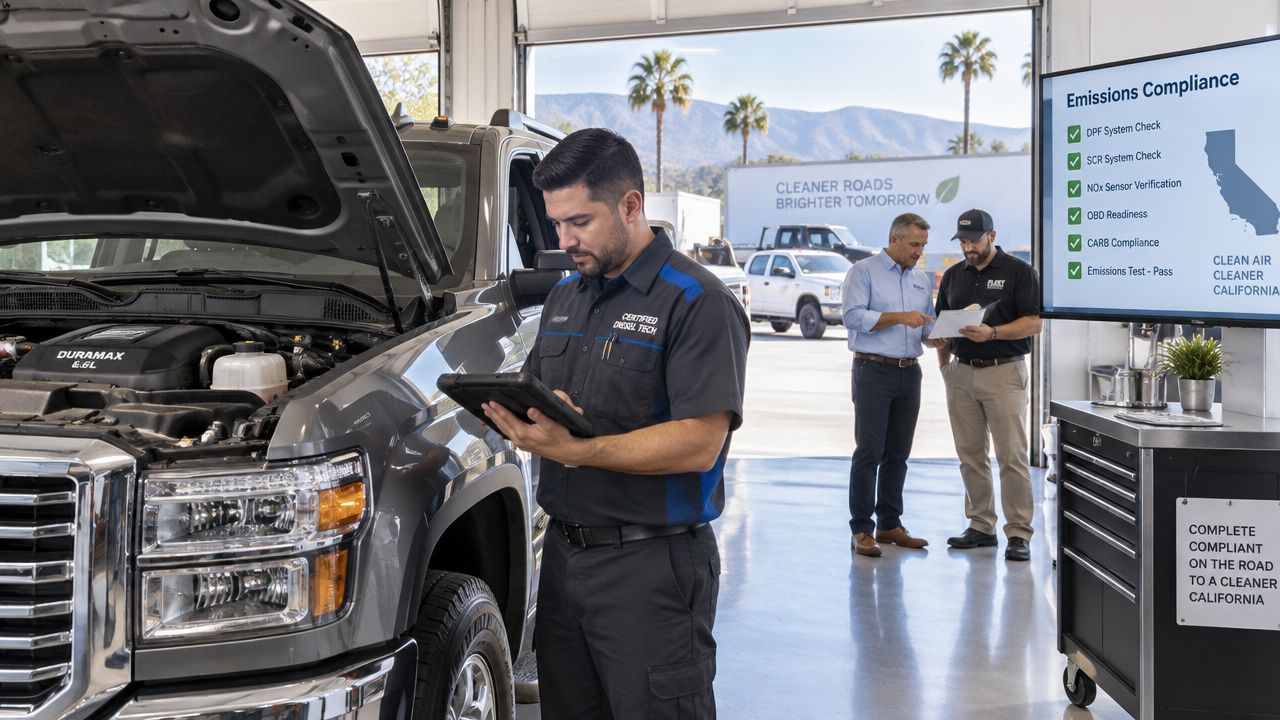
For drivers in Antioch and East Contra Costa County, Fire House Smog is a STAR-certified test-only station at 2900 Lone Tree Way in Antioch. It performs smog inspections for qualifying cars, trucks, and some recreational vehicles, along with California DMV renewal services and on-site tag printing. Testing is available seven days a week, and the station has two bays. Call 925-754-1600 before bringing a larger vehicle or motorhome to confirm that it fits the equipment limits. This Clean Air Truck resource explains related heavy-duty considerations.
Staying Ahead of California Diesel Emission Changes
A diesel pickup owner may focus on registration, while a trucking company tracks inspections across an entire fleet. Both face California diesel rules, but the compliance path depends first on vehicle classification. The state is placing growing attention on NOx and PM, especially from heavy-duty fleets and off-road equipment.
Off-road diesel is expected to remain a major source of mobile emissions in California. That direction explains why future compliance planning reaches beyond on-road truck inspections and passenger-vehicle smog checks. CARB has discussed proposed Tier 5 off-road standards in a 2026 workshop, aimed at reducing NOx and particulate matter from new compression-ignition engines sold in California.
Use this verification checklist
- Confirm classification: Check the vehicle's GVWR and identify whether it is light-duty, heavy-duty, or off-road equipment.
- Identify the program: Determine whether the vehicle needs a registration smog inspection, Clean Truck Check activity, or another CARB requirement.
- Track deadlines: Put applicable dates on a fleet calendar rather than relying only on a renewal reminder.
- Protect the emissions system: Maintain the DPF, sensors, backpressure monitor, and related aftertreatment equipment.
- Keep records: Save inspection results, repair invoices, equipment details, and compliance communications.
- Verify changes: Review current CARB guidance before buying parts, installing software, or changing an emissions-control strategy.
A fleet calendar works like a service map. It shows which vehicle needs attention, what documentation is missing, and when the next obligation arrives. For a passenger diesel owner, the same habit can be simpler: confirm the applicable smog-check rules, keep repair records, and verify requirements before a registration renewal.
CARB's SB 1 report identifies a useful-life limitation that reduced modeled emissions reductions from adopted and planned heavy-duty regulations by a cumulative 82,276 tons of NOx and 890 tons of diesel PM from 2024 through 2045 statewide, as documented in the EMFAC2025 technical materials. The point is practical. A rule may become stricter while regulators still assess whether its expected reductions occur during real vehicle use.
Long-term compliance depends on the full emissions system, accurate records, and the program governing the vehicle. Passing one inspection helps, but readiness between inspections prevents avoidable problems.
If you need a qualifying diesel smog inspection or California DMV renewal support in Antioch, visit Fire House Smog. The STAR-certified test-only station offers emissions testing, selected recreational-vehicle inspections, and on-site registration renewal services, so call 925-754-1600 to confirm your vehicle's requirements before arriving.
You've just opened a California DMV renewal notice and noticed the smog requirement. Maybe your vehicle is a diesel pickup, SUV, van, or motorhome, and you're unsure whether the rules apply to your model, your registration status, or the miles you drive. The questions usually arrive together: What exactly counts as a diesel emission, does every diesel vehicle need the same inspection, and what happens if the vehicle is based outside California?
California's approach can feel complicated because it combines several layers. The state regulates diesel particulate matter, nitrogen oxides, engine hardware, fuel characteristics, and in-use vehicle operation. A light-duty owner generally deals with the familiar California Smog Check process, while a heavy-duty vehicle operating on California public roads may fall under the separate Clean Truck Check program.
The reason for this strict approach is practical. Diesel pollution affects more than the person behind the wheel. Emissions can travel through neighborhoods near freeways, warehouses, ports, border crossings, and other freight routes. California's newer data systems examine those patterns at community level, not only as statewide totals.
This guide starts with the basic science, then connects it to health, CARB standards, out-of-state heavy-duty vehicles, exemptions, failed tests, and the steps an Antioch-area driver can take before visiting a test-only station. You'll also see why a functioning diesel particulate filter, accurate sensors, and complete diagnostic information matter even when the exhaust looks clean.
Table of Contents
- Introduction to California Diesel Emissions and Why They Matter Now
- What California Diesel Emissions Are and How They Form
- Health and Environmental Impacts Across California Communities
- How California Regulates Diesel Through CARB Rules and Standards
- Compliance Requirements for Diesel Vehicles Driving in California
- Testing Exemptions and What Happens If Your Diesel Fails
- Practical Guidance for Staying Compliant With Confidence
Introduction to California Diesel Emissions and Why They Matter Now
A diesel owner usually encounters the rules at an inconvenient but familiar moment. The registration renewal arrives, the DMV asks for a smog certificate, or a buyer wants proof that the vehicle can be transferred. The owner searches for “California diesel emissions” and finds references to CARB, DPFs, OBD systems, and Clean Truck Check, often without a clear explanation of which requirement applies.
The first distinction is the vehicle's role. A light-duty diesel vehicle may need a regular California Smog Check for registration or transfer. A heavy-duty vehicle operating on California public roads can face a separate emissions inspection and reporting obligation, even when it's registered in another state. Those programs serve different purposes, so treating every diesel as if it follows one universal test creates confusion.
Why the state focuses on diesel
California's diesel inventory has historically included more than one million on-road and off-road vehicles, along with stationary and portable engines, according to the California Air Resources Board diesel emissions assessment. The same assessment estimated statewide diesel particulate matter emissions at about 28,000 tons per year, with approximately 27% from on-road engines and 66% from off-road engines.
Those figures explain why the state's strategy reaches beyond passenger cars. Trucks matter, but construction equipment, agricultural machinery, generators, ships, and other diesel sources also contribute to the overall burden.
You don't need to become an emissions engineer to handle your own compliance. You do need to identify the correct program, keep the emissions equipment intact, and allow enough time to address a warning light or failed inspection before a registration deadline. The sections below translate the technical terms into decisions you can use.
What California Diesel Emissions Are and How They Form
A heavy-duty diesel truck can pass your neighborhood with no visible smoke and still release pollutants. The engine compresses air, injects fuel, and uses the resulting heat to ignite it. That combustion produces power, while incomplete burning and high-temperature reactions create emissions.
Two pollutants guide much of California's diesel-control work: diesel particulate matter, or diesel PM, and nitrogen oxides, known as NOx. They form differently and behave differently after leaving the tailpipe, so they require different control strategies. The rules also apply across changing routes. An out-of-state truck operating in California may still need to meet California requirements, even though its home-state program differs.
Diesel PM is more than visible smoke
A fireplace offers a useful comparison. The soot you can see represents only part of what combustion releases. Diesel engines can emit extremely small particles even when the exhaust appears clear. More than 90% of diesel particulate matter is smaller than 1 micrometer, placing it within the PM2.5 fraction, as described in California diesel standards and control information.
Fine particles can remain airborne and travel deep into the respiratory system. A diesel particulate filter, or DPF, captures much of this soot before it exits the tailpipe. During regeneration, the system raises conditions inside the filter so accumulated material burns in a controlled process.
NOx creates a different problem
NOx forms mainly during high-temperature combustion. It can affect air quality near the vehicle and react in the atmosphere to help form ozone and secondary particulate matter. PM is commonly associated with material emitted from the exhaust, while NOx can help create additional pollution after entering the air.
Modern diesel systems may combine exhaust gas recirculation, oxidation catalysts, DPFs, and selective catalytic reduction. SCR uses diesel exhaust fluid to reduce NOx. These components operate as a chain. A damaged hose, clogged filter, faulty temperature sensor, or malfunctioning catalyst can break that chain.
Practical rule: A clean-looking tailpipe does not prove that the complete emissions system is working correctly.
The engine computer monitors sensors and operating conditions. If it detects a fault, it may store a diagnostic trouble code or turn on the malfunction indicator lamp. That electronic record can matter during an OBD inspection, even if the vehicle drives normally.
Neighborhood mapping makes this distinction practical. Statewide emissions describe the broad problem, while 1×1 km community maps can show where traffic and nearby sources overlap. For a vehicle owner, the next step is straightforward: keep emissions equipment intact, respond to warning lights, and confirm the correct inspection requirements at a STAR test-only station.
Health and Environmental Impacts Across California Communities
A truck can meet statewide requirements while still affecting neighborhoods differently along its route. People encounter diesel pollution where they live, work, walk, wait near traffic, or spend time beside freight corridors and ports. A statewide average measures overall progress, while local mapping asks the more practical question: where are residents encountering emissions?
Long-term progress has not eliminated risk
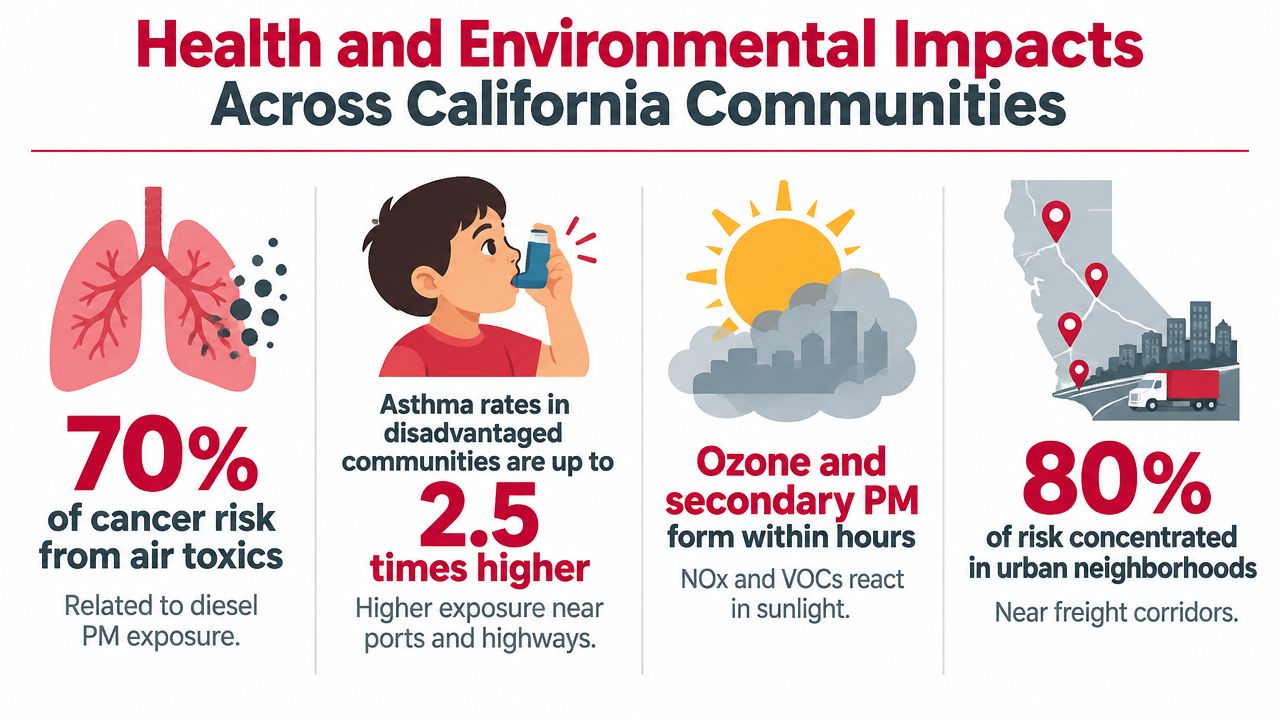
A peer-reviewed analysis found that statewide ambient diesel particulate matter concentrations fell 68% between 1990 and 2012, even as diesel vehicle miles traveled increased 81%. The analysis and CARB health summary associated the 2012 ambient concentration of 0.58 µg/m³ with an estimated 520 new cancer cases per million residents exposed, as documented in the peer-reviewed diesel PM analysis.
The lesson is that cleaner engines, improved fuels, and emission-control systems reduced pollution substantially, while residual exposure still deserves attention. Diesel PM remains toxic, and its effects are not distributed evenly across the state.
NOx creates a second pathway. After leaving a vehicle, it can help form ozone and secondary PM, so the impact extends beyond the visible exhaust plume. A route with frequent truck traffic and idling can produce a different exposure pattern from a quiet residential street, even within the same city.
Maps make local exposure easier to understand
California's community-analysis method combines emissions estimates from on-road, area, stationary, and ocean-going vessel sources. OEHHA grids the state at 1×1 kilometer resolution, then converts the information to census tracts for community analysis, as explained in the CalEnviroScreen diesel particulate matter fact sheet.
The inventory also accounts for diesel PM originating on the Mexico side of the border when evaluating San Diego and Imperial counties. Pollution does not stop at a registration system, county line, or state boundary. The same issue appears in interstate compliance: an out-of-state heavy-duty vehicle may follow rules from its home jurisdiction, yet still operate on California roads and affect communities here.
Exposure is local enough that the same vehicle can have very different community effects depending on its route, idling pattern, and proximity to homes, schools, and workplaces.
For drivers, maintenance and compliance are practical parts of reducing that exposure. At a STAR test-only station, ask which inspection applies, keep emissions equipment intact, and address warning lights before testing. One inspection cannot solve a neighborhood-wide problem, but it can help prevent an individual vehicle from adding avoidable pollution.
How California Regulates Diesel Through CARB Rules and Standards
A diesel pickup can pass a visual check yet still create excess pollution during idling or low-load driving. California's system therefore works across several connected layers. One set of rules limits particulate matter, another controls NOx under different engine conditions, and fuel policies address carbon intensity. The framework examines the vehicle, its controls, how it operates, and the fuel it uses.
PM controls target the smallest particles
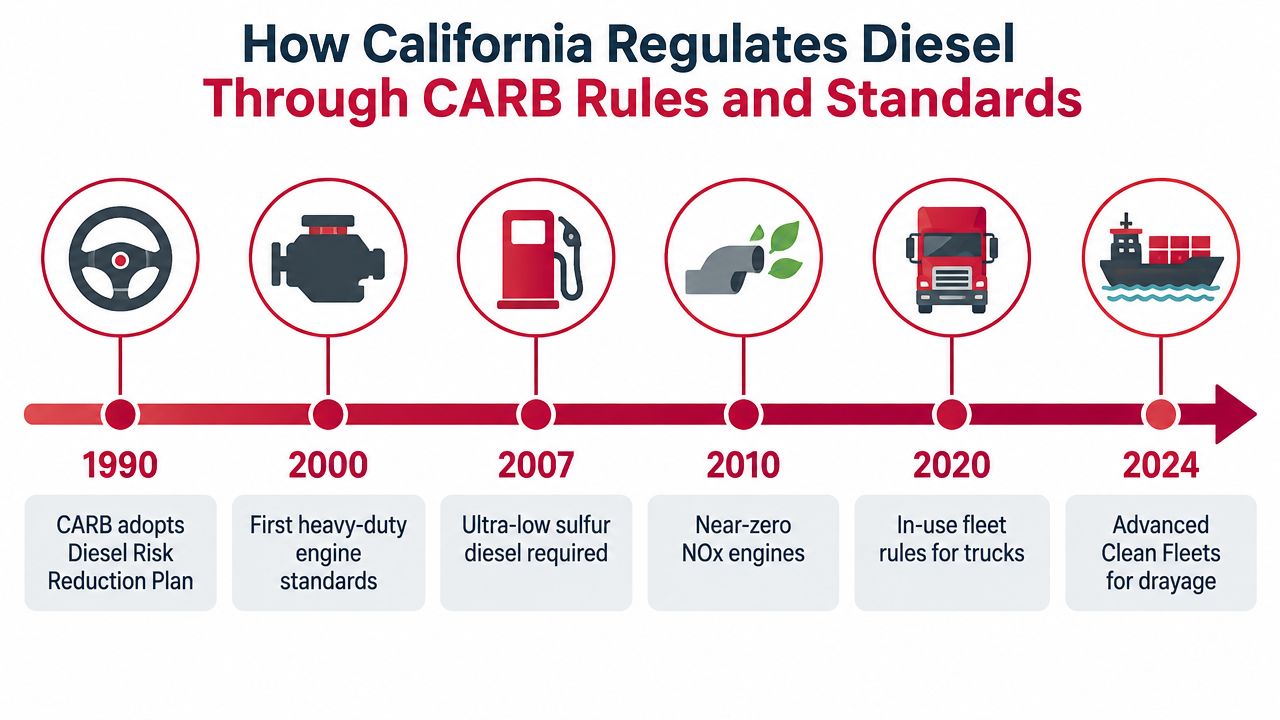
CARB's Diesel Risk Reduction Plan set statewide targets to reduce diesel PM emissions by 75% by 2010 and 85% by 2020. Later control programs moved heavy-duty engines toward PM levels below 0.01 g/bhp-hr, roughly matching the 2007 new-engine PM standard, as described in CARB's heavy-duty diesel risk-reduction materials.
Those limits explain why DPF condition matters. The filter works like a fine screen in the exhaust path, trapping soot before it reaches the air. If it is missing, damaged, modified, or not working correctly, emissions can rise sharply even when the engine still feels powerful. Proper maintenance supports the test result and the neighborhood-level pollution reduction the equipment was designed to provide.
NOx rules cover different operating conditions
CARB's heavy-duty omnibus rule reduced the transient diesel NOx limit from 0.20 to 0.050 g/bhp-hr, a 75% reduction, and lowered the idle NOx limit from 30 g/hr to 10 g/hr. It also established a low-load NOx standard of 0.200 g/bhp-hr for medium- and heavy-duty diesel engines, according to the CARB heavy-duty omnibus initial statement of reasons.
“Transient,” “idle,” and “low-load” describe different engine conditions. A truck may perform cleanly at steady highway speed while producing excess emissions during starting, idling, acceleration, or light-load operation. That distinction matters for vehicles traveling through California from another state, because a home-state rule may not address every condition covered by California requirements.
Fuel policy broadens the picture
California's Low Carbon Fuel Standard, or LCFS, addresses carbon intensity across the transportation fuel system. Amendments taking effect July 1, 2025 set reduction targets of 30% by 2030 and 90% by 2045, according to the official CARB LCFS rulemaking page.
A smog inspection checks vehicle operation and emissions-control readiness. Fuel policy examines the broader lifecycle of transportation fuels. Together, they cover hardware, software, operating conditions, fleet practices, and fuel pathways.
For a plain-language explanation of owner obligations, see California diesel smog laws and requirements. At a STAR test-only station, confirming the correct inspection and addressing warning lights before testing can help connect statewide rules with the condition of one vehicle.
Compliance Requirements for Diesel Vehicles Driving in California
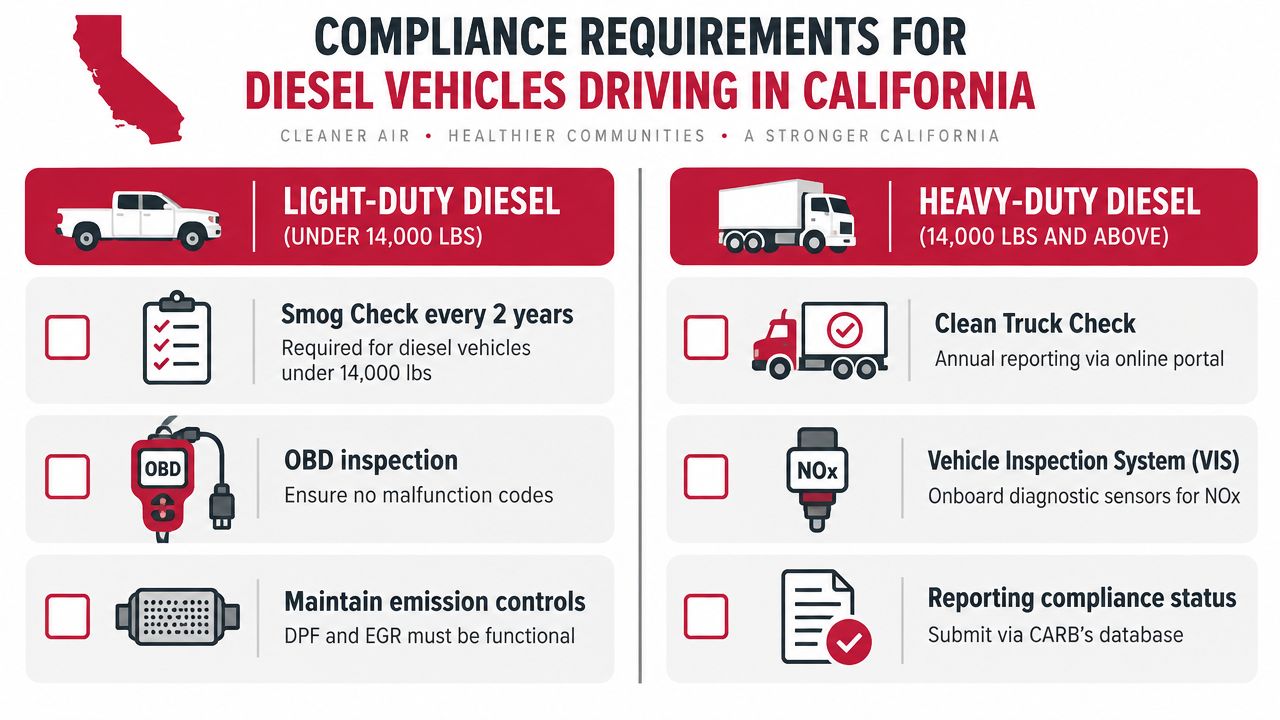
A diesel vehicle's compliance path starts with its use, weight, registration, and equipment, not its fuel type. A light-duty diesel renewing California registration generally follows the regular Smog Check process. A heavy-duty vehicle operating on California public roads may instead fall under Clean Truck Check, including some vehicles registered outside California.
Light-duty diesel vehicles
For a qualifying light-duty diesel vehicle, the inspection may include an OBD check, visual examination of emissions equipment, and an emissions test suited to the vehicle and program requirements. The model year, weight, registration circumstances, and DMV notice determine whether testing is required.
Before scheduling, gather the renewal notice, registration information, and recent repair records. If the malfunction indicator lamp is on, do not erase the codes just before testing. Clearing them can leave readiness monitors incomplete, much like resetting a checklist before all its items have been verified. The vehicle may then be unable to receive a clean result.
A STAR-certified test-only station performs inspections without selling repair work. That separation lets you obtain the test result first and choose a repair provider independently. It can also help connect statewide emissions rules with the condition of one vehicle in the neighborhood where it is driven and tested.
Heavy-duty vehicles and Clean Truck Check
CARB says nearly all diesel and alternative-fuel heavy-duty vehicles over 14,000 pounds operating on California public roads must comply with Clean Truck Check. The requirement includes out-of-state vehicles, motorcoaches, transit vehicles, school buses, and California-registered motorhomes, as stated in the Clean Truck Check FAQ and program information.
Testing began October 1, 2024, and the first compliance deadline was January 1, 2025, according to the same CARB information. Clean Truck Check includes reporting and compliance fees, so passing a regular light-duty smog inspection does not automatically satisfy a heavy-duty obligation. An interstate operator therefore needs to check California's requirements separately rather than relying only on the rules from the vehicle's home state.
| Vehicle situation | Main question |
|---|---|
| California light-duty diesel | Does the DMV require a Smog Check for this renewal or transfer? |
| Out-of-state heavy-duty truck | Does it operate on California public roads and exceed the applicable weight threshold? |
| Diesel motorhome | Is it over the applicable heavy-duty threshold and operating in California? |
| Fleet vehicle | Has the operator completed reporting and the required testing? |
CARB's program schedule calls for OBD-equipped vehicles to move to quarterly testing scheduled to begin in October 2027, as described in the agency's Clean Truck Check information. Fleet managers should track each vehicle separately. One completed inspection does not cover the entire operation.
Testing Exemptions and What Happens If Your Diesel Fails
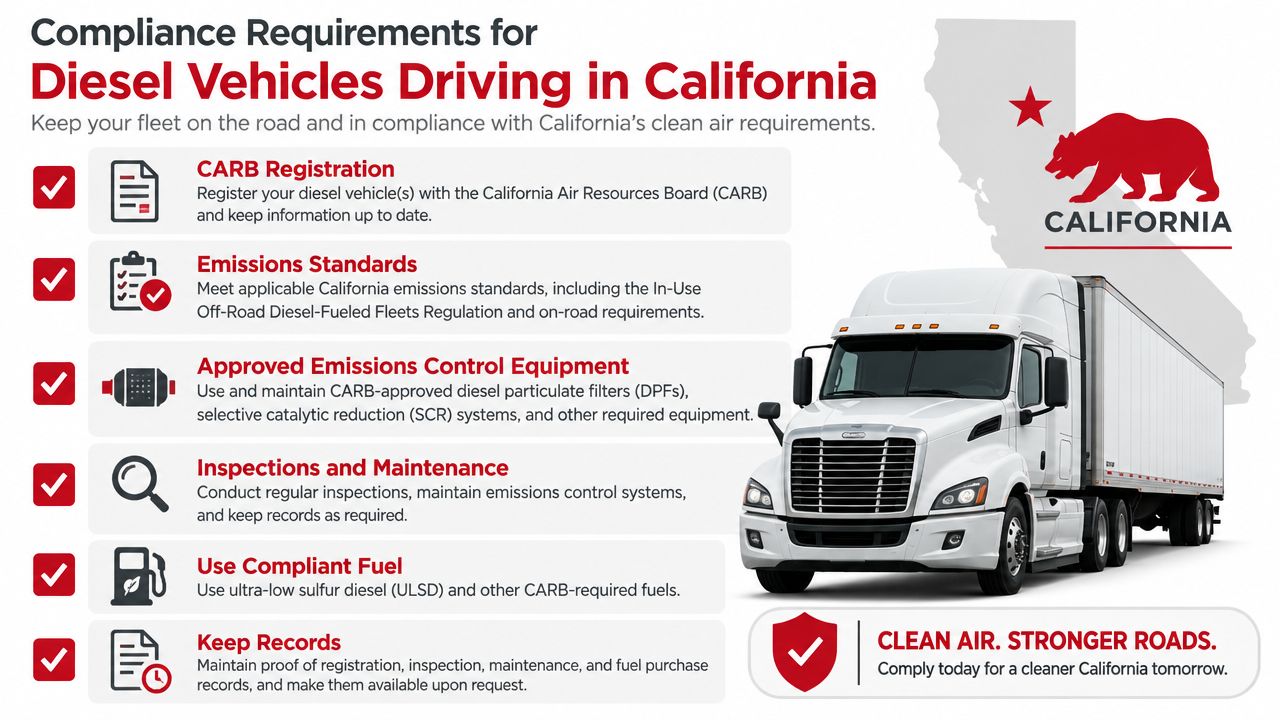
A failed result doesn't always mean the engine needs major work. It means the vehicle didn't meet one or more inspection conditions, and the result should identify the area that needs attention. The right next step depends on whether the issue is a warning lamp, incomplete monitor, visual defect, or measured emissions problem.
| Outcome or Exemption | Who It Applies To | Required Action |
|---|---|---|
| No Smog Check requested | Owners whose DMV notice or vehicle circumstances don't require a test | Confirm the exemption or non-test status with the DMV before assuming registration is complete |
| Pass | Vehicles that meet the applicable inspection requirements | Submit or retain the certificate as directed by the DMV or program |
| Fail with a warning lamp | Vehicles with an active emissions-related fault | Diagnose the stored code, repair the cause, and complete the required retest |
| Fail with incomplete monitors | Vehicles recently cleared of codes or disconnected from battery power | Drive only as appropriate for monitor completion, then follow station guidance |
| Visual inspection failure | Vehicles with missing, disconnected, or visibly altered emissions equipment | Restore compliant hardware before returning for inspection |
| Heavy-duty compliance issue | Vehicles covered by Clean Truck Check that lack required testing, reporting, or compliant results | Complete the applicable CARB process rather than relying on a light-duty certificate |
The table is a decision aid, not a substitute for the exact notice or CARB classification. Exemptions can depend on vehicle type, weight, fuel, registration, and use. Out-of-state registration alone doesn't remove a covered heavy-duty vehicle from California's operating requirements.
Common failure patterns
A DPF can deteriorate, sensors can report implausible readings, and NOx control hardware can stop working as designed. These problems may increase particulate matter or NOx without producing dramatic smoke. The engine computer may detect them before the driver notices a change in performance.
An incomplete monitor is different from a failed emissions measurement. It often means the computer hasn't completed the self-check needed for certification. If a repair shop clears codes and immediately sends the vehicle to a station, the monitors may not be ready.
Before a retest: Keep the failure report, ask which monitor or component caused the result, and make sure the repair provider confirms readiness before you return.
A test-only facility can provide an independent result, but it won't replace a qualified repair diagnosis. For diesel-specific preparation and inspection guidance, review this diesel smog test guide.
Practical Guidance for Staying Compliant With Confidence
Antioch and East Contra Costa County drivers can make the process easier by treating the smog visit as a scheduled compliance task, not a last-minute DMV emergency. Start with the notice, confirm the vehicle category, and check whether the vehicle has an active warning lamp or recent emissions-system repair.
Use this short preparation list:
- Bring the essentials: Take the DMV notice, current registration information, and any repair or diagnostic paperwork.
- Check the dashboard: Resolve an illuminated emissions warning before testing, and don't clear codes immediately beforehand.
- Protect the equipment: Don't remove, bypass, or disconnect the DPF, EGR, catalyst, SCR, or related sensors.
- Confirm the station fit: Call ahead for larger vehicles, RVs, or motorhomes because bay and equipment limits can vary.
- Plan the timing: Seven-day smog testing and extended weekday and weekend hours can help working drivers avoid a rushed visit.
- Ask about retesting: If the vehicle fails, keep the result and confirm whether a free retest applies under the station's current policy and coupon terms.
A STAR-certified test-only model can reduce concern about being pushed into repairs at the same location because the station doesn't sell repair work. Fire House Smog also provides on-site DMV renewal services with tag issuance at 2900 Lone Tree Way, with DMV service hours Monday through Saturday from 9:30 AM to 5:00 PM and Sunday from 12:00 PM to 4:00 PM. Smog testing is available seven days a week, and customers can call ahead at 925-754-1600.
For additional maintenance habits that support cleaner operation, read this guide on reducing vehicle emissions.
Fire House Smog provides STAR-certified test-only smog inspections for qualifying diesel vehicles, along with California DMV renewal and registration services at its Antioch location. Bring your vehicle to Fire House Smog, or call 925-754-1600 to confirm eligibility, available hours, and retest details before you visit.
Your registration notice shows up. You open it, see that your truck needs a smog check, and the questions start right away.
Does my truck even fall under the regular program? Is this the same thing as Clean Truck Check? If it's diesel, does the weight rating change the rule? If I pass, can I finish my DMV renewal the same day, or am I headed into another line somewhere else?
Those questions are common because California doesn't treat every truck the same. Fuel type matters. Model year matters. Gross Vehicle Weight Rating (GVWR) matters. And for heavier diesel trucks, the rules often shift into a different compliance system entirely. If you own a pickup, work truck, fleet unit, or a truck you're trying to sell or register, getting the category right is the first step that saves time.
Table of Contents
- Your DMV Notice Arrived, Now What?
- Which Trucks Require a California Smog Check
- Exemptions and Special Cases for Trucks
- The Smog Test Process From Start to Finish
- Practical Tips to Pass Your Truck's Smog Check
- Your One-Stop Solution in Antioch: Fire House Smog
Your DMV Notice Arrived, Now What?
Most truck owners do the same thing first. They look at the notice, then at the truck, then back at the notice, trying to figure out whether this is a routine registration step or the start of a compliance headache.
A common example is the owner of a diesel pickup who assumes diesel means exempt. Sometimes that's wrong. Another example is the owner of a heavier commercial truck who books a standard smog check appointment, only to learn the truck belongs under a different emissions program. The problem usually isn't the inspection itself. It's identifying the right rule before you lose time.
Read the notice, then check the truck's basics
Before you schedule anything, confirm these details from your registration or door-jamb label:
- Fuel type: Gasoline, diesel, hybrid, or another alternative fuel.
- Model year: Newer trucks often follow a different path than older ones.
- GVWR: This is the dividing line that changes the rule for many diesel trucks.
- Renewal or ownership change: A sale can trigger a different smog requirement than a routine renewal.
If you're also trying to finish registration, it helps to handle the smog requirement alongside the paperwork. Fire House Smog also offers California DMV registration renewal services, which is useful when the goal is to leave with both the inspection and renewal handled in one stop.
Practical rule: Don't ask, “Does my truck need smog?” Ask, “Which California program applies to my truck?”
What usually slows people down
The biggest delays come from assumptions:
- “It's a truck, so it must work like my car.” Not always.
- “It's diesel, so I'm exempt.” Sometimes true, sometimes false.
- “If it's heavy-duty, I don't need to think about smog at all.” That can create the worst surprise of all.
If your notice arrived and your registration deadline is coming up, the fastest move is to classify the truck correctly first. Once that part is clear, the next steps become straightforward.
Which Trucks Require a California Smog Check
A customer with a diesel pickup and a customer with a diesel box truck can walk in on the same day and leave with two different answers. That usually surprises people. In California, truck smog requirements turn on three facts: fuel type, model year, and gross vehicle weight rating (GVWR).
Get those three right first, and the rest gets much easier.
For gasoline, hybrid, and many alternative-fuel trucks, the standard Smog Check program usually applies if the truck is 1976 or newer and old enough to be out of the newer-vehicle exemption period. The California Bureau of Automotive Repair explains that vehicles in the first several model years pay a smog abatement fee instead of getting a biennial inspection under the regular program, then move into the testing cycle later on, as outlined on the BAR Smog Check program page.
Diesel trucks follow a different cutoff that causes a lot of confusion. Under California rules, diesel-powered vehicles with a model year of 1998 or newer and a GVWR of 14,000 pounds or less fall into the standard biennial Smog Check requirement. The California DMV lists that light-duty diesel rule in its Smog Inspections page.
The dividing line is the part many truck owners miss. A diesel truck can be newer and still not belong in the ordinary station-based smog program if its GVWR is too high.
California Truck Smog Check Requirements 2026
| Truck Type | Smog Check Required? | Key Conditions |
|---|---|---|
| Gasoline truck | Yes, in many cases | Applies on a biennial cycle for 1976 or newer trucks once they are past the newer-vehicle exemption period |
| Hybrid truck | Yes, in many cases | Usually follows the same standard Smog Check timing as other eligible light-duty vehicles |
| Alternative-fuel truck | Yes, in many cases | Requirement depends on fuel type, age, and registration event |
| Diesel truck, 1998 or newer, 14,000 lbs GVWR or less | Yes | Must complete a biennial smog check under the standard program |
| Diesel truck over 14,000 lbs GVWR | No, not under the standard program | Usually handled outside the regular station-based Smog Check system |
| Newer eligible truck still within the exemption window | No physical test yet | Smog abatement applies instead of a physical inspection during that period |
| Truck being sold | Sometimes | Ownership transfer rules can trigger a smog requirement depending on age and fuel type |
Heavy-duty trucks are where the article title can mislead people. Some trucks do need a standard smog check at a station like Fire House Smog. Others fall under Clean Truck Check, which is a separate compliance program aimed at heavier diesel vehicles, not the regular biennial inspection most pickup owners are used to.
That distinction matters before you book an appointment. If the truck is a light-duty gasoline, hybrid, alternative-fuel, or qualifying diesel truck, a STAR-certified test-only station is the right path. If the truck is over the light-duty diesel weight threshold, the question shifts from "Do I need a smog test today?" to "Am I in the standard Smog Check program or in Clean Truck Check?"
One practical tip from the shop side: check the GVWR on the door label, not what the truck weighs today and not what you use it for. California uses the vehicle's rated classification, and that single number often decides whether you need a regular smog inspection or a different compliance route entirely.
Exemptions and Special Cases for Trucks
Truck owners usually get tripped up here after they already know their weight class. The next question is whether an apparent exemption means "no test at a station" or "different compliance program entirely."
The biggest mistake truck owners make
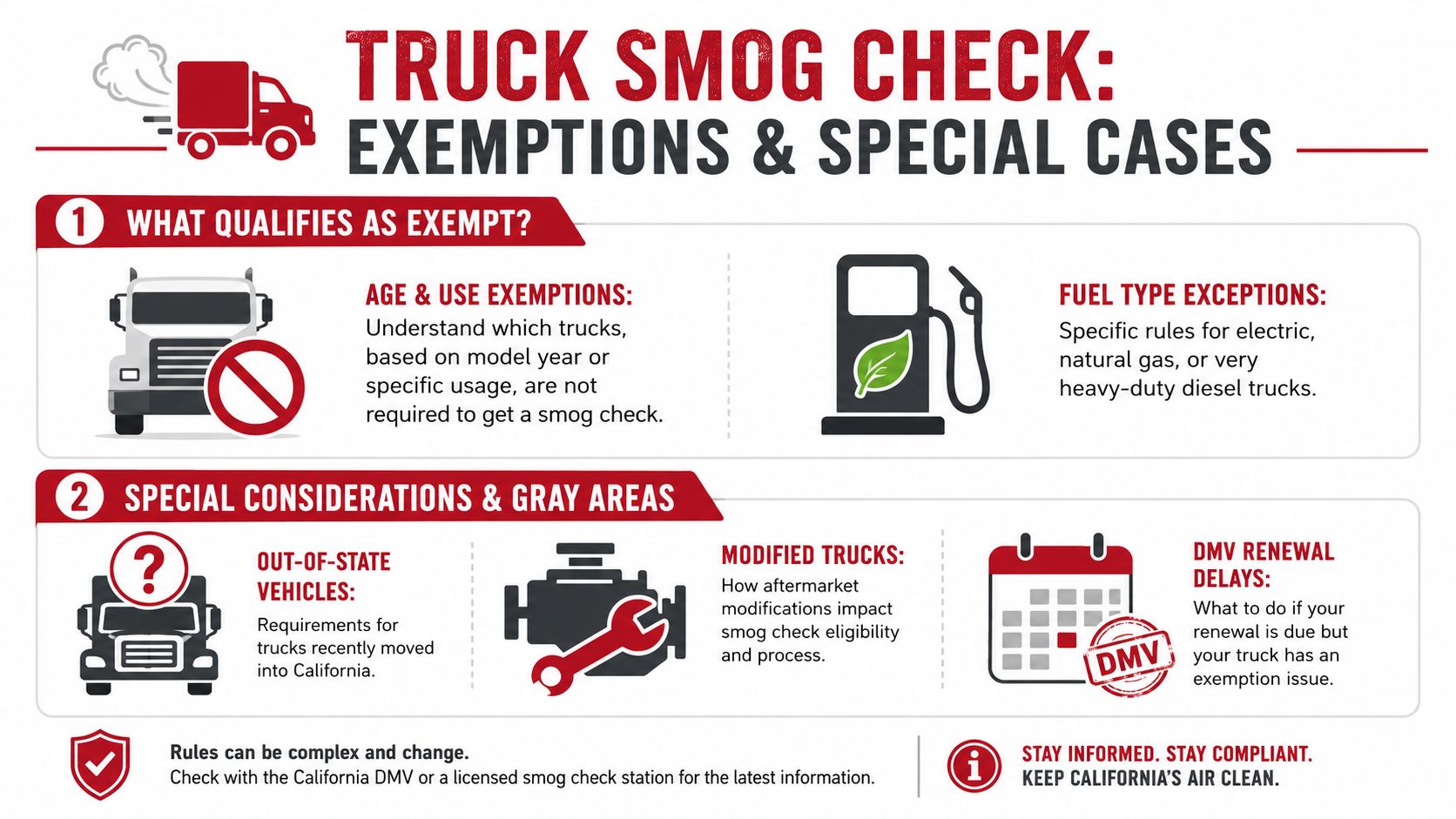
The most common mistake is assuming a heavy truck is exempt from everything because it does not go through the standard Smog Check lane.
For trucks with a GVWR over 14,000 lbs, the regular station-based smog inspection usually is not the controlling program. As Geotab's California truck smog guide explains, heavier diesel vehicles can fall under Clean Truck Check instead, including recurring OBD compliance requirements for certain model years. That is a different process, a different schedule, and a different problem to solve than the biennial inspection a light-duty pickup owner handles at a STAR station.
From the shop side, this is the practical consequence. A customer with a half-ton or three-quarter-ton truck may only need the normal inspection path. A customer with a heavier diesel may need to verify Clean Truck Check status before booking a station visit at all. Getting that wrong wastes time and can delay registration.
Exempt from the standard smog test does not mean exempt from California emissions compliance.
Other gray areas that cause delays
Newer trucks can also confuse the schedule. Some vehicles are still in the exemption window, so the owner pays a smog abatement fee instead of doing a physical inspection. Then a DMV notice arrives later, and it looks inconsistent. Usually it is just the truck aging into the regular requirement.
Out-of-state trucks are another frequent problem. California may require separate emissions compliance steps for trucks brought in from outside the state, especially for diesel and other non-gasoline vehicles. The rule is handled through the state program, not by relying on whatever testing the previous state required, according to the California Air Resources Board Clean Truck Check program information.
A few special cases are worth checking before you head to the station:
- RVs and motorhomes: Test eligibility is only part of the issue. Physical bay clearance matters too.
- Modified trucks: Aftermarket parts, deleted equipment, or missing emissions labels can stop the inspection quickly.
- Ownership transfers: A truck that is not due for normal renewal smog can still need certification for a sale.
- Diesel work trucks near the cutoff: A small difference in GVWR can put one truck in the regular Smog Check system and another in Clean Truck Check.
This is the part many owners want clarified in plain English. Light-duty trucks usually need the familiar station process. Heavy-duty diesel trucks often follow Clean Truck Check instead. If the paperwork is unclear, a STAR-certified test-only station like Fire House Smog can tell you whether you are booking the right type of appointment before you lose a day chasing the wrong requirement.
The Smog Test Process From Start to Finish
You pull in with a DMV notice on the seat and one question in mind. Is this a quick check, or is this going to turn into a problem? For most light-duty trucks in the regular California Smog Check program, the visit is straightforward if the truck is ready and you brought the right paperwork. For heavier diesel trucks that fall under Clean Truck Check, the process is different, which is why confirming the program before the appointment saves time.
What to bring and what the technician checks
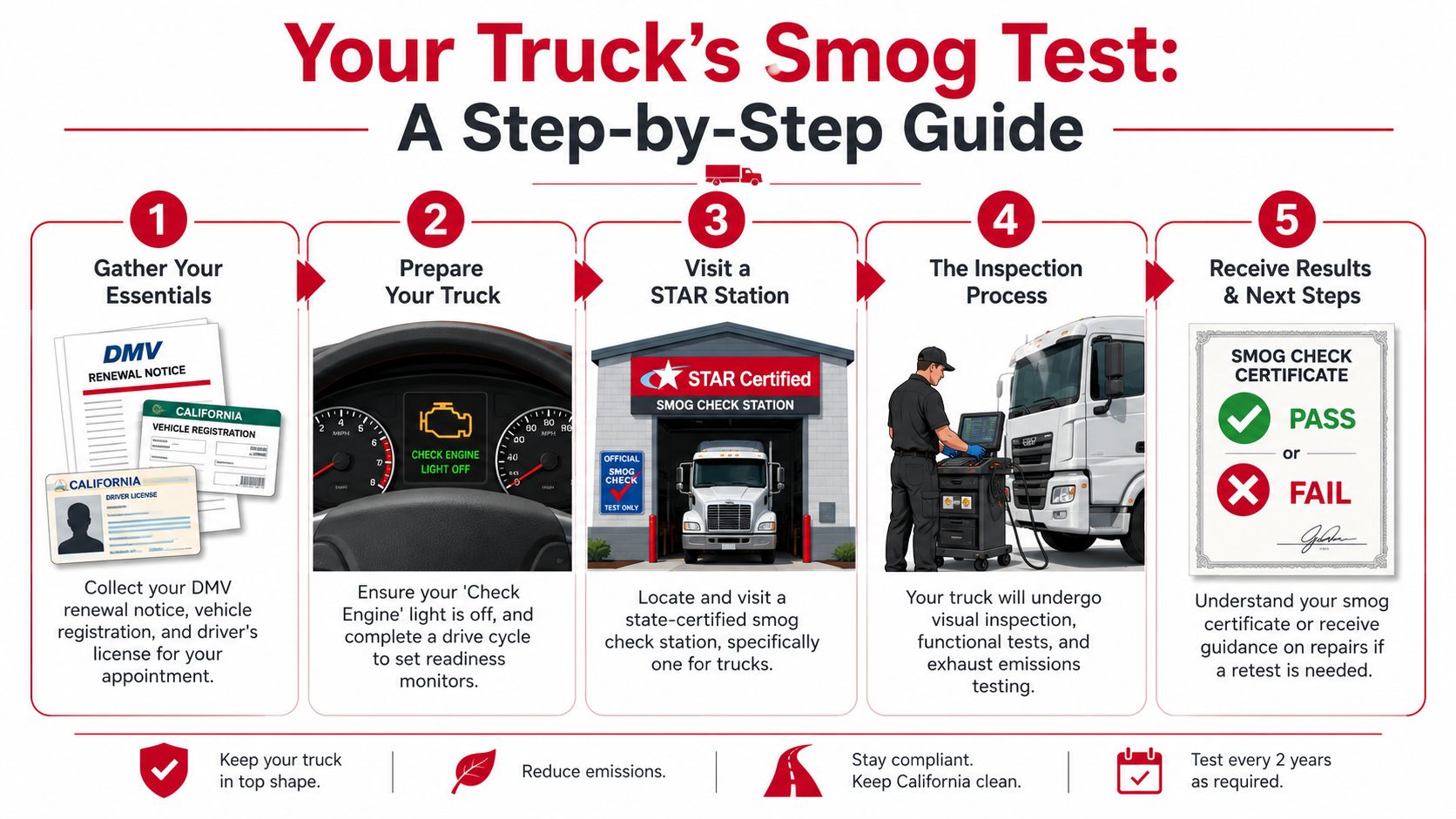
Bring your registration and the DMV notice if you received one. If you want to handle registration-related tasks at the same stop, keep your driver's license ready too. At a station like Fire House Smog, that matters because on-site DMV services can save you a second errand after the test is done.
Once the truck is checked in, the technician verifies the vehicle information, confirms the test type, and starts the inspection. For many gasoline trucks and newer light-duty models, the process centers on the emissions system status reported through the vehicle computer. Some older vehicles can still require a tailpipe portion, and every applicable vehicle gets a visual check for emissions components that are supposed to be there.
The inspection usually comes down to three parts:
Vehicle and equipment verification
The technician confirms the VIN, checks the emissions label when needed, and looks for missing, disconnected, or obviously tampered emissions parts.OBD-II and functional checks
The system is scanned for fault codes, monitor readiness, and command status related to emissions performance.Tailpipe testing when required
Older applicable trucks may still get an exhaust measurement based on the test standard for that vehicle.
If you want a clearer picture of what commonly causes a failed inspection, review these truck smog check fail reasons before you book.
A short explainer helps here:
What happens after the inspection
If the truck passes, the result is sent electronically to the state. In most cases, that clears the smog requirement tied to your registration. If the truck fails, you receive a report showing where the problem showed up, such as an active trouble code, incomplete readiness monitors, or a visual equipment issue.
That distinction matters at a test-only station. A STAR-certified test-only shop inspects the vehicle and reports the result. It does not turn the failed test into a repair sale.
Fire House Smog is a STAR-certified test-only station with two service bays, and that setup helps in a practical way. Owners can get the correct inspection for a qualifying light-duty truck, confirm whether they are dealing with standard Smog Check or a different heavy-duty requirement, and handle DMV-related tasks on site instead of piecing the process together at multiple stops.
The best appointment is the one where the truck is ready to test. Warning lights, recent battery disconnects, and visible emissions tampering still stop plenty of trucks before the paperwork is even the hard part.
Practical Tips to Pass Your Truck's Smog Check
Most smog failures are not surprises to the truck. They're surprises to the owner.
What helps before you arrive
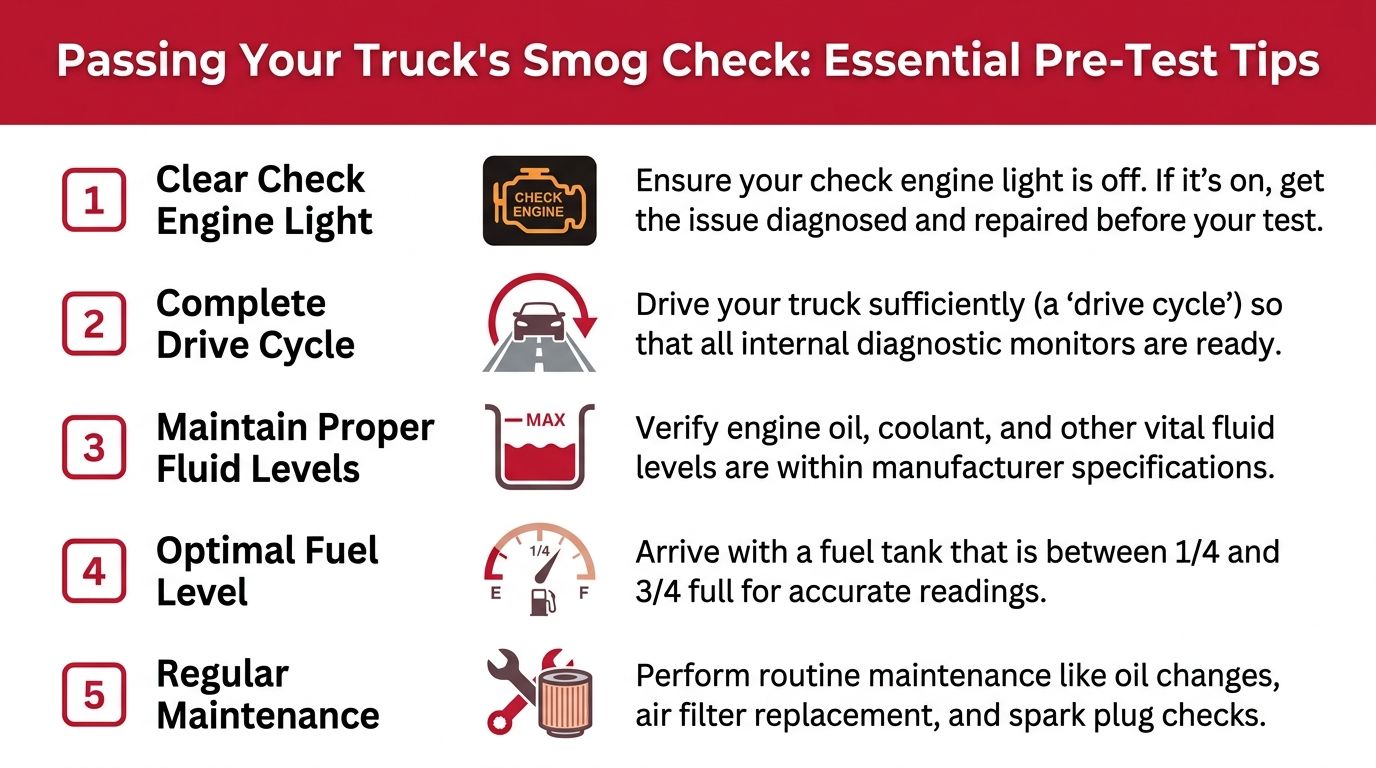
The first thing I tell customers is simple. If the Check Engine light is on, don't book the test expecting luck to save you. A lit check engine light causes an automatic failure regardless of tailpipe readings, as explained in Lytx's truck smog check guide.
That one rule changes how you should prepare.
- Handle warning lights first: A glowing MIL is a stop sign, not a maybe.
- Drive the truck before the test: A normal drive before the appointment helps the truck arrive warmed up and operating normally.
- Don't disconnect the battery right before testing: That can create readiness issues and turn a repair into a failed inspection.
- Look for obvious equipment problems: Missing caps, disconnected hoses, or visible tampering waste everyone's time.
- Stay current on routine maintenance: Dirty filters, neglected tune-up items, and unresolved drivability problems don't help.
For many owners, the most useful prep is not mechanical expertise. It's honesty. If the truck runs rough, stalls, smells rich, or has had a warning light recently cleared, it probably isn't ready.
“If you just cleared a code this morning, wait. A rushed test is usually more expensive than a delayed one.”
If you want a quick reference on common reasons vehicles fail, Fire House Smog has a page on smog check fail reasons that lines up with what technicians see every day.
If your truck fails
A fail result doesn't mean the truck is done for. It means the problem has to be corrected before certification.
What works after a failure is targeted repair. Read the failure report carefully, repair the actual issue, and then return for a retest. What doesn't work is replacing random parts and hoping one of them fixes it.
A test-only station is useful here because the inspection result stands on its own. There's no built-in incentive to turn a failed test into a repair ticket. That separation is one reason many truck owners prefer the test-only route when they want a straightforward answer.
Your One-Stop Solution in Antioch: Fire House Smog
When truck owners get frustrated, it's usually not because the inspection itself is impossible. It's because the process gets split into too many errands. One place for testing. Another for DMV work. Another call to verify whether the station can handle a truck or RV size.
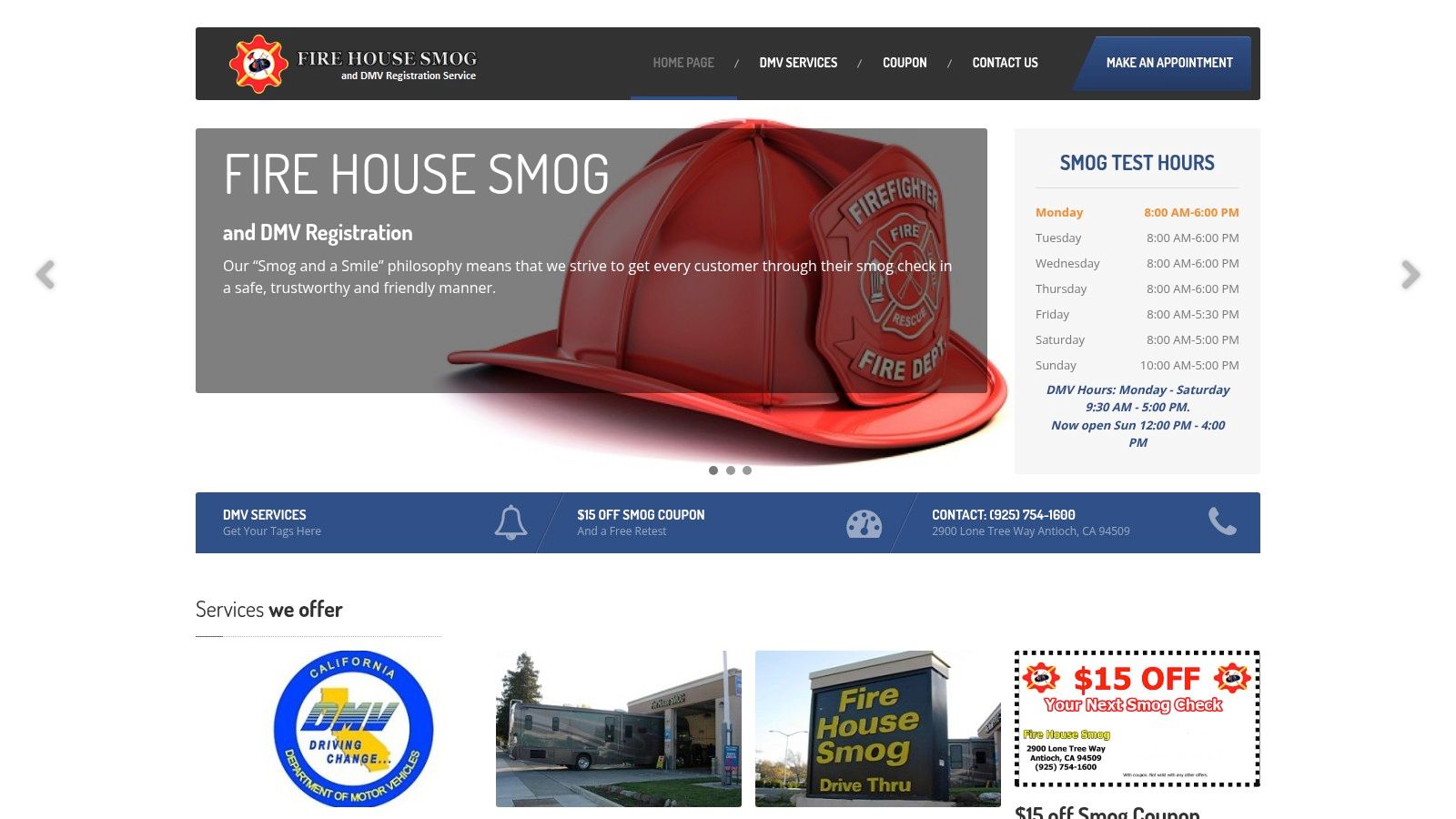
That's where a local station setup matters. Fire House Smog in Antioch is a STAR-certified test-only smog station and a licensed DMV registration services provider located on Lone Tree Way. It handles smog inspections for cars, trucks, and some RVs, subject to size and equipment limits, and it processes California registration renewals, ownership transfers, and related DMV transactions with on-site tag issuance during posted hours.
For truck owners, the practical advantages are straightforward:
- Test-only model: You get the inspection without repair sales pressure.
- Two service bays: That helps move vehicles through more efficiently.
- Seven-day smog availability: Easier for working drivers and small business owners.
- On-site DMV services: Useful when your goal is to finish the compliance step and the registration step together.
- Truck-focused service mix: You can review their local Antioch smog check services before you go.
If you have a light-duty truck that needs a standard inspection, or you're sorting out a renewal and want fewer moving parts, that kind of setup can save a lot of unnecessary back-and-forth. If you have a large RV or a vehicle with unusual fitment, call first and confirm the station can accommodate it.
If your truck needs a smog check and you want to handle the inspection and DMV paperwork with less friction, contact Fire House Smog. They provide STAR-certified test-only inspections, on-site DMV services, and practical help for Antioch and East Contra Costa County drivers trying to get registration done without extra stops.