
You've just opened a California DMV renewal notice and noticed the smog requirement. Maybe your vehicle is a diesel pickup, SUV, van, or motorhome, and you're unsure whether the rules apply to your model, your registration status, or the miles you drive. The questions usually arrive together: What exactly counts as a diesel emission, does every diesel vehicle need the same inspection, and what happens if the vehicle is based outside California?
California's approach can feel complicated because it combines several layers. The state regulates diesel particulate matter, nitrogen oxides, engine hardware, fuel characteristics, and in-use vehicle operation. A light-duty owner generally deals with the familiar California Smog Check process, while a heavy-duty vehicle operating on California public roads may fall under the separate Clean Truck Check program.
The reason for this strict approach is practical. Diesel pollution affects more than the person behind the wheel. Emissions can travel through neighborhoods near freeways, warehouses, ports, border crossings, and other freight routes. California's newer data systems examine those patterns at community level, not only as statewide totals.
This guide starts with the basic science, then connects it to health, CARB standards, out-of-state heavy-duty vehicles, exemptions, failed tests, and the steps an Antioch-area driver can take before visiting a test-only station. You'll also see why a functioning diesel particulate filter, accurate sensors, and complete diagnostic information matter even when the exhaust looks clean.
Table of Contents
- Introduction to California Diesel Emissions and Why They Matter Now
- What California Diesel Emissions Are and How They Form
- Health and Environmental Impacts Across California Communities
- How California Regulates Diesel Through CARB Rules and Standards
- Compliance Requirements for Diesel Vehicles Driving in California
- Testing Exemptions and What Happens If Your Diesel Fails
- Practical Guidance for Staying Compliant With Confidence
Introduction to California Diesel Emissions and Why They Matter Now
A diesel owner usually encounters the rules at an inconvenient but familiar moment. The registration renewal arrives, the DMV asks for a smog certificate, or a buyer wants proof that the vehicle can be transferred. The owner searches for “California diesel emissions” and finds references to CARB, DPFs, OBD systems, and Clean Truck Check, often without a clear explanation of which requirement applies.
The first distinction is the vehicle's role. A light-duty diesel vehicle may need a regular California Smog Check for registration or transfer. A heavy-duty vehicle operating on California public roads can face a separate emissions inspection and reporting obligation, even when it's registered in another state. Those programs serve different purposes, so treating every diesel as if it follows one universal test creates confusion.
Why the state focuses on diesel
California's diesel inventory has historically included more than one million on-road and off-road vehicles, along with stationary and portable engines, according to the California Air Resources Board diesel emissions assessment. The same assessment estimated statewide diesel particulate matter emissions at about 28,000 tons per year, with approximately 27% from on-road engines and 66% from off-road engines.
Those figures explain why the state's strategy reaches beyond passenger cars. Trucks matter, but construction equipment, agricultural machinery, generators, ships, and other diesel sources also contribute to the overall burden.
You don't need to become an emissions engineer to handle your own compliance. You do need to identify the correct program, keep the emissions equipment intact, and allow enough time to address a warning light or failed inspection before a registration deadline. The sections below translate the technical terms into decisions you can use.
What California Diesel Emissions Are and How They Form
A heavy-duty diesel truck can pass your neighborhood with no visible smoke and still release pollutants. The engine compresses air, injects fuel, and uses the resulting heat to ignite it. That combustion produces power, while incomplete burning and high-temperature reactions create emissions.
Two pollutants guide much of California's diesel-control work: diesel particulate matter, or diesel PM, and nitrogen oxides, known as NOx. They form differently and behave differently after leaving the tailpipe, so they require different control strategies. The rules also apply across changing routes. An out-of-state truck operating in California may still need to meet California requirements, even though its home-state program differs.
Diesel PM is more than visible smoke
A fireplace offers a useful comparison. The soot you can see represents only part of what combustion releases. Diesel engines can emit extremely small particles even when the exhaust appears clear. More than 90% of diesel particulate matter is smaller than 1 micrometer, placing it within the PM2.5 fraction, as described in California diesel standards and control information.
Fine particles can remain airborne and travel deep into the respiratory system. A diesel particulate filter, or DPF, captures much of this soot before it exits the tailpipe. During regeneration, the system raises conditions inside the filter so accumulated material burns in a controlled process.
NOx creates a different problem
NOx forms mainly during high-temperature combustion. It can affect air quality near the vehicle and react in the atmosphere to help form ozone and secondary particulate matter. PM is commonly associated with material emitted from the exhaust, while NOx can help create additional pollution after entering the air.
Modern diesel systems may combine exhaust gas recirculation, oxidation catalysts, DPFs, and selective catalytic reduction. SCR uses diesel exhaust fluid to reduce NOx. These components operate as a chain. A damaged hose, clogged filter, faulty temperature sensor, or malfunctioning catalyst can break that chain.
Practical rule: A clean-looking tailpipe does not prove that the complete emissions system is working correctly.
The engine computer monitors sensors and operating conditions. If it detects a fault, it may store a diagnostic trouble code or turn on the malfunction indicator lamp. That electronic record can matter during an OBD inspection, even if the vehicle drives normally.
Neighborhood mapping makes this distinction practical. Statewide emissions describe the broad problem, while 1×1 km community maps can show where traffic and nearby sources overlap. For a vehicle owner, the next step is straightforward: keep emissions equipment intact, respond to warning lights, and confirm the correct inspection requirements at a STAR test-only station.
Health and Environmental Impacts Across California Communities
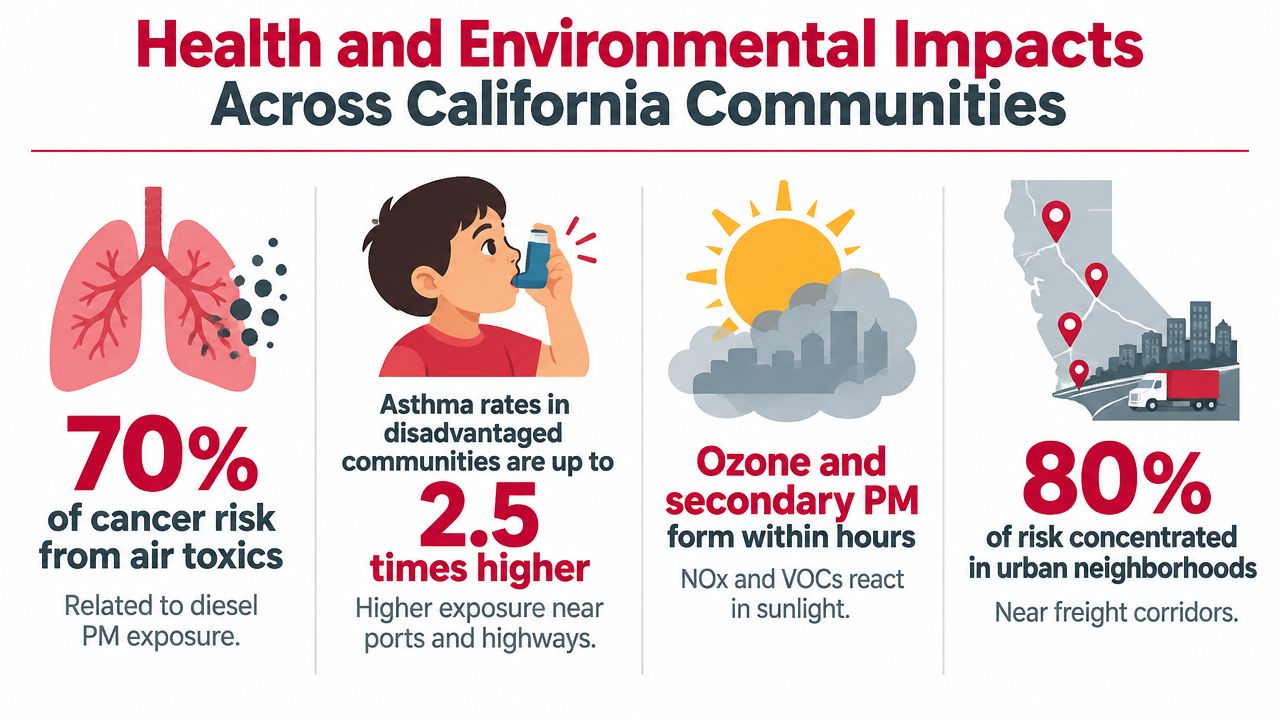
A truck can meet statewide requirements while still affecting neighborhoods differently along its route. People encounter diesel pollution where they live, work, walk, wait near traffic, or spend time beside freight corridors and ports. A statewide average measures overall progress, while local mapping asks the more practical question: where are residents encountering emissions?
Long-term progress has not eliminated risk
A peer-reviewed analysis found that statewide ambient diesel particulate matter concentrations fell 68% between 1990 and 2012, even as diesel vehicle miles traveled increased 81%. The analysis and CARB health summary associated the 2012 ambient concentration of 0.58 µg/m³ with an estimated 520 new cancer cases per million residents exposed, as documented in the peer-reviewed diesel PM analysis.
The lesson is that cleaner engines, improved fuels, and emission-control systems reduced pollution substantially, while residual exposure still deserves attention. Diesel PM remains toxic, and its effects are not distributed evenly across the state.
NOx creates a second pathway. After leaving a vehicle, it can help form ozone and secondary PM, so the impact extends beyond the visible exhaust plume. A route with frequent truck traffic and idling can produce a different exposure pattern from a quiet residential street, even within the same city.
Maps make local exposure easier to understand
California's community-analysis method combines emissions estimates from on-road, area, stationary, and ocean-going vessel sources. OEHHA grids the state at 1×1 kilometer resolution, then converts the information to census tracts for community analysis, as explained in the CalEnviroScreen diesel particulate matter fact sheet.
The inventory also accounts for diesel PM originating on the Mexico side of the border when evaluating San Diego and Imperial counties. Pollution does not stop at a registration system, county line, or state boundary. The same issue appears in interstate compliance: an out-of-state heavy-duty vehicle may follow rules from its home jurisdiction, yet still operate on California roads and affect communities here.
Exposure is local enough that the same vehicle can have very different community effects depending on its route, idling pattern, and proximity to homes, schools, and workplaces.
For drivers, maintenance and compliance are practical parts of reducing that exposure. At a STAR test-only station, ask which inspection applies, keep emissions equipment intact, and address warning lights before testing. One inspection cannot solve a neighborhood-wide problem, but it can help prevent an individual vehicle from adding avoidable pollution.
How California Regulates Diesel Through CARB Rules and Standards
A diesel pickup can pass a visual check yet still create excess pollution during idling or low-load driving. California's system therefore works across several connected layers. One set of rules limits particulate matter, another controls NOx under different engine conditions, and fuel policies address carbon intensity. The framework examines the vehicle, its controls, how it operates, and the fuel it uses.
PM controls target the smallest particles
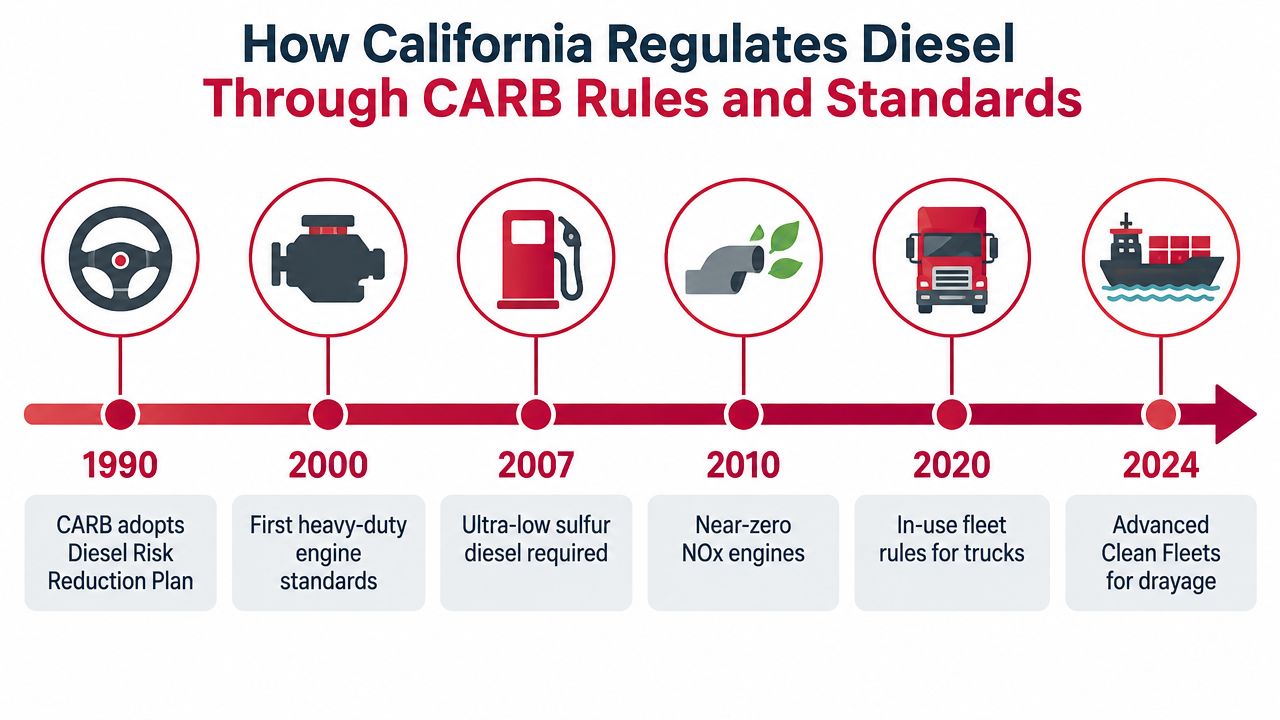
CARB's Diesel Risk Reduction Plan set statewide targets to reduce diesel PM emissions by 75% by 2010 and 85% by 2020. Later control programs moved heavy-duty engines toward PM levels below 0.01 g/bhp-hr, roughly matching the 2007 new-engine PM standard, as described in CARB's heavy-duty diesel risk-reduction materials.
Those limits explain why DPF condition matters. The filter works like a fine screen in the exhaust path, trapping soot before it reaches the air. If it is missing, damaged, modified, or not working correctly, emissions can rise sharply even when the engine still feels powerful. Proper maintenance supports the test result and the neighborhood-level pollution reduction the equipment was designed to provide.
NOx rules cover different operating conditions
CARB's heavy-duty omnibus rule reduced the transient diesel NOx limit from 0.20 to 0.050 g/bhp-hr, a 75% reduction, and lowered the idle NOx limit from 30 g/hr to 10 g/hr. It also established a low-load NOx standard of 0.200 g/bhp-hr for medium- and heavy-duty diesel engines, according to the CARB heavy-duty omnibus initial statement of reasons.
“Transient,” “idle,” and “low-load” describe different engine conditions. A truck may perform cleanly at steady highway speed while producing excess emissions during starting, idling, acceleration, or light-load operation. That distinction matters for vehicles traveling through California from another state, because a home-state rule may not address every condition covered by California requirements.
Fuel policy broadens the picture
California's Low Carbon Fuel Standard, or LCFS, addresses carbon intensity across the transportation fuel system. Amendments taking effect July 1, 2025 set reduction targets of 30% by 2030 and 90% by 2045, according to the official CARB LCFS rulemaking page.
A smog inspection checks vehicle operation and emissions-control readiness. Fuel policy examines the broader lifecycle of transportation fuels. Together, they cover hardware, software, operating conditions, fleet practices, and fuel pathways.
For a plain-language explanation of owner obligations, see California diesel smog laws and requirements. At a STAR test-only station, confirming the correct inspection and addressing warning lights before testing can help connect statewide rules with the condition of one vehicle.
Compliance Requirements for Diesel Vehicles Driving in California
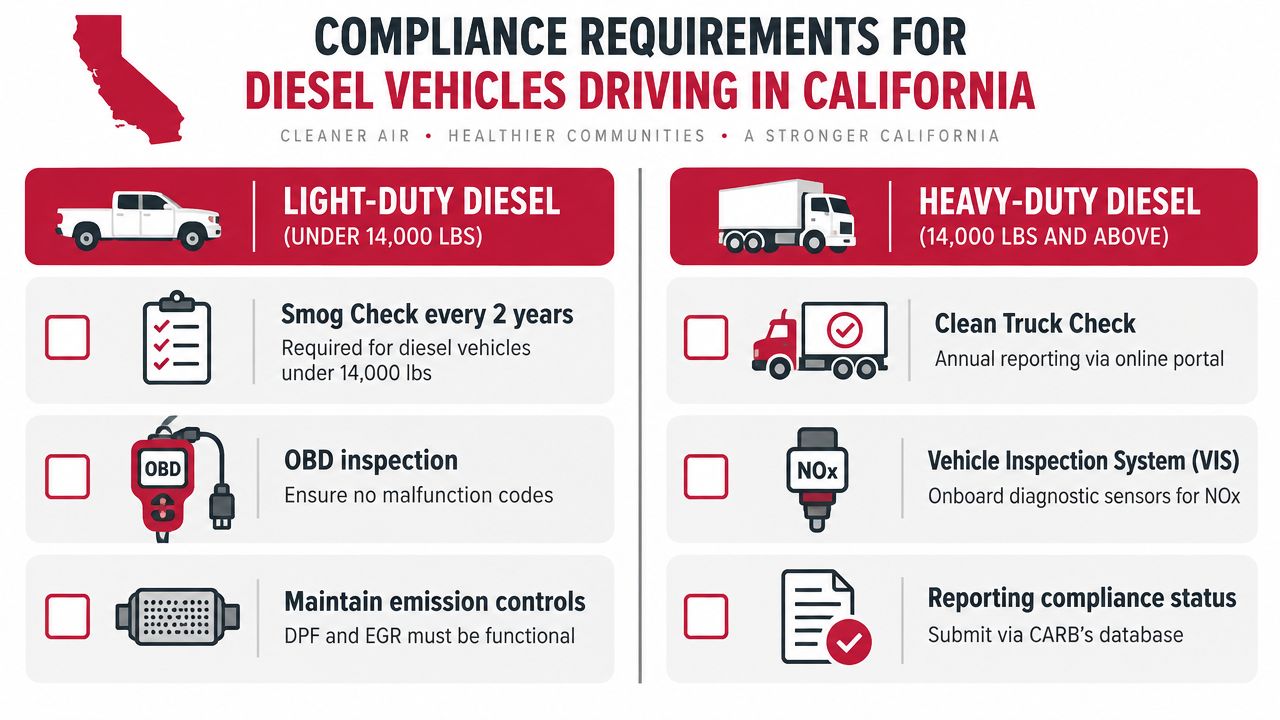
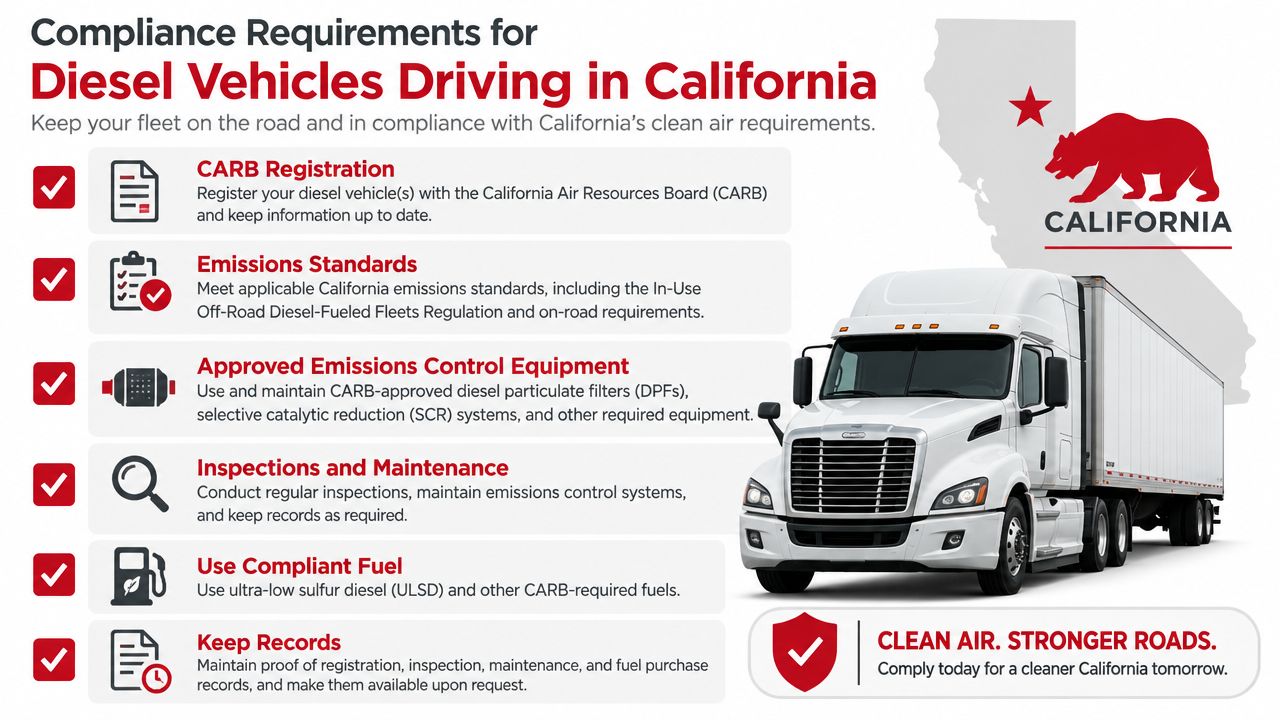
A diesel vehicle's compliance path starts with its use, weight, registration, and equipment, not its fuel type. A light-duty diesel renewing California registration generally follows the regular Smog Check process. A heavy-duty vehicle operating on California public roads may instead fall under Clean Truck Check, including some vehicles registered outside California.
Light-duty diesel vehicles
For a qualifying light-duty diesel vehicle, the inspection may include an OBD check, visual examination of emissions equipment, and an emissions test suited to the vehicle and program requirements. The model year, weight, registration circumstances, and DMV notice determine whether testing is required.
Before scheduling, gather the renewal notice, registration information, and recent repair records. If the malfunction indicator lamp is on, do not erase the codes just before testing. Clearing them can leave readiness monitors incomplete, much like resetting a checklist before all its items have been verified. The vehicle may then be unable to receive a clean result.
A STAR-certified test-only station performs inspections without selling repair work. That separation lets you obtain the test result first and choose a repair provider independently. It can also help connect statewide emissions rules with the condition of one vehicle in the neighborhood where it is driven and tested.
Heavy-duty vehicles and Clean Truck Check
CARB says nearly all diesel and alternative-fuel heavy-duty vehicles over 14,000 pounds operating on California public roads must comply with Clean Truck Check. The requirement includes out-of-state vehicles, motorcoaches, transit vehicles, school buses, and California-registered motorhomes, as stated in the Clean Truck Check FAQ and program information.
Testing began October 1, 2024, and the first compliance deadline was January 1, 2025, according to the same CARB information. Clean Truck Check includes reporting and compliance fees, so passing a regular light-duty smog inspection does not automatically satisfy a heavy-duty obligation. An interstate operator therefore needs to check California's requirements separately rather than relying only on the rules from the vehicle's home state.
| Vehicle situation | Main question |
|---|---|
| California light-duty diesel | Does the DMV require a Smog Check for this renewal or transfer? |
| Out-of-state heavy-duty truck | Does it operate on California public roads and exceed the applicable weight threshold? |
| Diesel motorhome | Is it over the applicable heavy-duty threshold and operating in California? |
| Fleet vehicle | Has the operator completed reporting and the required testing? |
CARB's program schedule calls for OBD-equipped vehicles to move to quarterly testing scheduled to begin in October 2027, as described in the agency's Clean Truck Check information. Fleet managers should track each vehicle separately. One completed inspection does not cover the entire operation.
Testing Exemptions and What Happens If Your Diesel Fails
A failed result doesn't always mean the engine needs major work. It means the vehicle didn't meet one or more inspection conditions, and the result should identify the area that needs attention. The right next step depends on whether the issue is a warning lamp, incomplete monitor, visual defect, or measured emissions problem.
| Outcome or Exemption | Who It Applies To | Required Action |
|---|---|---|
| No Smog Check requested | Owners whose DMV notice or vehicle circumstances don't require a test | Confirm the exemption or non-test status with the DMV before assuming registration is complete |
| Pass | Vehicles that meet the applicable inspection requirements | Submit or retain the certificate as directed by the DMV or program |
| Fail with a warning lamp | Vehicles with an active emissions-related fault | Diagnose the stored code, repair the cause, and complete the required retest |
| Fail with incomplete monitors | Vehicles recently cleared of codes or disconnected from battery power | Drive only as appropriate for monitor completion, then follow station guidance |
| Visual inspection failure | Vehicles with missing, disconnected, or visibly altered emissions equipment | Restore compliant hardware before returning for inspection |
| Heavy-duty compliance issue | Vehicles covered by Clean Truck Check that lack required testing, reporting, or compliant results | Complete the applicable CARB process rather than relying on a light-duty certificate |
The table is a decision aid, not a substitute for the exact notice or CARB classification. Exemptions can depend on vehicle type, weight, fuel, registration, and use. Out-of-state registration alone doesn't remove a covered heavy-duty vehicle from California's operating requirements.
Common failure patterns
A DPF can deteriorate, sensors can report implausible readings, and NOx control hardware can stop working as designed. These problems may increase particulate matter or NOx without producing dramatic smoke. The engine computer may detect them before the driver notices a change in performance.
An incomplete monitor is different from a failed emissions measurement. It often means the computer hasn't completed the self-check needed for certification. If a repair shop clears codes and immediately sends the vehicle to a station, the monitors may not be ready.
Before a retest: Keep the failure report, ask which monitor or component caused the result, and make sure the repair provider confirms readiness before you return.
A test-only facility can provide an independent result, but it won't replace a qualified repair diagnosis. For diesel-specific preparation and inspection guidance, review this diesel smog test guide.
Practical Guidance for Staying Compliant With Confidence
Antioch and East Contra Costa County drivers can make the process easier by treating the smog visit as a scheduled compliance task, not a last-minute DMV emergency. Start with the notice, confirm the vehicle category, and check whether the vehicle has an active warning lamp or recent emissions-system repair.
Use this short preparation list:
- Bring the essentials: Take the DMV notice, current registration information, and any repair or diagnostic paperwork.
- Check the dashboard: Resolve an illuminated emissions warning before testing, and don't clear codes immediately beforehand.
- Protect the equipment: Don't remove, bypass, or disconnect the DPF, EGR, catalyst, SCR, or related sensors.
- Confirm the station fit: Call ahead for larger vehicles, RVs, or motorhomes because bay and equipment limits can vary.
- Plan the timing: Seven-day smog testing and extended weekday and weekend hours can help working drivers avoid a rushed visit.
- Ask about retesting: If the vehicle fails, keep the result and confirm whether a free retest applies under the station's current policy and coupon terms.
A STAR-certified test-only model can reduce concern about being pushed into repairs at the same location because the station doesn't sell repair work. Fire House Smog also provides on-site DMV renewal services with tag issuance at 2900 Lone Tree Way, with DMV service hours Monday through Saturday from 9:30 AM to 5:00 PM and Sunday from 12:00 PM to 4:00 PM. Smog testing is available seven days a week, and customers can call ahead at 925-754-1600.
For additional maintenance habits that support cleaner operation, read this guide on reducing vehicle emissions.
Fire House Smog provides STAR-certified test-only smog inspections for qualifying diesel vehicles, along with California DMV renewal and registration services at its Antioch location. Bring your vehicle to Fire House Smog, or call 925-754-1600 to confirm eligibility, available hours, and retest details before you visit.