
You're renewing a diesel vehicle registration when a notice mentions emissions compliance, and one question immediately comes up: what does California diesel emission cover? For a passenger diesel, the answer may involve a conventional smog inspection. For a work truck, bus, motorhome, or fleet vehicle, it may involve a different program, additional reporting, or equipment requirements.
The phrase covers more than visible smoke from a tailpipe. It includes pollutants such as nitrogen oxides, particulate matter, and carbon dioxide, along with the tests, filters, monitors, engine standards, and fleet rules California uses to control them. The most important distinction today is between light-duty smog checks and the growing compliance system for heavy-duty and off-road diesel equipment.
This guide translates those rules into practical language. You'll learn what diesel engines produce, why California regulates them aggressively, which program may apply to your vehicle, how emissions are measured, and what steps can help you prepare for testing or fleet compliance.
Table of Contents
- What California Diesel Emission Means for Everyday Drivers
- How Diesel Engines Create Emissions You Can Understand
- Why California Regulates Diesel More Strictly Than Other States
- Light Duty Smog Checks Versus Heavy Duty Clean Truck Check
- How Diesel Emissions Are Measured and Reported in California
- What Diesel Owners Can Do to Stay Compliant in California
- Staying Ahead of California Diesel Emission Changes
What California Diesel Emission Means for Everyday Drivers
You are renewing a diesel vehicle's registration when the notice mentions emissions compliance. The first question is usually simple: do you need a smog inspection, or does another California program apply? The answer depends on the vehicle's weight, use, engine, equipment, and operating location, not on the word “diesel” alone.
For a light-duty diesel car, SUV, or pickup, the immediate requirement may be a California smog inspection connected with registration. A work truck, bus, motorhome, or fleet vehicle follows a different regulatory path. California's heavy-duty Truck and Bus Regulation applies to nearly all diesel-powered vehicles over 14,000 pounds gross vehicle weight rating operating in the state, with limited exceptions.
This shift matters for everyday drivers because California's diesel rules increasingly focus on heavy-duty and off-road equipment. A passenger diesel owner may mainly deal with a smog appointment, while a fleet operator may also manage inspections, reporting, equipment condition, and operating restrictions. Both groups may search for California diesel emission, but they do not face the same checklist.
Emissions are only one part of compliance
Diesel combustion produces nitrogen oxides, or NOx, which contribute to smog formation, and particulate matter, or PM, which includes tiny particles associated with diesel soot. Carbon dioxide is another combustion product with climate implications. California addresses these pollutants through engine standards, fuel requirements, aftertreatment systems, inspections, and fleet programs.
A clean-looking tailpipe does not prove that every emissions control is working. A malfunctioning sensor, failed filter, disabled emissions component, or excessive exhaust restriction can create a compliance problem without producing a dramatic cloud of black smoke. The visible exhaust is only the surface, much like checking a dashboard light tells you a system needs attention without identifying the failed part.
Practical rule: Identify your vehicle category first. An emissions notice does not mean every diesel vehicle follows the same inspection or reporting process.
What you should be able to decide
By the end of this guide, you should be able to:
- Classify the vehicle: Determine whether it is a passenger or light-duty diesel, a heavy-duty vehicle, or off-road equipment.
- Identify the program: Tell a regular smog inspection apart from the Clean Truck Check system.
- Understand the hardware: See why diesel particulate filters, backpressure monitors, and onboard diagnostics affect compliance.
- Prepare intelligently: Gather documents, inspect the vehicle, and seek qualified help before a deadline.
- Choose the right next step: Contact a testing station, fleet compliance provider, or qualified diesel technician based on the vehicle's actual use.
That process helps prevent a practical mistake: arriving for the wrong inspection or assuming that smoke-free exhaust guarantees compliance.
How Diesel Engines Create Emissions You Can Understand
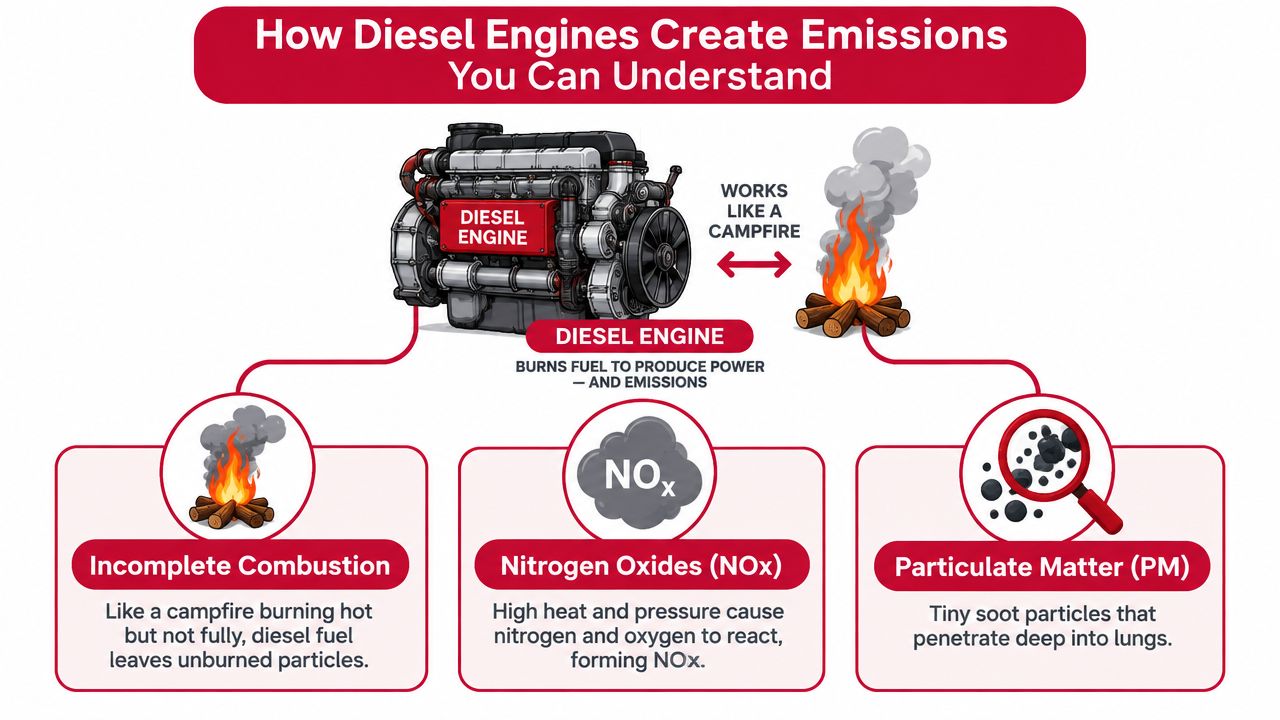
A diesel engine pulls a heavy load up a California grade. Inside the engine, fuel burns under high compression, producing power along with gases and particles that must be controlled before reaching the air. A campfire offers a useful comparison: a hot fire with enough oxygen burns more completely, while uneven fuel pockets leave smoke and residue behind.
Diesel engines are designed for efficiency and pulling power, yet their high-temperature combustion creates pollutants that California regulates closely. The exhaust system uses different components for different pollutants, so one working part cannot solve every emissions problem.
NOx forms in a hot combustion chamber
Nitrogen oxides, or NOx, develop when the intense heat and pressure inside the cylinder cause nitrogen and oxygen to react. NOx usually cannot be seen, but it contributes to the chemical reactions that produce ground-level ozone and smog.
A vehicle can therefore have clear exhaust while producing too much NOx. Depending on the engine and vehicle design, controls may include combustion calibration, exhaust gas recirculation, or selective catalytic reduction. A faulty sensor, catalyst, or related control component can raise NOx emissions without creating a visible black plume.
PM includes visible soot and hidden particles
Particulate matter, or PM, consists of tiny solid and liquid particles suspended in exhaust. Larger soot particles may look like smoke. Smaller particles are difficult to see, which explains why a clean-looking tailpipe does not prove that the emissions system is operating correctly. California focuses heavily on PM because these particles can enter the respiratory system.
A diesel particulate filter, commonly called a DPF, traps soot as exhaust passes through it. The filter must later regenerate, meaning a controlled process burns away the collected material. Repeatedly failed regeneration can restrict the filter and lead to reduced performance or warning lights.
Carbon dioxide has a different role
Carbon dioxide, or CO2, forms whenever carbon-based fuel burns. It differs from NOx and PM, and the control method differs as well. NOx and PM relate closely to local air quality and health concerns, while CO2 reflects the broader climate effect of fuel combustion.
The practical lesson is simple: diesel emission control requires several working systems. A DPF captures soot, but it does not correct every NOx problem. A NOx control system reduces that gas, but it cannot replace a functioning DPF.
Diesel emissions include invisible gases and visible or hidden particles. Compliance depends on controlling both.
Why California Regulates Diesel More Strictly Than Other States
A passenger diesel owner may notice California's rules during registration, while a truck operator may deal with engine model years, inspections, and reporting. That difference reflects how the state built its diesel program over time. The focus has shifted from checking only light-duty vehicles to controlling the heavy-duty and off-road equipment that produces large amounts of diesel pollution.
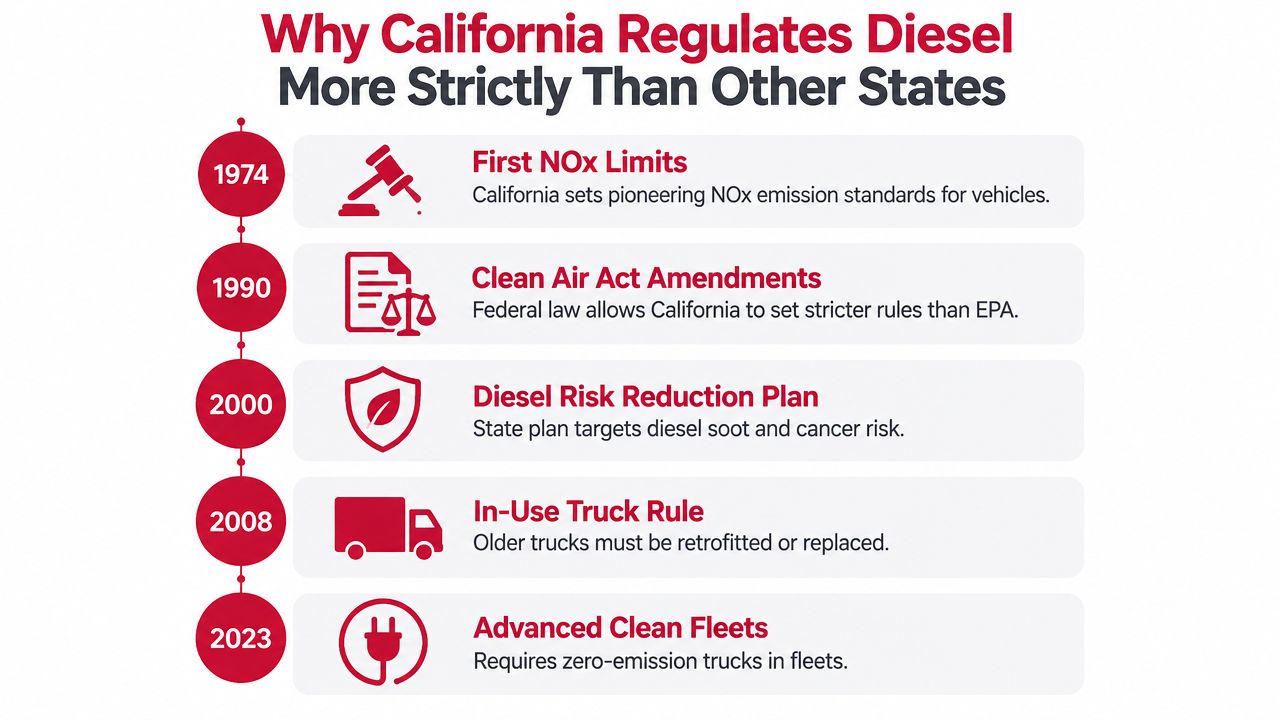
California's Air Resources Board, or CARB, began regulating diesel truck emissions in 1974 with a NOx standard for new vehicles. It tightened those standards through five steps, reaching the current level with 2010 models, according to this California Clean Diesel history.
The state adopted a Diesel Risk Reduction Plan in 2000. Its goals were to reduce diesel PM2.5 emissions by 75% by 2010 and 85% by 2020. Low-sulfur diesel fuel began in 2006 at 15 parts per million, allowing more advanced exhaust-control equipment to operate effectively.
These milestones explain why California diesel emission compliance involves more than a visual inspection. The program combines fuel requirements, new-engine standards, retrofit equipment, and rules for vehicles already working on California roads.
Why heavy-duty vehicles became the focus
CARB identified heavy-duty diesel trucks and buses as the single largest source of statewide NOx, responsible for 30% of statewide NOx emissions. In 2008, the agency estimated that about 941,000 trucks and buses operated in California, producing 859.3 tons per day of NOx and 33.1 tons per day of PM2.5.
Those figures shaped the regulatory strategy. Passenger-car inspections could not address commercial vehicles that travel long distances, carry heavy loads, idle at facilities, and remain in service for years. The same reasoning applies to diesel construction and other off-road equipment, where compliance depends on the engine, control equipment, and operating requirements.
The Truck and Bus Regulation took effect in December 2008. As of January 1, 2023, nearly all diesel-powered vehicles over 14,000 pounds GVWR operating in California must have a 2010-or-newer engine and emission system, with limited exceptions.
For a plain-English overview of standards affecting different vehicle categories, review this guide to diesel emissions standards. The practical starting point is the vehicle's weight rating and use, not the word “diesel.”
Light Duty Smog Checks Versus Heavy Duty Clean Truck Check
A diesel pickup owner may be thinking about registration and a familiar smog check. A fleet manager is usually solving a different problem: whether a heavy-duty vehicle must meet Clean Truck Check, California's inspection and maintenance program for heavy-duty vehicles.
Clean Truck Check covers nearly all diesel and alternative-fuel heavy-duty vehicles over 14,000 pounds GVWR operating on California roads, including trucks registered outside California. CARB identifies the first emissions compliance deadline as January 1, 2025. CARB also indicates that OBD-equipped vehicles are scheduled to move to quarterly testing beginning in October 2027, as described in its Clean Truck Check FAQ.
| Program | Applies To | Test Method | Frequency |
|---|---|---|---|
| Light-duty smog inspection | Qualifying passenger cars, SUVs, and light-duty trucks | California smog inspection procedures based on vehicle equipment and model | Frequency depends on registration and vehicle requirements |
| Clean Truck Check | Nearly all diesel and alternative-fuel vehicles over 14,000 pounds GVWR operating on California roads, including out-of-state trucks | Heavy-duty emissions compliance testing and reporting | Required according to the applicable CARB schedule, with quarterly OBD testing for OBD-equipped vehicles scheduled to begin in October 2027 |
Start with the weight rating, not the engine badge
A personally used diesel pickup may fall under the light-duty smog-check system. A similar-looking vehicle configured for commercial work may receive a different classification. A motorhome or recreational vehicle may also require special handling if its size or equipment exceeds a testing station's setup.
The gross vehicle weight rating provides the clearest starting point. Check the manufacturer's label, registration records, and fleet documentation instead of judging by appearance or the word “diesel.”
For a qualifying passenger diesel that needs a registration-related inspection, this guide to a smog test for diesel vehicles explains what the appointment may involve before you arrive.
Why the burden is shifting
Light-duty smog checks remain familiar to individual drivers. California's expanding compliance workload now centers more heavily on trucks, buses, motorcoaches, some motorhomes, and other heavy-duty vehicles.
That change follows how these vehicles operate. Commercial and industrial equipment can accumulate extensive road or operating time, so owners need an accurate compliance calendar, current vehicle records, and a response plan for failed tests or warning indicators. Waiting for a registration notice can leave an operator unprepared for a separate heavy-duty reporting obligation.
How Diesel Emissions Are Measured and Reported in California
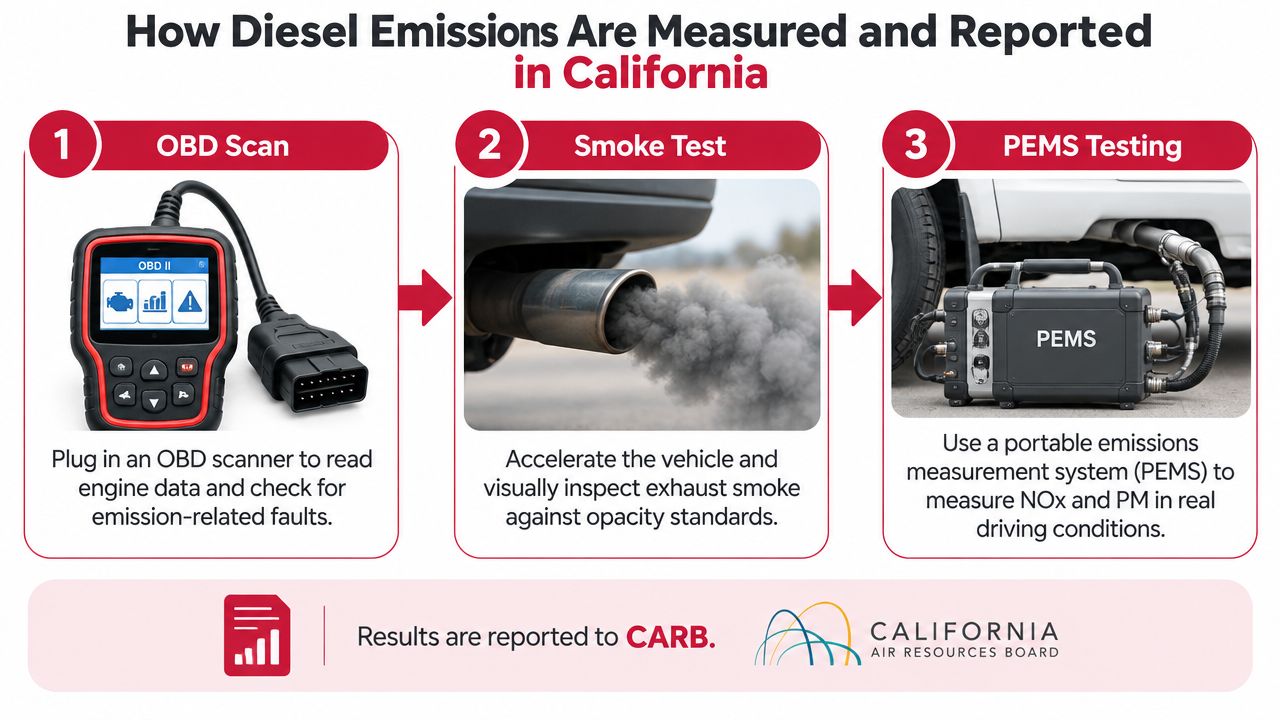
A truck can pass one check and still show a problem in another. California therefore uses several measurement layers. A computer scan may find a stored fault, a smoke or opacity inspection may reveal visible exhaust, and advanced equipment can measure emissions while the vehicle operates on the road or a test cycle.
The process has three practical levels.
First comes the vehicle's own diagnostic data
An onboard diagnostics, or OBD, scan reads information stored by the engine and emissions systems. It can identify sensor faults, aftertreatment trouble, or operating conditions that keep the system from working as designed.
A warning lamp is useful evidence, not a complete verdict. A vehicle without an illuminated lamp may still need readiness checks. Technicians also review whether a recent repair or battery disconnection erased diagnostic information before testing.
Filters require verification and monitoring
CARB requires a verified diesel particulate filter when the device is used for regulatory credit. CARB's installation and maintenance guidance identifies DPFs as the most common technology for reducing diesel particulate matter from heavy-duty engines operating in California.
A filter system also needs a backpressure monitor. It warns the operator before exhaust restriction reaches the specified high-pressure limit. Excessive backpressure can raise engine load, reduce filtration effectiveness, and damage the engine or aftertreatment system.
Real-world testing supports emissions inventories
CARB's EMFAC2025 documentation describes revisions to heavy-duty diesel emission rates based on real-world dynamometer testing, portable emission measurement, and in-use testing data. Its micro-trip method represents actual operating patterns more closely in emissions modeling, as described in the EMFAC2025 technical documentation.
For off-road and heavy-duty equipment, compliance increasingly examines NOx and PM together, rather than soot capture alone. CARB verification materials identify Level 3 diesel technologies that can target at least an 85% particulate matter reduction, while proposed off-road standards address both NOx and PM.
Here's a plain-language visual explanation of the testing flow:
A passing result depends on the complete system: engine, calibration, filter, sensors, and aftertreatment. Changing one component without checking the full setup may leave the original compliance problem in place.
What Diesel Owners Can Do to Stay Compliant in California
A passenger diesel owner may be preparing for a registration smog inspection, while a truck operator is managing a fleet emissions obligation. Those are different lanes of the same road. Start by confirming the vehicle's classification, GVWR, registration status, engine information, operating routes, and any Clean Truck Check responsibilities.
Use the notice as your first checklist:
- Read it carefully: Determine whether it requests a smog certificate, registration action, or heavy-duty compliance response.
- Check warning indicators: Repair check-engine, aftertreatment, DPF, or emissions-system warnings before testing.
- Bring supporting records: Have registration information, vehicle identification details, and recent emissions-system repair documents available.
- Keep the equipment intact: Do not remove, bypass, or substitute emissions components unless the replacement is approved for that vehicle and application.
- Confirm the test site fits: Large trucks, motorhomes, and specialized equipment may not fit every light-duty testing bay.
If a light-duty diesel fails
A failed inspection identifies a condition to diagnose, not a shopping list of parts to replace. Ask the station to explain the failure category, then get a diagnostic opinion from a qualified technician. The practical question is, “What condition caused the failure, and how will this repair correct it?”
Confirm the retest rules before returning. Some stations offer a free retest under their site policy and coupon terms, but eligibility depends on the circumstances and the station's conditions.
If you manage heavy-duty equipment
Fleet compliance works best when every vehicle has its own record. Track the GVWR, engine model year, emissions-control equipment, inspection status, fault history, and upcoming deadlines. A shared spreadsheet or fleet platform is enough if one person owns the task and updates it after each inspection or repair.
For drivers in Antioch and East Contra Costa County, Fire House Smog is a STAR-certified test-only station at 2900 Lone Tree Way in Antioch. It performs smog inspections for qualifying cars, trucks, and some recreational vehicles, along with California DMV renewal services and on-site tag printing. Testing is available seven days a week, and the station has two bays. Call 925-754-1600 before bringing a larger vehicle or motorhome to confirm that it fits the equipment limits. This Clean Air Truck resource explains related heavy-duty considerations.
Staying Ahead of California Diesel Emission Changes
A diesel pickup owner may focus on registration, while a trucking company tracks inspections across an entire fleet. Both face California diesel rules, but the compliance path depends first on vehicle classification. The state is placing growing attention on NOx and PM, especially from heavy-duty fleets and off-road equipment.
Off-road diesel is expected to remain a major source of mobile emissions in California. That direction explains why future compliance planning reaches beyond on-road truck inspections and passenger-vehicle smog checks. CARB has discussed proposed Tier 5 off-road standards in a 2026 workshop, aimed at reducing NOx and particulate matter from new compression-ignition engines sold in California.
Use this verification checklist
- Confirm classification: Check the vehicle's GVWR and identify whether it is light-duty, heavy-duty, or off-road equipment.
- Identify the program: Determine whether the vehicle needs a registration smog inspection, Clean Truck Check activity, or another CARB requirement.
- Track deadlines: Put applicable dates on a fleet calendar rather than relying only on a renewal reminder.
- Protect the emissions system: Maintain the DPF, sensors, backpressure monitor, and related aftertreatment equipment.
- Keep records: Save inspection results, repair invoices, equipment details, and compliance communications.
- Verify changes: Review current CARB guidance before buying parts, installing software, or changing an emissions-control strategy.
A fleet calendar works like a service map. It shows which vehicle needs attention, what documentation is missing, and when the next obligation arrives. For a passenger diesel owner, the same habit can be simpler: confirm the applicable smog-check rules, keep repair records, and verify requirements before a registration renewal.
CARB's SB 1 report identifies a useful-life limitation that reduced modeled emissions reductions from adopted and planned heavy-duty regulations by a cumulative 82,276 tons of NOx and 890 tons of diesel PM from 2024 through 2045 statewide, as documented in the EMFAC2025 technical materials. The point is practical. A rule may become stricter while regulators still assess whether its expected reductions occur during real vehicle use.
Long-term compliance depends on the full emissions system, accurate records, and the program governing the vehicle. Passing one inspection helps, but readiness between inspections prevents avoidable problems.
If you need a qualifying diesel smog inspection or California DMV renewal support in Antioch, visit Fire House Smog. The STAR-certified test-only station offers emissions testing, selected recreational-vehicle inspections, and on-site registration renewal services, so call 925-754-1600 to confirm your vehicle's requirements before arriving.